Article

Holocene Organic Carbon Source−Sink Dynamics in the North Yellow Sea: Influences of East Asian Summer Monsoon and Sea-Level Change


1
Haikou Marine Geological Survey, China Geological Survey, Haikou 571127, China
2
Observation and Research Station of South Yellow Sea Earth Multi-Sphere, Ministry of Natural Resources, Yantai 264000, China
3
College of Earth Science and Engineering, Shandong University of Science and Technology, Qingdao 266590, China
4
Yantai Coastal Geological Survey, China Geological Survey, Yantai 264000, China
*
Authors to whom correspondence should be addressed.
Sustainability 2026, 18(13), 6482; https://doi.org/10.3390/su18136482 (registering DOI)
Submission received: 16 April 2026 / Revised: 6 June 2026 / Accepted: 22 June 2026 / Published: 25 June 2026
(This article belongs to the Special Issue Sustainable Management of Blue Carbon Ecosystems)

Abstract

The Holocene evolution of organic carbon (OC) sources in the North Yellow Sea remains poorly constrained. In this study, a sedimentary dataset from core WHD01 retrieved from the Shandong Peninsula Mud Wedge is presented. After correcting grain-size, diagenetic and provenance biases in geochemical proxies and removing diagenetic offsets of sedimentary δ13C signals, the MixSIAR Bayesian mixing model was used to quantify three OC endmembers. The results reveal three distinct evolutionary stages of OC composition: pre-10 cal ka B.P. dominated by terrestrial C3 OC; 10–4.2 cal ka B.P. dominated by marine OC during rapid sea-level rise; post-4.2 cal ka B.P. marine-derived OC remained dominant while C3 terrestrial and estuarine OM increased alongside enhanced OC burial, driven by anthropogenic catchment erosion and improved organic preservation. Temporal shifts in OC source apportionment and burial flux are tightly coupled to East Asian Summer Monsoon variability and sea-level change, with conspicuous OM compositional reorganizations coinciding with the 8.2 ka and 4.2 ka climatic cold events.

1. Introduction

Carbon cycling is a core biogeochemical process regulating atmospheric CO2 levels, global climatic stability, and marine ecosystem functioning. As a critical link connecting atmosphere–ocean–land–biosphere material and energy exchange, it sustains Earth’s habitability [1,2]. Marginal seas represent a key nexus of land–sea interactions and major transport conduits for terrigenous materials to the open ocean. Although continental shelves occupy only ~20% of the global ocean area, they receive over 90% of global fluvial sediment and sequester more than 80% of sedimentary organic carbon (OC), constituting Earth’s most efficient and largest sedimentary carbon sinks with enormous carbon storage potential [3,4]. Shelf sedimentary organic matter (OM) comprises both allochthonous terrigenous/estuarine inputs and autochthonous marine phytoplankton production. Such dual land–sea sourcing leads to complex OM composition and dynamic cycling, making shelf systems critical for understanding and predicting global carbon cycle feedbacks [5,6].
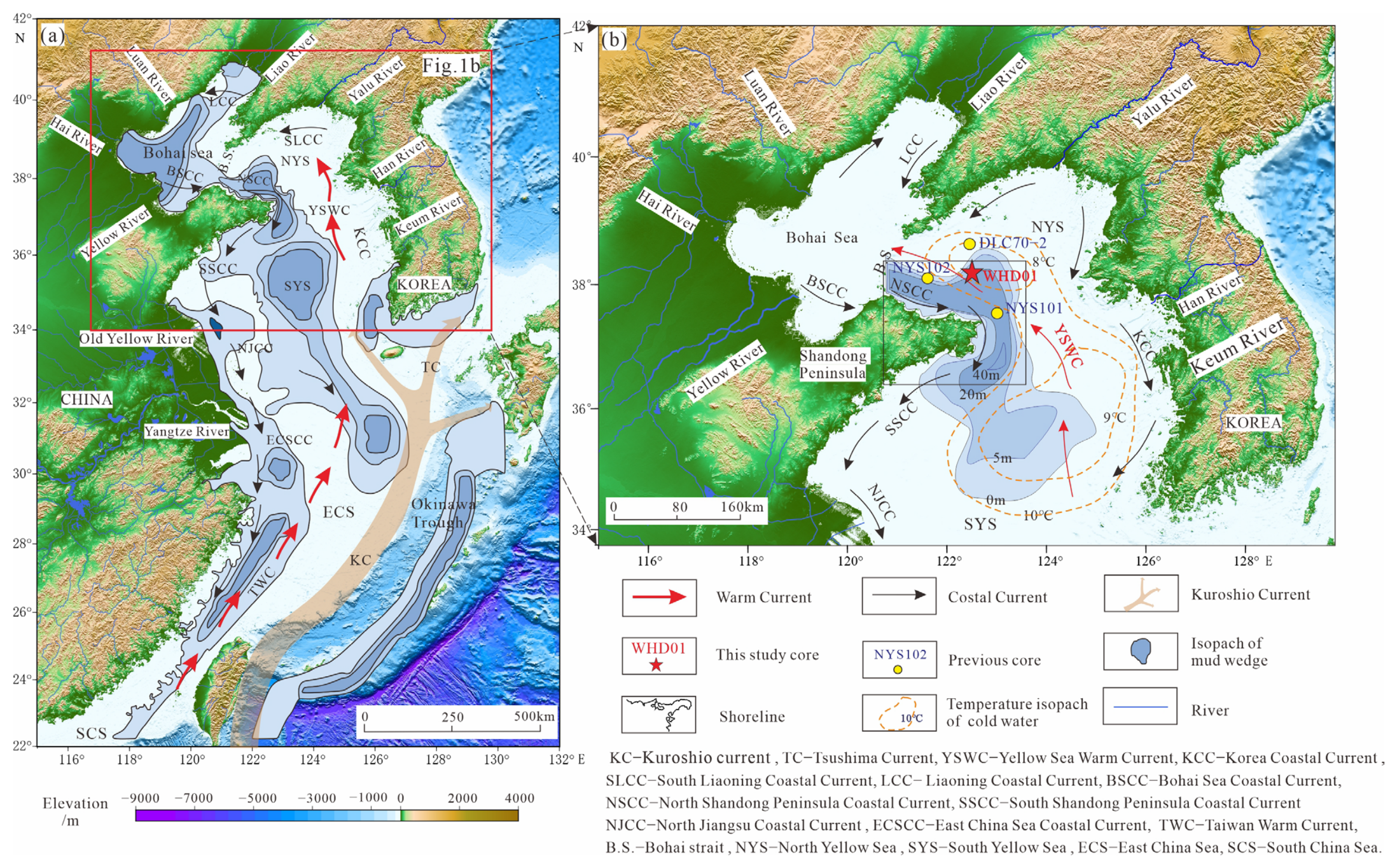
Notably, OC burial on East China continental shelves is predominantly concentrated in muddy depositional zones, which therefore serve as ideal archives for investigating shelf carbon sink processes. The East China marginal shelves were largely shaped by Holocene sea-level fluctuations and modulated by the East Asian Monsoon (EAM). Supplied primarily by massive fluvial inputs from the Yellow Rivers (YR), Yangtze River, and their major drainage system, these shelves contain a series of patchy muddy depositional belts governed by sea-level fluctuation, warm current and coastal current dynamics [7]. Seven typical muddy zones have been identified in the eastern China marginal seas: the Bohai Central Mud, Shandong Peninsula Mud Wedge (SPMW), Eastern Yellow Sea Mud, Southern Yellow Sea (SYS) Central Mud, East China Sea Inner Shelf Mud, Southwest Jeju Island Mud, and Beibu Gulf Mud [8,9,10,11] (Figure 1a). As a typical muddy deposit on the eastern China shelf, the SPMW lies at the convergence of YR inputs, coastal currents, and the Yellow Sea Warm Current (YSWC) [12,13,14]. It preserves continuous high-resolution Holocene sediments and records clear signals of terrestrial, estuarine, and marine OC inputs. Investigating OC evolution in the SPMW is crucial for revealing land–sea interaction processes, distinguishing the coupled impacts of the EAM and sea-level change, and understanding the formation mechanism of shelf sedimentary carbon sinks.
Previous investigations have primarily focused on SPMW, reconstructing Holocene OC burial processes and identifying potential controls such as sea-level change, the East Asian Winter Monsoon (EAWM), ENSO variability, and modern aquaculture impacts [18,19,20,21]. However, current studies remain limited by uneven spatial coverage concentrated in the SPMW [7,13], biased OC source estimates caused by inconsistent endmember (EM) values [14,19], unquantified early diagenetic effects on carbon isotopes, and poorly constrained coupling mechanisms between monsoon evolution and sea-level change [22,23]. As such, critical knowledge gaps remain regarding the quantitative evolution of terrigenous, estuarine, and marine OC EMs across the Holocene and the associated driving mechanisms of OC source–sink dynamics within the SPMW. To address these scientific questions, this study targets the WHD01 sediment core from the SPMW, with three main objectives: (1) to reconstruct Holocene OC source evolution by applying δ13C–δ15N isotopes and MixSIAR Bayesian mixing model for quantitative EM apportionment; (2) to infer changes in catchment weathering intensity, terrigenous input flux, and marine productivity using Rb/Sr, Sr/Ca, Ti/Al geochemical proxies; (3) to establish the linkage between East Asian Summer Monsoon (EASM) evolution, sea-level changes, and OC burial dynamics, and clarify the coupled controlling mechanisms governing Holocene OC source−sink processes in the SPMW.

2. Geological Setting

The northern Yellow Sea (NYS) is a semi-enclosed shallow shelf sea bounded by the Liaodong Peninsula to the north, the Korean Peninsula to the east, the Bohai Sea to the northwest via the Bohai Strait, the Shandong Peninsula to the west, and the SYS to the south by the Sulu Orogenic Belt-Qianliyan Uplift. As a typical low-relief dustpan-shaped depression in the western Pacific margin [24,25,26,27,28,29,30,31,32], it has an average water depth of ~38 m and a maximum depth of ~80 m [33]. The NYS receives abundant terrigenous materials from the YR, Yalu River, and rivers around the Shandong and Korean Peninsulas. Meanwhile, the YSWC can transport Yangtze River-derived sediments northward, forming a complex multi-source sedimentary system.
The regional circulation is dominated by the YSWC and shelf coastal currents. The YSWC, a branch of the Kuroshio current (KC), intrudes northwestward into the SYS and further propagates into the NYS along the Yellow Sea Trough, with pronounced seasonal variation (strong in winter and weak in summer) [12,34,35] (Figure 1a). The Shandong Coastal Current (SCC) flows eastward along the northern Shandong coast and turns southwestward, eventually converging with the YSWC to form a cyclonic circulation pattern that dominates sediment transport and redistribution [24] (Figure 1b).
The Core WHD01 is strategically located in the SPMW (Figure 1b). This site is uniquely positioned to differentiate terrestrial input from the YR, estuarine phytoplankton signals, and marine autochthonous OC. It lies within the main deposition convergence zone controlled by both riverine supply and YSWC-SCC dynamic circulation, with relatively stable sedimentary conditions. Therefore, the WHD01 sequence can provide an ideal archive for reconstructing evolutionary changes in sedimentary environments and OC sources.

3. Materials and Methods

Sediment core WHD01 (37.963187° N, 122.715566° E) was acquired by the Yantai Coastal Geological Survey, China Geological Survey (YCGS, CGS) aboard the research vessel Geology 17 during 2024–2025 (Figure 1b). The core was drilled at a water depth of 49.5 m, with a total length of 210 m, representing the longest sediment core ever retrieved in the NYS to date. For the present study, we focused on the core depth interval of 0–14 m (corresponding to elevation 49.5–64 m), which constitutes the Holocene sedimentary sequence.
Upon recovery, the core was split longitudinally, visually described, and subsampled at 2 cm intervals for geochemical analyses. All subsamples were stored at 4 °C to preserve OM integrity. Differentiated subsampling intervals were adopted for specific analytical targets, considering research funding constraints and variations in experimental testing costs: grain size measurements at 8–12 cm intervals, total organic carbon (TOC), total nitrogen (TN) and their isotope analyses at 10–15 cm intervals, and major/trace element analyses at 50–60 cm intervals. For chronological framework establishment, benthic foraminifera and plant detritus were hand-picked from selected sediment layers for accelerator mass spectrometry (AMS) 14C dating.

3.1. AMS14C Dating

AMS 14C dating was performed at Beta Analytic Inc. (Miami, FL, USA). Prior to dating, benthic foraminifera and plant detritus samples underwent rigorous preprocessing: sediment samples were ultrasonically cleaned with methanol to remove contaminants, dried at 50 °C, and reacted with concentrated phosphoric acid at 70 °C for 20 min to release CO2. The CO2 was purified and collected in a vacuum line, then graphitized using the Zn-TiH2-Fe method at 500 °C for 3 h, followed by 550 °C for 4 h.
AMS 14C measurements were conducted using a compact 200 kV MICADAS (MIni CArbon DAting System) accelerator mass spectrometer (Ionplus AG, Zurich, Switzerland), operating in cycle mode with a single cycle duration of ~3 min. Measurements were terminated when the net 14C count reached 160,000 (statistical precision: 2.5‰). The long-term 14C/12C measurement precision of the instrument is better than 3‰, with a background Fm value of 0.0004 (corresponding to ~63,764 a). For 14C dating of samples from the NYS, a regional marine reservoir correction (ΔR = −139 ± 59 a) [36] was adopted, with this regional average value derived from published Yellow Sea and Bohai Sea datasets [12,19]. All 14C ages were calibrated to calendar ages (cal. a B.P., referenced to 1950 CE) via CALIB 7.0.2 [37] using the updated MARINE 20 calibration curve, and corresponding 1σ uncertainties were calculated simultaneously.

3.2. Grain Size Analysis

Grain size analysis was conducted at the YCGS. Raw sediment samples underwent a rigorous preprocessing procedure prior to analysis: (1) a homogenized subsample of known weight was taken; (2) a 6% hydrogen peroxide (H2O2) solution was added to remove OM; (3) a 0.2 N hydrochloric acid (HCl) solution was used to dissolve carbonate cements and biogenic shells; (4) the sample was repeatedly rinsed with deionized water until the rinse solution reached neutral pH; (5) a 0.5 N sodium hexametaphosphate (Na6P6O18) solution was added, and the sample was soaked for 24 h to achieve complete dispersion.
Grain size was measured using a Mastersizer 2000 laser particle size analyzer (Malvern Panalytical, Worcestershire, UK). The instrument covers a measurement range of 0.5–2000 µm, with a relative error of repeated measurements less than 1%. Grain size parameters, including mean grain size (Mz), sorting, skewness, kurtosis, were calculated according to the method of Folk and Ward [38].

3.3. Geochemical Analyses

Major and trace element analyses were carried out at the YCGS using an Axios X-ray fluorescence (XRF) spectrometer (PANalytical, Almelo, The Netherlands). Prior to analysis, samples were subjected to drying and pelletizing processes. The acid digestion procedure was performed as follows: (1) 4 mL nitric acid (HNO3) and 1 mL perchloric acid (HClO4) mixed acid were added to the sample; (2) subsequently, 4 mL hydrofluoric acid (HF) and 1 mL perchloric acid (HClO4) mixed acid were added; (3) finally, 10 mL nitric acid (HNO3) was supplemented to complete the digestion.
These elemental ratios (Rb/Sr, Sr/Ca, Ti/Al) serve as reliable indicators of catchment chemical weathering, terrestrial input, and marine influence, which are consistent with the results of OC isotopes and EM apportionments. The Rb/Sr ratio reflects catchment chemical weathering intensity: during silicate weathering, Sr2+ is leached and mobilized, while Rb+ is retained in clay minerals. Thus, elevated Rb/Sr ratios indicate intensified chemical weathering and can further record variations in paleoclimate and fluvial runoff [39]. The Sr/Ca ratio serves as an indicator of marine productivity: since phytoplankton preferentially utilize Ca over Sr, lower Sr/Ca values correspond to higher biological activity [40]. The Ti/Al ratio represents terrigenous clastic input: higher values indicate enhanced terrestrial flux, whereas lower values suggest reduced terrestrial supply and a greater contribution from marine authigenic and chemical components [41].

3.4. TOC, TN, δ13C, and δ15N Analyses

Analyses of TOC, TN contents, and stable carbon (δ13C) and nitrogen (δ15N) isotopes were conducted at the Yantai Institute of Coastal Zone Research, Chinese Academy of Sciences (YICZR, CAS). Prior to analysis, sediment samples were freeze-dried using a Genesis G35EL pilot-scale vacuum freeze dryer (SP Scientific VirTis, Gardiner, NY, USA), then ground to a 100-mesh sieve. The mass of an empty centrifuge tube was first recorded as m1. Approximately 1–2 g of the sieved freeze-dried sample was transferred into a centrifuge tube, and the combined mass of the sample and centrifuge tube was recorded as m2. To remove inorganic carbon, 6 mol/L HCl was added dropwise to the tube while gently shaking to ensure sufficient reaction between the acid and carbonate minerals. The tube was then left to stand for 1–2 days to complete the reaction, followed by centrifugation to separate the solid sample from the supernatant. After removal of inorganic carbon, the residue was rinsed with ultra-pure water via centrifugation and supernatant discard, repeated 1–2 times to eliminate residual acid. The treated samples were then dried either by freeze-drying for 24 h or in an oven at a temperature of <60 °C. The combined mass of the acid-treated sample and centrifuge tube was recorded as m3. The OC content measured directly by the instrument was denoted as C2, and the OC content (C1) of the original sediment sample was calculated using the following Formula (1):
C1 = C2 × (m3 − m1)/(m2 − m1)
subsequently, the pretreated samples were subjected to TOC and TN content analysis using a TOC-VCPH analyzer (Shimadzu Corporation, Kyoto, Japan), which was coupled with a MAT 253 gas stable isotope ratio mass spectrometer (Thermo Fisher Scientific, Waltham, MA, USA) for the determination of δ13C and δ15N. The analytical precision, determined by duplicate analyses of samples, was ±0.02‰ for δ13C and δ15N, and ±0.01% for TOC and TN, respectively, calibrated against international standards (Pee Dee Belemnite for carbon, atmospheric nitrogen for nitrogen).

3.5. OC Source Apportionment Using the MixSIAR Model

To quantitatively assess the relative contributions of different OM EM to sedimentary OC, the Bayesian isotope mixing model MixSIAR (v3.1.12) was employed. MixSIAR is an open-source R package (v4.5.3) designed for multi-source quantitative apportionment using isotope tracers, which provides results in the form of probability distributions and quantifies uncertainty—addressing the limitations of traditional linear mixing models.

3.5.1. Model Principle

A core assumption of the model is that the stable isotope composition (δS) of sedimentary OC is a mixture of multiple OM sources, following the linear mixing equation:
δ S = f 1 δ 1 + γ 1 + f 2 δ 2 + γ 2 + + f i ( δ i + γ i )
where f i is the relative contribution of the i-th OM EM to sedimentary OC (with f i = 1 ), δi is the characteristic isotope value of the i-th EM, and γ i is the corresponding fractionation factor.
Based on Bayesian theorem, the probability of a specific contribution fq is calculated as:
P f q x = L x f q · p ( f q ) L x f q · p ( f q )
where x is the measured isotope value (δ13C or δ15N) of sedimentary OC, fq is the contribution of the q -th OM source, L(xfq) is the likelihood function of x given fq, p (fq) is the prior probability distribution of fq, and ∑L(xfqp(fq) represents the marginal likelihood of x.

3.5.2. Diagenetic Fractionation Correction of δ13C

Diagenetic fractionation parameters were calculated using the least-altered layer as the baseline, representing the least-modified depositional environment. The fractionation strength Δ(‰) was defined as the difference between the mean δ13C of each stratigraphic unit and the baseline values:
Δδ13C = δ13Cunit − δ13Cbaseline
where Δδ13C is the diagenetic fractionation strength (deviation from baseline, ‰); δ13C(unit) is the mean δ13C value of a given stratigraphic unit; δ13C(baseline) is the mean δ13C value of the unaltered baseline layer. The fractionation coefficient α was calculated as:
α = (1 + δ13Cbaseline/1000)/(1 + δ13Cunit/1000)
where α is the diagenetic fractionation coefficient (isotopic exchange coefficient). The weighted contribution of each unit was obtained by multiplying Δδ13C by the number of samples, and the fractionation contribution rate was expressed as a percentage of the total weighted contribution.
These parameters were used to correct the δ13C values prior to MixSIAR modeling, removing diagenetic biases to ensure accurate OM source apportionment.

3.5.3. Model Setup and Validation

The δ13C and δ15N values of sediment samples and identified OM EMs were imported into the MixSIAR model for OM source apportionment. To avoid artificial constraints and unstable partitioning caused by overlapping isotopic signatures, uninformative Dirichlet priors (α = 1) were adopted instead of fixed zero priors, which may cause unrealistic unbounded solutions.
The model was configured with three Markov chains and run with a very long MCMC simulation: Chain Length = 1,000,000; Burn-in = 500,000; Thin = 500. Isotopic uncertainties of EMs and samples were fully incorporated into the model simulation to account for analytical errors and natural variability in source signatures. Model convergence was validated via z-score diagnostic (within ±2) [42] and Gelman-Rubin potential scale reduction factor (PSRF < 1), with effective sample size (ESS > 1000) [43], confirming stable and reliable outputs [44]. The mean of the posterior distribution was taken as the final relative contribution of each OM EM.

3.6. Calculation of OC Burial Flux

The water content (W) and dry bulk density ( ρ d ) of sediment samples were calculated using Equations (6) and (7):
W = ( m w / m d ) 1
Ρ d = ρ w ρ s W ρ s + ρ w
where mw is the mass of wet sediment, md is the mass of dried sediment, ρs= 2.65 g/cm3 is the sediment grain density, and ρw = 1.03 g/cm3 is the density of seawater.
The OC burial flux ( B f l u x ) was then determined according to Gao et al., [7]:
B f l u x = T O C sediment × ρ × ν
where B f l u x is the OC burial flux (g/cm2/a), TOCsediment is the sedimentary TOC content (%), ρ is the dry bulk density (g/cm3), and ν is the sedimentation rate (cm/a).

4. Results

4.1. Chronostratigraphy and Sedimentary Sequence

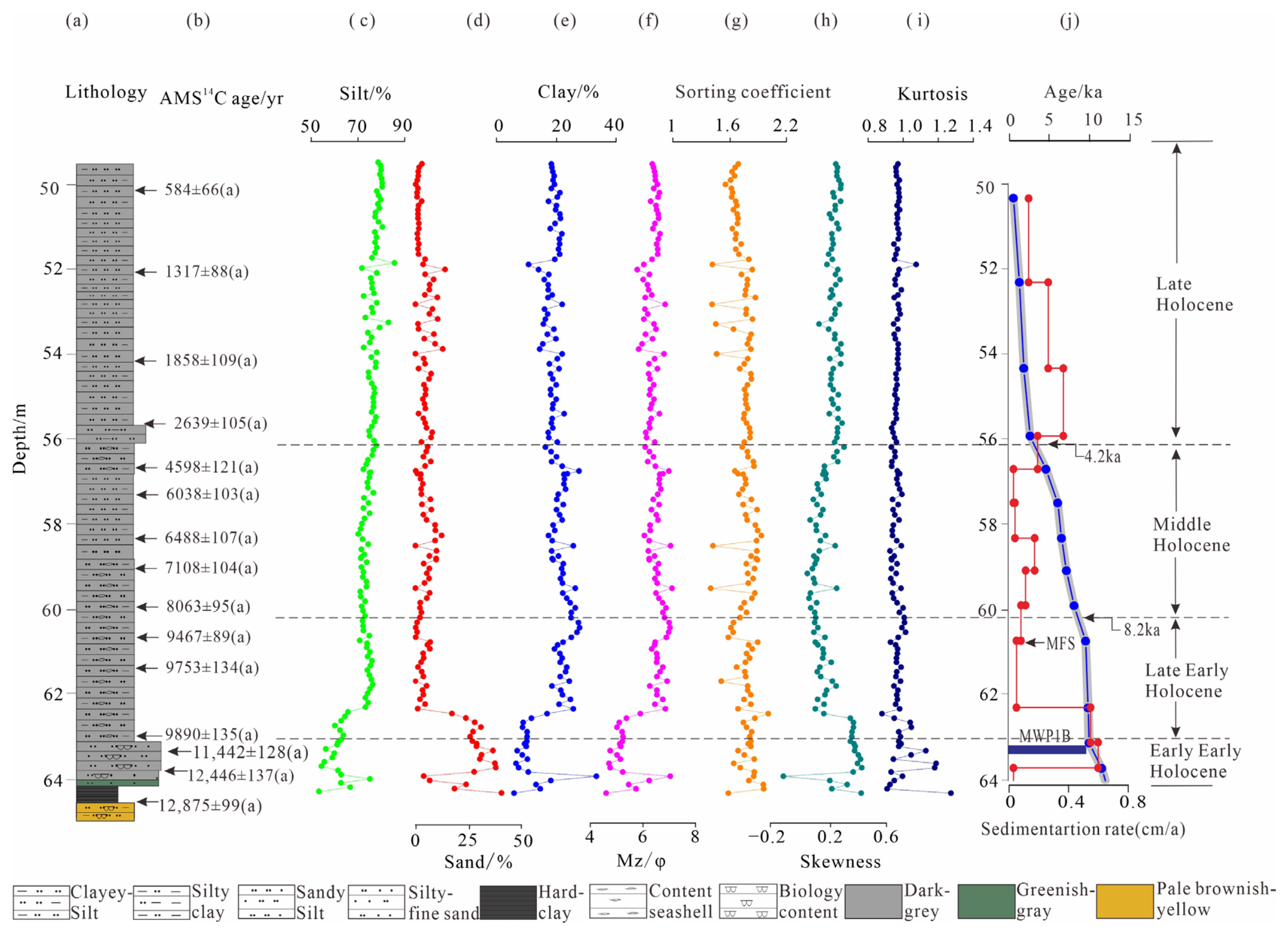
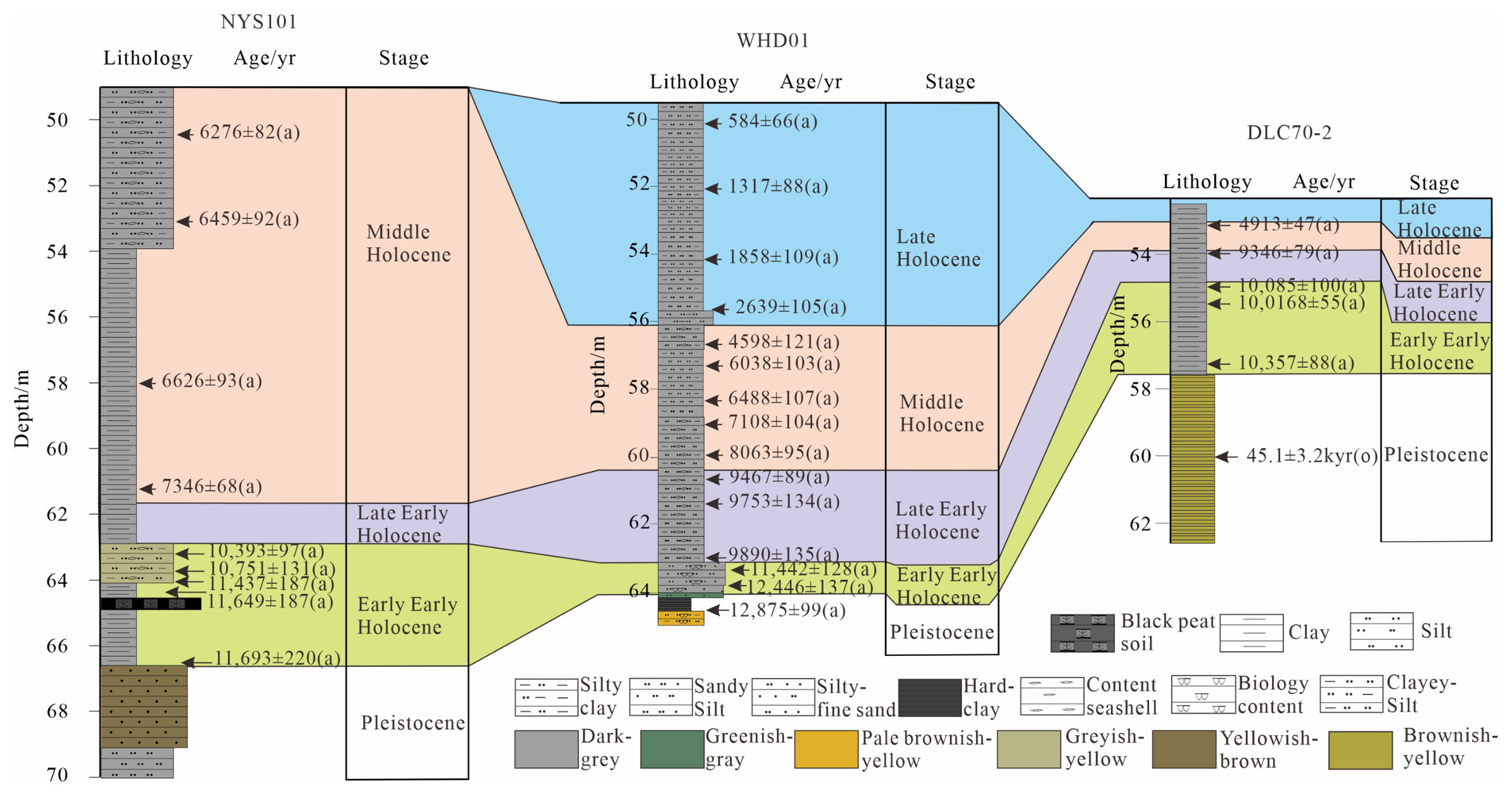
Based on AMS 14C dating results of core WHD01 (Table 1), a robust Holocene chronostratigraphic framework was established via piecewise linear age–depth interpolation between adjacent calibrated radiocarbon anchor points (Figure 2). According to this chronological calibration, the Holocene sedimentary succession is divided into three principal depositional stages, including the Early Holocene (12–8.2 ka cal B.P.), Middle Holocene (8.2–2.8 ka cal B.P.) and Late Holocene (2.8 ka cal B.P.—present). The Early Holocene interval can be further split into two sub-stages with a chronological boundary at 10 ka. A higher sedimentation rate prevailed during the Early Holocene, followed by an obvious decrease to relatively low values in the Middle Holocene. Sedimentation rates began to rise in the early Late Holocene and subsequently experienced a gradual decline in the Late Holocene. The depositional evolution of the core WHD01 reveals a continuous Holocene sequence that is broadly consistent with adjacent cores (NYS101 [12,15] and DLC70-2 [17,45]), reflecting regionally coherent changes in sediment supply, hydrodynamics, and relative sea level.
(1)
Early Early Holocene
WHD01 (64.27–63.1 m, 12–10 ka cal B.P.), the lowermost interval of this core consists of yellowish-green to grayish-green clay and bioturbated silty clay, with extremely high sand and silt contents, poor sorting, and sedimentation rate peaking at ~60 cm/a (Figure 2). These features are indicative of a fluvial-dominated continental–estuarine setting prior to Meltwater Pulse (MWP)-1B, marked by rapid terrigenous infilling and weak marine influence, representing a freshwater terrigenous phase before the main Holocene transgression. The NYS101 core (66.6–62.9 m) records a coeval fluvial-dominated interval with similarly high sand–silt contents and elevated sedimentation rate, while DLC70-2 (57.6–54.5 m) only begins continuous Holocene deposition at ~11 ka, indicating that this high-energy terrigenous phase was most strongly expressed in the proximal WHD01 and NYS101 locations (Figure 3).
(2)
Late Early Holocene
WHD01 (63.1–60 m, 10–8.2 ka cal B.P.) is dominated by dark gray silt and silty clay with abundant shell debris, stable silt content (~75%), improved sorting, and sharply reduced sedimentation rate (Figure 2). This transition reflects the establishment of a tide-dominated estuarine-bay environment following the early Holocene transgression. NYS101 records a similar lithologic transition at ~62.9 m, accompanied by a decline in sedimentation rates, and DLC70-2’s late Early Holocene deposits are dominated by silty clay and shell debris (Figure 3), consistent with regional expansion of the estuarine system.
(3)
Middle Holocene
WHD01 (60–56 m, 10–4.2 ka cal B.P.) consists of homogeneous dark gray silt, locally intercalated with thin beds of silty fine sand, well-developed bioturbation, stable shell debris, stable grain-size distributions, slightly decreased sorting coefficients, near-zero skewness (weakly positive), and stable kurtosis (~0.95), with steady sedimentation rates (10–20 cm/a) (Figure 2). These features reflect a fully marine inner shelf setting under highstand conditions. NYS101 (61.6–49 m) contains a comparable interval, where the lower section consists of ~8 m of gray clay overlain by ~5 m of clayey silt. DLC70-2 (53.8–53 m) records continuous Middle Holocene deposition with similar lithology and bioturbation (Figure 3), confirming regionally uniform tidal dynamics and sediment supply.
(4)
Late Holocene
WHD01 (56–50 m, 4.2 ka cal B.P. to present) is dominated by clayey silt, with reduced sand fractions, further improved sorting, and stable skewness and kurtosis. Sedimentation rates, which were high in the early stage (37 cm/a), gradually declined and stabilized at 15 cm/a (Figure 2). These features are indicative of a modern inner shelf environment under diminished fluvial influence. A correlative Late Holocene record is absent in NYS101, while DLC70-2 preserves a limited Late Holocene succession (53–52.4 m), consisting of clayey silt-dominated deposits under stable highstand conditions (Figure 3).

4.2. Geochemical Elements Results

4.2.1. Multi-Factor Correction of Geochemical Proxies

Sedimentary geochemical proxies are inherently susceptible to three major confounding factors: grain-size sorting, sediment provenance shifts, and post-depositional diagenesis. Grain-size fractionation can alter elemental ratios via mechanical mineral partitioning; provenance heterogeneity may shift baseline elemental compositions; and late diagenesis coupled with redox processes tends to induce element remobilization and recombination, thereby obscuring primary palaeoenvironmental signals. Without prior identification and elimination of these biases, the interpretations of Rb/Sr, Sr/Ca, and Ti/Al in terms of palaeoweathering, marine palaeoproductivity and terrigenous input would remain ambiguous and non-unique.
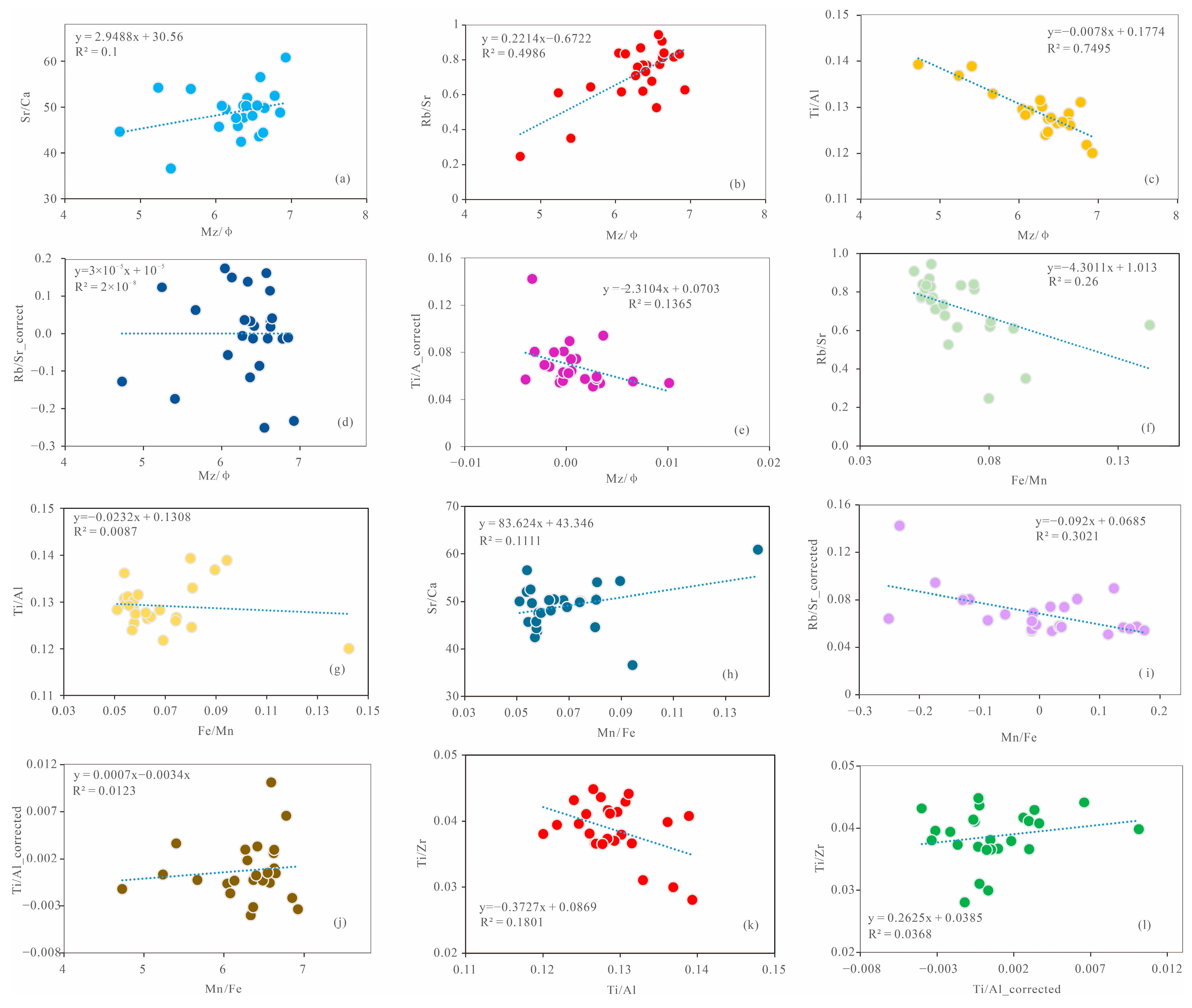
To constrain the potential influences of grain size, diagenesis and provenance on geochemical proxies, systematic correlation analyses were performed for Rb/Sr, Sr/Ca and Ti/Al (Figure 4). Correlation with Mz shows that Sr/Ca is barely affected by particle size (R2 = 0.10, Figure 4a), whereas Rb/Sr (R2 = 0.4986, Figure 4b) and Ti/Al (R2 = 0.7495, Figure 4c) exhibit moderate and strong grain-size dependence, respectively. Accordingly, these two proxies were corrected using the regression residual method. After correction, the correlation between the Rb/Sr_corrected and Mz was almost completely eliminated (R2 ≈ 0.00000002, Figure 4d), while that of the Ti/Al_corrected was reduced to an extremely low level (R2 = 0.1365, Figure 4e), demonstrating a robust grain-size correction effect.
Prior to grain-size correction, the original Rb/Sr, Ti/Al and Sr/Ca all exhibited weak correlations with the redox-sensitive Fe/Mn ratio (R2 = 0.26, R2 = 0.0087, and R2 = 0.1111, respectively, Figure 4f–h), indicating inherently minimal diagenetic overprinting. Notably, the original Ti/Al also showed a weak correlation with the provenance-sensitive Ti/Zr ratio (R2 = 0.1801, Figure 4k), reflecting stable sediment provenance independent of grain-size effects. After grain-size correction, the correlations between geochemical proxies and diagenetic/provenance indicators remained consistently weak (i.e., no significant enhancement or qualitative change): both Rb/Sr_corrected and Ti/Al_corrected still displayed negligible or weak correlations with Mn/Fe (R2 = 0.3021, R2 = 0.0123, respectively, Figure 4i,j), while the Ti/Al_corrected showed an even weaker correlation with Ti/Zr (R2 = 0.0368, Figure 4l). These results collectively confirm that grain-size correction only eliminates grain-size-induced biases without altering the inherent signals of diagenetic stability and provenance consistency.
Overall, Rb/Sr_corrected and Ti/Al_corrected, together with the original Sr/Ca, have effectively mitigated interferences from grain size, diagenesis and provenance. These proxies can thus be reliably applied to reconstruct palaeoweathering intensity, terrigenous sediment supply, and marine palaeoproductivity.

4.2.2. Spatiotemporal Variations of Geochemical Proxies

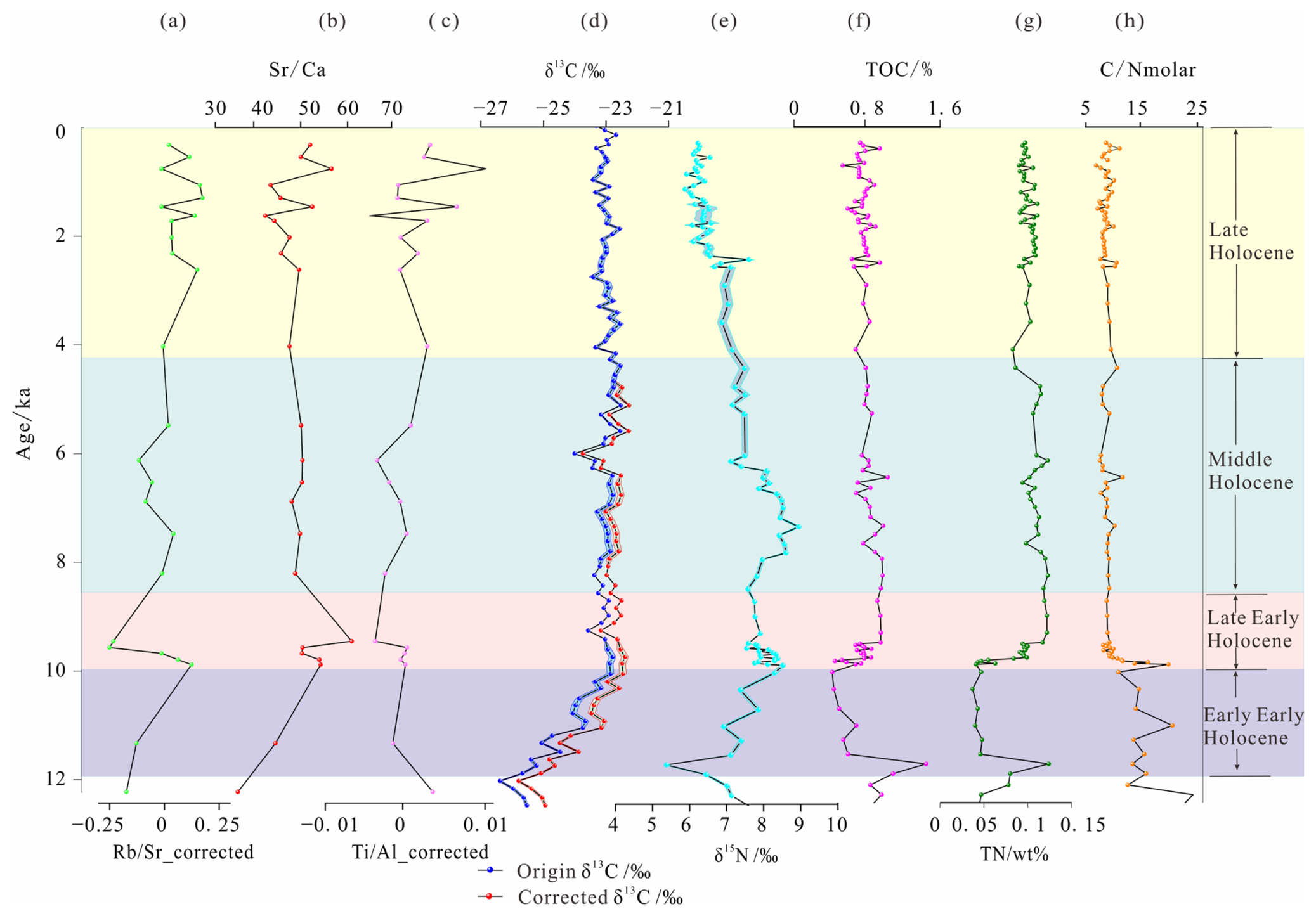
During the early Early Holocene, the Rb/Sr_corrected ratio increased from −0.174 to −0.128 (Figure 5a). Sr/Ca values rose continuously from 36.64 to 44.64 (Figure 5b), while the Ti/Al_corrected ratio declined from 0.0037 to −0.0012 (Figure 5c).
In the late Early Holocene, the Rb/Sr_corrected ratio displays a fall-rise-pattern, evolving from 0.123 to −0.251 and subsequently to −0.011 (Figure 5a). The Sr/Ca ratio follows a three-step shift: decreasing from 54.25 to 50.3, peaking at 60.88, then falling to 48.85 (Figure 5b). Ti/Al_corrected remains nearly invariant at first, undergoes modest depletion, and finally rebounds, ranging from 0.0003 via −0.0002 to 0.0005 (Figure 5c).
Through the Middle Holocene, the Rb/Sr_corrected ratio hovers consistently near 0.02, punctuated by a distinct minimum of ~−0.057 at 6–7 ka cal B.P. (Figure 5a). The Sr/Ca ratio drops rapidly from 60 to 48.85 before settling around a baseline of ~50 for the remainder of the interval (Figure 5b). The Ti/Al_corrected ratio features a well-defined rise-fall-rise three-stage trend, varying sequentially from −0.0033 to 0.0005, −0.0031 and 0.003 (Figure 5c).
For the Late Holocene, the Rb/Sr_corrected ratio oscillates within a narrow envelope of −0.02 and 0.02 (Figure 5a). The Sr/Ca ratio remains stable at first and shifts to large-amplitude fluctuations between 42 and 55 after 2.1 cal ka B.P. (Figure 5b). The Ti/Al_corrected ratio is constrained between 0.129 and 0.13 prior to 2.6 ka cal B.P., before switching to pronounced variability spanning −0.0006 to 0.0033 in the later period (Figure 5c).

4.3. OC Results

4.3.1. Diagenetic Fractionation of δ13C

Significant depth-dependent δ13C and δ15N fractionation was observed in the core WHD01, with clear Holocene gradients (Table 2 and Figure 5). Downcore, δ13C becomes progressively more negative, whereas δ15N becomes more positive (Figure 5d,e). These trends are consistent with prolonged microbial degradation and anoxic early diagenesis. Preferential microbial utilization of 12C and 14N enriches residual OM in 13C and 15N, leading to higher δ15N. The pronounced downcore depletion in δ13C, most evident in the early Early Holocene, is likely amplified by enhanced contribution from reworked, 13C-depleted aged terrestrial OC.
Diagenetic fractionation was quantified relative to a least-altered Late Holocene baseline (δ13C = −23.041‰, δ15N = 6.457‰). The late Holocene unit exhibits negligible fractionation (Δδ13C = 0‰, Δδ15N = 0‰), supporting its use as a primary EM. The middle Holocene and late Early Holocene show weak to moderate fractionation, reflecting moderate microbial activity under fluctuating redox conditions. The early Early Holocene exhibits the strongest diagenetic modification (Δδ13C = −1.746‰, Δδ15N = +1.022‰), corresponding to a “strong” alteration grade and 100% fractionation contribution.
All stratigraphic δ13C values were systematically corrected (Figure 5d) following Equations (4) and (5) based on calculated Δδ13C and fractionation coefficients (α). This correction removes diagenetic overprinting and recovers near-primary isotopic compositions, supporting robust OM apportionment.

4.3.2. TOC, TN, δ13C, and δ15N Variation

The δ13C_corrected values of core WHD01 range from −25.8 ± 0.059‰ to −22.26 ± 0.029‰ (mean = −23.11 ± 0.02‰). Values increased from −25.8 ± 0.059‰ to −22.59 ± 0.109‰ between 12–10 cal ka B.P., and stabilized near ~−22.5‰ after 10 cal ka B.P (Figure 5d). The δ15N values vary from 5.37 ± 0.05‰ to 8.49 ± 0.058‰ (mean = 7.16 ± 0.02‰), remaining relatively high and stable (~8.33‰) between 8.78–12 cal ka B.P., showing a decreasing trend (8.32 to 6.23‰) from 8.78 cal ka B.P. to the present (Figure 5e).
TOC contents range from 0.45 ± 0.098 wt% to 1.45 ± 0.057 wt% (mean = 0.79 ± 0.01 wt%), with low values (0.47–0.70 wt%) during the early Early Holocene, and stabilizing near 0.8 wt% after 10 cal ka B.P. (Figure 5f). TN contents range from 0.003 ± 0.00005 wt% to 0.124 ± 0.002 wt% (mean = 0.79 ± 0.01 wt%), generally low (0.01–0.05 wt%) before 10 cal ka B.P., stabilizing at 0.1 wt% only between 10–8.4 cal ka B.P., and slightly decreasing from 0.12 to 0.09 wt% after 8.4 cal ka B.P. (Figure 5g). C/N molar ratios fluctuated markedly (6.97–24.45) during the early Early Holocene, and subsequently stabilized with a mean value of ~8.96 (Figure 5h).

5. Discussion

5.1. Sources of OC

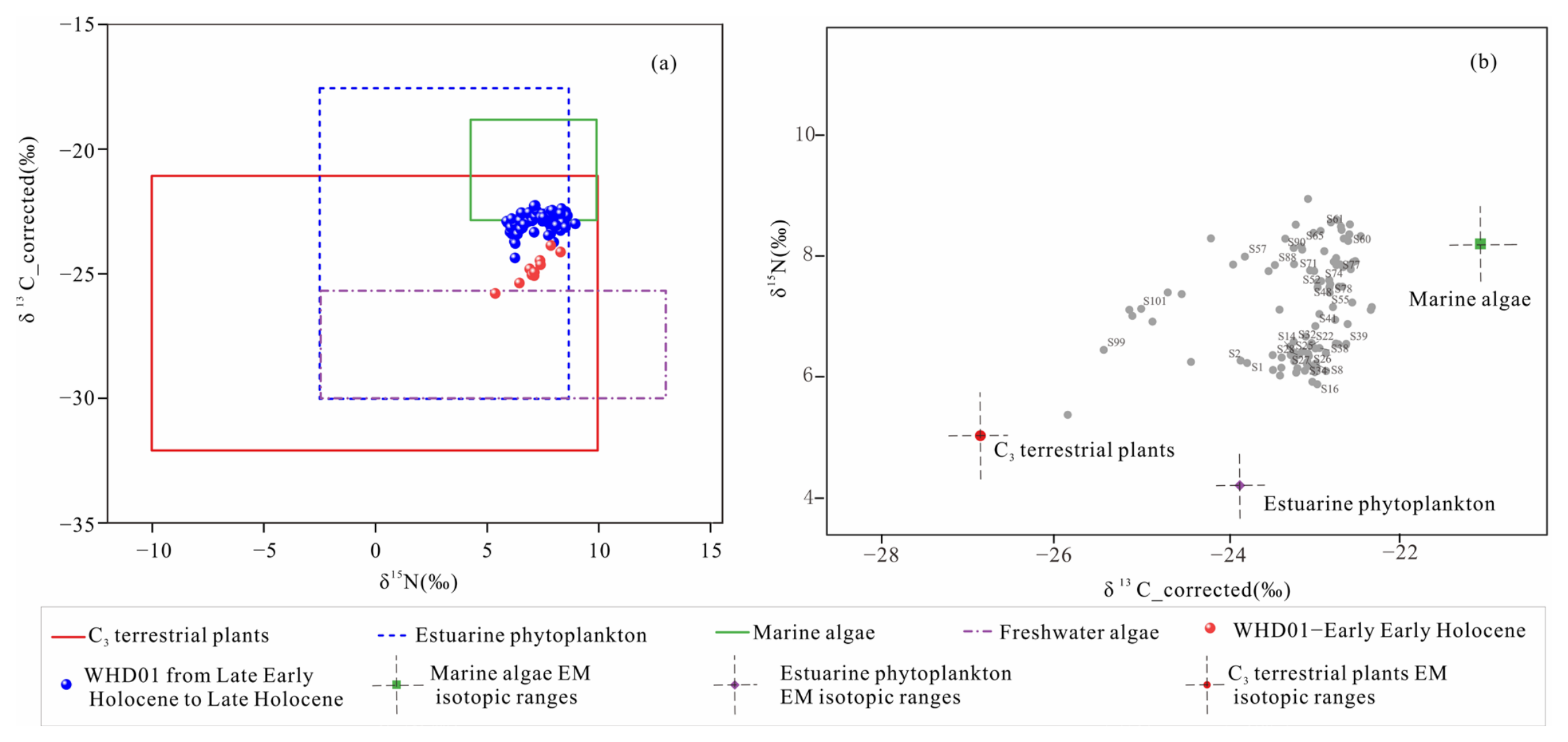
Qualitative source apportionment of Holocene sedimentary OC in core WHD01 was performed using dual δ13C_corrected–δ15N isotope EM tracing (Figure 6a), displaying typical multi-source mixing patterns that reflect variable terrigenous–marine contributions under changing land–sea interaction regimes through time.
During the early Early Holocene, sediment δ13C_ corrected values were significantly negative (−25.8 ± 0.059‰ to −23.878 ± 0.055‰), while δ15N increased from 5.37 ± 0.05‰ to 8.52 ± 0.079‰ (Figure 5d,e). Synchronously, TOC remains relatively low (0.47–0.70 wt%), TN shows persistently low concentrations (0.01–0.05 wt%), and C/N molar ratios fluctuate intensely across a wide range of 6.97–24.45 (Figure 5f–h). Isotopic data plot mainly between C3 terrestrial plants and estuarine phytoplankton (Figure 6a), indicating that OC was dominated by terrestrial C3 plants under low sea-level, fluvial-dominated conditions.
From the late Early Holocene to the Late Holocene, sediment δ13C_corrected values shifted to higher values (~−24‰ to ~−22‰), whereas δ15N stabilized then decreased to ~6‰ (Figure 5d,e). Accompanying this isotopic transition, TOC rises and stabilizes around a mean of ∼0.80 wt%; TN rises distinctly to peak near 0.10–0.12 wt% in the late Early–Middle Holocene and gently falls to ~0.09 wt% toward the Late Holocene; meanwhile, C/N molar values settle down to a steady average of ∼8.96 with greatly subdued fluctuation (Figure 5f–h). Data clustered primarily between the marine algae and estuarine phytoplankton EMs (Figure 6a), indicating that OC sources became dominated by aquatic autochthonous production from marine algae and estuarine phytoplankton, with weak terrigenous inputs. This corresponds to stable highstand conditions and a fully marine-influenced coastal environment.
Overall, the spatiotemporal variations in δ13C_corrected–δ15N isotopic compositions qualitatively reveal a continuous Holocene evolution of OC sources at WHD01 (Figure 6a): from terrestrial-dominated inputs during the Early Holocene, when fluvial systems prevailed under lowstand conditions, to aquatic-dominated sources in the Late Holocene, when marine phytoplankton and estuarine production became dominant under stable highstand conditions.
Terrestrial OM in sediments of the NYS domain is predominantly supplied by the YR, and surface vegetation in North China is overwhelmingly dominated by C3 plants. Based on this observation and previous studies, isotopic parameters for each EM were defined as follows: C3 terrestrial plants: δ13C = −27‰ to −26‰ (mean = −26.5‰, SD = 0.5‰), δ15N = 2‰ to 6‰ (mean = 4‰, SD = 2‰) [46]; Estuarine phytoplankton: δ13C = −24.5‰ to −23.5‰ (mean = −24‰, SD = 0.5‰) [47,48], δ15N = 4‰ to 8‰ (mean = 5‰, SD = 2‰) [49,50]; Marine algae: δ13C = −22‰ to −20‰ (mean = −21‰, SD = 1.0‰) [51], δ15N = 6‰ to 12‰ (mean = 9‰, SD = 3.0‰) [52]. The EM parameters used in the MixSIAR model are illustrated in Figure 6b.
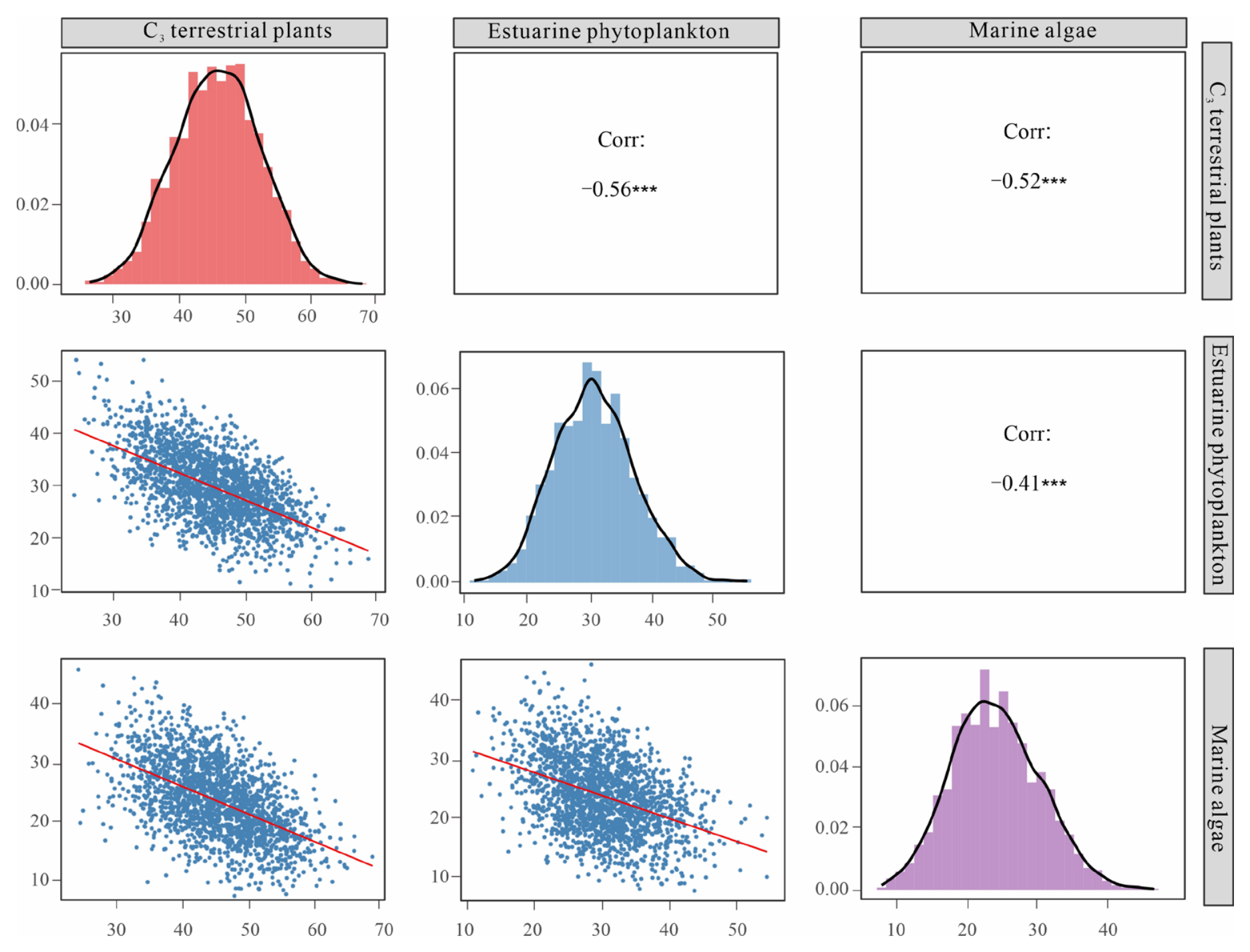
Based on the MixSIAR EM analysis (Figure 7), marine algae dominate bulk sedimentary OC with a mean contribution of 55.60% (95% CI: 52.92–58.25%, SD = 1.36%). C3 terrestrial plants and estuarine phytoplankton contribute nearly equally: mean proportions reach 22.10% (95% CI: 19.62–24.68%, SD = 1.29%) and 22.30% (95% CI: 19.41–25.26%, SD = 1.49%), respectively.
Correlation analysis shows a highly significant negative interdependence among the three OC sources. C3 terrestrial plant input correlates negatively with estuarine phytoplankton (r = −0.56, p < 0.001) and marine algae (r = −0.52, p < 0.001). Such inverse covariation implies that enhanced terrigenous supply elevates water turbidity, restricts light penetration, and suppresses aquatic primary production via a dilution-inhibition effect. Meanwhile, estuarine phytoplankton and marine algae display a moderate significant negative correlation (r = −0.41, p < 0.001), reflecting competitive alternation between brackish-estuarine and fully marine producers and highlighting frequent salinity fluctuation across the study marginal marine environment.
These pairwise correlations support the interpretation that shifts in OC sources are driven primarily by changes in relative sea level, salinity regime, and terrigenous sediment supply, rather than independent productivity trends.
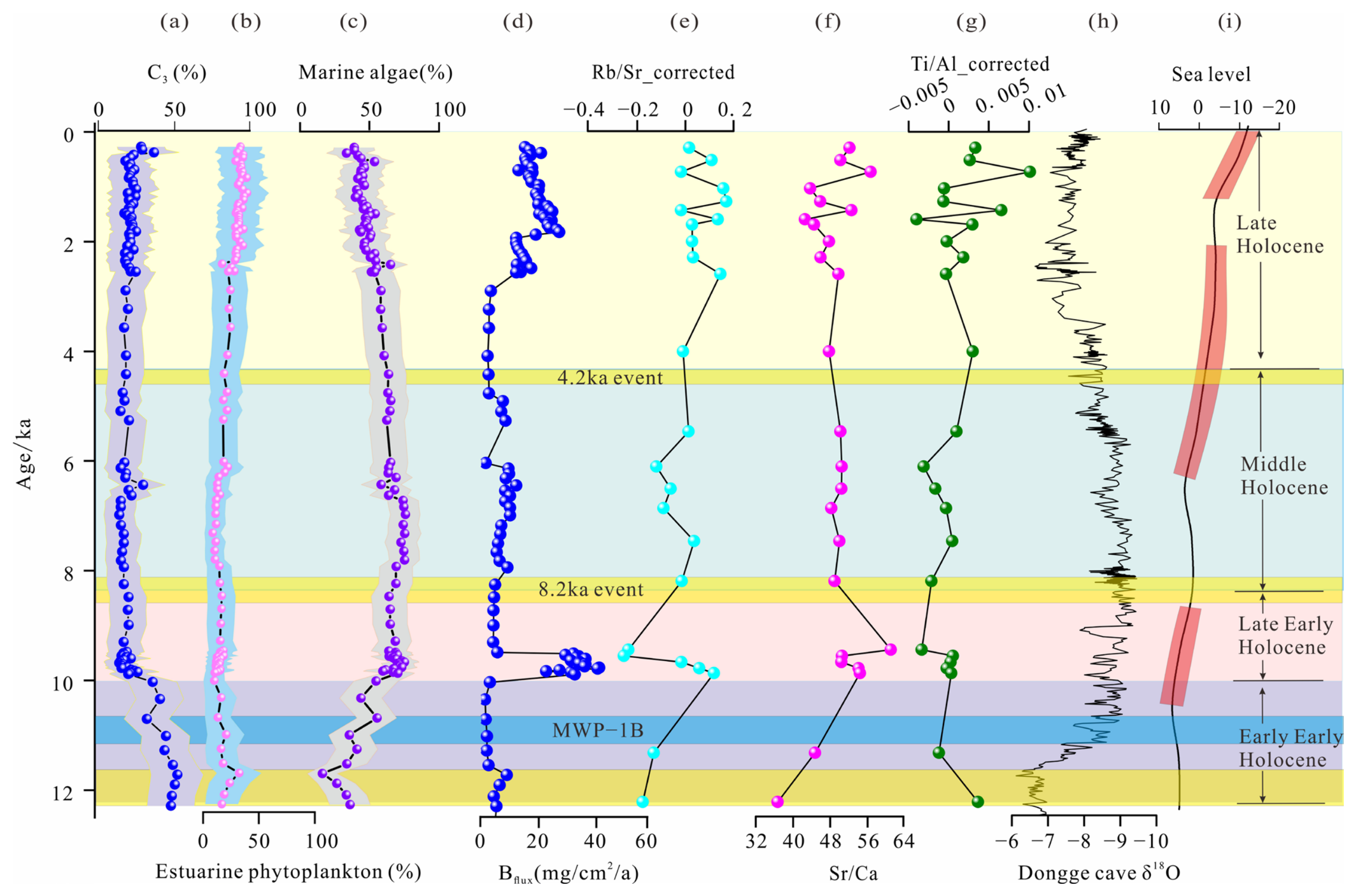
Temporal variations in OC EM proportions reveal stepwise shifts in sedimentary OC sources throughout the Holocene (Figure 8a–d).
During the early Early Holocene (before 10 cal ka B.P.), C3 terrestrial plants dominated OC sources, with a mean contribution of 44.42% ± 16.01% (95% CI:12.63–78.36%). Estuarine algae (18.13% ± 14.90%, 95% CI:0.74–56.72%) and marine algae (37.45% ± 14.37%, 95% CI:7.84–63.90%) were subordinate (Figure 8a–c). High C3 fractions, coupled with large SD values, are consistent with variable fluvial input under low post-glacial sea level [53], implying bulk OM was predominantly supplied by terrigenous C3 higher plants. Limited marine inundation likely constrained aquatic primary production at this stage. Although there was a peak in terrigenous C3 plant-derived OC during the early Early Holocene, in-situ Bflux remained relatively low (1–9 mg/cm2/a, Figure 8d).
From the Late Early Holocene (10–8.2 cal ka B.P.), terrigenous C3 fractions declined sharply and remained persistently low. During 8.48–9.88 cal ka BP, C3 terrestrial input decreased to an average of 18.27% (95% CI: 1.06–44.90%), while marine algae rapidly became the dominant EM with a mean proportion of 67.70% (95% CI: 41.75–89.65%); estuarine algae remained marginal at 14.03% (95% CI: 0.51–41.03%) (Figure 8a–c). Located far from the main YR depocenter, the study site mainly receives runoff from small Shandong Peninsula catchments, which may have limited terrestrial organic supply. Post-glacial sea-level rise was associated with widespread marine transgression after 6 cal ka BP [54]. Bflux initiated with relatively high burial values at the onset of this phase (35–41 mg/cm2/a), followed by a progressive decreasing trend toward a pronounced minimum near the 8.2 ka climatic event (~4–5 mg/cm2/a, Figure 8d).
In the Middle Holocene (4.2–8.2 cal ka BP), marine algae reached their Holocene maximum mean contribution of 68.32% (95% CI: 42.43–90.02%), with C3 terrestrial plants (17.22%, 95% CI: 1.08–43.31%) and estuarine algae (14.46%, 95% CI: 0.61–41.14%) remaining consistently subdued (Figure 8a–c). Stabilized sea-level highstand was likely favourable for sustained marine algal proliferation and the formation of open-marine environments [55]. OC Bflux maintains persistently low magnitudes throughout this period (2–10 mg/cm2/a, Figure 8d). Although marine algal-derived OC dominated the source pool, well-oxygenated open-shelf hydrographic conditions rates could have restricted OC burial efficiency, consistent with the overall depressed Bflux values.
During the Late Holocene (post-4.2 cal ka B.P.), the OC budget remained marine-dominated, yet terrestrial and estuarine EM fractions exhibited moderate recovery. Marine algae contributions declined slightly to a mean value of 55.00% (95% CI: 28.67–79.45%), accompanied by modest increases in both C3 terrestrial plants (21.44%, 95% CI: 3.21–48.76%) and estuarine phytoplankton (23.56%, 95% CI: 2.15–51.32%) (Figure 8a–c). Persistent sea-level highstand promoted extensive marine inundation across the study area [55], whilst fluctuating riverine freshwater and nutrient input possibly enhanced nearshore estuarine productivity and terrigenous organic delivery. Bflux increased sharply in the late Late Holocene, forming the second Holocene high-value peak (15–27 mg/cm2/a, Figure 8d). Intensified anthropogenic erosion and land-use modification are plausible contributors to elevated catchment terrigenous OC export, which synchronously increased C3 terrestrial and estuarine phytoplankton OC inputs to enhance sedimentary OC loading. Meanwhile, moderately increased sediment accumulation rates may have facilitated organic preservation, with these factors collectively contributing to the prominent late-stage burial enhancement.

5.2. Mechanisms Controlling OC Burial

Holocene climate and sea-level evolution appear to have exerted substantial potential influences on OC cycling across global marginal seas. Here, downcore records from core WHD01 in the NYS are integrated with Dongge Cave δ18O (a widely used EASM proxy) [25] and global sea-level compilations [55] (Figure 8) for regional comparison. Dongge Cave δ18O variations generally track large-scale EASM evolution, whereas sea-level fluctuations provide the boundary for post-glacial shelf transgression. Multiple proxies from WHD01 show coherent variations with regional monsoon and sea-level trends (Figure 8). Accordingly, the co-variation between EASM evolution and sea-level change is plausibly an important factor modulating Holocene shifts in OC sources and burial efficiency at this site.
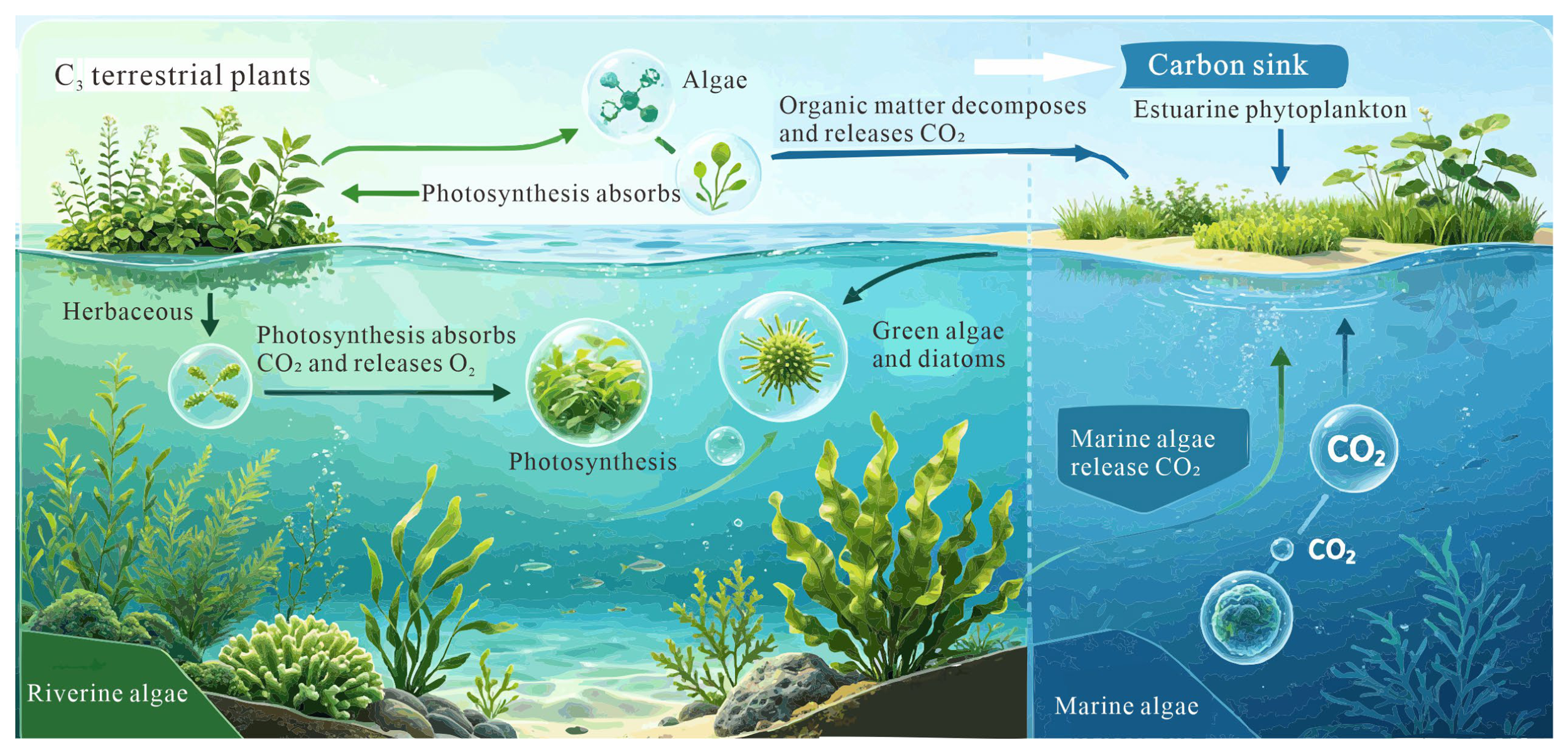
OC sources of core WHD01 consist of C3 terrestrial plants, estuarine phytoplankton and marine algae, whose proportional changes show good synchronism with monsoon variability and transgression–regression cycles, as summarized in the conceptual carbon-cycle model (Figure 9).
EASM variability is regarded as a key potential climatic factor modulating terrestrial OC delivery, correlating closely with catchment weathering, fluvial runoff and terrigenous clastics export [56,57]. Variations in monsoon strength coincide with two contrasting OC assemblages: predominant C3 terrestrial input before 10 cal ka B.P. and elevated marine algae fractions during 10–4.2 cal ka B.P.
(1)
Before 10 cal ka B.P.: Co-variation of EASM and Sea-Level and Associated OC Source Transition.
At the onset, the Younger Dryas event (YD, 12.9–11.7 cal ka B.P.) was characterized by massive North Atlantic freshwater input derived from Laurentide and Lake Agassiz outflows via the St. Lawrence and Mackenzie drainage systems [58,59], which correlates with weakened EASM signals preserved in the Dongge Cave δ18O record (Figure 8h) [25]. Under this monsoon background, suppressed chemical weathering and dominant physical erosion are implied across the catchment. Limited runoff likely transported terrestrial plant debris efficiently, consistent with high C3 terrestrial contribution (Figure 8a). Lowstand configuration restricted seawater intrusion, which probably limited the development of large-scale marine productivity.
The subsequent MWP-1B event (11.5–11.2 cal ka B.P.) corresponds to abrupt global sea-level acceleration [60]. Rising Rb/Sr_corrected ratios (Figure 8e) document progressive EASM intensification. Enhanced monsoonal precipitation likely boosted catchment chemical weathering and fluvial discharge, leading to strong physical dilution of land-derived organic fractions. Consequently, C3 plant-derived OC declined substantially (Figure 8a). Despite persistent sea-level rise, limited shelf-ocean water exchange maintained relatively high Sr/Ca ratios (Figure 8f). Such semi-enclosed hydrodynamic conditions favored in situ marine phytoplankton production, driving an elevated fractional contribution of marine algal OC (Figure 8c).
Collectively, shifts in EASM intensity are closely correlated with altered sediment transport and aquatic productivity, coinciding with the OC source transition from C3 terrestrial plants toward marine algae. Terrestrial-derived OM constituted the dominant carbon pool for the early-Holocene regional cycle (Figure 9).
(2)
Mid-Holocene (10–4.2 cal ka B.P.): Monsoon–Sea-Level Interaction and Cold-Event-Related OC Modification.
The interval of 10–9.5 cal ka B.P. features remarkably elevated OC Bflux, forming one of Holocene burial peaks (Figure 8d). Two interrelated factors may explain this pattern: (1) Postglacial transgression after ~12 ka coincided with accelerated sediment accumulation (Figure 2j), elevated sedimentation rates likely shortened organic degradation duration and improved preservation, while coarser grain size (Figure 2a) implies enhanced fluvial clastic and terrestrial OM supply; (2) Early-Holocene terrestrial OC was largely retained on nearshore shelves before being reworked and redeposited during the early Late Early Holocene, producing a lagged burial maximum decoupled from the peak of initial C3 input.
The 8.2 ka cold anomaly lasted 100–200 yr, and δ18O records from Dongge Cave document a notable EASM reduction (Figure 8h) [25]. Such climatic deterioration is potentially linked to Laurentide Ice Sheet meltwater perturbation slowing Atlantic Meridional Overturning Circulation (AMOC) [26,27,28], southward Intertropical Convergence Zone (ITCZ) migration and intensified EAWM [29,30]. Regional sea surface temperature (SST) dropped by ~0.5 °C [31], and intensified EAWM signals have been detected in neighbouring shelf sediment and magnetic datasets. Reduced EASM-driven runoff likely lowers catchment weathering and the transport capacity of Shandong Peninsula small rivers, consistent with falling C3 terrestrial fractions (Figure 8a). Diminished riverine nutrient input is probably responsible for restrained estuarine algal growth (Figure 8b). The cold event is thus correlated with disrupted terrestrial–marine OC balance and reduced land-derived OM flux. Together with prolonged transgression lengthening terrestrial transport distance and expanded well-oxygenated open shelf favoring organic decomposition, these multiple factors are consistent with the occurrence of Holocene burial minimum near 8.2 cal ka B.P. (Figure 8d).
The 4.2 ka cold shift represents another prominent mid-Holocene climatic transition. Multiple proxies record weakened EASM and strengthened EAWM around this period [25], possibly associated with reduced solar output, southward ITCZ migration and amplified El Niño–Southern Oscillation (ENSO) variability. Regional SST fell by approximately 1.5 °C [31], and adjacent shelf sequences register reduced terrigenous input and strengthened aeolian signals. Decreasing Rb/Sr_corrected ratios alongside elevated Ti/Al_corrected ratios from WHD01 further record this environmental shift (Figure 8e,f).
(3)
Late Holocene (4.2 ka to present): Variable EASM, Stabilized Highstand and Dynamic OC Burial.
Late Holocene OC cycling is closely associated with fluctuating EASM and persistent sea-level highstand. Elevated and variable Rb/Sr_corrected ratios, together with unstable Ti/Al_corrected ratios, imply irregular monsoon activity (Figure 8e,g). Moderate Sr/Ca ratios under stable highstand conditions suggest slightly weakened but sustained marine productivity compared with the mid- Holocene (Figure 8f). Termination of rapid post-glacial sea-level rise altered the modulating effect of estuarine front and freshwater input on coastal production, coinciding with modest growth of estuarine phytoplankton contribution, whereas marine algae remained dominant (Figure 8b). Variable terrestrial supply drove fluctuating burial efficiency, resulting in more dynamic OC accumulation relative to the mid-Holocene. This shift possibly marks a transition from sea-level-dominated toward nutrient- and hydrodynamic-controlled carbon cycling under persistent highstand conditions.
The conceptual model (Figure 9) synthesizes the above evolutionary pattern: early-Holocene OC was mainly sourced from terrestrial C3 plants and estuarine algae; progressive transgression increased marine algal proportion during the middle Holocene, and both estuarine- and terrigenous-derived OM recovered moderately in the Late Holocene. In-situ OM degradation and CO2 exchange further modulate TOC inventory, indicating that the study area functions as a transitional sink coupling terrestrial and marine carbon pools.

6. Conclusions

(1)
This study corrected grain size, diagenesis and provenance interference on geochemical proxies to reconstruct sedimentary evolution, terrigenous supply, and marine productivity within the SPMW. After eliminating OC fractionation and diagenetic deviation of downcore δ13C signals, a Bayesian mixing model was applied to quantitatively distinguish three OC EMs (EMs: C3 terrestrial plants, estuarine phytoplankton, and marine algae) in core WHD01.
(2)
OC EM assemblages exhibit three distinct evolutionary phases across the Holocene. C3 terrestrial dominates OC inventory prior to 10 cal ka B.P.; rapid sea-level rise facilitates the development of marine OC composition from 10 to 4.2 cal ka B.P.; relatively stable highstand after 4.2 cal ka B.P., marine-derived OC remained dominant whereas C3 and estuarine OM rebounded. Intensified anthropogenic erosion, together with enhanced organic preservation, collectively boosted OC burial flux.
(3)
Holocene variations in OC sources and burial at the site show good synergy with EASM and sea-level evolutions. EASM fluctuations correlate closely with catchment weathering intensity, river runoff and nutrient export, whereas sea-level change is tightly linked to the magnitude of marine transgression and land-ocean connectivity. The 8.2 ka and 4.2 ka climatic cold anomalies were accompanied by remarkable shifts in regional setting and OC constituent proportions.

Supplementary Materials

The following supporting information can be downloaded at: https://www.mdpi.com/article/10.3390/su18136482/s1, Table S1: Chronology, stable isotope and organic geochemical dataset of core WHD01.

Author Contributions

J.L.: writing—review and editing, writing—original draft, funding acquisition, Supervision, Visualization. S.W.: writing—review & editing, validation, supervision, methodology, investigation, funding acquisition, formal analysis, data curation, conceptualization. J.Z. and M.A.: resources. Y.F.: writing—review & editing, writing—original draft, investigation. J.S.: writing—resources, investigation, data curation. All authors have read and agreed to the published version of the manuscript.

Funding

This study was jointly supported by Observation and Research Station of South Yellow Sea Earth Multi-sphere, Ministry of Natural Resources (No. SYS-2025-G03, SYS-2026-K01); the China Geological Survey (No. DD20230412); the Science and Technology special fund of Hainan Province (No. ZDYF2024SHFZ147). The authors would like to express their gratitude to the YCGS, CGS for providing basic data. The authors are also grateful to the editors and reviewers who provided sincere comments and assisted in writing this manuscript.

Institutional Review Board Statement

Not applicable.

Informed Consent Statement

Not applicable.

Data Availability Statement

The original contributions presented in the study are included in the articles/Supplementary Materials. Further inquiries can be directed to the corresponding authors.

Conflicts of Interest

The authors declare that the research was conducted in the absence of any commercial or financial relationship that could be construed as a potential conflict of interest.

References

  1. Dai, M.H.; Su, J.Z.; Zhao, Y.Y.; Hofmann, E.E.; Cao, Z.; Cai, W.-J.; Gan, J.; Lacroix, F.; Laruelle, G.G.; Meng, F.; et al. Carbon Fluxes in the Coastal Ocean: Synthesis, Boundary Processes, and Future Trends. Annu. Rev. Earth Planet. Sci. 2022, 50, 593–626. [Google Scholar] [CrossRef]
  2. Jiao, N.Z.; Luo, T.W.; Chen, Q.R.; Zhao, Z.; Xiao, X.L.; Liu, J.H.; Jian, Z.M.; Xie, S.C.; Thomas, H.; Herndl, G.J.; et al. The microbial carbon pump and climate change. Nat. Rev. Microbiol. 2024, 22, 408–419. [Google Scholar] [CrossRef] [PubMed]
  3. Ausín, B.; Bruni, E.; Haghipour, N.; Welte, C.; Bernasconi, S.M.; Eglinton, T.I. Controls on the abundance, provenance and age of organic carbon buried in continental margin sediments. Earth Planet. Sci. Lett. 2021, 558, 116759. [Google Scholar] [CrossRef]
  4. Shi, X.F.; Wu, B.; Qiao, S.Q.; Yao, Z.Q.; Hu, L.M.; Bai, Y.Z.; Hu, S.; Sheng, J.; Liu, Y.G.; Liu, S.F.; et al. Distribution, burial fluxes and carbon sink effect of sedimentary organic carbon in the eastern China seas. Sci. China Earth Sci. 2024, 67, 3062–3082. [Google Scholar] [CrossRef]
  5. Middelburg, J.J.; Herman, P.M.J. Organic matter processing in tidal estuaries. Mar. Chem. 2007, 106, 127–147. [Google Scholar] [CrossRef]
  6. Andrews, J.E.; Greenaway, A.M.; Dennis, P.F. Combined Carbon Isotope and C/N Ratios as Indicators of Source and Fate of Organic Matter in a Poorly Flushed, Tropical Estuary: Hunts Bay, Kingston Harbour, Jamaica. Estuar. Coast. Shelf Sci. 1998, 46, 743–756. [Google Scholar] [CrossRef]
  7. Gao, S.; Jia, J.J. Sediment and carbon accumulation in a small tidal basin: Yuehu, Shandong Peninsula, China. Reg. Environ. Change 2004, 4, 63–69. [Google Scholar] [CrossRef]
  8. Milliman, J.D.; Beardsley, R.C.; Zuo Sheng, Y.; Limeburner, R. Modem Huanghe-derived muds on the outer shelf of the East China Sea: Identification and potential transport mechanisms. Cont. Shelf Res. 1985, 4, 175–188. [Google Scholar] [CrossRef]
  9. Alexander, C.R.; DeMaster, D.J.; Nittrouer, C.A. Sediment accumulation in a modern epicontinental-shelf setting; the Yellow Sea. Mar. Geol. 1991, 98, 51–72. [Google Scholar] [CrossRef]
  10. Liu, J.P.; Milliman, J.D.; Gao, S. The Shandong mud wedge and post-glacial sediment accumulation in the Yellow Sea. Geo-Mar. Lett. 2001, 21, 212–218, Erratum in Geo-Mar. Lett. 2001, 21, 253–254. https://doi.org/10.1007/s00367-002-0089-7. [Google Scholar] [CrossRef]
  11. Li, G.; Miao, L.; Yan, W. Holocene evolution of the shelf mud deposits in the north-western South China Sea. Front. Mar. Sci. 2022, 9, 937616. [Google Scholar] [CrossRef]
  12. Liu, J.; Saito, Y.; Wang, H.; Yang, Z.G.; Nakashima, R. Sedimentary evolution of the Holocene subaqueous clinoform off the Shandong Peninsula in the Yellow Sea. Mar. Geol. 2007, 236, 165–187. [Google Scholar] [CrossRef]
  13. Hu, L.M.; Shi, X.F.; Guo, Z.G.; Wang, H.J.; Yang, Z.S. Sources, dispersal and preservation of sedimentary organic matter in the Yellow Sea: The importance of depositional hydrodynamic forcing. Mar. Geol. 2013, 335, 52–63. [Google Scholar] [CrossRef]
  14. Zhang, Y.; Wang, H.J.; Hu, L.M.; Xing, L.; Li, G.X.; Wu, X. Different pacemakers of marine organic carbon burial in the North Yellow Sea from the early to late Holocene. Palaeogeogr. Palaeoclim. Palaeoecol. 2024, 652, 112408. [Google Scholar] [CrossRef]
  15. Liu, J.; Saito, Y.; Kong, X.H.; Wang, H.; Zhao, L. Geochemical characteristics of sediment as indicators of post-glacial environmental changes off the Shandong Peninsula in the Yellow Sea. Cont. Shelf Res. 2009, 29, 846–855. [Google Scholar] [CrossRef]
  16. Chen, X.H.; Li, R.H.; Lan, X.H.; Wang, Y. Stratigraphy of late Quaternary deposits in the mid-western North Yellow Sea. J. Oceanol. Limnol. 2018, 36, 2130–2153. [Google Scholar] [CrossRef]
  17. Lan, X.H.; Chen, X.H.; Mi, B.B.; Li, R.H.; Qin, Y.C.; Wang, Z.B. Distribution pattern and source of Major and Trace Elements in the central North Yellow sea since Late Pleistocene. Mar. Geol. Quat. Geol. 2015, 35, 1–10. [Google Scholar] [CrossRef]
  18. Wang, P.J.; Hu, L.M.; Yan, T.H.; Wang, H.J.; Bi, N.S.; Wang, N.; Zhang, Y.; Wu, X. The characteristics of sedimentary organic carbon in the mud area in the western North Yellow Sea since the Holocene. Mar. Geol. Quat. Geol. 2024, 44, 110–119. [Google Scholar] [CrossRef]
  19. Yan, T.H.; Wang, H.J.; Ai, L.N.; Liu, X.T.; Hu, L.M.; Bi, N.S.; Han, Z.Z.; Wu, X. Sedimentary evolution of the western North Yellow Sea mud patch: A Holocene perspective. Cont. Shelf Res. 2023, 269, 105144. [Google Scholar] [CrossRef]
  20. Wu, S.Y.; Liu, J.; Pei, L.X.; Chang, Q. Organic carbon provenance and its response to the East Asian winter monsoon in the northern offshore mud area of Shandong Peninsula over the past 3000 years. Reg. Stud. Mar. Sci. 2025, 81, 104008. [Google Scholar] [CrossRef]
  21. Mo, L.J.; Shi, Y.; Gao, J.H.; Sheng, H.; Liu, S.J.; Wang, Y.P.; Yang, Y.; Chen, Y.N. Source and distribution of lignin in mud deposits along the southeastern coast of Liaodong Peninsula and its response to environmental changes of the catchment. Geochimica 2021, 50, 199–210. [Google Scholar] [CrossRef]
  22. Shu, Z.; Gao, J.H.; Shi, Y.; Xu, X.M. The influence of cross-front sediment transport in north coast of Shandong Peninsula on the content and origin of sedimentary organic matter in east coast of Liaodong Peninsula. Mar. Sci. Bull. 2022, 41, 50–60. [Google Scholar] [CrossRef]
  23. Pan, Z.; Tan, Y.M.; Gao, Q.F.; Dong, S.L.; Fang, X.D.; Yan, J.L. A 120-year record of burial fluxes and source apportionment of sedimentary organic carbon in Alian Bay, China: Implication for the influence of mariculture activities, and regional environment changes. Aquaculture 2021, 535, 736421. [Google Scholar] [CrossRef]
  24. Xu, D.Y.; Liu, X.Q.; Zhang, X.H.; Li, T.G.; Chen, B.Y. Offshore Geology of China; Geological Publishing House: Beijing, China, 1997. [Google Scholar]
  25. Dykosi, C.; Edwards, R.; Cheng, H.; Yuan, D.; Cai, Y.; Zhang, M.; Lin, Y.; Qing, J.; An, Z.; Revenaugh, J. A high-resolution, absolute-dated Holocene and deglacial Asian monsoon record from Dongge Cave, China. Earth Planet. Sci. Lett. 2005, 233, 71–86. [Google Scholar] [CrossRef]
  26. Barber, D.C.; Dyke, A.; Hillaire-Marcel, C.; Jennings, A.E.; Andrews, J.T.; Kerwin, M.W.; Bilodeau, G.; McNeely, R.; Southon, J.; Morehead, M.D.; et al. Forcing of the cold event of 8,200 years ago by catastrophic drainage of Laurentide lakes. Nature 1999, 400, 344–348. [Google Scholar] [CrossRef]
  27. Boski, T.; Bezerra, F.H.R.; de Fátima Pereira, L.; Souza, A.M.; Maia, R.P.; Lima-Filho, F.P. Sea-level rise since 8.2ka recorded in the sediments of the Potengi–Jundiai Estuary, NE Brasil. Mar. Geol. 2015, 365, 1–13. [Google Scholar] [CrossRef]
  28. Ellison, C.R.W.; Chapman, M.R.; Hall, I.R. Surface and Deep Ocean Interactions During the Cold Climate Event 8200 Years Ago. Science 2006, 312, 1929–1932. [Google Scholar] [CrossRef] [PubMed]
  29. Cheng, H.; Fleitmann, D.; Edwards, R.L.; Wang, X.; Cruz, F.W.; Auler, A.S.; Mangini, A.; Wang, Y.; Kong, X.; Burns, S.J.; et al. Timing and structure of the 8.2 kyr B.P. event inferred from δ18O records of stalagmites from China, Oman, and Brazil. Geology 2009, 37, 1007–1010. [Google Scholar] [CrossRef]
  30. Haug, G.H.; Hughen, K.A.; Sigman, D.M.; Peterson, L.C.; Röhl, U. Southward Migration of the Intertropical Convergence Zone Through the Holocene. Science 2001, 293, 1304–1308. [Google Scholar] [CrossRef] [PubMed]
  31. Chen, L.L.; Li, F.; Liu, J.; Duan, X.Y.; He, X.L.; Chen, B.; Qin, M.G. New insights into the Holocene temperature conundrum from long-chain alkyl diol paleothermometers in the East China Sea inner shelf. Palaeogeogr. Palaeoclim. Palaeoecol. 2025, 675, 113093. [Google Scholar] [CrossRef]
  32. Kuypers, M.M.M.; Pancost, R.D.; Nijenhuis, I.A.; Damsté, J.S.S. Enhanced productivity led to increased organic carbon burial in the euxinic North Atlantic basin during the late Cenomanian oceanic anoxic event. Paleoceanography 2002, 17, 3-1–3-13. [Google Scholar] [CrossRef]
  33. Qin, Y.S.; Zhao, Y.Y.; Chen, L.R. Geology of Yellow Sea; Maritime Press: Beijing, China, 1989; p. 249. [Google Scholar]
  34. Hu, D.X. Upwelling and sedimentation dynamics. China J. Oceanol. Limnol. 1984, 2, 12–19. [Google Scholar] [CrossRef]
  35. Lee, H.J.; Jeon, C.K.; Lim, H.S. Dynamical analysis of the mud-belt formation in the Bohai, Yellow and East China seas. Mar. Geol. 2020, 423, 106140. [Google Scholar] [CrossRef]
  36. Southon, J.; Kashgarian, M.; Fontugne, M.; Metivier, B.; Yim, W.W. Marine reservoir corrections for the Indian Ocean and southeast Asia. Radiocarbon 2002, 44, 167–180. [Google Scholar] [CrossRef]
  37. Reimer, P.J.; Bard, E.; Bayliss, A.; Beck, J.W.; Blackwell, P.G.; Ramsey, C.B.; Buck, C.E.; Cheng, H.; Edwards, R.L.; Friedrich, M.; et al. IntCal13 and Marine13 Radiocarbon Age Calibration Curves 0–50,000 Years cal BP. Radiocarbon 2013, 55, 1869–1887. [Google Scholar] [CrossRef]
  38. Folk, R.L.; Ward, W.C. Brazos river bar: A study in the significance of grain size parameters. J. Sediment. Petrol. 1957, 27, 3–26. [Google Scholar] [CrossRef]
  39. Wang, L.S.; Zhou, B.; Zheng, B.; Wang, K.; Mei, X.; Wang, Q.; Wang, X.H.; Zheng, H.B. High-Resolution Geochemical Records in the Inner Shelf Mud Wedge of the East China Sea and Their Indication to the Holocene Monsoon Climatic Changes and Events. J. Ocean Univ. China 2021, 20, 1409–1418. [Google Scholar] [CrossRef]
  40. Stoll, H.M.; Schrag, D.P. Sr/Ca variations in Cretaceous carbonates; relation to productivity and sea level changes. Palaeogeogr. Palaeoclim. Palaeoecol. 2001, 168, 311–336. [Google Scholar] [CrossRef]
  41. Troch, M.; Bertrand, S.; Amann, B.; Liu, D.; Placencia, J.A.; Lange, C.B. Sediment Provenance in the Baker-Martínez Fjord System (Chile, 48°S) Indicated by Magnetic Susceptibility and Inorganic Geochemistry. Front. Mar. Sci. 2021, 8, 612309. [Google Scholar] [CrossRef]
  42. Geweke, J. Evaluating the Accuracy of Sampling-Based Approaches to the Calculation of Posterior Moments. Bayesian Stat. 1992, 4, 169–194. [Google Scholar] [CrossRef]
  43. Gelman, A.; Rubin, D.B. Inference from Iterative Simulation Using Multiple Sequences. Stat. Sci. 1992, 7, 457–472. [Google Scholar] [CrossRef]
  44. Stock, B.C.; Semmens, B.X. Unifying error structures in commonly used biotracer mixing models. Ecology 2016, 97, 2562–2569. [Google Scholar] [CrossRef] [PubMed]
  45. Tang, N.; Wang, Z.B.; Lin, P.H.; Liu, Y.X.; Wu, Z.H.; Tian, H.Z.; Mei, X.; Sun, J.; Qi, J.H.; Li, R.H.; et al. Luminescence dating of core DLC70-2 from the North Yellow Sea in China and its implication for late Quaternary transgressions. Palaeogeogr. Palaeoclim. Palaeoecol. 2025, 666, 112842. [Google Scholar] [CrossRef]
  46. Meyers, P.A. Organic geochemical proxies of paleoceanographic, paleolimnologic, and paleoclimatic processes. Org. Geochem. 1997, 27, 213–250. [Google Scholar] [CrossRef]
  47. Tao, S.Q.; Eglinton, T.I.; Montluçon, D.B.; McIntyre, C.; Zhao, M.X. Pre-aged soil organic carbon as a major component of the Yellow River suspended load: Regional significance and global relevance. Earth Planet. Sci. Lett. 2015, 414, 77–86. [Google Scholar] [CrossRef]
  48. Yu, M.; Eglinton, T.I.; Haghipour, N.; Montluçon, D.B.; Wacker, L.; Hou, P.; Zhang, H.L.; Zhao, M.X. Impacts of Natural and Human-Induced Hydrological Variability on Particulate Organic Carbon Dynamics in the Yellow River. Environ. Sci. Technol. 2019, 53, 1119–1129. [Google Scholar] [CrossRef] [PubMed]
  49. Middelburg, J.J.; Nieuwenhuize, J. Carbon and nitrogen stable isotopes in suspended matter and sediments from the Schelde Estuary. Mar. Chem. 1998, 60, 217–225. [Google Scholar] [CrossRef]
  50. Xia, S.P.; Song, Z.L.; Li, Q.; Guo, L.D.; Yu, C.X.; Singh, B.P.; Fu, X.L.; Chen, C.M.; Wang, Y.D.; Wang, H.L. Distribution, sources, and decomposition of soil organic matter along a salinity gradient in estuarine wetlands characterized by C:N ratio, δ13 C-δ15 N, and lignin biomarker. Glob. Change Biol. 2021, 27, 417–434. [Google Scholar] [CrossRef] [PubMed]
  51. Gearing, J.N.; Gearing, P.J.; Rudnick, D.T.; Requejo, A.G.; Hutchins, M.J. Isotopic variability of organic carbon in a phytoplankton-based, temperate estuary. Geochim. Cosmochim. Acta 1984, 48, 1089–1098. [Google Scholar] [CrossRef]
  52. Tao, S.Q.; Wang, A.J.; Liu, J.T.; Ye, X.; Blattmann, T.M.; Ran, C.; Liu, Z.T.; Wang, L.; Yin, X.J.; Zhang, H.L.; et al. Characteristics of sedimentary organic carbon burial in the shallow conduit portion of source-to-sink sedimentary systems in marginal seas. Geochim. Cosmochim. Acta 2023, 353, 92–111. [Google Scholar] [CrossRef]
  53. Liu, J.P.; Milliman, J.D. Reconsidering melt-water pulses 1A and 1B: Global impacts of rapid sea-level rise. J. Ocean Univ. China 2004, 3, 183–190. [Google Scholar] [CrossRef]
  54. Yu, S.Y.; Berglund, B.E.; Sandgren, P.; Lambeck, K. Evidence for a rapid sea-level rise 7600 yr ago. Geology 2007, 35, 891. [Google Scholar] [CrossRef]
  55. Lambeck, K.; Chappell, J. Sea Level Change Through the Last Glacial Cycle. Science 2001, 292, 679–686. [Google Scholar] [CrossRef] [PubMed]
  56. Li, B.F.; Feng, Q.; Wang, F.; Li, Z.J.; Wang, X.; Li, R.L.; Chen, W.Y. Chemical weathering evidence for East Asian Summer Monsoon rainfall variability in the upper reaches of the Yellow River since the Early Pleistocene. Palaeogeogr. Palaeoclim. Palaeoecol. 2023, 618, 111523. [Google Scholar] [CrossRef]
  57. Katsuta, N.; Naito, S.; Sano, N.; Ochiai, S.; Saito-Kokubu, Y.; Ogita, Y.; Nishio, T.; Hasebe, N.; Nagao, S.; Kawakami, S.; et al. East Asian summer monsoon evolution in northeast China since the mid-Holocene reconstructed from chemical weathering intensity of Lake Jingpo sediments. Glob. Planet. Change 2026, 262, 105441. [Google Scholar] [CrossRef]
  58. Broecker, W.S.; Kennett, J.P.; Flower, B.P.; Teller, J.T.; Trumbore, S.; Bonani, G.; Wolfli, W. Routing of meltwater from the Laurentide Ice Sheet during the Younger Dryas cold episode. Nature 1989, 341, 318–321. [Google Scholar] [CrossRef]
  59. Fairbanks, R.G. A 17,000-year glacio-eustatic sea level record: Influence of glacial melting rates on the Younger Dryas event and deep-ocean circulation. Nature 1989, 342, 637–642. [Google Scholar] [CrossRef]
  60. Bard, E.; Hamelin, B.; Delanghe-Sabatier, D. Deglacial Meltwater Pulse 1B and Younger Dryas Sea Levels Revisited with Boreholes at Tahiti. Science 2010, 327, 1235–1237. [Google Scholar] [CrossRef] [PubMed]
Figure 1. Regional hydrodynamic setting, sedimentary mud deposit distribution, and spatial overview of the NYS and adjacent shelf seas. (a) Spatial distribution of major ocean current systems across the study domain. Black arrows denote nearshore coastal currents, while red arrows mark warm current pathways; the red rectangle frame delineates the study area. (b) Spatial layout of sedimentary drilling sites, together with the spatial extent of the SPMW and the distribution of regional cold-water mass. Red pentagrams represent the newly obtained sediment core WHD01 used in this research, whereas solid yellow circles denote previously published sediment records (NYS101, NYS102 [12,15], and DLC70-2 [16,17]). Blue contour lines illustrate the thickness variation in the SPMW, and green dashed lines depict the spatial thermal boundary of the regional cold-water mass.
Sustainability 18 06482 g001
Figure 2. Downcore variations in sedimentary parameters from core WHD01. From left to right: (a) Lithology; (b) AMS 14C dating data (corresponding to Table 1); (ce) Sediment grian-size composition (sand: >63 μm, silt: 4–63 μm, clay: <4 μm); (f) Mean grain size (Mz); (g) Sorting coefficient; (h) Skewness; (i) Kurtosis; (j) AMS 14C ages versus depth (blue dots and line) and average sedimentation rates of stratigraphic units (red dots and line). Note: core depths are normalized to modern sea level (0 m), with the core top located at an equivalent water depth of 49.5 m.
Sustainability 18 06482 g002
Figure 3. Chronostratigraphic correlation of the Holocene sedimentary sequences from cores NYS101, WHD01, and DLC70-2 in the NYS. Symbols: (a) represents AMS 14C dating points, and (o) represents OSL dating points. The AMS 14C data of NSY101 are cited from Liu et al. [12,15]; the AMS 14C ages of DLC70-2 are from Lan et al., [17], and its OSL ages are from Tang et al. [45]. Note: all depths are normalized to modern sea level (0 m) and all AMS 14C ages were corrected using a marine reservoir effect with ΔR = −139 ± 59 a.
Sustainability 18 06482 g003
Figure 4. Correlation analyses of geochemical proxies with grain-size, diagenetic and provenance parameters. (a) Sr/Ca vs. Mz; (b) Rb/Sr vs. Mz; (c) Ti/Al vs. Mz; (d) Rb/Sr_corrected vs. Mz; (e) Ti/Al_corrected vs. Mz; (f) Rb/Sr vs. Fe/Mn; (g) Ti/Al vs. Fe/Mn; (h) Sr/Ca vs. Fe/Mn; (i) Rb/Sr_corrected vs. Fe/Mn; (j) Ti/Al_corrected vs. Fe/Mn; (k) Ti/Zr vs. Ti/Al; (l) Ti/Zr vs. Ti/Al_corrected.
Sustainability 18 06482 g004
Figure 5. Vertical evolution of Holocene OC and geochemical proxies in core WHD01. (a) Rb/Sr_corrected ratio; (b) Sr/Ca ratio; (c) Ti/Al_corrected ratio; (d) Original δ13C (‰) (blue dotted line) and δ13C_corrected (‰) (red dotted line); (e) δ15N (‰); (f) TOC (wt%); (g) TN (wt%); (h) C/N molar ratio.
Sustainability 18 06482 g005
Figure 6. Dual δ13C_corrected–δ15N isotope EMs mixing plots illustrating sedimentary OC source apportionment in core WHD01. (a) δ13C_corrected–δ15N dual-isotope tracing of Holocene sedimentary OC in core WHD01. (b) Scatter plot of all Holocene samples (grey circles) relative to the three EMs.
Sustainability 18 06482 g006
Figure 7. Posterior distribution and pairwise correlation of organic matter source contributions from the MixSIAR model for core WHD01. Note: diagonal plots present probability density distributions, and scatter plots with red regression lines are shown on off-diagonal panels. Corr = Pearson correlation coefficient; asterisk notation *** represents significance at p < 0.001.
Sustainability 18 06482 g007
Figure 8. Downcore variations in geochemical proxies and OC EM contributions since the Holocene in core WHD01. Proportional contributions of OC EM: (a) C3 terrestrial plants; (b) marine algae; (c) Estuarine phytoplankton; (d) OC Burial Flux (Bflux); (e) Rb/Sr_corrected ratio; (f) Sr/Ca ratio; (g) Ti/Al_corrected ratio; (h) Dongge cave δ18O (EASM); (i) Global sea-level fluctuation.
Sustainability 18 06482 g008
Figure 9. Carbon cycling in estuarine and aquatic ecosystems: from terrestrial C3 plants to marine algae. Note: the vertical dotted line separates the fluvial-estuarine zone from the offshore marine zone.
Sustainability 18 06482 g009
Table 1. AMS14C dating data of core WHD01.
Beta IDDepth (m)MaterialMeasured Radiocarbon Age (a)Calibration (a B.P.)Sedimentation Rate (cm/a)
76314050.34Foraminifera1030 ± 30584514–65014
76314152.31Foraminifera1780 ± 3013171228–140527
76314254.33Foraminifera2260 ± 3018581745–195737
75686755.92Foraminifera2890 ± 3026392535–274420
76312556.7Foraminifera4440 ± 3045984478–47194
75686357.49Foraminifera5680 ± 3060385930–61365
75686458.32Foraminifera6110 ± 3064886388–659518
76312659.08Foraminifera6660 ± 3071087009–721712
76312759.9Foraminifera7640 ± 3080638156–89719
75686560.73Foraminifera8820 ± 3094679371–95486
76312962.3Foraminifera9050 ± 3097539613–988055
75686663.12Foraminifera9140 ± 3098909749–10,03460
76313063.72Foraminifera10,280 ± 3011,44211,292–11,5704
72835964.36Plant material10,940 ± 4012,44612,336–12,5836
72836264.69Plant material11,410 ± 4012,87512,763–12,9628
Table 2. δ13C and δ15N characteristics and fractionation effects of OM in different Holocene stratigraphic stages.
Stratigraphic StageNumber of Samplesδ13C Mean (‰)δ15N Mean (‰)α (δ13C)α (δ15N)Δδ13C (‰)Δδ15N (‰)Weighted ContributionFractionation Contribution (%)Fractionation Grade
Late Holocene49−23.0416.457110000Baseline weak
Mid-Holocene23−23.0547.97211.002−0.0131.515−0.2991.049Moderate
Late Early Holocene13−23.0647.94311.001−0.0231.486−0.3021.071Moderate-strong
Early Early Holocene16−24.7877.4790.9981.001−1.7461.022−27.938100Strong
Note: Fractionation parameters are calculated relative to the Late Holocene baseline (0–7.24 m, δ13C = −23.041‰, δ15N = 6.457‰).
Disclaimer/Publisher’s Note: The statements, opinions and data contained in all publications are solely those of the individual author(s) and contributor(s) and not of MDPI and/or the editor(s). MDPI and/or the editor(s) disclaim responsibility for any injury to people or property resulting from any ideas, methods, instructions or products referred to in the content.