Communication

Fixed-Station Carbon Density Observations in a Zostera marina Meadow at Caofeidian
1
National Marine Data and Information Service, Tianjin 300171, China
2
Haikou Marine Center, Ministry of Natural Resources, Haikou 571126, China
*
Author to whom correspondence should be addressed.
Sustainability 2026, 18(12), 6127; https://doi.org/10.3390/su18126127 (registering DOI)
Submission received: 5 May 2026 / Revised: 12 June 2026 / Accepted: 12 June 2026 / Published: 15 June 2026
(This article belongs to the Special Issue Sustainable Management of Blue Carbon Ecosystems)

Abstract

Site-level carbon density data remain limited for many seagrass meadows, especially where the mapped meadow extent has not been paired with repeated carbon-pool measurements. This study quantified biomass carbon density, 0–1 m sediment organic carbon density, total carbon density, and sediment contribution at 10 fixed stations in a meadow dominated by Zostera marina Linnaeus in Caofeidian, Bohai Bay, China, in 2021, 2024, and 2025. Sediment grain-size composition and five water-quality variables were also summarized for 2025 as environmental context. Sediment organic carbon dominated the station-level carbon pool. In 2025, biomass carbon density was 0.269–0.900 Mg C ha−1, sediment organic carbon density was 8.108–39.730 Mg C ha−1, and total carbon density was 8.377–40.566 Mg C ha−1. The median total carbon density was 23.391 Mg C ha−1 in 2021, 18.827 Mg C ha−1 in 2024, and 20.040 Mg C ha−1 in 2025. The rank association between fine sediment fraction and carbon density was positive in 2025 (Spearman’s ρ = 0.491, p = 0.150). These fixed-station records support seagrass monitoring, restoration planning, and sustainable coastal management. They also help link the mapped meadow extent with field carbon data for blue carbon assessment under climate and marine sustainability goals.

1. Introduction

Seagrass meadows are widespread coastal habitats with high ecological and management value. They support benthic and nektonic biodiversity, stabilize surface sediments, and provide nursery and feeding habitats for many marine organisms [1]. By reducing wave energy and trapping sediments, seagrass meadows contribute to shoreline stability [2]. These ecosystem services are important in shallow coastal waters affected by reclamation, dredging, aquaculture, fishing, and water-quality change [1,2]. This functional role links seagrass conservation with climate action, marine ecosystem protection, and coastal sustainability under the 2030 Agenda for Sustainable Development [3]. Recent blue carbon studies show that protecting, restoring, and monitoring vegetated coastal habitats can support sustainable development through carbon storage, habitat protection, and local management evidence [4,5,6].
Blue carbon research places seagrass meadows together with mangroves and tidal salt marshes as vegetated coastal habitats that can store and retain organic carbon [7,8]. In seagrass meadows, the main measured carbon pools include aboveground biomass, belowground biomass, and sediment organic carbon [9]. Sediment often contains the largest share of ecosystem carbon because organic matter can be buried and retained below the living canopy [10,11]. This storage function gives seagrass meadows a role in coastal climate-change mitigation. The size and persistence of the carbon pool vary strongly among regions and habitat settings [10,12,13]. Local field measurements are therefore needed for carbon density assessment, especially where meadow-scale heterogeneity limits the direct use of broad default values [9,12,13].
Field-based seagrass blue carbon studies commonly estimate vegetation and sediment carbon pools from measured biomass, organic carbon content, bulk density, and sediment depth [9]. This approach provides site-level carbon density and can be linked with meadow distribution maps when whole-meadow carbon stocks are assessed [9,14]. Carbon density assessment has greater management value when the spatial structure of the meadow is retained. Distribution maps show where seagrass occurs. Fixed-station observations show how carbon pools differ among known locations. A single meadow-level value can obscure differences among stations, patches, and sediment settings. Meadow-scale, estuary-scale, and country-scale studies have reported strong spatial variation in seagrass carbon stocks, with sediment texture, hydrodynamic setting, patch structure, and local organic matter inputs often shaping the observed pattern [15,16,17,18].
The Caofeidian seagrass meadow is located in the coastal waters of Bohai Bay, China. It is dominated by Zostera marina Linnaeus. Previous mapping work reported this meadow as the largest eelgrass meadow in the Bohai Sea of northern China and documented long-term changes in meadow distribution from 1974 to 2019 using satellite and sonar data [19]. Recent work has also described bacterial communities in Zostera marina beds of Hebei Province, adding ecological context for local eelgrass systems [20]. These records provide an important basis for understanding meadow extent and conservation context. Carbon density information from repeated fixed stations remains limited for this meadow. Such information is needed to describe biomass carbon, sediment organic carbon, total carbon density, and local carbon-pool composition at known field locations. It can also help identify where later monitoring should pair carbon measurements with vegetation, sediment, and water-quality observations.
This study reports carbon density observations from 10 fixed stations in the Caofeidian Zostera marina meadow. The objectives were to quantify biomass carbon density, 0–1 m sediment organic carbon density, and total carbon density at the fixed stations; describe station-level carbon-pool composition; compare fixed-station carbon density observations among 2021, 2024, and 2025; and summarize 2025 sediment grain-size composition and five water-quality variables as supporting environmental context. The study provides a local carbon density baseline for seagrass blue carbon monitoring and future whole-meadow carbon-stock assessment.

2. Materials and Methods

2.1. Study Area

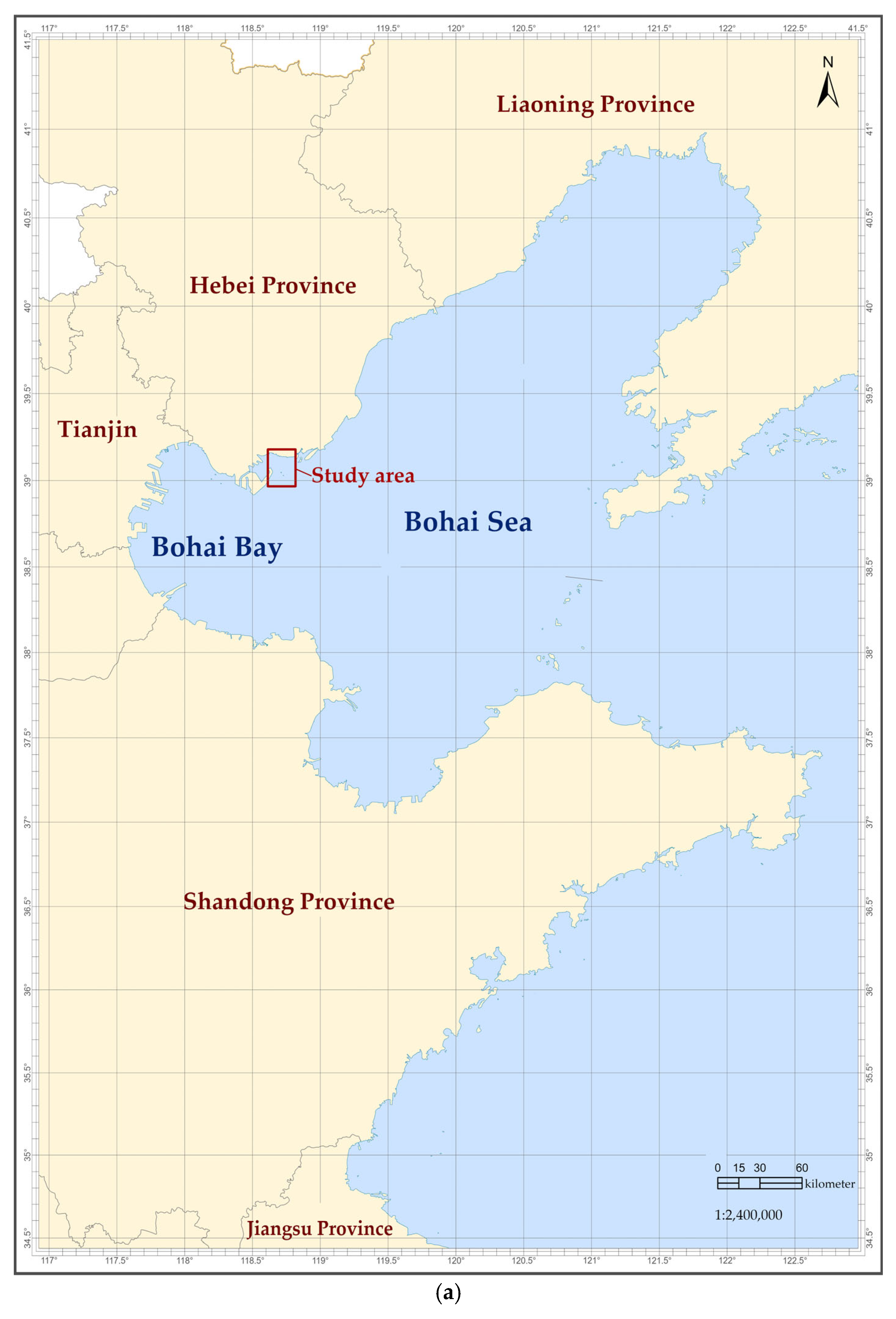
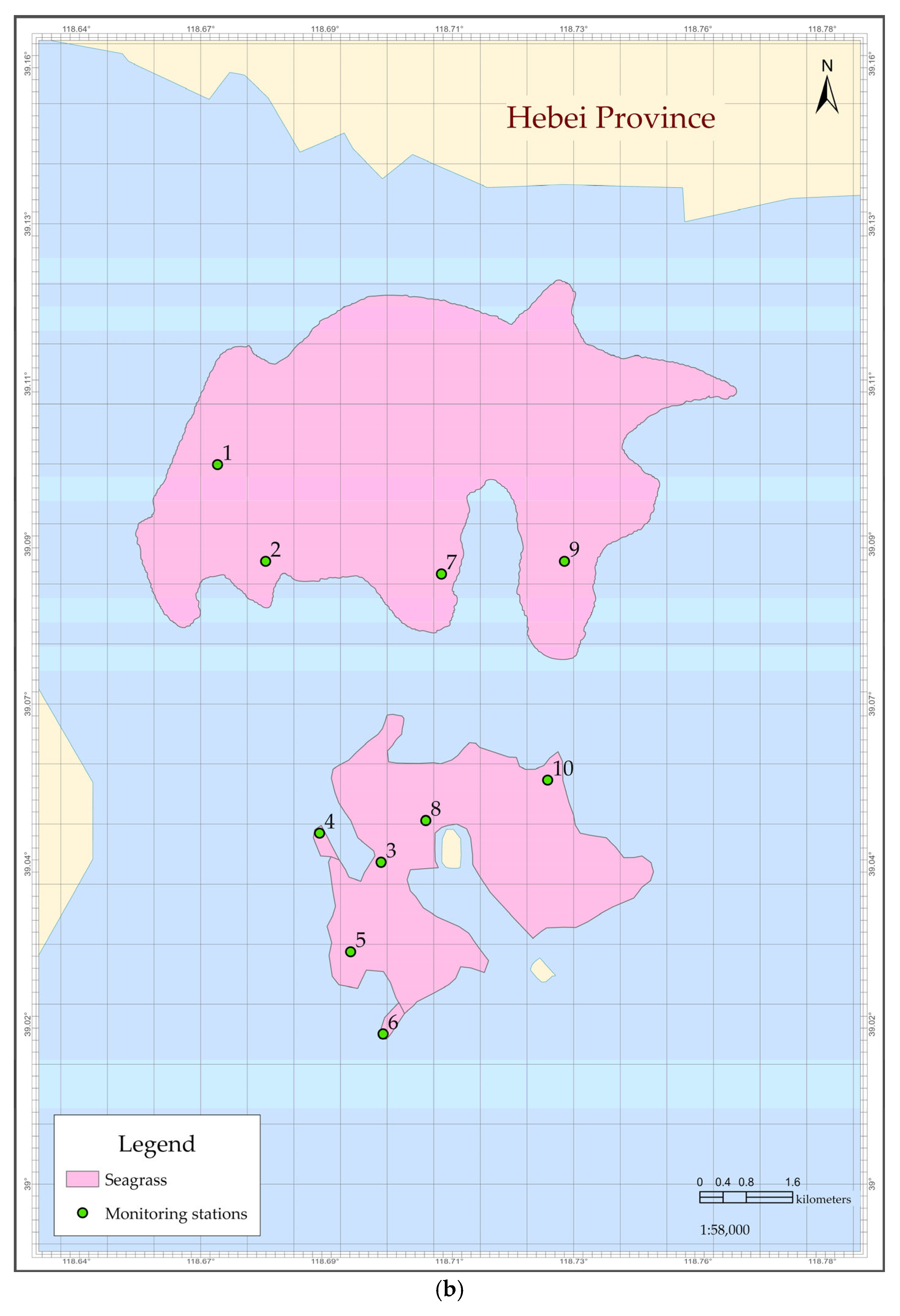
The study was conducted in the Caofeidian seagrass meadow off Tangshan, Hebei Province, China (Figure 1). The 10 fixed stations were located within the mapped Zostera marina meadow. The station group was concentrated within 118.66968–118.73169° E and 39.02087–39.09991° N, covering approximately 5.3 km from east to west and 8.8 km from north to south.
The fixed stations were in shallow nearshore water. Survey water depth across the 10 stations ranged from 1.5 to 2.6 m, with a mean of 2.17 m. Water temperature ranged from 26.2 to 28.4 °C, with a mean of 27.36 °C. The nearshore waters around the fixed stations are influenced by irregular semidiurnal tides. Published records indicate an average tidal range of about 1.5–1.8 m in the Caofeidian nearshore and headland area [21,22]. The Caofeidian sea area is also affected by tidal currents, waves, and sediment transport, which together shape the local hydrodynamic and sedimentary setting [23,24].
The same station codes were used in 2021, 2024, and 2025. Station locations were recorded in decimal degrees during field surveys. The station layout and mapped seagrass-distribution area are shown in Figure 1.

2.2. Field Sampling and Laboratory Analysis

Seagrass biomass and sediment samples were collected at the 10 fixed stations in August of each survey year. At each station, three 0.0625 m2 square quadrats were placed within the Zostera marina bed. Living plants were collected together with belowground tissues using a root-zone sampler. Sampling covered leaves, sheaths, rhizomes, and roots.
Samples were kept cool and protected from light during transport. In the laboratory, attached sediment and epiphytes were removed gently. The plants were separated into aboveground and belowground parts. Aboveground biomass included leaves and sheaths. Belowground biomass included rhizomes and roots. Fresh samples were weighed after cleaning. They were dried at 60 °C to constant weight and weighed again to obtain dry mass. The dried material was ground, passed through a 100-mesh sieve, and stored in sealed bags before organic carbon analysis. Organic carbon content was measured separately for aboveground and belowground tissues using an Elementar vario MACRO cube elemental analyzer operated in CN mode (Elementar Analysensysteme GmbH, Langenselbold, Germany). Plant samples were analyzed after drying, grinding, and sieving, without acidification.
Sediment cores were collected at the same fixed stations in August of each survey year. At each station, one sediment core was collected to a depth of 1 m using a corer with an inner cross-sectional area of 78.5 cm2. The cores were handled carefully to reduce compression and disturbance. When compression was observed, penetration depth and recovered core length were recorded and used to correct the sediment profile. Each core was divided into 10 cm intervals from the surface to 1 m depth.
Subsamples from each interval were used for bulk density and organic carbon analysis. Bulk density samples were dried to constant weight and weighed. Samples for organic carbon analysis were dried, ground, passed through a 100-mesh sieve, and stored in sealed bags before analysis. Before organic carbon analysis, sediment samples were immersed in excess 1 N carbon-free HCl and treated in an ultrasonic water bath for 5 min to remove inorganic carbon. The acidified sediment samples were dried at 60 °C to constant weight, ground, passed through a 100-mesh sieve, and sealed before measurement. Organic carbon content was determined for each sediment layer using an Elementar vario MACRO cube elemental analyzer operated in CN mode (Elementar Analysensysteme GmbH, Langenselbold, Germany). Biomass and sediment organic carbon analyses were conducted at the North China Sea Environmental Monitoring Center. The analyzer was calibrated using acetanilide, and one duplicate sample was included after every five samples. The same biomass and sediment sampling procedures were used for the 2021, 2024, and 2025 datasets.

2.3. Supporting Environmental Variables in 2025

Surface sediment samples for grain-size analysis were available for the same 10 fixed carbon density stations in 2025. Grain-size composition was reported as gravel, sand, silt, and clay. Values were expressed as percentages of total sediment mass. Fine sediment fraction was calculated as the sum of silt and clay contents.
Water-quality variables were available for the same 10 fixed carbon density stations in 2025. Surface-layer water samples were collected at 0.5 m below the water surface. The five variables used in this study were salinity, dissolved oxygen (DO), suspended solids (SSs), dissolved inorganic nitrogen (DIN), and transparency. Salinity and DO were measured in situ using a multi-parameter water quality meter (YSI Professional Pro, YSI Inc., Yellow Springs, OH, USA), following the manufacturer’s operating instructions. Transparency was measured with a Secchi disk. SSs were determined by filtering a known volume of water, drying the filter, and weighing the retained material. DIN was calculated as the sum of nitrite nitrogen, nitrate nitrogen, and ammonium nitrogen. Only the 2025 survey provided station-matched sediment grain-size and water-quality data for all 10 fixed carbon density stations. These station-matched data were used as supporting environmental context for the 2025 fixed-station observations.

2.4. Carbon Density Calculation and Data Processing

The carbon density variables included aboveground biomass carbon density, belowground biomass carbon density, biomass carbon density, 0–1 m sediment organic carbon density, total carbon density, and sediment contribution. Aboveground and belowground biomass carbon densities were calculated from dry biomass, organic carbon content, and quadrat area, and were converted to Mg C ha−1:
B C D p , q = D M p , q × C p , q A × 0.01
where BCDp,q is the biomass carbon density of plant part p in quadrat q (Mg C ha−1), p denotes aboveground or belowground biomass, DMp,q is dry biomass in the quadrat (g), Cp,q is organic carbon content as a fraction, and A is quadrat area (m2). For each station and survey year, biomass carbon density was first calculated for each quadrat and then averaged across the three quadrats to obtain one station-level value:
B C D = 1 3 × q = 1 3 ( B C D A G , q + B C D B G , q )
Sediment organic carbon density was calculated for each 10 cm layer:
S O C D i = B D i × C i × D i × 100
where SOCDi is the sediment organic carbon density of layer i (Mg C ha−1), BDi is dry bulk density (g cm−3), Ci is organic carbon content as a fraction, and Di is layer thickness (cm). Organic carbon values reported as percentages were divided by 100 before calculation. The 0–1 m sediment organic carbon density was calculated as the sum of all 10 cm layers:
S O C D 0 1 m = i = 1 10 S O C D i
Total carbon density was calculated as:
T C D = B C D + S O C D 0 1 m
Sediment contribution was calculated as:
S C = S O C D 0 1 m T C D × 100 %
where TCD is total carbon density (Mg C ha−1), and SC is the sediment contribution to total carbon density.
The fixed-station carbon density analysis used the available survey years with comparable field and laboratory procedures: 2021, 2024, and 2025. No comparable fixed-station carbon density dataset was available for 2023 under the same field and laboratory framework. All analyses were conducted at the station level. Descriptive statistics were calculated for biomass carbon density, sediment organic carbon density, total carbon density, and sediment contribution. The statistics included the mean, median, minimum, maximum, and interquartile range. For 2025, biomass carbon density and sediment organic carbon density were plotted as stacked bars to show carbon-pool composition. Total carbon density was ranked among stations to show station-level differences. Total carbon density from 2021, 2024, and 2025 was arranged in a station-by-year matrix and shown as a heatmap.
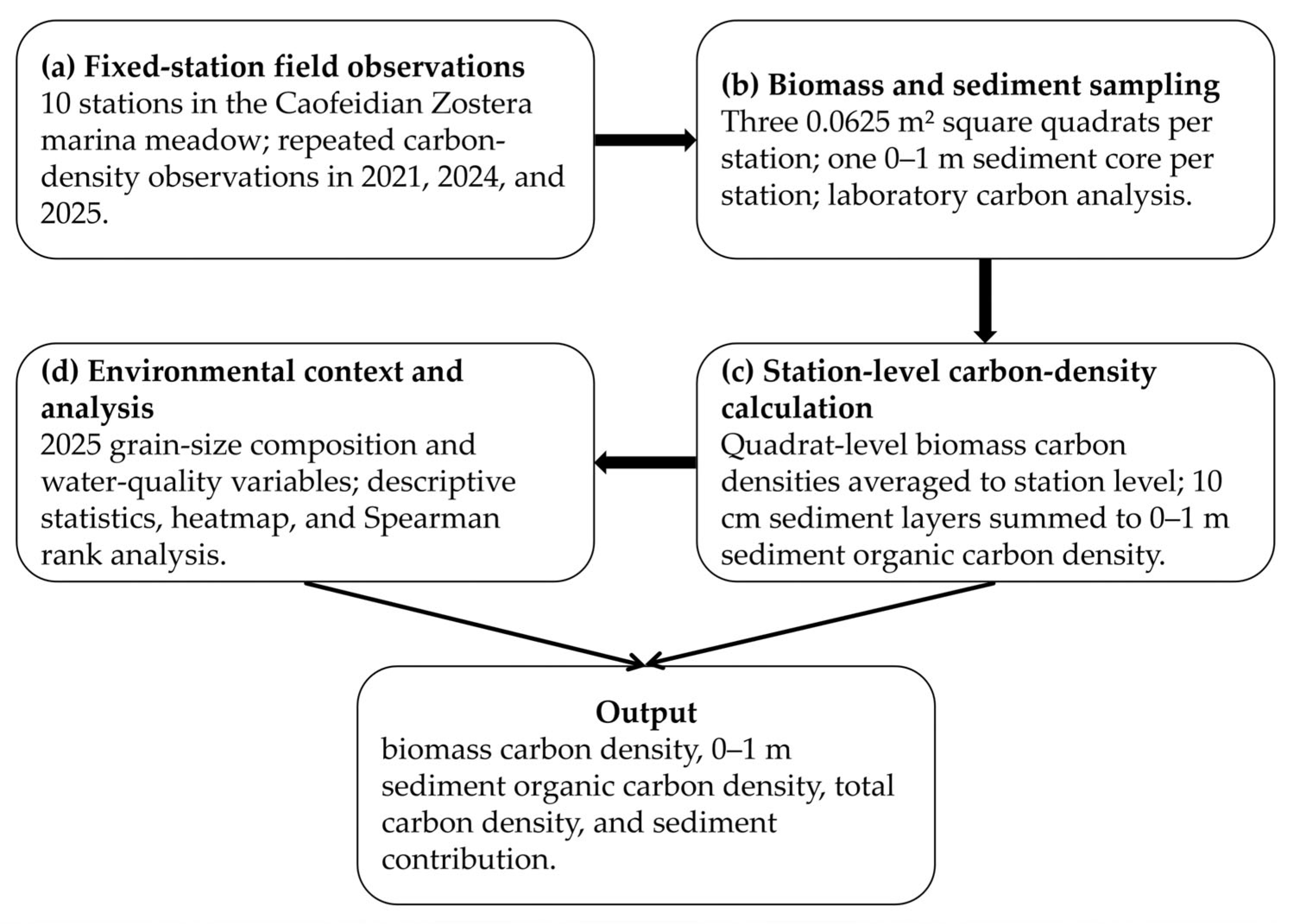
Sediment grain-size composition in 2025 was summarized by station. Fine sediment fraction was compared with sediment organic carbon density and total carbon density using Spearman rank correlation coefficients. Sand content was analyzed in the same way. Spearman’s ρ and p-values were reported as station-level descriptive statistics. The five water-quality variables were standardized before plotting. For each indicator, values across the 10 stations were centered by the mean and scaled by the standard deviation. Standardized values were used only for graphical comparison among stations. The data-processing workflow is summarized in Figure 2.

3. Results

3.1. Fixed-Station Carbon Density Across the Three Survey Years

Descriptive statistics for biomass carbon density, sediment organic carbon density, total carbon density, and sediment contribution across the 10 fixed stations are summarized in Table 1.
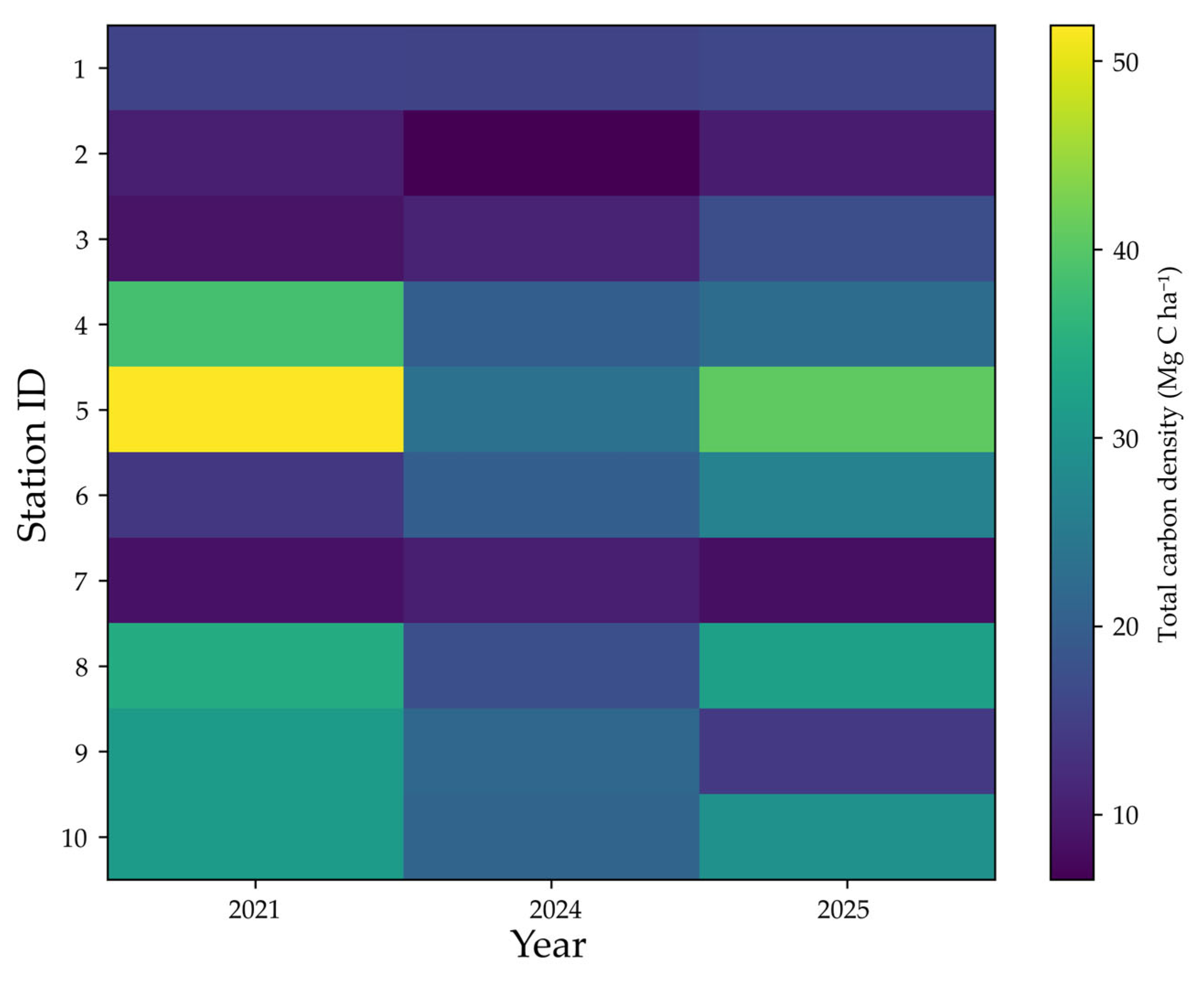
Total carbon density differed among the three survey years (Figure 3). The median total carbon density was 23.391 Mg C ha−1 in 2021, 18.827 Mg C ha−1 in 2024, and 20.040 Mg C ha−1 in 2025. The corresponding ranges were 8.781–51.889 Mg C ha−1 in 2021, 6.544–23.433 Mg C ha−1 in 2024, and 8.377–40.566 Mg C ha−1 in 2025.
Between-survey differences varied among stations. Compared with 2021, higher total carbon density values were observed in 2025 at stations 1, 3, and 6, while lower values were observed at the other stations. Compared with 2024, higher values were observed in 2025 at stations 1, 2, 3, 4, 5, 6, 8, and 10. Lower values were observed at stations 7 and 9.

3.2. Carbon Pool Composition and Station-Level Variation in 2025

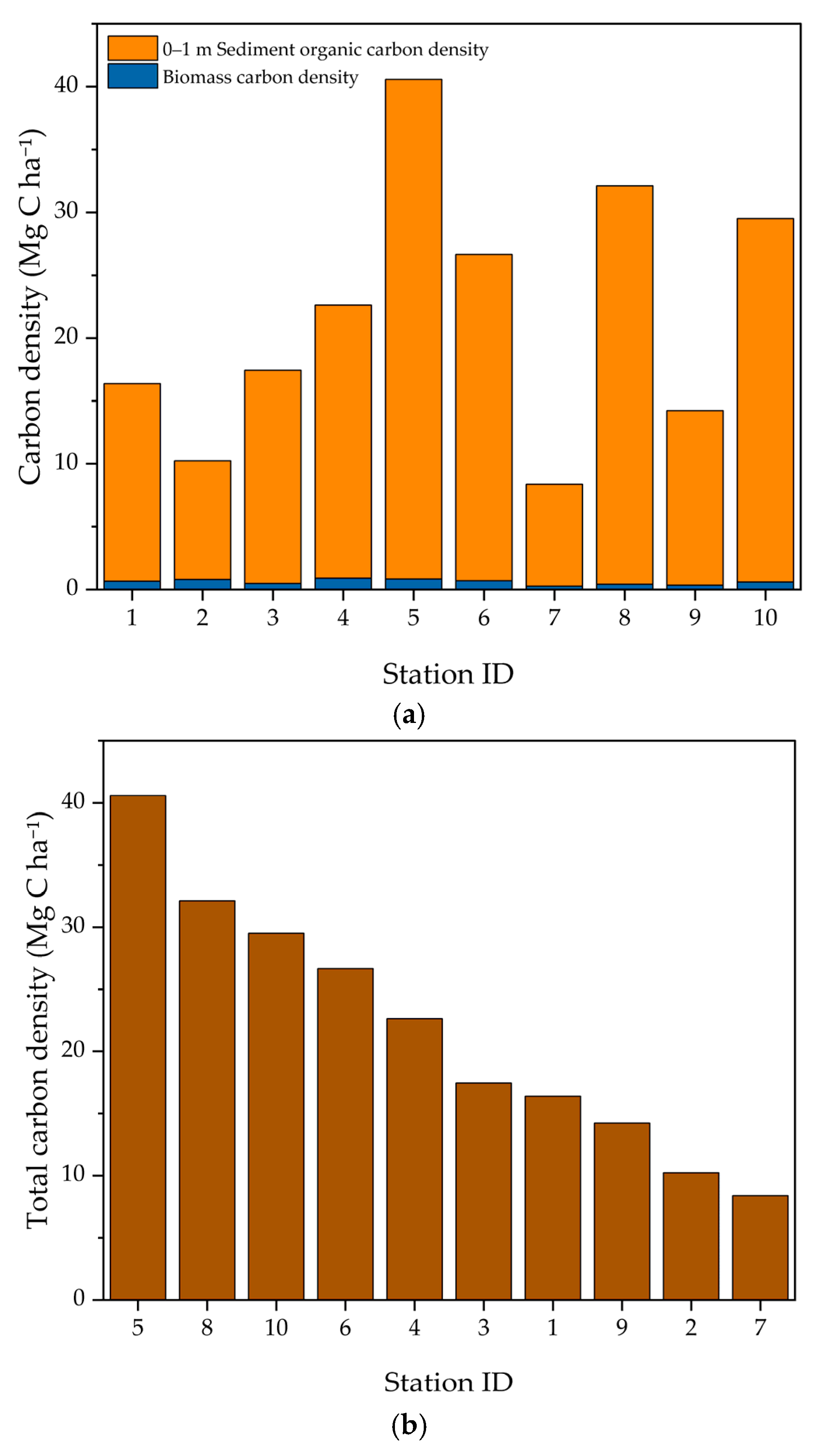
Carbon density in 2025 was dominated by the sediment organic carbon pool (Figure 4a). Biomass carbon density ranged from 0.269 to 0.900 Mg C ha−1 across the 10 stations, with a median of 0.632 Mg C ha−1. Sediment organic carbon density in the 0–1 m layer ranged from 8.108 to 39.730 Mg C ha−1, with a median of 19.349 Mg C ha−1. Total carbon density ranged from 8.377 to 40.566 Mg C ha−1, with a median of 20.040 Mg C ha−1.
Sediment organic carbon accounted for most of total carbon density at each station. Its contribution ranged from 92.143% to 98.694%, with a median of 97.320%.
Total carbon density also differed among stations in 2025 (Figure 4b). The highest value was recorded at station 5 (40.566 Mg C ha−1), followed by station 8 (32.103 Mg C ha−1) and station 10 (29.496 Mg C ha−1). The lowest value was recorded at station 7 (8.377 Mg C ha−1), followed by station 2 (10.234 Mg C ha−1) and station 9 (14.222 Mg C ha−1). The highest station-level value was approximately 4.8 times the lowest value.
The remaining stations had intermediate total carbon density. Values were 26.654 Mg C ha−1 at station 6, 22.626 Mg C ha−1 at station 4, 17.453 Mg C ha−1 at station 3, and 16.385 Mg C ha−1 at station 1.

3.3. Sediment Grain-Size Composition and Water-Quality Variables in 2025

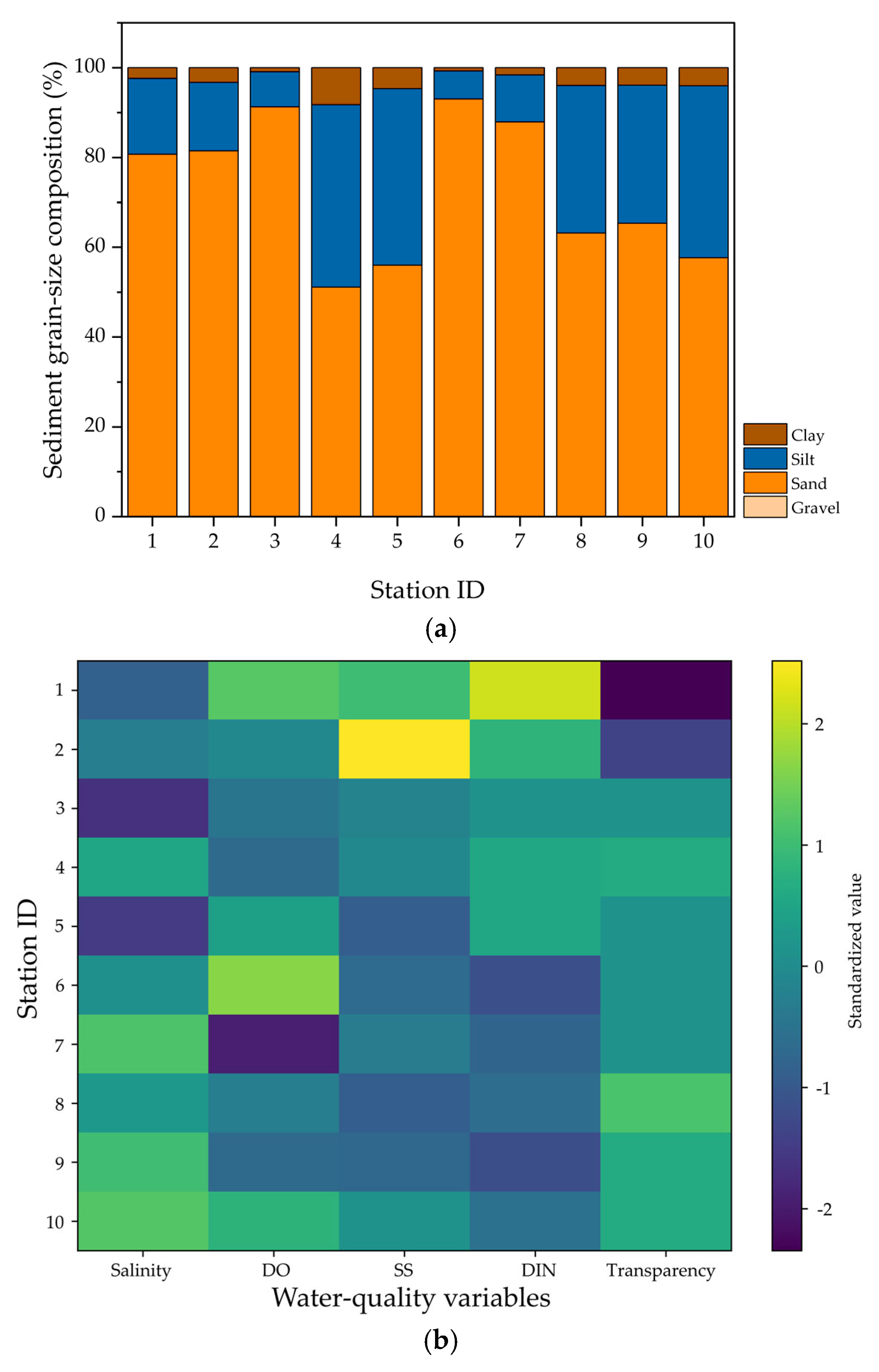
Surface sediment was sand-dominated at all stations in 2025 (Figure 5a). Gravel content was 0% at all stations. Sand content ranged from 51.10% to 93.01%, silt content from 6.26% to 40.67%, and clay content from 0.73% to 8.23%. Fine sediment fraction, calculated as silt plus clay, ranged from 6.99% to 48.90% across the 10 stations.
The five water-quality variables also showed station-level differences in 2025 (Figure 5b). Salinity ranged from 27.863 to 29.381. DO ranged from 5.86 to 6.40 mg L−1. SSs ranged from 14.53 to 58.80 mg L−1. DIN ranged from 0.255 to 0.453 mg L−1. Transparency ranged from 0.3 to 1.0 m.

3.4. Association Between Fine Sediment Fraction and Carbon Density in 2025

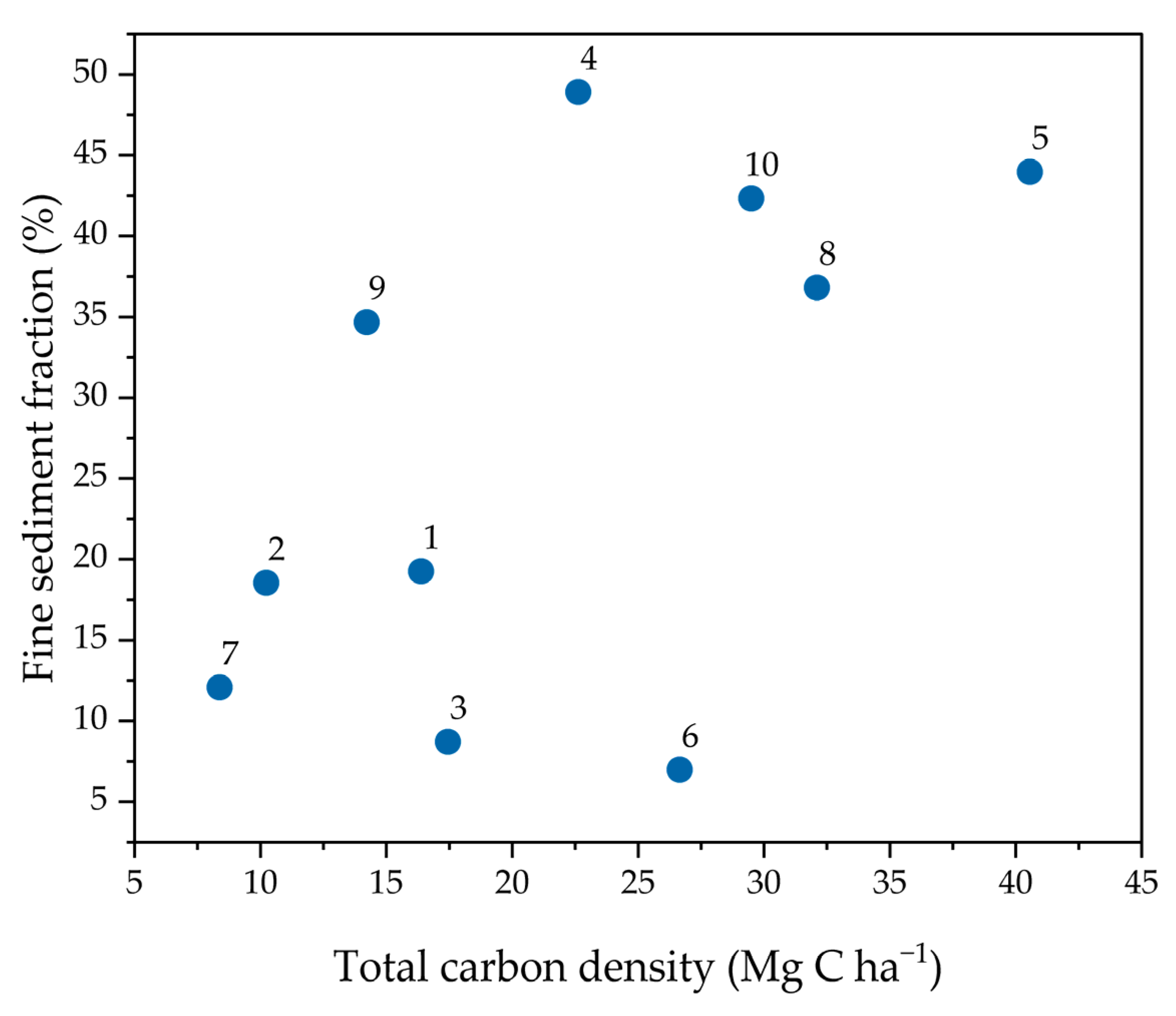
Fine sediment fraction ranged from 6.99% to 48.90% across the 10 fixed stations. Spearman rank analysis gave a positive coefficient between fine sediment fraction and both 0–1 m sediment organic carbon density and total carbon density (Spearman’s ρ = 0.491, p = 0.150 for both variables). Sand content showed the corresponding negative coefficient with both sediment organic carbon density and total carbon density (Spearman’s ρ = −0.491, p = 0.150 for both variables). These coefficients describe a station-level pattern in the 2025 dataset, and no predictive model was fitted. Full correlation results are provided in Table S3.

4. Discussion

4.1. Sediment Organic Carbon Dominance and Local Setting

Sediment organic carbon was the main component of total carbon density at the Caofeidian fixed stations. In 2025, median biomass carbon density was 0.632 Mg C ha−1, while median 0–1 m sediment organic carbon density was 19.349 Mg C ha−1. Sediment organic carbon accounted for a median of 97.320% of total carbon density.
This pool structure is consistent with the general pattern of seagrass blue carbon. Seagrass carbon assessments usually include aboveground biomass, belowground biomass, and sediment organic carbon [9]. Global and regional studies have shown that sediment often forms the largest carbon pool in seagrass ecosystems [10,11,12,13,25,26]. Living biomass is a smaller and more dynamic pool, while sediment can retain organic carbon over longer periods.
The Caofeidian sediment organic carbon density falls within a relatively low range compared with many sediment-rich seagrass systems reported in global and temperate eelgrass studies [27,28,29,30]. The 2025 results showed that surface sediments at all fixed stations were sand-dominated. This pattern is consistent with the shallow, mixed wave–tide setting described for the Caofeidian nearshore area [23,24]. Sandy and hydrodynamically exposed eelgrass meadows often have lower sediment carbon stocks than sheltered, fine-grained settings, because organic matter retention is more limited under higher permeability and sediment mobility [27,29,31,32].
This carbon-pool structure has direct relevance for monitoring. Biomass measurements describe the living plant pool and help indicate meadow condition. Total carbon density assessment also requires sediment organic carbon measurements. In the Caofeidian meadow, sediment measurements are central to any station-level carbon density assessment.

4.2. Station-Level Carbon Heterogeneity and Environmental Context

The 2025 data showed clear station-level heterogeneity in total carbon density. Stations 5, 8, and 10 had relatively high total carbon density, while stations 7, 2, and 9 had lower values. The highest station-level value was about 4.8 times the lowest value. This range shows that carbon density assessment in Caofeidian should retain station-level information where possible.
Spatial variability is common in seagrass carbon studies. Differences among meadows, sampling sites, species, sediment texture, hydrodynamic setting, and patch structure can influence sediment carbon storage [15,16,17,31,32,33,34]. Within-meadow heterogeneity is important for carbon-stock assessment because sediment carbon can vary across small spatial gradients. In Caofeidian, a single average value would reduce the visibility of contrasts between high-carbon and lower-carbon stations.
The 2025 sediment data showed that surface sediments were sand-dominated at all stations, while fine sediment fractions varied among stations (Figure 5a). Fine sediment fraction ranged from 6.99% to 48.90%. Spearman rank analysis gave a positive coefficient between fine sediment fraction and both 0–1 m sediment organic carbon density and total carbon density (Figure 6). Sand content showed the corresponding negative coefficient.
This pattern agrees with the broader body of seagrass blue carbon research. Studies of Zostera marina and other seagrass meadows have shown that fine particles, sediment porosity, dry bulk density, canopy structure, wave exposure, turbidity, and water depth can influence sediment organic carbon storage [31,32,33,34]. Fine sediments can help retain organic matter and reduce oxygen penetration into sediment. In sandy settings, organic matter may be more easily resuspended, mixed, or exported.
The Caofeidian association should be interpreted as a descriptive station-level pattern. The analysis included 10 fixed stations, and the coefficient had limited statistical support (Spearman’s ρ = 0.491, p = 0.150). Surface grain size also did not fully describe the station-level carbon density pattern. Station 6 had a relatively high total carbon density despite a low fine sediment fraction. Station 9 had a moderate fine sediment fraction but lower total carbon density. These patterns indicate that surface grain size should be considered together with sediment profiles, vegetation condition, coring position, and local hydrodynamic setting.
The five water-quality variables also differed among stations in 2025. The 2025 survey was the only survey year with water-quality data matched to all 10 fixed carbon density stations. These variables therefore describe the environmental setting of the 2025 observations. Inter-survey interpretation would require environmental observations matched to the same fixed stations and survey years as the carbon density measurements.

4.3. Between-Survey Differences and Interpretation of Repeated Snapshots

Total carbon density differed among the three survey years. The median value was 23.391 Mg C ha−1 in 2021, 18.827 Mg C ha−1 in 2024, and 20.040 Mg C ha−1 in 2025. Between-survey differences were also station-specific. Higher values in 2025 than in 2021 were observed at stations 1, 3, and 6, while lower values were observed at the other stations.
The three survey years provide repeated fixed-station snapshots with gaps between surveys. They are useful for identifying stations where future measurements can clarify temporal patterns. Carbon density observations and burial-rate estimates answer different questions. Carbon density describes the amount of carbon stored in defined pools and depth intervals. Burial estimates require sediment accretion, sediment chronology, or repeated accumulation measurements [9,28,30,35,36].
Several factors may contribute to between-survey differences at fixed stations. Local sediment heterogeneity, meadow patch condition, coring position, core recovery, sediment disturbance, water depth, and hydrodynamic setting can all affect sediment carbon measurements. Seasonal timing was consistent in this study, which reduces one source of variation. Future surveys would benefit from paired records of seagrass cover, shoot density, sediment grain-size profiles, water depth, and hydrodynamic conditions. Such paired records would help separate local ecological changes from sampling-scale sediment variability.

4.4. Fixed-Station Baseline for Sustainable Monitoring and Management

The Caofeidian observations provide a station-level carbon density baseline for a mapped Zostera marina meadow in Bohai Bay. Earlier work in this area mapped meadow distribution and documented long-term changes in seagrass extent [19]. The present carbon density data add fixed-station information on biomass carbon, sediment organic carbon, total carbon density, and carbon-pool composition.
This baseline connects distribution mapping with future whole-meadow carbon-stock assessment. Mapping describes the meadow extent. Fixed-station carbon density data describe the carbon-pool composition at repeated field locations. Recent coastal blue carbon studies in China also show the value of combining mapped habitat extent, carbon density information, and spatial assessment tools for monitoring and management [37]. These two types of information can support stratified or area-weighted sampling in future work. This step is important in Caofeidian because the meadow occurs in a shallow coastal setting where sediment and patch conditions can change over short distances.
Fixed stations can also support sustainable seagrass management. Stations with relatively high total carbon density can be used to track carbon-pool persistence. Lower-carbon stations can be paired with vegetation and habitat measurements to identify locations where the habitat condition may need closer field checks. Stations with larger between-survey differences may help prioritize repeated monitoring of coring position, sediment-profile consistency, meadow patch condition, and local disturbance indicators.
The monitoring groups in Table 2 provide a practical reference for future field design. These groups are descriptive and can be updated as vegetation condition, sediment profiles, and hydrodynamic observations accumulate. The approach supports restoration planning and long-term ecological assessment without treating the present fixed-station dataset as a whole-meadow carbon-stock estimate or a carbon burial-rate estimate.

4.5. Limitations and Future Work

The results should be interpreted within several limits. The 10 fixed stations were designed for repeated station-level observations. They provide a local monitoring baseline and should be combined with stratified or area-weighted sampling before whole-meadow carbon storage is estimated. The three survey years provide repeated fixed-station snapshots within the available monitoring record. No comparable fixed-station carbon density dataset was available for 2023 under the same field and laboratory framework. A continuous annual time series would be needed to evaluate temporal trends with greater confidence.
Station-matched sediment grain-size and water-quality data for all 10 fixed carbon density stations were available for 2025. They provide environmental context for the 2025 fixed-station observations. Future work should measure sediment grain size, vegetation condition, water-quality variables, and hydrodynamic conditions at the same fixed stations and in the same survey years as carbon density sampling. Recent seagrass habitat-suitability work in northern China has also shown that water-quality variables can support protection and restoration planning for seagrass growth areas [38].
A future whole-meadow assessment should combine updated seagrass mapping, fixed-station remeasurement, additional stations across habitat settings, and sediment-depth profiles. Such a design would help evaluate whether high-carbon and lower-carbon stations persist through time. It would also provide a clearer basis for estimating whole-meadow carbon storage and for comparing Caofeidian with other Zostera marina meadows in temperate coastal regions [27,28,29,30]. Sediment accretion and sediment chronology would be needed to move from carbon density assessment to burial-rate estimation [9,35,36,39].

5. Conclusions

This study provides a fixed-station carbon density baseline for the Caofeidian Zostera marina meadow based on observations from 2021, 2024, and 2025. Sediment organic carbon was the dominant carbon pool at the fixed stations. This finding supports the inclusion of 0–1 m sediment organic carbon measurements in future seagrass carbon density monitoring in this meadow.
Carbon density showed clear station-level heterogeneity. In 2025, total carbon density differed by about 4.8 times between the highest and lowest stations. The three survey years also showed station-specific between-survey differences. These results indicate that fixed stations can help retain local spatial information and identify locations where repeated field checks are most informative.
The 2025 environmental data added useful sediment and water-quality context. Fine sediment fraction showed a positive descriptive association with sediment organic carbon density and total carbon density, while surface grain size alone did not fully explain the station-level pattern. Future monitoring should pair fixed-station carbon measurements with vegetation condition, sediment profiles, water-quality variables, hydrodynamic observations, updated meadow mapping, and sediment chronology. This integrated design would support long-term ecological assessment, restoration planning, and future whole-meadow carbon-stock estimation.

Supplementary Materials

The following supporting information can be downloaded at: https://www.mdpi.com/article/10.3390/su18126127/s1, Table S1: Station-coded carbon density data for the 10 fixed stations in 2021, 2024, and 2025; Table S2: Sediment grain-size composition and five water-quality variables for the 10 fixed stations in 2025; Table S3: Spearman rank correlations between 2025 carbon density variables and sediment and water-quality variables.

Author Contributions

Conceptualization, Y.Z. and W.L.; methodology, Y.Z. and H.W.; investigation, Y.Z. and H.W.; data curation, Y.Z. and H.W.; formal analysis, Y.Z.; visualization, Y.Z.; writing—original draft preparation, Y.Z.; writing—review and editing, Y.Z., H.W. and L.D.; supervision, W.L.; project administration, W.L.; funding acquisition, W.L. All authors have read and agreed to the published version of the manuscript.

Funding

This research was funded by the National Key Research and Development Program of China, grant number 2023YFC3108004, and the 2024 National Statistical Science Fund of China, grant number 2024LZ024. The APC was funded by the National Key Research and Development Program of China, grant number 2023YFC3108004.

Institutional Review Board Statement

Not applicable.

Informed Consent Statement

Not applicable.

Data Availability Statement

The station-coded carbon density data, 2025 sediment grain-size data, water-quality variables, and derived correlation results supporting the main figures and tables are provided in the Supplementary Materials. Exact fixed-station coordinates, replicate-level field records, and additional environmental-monitoring records are subject to institutional data-management requirements. Additional supporting records may be made available by the corresponding author upon reasonable request and approval under the relevant institutional data-management procedures.

Acknowledgments

The authors acknowledge the support of the blue carbon ecosystem carbon-stock survey and assessment pilot work organized by the Ministry of Natural Resources of China. The authors also thank the field and laboratory personnel who contributed to the survey, sampling, monitoring, and sample analysis.

Conflicts of Interest

The authors declare no conflicts of interest. The funders had no role in the design of the study; in the collection, analyses, or interpretation of data; in the writing of the manuscript; or in the decision to publish the results.

Abbreviations

The following abbreviations are used in this manuscript:
DINDissolved Inorganic Nitrogen
DODissolved Oxygen
IQRInterquartile Range
SSsSuspended Solids

References

  1. Orth, R.J.; Carruthers, T.J.B.; Dennison, W.C.; Duarte, C.M.; Fourqurean, J.W.; Heck, K.L., Jr.; Hughes, A.R.; Kendrick, G.A.; Kenworthy, W.J.; Olyarnik, S.; et al. A Global Crisis for Seagrass Ecosystems. BioScience 2006, 56, 987–996. [Google Scholar] [CrossRef]
  2. Duarte, C.M.; Losada, I.J.; Hendriks, I.E.; Mazarrasa, I.; Marbà, N. The Role of Coastal Plant Communities for Climate Change Mitigation and Adaptation. Nat. Clim. Change 2013, 3, 961–968. [Google Scholar] [CrossRef]
  3. United Nations. Transforming Our World: The 2030 Agenda for Sustainable Development; Resolution Adopted by the General Assembly on 25 September 2015, A/RES/70/1; United Nations: New York, NY, USA, 2015. [Google Scholar]
  4. Pang, S.; Abdul Majid, M.; Perera, H.A.C.C.; Sarkar, M.S.I.; Ning, J.; Zhai, W.; Guo, R.; Deng, Y.; Zhang, H. A Systematic Review and Global Trends on Blue Carbon and Sustainable Development: A Bibliometric Study from 2012 to 2023. Sustainability 2024, 16, 2473. [Google Scholar] [CrossRef]
  5. Cinar, M.; Hilmi, N.; Arruda, G.; Elsler, L.; Safa, A.; van de Water, J.A.J.M. Blue Carbon as a Nature-Based Mitigation Solution in Temperate Zones. Sustainability 2024, 16, 7446. [Google Scholar] [CrossRef]
  6. Bandh, S.A.; Malla, F.A.; Qayoom, I.; Mohi-Ud-Din, H.; Butt, A.K.; Altaf, A.; Wani, S.A.; Betts, R.; Truong, T.H.; Pham, N.D.K.; et al. Importance of Blue Carbon in Mitigating Climate Change and Plastic/Microplastic Pollution and Promoting Circular Economy. Sustainability 2023, 15, 2682. [Google Scholar] [CrossRef]
  7. McLeod, E.; Chmura, G.L.; Bouillon, S.; Salm, R.; Björk, M.; Duarte, C.M.; Lovelock, C.E.; Schlesinger, W.H.; Silliman, B.R. A Blueprint for Blue Carbon: Toward an Improved Understanding of the Role of Vegetated Coastal Habitats in Sequestering CO2. Front. Ecol. Environ. 2011, 9, 552–560. [Google Scholar] [CrossRef]
  8. Macreadie, P.I.; Anton, A.; Raven, J.A.; Beaumont, N.; Connolly, R.M.; Friess, D.A.; Kelleway, J.J.; Kennedy, H.; Kuwae, T.; Lavery, P.S.; et al. The Future of Blue Carbon Science. Nat. Commun. 2019, 10, 3998. [Google Scholar] [CrossRef]
  9. Howard, J.; Hoyt, S.; Isensee, K.; Telszewski, M.; Pidgeon, E. (Eds.) Coastal Blue Carbon: Methods for Assessing Carbon Stocks and Emissions Factors in Mangroves, Tidal Salt Marshes, and Seagrass Meadows; Conservation International: Arlington, VA, USA; Intergovernmental Oceanographic Commission of UNESCO: Arlington, VA, USA; International Union for Conservation of Nature: Arlington, VA, USA, 2014. [Google Scholar]
  10. Fourqurean, J.W.; Duarte, C.M.; Kennedy, H.; Marbà, N.; Holmer, M.; Mateo, M.A.; Apostolaki, E.T.; Kendrick, G.A.; Krause-Jensen, D.; McGlathery, K.J.; et al. Seagrass Ecosystems as a Globally Significant Carbon Stock. Nat. Geosci. 2012, 5, 505–509. [Google Scholar] [CrossRef]
  11. Kennedy, H.; Beggins, J.; Duarte, C.M.; Fourqurean, J.W.; Holmer, M.; Marbà, N.; Middelburg, J.J. Seagrass Sediments as a Global Carbon Sink: Isotopic Constraints. Glob. Biogeochem. Cycles 2010, 24, GB4026. [Google Scholar] [CrossRef]
  12. Krause, J.R.; Cameron, C.; Arias-Ortiz, A.; Cifuentes-Jara, M.; Crooks, S.; Dahl, M.; Friess, D.A.; Kennedy, H.; Lim, K.E.; Lovelock, C.E.; et al. Global Seagrass Carbon Stock Variability and Emissions from Seagrass Loss. Nat. Commun. 2025, 16, 3798. [Google Scholar] [CrossRef]
  13. Lavery, P.S.; Mateo, M.-Á.; Serrano, O.; Rozaimi, M. Variability in the Carbon Storage of Seagrass Habitats and Its Implications for Global Estimates of Blue Carbon Ecosystem Service. PLoS ONE 2013, 8, e73748. [Google Scholar] [CrossRef] [PubMed]
  14. Simpson, J.; Bruce, E.; Davies, K.P.; Barber, P. A Blueprint for the Estimation of Seagrass Carbon Stock Using Remote Sensing-Enabled Proxies. Remote Sens. 2022, 14, 3572. [Google Scholar] [CrossRef]
  15. Oreska, M.P.J.; McGlathery, K.J.; Porter, J.H. Seagrass Blue Carbon Spatial Patterns at the Meadow-Scale. PLoS ONE 2017, 12, e0176630. [Google Scholar] [CrossRef] [PubMed]
  16. Ricart, A.M.; York, P.H.; Bryant, C.V.; Rasheed, M.A.; Ierodiaconou, D.; Macreadie, P.I. High Variability of Blue Carbon Storage in Seagrass Meadows at the Estuary Scale. Sci. Rep. 2020, 10, 5865. [Google Scholar] [CrossRef]
  17. Mazarrasa, I.; Lavery, P.; Duarte, C.M.; Lafratta, A.; Lovelock, C.E.; Macreadie, P.I.; Samper-Villarreal, J.; Salinas, C.; Sanders, C.; Trevathan-Tackett, S.M.; et al. Factors Determining Seagrass Blue Carbon Across Bioregions and Geomorphologies. Glob. Biogeochem. Cycles 2021, 35, e2021GB006935. [Google Scholar] [CrossRef]
  18. Stankovic, M.; Panyawai, J.; Khanthasimachalerm, N.; Prathep, A. National Assessment and Variability of Blue Carbon in Seagrass Ecosystems in Thailand. Mar. Pollut. Bull. 2023, 197, 115708. [Google Scholar] [CrossRef]
  19. Xu, S.; Xu, S.; Zhou, Y.; Yue, S.; Zhang, X.; Gu, R.; Zhang, Y.; Qiao, Y.; Liu, M. Long-Term Changes in the Unique and Largest Seagrass Meadows in the Bohai Sea (China) Using Satellite (1974–2019) and Sonar Data: Implication for Conservation and Restoration. Remote Sens. 2021, 13, 856. [Google Scholar] [CrossRef]
  20. Zhang, Y.; Wang, Q.; Yao, Y.; Tan, F.; Jiang, L.; Shi, W.; Yang, W.; Liu, J. Bacterial Communities in Zostera marina Seagrass Beds of Northern China. Water 2024, 16, 935. [Google Scholar] [CrossRef]
  21. Liang, H. Analysis of Tidal and Current Characteristics in the Coastal Waters of Caofeidian. Adv. Mar. Sci. 2023, 10, 245–253. (In Chinese) [Google Scholar] [CrossRef]
  22. Ji, R.; Lu, Y.; Zuo, L. Formation Mechanism and Stability of Caofeidian Channel in the Bohai Bay. Acta Geogr. Sin. 2011, 66, 348–355. (In Chinese) [Google Scholar] [CrossRef]
  23. Lu, Y.; Zuo, L.; Ji, R.; Zhang, J. Effect of Development of Caofeidian Harbor Area in Bohai Bay on Hydrodynamic Sediment Environment. Adv. Water Sci. 2007, 18, 793–800. (In Chinese) [Google Scholar]
  24. Feng, Y.; Hao, L.; Hu, Y.; Chu, H.; Li, J.; Yuan, J.; Huang, X.; Chen, X.; Wang, C. Characterization of Grain Size Distribution of Sediments and Transport Trend Analysis in Caofeidian Sea Area, Bohai Bay. Mar. Geol. Front. 2024, 40, 57–69. (In Chinese) [Google Scholar] [CrossRef]
  25. Green, A.; Chadwick, M.A.; Jones, P.J.S. Variability of UK Seagrass Sediment Carbon: Implications for Blue Carbon Estimates and Marine Conservation Management. PLoS ONE 2018, 13, e0204431. [Google Scholar] [CrossRef] [PubMed]
  26. Latifah, N.; Ningsih, N.S.; Kartadikaria, A.R.; Wirasatriya, A.; Febrianto, S.; Adi, N.S.; Hamzah, F. Seagrass Blue Carbon Stock and Air–Sea CO2 Fluxes in the Karimunjawa Islands, Indonesia during Southeast Monsoon Season. Diversity 2023, 15, 978. [Google Scholar] [CrossRef]
  27. Röhr, M.E.; Holmer, M.; Baum, J.K.; Björk, M.; Boyer, K.; Chin, D.; Chalifour, L.; Cimon, S.; Cusson, M.; Dahl, M.; et al. Blue Carbon Storage Capacity of Temperate Eelgrass (Zostera marina) Meadows. Glob. Biogeochem. Cycles 2018, 32, 1457–1475. [Google Scholar] [CrossRef]
  28. Prentice, C.; Poppe, K.L.; Lutz, M.; Murray, E.; Stephens, T.A.; Spooner, A.; Hessing-Lewis, M.; Sanders-Smith, R.; Rybczyk, J.M.; Apple, J.; et al. A Synthesis of Blue Carbon Stocks, Sources, and Accumulation Rates in Eelgrass (Zostera marina) Meadows in the Northeast Pacific. Glob. Biogeochem. Cycles 2020, 34, e2019GB006345. [Google Scholar] [CrossRef]
  29. Gagnon, K.; Thormar, J.; Fredriksen, S.; Potouroglou, M.; Albretsen, J.; Gundersen, H.; Hancke, K.; Rinde, E.; Wathne, C.; Norderhaug, K.M. Carbon Stocks in Norwegian Eelgrass Meadows across Environmental Gradients. Sci. Rep. 2024, 14, 25171. [Google Scholar] [CrossRef]
  30. Miyajima, T.; Hori, M.; Hamaguchi, M.; Shimabukuro, H.; Adachi, H.; Yamano, H.; Nakaoka, M. Geographic Variability in Organic Carbon Stock and Accumulation Rate in Sediments of East and Southeast Asian Seagrass Meadows. Glob. Biogeochem. Cycles 2015, 29, 397–415. [Google Scholar] [CrossRef]
  31. Dahl, M.; Deyanova, D.; Gütschow, S.; Asplund, M.E.; Lyimo, L.D.; Karamfilov, V.; Santos, R.; Björk, M.; Gullström, M. Sediment Properties as Important Predictors of Carbon Storage in Zostera marina Meadows: A Comparison of Four European Areas. PLoS ONE 2016, 11, e0167493. [Google Scholar] [CrossRef]
  32. Röhr, M.E.; Boström, C.; Canal-Vergés, P.; Holmer, M. Blue Carbon Stocks in Baltic Sea Eelgrass (Zostera marina) Meadows. Biogeosciences 2016, 13, 6139–6153. [Google Scholar] [CrossRef]
  33. Mazarrasa, I.; Samper-Villarreal, J.; Serrano, O.; Lavery, P.S.; Lovelock, C.E.; Marbà, N.; Duarte, C.M.; Cortés, J. Habitat Characteristics Provide Insights of Carbon Storage in Seagrass Meadows. Mar. Pollut. Bull. 2018, 134, 106–117. [Google Scholar] [CrossRef]
  34. Samper-Villarreal, J.; Lovelock, C.E.; Saunders, M.I.; Roelfsema, C.; Mumby, P.J. Organic Carbon in Seagrass Sediments Is Influenced by Seagrass Canopy Complexity, Turbidity, Wave Height, and Water Depth. Limnol. Oceanogr. 2016, 61, 938–952. [Google Scholar] [CrossRef]
  35. Hiraishi, T.; Krug, T.; Tanabe, K.; Srivastava, N.; Baasansuren, J.; Fukuda, M.; Troxler, T.G. (Eds.) 2013 Supplement to the 2006 IPCC Guidelines for National Greenhouse Gas Inventories: Wetlands; IPCC: Geneva, Switzerland, 2014. [Google Scholar]
  36. Greiner, J.T.; McGlathery, K.J.; Gunnell, J.; McKee, B.A. Seagrass Restoration Enhances “Blue Carbon” Sequestration in Coastal Waters. PLoS ONE 2013, 8, e72469. [Google Scholar] [CrossRef] [PubMed]
  37. Chen, J.; Lu, Y.; Liu, F.; Gao, G.; Xie, M. Remote Sensing Evidence of Blue Carbon Stock Increase and Attribution of Its Drivers in Coastal China. Remote Sens. 2025, 17, 2559. [Google Scholar] [CrossRef]
  38. Song, Y.; Fu, Y.; Song, J.; Yang, J.; Wang, Y.; Hu, W.; Guo, J. Suitability Evaluation of the Water Environment for Seagrass Growth Areas in the Changshan Archipelago. Sustainability 2025, 17, 4645. [Google Scholar] [CrossRef]
  39. Macreadie, P.I.; Costa, M.D.P.; Atwood, T.B.; Friess, D.A.; Kelleway, J.J.; Kennedy, H.; Lovelock, C.E.; Serrano, O.; Duarte, C.M. Blue Carbon as a Natural Climate Solution. Nat. Rev. Earth Environ. 2021, 2, 826–839. [Google Scholar] [CrossRef]
Figure 1. Location of the Caofeidian Zostera marina meadow and the 10 fixed sampling stations. (a) Location of the Caofeidian seagrass meadow study area in Bohai Bay, China, indicated by the red box. (b) Mapped seagrass distribution and the fixed stations used for carbon density observations in 2021, 2024, and 2025. The numbers in panel (b) indicate the fixed sampling station IDs. Station locations were based on field coordinate records. The seagrass boundary was derived from the 2021 coastal ecosystem status survey conducted by the Ministry of Natural Resources of China.
Sustainability 18 06127 g001aSustainability 18 06127 g001b
Figure 2. Workflow of fixed-station carbon density assessment. (a) Field observations at the 10 fixed stations in 2021, 2024, and 2025. (b) Biomass and sediment sampling, sample processing, and laboratory carbon analysis. (c) Station-level calculation of biomass carbon density, 0–1 m sediment organic carbon density, total carbon density, and sediment contribution. (d) Summary of 2025 sediment grain-size composition and water-quality variables as environmental context. The workflow was prepared by the authors based on the field sampling, laboratory analysis, and data-processing procedures used in this study.
Sustainability 18 06127 g002
Figure 3. Total carbon density across the 10 fixed stations in 2021, 2024, and 2025. Cell colors show total carbon density for each station and survey year. Data source: field measurements and authors’ calculations.
Sustainability 18 06127 g003
Figure 4. Carbon pool composition and station-level total carbon density across the 10 fixed stations in 2025. (a) Biomass carbon density and 0–1 m sediment organic carbon density at each station. (b) Total carbon density at each station, with stations ordered from high to low total carbon density. Data source: field measurements and authors’ calculations.
Sustainability 18 06127 g004
Figure 5. Sediment grain-size composition and water-quality variables across the 10 fixed stations in 2025. (a) Surface sediment grain-size composition. Fine sediment fraction was calculated as the sum of silt and clay contents. (b) Standardized values of salinity, dissolved oxygen, suspended solids, dissolved inorganic nitrogen, and transparency. Data source: field measurements and authors’ calculations.
Sustainability 18 06127 g005
Figure 6. Relationship between total carbon density and fine sediment fraction across the 10 fixed stations in 2025. Fine sediment fraction was calculated as the sum of silt and clay contents. Points represent fixed stations. Data source: field measurements and authors’ calculations.
Sustainability 18 06127 g006
Table 1. Descriptive statistics of carbon density across the 10 fixed stations in the Caofeidian Zostera marina meadow.
YearVariableMeanMedianMinMaxIQR
2021Biomass carbon density (Mg C ha−1)0.5630.5620.1520.9770.425
Sediment organic carbon density (Mg C ha−1)23.94122.9078.12250.91122.689
Total carbon density (Mg C ha−1)24.50423.3918.78151.88922.418
Sediment contribution (%)96.49597.33590.72299.5584.211
2024Biomass carbon density (Mg C ha−1)0.6090.6140.2980.9840.363
Sediment organic carbon density (Mg C ha−1)16.15218.2255.79822.6419.171
Total carbon density (Mg C ha−1)16.76118.8276.54423.4338.841
Sediment contribution (%)95.60996.82188.60098.0901.484
2025Biomass carbon density (Mg C ha−1)0.6010.6320.2690.9000.342
Sediment organic carbon density (Mg C ha−1)21.21019.3498.10839.73013.826
Total carbon density (Mg C ha−1)21.81220.0408.37740.56614.023
Sediment contribution (%)96.77297.32092.14398.6941.634
Note: Total carbon density was calculated as the sum of biomass carbon density and sediment organic carbon density. Sediment contribution refers to the proportion of sediment organic carbon density in total carbon density. IQR denotes the interquartile range. Data source: field measurements and authors’ calculations.
Table 2. Suggested monitoring focus for fixed stations in the Caofeidian Zostera marina meadow.
Monitoring GroupBasisStationsMonitoring Focus
Relatively high carbon density stationsHigher total carbon density in 20255, 8, 10Maintain repeated biomass and sediment carbon measurements. Track the persistence of 0–1 m sediment organic carbon density and meadow patch condition.
Intermediate carbon density stationsMid-range total carbon density in 20256, 4, 3, 1Use as routine comparison stations for biomass carbon density, sediment organic carbon density, sediment profiles, and local station condition.
Lower carbon density stationsLower total carbon density in 20257, 2, 9Pair carbon density monitoring with seagrass cover, shoot density, sediment texture, water depth, transparency, SSs, and other habitat observations.
Stations with larger between-survey differencesLarger range in total carbon density across 2021, 2024, and 20255, 4, 9, 8Recheck coring position, core recovery, sediment-profile consistency, meadow patch condition, and local disturbance indicators.
Note: Station groups are descriptive and non-exclusive. They are based on the fixed-station carbon density observations reported in this study. Data source: authors’ classification based on field measurements and station-level carbon density results.
Disclaimer/Publisher’s Note: The statements, opinions and data contained in all publications are solely those of the individual author(s) and contributor(s) and not of MDPI and/or the editor(s). MDPI and/or the editor(s) disclaim responsibility for any injury to people or property resulting from any ideas, methods, instructions or products referred to in the content.