2. Theoretical Background and Analytical Framework
Drawing on nutrition-sensitive agriculture, social–ecological systems theory [
19], and sustainability transitions research [
20], this paper develops an exploratory theoretical framework for analyzing nutrition optimization in grassland livestock systems. The paper does not aim to test hypotheses derived from a mature theory. Rather, it seeks to expand the conceptual boundary of nutrition-sensitive agriculture based on the empirical experience of China’s grassland pastoral areas and to provide a preliminary analytical framework for future multi-regional comparative studies.
2.1. The Core Proposition and Conceptual Boundary of Nutrition-Sensitive Agriculture
Nutrition-sensitive agriculture is a relatively recent concept in international development, agricultural policy, and nutrition research. Around 2013, the international development research community began to systematically reflect on the transmission mechanisms between agricultural growth and nutritional improvement, notably following the publication of The Lancet series on maternal and child nutrition. The core of this reflection was to question the long-standing assumption that increases in agricultural output and income would automatically translate into improvements in nutritional status. Cross-country empirical studies by Webb and Block also challenged this assumption [
15]. A growing body of evidence shows that the pathway from agricultural production growth to nutritional improvement is highly context-dependent. Its effects depend on how additional income is distributed and spent, what types of food become available, and whether households have market access to affordable and nutritious food. The concept of nutrition-sensitive agriculture was proposed in response to this critique. Its core proposition is to transform nutrition and health from an implicit “automatic outcome” into an explicit “design objective” embedded throughout agricultural policies and projects.
In terms of conceptual framework, one of the most influential approaches divides nutrition-sensitive agriculture into three interrelated dimensions: food production systems, food environments, and supportive policy environments [
16]. The food environment dimension has received growing analytical attention, with scholars developing global frameworks to capture how food availability, affordability, and quality shape nutritional outcomes [
21]. However, this framework is mainly derived from the experience of crop systems, which differ substantially from grazing livestock systems. Compared with grazing livestock systems, many crop-based interventions are more amenable to standardized breeding, agronomic management, and post-harvest processing, and the nutritional attributes of final products are often easier to stabilize. By contrast, grazing livestock systems are highly dependent on natural grasslands. The nutrient intake of livestock is significantly affected by plant diversity, phenological rhythms, and annual precipitation fluctuations. Livestock production cycles are generally longer, and the nutrient composition of livestock products may fluctuate naturally in ways that are difficult to eliminate. Simply transferring crop-based nutrition optimization pathways to grassland livestock systems risks a conceptual mismatch. Targeted theoretical refinement and framework adaptation are therefore needed.
2.2. The Application and Shortcomings of the Social–Ecological Systems Framework
Ostrom’s social–ecological systems (SES) framework [
19] is a widely adopted meta-analytical approach for disentangling the intricate interactions inherent in grassland pastoral systems. This analytical framework defines coupled social and ecological systems based on four interrelated core components: resource systems, resource units, governance systems, and end users. It further highlights the non-linear feedback relationships and cross-scale interactions that occur across different system subsystems. In the context of Inner Mongolian grassland pastures, the SES framework provides a robust theoretical basis for interpreting two key features of local pastoral governance. As typical common-pool resources, grassland systems rely on both biophysical factors, including precipitation and temperature regimes, and human interference such as grazing intensity, seasonal grazing arrangements and livestock structure to maintain their regeneration capacity and long-term sustainability. Beyond ecological conditions, herders’ grazing practices and resource utilisation choices are deeply embedded in local social contexts. These behaviours are constrained by formal institutional rules, such as the household grassland contracting system and market pricing mechanisms, as well as informal social restraints including traditional customs and community norms. Of particular importance, indigenous pastoral ecological knowledge constitutes an indispensable but often overlooked element of local grassland governance practices [
22].
While the standard SES framework performs well in evaluating ecological sustainability and institutional governance, it presents notable structural deficiencies when adapted to pastoral research focusing on nutritional outcomes. Current academic applications of the SES framework in grassland studies largely concentrate on ecological changes and institutional management, with existing research focusing on grassland vegetation succession, carrying capacity evaluation, herders’ adaptive behaviours and ecological compensation policies [
18]. Dominated by crop-oriented and output-centred research mindsets, existing studies leave substantial research gaps in nutrition-sensitive pastoral system analysis. Traditional SES assessment practices focus heavily on ecological and economic indicators, such as grassland carrying capacity, vegetation restoration status and livestock production efficiency, with no systematic evaluation framework for resource output quality, especially the nutritional attributes of grassland-fed livestock products. In empirical SES research on grasslands, quantitative measurements of resource units remain limited to biomass productivity and livestock numbers, ignoring the nutritional quality of pastoral products as a critical system characteristic. More importantly, mainstream SES analytical models fail to establish a complete causal path connecting grassland ecological conditions (e.g., plant species diversity, seasonal phenological changes and periodic resource variability), livestock micronutrient levels and household nutritional welfare. Recent systematic reviews focusing on Chinese grassland SES research have also verified that nutritional benefits have never been included as a core evaluation indicator of system performance [
18]. Against this research backdrop, this study revises and expands the classical SES framework by adding a nutritional output dimension. This revision aims to address the above research gaps, explain the linkage between grassland ecological environments, livestock product nutritional quality and human dietary nutrition status, and establish a complete causal logic from grassland ecological characteristics to the nutritional wellbeing of pastoral households.
2.3. Institutional Lock-In and Sustainable Transformation
Geels’ multi-level perspective on socio-technical transitions [
20] provides an important theoretical lens for analyzing how existing institutions constrain innovative practices. This perspective distinguishes among three levels: niches, where new technological models and practices are experimented with at the micro level; socio-technical regimes, where dominant production systems, market rules, and institutional arrangements are stabilized at the meso level; and the broader socio-technical landscape, which includes macro-level cultural, political, and policy environments. For an innovation to be successfully scaled, it must first accumulate sufficient practical experience and momentum in niche experiments, then overcome the constraints of the existing regime, and finally gain support from the broader landscape. Transitions occur when interactions among these levels open windows of opportunity for regime change. The paradigm shift from industrial agriculture to diversified agroecological systems represents precisely such a multi-level transition challenge [
23].
From this perspective, the scaling of nutrition-sensitive livestock practices in Inner Mongolia’s pastoral areas can be understood as a transition problem. Although such practices have begun to emerge at the micro level, they remain limited to a small number of herders and pilot projects. At the meso level, however, the existing regime has created multiple forms of institutional lock-in. Specifically, livestock breeding research and development has long centered on growth rate rather than nutritional traits; livestock product transactions are based mainly on weight rather than nutritional quality; and government subsidies and assessment systems are based largely on quantitative indicators. These institutional elements reinforce one another, making it difficult for nutrition-oriented innovation models to obtain stable institutional support or scale up beyond isolated experiments.
2.4. Building a Triple-Nested Framework
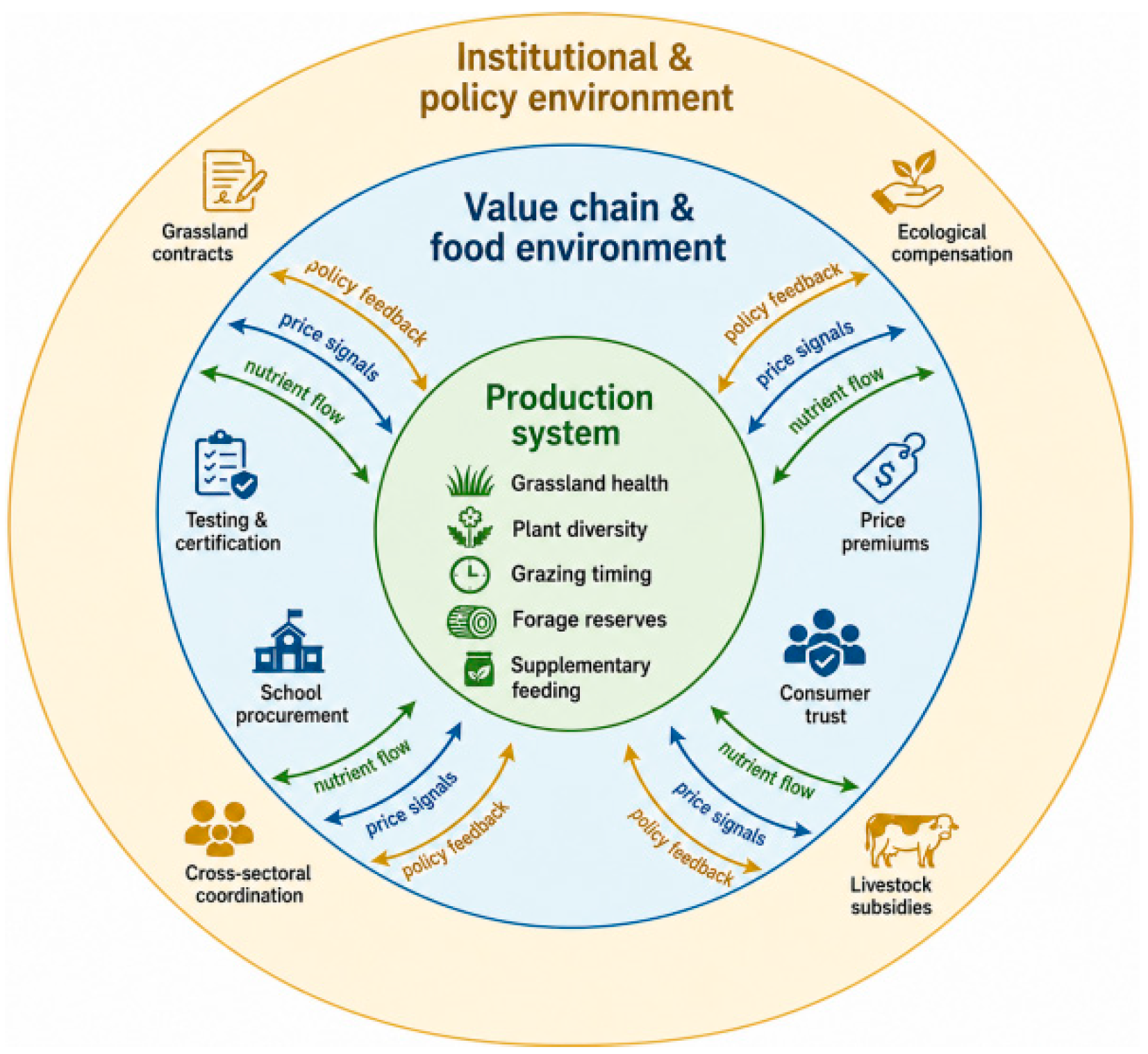
Based on the above theoretical resources, this paper constructs a triple-nested analytical framework to guide the empirical research (
Figure 1). The framework also draws on the sustainable rural livelihoods approach, which emphasizes the interplay of assets, institutions, and outcomes in shaping livelihood trajectories [
24].
The core layer concerns the nutritional reconstruction of the production system. This layer focuses on how herders and grassroots institutions adjust herd management, forage supply, grazing schedules, and supplementary feeding strategies at the operational level in order to improve the nutrition-related quality of livestock products without exceeding the carrying capacity of grasslands. It examines the interaction among local production decision-making, traditional ecological knowledge, and modern animal nutrition science.
The middle layer concerns the value chain and the nutritional reconstruction of the food environment. This layer focuses on the pathways through which nutrition-optimized livestock products enter transaction and consumption channels. It analyzes whether price mechanisms can effectively transmit nutritional quality signals, whether consumers are aware of and willing to pay for nutrition-oriented livestock products, whether the distribution of value-chain benefits can encourage continuous improvement at the production end, and whether public procurement can play a demand-side role [
25].
The peripheral layer concerns the nutritional reconstruction of the institutional and policy environment. This layer examines the compatibility between nutrition-oriented goals and the rule systems of grassland contract management, grassland ecological compensation policies, livestock subsidies, insurance clauses, and food safety supervision frameworks. It also analyzes the incentive orientation of current assessment indicators and subsidy mechanisms, as well as potential tensions among different departmental goals.
There are nonlinear interactive feedback relationships among the three layers. The development level of the value chain directly affects incentives for improvement at the production end. Institutional signals simultaneously shape market rules and herders’ expectations. The continuous accumulation of grassroots practices may also promote adaptive institutional adjustment from the bottom up. The framework retains the multidimensionality of the classical nutrition-sensitive agriculture framework while embedding the ecological and social particularities of grassland livestock systems.
2.5. Operationalizing Ecology–Nutrition Synergy
Ecology–nutrition synergy is the core analytical construct of this paper. To move beyond conceptual definition, we specify it through three cascading dimensions—foundational, process, and outcome synergy—each linked to measurable indicators, data sources, and the three case banners (
Table 1).
Foundational synergy refers to the material dependence of nutritional quality on ecological integrity. This dimension highlights the relationship between grassland ecological characteristics and the nutritional composition of livestock products. Higher grassland plant diversity may provide a broader nutrient spectrum for grazing livestock. Different plant groups contribute different nutritional functions: grasses provide energy and fiber, legumes contribute crude protein, and composites and chenopods may provide minerals and secondary metabolites. Relevant studies suggest that the proportion of n-3 polyunsaturated fatty acids in mutton produced under light grazing conditions is significantly higher than that in mutton produced under heavy grazing conditions, partly because of higher plant species richness [
26]. This indicates that the maintenance of grassland ecological integrity is not merely an external constraint on nutritional goals, but may also serve as an endogenous resource for nutrition optimization.
Process synergy refers to management practices that serve both ecological and nutritional objectives. This dimension emphasizes that grazing management decisions do not necessarily create a zero-sum relationship between ecological protection and nutrition optimization, and that well-designed practices may help coordinate both goals. For example, adjusted grazing schedules or rotational grazing may reduce repeated grazing pressure on the same grassland plots and allow time for forage regeneration. They may also enable livestock to access more diverse forage resources at different phenological stages, thereby improving the intake of micronutrients and flavor-related compounds. In this way, ecological and nutritional benefits may be pursued simultaneously.
Outcome synergy aims to improve nutrient output per unit of ecological resource input. This dimension provides a new perspective for performance evaluation. Traditional animal husbandry evaluations often treat grass yield as an ecological output and slaughter numbers as an economic output, without systematically connecting the two. A nutrition-sensitive perspective links them through the idea of grassland nutrition utilization efficiency, that is, the amount of key micronutrients, such as iron, zinc, and vitamin A, produced per unit of grassland area and per unit of water consumed. This concept may serve as a future evaluative direction for measuring the effectiveness of nutrition-sensitive livestock farming. At present, it remains at the conceptual stage. Although the empirical evidence in this paper does not support accurate calculation, it provides a clear direction for future policy evaluation and optimization.
These three dimensions also guide the empirical analysis in
Section 4. Foundational synergy is examined through the ecological conditions and native forage resources that shape nutrition-related product quality; process synergy is examined through grazing, feeding, and herd-management practices; and outcome synergy is examined through local attempts to evaluate, price, and institutionalize nutrition-related value.
3. Research Methods
3.1. Design Logic and Case Selection
This paper adopts a multi-case comparative study design. Case study research is suitable for exploring open-ended questions such as “how” and “why,” especially in research scenarios where the boundary between the phenomenon and its context is not clear [
27]. By comparing similarities and differences across cases, a multi-case design can refine more general theoretical associations and improve the transferability of research conclusions [
28].
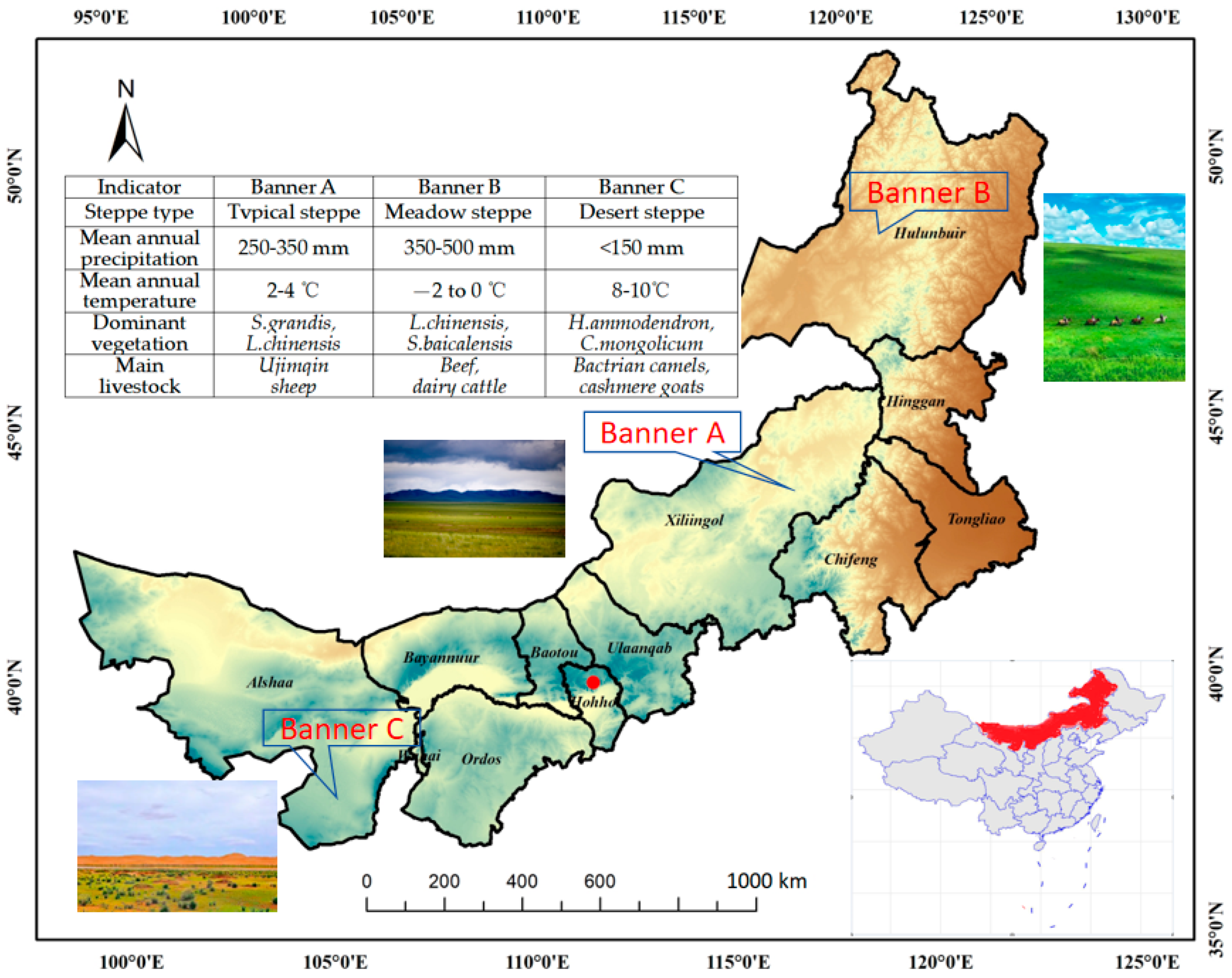
Case selection followed the principle of theoretical sampling. Meadow steppe, typical steppe, and desert steppe are distributed from east to west across Inner Mongolia’s grasslands. Annual precipitation decreases from approximately 500 mm in the east to less than 150 mm in the west. Vegetation structure and grazing systems show clear gradient differences, providing a natural comparative framework for investigating the forms of nutrition-sensitive livestock farming under different ecological constraints. Based on this logic, three banners were selected as cases.
Case 1: Banner A, located in the typical steppe area of Xilingol League, has an average annual precipitation of 250–350 mm. Its vegetation is dominated by perennial grasses such as Stipa capillata and Leymus chinensis, and Ujimqin sheep are the traditional dominant livestock species. Since 2016, the banner has taken the lead in implementing a dynamic grass–livestock balance management system based on remote sensing monitoring. In 2018, it implemented an early lamb slaughter subsidy policy. Because of these institutional innovations, this case is suitable for observing how nutrition-sensitive steering mechanisms are implemented at the policy level.
Case 2: Banner B, located in the meadow steppe area of Hulunbuir City, has an average annual precipitation of 350–500 mm and relatively high forage productivity. Leymus chinensis and Stipa baicalensis are the constructive species. Its livestock structure is dominated by beef cattle and dairy cattle. The area also contains large-scale agricultural reclamation pastures. The application of precision feeding technology and the development of high-fat dairy products are relatively advanced, making this case suitable for analyzing the technology-enabled pathway of nutrition optimization.
Case 3: Banner C, located in the desert steppe area of Alxa League, has annual precipitation of less than 150 mm and sparse vegetation. The vegetation consists mainly of sandy shrubs and drought-tolerant semi-shrubs, and the traditional livestock species are Bactrian camels and cashmere goats. The banner has explored the use of native shrubs as forage resources under extreme ecological constraints, making it suitable for analyzing nutrition-sensitive practices under strong ecological limitations (
Figure 2).
3.2. Reflection on the Researcher’s Position
Two members of the research team have long-term fieldwork and life experience in the pastoral areas of Inner Mongolia. This background had a dual impact on the research. Its advantages included familiarity with pastoral social networks, everyday Mongolian language, and local norms. These advantages helped the team quickly establish interview trust, capture implicit meanings in discourse, and distinguish between routine phenomena and atypical events. However, this background also created risks. Existing experience may produce cognitive inertia, reduce sensitivity to information that contradicts expectations, and lead to selective attention.
To manage these subjective risks, which cannot be completely avoided in qualitative research, this paper adopted a division-of-labor validation strategy during the coding stage. The first round of open coding was independently led by team members without long-term pastoral experience. The coding results were then cross-checked with those of experienced team members one by one. Approximately 18% of divergent codes were discussed by the team to form unified judgments. Although this strategy cannot completely eliminate the influence of researcher positionality, it can significantly reduce selective bias.
3.3. Data Collection
Data collection was carried out in five rounds from July 2019 to January 2025. Each field visit lasted 10–20 days, and the cumulative fieldwork across the three cases amounted to approximately 140 days. The study drew on three data sources and triangulated them where possible.
Semi-structured interviews formed the core data source. Respondents were divided into four categories: 42 herders, covering small households with 50–200 sheep units and large households with more than 500 sheep units; 22 grassroots animal husbandry, grassland management, and veterinary technicians; 20 Gacha cadres and leaders of herders’ cooperatives; and 8 officials and professionals from agriculture, animal husbandry, forestry, health, market supervision, and other county-level departments. Interviews were conducted in herders’ homes, grazing camps, or offices. Each interview lasted 40–90 min and was recorded and fully transcribed. The interview outline focused on livestock production decision-making, forage sources and feed ratios, sales channels and price formation, perceptions of ecological compensation policies, and understandings of meat and milk quality, while leaving space for flexible narration.
To protect interviewees’ anonymity, each respondent was assigned a unique identifier. The code consists of letters indicating the respondent category, the case site, and a number: H = herder, T = technician, G = government, and E = enterprise; A = typical steppe, B = meadow steppe, and C = desert steppe. The final number indicates the case number. All interview quotations in this paper are marked with corresponding codes to ensure research traceability.
Policy documents related to grassland livestock farming, ecological protection, and nutrition and health were systematically collected from the national, autonomous-region, league-city, and banner-county levels for the period from 2015 to 2025. These documents included grassland ecological protection subsidy and reward schemes, livestock breeding subsidy measures, agricultural and livestock product quality and safety supervision documents, and supporting rules for the student nutrition improvement plan. Textual analysis focused on the core indicators used in policy objectives and examined whether they covered the dimension of nutritional quality.
Field observation generated roughly 35,000 words of field notes. The research team participated as observers in settings that included herders’ winter–spring supplementation routines, Gacha-level meetings for reviewing grassland ecological compensation funds, technicians’ household visits for body condition scoring, and live animal trading market price negotiations. The notes focused on tacit knowledge that interviews may easily miss, including the texture of herders’ technical reasoning and the adaptations and deviations that characterize grassroots implementation of formal rules. Data triangulation was applied across interviews, policy documents, and field observations to enhance validity. Interview narratives were cross-verified with policy text analysis and on-site observational evidence. Complementary information from multiple sources was used to corroborate key findings, reduce information bias, and ensure factual accuracy.
3.4. Data Analysis Strategy
Data coding and analysis followed reflexive thematic analysis and the six-stage process proposed by Braun and Clarke [
29]. The specific steps were as follows. In the familiarization stage, the research team read all interview transcripts and field notes three times to form a holistic understanding of the data. In the initial coding stage, two researchers independently assigned descriptive labels to the text, generating a total of 127 initial codes. In the theme-searching stage, the initial codes were integrated into 14 candidate first-level themes through continuous comparison and clustering. In the theme-review stage, two team-wide thematic seminars were held to split or merge four first-level themes with blurred boundaries. In the theme-definition and naming stage, five core themes shared across cases were finalized. In the writing stage, each theme was supported with interview quotations, text excerpts, and observation fragments. NVivo 14 was used to assist coding management, but the core interpretive judgments were made through team discussion and did not rely on automatic software clustering. To ensure rigor and reliability, dual independent coding was conducted by two researchers. Initial coding results were compared, and discrepancies were discussed until consensus was reached. Approximately 18% of divergent codes were resolved through team discussion, enhancing the consistency and credibility of the thematic analysis.
3.5. Research Limitations, Bias Management, and Ethical Considerations
This study has several limitations. First, the sample was obtained through convenience and snowball sampling rather than random sampling, which may limit statistical generalizability. Second, livelihood and production data were mainly derived from self-reports without independent household ledger verification, which may involve social desirability bias. Third, the study is geographically limited to Inner Mongolia, and cross-regional generalizability to the Qinghai–Tibet Plateau or Xinjiang requires further validation. Fourth, no independent biochemical analysis was conducted for livestock products; nutritional quality evaluations rely on the published literature and local testing reports, which do not constitute direct laboratory evidence. These limitations are acknowledged and provide directions for future research.
Bias management involved multiple cross-validation strategies. Forage inventory data were verified using grassland lease contracts and allocation records where possible. The effects of technology adoption were cross-checked through input from livestock purchasers and testimony from neighboring herders. Coordination dilemmas among departments were verified through policy texts and interviews with officials. Statements that could not be verified were not given decisive weight, and their sources were clearly marked.
Regarding ethical considerations, this study was approved by the ethics committee of the researchers’ institution. All interviewees signed informed consent forms, and the names and personal information of banners and lower-level units were anonymized.
3.6. A Note on Nutritional Data
This paper focuses on institutional logic, practical mechanisms, and transformation dilemmas at the level of social–ecological systems. It does not carry out independent biochemical tests, such as fatty acid, trace element, or vitamin testing, on meat, milk, or other livestock products. Judgments about nutritional quality improvement in this paper are drawn from the published academic literature, local testing reports, related project evaluation data, and semi-structured interview data collected from field investigations. The paper explains the practical mechanisms behind these claims based on the above multi-source empirical materials, but it does not conduct independent causal testing. Relevant conclusions therefore need to be further verified in future studies that combine social-scientific fieldwork including in-depth interviews with measured biochemical data.
4. Research Findings
The following analysis is organised according to the three dimensions of the ecology–nutrition synergy framework, namely foundational, process, and outcome. Banner A’s typical steppe context examines process synergy through the practice of grass–livestock nutritional balancing. Banner C’s desert steppe and Banner B’s meadow steppe jointly illustrate the integration of foundational and process synergy via the scientific valorisation of native forage resources and traditional pastoral knowledge. Banner B takes the lead in exploring outcome synergy through market experiments that establish connections between ecological origin and nutritional quality, with Banner A and Banner C serving as comparative cases for supplementary analysis. All three research banners further reveal that four structural dilemmas constrain the realisation of all three synergy dimensions, explaining the isolation and limited diffusion of existing niche innovations.
4.1. From “Counting Sheep” to “Calculating Grass”: The Grass–Livestock Nutritional Balancing Pathway
In Banner A, more than 70% of surveyed herders now calculate winter–spring forage gaps. A beef cooperative in Banner B reduced herd size from 100 to 60 head but raised calf weaning survival to 91.5% and added 40 kg per calf, keeping total income unchanged. “We used to count sheep; now we calculate grass.” This widely heard expression in pastoral areas reflects a profound transformation in the underlying management logic of grassland livestock systems.
The first shift is from “checking excessive livestock numbers” to “calculating forage gaps.” Before 2016, the grass–livestock balance policy in Banner A centered on verifying livestock carrying capacity after autumn. Livestock exceeding the approved carrying capacity had to be sold within a certain period, and subsidy funds were withheld according to the implementation results. This model easily generated conflicts between cadres and herders. Herders questioned whether the calculation of carrying capacity adequately reflected that year’s grass growth, while cadres faced high verification costs and strong implementation resistance.
After 2016, Banner A introduced a dynamic grassland yield estimation model based on MODIS remote sensing data. After the peak grass-yield period in August each year, the hay yield of each Gacha and pastoral grassland was automatically estimated. The data were no longer used simply to identify excessive livestock numbers, but to calculate the winter–spring forage gap, that is, the difference between the forage required for the safe overwintering of existing livestock and the available supply from grasslands. The management logic changed from “how many sheep have you exceeded?” to “how much grass do you need?” Forage reserve became a prerequisite for issuing subsidy rewards. Herders had to provide forage purchase vouchers or silage retention certificates before winter, and only after inspection could they receive full compensation.
This institutional design embeds the idea of nutrition sensitivity into the grassland management process. It realizes pre-winter nutritional allocation before the withering period and helps avoid livestock weight loss and death. A staff member who had worked on grass–livestock balance management in Banner A for more than ten years explained:
“We no longer say to the herder, ‘you have too many sheep.’ Instead, we tell him: this year, your pasture can’t produced enough grass, you have to prepare some grass to fill the gap.”
—T-A-06
Herders’ acceptance of this approach has gradually increased. A herder interviewed in Banner A recalled:
“In the first two years, we were not used to it. In the past, herders would sell a batch of sheep right before an inspection to get past the check. Now, cadres no longer check only the number of sheep; they check whether you have enough grass. Gradually, we got used to preparing grass according to the number of sheep.”
—H-A-25
The second shift concerns the loosening of the traditional idea that “raising more means earning more.” The belief that “livestock are the herder’s savings account” has long shaped herders’ risk perception. Livestock are considered a core guarantee for coping with disasters, market fluctuations, and major household expenditures. Actively reducing livestock numbers therefore means reducing perceived risk resistance. However, the survey found that some herders had begun to rebalance quantity-based security and quality-based returns. The head of a beef cattle cooperative in Banner B explained:
“In the past, one person raised a hundred cattle, but the grassland was not enough. In spring, weak cattle died or cows miscarried, and more than ten head were lost in a year. Now our cooperative focuses on raising sixty basic cows. Concentrate feed and lick bricks are available year-round. The calf weaning survival rate is over 91.5%, and the weight of each calf at breeding is about 40 kg higher than before. We raise fewer cattle, but total income has not fallen.”
—H-B-02
Young herders were more likely to accept the logic of quality differentiation. A herder in his fifties in Banner A said:
“My child came back and told me, ‘Why do you raise so many? City people now care about how the mutton is produced and what grass the sheep eat, not just whether it is cheap.’ I do not understand nutrition very well, but he has read more, so I listen to him.”
—H-A-11
However, because the market in Banner C remains underdeveloped, “raising more” is still the mainstream logic. A middle-aged herder in Banner C stated bluntly:
“You ask me to raise fewer but better animals. I also want to be less tired. But tell me, who recognizes good meat? Who will buy it? If you can find the market, I will change.”
—H-C-04
Overall, grass–livestock nutritional balancing shows how nutrition sensitivity is translated into everyday herd management. It does not appear as a fully formalized technical package. Rather, it emerges through adjustments in stocking rates, grazing timing, forage reserves, and supplementary feeding under ecological constraints.
4.2. “The Camel’s Milk Is Thicker Now”: Scientific Valorization of Indigenous Forage and Knowledge
In Banner C, supplementing camels with Haloxylon twigs increased milk fat by 0.4 percentage points (2.8% → 3.2%) and raised vitamin C content. Traditional four-season rotational grazing in Banner B increased n-3 PUFA in mutton by 14.1%. Adoption remains below 10% due to strict harvesting quotas. Native wild plant resources and herders’ traditional production knowledge in grassland pastoral areas have long been undervalued by modern livestock systems. The introduction of nutrition-sensitive thinking has promoted a revaluation of these two types of resources.
The first form is the nutritional development of desert shrubs. In Banner C, Haloxylon ammodendron forests form a core ecological barrier for sand prevention and control. Traditionally, some herders regarded them as low-value or even useless vegetation. In 2019, the local science and technology department collaborated with an animal nutrition research team from a university to conduct experiments. The results indicated that the crude protein content of tender twigs from Haloxylon ammodendron and Calligonum mongolicum in spring reached 12–15%, close to the level of medium-quality alfalfa, and that these twigs were rich in minerals such as calcium and potassium. The team developed a simplified supplementary feeding protocol, which was piloted among more than 30 herder households.
A camel herder involved in the pilot described the change as follows:
“We used to feed this grass to camels too, but we just cut it and threw it there. Whether the camel liked it or not, we did not know. Now we follow the timing people told us: cut the tender branches, chop them up, and mix them with corn stalks. The camels eat it clean. The milk is obviously thicker than when only corn stalks are fed, and the color is more yellow. This is real.”
—H-C-05
Local testing showed that the milk fat rate of the camel milk group fed with Haloxylon was 0.4 percentage points higher than that of the control group, and the vitamin C content also increased. To avoid ecological damage, the local rule limits annual harvesting to one-third of new branches in May, with quotas approved by the forestry and grassland department to ensure the ecological bottom line.
The second form is the nutritional translation of traditional rotational grazing. Local herders often follow seasonal grazing rules summarized as sunny slopes in spring, hilltops in summer, shady slopes in autumn, and lowlands in winter. The core logic of this traditional knowledge is to allow grasslands to rest in rotation. In recent years, its potential nutritional contribution to livestock product quality has begun to receive scientific attention. Relevant tests showed that the proportion of n-3 polyunsaturated fatty acids in the muscle fat of Ujimqin sheep under complete four-season rotational grazing was 14.1% higher than that of sheep under year-round feeding.
A retired veterinarian in Banner B, who had kept records for more than 20 consecutive years, stated:
“When rainfall is good and there are many kinds of grass, the milk skin is thick. When legumes decline, milk quality drops.”
—T-B-03
He further explained:
“If you talk to herders about fatty acids, they do not understand. If you tell them, ‘go to that grass slope to graze the sheep, and the meat will taste better,’ they understand. But if you want outside consumers to believe this meat is good, you have to show numbers on a test sheet.”
—T-B-03
This pathway shows how traditional pastoral knowledge can be linked with modern animal nutrition science. It also reveals a crucial issue: local knowledge can support nutrition-sensitive livestock farming only when it is translated into verifiable, communicable, and institutionally recognized forms.
4.3. “Good Meat Cannot Sell at a Good Price”: Market Trust Deficits and Nascent Premium Experiments
“Good meat cannot sell at a good price” is a common bottleneck in pastoral areas. How to realize market premiums for nutritional quality is key to the closed-loop operation of nutrition-sensitive livestock farming. A school milk programme in Banner B paid herders 3.5 CNY/kg, a 59% premium over the market price. Yet a full nutritional test panel costs > 3000 CNY, which erodes most of the achievable premium. The three cases explored different pathways, but all faced the bottleneck of trust.
The first pathway is the dual narrative of nutritional function and origin. Xilingol mutton has long relied on grassland origin as its core selling point, but it has lacked systematic support from verifiable nutritional data. Evaluations of the nutritional characteristics of selenium-enriched grassland mutton have demonstrated the potential for nutritional differentiation [
30], yet such evidence remains scattered and has not been systematically used in marketing [
30]. Over the past five years, some enterprises have attempted to display third-party testing results on product packaging. Through QR codes, consumers can access data on selenium, zinc, amino acids, fatty acid profiles, and veterinary drug residues, thereby achieving product differentiation through objective data.
The director of a meat enterprise in Banner A explained:
“In the past, we competed with others by saying whose meat was more tender. That was subjective; no one could prove it. Now I take out the data, and consumers can see for themselves. It cannot be faked. The testing institution is in Hohhot, not run by me.”
—E-A-01
However, small and medium-sized herders face the barrier of testing costs. The chairperson of a herders’ cooperative in Banner A stated:
“Our cooperative sells thousands of sheep a year. A full set of nutritional indicators costs more than 3000 yuan. If this cost is shared by each sheep, it adds several yuan per head. If you say your sheep is selenium-rich, people ask: why? Then you have to test it. In the end, this cost is deducted from our profits.”
—H-A-08
The second pathway is public procurement as a demand-side pull experiment. Since 2019, Banner B has prioritized the purchase of pasteurized fresh milk from local cooperatives instead of non-local UHT milk in the nutrition improvement program for rural compulsory education students. This reduced logistics costs, improved acceptance, retained more nutrients in fresh milk, and better matched local taste preferences. The residual milk rate among students also decreased.
The cadre responsible for school health in Banner B explained:
“Children grew up drinking this kind of milk at home. Now the school also provides locally pasteurized fresh milk every day. Nutrient retention is certainly better than ultra-high-temperature sterilized milk.”
—T-B-06
Stable school orders provided price security for the cooperative. The head of a dairy cooperative in Banner B recalled:
“That year, the milk price fell to a little over two yuan per kilogram. Our cooperative supplied milk to the school at a contract price of 3.5 yuan. It was not high, but it was stable. The school needed milk every day, so there was no situation where they wanted it today but not tomorrow.”
—H-B-04
These experiments reveal the importance of outcome synergy. Nutrition-sensitive livestock farming requires not only ecological production practices, but also market and institutional mechanisms capable of recognizing nutrition-related value (
Table 2). Without such mechanisms, nutritional quality remains difficult to price, and herders have limited incentives to maintain quality-oriented production.
4.4. Comparative Mechanism Analysis of the Three Pathways
Three distinct mechanisms animate the nutrition-sensitive practices observed across the three grassland types (
Table 3). Each mechanism is defined by its core logic (how it works), its drivers (why it emerges), and its transmission logic (how it links action to outcome).
Each pathway depends on a specific bridging institution that connects grassland ecology to nutritional outcomes: policy (Pathway 1), science (Pathway 2), or market/public procurement (Pathway 3). Where no bridge exists (e.g., Banner C lacks functioning bridges for Pathways 1 and 3), even ecologically possible nutrition gains remain unrealised. Conversely, where bridges overlap (Banner B uses both Pathways 2 and 3), synergy amplifies outcomes. This reveals that institutional bridging, not just technical innovation, is the binding constraint for scaling nutrition-sensitive livestock farming in pastoral systems.
4.5. Structural Lock-In: Standardization, Trust, Trade-Offs, Fragmentation, and Local Agency
Camel milk fat fluctuates 15–20% seasonally while dairy plants require <±5% daily variation. A 30–40% stocking reduction is only offset by a 30–40 CNY/sheep premium. The existing practices remain isolated highlights and are difficult to diffuse into the mainstream. Cross-case analysis identifies four intertwined structural obstacles: standardization imperatives, trust deficits, quantity–quality trade-offs, and governance fragmentation. These obstacles are not independent; they reinforce one another, making piecemeal solutions ineffective.
The first obstacle is the dilemma of technical standardization. A core feature of grazing systems is the natural fluctuation in product quality, which is significantly affected by precipitation, pasture composition, and season. For example, the spring–autumn fluctuation in the milk fat rate of the same camel herd can reach 15–20%. Herders regard this as a natural condition, but modern food industries require a high degree of standardization. A staff member at a dairy enterprise milk station in Banner B explained:
“Large processing plants need standardization. The indicators of fresh milk delivered every day cannot exceed the specified range; otherwise, it is difficult to adjust the parameters of the production line. Milk from grazing households may be good, but the indicators are high today and low tomorrow. Enterprises cannot repeatedly adjust the process for such a small volume.”
—T-B-05
Technology promotion also faces difficulties. A technician engaged in beef cattle nutrition regulation in Banner B stated:
“When the same formula is used in three households, the effect can be very different. The silage harvest period, cattle purity, drinking water temperature, and feeding time all affect the outcome.”
—T-B-04
The second obstacle is the lack of trust and the dilemma of certification costs. The abuse of labels such as “grass-fed” and “natural” has weakened consumer trust. A cadre from the market supervision department in Banner A revealed:
“Some traders keep sheep in captivity for two months, but because there is a grass slope next to the pen, they dare to label the product as ‘grass-fed.’ Do you call this grass-fed? It is hard to say, because there is no unified national implementation standard for forage feeding.”
—G-A-02
Real high-quality producers are therefore caught in a dilemma. Certification is costly and premiums are uncertain; without certification, they cannot distinguish themselves from pseudo-concept products.
The third obstacle is the internal tension between quantity control and value enhancement. The grass–livestock balance system strictly controls herd size, but nutritional premiums lag behind. A cadre from the animal husbandry department in Banner A stated bluntly:
“If you ask herders to raise fewer animals, you must let them raise fewer and still earn the same amount of money. Now, with nutrition-related efforts, one sheep may sell for only thirty or forty yuan more. If the number of sheep is reduced by thirty or forty percent, total income still falls. Herders calculate this very clearly.”
—G-A-04
Because Banner B has a more mature dairy processing chain and quality-based pricing mechanism, its acceptance of transformation is higher. Most pastoral areas, however, lack such conditions.
The fourth obstacle is cross-sectoral governance fragmentation. Nutrition-sensitive livestock farming involves forestry and grassland, agriculture and animal husbandry, health, market supervision, and other departments. Their objectives and assessment systems are often independent of one another. A banner-level cadre who participated in cross-departmental coordination described the situation as follows:
“When we meet to discuss grassland compensation funds, the Forestry and Grassland Bureau emphasizes who is overloaded and whose subsidy should be deducted. The Agriculture and Animal Husbandry Bureau emphasizes what to do if households cannot continue after the deduction. Their starting points conflict. People from the Health Commission sometimes come, but they care more about anemia rates and growth retardation rates. They cannot clearly explain how these indicators are related to the sheep-feeding subsidies we provide.”
—G-B-05
Supervision of nutritional indicators is thus left vacant in the inter-departmental responsibility gaps, with no clear accountable entity. Finally, individual agency temporarily holds together practices that remain institutionally fragile. In the absence of stable certification systems, clear price premiums, and unified technical standards, innovative herders, grassroots cadres, technicians, cooperative leaders, and local entrepreneurs often play a bridging role between traditional pastoral knowledge, scientific verification, and market experimentation. In Banner A, a young Sumu cadre leveraged alumni resources to persuade the health commission to carry out a school-age children’s nutrition survey in the pilot Gacha. He explained:
“I wanted to obtain authoritative data endorsement to prove that my pilot was not only about improving livestock production methods. It was directly connected to the health of herders’ own children.”
—G-A-06
In Banner B, a retired veterinarian’s 20-year handwritten records on grassland conditions, cattle health, and milk quality served as persuasive evidence for engaging with herders:
“I do not hold a university textbook and talk to them about fatty acid structures. I simply take out my notebook, turn to the 1997 record when rainfall was abundant, and tell them: that year, the pasture contained wild alfalfa, astragalus, and other legumes, and the milk skin was thick.”
—T-B-03
Such agency helps explain the emergence of nutrition-sensitive livestock farming, but it also reveals its fragility. When innovation relies too heavily on a small number of motivated individuals, it remains vulnerable to market uncertainty, policy shifts, and inadequate long-term institutional support.
4.6. How the Four Dilemmas Hang Together
Section 4.5 listed four dilemmas: standardisation, trust, quantity–quality trade-off, and fragmented governance. They are not separate problems. One feeds the next.
The loop. It starts with natural quality fluctuation—camel milk fat can swing 15–20% between spring and autumn, but dairies want daily variation under 5%. That kills standardisation. No standard means no credible certification. Without certification, consumers do not trust the “grass-fed” claim. Testing is too expensive (>3000 CNY) for individual herders. So premiums stay tiny—a 30–40% cut in sheep numbers earns only 30–40 CNY extra per head. That makes the trade-off brutal: herders lose income if they reduce stocking. And no single government department (forestry, agriculture, health, market supervision) can fix any of this alone. Each dilemma reinforces the others. That is why small, one-off projects almost never scale.
Why they exist. Four things keep the loop running. Policy: for decades, livestock assessment has looked only at output weight, not nutrition. Grassland rules and food safety rules use different metrics; health policy has no say over how sheep are fed. Industry: pastoral areas have short supply chains, weak processing, and almost no public testing services. Ecology: seasonal quality swings are a fact of nature in dryland grazing—you cannot breed or engineer them away. Culture: older herders see livestock as their savings account; younger herders who might try new things are leaving.
Evolutionary logic. The four dilemmas emerged sequentially rather than simultaneously. During Phase 1 (2016 to 2018), following the implementation of the grass–livestock balance policy, the primary conflict was between ecological overload and herders’ income, while standardisation and trust issues had not yet become apparent. In Phase 2 (2019 to 2021), as early quality-improvement pilots were introduced, the tension between natural quality fluctuation and industrial processing standards became evident, particularly in meadow steppe dairy systems. In Phase 3 (2022 to the present), with the expansion of market experiments, trust deficits and fragmented governance have emerged as binding constraints. Currently, all four dilemmas coexist and mutually reinforce one another.
Implications for the three pathways. The pathways described in
Section 4.1,
Section 4.2 and
Section 4.3 represent adaptive responses that address individual dilemmas in isolation. However, they do not resolve the underlying causal loop. Each pathway circumvents one dilemma while leaving the other three intact. Without systemic changes in standardisation (accepting managed natural variation), trust (establishing public low-cost testing), trade-offs (linking payments to nutritional quality), and governance (integrating cross-sectoral responsibilities), these pathways are unlikely to scale beyond isolated pilot projects. A system-wide transformation requires simultaneous progress across all four dimensions.
5. Discussion
5.1. Theoretical Contribution: Expanding the Conceptual Boundary of Nutrition-Sensitive Agriculture
The core theoretical dialogue of this paper is with the crop-centered framework of nutrition-sensitive agriculture. Based on the experience of grassland livestock systems in Inner Mongolia, this study identifies three distinctive mechanisms of nutrition optimization in grazing systems and thereby revises and expands the existing conceptual framework.
The first mechanism is the ecological mediation of nutritional quality. In crop systems, micronutrient content is mainly influenced by genotype, soil conditions, and fertilization. In grazing livestock systems, however, the nutritional level of livestock products is highly dependent on grassland ecological processes. Plant diversity, phenological rhythms, and precipitation patterns jointly shape the nutrient intake structure of livestock. This means that the “production system” dimension of grassland livestock systems must be extended upstream to grassland ecosystem management. The ecosystem should be included as a pre-nested layer in the analytical framework.
The second mechanism is natural quality fluctuation as an endogenous feature. Crop systems can often pursue nutritional stability through standardized agronomy, whereas quality fluctuation in grazing systems is an endogenous feature rather than an external defect. The homogenizing tendency of the international food system has contributed to the marginalization of small-scale natural production. This paper argues that nutrition-sensitive practices in grassland livestock systems should not aim simply to eliminate fluctuation, but should establish quality grading systems within the range of fluctuation. The task is therefore to manage fluctuation rather than eliminate it.
The third mechanism is the scientific valorization of local knowledge. Traditional knowledge, such as seasonal grazing movement and the use of specific grass species, can be transformed into quantifiable and verifiable scientific indicators through animal nutrition research and chemical testing. Examples include increasing the proportion of n-3 fatty acids through rotational grazing and increasing milk fat rates through supplementary feeding with Haloxylon ammodendron. This pathway does not rely on external high-input technology packages and is therefore suitable for remote pastoral areas. It also enables the co-production of traditional knowledge and scientific knowledge.
In summary, this study extends the theoretical boundary of nutrition-sensitive agriculture by upgrading the traditional “production system” dimension into a nested “ecosystem-production system” framework, which incorporates ecological integrity and biodiversity as core mediating variables to adapt conventional crop-oriented theories to grassland livestock systems. Specifically, the proposed ecology–nutrition synergy framework realizes such theoretical adaptation through three unique grassland-oriented mechanisms. First, ecological mediation highlights that plant diversity, phenology, and precipitation collectively determine livestock nutrient intake, representing an ecological pathway absent from traditional cropland frameworks. Second, endogenous quality fluctuation recognizes that seasonal and inter-annual nutritional variations are inherent features of grazing ecosystems rather than deficiencies, suggesting that sustainable grassland management should regulate rather than eliminate natural fluctuations in product quality. Third, the scientific codification of traditional ecological knowledge validates that rotational grazing practices effectively improve livestock nutritional quality.
5.2. Practical Tensions and Unfinished Questions
This paper avoids selectively presenting only successful cases and instead focuses on revealing the critical tensions behind existing practices. The first core tension is the gap between the spontaneity of grassroots innovation and the absence of institutional support. The grass–livestock nutritional balancing practice in Banner A, the Haloxylon feeding experiment in Banner C, and the school procurement experiment in Banner B all depend heavily on individual actors rather than regular institutional supply. At present, these practices remain at the pilot or project level. They have not yet moved from niche experiments to system-wide transformation, and their sustainability remains uncertain.
The second core tension concerns fairness in value-chain distribution. If premiums from nutrition-sensitive livestock farming are mainly captured by downstream processing enterprises and marketing channels, while herders fail to obtain a reasonable share, the fairness and sustainability of the model will be undermined. The Banner B case provides some positive evidence, but its scale remains limited. More generally, herders’ bargaining power remains weak.
The third tension lies between ecological quantity control and household income security. Reducing herd size may support ecological restoration and improve forage conditions in the long term, but it may reduce herders’ short-term income. Without stable compensation, technical support, and nutrition-based price premiums, herders may find it difficult to maintain quality-oriented production under strict stocking constraints.
A further tension concerns the relationship between individual agency and institutionalization. The cases show that motivated herders, technicians, grassroots cadres, and entrepreneurs can translate nutrition-sensitive ideas into concrete local practices. However, when such practices depend primarily on individual initiative rather than stable rules, standards, and incentives, they remain difficult to reproduce and scale. Individual agency is therefore both a source of innovation and a sign of institutional fragility (
Table 4).
These tensions indicate that nutrition-sensitive livestock farming should not be treated as a simple technical innovation. It is a broader transition process involving ecological management, market trust, value distribution, and institutional coordination.
5.3. Global Comparative Perspective
Placing the Inner Mongolia case within the broader context of global grassland pastoral regions helps identify both local characteristics and more general patterns. Compared with pastoral systems in the arid regions of East Africa, Inner Mongolia has stronger administrative capacity and policy infrastructure. East African mobile grazing systems also face climate uncertainty and ecological vulnerability, but their institutional infrastructure is often weaker, and nutrition-sensitive interventions depend more heavily on NGOs and international projects. At the same time, East African herders may enjoy greater autonomy in grazing decisions, and the cost of reaching community-level quality consensus may be lower.
Compared with Mongolia’s grassland pastoral areas, Inner Mongolia also shows distinctive institutional features. Grasslands in Mongolia are nominally state-owned but often function as open-access resources in practice. Livestock decisions are less constrained by administratively defined carrying capacity, and overloading and degradation may become more severe. However, traditional ecological knowledge remains relatively complete, and seasonal rotational grazing rules still exist in some areas. The comparison between China and Mongolia suggests that overly strict administrative control may inhibit independent innovation, while overly loose public governance may lead to resource depletion. Effective coordination may require an intermediate equilibrium between ecological regulation and local autonomy.
Global comparison shows that there is no single best practice for nutrition-sensitive livestock farming. Such practices must be adapted to local political, economic, ecological, and cultural contexts. The global challenge of reconciling food demand with sustainable intensification further underscores the urgency of context-sensitive approaches [
31,
32].
5.4. Comparison with the Existing Literature
Our findings extend previous work in several ways. Ruel and Alderman [
11] developed the nutrition-sensitive agriculture concept for crop systems; we add an “ecological mediation” mechanism (plant diversity, phenology, precipitation) specific to grazing systems. Jones [
14] linked biodiversity to dietary diversity; we provide livestock-side evidence that grassland plant diversity directly improves animal-source food quality. Daley et al. [
9] confirmed grass-fed benefits for fatty acids; we further show how traditional knowledge (rotational grazing, shrub feeding) can be scientifically codified. Applying Geels’ multi-level perspective [
20], we identify four structural lock-ins that prevent niche innovations from scaling. Compared with East African pastoral systems (e.g., Grace et al. [
5]), Inner Mongolia has stronger administrative capacity but shares similar trade-offs between quality fluctuation and market standardisation. Our ecology–nutrition synergy framework thus generalises beyond China to other dryland pastoral regions.
5.5. Policy Implications for Nutrition-Sensitive Livestock Farming: A Context-Specific Approach
The usual recommendations—adding nutrition indicators to grassland compensation, building public testing platforms, running quality-linked subsidy pilots, and strengthening cross-sector coordination—are all sensible in principle. But they land very differently depending on ecology, industry base, and market conditions. Below is a differentiated strategy by grassland type and development stage, drawing directly from the three case banners.
Meadow steppe (Banner B, mature stage). The main tension is natural quality fluctuation versus industrial processing standards. Here, policy should not force year-round uniformity. Instead, write tiered standards that accept seasonal variation (e.g., milk fat ±15% over the year). Set up a shared testing centre, co-funded by government and dairy enterprises, so cooperatives pay only a fraction of the cost. Scale up public procurement—school milk, hospital canteens—with mandatory certified sourcing. Banner B’s school milk programme already delivers a 59% premium; use that as a model.
Typical steppe (Banner A, critical stage). The binding constraint is that herders are asked to cut stocking rates, but nutritional premiums do not cover the income loss. Policy should link grassland ecological compensation directly to nutritional quality. Add a “nutrition coefficient” to existing per-hectare subsidies—cooperatives that provide verifiable test results (e.g., mutton n-3/n-6 ratio, zinc content) receive a 10–20% top-up. Pool testing costs at cooperative level (a single herder cannot afford >3000 CNY; a 50-member cooperative can). Use remote sensing data to give herd-specific forage advice for winter–spring supplementary feeding.
Desert steppe (Banner C, initial stage). Ecology comes first. Do not push commercialisation prematurely. Enforce strict harvest quotas for native shrubs (Haloxylon, Calligonum) based on annual growth; do not expand supplementary feeding beyond what the land can take. Select 10–20 pilot households per banner, provide technical support from university nutrition teams, free testing, and help marketing camel milk or cashmere through direct-to-consumer channels (e-commerce, tourism)—bypassing conventional commodity markets. No market-based performance targets until practices prove sustainable.
What every region needs, regardless of type. Three enablers apply everywhere. First, a cross-sector coordination mechanism at provincial and banner levels (forestry, agriculture, health, market supervision) that meets quarterly and shares nutrition-related indicators. Second, a provincial-level testing platform with mobile vans for remote banners—so even desert steppe has basic testing capacity. Third, a training module on nutrition-sensitive livestock farming for herders, extension agents, and cooperative managers.
In short, the four generic recommendations are not wrong; they just need unpacking. Adding nutrition indicators to compensation works for typical steppe (as a coefficient) but is premature for desert steppe where testing is absent. Public testing platforms are needed everywhere, but the funding model differs. Quality-linked subsidies are urgent in typical steppe, less so in meadow steppe where market premiums already exist. Cross-sector coordination is the baseline for all.
5.6. Where These Findings Apply
Fully applicable. The framework and three pathways work where (i) northern China’s temperate dry grasslands (Inner Mongolia, Xinjiang, Gansu, Qinghai) with grass–livestock balance policies; (ii) Mongolian pastoral systems with similar ecology and institutions; (iii) other global drylands (US Great Plains, Argentine Pampas, Kazakh steppe) where grazing is extensive and basic markets exist. The precondition—natural grassland is the main feed source, and some grazing regulation is in place.
Partially applicable. East African pastoral systems (Kenya, Ethiopia, Tanzania) face similar ecology and nutrition problems, but state capacity is weaker, traditional governance is stronger, and NGOs/international projects play a larger role. The framework’s logic (ecological mediation, quality fluctuation, traditional knowledge) holds, but policy tools (remote sensing, subsidies) need deep adaptation. On the Tibetan Plateau, the “traditional knowledge” pathway fits well, but the “market signalling” pathway fits poorly due to weak market integration.
Not applicable. The framework does not work for (i) feedlot or confined livestock (no natural grassland); (ii) crop farming (other NSA frameworks already exist); (iii) tropical rainforest or high-humidity pastoral systems—different ecology and livestock species.
A note on numbers. The specific figures (milk fat +0.4 p.p., n-3 PUFA +14.1%) come from the studied grassland types and breeds. But the four structural dilemmas—standardisation, trust, quantity–quality trade-off, fragmented governance—will likely appear in any pastoral system caught between ecological regulation, industrial processing, and weak market differentiation.
6. Implications
In Inner Mongolia’s pastoral areas, nutrition-sensitive livestock farming has emerged in three practical forms: balancing grass and livestock feed, using native forage plants in a science-based way, and exploring markets that link ecological origin to nutritional quality. These pathways work through three mechanisms—ecological mediation, natural quality fluctuation, and the scientific use of traditional knowledge. Yet scaling them up is blocked by four structural problems: natural quality variation clashes with industrial standards; there is no institutional trust to support nutritional premiums; short-term trade-offs exist between stocking control and nutritional gains; and governance is fragmented across sectors, leaving nutrition goals with no clear owner. The proposed ecology–nutrition synergy framework adapts nutrition-sensitive agriculture from cropping systems to grassland social–ecological systems, providing a practical and theoretical basis for integrating ecological protection, livestock quality, and nutrition-oriented governance in dry rangelands.
This study has several limitations. First, the cases cover only Inner Mongolia. Future research should expand to the Qinghai–Tibet Plateau and Xinjiang’s mountainous pastoral areas to conduct cross-regional comparative studies. Second, because this study is based mainly on qualitative analysis; future research should combine it with large-sample herder surveys to improve the robustness of the conclusions. Third, research on consumers’ cognition, willingness to pay, and influencing factors regarding nutrient-dense livestock products remains weak. Consumer-side empirical studies are therefore needed. Fourth, independent nutritional testing was not conducted. Future research should match herder management practices with biochemical data on livestock products in order to strengthen causal inference.
Beyond these immediate steps, the broader research agenda is clear: nutrition-sensitive agriculture must move beyond its crop-centric origins and engage more fully with the ecological and institutional specificities of the world’s pastoral systems. The 500 million people living in dryland pastoral areas globally face a similar nexus of ecological degradation and nutritional vulnerability. Developing context-adapted frameworks for these settings is not merely an academic exercise, but a prerequisite for equitable nutrition governance in a climate-uncertain future.