Quantifying Event-Based Heatwave-Induced Power Outage Risk: A Multi-Year Spatiotemporal Analysis in Texas




Abstract
1. Introduction
2. Materials and Methods
2.1. Study Area and Period
2.2. Electricity Outage Data and Event Construction
2.2.1. EAGLE-I Data and Hourly Aggregation
2.2.2. New Outages
2.3. Meteorological Data and Apparent Temperature
2.3.1. Open-Meteo Archive
2.3.2. Dew Point and Heat Index
2.4. Daily Metrics
- Temperature: daily maximum (TF,max = maxh€d TF,h), and daily mean (TF,mean = meanh€d TF,h) air temperature (°F).
- Heat index: daily maximum (HImax = maxh€d HIh), and daily mean (HImean = meanh€d HIh)). The daily maximum heat index serves as the primary heatwave indicator because it captures the peak thermal stress experienced during the hottest part of the day, when electricity demand and equipment thermal limits are most critical [2].
- Hours of extreme heat: the number of hours during which the heat index equaled or exceeded 95 °F (nHI ≥ 95nHI ≥ 95) and 100 °F (nHI ≥ 100nHI ≥ 100). These counts characterize the duration of sustained extreme heat within each day, complementing the peak value with a measure of persistence.
- Outage metrics: total new outage customers during the day (new_outages_dayc,d = ∑h∈d new_outagesc,h) and the maximum concurrent customers without power (max_outages_customersc,d = maxh∈d outages_customersc,h). The daily sum of new outages captures total failure magnitude, while the daily maximum concurrent outage reflects peak system stress.
- Month: extracted from the date for subsequent seasonal filtering.
2.5. Adaptive Heatwave Threshold
2.6. Heatwave Event Identification and Metrics
2.7. County-Level Indicators and Mapping
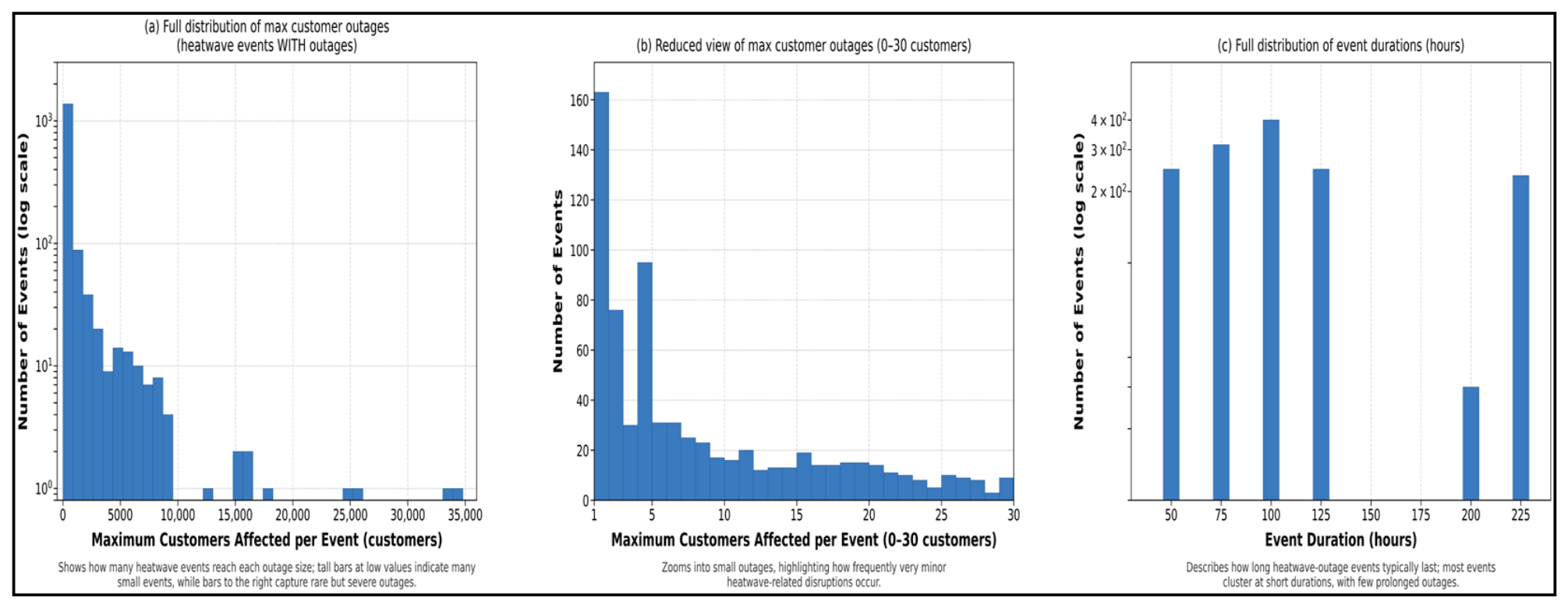
2.8. Exploratory Distributions of Event Severity and Duration
2.9. Logistic Regression for Major Outages
2.9.1. Definition of Major Events
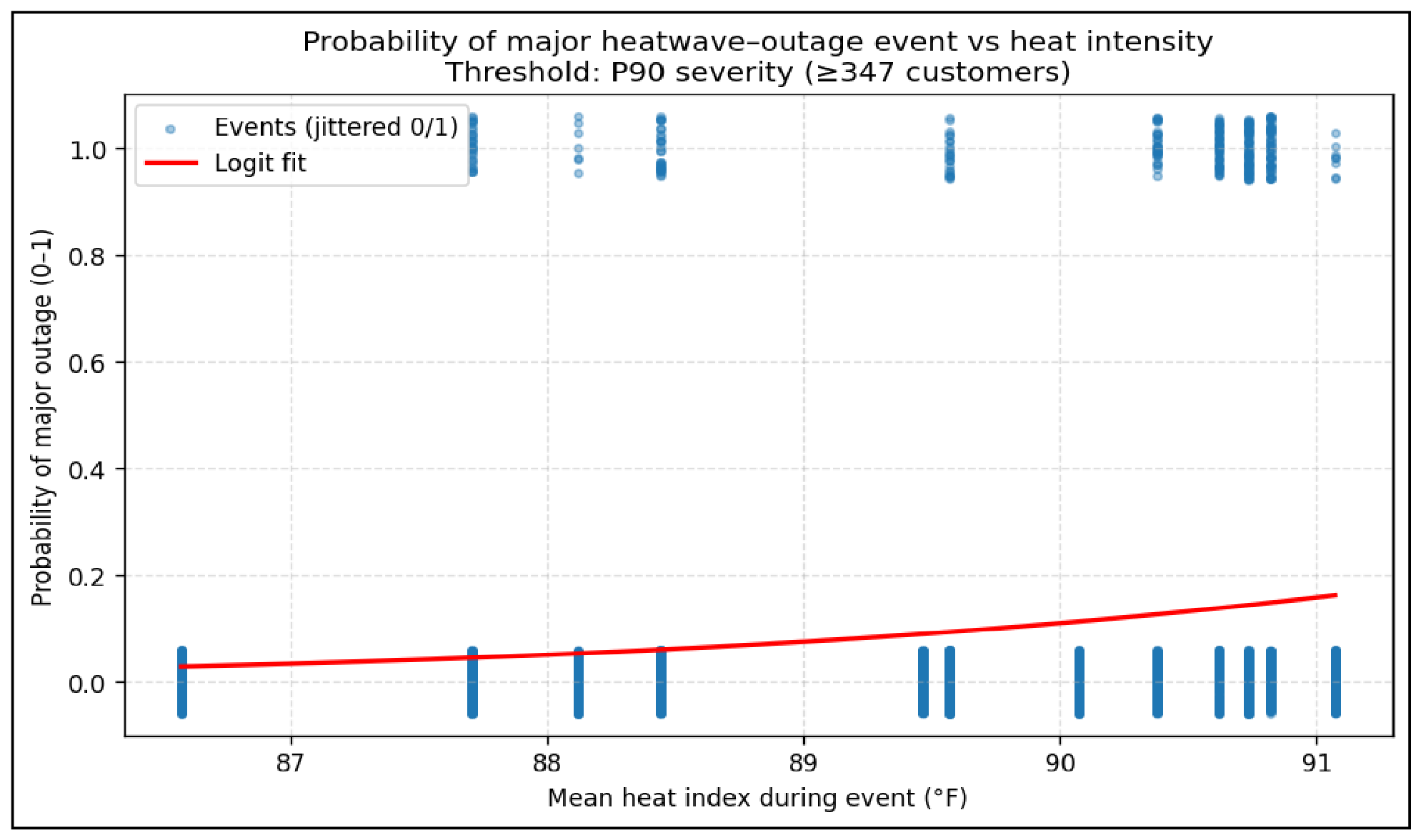
- P90 severity: Me ≥ P90, events in the top 10% of severity (≥347 customers in the dataset);
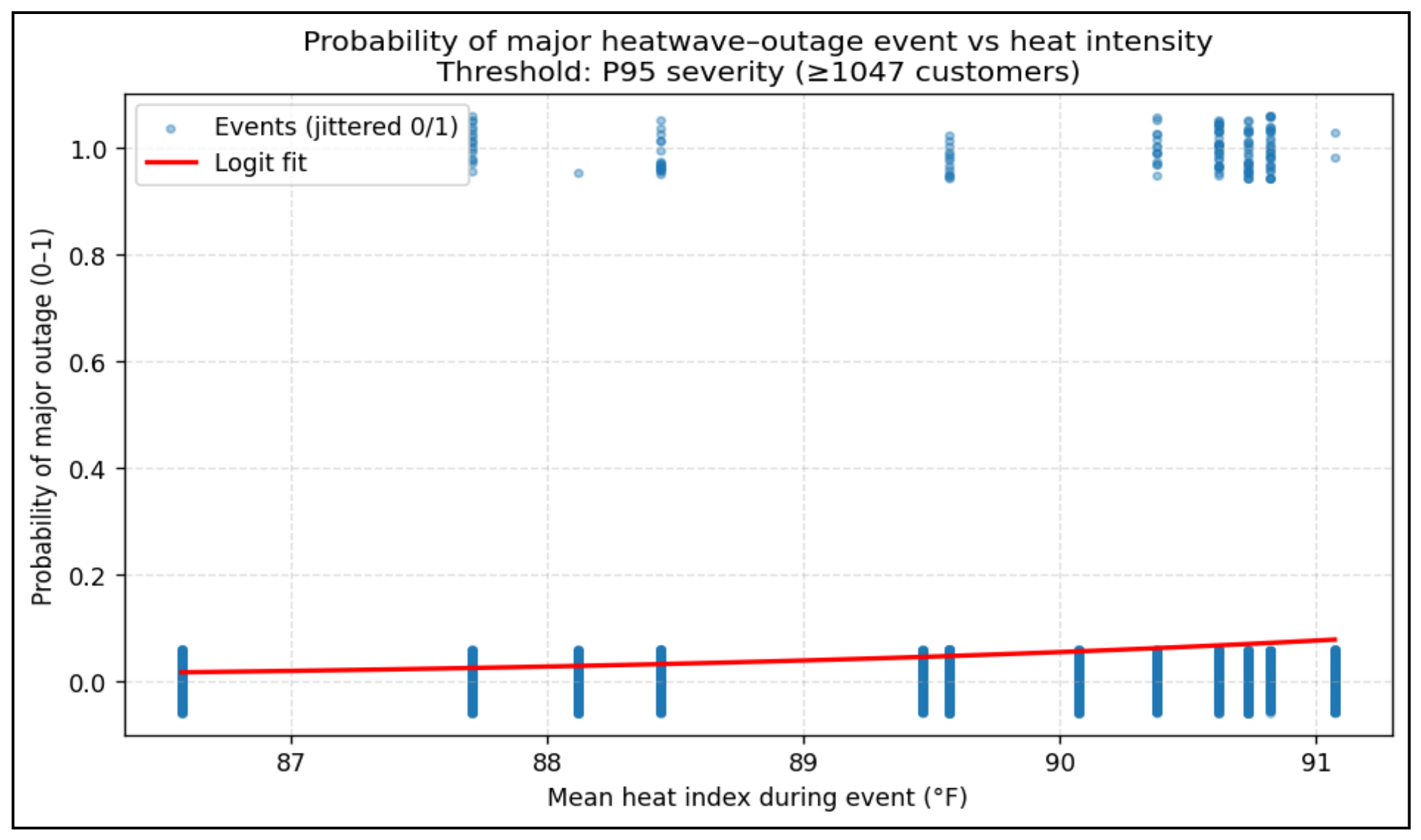
- P95 severity: Me ≥ P95; events in the top 5% of severity (≥1047 customers);
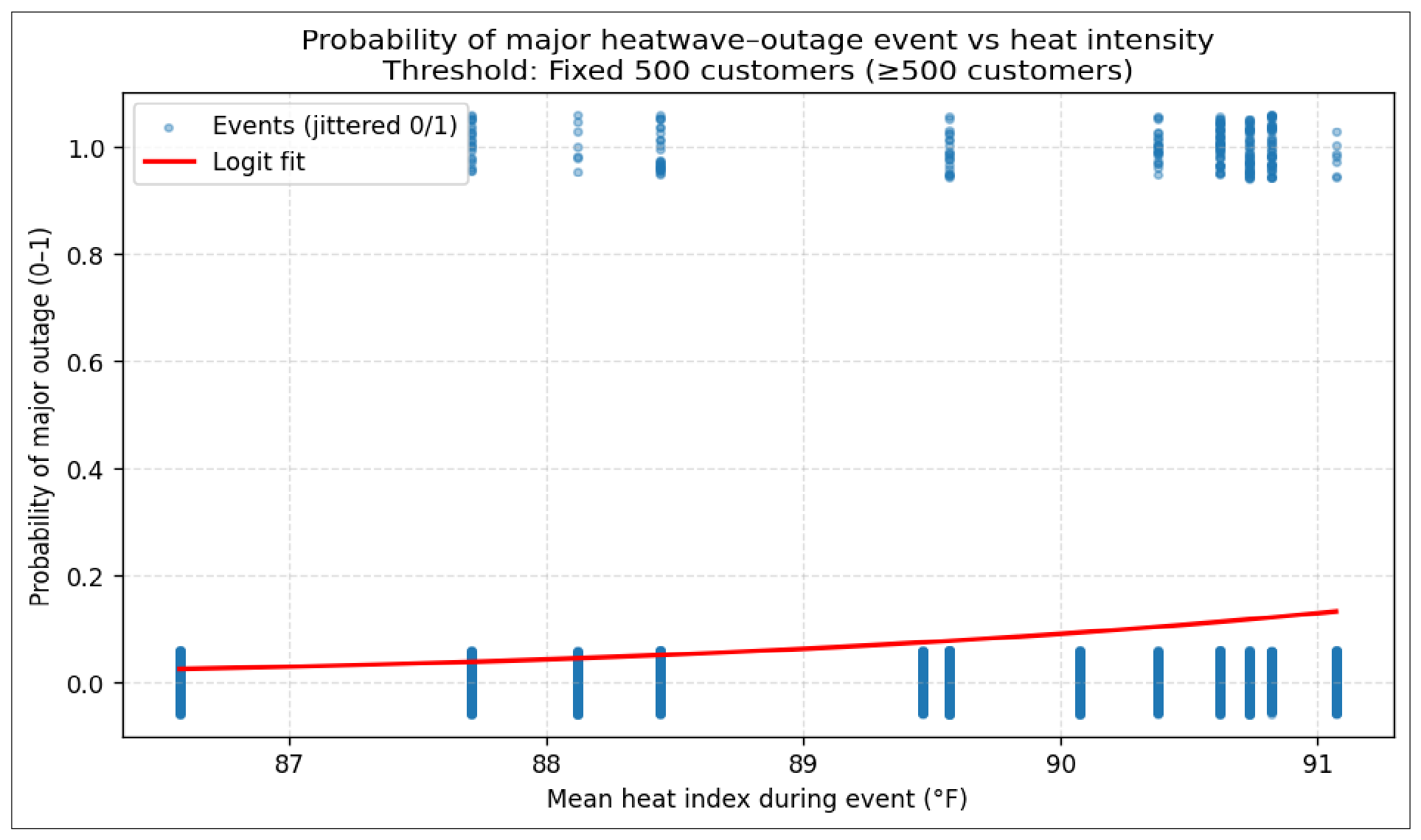
- Fixed 500 customers: operationally interpretable utility-scale threshold.
2.9.2. Model Specification
2.9.3. Visualization of Fitted Relationships
2.10. Software and Reproducibility
3. Results
3.1. Meteorological Data and Spatial Validation
3.2. Characteristics of Texas Heatwave–Outage Events
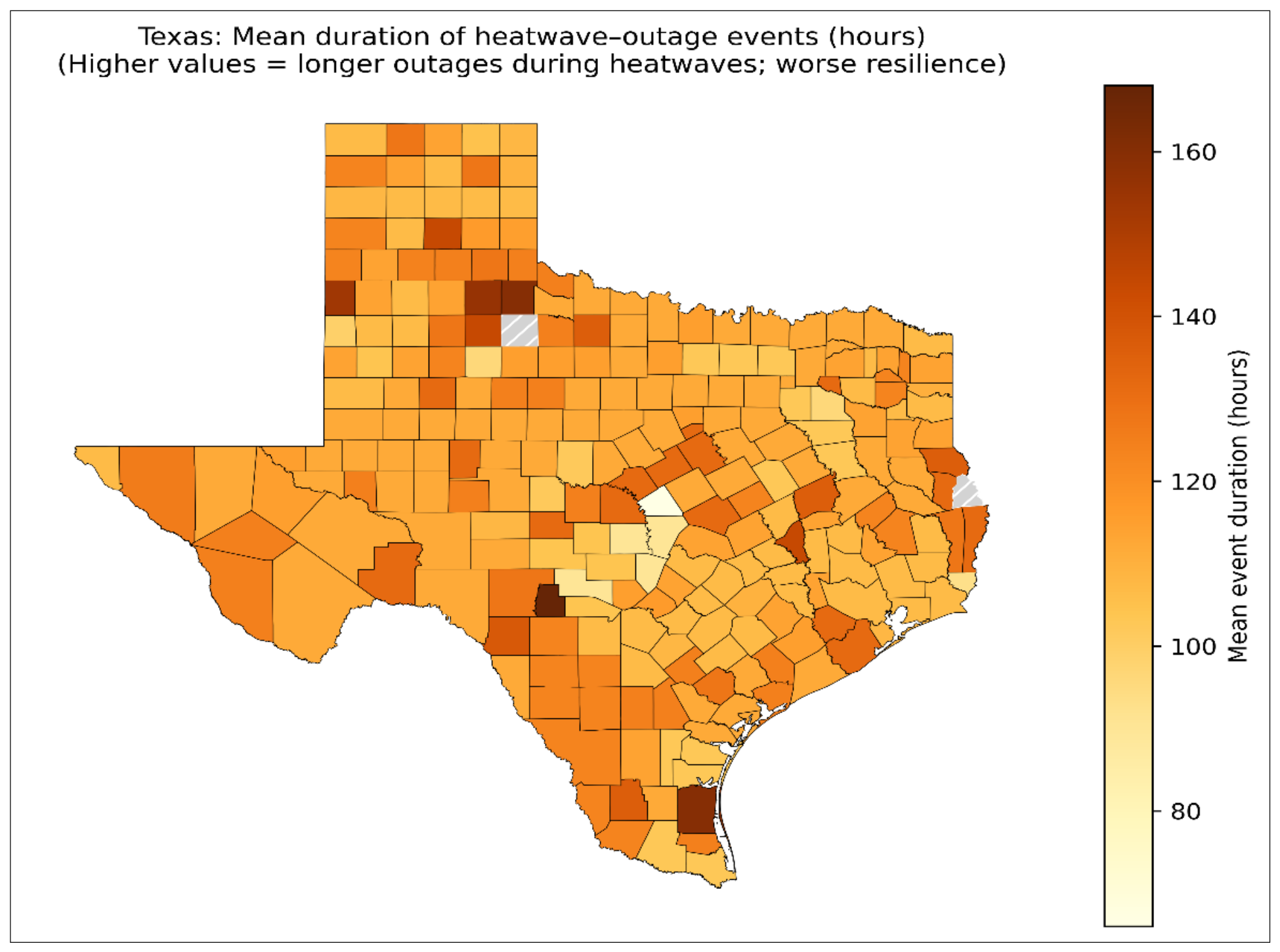
3.3. Spatial Patterns of Heatwave–Outage Frequency, Impacts, and Duration
3.4. Major-Outage Logistic Regression and Threshold Robustness
4. Discussion
4.1. Heat Intensity as a Probabilistic Driver of Major Outages
4.2. Comparison with Previous Studies
4.3. Spatial Heterogeneity and Resilience Implications
4.4. Limitations and Future Work
5. Conclusions
Author Contributions
Funding
Institutional Review Board Statement
Informed Consent Statement
Data Availability Statement
Conflicts of Interest
References
- Gonçalves, A.C.R.; Costoya, X.; Nieto, R.; Liberato, M.L.R. Extreme weather events on energy systems: A comprehensive review on impacts, mitigation, and adaptation measures. Sustain. Energy Res. 2024, 11, 4. [Google Scholar] [CrossRef]
- Perkins, S.E.; Alexander, L.V. On the Measurement of Heat Waves. J. Clim. 2013, 26, 4500–4517. [Google Scholar] [CrossRef]
- Wang, R.; Yuan, C.; Gong, F.-Y.; Lu, L.; Xiang, L.; Wang, X. Evaluation and Mitigation of Heatwave-Induced Health Risks in China: A Systematic Review. Environ. Sci. Technol. 2025, 59, 22987–23004. [Google Scholar] [CrossRef] [PubMed]
- Dong, J.; Peng, J.; He, X.; Corcoran, J.; Qiu, S.; Wang, X. Heatwave-induced human health risk assessment in megacities based on heat stress-social vulnerability-human exposure framework. Landsc. Urban Plan. 2020, 203, 103907. [Google Scholar] [CrossRef]
- Pruckner, S.; Bedford, J.; Murphy, L.; Turner, J.A.; Mills, J. Adapting to heatwave-induced seagrass loss: Prioritizing management areas through environmental sensitivity mapping. Estuar. Coast. Shelf Sci. 2022, 272, 107857. [Google Scholar] [CrossRef] [PubMed]
- Li, W.; Sun, R. A supply-demand model of vegetation cooling for urban heatwave mitigation. Urban Clim. 2023, 52, 101699. [Google Scholar] [CrossRef]
- Zou, Y.; Wu, Z.; Li, B.; Jia, Y. Cooling Energy Challenges in Residential Buildings During Heat Waves: Urban Heat Island Impacts in a Hot-Humid City. Buildings 2024, 14, 4030. [Google Scholar] [CrossRef]
- Ke, X.; Wu, D.; Rice, J.; Kintner-Meyer, M.; Lu, N. Quantifying impacts of heat waves on power grid operation. Appl. Energy 2016, 183, 504–512. [Google Scholar] [CrossRef]
- Li, J.; Wu, J.; Yang, Y.; Tang, R. Economic consequences of compound drought-heatwave induced power deficits: Evidence from Sichuan’s 2022 power crisis. Sustain. Cities Soc. 2025, 130, 106639. [Google Scholar] [CrossRef]
- Liu, S.; Shu, L.; Zhu, L.; Song, Y.; Sun, W.; Chen, Y.; Wang, D.; Pu, D.; Li, X.; Sun, S.; et al. Underappreciated Emission Spikes From Power Plants During Heatwaves Observed From Space: Case Studies in India and China. Earths Future 2024, 12, e2023EF003937. [Google Scholar] [CrossRef]
- Liang, J.; Qiu, Y.L.; Wang, B.; Shen, X.; Liu, S. Impacts of heatwaves on electricity reliability: Evidence from power outage data in China. iScience 2025, 28, 111855. [Google Scholar] [CrossRef] [PubMed]
- Ma, J.; Li, B.; Omitaomu, O.A.; Mostafavi, A. Establishing nationwide power system vulnerability index across US counties using interpretable machine learning. Appl. Energy 2025, 397, 126360. [Google Scholar] [CrossRef]
- Rodriguez-Garcia, L.; Heleno, M.; Parvania, M. Power Distribution System Planning for Mitigating Overheating Risk Inequity. IEEE Trans. Power Syst. 2025, 40, 920–932. [Google Scholar] [CrossRef]
- Stone, B.; Gronlund, C.J.; Mallen, E.; Hondula, D.; O’nEill, M.S.; Rajput, M.; Grijalva, S.; Lanza, K.; Harlan, S.; Larsen, L.; et al. How Blackouts during Heat Waves Amplify Mortality and Morbidity Risk. Environ. Sci. Technol. 2023, 57, 8245–8255. [Google Scholar] [CrossRef] [PubMed]
- Zhang, B.; Chen, H.; Lu, B. An Early Warning System for Heatwave-Induced Health Risks in China: A Sub-Seasonal to Seasonal Perspective—China, 2022. China CDC Wkly. 2023, 5, 647. [Google Scholar] [CrossRef] [PubMed]
- Saki, S.; Sofia, G.; Kar, B.; Anagnostou, E. A multi-year analysis of the impact of heatwaves and compound weather events on power outages. Sci. Rep. 2025, 15, 30846. [Google Scholar] [CrossRef] [PubMed]
- Li, Y.; Tang, Y.; Wang, S.; Toumi, R.; Song, X.; Wang, Q. Recent increases in tropical cyclone rapid intensification events in global offshore regions. Nat. Commun. 2023, 14, 5167. [Google Scholar] [CrossRef] [PubMed]
- Yuan, C.; Zhang, Y.; Zhou, Y.; Lin, J.; Zhang, J.; Lai, W. Analysis of Economic Losses and Comprehensive Impact Factors of Heatwave, Drought, and Heavy Rain Disasters in Hainan Island. Atmosphere 2025, 16, 1017. [Google Scholar] [CrossRef]
- Guikema, S.D.; Nateghi, R.; Quiring, S.M.; Staid, A.; Reilly, A.C.; Gao, M. Predicting Hurricane Power Outages to Support Storm Response Planning. IEEE Access 2014, 2, 1364–1373. [Google Scholar] [CrossRef]
- Nateghi, R. Multi-Dimensional Infrastructure Resilience Modeling: An Application to Hurricane-Prone Electric Power Distribution Systems. IEEE Access 2018, 6, 13478–13489. [Google Scholar] [CrossRef]
- Matthews, T.K.R.; Wilby, R.L.; Murphy, C. Communicating the deadly consequences of global warming for human heat stress. Proc. Natl. Acad. Sci. USA 2017, 114, 3861–3866. [Google Scholar] [CrossRef] [PubMed]
- Bhattarai, S.; Bista, S.; Sharma, S.; White, L.D.; Amini, F.; Talchabhadel, R. Spatiotemporal characterization of heatwave exposure across historically vulnerable communities. Sci. Rep. 2024, 14, 20882. [Google Scholar] [CrossRef] [PubMed]
- Ma, Z.; Zhao, Z.; Liu, C.; Yang, F.; Wang, M. The Impacts and Adaptation of Climate Extremes on the Power System: Insights from the Texas Power Outage Caused by Extreme Cold Wave. Chin. J. Urban Environ. Stud. 2022, 10, 2250004. [Google Scholar] [CrossRef]
- Anderson, G.B.; Bell, M.L. Heat waves in the United States: Mortality risk during heat waves and effect modification by heat wave characteristics in 43 U.S. communities. Environ. Health Perspect. 2011, 119, 210–218. [Google Scholar] [CrossRef] [PubMed]
- Tansakul, V.; Myers, A.; Tennille, S.; Denman, M.; Hamaker, A.; Huihui, J.; Medlen, K.; Allen, K.; Redmon, D.; Chinthavali, S.; et al. EAGLE-I Power Outage Data 2014–2022; Oak Ridge National Laboratory (ORNL): Oak Ridge, TN, USA, 2023. Available online: https://doi.ccs.ornl.gov/dataset/ccec86f0-e144-5de8-aee0-fb26028b26e1 (accessed on 5 February 2026).
- Lim, Y.-K.; DeAngelis, A.M.; Thomas, N.P.; Schubert, S.D.; Chang, Y.; Collow, A.B.; Dezfuli, A. Remote Forcing and Prediction of the June 2023 Texas Heat Wave. J. Clim. 2025, 38, 6397–6411. [Google Scholar] [CrossRef]
- Brelsford, C.; Tennille, S.; Myers, A.; Chinthavali, S.; Tansakul, V.; Denman, M.; Coletti, M.; Grant, J.; Lee, S.; Allen, K.; et al. A dataset of recorded electricity outages by United States county 2014–2022. Sci. Data 2024, 11, 271. [Google Scholar] [CrossRef] [PubMed]
- Hersbach, H.; Bell, B.; Berrisford, P.; Hirahara, S.; Horányi, A.; Muñoz-Sabater, J.; Nicolas, J.; Peubey, C.; Radu, R.; Schepers, D.; et al. The ERA5 global reanalysis. Q. J. R. Meteorol. Soc. 2020, 146, 1999–2049. [Google Scholar] [CrossRef]
- Bartos, M.D.; Chester, M.V. Impacts of climate change on electric power supply in the Western United States. Nat. Clim. Change 2015, 5, 748–752. [Google Scholar] [CrossRef]
- Yang, F.; Koukoula, M.; Emmanouil, S.; Cerrai, D.; Anagnostou, E.N. Assessing the power grid vulnerability to extreme weather events based on long-term atmospheric reanalysis. Stoch. Environ. Res. Risk Assess. 2023, 37, 4291–4306. [Google Scholar] [CrossRef]
- Lawrence, M.G. The Relationship between Relative Humidity and the Dewpoint Temperature in Moist Air: A Simple Conversion and Applications. Bull. Am. Meteorol. Soc. 2005, 86, 225–234. [Google Scholar] [CrossRef]
- Steadman, R.G. The Assessment of Sultriness. Part I: A Temperature-Humidity Index Based on Human Physiology and Clothing Science. J. Appl. Meteorol. Climatol. 1979, 18, 861–873. [Google Scholar] [CrossRef]
- Rothfusz, L.P. The Heat Index ‘Equation’ (or, More than You Ever Wanted to Know About Heat Index); NWS Southern Region Headquarters: Fort Worth, TX, USA, 1990. Available online: https://www.weather.gov/media/ffc/ta_htindx.PDF (accessed on 12 June 2026).
- Smith, T.T.; Zaitchik, B.F.; Gohlke, J.M. Heat waves in the United States: Definitions, patterns and trends. Clim. Change 2013, 118, 811–825. [Google Scholar] [CrossRef] [PubMed]
- Karagiannakis, G.; Panteli, M.; Argyroudis, S. Fragility Modeling of Power Grid Infrastructure for Addressing Climate Change Risks and Adaptation. Wiley Interdiscip. Rev. Clim. Change 2025, 16, e930. [Google Scholar] [CrossRef]
- Panteli, M.; Mancarella, P. Influence of extreme weather and climate change on the resilience of power systems: Impacts and possible mitigation strategies. Electr. Power Syst. Res. 2015, 127, 259–270. [Google Scholar] [CrossRef]
- Gasparrini, A.; Armstrong, B. The impact of heat waves on mortality. Epidemiology 2011, 22, 68–73. [Google Scholar] [CrossRef] [PubMed]
- Do, V.; Wilner, L.; Flores, N.; Mcbrien, H.; Northrop, A.; Casey, J. Spatiotemporal patterns of individual and multiple simultaneous severe weather events co-occurring with power outages in the United States, 2018–2020. PLoS Clim. 2025, 4, e0000523. [Google Scholar] [CrossRef]
- Richards, C.A.; Amiri, S.; Walden, V.P.; Postma, J.; Kapourchali, M.H.; Zuur, A.F. Association of social vulnerability factors with power outage burden in Washington state: 2018–2021. PLoS ONE 2024, 19, e0307742. [Google Scholar] [CrossRef] [PubMed]
- Fadden, D.M. Conditional logit analysis of qualitative choice behavior. In Frontiers in Econometrics; Academic Press: Cambridge, MA, USA, 1974; Available online: http://elsa.berkeley.edu/reprints/mcfadden/zarembka.pdf (accessed on 12 June 2026).
- Do, V.; McBrien, H.; Flores, N.M.; Northrop, A.J.; Schlegelmilch, J.; Kiang, M.V.; Casey, J.A. Spatiotemporal distribution of power outages with climate events and social vulnerability in the USA. Nat. Commun. 2023, 14, 2470. [Google Scholar] [CrossRef] [PubMed]
- Rao, S.; Scaggs, S.A.; Asuan, A.; Roque, A.D. Power outages and social vulnerability in the U.S. Gulf Coast: Multilevel Bayesian models of outage durations amid rising extreme weather. Humanit. Soc. Sci. Commun. 2025, 12, 912. [Google Scholar] [CrossRef]
- Hosmer, D.W.; Lemeshow, S. Index. In Applied Logistic Regression; John Wiley & Sons: Hoboken, NJ, USA, 2000; pp. 369–375. [Google Scholar] [CrossRef]
- Aivalioti, S. Electricity Sector Adaptation to Heat Waves. 2015. Available online: https://scholarship.law.columbia.edu/sabin_climate_change/136 (accessed on 2 February 2026).
- Attia, S.; Levinson, R.; Ndongo, E.; Holzer, P.; Kazanci, O.B.; Homaei, S.; Zhang, C.; Olesen, B.W.; Qi, D.; Hamdy, M.; et al. Resilient cooling of buildings to protect against heat waves and power outages: Key concepts and definition. Energy Build. 2021, 239, 110869. [Google Scholar] [CrossRef]
- Hawker, G.; Bell, K.; Bialek, J.; MacIver, C. Management of extreme weather impacts on electricity grids: An international review. Prog. Energy 2024, 6, 32005. [Google Scholar] [CrossRef]
- Dubey, A. Preparing the Power Grid for Extreme Weather Events: Resilience Modeling and Optimization. In Women in Power: Research and Development Advances in Electric Power Systems; Springer: Cham, Switzerland, 2023; pp. 209–243. [Google Scholar] [CrossRef]
- Busby, J.W.; Baker, K.; Bazilian, M.D.; Gilbert, A.Q.; Grubert, E.; Rai, V.; Rhodes, J.D.; Shidore, S.; Smith, C.A.; Webber, M.E. Cascading risks: Understanding the 2021 winter blackout in Texas. Energy Res. Soc. Sci. 2021, 77, 102106. [Google Scholar] [CrossRef]
- Xu, L.; Feng, K.; Lin, N.; Perera, A.; Poor, H.V.; Xie, L.; Ji, C.; Sun, X.A.; Guo, Q.; O’mAlley, M. Resilience of renewable power systems under climate risks. Nat. Rev. Electr. Eng. 2024, 1, 53–66. [Google Scholar] [CrossRef]
- Abdin, A.; Fang, Y.-P.; Zio, E. A modeling and optimization framework for power systems design with operational flexibility and resilience against extreme heat waves and drought events. Renew. Sustain. Energy Rev. 2019, 112, 706–719. [Google Scholar] [CrossRef]





| Symbol | Description | Unit |
|---|---|---|
| c | County index | — |
| d | Calendar day index | — |
| e | Heatwave event index | — |
| h | Hour index | — |
| t | Timestamp (run_start_time) | — |
| y | Year index | — |
| Le | Duration of heatwave event e | h |
| Me | Maximum customers simultaneously affected during event e | customers |
| N | Total number of heatwave events | — |
| Nhm | Number of warm-season county-days exceeding the heatwave threshold | days |
| Nhm,out | Number of heatwave days with at least one outage | days |
| HI | Heat index (apparent temperature) | °F |
| HImax | Daily maximum heat index | °F |
| HImean | Daily or event-mean heat index | °F |
| OR | Odds ratio from logistic regression | — |
| RH | Relative humidity | % |
| T | Air temperature | °C |
| Th | Dew-point temperature | °C |
| Td,h | Dew-point temperature in Fahrenheit | °F |
| Th | Air temperature in Fahrenheit | °F |
| Thm | Heatwave threshold heat index value | °F |
| Xe | Centered event-mean heat index | °F |
| α | Magnus–Tetens parameter (α = 17.27) | — |
| β | Magnus–Tetens parameter (β = 237.7) | °C |
| β0 | Intercept coefficient in logistic regression | — |
| β1 | Slope coefficient in logistic regression | — |
| γ | Intermediate variable in dew-point calculation | — |
| μmean | Grand mean of event-mean heat index across all events | °F |
| τ | Severity threshold (P90, P95, or fixed 500) | — |
| c,d | Subscript denoting county c and day d | — |
| c,h | Subscript denoting county c and hour h | — |
| max | Subscript denoting maximum value | — |
| mean | Subscript denoting mean (average) value | — |
| start | Subscript denoting event start time | — |
| end | Subscript denoting event end time | — |
| DLNM | Distributed-lag non-linear model | — |
| EAGLE-I | Environment for Analysis of Geo-Located Energy Information | — |
| ERA5 | ECMWF Reanalysis v5 | — |
| ERCOT | Electric Reliability Council of Texas | — |
| FIPS | Federal Information Processing Standards | — |
| NWS | U.S. National Weather Service | — |
| P90 | 90th percentile severity threshold | — |
| P95 | 95th percentile severity threshold | — |
| Metric | Value | Interpretation |
|---|---|---|
| Mean Correlation (all months) | 0.9 | Temporal correlation of heat index—Strong temporal coherence |
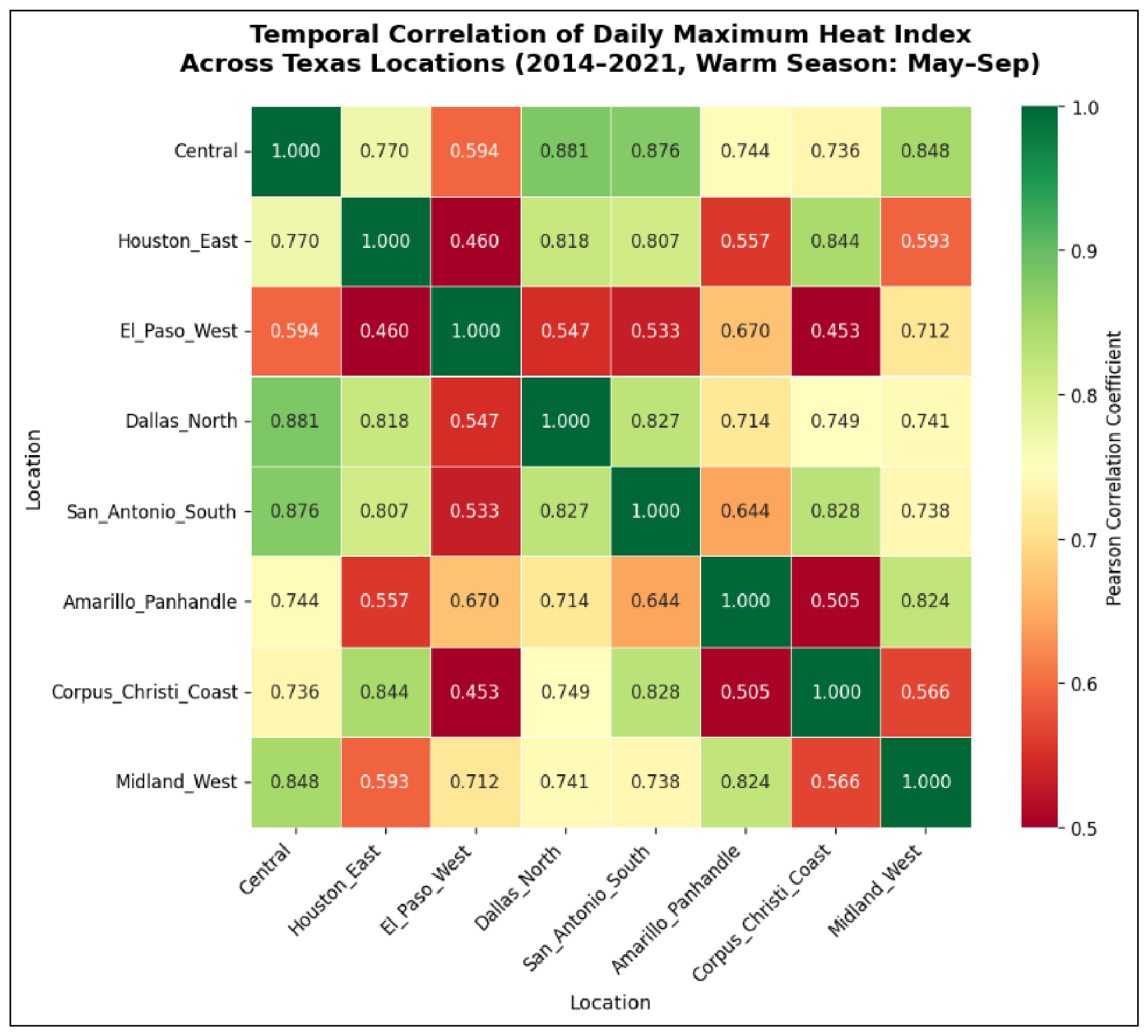
| Mean Correlation (warm season) | 0.70 | Temporal correlation (warm season only, may–sep) (Figure 2) |
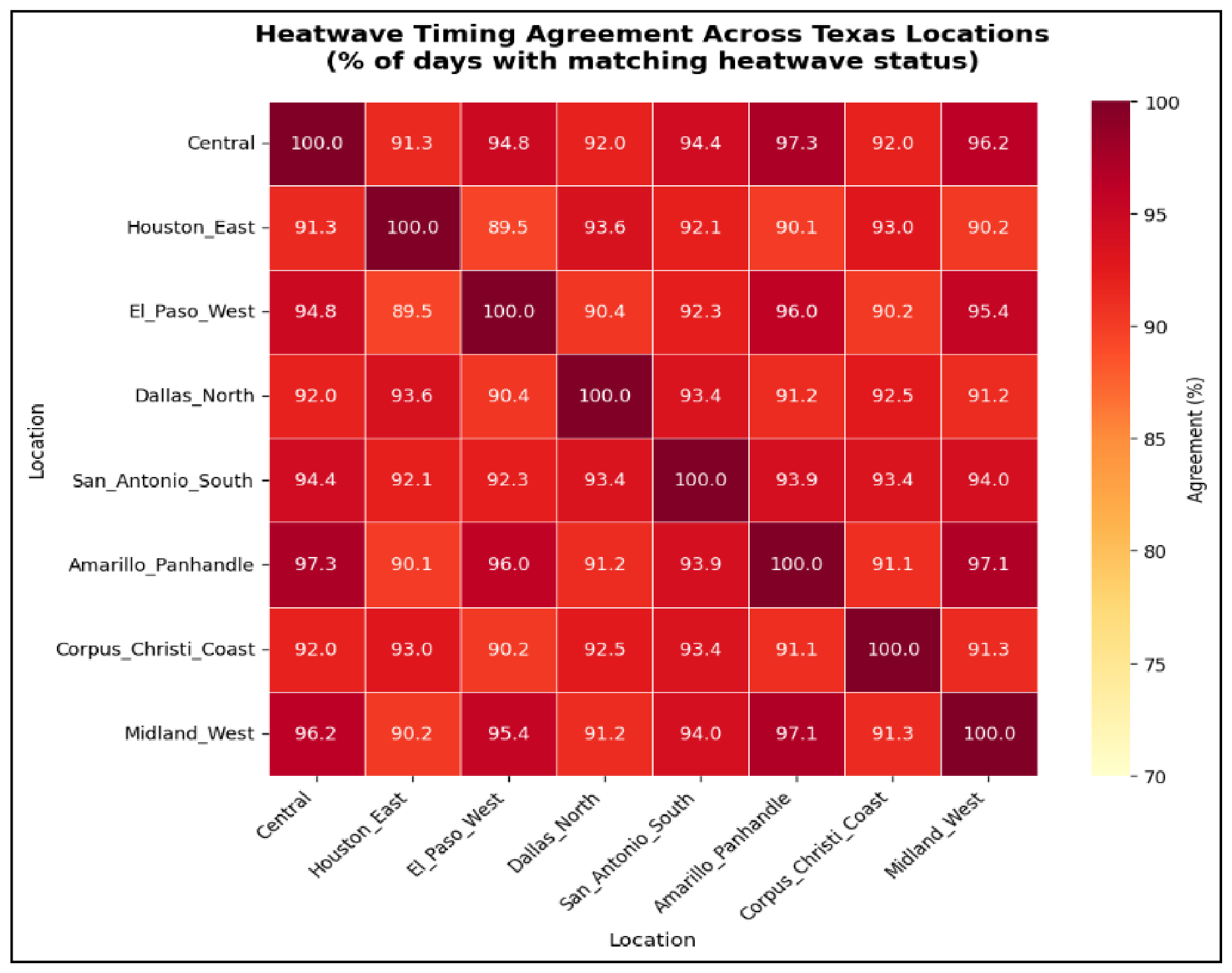
| Mean Agreement (%) | 92.8 | Heatwave timing agreement (Figure 3) |
| Central vs. All (mean corr) | 0.922 | Correlations with central Texas (reference point)—Reference point representative |
| Threshold | Key Statistics | Interpretation |
|---|---|---|
| P90 (≥347 customers) | OR = 1.52; 95% CI [1.36, 1.70]; p ≈ 4.7 × 10⁻¹⁴; McFadden R2 = 0.035 | Each +1 °F raises odds of a major event by ~52%. Predicted probability increases from ~7% to ~14% between lower and upper HI quartiles. |
| Fixed 500 customers | OR = 1.49; 95% CI [1.32, 1.67]; p ≈ 3.4 × 10⁻¹¹; McFadden R2 = 0.030 | Utility-relevant threshold. Each +1 °F increases odds of a ≥500-customer event by ~49%. Probability approximately doubles (~5% → ~11%) across the observed IQR. |
| P95 (≥1047 customers) | OR = 1.43; 95% CI [1.23, 1.65]; p ≈ 1.8 × 10⁻⁶; McFadden R2 = 0.022 | Focuses on the most extreme 5% of events. Absolute probabilities are lower (~3–7%) but the relative increase with heat intensity remains strong. |
Disclaimer/Publisher’s Note: The statements, opinions and data contained in all publications are solely those of the individual author(s) and contributor(s) and not of MDPI and/or the editor(s). MDPI and/or the editor(s) disclaim responsibility for any injury to people or property resulting from any ideas, methods, instructions or products referred to in the content. |
© 2026 by the authors. Licensee MDPI, Basel, Switzerland. This article is an open access article distributed under the terms and conditions of the Creative Commons Attribution (CC BY) license.
Share and Cite
Kabir, S.M.R.; Rahman, M.; Zisha, F.K.; Meng, L. Quantifying Event-Based Heatwave-Induced Power Outage Risk: A Multi-Year Spatiotemporal Analysis in Texas. Sustainability 2026, 18, 6205. https://doi.org/10.3390/su18126205
Kabir SMR, Rahman M, Zisha FK, Meng L. Quantifying Event-Based Heatwave-Induced Power Outage Risk: A Multi-Year Spatiotemporal Analysis in Texas. Sustainability. 2026; 18(12):6205. https://doi.org/10.3390/su18126205
Chicago/Turabian StyleKabir, S M Redwan, Mizanur Rahman, Farhana Kabir Zisha, and Lei Meng. 2026. "Quantifying Event-Based Heatwave-Induced Power Outage Risk: A Multi-Year Spatiotemporal Analysis in Texas" Sustainability 18, no. 12: 6205. https://doi.org/10.3390/su18126205
APA StyleKabir, S. M. R., Rahman, M., Zisha, F. K., & Meng, L. (2026). Quantifying Event-Based Heatwave-Induced Power Outage Risk: A Multi-Year Spatiotemporal Analysis in Texas. Sustainability, 18(12), 6205. https://doi.org/10.3390/su18126205