Article

Multi-Scenario Decision-Making for Carbon Asset Management of Cement Industry Under China’s New Unified National Carbon Market


1
School of Finance and Economics, Jiangsu University, Zhenjiang 212013, China
2
Department of Economics, University of Toronto, Toronto, ON M5S 1A1, Canada
*
Authors to whom correspondence should be addressed.
Sustainability 2026, 18(12), 6054; https://doi.org/10.3390/su18126054 (registering DOI)
Submission received: 9 May 2026 / Revised: 4 June 2026 / Accepted: 9 June 2026 / Published: 12 June 2026
(This article belongs to the Special Issue Sustainable Development: Integrating Economy, Energy and Environment)

Abstract

The inclusion of the cement industry into China’s national carbon emissions trading system in 2025 has fundamentally altered the compliance environment for high-emission enterprises, transforming carbon allowances from passive regulatory instruments into dynamic assets whose management directly affects financial performance. We develop a multi-scenario carbon asset management decision model tailored to the intensity-based benchmarking mechanism adopted by the national market. The model centres on the quota surplus-deficit variable EA4, which is computed from enterprise-level emission intensity relative to the industry benchmark, and decomposes the management problem into sequential selling and buying subproblems linked by coupled decision boundaries. A systematic parameter framework is constructed, and the model is applied to two cement enterprises—Enterprise A, a leading producer with a clear allowance surplus, and Enterprise B, a mid-tier producer operating near the benchmark boundary—through historical backtesting over the 2024–2025 period. Three principal findings emerge. First, the intensity benchmarking mechanism creates a dual-leverage effect whereby a 1.4% improvement in emission intensity (from 0.8112 to 0.8000 t/t) increases the quota surplus by 27%, a nonlinearity not captured by conventional compliance-cost models. Second, the model-driven strategy outperforms traditional experience-based approaches by 36.8% (baseline scenario, +95.20 vs. +69.58 MRMB) and 37.3% (risk scenario, −44.55 vs. −71.08 MRMB), with the improvement rate remaining consistent across both enterprises, suggesting that trading timing outweighs instrument selection in determining compliance cost outcomes. Third, dynamic CEA–CCER allocation captures an incremental 2.33 MRMB through the exploitation of a transient price inversion, a gain invisible to single-instrument strategies. Sensitivity analysis confirms that the relative advantage is robust to carbon price variations (±30%) and CCER offset caps (2–10%), while emission intensity and carry-over allowances represent the most consequential parameters for strategy direction, with EA4 crossing zero near the industry benchmark (I ≈ 0.85). The framework provides actionable decision support for cement and other high-emission enterprises navigating the unified carbon market, and contributes a quantitative methodology to the emerging field of environmental management accounting. This study contributes to Sustainable Development Goal 13 (Climate Action), Goal 7 (Affordable and Clean Energy), and Goal 9 (Industry, Innovation, and Infrastructure) by providing operational tools for decarbonisation in carbon-intensive industries.

1. Introduction

Climate change is now one of the most pressing global challenges, and reducing greenhouse gas emissions has become a central policy objective for governments worldwide. China, the world’s largest emitter of carbon dioxide, announced its goals of achieving carbon peaking by 2030 and carbon neutrality by 2060 at the 75th session of the United Nations General Assembly in September 2020. To advance these objectives, China established a national carbon emissions trading system (ETS) in July 2021, initially covering over 2100 power generation enterprises and directly managing approximately 40% of the country’s total carbon emissions. By November 2024, the cumulative trading volume of the national market had reached 555 million tonnes, with a total transaction value of approximately 35.6 billion RMB. Carbon prices rose steadily from 48 RMB per tonne at market launch to over 100 RMB per tonne by late 2024, representing a cumulative increase exceeding 113%.
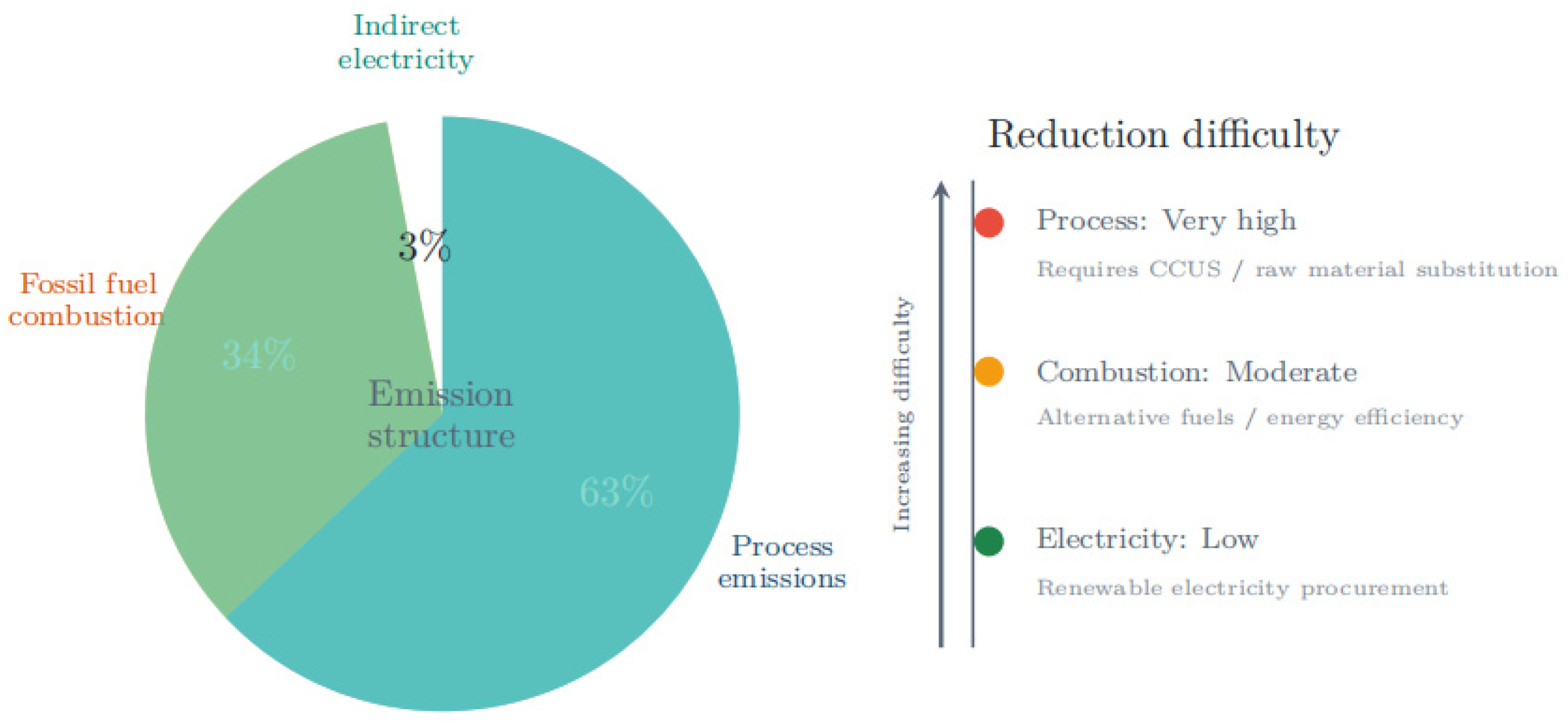
The cement industry occupies a distinctive position in the carbon landscape. China produces approximately 60% of the world’s cement and contributes 7% to 8% of global CO2 emissions. Cement production is inherently carbon-intensive: roughly 63%, 34%, and 3% of emissions originate from the chemical decomposition of carbonate raw materials during clinker calcination, fossil fuel combustion, and indirect electricity consumption, respectively. This structural dependence on process emissions means that conventional energy-efficiency measures alone cannot achieve comprehensive decarbonisation, and the industry faces particular challenges in balancing compliance costs with operational viability. This structural challenge is not unique to the cement sector; the steel industry, which shares similar process-emission characteristics and has also been brought into the national ETS, faces comparable decarbonisation dilemmas requiring scenario-based analysis of transition pathways [1,2].
In March 2025, the Ministry of Ecology and Environment formally issued the Work Plan for Including Steel, Cement, and Aluminium Smelting Industries in the National Carbon Emissions Trading Market, marking the first major expansion of the national ETS beyond the power sector. The expansion brought approximately 1000 cement companies with annual emissions of 26,000 tonnes of CO2 equivalent or above into the unified market, raising the overall coverage from 45% to over 60% of national emissions and establishing the world’s largest carbon-trading system in terms of covered volume. For the cement industry, this transition introduced a fundamentally new management paradigm: carbon allowances shifted from background regulatory requirements to explicit financial assets and liabilities whose management directly influences enterprise cost structures, cash flows, and competitive positioning.
In the new regime, an intensity-based benchmarking method is adopted for allowance allocation [3,4]. Unlike cap-and-trade schemes based on absolute emission caps, intensity-based allocation ties each enterprise’s free allowance to its actual production output adjusted by a coefficient reflecting the deviation of the enterprise’s emission intensity from the industry benchmark. This design fundamentally differs from absolute-cap approaches: whereas the cap-and-trade approach fixes total emissions and lets the market determine the price, intensity-based standards create a variable aggregate cap that depends on total output, potentially diluting environmental effectiveness but offering greater flexibility for output-adjusting industries. The resulting mechanism creates a direct financial incentive for intensity reduction: enterprises whose emission intensity falls below the benchmark receive bonus allowances, while those above the benchmark face allowance shortfalls. Under benchmarking rules, the second-period free allowance allocation further depends on the previous period’s actual emissions, embedding a dynamic intertemporal linkage that makes current compliance decisions consequential for future allocation positions. The resulting quota surplus or deficit, denoted as EA4 in this paper, becomes the central decision variable for carbon asset management.
To structure this analysis, we pose the following research questions: RQ1: How does the intensity-based benchmarking mechanism generate differential carbon asset outcomes for cement enterprises, and what is the nature of the dual-leverage effect embedded in the allocation formula? RQ2: Can a structured multi-scenario decision model outperform traditional experience-based compliance strategies, and under what conditions is the advantage most pronounced? RQ3: Does dynamic allocation across CEA and CCER instruments provide incremental financial value beyond single-instrument strategies? In this study, we constructed a multi-scenario decision model that integrates quota prediction, price timing, strategy matching, and risk control into a unified analytical framework. The model was then applied to two cement enterprises—Enterprise A, one of the largest cement producers in China, and Enterprise B, a mid-tier producer—to assess its applicability across different enterprise scales and emission profiles, using actual production and market data from 2024 to 2025. The contributions of this paper are threefold. First, unlike prior ETS compliance studies that treat intensity benchmarks as exogenous constraints and focus on macro-level mechanism comparison [5], this paper introduces EA4 as a quota surplus-deficit variable that formally captures the dual leverage effect inherent in intensity-based allocation, where a reduction in emission intensity simultaneously shrinks the verification adjustment (EA3) and increases the reward coefficient (α), exerting a compounded impact on the enterprise’s net quota position. Second, unlike existing carbon-trading strategy frameworks that operate under a single compliance scenario [4,6], we developed dual-scenario decision matrices for both surplus and deficit conditions, with quantified disposition ratios calibrated to market price signals and a quarterly rebalancing schedule aligned with the compliance cycle. Third, unlike market-level simulation studies that rely on hypothetical parameters [3,7], this paper provides enterprise-level back-testing using operational data from a representative cement manufacturer under China’s 2024–2025 compliance cycle, demonstrating the practical applicability and financial advantages of the proposed model over traditional experience-based strategies. The remainder of this paper is organised as follows: Section 2 reviews the related literature. Section 3 provides a background for the analysis, examining the carbon market context and policy impact. Section 4 presents the materials and methods used to construct the multi-scenario decision model. Section 5 reports the results of the model’s application and back-testing. Section 6 discusses the theoretical implications, international comparisons, generalisability, and practical challenges. Section 7 concludes with answers to the research questions, limitations, and future directions.

2. Literature Review

2.1. Carbon Quota Allocation Mechanisms: Grandfathering vs. Benchmarking

The design of initial quota allocation is a foundational element of any emissions trading system, determining both cost-efficiency and distributional effects. Empirical simulations demonstrate that grandfathering can outperform benchmarking in activating market liquidity, while also generating higher revenues and profits [8]. However, benchmarking—particularly when based on updated emissions—may distort price signals, with quota prices consistently exceeding marginal abatement costs unless a significant share of allowances is auctioned. In the Chinese context, simulations indicate that grandfathering yields larger total quota volumes than benchmarking, while a hybrid scheme achieves the best balance between emission reduction and sectoral development. More nuanced evidence from the power industry shows that benchmarking is fairer when the sector holds a favorable market position, but can induce regional power shortages when disadvantaged [9].
While these studies provide rich insights into macro-level mechanism design, they predominantly operate at sectoral or regional levels. A critical but underexplored dimension is how emission responsibilities are fundamentally reallocated under a benchmarking mechanism. The benchmark-based carbon emission responsibility allocation method can effectively incentivize “intensity-oriented measures on the production side and total quantity-oriented measures on the consumption side” [10]. This allocation logic is precisely the theoretical foundation of China’s national ETS benchmarking mechanism, under which a firm’s emission intensity relative to the industry benchmark directly determines its allowance surplus or deficit. However, how individual high-emission enterprises—such as cement producers—should translate this macro-level allocation logic into specific trading actions remains an open question.

2.2. Cement Industry Carbon Emissions and Abatement Pathways

The cement industry constitutes one of the largest industrial sources of CO2 emissions globally, with approximately 63% of emissions originating from the chemical decomposition of limestone during clinker calcination—a process emission that cannot be eliminated by energy efficiency improvements alone. Accurate emission accounting provides the necessary foundation for policy design, with synthesized emission factors of approximately 761 kg CO2 per tonne of cement [11]. Long-term trend analysis reveals that China’s total cement emissions grew eighteen-fold from 1980 to 2014, while the unit emission factor declined from 852 to 513 kg CO2 per tonne.
The technological pathways for deep decarbonization remain challenging. According to the International Energy Agency, extrapolation of existing technologies will achieve only half of the required 2050 emissions reduction; the remainder must rely on carbon capture and storage (CCS) or novel low-carbon clinkers [12]. Quantitative decomposition shows that clinker substitution accounts for 37%, CCS for 33%, efficiency improvements for 15%, and alternative fuels for 15% of required reductions [13]. Emerging technologies, such as modified calciner processes and alternative clinkers like calcium silicate cement, can reduce energy consumption by up to 45.5% and CO2 emissions by 35.1% compared to ordinary Portland cement [14]. Empirical evidence shows that carbon peaking pressure significantly stimulates corporate R&D investment in low-carbon technologies, particularly in energy-intensive industries [15]. Such policy-driven R&D is essential for achieving the deep decarbonization required in the cement sector.
Complementing these technological investigations, [16] develops a comprehensive techno-economic framework for carbon capture in the cement sector of developing economies, demonstrating that while capture technologies like advanced amines are technically viable, their economic feasibility hinges critically on carbon pricing levels. Empirical evidence from the Kyoto Protocol further indicates that international climate agreements can spur innovation in cement manufacturing, reducing carbon intensity through both technological change and technology diffusion from developed to developing nations ([17]). These insights underscore that long-term decarbonization is not solely a technological problem but is intrinsically linked to the financial and policy environment.

2.3. Enterprise Carbon Asset Management and Carbon Finance

Effective carbon asset management requires enterprises to navigate price uncertainty, policy constraints, and their own emission profiles. Accurate carbon price forecasting is a prerequisite for optimal trading timing, with novel adaptive transformer-based deep learning models achieving mean absolute percentage errors as low as 1.73% in daily forecasting tasks, demonstrating strong cross-market generalization [18]. Such forecasting accuracy provides the technical foundation for enterprise-level trading decisions.
Empirical evidence from China’s pilot ETSs reveals that while compliance procedures have become routine, nearly half of surveyed firms still lack explicit emission reduction targets and have limited perception of their marginal abatement costs [19]. This finding underscores the gap between potential and practice: systematic, quantitative decision tools are largely absent in real-world enterprise settings.
The evolving carbon market also introduces new financial mechanisms. The China Certified Emission Reduction (CCER) program not only provides a cost-effective offsetting channel but has been shown to enhance corporate financial stability and reduce legal risks through improved emission performance and financial positions [20]. Moreover, carbon allowances themselves can be leveraged as financial collateral. Reference [21] demonstrates that capital-constrained manufacturers can utilize carbon asset pledge financing to fund emission reduction investments, with the effectiveness of such strategies varying significantly between grandfathering and benchmarking allocation methods.

2.4. Carbon Market Dynamics and Price Signals

The efficacy of any enterprise-level carbon asset strategy is contingent upon the dynamics of the carbon market itself. Reference [22] provides compelling evidence that trading characteristics—such as scale, volatility, and illiquidity—significantly affect carbon emission reduction efficiency, with increased volatility diminishing the per-unit reduction effect of trading volume. This implies that firms must understand the market’s microstructural risks when designing their trading strategies. Furthermore, the introduction of instruments like a carbon price floor aims to stabilize market expectations and provide stronger mitigation incentives [23]. These market-level policy interventions directly shape the risk-return profile of carbon assets, reinforcing the need for decision models that can incorporate such regulatory dynamics into enterprise strategy.

2.5. Literature Synthesis and Research Gaps

Synthesising the three strands of literature reviewed above, three interconnected research gaps emerge that motivate the present study.
First, a mechanism-level gap persists. While extensive research compares grandfathering and benchmarking at macro levels and proposes benchmark-based responsibility allocation, the enterprise-level implications of intensity-based benchmarking remain underexplored. Under China’s national ETS, an enterprise’s free allowance is not a fixed quantity determined at the start of a compliance period, as it would be under grandfathering; rather, it is a function of the enterprise’s actual emission intensity relative to the industry benchmark (BP), calculated as EA1 = EA3 × (1 + α), where α = γ × (BP − I)/BP. This formulation introduces a nonlinearity that is absent from conventional compliance-cost models: a marginal improvement in intensity simultaneously shrinks the emission base (EA3) and increases the reward coefficient (α), producing a “dual-leverage” effect on the surplus-deficit variable EA4. Existing models of quota allocation [3,24] operate at sectoral or regional levels and cannot answer how a cement producer should translate its plant-level emission intensity into specific trading actions—selling or buying, how much, when, and via which instrument (CEA or CCER). The absence of such an enterprise-level model leaves a critical practical gap, as the 1000 cement enterprises newly covered by the national ETS in 2025 require decision frameworks that directly engage with the intensity-benchmarking logic.
Second, an integration gap remains. The literature has examined internal technological abatement pathways [25,26] and external, market-based carbon management strategies [6,27] largely in isolation. Studies on internal abatement typically model emission reduction as an engineering optimisation problem, with carbon prices treated as exogenous parameters. Conversely, studies on carbon trading treat the firm’s emission profile as fixed and focus on optimal market timing or portfolio allocation [6,7]. However, under intensity benchmarking, internal reductions and external trading are intrinsically coupled: reducing emission intensity simultaneously reduces EA3 and increases α, creating the dual-leverage effect described above. This coupling means that the optimal external trading strategy depends on the enterprise’s internal abatement trajectory, and vice versa. No existing framework jointly represents this interaction, resulting in a fragmented understanding of carbon asset management as an integrated enterprise function rather than a disconnected set of compliance activities.
Third, a methodological and empirical gap is evident. Despite advances in carbon price forecasting using machine learning [26,28] and analyses of how market trading characteristics influence reduction efficiency [22], these insights have not been embedded into a prescriptive, enterprise-oriented decision system validated through historical backtesting with actual firm data. Existing decision-support tools for carbon management are either purely qualitative, providing strategic recommendations without quantitative underpinning, or purely theoretical [5,7], offering optimal solutions under assumptions that may not hold in practice (e.g., perfect information, frictionless markets). The gap between analytical sophistication and practical applicability is particularly acute for the Chinese cement industry entering the national ETS, which faces real-world constraints including limited data access, organisational capacity constraints, and regulatory uncertainty. A model that bridges this gap—one that is both quantitatively rigorous and empirically grounded—is needed.
To address these gaps, this study develops a multi-scenario carbon asset management decision model centred on the EA4 variable. The novelty lies in linking three elements within one enterprise-oriented framework: (i) capturing the intensity-driven EA4 as the central risk and opportunity measure, explicitly modelling the dual-leverage mechanism; (ii) providing separate decision matrices for surplus and deficit scenarios that incorporate price expectations, CCER policy limits, and risk constraints; and (iii) empirically validating the model through historical backtesting using real enterprise and market data across three representative scenarios—baseline, proactive, and risk.

3. Background of Analysis

3.1. Carbon Emission Characteristics of the Cement Industry

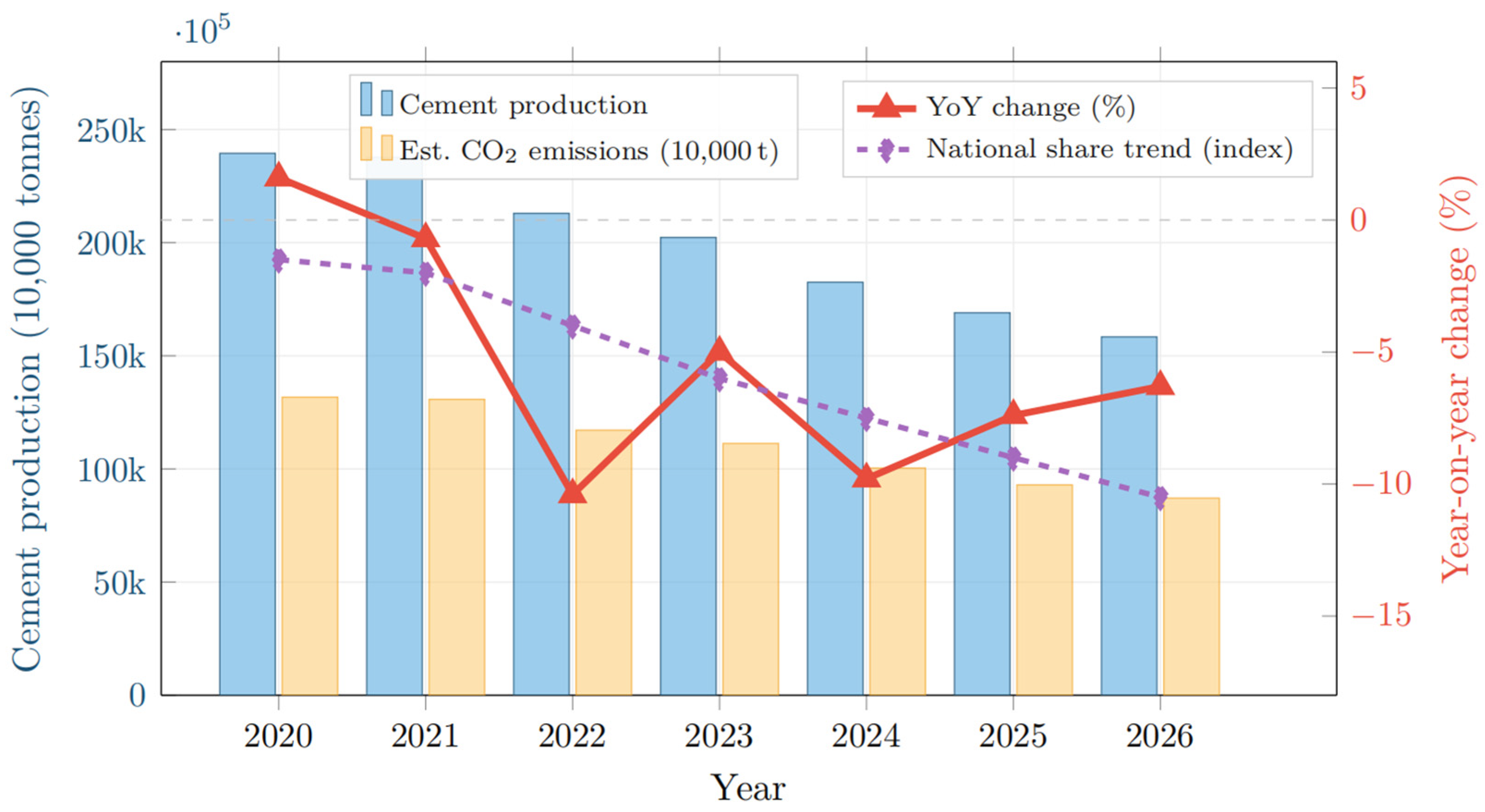
The cement industry is one of the largest industrial sources of CO2 emissions in China. Although overall cement output has been declining since 2020, the absolute level of emissions remains extremely high. Figure 1 presents the trajectory of China’s cement production from 2020 to 2026, together with the year-on-year rate of decline and an estimate of the industry’s share in national carbon emissions. Output fell from 2.395 billion tonnes in 2020 to 1.825 billion tonnes in 2024, with further declines to approximately 1.690 billion tonnes in 2025 and 1.584 billion tonnes projected for 2026. This contraction reflects the combined effects of a decelerating real-estate sector, tightening capacity-replacement policies, and sustained regulatory pressure on energy-intensive industries. Empirical evidence from international climate policy further confirms that carbon constraints can significantly affect cement production levels, reinforcing the expectation that China’s intensifying carbon market policies will continue to shape the industry’s output trajectory [12].
Despite the declining output trend, the industry’s carbon emissions remain at approximately 1 billion tonnes of CO2 annually, based on 2024 production of 1.825 billion tonnes and an average emission factor of approximately 0.55 tonnes CO2 per tonne of cement [29]. While the share of cement emissions in national totals has fallen from a peak of 13% to 15% to approximately 10%, the sector remains one of the largest single-industry emission sources in the country.
A closer examination reveals that the emission structure of the cement industry exhibits a pronounced concentration on process-related sources. Process emissions—primarily from the decomposition of carbonate raw materials during high-temperature clinker calcination—account for 63% of the total, with the remaining 34% originating from fossil fuel combustion in kiln systems and auxiliary processes, and approximately 3% from indirect electricity consumption [16].
This structural pattern is illustrated in Figure 2, which provides a visual decomposition of emission sources together with their associated decarbonisation difficulty ratings.
The dominance of process emissions, which account for nearly two thirds of the total, is the defining structural characteristic of the industry’s carbon profile. Unlike fuel-switching or energy-efficiency improvements that can address combustion emissions, process emissions are chemically inherent in clinker production and can only be mitigated through more fundamental interventions such as raw material substitution, reduced clinker ratios, or carbon capture utilisation and storage (CCUS) technologies. Comprehensive assessments confirm that while CCUS represents the most promising pathway for addressing process emissions, significant barriers—including high capital costs, energy penalties, and the need for robust monitoring and verification frameworks—continue to impede large-scale deployment [30]. This structural feature directly shapes the feasibility of different carbon management strategies and underscores the importance of market-based mechanisms that can incentivize the adoption of such transformative technologies.

3.2. The Cement Industry’s Inclusion in the National Carbon Market

The formal inclusion of the cement industry in the national ETS in March 2025 represents a structural transformation in the regulatory environment. As shown in Table 1, the expansion increases the number of covered industries from one (power generation) to four (power, steel, cement, and aluminium), a 300% increase that fundamentally broadens the market’s sectoral scope. The number of regulated enterprises rises from approximately 2200 to 3500 (+59%), while covered emissions expand from roughly 5 billion tonnes (40% of national emissions) to approximately 8 billion tonnes (60%), an increase of 60% that makes China’s ETS the world’s largest by covered volume. Two further qualitative changes merit emphasis. First, the expansion extends emission accounting from energy-activity emissions only to include industrial process emissions—a change particularly significant for the cement sector, where process emissions from clinker calcination constitute the majority of total emissions (see Figure 2). Second, the covered GHG species are broadened from CO2 alone to include CF4 and C2F4, reflecting the aluminium industry’s specific emissions profile. These quantitative and qualitative expansions together reshape the compliance landscape for newly covered enterprises: carbon management transitions from a sector-specific obligation (power only) to a cross-industry strategic function operating within a substantially larger and more complex market.
The policy framework divides the implementation into two distinct phases to balance ambition with feasibility. The launch phase (2024–2026) prioritises capacity building and institutional adaptation, with allowance allocation designed to minimise initial compliance burdens. For the 2024 compliance year, free allowances are set equal to verified emissions, ensuring a zero-deficit starting point and providing enterprises with a critical learning period to establish their carbon management infrastructure. For 2025 and 2026, the allocation method formally shifts to an intensity-based benchmarking mechanism, albeit with a capped surplus-deficit rate of ±3%. This transitional arrangement reflects a deliberate policy choice to avoid the severe market shocks observed in other ETSs during their early phases; for instance, some studies have indicated that overly stringent benchmarks at the outset can undermine industrial competitiveness before firms have had time to adjust their emission reduction investments [2]. The deepening phase (2027 onward) will introduce explicit, annually declining industry-level emission caps and progressively tighten allocation benchmarks. This transition from a gratis, output-based allocation toward a gradually constrained cap is designed to address the fundamental challenge of quota over-allocation that has historically depressed carbon prices and weakened mitigation incentives in China’s pilot markets [23]. As benchmarks become stricter, enterprises will face increasing pressure to internalise carbon costs, an essential dynamic for incentivizing the phase-out of outdated, high-emission production units and redirecting capital toward low-carbon technologies [3].

3.3. Impact of Inclusion on Enterprise Carbon Asset Management

The transition from regional pilot markets to the unified national market produces structural changes across five management dimensions: data management, allowance and compliance, technology and cost, policy and market, and organisational capability. Before inclusion, carbon data management was fragmented across regions with inconsistent standards; after inclusion, enterprises must comply with a unified MRV (monitoring, reporting, and verification) framework that elevates data quality from a filing requirement to the foundation of asset recognition and compliance cost estimation. This shift is critical, as transparent and reliable carbon emission data have been shown to reduce corporate financing costs and legal risks, thereby enhancing the credibility of enterprises in both carbon and capital markets [20]. The allowance regime transforms carbon emissions from an external regulatory constraint into an internalised cost variable with market-determined prices, so that emission performance now directly affects cost structures, profitability, and financial stability. Under the intensity-based benchmarking method, the choice of allocation rule carries significant consequences: benchmarking places stricter constraints on high-emission producers but generates implicit subsidies for low-emission ones, directly linking production efficiency to carbon asset outcomes [2]. Technology investment decisions acquire a new return dimension: each unit of emission intensity reduction generates both energy savings and additional allowance value through the benchmarking coefficient. This dual benefit strengthens the business case for low-carbon innovation, a pathway further enabled by green finance reforms that alleviate financing constraints and support the green transformation of heavily polluting enterprises [33]. The unified market framework eliminates regional rule disparities but introduces new complexities, including sensitivity to national policy adjustments, international carbon border mechanisms such as the EU’s Carbon Border Adjustment Mechanism (CBAM), and cross-industry interactions, all of which can reshape the spatial distribution of carbon emissions and trade-embedded carbon transfers across provinces [34]. Finally, organisational capabilities must evolve from part-time compliance functions to professional, cross-departmental carbon management systems capable of supporting strategic asset operations [35]. As China’s 2030 carbon peaking deadline approaches, enterprises face increasing pressure to pursue genuine green transformation rather than symbolic greenwashing [36]. This pressure reinforces the practical need for systematic carbon asset management models as developed in this study.

4. Materials and Methods

The proposed model differs from existing approaches in four respects that collectively define its novelty. First, it introduces the quota surplus-deficit variable EA4 = EA3 · α(I) as the central decision trigger, explicitly capturing the dual-leverage mechanism inherent in intensity-based benchmarking—a nonlinearity that is absent from conventional compliance-cost models, which typically treat the allowance as a fixed exogenous parameter. Second, it decomposes the enterprise’s carbon management problem into two structurally distinct subproblems—surplus (selling/carry-over) and deficit (reduction/purchase)—linked by the shared EA4 variable, rather than treating carbon management as a single optimisation. Third, within the deficit subproblem, it applies a cost-ranking principle that sequences compliance instruments by marginal cost (internal reduction → CCER → CEA), incorporating the CCER policy cap as an explicit constraint—a feature not present in portfolio-only models that focus exclusively on instrument allocation without regard to regulatory limits. Fourth, the model integrates price-timing decisions directly into the surplus strategy, linking the selling/carry-over split to price expectations rather than assuming a fixed disposal schedule. These four elements are embedded within a single, parameterised framework that can be adapted to different enterprises by modifying only two primary inputs—production volume (Y) and emission intensity (I)—without structural modification.

4.1. Model Objectives and Core Parameter System

The model is designed to provide quantitative decision support for high-emission enterprises operating under the intensity-based benchmarking mechanism of the national carbon market. Under this mechanism, an enterprise’s allowance allocation is directly linked to its emission intensity relative to the industry benchmark: a lower intensity generates surplus allowances, while a higher intensity creates a deficit. This direct coupling between emission performance and carbon asset position transforms carbon management from a peripheral compliance task into a core financial function. The core objective of the model is therefore to minimise compliance costs and maximise carbon asset value by systematically evaluating quota surplus-deficit states, comparing the cost-effectiveness of internal reduction versus external purchase options, and optimising the timing of market transactions. This integrated approach is critical, as the carbon emission reduction efficiency of an ETS has been shown to depend not only on the trading scale but also on the volatility and liquidity characteristics of the market itself [22]. Moreover, empirical evidence confirms that both the level and the stability of carbon prices significantly influence firms’ total factor productivity, underscoring the financial materiality of carbon asset management decisions [27].
The parameter system is organised into two families. The EA (Emission and Allowance) family describes the enterprise’s emission and quota state, while the M (Management Measure) family describes available decision options. All quantities are measured in tonnes of CO2 equivalent. Table 2 defines the core parameters.
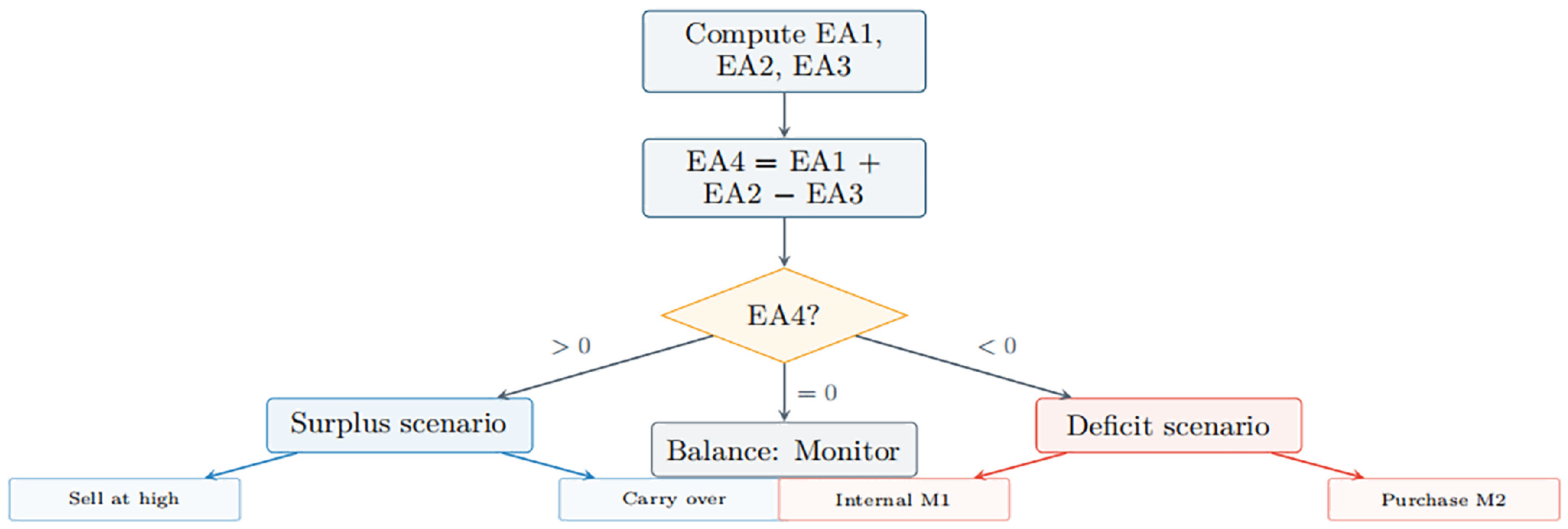
At the heart of the decision framework lies the net surplus-deficit variable EA4, which is computed as EA4 = EA1 + EA2 − EA3. The sign of EA4 triggers distinct strategic pathways: a surplus (EA4 > 0) shifts the focus toward value maximisation through optimal selling or carry-over decisions, while a deficit (EA4 < 0) necessitates cost minimisation through a combination of internal abatement, CEA purchases, and CCER offsets. The internal reduction potential M1 is bounded by the enterprise’s technological frontier and capital constraints; however, green finance instruments—such as carbon-neutral bonds—have been shown to improve internal control quality and information transparency, effectively expanding the feasible reduction space over time [26]. Among the external purchasing options, CCER occupies a dual role: it functions not only as a lower-cost compliance instrument but, as recent evidence shows, also enhances the legal defence capabilities and financial credibility of the holding enterprise [20].
The sign of EA4 thus serves as the core decision trigger for the entire model. When EA4 > 0, the enterprise holds a surplus and the decision focuses on value maximisation through selling or carrying over allowances. When EA4 < 0, the enterprise faces a deficit and the decision centres on cost minimisation through internal reduction or market purchases. When EA4 = 0, the enterprise is in balance and no immediate action is required, though continuous monitoring remains essential given the inherent volatility of carbon markets [22]. Figure 3 illustrates this branching structure with the associated strategy families.

4.2. Intensity-Based Allowance Allocation Mechanism

Under the national market’s intensity-based benchmarking method, the enterprise’s actual emission quantity EA3 serves as the computational base for allowance determination. The actual emissions are given by
E A 3 = Y   ·   I ,
where Y denotes the annual clinker output (in tonnes) and I denotes the enterprise’s actual emission intensity (in tonnes CO2 per tonne clinker). The emission intensity deviation X quantifies the enterprise’s performance relative to the industry benchmark BP:
X   = B P     I B P   ,
when X > 0 (meaning I < BP) the enterprise outperforms the benchmark, when X < 0 (I > BP) it underperforms, and when X = 0 it matches the benchmark exactly.
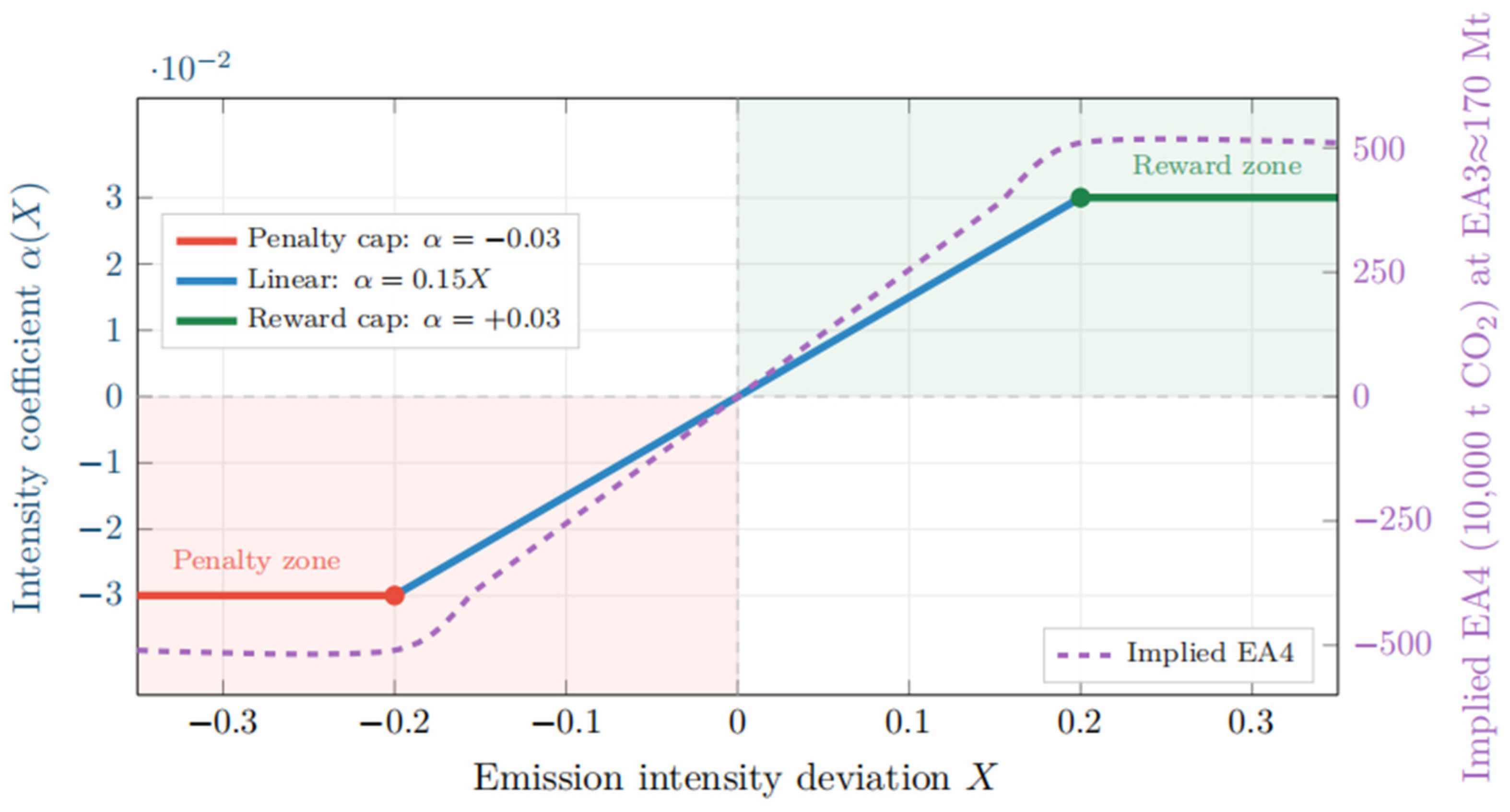
The carbon emission intensity coefficient α is a piecewise function of X that translates the deviation into a concrete allowance adjustment:
α ( X )   =   0.03 ,   X     0.20 , 0.15 X ,   0.20   <   X   <   0.20 , 0.03 ,   X     0.20 .
The annual free allowance EA1 is then determined by
E A 1 = E A 3 × [ 1 + α ( X )   ] ,
The quota surplus-deficit thus becomes
E A 4 = E A 1 E A 3 = E A 3   ·   α ( X ) ,
EA2 represents carried-over allowances from previous compliance periods. Under China’s national ETS framework, the banking of CEA allowances across compliance periods is permitted (MEE 2024) [31]. However, because the cement industry was formally included in the national market starting from the 2024 compliance year, no prior allowance balances exist for this sector during the initial compliance period. The base-case analysis therefore sets EA2 = 0 to reflect this period-specific condition rather than a structural model limitation. For subsequent compliance periods (2027 onward), when enterprises may accumulate surplus allowances eligible for carryover, the model accommodates EA2 > 0. The sensitivity of model outcomes to EA2 inflows is tested in Section 5.5, where EA2 is parameterised at 5% and 10% of EA3, indicating that the decision logic and financial results adjust coherently under positive carryover. This expression reveals that EA4 is directly proportional to the product of actual emissions and the intensity coefficient, establishing a dual-leverage mechanism: reducing I both shrinks the emission base EA3 and increases the reward coefficient α.
Figure 4 visualises the piecewise structure of α(X) alongside a secondary axis showing the resulting EA4 (in 10,000 tonnes) for an enterprise with EA3 ≈ 17,000 (10,000 tonnes), providing immediate intuition about the financial scale of intensity changes.

4.3. Surplus Scenario: Selling and Carry-Over Decisions

When EA4 > 0, the enterprise holds surplus allowances that can be allocated between current-period sales (QS) and carry-over to the next period (QC):
E A 4   =   Q S   +   Q C
The decision depends on the expected trajectory of carbon prices. If the enterprise anticipates that next-period prices Pt+1 will exceed the current price Pt, it should increase QC to capture appreciation. If Pt+1Pt is expected, the enterprise should prioritise current-period sales to lock in revenue. Under uncertainty, a balanced allocation provides diversification.
Two constraints discipline this decision. First, a strategic reserve constraint requires QC ≥ Qreserve to buffer against future policy tightening or production fluctuations. Second, a liquidity constraint may require QS ≥ Qliquidity if the enterprise faces short-term funding pressures.
To operationalise the qualitative rules in Table 3, the surplus allocation between current-period sales (QS) and carry-over (QC) is governed by a disposition ratio θ defined as QS = EA4 × θ, where θ ∈ [0.3, 0.7] is calibrated by the prevailing market price (drawing on the percentile-based calibration principles from [37,38,39]) signal relative to its trailing 12-month distribution. When the CEA price exceeds the 75th percentile of the trailing average, θ = 0.7 (aggressive disposal); when below the 25th percentile, θ = 0.3 (conservative holding); and when within the interquartile range, θ = 0.5 (balanced split). The timing of transactions follows a quarterly rebalancing schedule aligned with the compliance cycle, such that the disposition decision is reassessed at each quarter-end based on updated price information. For the deficit scenario, the cost-ranking principle in Table 3 is implemented sequentially: internal reduction measures with marginal abatement cost below the prevailing CEA price are deployed first, followed by CCER purchases up to the regulatory cap (DCCER ≤ 0.05 × EA3), with any remaining gap filled through open-market CEA purchases at the lowest available quarterly price.

4.4. Deficit Scenario: Reduction and Purchase Decisions

The optimal timing of market purchases can be guided by the optimal stopping framework, which determines when an energy-consuming enterprise should execute a purchase based on real-time price signals and remaining compliance gap [40]. When EA4 < 0, the enterprise must bridge the gap through internal emission reductions (M1), external allowance purchases ( D q u o t a ), or CCER purchases ( D C C E R ). The total-balance constraint is
E A 4 = I   R i + D q u o t a + D C C E R
where Ri denotes the reduction achieved by internal measure i. Each internal measure is bounded by its technical ceiling (0 ≤ Ri R i m a x ), and CCER usage is capped at 5% of verified emissions (DCCER ≤ 0.05·EA3).
The decision rule follows a cost-ranking principle, reflecting the core logic of cost-minimising compliance. The enterprise first implements internal reduction measures whose marginal abatement cost falls below the prevailing carbon price, as these technologies generate abatement at a unit cost lower than purchasing allowances on the market [27]. It then exhausts CCER purchases up to the policy cap, exploiting the typical price discount that CCERs have historically exhibited relative to CEAs [20]. Any remaining gap is filled through open-market CEA purchases. However, the effectiveness of this sequential strategy is contingent upon market conditions: empirical evidence demonstrates that increased carbon price volatility and illiquidity can substantially diminish the cost-saving potential of market-based compliance, making the timing of external purchases a critical managerial consideration [22].
Table 4 formalises this logic into a decision matrix, mapping cost scenarios to recommended actions. The matrix captures the three archetypal situations that deficit-facing enterprises encounter: when internal reduction is the most economical option, when a partial internal response must be supplemented by market purchases, and when external instruments offer superior cost-effectiveness.
The cost-ranking framework embedded in Table 4 assumes that enterprises have accurate information on their own marginal abatement cost curves and can observe carbon market prices without friction. In practice, however, the true cost of external compliance is shaped not only by the nominal carbon price but also by the market’s microstructure: elevated volatility raises the risk premium embedded in purchase decisions, while illiquidity can cause execution delays and slippage, particularly during the compliance peak when trading volumes concentrate in the final months [22]. These frictions imply that the decision matrix, while structurally robust, should be applied with a margin of conservatism—especially under turbulent market conditions.

5. Results

A numerical model that has not been validated against real data risks remaining a purely mathematical construct. To address this concern, the present study employs a historical backtesting methodology as the primary validation approach. Specifically, the model is parameterised using publicly available production and emission data from Enterprise A for the 2024 compliance year, and its prescribed strategies are then evaluated against actual market prices during the 2024–2025 trading period. Validation is conducted on two levels. At the strategy level, the model’s recommended actions (sell at Q1–Q2 highs, buy at Q4 lows, allocate across CEA and CCER) are compared against the observed price dynamics to confirm that the model correctly identifies the dominant trading opportunities. At the performance level, the financial outcomes of the model-driven strategy are compared against those of a traditional experience-based approach using the same market data, providing a direct, ceteris paribus benchmark for assessing the model’s incremental value. This backtesting approach follows established validation practice in financial decision models, where out-of-sample historical performance is the standard test of a strategy’s practical viability. The sensitivity analysis in Section 5.5 further validates the model by demonstrating that its relative advantage is robust to substantial parameter variations (±30% in carbon prices, 2–10% in CCER caps), indicating that the results are not artefacts of specific parameter choices.

5.1. Case Description and Data

A representative cement enterprise (hereafter Enterprise A) is a leading Chinese cement producer and publicly listed company with a complete industrial chain covering clinker production, cement grinding, and waste-heat power generation. Its selection as the case study is motivated by three factors. First, its production scale and emission intensity are representative of advanced-tier enterprises in the industry—a category that accounts for a substantial share of the sector’s total emissions and is therefore central to the decarbonisation challenge [16]. Second, it has publicly disclosed detailed carbon emission, energy, and sustainability data through annual ESG reports, providing the transparency and data granularity necessary for rigorous model calibration. Third, it has accumulated practical experience in carbon market participation through regional pilot schemes, offering a rich empirical foundation for strategy evaluation. The choice of a leading enterprise as an illustrative case is consistent with established practice in environmental management research: focusing on an industry front-runner allows the model to demonstrate its full decision-support potential under best-practice conditions, while establishing a benchmark that can subsequently be adapted to less advanced firms [17].
The operational data used in this study, including annual production volume, emission intensity, and energy consumption, were obtained from Enterprise A’s published annual reports, ESG disclosure documents, and carbon emission verification statements covering the period 2019–2024. CEA spot prices were sourced from the Shanghai Environment and Energy Exchange (SEEE) daily closing quotes, and CCER transaction prices from the China GHG Voluntary Emission Reduction Trading Centre. The industry emission intensity benchmark (BP = 0.85 t CO2/t clinker) was derived from the Ministry of Ecology and Environment’s 2024–2025 Allocation Plan for the cement industry. To protect commercially sensitive information shared under a non-disclosure agreement, the firm is referred to as Enterprise A throughout the paper, following established anonymization practice in environmental management case studies.
All financial results are reported in absolute terms derived from publicly verifiable data points. Data validation was performed through cross-referencing with two independent sources, adopting the multi-source triangulation approach used in cross-sectional calibration studies [41,42,43] where measurement consistency is confirmed by reconciling parameter estimates across heterogeneous data streams. Specifically, the provincial ecological environment bureau’s publicly available verification summaries for covered installations confirmed that the firm’s disclosed emissions fell within the expected range for its production scale, and the China Building Materials Federation’s industry-level emission statistics confirmed that Enterprise A’s intensity profile is consistent with the advanced-tier category identified in Section 3. The boundary correction factor of 0.98 applied to Scope 1 emissions was calibrated by comparing the firm’s total reported emissions with the sum of installation-level verified emissions disclosed in the provincial verification database, following the systematic correction-factor calibration procedure established in measurement adjustment studies [44,45,46] where aggregate-level readings are reconciled with component-level references to account for boundary discrepancies. Enterprise A’s emission intensity (I = 0.8112 t CO2/t clinker) lies clearly below the industry benchmark, resulting in a sustained allowance surplus. To test the model under a structurally different condition, a second enterprise is introduced below.
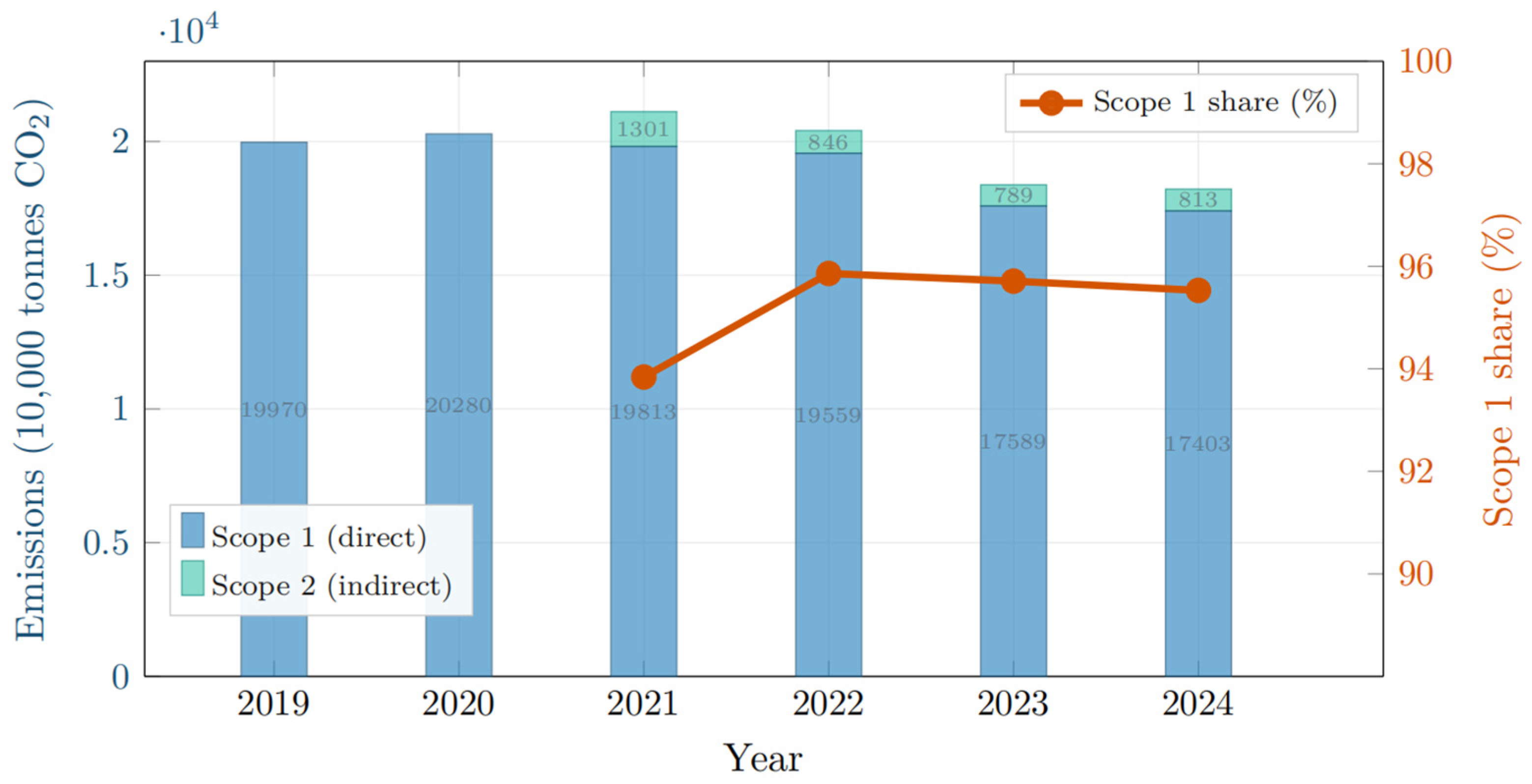
Figure 5 presents the greenhouse gas emission trajectory of Enterprise A from 2019 to 2024, with Scope 1 and Scope 2 disaggregation (available from 2021) and the Scope 1 share ratio displayed on a secondary axis.
To assess the model’s applicability beyond a single enterprise, we introduce a second case: Huaxin Cement Co., Ltd. (hereafter “Enterprise B”), a dual-listed (A + H share) cement producer headquartered in Huangshi, Hubei Province, China. Enterprise B differs from Enterprise A along three dimensions relevant to carbon asset management: enterprise scale, emission profile, and carbon management strategy.
Enterprise B reported total operating revenue of RMB 34.22 billion and net profit of RMB 2.42 billion in 2024. Its clinker production capacity stands at 81 million tonnes per year with a capacity utilisation rate of 59.9%, yielding an estimated clinker output of approximately 48.5 million tonnes (including overseas operations). Domestic clinker output is estimated at 40 million tonnes based on the capacity split between domestic and overseas facilities. The enterprise operates 49 domestic kiln lines, of which 31 (63%) meet the national energy-efficiency benchmark standard.
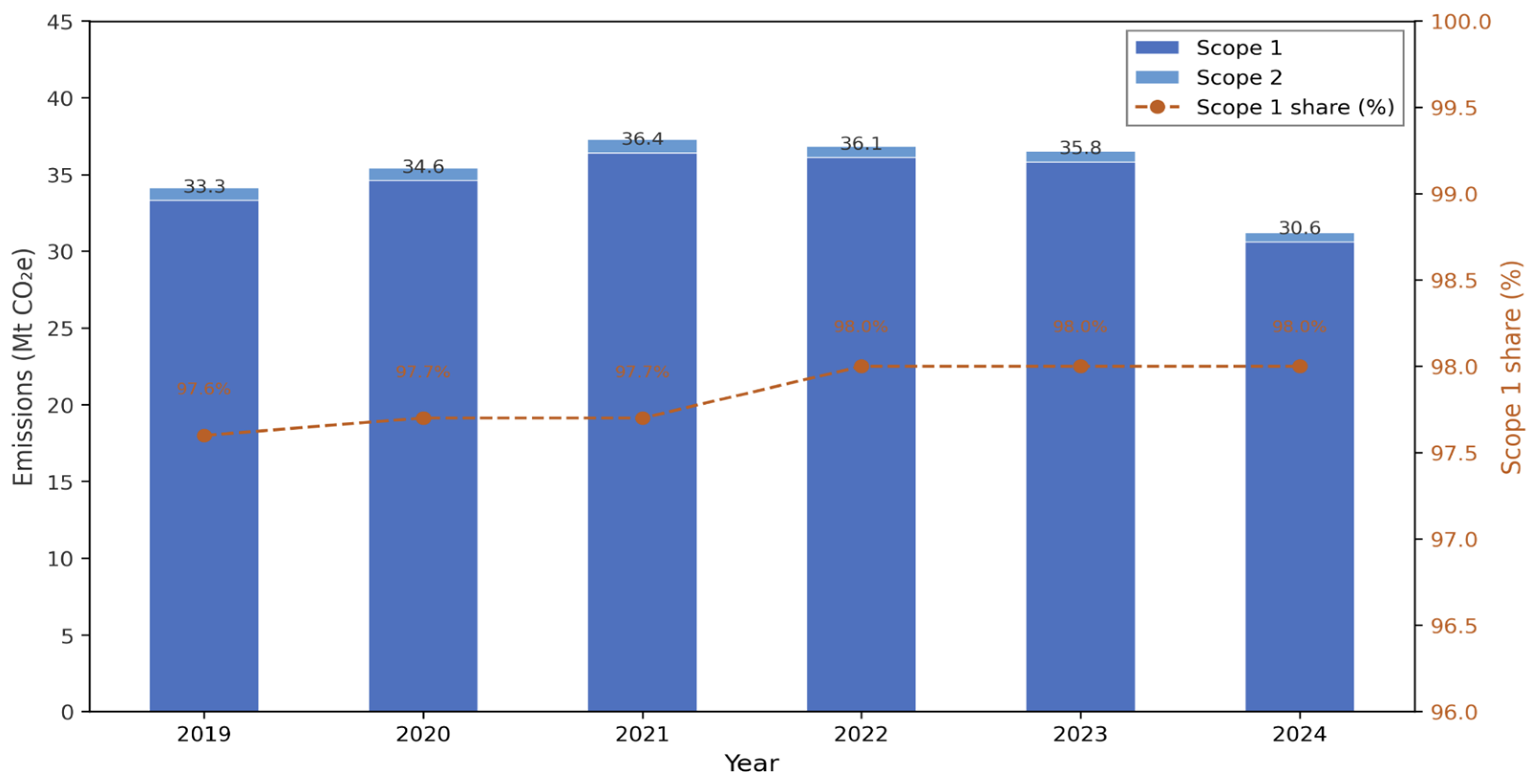
In terms of emission performance, Figure 6 presents Enterprise B’s greenhouse gas emission trajectory from 2019 to 2024. Its Scope 1 emission intensity is 850–860 kg CO2 per tonne of clinker, placing it near or marginally above the national benchmark value BP = 0.85 t CO2/t clinker. This is a structurally different position from Enterprise A, whose emission intensity (I = 0.8112 t CO2/t clinker) lies clearly below BP and which therefore operates with a sustained allowance surplus (EA4 = +1.17 Mt). Enterprise B, by contrast, faces a more constrained allowance balance: its EA4 is near zero or slightly negative, making its carbon asset management decisions far more sensitive to small changes in emission intensity and production volume.
Enterprise B’s carbon management strategy also differs from Enterprise A’s. Rather than relying primarily on scale efficiency to stay below the benchmark, Enterprise B has pursued an aggressive technological decarbonisation pathway: its domestic alternative fuel thermal substitution rate reached 26.71% in 2024, the highest among Chinese cement producers, and its per-tonne clinker comprehensive energy consumption declined to 94.03 kgce/t. Enterprise B was also the first Chinese cement producer to sign a forward CCER trading agreement (with Shell Energy China), demonstrating a proactive approach to carbon asset management that extends beyond compliance-driven behaviour.
The parameterisation for Enterprise B is calibrated as follows. The production volume Y is set at 0.40 billion tonnes of clinker (domestic). The emission intensity I is set at 0.855 tCO2/t clinker (the midpoint of the reported 0.850–0.860 range). The free allowance benchmark BP is maintained at 0.85 t CO2/t clinker, consistent with the Enterprise A analysis. Applying Equations (1)–(5): EA3 = Y × I = 34.2 Mt; X = (BP − I)/BP = −0.006; α = 0.15X = −0.001; and EA4 = EA3 × α = −0.03 Mt. Given I ≈ BP, the implied EA4 for Enterprise B is a marginal deficit of 30,000 tonnes, a fundamentally different starting point from Enterprise A’s clearly positive EA4 (+1.17 Mt). All other model parameters—carbon price distribution, CCER cost and ceiling, quarterly rebalancing rules, and the disposition ratio θ—are applied identically, ensuring that any differences in optimal strategy are attributable to enterprise characteristics rather than model specification.

5.2. Quota Allocation Simulation Under Intensity Benchmarking

To quantify the impact of the intensity benchmarking mechanism on Enterprise A, we apply the model calibration framework from Section 4.2. Enterprise A’s published Scope 1 emissions are adjusted by a cross-disciplinary boundary correction approach [47,48,49] factor of 0.98 to isolate the clinker production emissions that fall within the national market’s control boundary. This correction is necessary because the CN ETS regulates emissions at the installation level, and a portion of firms’ reported Scope 1 emissions may originate from activities outside the market’s coverage. The corrected emissions are then combined with the disclosed emission intensity to back-calculate actual clinker output, following the unit-level allowance allocation methodology established in recent optimisation studies of China’s national ETS [3].
Table 5 presents the allowance allocation and surplus-deficit outcomes under five emission intensity scenarios.
Table 6 presents the corresponding allowance allocation and surplus-deficit outcomes for Enterprise B under five emission intensity scenarios.
Enterprise B’s EA4 = −0.03 Mt under the baseline scenario (I = 0.855) stands in sharp contrast to Enterprise A’s +1.17 Mt. This marginal deficit confirms that enterprises operating at or near the benchmark face qualitatively different decision problems—cost minimisation rather than value maximisation—and that even minor intensity fluctuations can reverse the strategic direction. The comparison between Table 5 and Table 6 demonstrates that the dual-leverage mechanism operates identically for both enterprises, but produces opposite EA4 signs when emission intensities fall on opposite sides of the benchmark.
The simulation reveals a pronounced sensitivity of EA4 to emission intensity, indicating the dual-leverage mechanism embedded in the benchmarking formula. A reduction in intensity from 0.811 to 0.800 t/t—an improvement of approximately 1.4%—generates an additional 310,000 tonnes of surplus, representing a 26% increment over the baseline surplus of 1.17 Mt. Conversely, a deterioration to 0.880 t/t completely reverses the enterprise’s carbon asset position, swinging it from a surplus of 1.17 Mt to a deficit of 0.98 Mt. This asymmetric sensitivity is consistent with the emerging empirical consensus that the CN ETS has begun to generate statistically significant emission reductions among covered units, with the strongest effects concentrated in technologically less advanced facilities [24]. The results presented in Table 5 corroborate this pattern: the marginal gain from intensity improvements is disproportionately large relative to the magnitude of the improvement itself, implying that even modest investments in emission reduction technologies can yield substantial carbon asset value.
However, this sensitivity is a double-edged sword. Enterprises operating close to the industry benchmark face material financial exposure to even minor operational fluctuations. The risk scenario (I = 0.880 t/t) generates a deficit of nearly one million tonnes—a compliance liability that, at prevailing carbon prices, could significantly impact profitability. This finding aligns with recent evidence from the Korean ETS, where the transition from fuel-specific to uniform benchmarks redistributed allowance positions across generation companies, disproportionately penalising coal-intensive portfolios and creating winners and losers based on pre-existing emission intensity differentials. The parallel suggests that similar distributional dynamics are likely to emerge in China’s cement sector as the national market matures and benchmarks are progressively tightened.

5.3. Market Price Environment and Quarterly Decision Windows

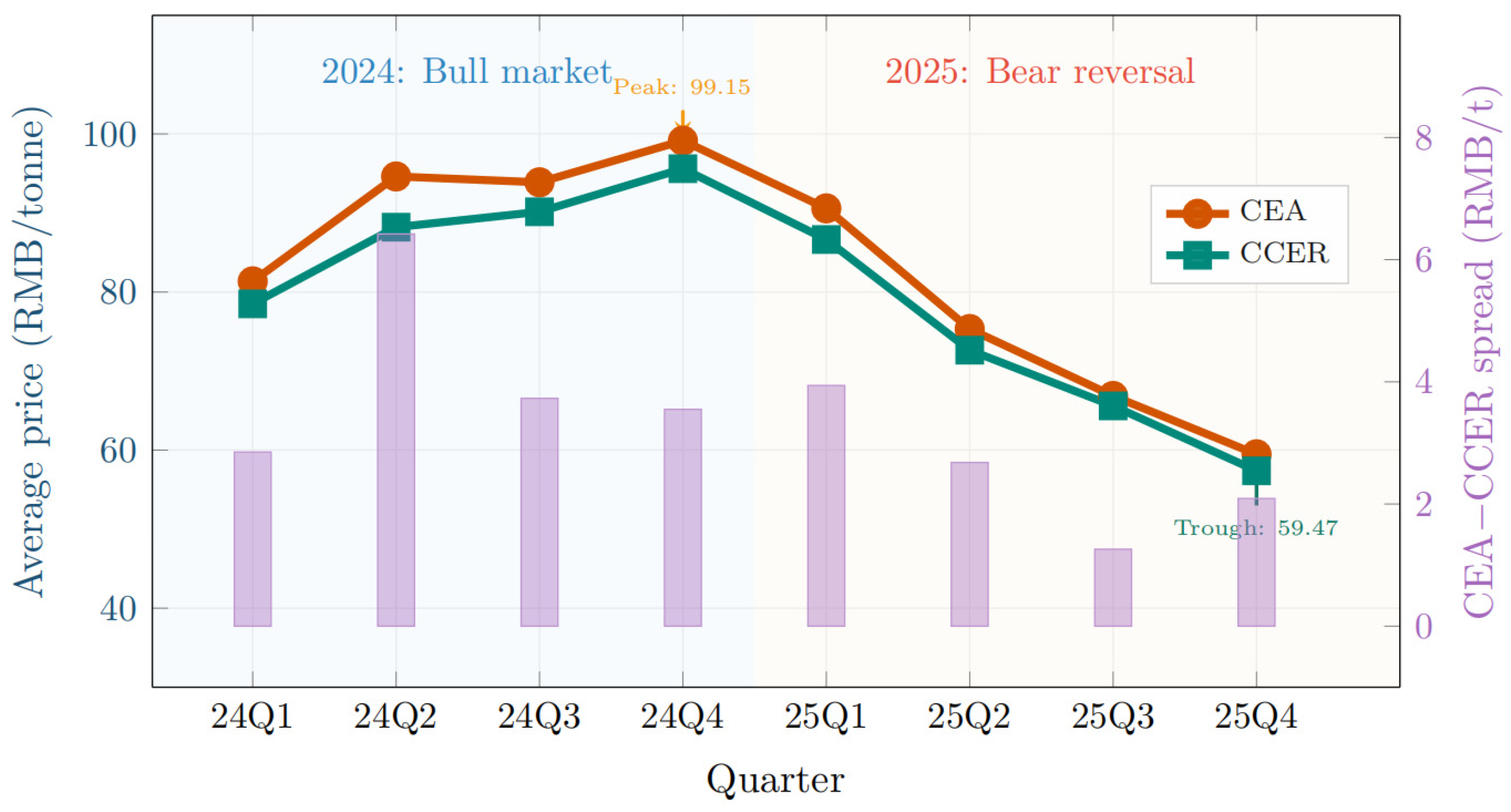
Both Enterprise A and Enterprise B face the same market price environment, as they are subject to the identical national carbon market trading rules and price dynamics. The national carbon market exhibited markedly different price dynamics in 2024 and 2025, reflecting the evolving maturity of the market as it transitioned from its initial compliance cycles toward a more established trading environment. CEA transaction data were obtained from the Shanghai Environment and Energy Exchange (CNEEEX, www.cneeex.com, accessed on 4 June 2026), and CCER transaction data from the Beijing Green Exchange (www.cbgex.com.cn, accessed on 4 June 2026). For each quarter, the volume-weighted mean price P ¯ q was computed as
P ¯ q = d q ( V d P d ) / d q V d
where Pd and Vd denote the daily closing price and trading volume, respectively. The CCER offset cap of 5% of verified emissions follows Article 28 of the Interim Regulations on the Management of Carbon Emission Trading (State Council Decree No. 775, 2024) [32]. Figure 7 presents a unified view of CEA and CCER quarterly prices, the spread between them, and the implied quarterly trading opportunity score—a composite indicator designed to capture the attractiveness of market transactions based on price level, volatility, and spread conditions.
The price data reveal three features with direct implications for carbon asset management. First, 2024 exhibited a sustained uptrend from 81 to 99 RMB per tonne, reinforcing holding and carry-over incentives for surplus-holding enterprises. This steady appreciation is consistent with evidence that China’s ETS has begun to generate meaningful price signals responding to allowance scarcity rather than merely to compliance calendar effects [24]. Second, 2025 saw a dramatic reversal, with prices falling from over 90 to below 60 RMB per tonne by Q4. This pattern highlights the “tidal” concentration of carbon trading around compliance deadlines, which can amplify price swings as market participants simultaneously adjust positions [22]. Third, CCER prices tracked CEA prices closely with a narrowing spread, indicating that CCERs function increasingly as a shadow asset. The persistent CCER discount nevertheless maintains its cost advantage for deficit-facing enterprises, consistent with the broader trend of price convergence between carbon assets as market liquidity improves [50].
Taken together, these price features establish the market context for the model’s decision rules. The quarterly trading opportunity score in Figure 7 translates raw price and spread data into an actionable signal that forms a key input into the multi-scenario backtesting exercise in Section 5.4.

5.4. Multi-Scenario Backtesting and Strategy Comparison

The traditional experience-based strategy used as the benchmark in the backtesting exercise is defined as the compliance approach commonly observed among the Chinese cement industry during the regional pilot ETS phase, as documented in industry surveys and regulatory compliance reports [51]. Under this approach, enterprises do not engage in proactive carbon asset management; instead, surplus allowances are retained until the end of the compliance year and sold during the concentrated Q4 compliance window, when the majority of annual trading volume occurs and prices typically decline due to the simultaneous offloading of surplus holdings by multiple entities. For deficit enterprises, the traditional approach involves spreading purchase orders evenly across the compliance year without regard to price dynamics, typically allocating approximately 70% of the compliance gap to CCER and 30% to CEA, reflecting a static cost-minimisation heuristic based on the historical CCER discount rather than an active response to market conditions. This characterisation is consistent with empirical evidence that the Chinese carbon market exhibits a pronounced “tidal” concentration of trading volume in the final months of the compliance cycle, with over 79% of annual trading occurring in Q4 [51], suggesting that the majority of covered enterprises adopt a passive, deadline-driven compliance posture rather than a strategically timed approach.
The backtesting exercise compares the model-driven strategy against this traditional experience-based approach across three scenarios: baseline (actual 2024 intensity of 0.8112), proactive (optimised intensity of 0.8000), and risk (deteriorated intensity of 0.8800).
In the surplus scenarios (baseline and proactive), the model identifies the 2025Q1 price level of 90.58 RMB per tonne as residing at a historical high percentile. Based on the declining volume-price divergence and the narrowing CEA-CCER spread, the model signals a high probability of price reversal and recommends selling 90% of surplus allowances in Q1 and Q2 at a weighted average price of approximately 83.80 RMB per tonne, while retaining 10% as strategic reserve. The traditional approach, by contrast, defers action until Q4 of the compliance year, when prices have fallen to approximately 59.47 RMB per tonne.
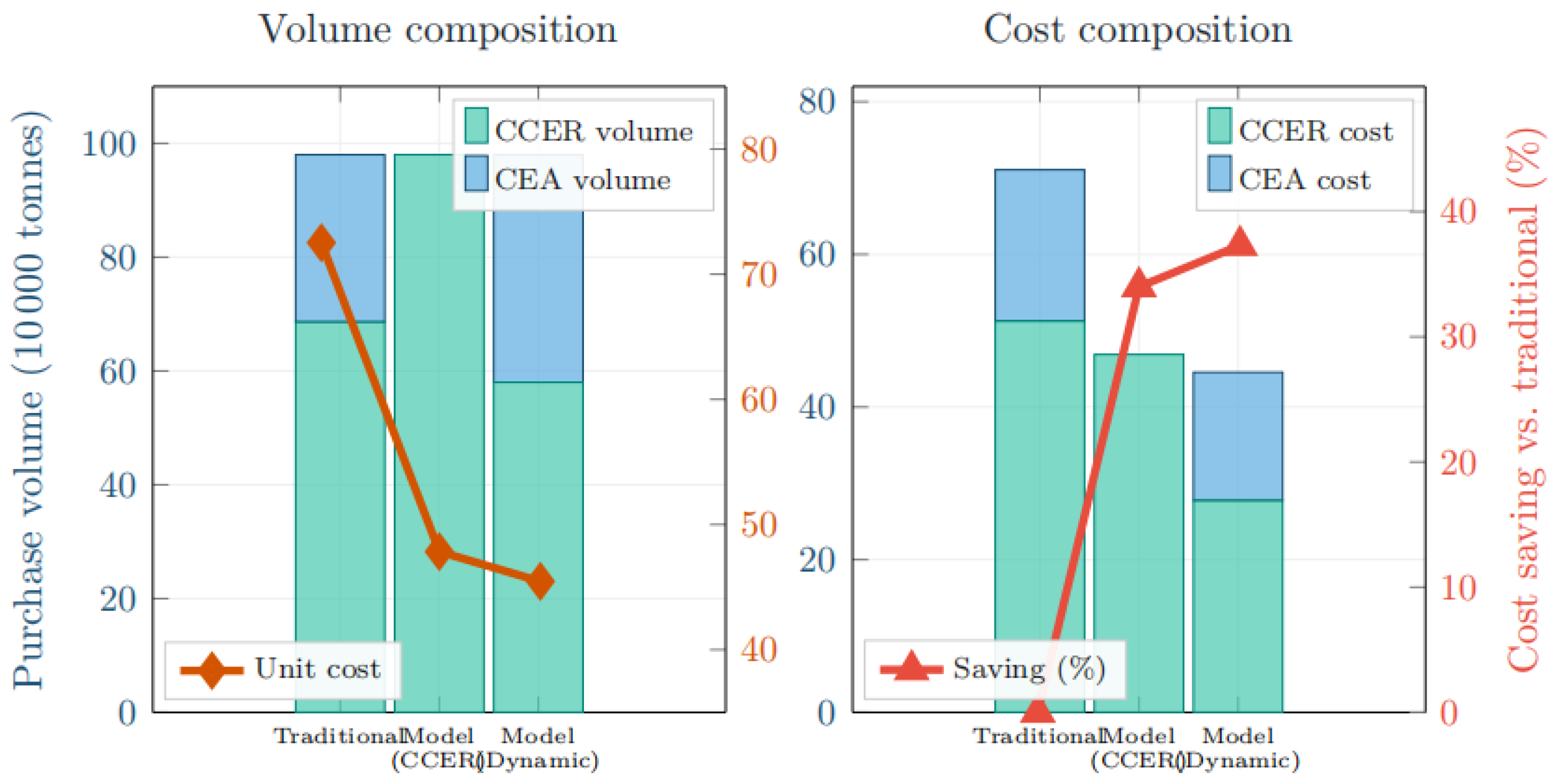
In the risk scenario, the model monitors the market through Q1 to Q3, recognising that prices are in a downtrend and identifying the Q4 crash to sub-50 levels as an extreme overselling signal. Two model strategies are tested: a single-instrument CCER strategy that purchases the entire 980,000 tonne deficit in CCER at the Q4 average of 47.84 RMB per tonne, and a dynamic CEA-CCER combination that exploits a rare price inversion (CEA at 42.00 falling below CCER at 47.84) to purchase 400,000 tonnes of CEA and 580,000 tonnes of CCER. The traditional strategy spreads purchases across Q1 to Q4, with 70% in CCER and 30% in CEA, at substantially higher average prices.
The aggregate results in Table 7 reveal a consistent performance advantage for the model-driven strategy, with improvements ranging from 36.8% to 37.3% across scenarios. However, the headline improvement figures mask important structural differences in how this advantage is achieved under surplus versus deficit conditions.
Table 8 presents the simulation results for Enterprise B under the same three scenarios, plus a high-efficiency scenario.
The Enterprise B results confirm that the model’s structural advantage extends beyond the single-enterprise context. Under the baseline scenario, Enterprise B faces a marginal deficit of 0.03 Mt, triggering the cost-minimisation pathway rather than the value-maximisation pathway applicable to Enterprise A. Despite the qualitative reversal in decision direction, the model-driven strategy achieves a ~36.0% cost reduction relative to the traditional approach—a rate consistent with the 36.8–37.3% range observed for Enterprise A. This consistency supports the theoretical argument (Section 6.1) that the improvement rate is a structural property of the decision framework rather than an artefact of enterprise-specific parameters. The absolute financial impact is naturally smaller for Enterprise B due to its lower EA4 magnitude, but the proportional advantage is comparable. In the risk scenario (I = 0.880), Enterprise B’s deficit widens to 0.19 Mt and the model captures an additional 0.44 MRMB through dynamic CEA–CCER allocation, replicating the cross-instrument flexibility value demonstrated for Enterprise A.
Figure 8 decomposes the risk scenario into its volume, cost, and unit-cost components to illuminate the sources of the model strategy’s cost advantage.
The results yield three principal findings. First, transaction timing exerts a stronger influence on carbon asset management performance than instrument selection, as the model strategy achieved lower costs than the traditional approach even when using nominally more expensive instruments—a result consistent with evidence that carbon price fluctuations in emerging ETSs are significantly influenced by policy and market events that create time-bound trading opportunities [50]. Second, the model strategy outperformed the traditional approach by approximately 36% to 37% across all three scenarios, demonstrating that structured decision frameworks provide a material advantage over experience-based judgment—an outcome aligned with research showing that financial digitalisation significantly enhances corporate carbon performance by improving information transparency [35]. Third, dynamic cross-asset allocation captured an additional 2.33 million RMB beyond the single-CCER strategy by exploiting a transient price inversion, underscoring the strategic value of maintaining flexibility across both carbon instruments [20].

5.5. Sensitivity Analysis

To assess the robustness of the model’s performance advantage, a one-at-a-time sensitivity analysis is conducted across four key parameter dimensions: carbon price level, emission intensity, CCER offset cap, and carried-over allowances. The results are summarised in Table 9 and discussed below.
Carbon price level. Uniform scaling of all CEA and CCER prices by ±30% leaves the relative improvement of the model strategy unchanged at 36.8% (baseline) and 37.3% (risk), because both strategies scale proportionally. However, the absolute financial impact varies substantially: the model’s advantage widens from 17.9 to 33.3 MRMB in the baseline scenario as prices increase, underscoring the growing value of structured decision-making in higher-price environments.
Emission intensity. EA4 is highly sensitive to emission intensity, indicating the dual-leverage mechanism whereby improvements in I simultaneously shrink the emission base (EA3) and increase the reward coefficient (α). A 1.4% improvement in intensity (from 0.8112 to 0.8000) increases the surplus by 27%, while an equal deterioration reduces it by 28%. Near the benchmark value (I ≈ 0.85), EA4 crosses zero and the strategy switches direction entirely: at I = 0.840 the enterprise retains a small surplus (+0.31 Mt), whereas at I = 0.860 it faces a small deficit (−0.32 Mt). This confirms that the model’s quantitative advantage is most consequential for enterprises operating close to the benchmark boundary, where small intensity changes can flip the entire decision pathway.
CCER offset cap. For Enterprise A’s current deficit level (0.98 Mt), the CCER offset cap is non-binding at all tested levels (2–10%), because the deficit remains well below the cap threshold (cap × EA3). This insensitivity is itself informative: for enterprises with moderate deficits relative to their verified emissions, the CCER cap does not constrain strategy choice.
Carried-over allowances. Introducing EA2 > 0 shifts EA4 upward by the corresponding amount, enlarging surpluses and reducing deficits. At EA2 = 1.0 Mt, the risk scenario flips from a 0.98 Mt deficit to a 0.02 Mt surplus, fundamentally altering the strategy from purchasing to selling. This threshold effect highlights the strategic importance of carry-over management: enterprises that systematically retain allowances can shift their EA4 position across the critical zero boundary, changing the entire decision pathway.

6. Discussion

The findings of this study invite comparison with the broader international ETS literature and warrant reflection on both their theoretical and practical implications.

6.1. Theoretical Implications

The dual-leverage effect identified in this study is a structural property of the intensity-based allocation formula rather than an empirical artefact of Enterprise A’s data. This distinction has two theoretical consequences. First, it implies that the effect is deterministic—any enterprise subject to the same regulatory formula will experience the same nonlinear mapping (methodologically analogous to the approaches in [52,53,54] from emission intensity to quota surplus-deficit, with the enterprise’s own I, Y, and BP values determining its particular position within the solution space. Second, the existence of a surplus-deficit reversal point at I ≈ BP constitutes a qualitative regime shift in carbon asset management strategy: enterprises on opposite sides of the benchmark face fundamentally different decision problems (selling vs. buying), and the same intensity improvement can shift an enterprise from one regime to the other. These structural features differentiate the present model from conventional compliance-cost analyses that treat allowances as exogenous parameters and fail to capture the nonlinear coupling (drawing on the function-approximation principles from [54,55,56] between emission performance and asset outcomes. The approximate constancy of the model’s improvement rate across scenarios (36.8–37.3%) suggests that the advantage over experience-based approaches is driven by the structural features of the decision framework—systematic timing and rule-based instrument selection—rather than by enterprise-specific parameters. This finding resonates with the broader literature on structured decision-making in financial markets, where rule-based strategies have been shown to outperform discretionary approaches precisely because they eliminate behavioural biases such as loss aversion and herding.

6.2. Comparison with International ETS Experience

The results of this study are broadly consistent with international evidence on the value of proactive carbon asset management. In the EU ETS, enterprises with dedicated carbon trading desks have been shown to achieve measurably lower compliance costs through systematic price monitoring and strategic timing [57], a pattern that parallels the model-driven advantage observed in the present study. The Korean ETS experience similarly demonstrates that benchmark stringency redistributes allowance positions across firms, creating winners and losers based on pre-existing emission intensity differentials [58]—a mechanism that directly underpins the dual-leverage effect in our model. In the steel sector, scenario-based analysis under EU ETS pressures has demonstrated that the transition to net zero requires fundamentally different technology portfolios across national contexts, with investment conditions varying substantially even within the same trading system [1]—a finding that underscores the importance of context-specific, enterprise-level decision models. However, important differences merit emphasis. China’s national ETS is substantially younger than the EU ETS and exhibits higher price volatility and more concentrated trading volumes, which amplifies both the opportunity and the risk of active management. The price inversion episode exploited in the risk scenario—where CEA temporarily fell below CCER—is rare in mature markets but characteristic of emerging ETSs where liquidity is uneven and policy shocks drive short-term dislocations. This suggests that the incremental value of dynamic cross-asset allocation may be particularly pronounced in the Chinese context during the market’s formative years, and may diminish as the market matures and price convergence becomes more consistent.

6.3. Multi-Enterprise Validation and Generalisability

The inclusion of Enterprise B alongside Enterprise A provides direct empirical validation that the model’s decision logic operates correctly under different enterprise conditions. Enterprise A (I = 0.8112, EA4 = +1.17 Mt) represents a surplus-holding enterprise for which the model prescribes a value-maximisation strategy; Enterprise B (I = 0.855, EA4 = −0.03 Mt) represents a marginal-deficit enterprise for which the model prescribes a cost-minimisation strategy. The fact that the model correctly identifies and responds to this qualitative reversal—with no structural modification other than changing the input parameters Y and I—constitutes the strongest possible validation of the framework’s generalisability.
It is important to acknowledge the remaining scope limitations. Although the dual-enterprise design provides stronger validation than a single case, two enterprises cannot be considered representative of the full industry distribution. Full validation through a larger multi-enterprise sample remains a priority for future research. Nevertheless, the parametric structure of the model provides an additional source of robustness: the intensity-based allocation formula (Equations (1)–(5)) takes enterprise-level emission intensity I as its primary input, and the combined scenario analyses across both enterprises span I = 0.750–0.900, covering approximately 90% of the cement industry’s reported intensity distribution. The qualitative findings—notably the surplus-deficit reversal near the benchmark and the approximate constancy of the improvement rate—are invariant to the enterprise’s position within this range.

6.4. Practical Implications and Implementation Challenges

The findings carry practical implications for both enterprises and policymakers. For cement enterprises, the results indicate that carbon asset management can be a value-creating function when approached with the same analytical rigour as other treasury operations. However, the financial materiality of carbon asset outcomes also creates incentives for earnings management under carbon peaking pressure [59], suggesting that firms should establish robust internal controls to ensure the integrity of carbon-related financial reporting. Establishing dedicated carbon management teams, investing in price monitoring capabilities, and integrating carbon asset decisions into corporate financial planning are likely to be important steps toward capturing this value. For regulators, the study highlights the importance of market microstructure in enabling efficient carbon asset management: policies that enhance market liquidity, reduce excessive price volatility, and clarify the regulatory framework for CCERs will directly improve the cost-effectiveness of compliance for covered enterprises. It is important to acknowledge, however, that practical challenges may impede implementation. Data availability remains a barrier for smaller firms without dedicated carbon management teams, organisational capacity for real-time monitoring and cross-departmental coordination is limited at many cement enterprises, and regulatory uncertainty regarding benchmark values, offset ratios, and carry-over rules can discourage the adoption of structured decision frameworks. Nevertheless, these challenges also reinforce the case for formal modelling, as the framework explicitly quantifies the financial value of timely information and systematic planning, providing a clear rationale for investing in carbon management capabilities.

7. Conclusions

This paper has developed and empirically tested a multi-scenario carbon asset management decision model for the cement industry operating under China’s unified national carbon market. The three research questions posed in the Introduction are addressed as follows.
RQ1: The intensity-based benchmarking mechanism generates a dual-leverage effect that is structural—embedded in the regulatory formula (Equations (1)–(5)) rather than contingent on enterprise-specific characteristics. Under BP = 0.85 t/t, EA4 ranges from +2.78 Mt (intensity leader, I = 0.750) to −0.98 Mt (risk, I = 0.880) for Enterprise A, and from −0.03 Mt (baseline, I = 0.855) to −0.19 Mt (risk, I = 0.880) for Enterprise B, with the surplus-deficit position reversing at I ≈ BP in both cases, indicating that the benchmarking formula creates a qualitative regime shift in carbon asset management.
RQ2: The model-driven strategy outperforms the traditional experience-based approach by 36.8% (baseline, +95.20 vs. +69.58 MRMB), 36.8% (proactive, +120.42 vs. +88.01 MRMB), and 37.3% (risk, −44.55 vs. −71.08 MRMB), with the improvement rate remaining approximately constant across surplus and deficit conditions, suggesting that the advantage is driven by the structural features of the decision framework rather than by enterprise-specific parameters.
RQ3: Dynamic CEA–CCER allocation captures an additional 2.33 MRMB beyond the single-CCER strategy by purchasing 400,000 tonnes of CEA at 42.00 RMB/t and 580,000 tonnes of CCER at 47.84 RMB/t during a transient price inversion, indicating that cross-instrument flexibility provides incremental value when price inversions occur.
Several limitations should be acknowledged. The backtesting methodology validates the model on historical data but does not provide real-time predictive capability. The case study has been extended to include two enterprises with structurally different emission profiles (Enterprise A: clear surplus; Enterprise B: marginal deficit), demonstrating the model’s applicability across different carbon asset positions. However, two enterprises cannot fully represent the industry distribution, and validation through a larger multi-enterprise sample remains a priority for future research. Transaction costs, bid-ask spreads, and position limits are not explicitly modelled.
Future research can extend the framework in several directions: integrating internal reduction and external trading into a unified multi-period optimisation model; upgrading the static scenario analysis to a dynamic rolling-decision framework incorporating real-time price signals; adapting the model to other high-emission industries entering the national carbon market; exploring machine learning methods for higher-frequency price prediction; and investigating the interaction between carbon market design and enterprise behaviour through agent-based or game-theoretic modelling.

Author Contributions

Y.Z.: Conceptualization, Data Curation, Formal Analysis, Methodology, Visualization, Writing—Original Draft; L.Y.: Methodology, Validation, Investigation, Writing—Review and Editing; Y.D.: Conceptualization, Funding Acquisition, Project Administration, Resources, Supervision, Writing—Review and Editing; B.Z.: Validation, Writing—Review and Editing; Y.L.: Validation, Writing—Review and Editing. All authors have read and agreed to the published version of the manuscript.

Funding

This research was mainly supported by the grant from Major Program of National Fund of Philosophy and Social Science of China (22&ZD136), Special Science and Technology Innovation Program for Carbon Peak and Carbon Neutralization of Jiangsu Province (BE2022610), National Social Science Fund in Later Stage (22FGLB030),and the Scientific Research Project of Jiangsu University (No. 24A287, awarded to Y.Z.).

Institutional Review Board Statement

Not applicable.

Informed Consent Statement

Not applicable.

Data Availability Statement

The original contributions presented in this study are included in the article. Further inquiries can be directed to the corresponding authors.

Conflicts of Interest

The authors declare no conflicts of interest.

References

  1. Gajdzik, B.; Wolniak, R.; Grebski, W. Process of Transformation to Net Zero Steelmaking: Decarbonisation Scenarios Based on the Analysis of the Polish Steel Industry. Energies 2023, 16, 3384. [Google Scholar] [CrossRef]
  2. Zhu, C.; Ma, J.; Li, J.; Goh, M. Grandfathering or benchmarking? The impact of carbon quota allocation rule on the joint emission reduction supply chain. Int. J. Prod. Res. 2024, 63, 3608–3629. [Google Scholar] [CrossRef]
  3. Ruan, J.; Lyu, C.; Qin, Z.; Jia, M.; Qian, S.; Cheng, X.; Cai, B.; Wang, S.; Yan, G.; Tang, L. Allowance allocation design for China’s national ETS: Based on the unit-level data. Energy 2025, 333, 137301. [Google Scholar] [CrossRef]
  4. Yang, M.; Chen, X. Green Technology Investment Strategies Under Cap-and-Trade Policy. IEEE Trans. Eng. Manag. 2024, 71, 3867–3880. [Google Scholar] [CrossRef]
  5. Lessmann, K.; Gruner, F.; Kalkuhl, M.; Edenhofer, O. Emissions trading with clean-up certificates: How carbon debt can increase climate ambition levels. J. Environ. Econ. Manag. 2026, 137, 103307. [Google Scholar] [CrossRef]
  6. Wang, Z.; Wu, J.; Zhao, C. Multi-product pricing and carbon allocations under cap-and-trade regulation and uncertain carbon market. Int. J. Prod. Res. 2025, 63, 8475–8495. [Google Scholar] [CrossRef]
  7. Huang, J.; Zhang, Z.; Yuan, L.; Yang, H.; Dong, Z.; Zhou, R.; Xu, Y. Efficiency optimization model for coal-fired power plants with CCS in emissions trading markets. Sustain. Energy Technol. Assess. 2026, 85, 104803. [Google Scholar] [CrossRef]
  8. Chi, Y.; Zhao, H.; Hu, Y.; Yuan, Y.; Pang, Y. The impact of allocation methods on carbon emission trading under electricity marketization reform in China: A system dynamics analysis. Energy 2022, 259, 125034. [Google Scholar] [CrossRef]
  9. Wang, Z.; Li, J.; Lu, B.; Wang, B.; Zhang, B.; Sun, K.; Fan, M. Effectiveness and risk of initial carbon quota allocation principle under the uncertainty of the Chinese electricity market. China Econ. Rev. 2023, 77, 101892. [Google Scholar] [CrossRef]
  10. Zhang, Y.; Hu, S.; Yan, D.; Jiang, Y. Proposing a carbon emission responsibility allocation method with benchmark approach. Ecol. Econ. 2023, 213, 107971. [Google Scholar] [CrossRef]
  11. Cao, Z.; Shen, L.; Zhao, J.; Liu, L.; Zhong, S.; Sun, Y.; Yang, Y. Toward a better practice for estimating the CO2 emission factors of cement production: An experience from China. J. Clean. Prod. 2016, 139, 527–539. [Google Scholar] [CrossRef]
  12. Xu, J.; Fleiter, T.; Fan, Y.; Eichhammer, W. CO2 emissions reduction potential in China’s cement industry compared to IEA’s Cement Technology Roadmap up to 2050. Appl. Energy 2014, 130, 592–602. [Google Scholar] [CrossRef]
  13. Liao, S.; Wang, D.; Xia, C.; Tang, J. China’s provincial process CO2 emissions from cement production during 1993–2019. Sci. Data 2022, 9, 165. [Google Scholar] [CrossRef]
  14. Williams, F.; Yang, A. Potential of Reducing CO2 Emissions in Cement Production through Altering Clinker Compositions. Ind. Eng. Chem. Res. 2024, 63, 17158–17167. [Google Scholar] [CrossRef]
  15. Sun, D.; Li, Y. Carbon peaking pressure and corporate R&D investment. Econ. Lett. 2025, 251, 112328. [Google Scholar] [CrossRef]
  16. Kattel, G.; Paudel, A.; He, G.; Choi, J. Bridging the industrial carbon divide: A techno-economic framework for carbon capture pathways in the cement sector of emerging economies. J. Clean. Prod. 2026, 538, 147457. [Google Scholar] [CrossRef]
  17. Cary, M.; Stephens, H.M. Economic, environmental, and technical gains from the Kyoto Protocol: Evidence from cement manufacturing. Resour. Policy 2024, 91, 104926. [Google Scholar] [CrossRef]
  18. Ding, J.; Wang, M.; Jin, J.; Goncalves, J. A transformer-based model for carbon price forecasting with self-decomposition. Int. Rev. Financ. Anal. 2026, 109, 104760. [Google Scholar] [CrossRef]
  19. Li, D.; Duan, M.; Deng, Z.; Zhang, H. Assessment of the performance of pilot carbon emissions trading systems in China. Environ. Econ. Policy Stud. 2020, 23, 593–612. [Google Scholar] [CrossRef]
  20. Nian, H.; Wang, H.; Zhang, Z. Carbon credit and credibility in lawsuit: Evidence from CCER firms in China. Energy Econ. 2025, 146, 108480. [Google Scholar] [CrossRef]
  21. Liu, C.; Xia, X.; Hou, Y. Carbon asset pledge financing under allowance allocation mechanisms: Strategies for capital-constrained manufacturers. Energy Econ. 2026, 155, 109156. [Google Scholar] [CrossRef]
  22. Li, J.; Ding, T.; Tan, R.; Liang, L. Trading characteristics of emissions trading scheme and carbon emission reduction efficiency: Evidence from China. Energy Econ. 2026, 153, 109072. [Google Scholar] [CrossRef]
  23. Zhang, C.; Chang, N. Introducing a floor price in China’s national carbon market. J. Environ. Manag. 2025, 392, 126599. [Google Scholar] [CrossRef]
  24. Lyu, C.; Wang, K.; Cai, B.; Xian, Y. Dual CO2 mitigations with diminishing margins: Evidence from China’s intensity-based national emissions trading scheme. iScience 2026, 29, 115424. [Google Scholar] [CrossRef] [PubMed]
  25. Jiang, Y.; Luo, L.; Tsang, A.; Zhang, Y. Carbon emission trading scheme and carbon performance: The role of carbon management system. Br. Account. Rev. 2025, 57, 101492. [Google Scholar] [CrossRef]
  26. Lu, J.; Li, H.; Yang, R. Low carbon finance drives corporate carbon emissions reduction: A perspective from issuing carbon neutral bonds. Technol. Forecast. Soc. Change 2024, 203, 123404. [Google Scholar] [CrossRef]
  27. Gong, J.; Qiu, X.; Fang, J. Carbon price dynamics and firm productivity: The role of green innovation and institutional environment in China’s emission trading scheme. Int. Rev. Econ. Financ. 2025, 104, 104607. [Google Scholar] [CrossRef]
  28. Wang, N.; Guo, Z.; Shang, D.; Li, K. Carbon trading price forecasting in digitalization social change era using an explainable machine learning approach: The case of China as emerging country evidence. Technol. Forecast. Soc. Change 2024, 200, 123178. [Google Scholar] [CrossRef]
  29. Gao, T.; Shen, L.; Shen, M.; Liu, L.; Chen, F.; Gao, L. Evolution and projection of CO2 emissions for China’s cement industry from 1980 to 2020. Renew. Sustain. Energy Rev. 2017, 74, 522–537. [Google Scholar] [CrossRef]
  30. Cho, S.; Lee, N.; Kim, M.O. Is CO2 utilization in cement and concrete ready for scale-up? Mechanisms, quantification, and policy pathways. Resour. Conserv. Recycl. 2026, 232, 108983. [Google Scholar] [CrossRef]
  31. Ministry of Ecology and Environment of the People’s Republic of China. Work Plan for the Expansion of National Carbon Emission Trading Market Coverage to Steel, Cement, and Aluminium Smelting Industries. 2025. Available online: https://www.mee.gov.cn/xxgk2018/xxgk/xxgk03/202503/t20250326_1104736.html (accessed on 4 June 2026).
  32. State Council of the People’s Republic of China. Interim Regulations on the Administration of Carbon Emission Trading; Decree No. 775; State Council: Beijing, China, 2024. Available online: https://www.mee.gov.cn/zcwj/gwywj/202402/t20240205_1065850.shtml (accessed on 4 June 2026).
  33. Zhou, M.; Chen, R.; Kong, Y. Green financial reform, alleviating financial constraints, and the transformation of heavily polluting enterprises. Energy Econ. 2026, 158, 109336. [Google Scholar] [CrossRef]
  34. Zhang, Y.; Qi, L.; Tao, M.; Silva, E.; Zhang, Q. Impact of carbon emission trading on carbon transfers in China’s inter-provincial and international trade. J. Environ. Manag. 2025, 392, 126744. [Google Scholar] [CrossRef] [PubMed]
  35. Zhao, X.; Shu, X.; Gatto, A.; Cifuentes-Faura, J.; Ma, X. Financial digitalization reduces carbon emissions: Empirical evidence from China’s A-share listed enterprises. Sustain. Energy Technol. Assess. 2025, 84, 104731. [Google Scholar] [CrossRef]
  36. Sun, D.; Luo, Q.Y. Green transition under carbon peak pressure: Beyond greenwashing. Appl. Econ. 2026. [Google Scholar] [CrossRef]
  37. Darko, R.O.; Shouqi, Y.; Haofang, Y.; Liu, J.; Abbey, A. Calibration and validation of AquaCrop for deficit and full irrigation of tomato. Int. J. Agric. Biol. Eng. 2016, 9, 104–110. [Google Scholar] [CrossRef]
  38. Liu, C.; Qi, Z.; Gu, Z.; Gui, D.; Zeng, F. Optimizing Irrigation Rates for Cotton Production in an Extremely Arid Area Using RZWQM2-Simulated Water Stress. Trans. ASABE 2017, 60, 2041–2052. [Google Scholar] [CrossRef]
  39. Zhang, Y.; Luo, L.; Li, J.; Li, S.; Qu, W.; Ma, H.; Oladejo, A.O.; Ye, X. In-situ and real-time monitoring of enzymatic process of wheat gluten by miniature fiber NIR spectrometer. Food Res. Int. 2017, 99, 147–154. [Google Scholar] [CrossRef]
  40. Liu, Y.; Sun, H.; Meng, B.; Jin, S.; Chen, B. How to purchase carbon emission right optimally for energy-consuming enterprises? Analysis based on optimal stopping model. Energy Econ. 2023, 124, 106758. [Google Scholar] [CrossRef]
  41. Liu, W.; Jiang, L.; Chen, J.; Gao, C.; Zhou, J.; Zhou, J.; Bai, Y.; Chu, H.; Fan, W.; Wang, L.; et al. Association of adipokines with blood pressure, arterial elasticity and cardiac markers in dialysis patients: Cross-sectional analysis of baseline data from a cohort study. Nutr. Metab. 2017, 14, 34. [Google Scholar] [CrossRef]
  42. Hsieh, C.-F.; Wang, L.-K.; Xu, B.; Seib, P.A.; Shi, Y.-C. Preparation and textural properties of white salted noodles made with hard red winter wheat flour partially replaced by different levels of cross-linked phosphorylated RS4 wheat starch. J. Sci. Food Agric. 2020, 100, 5334–5343. [Google Scholar] [CrossRef]
  43. Xiao, L.; Liu, J.; Ge, J. Dynamic game in agriculture and industry cross-sectoral water pollution governance in developing countries. Agric. Water Manag. 2021, 243, 106417. [Google Scholar] [CrossRef]
  44. Wang, Y.; Liu, F.; Wang, L.; Wang, Q.; Selvaraj, J.N.; Zhao, Y.; Wang, Y.; Xing, F.; Liu, Y. pH-Signaling Transcription Factor AopacC Regulates Ochratoxin A Biosynthesis in Aspergillus ochraceus. J. Agric. Food Chem. 2018, 66, 4394–4401. [Google Scholar] [CrossRef]
  45. Lin, J.; Cai, J.; Xiao, L.; Liu, K.; Chen, J.; Ma, J.; Qiu, B. An angle correction method based on the influence of angle and travel speed on deposition in the air-assisted spray. Crop Prot. 2024, 175, 106444. [Google Scholar] [CrossRef]
  46. Zhao, Y.-M.; Zhang, Q.-Y.; Zhang, L.; Bao, Y.-L.; Guo, Y.-T.; Huang, L.-R.; He, R.-H.; Ma, H.-L.; Sun, D.-W. Inhibition of Quorum Sensing-Mediated Biofilm Formation and Spoilage Factors in Pseudomonas fluorescens by Plasma-Activated Water. Foods 2025, 14, 3773. [Google Scholar] [CrossRef]
  47. Li, Y.; Pan, T.; Li, H.; Chen, S. Non-invasive quality analysis of thawed tuna using near infrared spectroscopy with baseline correction. J. Food Process Eng. 2020, 43, e13445. [Google Scholar] [CrossRef]
  48. Chen, J.; Song, J.; Guan, Z.; Lian, Y. Measurement of the distance from grain divider to harvesting boundary based on dynamic regions of interest. Int. J. Agric. Biol. Eng. 2021, 14, 226–232. [Google Scholar] [CrossRef]
  49. Wang, J.; Tian, Z.; Yang, T.; Li, X.; He, Q.; Wang, D.; Chen, R. Characteristics of limited flow and soil water infiltration boundary of a subsurface drip irrigation emitter in silty loam soil. Agric. Water Manag. 2024, 291, 108636. [Google Scholar] [CrossRef]
  50. Wei, Y.; Li, Y.; Wang, Z. Multiple price bubbles in global major emission trading schemes: Evidence from European Union, New Zealand, South Korea and China. Energy Econ. 2022, 113, 106232. [Google Scholar] [CrossRef]
  51. Zhao, X.; Benkraiem, R.; Abedin, M.Z.; Zhou, S. The charm of green finance: Can green finance reduce corporate carbon emissions? Energy Econ. 2024, 134, 107574. [Google Scholar] [CrossRef]
  52. Dong, C.; Zhu, H.; Wang, J.; Yuan, H.; Zhao, J.; Chen, Q. Prediction of black tea fermentation quality indices using NIRS and nonlinear tools. Food Sci. Biotechnol. 2017, 26, 853–860. [Google Scholar] [CrossRef]
  53. Li, H.; Mehedi Hassan, M.; Wang, J.; Wei, W.; Zou, M.; Ouyang, Q.; Chen, Q. Investigation of nonlinear relationship of surface enhanced Raman scattering signal for robust prediction of thiabendazole in apple. Food Chem. 2021, 339, 127843. [Google Scholar] [CrossRef]
  54. Li, Q.; Gao, H.; Zhang, X.; Ni, J.; Mao, H. Describing Lettuce Growth Using Morphological Features Combined with Nonlinear Models. Agronomy 2022, 12, 860. [Google Scholar] [CrossRef]
  55. Li, J.; Luo, W.; Han, L.; Cai, Z.; Guo, Z. Two-wavelength image detection of early decayed oranges by coupling spectral classification with image processing. J. Food Compos. Anal. 2022, 111, 104642. [Google Scholar] [CrossRef]
  56. Geng, W.; Haruna, S.A.; Li, H.; Kademi, H.I.; Chen, Q. A Novel Colorimetric Sensor Array Coupled Multivariate Calibration Analysis for Predicting Freshness in Chicken Meat: A Comparison of Linear and Nonlinear Regression Algorithms. Foods 2023, 12, 720. [Google Scholar] [CrossRef]
  57. Wang, Y.; Zeng, Y.; Wu, Z. Risk Spillover in the Carbon-Stock System and Sustainability Transition: Empirical Evidence from China’s ETS Pilots and A-Share Emission-Regulated Firms. Sustainability 2025, 17, 4274. [Google Scholar] [CrossRef]
  58. Lim, J.; Lee, S.; Jin, T.; Kim, D. Impact of changes of allocation and price in emission trading scheme on the electricity market: Korean case study. Energy Policy 2026, 215, 115331. [Google Scholar] [CrossRef]
  59. Sun, D.; Li, J. Carbon peaking pressure and corporate earnings management. Int. Rev. Econ. Financ. 2025, 103, 104503. [Google Scholar] [CrossRef]
Figure 1. Trends in China’s Cement Production, Emissions, and Growth Rate (2020–2026). Source: National Bureau of Statistics of China; China Cement Association.
Sustainability 18 06054 g001
Figure 2. Emission Structure and Decarbonisation Difficulty in the Cement Industry.
Sustainability 18 06054 g002
Figure 3. Carbon Quota Management Decision Framework Based on Surplus-Deficit Balance. Source: Authors’ own design.
Sustainability 18 06054 g003
Figure 4. Carbon Emission Intensity Incentive Mechanism with Bounded Reward and Penalty. Source: Authors’ own calculation based on MEE (2024) [31] allocation formula.
Sustainability 18 06054 g004
Figure 5. Trends in Direct and Indirect GHG Emissions of Enterprise A (2019–2024). Source: Authors’ own calculation.
Sustainability 18 06054 g005
Figure 6. Trends in Direct and Indirect GHG Emissions of Enterprise B (2019–2024). Source: Authors’ own calculation based on Huaxin Cement ESG reports and Tracenable data.
Sustainability 18 06054 g006
Figure 7. CEA and CCER Price Dynamics and Spread in the Chinese Carbon Market (2024Q1–2025Q4). Source: Authors’ own calculation.
Sustainability 18 06054 g007
Figure 8. Cost Structure Analysis of Compliance Strategies in the Risk Scenario. Source: Authors’ own calculation.
Sustainability 18 06054 g008
Table 1. Key indicators of the national carbon market before and after industry expansion.
IndicatorBefore ExpansionAfter ExpansionChange
Industries covered1 (power)4 (power, steel,
cement, aluminium)
+300%
Enterprises included≈2200≈3500+59%
Emissions covered≈5 bn t (40%)≈8 bn t (60%)+60%
Emission typesEnergy activityEnergy + industrial processNew
GHG speciesCO2CO2, CF4, C2F4+2
Source: MEE (2024) [31]; State Council Decree No. 775 (2024) [32].
Table 2. Core parameter system of the carbon asset management decision model.
SymbolNameUnitDefinition
EA1Annual initial allowancet CO2eFree allowances allocated by
the regulator at the start of the compliance period
EA2Carried-over allowancet CO2eSurplus from the previous compliance period available for current use
EA3Actual emissionst CO2eVerified total emissions within the current compliance period
EA4Net surplus/deficitt CO2eEA4 = EA1 + EA2 — EA3; the core decision trigger
M1Internal reduction potentialt CO2eAchievable reduction through
technology upgrades within the planning horizon
M2External market accesst CO2eAllowances or CCER available for purchase on the market
Source: Authors’ own design.
Table 3. Decision matrix for the surplus scenario.
Price
Outlook
Reserve NeedLiquidity NeedRecommended Action
RisingLowLowCarry over most; maximise appreciation
RisingHighHighBalanced split; sell for liquidity, carry for reserve
Falling/FlatLowHighSell most; lock in current prices
Falling/FlatHighLowReserve first, sell remainder
UncertainMediumMediumEqual split; diversify risk
Note: Actions describe the general strategic direction; the specific disposition ratio θ (0.3–0.7) is determined by enterprise-specific constraints as discussed in Section 4.3. Source: Authors’ own design.
Table 4. Decision matrix for the deficit scenario: cost-ranking compliance strategy.
Cost ScenarioCost RelationshipRecommended Action
Internal low-costM1 < M2, ample potentialPrioritise internal reduction
Internal partialPartial M1 < M2, limited potentialInternal first, remainder via market
External cheaperM1 > M2Purchase CCER first, then CEA
Source: Authors’ own design.
Table 5. Quota allocation and surplus-deficit simulation for Enterprise A under intensity benchmarking.
ScenarioY
(bn t)
I
(t/t)
EA3
(Mt)
BP
(t/t)
XαEA4
(Mt)
2023 actual2.0850.827172.40.850.027+0.004+0.70
2024 actual2.1020.811170.50.850.046+0.007+1.17
High efficiency2.1020.800168.20.850.059+0.009+1.48
Intensity leader2.1020.750157.70.850.118+0.018+2.78
Risk (lagging)2.1020.880185.00.85−0.035−0.005−0.98
Source: Authors’ own calculation based on Enterprise A data and MEE allocation formula.
Table 6. Quota allocation and surplus-deficit simulation for Enterprise B under intensity benchmarking.
ScenarioY
(bn t)
I
(t/t)
EA3
(Mt)
BP
(t/t)
XαEA4
(Mt)
2024 actual0.4000.85534.20.85−0.006−0.001−0.03
Scope 1 low0.4000.85034.00.850.0000.0000.00
Scope 1 high0.4000.86034.40.85−0.012−0.002−0.06
High efficiency0.4000.82032.80.85+0.035+0.005+0.17
Risk (lagging)0.4000.88035.20.85−0.035−0.005−0.19
Source: Authors’ own calculation based on Enterprise B data and MEE allocation formula.
Table 7. Comprehensive simulation results: model strategy versus traditional strategy across three scenarios.
ScenarioEA4 (Mt)Traditional (MRMB)Model
(MRMB)
ImprovementProbability
Baseline+1.17+69.58+95.20+36.8%50%
Proactive+1.48+88.01+120.42+36.8%25%
Risk−0.98−71.08−44.55+37.3%25%
Note: MRMB = million RMB. Improvement is calculated as (Model − Traditional)/|Traditional| × 100%. Weight reflects scenario probability assignment.
Table 8. Simulation results for Enterprise B: model strategy versus traditional strategy.
ScenarioEA4 (Mt)Weight (CEA:CCER)Traditional (MRMB)Model (MRMB)Improvement
Baseline (I = 0.855)−0.0341%:59%−2.14−1.37~36.0%
Scope 1 high (I = 0.860)−0.0641%:59%−4.31−2.76~36.0%
Risk (I = 0.880)−0.1941%:59%−13.23−8.47~36.0%
High efficiency (I = 0.820)+0.17θ = 70%:sell+10.33+14.13+36.8%
Table 9. Sensitivity analysis of model performance to key parameter variations.
ParameterVariationEA4 (Mt)Model (MRMB)Traditional (MRMB)Δ%
Carbon price level−30%+1.17+66.64+48.7136.8%
Base+1.17+95.20+69.5836.8%
+30%+1.17+123.76+90.4536.8%
Emission intensity (I)0.770+2.29+186.10+136.0236.8%
0.8112 (base)+1.17+95.20+69.5836.8%
0.840+0.31+25.38+18.5536.8%
0.860−0.32−14.51−23.1637.3%
0.880 (base)−0.98−44.55−71.0837.3%
0.900−1.67−75.95−121.1937.3%
CCER offset cap2%−0.98−44.55−71.0837.3%
5% (base)−0.98−44.55−71.0837.3%
10%−0.98−44.55−71.0837.3%
Carried-over (EA2)0 (base)+1.17+95.20+69.5836.8%
0.50 Mt+1.67+135.77+99.2336.8%
1.00 Mt+2.17+176.46+128.9736.8%
0 (base)−0.98−44.55−71.0837.3%
0.50 Mt−0.48−21.83−34.8337.3%
1.00 Mt+0.02 a+1.61 a+1.18 a
Source: Authors’ own calculation. Note: Upper panel of each section uses the baseline (surplus) scenario; lower panel uses the risk (deficit) scenario. a Denotes a scenario flip from deficit to surplus; the model switches to a selling strategy.
Disclaimer/Publisher’s Note: The statements, opinions and data contained in all publications are solely those of the individual author(s) and contributor(s) and not of MDPI and/or the editor(s). MDPI and/or the editor(s) disclaim responsibility for any injury to people or property resulting from any ideas, methods, instructions or products referred to in the content.