1. Introduction
Environmental sustainability is at the heart of global debates as humanity faces unprecedented challenges related to climate change, pollution, and resource depletion [
1]. The urgency to find sustainable practices is particularly pressing in the extractive industries, where the intersection of economic growth and environmental responsibility is complex and fraught with challenges [
2]. Within this context, the cobalt sector in the Democratic Republic of Congo (DRC) emerges as an essential area of inquiry, given that the DRC accounts for nearly 70% of global cobalt production, a critical component in renewable energy technologies [
3]. Despite cobalt’s central role in enabling the low-carbon transition, cobalt extraction, especially in the DRC, creates a sustainability paradox: the supply chain that supports “green” technologies are simultaneously linked with severe local environmental degradation and stakeholder controversy. This paradox motivates the present study because it raises a fundamental question for scholars and decision-makers: how can firms in high-risk extractive contexts translate sustainability intent into sustained environmental performance?
A growing global consensus acknowledges that businesses have a fundamental role to play in promoting environmental sustainability. Given the growing challenges of the 21st century, the critical role of sustainable practices in all industries cannot be overstated. Among the extractive industries, cobalt mining holds a unique position. Cobalt is an essential component in the production of rechargeable lithium-ion batteries used in electric vehicles and other electronics [
4]. The increased demand for these products has driven up cobalt production, spotlighting the environmental and social impacts of cobalt mining. The Democratic Republic of Congo (DRC) sits at the epicentre of this issue [
5]. Cobalt mining in the DRC is associated with numerous environmental and social issues, including deforestation, pollution of water sources, and human rights abuses [
6]. Therefore, the role of CSR and sustainable practices in the DRC’s cobalt sector is a matter of global importance [
7]. Achieving sustainability in this sector will not only have significant environmental and social benefits but also economic benefits, as companies that adopt sustainable practices are increasingly favoured by investors and consumers. For practitioners, this issue is no longer peripheral: mining firms face tightening buyer requirements, investor scrutiny, and regulatory expectations across critical-mineral supply chains. For academics, the DRC cobalt context offers a theoretically rich setting because it combines high environmental risk, complex stakeholder pressure, and implementation challenges, conditions under which established CSR sustainability relationships may operate differently than in lower-risk industries.
However, the dynamics that shape an organization’s environmental practices are complex and multifaceted. Cobalt mining, although indispensable for the growing renewable energy sector, poses substantial environmental risks. This necessitates a comprehensive understanding of how green initiatives can be effectively implemented and sustained. This study focuses on two crucial aspects that might guide these efforts: the employees’ environmental mindset and the role of Corporate Social Responsibility (CSR). A particularly nuanced aspect is the role of employees’ environmental mindsets within these processes [
8]. Employees are vital agents in any organization, and their attitudes, beliefs, and behaviours can profoundly influence the adoption and efficacy of green initiatives [
9]. Understanding the environmental mindset of employees can offer insights into their propensity to embrace and participate in green initiatives [
10]. If employees display a deep-seated understanding of and concern for environmental issues, they are likely to be enthusiastic participants in sustainability efforts. Conversely, a lack of interest or disbelief in environmental issues may lead to resistance or a passive response to these initiatives, thereby impeding their implementation and effectiveness. While employees may hold pro-environmental values, organizations frequently struggle to convert these values into consistent operational practices. This study is motivated by that “intention–implementation” gap and asks what organizational mechanisms help environmentally oriented employees become active contributors to workplace green initiatives, particularly in high-impact industries such as mining.
Despite a growing body of research linking corporate social responsibility (CSR) to employees’ pro-environmental behaviours, three important gaps remain [
11,
12]. First, much of the evidence comes from manufacturing and service settings, while far less is known about how CSR and employee-level drivers translate into environmental practices in extractive industries operating under high environmental risk and complex stakeholder pressures [
2,
13]. Second, prior studies often treat CSR as a direct predictor of sustainability outcomes, but they are less explicit about how CSR functions as an enabling mechanism that converts employees’ environmental orientations into day-to-day green practices [
11,
14]. Third, studies rarely integrate employee mindset, green initiatives, and environmental sustainability into a single framework that clarifies both the behavioural pathway and the conditions under which it becomes stronger or weaker [
15,
16]. These gaps are particularly salient in Congo’s cobalt sector, where global sustainability expectations are rising and sustainability performance is closely scrutinized across critical mineral supply chains [
3,
7]. Addressing these gaps advances micro foundations research in CSR and environmental management by explaining how employee-level orientations are transformed into organizational environmental action. It is also useful to practitioners because it identifies actionable levers (CSR policies, training, incentives, and resource support) that can strengthen the translation of employee mindset into measurable green initiatives and sustainability outcomes.
This study addresses that core problem: why do environmentally oriented employees not always translate their intentions into green initiatives at work, and under what organizational conditions does this translation become more likely? We argue that CSR provides those conditions by operating as an internal “implementation infrastructure.” When CSR is strong and visible—through clear environmental policies, training, incentive systems, and resource support—it reduces ambiguity about priorities, increases employees perceived efficacy, and lowers practical barriers to action [
8,
17,
18]. In contrast, when CSR is weak or symbolic, employees may still hold pro-environmental views, but they face unclear expectations, limited resources, and little reinforcement, making green initiatives less likely to materialize [
11]. In this way, CSR is not only an ethical posture but also a managerial mechanism that shapes whether employee mindset becomes sustained organizational practice [
19,
20]. By conceptualizing CSR as an “implementation infrastructure,” the study provides a practical roadmap for managers in cobalt mining firms: CSR must be designed not only for external legitimacy but also for internal execution aligning employees, processes, and resources to enable environmentally oriented staff to initiate and sustain green actions.
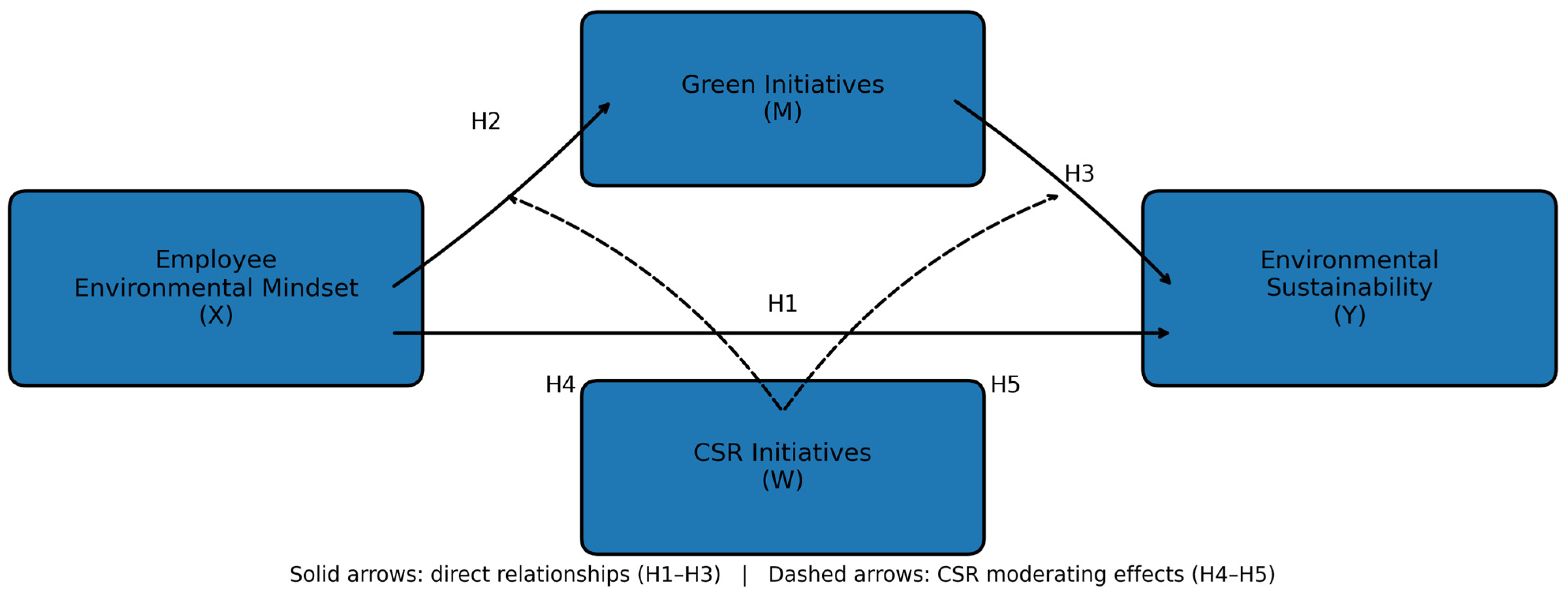
Accordingly, we examine how employees’ environmental mindset relates to green initiatives and environmental sustainability, and we test whether CSR strengthens these links. Using survey data from employees in Congo’s cobalt mining firms, this study makes three contributions. First, it provides micro-level evidence on sustainability implementation in an extractive industry context that remains underrepresented in the CSR and environmental management literature [
1]. Second, it clarifies CSR’s role as a boundary condition, explaining when employee mindset is most likely to translate into green initiatives [
12,
14]. Third, it links these behavioural and organizational mechanisms to environmental sustainability outcomes, offering an integrated model that is practically relevant for firms facing intensifying sustainability pressures in the cobalt sector [
3,
7].
5. Results
5.1. Descriptive Analysis
Table 3 reports descriptive statistics for the demographic variables and the study constructs CSR Initiatives (CSR_INIT), Employee Environmental Mindsets (EMP_M), Green Initiatives (GREEN_IN), and Environmental Sustainability (EN_SUST) based on 398 observations.
Table 4 presents the Pearson bivariate correlations among all variables. The correlation matrix indicates that demographic characteristics exhibit limited relationships with the focal constructs, suggesting that respondents’ perceptions of CSR initiatives, environmental mindset, green initiatives, and environmental sustainability are not strongly patterned by gender, age, tenure, or education in this sample. Notably, age and tenure are very strongly correlated (r = 0.929,
p < 0.01), reflecting substantial overlap between these two variables and implying that they capture closely related aspects of employee experience. This issue is acknowledged in subsequent multivariate analyses.
With respect to the study constructs, the results show several statistically significant and substantively meaningful associations. CSR initiatives (CSR_INIT) display a strong positive relationship with employee environmental mindset (EMP_M) (r = 0.638, p < 0.01) and a strong positive relationship with environmental sustainability (EN_SUST) (r = 0.596, p < 0.01). These magnitudes indicate that more robust CSR practices are systematically associated with more environmentally oriented employee mindsets and higher environmental sustainability outcomes. Consistent with this pattern, employee environmental mindset (EMP_M) is strongly correlated with environmental sustainability (EN_SUST) (r = 0.650, p < 0.01) and moderately correlated with green initiatives (GREEN_IN) (r = 0.383, p < 0.01), suggesting that employees’ environmental orientation is closely aligned with sustainability outcomes and meaningfully related to the implementation of green initiatives. Finally, green initiatives (GREEN_IN) are moderately and positively associated with environmental sustainability (EN_SUST) (r = 0.334, p < 0.01), providing preliminary evidence that increased engagement in green practices corresponds to improved sustainability performance.
5.2. Moderated Regression Analysis
Given the study’s focus on interaction effects, moderated regression was used in SPSS 27 with composite variables. This approach was considered suitable and straightforward for testing moderation, whereas SEM would require simultaneous estimation of both the measurement and structural models. Before running the analysis, interaction terms were created and multicollinearity was checked using variance inflation factors (VIF). All VIF values were low, with a maximum of 1.72, indicating no multicollinearity concerns.
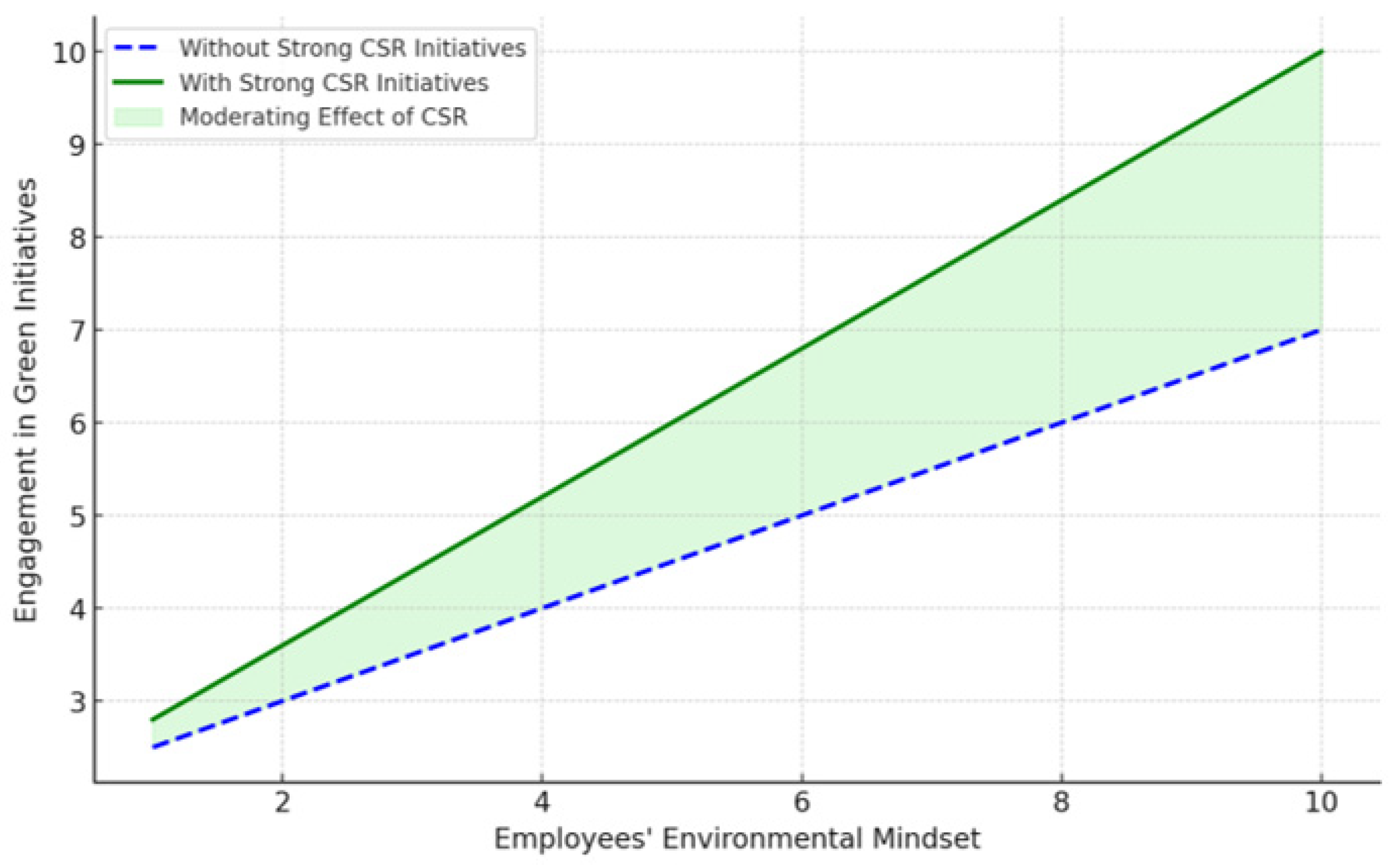
Table 5 reports the results testing whether CSR moderates the relationship between employee environmental mindset and green initiatives in the Congolese cobalt sector. Employee mindset (EMP_M) has a positive and statistically significant effect on green initiatives (β = 0.7866,
p = 0.0001), showing that employees with stronger pro-environmental attitudes are more likely to support and engage in green practices. CSR initiatives (CSR_INIT) also have a positive and significant effect (β = 0.5894,
p = 0.0088), suggesting that stronger CSR practices are associated with higher levels of green initiatives. The interaction term between employee mindset and CSR initiatives is positive and significant (β = 0.1441,
p = 0.0178), indicating that CSR strengthens the positive relationship between employee mindset and green initiatives. This moderating effect is illustrated in
Figure 2. The model explains 60% of the variation in green initiatives (R
2 = 0.60). The overall model is also statistically significant (F = 25.4604), indicating that the predictors jointly contribute to explaining differences in green initiatives.
Subsequently,
Table 6 presents the results of the Moderated Regression Analysis Model 2, which appears to examine how employee mindset (EMP_M), green initiatives (GREEN_IN), and Corporate social responsibility initiatives (CSR_INIT) interact to affect environmental sustainability in the Congolese cobalt sector. Employee Mindset has a significant positive effect (β = 0.4167,
p < 0.001) on Environmental Sustainability. The predictor is statistically significant, meaning a unit increase in EMP_M leads to a 0.4167-unit increase in Environmental Sustainability. The Green Initiatives variable is statistically significant with β = 0.2932 and
p-value = 0.0114, suggesting that Green Initiatives have a positive impact on Environmental Sustainability. Corporate Social Responsibility Initiatives variable also has a positive, significant impact on Environmental Sustainability (β = 0.4691,
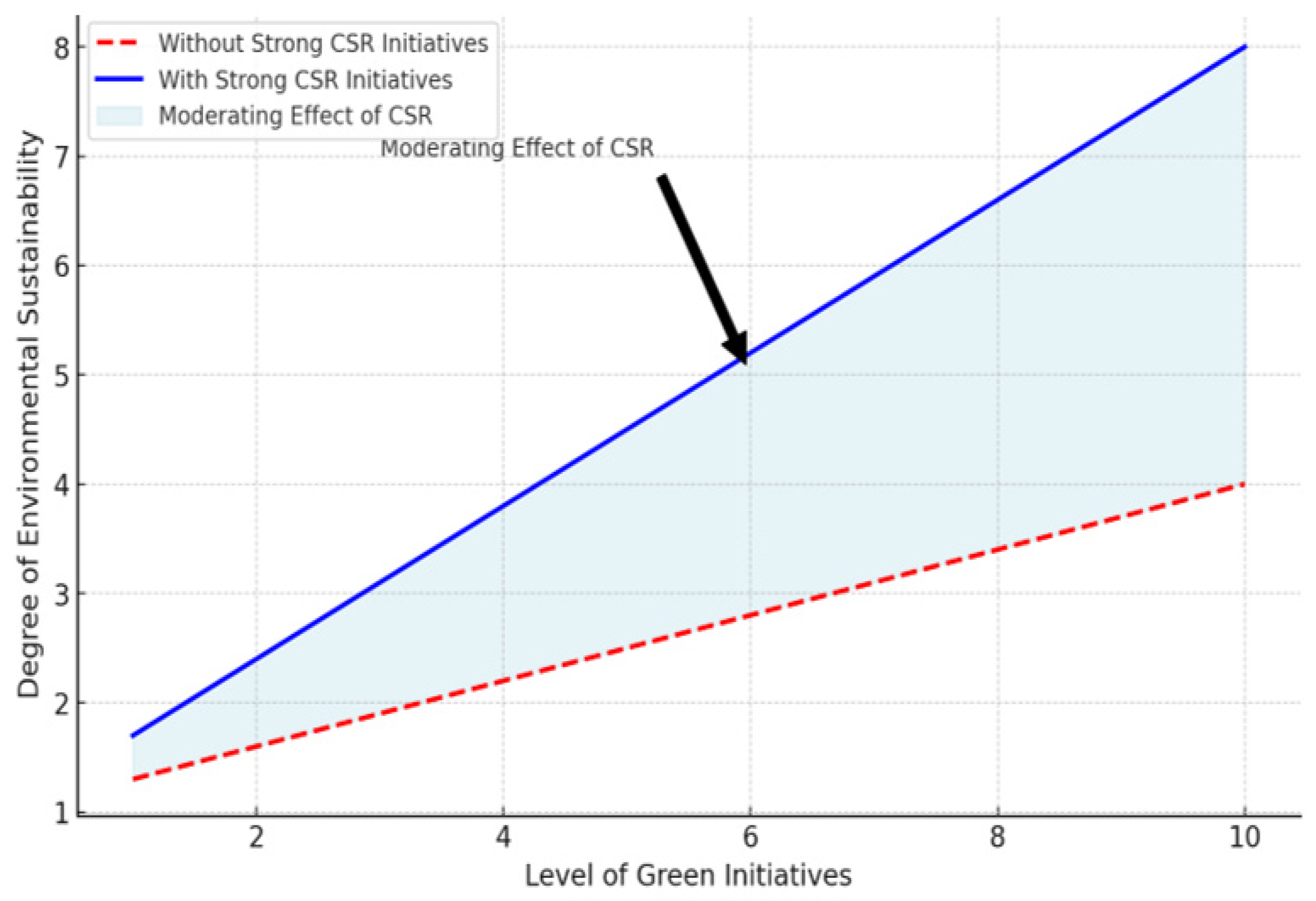
p = 0.0106). This suggests that CSR initiatives are a strong predictor in this model. GREEN_IN × CSR_INIT interaction term is significant with a
p-value of 0.010 and β = 0.0614. This shows that the effect of Green Initiatives on Environmental Sustainability is moderated by CSR Initiatives, subsequently
Figure 3 illustrates that robust CSR initiatives significantly boost the effectiveness of green initiatives in achieving environmental sustainability, highlighting the crucial role of comprehensive CSR strategies in attaining superior sustainability outcomes. Essentially, the positive effect of Green Initiatives is amplified when accompanied by strong CSR initiatives. The value of 0.696 suggests that approximately 69.6% of the variance in Environmental Sustainability can be explained by the model’s predictors. This is a robust R-squared value, indicating a good model fit. The F-value of 92.5622 is highly significant, confirming that the regression model is valid.
Model 2 in
Table 6 reveals that both Employee Mindset (EMP_M) and Corporate Social Responsibility Initiatives (CSR_INIT) have strong, significant positive effects on Environmental Sustainability. Furthermore, the impact of Green Initiatives on Environmental Sustainability is moderated by the level of CSR initiatives in place. These findings could be particularly useful for companies in the Congolese cobalt sector aiming to improve their sustainability practices.
Furthermore, the analysis examines the conditional indirect effects of an employee’s mindset (EMP_M) on environmental sustainability (EN_SUST) through green initiatives (GREEN_IN), all within the context of varying levels of corporate social responsibility initiatives (CSR_INIT). When CSR_INIT is set at 2.6, the indirect effect of an employee’s mindset on environmental sustainability through green initiatives is 0.0551. Importantly, the bootstrapped confidence interval for this effect ranges from 0.0034 to 0.1125. The fact that this confidence interval does not encompass zero indicates that the effect is statistically significant. In practical terms, this suggests that when CSR initiatives are moderately implemented (at a level of 2.6), an employee’s positive mindset toward green initiatives has a statistically significant and positive impact on environmental sustainability.
In the case where CSR_INIT is at 3.2, the indirect effect size is 0.0315, with a bootstrapped confidence interval ranging from 0.0016 to 0.0652. Again, the interval does not include zero, confirming that the effect is statistically significant at this level. However, the effect size is smaller than in the first scenario. This could mean that when CSR initiatives are at a higher level (3.2000), the mediating role of green initiatives between employee mindset and environmental sustainability is still significant but weaker. Contrastingly, at a CSR_INIT level of 4, the indirect effect of EMP_M on EN_SUST is 0.0100, and the bootstrapped confidence interval ranges from −0.0112 to 0.0445. Here, the confidence interval includes zero, indicating that the effect is not statistically significant at this level of CSR initiatives. This suggests that at very high levels of CSR implementation, the effect of an employee’s mindset on environmental sustainability through green initiatives is negligible or non-existent. To sum up, the effectiveness of an employee’s positive mindset on environmental sustainability, as mediated by green initiatives, appears to be conditioned by the level of corporate social responsibility initiatives in place. Specifically, the impact is most substantial at moderate CSR levels, diminishes at higher levels, and becomes statistically non-significant at very high levels of CSR initiatives.
5.3. Robustness Checks
To examine whether the main results are sensitive to sampling variability, we re-estimated the regression parameters using percentile bootstrapping with 5000 resamples and 95% confidence intervals. An effect is considered supported when the bootstrap interval excludes zero.
5.3.1. Model 1 (Outcome: GREEN_IN)
The bootstrap results confirm that employee environmental mindset (EMP_M) is a robust positive predictor of green initiatives (Coeff = 0.7866; 95% bootstrap CI [0.2440, 1.2665]). CSR initiatives (CSR_INIT) also retain a positive and statistically supported association with green initiatives (Coeff = 0.5894; 95% CI [0.0061, 1.1312]). In contrast, the interaction term between EMP_M and CSR_INIT is not supported under bootstrapping because its confidence interval includes zero (Coeff = 0.1441; 95% CI [−0.2939, 0.0241]). This suggests that, while employee mindset and CSR are each positively related to green initiatives, the moderating effect of CSR is not robust under bootstrap estimation (See
Table 7).
5.3.2. Model 2 (Outcome: EN_SUST)
Table 8 indicates that the bootstrap analysis generally supports the direct effects reported in the main model. Employee mindset and CSR initiatives remain positively associated with environmental sustainability. By contrast, the effects of green initiatives and the interaction term are less stable, as their confidence intervals include zero. These results suggest stronger support for the direct predictors than for the moderating effect.
6. Discussion
6.1. Theoretical Implications
First, much of the existing literature has centred on the role of CSR in fostering Pro-Environmental Behaviour (PEB) among employees [
61,
62]. However, our research significantly extends this perspective by revealing the importance of employee mindset in influencing environmental sustainability. This suggests that employees with positive attitudes, awareness, and knowledge about CSR initiatives and green practices are more likely to contribute to environmental sustainability [
63,
64,
65]. In this regard, the study introduces and validates a new pathway wherein employees develop a strong sense of commitment to organizations that prioritize CSR initiatives and green practices. This commitment, in turn, has a significant impact on environmental sustainability. Hence, this research enriches the existing CSR-PEB literature by introducing employee mindset as a less commonly explored but crucial variable. Second, by investigating the moderating role of CSR initiatives (CSR_INIT) and their interaction with green initiatives (GREEN_IN), the study contributes to the understanding of the boundary conditions for achieving environmental sustainability. Although prior research has hinted at the impact of organizational green initiatives on pro-environmental behaviour, our study is among the first to introduce the interaction between CSR and green initiatives as a key moderating factor. Our findings reveal that this interaction significantly impacts environmental sustainability, thereby amplifying or attenuating the direct effects of CSR and green initiatives. In doing so, we extend existing theories to introduce CSR as not just an independent variable but also as a contextual factor that influences the effectiveness of green initiatives. Thus, this study provides valuable insights into the conditions under which CSR and green initiatives synergistically improve environmental sustainability. Interestingly, our model, which accounts for a substantial 69.6% of the variance in environmental sustainability, reveals that the effectiveness of these variables is not uniform across all conditions. This underlines the critical importance of understanding the boundary conditions that influence the relationship between CSR, employee mindset, and green initiatives. By delineating these conditions, our study provides a more nuanced understanding of how to implement effective CSR programs and foster a mindset conducive to environmental sustainability. By addressing these points, our research offers a more comprehensive theoretical framework for understanding the intricate dynamics between CSR, employee mindset, and green initiatives in achieving environmental sustainability. In doing so, we bridge existing gaps and introduce new avenues for future research in this domain.
6.2. Managerial Implications
In Congo’s cobalt operations, the practical lesson is that CSR only matters for environmental outcomes when it shows up in how the site is run every day. Managers should therefore treat CSR as an operating system, not a slogan. That starts with focusing on the impacts that dominate cobalt mining in the DRC: tailings and waste rock control, water and runoff protection, chemical and fuel handling, dust, and erosion. CSR commitments should be translated into simple routines that supervisors and crews can follow and verify, such as inspection logs for tailings storage areas, basic spill response steps, clear rules for storage and transfers of fuels and reagents, and regular checks on drainage and sediment control. Training should be short, role-based, and linked to the tasks that create risk on site, and it should come with the tools employees need to act, for example, spill kits, labelled containers, bunding materials, and standard reporting forms. Because water contamination is one of the most sensitive issues around many cobalt sites, firms should make water stewardship visible and routine by fixing sampling points, setting clear testing schedules, and documenting maintenance of ponds and channels so compliance is easy to confirm. To stop CSR from becoming symbolic, environmental performance should be tied to supervision and accountability through clear targets and follow-up, using indicators that make sense operationally, such as spill frequency, completion of inspections, maintenance execution, and proper waste segregation. Since contractors and transport providers are often where problems reappear, CSR standards must extend to procurement and subcontracting, with environmental requirements written into contracts and checked in the field. Finally, credibility depends on what people can see, so companies should communicate CSR internally through evidence of implementation such as budgets spent, containment repaired, rehabilitation completed, and corrective actions taken after incidents.
7. Conclusions
This study offers a comprehensive analysis of the role of Corporate Social Responsibility (CSR) initiatives, employee mindset, and green initiatives in influencing environmental sustainability within the context of the Congolese cobalt sector. Utilizing a mixed-methods approach, this research has been able to validate several key relationships and interactions among these variables, contributing both theoretically and practically to the existent literature and business practices. Theoretically, this research adds to the current body of knowledge by demonstrating how an employee’s positive mindset towards CSR and green initiatives can lead to improved environmental sustainability outcomes. Additionally, our research takes the conversation a step further by revealing the moderating effect of CSR initiatives on employee mindset and green initiatives, highlighting the complex yet influential role that CSR plays in an organizational setting. From a managerial perspective, this study offers concrete recommendations for improving the implementation and effectiveness of CSR and green initiatives. It underlines the importance of aligning these programs with the organization’s overall goals and the specific attitudes and perceptions of its employees. Businesses, especially those in sectors with substantial environmental impacts, such as cobalt mining, can use these findings to design more effective, targeted CSR strategies that not only fulfil corporate objectives but also engage employees in meaningful ways. The significant R-squared values and F-values in the regression analyses point to the robustness of the proposed models, giving both scholars and practitioners strong starting points for further research and implementation. Our study is particularly timely given the increasing global emphasis on sustainable business practices and the ethical implications of mining operations in regions like the Democratic Republic of Congo. In summary, this research stands as an important contribution to understanding the complex dynamics of CSR, employee mindset, and environmental sustainability. As organizations increasingly seek ways to be socially responsible while also ensuring profitability and sustainability, this study provides a framework for achieving these multifaceted objectives.
While this study provides valuable insights into the synergistic effects of CSR initiatives and employee mindsets on green initiatives and environmental sustainability within the Congolese cobalt sector, it is not without limitations. The use of cross-sectional data may not capture the dynamic nature of these relationships over time, and the focus on a specific geographic and industrial context may limit the generalizability of the findings. Future research should consider employing longitudinal data and exploring similar relationships in different regions and industries to enhance the robustness and applicability of the results.