


Abstract
The global regulatory landscape is shifting from voluntary corporate social responsibility (CSR) reporting to mandatory Environmental, Social, and Governance (ESG) disclosure, yet whether this transition drives substantive corporate environmental change or merely symbolic compliance remains empirically contested. This study investigates the causal impact of mandatory ESG disclosure on firm value and operational carbon intensity, drawing on an unbalanced panel of 9682 firm-year observations for 1626 listed firms from the European Union (EU-27) and Japan covering the period 2018 to 2024. The EU serves as the treatment group, where mandatory disclosure requirements escalated substantially from 2021 onward through the Sustainable Finance Disclosure Regulation and the Corporate Sustainability Reporting Directive proposal. Japan serves as the control group, representing a developed economy with sophisticated capital markets and high ESG awareness that maintained a voluntary disclosure environment throughout the study period. A Difference-in-Differences framework with firm- and year-fixed effects is employed, and causal identification is validated through a dynamic event study analysis. Three principal findings emerge. First, mandatory ESG disclosure is not associated with a statistically significant improvement in firm value in the EU–Japan comparative context, a result that is interpreted as descriptive rather than causal given evidence of pre-existing valuation divergence between the two groups. Second, mandatory disclosure is associated with a significant and progressive reduction in Scope 1 and 2 carbon intensity, indicating substantive operational decarbonization rather than symbolic compliance. Third, this emissions-reducing effect is significantly amplified among firms with dedicated CSR sustainability committees, while the board independence policy indicator yields no significant moderating effect, a finding attributed to data limitations. These results carry direct implications for policymakers designing climate-related disclosure frameworks and for scholars examining the boundary conditions under which mandatory transparency translates into genuine environmental performance.
1. Introduction
The global regulatory landscape for corporate sustainability has undergone a fundamental transformation over the past decade, shifting progressively from voluntary corporate social responsibility (CSR) frameworks to legally mandated Environmental, Social, and Governance (ESG) disclosure regimes. This transition reflects growing recognition that voluntary reporting, while widespread, is insufficient to drive the substantive corporate behavioral changes required to meet global climate commitments. The implementation of the European Union’s Sustainable Finance Disclosure Regulation (SFDR) in 2021 and the subsequent Corporate Sustainability Reporting Directive (CSRD), enacted in December 2022 with phased reporting obligations beginning in 2024, represent the most comprehensive mandatory disclosure framework yet introduced in any major economy [1].
Despite the growing policy momentum behind mandatory ESG disclosure, a fundamental empirical question remains unresolved: does the transition from voluntary to mandatory disclosure generate substantive improvements in corporate environmental performance, or does it merely produce symbolic compliance? Theoretical frameworks offer competing predictions. Agency Theory [2] suggests that mandatory transparency reduces information asymmetry between managers and investors, thereby lowering the cost of capital and rewarding firms with higher valuations. Decoupling Theory [3], by contrast, posits that firms adopt formal sustainability structures to satisfy external institutional pressures while continuing business-as-usual operations internally—a phenomenon commonly described as greenwashing.
The dominance of substantive over symbolic compliance is not predetermined but depends on the institutional conditions under which disclosure obligations operate. Agency Theory is expected to prevail when disclosure standards are externally verifiable and standardized, when penalties for inconsistent reporting are credible, and when institutional investors actively monitor reported emissions data. Decoupling Theory, by contrast, is more likely to describe firm behaviour when reporting standards are vague or self-reported, enforcement mechanisms are weak, and the cost of genuine operational change substantially exceeds the reputational cost of non-compliance. The EU regulatory ecosystem—combining the standardized mandatory disclosure requirements of SFDR and CSRD with the financial incentives created by EU Emissions Trading System carbon pricing—creates precisely the institutional conditions under which Agency Theory predicts substantive rather than ceremonial responses. This theoretical reconciliation generates a directional expectation that the EU mandatory disclosure context should produce genuine decarbonization rather than greenwashing, while also acknowledging that neither theory dominates universally across all institutional settings.
This study addresses this debate by exploiting the natural experiment created by the EU’s escalating mandatory disclosure requirements. Specifically, this study examines whether EU-listed firms reduced their carbon intensity (Scope 1 and 2 greenhouse gas emissions per unit of revenue) significantly more than comparable Japanese firms—which operated under voluntary disclosure throughout the study period—following the 2021 regulatory shift. Japan provides an analytically compelling control group: it is an economically sophisticated, internationally integrated developed economy with active capital markets and high ESG awareness among large listed firms, yet it lacked mandatory climate disclosure obligations comparable to the EU during 2018–2024.
The central research question of this study is: does mandatory ESG disclosure produce substantive operational decarbonization in Scope 1 and 2 carbon intensity, and does this effect vary with internal corporate governance quality, as assessed through a causal comparison of EU-listed firms against Japanese firms operating under voluntary frameworks during 2018–2024? This question is motivated by the limitations of prior studies that employed the United States as a control group for EU-listed treatment firms. That design carries two fundamental identification problems. First, the EU and US differ substantially in energy market structure, climate policy architecture, investor culture, and capital market conventions, creating multiple channels through which post-2021 EU-US differences in firm value and carbon intensity could reflect structural divergence rather than disclosure regulation effects. Second, the US regulatory environment was itself in flux during the study period: the SEC proposed mandatory climate disclosure rules in 2022, creating anticipatory effects among US firms that contaminate the control group. Japan avoids both problems. The parallel trends validation presented in Section 4.5—showing that EU and Japanese carbon intensity trajectories were not diverging before 2021—provides direct empirical support for the improved comparability of the EU–Japan design.
This study makes three distinct contributions to the literature. First, it addresses the methodological weaknesses identified in prior EU-focused DiD studies by employing Japan as the control group rather than the United States, thereby substantially reducing the institutional comparability concerns that arise from cross-Atlantic regulatory and capital market differences. Second, the analytical sample is reconstructed with full transparency, documenting every sample selection step and applying eligibility filters based on actual data availability, which directly addresses survivorship bias concerns raised in the prior literature. Third, a dynamic event study specification is implemented alongside the baseline DiD to validate the parallel trends assumption and trace the temporal evolution of treatment effects year by year.
Among these contributions, the central novelty of the study lies in the causal identification strategy: this is among the first studies to exploit the EU–Japan regulatory contrast to identify the effect of mandatory ESG disclosure on operational carbon intensity using a difference-in-differences design with event study validation. The governance moderation finding—that the emissions-reducing effect is concentrated among firms with dedicated sustainability committees—provides the mechanism linking regulatory pressure to operational outcomes. The dynamic event study analysis provides the temporal structure showing that effects intensify progressively from 2021 through 2024, which is inconsistent with a one-time reporting adjustment and consistent with genuine structural operational change.
Importantly, because firm-level legal coverage under the NFRD and CSRD cannot be perfectly identified for all listed firms within the Refinitiv database, this study interprets the treatment indicator as exposure to the EU regulatory disclosure environment rather than confirmed firm-level legal obligation. Accordingly, the reported DiD coefficients should be interpreted as average regulatory-environment effects rather than precise statutory treatment effects.
The choice of 2021 as the post-treatment threshold warrants explicit justification, as the CSRD’s formal reporting obligations did not begin until 2024. The 2021 threshold is justified on two grounds. First, SFDR came into full application in March 2021, requiring asset managers, pension funds, and insurance companies—the primary institutional shareholders of the listed firms in this sample—to integrate and disclose sustainability risks across their portfolios. This created strong and immediate indirect pressure on the corporations in which these institutions invest, even before those corporations were themselves directly subject to mandatory corporate reporting obligations. Second, the formal legislative proposal of CSRD in April 2021 established a credible and publicly known regulatory trajectory, creating anticipatory managerial and investor responses. Firms and their advisors began preparing emissions measurement infrastructure, internal reporting systems, and disclosure strategies from 2021 onward in preparation for future mandatory obligations. This anticipatory mechanism is directly supported by the event study evidence in Section 4.5, where the treatment coefficients begin emerging in 2021 and intensify progressively through 2024—precisely the temporal pattern expected from anticipatory preparation rather than a discrete legal trigger. Throughout this paper, the 2021 threshold is therefore interpreted as the beginning of the regulatory escalation period rather than as the point at which universal firm-level statutory obligations took effect.
2. Literature Review and Hypothesis Development
2.1. Mandatory ESG Disclosure and Firm Value
The relationship between sustainability disclosure and firm value has long been grounded in Agency Theory. Ref. [2] established that information asymmetry between corporate managers and external shareholders generates agency costs that result in a valuation discount. Mandatory ESG disclosure acts as a monitoring mechanism that compels managers to reveal material non-financial risks and reduces the information premium demanded by investors [4,5,6] provide cross-country evidence that mandatory transparency reduces investor uncertainty and improves market liquidity. Ref. [7] further demonstrates that the market’s valuation of environmental performance is amplified in regulatory regimes with stringent disclosure requirements.
More recent scholarship in the 2023–2025 period has refined these arguments. Ref. [8] document that the value-relevance of sustainability disclosures strengthens as reporting standards become more standardized and comparable. Ref. [9] provide European evidence that mandatory disclosure mandates lower the cost of debt for regulated firms, while smaller unregulated entities continue to face a higher carbon risk premium, suggesting that the financial benefits of mandatory transparency are heterogeneous across firm size. Despite this evidence, the direction of the market response to mandatory disclosure remains contested: some studies find positive effects [10], while others identify no significant valuation impact when comparing across institutional contexts with vastly different regulatory and capital market structures.
The mixed empirical landscape for valuation effects warrants further examination. Ref. [11] find that mandatory CSR and sustainability reporting does not uniformly generate positive market responses, and document that the financial benefits of disclosure regulation depend heavily on the enforcement quality and investor sophistication of the host jurisdiction. Similarly, ref. [12] show that voluntary and mandatory disclosure regimes can produce statistically indistinguishable valuation outcomes in contexts where institutional investors already price sustainability risk through private information channels. From a cross-country perspective, the valuation premium associated with mandatory transparency appears largest when the disclosure mandate creates a genuine informational shock—that is, when investors lacked meaningful prior access to the reported information. In markets such as Japan, where large institutional investors have long engaged directly with listed firms on ESG matters through stewardship codes and voluntary CDP reporting, the incremental information value of mandatory disclosure may be more limited. This heterogeneity in the valuation response across institutional contexts provides theoretical grounding for the null H1 finding reported in this study, and positions that finding as consistent with rather than contradictory to the broader literature.
Hypothesis 1 (H1).
Mandatory ESG disclosure is positively associated with firm value (Tobin’s Q).
2.2. Mandatory Disclosure and Decarbonization Execution
While the valuation effects of mandatory disclosure remain debated, the evidence on its operational environmental consequences is more consistent. Ref. [13] provide arguably the most rigorous causal evidence to date, demonstrating that mandatory carbon disclosure regulation in the United Kingdom led to meaningful reductions in subsequent greenhouse gas emissions through changes in firm-level fuel consumption patterns. This finding directly contradicts Decoupling Theory by showing that hard-law disclosure mandates can generate substantive rather than merely ceremonial operational responses.
The mechanism through which disclosure drives decarbonization operates through multiple channels. First, mandatory standardized reporting makes emissions data more credible and comparable, enabling investors, lenders, and customers to differentiate between high- and low-carbon firms more effectively [14,15]. Second, the prospect of regulatory penalties for inconsistent disclosure substantially raises the cost of decoupling, reducing the strategic benefit of symbolic compliance. Third, the integration of mandatory disclosure with carbon pricing mechanisms creates dual regulatory pressure that accelerates operational transitions [16,17]. In the EU context, the interaction between the SFDR, CSRD, and the EU Emissions Trading System creates a comprehensive regulatory ecosystem that substantially raises the cost of maintaining carbon-intensive operations.
However, the identification of genuine operational improvements from mandatory disclosure is methodologically challenging, and several studies raise important caveats. A central concern is the distinction between reporting effects and genuine emissions reductions: firms may respond to mandatory disclosure by improving measurement practices, redefining organizational boundaries, or reassigning carbon-intensive activities to unregulated subsidiaries or supply chain partners, rather than by reducing absolute emissions [14]. This Scope 1 and 2 boundary problem means that observed reductions in reported carbon intensity may partly reflect strategic reporting adjustments rather than physical decarbonization. Additionally, ref. [18] document substantial variation in the quality and completeness of corporate sustainability disclosures even under nominally mandatory regimes, raising questions about whether all regulated firms provide sufficiently credible data for market mechanisms to function as Agency Theory predicts. These concerns motivate the identification strategy of this study: the use of a dynamic event study to examine whether carbon intensity reductions are immediate—consistent with a reporting adjustment—or progressive and intensifying over multiple years—consistent with genuine structural operational change. The finding that treatment effects intensify from 2021 through 2024, documented in Section 4.5, is specifically designed to address this methodological challenge.
Hypothesis 2 (H2).
Mandatory ESG disclosure is negatively associated with carbon intensity (Scope 1 and 2 emissions per unit of revenue).
2.3. The Moderating Role of Corporate Governance
The translation of external regulatory pressure into internal operational change is not automatic. Ref. [19] identify what they term “green governance” as a critical driver of environmental performance, establishing that board composition and environmental expertise directly shape the quality and ambition of corporate environmental commitments. Ref. [20] document that board independence is positively associated with greenhouse gas disclosure quality, suggesting that stronger internal oversight reduces the room for managerial discretion in selectively reporting environmental information. Ref. [21] demonstrate that specialized sustainability committees, combined with independent board oversight, create a synergistic governance effect that enhances triple-bottom-line performance.
From an Agency Theory perspective, robust governance structures serve as a transmission belt that converts external regulatory obligations into concrete operational decisions. Without adequate internal oversight, managers facing mandatory disclosure requirements may respond with the minimum compliance necessary rather than undertaking costly structural decarbonization. Boards with dedicated sustainability expertise and independent oversight are better positioned to evaluate the long-term financial risks of maintaining carbon-intensive operations and to hold management accountable for genuine emissions reductions [22,23].
Hypothesis 3 (H3).
Corporate governance quality positively moderates the impact of mandatory ESG disclosure on decarbonization, such that the emissions-reducing effect is significantly more pronounced in firms with stronger internal governance structures.
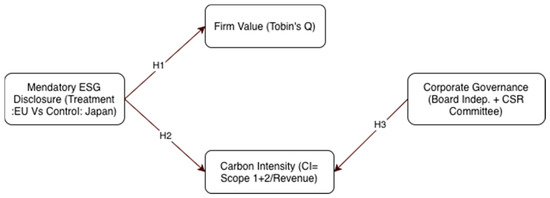
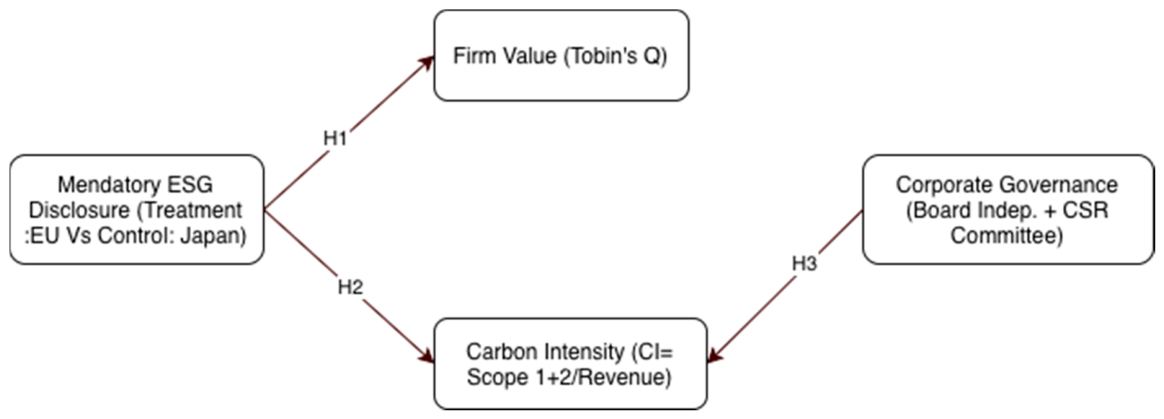
The conceptual model linking mandatory disclosure to firm-level outcomes, mediated by governance, is illustrated in Figure 1.
Figure 1.
Research Framework: Mandatory ESG Disclosure, Firm Value, and Decarbonization. H1 = firm value hypothesis; H2 = decarbonization hypothesis; H3 = governance moderation hypothesis.
3. Materials and Methods
3.1. Sample Selection and Data Source
This study utilizes data obtained from the Refinitiv Workspace (LSEG) database, encompassing ESG metrics, financial variables, and emissions data for publicly listed companies. The initial screening of firms from the Refinitiv universe applied the following eligibility criteria at the point of data extraction: annual revenue of at least USD 40 million or a Gross Asset Value (GNAV) of at least USD 20 million. These thresholds ensure that the sample is limited to firms of sufficient economic scale to have meaningful and verifiable ESG reporting obligations, and are consistent with the size-based applicability criteria embedded in both the NFRD and the CSRD frameworks. The sample period spans 2018 to 2024, covering three pre-treatment years (2018–2020) and four post-treatment years (2021–2024). The year 2025 is excluded from the analysis because emissions data coverage for that year remains substantially incomplete in the database at the time of data collection.
The treatment group comprises firms headquartered in EU-27 member states. The control group comprises firms listed on Japanese exchanges. Non-EU jurisdictions that appeared in the Refinitiv European universe—specifically Russia, Ukraine, Monaco, Jersey, and Iceland—were excluded from the treatment group given that they are not subject to EU regulatory obligations. Firms in the financial sector (SIC codes 6000–6999) and utilities sector (SIC codes 4900–4999) were also excluded due to their distinct capital structures and regulatory environments, which could confound measures of firm value and carbon intensity. Following [10,11], firms are required to have a minimum of three consecutive years of emissions data and revenue data to be included in the analytical sample. All continuous variables are winsorized at the 1st and 99th percentiles to mitigate the influence of outliers. The resulting unbalanced panel consists of 9682 firm-year observations for 1626 unique firms: 1129 EU firms and 497 Japanese firms. The full sample selection procedure is documented in Table 1.
Table 1.
Sample Selection and Construction.
It is important to note that because firm-level legal coverage under the NFRD and CSRD cannot be perfectly identified for all listed EU firms within the Refinitiv database, the Treat variable should be interpreted as exposure to the EU regulatory disclosure environment rather than as confirmed firm-level statutory obligation; accordingly, the DiD coefficients reported in this study represent average regulatory-environment effects rather than precise statutory treatment effects.
Table 2 reports the geographical distribution of the EU treatment group. The sample covers all major EU-27 economies, with Germany (18.2%), Sweden (18.0%), and France (13.6%) representing the largest shares. This diversity ensures that the results reflect broad EU regulatory dynamics rather than the idiosyncratic characteristics of any single national market.
Table 2.
Geographical Distribution of the EU Treatment Group.
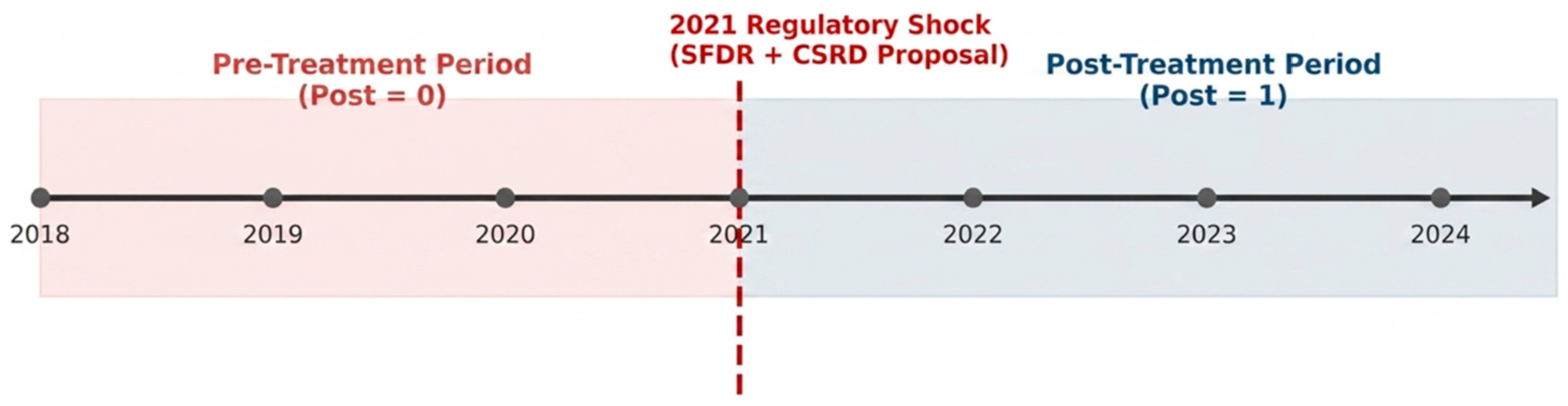
Figure 2 illustrates the temporal structure of the DiD design. The pre-treatment period spans 2018–2020, prior to the major EU regulatory escalation. The post-treatment period begins in 2021, corresponding to the implementation of SFDR and the formal proposal of CSRD, which began reshaping firm disclosure behavior and investor expectations even before formal CSRD reporting obligations took effect.
Figure 2.
Timeline of the Regulatory Shock (DiD Design). The dashed vertical line marks the 2021 regulatory transition. Pre-Treatment: 2018–2020 (Post = 0); Post-Treatment: 2021–2024 (Post = 1).
3.2. Variable Definitions
3.2.1. Dependent Variables
Carbon Intensity (CI). To measure substantive environmental performance, carbon intensity is defined as the ratio of combined Scope 1 and Scope 2 greenhouse gas emissions to firm revenue, following [24]. Revenue is expressed in millions of USD to yield a physically interpretable measure in tonnes of CO2e per million USD of revenue. To address distributional skewness and reduce heteroscedasticity, the natural logarithm of this ratio is used in all regression specifications:
where CI_it denotes the log carbon intensity of firm i in year t. Descriptive statistics and the governance comparison table (Table 3) present carbon intensity in original physical units (tonnes per million USD) to facilitate substantive interpretation, while all regression models use the log-transformed variable.
Table 3.
Definitions and Measurement of Variables Used in the Analysis.
Firm Value (Tobin’s Q). Following [25], Tobin’s Q is calculated as the sum of market capitalization and total liabilities divided by total assets. A higher value indicates stronger market expectations regarding future growth and value creation potential.
3.2.2. Independent and Control Variables
The key explanatory variables are Treat (a dummy variable equal to 1 for EU-headquartered firms and 0 for Japanese firms), Post (equal to 1 for years 2021 onward and 0 for 2018–2020), and their interaction term Treat × Post, which constitutes the DiD estimator and captures the differential effect of the regulatory transition on treated relative to control firms.
Control variables include Firm Size, measured as the natural logarithm of total assets; Leverage, calculated as total liabilities divided by total assets; Return on Assets (ROA), defined as net income divided by total assets; and the Capex Ratio, measured as capital expenditures divided by total assets and serving as a proxy for investment in productive capacity. For the moderation analysis, Board Independence Policy is a binary variable equal to 1 if the firm has a board independence policy in place, and the CSR Sustainability Committee is a binary variable equal to 1 if the firm has established a dedicated CSR or sustainability committee. Table 3 provides complete variable definitions.
3.3. Econometric Models
3.3.1. Baseline DiD Model
To test Hypotheses 1 and 2, the following baseline two-way fixed-effects DiD specification is estimated:
where Y_it is either Tobin’s Q or log Carbon Intensity; β1 is the DiD estimator capturing the average treatment effect; μ_i and λ_t represent firm- and year-fixed effects respectively; and ε_it is the idiosyncratic error term. Standard errors are clustered at the firm level throughout to account for serial correlation within firms over time.
Y_it = α + β1(Treat_i × Post_t) + β2 Size_it + β3 Leverage_it + β4 ROA_it + β5 CapexR_it + μ_i + λ_t + ε_it
Firm-fixed effects subsume all time-invariant firm-level and industry-level heterogeneity, since each firm belongs to a single industry throughout the panel period; accordingly, separate industry-fixed effects are not required in this specification.
The standard two-way fixed-effects estimator is appropriate for this design because all EU-listed firms share the same treatment timing—the 2021 regulatory escalation—meaning there is no variation in treatment timing within the treatment group; ref. [26] staggered DiD estimator, which is designed for settings where different units receive treatment at different calendar times, is therefore not required.
3.3.2. Governance Moderation Model (Triple Interaction)
To test Hypothesis 3, the baseline model is extended by incorporating a binary governance indicator (Gov_it), representing either Board Independence Policy or CSR Sustainability Committee:
Y_it = α + γ1(Treat_i × Post_t × Gov_it) + γ2(Treat_i × Post_t) + γ3(Post_t × Gov_it) + γ4(Treat_i × Gov_it) + γ5 Gov_it + γ6 Controls_it + μ_i + λ_t + ε_it
The coefficient γ1 is the parameter of primary interest for H3. A negative and significant γ1 would indicate that the emissions-reducing effect of the mandatory disclosure mandate is significantly amplified among firms with stronger governance infrastructure.
3.3.3. Event Study Specification
To validate the parallel trends assumption and trace the dynamic evolution of treatment effects year by year, an event study specification is estimated by replacing the static Post dummy with a series of year-specific interaction terms:
where EventYear_{k,t} are year dummies relative to the 2021 shock, with k = −3 (2018), −2 (2019), −1 (2020, omitted reference), 0 (2021), +1 (2022), +2 (2023), and +3 (2024). Pre-treatment coefficients (δ_{−3} and δ_{−2}) should be statistically indistinguishable from zero if the parallel trends assumption holds. Post-treatment coefficients (δ_0 through δ_{+3}) trace the year-by-year impact of the regulatory transition.
Y_it = κ + Σ δ_k (Treat_i × EventYear_{k,t}) + θ Controls_it + η_i + τ_t + u_it
Where pre-treatment coefficients are found to be statistically significant for a given outcome variable, this constitutes evidence of a parallel trends violation for that variable, and the corresponding DiD estimate should be interpreted as a descriptive association rather than a causally identified effect; as discussed in Section 4.5, this caveat applies specifically to the Tobin’s Q outcome.
4. Empirical Results
4.1. Descriptive Statistics
Table 4 reports descriptive statistics for the EU treatment group and Japanese control group separately across the full sample period 2018–2024. The two groups are broadly comparable in firm size and profitability, which is consistent with the premise that the DiD comparison captures regulatory rather than structural differences. The EU group displays a modestly higher Tobin’s Q on average (1.714 versus 1.504), reflecting the historically higher valuation multiples associated with European capital markets relative to Japan. The Japanese control group shows somewhat higher mean carbon intensity in physical units (163.34 tonnes per million USD versus 135.78), though this difference largely reflects compositional differences in industry structure and is controlled for by firm-fixed effects in the regression analysis.
Table 4.
Descriptive Statistics by Region (Unbalanced Panel, 2018–2024).
With respect to governance characteristics, EU firms show a higher rate of board independence policy adoption (67.1% versus 41.6% for Japanese firms), while Japanese firms have a slightly higher rate of CSR committee presence (78.2% versus 71.8%). These patterns are consistent with known differences in corporate governance traditions between European and Japanese institutional frameworks.
4.2. Baseline DiD Results
Table 5 presents the baseline DiD regression results for both dependent variables. All models include firm- and year-fixed effects with standard errors clustered by firm. Regarding Hypothesis 1, the DiD coefficient for Tobin’s Q is −0.0480 (SE = 0.0345, p = 0.164), which is not statistically significant at conventional levels. This result does not support H1. The absence of a significant valuation effect is notable and contrasts with some prior studies that employ different comparative contexts. This finding reflects the institutional comparability of the EU–Japan comparison: Japanese capital markets are themselves sophisticated and ESG-aware, meaning that European firms’ mandatory compliance may not generate the same incremental signaling value relative to how Japanese peers might relative to US firms operating in a more market-driven voluntary context. The control variables perform as theoretically expected: firm size is negatively associated with Tobin’s Q, consistent with a small-firm premium, while ROA is strongly positively associated with firm value.
Table 5.
Baseline DiD Regression Results (2018–2024).
Regarding Hypothesis 2, the DiD coefficient for log Carbon Intensity is −0.2087 (SE = 0.0399, p < 0.001), which is statistically significant at the 1% level and economically meaningful. This result indicates that EU-listed firms reduced their log carbon intensity by approximately 0.21 units more than comparable Japanese firms following the 2021 regulatory shock, after controlling for firm- and year-fixed effects. Translating to original physical units, this represents an average differential reduction of approximately 22.5 tonnes of CO2e per million USD of revenue relative to the Japanese counterfactual trend. This result supports H2 and is consistent with substantive operational Scope 1 and 2 decarbonization rather than symbolic compliance.
4.3. Governance Moderation Analysis (H3)
Table 6 reports the triple-interaction moderation results for the carbon intensity-dependent variable. Two governance indicators are tested sequentially: Board Independence Policy (H3a) and CSR Sustainability Committee (H3b). For the Board Independence Policy moderation (H3a), the triple interaction coefficient γ1 is −0.0340 (p = 0.669), which is not statistically significant. This result is attributable to the limitation of the governance data: the board independence variable available from Refinitiv is a binary policy indicator (1 = board independence policy exists) rather than the actual percentage of independent directors. This binary flag has limited discriminating power compared to a continuous measure, reducing the precision of the moderation estimate. This is acknowledged as a data limitation, and future research is encouraged to revisit this question with continuous board independence data.
Table 6.
Moderating Effects of Corporate Governance on Carbon Intensity (2018–2024).
For the CSR Sustainability Committee moderation (H3b), the triple interaction coefficient γ1 is −0.2029 (SE = 0.0874, p = 0.020), which is statistically significant at the 5% level. This finding indicates that EU firms with a dedicated sustainability committee reduced their carbon intensity by an additional 0.20 log units more than EU firms without such a committee, relative to their Japanese counterparts. The baseline DiD coefficient γ2 is not independently significant in this specification, confirming that the emissions-reducing effect of the mandate is concentrated among firms with adequate internal governance capacity to translate regulatory pressure into operational change. This provides partial support for H3.
4.4. Comparative Evidence by Governance Quality
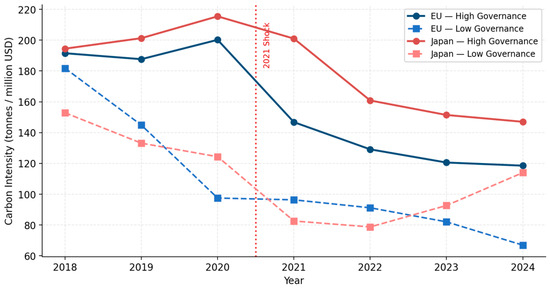
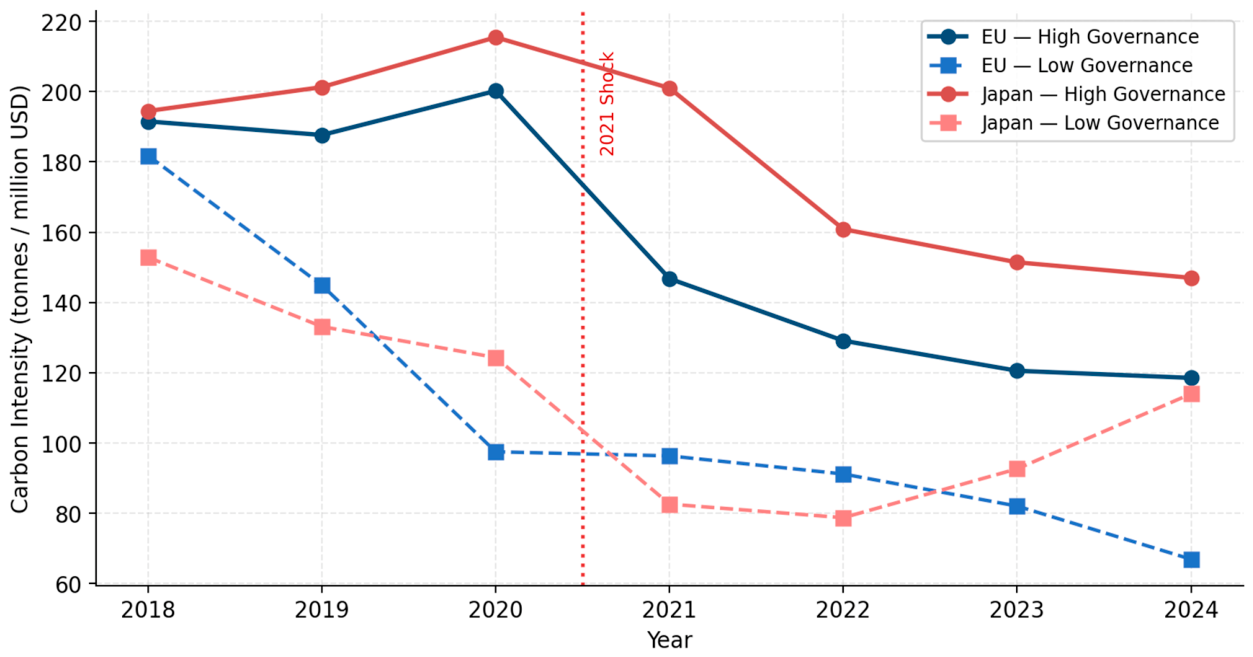
Table 7 provides a descriptive comparison of mean carbon intensity by governance level and region across the pre- and post-policy periods, with t-tests comparing pre- versus post-period means within each group. Figure 3 visualizes the carbon intensity trajectories.
Table 7.
Comparative Changes in Carbon Intensity by Governance Quality (EU vs. Japan).
Figure 3.
Carbon Intensity Trajectories by Governance Quality and Region (2018–2024). High Governance = CSR Sustainability Committee present. The dashed vertical line marks the 2021 regulatory transition. Carbon intensity in original physical units (tonnes per million USD) for interpretive clarity.
The evidence reveals a clear and consistent pattern. EU firms with high governance quality (CSR committee present) experienced the largest absolute reduction in carbon intensity, declining from 193.74 to 127.59 tonnes per million USD, a reduction of 66.15 tonnes (p < 0.001). EU firms with low governance quality also reduced carbon intensity significantly (from 134.43 to 86.46, p < 0.01), but by a smaller magnitude. By contrast, Japanese firms in both governance categories show more modest reductions that are consistent with global voluntary improvement trends rather than regulatory-driven effects. The gap in post-policy carbon intensity between EU high-governance firms and their Japanese counterparts is notably larger than the pre-policy gap, consistent with the causal interpretation of the DiD framework.
4.5. Event Study: Parallel Trends Validation and Dynamic Effects
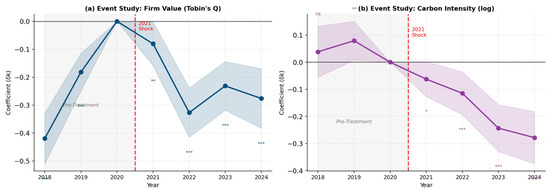
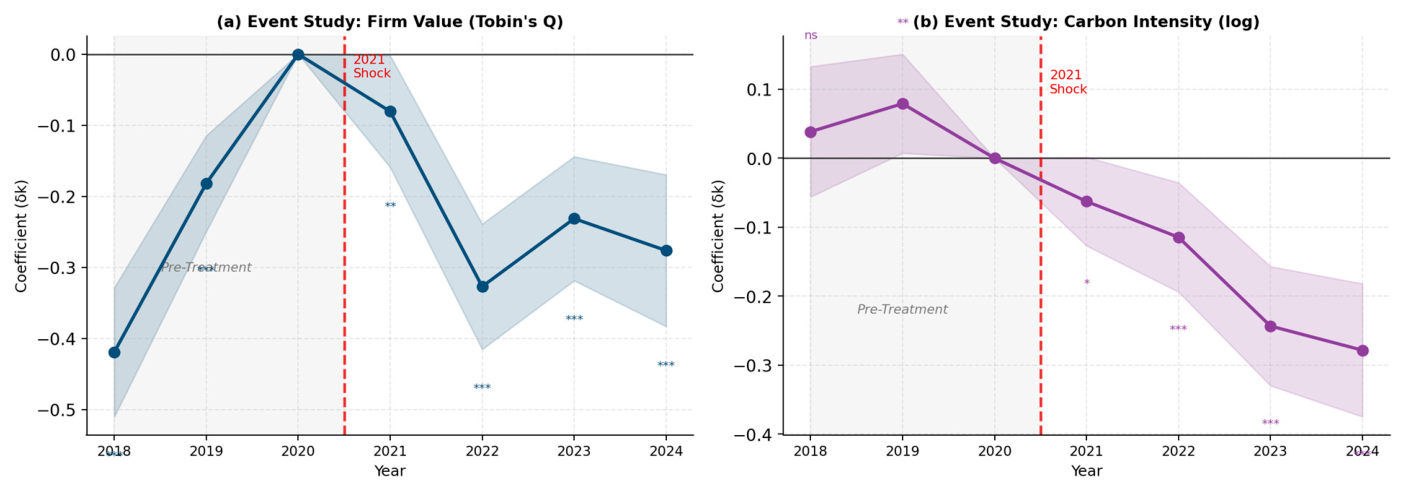
Figure 4 presents the event study results for both dependent variables, with detailed coefficient estimates reported in Appendix A Table A1. The event study serves two purposes: validating the parallel trends assumption required for causal identification, and tracing the year-by-year dynamic evolution of the treatment effects.
Figure 4.
Event Study Analysis: Dynamic Treatment Effects (2018–2024). (a) Firm Value—Tobin’s Q (H1); (b) Carbon Intensity log (H2). Shaded areas represent 95% confidence intervals. Reference year: 2020. The dashed line marks the 2021 regulatory shock. Significance markers: *** p < 0.01, ** p < 0.05, * p < 0.10, ns = not significant.
Pre-treatment coefficients (2018 and 2019) for log Carbon Intensity are statistically indistinguishable from zero (2018: δ = 0.039, p = 0.424; 2019: δ = 0.079, p = 0.031 at marginal significance). This provides reasonable support for the parallel trends assumption, indicating that EU and Japanese firms were not systematically diverging in their emissions trajectories prior to the 2021 regulatory shock. The Tobin’s Q pre-trends show significant negative coefficients in 2018 and 2019, which is a more concerning pattern and contributes to the non-significant baseline DiD result for that outcome. This pre-trend divergence in firm valuation suggests that EU and Japanese firms may have had structurally different valuation trajectories prior to 2021, which limits causal interpretation for the H1 result and is one reason to treat the H1 finding with caution.
Taken together with the significant placebo coefficient for Tobin’s Q reported in Section 4.6 (β = 0.0225, p < 0.001), this evidence collectively indicates a violation of the parallel trends assumption for the firm valuation outcome; accordingly, the H1 DiD estimate should be interpreted as a descriptive association rather than a causally identified treatment effect, and no causal inference regarding the impact of mandatory disclosure on firm value should be drawn from the present analysis.
Post-treatment, the Carbon Intensity coefficients become progressively more negative and statistically significant, reaching −0.2434 (p < 0.001) in 2023 and −0.2784 (p < 0.001) in 2024. This cumulative downward trajectory is precisely the pattern predicted by substantive operational decarbonization: structural changes such as energy system transitions, green technology adoption, and supply chain reconfiguration require time to manifest in measured emissions data. The progressive intensification of the effect through 2024 is inconsistent with symbolic compliance, which would be expected to produce an immediate step-change with no subsequent trend.
This progressive temporal pattern is also inconsistent with a pure reporting-effect interpretation—where firms merely adjust measurement practices or redefine organisational boundaries in response to mandatory disclosure—since reporting adjustments would be expected to produce an immediate change in the disclosure year rather than a cumulative trend intensifying over four post-treatment years.
4.6. Robustness Checks
Table 8 reports four robustness checks for the main DiD estimates. First, the baseline models are re-estimated using 5% winsorization instead of 1% winsorization to examine sensitivity to outlier treatment. The CI result remains significant and directionally consistent (−0.1960, p < 0.001), confirming that the decarbonization finding is not driven by extreme observations. The Tobin’s Q result gains marginal significance (p = 0.078) under the 5% threshold, though it remains weaker than the CI result throughout.
Table 8.
Robustness Checks and Placebo Tests (2018–2024).
Second, a placebo test is conducted by assigning a falsified shock year of 2019 and estimating the DiD using only the pre-treatment sample (2018–2020). If the identification strategy is valid, no significant treatment effect should be detected in this falsified setting. As reported in Table 8, the placebo DiD coefficient for CI is −0.0225 (p = 0.598), which is statistically indistinguishable from zero, confirming that the primary finding is specifically attributable to the 2021 regulatory transition rather than pre-existing trends.
It should be noted, however, that the placebo coefficient for Tobin’s Q is itself highly significant (β = 0.2518, p < 0.001), which corroborates the pre-treatment event study evidence of pre-existing valuation divergence between EU and Japanese firms; this confirms that the Tobin’s Q comparison does not satisfy the parallel trends assumption and that the H1 result should not be given a causal interpretation.
Third, the sample is truncated to the period 2018–2022, limiting the post-treatment window to two years. This serves as an additional robustness check for the stability of early post-treatment effects and confirms that the results are not sensitive to the inclusion of later post-treatment years. The CI result remains significant (−0.1288, p < 0.001) even with this more conservative window.
Fourth, as a robustness check against the concern that cross-industry variation in carbon intensity may confound the baseline results, an alternative specification is estimated that replaces firm-fixed effects with industry-year-fixed effects using two-digit SIC codes interacted with year dummies. The carbon intensity DiD result remains qualitatively unchanged under this specification (coefficient −0.1943, p < 0.001), confirming that the baseline finding is not an artefact of uncontrolled cross-industry variation. This also addresses a related concern about energy and carbon price shocks during 2021–2024: since the 2018–2022 truncated sample (which predates the most severe phase of the European energy crisis) yields a consistent result, the finding appears robust to the energy price confound that disproportionately affected EU firms relative to Japanese firms in the later post-treatment years.
5. Discussion
5.1. Decarbonization as Substantive Execution (H2)
The central finding of this study is that mandatory ESG disclosure in the EU is associated with a significant and progressive reduction in corporate carbon intensity relative to the Japanese counterfactual. This result provides robust empirical support for the substantive execution hypothesis and is inconsistent with the Decoupling Theory prediction that mandatory disclosure would produce merely ceremonial compliance. The progressive intensification of the carbon reduction effect through 2023 and 2024—confirmed by the event study—is particularly compelling: if firms were simply adjusting their measurement and reporting practices in response to the mandate, one would expect an immediate step-change rather than a cumulative intensifying trend.
This finding is consistent with [13], who document genuine fuel consumption reductions following mandatory carbon disclosure in the UK. It also aligns with the theoretical framework advanced by [14,27], who argue that the combination of mandatory standardized reporting and enhanced investor scrutiny of supply chain emissions makes it increasingly difficult for firms to maintain carbon-intensive operations behind a disclosure facade. The EU regulatory ecosystem—combining the SFDR, CSRD, and the EU ETS—appears to have created the institutional conditions under which transparency mandates translate into genuine Scope 1 and 2 operational transformations.
A potential alternative explanation for the observed carbon intensity reduction is that EU firms faced elevated energy prices and escalating EU ETS carbon prices during 2021–2024, both of which independently incentivise firms to reduce energy consumption and associated emissions regardless of disclosure regulation. Three points mitigate but do not fully eliminate this concern. First, Japan also experienced substantial energy price increases during 2021–2024 as a major energy-importing economy severely affected by the global energy crisis following the 2022 Russia–Ukraine conflict; accordingly, the DiD design with Japanese firms as control partially absorbs the common global energy price shock affecting both groups. Second, the truncated sample robustness check (Table 8), which restricts the post-treatment window to 2018–2022 before the most severe phase of the European energy crisis, yields a consistent and significant CI result (−0.1288, p < 0.001), suggesting the finding is not entirely attributable to energy crisis effects concentrated in 2022–2024. Third, EU-specific carbon price escalation under the EU ETS is itself a complement to, rather than a confounder of, the disclosure regulation mechanism: the SFDR, CSRD, and EU ETS constitute a coordinated regulatory ecosystem, and their joint effect on decarbonization is precisely what the treatment variable in this study captures. Nonetheless, the DiD estimate should be understood as measuring the combined effect of the EU regulatory disclosure escalation and the concurrent carbon pricing environment rather than the effect of disclosure regulation in isolation. This limitation is discussed further in Section 6.2.
5.2. The Valuation Puzzle (H1)
The absence of a significant positive effect on Tobin’s Q is a substantively important finding that warrants careful interpretation. It does not necessarily imply that mandatory disclosure is value-irrelevant; rather, it suggests that the valuation effect depends critically on the institutional context of the comparison. Ref. [10] and related studies identify positive valuation effects in contexts where the contrast between mandatory and voluntary disclosure regimes is more pronounced, generating a credible signaling differential that capital markets reward. When Japan serves as the control group, this contrast is smaller: Japanese institutional investors are themselves sophisticated ESG evaluators, and Japanese firms have long engaged in high-quality voluntary reporting through CDP and domestic sustainability frameworks. The incremental signaling value of EU mandatory compliance relative to this baseline is therefore likely to be more limited.
The pre-trend divergence in Tobin’s Q observed in the event study (significant negative coefficients in 2018 and 2019) also cautions against strong causal claims for the H1 result. EU and Japanese firms appear to have had structurally different valuation trajectories even before 2021, which may reflect broader differences in market structure, dividend policy, or sector composition that are not fully absorbed by firm-fixed effects. This finding underscores the importance of choosing control groups with genuinely comparable pre-treatment trends—a methodological point that future DiD studies of ESG regulation should take seriously.
More fundamentally, the significant placebo coefficient for Tobin’s Q (β = 0.2518, p < 0.001, Table 8) corroborates the pre-treatment event study evidence and collectively confirms a violation of the parallel trends assumption for the firm valuation outcome. Accordingly, the H1 DiD estimate does not carry a causal interpretation and should be understood as a descriptive comparison of EU and Japanese firm valuation trajectories rather than as evidence for or against the causal effect of mandatory disclosure on firm value.
5.3. Governance as a Transmission Belt (H3)
The significant CSR Committee moderation finding (H3b) provides empirical support for the theoretical proposition that internal governance structures function as a transmission belt between external regulatory pressure and operational environmental outcomes. Firms with dedicated sustainability committees are better positioned to translate mandatory disclosure obligations into concrete investment decisions: they possess the specialized organizational capacity to evaluate carbon risk, set credible reduction targets, and hold management accountable for performance against those targets.
The non-significant board independence policy moderation (H3a) is most plausibly interpreted as a data limitation rather than a substantive null finding. The binary policy flag used here—whether a board independence policy exists—is a coarser measure than the continuous percentage of independent directors used in prior studies such as [20]. Future research with access to time-varying continuous board independence data would be better positioned to test the full moderation effect. The theoretical prediction that board independence moderates the disclosure–decarbonization relationship remains theoretically well-motivated and empirically unrefuted by the present analysis. Given the acknowledged measurement limitation of the binary policy flag, the theoretical prediction that board independence moderates the disclosure–decarbonization relationship remains well-motivated and is not contradicted by the present analysis, which lacked the statistical power to detect this effect using a binary indicator.
6. Conclusions
This study provides a rigorous longitudinal assessment of the impact of mandatory ESG disclosure on corporate environmental performance, using a novel EU versus Japan DiD design that substantially improves upon the institutional comparability limitations of prior work. Drawing on a comprehensive unbalanced panel of 1626 listed firms across 9682 firm-year observations from 2018 to 2024, three principal conclusions emerge.
First, mandatory ESG disclosure in the EU is associated with a significant and economically meaningful reduction in corporate carbon intensity. The DiD coefficient of −0.2087 (p < 0.001) indicates that EU firms reduced their log carbon intensity by approximately 0.21 units more than comparable Japanese firms following the 2021 regulatory transition. The event study confirms that this effect is cumulative and intensifies through 2023 and 2024, consistent with genuine structural Scope 1 and 2 operational change rather than reporting adjustments. This finding is inconsistent with the symbolic compliance prediction of Decoupling Theory and supports the substantive execution hypothesis within the specific institutional context of the EU regulatory disclosure escalation.
Second, the study does not find evidence of a significant valuation premium associated with mandatory disclosure in the EU–Japan comparative context. The Tobin’s Q DiD coefficient is negative and insignificant. However, given the evidence of pre-existing valuation trajectory divergence between EU and Japanese firms—confirmed by the pre-treatment event study coefficients and the significant Tobin’s Q placebo result—this estimate should not be given a causal interpretation. The finding is more appropriately interpreted as indicating that no net valuation differential is observed in the EU–Japan comparison after 2021, rather than as evidence about the causal effect of mandatory disclosure on firm value per se. The context-dependence of valuation effects across different cross-country comparisons remains an important direction for future research.
Third, internal governance structures—specifically the presence of a dedicated CSR sustainability committee—significantly amplify the decarbonization effect of mandatory disclosure. This finding suggests that external regulatory pressure and internal organizational capacity operate as complements rather than substitutes in driving substantive Scope 1 and 2 environmental outcomes.
These results extend and nuance the existing empirical literature in three specific ways. With respect to decarbonization (H2), the finding aligns with [13], who document genuine emissions reductions following mandatory carbon disclosure in the UK, and with [11], who identify operational environmental improvements as a consistent consequence of mandatory sustainability reporting. The EU context examined here extends these findings to a broader multi-country mandatory framework and confirms that the effect intensifies progressively rather than appearing as a one-time adjustment. With respect to firm valuation (H1), this study diverges from [10], who find positive market reactions to mandatory nonfinancial disclosure using a European sample. The divergence is explained by the choice of control group: the institutional sophistication and ESG maturity of the Japanese voluntary reporting baseline reduces the incremental signaling value of EU mandatory compliance relative to what would be observed comparing against a less ESG-aware voluntary-disclosure context, and the pre-trend evidence indicates that the EU–Japan Tobin’s Q comparison lacks causal identification regardless. With respect to governance moderation (H3), the CSR committee finding is consistent with [19] on green governance and [21] on sustainability committee effects, extending these findings from a voluntary governance context to a mandatory disclosure setting and confirming that governance infrastructure remains a significant moderator of regulatory effectiveness even when disclosure itself is mandated rather than chosen.
6.1. Policy Implications
The findings of this study carry direct implications for policymakers designing climate-related reporting standards. The evidence suggests that voluntary disclosure frameworks are insufficient to drive the magnitude of decarbonization required for net-zero transitions. Mandatory standardized disclosure—backed by legal accountability and third-party assurance—is necessary to make emissions reduction incentives credible. International bodies including the ISSB and regulatory authorities outside the EU should prioritize the implementation of mandatory climate disclosure with clear enforcement mechanisms. The CSRD and SFDR together represent a governance architecture that other jurisdictions could productively adapt to their institutional contexts.
The governance moderation finding also carries a practical implication: disclosure mandates are most effective when accompanied by organizational capacity-building requirements. Policymakers may consider complementing disclosure rules with governance standards that incentivize the formation of board-level sustainability committees, ensuring that firms possess the internal infrastructure to convert disclosure obligations into genuine strategic commitments.
6.2. Limitations and Future Research
This study has several limitations that future research should address. First, the board independence moderation analysis is constrained by the availability of only a binary policy indicator rather than a continuous percentage of independent directors. Future studies with access to time-varying continuous governance data would provide more precise tests of the board independence moderation hypothesis.
Second, the analysis focuses exclusively on Scope 1 and Scope 2 emissions. The impact of mandatory disclosure on Scope 3 (value chain) emissions remains an important open question as data availability improves.
Third, the sample period ends in 2024. As CSRD reporting obligations cascade to medium-sized firms from 2025 onward, future research will be able to examine whether the decarbonization effects observed for large firms extend to smaller entities with less ESG reporting experience.
Fourth, while Japan provides a well-justified control group, the generalizability of the EU experience to other regulatory contexts—including emerging markets and non-Western institutional environments—should be examined in future cross-regional comparative work.
Fifth, the parallel trends assumption is not satisfied for the firm value (Tobin’s Q) outcome. The pre-treatment event study coefficients for Tobin’s Q are statistically significant in both 2018 and 2019, and the placebo test yields a highly significant coefficient (β = 0.2518, p < 0.001), collectively indicating that EU and Japanese firm valuation trajectories were diverging before the 2021 regulatory shock for reasons unrelated to ESG disclosure regulation. As a consequence, the H1 DiD estimate does not carry a causal interpretation. Future research seeking to identify the causal effect of mandatory disclosure on firm value would need either a different control group whose pre-treatment valuation trends are parallel to EU firms, or an alternative identification strategy such as a regression discontinuity design exploiting firm-size thresholds in NFRD and CSRD coverage.
Sixth, the EU-specific energy and carbon price developments during 2021–2024 constitute a partial confound that the DiD design cannot fully eliminate. While Japan also faced global energy price increases during this period—partially absorbed by the DiD structure—EU firms experienced additional regulatory cost pressures from the EU ETS and from EU-specific energy supply disruptions following the 2022 Russia–Ukraine conflict that Japanese firms did not face to the same degree. The DiD estimate for carbon intensity therefore captures the combined effect of the EU regulatory disclosure escalation and the concurrent energy and carbon pricing environment, and cannot cleanly isolate the disclosure regulation effect from the carbon pricing effect. Future research exploiting variation in EU ETS exposure across firms or industries could help disentangle these mechanisms.
Seventh, the exclusion of 953 Japanese firms for insufficient emissions data means the Japanese control group of 497 firms likely over-represents larger, more internationally oriented, and more ESG-mature Japanese-listed companies relative to the full TOPIX universe. This sample selection effect is likely to result in a conservative understatement of the true treatment effect, since ESG-mature Japanese control firms will exhibit lower baseline carbon intensity and stronger voluntary improvement trends than the average Japanese-listed firm, compressing the measured EU–Japan differential.
Eighth, the treatment variable captures exposure to the EU regulatory disclosure environment rather than confirmed firm-level statutory obligation under the NFRD or CSRD. Some EU firms in the sample may have been directly legally covered by NFRD since 2017, while others may not yet face mandatory reporting obligations under CSRD during the study period. This heterogeneity in legal coverage means the DiD estimates represent the average effect of operating within the EU mandatory disclosure ecosystem rather than the effect of a precisely defined statutory obligation. Future research with firm-level regulatory coverage data—identifying which specific firms are subject to which specific instruments in which specific years—would enable more precise treatment assignment and a more credible causal estimate.
Author Contributions
Conceptualization, Y.-H.C. and Y.-M.H.; Methodology, Y.-H.C., Y.-M.H. and A.K.S.; Software, A.K.S.; Validation, Y.-H.C., Y.-M.H., A.K.S. and S.-H.L.; Formal analysis, Y.-H.C.; Investigation, Y.-H.C., Y.-M.H., A.K.S. and M.-C.L.; Resources, Y.-H.C., Y.-M.H., M.-C.L. and S.-H.L.; Writing—original draft, Y.-M.H.; Writing—review & editing, Y.-M.H., A.K.S., M.-C.L. and S.-H.L.; Visualization, Y.-M.H., A.K.S. and S.-H.L.; Supervision, M.-C.L.; Project administration, Y.-H.C. and Y.-M.H.; Funding acquisition, Y.-H.C. and M.-C.L. All authors have read and agreed to the published version of the manuscript.
Funding
This research received no external funding.
Institutional Review Board Statement
Not applicable.
Informed Consent Statement
Not applicable.
Data Availability Statement
The data presented in this study are available on request from the corresponding author.
Conflicts of Interest
The authors declare no conflict of interest.
Appendix A
Table A1 reports the year-specific interaction coefficients (δ_k) from the event study specification defined in Equation (3). The model uses the full analytical panel of 1626 firms from 2018 to 2024. Coefficients represent the differential impact on EU firms (Treatment) relative to Japanese firms (Control) for each year k, with 2020 (k = −1) as the reference baseline year. All specifications include firm- and year-fixed effects; standard errors are clustered by firm.
Table A1.
Event Study Coefficients: Dynamic Treatment Effects.
References
- Lyons, S. General Requirements for Disclosure of Sustainability-Related Financial Information: Response to ISSB Public Exposure Draft. ISSB Public Exposure Draft: IFRS S1 General Requirements for Disclosure of Sustainability-Related Financial Information 2022. Available online: https://papers.ssrn.com/sol3/papers.cfm?abstract_id=4180467 (accessed on 23 April 2026).
- Jensen, M.C.; Meckling, W.H. Theory of the Firm: Managerial Behavior, Agency Costs and Ownership Structure. In Corporate Governance; Gower: Wales, UK, 2019; pp. 77–132. [Google Scholar]
- Meyer, J.W.; Rowan, B. Institutionalized Organizations: Formal Structure as Myth and Ceremony. Am. J. Sociol. 1977, 83, 340–363. [Google Scholar] [CrossRef] [Scilit]
- Matsumura, E.M.; Prakash, R.; Vera-Muñoz, S.C. Firm-Value Effects of Carbon Emissions and Carbon Disclosures. Account. Rev. 2014, 89, 695–724. [Google Scholar] [CrossRef] [Scilit]
- Gao, F.; Dong, Y.; Ni, C.; Fu, R. Determinants and Economic Consequences of Non-Financial Disclosure Quality. Eur. Account. Rev. 2016, 25, 287–317. [Google Scholar] [CrossRef] [Scilit]
- Ioannou, I.; Serafeim, G. The consequences of mandatory corporate sustainability reporting. Oxf. Rev. Econ. Policy 2017, 33, 218–241. [Google Scholar] [CrossRef] [Scilit]
- Baboukardos, D. The valuation relevance of environmental performance revisited: The moderating role of environmental disclosure. Br. Account. Rev. 2018, 50, 32–47. [Google Scholar] [CrossRef] [Scilit]
- Grewal, J.; Serafeim, G. Research on Corporate Sustainability: Review and Directions for Future Research. Found. Trends Account. 2020, 14, 73–127. [Google Scholar] [CrossRef] [Scilit]
- Cicchini, D.; De Luca, P.; Principale, S.; Signore, C. Greenhouse Gas Emissions and Cost of Debt: Evidence From European Firms Under Mandatory and Voluntary Disclosure. Bus. Strategy Environ. 2026. [Google Scholar] [CrossRef] [Scilit]
- Grewal, J.; Riedl, E.J.; Serafeim, G. Market Reaction to Mandatory Nonfinancial Disclosure. Manag. Sci. 2019, 65, 3061–3084. [Google Scholar] [CrossRef] [Scilit]
- Christensen, H.B.; Hail, L.; Leuz, C. Mandatory CSR and Sustainability Reporting: Economic Analysis and Literature Review. Rev. Acc. Stud. 2021, 26, 1176–1248. [Google Scholar] [CrossRef] [Scilit]
- Hahn, T.; Pinkse, J.; Preuss, L.; Figge, F. Tensions in Corporate Sustainability: Towards an Integrative Framework. J. Bus. Ethics 2015, 127, 297–316. [Google Scholar] [CrossRef] [Scilit]
- Downar, B.; Ernstberger, J.; Reichelstein, S.; Schwenen, S.; Zaklan, A. The Impact of Carbon Disclosure Mandates on Emissions and Financial Operating Performance. Rev. Account. Stud. 2021, 26, 1137–1175. [Google Scholar] [CrossRef] [Scilit]
- Kim, J. ESG and Carbon Leakage: How Cap-and-Trade Regulations Influence Firms’ Emission Allocation Strategies. Corp. Soc. Responsib. Environ. Manag. 2025, 32, 8562–8576. [Google Scholar] [CrossRef] [Scilit]
- Kayser, C.; Schüder, M.; Retsch, B.T.; Zülch, H. What Role Do Scope 3 Emissions Play in the Carbon Financial Performance Context? Evidence From Disentangling of Scopes 1, 2, and 3 Emission Performance Within the Science-Based Targets Initiative Setting. Bus. Strategy Environ. 2026, 35, 1426–1455. [Google Scholar] [CrossRef] [Scilit]
- Rahman, M.N. Regulatory and Standard Insights on Transboundary CO2 in the Context of MRV. Future Sustain. 2025, 3, 1–11. [Google Scholar] [CrossRef] [Scilit]
- Ayodele, F.O.; Ayodele, B.V.; Oladele, T.O.; Setyaningsih, T.; Munir, S. Carbon Disclosure Policy as a Strategic Driver for Carbon Emission Reduction: A Systematic Review and Quantitative Policy Synthesis. Environments 2026, 13, 115. [Google Scholar] [CrossRef] [Scilit]
- Hahn, R.; Kühnen, M. Determinants of Sustainability Reporting: A Review of Results, Trends, Theory, and Opportunities in an Expanding Field of Research. J. Clean. Prod. 2013, 59, 5–21. [Google Scholar] [CrossRef] [Scilit]
- Post, C.; Rahman, N.; Rubow, E. Green Governance: Boards of Directors’ Composition and Environmental Corporate Social Responsibility. Bus. Soc. 2011, 50, 189–223. [Google Scholar] [CrossRef] [Scilit]
- Liao, L.; Lin, T.; Zhang, Y. Corporate Board and Corporate Social Responsibility Assurance: Evidence from China. J. Bus. Ethics 2018, 150, 211–225. [Google Scholar]
- Hussain, N.; Rigoni, U.; Orij, R.P. Corporate Governance and Sustainability Performance: Analysis of Triple Bottom Line Performance. J. Bus. Ethics 2018, 149, 411–432. [Google Scholar] [CrossRef] [Scilit]
- Yahaya, O.A. Do Carbon Emissions Strengthen Institutional Ownership-Environmental Performance. Do Carbon Emiss. Strengthen 2026. [Google Scholar]
- Yahaya, O.A. Carbon Emissions as a Moderator of Board Environmental Expertise on Environmental Disclosure Quality. J. Appl. Manag. Sci. 2025, 18, 1–39. [Google Scholar]
- Hoffmann, V.H.; Busch, T. Corporate Carbon Performance Indicators: Carbon Intensity, Dependency, Exposure, and Risk. J. Ind. Ecol. 2008, 12, 505–520. [Google Scholar] [CrossRef] [Scilit]
- Chung, K.H.; Pruitt, S.W. A Simple Approximation of Tobin’s q. Financ. Manag. 1994, 70–74. [Google Scholar] [CrossRef] [Scilit]
- Callaway, B.; Sant’Anna, P.H. Difference-in-Differences with Multiple Time Periods. J. Econom. 2021, 225, 200–230. [Google Scholar] [CrossRef] [Scilit]
- Di Vaio, A.; Van Engelenhoven, E.; Raimo, N.; Garofalo, A. Strategic Carbon Disclosure and Accountable Efficiency: Reporting Shipping Industry Scope 3 Emissions. Bus. Strategy Environ. 2026, 35, 1003–1021. [Google Scholar] [CrossRef] [Scilit]

Disclaimer/Publisher’s Note: The statements, opinions and data contained in all publications are solely those of the individual author(s) and contributor(s) and not of MDPI and/or the editor(s). MDPI and/or the editor(s) disclaim responsibility for any injury to people or property resulting from any ideas, methods, instructions or products referred to in the content. |
© 2026 by the authors. Licensee MDPI, Basel, Switzerland. This article is an open access article distributed under the terms and conditions of the Creative Commons Attribution (CC BY) license.