


Abstract
In the Iberian Pyrite Belt (IPB), long-term persistence of mine waste piles poses environmental challenges. The present work studies the Trimpancho Mining Complex in northern IPB with exposed mine waste and acidic waters in the proximity to the Chança River, a tributary of the Guadiana international river. A multidisciplinary approach is proposed, using hyperspectral reflectance spectroscopy, portable X-ray fluorescence (pXRF), multispectral Unmanned Aerial Vehicle (UAV) and Sentinel-2 images. Spectroscopic, geochemical and remote sensing methods were applied to characterise the mining area. Comparison of hyperspectral data with spectral libraries were used to validate mineralogy. Multispectral UAV data is used for custom band-ratios and adapted to Sentinel-2 images. Results grouped the samples into four groups. Spectroscopy is indicative of clays (white mica and smectite group), hematite/goethite, jarosite, and arsenopyrite and pyrite (exclusive to the Group 2); iron-rich samples reach maximum reflectance earlier than iron-poor samples. Geochemical studies show an increase in content of heavy metal such as As, Cu, Fe, Pb, and Zn from Group 1 < Group 3 ≈ Group 4 < Group 2, but Group 4 showed elevated Pb and Zn. Custom false colour composition highlighted the groups in UAV and satellite, thus constituting cost-effective tools for finding contamination sources.
1. Introduction
The geoenvironmental characterisation of abandoned mining sites is essential for the development of a sustainable future, with proper remediation and rehabilitation strategies. At these historical sites, oxidation of exposed sulphide-rich waste materials, driven by contact with oxygen and water, leads to the formation of acid mine drainage (AMD), a problem often intensified by inadequate environmental regulation [1,2,3,4]. The Iberian Pyrite Belt (IPB) is a prime example of this problem, being one of the world’s largest volcanogenic hosted massive sulphides (VHMS) provinces. It contains over 2500 Mt of ore as massive sulphides or stockworks, including five giant deposits (>100 Mt—La Zarza, Aznalcóllar, Sotiel-Migollas, Tharsis, and Valverde) and three super-giant deposits (>200 Mt—Rio Tinto, Neves Corvo and Aljustrel; [5]). The VHMS mineralisation is characterised by pyrite (FeS2), sphalerite (ZnS), galena (PbS), chalcopyrite (CuFeS2), and arsenopyrite (FeAsS), concentrating substantial amounts of base metals (Cu-Pb-Zn), precious metals (Au-Ag), and sulphur, which was used in the production of sulphuric acid [6,7,8]. The sulphide minerals generate acidic water with metal releases when exposed to oxidic conditions. For example, pyrite oxidation occurs in three main steps: sulphur oxidation (Equation (1)), ferrous iron oxidation (Equation (2)), and ferric minerals and complexes hydrolysis and precipitation (Equation (3)) [9,10,11,12], forming meta-stable products such as ferrihydrite (5Fe2O3·9H2O), goethite (FeO(OH)), hematite (Fe2O3), jarosite (KFe3(SO4)2(OH)6) and schwertmannite (between Fe8O8(OH)6SO4 and Fe16O16(OH)10(SO4)3) [11]. All sulphide mineral oxidation processes relate to the same equations with additional metal release [11,12].
FeS2 + 7/2O2 + H2O → Fe2+ + 2SO42− + 2H+,
Fe2+ + 1/4O2 + H+ → Fe3+ + 1/2H2O,
Fe3+ + 3H2O → Fe(OH)3(s) + 3H+
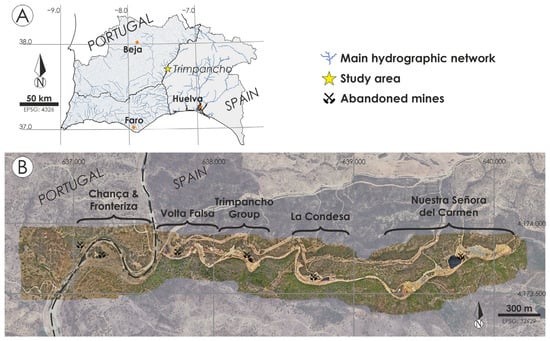
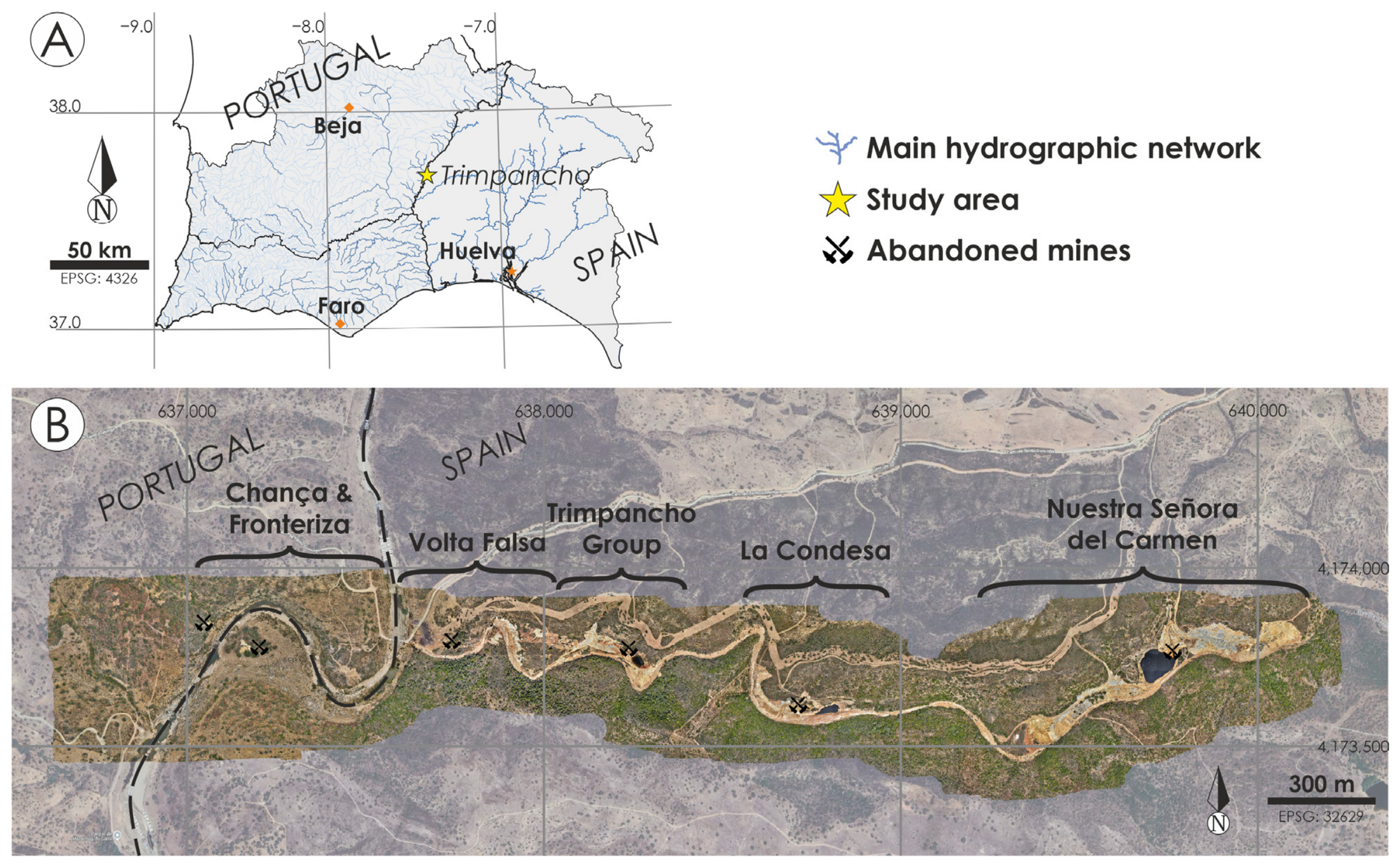
The Trimpancho Mining Complex (TMC) is in the northern sector of the IPB, Huelva province, near the border between Spain and Portugal. It comprises a set of small, abandoned exploitations, from East to West (Figure 1): Nuestra Señora del Carmen (NSdC), La Condesa (LC), Trimpancho Group (TG), Volta Falsa (VF), Fronteriza (F), and Chança (Ch). Historical records indicate that NSdC had approximately 200.000 t of measured resources, from which ~160.000 t were extracted. The remaining 40.000 t of proven resources have a concentration of 2.5% Cu, 2% Pb, 4% Zn, 114 g/t Ag, and 0.6 g/t Au [13]. The same records suggest 1.000 to 10.000 t of probable reserves for the Volta Falsa mine, with estimated concentrations of 1.27% Cu, 8.8% Pb, 307 g/t Ag, and 8–10 g/t Au [13].
Figure 1.
Geographical location of the Trimpancho Mining Complex: (A) Regional setting, in the Huelva province; (B) The study area, with the Chança, Fronteriza, Volta Falsa, Trimpancho Group, La Condesa, and Nuestra Señora del Carmen mines identified.
The regional geology is characterised by two main lithologies: (i) the Volcano-Sedimentary Complex (VSC) from the Late Devonian (Famennian) to the Early Carboniferous (Visean), and (ii) a synorogenic flysch named Culm of Early Carboniferous [5,6,7,14,15]. The VSC is the primary host for the region’s mineral deposits. It comprises a bimodal volcanic suite with alternating mafic and dominant felsic volcanic rocks, heavily interlayered with dark, carbonaceous slates [14,15]. The Culm Group is diachronically overlayed a on top of the VSC and represents a thick turbiditic succession characterised by thick greywacke layers interbedded with silt slates [5,6,7,14,15]. The TMC was exploited in the northern flank of an antiform, formed by the VSC (inner) and the Culm (outer). The mines are located in the volcanic VSC, on felsic volcanic rocks, near a contact with the sedimentary VSC, composed of slates, greywackes, quartzites and arenites. The only exception is TG mine, exploited in the sedimentary component [14,15]. The Trimpancho stream crosses the VSC and the Culm.
Assessing the contamination potential and remediation strategies of mine wastes and AMD varies between case studies [16,17], with soil sample collection and analysis by portable X-ray fluorescence (pXRF) and/or hyperspectral reflectance spectroscopy being common procedures [18,19,20,21]; recent studies using remote sensing hyperspectral mineral mapping [22,23,24,25] achieved successful results, including in the IPB [26,27,28]. These studies extend to geoenvironmental assessment, AMD, and mine waste characterisation and monitoring [18,29,30,31,32,33]. Additionally, several studies have been made towards Unmanned Aerial Vehicle (UAVs) and satellite data fusion in geoenvironmental and mineral mapping [34,35]; however, the combined approach of a multispectral UAV sensor with Sentinel-2 remains understudied.
Abandoned sulphide mines pose global environmental challenges, and scalable, cost-effective methodologies such as geospatial analysis need to be implemented for practical geoenvironmental characterisation. This study addresses this problem through the use of ground geochemical and hyperspectral reflectance spectroscopy data in combination with multispectral images from UAVs and satellites to characterise abandoned mines in the IPB, as a strategy with potential for global applications. The multidisciplinary approach uses point data, pXRF, and reflectance spectroscopy to fully characterise the TMC and its surrounding environment, and transpose the obtained knowledge to local and regional scales using remote sensing techniques such as band ratioing and colour composites [18]. As such, the present work could represent a streamlined and sustainable methodology for preliminary environmental studies in all VHMS deposits, capable of identifying targets that entail more detailed studies.
2. Materials and Methods
The present work uses a combined multidisciplinary and multiscale approach, aiming to characterise the mine wastes before applying the obtained knowledge at a regional scale perspective. As such, a multi-thematic data collection was performed, including in situ mine-sample analysis (pXRF and hyperspectral reflectance spectroscopy) and multispectral UAV and satellite images.
2.1. Field Sample Collection
Field observation and sample collection were guided by orthophotomaps obtained from a UAV, considering sampling bias and accessibility to the location. The samples were collected in order to (i) fully characterise the abandoned exploitation area, with samples from mine waste piles, surrounding soil, and sediments near the Trimpancho river; and to (ii) understand the regional background soil information by collecting samples away from the mined area and along the Chança river (upstream and downstream). A total of 163 samples were collected in two main environments: (i) in the mine wastes and their immediate surroundings, and along the Trimpancho riverbed (91 samples), which could be considered contaminated; and (ii) outside the abandoned exploitation limits, and along the Chança river (72 samples), considered as non-contaminated. The samples were then dried at 60 °C and sieved to a <2 mm fraction, before reflectance spectroscopy and pXRF.
2.2. Hyperspectral Reflectance Spectroscopy
Point-data reflectance spectroscopy was conducted using an ASD FieldSpec 4 spectroradiometer from Malvern Panalytical, Malvern, UK [36], collecting data from 350 nm to 2500 nm with a spectral resolution of 3 nm (@700 nm—VNIR) and 10 nm (@1400 nm and @2100 nm—SWIR). Regular reflectance calibrations were performed using a Spectralon© white plate from Labsphere. Each sample was analysed four times to ensure statistical robustness, and random replicates were performed to guarantee consistency. The preprocessing steps were performed in Spectragryph [37], followed by processing using the R language (version 4.4.2) in RStudio (version “Kousa Dogwood” 2014.12.1) [38,39]. The four measured spectra of each sample are averaged using the mean reflectance value at each wavelength position, obtaining one single spectral signature per sample, which is exported as a table. As the measurements were taken in a laboratory setting, with constant lighting conditions and rigorous white reflectance calibration procedures, no further noise-reduction techniques are necessary. Additionally, the head (350 nm to 400 nm) and tail (2350 nm to 2500 nm) were preserved, since they may help highlight some minerals’ key diagnostic spectral features, such as the 432 nm jarosite absorption band. Using custom R scripts, samples were separated by their spectral signatures and diagnostic absorption bands and allocated into groups. Given the natural variance of the spectral signature within the groups, representative samples of each group were used to describe the spectral features, including the main absorption bands, enabling the inference of each group’s mineralogy. The proposed mineralogy was validated through the comparison of the group average spectral signature to the USGS Spectral Library V7 (splib07, [40]) using a ranked Spectral Angle Mapper (SAM) and root mean square error (RMSE) classifications for raw and continuum-removed reflectance, where references with the lowest SAM/RMSE correspond to the best matching minerals.
2.3. Portable X-Ray Fluorescence (pXRF)
Geochemical data were obtained using an Explorer-9000 spectrometer from Jiangsu Skyray Instrument Co., Ltd., Kunshan, China [41]. The equipment uses a micro-Ag target and a miniature X-ray tube with a maximum excitation source of 50 kV/200 µA, able to measure all elements from Mg to U with a concentration range from 1 ppm to 99.99%, using two self-changing collimators (with 4 and 2 mm diameters) and 6 filters. Its large-area beryllium-window silicon drift detector (SDD) has a 25 mm2 active area and a resolution of <150 eV, processed by a miniature multi-channel digital signal processor. The spectrometer was configured to run for 100 s at a 45 kV voltage and 80 µA current. Internal intensity correction algorithms correct deviations caused by uneven samples of different geometries, densities, and structures [41]. Among the detected elements, the metals Fe, As, Cu, Pb, and Zn (Potentially Toxic Elements—PTEs), and Mn were used. Each sample was analysed four times with random replicates, ensuring statistical robustness and result consistency; the results were then averaged per sample. The obtained data were used to create interpolation maps obtained from Inverse Distance Weighting (IDW), with a distance coefficient p of 2 and a pixel size of 2 m and for Exploratory Data Analysis (EDA) to assess elemental spatial distribution and geochemical trends based on elemental relations. The IDW maps were created and interpreted in QGIS, showing spatial tendencies, and the R language was used for EDA, including pairwise element scatterplots, density plots, and correlation matrices, enabling the interpretation of geochemical trends and group distributions.
2.4. UAV Data
A M350RTK UAV from DJI Global, Shenzhen, China [42] equipped with a Rededge-P multispectral sensor from Micasense, Seattle, DC, USA [43] was flown on the 24 and 25 September 2024 to gather high-resolution imagery of the TMC. The flights were planned with 60% side and 70% forward overlap, with terrain-follow enabled and set at a height of 79 m.
The multispectral sensor captures 6 bands per image: Blue (475 nm), Green (560 nm), Red (668 nm), Rededge (717 nm), NIR (842 nm), and a Panchromatic (634.5 nm centred). To standardise collected reflectance data, radiometric calibration was performed using the Calibration Reflectance Panel and the Downwell Light Sensor installed on the UAV for irradiance data. The different band images were processed in Agisoft Metashape Professional (version 2.2.0 build 19853) [44,45], producing a stacked 5-band multispectral image resampled to 1 m/pixel resolution in the WGS 84/ UTM zone 29N (EPSG: 32629) coordinate system. Orthophotomap processing was performed using R (version 4.4.2) for pixel data extraction and in QGIS (version 3.42.3) [46] for raster visualisation and manipulation. Pixels matching the location of the samples were compared to hyperspectral reflectance data, and obtainable spectral signatures were used as a basis for custom band indices, including adaptations from satellite bands [47,48]. Lastly, a curated composite image using custom Bare Soil Index (using Red, Red Edge, Blue, and NIR bands), Iron Oxide Index (Red and Blue bands), and the Blue band, respectively, for Red, Green, and Blue channels, best showcased the separation between the study area elements.
2.5. Satellite Image
Sentinel-2 images acquired on 30 September 2024, covering tile T29SPB, provided an overview of the TMC limits. This date was chosen for being cloud-free (<2%) and close to the UAV flight days. The images were downloaded with Level 2A correction as 12-band, orthorectified, and atmospherically corrected images in the WGS 84/UTM zone 29N (EPSG: 32629) coordinate system [49,50]. In addition to Band 10, which is not bundled with L2A images, bands 1 and 9 were also excluded, as these are considered atmospheric bands and are not used in geological work [51,52,53]. The remaining 10 bands were resampled to 10 m/pixel using bilinear interpolation, cropped to fit the study area, and used to create band indices that could potentially distinguish the study area features. These band indices, including Normalised Difference Vegetation Index, (custom) Bare Soil Index, and Iron Oxide Index, were retrieved from the referenced literature [47,48] and adapted from the multispectral UAV band ratios; the Sentinel-2 custom Bare Soil Index uses VNIR-1 and VNIR/SWIR-1 as substitutes for UAV’s Red Edge and NIR bands, respectively.
3. Results
3.1. Hyperspectral Results
The collected samples were analysed, and the spectral signature of all samples was considered. Individual geochemical analyses were compared with the defined limits for industrial soils ([54]; see Section 3.3 Geochemistry Results for more information), showing a group below the limits (“non-contaminated”) and another above (“contaminated”). Hyperspectral reflectance spectroscopy analysis and individual spectral signatures marked key spectral features (reflectance values at specific wavelengths), refining the group separations. While some spectral features are shared across all samples, four groups were defined based on diagnostic features and absorption bands:
- Samples singularly defined by the vibrational overtones (OH, H2O, and Al-OH).
- Samples with low reflectance.
- Samples defined by characteristic 500–1000 nm absorption bands and vibrational overtones.
- Samples with high reflectance, pronounced 432 nm absorptions, and doublet OH absorption.
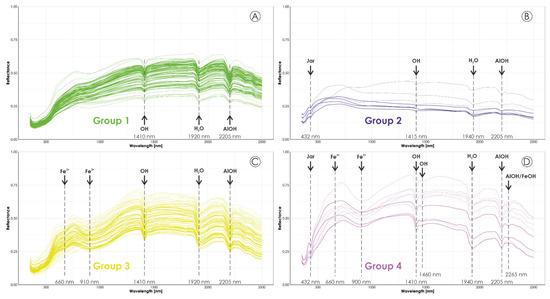
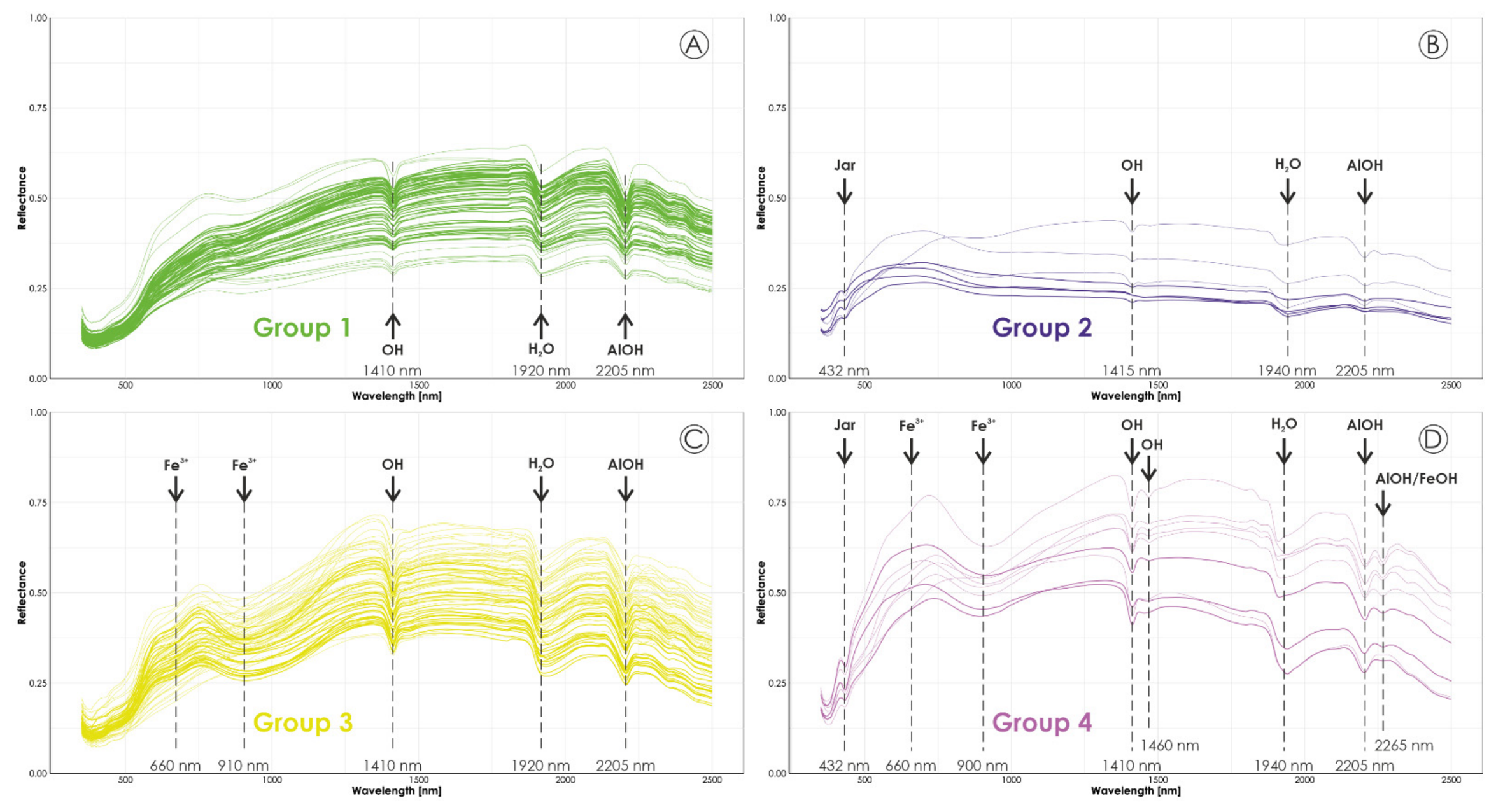
All groups show some spectroscopic variance between samples, mostly due to reflectance changes; however, the spectral profile is mostly preserved, maintaining the main spectral features. To highlight the group spectral signature, the samples that best represent this tendency are highlighted in bold colours, while the remaining group samples are represented by a faded colour (Figure 2).
Figure 2.
Grouping based on hyperspectral data, with main absorption bands identified. (A) Group 1, with vibrational overtones (OH, H2O, and Al-OH); (B) Group 2, low reflectance samples with one jarosite band (432 nm) and shallow vibrational overtones; (C) Group 3, with well-developed iron absorption bands and vibrational overtones; (D) Group 4, with high reflectance and a full set of jarosite key diagnostic absorption bands.
Group 1 samples show little variance and a generally soft spectral profile whose main absorption bands are at 1412 nm (OH overtone), 1920 nm (H2O overtone), and 2204 nm (Al-OH overtone; Figure 2A), with some samples showing a shoulder in the absorption between 500 and 900 nm (iron absorption bands) [55,56,57,58,59,60]. The maximum reflectance value is reached around 1857 nm. The identified absorption band positions and shape, along with the lack of other meaningful diagnostic features, inferred that these samples are mostly constituted by clay minerals (smectite group, possibly montmorillonite due to pronounced Al-OH overtone, or white mica, such as illite or muscovite), with possible iron-bearing minerals (hematite/goethite) as accessory minerals [55,56,57,58,59,60].
Group 2 samples have a general tendency towards low reflectance, with a maximum around 687 nm (Figure 2B). Absorption bands are recorded at 432 nm (jarosite [55,56,57,58,59,60]), 1414 nm (OH overtone), 1944 nm (H2O overtone), and 2207 nm (Al-OH overtone), although their depth is much smaller than in other groups. These bands suggest the presence of clay minerals, possibly combined with jarosite (an iron-bearing sulphate), as the absorption at 432 nm is a key diagnostic feature; however, the lack of other key diagnostic features (at 1460 nm and 2265 nm) suggests that jarosite, if present, would only be as an accessory mineral. Furthermore, the low reflectance in the visible and near-infrared range is typical of sulphide minerals (e.g., pyrite or arsenopyrite) [55,56,57,58,59,60].
Group 3 samples show the highest spectral signature variance, mostly in the 350 nm to 1000 nm range, with iron absorption bands at 660 nm (small shoulder) and 990 nm [55,56,57,58,59,60], with variable depth across the samples, in addition to the same OH, H2O and Al-OH absorption band overtones at 1412 nm, 1920 nm, and 2205 nm, respectively (Figure 2C); some samples also show a 432 nm absorption, indicative of jarosite. The absorption bands’ positions are characteristic of iron-bearing minerals, such as hematite/goethite, mixed with clay minerals, possibly smectite (montmorillonite due to Al-OH overtone) or white mica (illite or muscovite) [55,56,57,58,59,60]; as with Group 2, the lack of other key diagnostic features would indicate that jarosite, if present, would only be as an accessory mineral. The most probable iron-bearing mineral is goethite, due to the more characteristic shape of the iron absorption bands and the presence of OH, but spectral mixing effects do not fully exclude the existence of hematite. The maximum reflectance is observed around 1345 nm in all samples.
Group 4 spectral signatures show important features at 432 nm, 1460 nm, and 2265 nm, the complete set of key diagnostic features of jarosite [55,56,57,58,59,60], 660 nm and 903 nm, attributed to iron absorption bands, and the same 1413 nm (OH), 1940 nm (H2O), and 2205 nm (Al-OH) absorption overtones found in the other groups (Figure 2D). As such, it suggests a mineralogy predominantly dominated by jarosite, mixed with iron oxides/oxyhydroxides (hematite/goethite), and clay minerals (smectite and/or white mica minerals) [55,56,57,58,59,60]. One sample (with the highest reflectance) shows a spectral signature similar to schwertmannite, an iron oxyhydroxysulphate [40,60]. Additionally, this group shows the highest maximum reflectance near 1316 nm, as in Group 3.
To validate the inferred mineralogy, the groups’ mean spectral signatures were compared to selected reference samples from the USGS spectral library (USGS splib07, [40]) using Spectral Angle Mapper (SAM) and Root Mean Square Error (RMSE) as the validation metrics. This operation was performed using raw reflectance data and continuum removed, and the results can be observed in Table 1; a full description of each matched reference sample can be consulted in the Supplementary Materials. All samples matched at least one reference sample for clay minerals, i.e., montmorillonite(-Na) and illite, with low spectral angles and RMSE values, supporting their correspondence with the main clay minerals in the study area. Furthermore, all samples matched a reference sample of goethite, in the form of coating or intimately mixed with other minerals, promoting the idea that this mineral is not only the main iron-hydroxide present but is also disseminated in all samples, with varying proportions. For Group 1, it is noted that the matched goethite sample (Goethite MPCMA2-B FineGr) is described as “No saturated Fe-absorptions because of the fine-grained nature of the goethite coating. Bands around 1.4 and 2.2 microns are due to underlying muscovite in the host rock” [40], showing how the standard sample is an intimate mixture of iron-oxide minerals and micas. For both the Groups 3 and 4, the matching indicated jarosite, mixed in with other minerals (altered muscovite, quartz, and goethite). While Group 3 only shows one key diagnostic feature of jarosite, its presence was inferred based on natural mixtures between minerals. Additionally, no “pure” reference sample of jarosite was matched, as the collected samples are all intimate mixtures with goethite, white mica and/or montmorillonite (from the smectite group). Group 2 was the only case matching sulphide minerals, namely pyrite and arsenopyrite. No schwertmannite was identified in Group 4 samples. The obtained reference minerals and average group spectral signatures were compared to reference literature [55,56,57,60] to provide additional supporting evidence of the obtained matches.
Table 1.
Matched USGS splib07 reference samples.
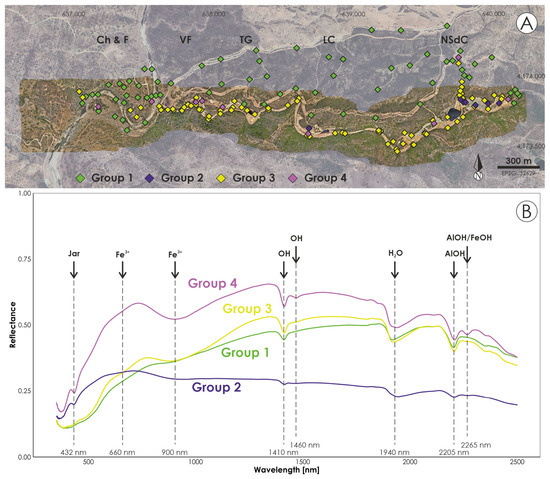
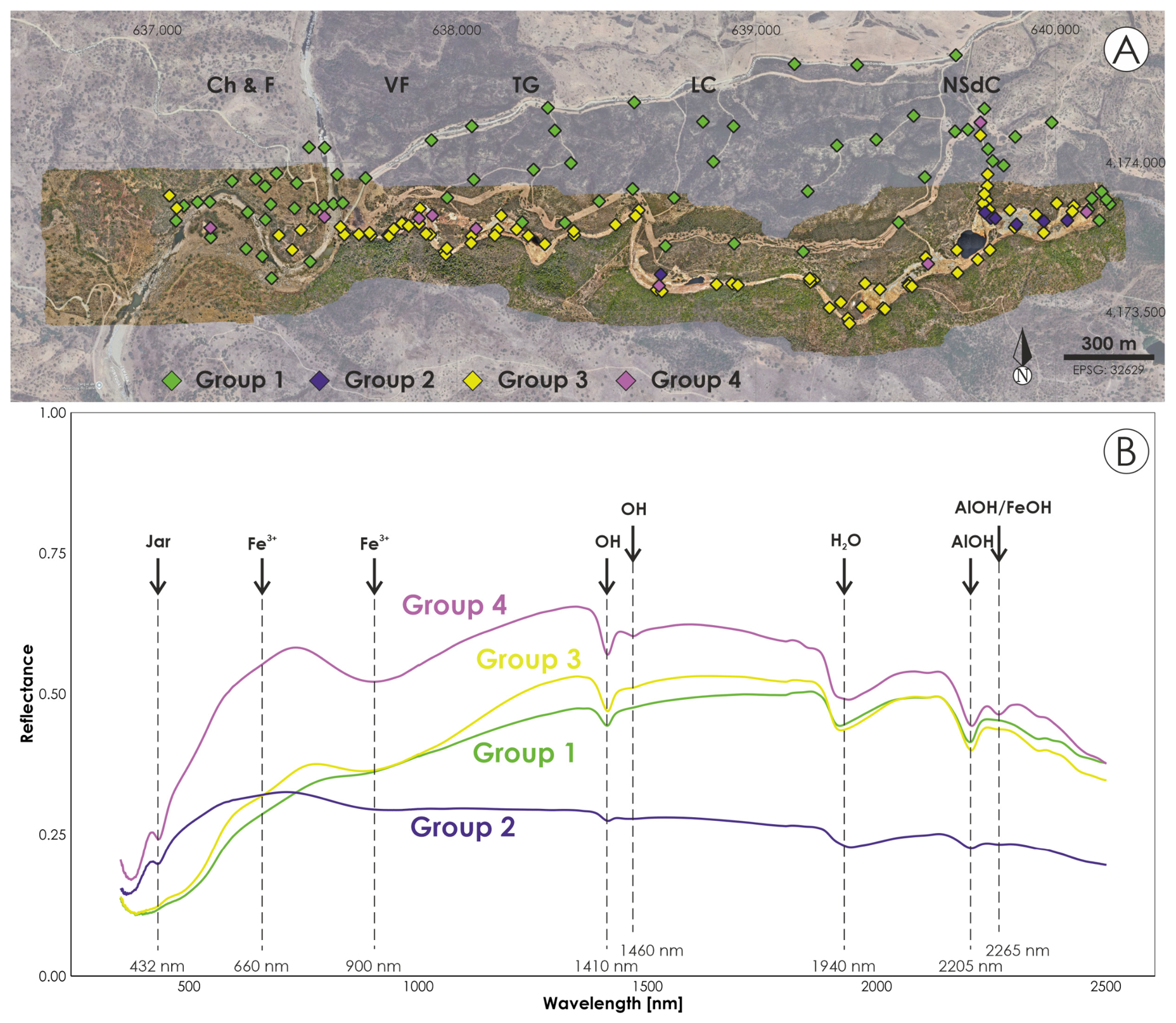
Regarding the spatial distribution of the groups created, one must note that: Group 1 is composed by 69 samples, collected on the north slope and the west region of the TMC, surrounding the mining sites (Figure 3A); Group 2 corresponds to samples collected from grey-silvery mine waste in the NSdC and LC mines, totalling 7 samples, with scarce observations of similar-type mine waste in TG mine; Group 3 is the largest and most widespread group, with 76 samples from mine wastes observed in all mines, and along the Trimpancho stream riverbed; Group 4 corresponds to samples from all mines except VF, and despite its widespread distribution, only 9 samples belong to this group.
Figure 3.
Comparison of the defined groups: (A) Collected samples, coloured by group; (B) Average spectral signature, with diagnostic absorption bands. Ch & F—Chança and Fronteriza; VF—Volta Falsa; TG—Trimpancho Group; LC—La Condesa; NSdC—Nuestra Señora del Carmen mines.
Comparing the average spectral signatures (Figure 3B), all groups exhibit common absorption band overtones of OH, H2O, and AlOH. However, a shift in the H2O absorption band for Group 2 and Group 4 is noted, moving from 1920 nm (Group 1 and 3 band position) to ~1942 nm. In the vibrational overtones, the shoulder shapes are consistent across all groups, suggesting a similar dominant clay mineralogy. Groups 1 and 3 share similar spectral signatures, distinguished only by the more developed Fe absorption bands in Group 3. The same absorption bands are observed in Group 4, although the small divot at ~660 nm is absent. Lastly, the 432 nm absorption, suggesting a jarosite presence, can also be observed in both Groups 2 and 3, but only Group 4 displays the full key diagnostic features of this mineral.
Maximum reflectance values for Groups 3 and 4 peaks at approximately 1330 nm, while Group 1 reaches its maximum closer to ~1860 nm. Group 2, with the lowest spectral signature of all, reaches its visible maximum reflectance near 690 nm.
3.2. Remote Sensing Results
3.2.1. Multispectral UAV Sensor Dataset Validation
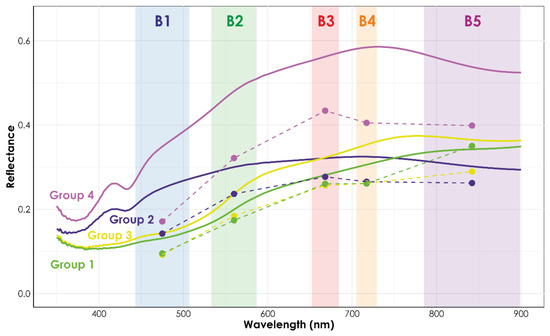
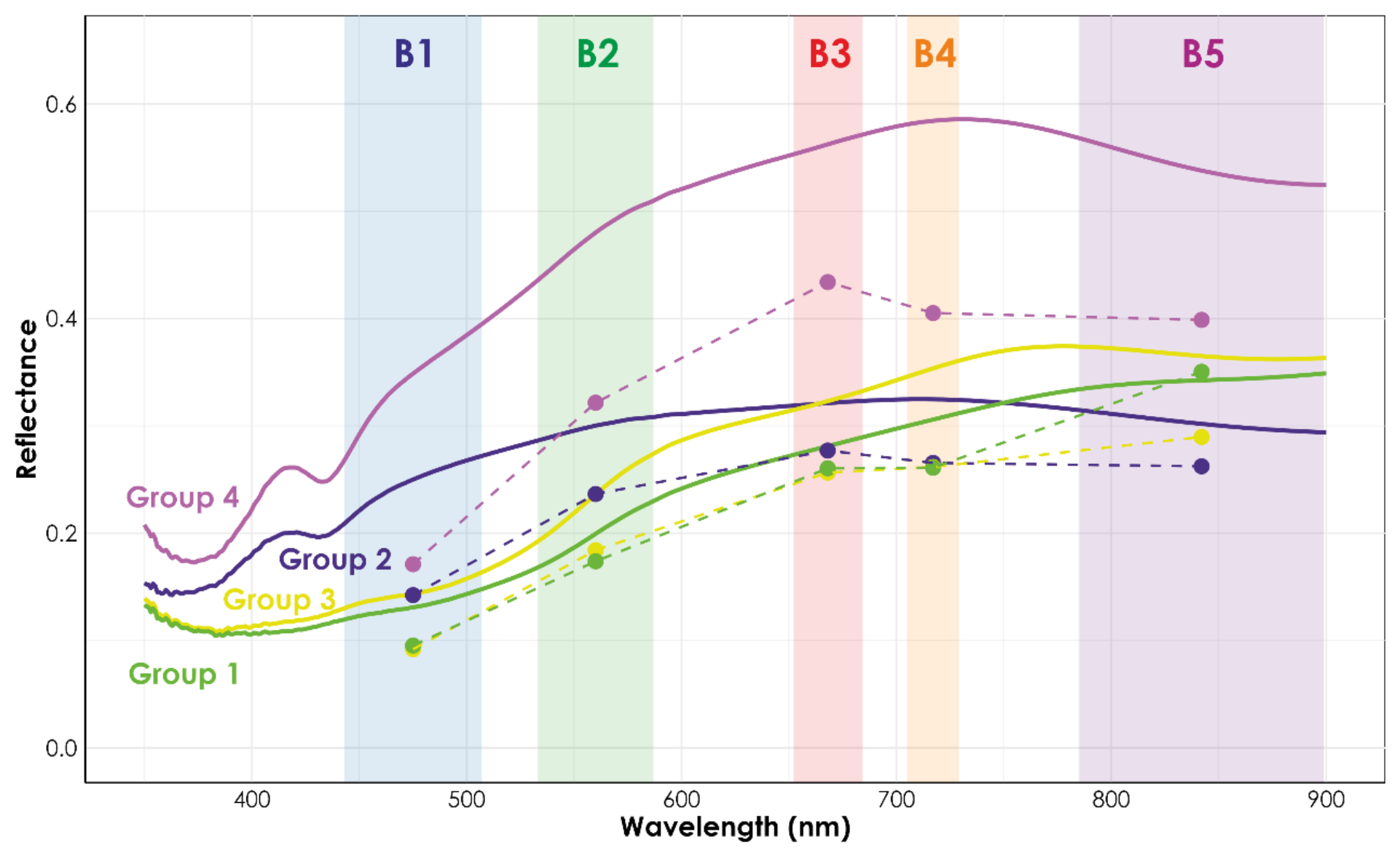
The multispectral orthorectified map was resampled to 1 m/pixel, and pixel data were extracted using R. Pixels matching collected sample locations were compared to hyperspectral reflectance spectroscopy. Figure 4 shows high-resolution hyperspectral spectroscopy (350 to 900 nm, solid lines) retrieved from ASD FieldSpec 4, compared to the point data obtained from UAV multispectral images (5 bands, in point and dashed lines). Both line plots are grouped and averaged according to the proposed groups. Coloured bars represent Micasense Rededge-P bandwidths. Pixel reflectance spectroscopy data obtained from the UAV are consistently lower than point hyperspectral data, except for the NIR band in Group 1; this band is the primary distinguishing factor between Groups 1 and 3, which have otherwise similar spectral signatures.
Figure 4.
Comparison of hyperspectral (full line) and multispectral (dashed line) spectral signatures. Background coloured bars match the multispectral (Micasense Rededge-P) bandwidths.
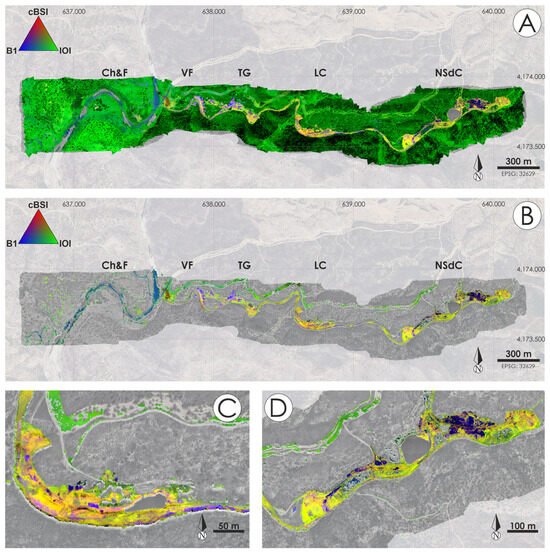
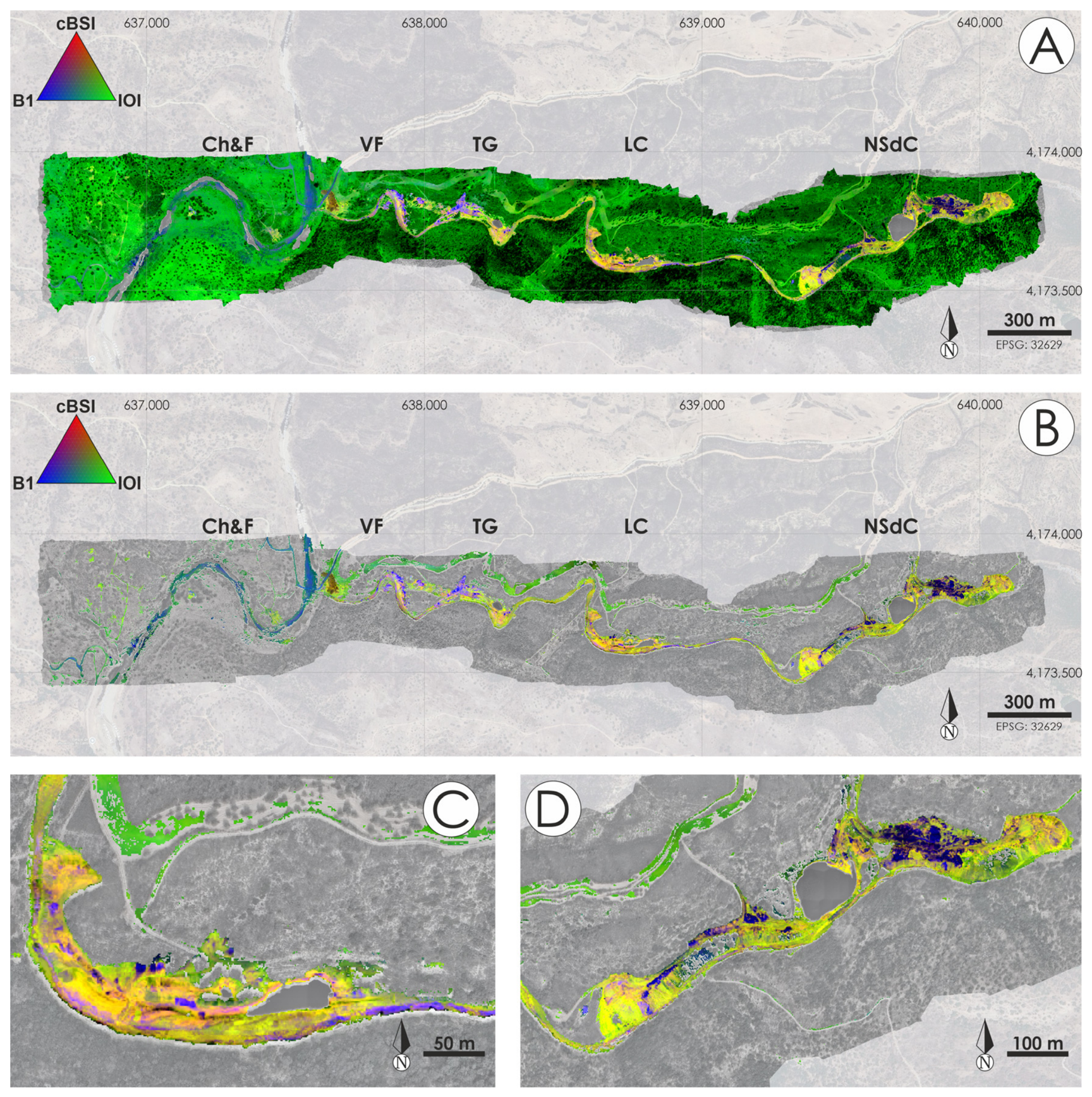
Based on the collected spectral data, several band ratios and band indices referred in the specialised literature [47,48] were assessed, retaining those that showed the most potential for better explaining the results (Table 2 contains the ones discussed in the present work; see Supplementary Materials for a full list of indices calculated). These band indices highlight distinct aspects of the spectral signatures, with the most important being the higher absorption of the Red Edge/NIR (B4/B5) bands compared to the Red band (B3), and the low reflectance values of the Blue band (B1). Figure 5A shows a composite image that enhances the differences within the TMC using a combination of the custom Bare Soil Index (red channel), Iron Oxide Index (green channel), and Blue band (blue channel). To emphasise the bare-soil regions, the vegetation was masked using a Normalised Difference Vegetation Index (NDVI) of 0.1 (Figure 5B). Closer observations of individual mines (Figure 5C,D) using masked composite images display four different colours and their variations: green colours, matching the locations of Group 1 samples; dark blue in NSdC mine and in the centre of LC mine, matching the position of the grey-silver mine wastes of Group 2; yellow colours in all mines and Trimpancho stream, matching Group 3 collected samples; and violet/ purple colours, that match the location of Group 4.
Table 2.
Band ratio/indices adapted for UAV multispectral sensor.
Figure 5.
UAV multispectral false colour compositions: (A) False colour composition with Red—custom Bare Soil Index; Green—Iron Oxide Index; Blue—blue band; (B) same false colour composition, with vegetation masked for NDVI > 0.1; (C) Sectioned view of LC mine; (D) Sectioned view of NSdC mine. Ch & F—Chança and Fronteriza; VF—Volta Falsa; TG—Trimpancho Group; LC—La Condesa; NSdC—Nuestra Señora del Carmen mines.
3.2.2. Sentinel-2
Sentinel-2 multispectral bands have some correspondence with those acquired by UAVs and are, therefore, used to upscale the results and provide a regional perspective. Figure 6 corresponds to the same image as the one obtained by UAV in Figure 5, as seen from the Sentinel-2 perspective.
Figure 6.
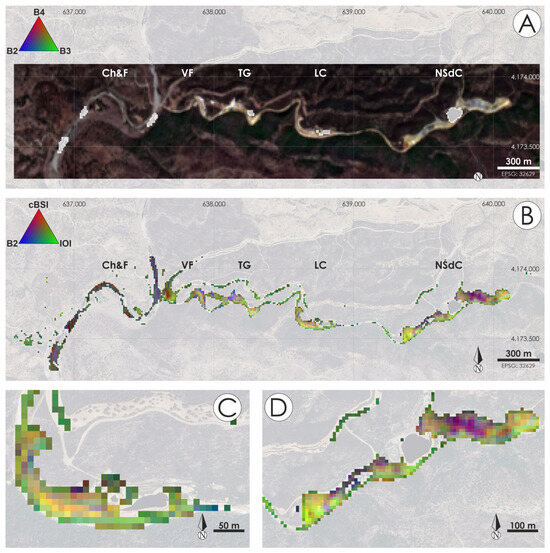
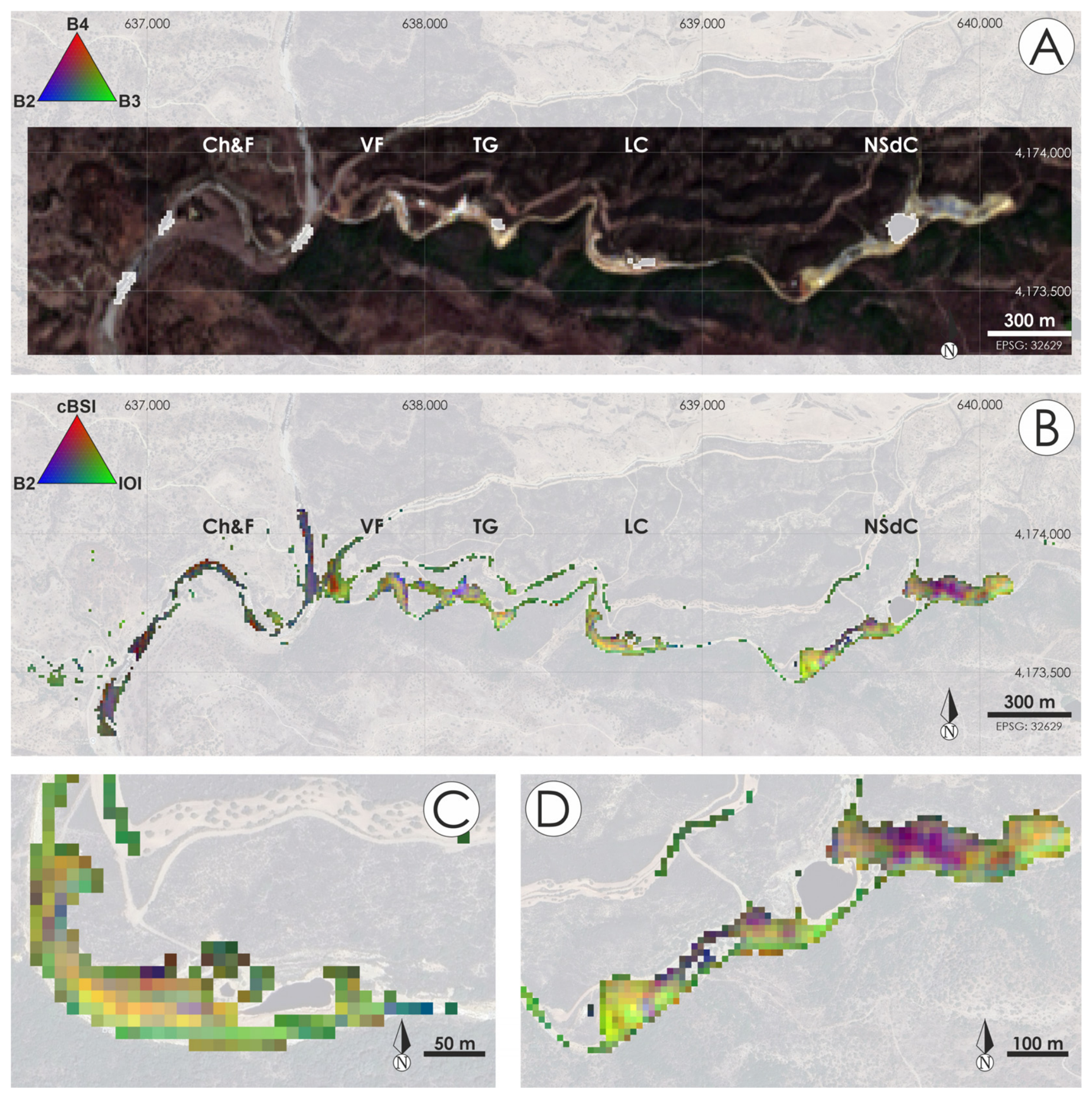
Sentinel-2 multispectral images of the study area: (A) True colour composition; (B) False colour composition with Red—custom Bare Soil Index; Green—Iron Oxide Index; Blue—blue band, with vegetation masked for NDVI > 0.1; (C) Sectioned view of LC mine; (D) Sectioned view of NSdC mine. Ch & F—Chança and Fronteriza; VF—Volta Falsa; TG—Trimpancho Group; LC—La Condesa; NSdC—Nuestra Señora del Carmen mines.
The true colour composition (red—B4, green—B3, blue—B2; Figure 6A) and a false colour composition using adapted indices from Table 2 (red—custom Bare Soil index, green—Iron Oxide Index, blue—B2; Figure 6B). Vegetation and water bodies were masked in the false-colour composition, enhancing differences in the bare soil. For a more detailed view, a sectioned view of the LC mine (Figure 6C) and NSdC mine (Figure 6D) was mapped. This composition shows the vegetated areas in dark green colours, and bare soil in brown shades. For the mines, a few colours are verifiable: yellow to orange colours; silver tones, best seen in NSdC; and, in some instances, high-reflectance white pixels in the dried Trimpancho stream parts and surrounding the pits.
The false colour is a replica of the multispectral UAV image in Figure 5B, using equivalent bands for the custom band ratios. While Groups 1 and 3 remained green and yellow, respectively, pixels matching Group 2 samples changed to purple hues, and Group 4 pixels are now blue (from light to dark blue). These colour differences are best captured by masking vegetation and water from the image, focusing attention on the soil.
3.3. Geochemistry Results
Samples were analysed using pXRF, and concentrations of PTEs (Fe, As, Cu, Pb, Zn) together with Mn were recorded. The collected data were used to create maps using inverse-distance weighted (IDW) interpolation and to conduct exploratory data analysis, using the groups defined in the hyperspectral results section. Table 3 summarises the main aspects of each group; a full geochemical table for each sample is available in the Supplementary Materials.
Table 3.
Geochemical summary table for each Group (M—median; σ—standard deviation; Range—minimum to maximum values). APA (Portuguese Environmental Agency) rows are concentration limits for industrial soils [54].
3.3.1. Spatial Distribution
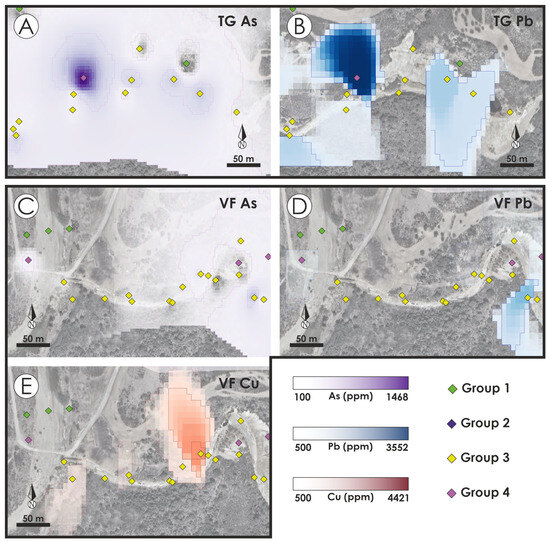
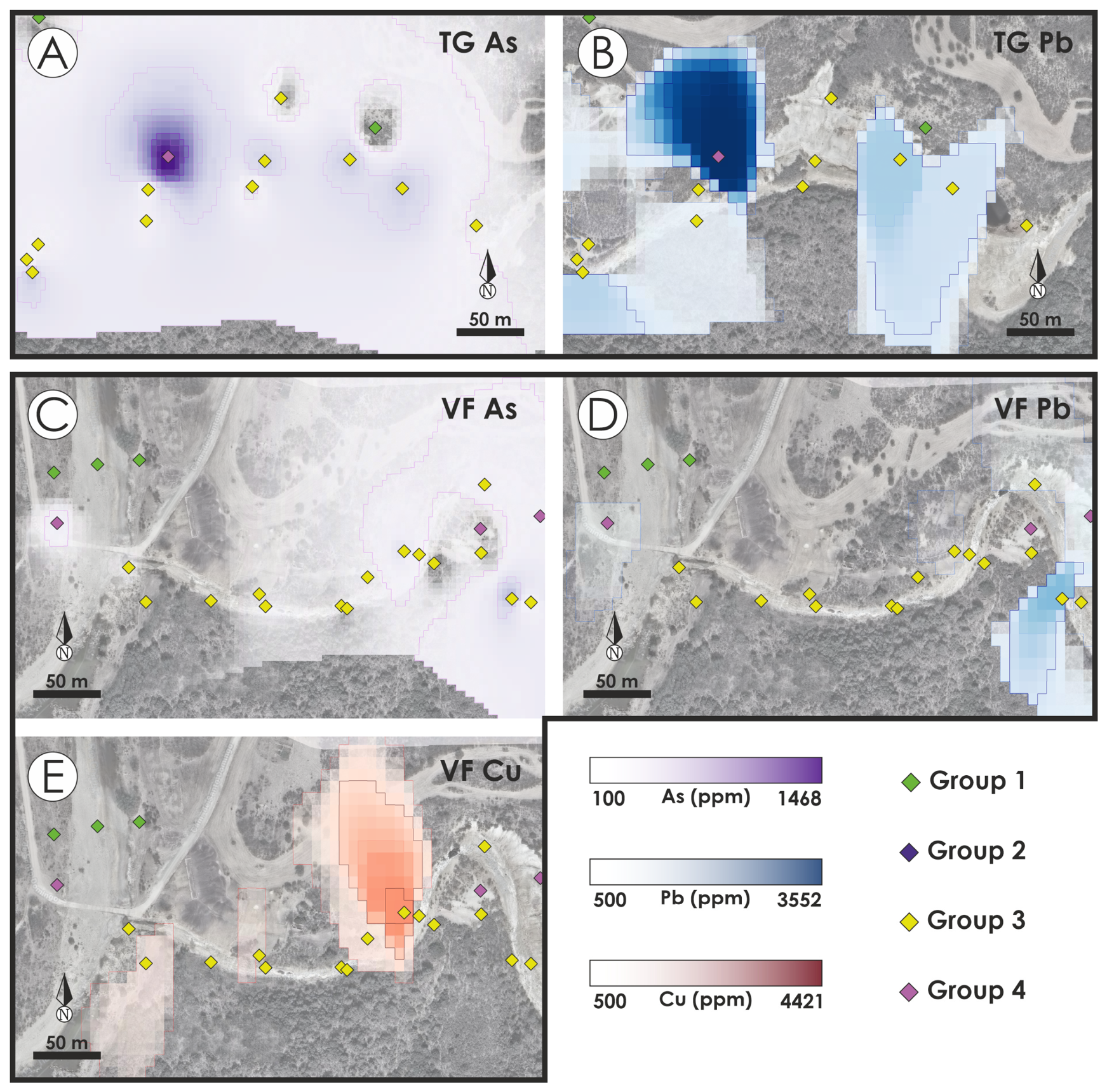
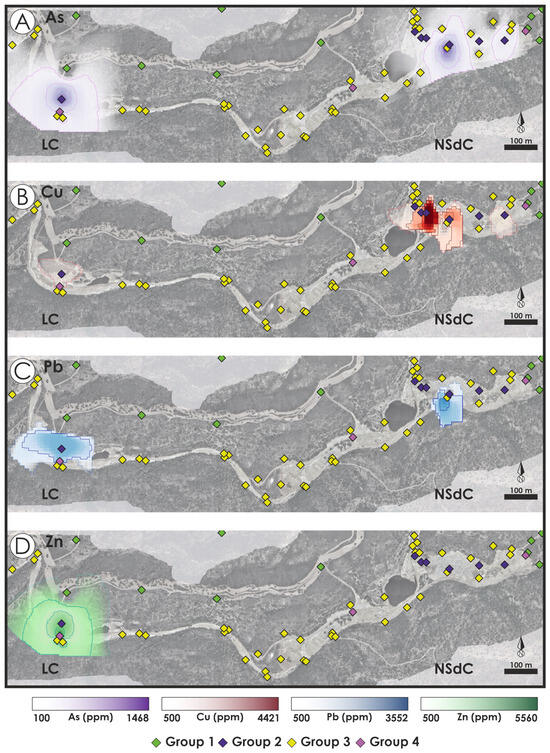
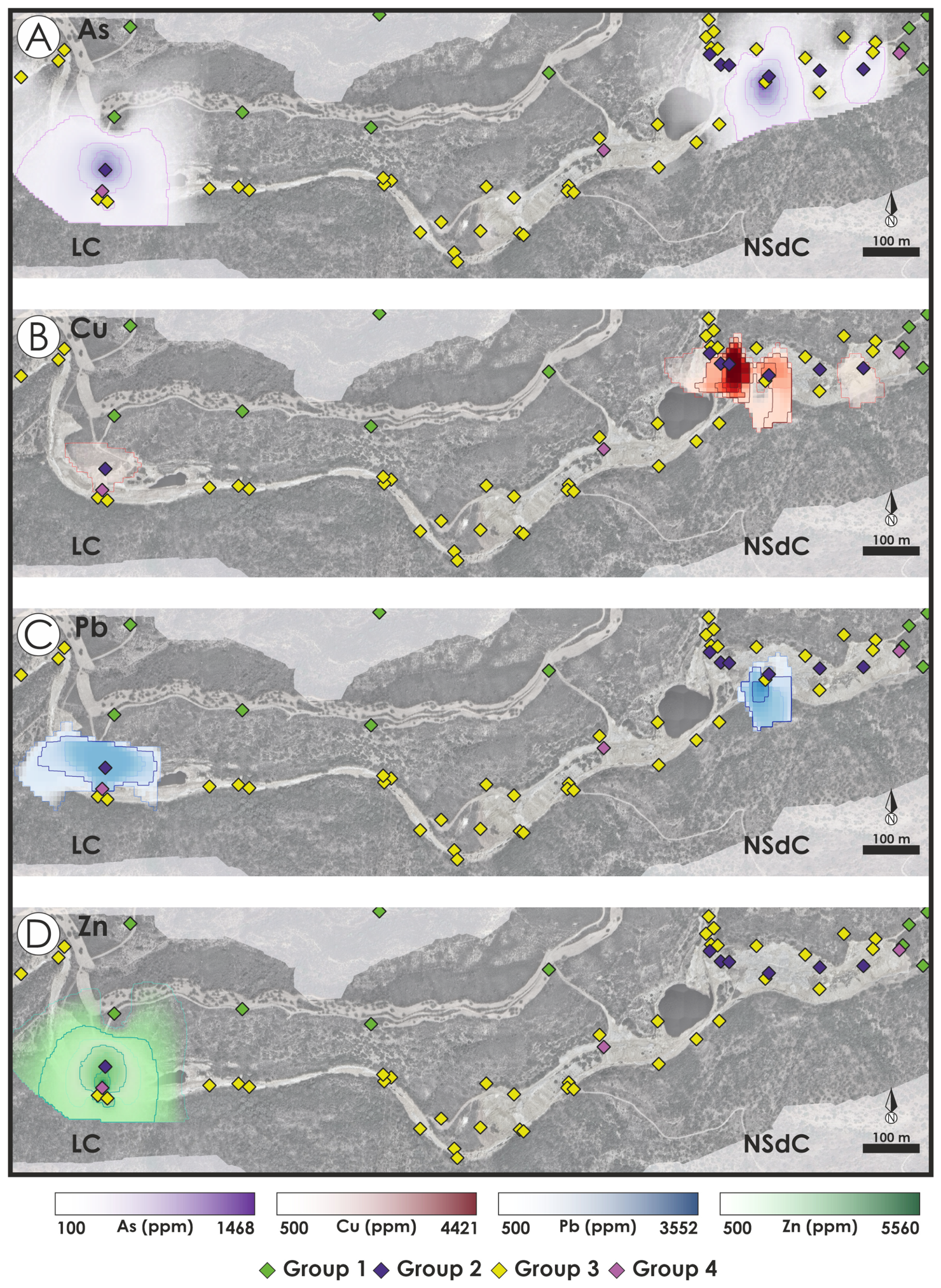
The interpolation maps illustrate the spatial distribution of elements and provide visual guides for element correlations. Figure 7 shows the interpolation maps for As, Cu, and Pb in VF and TG mines, as these are the most relevant PTEs, while Figure 8 shows the As, Cu, Pb, and Zn interpolation maps for LC and NSdC mines (see Supplementary Materials for complete IDW maps). The collected samples are coloured according to the groups proposed in the hyperspectral results section. Element thresholds were manually defined to best highlight the highest concentration samples. The Ch & F area showed only a small high Fe value (9.78%) at the Ch mine waste, associated with a Group 3 sample.
Figure 7.
Geochemical distribution based on interpolation IDW maps for TG and VF; (A) Arsenic map of TG mine; (B) Lead map of TG mine; (C) Arsenic map of VF mine; (D) Lead map of VF mine; (E) Copper map of VF mine. TG—Trimpancho Group; VF—Volta Falsa mine.
Figure 8.
Geochemical distribution based on interpolation IDW maps for LC and NSdC mines; (A) Arsenic map; (B) Copper map; (C) Lead map; (D) Zinc map. LC—La Condesa; NSdC—Nuestra Señora del Carmen mine.
The VF mine shows incisive high concentrations of Cu (2022 ppm) and Pb (1894 ppm), and a continuous high concentration of As (36–675 ppm) in the entire area (Figure 7A–C). Additionally, smaller concentrations of Fe (7.80–13.34%), and Zn (1057 ppm) are recorded. The Pb and Zn plumes are related to the same Group 3 sample; Fe and As anomalies are observed overlapping Pb and Zn, Cu, and occurring on their own, associated with Groups 3 and 4 samples.
TG mine’s most evident anomalies are of high Pb (1112–3552 ppm), with high As content (112–543 ppm) spread across the mine wastes and stream samples, and very high in association with the highest Pb concentration (As = 1430 ppm; Figure 7D,E). Additionally, relevant PTEs concentrations of Fe (11.00–25.76%), Cu (649 ppm), and Zn (1200–1847 ppm) are noted. All anomalies are associated with Group 3 samples, with the highest Pb concentration associated with a Group 4 sample.
At the LC mine (Figure 8) the highest values are centred around one sample from Group 2 and another from Group 4, which show high concentrations of As (614–1031 ppm), Pb (1820–1955 ppm), Zn (3116–5706 ppm), Fe (12.47%, only in Group 2 sample), and a less notorious Cu concentration (586–604 ppm).
The NSdC mine (Figure 8) shows the largest plumes, with the highest concentrations of Cu (1643–4421 ppm) and As (189–1569 ppm), alongside very high concentrations of Pb (2561 ppm), Fe (9.31–20.58%), and Mn (1250–1660 ppm). Copper anomalies are distributed along the Group 2 samples, bordering the Pb and the highest As concentrations, associated with one Group 3 sample. The Fe plume is spread across the eastern mine waste, in both Group 2 and Group 3 samples, and in one Group 3 sample on the western side. Manganese high concentrations occur in association with Group 1 and Group 3 samples.
The interpolation maps show that Cu, Pb, and Zn occur in high-concentration zones, associated with samples from Groups 2, 3, and 4. Additionally, the highest concentrations of Pb and Zn frequently overlap, while the highest Cu concentrations are frequently occurring separately, or associated with Fe. Arsenic is highly concentrated in all mines and is indiscriminately associated with samples from Groups 2, 3, and 4, with occasional increases in samples with higher PTE concentrations. For Fe, the maps indicate widespread high-concentration areas, with the strongest expression at the NSdC mine, associated with samples from both Groups 2 and 3, also overlapping high-concentration regions of the other PTEs. The highest concentrations of Mn are found around the mine boundaries, predominantly associated with samples from Group 1, and occasionally Group 2 and Group 3.
3.3.2. Exploratory Data Analysis
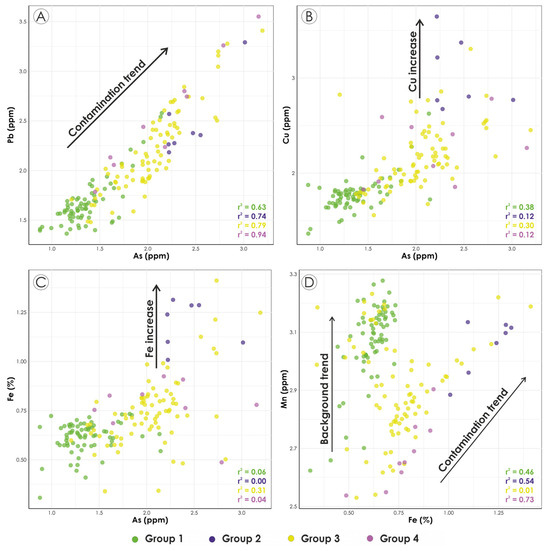
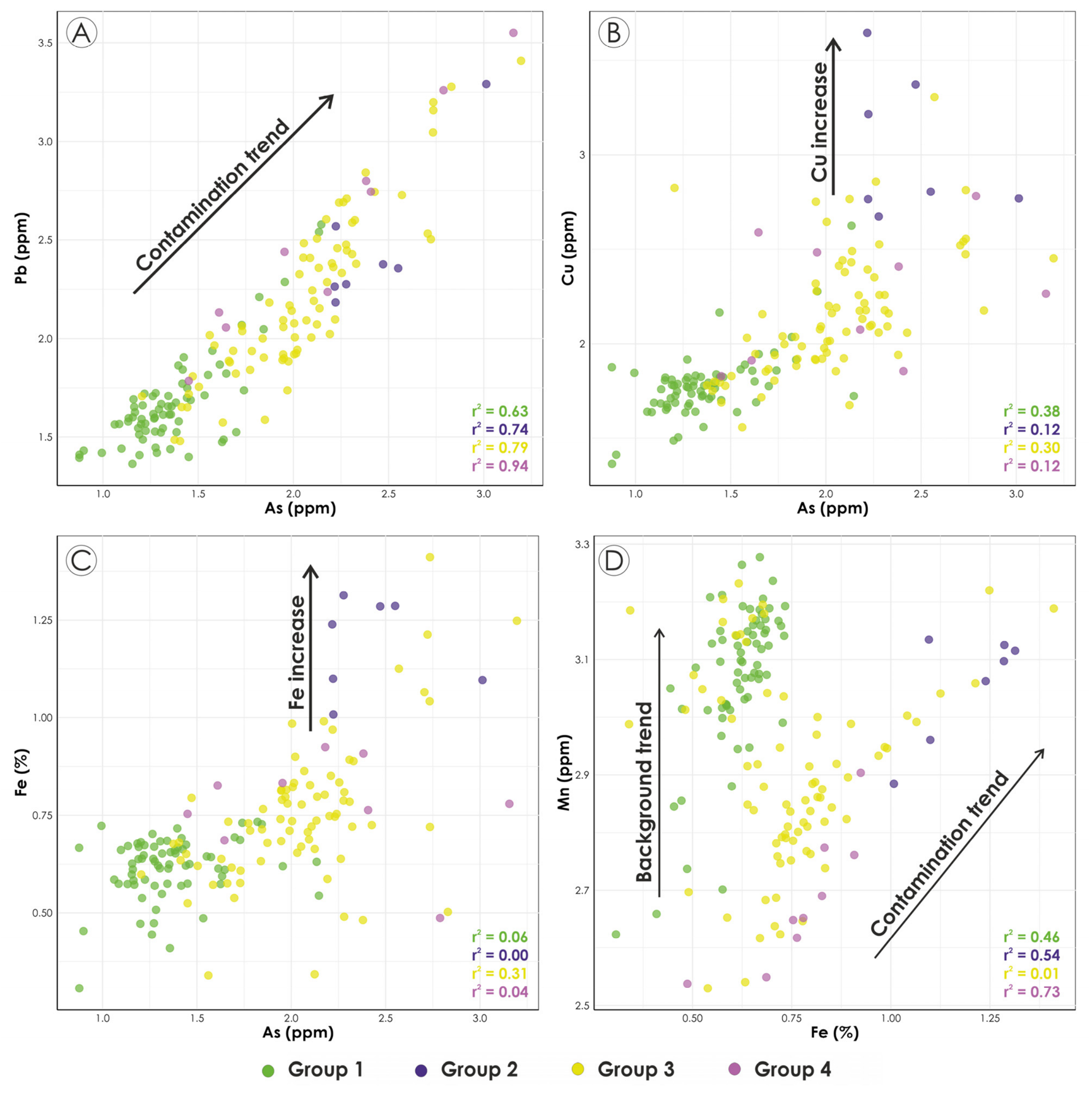
The data shown in Table 3, supported by elemental correlations and selected scatterplots in Figure 9, describe the geochemical trends for each group (see the Supplementary Materials for the full correlations and scatterplots list).
Figure 9.
Geochemical summary scatterplots of (A) As vs. Pb, (B) As vs. Cu (C) As vs. Fe (D) Fe vs. Mn. Points are coloured by group. Element concentrations are expressed as log10.
Group 1 shows low PTE concentrations, except for As, with medians below the reference values defined by the Portuguese Environmental Agency (APA) for industrial soils [54]. Correlation studies show very high correlations in As-Pb (0.80) and in As-Cu pairs (0.62); Pb-Cu also shows a similar correlation (0.62), with increasingly weaker correlations for Zn (0.56 to 0.32), Fe (0.48 to 0.20), and Mn (0.33 to 0.10). Regarding Mn, it is noted that Group 1 has the second-highest median concentration among all groups, with a high correlation in the Fe-Mn pair (0.68). These correlations support their geochemical trend, as the samples show clustered behaviour with a fairly weak coefficient of determination r2 (0.01 to 0.46) except for As-Pb (Figure 9A), where some samples with higher Pb content stray from the cluster, conferring an r2 = 0.63.
Group 2 has the highest median PTE concentration of all groups, with many outliers (Table 3), and the highest Mn concentrations. Results show a very high correlation between As-Zn (0.92) and As-Pb (0.86), co-occurring with a high correlation in the Pb-Zn (0.75) pair. The remaining PTE combinations show almost exclusive negative moderate correlations (−0.45 to 0.11). On the other hand, Mn shows high correlations with Fe (0.74), Zn (0.73), and a moderate correlation with As (0.60). The trends are fairly non-linear, with most r2 varying from 0.00 to 0.36. Exceptions include As-Pb (r2 = 0.74) and Fe-Mn (r2 = 0.54), which present mostly linear trends with high concentrations (Figure 9A,D). In the case of As-Cu (Figure 9B) and As-Fe (Figure 9C), both show low r2 values and weak negative linear trends, as Cu and Fe concentrations decrease with increasing As concentrations.
Group 3 shows medium-high PTE concentrations, above Group 1 and below Group 2, with a wider distribution. Correlation studies show very high correlations in the As-Pb pair (0.89), contrasting with Zn-Cu (0.15) and Zn-Fe (−0.13). The remaining pairs of PTEs show moderate correlations (0.62 to 0.38), while Mn shows weak correlations with all PTEs (−0.09 to 0.20). Similar to Group 2, most trends are non-linear, with varying r2 from 0.00 to 0.38. The only exception is As-Pb, with an r2 = 0.79, denoting a positive linear trend between the elements, but with a fairly large spread. The Fe-Mn scatterplot (Figure 9D) results would best fit a curved regression line, or two linear regressions: one with a negative steep slope and another with a positive slope of almost proportional increase in Mn and Fe concentrations.
Group 4 shows the second-highest median PTE concentrations, with their concentrations far above the recommended APA values, and the highest observed concentrations of Pb and Zn, with an almost perfect correlation in As-Pb (0.97). Other PTE combinations show moderate correlations (0.35 to 0.60) and negative moderate, in the case of Fe (−0.66 to −0.21). Lastly, the results show that Mn has negative low to moderate correlations with all PTEs (−0.28 to −0.09), except for the Mn-Fe pair (0.85). These correlations translate into clustered or fairly weak linear regression models, except for Fe-Mn (Figure 9D) and As-Pb (Figure 9A), which fit a positive linear regression model.
As such, geochemical exploratory data analysis results show that correlations are generally highest between PTEs, mainly As-Pb (>0.80). For As-Cu and As-Zn, relations are moderate except for Group 2, with negative (−0.34 As-Cu) and very high (0.92 As-Zn) correlations. Iron is frequently associated with Mn (0.68–0.85) with low to moderate relations to other PTEs (−0.66 to 0.38); Group 3 is exempt, where the highest correlations are between Fe-As and Fe-Cu (0.57 in both). For Mn, results demonstrate low correlations with PTEs, except for Fe and Zn in Group 2 (0.73). In scatterplots, most data results reveal clustered or non-linear regression patterns, except for As-Pb, which is consistently linear across all Groups; As-Zn in Group 2; and Fe-Mn in Groups 1, 2, and 4. For the selected scatterplots, it is possible to infer a contamination trend that increases as PTEs concentration rises, usually marked by the transition Group 1 → Group 3 → Group 4 → Group 2. This contamination trend can also be complemented with increases in some PTEs, such as Cu (Figure 9B) and Fe (Figure 9C), associated with Group 2 samples, that are not accompanied by an increase in As content. For Fe-Mn, a particular “background trend” can be defined, separating Group 1 samples from Group 2 (high Mn and Fe concentrations) and Group 4 (low Mn and medium Fe concentrations); Group 3 samples are observed following both contamination and background trends.
The interpolation maps and geochemical scatterplots relate the distribution of Mn to samples from Group 1 in a clustered pattern with consistently high concentrations. Furthermore, geochemical trends provide evidence of the association between As and other PTEs, with its highest concentrations frequently coinciding with those of Fe, Pb and Zn. For Cu, although an association with elevated As content is still observed, this effect is weaker, as the highest concentrations of both elements do not spatially coincide. As such, high As contents are indiscriminately associated with Groups 2, 3, and 4.
4. Discussion
The collected samples were divided into four groups according to their spectroscopy, geochemical observations, and inferred mineralogy. Within each group, some reflectance variance was observed, while the main spectral features were preserved. Slight absorption band shifts are also noted, attributed to natural mixing of soil composition. Based on their spectroscopy and geochemical signatures, the groups correspond to distinct geoenvironmental units:
- Most samples of Group 1 are outside the mine limits, showing a clay-dominated mineralogy (montmorillonite, illite and/or muscovite) with low PTEs and high Mn concentrations, representing the uncontaminated regional spectral and geochemical signatures.
- Group 2 samples revealed the presence of sulphide minerals, supported by low reflectance and USGS reference matches, with the highest PTEs and Mn concentrations, most likely representing the original ore waste piles.
- Group 3 samples are found in all mines, showing the presence of hematite/goethite mixed with white micas and clay minerals, and accessory jarosite. The medium-to-high PTEs and low Mn concentrations indicate that this group represents late-stage alteration minerals derived from the sulphide-rich mine wastes [11].
- Group 4 samples showed the presence of jarosite, hematite/goethite and white micas/clay minerals. Geochemically, it is marked by high PTEs and low Mn concentrations, including some of the highest PTEs outliers. The similarities with Group 3 and the inferred mineralogy indicate that this group represents alteration minerals from the first stages of the sulphide oxidation process, with the precipitation of sulphates in very acidic pH conditions [11].
Individually, the geochemical data provide the best method for quantifying mineral alteration and tracing background and contamination trends, capable of separating some samples of each group, using a combined approach of exploratory data analysis and interpolation maps for spatial distribution. Hyperspectral reflectance spectroscopy can infer the mineralogy of each individual sample, able to separate end members of each group; however, common spectral features and spectral mixing within each group hinder accurate separation of every sample without the support of geochemical data. Remote sensing techniques successfully separated the individual geoenvironmental units using a composite image. However, this was only made possible through the integration of UAV multispectral sensor data with ground hyperspectral reflectance spectroscopy. Analysis of pixels matching the sample locations showed that UAV multispectral data consistently underestimate absolute reflectance relative to hyperspectral measurements, but preserve the spectral shape, regardless of the difference in the number of bands. The NIR reflectance increase in Group 1 (Background) is attributed to spectral mixing with surrounding vegetation, mitigated by NDVI masking. The custom band ratios created from UAV multispectral images successfully discriminated the geoenvironmental units using an image composite with a custom-built Bare Soil Index (cBSI; Red channel), an Iron Oxide Index (IOI; Green channel), and the Blue band (Blue channel). Individually, each channel (see Supplementary Materials for figures) can only separate background from general mine waste piles (cBSI) or between the types of alteration materials (IOI and Blue band). The adaptation of these band ratios to Sentinel-2 demonstrates that the characterisation framework is sensor-independent, enabling cost-effective regional monitoring without dedicated UAV campaigns. Previous work by [28] identified goethite and jarosite in São Domingos mine, analogous to TMC, using hyperspectral images. Additionally, ref. [28] used band ratioing in Sentinel-2 images combined with radiometric data to map ferrous minerals, clay minerals and iron oxide minerals in the entire Portuguese sector of the IPB. Our work showed the potential for Sentinel-2 as a cost-effective methodology for sustainable environmental studies, identifying key component minerals present in other mines in the IPB using custom-built band ratios through non-disturbing, repeatable methods that may be applied in initial geoenvironmental characterisation studies.
Environmental Model
Previous studies on the NSdC and VF mines [61] report that the mineralogy of the waste piles consists of quartz, mica, K-feldspar, plagioclase, jarosite, pyrite, hematite, illite, smectite, and kaolinite (NSdC mine), and of quartz, mica, pyrite, jarosite, goethite, illite, chlorite, and smectite (in VF mine). NSdC showed intense oxidative alteration with low pH values (2.42 to 3.60) and abundant secondary sulphate minerals, including copiapite and melanterite. In contrast, VF showed lower reactivity through slightly higher pH (2.77 to 5.05), and more sporadic jarosite occurrence. These observations co-align with our own findings of a sulphide-dominant mine waste in the NSdC mine, mixed with iron oxides/oxyhydroxides (hematite/goethite) and sulphate minerals (jarosite) that resulted from sulphide oxidation. The presence of jarosite in the VF mine could be present as a trace mineral, as no spectral signature from this mine exhibited all three diagnostic spectral features, confirming the low abundance of this sulphate mineral. The high concentrations of As, Cu, Pb, and Zn throughout TMC are interpreted as resulting from the decomposition of arsenopyrite, chalcopyrite, galena, and sphalerite, releasing these PTEs, also mentioned by [61].
The average spectral signatures comparison between background and contaminated soils from the mine reveals a contrast in maximum reflectance: non-contaminated soils, i.e., Group 1 samples, reach their maximum around 1857 nm, situated before the H2O absorption overtone, while alteration mine waste piles, i.e., Groups 3 and 4, samples peak earlier, between 1316 and 1345 nm, preceding the OH absorption overtone. This difference can be used in the field, using a portable spectroradiometer, to quickly differentiate between contaminated and non-contaminated soil without prior knowledge of the soil mineralogy. For sulphide-rich mine wastes, maximum reflectance should occur further into the infrared region (where key diagnostic features of sulphide minerals are located), and the observed spectral signature therefore lacks complete information. Nevertheless, the low reflectance value is a strong indicator of sulphide-dominant areas. The geochemical aspects show a decrease in toxic metals from sulphide-rich > sulphate-rich ≈ iron oxide-rich mine wastes. This pattern is interpreted as reflecting increased mobility of PTEs under low-pH conditions, characteristic of AMD [62]; this process is supported by interpolation maps, which show high concentrations of Cu, Pb, and Zn often together and associated with either sulphide-rich or sulphate-rich mine wastes (Groups 2 and 4). For Fe, the higher concentrations are observed in NSdC, LC and TG mines, often associated with either iron-oxide/oxyhydroxide or sulphide-rich mine wastes. Arsenic behaves differently from the remaining PTEs, forming oxyanions that are typically adsorbed and retained on mineral surfaces [63]. However, As content is consistently high (above 100 ppm) inside the mining limits, although the highest concentrations are bound to the other PTEs with higher concentrations. These high PTE concentrations likely reflect the oxidation of sulphide minerals, namely arsenopyrite (AsS), galena (PbS), chalcopyrite (CuFeS2), and sphalerite (ZnS), releasing metals that are subsequently incorporated into sulphate minerals.
Manganese concentration is relatively high in the background samples. The soil is mostly formed by the weathering of altered metavolcanic rocks, and the obtained Mn concentration is well within the range for whole rock analysis in metavolcanic rocks, indicating that Mn should be incorporated in common rock-forming minerals such as ferromagnesian minerals [64]. Comparatively, sulphide-rich mine wastes share similar Mn concentrations, with increasing impoverishment towards the alteration of mine waste piles. This decrease is controlled by Mn mobility: Mn(IV) species are highly insoluble and retained in ferromagnesian minerals, whereas Mn(II) is more soluble and can be transported in solution beyond the TMC [64]. Furthermore, Mn can be specifically adsorbed onto the surfaces of fine-grained minerals and subsequently released under appropriate redox conditions or complexed with organic ligands [64]. The iron oxides/oxyhydroxides (Group 3) samples containing higher Mn concentrations may reflect either Mn incorporation into Fe and Mn oxide/oxyhydroxide phases [65] or mixing with the surrounding background soil. A more in-depth study on soil mineralogy should be conducted in order to validate the most likely hypothesis.
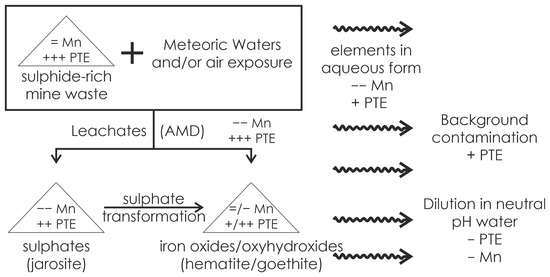
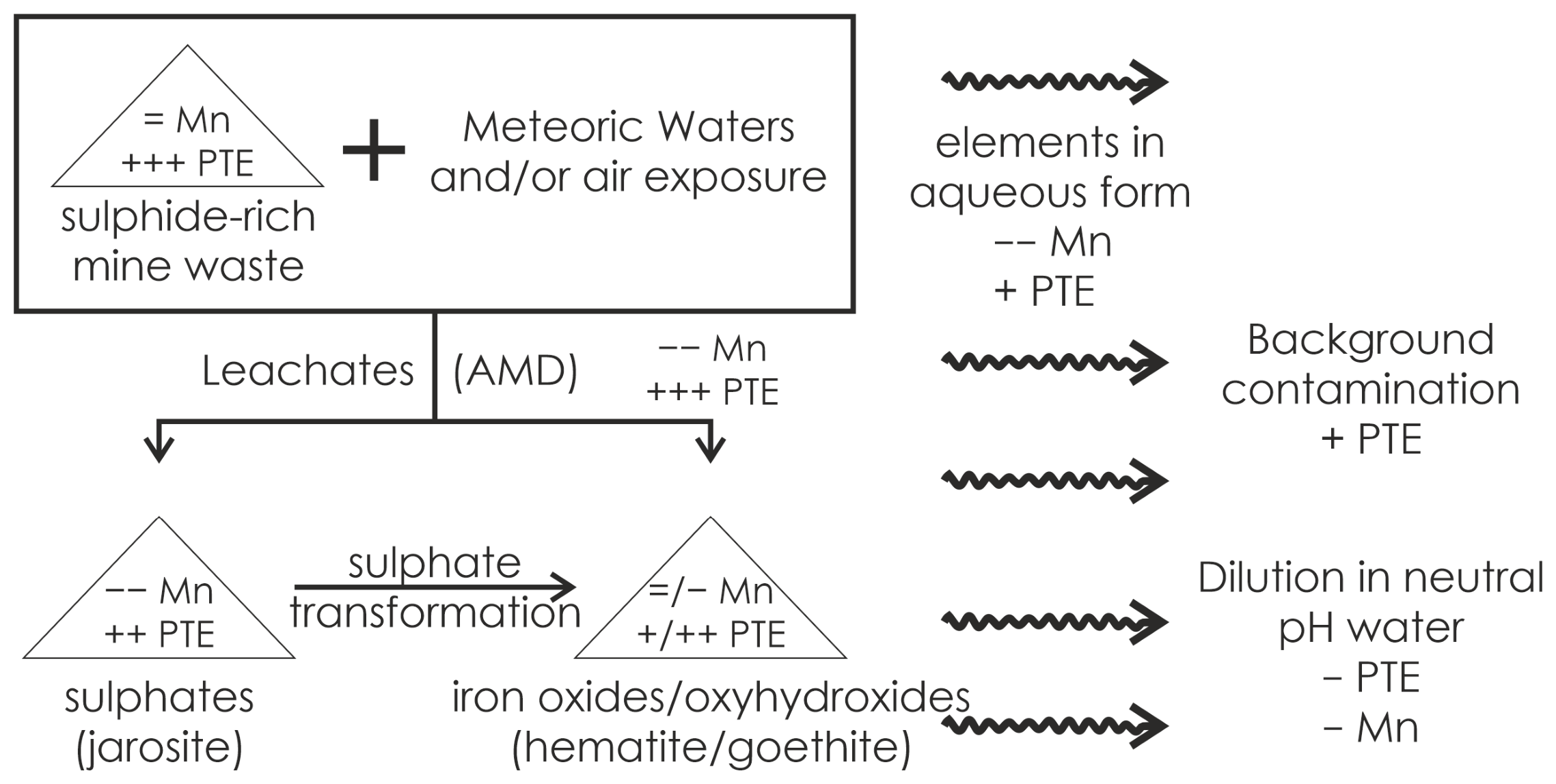
The TMC is a representative of the current state of the abandoned mines in the IPB, and the sulphide-rich mine waste piles are closely related to the ore piles, exhibiting elevated concentrations of As, base metals, and Mn. Interaction with meteoric water promotes sulphide oxidation, releasing acid waters with low pH and high oxidation (Eh) conditions, triggering the precipitation of sulphates (jarosite) and/or iron oxides/oxyhydroxides (hematite/goethite). These alteration minerals are impoverished in Mn, either due to the mobilisation of Mn(II) in aqueous form or to the retention of Mn(IV) in the sulphide mine wastes. Jarosite is a known metal retainer [11,66] derived from sulphide oxidation in very acidic environments of pH < 2.5 and is present with pH values up to 6.5 [67,68,69], explaining local concentration increases in Cu, Pb, and Zn, usually accompanied by As. Other sulphates, such as melanterite, copiapite and schwertmannite, usually accompany jarosite, and although not identified by this study, they have been reported in the IPB [61,70,71]. The sulphates are metastable under higher pH conditions, transforming into goethite [11,68], which explains the low number of samples. Iron is preferentially retained in later-stage iron oxides/oxyhydroxides waste piles as pH rises. These weathering dynamics evolve over time through repeated cycles, producing the mixed spectroscopic and geochemical signatures observed within groups. The soils north of the TMC remain largely unaffected, providing stable background signatures; however, PTEs detected outside the mine limits confirm that metal-bearing particles are transported beyond the mine boundaries, particularly along the left margin of the Trimpancho River. Figure 10 summarises the proposed environmental model using “+”, “−”, and “=” symbology to represent PTEs and Mn concentrations relative to background geochemical signatures.
Figure 10.
Environmental model with toxic elements (PTEs) and Mn balance in relation to the background geochemical signature. Key: “+ (plus)” higher concentration; “− (minus)” lower concentration; “= (equal)” approximately equal concentration as the background.
5. Conclusions
The present study presents a cost-effective, multidisciplinary methodology for characterising soils around abandoned mining complexes in the IPB, combining hyperspectral reflectance spectroscopy, geochemical analysis, and multispectral UAVs and Sentinel-2 imagery. While some limitations should be addressed: (i) spectral bandwidth mismatch between UAV and satellite sensor; (ii) GPS sample position uncertainty (around 3 m); and (iii) sparse sampling in the south slope due to access constraints. The sample location was manually corrected, enabling comparison with correct multispectral pixels. The approach successfully separates regional background from sulphide-rich mine wastes and two distinct alteration stages, and the main findings, as well as proposed future studies, are summarised below:
- Spectral signatures of contaminated samples reached the maximum reflectance before non-contaminated (below 1350 nm and above 1850 nm, respectively). Together with background and contamination trends in geochemical data, these provide path-traces for contamination sources.
- Combining hyperspectral and geochemical datasets refines the geoenvironmental model, enabling the distinction between background, sulphide-rich and alteration minerals mine waste signatures.
- Multispectral UAV imagery is consistent with ground-truth observations; custom false colour compositions allow high-resolution identification of potential contamination sources.
- Adapting band ratios to Sentinel-2 provides a streamlined, scalable solution for preliminary environmental monitoring.
- The false colour composition can be applied independently of hyperspectral and geochemical data, broadening its practical use.
- The proposed methodology is transferable to other IPB mines and VHMS deposits; future works will validate it at São Domingos (Portugal) and Rio Tinto (Huelva, Spain) under different environmental and operational scenarios.
Supplementary Materials
The following supporting information can be downloaded at: https://www.mdpi.com/article/10.3390/su18126038/s1, S1 Materials—Hyperspectral results (USGS reference sample description); S1 Materials—Hyperspectral results (Band ratios); S2 Materials—Geochemistry data results (Geochemical table); S2 Materials—Geochemistry data results (IDW Maps); S2 Materials—Geochemistry data results (Pearson’s Correlation and Coefficient of Determination tables); S2 Materials—Geochemistry data results (Scatterplots); S3 Materials—Band ratio maps.
Author Contributions
Conceptualization, M.G.S., J.R. and P.N.; methodology, M.G.S., J.R., P.N. and D.S.P.; software, M.G.S. and P.N.; validation, M.G.S. and J.R.; formal analysis, M.G.S.; investigation, M.G.S. and D.S.; resources, P.N., A.C.T. and R.F.; data curation, M.G.S. and J.R.; writing—original draft preparation, M.G.S. and J.R.; writing—review and editing, J.R., D.S.P., D.S., P.N., J.F.A., R.d.S., A.C.T., M.A.G., R.H. and R.F.; visualisation, M.G.S. and J.R.; supervision, P.N., M.A.G. and R.H.; project administration, R.F.; funding acquisition, R.F. All authors have read and agreed to the published version of the manuscript.
Funding
The authors acknowledge the financial support provided to the Institute of Earth Sciences (ICT) through the multi-annual funding contract with the Foundation for Science and Technology (FCT), under project UID/04683/2025 with the DOI number 10.54499/UID/04683/2025, and the funding of the GEOMINA project (ref: PL23-00035) through the “La Caixa” Foundation. Silva, M. acknowledges the financial support of FCT through the PhD grant PRT/BD/153588/2021, promoted by the Portuguese Space Agency. Gonçalves, M. acknowledges the support by FCT, I.P/MCTES, through the national funds (PIDDAC): LA/P/0068/2020 (DOI number 10.54499/LA/P/0068/2020), UID/50019/2025 (DOI number 10.54499/UID/50019/2025), UID/PRR/50019/2025 (DOI number 10.54499/UID/PRR/50019/2025), and UID/PRR2/50019/2025 (DOI number 10.54499/UID/PRR2/50019/2025).
Institutional Review Board Statement
Not applicable.
Informed Consent Statement
Not applicable.
Data Availability Statement
The original contributions presented in this study are included in the article/Supplementary Material. Further inquiries can be directed to the corresponding author.
Acknowledgments
The authors acknowledge the work and support of the remaining AmbiTerra laboratory members not participating in the project, but who partook in sample preparation. The authors would also like to acknowledge the four anonymous reviewers who helped improve our work.
Conflicts of Interest
The authors declare no conflicts of interest.
Abbreviations
The following abbreviations are used in this manuscript:
| IPB | Iberian Pyrite Belt |
| AMD | Acid mine drainage |
| VHMS | Volcanogenic Hosted Massive Sulphides |
| TMC | Trimpancho mining complex |
| NSdC | Nuestra Señora del Carmen |
| LC | La Condesa |
| TG | Trimpancho Group |
| VF | Volta Falsa |
| F | Fronteriza |
| Ch | Chança (mine) |
| VSC | Volcano-sedimentary complex |
| pXRF | Portable X-ray fluorescence |
| PTEs | Potentially toxic elements |
| IDW | Inverse distance weight |
| EDA | Exploratory data analysis |
| SAM | Spectral angle mapper |
| RMSE | Root mean square error |
| cBSI | Custom Bare Soil Index |
| IOI | Iron oxide index |
| NDVI | Normalised difference vegetation index |
References
- Bird, G. The Influence of the Scale of Mining Activity and Mine Site Remediation on the Contamination Legacy of Historical Metal Mining Activity. Environ. Sci. Pollut. Res. 2016, 23, 23456–23466. [Google Scholar] [CrossRef] [Scilit]
- Azapagic, A. Developing a Framework for Sustainable Development Indicators for the Mining and Minerals Industry. J. Clean. Prod. 2004, 12, 639–662. [Google Scholar] [CrossRef] [Scilit]
- Zhang, T.; Zhang, C.; Du, S.; Zhang, Z.; Lu, W.; Su, P.; Jiao, Y.; Zhao, Y. A Review: The Formation, Prevention, and Remediation of Acid Mine Drainage. Environ. Sci. Pollut. Res. 2023, 30, 111871–111890. [Google Scholar] [CrossRef] [Scilit]
- Moreno-González, R.; Macías, F.; Olías, M.; Ruiz Cánovas, C. Temporal Evolution of Acid Mine Drainage (AMD) Leachates from the Abandoned Tharsis Mine (Iberian Pyrite Belt, Spain). Environ. Pollut. 2022, 295, 118697. [Google Scholar] [CrossRef] [Scilit]
- Oliveira, J.T.; Relvas, J.; Pereira, Z.; Matos, J.; Rosa, C.; Rosa, D.; Munhá, J.; Fernandes, P.; Jorge, R.; Pinto, Á. Geologia Sul Portuguesa, Com Ênfase Na Estratigrafia, Vulcanologia Física, Geoquímica e Mineralizações Da Faixa Piritosa. In Geologia de Portugal, Volume I—Geologia Pré-Mesozóica de Portugal; Dia, R., Araújo, A., Terrinha, P., Kullberg, J.C., Eds.; Escolar Editora: Lisboa, Portugal, 2013; Volume 1, pp. 673–765. [Google Scholar]
- Tornos, F.; Sánchez-España, J.; López-Pamo, E. The Iberian Pyrite Belt. In Contextos Geológicos Españoles: Una Aproximación al Patrimonio Geológico de Relevancia Internacional; García-Cortes, Á., Ed.; Instituto Geológico y Minero de España: Madrid, Spain, 2008; pp. 56–64. [Google Scholar]
- Inverno, C.; Díez-Montes, A.; Rosa, C.; García-Crespo, J.; Matos, J.; García-Lobón, J.L.; Carvalho, J.; Bellido, F.; Castello-Branco, J.M.; Ayala, C.; et al. Introduction and Geological Setting of the Iberian Pyrite Belt. In 3D, 4D and Predictive Modelling of Major Mineral Belts in Europe, Mineral Resource Reviews; Weihed, P., Ed.; Springer: Berlin/Heidelberg, Germany, 2015; pp. 191–208. [Google Scholar]
- Tornos, F. La Geología y Metalogenia de La Faja Pirítica Ibérica. Macla 2008, 10, 13–22. [Google Scholar]
- Evangelou, V.P.; Zhang, Y.L. A Review: Pyrite Oxidation Mechanisms and Acid Mine Drainage Prevention. Crit. Rev. Environ. Sci. Technol. 1995, 25, 141–199. [Google Scholar] [CrossRef] [Scilit]
- Nordstrom, D.K.; Alpers, C.N. Geochemistry of Acid Mine Waters. In The Environmental Geochemistry of Mineral Deposits; Plumlee, G.S., Logsdon, M.J., Eds.; Society of Economic Geologists Inc.: Littleton, CO, USA, 1999; Volume 6. [Google Scholar]
- Dold, B. Evolution of Acid Mine Drainage Formation in Sulphidic Mine Tailings. Minerals 2014, 4, 621–641. [Google Scholar] [CrossRef] [Scilit]
- Dold, B. Basic Concepts in Environmental Geochemistry of Sulfidic Mine-Waste Management. In Waste Management; Kumar, E.S., Ed.; Books on Demand: Norderstedt, Germany, 2010; pp. 173–198. [Google Scholar]
- Instituto Geologico y Minero de España; Dirección General de Minas e Industrias de la Construcción. Desarrollo de un Nuevo Proceso de Beneficio de Minerales Piriticos Complejos; Ministerio de Industria Y Energia, IGME, Ed.; Instituto Geológico y Minero de España (IGME): Madrid, Spain, 1978; Volume I-Invent. Res. [Google Scholar]
- Gozalo, F.; Locutura, J.; Sánchez, A.; Vázquez, F.; Cueto, L.A. Mapa Geologico de España Hoja 936—Paymogo 1:50.000; IGME, Ed.; IDEAL: Madrid, Spain, 1979; Available online: https://info.igme.es/cartografiadigital/datos/magna50/memorias/MMagna0936.pdf (accessed on 2 February 2025).
- Díez-Montes, A.; Matos, J.X.; Dias, R.; Pereira, Z.; Machado, S.; Solá, R.; López López, M.; Huerta Carmona, J.J.; Ressurreição, R.; Mendes, M.; et al. Carta Geológica Da Zona Sul Portuguesa, Esc. 1:400 000. Mapa Geológico de La Zona Surportuguesa, Esc. 1:400.000. Programa Interreg V-A España-Portugal (POCTEP). GEO_FPI: Observatorio Transfronterizo Para La Valorización Geo-Económica de La Faja Pirítica Ibérica (0052_GEO_FPI_5_E); Instituto Geológico y Minero de España (IGME): Madrid, Spain; Laboratório Nacional de Energia e Geologia (LNEG): Amadora, Portugal; Junta de Andalucía (JA-DGIEM): Seville, Spain; CM Aljustrel: Amadora, Portugal, 2020. [Google Scholar]
- U.S. Environmental Protection Agency. Technical Document: Acid Mine Drainage Prediction; U.S. Environmental Protection Agency: Washington, DC, USA, 1994.
- Akcil, A.; Koldas, S. Acid Mine Drainage (AMD): Causes, Treatment and Case Studies. J. Clean. Prod. 2006, 14, 1139–1145. [Google Scholar] [CrossRef] [Scilit]
- Nogueira, P.; Silva, M.; Roseiro, J.; Potes, M.; Rodrigues, G. Mapping the Mine: Combining Portable X-Ray Fluorescence, Spectroradiometry, UAV, and Sentinel-2 Images to Identify Contaminated Soils—Application to the Mostardeira Mine (Portugal). Remote Sens. 2023, 15, 5295. [Google Scholar] [CrossRef] [Scilit]
- Barago, N.; Pavoni, E.; Floreani, F.; Crosera, M.; Adami, G.; Lenaz, D.; Larese Filon, F.; Covelli, S. Portable X-Ray Fluorescence (PXRF) as a Tool for Environmental Characterisation and Management of Mining Wastes: Benefits and Limits. Appl. Sci. 2022, 12, 12189. [Google Scholar] [CrossRef] [Scilit]
- Kamps, O.; Desta, F.; Maghsoudi Moud, F.; Buxton, M. Multi-Level Characterization of Lignite Mine Waste by the Integration of Wide Wavelength Range Infrared Spectroscopy. Mining 2024, 4, 588–612. [Google Scholar] [CrossRef] [Scilit]
- Montero, S.I.C.; Brimhall, G.H.; Alpers, C.N.; Swayze, G.A. Characterization of Waste Rock Associated with Acid Drainage at the Penn Mine, California, by Ground-Based Visible to Short-Wave Infrared Reflectance Spectroscopy Assisted by Digital Mapping. Chem. Geol. 2005, 215, 453–472. [Google Scholar] [CrossRef] [Scilit]
- Pereira, I.; García-Meléndez, E.; Ferrer-Julià, M.; van der Werff, H.; Valenzuela, P.; Cruz, J.A. Multi-Temporal Mineral Mapping in Two Torrential Basins Using PRISMA Hyperspectral Imagery. Remote Sens. 2025, 17, 2582. [Google Scholar] [CrossRef] [Scilit]
- Kouzeli, E.; Pantelidis, I.; Nikolakopoulos, K.G.; Tsikos, H.; Sykioti, O. Integration of Multispectral and Hyperspectral Satellite Imagery for Mineral Mapping of Bauxite Mining Wastes in Amphissa Region, Greece. Remote Sens. 2026, 18, 342. [Google Scholar] [CrossRef] [Scilit]
- Orynbassarova, E.; Ahmadi, H.; Pour, A.B.; Yerzhankyzy, A.; Zakariya, M.; Omirzhanova, Z. PRISMA Hyperspectral Satellite Imagery for Mapping Alteration Minerals and Zones in Aktogay Porphyry Copper Deposit, Kazakhstan: Implications for New Discoveries. Geocarto Int. 2025, 40, 2591763. [Google Scholar] [CrossRef] [Scilit]
- Asadzadeh, S.; Zhou, X.; Chabrillat, S. Assessment of the Spaceborne EnMAP Hyperspectral Data for Alteration Mineral Mapping: A Case Study of the Reko Diq Porphyry CuAu Deposit, Pakistan. Remote Sens. Environ. 2024, 314, 114389. [Google Scholar] [CrossRef] [Scilit]
- Kirsch, M.; Lorenz, S.; Thiele, S.; Gloaguen, R. Characterisation of Massive Sulphide Deposits in the Iberian Pyrite Belt Based on the Integration of Digital Outcrops and Multi-Scale, Multi-Source Hyperspectral Data. In Proceedings of the 2021 IEEE International Geoscience and Remote Sensing Symposium IGARSS, 11 July 2021; IEEE: Piscataway, NJ, USA, 2021; pp. 126–129. [Google Scholar]
- Papenfua, A.; Frei, M.; Meyer, U.; Seht, M.I. Hyperspectral and Geophysical Survey for the Development of New Exploration Approaches in the Iberian Pyrite Belt/Spain. In Proceedings of the 2017 IEEE International Geoscience and Remote Sensing Symposium (IGARSS), July 2017; IEEE: Piscataway, NJ, USA, 2017; pp. 4489–4492. [Google Scholar]
- Quental, L.; Gonçalves, P.; De Oliveira, D.; Batista, M.J.; Matos, J.X.; Sousa, A.J.; Marsh, S.; Carreiras, J.; Dias, R. Multispectral and Hyperspectral Remote Sensing as a Source of Knowledge in the Portuguese Sector of the Iberian Pyrite Belt. Comun. Geológicas 2020, 107, 21–39. [Google Scholar] [CrossRef]
- Quental, L.; Sousa, A.J.; Marsh, S.; Brito, G.; Abreu, M.M. Imaging Spectroscopy Answers to Acid Mine Drainage Detection at S. Domingos, Iberian Pyrite Belt, Portugal. Comun. Geológicas 2011, 98, 61–71. [Google Scholar]
- Riaza, A.; Buzzi, J.; García-Meléndez, E.; Carrère, V.; Müller, A. Monitoring the Extent of Contamination from Acid Mine Drainage in the Iberian Pyrite Belt (SW Spain) Using Hyperspectral Imagery. Remote Sens. 2011, 3, 2166–2186. [Google Scholar] [CrossRef] [Scilit]
- Marcos, J.B. Imaging Spectroscopy to Evaluate the Contamination from Sulphide Mine Waste in the Iberian Pyrite Belt Using Hyperspectral Sensors (Huelva, Spain). Ph.D. Thesis, Universidad de León, León, Spain, 2012. [Google Scholar]
- Barroso, A.; Henriques, R.; Cerqueira, Â.; Gomes, P.; Ribeiro Antunes, I.M.H.; Reis, A.P.M.; Valente, T.M. Acid Mine Drainage and Waste Dispersion in Legacy Mining Sites: An Integrated Approach Using UAV Photogrammetry and Geospatial Analysis. J. Hazard. Mater. 2025, 495, 138827. [Google Scholar] [CrossRef] [Scilit]
- Isgró, M.A.; Basallote, M.D.; Barbero, L. Unmanned Aerial System-Based Multispectral Water Quality Monitoring in the Iberian Pyrite Belt (SW Spain). Mine Water Environ. 2022, 41, 30–41. [Google Scholar] [CrossRef] [Scilit]
- Samadzadegan, F.; Toosi, A.; Dadrass Javan, F. A Critical Review on Multi-Sensor and Multi-Platform Remote Sensing Data Fusion Approaches: Current Status and Prospects. Int. J. Remote Sens. 2025, 46, 1327–1402. [Google Scholar] [CrossRef] [Scilit]
- Zhang, F.; Guo, A.; Hu, Z.; Liang, Y. A Novel Image Fusion Method Based on UAV and Sentinel-2 for Environmental Monitoring. Sci. Rep. 2025, 15, 27256. [Google Scholar] [CrossRef] [Scilit]
- Malvern Panalytical. ASD Fieldspec 4 User Manual; Malvern Panalytical: Malvern, UK, 2019. [Google Scholar]
- Menges, F. Spectragryph-Optical Spectroscopy Software; Version 1.2.16.1. 2022. Available online: https://www.effemm2.de/spectragryph/license_copy.html (accessed on 2 February 2025).
- R Core Team. R: A Language and Environment for Statistical Computing, R version 4.4.2; R Foundation for Statistical Computing: Vienna, Austria, 2025.
- Posit Team. RStudio: Integrated Development Environment for R; Posit: Boston, MA, USA, 2025. [Google Scholar]
- Kokaly, R.F.; Clark, R.N.; Swayze, G.A.; Livo, K.E.; Hoefen, T.M.; Pearson, N.C.; Wise, R.A.; Benzel, W.; Lowers, H.A.; Driscoll, R.L.; et al. USGS Spectral Library Version 7; Data Series; US Geological Survey: Denver, CO, USA, 2017.
- Jiangsu Skyray Instrument Co., Ltd. Explorer XRF Series Explorer 9000XRF User Manual; Jiangsu Skyray Instrument Co., Ltd.: Kunshan, China, 2014. [Google Scholar]
- DJI. M350RTK User Manual. 2024. Available online: https://dl.djicdn.com/downloads/matrice_350_rtk/Matrice_350_RTK_User_Manual_en.pdf (accessed on 24 October 2024).
- Micasense. MicaSense RedEdge-PTM and DLS 2 Integration Guide; MicaSense, Inc.: Seattle, DC, USA, 2021. [Google Scholar]
- Micasense. Pan-Sharpening/Processing Data from Altum-PT and RedEdge-P Cameras in Agisoft Metashape. Available online: https://support.micasense.com/hc/en-us/articles/4416696717847-Pan-sharpening-processing-data-from-Altum-PT-and-RedEdge-P-cameras-in-Agisoft-Metashape (accessed on 19 November 2025).
- Agisoft. MicaSense RedEdge MX Processing Workflow (Including Reflectance Calibration) in Agisoft Metashape Professional. Available online: https://agisoft.freshdesk.com/support/solutions/articles/31000148780-micasense-rededge-mx-processing-workflow-including-reflectance-calibration-in-agisoft-metashape-pro (accessed on 19 November 2025).
- QGIS.org. QGIS Geographic Information System, version 3.42.3; QGIS Association: Grüt, Switzerland, 2026.
- Henrich, V.; Krauss, G.; Götze, C.; Sandow, C. IDB—Entwicklung Einer Datenbank Für Fernerkundungsindizes. Available online: https://www.indexdatabase.de (accessed on 19 November 2025).
- van der Meer, F.D.; van der Werff, H.M.A.; van Ruitenbeek, F.J.A. Potential of ESA’s Sentinel-2 for Geological Applications. Remote Sens. Environ. 2014, 148, 124–133. [Google Scholar] [CrossRef] [Scilit]
- ESA. Sentinel-2 User Handbook; ESA: Paris, France, 2015. [Google Scholar]
- ESA. Sentinel-2 Products Specification Document; ESA: Paris, France, 2021. [Google Scholar]
- Ge, W.; Cheng, Q.; Tang, Y.; Jing, L.; Gao, C. Lithological Classification Using Sentinel-2A Data in the Shibanjing Ophiolite Complex in Inner Mongolia, China. Remote Sens. 2018, 10, 638. [Google Scholar] [CrossRef] [Scilit]
- Bachri, I.; Hakdaoui, M.; Raji, M.; Benbouziane, A.; Mhamdi, H.S. Identification of Lithology Using Sentinel-2A Through an Ensemble of Machine Learning Algorithms. Int. J. Appl. Geospat. Res. 2022, 13, 1–17. [Google Scholar] [CrossRef] [Scilit]
- Chen, Y.; Dong, Y.; Wang, Y.; Zhang, F.; Liu, G.; Sun, P. Machine Learning Algorithms for Lithological Mapping Using Sentinel-2 and SRTM DEM in Highly Vegetated Areas. Front. Ecol. Evol. 2023, 11, 1250971. [Google Scholar] [CrossRef] [Scilit]
- Agência Portuguesa do Ambiente. Solos Contaminados-Guia Técnico Valores de Referência Para o Solo; Agência Portuguesa do Ambiente: Amadora, Portugal, 2022; Available online: https://sniambgeoviewer.apambiente.pt/GeoDocs/geoportaldocs/AtQualSolos/Guia_Tecnico_Valores%20de%20Referencia_2019_01.pdf (accessed on 19 November 2025).
- Clark, R.N. Spectroscopy of Rocks and Minerals, and Principles of Spectroscopy. In Remote Sensing for the Earth Sciences: Manual of Remote Sensing; Rencz, A.N., Ed.; John Wiley & Sons: Hoboken, NJ, USA, 1999; Volume 3. [Google Scholar]
- Hunt, G.R. Spectral Signatures of Particulate Minerals in the Visible and near Infrared. Geophysics 1977, 42, 501–511. [Google Scholar] [CrossRef] [Scilit]
- Hunt, G.R.; Ashley, R.M. Spectra of Altered Rocks in the Visible and Near Infrared. Econ. Geol. 1979, 74, 1613–1629. [Google Scholar] [CrossRef] [Scilit]
- Gupta, R.P. Spectra of Minerals and Rocks. In Remote Sensing Geology; Springer: Berlin/Heidelberg, Germany, 2018; pp. 23–35. [Google Scholar]
- Rossman, G.R.; Ehlmann, B.L. Electronic Spectra of Minerals in the Visible and Near-Infrared Regions. In Remote Compositional Analysis: Techniques for Understanding Spectroscopy, Mineralogy, and Geochemistry of Planetary Surfaces; Cambridge University Press: Cambridge, UK, 2019; pp. 3–20. [Google Scholar] [CrossRef] [Scilit]
- AusSpec International Ltd. GMEX Spectral Interpretation Field Manual, 3rd ed.; AusSpec International: Sydney, Australia, 2008; Volume 1. [Google Scholar]
- Barroso, A.; Valente, T.M.; Antunes, I.M.H.R.; Cerqueira, Â.; Gomes, P.; Henriques, R.; Reis, A.P.M. Integrated Assessment of Environmental Risk in AMD-Affected Mine Waste: Mineralogical and Geochemical Perspectives. Environ. Earth Sci. 2026, 85, 8. [Google Scholar] [CrossRef] [Scilit]
- Lindsay, M.B.J.; Moncur, M.C.; Bain, J.G.; Jambor, J.L.; Ptacek, C.J.; Blowes, D.W. Geochemical and Mineralogical Aspects of Sulfide Mine Tailings. Appl. Geochem. 2015, 57, 157–177. [Google Scholar] [CrossRef] [Scilit]
- Smedley, P.L.; Kinniburgh, D.G. A Review of the Source, Behaviour and Distribution of Arsenic in Natural Waters. Appl. Geochem. 2002, 17, 517–568. [Google Scholar] [CrossRef] [Scilit]
- Gilkes, R.J.; McKenzie, R.M. Geochemistry of Manganese in Soil. In Manganese in Soils and Plants; Graham, R.D., Hannam, R.J., Uren, N.C., Eds.; Springer: Dordrecht, The Netherlands, 1988. [Google Scholar]
- Sahoo, P.K.; Tripathy, S.; Panigrahi, M.K.; Equeenuddin, S.M. Mineralogy of Fe-Precipitates and Their Role in Metal Retention from an Acid Mine Drainage Site in India. Mine Water Environ. 2012, 31, 344–352. [Google Scholar] [CrossRef] [Scilit]
- Cruells, M.; Roca, A. Jarosites: Formation, Structure, Reactivity and Environmental. Metals 2022, 12, 802. [Google Scholar] [CrossRef] [Scilit]
- De, M.; Buriti, S.; Cézac, P.; Casás, L.; De Souza Buriti, M.; De Souza Buriti, M. Dissolution and Precipitation of Jarosite-Type Compounds: State of the Art and Future Perspectives. Comptes Rendus Chim. 2024, 27, 81–109. [Google Scholar] [CrossRef] [Scilit]
- Bigham, J.M.; Schwertmann, U.; Traina, S.J.; Winland, R.L.; Wolf, M. Schwertmannite and the Chemical Modeling of Iron in Acid Sulfate Waters. Geochim. Cosmochim. Acta 1996, 60, 2111–2121. [Google Scholar] [CrossRef] [Scilit]
- Crowley, J.K.; Williams, D.E.; Hammarstrom, J.M.; Piatak, N.; Chou, I.M.; Mars, J.C. Spectral Reflectance Properties (0.4–2.5 Mm) of Secondary Fe-Oxide, Fe-Hydroxide, and Fe-Sulphate-Hydrate Minerals Associated with Sulphide-Bearing Mine Wastes. Geochem. Explor. Environ. Anal. 2003, 3, 219–228. [Google Scholar] [CrossRef] [Scilit]
- España, J.S.; Pamo, E.L.; Santofimia, E.; Aduvire, O.; Reyes, J.; Barettino, D. Acid Mine Drainage in the Iberian Pyrite Belt (Odiel River Watershed, Huelva, SW Spain): Geochemistry, Mineralogy and Environmental Implications. Appl. Geochem. 2005, 20, 1320–1356. [Google Scholar] [CrossRef] [Scilit]
- Maia, F.; Pinto, C.; Waerenborgh, J.C.; Gonçalves, M.A.; Prazeres, C.; Carreira, O.; Sério, S. Metal Partitioning in Sediments and Mineralogical Controls on the Acid Mine Drainage in Ribeira Da Água Forte (Aljustrel, Iberian Pyrite Belt, Southern Portugal). Appl. Geochem. 2012, 27, 1063–1080. [Google Scholar] [CrossRef] [Scilit]

Disclaimer/Publisher’s Note: The statements, opinions and data contained in all publications are solely those of the individual author(s) and contributor(s) and not of MDPI and/or the editor(s). MDPI and/or the editor(s) disclaim responsibility for any injury to people or property resulting from any ideas, methods, instructions or products referred to in the content. |
© 2026 by the authors. Licensee MDPI, Basel, Switzerland. This article is an open access article distributed under the terms and conditions of the Creative Commons Attribution (CC BY) license.