Article

AI-Driven Climate Disaster Simulations and Public Engagement in Agro-Ecological Risk Contexts

by
Hen Friman
1,* and
Vered Elishar
2
1
Faculty of Electrical and Electronics Engineering, HIT—Holon Institute of Technology, Holon 5810201, Israel
2
Department of Communication, The Max Stern Yezreel Valley College, Mizra 1930600, Israel
*
Author to whom correspondence should be addressed.
Sustainability 2026, 18(12), 6036; https://doi.org/10.3390/su18126036
Submission received: 6 May 2026 / Revised: 24 May 2026 / Accepted: 8 June 2026 / Published: 12 June 2026

Abstract

Climate-related disasters increasingly threaten agricultural sustainability and agro-ecological systems, yet public engagement with these risks often remains limited because climate impacts are perceived as psychologically distant. This study examined whether AI-generated audiovisual simulations of climate-related disasters are associated with stronger emotional and action-oriented engagement responses, particularly when scenarios are presented in a familiar local context. Using an experimental survey design, 402 participants broadly reflecting the characteristics in Israel viewed four short AI-generated films depicting wildfire and tsunami scenarios in either local (Israel) or geographically distant settings. Participants were explicitly informed that the videos were generated using artificial intelligence tools. After viewing, participants ranked the scenarios according to emotional response, concern about future implications, perceived personal relevance, and willingness to take action. The findings show a consistent pattern in which locally framed scenarios elicited stronger responses across all four dimensions than geographically distant scenarios. Wildfire scenarios set in Israel were rated as the most emotionally impactful, personally relevant, and action-motivating. Additional differences were observed across demographic groups, with higher engagement among women, younger participants, and respondents with higher educational attainment. These results suggest that AI-generated simulations, especially when locally contextualized, may serve as a potentially useful communication tool for reducing psychological distance and strengthening public engagement with climate-related environmental risks that may indirectly affect agricultural sustainability and agro-ecological resilience.

1. Introduction

1.1. Climate Risks to Agricultural and Agro-Ecological Systems

Climate change is increasingly reshaping the environmental conditions on which agricultural production depends. Rising temperatures, shifting precipitation regimes, longer drought periods, hydrological instability, and a growing incidence of extreme events such as wildfires and floods are affecting crop performance, soil quality, water availability, and ecosystem stability across a wide range of farming systems [1,2,3,4]. Because agriculture operates within broader socio-ecological systems, these pressures cannot be understood only as environmental hazards. Their consequences are mediated by local ecological conditions, farming practices, access to resources, and the wider institutional and social capacities that determine whether communities can absorb disturbance or remain highly exposed [2,3].
These pressures rarely occur in isolation. Heat stress, for example, does not simply reduce crop productivity directly; it also intensifies evaporation, increases plant water demand, and amplifies the effects of drought [4,5]. In lower-latitude and already water-stressed regions, prolonged exposure to temperatures beyond crop-specific thresholds can accelerate phenological development while undermining grain formation, quality, and yield stability [4,5]. At the same time, rainfall is becoming more erratic in many regions, with more intense downpours, storms, and flooding events that damage crops, erode topsoil, and destabilize agricultural infrastructure [3,4]. These abiotic stresses are often compounded by biotic ones. Changing temperature and humidity patterns can favor the survival and spread of pests, weeds, and plant pathogens, further weakening already stressed agro-ecosystems [1,5].
The unevenness of these impacts becomes particularly clear in comparative case evidence. Across Central America and the Caribbean, farms managed as diversified agro-ecological systems have repeatedly shown greater resistance to climatic shocks than neighboring monocultures. After Hurricane Mitch, holdings that used cover crops, agroforestry, terraces, and related diversification practices retained significantly more topsoil and suffered lower erosion and economic loss than nearby conventional farms [1]. Similar patterns were reported after Hurricane Stan in Chiapas and Hurricane Ike in Cuba, where more diverse systems recovered more quickly and suffered markedly lower crop losses [1]. Such cases show that climate vulnerability depends not only on the intensity of the hazard, but also on the ecological structure of the farming system that receives the shock.
A similar contrast appears under prolonged drought. In Colombia, the El Hatico farm, which combines trees, shrubs, and pasture in an intensive silvopastoral system, increased milk production during an exceptionally dry period while nearby conventional farms experienced severe cattle losses [1]. In southern Brazil, organic no-till systems with cover crops sustained substantially smaller maize losses during the 2008–2009 drought than conventional systems dependent on mechanical tillage and chemical inputs [1]. These examples point to a broader pattern: systems with higher ecological diversity tend to buffer water stress, maintain productive functions more effectively, and recover more quickly after disturbance than simplified systems designed primarily for short-term output maximization [1,6].
Climate risk also depends on the wider socio-economic landscape. In Mexico, future vulnerability in rainfed maize systems differs sharply by region. In the north, higher temperatures and lower precipitation are dominant drivers of risk, whereas in the south, poverty, marginalization, and weak adaptive capacity play a more decisive role, even in areas where traditional drought-tolerant maize landraces are still maintained [3]. At the global scale, drought-risk assessments reveal a similar pattern: countries such as Zimbabwe, Botswana, and Namibia face severe agricultural risk not only because of climatic exposure, but because exposure coincides with limited coping capacity, whereas other highly exposed countries may be better protected by stronger infrastructure and institutions [4]. Coastal and marine hazards are also relevant to agricultural and agro-ecological systems, even when they are perceived as less immediate than drought or wildfire in everyday public discourse. Sudden marine inundations can damage productive land directly, disrupt irrigation and drainage systems, degrade soils through flooding and salinity, and interrupt transport, storage, and distribution networks on which food systems depend. In the present study, the tsunami condition was included not because it represents the most common climate-related hazard in Israel, but because it represents a large-scale environmental disruption capable of affecting water systems, coastal infrastructure, and agricultural support systems.
The same logic applies to biological pressures. As climate conditions change, the spread and persistence of insect pests and plant diseases may intensify, adding another layer of instability to agricultural systems already under thermal and hydrological stress [5]. The implications are wide-ranging. Climate-related hazards can reduce yields, undermine soil and water systems, damage productive landscapes, and increase food insecurity and economic fragility, especially among vulnerable rural populations [2,3,5]. Taken together, the literature points to a clear conclusion: climate risks to agriculture are not marginal or isolated. They are systemic, place-specific, and deeply consequential for the long-term resilience of agro-ecological systems.

1.2. Adaptation, Resilience, and Socio-Ecological Vulnerability

A socio-ecological systems perspective suggests that climate risk in agriculture cannot be understood solely in terms of exposure to environmental hazards. Vulnerability emerges from the interaction between climatic stress, the sensitivity of production systems, and the social, economic, and institutional capacity to cope with disturbance and recover after crisis [2,3]. This means that the same drought, storm, or heatwave may have very different consequences depending on whether the affected system is ecologically diverse, socially organized, economically secure, and institutionally supported. From this standpoint, resilience is not simply the ability to preserve yields under stress. It refers to the capacity of a system to absorb disturbance, maintain key functions, reorganize when necessary, and continue adapting over time [6,7].
This distinction matters because agricultural adaptation is often discussed in overly narrow terms. Incremental responses—such as changing sowing dates, adjusting irrigation schedules, or adopting short-term support measures—may help preserve existing systems for a time [2,3]. Yet many of the vulnerabilities identified in the literature are structural. They stem from monocultural production, ecological simplification, poverty, weak institutional support, and dependence on external inputs. Where these conditions persist, temporary adjustments may do little to reduce long-term risk. For this reason, recent work increasingly distinguishes between incremental adaptation and more transformative forms of adaptation that address the deeper roots of socio-ecological fragility [2,3,6].
At the farm level, many of the most robust adaptation strategies revolve around ecological diversification. Agroforestry, polyculture, crop-livestock integration, cover cropping, and related practices reduce dependence on single functions and create more buffered production environments [1,8]. Trees and mixed vegetation can moderate microclimates, reduce evapotranspiration, improve habitat complexity, and provide economic as well as ecological redundancy when one component of the system fails [1]. Soil and water management are equally central. Moisture-conserving practices—such as compost use, green manures, cover crops, reduced tillage, and rainwater harvesting—can improve infiltration, reduce erosion, increase soil organic matter, and help maintain productive capacity under drought conditions [1,7,8]. Their significance lies in the fact that they improve the internal ecological functioning of the farm rather than compensating for degradation through greater input dependence.
Adaptation also depends on biological and cultural diversity. Locally adapted crop varieties and native landraces often perform better than uniform commercial varieties under conditions of heat and water stress because they are better matched to local variability [1,3]. Their value is not only agronomic. It is also tied to local knowledge systems, seed practices, and accumulated ecological understanding. In this sense, adaptation is partly a question of preserving and mobilizing forms of knowledge that remain closely linked to place. The same is true of traditional approaches to water harvesting and runoff management, which show that effective adaptation does not always depend on high-cost technological intervention, but can emerge from long-standing local experimentation with ecological constraints [1,3].
Resilience, however, is never only biophysical. The literature consistently shows that communities adapt more effectively when they are able to organize, share knowledge, and coordinate responses beyond the scale of the individual farm [2,6]. Farmer-to-farmer learning, collaborative experimentation, and other forms of social self-organization have played an important role in the spread of agro-ecological practice across many regions [1,6]. Long-term transitions in Brazil, for example, suggest that resilience is strengthened not only by on-farm diversification, but also by strong local networks, institutional alliances, and the accumulation of social autonomy over time [6]. Households with more diverse livelihood portfolios also tend to be less vulnerable to climatic and market shocks than those dependent on a single commodity or income source [2,7]. In this respect, socio-economic diversity performs a function analogous to ecological diversity: it reduces the consequences of failure in any one component of the system.
This wider understanding of adaptation has important policy implications. Conventional subsidies designed to preserve short-term output through continued monocultural production or greater synthetic input use may stabilize yields temporarily without reducing long-term climate risk [2,3]. In some cases, they may even deepen dependence and delay adaptive change. By contrast, more transformative approaches direct support toward ecosystem-based adaptation, including agroforestry, forest protection, water management, poverty reduction, and investment in the capacities of vulnerable groups [2,3]. Decision making in such settings is increasingly supported by multidimensional vulnerability and resilience indices, which help distinguish between areas where risk is driven primarily by climatic exposure and those where it is driven more strongly by weak coping capacity or social marginalization [3,7,9]. Adaptation, resilience, and vulnerability are therefore best understood not as separate themes, but as interdependent dimensions of agricultural sustainability under climate change.

1.3. Climate Communication, Psychological Distance, and AI-Based Visual Communication

The severity of climate-related risks to agriculture does not automatically translate into public engagement. One reason is that climate change is often perceived as distant—geographically, socially, and sometimes temporally—which weakens emotional involvement and reduces the sense that action is urgent [10,11]. This matters in the case of agricultural sustainability because many of the most consequential effects of climate change are unevenly distributed, gradual, or experienced most directly by rural communities rather than by the public at large. Soil degradation, water stress, declining resilience, or changing pest dynamics may be well documented scientifically, yet remain outside the perceptual field of those who are not immediately connected to farming systems [1,2,3,4]. Communication therefore becomes critical: not only to inform, but to make climate risk legible in ways that resonate beyond expert or agricultural circles.
This is not simply a matter of message volume. The adaptation literature suggests that whether climate information is acted upon depends heavily on how it is interpreted, whether it is trusted, and whether it appears relevant to everyday decisions [12,13]. Farmers’ responses to climate variability are shaped not only by exposure to risk, but also by beliefs, prior experience, and the credibility of the sources through which knowledge is conveyed [13]. More broadly, the growing use of ICT tools, climate services, and early warning systems reflects a wider recognition that adaptation requires information to be timely, understandable, and usable in local contexts [3,4,14]. Communication, in other words, is part of adaptation itself, not merely an external aid to it.
Traditional climate communication has not always been well suited to this challenge. Symbolic images of melting ice, distant environmental destruction, or abstract graphs may effectively communicate global change, yet they often do so in ways that remain emotionally remote for non-specialist audiences [15]. Such representations can reinforce the impression that climate change is happening elsewhere, to other people, or in the future. This is a particularly important limitation when the issue at stake is agricultural vulnerability, because the consequences of climate change for food systems are inherently local: they unfold through particular landscapes, infrastructures, communities, and forms of land use. When these consequences are framed in distant or generic terms, the public connection between climate change and agricultural fragility may remain too weak to generate sustained attention.
AI-based visual communication offers a different possibility. Generative systems make it possible to render future climate impacts within recognizable and socially meaningful environments—streets, neighborhoods, and landscapes that viewers can immediately place in relation to their own lives [16,17]. This capacity matters because it changes the form in which risk appears. Instead of remaining a distant environmental abstraction, the climate threat can be visualized as something embedded in familiar places. That shift is especially relevant for agro-ecological communication, where risks to land, water, livelihoods, and food production often only become publicly salient once they are translated into visible and locally intelligible forms.
Another advantage lies in the relationship between data and affect. Scientific graphs and predictive models are indispensable for expert understanding, but they do not always translate easily into emotional engagement [16,18]. AI-generated simulations can complement them by converting projected futures into concrete, photorealistic, or narratively coherent scenarios that are easier to imagine and interpret [16,17,18]. This does not replace evidence. It gives evidence of a different communicative form. In domains such as agricultural sustainability, where the public may recognize climate change as a general issue but struggle to connect it with the deterioration of soils, water systems, or rural productivity, this visual translation may narrow the gap between scientific projection and perceived relevance.
AI also broadens the communicative repertoire in other ways. It allows for the rapid creation of multiple “what-if” scenarios that vary by location, hazard, or adaptation pathway, making it easier to compare different possible futures and to communicate the consequences of inaction in ways that are more dynamic than traditional reports or static visuals [19]. Beyond image generation itself, AI is increasingly being used to improve how complex information is organized and communicated. Work on narrative building suggests that computational tools can help synthesize complex material and make contested issues more accessible to wider publics [20], while studies of AI-assisted design point to improvements in layout, readability, and visual hierarchy that can strengthen interpretive accessibility [21]. Taken together, these developments suggest that AI-based visual communication is not just a more efficient way of producing climate imagery. It offers a communicative mode that is more local, more flexible, and potentially more effective in connecting environmental risk to lived experience.
Beyond communication and perception, the broader institutional and regulatory context plays a decisive role in shaping responses to climate risks. Law, as an enforceable normative system, defines the boundaries of acceptable technological, environmental, and social behavior. Recent research highlights how legal frameworks actively structure the integration of artificial intelligence, sustainability, and public governance.
In the context of smart cities, European regulatory frameworks such as the AI Act, GDPR, and NIS2 directive establish clear constraints and obligations regarding the use of artificial intelligence in critical infrastructures, including energy, transportation, and public services. These frameworks not only restrict high-risk or unethical applications—such as manipulative behavioral targeting or unrestricted biometric surveillance—but also require transparency, human oversight, and risk management mechanisms [22,23].
These governance perspectives are relevant because climate adaptation and sustainability transitions depend not only on technological capability, but also on public awareness, institutional legitimacy, and societal support for environmental action [24,25].

1.4. Research Gap, Aim, and Contribution

Although there is now substantial scholarship on climate vulnerability in agriculture, on agro-ecological resilience, and on the communication of environmental risk, these studies have only rarely been brought together in a single empirical framework. Research on agricultural systems has shown that climate risk depends on the interaction of exposure, ecological design, and socio-economic capacity [1,2,3,4,5,6,7,8]. Research on communication has shown that framing, trust, and proximity influence whether environmental threats are perceived as meaningful and actionable [10,11,12,13,14,15]. More recent work on artificial intelligence suggests that new tools are available for visualizing climate futures and making complex environmental information more accessible [16,17,18,19,20,21]. What remains less well understood is whether AI-generated audiovisual simulations can actually strengthen public engagement with climate risks that affect agricultural sustainability and agro-ecological systems, and whether local framing plays a decisive role in that process.
Accordingly, the study addresses the following research questions:
RQ1: Does local framing increase engagement compared to distant framing?
RQ2: Do different hazard types influence engagement differently?
RQ3: Do demographic characteristics moderate these effects?
This unresolved question matters both conceptually and practically. From a conceptual perspective, the study of climate communication has repeatedly shown that public responses are shaped not simply by information content, but by the way information is framed, felt, and situated [10,11,12,13,14,15]. From a practical perspective, adaptation research makes clear that climate threats to agriculture are not merely environmental events; they are socio-ecological risks whose consequences depend on whether communities, institutions, and publics recognize them and support appropriate responses [2,3,6,7]. If communication fails to make such risks visible and meaningful, then even robust ecological or technical adaptation strategies may struggle to gain broader legitimacy or support.
The present study addresses this gap by examining whether AI-generated audiovisual simulations of climate-related disasters can strengthen public engagement and whether local framing increases their impact relative to geographically distant framing. Using an experimental survey design, participants were exposed to short AI-generated films depicting wildfire and tsunami scenarios in either local (Israel) or geographically distant contexts. Their responses were assessed across four dimensions: emotional reaction, concern about future implications, perceived personal relevance, and willingness to take action. By comparing locally grounded and geographically distant representations of the same types of hazard, the study isolates the role of contextual proximity in shaping public response.
The article contributes in three related ways. First, it adds to climate communication research by examining whether AI-generated visualizations can reduce psychological distance and strengthen public responsiveness to climate-related threats [10,15,16,17]. Second, it contributes to the literature on agro-ecological resilience by treating communication as part of the wider conditions that enable adaptation, rather than as a secondary issue external to ecological or institutional change [1,2,3,4,5,6,7]. Third, it offers an empirical contribution to the growing literature on AI in environmental communication by empirically examining audience responses to locally framed AI-generated climate-disaster simulations and testing how audiences respond to locally framed versus geographically distant climate-disaster simulations in a structured comparative design [16,17,18,19,20,21].
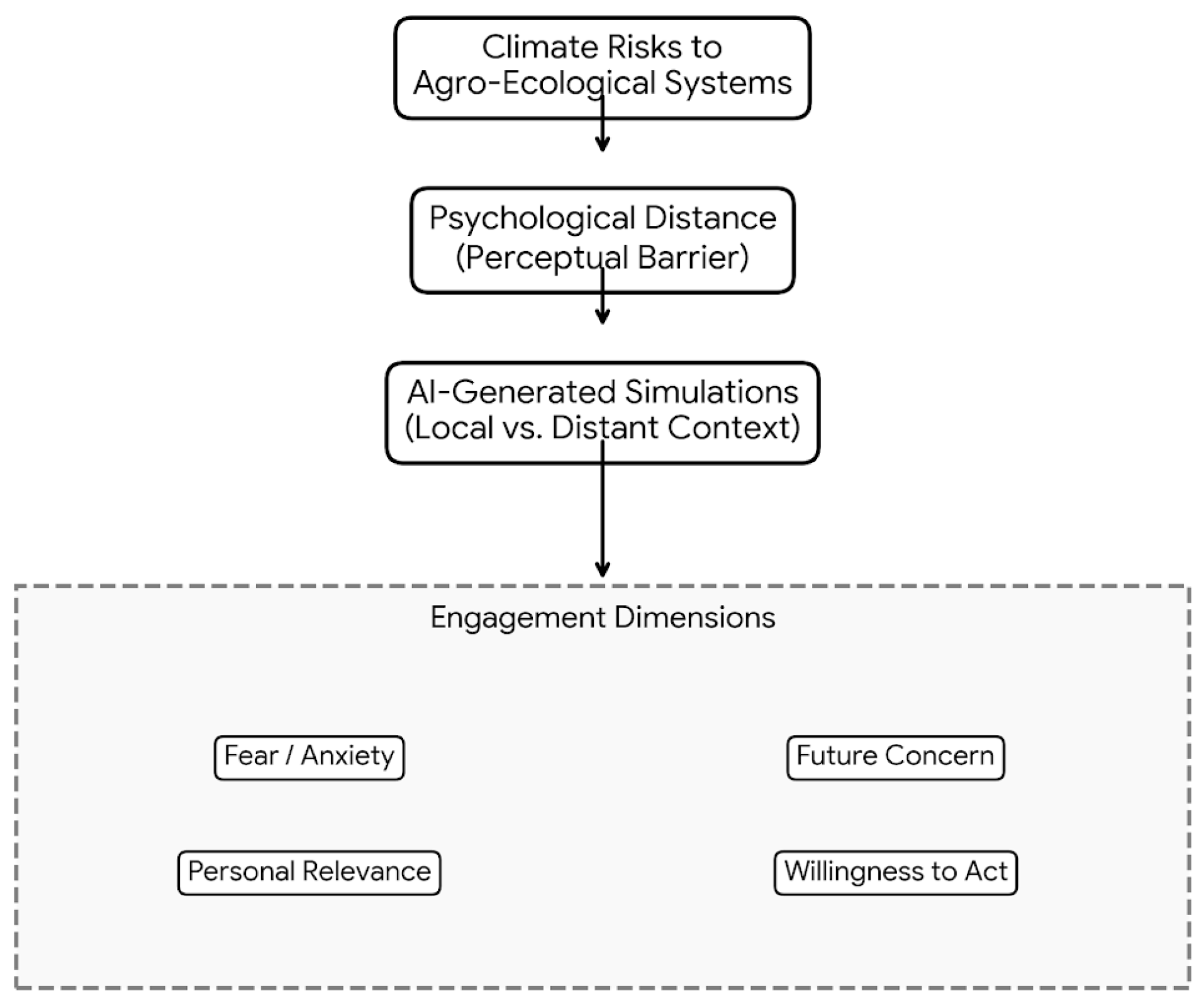
The broader premise of the study is that adaptation requires more than ecological redesign, technological preparedness, or policy support in isolation. It also requires forms of communication capable of making climate risks tangible, locally legible, and publicly intelligible. In that sense, AI-generated simulation is not treated here as a substitute for adaptation itself. Rather, the study asks whether such communication can help create the conditions under which adaptation becomes more visible, emotionally compelling, and socially supportable. The findings suggest that this possibility warrants further investigation. The conceptual structure of the study is illustrated in Figure 1.
Figure 1 presents the conceptual logic underlying the study. It illustrates how climate risks affecting agricultural and agro-ecological systems may remain psychologically distant to the public, thereby limiting engagement. The figure then positions AI-generated simulations as a communicative intervention designed to reduce this perceptual barrier by presenting hazards in either local or geographically distant contexts. Finally, it summarizes the four response dimensions examined in the study—fear/anxiety, future concern, personal relevance, and self-reported willingness to act—which together capture the main forms of public engagement assessed in the empirical design. Given the absence of pre-exposure measurement and the use of comparative ranking data, the study should be understood as an exploratory examination of relative engagement with different AI-generated climate-disaster scenarios. Its aim is not to measure behavioral change over time, but to identify whether locally framed simulations are perceived as more salient than geographically distant ones within a controlled comparative setting.

2. Materials and Methods

In addition to the experimental design, the study is conceptually informed by established methodological approaches used in interdisciplinary research at the intersection of sustainability, governance, and artificial intelligence. Following the framework outlined by Peráček and Kaššaj, the research process integrates several complementary methods, including analysis, comparison, synthesis, and abstraction [22]. While this framework informs the conceptual structure of the study, the empirical analysis itself relies on the experimental design described below.
Analytical elements are reflected in the structured examination of participant responses across multiple dimensions of climate-risk perception. Comparison is applied through the systematic evaluation of different hazard types and geographic framings, enabling the identification of consistent patterns across conditions. Synthesis is used in the interpretation of findings, where empirical observations are integrated with theoretical perspectives from climate communication and agro-ecological resilience. Finally, abstraction supports the derivation of broader conceptual insights from specific experimental outcomes, particularly in relation to the role of psychological distance and local contextualization.
This combined methodological perspective strengthens the interpretive coherence of the study and aligns it with contemporary interdisciplinary approaches to sustainability research. Consistent with this framework, analytical and comparative elements are primarily reflected in the Results section, while synthesis and abstraction are more prominent in the Discussion and Conclusions, where empirical findings are integrated into broader conceptual insights.
The study employed an experimental survey design to examine how AI-generated audiovisual simulations of climate-related disasters influence public engagement with climate risks. The research focused on whether the geographic framing of a hazard—local versus geographically distant—affects emotional, cognitive, and action-oriented responses. To address this question, respondents were exposed to a set of short AI-generated films and were then asked to evaluate the relative impact of each scenario across several dimensions relevant to climate-risk perception.
The sample comprised 402 adult respondents recruited to approximate the general Jewish population in Israel. Recruitment was based on stratified quotas designed to ensure broad proportional representation across key demographic categories, including gender, age group, geographic region, education level, and religiosity. In accordance with the panel sampling frame, the study did not include Haredi or Arab populations. Eligibility criteria required current residence in Israel and fluency in Hebrew, so that all participants could fully understand the content of the videos and the accompanying survey questions. Participation was voluntary and contingent upon electronic informed consent. The consent form described the aims of the study, clarified the use of AI-generated materials, noted the possibility of mild emotional discomfort, and stated explicitly that participants could discontinue viewing any video or withdraw from the study at any point without penalty.
The stimulus set consisted of four short AI-generated films depicting climate-related disaster scenarios: wildfires in Israel, wildfires abroad, tsunamis in Israel, and tsunamis abroad. Each film was approximately 90 to 130 s in length. The set was constructed so that the scenarios differed primarily along two dimensions: hazard type and geographic framing. Two films depicted wildfire and two depicted tsunami-related destruction, while within each hazard category, one film was framed in a local Israeli context and the other in a geographically distant context. This design made it possible to compare responses not only across types of hazards, but also across different degrees of perceived proximity. Each participant viewed all four videos. To reduce the possibility that one scenario would systematically benefit from appearing earlier or later in the sequence, the order of presentation was varied across respondents within the online questionnaire. This counterbalancing procedure was intended to distribute potential sequence effects across the sample. However, the present study did not include a separate formal analysis of order effects, and the procedure should therefore be understood as a design precaution rather than as an independently evaluated source of variance control. Future studies should incorporate formal testing of order and contrast effects in order to better isolate potential sequence-related influences on comparative rankings.
Immediately after viewing the full stimulus set, participants completed a series of comparative ranking tasks. For each of the four evaluative dimensions—fear or anxiety, concern about future implications, perceived personal relevance, and willingness to take action—participants were asked to consider the four films together and rank them from the most impactful to the least impactful. In practical terms, respondents were required to decide which film elicited the strongest response on a given dimension and which elicited the weakest, thereby generating a relative ordering of the four scenarios within the same participant.
A ranking format was selected because the study was designed to compare the relative salience of four closely related stimuli presented within a single session. The aim was therefore not to estimate an absolute score for each film in isolation, but to identify which combinations of hazard type and geographic framing were experienced as more or less impactful when participants considered the full set comparatively. This design supports within-participant comparison, but it also means that the resulting data are ipsative and should be interpreted as relative rather than fully independent absolute evaluations. Accordingly, the study should be understood primarily as an exploratory comparative perception study rather than as a fully controlled causal experiment.
Data were analyzed using IBM SPSS Statistics Version 29.0 (IBM Corp., Armonk, NY, USA). The analytic plan was descriptive and comparative. Mean ranks were calculated for each video within each evaluative dimension, and subgroup comparisons were used to examine directional variation across gender, age, education, religiosity, region, and political orientation. Because the study relied on relative rankings rather than independent rating scales, the analysis focused on comparative response patterns across scenarios and groups rather than on absolute levels of response to any single stimulus.
The analysis combined descriptive statistics with non-parametric inferential tests appropriate for ranked data. Mean ranks were calculated for each scenario across all evaluative dimensions. In addition, Friedman tests were conducted to assess differences between scenarios within participants. Given the ipsative nature of the ranking data, inferential results should be interpreted as supplementary indicators of internal consistency within the comparative ranking structure.
The study was conducted in accordance with the approval of the institutional ethics committees of both Yezreel Valley College and the Holon Institute of Technology. Ethical approval was granted under protocol numbers EMEK YVC 58-2025 and EE_HIT_01/25, respectively. All participants provided informed consent prior to exposure to the video materials and completion of the questionnaire. The study did not employ a pre-test/post-test design. Accordingly, it does not estimate the change in engagement before and after exposure to the videos. Rather, it compares participants’ relative responses to four AI-generated scenarios after exposure. The findings should therefore be interpreted as comparative evidence of scenario salience and perceived engagement, not as direct evidence of individual-level change over time.
Although the stimuli were designed to maintain consistency in duration, narrative structure, pacing, and visual style, no formal pre-testing procedure was conducted to independently validate equivalence across conditions. The development process focused on internal consistency and expert review rather than external validation. No formal pretest was conducted to independently assess perceived realism, emotional intensity, or equivalence between videos.
The study therefore cannot fully isolate the effects of AI generation itself from broader effects related to audiovisual storytelling, visual salience, or localized framing.

3. Results

3.1. Sample Characteristics

The distribution of respondents was broadly balanced across the main demographic categories defined in the sampling framework. Women constituted 52% of the sample and men 48%. The age distribution was approximately even across three groups, with about one-third of respondents aged 18–34, one-third aged 35–54, and one-third aged 55 and above. Geographically, nearly half of the participants resided in the Center and Tel Aviv regions, with additional representation from Haifa, Jerusalem, the South, and the North, as well as a small minority from the West Bank. In terms of education, most respondents reported secondary or post-secondary non-academic education, approximately one-quarter held at least a bachelor’s degree, and smaller groups reported lower levels of schooling. Regarding religiosity, about 63% identified as secular, 24% as traditional, and 13% as religious.

3.2. Comparative Rankings Across the Four Scenarios

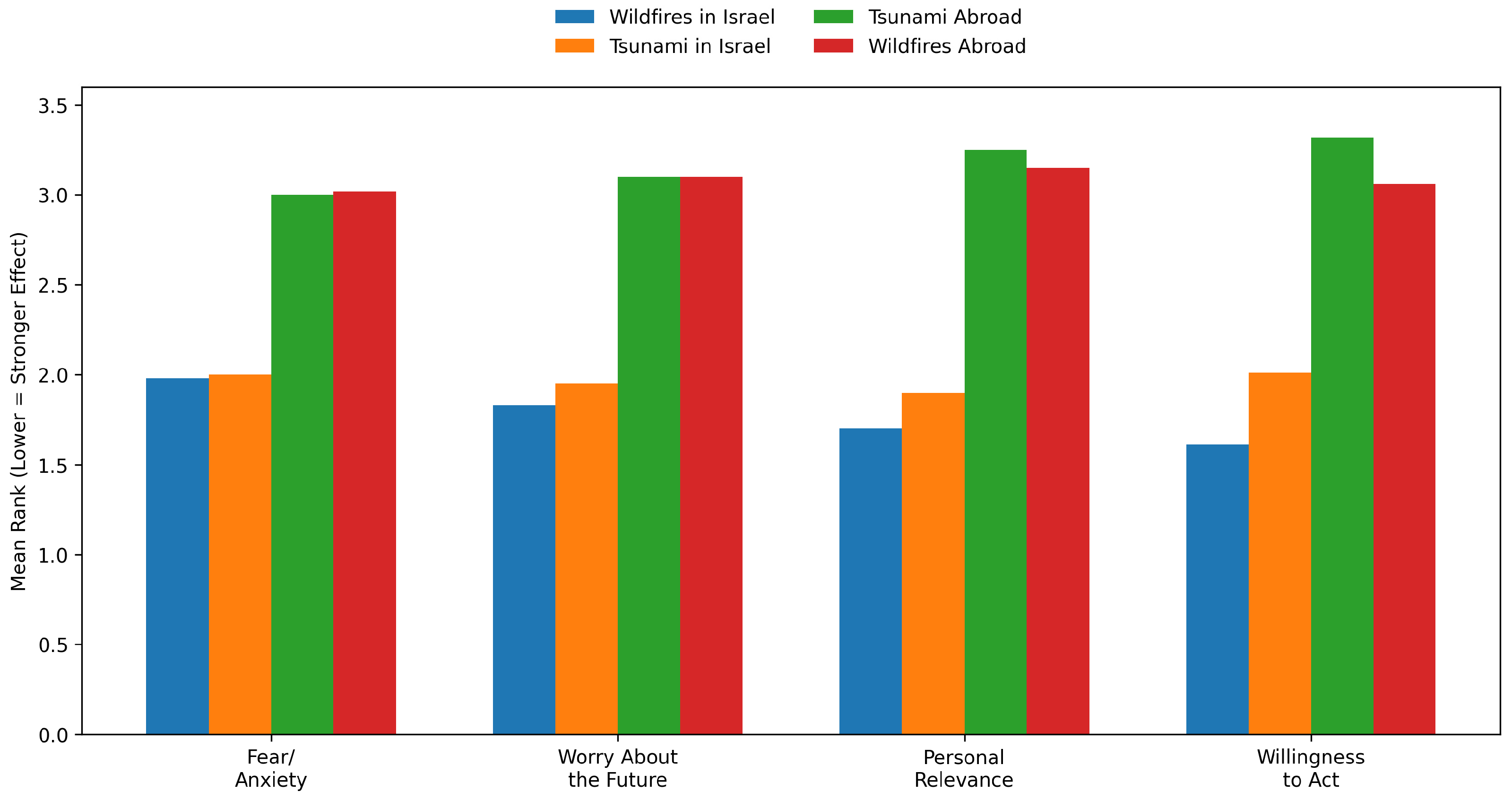
Across all four evaluative dimensions, scenarios framed in the Israeli context were ranked as more impactful than those framed in geographically distant contexts, with lower mean ranks indicating stronger effects. Among all four scenarios, Wildfires in Israel consistently produced the strongest responses. For fear and anxiety, Wildfires in Israel received a mean rank of 1.98 and Tsunamis in Israel a mean rank of 2.00, compared with 3.00 for Tsunamis Abroad and 3.02 for Wildfires Abroad. A similar pattern emerged for worry about the future, with Wildfires in Israel receiving the strongest mean rank (1.83), followed by Tsunamis in Israel (1.95), whereas both geographically distant scenarios were rated substantially weaker at approximately 3.10. For personal relevance, Wildfires in Israel again received the strongest ranking (1.70), followed by Tsunamis in Israel (1.90), while Tsunamis Abroad and Wildfires Abroad were ranked much lower, at 3.25 and 3.15, respectively. Willingness to act followed the same general pattern: Wildfires in Israel received the lowest mean rank (1.61), indicating the strongest motivating effect, followed by Tsunami in Israel (2.01), while the two geographically distant scenarios fell within a substantially weaker range of 3.06 to 3.32. These findings indicate a clear and consistent advantage of local framing over geographically distant framing across emotional, cognitive, and motivational dimensions. They also show that the wildfire scenario in the Israeli context was the most influential condition throughout the analysis.

3.3. Visual Summary of the Main Pattern

Figure 2 presents the mean ranks assigned to the four AI-generated climate-disaster scenarios across the study’s four evaluative dimensions: fear/anxiety, worry about the future, personal relevance, and willingness to act. A stable pattern is evident across all measures. Scenarios framed in the Israeli context were consistently ranked as more impactful than those framed in geographically distant contexts, and Wildfires in Israel produced the strongest overall effect. Tsunami in Israel was also evaluated as relatively impactful, although consistently to a lesser extent than the local wildfire scenario. By contrast, both geographically distant scenarios received markedly higher mean ranks, indicating weaker emotional, cognitive, and behavioral influence. Overall, the figure reinforces the conclusion that local contextualization substantially strengthened participants’ responses to the simulated climate-disaster scenarios.
To examine whether the observed differences between scenarios were statistically meaningful, Friedman tests were conducted for each evaluative dimension. The results indicated significant differences between the four scenarios for emotional response (χ2(3) = 65.32, p < 0.001), future concern (χ2(3) = 70.93, p < 0.001), perceived personal relevance (χ2(3) = 83.48, p < 0.001), and willingness to act (χ2(3) = 79.68, p < 0.001). These findings indicate that the comparative ranking patterns were statistically consistent across participants within the constraints of the ranking-based design.
As shown in Figure 2, the mean ranking patterns are consistent across all evaluative dimensions. The statistical analysis confirms that these differences are not only descriptively consistent but also statistically significant across all dimensions.

3.4. Demographic Patterns

Subgroup analyses revealed consistent directional differences across population groups. Women showed stronger responses than men across all four outcome dimensions, with the largest gap observed for willingness to act. Younger respondents aged 18–34 reported somewhat higher fear and greater perceived personal relevance, particularly in response to the Wildfires in Israel scenario, although the overall pattern of stronger responses to local compared with distant scenarios remained stable across age groups. Higher educational attainment, especially among respondents with a bachelor’s degree or above, was associated with greater worry about future implications and a stronger willingness to act. Differences by religiosity followed a clear gradient, with secular participants showing stronger engagement than traditional participants, who in turn reported stronger responses than religious participants on fear, worry, and willingness to act. At the same time, the contrast between local and geographically distant scenarios remained evident across all religiosity groups. Regional variation was also observed: respondents from areas more prone to fire, particularly the North and Jerusalem, showed stronger reactions to wildfire scenarios, whereas participants from Tel Aviv and the Center displayed somewhat greater responsiveness to tsunami scenarios.

3.5. Overall Interpretation of the Results

Taken together, the findings demonstrate a clear and internally consistent pattern. Across all four evaluated dimensions, local framing increased perceived impact relative to geographically distant framing. This effect was especially pronounced for the Wildfires in Israel scenario, which emerged as the strongest condition throughout the analysis. The results therefore suggest that local contextualization plays a central role in shaping public engagement with AI-generated representations of climate-related disasters.
A structured summary of the main findings and their theoretical and practical implications is presented in Table 1. Overall, the findings suggest that both geographic proximity and hazard type play a significant role in shaping public engagement with climate-related risks.

4. Discussion

The findings directly address the research questions outlined in the Introduction. Specifically, the results suggest that local framing is associated with stronger perceived engagement with climate risks (RQ1), while differences between hazard types highlight the role of perceived plausibility and familiarity (RQ2). In addition, demographic patterns suggest that individual characteristics may moderate these effects (RQ3).
Importantly, the inferential analysis supports the internal consistency of the comparative ranking patterns observed across participants, within the constraints of the ranking-based design.
The main finding of this study is straightforward: AI-generated climate-disaster simulations had a stronger impact when the scenarios were presented in a local Israeli context than when the same types of hazards were framed as occurring abroad. This pattern was consistent across all four dimensions examined: fear and anxiety, concern about future implications, perceived personal relevance, and willingness to act. The results therefore suggest that geographic proximity matters not only for how climate risks are understood but also for how strongly they are felt. These patterns are consistent with the conceptual framework presented in Figure 1.
It should also be acknowledged that the experimental stimuli were not explicitly designed to depict agricultural or agro-ecological systems. While wildfires and coastal hazards have well-documented implications for agricultural landscapes, soil systems, and water resources, the videos primarily presented general disaster scenarios rather than farming-specific impacts. As a result, participant responses may partly reflect reactions to general environmental risk imagery rather than direct consideration of agro-ecological processes. This distinction limits the extent to which the findings can be interpreted as evidence of engagement with agriculture-specific risks.
Accordingly, the study should be interpreted primarily as an examination of climate-disaster communication with indirect relevance to agro-ecological resilience rather than as a direct assessment of agricultural perception or farming-system adaptation.
Among the four scenarios, Wildfires in Israel produced the strongest overall response. It received the lowest mean ranks across all dimensions, indicating the highest perceived impact. This finding is meaningful in several ways. First, wildfire appears to function as a highly salient hazard in the Israeli context. Second, the result suggests that participants did not respond only to the visual intensity of the videos, but also to the degree to which the event felt plausible and locally relevant. In other words, the local wildfire scenario seems to have combined emotional immediacy with contextual credibility. In the broader context of agricultural sustainability, it is important because wildfire is not only a dramatic event; it is also a potential threat to land, vegetation, soil quality, water retention, and the resilience of productive landscapes [1,4,5].
The tsunami scenarios followed the same general pattern, although with weaker overall responses than wildfire. Here too, the Israeli scenario was consistently ranked as more impactful than the geographically distant one. This suggests that even when a hazard is less central to everyday public imagination, local framing still increases its relevance. The result is especially useful for interpretation because it shows that the study is not simply capturing one particularly strong reaction to wildfire. Rather, it points to a broader effect of local contextualization across different hazard types. Substantively, the tsunami condition also served an important comparative purpose. While less immediately familiar than wildfire in the Israeli context, it represents a form of acute hydrological and coastal disruption that can still affect agro-ecological systems through flooding, soil degradation, infrastructure damage, and interruption of water and food-system functions. Its inclusion therefore made it possible to test whether local framing strengthens engagement only for highly familiar hazards or also for hazards that are less central to everyday public imagination.
This weaker response may also reflect lower perceived plausibility of tsunami events in the Israeli context, rather than psychological distance alone, suggesting that hazard credibility plays an additional role in shaping engagement.
The interpretation of local framing should also be distinguished from hazard familiarity and place-based exposure. A local scenario may be more impactful not only because it is nationally familiar, but also because some participants may associate it with residential proximity, prior disaster experience, or perceived vulnerability of places they know. For example, residents of fire-prone or hilly areas may respond more strongly to wildfire imagery, while residents of coastal areas may be more attentive to tsunami or inundation scenarios. The present study included regional comparisons, but it did not directly measure prior disaster experience, distance from hazard-prone landscapes, proximity to agricultural land, or professional involvement in farming. These factors may partly explain variation in risk perception and should be examined directly in future studies.
The demographic patterns were also consistent and interpretable. Women showed stronger responses than men, especially in willingness to act. Younger participants reported somewhat greater emotional engagement and personal relevance, and respondents with higher education showed greater concern and stronger readiness to respond. This pattern is also broadly consistent with research suggesting that younger adults often express stronger sustainability-oriented value profiles, which may increase receptivity to environmental messaging and future-oriented risk frames [26,27,28]. These differences did not overturn the main pattern. Across groups, local framing remained more effective than distant framing. This suggests that the local-context effect is relatively robust, even though its intensity may vary across social categories. The finding is useful because it indicates that localized communication may have broad public value rather than being limited to one narrow subgroup.
The findings also align with evidence from other national contexts showing that climate-risk perception is shaped by proximity, social context, and locally meaningful forms of communication. Research in South Korea has shown that perceived proximity to climate threats is associated with stronger pro-environmental responses, while studies in the United Kingdom point to generational differences in climate-related beliefs, risk perception, and emotions [10,26]. Work on farmer perceptions in India further shows that adaptation attitudes are shaped by local climatic experience and livelihood conditions [13]. Similarly, studies of smallholder farmers in South Africa and participatory ecosystem-based assessment in Tajikistan emphasize that climate adaptation is strongly mediated by local knowledge, community context, and practical exposure to environmental change [29,30]. These comparisons suggest that the Israeli findings should be understood as part of a broader international pattern: climate communication becomes more meaningful when it connects abstract hazards to locally recognizable risks, while the specific strength of response depends on cultural, geographic, and livelihood contexts.
What this study shows most clearly is that climate-risk communication becomes stronger when it is anchored in recognizable places. That point is especially relevant for agriculture and agro-ecological systems, where many climate-related threats are diffuse, cumulative, or unevenly distributed. Soil degradation, water stress, salinization, declining productivity, and ecological instability often do not appear as single dramatic events in public consciousness, even when their long-term effects are severe. By contrast, the videos used here made climate disruption visible in ways that could be more readily interpreted as immediate and socially meaningful. The findings suggest that locally contextualized visual communication may help make climate-related environmental risks more concrete and publicly intelligible.
Another important boundary of the study concerns the population examined. The research focused on a general public sample rather than on agro-ecological operators, farmers, environmental professionals, or policy stakeholders. This distinction matters because professional or experiential proximity to agricultural systems may shape climate-risk perception differently from general public exposure. Farmers and environmental practitioners may evaluate wildfire, flooding, drought, or coastal hazards through direct operational concerns such as land productivity, water availability, soil degradation, infrastructure loss, and livelihood risk. By contrast, non-specialist publics may respond more strongly to visual salience, national familiarity, or perceived emotional immediacy. Future research should therefore compare general public audiences with agro-ecological stakeholders in order to examine whether AI-generated simulations operate similarly across expert, practitioner, and lay groups.
This has practical implications for awareness and resilience. Public-facing climate communication also matters because the way risks and responses are represented can shape whether audiences attend not only to the threat itself, but also to possible forms of action and adaptation [31,32]. The literature on agro-ecological adaptation repeatedly shows that communities do not always respond to environmental decline when degradation is gradual or difficult to interpret. Climate communication, therefore, is not only a matter of dissemination. It can influence whether risks are recognized early enough to support discussion, learning, and adaptive action [1,3,6]. In this sense, the value of AI-generated simulations may lie less in technological novelty and more in their ability to make climate threats concrete. If a hazard is seen as local, visible, and personally relevant, it may be more likely to enter public discussion and to generate broader support for resilience-oriented strategies.
These findings also resonate with a broader body of literature emphasizing the role of environmental awareness and collective learning in strengthening agro-ecological resilience. Increasing awareness among farmers and local communities has been shown to reduce cognitive and cultural barriers to the adoption of sustainable practices, particularly when environmental degradation is gradual or not immediately visible [29,33,34].
At the community level, awareness contributes to the development of social capital and collective action, enabling knowledge sharing, cooperative resource management, and adaptive experimentation. Farmer-to-farmer knowledge networks and participatory approaches have proven effective in disseminating agro-ecological practices and strengthening local resilience under climatic stress [29,30,33,34].
Moreover, reflective learning processes that integrate scientific knowledge with local and traditional expertise allow communities to better interpret environmental signals and adapt their practices over time. Such processes are especially important in agricultural systems, where long-term sustainability depends on both ecological understanding and social organization. In this sense, communication tools—such as the AI-generated simulations examined in this study—may play a complementary role by enhancing awareness, supporting interpretation, and fostering engagement across different social groups.
Because the study did not compare AI-generated simulations with non-AI visual materials, the findings should not be interpreted as evidence that AI-based communication is inherently superior to traditional visual communication approaches.
The study also demonstrates that AI-generated simulations can function as exploratory audiovisual stimuli for examining comparative climate-risk perception within controlled survey settings.
Several limitations should be acknowledged. First, the study relied on a comparative ranking design rather than independent rating scales. Because participants were required to rank the four films relative to one another, the resulting data are ipsative: assigning a higher position to one scenario necessarily lowers the position of another. The findings should therefore be interpreted as evidence of relative salience within the stimulus set rather than as fully independent estimates of absolute emotional or behavioral response to each film. Second, because the ranking procedure generated inherently interdependent responses, the inferential statistics reported in this study should not be interpreted as independent estimates of effect magnitude. Rather, they serve only as supplementary indicators supporting the consistency of the comparative ranking patterns observed across participants. Third, although presentation order was varied across respondents in order to reduce possible sequence effects, the study did not include a separate analysis of order effects. In addition, the absence of a pre-test/post-test structure limits the ability to evaluate changes in engagement following exposure to the videos. Fourth, while the films were designed to be broadly comparable in duration, structure, pacing, and tone, any audiovisual stimulus set inevitably retains residual variation that may influence audience response. Finally, the sample was designed to approximate the Jewish population in Israel within the panel framework and did not include Haredi or Arab populations; the findings should therefore not be generalized to the Israeli population as a whole or interpreted as proof of real-world behavioral or policy change. The exclusion of agricultural operators, farmers, and environmental practitioners further limits the ability to generalize the findings directly to agro-ecological stakeholder groups.
Even with these limitations, the findings are meaningful. They indicate that locally framed AI-generated disaster simulations can make climate risks feel closer, more relevant, and more actionable. For agricultural and agro-ecological systems, this matters because resilience depends not only on ecological practices and institutional support, but also on whether climate risks are publicly understood in ways that justify attention and response. The present study suggests that visual communication grounded in familiar contexts may help strengthen that understanding.
These implications may extend beyond local risk visualization alone. Recent work suggests that AI can also strengthen climate adaptation by improving the quality and reliability of public climate communication and by supporting disaster preparedness and response in high-risk environments. AI-driven misinformation frameworks can be used to classify climate-related content on social media, assess credibility, detect emerging false narratives, and help decision makers respond more effectively to distorted or polarizing discourse [35]. In parallel, research on marine disaster risk reduction shows that AI can contribute across the disaster cycle, from pre-disaster forecasting and infrastructure vulnerability assessment to real-time emergency response, damage evaluation, and post-disaster recovery planning [36]. Taken together, these developments suggest that the value of AI in climate adaptation lies not only in making risks more visible but also in helping societies interpret information more reliably, respond more quickly, and build more resilient systems under conditions of growing environmental uncertainty.
The contextual specificity of the study should also be emphasized. The sample reflects a particular socio-cultural and geographic setting, and the observed effects may be influenced by locally salient environmental conditions, media exposure, and collective experience with specific hazards. For example, wildfire represents a highly familiar and plausible risk in the Israeli context, which may amplify its perceived relevance independently of the local-versus-distant framing manipulation. As a result, the findings should not be interpreted as universally generalizable, but rather as context-dependent insights that may vary across different environmental, cultural, and institutional settings.
Previous research has shown that climate-risk perception is strongly shaped by cultural context, lived experience, and local environmental conditions, which may lead to substantial variation in responses across regions and populations [30].
It is also possible that subtle differences in visual intensity, narrative emphasis, or perceived realism across the videos contributed to the observed differences in responses. While efforts were made to standardize the stimuli, the absence of formal pre-testing means that stimulus-related variation cannot be fully ruled out as a contributing factor.
From this perspective, the contribution of AI-based visualization should be understood as part of a broader communicative and institutional ecosystem. While such tools may enhance salience and perceived relevance, their effectiveness ultimately depends on how they interact with existing knowledge systems, governance structures, and socio-economic conditions. This reinforces the view that communication is not an isolated driver of adaptation, but one component within a multi-layered process of socio-ecological change.


5. Conclusions

These results provide exploratory comparative evidence for interpreting the role of geographic framing and hazard type in shaping climate-risk engagement. The findings consistently indicate that local contextualization enhances perceived engagement. However, these results reflect relative scenario salience rather than direct behavioral change.
The results also suggest that communication should be considered part of the broader adaptive capacity of socio-ecological systems. Resilience depends on ecological diversification, soil and water management, local knowledge, and institutional support, but it also depends on whether risks are publicly understood in ways that justify attention and response [1,2,3,4,5,6,8]. AI-generated simulations may contribute to this process, helping make climate threats appear more immediate and socially intelligible to participants within the study setting, especially for audiences who are not directly engaged in agriculture but whose awareness and support are potentially relevant to broader adaptation discourse.
The statistical analysis supports the consistency of the observed patterns, although the results should be interpreted within the constraints of the ranking-based design.
A further implication of the study is that the role of AI in climate adaptation extends beyond visual communication alone. In agricultural contexts, artificial intelligence is increasingly relevant to crop forecasting, vulnerability assessment, pest detection, and the interpretation of large and complex environmental datasets [16,18,19,20,21,35,36].
The present study does not claim that AI-generated simulations lead to actual behavioral change; rather, they contribute to shaping perceptions that are relevant to adaptive behavior or policy change. What it does show is that they may help reduce psychological distance and strengthen forms of engagement that are relevant to adaptation. That contribution is modest, but it is meaningful. For agricultural and agro-ecological systems under increasing climatic pressure, the ability to communicate risks in ways that are locally legible, emotionally credible, and publicly accessible may become an important condition for building resilience over time [10,15,16,17,18,19,20,21].
It is important to note that the study does not measure actual behavioral change or real-world decision-making. The findings relate to perceived engagement and self-reported responses within a controlled experimental setting. Accordingly, the implications for policy and practice should be understood as indicative rather than predictive, highlighting potential pathways through which communication strategies may influence public perception rather than demonstrating direct causal effects.
This distinction is consistent with broader research emphasizing that changes in awareness and perception do not automatically translate into behavioral change, particularly in complex socio-ecological systems where structural and institutional factors also play a significant role [33].
While the findings should be interpreted within the methodological and contextual limitations of the study, they nevertheless suggest that localized audiovisual climate-risk communication may warrant further investigation within broader sustainability and resilience research.

Author Contributions

Conceptualization, H.F. and V.E.; methodology, H.F. and V.E.; software, H.F. and V.E.; validation, H.F. and V.E.; formal analysis, H.F. and V.E.; investigation, H.F. and V.E.; resources, H.F. and V.E.; data curation, H.F. and V.E.; writing—original draft preparation, H.F. and V.E.; writing—review and editing, H.F. and V.E.; visualization, H.F. and V.E.; supervision, H.F. and V.E.; project administration, H.F. and V.E.; funding acquisition, H.F. and V.E. All authors have read and agreed to the published version of the manuscript.

Funding

This research was funded by the Joint Research Fund of The Max Stern Yezreel Valley College and Holon Institute of Technology (HIT).

Institutional Review Board Statement

The study was conducted in accordance with the Declaration of Helsinki and approved by the Institutional Ethics Committees of The Max Stern Yezreel Valley College and the Holon Institute of Technology (HIT) (protocol code EMEK YVC 58-2025, approved on 1 September 2025; protocol code EE_HIT_01/25, approved on 21 September 2025).

Informed Consent Statement

Informed consent was obtained from all subjects involved in the study.

Data Availability Statement

The data presented in this study are available from the corresponding author on reasonable request, subject to ethical and privacy restrictions.

Acknowledgments

The authors would like to thank Avishai Goldstein, the AI-generated audiovisual simulation materials used in this study, for his professional contribution to the development and production of the climate-disaster scenarios presented to participants. The authors also acknowledge the use of generative artificial intelligence tools during the creation of the audiovisual simulation materials and for limited editorial and language-support purposes during manuscript preparation. All study design decisions, data analysis, interpretation of findings, and final manuscript content remain the sole responsibility of the authors.

Conflicts of Interest

The authors declare no conflicts of interest.

References

  1. Altieri, M.A.; Nicholls, C.I.; Henao, A.; Lana, M.A. Agroecology and the design of climate change-resilient farming systems. Agron. Sustain. Dev. 2015, 35, 869–890. [Google Scholar] [CrossRef]
  2. Domptail, S.; Easdale, M.H.; Yuerlita. Managing socio-ecological systems to achieve sustainability: A study of resilience and robustness. Environ. Policy Gov. 2013, 23, 30–45. [Google Scholar] [CrossRef]
  3. Haro, A.; Mendoza-Ponce, A.; Calderón-Bustamante, Ó.; Velasco, J.A.; Estrada, F. Evaluating risk and possible adaptations to climate change under a socio-ecological system approach. Front. Clim. 2021, 3, 674693. [Google Scholar] [CrossRef]
  4. Meza, I.; Siebert, S.; Döll, P.; Kusche, J.; Herbert, C.; Rezaei, E.E.; Nouri, H.; Gerdener, H.; Popat, E.; Frischen, J.; et al. Global-scale drought risk assessment for agricultural systems. Nat. Hazards Earth Syst. Sci. 2020, 20, 695–712. [Google Scholar] [CrossRef]
  5. Verma, K.K.; Song, X.-P.; Kumari, A.; Jagadesh, M.; Singh, S.K.; Bhatt, R.; Singh, M.; Seth, C.S.; Li, Y.-R. Climate change adaptation: Challenges for agricultural sustainability. Plant Cell Environ. 2024, 48, 2522–2533. [Google Scholar] [CrossRef]
  6. Tittonell, P. Assessing resilience and adaptability in agroecological transitions. Agric. Syst. 2020, 184, 102862. [Google Scholar] [CrossRef]
  7. Suarez-Pardo, A.; Villegas-Palacio, C.; Berrouet, L. Resilience in agroecosystems: An index based on a socioecological systems approach. Weather Clim. Soc. 2022, 14, 425–438. [Google Scholar] [CrossRef]
  8. Zenda, M.; Rudolph, M. A systematic review of agroecology strategies for adapting to climate change impacts on smallholder crop farmers’ livelihoods in South Africa. Climate 2024, 12, 33. [Google Scholar] [CrossRef]
  9. Aleksandrova, M.; Gain, A.K.; Giupponi, C. Assessing agricultural systems vulnerability to climate change to inform adaptation planning: An application in Khorezm, Uzbekistan. Mitig. Adapt. Strateg. Glob. Change 2016, 21, 1263–1287. [Google Scholar] [CrossRef]
  10. Park, J.; Chang, K. How perceived proximity to climate change threats affects pro-environmental behaviors in South Korea? Sustainability 2024, 16, 7298. [Google Scholar] [CrossRef]
  11. Bowden, V.; Nyberg, D.; Wright, C. “We’re Going Under”: The role of local news media in dislocating climate change adaptation. Environ. Commun. 2021, 15, 625–640. [Google Scholar] [CrossRef]
  12. Arbuckle, J.G., Jr.; Morton, L.W.; Hobbs, J. Understanding farmer perspectives on climate change adaptation and mitigation: The roles of trust in sources of climate information, climate change beliefs, and perceived risk. Environ. Behav. 2015, 47, 205–234. [Google Scholar] [CrossRef]
  13. Dhanya, P.; Ramachandran, A. Farmers’ perceptions of climate change and the proposed agriculture adaptation strategies in a semi arid region of south India. J. Integr. Environ. Sci. 2016, 13, 1–18. [Google Scholar] [CrossRef]
  14. Zanamwe, N.; Okunoye, A. Role of information and communication technologies in mitigating, adapting to and monitoring climate change in developing countries. Int. J. Inf. Commun. Technol. Res. 2013, 3, 225–232. [Google Scholar]
  15. O’Neill, S.J.; Smith, N. Climate change and visual imagery. WIREs Clim. Change 2014, 5, 73–87. [Google Scholar] [CrossRef]
  16. Schmidt, V.; Luccioni, A.; Teng, M.; Zhang, T.; Reynaud, A.; Raghupathi, S.; Cosne, G.; Juraver, A.; Vardanyan, V.; Hernandez-Garcia, A.; et al. ClimateGAN: Raising climate change awareness by generating images of floods. In Proceedings of the International Conference on Learning Representations (ICLR), Virtual, 25 April 2022. [Google Scholar]
  17. Sheppard, S.R.J. Visualizing Climate Change: A Guide to Visual Communication of Climate Change and Developing Local Solutions; Routledge: London, UK, 2012. [Google Scholar]
  18. Rolnick, D.; Donti, P.L.; Kaack, L.H.; Kochanski, K.; Lacoste, A.; Sankaran, K.; Ross, A.S.; Milojevic-Dupont, N.; Jaques, N.; Waldman-Brown, A.; et al. Tackling climate change with machine learning. ACM Comput. Surv. 2022, 55, 1–96. [Google Scholar] [CrossRef]
  19. Cowls, J.; Stahl-Timmins, J.C.; Caton, L.; Floridi, L. The AI gambit: Leveraging artificial intelligence to combat climate change—Opportunities, challenges, and recommendations. AI Soc. 2022, 38, 283–307. [Google Scholar] [CrossRef]
  20. Marmolejo-Ramos, F.; Workman, T.; Walker, C.; Lenihan, D.; Moulds, S.; Correa, J.C.; Hanea, A.M.; Sonna, B. AI-powered narrative building for facilitating public participation and engagement. Discov. Artif. Intell. 2022, 2, 7. [Google Scholar] [CrossRef] [PubMed]
  21. Zhao, Y. The synergistic effect of artificial intelligence technology in the evolution of visual communication of new media art. Heliyon 2024, 10, e38008. [Google Scholar] [CrossRef]
  22. Peráček, T.; Kaššaj, M. The Impact of Effective Public Administration and European Digital Connectivity on Building Smart Cities: An Analysis of Legal Frameworks, Policy Initiatives and Transformative Impact in the Emerging Era of Artificial Intelligence. Jurid. Trib. 2025, 15, 720–745. [Google Scholar]
  23. Carvalho, R. Climate Change, Urban Planning and Environmental Migrants. Jurid. Trib. 2025, 15, 757–770. [Google Scholar]
  24. Pimbert, M.P.; Barry, B. Let the people decide: Citizen deliberation on the role of GMOs in Mali’s agriculture. Agric. Hum. Values 2021, 38, 1097–1122. [Google Scholar] [CrossRef]
  25. Shcherbak, V.G.; Danko, Y.I.; Tereshchenko, S.; Nifatova, O.; Dehtiar, N.; Stepanova, O.; Yatsenko, V. Circular Economy and Inclusion as Effective Tools to Prevent Ecological Threats in Rural Areas during Military Operations. Glob. J. Environ. Sci. Manag. 2024, 10, 969–986. [Google Scholar] [CrossRef]
  26. Poortinga, W.; Demski, C.; Steentjes, K. Generational differences in climate-related beliefs, risk perceptions and emotions in the UK. Commun. Earth Environ. 2023, 4, 229. [Google Scholar] [CrossRef]
  27. Bush, S.S.; Clayton, A. Facing change: Gender and climate change attitudes worldwide. Am. Polit. Sci. Rev. 2023, 117, 591–608. [Google Scholar] [CrossRef]
  28. Falke, A.; Schröder, N.; Hofmann, C. The influence of values in sustainable consumption among millennials. J. Bus. Econ. 2022, 92, 899–928. [Google Scholar] [CrossRef]
  29. Spies, M.; Schick, A.; Karomatov, S.; Bakokhoja, B.; Zikriyokhon, K.; Jobirov, S.; Bloch, R.; Ibisch, P.L. Adapting a Participatory and Ecosystem-Based Assessment Impacted by the Pandemic: Lessons Learned with Farmers in Tajikistan. Front. Sustain. Food Syst. 2021, 5, 750252. [Google Scholar] [CrossRef]
  30. Mkhize, N.; Zwane, E.; Mudhara, M. The Impact of Climate Variability on the Livelihoods of Smallholder Farmers in South Africa. Atmosphere 2024, 15, 1353. [Google Scholar] [CrossRef]
  31. Dang, T.K.P. Climate change communication in Vietnam’s online newspapers and its implications for climate actions. Sustainability 2025, 17, 1354. [Google Scholar] [CrossRef]
  32. Borth, A.C.; Campbell, E.; Munson, S.; Patzer, S.M.; Yagatich, W.A.; Maibach, E. Are journalists reporting on the highest-impact climate solutions? Findings from a survey of environmental journalists. Journal. Pract. 2022, 16, 443–461. [Google Scholar] [CrossRef]
  33. Levidow, L.; Pimbert, M.; Vanloqueren, G. Advancing the Contributions of European Stakeholders in Farming Systems to Transitions to Agroecology. EuroChoices 2022, 21, 50–57. [Google Scholar] [CrossRef]
  34. Béné, C.; Headey, D.; Haddad, L.; von Grebmer, K. Exploring Resilience Concepts and Strategies within Regional Food Systems: A Systematic Literature Review. Food Secur. 2023, 15, 1201–1220. [Google Scholar] [CrossRef]
  35. Shahbazi, Z.; Jalali, R.; Shahbazi, Z. AI-Driven Framework for Evaluating Climate Misinformation and Data Quality on Social Media. Future Internet 2025, 17, 231. [Google Scholar] [CrossRef]
  36. Luo, J.; Yang, A. Human Adaption to Climate Change: Marine Disaster Risk Reduction in the Era of Intelligence. Sustainability 2024, 16, 9647. [Google Scholar] [CrossRef]
Figure 1. Process model: AI disaster simulations, geographic proximity, and climate risk engagement.
Sustainability 18 06036 g001
Figure 2. Mean ranks of AI-generated climate-disaster scenarios across four evaluative dimensions. Lower mean ranks indicate stronger perceived impact.
Sustainability 18 06036 g002
Table 1. Summary of Core Research Findings, Theoretical Interpretations, and Practical Implications.
Core FindingInterpretationPractical Implication
Locally framed scenarios (Israel) consistently received stronger impact rankings than geographically distant scenarios across all four evaluative dimensions.Geographic proximity and local contextualization effectively reduce psychological distance. This reduction enhances both emotional and cognitive engagement with climate risks.Climate communication strategies should prioritize localized framing to strengthen public responsiveness. This approach can generate broader social support for resilience-oriented strategies.
Wildfire scenarios in the Israeli context produced the strongest responses in terms of fear, future concern, relevance, and motivation to act.Familiar hazards are perceived as more credible and plausible than abstract environmental threats. The immediacy of a recognizable threat increases perceived personal relevance.Fire-related risk communication appears comparatively more salient in the Israeli context. Leveraging locally salient hazards can serve as a potential communication approach for mobilizing public action.
AI-generated audiovisual simulations were associated with increased perceived salience of climate-related disaster risks for a non-specialist audience.AI-based visualization helps bridge the gap between abstract scientific projections and lived experience. It converts complex environmental data into concrete, narratively coherent scenarios.Generative AI tools may support climate communication and public awareness efforts by making environmental risks more concrete and locally intelligible.
Disclaimer/Publisher’s Note: The statements, opinions and data contained in all publications are solely those of the individual author(s) and contributor(s) and not of MDPI and/or the editor(s). MDPI and/or the editor(s) disclaim responsibility for any injury to people or property resulting from any ideas, methods, instructions or products referred to in the content.