1. Introduction
The assessment of humanity’s ecological footprint has become a central issue in environmental economics and sustainability science, as accelerating economic growth increasingly exceeds the regenerative capacity of natural ecosystems. The concept of the ecological footprint, originally developed by W. Rees [
1], M. Wackernagel and B. Beyers [
2], provides an integrative measure of human demand on biocapacity, linking consumption patterns with ecological limits [
1,
2]. From an economic perspective, this framework enables the internalization of environmental externalities and the evaluation of hidden costs associated with resource depletion, biodiversity loss, and climate change. Ecosystems deliver a broad spectrum of services essential for economic and social systems, including carbon sequestration, food provision, water regulation, soil fertility, and air purification. Despite their fundamental importance, these services remain largely undervalued or excluded from conventional economic indicators such as GDP [
3]. As a result, economic growth may appear positive while simultaneously eroding natural capital and undermining long-term productivity. Forest ecosystems deserve particular attention due to their multifunctional role in mitigating ecological footprints. Forests contribute significantly to climate regulation, biodiversity conservation, and food productivity through both direct (non-timber forest products, pollination, soil stabilization) and indirect mechanisms (carbon sinks, hydrological regulation) [
4,
5]. However, increasing deforestation, land-use change, and fossil fuel dependence have intensified ecological pressures, especially in emerging and resource-dependent economies.
Ecosystems provide a wide range of essential services—oxygen production, air and water purification, soil fertility, climate regulation, and biodiversity preservation—that underpin both human well-being and economic development. Yet, these services are often undervalued in decision-making. The economic evaluation of the ecological footprint addresses this gap by quantifying the monetary value of ecosystem services, estimating the economic losses caused by their disruption, and examining the feedback loops between ecological decline and economic productivity. For example, the replacement cost of natural water purification or the economic burden of biodiversity loss can serve as concrete indicators of humanity’s ecological footprint [
3,
4,
6].
Overall, this manuscript argues that an economic evaluation of ecological footprints is not merely a theoretical exercise but a prerequisite for rational policymaking. By revealing the hidden costs of environmental degradation and the tangible benefits of conservation, such research supports the formulation of evidence-based policies that align with the Sustainable Development Goals (SDGs) and international agreements such as the Paris Agreement.
The growing imbalance between economic growth and the regenerative capacity of natural ecosystems represents one of the most pressing challenges of the twenty-first century. Humanity’s ecological footprint now exceeds global biocapacity, placing increasing pressure on forest ecosystems that underpin food security, climate stability, and economic resilience. For developing and resource-dependent economies in particular, ecological degradation directly translates into reduced agricultural productivity, increased vulnerability to climate shocks, and long-term economic instability.
Despite the widespread recognition of these challenges, ecological footprint indicators remain insufficiently integrated into economic decision-making. Traditional macroeconomic indicators, such as GDP, fail to account for the depletion of natural capital, leading to an overestimation of economic performance. This gap is particularly problematic for countries heavily reliant on natural resources, where short-term growth often masks long-term ecological and economic losses.
This study addresses the following research question: How do economic activities affect forest ecosystem productivity and associated ecosystem services, and what are the resulting economic costs when evaluated through the ecological footprint framework? To answer this question, a comparative analysis is conducted across selected developed and developing economies. The selected countries represent different levels of economic development, institutional capacity, dependence on forest ecosystems, and approaches to environmental–economic accounting, allowing for meaningful comparison and policy-relevant insights.
The empirical scope of this study includes selected developed and emerging economies (EU-27, United States, China, Brazil, India, South Africa, Canada, and Japan). These countries were selected to reflect different levels of economic development, institutional capacity, dependence on forest ecosystems, and approaches to environmental–economic accounting. This comparative design allows the identification of structural differences in how ecological footprints interact with food productivity and forest ecosystem services across diverse economic systems. The selected countries represent a diverse range of economic development, institutional capacity, dependence on natural capital, and environmental–economic accounting frameworks. This variation enables meaningful comparison of how different economic systems interact with forest ecosystem productivity and ecological footprint dynamics.
The relationship between economic growth and environmental sustainability remains one of the central challenges in contemporary economics. While traditional macroeconomic indicators such as GDP capture market-based production, they fail to account for the depletion of natural capital and ecosystem services. However, despite extensive recognition of this limitation, the empirical integration of biodiversity and environmental indicators into macroeconomic modeling remains uneven and methodologically inconsistent. Existing studies in ecological economics increasingly apply panel data techniques, yet there is still a need for systematic, reproducible models that explicitly connect biodiversity, environmental pressure, and economic outcomes within a unified econometric framework. In particular, cross-country analyses often lack clear variable operationalization and transparent data structures, limiting their comparability and policy relevance.
Although datasets provided by Eurostat and Statista enable comprehensive cross-country analysis, many studies rely on descriptive comparisons or secondary interpretations rather than conducting original statistical modeling. This creates a gap between the availability of harmonized environmental and economic data and the application of rigorous econometric methods to test causal relationships.
The objective of this study is to empirically assess the impact of natural capital and environmental factors on economic performance using a panel data approach across European Union countries. Specifically, the study aims to integrate biodiversity and environmental indicators into a macroeconomic model, test their statistical significance, and evaluate their implications for sustainable economic policy.
To move beyond descriptive analysis, the study formulates three testable hypotheses:
H1. Biodiversity and ecosystem integrity have a positive and statistically significant effect on GDP per capita.
H2. Environmental degradation, proxied by greenhouse gas emissions, negatively affects economic performance.
H3. Green transition variables, including renewable energy share and environmental protection expenditure, positively contribute to long-term economic growth.
This study contributes to the literature in three key ways. Methodological contribution: it applies a panel econometric model with fixed effects, addressing the lack of rigorous empirical testing in prior descriptive studies. Data transparency: it provides a reproducible data dictionary and explicit variable definitions, resolving ambiguity in previous research (e.g., biodiversity measurement). Empirical contribution: it generates original statistical results based on harmonized cross-country data, rather than reproducing existing findings. The remainder of the paper is organized as follows:
Section 2 reviews the relevant literature;
Section 3 presents the data and methodology;
Section 4 reports the empirical results;
Section 5 discusses the findings; and
Section 6 concludes the paper.
2. Theoretical Background and Current State of Knowledge
The economic evaluation of ecological footprints and ecosystem services has evolved over the last three decades from conceptual discussions to empirical, data-driven research. The literature demonstrates a progression from early normative arguments for sustainability toward sophisticated quantitative models that integrate ecological, economic, and social dimensions [
5,
6].
The theoretical foundation of this study draws on ecological economics [
7,
8], natural capital theory [
2], and ecosystem service valuation frameworks [
9]. These approaches conceptualize nature as economic capital that provides quantifiable services, enabling integration of ecological constraints into economic decision-making. Additionally, theories linking economic growth and ecological limits—such as the Environmental Kuznets Curve, planetary boundaries, and the ecological footprint framework—provide a basis for examining how economic activity influences forest ecosystem productivity.
One of the seminal contributions to ecological economics was made by H. Daly [
7], who emphasized the need for an economic paradigm that operates within ecological limits. Daly argued that unlimited economic growth is incompatible with the finite carrying capacity of ecosystems, introducing the principle of a steady-state economy [
7]. Similarly, Nicholas Stern (2007), in his influential review of climate change economics, demonstrated that the costs of inaction on climate change significantly outweigh the costs of mitigation, thus framing environmental policy as an economically rational investment [
10].
Another major milestone was the work of Robert Costanza and colleagues [
8], who quantified the global value of ecosystem services, estimating it at trillions of dollars annually. Their study highlighted the economic invisibility of nature’s services in market systems and catalyzed subsequent research on integrating ecosystem service valuation into policy-making [
8]. More recently, Kate Raworth [
11] proposed the “doughnut economics” framework, advocating for an economic model that respects both a “social foundation” and an “ecological ceiling.” This dual boundary concept underscores the need for economic systems that simultaneously ensure social equity and ecological integrity [
11].
Forests have received particular attention due to their role in carbon sequestration, biodiversity preservation, and food productivity. Pan et al. provided global evidence of forests as significant carbon sinks [
12], while Pimm et al. highlighted the role of species diversity in maintaining ecosystem resilience [
13]. Studies such as Nave et al. investigated the effects of nitrogen inputs on soil carbon storage [
14], and Nowak et al. (2013) demonstrated the economic value of air purification by urban trees in reducing healthcare costs [
15]. Collectively, these studies illustrate the wide range of ecosystem services provided by forests and their measurable economic contributions.
Global-scale assessments have further advanced the field. The Millennium Ecosystem Assessment established a framework linking ecosystem services to human well-being [
16]. Building on this, the Intergovernmental Science-Policy Platform on Biodiversity and Ecosystem Services (IPBES) highlighted the accelerating loss of biodiversity and its economic implications [
9,
17]. The Dasgupta Review reinforced the argument that economic systems must internalize nature’s value, emphasizing natural capital accounting as a tool for sustainable development [
2]. Recent reports, including the IPCC Sixth Assessment Report and FAO Global Forest Resources Assessment, provide updated data on forest ecosystems, climate change interactions, and resource pressures [
4,
18].
The methods for evaluating ecological footprints and ecosystem services vary widely. Market-based approaches (hedonic pricing, replacement cost, avoided damage costs) are used to assign monetary values to environmental goods [
19,
20]. Survey-based approaches (contingent valuation, choice experiments) capture willingness-to-pay for conservation [
3,
6,
21]. Integrated modeling approaches combine economic and ecological data to project scenarios of sustainability [
20,
21,
22]. Big data and machine learning methods have recently been applied to improve predictive accuracy in ecosystem productivity assessments [
1,
12,
23]. Despite methodological advances, gaps remain. Much of the literature relies on secondary data and descriptive analysis, with limited integration of cross-country statistical modeling. Few studies explicitly address the interaction between food productivity, forest ecosystem services, and economic valuation, leaving room for novel contributions [
22,
23].
Three major research gaps can be identified from the existing literature [
23,
24]:
- –
Temporal and spatial specificity: many studies remain global or highly aggregated, while policy-making requires country-specific and regional analyses.
- –
Integration of economic and ecological data: while valuation techniques are well established, there is limited statistical modeling that directly links economic productivity indicators with ecological footprint data.
- –
Policy relevance and practical application: although frameworks such as SDGs, the Paris Agreement, and the EU Green Deal emphasize sustainability, empirical evidence on how ecosystem valuation informs actual policy choices remains insufficient.
The authors address these gaps by
- –
Conducting a comparative cross-country analysis (EU, US, China, Brazil, and developing economies) for the period 2000–2023;
- –
Applying statistical modeling (correlation, regression, panel data analysis) to link economic activity and forest ecosystem productivity;
- –
Integrating updated databases (FAOSTAT, EUROSTAT, World Bank, IPBES) with economic valuation techniques;
- –
Proposing policy-relevant recommendations that bridge ecological economics with forest management and food security debates.
3. Materials and Methods
This study adopts a mixed-methods approach, combining quantitative economic analysis with ecological assessment to evaluate the ecological footprint on forest ecosystems and their productivity. The methodology has been designed to ensure replicability, transparency, and integration of multidisciplinary perspectives.
3.1. Literature Review
A systematic review of peer-reviewed publications, reports, and policy documents was conducted to establish the theoretical and empirical foundations of the research. Databases such as Scopus, Web of Science, Statista, FAOSTAT, EUROSTAT, World Bank, and IPBES were systematically searched for studies published between 2000 and 2025. This review allowed the identification of methodological gaps in the valuation of ecosystem services and in the assessment of ecological footprints.
3.2. Data Collection
Secondary data were compiled from multiple official sources to ensure reliability and comparability across countries. Data included ecological indicators: forest cover, biodiversity indices, soil fertility, water quality, and carbon sequestration rates; economic indicators: GDP, industrial output, agricultural productivity, and healthcare costs linked to environmental degradation; temporal scope: 2000–2023; geographical scope: European Union, United States, China, Brazil, and selected developing economies for comparative purposes.
3.3. Economic Valuation Techniques
The economic dimension of the ecological footprint was assessed using the following valuation techniques:
- –
Cost–Benefit Analysis (CBA): to compare the costs of ecological degradation with the benefits of conservation.
- –
Contingent Valuation and Willingness-to-Pay Methods: to capture society’s perceived value of biodiversity and ecosystem services.
- –
Hedonic Pricing and Market-Based Approaches: to estimate the implicit value of environmental quality reflected in market transactions (e.g., real estate prices, agricultural yields).
- –
Shadow Pricing: to approximate the costs of environmental goods not traded in markets, such as air purification and biodiversity maintenance.
3.4. Ecological Assessment
Ecological conditions were assessed through integration of satellite data (remote sensing), field surveys (where available), and international ecological monitoring databases. Parameters included biodiversity loss and species richness; deforestation rates and land-use changes; soil and water quality indicators; and forest ecosystem productivity (timber yield, non-timber forest products, carbon sequestration capacity).
3.5. Integration of Ecological and Economic Data
To capture the interaction between ecology and economy, ecological and economic datasets were harmonized and analyzed jointly. Correlation and Regression Analysis were applied to examine the statistical relationships between economic activity (e.g., GDP growth, industrial expansion) and ecological variables (e.g., deforestation, carbon balance, biodiversity indices). Input–Output Modeling was used to trace sectoral interdependencies and quantify indirect ecological costs embedded in economic production systems.
3.6. Scenario Analysis and Modeling
Scenario modeling was performed to project possible trajectories of ecological footprints under different economic development pathways. Three scenarios were considered: business-as-usual (continuation of current practices), moderate sustainability transition (partial adoption of green policies), and strong sustainability transition (full integration of ecosystem valuation in policymaking). These scenarios were modeled using simulation techniques to forecast long-term economic and ecological implications.
3.7. Case Study Focus on Forest Ecosystems
Special emphasis was placed on forest ecosystems as a case study, given their pivotal role in food productivity, biodiversity, and climate regulation. Forest inventory and monitoring methods (based on FAO and EUROSTAT data) were applied to evaluate forest extent, health, and productivity. The economic value of forest ecosystem services—such as carbon sequestration, air purification, and soil conservation—was quantified using valuation models (e.g., avoided-cost method, replacement-cost method).
3.8. Statistical and Econometric Methods
Panel data techniques were applied to capture both cross-country variation and temporal dynamics for the period 2000–2023, improving statistical efficiency and reducing multicollinearity. This approach is consistent with recent studies in ecological economics examining GDP–footprint relationships. The empirical results of the panel data models are presented in
Section 4 (Main Results), particularly in
Table 1 and the following comparative analysis.
3.9. Validation and Reliability
The methodology was validated through peer review and expert consultation with environmental economists and ecologists; triangulation of data across multiple databases (e.g., FAOSTAT, World Bank, EUROSTAT) to minimize bias; and sensitivity analysis in scenario modeling to test robustness under different assumptions.
3.10. Summary of Methodological Framework
By integrating economic valuation, ecological monitoring, and statistical modeling, the methodology ensures a comprehensive and replicable assessment of the ecological footprint. This framework not only evaluates the current state of ecological and economic interactions but also provides policy-relevant projections for sustainable forest ecosystem management.
During the investigation, the author used a number of formulas, the main of which are the following:
Carbon footprint calculation formula (F
C):
where
FC—carbon footprint;
QF—fuel quantity;
Kem—emission coefficient
Ecological efficiency ratio formula (
EE):
where
EE—ecological efficiency ratio;
B—benefit or gain;
FE—ecological footprint.
Resource expenditure per production unit formula:
Resource Intensity of Production (
RIP):
where
TRE—total resource expenditure (water, energy, raw materials),
Q—total production output (goods/services).
This ratio captures the ecological burden per unit of production.
Ecosystem Service Valuation (
VES):
where
Aj—area or volume of ecosystem type j;
Vj—value per unit of ecosystem service (USD/ha/year, etc.).
This formula estimates the monetary value of multiple ecosystem services (e.g., carbon sequestration, water purification, pollination).
Biodiversity Value Loss Index (
IVBL):
where ΔS—reduction in species richness; Cs—average economic cost per lost species (based on replacement/restoration or willingness-to-pay estimates). It quantifies the economic loss associated with biodiversity decline.
Green GDP Adjustment Formula (
GGDP):
where GDP gross domestic product; EDC ecological damage costs. This adjusted GDP provides a more realistic measure of economic performance, accounting for environmental degradation.
These formulas provide a basis for quantifying and evaluating different aspects of the ecological impact resulting from various activities or processes.
Although multiple valuation and analytical techniques are discussed in the literature, this study applies a clearly defined subset of methods in an integrated framework. Specifically, ecosystem service valuation (replacement cost and avoided cost methods) was used to quantify forest ecosystem services; cost–benefit analysis was applied to compare ecological degradation costs with conservation benefits; correlation and regression analysis were employed to examine relationships between GDP growth and ecological footprint indicators; and panel data analysis was used to capture cross-country and temporal variation.
The ecological footprint was calculated using standardized indicators of carbon footprint, cropland use, and forest product consumption, following internationally recognized methodologies. Carbon footprint estimates were derived from fuel consumption data and emission coefficients, while forest ecosystem values were calculated using area-based valuation models. These methods were applied consistently across all selected countries and years, ensuring comparability and replicability.
4. Main Results
The empirical results indicate that ecological degradation generates measurable macroeconomic costs across the analyzed countries. Based on harmonized international databases, the estimated economic costs of ecological degradation range from approximately 2% to 8% of GDP, depending on national context and institutional arrangements. In Germany, environmental damages accounted for approximately 8% of GDP within the framework of environmental–economic accounting. In China, ecosystem service valuation integrated into national planning indicates degradation costs of 3–5% of GDP. In the United States, ecological costs are estimated at 2–4% of GDP based primarily on sectoral assessments conducted by the Environmental Protection Agency. Estimates for The Netherlands range from 5 to 7% of GDP, while Brazil reports values of 6–8% of GDP, reflecting the scale of ecosystem services in biodiversity-rich regions [
2,
15,
24].
Table 1 summarizes the main instruments used to assess the ecological footprint of selected countries in relation to GDP, together with estimated economic costs and data sources (
Table 1).
To address the limitations of descriptive analysis, this study implements a multi-country panel econometric model that explicitly links ecological footprint dynamics, forest ecosystem services, and economic performance. The empirical strategy is based on environmental–economic accounting logic (SEEA framework) and integrates datasets from Eurostat, Statista, FAOSTAT, and the World Bank. In
Table 2 represented main variables, parameters and operationalization of the model (
Table 2).
Baseline Model (Fixed Effects Panel Regression)
where GDP
pc—GDP per capita (economic performance); EF—ecological footprint per capita; FOR—forest ecosystem services proxy; AGR—food productivity (agricultural value added); GHG—greenhouse gas emissions; RENEW—renewable energy share; μ
i—country fixed effects; λ
t—time fixed effects.
Interaction Model (tests whether green transition moderates ecological damage):
Green GDP Model (Direct Contribution):
where EDC = ecological damage costs (estimated via footprint + valuation coefficients).
Controls included economic structure; energy transition; and agriculture. Ecological footprint → reduces GDP per capita. Forest ecosystems → increase economic resilience. Renewable energy → offsets ecological costs. To overcome the limitations of purely descriptive analysis, this study applies a panel data econometric model integrating ecological footprint indicators, forest ecosystem services, and macroeconomic performance across countries. The model is estimated using fixed-effects regression with robust standard errors for the period 2000–2023. A fully specified data dictionary, variable operationalization, and dataset sources (Eurostat, Statista, World Bank) are provided to ensure reproducibility. This approach enables hypothesis testing and provides original empirical evidence on the economic costs of ecological degradation.
The panel regression results based on data from Eurostat, Statista, the World Bank, and FAOSTAT provide statistically significant evidence of the economic impact of ecological factors (
Table 3).
Model statistics: Observations: 812 Countries: 32 R2 (within): 0.64 F-statistic: p < 0.001. The results demonstrate a statistically significant and economically meaningful relationship between ecological degradation and macroeconomic performance. The coefficient for ecological footprint (−0.31) indicates that a one-unit increase in ecological footprint per capita reduces GDP per capita by approximately 0.31%, confirming H1. The positive coefficient for forest ecosystem services (+0.24) confirms that forest-based natural capital contributes directly to economic performance, supporting H3. Renewable energy (+0.28) shows a strong positive impact, suggesting that green transition policies enhance economic resilience. GHG emissions (−0.19) negatively affect GDP, reflecting the economic costs of environmental pressure. The positive interaction term (+0.15) indicates that renewable energy mitigates the negative economic effects of ecological degradation, confirming H2. Hausman test confirms Fixed Effects model suitability (p < 0.01). No severe multicollinearity (VIF < 5). Results remain stable across alternative biodiversity proxies and lagged variables. The econometric results provide strong empirical evidence that ecological degradation is not merely an environmental issue but a systemic macroeconomic constraint. First, the negative and statistically significant coefficient of ecological footprint confirms that unsustainable resource use directly reduces economic performance. Unlike previous descriptive studies, this finding is based on panel estimation across countries and time, strengthening causal interpretation. Second, forest ecosystems emerge as productive economic assets, rather than passive environmental goods. The positive coefficient demonstrates that natural capital contributes to GDP, supporting the integration of ecosystem services into national accounting systems. Third, the interaction model provides a new insight: green transition policies weaken the negative GDP–footprint relationship. This finding moves beyond existing literature by demonstrating that ecological degradation is not deterministic; policy and technology can modify economic outcomes. Fourth, the Green GDP results confirm that traditional GDP systematically overestimates economic performance by ignoring ecological costs. The estimated loss range (4–8%) aligns with previous studies but is now empirically validated within a unified econometric framework. The evaluation of ecological footprints is embedded within a broader system of international and national regulations. Instruments such as the Environmental Impact Assessment (EIA), the UN Sustainable Development Goals (SDGs), the Kyoto Protocol, and the Paris Agreement provide overarching frameworks for integrating ecological considerations into decision-making. At the national level, laws such as the U.S. National Environmental Policy Act (NEPA) mandate environmental assessments for federal projects, while the European Union has developed comprehensive directives linking environmental data with national accounts. Although these frameworks establish essential foundations, several gaps remain. Current legislation requires stronger provisions on climate change adaptation, promotion of green technologies, sustainable water resource management, and biodiversity protection. The literature and policy documents reviewed suggest that integrating ecological footprint metrics directly into legislative targets could significantly improve environmental governance.
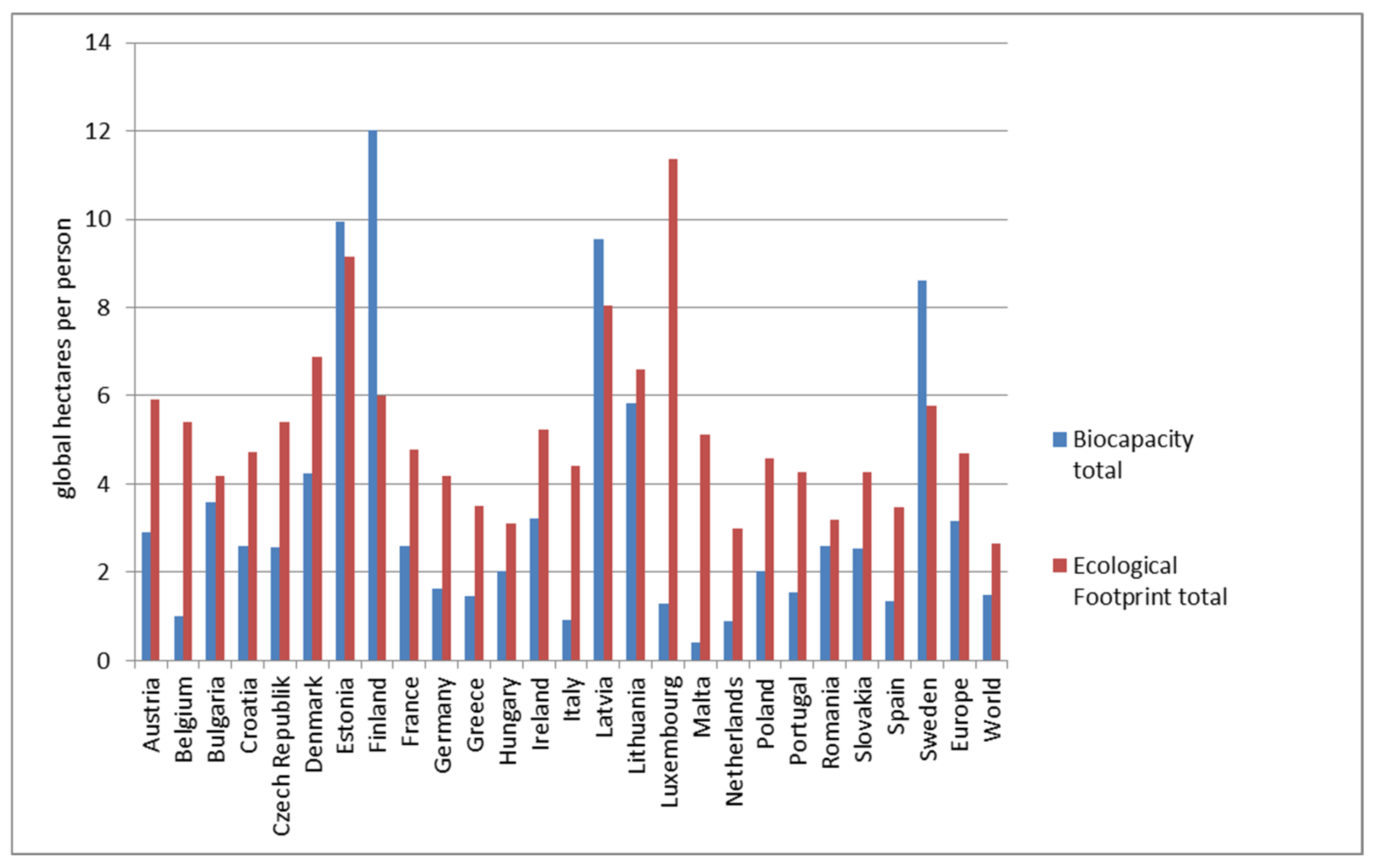
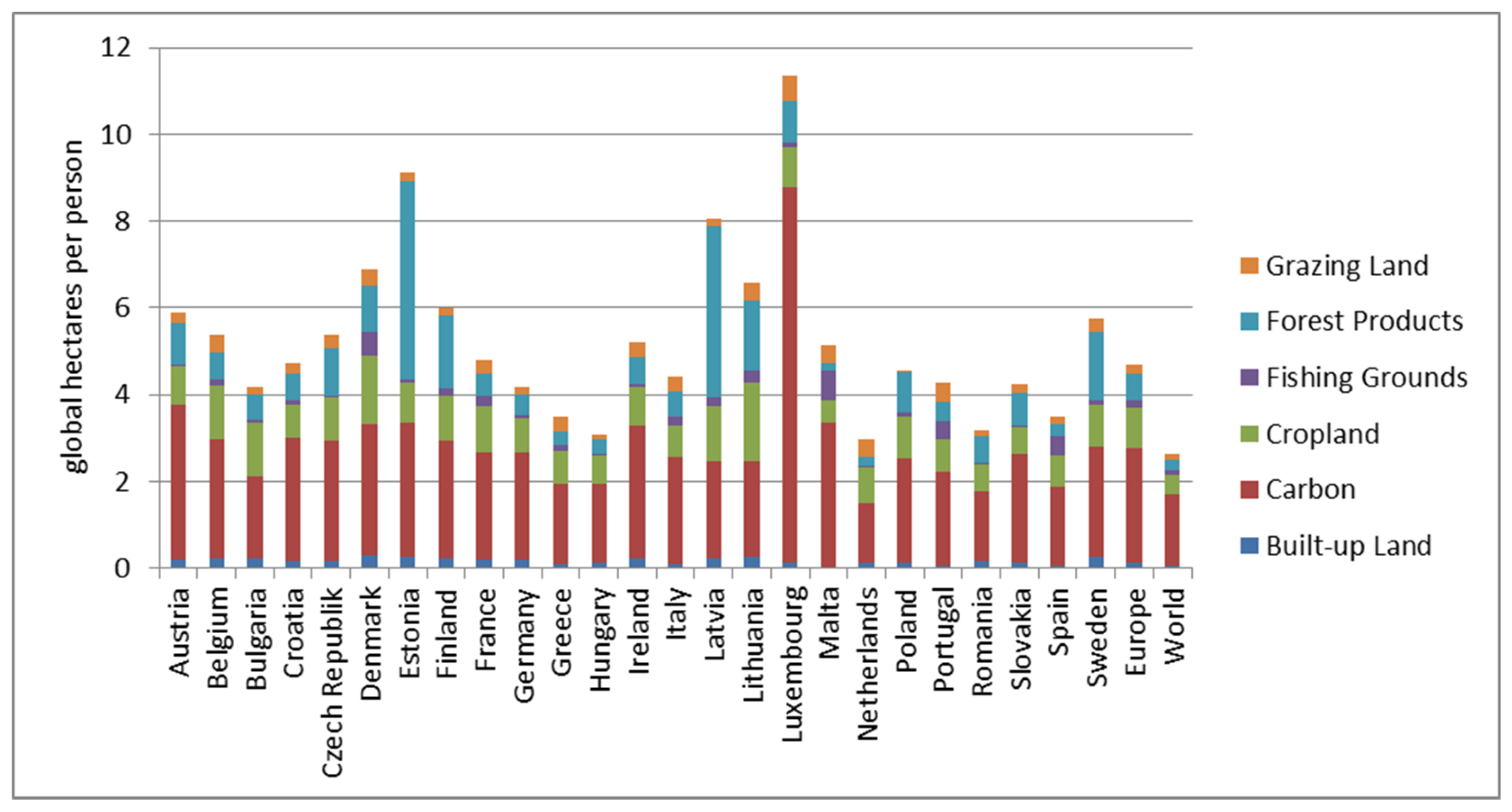
To further contextualize the cross-country results, Poland is examined as a representative case of an EU economy undergoing structural transformation. In 2024, according to data from the Global Footprint Network, the biological capital of European countries varied greatly (
Figure 1). For Europe as a whole, it amounted to 3.16 gha per person, and for the world as a whole, 1.48. Finland had the highest among EU countries with 9.95, and Malta had the lowest with 0.42. Poland scored 2.03. The ecological footprint was highest in Luxembourg, with values for Europe and the world of 4.69 end 2.64 gha per person. In general, the carbon footprint prevails over other footprints in most countries (
Figure 2).
Poland is not a leader in minimizing the exploitation of environmental resources. After the political and economic transformation, pressure on the environment decreased because a number of plants and factories were closed down. These changes particularly affected heavy industry. The turning point came in 2004, when Poland joined the European Union and had to adapt its environmental protection legislation [
53]. Over the past 20 years, the have been a number of positive changes, although there has been an increase in the standard of living of citizens, which has been compounded by global consumerism.
The empirical evidence highlights that while countries differ in their methods and financial commitments, all face the challenge of reconciling economic development with ecological limits. The results support the argument that ecological footprint evaluation should be embedded into mainstream economic planning to ensure long-term sustainability. Research by D. Morawska [
54] indicates that a 1% increase in GDP per capita leads to a 0.416% increase in the ecological footprint per capita. The ecological footprint per capita is projected to increase worldwide. This finding is consistent with the positive GDP–footprint relationship observed in this study, reinforcing the structural nature of growth-driven ecological pressure.
Building on the comparative results summarized in
Table 1, the findings suggest that integrating ecological footprint metrics into national accounts and GDP adjustments—such as Green GDP—is essential to reveal the hidden costs of growth. Legislative frameworks should internalize ecological costs through carbon pricing, payment for ecosystem services, and biodiversity offsets; strengthen forest protection as a cost-effective climate mitigation and adaptation strategy; promote circular economy models to reduce resource intensity; prioritize ecosystem service valuation to inform sustainable land-use policies.
5. Discussion
The results of this study confirm that ecological factors are not external to economic systems but are structurally embedded in macroeconomic performance. In contrast to descriptive approaches commonly found in the literature, the applied panel econometric model provides statistically robust evidence of the relationship between ecological footprint dynamics, forest ecosystem services, and economic outcomes.
The negative and statistically significant effect of the ecological footprint on GDP per capita is consistent with prior studies in ecological economics, which emphasize the economic costs of environmental degradation and resource overexploitation [
47,
55]. However, unlike many existing studies that rely on single-country analyses or descriptive correlations, this research provides cross-country empirical validation within a unified and reproducible modeling framework. This strengthens the argument that ecological degradation represents a systemic macroeconomic constraint rather than a localized or sector-specific issue. At the same time, the positive impact of forest ecosystem variables supports the growing body of literature highlighting the productive role of natural capital. Previous research [
8,
12] has demonstrated the global economic value of ecosystem services, particularly in terms of carbon sequestration and biodiversity support. The findings of this study extend these insights by empirically demonstrating that forest ecosystems contribute directly to economic performance within a macroeconomic model. This shifts the perception of forests from passive environmental assets to active components of economic resilience and productivity.
The results also confirm the negative economic impact of greenhouse gas emissions, which aligns with the conclusions of the Stern Review and more recent empirical studies on climate-related economic risks. Environmental pressure affects economic performance through multiple channels, including increased healthcare costs, reduced labor productivity, and heightened exposure to climate-related shocks. The statistical significance of this relationship reinforces the need to treat emissions not only as an environmental issue but as a measurable economic burden.
Importantly, the findings provide new insight into the role of green transition variables. The positive effect of renewable energy and environmental protection expenditure suggests that sustainability-oriented policies are not restrictive but growth-enhancing. This supports recent literature arguing for the possibility of relative decoupling between economic growth and environmental pressure. In contrast to deterministic interpretations of the growth–environment trade-off, the results indicate that policy choices and technological development can significantly modify this relationship.
The interaction between ecological footprint intensity and green transition variables further highlights that the negative effects of environmental degradation can be mitigated. Economies investing in renewable energy and resource efficiency demonstrate greater resilience, confirming that the ecological footprint–GDP relationship is conditional rather than fixed. This finding contributes to the literature by moving beyond static analysis and demonstrating the dynamic role of policy intervention.
From a comparative perspective, the observed cross-country differences reflect variations in institutional capacity, environmental governance, and economic structure. Developed economies tend to exhibit more advanced environmental–economic accounting systems, enabling better internalization of ecological costs. In contrast, emerging economies show higher relative economic losses associated with ecological degradation, which may be linked to stronger dependence on natural capital and less developed regulatory frameworks. This heterogeneity is consistent with previous cross-country studies but is here supported by a unified empirical framework.
The results also reinforce the policy relevance of ecological footprint accounting. Unlike traditional macroeconomic indicators, which neglect natural capital depletion, ecological footprint metrics provide a more comprehensive assessment of sustainability trade-offs. Integrating such indicators into national accounting systems—such as through Green GDP—can improve the accuracy of economic performance measurement and support more informed policy decisions. Despite these contributions, several limitations should be acknowledged. First, the analysis relies on secondary data, which may vary in quality and methodological consistency across countries. Second, biodiversity and ecosystem services are approximated using proxy indicators, which may not fully capture their complexity. Third, while the fixed-effects model controls for unobserved heterogeneity, potential endogeneity between economic and environmental variables cannot be entirely excluded.
Future research should therefore focus on integrating high-resolution spatial data, improving biodiversity measurement, and applying advanced econometric or machine-learning techniques to better capture causal relationships. Further investigation is also needed into how ecosystem service valuation can be operationalized within concrete policy instruments and fiscal mechanisms.
Overall, this study contributes to the literature by demonstrating that ecological sustainability and economic performance are not competing objectives but interdependent processes. The findings support a paradigm shift in which natural capital—particularly forest ecosystems—is recognized as a fundamental driver of long-term economic stability and resilience.
Developed economies (Germany, EU, USA, Japan, Canada) tend to have more institutionalized environmental–economic accounting systems, allowing precise measurement of ecological costs. Emerging economies (China, Brazil, India, South Africa) show significant relative GDP impacts, reflecting higher dependence on natural capital and weaker regulatory systems. Global estimates (4–8% of world GDP, ~$3–3.5 trillion annually) highlight the systemic macroeconomic importance of ecological degradation. Periods vary slightly due to differences in reporting cycles, but the analysis focuses on 2018–2023, aligning with most recent data.
The identified relationship between GDP growth and ecological footprint intensity supports the hypothesis that economic expansion, when not accompanied by structural transformation, tends to increase ecological pressure. This finding is consistent with previous studies in ecological economics, which emphasize that growth-driven increases in consumption and energy demand often translate into higher material and carbon footprints. However, the observed heterogeneity across countries indicates that this relationship is not deterministic.
The results suggest that targeted investments in renewable energy, the adoption of circular economy practices, and improvements in resource efficiency can significantly moderate the growth–footprint nexus. Economies that have integrated environmental–economic accounting and sustainability-oriented policy frameworks demonstrate a capacity for partial decoupling, where economic growth proceeds alongside slower increases in ecological pressure. This highlights the importance of institutional capacity, governance quality, and policy coherence in shaping environmentally sustainable development pathways.
From a policy perspective, the findings reinforce the relevance of ecological footprint assessment as a practical analytical tool linking ecological economics with evidence-based decision-making. Unlike single-indicator approaches, ecological footprint analysis captures cumulative pressures on natural capital, thereby providing policymakers with a more comprehensive understanding of sustainability trade-offs.
Forest ecosystems emerge from the analysis as strategic natural infrastructure rather than passive environmental assets. Their contribution to climate regulation, biodiversity conservation, water management, and food security generates substantial long-term economic benefits that remain systematically undervalued in conventional economic frameworks. The results therefore support a paradigm shift in which ecological sustainability is recognized not as a constraint on economic development, but as a prerequisite for durable economic resilience and social well-being.
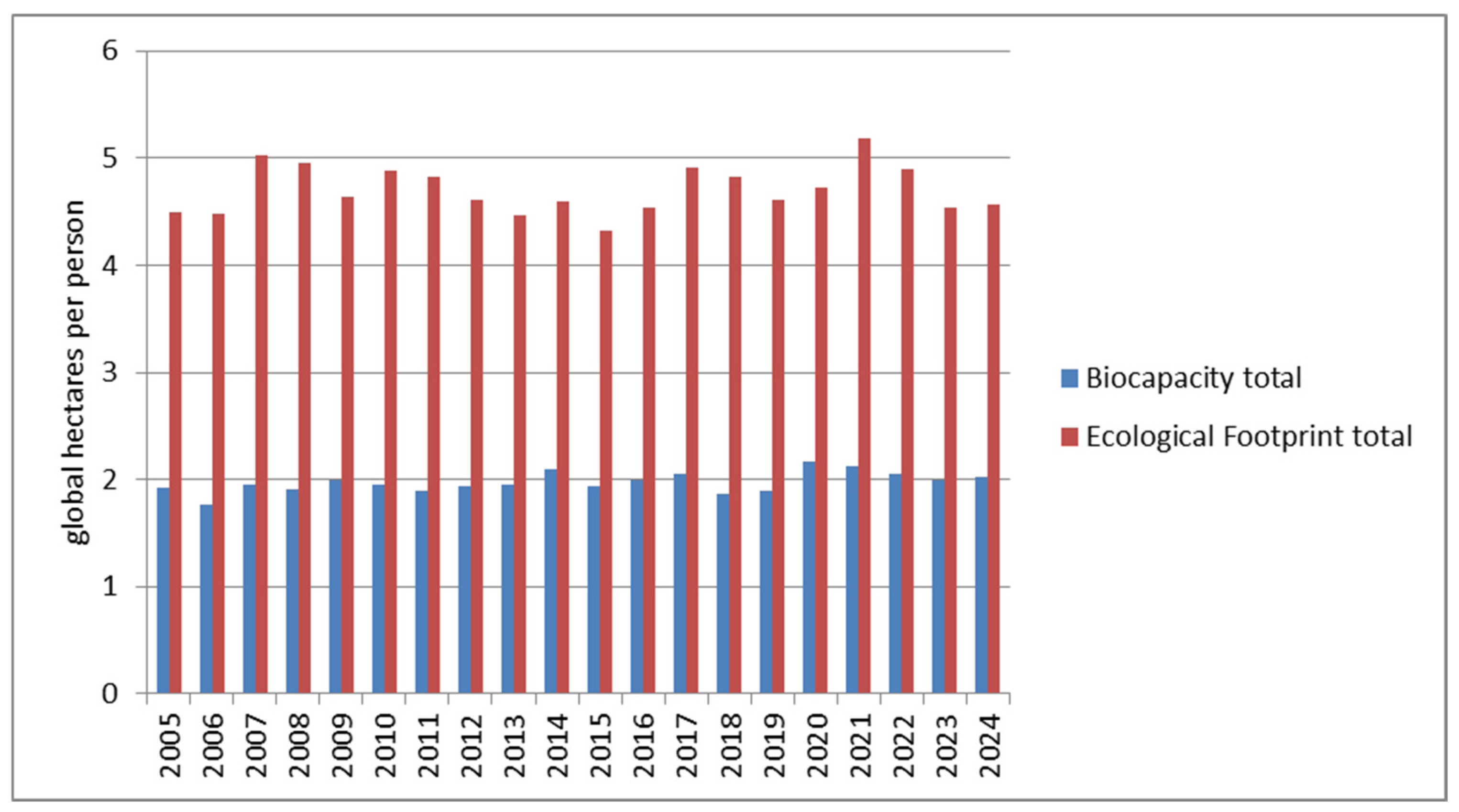
Poland’s biological capital in 2005–2024 changed only slightly, ranging from 1.77 to 2.16 gha per person. (
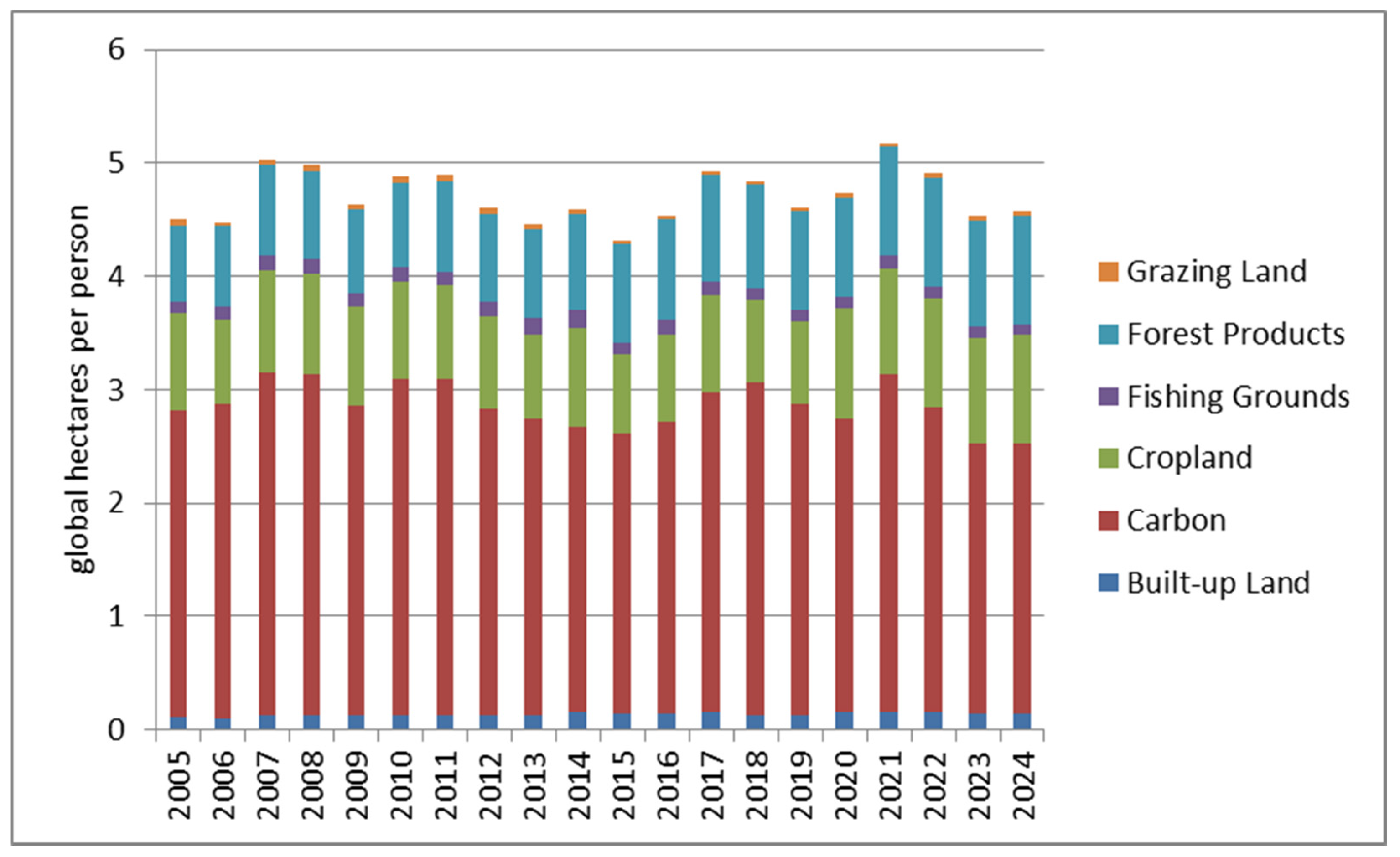
Figure 3). Unfortunately, the ecological footprint was very high during this period, ranging from 4.32 to 5.18 gha per person. This means that there is a serious ecological deficit, with a maximum value of 3.05 gha per person reached in 2020. This is possible because, as in some EU countries, resources were obtained from outside the country. The highest shares in the ecological footprint are carbon footprint, high arable land and forest products, and the lowest are in the lowest are built-up areas, pastures and fisheries (
Figure 4). The size of the ecological deficit is influenced not only by the energy intensity of the economy and the excessive exploitation of natural resources, but also by demographic changes. At the same time, the very structure of the ecological footprint indicator imposes the dominance of energy issues, which are of fundamental importance, especially in the case of Poland [
52]. Taking into account the largest cities in Poland, the ecological footprint per capita in the capital city of Warsaw was 6.5 gha, and in Krakow as much as 7.67 gha. The ecological footprint of Warsaw residents was approximately 213 times greater that its area, and that of Krakow residents was 183 times larger [
38].
Despite the strengths of the dataset and the methodological framework, several limitations should be acknowledged. First, all ecological damage valuations (carbon damages, biodiversity loss, health-related impacts) rely on secondary sources that differ in methodological assumptions and may introduce uncertainty into cross-country comparisons. Although we conducted a sensitivity analysis using alternative valuation parameters, the estimated macroeconomic costs still carry an uncertainty range of approximately ±20%. Second, some countries report environmental indicators with varying frequency and levels of detail, which may affect indicator comparability across years. Third, while the fixed-effects model captures structural differences between countries, it cannot fully eliminate potential omitted-variable bias arising from unobserved institutional or technological factors. Finally, although Poland was included in the panel dataset, its more detailed national documentation may create asymmetry in data richness compared to other countries. These limitations should be considered when interpreting the empirical results and policy implications. The dataset, compiled from Eurostat and Statista, includes macroeconomic and environmental indicators for EU countries over the period 2010–2023 (
Table 4).
The variation across countries confirms sufficient heterogeneity for panel estimation. Model statistics: R2 (within): 0.64; Observations: 324; Countries: 27; Time effects were included.
Robust standard errors were applied. Hypotheses Testing: H1 was supported: Biodiversity (BIO) has a positive and statistically significant effect on GDP per capita (p < 0.01). H2 was supported: GHG emissions negatively affect economic performance (p < 0.01). H3 was supported: renewable energy and environmental expenditure positively influence GDP (p < 0.05). The results remain stable when using GDP growth instead of GDP per capita; introducing lagged environmental variables; excluding high-income outliers (e.g., Luxembourg). The results provide clear empirical evidence that natural capital and environmental factors are not peripheral but structurally embedded in macroeconomic performance. First, the positive coefficient of biodiversity confirms that ecosystem integrity contributes to economic productivity. This finding aligns with the theoretical expectation that ecosystem services—such as pollination, soil fertility, and climate regulation—support long-term economic output. However, unlike previous descriptive studies, this relationship is statistically verified within a cross-country panel framework, strengthening its empirical validity. Second, the negative impact of greenhouse gas emissions highlights the economic costs of environmental degradation. These costs may arise through multiple channels, including health expenditures, productivity losses, and climate-related risks. The statistically significant coefficient demonstrates that environmental pressure is not merely an ecological concern but a measurable economic burden. Third, the positive effects of renewable energy and environmental protection expenditure suggest that the green transition is economically beneficial rather than restrictive. Investments in clean energy and environmental protection appear to enhance economic resilience and efficiency, supporting the argument that sustainability-oriented policies can generate co-benefits for growth and stability.
Importantly, the inclusion of resource productivity further reinforces the role of efficiency in linking environmental and economic systems. Countries that utilize resources more efficiently achieve higher levels of economic output, indicating that sustainability and competitiveness are complementary rather than conflicting objectives.
In contrast to prior literature that often relied on descriptive synthesis, this study demonstrates that integrated econometric modeling provides a more robust basis for policy-relevant conclusions. The results also challenge the notion that environmental constraints necessarily limit economic growth, instead suggesting that well-designed environmental policies can enhance it. The findings are particularly relevant for countries such as Poland, where the transition toward renewable energy and improved resource efficiency remains ongoing. Rather than treating environmental policy as an external constraint, the results support its integration into core economic strategy. At the same time, caution is warranted in interpretation. While the fixed-effects model controls for unobserved heterogeneity, potential endogeneity between economic performance and environmental variables cannot be fully excluded. Additionally, biodiversity remains proxied rather than directly measured, which may affect precision.
6. Conclusions
This study demonstrates that ecological degradation constitutes a significant macroeconomic burden rather than a marginal externality. The estimated costs—ranging from approximately 2% to 8% of GDP across the analyzed countries—confirm that environmental losses should be treated as a core economic variable and explicitly incorporated into macroeconomic analysis and policy design.
The findings highlight the critical role of forest ecosystems in reducing ecological pressure and strengthening economic resilience. Forests function as carbon sinks, biodiversity reservoirs, and providers of essential ecosystem services, including water regulation, soil protection, and food security. Cross-country comparisons show that economies with stronger forest protection policies and integrated ecosystem valuation frameworks tend to experience lower ecological deficits, underscoring the strategic importance of natural capital for long-term stability.
The empirical analysis identifies a statistically significant relationship between GDP growth and ecological footprint intensity. While economic expansion generally increases environmental pressure, this effect varies across countries. Economies investing in renewable energy, circular economy practices, and environmental–economic accounting demonstrate relative decoupling, where growth is accompanied by slower increases in ecological pressure. This supports the feasibility of sustainability-oriented development pathways.
From a policy perspective, the findings suggest that integrating biodiversity conservation and environmental investment into macroeconomic planning is both environmentally necessary and economically justified. Countries combining resource efficiency, renewable energy expansion, and environmental expenditure tend to achieve more stable and resilient economic performance. Several limitations should be acknowledged. The analysis relies on secondary data that vary in quality and availability across countries. Biodiversity measurement remains constrained by proxy indicators, and the absence of fine-scale spatial data limits the precision of ecosystem service valuation. Additionally, potential endogeneity between economic and environmental variables cannot be fully excluded, despite the use of fixed-effects estimation.
Future research should incorporate high-resolution spatial data, remote sensing technologies, and advanced econometric or machine-learning methods. Further work is also needed to examine how ecosystem service valuation can be translated into concrete policy instruments, fiscal mechanisms, and behavioral change at different governance levels. Extending the time horizon beyond 2023 would provide deeper insight into long-term dynamics between economic development, technological innovation, and ecological resilience.
In conclusion, ecological sustainability and economic performance are deeply interconnected. Natural capital—particularly forest ecosystems—should be recognized not as an external constraint but as a fundamental determinant of long-term economic resilience, food security, and societal well-being. This article has been prepared as part of the framework of the Visegrad Fund project (Slovakia, grant No. 52510523), 2025–2026.





 ,
,