Article

Sustainability of the Local Maize (Zea mays L.) Varieties and Populations Cultivation

by
Ion Toncea
1,*,
Elena Pop
2,
Tudor Prisecaru
2,
Ioana Virginia Berindean
3,*,
Vladimir-Adrian Toncea
1,
Mădălina Irina Ghilvacs
2,
Constantin Guruianu
4 and
Gheorghe Măturaru
4
1
Romanian Association for Sustainable Agriculture (A.R.A.D.), 915200 Fundulea, Romania
2
Faculty of Mechanical Engineering and Mechatronics, National University of Science and Technology Politehnica, 060042 Bucharest, Romania
3
Department of Crops Sciences: Genetic, Faculty of Agriculture, University of Agricultural Sciences and Veterinary Medicine, 400372 Cluj-Napoca, Romania
4
National Agricultural Research and Development Institute Fundulea, 915200 Fundulea, Romania
*
Authors to whom correspondence should be addressed.
Sustainability 2026, 18(6), 2961; https://doi.org/10.3390/su18062961
Submission received: 15 January 2026 / Revised: 8 March 2026 / Accepted: 13 March 2026 / Published: 17 March 2026

Abstract

Within the project “Small-scale grants for biodiversity actors in South-East Europe 2023–2025”, whose main mission is the collection of local varieties and populations, a fundamental question arises: “Why are ‘ancestral’ maize varieties and populations still cultivated?” To answer this question, we conducted a comprehensive set of investigations on 14 maize (Zea mays L.) varieties and populations and on one hybrid, collected from the historical regions of Romania—Transylvania, Moldova, Oltenia and Muntenia. The studies combine quantitative, qualitative and computational methods and focused on energy consumption associated with maize cultivation; maize grain production and related agronomic characteristics; the content of energy macronutrients (protein, fat, starch) and energy elements (CHNS-O, ash, moisture); and nutritional and thermal energy values (upper and lower) of whole cornmeal. The sustainability of the cultivation of local maize varieties was also evaluated based on the energy balance and the energy efficiency ratio. The results demonstrated that the cultivation of “ancestral” maize varieties and populations is sustainable, because the amount of energy obtained, expressed in kJ ha−1, as nutritional energy (24,740,195.04–90,287,743.07), higher heating energy (55,162,983.798–193,374,572.55) and lower heating energy (32,329,465.37–113,906,753.63), is greater than the amount of energy consumed for the establishment and maintenance of these crops (1,742,798.75–19,524,555.05).

1. Introduction

Maize (Zea mays L.) was introduced into culture and is still cultivated all over the world, almost exclusively for the nutritional value of its grains, the white whole grain cornmeal having an energy value within the range of 14,784–15,420 kJ/kg [1]. The cultivation of local (traditional) maize (Zea mays L.) varieties and populations represents a major challenge in the context of rural depopulation, economic globalization, and the pressure exerted by seed companies promoting modern varieties and hybrids to small-scale farming households. This situation is further exacerbated by the insufficient material and moral support needed for the maintenance and conservation of local maize genetic resources. The following initiatives are exceptions: the project “Small-scale grants for biodiversity actors in South-Eastern Europe 2023–2025” [2]; the IFOAM–Organics International and IFOAM–Organics Europe webinar of 23 April 2025 “Protecting Seeds, Preserving the Future” [3] and “Our Seeds, Our Future: Protecting Biodiversity and Farmers’ Rights” [4]; the International Seed Federation’s call to action “Seeds for a Resilient Future” [5]; the broader concept “Seeds and Plant Genetic Resources: A Basis for Life”, explored by FAO [6], etc. Additionally, gene banks, together with numerous international organizations and several Romanian NGOs, play a key role in the collection and conservation of local (traditional) varieties and populations of field crops, vegetables, aromatic and medicinal plants, as well as fruit tree species, etc. For the moment, research on local maize varieties focuses on investigating their essential traits for climate adaptation through the analysis of phenotypic characteristics and genetic background, with the aim of developing new directions in maize breeding and strengthening food security. Within the project “Small-scale grants for biodiversity actors in South-Eastern Europe 2023–2025,” a fundamental question was raised: “Why are the local ‘ancestral’ maize varieties and populations still cultivated?” or, in other words, “What is the level of sustainability of cultivating these varieties?” Modern agricultural systems are highly dependent on industrial energy inputs, as socio-economic development continues to promote the adoption of more energy-intensive production technologies [7]. Measuring energy flows in production systems is essential for assessing energy consumption and improving efficiency, thereby contributing to economically profitable outputs with reduced environmental impact. Energy use efficiency reflects the balance between energy inputs and outputs within an agroecosystem [8].
In this context, local maize varieties and populations, being better adapted to pedoclimatic conditions, generally require fewer inputs and are associated with lower energy consumption and higher sustainability [8].
Monocropping systems, which predominate in major grain-producing regions of China, contribute to resource reduction and environmental degradation, while intercropping represents an alternative with the potential to improve resource use efficiency [9]. Also, in their study, the same authors reported that maize monocropping systems can exhibit higher energy-based sustainability than maize–soybean intercropping, with the energy yield ratio and energy sustainability index being 13.7% and 21.1% higher, respectively, while the environmental loading ratio was 7.3% lower compared to intercropping systems. Romaneckas et al. [10] suggest that multicropping systems can contribute to addressing issues related to energy consumption. Vicia faba L. is widely used as an intercrop with maize (Zea mays L.) [11,12]. Previous studies have shown that maize–faba bean intercropping systems can enhance crop yield [13], improve land-use efficiency [14], increase soil fertility [15,16], and reduce weed and pest pressure [17].
Multicropping systems represent a sustainable practice used by smallholder farmers in Rwanda too, contributing to the development of resilient agroecosystems and providing socio-economic and ecological advantages over monocropping, particularly under drought conditions [18].
The sustainability of cultivating local maize (Zea mays L.) varieties and populations in Romania has not been sufficiently investigated to date, particularly due to the lack of integrated studies associated with energy consumption, and the energy value of production. In this context, considering the importance of sustainable agricultural practices and the need to optimize resource use, the aim of this study was to evaluate the sustainability of cultivating local maize varieties and populations by analyzing grain production and agronomic characteristics, technological energy consumption, and the complete energy value of whole cornmeal—from both nutritional and caloric perspectives. In addition, the energy balance and energy efficiency rate were determined. The caloric energy values are particularly relevant for the use of maize grains that are unsuitable for human or animal consumption, or as a fuel source in thermal power plants. Furthermore, the concept of sustainability is examined in relation to cropping systems and the dynamics of energy production and consumption throughout their entire life cycle (Ion Toncea, personal communication, 25 August 2024).

2. Materials and Methods

In this chapter, the materials and methods used in the study are briefly described as follows:

2.1. Biological Materials

The study involved 15 air-dried cob samples collected from 9 maize (Zea mays L.) genotypes cultivated in 2024, including 8 traditional varieties (populations) and one hybrid. The genotypes differed in the number of kernel rows per cob (8R, 12R, 14R, and 16R) and cultivation systems: intercropping and corn only (monocropping).
The experimental plots were located across four Romanian development regions which differ in environmental and pedoclimatic condition, like South-Muntenia, South-West Oltenia, North-East, and North-West). The plant material included local maize varieties and populations differing in kernel row number (8, 12, 14 and 16 rows per cob) and kernel/cob coloration (with orange cob and red seed or some of them with white or red cobs and yellow seed), as well as one commercial hybrid.
Cultivation technologies were mainly traditional, such as intercropping systems and, in some cases, professional organic (ecological) systems, corn only (Mălai sticlos de Bărăi 12R, Optaș de Bărăi 8R and Porumb Moldovenesc 12R) and a conventional one (Fundulea 423 16R).

2.2. Quantitative Methods

Systematic observations and measurements were performed on the maize cobs and their grains in order to characterize the phenotypic performance of the studied genotypes. Data regarding cultivation practices applied to the studied maize (Zea mays L.) genotypes were collected through interviews with farmers. For each genotype, a detailed technological sheet was developed, incorporating all production inputs. These included energy carriers (diesel fuel, gasoline, and electricity), organic and mineral fertilizers, herbicides, pesticides, and seeds. Based on these records, the energy equivalents of all technological inputs were calculated (Table 1), enabling a comprehensive assessment of energy consumption associated with each genotype.
Maize grains were milled using a SWANTECH sample mill (model SJ500) at a coarse grinding setting of 5.5, to ensure uniform particle size for subsequent analyses.
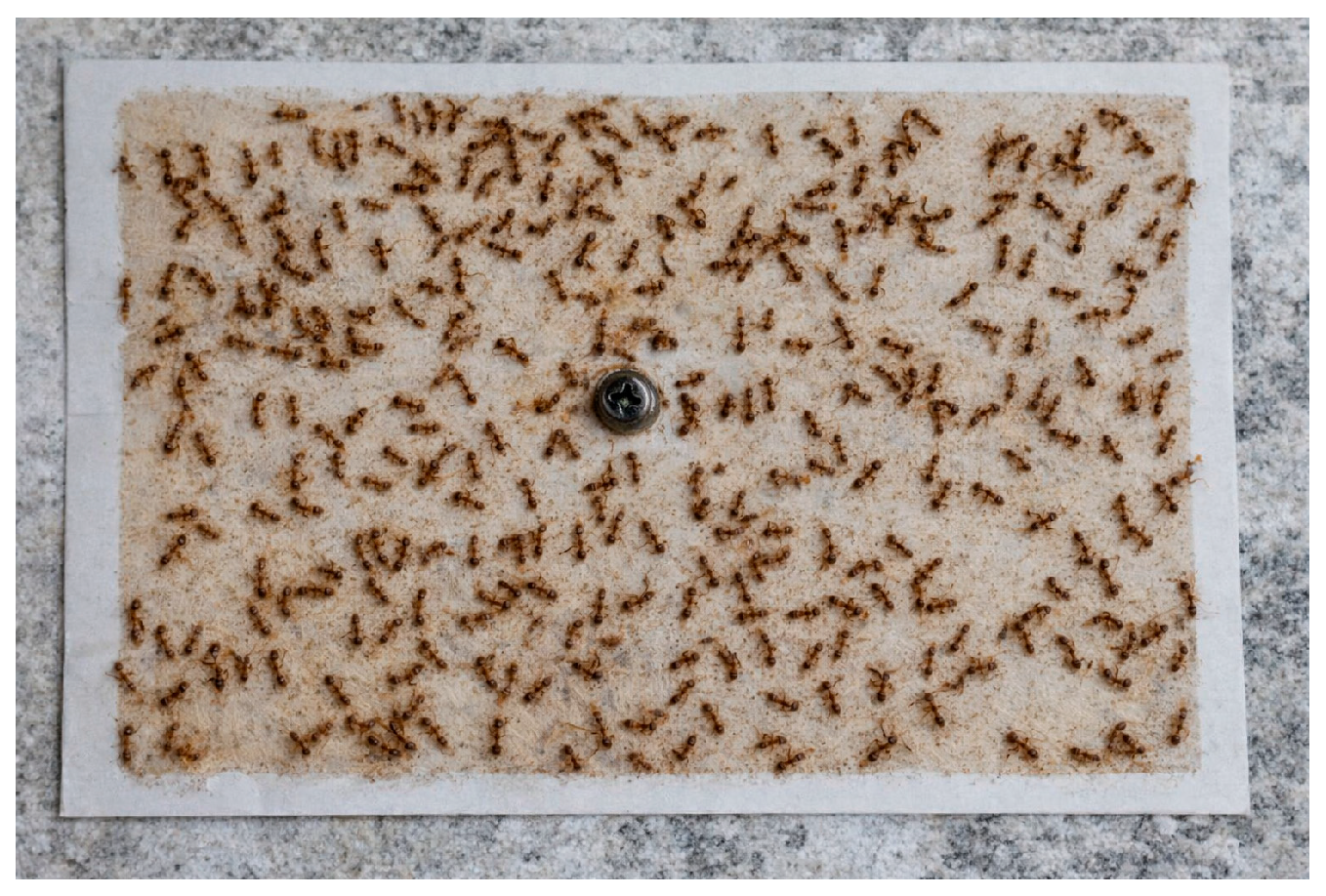
Monitoring and control of the grain moth (Sitotroga cerealella) were performed using sex pheromone-baited sticky traps, allowing for systematic detection and population surveillance under storage conditions.

2.3. Qualitative Methods

The following determinations were performed on whole cornmeal samples:
-
The macronutrient content (protein, fat, starch, ash, and moisture, expressed as percentages) was analyzed using an INSTALAB 660 instrument, a DICKEY-John NIR (Near-Infrared Reflectance) device.
-
The elemental composition of carbon, hydrogen, nitrogen, and sulphur (CHNS) was determined with a COSTECH 4010 analyzer. Additionally, proximate analyses were conducted to determine ash content (A) by oven incineration at 600 °C and moisture content (W) by drying at 105 °C.

2.4. Computational Methods

The energy consumption (human labour, animal traction, and various materials) for the cultivation of the studied maize (Zea mays L.) genotypes was calculated in kJ/plot (1), kJ ha−1 (2), kJ/kg DM (3), based on the quantities of inputs used and their corresponding energy equivalents [19] (Table 1 and Table 2).
Energy consumption k J p l o t = = Human labour no . of hours 12,558 8 + Animal power no . of hours 12,558 8 + + E l e c t r i c   e n e r g y k W h 3600 + D i e s e l   f u e l l 35,581 + C h e m i c a l   f e r t i l i z e r s k g   N 92.519 + C h e m i c a l   f e r t i l i z e r s k g   o f   P 2 O 5 20,340 + O r g a n i c   f e r t i l i z e r s k g 682 + P e s t i c i d e s   a n d   H e r b i c i d e s k g   o r   l 418,600 + S e e d s k g 19,080
E n e r g y   c o n s u m p t i o n k J / h a 1 = E n e r g y   c o n s u m p t i o n k J / p l o t P l o t   a r e a   ( m 2 ) 10,000
E n e r g y   c o n s u m p t i o n k J / k g   D M = E n e r g y   c o n s u m p t i o n   ( k J / h a ) G r a i n   y i e l d k g   D M   h a 1
The oxygen (Oc) content (%) of whole cornmeal was calculated using the following Formula (4), according to the CHNS analysis results obtained with the COSTECH 4010 analyser and the proximate ash analysis [20]:
Oc = 100 − Carbon (%) − Hydrogen (%) − Nitrogen (%) − Sulphur (%) − Ash (%),

2.5. Calculation of Nutritional and Caloric Values

The nutritional and caloric values of whole-ground cornmeal were calculated using specific and widely cited empirical formulas. These equations employ empirically derived coefficients (with 4–6 or 2–4 significant digits) and the concentrations of chemical elements or macronutrients in the analyzed material, expressed as decimal fractions or percentages.
Nutritional energy value (NEVc) of whole-ground cornmeal (kJ/kg dry matter) calculated as Formula (5):
NEVc = 11,400∙P + 35,000∙F + 16,900∙St,
in which 11,400, 35,000, and 16,900 represent the Atwater metabolizable energy factors for protein (P), fat (F), and starch (St), respectively. The values of P, F, and St were determined using the INSTALAB 660 analyser and expressed as decimal fractions.
Higher Heating Value (HHVc), or Gross Heating Value, was estimated using the approximation Formula (6) by Wojciech et al. [21]:
HHVc = 34,910∙C + 117,830∙H + 10,050∙S + 10,340∙O − 1510∙N − 2110∙A,
in kJ/kg dry matter. The coefficients correspond to the empirical energy equivalents of the elements carbon (C), hydrogen (H), sulphur (S), oxygen (O), nitrogen (N), and ash (A). Elemental contents were determined using the COSTECH 4010 analyser and electric oven incineration (600 °C), expressed as decimal fractions [21,22].
Lower Heating Value (LHVc), also known as Net Heating Value, was calculated according to Mendeleev’s Formula (7) [23]:
LHVc = 339∙C + 1030∙H − 109∙(O − S) − 25.12∙W,
in kJ/kg, based on empirical coefficients and the percentage contents of carbon (C), hydrogen (H), sulphur (S), oxygen (O), and moisture (W).

2.6. The Sustainability Indicators

The sustainability indicators were calculated as follows:
  • Energy balance (kJ kg−1 and kJ ha−1): calculated as the difference between the output (produced) energy and the input (consumed) energy.
  • Energy efficiency ratio: determined as the ratio between output energy and input energy.
Statistical analysis: mean values, standard deviations (SDs), standard errors, and graphical representations with error bars were generated using Microsoft Excel software.

3. Results and Discussion

General information on the studied maize (Zea mays L.) varieties and populations is presented in Table 2, including plot location and area (m2), farming systems, and productivity indicators such as cob production (kg plot−1), grain yield per cob (%), grain yield (kg ha−1, expressed in dry matter—DM), and thousand grain weight (TGW, g).
Analysis of these data reveals that all presented parameters exhibited a high degree of variability, both qualitative and quantitative. This variability is partly explained by the fact that the analyzed genotypes cultivated under different environmental and management conditions exhibited different agronomic performances.
The variability of the productivity indicators, assessed through the coefficient of variation (CV, %), is characteristic of each parameter and exceeded the generally accepted upper threshold of 20% for all indicators. The high coefficients of variation observed for most productivity parameters indicate substantial heterogeneity among the studied systems, likely reflecting the combined effects of genotype, environmental conditions, and management practices [24].
Specifically, the coefficient of variation reached 25.01% for thousand grains weight (TGW), 25.79% for grains yield per cob, 51.27% for grains yield (DM), 104.40% for plot area, and 212.86% for cob production. Such variability is typical for traditional maize varieties cultivated under diverse environmental conditions and farming systems. The high variability observed in agronomic indicators can be explained by the interaction between genotype (G), environmental conditions (E), and management practices (M), commonly referred to in agronomy as the G × E × M interaction [25].
Another important detail, which significantly negatively influenced the production of maize grains, was the very low grain yield per cob (%) in some of varieties like Florian 12R (34.60%) and 16R (27.93%) and Mesteceni 12 and 14R (49.70%) varieties, due to the attack of the grain moth (Sitotogra cerealella) (Figure 1).

3.1. The Energy Consumption

The first set of results presented in this study concerns the energy consumption associated with the cultivation of local maize (Zea mays L.) varieties and populations under different cropping systems. The analysis is based on the quantification of energy inputs derived from both labour and material resources, expressed in energy units (kJ ha−1), in order to compare the performance and sustainability of the studied varieties. Romaneckas et al. [10] reported that maize–legume intercropping systems can influence the main energy indicators of crop production, demonstrating that energy performance is strongly affected by biomass productivity and environmental conditions.
According to the data presented in Table 3, the highest energy consumption values were associated with the cultivation of the De Maramureș variety, both under monocropping (19,524,555.1 kJ ha−1) and under intercropping conditions (16,392,374.6 kJ ha−1), followed by the Fundulea 423 hybrid in monocropping (14,896,476.5 kJ ha−1) and the Lăpușneac population in intercropping conditions (13,856,032 kJ ha−1). Intercropping systems generally showed lower energy consumption compared to monocropping, suggesting a more efficient use of resources. Similar results were reported by Romaneckas et al. [10], who showed that intercropping systems improve energy efficiency and reduce overall energy inputs compared to monocropping. In addition, Mandal et al. [26] demonstrated that maize-based intercropping systems can improve energy use efficiency and net energy production compared with monocropping systems. Relatively high energy consumption values were also recorded for the Florian (10,689,083.7 kJ ha−1) and Mesteceni (8,611,594.8 kJ ha−1) populations cultivated under intercropping conditions. Lower energy consumption values were observed for the Bob tare population (4,137,128.6 kJ ha−1) under intercropping, and for two varieties cultivated in the monocropping system, Optaș de Bărai (4,505,213.2 kJ ha−1) and Mălai sticlos de Bărai (5,580,880.7 kJ ha−1). The lowest energy consumption value was recorded for the Porumb Moldovenesc variety (1,742,798.8 kJ ha−1), cultivated under intercropping.
The analysis of energy inputs further revealed that diesel fuel and fertilizers are also important contributors to total energy consumption. This is consistent with previous studies showing that fertilizers alone can account for more than 50% of total energy input in maize production systems [27], while other studies have highlighted their dominant role in overall energy consumption [28]. Therefore, variations in fertilizer application rates and the level of mechanization largely explain the differences observed among the studied variants.
Significant differences in energy use efficiency (kJ/kg DM) were observed when comparing the Porumb Moldovenesc variety (intercropping) with the hybrid Fundulea 423, indicating that certain local varieties require substantially lower energy input per unit of yield. These findings are consistent with previous studies reporting that maize production systems based on hybrid varieties and intensive input use tend to be associated with higher energy consumption, whereas traditional systems relying on local varieties are often more energy-efficient [8,29]. Consequently, the use of locally adapted maize varieties may contribute to reducing energy inputs and improving the sustainability of agricultural systems.

3.2. The Content of the Energy Macronutrients

The moisture, protein, fat, starch and ash content of whole cornmeal obtained from the studied maize varieties and populations were determined using the INSTALAB 660 analyzer (Table 4). The results revealed noticeable variation among genotypes for all analyzed macronutrients.
The moisture content ranged from 10.3% to 14.4%, indicating that the grains were relatively dry compared to the maize humidity standard levels of 15.5% at harvest and 14% during storage. In this context, the rapid dry-down of maize observed may be considered a favourable characteristic, not only in the Fundulea 423 hybrid but also in the other analyzed genotypes. Considerable variation in maize grain moisture content among different genotypes has been reported in the literature. For example, Hamisu and his team [30] recorded a moisture content of 8% in the improved variety Sammaz 14, compared with 7.5% and 6.5% in local and Golden Strawberry varieties, respectively. Other studies also reported substantial variation, with moisture contents of 13.0%, 11.0%, 8.0% and 12.5% in sweet corn, popcorn, white corn and yellow corn, respectively [31]. These differences highlight the influence of genetic factors on grain moisture content, as well as the potential impact of environmental and experimental conditions.
Protein content varied among the analyzed genotypes, with an overall mean value of 10.858%. Only two varieties showed values below this mean: De Maramureș 12R cultivated under intercropping (7.04%) and the hybrid Fundulea 423 (8.14%). Most genotypes showed protein levels close to or higher than the overall mean (10.86%), with values ranging from 7.04% to 13.02%. The highest protein content (12.28%) was obtained with the application of 120 kg ha−1 nitrogen combined with green winter pea manure [32]. The coefficient of variation for protein content for all maize varieties studied was relatively high (CV = 14.32%), suggesting also that genetic factors play an important role in the observed variation. In addition, the variation in protein content observed in this study may be attributed to differences in nitrogen availability and fertilization practices, as nitrogen fertilization is known to significantly increase maize grain protein concentration [32,33]. Several local maize varieties showed higher protein levels than the hybrid Fundulea 423, highlighting the potential nutritional value of traditional germplasm. A relatively wide variation was observed for fat content, which ranged from 3.23% to 8.54%, with a mean value of 6.17%. These values are generally higher than those commonly reported in the literature (2–6%, with an average of approximately 4.5%) [34,35]. Similar values have been reported in maize grain composition studies, where mean fat contents of approximately 3.6–4.5% were observed under typical cultivation conditions [36]. The relatively high coefficient of variation (CV = 21.56%) indicates considerable variability among the studied genotypes. This variability may reflect the combined influence of genotype and cultivation practices, as previous research has shown that agronomic factors such as fertilization regimes, plant density and environmental conditions can significantly influence the oil content of maize grains [37]. In our study as well, the observed variability appears to be primarily associated with fertilization practices, while genetic background plays a secondary role.
Starch represented the major carbohydrate fraction of the analyzed samples, ranging from 47.96% to 61.41%, with a mean value of 54.81%, and showing the lowest coefficient of variation among the analyzed macronutrients (CV = 6.26%). Considerable variability in carbohydrate-related components among maize genotypes has also been reported by Hamisu et al. [30], who observed the highest carbohydrate content (94.67%) in the Golden Strawberry maize variety. In our study, a significant reduction in starch content was observed only in the Mesteceni variety cultivated under an intercropping system, which, according to the data in Table 3, is associated with higher organic fertilization levels. Illés et al. [33] indicate that starch accumulation in maize grains can be influenced by both genotype and fertilization practices, with significant differences observed among hybrids and nutrient treatments.
The ash content showed a trend similar to that of the previously analyzed macronutrients, differing mainly in numerical range: Values ranged from 4.91% to 10.97%, with a mean of 7.64%, and it presented the highest coefficient of variation among all measured components (CV = 24.74%). In their study, Hamisu and his team [30] reported that the local maize variety Hakorin Hajiya exhibited a higher ash content (4%), indicating a greater mineral composition compared with improved varieties. Based on the information presented in Table 3, the variability in ash content appears to be primarily associated, also in this situation, with technological factors, particularly chemical and organic fertilization.

3.3. The Content of the Major Elemental Components

Results of the analyses of the major elemental components (C, H, N, S–O), as well as the ash (A) and moisture (W) contents in the whole cornmeal obtained from the studied maize (Zea mays L.) varieties and populations, are summarized in Table 5.
These parameters—carbon (C), hydrogen (H), nitrogen (N), sulphur (S), oxygen (Oc), ash (A), and moisture (W)—were quantified in order to enable the estimation of the calorific values (HHVc and LHVc) of the whole cornmeal, as they represent key constituents of the energy-related macronutrients previously described. The same elemental composition of biomass (C, H, N, O and S) has been used by Brandić et al. [38], in estimating the HHV (Higher Heating Value) of corn biomass and to evaluate the calorific potential and combustion behaviour.
The elemental composition of the analyzed cornmeal samples showed relatively stable values for the main structural components of biomass. The carbon (C) content ranged from 42.98% to 45.90%, with a mean of 44.20%, exhibiting the lowest coefficient of variation (CV = 1.90%). Similarly, hydrogen (H) content varied between 6.46% and 7.26%, with a mean value of 6.67% and a low coefficient of variation (CV = 3.15%). These two elements play a key role in the energetic potential of biomass, as higher carbon and hydrogen contents generally contribute to increased calorific values due to their direct participation in combustion reactions.
Sulphur (S) was below the detection limit (reported as 0) in all samples [39]. In contrast, nitrogen (N) showed the highest variability among the elemental components, ranging from 1.40% to 6.69%, with a mean of 2.13% (CV = 60.72%). This variability was largely influenced by the Mesteceni variety, which showed the highest nitrogen concentration (6.69%). Overall, the elemental composition obtained in this study is consistent with the typical composition of plant biomass, where carbon usually ranges between 42 and 50% and hydrogen between 5 and 6%, while nitrogen and sulphur occur in relatively small amounts [40].
A relatively stable pattern was observed for oxygen (Oc) in the analyzed cornmeal varieties. The oxygen content varied between 39.95% and 47.78%, with a mean of 45.60% and a relatively low coefficient of variation (CV = 4.09%). Comparable elemental compositions were reported by Sulaiman et al. [41], who found values of approximately 48.57% carbon, 0.38% sulphur, 6.22% hydrogen and 55.81% oxygen in maize cob and stalk-based pellets used for energy production. These results confirm that the elemental composition of maize biomass remains within relatively narrow limits despite differences among genotypes and cultivation conditions.
The ash (A) and moisture (W) contents showed different patterns: Ash ranged from 1.13% to 1.62%, with a mean of 1.40% (CV = 10.82%), while moisture varied between 9.48% and 11.22%, with a mean value of 10.72% and a lower coefficient of variation (CV = 4.87%). In comparison, Sulaiman and his team [41], reported ash and moisture contents of 2.20% and 3.25%, respectively. These parameters are particularly important for evaluating the energy potential of biomass, as elemental composition and moisture content directly influence calorific value and combustion efficiency.

3.4. Estimation of the Nutritional Energy Value (NEV)

The nutritional energy values (NEVs) presented in Table 6 reflect the content of metabolizable macronutrients (protein, fat, and starch), expressed as decimal fractions, as well as the application of Atwater energy conversion factors (kJ/kg) specific to each macronutrient. Surprisingly (though perhaps expected) there is a perfect similarity between the coefficients of variation (CV, %) of the macronutrient NEVs and the CVs (%) of their contents, indicating a direct and proportional relationship between chemical composition and the resulting nutritional energy. Furthermore, compared with the NEVs of each individual macronutrient, the variability of the total nutritional energy content of whole cornmeal (kJ/kg) is very low (CV = 2.42%), with a variation range of 12,040.06 to 13,199.37 kJ/kg around a mean value of 12,659.71 kJ/kg. A similarly low variability was observed for the nutritional energy derived from starch (CV = 6.26%), which ranged from 8105.24 to 10,378.29 kJ/kg, around a mean value of 9263.57 kJ/kg.
The lowest NEVs for whole cornmeal (12,040.06–12,285.88 kJ/kg) were recorded for the genotypes Mesteceni 12R and 14R (intercropping), Florian 16R (intercropping), and Mălai sticlos de Bărăi 12R (corn only). In contrast, higher nutritional energy values (12,859.67–13,199.37 kJ/kg) were observed for the genotypes Fundulea 423 (corn only), De Maramureș 12R and 14R (intercropping), De Maramureș 14R (corn only), and Porumb Moldovenesc 12R (intercropping). The highest coefficient of variation (CV = 51.50%) was recorded for the nutritional energy (NEV) produced per 1 ha cultivated with the local maize varieties and populations (24,740,195.04–90,287,743.07 kJ ha−1), as a result, mainly, of maize grains production (kg ha−1DM) variability, which has a CV = 51.50%.
The nutritional energy values (NEVs) of the whole cornmeal of the maize varieties and populations studied are, normally, lower than the energy value of cornmeal.

3.5. Estimation of the Higher Heating Values (HHVs)

The Higher Heating Value (HHV) represents the amount of heat released by the combustion of 1 kg of solid or liquid fuel under conditions in which the water vapours are condensed and the combustion products are cooled to 0 °C [42]. In this context, the results of the HHVs estimations obtained using the approximation formula [23] are presented in Table 7. The elemental Higher Heating Values (HHVs), expressed in kJ/kg, depend on the carbon (C), hydrogen (H), nitrogen (N), oxygen (O), and ash (A) contents of the whole cornmeal, expressed as decimal fractions, as well as on the empirical energy coefficients of the formula. Thus, the HHVs of carbon (C) show a very low coefficient of variation (CV = 1.90%), with a variation range of 15,004.32–16,023.69 kJ/kg and a mean of 15,430.69 kJ/kg. For hydrogen (H), the variability is similarly low (CV = 3.145%), with values ranging from 7611.82 to 8554.46 kJ/kg and a mean of 7853.76 kJ/kg. In the case of oxygen (O), the CV is also low (4.09%), with values between 4130.83 and 4940.45 kJ/kg, and a mean of 4715.32 kJ/kg. The HHVs for nitrogen (N) differ considerably from those of the other elements, showing a very high coefficient of variation (CV = 60.173%), a wide variation range of 21.14–101.20 kJ/kg, and a mean of 32.18 kJ/kg. For ash (A), the CV = 10.819%, with values ranging from 23.84 to 34.18 kJ/kg and a mean of 29.53 kJ/kg, while sulphur (S) values were zero, corresponding to each biomass type.
Table 6. Estimation of the nutritional energy values (NEVs) of whole cornmeal of the studied local varieties and populations, based on Atwater conversion factors [43] *.
Name of the Local Maize (Zea mays L.) Varieties and Populations StudiedNutritional Energy of the Metabolizable Macronutrients * (kJ/kg)Total Energy of Whole Cornmeal
(kJ ha−1)
ProteinFatsStarchTotal
Mălai sticlos de Bărăi 12R (corn only), organic1246.022194.58845.4612,285.9883,741,239.68
Optaș de Bărăi 8R (corn only), organic1130.882467.58936.7212,535.134,220,823
Lăpușneac 8R, orange seeds, white cob (intercropping)1259.71606.59793.5512,659.7544,347,104.25
Lăpușneac 8R, red seeds, white cob (intercropping)12541130.510,378.2912,762.7927,924,984.52
De Maramureș 12R (intercropping)802.5621849884.8112,871.3778,064,859.05
De Maramureș 14R (intercropping)1274.5225699016.1512,859.6790,287,743.07
De Maramureș 12R (corn only)1342.9229898612.2412,944.1666,740,088.96
De Maramureș 14R (corn only)1484.282334.58874.1912,692.9779,711,851.60
Florian 12R (intercropping)1428.421956.58997.5612,382.4824,740,195.04
Florian 16R (intercropping)1250.581732.59289.9312,273.0133,578,955.36
Mesteceni 12R and 14R (intercropping)1411.322523.58105.2412,040.0638,913,473.92
Porumb Moldovenesc 12R (intercropping), organic1281.3622689372.7412,922.130,909,663.2
Bob tare 14R, white cob (intercropping)1220.9420729391.3312,684.2725,558,804.05
Bob tare 14R, red cob (intercropping)1251.721774.59756.3712,782.5928,096,132.82
Fundulea 423, 16R (corn only)927.962572.59698.9113,199.3726,821,119.84
Mean1237.8122158.3339263.5712,659.7147,577,135.891
SD177.243466.136579.527306.91724,497,662.918
CV%14.3221.606.262.4251.50
* Atwater conversion factors for cornmeal, whole ground: protein = 11,400 kJ/kg; fat: 35,000 kJ/kg; starch: 16,900 kJ/kg.
Table 7. Estimation of the Higher Heating Values (HHVs) of the whole cornmeal of the studied local varieties and populations.
Name of the Local Maize (Zea mays L.) Varieties and Populations StudiedHigher Heating Values (HHVs) * of the Whole Cornmeal Elements (C, H, N, S, O) and Ash (A) Higher Heating Values (HHVs) of the Whole Cornmeal
Carbon
(C)
Hydrogen (H)Sulfur (S)Oxygen (O)Nitrogen (N)Ash
(A)
kJ/kgkJ/kgkJ ha−1
Mălai sticlos de Bărăi 12R (corn only), organic15,451.178024.2204743.9928.3924.6928,166.31191,981,541.696
Optaș de Bărăi 8R (corn only), organic15,402.297823.9104746.0628.09031.2327,912.9576,202,353.500
Lăpușneac 8R, orange seeds, white cob (intercropping)15,063.677812.1304894.9622.5029.3327,718.9297,099,383.766
Lăpușneac 8R, red seeds, white cob (intercropping)15,880.568106.7004573.3834.2823.8428,502.5362,363,524.700
De Maramureș 12R (intercropping)15,189.347894.6104855.6622.3528.4927,888.78169,145,462.830
De Maramureș 14R (intercropping)15,004.327647.1704940.4521.1428.4927,542.31193,374,572.55
De Maramureș 12R (corn only)15,555.907706.0804692.2928.7034.1827,891.39143,808,048.088
De Maramureș 14R (corn only)15,133.497658.9504874.2823.7030.3827,612.62173,407,253.600
Florian 12R (intercropping)15,280.117635.3804759.5031.7134.1827,609.1055,162,983.80
Florian 16R (intercropping)15,437.2077682.5204758.4728.3928.7027,821.1076,118,535.072
Mesteceni 12R and 14R (intercropping)15,566.378554.4604130.83101.2031.8628,118.7890,879,887.264
Porumb Moldovenesc 12R (intercropping), organic16,023.697611.8204568.2228.5433.1328,142.0567,315,793.168
Bob tare 14R, white cob (intercropping)15,315.028012.4404763.6427.0331.0228,033.0556,486,593.735
Bob tare 14R, red cob (intercropping)15,405.787812.1304721.2435.3326.1627,877.6661,275,092.284
Fundulea 423, 16R (corn only)15,751.397823.9104706.7721.6027.2228,233.2657,369,984.320
Mean15,430.697853.7604715.3232.1829.5327,938.05104,799,400.7
SD291.80246.990192.7019.543.20264.9153,356,269.8
CV%1.903.1504.0960.7310.820.9550.9134
* acc. to Channiwala and Parikh (2002), cited by Wojciech et al. [21], formula: HHVs = 34,910∙C + 117,830∙H + 10,050∙S + 10,340∙O − 1510∙N − 2110∙A (kJ/kg and kJ ha−1).
The HHVs (kJ) per 1 kg of whole cornmeal from the studied genotypes were relatively stable (CV = 0.95%), with a narrow variation range of 27,542.31 to 28,502.53 kJ/kg and a mean of 27,938.05 kJ/kg, but quite large compared to the HHV of birch, beech, pine and spruce wood and close to those of coal [21].
In contrast, the HHVs expressed per hectare (kJ ha−1) for the analyzed maize genotypes exhibited very high variability (CV = 50.913%), closely reflecting the variability of grain yield (CV = 51.27%). The values ranged from 55,162,983.80 to 193,374,572.55 kJ ha−1, with a mean of 104,799,400.7 kJ ha−1.
Among the studied varieties and local populations, the following genotypes were distinguished by their lower or higher HHVc values (kJ ha−1): Florian 12R (intercropping), Bob tare 14R, white cob (intercropping), Fundulea 423, 16R (corn only), De Maramureș 12R and 14R (intercropping), Mălai sticlos de Bărăi 12R (corn only), and De Maramureș 14R (corn only).

3.6. Estimation of the Lower Heating Values (LHVs)

The Lower Heating Value (LHV) differs from the Higher Heating Value (HHV) by the heat of vaporization of the moisture present in the fuel, as well as the moisture generated during the combustion of hydrogen [42]. The LHV results, calculated using the Mendeleev approximation formula [23] and presented in Table 8, depend on the carbon (C), hydrogen (H), sulphur (S), oxygen (O), and moisture (W) contents of the whole cornmeal, expressed in percentages, and on the empirical energy coefficients of the Mendeleev formula. Therefore, the coefficients of variation (CV%) of the LHVs for carbon (1.891%), hydrogen (3.145%), oxygen (4.087%), and moisture (4.865%) are equal to those of these elements from Table 5 and Table 7, and almost as small or large as the coefficients of variation (CV%) of the HHVs for 1 kg (CV = 3.472%) and for the production on 1 ha of whole cornmeal (CV = 49.574%). Other LHV parameters are specific to each variety or population studied.
Thus, the elemental LHV dispersion (kJ/kg) for whole cornmeal ranged from 14,570.22 to 15,560.10 for carbon (C), from 6621.5 to 7441.5 for hydrogen (H), from 4354.55 to 5208.02 for oxygen (O), between 238.14 and 281.85 for moisture (W), and between 15,733.36 to 17,923.63 for total LHV (kJ/kg), as with the previously mentioned wood species [21], while the LHV per hectare ranged from 32,329,465.37 to 113,906,753.63 kJ ha−1.
The mean elemental LHVs (kJ/kg) of the whole cornmeal were: 14,984.252 for carbon (C), 6831.967 for hydrogen (H), 4970.691 for oxygen (O), 269.286 for moisture (W), 16,576.242 for total LHV/kg, and 61,836,573.67 kJ ha−1 for LHV/ha.
Among the local maize varieties and populations for which LHVs were determined, the following genotypes were distinguished: Mălai sticlos de Bărăi 12R (corn only), De Maramureș 14R (intercropping), De Maramureș 14R (corn only), Florian 12R (intercropping), Mesteceni 12 and 14R (intercropping), Porumb Moldovenesc 12R (intercropping), and Fundulea 423–16R (corn only).
The higher (HHV) and lower (LHV) calorific values of whole cornmeal were greater than or similar to those of different forest species of wood, suggesting a new use of corn kernels, that of fuel.

3.7. The Energy Balance of Cultivation Local Maize Varieties and Populations

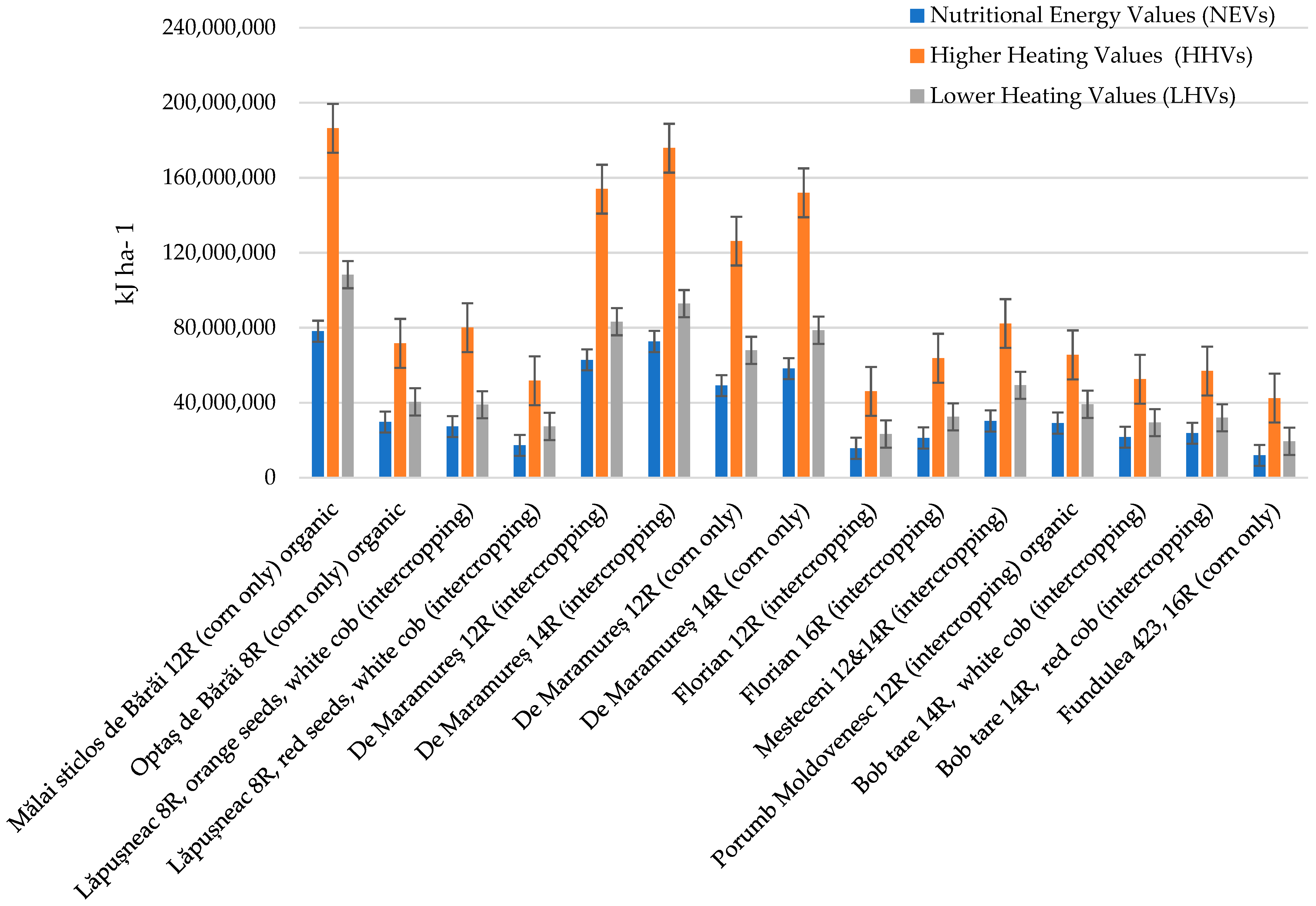
The results of the energy balance for the local maize varieties and populations studied are similar to the previous ones and additionally confirm the relevance of this indicator as a measure of sustainability. First, the energy balance is positive for all types of energy indicators (NEV, HHV, and LHV) and for all maize genotypes studied. Then, there are only 6 cases out of 45 in which the order of magnitude of the energy values (NEVs, HHVs, LHVs) of the whole cornmeal is not maintained among the genotypes analyzed.
Although the energy balance is positive in all cases (Figure 2), we identified three classification groups of genotypes based on the overall mean and standard deviation (SD) of the NEVs, HHVs, and LHVs of their nutritional and caloric energy balance (kJ ha−1). Values ≥ mean were considered highly sustainable, values between the mean and SD were considered moderately sustainable, and values below SD were considered low-performing. The groups are presented below:
-
High positive sustainable energy balances (≥mean): Mălai sticlos de Bărai (corn only), De Maramureș 14R and 12R (intercropping), De Maramureș 12R and 14R (corn only);
-
Moderate positive sustainable energy balances (≥SD and <mean): Lăpușneac 8R, orange seeds (intercropping), Mesteceni 12 and 14R (intercropping), Optaș de Bărăi (corn only), Porumb Moldovenesc 12R (intercropping), Florian 16R (intercropping), Bob tare 14R, red and white cob;
-
Low energy balances (<SD): Lăpușneac 8R, red seeds (intercropping), Florian 12R (intercropping), and Fundulea 423 16R (corn only).
This surprisingly similar grouping of the studied maize varieties and populations is mainly driven by input levels and reflects the inherent sustainability specificity of each maize genotype.

3.8. The Energy Efficiency Rate of the Cultivation of Local Maize Varieties and Populations

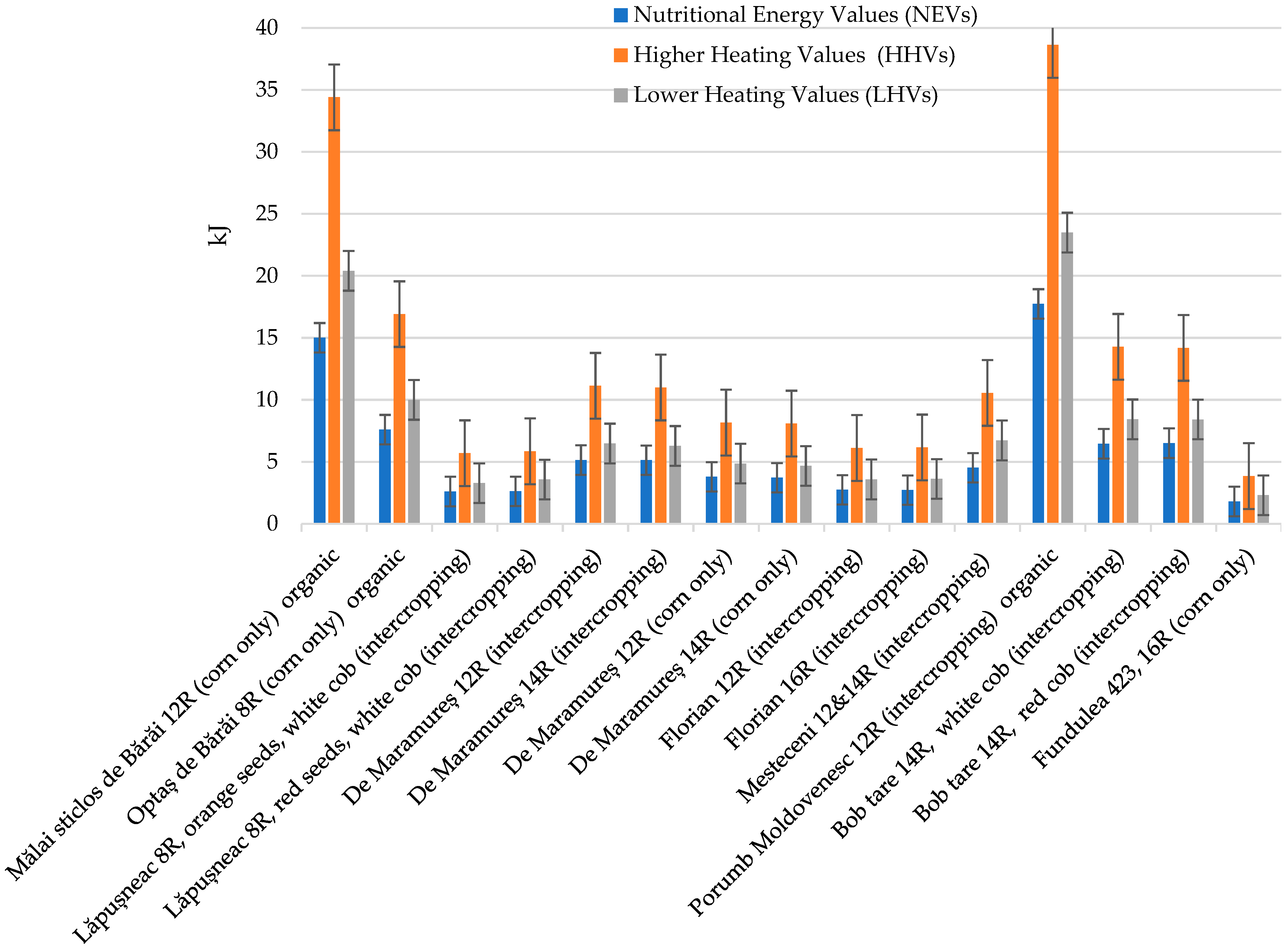
The energy efficiency rate or energy rate, calculated as the ratio between the energy produced and the energy consumed (expressed in kJ ha−1), is, according to Figure 3, specific to the cultivation technology and grain yield of each maize genotype studied. Moreover, compared with the energy balance, in this case, the ranking of maize genotypes based on their energy efficiency rate differs across all types of energy assessed (NEVs, HHVs, and LHVs):
-
high sustainable energy efficiency rates (≥mean): Porumb Moldovenesc 12R (intercropping), Mălai sticlos de Bărăi (corn only), Optaș de Bărăi 8R (corn only), Bob tare 14R, white and red cob (intercropping);
-
Moderate sustainable energy efficiency rates (≥SD and <mean): De Maramureș 14R (intercropping) and Mesteceni 12 and 14R (intercropping);
-
Low energy efficiency rates (<SD): the remaining (eight in the case of NEVs and seven in the case of HHVs and LHVs) maize genotypes.
The energy efficiency rate highlights the cultivation systems of the local maize varieties and populations. In the present study, organic farming systems showed higher energy efficiency, while traditional intercropping systems—relying largely on internal system resources—also proved particularly favourable. These observations are consistent with findings reported in the literature, like Rahman et al. [29], who demonstrated that maize production systems can achieve high energy productivity and technical efficiency, although the final energy performance is strongly influenced by the level of energy inputs and environmental conditions. In addition, Konieczna and his team [44] emphasized that energy efficiency in maize silage production largely depends on the cultivation technology and the energy inputs associated with mechanical operations, fuel consumption, fertilizers, and labour.

4. Conclusions

The sustainability of cultivating local maize (Zea mays L.) varieties and populations is closely related to the performance of cropping systems in terms of energy consumption and production throughout their entire life cycle. The persistence in cultivation of ancestral maize varieties and populations is explained by their high macronutrient content, their potential for technological improvement of nutritional value, and, undeniably, their nutritional and caloric energy values.
The energy balance and energy efficiency rate give originality to the sustainability measurement and importance to the agricultural systems of cultivating local varieties and populations. Thus, the most sustainable, regardless of energy type produced (nutritive or caloric) are the following local studied corn varieties and populations, in descending order: as the energy balance ≥ SD: Mălai sticlos de Bărăi 12R (corn only), organic, De Maramureș 14R and 12R (intercropping), De Maramureș 14R and 12R (corn only), Mesteceni 12&14R (intercropping), followed by the Optaș de Bărăi 8R (corn only), organic, Porumb Moldovenesc (intercropping), organic, Lăpușneac 8R, orange seeds (intercropping), and Bob tare 14R, red cobs (intercropping), as well as Florian 16R (intercropping) and Bob tare 14R, white cobs (intercropping), in two cases each; as the energy efficiency rate ≥ SD: Porumb Moldovenesc 12R (intercropping), organic, Mălai sticlos de Bărăi 12R (corn only), organic, Optaș de Bărăi 8R (corn only), organic, Bob tare 14R, red cob (intercropping), and Bob tare 14 R, white cob (intercropping), followed by the Maramureș 12R and 14R (intercropping) and Mesteceni 12 and 14R (intercropping), in two cases.
The cultivation of local maize varieties and populations can be considered sustainable, as the energy produced by each maize genotype exceeds the energy required for its establishment and maintenance. Moreover, the higher (HHV) and lower (LHV) calorific values of whole cornmeal, which are comparable to or even higher than those of certain forest wood species, highlight the potential of maize kernels as an alternative biomass fuel.

Author Contributions

Conceptualization, I.T.; methodology, I.T.; software, I.T.; validation, I.T.; formal analysis, I.T.; investigation, E.P., M.I.G. and C.G.; resources, I.V.B. and G.M.; data curation, V.-A.T.; writing—original draft preparation, I.T.; writing—review and editing, I.V.B.; visualization, I.T.; supervision, I.T. and T.P.; funding acquisition, I.T. All authors have read and agreed to the published version of the manuscript.

Funding

This research received a small amount of funding from the project “Small-scale grants for biodiversity actors in South-Eastern Europe 2023–2025”, from Verein ARCHE NOAH (“A.N.”) in the period 2024, mainly for the collecting mission of the local maize varieties and populations.

Institutional Review Board Statement

Not Applicable.

Informed Consent Statement

Not Applicable.

Data Availability Statement

The original contributions presented in this study are included in the article. Further inquiries can be directed to the corresponding authors.

Acknowledgments

Great gratitude is also expressed to the brave, hardworking, serious, tireless, beautiful volunteers: Mirela Velicu (velicu.mirela@yahoo.com) and Aurelia Florian (florianpatrisia@gmail.com); and for the preservers of the “ancestral” maize varieties and populations: Melania and Niculae Banc (adi.banc@gmail.com), Ioana and Dănuț Berindean (danutberindean@yahoo.com), Maria and Ioan Buda (ioanbuda956@gmail.com), Gheorghe and Angela Negoiță (marian.ghe.negoita@gmail.com), Anca and Vasile Mureșan (ionutmuresan001@gmail.com), Vasile Tămaș, Dorin Tămaș, Norica and Ion Nedelcu (validragoman@yahoo.com).

Conflicts of Interest

The authors declare no conflicts of interest.

References

  1. Available online: https://www.Fatsecret.Co.in/Calories-Nutrition/Generic/White-Whole-Grain-Cornmeal (accessed on 12 September 2025).
  2. Available online: https://www.Arche-Noah.at/Wissen/Projekte/Small-Scale-Grants-for-Biodiversity-Actors-in-South-Eastern-Europe/ (accessed on 12 March 2026).
  3. Protecting Seeds, Preserving Futures: Insights from the Global Seed Rights Webinar|IFOAM. Available online: https://www.ifoam.bio/news/protecting-seeds/preserving-futures-insights-global (accessed on 18 November 2025).
  4. Our Seeds, Our Future: Protecting Biodiversity and Farmers’ Rights. IFOAM Organics Europe. 2025. Available online: https://seedalliance.org/events/our-seeds-our-future/ (accessed on 23 April 2025).
  5. Seeds for a Resilient Future—A Call to Action from the Private Seed Sector at COP29 2024. Available online: https://worldseed.org/wp-content/uploads/2024/11/Seeds-for-a-Resilient-Future.pdf (accessed on 15 October 2025).
  6. Seeds and Plant Genetic Resources. Available online: https://www.fao.org/agriculture/crops/core-themes/theme/seeds-and-plant-genetic-resources/en/ (accessed on 18 November 2025).
  7. Wysokiński, M.; Domagała, J.; Gromada, A.; Golonko, M.; Trębska, P. Economic and Energy Efficiency of Agriculture. Agric. Econ.-Czech 2020, 66, 355–364. [Google Scholar] [CrossRef]
  8. Martínez, F.B.; Guevara, F.; Aguilar, C.E.; Pinto, R.; la O, M.A.; Rodríguez, L.A.; Aryal, D.R. Energy and Economic Efficiency of Maize Agroecosystem under Three Management Strategies in the Frailesca, Chiapas (Mexico). Agriculture 2020, 10, 81. [Google Scholar] [CrossRef]
  9. Yang, X.; Sui, P.; Shen, Y.; Gerber, J.S.; Wang, D.; Wang, X.; Dai, H.; Chen, Y. Sustainability Evaluation of the Maize–Soybean Intercropping System and Maize Monocropping System in the North China Plain Based on Field Experiments. Agronomy 2018, 8, 268. [Google Scholar] [CrossRef]
  10. Romaneckas, K.; Švereikaitė, A.; Kimbirauskienė, R.; Sinkevičienė, A.; Adamavičienė, A.; Jasinskas, A. The Impact of Maize Legume Intercropping on Energy Indices and GHG Emissions as a Result of Climate Change. Agriculture 2024, 14, 1303. [Google Scholar] [CrossRef]
  11. Stoltz, E.; Nadeau, E.; Wallenhammar, A.-C. Intercropping Maize and Faba Bean for Silage Under Swedish Climate Conditions. Agric. Res. 2013, 2, 90–97. [Google Scholar] [CrossRef]
  12. Wang, W.; Li, M.-Y.; Zhang, W.; Khan, A.; Zhou, R.; Zhu, S.-G.; Wang, B.-Z.; Yang, Y.-M.; Tao, H.-Y.; Li, W.-B.; et al. Soil Moisture Drives the Shift from Selection to Complementarity Effect in the Rainfed Maize/Faba Bean Intercropping System. Plant Soil 2024, 499, 313–328. [Google Scholar] [CrossRef]
  13. Nurgi, N.; Tana, T.; Dechassa, N.; Alemayehu, Y.; Tesso, B. Effects of Planting Density and Variety on Productivity of Maize-Faba Bean Intercropping System. Heliyon 2023, 9, e12967. [Google Scholar] [CrossRef]
  14. Schwerdtner, U.; Spohn, M. Interspecific Root Interactions Increase Maize Yields in Intercropping with Different Companion Crops. J. Plant Nutr. Soil Sci. 2021, 184, 596–606. [Google Scholar] [CrossRef]
  15. Raji, S.G.; Dörsch, P. Effect of Legume Intercropping on N2O Emissions and CH4 Uptake during Maize Production in the Great Rift Valley, Ethiopia. Biogeosciences 2020, 17, 345–359. [Google Scholar] [CrossRef]
  16. Wang, W.; Zhao, J.-H.; Li, M.-Y.; Zhang, W.; Rehman, M.M.U.; Wang, B.-Z.; Ullah, F.; Cheng, Z.-G.; Zhu, L.; Zhang, J.-L.; et al. Yield Loss of Inferior Crop Species and Its Physiological Mechanism in a Semiarid Cereal-Legume Intercropping System. Eur. J. Agron. 2024, 152, 127032. [Google Scholar] [CrossRef]
  17. Hüber, C.; Zettl, F.; Hartung, J.; Müller-Lindenlauf, M. The Impact of Maize-Bean Intercropping on Insect Biodiversity. Basic Appl. Ecol. 2022, 61, 1–9. [Google Scholar] [CrossRef]
  18. Léonidas, H.; Toru, T.; Fidèle, N.; Watabaji, M.D.; Gelete, T.B.; Hubert, H. Monocropping vs Mixed Cropping Systems under a Changing Climate: Smallholder Farmers’ Perceptions and Farm Profitability in Eastern Rwanda. Environ. Sustain. Indic. 2024, 24, 100527. [Google Scholar] [CrossRef]
  19. Teșu, I.; Baghinsch, V. Book: Energia Și Agricultura; Editura Ceres: București, Romania, 1984. [Google Scholar]
  20. Analytes Determined at Celignis—Analysis of Oxygen. Available online: https://www.celignis.com/analyte.php?value=26 (accessed on 18 November 2025).
  21. Wojciech, J.C.; Pawłowski, J.; Witczak, M.; Walkowiak, M. Comparison of Methods for Determining the Calorific Value of Fuels Obtained from Wooden Biomass. Ann. WULS For. Wood Technol. 2016, 94, 91–100. [Google Scholar]
  22. Toncea, I.; Toncea, V.A. Sustenability Measurement in Practice Case Study “Organic Camelia Variety of Camelina sativa (L) Crantz Metadata”. Proc. Rom. Acad. Ser. B 2024, 26, 111–118. [Google Scholar]
  23. Pănoiu, N. Cazane de Abur; Didactică și Pedagogică: București, Romania, 1982. [Google Scholar]
  24. Ceccarelli, S. Adaptation to Low/High Input Cultivation. Euphytica 1996, 92, 203–214. [Google Scholar] [CrossRef]
  25. Annicchiarico, P. Book: Genotype x Environment Interactions: Challenges and Opportunities for Plant Breeding and Cultivar Recommendations; Chapter 3: Multi-Environment Yield Trials; Food & Agriculture Organization: Rome, Italy, 2002; Volume 1, Available online: https://books.google.ro/books?id=-9XjxwEACAAJ&pg=PR1&source=gbs_selected_pages&cad=1#v=onepage&q&f=false (accessed on 12 March 2026).
  26. Mandal, M.K.; Banerjee, M.; Malik, G.C.; Das, R.; Pathak, A. Effect of Intercrop on Productivity, Energetic of Maize (Zea mays)-Legumes Based Intercropping Systems. Available online: https://www.cabidigitallibrary.org/doi/pdf/10.5555/20153308861 (accessed on 5 March 2026).
  27. Hulmani, S.; Salakinkop, S.R.; Somangouda, G. Productivity, Nutrient Use Efficiency, Energetic, and Economics of Winter Maize in South India. PLoS ONE 2022, 17, e0266886. [Google Scholar] [CrossRef]
  28. Reddy, K.K.K.; Vani, K.P.; Sudhakar, C.; Babu, P.S.; Triveni, S.; Kumar, N.V.; Raising, L.P. Energy-Efficient Strategies for Maize-Safflower Cropping Systems: Comparative Analysis of Tillage and Weed Management Practices. Sci. Rep. 2025, 15, 39537. [Google Scholar] [CrossRef]
  29. Rahman, S.; Rahman, M.S. Energy Productivity and Efficiency of Maize Accounting for the Choice of Growing Season and Environmental Factors: An Empirical Analysis from Bangladesh. Energy 2013, 49, 329–336. [Google Scholar] [CrossRef]
  30. Hamisu, A.; Muhammad, I.; Ullah, S.; Danladi, G. Comparative Study on the Nutritional Value of Local Maize Variety (Hakorin Hajiya) and Improved Varieties of Maize (Sammaz14 and Golden Strawberry). Int. J. Bot. Stud. 2023, 8, 1–9. [Google Scholar]
  31. Nwalo, N. Rate of Water Absorption and Proximate Analysis of Different Varieties of Maize Cultivated in Ikwo Local Government Area of Ebonyi State, Nigeria. Afr. J. Biotechnol. 2010, 9, 8913–8917. [Google Scholar]
  32. Ghiorghe, I.A.; Turek-Rahoveanu, A. Inluence on the Protein and Starchcontent of Maize (Zea mays L.) of Integrated Fertilization with Green Manure and Mineral Fertilizers. Sci. Pap. Ser. Manag. Econ. Eng. Agric. Rural. Dev. 2024, 24, 345–352. [Google Scholar]
  33. Illés, Á.; Bojtor, C.; Harsányi, E.; Nagy, J.; Lengyel, L.; Széles, A. Optimizing Nitrogen Fertilization in Maize Production to Improve Yield and Grain Composition Based on NDVI Vegetation Assessment. Agriculture 2025, 15, 2279. [Google Scholar] [CrossRef]
  34. Mukri, G.; Patil, M.S.; Motagi, B.N.; Bhat, J.S.; Singh, C.; Jeevan Kumar, S.P.; Gadag, R.N.; Gupta, N.C.; Simal-Gandara, J. Genetic Variability, Combining Ability and Molecular Diversity-Based Parental Line Selection for Heterosis Breeding in Field Corn (Zea mays L.). Mol. Biol. Rep. 2022, 49, 4517–4524. [Google Scholar] [CrossRef]
  35. Amanjyoti; Singh, J.; Sowdhanya, D.; Rasane, P.; Singh, J.; Ercisli, S.; Verma, H.; Ullah, R. Maize. In Cereals and Nutraceuticals; Singh, J., Kaur, S., Rasane, P., Singh, J., Eds.; Springer Nature: Singapore, 2024; pp. 47–80. [Google Scholar]
  36. Stępień, A.; Wojtkowiak, K.; Kolankowska, E.; Pietrzak-Fiećko, R. Corn Grain Fatty Acid Contents in Response to Organic Fertilisers from Meat Industry Waste. Sustainability 2024, 16, 952. [Google Scholar] [CrossRef]
  37. Ivaniv, M.; Sydiakina, O.; Hamula, Y. Formation of Maize Grain Oil Content Depending on Technological Elements and Variable Agro-Climatic Conditions. J. Ecol. Eng. 2026, 27, 129–137. [Google Scholar] [CrossRef] [PubMed]
  38. Brandić, I.; Antonović, A.; Pezo, L.; Matin, B.; Krička, T.; Jurišić, V.; Špelić, K.; Kontek, M.; Kukuruzović, J.; Grubor, M.; et al. Energy Potentials of Agricultural Biomass and the Possibility of Modelling Using RFR and SVM Models. Energies 2023, 16, 690. [Google Scholar] [CrossRef]
  39. Ionel, I.; Trif-Tordai, G.; Silaghi, D.; Ungureanu, C. Managementul Valorificării Energetice a Biomasei: Monografie; Editura Politehnica Timişoara: Timișoara, România, 2007. [Google Scholar]
  40. Friedl, A.; Padouvas, E.; Rotter, H.; Varmuza, K. Prediction of Heating Values of Biomass Fuel from Elemental Composition. Anal. Chim. Acta 2005, 544, 191–198. [Google Scholar] [CrossRef]
  41. Sulaiman, M.A.; Adetifa, B.O.; Adekomaya, S.O.; Lawal, N.S.; Adama, O.O. Experimental Characterization of Maize Cob and Stalk Based Pellets for Energy Use. Eng. J. 2019, 23, 117–128. [Google Scholar] [CrossRef]
  42. Reznikov, M.I.; Lipov, Y.M. Steam Boilers of Thermal Power Stations; Mir Publishers: Moscow, Russia, 1985. [Google Scholar]
  43. Food Energy–Methods of Analysis and Conversion Factors; Report of a Technical Workshop; Food and Agriculture Organization of the United Nations: Rome, Italy, 2002.
  44. Konieczna, A.; Roman, K.; Roman, M.; Śliwiński, D.; Roman, M. Energy Efficiency of Maize Production Technology: Evidence from Polish Farms. Energies 2020, 14, 170. [Google Scholar] [CrossRef]
Figure 1. Grain moth (Sitotroga cerealella) in sex pheromone-baited sticky traps.
Sustainability 18 02961 g001
Figure 2. The energy balance of cultivated local maize (Zea mays L.) varieties and populations.
Sustainability 18 02961 g002
Figure 3. The energy efficiency rate of cultivation local maize (Zea mays L.) varieties and populations.
Sustainability 18 02961 g003
Table 1. Energy equivalents of human labour, animal traction and various materials [19].
Inputs NamePhysical Unit of MeasurementEnergy Equivalent
(kJ)
Inputs NamePhysical Unit of MeasurementEnergy Equivalent
(kJ)
Human labourMan-day
(8 h)
12,558Chemical
fertilizers: (N)
kg92,519
Animal powerAnimal-day
(8 h)
125,580Chemical fertilizers: (P2O5)kg20,340
Electric energykWh3600Organic fertilizerskg682
Diesel fuelL35,581Pesticides, Herbicides kg, L418,600
GasolineL32,965Seedskg19,080
Table 2. Productivity indicators of local maize (Zea mays L.) varieties and populations cultivated in 2024.
Name of the Maize (Zea mays L.)
Local Varieties and Populations
Plots LocationFarming SystemPlots Area
(m2)
Cobs Prod.
(kg/plot)
Grains Yield of Cobs (%)Grains Yield (DM) (kg ha–1)Thousand Grains Weight (TGW-Grams)
Mălai sticlos de Bărăi 12R (corn only), organic Sustainability 18 02961 i001Barai 4/
Caianu,
Cluj county
Organic farming5600600173.036816351.40
Optaș de Bărăi 8R
(corn only), organic
Sustainability 18 02961 i002100045069.492730400.86
Lăpușneac 8R, orange seeds, white cob
(intercropping)
Sustainability 18 02961 i003Corusu/
Baciu,
Cluj county
Household farming20054.7083.363503521.09
Lăpușneac 8R, red seeds, white cob (intercropping)31.3979.762188310.74
De Maramureș 12R
(intercropping)
Sustainability 18 02961 i004Ungureni 100/
Cupseni Maramures county
Mixed farming (traditional + conventional)500250.9169.546065344.79
De Maramureș 14R
(intercropping)
249.9279.547021288.54
De Maramureș 12R
(corn only)
Mixed farming (conventional + traditional) 30001073.3681.885156247.36
De Maramureș 14R
(corn only)
1445.7573.796280297.85
Florian 12R
(intercropping)
Sustainability 18 02961 i005Preluca Noua 63/Copalnic Manastur, Maramures countyTraditional farming450148.4934.601998299.45
Florian 16R
(intercropping)
257.4927.932736205.39
Mesteceni 12R and 14R (intercropping)Sustainability 18 02961 i006Preluca Noua 113/Copalnic Manastur, Maramures countyTraditional farming 20001500.1249.703232197.66
Porumb Moldovenesc 12R (intercropping), organicSustainability 18 02961 i007Negritesti 27/ Podoleni, Neamt countyOrganic farming2100699.8881.192392328.98
Bob tare 14R, white cob (intercropping)Sustainability 18 02961 i008Sustainability 18 02961 i009Surpati/
Runcu, Valcea county
Traditional farming 1000138.9583.312015333.10
Bob tare 14R, red cob (intercropping)178.0870.212198330.33
Fundulea 423, 16R (corn only)Sustainability 18 02961 i010Fundulea/N. Titulescu 1, Calarași countyConventional farming246.458.8485.352032411.07
Mean1609.641031.4969.513757.46324.57
SD1680.402195.6017.921926.4681.18
CV (%)104.40212.8625.7951.2725.01
Table 3. Energy consumption (human labour, animal traction and various materials) for cultivating local maize (Zea mays L.) varieties and populations studied (kJ).
Name of Maize Studied/Energy ConsumptionsMălai Sticlos de Bărăi
Corn Only
Optaș de Bărăi
Corn Only
Lăpușneac
Intercropping
De Maramureș
Intercropping
De Maramureș Corn OnlyFlorian
Intercropping
Mesteceni
Intercropping
Porumb Moldovenesc
Intercropping
Bob Tare
Intercropping
Fundulea 423
Corn Only
Human labour31,499.6543,298.9421,191.6244,625.75104,724.7532,964.75175,81246,307.6387,121.1243,117.36
Animal power000448526,9107848.7298,252.515,697.515,697.50
Electric energy0072000000000
Diesel fuel2,531,943.9316,670.914,232.4112,817.11,694,163.9189,522.2177,905213,486155,488.940,942.6
Gasoline0065,9300000000
Chemical fertilizers000528,6803172.10000200,997
Organic fertilizers00136,40000168,795818,400068,2000
Pesticides0000000001485.26
Herbicides00000000038,678.64
Seed277,73249,5956973.8254,500327,00038,15095,37557,22549,5958460.14
Total energy/plot (kJ)2,841,175.6409,564.8251,927.8745,107.95,324,878.6437,280.61,565,744332,716.1376,102.5333,681.1
Other types of energy (10%)284,117.540,956.425,192.774,510.7532,487.843,728.1156,574.433,271.637,610.233,368.1
Total kJ/plot3,125,293.2450,521.3277,120.6819,618.75,857,366.5481,008.81,722,319.365,987.7413,712.9367,049.2
Total kJha−15,580,880.74,505,213.213,856,03216,392,374.619,524,555.110,689,083.78,611,594.81,742,798.84,137,128.614,896,476.5
kJ/kg DM818.791650.264869.452505.333414.584515.882664.48728.591963.987330.94
Table 4. The content of the energy macronutrients (moisture, protein, fats, starch, and ash) of cornmeal from local varieties and population studied.
Name of the Local Maize (Zea mays L.) Varieties and
Populations Studied
Cornmeal Macronutrients Content (INSTALAB 660)
Moisture (W) Protein
(P)
Fat
(F)
Starch
(S)
Ash
(A)
(%)
Mălai sticlos de Bărăi 12R (corn only), organic12.910.936.2752.348.26
Optaș de Bărăi 8R (corn only), organic12.79.927.0552.887.95
Lăpușneac 8R, orange seeds, white cob (intercropping)12.311.054.5957.955.61
Lăpușneac 8R, red seeds, white cob (intercropping)12.6113.2361.415.36
De Maramureș 12R (intercropping)13.17.046.2458.497.91
De Maramureș 14R (intercropping)11.711.187.3453.3510.31
De Maramureș 12R (corn only)1211.788.5450.9610.1
De Maramureș 14R (corn only)11.713.026.6752.519.11
Florian 12R (intercropping)12.512.535.5953.246.94
Florian 16R (intercropping)14.410.974.9554.977.91
Mesteceni 12R and 14R (intercropping) 13.312.387.2147.9610.97
Porumb Moldovenesc 12R (intercropping), organic 11.611.246.4855.466.23
Bob tare 14R, white cob (intercropping)12.410.715.9255.577.26
Bob tare 14R, red cob (intercropping)12.110.985.0757.734.91
Fundulea 423, 16R (corn only)10.38.147.3557.395.76
Mean12.37310.866.1754.817.64
SD0.931.561.333.431.89
CV (%)7.47314.3221.566.2624.74
Table 5. Results of elemental (CHNS-O) and proximate analysis of ash (A) and moisture (W) in the whole cornmeal from the studied maize (Zea mays L.) varieties and populations.
Name of the Local Maize
(Zea mays L.) Varieties and
Populations Studied
CHNS Elements Content (COSTECH 4010)Oxygen * (Oc)Oven Determinations
Carbon
(C)
Hydrogen (H)Sulphur (S)Nitrogen (N)Ash
(A)
Moisture (W)
(%)
Mălai sticlos de Bărăi 12R
(corn only), organic
44.266.8101.8845.881.1710.82
Optaș de Bărăi 8R (corn only),
organic
44.126.6401.8645.91.4810.69
Lăpușneac 8R, orange seeds, white cob (intercropping)43.156.6301.4947.341.3910.44
Lăpușneac 8R, red seeds, white cob (intercropping)45.496.8802.2744.231.1310.99
De Maramureș 12R
(intercropping)
43.516.701.4846.961.3510.76
De Maramureș 14R
(intercropping)
42.986.4901.4047.781.3511.19
De Maramureș 12R (corn only)44.566.5401.945.381.6211.13
De Maramureș 14R (corn only)43.356.501.5747.141.4410.95
Florian 12R (intercropping)43.776.4802.146.031.6211.22
Florian 16R (intercropping)44.226.5201.8846.021.3611.05
Mesteceni 12R and 14R
(intercropping)
44.597.2606.6939.951.5111.12
Porumb Moldovenesc 12R
(intercropping), organic
45.96.4601.8944.181.579.91
Bob tare 14R, white cob
(intercropping)
43.876.8001.7946.071.4710.98
Bob tare 14R, red cob
(intercropping)
44.136.6302.3445.661.2410.07
Fundulea 423, 16R (corn only)45.126.6401.4345.521.299.48
Mean44.206.6702.1345.601.4010.72
SD0.840.2101.291.870.120.52
CV (%)1.903.15060.724.0910.824.87
* Oc (Oxygen calculated) = 100 − C − H − S − N − A.
Table 8. Estimation of Lower Heating Values (LHVs) of the whole cornmeal of the studied local varieties and populations.
Name of the Local Maize (Zea mays L.) Varieties and Populations StudiedLower Heating Values (LHVs) ∗ of the Cornmeal Elements (CHS-O) and Moisture (W) Lower Heating Values (LHVs) of the Whole Cornmeal
Carbon
(C)
Hydrogen (H)Sulfur
(S)
Oxygen
(O)
Moisture
(W)
(kJ/kg)kJ/kgkJ ha−1
Mălai sticlos de Bărăi 12R (corn only), organic15,004.1406980.25005000.920271.79816,711.672113,906,753.63
Optaș de Bărăi 8R (corn only), organic14,956.6806806.00005003.100268.53316,491.04745,020,558.86
Lăpușneac 8R, orange seeds, white cob (intercropping)14,627.8506795.75005160.060262.25316,001.28756,052,509.06
Lăpușneac 8R, red seeds, white cob (intercropping)15,421.1107052.00004821.070276.06917,375.97138,018,624.99
De Maramureș 12R (intercropping)14,749.8906867.50005118.640270.29116,228.45998,425,602.62
De Maramureș 14R (intercropping)14,570.2206652.25005208.020281.09315,733.357110,463,900.90
De Maramureș 12R (intercropping)15,105.8406703.50004946.420279.58616,583.33485,503,672.17
De Maramureș 14R (corn only)14,695.6506662.50005138.260275.06415,944.826100,133,507.28
Florian 12R (intercropping)14,838.0306642.00005017.270281.84616,180.91432,329,465.37
Florian 16R (intercropping)14,990.5806683.00005016.180277.57616,379.82444,815,198.46
Mesteceni 12R and 14R (intercropping)15,116.0107441.50004354.550279.33417,923.62657,929,157.94
Porumb Moldovenesc 12R (intercropping), organic15,560.1006621.50004815.620248.93917,117.04140,943,961.59
Bob tare 14R, white cob (intercropping)14,871.9306970.00005021.630275.81816,544.48233,337,132.04
Bob tare 14R, red cob (intercropping)14,960.0706795.75004976.940252.95816,525.92236,323,975.68
Fundulea 423, 16R (corn only)15,295.6806806.00004961.680238.13816,901.86234,344,584.40
Mean14,984.2526831.96704970.691269.28616,576.24261,836,573.665
SD283.349214.8610203.14013.102575.58830,654,851.447
CV%1.8913.14504.0874.8653.47249.574
* Mendeleev approximation formula [23]: LHVc = 339∙C + 1030∙H − 109∙(O − S) − 25.12∙W.
Disclaimer/Publisher’s Note: The statements, opinions and data contained in all publications are solely those of the individual author(s) and contributor(s) and not of MDPI and/or the editor(s). MDPI and/or the editor(s) disclaim responsibility for any injury to people or property resulting from any ideas, methods, instructions or products referred to in the content.