Article

Uncovering the Differences in Environmental Justice of Passenger and Freight Transportation Emissions Through Multi-Task Interpretable Deep Learning

1
College of Urban Rail Transit, Shanghai University of Engineering Science, No. 333 Long Teng Road, Shanghai 201620, China
2
College of Transportation, Tongji University, No. 4800 Caoan Highway, Shanghai 201804, China
*
Author to whom correspondence should be addressed.
Sustainability 2026, 18(12), 5988; https://doi.org/10.3390/su18125988
Submission received: 12 April 2026 / Revised: 4 June 2026 / Accepted: 5 June 2026 / Published: 11 June 2026
(This article belongs to the Special Issue Sustainable Transportation Systems and Travel Behaviors)

Abstract

Transportation emissions raise critical environmental justice concerns, yet most studies overlook the distinct inequity patterns between passenger and freight systems. This study aims to compare the spatial disparities and driving mechanisms of exposure injustice from passenger and freight emissions at the U.S. county level. Using 2020 county-level cross-sectional data, we construct an environmental injustice index (EII) and apply spatial autocorrelation analysis, a two-stage multi-task TabNet model, and SHAP interpretation to identify spatial divergence, key determinants, and heterogeneous effects of urban compactness. Results show that passenger EII features continuous regional clustering, while freight EII concentrates along corridors and nodes with limited spatial overlap. Passenger injustice is driven by population density, auto dependence, and public transit, whereas freight injustice is dominated by truck intensity, freight network location, and logistics employment. Urban compactness has dual impacts on passenger injustice but consistently exacerbates freight injustice. These findings highlight the necessity of differentiated governance and provide empirical support for equitable low-carbon transport policies.

1. Introduction

Transportation is a major source of greenhouse gas emissions and local air pollutants, making it central to contemporary debates on sustainability, public health, and environmental justice. In the United States, the transportation sector accounts for the largest share of national greenhouse gas emissions, and its pollution burdens are distributed unevenly across space and population groups [1,2,3]. Such disparities are not merely an environmental problem; they are also a justice issue, because socially vulnerable communities often bear disproportionately high exposure to traffic-related pollutants while receiving fewer mobility and environmental benefits [4,5,6]. From the perspective of sustainable development, this unequal exposure directly challenges the goals of improving health, reducing inequality, and promoting inclusive and sustainable cities.
Environmental justice and just sustainabilities provide the theoretical foundation for this argument. Classic work on environmental racism and environmental injustice emphasizes that environmental burdens are not distributed randomly, but are shaped by unequal power relations, racialized and socioeconomic marginalization, and uneven development processes. The just sustainabilities framework further argues that sustainability cannot be evaluated only by aggregate environmental improvement; it must also consider whether development improves quality of life while reducing inequality and protecting vulnerable communities [7]. This perspective is especially relevant to transportation emissions, because emission-reduction strategies may improve average environmental quality while leaving exposure burdens concentrated among particular places and population groups.
Empirical air pollution equity research reinforces this theoretical concern. At the national scale, Clark et al. [8] documented systematic environmental injustice and inequality in outdoor NO2 exposure across the contiguous United States, demonstrating that traffic-related air pollution burdens are geographically structured and socially unequal. More recently, Marshall et al. [9] traced the development of environmental equity and air pollution research and emphasized the importance of connecting exposure science with equity-oriented outcomes. In parallel, advances in high-resolution urban air pollution mapping show that exposure is shaped by fine-grained spatial variation in emissions, dispersion, and population activity patterns [10]. These studies indicate that transportation environmental justice analysis should move beyond aggregate emission totals and explicitly examine how exposure burdens are distributed across places, populations, pollutants, and transport subsystems.
A growing body of literature has examined the relationships between transportation, the built environment, and carbon emissions. Existing studies have shown that urban form, density, land-use mix, and accessibility can substantially shape travel demand and transport-related emissions [11,12,13,14]. More recently, scholars have also explored how compact urban development may contribute to low-carbon mobility transitions [15,16,17,18]. However, the environmental justice implications of these transport emission dynamics remain much less clear. In particular, most prior studies either treat transportation emissions as a homogeneous whole or focus on aggregate emission-reduction outcomes, paying insufficient attention to who is exposed to these emissions and whether different transport subsystems produce distinct patterns of injustice.
A critical but underexplored distinction in this context is the difference between passenger and freight transportation emissions. These two systems are generated by fundamentally different socio-spatial processes. Passenger emissions are closely associated with residential location, commuting behavior, automobile dependence, and daily activity-travel patterns, all of which are strongly related to income, housing markets, and urban accessibility [11,14,19]. Freight emissions, by contrast, are driven by goods movement, logistics networks, industrial structure, warehousing, inter-regional flows, and last-mile delivery systems, which are more closely tied to production organization and supply-chain geography [20,21,22,23]. Because of these differences, the environmental injustice associated with passenger emissions may be shaped primarily by patterns of daily mobility and residential segregation, whereas freight-related injustice may be more strongly linked to industrial corridors, truck-intensive land uses, and logistics concentration.
Despite this conceptual distinction, environmental justice research has rarely compared passenger and freight emissions within a unified analytical framework. Existing studies on transportation justice have largely emphasized accessibility, equity in transport provision, or near-road exposure in general terms [4,6,24]. Other studies have begun to reveal the growing inequality embedded in freight systems, showing that freight-related burdens are increasingly concentrated in specific places and among specific populations [25]. Yet there is still little evidence on whether passenger and freight emissions exhibit similar or divergent spatial patterns of exposure injustice at a broad geographic scale, and even less understanding of whether the driversper of these injustices differ systematically. This gap limits both theory development and policy design, because interventions that are effective for passenger-related injustice may not be suitable for freight-related injustice. A second unresolved issue concerns the role of urban form, especially compactness, in shaping environmental justice outcomes. Compact development is often promoted as a cornerstone of sustainable urbanism because it can shorten travel distances, support non-automobile modes, and reduce passenger transport emissions [12,15,16,17]. Nevertheless, the same compact urban structure may intensify freight activities, congestion, curbside competition, and localized delivery externalities, thereby worsening pollution exposure for residents living near logistics facilities and high-volume truck corridors [20,21,22,23]. In other words, compactness may generate a double-edged effect: it can mitigate passenger-related environmental burdens while simultaneously amplifying freight-related ones. Without distinguishing between passenger and freight systems, urban planning policies may unintentionally shift rather than reduce environmental injustice.
In addition, many studies identify the determinants of transport emissions or environmental inequality using linear and additive models, implicitly assuming that the effects of socioeconomic characteristics, land use, and urban form are constant across places [19,26]. In reality, however, the mechanisms underlying transportation-related exposure injustice are likely to be nonlinear and interactive. For example, the effect of income on passenger-emission injustice may diminish after a certain threshold, while the influence of urban compactness on freight-emission injustice may depend on industrial structure, logistics intensity, or road network conditions. Ignoring such threshold and interaction effects risks oversimplifying the causal structure of environmental injustice and may lead to generalized policy prescriptions that are poorly matched to local conditions.
To address these gaps, this study investigates transportation-related exposure injustice from a passenger–freight comparative perspective at the U.S. county level. Specifically, this study asks three questions: (1) How do the spatial patterns of exposure injustice differ between passenger and freight transportation emissions? (2) What are the distinct drivers of passenger- versus freight-related exposure injustice, and to what extent do these drivers operate through nonlinear and interactive mechanisms? (3) How does urban compactness regulate exposure injustice differently across passenger and freight systems, and what are the implications for sustainable urban planning and environmental justice policy?
This study contributes to the literature in three main ways. First, it extends transportation environmental justice research by explicitly differentiating between passenger and freight emissions, thereby moving beyond the conventional treatment of transportation pollution as a single category. Second, it advances understanding of the mechanisms of exposure injustice by examining not only average effects but also nonlinearities and interactions among socioeconomic, spatial, and structural factors. Third, it revisits the sustainability promise of compact urban development by demonstrating that its environmental justice consequences may be system-specific rather than uniformly beneficial. In doing so, the study provides a more nuanced basis for designing targeted policies that can simultaneously support de-carbonization and environmental justice.
The remainder of this paper is organized as follows. Section 2 reviews the relevant literature. Section 3 introduces the methodological framework. Section 4 describes the data and model specification. Section 5 presents the empirical results. Section 6 discusses the policy implications, and Section 7 concludes the paper and outlines directions for future research.

2. Literature Review

2.1. Transportation-Related Environmental Justice

Before reviewing transportation-related environmental justice studies, it is necessary to distinguish among environmental exposure, environmental inequality, and environmental injustice. Environmental exposure refers to the physical contact or potential contact of populations with environmental hazards, such as traffic-related NOx, PM2.5, and PM10 emissions. Environmental inequality refers to the uneven distribution of such exposures across places or population groups. These two concepts are primarily descriptive, because they identify the magnitude and distribution of pollution burdens. Environmental injustice, by contrast, adds a normative interpretation to unequal exposure. It concerns whether environmental burdens are disproportionately imposed on particular communities, especially when such burdens are associated with social vulnerability, historical marginalization, unequal political power, limited procedural participation, or a mismatch between those who benefit from an activity and those who bear its environmental costs [5,7,27,28].
Research on transportation-related environmental justice has expanded rapidly over the past decade, but its internal emphasis has also shifted in important ways. Over 70% of the studies relied primarily on statistical analysis [29]. This pattern indicates that the field has moved beyond normative debate and increasingly entered a stage of empirical measurement, spatial diagnosis, and model-based explanation. Nevertheless, the dominant research tradition still focuses on disproportional exposure to pollution, whereas questions of responsibility, procedural inclusion, and transition fairness remain comparatively underdeveloped [4,6,30].
Early transportation environmental justice studies mainly asked whether disadvantaged groups were disproportionately located near transport-related environmental burdens and whether planning processes adequately identified such communities. In this line of work, a central methodological issue has been how to define and identify environmental justice communities in a way that is both operationally robust and policy-relevant. Rowangould et al. [31] show that the delineation of environmental justice communities is highly sensitive to the selection and aggregation of demographic indicators, implying that different indicator systems can lead to different justice diagnoses even within the same metropolitan region. This insight is important because it suggests that environmental justice is not only an empirical condition but also, in part, a product of measurement design. Accordingly, later studies have paid increasing attention to methodological transparency, multidimensional indicators, and spatially explicit exposure metrics.
Meanwhile, another development in the literature is the distinction between emissions generation and pollution exposure. This distinction matters because the social groups responsible for transport emissions are not necessarily the groups most exposed to them. Using England and Wales as a case, Barnes et al. [32] show that poorer households tend to generate lower private vehicle emissions, while socially disadvantaged areas bear higher traffic-related pollution concentrations. This decoupling between responsibility and burden is highly relevant to environmental justice because it reveals that aggregate emission-reduction does not automatically translate into fairer environmental outcomes. Recent work in the mobility justice tradition has pushed this argument further by emphasizing that mobility systems distribute not only environmental burdens, but also rights, opportunities, and recognition across social groups [30]. In this sense, transportation environmental justice has gradually evolved from a narrow exposure-based perspective toward a broader framework that links distributive, recognitional, and procedural dimensions of justice.
Canepa et al. [33] find that disadvantaged communities in California accounted for only 5.7% of new plug-in electric vehicle sales and 8.7% of used plug-in electric vehicle sales, both substantially below their population share. Hsu and Fingerman [34] further show that Black- and Hispanic-majority neighborhoods in California have lower access to public chargers, and even lower access to publicly funded charging infrastructure. Using machine learning, Roy and Law [35] confirm that charging-station placement also exhibits spatial disparities at the neighborhood scale. At the policy-evaluation level, Hennessy and Syal [36] argue that electric vehicle adoption, rebate allocation, and the geography of historical redlining must be considered together if the justice implications of clean transportation transitions are to be properly assessed. Chang et al. [37] estimate that, in southern California communities along Interstate 710, an aggressive electric vehicle penetration scenario can reduce nitrogen dioxide disparity by 30% and fine particulate matter disparity by 14%, suggesting that electrification can indeed produce environmental justice gains. However, Yu et al. [38] show that in California non-disadvantaged communities still had per capita zero-emission vehicle ownership 3.8 times higher than disadvantaged communities in 2020, and that although disadvantaged communities received larger absolute pollutant reductions, relative exposure gaps persisted. Similarly, Zhu et al. [39] show that de-carbonization policies can improve average air quality and public health while still producing unequal distributions of those benefits across space and population groups. These studies indicate that transportation environmental justice research is moving from static exposure assessment toward dynamic transition assessment, but the empirical emphasis remains concentrated on passenger mobility, electric passenger vehicles, and near-road exposure to mixed traffic rather than on a systematic comparison between passenger and freight systems.

2.2. Passenger–Freight Differentiation and the Rise of Freight Justice

Compared with the relatively mature literature on passenger mobility and transport justice, freight-related environmental justice remains a younger and more fragmented field. A recent review by Fried et al. [40] shows that urban freight studies have only recently begun to engage with the broader debates on transportation justice and mobility justice. Existing freight justice research is still dominated by distributional concerns, such as who is exposed to truck-related burdens, whereas recognitional and procedural questions, for example, whose needs are prioritized in freight governance and who is represented in decision-making, have been much less systematically explored. This imbalance is important because freight systems are deeply embedded in unequal urban land-use structures, labor relations, and consumption patterns, yet their justice implications are often treated as secondary to efficiency and logistics performance.
The freight literature has nonetheless made substantial progress in identifying the distinctive mechanisms through which goods movement produces environmental burdens. Unlike passenger emissions, which are closely tied to residential choice, commuting, and daily travel behavior, freight emissions are more strongly shaped by industrial organization, warehouse location, truck routing, curbside operations, and temporal delivery scheduling. These features create highly concentrated environmental externalities around ports, logistics corridors, distribution hubs, and truck-intensive arterials. The growing availability of telematics and vehicle trajectory data has further improved the precision with which freight externalities can be measured. For instance, Hu et al. [41] use vehicle telematics to evaluate the London Lorry Control Scheme and show that unintended policy effects may include approximately 15% additional vehicle-kilometers traveled per trip and 12% more fuel consumption per trip for the freight operator studied. This finding is especially relevant for environmental justice research because it demonstrates that freight regulations can redistribute burdens across places and times rather than simply eliminate them.
Another stream of research has examined the technological transition of freight systems, especially the move toward zero-emission heavy-duty vehicles. Giuliano et al. [42] argue that heavy-duty trucks remain one of the most difficult transport segments to de-carbonize because of constraints related to range, charging, and operational heterogeneity, even though they contribute disproportionately to local air pollution and greenhouse gas emissions. At the local scale, Ramirez-Ibarra and Saphores [43] show that electrifying drayage trucks can generate both health and equity gains, highlighting the potential co-benefits of targeting freight fleets in pollution hotspots. At the regional scale, Camilleri et al. [44] estimate that a 30% transition from diesel heavy-duty vehicles to electric heavy-duty vehicles around the Chicago freight hub would reduce NO2-related mortality by about 590 cases per year and PM2.5-related mortality by about 70 cases per year, although ozone-related mortality could increase by around 50 cases; notably, the largest benefits would accrue to communities with higher shares of Black and Hispanic/Latino residents. This result shows that freight de-carbonization is not only a climate issue but also a redistribution issue, and that its justice implications can be both positive and spatially uneven.
The latest national-scale evidence further complicates this picture. McNeil et al. [45] find that truck electrification in the United States reduces absolute air pollution-related mortality in disadvantaged communities, but may still increase relative disparities because part of the burden is shifted from diesel truck tailpipes to electricity-generation sources. This is a crucial insight for freight environmental justice research: de-carbonization can reduce absolute harm while leaving relative injustice unresolved, or even worsening it under some scenarios. In other words, the freight transition cannot be evaluated solely by total emissions reduction; it must also be judged by how burdens and benefits are redistributed across places and populations.
Despite these advances, two limitations remain. First, most freight justice studies still examine freight in isolation, often focusing on a single corridor, port region, or technology transition. Second, the literature rarely places freight and passenger systems within the same analytical framework, using the same spatial unit, justice metric, and explanatory variables. As a result, although the freight literature increasingly acknowledges that goods movement produces highly unequal environmental burdens, it still provides limited evidence on how those burdens compare with passenger-related injustice or whether the two systems are driven by different structural mechanisms. This unresolved issue is precisely where a passenger–freight comparative perspective becomes necessary.

2.3. Urban Form, Compactness, and Nonlinear Mechanisms of Transport Injustice

There also exists the literature concerning the relationship between the built environment, transport emissions, and sustainable urban form. Much of the classic debate has centered on whether compact development reduces car dependence, shortens trip distances, and lowers transport-related emissions [11,12,15,16]. Although this literature has provided substantial evidence that urban density, land-use mix, and accessibility can reduce passenger transport emissions on average, two weaknesses are increasingly evident. First, most studies still focus on aggregate or passenger-dominated emissions. Second, many studies rely on linear specifications, implicitly assuming that the effects of built environment variables are constant across space and across intensity levels.
Recent research has begun to challenge these assumptions by revealing strong nonlinearities, thresholds, and scale effects. Using commuting survey data from Jinan, Liu et al. [46] find that about 40% of commuting carbon emissions are associated with the workplace built environment, a larger share than that explained by the residential environment or most socioeconomic attributes. Their study also shows a strong concentration pattern in which roughly 70% of commuting CO2 emissions are generated by approximately 20% of residents, indicating that transport emissions are highly uneven even before entering the environmental justice stage of exposure. At a similar conceptual level, Yang [47] show that built-environment effects on commuting carbon emissions are highly nonlinear and that workplace environments can be more influential than residential environments, implying that the spatial organization of jobs may be as important as residential density for low-carbon transport outcomes.
At the city scale, nonlinear evidence is becoming even more explicit. Based on 274 Chinese cities, Li et al. [48] report that urban form explains 20.48% of per capita transport CO2 emissions, with compactness showing an inverted U-shaped or threshold-type relationship depending on the emissions indicator. In other words, compactness is not unconditionally beneficial: beyond certain levels, its marginal emission-reduction effect may weaken or reverse. This is especially significant for the present study because it suggests that compactness may produce contradictory effects once the transport system is disaggregated. A compact urban structure may reduce passenger travel distances and support transit use, but it may also intensify freight circulation, local delivery pressure, curb competition, and congestion in dense activity centers. Indeed, recent freight-oriented studies using GPS and explainable machine learning show that truck and freight emissions respond nonlinearly to built environment factors such as land-use structure, traffic design, and density [21,23]. The implication is that compactness may alleviate passenger-related burdens while aggravating freight-related ones.
This tension reveals a broader limitation in the literature: the built-environment literature and the environmental justice literature have largely advanced in parallel rather than in integration. Built-environment studies are increasingly sophisticated in modeling thresholds, scale effects, and nonlinearities, but they usually explain emission levels rather than social inequalities in exposure. By contrast, environmental justice studies are strong in documenting unequal burdens, but often treat transportation or emissions as a homogeneous category and seldom examine whether justice outcomes are shaped by nonlinear urban-form mechanisms. As a result, we know much more about whether compactness reduces average emissions than about whether compactness redistributes pollution exposure more fairly across social groups. We also know little about whether the same urban-form variable may have opposite justice effects in passenger and freight systems.

3. Proposed Methodology

This section presents the methodological framework developed to compare passenger and freight transportation injustice. The framework consists of three interconnected components. First, an Exposure Injustice Index (EII) is constructed to quantify the relative per capita emission burden at the county level. Second, spatial autocorrelation analysis (global and local Moran’s I) is applied to identify clustering patterns and hotspot overlap between the two transport systems. Third, a two-stage multi-task TabNet model is designed to jointly predict passenger and freight EII, followed by SHAP interpretation to reveal nonlinear and interactive determinants. The following subsections detail each component.

3.1. Construction of the Injustice Index and Spatial Pattern Analysis

This study operationalizes transportation-related exposure injustice as a relative per capita emission burden. This definition is grounded in the distributive dimension of environmental justice, which focuses on whether environmental harms are allocated unevenly across places and population groups [4,5,6]. From this perspective, an environmental burden is not only a matter of how much pollution is produced in a place, but also of how that burden is distributed relative to the population that must live with its consequences. Therefore, a county with high total emissions is not necessarily more unjust if it also contains a large exposed population, whereas a county with moderate emissions but a small resident population may represent a disproportionate per capita burden.
The per capita normalization is particularly important for comparing passenger and freight transportation systems. Passenger emissions are closely linked to resident mobility and daily travel behavior, whereas freight emissions often arise from through-traffic, logistics corridors, and inter-regional commodity flows whose benefits may extend far beyond the host county. In such cases, local residents may bear emission burdens that are disproportionate to the local population base and are only weakly related to local consumption or mobility benefits. A normalized per capita metric therefore provides a consistent way to identify counties where transportation-related emission burdens are disproportionately high relative to the population exposed to them.
Accordingly, compared with absolute emissions, this measure better captures the core distributive concern of environmental justice, namely whether residents in a county bear a higher or lower transportation-related emission burden than the national average. The index should be interpreted as a burden-based measure of exposure injustice rather than a complete measure of environmental justice in all its procedural, recognitional, and participatory dimensions. The county-level injustice index for transportation system s is defined as follows:
E I I i , s = E m i , s / P o p i e ¯ s ,
where
e ¯ s = i = 1 n E m i , s i = 1 n P o p i , s { P , F } .
In Equations (1) and (2), E I I i , s denotes the injustice index of county i under transportation system s, where P refers to passenger transportation and F refers to freight transportation. E m i , s is the total transportation-related emissions ( P M 2.5 , P M 10 , N O x ) of county i under system s, and  P o p i is the total population of county i. e ¯ s denotes the national average per capita emission burden of transportation system s, and n is the total number of counties in the sample. When E I I i , s > 1 , residents in county i bear an above-average per capita emission burden under system s. A larger value indicates a more severe degree of exposure injustice. For descriptive spatial comparison, this study classifies counties with E I I i , s > 1.2 as relative hotspots and counties with E I I i , s < 0.8 as relative cold spots.
After constructing the EII index, this study examines whether passenger and freight injustice exhibit significant spatial dependence. The global spatial autocorrelation is tested using Moran’s I [49]:
I s = n i = 1 n j = 1 n w i j · i = 1 n j = 1 n w i j ( x i , s x ¯ s ) ( x j , s x ¯ s ) i = 1 n ( x i , s x ¯ s ) 2 ,
where x i , s is the EII value of county i under transportation system s, x ¯ s is the sample mean of the corresponding EII, and  w i j is the element of the spatial weight matrix W. A positive and statistically significant Moran’s I indicates positive spatial autocorrelation, meaning that counties with high EII values tend to be adjacent to counties with similarly high values, while low-value counties also cluster together. A negative and significant Moran’s I indicates negative spatial autocorrelation.
To further identify the local structure of clustering, this study computes Local Indicators of Spatial Association [50]:
I i , s = z i , s j = 1 n w i j z j , s ,
where
z i , s = x i , s x ¯ s s s .
In Equations (4) and (5), I i , s denotes the local Moran statistic of county i under transportation system s, z i , s is the standardized EII value of county i, and  s s is the standard deviation of the EII under system s. Based on the sign of z i , s and the spatial lag term j w i j z j , s , each county can be classified into four local association types, namely high–high, low–low, high–low, and low–high. In this study, significant high–high clusters are interpreted as environmental justice hotspots, while significant low–low clusters are interpreted as cold spots.
To quantify whether passenger and freight injustice share similar hotspots geographies, this study additionally computes a hotspot overlap ratio:
O R = | H P H F | | H P H F | ,
where H P and H F denote the sets of counties identified as passenger and freight hotspots, respectively. | · | denotes the number of counties contained in a set. A larger O R indicates a stronger spatial coincidence between passenger and freight injustice hotspots, while a smaller O R suggests that the two systems follow more independent spatial logic.

3.2. Multi-Task Learning Model for Predicting Passenger and Freight Environmental Injustice

Since the two tasks are related but not identical, this study adopts a multi-task learning strategy rather than estimating two fully independent models [51]. The rationale is that passenger and freight injustice are both generated within the same county-level socioeconomic and spatial context, so they should share part of the underlying representation. At the same time, each system also has its own task-specific determinants. Multi-task learning is therefore suitable for extracting common mechanisms while preserving system-specific heterogeneity.
Let y i P and y i F denote the passenger and freight EII of county i, respectively. The explanatory variables are divided into three groups. The first group is the shared variable set X i c R p c , which contains factors assumed to affect both passenger and freight injustice. The second group is the passenger-specific variable set X i P R p P . The third group is the freight-specific variable set X i F R p F . Before model training, all continuous variables are standardized:
x ˜ i j = x i j μ j σ j ,
where x ˜ i j is the standardized value of variable j for county i, x i j is the original value, and  μ j and σ j are the sample mean and standard deviation of variable j, respectively. Binary dummy variables are retained in their original form.
The variables used in this study are summarized in Table 1. Shared variables include median household income, minority population share, urban compactness index, population density, retail employment density, transportation and warehousing employment density, and manufacturing employment density. Passenger-specific variables reflect residential travel dependence and passenger traffic pressure, whereas freight-specific variables capture truck intensity and logistics-related infrastructure conditions.
This study employs a multi-task TabNet architecture composed of one shared feature extractor and two task-specific prediction heads. TabNet is particularly suitable for this problem because it is designed for tabular data and uses sequential attentive masks to select salient variables step by step [52]. The shared encoder transforms the shared variables into a latent representation:
h i = T X ˜ i c ; Θ c = d = 1 D f d M i ( d ) X ˜ i c ,
where h i is the shared latent representation of county i, T ( · ) denotes the shared TabNet encoder, Θ c is the parameter set of the encoder, D is the number of decision steps, M i ( d ) is the attentive feature mask generated at decision step d, ⊙ denotes element-wise multiplication, and  f d ( · ) is the nonlinear feature transformation at step d.
The passenger and freight prediction heads then combine the shared representation with their task-specific variables:
y ^ i P = g P [ h i , X ˜ i P ] ; Θ P , y ^ i F = g F [ h i , X ˜ i F ] ; Θ F ,
where y ^ i P and y ^ i F denote the predicted passenger and freight EII of county i, [ · , · ] denotes feature concatenation, and  Θ P and Θ F are the parameter sets of the passenger and freight heads, respectively.
The prediction error of each task is measured by mean squared error:
L P = 1 n i = 1 n y i P y ^ i P 2 , L F = 1 n i = 1 n y i F y ^ i F 2 .
To better fit the comparative objective of this study, a two-stage training strategy is designed. In Stage I, only the shared variable set is used to pre-train the shared encoder and two temporary task heads. The purpose of this stage is to let the model first learn a generic representation of county-level transportation injustice without interference from task-exclusive information. The Stage I loss is defined as
L pre = β L P ( c ) + 1 β L F ( c ) ,
where L P ( c ) and L F ( c ) are the passenger and freight losses computed using only the shared variable representation, and  β is the pretraining weight coefficient.
In Stage II, the pretrained shared encoder is retained as initialization, and the model is fine-tuned by using both the shared variables and the task-specific variables. The final training objective is
L total = α L P + 1 α L F + λ Ω ,
where α is the task-balancing coefficient, λ is the regularization coefficient, and  Ω is the sparsity regularization term for attentive masks:
Ω = 1 n D i = 1 n d = 1 D j = 1 p c M i j ( d ) log M i j ( d ) + ε .
In Equation (13), M i j ( d ) is the attention weight assigned to shared feature j of county i at decision step d, and  ε is a small constant added to avoid numerical instability. This regularization encourages sparse and selective feature usage, which is consistent with the original design of TabNet and improves interpretability of the shared representation.
The complete two-stage training procedure is summarized in Algorithm 1. The model architecture is illustrated in Figure 1. In empirical implementation, the training set is used for parameter updating, the validation set is used for hyperparameter tuning and early stopping, and the held-out test set is used for prediction evaluation.
Algorithm 1 Two-stage training procedure of the multi-task TabNet model.
Require: Shared variables X c , passenger-specific variables X P , freight-specific variables X F , passenger target y P , freight target y F , pretraining weight β , task weight α , regularization coefficient λ , maximum epochs E 1 and E 2 .
Ensure: Trained parameters Θ c , Θ P , and Θ F .
 
       Stage I: Shared-variable pretraining
  1: Initialize the shared encoder Θ c and two temporary task heads.
  2: For each epoch from 1 to E 1 , feed only X c into the shared encoder and generate temporary passenger and freight predictions.
  3: Compute L pre in Equation (11).
  4: Update the shared encoder and temporary heads by backpropagation.
  5: Save the pretrained encoder parameters Θ c .
 
     Stage II: Joint fine-tuning with shared and task-specific variables
  6: Initialize the final multi-task model using Θ c as the shared encoder.
  7: Attach the passenger-specific head with input [ h i , X ˜ i P ] and the freight-specific head with input [ h i , X ˜ i F ] .
  8: For each epoch from 1 to E 2 , compute the passenger and freight predictions using Equation (9).
  9: Compute L P and L F in Equation (10), then compute L total in Equation (12).
10: Update Θ c , Θ P , and Θ F jointly by backpropagation.
11: Monitor the validation loss and stop training when early stopping criteria are met.
12: Return the trained parameters of the final model.

4. Data and Model Settings

4.1. Data

This study takes counties in the conterminous United States as the basic unit of analysis. A total of 3125 counties are included after excluding Alaska, Hawaii, and overseas territories with data absence. This geographic scope is adopted to reduce the interference caused by extreme spatial discontinuity, highly heterogeneous transportation conditions, and inconsistent statistical coverage in non-contiguous regions. The benchmark year is 2020. This choice is mainly driven by data consistency and spatial harmonization. Specifically, 2020 is the most recent year for which the major emissions, demographic, employment, traffic, and freight-infrastructure datasets used in this study can be consistently aligned to the 2020 county boundary system. The 2020 National Emissions Inventory provides county-level emissions estimates for major criteria pollutants, while the 2016–2020 ACS five-year estimates and other socioeconomic and transportation datasets can be harmonized with the same census geography. Using a single benchmark year therefore avoids inconsistencies caused by changes in spatial boundaries, data definitions, and temporal coverage across sources. At the same time, we acknowledge that 2020 was not a normal mobility year because of the COVID-19 pandemic. Pandemic-related stay-at-home orders, teleworking, business closures, and reduced discretionary travel substantially disrupted passenger mobility. National evidence shows that total U.S. vehicle-miles traveled decreased by 13.2% in 2020 compared with 2019 [53]. The U.S. EPA also notes that the impacts of the COVID-19 pandemic are reflected in the 2020 National Emissions Inventory, especially for vehicle-travel-related emission sources [54]. These disruptions may bias the absolute magnitude of transportation emissions and exposure burdens, particularly for passenger transportation. The potential influence on freight transportation is more complex. Freight activity was also affected by supply-chain disruptions, port delays, changes in consumer demand, and shifts toward essential goods movement and e-commerce logistics [55]. As a result, the 2020 freight-emission pattern may reflect both structural freight network conditions and pandemic-specific operational adjustments. Therefore, the empirical results of this study should be interpreted as a 2020 cross-sectional benchmark rather than as a long-term average condition. Nevertheless, because the analysis focuses on relative spatial disparities and passenger–freight differences within the same benchmark year, the 2020 dataset remains useful for identifying how transportation-related emission burdens were unevenly distributed across counties under a consistent national data framework.
The empirical database integrates multiple public data sources [25]. County-level transportation-related emissions are derived from the 2020 National Emissions Inventory released by the U.S. Environmental Protection Agency [56]. Socioeconomic and demographic variables, including population, median household income, minority population, private vehicle ownership, and public transit mode share, are obtained from the 2016–2020 American Community Survey five-year estimates released by the U.S. Census Bureau [57]. Public transit mode share is measured as the share of workers commuting by public transportation in the ACS journey-to-work data; therefore, it represents realized transit modal share rather than direct transit service availability or accessibility. Employment and job–housing information is compiled from the Longitudinal Employer-Household Dynamics Origin-Destination Employment Statistics database [58]. Traffic indicators, including annual average daily traffic and annual average daily truck traffic, are obtained from the Federal Highway Administration Highway Performance Monitoring System and related highway traffic monitoring products [59]. Industrial structure and regional economic information are supplemented with the Bureau of Economic Analysis regional economic accounts [60]. The freight-infrastructure variables are constructed using the National Highway Freight Network published by the Federal Highway Administration, with official freight hub directories for major seaports and cargo airports released by the U.S. Department of Transportation, the Bureau of Transportation Statistics, and the Federal Aviation Administration [61,62,63].
All datasets are harmonized to the 2020 county boundary system using county Federal Information Processing Standards codes as the common spatial identifier. For datasets originally reported at finer geographic levels, values are aggregated to counties before model construction. For the small number of missing observations that remain after merging, this study applies a nearest-neighbor county interpolation strategy. Specifically, missing values are replaced by the mean of adjacent counties sharing a common boundary. After data cleaning, all continuous variables are standardized to have a mean of zero and a standard deviation of one. This step removes scale differences across variables and ensures that the inputs are suitable for both principal component analysis and the subsequent machine learning model. Table 1 summarizes the variables.
The urban compactness index is constructed as a parsimonious, transportation-oriented measure of compact urban form rather than as a comprehensive sprawl index. Compactness is a multidimensional concept that may include density, land-use mix, street-network structure, development continuity, and activity balance [11,64,65]. However, several of these dimensions are already explicitly included in the predictive model as separate explanatory variables. For example, population density is retained as an independent variable because it directly affects the denominator of per capita exposure burden and is also central to the interpretation of passenger–freight differences. Retail, transportation and warehousing, and manufacturing employment densities are also included separately to capture the economic and functional structure of counties. For this reason, incorporating population density or employment-density indicators into the compactness index would create conceptual overlap and increase multicollinearity between the index and other covariates. It would also make the SHAP-based interpretation less transparent, because the estimated effect of compactness would partly reflect density and employment effects that are already represented elsewhere in the model. Therefore, this study deliberately restricts the compactness index to two indicators that capture the transport-supportive physical and functional dimensions of compactness while minimizing redundancy with other variables: road density and job–housing balance. Road density reflects the intensity and connectivity of the local road network, while job–housing balance captures the degree to which employment and residential functions are spatially coordinated. Together, these two indicators represent the compactness dimension most relevant to transportation emissions and exposure mechanisms. Road density is defined as
R D i = R o a d L e n i A r e a i ,
where R D i denotes the road density of county i, R o a d L e n i is the total length of roads within county i, and A r e a i is the land area of county i. Job–housing balance is measured as
J H B i = J o b s i E m p R e s i ,
where J H B i denotes the job–housing balance of county i, J o b s i is the total number of jobs located in county i, and E m p R e s i is the number of employed residents living in county i. Before principal component extraction, both indicators are standardized:
z i k = x i k μ k σ k , k { R D , J H B } ,
where x i k is the original value of indicator k in county i, and μ k and σ k denote the sample mean and standard deviation of indicator k, respectively. Principal component analysis is then applied to the standardized indicators, and the first principal component is retained as the raw urban compactness score:
U C I i = ω 1 z i , R D + ω 2 z i , J H B ,
where U C I i is the raw compactness score of county i, and ω 1 and ω 2 are the component loadings determined by the first principal component [66]. To facilitate interpretation, the raw score is further normalized into the unit interval:
U C I i = U C I i min ( U C I ) max ( U C I ) min ( U C I ) .
A larger U C I i indicates a more compact county in terms of transport-supportive road structure and job–housing coordination. Descriptive statistics are shown in Table 2.
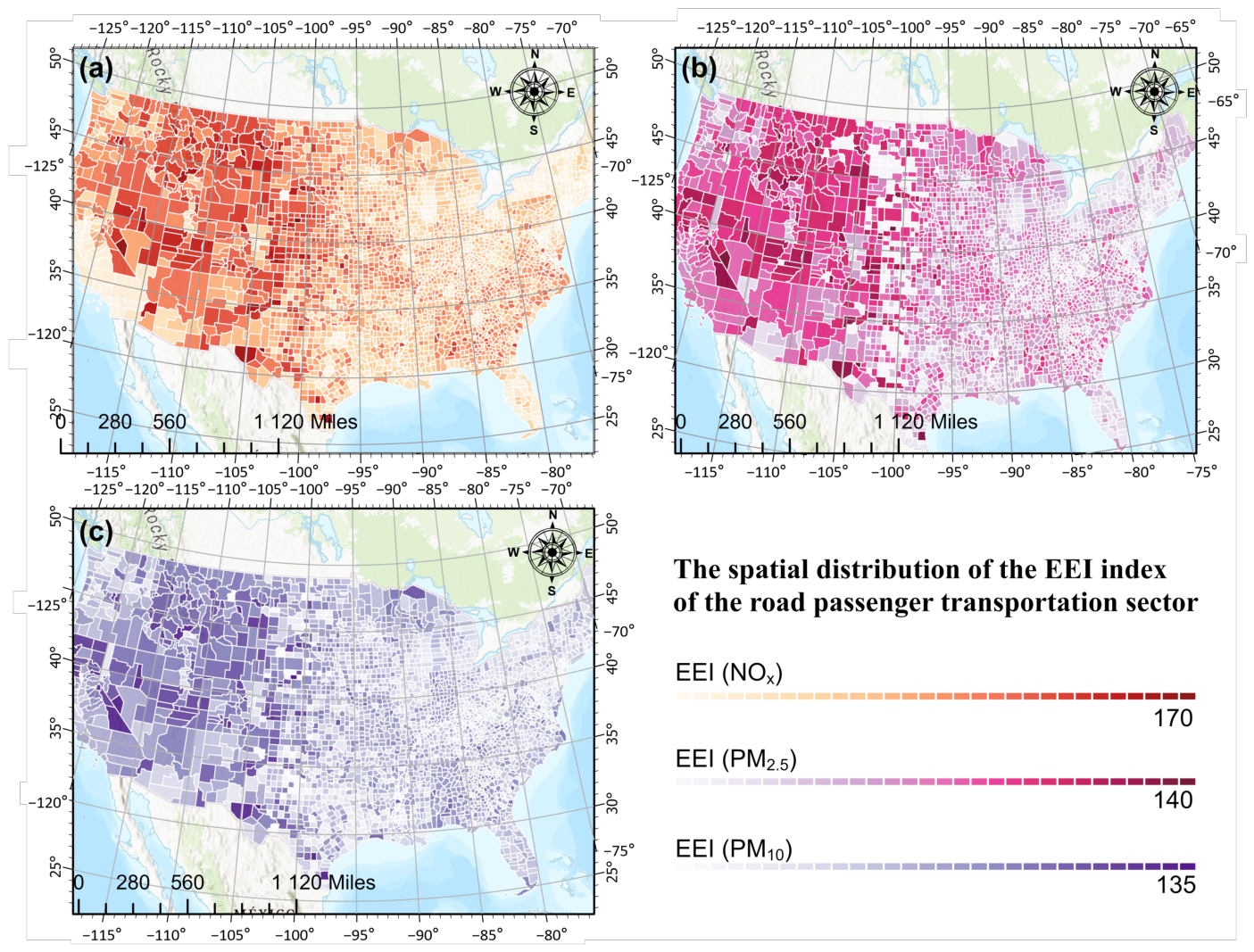
The spatial distributions of passenger and freight exposure injustice are shown in Figure 2 and Figure 3, respectively. These maps offer an initial visual diagnosis of whether the two forms of injustice display similar or differentiated geographic concentration patterns. As shown in Figure 2, the passenger transportation sector exhibits a comparatively broad and regionally coherent pattern across all three pollutants. Counties with elevated passenger EII are concentrated much more visibly across the western interior, the Southwest, and parts of the southern plains, whereas lower-burden counties are more prevalent across large portions of the eastern half of the country. Because the indicator is normalized by population, this pattern should not be interpreted as a mere reflection of total vehicle activity. Rather, it points to a structural mismatch between travel demand and population scale in counties characterized by dispersed settlement, long trip distances, strong automobile dependence, and limited substitution toward collective modes. In such settings, even when total traffic is not nationally dominant, the per capita burden of passenger emissions can become disproportionately high. The fact that this spatial configuration recurs across NO x , PM 2.5 , and PM 10 further indicates that passenger injustice is not driven by a pollutant-specific anomaly; instead, it is anchored in a relatively stable territorial logic of low-density mobility, weak modal diversification, and spatial separation between daily activities.
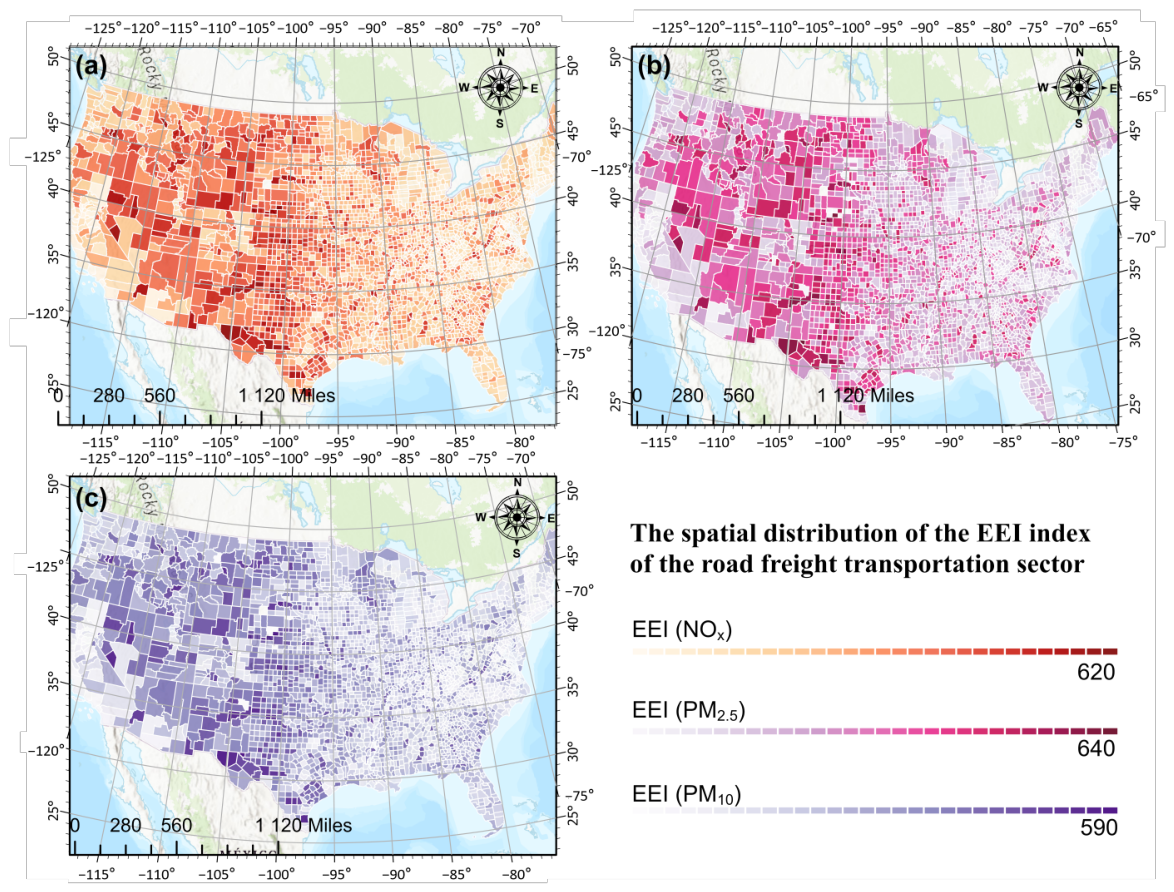
The freight transportation sector, by contrast, displays a more selective and infrastructure-mediated geography. As shown in Figure 3, high freight EII values remain visible in parts of the West and South, but they are less continuous and more fragmented than those of passenger transport. Instead of forming a broad regional belt, freight hotspots appear more corridor-like, nodal, and discontinuous, which is consistent with the fact that freight emissions are produced not by routine household mobility but by the territorial organization of commodity circulation. Counties may therefore register high freight EII not because they contain large resident populations or diversified urban functions, but because they are traversed by long-haul truck flows, host freight facilities, or occupy strategic positions in logistics networks. This distinction has substantive environmental justice implications. Whereas passenger injustice is more closely tied to where people live and how they travel, freight injustice is more closely tied to where goods move and where freight externalities are spatially offloaded. In other words, the communities bearing freight-related burdens need not be the communities generating the demand that sustains those flows.

4.2. Model Settings

Following the methodological framework in Section 3, the multi-task TabNet model was trained to predict passenger and freight exposure injustice simultaneously. We used a five-fold spatial cross-validation for model selection and hyperparameter tuning, while the test set was kept untouched for final performance evaluation. β and α equaled 0.5. Model training was performed using the Adam optimizer [67]. The initial learning rate was set to 0.001 and updated according to an exponential decay schedule:
η e = 0.001 × 0 . 9 e / 10 ,
where η e denotes the learning rate at epoch e, and e / 10 denotes the integer part of e / 10 . Early stopping was adopted to prevent overfitting. Training was terminated when the validation loss showed no meaningful improvement for 10 consecutive epochs [68]. Since TabNet relies on attentive feature masks rather than multi-head attention, the key architecture hyperparameters tuned in this study include the feature dimension, attention dimension, number of decision steps, batch size, and sparsity regularization coefficient.
Model performance is evaluated using the coefficient of determination ( R 2 ), the mean absolute error (MAE), the mean absolute percentage error (MAPE), and the root mean squared error (RMSE) [69]. Table 3 reports the hyperparameter settings of the proposed two-stage multi-task TabNet framework.
The full sample was first divided into training and test sets at a ratio of 7:3, and five-fold cross-validation was conducted within the training set for model selection. Model training was implemented using the Adam optimizer with an initial learning rate of 0.001, and the learning rate was updated using an exponential decay schedule to improve convergence stability. The task balance coefficient α was selected by grid search over the interval [0.3, 0.7] with an increment of 0.1, and the final value was set to 0.5 to maintain a symmetric comparative framework between the two tasks.
For the architecture-related settings, the feature dimension and attention dimension were both set to 16, the number of decision steps was set to 4, and the batch size was fixed at 256. This configuration provided sufficient representation capacity for county-level tabular data while avoiding excessive model complexity and overfitting. The sparsity regularization coefficient was set to 1 × 10 3 to encourage selective feature usage by the attentive masks and thereby preserve model interpretability. The maximum numbers of epochs in the pretraining and joint fine-tuning stages were set to 100 and 200, respectively, and early stopping with a patience of 10 epochs was adopted to terminate training once the validation loss no longer improved meaningfully. Overall, these settings strike a balance among prediction accuracy, computational efficiency, and interpretability, which is consistent with the comparative objective of distinguishing the common and task-specific mechanisms underlying passenger and freight transportation injustice.

5. Results

5.1. Spatial Divergence and Dependence of Passenger and Freight Transportation Injustice

The global Moran’s I statistics confirm that these visual patterns are statistically meaningful, but they also indicate that the strength of spatial dependence is limited rather than overwhelming. As reported in Table 4, all six indicators are positive and statistically significant at the 5% level, with Moran’s I values ranging from 0.0088 to 0.0667. This result establishes that both passenger and freight injustice exhibit positive spatial autocorrelation, meaning that counties with relatively high or low EII values are more likely than chance to be located near counties with similar burdens. At the same time, the magnitudes remain modest, which implies that transportation injustice is not organized as a simple, highly compact regional bloc. Instead, it is better understood as a pattern of weak-to-moderate spatial clustering embedded within substantial local heterogeneity.
More importantly, passenger EII shows consistently stronger global spatial dependence than freight EII for all three pollutants. For NO x , the Moran’s I for passenger transport reaches 0.0667, more than three times the corresponding freight value of 0.0198; for PM 2.5 , the values are 0.0339 and 0.0149, respectively; and for PM 10 , the gap narrows to 0.0088 versus 0.0104, with both effects remaining weak. This pattern suggests that passenger-related injustice is shaped more strongly by broad regional differences in urban form and mobility regimes, whereas freight-related injustice is comparatively less spatially continuous at the national scale and more contingent upon localized infrastructures, corridor effects, and facility siting.
We employ the local Moran’s I results to deepen this interpretation by showing that passenger injustice is not only more spatially correlated overall, but also more likely to form both coherent hotspots and coherent cold spots. Table 5 shows that the passenger sector records 173 high–high and 74 low–low counties for NO x , 169 high–high and 19 low–low counties for PM 2.5 , and 143 high–high and 22 low–low counties for PM 10 . This simultaneous presence of sizable high–high and low–low groupings indicates that passenger injustice is spatially polarized in a relatively systematic way: there are not only counties in which high burdens reinforce one another, but also counties in which low burdens cluster together as contiguous low-exposure environments. Such dual clustering is difficult to explain through traffic volume alone. More plausibly, it reflects the cumulative effect of spatially coherent mobility regimes, where low-density, car-dependent territories reproduce one another across neighboring counties, while denser and more functionally diversified areas produce comparatively lower per capita passenger burdens. The asymmetry between pollutant types is equally informative. In particular, the number of low–low clusters drops sharply from NO x to particulate indicators, suggesting that low passenger burden is more spatially stable for combustion-related emissions than for particulates, whose local levels may be more sensitive to county-specific road conditions, fleet composition, vehicle age, and non-exhaust sources.
By contrast, the freight sector exhibits a much more one-sided local structure. Although high–high clusters remain visible, which is 117 for NO x , 109 for PM 2.5 , and 99 for PM 10 , low–low clusters are virtually absent, with counts of 0, 0, and 1, respectively. This is a substantively important result. It indicates that freight injustice is not characterized by a balanced spatial polarization between high-burden and low-burden regional systems; rather, it is characterized by the selective concentration of burden in a limited set of counties. In practical terms, freight exposure does not generate a broad geography of uniformly protected places. Instead, it creates a narrower geography of repeatedly burdened places, typically those embedded in freight corridors, freight gateways, warehouse belts, or manufacturing–logistics interfaces. This also helps explain why the overwhelming majority of counties remain locally non-significant in the freight LISA results: the statistically meaningful geography of freight injustice is real, but it is territorially narrow and concentrated, involving fewer than one-tenth of counties. The freight system therefore appears less as a uniformly regionalized field and more as a networked infrastructure regime in which burdens are sharply localized around specific strategic nodes.
The comparison of hotspot overlap between passenger and freight systems provides an additional layer of evidence that the two sectors are related but not spatially interchangeable. As shown in Table 6, the overlap ratio reaches 68.36% for NO x , declines to 58.10% for PM 2.5 , and falls further to 44.32% for PM 10 . Two implications follow. First, the relatively high overlap for NO x suggests that passenger and freight systems still share a substantial common geography of combustion-related burden, which is unsurprising given that both light- and heavy-duty vehicles draw on the same network and intensify emissions along the same broad mobility corridors. Second, the steady decline from NO x to PM 10 indicates that sectoral divergence becomes stronger as the pollutant becomes more sensitive to vehicle class, operating conditions, and non-exhaust processes. Coarser particulate burdens are more likely to reflect heavy-truck weight, braking and tire wear, stop-and-go freight operations, dust resuspension, and logistics-facility environments, all of which make freight hotspots increasingly distinct from passenger hotspots. This difference in overlap therefore directly challenges any analytical strategy that pools transport emissions into a single exposure category, because such an approach would systematically overstate commonality and understate sector-specific injustice.
The spatial evidence points to a clear but differentiated geography of transportation injustice. Passenger EII is more regionally structured, more likely to form both hotspots and cold spots, and more strongly embedded in broad patterns of settlement dispersion and mobility dependence. Freight EII, in contrast, is more weakly auto-correlated at the national scale yet more sharply concentrated in a limited number of infrastructural locations, indicating that logistics networks redistribute emissions burdens in a highly selective way. The declining hotspot overlap across pollutants further shows that the apparent similarity between passenger and freight injustice is greatest for combustion emissions and weakest for particulate burdens, where sector-specific operating environments matter most. These results not only substantiate the need to distinguish passenger and freight systems empirically, but also provide the spatial justification for the comparative modeling strategy that follows, in which common drivers and task-specific mechanisms are estimated separately rather than collapsed into a single transport outcome.

5.2. Analysis of Prediction Results 

To validate the effectiveness of the proposed two-stage multi-task TabNet framework, this study jointly predicted passenger EII and freight EII under the three pollutant settings of PM2.5, PM10, and NOx, and evaluated model performance using R 2 , MAE, MAPE, and RMSE, as shown in Table 7, Table 8 and Table 9. The experimental protocol was fully consistent with the methodological setting described above. Specifically, the county-level sample was divided into training and test sets at a ratio of 7:3, five-fold cross-validation was conducted within the training set for model selection, and the final performance is reported for the held-out test set. The comparison set includes Random Forest, XGBoost, a Transformer-based tabular model, and Single-task TabNet. This benchmark design makes it possible to distinguish the value of conventional nonlinear ensemble learning, generic self-attention-based deep learning, and the task-sharing mechanism embedded in the proposed framework.
The proposed framework consistently achieves the best performance across all six prediction tasks. For the full model, R 2 ranges from 0.884 to 0.909, MAE ranges from 0.156 to 0.173, and MAPE remains within 13.47–15.02%, indicating that the framework not only exceeds the minimum explanatory threshold of 0.80 in every task, but also maintains stable and low prediction errors across pollutants and transport subsystems. More importantly, the superiority of the proposed method is not confined to a single pollutant or a single target. Compared with XGBoost, which is the strongest non-TabNet baseline, the proposed framework improves R 2 by an average of 0.026 across the six sub-tasks, reduces MAE by 0.0165 on average, and lowers MAPE by approximately 1.30 percentage points. Relative to Single-task TabNet, the average gain in R 2 is still about 0.017, while the average MAE is reduced by about 0.0115. This pattern indicates that the performance improvement cannot be attributed to the TabNet backbone alone; instead, it is the combined effect of shared representation learning, two-stage optimization, and task-specific refinement that drives the overall gain.
Meanwhile, the passenger EII is consistently easier to predict than freight EII under the same pollutant setting. In the proposed model, passenger R 2 exceeds freight R 2 by 0.015, 0.017, and 0.015 under PM2.5, PM10, and NOx, respectively, while passenger MAE remains 0.011 lower than freight MAE in all three cases. This difference is substantively meaningful. Passenger injustice is more directly tied to relatively smooth county-level gradients such as household income, automobile dependence, transit substitution, and compact development, whereas freight injustice is additionally shaped by corridor pass-through effects, hub concentration, truck flows, and logistics infrastructure. These latter mechanisms are more discontinuous in space and more sensitive to node–link structures, which naturally makes the freight task harder to approximate at the county level. The fact that the proposed framework still keeps freight R 2 above 0.88 suggests that shared learning is able to extract a stable common background, while the freight-specific head retains enough flexibility to absorb the residual heterogeneity.
The comparison with the Transformer-based model further clarifies why a generic deep architecture is insufficient for this problem. Although the Transformer baseline outperforms Random Forest in several sub-tasks, it remains systematically weaker than both XGBoost and TabNet-based models. Under the NOx–freight setting, for example, the Transformer achieves an R 2 of 0.848 and an MAE of 0.195, whereas the proposed model reaches 0.884 and 0.173, respectively. This gap suggests that generic self-attention does not automatically translate into better performance for moderately sized, strongly structured tabular data. In the present study, the predictor set has clear semantic grouping and limited dimensionality, so sequential feature selection is more beneficial than fully dense attention over all variables. The attentive mask mechanism in TabNet appears to be better aligned with this type of county-level socioeconomic and transportation data because it progressively filters irrelevant information while preserving interpretability.
To further identify the source of the performance gain, Table 10 reports the ablation results under the NOx setting, which is used here as a representative pollutant because traffic-related NOx is highly sensitive to both passenger and freight activities and thus provides a clear test bed for examining the passenger–freight distinction. The full-model results in Table 10 are identical to those reported for NOx in Table 8, ensuring consistency between the benchmark comparison and the structural diagnosis. The ablation design focuses on the four components that define the methodological contribution of this study, namely Stage I pretraining, the shared encoder, task-specific inputs, and sparsity regularization.
The ablation results confirm that the advantage of the proposed framework comes from the interaction of multiple design choices rather than from any single module. Removing task-specific inputs causes the largest deterioration, especially for freight EII, where R 2 drops from 0.884 to 0.838 and MAPE rises from 15.02% to 17.42%. For passenger EII, the corresponding reduction in R 2 is 0.037, with a 2.06-percentage-point increase in MAPE. This finding is central to the interpretation of the model. It shows that shared county-level background variables are necessary but not sufficient. Once freight-specific information such as truck intensity, freight-corridor structure, and hub conditions is removed, the model loses its ability to capture the institutional and infrastructural logic that distinguishes freight injustice from passenger injustice. The same argument holds, although to a slightly lesser degree, for passenger-specific indicators such as vehicle ownership, transit mode share, and passenger traffic pressure.
The removal of Stage I pretraining also leads to a clear decline in model performance. Under this setting, passenger R 2 falls by 0.013 and freight R 2 falls by 0.017, while MAE increases by 0.011 and 0.013, respectively. This result suggests that the pretraining stage is not merely an optimization convenience. By forcing the model to first learn a common representation from the shared variable set, Stage I reduces premature interference from task-exclusive information and provides a more stable initialization for the subsequent joint fine-tuning stage. This effect is especially important for freight EII, whose underlying mechanism is more spatially discontinuous and therefore more susceptible to noisy gradients during training.
A similarly important pattern emerges when the shared encoder is removed. In this case, the model degenerates into two separate Single-task TabNet models, and the corresponding performance drops to an R 2 of 0.882 for passenger EII and 0.868 for freight EII. This outcome indicates that the two tasks are not independent prediction problems. They are rooted in the same county-level socioeconomic and spatial context, and part of the useful signal can only be fully exploited when the model is allowed to learn a common latent representation. The modest but systematic decline after removing sparsity regularization further shows that selective feature usage improves not only interpretability but also generalization. When λ is set to zero, passenger and freight R 2 decline by 0.007 and 0.006, respectively, and both MAE and MAPE increase in a stable manner. This implies that constraining the attentive masks to focus on a smaller subset of informative variables helps suppress noise accumulation and stabilizes the representation learned by the shared encoder.

5.3. Interpretation Results of the Mechanisms of Passenger and Freight EIIs

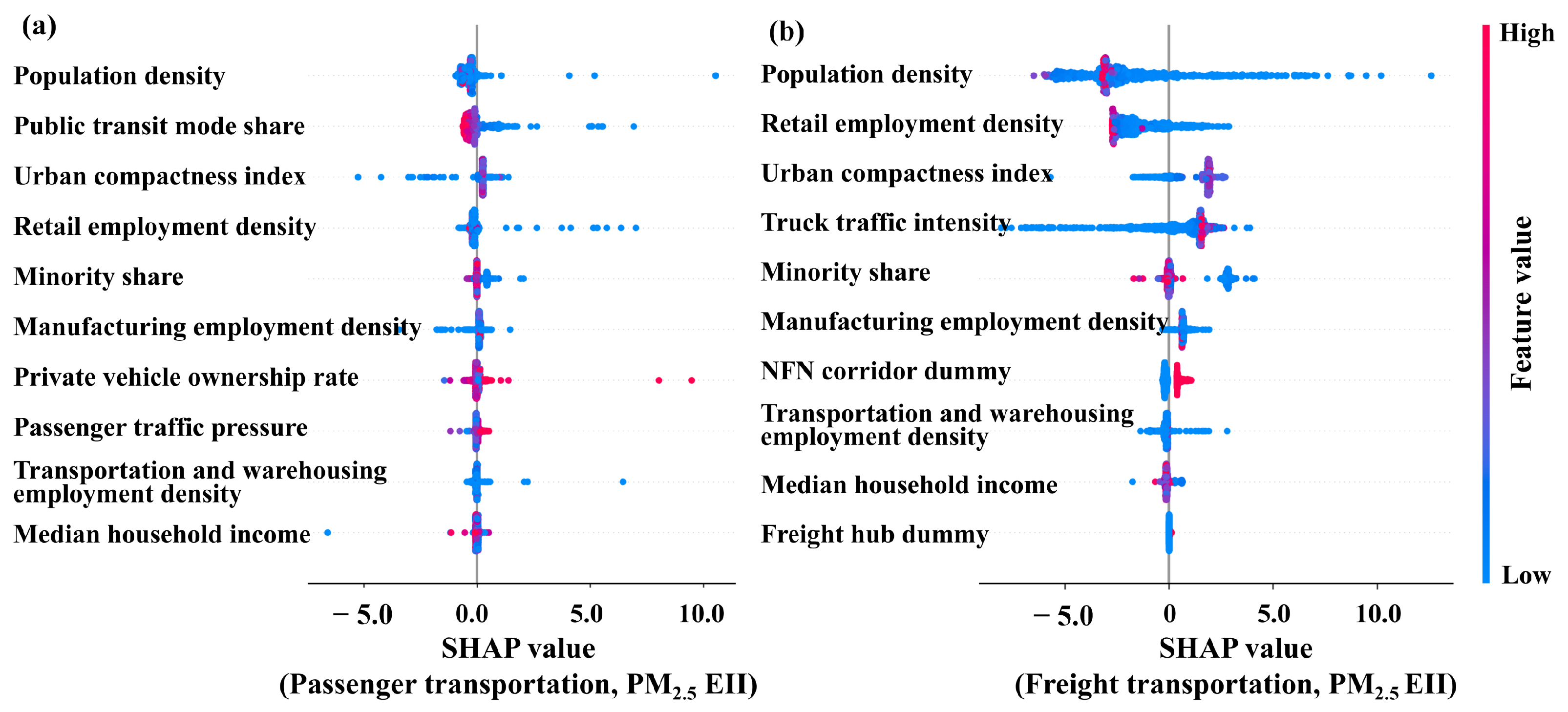
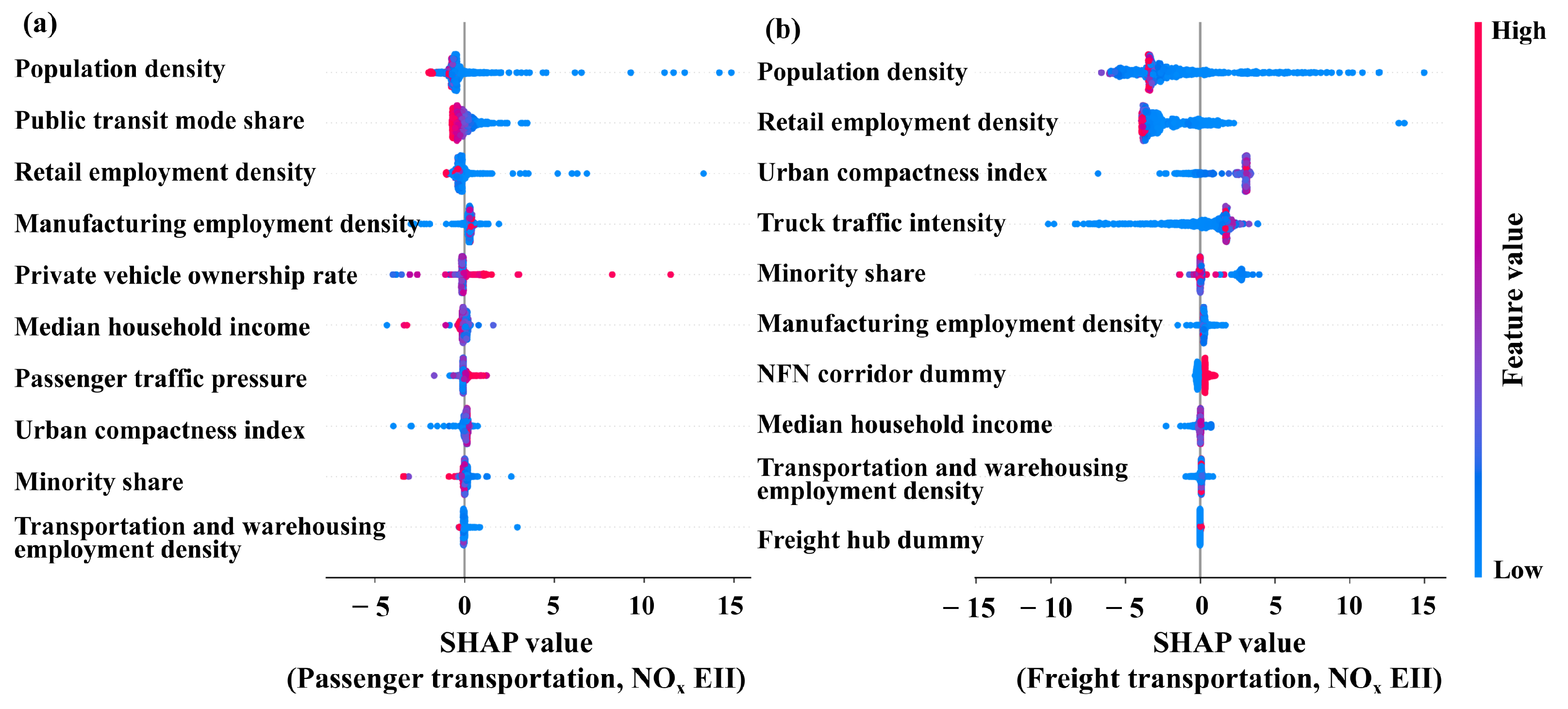
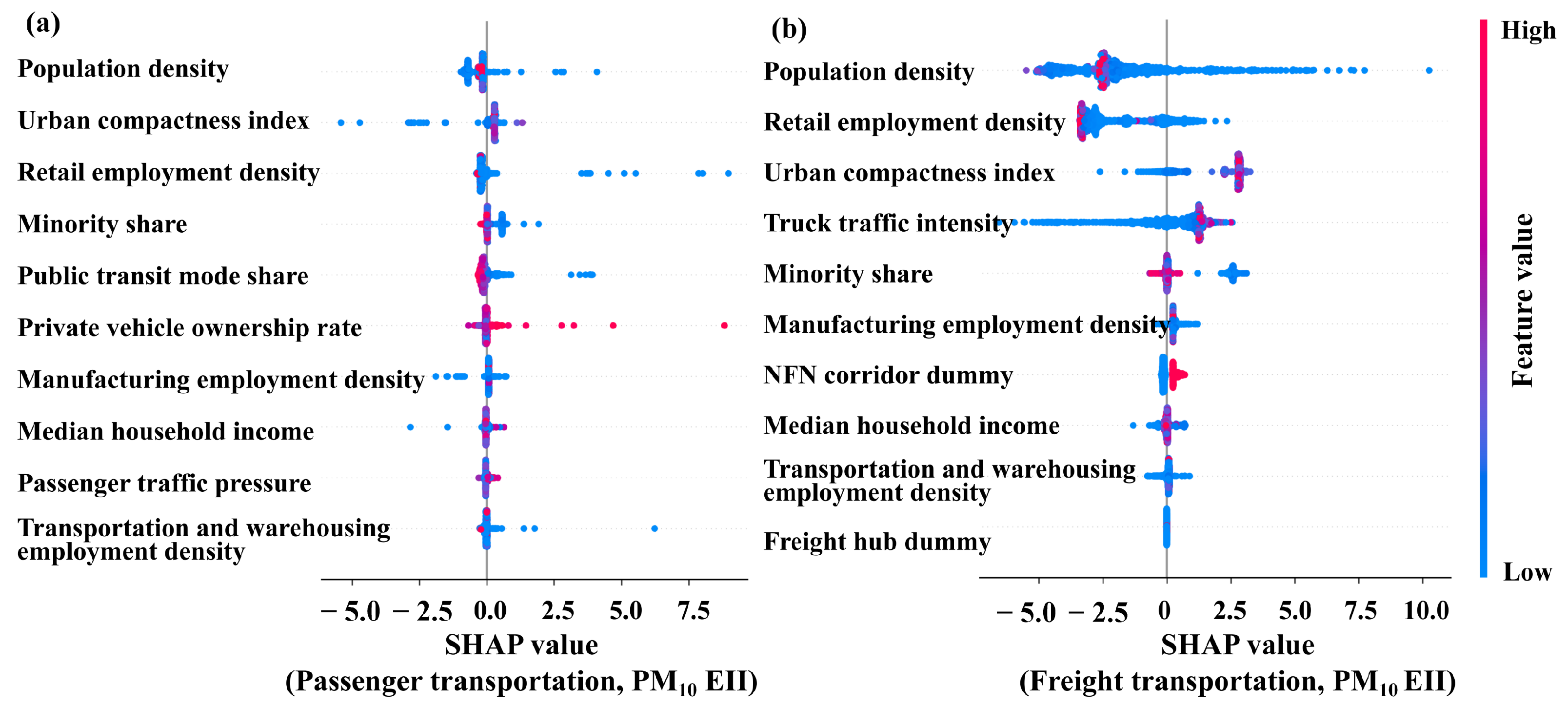
This study further applies SHAP to interpret how each explanatory variable contributes to passenger and freight EIIs across the three pollutants [70]. It should be noted that SHAP reflects the marginal contribution of each variable to the model prediction rather than a strict causal effect. Nevertheless, when a variable exhibits a stable rank, direction, and dispersion pattern across pollutants and across transport subsystems, the result carries substantial mechanistic meaning [71]. In the six beeswarm plots (Figure 4, Figure 5 and Figure 6), the variable order corresponds to the mean absolute SHAP value and therefore indicates relative importance; the horizontal spread reflects the strength and heterogeneity of marginal effects; and the coupling between color and sign reveals whether high or low feature values tend to increase or decrease EII. A consistent pattern across all six models is that the explanatory structure is strongly concentrated rather than evenly distributed: the top few variables generate the vast majority of prediction variation, whereas most lower-ranked variables cluster tightly around zero. This suggests that transportation-related exposure injustice is not produced by a diffuse accumulation of many equally sized effects, but by a limited number of dominant socio-spatial mechanisms supplemented by weaker contextual modifiers.
The SHAP analysis reveals a common socio-spatial foundation underlying both passenger and freight injustice, alongside a clear divergence in their underlying mechanisms. In the passenger system, elevated EII is consistently associated with a dispersed mobility structure, characterized by low population density, limited public transit substitution, constrained service accessibility, and strong reliance on private automobiles. Population density ranks as the most important variable across all passenger models, with a distinctly asymmetric effect: low-density counties generate the largest positive SHAP values. This indicates that passenger injustice is not primarily driven by where traffic volumes are highest, but by where emissions are distributed over relatively small population bases under automobile-dependent conditions. Public transit mode share and private vehicle ownership further reinforce this mechanism, while passenger traffic pressure itself plays a comparatively minor role. This suggests that passenger EII is shaped more by the structural organization of everyday mobility than by short-term traffic intensity.
At the same time, the passenger mechanism varies across pollutants. NOx is more closely linked to motorized travel demand and tailpipe emissions, making variables such as transit availability, vehicle ownership, and destination accessibility more influential. In contrast, urban compactness becomes more important for PM2.5 and PM10, where it emerges as a leading factor with a predominantly positive effect. Because compactness in this study reflects road density and jobs–housing balance rather than population density alone, higher values imply denser road networks, more frequent stop-and-go traffic, and greater accumulation of non-tailpipe emissions (e.g., brake, tire, and road dust). This indicates a pollutant-specific distinction: passenger NOx is driven primarily by tailpipe-intensive mobility dependence, whereas particulate pollution is more strongly shaped by localized road-environment intensification.
In contrast, the freight system exhibits a more network- and infrastructure-driven structure. Population density again ranks first, with low-density counties showing the highest EII levels. This reflects the fact that freight injustice tends to concentrate in areas with relatively small populations but significant through-traffic, corridor flows, or transshipment activity. Retail employment density suggests that these burdens are more common in peripheral or corridor regions than in major consumption centers. Freight-specific variables, especially truck traffic intensity and location within the National Highway Freight Network, play a central role. High truck intensity consistently increases EII, and corridor counties are strongly associated with positive contributions, while freight hub effects are comparatively weak. This indicates that freight injustice is less about isolated nodes and more about the spatial transmission of logistics externalities along network corridors.
Across pollutants, the freight system shows greater structural consistency than the passenger system, with key variables remaining stable. However, urban compactness plays a distinct and important role: unlike in the passenger case, it consistently exerts a positive effect across all pollutants. This suggests that compactness acts as an amplifier in freight systems rather than a mitigating factor. More compact areas tend to experience overlapping freight flows, intensified delivery activity, and increased congestion and curbside competition, all of which raise per capita exposure levels. While NOx remains more sensitive to truck intensity due to diesel combustion, particulate pollutants are more influenced by the interaction between logistics activity, local operating conditions, and compact urban structure.
Taken together, these results highlight both a shared foundation and a clear divergence. Both systems are shaped by a mismatch between emissions and local population scale, but their direct mechanisms differ substantially. Passenger injustice is primarily driven by behavioral and mobility structures (especially automobile dependence and limited modal alternatives), whereas freight injustice is driven by infrastructural and network dynamics, particularly the routing and spatial redistribution of logistics externalities. The role of compactness further sharpens this contrast: it mainly affects particulate exposure in passenger transport, but consistently amplifies exposure in freight systems.
The substantive contribution of the SHAP analysis lies in demonstrating that passenger and freight injustice arise from fundamentally different socio-spatial processes. Passenger EII is rooted in dispersed settlement patterns and everyday mobility dependence, whereas freight EII is rooted in corridorization, logistics throughput, and the selective territorial concentration of network externalities. This distinction has direct policy implications. Planning strategies such as compact development or traffic optimization may reduce passenger-related burdens under certain conditions, but can simultaneously intensify freight exposure by attracting delivery traffic and increasing local congestion. Therefore, transportation environmental justice cannot be effectively addressed through a single, undifferentiated emissions framework. A more effective approach requires explicit recognition of passenger–freight heterogeneity, as well as pollutant-specific differences between tailpipe and non-tailpipe processes.

6. Discussion

Passenger EII is rooted in dispersed settlement patterns, automobile dependence, and limited transit alternatives, which are largely shaped by local land use and mobility regimes. Freight EII, in contrast, is driven by corridorization, logistics throughput, and the selective spatial concentration of network externalities, which are determined by national infrastructure networks and inter-regional freight flows. This fundamental distinction implies that a one-size-fits-all policy framework cannot effectively address both types of injustice. Instead, a tiered governance system is required, with localized interventions for passenger injustice and nationally coordinated strategies for freight injustice. It is also useful to clarify how the proposed EII relates to alternative environmental justice metrics used in prior studies. Existing EJ assessments commonly adopt three types of measures. The first type is proximity-based, identifying whether disadvantaged communities are located closer to highways, industrial facilities, ports, or other pollution sources [4,72]. The second type is exposure- or concentration-based, using ambient pollution estimates and demographic data to compare population-weighted exposure levels across racial, ethnic, income, or age groups [1,2,8]. The third type is composite cumulative-burden screening, such as EJScreen and CalEnviroScreen, which combines environmental indicators with socioeconomic or population-vulnerability indicators to identify overburdened communities [73,74]. Compared with these metrics, the EII proposed in this study has a narrower but complementary purpose. It does not measure distance to sources, modeled ambient concentrations, health risks, or multidimensional vulnerability. Instead, it measures the relative per capita transportation-emission burden borne by county residents under a specific transport subsystem. This design is appropriate for the objective of this study because it enables a consistent comparison between passenger and freight emissions, between pollutants, and across all counties using the same national benchmark. In particular, the EII is useful for identifying places where local residents bear a disproportionate emissions burden relative to the size of the resident population, including freight-corridor counties where emissions may be generated by through-traffic and logistics flows serving broader regional or national demand. Therefore, the EII should be interpreted as a burden-based distributive justice metric that complements, rather than replaces, established proximity-based, concentration-based, and cumulative-impact EJ indicators.

6.1. Local Governance Framework for Passenger Injustice

Passenger EII consistently concentrates in low-density, automobile-dependent counties where emissions are distributed over small population bases. Population density is the most important predictor, and its asymmetric effect indicates that reducing traffic volume alone is insufficient if the population base remains tiny. Public transit mode share and vehicle ownership further reinforce the mechanism, while passenger traffic pressure plays only a minor role. These findings point to a set of locally tailored policy instruments.
First, improving transit service frequency and coverage in low-density areas can reduce per capita vehicle miles traveled, but conventional fixed-route transit is often economically infeasible in such settings. Flexible alternatives such as on-demand micro-transit, ride-sharing programs, and mobility-as-a-service platforms should be considered, paired with targeted subsidies for low-income populations. Second, land-use and transportation coordination is essential. Policies that promote job–housing balance, mixed-use development, and 15 min neighborhoods can shorten trip distances and reduce automobile reliance. However, compact development has a dual effect: it lowers NOx emissions by reducing per capita travel demand, but it may increase particulate exposure through denser road networks, stop-and-go traffic, and non-tailpipe emissions. Therefore, local governments implementing compact growth strategies must simultaneously enforce low-emission zones, street sweeping programs, and non-exhaust emission standards. Third, because passenger injustice varies systematically with urban form and pollutant type, counties should adopt differentiated targets. For NOx, reducing tailpipe emissions through vehicle electrification and inspection programs is a priority. For PM2.5 and PM10, controlling brake, tire, and dust emissions via traffic calming, pavement maintenance, and fleet composition rules becomes equally important.
In short, passenger injustice is a local problem requiring local solutions. The high spatial heterogeneity of passenger EII means that state or federal mandates without local flexibility are likely to be ineffective. A place-based approach that respects county-level differences in density, transit availability, and mobility dependence is the logical policy response [75].

6.2. National Governance Framework for Freight Injustice

Freight EII exhibits a very different spatial logic. It is not widely distributed but sharply concentrated in a limited number of counties that function as freight corridors, gateways, warehouse belts, or manufacturing–logistics interfaces. Low-density counties with high truck intensity and location within the National Highway Freight Network are the primary hotspots. Moreover, urban compactness acts as an amplifier: denser areas experience overlapping freight flows, intensified delivery activity, and increased congestion, all of which raise per capita exposure. These characteristics render freight injustice largely beyond the capacity of any single county to mitigate, because truck flows and network-level routing decisions are determined by national and inter-regional logistics systems.
A national governance framework is therefore necessary. First, environmental justice indicators should be formally integrated into the planning and operation of the National Highway Freight Network and other federal freight programs. Specifically, a “freight environmental justice corridor” designation could be established for counties that fall in the top decile of freight EII while having below-median population density. Such designation would trigger federal oversight, mitigation requirements, and compensatory funding. Second, a cross-regional environmental compensation mechanism should be created. Counties that host disproportionate freight through-traffic but consume little of the delivered goods are effectively bearing externalities for the benefit of distant consumption centers. A federal compensation fund, financed by a small surcharge on freight movements or by consumption-based fees in major metropolitan areas, could provide resources for local health interventions, green infrastructure, and community buffers. Third, the federal government should accelerate the transition away from diesel trucking through national low-emission truck standards, zero-emission vehicle mandates, and investments in rail and water freight intermodal capacity. Corridor-specific electrification of truck stops and charging infrastructure along major freight routes can directly reduce tailpipe exposure. Fourth, a national freight emissions monitoring and early-warning platform, integrating real-time truck GPS data, air quality sensors, and health impact models, would enable dynamic routing recommendations and public alerts.
The national framework does not preclude local action. Counties can still implement truck route restrictions, idle reduction policies, and warehouse setback rules. However, the core burden of freight injustice cannot be shifted onto local governments alone. Without national corridor-level planning and compensation, freight hotspots will persist regardless of local efforts.

6.3. Coordinated Multi-Level Mitigation System

The coexistence of local passenger injustice and national freight injustice demands a coordinated multi-level mitigation system rather than two separate policy silos. The key is to design vertical and horizontal integration mechanisms that align incentives and avoid policy conflicts.
Vertically, the federal government should establish a national framework that defines environmental justice performance standards for freight corridors, identifies priority zones, allocates compensatory funds, and mandates data reporting. State governments can serve as intermediaries, assisting counties with technical planning, aggregating local demands, and ensuring compliance with federal guidelines. Local governments retain autonomy over passenger-related measures and implement freight mitigation actions adapted to their specific land use and community contexts. This tiered structure respects the spatial scale of each mechanism: national for freight corridors, local for passenger mobility.
Horizontally, coordination is needed to prevent unintended consequences. For example, a local compact development strategy designed to reduce passenger VMT may inadvertently attract more delivery vehicles, worsen congestion, and increase freight exposure. To avoid such trade-offs, local land-use plans should be reviewed against regional freight flow projections. Similarly, a national program that encourages warehouse development near highway interchanges could concentrate particulate burdens in already vulnerable low-density counties. Therefore, an inter-governmental working group on transportation environmental justice, comprising federal, state, and local representatives, should be established to conduct ex ante policy screening and ex post evaluation.

7. Conclusions

This study addresses the gap that transportation environmental justice studies often treat emissions as a homogeneous whole, lacking a systematic comparison between passenger and freight systems. We construct the Exposure Injustice Index (EII) and combine spatial statistics, a two-stage multi-task TabNet model, and SHAP analysis to examine spatial divergence, driving mechanisms, and regulatory effects of urban compactness across the two systems.
Three key findings emerge. First, passenger and freight emissions show fundamentally different spatial patterns of environmental injustice: passenger EII exhibits regionally coherent clustering, while freight EII is fragmented and corridor-like. Second, passenger injustice is dominated by local mobility factors (e.g., population density, auto dependence), whereas freight injustice is shaped by infrastructural and network factors (e.g., truck traffic, highway coverage). Third, urban compactness has a dual effect on passenger injustice reducing tailpipe NOx but amplifying non-tailpipe particulate burden and consistently amplifies freight-related injustice.
Several limitations point to future research. The county-level analysis may be affected by the modifiable areal unit problem; future studies should use finer spatial units. This study focuses only on distributive justice, not procedural or recognitional justice, and uses cross-sectional 2020 data. Endogeneity cannot be fully ruled out; the identified associations are predictive, not causal. Future research should adopt panel data, quasi-experimental designs, or instrumental variables to establish causality. Further work may also explore intra-county disparities, multi-dimensional justice frameworks, and temporal dynamics.

Author Contributions

Conceptualization, H.Z. and B.Y.; methodology, H.Z.; software, H.Z.; validation, H.Z., Z.L. and B.Y.; formal analysis, H.Z.; investigation, H.Z.; resources, Z.L. and B.Y.; data curation, H.Z.; writing—original draft preparation, H.Z.; writing—review and editing, Z.L. and B.Y.; visualization, H.Z.; supervision, B.Y.; project administration, B.Y.; funding acquisition, B.Y. All authors have read and agreed to the published version of the manuscript.

Funding

This research was funded by National Natural Science Foundation of China, grant number 52072235.

Institutional Review Board Statement

Not applicable.

Informed Consent Statement

Not applicable.

Data Availability Statement

The data presented in this study are available on request from the corresponding author.

Conflicts of Interest

The authors declare no conflicts of interest.

Abbreviations

The following abbreviations are used in this manuscript:
EIIExposure Injustice Index
PCAPrincipal Component Analysis
UCIUrban Compactness Index
SHAPSHapley Additive exPlanations
NFNNational Highway Freight Network
MT-TabNetMulti-Task TabNet
ST-TabNetSingle-Task TabNet
MAEMean Absolute Error
MAPEMean Absolute Percentage Error
RMSERoot Mean Squared Error
R2Coefficient of Determination
ACSAmerican Community Survey
LEHDLongitudinal Employer-Household Dynamics
FHWAFederal Highway Administration
BEABureau of Economic Analysis
EPAEnvironmental Protection Agency

References

  1. Jbaily, A.; Zhou, X.; Liu, J.; Lee, T.H.; Kamareddine, L.; Verguet, S.; Dominici, F. Air pollution exposure disparities across U.S. population and income groups. Nature 2022, 601, 228–233. [Google Scholar] [CrossRef] [PubMed]
  2. Tessum, C.W.; Apte, J.S.; Goodkind, A.L.; Muller, N.Z.; Mullins, K.A.; Paolella, D.A.; Polasky, S.; Springer, N.P.; Thakrar, S.K.; Marshall, J.D.; et al. Inequity in consumption of goods and services adds to racial–ethnic disparities in air pollution exposure. Proc. Natl. Acad. Sci. USA 2019, 116, 6001–6006. [Google Scholar] [CrossRef]
  3. U.S. Environmental Protection Agency. Inventory of U.S. Greenhouse Gas Emissions and Sinks: 1990–2022. 2024. Available online: https://www.epa.gov/ghgemissions/inventory-us-greenhouse-gas-emissions-and-sinks-1990-2022 (accessed on 26 March 2026).
  4. Karner, A.; London, J.; Rowangould, D.; Manaugh, K. From transportation equity to transportation justice: Within, through, and beyond the state. J. Plan. Lit. 2020, 35, 440–459. [Google Scholar] [CrossRef]
  5. Mohai, P.; Pellow, D.; Roberts, J.T. Environmental justice. Annu. Rev. Environ. Resour. 2009, 34, 405–430. [Google Scholar] [CrossRef]
  6. Pereira, R.H.M.; Schwanen, T.; Banister, D. Distributive justice and equity in transportation. Transp. Rev. 2017, 37, 170–191. [Google Scholar] [CrossRef]
  7. Agyeman, J.; Bullard, R.D.; Evans, B. (Eds.) Just Sustainabilities: Development in an Unequal World; MIT Press: Cambridge, MA, USA, 2003. [Google Scholar]
  8. Clark, L.P.; Millet, D.B.; Marshall, J.D. National patterns in environmental injustice and inequality: Outdoor NO2 air pollution in the United States. PLoS ONE 2014, 9, e94431. [Google Scholar] [CrossRef]
  9. Marshall, J.D.; Giang, A.; Ivey, C. Tracing environmental equity and air pollution research at ES&T. Environ. Sci. Technol. 2026, 60, 5905–5909. [Google Scholar] [CrossRef]
  10. Apte, J.S.; Manchanda, C. High-resolution urban air pollution mapping. Science 2024, 385, 380–385. [Google Scholar] [CrossRef]
  11. Ewing, R.; Cervero, R. Travel and the built environment. J. Am. Plan. Assoc. 2010, 76, 265–294. [Google Scholar] [CrossRef]
  12. Glaeser, E.L.; Kahn, M.E. The greenness of cities: Carbon dioxide emissions and urban development. J. Urban Econ. 2010, 67, 404–418. [Google Scholar] [CrossRef]
  13. Grazi, F.; van den Bergh, J.C.J.M.; van Ommeren, J.N. An empirical analysis of urban form, transport, and global warming. Energy J. 2008, 29, 97–122. [Google Scholar] [CrossRef]
  14. Hankey, S.; Marshall, J.D. Impacts of urban form on future U.S. passenger-vehicle greenhouse gas emissions. Energy Policy 2010, 38, 4880–4887. [Google Scholar] [CrossRef]
  15. Fan, T.; Chapman, A. Policy driven compact cities: Toward clarifying the effect of compact cities on carbon emissions. Sustainability 2022, 14, 12634. [Google Scholar] [CrossRef]
  16. Park, J.; Jung, S. Exploring urban compactness and greenhouse gas emissions in the road transport sector: A case study of big cities in South Korea. Sustainability 2024, 16, 1911. [Google Scholar] [CrossRef]
  17. Wang, Y.; Hayashi, Y.; Chen, J.; Li, Q. Changing urban form and transport CO2 emissions: An empirical analysis of Beijing, China. Sustainability 2014, 6, 4558–4579. [Google Scholar] [CrossRef]
  18. Ye, Y.; Wang, C.; Zhang, Y.; Wu, K.; Wu, Q.; Su, Y. Low-carbon transportation oriented urban spatial structure: Theory, model and case study. Sustainability 2017, 10, 19. [Google Scholar] [CrossRef]
  19. Ao, Y.; Yang, D.; Chen, C.; Wang, Y. Effects of rural built environment on travel-related CO2 emissions considering travel attitudes. Transp. Res. Part D Transp. Environ. 2019, 73, 187–204. [Google Scholar] [CrossRef]
  20. Hong, J.; Goodchild, A. Land use policies and transport emissions: Modeling the impact of trip speed, vehicle characteristics and residential location. Transp. Res. Part D Transp. Environ. 2014, 26, 47–51. [Google Scholar] [CrossRef]
  21. Peng, T.; Gan, M.; Yao, Z.; Yang, X.; Liu, X. Nonlinear impacts of urban built environment on freight emissions. Transp. Res. Part D Transp. Environ. 2024, 134, 104358. [Google Scholar] [CrossRef]
  22. Russo, F.; Comi, A. Urban freight transport planning towards green goals: Synthetic environmental evidence from tested results. Sustainability 2016, 8, 381. [Google Scholar] [CrossRef]
  23. Shi, T.; Tu, M.; Li, Y.; Liu, H.; Gruyer, D. Revealing the built environment impacts on truck emissions using interpretable machine learning. Transp. Res. Part D Transp. Environ. 2025, 141, 104662. [Google Scholar] [CrossRef]
  24. Antonczak, B.; Thompson, T.M.; DePaola, M.W.; Rowangould, G. 2020 near-roadway population census, traffic exposure and equity in the United States. Transp. Res. Part D Transp. Environ. 2023, 125, 103965. [Google Scholar] [CrossRef]
  25. Yu, C.; Yuan, Q.; Goodchild, A.; Dong, W.; Fried, T.; Lin, H.; Zou, Y.; Yang, C.; Lu, Y.; Duan, Q.; et al. Increasing nationwide disparities in road freight emissions across cities. Nat. Cities 2026, 3, 28–37. [Google Scholar] [CrossRef]
  26. Wu, X.; Tao, T.; Cao, J.; Fan, Y.; Ramaswami, A. Examining threshold effects of built environment elements on travel-related carbon-dioxide emissions. Transp. Res. Part D Transp. Environ. 2019, 75, 1–12. [Google Scholar] [CrossRef]
  27. Schlosberg, D. Defining Environmental Justice: Theories, Movements, and Nature; Oxford University Press: Oxford, UK, 2007. [Google Scholar]
  28. Walker, G. Environmental Justice: Concepts, Evidence and Politics; Routledge: Oxfordshire, UK, 2012. [Google Scholar]
  29. Monteiro, A.; Figueiredo, E.; Rodrigues, V.; Cardoso, C.; Lopes, M.; Roebeling, P.; Relvas, H.; Seixas, P.; Gouveia, S.; Gomes, A.; et al. Air pollution and environmental justice: A systematic literature review on methodological approaches. Heliyon 2026, 12, e44289. [Google Scholar] [CrossRef]
  30. Verlinghieri, E.; Schwanen, T. Transport and mobility justice: Evolving discussions. J. Transp. Geogr. 2020, 87, 102798. [Google Scholar] [CrossRef]
  31. Rowangould, D.; Karner, A.; London, J. Identifying environmental justice communities for transportation analysis. Transp. Res. Part A Policy Pract. 2016, 88, 151–162. [Google Scholar] [CrossRef]
  32. Barnes, J.H.; Chatterton, T.J.; Longhurst, J.W.S. Emissions vs exposure: Increasing injustice from road traffic-related air pollution in the United Kingdom. Transp. Res. Part D Transp. Environ. 2019, 73, 56–66. [Google Scholar] [CrossRef]
  33. Canepa, K.; Hardman, S.; Tal, G. An early look at plug-in electric vehicle adoption in disadvantaged communities in California. Transp. Policy 2019, 78, 19–30. [Google Scholar] [CrossRef]
  34. Hsu, C.-W.; Fingerman, K. Public electric vehicle charger access disparities across race and income in California. Transp. Policy 2021, 100, 59–67. [Google Scholar] [CrossRef]
  35. Roy, A.; Law, M. Examining spatial disparities in electric vehicle charging station placements using machine learning. Sustain. Cities Soc. 2022, 83, 103978. [Google Scholar] [CrossRef]
  36. Hennessy, E.M.; Syal, S.M. Assessing justice in California’s transition to electric vehicles. iScience 2023, 26, 106856. [Google Scholar] [CrossRef]
  37. Chang, S.Y.; Huang, J.; Chaveste, M.R.; Lurmann, F.W.; Eisinger, D.S.; Mukherjee, A.D.; Erdakos, G.B.; Alexander, M.; Knipping, E. Electric vehicle fleet penetration helps address inequalities in air quality and improves environmental justice. Commun. Earth Environ. 2023, 4, 135. [Google Scholar] [CrossRef]
  38. Yu, Q.; He, B.Y.; Ma, J.; Zhu, Y. California’s zero-emission vehicle adoption brings air quality benefits yet equity gaps persist. Nat. Commun. 2023, 14, 7798. [Google Scholar] [CrossRef]
  39. Zhu, S.; Mac Kinnon, M.; Carlos-Carlos, A.; Davis, S.J.; Samuelsen, S. Decarbonization will lead to more equitable air quality in California. Nat. Commun. 2022, 13, 5738. [Google Scholar] [CrossRef]
  40. Fried, T.; Goodchild, A.; Browne, M.; Sanchez-Diaz, I. Seeking equity and justice in urban freight: Where to look? Transp. Rev. 2024, 44, 191–212. [Google Scholar] [CrossRef]
  41. Hu, S.; Shu, S.; Bishop, J.; Na, X.; Stettler, M. Vehicle telematics data for urban freight environmental impact analysis. Transp. Res. Part D Transp. Environ. 2022, 102, 103121. [Google Scholar] [CrossRef]
  42. Giuliano, G.; Dessouky, M.; Dexter, S.; Fang, J.; Hu, S.; Miller, M. Heavy-duty trucks: The challenge of getting to zero. Transp. Res. Part D Transp. Environ. 2021, 93, 102742. [Google Scholar] [CrossRef]
  43. Ramirez-Ibarra, M.; Saphores, J.-D.M. Health and equity impacts from electrifying drayage trucks. Transp. Res. Part D Transp. Environ. 2023, 116, 103616. [Google Scholar] [CrossRef]
  44. Camilleri, S.F.; Montgomery, A.; Visa, M.A.; Schnell, J.L.; Adelman, Z.E.; Janssen, M.; Grubert, E.A.; Anenberg, S.C.; Horton, D.E. Air quality, health and equity implications of electrifying heavy-duty vehicles. Nat. Sustain. 2023, 6, 1643–1653. [Google Scholar] [CrossRef]
  45. McNeil, W.H.; Porzio, J.; Tong, F.; Harley, R.A.; Auffhammer, M.; Scown, C.D. Impact of truck electrification on air pollution disparities in the United States. Nat. Sustain. 2025, 8, 276–286. [Google Scholar] [CrossRef]
  46. Liu, Q.; Zhao, P.; Zhang, Y.; Zhang, Z.; Yang, J. Estimating the non-linear effects of urban built environment at residence and workplace on carbon dioxide emissions from commuting. Front. Public Health 2022, 10, 1077560. [Google Scholar] [CrossRef]
  47. Yang, W. The nonlinear effects of multi-scale built environments on CO2 emissions from commuting. Transp. Res. Part D Transp. Environ. 2023, 118, 103736. [Google Scholar] [CrossRef]
  48. Li, L.; Deng, Z.; Huang, X. Nonlinear relationship between urban form and transport CO2 emissions: Evidence from Chinese cities based on machine learning. J. Geogr. Sci. 2024, 34, 1558–1588. [Google Scholar] [CrossRef]
  49. Moran, P.A.P. Notes on continuous stochastic phenomena. Biometrika 1950, 37, 17–23. [Google Scholar] [CrossRef] [PubMed]
  50. Anselin, L. Local indicators of spatial association—LISA. Geogr. Anal. 1995, 27, 93–115. [Google Scholar] [CrossRef]
  51. Caruana, R. Multitask learning. Mach. Learn. 1997, 28, 41–75. [Google Scholar] [CrossRef]
  52. Arik, S.Ö.; Pfister, T. TabNet: Attentive interpretable tabular learning. Proc. AAAI Conf. Artif. Intell. 2021, 35, 6679–6687. [Google Scholar] [CrossRef]
  53. Federal Highway Administration. U.S. Driving Last Year Was Lowest in Two Decades, New Data Show. 2021. Available online: https://highways.dot.gov/newsroom/us-driving-last-year-was-lowest-two-decades-new-data-show (accessed on 26 March 2026).
  54. U.S. Environmental Protection Agency. EPA’s 2020 National Emissions Inventory and Trends Report. 2023. Available online: https://storymaps.arcgis.com/stories/d7d730f974c6474190b142a49ae8d3bd (accessed on 26 March 2026).
  55. U.S. International Trade Commission. The Impact of the COVID-19 Pandemic on Freight Transportation Services and U.S. Merchandise Imports. 2021. Available online: https://www.usitc.gov/research_and_analysis/tradeshifts/2020/special_topic.html (accessed on 26 March 2026).
  56. U.S. Environmental Protection Agency. 2020 National Emissions Inventory (NEI) Data. 2026. Available online: https://www.epa.gov/air-emissions-inventories/2020-national-emissions-inventory-nei-data (accessed on 26 March 2026).
  57. U.S. Census Bureau. American Community Survey 5-Year Data (2009–2024). 2026. Available online: https://www.census.gov/data/developers/data-sets/acs-5year.html (accessed on 26 March 2026).
  58. U.S. Census Bureau. Longitudinal Employer-Household Dynamics Data. 2026. Available online: https://lehd.ces.census.gov/data/ (accessed on 26 March 2026).
  59. Federal Highway Administration. Highway Performance Monitoring System. 2026. Available online: https://www.fhwa.dot.gov/policyinformation/hpms.cfm (accessed on 26 March 2026).
  60. U.S. Bureau of Economic Analysis. Regional Economic Accounts. 2026. Available online: https://www.bea.gov/data/economic-accounts/regional (accessed on 26 March 2026).
  61. Bureau of Transportation Statistics. Port Profiles. 2024. Available online: https://www.bts.gov/browse-statistical-products-and-data/port-performance/port-profiles (accessed on 26 March 2026).
  62. Federal Aviation Administration. Airport Categories. 2026. Available online: https://www.faa.gov/airports/planning_capacity/categories (accessed on 26 March 2026).
  63. Federal Highway Administration. National Highway Freight Network. 2025. Available online: https://ops.fhwa.dot.gov/freight/infrastructure/nfn/index.htm (accessed on 26 March 2026).
  64. Ewing, R.; Hamidi, S. Compactness versus sprawl: A review of recent evidence from the United States. J. Plan. Lit. 2015, 30, 413–432. [Google Scholar] [CrossRef]
  65. Galster, G.; Hanson, R.; Ratcliffe, M.R.; Wolman, H.; Coleman, S.; Freihage, J. Wrestling sprawl to the ground: Defining and measuring an elusive concept. Hous. Policy Debate 2001, 12, 681–717. [Google Scholar] [CrossRef]
  66. Jolliffe, I.T. Principal Component Analysis, 2nd ed.; Springer: Berlin/Heidelberg, Germany, 2002. [Google Scholar]
  67. Kingma, D.P.; Ba, J. Adam: A method for stochastic optimization. In Proceedings of the 3rd International Conference on Learning Representations, San Diego, CA, USA, 7–9 May 2015. [Google Scholar]
  68. Prechelt, L. Early stopping—But when? In Neural Networks: Tricks of the Trade; Orr, G.B., Müller, K.-R., Eds.; Springer: Berlin/Heidelberg, Germany, 1998; pp. 55–69. [Google Scholar]
  69. Snoek, J.; Larochelle, H.; Adams, R.P. Practical Bayesian optimization of machine learning algorithms. In Advances in Neural Information Processing Systems; Curran Associates, Inc.: Red Hook, NY, USA, 2012; Volume 25, pp. 2951–2959. [Google Scholar]
  70. Lundberg, S.M.; Lee, S.-I. A unified approach to interpreting model predictions. In Advances in Neural Information Processing Systems; Guyon, I., Luxburg, U.V., Bengio, S., Wallach, H., Fergus, R., Vishwanathan, S., Garnett, R., Eds.; Curran Associates, Inc.: Red Hook, NY, USA, 2017; Volume 30, pp. 4768–4777. [Google Scholar]
  71. Lundberg, S.M.; Erion, G.; Chen, H.; DeGrave, A.; Prutkin, J.M.; Nair, B.; Katz, R.; Himmelfarb, J.; Bansal, N.; Lee, S.-I. From local explanations to global understanding with explainable AI for trees. Nat. Mach. Intell. 2020, 2, 56–67. [Google Scholar] [CrossRef] [PubMed]
  72. Maantay, J. Asthma and air pollution in the Bronx: Methodological and data considerations in using GIS for environmental justice and health research. Health Place 2007, 13, 32–56. [Google Scholar] [CrossRef] [PubMed]
  73. California Office of Environmental Health Hazard Assessment. CalEnviroScreen 4.0. 2023. Available online: https://oehha.ca.gov/calenviroscreen/report/calenviroscreen-40 (accessed on 26 March 2026).
  74. U.S. Environmental Protection Agency. EJScreen Technical Documentation for Version 2.3. 2024. Available online: https://www.epa.gov/system/files/documents/2024-07/ejscreen-tech-doc-version-2-3.pdf (accessed on 26 March 2026).
  75. Cubells, J.; Miralles-Guasch, C.; Marquet, O. Traffic pollution as a privilege: An intersectional approach to environmental justice and transport emissions. Transp. Res. Part D Transp. Environ. 2024, 126, 104032. [Google Scholar] [CrossRef]
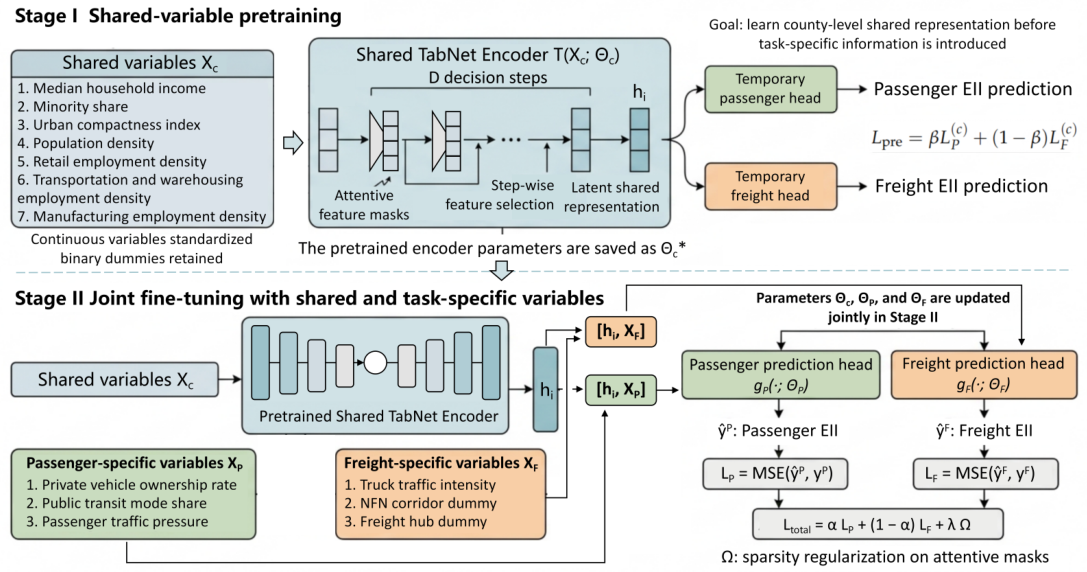
Figure 1. Architecture of the two-stage multi-task TabNet model.
Sustainability 18 05988 g001
Figure 2. Spatial distribution of county-level exposure injustice indices in the passenger transportation sector: (a) EII ( NO x ) ; (b) EII ( PM 2.5 ) ; and (c) EII ( PM 10 ) .
Sustainability 18 05988 g002
Figure 3. Spatial distribution of county-level exposure injustice indices in the freight transportation sector: (a) EII ( NO x ) ; (b) EII ( PM 2.5 ) ; and (c) EII ( PM 10 ) .
Sustainability 18 05988 g003
Figure 4. SHAP beeswarm plots for the NOx EII models: (a) passenger transportation and (b) freight transportation.
Sustainability 18 05988 g004
Figure 5. SHAP beeswarm plots for the PM10 EII models: (a) passenger transportation and (b) freight transportation.
Sustainability 18 05988 g005
Figure 6. SHAP beeswarm plots for the PM2.5 EII models: (a) passenger transportation and (b) freight transportation.
Sustainability 18 05988 g006
Table 1. Definitions and task applicability of variables.
Variable NameDefinitionPassenger TaskFreight Task
Passenger EIIExposure injustice level of passenger transportation emissionsYesNo
Freight EIIExposure injustice level of freight transportation emissionsNoYes
Median household incomeOverall income level of county residentsYesYes
Minority shareRacial and ethnic compositionYesYes
Urban compactness indexIntegrated urban-form characteristicYesYes
Population densityIntensity of population concentrationYesYes
Retail employment densityLocal consumption-oriented employment intensityYesYes
Transportation and warehousing employment densityLogistics and freight-related employment intensityYesYes
Manufacturing employment densityIndustrial production intensityYesYes
Private vehicle ownership rateDependence on private car useYesNo
Public transit mode shareShare of public transport in daily mobilityYesNo
Passenger traffic pressurePassenger-dominated traffic intensityYesNo
Truck traffic intensityFreight traffic intensityNoYes
NFN corridor dummyWhether the county is traversed by the National Highway Freight NetworkNoYes
Freight hub dummyWhether the county contains a major freight hub such as a seaport or cargo airportNoYes
Table 2. Descriptive statistics of all variables.
VariableMeanStd. Dev.MinMax
Passenger EII (NOx)2.434.680.08168.27
Passenger EII (PM2.5)1.553.230.00136.35
Passenger EII (PM10)1.292.590.00130.59
Freight EII (NOx)2.8311.780.07616.16
Freight EII (PM2.5)2.7011.980.00636.95
Freight EII (PM10)2.2910.870.00588.34
Median household income54,975.4714,613.510.00147,111.00
Minority share0.230.180.020.92
Urban compactness index0.120.100.001.00
Population density55.08296.360.0011,127.35
Retail employment density2.5616.910.00821.00
Transportation and warehousing employment density0.985.900.00168.86
Manufacturing employment density1.835.170.0096.20
Private vehicle ownership rate0.860.020.810.93
Public transit mode share0.110.030.050.17
Passenger traffic pressure2015.68515.221000.004000.00
Truck traffic intensity183.53747.240.0024,193.21
NFN corridor dummy0.300.460.001.00
Freight hub dummy0.120.330.001.00
Table 3. Hyperparameter settings of the proposed two-stage multi-task TabNet framework.
HyperparameterDescriptionValue/Selection Rule
Training–test splitData split ratio7:3
Cross-validation foldsNumber of CV folds5
OptimizerOptimization methodAdam
Initial learning rateInitial learning rate0.001
Learning-rate scheduleLearning-rate decay rule η e = 0.001 × 0 . 9 e / 10
Pretraining loss weight ( β )Stage I task weight0.5
Task balance coefficient ( α )Stage II task weightGrid search over { 0.3 , 0.4 , 0.5 , 0.6 , 0.7 } ; final value = 0.5
Feature dimension ( n d )Feature representation size16
Attention dimension ( n a )Attention representation size16
Number of decision steps ( N steps )Number of decision steps4
Batch sizeMini-batch size256
Sparsity regularization coefficient ( λ )Sparsity penalty 1 × 10 3
Maximum pretraining epochs ( E 1 )Max epochs in Stage I100
Maximum fine-tuning epochs ( E 2 )Max epochs in Stage II200
Early-stopping patienceEarly-stopping patience10
Table 4. Global Moran’s I statistics for passenger and freight EII by pollutant.
Transport SectorPollutantGlobal Moran’s Ip-ValueSignificant
Passenger NO x 0.06670.0060Yes
Passenger PM 2.5 0.03390.0070Yes
Passenger PM 10 0.00880.0350Yes
Freight NO x 0.01980.0120Yes
Freight PM 2.5 0.01490.0200Yes
Freight PM 10 0.01040.0230Yes
Table 5. Counts of local spatial association types based on the local Moran’s I statistics.
SectorPollutantHigh–HighLow–LowHigh–LowLow–HighNot Significant
Passenger NO x 1737418372823
Passenger PM 2.5 1691923552859
Passenger PM 10 1432234502876
Freight NO x 117020302958
Freight PM 2.5 109022342960
Freight PM 10 99125332967
Table 6. Hotspot overlap between passenger and freight EII by pollutant.
PollutantPassenger HotspotsFreight HotspotsOverlappingOverlap Ratio (%)
NO x 23671911173768.36
PM 2.5 15961917129158.10
PM 10 1103180589344.32
Table 7. Prediction performance comparison of different models for passenger and freight EIIs under PM2.5 emissions.
ModelPassenger EIIFreight EII
R 2 MAE MAPE RMSE R 2 MAE MAPE RMSE
RF0.8580.18816.520.2580.8410.19717.080.273
XGBoost0.8790.17615.210.2440.8620.18616.030.259
Transformer0.8680.18215.740.2490.8530.19216.470.264
ST-TabNet0.8870.17114.880.2390.8710.18115.610.252
MT-TabNet0.9040.15913.920.2260.8890.17014.860.239
Note: RF = Random Forest; ST-TabNet = Single-task TabNet; MT-TabNet = proposed two-stage multi-task TabNet. MAPE is expressed as a percentage (%).
Table 8. Prediction performance comparison of different models for passenger and freight EIIs under PM10 emissions.
ModelPassenger EIIFreight EII
R 2 MAE MAPE RMSE R 2 MAE MAPE RMSE
RF0.8610.18516.310.2550.8440.19516.890.270
XGBoost0.8830.17314.970.2400.8650.18315.780.255
Transformer0.8720.17915.420.2460.8570.19016.210.261
ST-TabNet0.8910.16814.560.2340.8740.17815.360.248
MT-TabNet0.9090.15613.470.2210.8920.16714.550.236
Table 9. Prediction performance comparison of different models for passenger and freight EIIs under NOx emissions.
ModelPassenger EIIFreight EII
R 2 MAE MAPE RMSE R 2 MAE MAPE RMSE
RF0.8520.19116.880.2620.8360.20117.460.278
XGBoost0.8740.17915.460.2480.8570.18916.240.264
Transformer0.8640.18415.930.2530.8480.19516.710.270
ST-TabNet0.8820.17415.030.2420.8680.18415.890.257
MT-TabNet0.8990.16214.110.2290.8840.17315.020.244
Table 10. Ablation results of the proposed framework under the NOx setting.
Ablation SettingPassenger EIIFreight EII
R 2 MAE MAPE RMSE R 2 MAE MAPE RMSE
Full model0.8990.16214.110.2290.8840.17315.020.244
w/o Stage I pretraining0.8860.17315.050.2410.8670.18616.080.256
w/o shared encoder0.8820.17415.030.2420.8680.18415.890.257
w/o task-specific inputs0.8620.18616.170.2530.8380.20217.420.278
w/o sparsity reg0.8920.16614.390.2340.8780.17815.310.247
Note: “Full model” denotes the complete two-stage multi-task TabNet framework. “w/o Stage I pretraining” removes the shared-variable pretraining stage and directly trains the model in a single joint stage. “w/o shared encoder” removes the shared representation module and replaces it with two independent task-specific branches. “w/o task-specific inputs” uses only the shared variables for both tasks, without passenger-specific or freight-specific inputs. “w/o sparsity reg” removes the sparsity regularization term imposed on the attentive masks. MAPE is expressed as a percentage (%).
Disclaimer/Publisher’s Note: The statements, opinions and data contained in all publications are solely those of the individual author(s) and contributor(s) and not of MDPI and/or the editor(s). MDPI and/or the editor(s) disclaim responsibility for any injury to people or property resulting from any ideas, methods, instructions or products referred to in the content.