Direct and Indirect Effects of Natural and Anthropogenic Drivers on Avian Diversity in the Sanjiang Plain, Northeast China


Abstract
1. Introduction
2. Materials and Methods
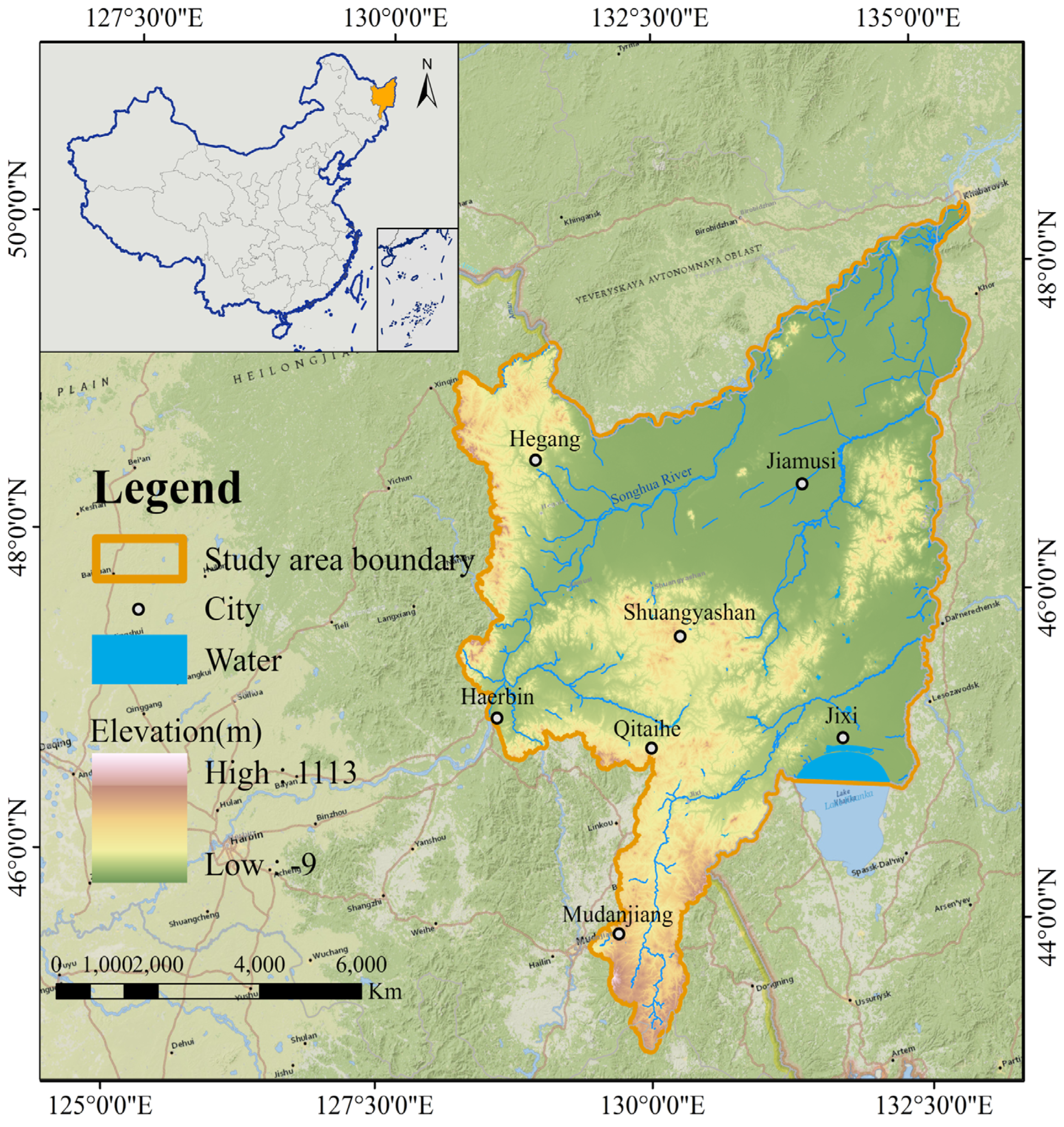
2.1. Study Area
2.2. Data Sources
2.3. Methods
2.3.1. Habitat Quality Assessment
2.3.2. Spatial Analysis of Species Richness
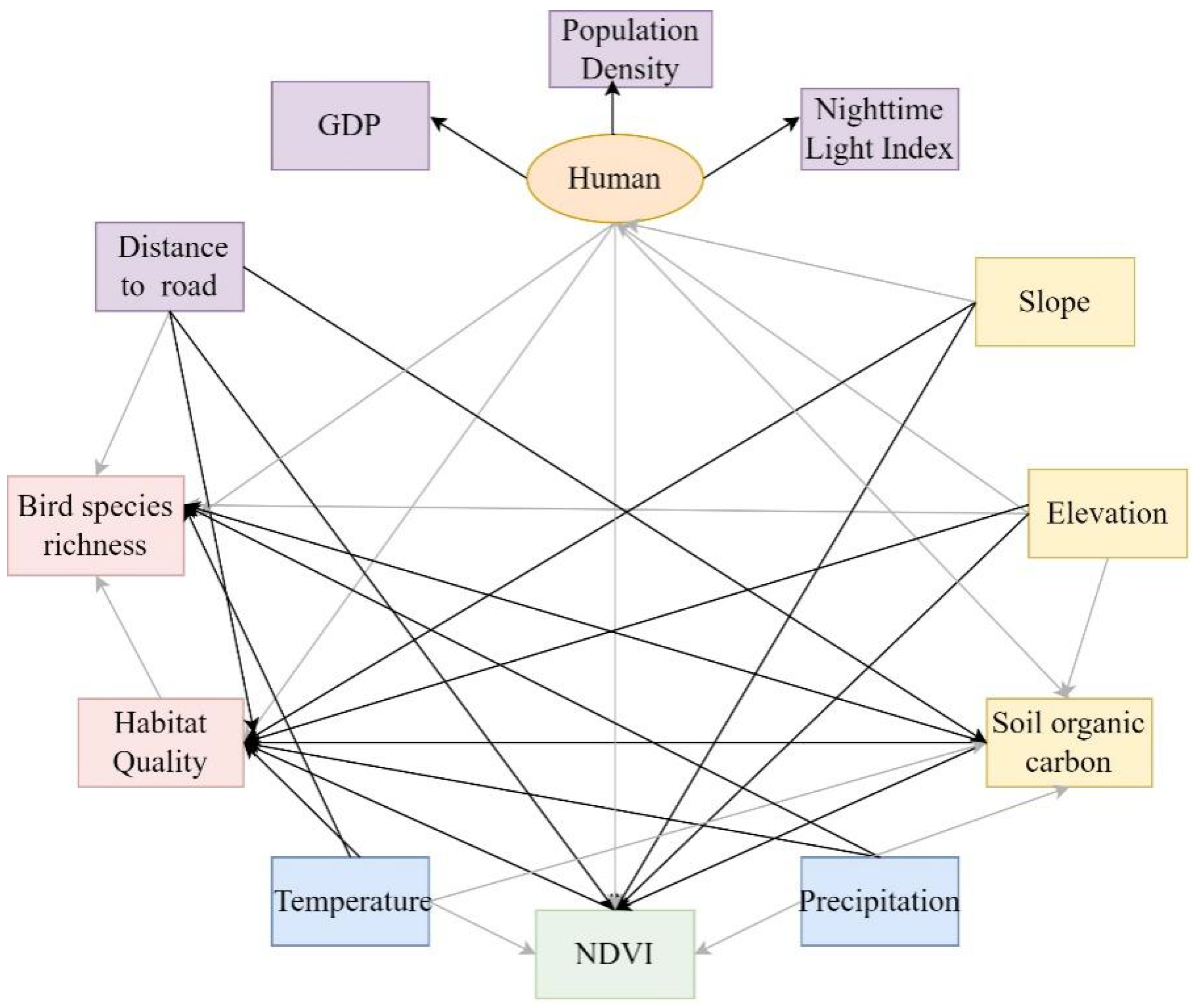
2.3.3. Structural Equation Modeling (SEM)
3. Results
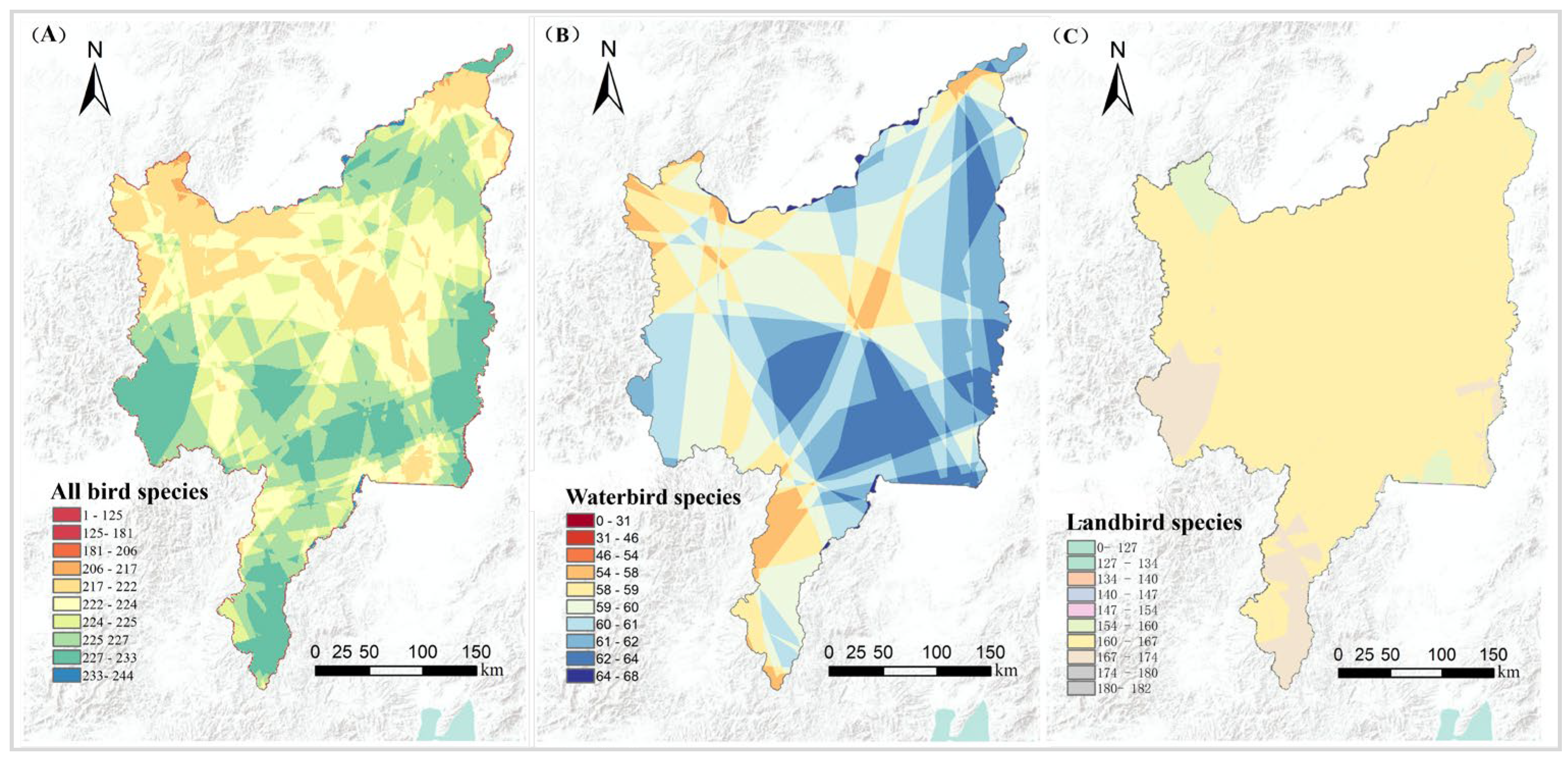
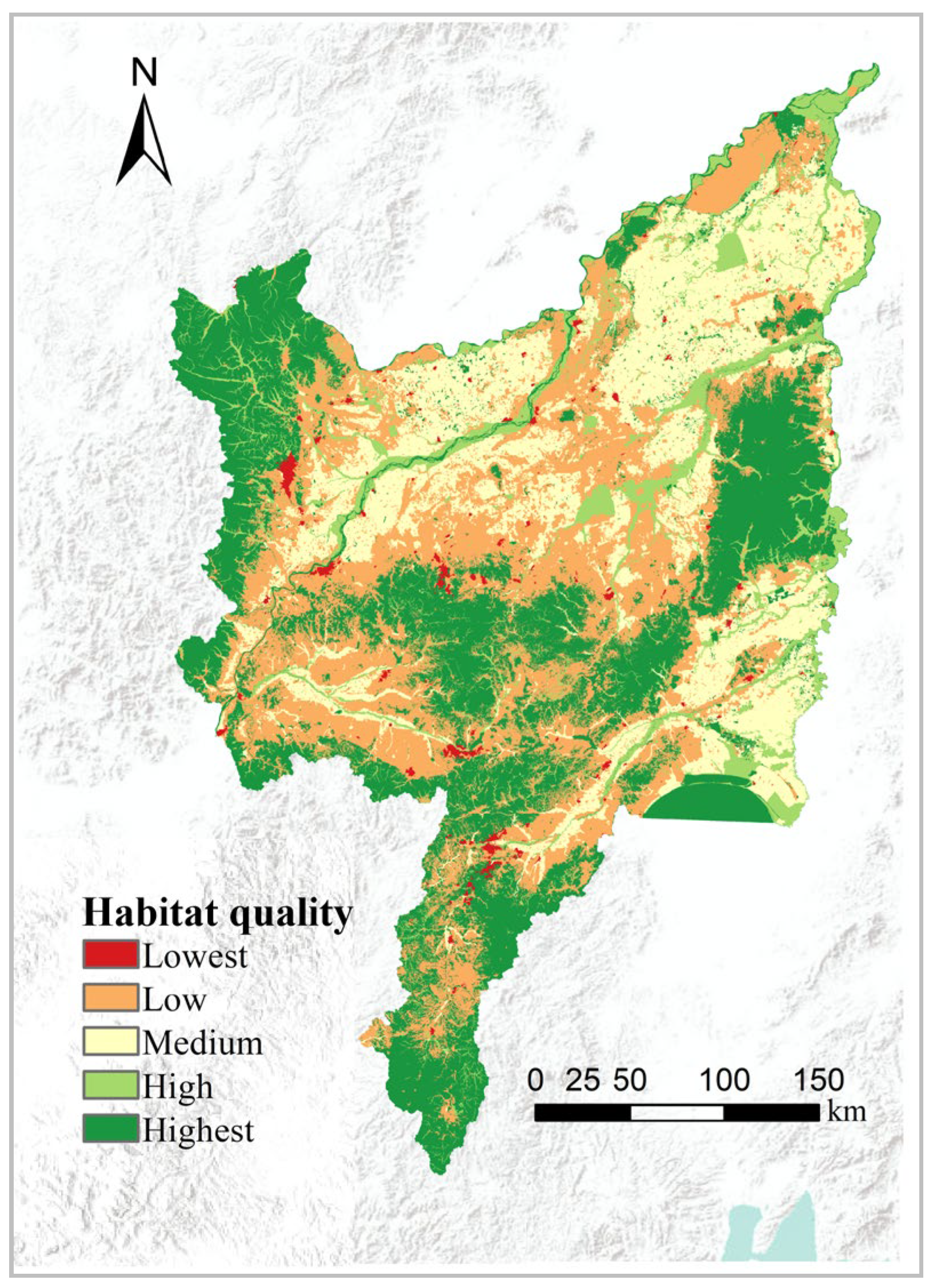
3.1. Spatial Patterns of Avian Diversity and Habitat Quality
3.2. Drivers of Habitat Quality
3.2.1. Waterbirds
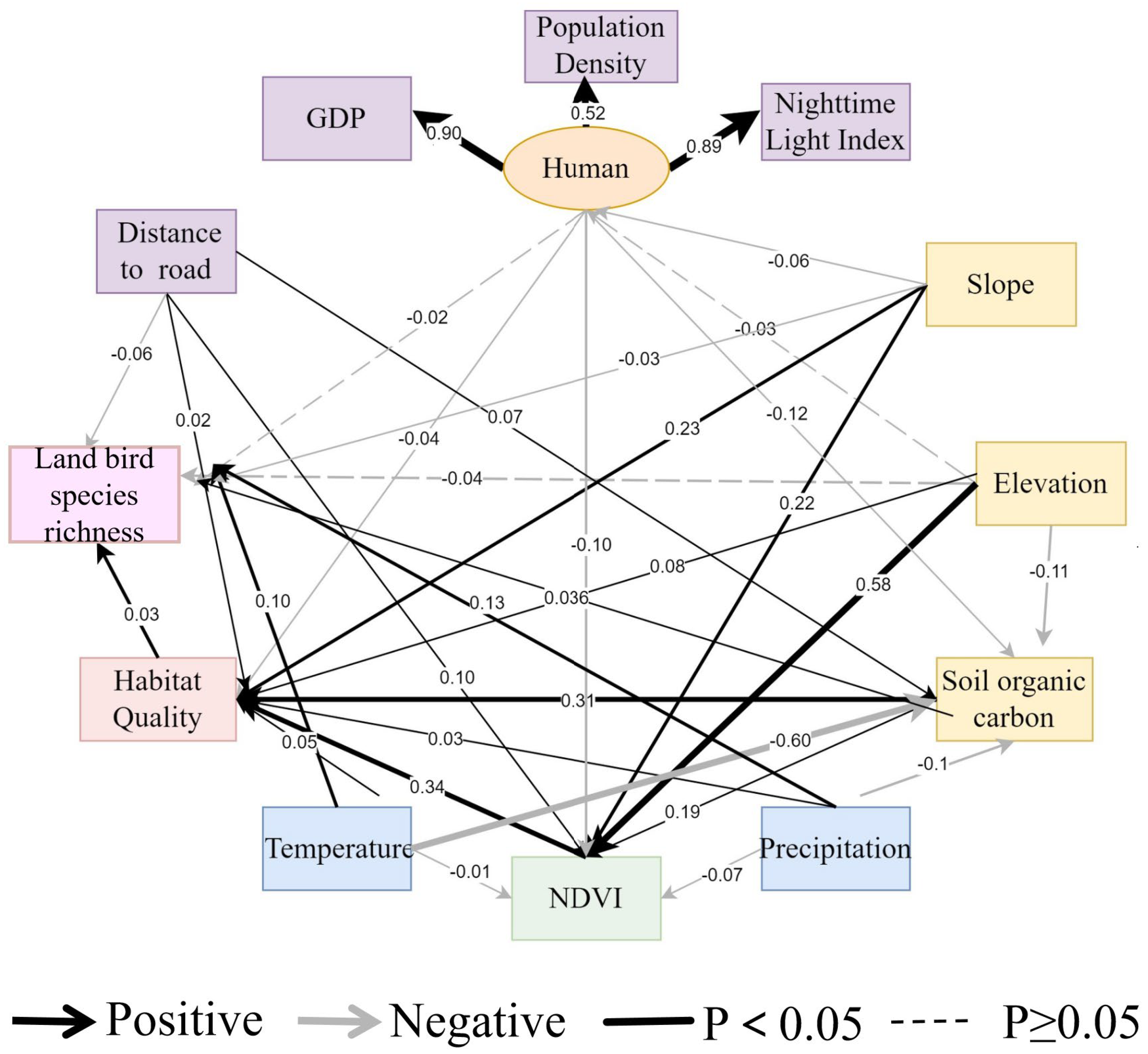
3.2.2. Land Birds
3.3. Drivers of Avian Diversity
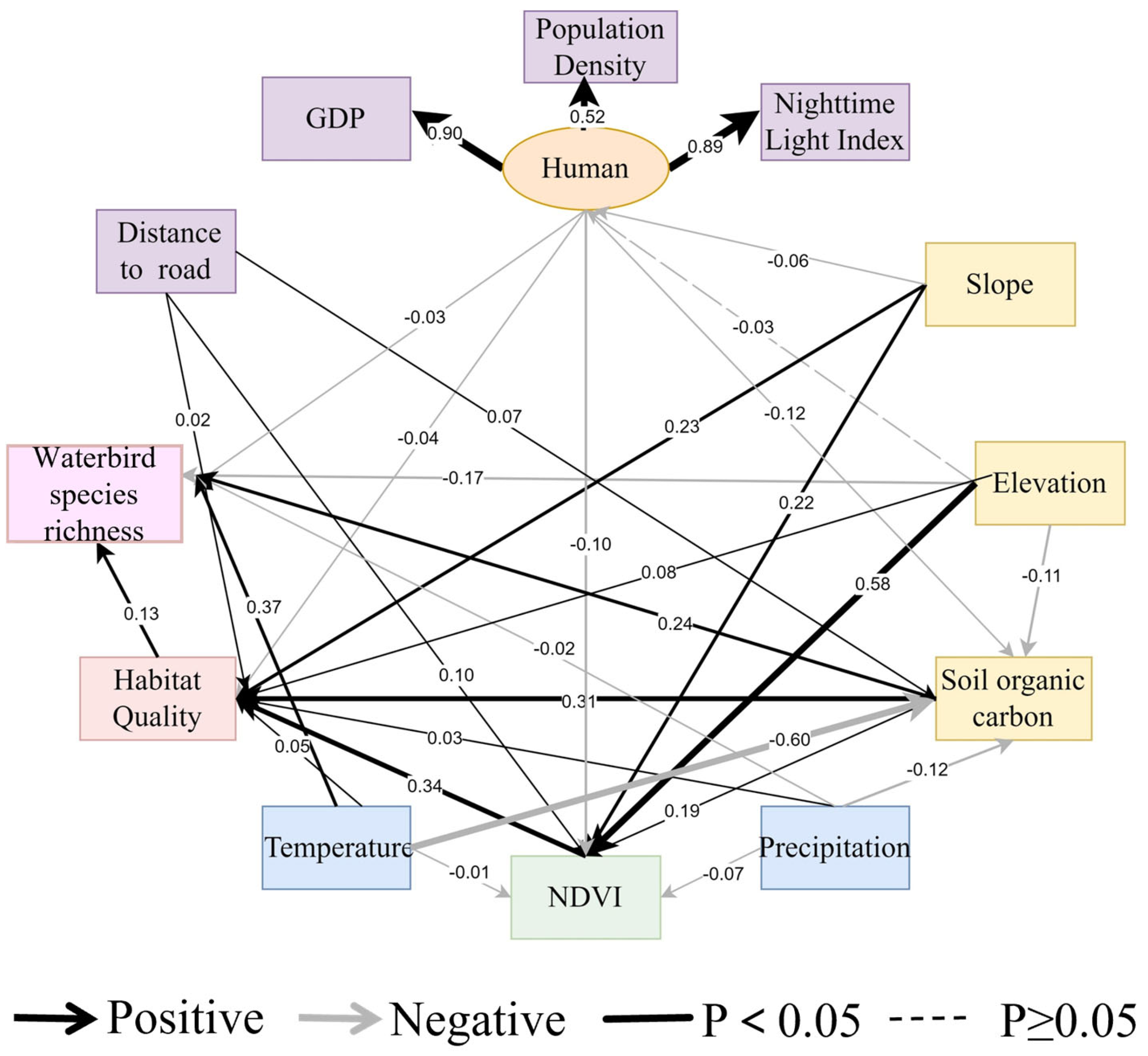
3.3.1. Waterbirds
3.3.2. Land Birds
4. Discussion
4.1. Drivers of Habitat Quality
4.1.1. Soil Organic Carbon (SOC) and NDVI
4.1.2. Topographic Factors
4.1.3. Climatic Factors
4.1.4. Human Activities
4.2. Drivers of Avian Biodiversity
4.2.1. Pathway Structure
4.2.2. Weaker Anthropogenic than Natural Effects
4.2.3. The Effects of Natural Environmental Drivers
Soil Organic Carbon
NDVI
Precipitation
Temperature
4.3. Limitations and Uncertainties
4.4. Implications
5. Conclusions
Supplementary Materials
Author Contributions
Funding
Institutional Review Board Statement
Informed Consent Statement
Data Availability Statement
Acknowledgments
Conflicts of Interest
References
- Parajuli, K.; Ghimire, P. Farmland Birds and their Importance in Agro ecosystem: A Review. Int. Res. J. MMC 2024, 5, 158–168. [Google Scholar] [CrossRef] [Scilit]
- Sekercioglu, C.H. Increasing awareness of avian ecological function. Trends Ecol. Evol. 2006, 21, 464–471. [Google Scholar] [CrossRef] [Scilit]
- Qiu, J.; Zhang, Y.; Ma, J. Wetland habitats supporting waterbird diversity: Conservation perspective on biodiversity-ecosystem functioning relationship. J. Environ. Manag. 2024, 357, 120663. [Google Scholar] [CrossRef] [Scilit]
- Mao, D.; Tian, Y.; Wang, Z.; Jia, M.; Du, J.; Song, C. Wetland changes in the Amur River Basin: Differing trends and proximate causes on the Chinese and Russian sides. J. Environ. Manag. 2021, 280, 111670. [Google Scholar] [CrossRef] [Scilit] [PubMed]
- Zhang, H.; Zhang, C.; Hu, T.; Zhang, M.; Ren, X.; Hou, L. Exploration of roadway factors and habitat quality using InVEST. Transp. Res. Part D Transp. Environ. 2020, 87, 102551. [Google Scholar] [CrossRef] [Scilit]
- Rahimi, L.; Malekmohammadi, B.; Yavari, A.R. Assessing and Modeling the Impacts of Wetland Land Cover Changes on Water Provision and Habitat Quality Ecosystem Services. Nat. Resour. Res. 2020, 29, 3701–3718. [Google Scholar] [CrossRef] [Scilit]
- Wang, C.; Xia, S.; Duan, H.; Wu, Y.; Su, Y.; Wang, B.; Shen, Z.; Sun, G.; Dong, B. Study on the impact of reclamation and development of Yancheng coastal wetlands on the spatio-temporal evolution of wintering Anatidae habitat. Ecol. Indic. 2024, 160, 111892. [Google Scholar] [CrossRef] [Scilit]
- Song, Z.; Gao, S.; Leng, M.; Zhou, B.; Wu, B.; Song, Z.; Gao, S.; Leng, M.; Zhou, B.; Wu, B. Quantifying the Ecological Performance of Migratory Bird Conservation: Evidence from Poyang Lake Wetlands in China. Biology 2024, 13, 786. [Google Scholar] [CrossRef] [Scilit]
- Zhu, C.; Zhang, X.; Zhou, M.; He, S.; Gan, M.; Yang, L.; Wang, K. Impacts of urbanization and landscape pattern on habitat quality using OLS and GWR models in Hangzhou, China. Ecol. Indic. 2020, 117, 106654. [Google Scholar] [CrossRef] [Scilit]
- Bai, L.; Xiu, C.; Feng, X.; Liu, D. Influence of urbanization on regional habitat quality:a case study of Changchun City. Habitat Int. 2019, 93, 102042. [Google Scholar] [CrossRef] [Scilit]
- Wu, H.; Fang, S.; Yang, Y.; Cheng, J. Changes in habitat quality of nature reserves in depopulating areas due to anthropogenic pressure: Evidence from Northeast China, 2000–2018. Ecol. Indic. 2022, 138, 108844. [Google Scholar] [CrossRef] [Scilit]
- Zhao, Y.; Qu, Z.; Zhang, Y.; Ao, Y.; Han, L.; Kang, S.; Sun, Y. Effects of human activity intensity on habitat quality based on nighttime light remote sensing: A case study of Northern Shaanxi, China. Sci. Total Environ. 2022, 851, 158037. [Google Scholar] [CrossRef] [Scilit]
- Hodapp, D.; Meier, S.; Muijsers, F.; Badewien, T.H.; Hillebrand, H. Structural equation modeling approach to the diversity-productivity relationship of Wadden Sea phytoplankton. Mar. Ecol. Prog. Ser. 2015, 523, 31–40. [Google Scholar] [CrossRef] [Scilit]
- Zerbe, S.; Maurer, U.; Schmitz, S.; Sukopp, H. Biodiversity in Berlin and its potential for nature conservation. Landsc. Urban Plan. 2003, 62, 139–148. [Google Scholar] [CrossRef] [Scilit]
- Kapitza, S.; Van Ha, P.; Kompas, T.; Golding, N.; Cadenhead, N.C.R.; Bal, P.; Wintle, B.A.; Kapitza, S.; Van Ha, P.; Kompas, T.; et al. Assessing biophysical and socio-economic impacts of climate change on regional avian biodiversity. Sci. Rep. 2021, 11, 3304. [Google Scholar] [CrossRef] [Scilit] [PubMed]
- Roland, C.A.; Sadoti, G.; Nicklen, E.F.; McAfee, S.A.; Stehn, S.E. A structural equation model linking past and present plant diversity in Alaska: A framework for evaluating future change. Ecosphere 2019, 10, e02832. [Google Scholar] [CrossRef] [Scilit]
- Xiang, H.; Wang, Z.; Mao, D.; Zhang, J.; Xi, Y.; Du, B.; Zhang, B. What did China’s National Wetland Conservation Program Achieve? Observations of changes in land cover and ecosystem services in the Sanjiang Plain. J. Environ. Manag. 2020, 267, 110623. [Google Scholar] [CrossRef] [Scilit] [PubMed]
- Hines, C.; Duval, L.; Watts, B.; Mitchell, M. The Role of Patch Age and Agricultural Legacy on Carbon Sequestration and Bird Habitat in Salt Marshes. Authorea Prepr. 2024. [Google Scholar] [CrossRef] [Scilit]
- Sanderson, F.J.; Donald, P.F.; Pain, D.J.; Burfield, I.J.; van Bommel, F.P.J. Long-term population declines in Afro-Palearctic migrant birds. Biol. Conserv. 2006, 131, 93–105. [Google Scholar] [CrossRef] [Scilit]
- Benton, T.G.; Vickery, J.A.; Wilson, J.D. Farmland biodiversity: Is habitat heterogeneity the key? Trends Ecol. Evol. 2003, 18, 182–188. [Google Scholar] [CrossRef] [Scilit]
- Cao, Y.; Wang, C.; Su, Y.; Duan, H.; Wu, X.; Lu, R.; Su, Q.; Wu, Y.; Chu, Z.; Cao, Y.; et al. Study on Spatiotemporal Evolution and Driving Forces of Habitat Quality in the Basin along the Yangtze River in Anhui Province Based on InVEST Model. Land 2023, 12, 1092. [Google Scholar] [CrossRef] [Scilit]
- Li, X.; Anderson, C.J.; Wang, Y.; Lei, G. Waterbird diversity and abundance in response to variations in climate in the Liaohe Estuary, China. Ecol. Indic. 2021, 132, 108286. [Google Scholar] [CrossRef] [Scilit]
- Ónodi, G.; Czeglédi, I.; Erős, T. Drivers of the taxonomic and functional structuring of aquatic and terrestrial floodplain bird communities. Landsc. Ecol. 2024, 39, 174. [Google Scholar] [CrossRef] [Scilit] [PubMed]
- Freedman, A.H.; Buermann, W.; Mitchard, E.T.A.; Defries, R.S.; Smith, T.B. Human Impacts Flatten Rainforest-Savanna Gradient and Reduce Adaptive Diversity in a Rainforest Bird. PLoS ONE 2010, 5, e13088. [Google Scholar] [CrossRef] [Scilit]
- Poiani, K.A.; Richter, B.D.; Anderson, M.G.; Richter, H.E. Biodiversity Conservation at Multiple Scales: Functional Sites, Landscapes, and Networks. BioScience 2000, 50, 133–146. [Google Scholar] [CrossRef] [Scilit]
- Jin, H.; Van Leeuwen, C.H.A.; Bakker, E.S. Restoring land–water transition areas to stimulate food web development is mediated by the hydrological connectivity. Ecol. Indic. 2024, 167, 112615. [Google Scholar] [CrossRef] [Scilit]
- Büscher, M.; Lange, F.; Bröckel, M.; Höfer, S.; Stemberg, E.; Folsche, E.; Eylering, A.; Fiebelkorn, F. Quantifying behavioural impact and plasticity via expert and population surveys to prioritise bird conservation behaviour. Ecosyst. People 2025, 21, 2478555. [Google Scholar] [CrossRef] [Scilit]
- Cazalis, V.; Princé, K.; Mihoub, J.-B.; Kelly, J.; Butchart, S.H.M.; Rodrigues, A.S.L. Effectiveness of protected areas in conserving tropical forest birds. Nat. Commun. 2020, 11, 4461. [Google Scholar] [CrossRef] [Scilit]
- Weller, M.W. Wetland Birds: Habitat Resources and Conservation Implications; Cambridge University Press: Cambridge, UK, 1999. [Google Scholar]
- Zedler, J.; Kercher, S. Wetland resources: Status, trends, ecosystem services, and restorability. Annu. Rev. Environ. Resour. 2005, 30, 39–74. [Google Scholar] [CrossRef] [Scilit]
- Richardson, J.S.; Sato, T. Resource subsidy flows across freshwater–terrestrial boundaries and influence on processes linking adjacent ecosystems. Ecohydrology 2015, 8, 406–415. [Google Scholar] [CrossRef] [Scilit]
- Nakano, S.; Murakami, M. Reciprocal subsidies: Dynamic interdependence between terrestrial and aquatic food webs. Proc. Natl. Acad. Sci. USA 2001, 98, 166–170. [Google Scholar] [CrossRef] [Scilit]
- Peng, S. 1-km Monthly Mean Temperature Dataset for China (1901–2022); National Tibetan Plateau/Third Pole Environment Data Center: Beijing, China, 2020. [Google Scholar] [CrossRef]
- Peng, S. 1-km monthly precipitation dataset for China (1901–2022). Earth Syst. Sci. Data 2019, 11, 1931–1946. [Google Scholar] [CrossRef] [Scilit]
- Wu, Y.; Shi, K.; Chen, Z.; Liu, S.; Chang, Z. An Improved Time-Series DMSP-OLS-like Data (1992–2023) in China by Integrating DMSP-OLS and SNPP-VIIRS; Harvard Dataverse: Cambridge, MA, USA, 2021. [Google Scholar] [CrossRef]
- Broquet, M.; Campos, F.S.; Cabral, P.; David, J. Habitat quality on the edge of anthropogenic pressures: Predicting the impact of land use changes in the Brazilian Upper Paraguay river Basin. J. Clean. Prod. 2024, 459, 142546. [Google Scholar] [CrossRef] [Scilit]
- Dai, L.; Li, S.; Lewis, B.J.; Wu, J.; Yu, D.; Zhou, W.; Zhou, L.; Wu, S. The influence of land use change on the spatial–temporal variability of habitat quality between 1990 and 2010 in Northeast China. J. For. Res. 2018, 30, 2227–2236. [Google Scholar] [CrossRef] [Scilit]
- Jin, S.; Liu, X.; Yang, J.; Lv, J.; Gu, Y.; Yan, J.; Yuan, R.; Shi, Y. Spatial-temporal changes of land use/cover change and habitat quality in Sanjiang plain from 1985 to 2017. Front. Environ. Sci. 2022, 10, 1032584. [Google Scholar] [CrossRef] [Scilit]
- Sun, X.L.; Li, Y.H.; Hu, Y.M.; Li, Y. Human and natural factors affect habitat quality in ecologically fragile areas: Evidence from Songnen Plain, China. Front. Plant Sci. 2024, 15, 1444163. [Google Scholar] [CrossRef] [Scilit] [PubMed]
- Wang, Z.; Zhu, T.; Jiang, Q. Analysis of land use/cover change and habitat quality in Heilongjiang Province. J. Northeast Agric. Univ. 2022, 53, 77–86. [Google Scholar] [CrossRef]
- Liang, X.; Yuan, L.; Ning, L. Spatial pattern and influencing factors of habitat quality in Heilongjiang Province based on the InVEST model. J. Beijing Norm. Univ. (Nat. Sci.) 2020, 56, 864–872. [Google Scholar] [CrossRef]
- Sallustio, L.; Toni, A.D.; Strollo, A.; Febbraro, M.D.; Gissi, E.; Casella, L.; Geneletti, D.; Munafò, M.; Vizzarri, M.; Marchetti, M. Assessing habitat quality in relation to the spatial distribution of protected areas in Italy. J. Environ. Manag. 2017, 201, 129–137. [Google Scholar] [CrossRef] [Scilit]
- Xu, H.; Dong, B.; Gao, X.; Xu, Z.; Ren, C.; Fang, L.; Wei, Z.; Liu, X.; Lu, Z. Habitat quality assessment of wintering migratory birds in Poyang Lake National Nature Reserve based on InVEST model. Environ. Sci. Pollut. Res. 2022, 30, 28847–28862. [Google Scholar] [CrossRef] [Scilit]
- Gotelli, N.J.; Colwell, R.K. Quantifying biodiversity: Procedures and pitfalls in the measurement and comparison of species richness. Ecol. Lett. 2001, 4, 379–391. [Google Scholar] [CrossRef] [Scilit]
- Mittelbach, G.G.; Steiner, C.F.; Scheiner, S.M.; Gross, K.L.; Reynolds, H.L.; Waide, R.B.; Willig, M.R.; Dodson, S.I.; Gough, L. What Is the Observed Relationship Between Species Richness and Productivity? Ecology 2001, 82, 2381–2396. [Google Scholar] [CrossRef]
- Secretariat, R.C. The Ramsar Convention Manual: A guide to the Convention on Wetlands; Ramsar Convention Secretariat: Gland, Switzerland, 2013. [Google Scholar]
- Bedane, G.A.; Feyisa, G.L.; Senbeta, F. Spatial distribution of above ground carbon density in Harana Forest, Ethiopia. Ecol. Process. 2022, 11, 4. [Google Scholar] [CrossRef] [Scilit]
- Liu, S.; Liao, Q.; Xiao, M.; Zhao, D.; Huang, C. Spatial and Temporal Variations of Habitat Quality and Its Response of Landscape Dynamic in the Three Gorges Reservoir Area, China. Int. J. Environ. Res. Public Health 2022, 19, 3594. [Google Scholar] [CrossRef] [Scilit]
- Fritz, K.M.; Schofield, K.A.; Alexander, L.C.; McManus, M.G.; Golden, H.E.; Lane, C.R.; Kepner, W.G.; LeDuc, S.D.; DeMeester, J.E.; Pollard, A.I. Physical and Chemical Connectivity of Streams and Riparian Wetlands to Downstream Waters: A Synthesis. JAWRA J. Am. Water Resour. Assoc. 2018, 54, 323–345. [Google Scholar] [CrossRef] [Scilit]
- Hao, J.; Xu, G.; Luo, L.; Zhang, Z.; Yang, H.; Li, H. Quantifying the relative contribution of natural and human factors to vegetation coverage variation in coastal wetlands in China. Catena 2020, 188, 104429. [Google Scholar] [CrossRef] [Scilit]
- Maydeu-Olivares, A.; Shi, D.; Rosseel, Y. Assessing Fit in Structural Equation Models: A Monte-Carlo Evaluation of RMSEA Versus SRMR Confidence Intervals and Tests of Close Fit. Struct. Equ. Model. Multidiscip. J. 2018, 25, 1389611. [Google Scholar] [CrossRef] [Scilit]
- Mao, D.H.; Wang, Z.M.; Li, L.; Miao, Z.H.; Ma, W.H.; Song, C.C.; Ren, C.Y.; Jia, M.M. Soil organic carbon in the Sanjiang Plain of China: Storage, distribution and controlling factors. Biogeosciences 2015, 12, 1635–1645. [Google Scholar] [CrossRef] [Scilit]
- Xu, W.; Xu, Y.; Han, Z.; Yao, J.; Tryjanowski, P.; Wang, H. Disentangling the relative effects of semi-natural habitats within different landscape agricultural intensities on bird communities. Avian Res. 2025, 16, 100228. [Google Scholar] [CrossRef] [Scilit]
- Ahmadi Mirghaed, F.; Souri, B. Relationships between habitat quality and ecological properties across Ziarat Basin in northern Iran. Environ. Dev. Sustain. 2021, 23, 16192–16207. [Google Scholar] [CrossRef] [Scilit]
- Man, W.; Liu, M.; Wang, Z.; Mao, D.; Tian, Y.; Jia, M.; Li, X.; Ren, C.; Ouyang, L. Dynamics of waterfowl habitat suitability in the Sanjiang Plain ecological function area from 1990 to 2015. Chin. J. Appl. Ecol. 2017, 28, 4083–4091. [Google Scholar] [CrossRef]
- Gong, Z.; Su, S.; Du, B.; Guan, H.; Zhang, Q. Selection and dispersal of red-crowned crane breeding habitats in Zhalong Wetland. J. Nat. Resour. 2021, 36, 1964–1975. [Google Scholar] [CrossRef] [Scilit]
- Hagger, V.; Wilson, K.; England, J.R.; Dwyer, J.M. Water availability drives aboveground biomass and bird richness in forest restoration plantings to achieve carbon and biodiversity cobenefits. Ecol. Evol. 2019, 9, 14379–14393. [Google Scholar] [CrossRef] [Scilit]
- Brüggeshemke, J.; Fartmann, T. Predicting species richness and abundance of breeding birds by remote-sensing and field-survey data. Ecol. Solut. Evid. 2025, 6, e70170. [Google Scholar] [CrossRef] [Scilit]
- Li, X.; Hou, X.; Song, Y.; Shan, K.; Zhu, S.; Yu, X.; Mo, X. Assessing Changes of Habitat Quality for Shorebirds in Stopover Sites: A Case Study in Yellow River Delta, China. Wetlands 2019, 39, 67–77. [Google Scholar] [CrossRef] [Scilit]
- Yan, S.; Wang, X.; Cai, Y.; Li, C.; Yan, R.; Cui, G.; Yang, Z. An Integrated Investigation of Spatiotemporal Habitat Quality Dynamics and Driving Forces in the Upper Basin of Miyun Reservoir, North China. Sustainability 2018, 10, 4625. [Google Scholar] [CrossRef] [Scilit]
- Yang, F.; Wang, Z.; Wang, Y.; An, F.; Zhao, C. The correlation between soil water salinity and plant community distribution under micro-topography in Songnen Plain. Acta Ecol. Sin. 2013, 33, 6202–6208. [Google Scholar] [CrossRef] [Scilit]
- van den Bosch, M.; Steel, Z.L.; Costanza, J.K.; Kellner, K.F.; Peek, R.A. Increased drought drives avian community declines in the warm deserts of the United States. Biol. Conserv. 2025, 310, 111393. [Google Scholar] [CrossRef] [Scilit]
- Labadie, G.; Boulanger, Y.; Drapeau, P.; Stralberg, D.; Tremblay, J.A. Projecting bird assemblage responses to climate-driven changes in managed boreal forest landscapes of Québec. Biol. Conserv. 2025, 302, 110956. [Google Scholar] [CrossRef] [Scilit]
- Chen, S.; Jin, Y.; Huang, Y. Spatio-temporal variations of habitat quality and its underlying mechanism in the central region of Yangtze River Delta. Chin. J. Ecol. 2023, 42, 1175–1185. [Google Scholar]
- Kou, J.F.; Liu, J.; Wang, H.L.; Huang, S.; Zhou, Z.; Yang, C.; Huang, X.L. Spatio-temporal evolution in habitat quality and its driving factors in Han River Basin, China. Sci. Rep. 2025, 15, 26139. [Google Scholar] [CrossRef] [Scilit]
- Zhao, J.W.; Wang, L.Y.; Jia, D.; Wang, Y.W. Study on the effects of land use transformation on habitat quality and its driving mechanisms: A case study of the Qin-Mang River Basin. Front. Environ. Sci. 2025, 13, 1505178. [Google Scholar] [CrossRef] [Scilit]
- He, X.; Jia, M.; Wang, Z.; Ren, C.; Zheng, H.; Guo, Y.; Zhang, X.; Xin, X. Remote Sensing Based Evaluation of Effectiveness of Wetland Protection Project in Sanjiang Plain, China. Bull. Chin. Acad. Sci. 2017, 32, 3–10. [Google Scholar] [CrossRef]
- Aarif, K.M.; Nefla, A.; Rubeena, K.A.; Xu, Y.; Bouragaoui, Z.; Nasser, M.; Shifa, C.T.; Athira, T.R.; Jishnu, K.; Anand, J.; et al. Assessing environmental change and population declines of large wading birds in southwestern India. Environ. Sustain. Indic. 2025, 25, 100572. [Google Scholar] [CrossRef] [Scilit]
- Luck, G.W.; Lavorel, S.; McIntyre, S.; Lumb, K. Improving the application of vertebrate trait-based frameworks to the study of ecosystem services. J. Anim. Ecol. 2012, 81, 1065–1076. [Google Scholar] [CrossRef] [Scilit] [PubMed]
- Reijnen, R.; Foppen, R.; Meeuwsen, H. The effects of traffic on the density of breeding birds in Dutch agricultural grasslands. Biol. Conserv. 1996, 75, 255–260. [Google Scholar] [CrossRef] [Scilit]
- Newbold, T.; Hudson, L.N.; Hill, S.L.L.; Contu, S.; Lysenko, I.; Senior, R.A.; Börger, L.; Bennett, D.J.; Choimes, A.; Collen, B.; et al. Global effects of land use on local terrestrial biodiversity. Nature 2015, 520, 45–50. [Google Scholar] [CrossRef] [Scilit]
- Ling, Z.; Li, Q.; Jiang, W.; Zhang, Z.; Hou, P.; Huang, S.; Yang, Z.; Xiao, Z.; Yin, X. Multi-guild waterbird habitat suitability change and hotspots (2018–2024) in China’s international wetland cities: MaxEnt + Gi* within a DIKW framework. Ecol. Indic. 2026, 182, 114564. [Google Scholar] [CrossRef] [Scilit]
- Panjin Forestry and Wetland Conservation Bureau. Bird Species Diversity in Panjin Wetland Reaches 336; Panjin Municipal People’s Government: Panjin, China, 2026.
- Russell, I.A.; Randall, R.M.; Hanekom, N. Spatial and Temporal Patterns of Waterbird Assemblages in the Wilderness Lakes Complex, South Africa. Waterbirds 2014, 37, 1–18. [Google Scholar] [CrossRef] [Scilit]
- Henry, D.A.W.; Cumming, G.S. Can waterbirds with different movement, dietary and foraging functional traits occupy similar ecological niches? Landsc. Ecol. 2016, 32, 265–278. [Google Scholar] [CrossRef] [Scilit]
- Zhou, J.; Zhou, L.; Xu, W. Diversity of wintering waterbirds enhanced by restoring aquatic vegetation at Shengjin Lake, China. Sci. Total Environ. 2020, 737, 140190. [Google Scholar] [CrossRef] [Scilit]
- Guo, J.; He, C.; Jiang, H.; Sheng, L.; Li, L. The study on the relationship between vegetation productivity and waterfowl diversity in Xianghai wetland. J. Northeast Norm. Univ. (Nat. Sci. Ed.) 2012, 44, 120–124. [Google Scholar]
- Hunt, M.L.; Blackburn, G.A.; Siriwardena, G.M.; Carrasco, L.; Rowland, C.S. Using satellite data to assess spatial drivers of bird diversity. Remote Sens. Ecol. Conserv. 2023, 9, 483–500. [Google Scholar] [CrossRef] [Scilit]
- Macgregor-Fors, I.; Garizábal-Carmona, J.A.; García-Arroyo, M.; Fishel, E.; Nilon, C.H.; Lemoine-Rodríguez, R. Does NDVI explain patterns of urban bird diversity? Insights from temperate to tropical cities. Urban For. Urban Green. 2026, 116, 129211. [Google Scholar] [CrossRef] [Scilit]
- Awoyemi, A.G.; Alabi, T.R.; Ibáñez-Álamo, J.D. Remotely sensed spectral indicators of bird taxonomic, functional and phylogenetic diversity across Afrotropical urban and non-urban habitats. Ecol. Indic. 2025, 170, 112966. [Google Scholar] [CrossRef] [Scilit]
- Zeng, H.; Xiao, C.; Chen, X.; Ye, D. State of China’s climate in 2018. Atmos. Ocean. Sci. Lett. 2019, 12, 349–354. [Google Scholar] [CrossRef] [Scilit]
- Zhang, H.; Xiao, L.; Zhao, Z.; Yin, S.; Zhang, Y. Importance of surrounding landscape features in explaining wintering waterbird diversity and community assembly in Jiangsu’s inland lake wetlands. Avian Res. 2025, 16, 100295. [Google Scholar] [CrossRef] [Scilit]
- Wei, Z.; Zhou, L. The impact of earlier flood recession on metacommunity diversity of wintering waterbirds at shallow lakes in the middle and lower Yangtze River floodplain. Avian Res. 2023, 14, 100102. [Google Scholar] [CrossRef] [Scilit]
- Gaget, E.; Ovaskainen, O.; Bradter, U.; Haas, F.; Jonas, L.; Johnston, A.; Langendoen, T.; Lehikoinen, A.S.; Pärt, T.; Pavón-Jordán, D.; et al. Changes in waterbird occurrence and abundance at their northern range boundaries in response to climate warming: Importance of site area and protection status. Anim. Conserv. 2025, 28, 490–500. [Google Scholar] [CrossRef] [Scilit]
- Lauck, K.S.; Ke, A.; Olimpi, E.M.; Paredes, D.; Hood, K.; Phillips, T.; Anderegg, W.R.L.; Karp, D.S. Agriculture and hot temperatures interactively erode the nest success of habitat generalist birds across the United States. Science 2023, 382, 290–294. [Google Scholar] [CrossRef] [Scilit]
- Şekercioğlu, Ç.H.; Primack, R.B.; Wormworth, J. The effects of climate change on tropical birds. Biol. Conserv. 2012, 148, 1–18. [Google Scholar] [CrossRef] [Scilit]
- Duflot, R.; Daniel, H.; Aviron, S.; Alignier, A.; Beaujouan, V.; Burel, F.; Cochard, A.; Ernoult, A.; Pain, G.; Pithon, J.A. Adjacent woodlands rather than habitat connectivity influence grassland plant, carabid and bird assemblages in farmland landscapes. Biodivers. Conserv. 2018, 27, 1925–1942. [Google Scholar] [CrossRef] [Scilit]
- Herrando, S.; Titeux, N.; Brotons, L.; Anton, M.; Ubach, A.; Villero, D.; García-Barros, E.; Munguira, M.L.; Godinho, C.; Stefanescu, C. Contrasting impacts of precipitation on Mediterranean birds and butterflies. Sci. Rep. 2019, 9, 5680. [Google Scholar] [CrossRef] [Scilit]
- La Sorte, F.A.; Fink, D.; Hochachka, W.M.; Farnsworth, A.; Rodewald, A.D.; Rosenberg, K.V.; Sullivan, B.L.; Winkler, D.W.; Wood, C.; Kelling, S. The role of atmospheric conditions in the seasonal dynamics of North American migration flyways. J. Biogeogr. 2014, 41, 1685–1696. [Google Scholar] [CrossRef] [Scilit]
- Sullivan, B.L.; Aycrigg, J.L.; Barry, J.H.; Bonney, R.E.; Bruns, N.; Cooper, C.B.; Damoulas, T.; Dhondt, A.A.; Dietterich, T.; Farnsworth, A.; et al. The eBird enterprise: An integrated approach to development and application of citizen science. Biol. Conserv. 2014, 169, 31–40. [Google Scholar] [CrossRef] [Scilit]
- Wiens, J.A. Spatial scaling in ecology. Funct. Ecol. 1989, 3, 385–397. [Google Scholar] [CrossRef] [Scilit]
- Levin, S.A. The Problem of Pattern and Scale in Ecology; Springer: New York, NY, USA, 1992; pp. 277–326. [Google Scholar]




| Dataset | Original Resolution | Source | Version | Processing Steps | Resampling Method (to 1 km) |
|---|---|---|---|---|---|
| Land use/land cover (LULC) | 30 m | RESDC (http://www.resdc.cn) | CLUD v1.0 (2018 version) | Mosaic, projection transform, extract by mask | Nearest neighbor (categorical) |
| Digital Elevation Model (DEM) | 30 m | ASTER GDEM (https://www.gscloud.cn/) | v3 | Slope calculation using ArcGIS 10.8 | Bilinear |
| Annual mean temperature | 1 km | National Tibetan Plateau Data Center [33,34] | 1.0 (2020) | Pixel-based annual average for 2018 | None |
| Annual precipitation | 1 km | National Tibetan Plateau Data Center [33,34] | 1.0 (2020) | Pixel-based annual total for 2018 | None |
| NDVI (annual maximum) | 250 m | MOD13Q1 (MODIS/Terra) | Collection 6.1 | Maximum value compositing (MVC) across all 23 MOD13Q1 16-day composites (1 January–31 December 2018) | Bilinear |
| Soil organic carbon (SOC) | 1 km | National Earth System Science Data Center (http://www.geodata.cn) | v1.0 | Convert to g/kg using scale factor (original unit: 0.1%) | None |
| Population density | 1 km | WorldPop (https://hub.worldpop.org/) | UN-adjusted 2018 | Extract by mask | None |
| Nighttime light (NPP-VIIRS-like) | 500 m | Harvard Dataverse (https://dataverse.harvard.edu/dataset.xhtml?persistentId=doi:10.7910/DVN/GIYGJU accessed on 10 December 2025) [35] | Cross-sensor corrected v1.0 | Extract by mask (data already corrected by provider) | Bilinear |
| Gross Domestic Product (GDP) | 1 km | RESDC (GDP spatial distribution dataset for China, 2018) | v1.0 | Extract by mask, unit: 104 CNY/km2 | None |
| Distance to roads | Vector (OSM) | Geofabrik (http://download.geofabrik.de/ accessed on 10 December 2025) | 2018 extract | Euclidean distance raster at 1 km resolution | – |
| Bird distribution ranges | – | BirdLife International/HBW (https://www.birdlife.org/) | 2021 version | Overlay, richness calculation at 1 km grid | – |
| Threat Factor | Maximum Distance (km) | Weight | Decay Type |
|---|---|---|---|
| Industrial and mining land | 6.00 | 0.75 | exponential |
| Arable land | 1.50 | 0.65 | linear |
| Urban land | 8.00 | 0.90 | exponential |
| Rural residential areas | 4.00 | 0.65 | exponential |
| Alkali land | 2.50 | 0.30 | linear |
| Barren land | 2.50 | 0.30 | exponential |
| LULC | Habitat Suitability | Threat Factor | |||||
|---|---|---|---|---|---|---|---|
| Arable Land | Urban Land | Rural Residential Areas | Industrial and Mining Land | Alkali Land | Barren Land | ||
| Paddy Field | 0.6 | 0.3 | 0.5 | 0.35 | 0.4 | 0.5 | 0.1 |
| Arable Dry Land | 0.4 | 0.6 | 0.5 | 0.35 | 0.4 | 0.2 | 0.2 |
| Forest Land | 1 | 0.5 | 0.85 | 0.65 | 0.6 | 0.6 | 0.2 |
| Shrubland | 1 | 0.3 | 0.7 | 0.6 | 0.5 | 0.6 | 0.1 |
| Sparse Woodland | 1 | 0.6 | 0.85 | 0.65 | 0.6 | 0.5 | 0.3 |
| Other Woodland | 1 | 0.6 | 0.85 | 0.65 | 0.6 | 0.2 | 0.3 |
| High Coverage Grassland | 0.75 | 0.4 | 0.6 | 0.4 | 0.5 | 0.25 | 0.2 |
| Medium Coverage Grassland | 0.7 | 0.5 | 0.7 | 0.5 | 0.55 | 0.3 | 0.3 |
| Low Coverage Grassland | 0.6 | 0.5 | 0.8 | 0.6 | 0.55 | 0.3 | 0.3 |
| River | 1 | 0.5 | 0.9 | 0.7 | 0.8 | 0.25 | 0.15 |
| Lake | 0.9 | 0.5 | 0.9 | 0.75 | 0.8 | 0.2 | 0.15 |
| Marshland | 0.9 | 0.6 | 0.9 | 0.75 | 0.8 | 0.2 | 0.15 |
| Urban Area | 0.1 | 0 | 0 | 0 | 0 | 0 | 0 |
| Rural residential areas | 0.2 | 0 | 0 | 0 | 0 | 0 | 0 |
| Other Construction Land | 0.1 | 0 | 0 | 0 | 0 | 0 | 0 |
| Sandy Land | 0.1 | 0 | 0 | 0 | 0 | 0 | 0 |
| Saline-alkali Land | 0.5 | 0.2 | 0.2 | 0.15 | 0.15 | 0.15 | 0.1 |
| Bare Rocky Land | 0.65 | 0.7 | 0.5 | 0.2 | 0.2 | 0.3 | 0.3 |
| Model | N | Comparative Fit Index (CFI) | Goodness of Fit Index (GFI) | Standardized Root Mean Square Residual (SRMR) | Root Mean Square Error of Approximation (RMSEA) |
|---|---|---|---|---|---|
| Habitat quality | 11,770 | 0.970 | 0.986 | 0.038 | 0.051 |
| Waterbird | 11,770 | 0.980 | 0.988 | 0.029 | 0.050 |
| Land bird | 11,770 | 0.989 | 0.980 | 0.040 | 0.050 |
| Acceptance Standards | - | >0.90 | >0.90 | <0.05 | <0.06 |
Disclaimer/Publisher’s Note: The statements, opinions and data contained in all publications are solely those of the individual author(s) and contributor(s) and not of MDPI and/or the editor(s). MDPI and/or the editor(s) disclaim responsibility for any injury to people or property resulting from any ideas, methods, instructions or products referred to in the content. |
© 2026 by the authors. Licensee MDPI, Basel, Switzerland. This article is an open access article distributed under the terms and conditions of the Creative Commons Attribution (CC BY) license.
Share and Cite
Sun, X.; Liu, C.; Li, Y.; Li, Y.; Li, Y. Direct and Indirect Effects of Natural and Anthropogenic Drivers on Avian Diversity in the Sanjiang Plain, Northeast China. Sustainability 2026, 18, 5887. https://doi.org/10.3390/su18125887
Sun X, Liu C, Li Y, Li Y, Li Y. Direct and Indirect Effects of Natural and Anthropogenic Drivers on Avian Diversity in the Sanjiang Plain, Northeast China. Sustainability. 2026; 18(12):5887. https://doi.org/10.3390/su18125887
Chicago/Turabian StyleSun, Xiuli, Chenxiao Liu, Yueyuan Li, Yuehui Li, and Yue Li. 2026. "Direct and Indirect Effects of Natural and Anthropogenic Drivers on Avian Diversity in the Sanjiang Plain, Northeast China" Sustainability 18, no. 12: 5887. https://doi.org/10.3390/su18125887
APA StyleSun, X., Liu, C., Li, Y., Li, Y., & Li, Y. (2026). Direct and Indirect Effects of Natural and Anthropogenic Drivers on Avian Diversity in the Sanjiang Plain, Northeast China. Sustainability, 18(12), 5887. https://doi.org/10.3390/su18125887