1. Introduction
Less than 3% of the apparel sold in the United States is manufactured domestically [
1]. This figure reflects more than a change in consumer markets. It represents the gradual dismantling of a once-extensive textile and apparel production system. Over several decades, manufacturing shifted offshore in pursuit of lower labor costs, leaving behind weakened domestic capacity for fiber processing, textile manufacturing, and apparel production [
2]. While the United States remains the world’s third-largest cotton producer and one of the largest apparel-consuming nations, much of the infrastructure required to transform raw materials into finished garments has diminished [
3]. Consequently, rebuilding domestic or regional apparel systems now involves more than increasing consumer demand for “Made in USA” products. It requires restoring the fragmented upstream networks through which fibers become textiles and textiles become garments.
Recent disruptions have renewed attention to localized production. The COVID-19 pandemic, geopolitical instability, rising transportation costs, and tariff uncertainty exposed vulnerabilities within globally dispersed supply chains and accelerated interest in reshoring and nearshoring manufacturing [
4]. However, industry reports suggest that, despite growing interest among U.S. fashion companies in expanding domestic or Western Hemisphere sourcing, limited regional textile infrastructure remains the most significant barrier to such expansion [
5]. The challenge is therefore not solely one of policy or market preference, but of capacity. Local sourcing depends on functioning networks of producers, processors, transportation systems, skilled labor, and manufacturing facilities.
This infrastructural gap is especially evident in natural fiber systems. Fiber farming in the United States has emerged as a specialized form of diversified agriculture that involves sheep, alpacas, angora goats, cashmere goats, and other fiber-producing animals, supplying raw materials for artisan producers, handcrafters, and local textile economies [
6]. Although the broader sheep and fiber sector contributes substantially to the economy, supporting approximately 8492 jobs and generating an estimated
$1.4 billion in output [
7], many small-scale fiber producers operate under persistent economic constraints. Declining wool prices, high production costs, limited processing options, and unstable market access have reduced profitability for many producers [
8].
At the same time, the downstream infrastructure upon which fiber farms depend has simultaneously contracted. National inventories have identified only a limited number of operating fiber-processing mills, with dedicated scouring facilities particularly scarce [
9]. Long processing delays, labor shortages, equipment constraints, and the retirement of skilled operators further restrict producers’ ability to convert raw fibers into marketable goods [
9,
10]. Consequently, fiber farmers often produce the materials needed for localized textile systems yet lack access to the regional networks required to realize their economic value.
This challenge is fundamentally a sustainability and circular economy problem. Wool is a renewable, biodegradable, and recyclable fiber that can support environmental goals by improving soil health, encouraging responsible land management, and reducing reliance on synthetic materials [
6,
10]. Circular economy principles emphasize keeping materials in productive use through reuse, repair, and regeneration rather than disposal [
11]. However, when regional processing, aggregation, and market infrastructure are absent, the environmental and economic potential of wool cannot be fully realized. Sustainability in this context depends not only on the characteristics of the fiber itself but also on the networks that enable its movement from farm to market. Examining where these networks function effectively and where they break down provides insight into the interconnected social, environmental, and economic dimensions of regional textile systems.
Despite growing scholarly interest in sustainable fashion, the circular economy, local sourcing, and regional fibersheds, fiber farmers themselves remain underexamined, and the existing literature exhibits three recurring limitations. A first body of work documents the lifestyles, motivations, and selling strategies of small fiber producers, often through the lens of slow fashion and nostalgia [
11]. A second strand maps regional fiber resources and infrastructure, demonstrating the fragmentation between farms, processing mills, and end markets [
12,
13]. A third evaluates the Fibershed model as an organizational response to industrial textile production, emphasizing its soil-to-soil circularity, regenerative agriculture, and policy advocacy [
14,
15]. Although these studies have significantly advanced understanding of regional textile systems, several important gaps remain.
First, much of the empirical literature focuses on regions with relatively well-developed fiber economies, established festival networks, and surviving processing infrastructure, such as New York, California, Maine, and Michigan [
13,
15,
16,
17]. In contrast, the experiences of producers operating in regions marked by infrastructural decline, rural population loss, and extractive-industry legacies remain largely undocumented. Second, prior studies tend to examine producers, processors, markets, or policy environments separately [
15,
16]. Few studies conceptualize fiber production as a relational system in which farmers, animals, land, materials, processing facilities, regulations, and community institutions interact to shape outcomes. Third, while the environmental and economic benefits of regional fiber networks are frequently highlighted [
17,
18,
19,
20], comparatively little research has examined how these networks operate in practice or identified the conditions under which they succeed, struggle, or fail.
These gaps are particularly relevant in West Virginia, a state that has the highest number of small farms per capita in the United States yet ranks 49th of 50 in median household income [
21,
22]. Its mountainous terrain and extensive forest cover limit large-scale commodity agriculture and instead support small, diversified, livestock-based operations in which fiber production is often embedded. At the same time, low population density and the limited availability of regional aggregation, processing, and marketing infrastructure constrain producers’ ability to move fiber products through local and regional markets [
23]. Consequently, West Virginia provides a valuable setting for examining how regional fiber networks are assembled, maintained, and disrupted under conditions of infrastructural scarcity. Understanding these dynamics is increasingly important as policymakers, industry stakeholders, and community organizations seek to strengthen regional supply chains that support both rural livelihoods and more sustainable forms of textile production.
Accordingly, this study investigates the prospects and challenges of fiber farming in West Virginia and explores the motivations behind operating fiber businesses within the state. Using qualitative semi-structured interviews interpreted through Actor-Network Theory, the study examines how regional fiber economies are assembled, maintained, and destabilized through interactions among producers, animals, materials, infrastructure, and institutions. The study makes three contributions. First, it extends fibershed scholarship into an Appalachian context characterized by infrastructural scarcity rather than abundance. Second, it applies Actor-network theory (ANT) to analyze how human and non-human actors collectively shape the viability of regional fiber economies, moving beyond producer-centered explanations. Third, it conceptualizes sustainability as an outcome of network performance rather than an inherent property of the fiber itself, identifying where regional connections enable or constrain the movement of fiber from farm to market. In doing so, the study contributes to emerging discussions on local sourcing, rural enterprise, circular-economy systems, and the rebuilding of regionally embedded textile supply chains.
4. Results
The participants were predominantly long-established, family-operated farmers. Most had extensive experience in sheep farming, ranging from 20 to 60 years. However, one respondent was a newcomer with only a few months of experience, whereas another, aged 87, had been raising sheep since the age of 10. Many participants reported reducing their flock sizes in recent years due to age-related or health-related constraints. Farm sizes averaged approximately 303 acres, ranging from 18 to 1100 acres. Flock sizes also varied considerably, from as few as 2–9 sheep to commercial operations with more than 600 breeding ewes. Labor was provided primarily by family members, with only occasional reliance on part-time, seasonal, or hired workers. Annual wool and fiber sales ranged from approximately $1000 to $21,600 across the sample.
The analysis of semi-structured interviews revealed five overarching themes related to fiber farming in West Virginia: (i) heterogeneous actants, (ii) the translation of wool, (iii) regional network in translation breakdown, (iv) festivals and social media as network hubs, and (v) institutional gaps and network fragility. Together, these themes describe distinct features of West Virginia fiber farming: how farms come into being, how fiber materially constrains what is possible, where the regional network has broken down, where it has reconcentrated, how value is produced at the point of sale, how external forces intrude, and how some producers have built parallel enterprises.
Table 2 summarizes the five themes.
4.1. Heterogeneous Actants
Heterogeneous actants emerged as a foundational theme across the interviews, revealing that West Virginia fiber farms are shaped not by isolated individual decisions but by interactions among diverse human and non-human actors. Consistent with ANT’s principle of generalized symmetry, participants described their farms as evolving assemblages in which family members, inherited land, animals, mentors, equipment, weather conditions, predators, and regional landscapes collectively shaped their pathways into fiber production. Rather than presenting themselves as autonomous founders, participants narrated processes of gradual enrolment in which multiple actants worked together to stabilize the farm network. This theme is captured through four subthemes: (1) kin, inherited land, and intergenerational enrolment, (2) mentors and the fiber community as enrolling actants, (3) animals, breeds, and equipment as enrolling actants, and (4) predators, weather, and the land as participating actants.
4.1.1. Kin, Inherited Land, and Intergenerational Enrolment
Participants frequently traced their entry into fiber farming through intergenerational relationships, inherited farms, and family agricultural traditions. These narratives demonstrated that farms were not established by a single entrepreneurial moment but emerged from long-standing familial and material connections. One participant (P5) reflected, “I’ve always wanted to farm and got introduced to sheep through 4-H as a kid,” while another (P8) observed, “I’ve been farming since I was about twelve years old.” Another participant (P11) described a similar arc: “Started it as a 4-H project when I was eight, I guess basically kind of fell in love with it and have continued to do it.” These accounts reveal that the farm itself, as an inherited assemblage of land, animals, and family practice, functioned as an enrolling actant well before the participant’s adult identification as a producer.
The interviews further revealed that family-based enrolment often extended across generations and life stages. Participants referenced 4-H projects, grandparents’ farms, military service, marriage, and inherited acreage (P13, P15) as interconnected pathways that stabilized their involvement in fiber production over time. These findings indicate that family relations, inherited property, and intergenerational agricultural knowledge functioned as active actants within the network, shaping not only access to farming but also participants’ long-term attachment to fiber production.
4.1.2. Mentors and the Fiber Community as Enrolling Actants
Beyond family relationships, participants consistently identified mentors, guilds, and fiber communities as significant enrolling actants within their farming networks. Participants emphasized that entry into fiber farming was frequently facilitated through informal learning communities, peer support, and shared resources. One participant (P1) described how a colleague introduced her to spinning by bringing “a wheel and pieces that needed to be reassembled and a bag of fiber,” later reflecting that “the fiber community… help[s] other people get into it.” Another participant (P16) explained that after an unsuccessful livestock purchase, she joined a spinning guild where she “learned how to spin” despite initially knowing little about the craft.
Several participants also described how non-human actants, such as books, equipment, and community organizations, played equally important roles in their enrolment. One participant (P14) recalled discovering a book on sheep and spinning through a traveling library van, explaining that after reading it, “I knew… that that’s what I wanted to do.” Another participant (P2) described learning to knit from her grandmother using paintbrushes as improvised knitting needles during childhood illness. These examples illustrate how enrolment into fiber farming often emerged through networks of people, materials, and learning infrastructures rather than through formal institutional pathways alone.
The interviews further demonstrated that the fiber community functioned as a horizontal mentoring structure in which knowledge circulated informally across producers, artisans, guild members, and customers. Participants repeatedly emphasized collaboration, mutual assistance, and peer-to-peer learning as central to sustaining participation within the sector. Collectively, these findings suggest that the fiber community itself operates as a stabilizing actant, enabling the continuation and reproduction of regional fiber practices.
4.1.3. Animals, Breeds, and Equipment as Enrolling Actants
Participants also described animals, breeds, and equipment as active actants that shaped the organization and direction of their farming practices. Rather than viewing animals solely as passive agricultural commodities, participants discussed how particular breeds materially influence farm decisions, labor practices, and business trajectories. One participant (P3) traced her flock’s origin to a specific ewe: “My first fiber animal was Border Leicester. Went to New Jersey and brought home a Border Leicester ewe in the back of an Omni.” Another participant (P10) explained that his entire operation orbited around a single breed: “I wanted to raise sheep, and what you see in the background is a Wensleydale sheep. So I wanted to raise these sheep”.
Breed characteristics frequently shaped participants’ labor arrangements and farming identities. One participant (P16) explained that she selected Coopworth sheep partly because “I’m a short person,” making the breed easier to manage independently. Participants similarly described how wool characteristics such as luster, softness, curl, and staple length influenced both production strategies and market opportunities. These findings indicate that sheep breeds actively participated in configuring farm networks by shaping handling practices, marketing possibilities, and producer identities.
Equipment also emerged as a critical actant within the enrolment process. Participants discussed spinning wheels, shearing equipment, skirting tables, and carding tools as technologies that enabled or constrained their participation in the fiber economy. In several cases, access to specific tools or equipment facilitated deeper engagement with fiber processing and textile production. Collectively, these findings demonstrate that animals, breed characteristics, and fiber-processing technologies were not passive objects within the network but active participants shaping how farms operated and evolved.
4.1.4. Predators, Weather, and the Land as Participating Actants
Participants consistently described environmental conditions and landscape characteristics as active forces shaping farm operations. Predators, weather patterns, soil quality, and regional geography emerged not simply as background conditions but as influential actants that reorganized farm practices and decision-making. One participant (P4) explained that increased coyote activity forced him to keep his sheep closer to the house and to invest in guard dogs and additional fencing. Another participant (P13) identified black vultures and golden eagles as major threats to lamb survival, while participant (P1) described mud and coccidia as persistent management challenges associated with West Virginia’s climate.
The material condition of the land itself also shaped farming possibilities. One participant (P14) discussed the ongoing challenges of farming on previously strip-mined land, explaining that the soil had not been properly restored after mining, resulting in persistent difficulties with pasture quality and land productivity. These environmental conditions required ongoing adaptation and investment from producers.
Across the interviews, participants repeatedly emphasized that farming emerged through ongoing negotiation with both human and non-human forces. Coyotes, parasites, rainfall, soil conditions, fencing, and topography all acted within the network, shaping labor demands, economic costs, and production strategies. Together, these findings suggest that fiber farms in West Virginia are best understood as relational assemblages in which environmental conditions participate directly in structuring agricultural practice.
4.2. The Translation of Wool
The second theme, the translation of wool, captured how raw fleece underwent a series of material and economic transformations that determined whether it became a valuable product or was discarded as waste. Consistent with ANT’s concept of translation, participants described wool’s value as emerging through successful negotiations between fiber characteristics, processing infrastructure, market demands, and available technologies. The interviews demonstrated that wool did not possess a fixed value in isolation; rather, its value depended on whether it could successfully move through interconnected networks of processing, blending, transportation, and sale. This theme is represented through five subthemes: (1) the material qualities of wool as the basis of translation, (2) successful translation and high-value fiber production, (3) mutual translation between wool and alpaca fiber, (4) the role of skirting, lanolin, and vegetable matter, and (5) translation failure: when wool becomes waste.
4.2.1. The Material Qualities of Wool as the Basis of Translation
Participants consistently emphasized that wool’s ability to move through the marketplace depended first on its physical characteristics, particularly micron count, softness, springiness, and staple length. Several participants articulated these qualities with technical precision, demonstrating sophisticated knowledge of fiber grading and textile production. One participant (P4) described his wool as “around 28, maybe even 30 microns,” contrasting it with finer wool that “needs to be like 18 to 22 microns.” Although he acknowledged the coarseness of his wool, he explained that its “springiness” allowed it to be blended successfully with finer Western wool at commercial mills.
Participants raising meat breeds frequently described their wool as a secondary by-product with limited marketability. One participant (P7) explained that wool from meat-type sheep was “a coarse, low-quality wool,” while another participant (P13) stated that most West Virginia sheep produce medium-grade wool that must be blended with finer wool to create usable garments: “If you’re going to process wool into garments or something like that, you pretty well got to have fine-wool sheep, and that’s just not what West Virginians raise.” Similar reflections emerged across the interviews, with participants repeatedly identifying Suffolk, Hampshire, and Dorset wool as unsuitable for high-end apparel because of its rough texture.
These findings illustrate that fiber characteristics themselves actively shaped the translation process. Wool with higher micron counts was less likely to enter certain product markets, limiting its potential uses to rugs, blankets, insulation, or blended products. In this sense, wool’s materiality functioned as an actant within the network, influencing whether the fiber could successfully move into higher-value production chains.
4.2.2. Successful Translation and High-Value Fiber Production
While many participants struggled with coarse wool markets, participants raising specialty breeds described significantly different translation outcomes. Producers of fine wool and long-wool breeds consistently reported stronger market demand and higher economic returns. One participant (P10) explained the economics of high-grade fiber directly: “If you sell fiber of just something like a Suffolk, you’re only going to be able to get something on the order of about two to three dollars a pound for the fiber. And we sell our fiber for thirty to about seventy dollars a pound.” He explained that the unique characteristics of Wensleydale and Suri alpaca fiber enabled the production of luxury yarn products with substantially higher value.
Participants raising Rambouillet, Leicester Longwool, and Coopworth sheep similarly emphasized how fiber quality facilitated successful translation into specialty markets. One participant (P9) explained that Rambouillet wool was fine enough for “clothes close to the skin,” while another participant (P14) described Leicester Longwool as highly lustrous, durable, and suitable for socks, rugs, and blended yarns. Participant (P16) further noted that long-wool breeds “almost spin themselves,” highlighting how fiber characteristics reduced labor demands during processing.
The interviews revealed that successful translation depended upon alignment between fiber materiality and downstream market expectations. Specialty fibers were more readily adopted by hand-spinning, weaving, and luxury textile markets because their physical properties matched consumer preferences and processing requirements. These findings suggest that value within the fiber economy is not inherent but emerges relationally through successful alignment between wool characteristics, processing technologies, and consumer demand.
4.2.3. Mutual Translation Between Wool and Alpaca Fiber
Several participants described how wool frequently required blending with other fibers to produce functional textile products. Alpaca fiber emerged as a particularly important complementary material because of its softness and warmth, though participants emphasized that alpaca alone lacked certain structural qualities necessary for durable products. One participant (P16) explained: “Virtually no lanolin in the alpaca, so it’s a lot lighter than the wool is. But to get the best quality, it’s best to have at least 10% wool blended in with it”.
Another participant (P10) described combining Wensleydale wool with Suri alpaca fiber to produce a blended yarn marketed as “Surridale.” Participants explained that blending succeeded because the properties of each fiber compensated for the other’s limitations. Wool contributed elasticity and resilience, while alpaca contributed softness and warmth.
These findings demonstrate that translation within the fiber economy is often relational and interdependent. Wool and alpaca fibers acted upon one another materially, enabling the successful production of products that neither fiber could fully support independently. In this way, the interviews illustrate how value creation within the fiber network frequently depended upon cooperative relationships between multiple material actants.
4.2.4. The Role of Skirting, Lanolin, and Vegetable Matter
Participants emphasized that successful translation also required extensive labor to maintain fiber cleanliness and quality. Producers described skirting, coating sheep, removing vegetable matter, and controlling contamination as essential practices for preserving wool value. One participant (P16) explained that all of her sheep wear coats “to keep their wool clean,” which allowed her to develop a reputation for high-quality raw fleeces free of vegetation. Another participant (P10) described heavily skirting fleeces, reducing a seven-pound fleece to five pounds in order to preserve only the highest-quality fiber.
Several participants identified West Virginia’s terrain and vegetation as major obstacles to producing premium fiber. One participant (P6) explained that multiflora rose frequently becomes embedded in fleece, damaging wool quality and limiting its marketability. Participants noted that producers in flatter regions often keep sheep enclosed or blanketed year-round, specifically to reduce contamination.
These findings demonstrate that wool quality is determined not solely by breed genetics but also by continuous labor to control environmental contamination. Vegetation, topography, lanolin, skirting practices, and protective coverings all contributed to shaping whether wool could successfully move through the translation chain.
4.2.5. Translation Failure: When Wool Becomes Waste
The clearest evidence of translation breakdown emerged when participants described discarding wool because processing and transportation costs exceeded market returns. Multiple participants explained that low wool prices made selling fleece economically irrational. One participant (P5) stated that transporting wool cost more than the wool itself was worth, “we don’t sell it. We kind of throw it out in the woods.” Another participant (P6) explained that their wool was either given away to shearers or discarded because it “doesn’t bring much money.” Similar accounts appeared throughout the interviews, with participants describing wool being disposed of through trash collection, abandoned in fields, or sold for only a few cents per pound.
Participants repeatedly emphasized that these outcomes reflected infrastructural failure rather than lack of effort from producers. Transportation costs, the absence of processing facilities, low commodity prices, and declining wool pools collectively prevented wool from successfully entering downstream markets. One participant (P15), despite years of involvement in organizing wool pools, acknowledged that producers were often “better off just shear[ing] it and put[ting] it in piles”.
These findings reveal that wool’s value was entirely dependent upon successful network translation. When mills, shearers, wool pools, buyers, and transportation systems failed to align, the same fiber that could become luxury yarn under one set of conditions became waste under another. This dependence is reflected in the broader economics of the regional fiber network. National wool prices remained low at
$1.40 per pound in 2025, down from
$1.43 in 2024 [
14]. Regional prices were lower still: West Virginia growers received an estimated
$0.80 per pound, roughly half the national average and a fraction of the
$2.00 to
$2.20 paid in Western states such as Wyoming, Montana, and Nevada [
14]. Translation failure, therefore, emerged not as an isolated economic issue but as evidence of broader instability within the regional fiber network.
4.3. Regional Network in Translation Breakdown
The third theme, regional network in translation breakdown, captured how the broader West Virginia fiber network has progressively weakened through the loss or instability of key infrastructure and institutional actants. The fragility participants described is grounded in the scale of the regional wool economy itself. West Virginia generates an estimated
$112,000–
$130,000 in annual wool receipts from approximately 60,000–80,000 pounds of wool produced, representing less than 0.4% of the total U.S. wool market value [
14]. Within this constrained economic environment, participants consistently described a sector operating under conditions of fragmentation, in which mills, shearers, wool pools, veterinary systems, and festivals that once stabilized the regional network have either disappeared or become increasingly fragile. Consistent with ANT, these findings suggest that breakdown occurs not through a single failure but through the gradual withdrawal of interconnected actants whose absence destabilizes the entire network. This theme is represented through five subthemes: (1) the disappearance of mills, (2) the thinning of the shearer network, (3) the collapse of the wool pool, (4) the loss of the West Virginia Fiber Festival, and (5) the withdrawal of veterinary access.
4.3.1. The Disappearance of Mills
Participants overwhelmingly identified the absence of regional fiber-processing infrastructure as one of the most significant challenges facing the West Virginia fiber sector. Several participants emphasized that commercial wool mills, once common throughout the northeastern United States, have nearly disappeared. One participant (P9), who operates one of the few remaining wool mills in the country, explained that the decline accelerated with the rise in synthetic fiber and the collapse of domestic textile manufacturing, noting that “there’s about nine [wool mills in the whole country].” Participants consistently reported that no commercial wool mill currently operates within West Virginia.
As a result, producers described relying on distant out-of-state mills to process their fiber. One participant (P1) explained that most producers in the region send wool to a Pennsylvania mill, though turnaround times can take months depending on the condition of the fleece. Another participant (P16) described shipping fiber to mills in both Michigan and Pennsylvania because no suitable processing infrastructure exists locally. Participants also emphasized that small-scale or cottage equipment could not adequately replace large-scale commercial processing capacity. One participant (P10) compared family-scale processing equipment to “the difference between a golf cart and a full truck,” underscoring the technological limitations facing small producers.
Several participants had attempted to develop small-scale processing systems themselves but found it difficult to sustain such efforts alongside other responsibilities. One participant (P14) described selling her cottage-industry carding and picking equipment because balancing farming, outside employment, caregiving responsibilities, and fiber processing simultaneously became unmanageable.
Collectively, these findings suggest that mills function not simply as passive infrastructure but as essential actants whose absence reshapes the entire regional network. The processing gap described by participants is the local manifestation of a structural collapse documented across the U.S. textile manufacturing [
26,
27]. Without local processing capacity, producers become dependent upon distant relationships that increase costs, delay production timelines, and weaken the overall stability of the fiber economy.
4.3.2. The Thinning of the Shearer Network
Participants also described a significant decline in the availability of skilled sheep shearers across the region. Multiple participants reported difficulty locating shearers, increased reliance on out-of-state labor, and rising shearing costs that often exceeded the fleece’s economic value. Several stated plainly that “there’s not anybody that wants to shear” locally (P3), and others described regular shearers retiring without replacement (P4). The economic logic was consistent: at “four or five, maybe even six dollars per sheep” (P12), shearing can exceed the value of the fleece, leading some families to shear their own flocks and others (P10) to conclude that “you can’t make any money at all off the fleece.” Where producers cannot shear themselves, they import labor: several now rely on shearers traveling from Ohio, Maryland, or Virginia due to a limited local workforce.
Participants further emphasized that the loss of skilled shearers affects not only labor availability but also wool quality itself. Poor shearing practices produce “second cuts,” shortening fiber length and reducing wool quality. One participant (P3) explained that successful wool production requires “a shearer that doesn’t do second cuts,” highlighting how the shearer’s skill directly influences the fleece’s material integrity.
These findings indicate that shearers operate as critical translating actants within the fiber network. Their withdrawal destabilizes the network not only economically but also materially, affecting both the cost and quality of wool production. The thinning of the shearer workforce, therefore, contributes directly to broader patterns of translation breakdown within the regional fiber economy.
4.3.3. The Collapse of the Wool Pool
Participants also described the weakening of the West Virginia Wool Pool, historically a cooperative structure that aggregated fleece and connected producers to larger commercial buyers, as a translation failure. Several participants emphasized that the wool pool once functioned as an important stabilizing actant within the regional network by allowing producers to collectively market wool that would otherwise lack sufficient scale for commercial sale.
One participant (P7), who coordinates wool pool operations, described how recent labor shortages and storage limitations prevented a major buyer from accepting wool deliveries, resulting in unsold inventory carrying over into subsequent years. Another participant (P4) reflected on the long-term decline of the wool pool system, explaining that regional wool pools had gradually disappeared as wool production diminished throughout the state.
Participants repeatedly connected the collapse of the wool pool to broader infrastructural decline. One participant (P13) described the simultaneous closure of wool buyers, core-sampling services, and supply companies, observing that “when you lose all that kind of stuff… it’s really hard to keep going sometimes.” Other participants emphasized that transportation costs often exceeded the value received through wool pool sales, making participation economically irrational.
The interviews suggest that the wool pool served as more than a marketing mechanism. It functioned as a cooperative translation structure that stabilized relationships among producers, buyers, and processors. As these relationships weakened, participants increasingly found themselves without reliable pathways for moving wool into downstream markets. The collapse of the wool pool, therefore, illustrates how the withdrawal of a single institutional actant can trigger cascading instability throughout the wider network.
4.3.4. The Loss of the West Virginia Fiber Festival
Participants consistently described the disappearance of the West Virginia Fiber Festival as another significant loss within the regional network. Several participants explained that the festival once served as a gathering place where producers, customers, vendors, and artisans could converge to showcase their products and strengthen regional visibility. One participant (P3) recalled that the festival was difficult to sustain due to limited volunteer participation and declining attendance, while another participant (P7) confirmed that the event had not operated for several years.
Participants who had organized or regularly attended the festival emphasized the importance of institutional and financial support in maintaining such events. One participant (P10), who helped organize the festival for several years, explained that despite repeated requests, organizers were unable to secure meaningful state tourism funding. He noted that maintaining the festival eventually became unsustainable because organizers were “too tired to do it again”.
Several participants connected the festival’s disappearance to broader visibility challenges within the state. One participant (P1) observed that there was “no West Virginia labeling” and “no way to show that we’re here,” emphasizing the absence of formal spaces for promoting regional fiber production. Other participants similarly described the lack of state-supported promotional infrastructure as a missed opportunity for increasing public awareness of the sector.
These findings suggest that the fiber festival served as an obligatory passage point within the network, temporarily bringing together producers, customers, vendors, educators, and institutions in a shared physical space. Its disappearance weakened opportunities for recruitment, visibility, education, and relationship-building, further contributing to the fragmentation of the regional fiber economy.
4.3.5. The Withdrawal of Veterinary Access
A final dimension of regional network breakdown concerned participants’ concerns about veterinary access and restrictions on antibiotic use in livestock. Several participants described the combined effects of federal regulations and the decline in the availability of rural veterinarians as highly destabilizing for livestock operations. One participant (P1) expressed strong concern regarding new prescription requirements for livestock antibiotics, explaining that delayed veterinary access could mean “my animal might be dead” before treatment becomes available.
Participants emphasized that these regulatory shifts interact with broader shortages in rural veterinary services. One participant (P15) described the high cost of emergency veterinary care following complicated lambing procedures, reporting bills exceeding $1000 for treatment attempts that were not always successful. These experiences reflected broader anxieties about the shrinking availability of affordable large-animal veterinary care throughout rural communities.
The interviews indicate that veterinary systems and pharmaceutical access function as essential but often overlooked actants within the fiber farming network. Their withdrawal reshapes the possibilities of livestock management, increasing financial pressure, emotional stress, and operational uncertainty for producers. Importantly, participants did not frame the issue as a simple conflict between regulation and producer interests. FDA’s GFI #263 advances a legitimate public health objective by encouraging responsible antibiotic use and helping curb antimicrobial resistance [
50]. Rather, the challenge arose from the interaction between regulation and local infrastructure. In regions where affordable large-animal veterinary care is already scarce, a prescription requirement that assumes timely access to veterinary care can create disproportionate burdens for small-scale rural producers. These findings demonstrate that regional network breakdown extends beyond economic infrastructure alone to include healthcare, regulation, and rural service access. More broadly, they illustrate how the effects of well-intentioned policies are shaped by the network conditions into which they are introduced.
4.4. Festivals and Social Media as Network Hubs
The fourth theme, festivals and social media as network hubs, captured how producers increasingly rely on out-of-state festivals and digital platforms to compensate for the weakening of regional infrastructure. Participants consistently described fiber festivals and social media as essential sites where producers, customers, breed organizations, and fiber communities converge to exchange products, knowledge, and relationships. Within ANT, these spaces functioned as obligatory passage points through which producers accessed markets, visibility, and community engagement. This theme is represented through four subthemes: (1) the Maryland Sheep and Wool Festival as the regional passage point, (2) secondary festival nodes and breed association circuits, and (3) social media as a parallel hub.
4.4.1. The Maryland Sheep and Wool Festival as the Regional Passage Point
Nearly all participants in the fiber economy identified the Maryland Sheep and Wool Festival as the most significant regional gathering for the industry. Participants consistently described the festival as a major site for selling products, building customer relationships, networking with other producers, and increasing visibility within the fiber community. One participant (P9) explained that he had maintained a booth at the festival for fifty consecutive years, using the event to educate visitors and market products directly to consumers.
Several participants emphasized the event’s extraordinary scale compared to smaller regional festivals. One participant (P10) estimated attendance at approximately 60,000 visitors, compared with the much smaller West Virginia Fiber Festival he had previously helped organize. Another participant (P14) described the Maryland festival as “the biggest fiber festival in the world,” emphasizing its role as a central gathering point for the broader fiber economy.
Even participants who had never attended the festival recognized its significance. One participant (P15) identified never attending as a notable omission, while another (P4) described the event as the regional default gathering for fiber producers. These findings suggest that the Maryland Sheep and Wool Festival serves as a highly stable network hub through which producers gain access to customers, professional relationships, and industry visibility unavailable in West Virginia itself.
4.4.2. Secondary Festival Nodes and Breed Association Circuits
Beyond the Maryland Sheep and Wool Festival, participants described participating in a broader circuit of regional festivals, craft shows, and breed association events. These secondary festivals served as smaller yet important nodes in the network, connecting producers, artisans, and specialized fiber communities.
One participant (P16), who serves in a leadership role within the American Coopworth Registry, described attending seven major festivals annually across multiple states, as well as several fiber retreats. Another participant (P3) attended Pennsylvania folk festivals where she performed live shearing demonstrations, while participant (P14) described maintaining a long-term presence at the Morgantown Farmers Market before opening her own on-farm retail store.
Participants emphasized that these events helped sustain breed-specific communities and allowed producers to maintain recurring relationships with customers and fellow artisans. The festival circuit, therefore, functioned as an extended relational infrastructure compensating for the absence of stronger in-state systems.
These findings suggest that regional festivals collectively operate as distributed network hubs through which fiber producers maintain visibility, exchange knowledge, and sustain social relationships across state boundaries. In the absence of stable West Virginia infrastructure, producers increasingly rely on these external circuits to stabilize their participation within the fiber economy.
4.4.3. Social Media as a Parallel Hub
Alongside festivals, participants consistently identified Facebook and Instagram as important digital hubs for marketing, communication, and customer engagement. Several participants described social media as essential for promoting products, maintaining customer relationships, and expanding visibility beyond local geographic boundaries. One participant (P14) stated directly, “Facebook has been my lifeline,” explaining that the platform allowed her to market products quickly and to rely on customer sharing and word-of-mouth promotion: “You can immediately get something out there. Everybody sees it. Everybody shares it. And then if you have satisfied customers, they’ll tell people about it”.
Participants described using social media in multiple ways, including advertising livestock, selling raw fleeces, promoting farm products, and maintaining communication with repeat customers. One participant (P16) explained that during COVID-19, she sold most of her fleeces through Facebook groups by posting photographs online. Another participant (P11) described using Facebook to showcase show lambs and competition results in order to attract future customers.
At the same time, participants emphasized that social media functions best when paired with in-person interaction. Several participants noted that digital platforms can recruit customer interest, but successful high-value sales still depend heavily on physical encounters at festivals, farm visits, or demonstrations where customers can directly evaluate fiber quality. One participant (P16) summarized it best: “digital platforms can extend reach and recruit attention,” but translating interest into a high-value sale typically still requires the physical convergence of a festival or farm visit. The two hubs, therefore, function complementarily, “social media as a recruitment channel, festival as a conversion site,” and together they have come to substitute for the regional West Virginia infrastructure that no longer exists.
These findings suggest that social media and festivals function as complementary network hubs rather than interchangeable systems. Social media extends visibility and communication, while festivals provide the material and relational interactions necessary to sustain trust, value, and community within the fiber economy.
4.5. Institutional Gaps and Network Fragility
The final theme, institutional gaps and network fragility, captured the broader structural absences that participants believed limited the long-term viability of the West Virginia fiber sector. Across the interviews, participants consistently described a lack of coordinated infrastructure, uneven institutional support, rising operational costs, deteriorating rural systems, and limited economic sustainability. Together, these absences contributed to a highly fragile network in which producers often relied on personal persistence, supplemental income, and informal support systems rather than stable institutional structures. This theme is represented through six subthemes: (1) the absence of state-level fiber infrastructure, (2) the patchiness of cost-share programs, (3) rising operational costs, (4) the decay of rural infrastructure, (5) economic non-viability and vocational persistence, and (6) successful counter networks as evidence of fragility.
4.5.1. The Absence of State-Level Fiber Infrastructure
Participants consistently identified the lack of coordinated state-level fiber infrastructure as one of the sector’s greatest limitations. Several participants specifically emphasized the absence of a commercial wool mill, a statewide fiber label, and a stable state-supported festival. One participant (P14) stated directly that “West Virginia could use their own fiber mill,” arguing that establishing such infrastructure would represent one of the most important investments the state could make for the agricultural sector.
Participants also emphasized the lack of visibility mechanisms for West Virginia fiber producers. One participant (P1) observed that “I think nobody has a way to showcase. Like, there’s no West Virginia labeling. There’s no way to show that we’re here. There’s no West Virginia fiber festival,” limiting opportunities for producers to collectively market regional products and identities. Another participant (P2) described festivals and public events as important opportunities to raise awareness that fiber production remains “a real industry here in the state, […], we can as a state, support”.
Several participants also identified gaps in education and product development within the sector. One participant (P7) emphasized the need for developing value-added uses for coarse wool, including insulation and fertilizer products. Another participant (P2) expressed interest in workshops where experts could teach producers how to improve fleece quality and expand technical knowledge: “What would be really helpful is to have maybe workshops where fiber experts can come and say, you know, you can adjust the diet of your sheep to get a better coat this way, or you can try this technique versus that technique”.
Together, these findings suggest that the absence of coordinated infrastructure leaves producers operating in highly individualized and fragmented ways. Participants repeatedly framed state-level support not as an optional enhancement but as a necessary stabilizing force for the long-term viability of the regional fiber economy.
4.5.2. The Patchiness of Cost-Share Programs
Participants described highly uneven experiences with government assistance programs, particularly those connected to USDA Natural Resources Conservation Service (NRCS), Farm Service Agency (FSA), and wool incentive initiatives. Some participants reported successfully accessing loans, fencing assistance, livestock buildings, or wool incentives through federal programs. One participant (P1) described receiving an FSA loan through a women’s farmer initiative: “I got a loan for a hay baler,” while another participant (P4) explained that NRCS programs helped support fencing and water infrastructure. Another Participant (P11) reported NRCS construction support: “We built a building to feed sheep several years ago through the NRCS”.
Other participants, however, reported little or no engagement with available programs. Several participants indicated that they were unaware of relevant opportunities, found programs difficult to navigate, or viewed the reimbursement structure as impractical. One participant (P14) explained that many cost-share programs require farmers to pay for improvements up front before receiving reimbursement, making them inaccessible for producers already struggling financially.
Participants further emphasized that available programs often failed to align with the actual needs of fiber producers. Rather than needing highly specialized infrastructure, participants described requiring basic agricultural investments such as fencing, water systems, hay equipment, and processing support. These findings indicate that while support programs exist, their uneven accessibility and limited flexibility contribute to ongoing instability within the network.
4.5.3. Rising Operational Costs
Participants consistently described rising operational expenses as a major challenge threatening the sustainability of their farms. Feed costs, fuel prices, equipment expenses, land values, and infrastructure investments all emerged as recurring financial pressures. One participant (P5) reported that feed prices had “almost doubled,” while another participant (P14) noted that feed costs had increased from “$6 to $15 per bag” over time.
Fuel and equipment expenses also created substantial strain. One participant (P10) explained that hay production required “several hundred gallons of diesel fuel,” while another participant (P1) described needing an additional fifteen-to-eighteen-thousand-dollar investment in processing equipment to expand production capacity. One participant (P8) noted “the cost of materials, feed, equipment” as “the biggest challenge” and “having enough at the very end when you’ve paid all your bills to actually make it worthwhile to keep going.” Several participants additionally emphasized that rapidly rising farmland prices made expansion nearly impossible for working farmers.
These findings indicate that producers are operating within increasingly difficult economic conditions without corresponding institutional support structures to offset rising costs. Operational inflation, therefore, emerged as another destabilizing force contributing to broader network fragility.
4.5.4. The Decay of Rural Infrastructure
Participants additionally described deteriorating rural infrastructure as a significant but often overlooked barrier to sustaining farm operations. One participant (P14) reported severe road deterioration near her farm, noting that customers and delivery drivers struggled to access the property due to extensive potholes and poor maintenance. She further noted that neighboring small businesses faced similar transportation challenges due to poor road conditions. Another participant (P6) described the road condition to her farm as “our road looks like hell. They [customers] can’t even get there”.
Participants also linked environmental degradation to the state’s historical extractive industries. One participant (P4) described ongoing difficulties farming on previously strip-mined land: “West Virginia has had a lot of strip mining. Our particular piece of property had been surface-mined, and it was destroyed. So we are constantly putting fertilizer and lime back into our [land]”.
These findings demonstrate that infrastructure itself functions as an active actant within the agricultural network. Roads, soil conditions, transportation systems, and environmental legacies directly shape customer access, farm productivity, and business viability. Their deterioration, therefore, contributes materially to the fragility of the regional fiber sector.
4.5.5. Economic Non-Viability and Vocational Persistence
Participants overwhelmingly reported that fiber farming alone could not provide a sufficient primary household income. Nearly all participants described relying on outside employment, retirement income, or supplemental earnings to sustain their farming activities. One participant (P1) stated directly, “I have a full-time job in addition to that,” while another participant (P6) described sheep farming as “pretty much a hobby.” Participant (P3) stated: “I have retirement. […] So, this is supplemental.” Even larger operations frequently generated only enough revenue to maintain the farm itself rather than support household living expenses. One participant (P7) explained that the farm “is paying for itself” but does not provide personal income, while another participant (P4) stated: “It pays for itself, and that’s it.” Similarly, another participant reported: “The sheep pay for themselves, but I work outside the home and so does my husband”.
One participant (P10) framed the economics in starker terms by contrasting it with his consulting work: “My consulting fee for an hour’s work is greater than the income from the farm. But the lifestyle here is more important to me. I’d rather live on this farm than live in the middle of Washington, DC.” Similarly, another participant (P8) stated that annual wool revenues are only approximately $1000 to $2000 despite maintaining extensive acreage and livestock. Another participant (P15) reported annual wool revenues of only approximately $200 despite maintaining extensive acreage and livestock.
Participants nevertheless demonstrated strong vocational commitment to continuing fiber production despite limited financial returns. Several participants framed farming as a lifestyle, personal calling, or multigenerational responsibility rather than a purely profit-driven enterprise. These findings suggest that the sector’s continued existence depends heavily on producers’ personal attachment to farming and their willingness to subsidize operations with external income.
4.5.6. Successful Counter Networks as Evidence of Fragility
Interestingly, participants who achieved the greatest economic stability often did so by constructing independent counter networks that compensated for the absence of regional infrastructure. Several participants developed vertically integrated systems combining farming, processing, retail sales, education, tourism, and direct marketing.
One participant (P9) described operating his own mill, retail store, museum, newsletter, and festival network, allowing him to bypass commodity markets entirely and “set the price” for his products. Another participant (P14) developed a barn-top retail store, teaching business, and artisan collaborative network that eventually generated stronger sales than decades of traveling to distant festivals.
Participants who built these counter networks consistently emphasized direct customer relationships, value-added production, and independence from commodity pricing systems. At the same time, the success of these individualized systems highlighted the absence of broader institutional support structures available to most producers. These findings suggest that the most stable enterprises within the sector have succeeded not because the regional network functions effectively, but because individual producers have constructed alternative systems to replace missing infrastructure. The existence of these counter networks, therefore, serves as evidence of broader structural fragility within the West Virginia fiber economy.
5. Discussion
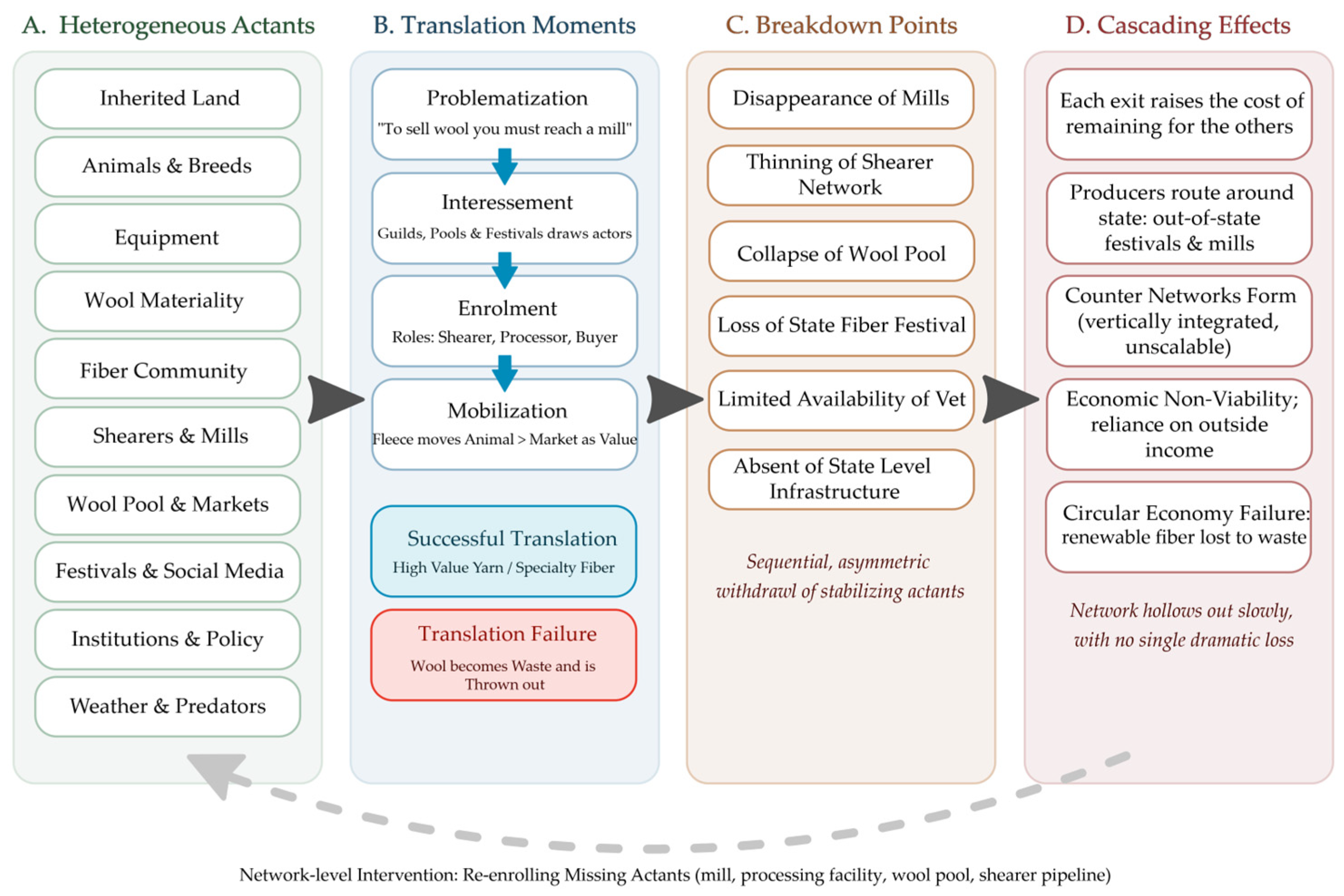
This study examines fiber farming in West Virginia through ANT, tracing how producers, animals, materials, infrastructure, and institutions are assembled into a regional fiber economy. By investigating how heterogeneous actants enroll in, translate, and, at times, disengage from this network, the research advances understanding of small-scale agricultural fiber businesses. The analytical contribution of ANT in this study is not merely terminological but fundamentally explanatory. Viewed through the lens of generalized symmetry, the findings suggest that the West Virginia fiber economy is not declining due to a single market force; rather, it is being progressively disassembled through the sequential withdrawal of both human and non-human actants. Each departure increases the burden and cost of participation for those who remain within the network.
Figure 1 illustrates this process by connecting the heterogeneous actants, the translation of wool, the points of network breakdown, and their cascading consequences.
5.1. Heterogeneous Enrolment and the Appalachian Farm
The assembly of a fiber farm emerged as a fundamentally relational process. Participants traced their entry into fiber farming through inherited land, kinship, mentors, fiber guilds, particular breeds, and the affordances of specific equipment, rather than through individual entrepreneurial decisions. This pattern aligns with [
37]’s observation that entities in a farming network derive their forms and performances from the relations in which they are located. In an Appalachian context, this enrolment carries additional weight. Land that has been strip-mined, soils still in remediation, and roads in disrepair are not neutral backdrops but active actants shaping what producers can plant, where customers can travel, and which animals can be kept. The West Virginia farm is therefore best understood not as an enterprise built by an operator but as an assemblage in which the producer, the ancestor, the animal, the land, and the legacy of extractive industry are all enrolled together.
5.2. The Translation of Wool and the Limits of Material Value
Wool’s market value emerged as wholly contingent on a chain of successful material translations rather than on the fiber’s intrinsic qualities. Participants described the same fleece becoming a luxury yarn under one set of conditions and being thrown into the woods under another. This finding extends the slow-fashion and regional-textile literature, which has emphasized inherent fiber qualities as the basis of value [
40], by demonstrating that softness, breed character, and traceability are necessary but insufficient in themselves. Without the shearer, skirting table, wool pool, and mill aligned in sequence, wool’s material qualities cannot become economic ones.
5.3. Regional Network in Slow, Asymmetric Translation Breakdown
The findings document a regional network undergoing slow, asymmetric translation breakdown. No single failure caused the decline; rather, the retirement of shearers, the disappearance of mills, the collapse of the wool pool, the loss of the state-fiber festival, and new restrictions on antibiotic access each weakened the others. From [
36], four moments of translation describe how a network assembles. The West Virginia case illustrates what its inverse looks like in practice. Disenrollment proceeds asymmetrically, with some actants exiting before others. Cascadingly, with each exit raising the cost of remaining for those still in place, and silently, with no single departure large enough to register as a sectoral event. This is the architecture by which a regional fiber economy quietly hollows out over decades without any dramatic moment of loss.
5.4. Festivals, Social Media, and the Workaround That Reproduces the Gap
Producers have responded to regional breakdown by reconcentrating activity around out-of-state festivals and digital platforms. The Maryland Sheep and Wool Festival, multi-state breed association circuits, and active Facebook and Instagram presences function as the obligatory passage points that the West Virginia network no longer supplies. Yet these venues do their work by routing around the state rather than through it. Producers, wool, and animals must each leave West Virginia for their value to be made visible. This complicates the resilience narrative and deepens the regional gap, because each successful out-of-state sale reduces the incentive to rebuild in-state infrastructure.
5.5. Institutional Gaps and the Case for Network-Level Intervention
Despite producers’ adaptive workarounds, persistent institutional gaps leave the sector structurally fragile. Producers operate without a state-fiber mill, a state-fiber label, a functioning wool pool, a stable festival, or adequate access to veterinary care. The most economically stable producers have responded by personally absorbing the functions a regional network would otherwise distribute, building vertically integrated farm-mill-store operations. Their success is real but unscalable because it depends on capital and capacity that most producers lack. The implication is consequential: producer-level instruments such as equipment grants or single-farm cost-share, while useful, cannot reverse a pattern whose missing actants operate at the network level. A regionally embedded farm-to-fashion pathway in West Virginia will require re-enrolment of the lost stabilizing actants, sequenced and integrated, rather than further empowerment of individual producers operating within a network that no longer assembles itself.
5.6. Sustainability and the Circular Economy in a Fragmented Fiber Network
The five themes describe a sector whose sustainability is limited less by producers’ intent than by the state of the surrounding network. West Virginia fiber farming already embodies much of what sustainability and circular-economy scholarship treat as ideal. Producers raise renewable, biodegradable fiber, often keep heritage breeds that conserve genetic diversity, steward remediated post-mining land, and favor durable, locally made goods sold directly rather than through disposable mass-market channels. These are the hallmarks of slow fashion and a circular textile economy, in which materials are kept in use and waste is designed out of the system [
10,
18,
30]. Yet the findings show that these potentials go unrealized because circularity is a property of networks, not of individual firms. The translation of wool is the clearest case: the fleece thrown into the woods, bagged with trash, or abandoned in fields is not a behavioral failure but a circular-economy breakdown caused by missing actants. Circularity cannot be achieved by small businesses alone. It needs shared infrastructure, aggregation, processing, and market access, through which materials are revalued rather than discarded.
This reframing carries three implications for a sustainable, circular small-business strategy. First, the social and economic pillars are inseparable from the environmental pillar. The same gaps that send wool to the woods also depress income, force reliance on outside jobs, and erode the multigenerational, women-led enterprises that sustain rural Appalachian livelihoods. Sustainability here is at once ecological, economic, and social. Second, the counter networks, in which vertically integrated farm-mill-store operations close the loop internally, show that circularity is achievable, but only for a few producers with the capital to internalize an entire supply chain. Their success measures the absence of shared infrastructure, not its presence. Third, the most useful interventions are therefore network-level rather than firm-level. Re-enrolling the missing actant, regional processing capacity, a functioning wool pool, value-added uses for coarse wool, such as insulation and soil-amendment pellets, and a state-fiber label that makes regional, traceable fiber visible to consumers would turn latent material value into circulating economic and environmental value across many small businesses at once. For policymakers and industry partners, supporting circularity means rebuilding the infrastructure that keeps renewable materials in use, not just urging individual farms to be greener.
6. Conclusions
This study contributes to the ongoing conversation in the field of small-scale fiber farming and regional textile economies by illuminating the relational architecture and the current fragility of fiber farming in West Virginia. It reframes the sustainability and circular economy challenges faced by small-fiber businesses as network problems. The renewable, biodegradable potential of wool is realized only when a regional infrastructure exists to keep the material in productive use. Otherwise, it is wasted regardless of producer commitment. By examining the sector through the integrated lens of heterogeneous enrolment, material translation, regional network breakdown, festival and social media reconcentration, and institutional gaps, the research offers a nuanced portrait of where the fiber economy is being held together and where meaningful gaps remain.
The findings demonstrate that West Virginia fiber producers are successfully assembling viable farms from heterogeneous actants and translating wool into high-value products under specific, often hard-won conditions. The persistence of multigenerational fiber farms, the depth of producers’ knowledge, the resourcefulness of vertically integrated counter networks, and the commitment to direct customer relationships and value-added production all speak to the genuine adaptive capacity of this producer population. At the same time, the disappearance of regional mills, the thinning of the shearer network, the collapse of the wool pool, the loss of the state-fiber festival, and the persistent absence of state-level fiber infrastructure indicate that the regional network supporting these producers is undergoing a slow, asymmetric breakdown.
By integrating heterogeneous enrolment, successful material translation, regional network stabilization, and institutional re-enrolment as intentional elements of agricultural and economic development, policymakers and industry partners can empower producers as actants within a viable regional fiber economy. This requires moving fiber support from the margins of isolated producer-level grants to the structural center of regional policy, embedded in workforce pipelines, reinforced across processing and aggregation infrastructure, and connected to real-world regional and community contexts. The next steps in this field involve addressing the identified limitations and advancing understanding of how regional fiber networks reassemble to foster more resilient practices in small-scale agricultural fiber economies.
6.1. Limitations and Future Scope
This study’s limitations include its focus solely on currently active fiber producers within West Virginia. The perspectives and insights of producers who have already exited the sector, downstream mill operators, breed association leaders, and state agricultural officials offer meaningful scope for future inquiry to enrich understanding of regional fiber network dynamics. Although the analysis treats the regional fiber economy as a heterogeneous network encompassing these actors, they were not interviewed directly; their roles were reconstructed through producers’ accounts rather than observed first-hand, so the network is necessarily described from a single vantage point. The perspectives of actants whose decisions producers experience as external constraints, particularly processors and policymakers, are therefore represented only as producers perceive them, and future research incorporating these stakeholders would help corroborate and extend the present account.
The sample is also concentrated in the sheep-wool segment of the sector, consistent with the structure of fiber production in West Virginia; consequently, the findings speak most directly to regional sheep-wool production, and perspectives specific to alpaca, mohair, and other specialty-fiber producers remain underexplored. Taken together, these limitations suggest that the findings are best understood as analytically generalizable, offering transferable conceptual insight into how regional fiber networks are assembled and become fragile, rather than statistically generalizable to all U.S. fiber farming operations.
Future researchers could conduct longitudinal studies to track the West Virginia fiber sector’s long-term trajectory across re-enrolment interventions, should they occur, shedding light on whether cascading translation breakdowns can be reversed once advanced. Additionally, investigating the effectiveness of specific structural interventions or institutional supports, such as state-supported fiber mills, regional wool pools, statewide fiber labels, or shearer training pipelines, in stabilizing the regional network could substantially enhance the efficacy of farm-to-fashion development initiatives.
6.2. Implications
As regional textile value chains and the circular economy continue to evolve rapidly, supporting network-level re-enrolment can help producers adapt, innovate, and tackle complex supply chain challenges. This study sheds light on the specific areas where West Virginia fiber producers need support, guiding policymakers and industry stakeholders in incorporating infrastructure and institutional investments that nurture deeper, more durable regional capacity. Examining how ANT illuminates the assembly and breakdown of small-fiber economies also encourages a mindset of relational analysis, which is essential for continuous growth in dynamic fields such as agriculture and regional textile production. The findings offer practitioners valuable insights into producers’ lived experiences, enabling them to refine their strategies through cooperative infrastructure, real-world problem-solving, and cross-sector collaboration, ultimately enriching the regional fiber sector and preparing the next generation of West Virginia producers to lead with sustainability and regional embeddedness at the forefront of their practice.