Article

Adaptive Dynamic Evolution of Social-Ecological Systems in the Huaihe River Ecological and Economic Belt (HREEB) Based on Complex Adaptive System Theory

1
School of Economic and Management, Nanjing Tech University, Nanjing 211816, China
2
School of Finance and Public Administration, Anhui University of Finance & Economics, Bengbu 233030, China
3
Xuzhou Construction Machinery Group (China), Xuzhou 221001, China
*
Author to whom correspondence should be addressed.
Sustainability 2026, 18(12), 5823; https://doi.org/10.3390/su18125823
Submission received: 23 April 2026 / Revised: 28 May 2026 / Accepted: 30 May 2026 / Published: 8 June 2026
(This article belongs to the Section Environmental Sustainability and Applications)

Abstract

Understanding the adaptive dynamics of social-ecological systems (SESs) is critical for regional sustainability as human–environment interactions intensify. However, existing indicator-based research frequently lacks a clear theoretical framework and methodological clarity when analyzing SES adaptation. Using complex adaptive system (CAS) theory as an interpretive lens, this research creates a social-ecological system (SES) adaptability evaluation framework that incorporates the pressure–state–response (PSR) model from a CAS perspective. This study examines the Huaihe River Ecological and Economic Belt (HREEB) as a case study, combining remote sensing (RS) and geographic information system (GIS) data from 28 prefecture-level cities from 2005 to 2020. The entropy-weight approach is used to create a composite adaptability index, and obstacle-degree analysis is used to identify key limiting factors, followed by an examination of spatiotemporal evolution patterns. The study found that: (1) SES adaptability in the HREEB increased steadily (mean annual growth rate: 3.97%), with the social subsystem exhibiting a larger connection with the overall trend and the ecological subsystem displaying greater volatility; (2) there was significant spatial heterogeneity, forming a “high in the east and west, low in the center” pattern (supported by a global Moran’s I = 0.535, p < 0.05); (3) obstacle degree analysis identified per capita afforestation area (ecological response), per capita GDP (social state), and population density (ecological pressure) as persistent key constraints.

1. Introduction

With rapid urbanization, the natural environment has shifted from primarily providing resources and necessities for societal progress to being increasingly influenced by human activities, aggravating tensions between people and nature [1].
SES research provides a key foundation for researching human–land interactions. Since its inception in the early twentieth century, this issue has sparked widespread scholarly attention [2]. The HREEB is an example of a complex adaptive system (CAS), defined by the mutual evolution of socio-economic and biophysical subsystems through nonlinear interactions and feedback mechanisms. Holling (1973) initially proposed the SES concept, viewing it as a multidimensional network of mutual dependence and shifting dynamics between natural habitats and societal institutions [3,4]; Cumming and colleagues describe the SES as an intricate network marked by a profound fusion between human communities and the biosphere. Within this perspective, civilization is interpreted as the collective outcome of collaboration and mutual dependency among people [5]. To conclude, the social framework includes many interlinked sub-elements, with sophisticated interactions that correspond to complexity, refinement, and fluctuation, thus forming a cluster of interdependent, perpetually transforming complex adaptive systems [6].
Within current debates concerning the sociological aspects of the SES framework, a major focus involves the intricacy embedded in societal existence and mechanisms [7]. CAS serves as a portrayal of evolving, responsive connections among mutually reliant, collaborative elements within a network. Such structures integrate ecological features alongside the traits of separate parts, matching the persistent development of the whole organization into unique arrangements. Simultaneously, those constituent parts undergo ongoing transformation, displaying specific architectural and operational attributes [4]. CAS displays traits that set it apart from standard complicated systems: (1) separate tiers, (2) partial autonomy between those levels, (3) flexibility of the actors participating, and (4) simultaneity. Such qualities likewise correspond with the foundations of SES doctrine.
The adaptive cycle primarily illustrates the developmental trajectory of a sophisticated adaptive system as it undergoes constant transformation. This framework comprises four distinct phases: exploitation (r), conservation (Κ), release (Ω), and reorganization (α). The intrinsic characteristics of the adaptive cycle encompass potential, connectivity, and resilience [8]. The adaptive cycle theory offers insights into the evolutionary mechanisms underlying complex systems.
In investigating the use of SES, resilience, vulnerability, and adaptation represent three fundamental concepts that must be given significant weight [9]. Studies concerning the vulnerability of SES within China primarily utilize an ecological viewpoint. This methodology seeks to address the challenges posed by external shocks, including climate shifts [10,11,12] and natural disasters [13], within the framework of regional administration. The examination of vulnerability in special ecological function zones has become a primary research area for academics in China [14], focusing on bay terrains, karst regions [15], key areas of soil erosion [16], large lakes [17], and other vital locations. Regarding these central ideas, adaptability, as a vital feature of SES and intricate adaptive systems, is likewise regarded domestically as a crucial element of sustainable studies [18]. Adaptation involves the system’s reaction to environmental signals, in which the actor experiences ongoing adjustment and development [19].
Nevertheless, numerous deficiencies remain in current academic work, including an underdeveloped evolution of the responsive evaluation framework, a broad research scope, and a limited dataset, especially in the HREEB area. Furthermore, although CAS concepts are widely referenced, their use typically remains narrative rather than functional, creating a separation between conceptual structure and practical analysis. Given this foundation, this research incorporates the societal development levels of each metropolis in the HREEB, accounting for the natural environment. Adopting the paradigm of complex adaptive systems, this inquiry chose 28 prefecture-level municipalities across the HREEB as its primary objects of inquiry.
By integrating remote sensing (RS) and geographic information system (GIS) technologies [20,21], this research conducted a comprehensive assessment of the SES’s adaptability. The evaluation was structured into two subsystems (social subsystem and ecological) and three levels (pressure, state, and response) within each [22].
This research conducted a numerical assessment of the system’s flexibility across provincial and prefectural levels, simultaneously pinpointing the temporal sequence dynamics and spatial distribution traits [23]. To investigate the determinants of shifts in adaptive structures of the SES within the HREEB, and to examine both the evolutionary trajectories and strategic governance approaches regarding the fluctuating resilience of SES adaptability in this area, our objective is to establish a conceptual basis and guideline for regional authorities in the HREEB, which will help them make choices regarding natural resources, fiscal growth, and environmental management [24].
Although a substantial volume of the literature regarding SES adaptability has emerged, multiple constraints persist. Initially, many investigations used indicator-driven methods but failed to provide explicit justification for variable selection and weight allocation, thereby undermining procedural clarity and replicability. Furthermore, while complex adaptive system (CAS) concepts are commonly referenced, they are typically employed narratively instead of practically, creating a chasm between conceptual structuring and quantitative evaluation. Finally, insufficient attention has been paid to medium-scale areas such as the Huaihe River Ecological and Economic Belt, a vital climatic transition region marked by overlapping environmental vulnerability and economic strain.
To bridge these voids, the current research seeks to: (1) establish a practical evaluation architecture for SES resilience that adopts CAS theory as a conceptual framework and the PSR model as an organizing tool for metric identification—we do not attempt to formally implement CAS via agent-based modeling, system dynamics, or network topology, but instead utilize CAS principles (adaptive cycle, hierarchical nesting, multi-stability) to explain observed variable patterns; (2) improve analytical precision and replicability by providing clear metric rationalization, entropy weighting, stability tests, and obstacle intensity assessment; and (3) examine the geographic-temporal transformation of SES robustness within the HREEB and determine potential strategic entry points for mitigation according to system analysis (e.g., obstacle drivers).
To clarify the link between CAS theory and the PSR framework, we explicitly define the conceptual mapping utilized throughout this study. The four stages of the adaptive cycle—exploitation (r), conservation (Κ), release (Ω), and reorganization (α)—are translated into the integrated dynamics of the three PSR pillars as outlined as follows. (1) Exploitation (r): this stage sees the response (R) pillar driving swift expansion of the state (S) pillar while pressure (P) on resources increases without yet degrading system function—empirically anticipated to align with periods of increasing social-S metrics (per-capita GDP, urbanization), supportive R metrics (science-education spending, medical care delivery), and progressively building P metrics (energy efficiency, fertilizer application, population pressure). (2) Conservation (Κ): the network attains relative equilibrium, with S metrics plateauing, R metrics reaching saturation, and P metrics persisting to climb—the “stiff” structure where adaptive potential remains strong, but resilience is diminished. (3) Release (Ω): climbing P metrics (e.g., pollution indices, population concentration) match failing R metrics (e.g., per-capita afforestation, sewage treatment levels), triggering a dramatic decline in ecological-S metrics (NDVI, air purity, climatic suitability). (4) Reorganization (α): R-dimension governance measures facilitate the limited recovery of S metrics while P metrics stabilize; the network either resumes an r-stage or shifts toward a distinct K-stage path. This alignment is interpretive, not mechanistic: we do not posit a rigid correlation between particular P/S/R datasets and adaptive-cycle epochs, but utilize it as a theoretical framework to analyze the factual trends detailed in Section 3 and Section 4.

2. Materials and Methods

2.1. Study Area

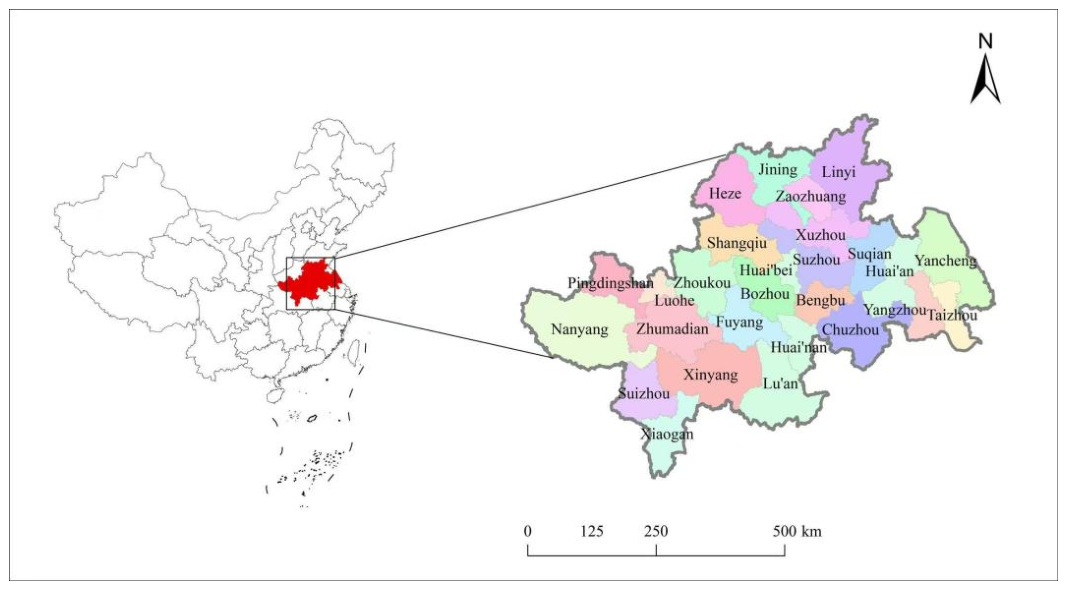
The HREEB (Figure 1) is located in central and eastern China, at longitude 111°55′ E–121°20′ E and latitude 30°55′ N–36°20′ N. The northern region of the HREEB is characterized by a warm-temperate, semi-humid monsoon climate. In contrast, the southern region exhibits a humid subtropical monsoon climate, featuring distinct seasonal variations and abundant sunshine. It is China’s major commodity grain base and a significant production area for cotton, oilseeds, and fruits. The study area encompasses 28 cities across 5 provinces—Anhui, Shandong, Jiangsu, Henan, and Hubei—covering a total area of 243,000 square kilometers. As of 2021, it had a resident population of 159 million and a gross regional product of 9.8372 trillion yuan.
The Huaihe River Economic Belt Development Plan divides the 5 provinces and 28 cities of the HREEB into three major regions: the Eastern Sea–River–Lake Linkage Region, the Northern Huaihe River Economic Belt [25], and the Midwest Inland Rising Region, as shown in Table 1.

2.2. Data Sources

This article uses 28 prefecture-level cities within the HREEB region as the primary analytical subjects. The investigation timeframe was defined as 2005–2020, constrained by the accessibility of empirical datasets. Socioeconomic metrics were mainly derived from provincial and municipal statistical yearbooks. To address any missing information, linear interpolation across individual city chronologies was used to maintain temporal patterns. A rigorous sensitivity analysis contrasting various imputation approaches with this linear-interpolation reference was not conducted in this research; the theoretical consequences of such a selection, particularly the ratio of estimated values across key metrics, are explored as a constraint in Section 4.1. The data concerning the normalized difference vegetation index (NDVI) [26] originated from 1 km resolution raster layers (https://www.resdc.cn/), the greenhouse gas emission data were supplied by the China Carbon Accounting Database (https://www.ceads.net.cn/), and the monthly mean temperature records were obtained from the National Meteorological Science Data Center (http://data.cma.cn/).

2.3. Construction of the Adaptive Assessment Index System for Social-Ecological Systems Based on PSR Theory

Inspired by CAS theory, which highlights the dynamics among system forces, internal conditions, and coping mechanisms, we utilized the PSR framework to organize our metric system. Every selected metric was chosen for its conceptual alignment with SES resilience in the HREEB setting, supported by recognized research (see Table 2). Increased pressure on individual subsystems is associated with reduced total system resilience, underscoring the detrimental impacts of anthropogenic activities on resource use, natural habitats, and labor markets. Particularly, the strain from the social sector is defined by energy use per GDP unit, apparent CO2 emissions per GDP unit, and the unemployment rate, whereas the strain from the ecological sector is represented by fertilizer application volumes, environmental contamination metrics, and population density [27,28,29].
A properly operating sub-component’s condition facilitates the overall system’s reliable functioning and helps sustain a superior degree of systemic flexibility [30]. In this research, the social subsystem’s status is depicted through metrics such as individual GDP, individual food output, urbanization levels, and the metric for industrial structure diversity. The ecological subsystem’s condition is defined by the forest coverage ratio, climatic appropriateness, and the share of excellent air quality [31].
Improved responsiveness of the subsystem is associated with an improvement in the system’s capacity to manage external risks and internal conflicts [32,33]. This study characterizes the responsiveness of the ecological subsystem [34] through three key indicators: the area of afforestation per capita, the rate of harmless treatment of domestic waste, and the rate of centralized sewage treatment. These indicators collectively reflect the effectiveness of ecological protection and environmental management within a given region [35]. Therefore, these measures can represent the ecological subsystem’s holistic capacity to react to external hazards and internal disruptions. Furthermore, they define the responsiveness of the social system as the proportion of scientific and educational funding, the density of hospital beds per capita, and the disposable income of urban inhabitants [36]. A strong educational foundation and medical service are vital for efficiently managing various risks.
Table 2. SES adaptability evaluation index system.
Level 1 IndicatorsSecondary IndicatorsTertiary IndicatorsCharacteristicInterpretation of Indicators
Social SubsystemSocial Pressure (P)The energy consumption per unit GDP (P1)Energy consumption intensity
Apparent carbon dioxide emissions per unit of GDP (P2)Intensity of carbon emissions per unit
Unemployment rate (P3)Degree of stability of the system’s employment
Social Status (S)GDP per capita (S1)+Economic level per capita
Per-capita grain production (S2)+Stability of agricultural development
The rate of urbanization (S3)+Systematic urbanization process
Industrial structure diversification index (S4)+Degree of balance in industrial structure
Social Response (R)Science and education investment ratio (R1)+Public service level
Number of health establishment beds per capita (R2).+Level of medical and health care
Urban disposable income (R3)+Economic conditions of the population
Ecological SubsystemEcological Pressure (P)Fertilizer use per unit sown area (P4)Degree of environmental pollution
Environmental pollution index (P5)Degree of stress on the environment
Population density (P6)State of system pressure
Ecological Status (S)Normalized difference vegetation index (NDVI) (S5)+System natural conditions
Climate suitability (S6)+System livability level
Proportion of good air quality (S7)+System atmospheric level
Ecological Response (R)Afforestation area per capita (R4)+Environmental support efforts
Harmless treatment rate of domestic garbage (R5)+Strength of regional ecological management
Centralized treatment rate of sewage treatment plants (R6)+Strength of industrial governance
Note: ① Formula for calculating the industrial structure diversification index: r = 1 / i = 1 n x i 2 , where xi is the share of primary, secondary, and tertiary industries in GDP. ② The environmental pollution index is derived by determining the proportions of three contaminants, specifically industrial discharge, vehicular emissions, and solid debris, utilizing the entropy approach and subsequently assigning these values [37]. ③ Climatic suitability = Σ|Average monthly temperature − Suitable temperature|. Seasonal variations in suitable temperatures: 25 °C in May–July, 20 °C in February–April and August–October, 15 °C in January, November, and December [38]. A lower value indicates higher climatic suitability for human settlement and ecological functioning.

2.4. Determining the Weight of the Huaihe River Ecosystem Adaptation Based on the Entropy Weight Method

2.4.1. Entropy Weight Method

To alleviate the impact of human subjective elements in conventional weighting approaches and to efficiently address information redundancy among variables, this study proposes a correction framework for weights derived via the entropy-based technique [39]. The particular procedures are outlined below:
(1) Indicator selection: Assuming that there are h years, m cities, and n indicators, X λ ij is the initial value of the jth indicator in the λth city in the ith year.
(2) Data Standardization:
The importance of attributes possessing adaptive metrics across SES fluctuates significantly. Moreover, the scales of the original data within such adaptive framework systems diverge, requiring normalization. Within this research, the polar deviation standardization approach was utilized to normalize the metrics. The computational formula is shown below:
Formula for calculating positive indicators:
N λ ij = X λ ij Min ( X j ) Max ( X j ) Min ( X j )
Formula for calculating negative indicators:
N λ ij = Max ( X j ) X λ ij Max ( X j ) Min ( X j )
where N λ ij is the standardized value; Max ( X j ) , Min ( X j ) are the maximum and minimum values of the jth indicator across all cities and years.
(3) Calculate the proportion of the indicator value:
P λ ij = N λ ij λ = 1 m i = 1 h ( N λ ij )
(4) Calculate the entropy of each indicator, e j :
e j = k λ = 1 m i = 1 h ( P λ ij × ln P λ ij )
Included among these, k   =   1 lnhm , k   >   0 .
(5) Calculate the redundancy of the entropy value of each indicator, d j :
d j = 1 e j
(6) Calculation of the weights of the indicators w j :
w j = d j j = 1 n d j
(7) Calculate the composite indices:
The standardized metrics are assigned weights and aggregated to derive the burden, condition, and reaction scores for every urban area and period:
P λ j = i = 1 n ( N p λ ij   ×   w j )
S λ j = i = 1 n ( N s λ ij   ×   w j )
R λ j = i = 1 n ( N r λ ij   ×   w j )
where P λ j , S λ j , R λ j are the pressure, state, and response indices for city λ in year i, respectively.
Adaptability metrics for the societal and environmental subsystems were derived by summing their individual P, S, and R values [40].
SESP s = P λ j × w p 1 + S λ j × w s 1 + R λ j × w r 1
SESP e = P λ j × w p 2 + S λ j × w s 2 + R λ j × w r 2
In these formulas, w p 1 , w s 1 , and w r 1 are the weights for the pressure, state, and response indicators in the social subsystem, and w p 2 , w s 2 , and w r 2 are the corresponding weights for the pressure, state, and response indicators in the ecological subsystem. To synthesize the P, S, and R dimensions into subsystem scores, we assigned equal weights (1/3 each). This parsimonious approach is based on the foundational PSR framework’s premise that pressure, state, and response are conceptually interdependent and jointly constitutive of system dynamics, with no prior empirical basis to privilege one over the others in this regional context. To test the robustness of this assumption, a sensitivity analysis with alternative weighting schemes (e.g., AHP-derived weights) was conducted, confirming that the main spatiotemporal conclusions remained stable. Specifically, three alternative P/S/R weighting schemes were evaluated against the equal-weight baseline: (i) an analytic hierarchy process (AHP) scheme based on pairwise judgments from five domain experts (P = 0.28, S = 0.41, R = 0.31 for the social subsystem; P = 0.32, S = 0.38, R = 0.30 for the ecological subsystem; pairwise comparison consistency ratio CR < 0.08); (ii) a state-emphasized scheme (P = 0.25, S = 0.50, R = 0.25); and (iii) a response-emphasized scheme (P = 0.25, S = 0.25, R = 0.50). Across all three alternatives, the Spearman rank correlation of city-level mean adaptability scores with the baseline ranking exceeded 0.94, the “east and west high, center low” spatial pattern was preserved, and the identification of the top three obstacle factors (afforestation area per capita, GDP per capita, population density) was unchanged (Table 3). Full sensitivity tables are reported in the Supplementary Materials. The complete weight coefficients of the 19 tertiary indicators ( w j ) computed by the entropy method are provided in Table 4, and the corresponding cell entries [41].
SESP = 1 2 ( SESP s + SESP e )

2.4.2. Determining the Adaptive Weights of the Huai River Ecosystem

The proportion factors for each metric, determined using the entropy weighting technique, are shown in Table 4. The total of these values across each P/S/R category is 1.
In this research, entropy methods were employed at the specific indicator level to capture data-driven fluctuations, whereas uniform weights were distributed across the pressure, state, and response pillars. This premise stems from the theoretical structure of the PSR framework, which views these three elements as equally significant for depicting system evolution. To guarantee reliability, sensitivity evaluations utilizing various weighting strategies were performed.

2.5. Obstacle Degree Model

The obstacle degree framework is widely used to identify primary constraints on system efficiency and differs from the statistical hurdle approach. This technique evaluates the flexibility of the social and ecological components within the HREEB by computing factor contributions, indicator deviations, and obstacle levels [42].
The calculation steps are as follows:
P ij = 1 Y ij
Z j = P ij × G j j = 1 n P ij G j
In these formulas, P ij represents the indicator deviation, which is the distance between the standardized Y ij of a single indicator and the overall target. Z j represents the obstacle degree, which indicates the extent of influence of a single indicator on the overall social and ecological adaptability; G j represents the factor contribution, which is equivalent to the indicator’s weight w j obtained from the entropy method.
The obstacle degree at the criterion layer (subsystem or P/S/R dimension) is calculated by summing the obstacle degrees of its constituent indicators:
U i = j = 1 m Z j
where U i is the obstacle degree of the i criterion layer (here i denotes a P, S, or R criterion layer; this i is conceptually distinct from the year index i used in Equations (3) and (4) and is reused only for notational compactness); Z j is the indicator layer obstacle degree. To clarify the notation in Equation (15): Z j denotes the per-city-per-year obstacle degree of indicator j (i.e., the city-and year-specific Z value previously defined in Equation (14) for a given (i, j) pair, evaluated at the current city λ and year i and indexed by j only for compactness). The summation in Equation (15) runs over all indicators j that belong to criterion layer i (i.e., the subset of indicators within a given P, S, or R dimension of a given subsystem), so that U i is the aggregated obstacle degree of criterion layer i for that city-year.

2.6. Identification of the Evolutionary Stages of the Adaptive Cycle

To analyze the adaptive cycle of the HREEB at regional and urban scales [43,44], we applied K-means clustering [45] to the annual rate of change of the adaptability indices for the social subsystem, the ecological subsystem, and the integrated SES from 2005 to 2020. Clustering was performed on the pooled panel of all 28 cities × 15 year-on-year change vectors (420 observations in total), so each year–city pair received a cluster label that could subsequently be interpreted within the within-city temporal sequence. The number of clusters was set to 4, corresponding to the four phases (r, Κ, Ω, α) of the adaptive cycle theory. It should be emphasized that the choice of k = 4 is mainly motivated by the four-stage framework of adaptive cycle theory (r, Κ, Ω, α), rather than by the statistical optimum of a clustering criterion. The silhouette coefficient and multiple random-initialization tests are reported solely to indicate that the four-cluster solution has acceptable internal stability, not to imply that it represents the statistically optimal grouping. Specifically, the average silhouette coefficient for k = 4 was 0.328, while those for k = 3 and k = 5 were 0.36 and 0.34, respectively, and 0.30 for k = 6; the differences across candidate k values were small, so we do not claim that the silhouette coefficient “supports” k = 4 in a statistical sense. To further assess stability, we reran K-means with 50 random seeds (K-means++ initialization, 500 max iterations); the resulting cluster assignments matched our reported labels for 98.7% of observations, and the four-phase interpretation of cluster centroids was preserved across all runs. The characteristics of each cluster were defined based on the direction and magnitude of change in the subsystem indices [46].
Along the evolutionary trajectory of social-ecological systems, the social subsystem experiences swift, profound transformations in response to pressure, while the ecological subsystem evolves more slowly and shows a delayed response. Consequently, a situation of disordered advancement among these subsystems frequently occurs within the same timeframe. Based on the findings and clustering classification, the four phases of the adaptive cycle were segmented into a rapid expansion phase, a stabilization and preservation phase, a release phase, and a reorganization phase to more clearly depict the dynamic development of HREEB at both the regional and urban levels [47]. Throughout the stabilization and preservation phase, both social and ecological systems maintain a rising trend [48,49,50]; however, the rate of progress diminishes, hazards grow, and sensitivity wanes. In the release phase, the system’s and its subsystems’ general flexibility diminishes, making it susceptible to diverse hazards and tensions and putting it at peril [51,52]. During the reorganization phase, the general resilience of social and ecological systems is continually evolving [53], and the subsystems are in a gradual recovery period and transitioning toward a rapid expansion phase [54]. The r and Κ stages signify a forward cycle, wherein the system perpetually builds energy, enhances its capacities, and moves ahead; the Ω and α stages signify a reverse cycle, wherein the system’s instability and dangers intensify [55,56].
Drawing on the adaptive cycle framework, social-ecological structures within metropolitan regions across various phases were examined, and the specific adaptive cycle phases for each group were initially identified [57] (Table 5). Subsequently, the clustering outcomes for specific years and urban areas were improved to integrate the chronological sequence and developmental coherence of these social-ecological frameworks.

2.7. Correlation Analysis

To initially evaluate the mutual evolution of the social and ecological subsystems, we determined the Pearson correlation coefficient (r) for their yearly adaptability metrics in each city across the research timeframe and provided the corresponding two-tailed p-value and 95% confidence interval for each location in the supporting documents. Several crucial constraints are to be acknowledged. Initially, given merely N = 16 yearly records per city, the 95% confidence interval around r = 0 is roughly ±0.50, implying that a sample correlation categorized as “essentially uncorrelated” (|r| < 0.3) must be considered statistically inconclusive rather than providing evidence of actual independence. Furthermore, Pearson correlations fail to account for temporal autocorrelation, which is often prevalent in indicator sequences and overstates the perceived strength of association; we therefore confirmed our qualitative findings using first-differenced data, with the results presented in the Supplementary Materials. Thirdly, both subsystem metrics might exhibit shared patterns linked with macro-level variables (e.g., state policy cycles, climate fluctuations) or unseen factors (e.g., industrial reorganization, population shifts), meaning that an observed correlation needs to be interpreted as a descriptive synchronization rather than as proof of a causal link between the two systems. Throughout this manuscript, we thus use associative terminology (“coincided with”, “tended to be associated with”) rather than causal terminology when addressing these findings.
Correlations were categorized as highly correlated ( 0.8 | r | 1 ), moderately correlated (0.5 ≤ | r | < 0.8), poorly correlated (0.3 ≤ | r | < 0.5) and essentially uncorrelated (0 ≤ | r | < 0.3) based on common judgmental methods of mathematical statistics.

3. Results

3.1. Dynamic Evolutionary Analysis of Adaptations in Social and Ecological Systems Within the HREEB at a Regional Scale

Process Analysis of Adaptive Cyclic Evolution in Social and Ecological Systems Within the HREEB

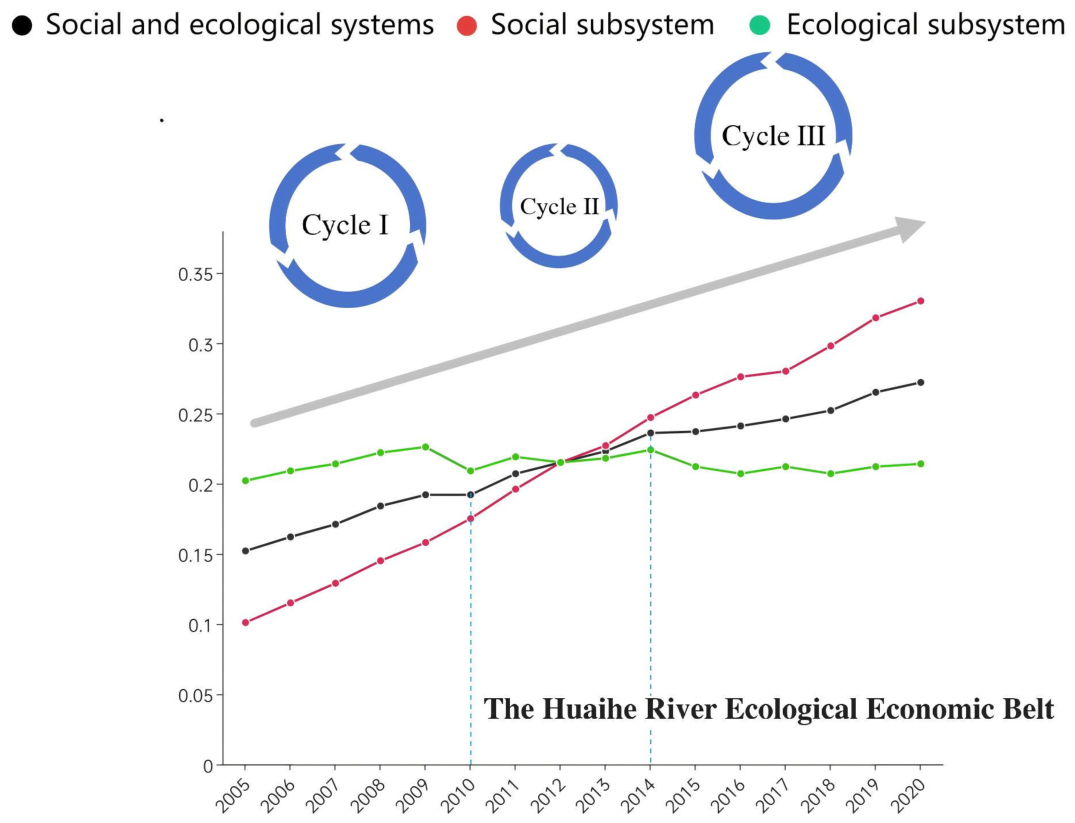
From the perspective of the HREEB as a whole, the composite SES adaptability index showed an overall upward trend from 2005 to 2020, except for a decline in 2010. The mean annual growth rate of the composite SES adaptability index over the 2005–2020 period was 3.97% (computed as the geometric mean of year-over-year changes across the 28 cities), with the social subsystem growing at 8.30% per year and the ecological subsystem at 0.36% per year. A spatial autocorrelation analysis using a row-standardized queen-contiguity spatial weights matrix (with island-cities linked to their nearest neighbor by centroid distance) yielded a global Moran’s I of 0.535 for the composite SES adaptability index in 2020 (z = 4.76, p = 0.002 under 999 permutations), confirming statistically significant positive spatial autocorrelation. Results were qualitatively unchanged when using a Κ-nearest-neighbors (k = 4) weights specification (Moran’s I = 0.589, p = 0.002) and an inverse-distance weights specification (Moran’s I = 0.152, p = 0.006). The broad advancement of the HREEB over the last 16 years has been beneficial, with both social and ecological systems benefiting from mutual growth. Nevertheless, ecological subsystems have shown volatility throughout this interval, indicating that further improvement is feasible in future developments. Examination of the subsystems reveals that the social subsystem exhibited a steady upward movement [58]. Conversely, the ecological subsystem underwent reductions in 2010, 2012, 2015, 2016, and 2018. This sequence matched intervals of rapid social-subsystem growth, suggesting a possible delayed association between environmental pressure metrics and ecological-subsystem ratings. Intervals of diminished ecological-subsystem values were likewise simultaneous with lower total SES adaptability throughout the HREEB [59].
As shown in Figure 2, the dynamic adaptation of social and ecological systems within the HREEB region experienced three distinct cyclical stages. The initial cycle extends from 2005 to 2010. Throughout this interval, the swift advancement of the social framework—such as GDP growth and urbanization—reflects the “r-phase” (expansion) of complex adaptive systems (CASs), characterized by the prevalence of positive feedback mechanisms. Conversely, ecological components showed a delay, along with delayed detrimental feedback processes such as pollutant buildup. This resulted in a general systemic downturn in 2010, matching a temporary “Ω-phase” (release) triggered by accumulated ecological stress reaching a regional tipping point. Nevertheless, the 2010 drop was minimal (0.24%), demonstrating the system’s inherent resilience.
To clarify: Phase I (2005–2010) represents a rapid social subsystem expansion culminating in a transient Ω-phase transition by 2010; Phase II (2010–2014) signifies a Κ-phase of preservation characterized by limited oscillations within the ecological framework; Phase III (2014–2020) reflects a terminal Κ-phase marked by the accumulation of multiple stress indicators. Circular markers in the diagram indicate the theoretical placement of every period inside the CAS adaptive-cycle architecture.
Between 2010 and 2014, the social subsystem experienced steady expansion, whereas the ecological subsystem oscillated within a specific interval [60,61]. This aligns with the “Κ-phase” (conservation), during which frameworks stabilize but internal inflexibility might rise. The restricted variations of the ecological subsystem serve as resilience mechanisms in CAS, such as buffering via ecosystem services. The third cycle, covering 2014 to 2020, was marked by a slowdown in the unified SES’s development. Social subsystems showed a constant yet slower ascending trajectory, while stresses intensified. Simultaneously, industrial structure diversification advanced across urban areas [62], indicating a path-dependent evolution toward a more diversified economy. The declining growth rates after 2019 suggest increased system rigidity—a potential CAS warning sign. It is important to note that the current phase is interpreted as late conservation (Κ) with rising pressure, rather than as a confirmed transition to the release (Ω) phase.
The 2019–2020 timeframe observed a deceleration in the progression of adaptation. The emergence of the COVID-19 pandemic in 2020 introduced an external disturbance to these subsystems, characterized by significant volatility, underscoring the framework’s vulnerability to international shocks. Post-pandemic reconstruction requires a comprehensive evaluation to avoid the HREEB transitioning into a real Ω-phase. Emphasizing environmental recovery while promoting effective societal advancement is vital for guiding the HREEB toward a resilient developmental path.

3.2. Adaptive Dynamic Evolution Analysis of Social and Ecological Systems in the HREEB at the Urban Scale

3.2.1. Evolutionary Characterization of Subsystems of Social and Ecological Systems at the Urban Scale

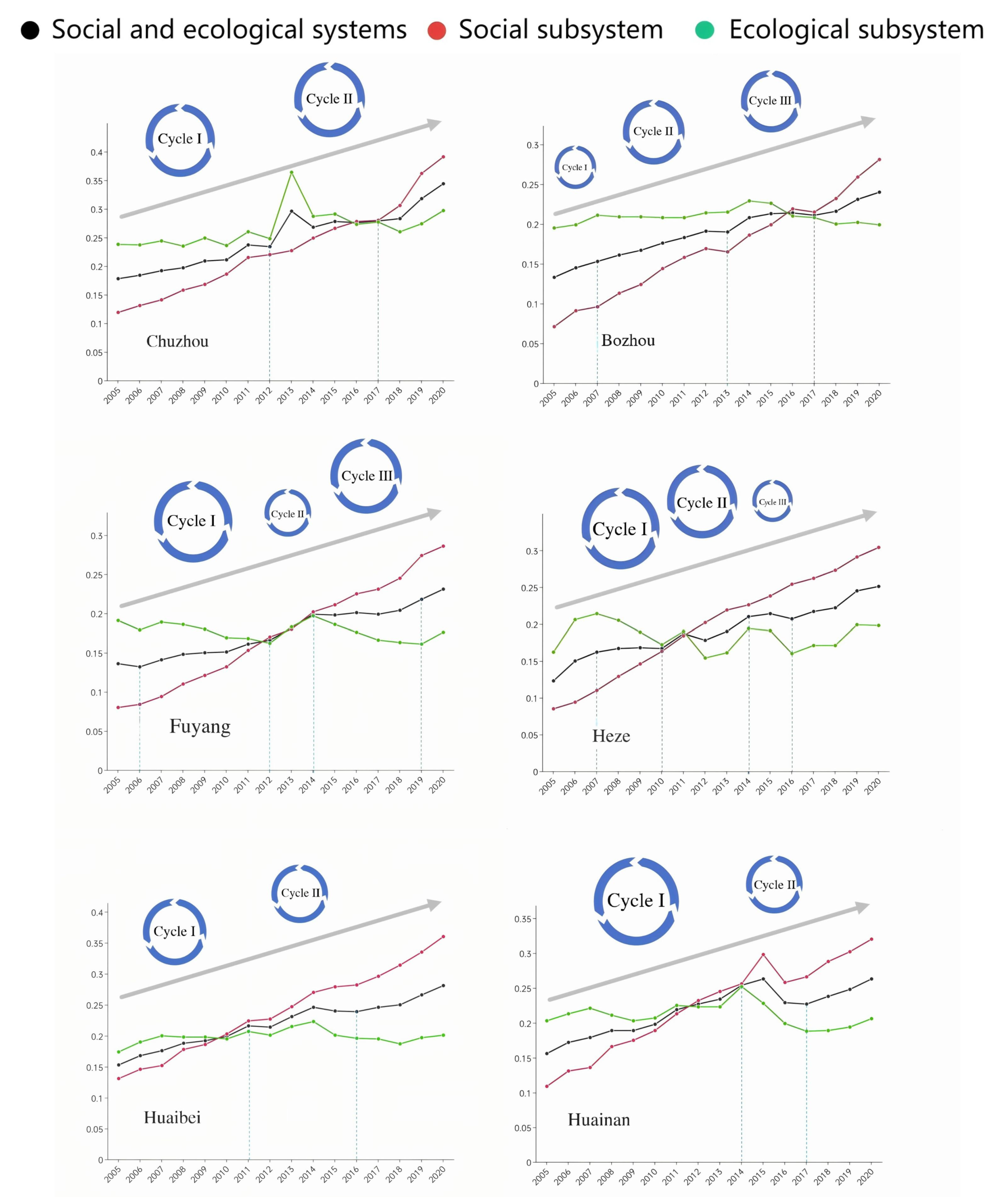
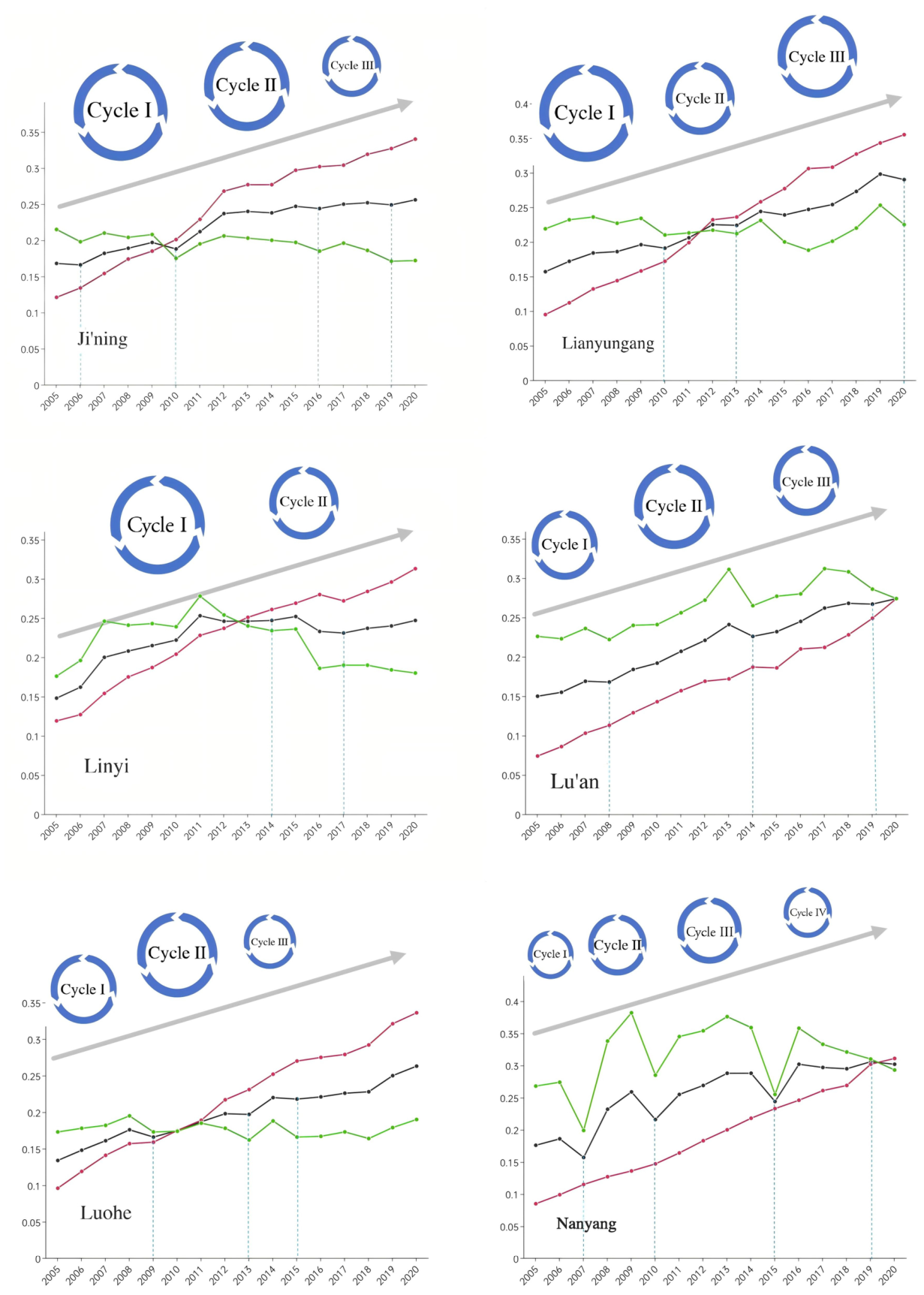
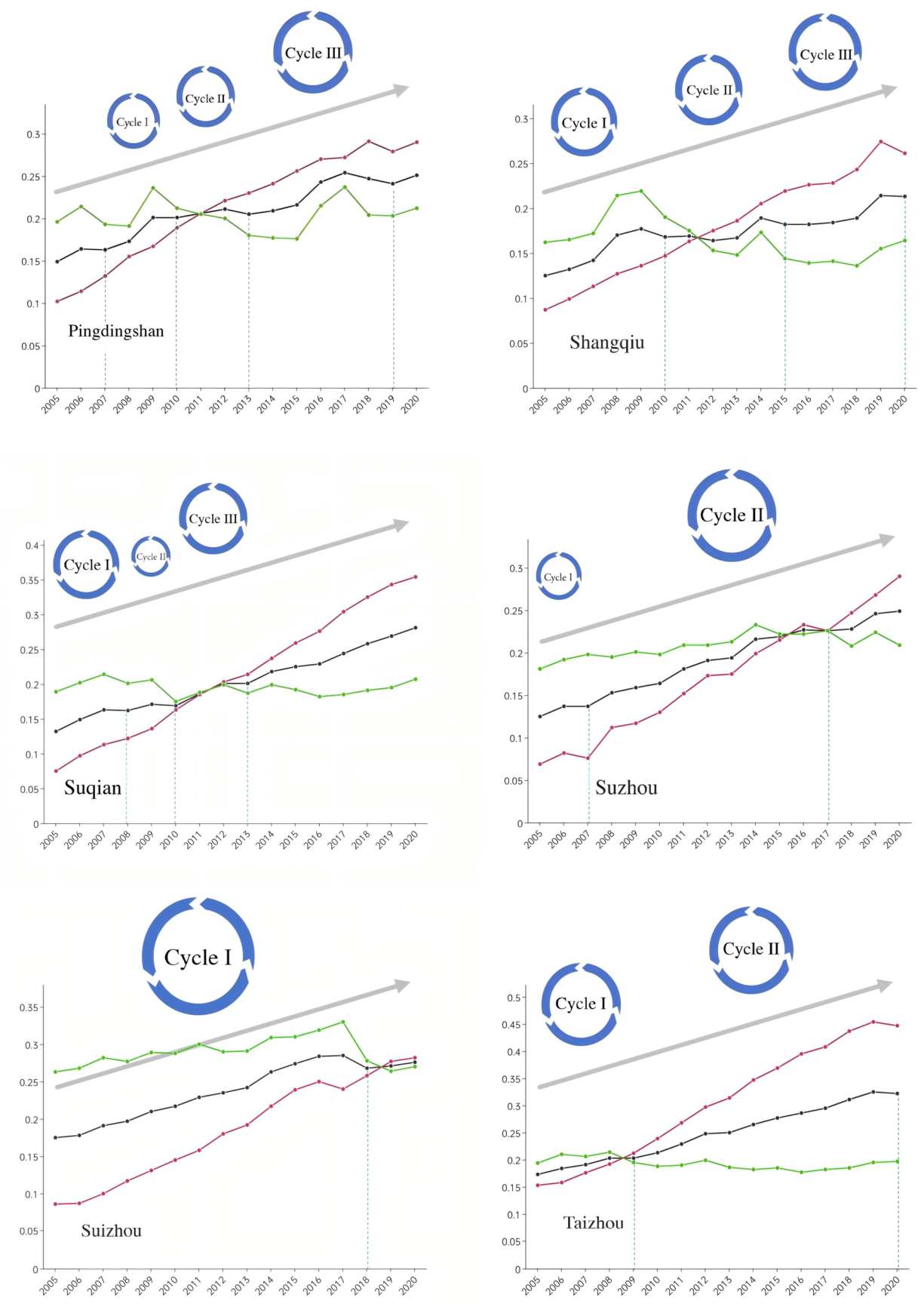
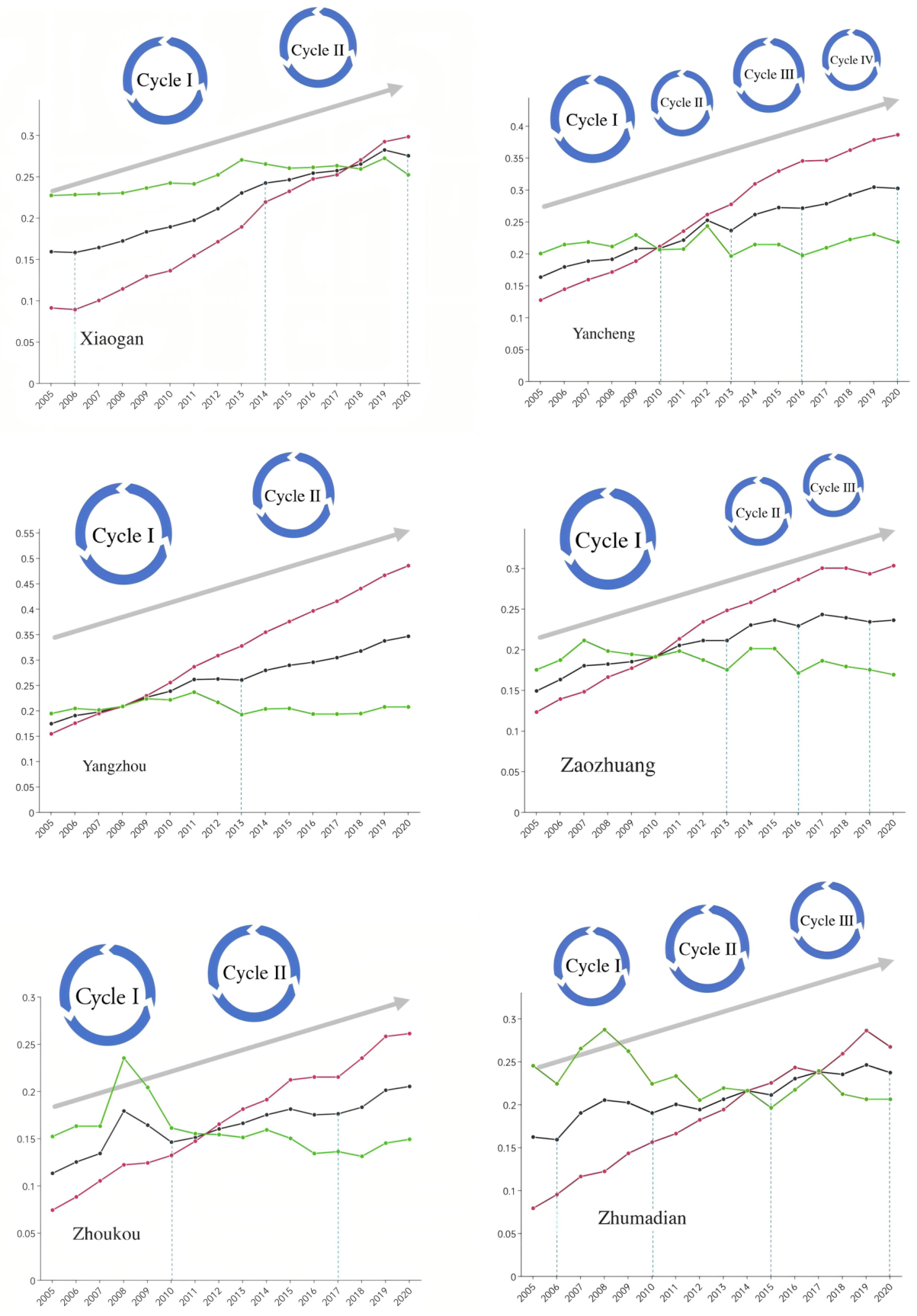
As shown in Figure 3, the flexibility of social subsystems across 28 HREEB cities generally increased over the 16-year period. Nevertheless, several municipalities, namely Bozhou, Suzhou, Zaozhuang, Zhumadian, and Huai’an, witnessed brief decreases. The persistent growth in most regions matches the “r-phase” of CAS theory [63]. Conversely, the reduced adaptability of traditional industrial hubs, such as Zaozhuang, reflects the “path-dependence” phenomenon [64], in which a resource-oriented industrial framework limits adaptive potential. The resilience of the ecological subsystems fluctuated greatly, with clear declines near 2010 and 2015 in most places.
The sharp drop in ecological flexibility observed during those years matches the Ω-phase (release phase) of the CAS adaptive cycle, suggesting that ecological strain exceeded local tipping points.
The following multi-year restoration phase in many cities aligns with the “lag effect” and the intrinsic resilience typically linked to CASs, whereby ecological regeneration is often gradual following decline.

3.2.2. Evolutionary Stages and Identification of Social and Ecological Systems at the Urban Scale

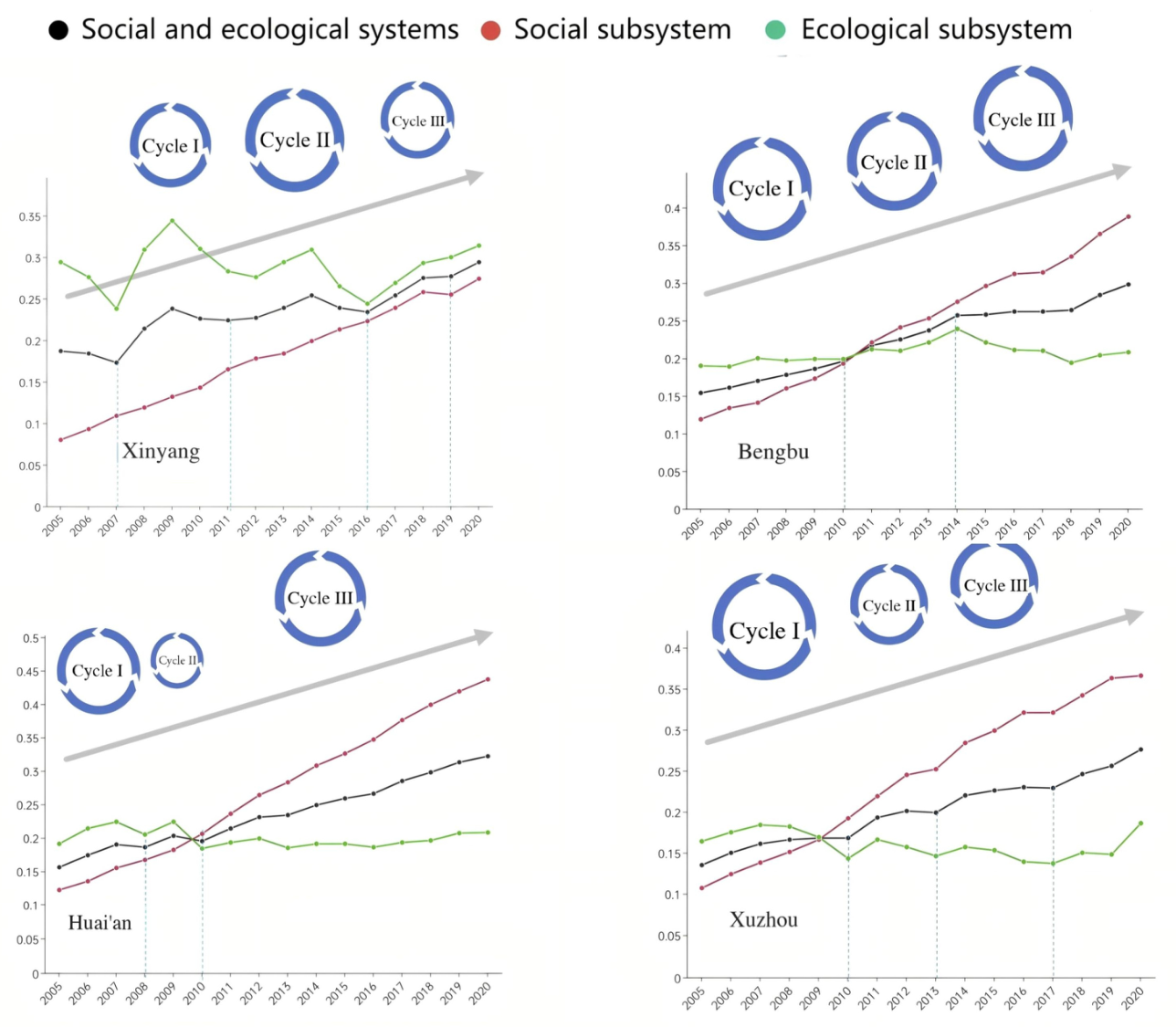
The advancement of HREEB adheres to a “one belt, three cores and numerous nodes” spatial blueprint, established within the Huaihe River Ecological and Economic Belt Development Blueprint: this “belt” denotes the Huaihe River corridor as the primary growth spine; the “three cores” represent the provincial hubs of Xuzhou (Northern Huaihai Economic Zone), Huai’an (Eastern Sea–River–Lake Linkage Zone), and Xinyang (Midwest Inland Rising Region); and the “numerous nodes” encompass the additional 25 prefecture-level cities functioning as secondary growth centers throughout the region. The mutual evolution of central cities (such as Xuzhou) and neighboring nodes illustrates the “hierarchical nesting” characteristic of CASs (Figure 4). These three sub-regions demonstrate unique adaptive capacities, corroborating CAS’s “multi-stability” theory, whereby every area stabilizes into various developmental trajectories under identical external environments. For example, the Eastern Sea–River–Lake Linkage Area, owing to its geographical benefits, initially reached a high-adaptability condition.
We investigated four typical metropolises: Xinyang and Bengbu (Midwest Inland Rising Area), Huai‘an (Eastern Zone), and Xuzhou (Northern Zone, serving as a regional driver). Xuzhou’s leading function aligns with the CAS theory of an “attractor”, restructuring the regional framework through beneficial feedback, such as industrial connections.
(1)
Xinyang City
Xinyang City experienced three distinct cycles of adaptation involving its social and ecological frameworks between 2005 and 2020. Key drivers linked to the Ω-phase are primarily per capita GDP figures, supplemented by reactive variables like afforestation coverage. The deterioration of the ecological framework can mainly be linked to rising population density, shifts in fertilizer application, declining air quality, and decreased afforestation extents. Furthermore, the social subsystem’s decline in 2019 corresponded with the onset of epidemics. Following the crisis, Xinyang City implemented various strategies to promote recovery in affected areas. These included rebuilding demolished residences, lowering pollutant discharges, and launching flood mitigation and drought assistance programs. These efforts have significantly aided in the renewal of the ecological framework. As Xinyang undergoes swift expansion, it is crucial to balance economic advancement with ecological preservation. Particular focus must be directed toward broadening afforestation initiatives throughout this area.
(2)
Bengbu City
Bengbu City underwent three distinct phases of resilience within its social and ecological systems, spanning 2005 through 2020. Throughout this interval, both GDP and per capita GDP rose substantially, while the system’s adaptability index continued to increase. The drop observed in the ecological subsystem in 2018 can mainly be attributed to a decline in the normalized vegetation cover index, a decrease in forested area, and fewer days with superior air quality. Bengbu faces the integrated impacts of external and domestic air pollution. After adopting the forest chief framework and air pollution mitigation strategies, atmospheric conditions have improved considerably. At present, during the stabilization and conservation stage, there is a weak correlation between the social and ecological subsystems. It is vital to rigorously track the ecological subsystem to avoid entering the Ω-phase. This monitoring is crucial to enable a shift to the next phase of rapid expansion, which is advantageous for upgrading mature industrial cities.
(3)
Huai’an City
As the core urban center of the HREEB region, Huai’an experienced two distinct cycles between 2005 and 2020 and is now entering its third phase. Major driving forces include forested land extent, which, together with population density, is strongly linked to the ecological subsystem’s resilience. In both 2008 and 2010, there was a swift decline in the ecological subsystem, coinciding with increased chemical fertilizer application and a decrease in planted forest areas. Presently, the framework is in a period of equilibrium and preservation, marked by swift and variable adaptability. There is a weak inverse relationship between the social and ecological subsystems. Consequently, it is vital to advance the social subsystem concurrently while fostering the ecological subsystem to fully exploit its capacity for rapid expansion.
(4)
Xuzhou City
Serving as the core metropolis of the Huaihai Economic Area, Xuzhou underwent three distinct cycles between 2005 and 2020 and currently stands in its fourth. Primary determinants include the extent of forestation and additional factors. In 2010, the resilience of the ecological framework decreased as environmental stresses escalated. As such, initiatives were launched to save energy and reduce pollution. In 2017, the flexibility of the social framework likewise decreased alongside surging jobless figures and various issues, triggering relevant interventions. Today, the social and ecological subsystems display a moderate inverse relationship during periods of equilibrium and preservation. As a resource-limited city, Xuzhou must value its environmental conditions throughout its evolution. It is vital to investigate the expansion of the social framework while safeguarding the ecological framework.
Furthermore, leveraging both local and global insights is essential for sustaining long-term progress across these interwoven societal and environmental frameworks. Applying the principles of adaptive transformation in social-ecological systems, the aforementioned urban areas can be grouped into four distinct categories. Group 1 comprises stable-growth metropolises that exhibit relatively slight variations in expansion over the course of evolution. Group 2 includes municipalities with fluctuating growth that experience faster system advancement than Group 1 municipalities, but with larger oscillations. Group 3 involves unevenly developed cities, where the rate of growth in social components exceeds that in Groups 1 and 2; nevertheless, there is a minor decline in the overall progress of ecological components. Ultimately, Group 4 represents ecological crisis urban areas marked by significant deterioration in ecological sectors and intensified fluctuations in system evolution. This categorization is presented in the table provided.
Based on the classification outcomes and conceptual mapping, the specific adaptive cycle phases for each city-year were identified and compiled in Table 6.
To facilitate the summarized data mentioned in the Section 5, we present the integrated cluster distributions that underpin Table 6. Throughout the 28 urban centers × 15 consecutive annual periods (n = 420 city-year shifts), the social framework was categorized into a development-phase cluster (r-phase or terminal-r) during 286 periods (68.1%); among these expanding phases, 102 (35.5%, or more than one-third) exhibited an annual increment in the social-system resilience metric surpassing 10%. The environmental framework was designated to a positive-trending cluster (merging r and reorganizing-α which subsequently increased) in 281 out of 420 periods (66.9%, approximated to 67% within the Conclusions); among these phases, 56 (13.3%) demonstrated a sluggish expansion speed of around 3% or less, matching the “Κ-phase with persistent environmental limitations” structure analyzed in Section 3.1. A full frequency matrix of cluster classifications by municipality and year, along with the annual growth rate distribution charts used to calculate the 10%, 67%, and 13.3% benchmarks are provided. These extracted statistics are cited once more in the Conclusions (3) hereafter.

3.2.3. Spatial Differentiation of Correlation Results

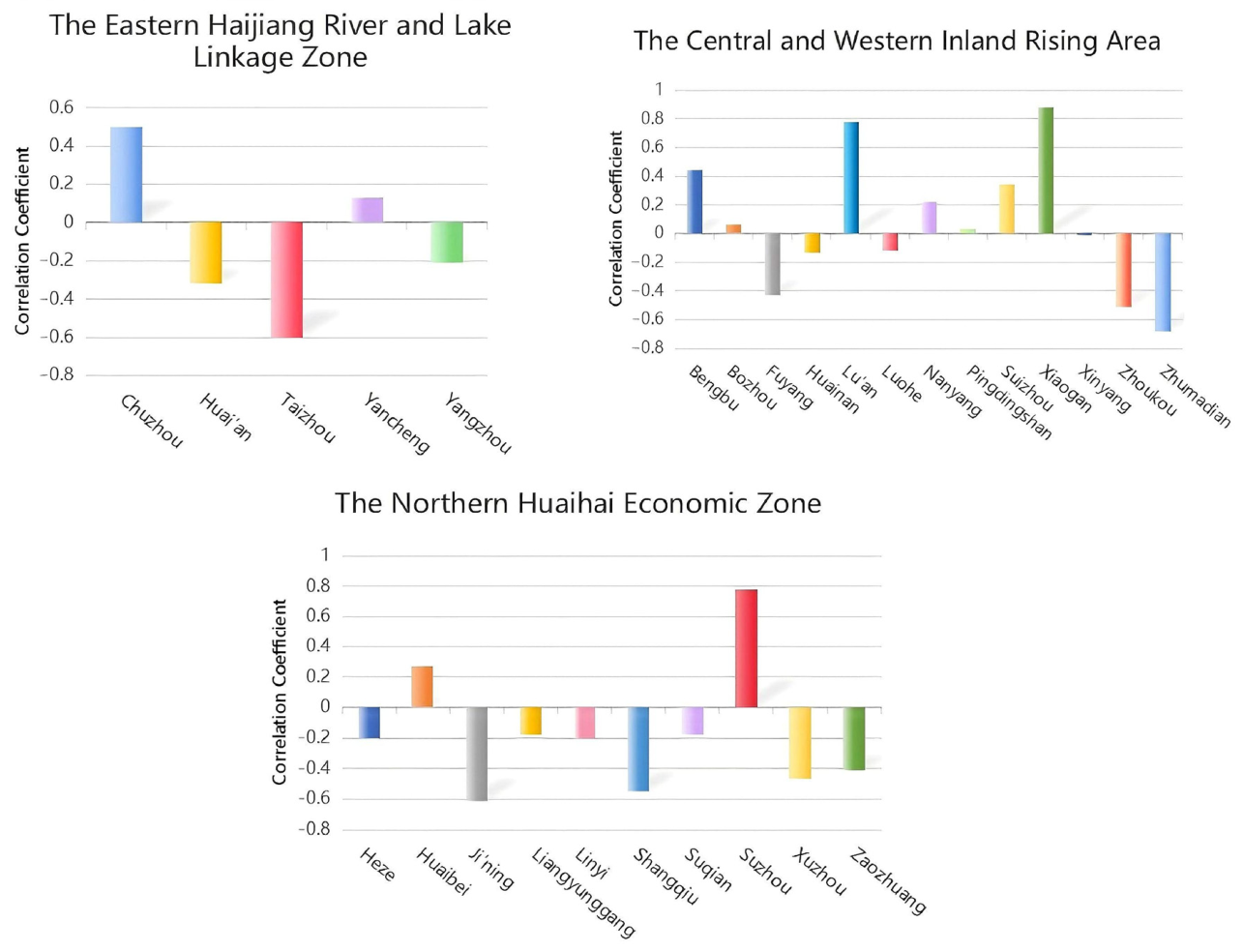
The results suggest that across the vast majority of urban areas in the HREEB, a negative relationship persists between the social subsystem’s adaptability index and its ecological counterpart (Figure 5). These cities are generally not achieving integrated, synergistic advancement of social and environmental sectors throughout their developmental trajectories. Rather, they are trapped in a situation with a dual outcome. While most regions in the Eastern Sea–River–Lake Integration Zone showed no significant association, Chuzhou stands out as showing a moderate positive association. This observation implies that the social and ecological frameworks within Chuzhou’s progress are mutually supportive.
Conversely, the social and ecological components of Bozhou displayed a moderate inverse relationship (approximately r = −0.62, p < 0.05), implying that throughout the research interval, elevated social subsystem indicators generally correlated with reduced ecological subsystem indicators. The majority of municipalities in the central and western inland-rising region showcased a positive association between their social and ecological subsystems. Fuyang City showed a minimal negative association, whereas Zhoukou and Zhumadian Cities showed moderate negative associations. Conversely, Lu’an and Xiaogan Cities manifested moderate positive links, suggesting synchronized rather than conflicting patterns across the investigation timeframe. Unlike the Eastern Haijiang River and Lake Linkage Zone and the Northern Huaihai Economic Zone, most locations in the central and western inland rising region exhibited a negative link between the social and ecological subsystems. Significantly, only Huaibei City and Suzhou City exhibited a positive correlation. Within this area, regions with superior social subsystem performance tended to exhibit inferior ecological subsystem outcomes, suggesting a link—though not necessarily a causal one—between the two subsystems. With N = 16 yearly data points, the 95% confidence range for r = 0 is broad (around ±0.50), meaning that “no correlation” findings (like Eastern Linkage Zone cities) must be regarded as statistically uncertain rather than as proof of absolute independence. p-values and 95% confidence intervals for every city-level association are detailed in the Supplementary Materials.

4. Discussion and Recommendations

4.1. Discussion

Based on the CAS theory for interpretation and the PSR model for organization, this study developed an indicator-based evaluation system for SES adaptability. From 2005 to 2020, empirical studies of HREEB have shown that some space-time characteristics can be explained by key CAS concepts, such as adaptive cycles, hierarchical organization, and multi-stability. It should also be noted that the correlations found in this study do not provide direct evidence that CAS is a perfect predictor of regional SES changes.
The ecological subsystem showed fluctuations and a general upward trend [65] over the course of the study; therefore, it is likely that ecological restoration and environmental governance will have delayed but gradually positive results. Generally speaking, the type of pattern above has a relatively slow response speed and a complex feedback loop, as is typical for biophysical systems. The areas were also quite different. Generally speaking, the SES linkage area had higher SES adaptability than the Northern Huaihai Economic Zone, and the capacities for long-term adaptive development in these sub-regions differed. These spatial differences indicate that the conditions at the location, development plans, and resource endowments are closely related to regional SES adaptability.
In addition, some long-term constraints on regional adaptability have been identified, including forest cover, per capita GDP, urban resident disposable income, medical resource availability, and population density. The above are the combined effects of internal factors, the circumstances of social and economic development, and ecological response ability within the PSR analysis system. The observed spatial clustering of SES adaptability is also likely to be linked to the original ecological and economic conditions and their recovery capacity.
Notably, the social subsystem had relatively fast growth during most of the period covered by the study, with growth rates exceeding 10% in more than a third of the years observed. Therefore, it is expected that all regions of HREEB will continue to develop at an increasing rate. To continue this direction and reduce environmental damage, stronger ecological governance, integrated spatial planning, investment in green infrastructure, and region-specific policy support all need to be strengthened [66]. In the future, the strategy for development should be to promote balanced, coordinated development across all areas, preventing some areas from being neglected and fostering the synergistic evolution of social and ecological subsystems.
In short, although the HREEB’s SES adaptability has gradually improved over time, some regional systems remain prone to economic and social fluctuations, as well as to environmental factors. Therefore, in the future, targeted policies, institutional strengthening, and adaptive governance mechanisms will need to be introduced to boost the area’s long-term resilience against new uncertainties, such as climate change and an aging population.
There were also some deficiencies in the research method. First, linear interpolation was used to handle the missing observations in the city-level panel data. Although an additional robustness check using spline interpolation showed very stable results, more extensive comparisons among different multiple imputation methods, such as k-nearest-neighbor imputation and multiple imputation by chained equations, were not carried out in this paper. Although the proportion of interpolated observations is still relatively small, in the future, more detail should be added to the reports on missing-data distributions and imputation methods for each indicator to enhance methodological transparency. This is a limitation of the data processing framework rather than a deficiency in the theoretical system, and it will be selected as a focus for further study. A complete audit of missing data for all variables and a direct comparison of imputation methods is detailed in the Supplementary Materials. Moreover, some studies of regional co-evolutionary dynamics use Pearson correlation coefficients over a 16-year period for each city, and, as noted in Section 2.7, they fail to control for the impact of general trends or hidden factors. Finally, the division of adaptive-cycle stages according to CAS principles remains descriptive rather than mechanistic, and the strict operationalization of CASs (e.g., through system dynamics or agent-based simulation) has been postponed to the future.

4.2. Recommendations

According to the aforementioned discoveries, specific suggestions are proposed to improve the well-being and enduring progress of the socio-ecological framework within the HREEB:
(1)
Strengthen regional coordinated development and optimize spatial layout. Given the spatial pattern characterized by a “low center, high edge”, it is essential to reinforce the radiation-driven role of core cities such as Xinyang City, Bengbu City, Huai’an City, and Xuzhou City. By enhancing both the radiation effect and comprehensive carrying capacity of these central hub cities, optimizing industrial transfer functions in less adaptable cities, and fostering synergistic development among urban areas, we can promote sustainable urban growth within the HREEB.
(2)
Focus on key issues. Greater emphasis should be placed on developing primary factors that are associated with adaptability within the HREEB. It is crucial to identify and prioritize specific areas for improvement while paying close attention to indicators that impede adaptability enhancement. Targeted efforts must be made to address challenges affecting both social and ecological systems in this region while increasing support for critical elements that correlate with overall adaptability.
(3)
Promote coordinated development between socioeconomic growth and ecological sustainability. The observed negative association between social-subsystem and ecological-subsystem scores in much of the Northern Huaihai Economic Zone suggests that economic expansion in this sub-region coincided with lower ecological-subsystem outcomes during the study period; while this association cannot on its own demonstrate causation, it is consistent with the historical reliance on extensive developmental practices documented in regional plans. It is therefore advisable to strengthen ecological protection measures alongside comprehensive remediation efforts against environmental pollution. This approach aims not only to improve environmental quality but also to support a more balanced trajectory between socioeconomic advancement and ecological preservation [67].
(4)
Explore the urban development pattern based on the city’s policy. To achieve regional optimization, it is essential not only to balance the relationship between social and ecological subsystems—avoiding a development model that pits one against the other—but also to leverage each city’s advantageous industries to realize a synergistic effect in which inter-city cooperation generates a combined regional outcome greater than the sum of individual city contributions within the HREEB. For cities experiencing stable growth, maintaining consistent developmental stability is crucial; this involves identifying developmental shortcomings and implementing further improvements. In contrast, for cities with fluctuating growth rates, attention must be directed to optimizing development speed by identifying key indicators associated with adaptive rapid-growth stages and continuously enhancing these indicators to facilitate steady, accelerated urban expansion. For cities with uneven development patterns, there is a pressing need to prioritize ecological environmental development. Furthermore, for cities facing ecological crises, it is imperative to bolster ecological protection efforts while transforming the existing social-ecological development framework so that both subsystems can progress in a healthy and sustainable manner [49].

5. Conclusions

In this paper, 28 prefecture-level cities in the HREEB were selected as research objects, and based on complex adaptive system theory, this study examined the dynamic evolution of social-ecological system adaptability in the HREEB from 2005 to 2020. The following conclusions can be drawn:
(1)
The adaptability of social-ecological systems within the HREEB exhibits an overall upward trend characterized by relative stability. While the social subsystem’s performance has increased linearly, its rate of increase has shown signs of decline. Conversely, adaptability within ecological subsystems demonstrated a fluctuating yet gradually stabilizing upward trajectory. Additionally, spatial analysis revealed that the adaptability index for social and ecological systems across HREEB followed a distinct pattern: “low in the center and high at the edges”, with areas of high values predominantly concentrated in the Eastern Sea–River–Lake Linkage Zone, followed by the Midwest Inland Rising Region, while the Northern Huaihai Economic Zone was in the relatively low value area.
(2)
The afforestation area, GDP per capita, disposable income of urban residents, the number of beds in health institutions per capita, and population density were consistently identified as the top-ranked obstacle factors in the HREEB by the obstacle degree model from 2005 to 2020. The leading obstacle factors within the indicator layer were predominantly distributed across three dimensions: pressure, state, and response. Furthermore, the spatial differentiation in adaptability tended to covary with the indicators represented in the state layer, although this descriptive co-movement cannot, on its own, establish a causal role for the state dimension.
(3)
The adaptability of social subsystems in the HREEB showed a continuous growth trend from 2005 to 2020, with over one-third of phases experiencing a growth rate exceeding 10%. Periods of rapid social-subsystem improvement coincided with sustained urban construction and economic expansion across the region. In contrast, the adaptive dynamic evolution of ecological subsystems in the HREEB displayed fluctuating characteristics; an upward phase accounted for 67%, while only 13.3% of phases showed a slow growth rate of merely 3%. The system is currently in its third cycle and is best interpreted as a late conservation (Κ) phase with accumulating pressure indicators; whether it will transition into a release (Ω) phase depends on subsequent pressure–response dynamics and cannot be inferred from the present analysis alone.
(4)
Throughout each prefecture-level city during the period from 2005 to 2020, there was generally an upward trend in social subsystem adaptability; however, some cities (Bozhou, Suzhou, Zaozhuang, Zhumadian, and Huai’an) exhibited a slight decline in this regard. Additionally, indices reflecting ecological subsystem adaptability demonstrated considerable fluctuations across various prefecture-level cities during 2005–2020.

Supplementary Materials

The following supporting information can be downloaded at: https://www.mdpi.com/article/10.3390/su18125823/s1, File S1: Weight; File S2: Cluster analysis.

Author Contributions

Conceptualization, G.F. and H.C.; Methodology, G.F. and J.C.; Validation, J.L.; Formal analysis, J.C. and J.L.; Resources, G.F. and H.C.; Data curation, S.L. and L.C.; Writing—original draft, G.F. and J.C.; Writing—review & editing, G.F., H.C. and J.C.; Visualization, J.C.; Supervision, G.F. and H.C.; Project administration, H.C.; Funding acquisition, G.F. All authors have read and agreed to the published version of the manuscript.

Funding

This research was funded by the National Social Science Fund of China (21BMZ071).

Institutional Review Board Statement

Not applicable.

Informed Consent Statement

Not applicable.

Data Availability Statement

Raw remote-sensing inputs, carbon-emission accounts, and meteorological records used in this study were obtained from the Resource and Environment Science and Data Center (https://www.resdc.cn), the China Carbon Accounting Database (https://www.ceads.net.cn), and the National Meteorological Science Data Center (http://data.cma.cn), respectively, and are redistributed subject to their original licensing terms. Provincial and municipal statistical yearbook data underlying the socioeconomic indicators are publicly available from the respective statistical bureaus and were aggregated by the authors. The compiled prefecture-level panel dataset (2005–2020, 28 cities × 19 indicators) and the analysis scripts used to produce all figures, tables, and statistics reported in this paper are available from the corresponding author upon reasonable request. Raw provincial-yearbook data are redistributed subject to the original publishers’ licensing terms and cannot be redeposited in a public repository.

Conflicts of Interest

Author Lijia Chen is currently employed by Xuzhou Construction Machinery Group Co., Ltd. He participated in this research during his postgraduate studies at Nanjing Tech University, and the company had no role in the design of the study, collection or analysis of data, writing of the manuscript, or the decision to publish the results. The remaining authors declare that the research was conducted in the absence of any commercial or financial relationships that could be construed as potential conflicts of interest.

References

  1. Cao, Y.; Xia, Y.; Mao, G. Regional Development Differences and Synergistic Development Strategies in the Huaihe River Ecological and Economic Belt. Econ. Geogr. 2019, 39, 213–221. [Google Scholar] [CrossRef]
  2. Heng, J.; Wang, P.; Chen, H. Geographic Detection of Spatial and Temporal Evolution of Ecological Risks and Their Influencing Factors in Semiarid Areas—The Case of Yanchi County in Ningxia. Arid Land Geogr. 2022, 45, 1425–1439. [Google Scholar] [CrossRef]
  3. Holling, C.S. Resilience and Stability of Ecological Systems. Annu. Rev. Ecol. Evol. Syst. 1973, 4, 460–482. [Google Scholar] [CrossRef]
  4. Holling, C.S. Understanding the Complexity of Economic, Ecological, and Social Systems. Ecosystems 2001, 4, 390–405. [Google Scholar] [CrossRef]
  5. Cumming, G.; Cumming, D.; Redman, C. Scale Mismatches in Social-Ecological Systems: Causes, Consequences, and Solutions. Ecol. Soc. 2006, 11, 14. [Google Scholar] [CrossRef]
  6. Ostrom, E. A General Framework for Analyzing Sustainability of Social-Ecological Systems. Science 2009, 325, 419–422. [Google Scholar] [CrossRef]
  7. Hatt, K. Social Attractors: A Proposal to Enhance Resilience Thinking about the Social. Soc. Nat. Resour. 2013, 26, 30–43. [Google Scholar] [CrossRef]
  8. Liu, Y.; Wang, Y.; Peng, J.; Zhang, T.; Wei, H. Urban Landscape Ecological Risk Assessment Based on the 3D Framework of the Ecological Adaptive Cycle. Acta Geogr. Sin. 2015, 70, 1052–1067. [Google Scholar] [CrossRef]
  9. Kaplan-Hallam, M.; Bennett, N.J.; Satterfield, T. Catching Sea Cucumber Fever in Coastal Communities: Conceptualizing the Impacts of Shocks versus Trends on Social-Ecological Systems. Glob. Environ. Change 2017, 45, 89–98. [Google Scholar] [CrossRef]
  10. Yuan, Q.; Wu, S.; Dai, E. Vulnerability Evaluation of NPP of Potential Vegetation in China under Climate Change in the Past 50 Years. Acta Geogr. Sin. 2016, 71, 797–806. [Google Scholar] [CrossRef]
  11. Zhang, Q.; Zhao, X.; Luo, L. Vulnerability Impact Assessment of Climate Change on Farmers’ Livelihoods in Alpine Ecologically Vulnerable Areas—An Example from the Gannan Plateau. Chin. J. Ecol. 2016, 35, 781–790. [Google Scholar] [CrossRef]
  12. Huang, X.; Wang, B.; Liu, M. Evaluation of High Temperature Characteristics and Social Vulnerability in Chinese Cities. Geogr. Res. 2020, 39, 1534–1547. [Google Scholar] [CrossRef]
  13. Huang, J.; Su, F. Commentary and Outlook on Hot Issues in Urban Disaster Social Vulnerability Research. Sci. Geogr. Sin. 2017, 37, 1211–1217. [Google Scholar] [CrossRef]
  14. Guo, L.; Li, B.; Yang, Z. Evaluation of the Ecological Vulnerability of the Qinling “Life Community” Based on the SRP Model from the Perspective of Mineral Resource Development. Saf. Environ. Eng. 2023, 30, 273–280. [Google Scholar] [CrossRef]
  15. Xiang, A.; Yue, Q.; Zhao, X. Identification and Restoration Zoning of key Areas for Land and Space Ecological Restoration in the karst Mountains of Southwest China—Taking kaiyuan City as an Example. China Environ. Sci. 2023, 43, 6571–6582. [Google Scholar] [CrossRef]
  16. Yao, X.; Yu, K.; Liu, J. Spatial and Temporal Evolution of Ecological Vulnerability in Areas of Severe Soil Erosion in the South of the Country. Chin. J. Appl. Ecol. 2016, 27, 735–745. [Google Scholar] [CrossRef]
  17. Wang, Z.; Su, Y. Evaluation and Characteristic Analysis of Ecological Vulnerability of Water Sources in Hanzhong City on the Middle Line of the South-to-North Water Diversion. Acta Ecol. Sin. 2018, 38, 432–442. [Google Scholar] [CrossRef]
  18. Maldonado, D.A.; Morales, M.; Aguilera, A.P.; Salmerón, A. Analyzing Uncertainty in Complex Socio-Ecological Networks. Entropy 2020, 22, 123. [Google Scholar] [CrossRef]
  19. Porter, S. Evolution: Symbiont Switching and Environmental Adaptation. Curr. Biol. 2021, 31, R1049–R1050. [Google Scholar] [CrossRef] [PubMed]
  20. Wang, L.; Chen, C.; Xie, F.; Hu, Z.; Zhang, Z.; Chen, H.; He, X.; Chu, Y. Estimation of the Value of Regional Ecosystem Services of an Archipelago Using Satellite Remote Sensing Technology: A Case Study of Zhoushan Archipelago, China. Int. J. Appl. Earth Obs. Geoinf. 2021, 105, 102616. [Google Scholar] [CrossRef]
  21. Das, A. A Data-Driven Approach Utilizing Machine Learning (ML) and Geographical Information System (GIS)-Based Time Series Analysis with Data Augmentation for Water Quality Assessment in the Mahanadi River Basin, Odisha, India. Discov. Sustain. 2025, 6, 555. [Google Scholar] [CrossRef]
  22. Wu, D.; Liu, M. Assessing Adaptability of the Water Resource System to Social-Ecological Systems in the Beijing-Tianjin-Hebei Region: Based on the DPSIR-TOPSIS Framework. Chin. J. Popul. Resour. Environ. 2022, 20, 261–269. [Google Scholar] [CrossRef]
  23. Zhao, Y.; He, G.; Bao, K.; Zhu, Y.; Yang, J.; Ruan, J.; Wang, Y. Assessment of Spatial–Temporal Differences of Industrial Eco-Efficiency in the Huaihe River Economic Belt. Geogr. J. 2022, 88, 1703–1720. [Google Scholar] [CrossRef]
  24. Xue, H.; Liu, P. Spatiotemporal Evolution Characteristics and Driving Factors of Ecological Environment Quality in the Middle Reaches of the Yellow River Based on RSEI: A Case Study of Yan’an City. Res. Soil Water Conserv. 2024, 31, 373–384. [Google Scholar] [CrossRef]
  25. Tang, F.; Fu, M.; Li, W.; Song, W.; Yu, J.; Wu, Y. Dynamic Evolution and Scenario Simulation of Habitat Quality under the Impact of Land-Use Change in the Huaihe River Economic Belt, China. PLoS ONE 2021, 16, e0249566. [Google Scholar] [CrossRef]
  26. Anand, V.; Kaur, S.; Rajput, V.D.; Minkina, T.; Mandzhieva, S.; Kumar, S.; Sharma, A.; Kumar, S. Analyzing the Spatial Relationship between Land Surface Temperature and Normalized Difference Vegetation Index Using Remote Sensing and GIS. Discov. Geosci. 2025, 3, 65. [Google Scholar] [CrossRef]
  27. Chamani, R. Flood-Oriented Watershed Health and Ecological Security Conceptual Modeling Using Pressure, State, and Response (PSR) Approach for the Sharghonj Watershed, South khorasan Province, Iran. Nat. Resour. Model. 2023, 37, e12385. [Google Scholar] [CrossRef]
  28. Zhao, Z.; Liu, C.; Chang, W.Y.; Ren, Y. Comprehensive Resilience Assessment and Obstacle Analysis of Cities Based on the PSR-TOPSIS Model: A Case Study of Jiangsu Cities. Land 2025, 14, 1437. [Google Scholar] [CrossRef]
  29. Jatav, S.S.; Naik, K. Measuring the Agricultural Sustainability of India: An Application of the Pressure-State-Response (PSR) Model. Reg. Sustain. 2023, 4, 218–234. [Google Scholar] [CrossRef]
  30. Das, S.; Pradhan, B.; Shit, P.k.; Alamri, A.M. Assessment of Wetland Ecosystem Health Using the Pressure–State–Response (PSR) Model: A Case Study of Murshidabad District of West Bengal (India). Sustainability 2020, 12, 5932. [Google Scholar] [CrossRef]
  31. Stroink, M.L. The Dynamics of Psycho-Social-Ecological Resilience in the Urban Environment: A Complex Adaptive Systems Theory Perspective. Front. Sustain. Cities 2020, 2, 31. [Google Scholar] [CrossRef]
  32. Wan, Z.; Zhao, C.; Zhu, J.; Ma, X.; Chen, J.; Wang, J. Assessment and Prediction of Coastal Ecological Resilience Based on the Pressure–State–Response (PSR) Model. Land 2024, 13, 2130. [Google Scholar] [CrossRef]
  33. Tavosi, M.; Vafakhah, M.; Sadeghi, H.S.; Shekohideh, H.; Moosavi, V. Comparative Assessment of Watershed Hydrological Health (WHH) Using a Multi-Criteria Decision-Making Approach Based on the PSR Framework. J. Environ. Manag. 2025, 373, 123833. [Google Scholar] [CrossRef] [PubMed]
  34. Kaige, W.; Cai, Z.; Xu, Y.; Zhang, F. Hexagonal Cyclical Network Structure and Operating Mechanism of the Social-Ecological System. Ecol. Indic. 2022, 141, 109099. [Google Scholar] [CrossRef]
  35. Zhao, J.; Sa, N.; Kou, X.; Fu, X.; Zheng, S.; Lu, Z.; Wu, G.; Sang, W. Coupling Coordination Analysis and Prediction of Multi-Social-Ecological Subsystem in the Xiaoxing’an Mountains-Sanjiang Plain, Northeast China. Glob. Ecol. Conserv. 2024, 51, e02892. [Google Scholar] [CrossRef]
  36. Ren, K.; Luo, M.; Zhao, Y.; Han, L.; Zhang, L.; Yang, S. Evaluation of Ecological Environment and Urban Development Quality in Xi’an City, China. Yingyong Shengtai Xuebao 2022, 33, 2485–2492. [Google Scholar] [CrossRef]
  37. Wang, Y.; Sun, X. The Mechanism of Government Subsidies Driving Industrial Transformation and Upgrading. China Ind. Econ. 2017, 99–117. [Google Scholar] [CrossRef]
  38. Zheng, J.; Yu, H.; Huang, S. Evaluation of the Carrying Capacity of the Ecological Environment in Fujian Province and Research on Obstacle Factors Based on the DPSIR-TOPSIS Model. Acta Sci. Circumst. 2017, 37, 4391–4398. [Google Scholar] [CrossRef]
  39. Wang, H. Socio-Ecological System Vulnerability Assessment and Spatiotemporal Evolution of Coastal Tourism Destinations. Master’s Thesis, Dalian University of Technology, Dalian, China, 2022. [Google Scholar] [CrossRef]
  40. Li, K.; Hu, H.; Zhao, H. Study on the Evolution of Regional Social-Ecological Systems Based on Adaptive Cycle Theory and Pressure-State-Response Framework. Acta Ecol. Sin. 2022, 42, 10164–10179. [Google Scholar] [CrossRef]
  41. Han, Z.; Pan, J.; Guo, J.; Yin, S. Adaptive Analysis of the Coastal City Tourism System Based on Geographical Nature. Resour. Sci. 2022, 44, 634–645. [Google Scholar] [CrossRef]
  42. Wang, C.; Ye, Y.; Tian, L.; Chen, H. Research on the Logic and Implementation Deviation of the Vertical Allocation of Urban and Rural Construction Land Indicators. China Land Sci. 2023, 37, 34–44. [Google Scholar] [CrossRef]
  43. Hong, Z.; Zheng, W.; Hu, L. Value Evaluation of Traditional Villages in the Lijiang River Basin Based on Ontology-Regional Scale. Guangxi Sci. 2024, 31, 1220–1232. [Google Scholar] [CrossRef]
  44. Meshkinkiya, M.; Galimshina, A.; Hischier, I.; Schlueter, A. Assessing Biogenic Carbon Storage at the Urban Scale through Urban Building Energy Modeling. Sustain. Cities Soc. 2025, 125, 106355. [Google Scholar] [CrossRef]
  45. Sun, S.; Lin, J.; Zhuang, Y.; Li, C.; Huang, C.; Chen, Y.; Chen, W.; Chen, G.; Gan, M.; Liao, Q.; et al. Bio-Molecular Structural k-Means Clustering Method Decodes the Binding Pattern between Microtubules and Intrinsically Disordered CkAP4. Cell Rep. Phys. Sci. 2025, 6, 102626. [Google Scholar] [CrossRef]
  46. Li, S.; Pu, J.; Deng, X.; Dong, B.; Su, Y. Improving Ecological Barrier Area Sustainability Integrating Ecosystem Service Interaction and Social–Ecological System Coupling. Land Degrad. Dev. 2025, 36, 2420–2437. [Google Scholar] [CrossRef]
  47. Munir, S.; Chen, H.; Crowther, R. Modelling of Nanoparticle Number Emissions from Road Transport—An Urban Scale Emission Inventory. Atmosphere 2025, 16, 417. [Google Scholar] [CrossRef]
  48. Sa, N.; Zhao, J.; Kou, X.; Zheng, S.; Lu, Z.; Axmacher, C.J.; Sang, W. Transformation of Social-Ecological Systems in the Songhua River Basin, Northeast China: Lessons for a More Sustainable Development. People Nat. 2025, 7, 1749–1768. [Google Scholar] [CrossRef]
  49. Sarker, H.M.M.; Gain, K.A.; Giupponi, C. Modeling Mangrove Social-Ecological Systems: A Review. Environ. Res. Commun. 2025, 7, 062001. [Google Scholar] [CrossRef]
  50. Hong, W.; Zhao, Y.; Yang, S.; Yang, X.; Li, Y.; Wang, C. An Analytical Framework Based on Social-Ecological Systems for Identifying Priority Areas for Ecological Restoration in Coastal Regions. J. Environ. Manag. 2024, 370, 122958. [Google Scholar] [CrossRef]
  51. Chen, J.; Xiong, K.; Luo, L.; Zhang, W.; Chen, Y. Social-Ecological System Vulnerability in the Core Area of Desertification Control in South China karst: Spatial–Temporal Feature, Driver Factors, and Scenario Simulation. Environ. Dev. Sustain. 2025, 15, 10216. [Google Scholar] [CrossRef]
  52. Zhang, Y.; Liu, B.; Shi, B.; Bi, X.; Mao, Y.; Sui, R. Exploring the Driving Mechanism Path of Ecosystem Service Relationships Based on the Social-Ecological System Framework. Sci. Rep. 2025, 15, 10216. [Google Scholar] [CrossRef]
  53. Galeazzi, M.A.; Foucat, A.S.V.; Perevochtchikova, M. Analysis of the Watershed Social-Ecological System Trajectory in Copalita-Huatulco, Mexico: The Impact of Drivers on Hydrological Ecosystem Services. Ambio 2024, 53, 1797–1812. [Google Scholar] [CrossRef]
  54. Zhao, Y.; Han, Z.; Zhang, C.; Wang, Y.; Zhong, J.; Gao, M. Coastal Cultural Ecosystem Services: A Bridge between the Natural Ecosystem and Social Ecosystem for Sustainable Development. Land 2024, 13, 1352. [Google Scholar] [CrossRef]
  55. Sundstrom, S.M.; Allen, C.R. The Adaptive Cycle: More Than a Metaphor. Ecol. Complex. 2019, 39, 100767. [Google Scholar] [CrossRef]
  56. Angeler, D.G.; Allen, C.R.; Garmestani, A.S.; Gunderson, L.H.; Hjerne, O.; Winder, M. Quantifying the Adaptive Cycle. PLoS ONE 2015, 10, e0146053. [Google Scholar] [CrossRef] [PubMed]
  57. Jin, X.; Li, B. Adaptive Cycle Process and Driving Mechanism of the Marine Fishery Industrial Ecosystem in Coastal Areas of China. Acta Ecol. Sin. 2021, 41, 5857–5867. [Google Scholar] [CrossRef]
  58. Zhang, L.; Huang, Q.; He, C.; Yue, H.; Zhao, Q. Assessing the Dynamics of Sustainability for Social-Ecological Systems Based on the Adaptive Cycle Framework: A Case Study in the Beijing-Tianjin-Hebei Urban Agglomeration. Sustain. Cities Soc. 2021, 70, 102899. [Google Scholar] [CrossRef]
  59. Oliveira, M.B.; Boumans, R.; Fath, D.B.; Othoniel, B.; Liu, W.; Harari, J. Prototype of Social-Ecological System’s Resilience Analysis Using a Dynamic Index. Ecol. Indic. 2022, 141, 109113. [Google Scholar] [CrossRef]
  60. Rosario, M.G.A.V.; Néstor, R.N.; Mar, D.M.M.S.; Mar, L.A.S. Ecosystem services provided by dry river socio-ecological systems and their drivers of change. Hydrobiologia 2023, 850, 2585–2607. [Google Scholar] [CrossRef]
  61. Bolaños-Valencia, I.; Villegas-Palacio, C.; López-Gómez, P.C.; Berrouet, L.; Ruiz, A. Social Perception of Risk in Socio-Ecological Systems. A Qualitative and Quantitative Analysis. Ecosyst. Serv. 2019, 38, 100942. [Google Scholar] [CrossRef]
  62. Antonov, G.; Ivanova, O.; Antonova, I. Assessment of Economic Diversification Projects in a Single-Industry City. Probl. Econ. Transit. 2012, 55, 3–13. [Google Scholar] [CrossRef]
  63. Daniel, J.L.; Margarietha, J.S.V.; Miles, P.M.; Klerk, S. Understanding Entrepreneurial Ecosystems Using Complex Adaptive Systems Theory: Getting the Big Picture for Economic Development, Practice, and Policy. Entrep. Reg. Dev. 2022, 34, 911–934. [Google Scholar] [CrossRef]
  64. Li, B.; Qu, Y.; Wang, Z.; Wu, F.; Wu, J. The Impact of Industrial Evolution Path Dependence on Economic Resilience in the Yangtze River Delta Cities. Geogr. Res. 2023, 42, 2036–2052. [Google Scholar] [CrossRef]
  65. Andrijevic, M.; Cuaresma, C.J.; Muttarak, R.; Schleussner, F.C. Governance in Socioeconomic Pathways and Its Role for Future Adaptive Capacity. Nat. Sustain. 2020, 3, 35–41. [Google Scholar] [CrossRef]
  66. Ma, L.; Zhang, H.; Meng, X.; Lu, Q. Spatiotemporal Heterogeneity of the Ecological Civilization in the Yangtze River Economic Belt. Ecol. Indic. 2025, 177, 113808. [Google Scholar] [CrossRef]
  67. Gu, X.; Jin, H.; Luo, J. The Associated Ecological Risks Identification and Optimal Management of Basin “Water-Energy-Food-Ecology” Nexus: A Case Study of the Yellow River Basin. J. Clean. Prod. 2025, 520, 146129. [Google Scholar] [CrossRef]
Figure 1. Spatial scope of the research region.
Sustainability 18 05823 g001
Figure 2. Dynamic evolution of SES adaptability in the HREEB.
Sustainability 18 05823 g002
Figure 3. Dynamics of adaptive cycle evolution in the HREEB.
Sustainability 18 05823 g003aSustainability 18 05823 g003bSustainability 18 05823 g003cSustainability 18 05823 g003d
Figure 4. The evolution of the adaptive cycle of SES in Xinyang City, Bengbu City, Huai’an City, and Xuzhou City.
Sustainability 18 05823 g004
Figure 5. Correlation between the social subsystem and the ecological subsystem of cities in the HREEB.
Sustainability 18 05823 g005
Table 1. Administrative division of the three regions of the Huaihe Ecological Economic Belt.
RegionsInclude Prefecture-Level Cities
Eastern Sea–River–Lake Linkage ZoneHuaian, Yancheng, Yangzhou, Taizhou, Chuzhou
Northern Huaihai Economic Zone (NHEZ)Xuzhou, Lianyungang, Suqian, Suzhou, Huaibei, Shangqiu, Zaozhuang, Jining, Linyi, Heze
Midwest Inland Rising RegionBengbu, Xinyang, Huainan, Fuyang, Lu’an, Bozhou, Zhumadian, Zhoukou, Luohe, Nanyang, Pingdingshan, Suizhou, Xiaogan
Table 3. Sensitivity of headline conclusions to the choice of P/S/R weights (28 cities, 2005–2020).
Weighting Scheme(P, S, R)Spearman ρ with BaselineTop-3 Obstacle Factors Preserved?“East/West High, Center Low” Preserved?
Baseline (equal)(0.333, 0.333, 0.333)1.000 (ref.)ReferenceYes
AHP (social subs.)(0.28, 0.41, 0.31)0.962Yes (same 3)Yes
AHP (ecol. subs.)(0.32, 0.38, 0.30)0.971Yes (same 3)Yes
State-emphasized(0.25, 0.50, 0.25)0.972Yes (same 3)Yes
Response-emphasized(0.25, 0.25, 0.50)0.972Yes (same 3)Yes
Notes: The Spearman ρ columns report the rank correlation between city-level mean SES adaptability under each alternative scheme and under the equal-weight baseline. The top 3 obstacle factors across all schemes are afforestation area per capita, GDP per capita, and population density.
Table 4. Weight of the adaptability index of the HREEB.
Level 1 IndicatorsSecondary IndicatorsTertiary IndicatorsCharacteristicWeight ( w j )Interpretation of Indicators
Social SubsystemSocial Pressure (P)The energy consumption per unit GDP (P1)0.0073Energy consumption intensity
Apparent carbon dioxide emissions per unit of GDP (P2)0.0091Intensity of carbon emissions per unit
Unemployment rate (P3)0.0276Degree of stability of system employment
Social Status (S)GDP per capita (S1)+0.1510Economic level per capita
Per-capita grain production (S2)+0.0633Stability of agricultural development
The rate of urbanization (S3)+0.0343Systematic urbanization process
Industrial structure diversification index (S4)+0.0490Degree of balance in industrial structure
Social Response (R)Science and education investment ratio (R1)+0.0092Public service level
Number of health establishment beds per capita (R2)+0.0769Level of medical and health care
Urban disposable income (R3)+0.1063
Economic conditions of the population
Ecological SubsystemEcological Pressure (P)Fertilizer use (P4)0.0469Degree of environmental pollution
Environmental pollution index (P5)0.0234Degree of stress on the environment
Population density (P6)0.0678State of system pressure
Ecological Status (S)Normalized difference vegetation index (NDVI) (S5)+0.0157System natural conditions
Climate suitability (S6)+0.0392System livability level
Proportion of good air quality (S7)+0.0315System atmospheric level
Ecological Response (R)Afforestation area (R4)+0.2010Environmental support efforts
Harmless treatment rate of domestic garbage (R5)+0.0179Strength of regional ecological management
Centralized treatment rate of sewage treatment plants (R6)+0.0228Strength of industrial governance
Table 5. Identification of adaptive cycle phases.
Stages of the Adaptive CycleSocial Subsystem Adaptation ScoreEcological Subsystems Adaptation ScoreSocial and Ecological Systems Adaptation Score
Rapid growthRapidly risingSlowly risingRapidly rising
Stabilization and conservationRisingSlowly rising or fallingRising
ReleaseSlowly rising or fallingRapidly fallingFalling
ReorganizationSlowly risingSlowly rising or fallingSlowly rising
Table 6. Characteristics of the adaptive cycle stage.
CityCategoryDevelopment Characteristics
Xinyang CityStable GrowthSocial and ecological systems, including their subsystems, are in an upward phase with a sustainable, healthy momentum.
Bengbu CityUneven GrowthSocial and ecological systems are slowly rising; social and ecological subsystems are in a slow-rising or slow-falling phase.
Huaian CityFluctuating GrowthSocial and ecological systems, social subsystems, and ecological subsystems are generally positive, with rapid growth and fluctuations in system adaptation.
Xuzhou CityEcological CrisisThe social and ecological subsystems are moderately negatively correlated, resulting in negative impacts on the ecosystem during socioeconomic development.
Disclaimer/Publisher’s Note: The statements, opinions and data contained in all publications are solely those of the individual author(s) and contributor(s) and not of MDPI and/or the editor(s). MDPI and/or the editor(s) disclaim responsibility for any injury to people or property resulting from any ideas, methods, instructions or products referred to in the content.