Screening Agricultural Residues as Sustainable Alternative Sorbents for the Active Removal of Methylene Blue

 ,
, 
 ,
,  ,
, 

Abstract
1. Introduction

| Biomass Waste | Optimal Adsorption Conditions | MB Adsorbed mg g−1 | Reference |
|---|---|---|---|
| Onion membrane | Dosage = 0.48 g L−1; T = 50 °C; pH = 11; Contact time = 1 h Contact time = 8 h | 1055 1202 | [20] |
| Citrus limetta peel waste | Dosage = 2.0 g L−1; T = 25 °C; pH = 4; Contact time = 3 h | 227.3 | [21] |
| Subble Tectona Grandis Adansonia digitata L. Bamboo flowers | Dosage = 1 g L−1; Co = 5–400 mg L−1; T = 25 °C; pH = 6; contact time = 24 h | 63.7 27.9 156.8 42.8 | [15] |
| Potato peels; date palm leaves; dragon fruit peels; corn husk; sugarcane bagasse; Chlorella vulgaris microalgae, plant leaves | Variable | 0.25 to 72.0 4.5 to 149.0 | [22] (review) |
| Barley (Hordeum vulgare) bran Enset (Ensete entricosum midrib leaf) | 63.2 35.5 | [23] | |
| Potato (Solanum tuberosum) peel | Dosage = 2.0 g L−1, Co = 10–40 mg L−1; T = 25 °C; contact time = 5 h | 15.77 | [24] |
| Garlic peel | Co = 25–200 mg L−1; T = 50 °C; contact time = 5 h | 142.86 | [25] |
| Dragon fruit peels (Hylocereus polyrhizus) peels | Dosage = 0.2–2 g L−1; pH = 5; Co = 50–400 mg L−1; T = 30 °C; contact time = 2 h | 192.31 | [26] |
| Laminaria digitata; Horse chestnut husk Hazelnut husk Rapeseed residue | Dosage = 2.0 g L−1; Co = 200 mg L−1; contact time = 24 h; T = 30 °C | 500 137 120 85 | [27] |
| Precursor | Experimental Conditions on MB Removal | MB Adsorbed (mg g−1) or (%) * | Reference |
|---|---|---|---|
| Acacia wood (Microwave—CO2: 150 mL min.) | Contact time = 180 min.; T = 30 °C; pH = 7 | 210.21 | [28] |
| Date stones—mixed with 100 mL of H2 SO4 (2N); heated under reflux for 8 h. | Dosage = 1 g L−1; Co = 100–800 mg L−1; t = 60 min.; pH = 5.57; T = 50 °C | 515.46 | [23,29] |
| Areca leaf plate waste (biochar) | Dosage = 0.2 g L−1; contact time = 90 min.; pH = 8.0; T = 35 °C, Co = 10 to 200 mg L−1. | 80.8 * | [30] |
| Wood Pinus caribaea hydrochar (hydrocarbonisation done at 200 or 240 °C, for 12 or 24 h, in acidic or basic medium) | Dosage = 1.0 g L−1; contact time = 360 min.; pH = 11.0; T = 25 °C; Co = 300 mg L−1 | 149.0 94.7 * | [31] |
| Leaves from enset; banana; Agave Samaniana; Aloe vera; carrot, grape, magnolia; Euonymus japonicus; coconut; Saccha-rum; Dipterocarpus; Artichoke; rubber; tealeaves; mango; potato; pineapple; | Variable | 30 to 500.0 | [22] (review) |
| Sol–gel—prepared from aminated lignin and sodium alginate | Dosage = 1.0 g L−1; Co = 400 mg L−1; pH = (5.0, 7.0 and 12.0); contact time = 5–700 min.; T = 25 °C. | 388.81 | [32] |
| Chestnut thorns shell—ACs | Co = 20–700 mg L−1; pH = (5.0, 7.0 and 12.0); contact time = 24 h.; T = 25 °C. | 305.81 | [33] |
| Bamboo flowers—ACs | Dosage = 1.0 g L−1; Co = 50 mg L−1; contact time = 12 h; T = 30–50 °C | 374.75 | [34] |
| Almond shell—ACs | Dosage = 1.0 g L−1; Co = 100–500 mg L−1; contact time = 24 h; T = 25 °C; | 213.0 to 487 | [35] |
| Coconut Shell—ACs | Dosage = 5.0 g L−1; Co = 25–500 mg L−1; contact time = 6 h; T = 25–45 °C; | 200.0 | [36] |
2. Materials and Methods
2.1. Use of Raw Materials as Adsorbents for Methylene Blue Removal from Water
2.2. Activated Carbon Production from Agricultural and Processing Industries Waste
2.3. Characterisation of Natural Adsorbents and Activated Carbons
2.4. Dye Adsorption
3. Results and Discussion
3.1. Adsorbents Characterisation
| Samples | η | ABET | αs | DR | |||
|---|---|---|---|---|---|---|---|
| As | Vs | Vo | Eo | Lo | |||
| % | m2g−1 | m2 g−1 | cm3 g−1 | cm3g−1 | kJ mol−1 | nm | |
| AC-AS_KOH_1_2 | 17.2 | 1103.5 | 130.9 | 0.51 | 0.27 | 18.7 | 1.48 |
| AC-Cork-KOH_1_2 | 22.9 | 986 | 86 | 0.38 | 0.22 | 25.40 | 0.82 |
| AC_OS_KOH_1_2 | 24.8 | 760 | 78 | 0.31 | 0.27 | -- | 1.39 |
3.2. Methylene Blue Adsorption
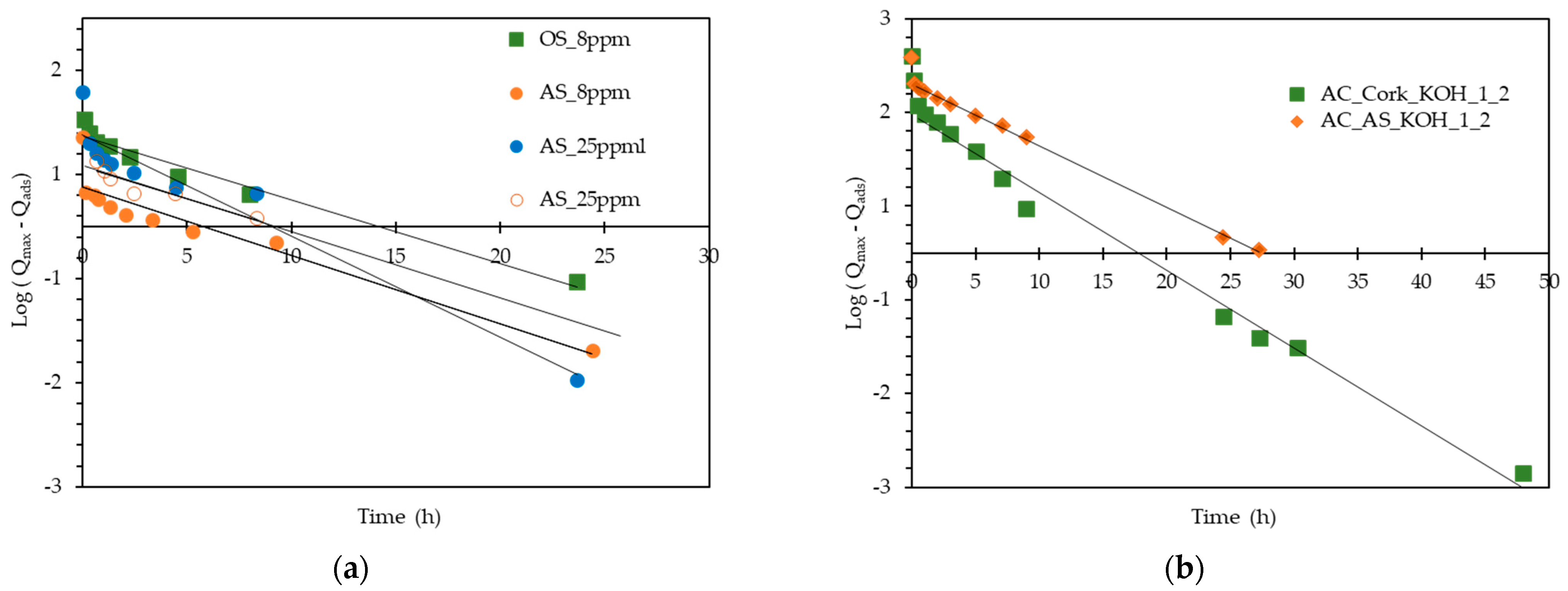
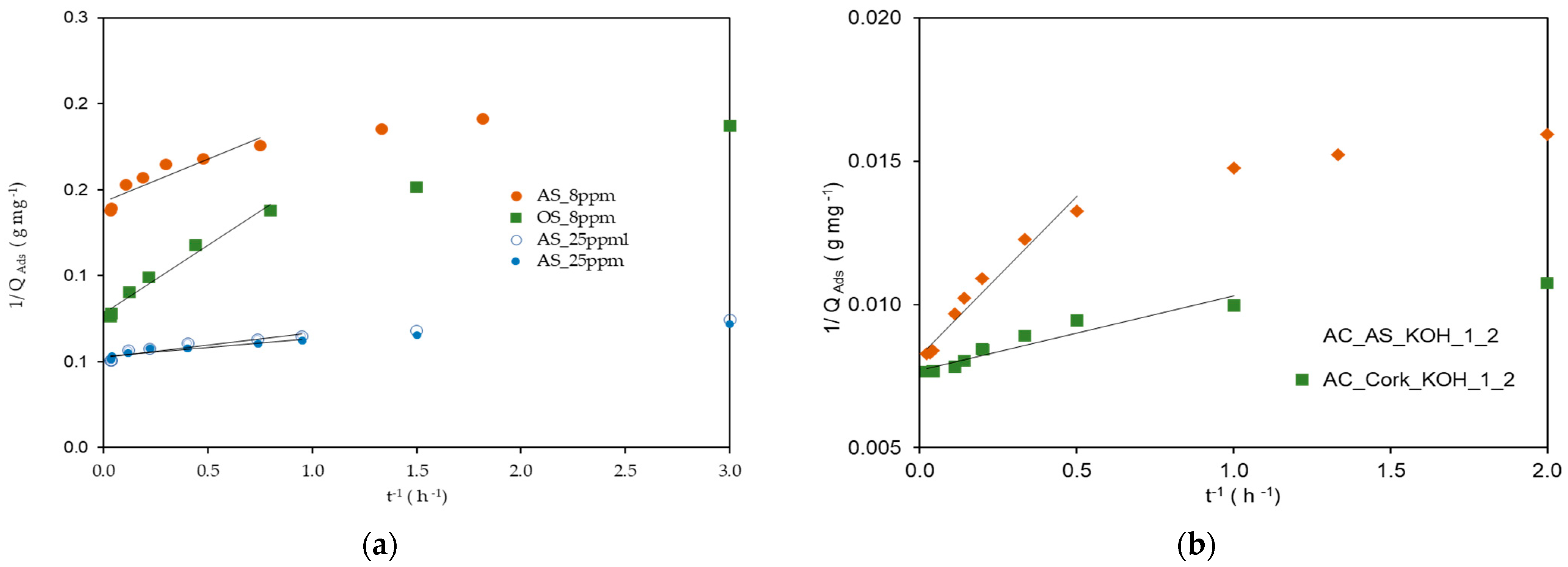
3.2.1. MB Kinetic Studies
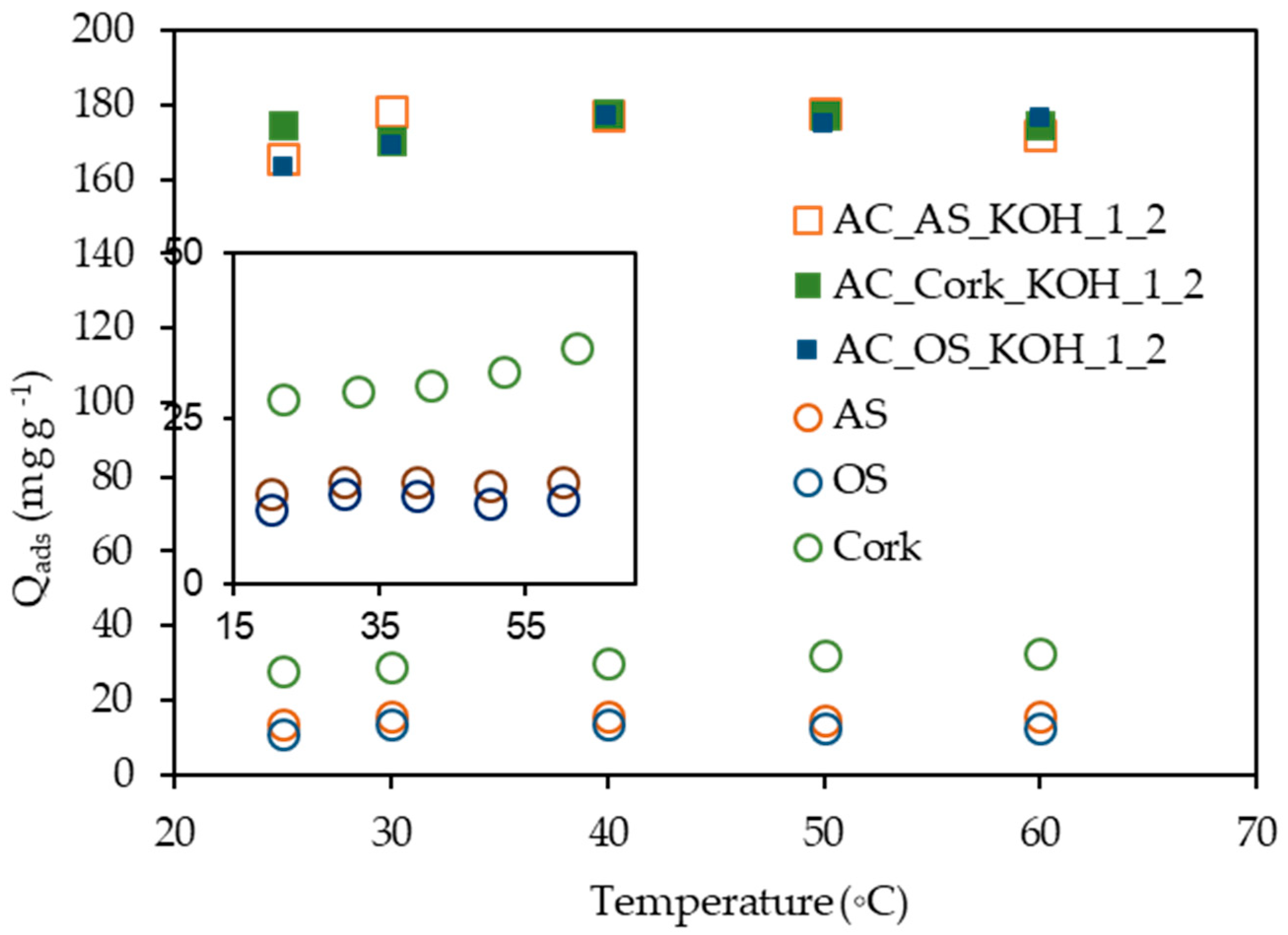
3.2.2. MB Thermodynamic Studies
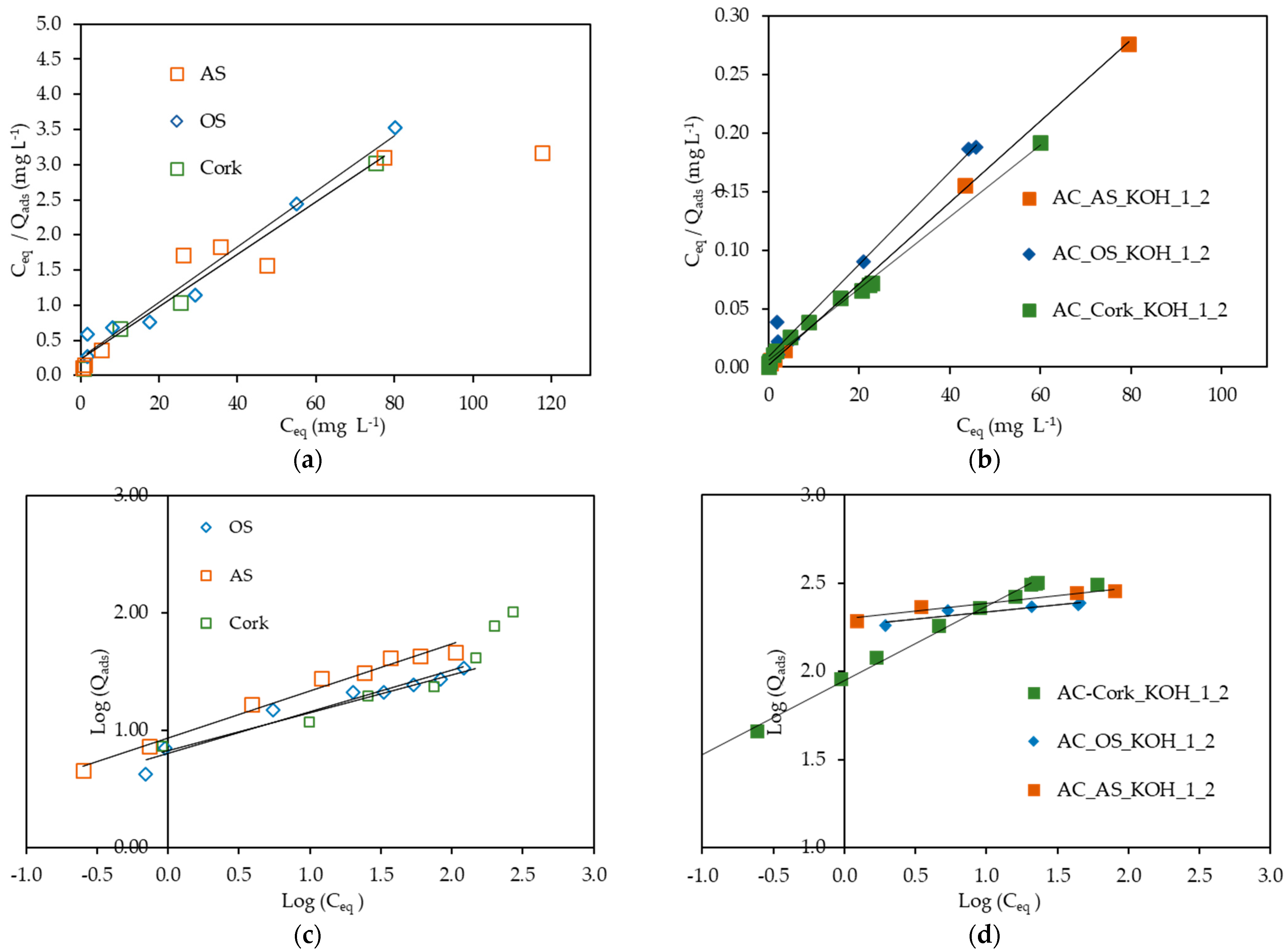
3.2.3. MB Adsorption Isotherms
4. Conclusions
Author Contributions
Funding
Institutional Review Board Statement
Informed Consent Statement
Data Availability Statement
Acknowledgments
Conflicts of Interest
References
- Kadhom, M.; Albayati, N.; Alalwan, H.; Al-Furaiji, M. Removal of dyes by agricultural waste. Sustain. Chem. Pharm. 2020, 16, 100259. [Google Scholar] [CrossRef]
- Zhang, N.; Cheng, M.; Zhou, A.; Li, Z.; Wang, H.; Han, R. Advances in the preparation and application of coal gasification slag-based adsorbent materials. Green Smart Min. Eng. 2025, 2, 57. [Google Scholar] [CrossRef]
- Dias, J.M.; Alvim-Ferraz, M.C.M.; Almeida, M.F.; Rivera-Utrilla, J.; Sánchez-Polo, M. Waste Materials for Activated Carbon Preparation and Its Use in Aqueous-Phase Treatment: A Review; Academic Press: Cambridge, MA, USA, 2007. [Google Scholar] [CrossRef]
- Khan, I.; Saeed, K.; Zekker, I.; Zhang, B.; Hendi, A.H.; Ahmad, A.; Ahmad, S.; Zada, N.; Ahmad, H.; Shah, L.A.; et al. Review on Methylene Blue: Its Properties, Uses, Toxicity and Photodegradation. Water 2022, 14, 242. [Google Scholar] [CrossRef]
- He, J.; Cui, A.; Deng, S.; Chen, J.P. Treatment of methylene blue containing wastewater by a cost-effective micro-scale biochar/polysulfone mixed matrix hollow fiber membrane: Performance and mechanism studies. J. Colloid Interface Sci. 2018, 512, 190–197. [Google Scholar] [CrossRef]
- Silva, B.; Martins, M.; Rosca, M.; Rocha, V.; Lago, A.; Neves, I.C.; Tavares, T. Waste-based biosorbents as cost-effective alternatives to commercial adsorbents for the retention of fluoxetine from water. Sep. Purif. Technol. 2020, 235, 116139. [Google Scholar] [CrossRef]
- Available online: https://shop.schneider-berlin.de/en/Equipment/Machines-accessories-and-parts/Water-purification/Accessories-for-contact-water-treatment/ACTIVATED-CARBON-GRANULATES-FOR.html?utm_source=chatgpt.com€] (accessed on 27 May 2026).
- Esteban, L.S.; Carrasco, J.E. Biomass resources and costs: Assessment in different EU countries. Biomass Bioenergy 2011, 35, S21–S30. [Google Scholar] [CrossRef]
- Talavyria, M.; Furman, I.; Alexandrov, D.; Drabovskyi, A. Assessment of agricultural biomass potential in Sustainable biofuel production. Econ. Ecol. Socium 2025, 9, 109. [Google Scholar] [CrossRef]
- Koval, V.; Perovi’c, N.; Rasovic, I.; Božovi’c, D.; Gontaruk, Y. Biofuel Production Assessment of Crop Rotation Systems and Organic Residues in Agricultural Management. Agriculture 2025, 15, 2316. [Google Scholar] [CrossRef]
- Koval, V.; Atstaja, D.; Filipishyna, L.; Udovychenko, V.; Kryshtal, H.; Gontaruk, Y. Sustainability Assessment and Resource Utilization of Agro-Processing Waste in Biogas Energy Production. Climate 2025, 13, 99. [Google Scholar] [CrossRef]
- Gura, V.; Sambulov, A.; Vaschenko, O.; Ponomarenko, Y. Strategic development of social entrepreneurship mechanisms and regulation in biomass waste management. Econ. Ecol. Socium 2025, 9, 31. [Google Scholar] [CrossRef]
- Han, B.; Weatherley, A.J.; Mumford, K.; Bolan, N.; He, J.-Z.; Stevens, G.W.; Chen, D. Modification of Naturally Abundant Resources for Remediation of Potentially Toxic Elements: A Review; Elsevier: Amsterdam, The Netherlands, 2022. [Google Scholar] [CrossRef]
- Cansado, I.P.d.P.; Mourão, P.A.M.; Castanheiro, J.E.; Geraldo, P.F.; Suhas; Suero, S.R.; Cano, B.L. A Review of the Biomass Valorization Hierarchy. Sustainability 2025, 17, 335. [Google Scholar] [CrossRef]
- Cansado, I.P.d.P.; Geraldo, P.F.; Mourão, P.A.M.; Castanheiro, J.E.; Carreiro, E.P.; Suhas. Utilization of Biomass Waste at Water Treatment. Resources 2024, 13, 37. [Google Scholar] [CrossRef]
- Yunusa, U.; Usman, B.; Bashir Ibrahim, M. Algerian Journal of Chemical Engineering Cationic dyes removal from wastewater by adsorptive method: A systematic in-depth review. Alger. J. Chem. Eng. 2021, 2, 40. [Google Scholar] [CrossRef]
- Kamenická, B. Chemical Degradation of Azo Dyes Using Different Reducing Agents: A Review; Elsevier: Amsterdam, The Netherlands, 2024. [Google Scholar] [CrossRef]
- Slama, H.B.; Bouket, A.C.; Pourhassan, Z.; Alenezi, F.N.; Silini, A.; Cherif-Silini, H.; Oszako, T.; Luptakova, L.; Golińska, P.; Belbahri, L. Diversity of Synthetic Dyes from Textile Industries, Discharge Impacts and Treatment Methods. Appl. Sci. 2021, 11, 6255. [Google Scholar] [CrossRef]
- Oladoye, P.O.; Ajiboye, T.O.; Omotola, E.O.; Oyewola, O.J. Methylene Blue Dye: Toxicity and Potential Elimination Technology from Wastewater; Elsevier: Amsterdam, The Netherlands, 2022. [Google Scholar] [CrossRef]
- Saber-Samandari, S.; Heydaripour, J. Onion membrane: An efficient adsorbent for decoloring of wastewater. J. Environ. Health Sci. Eng. 2015, 13, 16. [Google Scholar] [CrossRef]
- Shakoor, S.; Nasar, A. Removal of methylene blue dye from artificially contaminated water using citrus limetta peel waste as a very low cost adsorbent. J. Taiwan Inst. Chem. Eng. 2016, 66, 154–163. [Google Scholar] [CrossRef]
- Mussa, Z.H.; Al-Ameer, L.R.; Al-Qaim, F.F.; Deyab, I.F.; Kamyab, H.; Chelliapan, S. A Comprehensive Review on Adsorption of Methylene Blue Dye Using Leaf Waste as a Bio-Sorbent: Isotherm Adsorption, Kinetics, and Thermodynamics Studies; Springer: Berlin/Heidelberg, Germany, 2023. [Google Scholar] [CrossRef]
- Mekuria, D.; Diro, A.; Melak, F.; Asere, T.G. Adsorptive Removal of Methylene Blue Dye Using Biowaste Materials: Barley Bran and Enset Midrib Leaf. J. Chem. 2022, 2022, 4849758. [Google Scholar] [CrossRef]
- Guechi, E.K.; Hamdaoui, O. Biosorption of methylene blue from aqueous solution by potato (Solanum tuberosum) peel: Equilibrium modelling, kinetic, and thermodynamic studies. Desalin. Water Treat. 2016, 57, 10270–10285. [Google Scholar] [CrossRef]
- Hameed, B.H.; Ahmad, A.A. Batch adsorption of methylene blue from aqueous solution by garlic peel, an agricultural waste biomass. J. Hazard. Mater. 2009, 164, 870–875. [Google Scholar] [CrossRef] [PubMed]
- Jawad, A.H.; Kadhum, A.M.; Ngoh, Y.S. Applicability of dragon fruit (Hylocereus polyrhizus) peels as low-cost biosorbent for adsorption of methylene blue from aqueous solution: Kinetics, equilibrium and thermodynamics studies. Desalin. Water Treat. 2018, 109, 231–240. [Google Scholar] [CrossRef]
- Güleç, F.; Williams, O.; Samson, A.; Kostas, E.T.; Stevens, L.A.; Lester, E. Exploring the Utilisation of Natural Biosorbents for Effective Methylene Blue Removal. Appl. Sci. 2024, 14, 81. [Google Scholar] [CrossRef]
- Yusop, M.F.M.; Ahmad, M.A.; Rosli, N.A.; Manaf, M.E.A. Adsorption of cationic methylene blue dye using microwave-assisted activated carbon derived from acacia wood: Optimization and batch studies. Arab. J. Chem. 2021, 14, 103122. [Google Scholar] [CrossRef]
- El Messaoudi, N.; El Khomri, M.; Bentahar, S.; Dbik, A.; Lacherai, A.; Bakiz, B. Evaluation of performance of chemically treated date stones: Application for the removal of cationic dyes from aqueous solutions. J. Taiwan Inst. Chem. Eng. 2016, 67, 244–253. [Google Scholar] [CrossRef]
- Nithyalakshmi, B.; Saraswathi, R. Removal of colorants from wastewater using biochar derived from leaf waste. Biomass Convers. Biorefin. 2023, 13, 1311–1327. [Google Scholar] [CrossRef]
- Andrade, J.G.d.S.; Porto, C.E.; Moreira, W.M.; Batistela, V.R.; Scaliante, M.H.N.O. Production of hydrochars from Pinus caribaea for biosorption of methylene blue and tartrazine yellow dyes. Clean. Chem. Eng. 2023, 5, 100092. [Google Scholar] [CrossRef]
- Wang, C.; Feng, X.; Shang, S.; Liu, H.; Song, Z.; Zhang, H. Lignin/sodium alginate hydrogel for efficient removal of methylene blue. Int. J. Biol. Macromol. 2023, 237, 124200. [Google Scholar] [CrossRef] [PubMed]
- Kong, L.; Zhang, M. Adsorption of Methylene Blue on Chestnut Shell-Based Activated Carbon: Calculation of Thermodynamic Parameters for Solid–Liquid Interface Adsorption. Catalysts 2022, 12, 813. [Google Scholar] [CrossRef]
- Santana, G.M.; Lelis, R.C.C.; Paes, J.B.; Morais, R.d.M.; Lopes, C.R.; de Lima, C.R. Activated carbon from bamboo (Bambusa vulgaris) for methylene blue removal: Prediction to the environment applications. Cienc. Florest. 2018, 28, 1179–1191. [Google Scholar] [CrossRef]
- McCaffrey, Z.; Torres, L.F.; Chiou, B.-S.; Hart-Cooper, W.; McMahan, C.; Orts, W.J. Almond and Walnut Shell Activated Carbon for Methylene Blue Adsorption. ACS Sustain. Resour. Manag. 2024, 1, 1421–1431. [Google Scholar] [CrossRef]
- Yağmur, H.K.; Kaya, İ. Synthesis and characterization of magnetic ZnCl2-activated carbon produced from coconut shell for the adsorption of methylene blue. J. Mol. Struct. 2021, 1232, 130071. [Google Scholar] [CrossRef]
- Geraldo, P.F.; Cansado, I.P.P.; Mourão, P.A.M.; Castanheiro, J.E. Urea-Modified Activated Carbons and Their Application in Methylene Blue Removal from Wastewater. Eng. Proc. 2026, 124, 88. [Google Scholar] [CrossRef]
- El Qada, E.N.; Allen, S.J.; Walker, G.M. Adsorption of basic dyes from aqueous solution onto activated carbons. Chem. Eng. J. 2008, 135, 174–184. [Google Scholar] [CrossRef]
- Arias, M.; López, E.; Nunez, A.; Rubinos, D.; Soto, B.; Barral, M.T.; Diaz-Fierros, F. Adsorption of methylene blue by red mud, an oxide-rich byproduct of bauxite refining. In Effect of Mineral-Organic-Microorganism Interactions on Soil and Freshwater Environments; Springer: Boston, MA, USA, 1999. [Google Scholar] [CrossRef]
- Borges, A.D.S.; Matos, P.; Oliveira, M. Valorization of Cork Residues for Biomass Pellet Production: Meeting ENplus® Standards Through Strategic Blending. Clean Technol. 2025, 7, 43. [Google Scholar] [CrossRef]
- Alardhi, S.M.; Salih, H.G.; Ali, N.S.; Khalbas, A.H.; Salih, I.K.; Saady, N.M.C.; Zendehboudi, S.; Albayati, T.M.; Harharah, H.N. Olive Stone as an Eco-Friendly Bio-Adsorbent for Elimination of Methylene Blue Dye from Industrial Wastewater; Random House Audio: New York, NY, USA, 2023; Volume 13, p. 21063. [Google Scholar] [CrossRef]
- Bourafa, A.; Belhachemi, M.; Kilani, E.B.; Jellali, S.; Jeguirim, M. Porous Activated Carbons from Olive Stone-Derived Biochar and Hydrochar: Production, Characterization and Application for Amoxicillin Removal. Processes 2026, 14, 1064. [Google Scholar] [CrossRef]
- Costa, R.; Lourenço, A.; Oliveira, V.; Pereira, H. Chemical characterization of cork, phloem and wood from different Quercus suber provenances and trees. Heliyon 2019, 5, e02910. [Google Scholar] [CrossRef] [PubMed]
- Ferreiro-Cabello, J.; Fraile-Garcia, E.; Pernia-Espinoza, A.; Martinez-de-Pison, F.J. Strength Performance of Different Mortars Doped Using Olive Stones as Lightweight Aggregate. Buildings 2022, 12, 1668. [Google Scholar] [CrossRef]
- Silva, V.; Oliveira, I.; Pereira, J.A.; Gonçalves, B. Almond By-Products: A Comprehensive Review of Composition, Bioactivities, and Influencing Factors. Foods 2025, 14, 1042. [Google Scholar] [CrossRef]
- Debevc, S.; Weldekidan, H.; Snowdon, M.R.; Vivekanandhan, S.; Wood, D.F.; Misra, M.; Mohanty, A.K. Valorization of almond shell biomass to biocarbon materials: Influence of pyrolysis temperature on their physicochemical properties and electrical conductivity. Carbon Trends 2022, 9, 100214. [Google Scholar] [CrossRef]
- Pintor, A.M.A.; Ferreira, C.I.A.; Pereira, J.C.; Correia, P.; Silva, S.P.; Vilar, V.J.P.; Botelho, C.M.S.; Boaventura, R.A.R. Use of Cork Powder and Granules for the Adsorption of Pollutants: A Review; Elsevier: Amsterdam, The Netherlands, 2012. [Google Scholar] [CrossRef]
- Carrott, P.J.M.; Roberts, R.A.; Sing, K.S.W. Standard nitrogen adsorption data for nonporous carbons. Carbon 1987, 25, 769–770. [Google Scholar] [CrossRef]
- Kupriyanov, M.Y.; Miroshkin, A.S.; Yang, L. The Affinity Coefficient of the Dubinin–Radushkevich Equation for Neon Adsorption onto Activated Carbons at 27 K. Prot. Met. Phys. Chem. Surf. 2025, 61, 802–807. [Google Scholar] [CrossRef]
- Yu, L.; Bi, J.; Song, Y.; Wang, M. Isotherm, Thermodynamics, and Kinetics of Methyl Orange Adsorption onto Magnetic Resin of Chitosan Microspheres. Int. J. Mol. Sci. 2022, 23, 13839. [Google Scholar] [CrossRef]
- Tran, H.V.; Hoang, L.T.; Huynh, C.D. An investigation on kinetic and thermodynamic parameters of methylene blue adsorption onto graphene-based nanocomposite chemical Physics. Chem. Phys. 2020, 535, 110793. [Google Scholar] [CrossRef]



| Methylene Blue | Molecule Structure | Reference | |
|---|---|---|---|
| Molecular formula | C16H18ClN3S |  Protonated form  Deprotonated form Deprotonated form | |
| Molar mass (g mol−1) | 319.85 | ||
| pKa | 3.8 | [4] | |
| Solubility in water (g L−1), 298 K | 43.6 | [4] | |
| Molar absorption coefficient (L mol−1 cm−1, at 664 nm) | ~8.4104 | ||
| Molecular volume (cm3 mol−1) Molecular diameter (Å) | 241.9 8.9 | [38] | |
| Molecular area σ2 (Å2) | 130–135 | [39] | |
| Length (Å) Width (Å) | 13.5 or 14.47 9.5 | [4] | |
| Adsorbents | N | C | H | O2 * | pHpzc |
|---|---|---|---|---|---|
| OS | 0.15 | 47.9 | 5.7 | 46.25 | 4.36 |
| AC_OS_KOH_1_2 | 0.45 | 71.3 | 2.3 | 25.95 | 8.8 |
| AS | 1.01 | 46.25 | 6.37 | 46.37 | 4.73 |
| AC_AS_KOH_1_2 | 3.23 | 55.4 | 0.72 | 40.65 | 8.6 |
| Cork | 0.59 | 61.7 | 6.57 | 31.14 | 3.93 |
| AC_Cork_KOH_1_2 | 0.64 | 63.2 | 0.03 | 36.13 | 7.96 |
| Adsorbents | Qmax,exp Qmax (Exp) mg g−1 | Pseudo-First-Order Model | Pseudo-Second-Order Model | |||||
|---|---|---|---|---|---|---|---|---|
| Qmax1,cal1 mg g−1 | K1 h−1 | R2 | Qmax,cal2 mg g−1 | Vo mg g−1 h−1 | K2 h−1 | R2 | ||
| AS_8ppm | 7.25 | 2.42 | 0.067 | 0.88 | 7.0 | 20.1 | 0.38 | 0.85 |
| AS_25ppml | 19.85 | 3.44 | 0.092 | 0.97 | 19.12 | 60.0 | 0.17 | 0.91 |
| AS_25ppm | 19.48 | 3.79 | 0.062 | 0.91 | 18.87 | 99.0 | 0.26 | 0.90 |
| OS_8ppm | 13.15 | 7.36 | 0.061 | 0.97 | 12.89 | 12.5 | 0.073 | 0.97 |
| AC_AS_KOH_1_2 | 120.6 | 29.6 | 0.065 | 0.991 | 121.95 | 90.1 | 0.0063 | 0.96 |
| AC_Cork_ KOH_1_2 | 130.68 | 62.7 | 0.28 | 0.991 | 129.87 | 386.6 | 0.0023 | 0.91 |
| Samples | Temperature (°C) | ΔG (KJ mol−1) | ΔH (KJ mol−1) | ΔS (J mol−1) |
|---|---|---|---|---|
| Cork | 292 | −2.29 | 19.88 | 74.99 |
| 305 | −2.85 | |||
| 315 | −3.78 | |||
| 325 | −4.67 | |||
| 335 | −5.15 | |||
| AS | 292 | −6.39 | 1.57 | 27.5 |
| 305 | −6.91 | |||
| 315 | −7.14 | |||
| 325 | −7.12 | |||
| 335 | −7.37 | |||
| OS | 292 | −5.88 | 1.23 | 25.03 |
| 305 | −6.58 | |||
| 315 | −6.76 | |||
| 325 | −6.75 | |||
| 335 | −7.05 | |||
| AC_cork_KOH_1_2 | 298 | −10.33 | 61.66 | 244.08 |
| 303 | −12.83 | |||
| 313 | −15.22 | |||
| 323 | −17.49 | |||
| 333 | −19.76 | |||
| AC_AS_KOH_1_2 | 298 | −11.97 | 36.10 | 160.4 |
| 303 | −13.24 | |||
| 313 | −14.78 | |||
| 323 | −16.78 | |||
| 333 | −17.41 | |||
| AC_OS_KOH_1_2 | 298 | −10.89 | 14.17 | 92.11 |
| 303 | −15.05 | |||
| 313 | −16.26 | |||
| 323 | −16.93 | |||
| 333 | −14.70 |
| Adsorbents | nmax mg g−1 | nmL mg g−1 | KL L mmol−1 | R2 | KF mmolg−1 [L mmol−1]1/nF | nF | R2 |
|---|---|---|---|---|---|---|---|
| AS | 46.42 | 4.37 | 6.12 | 0.99 | 8.67 | 24.87 | 0.98 |
| Cork | 35.58 | 7.17 | 3.64 | 0.95 | 6.70 | 3.0 | 0.94 |
| OS | 34.13 | 3.98 | 0.63 | 0.98 | 6.33 | 2.82 | 0.95 |
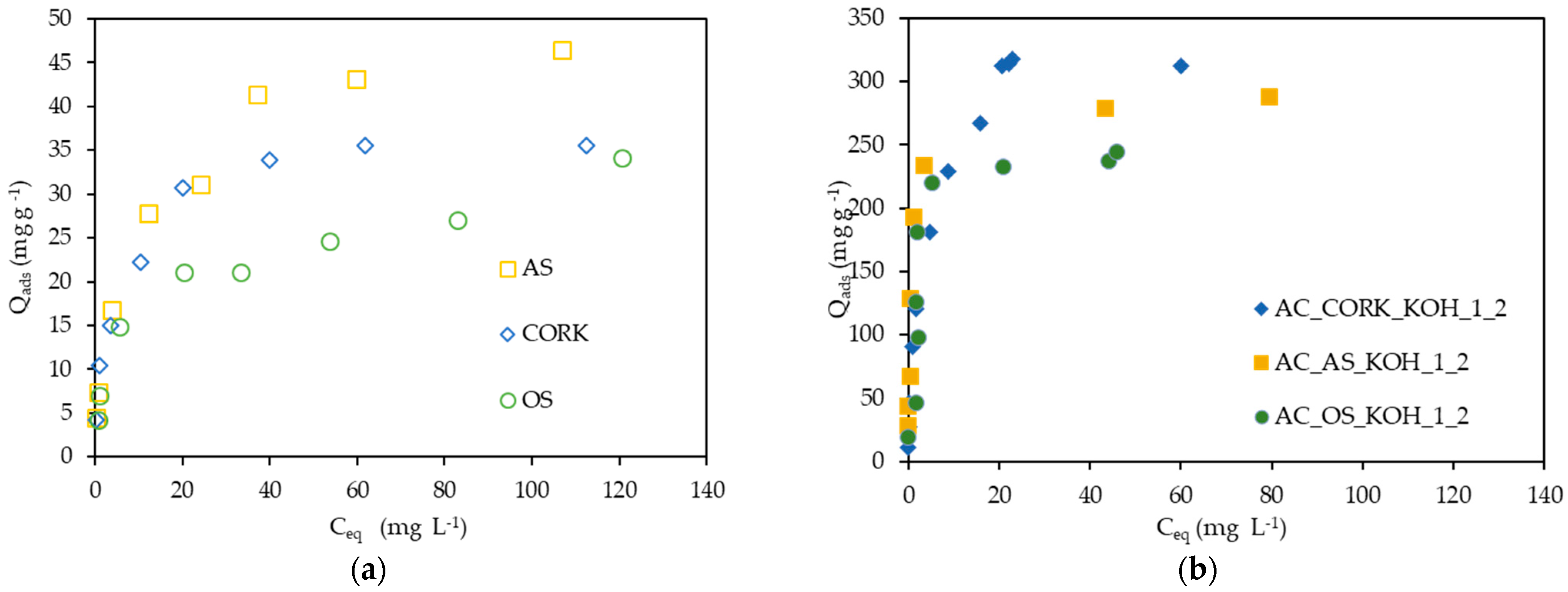
| AC_AS_KOH_1_2 | 287.69 | 434.78 | 0.66 | 0.99 | 197.42 | 11.10 | 0.95 |
| AC_Cork_KOH_1_2 | 317.58 | 166.67 | 1.94 | 0.99 | 180.47 | 12.58 | 0.86 |
| AC_OS_KOH_1_2 | 244.20 | 102.05 | 2.51 | 0.98 | 88.90 | 2.37 | 0.99 |
Disclaimer/Publisher’s Note: The statements, opinions and data contained in all publications are solely those of the individual author(s) and contributor(s) and not of MDPI and/or the editor(s). MDPI and/or the editor(s) disclaim responsibility for any injury to people or property resulting from any ideas, methods, instructions or products referred to in the content. |
© 2026 by the authors. Licensee MDPI, Basel, Switzerland. This article is an open access article distributed under the terms and conditions of the Creative Commons Attribution (CC BY) license.
Share and Cite
Cansado, I.P.d.P.; Geraldo, P.F.; Timóteo, I.M.; Carilho, B.d.S.; Coelho, S.; Mourão, P.A.M.; Castanheiro, J.E.F.d.S.; Batista, M.T.F.; Suhas. Screening Agricultural Residues as Sustainable Alternative Sorbents for the Active Removal of Methylene Blue. Sustainability 2026, 18, 5793. https://doi.org/10.3390/su18125793
Cansado IPdP, Geraldo PF, Timóteo IM, Carilho BdS, Coelho S, Mourão PAM, Castanheiro JEFdS, Batista MTF, Suhas. Screening Agricultural Residues as Sustainable Alternative Sorbents for the Active Removal of Methylene Blue. Sustainability. 2026; 18(12):5793. https://doi.org/10.3390/su18125793
Chicago/Turabian StyleCansado, Isabel Pestana da Paixão, Pedro Francisco Geraldo, Inês Monginho Timóteo, Beatriz dos Santos Carilho, Sónia Coelho, Paulo Alexandre Mira Mourão, José Eduardo Felix dos Santos Castanheiro, Maria Teresa Folgôa Batista, and Suhas. 2026. "Screening Agricultural Residues as Sustainable Alternative Sorbents for the Active Removal of Methylene Blue" Sustainability 18, no. 12: 5793. https://doi.org/10.3390/su18125793
APA StyleCansado, I. P. d. P., Geraldo, P. F., Timóteo, I. M., Carilho, B. d. S., Coelho, S., Mourão, P. A. M., Castanheiro, J. E. F. d. S., Batista, M. T. F., & Suhas. (2026). Screening Agricultural Residues as Sustainable Alternative Sorbents for the Active Removal of Methylene Blue. Sustainability, 18(12), 5793. https://doi.org/10.3390/su18125793