Article

Considering Service Priority in Multimodal Transport Route Selection Under the Uncertainty of Carbon Trading Prices


School of Transportation Engineering, Nanjing Tech University, Nanjing 211816, China
*
Author to whom correspondence should be addressed.
Sustainability 2026, 18(12), 5794; https://doi.org/10.3390/su18125794 (registering DOI)
Submission received: 21 April 2026 / Revised: 31 May 2026 / Accepted: 4 June 2026 / Published: 6 June 2026
(This article belongs to the Section Sustainable Transportation)

Abstract

To investigate the impact of transfer node service priority on multimodal transport path selection under carbon trading price uncertainty, this study models carbon price fluctuations using a “carbon K-line” distribution and quantifies service priority via cargo time value, optimising node service processes for multi-task handling. An interval robust optimisation model is formulated to minimise total transport costs (including transport, time, cargo time value, and carbon emission costs), subject to constraints such as service priority, transfer capacity limits, and mixed time windows. The model is solved using a catastrophe-adaptive genetic algorithm with Monte Carlo sampling. Case studies of three transport tasks reveal that (1) incorporating service priority alters transport paths, reducing total cargo time value loss by 12.64% and decreasing comprehensive costs by 2.26%; (2) carbon price uncertainty increases rail transport distance share by 10.86% on average and raises carbon emission cost proportions by 0.23%, ultimately increasing comprehensive costs by 3.48%. These findings assist multimodal operators in holistically evaluating cargo types, shipper requirements, and carbon markets. By forecasting carbon prices and implementing service priority, stakeholders can select low-carbon intermodal paths that balance cost efficiency, service priority, and emission reduction, thereby supporting sustainable freight transport decision-making.

1. Introduction

With the proposal of China’s “Dual Carbon” strategic goal, multimodal transport, as a green and efficient transport organisation mode, can effectively reduce total transport costs and environmental pollution. Under China’s current carbon trading policy, the carbon trading price fluctuates with daily market conditions and affects transport route selection. Meanwhile, with the continuous growth of freight volume and the increasing diversification of cargo types, multimodal transport scenarios with multi-commodity flows have become increasingly common. However, restricted by the capacity of transshipment nodes and the transport capacity of different modes, the simultaneous transport of multi-commodity flows tends to cause congestion or delays, which further raises the carbon emission cost and cargo time value cost of different routes. Different transport modes also differ in cost, speed, capacity, and emission performance; for example, waterway transport usually has cost advantages, railway transport has advantages in capacity and low-carbon performance, while air transport is often used for highly time-sensitive cargo despite its higher cost [1]. Against this background, carbon trading price uncertainty further complicates route selection. Therefore, in a multi-commodity-flow environment with uncertain carbon trading prices, considering service priority is of practical significance for selecting green multimodal transport routes and improving comprehensive transport benefits. In this sense, route optimisation under carbon trading price uncertainty links operational cost control with the broader goal of sustainable freight transport development.
Regarding the route selection problem for low-carbon multimodal transport, early studies mainly incorporated carbon emissions into the model. For example, Chen et al. [2] introduced a carbon tax mechanism and included carbon emission costs during transport and transshipment into the comprehensive transport cost to construct a single-objective function for route selection. Numerical examples verified that restricting total carbon emissions can guide low-carbon transport. Lü Xuewei et al. [3] established a bi-objective optimisation model with the objectives of minimising total transport cost and carbon emissions, which can provide optimal choices for multimodal carriers pursuing different goals. Subsequently, Cheng Xingqun et al. [4] and Zhang Xu et al. [5] established and compared route selection models under four different carbon emission policies to clarify the impact of low-carbon policies on multimodal transport route selection. Recent studies have further examined multimodal route optimisation under carbon tax policies and multiple uncertainty settings, providing useful references for low-carbon and robust transport decision-making [6,7]. Given that the carbon trading price under the current carbon trading policy is characterised by randomness and dynamics, relevant studies [8] have also indicated the necessity of considering the impact of carbon trading price uncertainty on total transport cost in multimodal transport route selection. However, most existing studies set it as a fixed value; that is, ignoring the uncertainty of carbon trading prices may lead to considerable differences in route selection results and carbon emission costs. At present, studies on multimodal transport route selection considering uncertain factors mostly focus on uncertainties such as transport time [9,10] and demand [11,12,13], while research on the impact of carbon trading price uncertainty is relatively insufficient. For the treatment of uncertainty problems, scholars usually adopt three methods: stochastic programming [14], fuzzy programming [15], and robust optimisation [16]. Compared with the other two methods, robust optimisation has lower data requirements and produces solutions with strong anti-interference ability, which can effectively handle multimodal transport route selection problems with uncertain parameter probability distributions [4].
At present, most studies on multimodal transport route selection focus on single-commodity flows [16]. With the development of the logistics industry, customers have increasingly higher requirements for transport services, and the market environment of transport is becoming more complex. Multimodal transport operators need to comprehensively consider the demands of multiple customers to complete route selection for multi-commodity flows. Fazayeli et al. [17] constructed a multi-commodity flow multimodal transport route selection model oriented to meeting diverse customer demands and obtained the optimal transport scheme under the combination of multiple transport tasks. Hrusovsky et al. [18] established a multi-commodity flow intermodal transport route selection model under stochastic transport time by considering the uncertainty of transport time according to actual transport conditions. However, existing studies on multi-commodity flow transport routes mostly ignore the capacity constraints of transshipment nodes and transport modes in practice. When multiple transport tasks are carried out simultaneously, they tend to converge on certain superior nodes, resulting in congestion or delays [19]. In this case, service priority can be adopted to optimize the service process of transfer nodes. Current research on priority mainly focuses on vehicle routing and distribution, and most studies measure service priority from the perspectives of customer importance [20], urgency of cargo demand [21,22] and hazard level [23], while few studies start from the value characteristics of the cargo itself. Previous studies have shown that when the daily average attenuation rate is greater than 0.040%, the cargo time value cost constitutes an important part of the total transport cost [15]. Therefore, using cargo time value to measure priority, optimising the service process of transshipment nodes, and reasonably selecting multimodal transport routes can avoid significant losses in cargo time value and sharp increases in carbon emission costs caused by transport congestion.
In summary, most existing studies on multimodal transport route selection that measure carbon emission costs based on carbon trading prices fail to consider the uncertainty of carbon trading prices in practice. Meanwhile, there is also a lack of research on optimising multi-commodity flow multimodal transport route selection by measuring service priority using cargo time value. Against this background, this study adopts an interval-based robust optimisation approach to characterise uncertain carbon trading prices and uses cargo time value to measure the service priority of multiple transport tasks. On this basis, a multimodal transport route selection model is constructed with the objective of minimising the total comprehensive cost, including transport cost, time cost, cargo time value cost, and carbon emission cost. An appropriate algorithm is designed to solve the model, so as to obtain the optimal transport route and improve transshipment efficiency.
The main contributions of this paper can be summarised as follows:
First, this paper constructs a path selection model considering service priority for the multi-commodity flow multimodal transport scenario under uncertain carbon trading prices. Unlike previous studies that mostly set carbon trading prices as a fixed value or only focus on single-commodity flow, this paper uses the cargo time value to measure the service priority of multiple transport tasks at transshipment nodes and introduces interval robust optimisation to characterise the fluctuation characteristics of carbon trading prices. Thus, the collaborative transport process of multiple tasks is optimized under node capacity and transport capacity constraints, effectively reducing the loss of cargo time value and carbon emission costs. This provides a decision-making basis for coordinating transport efficiency, service fairness among cargo tasks, and low-carbon freight development.
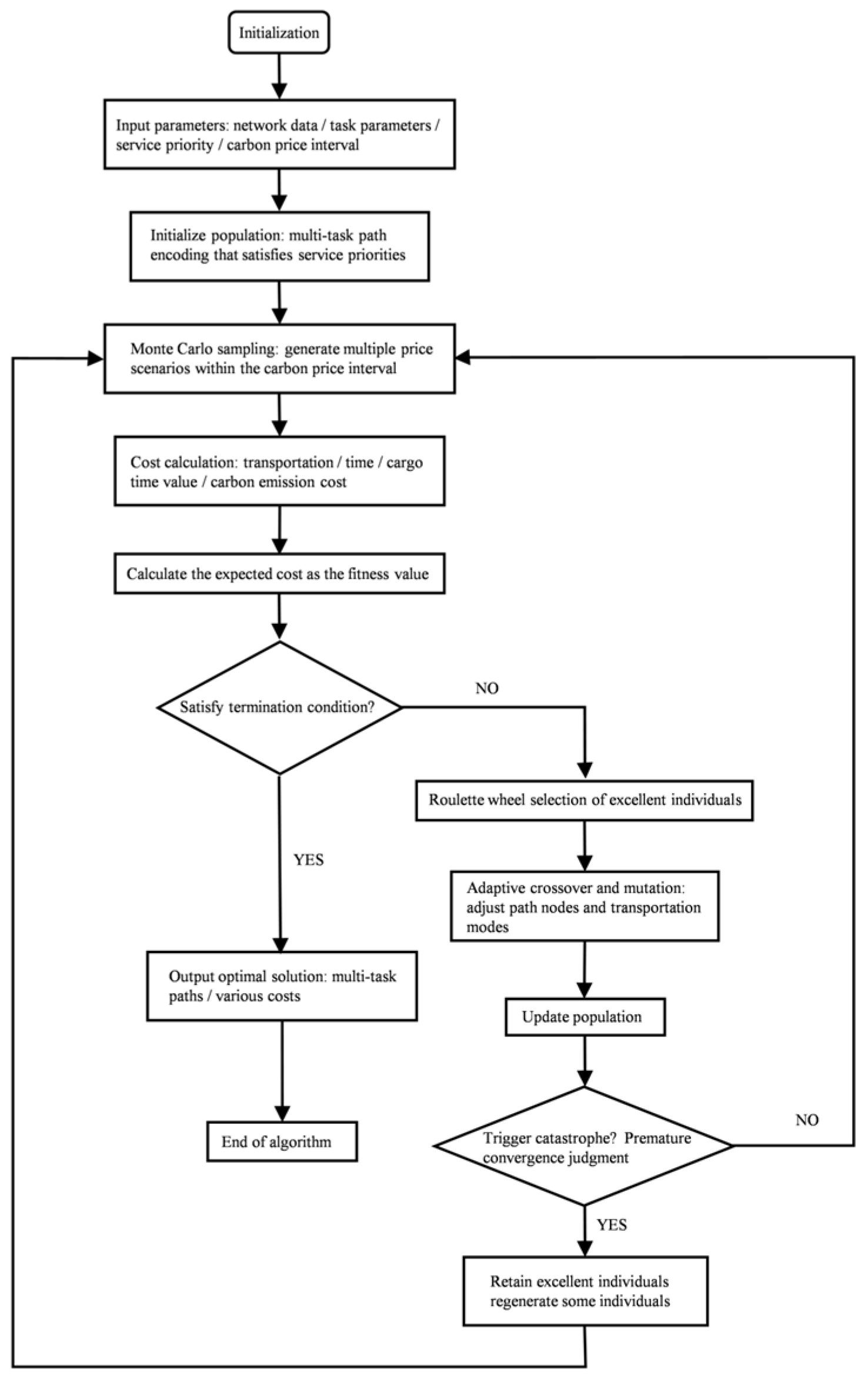
Second, for the proposed interval robust optimisation model, a catastrophe-adaptive genetic algorithm based on Monte Carlo sampling is developed. The core innovations of the algorithm include: using Monte Carlo sampling to handle the uncertainty of carbon trading prices, with the expected cost as the fitness evaluation criterion; designing adaptive crossover and mutation probabilities to maintain population diversity; introducing a catastrophe mechanism to prevent premature convergence; and performing decoding and repair considering constraints such as node capacity, service priority order, and hybrid time windows, so as to realize robust optimisation of multi-task paths under an uncertain environment.
Third, case analysis verifies the effectiveness of the model and algorithm. The results show that, after considering service priority, the total loss of cargo time value of the three transport tasks is reduced by 12.64%, and the total comprehensive transport cost is reduced by 2.26%. Furthermore, the uncertainty of carbon trading prices increases the proportion of railway transport distance by an average of 10.86% and the proportion of carbon emission cost by an average of 0.23%, with a total comprehensive transport cost increase of 3.48%. The study also finds that electronic products with the highest service priority do not blindly pursue speed but choose efficient and low-carbon railway transport, revealing the trade-off relationships among priority, time value and carbon emission cost.
The remainder of this paper is organised as follows: Section 2 describes the problem background and establishes the mathematical model; Section 3 analyses the related costs and formulates the robust optimisation model; Section 4 designs the solution algorithm; Section 5 presents the numerical example analysis and comparative discussion; Section 6 concludes the paper and outlines future research directions.

2. Problem Description

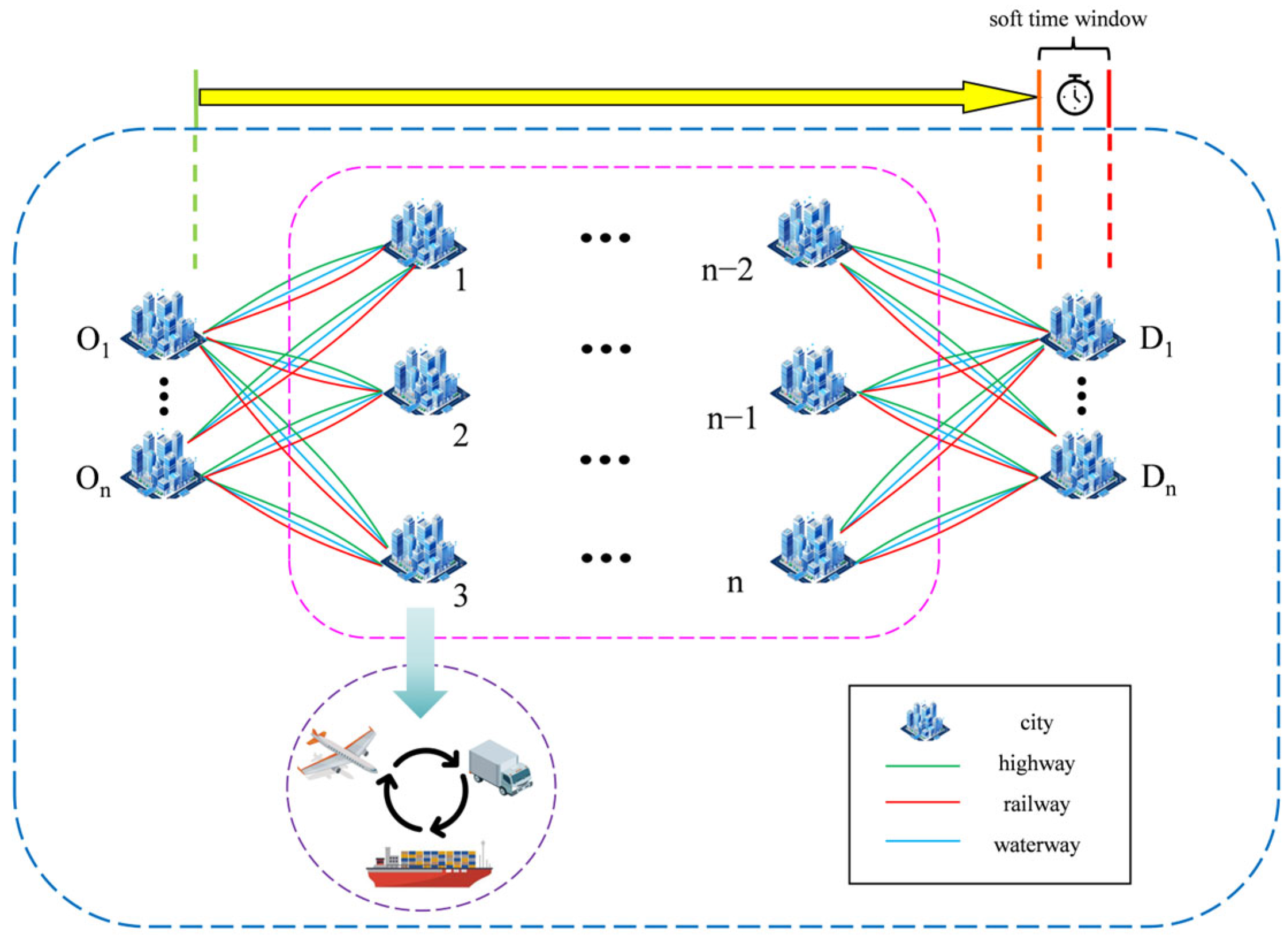
A multimodal transport operator needs to deliver M transport tasks through a multimodal transport network from different origins (O) to different destinations (D). There are three main modes of transport in the network: road, rail, and waterway, as shown in Figure 1. Considering the capacity constraints of transshipment nodes and transport modes, the simultaneous transport of multiple commodity flows may cause delays or congestion. Therefore, to optimize the service process of multiple transport tasks at transshipment nodes, this study ranks the tasks according to cargo time value and determines the service sequence by priority order. If the cargo volume of a subsequent task does not exceed the residual capacity, it can continue to use the same transport mode as the previous task; otherwise, the transport mode must be reselected. In addition, the randomness of carbon trading prices affects carbon emission costs and further influences route selection. Accordingly, under uncertain carbon trading prices, transport schedule constraints, soft destination time windows, and network capacity constraints, this study seeks routes that minimise the total multimodal transport cost for tasks with different service priorities. To facilitate modelling, the following assumptions are made:
(1)
Each node has a maximum of three transport modes: road, rail, and waterway. Other transport modes are not considered;
(2)
Each transport task is indivisible during transport and transshipment. The transshipment capacity of each node and the transport capacity of various transport modes between nodes are also known;
(3)
It is assumed that the carbon trading price lies within an interval and follows a uniform distribution;
(4)
The carbon trading market has sufficient and reasonably priced carbon emission allowances available for trading. After transport is completed, any excess carbon emission allowances required may be purchased from the market, while all saved carbon emission allowances shall be sold.

3. Model Establishment

To optimize the service process of multiple transport tasks at transshipment nodes and reduce both cargo time value loss and environmental pollution, this study measures the service sequence of multiple transport tasks by cargo time value and establishes an objective function for minimising the total cost of multimodal transport based on the analysis of related costs and time components.

3.1. Description of Symbols

The notation of the model variables in this paper is defined as shown in Table 1.

3.2. Cost Analysis

3.2.1. Transport Cost

The transport cost of the transport task m is mainly composed of the sum of the transport cost between nodes and the sum of the transit cost of the transport mode conversion at nodes, as shown in Equation (1).
C 1 , m = q m i , j N k K m M c i j k d i j k x i j k , m + q m i N k , l K m M c i k l y i k l , m

3.2.2. Time Cost

According to the objective reality in transport operations, the total time for transport task m to be transported is shown in Equation (2), where the time of transport task m waiting for the arrival of mode k after reaching node i is shown in Equation (3). The time cost is related to the total transport time. If the arrival time of goods is earlier than the lower limit of the destination time window, a certain amount of warehousing cost has to be paid; if the arrival time of goods is later than the upper limit of the destination time window, the corresponding penalty cost has to be paid, as shown in Equation (4).
T Z , m = t i j k , m + t w k , m + t c m = i , j N k K m M d i j k v ¯ k x i j k , m + w i k , m x i j k , m + q m t i k l y i k l , m
w i k , m = φ i k S i m , S i m < φ i k 0 , S i m = φ i k φ i k S i m , φ i k < S i m < φ i k
C 2 , m = q m f w max E T m T Z , m , 0 + q m f p max T Z , m L T m , 0

3.2.3. Time Value Cost of Cargo

The concept of service priority based on cargo time value is introduced, and the urgency of transport task m is measured by the cargo time value loss function, so as to evaluate the priority of transport task m receiving services at the transit node, as shown in Formulas (5) and (6). The time value cost of goods is mainly related to its average daily decay rate and its own unit value, etc., as shown in Formula (7).
h m ( t ) = G m λ m 24
δ m = h m ( t ) m M h m ( t )
C 3 , m = q m T Z , m h m ( t ) = q m λ m G m T Z , m 24

3.2.4. Cost of Carbon Emissions

The cost of carbon emissions is calculated based on carbon trading policies. Under the carbon trading policy, companies have a certain amount of emission credits, and when emissions exceed the emission credits, they must purchase the balance from outside. If the emissions do not exceed the emission quota, they may sell all the emission credits saved [24], as shown in Formula (8).
C 4 , m = ω ~ i , j N k K m M q m e i j k d i j k x i j k , m + ω ~ i N k , l K m M q m μ i k l y i k l , m ω ~ E q

3.3. Interval-Based Robust Optimisation Model for Multimodal Transport

The robust optimisation method is an effective method to solve the uncertainty problem, where the exact probability distribution of the uncertain parameters does not need to be known in advance. According to the changes in the carbon trading market and the characteristics of “carbon K-line” statistical data, an interval-based robust optimisation method is adopted to represent the volatility of carbon trading prices [24]. According to Model Assumption (3) in this paper, the interval of the carbon trading price can be expressed as ω ~ ~ U ( ω ¯ ω ^ , ω ¯ + ω ^ ) in this subsection. The range of ω ~ is determined by the maximum allowable variation of the benchmark carbon trading price ω ¯ and the random carbon trading price ω ^ . The minimum value is the difference between the two, and the maximum value is the sum of the two [5].
Combined with the above cost analysis, the multimodal transport robust optimisation model is established by applying the interval-based robust optimisation method based on the consideration of service priority. The objective function is shown in formula (9), which indicates that the total cost of transport is the lowest. The related constraints are shown in Formulas (10)–(19).
Objective function:
min Z = s S 1 s C 1 , m + C 2 , m + C 3 , m + C 4 , m
k K x i j k , m 1 i , j N ; k K ; m M
k , l K y i k l , m 1 i N ; k , l K ; m M
x i j k , m + x j n l , m 2 y i k l , m i , j , n N ; k , l K ; m M
i N k K x i j k , m i N k K x j i k , m = 1 ,   i = O 0 ,   i O , D 1 ,   i = D
x i j k , m , y i k l , m 0,1   i , j N ; k , l K ; m M
S i m 0   i N ; m M
ω ~ ~ U ( ω ¯ ω ^ , ω ¯ + ω ^ )
Q i j k , m 1 = ( q m + Q i j k , m ) x i j k , m ,   δ m 1 > δ m
Q i k l , m 1 = ( q m + Q i k l , m ) y i k l , m ,   δ m 1 > δ m
s S ω ¯ s ω ¯ ω ^ S R
Constraint conditions:
Formula (10) means that goods can only be transported by one transport mode between adjacent nodes. Formula (11) means that only one of the transport modes at node i can be selected for transport, which can be divided into no conversion of transport mode or conversion from one transport mode to another. Formula (12) ensures the smooth conversion of different modes of transport. Formula (13) is the flow conservation constraint of the intermediate node. Formula (14) limits the decision variable as a 0–1 variable. Formula (15) is the value constraint of the variable. Formula (16) is the value range of the constrained carbon trading price ω ~ , and it follows a uniform distribution within the range. Formula (17) denotes that the residual transport capacity Q i j k , m 1 of the transport mode adopted by the previous task equals the sum of the freight volume and residual transport capacity Q i j k , m of the subsequent task. When multiple tasks arrive at the transshipment node at the same time, they are transshipped sequentially in descending order of service priority corresponding to the time value of goods. Formula (18) means that the transit residual capacity Q i k l , m 1 of the upper-level task is equal to the sum of the cargo volume of the lower-level task and its transit residual capacity Q i k l , m . Formula (19) is the conservative degree of the value of carbon trading price that satisfies the robust optimisation, that is, the constraint of the maximum conservative value R .

4. Algorithm Design

The robust optimisation model for multimodal transport routing considering service priority under uncertain carbon trading prices constructed in this paper includes interval uncertain parameters, mixed-integer decision variables, multi-task collaboration, and node capacity constraints. Therefore, it constitutes a complex combinatorial optimisation problem. Traditional exact algorithms are difficult to solve efficiently, while genetic algorithms have the advantages of strong global search ability and the capability to handle constraints, making them suitable for such problems. However, the standard genetic algorithm is prone to falling into local optima and limited in its ability to directly address uncertain parameters. Therefore, combined with the problem characteristics, this paper introduces the catastrophe operator, adopts the principle of adaptive genetic algorithm [25], and designs a catastrophe adaptive genetic algorithm based on Monte Carlo sampling [26] to achieve robust optimisation of multi-task routing in an uncertain environment.

4.1. Core Idea of the Algorithm

(1)
Coding design: A multi-layer coding scheme based on the combination of transport nodes and transport modes is adopted. Each chromosome represents a complete path and transport mode sequence for one transport task, and chromosomes of multiple tasks form an individual in the population.
(2)
Fitness evaluation: The Monte Carlo sampling method [26] is used to randomly generate multiple sets of carbon price scenarios within the interval ω ~ ~ U ( ω ¯ ω ^ , ω ¯ + ω ^ ) to handle the uncertainty of carbon trading prices. The total cost under each scenario is calculated, and the expected cost is taken as the basis for fitness evaluation to reflect robustness.
(3)
Adaptive crossover and mutation: The crossover and mutation probabilities are dynamically adjusted according to individual fitness to maintain population diversity.
(4)
Catastrophe mechanism: When the population evolution stagnates (premature convergence), the catastrophe operation is triggered. The best individuals are retained, and some individuals are regenerated to jump out of the local optimum.
(5)
Constraint handling: During the decoding process, constraints such as node capacity, service priority order, and time windows are checked. Infeasible individuals are repaired or penalized to ensure the feasibility of the solution.

4.2. Specific Steps and Flow

Step 1 (Initialization): Input network data, task parameters, carbon price interval, and algorithm parameters (population size, number of iterations, catastrophe threshold, etc.). Generate the initial population according to topological sorting and, based on the feasible region of transport modes, randomly generate initial path schemes that satisfy origin-destination and node connectivity constraints.
Step 2 (Fitness Calculation): For each individual (i.e., multi-task path combination), use Monte Carlo sampling to generate N groups of carbon trading prices. For each price scenario, calculate the transport cost, time cost, cargo time value cost, and carbon emission cost of each task, and sum them to obtain the total cost under that scenario. Take the expected value of the total costs across all scenarios as the fitness value of the individual.
Step 3 (Selection Operation): Adopt the roulette wheel selection method to select excellent individuals into the next generation according to their fitness values.
Step 4 (Adaptive Crossover and Mutation): Perform crossover on the selected individuals with adaptive probability: randomly select two individuals, exchange nodes or transport modes in the same task path segment to generate new paths; perform mutation on the crossed individuals with adaptive probability—randomly change a certain node or transport mode of a task to ensure path connectivity. Conduct constraint verification and repair on new individuals to satisfy node capacity and service priority order.
Step 5 (Catastrophe Judgment and Execution): Calculate the improvement rate of the optimal fitness of the current population. If there is no significant improvement for several consecutive generations, trigger the catastrophe, retain the current optimal individuals, and randomly regenerate part of the individuals to maintain the population size. Reset the catastrophe counter.
Step 6 (Termination Judgment): If the maximum number of iterations is reached or the fitness converges, output the optimal path scheme and the cost of each task. Otherwise, return to Step 2 to continue evolution.
The corresponding flowchart of the algorithm is shown in Figure 2.

5. Example Analysis

5.1. Example Background and Parameter Description

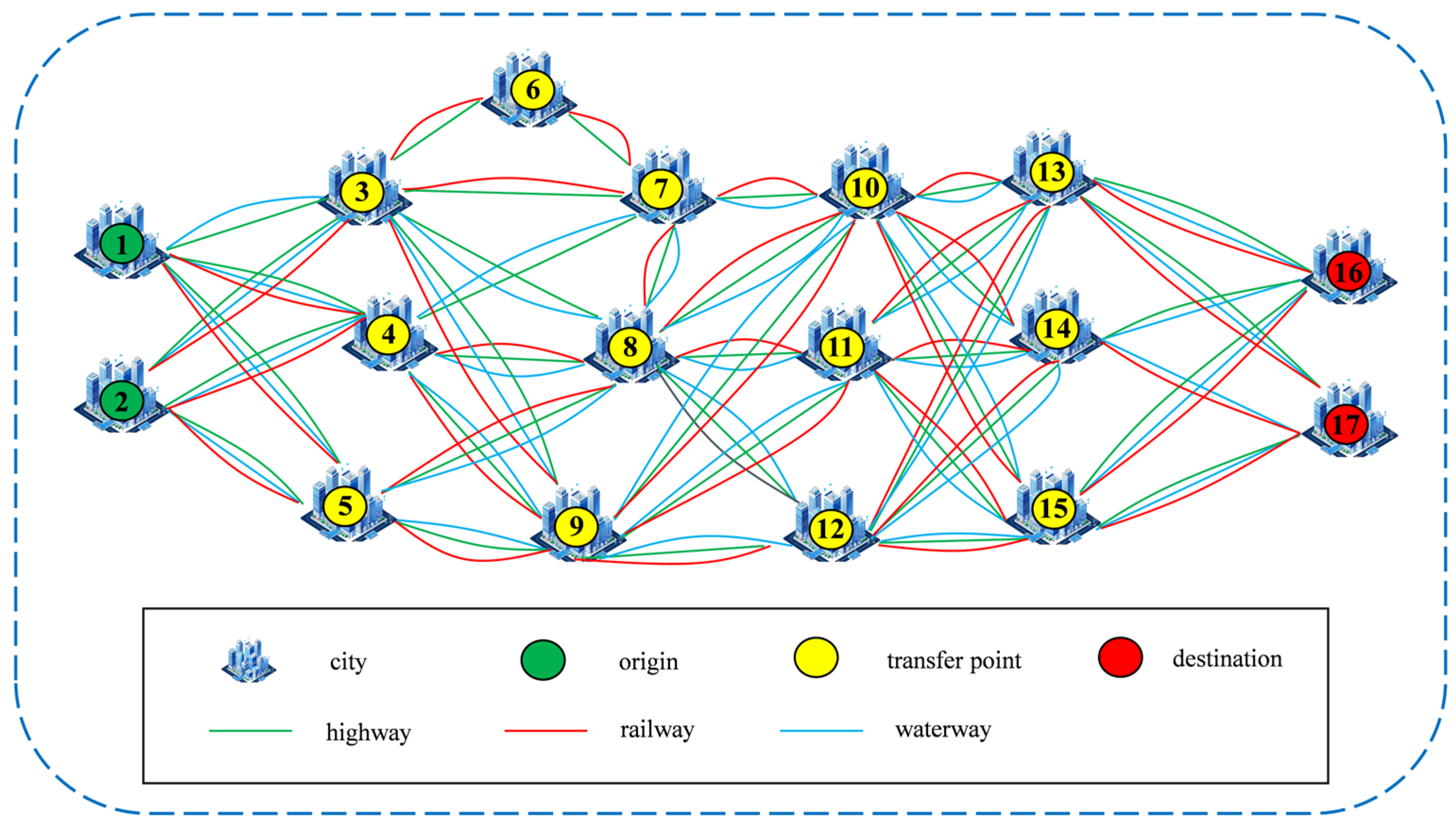
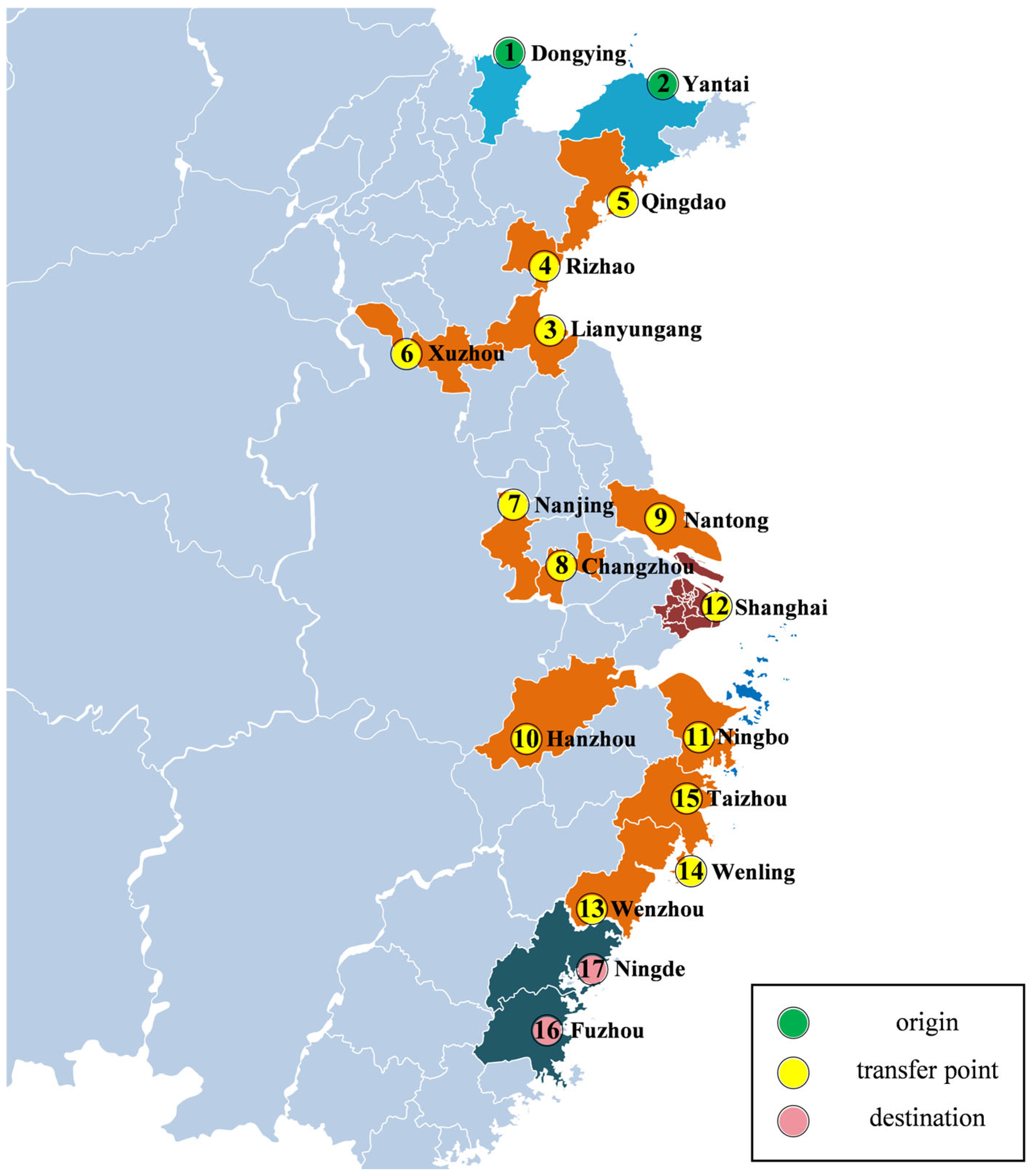
To investigate the feasibility of the model and algorithm, a multi-commodity-flow multimodal transport network [19] in eastern China is established. It is assumed that a multimodal transport enterprise undertakes three transport tasks on the same day, namely auto parts, electronic products, and industrial parts. These three transport tasks need to be transported from different origins to different destinations through a joint transport network consisting of 17 city nodes and 106 transport trunk lines. The available transit cities include Dongying, Yantai, Lianyungang, Rizhao, Qingdao, Xuzhou, Nanjing, Changzhou, Nantong, Hangzhou, Ningbo, Shanghai, Wenzhou, Wenling, Taizhou, Fuzhou, and Ningde, as shown in Figure 3. Each city in the network is sequentially represented by 1, 2,…,16, and 17, and the city modes and transport networks between nodes are shown in Figure 4.
It is assumed that the three transport tasks start simultaneously from their origins (Node 1 and Node 2) at 0:00. The relevant parameters [19,27] of the transport tasks are set, and the cargo time value function, urgency degree, and service priority of each transport task are calculated according to (2) and (3), respectively, as shown in Table 2. The unit storage cost for early arrival at the destination is 15 yuan/(h·t), and the unit penalty cost for late arrival is 30 yuan/(h·t) [4].
Gaode Map, China Railway 95306, Shipxy, and MarineCircle were used to collect transport distance data for different modes between cities. Transport parameters for each mode were determined according to actual freight rates and transport capacity ranges of freight companies, including China Railway Express. These parameters also considered the specific conditions of ports and freight transfer stations, as well as previous studies [16,18]. Specific data are shown in Table 3, Table 4 and Table 5. In the default setting, highway transport has no time window limit. The capacity limit of each node and the rail and waterway transport schedules are based on direct freight trains of China Railway Group and the China Railway Freight Service Center, as shown in Table 6. In Table 6, the transport capacity of each mode and the transshipment capacity of each node were randomly generated within the reference interval using Python 3.11. Based on the carbon emission reduction plan and the carrier’s previous production and operation level, the carbon regulatory authority allocates a carbon emission quota of E q = 4500 kg [25] to the carrier. According to the temporal distribution characteristics of recent “carbon K-line” data from China’s carbon trading platforms, as well as the parameter settings in the relevant literature [8], the benchmark carbon trading price is set as 0.03 yuan/kg, with a maximum allowable variation of 0.02 yuan/kg. Thus, the price follows a uniform distribution over the interval [0.01, 0.05].

5.2. Results and Analysis of Examples

5.2.1. Result Analysis

The established robust optimisation model for intermodal transport routing is solved using MATLAB (R2024b) programming. Referring to the relevant literature and comparing the convergence speed, solution stability, and computational time through multiple sets of preliminary experiments to balance the optimisation performance and efficiency, the maximum conservativeness value is finally determined. The maximum number of sampling times for carbon trading prices is set as S={1,2,3,…,49,50}, and the algorithm parameters are configured as follows: population size of 80, maximum iterations of 150, initial crossover probability of 0.8, and initial mutation probability of 0.6 [24]. The final solution results are presented in Table 7.
As shown in Table 7, goods with different service priority requirements choose different transport modes and paths. The reason is that after the three types of goods arrive at Advantage Node 5 simultaneously, according to the order of service priority, the 150 t of electronic products are given priority to select the optimal transport path (5–9) and transport mode (2) to achieve the goal of minimising the total cost of this task. Since auto parts and industrial parts have lower service priorities and considering that the railway capacity of the advantage path 5–9 is only 225 t, the remaining 75 t capacity of this path can no longer meet the demand of either of the other two types of goods. Therefore, after Node 5, these two types of goods cannot continue to be transported by railway along path 5–9. Auto parts have the second-highest service priority; after Node 5, they are transported by railway with relatively high speed along the relatively advantageous path 5–8. Industrial parts, however, are transported by waterway with lower cost along path 5–8. The specific path selection scheme is shown in Table 7. For goods with the highest daily average decay rate and service priority, such as electronic products, the proportion of cargo time value cost is relatively high. Early delivery can save considerable time value loss and make up for the difference in freight rates. Therefore, based on the comprehensive consideration of transport time constraints, carbon emission costs and total transport costs, such goods are preferentially transported by railway with high speed and low carbon emissions throughout the whole journey. For auto parts and industrial parts, which have lower requirements on transport time and lower daily average decay rates, the time value loss saved by early delivery is relatively small. Therefore, their transport paths tend to adopt rail–water intermodal transport, which is advantageous in both economic efficiency and environmental protection, thereby reducing the total transport cost.
In the transport mode selection results in Table 7, highway transport is not selected. This is mainly the optimisation result of the model after comprehensive trade-off of various costs and constraints under the objective of total cost minimisation, which is reflected in the following aspects. First, the transport speed of rail and waterway sufficiently meets the loose mixed time window requirements of each task. Second, Table 7 shows that the transport cost accounts for a large proportion of the total transport cost for each task, and the combination of railway and waterway has an absolute advantage in transport cost (only 1/5 to 1/14 of that of highway), which ultimately affects the choice of transport mode. In addition, the loss of cargo time value cannot offset the high premium of highway transport. Moreover, the carbon trading policy converts carbon emissions into costs, further enhancing the competitiveness of low-carbon modes, making the solution more inclined to the economical and environmentally friendly rail–water intermodal scheme. This situation is also highly consistent with China’s green transport policy of “shifting freight from road to railway and from road to waterway” and provides a quantitative basis for multimodal transport operators to select robust and low-carbon paths under uncertain environments.

5.2.2. Comparative Analysis

From the above analysis of the solution results, it can be seen that there are significant differences in the cargo time value cost and carbon emission cost of transport tasks corresponding to different types of goods, which further affect the path selection results. Therefore, this section conducts a comparative analysis from two perspectives—whether service priority is considered and whether carbon trading price uncertainty is considered—so as to verify the necessity of considering the two factors of cargo time value and carbon trading price uncertainty in this paper.
(1)
Whether service priority is considered
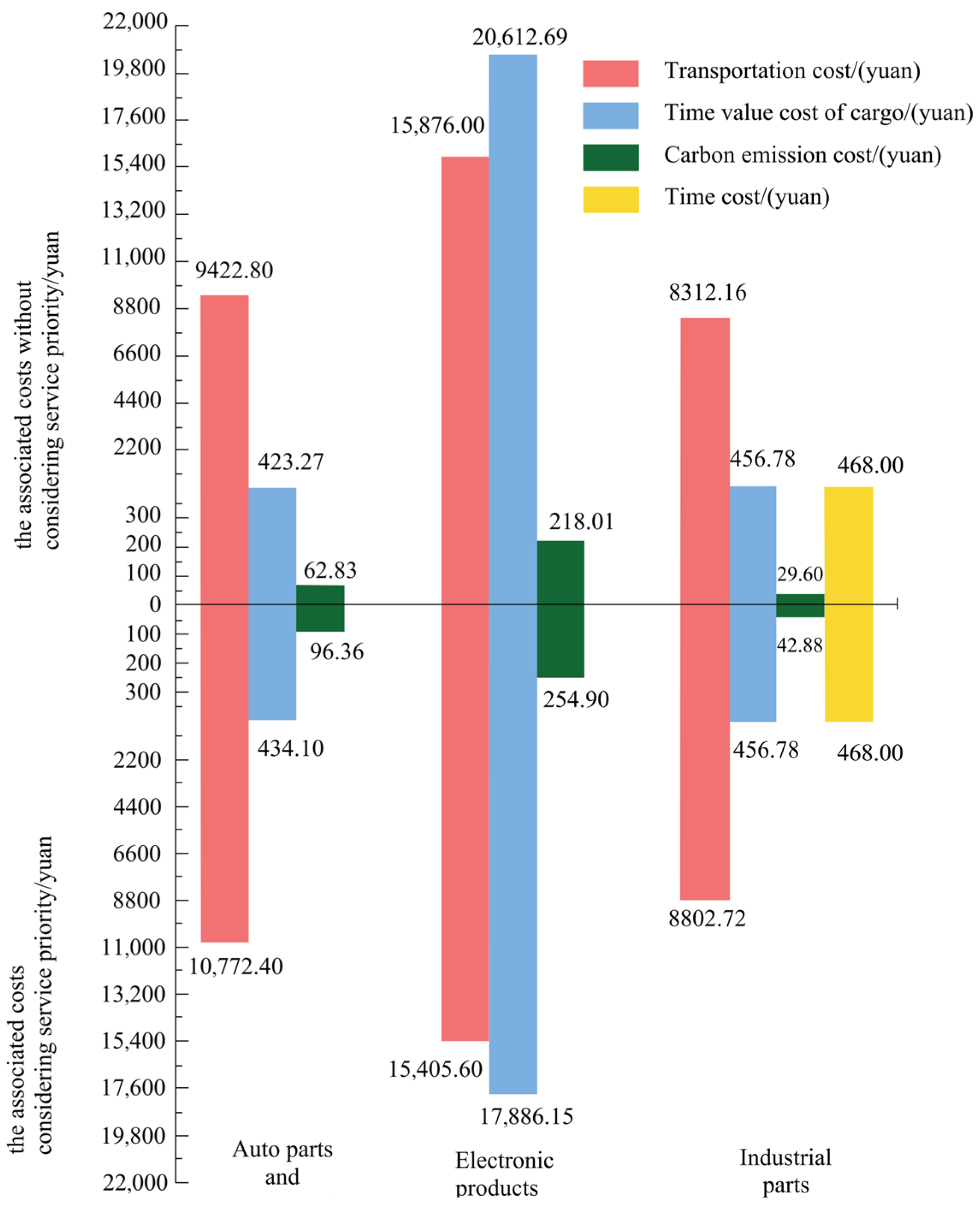
This section compares the path selection and changes in various costs with and without considering service priority under carbon trading price uncertainty to investigate the impact of service priority on path selection. The comparison results are shown in Table 8 and Figure 5.
According to Table 8, compared with the scenario without service priority, the transport paths of different types of goods have changed after considering service priority. The reason is that, without considering service priority, the first accepted transport task, namely 100 t of auto parts, chooses section 5–9 at Node 5. However, since the railway capacity of this section is only 225 t, the remaining 125 t capacity can no longer meet the transport volume of 150 t of electronic products. Therefore, the transport path of electronic products changes to railway transport on section 5–8, while 120 t of industrial parts can still choose this advantageous section. After considering service priority, the transport paths of the three tasks are adjusted. However, as shown in Table 8 and Figure 5, compared with the paths without service priority, the cargo time value cost of electronic products with the highest daily average decay rate decreases from 20,612.69 yuan to 17,886.15 yuan, a decrease of about 13.23%, and the total transport cost is reduced from 36,706.70 yuan to 33,546.65 yuan, saving 3160.05 yuan. This saving can offset the total increase of 1897.80 yuan in transport costs for auto parts and industrial parts caused by path switching. As a result, the total comprehensive cargo time value cost of the three transport tasks decreases to 18,777.03 yuan, and the total comprehensive transport cost with service priority is reduced from 55,882.14 yuan to 54,619.89 yuan, a decrease of about 2.26% compared with the scenario without service priority. This shows that in the path planning of multi-commodity flow, one should not blindly pursue the optimal path for a single task, but comprehensively consider the cargo characteristics and transport requirements of multiple tasks to achieve the overall optimum.
In addition, it can be seen from Figure 5 that, regardless of whether service priority is considered, only industrial parts among the three transport tasks fail to meet the time window requirement and thus incur penalty time cost, but the total transport cost of this task is still the lowest among the three. Based on the analysis presented Table 8 and Figure 5, this occurs because the transport cost and carbon emission cost are effectively controlled in the path selection of industrial parts, which offsets the increase in time cost. For example, under service priority, the transport cost of industrial parts is 10,772.40 yuan, which is 1969.68 yuan higher than the 8802.72 yuan transport cost of auto parts. This value is also significantly larger than the 468 yuan increase in time cost for the industrial parts task. This result indicates that in multimodal transport path selection, multimodal transport operators can appropriately increase time cost to save more transport cost, so as to achieve the optimal total cost of transport tasks.
(2)
Whether to consider the uncertainty of carbon trading prices
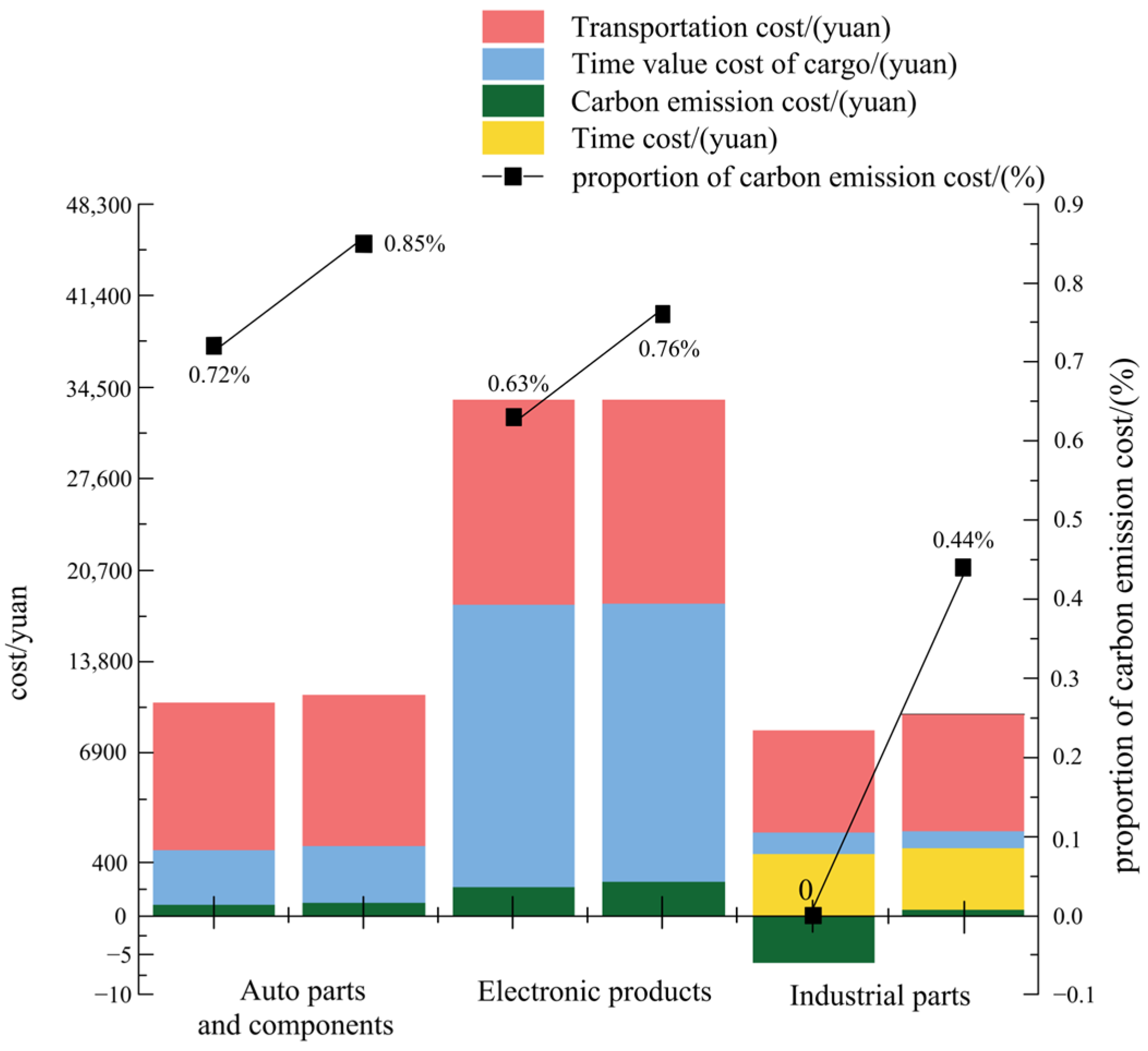
The price of carbon trading changes over time, but most of the time it fluctuates slightly above and below the benchmark price. Therefore, the benchmark carbon trading price ω ¯ = 0.03 yuan/kg is used to calculate the deterministic carbon trading price scenario, and the transport routes and cost are compared with the uncertain carbon trading price, as shown in Table 9 and Figure 6.
According to Table 9 and Figure 6, under the influence of uncertainty in carbon trading prices, transport routes and modes for automotive and industrial parts change, while transport routes and modes for electronic products do not. The reason is that when the carbon trading price is determined, the total transport costs of electronic products with the highest priority for service and transport time requirements are included in the total transport costs. The cost of carbon emissions is 0.63%, which is much smaller than the time value cost of goods (53.39%) and transport costs (45.98%). Therefore, the determination of the carbon trading price has little impact on the carbon emission cost of electronic products, so the transport route does not change. Compared with certain carbon trading prices, under carbon trading price uncertainty, the proportion of railway transport distance in the transport routes of the three transport tasks increases by 10.86% on average, resulting in increases in carbon emission costs by 0.13%, 0.13% and 0.44% respectively, while total transport costs increase by 5.52%, 0.13% and 12.61%, respectively. Finally, the total cost of comprehensive transport increases by 3.48%, which verifies that the uncertainty of carbon trading prices will have an impact on the related transport costs, indicating that certain costs need to be sacrificed in pursuit of the stability of transport routes under uncertain carbon trading prices.
The negative carbon emission cost of industrial parts under the deterministic carbon price scenario in Figure 6 arises because the actual carbon emissions of this transport path are below the emission limit, and the unused allowances are sold to generate carbon revenue. In contrast, if a transport task generates excess carbon emissions, additional allowances must be purchased from the market. This also indicates that under the carbon trading policy, carbon emission costs can be positive or negative, so the total transport cost of enterprises no longer shows a single increasing trend. Enterprises can gain revenue by reducing carbon emissions and selling saved allowances, thereby lowering total transport costs. Furthermore, the government can use this mechanism to encourage carriers to reduce emissions and promote the development of green transport.

6. Conclusions

This study investigates multimodal transport route selection under carbon trading price uncertainty by introducing service priority based on cargo time value. An interval-based robust optimisation model is established to minimise total transport cost while considering transport cost, time cost, cargo time value cost, carbon emission cost, service priority, transshipment capacity, mode capacity, and mixed time windows. The case analysis further examines how service priority and carbon trading price uncertainty affect route selection and cost structure. From the perspective of sustainable freight transport, the proposed model provides a practical way to jointly consider economic cost, cargo service priority, and carbon-emission cost under carbon market uncertainty. The main conclusions are as follows:
(1)
Under the constraints of service priority and transport time windows, the proposed model can effectively reduce cargo time value loss and total transport cost by optimising the service process of transshipment nodes. For electronic products with the highest service priority, the model does not select road transport simply in pursuit of speed. Instead, it gives priority to an all-rail transport scheme with relatively high efficiency and low carbon emissions, reducing the cargo time value cost by 13.23% and the total transport cost of this task by 8.61%. For auto parts and industrial parts, which have lower service priority and lower average daily decay rates, the selected routes tend to adopt rail–water intermodal transport, which can better balance transport time and cost. This optimisation result is consistent with China’s green freight policy of shifting freight from road to railway and waterway transportation and can provide quantitative support for multimodal transport operators to select robust and low-carbon routes under uncertain environments.
(2)
Considering service priority changes the transport routes of the three transport tasks and improves the system-level optimisation result for multi-commodity-flow transport. After service priority is introduced, the priority-based route selection for electronic products saves 3160.05 yuan in total transport cost. Although the route changes of auto parts and industrial parts increase their total transport cost by 1897.80 yuan due to their lower service priority and the capacity constraints of transport modes, the overall comprehensive transport cost is still reduced by 2.26%. In the route selection of industrial parts, the reduction in transport and carbon-emission costs effectively offsets the increase in time cost. Therefore, multimodal transport operators may appropriately accept a moderate increase in time cost when it can save more transport and carbon emission costs, thereby achieving total cost optimisation.
(3)
Carbon trading price uncertainty affects the related costs of the three transport tasks to different degrees and ultimately increases the total comprehensive transport cost by 3.48%. This indicates that when carbon trading prices may fluctuate significantly, multimodal transport operators should estimate a reasonable fluctuation range of carbon trading prices and make route decisions based on reliable estimation data to avoid excessive additional costs caused by carbon market uncertainty.
Overall, incorporating service priority and carbon trading price uncertainty into multimodal transport route selection can help operators coordinate cost reduction, service quality assurance, and emission-control objectives. This is consistent with the sustainable development requirements of modern freight transport. Future research can further extend the proposed model by considering more cargo categories, larger-scale transport networks, real-time carbon price data, delivery deadline tightness, and delay penalty mechanisms to better meet the sustainable development needs of multimodal transport.

Author Contributions

Conceptualization, J.H.; methodology, K.L.; supervision, J.H.; writing—review and editing, Z.Z., Z.W. and R.L.; writing—original draft, K.L.; software, K.L.; data curation, Z.Z., Z.W. and R.L.; resources, J.H.; project administration, J.H.; formal analysis, K.L.; investigation, Z.W. and R.L.; visualization, Z.W. and R.L. All authors have read and agreed to the published version of the manuscript.

Funding

This research was funded by the China’s National Railway Administration Research Project (KF2019-029) and China Logistics Society and China Federation of Logistics & Purchasing Research Project (2025CSLKT3-641).

Institutional Review Board Statement

Not applicable.

Informed Consent Statement

Not applicable.

Data Availability Statement

The data that support the findings of this study are available from the corresponding author upon reasonable request.

Acknowledgments

The authors sincerely thank the Academic Editor, the Editorial Office, and the anonymous reviewers for their valuable comments and constructive suggestions, which helped improve the quality and clarity of this manuscript.

Conflicts of Interest

The authors declare no conflicts of interest.

References

  1. Macioszek, E. Cargo transport on the example of a selected mode of transport in Poland. Sci. J. Silesian Univ. Technol. Ser. Transp. 2024, 122, 181–197. [Google Scholar] [CrossRef]
  2. Chen, L.; Lin, B.; Wang, L.; Wen, X.; Li, J. Optimization model of mode selection for intermodal transportation based on carbon-reduction policy. J. Beijing Jiaotong Univ. 2015, 39, 70–75. [Google Scholar] [CrossRef]
  3. Lyu, X.; Yang, B.; Yuan, J. Optimal path selection of multimodal transport under the perspective of low carbon. J. Guangxi Univ. Nat. Sci. Ed. 2017, 42, 519–526. [Google Scholar] [CrossRef]
  4. Cheng, X.; Jin, C. Route selection problem in multimodal transportation with traffic congestion considered under low-carbon policies. Oper. Res. Manag. Sci. 2019, 28, 67–77. [Google Scholar] [CrossRef]
  5. Zhang, X.; Liu, J.; Yuan, X.; Jiang, Y. Selection of multimodal transportation route considering scale economy under different carbon emission policies. J. Ind. Eng. Manag. 2022, 27, 22–31. [Google Scholar] [CrossRef]
  6. Ren, X.; Pan, S.; Zheng, G. Robust optimization of multimodal transportation route selection based on multiple uncertainties from the perspective of sustainable transportation. Sustainability 2025, 17, 5508. [Google Scholar] [CrossRef]
  7. Gao, L.; Zhan, M. Route optimization of multimodal transport considering regional differences under carbon tax policy. Sustainability 2025, 17, 5743. [Google Scholar] [CrossRef]
  8. Zhang, X.; Yuan, X.; Jiang, Y. Optimization of multimodal transportation under uncertain demand and stochastic carbon trading price. Syst. Eng. Theory Pract. 2021, 41, 2609–2620. [Google Scholar] [CrossRef]
  9. Gu, Y.; Wen, J. Research on multimodal transport route optimization of refrigerated containers under uncertain transportation time. J. Wuhan Univ. Technol. Transp. Sci. Eng. 2025, 49, 469–475. [Google Scholar] [CrossRef]
  10. Deng, M.; Dai, Y.; Li, X. Robust optimization of multi-modal transportation routing with low-carbon under demand uncertainty. Ind. Eng. J. 2023, 26, 104–113. [Google Scholar] [CrossRef]
  11. Tang, R.; Hu, J.; Wen, C.; Zhang, W. Multimodal transport route selection considering dynamic transit time under uncertain demand. J. Nanjing Tech Univ. Nat. Sci. Ed. 2023, 45, 554–562. [Google Scholar] [CrossRef]
  12. Hu, J.; Tang, R.; Wen, C.; Zhang, W. Multimodal transport path selection considering mixed time windows and cargo damage with uncertain demand. Highw. Transp. Res. Dev. 2025, 42, 196–206. [Google Scholar] [CrossRef]
  13. Li, J.; Yang, B.; Zhu, X. Path Optimization of green multimodal transportation under mixed uncertainties. J. Transp. Syst. Eng. Inf. Technol. 2019, 19, 13–19+27. [Google Scholar] [CrossRef]
  14. Sun, Y.; Ge, Y.; Wang, F.; Wang, D. Optimization for a green intermodal routing problem of time-sensitive goods under interval fuzzy demand. J. Railw. Sci. Eng. 2026, 23, 644–654. [Google Scholar] [CrossRef]
  15. Qiu, Y.; Hu, J.; Guo, J.; Liu, K. Multimodal transport path selection method considering time value of goods under uncertain demand. J. Railw. Sci. Eng. 2024, 21, 994–1003. [Google Scholar] [CrossRef]
  16. Zhang, Q.; Cui, M.; Ye, J.; Dong, H.; Zhuang, Y.; Yang, H.; Wei, Y. Study on the optimization of route selection for container multimodal transport based on the time value. Adv. Transp. Stud. 2017, 3, 49–60. [Google Scholar] [CrossRef]
  17. Fazayeli, S.; Eydi, A.; Kamalabadi, I.N. Location-routing problem in multimodal transportation network with time windows and fuzzy demands: Presenting a two-part genetic algorithm. Comput. Ind. Eng. 2018, 119, 233–246. [Google Scholar] [CrossRef]
  18. Hrušovský, M.; Demir, E.; Jammernegg, W.; Van Woensel, T. Hybrid simulation and optimization approach for green intermodal transportation problem with travel time uncertainty. Flex. Serv. Manuf. J. 2018, 30, 486–516. [Google Scholar] [CrossRef]
  19. Qi, P.; Ji, M.; Feng, Z.; Qi, J. Research on the route optimization scheme of multimodal transportation considering multi-task container. J. Ind. Eng. Manag. 2022, 27, 54–63. [Google Scholar] [CrossRef]
  20. Wang, Y.; Huang, Q.; Liu, Y.; Xu, M. Study on vehicle routing problem with mixed time windows based on importance of customers. Highw. Transp. Res. Dev. 2019, 36, 151–158. [Google Scholar] [CrossRef]
  21. Li, M.; Wang, X.; Sun, Q.; Yang, Z. Research on allocation strategies of multimodal transportation for emergency resources based on robust optimization. J. China Railw. Soc. 2017, 39, 1–9. [Google Scholar] [CrossRef]
  22. Doan, T.T.; Bostel, N.; Hà, M.H. The vehicle routing problem with relaxed priority rules. Eur. J. Transp. Logist. 2021, 10, 100039. [Google Scholar] [CrossRef]
  23. Zhao, Z.; Yang, B.; Zhu, X. A multimodal transport site selection and path planning for hazardous material considering multi-category goods. Comput. Appl. Softw. 2018, 35, 90–94+143. [Google Scholar] [CrossRef]
  24. Yuan, X.; Jiang, Y.; Zhang, X. Research on robust optimization of interval-based fuzzy multimodal transport paths under low-carbon policies. J. Ind. Eng. Manag. 2021, 26, 134–141. [Google Scholar] [CrossRef]
  25. Abbassi, A.; El Hilali Alaoui, A.; Boukachour, J. Robust optimisation of the intermodal freight transport problem: Modeling and solving with an efficient hybrid approach. J. Comput. Sci. 2019, 30, 127–142. [Google Scholar] [CrossRef]
  26. Wang, C.; Dong, Z.; Sun, L.; Jiang, J.; Shi, Z.; Wu, X. New catastrophe adaptive genetic algorithm and application. Comput. Syst. Appl. 2019, 28, 278–283. [Google Scholar] [CrossRef]
  27. Feng, F.; Sun, N. Time value based route and port selection for China and Africa multimodal transportation. J. Transp. Syst. Eng. Inf. Technol. 2022, 22, 45–53. [Google Scholar] [CrossRef]
Figure 1. Diagram of multimodal transport network with multi-commodity flow. (Note: The yellow arrow indicates the transport time progression. The green vertical line represents the initial time, while the orange and red vertical lines represent the lower and upper bounds of the soft time window, respectively).
Sustainability 18 05794 g001
Figure 2. Process flowchart of the algorithm solution.
Sustainability 18 05794 g002
Figure 3. Schematic diagram of the scope for a multi-commodity flow multimodal transport network example. (Note: The numbers in the circles indicate the node indices of the corresponding cities, which are used for route representation and model calculation. They do not indicate priority or ranking).
Sustainability 18 05794 g003
Figure 4. Multi-commodity flow multimodal transport network map. (Note: The numbers in the circles indicate the node indices of the corresponding cities, which are used for route representation and model calculation. They do not indicate priority or ranking).
Sustainability 18 05794 g004
Figure 5. Comparison of path-related costs with and without service priority under uncertain carbon trading price.
Sustainability 18 05794 g005
Figure 6. Comparison of path-related costs with deterministic and uncertain carbon trading prices considering service priority. (Note: The bar charts on the left and right for the same transport task represent the associated costs and total transport costs under conditions of certain and uncertain carbon trading prices, respectively).
Sustainability 18 05794 g006
Table 1. Description of model variables.
ParametersDefine
N i ,   j   are urban nodes;   N = i , j i , j = 1,2 , 3 , , n
A collection of transport arc segments, ( i , j ) A
K K = k , l k , l = 1,2 , 3 , ( k , l ) are modes of transport, 1—highway, 2—railway, 3—waterway
m transport task, m M
q m cargo volume of transport task   m , t
d i j k transport distance of the k transport mode between nodes i   and   j , k m
v ¯ k average transport speed of transport mode k , km/h
C 1 transport cost of transport task m , yuan
c i j k unit transport cost of transport task m transported by mode k between nodes i and j , yuan/(t·km)
c i k l unit transit cost of transport task m from transport mode k to transport mode l at node i , yuan/t
C 2 time cost of transport task m , yuan
f w unit storage cost of early arrival at the destination, yuan/(h·t)
f p unit penalty cost of delayed arrival, yuan/(h·t)
E T m , L T m lower and upper bounds of the time window for transport task m to destination, respectively
T Z , m total transport time of transport task m , h
t i j k , m , t w k , m , t c m total in-transit transport time for transport task m, the total time waiting for mode k to arrive due to schedule constraints after arrival at the node, and the total changeover transit time, respectively, h
t i k l transit time per unit of switching from transport mode k to transport mode l at node i , h/t
w i k , m time of waiting for the arrival of transport mode k after the arrival of transport task m at the node i , h
φ i k ,   φ i k arrival time of transport mode k to node i, h; the arrival time of node i of the next flight of transport mode k , h
S i m actual time, h, when transport task m arrives at node i
h m ( t ) time value function of goods for transport task m , yuan/(h·t)
G m unit value of cargo of transport task m , yuan/t
λ m daily average decay rate of cargo in transport task m
δ m transport urgency of transport task m
C 3 the time cost of transport task m , yuan
C 4 carbon emission cost of transport task m , yuan
ω ~ uncertain carbon trading unit price, yuan/kg
e i j k corresponding unit carbon emission of transport mode k between transport nodes i and j, kg/(t·km)
μ i k l unit carbon emission caused by the conversion of transport mode k to l at node i , kg/t
E q carbon emission quota of the enterprise under the carbon trading policy, kg
Z total transport costs under carbon trading price uncertainty, yuan
R maximum conservative value
S where S is the set of times s of the value of carbon trading price based on the interval under the uncertainty of carbon trading prices, s S
x i j k , m decision variable, indicating that the transport task m adopts the transport mode k between nodes i and j is 1, otherwise it is 0
y i k l , m decision variable, indicating that the transport task m converts from the transport mode k to the transport mode l at node i is 1, otherwise it is 0
Table 2. Parameters related to transport tasks.
Serial Number123
TaskAuto parts and componentsElectronic productsIndustrial parts
O~DDongying~Fuzhou
(1–16)
Dongying~Ningde
(1–17)
Yantai~Ningde
(2–17)
Freight volume/ t 100150120
Unit value of cargo
/(Ten thousand yuan/t)
18.0520.1516.57
Average daily decay rate0.0012%0.0433%0.0010%
Time window(h)[35, 50][30, 45][40, 55]
Cargo time value loss function
/(yuan/h·t)
0.0903.6350.069
Degree of urgency0.0240.9580.018
Service priorityIIIIII
Note: O~D denotes origin–destination. The earliest and latest arrival times define the time window at the destination; I, II, and III represent the highest, medium, and lowest service priority levels, respectively.
Table 3. Transport distance (km) and transport capacity (t) between nodes.
Route SectionDistance/Transport CapacityRoute SectionDistance/
Transport Capacity
Route SectionDistance/
Transport Capacity
HRWHRWHRW
1–3365/
200
540/
270
5–8591/
228
660/
260
945/29110–15261/
140
307/
257
464/
275
1–4297/
215
567/
258
792/
265
5–9602/
204
532/
28
750/27411–13264/
166
275/
268
198/
280
1–5277/
255
359/
280
690/
298
6–7339/
190
348/
201
11–14199/
159
176/
209
2–3440/
187
428/
259
345/
279
7–8128/
194
136/
255
64/
245
11–15174/
120
304/
210
168/
205
2–4334/
177
340/
210
308/
310
7–10313/
232
471/
263
336/37012–13459/
163
496/
205
558/
276
2–5237/
202
261/
254
344/
280
8–10218/
192
352/
227
200/16612–14402/
186
425/
120
3–6205/
180
190/
262
8–11315/
220
479/
251
397/27512–15375/
200
466/
215
403/
209
3–7323/
200
578/
240
8–12181/
229
179/
278
175/22113–16323/
184
294/
227
378/
291
3–8346/
170
667/
220
9–10244/
225
317/
230
280/23513–17237/
255
196/
270
94/
310
3–9358/
187
503/
207
822/
290
9–11297/
199
472/
259
551/26014–16414/
215
393/
250
4–7433/
205
514/
210
9–12127/
226
173/
284
106/29014–17318/
198
305/
221
4–8455/
189
492/
243
908/
316
10–13303/
207
413/
246
636/27415–16430/
205
412/
237
327/
243
4–9467/
207
493/
200
828/
247
10–14287/
188
331/
260
15–17334/
197
324/
210
221/
268
Note: W, R, and H represent waterway, railway, and highway, respectively.
Table 4. Relevant data by mode of transport.
Mode of TransportUnit Transport Cost
(yuan/(t·km))
Unit Carbon Emission
(kg/(t·km))
Average Velocity
(km/h)
highway0.2800.05980
railway0.0560.04270
waterway0.0200.01530
Table 5. Unit transshipment cost (yuan/t), unit transshipment carbon emissions (kg/t) and unit transshipment time (h/t) for different modes of transshipment.
Mode of TransportHighwayRailwayWaterway
highway0/0/06.5/0.128/0.0097.0/0.117/0.006
railway6.5/0.128/0.0090/0/08.0/0.113/0.012
waterway7.0/0.117/0.0068.0/0.113/0.0120/0/0
Table 6. Transit capacity (t) and timetable for rail and water transport at each node.
NodeNode Transfer CapacityRailway Schedule TimeWaterway Schedule Time
H—H/R/WR—R/WW—W12345123
3210/265/270250/2683571:005:009:0013:0017:002:009:0016:00
4235/250/266280/2953102:006:0010:0014:0018:003:0010:0017:00
5221/275/280370/3603853:007:0011:0015:0019:004:0011:0018:00
6243/267/276305/3263254:008:0012:0016:0020:005:0012:0019:00
7217/280/288296/3283811:005:009:0013:0017:003:0010:0017:00
8238/269/275310/3423693:007:0011:0015:0019:002:009:0016:00
9241/250/267300/3253542:006:0010:0014:0018:004:0011:0018:00
10244/285/289370/3753363:007:0011:0015:0019:003:0010:0017:00
11257/278/290290/3003581:005:009:0013:0017:004:0011:0018:00
12211/273/289306/3453722:006:0010:0014:0018:002:009:0016:00
13225/277/280327/3333531:005:009:0013:0017:004:0011:0018:00
14252/269/285299/3283293:007:0011:0015:0019:00
15209/260/278350/3703754:008:0012:0016:0020:005:0012:0019:00
Note: W, R, and H represent waterway, railway, and highway, respectively; combined labels such as W—W and R—R/W indicate the corresponding transshipment mode categories.
Table 7. Transport paths and associated costs considering service prioritisation under carbon trading price uncertainty.
Transport TaskAuto Parts and ComponentsElectronic ProductsIndustrial Parts
Routes1—5—8—12—15—161—5—9—11—13—172—5—8—11—13—17
Mode of transport2—2—2—2—32—2—2—2—22—2—3—3—3
Transport cost/(yuan)10,772.4015,405.608802.72
Time cost/(yuan)00468.00
Time value cost of cargo/(yuan)434.1017,886.15456.78
Carbon emission cost/(yuan)96.36254.9042.88
Total transport cost/(yuan)11,302.8633,546.659770.38
Total transport time/(h)48.1032.8055.13
Time value cost ratio of cargo3.84%53.32%4.68%
Notes: Transport mode 1 represents highway, 2 represents railway, and 3 represents waterway; the share of cargo time value cost refers to the proportion of cargo time value cost in the total transport cost.
Table 8. Comparison of transport path selection results with and without service priority under uncertain carbon trading prices.
Consider Service PrioritiesNOYES
Transport taskAuto parts and componentsElectronic productsIndustrial partsAuto parts and componentsElectronic productsIndustrial parts
Route1—5—9—11—15—161—5—8—12—13—172—5—9—11—13—171—5—8—12—15—161—5—9—11—13—172—5—8—11—13—17
Mode of transport2—2—2—3—32—2—2—2—22—2—3—3—32—2—2—2—32—2—2—2—22—2—3—3—3
Total transport cost/(yuan)9908.9036,706.709266.5411,302.8633,546.659770.38
Total transport time/(h)46.9037.8055.1348.1032.8055.13
Total cost of cargo time value/(yuan)21,492.7418,777.03
Total cost of comprehensive transport/(yuan)55,882.1454,619.89
Notes: Mode 1 stands for highway, 2 for railway, and 3 for waterway; the total comprehensive transport cost refers to the sum of the total transport costs of the three transport tasks.
Table 9. Comparison of transport path selection results with deterministic and uncertain carbon trading prices considering service priority.
When Price of Carbon Trading Is CertainWhen Price of Carbon Trading Is Uncertain
Transport taskAuto parts and componentsElectronic productsIndustrial partsAuto parts and componentsElectronic productsIndustrial parts
Route1—5—8—11—15—161—5—9—11—13—172—4—8—11—13—171—5—8—12—15—161—5—9—11—13—172—5—8—11—13—17
Mode of transport2—2—2—3—32—2—2—2—23—2—3—3—32—2—2—2—32—2—2—2—22—2—3—3—3
Total transport cost/(yuan)10,678.4433,503.378537.8611,302.8633,546.659770.38
Proportion of railway transport distance75.16%100.00%33.04%83.58%100.00%57.20%
Total cost of comprehensive transport/(yuan)52,719.6754,619.89
Notes: Mode 1 represents highway, 2 represents railway, and 3 represents waterway; the share of railway transport refers to the proportion of the distance transported by railway in the total transport distance of a certain route.
Disclaimer/Publisher’s Note: The statements, opinions and data contained in all publications are solely those of the individual author(s) and contributor(s) and not of MDPI and/or the editor(s). MDPI and/or the editor(s) disclaim responsibility for any injury to people or property resulting from any ideas, methods, instructions or products referred to in the content.