Smart Dashboard for Sustainable Management of Electrical Energy in a Rankine–Hirn Power Station

Abstract
1. Introduction
2. Recent Works on Industry 4.0 Methods for Improving Power Generation Efficiency
3. Materials and Methods
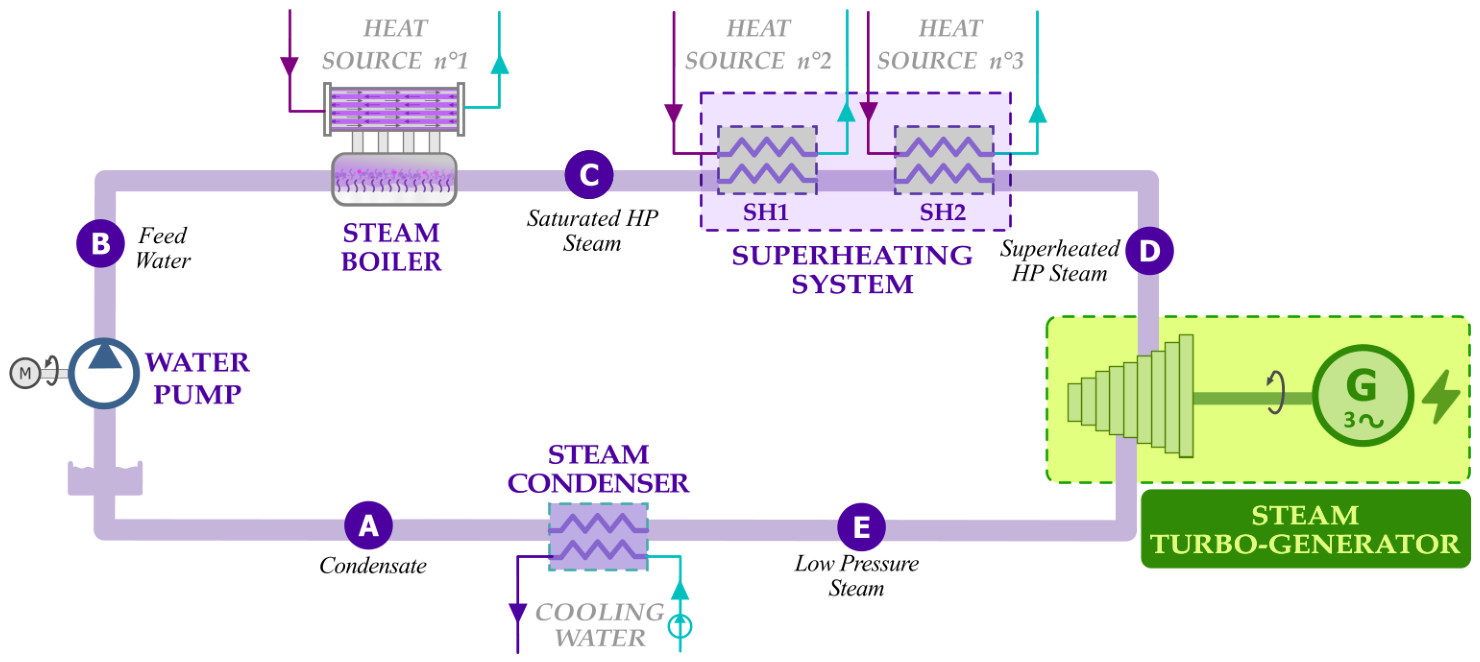
3.1. Scientific Framework of the Case Study
- ∆Esys: variation in the microscopic and macroscopic energy of the system;
- ∆Epot: variation in the potential energy of the system;
- ∆Ekin: variation in the kinetic energy of the system;
- ∆Uint: variation in the internal microscopic energy;
- Qh: heat transfer exchanged between the system and its surroundings;
- Wk: mechanical work exchanged between the system and its surroundings.
- ẇij: the power of the work exchanged between the two states “i” and “j” (kW);
- q·ij: the power of the heat exchanged between the two states “i” and “j” (kW);
- ṁij: the fluid mass flow rate of the between the two states “i” and “j” (kg/s);
- ∆hij: the difference between specific enthalpies in states “i” and “j” (kJ/kg).
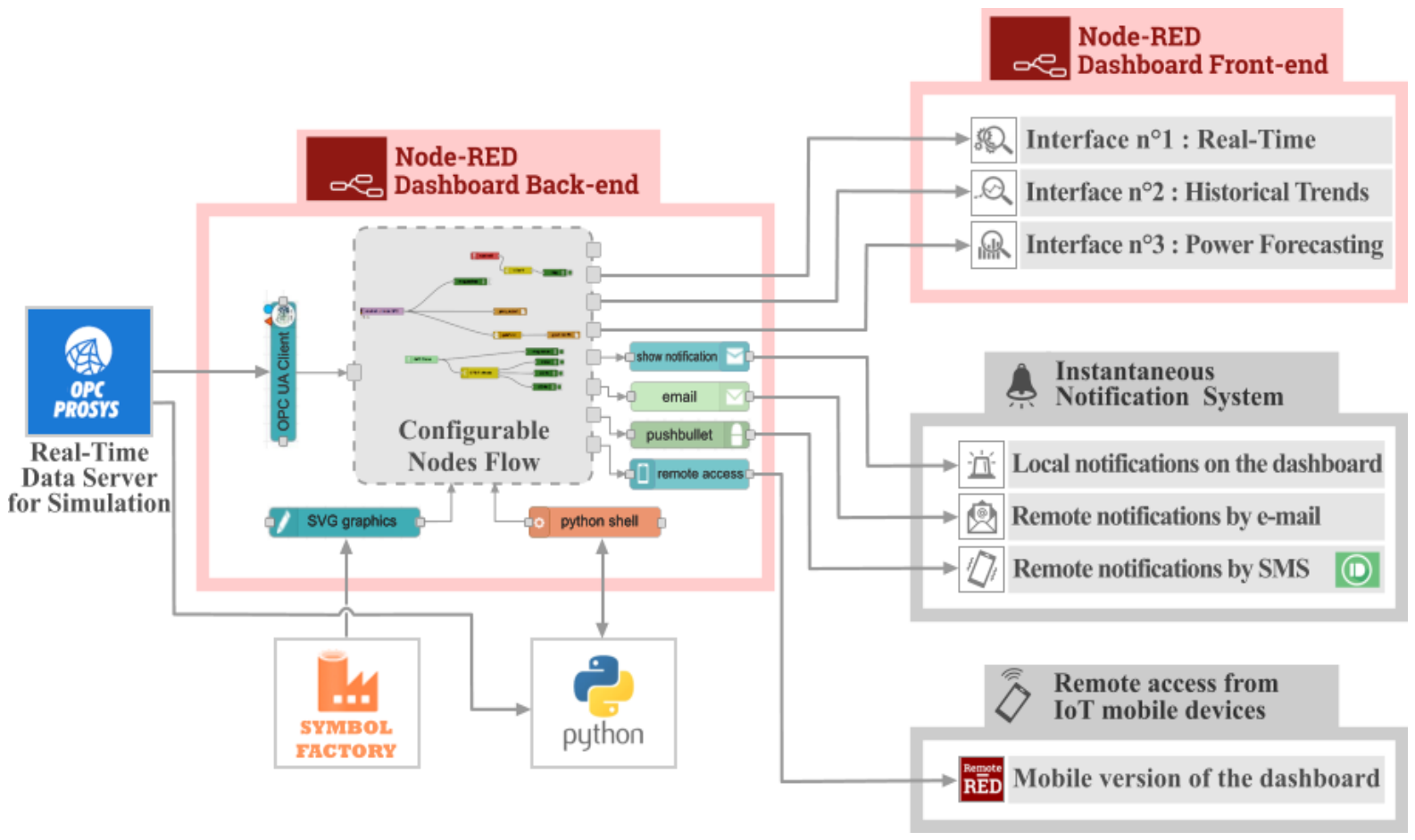
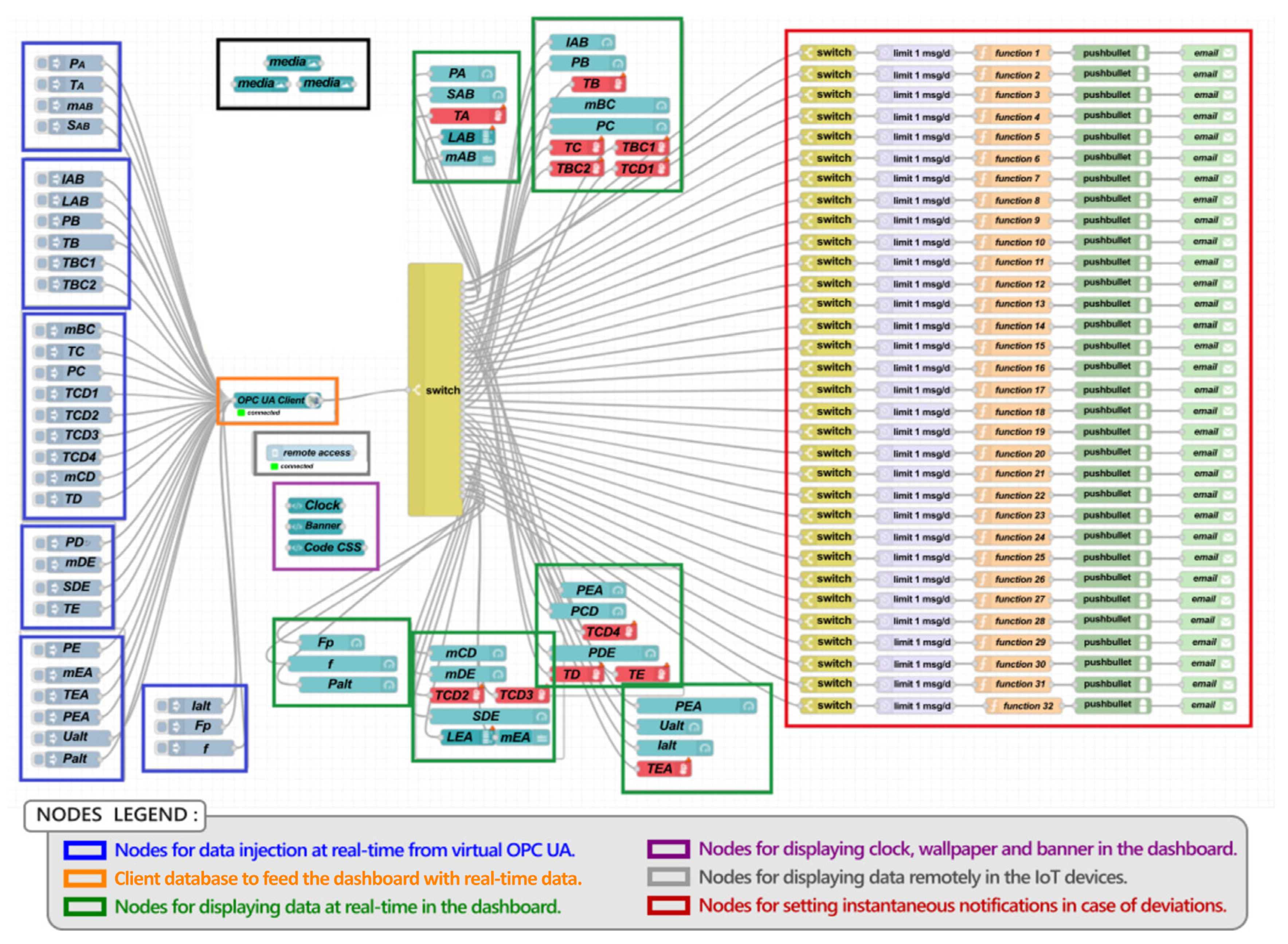
3.2. Architecture of the Designed Dashboard
3.3. Developed Predictive Model of the Third Interface
- : the measured value of the output variable PALT;
- : the predicted value of the output variable PALT;
- : the average value of the output variable PALT;
- N: the number of data points of the set (training set or testing set).
4. Results and Discussion
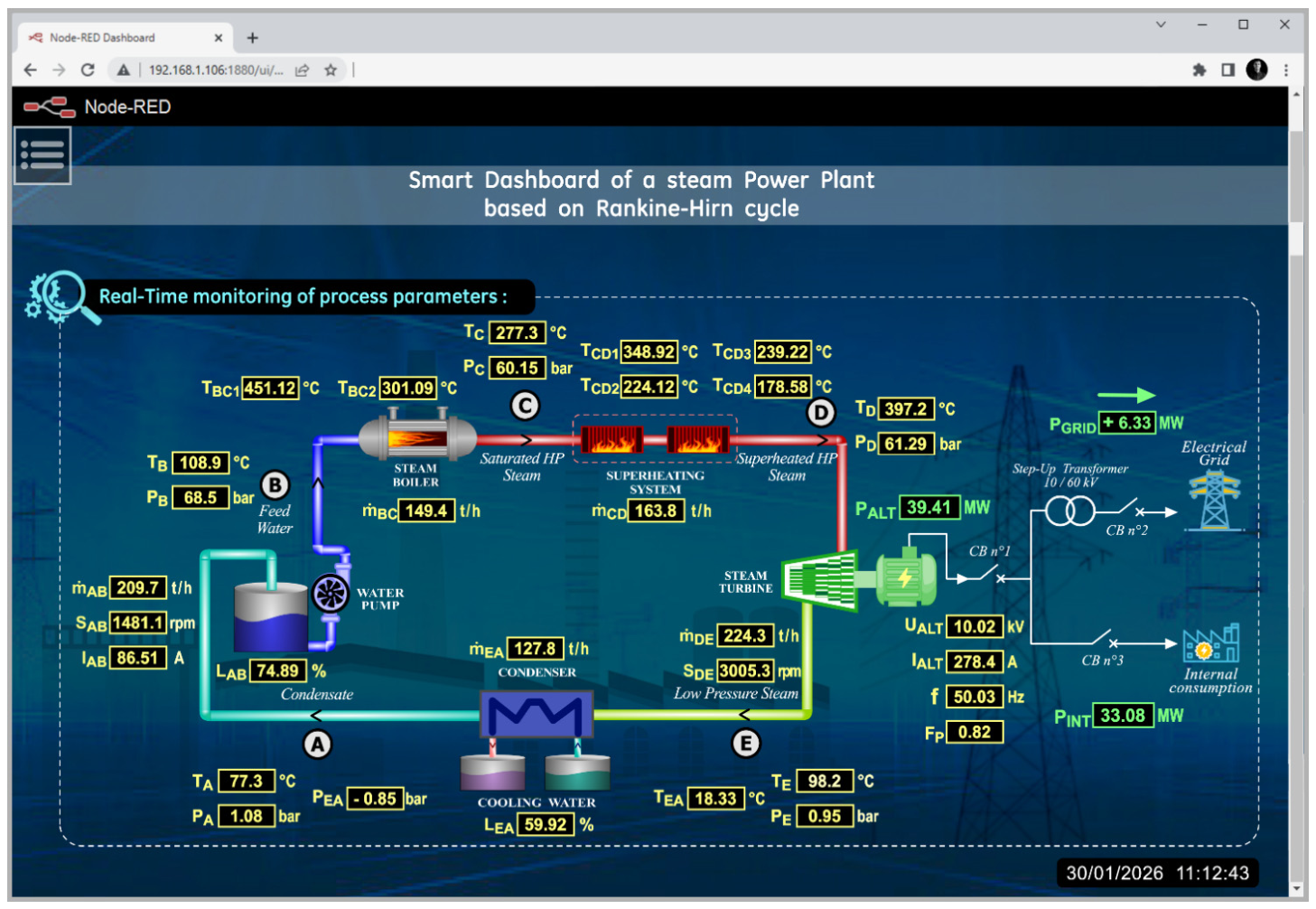
4.1. Findings
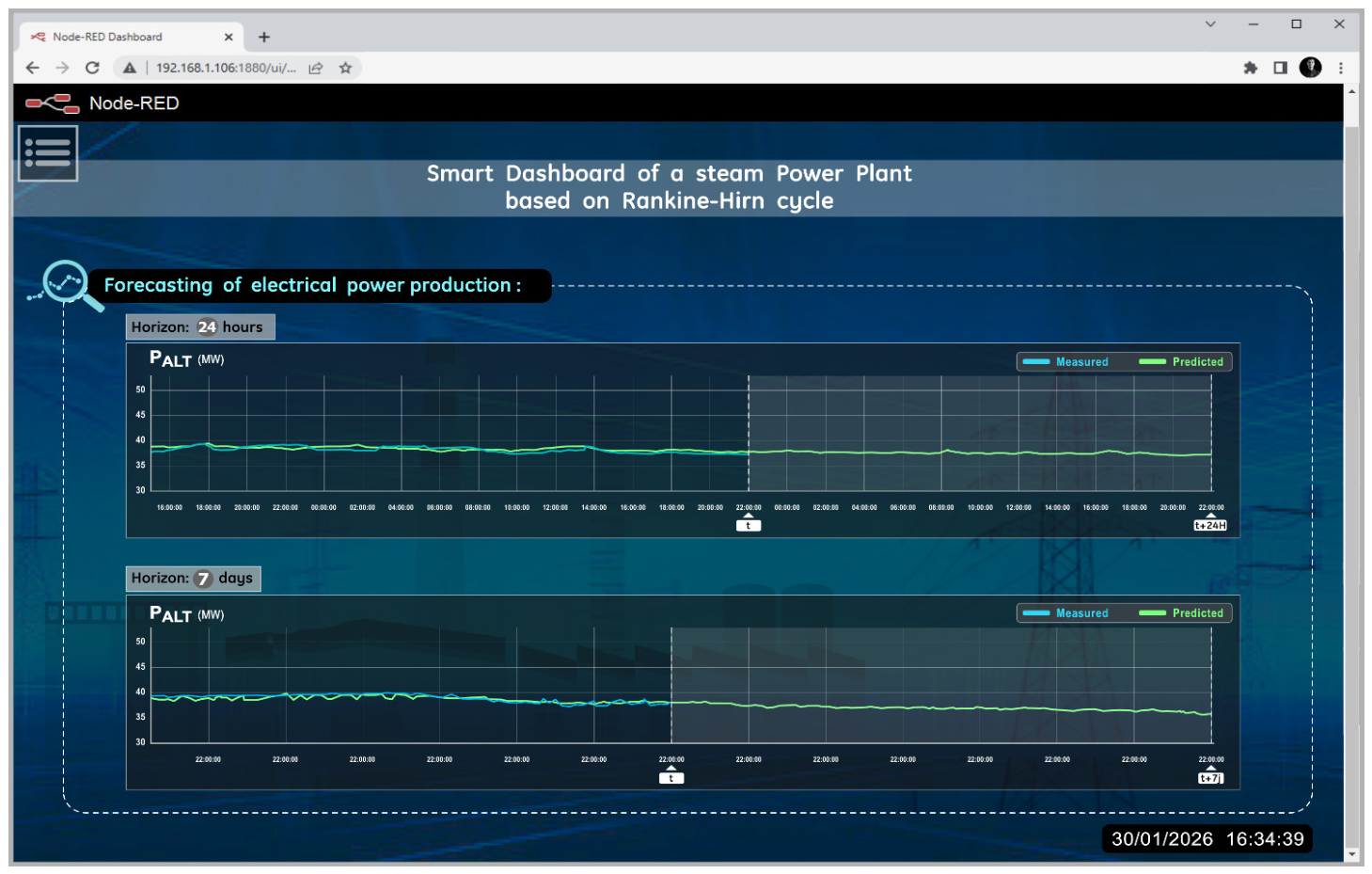
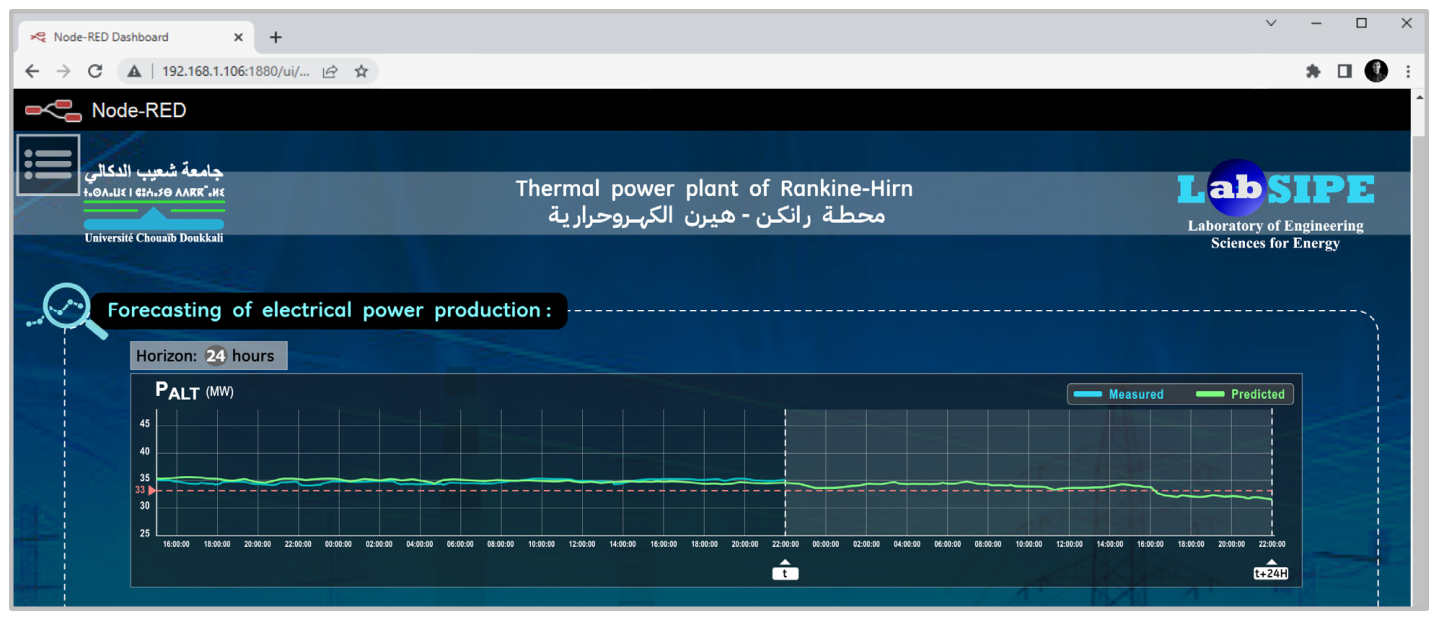
- The first horizon is for the short-term and concerns 24 h ahead of forecasting, it is specially intended for the variables that are actionable during the full running mode of the power plant [33].
- The second horizon is for mid-term forecasting, it involves 7 days of prediction ahead, and it is intended for the variables that are actionable during a shutdown of the power plant.
4.2. Test and Experimentation Through Simulation
- -
- Power plant with energy excess: when production exceeds the critical value of 33 MW, the excess of energy is injected into the grid.
- -
- Power plant with an energy deficit: when production falls below the critical value of 33 MW, the energy deficit is spontaneously compensated by the grid.
4.3. Projected Operational Impacts of the Solution
4.3.1. Calculation of the Avoidable Energy Waste
- EW: the annual avoidable energy imported from the grid, which is considered as an energy waste for the power plant (MW);
- EWk: the monthly avoidable energy imported from the grid (MW);
4.3.2. Calculation of the Avoidable Energy Bill
- Ebill: the avoidable energy bill during a production cycle of two years by impeding the importation from the grid (USD);
- Epk: avoidable energy during peak hours (MWh);
- Eon: avoidable energy during on-peak hours (MWh);
- Eoff: avoidable energy during off-peak hours (MWh);
- Tpk: tariff of energy importation during peak hours (USD/MWh).
- Ton: tariff of energy importation during on-peak hours (USD/MWh);
- Toff: tariff of energy importation during off-peak hours (USD/MWh).
4.3.3. Calculation of the Avoidable Carbon Emissions
- TCO2: the avoidable CO2 emissions during a production cycle of two years by impeding the importation from the grid (Ton);
- SCO2: Current specific carbon emissions in Morocco (0.607 tons/MWh).
5. Conclusions and Outlook
Author Contributions
Funding
Institutional Review Board Statement
Informed Consent Statement
Data Availability Statement
Conflicts of Interest
Abbreviations
| DSS | Decision Support System |
| AI | Artificial Intelligence |
| IoT | Internet of Things |
| OPC | Open Platform Communications |
| OPC UA | Open Platform Communications—Unified Architecture |
| SMS | Short Message Service |
| XGBoost | Extreme Gradient Boosting |
| RFR | Random Forest Regressor |
| GRU | Gated Recurrent Unit |
| MSE | Mean Square Error |
| MAE | Mean Absolute Error |
| IT | Information Technology |
References
- Ferreira, V.B.; Gomes, R.d.A.; Domingos, J.L.; da Fonseca, R.C.B.; Mendes, T.A.; Bouloukakis, G.; da Costa, B.B.F.; Haddad, A.N. Planning Energy-Efficient Smart Industrial Spaces for Industry 4.0. Eng 2025, 6, 53. [Google Scholar] [CrossRef]
- Ranade, A.; Gómez, J.; de Juan, A.; Chicaiza, W.D.; Ahern, M.; Escaño, J.M.; Hryshchenko, A.; Casey, O.; Cloonan, A.; O’sullivan, D.; et al. Implementing Industry 4.0: An in-depth case study integrating digitalisation and modelling for decision support system applications. Energies 2024, 17, 1818. [Google Scholar] [CrossRef]
- Harmoko, U.; Christwardana, M.; Rizkan, M. Use of Machine Learning-Based Health Index With K-Nearest Neighbors Method to Maintain Desalination Plant Performance Gas and Steam Power Plants Applications. Asian J. Soc. Humanit. 2025, 3, 1439–1456. [Google Scholar] [CrossRef]
- Rediske, P.D.R.G. Performance Monitoring Dashboard. In Proceedings of the Industrial Engineering and Operations Management: XXX IJCIEOM, Salvador, Brazil, 26–28 June 2024; Volume 483, p. 489. [Google Scholar]
- Bawane, S.; Matange, G.; Shrivastava, A.; Qureshi, A.R.; Sultan, S.; Shrivastava, D. Smart Wind Farm Management Using IoT and Predictive in Analytics. Int. J. Environ. Sci. 2025, 11, 1079–1095. [Google Scholar]
- Hamza, M. Development of an IoT-Enabled Android Dashboard for Smart Trainer and Solar Energy Visualization at Meteoria. 2025. Available online: https://www.theseus.fi/handle/10024/894219 (accessed on 7 November 2025).
- Tohir, Y.; Laksono, A.D.; Hardana, H.E.; Prayitno, H.; Kurniawan, T.E.K.; Rokim, A. Smart Building for Energy Management using IoT at Coal-Fired Power Plant Facilities. In Proceedings of the 2024 IEEE International Conference on Internet of Things and Intelligence Systems (IoTaIS), Bali, Indonesia, 28–30 November 2024; IEEE: New York, NY, USA, 2024. [Google Scholar]
- Arief, R. Current and Voltage Monitoring in Wind Power Plants Using ESP8266 And Node-Red. Vokasi Unesa Bull. Eng. Technol. Appl. Sci. 2024, 1, 64–71. [Google Scholar] [CrossRef]
- Cigánek, J.; Dávid, Č. Visualization of Production Data Using Node-Red. Inf. Technol. Appl. 2024, 13, 17–28. [Google Scholar]
- Al-Mohannadi, A.; Masoud, M.; Al-Naemi, B.; Kucukvar, M. Assessment of the GHG performance of a gas plant through an interactive business intelligence dashboard. In Innovation and Technological Advances for Sustainability; CRC Press: Boca Raton, FL, USA, 2024; pp. 291–299. [Google Scholar]
- Kurniawan, A.; Danaputra, F.I.; Putra, P.D.; Fatimah, F.; Rahmanissa, A. Centralized Automatic Greasing with Intelligent Notification to Maximize Reliability and Hazardous Waste Reduction in Combined Cycle Power Plant. In IOP Conference Series: Earth and Environmental Science; IOP Publishing: Bristol, UK, 2024; Volume 1414. [Google Scholar]
- Khan, M.; Raza, M.A.; Faheem, M.; Sarang, S.A.; Panhwar, M.; Jumani, T.A. Conventional and artificial intelligence based maximum power point tracking techniques for efficient solar power generation. Eng. Rep. 2024, 6, e12963. [Google Scholar] [CrossRef]
- Mazdak, S.; Moosavi, S.M.M.; Bahramian, A. Enhanced power generation through hybrid solar chimney coupled with a steam turbine power plant leveraging heat recovery. Int. J. Energy Res. 2025, 2025, 9958191. [Google Scholar] [CrossRef]
- Mohapatra, A.G.; Mohanty, A.; Tripathy, P.K. IoT-enabled predictive maintenance and analytic hierarchy process based prioritization of real-time parameters in a diesel generator: An industry 4.0 case study. SN Comput. Sci. 2024, 5, 145. [Google Scholar] [CrossRef]
- Li, Z.; Shi, J.; Li, M.; Fan, S.; Yao, K.; Wan, J. Online monitoring and fault early warning prediction method for the operational status of steam turbine sliding pin systems. Meas. Sci. Technol. 2024, 36, 016220. [Google Scholar] [CrossRef]
- Thirumurthy, D.; Scudamore, M. Novel Applications of Data Analytics in Gas Turbine Operation for Distributed Power Generation. In Turbo Expo: Power for Land, Sea, and Air; American Society of Mechanical Engineers: New York, NY, USA, 2024. [Google Scholar]
- Fakir, K.; Haba, J.A.; Ennawaoui, C.; El Mouden, M. Forecasting Electricity Generated in A Rankine Power Station Running in Gridconnected Mode. Int. J. Intell. Eng. Syst. 2023, 16. [Google Scholar] [CrossRef]
- Zivieri, R. Trends in the second law of thermodynamics. Entropy 2023, 25, 1321. [Google Scholar] [CrossRef]
- Hake, L.; der Wiesche, S.A. Trailing Edge Loss of Choked Organic Vapor Turbine Blades. Int. J. Turbomach. Propuls. Power 2025, 10, 23. [Google Scholar] [CrossRef]
- Kerboua, K.; Cheniti, H.; Bouvett, C.F.; Gasmi, I.; Aouissi, H.A.; Petrisor, A.-I.; Boştenaru-Dan, M. A Techno-ecological transformative approach of municipal solid waste landfill in upper-middle-income countries based on energy recovery. Sustainability 2025, 17, 1479. [Google Scholar] [CrossRef]
- Brancaleoni, P.P.; Corti, E.; Di Prospero, F.; Di Battista, D.; Cipollone, R.; Ravaglioli, V. Optimization of Hydrogen Internal Combustion Engines Equipped with Turbocompound Technology for Enhanced Performance and Efficiency. Energies 2025, 18, 2166. [Google Scholar] [CrossRef]
- Moussa, M.; Abbas, M.; ElMaraghy, H. Industry 4.0 in Automotive Manufacturing: A Digital Twin Approach. Procedia CIRP 2025, 134, 825–830. [Google Scholar] [CrossRef]
- Kiangala, K.S.; Wang, Z. An inceptive approach for designing simple digital twins and industrial metaverse process frameworks for small manufacturing I5. 0 environments using Node-RED. Int. J. Adv. Manuf. Technol. 2025, 140, 2245–2268. [Google Scholar] [CrossRef]
- Rodríguez, F.; César, D.; Cajo, D. Desarrollo de Una Aplicación Basada en Aprendizaje de Máquina Para la Transferencia Automática de Reconectadores en Falla de la Red Eléctrica de Guayaquil. Diss. 2025. Available online: https://www.dspace.espol.edu.ec/xmlui/handle/123456789/65796 (accessed on 7 November 2025).
- Fakir, K.; Ennawaoui, C.; El Mouden, M. Design of a six-layer data architecture based on OT/IT convergence in the context of Industry 4.0. In Proceedings of the 2023 3rd International Conference on Innovative Research in Applied Science, Engineering and Technology (IRASET), Mohammedia, Morocco, 18–19 May 2023; IEEE: New York, NY, USA, 2023. [Google Scholar]
- Calderón, D.; Folgado, F.J.; González, I.; Calderón, A.J. Implementation and experimental application of industrial IoT architecture using automation and IoT Hardware/Software. Sensors 2024, 24, 8074. [Google Scholar] [CrossRef]
- Nițulescu, I.-V.; Korodi, A. Supervisory control and data acquisition approach in node-RED: Application and discussions. IoT 2020, 1, 5. [Google Scholar] [CrossRef]
- Reddy, V.M.K.; Lokasree, B.S.; Kumar, K.N. IOT based smart meter using node-red. In Proceedings of the 2023 International Conference on Artificial Intelligence and Smart Communication (AISC), Greater Noida, India, 27–29 January 2023; IEEE: New York, NY, USA, 2023. [Google Scholar]
- Fakir, K.; Ennawaoui, C.; El Mouden, M. Deep learning algorithms to predict output electrical power of an industrial steam turbine. Appl. Syst. Innov. 2022, 5, 123. [Google Scholar] [CrossRef]
- Chicco, D.; Warrens, M.J.; Jurman, G. The coefficient of determination R-squared is more informative than SMAPE, MAE, MAPE, MSE and RMSE in regression analysis evaluation. PeerJ Comput. Sci. 2021, 7, e623. [Google Scholar] [CrossRef] [PubMed]
- Uzougbo, O.I.; Olowojebutu, A.O.; Akomolede, K.K. Node-red and IoT analytics: A real-time data processing and visualization platform. Tech-Sphere Multidiscip. Int. J. (TSMIJ) 2024, 1, 3672–4648. [Google Scholar]
- Rosalin, B.D. Energy Monitoring in Wave Power Plant Based on Node-Red and ESP 8266. Vokasi Unesa Bull. Eng. Technol. Appl. Sci. 2024, 1, 112–120. [Google Scholar]
- Didavi, K.B.A.; Agbokpanzo, R.G.; Agbomahena, B.M. LSTM and XGBoost models for 24-hour ahead forecast of PV power from direct irradiation. Renew. Energy Res. Appl. 2024, 5, 229–241. [Google Scholar]
- Lin, M.H.; Wu, S.H.; Huang, B.W.; Chen, P.H.; Huang, C.H.; Chen, C.Y.; Yang, C.F. Node-RED Web-based Monitor and Control of Power System Using Modbus and Message Queuing Telemetry Transport Communication in Raspberry Pi Embedded Platform. Sens. Mater. 2024, 36, 4849–4864. [Google Scholar] [CrossRef]
- Helgeson, B. Europe, the Green Island? Developing an Integrated Energy System Model to Assess an Energy-Independent, CO2-Neutral Europe; No. 24/02. EWI Working Paper; Institute of Energy Economics at the University of Cologne (EWI): Köln, Germany, 2024. [Google Scholar]
- Ait Faraji, S.; Nouzha, Z. What is the Optimal Value of the Carbon Tax for Morocco? In International Conference on Advanced Sustainability Engineering and Technology; Springer Nature Switzerland: Cham, Switzerland, 2025. [Google Scholar]




| Author | Year | Category of Power Production | Main Contributions and Impacts | Ref. |
|---|---|---|---|---|
| Harmoko | 2026 | Steam Turbine Power Plant | The interactive dashboard of this paper features a predictive algorithm for the power output of a turbine generator. This model is built using the K-Nearest Neighbor (KNN) algorithm. It was an effective decision-making tool, distinguished by the fact that it offers up to 8% additional productivity simply by using the dashboard to make proactive decisions based on the model’s predictive results. Our research addresses a more specific and critical operational challenge. Unlike existing general models, this work focuses on the Rankine–Hirn thermodynamic cycle within steam thermal power plants. We introduce a Decision Support System (DSS) specifically engineered to tackle sudden power drops. By integrating a custom Python-based predictive model with a real-time Node-RED interface, our approach moves beyond general productivity to provide a robust, sustainable monitoring solution that alerts users to specific underperformance events before they occur. While the KNN dashboard offers a valuable 8% productivity gain, this work elevates the domain by shifting from broad optimization to targeted risk mitigation within the specialized Rankine–Hirn cycle. By replacing a standalone tool with an integrated, real-time Decision Support System, it bridges the gap between passive predictive modeling and proactive industrial maintenance. | [3] |
| Rediske | 2025 | PV Solar Power Plant | In this case, the paper has demonstrated the value of automated dashboards for solar power parks, primarily focusing on the calculation of Key Performance Indicators (KPIs) to improve asset availability and streamline maintenance. However, while KPI monitoring is essential for assessing historical performance, it often lacks the predictive foresight required to manage complex thermodynamic fluctuations. Our research advances this field by transitioning from passive KPI tracking to a proactive decision-making system tailored for steam thermal power plants. Unlike the aforementioned solar-focused studies, our approach utilizes Python-driven predictive modeling to specifically address the problem of sudden power drops in the Rankine–Hirn cycle. By integrating this model into a real-time Node-RED dashboard, we provide a solution that does not just report failures but actively alerts operators to prevent imminent power loss. While solar dashboards effectively track historical KPIs for asset availability, they lack the predictive foresight needed for complex thermodynamic systems. This study successfully bridges that gap by shifting from passive reporting to active, real-time failure prevention within the Rankine–Hirn cycle. | [4] |
| Bawane | 2025 | Wind Power Plant | It is an IoT-based dashboard to realize real-time management of wind farms. This mode of monitoring has allowed us to ensure a high efficiency of power production, knowing that it also includes an interface of power prediction based on machine learning algorithms that makes it possible to increase daily productivity by more than 3 MWh. Our study diverges from these general IoT monitoring systems by focusing specifically on the Rankine–Hirn thermodynamic cycle. Rather than focusing solely on incremental productivity gains, it lies in the development of a predictive model designed to mitigate sudden power drops—a recurring issue in steam plants. By leveraging historical archived data, we provide a specialized solution for real-time alerting and long-term operational sustainability that generic IoT frameworks do not address. | [5] |
| Hamza Muhammad | 2024 | PV Solar Power Plant | This research leverages the transformative potential of Industry 4.0 by integrating emerging technologies, such as the MQTT (Message Queuing Telemetry Transport) protocol and high-precision IoT sensors, to construct a comprehensive real-time dashboard. The primary objective is to streamline the decision-making process by providing stakeholders with instantaneous visibility into operational metrics, thereby significantly enhancing time management and resource allocation. By digitizing the feedback loop, the system reduces the latency between data acquisition and corrective action, which is vital in fast-paced industrial environments. | [6] |
| Tohir | 2024 | Coal-Fired Power Plant | This work presents a low-investment, high-impact framework that capitalizes on the deployment of smart sensing technologies, specifically intelligent energy meters, to establish a centralized and remotely accessible monitoring dashboard. By prioritizing cost-effective hardware integration, the solution demonstrates how legacy industrial infrastructure can be modernized without the need for prohibitive capital expenditure. This study was instrumental in the ISO 50001 certification process of a coal-fired power plant, where the implementation of these enhanced decision-making tools directly contributed to a documented 11.76% reduction in energy losses. This proves that real-time visibility is a powerful catalyst for operational efficiency and rigorous energy management. This low-cost hardware framework effectively reduces energy losses by maximizing real-time visibility of current waste. Our study builds upon this foundation by integrating predictive modeling, moving beyond mere monitoring to actively prevent future operational drops. | [7] |
| Arief | 2024 | Wind Power | The particularity of this research work is that it is based on the “Node-Red” and Remote-Red platform, to design a mobile dashboard that can be consulted from smartphones. This architectural choice facilitates a transition toward “On-the-Go” industrial management, allowing engineers to bypass the constraints of fixed-site monitoring stations. By centralizing data through this agile, flow-based programming environment, this idea guarantees rigorous monitoring of the operating parameters of the wind farm studied, which saves time and efficiency by reducing decision-making times for managers. Such a system proves invaluable for remote sites, where the ability to visualize real-time performance metrics on a handheld device can mean the difference between a minor adjustment and a costly system failure. While mobile dashboards successfully liberate operators from fixed workstations through real-time visualization, they remain focused on passive data access. This study advances that mobility by embedding predictive alerts directly into the handheld interface, transforming a remote viewing tool into a proactive decision-making asset. | [8] |
| Cigánek | 2024 | Steam Turbine Power Plant | In the case of a steam turbine and using the “Node-Red” platform, the study demonstrates that the combination of Industry 4.0 technologies and advanced automation can increase the efficiency of operational monitoring. By integrating real-time data flows with intuitive visual programming, this approach allows for a granular oversight of thermodynamic variables that were previously siloed in legacy systems. Consequently, decision-making becomes more fluid, which also has an impact on sustainability and decarbonization. This fluidity enables operators to maintain the turbine within its optimal efficiency window, thereby reducing fuel consumption and minimizing the carbon footprint associated with thermal power generation. | [9] |
| Al Mohannadi | 2024 | Gas Turbine Power Plant | This study incorporates a predictive model of power production based on Random Forest Regressor (RFR), built using a five-year historical dataset. By leveraging this ensemble learning technique, the research captures non-linear relationships between operational variables and output, ensuring a robust baseline for performance forecasting. The model’s results were then incorporated into an interactive dashboard, transforming complex algorithmic outputs into actionable visual insights for plant operators. This achievement has improved the decision-making process, both in terms of energy and the environment, by reducing greenhouse gas emissions by approximately 1,400 tons per year, primarily through the optimization of fuel combustion and the early detection of efficiency drifts. An analysis of this RFR-based model highlights its success in reducing emissions by utilizing a five-year dataset to optimize fuel combustion. Our work builds upon this insight by introducing a multi-algorithm approach and real-time integration to target sudden, short-term power drops within the specific Rankine–Hirn cycle. | [10] |
| Kurniawan | 2024 | Combined Cycle Power Plant (CCPP) | The mechanism used to develop the smart dashboard in this case was Node-RED associated with a predictive model developed under Python. This hybrid architecture leverages the rapid prototyping and data-flow orchestration of Node-RED alongside the robust analytical power of Python’s machine learning libraries. By creating a seamless bridge between raw data acquisition and advanced algorithmic processing, the system transforms static metrics into dynamic forecasts. Even if the impact of this study was not clearly quantified, the developed smart dashboard allows to maximize the reliability of the plant. This is achieved by shifting the operational paradigm from reactive maintenance to a more informed, proactive stance, ensuring that critical components are monitored against their theoretical performance curves. This became true thanks to the intelligent and instantaneous notifications that enormously helped the site managers to make good decisions at the right moment, effectively reducing the cognitive load on operators during high-pressure scenarios. | [11] |
| Khan Malhar | 2024 | PV Solar Power Plant | The target behind developing the business intelligence dashboard of this paper was to enhance the maximum power point tracking (MPPT) to achieve an efficient solar power generation. By providing a centralized platform for monitoring atmospheric variables such as irradiance and ambient temperature, the dashboard serves as a strategic interface to optimize the alignment between photovoltaic output and load demands. The dashboard was equipped with an artificial intelligence model based on artificial neural networks (ANN) that has given an accuracy score of 99.2%, which was a tangible added value to the dashboard as a decision support system. This high-precision forecasting allows operators to anticipate fluctuations in energy harvest with near-certainty, transforming the dashboard from a simple visualization tool into a robust engine for grid stability and performance optimization. | [12] |
| Mazdak | 2024 | Steam Turbine Power Plant | Increasing the overall efficiency of the power plant was the main objective of this work. To achieve this, the research focused on a sophisticated technological framework performed through a solution involving supervision and monitoring aiming to maximize energy recovery from the gas at the chimney output. By deploying advanced thermal sensors and real-time data acquisition systems, the study targeted the “waste heat” typically lost to the atmosphere, seeking to reintegrate this energy into the plant’s thermodynamic cycle. The implementation of this solution could contribute to enhancing the overall efficiency from 83% to 91%, representing a massive leap in operational performance and fuel economy. This gain demonstrates the untapped potential of digital oversight when applied to the recovery of low-grade thermal energy from flue gases. | [13] |
| Mohapatra | 2024 | Diesel Power Generation | The authors of this work have chosen the technology of the Internet of Things (IoT) to build their decision-making solution based on business intelligence. By deploying a network of interconnected sensors across the plant’s critical infrastructure, they have established a continuous data pipeline that feeds a centralized analytical engine. In this sense, the dashboard was equipped with a model for predictive maintenance, allowing breakdowns to be anticipated by predicting the remaining useful life (RUL) of key components such as turbines, pumps, or bearings. This transition from traditional scheduled maintenance to a condition-based approach allows the user to act proactively to gain energy productivity, ensuring that assets are repaired only when necessary but before a catastrophic failure occurs, thus minimizing unplanned downtime and optimizing the levelized cost of energy. An analysis of this IoT-driven framework reveals how predicting the remaining useful life (RUL) of components successfully minimizes unplanned downtime through condition-based maintenance. Our work builds upon this predictive approach by shifting the focus from individual component wear to the real-time prevention of sudden thermodynamic power drops across the entire Rankine–Hirn cycle. | [14] |
| Zongjie | 2024 | Steam Turbine Power Plant | The BI platform used in this work is centered around a predictive model of electrical energy production, driven by the long short-term memory (LSTM) algorithm. By utilizing this specific type of recurrent neural network, the system is uniquely capable of capturing long-term dependencies and complex temporal patterns within the power plant’s historical data, which traditional linear models often overlook. In addition, this work is particularly notable for the addition of an alarm system, alerting users to abnormal deviations in process variables. This proactive layer ensures that any drift from the optimal operating envelope is flagged instantly. This approach aims to improve end-user responsiveness to undesirable situations that could impact productivity, which in itself represents an effective decision-making tool that allows productivity to be increased three times compared to standard monitoring, transforming the dashboard from a passive display into an active guardian of operational continuity. Examining this LSTM platform reveals its strength in capturing temporal patterns and boosting responsiveness through basic process alarms. Our research expands on this concept by merging predictive intelligence with a three-tiered alert system to actively mitigate sudden thermodynamic power drops. | [15] |
| Thirumurthy | 2024 | Gas Turbine Power Plant | This paper highlights the increased value of gas turbines through digitalization and real-time data analysis, emphasizing how silicon-based intelligence now complements traditional steel-based engineering. It is founded on the following three digital applications co-developed by Siemens Energy: First, remote diagnostics to increase availability and reduce costs by enabling offshore or isolated sites to access global expert centers without the need for physical travel. Second, advanced vibration analysis for reliability-driven maintenance, as well as maintenance optimization and reduced lifecycle costs. Third, by utilizing high-frequency telemetry to detect spectral anomalies in rotating components, the system can identify incipient flaws long before they lead to mechanical failure. The study demonstrates how these tools are transforming asset management by enabling proactive decision-making and operational efficiency for customers, effectively shifting the industry standard from reactive “break–fix” models to data-driven strategic planning. | [16] |
| Steps of the Process | Power Machine | Particularity of the Transformation | Physical Equations of Power Exchange | |
|---|---|---|---|---|
| From state (A) to state (B) | Water pump | Adiabatic | ẇAB = ṁAB × (hB − hA) | (4) |
| From state (B) to state (C) | Steam boiler | Isobaric | q·BC = ṁBC × (hC − hB) | (5) |
| From state (C) to state (D) | Steam superheaters | Isobaric | q·CD = ṁCD × (hD − hC) | (6) |
| From state (D) to state (E) | Turbine | Adiabatic | ẇDE = ṁDE × (hE − hD) | (7) |
| From state (E) to state (A) | Steam condenser | Isobaric | q·EA = ṁEA × (hA − hE) | (8) |
| Input Variables | Symbol | Physical Unit | Nominal Value | Alarm Value |
|---|---|---|---|---|
| Pressure of the fluid at state (A). | PA | bar | 1.05 | 1.2 |
| Temperature of the fluid at state (A). | TA | °C | 77.5 | 90 |
| Pressure of the fluid at state (B). | PB | bar | 66 | 71 |
| Temperature of the fluid at state (B). | TB | °C | 108 | 120 |
| Pressure of the fluid at state (C). | PC | bar | 60 | 68 |
| Temperature of the fluid at state (C). | TC | °C | 277 | 290 |
| Pressure of the fluid at state (D). | PD | bar | 62 | 68 |
| Temperature of the fluid at state (D). | TD | °C | 397 | 410 |
| Pressure of the fluid at state (E). | PE | bar | 1.05 | 1.2 |
| Temperature of the fluid at state (E). | TE | °C | 98.2 | 110 |
| Mass flow of the fluid during the transformation (A→B). | ṁAB | t/h | 210 | 220 |
| Rotation speed of the pump. | SAB | rpm | 1480.1 | 1450 |
| Electrical current of the motor. | IAB | Ampere | 86.5 | 82 |
| Level of the water tank. | LAB | % | 75.0 | 15 |
| Mass flow of the fluid during the transformation (B→C). | ṁBC | t/h | 148 | 160 |
| Input temperature of the heating gas at the boiler. | TBC1 | °C | 448 | 465 |
| Output temperature of the heating gas at the boiler. | TBC2 | °C | 298 | 315 |
| Mass flow of the fluid during the transformation from (C→D). | ṁCD | t/h | 161 | 170 |
| Input temperature of the heating gas at superheater n°1. | TCD1 | °C | 346 | 360 |
| Output temperature of the heating gas at superheater n°1. | TCD2 | °C | 222 | 235 |
| Input temperature of the heating gas at superheater n°2. | TCD3 | °C | 238 | 255 |
| Output temperature of the heating gas at superheater n°2. | TCD4 | °C | 174 | 185 |
| Mass flow of the fluid during the transformation from (D→E). | ṁDE | t/h | 223 | 235 |
| Rotation speed of the turbomachine. | SDE | rpm | 3000 | 2850 |
| Mass flow of the fluid during the transformation from (E→A). | ṁEA | t/h | 126 | 135 |
| Temperature of the cooling water at the condenser. | TEA | °C | 18 | 20 |
| Pressure of the vacuum at the condenser. | PEA | bar | −0.85 | −0.75 |
| Level of the cooling water basin. | LEA | % | 75.0 | 15 |
| Electrical voltage of the power generator. | UALT | kV | 10.0 | 10.5 |
| Electrical current of the power generator. | IALT | Ampere | 2885 | 3050 |
| Power factor. | FP | without unit | 0.85 | 0.79 |
| Frequency of the electrical current. | F | Hz | 50.0 | 50.5 |
| Metrics of Assessment | Mathematical Formula | RFR | XGBoost | GRU | ||||
|---|---|---|---|---|---|---|---|---|
| Training Phase | Testing Phase | Training Phase | Testing Phase | Training Phase | Testing Phase | |||
| Score of determination | (9) | 0.9204 | 0.9304 | 0.9936 | 0.9911 | 0.9633 | 0.9721 | |
| Mean Square Error | (10) | 0.0341 | 0.0837 | 0.00024 | 0.0003 | 0.0065 | 0.00298 | |
| Mean Absolute Error | (11) | 0.0793 | 0.0776 | 0.0031 | 0.00435 | 0.00783 | 0.00801 | |
| Hyperparameter | Value |
|---|---|
| Nbr. of estimators | 500 |
| Learning rate | 0.02 |
| Max_depth | 7 |
| Early stopping round | 50 |
| Subsample | 0.7 |
| Jan | Feb | Mar | Apr | May | June | July | Aug | Sept | Oct | Nov | Dec | Total | ||
|---|---|---|---|---|---|---|---|---|---|---|---|---|---|---|
| EW1 | EW2 | EW3 | EW4 | EW5 | EW6 | EW7 | EW8 | EW9 | EW10 | EW11 | EW12 | EW | ||
| Imported Energy from the grid (MWh) | Year of 2024 | 984.8 | 429.4 | 291.5 | 562.8 | 186.7 | 1194.2 | 1181.6 | 895.7 | 0 | 0 | 0 | 412.1 | 6138.8 |
| Year of 2025 | 0 | 0 | 0 | 0 | 210.9 | 290.0 | 40.3 | 0 | 0 | 386.9 | 178.6 | 379.4 | 1486.1 | |
| Year | Imported Energy from the Grid (MWh) | Distribution of Imported Energy Across Tariff Periods (MWh) | Energy Tariff (USD/MWh) | Avoidable Energy Bill (USD) | ||
|---|---|---|---|---|---|---|
| 2024 | 6138.8 | Peak hours | 1534.7 | 97.0 | 148,865.9 | 509,827.3 |
| On-peak hours | 2578.3 | 85.0 | 219,155.1 | |||
| Off-peak hours | 2025.8 | 70.0 | 141,806.2 | |||
| 2025 | 1486.1 | Peak hours | 371.53 | 97.0 | 36,037.9 | 123,420.6 |
| On-peak hours | 624.16 | 85.0 | 53,053.7 | |||
| Off-peak hours | 490.41 | 70.0 | 34,328.9 | |||
Disclaimer/Publisher’s Note: The statements, opinions and data contained in all publications are solely those of the individual author(s) and contributor(s) and not of MDPI and/or the editor(s). MDPI and/or the editor(s) disclaim responsibility for any injury to people or property resulting from any ideas, methods, instructions or products referred to in the content. |
© 2026 by the authors. Licensee MDPI, Basel, Switzerland. This article is an open access article distributed under the terms and conditions of the Creative Commons Attribution (CC BY) license.
Share and Cite
Fakir, K.; Ennawaoui, C.; Mouden, M.E. Smart Dashboard for Sustainable Management of Electrical Energy in a Rankine–Hirn Power Station. Sustainability 2026, 18, 5787. https://doi.org/10.3390/su18115787
Fakir K, Ennawaoui C, Mouden ME. Smart Dashboard for Sustainable Management of Electrical Energy in a Rankine–Hirn Power Station. Sustainability. 2026; 18(11):5787. https://doi.org/10.3390/su18115787
Chicago/Turabian StyleFakir, Kossai, Chouaib Ennawaoui, and Mahmoud El Mouden. 2026. "Smart Dashboard for Sustainable Management of Electrical Energy in a Rankine–Hirn Power Station" Sustainability 18, no. 11: 5787. https://doi.org/10.3390/su18115787
APA StyleFakir, K., Ennawaoui, C., & Mouden, M. E. (2026). Smart Dashboard for Sustainable Management of Electrical Energy in a Rankine–Hirn Power Station. Sustainability, 18(11), 5787. https://doi.org/10.3390/su18115787