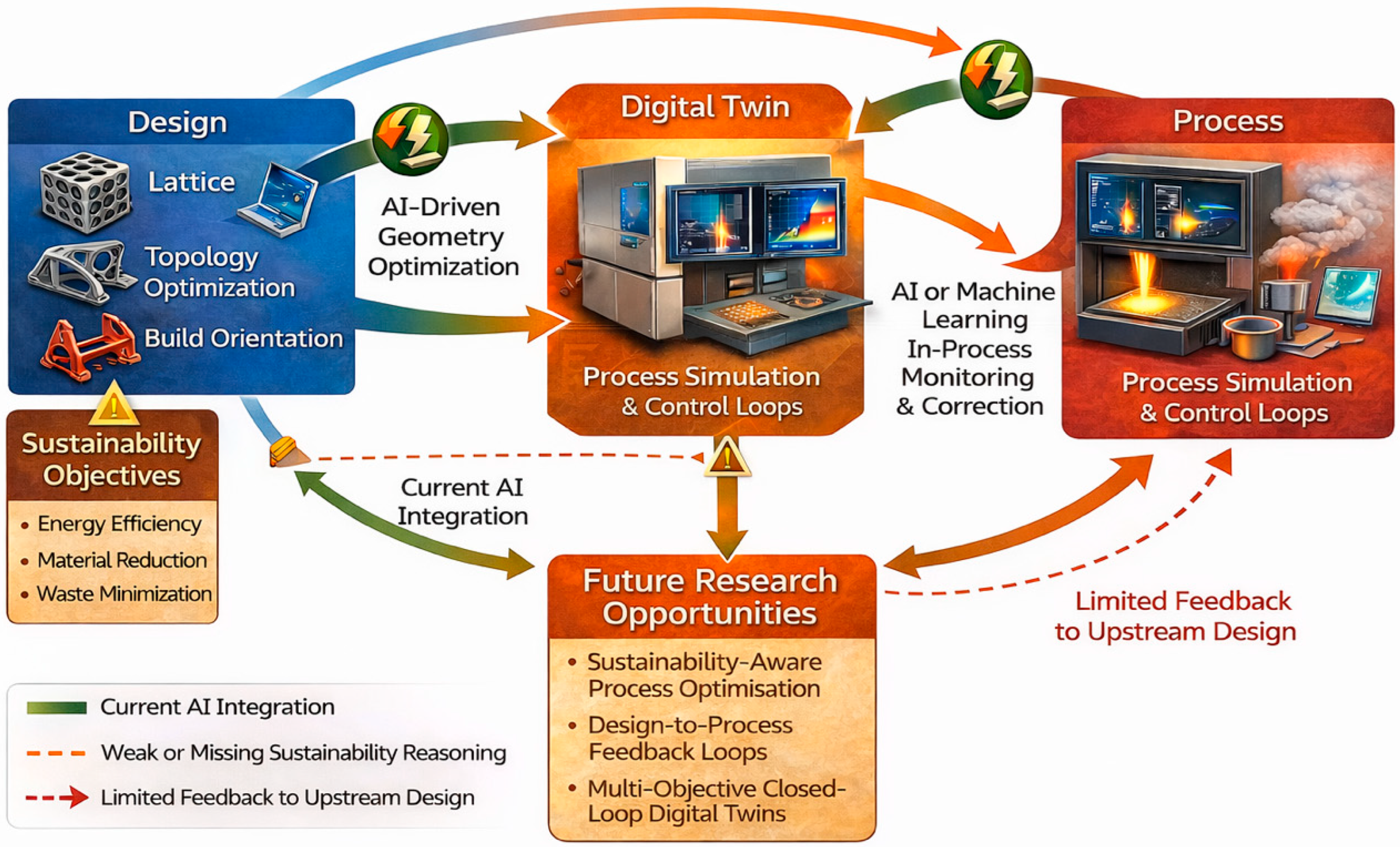
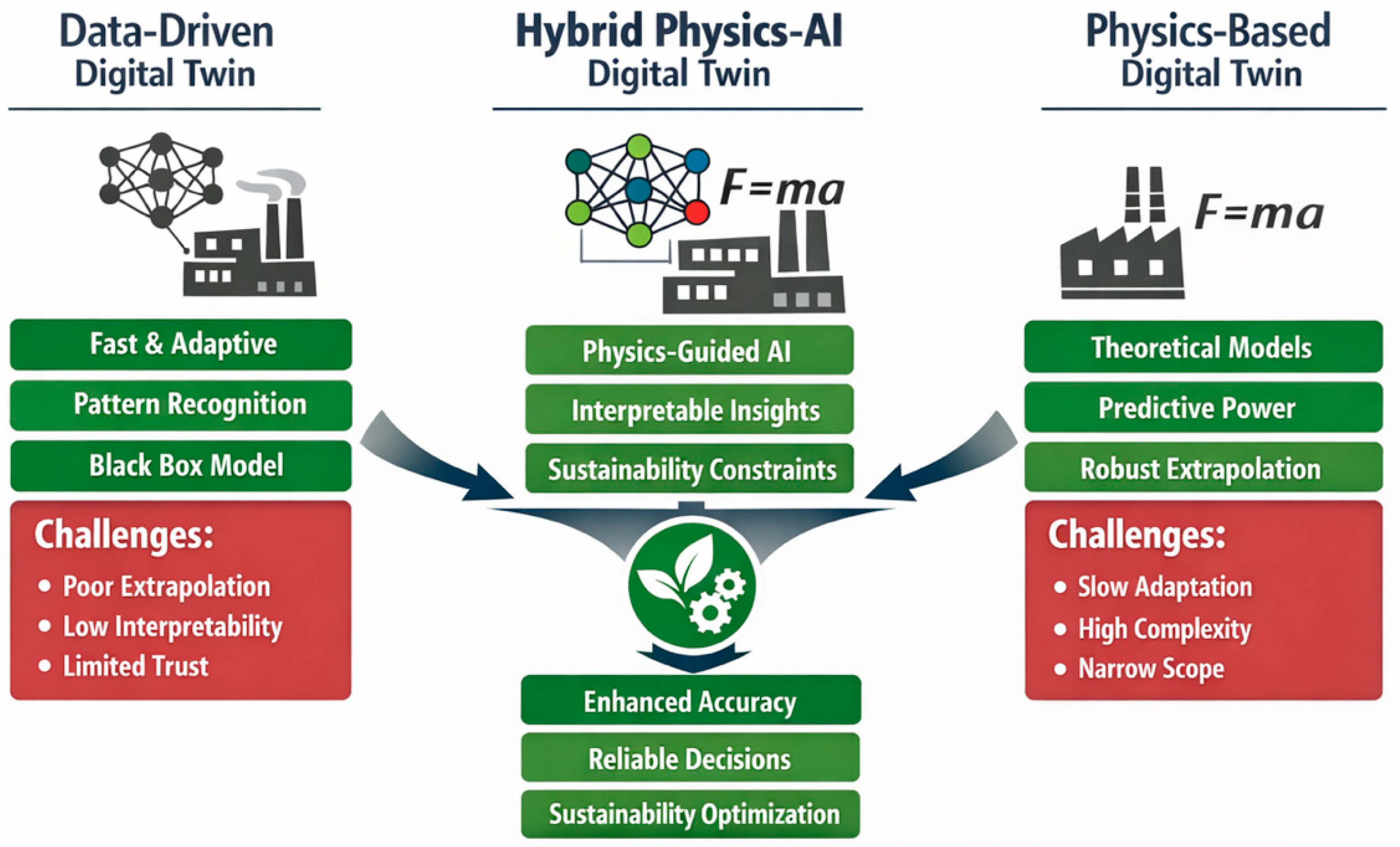
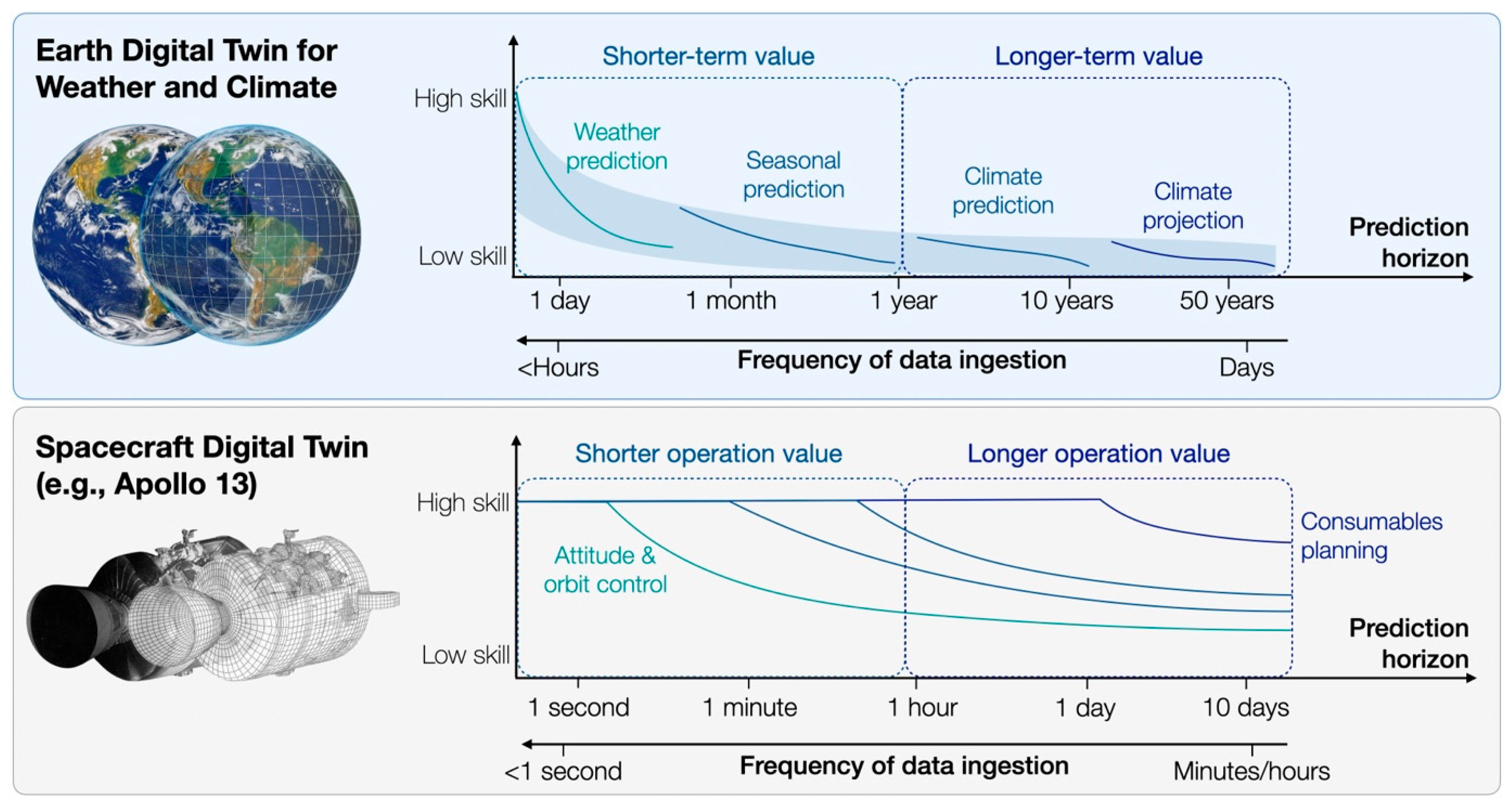
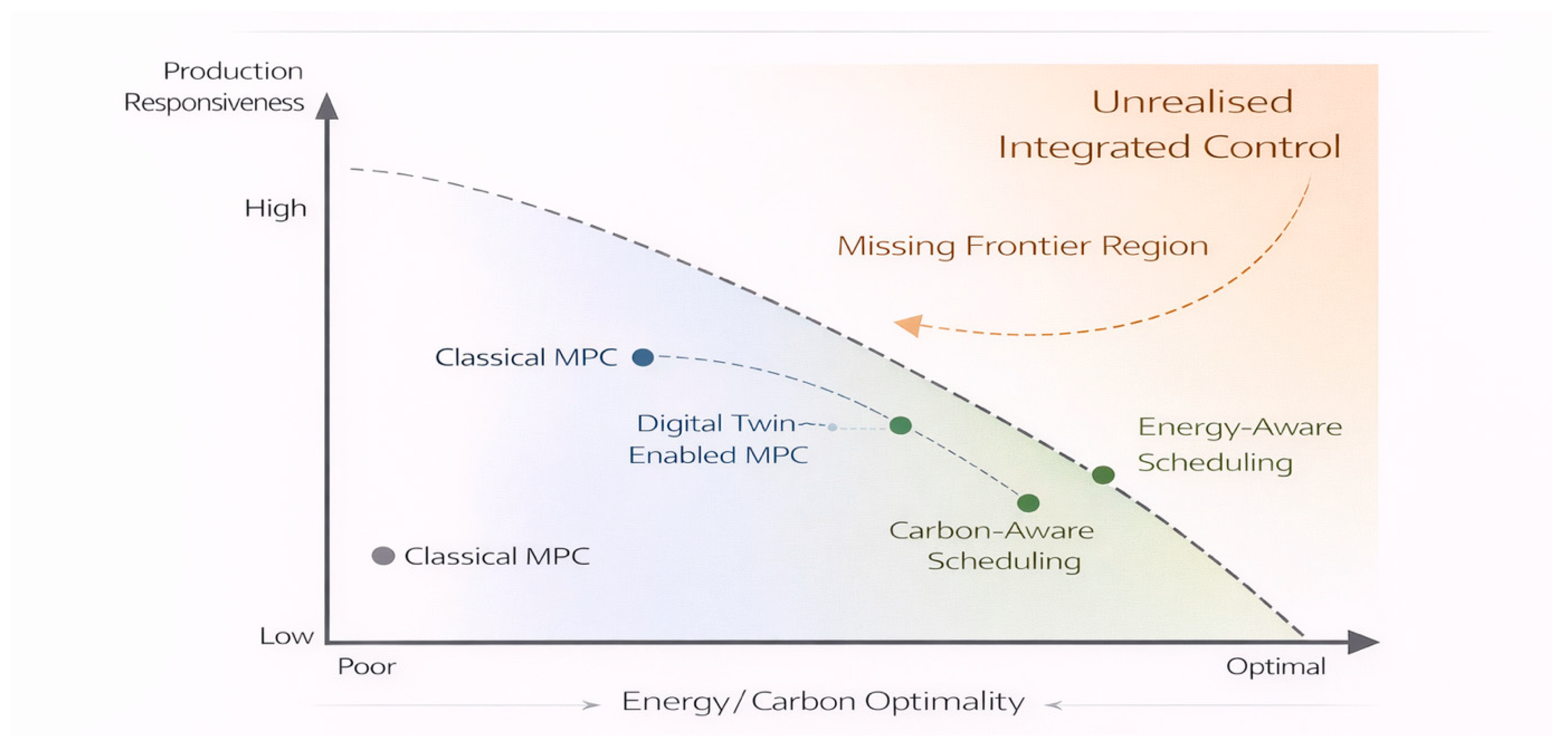
AI-Driven Digital Twins in Sustainable Manufacturing: A Critical Review
Abstract
1. Introduction: From Efficiency-Driven Manufacturing to Sustainability-Centred Intelligence
2. Methodology
2.1. Search Strategy and Information Sources
2.2. Eligibility Criteria
- Peer-reviewed journal articles, review articles, or high-quality conference proceedings
- Published in the English language
- Focus on Digital Twin applications in manufacturing or additive manufacturing contexts
- Explicit integration of AI, machine learning, or data-driven techniques within Digital Twin frameworks
- Relevance to sustainability dimensions, including energy efficiency, material optimisation, carbon emission reduction, predictive maintenance, or lifecycle assessment
- Presentation of technical implementation details, case studies, or experimental validation
- Publications in non-English languages
- Non-peer-reviewed sources, including preprints, editorials, and opinion pieces without empirical content
- Digital Twin applications exclusively in non-manufacturing domains (e.g., healthcare, urban planning, construction) without transferable manufacturing insights
- Purely conceptual or theoretical papers lacking technical implementation details or validation
- Studies focusing solely on traditional simulation or modelling without Digital Twin characteristics (real-time data integration, bidirectional connectivity, virtual-physical synchronisation)
- Duplicate publications across databases (retained only the most comprehensive version)
2.3. Study Selection Process
2.4. Data Extraction and Synthesis
2.5. PRISMA Flow Diagram and Search Outcomes
2.6. Quality Assessment
2.7. Limitations of the Search Strategy
2.8. Bibliometric Analysis of AI-Driven Digital Twin Research (2015–2024)
- Cluster 1: Process Optimisation and Quality Control (28% of publications)
- Cluster 2: Energy Management and Carbon Reduction (24% of publications, 62% CAGR since 2020)
- Cluster 3: Predictive Maintenance and Asset Health (22% of publications)
- Cluster 4: Supply Chain and Circular Economy (15% of publications)
- Cluster 5: Human-Machine Collaboration (11% of publications)
3. Digital Twins in Manufacturing: Concepts, Architectures, and Evolution Toward Intelligence
3.1. Defining Digital Twins in Manufacturing Contexts
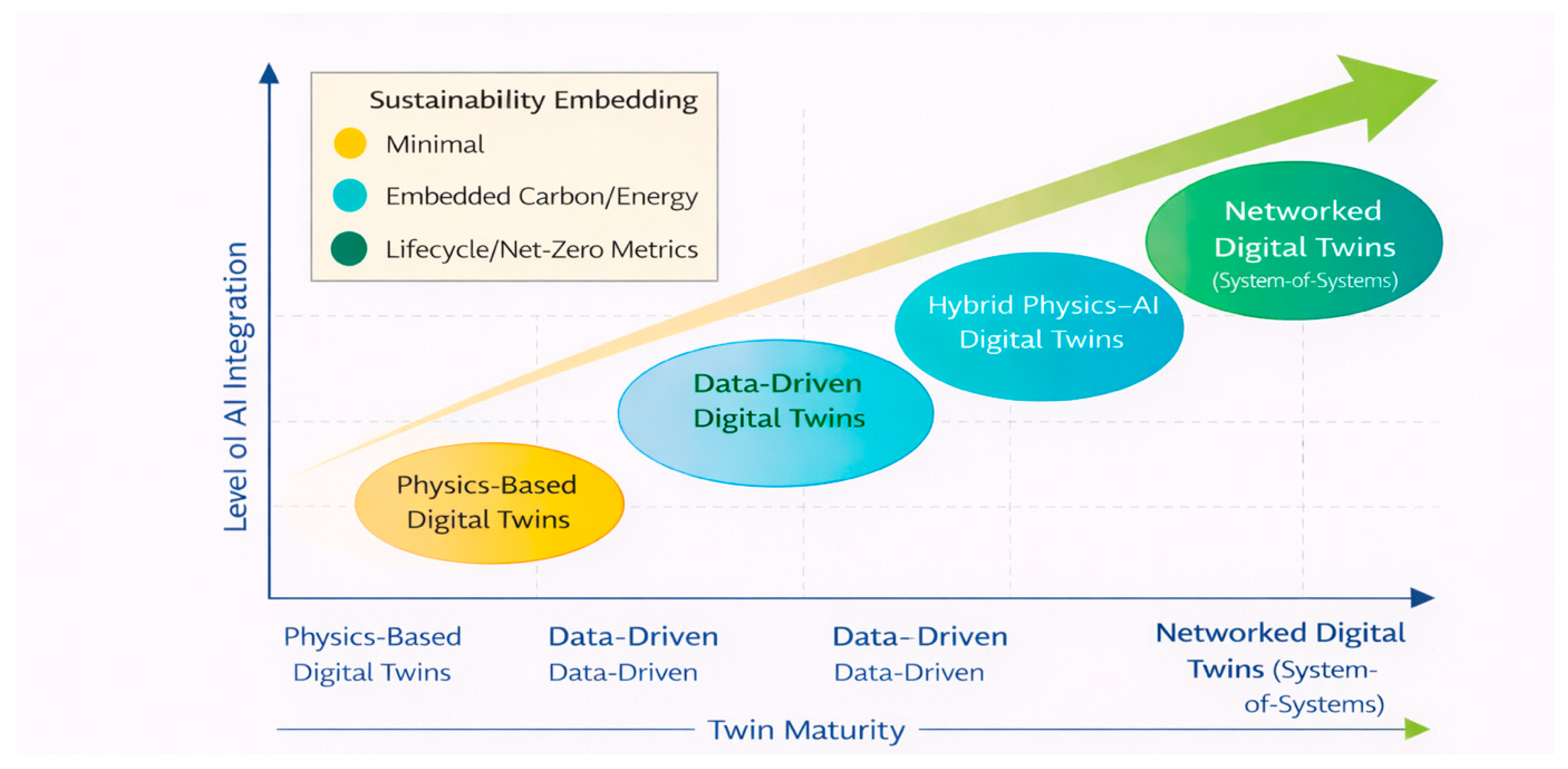
3.2. Evolution of Digital Twin Architectures
3.3. Hybrid Physics–AI Digital Twins
3.4. System-of-Systems and Networked Digital Twins
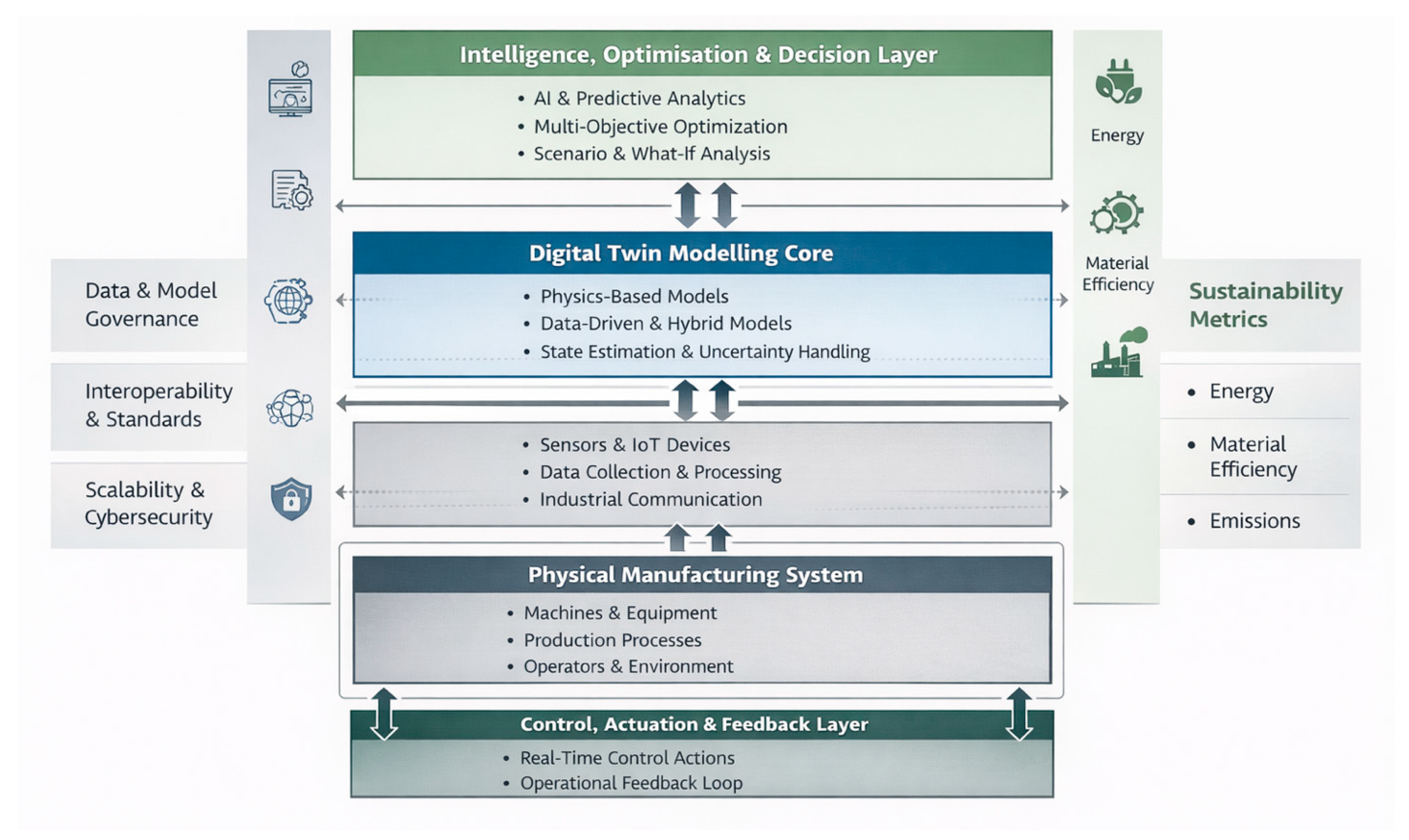
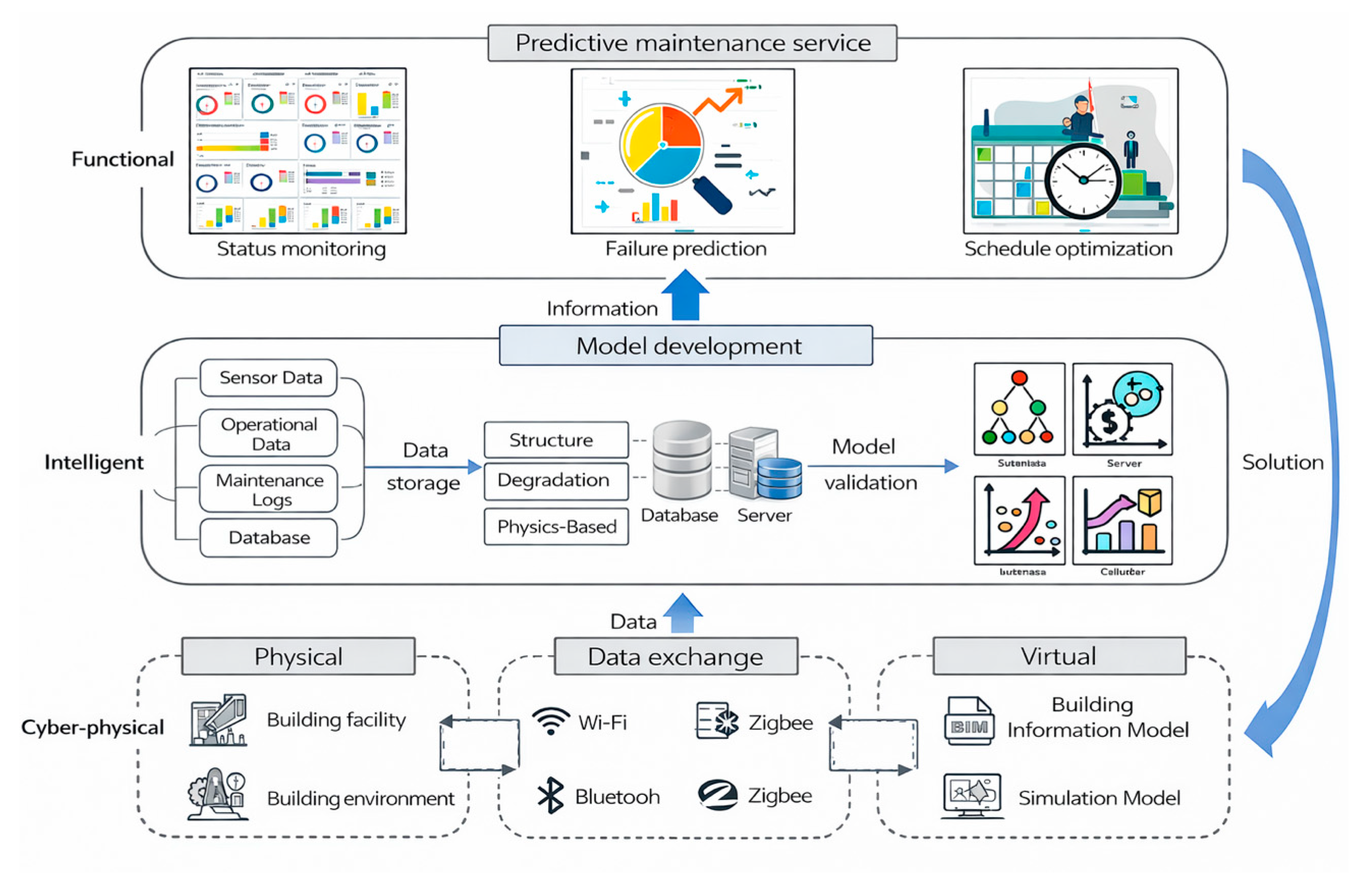
3.5. Conceptual Framework and Current State of Practice
3.6. AI Algorithms for Manufacturing Digital Twins
4. Artificial Intelligence as a Decision Layer in Manufacturing Digital Twins
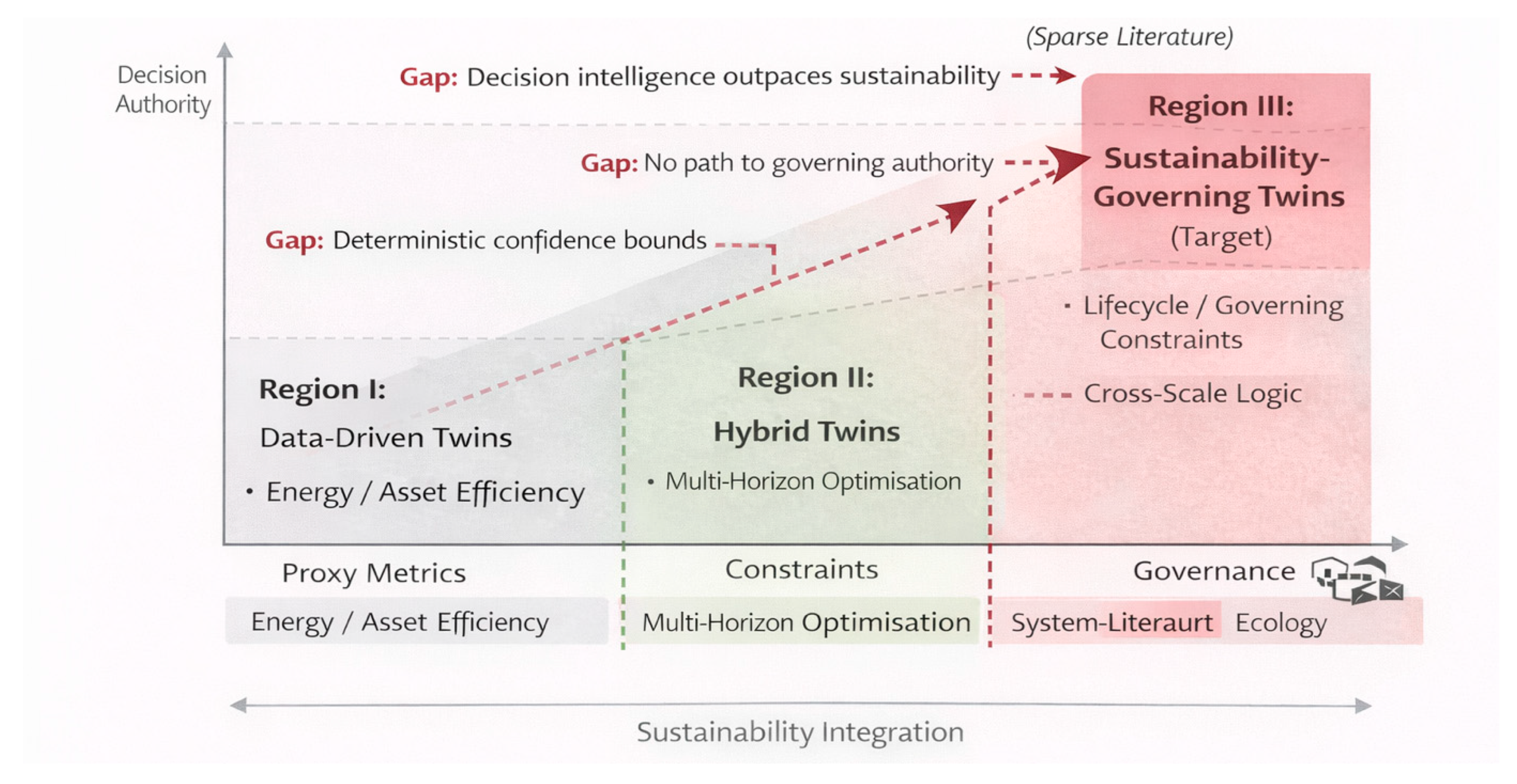
4.1. The Evolving Role of AI: From Peripheral Analytics to Central Decision Authority
4.2. The Trajectory from Physics-Based to Data-Driven to Hybrid Architectures
4.3. Critical Synthesis: Nine AI Functions in Manufacturing Digital Twins
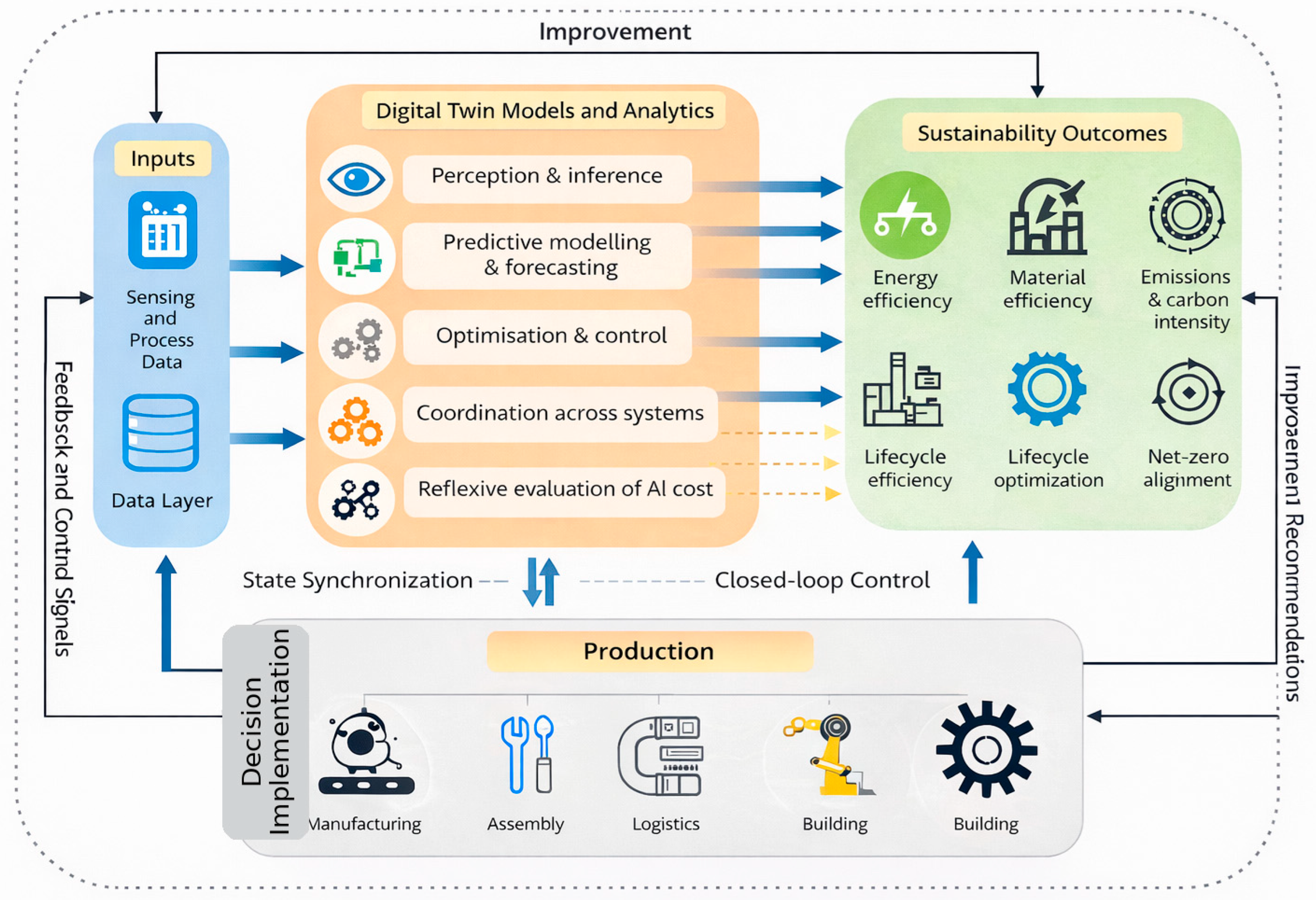
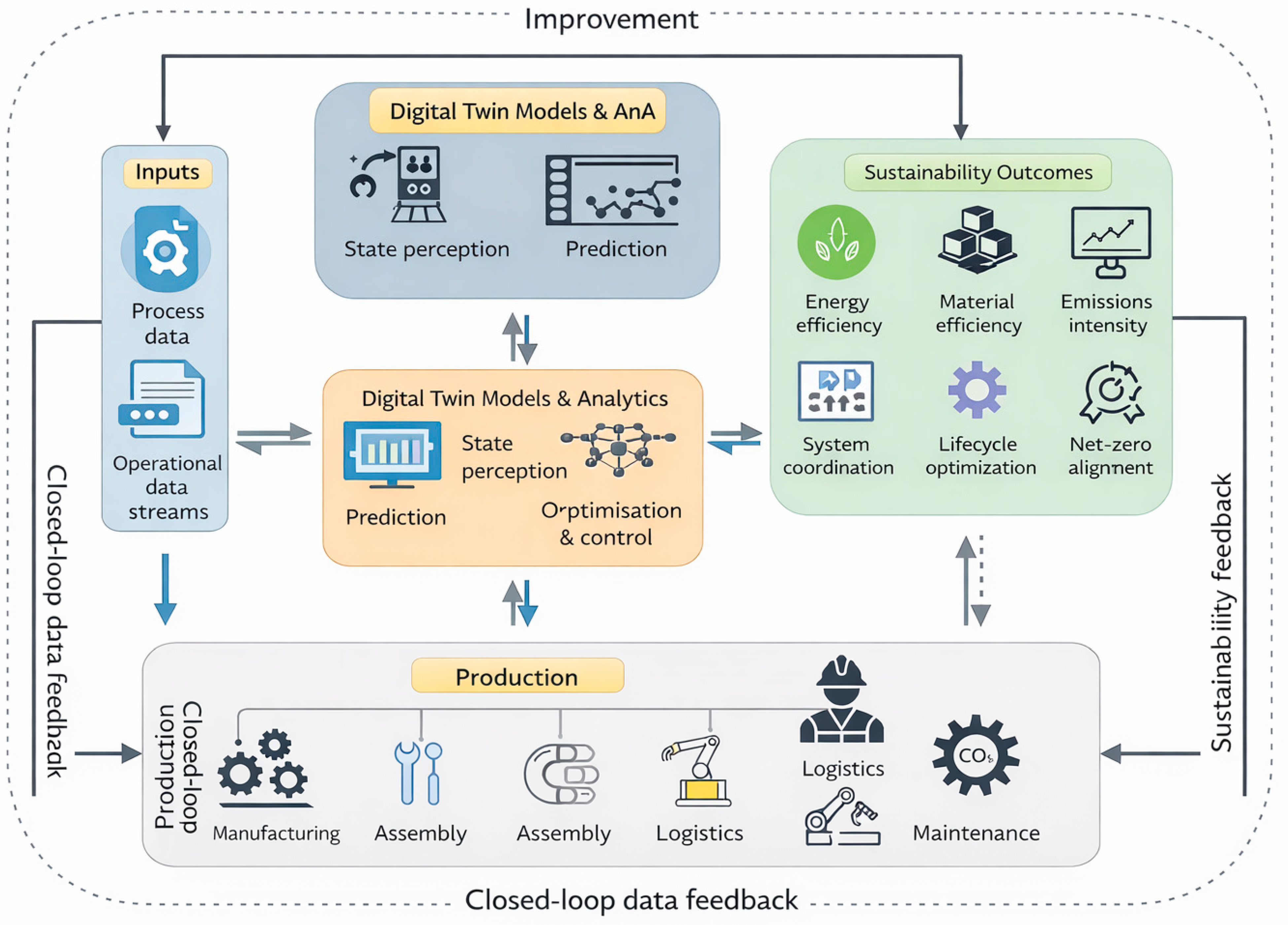
4.4. Conceptual Framework for Sustainability-Driven Digital Twins
4.5. Structural Limitations and Research Priorities
5. Embedding Sustainability into Digital Twin Design and Decision-Making
5.1. Energy Efficiency and Carbon-Aware Process Optimisation
5.2. Material Efficiency, Waste Reduction, and Resource Circularity
5.3. Lifecycle Environmental Assessment Within Digital Twin Frameworks
6. AI-Enabled Digital Twins for Additive Manufacturing Systems
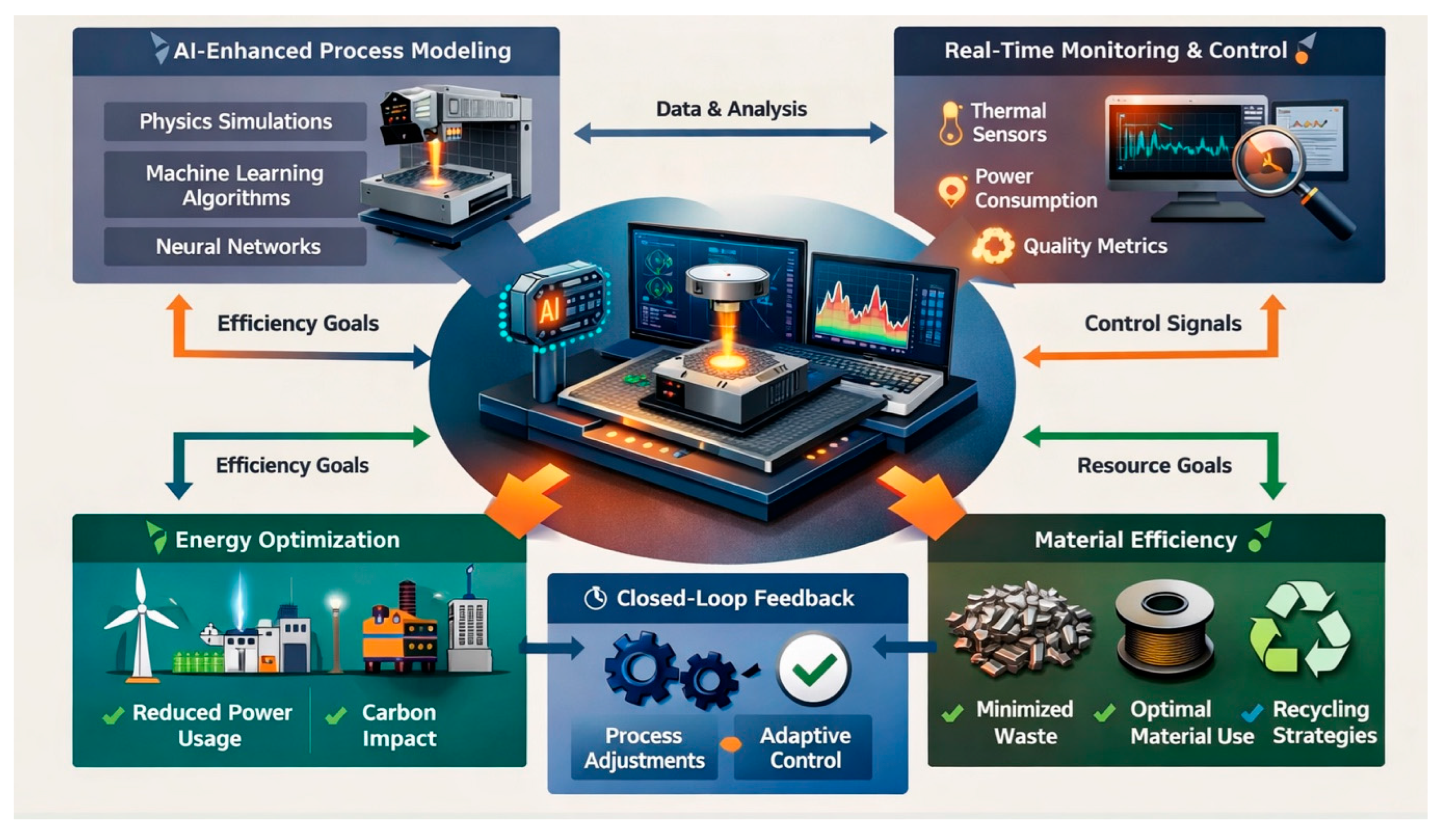
6.1. Process-Level Digital Twins for Real-Time Quality and Resource Governance
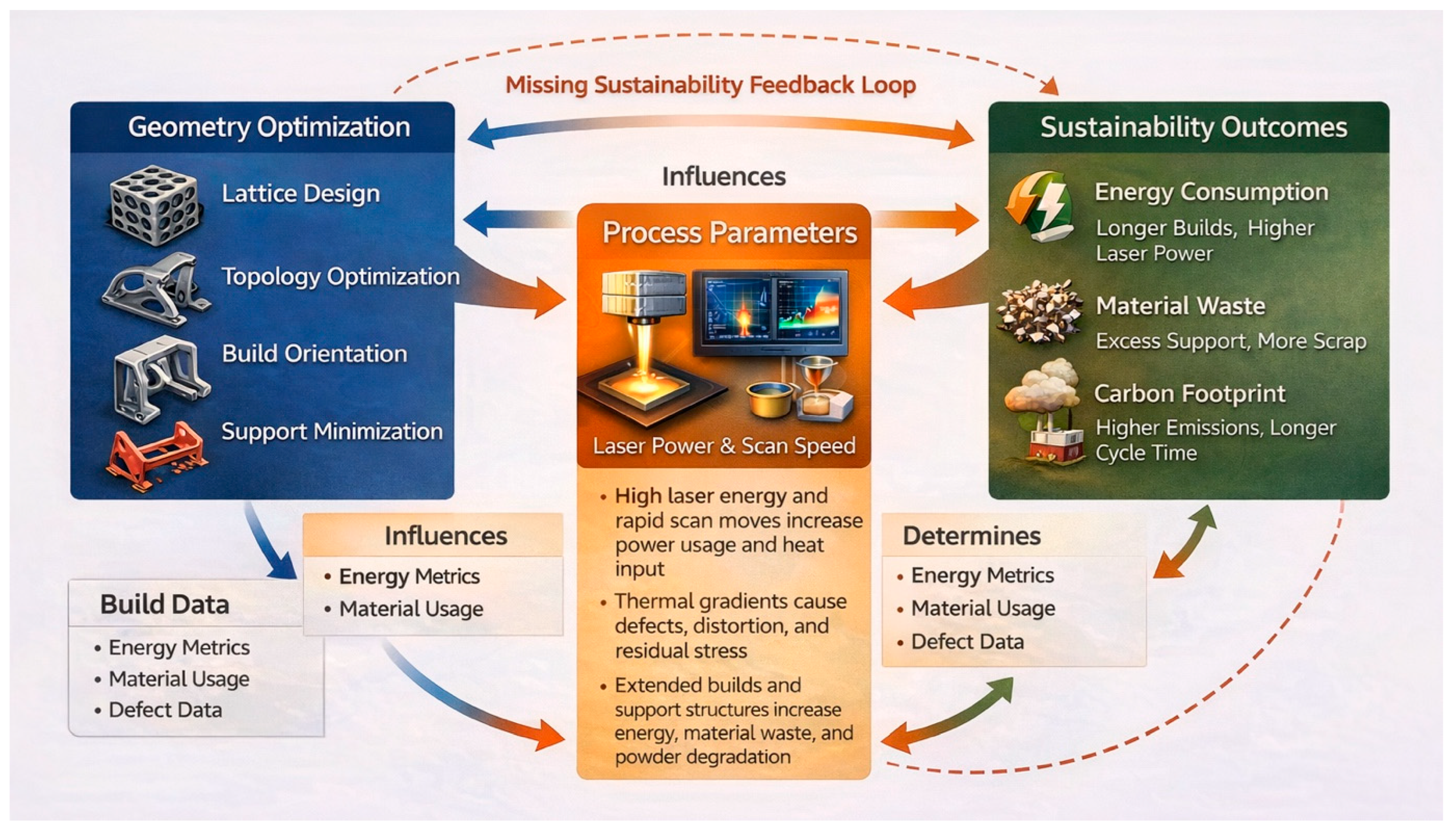
6.2. Design-for-Sustainability: Geometry-Process-Impact Co-Optimisation
6.3. Closed-Loop Architectures: From Defect Mitigation to Waste Minimisation
6.4. Industrial Implementation Cases and Quantified Sustainability Outcomes
6.5. Synthesis: Technical Maturity and Sustainability Governance Gaps
7. Data-Driven and Hybrid Physics–AI Digital Twin Approaches
7.1. Purely Data-Driven Digital Twins: Capabilities and Limitations
7.2. Hybrid Physics–AI Models for Trustworthy Digital Twins
8. Environmental Cost of Intelligence: Sustainability Trade-Offs in AI-Enabled Digital Twins
8.1. Energy and Carbon Footprint of AI-Driven Digital Twin Intelligence
8.2. Intelligence-Induced Rebound Effects and Hidden Resource Consumption
8.3. Lifecycle Cost of Intelligence: Model Proliferation and Computational Persistence
8.4. Placement of Intelligence: Edge, Cloud, and Hybrid Trade-Offs
8.5. When Does Intelligence Become Unsustainable? Thresholds and Design Principles
9. Barriers to Industrial Adoption and Large-Scale Deployment
9.1. Data Interoperability and Platform Fragmentation
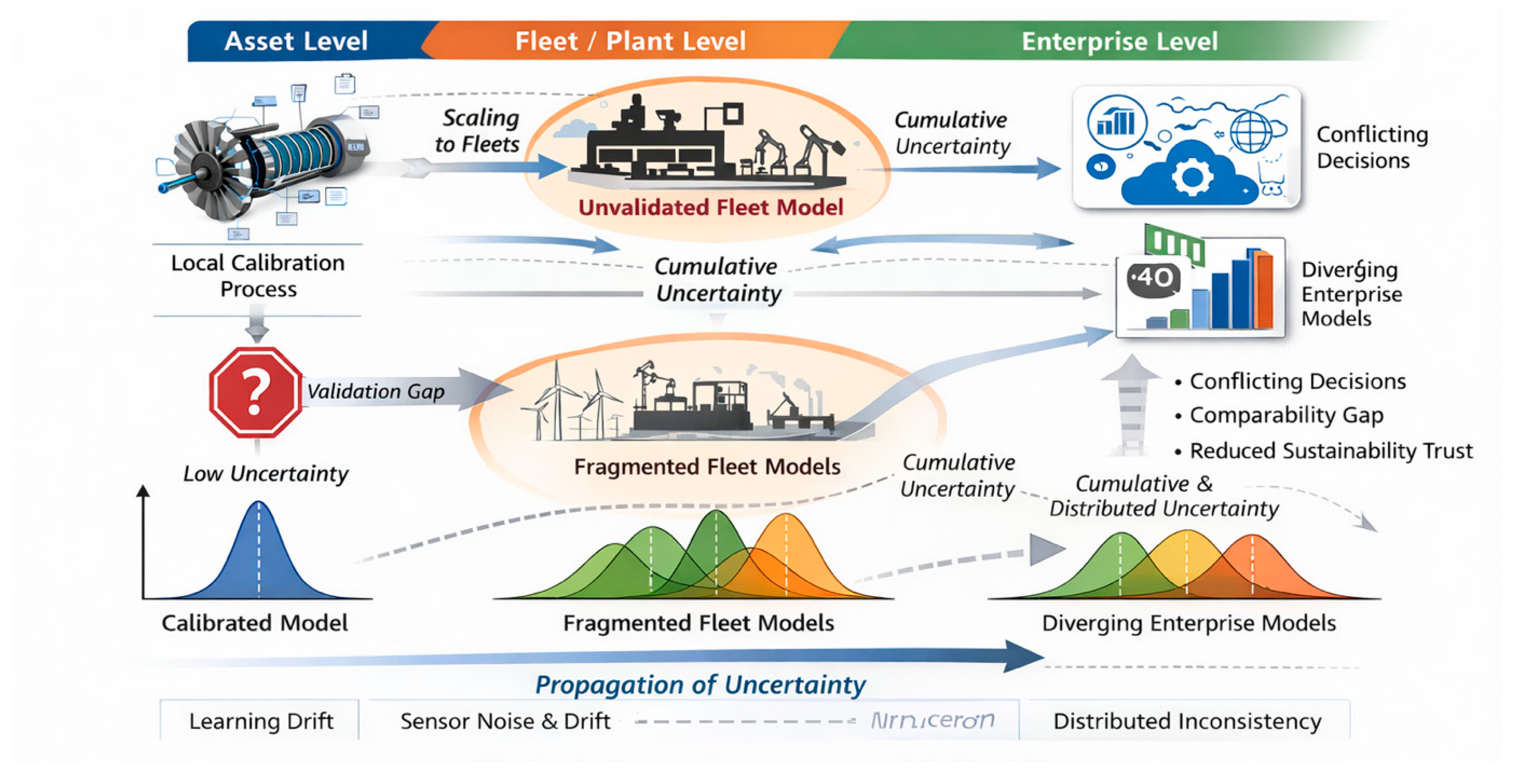
9.2. Scalability, Uncertainty, and Model Validation
9.3. Organisational, Regulatory, and Skills Constraints
9.4. Cross-Barrier Synthesis and Sustainability Implications
10. Digital Twins as Enablers of Circular and Net-Zero Manufacturing Systems
10.1. The Efficiency-First Paradigm and Its Limitations
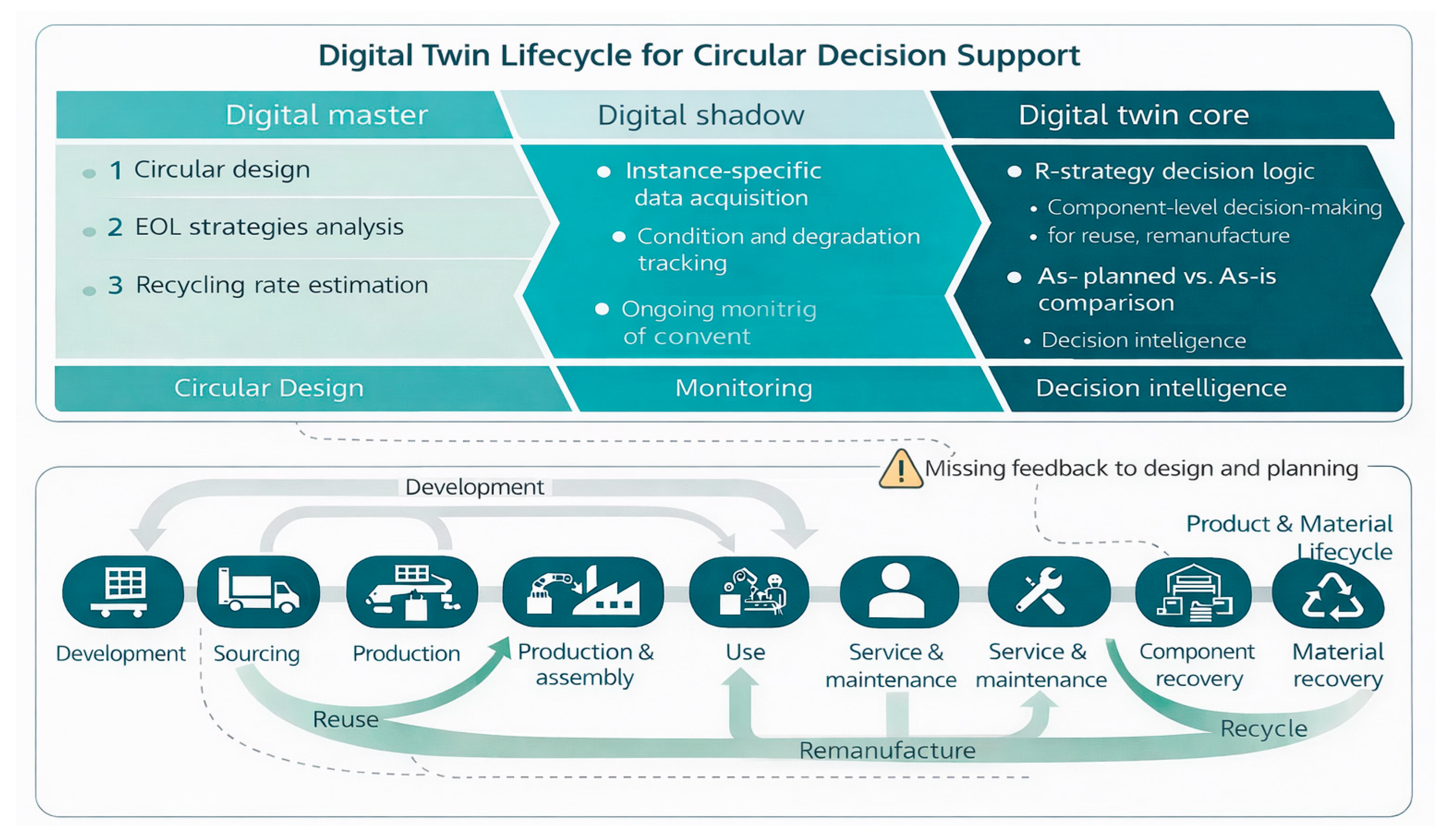
10.2. Lifecycle Fragmentation and the Missing Feedback Loop
10.3. Net-Zero Manufacturing: Energy vs. Carbon Optimisation
10.4. Closed-Loop Feedback and System Learning
10.5. Governance, Trust, and Decision Authority
10.6. Synthesis: From Optimisation Tools to Sustainability Infrastructures
11. Future Research Directions and Policy-Relevant Opportunities
11.1. Digital Twins Must Span the Full Asset Lifecycle
11.2. Sustainability Must Become a Hard Constraint
11.3. Uncertainty Must Be Propagated, Not Suppressed
11.4. Local Optimisation Must Give Way to System Coordination
11.5. Explainability Must Be a Prerequisite for Deployment
11.6. Policy and Research Must Co-Evolve
12. Conclusions
12.1. Principal Findings
12.2. Critical Research Gaps
- Lifecycle-spanning architectures. Only 9% of digital twins persist across design, operation, and recovery phases. Research must develop persistent semantic models and governance frameworks enabling knowledge accumulation and upstream feedback from end-of-life outcomes.
- Constraint-based sustainability governance. Carbon budgets, energy limits, and material scarcity must be embedded as non-negotiable boundaries rather than weighted objectives. Current implementations achieve this in only 10% of cases.
- Uncertainty-aware decision systems. Propagating uncertainty across physics models, AI components, and optimisation layers remains rare (18% of implementations), yet it is essential for risk-sensitive sustainability decisions.
- Cross-scale coordination mechanisms. Linking machine-level control to facility and grid-level sustainability governance occurs in only 24% of implementations, limiting system-level impact.
- Explainable hybrid intelligence. Hybrid physics–AI architectures that justify decisions against physical laws and regulatory standards are essential for trust, yet only 32% of implementations achieve meaningful explainability.
12.3. Implications for Practice
- Prioritise interoperability and data governance as foundational requirements rather than afterthoughts
- Embed sustainability constraints explicitly within optimisation logic rather than treating them as secondary objectives
- Invest in skills development spanning domain engineering, data science, and sustainability assessment
- Establish validation protocols that evaluate decisions rather than merely predictions
- Develop governance frameworks addressing liability, accountability, and explainability before granting digital twins operational authority
12.4. Policy Relevance
- Machine-readable sustainability regulations enabling real-time compliance verification
- Standardised metrics and validation protocols for digital twin sustainability claims
- Incentive structures rewarding lifecycle-aware deployment over narrow efficiency gains
- Interoperability standards with enforcement mechanisms rather than voluntary adoption
12.5. Contribution and Limitations
12.6. Closing Statement
Funding
Data Availability Statement
Conflicts of Interest
References
- Tao, F.; Qi, Q.; Wang, L.; Nee, A. Digital twins and cyber–physical systems toward smart manufacturing and Industry 4.0: Correlation and comparison. Engineering 2019, 5, 653–661. [Google Scholar] [CrossRef]
- Rasheed, A.; San, O.; Kvamsdal, T. Digital twin: Values, challenges and enablers from a modeling perspective. IEEE Access 2020, 8, 21980–22012. [Google Scholar] [CrossRef]
- Fuller, A.; Fan, Z.; Day, C.; Barlow, C. Digital twin: Enabling technologies, challenges and open research. IEEE Access 2020, 8, 108952–108971. [Google Scholar] [CrossRef]
- Zhou, X.; Xu, X.; Liang, W.; Zeng, Z.; Shimizu, S.; Yang, L.T.; Jin, Q. Intelligent small object detection for digital twin in smart manufacturing with industrial cyber–physical systems. IEEE Trans. Ind. Inform. 2021, 18, 1377–1386. [Google Scholar] [CrossRef]
- Groshev, M.; Guimarães, C.; Martin-Perez, J.; de la Oliva, A. Toward intelligent cyber–physical systems: Digital twin meets artificial intelligence. IEEE Commun. Mag. 2021, 59, 14–20. [Google Scholar] [CrossRef]
- Mihai, S.; Yaqoob, M.; Dang, H.V.; Davis, W.; Towakel, P.; Raza, M.; Karamanoglu, M.; Barn, B.; Shetve, D.; Prasad, R.; et al. Digital twins: A survey on enabling technologies, challenges, trends and future prospects. IEEE Commun. Surv. Tutor. 2022, 24, 2255–2291. [Google Scholar] [CrossRef]
- Segovia, M.; García-Alonso, J. Design, modeling and implementation of digital twins. Sensors 2022, 22, 5396. [Google Scholar] [CrossRef] [PubMed]
- Emmert-Streib, F.; Ioannidis, O.Y.-H. What is a digital twin? Experimental design for a data-centric machine learning perspective in health. Int. J. Mol. Sci. 2022, 23, 13149. [Google Scholar] [CrossRef]
- Emmert-Streib, F.; Dehmer, K. Defining a digital twin: A data science-based unification. Data 2023, 5, 1036–1054. [Google Scholar] [CrossRef]
- Wu, Y.; Zhang, K.; Zeng, Y.; Zhang, Y. Digital twin networks: A survey. IEEE Internet Things J. 2021, 8, 13789–13804. [Google Scholar] [CrossRef]
- Min, Q.; Lu, Y.; Liu, Z.; Su, C.; Wang, B. Machine learning based digital twin framework for production optimization in petrochemical industry. Int. J. Inf. Manag. 2019, 49, 502–519. [Google Scholar] [CrossRef]
- Jarosz, K.; Özel, T. Machine learning approaches towards digital twin development for machining systems. Int. J. Mechatron. Manuf. Syst. 2022, 15, 127–148. [Google Scholar] [CrossRef]
- Langlotz, P.; Klar, M.; Yi, L.; Hussong, M.; Sousa, F.J.P.; Aurich, J.C. Concept of hybrid modeled digital twins and its application for an energy management of manufacturing systems. Procedia CIRP 2022, 112, 549–554. [Google Scholar] [CrossRef]
- Mykoniatis, K.; Harris, G.A. A digital twin emulator of a modular production system using a data-driven hybrid modeling and simulation approach. J. Intell. Manuf. 2021, 32, 1899–1911. [Google Scholar] [CrossRef]
- Hürkamp, A.; Gellrich, S.; Ossowski, T.; Beuscher, J.; Thiede, S.; Herrmann, C.; Dröder, K. Combining simulation and machine learning as digital twin for the manufacturing of overmolded thermoplastic composites. J. Manuf. Mater. Process. 2020, 4, 92. [Google Scholar] [CrossRef]
- Stavroulakis, G.E.; Charalambidi, B.G.; Koutsianitis, P. Review of computational mechanics, optimization, and machine learning tools for digital twins applied to infrastructures. Appl. Sci. 2022, 12, 11997. [Google Scholar] [CrossRef]
- Lv, Z.; Chen, D.; Feng, H.; Wei, W.; Lv, H. Artificial intelligence in underwater digital twins sensor networks. ACM Trans. Sens. Netw. 2022, 18, 39. [Google Scholar] [CrossRef]
- Rasheed, A.; San, O.; Kvamsdal, T. Digital twin: Values, challenges and enablers. arXiv 2019, arXiv:1910.01719. [Google Scholar] [CrossRef]
- Zohdi, T.I. A digital-twin and machine-learning framework for precise heat and energy management of data-centers. Comput. Mech. 2022, 69, 1501–1516. [Google Scholar] [CrossRef]
- Chaparro-Cárdenas, S.L.; Ramirez-Bautista, J.-A.; Terven, J.; Córdova-Esparza, D.-M.; Romero-Gonzalez, J.-A.; Ramírez-Pedraza, A.; Chavez-Urbiola, E.A. A technological review of digital twins and artificial intelligence for personalized and predictive healthcare. Healthcare 2025, 13, 1763. [Google Scholar] [CrossRef]
- Allen, A.; Siefkas, A.; Pellegrini, E.; Burdick, H.; Barnes, G.; Calvert, J.; Mao, Q.; Das, R. A digital twin machine learning model for forecasting disease progression in stroke patients. Appl. Sci. 2021, 11, 5576. [Google Scholar] [CrossRef]
- Gruber, T.; Lechner, F.; Krieger, J.-P.; García-Cáceres, C. Neuroendocrine gut–brain signaling in obesity. Trends Endocrinol. Metab. 2024, 36, 42–54. [Google Scholar] [CrossRef]
- Skákala, J.; Awty-Carroll, K.; Menon, P.P.; Wang, K.; Lessin, G. Future digital twins: Emulating a highly complex marine biogeochemical model with machine learning to predict hypoxia. Front. Mar. Sci. 2023, 10, 1058837. [Google Scholar] [CrossRef]
- Renold, A.; Koumoulos, N. Comprehensive review of machine learning, deep learning, and digital twin data-driven approaches in battery health prediction of electric vehicles. IEEE Access 2024, 12, 43984–43999. [Google Scholar] [CrossRef]
- Karkaria, V.; Tsai, Y.K.; Chen, Y.P.; Chen, W. An optimization-centric review on integrating artificial intelligence and digital twin technologies in manufacturing. Eng. Optim. 2025, 57, 161–207. [Google Scholar] [CrossRef]
- Wang, Y.; Kang, X.; Chen, Z. A survey of digital twin techniques in smart manufacturing and management of energy applications. Green Energy Intell. Transp. 2022, 1, 100014. [Google Scholar] [CrossRef]
- Yu, W.; Patros, P.; Young, B.; Klinac, E.; Walmsley, T.G. Energy digital twin technology for industrial energy management: Classification, challenges and future. Renew. Sustain. Energy Rev. 2022, 158, 112407. [Google Scholar] [CrossRef]
- Davila R, M.F.; Schwark, F.; Dawel, L.; Pehlken, A. Sustainability digital twin: A tool for the manufacturing industry. Procedia CIRP 2023, 116, 143–148. [Google Scholar] [CrossRef]
- Barenji, A.V.; Liu, X.; Guo, H.; Li, Z. A digital twin-driven approach towards smart manufacturing: Reduced energy consumption for a robotic cell. Int. J. Comput. Integr. Manuf. 2021, 34, 844–859. [Google Scholar] [CrossRef]
- Xia, T.; Sun, H.; Ding, Y.; Han, D.; Qin, W.; Seidelmann, J.; Xi, L. Digital twin-based real-time energy optimization method for production line considering fault disturbances. J. Intell. Manuf. 2025, 36, 569–593. [Google Scholar] [CrossRef]
- Gao, Y.; Chang, D.; Chen, C. A digital twin-based approach for optimizing operation energy consumption at automated container terminals. J. Clean. Prod. 2023, 360, 135782. [Google Scholar] [CrossRef]
- Li, H.; Yang, D.; Cao, H.; Ge, W.; Chen, E.; Wen, X.; Li, C. Data-driven hybrid Petri-net-based energy consumption behaviour modelling for digital twin of energy-efficient manufacturing systems. Energy 2022, 239, 122178. [Google Scholar] [CrossRef]
- Zhao, L.; Fang, Y.; Lou, P.; Yan, J.; Xiao, A. Cutting parameter optimization for reducing carbon emissions using digital twin. Int. J. Precis. Eng. Manuf. 2021, 22, 933–949. [Google Scholar] [CrossRef]
- Wang, Q.; Yin, Y.; Chen, Y.; Liu, Y. Carbon peak management strategies for achieving net-zero emissions in smart buildings: Advances and modeling in digital twin. Sustain. Energy Technol. Assess. 2024, 64, 103661. [Google Scholar] [CrossRef]
- Chen, L.; Li, X.; Zhu, J. Carbon peak control for achieving net-zero renewable-based smart cities: Digital twin modeling and simulation. Sustain. Energy Technol. Assess. 2024, 65, 103792. [Google Scholar] [CrossRef]
- Turan, E.; Konuşkan, Y.; Yıldırım, N.; Tunçalp, D.; İnan, M.; Yasin, O.; Turan, B.; Kerimoğlu, V. Digital twin modelling for optimizing material consumption: A sustainability improvement case study in thermoforming. Sustain. Comput. Inform. Syst. 2022, 35, 100655. [Google Scholar] [CrossRef]
- Chinnathai, M.; Anand, B. A digital life-cycle management framework for sustainable smart manufacturing in energy intensive industries. J. Clean. Prod. 2023, 389, 138259. [Google Scholar] [CrossRef]
- Xiang, F.; Zhang, Z.; Zuo, Y.; Tao, F. Digital twin-driven green material optimal selection towards sustainable manufacturing. Procedia CIRP 2019, 81, 1290–1294. [Google Scholar] [CrossRef]
- Sajadieh, S.; Nouri, S. A review of digital twin integration in circular manufacturing for sustainable industry transition. Sustainability 2025, 17, 7316. [Google Scholar] [CrossRef]
- Glatt, M.; Kölsch, P.; Siedler, C.; Langlotz, P.; Ehmsen, S.; Aurich, J.C. Edge-based digital twin to trace and ensure sustainability in cross-company production networks. Procedia CIRP 2021, 98, 276–281. [Google Scholar] [CrossRef]
- Yang, S.; Yu, Z.; Ma, W.-Q.; Ma, L.; Li, C.; Fu, L.; Li, M.; Zhao, Z.; Yang, Y. Coupling the digital twin technology and life cycle assessment: Carbon dioxide emissions from polysilicon production. Sustain. Prod. Consum. 2023, 41, 156–166. [Google Scholar] [CrossRef]
- Barni, A.; Fontana, A.; Menato, S.; Sorlini, M.; Canetta, L. Exploiting the digital twin in the assessment and optimization of sustainability performances. In Proceedings of the 2018 International Conference on Intelligent Systems (IS), Funchal, Portugal, 25–27 September 2018. [Google Scholar]
- Enyejo, J.O.; Fajana, O.P.; Jok, I.S.; Ihejirika, C.J.; Awotiwon, B.O.; Olola, T.M. Digital twin technology, predictive analytics, and sustainable project management in global supply chains for risk mitigation, optimization, and carbon footprint reduction through green initiatives. Int. J. Innov. Sci. Res. Technol. 2024, 9, 609–630. [Google Scholar] [CrossRef]
- Zhang, Z.; Wei, Z.; Court, S.; Yang, L.; Wang, S.; Thirunavukarasu, A.; Zhao, Y. A review of digital twin technologies for enhanced sustainability in the construction industry. Buildings 2024, 14, 1113. [Google Scholar] [CrossRef]
- Arsecularatne, B.P.; Rodrigo, N.; Chang, R. Review of reducing energy consumption and carbon emissions through digital twin in built environment. J. Build. Eng. 2024, 98, 111150. [Google Scholar] [CrossRef]
- Elghaish, F.; Matarneh, S.; Hosseini, M.R.; Tezel, A.; Mahamadu, A.-M.; Taghikhah, F. Predictive digital twin technologies for achieving net zero carbon emissions: A critical review and future research agenda. Smart Sustain. Built Environ. 2024, 15, 680–709. [Google Scholar] [CrossRef]
- Fathy, Y.; Jaber, M.; Nadeem, Z. Digital twin-driven decision making and planning for energy consumption. J. Sens. Actuator Netw. 2021, 10, 37. [Google Scholar] [CrossRef]
- Park, J.; Yoo, B. GIS-enabled digital twin system for sustainable evaluation of carbon emissions: A case study of Jeonju city, South Korea. Sustainability 2020, 12, 9186. [Google Scholar] [CrossRef]
- Sayed, A.N.; Bensaali, F.; Himeur, Y.; Dimitrakopoulos, G.; Varlamis, I. Enhancing building sustainability: A digital twin approach to energy efficiency and occupancy monitoring. Energy Build. 2025, 328, 115151. [Google Scholar] [CrossRef]
- Agho, M.O.; Eyo-Udo, N.L.; Onukwulu, E.C.; Sule, A.K.; Azubuike, C. Digital twin technology for real-time monitoring of energy supply chains. Int. J. Res. Innov. Appl. Sci. 2024, 9, 564–592. [Google Scholar] [CrossRef]
- Bányai, Á.; Bányai, T. Real-time maintenance policy optimization in manufacturing systems: An energy efficiency and emission-based approach. Sustainability 2022, 14, 10725. [Google Scholar] [CrossRef]
- Shofiullah, S.; Sadiq, M. Digital twin-driven process modeling for energy efficiency and lifecycle optimization in industrial facilities. Am. J. Interdiscip. Stud. 2023, 4, 65–95. [Google Scholar] [CrossRef]
- Kaewunruen, S.; Li, Q. Digital twin-aided sustainability-based lifecycle management for railway turnout systems. J. Clean. Prod. 2019, 228, 1537–1551. [Google Scholar] [CrossRef]
- Nagar, S.V.; Chandrashekar, A.C.; Suvarna, M. Optimized additive manufacturing technology using digital twins and cyber physical systems. Lect. Notes Netw. Syst. 2020, 80, 65–73. [Google Scholar] [CrossRef]
- Abhilash, P.M.; Boban, J.; Ahmed, A.; Luo, X. Digital twin-driven additive manufacturing: Advancements and future prospects. In Hybrid Metal Additive Manufacturing: Technology and Applications; CRC Press: Boca Raton, FL, USA, 2023; pp. 196–221. [Google Scholar] [CrossRef]
- Tudorache, L.; Babur, Ö.; Lucas, S.S.; Brand, M.v.D. Current approaches to digital twins in additive manufacturing: A systematic literature review. Prog. Addit. Manuf. 2025, 10, 10819–10853. [Google Scholar] [CrossRef]
- Bartsch, K.; Pettke, A.; Hübert, A.; Lakämper, J.; Lange, F. On the digital twin application and the role of artificial intelligence in additive manufacturing: A systematic review. Eng. Res. Express 2021, 4, 032005. [Google Scholar] [CrossRef]
- Corradini, F.; Silvestri, M. Design and testing of a digital twin for monitoring and quality assessment of material extrusion process. Addit. Manuf. 2022, 51, 102633. [Google Scholar] [CrossRef]
- Knapp, G.L.; Reeve, S.T.; Coleman, J.; Rolchigo, M.; Stump, B.; DeWitt, S.; Plotkowski, A. Myna: Connecting powder bed fusion build data to simulation tools for digital twin applications. Comput. Mater. Sci. 2025, 258, 114094. [Google Scholar] [CrossRef]
- Park, Y.; Love, A.; Behseresht, S.; Pastrana, O.V.; Sakai, J. Digital twin development for additive manufacturing. In Proceedings of the ASME 2024 Pressure Vessels & Piping Conference, Bellevue, WA, USA, 28 July–2 August 2024. [Google Scholar]
- Rachmawati, S.M.; Putra, M.A.P.; Lee, J.M.; Kim, D.S. Digital twin-enabled 3D printer fault detection for smart additive manufacturing. Eng. Appl. Artif. Intell. 2023, 124, 106430. [Google Scholar] [CrossRef]
- Pantelidakis, M.; Mykoniatis, K.; Liu, J.; Harris, G. A digital twin ecosystem for additive manufacturing using a real-time development platform. Int. J. Adv. Manuf. Technol. 2022, 120, 6547–6563. [Google Scholar] [CrossRef]
- Chen, Z.; Surendraarcharyagie, K.; Granland, K.; Chen, C.; Xu, X.; Xiong, Y.; Davies, C.; Tang, Y. Service oriented digital twin for additive manufacturing process. J. Manuf. Syst. 2024, 74, 762–776. [Google Scholar] [CrossRef]
- Mukherjee, T.; DebRoy, T. A digital twin for rapid qualification of 3D printed metallic components. Addit. Manuf. 2019, 14, 59–65. [Google Scholar] [CrossRef]
- Yang, L.; Özel, T. Physics-based simulation models for digital twin development in laser powder bed fusion. Int. J. Mechatron. Manuf. Syst. 2021, 14, 143–163. [Google Scholar] [CrossRef]
- Liu, N.; Li, X.; Rajanna, M.R.; Reutzel, E.W.; Sawyer, B.; Rao, P.; Lua, J.; Phan, N.; Yu, Y. Deep neural operator enabled digital twin modeling for additive manufacturing. Adv. Comput. Sci. Eng. 2024, 2, 174–201. [Google Scholar] [CrossRef]
- Kang, B.; Park, C.; Kim, H.; Hong, S. Real-time decision-making for digital twin in additive manufacturing with model predictive control using time-series deep neural networks. J. Manuf. Syst. 2025, 80, 412–424. [Google Scholar] [CrossRef]
- Kannapinn, M.; Roth, F.; Weeger, O. Digital twin inference from multi-physical simulation data of DED additive manufacturing processes with neural ODEs. arXiv 2024, arXiv:2412.03295. [Google Scholar] [CrossRef]
- Mu, H.; He, F.; Yuan, L.; Hatamian, H.; Commins, P.; Pan, Z. Online distortion simulation using generative machine learning models: A step toward digital twin of metallic additive manufacturing. J. Ind. Inf. Integr. 2024, 38, 100563. [Google Scholar] [CrossRef]
- Malik, A.W.; Mahmood, M.A.; Liou, F. Digital twin-driven optimization of laser powder bed fusion processes: A focus on lack-of-fusion defects. Rapid Prototyp. J. 2024, 30, 1977–1988. [Google Scholar] [CrossRef]
- Rescsanski, S.; Nardi, T.; Shah, V.; Tang, J.; Imani, F. Multi-fidelity sensing and digital twin system for automated monitoring in cooperative robotic additive manufacturing. In Proceedings of the 2024 International Symposium on Flexible Automation, Seattle, WA, USA, 21–24 July 2024; American Society of Mechanical Engineers: New York, NY, USA, 2024; Paper No. ISFA2024-141314. [Google Scholar]
- Ziadia, A.; Habibi, M.; Kelouwani, S. Digital twin-driven real-time optimization of layer-specific surface roughness in FDM 3D printing. Prog. Addit. Manuf. 2025, 10, 10053–10076. [Google Scholar] [CrossRef]
- Chen, L.; Bi, G.; Yao, X.; Tan, C.; Su, J.; Ng, N.P.H.; Chew, Y.; Liu, K.; Moon, S.K. Multisensor fusion-based digital twin for localized quality prediction in robotic laser-directed energy deposition. Robot. Comput.-Integr. Manuf. 2023, 84, 102581. [Google Scholar] [CrossRef]
- Paek, S.W.; Lee, Y.; Park, H.C.; Shin, H.; Lee, S.W. Development of distributed network-based digital twin with real-time unstructured data processing: A case study on directed energy deposition system. Manuf. Lett. 2025, 44, 1198–1208. [Google Scholar] [CrossRef]
- Kim, D.B.; Shao, G.; Jo, G. A digital twin implementation architecture for wire + arc additive manufacturing based on ISO 23247. Manuf. Lett. 2022, 34, 1–5. [Google Scholar] [CrossRef]
- Ben Amor, S.; Elloumi, N.; Eltaief, A.; Louhichi, B.; Alrasheedi, N.H.; Seibi, A. Digital twin implementation in additive manufacturing: A comprehensive review. Processes 2024, 12, 1062. [Google Scholar] [CrossRef]
- Knapp, G.L.; Mukherjee, T.; Zuback, J.S.; Wei, H.L.; Palmer, T.A.; De, A.; DebRoy, T.J.A.M. Building blocks for a digital twin of additive manufacturing. Acta Mater. 2017, 135, 390–399. [Google Scholar] [CrossRef]
- Shen, T.; Li, B. Digital twins in additive manufacturing: A state-of-the-art review. Int. J. Adv. Manuf. Technol. 2024, 131, 63–92. [Google Scholar] [CrossRef]
- Alvares, A.J.; Rodriguez, E.; Figueroa, B. Digital-twin-enabled process monitoring for a robotic additive manufacturing cell using wire-based laser metal deposition. Processes 2025, 13, 2335. [Google Scholar] [CrossRef]
- Ali, M.; Malik, A.; Jyeniskhan, N.; Al-Wesabi, O.A.; Khan, M.A.; Almotairi, S.; Al-Hammadi, Y.; Al-Wesabi, M.A. Development of digital twin for FDM printer with preventive cyber-attack and control algorithms. IEEE Access 2024, 12, 193594–193606. [Google Scholar] [CrossRef]
- Nath, P.; Mukherjee, S. Probabilistic digital twin for additive manufacturing process design and control. ASME J. Mech. Des. 2022, 144, 091704. [Google Scholar] [CrossRef]
- Butt, J.; Mohagheghi, V. Combining digital twin and machine learning for the fused filament fabrication process. Metals 2023, 13, 24. [Google Scholar] [CrossRef]
- Yi, L.; Glatt, M.; Ehmsen, S.; Duan, W.; Aurich, J.C. Process monitoring of economic and environmental performance of a material extrusion printer using an augmented reality-based digital twin. Addit. Manuf. 2021, 48, 102388. [Google Scholar] [CrossRef]
- Koizumi, Y.; Okugawa, M. Digital twin science of metal powder bed fusion additive manufacturing: A selective review of simulations for integrated computational materials engineering and science. ISIJ Int. 2022, 62, 2183–2196. [Google Scholar] [CrossRef]
- Castelló-Pedrero, P.; García-Gascón, C.; Bas-Bolufer, J.; García-Manrique, J.A. Integrated computational modeling of large format additive manufacturing: Developing a digital twin for material extrusion with carbon fiber-reinforced acrylonitrile butadiene styrene. Proc. Inst. Mech. Eng. Part L J. Mater. Des. Appl. 2024, 238, 332–346. [Google Scholar] [CrossRef]
- Karkaria, V.; Tsai, Y.-K.; Rolark, F.; Quispel, D.; Gao, R.X.; Cao, J.; Chen, W. Towards a digital twin framework in additive manufacturing: Machine learning and Bayesian optimization for time-series process optimization. J. Manuf. Syst. 2024, 75, 322–332. [Google Scholar] [CrossRef]
- Tariq, U.; Joy, R.; Wu, S.-H.; Mahmood, M.A.; Malik, A.W.; Liou, F. A state-of-the-art digital factory integrating digital twin for laser additive and subtractive manufacturing processes. Rapid Prototyp. J. 2023, 29, 2061–2097. [Google Scholar] [CrossRef]
- Liu, C.; Le Roux, L.; Körner, C.; Tabaste, O.; Lacan, F.; Bigot, S. Digital twin-enabled collaborative data management for metal additive manufacturing systems. J. Manuf. Syst. 2020, 62, 857–874. [Google Scholar] [CrossRef]
- Gaikwad, A.; Yavari, R.; Montazeri, M.; Cole, K.; Bian, L.; Rao, P. Toward the digital twin of additive manufacturing: Integrating thermal simulations, sensing, and analytics to detect process faults. IISE Trans. 2020, 52, 1204–1217. [Google Scholar] [CrossRef]
- Love, A.; Behseresht, S.; Pastrana, O.A.V.; Sakai, J.; Park, Y.H. Hybrid physical–virtual digital twin system for additive manufacturing. J. Adv. Manuf. Syst. 2025, 24, 1–20. [Google Scholar] [CrossRef]
- Christopher, G.G.; Olalekan, O.R.; Maeva, M.N.H.; Hassan, B.; Sayed, H.A. AI-augmented digital twin framework for predictive thermo-mechanical degradation monitoring in solid oxide fuel cell stacks: Integration of multi-physics models and uncertainty quantification. Ceram. Int. 2025, 52, 10–22. [Google Scholar] [CrossRef]
- Radbakhsh, S.H.; Nik-Bakht, M.; Zandi, K. Structural digital twin of concrete infrastructure powered with physics-informed neural networks. In Smart & Sustainable Infrastructure: Building a Greener Tomorrow; Banthia, N., Soleimani-Dashtaki, S., Mindess, S., Eds.; RILEM Bookseries; Springer: Cham, Switzerland, 2024; Volume 48, pp. 1101–1113. [Google Scholar] [CrossRef]
- Kapteyn, M.G.; Willcox, K.E. Design of digital twin sensing strategies via predictive modeling and interpretable machine learning. J. Mech. Des. 2022, 144, 091710. [Google Scholar] [CrossRef]
- Lim, J.Y.; Li, J.; O’Grady, D.; Downar, T.; Duraisamy, K. A hybrid surrogate modeling framework for the digital twin of a fluoride-salt-cooled high-temperature reactor (FHR). Nucl. Eng. Des. 2025, 433, 113690. [Google Scholar] [CrossRef]
- Kim, W.; Kim, S.; Jeong, J.; Kim, H.; Lee, H.; Youn, B.D. Digital twin approach for on-load tap changers using data-driven dynamic model updating and optimization-based operating condition estimation. Mech. Syst. Signal Process. 2022, 181, 109471. [Google Scholar] [CrossRef]
- Thelen, A.; Zhang, X.; Fink, O.; Lu, Y.; Ghosh, S.; Youn, B.D.; Todd, M.D.; Mahadevan, S.; Hu, C.; Hu, Z. A comprehensive review of digital twin—Part 1: Modeling and twinning enabling technologies. Struct. Multidiscip. Optim. 2022, 65, 354. [Google Scholar] [CrossRef]
- Naeini, H.K.; Shomali, R.; Pishahang, A.; Hasanzadeh, H.; Asadi, S.; Lonbar, A.G. PINN-DT: Optimizing energy consumption in smart building using hybrid physics-informed neural networks and digital twin framework with blockchain security. arXiv 2025, arXiv:2503.00331. [Google Scholar]
- Hossain, R.; Ahmed, F.; Kobayashi, K.; Koric, S.; Abueidda, D.; Alam, S.B. Virtual sensing-enabled digital twin framework for real-time monitoring of nuclear systems leveraging deep neural operators. npj Comput. Mater. 2025, 9, 21. [Google Scholar] [CrossRef]
- Mei, S.; Xie, Y.; Liu, J.; Wu, J.; Zhang, C. Physics-based modeling and intelligent optimal decision method for digital twin system towards sustainable CNC equipment. Robot. Comput.-Integr. Manuf. 2025, 95, 103028. [Google Scholar] [CrossRef]
- Nath, K.; Kumar, V.; Smith, D. A digital twin for diesel engines: Operator-infused PINNs with transfer learning for engine health monitoring. Eng. Appl. Artif. Intell. 2024, 170, 114052. [Google Scholar] [CrossRef]
- San, O.; Rasheed, A.; Kvamsdal, T. Hybrid analysis and modeling, eclecticism, and multifidelity computing toward digital twin revolution. GAMM-Mitteilungen 2021, 44, e202100007. [Google Scholar] [CrossRef]
- Kia, S.H.; Dunai, L.; Antonino-Daviu, J.A.; Razik, H. Real-Time Digital Twins for Intelligent Fault Diagnosis and Condition-Based Monitoring of Electrical Machines. Energies 2025, 18, 4637. [Google Scholar] [CrossRef]
- Yang, J.; Oh, J.; Kwak, J.; Lee, D.; Kim, H.; Park, N.; Kim, M.; Lee, H. Digital twin implementation for three-dimensional rotordynamic response via physics-informed LSTM neural networks. J. Vib. Acoust. 2024, 146, 021003. [Google Scholar] [CrossRef]
- Garcia, F.A.; Devriendt, H.; Metin, H.; Özer, M.; Naets, F. Physics-informed digital twin design for supporting the selection of process settings in continuous manufacturing, with a focus in fiberboard production. Comput. Ind. 2025, 168, 104267. [Google Scholar] [CrossRef]
- Wan, A.; Chenyu, D.; Peng, C.; AL-Bukhaiti, K. Predictive modeling of combined cycle power plant performance using a digital twin-based neural ODE approach. J. Build. Eng. 2024, 96, 110390. [Google Scholar] [CrossRef]
- Kim, H.; Okwudire, C.E. Intelligent feedrate optimization using a physics-based and data-driven digital twin. CIRP Ann. 2023, 72, 325–328. [Google Scholar] [CrossRef]
- Kapteyn, M.G.; Knezevic, D.J.; Huynh, D.B.P.; Tran, M.; Willcox, K.E. Data-driven physics-based digital twins via a library of component-based reduced-order models. Int. J. Numer. Methods Eng. 2022, 123, 2986–3003. [Google Scholar] [CrossRef]
- Chakraborty, S.; Adhikari, S.; Ganguli, R. The role of surrogate models in the development of digital twins of dynamic systems. Appl. Math. Model. 2021, 90, 662–681. [Google Scholar] [CrossRef]
- Zhang, Y.; Zhang, S.; Dinavahi, V. Physics-Informed Machine Learning Modeling and Inferencer-in-The-Loop Based Real-Time Digital-Twin Emulation for a High-Speed Maglev Transportation System. Available online: https://ssrn.com/abstract=5389685 (accessed on 11 February 2026).
- Catti, P.; Nikolakis, N.; Sipsas, K.; Picco, N.; Alexopoulos, K. A hybrid digital twin approach for proactive quality control in manufacturing. Procedia Comput. Sci. 2024, 232, 3083–3091. [Google Scholar] [CrossRef]
- Barimah, A.K.; Onu, O.P.; Niculita, O.; Cowell, A.; McGlinchey, D. Scalable Data Transformation Models for Physics-Informed Neural Networks (PINNs) in Digital Twin-Enabled Prognostics and Health Management (PHM) Applications. Computers 2025, 14, 121. [Google Scholar] [CrossRef]
- McClellan, A.; Lorenzetti, J.; Pavone, M.; Farhat, C. A physics-based digital twin for model predictive control of autonomous unmanned aerial vehicle landing. Philos. Trans. A Math. Phys. Eng. Sci. 2022, 380, 20210204. [Google Scholar] [CrossRef]
- Cong, A.; Jin, Y.; Lu, Z.; Gao, Q.; Ge, X.; Li, Z.; Lin, R.; Hu, X.; Hou, L. Transfer learning-based physics-informed DeepONets for the adaptive evolution of digital twin models for dynamic systems. Nonlinear Dyn. 2025, 113, 19075–19102. [Google Scholar] [CrossRef]
- Yucesan, Y.A.; Viana, F.A. Physics-informed digital twin for wind turbine main bearing fatigue: Quantifying uncertainty in grease degradation. Appl. Soft Comput. 2023, 149, 110921. [Google Scholar] [CrossRef]
- Li, Y.; Mojumder, S.; Lu, Y.; Al Amin, A.; Guo, J.; Xie, X.; Chen, W.; Wagner, G.J.; Cao, J.; Liu, W.K. Statistical parameterized physics-based machine learning digital twin models for laser powder bed fusion process. Addit. Manuf. 2023, 87, 104214. [Google Scholar]
- Wang, S.; Tao, J.; Jiang, Q.; Chen, W.; Qin, C.; Liu, C. A digital twin framework for anomaly detection in industrial robot system based on multiple physics-informed hybrid convolutional autoencoder. J. Manuf. Syst. 2024, 77, 798–809. [Google Scholar] [CrossRef]
- Zia, M.S.; Houpert, C.; Anjum, A.; Liu, L.; Conway, A.; Peña-Rios, A. Physics encoded blocks in residual neural network architectures for digital twin models. Mach. Learn. 2025, 114, 180. [Google Scholar] [CrossRef]
- Balu, A.; Sarkar, S.; Ganapathysubramanian, B.; Krishnamurthy, A. Physics-aware machine learning surrogates for real-time manufacturing digital twin. Manuf. Lett. 2022, 34, 71–74. [Google Scholar] [CrossRef]
- Chen, F.; Huang, Q.; Song, M.; Liu, X.; Zeng, W.; Song, H.; Cheng, K. A study on the development of digital model of digital twin in nuclear power plant based on a hybrid physics and data-driven approach. Appl. Therm. Eng. 2025, 271, 126289. [Google Scholar] [CrossRef]
- Sahin, T.; Wolff, D.; von Danwitz, M.; Popp, A. Towards a hybrid digital twin: Physics-informed neural networks as surrogate model of a reinforced concrete beam. arXiv 2024, arXiv:2405.08406. [Google Scholar] [CrossRef]
- Farhat, H.; Altarawneh, A. Physics-informed machine learning for intelligent gas turbine digital twins: A review. Energies 2025, 18, 5523. [Google Scholar] [CrossRef]
- Kim, S.; Choi, J.-H.; Kim, N.H. Data-driven prognostics with low-fidelity physical information for digital twin: Physics-informed neural network. Struct. Multidiscip. Optim. 2022, 65, 255. [Google Scholar] [CrossRef]
- Li, A.; Guan, F.; Hu, H.; Liu, Z.; Xiao, B.; Huang, W.; Yang, Y. Physics-informed DEEPLSTM for digital twin modeling of steam turbine full-operating condition. Appl. Therm. Eng. 2025, 278, 127439. [Google Scholar] [CrossRef]
- Qin, Y.; Liu, H.; Wang, Y.; Mao, Y. Inverse physics-informed neural networks for digital twin-based bearing fault diagnosis under imbalanced samples. Knowl.-Based Syst. 2024, 292, 111641. [Google Scholar] [CrossRef]
- Ritto, T.; Rochinha, F.A. Digital twin, physics-based model, and machine learning applied to damage detection in structures. Mech. Syst. Signal Process. 2020, 155, 107614. [Google Scholar] [CrossRef]
- Zhang, J.; Zhao, X. Digital twin of wind farms via physics-informed deep learning. Energy Convers. Manag. 2023, 293, 117507. [Google Scholar] [CrossRef]
- Kim, M.; Ghobadi, F.; Tayerani Charmchi, A.S.; Lee, M.; Lee, J. Digital twins for clean energy systems: A state-of-the-art review of applications, integrated technologies, and key challenges. Sustainability 2026, 18, 43. [Google Scholar] [CrossRef]
- Kharbouch, A.; Aghdam, F.H.; Gholipoor, N.; Rasti, M. Digital-twin-6G empowered future smart grid applications. IEEE Wirel. Commun. 2025, 32, 90–97. [Google Scholar] [CrossRef]
- Natarajan, V.P.; Malarvizhi, N.; Prabu, S.; Parthiban, K.G.; Ravi, G.; Patel, M. Implementing Digital Twins in Intelligent Control Systems for Real-Time Energy Optimization. In Proceedings of the 2025 2nd International Conference on Intelligent Algorithms for Computational Intelligence Systems (IACIS), Hassan, India, 22–23 August 2025; pp. 1–7. [Google Scholar] [CrossRef]
- Martínez, J.; Loyola, L. Real-time energy and CO2 optimization in construction cranes through digital twins and lean construction. Rev. Ing. Constr. 2025, 40, 1–11. [Google Scholar] [CrossRef]
- Li, S.; Fan, X.; Qin, Z. A study on the dynamic optimization strategy of energy routers in zero-carbon ports based on digital twin technology. Int. J. Electr. Power Energy Syst. 2025, 170, 110897. [Google Scholar] [CrossRef]
- Igbokwe, N.C.; Nwamekwe, C.O.; Ono, C.G.; Nwabunwanne, E.C.; Aguh, P.S. The role of digital twins in optimizing renewable energy utilization and energy efficiency in manufacturing. Siber Int. J. Digit. Bus. 2024, 1, 93–111. [Google Scholar] [CrossRef]
- Hosamo, H. Digital Twin Technology Toward More Sustainable Buildings: Predictive Maintenance, Energy Optimization and Occupants’ Comfort in Non-Residential Buildings. Doctoral Thesis, Universitetet i Agder, Kristiansand, Norway, 2023. [Google Scholar]
- Boukaf, M.; Fadli, F.; Meskin, N. A comprehensive review of digital twin technology in building energy consumption forecasting. IEEE Access 2024, 12, 187778–187799. [Google Scholar] [CrossRef]
- Al-Shetwi, A.Q.; Atawi, I.E.; El-Hameed, M.A.; Abuelrub, A. Digital Twin Technology for Renewable Energy, Smart Grids, Energy Storage and Vehicle-to-Grid Integration: Advancements, Applications, Key Players, Challenges and Future Perspectives in Modernising Sustainable Grids. IET Smart Grid 2025, 8, 70026. [Google Scholar] [CrossRef]
- Ahmed, M.; Khan, M.R. Artificial intelligence-enabled digital twins for energy efficiency in smart grids. Rev. Appl. Sci. Technol. 2025, 4, 580–615. [Google Scholar] [CrossRef]
- Rajesh, M.; Sitharthan, R. Enhanced edge computing for digital twin applications in energy-intensive industrial systems. IEEE Power Electron. Mag. 2026, 12, 11–18. [Google Scholar] [CrossRef]
- Abtahi, M.; Rueda, L.; Delcroix, B.; Athienitis, A. Semantic Digital Twinning for Cost-Optimal HVAC Operation: Real-Time Application to a House with Smart Thermostats and PV/Battery under a Time-of-Use Tariff. Energy Build. 2025, 343, 115938. [Google Scholar] [CrossRef]
- Olasilola, O.B.; Oni, A.A.; Olawale, R.A.; Ologun, A.G.; Fajingbesi, A.A.; Oladapo, K.K.; Omigbodun, F.T. Smart magnesium batteries: Using AI to power greener and more reliable desalination systems. Future Batter. 2026, 9, 100151. [Google Scholar] [CrossRef]
- He, G.; Lei, M.; Han, L.; Shan, P.; Chen, R. Energy-efficient smart grid operations through dynamic digital twin models and deep learning. Sustain. Comput. Inform. Syst. 2025, 48, 101200. [Google Scholar] [CrossRef]
- Mukhitdinov, O.; Jumanazarov, D.; Xudaynazarov, E.; Umarov, A.; Alsayah, A.M. Digital twin-enabled thermal energy management system for sustainable manufacturing process optimization. Sustain. Comput. Inform. Syst. 2026, 48, 101200. [Google Scholar] [CrossRef]
- Kabir, M.; Halder, D.; Ray, S. Digital twins for IoT-driven energy systems: A survey. IEEE Access 2024, 12, 177123–177143. [Google Scholar] [CrossRef]
- Cao, Z. Towards Intelligent Operations of Carbon-Neutral Data Centers: A Cognitive Digital Twin Approach. Ph.D. Thesis, Nanyang Technological University, Singapore, 2026. [Google Scholar]
- Kudapa, S.P.; Kamruzzaman, M. Real-Time Cyber-Physical Deployment and Validation of H-DEABSF: Model Predictive Control, and Digital-Twin–Driven Process Control in Smart Factories. Rev. Appl. Sci. Technol. 2025, 4, 750–776. [Google Scholar] [CrossRef]
- Li, H.; Pangborn, H.C.; Kovalenko, I. Hierarchical Model Predictive Control for Energy-aware Scheduling of Digital Twin-based Batch Manufacturing Systems. IEEE Trans. Autom. Sci. Eng. 2025, 23, 291–305. [Google Scholar] [CrossRef]
- Georgiadis, G.P.; Dimitriadis, C.N.; Georgiadis, M.C. Decarbonizing the industry sector: Current status and future opportunities of energy-aware production scheduling. Processes 2025, 13, 1941. [Google Scholar] [CrossRef]
- Fujii, T.Y.; Hayashi, V.T.; Arakaki, R.; Ruggiero, W.V.; Bulla, R.; Hayashi, F.H.; Khalil, K.A. A digital twin architecture model applied with MLOps techniques to improve short-term energy consumption prediction. Machines 2021, 10, 23. [Google Scholar] [CrossRef]
- Nozari, H.; Szmelter-Jarosz, A.; Samadi, S. Machine learning models for energy optimization and resource consumption in smart factories. In Artificial Intelligence of Everything and Sustainable Development; Springer: Berlin/Heidelberg, Germany, 2025; pp. 175–189. [Google Scholar] [CrossRef]
- Sghiri, A.; Gallab, M.; Merzouk, S.; Assoul, S. Leveraging Digital Twins for Enhancing Building Energy Efficiency: A Literature Review of Applications, Technologies, and Challenges. Buildings 2025, 15, 498. [Google Scholar] [CrossRef]
- Almadhor, A.S.; Ghazouani, N.; Bouallegue, B.; Kryvinska, N.; Alsubai, S.; Krichen, M.; Al Hejaili, A.; Sampedro, G.A.R. Digital twin based deep learning framework for personalized thermal comfort prediction and energy efficient operation in smart buildings. Sci. Rep. 2025, 15, 24654. [Google Scholar] [CrossRef] [PubMed]
- Wu, J.; Dang, Y.; Jia, H.; Liu, X.; Lv, Z. Prediction of energy consumption in digital twins of intelligent factory by artificial intelligence. In Proceedings of the 2021 International Conference on Technology and Policy in Energy and Electric Power (ICT-PEP), Jakarta, Indonesia, 29–30 September 2021; IEEE: New York, NY, USA, 2021. [Google Scholar]
- Venkateswarlu, N.; Sathiyamoorthy, M. Sustainable innovations in digital twin technology: A systematic review about energy efficiency and indoor environment quality in built environment. Front. Built Environ. 2025, 11, 1523464. [Google Scholar] [CrossRef]
- Xia, D.; Shi, J.; Wan, K.; Wan, J.; Martínez-García, M.; Guan, X. Digital twin and artificial intelligence for intelligent planning and energy-efficient deployment of 6G networks in smart factories. IEEE Wirel. Commun. 2023, 30, 171–179. [Google Scholar] [CrossRef]
- Omigbodun, F.T. A Review inside Innovation: AI and Additive Manufacturing for Advanced Bone Scaffold Design. IgMin Res. 2025, 3, 346–361. [Google Scholar] [CrossRef]
- Sarkar, S.; Naug, A.; Guillen, A.; Gutierrez, R.L.; Ghorbanpour, S.; Mousavi, S.; Babu, A.R.; Gundecha, V. Concurrent carbon footprint reduction (C2FR) reinforcement learning approach for sustainable data center digital twin. In Proceedings of the 2023 IEEE 19th International Conference on Automation Science and Engineering (CASE), Auckland, New Zealand, 26–30 August 2023; IEEE: New York, NY, USA, 2023. [Google Scholar]
- Madaminov, B.; Saidmurodov, S.; Saitov, E.; Jumanazarov, D.; Alsayah, A.M.; Zhetkenbay, L. Multi-objective optimization framework for energy efficiency and production scheduling in smart manufacturing using reinforcement learning and digital twin technology. Int. J. Ind. Eng. Manag. 2025, 16, 283–295. [Google Scholar] [CrossRef]
- Abdoune, F.; Ragazzini, L.; Nouiri, M.; Negri, E.; Cardin, O. Toward digital twin for sustainable manufacturing: A data-driven approach for energy consumption behavior model generation. Comput. Ind. 2023, 150, 103949. [Google Scholar] [CrossRef]
- Shah, K.B.; Visalakshi, S.; Guragain, D.P.; Panigrahi, R. Advancing smart city sustainability with Internet of Things and artificial intelligence aided low-cost digital twin systems for waste management. Microsyst. Technol. 2025, 31, 2783–2796. [Google Scholar] [CrossRef]
- Almadhor, A.; Alsubai, S.; Kryvinska, N.; Ghazouani, N.; Bouallegue, B.; Al Hejaili, A.; Sampedro, G.A. A synergistic approach using digital twins and statistical machine learning for intelligent residential energy modelling. Sci. Rep. 2025, 15, 26088. [Google Scholar] [CrossRef]
- Filippova, E.; Hedayat, S.; Ziarati, T.; Manganelli, M. Artificial intelligence and digital twins for bioclimatic building design: Innovations in sustainability and efficiency. Energies 2025, 18, 5230. [Google Scholar] [CrossRef]
- El-Gohary, M.; El-Abed, R.; Omar, O. Prediction of an efficient energy-consumption model for existing residential buildings in Lebanon using an artificial neural network as a digital twin. Buildings 2023, 13, 3074. [Google Scholar] [CrossRef]
- Sarkar, S.; Naug, A.; Luna, R.; Guillen, A.; Gundecha, V.; Ghorbanpour, S.; Mousavi, S.; Markovikj, D.; Ramesh Babu, A. Carbon Footprint Reduction for Sustainable Data Centers in Real-Time. Proc. AAAI Conf. Artif. Intell. 2024, 38, 22322–22330. [Google Scholar] [CrossRef]
- Aghdam, F.H.; Zavodovski, A.; Rasti, M.; Pongracz, E. Navigating the digital landscape: A review of digitalization in smart grids with renewable energy sources. J. Renew. Sustain. Energy 2025, 17, 052706. [Google Scholar] [CrossRef]
- Li, Y. AI-enhanced digital twins for energy efficiency and carbon footprint reduction in smart city infrastructure. Appl. Comput. Eng. 2025, 118, 42–47. [Google Scholar] [CrossRef]
- Tahmasebinia, F.; Lin, L.; Wu, S.; Kang, Y.; Sepasgozar, S. Exploring the benefits and limitations of digital twin technology in building energy. Appl. Sci. 2023, 13, 8814. [Google Scholar] [CrossRef]
- Mittal, S.; Khan, M.A.; Romero, D.; Wuest, T. Smart manufacturing: Characteristics, technologies and enabling factors. Proc. Inst. Mech. Eng. Part B J. Eng. Manuf. 2019, 233, 1342–1361. [Google Scholar] [CrossRef]
- Shen, J.; Saini, P.K.; Zhang, X. Machine learning and artificial intelligence for digital twin to accelerate sustainability in positive energy districts. In Data-Driven Analytics for Sustainable Buildings and Cities; Sustainable Development Goals Series; Springer: Singapore, 2021; pp. 411–422. [Google Scholar] [CrossRef]
- Zhu, H.; Hwang, B.-G.; Tan, Y.Z.; Wei, F. Building on digital twin: Overcoming barriers and unlocking success in the construction industry. J. Constr. Eng. Manag. 2024, 150, 5. [Google Scholar] [CrossRef]
- Winter, P.D.; Chico, T.J.A. Using the non-adoption, abandonment, scale-up, spread, and sustainability (NASSS) framework to identify barriers and facilitators for the implementation of digital twins in cardiovascular medicine. Sensors 2023, 23, 6333. [Google Scholar] [CrossRef]
- Wanasinghe, T.R.; Wroblewski, L.; Petersen, B.; Gosine, R.G.; James, L.A.; De Silva, O.; Mann, G.K.I.; Warrian, P.J. Digital twin for the oil and gas industry: Overview, research trends, opportunities, and challenges. IEEE Access 2020, 8, 104175–104197. [Google Scholar] [CrossRef]
- Singh, M.; Srivastava, R.; Fuenmayor, E.; Kuts, V.; Qiao, Y.; Murray, N.; Devine, D. Applications of digital twin across industries: A review. Appl. Sci. 2022, 12, 5727. [Google Scholar] [CrossRef]
- De Larmelina, S.; Da Silva, A.L.; Risso, L.A. Barriers and overcoming strategies for adopting digital twin in the manufacturing industry. J. Adv. Manuf. Syst. 2025. [Google Scholar] [CrossRef]
- Lattanzi, L.; Raffaeli, R.; Peruzzini, M.; Pellicciari, M. Digital twin for smart manufacturing: A review of concepts towards a practical industrial implementation. Int. J. Comput. Integr. Manuf. 2021, 34, 567–597. [Google Scholar] [CrossRef]
- Daraio, C.; Di Leo, S.; Orsini, J. An integrated and flexible review framework to evaluate the evolution and barriers of digital-twin technologies in industrial and healthcare domains. Glob. J. Flex. Syst. Manag. 2025, 26, 625–648. [Google Scholar] [CrossRef]
- Gulewicz, M. Digital twin technology—Awareness, implementation problems and benefits. Eng. Manag. Prod. Serv. 2022, 14, 63–77. [Google Scholar] [CrossRef]
- Mohanraj, R.; Balaji, S.N. Digital twin technology: A comprehensive review of modeling, applications, challenges and future directions in complex system integration. Arch. Comput. Methods Eng. 2025, 33, 3291–3316. [Google Scholar] [CrossRef]
- Singh, S.; Shehab, E.; Higgins, N.; Fowler, K.; Tomiyama, T.; Fowler, C. Challenges of Digital Twin in High Value Manufacturing; SAE Technical Paper Series; SAE International: Warrendale, PA, USA, 2018; SAE Paper No. 2018-01-1928. [Google Scholar] [CrossRef]
- Opoku, D.G.J.; Perera, S.; Osei-Kyei, R.; Rashidi, M.; Famakinwa, T.; Bamdad, K. Drivers for digital twin adoption in the construction industry: A systematic literature review. Buildings 2022, 12, 113. [Google Scholar] [CrossRef]
- Firman, A.; Hutajulu, N.; Pasaribu, K.; Panuluh, A.A. The barriers of adopting digital twin in Indonesian industry: The innovation resistance theory. J. Soc. Res. 2026, 4, 347–358. [Google Scholar] [CrossRef]
- Waqar, A.; Othman, I.; Almujibah, H.; Khan, M.B.; Alotaibi, S.; Elhassan, A.A.M. Factors influencing adoption of digital twin advanced technologies for smart city development: Evidence from Malaysia. Buildings 2023, 13, 775. [Google Scholar] [CrossRef]
- Jahangir, M.; Schultz, C.L.; Kamari, A. A review of drivers and barriers of digital twin adoption in building project development processes. J. Inf. Technol. Constr. 2024, 29, 141–178. [Google Scholar] [CrossRef]
- Fang, X.; Wang, H.; Liu, G.; Tian, X.; Ding, G.; Zhang, H. Industry application of digital twin: From concept to implementation. Int. J. Adv. Manuf. Technol. 2022, 121, 4289–4312. [Google Scholar] [CrossRef]
- de Larmelina, S.; da Silva, A.L.; Risso, L.A. A technology readiness assessment approach for digital twin implementation in SMEs. Int. J. Adv. Manuf. Technol. 2025, 140, 2777–2796. [Google Scholar] [CrossRef]
- Zhan, H.; Hwang, B.G.; Krishnankutty, P. Embracing digital transformation for sustainable development: Barriers to adopting digital twin in asset management within Singapore’s energy and chemicals industry. Sustain. Dev. 2025, 33, 2864–2887. [Google Scholar] [CrossRef]
- Al Zami, B.; Shaon, S.; Quy, V.K.; Nguyen, D.C. Digital twin in industries: A comprehensive survey. IEEE Access 2025, 13, 47291–47336. [Google Scholar] [CrossRef]
- Bae, C.; Choi, E.; Lee, S. Technologies, applications, and challenges of digital twin across industries: A systematic review of the state-of-the-art literature. IEEE Access 2025, 13, 152843–152869. [Google Scholar] [CrossRef]
- Xu, H.; Wu, J.; Pan, Q.; Guan, X.; Guizani, M. A survey on digital twin for industrial internet of things: Applications, technologies and tools. IEEE Commun. Surv. Tutor. 2023, 25, 2569–2598. [Google Scholar] [CrossRef]
- Jørgensen, B.N.; Ma, Z.G. Digital twin of the European electricity grid: A review of regulatory barriers, technological challenges, and economic opportunities. Appl. Sci. 2025, 15, 6475. [Google Scholar] [CrossRef]
- Hasan, S.K.K.; Crawford, C.W. A new era for digital twins: Progress and industry adoption. Digit. Twin 2025, 2, 2555877. [Google Scholar] [CrossRef]
- Ding, H.; Zhao, L.; Yan, J.; Feng, H.-Y. Implementation of digital twin in actual production: Intelligent assembly paradigm for large-scale industrial equipment. Machines 2023, 11, 1031. [Google Scholar] [CrossRef]
- Opoku, D.-G.J.; Perera, S.; Osei-Kyei, R.; Rashidi, M.; Bamdad, K.; Famakinwa, T. Barriers to the adoption of digital twin in the construction industry: A literature review. Informatics 2023, 10, 14. [Google Scholar] [CrossRef]
- Bello, A.O.; Olanrewaju, O.I.; Gbenga, P.O.; Khan, A.A.; Isa, R.B. Exploring the barriers to digital twin adoption in the Nigerian construction industry: A structural equation modelling approach. J. Eng. Des. Technol. 2024, 23, 1541–1572. [Google Scholar] [CrossRef]




| Digital Twin Class | Core Modelling Logic | Dominant Technical Capabilities | Strengths | Structural Limitations | Sustainability Relevance | Typical Manufacturing Use-Cases | Representative Literature |
|---|---|---|---|---|---|---|---|
| Physics-based digital twins | First-principles, mechanistic, or numerical models synchronised with operational data | Deterministic simulation; state estimation; scenario and sensitivity analysis | High physical fidelity and interpretability; strong causal insight; reliable under known physics | Computationally intensive; limited adaptability; weak performance under uncertainty or drift | Enables energy and material flow analysis at design stage; supports baseline carbon and resource accounting | Process understanding; design-stage optimisation; offline energy and material analysis; validation studies | Tao et al. [1]; Rasheed et al. [2]; Fuller et al. [3]; Segovia and García-Alonso [7] |
| Data-driven digital twins | Machine learning models trained on historical and streaming production data | Pattern recognition; surrogate modelling; anomaly detection; rapid prediction | Fast inference; scalable to complex nonlinear systems; effective where physics is incomplete | Limited extrapolation; reduced explainability; validation challenges under non-stationary conditions | Supports real-time monitoring of energy use, waste generation, and emissions trends but lacks intrinsic environmental causality | Predictive quality control; fault detection; short-term optimisation; real-time operational monitoring | Fuller et al. [3]; Groshev et al. [5]; Mihai et al. [6]; Min et al. [11]; Jarosz and Özel [12] |
| Hybrid physics–AI digital twins | Coupled mechanistic models and ML components (residual learning, parameter inference, surrogate acceleration) | Constrained learning; adaptive prediction; physically consistent optimisation | Balance of robustness, accuracy, and interpretability; improved generalisability; industrially deployable | Integration and calibration complexity; uncertainty propagation must be managed | Enables energy-aware optimisation, material efficiency improvement, and physically grounded sustainability metrics | Energy-aware process control; predictive maintenance; constrained optimisation; sustainability-driven decision support | Rasheed et al. [2]; Mihai et al. [6]; Langlotz et al. [13]; Mykoniatis and Harris [14]; Hürkamp et al. [15] |
| Networked digital twins (system-of-systems) | Federated or interconnected twins spanning assets, lines, and logistics | Cross-system coordination; distributed intelligence; multi-level optimisation | Captures interdependencies; aligns local and global objectives; supports system-wide optimisation | Interoperability, governance, cybersecurity, and scalability challenges | Enables factory-wide energy coordination, lifecycle-aware decision-making, and net-zero pathway evaluation | Production line orchestration; logistics integration; multi-asset energy optimisation; enterprise-level planning | Wu et al. [10]; Tao et al. [1]; Mihai et al. [6]; Fuller et al. [3] |
| AI Category | Specific Techniques | Manufacturing Applications | Advantages | Limitations | Sustainability Relevance |
|---|---|---|---|---|---|
| Supervised Learning | Linear regression, Random Forest, SVM, Gradient Boosting | Process parameter prediction, quality control, energy forecasting | Interpretable, well validated, moderate data requirements | Requires labeled data, limited extrapolation capability | Energy demand prediction, defect classification, material property estimation |
| Deep Learning | CNNs, RNNs/LSTMs, Autoencoders, Transformers | Visual inspection, time series forecasting, anomaly detection | High accuracy on complex patterns, automatic feature extraction | Black box nature, high data and compute requirements, overfitting risk | Real time defect detection, predictive maintenance, process optimization |
| Reinforcement Learning | Q-learning, Policy Gradient, Actor-Critic, DQN | Adaptive control, scheduling optimization, resource allocation | Handles dynamic environments, learns optimal policies through interaction | Sample inefficiency, exploration risk, training instability | Energy aware scheduling, dynamic process control, multi objective optimization |
| Physics-Informed ML | PINNs, Neural Operators, physics constrained neural networks | Multiphysics simulation, surrogate modeling, parameter inference | Embeds physical laws, improved generalization, interpretable | Implementation complexity, requires domain expertise, computational cost | Physics based energy modeling, material behavior prediction, lifecycle simulation |
| Hybrid Approaches | Residual learning, multi fidelity models, co-simulation | Real time control, digital twin core, uncertainty quantification | Combines physics and data driven strengths, robust | Integration complexity, validation challenges, architecture design | Integrated sustainability optimization, cross scale coordination, lifecycle aware decision making |
| Unsupervised Learning | Clustering (K-means, DBSCAN), dimensionality reduction (PCA, t-SNE) | Pattern discovery, data preprocessing, anomaly detection | No labeled data required, reveals hidden structures | Less precise than supervised methods, interpretation challenges | Unsupervised energy pattern detection, material usage clustering, operational state identification |
| AI Function in Digital Twins | Dominant Approaches in the Literature | What the Literature Does Well | Structural Weaknesses and Blind Spots | Typical Deployment Scale | Sustainability Integration Status | Research Gaps and Opportunities | Representative Literature |
|---|---|---|---|---|---|---|---|
| Surrogate modelling of processes | Neural networks, regression models, ensemble learners used to emulate physics-based simulations | Enables fast prediction and optimisation; makes real-time digital twins feasible; reduces computational cost | Weak extrapolation beyond training data; physical causality often implicit or absent; uncertainty rarely quantified | Asset and process level | Indirect and implicit; sustainability rarely encoded in objectives | Physics-informed surrogates with uncertainty awareness; explicit coupling to energy and emissions metrics | [2,6,11,12,15] |
| State estimation and perception | Learning-based inference from noisy, partial, or heterogeneous sensor data | Improves observability; supports early fault detection and adaptive responses | Heavy dependence on data quality; poor performance under rare or abnormal conditions | Asset and line level | Low; environmental variables seldom treated as core states | Integration of environmental sensing and lifecycle state variables into twin perception | [4,6,17] |
| Anomaly detection and diagnostics | Unsupervised and semi-supervised learning for deviation detection | Scalable across assets; effective for condition monitoring | Largely reactive; weak linkage to root causes and system-level impact | Asset level | Low; sustainability impacts rarely traced | Transition from detection to causal diagnosis and sustainability impact attribution | [6,7,12] |
| Predictive forecasting | Time-series learning and probabilistic prediction of future states | Enables anticipation of failures and proactive intervention | Short prediction horizons; uncertainty propagation poorly handled | Asset and line level | Moderate; energy forecasting more common than emissions | Long-horizon forecasting with lifecycle-aware uncertainty modelling | [6,11,18] |
| AI-driven optimisation | Learning embedded within optimisation and control loops | Supports adaptive decision-making under variability | Risk of non-physical or unstable solutions without constraints; limited trust | Mostly advisory, rarely autonomous | Moderate; sustainability often secondary to cost or throughput | Constrained, multi-objective optimisation with sustainability as a primary objective | [3,5,13] |
| Hybrid physics–AI integration | Residual learning, parameter inference, physics-informed ML | Balances adaptability and interpretability; improves robustness | Integration complexity; lack of standardised validation methods | Asset and emerging system level | High potential but unevenly realised | Standardised hybrid architectures and benchmarking for sustainability performance | [2,6,13,14,15] |
| Coordination across networked twins | AI-enabled orchestration across multiple assets or systems | Enables system-level reasoning and coordination | Sparse empirical validation; interoperability challenges | Factory and network level | High conceptual relevance | Scalable AI coordination frameworks for factory-wide and supply-chain sustainability | [10,19,26] |
| Sustainability-aware cognition | AI explicitly optimises energy, material use, or emissions | Demonstrates feasibility of sustainability-first decision-making | Still rare; metrics often simplified or static | Mostly conceptual or pilot studies | Central but underdeveloped | Dynamic, lifecycle-based sustainability objectives embedded into twin cognition | [13,19,22] |
| Reflexive evaluation of AI cost | Assessment of AI’s own computational and environmental footprint | Raises awareness of intelligence–sustainability trade-offs | Rarely integrated into twin design or optimisation | Conceptual | High conceptual importance | Co-optimisation of manufacturing performance and AI energy footprint | [21,22,27] |
| Implementation | Sector/Process | Optimisation Approach | Energy Reduction | Carbon Impact | Decision Horizon | Reference |
|---|---|---|---|---|---|---|
| Robotic manufacturing cell | Automotive assembly | Real time parameter optimisation | 15.70% | Inferred (static factor) | Real time | [83] |
| Production line with fault recovery | Electronics manufacturing | MPC with disturbance compensation | 18.30% | Not quantified | Short term | [84] |
| Container terminal operations | Logistics/port | Digital twin based scheduling | 22% | Not quantified | Medium term | [85] |
| CNC machining centre | Aerospace components | Cutting parameter optimisation | 12.40% | 11.8% (dynamic grid) | Real time | [86] |
| Smart building HVAC | Commercial facilities | AI enhanced predictive control | 25–30% | 23–28% (temporal factors) | Short term | [87] |
| Thermoforming process | Packaging manufacturing | Material consumption optimisation | 8.50% | 8.2% (static factor) | Process level | [88] |
| Data centre cooling | IT infrastructure | Physics ML hybrid control | 35% | 33% (location dependent) | Real time | [89] |
| Steel production line | Heavy industry | Integrated energy management | 14.20% | 13.9% (grid mix dependent) | Short to medium | [90] |
| Lifecycle Stage | Digital Twin Role | Circularity Strategy | Implementation Prevalence | Quantified Outcomes | Feedback Loop | Key Gap |
|---|---|---|---|---|---|---|
| Raw material sourcing | Monitoring, planning support | Reduce (implicit) | 12% | Cost, availability metrics | None | Sustainability attributes rarely integrated |
| In-process material usage | Process monitoring, parameter optimisation | Reduce | 31% | 8–18% material savings | Partial | Material identity, degradation not tracked |
| Defect/scrap generation | Predictive quality control | Reduce | 24% | 10–35% scrap reduction | Partial | Scrap treated as loss, not resource |
| Component condition | Diagnostics, maintenance | Reuse (conceptual) | 8% | Extended asset life (qualitative) | Partial | Reuse decisions externalised |
| Product dismantling | Process modelling | Reuse/recycle (conceptual) | 3% | Feasibility assessment | None | Terminal stage; no upstream feedback |
| Remanufacturing | Scenario evaluation (rare) | Remanufacture | 2% | Cost-benefit analysis | Partial | Mostly conceptual; weak coupling |
| Recycling processes | Post-hoc assessment | Recycle | 4% | Recycling rate estimation | None | Disconnected from material tracking |
| End-of-life recovery | Compliance reporting | Recycle | 6% | Regulatory metrics | None | No feedback to design/process |
| Integration Mode | Description | Prevalence | Decision Impact | Key Limitation |
|---|---|---|---|---|
| Post-hoc assessment | LCA conducted after optimisation; results reported | 42% | None; purely evaluative | Does not influence decisions |
| Sequential coupling | Digital twin outputs fed to LCA tool; iterative refinement | 32% | Indirect; manual intervention required | Slow; disconnected from real time control |
| Periodic refresh | LCA updated at intervals (hourly/daily) with operational data | 18% | Limited; lag between operation and assessment | Not truly real time; simplified factors |
| Embedded constraints | LCA metrics as optimisation constraints or objectives | 6% | Direct; shapes decisions | Data intensive; limited validation |
| Continuous lifecycle reasoning | Live material/energy tracking with dynamic impact assessment | 2% | Direct; integrated into control | Minimal industrial exemplars |
| Architecture | Physics Integration | AI Role | Strengths | Limitations | Representative Sources |
|---|---|---|---|---|---|
| PINNs | Governing equations as loss constraints | Learn solution fields with physical regularisation | Strong extrapolation; enforces conservation laws | Training cost; struggles with sharp gradients | [96,109] |
| Residual learning | Reduced order physics plus data driven correction | Correct model form errors and unresolved dynamics | Computational efficiency; adaptive correction | Coupling instability; error accumulation | [113,119] |
| Neural operators | Learn operator mappings with structure preservation | Approximate solution operators efficiently | Fast inference; generalises across geometries | Data requirements; limited interpretability | [69,116] |
| Co-simulation | Physics solver plus AI exchange states iteratively | Provide boundary conditions, disturbances, or corrections | Modular; leverages existing solvers | Latency; coupling convergence issues | [98,122] |
| Cost Dimension | Typical Treatment | Environmental Impact | Assessment Gap | Key References |
|---|---|---|---|---|
| Model training | One time cost, rarely quantified | High GPU or TPU energy, carbon emissions | No lifecycle accounting in most studies | [184,188] |
| Inference runtime | Assumed negligible | Continuous energy consumption at scale | Aggregated costs not reported | [186,191] |
| Retraining/adaptation | Maintenance overhead | Cumulative energy, model drift correction | Long term costs ignored | [186,189] |
| Data storage/transmission | Infrastructure cost | Data centre energy, network bandwidth | Externalised in most assessments | [185,192] |
| Rebound effects | Not modelled | Increased utilisation, comfort creep | Behavioural dynamics excluded | [178,190] |
| Edge cloud placement | Latency driven | Location dependent carbon intensity | Environmental trade offs unanalysed | [184,186] |
| Model proliferation | Feature accumulation | Redundant computation, version sprawl | Complexity costs unquantified | [188,191] |
| Barrier | Prevalence | Industrial Impact | Mitigation Maturity | Key References |
|---|---|---|---|---|
| Multi source data heterogeneity | 73% | Incomplete twin state; unreliable optimisation | Low to medium | [184,185,188] |
| Semantic misalignment | 71% | Model mismatch; loss of trust | Low | [185,186,192] |
| Proprietary platform lock in | 57% | Limited scalability across assets | Medium | [187,189,191] |
| Weak standards adoption | 88% | Fragmented implementations | Low | [180,183,191] |
| Temporal desynchronisation | 64% | Delayed control actions | Low | [184,186,188] |
| Lifecycle data discontinuity | 82% | Loss of historical context | Very low | [186,188,190] |
| Barrier Category | Primary Effect | Sustainability Consequence | Evidence Base |
|---|---|---|---|
| Interoperability gaps | Data fragmentation | Lifecycle impacts invisible across stages | 73% isolated implementations [184,189] |
| Scalability failures | Uncertainty accumulation | Long term carbon reasoning unreliable | 69% lack uncertainty propagation [178] |
| Validation gaps | Trust erosion | Sustainability claims lack credibility | 84% no standardised validation [184,191] |
| Skills deficits | Vendor dependency | Sustainability expertise externalised | 77% insufficient internal capability [189,191] |
| Regulatory ambiguity | Conservative deployment | Sustainability objectives deprioritised | 76% unresolved liability [177,183] |
Disclaimer/Publisher’s Note: The statements, opinions and data contained in all publications are solely those of the individual author(s) and contributor(s) and not of MDPI and/or the editor(s). MDPI and/or the editor(s) disclaim responsibility for any injury to people or property resulting from any ideas, methods, instructions or products referred to in the content. |
© 2026 by the author. Licensee MDPI, Basel, Switzerland. This article is an open access article distributed under the terms and conditions of the Creative Commons Attribution (CC BY) license.
Share and Cite
Omigbodun, F.T. AI-Driven Digital Twins in Sustainable Manufacturing: A Critical Review. Sustainability 2026, 18, 5785. https://doi.org/10.3390/su18115785
Omigbodun FT. AI-Driven Digital Twins in Sustainable Manufacturing: A Critical Review. Sustainability. 2026; 18(11):5785. https://doi.org/10.3390/su18115785
Chicago/Turabian StyleOmigbodun, Francis T. 2026. "AI-Driven Digital Twins in Sustainable Manufacturing: A Critical Review" Sustainability 18, no. 11: 5785. https://doi.org/10.3390/su18115785
APA StyleOmigbodun, F. T. (2026). AI-Driven Digital Twins in Sustainable Manufacturing: A Critical Review. Sustainability, 18(11), 5785. https://doi.org/10.3390/su18115785