Determinants of Agrarian Technology Adoption for Climate Change Adaptation in Semi-Arid Region of Chicualacuala, Mozambique
Abstract
1. Introduction
2. Materials and Methods
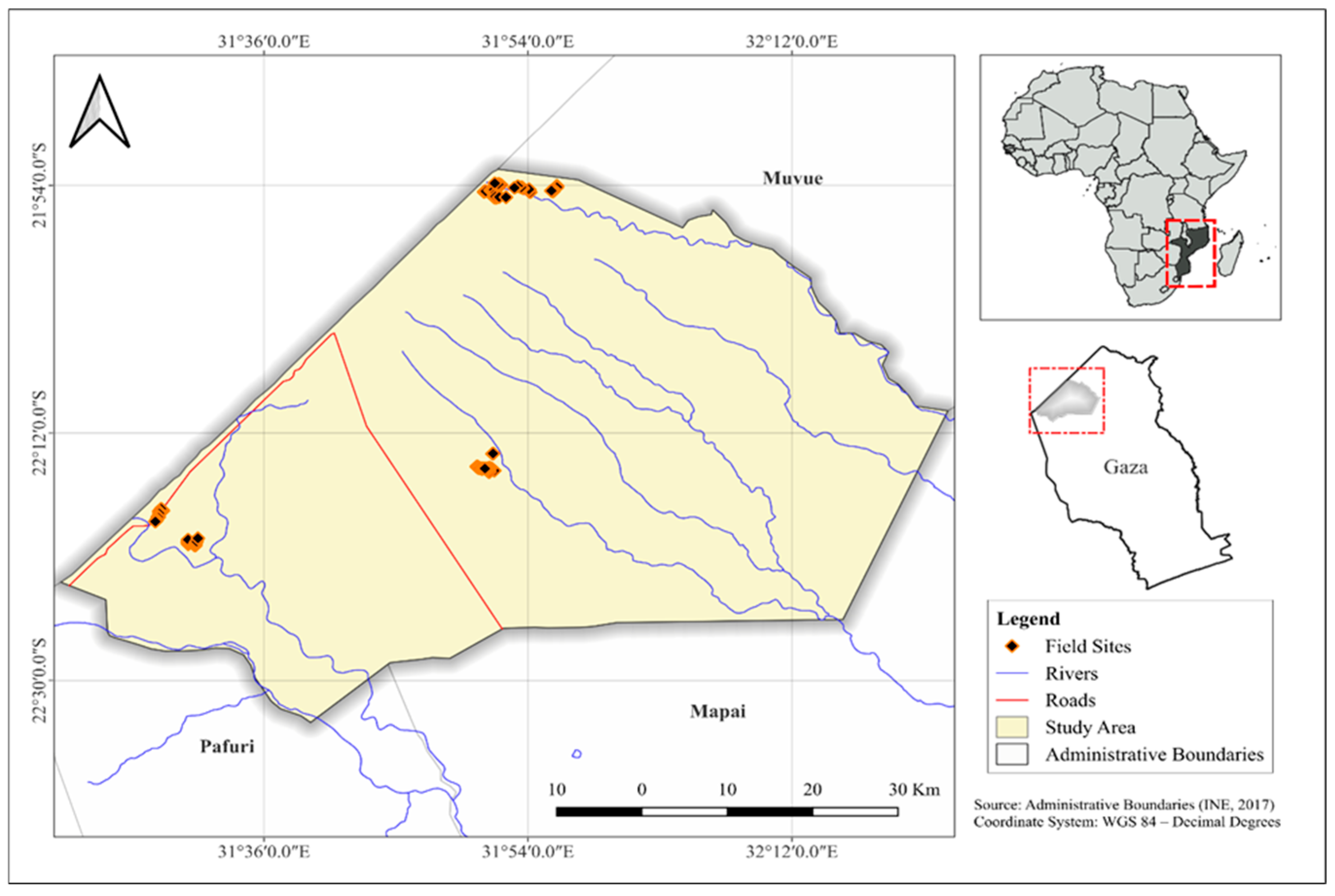
2.1. Characterization of the Study Area
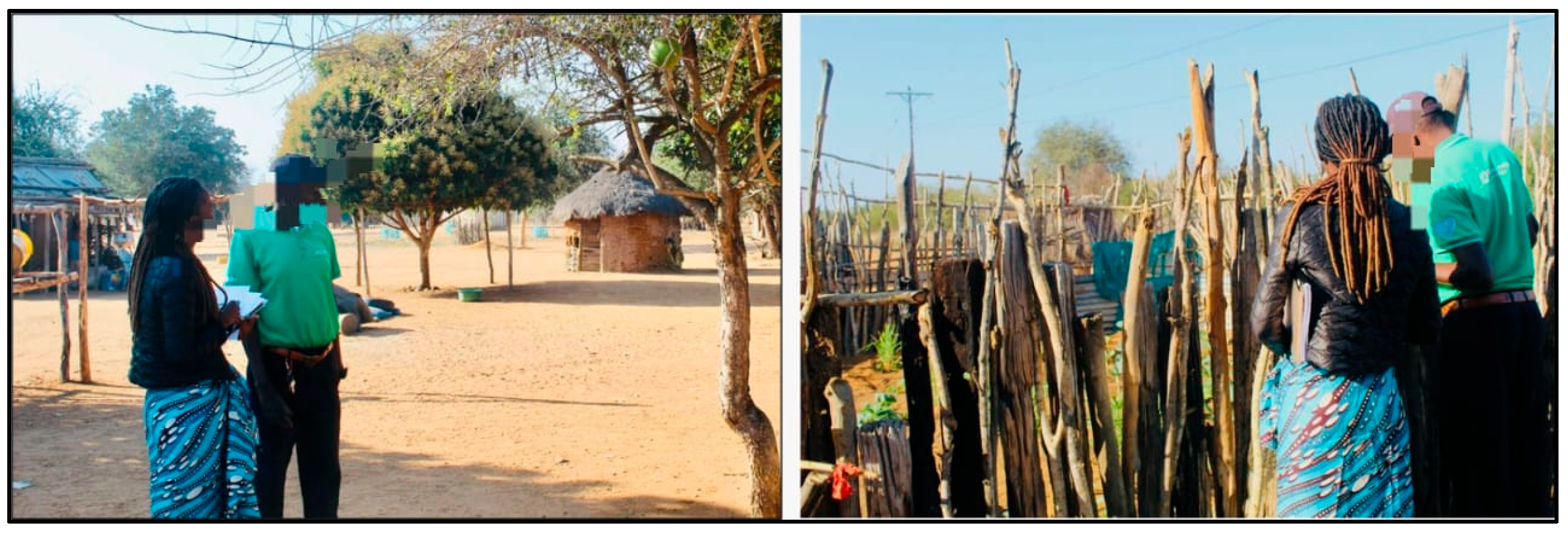
2.2. Data Collection
- n—Sample size
- Zα—Critical value corresponding to the desired confidence level (1.96 for 95%)
- p—Estimated proportion of the population belonging to the category of interest (0.50)
- N—Total number of households in Chicualacuala district (5099)
- E—Allowed estimation error (7%)

| Villages | Total Respondents | Percent (%) |
|---|---|---|
| Chicualacuala River | 105 | 55 |
| Chitanga | 52 | 27 |
| Chicualacuala Sede | 34 | 18 |
2.3. Data Analysis
2.3.1. Dependent and Independent Variables
- Adoption of adaptation technologies in agriculture: Takes value 1 if the head of the households adopted at least one adaptation technology in agriculture, and 0 otherwise.
- Adoption of adaptation technologies in forestry: Takes the value 1 if the head of the households adopted at least one adaptation technology in forestry, and 0 otherwise.
- Adoption of adaptation technologies in livestock farming: Takes the value 1 if the head of the households adopted at least one adaptation technology in livestock farming, and 0 otherwise.
2.3.2. Explanatory Variables
- Hypothesis 1: Male-headed households are more likely to adopt adaptation technologies [9].
- Hypothesis 2: Younger household heads are more likely to adopt adaptation technologies [10].
- Hypothesis 3: Household heads with higher education are more likely to adopt adaptation technologies [12].
- Hypotheses 4 to 8: Adoption likelihood is higher for households engaged in full-time agriculture, livestock farming, or charcoal production [4].
- Hypotheses 9 and 10: Credit access and membership in savings associations increase adoption [10].
- Hypothesis 11: Higher-income households are more likely to adopt adaptation technologies [8].
- Hypotheses 14 to 18: Access to information increases the likelihood of adopting adaptation technologies [4].
- The explanatory variables included in the study, along with their types, expected signs, and associated hypotheses, are summarized in Table 2.
3. Results
3.1. Characterization of the Socioeconomic Profile of Household
3.2. Main Climate Change Adaptation Technologies Adopted by Local Communities
- (a)
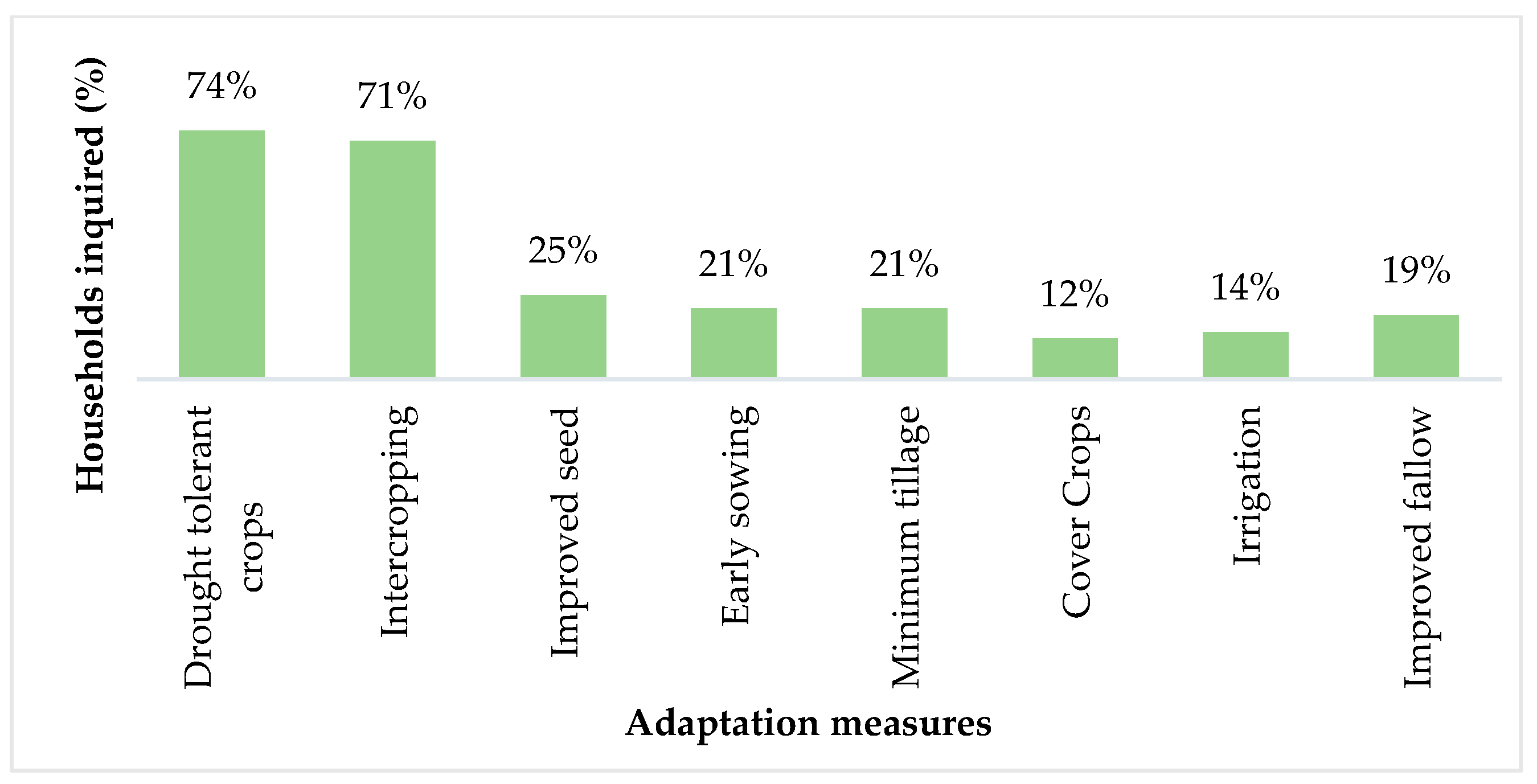
- Agriculture
- (b)
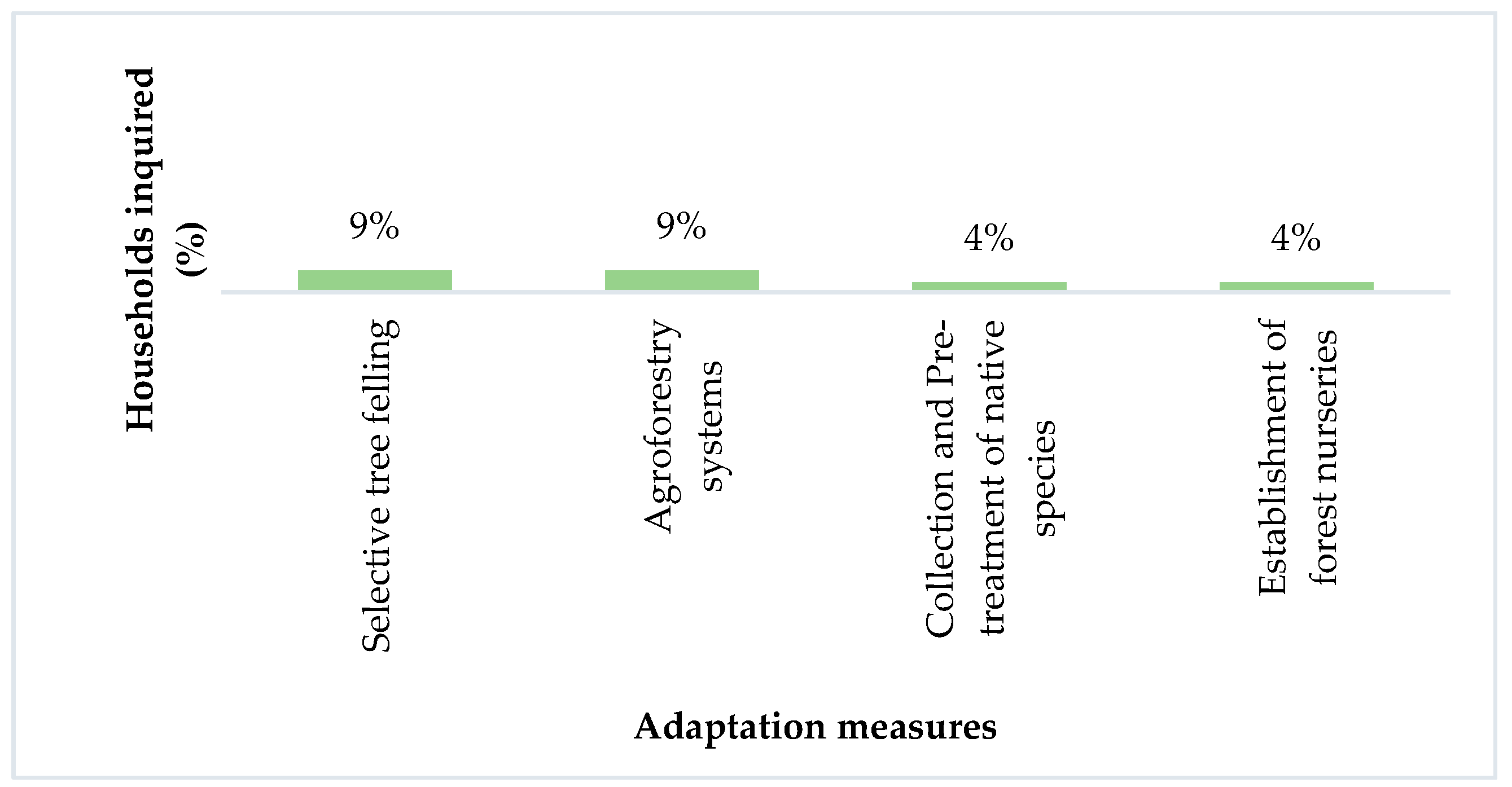
- Forest
- (c)
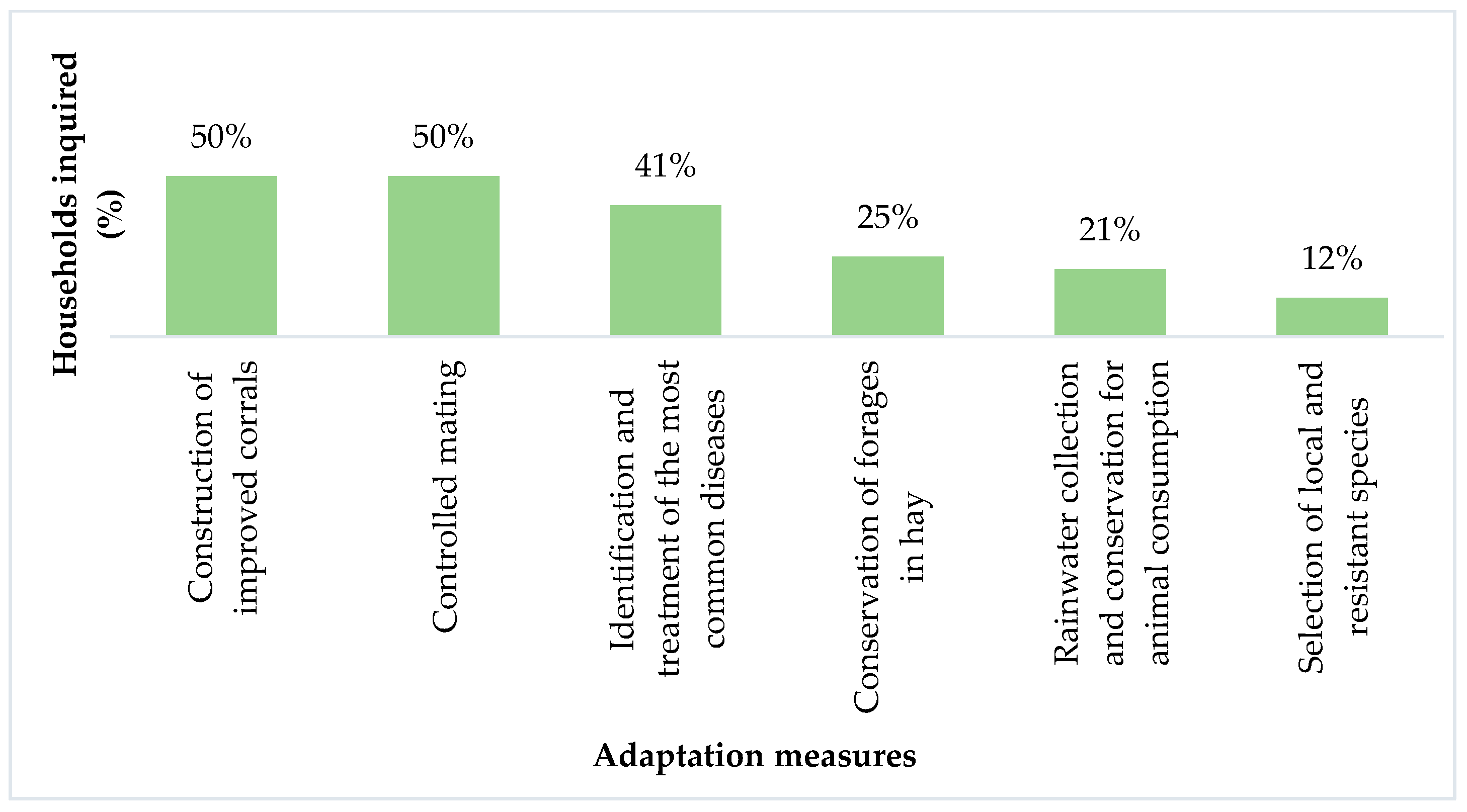
- livestock
3.3. Perceived Effects of the Adopted Technologies
- (a)
- Agriculture
- (b)
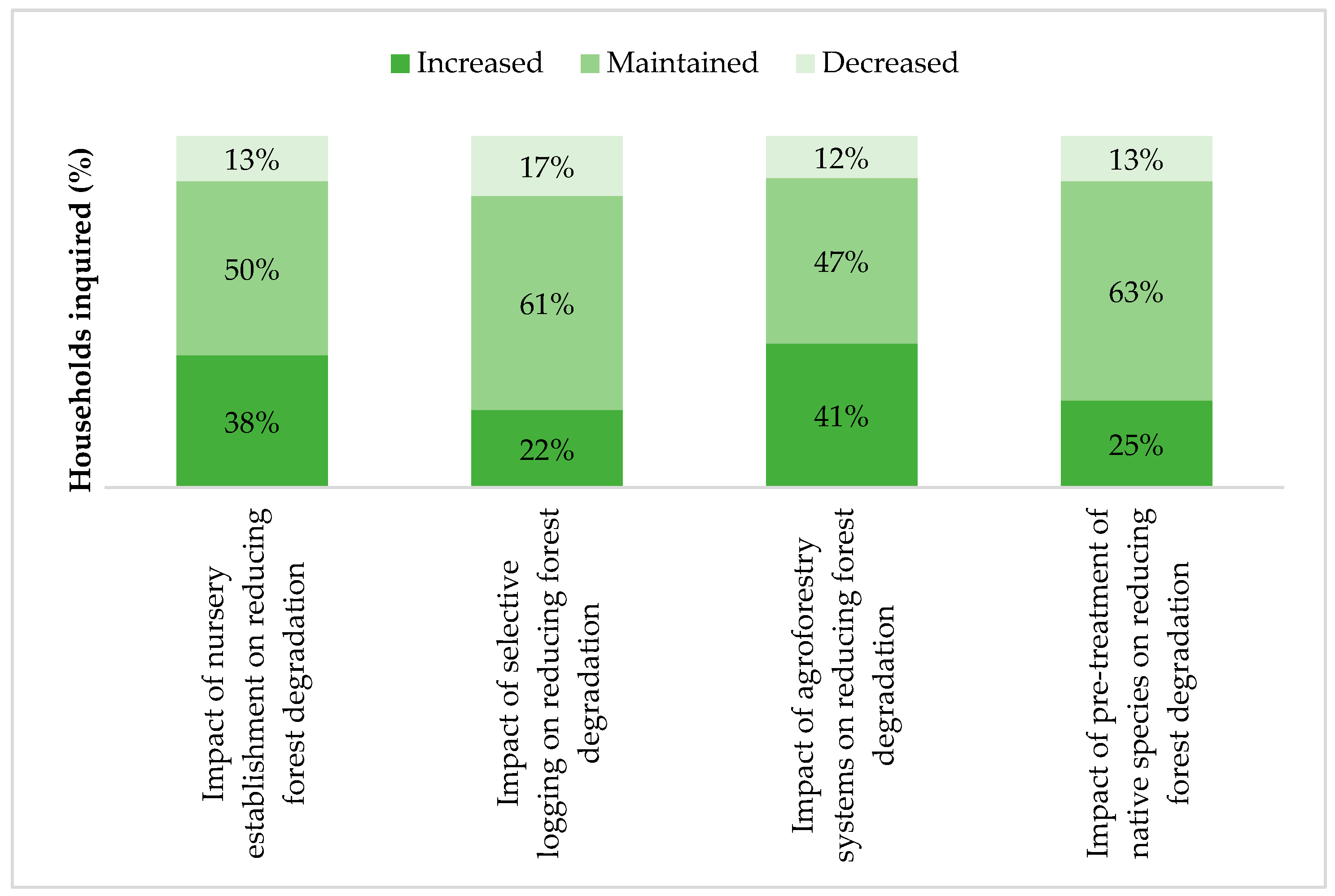
- Forestry
- (c)
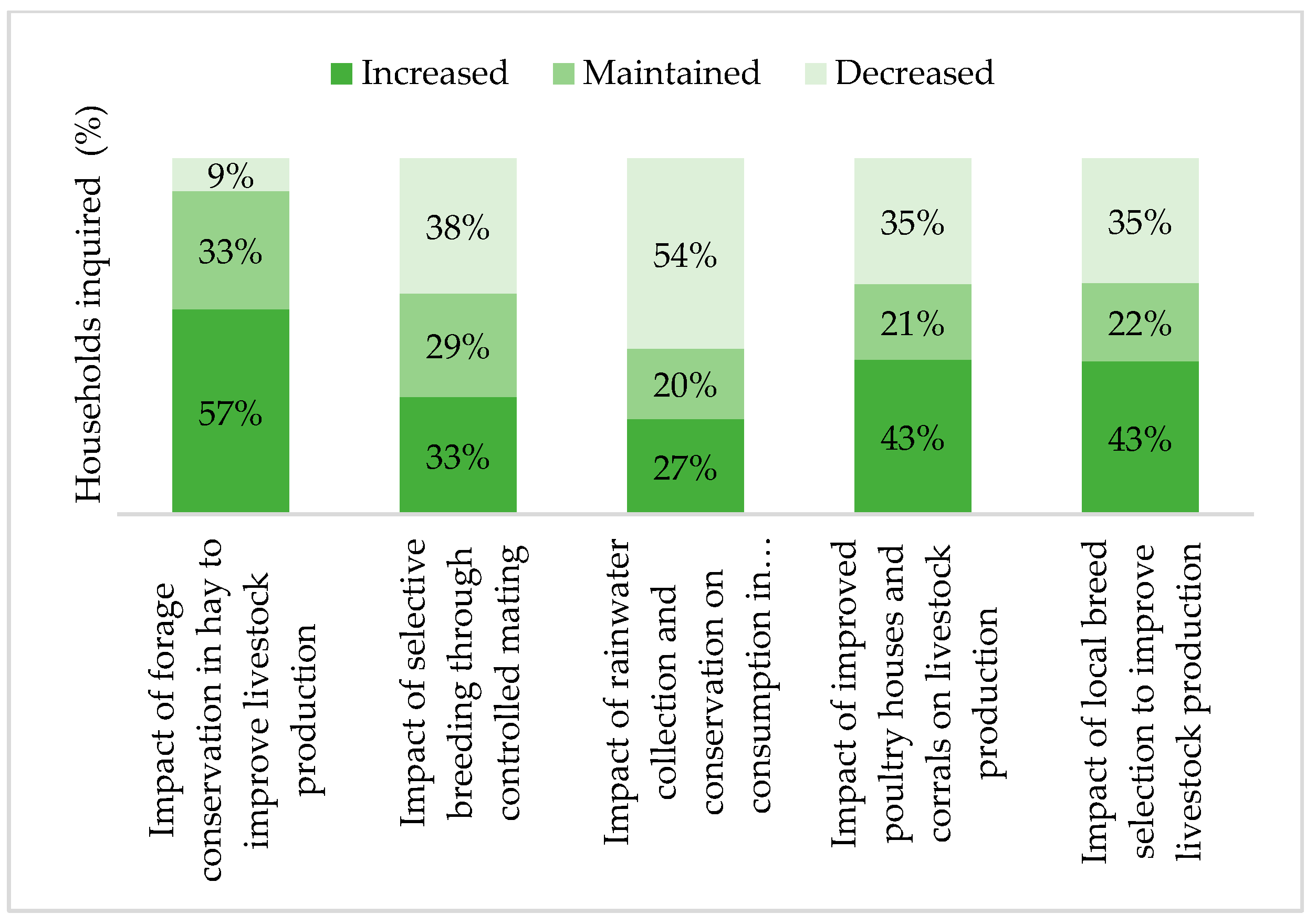
- Livestock
3.4. Estimation Results of the Binary Logistic Regression Model (Logit)
3.4.1. Agriculture Sector
- (a)
- Field size
- (b)
- Household head practicing agriculture full-time
- (c)
- Total household income
- (d)
- Access to information through community meetings
- (e)
- Membership in an agricultural farmers’ association
3.4.2. Forestry Sector
- (a)
- Access to credit
- (b)
- Access to agricultural extension services
- (c)
- Access to information via radio
- (d)
- Access to information through community meetings
- (e)
- Membership in the charcoal producers’ association
3.4.3. Livestock Sector
- (a)
- Household head formally employed
- (b)
- Access to credit
- (c)
- Membership in the charcoal producers’ association
4. Discussion
4.1. Main Climate Change Adaptation Measures Adopted by Local Communities
- Agriculture
- Forestry
- Livestock
4.2. Perceived Effects of the Adopted Technologies
4.2.1. Agriculture
4.2.2. Forestry
4.2.3. Livestock
4.3. Estimation Results of the Binary Logistic Regression Model (Logit)
- (a)
- For the agriculture sector
- (b)
- Forestry Sector
- (c)
- Livestock Sector
5. Conclusions
Author Contributions
Funding
Institutional Review Board Statement
Informed Consent Statement
Data Availability Statement
Conflicts of Interest
References
- Wiederkehr, C.; Beckmann, M.; Hermans, K. Environmental change, adaptation strategies and the relevance of migration in Sub-Saharan drylands. Environ. Res. Lett. 2018, 13, 113003. [Google Scholar] [CrossRef]
- Gannon, K.; Crick, F.; Atela, J.; Babagaliyeva, Z.; Batool, S.; Bedelian, C.; Wade, C. Private adaptation in semi-arid lands: A tailored approach to ‘leave no one behind’. Glob. Sustain. 2020, 3, e6. [Google Scholar] [CrossRef]
- Huang, J.; Yu, H.; Guan, X.; Wang, G.; Guo, R. Accelerated dryland expansion under climate change. Nat. Clim. Change 2016, 6, 166–171. [Google Scholar] [CrossRef]
- Mugari, E.; Masundiri, H.; Bolaane, M. Adapting to Climate Change in Semi-Arid Rural Areas: A Case of the Limpopo Basin Part of Botswana. Sustainability 2020, 12, 8292. [Google Scholar] [CrossRef]
- Wiegel, H. Complicating the tale of ‘first climate migrants’: Resource-dependent livelihoods, drought and labour mobilities in semi-arid Chile. Geoforum 2023, 138, 103663. [Google Scholar] [CrossRef]
- Instituto Nacional de Meteorologia (INAM). Relatório Anual do Estado do Clima em Moçambique 2023; INAM: Maputo, Mozambique, 2024. Available online: https://www.inam.gov.mz/images/RAECM2023/RAECM_2023_Versao_Final_19-03-2024-compactado.pdf (accessed on 10 November 2024).
- Instituto Nacional de Gestão de Calamidades (INGC). Guião Para o Desenvolvimento Das Zonas Áridas e Semiáridas de Moçambique; Ministério da Administração Estatal: Maputo, Mozambique, 2010. [Google Scholar]
- Mavume, A.; Banze, B.; Macie, O.; Queface, A. Analysis of Climate Change Projections for Mozambique under the Representative Concentration Pathways. Atmosphere 2021, 12, 588. [Google Scholar] [CrossRef]
- Pereira, I.; do Nascimento, F. Panorama da desertificação em Chicualacuala, Moçambique (África Austral). Mercator 2013, 12, 171–189. [Google Scholar]
- Abbas, M. Efeitos das mudanças climáticas nos sistemas de produção em Moçambique: Implicações para a segurança alimentar. Obs. Rural. 2022, 33. [Google Scholar]
- IPCC. Mudanças climáticas–A base da ciência. In Sexto Relatório do Painel Intergovernamental de Mudanças Climáticas; WMO: Geneva, Switzerland; UNEP: Nairobi, Kenya, 2021. [Google Scholar]
- Grigorieva, E.; Livenets, A.; Stelmakh, E. Adaptation of agriculture to climate change: A scoping review. Climate 2023, 11, 202. [Google Scholar] [CrossRef]
- Dias, E.; Pessoa, Z. Mudanças climáticas e tecnologias sociais: Adaptação ao contexto do semi-árido. In Proceedings of the Anais XVIII ENANPUR, Natal, Brazil, 27–31 May 2019. [Google Scholar]
- Gao, J.; Shahid, R.; Ji, X.; Li, S. Climate change resilience and sustainable tropical agriculture: Farmers’ perceptions, reactive adaptations and determinants of reactive adaptations in Hainan, China. Atmosphere 2022, 13, 955. [Google Scholar] [CrossRef]
- United Nations Development Program (UNDP); Global Environmental Facility (GEF). Climate Change Adaptation in Africa: UNDP Synthesis of Experiences and Recommendations. Bangkok Regional Hub. 2018. Available online: https://www.thegef.org/sites/default/files/publications/CCA-Africa-Final.pdf (accessed on 9 July 2025).
- Guzmán, S.; Balm, A.; Meattle, C. The State of Climate Finance in Africa: Climate Finance Needs of African Countries. Climate Policy Initiative. 2022. Available online: https://climatepolicyinitiative.org (accessed on 9 July 2025).
- African Climate Foundation (ACF); International Food Policy Research Institute (IFPRI). From Climate Risk to Resilience: Unpacking the Economic Impacts of Climate Change in Mozambique. 2023. Available online: https://reliefweb.int/attachments/3ed1f2c7-7d31-4990-a899-51abc803ec05/800834-AFC-Mozambique-country-note-05A.pdf (accessed on 9 July 2025).
- Sacramento, A.; Matavel, A.; Basílio, M.; Bila, S. Climate change impacts and coping strategies in Chicualacuala district, Gaza province, Mozambique. In Joint Programme on Environmental Mainstreaming and Adaptation to Climate Change in Mozambique; United Nations Environment Programme (UNEP): Maputo, Mozambique, 2012. [Google Scholar]
- Vilanculos, M.; Mafalacusser, J.; Jalane, O. Caracterização Biofísica do Distrito de Chicualacuala, Província de Gaza; CGIAR: Gaza, Moçambique, 2014. [Google Scholar]
- FAO. Adaptation to Climate Change in Semi-Arid Environments: Experience and Lessons from Mozambique; FAO: Rome, Italy, 2012. [Google Scholar]
- Saíde, M. “Nossa Agricultura não Pode Parar!”: Percepções, Processos Transformativos e Estratégias Diante da seca Entre Agricultores no Distrito de Magude. Master’s Thesis, Universidade Federal do Rio Grande do Sul, Porto Alegre, Brazil, 2020. [Google Scholar]
- Government of the District of Chicualacuala. Plano Local de Adaptação às Mudanças Climáticas do Distrito de Chicualacuala; Government of the District of Chicualacuala: Gaza, Moçambique, 2016. [Google Scholar]
- Instituto Nacional de Estatística (INE). Estatísticas do Distrito de Chicualacuala 2017–2021; Instituto Nacional de Estatística: Gaza, Moçambique, 2023. [Google Scholar]
- Humulane, A.; Filimone, C.; Fabião, A.; Dimande, B. Necessidades de Informação e Transferência de Tecnologias dos Produtores Agrários para Adaptação às Mudanças Climáticas no Distrito de Chicualacuala, Província de Gaza. Programa de Pesquisa do CGIAR. 2014. Available online: https://cgspace.cgiar.org/items/f5247dc7-857b-44c0-8ed1-045d8a88266b (accessed on 15 August 2025).
- Martinho, M. Resultados do teste da metodologia cristal em Mapai: Um contributo ao PEDD de Chicualacuala. Programa Conjunto das Nações Unidas (UNJP). 2009. Available online: https://www.fao.org/climatechange/36184-0ef1a2be62ea1147211248ce615f3dd8e.pdf (accessed on 15 August 2025).
- Government of the District of Chicualacuala. Plano Estratégico de Desenvolvimento (PEDD) do Distrito de Chicualacuala; Government of the District of Chicualacuala: Gaza, Moçambique, 2010. [Google Scholar]
- USAID; FEWS NET. Atualização da perspectiva de segurança alimentar em Moçambique. 2012. Available online: https://fews.net/sites/default/files/documents/reports/Mozambique_FSOU_2012_08_Port.pdf (accessed on 9 July 2025).
- Yin, R.K. Case Study Research: Design and Methods, 5th ed.; Sage Publications: Thousand Oaks, CA, USA, 2014. [Google Scholar]
- Weber, A.; Persigo, P. Pesquisa de Opinião Pública: Princípios e Exercícios; Facos/UFSM: Santa Maria, Brazil, 2017. [Google Scholar]
- Cabral, C. Aplicação do Modelo de Regressão Logística num Estudo de Mercado. Master’s Thesis, Universidade de Lisboa, Lisboa, Portugal, 2013. [Google Scholar]
- Jayaraman, K. A Statistical Manual for Forest; FAO: Bangkok, Thailand, 2000. [Google Scholar]
- João, W. Determinantes da Adopção da Energia Solar em Funhalouro: Uma Estratégia de Desenvolvimento Local. Master’s Thesis, Universidade Eduardo Mondlane, Maputo, Moçambique, 2015. [Google Scholar]
- Peng, C.; Lee, K.; Ingressol, G. An Introduction to Logistic Regression Analysis and Reporting. J. Educ. Res. 2002, 96, 2–14. [Google Scholar] [CrossRef]
- Raghuvanshi, R.; Singh, R.; Chand, K. Farmers’ adoption of climate-smart agricultural practices: Evidence from India. Environ. Sci. Policy 2019, 96, 54–66. [Google Scholar]
- Corrar, L.; Paulo, E.; Dias, F. Análise Multivariada Para Cursos De administração, Ciências Contábeis e Economia; Atlas: São Paulo, Brazil, 2009. [Google Scholar]
- FAO. Building a Climate-Resilient Future: Adaptation Strategies for Semi-Arid Regions ; FAO: Rome, Italy, 2024; Available online: https://openknowledge.fao.org/server/api/core/bitstreams/c59fd320-0c16-4411-9840-b076fdd67c64/content (accessed on 21 November 2025).
- Reddy, V.R.; Syme, G.; Narsimlu, B. Adoption of climate-resilient technologies in agriculture: The role of information and farmer perceptions. Clim. Dev. 2019, 11, 488–499. [Google Scholar]
- El Sayed, M.A. Determinants of farmers’ adoption of climate adaptation practices in arid regions. Agric. Syst. 2019, 176, 102–115. [Google Scholar]
- Singh, C.; Dorward, P.; Osborn, J. Climate change adaptation technology adoption among smallholder farmers: Drivers and barriers. Technol. Forecast. Soc. Change 2019, 146, 290–297. [Google Scholar]
- El Sayed, M.A. Adoption of drought-resilient farming technologies under increasing climate variability. Clim. Risk Manag. 2021, 31, 100259. [Google Scholar]
- Knowler, D.; Bradshaw, B. Farmers’ adoption of conservation agriculture: A review and synthesis of recent research. Food Policy 2007, 32, 25–48. [Google Scholar] [CrossRef]
- Aboye, C.; Tadesse, T. Smallholder farmers’ adoption of climate-smart agriculture practices: Evidence from Ethiopia. J. Environ. Manag. 2019, 234, 162–170. [Google Scholar]
- FAO. Cropping Systems Diversification to Enhance Productivity and Adaptation to Climate Change in Mozambique (Fact-sheet/Folheto); Food and Agriculture Organization of the United Nations: Rome, Italy, 2019; Available online: https://openknowledge.fao.org/handle/20.500.14283/ca2651en (accessed on 9 July 2025).
- Aboye, A.B.; Kinsella, J.; Mega, T.L. Farm households’ adaptive strategies in response to climate change in lowlands of southern Ethiopia. Int. J. Clim. Change Strat. Manag. 2023, 15, 579–598. [Google Scholar] [CrossRef]
- Zhang, C.; Jin, J.; Kuang, F.; Ning, J.; Wan, X.; Guan, T. Farmers’ perceptions of climate change and adaptation behavior in Wushen Banner, China. Environ. Sci. Pollut. Res. 2020, 27, 26484–26494. [Google Scholar] [CrossRef]
- Suresh, K.; Khanal, U.; Managi, S.; Quayle, A.; Santhirakumar, S. Uma análise econômica da adaptação agrícola aos impactos das mudanças climáticas no Sri Lanka: Uma análise de regressão de comutação endógena. Land Use Policy 2021, 109, 105601. [Google Scholar] [CrossRef]
- Altieri, M.A.; Funes-Monzote, F.R.; Petersen, P. Agroecologically efficient agricultural systems for smallholder farmers: Contributions to food sovereignty. Agron. Sustain. Dev. 2015, 32, 1–13. [Google Scholar] [CrossRef]
- Recha, J.; Chiulele, R. Mozambique Climate Smart Agriculture Guideline; Vuna: Pretoria, South Africa, 2017. [Google Scholar]
- Singh, P.K.; Chudasama, H. Pathways for climate change adaptations in arid and semi-arid regions. J. Clean. Prod. 2021, 284, 124744. [Google Scholar] [CrossRef]
- Adenle, A.A.; Ford, J.D.; Morton, J.; Twomlow, S.; Alverson, K.; Cattaneo, A.; Cervigni, R.; Kurukulasuriya, P.; Huq, S.; Helfgott, A.; et al. Managing Climate Change Risks in Africa–A Global Perspective. Ecol. Econ. 2017, 141, 190–201. [Google Scholar] [CrossRef]
- Mbow, C.; Smith, P.; Skole, D.; Duguma, L.; Bustamante, M. Achieving mitigation and adaptation to climate change through sustainable agroforestry practices in Africa. Curr. Opin. Environ. Sustain. 2014, 6, 8–14. [Google Scholar] [CrossRef]
- Funk, C.; Sathyan, A.; Winker, P.; Breuer, L. Changing climate–Changing livelihood: Smallholder’s perceptions and adaption strategies. J. Environ. Manag. 2020, 259, 109702. [Google Scholar] [CrossRef]
- Ombogoh, D.B.; Tanui, J.; McMullin, S.; Muriuki, J.; Mowo, J. Enhancing adaptation to climate variability in the East African highlands: A case for fostering collective action among smallholder farmers in Kenya and Uganda. Clim. Dev. 2016, 10, 61–72. [Google Scholar] [CrossRef]
- Amara, A.; Oladele, I. Commodity association’s roles and determinants of farmers’ participation in their climate change adaptation activities in Sierra Leone. Local Environ. 2024, 30, 642–652. [Google Scholar] [CrossRef]
- Deressa, T.T.; Hassan, R.M.; Ringler, C.; Alemu, T.; Yesuf, M. Determinants of farmers’ choice of adaptation methods to climate change in the Nile Basin of Ethiopia. Global Environ. Change 2009, 19, 248–255. [Google Scholar] [CrossRef]
- Serdeczny, O.; Adams, S.; Baarsch, F.; Coumou, D.; Robinson, A.; Hare, W.; Schaeffer, M.; Perrette, M.; Reinhardt, J. Climate change impacts in Sub-Saharan Africa: From physical changes to their social repercussions. Reg. Environ. Change 2017, 17, 1585–1600. [Google Scholar] [CrossRef]




| Label | Variable Type | Expected Signal |
|---|---|---|
| Gender of the household head | Dichotomous (Male = 1; Female = 0) | − |
| Age of the household head in years | Continuous | − |
| High School of the household head | Dichotomous (=1 if yes; 0 otherwise) | + |
| Elementary School of the household head | Dichotomous (=1 if yes; 0 otherwise) | − |
| Formal employment of the household head | Dichotomous (=1 if yes; 0 otherwise) | + |
| Household head had land ownership | Dichotomous (=1 if yes; 0 otherwise) | + |
| Household head practices agriculture full-time | Dichotomous (=1 if yes; 0 otherwise) | + |
| Household head practices charcoal production | Dichotomous (=1 if yes; 0 otherwise) | + |
| Household head had access to credit | Dichotomous (=1 if yes; 0 otherwise) | + |
| Total monthly income of the Household (local currency) | Continuous | + |
| Farm size (hectares) | Continuous | + |
| Household head had access to climate information | Dichotomous (=1 if yes; 0 otherwise) | + |
| Household heads have participated in community meetings | Dichotomous (=1 if yes; 0 otherwise) | + |
| Household used social networks | Dichotomous (=1 if yes; 0 otherwise) | + |
| Household heads used radio | Dichotomous (=1 if yes; 0 otherwise) | |
| Household head belonged to an agricultural association | Dichotomous (=1 if yes; 0 otherwise) | + |
| Household head belonged to a livestock association | Dichotomous (=1 if yes; 0 otherwise) | + |
| Household head belonged to a charcoal producer’s association | Dichotomous (=1 if yes; 0 otherwise) | + |
| Household head belonged to a savings association | Dichotomous (=1 if yes; 0 otherwise) | + |
| Household head had contact with extension service | Dichotomous (=1 if yes; 0 otherwise) | + |
| Household size | Discrete (Number of members in the household) | + |
| Variable | Frequency | Percent (%) | |
|---|---|---|---|
| Gender | Male | 82 | 42.90 |
| Female | 109 | 57.10 | |
| Education level | None | 95 | 49.70 |
| Elementary School | 79 | 41.40 | |
| Higher School | 17 | 8.90 | |
| College level | 0 | 0.00 | |
| Marital status | Single | 77 | 40.31 |
| Married | 0 | 0.00 | |
| Common-law marriage | 102 | 53.40 | |
| Divorced | 1 | 0.52 | |
| Widowed | 11 | 5.76 | |
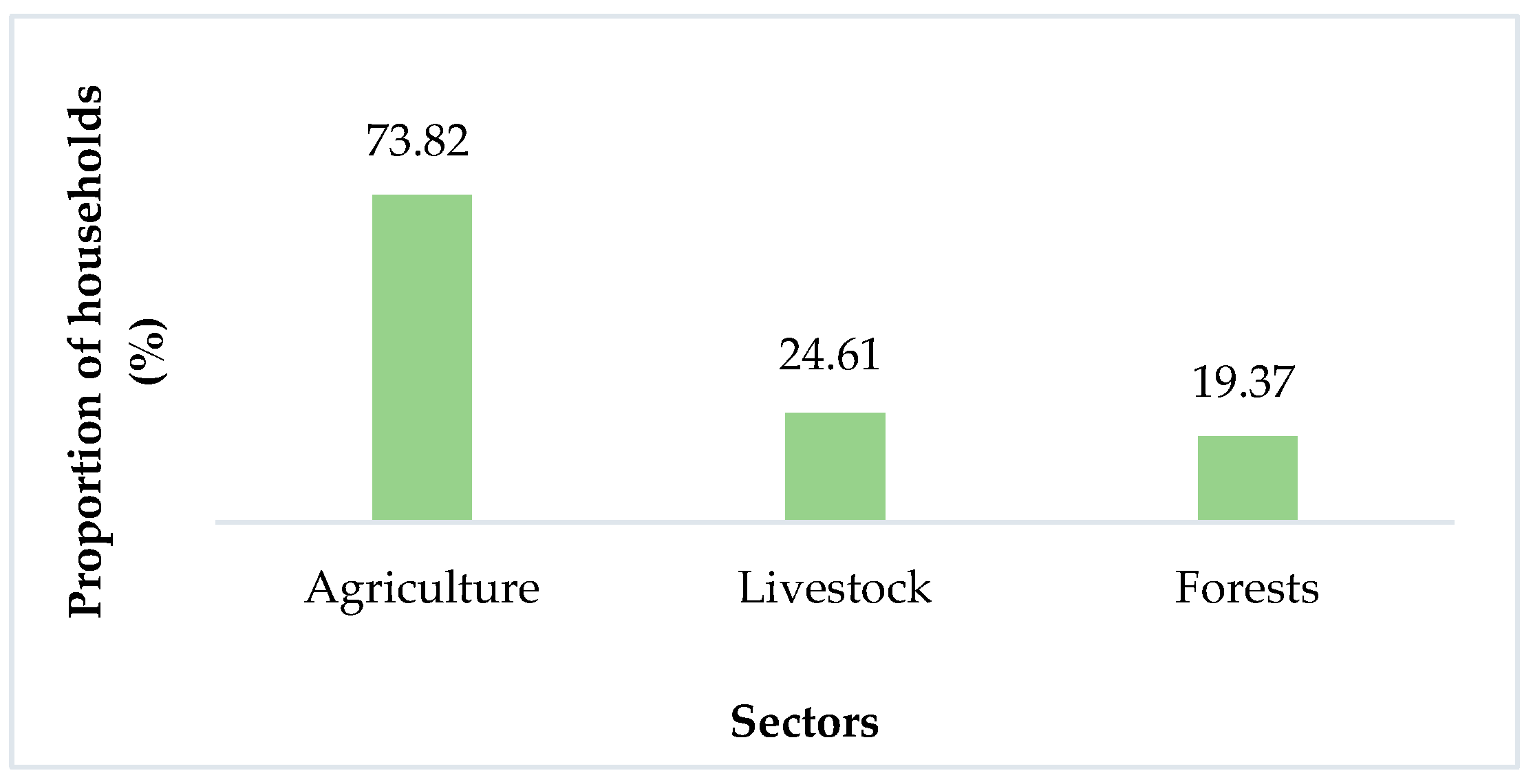
| Activities | Agriculture | 141 | 73.82 |
| Livestock | 47 | 24.61 | |
| Sale of tree seedlings | 20 | 10.47 | |
| Traditional medicine | 2 | 1.05 | |
| Charcoal producer | 103 | 53.93 | |
| Merchant | 6 | 3.14 | |
| Craftsman and State Employee | 0 | 0 | |
| Beverage producer | 7 | 3.67 | |
| Construction | 1 | 0.52 | |
| Association Membership | None | 104 | 54.45 |
| Household head belonged to an agricultural association | 15 | 7.85 | |
| Household head belonged to a livestock association | 7 | 3.67 | |
| Household head belonged to a charcoal producer’s association | 10 | 5.24 | |
| Household head belonged to a savings association | 55 | 28.80 | |
| Main source of information | Social networks | 27 | 14.14 |
| Community meetings | 165 | 86.39 | |
| Community radio | 14 | 7.33 | |
| Access to Climate information | Yes | 77 | 40.31 |
| No | 114 | 50.69 | |
| Land ownership | Yes | 141 | 96.34 |
| No | 7 | 3.66 | |
| Variable | N | Mean | Standard Deviation | Minimum | Maximum |
|---|---|---|---|---|---|
| Age (average) of the household head | 191 | 41.10 | 14.50 | 14.00 | 76.00 |
| Monthly income (USD) | 191 | 42.00 | 37.00 | 0.76 | 461.5 |
| Household size | 191 | 9.53 | 2.69 | 5.00 | 16.00 |
| Farm size (hectares) | 191 | 2.05 | 0.70 | 1.00 | 3.00 |
| Independent Variables | Coefficient | Significance | Odds Ratio (Exp (β)) | ||||||
|---|---|---|---|---|---|---|---|---|---|
| Agriculture | Forestry | Livestock | Agriculture | Forestry | Livestock | Agriculture | Forestry | Livestock | |
| Land ownership | 0.546 | - | 0.629 | - | - | - | |||
| Field size | −3.549 | - | 0.051 * | 0.029 | - | - | |||
| Gender of the household head | 0.948 | 0.1984 | −0.044 | 0.193 | 0.677 | 0.906 | - | - | - |
| Age of the household head | −0.024 | −0.0147 | 0.0017 | 0.430 | 0.336 | 0.886 | - | - | - |
| Basic education level of the household head | 2.676 | 0.906 | 0.334 | 0.1140 | 0.107 | 0.406 | - | - | 0.122 |
| Intermediate level of education of the household head | 1.147 | 1.042 | −0.546 | 0.257 | 0.2601 | 0.4371 | - | - | |
| The household head is formally employed | −0.8017 | −0.4853 | −2.1055 | 0.6166 | 0.549 | 0.007 ** | - | - | 0.122 |
| The household head is practicing agriculture full-time | 4.8376 | 0.6325 | 0.015 ** | 0.322 | 126.170 ** | - | - | ||
| The household head is a charcoal producer | 0.2020 | 0.5991 | 0.726 | 0.141 | 4.727 | 3.510 | |||
| The household head is a livestock farmer | 0.4018 | - | 0.418 | - | - | - | |||
| The household head has access to credit | −1.125 | 1.553 | 1.256 | 0.168 | 0.090 ** | 0.090 ** | - | - | - |
| Total household income | 0.0003 | −0.001 | −0.0001 | 0.020 ** | 0.455 | 0.892 | 1.003 | 0.415 | - |
| The household head has access to climate information services | 0.6008 | 0.3716 | −0.1701 | 0.5906 | 0.373 | 0.650 | 0.369 | - | - |
| The household head has access to agricultural extension services | −0.766 | −0.8740 | 0.095 | 0.370 | 0.0481 ** | 0.796 | - | 3.425 | - |
| The household head has access to information services via social media | −1.9896 | −0.5174 | −0.0809 | 0.207 | 0.486 | 0.871 | - | 4.892 | - |
| The household head has access to information services via radio | 0.336 | 1.231 | 0.854 | 0.7989 | 0.038 ** | 0.153 | - | - | - |
| The household head has access to information services through community meetings | 1.675 | 1.588 | −0.4735 | 0.0636 * | 0.0278 ** | 0.359 | 0.061 | - | 7.355 |
| The household head belongs to the agriculture farmers association | 3.242 | −1.150 | - | 0.037 ** | 0.147 | - | 25.579 | - | - |
| The household head belongs to the charcoal producer’s association | 1.741 | 1.995 | 0.051 * | 0.018 ** | - | - | |||
| The household head belongs to the livestock farmers association | 1.241 | - | 0.082 * | - | - | - | |||
| The household head belongs to the savings association | −0.207 | 0.362 | −0.828 | 0.800 | 0.480 | 0.069 * | - | - | - |
| Household size | −0.3241 | −0.074 | 0.005 | 0.117 | 0.401 | 0.935 | - | - | 0.029 |
| Cons | 7.4796 | 0.198 | −0.044 | 0.165 | 0.677 | 0.906 | - | - | - |
| Number of obs = | 191 | 191 | 191 | ||||||
| Wald Chi2 = | 68.30 | 33.750 | 22.190 | ||||||
| Prob > Chi2 = | 0.000 | 0.028 | 0.0023 | ||||||
| Log likelihood = | −21.460 | −5.346 | −33.450 | ||||||
| Pseudo R2 = | 0.8045 | 0.196 | 0.125 | ||||||
Disclaimer/Publisher’s Note: The statements, opinions and data contained in all publications are solely those of the individual author(s) and contributor(s) and not of MDPI and/or the editor(s). MDPI and/or the editor(s) disclaim responsibility for any injury to people or property resulting from any ideas, methods, instructions or products referred to in the content. |
© 2025 by the authors. Licensee MDPI, Basel, Switzerland. This article is an open access article distributed under the terms and conditions of the Creative Commons Attribution (CC BY) license.
Share and Cite
Cardina, C.; Jorge, A.; Mosse, G.; Artur, L.; Macuácua, J.; Munissa, D.; Sitoe, A.A. Determinants of Agrarian Technology Adoption for Climate Change Adaptation in Semi-Arid Region of Chicualacuala, Mozambique. Sustainability 2026, 18, 5690. https://doi.org/10.3390/su18115690
Cardina C, Jorge A, Mosse G, Artur L, Macuácua J, Munissa D, Sitoe AA. Determinants of Agrarian Technology Adoption for Climate Change Adaptation in Semi-Arid Region of Chicualacuala, Mozambique. Sustainability. 2026; 18(11):5690. https://doi.org/10.3390/su18115690
Chicago/Turabian StyleCardina, Cléusia, Arsénio Jorge, Gerivásia Mosse, Luís Artur, Jaime Macuácua, Délcio Munissa, and Almeida A. Sitoe. 2026. "Determinants of Agrarian Technology Adoption for Climate Change Adaptation in Semi-Arid Region of Chicualacuala, Mozambique" Sustainability 18, no. 11: 5690. https://doi.org/10.3390/su18115690
APA StyleCardina, C., Jorge, A., Mosse, G., Artur, L., Macuácua, J., Munissa, D., & Sitoe, A. A. (2026). Determinants of Agrarian Technology Adoption for Climate Change Adaptation in Semi-Arid Region of Chicualacuala, Mozambique. Sustainability, 18(11), 5690. https://doi.org/10.3390/su18115690