1. Introduction
Landslides are one of the most significant natural hazards affecting mountainous and foothill regions worldwide, particularly in areas undergoing rapid urbanization. This problem is particularly critical in Central Asia, where expanding cities increasingly occupy geodynamically unstable areas characterized by complex geological conditions and active exogenous processes. Almaty, the largest city in Kazakhstan, is located in the northern foothills of the Trans-Ili Alatau Mountains and represents a highly vulnerable environment where geological, climatic, and anthropogenic factors combine to control slope stability [
1,
2,
3].
Loess soils, which widely cover the foothill zones of Almaty and much of Central Asia, are characterized by a metastable structure, high porosity, and strong sensitivity to moisture changes. Under dry conditions, these deposits can support steep slopes due to their apparent cohesion; however, when wet, their structure collapses, leading to a rapid decrease in shear strength and, in some cases, to a transition to a liquid state [
4,
5,
6]. Landslides on loess soils are typically shallow and largely controlled by infiltration processes and local water saturation. A regional review by Khasanov et al. (2021) [
1] highlighted that loess-covered areas in Central Asia are particularly susceptible to landslides, especially under conditions of increasing anthropogenic pressure and climate variability, highlighting the importance of geospatial and remote sensing methods for hazard assessment [
7].
Urbanization substantially increases landslide susceptibility by altering natural drainage systems, increasing slope loads, and creating artificial sources of water infiltration. In cities such as Almaty, uncontrolled development, leaks from water supply systems, and inadequate drainage infrastructure have been identified as key factors contributing to slope instability [
2,
8]. These anthropogenic factors alter both the hydrological regime and the stress–strain state of soils, making slopes more sensitive to external influences such as precipitation and temperature fluctuations.
Climate factors, particularly freeze–thaw processes, play a fundamental role in slope destabilization in continental conditions. Repeated temperature fluctuations around 0 °C lead to progressive degradation of the soil structure, increased porosity, and the development of microcracks, which reduce cohesion and internal friction [
9,
10,
11]. Freeze–thaw cycles are particularly critical in loess soils, where structural failure can occur under combined thermal and hydrological loads. A key mechanism associated with winter slope instability is the formation of “frozen standing water,” which accumulates beneath frozen layers and increases pore pressure, thereby reducing effective stress and shear strength [
10,
11].
Hydrometeorological conditions also contribute to landslide occurrence. Precipitation and snowmelt are widely recognized as the primary factors triggering landslides, particularly in loess regions, where infiltration processes rapidly increase pore pressure [
4,
6]. In continental climates, such as Almaty, snow accumulation during winter followed by rapid thaw in late winter and early spring leads to significant water influx into slope materials. These processes are often enhanced by anthropogenic factors such as water leakage and disruption of drainage systems, leading to localized saturation and reduced slope stability.
In mountainous regions of Asia, similar landslide processes associated with loess soil, rapid urbanization, hydrometeorological extremes, and anthropogenic slope modification are widely documented. Li et al. (2025) [
12] studied rainfall-induced shallow landslides in the loess region of China, demonstrating the crucial roles of water infiltration and soil saturation in slope destabilization. Li et al. (2025) [
13] also highlighted the importance of geological and anthropogenic factors in assessing landslide susceptibility in highly urbanized environments. A study by Silacheva et al. (2020) [
14] and Bayramov et al. (2024) [
15] highlighted the influence of geological structure, seismic activity, and urbanization on slope deformation processes in the mountainous region of Almaty and its surrounding areas in Kazakhstan. Furthermore, Azhideh et al. (2024) [
16] and Huangfu et al. (2025) [
17] showed that landslide occurrence in crustal-active mountainous regions is often controlled by a combination of topographic, precipitation, geological conditions, and anthropogenic influences.
In recent decades, landslide susceptibility assessment has advanced significantly through the use of geospatial technologies. Modern approaches integrate digital elevation models (DEMs), remote sensing data, and meteorological observations into geographic information systems (GIS). Frequently applied methods include multi-criteria decision analysis (e.g., analytic hierarchy process, AHP), statistical models, and machine learning methods such as random forest and logistic regression [
18,
19,
20]. These methods integrate multiple factors influencing landslides and provide a spatial representation of landslide susceptibility. However, many approaches are based on simplified assumptions and often lack sufficient validation, especially in data-poor settings. Moreover, most models are primarily developed for precipitation-induced landslides and do not explicitly consider seasonal processes such as freeze–thaw dynamics and snowmelt, which are crucial in cold climates [
19,
20,
21]. Another important limitation is the insufficient integration of process understanding and geospatial modeling in cold urban settings. Although laboratory and field studies have demonstrated the influence of freeze–thaw cycles on soil strength, these processes are rarely included spatially explicitly in susceptibility models. Furthermore, remote sensing methods such as InSAR, although effective for detecting slope deformation, often face limitations in winter due to snow cover and reduced signal coherence [
20,
22]. As a result, the combined effects of freeze–thaw processes, snow cover dynamics, precipitation, and anthropogenic factors are insufficiently reflected in current landslide susceptibility assessments.
This research gap is particularly evident in Central Asia, where comprehensive studies of winter landslides in urban loess environments remain limited. Existing studies typically focus on either individual landslide triggers or generalized susceptibility modeling approaches, without adequately considering seasonal and anthropogenic interactions. In the case of Almaty, despite the availability of geological and meteorological data, the mechanisms of winter landslides caused by the interaction of natural and anthropogenic factors remain poorly understood.
Human-induced landslides in urban environments, often associated with disruptions to drainage systems, infrastructure leakage, and uncontrolled slope development, are increasingly reported worldwide. Such processes have been documented in regions including Nepal, China, Georgia, and South America [
20,
21,
22,
23,
24]. In cities such as Tbilisi and Kathmandu, anthropogenic factors such as water leakage and unregulated construction on slopes have been identified as key contributors to increased landslide activity, particularly during periods of elevated moisture [
22,
23].
Recent studies based on multi-sensor satellite analysis, such as Poggi et al. (2025) [
24], demonstrate the effectiveness of integrated approaches for assessing landslide dynamics in complex urban environments and highlight the importance of combining geotechnical, environmental, and socio-economic factors.
These findings emphasize the need for an integrated assessment of urban development and slope processes, particularly in rapidly expanding cities [
25]. In this context, the landslide that occurred on 8 February 2024 in the Tau-Samal microdistrict is a typical example of such a multifactorial event [
26]. The failure was associated with a combination of anthropogenic water leakage, freeze–thaw processes, precipitation, and local geological conditions, highlighting the complexity of slope instability in urban settings.
The aim of this study is to investigate the mechanisms of a human-induced winter landslide in the Tau-Samal district (Almaty, Kazakhstan) through an integrated geospatial approach, combining topographic, hydrometeorological, and anthropogenic factors, and to develop a landslide susceptibility model for identifying high-risk areas in urban loess environments.
2. Research Area and Datasets
2.1. Study Area
The study area is located in the southeastern part of Almaty, Kazakhstan, within the Medeu district, home to the Tau-Samal microdistrict and the adjacent foothill slopes of the northern macroslope of the Transilian Alatau. The study area represents a typical example of an urbanized mountain zone characterized by high development density, complex topography, and active exogenous processes. Absolute relief marks vary from 950 to 1200 m, and slope angles reach 30–35°, which facilitates the development of surface and deep deformation processes. The landscape combines elements of a natural mountain slope with engineering infrastructure, including roads, retaining walls, water mains, and drainage systems, forming a complex natural-technological system. Geomorphologically, the area is characterized by accumulative-erosional terraces and deluvial–proluvial aprons on the northern slope of the Transilian Alatau. The geological structure is represented by loess, sandy loam, and loamy deposits of Quaternary age, characterized by a macroporous structure and a tendency to subsidence when oversaturated. These materials exhibit highly variable physical and mechanical properties depending on humidity and temperature: during repeated freeze–thaw cycles, they lose cohesion, and during leaks from utility networks or intense precipitation, they rapidly transition into a plastic state [
27]. These properties make the area particularly susceptible to landslides, mudflows, and localized subsidence.
Figure 1 shows the spatial characteristics of the surveyed area.
Figure 1 shows the location of Almaty, Kazakhstan, the distribution of landslide events recorded within the city, and the detailed location of the Tau-Samal survey area in the Medeu district. The most concentrated areas of recorded landslide events are the steep slopes and highly urbanized foothills of the southern and southeastern regions.
The region is characterized by a continental climate with pronounced seasonal temperature variations. According to Kazhydromet, in February 2024, approximately 50 mm of precipitation fell in the Tau-Samal microdistrict over three days, coinciding with a sharp change in air temperature from below freezing to above freezing (up to +8 °C). This combination of meteorological factors led to waterlogging of the upper horizons of loess soils and a decrease in their strength. This, combined with man-made disruptions to drainage systems, created conditions favorable for slope failure.
Seismotectonic conditions also play a significant role in shaping slope susceptibility to deformation. According to the current seismic zoning map of the Republic of Kazakhstan, Almaty is located in a zone with an intensity of 9 on the MSK-64 scale.
Figure 1a provides a more detailed view of Kazakhstan’s geographical location in Asia and the spatial distribution of earthquake epicenters in relation to Almaty’s geological structure. The heatmap of Almaty (
Figure 1b) shows the locations of recorded landslides, confirming the concentration of slope failures in the hilly areas south of the city. Several active tectonic faults have been identified within the city limits, determining the current morphology and potential seismic hazard:
The Zailiysky Fault, running diagonally along Al-Farabi Avenue and further to the east;
The Latitudinal Fault, extending along Dzhandosov, Timiryazev, Satpayev, and Furmanov Streets to the northeast;
The Northern Fault, running from the Lake Sairan area through the city center to the east;
The Almaty Fault, which crosses the western and northern parts of the Medeu District;
The Northwest Fault, which runs along the western outskirts of the city through the villages of Kok-Kainar, Ozhet, and Karasu to the northeast [
2].
To the south of these structures lies the active Chilik-Kemin deep fault zone, within which destructive earthquakes have been recorded in historical periods, including the Vernoye earthquake of 1887 with a magnitude of 7.3 [
28] and the Kemin earthquake of 1911 with a magnitude of 8.2 [
29]. Current instrumental observations by the National Seismological Service of the Republic of Kazakhstan indicate that up to 200 weak earthquakes are recorded annually within an 80 km radius of Almaty, the majority of which are concentrated to the south and southeast of the city. Even moderate seismic impacts (magnitude 4–5) can cause local displacements and activation of slope processes in areas with waterlogged and disturbed soils, which is especially characteristic of urbanized slopes. Thus, the Tau-Samal microdistrict represents a characteristic example of the interaction of natural (morphology, lithology, climate, seismic) and anthropogenic (urban development, utility networks, drainage changes) factors that contribute to the high susceptibility of an urban foothill area. Its geological and engineering-geomorphological characteristics make this zone a key site for studying the mechanisms of man-made and natural landslide development in the context of active urbanization and climate variability.
The city of Almaty is one of the most landslide-prone cities in Kazakhstan, due to its location in the foothills of the Trans-Ili Alatau, its complex engineering-geological structure, and high development density. According to open sources and materials from the Emergency Situations Committee of the Ministry of Emergency Situations of the Republic of Kazakhstan, dozens of local deformations, landslides, mudslides, and soil subsidence are recorded within the city annually. The largest number of landslides was recorded in the Bostandyk and Medeu districts, which include the steepest and most dynamic sections of the ridge’s northern slopes.
An analysis of the spatial distribution of known landslide events for the period 2016–2024 shows that over 60 percent of all events occurred in the Medeu district, where a significant portion of the slopes are composed of loess, sandy loam, and clayey soils prone to subsidence and loss of strength when oversaturated [
30]. This study uses a landslide cadaster compiled from official reports and documented landslide data provided by the Emergency Situations Agency of the Republic of Kazakhstan for the period 2016–2024. The cadaster includes documented landslide events within the Almaty metropolitan area and was used for qualitative spatial validation of the landslide hazard map [
31]. The Almaty map displays the locations of registered landslides as a heat map (
Figure 1b), confirming the high concentration of slope processes in this part of the city.
Figure 1a shows Kazakhstan’s geographical location within Asia and the spatial distribution of earthquake epicenters related to the geological structure of Almaty.
The enlarged fragment (
Figure 1b) shows a section of the Tau-Samal microdistrict where the largest man-made landslide in recent years occurred on 8 February 2024. A mass of mud slid down the slope, destroying two private homes. The landslide developed on a steep (45–50°) slope composed of loess-like loam, under a combination of waterlogging, thaw, and the failure of a water main.
Thus, the Tau-Samal district is a typical case area for studying winter and human-induced landslide processes in dense urban settings. Its analysis reveals the interrelationships between climatic, engineering, and geomorphological factors that lead to a decline in slope stability.
The area of interest was defined based on the spatial continuity of contiguous microdistricts surrounding the Tau-Samal district, rather than using administrative boundaries or arbitrary raster boundaries. The selected area of interest includes Tau-Samal and adjacent microdistricts located within the same slope system and geomorphological setting. These areas share similar topographic conditions, lithological characteristics, and exposure to anthropogenic impacts, including urban development and engineering infrastructure. The surveyed area covers approximately 35 km2 and is spread across the southern foothills of the Medeu region.
This approach allows for analysis within a physically consistent region where slope processes are controlled by comparable environmental conditions. Importantly, the inclusion of adjacent microdistricts ensures the representation of both affected and potentially stable areas, which is necessary for a meaningful landslide susceptibility assessment.
Furthermore, the spatial distribution of documented landslides (2016–2024 inventory) shows clustering within this combined area, confirming that it represents an active landslide-prone zone. Thus, the defined area of interest (AOI) provides a representative spatial framework for analyzing landslide processes in the Tau-Samal region.
Between 2016 and 2024, 34 landslides were recorded in the study area, corresponding to an approximate landslide density of 1.08 events/km2.
2.2. Description of the Landslide
On 8 February 2024, at 2:20 A.M. local time, a landslide occurred in the Tau-Samal microdistrict (Medeu District, Almaty), leading to the destruction of two residential buildings on Olimpiyskaya Street. According to the classification proposed by Cruden and Varnes (1996) [
32] and updated by Hungr et al. (2014) [
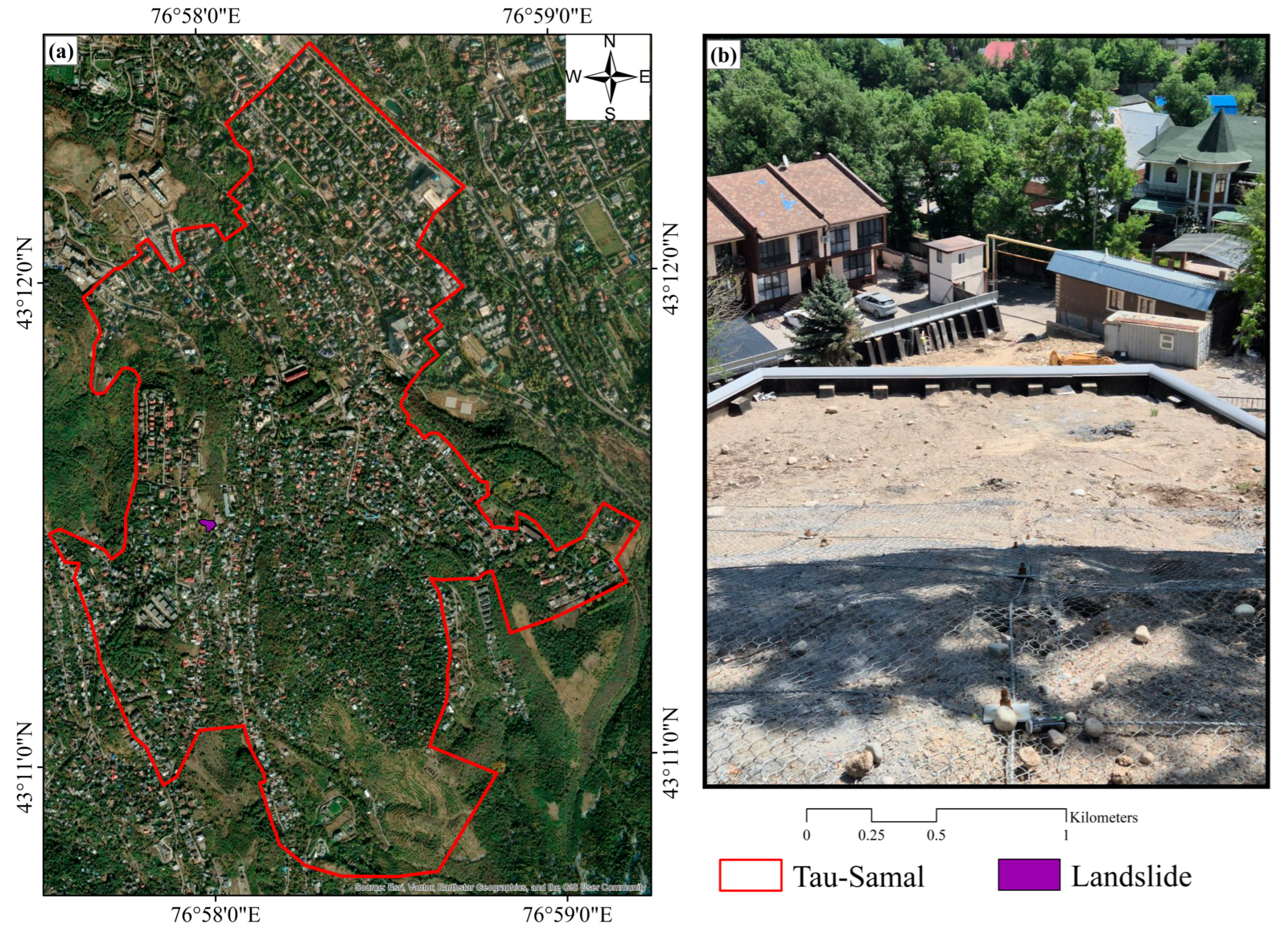
33], the Tau-Samal phenomenon can be classified as a complex landslide flow occurring in loess soil under conditions of rapid water saturation and anthropogenic slope influences. The landslide affected an area of approximately 400 square meters and moved approximately 3200 cubic meters. The collapse occurred on a steep slope characterized by loess deposits and altered drainage conditions. The main collapse occurred at the top of the slope, and the moved soil spread downwards towards residential areas, causing severe structural damage to nearby residential infrastructure. The affected slope sector and residential zone are shown in
Figure 2b.
A preliminary engineering–geological inspection conducted on 9 February 2024 indicated that the landslide was likely triggered by a ruptured water pipe running under the unpaved access road to the Sakura Village cottage community (
Figure 2a). The leak from the 70 mm (steel) and 32 mm (plastic) diameter pipes caused localized waterlogging of the soil massif, formed from loess-like loam with subsidence properties. When saturated with water, such soils rapidly lose their structural stability and may transition into a fluidized state, which likely contributed to mass displacement.
The pipe was located at a depth of approximately 2.8 m below the seasonal freezing zone, which contributed to prolonged moisture accumulation within the slope. Excessive water saturation resulted in partial loosening and loss of particle cohesion within the middle section of the slope. The formation of a tensile crack and subsequent landslide occurred within the artificial slope zone, bounded by residential buildings and a road.
According to inspection data, the parameters of the tensile crack zone are approximately 10 m wide, 40 m long, and 8 m deep on average. The estimated volume of the released soil is 3200 m3. A tensile crack (semi-ring-shaped) 10 m long and 1 m wide was detected at the upper part of the slope, which was present prior to the main slump, indicating the development of deformation. According to the Ministry of Emergency Situations and engineering observations, a secondary collapse of a block with a volume of up to 100 m3 is also possible. The event’s genesis is interpreted as a human-induced landslide, a type of gravitational displacement caused by engineering interventions, in this case, the destruction of a water pipeline and drainage disruption. Analysis revealed that the combination of anthropogenic factors (water leakage) and natural and climatic conditions (freeze–thaw cycles, heavy precipitation, and high humidity) created a critical state of equilibrium in the soil mass.
According to Kazhydromet (2024) [
34], from 5 to 8 February 2024, abnormal temperature fluctuations were observed in Almaty—a drop through 0 °C with daytime temperatures reaching 8 °C, as well as precipitation of up to 50 mm over three days. These conditions contributed to active snowmelt and additional moisture influx into the soil, exacerbating the effects of the pipeline leak. Local residents had previously repeatedly recorded signs of progressive deformation, such as cracks in house walls and fences, and loose doors and windows, indicating a long-term, latent deformation process.
To assess the potential role of increased soil moisture in triggering the Tau-Samal landslide (February 2024), a simplified geotechnical evaluation was carried out to estimate the additional amount of water required for the soil to reach critical conditions corresponding to the liquid limit.
The analysis focuses on loess-like loamy soils, which are widely distributed within the study area and are characterized by high macroporosity, collapsibility, and a sharp reduction in strength upon saturation. Such soils are particularly sensitive to increases in moisture content, making them prone to transition into a fluid state.
The calculations are based on standard definitions of gravimetric water content and generalized physical and mechanical properties of loess soils reported in the literature. The gravimetric water content is defined as:
where
mw is the mass of water, and
md is the mass of dry soil.
The mass of dry soil is calculated as:
where V is the soil volume, and
is the dry soil density.
Using typical values for loess-like soils, the dry mass of the soil body (volume ~3200 m
3) was estimated as:
The mass of water corresponding to the natural moisture content (
w1) and the liquid limit (
w2) is determined as:
The additional amount of water potentially associated with critical moisture conditions was approximately estimated as:
Based on representative moisture values for loess soils, the additional amount of water required is estimated to be:
This value represents an approximate estimate of the increase in moisture required for the soil to approach a liquid state.
To assess the likelihood of such moisture accumulation under natural conditions, cumulative precipitation prior to the landslide was taken into account. For example, a precipitation amount of approximately 376 mm over a limited area corresponds to a water volume of about:
which yields a value of the same order of magnitude (~150 m
3), suggesting that precipitation, together with snowmelt, groundwater inflow, and possible infrastructure leakage, may have contributed to increased soil moisture conditions.
It is important to note that not all precipitation infiltrates into the soil due to surface runoff, evaporation, and spatial variability of infiltration processes. Therefore, the contribution of precipitation alone may be insufficient to reach critical conditions, highlighting the likely combined influence of multiple hydrological factors.
This assessment represents a simplified approach based on moisture threshold values and does not account for changes in pore pressure, degradation of soil structure, or slope stability parameters such as the factor of safety. In addition, the calculations are based on generalized soil properties and do not include laboratory or field measurements specific to the study site.
Therefore, the presented calculations should be interpreted only as simplified, indicative estimates intended to support the conceptual interpretation of possible landslide-triggering mechanisms rather than as rigorous geotechnical or hydrological calculations.
An additional risk factor is the geomorphological location of the site: a slope with a 45–50° inclination, composed of loose, subsiding soils, intersected by utility lines, and lacking natural drainage. Such conditions are typical of urbanized slopes affected by modified drainage and infrastructure-related disturbances [
35,
36].
3. Data Collection and Preparation
The analysis is based on an integrated set of topographic, lithological, meteorological, and anthropogenic geospatial data combined in a geographic information system (GIS). All data were projected into the WGS 84/UTM Zone 43N coordinate system to ensure spatial consistency. Data processing, spatial analysis, and visualization were performed using QGIS 3.32 and ArcGIS Pro 3.2.
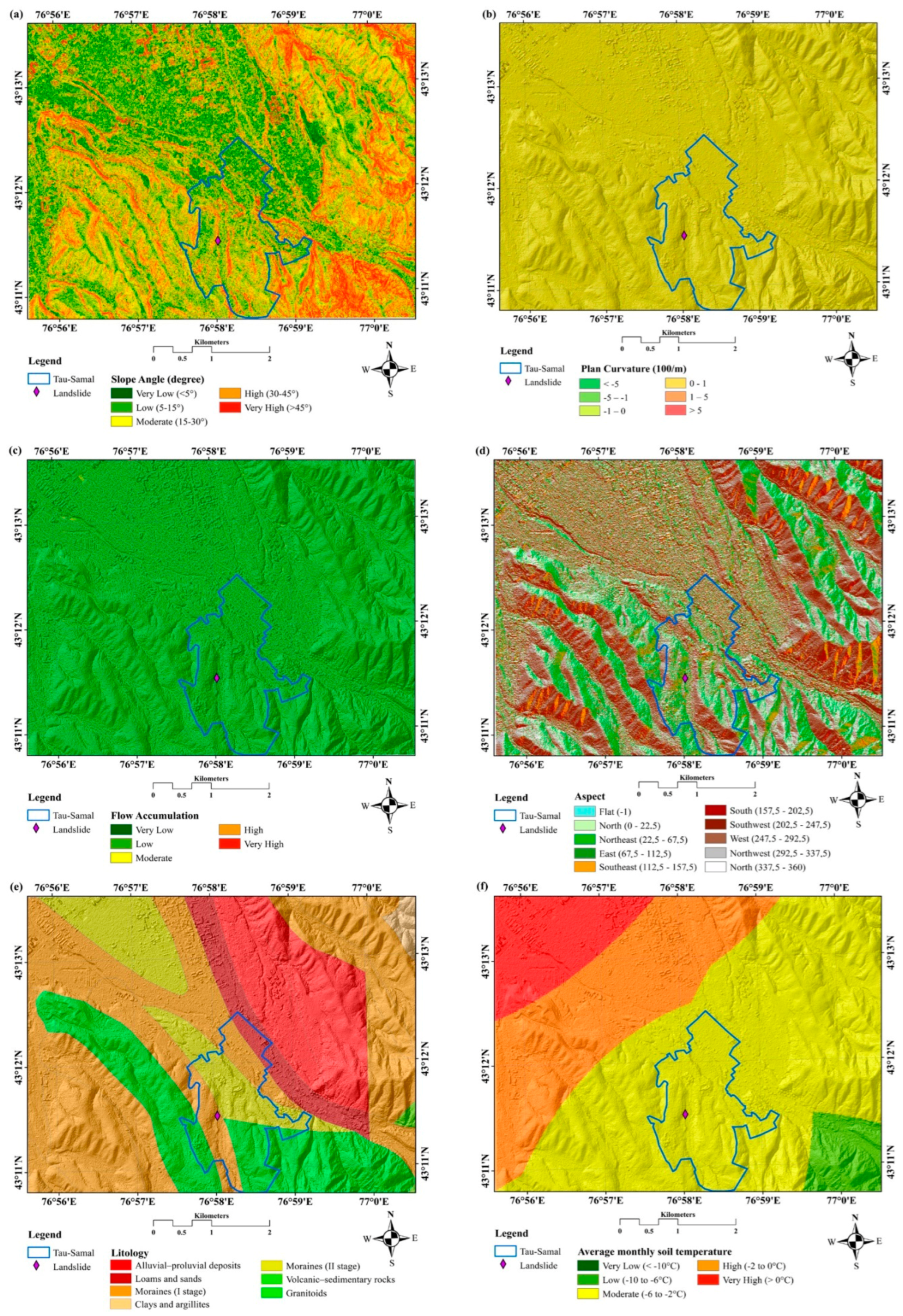
Landslide susceptibility assessments were performed based on nine geographic information system (GIS) layers derived from digital elevation models (DEMs), meteorological observation data, and geospatial datasets. These layers were selected as conditional factors representing topographic, hydrological, geological, climatic, and anthropogenic influences on slope instability and incorporated into a GIS-based susceptibility modeling workflow.
The selected factors included variables such as slope, plan curvature, flow accumulation, aspect, lithology, soil temperature, distance to roads, building density, and precipitation. Seismic data were not incorporated into the landslide susceptibility model and were used only as supplementary information for the interpretation of the results.
The source data included observational data (weather stations, seismic events) and spatial layers characterizing the morphology, lithology, and anthropogenic factors affecting slope susceptibility (
Table 1). In this study, landslide observation data previously recorded by Zhanabaev et al. (2024) [
37] were used as additional reference information for the spatial interpretation of areas at high risk of landslides. These data were combined with newly processed GIS layers, topographic analysis, meteorological observations, and susceptibility modeling performed in this study.
All input layers were preprocessed, including data cleaning and standardization, to ensure consistency and comparability.
Each factor is described in the following sections.
3.1. GIS Layers
3.1.1. Slope
Slope is one of the primary factors controlling landslide occurrence [
7,
8], as it directly reflects the mechanical conditions governing slope stability. Within a digital elevation model (DEM), slope is calculated as the rate of elevation change over a given distance. The DEM (3 m resolution) was derived from high-resolution point cloud data available via the OpenTopography platform [
38]. It was used to derive key morphometric parameters, including slope, plan curvature, flow accumulation, and aspect, using standard GIS-based terrain analysis tools. Based on their degree of steepness, these slope values were classified into five distinct classes: very low (0–5°), low (5–15°), moderate (15–30°), high (30–45°), and very high (>45°).
3.1.2. Plan Curvature
Terrain curvature describes the concavity or convexity of the surface and was derived from the DEM as a plan curvature parameter (m
−1). In this study, plan curvature values were classified into several categories, ranging from strongly concave to strongly convex surfaces. Negative curvature values represent concave landforms, which tend to accumulate surface runoff and sediments, thereby increasing local soil moisture and potentially enhancing landslide susceptibility. Values close to zero correspond to relatively flat or linear surfaces with minimal influence on flow convergence or divergence [
39,
40]. Positive curvature values indicate convex forms, where surface runoff is more dispersed, reducing water accumulation and, consequently, the likelihood of slope saturation.
3.1.3. Flow Accumulation
Flow accumulation was derived from the DEM using a flow-routing algorithm that estimates the number of upstream cells contributing to each location, representing the potential concentration of surface runoff. The values were classified into five categories (very low, low, moderate, high, and very high) to reflect spatial variations in water accumulation [
11,
39,
40]. Areas with higher flow accumulation indicate zones of runoff convergence and increased soil moisture, which may contribute to slope instability, while lower values correspond to well-drained areas with limited water concentration.
3.1.4. Aspect
Slope aspect plays an important role in shaping microclimatic conditions by influencing the distribution of solar radiation, snow accumulation, and moisture retention [
10,
39], which in turn affects soil moisture processes and slope stability. In this study, aspect values were classified into nine categories, including flat areas and eight directional classes: north (0–22.5° and 337.5–360°), northeast (22.5–67.5°), east (67.5–112.5°), southeast (112.5–157.5°), south (157.5–202.5°), southwest (202.5–247.5°), west (247.5–292.5°), and northwest (292.5–337.5°).
3.1.5. Lithology
Lithology plays a key role in controlling the mechanical and hydrological properties of the terrain and, therefore, strongly influences landslide susceptibility [
5,
38]. In this study, several lithological units were identified within the study area, including alluvial–proluvial deposits, loams and sands, moraines (I and II stages), clays and argillites, volcanic–sedimentary rocks, and granitoids.
Different lithological units exhibit varying physical properties that affect slope stability. Unconsolidated deposits such as alluvial–proluvial sediments and loams are generally more prone to deformation due to their low cohesion and high sensitivity to water saturation [
11]. Clay-rich materials tend to retain moisture and may develop elevated pore pressure, reducing shear strength. In contrast, consolidated rocks such as granitoids are typically more stable due to their higher strength and lower permeability. Soil type characteristics were determined using 1:200,000 scale maps. The original lithological dataset was available at a scale of 1:200,000 and was resampled to match the generally accepted 3 m analytical grid used in the study. This resampling procedure ensured spatial consistency between the datasets but did not improve the original accuracy of the geological mapping.
3.1.6. Soil Temperature
Meteorological and soil temperature data were obtained from five meteorological stations operated by JSC Kazhydromet within the Almaty region, including Almaty, Big Almaty Lake, Kamenskoye Plateau, Mynzhylky, and Shymbulak stations. To assess the general spatial distribution of soil temperature, the data were interpolated using the Inverse Distance Weighting (IDW) method. The resulting map shows the spatial variability of average monthly soil temperature, classified into five categories ranging from very low (<−10 °C) to very high (>0 °C). Higher temperature values are mainly observed on southern and southwestern exposures, indicating zones of earlier soil thawing, while lower temperatures correspond to shaded areas with prolonged freezing conditions. The interpolated map does not represent direct soil temperature measurements at every location. Instead, it provides a generalized spatial approximation of soil temperature patterns across the study area and was used for comparative susceptibility analysis. The soil temperature layer serves as an indicator of the spatial variability of freeze–thaw conditions within the study area [
18,
19].
3.1.7. Distance to Roads
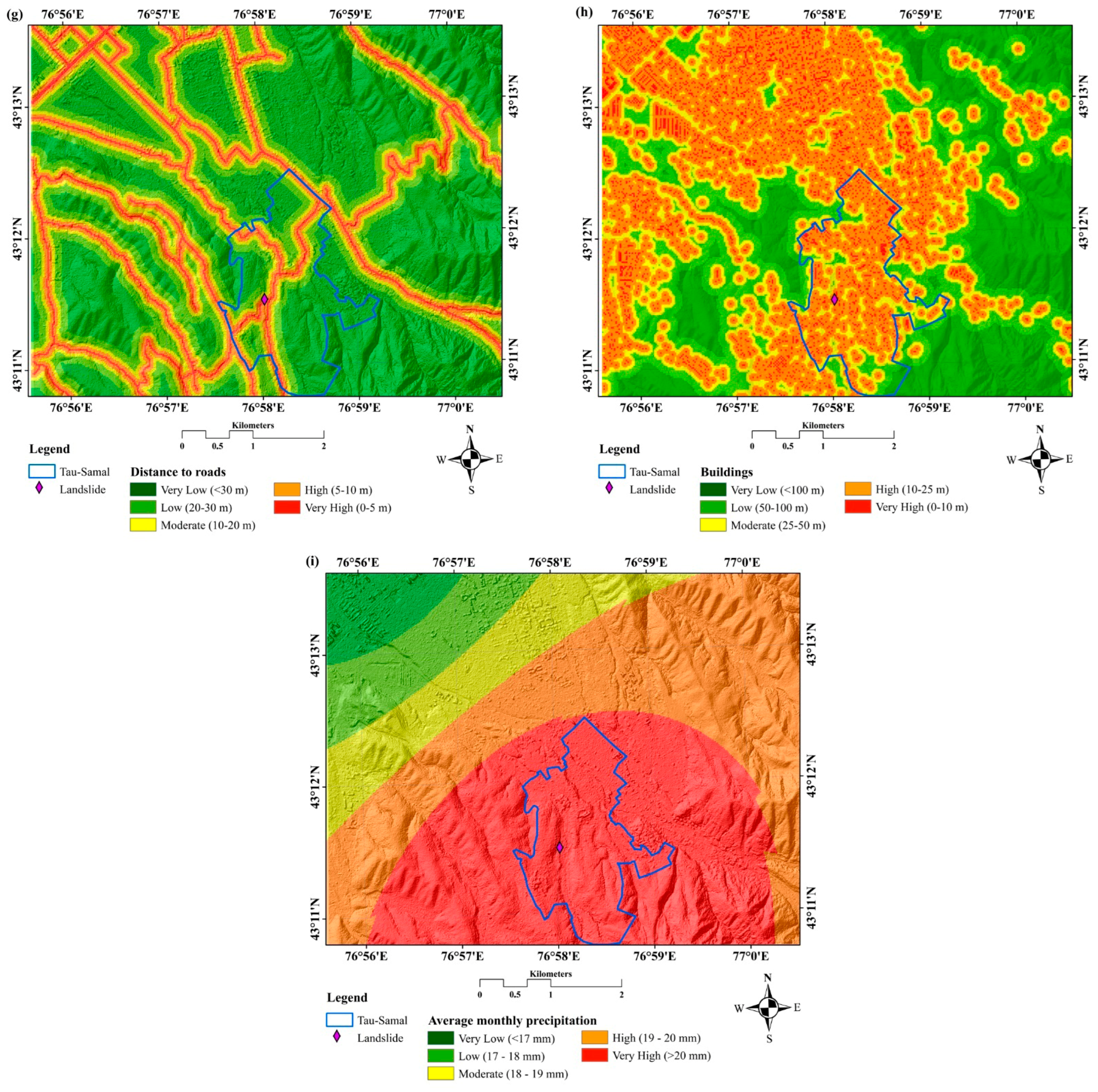
The spatial layers of road infrastructure were created using OpenStreetMap (OSM) open geodata, distributed under the Open Database License (ODbL). The study utilized vector layers of roads exported from the OSM database and adapted for subsequent analysis in a geographic information environment. To assess the impact of transport infrastructure on slope stability, raster layers of distances to roads and intra-block driveways were constructed. The calculation was performed using the Euclidean Distance method, which allowed us to quantitatively characterize zones of potential slope undercutting, disturbances to the natural relief profile, and local changes in the hydrodynamic regime of surface runoff [
21,
25]. Such areas are characterized by an increased likelihood of developing localized zones of softening and moisture accumulation.
3.1.8. Building Density
The spatial layers of development were created using OpenStreetMap (OSM) open geodata, distributed under the Open Database License (ODbL). The study utilized vector layers of buildings exported from the OSM database and adapted for subsequent analysis in a geographic information environment. The building layer was used to calculate the development density using the Kernel Density method with a spatial resolution of 30 m, ensuring the formation of a continuous field of anthropogenic load on the slope [
21,
24].
3.1.9. Precipitation
Precipitation data were obtained from five meteorological stations operated by JSC Kazhydromet within the Almaty region, including Almaty, Big Almaty Lake, Kamenskoye Plateau, Mynzhylky, and Shymbulak stations. To derive the general spatial distribution of rainfall, the data were interpolated using the Inverse Distance Weighting (IDW) method, which allows the estimation of precipitation values across the study area based on nearby observations.
The resulting precipitation values were classified into five categories: very low (<17 mm), low (17–18 mm), moderate (18–19 mm), high (19–20 mm), and very high (>20 mm). This classification reflects the spatial variability of precipitation and its influence on hydrological conditions within the study area [
10,
11].
3.2. Seismic Conditions and Contextual Analysis
Seismic activity was analyzed as a contextual environmental factor potentially affecting slope stability in the Almaty region. Initially, seismicity was considered as a potential input factor for landslide susceptibility analysis due to the high seismicity of the Almaty region. However, further analysis showed that the recorded seismic events were located at a considerable distance from the Tau-Samal landslide site, and a direct spatial relationship with the observed slope failure could not be established. Therefore, seismicity was not included as a direct factor in the final LSI model and was instead analyzed qualitatively as a contextual environmental condition.
Research in Central Asia shows that earthquakes are one of the main triggers for landslides and rockfalls [
41,
42,
43].
This study used seismic event data for January–February 2024, obtained from the Kazakhstan National Data Center (KNDC) network catalog of stations located in Almaty (coordinates 43.22° N, 76.97° E) [
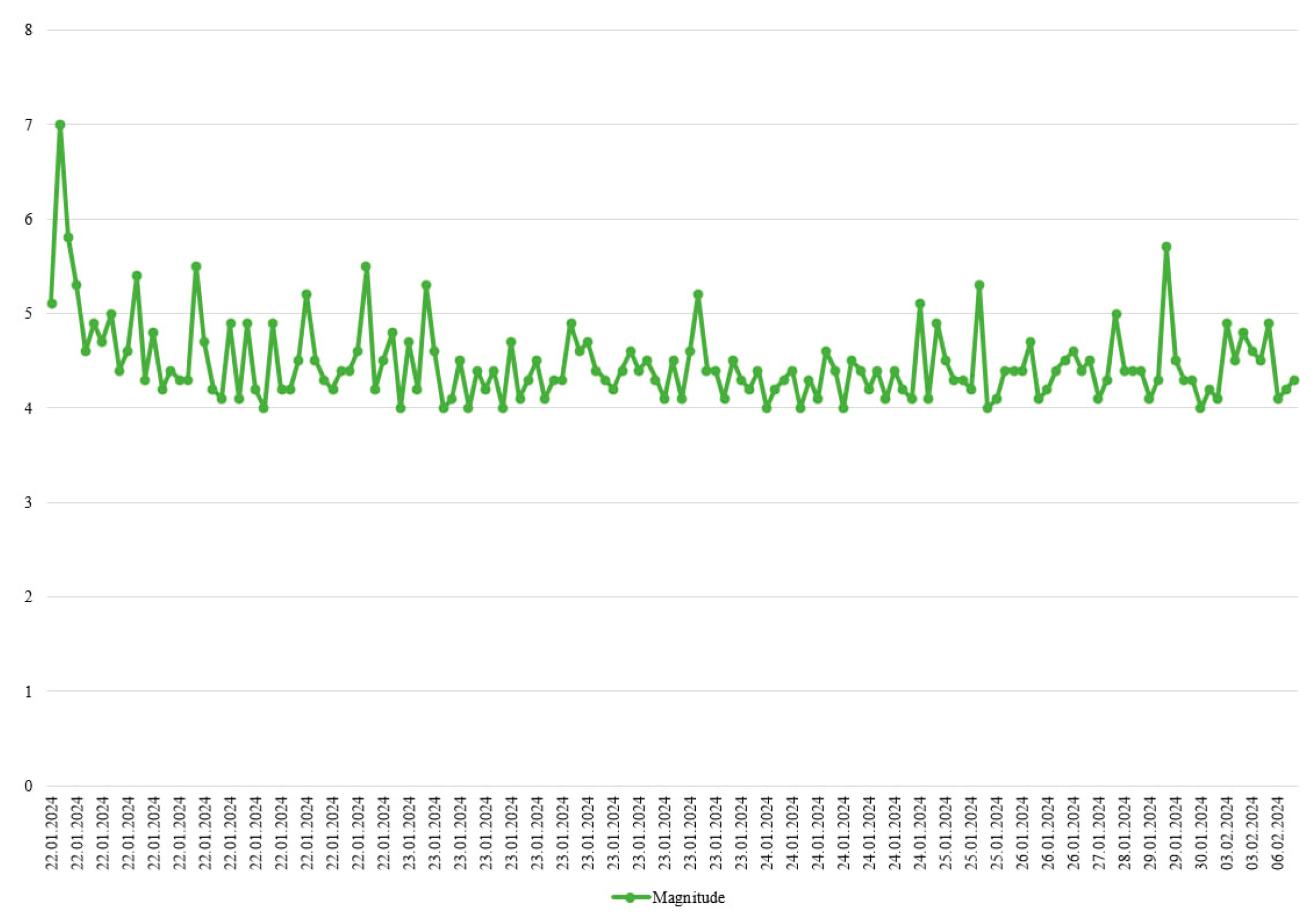
44]. A total of 167 events with magnitudes ranging from 4.0 to 7.0 and focal depths ranging from 2.3 to 43.1 km were recorded between 22 January and 28 February 2024. The main seismic activity was observed in the area of 41° N and 78° E, corresponding to eastern Kazakhstan and western China (the Zharkent zone).
Analysis of the seismic data allows the following conclusions to be drawn:
The timing and spatial distribution of the events (22 January–28 February), magnitudes (up to ~7.0), and depths (8–13 km) indicate reactivation of upper crustal faults.
The locations of the foci and their depth ranges correspond to the typical pattern of intracontinental compressional structures, as confirmed by the literature.
Given the geomorphological features of the area and the regional seismic background, the risk of secondary geological processes (landslides, rockfalls) must be considered, especially on slopes.
These factors should be taken into account in further susceptibility assessments and the formulation of recommendations for monitoring and seismic geomorphological risk.
However, the spatial distribution of seismic events reveals a clear separation between the main zone of seismic activity and the study area. Most of the recorded epicenters are concentrated in the eastern Tien Shan (approximately 41.1–41.3° N and 78.5–78.7° E), while the Tau-Samal landslide area is located further northwest (approximately 43.2° N and 76.9° E). This spatial shift corresponds to a distance of approximately 200–300 km between the seismic source zone and the study slope.
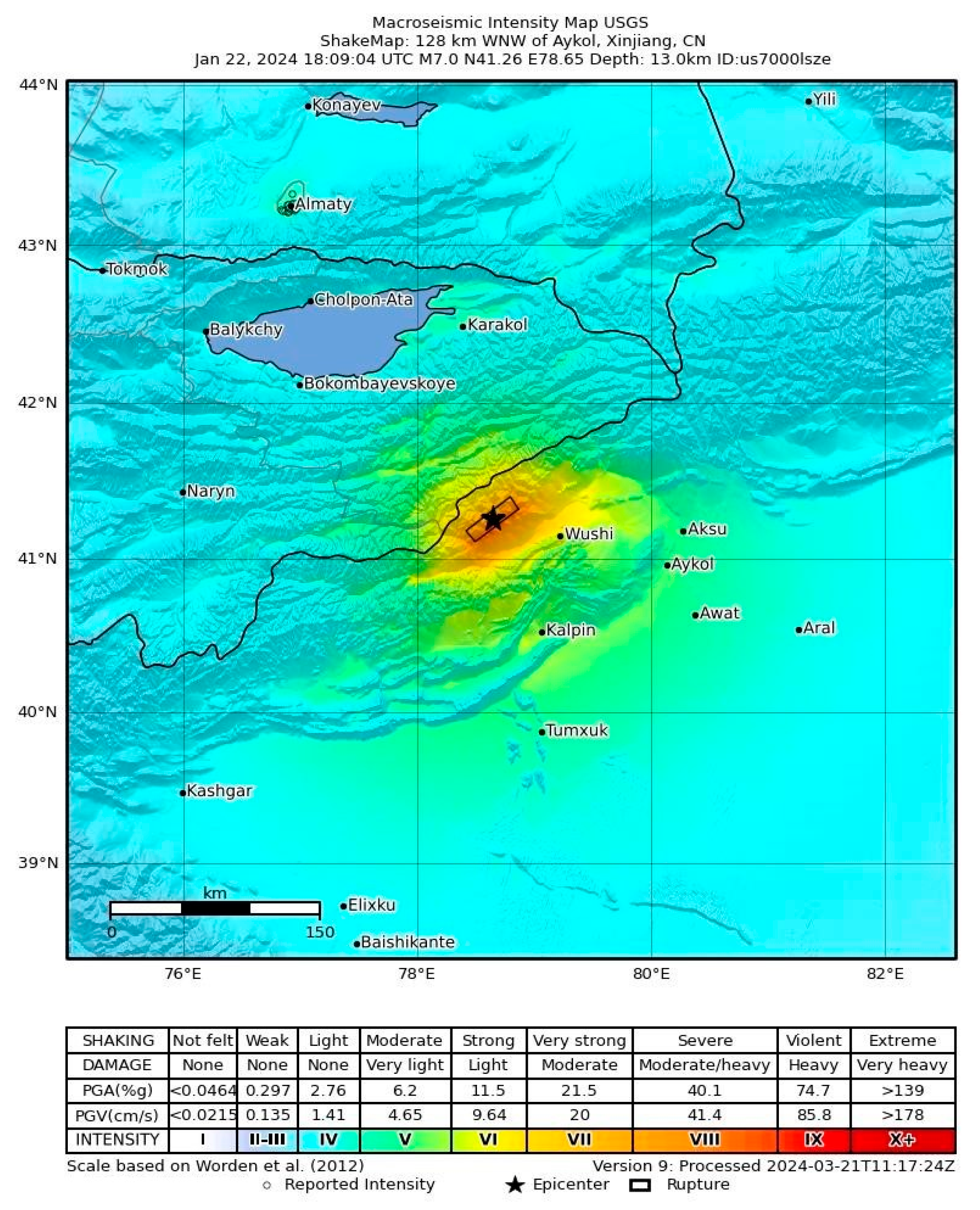
To further assess the potential impact of seismic vibrations, USGS ShakeMap data for the Mw 7.0 earthquake of 22 January 2024 were analyzed (
Figure 3) [
45]. The distribution of macroseismic intensity shows that the highest shaking intensities (VIII–IX) were concentrated in the epicentral region in western China, while the Almaty region experienced only moderate shaking (intensity V–VI). These intensity levels are generally insufficient to directly trigger large-scale landslides in the absence of additional destabilizing factors.
Therefore, seismic activity in the study region is interpreted as a secondary (indirect) factor preceding the landslide, rather than a direct trigger (
Table 2).
3.3. Data Preprocessing and Harmonization
To ensure compatibility between datasets with different formats and spatial resolutions, all data were resampled and aligned to a common spatial grid with a 3 m resolution. Vector datasets were converted to raster images, and continuous variables were interpolated or scaled as necessary.
All factors influencing landslides were standardized before inclusion in the landslide susceptibility index (LSI) model. Continuous variables were normalized using min–max scaling, and categorical variables were reclassified based on their relative contribution to slope instability.
4. Methodology
The applied classification schemes for factors influencing landslides were not based on a single standard, but on engineering-geological principles and widely used approaches in landslide susceptibility studies. The choice of class thresholds reflects the physical mechanisms controlling slope instability, including gravitational forces, water saturation, and anthropogenic impacts. Similar approaches have been widely used in previous studies [
39,
47,
48].
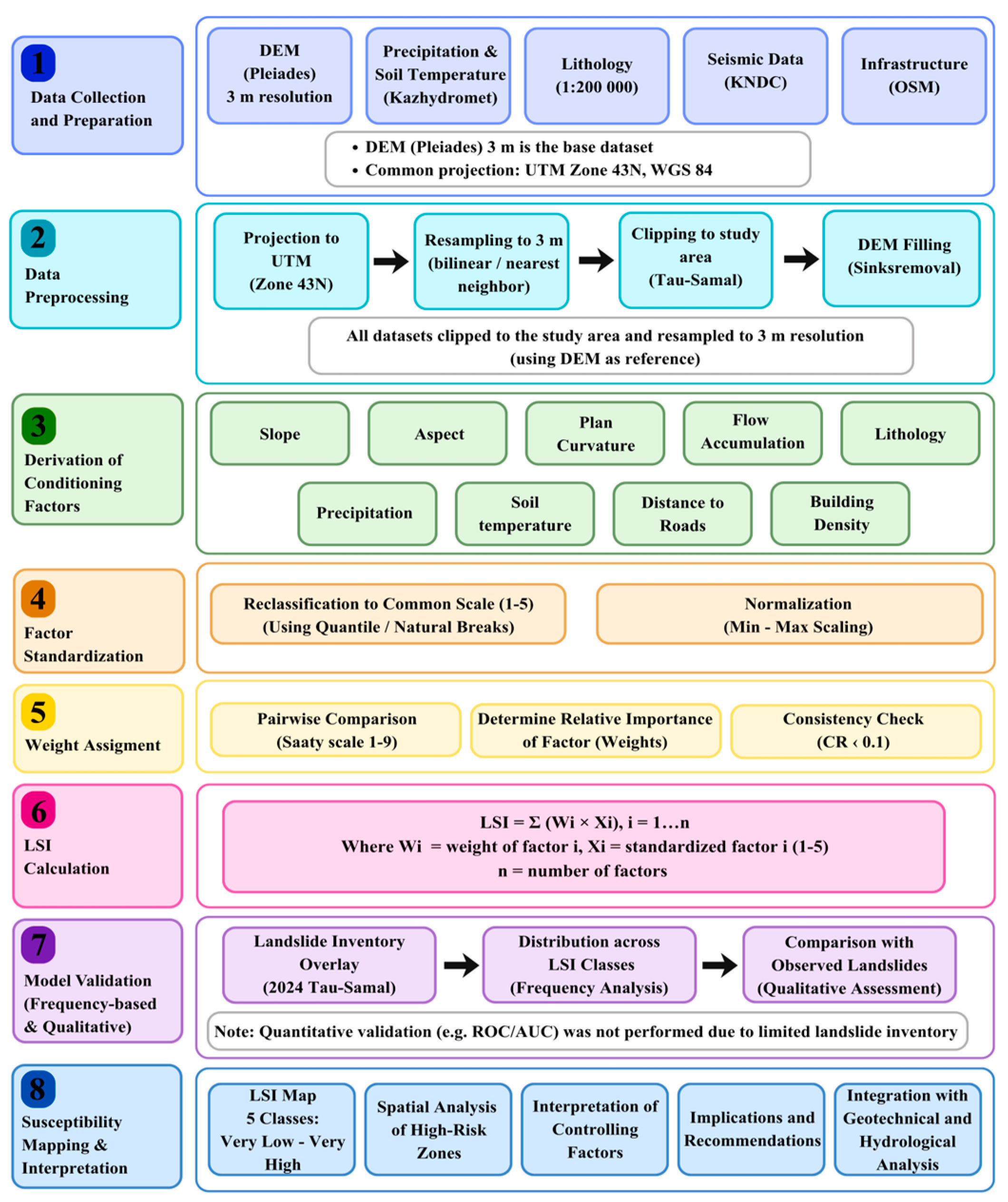
The methodology followed for landslide susceptibility mapping is illustrated in
Figure 4.
4.1. Conceptual Framework
The methodological framework for this study is based on an integrated multifactorial approach that integrates geomorphic, geological, hydrometeorological, seismic, and anthropogenic variables affecting slope stability in urbanized mountainous areas. This framework follows the general principles of landslide susceptibility assessment, in which spatial datasets representing factors influencing landslides are transformed into a unified analytical framework and subsequently combined to assess relative hazard levels.
The conceptual model assumes that landslide occurrence is controlled by the interaction of predisposing and triggering factors. Predisposing factors include relatively static characteristics such as slope angle, lithology, and geomorphology, while triggering factors include dynamic processes such as precipitation, temperature variations, and anthropogenic impacts (e.g., water leakage or drainage disruption). This distinction is consistent with widely accepted concepts in landslide research (e.g., in the geomorphology and hazard modeling literature). In the context of loess environments, particular attention is paid to the role of moisture and thermal processes. Loess-like soils are highly sensitive to changes in water content and temperature, especially under freeze–thaw conditions, which can significantly reduce shear strength and alter the internal structure of the soil [
18]. Therefore, the conceptual framework explicitly incorporates hydrometeorological variables along with topographic and anthropogenic factors.
The research workflow consists of several sequential steps: (1) selection of relevant factors influencing landslides based on literature data and regional conditions; (2) collection and pre-processing of spatial and temporal datasets; (3) standardization and classification of variables into susceptibility classes; (4) weighting of factors using the analytic hierarchy process (AHP); and (5) integration of all factors into a composite landslide susceptibility index (LSI) using the weighted overlay approach. Although the proposed model follows a standard framework for landslide susceptibility modeling, in this study, it is adapted to the specific conditions of an urban loess environment with pronounced seasonal variability. Unlike purely statistical approaches or machine learning methods, the adopted model emphasizes interpretability and physical justification, which is particularly important in data-sparse settings [
39,
47].
Thus, the conceptual model provides a structured framework for integrating heterogeneous datasets and analyzing the combined influence of natural and anthropogenic factors on landslide development.
Before the relief analysis, the DEM was subjected to pre-processing procedures, including filling of relief depressions, calculation of flow direction and determination of morphometric parameters of the relief. Filling of relief depressions was used to eliminate false depressions that would affect the results of hydrological modeling. Flow direction and runoff accumulation were calculated using the D8 flow routing algorithm implemented in ArcGIS Pro 3.2. The processed DEM was subsequently used to obtain layers of slope, exposure, plan curvature and runoff accumulation using a common 3 m grid. The high-resolution DEM used in this study was obtained from OpenTopography and is based on satellite elevation data previously used in tectonic and geomorphological studies of the Almaty region [
38].
4.2. Landslide Conditioning Factors
The selection of factors influencing landslides was based on both theoretical considerations and empirical data from previous studies conducted in areas with loess deposits. The selected factors reflect the main processes affecting slope stability and were selected based on data availability and spatial resolution.
Topographic factors, including slope angle, plan curvature, flow accumulation, and aspect, are among the most important factors determining landslide occurrence. Slope angle directly influences the gravitational forces acting on the soil mass, while aspect affects solar radiation, snow accumulation, and moisture retention [
47,
48]. Steep slopes, especially those exceeding 30–40°, are generally associated with a higher probability of landslides.
Geological conditions, particularly lithology, play a fundamental role in determining slope stability. The study area is dominated by loess-like loams, characterized by high porosity, a tendency to collapse, and sensitivity to water saturation. These soils are prone to structural degradation when saturated, significantly increasing the likelihood of slope failure [
5,
11].
The hydrometeorological factor included precipitation. Precipitation acts as the primary erosion factor, increasing pore water pressure and reducing effective stress [
10,
11].
Climate variables, including air and soil temperature, were included to account for freeze–thaw processes. Temperature fluctuations around 0 °C are known to cause mechanical weakening of soils and contribute to slope instability in cold regions [
18]. Interpolated precipitation values ranged from 16 to 21 mm and were divided into five equal intervals, reflecting the increasing level of hydrological influence on slope stability.
Average soil temperature inadequately reflects freeze–thaw processes, as critical transitions near 0 °C are smoothed out by the aggregation process. Therefore, an indicator based on temperature thresholds was used to represent conditions favorable for thaw.
Freeze–thaw conditions were qualitatively evaluated based on the number of days during which soil temperature remained close to 0 °C. More frequent phase transitions may contribute to the weakening of soil structure and potentially increase slope instability.
Anthropogenic factors were represented by distance to roads and buildings, as well as building density. Infrastructure development can significantly alter the natural conditions of slopes by increasing loads, altering drainage, and creating artificial water sources. Numerous studies have demonstrated the importance of human activity in triggering landslides in urban settings [
21,
25].
Seismic activity was included as an additional factor, although it is considered secondary in this study. Earthquakes can affect slope stability through dynamic loading and long-term weakening of geological structures [
43].
Each of these factors was classified into susceptibility categories based on thresholds derived from the literature and regional characteristics. This classification allowed for the transformation of heterogeneous variables into a comparable scale suitable for multicriteria analysis.
Distance-based factors were reclassified using thresholds adapted to the spatial characteristics of the study area. Wider distance intervals were used for road proximity to reflect the local distribution of infrastructure and avoid sparsely populated intermediate classes. This approach provided both physical interpretability and a meaningful spatial representation of anthropogenic influence.
4.3. LSI Model Formulation
The landslide susceptibility index (LSI) was used as the primary method for integrating factors influencing landslides into a single spatial model. The LSI approach is based on a weighted linear combination of standardized variables and is widely used in landslide susceptibility studies due to its simplicity and interpretability [
39].
The general formula for the LSI is as follows:
Wi represents the weight of the i-th factor, and xi is the normalized value of this factor.
Before integration, all variables were standardized to ensure comparability. Continuous variables such as slope, precipitation, and temperature were normalized using min–max scaling:
Categorical variables, such as lithology, were reclassified based on their relative contribution to landslide susceptibility using expert judgment and literature.
Distance-based variables (e.g., distance to roads and streams) were calculated using Euclidean distance functions and subsequently classified into susceptibility zones. This approach allows for a continuous representation of spatial influence and avoids abrupt transitions associated with discrete buffer zones.
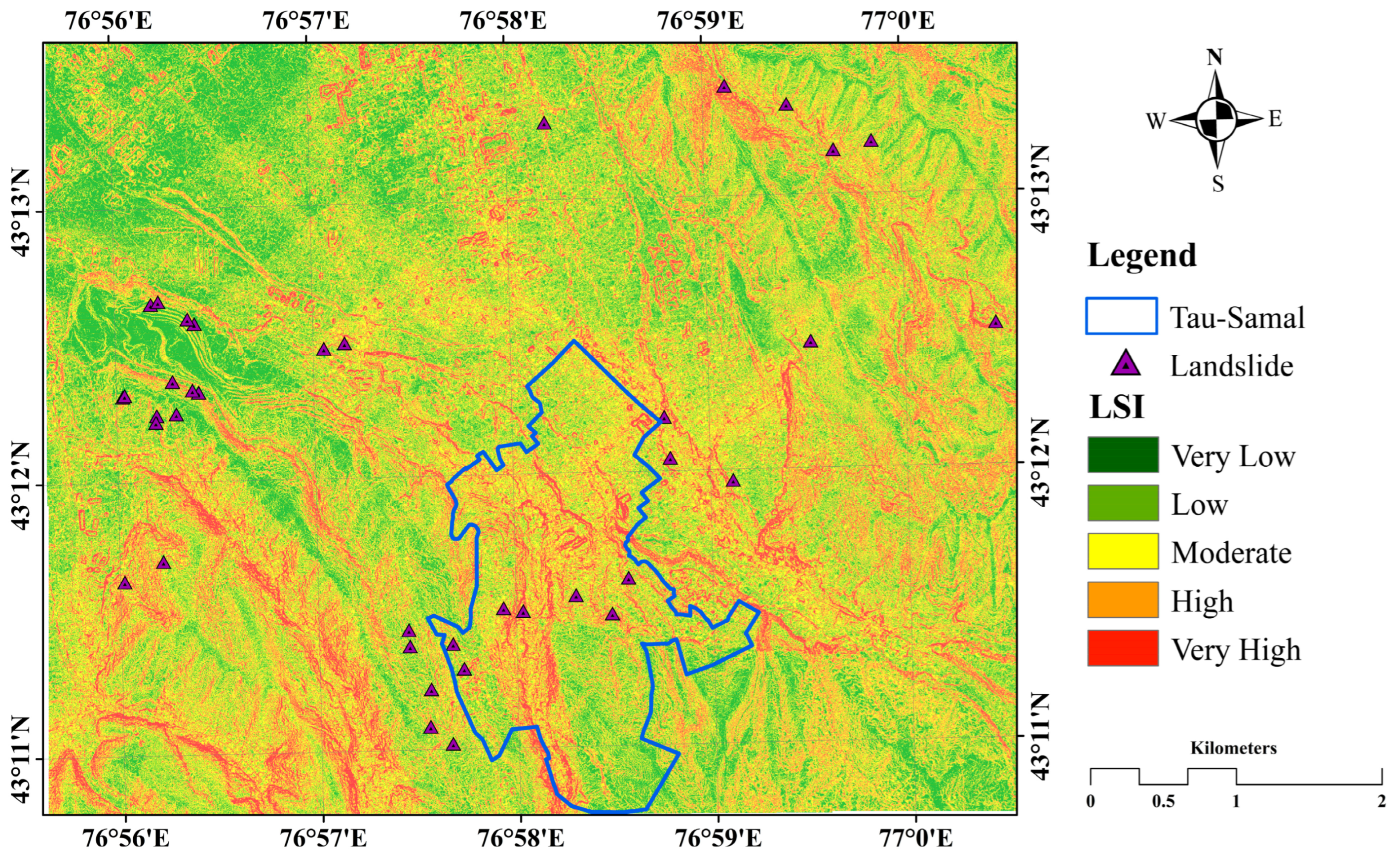
A weighted overlay technique was used to integrate all factors and create a composite landslide susceptibility surface. The resulting LSI values were classified into five categories (very low, low, moderate, high, and very high) to facilitate interpretation and comparison with observed landslide locations (
Figure 5).
4.4. Weight Determination Using AHP
Based on an analysis of international studies on landslide susceptibility modeling, weighting factors were assigned based on their proven importance in LSI models. To determine the factor weights, the Analytic Hierarchy Process (AHP) methodology, widely used in multicriteria analysis of geological and natural resource decisions [
49,
50], was applied. The AHP approach has proven to be one of the most reproducible tools for constructing landslide susceptibility maps [
51,
52]. For each of the nine factors, a pairwise comparison matrix was constructed based on a relative importance scale (
Table 3), then the matrix was normalized and a weight vector was calculated. The consistency of the pairwise comparison matrix was evaluated using the Consistency Ratio (CR), following standard AHP methodology recommendations.
Particular emphasis was placed on lithology, which was assigned a relatively high weight due to the presence of loess-like deposits in the study area. These materials are known to be highly collapsible and sensitive to water infiltration, making them especially vulnerable under saturation and freeze–thaw conditions. This characteristic significantly increases their susceptibility to slope failure and justifies their strong influence in the model.
Slope was assigned the highest weight, as it directly controls gravitational forces and shear stress acting on the slope. Flow accumulation, precipitation, and lithology were also assigned high importance due to their role in controlling moisture dynamics and the seasonal weakening of soil structure.
Plan curvature and soil temperature were considered important conditioning factors. Plan curvature reflects the concavity and convexity of the terrain, influencing surface runoff concentration and moisture accumulation, while soil temperature accounts for freeze–thaw processes that affect soil strength and slope stability. Roads and buildings were assigned moderate weights reflecting anthropogenic modification of slopes and drainage conditions. Although the Tau-Samal event was strongly influenced by anthropogenic processes, including infrastructure leakage and slope modification, topographic and geological conditions were retained as dominant weighting factors because they control the fundamental mechanical susceptibility of the slope to failure. Anthropogenic factors were interpreted as triggering and amplifying conditions acting upon an already vulnerable geomorphological environment. Aspect received the lowest weight, as its influence is indirect and mainly affects microclimatic conditions.
The resulting normalized weights sum to 1.00, making them directly applicable in a weighted overlay model. The consistency of the pairwise comparison matrix was verified using the Consistency Ratio (CR), which was calculated as 0.08. Since this value is well below the acceptable threshold of 0.10, the weighting scheme is considered reliable and internally consistent [
49].
The AHP was used to determine the factor weights. Nine potential landslide-inducing factors were included: slope, plan curvature, flow accumulation, aspect, lithology, soil temperature, distance to roads, building density, and mean monthly precipitation. The resulting normalized weights (sum = 1) were: slope 0.24, flow accumulation 0.17, precipitation 0.14, lithology 0.13, plan curvature 0.10, soil temperature 0.08, distance to roads 0.06, building density 0.05, aspect 0.03. These weights were used in a weighted overlay procedure for displacement susceptibility mapping.
4.5. Time-Series Analysis
The dynamics of environmental conditions preceding the landslide were analyzed using time-series data on temperature, precipitation, and seismic activity. The goal of this analysis was to identify short-term changes and cumulative effects that could have contributed to slope destabilization.
Meteorological data were obtained from the Almaty station (Kazhydromet) and included daily air temperature, soil temperature, and precipitation for the period preceding the landslide (January–February 2024). Particular attention was paid to temperature fluctuations around 0 °C, which are associated with freeze–thaw processes.
The analysis revealed a period of persistently low temperatures in late January, when soil temperatures reached approximately −19–21 °C, followed by a rapid increase to near-freezing and positive values in early February. These conditions indicate an active freeze–thaw transition, which is known to reduce soil strength and increase its susceptibility to deformation. Repeated temperature fluctuations around the freezing point promote the formation of microcracks and increased soil permeability, facilitating water infiltration.
Precipitation data were analyzed as both daily values and cumulative rainfall. The period immediately preceding the landslide (5–8 February) was characterized by increased rainfall, reaching approximately 50 mm over three days. This precipitation, combined with snowmelt caused by rising temperatures, likely contributed to rapid soil saturation and an increase in pore pressure.
To assess the total hydrological contribution, cumulative rainfall values were compared with estimated soil moisture thresholds required for the weakening of loess-like soils. The results indicate that the estimated pre-event water input could have been sufficient to significantly increase soil moisture, especially when combined with additional sources such as snowmelt and potential water runoff.
Seismic activity was also analyzed using data from the KNDC catalog for the same period. Although several seismic events were recorded, their spatial distribution indicates that most occurred at a significant distance from the study area. Therefore, seismicity is interpreted as a secondary factor, potentially contributing to the generation of long-term stresses, but not as a direct trigger for the landslide.
5. Results
5.1. Spatial Analysis (LSI)
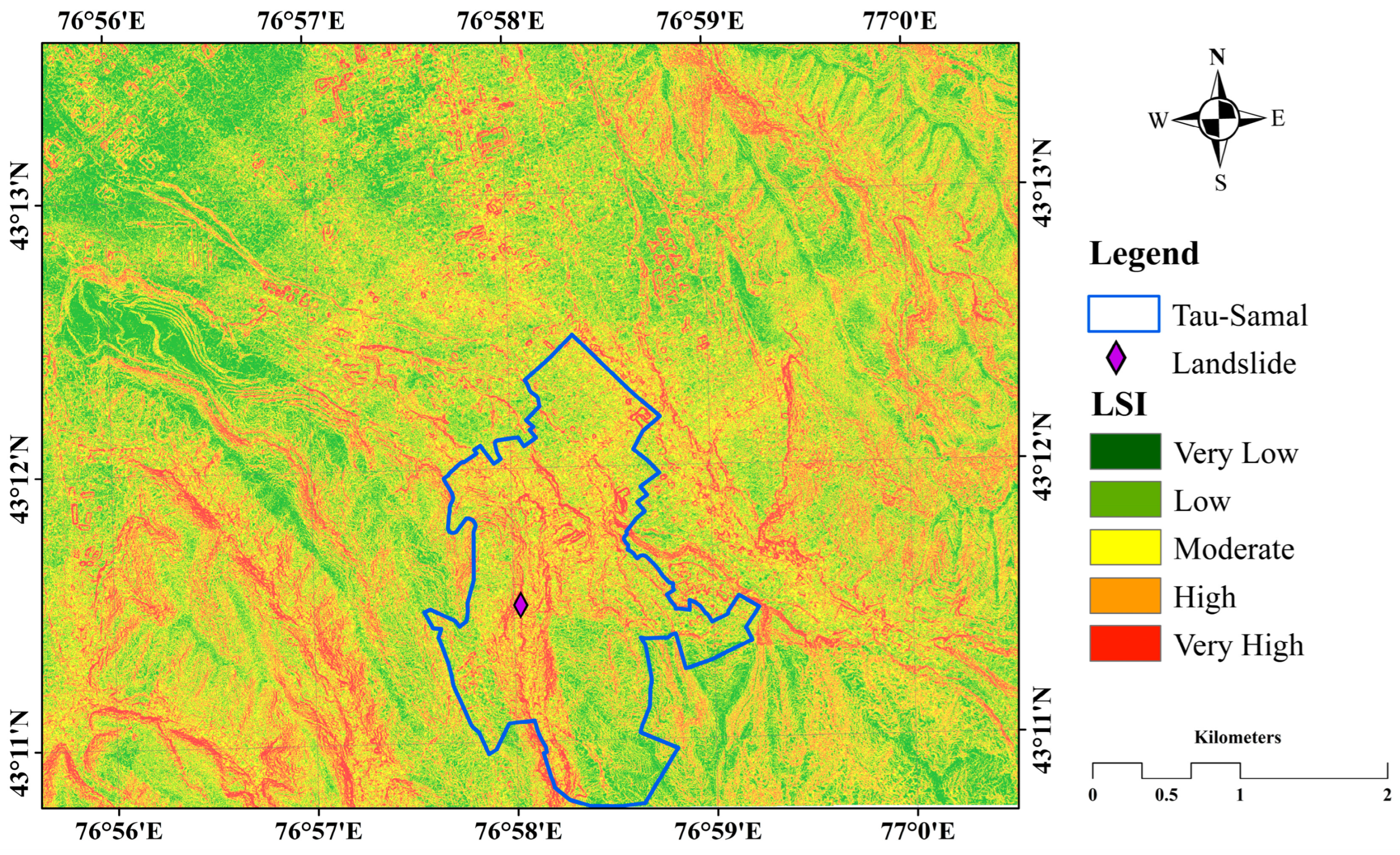
The spatial distribution of landslide susceptibility was analyzed using the LSI model. The resulting susceptibility map (
Figure 6) classifies the study area into five categories: very low, low, moderate, high, and very high susceptibility.
High- and very high-susceptibility zones are predominantly located along steep slopes (45–50°), particularly in areas characterized by proximity to surface runoff and dense urban development. These zones correspond to geomorphic conditions favorable for slope instability, including steep slopes, weak loess-like soils, and impaired drainage systems. The susceptibility distribution reveals clusters of increased hazard in adjacent areas, indicating potential areas of future instability. Moderate-susceptibility zones are distributed along transitional slope sections, while low- and very-low susceptibility zones correspond to relatively flat terrain and areas with limited anthropogenic impact.
The LSI map demonstrates clear spatial differentiation of landslide susceptibility within the study area. High- and very-susceptibility zones are primarily concentrated along steep slopes and valley systems, reflecting the dominant influence of topographic and hydrological factors. Moderate-susceptibility zones are distributed across transitional slopes, while low-susceptibility zones correspond to relatively stable terrain with gentle slopes.
The resulting index values ranged from 1.69 to 4.19. For ease of interpretation, it was reclassified into five categories: “very low susceptibility” (1.69–2.19), “low susceptibility” (2.19–2.69), “moderate susceptibility” (2.69–3.19), “high susceptibility” (3.19–3.69), and “very high susceptibility” (3.69–4.19).
The spatial distribution of the index demonstrates the heterogeneity across the territory. The largest areas are classified as “medium” and “high susceptibility,” while “very high susceptibility” zones are located primarily in the central and southern parts of the study area, characterized by steep slopes and high residential density. “Low” and “very low” susceptibility zones are concentrated in the northeastern and eastern parts, characterized by gentler terrain and a lower concentration of anthropogenic objects.
A notable feature of the susceptibility map is the alignment of high-risk zones with drainage pathways and areas of increased moisture accumulation, indicating the strong influence of hydrological factors. In addition, zones of elevated susceptibility are observed in proximity to anthropogenic features such as roads and buildings, reflecting the impact of slope modification, loading, and altered drainage patterns.
The Tau-Samal landslide site is located in a high susceptibility zone, confirming the spatial consistency between the modeling results and the observed event.
5.2. Temporal Analysis
A temporal analysis of meteorological and seismic data revealed distinct patterns preceding the landslide.
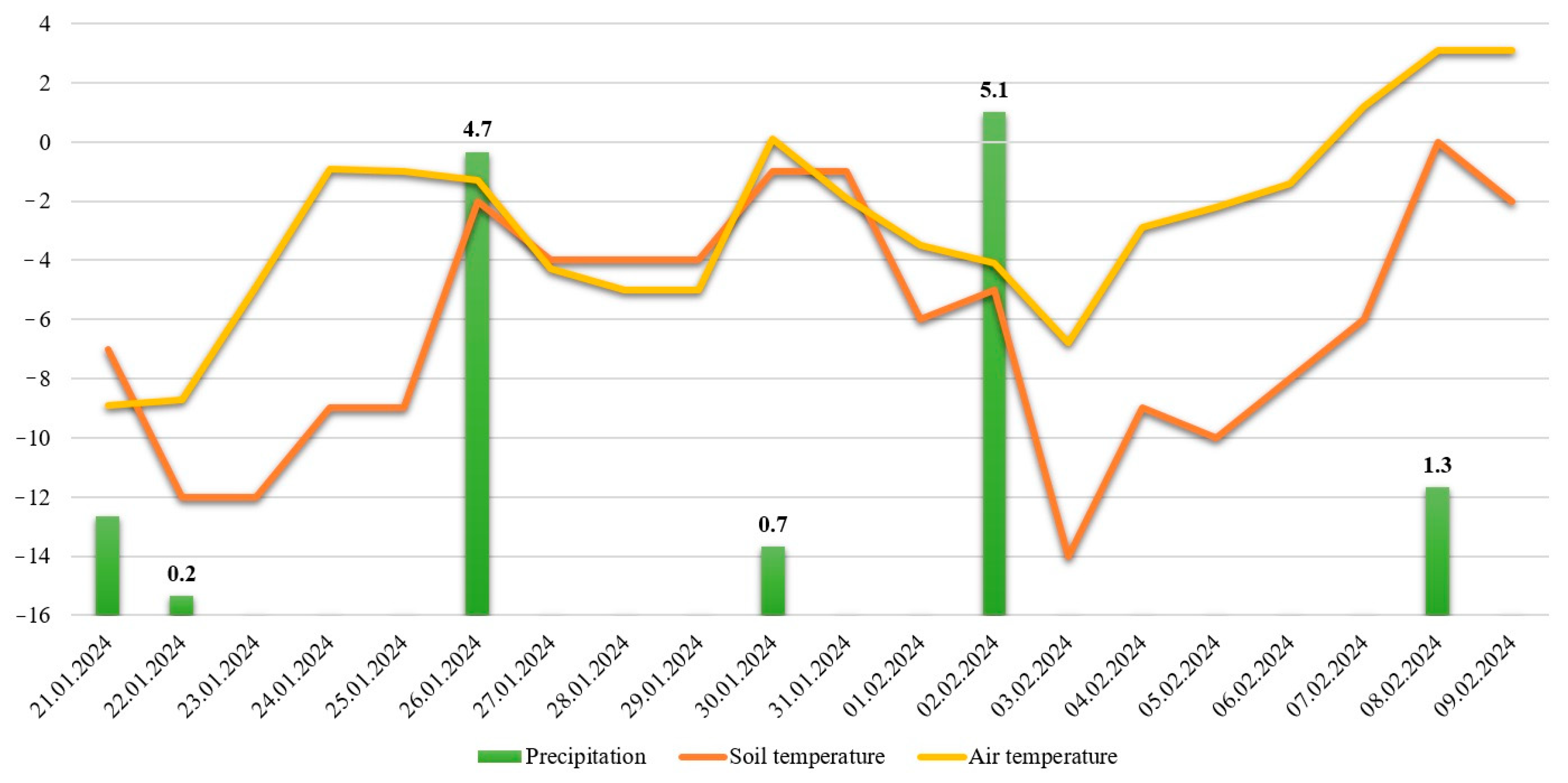
The temperature time series show a period of persistently low temperatures in late January, followed by a rapid warming in early February. Soil temperatures increased from approximately −20 °C to almost 0 °C in a short period, indicating active freeze–thaw processes (
Figure 7).
Precipitation data indicate an increase in precipitation between 5 and 8 February, with the total precipitation reaching approximately 50 mm. This period coincides with a rise in temperature, suggesting a simultaneous influx of snow and precipitation.
Time series analysis revealed a combination of hydrometeorological conditions preceding the landslide. Several freeze–thaw cycles were observed, particularly around 30 January and 7–8 February, when air temperatures exceeded 0 °C.
These temperature fluctuations were accompanied by precipitation events, particularly on 26 January and 2 February, which contributed to increased soil moisture. The cumulative effect of repeated freezing and thawing, combined with water infiltration, likely resulted in a gradual weakening of the soil structure.
Immediately prior to the landslide (8 February), a sharp increase in air temperature above 0 °C was recorded, indicating active thawing conditions. This combination of factors suggests that the landslide was triggered by a reduction in soil strength due to both thermal and hydrological processes.
As shown in
Figure 7, the period preceding the landslide was characterized by numerous freeze–thaw cycles and precipitation, which led to gradual saturation of the soil with moisture. At the same time, seismic activity (
Figure 8) was recorded at a significant distance from the study area. Seismic activity was considered as a potential triggering factor; however, spatial analysis showed that the recorded events occurred at significant distances (200–300 km) from the study area, excluding their role as a direct trigger of the landslide.
Nevertheless, seismicity is retained in the analysis as a secondary factor, as repeated low- to moderate-magnitude events may contribute to long-term weakening of slope materials through the accumulation of microfractures and changes in stress conditions.
Overall, time series analysis shows that the landslide occurred during a period characterized by the combined effects of freeze–thaw processes, increased precipitation, and rapid moisture accumulation. These temporary conditions, combined with anthropogenic water influx, created a critical state of soil moisture saturation and reduced its stability.
5.3. Validation and Model Performance
Validation of landslide susceptibility models is a critical step in assessing their predictive ability. Many studies perform quantitative validation using statistical methods such as receiver operating characteristic (ROC) curves and area under the curve (AUC), which require a sufficiently large and reliable landslide dataset [
39].
In this study, the available landslide data are limited and do not provide a sufficient sample size for statistically robust validation. Therefore, advanced statistical methods such as ROC/AUC analysis were not applied. Instead, validation primarily relied on simplified frequency analysis and an assessment of the spatial overlap between mapped landslide-prone areas and documented landslide events.
Validation was conducted by comparing the spatial distribution of high-susceptibility zones derived from the LSI model with the actual location of a landslide that occurred on 8 February 2024, in the Tau-Samal microdistrict. The results indicate that the landslide occurred in an area classified as very high landslide susceptibility, indicating that the model results are consistent with observed conditions.
Furthermore, the model results were compared with known slope instability patterns in the region, including areas characterized by steep slopes, proximity to streams, and strong anthropogenic impacts. These conditions are widely recognized as key factors contributing to landslide occurrence [
47,
48].
Despite these positive results, it is important to note that the lack of a complete landslide inventory limits the ability to perform quantitative validation and statistically evaluate the predictive accuracy of the model. Therefore, the modeling results should be interpreted as preliminary estimates rather than as a fully validated forecasting tool.
Further research should focus on developing a detailed landslide inventory and applying quantitative validation methods such as ROC/AUC analysis, probability of success curves, and error matrix estimation.
To assess the predictive performance of the Landslide Susceptibility Index (LSI), a validation analysis was conducted by comparing the spatial distribution of recorded landslides with classified susceptibility zones (
Table 4).
Recorded landslide data were overlaid on the LSI map (
Figure 9), and each event was assigned a corresponding susceptibility class (very low, low, moderate, high, and very high). The results show that most landslides are concentrated in moderate, high and very high susceptibility zones.
This distribution demonstrates good agreement between the modeled susceptibility and observed landslide events. Only a limited number of events fall into low susceptibility zones, which may be due to local anthropogenic factors or small-scale geological heterogeneity not accounted for in the model.
A simplified frequency-based comparison approach was used instead of formal statistical testing. The majority of documented landslides were located within the moderate, high, and very high susceptibility classes, indicating a general spatial correspondence between the susceptibility map and the observed landslide distribution.
The Tau-Samal landslide of 8 February 2024 also occurred within the high susceptibility zone identified by the model, confirming the conceptual consistency of the resulting susceptibility assessment under the combination of geomorphological, hydrological, and anthropogenic factors.
However, due to the limited number of documented landslides and the lack of a complete regional landslide inventory, the presented results should be interpreted as a preliminary spatial susceptibility assessment rather than a statistically validated predictive model.
It should also be noted that the selected study area boundaries may introduce local edge effects into the relief and hydrology analysis, especially near the boundaries of the modeled area. However, the main landslide-prone areas and documented landslide events are located in the central part of the study area, which reduces the impact of potential boundary-related distortions on the overall interpretation of landslide susceptibility.
6. Discussion
The results of this study indicate that the Tau-Samal landslide resulted from the combined effects of multiple predisposing and triggering factors acting simultaneously. Spatial analysis reveals that the landslide occurred in an area characterized by steep slopes, weak loess-like soils, and significant anthropogenic impacts. These conditions created an environment highly susceptible to slope instability.
Temporal analysis indicates that the landslide was preceded by a period of freeze–thaw transition, coupled with increased precipitation. In January, most of the precipitation fell as snow at subzero temperatures, followed by rapid melting in early February. This process led to a sharp increase in soil moisture and pore water pressure, significantly reducing soil strength.
Geotechnical considerations further support this interpretation. Similar deformation processes have been identified using satellite interferometry techniques, which allow the detection of millimeter-scale surface displacements and provide valuable insights into slope instability dynamics [
53,
54]. The observed water influx, including both natural meltwater and anthropogenic leakage, likely increased the moisture content to levels approaching the liquid limit of the soil. Under such conditions, even minor additional impacts can trigger a landslide.
The observed mechanisms are consistent with previous studies conducted in the Tien Shan region, where landslides are typically associated with loess soils, steep slopes, and seasonal climate variations [
1,
41]. These studies highlight the importance of hydroclimatic influences in triggering landslides in weak, water-sensitive materials.
Similar processes have also been documented in European mountain regions. For example, the Åknes landslide in Norway demonstrates how long-term deformation, water infiltration, and temperature fluctuations can interact to destabilize slopes.
These findings confirm that landslides are rarely triggered by a single factor, but are the result of the interaction of geological, hydrological, and climatic processes. Human impact played a decisive role in the development of the Tau-Samal landslide. A ruptured water main resulted in continuous water infiltration into the slope, significantly exceeding natural moisture conditions. This artificial influx of water disrupted the natural hydrological balance and contributed to the rapid saturation of the soil mass.
Furthermore, urbanization altered natural drainage pathways and increased mechanical stress on the slope. Such effects are widely recognized as important contributing factors in the occurrence of landslides in urbanized mountainous areas [
21,
25].
While spatial and temporal analysis reveals a strong correlation between environmental factors and the landslide, it is important to distinguish between correlation and causation.
The results indicate that several factors were present prior to the landslide, including precipitation, temperature fluctuations, and weak seismic activity. However, these factors alone were not sufficient to trigger the collapse. The analysis suggests that anthropogenic water saturation was the primary triggering mechanism, while natural factors acted as preconditions and amplifying processes. Seismic activity was also considered as a potential factor contributing to the landslide. Although several earthquakes were recorded during the study period, including a magnitude 7.0 earthquake on 22 January 2024, their spatial distribution indicates that most epicenters were located at a significant distance (approximately 200–300 km) from the Tau-Samal region. ShakeMap analysis further reveals that only moderate ground motion (intensity V–VI) and relatively low peak ground acceleration values were observed in the study area.
These observations suggest that seismic activity was insufficient to directly trigger the landslide. However, under conditions of elevated soil moisture and ongoing freeze–thaw processes, even weak dynamic loading could have contributed to structural weakening of the soil and redistribution of internal stresses. Thus, seismicity is interpreted as a secondary factor amplifying the impact of hydrometeorological processes, rather than as a primary trigger.
Thus, the Tau-Samal landslide can be interpreted as a multifactorial event in which anthropogenic influence played a dominant role, while climatic and geological conditions acted as supporting factors.
It is important to note that, although the immediate trigger was anthropogenic, the spatial distribution of susceptibility obtained using the LSI model successfully captures the underlying factors that made the slope initially unstable. As a result, the landslide occurred in an area classified as very vulnerable, demonstrating the model’s ability to identify areas susceptible to failure even when the final trigger is an external factor.
To further enhance the understanding of slope deformation processes and improve the reliability of hazard assessment, a geodetic monitoring program has been implemented in the study area. GNSS measurements in the Tau-Samal region serve as a key tool for the early detection of potential subsequent deformations. Within this framework, permanent monitoring points GG01, GG02, and GG03 have been established to capture the spatiotemporal dynamics of slope behavior in the vicinity of the February 2024 landslide.
This study has several limitations that should be considered when interpreting the results. First, the analysis is based on a single landslide (8 February 2024, Tau-Samal), limiting the generalizability of the results. Although this case is a characteristic example of urban landslides in loess environments, more data on similar events would be required to draw broader conclusions. Second, the study lacks detailed geotechnical field data, including laboratory measurements of soil strength parameters (e.g., cohesion, internal friction angle) and field tests. As a result, the geotechnical analysis is based on simplified assumptions and indirect estimates of soil behavior. Third, there are uncertainties associated with the input data. Geological data are available at a relatively large scale of 1:200,000, limiting their accuracy at the local level.
7. Conclusions
The landslide that occurred on 8 February 2024 in the Tau-Samal area resulted from the combined influence of natural and anthropogenic factors. The dominant role was played by soil saturation processes associated with snowmelt, precipitation, and anthropogenic water leakage, which led to a reduction in the geomechanical properties of the soil and subsequent slope instability. Seismic activity analysis revealed a secondary, indirect influence, excluding its role as a direct triggering factor of the landslide.
The results confirm that landslide processes in loess-like soils are controlled by the interaction of hydrometeorological, climatic, and anthropogenic factors, with the critical mechanism being the attainment of a threshold level of soil saturation.
The applied LSI model adequately represents the spatial distribution of landslide susceptibility and successfully identifies high-risk zones, including the area of the observed landslide.
The results demonstrate the importance of considering hydrometeorological, anthropogenic and geomorphological factors when assessing landslide susceptibility in urban loess environments.
To further improve the accuracy of landslide hazard assessment, it is necessary to expand the observational database and integrate additional data sources, including remote sensing techniques (InSAR), geotechnical monitoring data (inclinometers, extensometers, piezometers), as well as geophysical parameters such as gravity anomalies and vertical gravity gradients. Such integration will enhance the reliability of monitoring and provide a foundation for the development of early warning systems.
The results of this study contribute to sustainable urban development and disaster risk reduction in mountainous cities prone to landslide hazards. The proposed geospatial susceptibility assessment system can contribute to sustainable land-use planning, infrastructure management, and slope monitoring in Almaty and similar urban settings. Identifying areas potentially vulnerable to the combined impact of natural and anthropogenic factors can help local governments improve risk-based urban development planning and increase the resilience of urban infrastructure to changing climatic and environmental conditions.
These recommendations can support municipal authorities, emergency management agencies, urban planning agencies, and engineering services involved in disaster mitigation and land use management in Almaty and other mountainous regions of Kazakhstan.
8. Recommendations
Based on the results of this study, several recommendations can be made to improve landslide risk management in Almaty and similar urban settings.
First, monitoring of utility infrastructure, particularly water supply systems located on slopes, should be strengthened. Regular inspection and maintenance of pipelines can significantly reduce the risk of water leakage, which was identified as a key trigger in this case.
Second, landslide susceptibility assessments should be incorporated into urban planning policies. Construction in areas characterized by steep slopes and unstable soils should be limited or accompanied by appropriate engineering measures, including drainage systems and slope stabilization.
Third, the development of an integrated landslide monitoring system is recommended. This system should combine remote sensing methods (e.g., InSAR), ground-based observations (GNSS), and meteorological monitoring to detect early signs of slope instability.
Fourth, it is important to create a comprehensive landslide database for the Almaty region. Such a database will enable more robust statistical analysis and improve the accuracy of landslide susceptibility models.
Finally, public awareness and risk communication must be improved, especially among residents of high-risk areas. Early warning systems and emergency preparedness measures can significantly reduce the impact of future landslides.




 ,
,