1. Introduction
The construction industry’s work environment has evolved from a simple safety system to a complex socio-technical system with the adoption of IoT and wearable devices [
1,
2]. Safety outcomes in complex socio-technical systems (STSs) are generated by intricate interactions among humans, organizations, and technologies, rather than from the properties of individual technological components [
1,
3,
4]. While numerous IoT-enabled innovations have been proposed and are already available, the construction industry remains among the least digitized industry sectors globally, with lower adoption rates than manufacturing and other sectors [
2,
5,
6].
While previous studies have examined individual factors that drive the adoption of IoT and wearable devices in construction [
7,
8], a systems perspective suggests that these factors are not independent of one another. Rather, perceived Safety System Value (SSV), Organizational Readiness (OR), and Adoption Barriers (AB) are interdependent system-level constructs that are theoretically linked. The state of one component is associated with the states of the others within the broader socio-technical system.
Despite significant efforts and initiatives to promote the adoption of digital technologies in construction, numerous barriers persist that impede their successful uptake [
2,
9,
10]. It is, however, important to view these barriers as emergent properties arising from a lack of alignment among the technology, organizational, and workforce dimensions. Furthermore, OR to adapt to new systems and processes can be viewed as an internal system property or state.
Infrastructure projects in Saudi Arabia are undergoing a transformation driven by Saudi Vision 2030, which is increasing project complexity and introducing diverse migrant workforces that pose unique challenges for technology adoption [
2,
11,
12]. The need for empirically validated models that explain the relationship between perceived SSV and organizational responses to safety at the project level and their impact on safety AB has become evident.
To address this research gap, a systems-based Structural Equation Model (SEM) is proposed and empirically tested to investigate the relationships among SSV, OR, and AB. This study contributes to the existing body of knowledge by examining technology adoption as a system behavior rather than a simple decision-making process.
Most literature reviews on IoT adoption in construction have identified three main gaps. One of these gaps is the limited examination of individual factors influencing IoT adoption, followed by an exploration of the integrated relationships among the perceived benefits of IoT for worker safety, the readiness of construction organizations, and the barriers that hinder adoption. The second gap is that few published articles on IoT adoption in construction use covariance-based SEM, thereby failing to account for potential measurement error in critical factors. A third gap is that the function of OR, as a system state mediating perceived IoT safety benefits to recognizing IoT barriers, remains empirically untested. This paper investigates each of these three identified gaps.
2. Literature Review and Hypothesis Development
2.1. Theoretical Background: From TAM and UTAUT to Socio-Technical Systems
Work on technology adoption research in construction has grown substantially [
13]. Davis’s (1989) Technology Acceptance Model (TAM) defines perceived usefulness and perceived ease of use as primary drivers of an individual’s adoption intentions [
14]. The model has since been widely examined in the literature concerning the adoption of IT innovations within the construction sector [
7]. Later, Venkatesh et al. (2003) synthesized several existing adoption models into a unified framework, the Unified Theory of Acceptance and Use of Technology (UTAUT), with four core behavioral determinants: performance expectancy, effort expectancy, social influence, and facilitating conditions [
15]. UTAUT2, introduced by Venkatesh et al. (2012), subsequently extended UTAUT to a consumer context by incorporating additional constructs, including hedonic motivation and habit [
16]. TAM and UTAUT have been used extensively in studies exploring the adoption of IoT and digital technologies in the construction industry [
7]. However, TAM and UTAUT focus solely on the technology adoption decision from the individual perspective and abstract it away from its organizational and systems context [
17]. STS theory, first formulated by Trist and Bamforth (1951) and further developed over subsequent decades, observes technology not as a standalone object but as one component of an integrated human-organizational system, thereby complementing individual-level adoption models such as TAM and UTAUT [
18]. STS theory advocates joint optimization of technical and social subsystems [
18]. This study builds on the TAM/UTAUT lineage by positioning technology adoption mechanisms within an organizational-level STS framework and treating technology adoption not as a rational choice by an individual user but as a behavior emergent from an organizational system.
2.2. IoT and Wearable Devices as Safety Systems
The implementation of IoT and wearable devices in construction requires a socio-technical approach, as safety outcomes emerge from interactions among technological, human, organizational, and environmental components of the work system [
2,
3,
19]. Systems thinking demonstrates that introducing smart technology into the construction industry creates new operational patterns that require synchronized coordination among system components rather than replacing existing systems with new technologies [
1,
3,
20].
Research findings demonstrate that IoT-based safety systems integrating real-time sensing with analytical capabilities significantly enhance hazard detection, health monitoring, and emergency response time on construction sites [
21,
22]. The success of IoT-based systems relies on their technical capabilities, their integration with organizations, users’ trust in them, established safety protocols, and response procedures [
2,
23,
24]. Technology adoption failures in construction are usually due to inadequate training, unclear employee responsibilities, and safety procedures that do not align with the operational features of IoT and wearable devices [
9,
10,
25]. Construction safety innovation requires holistic system design methods that integrate human-technology interaction with organizational governance, workflow compatibility, and technical development [
1,
26,
27].
2.3. Perceived Safety Value in Construction Systems
Stakeholders evaluate construction safety technologies based on their perceptions of how well these technologies enhance overall site safety performance [
28]. Construction personnel use their perceived usefulness of safety technologies to decide which systems to implement, and the level of investment needed [
29].
The perceived value of IoT and wearable devices in construction comes from their ability to support emergency response, enable health monitoring, and assist in accident prevention [
2]. IoT and wearable devices act as proactive safety improvement systems by reducing the need for human monitoring and enabling organizations to perform preventive safety measures across their operations [
26,
30]. The adoption process for these capabilities depends on how stakeholders view their usefulness and dependability and their connection to safety-related organizational needs.
Different groups within the organization have distinct perspectives about the value of IoT and wearable devices for worksite safety [
31]. The evaluation of strategic and compliance-related benefits falls under management responsibilities, yet workers assess how the use of their personal data affects their safety and comfort level as well as their trust in data utilization [
31]. Workers could reject these technologies despite their safety benefits when they perceive them as surveillance tools or are concerned about data misuse [
20,
31]. While safety technologies generate organizational responses based on safety value perception, their successful implementation depends on how well the organization translates that perceived value into operational readiness and the technical and human capabilities required for sustained adoption [
2,
32].
2.4. Organizational Readiness as a System Enabler
OR exists as an internal system state that shows how well an organization can and wants to adopt new technology [
33]. The framework consists of four essential elements: technological infrastructure, workforce competence, managerial commitment, and governance arrangements [
33].
OR for safety technology adoption in the construction environment is influenced by multiple factors, including training programs, availability of technical support, leaders’ support, and suitable data governance systems [
2,
34]. Organizations that achieve high readiness levels are more likely to successfully implement safety technologies into their current operations, but organizations with low readiness experience increased uncertainty, operational challenges, and employee resistance to adoption [
25,
35].
Organizational change theory defines readiness as a shared belief in both the value of change and the organization’s ability to execute it [
35]. Within construction safety systems, OR serves as the operational mechanism that converts the perceived value of safety technologies into actual implementation capabilities [
2]. The lack of proper readiness will result in safety technologies failing to perform their designed protective functions [
25].
2.5. Adoption Barriers as Emergent System Properties
The construction industry faces multiple ABs, including high costs, complex technical requirements, privacy-related issues, and employee resistance to new systems [
9,
10]. A systems perspective shows that most adoption obstacles in construction arise from continual misalignments among technological, organizational, and human factors within the socio-technical system [
33,
36].
Construction organizations encounter compounding challenges when inadequate training programs, weak data governance, and poor communication collectively lead to privacy violations and worker resistance to new safety technologies [
10,
31]. Construction organizations face increasing integration problems when new safety technologies are not designed to be compatible with existing technical infrastructure and operational processes [
9,
23]. New safety technologies in construction face ongoing user resistance, as accumulated technical, organizational, and interpersonal barriers create a self-reinforcing cycle of rejection [
25].
ABs are not static; organizations that achieve high readiness levels actively work to reduce multiple barriers through strategic planning, active worker engagement, and careful alignment of new systems with existing processes [
23]. Research reveals that AB in construction safety systems is system-dependent, indicating the degree to which users perceive the technology’s value and the level of their organization’s readiness to implement it [
2].
2.6. Hypothesis Development
Based on the previously discussed synthesis, the following hypotheses are proposed:
H1. Perceived SSV is positively associated with OR.
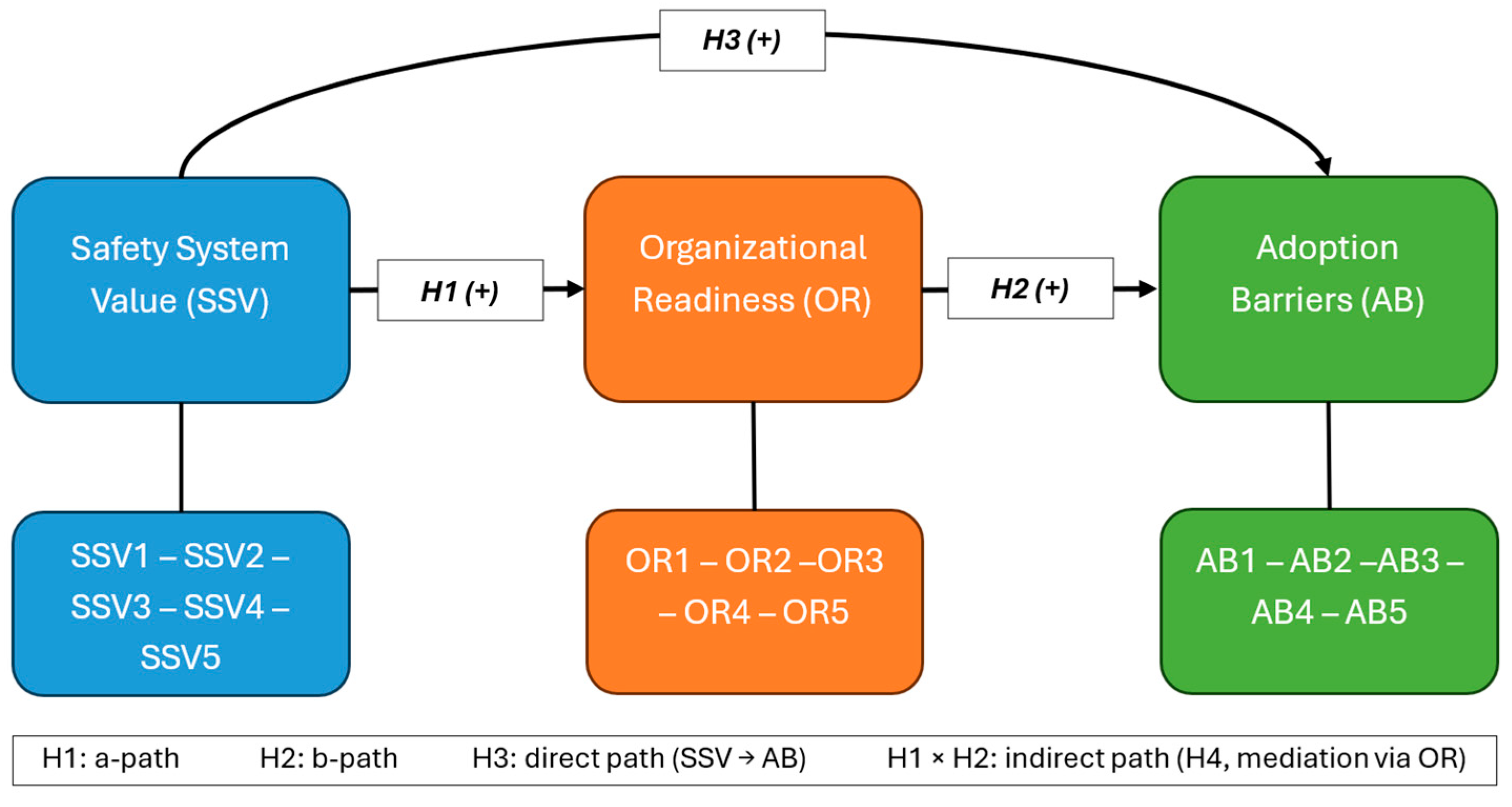
H2. OR is positively associated with perceived AB. In more ready organizations, employees are more likely to encounter implementation challenges and therefore report greater recognition of adoption barriers. Organizations that understand readiness through both organizational change theory [37] and the technology readiness concept [38] know better that implementing change is difficult. Because these companies have already committed resources to being “ready, “ employees have already begun to understand many problems inherent to implementation. Less ready organizations are still unaware of some implementation obstacles. This means there is a positive correlation between OR and AB. H3. Perceived SSV is positively associated with perceived AB. Employees who recognize the high personal value of safety technologies have also identified gaps between how these technologies should function and how they currently do, consistent with the expectancy theory of work motivation [39]. Employees who attribute greater safety value to IoT and wearable devices are expected to be more attentive to the practical challenges of realizing that value. H4. OR mediates the relationship between SSV and AB. This means that the SSV influences AB partially through the degree of OR. The theory of mediating variables is outlined in Baron and Kenny’s (1986) criteria for mediation [40]. SEM-based mediation theory shows that the mediating variable affects the outcome variable and accounts for the X-Y relationship [41]. The research hypotheses show that construction safety technology adoption has evolved from linear models to a systems approach, which examines how OR and system behavior, along with organizational conditions, generate obstacles to adoption (see
Figure 1).
3. Methodology
3.1. Research Design
The research design employed for this study was a quantitative cross-sectional study to investigate the relationships among perceived SSV, OR, and AB regarding the adoption of IoT and wearable devices in the construction industry.
The unit of analysis for the Saudi Arabian construction workforce was the individual respondent; thus, data were not grouped by construction firms or projects, and so boundaries did not occur empirically but conceptually. Confirmatory SEM captures co-variation among latent variables at a single point in time, rather than feedback loops or dynamics (e.g., emerging behavior as viewed under systems theory) between individual constructs within the system; hence, the term “systems” in this study is a framing and perspective choice rather than analytically grounded in systems theory.
SEM was chosen as the analytical technique for this study because it combines confirmatory factor analysis and path analysis into a single analysis. A structural regression model simultaneously estimates a measurement component, which represents the correspondence between latent constructs and their indicators, and a structural component, which represents the hypothesized direct and indirect effects among those constructs [
42]. The SEM approach allows researchers to test their hypotheses about measurement and structure within a single analysis system rather than in separate regression analyses. Statistical analyses, including the confirmatory factor analysis, were performed using JASP (version 0.95.4).
3.2. Data Collection and Sample
Data for this study were collected via a structured questionnaire survey administered to construction industry professionals involved in project execution, project management, and project safety in Saudi Arabia. The questionnaire comprised closed-ended items assessed on a five-point Likert scale [
43]. Interval-level statistics are assumed in variance-based statistical analyses [
44]. A total of 567 responses were analyzed in this study. The dataset contained no missing data, as respondents were required to answer all questionnaire items before submission.
The survey was distributed via electronic channels, reaching professionals who were members of professional networks and industry associations, as well as through their direct organizational connections. The research study provided participants with complete freedom to participate, with their personal information kept confidential from start to finish. The research participants received information about the study’s academic nature before deciding to participate. No personal identifiers were collected. The data were collected over a three-month research period, from December 2024 to February 2025. The study analyzed 567 valid responses.
Table 1 presents basic participant information, which serves as critical data for structural analysis. Demographic variables were not included as explanatory variables in the SEM, as this study focuses on latent system relationships rather than subgroup comparisons.
3.3. Measurement Instrument
Measurement tools were developed to assess the three essential latent variables from their system-level model: Perceived SSV, OR, and AB (see
Table 2). All three latent constructs were measured using reflective measurement models. In reflective measurement models, effect indicators are caused by latent variables and therefore constitute the measurement component of the structural regression model [
42]. The quality of the measurements obtained was assessed using factor loadings and variance-based validity criteria. Convergent validity was assessed in terms of the proportion of variance that is explained by each construct relative to measurement error. When this proportion is less than 0.50, however, error variance exceeds explained variance, and construct validity becomes questionable [
45].
To demonstrate the nature of the measuring items, representative examples from each construct are as follows. For SSV: “IoT and wearable devices enhance overall construction site safety”. For OR: “Transparent data usage policies would increase worker acceptance”. For AB: “The cost of implementing IoT and wearable devices is a significant barrier”. All items were assessed on a five-point Likert scale (1 = strongly disagree, 5 = strongly agree).
Perceived SSV reflects respondents’ beliefs about how IoT and wearable devices improve construction site safety through their individual perspectives. The construct shows the expected advantages that systems are expected to achieve, rather than their actual operational results. The participants received an introductory statement briefly describing IoT and wearable devices deployed on construction sites to ensure a common understanding of the topic. It was measured using the following five indicators addressing:
Overall site safety;
Health monitoring;
Emergency response;
Collision prevention;
Hazard awareness.
OR shows the extent to which construction organizations have prepared their systems to implement IoT and wearable devices. The model shows that organizations need to align their organizational structure with their operational procedures and cultural values to succeed with new system implementation. Five specific readiness conditions OR were measured (OR1 = Data usage policies, OR2 = Worker training, OR3 = Data privacy, OR4 = Device reliability, OR5 = Training emphasis). The OR dimensions are mutually complementary and capture distinct, non-overlapping aspects of technology readiness. OR1 is closely related to OR3, as both address issues related to data. OR1 captures whether a policy document exists that regulates the use of device data, and OR3 addresses whether employees trust that their data is being handled securely and that personal information will not be misused. These dimensions were empirically distinct and treated as distinct readiness conditions, as suggested in the literature, which distinguishes between the existence of data governance policies and their legitimation. OR2 measures whether programs are available for structured employee training on the technology, and OR5 represents the extent to which training is a priority for the company and is part of its corporate culture, as also noted in studies focusing on organizational learning. OR4 is defined as an OR dimension, not a barrier, since it relates to the organization’s readiness to manage technological systems reliably; thus, it relates to the quality of procurement decisions for devices that can operate reliably on a day-to-day basis. This view aligns with the technology, organization, and environment (TOE) framework, which considers organizational infrastructure readiness a key determinant of technology adoption [
47,
48,
49]. While OR4 is close to AB3 (Device durability), reliability means the company uses devices that are functional for day-to-day operations, while durability refers to whether those devices withstand the rough conditions of the construction site environment over the long term. Reliability is an issue tied to the company’s procurement decision, while durability is related to the device’s resistance to physical damage over time. Reliability is thus measured by whether the company has chosen functional equipment for the environment, while durability is related to the equipment’s materials. It was measured using the following five indicators addressing:
Data usage policies;
Worker training;
Data privacy;
Device reliability;
Training emphasis.
The perceived obstacles to the deployment of IoT and wearable devices are known as AB. The system misalignment produces these barriers, which function as system-generated obstacles. Five indicators were used:
Implementation cost;
Privacy concerns;
Device durability;
Connectivity issues;
Worker resistance.
3.4. Structural Equation Model Specification
Covariance-based SEM simultaneously estimates the free parameters of both the measurement and structural components of the model [
42]. Because several indicators departed from multivariate normality, robust maximum likelihood (MLR) estimation was applied [
42]. MLR retains the maximum likelihood principle while correcting the standard errors and model test statistics for non-normality [
42]. Estimation seeks to minimize the discrepancy between the sample covariances and those implied by the model [
42]. The model identification problem was addressed prior to estimation, and model fit was evaluated using global fit statistics. The global fit statistics used to evaluate the model’s fit include
χ2, CFI, TLI, RMSEA, and SRMR. The conventional dual-threshold approach was followed in this study; CFI and TLI ≥ 0.95 suggest a close fit, while ≥ 0.90 suggests an acceptable fit [
50]. Because the models involved 3 constructs and 15 indicators, we found satisfactory fit values in the acceptable range. No model respecifications were performed in post hoc analysis without sound theoretical justification, as is standard practice in SEM [
42].
4. Results
4.1. Measurement Model Assessment
As a preliminary step, the structural relationships were estimated after verifying the measurement model to verify the reliability and validity of the latent variables. This stage involved verification of standardized factor loadings, reliability, convergent validity, discriminant validity, and multicollinearity among variables.
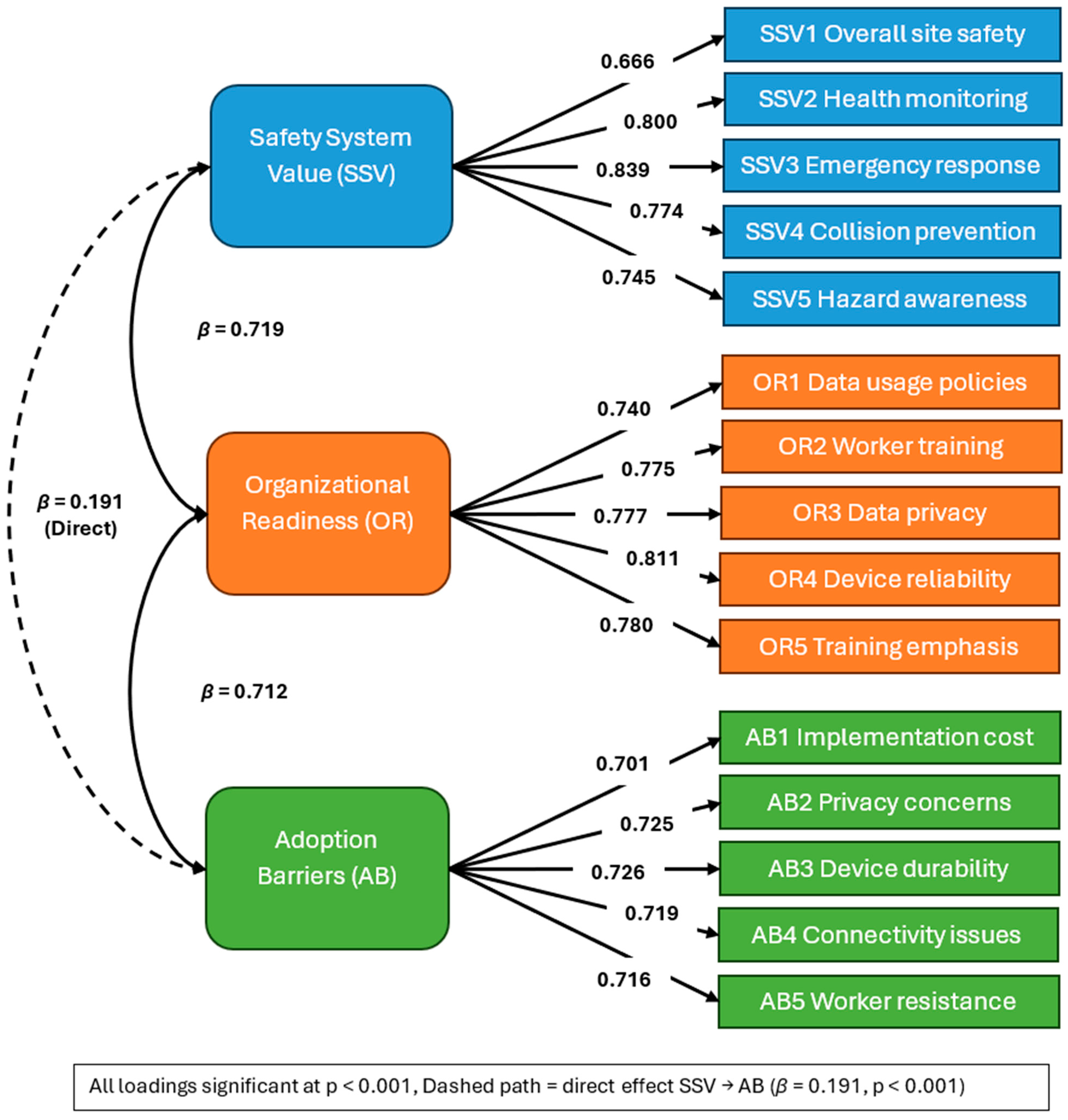
All indicators loaded highly and significantly (p < 0.001) on the respective latent variables. The standardized loadings ranged from 0.666 to 0.839 for SSV, from 0.740 to 0.811 for OR, and from 0.701 to 0.726 for AB. All are far above the most commonly cited cut-off value of 0.5, indicating satisfactory reliability of the indicators and a good correspondence between indicator items and the latent variable.
This phase was designed to investigate the internal consistency of the measurement model, and, for that purpose, composite reliability (CR) was calculated for all constructs. The results indicated that all constructs have CR values greater than 0.80, which exceeds the minimum standard of 0.70 (SSV: CR = 0.879; OR: CR = 0.887; AB: CR = 0.841). In addition, the average variance extracted (AVE) for all constructs was calculated to assess convergent validity. The results indicated that AVE values for all constructs were greater than 0.50, indicating that the latent variables explain more than 50% of the variance in their respective indicators.
The AVE for each construction fell over the 0.50 threshold (SSV: AVE = 0.588, OR: AVE = 0.604, AB: AVE = 0.515), supporting convergent validity, while the CR exceeded the 0.70 threshold (SSV: CR = 0.879, OR: CR = 0.887, AB: CR = 0.841). For discriminant validity, following Fornell and Larcker’s guidelines, the square roots of each construct’s AVE were 0.767, 0.777, and 0.717 for SSV, OR, and AB, respectively. This exceeds most inter-construct correlations (SSV–OR: 0.637; SSV–AB: 0.608; OR–AB: 0.739). HTMT ratios for SSV-OR (0.724) and SSV-AB (0.709) fell below 0.85. The OR-AB ratio (0.861) marginally exceeded the 0.85 threshold, suggesting conceptual overlap; this study considers this a limitation. Finally, multicollinearity was assessed by variance inflation factors (VIF). Values ranged from 1.74 to 2.56 for SSV, 1.84 to 2.62 for OR, and 1.53 to 2.24 for AB, which were all below the acceptable VIF threshold of 5 [
51].
Overall, the measurement model demonstrates satisfactory reliability, convergent validity, and discriminant validity, and is suitable for subsequent structural evaluation (see
Table 3 and
Figure 2).
4.2. Structural Model Results
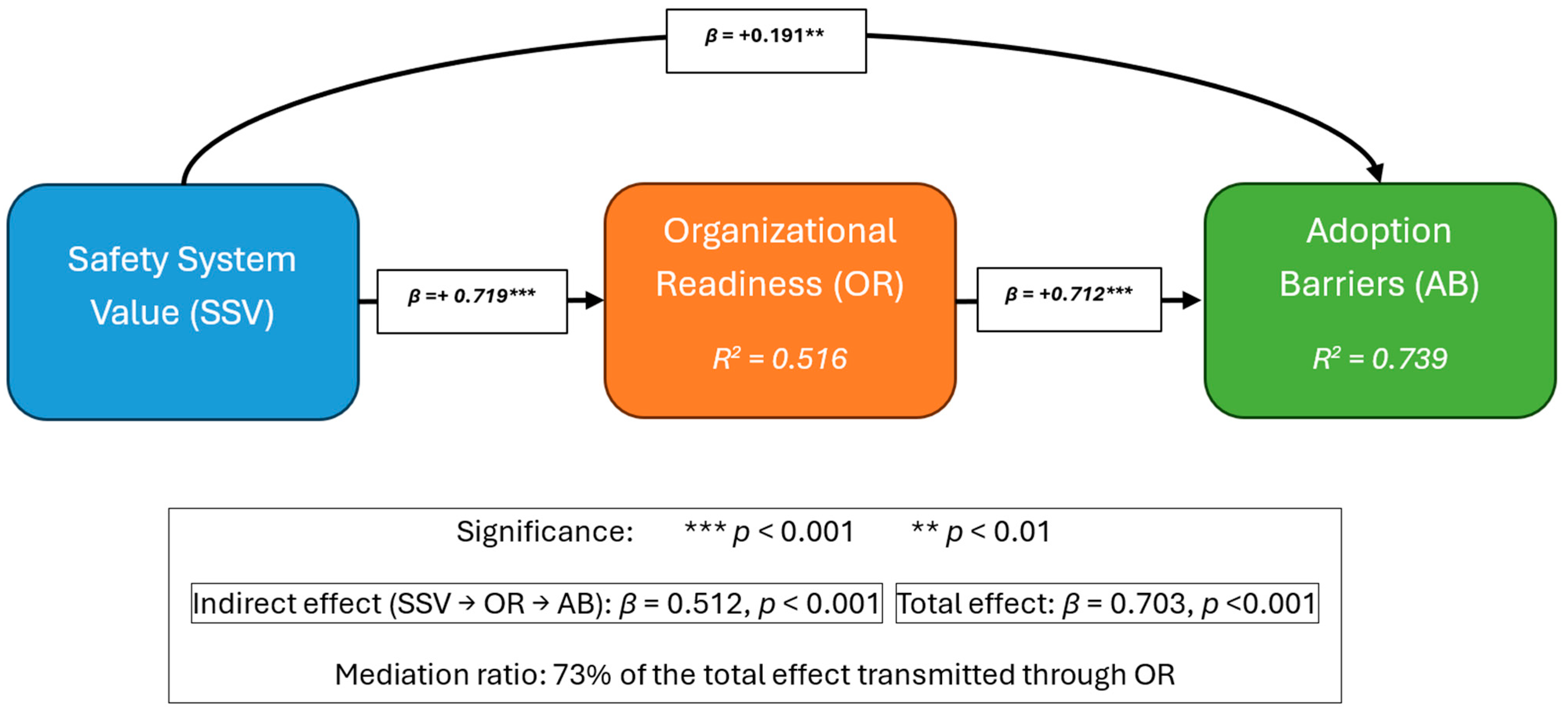
The validation test showed that all variables were measured adequately. The research model was tested to verify the proposed structural relationships among SSV, OR, and AB (see
Table 4 and
Figure 3). The results indicate that SSV has a strong, positive relationship with OR (
β = 0.719,
p < 0.001), supporting H1. In addition, OR shows a strong, positive relationship with AB (
β = 0.712,
p < 0.001), supporting H2. Further, SSV shows a positive but small relationship with AB (
β = 0.191,
p = 0.009), supporting H3.
The model’s explanatory power for the endogenous variables was substantial, with
R2 values of 0.516 for OR and 0.739 for AB. The results of the indirect effect analysis indicated that OR mediated the indirect effect of the perceived SSV on AB (see
Table 5). The indirect effect of SSV on AB through OR was statistically significant with
β = 0.512 (
p < 0.001). The total effect of SSV on AB was also statistically significant with
β = 0.703 (
p < 0.001). Thus, the majority of the total effect was transmitted through OR rather than through the direct effect.
4.3. Model Fit
The global model fit was evaluated with several indices (see
Table 6). The robust scaled model test (Yuan–Bentler Mplus) yielded a
χ2 = 257.7 with
df = 87 (
p < 0.001), based on n = 567 observations and 33 free parameters. Large samples tend to yield large
χ2 values, so other indices need to be considered to evaluate the model. The incremental fit indices (CFI and TLI) indicated acceptable incremental fit, with values of 0.923 and 0.907, respectively. The absolute fit indices (RMSEA and SRMR) fell within the typical acceptable range for the applied SEM. The RMSEA (0.059; 90% CI: 0.053–0.065) and SRMR (0.055) supported the model.
These indices collectively suggest that the systems-based structural model provided an acceptable representation of the data. The model chi-square was significant (χ
2(87) = 257.7,
p < 0.001). The CFI (0.923) and TLI (0.907) were above the threshold for acceptable fit (≥0.90), though they did not reach the close fit standard (≥0.95). The absolute fit indices indicated acceptable fit to the data: RMSEA = 0.059 (90% CI [0.053, 0.065]) and SRMR = 0.055. These index values fall within recommended thresholds [
50]. Global fit was acceptable, along with satisfactory measurement properties and the presence of all hypothesized structural relations.
5. Discussion
5.1. Interpretation of System Relationships
The results show a strong positive relationship between perceived SSV and OR (β = 0.719, p < 0.001). Construction professionals perceive the potential SSV that IoT and wearable devices can deliver (e.g., effective emergency response, health monitoring, collision prevention), and organizations respond by establishing internal enablers for adoption, such as workforce training, data management, and infrastructure development.
Most surprisingly, rather than a negative relation, as one would expect with increasing readiness to adopt IoT and wearable devices, we observe a positive relation between readiness to adopt and barriers to adoption (β = 0.712, p < 0.001). At face value, readiness appears to coincide with more rather than fewer reported barriers. This most likely relates to a heightened awareness effect of new technologies in ready firms, whereby their members are more aware of the actual impediments they will face or are already facing due to their direct involvement with the technologies. Because less ready firms have not yet engaged in this way, they may only know general barriers. In light of this, AB captures respondents’ recognition of challenges rather than the severity of obstacles that actually impede adoption. Increased awareness of barriers can indicate readiness to adopt new technologies rather than failure to overcome problems. An alternative interpretation explains the pattern equally well. Organizations that are more ready and actively seeking to improve are more likely to face genuinely larger barriers, whereas organizations that are less ready are just not there yet. Thus, the positive OR-AB correlation does not distinguish between greater awareness and a more difficult context for implementing changes. This ambiguity cannot be resolved with cross-sectional data and requires a longitudinal or an experimental study design to uncover its causes.
This interpretation is consistent with how systems view barriers. Many of the construction barriers documented in the present paper are, in fact, interdependent and arise when these elements—technological systems, the humans who interact with them, and the firms that deploy them—are misaligned. What the present findings add is that these misalignments become visible and, therefore, measurable as perceived barriers, mainly in firms that have developed sufficient readiness to act on the perceived benefits of the technology. They do not invent barriers; they uncover the ones already inherent in the system.
The same can be said about SSV, which also shows a smaller but significant direct relationship with AB (β = 0.191, p = 0.009): when firms attribute greater safety value to the technologies, they will also be more mindful of the obstacles to achieving that value. The mediation analysis suggests that the indirect effect through OR is dominant: it accounts for roughly 73% of the total effect (β = 0.512 of a total β = 0.703), while the direct SSV → AB path accounts for the remaining 27%.
These results highlight the relationship between perceptions of safety value and the system constraints recognized within ready organizations. Safety value perceptions drive the organizational states through which barriers become recognized and, in turn, addressed. Understanding these relationships highlights the potential benefits of focusing future efforts on building OR for effective safety practices rather than on addressing each barrier in isolation.
These results represent the STS principle of “joint optimization” through the SSV-OR-AB sequences [
52]. It presents the systemic interdependence of technical value perception, organizational enablers, and system-generated constraints. So, studies that focus solely on techno-centric adoption, ignoring the organizational mediating layer, and purely barrier-focused studies that do not account for perceptions of safety value provide only a view of the system.
5.2. Comparison with Prior Studies
Most previous studies on construction technology adoption have focused on identifying individual determinants of acceptance, using either variable-centric approaches or loosely specified systems framings [
7]. The constructs of perceived usefulness, price, privacy concerns, and worker resistance have been examined using regression and exploratory factor analysis techniques to better understand their relative influence on intentions to adopt technology [
2]. However, few studies have attempted to model the relationships among these and other variables within an integrated framework [
23,
53].
Although considerable research has identified perceived safety value as a determinant of technology adoption, little has been done to clarify the underlying mechanisms or processes that explain how these perceptions translate into organizational capability [
7,
54]. In this paper, covariance-based SEM was used to specify and test a measurement model for perceived SSV, OR, and AB, along with a structural model linking them. Consistent with TAM and UTAUT, the findings confirm a positive role for perceived safety value. Moreover, they illustrate that OR acts as a central mediator, linking perceived safety value to the recognition of adoption barriers. From a construction management perspective, building OR is an important condition for successfully integrating IoT and wearable devices.
Within a systems perspective, this work corresponds to Leveson’s (2011) STAMP framework, which defines accidents and failures as outcomes of inadequate control of STS [
55]. This study model may be viewed as a snapshot of system alignment: SSV reflects the system’s perceived control value, OR reflects the organizational capabilities in exerting control, and AB reflects the system’s resistance to control. Similarly, the interpretation aligns with Hollnagel’s (2004) Cognitive Systems Engineering in its emphasis on barriers as system-generated properties rather than individual errors, as evidenced by the study findings showing that AB is largely predicted by organizational-level OR rather than individual attitudes [
56]. This study extends TAM and UTAUT by placing adoption mechanisms within an organizational-level STS framework and empirically demonstrating that OR mediates the relationship between perceived value and barrier recognition.
5.3. Practical Implications for Construction Systems
The findings of this research have significant implications for construction companies, safety system designers, and construction policymakers who are interested in the adoption of IoT and wearable devices in the built environment. Most importantly, the findings suggest that future strategies to increase adoption of these emerging technologies must address OR as a systemic condition rather than focusing solely on individual barriers.
Training programs need to be conceived as ongoing organizational systems that develop competence in device use, safety data interpretation, emergency management, and digital risk management. Short-term device training is not sufficient; workforce development programs need to be at the heart of how the organization is designed and integrated with safety governance.
Construction organizations need transparency into data usage policies to be ready to adopt system innovation. To achieve this, the construction organization needs to develop data governance policies for workforce monitoring by the system (level of monitoring), the use of health and location data that the system will hold, and data privacy. These are key to gaining workforce trust and to embedding system innovation within the organization.
When designing systems to incorporate IoT and wearable devices, it is important to remember that these technologies are not intended to replace existing safety systems. Instead, they should be designed to be reliable, straightforward to use, and fully integrated into existing workflows. For those in Saudi Arabia looking to develop a digital safety strategy, this means prioritizing readiness alongside technology selection. Saudi Arabian policymakers and industry leaders from sectors such as health, transportation, and manufacturing can benefit from developing a framework for readiness and a means to assess OR to integrate these technologies. Given Saudi Arabia’s massive migrant construction workforce, highlighted by Vision 2030, the language barrier, the types of migrant workers, and diverse prior experience with technologies, these OR problems will add additional complications and differ from those faced by local workers. Safety organizations’ training, data governance schemes, and associated policy frameworks will therefore need to account for the diverse backgrounds of the Saudi construction labor force. At the same time, regulatory bodies may consider adding language-accessible safety interfaces as a measure of OR.
The SSV-OR-AB chain is not a one-way path; instead, it is a reinforcing feedback system. The more proficient an organization becomes with OR practices and their interaction with IoT and wearable devices, the higher its SSV perceptions generally become. This is primarily because companies deeply involved in these technologies will begin to identify specific functional uses for them, something companies less involved may never experience. The more detailed sense of value then influences an organization’s decision to increase its own readiness, hence strengthening SSV and OR. Inversely, when AB expands with readiness, organizations that implement changes to address recognized barriers reduce the differences between their technological and social systems, lowering the barrier intensity the next readiness cycle must contend with. Three operationally specific recommendations result from the feedback logic presented in this section. First, organizations should institute a readiness monitoring cycle that periodically assesses their five OR indicators, with the results feeding directly into readiness investment strategies. Second, construction firms should move towards a phased implementation model in which each stage begins with an assessment of OR and concludes with an evaluation of AB; the gap between the two provides a corrective signal to inform the subsequent phase’s readiness strategy. Third, to solve AB among the identified privacy concerns and data governance issues, Saudi Arabian construction regulators should consider establishing industry-wide data privacy and usage governance guidelines.
6. Conclusions
The research investigated how IoT and wearable devices affect construction safety through systems analysis, which views safety technology adoption as the result of multiple social and technical systems working together rather than relying on technology or human behavior alone. The research developed an SEM, which showed that system adoption depends mainly on internal system alignment between OR and perceived SSV and AB.
Results showed that Perceived SSV, OR, and AB were strongly and positively associated with one another, with OR acting as the central mediator. Overall, OR accounted for about 73% of the SSV in the AB total effect, while a small direct path remains. The positive OR-AB association, where OR and barrier identification co-occur, may reflect the enhanced understanding of implementation barriers that comes with active engagement with the technology. Although the reverse interpretation cannot be excluded without longitudinal data. AB was viewed as a system property reflecting the OR levels, governance systems, training programs, and data management arrangements rather than as a set of isolated technical or financial constraints.
Organizations need to establish readiness-based solutions that unite training systems with data governance frameworks and operational workflow adjustments to improve construction safety through digital technologies. Organizations need to assess their current readiness before they can sustainably adopt new practices, because removing barriers does not automatically lead to success.
The research investigates Saudi construction sites, but the developed system-level framework provides value to safety-dependent industries that operate with complicated organizational systems and multiple project sites.
The SSV-OR-AB framework is equally applicable to other high-risk sectors, such as mining, offshore oil and gas, and manufacturing. This is because they share similar characteristics, including complex multi-stakeholder environments, safety-critical technologies, and diverse workforces. In these scenarios, building the organizational capacity required to operate technology before deploying it is often more effective than removing barriers in isolation.
Research studies should build on this framework by using three methods: tracking participants over time, studying different countries, and measuring construction safety performance and outcomes. The research contributes to systems scholarship by showing that organizational safety systems require socio-technical readiness to affect how employees use technology.
Limitations and Future Studies
Several limitations exist in this study that should be considered when interpreting its findings. First, a single snapshot of respondents’ perceptions was taken, which does not support casual inference due to the study’s cross-sectional data collection. Second, the use of data from single-source, single-wave surveys created an opportunity for common-method bias [
57]. Two post hoc checks were performed to determine whether this bias was affecting the results. Harman’s single-factor test indicated that the largest unrotated factor accounted for only 50.71% of the total variance. Second, a common method factor (CMF) was added to the model. Doing so improved model fit relative to the baseline model (ΔCFI = 0.058, ΔRMSEA = −0.032), suggesting that some variance is attributable to a shared method. The relationships were not affected by the addition of a CMF, but it should be taken as an indicator that the size of the structural path coefficients might be overestimated. Longitudinal or multi-source studies should be undertaken in the future to replicate or build upon the study at a later stage. Third, findings should not be generalized to specific organization types or project categories without additional confirmatory research. Fourth, the sub-groups’ measurement invariance was not tested. The study dataset comprises a wide range of roles, from site laborers to executives. This broad demographic base might suggest significant variance in perceptions of SSV and AB. Laborers might see safety as a physical matter, whereas managers might see it as related to legal obligations and ROI. Similarly, laborers may perceive cost and worker resistance as more personally salient barriers, whereas executives may weigh data governance and connectivity infrastructure more heavily. Fifth, the study did not distinguish between different types of IoT and wearable devices. Finally, the incremental fit indices (CFI and TLI) meet the acceptable but not close-fit threshold. Future studies may improve fit by using different indicators or refining the model in ways that are theoretically justified. Moreover, multi-group confirmatory factor analysis can be employed in future studies to examine whether the SSV-OR-AB relationships hold equally across role and experience, or whether organizational position moderates the strength or direction of these paths.
Funding
This work was funded by the Deanship of Scientific Research (DSR), King Abdulaziz University, Jeddah, under grant No. (IPP: 1542-829-2025). The author, therefore, acknowledges with thanks DSR technical and financial support.
Institutional Review Board Statement
This study is waived for ethical review as after careful reviewing of your submitted application to REC, please be informed that your above-mentioned research project has been waived from getting a formal Ethical Approval by the REC. The researcher can therefore apply directly to the body where the research will be conducted. This REC approval for exemption of this research study must not contradict with any Saudi law including, but not limited to, the Saudi Law of Ethics of Research on Living Creatures and its Implementing Regulations. And is expected to adhere to all regulations issued by the National Committee of Bioethics (NCBE) - King Abdul Aziz City for Science and Technology.
Informed Consent Statement
Informed consent for participation was obtained from all subjects involved in the study.
Data Availability Statement
The data presented in this study are available on request from the author. The data are not publicly available due to privacy and ethical restrictions.
Conflicts of Interest
The author declares no conflicts of interest.
References
- Bayramova, A.; Edwards, D.J.; Roberts, C.; Rillie, I. Enhanced Safety in Complex Socio-Technical Systems via Safety-in-Cohesion. Saf. Sci. 2023, 164, 106176. [Google Scholar] [CrossRef]
- Mosly, I. Barriers, Enablers, and Adoption Patterns of IoT and Wearable Devices in the Saudi Construction Industry: Survey Evidence. Buildings 2026, 16, 347. [Google Scholar] [CrossRef]
- Carayon, P.; Hancock, P.; Leveson, N.; Noy, I.; Sznelwar, L.; van Hootegem, G. Advancing a Sociotechnical Systems Approach to Workplace Safety—Developing the Conceptual Framework. Ergonomics 2015, 58, 548–564. [Google Scholar] [CrossRef]
- Robertson, M.M.; Hettinger, L.J.; Waterson, P.E.; Ian Noy, Y.; Dainoff, M.J.; Leveson, N.G.; Carayon, P.; Courtney, T.K. Sociotechnical Approaches to Workplace Safety: Research Needs and Opportunities. Ergonomics 2015, 58, 650–658. [Google Scholar] [CrossRef] [PubMed]
- Maqbool, R.; Saiba, M.R.; Ashfaq, S. Emerging Industry 4.0 and Internet of Things (IoT) Technologies in the Ghanaian Construction Industry: Sustainability, Implementation Challenges, and Benefits. Environ. Sci. Pollut. Res. 2022, 30, 37076–37091. [Google Scholar] [CrossRef] [PubMed]
- Abioye, S.O.; Oyedele, L.O.; Akanbi, L.; Ajayi, A.; Davila Delgado, J.M.; Bilal, M.; Akinade, O.O.; Ahmed, A. Artificial Intelligence in the Construction Industry: A Review of Present Status, Opportunities and Future Challenges. J. Build. Eng. 2021, 44, 103299. [Google Scholar] [CrossRef]
- Nnaji, C.; Okpala, I.; Awolusi, I.; Gambatese, J. A Systematic Review of Technology Acceptance Models and Theories in Construction Research. J. Inf. Technol. Constr. 2023, 28, 39–69. [Google Scholar] [CrossRef]
- Yap, J.B.H.; Lee, K.P.H.; Skitmore, M.; Lew, Y.L.; Lee, W.P.; Lester, D. Predictors to Increase Safety Technology Adoption in Construction: An Exploratory Factor Analysis for Malaysia. J. Civ. Eng. Manag. 2022, 29, 157–170. [Google Scholar] [CrossRef]
- Yap, J.B.H.; Lam, C.G.Y.; Skitmore, M.; Talebian, N. Barriers to the Adoption of New Safety Technologies in Construction: A Developing Country Context. J. Civ. Eng. Manag. 2022, 28, 120–133. [Google Scholar] [CrossRef]
- Daniel, E.I.; Oshodi, O.S.; Nwankwo, N.; Emuze, F.A.; Chinyio, E. Barriers to the Application of Digital Technologies in Construction Health and Safety: A Systematic Review. Buildings 2024, 14, 2386. [Google Scholar] [CrossRef]
- Alazmi, Y.H.; Al-Zu’bi, M.; Al-Kheetan, M.J.; Rabi, M. A Review of Robotic Applications in the Management of Structural Health Monitoring in the Saudi Arabian Construction Sector. Buildings 2025, 15, 2965. [Google Scholar] [CrossRef]
- Rehman, M.A.; Alqahtani, D.A. The Catalyst of Culture: Unlocking Blockchain-Driven Digital Transformation in Saudi Construction. Buildings 2026, 16, 672. [Google Scholar] [CrossRef]
- Elkhayat, Y.; Adel, K.; Marzouk, M. Technology Adoption in the Construction Industry (1999–2023): Science Mapping and Visualization. Autom. Constr. 2024, 165, 105491. [Google Scholar] [CrossRef]
- Davis, F.D. Perceived Usefulness, Perceived Ease of Use, and User Acceptance of Information Technology. MIS Q. 1989, 13, 319. [Google Scholar] [CrossRef]
- Venkatesh, V.; Morris, M.G.; Davis, G.B.; Davis, F.D. User Acceptance of Information Technology: Toward a Unified View. MIS Q. 2003, 27, 425. [Google Scholar] [CrossRef]
- Venkatesh, V.; Thong, J.Y.L.; Xu, X. Consumer Acceptance and Use of Information Technology: Extending the Unified Theory of Acceptance and Use of Technology1. MIS Q. 2012, 36, 157–178. [Google Scholar] [CrossRef]
- Shachak, A.; Kuziemsky, C.; Petersen, C. Beyond TAM and UTAUT: Future Directions for HIT Implementation Research. J. Biomed. Inform. 2019, 100, 103315. [Google Scholar] [CrossRef] [PubMed]
- Pasmore, W.; Winby, S.; Mohrman, S.A.; Vanasse, R. Reflections: Sociotechnical Systems Design and Organization Change. J. Change Manag. 2019, 19, 67–85. [Google Scholar] [CrossRef]
- Kleiner, B.M.; Hettinger, L.J.; DeJoy, D.M.; Huang, Y.-H.; Love, P.E.D. Sociotechnical Attributes of Safe and Unsafe Work Systems. Ergonomics 2015, 58, 635–649. [Google Scholar] [CrossRef] [PubMed]
- Dodoo, J.E.; Al-Samarraie, H.; Alzahrani, A.I.; Lonsdale, M.; Alalwan, N. Digital Innovations for Occupational Safety: Empowering Workers in Hazardous Environments. Workplace Health Saf. 2024, 72, 84–95. [Google Scholar] [CrossRef]
- Khan, A.M.; Alrasheed, K.A.; Waqar, A.; Almujibah, H.; Benjeddou, O. Internet of Things (IoT) for Safety and Efficiency in Construction Building Site Operations. Sci. Rep. 2024, 14, 28914. [Google Scholar] [CrossRef]
- Zhang, H.; Zhang, R.; Sun, J. Developing Real-Time IoT-Based Public Safety Alert and Emergency Response Systems. Sci. Rep. 2025, 15, 29056. [Google Scholar] [CrossRef]
- Elrifaee, M.; Zayed, T.; Ali, A.H.; Ibrahim, A.; Wang, R.D. A Holistic Evaluation of Success Factors for Advancing IoT Adoption through Mitigating Barriers in Construction Site Safety. Internet Things 2025, 31, 101595. [Google Scholar] [CrossRef]
- Tabatabaee, S.; Mohandes, S.R.; Ahmed, R.R.; Mahdiyar, A.; Arashpour, M.; Zayed, T.; Ismail, S. Investigating the Barriers to Applying the Internet-of-Things-Based Technologies to Construction Site Safety Management. Int. J. Environ. Res. Public Health 2022, 19, 868. [Google Scholar] [CrossRef] [PubMed]
- Nnaji, C.; Karakhan, A.A. Technologies for Safety and Health Management in Construction: Current Use, Implementation Benefits and Limitations, and Adoption Barriers. J. Build. Eng. 2020, 29, 101212. [Google Scholar] [CrossRef]
- Zhang, Q.; Liu, Z.; Yang, S. Enhancing Construction Workers’ Health and Safety: Mechanisms for Implementing Construction 4.0 Technologies in Construction Organizations. Eng. Constr. Archit. Manag. 2025, 32, 68–103. [Google Scholar] [CrossRef]
- Wang, J.; Cheng, R.; Liu, M.; Liao, P.-C. Research Trends of Human–Computer Interaction Studies in Construction Hazard Recognition: A Bibliometric Review. Sensors 2021, 21, 6172. [Google Scholar] [CrossRef]
- Nnaji, C.; Gambatese, J.; Karakhan, A.; Osei-Kyei, R. Development and Application of Safety Technology Adoption Decision-Making Tool. J. Constr. Eng. Manag. 2020, 146, 04020028. [Google Scholar] [CrossRef]
- Chong, H.-Y.; Xu, Y.; Lun, C.; Chi, M. The Adoption Intentions of Wearable Technology for Construction Safety. Buildings 2023, 13, 2747. [Google Scholar] [CrossRef]
- Chen, H.; Mao, Y.; Xu, Y.; Wang, R. The Impact of Wearable Devices on the Construction Safety of Building Workers: A Systematic Review. Sustainability 2023, 15, 11165. [Google Scholar] [CrossRef]
- Nnaji, C.; Awolusi, I.; Park, J.; Albert, A. Wearable Sensing Devices: Towards the Development of a Personalized System for Construction Safety and Health Risk Mitigation. Sensors 2021, 21, 682. [Google Scholar] [CrossRef] [PubMed]
- Uren, V.; Edwards, J.S. Technology Readiness and the Organizational Journey towards AI Adoption: An Empirical Study. Int. J. Inf. Manag. 2023, 68, 102588. [Google Scholar] [CrossRef]
- Saghafian, M.; Laumann, K.; Skogstad, M.R. Stagewise Overview of Issues Influencing Organizational Technology Adoption and Use. Front. Psychol. 2021, 12, 630145. [Google Scholar] [CrossRef] [PubMed]
- Xu, J.; Li, J.; Chen, X. Assessment of Technology Adoption in Construction Safety Management: Case Study in China. Sci. Prog. 2024, 107, 1–21. [Google Scholar] [CrossRef] [PubMed]
- Weiner, B.J. A Theory of Organizational Readiness for Change. Implement. Sci. 2009, 4, 67. [Google Scholar] [CrossRef]
- Amanollahnejad, A.; Fosso-Wamba, S.; Shabbir, M.S.; Pakseresht, A. Aligning Socio-Technical Systems: Rethinking AI Adoption and Digital Transformation in SMEs. Inf. Syst. Manag. 2026, 43, 103–117. [Google Scholar] [CrossRef]
- Armenakis, A.A.; Harris, S.G. Crafting a Change Message to Create Transformational Readiness. J. Organ. Change Manag. 2002, 15, 169–183. [Google Scholar] [CrossRef]
- Parasuraman, A. Technology Readiness Index (Tri): A Multiple-Item Scale to Measure Readiness to Embrace New Technologies. J. Serv. Res. 2000, 2, 307–320. [Google Scholar] [CrossRef]
- Vroom, V. Work and Motivation; Wiley: New York, NY, USA, 1964. [Google Scholar]
- Baron, R.M.; Kenny, D.A. The Moderator–Mediator Variable Distinction in Social Psychological Research: Conceptual, Strategic, and Statistical Considerations. J. Pers. Soc. Psychol. 1986, 51, 1173–1182. [Google Scholar] [CrossRef]
- MacKinnon, D. Introduction to Statistical Mediation Analysis; Routledge: New York, NY, USA, 2008. [Google Scholar]
- Kline, R. Principles and Practice of Structural Equation Modeling, 4th ed.; The Guilford Press: New York, NY, USA, 2016. [Google Scholar]
- Field, A. Discovering Statistics Using SPSS, 3rd ed.; SAGE Publications Ltd.: London, UK, 2009. [Google Scholar]
- Hinton, P.; McMurray, I.; Brownlow, C. SPSS Explained, 2nd ed.; Routledge: New York, NY, USA, 2014. [Google Scholar]
- Fornell, C.; Larcker, D.F. Evaluating Structural Equation Models with Unobservable Variables and Measurement Error. J. Mark. Res. 1981, 18, 39–50. [Google Scholar] [CrossRef]
- Awolusi, I.; Marks, E.; Hallowell, M. Wearable Technology for Personalized Construction Safety Monitoring and Trending: Review of Applicable Devices. Autom. Constr. 2018, 85, 96–106. [Google Scholar] [CrossRef]
- Oliveira, T.; Martins, M. Literature Review of Information Technology Adoption Models at Firm Level. Electron. J. Inf. Syst. Eval. 2011, 14, 110–121. [Google Scholar]
- Baker, J. The Technology–Organization–Environment Framework. In Integrated Series in Information Systems; Springer: New York, NY, USA, 2012; Volume 28, pp. 231–245. [Google Scholar]
- Jamalut, Y.; Abd Rahim, M.F.; Ong, J.W. Internet of Things (IoT) Adoption by Organisation: A Systematic Review. Int. J. Manag. Financ. Account. 2025, 6, 300–340. [Google Scholar] [CrossRef]
- Hu, L.; Bentler, P.M. Cutoff Criteria for Fit Indexes in Covariance Structure Analysis: Conventional Criteria versus New Alternatives. Struct. Equ. Model. 1999, 6, 1–55. [Google Scholar] [CrossRef]
- Hair, J.; Babin, B.; Anderson, R.; Black, W. Multivariate Data Analysis, 8th ed.; Cengage: Hampshire, UK, 2019. [Google Scholar]
- Trist, E. The Evolution of Socio-Technical Systems: A Conceptual Framework and an Action Research Program; Ontario Quality of Working Life Centre: Toronto, ON, Canada, 1981. [Google Scholar]
- Manzoor, N.; Khan, H.; Hassan, M.U.; Ahmed, K.; Zubair, M.U. Modelling Adoption of Camera-Based Safety Monitoring Systems in Construction: An Extended Technology Acceptance Model Approach Using PLS-SEM. Innov. Infrastruct. Solut. 2026, 11, 144. [Google Scholar] [CrossRef]
- Nnaji, C.; Gambatese, J.; Karakhan, A.; Eseonu, C. Influential Safety Technology Adoption Predictors in Construction. Eng. Constr. Archit. Manag. 2019, 26, 2655–2681. [Google Scholar] [CrossRef]
- Leveson, N.G. Engineering a Safer World: Systems Thinking Applied to Safety; The MIT Press: Cambridge, MA, USA, 2012. [Google Scholar]
- Hollnagel, E. Barriers and Accident Prevention; Routledge: London, UK, 2004. [Google Scholar]
- Podsakoff, P.M.; MacKenzie, S.B.; Lee, J.-Y.; Podsakoff, N.P. Common Method Biases in Behavioral Research: A Critical Review of the Literature and Recommended Remedies. J. Appl. Psychol. 2003, 88, 879–903. [Google Scholar] [CrossRef]
| Disclaimer/Publisher’s Note: The statements, opinions and data contained in all publications are solely those of the individual author(s) and contributor(s) and not of MDPI and/or the editor(s). MDPI and/or the editor(s) disclaim responsibility for any injury to people or property resulting from any ideas, methods, instructions or products referred to in the content. |