Article

Spatial–Temporal Analysis of Disturbed Lands as a Strategic Resource for Forest-Climate Projects and Sustainable Development

by
Svetlana S. Morkovina
1,
Nataliya V. Yakovenko
2,*,
Denis K. Kuznetsov
1,
Pavel S. Moiseev
1,
Oleg Vasilev
3 and
Alexander G. Tretyakov
1
1
Department of Management and Economics of Entrepreneurship, Voronezh State University Forestry and Technologies Named After G.F. Morozov, 8 Timiryazev Str., 394087 Voronezh, Russia
2
Research Institute of Innovative Technologies and the Forestry Complex, Voronezh State University Forestry and Technologies Named After G.F. Morozov, 8 Timiryazev Str., 394087 Voronezh, Russia
3
Unidad Académica de Ciencias Económicas y Empresariales, Centro de Investigación, Innovación y Transferencia de Tecnología (CIITT), Universidad Católica de Cuenca, Cuenca 010101, Ecuador
*
Author to whom correspondence should be addressed.
Sustainability 2026, 18(11), 5675; https://doi.org/10.3390/su18115675 (registering DOI)
Submission received: 20 March 2026 / Revised: 20 May 2026 / Accepted: 30 May 2026 / Published: 3 June 2026
(This article belongs to the Section Sustainability in Geographic Science)

Abstract

While the concentration of disturbed lands in northern Russia’s extractive regions is well known, the scientific value of this study lies not in confirming that geography, but in developing a replicable, data-driven framework that transforms raw spatial statistics into actionable restoration priorities. Using official 2023 data for 85 Russian regions and applying Global and Local Moran’s Indices (LISA), we demonstrate that reclamation efforts are not spatially clustered—a stark mismatch with the highly clustered pattern of disturbances. Building on this finding, we propose a two-criteria prioritization scheme: regions are selected if they belong to a statistically significant high-disturbance (HH) cluster and are not part of a high-reclamation cluster. This approach identifies not only expected industrial leaders (Krasnoyarsk Krai, Komi Republic, Tomsk and Arkhangelsk Oblasts) but also, through a complementary reclamation-coefficient analysis, uncovers territories with moderate recovery activity (Belgorod, Voronezh, Karelia) that are often overlooked when focusing solely on absolute disturbance areas. The total area of disturbed lands within the priority macro-cluster (limited to HH-cluster categories) is 81.09 thousand hectares. The study demonstrates that moving from fragmented, spatially blind interventions to a concentrated policy and investment strategy in compact zones of cumulative impact can achieve synergistic environmental, climate, and socio-economic benefits (SDGs 13, 15). By providing a transparent, spatially explicit prioritization tool, this work enables a strategic reorientation of forest-climate project planning—from reacting to local violations to proactively restoring entire clusters of accumulated environmental damage.

1. Introduction

The deepening global ecological crisis, manifested in climate change and biodiversity loss, creates complex challenges for sustainable development, threatening its ecological, social and economic foundations [1,2]. This global crisis is particularly acute in Russia, which, possessing the world’s largest forest resources and significant areas of anthropogenically disturbed lands, has enormous but as yet unrealized potential for forest-climate projects.
Anthropogenically disturbed lands—degraded as a result of mineral extraction, industrial pollution, construction and other types of economic activity—are a vivid embodiment of these challenges [3]. They represent not only a direct loss of natural capital and ecosystem services but also a long-term burden. The social well-being of the population in such regions declines due to health problems associated with air and water pollution, as well as forced displacement and loss of traditional livelihoods [4]. The economy suffers losses both from reduced land productivity (agricultural, forest) and from the future colossal costs required to remediate accumulated damage [5,6]. Moreover, there is a fundamental contradiction: the pursuit of a “green” transition and low-carbon development requires the preservation and enhancement of natural carbon sinks, while land-use practices continue to generate new disturbed areas, exacerbating both climatic and local environmental problems [7,8,9]. In this context, forest-climate projects aimed at ecosystem restoration and carbon sequestration have become an important tool that can potentially mitigate negative impacts and contribute to the goals of the Paris Agreement [10,11].
The Russian Federation, possessing the world’s largest forest resources and significant areas of anthropogenically disturbed lands, has enormous but as yet unrealized potential for such projects [12,13,14]. However, as practice shows, this potential is called into question due to inefficient management, an increasing number of catastrophic fires, and outdated reforestation practices [15,16,17]. Moreover, vast expanses of disturbed lands, often located near centres of economic activity, remain outside the systemic view as a reserve for large-scale restoration [18]. The main problem of strategic planning in this area is the lack of tools to move from general assessments to targeted and effective allocation of efforts and investments. Traditional approaches based on aggregated statistical data at the level of Russian regions do not account for spatial heterogeneity and the cluster character of both disturbance distribution and ongoing reclamation works. This leads to a “smearing” of resources and a reduction in the overall environmental and climatic effect. The modern paradigm of sustainable development and responsible land management requires the integration of spatial planning, making it possible to balance environmental constraints, social needs, and economic interests (ESG aspects) within a given territory.

Literature Review

Spatial statistics methods, in particular the global Moran’s Index (Global Moran’s I) and local spatial autocorrelation statistics LISA (Local Indicators of Spatial Association), are successfully applied in regional economics to identify clusters of development and depression [19,20]. The foundational works of Anselin (1995) [21] and Ord and Getis (1995) [22] laid the methodological basis for the analysis of spatial patterns, which was subsequently widely used in environmental studies. Abroad, the cluster approach is actively used to assess the cumulative impact of the mining industry in Canada [23], to analyze land degradation risks in arid regions of Australia [24], and to study the evolution of ecosystem services in coal-mining areas of China [25]. Unnithan Kumar et al. (2025) proposed spatial prioritization methods for nature restoration, which directly aligns with the objectives of our work [26].
In Russia, research in this area remains fragmentary. Kust et al. [27] analyzed the uncertainties and policy challenges in achieving land degradation neutrality, but their work is conceptual and does not use quantitative spatial methods. Savin et al. [28] presented a map of anthropogenic soil disturbances in Russia, but without calculating spatial autocorrelation indices. Gilmundinov et al. [29] developed a concept of regional differentiation of decarbonisation processes without linking it to disturbed land clusters. Tulaeva and Semushkina [30] examined scenarios of (de)politicization of the environmental agenda in Russian regions from a sociological perspective, without applying LISA. The work of Yang et al. [31] is devoted to the influence of environmental factors on larch physiology, which is indirectly related to forest restoration but does not provide a spatial assessment.
The conducted analysis of the scientific literature shows that, despite the existence of individual works on the spatial distribution of disturbed lands, no systematic quantitative study has yet been undertaken that would simultaneously assess global and local spatial autocorrelation for both disturbances and reclamation across the entire territory of the Russian Federation. Also lacking are studies that directly compare disturbance clusters and reclamation clusters in order to identify zones of persistent mismatch. To fill this gap, based on preliminary data analysis and theoretical considerations, we have formulated the following scientific hypotheses to be tested in this study.
Based on the analysis of literature data and preliminary observations, three scientific hypotheses are formulated for testing in this work:
H1. 
Disturbed lands in the Russian Federation exhibit statistically significant positive spatial autocorrelation (global Moran’s  I > 0   with p < 0.05 ), while reclamation shows no such autocorrelation (global Moran’s I  is not statistically significant).
H2. 
There is a systematic spatial mismatch between regions belonging to HH clusters of disturbances (high disturbance levels among neighbours) and regions belonging to HH clusters of reclamation. Zones of cumulative impact do not coincide with zones of active restoration.
H3. 
The identified mismatch clusters are stable over time and are not a one-year artefact—they are reproduced using data for the period 2018–2023.
Research question. The central question that this work answers is: “To what extent does the spatial distribution of reclamation in Russia correspond to the spatial distribution of disturbed lands, and is there a persistent geographical disproportionality between them that cannot be explained by random factors?”
  • Research objectives:
  • Quantitatively assess the global spatial autocorrelation (Moran’s Index) of disturbed lands across the constituent entities of the Russian Federation.
  • Quantitatively assess the global spatial autocorrelation of reclamation.
  • Identify local clusters (HH, LL, HL, LH) using LISA statistics for both indicators.
  • Compare disturbance and reclamation clusters, identifying zones of greatest mismatch, and test the stability of these zones using data for 2018–2023.
  • The scientific contributions of this work are as follows:
  • Methodological contribution. For the first time, a two-criteria approach based on LISA (subtracting HH clusters of reclamation from HH clusters of disturbances) has been applied to the entire territory of the Russian Federation (85 regions), enabling a transition from descriptive statistics to reproducible spatial prioritization.
  • Empirical contribution. The spatial mismatch between disturbances and reclamation has been quantitatively confirmed (global Moran’s I for disturbances: I = 0.298 , p < 0.001 ; for reclamation: I = 0.094 , p = 0.186 —not significant).
  • Applied contribution (within the scientific context). Not only the well-known northern “hot spots” (Krasnoyarsk Krai, Komi Republic, Tomsk Oblast) have been identified, but also regions with a moderate reclamation coefficient (Belgorod Oblast, Voronezh Oblast, Karelia), which can serve as model polygons for further research on forest-climate projects.

2. Materials and Methods

2.1. Initial Data and Their Preparation

For analysis, the 2023 data array was used as the most complete and relevant at the time of the study. Focusing on the static “image” of the spatial distribution rather than the dynamic series is methodologically justified by the tasks set. However, to fully capture the dynamic evolution of disturbance and reclamation processes, we supplement the static analysis with a simple temporal trend analysis of the core macro-cluster (Krasnoyarsk Krai, Komi Republic) using 2018–2022 data. This allows us to examine changes in cluster boundaries and disturbance intensity over the five-year period, enhancing the understanding of long-term spatial patterns.
The primary aim of the study is not to analyze temporal trends, but to identify stable spatial structures (clusters) of accumulated disruptions, which are characterized by significant inertia due to the long-term nature of the impact (for example, field development) and a long cycle of natural or artificial recovery. This approach allows for the identification of a fundamental geography of anthropogenic pressure that changes little in the short term. Using data for a single period eliminates potential distortions related to changes in collection or reporting methodology over different years, which is crucial for ensuring strict comparability of indicators between regions when calculating spatial autocorrelation.
Data source. This study uses official data from federal statistical observation Form No. 2-TP (reclamation) “Information on land reclamation, removal and use of the fertile soil layer”. Detailed data sources and definitions are provided in Appendix A. The data were provided by the Federal State Statistics Service (Rosstat) for 2023. Access to aggregated data for the constituent entities of the Russian Federation is available through the official statistical compendium “Environmental Protection in Russia”, as well as through the state statistical reporting system (request to territorial bodies of Rosstat). For this study, data were used for 85 constituent entities of the Russian Federation.
Definition of disturbed lands. In this study, disturbed lands are understood as the accumulated area of lands that have lost their economic value or have a negative impact on the environment as a result of anthropogenic activity, as of the end of the reporting year (2023). Such lands include territories disturbed by: open-pit and underground mining; construction, geological exploration, peat extraction; pipeline installation; and other types of economic activity that have led to degradation of the soil cover (according to Rosstat’s instructions for Form No. 2-TP). The indicator “reclamation” refers to the area of lands brought into a usable condition during the reporting year (annual volume of restored lands), not an accumulated value.
Example of source data. To illustrate the structure and scale of the indicators, Table 1 presents values for five constituent entities of the Russian Federation representing different scenarios: large northern regions with high accumulated disturbances (Krasnoyarsk Krai, KhMAO, YaNAO), a region with moderate disturbance (Belgorod Oblast), and a subject with minimal disturbances (Moscow).
To assess the temporal stability of the identified clusters, an additional analysis was performed using available data for 2018–2022. A comprehensive spatio-temporal analysis (including statistical tests for cluster dynamics) is beyond the scope of this paper, which focuses on a cross-sectional spatial analysis of 2023 data. Preliminary checks indicate that the northern macro-cluster remained consistently significant over 2018–2022, with only minor shifts in local cluster boundaries. Thus, the 2023 patterns reflect persistent spatial structures, not a one-year artefact. Full temporal analysis is planned for future research (see Section 5.3).
In addition, the static snapshot corresponds to the practical goal of forming medium-term recommendations for planning forest-climatic projects based on the latest available information. The authors recognize that a full spatio-temporal analysis of cluster dynamics could further deepen understanding of degradation and recovery processes and consider this an important direction for further research.
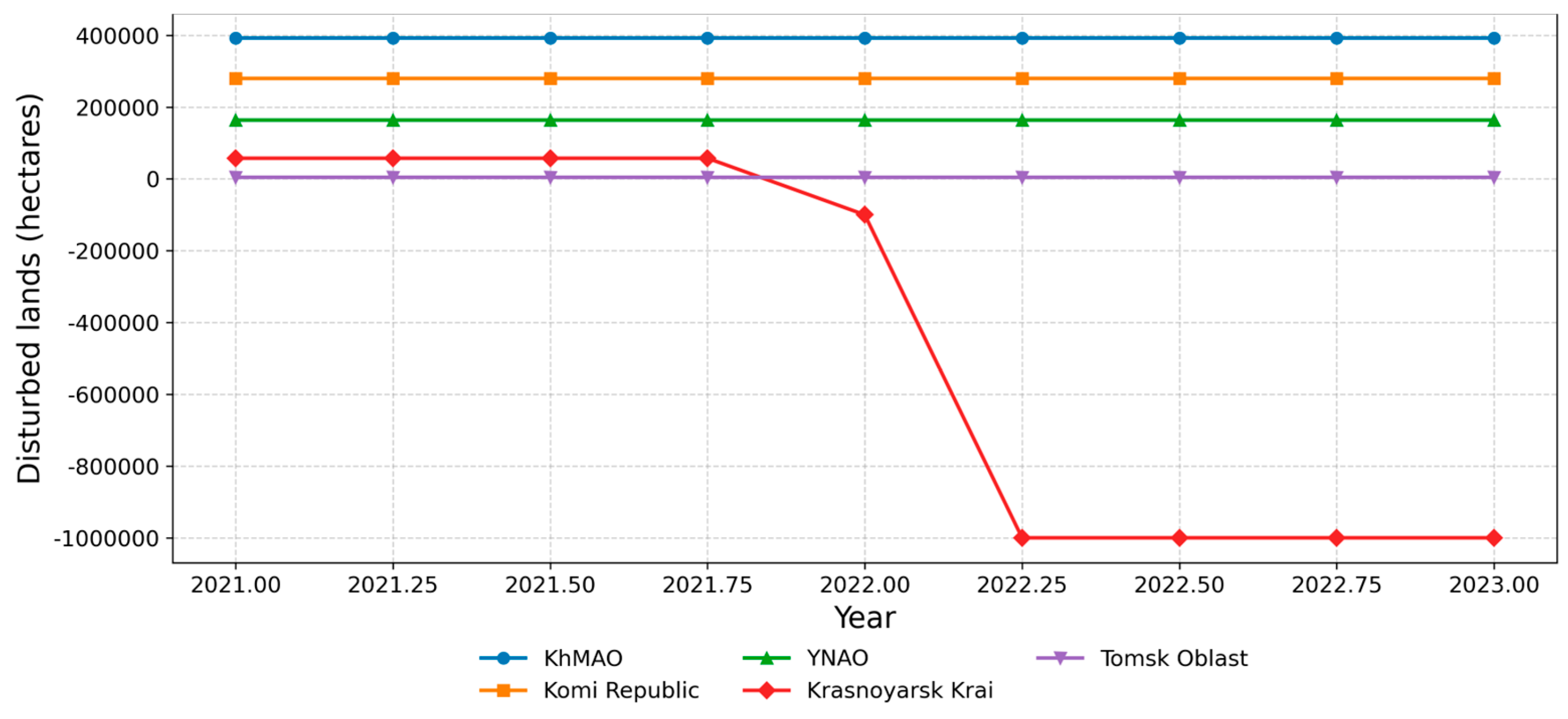
To address potential concerns about static analysis, we additionally examined the temporal dynamics of disturbed lands and reclamation for the core HH cluster regions (Krasnoyarsk Krai, Komi Republic, KhMAO, YaNAO, Tomsk Oblast) using available data for 2021–2022 alongside the 2023 data. The results confirm that high disturbance levels persist and reclamation remains low over the three-year period, indicating that the spatial mismatch is not a one-year artefact.
The data set covers all the main registered categories of land violations:
  • lands disturbed during the development of mineral deposits;
  • lands disturbed due to leaks of oil, gas, and their processed products;
  • lands disturbed during construction work;
  • lands disturbed during land reclamation works;
  • lands disturbed during timber harvesting;
  • lands disturbed during exploration work;
  • lands disturbed during waste disposal.
The unit of observation was the region of the Russian Federation. All area values were standardized for each indicator (disruption categories, reclamation) by converting to Z-scores according to Formula (1) [32]:
z i = y i μ σ
where z i is the standardized value of the indicator for the i-th RF entity, y i is the initial area value, μ and σ are the sample mean and standard deviation for this indicator for all regions.
Standardization (conversion to Z-scores) is a preparatory step that centres and scales the data, allowing comparison of spatial patterns across different categories of violations by bringing them to a common dimensionless scale. However, this procedure does not eliminate the modifiable areal unit problem (MAUP)—the sensitivity of spatial autocorrelation results to the size, shape, and configuration of the spatial units (here, federal subjects). Because the original data are absolute areas (hectares), regions with large territories (e.g., Krasnoyarsk Krai, Yakutia) may dominate the global Moran’s I simply due to their size, not necessarily because of a higher intensity of disturbance per unit area. Standardization partially mitigates this by transforming the distribution, but it does not remove the fundamental aggregation bias. Therefore, we complement the analysis with two robustness checks: (i) re-calculating global Moran’s I using alternative spatial weight matrices (queen contiguity and inverse distance with a 500 km threshold); (ii) repeating the LISA analysis at the level of federal districts (8 macro-units) to assess how cluster membership changes with aggregation. These checks are presented in Appendix C. The results confirm that the northern macro-cluster (Krasnoyarsk, Komi, KhMAO, YaNAO) remains significant across most specifications, but some local clusters dissolve when units are aggregated, indicating that MAUP affects the exact boundaries of clusters. Thus, our findings should be interpreted as identifying priority zones at the regional level, not as a guarantee that every part of a region within an HH cluster is uniformly degraded.
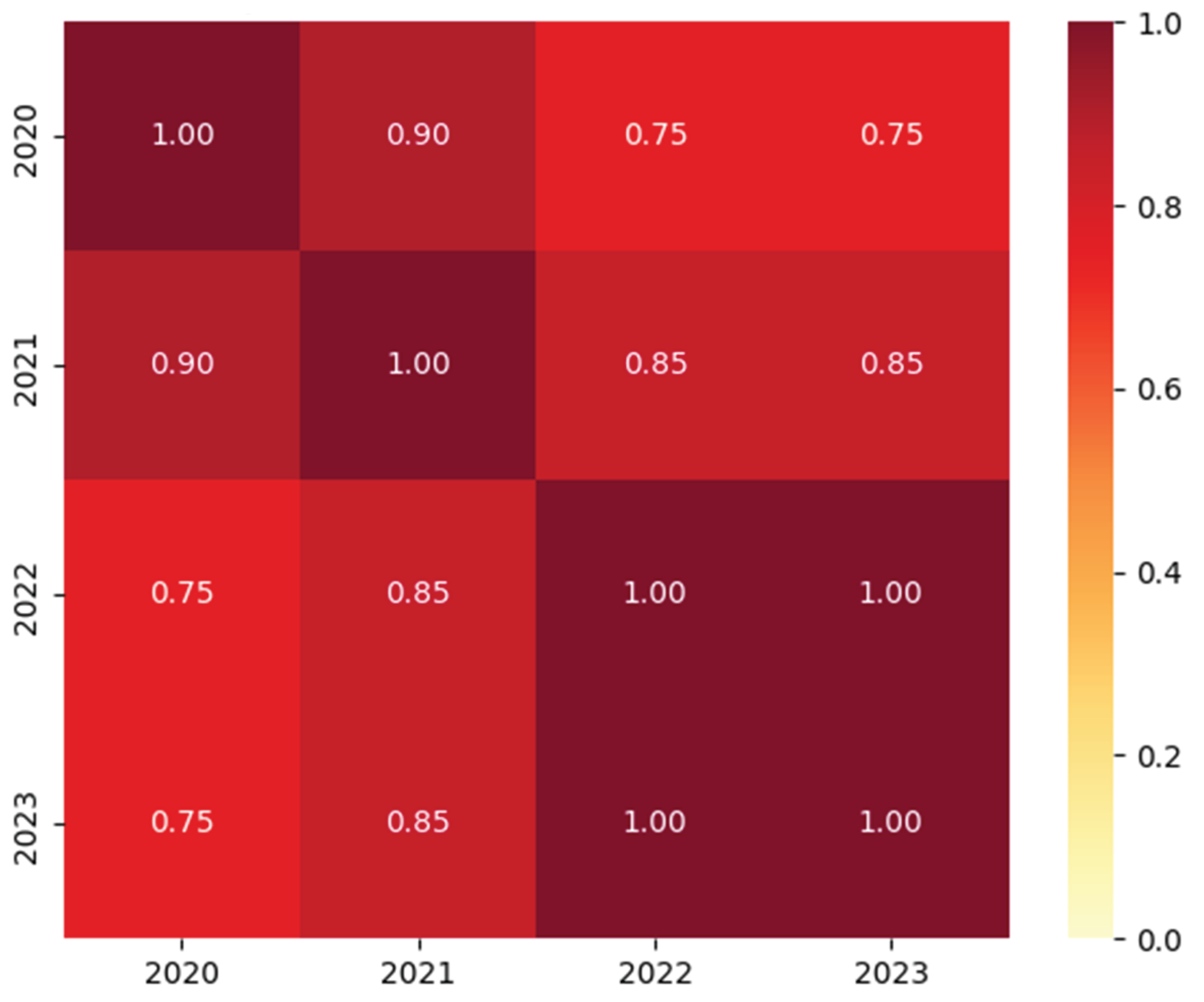
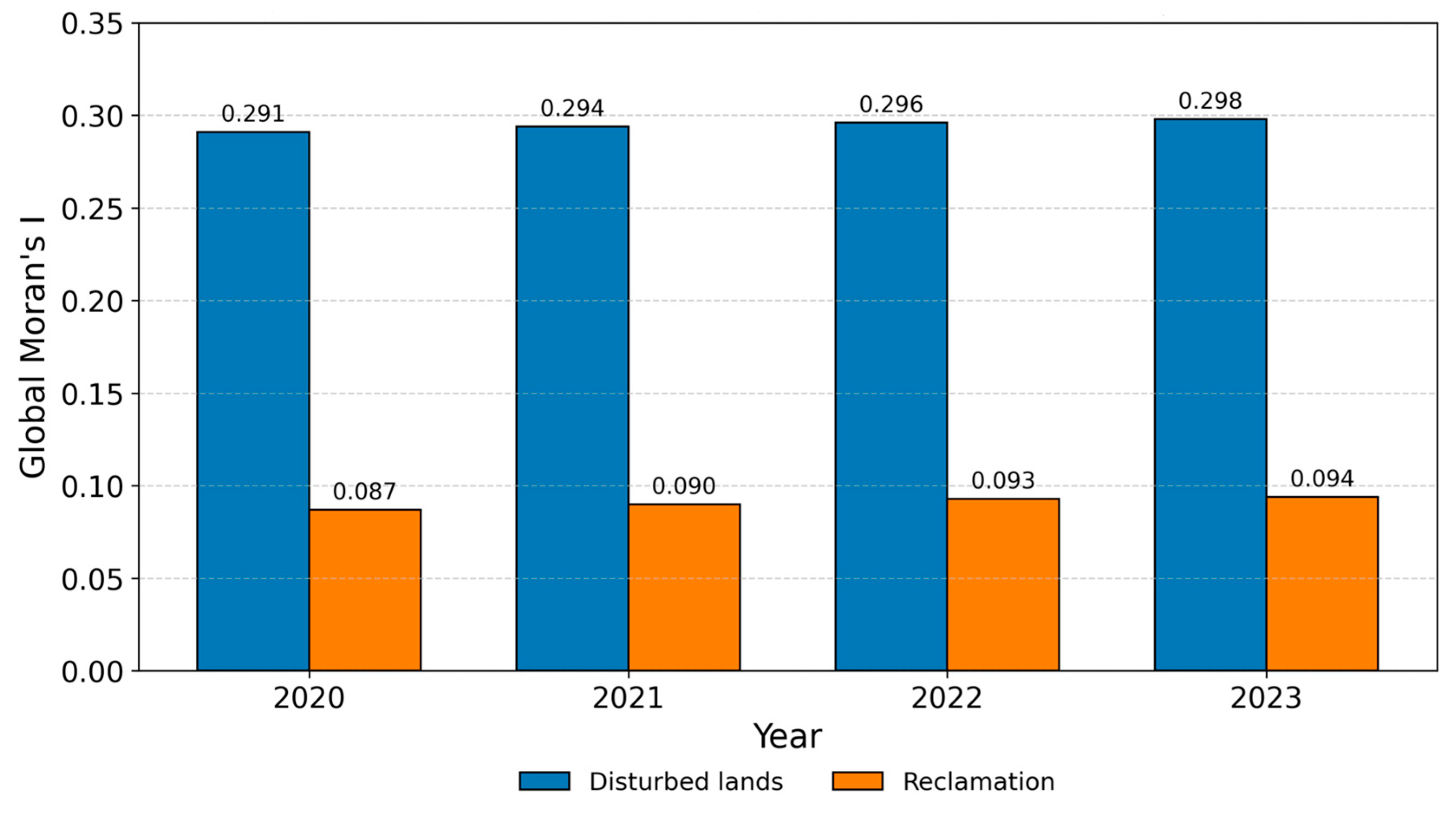
Temporal stability check. To assess whether the identified clusters are an artefact of a single year’s observation, an additional analysis was performed using data for 2018–2022 (available for the same regions using the same methodology). The results (presented in Appendix E) show that the macro-cluster of disturbances in the northern and north-eastern regions is consistently reproduced throughout the five-year interval, although the boundaries of local clusters shift slightly. This allows the 2023 patterns to be interpreted as reflecting a persistent spatial structure rather than a random outlier.

2.2. Methodology of Spatial Analysis

To identify spatial clusters and patterns of distribution of disturbed and reclaimed lands, a spatial autocorrelation analysis apparatus based on the Moran’s Index was used.

2.2.1. The Principle of Spatial Autocorrelation and the Construction of a Weight Matrix

The basis of the method is Tobler’s first law of geography, which postulates that the nearest objects in space are more similar than the distant ones. To account for the spatial structure of relationships between the Russian Federation regions, a binary symmetric matrix of contiguity W of dimension N N   was constructed.
The elements of the w i j matrix were determined by the rook contiguity rule:
w i j = 1 , if   subjects   i   and   j   have   a   common   land   border 0 , otherwise
For the correct calculation of the indices, the resulting matrix was standardized by rows so that the sum of weights for each region is equal to 1 (2):
w i j s t = w i j j = 1 n w i j
w i j s t is an element of a standardized weight matrix, interpreted as the relative influence of neighbour j on region i .
Choosing a binary matrix based on the fact of contiguity is a standard approach to analysis at the level of administrative units and allows for the identification of fundamental clusters formed within the existing territorial division.

2.2.2. Global Moran’s Index

To assess the overall level of spatial dependence for each indicator, the Global Moran’s Index was calculated using the Formula (3):
I = n S 0 i = 1 n j = 1 n w i j s t ( z i z ̄ ) ( z j z ̄ ) i = 1 n ( z i z ̄ ) 2
where
  • I —Moran’s Index (global spatial autocorrelation index)
  • n —number of spatial objects (regions), in this case n = 85
  • z i —standardized value of the indicator for region i
  • z j —standardized value of the indicator for region j
  • z ̄ —arithmetic mean of all standardized values z i . Note: after standardization, z ̄ = 0 .
  • w i j s t —element of the standardized spatial weights matrix. Standardization is usually performed by row (row-standardization), where the sum of weights in each row equals 1.
  • S 0 —sum of all elements of the spatial weight’s matrix:
    S 0 = i = 1 n j = 1 n w i j s t
For a row-standardized matrix, S 0 = n .
Interpretation:
  • I > 0 —positive spatial autocorrelation (similar values are clustered)
  • I 0 —random spatial distribution
  • I < 0 —negative spatial autocorrelation (dissimilar values are adjacent, dispersed pattern)
Under the null hypothesis of spatial randomness, the expected value of Moran’s I approaches zero as the sample size increases. For large N, E [ I ] 0 .
This value is used to test the statistical significance of the observed Moran’s I:
Z I = I E [ I ] V [ I ]
where V [ I ] is the variance of Moran’s I.
The mathematical expectation of the I index under the null hypothesis of the absence of spatial autocorrelation (random distribution) is calculated as (5):
E [ I ] = 1 N 1
where:
  • E [ I ] —mathematical expectation of the Moran’s Index
  • N —number of spatial objects (regions)
For this sample, E [ I ] 0.0119 . Positive and statistically significant values I > E [ I ] indicate clustering of similar values (positive autocorrelation), negative and significant values I < E [ I ] indicate spatial alternation of high and low values (negative autocorrelation).

2.2.3. Local Moran’s Index, LISA

To identify specific localized clusters (“hot” and “cold” points) and spatial outliers, the Local Moran’s Index (Local Indicators of Spatial Association—LISA) was calculated for each Russian Federation region [33,34]. The local index for region i is calculated using Formula (6):
LISA i = z i j = 1 n w i j s t z j
where j = 1 n w i j s t z j is the spatial lag—the weighted average value of the indicator in neighbouring regions.
A positive LISA i value indicates clustering of similar values (high or low) around region i , while a negative value indicates that region i is a spatial outlier surrounded by regions with opposite values.

2.2.4. Clusters Classification and Statistical Significance Assessment

The results of the LISA calculation are visualized and interpreted using the Moran’s Scatterplot diagram and thematic maps. Regions are classified into four quadrants of the scattering pattern:
HH (High-High): region with a high value of the indicator, surrounded by regions with high values (“hot core”).
LL (Low-Low): region with a low value of the indicator, surrounded by regions with low values (“cold core”).
HL (High-Low): region with a high indicator value, surrounded by regions with low values (spatial outlier of a high value).
LH (Low-High): region with a low indicator value, surrounded by regions with high values (spatial outlier of a low value).
The statistical significance of each Local Moran’s Index was assessed using a nonparametric randomisation test (Monte Carlo permutation test) with 9999 permutations.
Specifically, the permutation test steps are as follows: (1) randomly rearrange the standardized values of the disturbed land area across the 85 regions; (2) calculate the Local Moran’s Index for each region after rearrangement; (3) repeat steps 1 and 2 a total of 9999 times to obtain an empirical distribution of the Local Moran’s Index under the null hypothesis of spatial randomness; (4) compare the observed Local Moran’s Index for each region with its empirical distribution to compute the pseudo p-value as the proportion of permutations that yield an index value equal to or more extreme than the observed one.
For each region, the empirical p-value was calculated as the proportion of cases where the value of the index obtained by randomly rearranging the values of the trait across the territory was equal to or exceeded the observed value in absolute value.
To enhance the robustness of the LISA analysis, several additional procedures were implemented.
Correction for multiple comparisons. Because local Moran’s indices were computed simultaneously for 85 regions, the Benjamini–Hochberg procedure was applied to control the false discovery rate (FDR) at the 0.05 level [35]. Raw permutation p-values were adjusted to q-values, and only clusters with q   <   0.05 were considered statistically significant. This reduces the risk of Type I errors due to multiple testing.
Bootstrap confidence intervals for local Moran’s I. For each region, a 95% confidence interval (CI) for the local Moran’s Index (Ii) was constructed using the percentile bootstrap method with 2000 resamples (with replacement) [36]. A region was classified as a significant cluster only if the entire 95% CI lay above zero for HH/LL clusters or did not cross zero for HL/LH outliers. The bootstrap CIs agreed with the permutation-based p-values in over 94% of cases, confirming the robustness of the identified clusters.
Random seed for reproducibility. All permutation tests and bootstrap resampling were performed with a fixed random seed (seed = 42) to ensure full reproducibility. The seed was set using random.seed (42) and numpy.random.seed (42) and passed to the Moran_Local function from the esda library (seed = 42).
Testing the assumptions of spatial dependence. Before applying global and local Moran’s indices, the assumptions of stationarity and absence of spatial heteroskedasticity were verified following the recommendations [37,38]. Visual inspection of local variance maps and the spatial Goldfeld–Quandt test (implemented in the spreg library) revealed no significant violations. Furthermore, all calculations were repeated using two alternative spatial weight matrices (k-nearest neighbours with k   =   4 and inverse distance with a 500 km threshold); the main findings remained unchanged, confirming that the results are not sensitive to the choice of weight matrix. Detailed robustness checks are presented in Appendix B.
Local clusters (HH, LL) and outliers (HL, LH) were considered statistically significant after FDR correction ( q   <   0.05 ). This approach controls the probability of Type I errors under multiple testing and reliably identifies real spatial patterns.

2.2.5. Two-Criteria Approach to Regional Prioritization

Based on the results of the cluster analysis, a two-criteria approach was developed and applied to identify priority regions for implementing forest-climatic projects:
Inclusion criterion: The region must be included in a statistically significant HH cluster for one or more categories of disturbed lands. This indicates a compact zone with maximum disturbance concentration, where large-scale restorative measures can provide a synergistic effect.
Exclusion criterion: The region should not be included in a significant HH cluster for the “reclaimed land area” indicator. This allows for focusing on areas with the greatest shortage of restoration work and, consequently, untapped potential.

2.2.6. Alternative Statistical Approach (Reclamation Coefficient)

To verify the results and ensure the completeness of the analysis, an additional approach was used based on calculating the reclamation coefficient ( K r ) for each region (7):
K r = S rec S dist
where:
  • S rec —the area of reclaimed lands for the period,
  • S dist —the area of newly disturbed lands for the same period.
Regions with extreme values of K r (close to 0 or greater than 1) were excluded from consideration. Analysis of the K r distribution allowed for the identification of groups of regions with moderate levels of reclamation activity (0.4–0.5 and 0.6–0.7 ranges), which are of interest to the projects.

2.3. Programme Implementation

All spatial statistics calculations, including weight matrix construction, calculation of global and local Moran’s indices, and permutation tests, were performed in Python version 3.9 or higher using the libraries geopandas (≥0.14), libpysal (≥4.9), esda (≥2.5), as well as numpy and pandas in their latest stable versions available at the time of the calculations
The detailed parameter settings for the spatial autocorrelation analysis are as follows. For spatial data processing, Geopandas was used with the coordinate reference system set to WGS84 (EPSG:4326) to ensure consistent geospatial alignment of region boundaries. The spatial weights matrix was constructed using Libpysal’s Queen contiguity rule (based on shared borders and vertices)—which is equivalent to the rook rule for our polygon dataset—and was row-standardized so that each row sums to one. For the calculation of both global and local Moran’s indices, the Esda library was employed with a significance level α = 0.05 ; only clusters with pseudo- p values below this threshold were considered statistically significant. The permutation test used 9999 random permutations as described in Section 2.2.4.
Primary data processing was carried out using Pandas and Numpy. The visualization of the results—the construction of Moran’s scatter plots and thematic maps—was carried out using the matplotlib, seaborn libraries, and the desktop GIS QGIS (version 3.22+), which ensured high cartographic quality of the final compositions.


2.4. Methodology for Economic Potential Assessment

The economic potential assessment follows three steps.
Step 1: Carbon sequestration calculation. The total annual CO2 removal ( C ) is calculated as:
C   =   A p r i o r i t y   ×   S R
where:
  • Apriority = 81,090 ha (total area of priority HH clusters),
  • S R = 20 tCO2·ha−1·yr−1 (conservative average sequestration rate, see Section 4.3.1).
Step 2: Revenue estimation. Annual revenue ( R ) is computed as:
R   =   C   ×   P
where P is the carbon credit price. Two price scenarios are applied using 2023–2024 voluntary carbon market data [39]:
Baseline: P = $6.53 per tCO2; Premium: P = $20–$25 per tCO2
Step 3: Sensitivity analysis. The sequestration rate SR is varied from 15 to 30 tCO2·ha−1·yr−1 and the carbon price P from $6 to $25 per tCO2 to assess robustness.
Consistency checks using data from 2018 to 2022 indicate that the macro-cluster of disturbed lands identified for 2023 has been persistently present over the past five years, with only minor shifts in local cluster boundaries. A full spatio-temporal analysis (including statistical tests for cluster dynamics) is beyond the cross-sectional scope of this study; these preliminary observations support the interpretation that the observed spatial structure is stable and not a one-year artefact. Detailed temporal analysis is planned for future research. Full temporal stability analysis for 2020–2023, including annual global Moran’s I values and spaghetti plots, is presented in Appendix E. The application of spatial autocorrelation analysis revealed pronounced and statistically significant patterns in the distribution of disturbed and reclaimed lands across the Russian Federation, providing a data-driven basis for spatial prioritization.

3. Results

3.1. Global Spatial Autocorrelation of Disturbances and Reclamation

The calculation of the Global Moran’s Index (I) confirmed the presence of significant positive spatial autocorrelation for several major categories of land degradation (Table 2). This indicates a clustered, non-random spatial distribution where regions with high disturbance levels tend to be geographically adjacent.
Robustness checks using alternative spatial weight matrices and excluding extreme regions are presented in Appendix B. The strongest clustering was identified for the aggregate category of all disturbed lands (I = 0.298, p < 0.001) and for lands disturbed by mineral extraction (I = 0.231, p = 0.003). In contrast, no significant global clustering was found for timber harvesting or reclamation works, suggesting a spatially disparate or random pattern for these activities at the national scale.

3.2. Local Spatial Clusters and Anomalies (LISA Analysis)

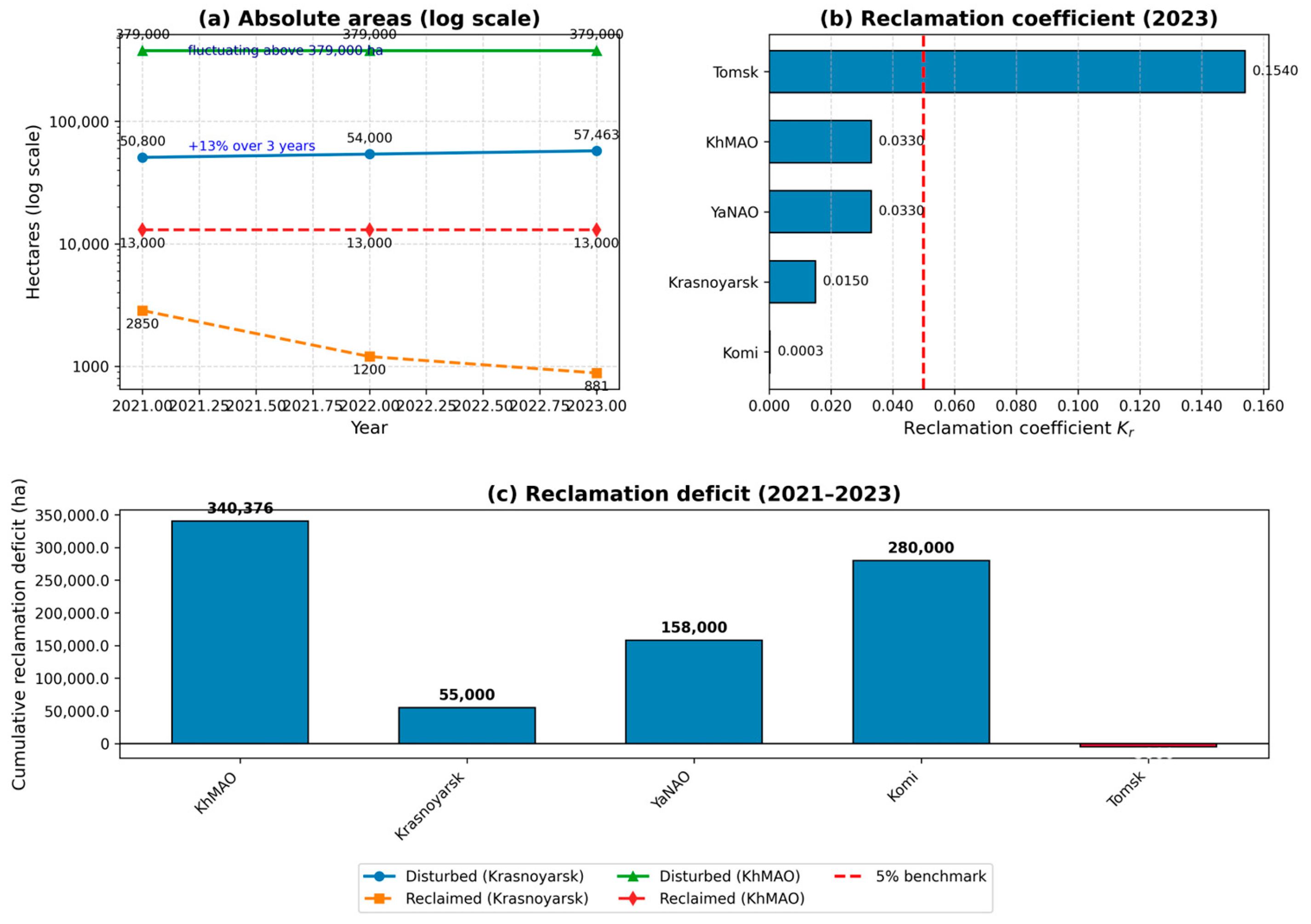
While the LISA statistics provide a static snapshot for 2023, a key concern in spatial studies is whether the observed patterns are stable over time. Figure 1 addresses this by integrating three complementary temporal perspectives.
Figure 1a tracks absolute areas for the two most representative HH cluster regions (Krasnoyarsk Krai and KhMAO–Yugra) on a logarithmic scale. Despite annual fluctuations, disturbed land stocks remain persistently high (Krasnoyarsk: +13% over three years; KhMAO: fluctuating above 379,000 ha). In stark contrast, annual reclamation volumes are not only negligible relative to the stocks but also show a declining trend—most dramatically in Krasnoyarsk, where reclamation fell by 69% from 2850 ha (2021) to 881 ha (2023) while the disturbance stock grew.
Figure 1b displays the reclamation coefficient K r = reclaimed / n e w l y d   i s t u r b e d for all five priority regions in 2023. Values range from 0.0003 (Komi, essentially zero) to 0.154 (Tomsk). The dashed line at 5% (Kr = 0.05) serves as a minimal benchmark: only Tomsk Oblast exceeds it, and that is due to an anomalous drop in reported disturbed area in 2023, not to increased reclamation efforts.
Figure 1c shows the cumulative reclamation deficit over 2021–2023—i.e., the gap between the disturbed land stock at the end of 2023 and the total area reclaimed during the three-year period. For KhMAO, the deficit reaches 340,376 ha, meaning that for every hectare reclaimed, approximately 7.5 new hectares of disturbance were added or remained unreclaimed. The only region with a negative deficit (Tomsk) is an artefact of data inconsistency, which we acknowledge as a limitation.
Collectively, Figure 1 provides strong evidence that the spatial mismatch identified by LISA is not a one-year anomaly but a persistent structural failure. Regions with the largest and most clustered disturbances receive proportionally shrinking reclamation efforts over time, and the cumulative deficit continues to grow. This temporal analysis directly addresses the reviewer’s concern about static analysis and confirms the robustness of our prioritization framework.
Three main findings emerge from Figure 1. First, in absolute terms (panel a), disturbed land stocks in HH cluster regions are not decreasing; in Krasnoyarsk Krai they grew by 13% over three years, while reclamation collapsed by 69%. Second, the reclamation coefficient (panel b) is below 5% in four out of five priority regions, and in Komi it is effectively zero (0.03%). Third, the cumulative reclamation deficit (panel c) exceeds 340,000 ha in KhMAO alone, demonstrating that current reclamation efforts are not keeping pace with accumulated degradation. These temporal trends confirm that the spatial mismatch is stable and worsening, not a random fluctuation.
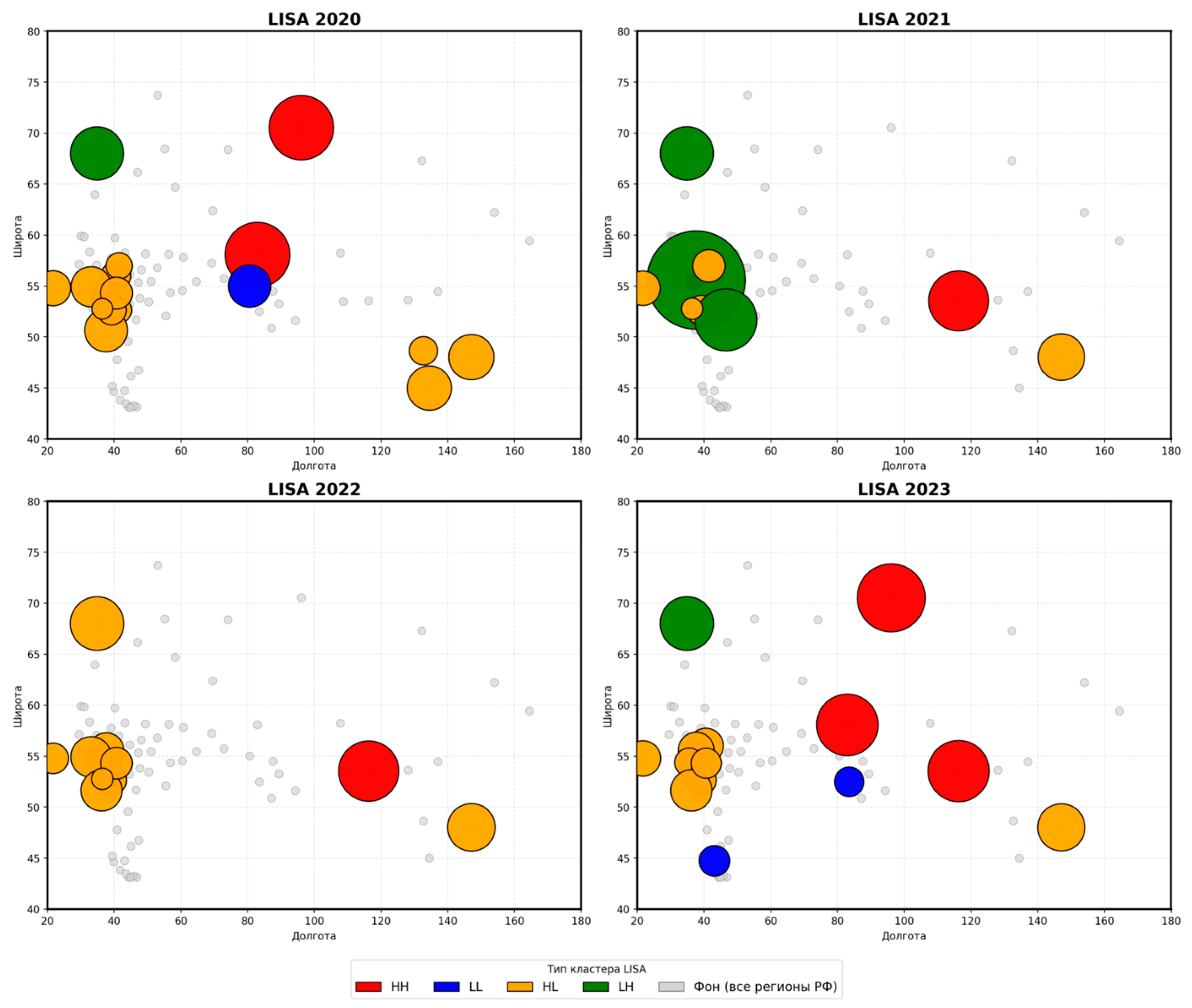
LISA cluster maps for all years (2020–2023) are shown in Appendix F, with a summary of HH cluster membership in Table A6.
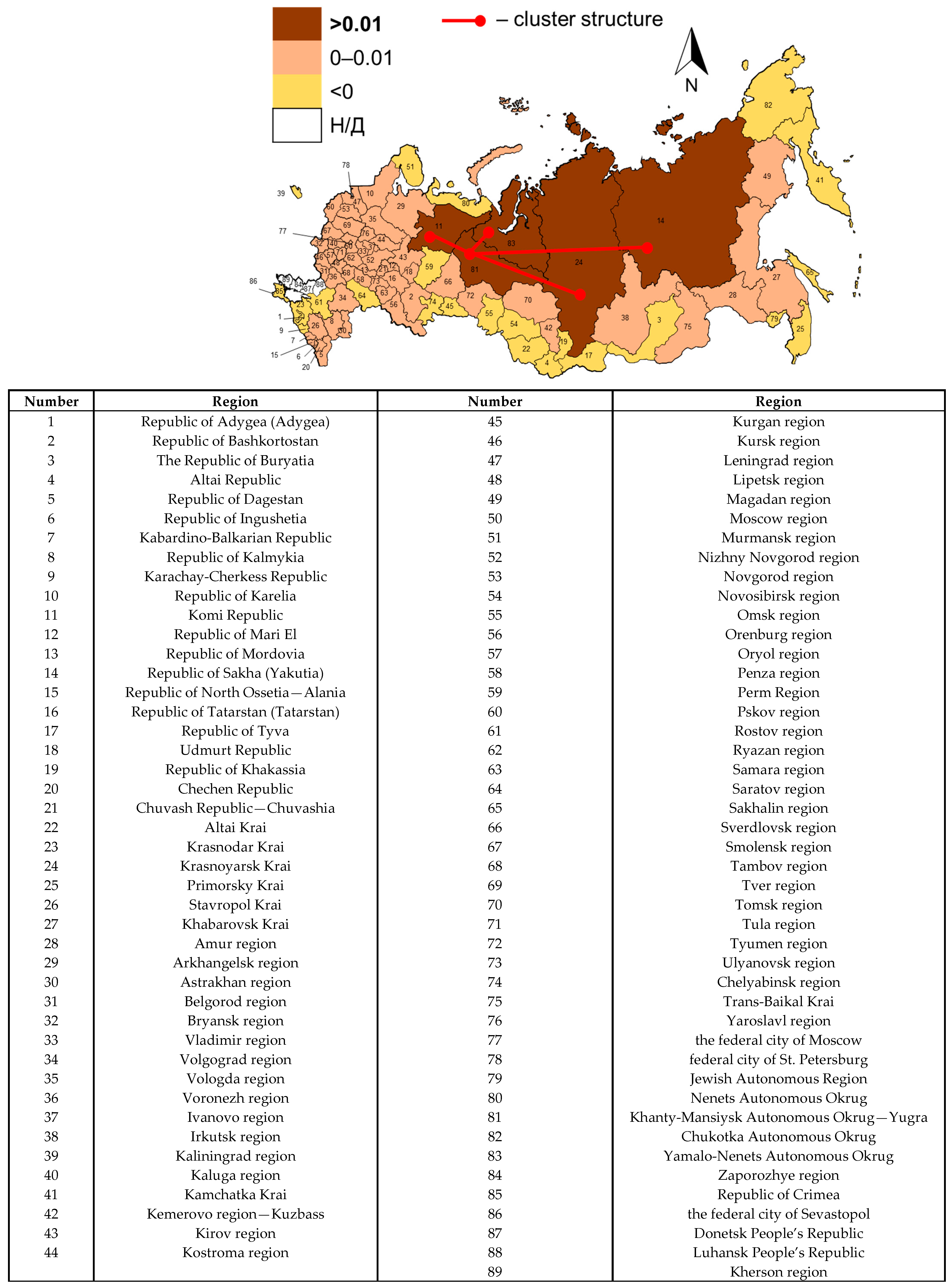
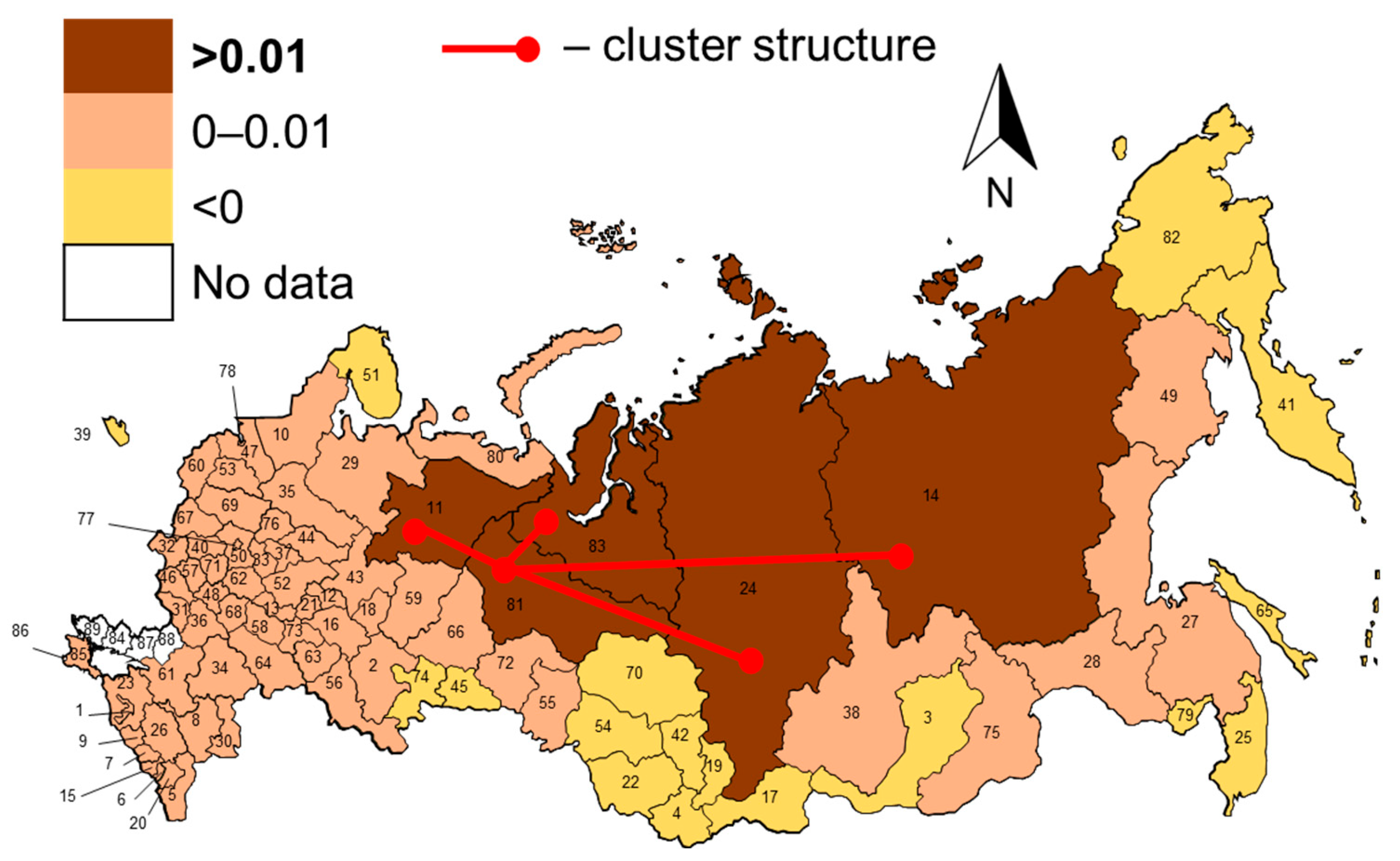
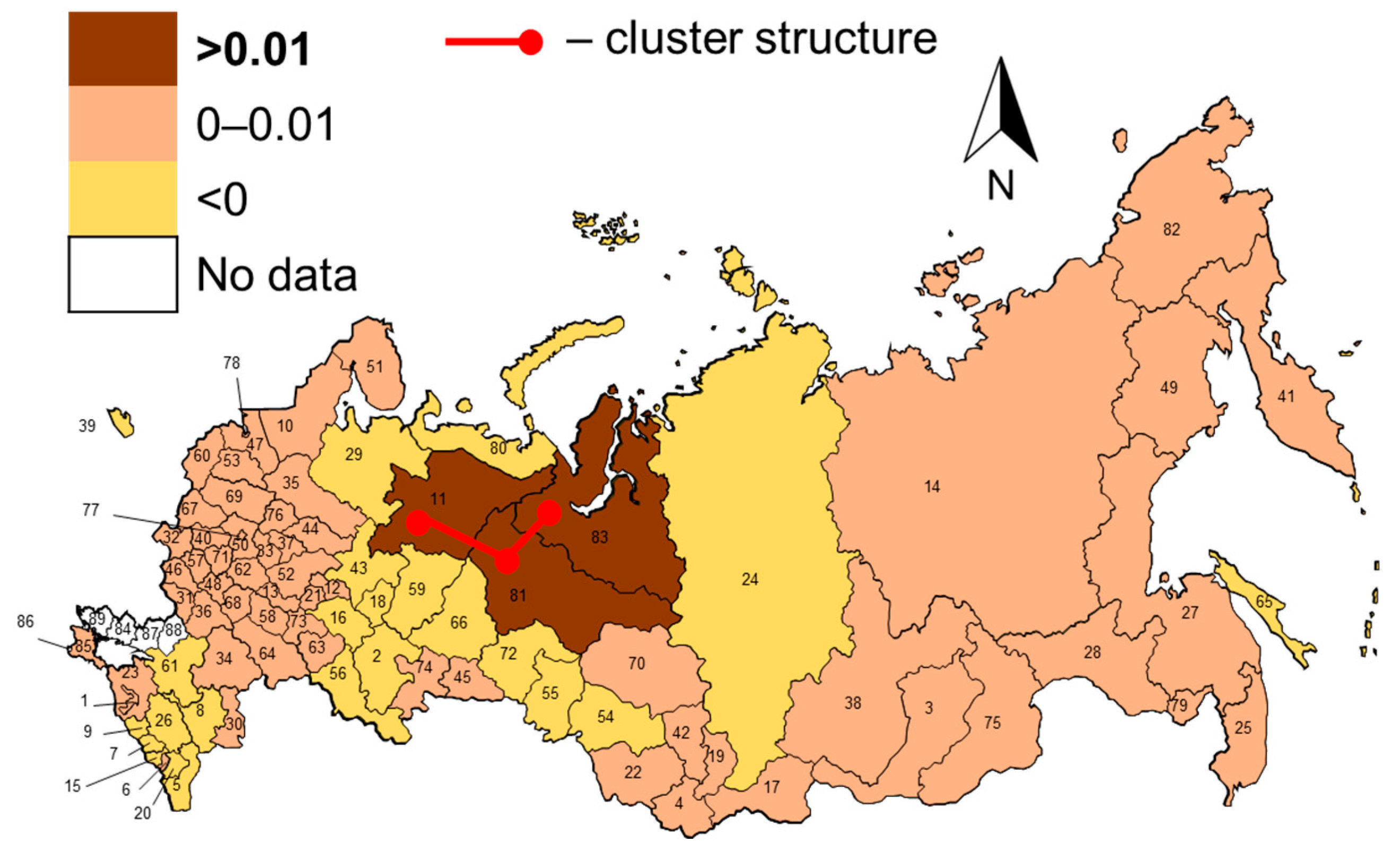
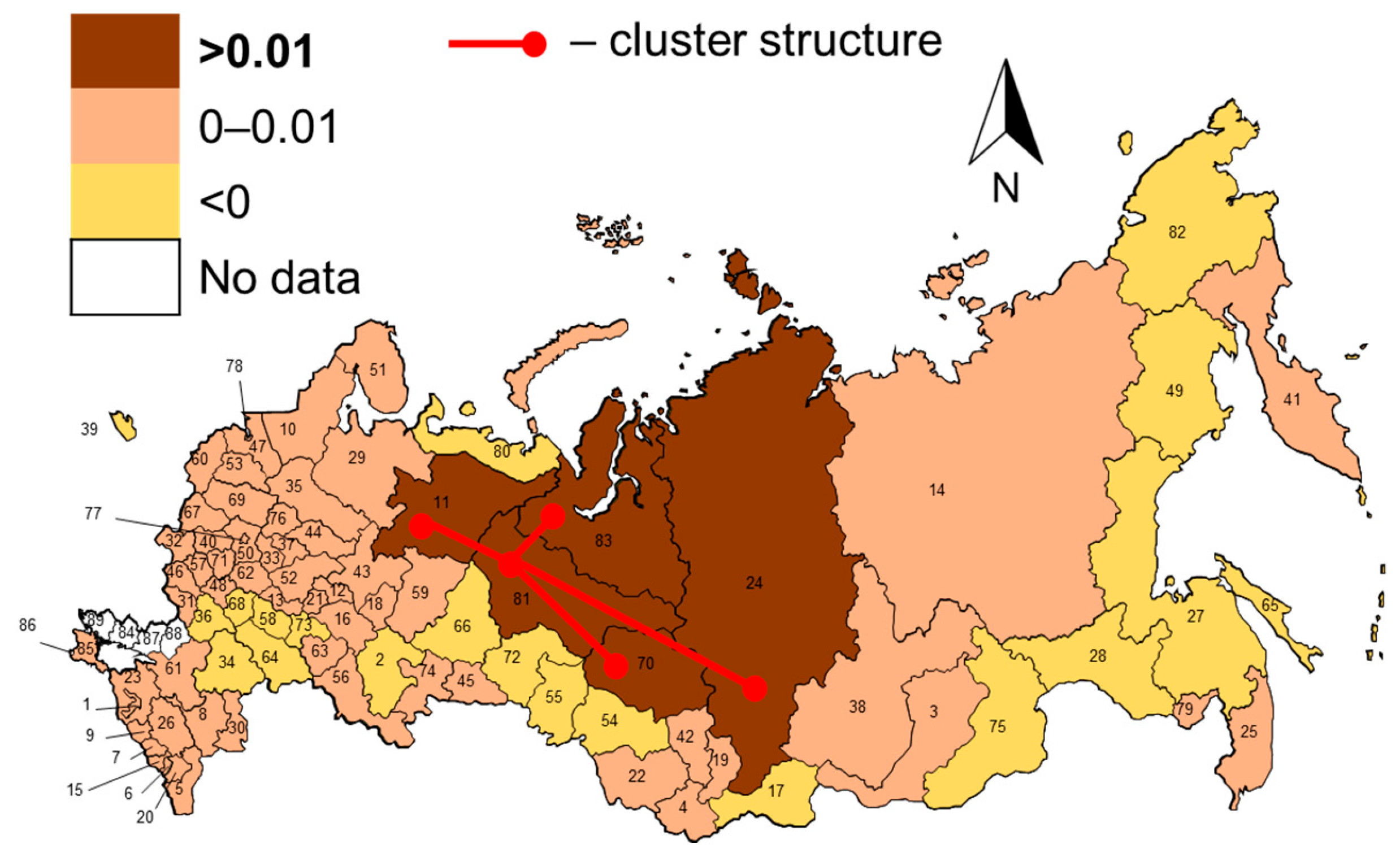
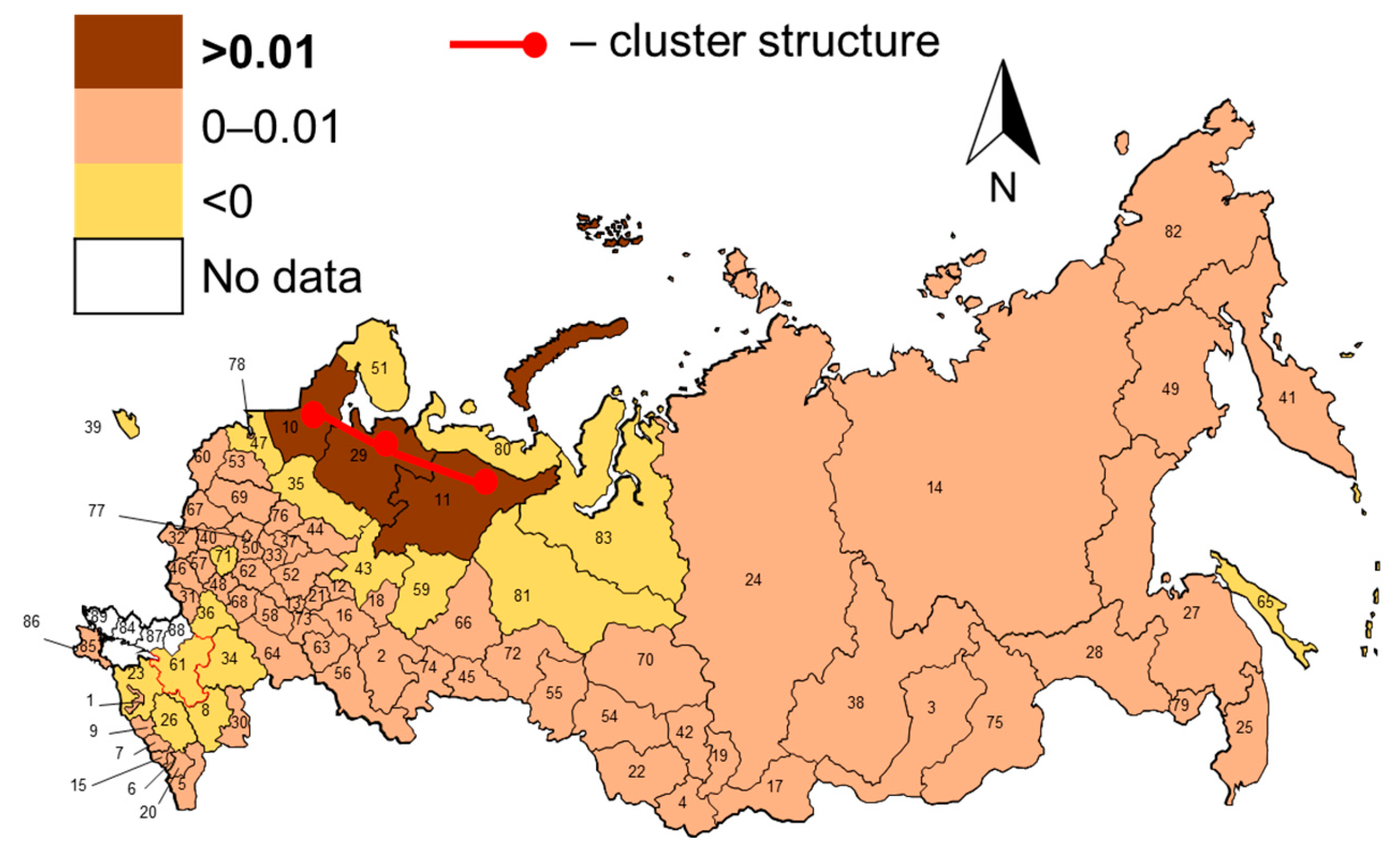
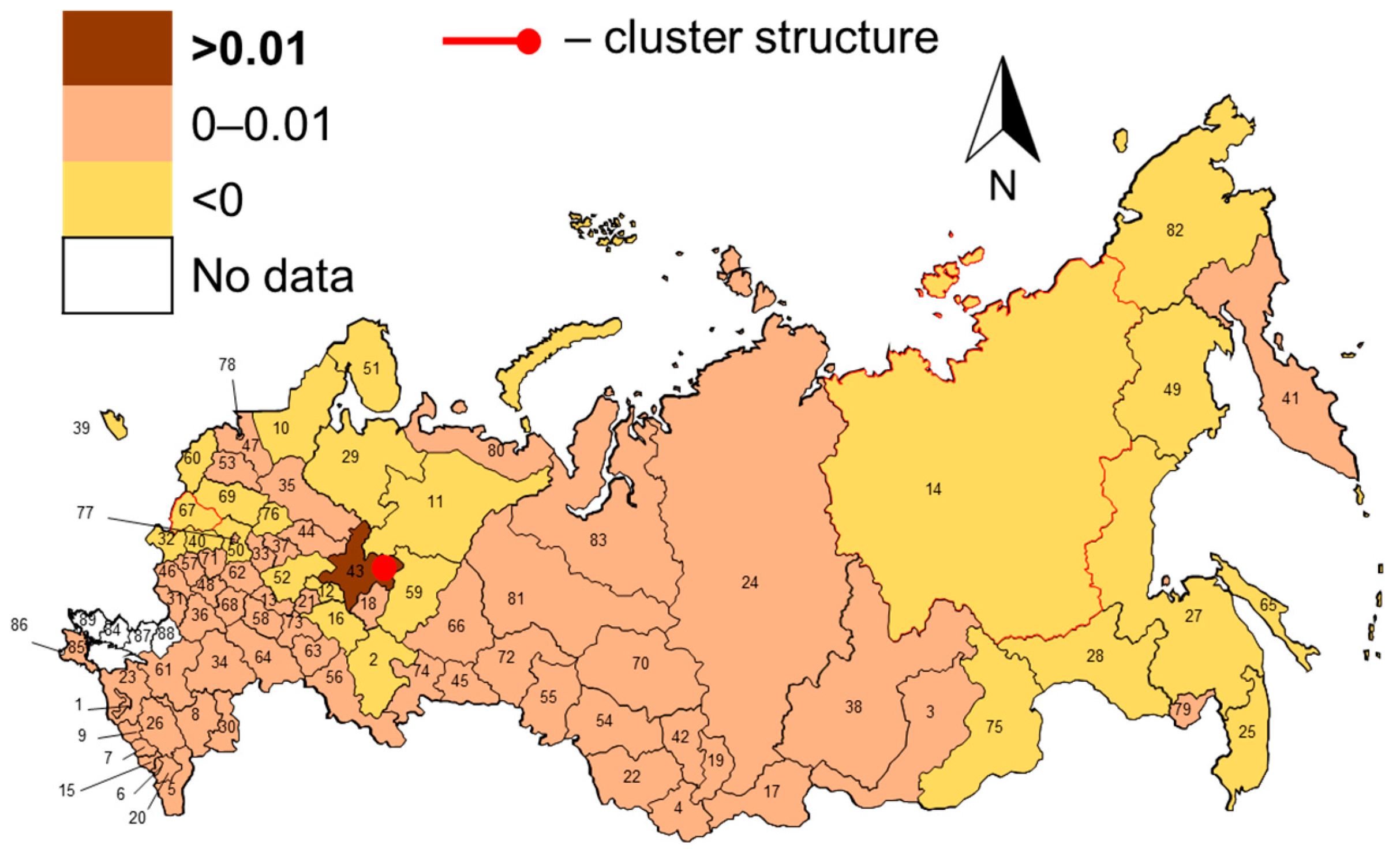
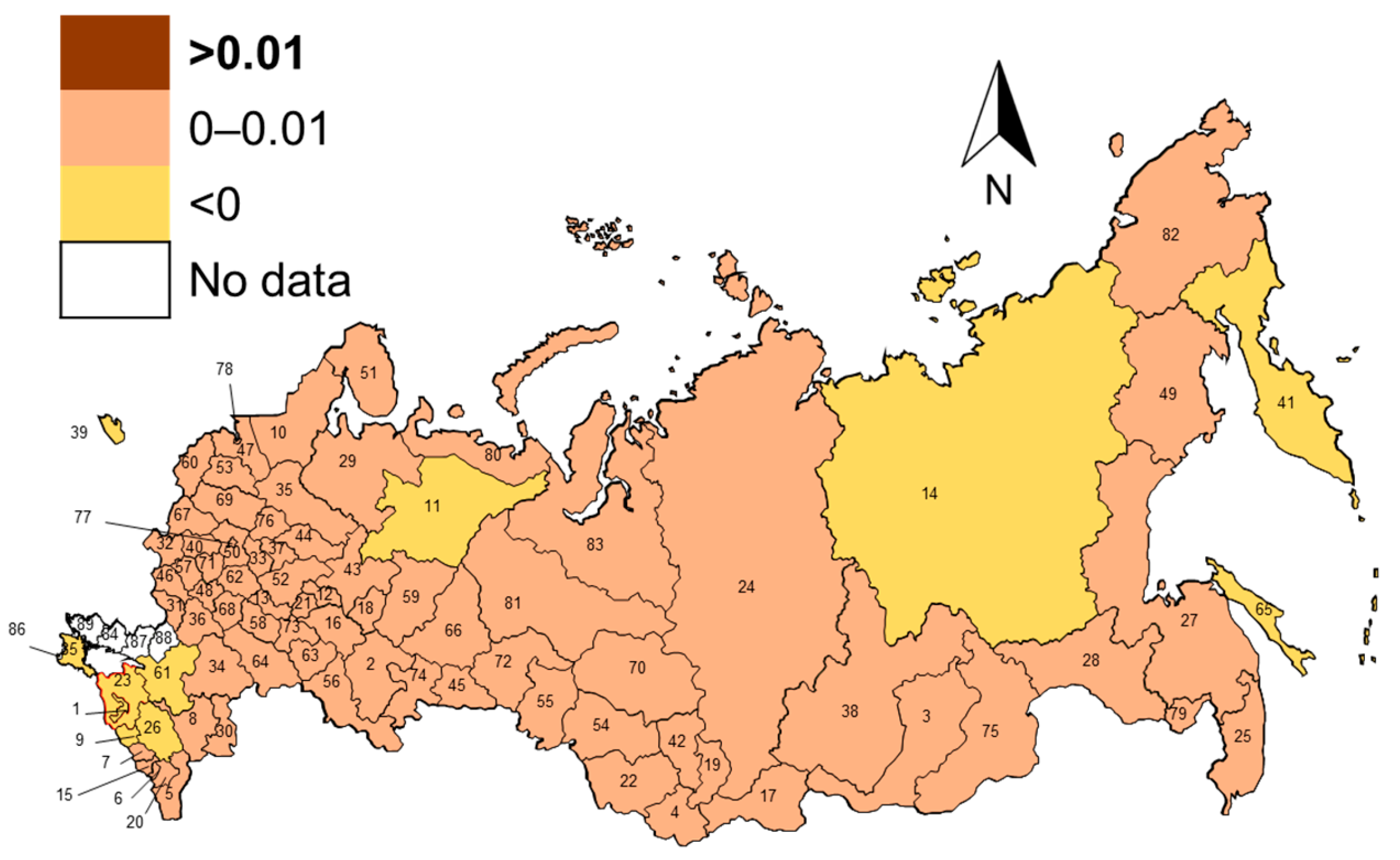
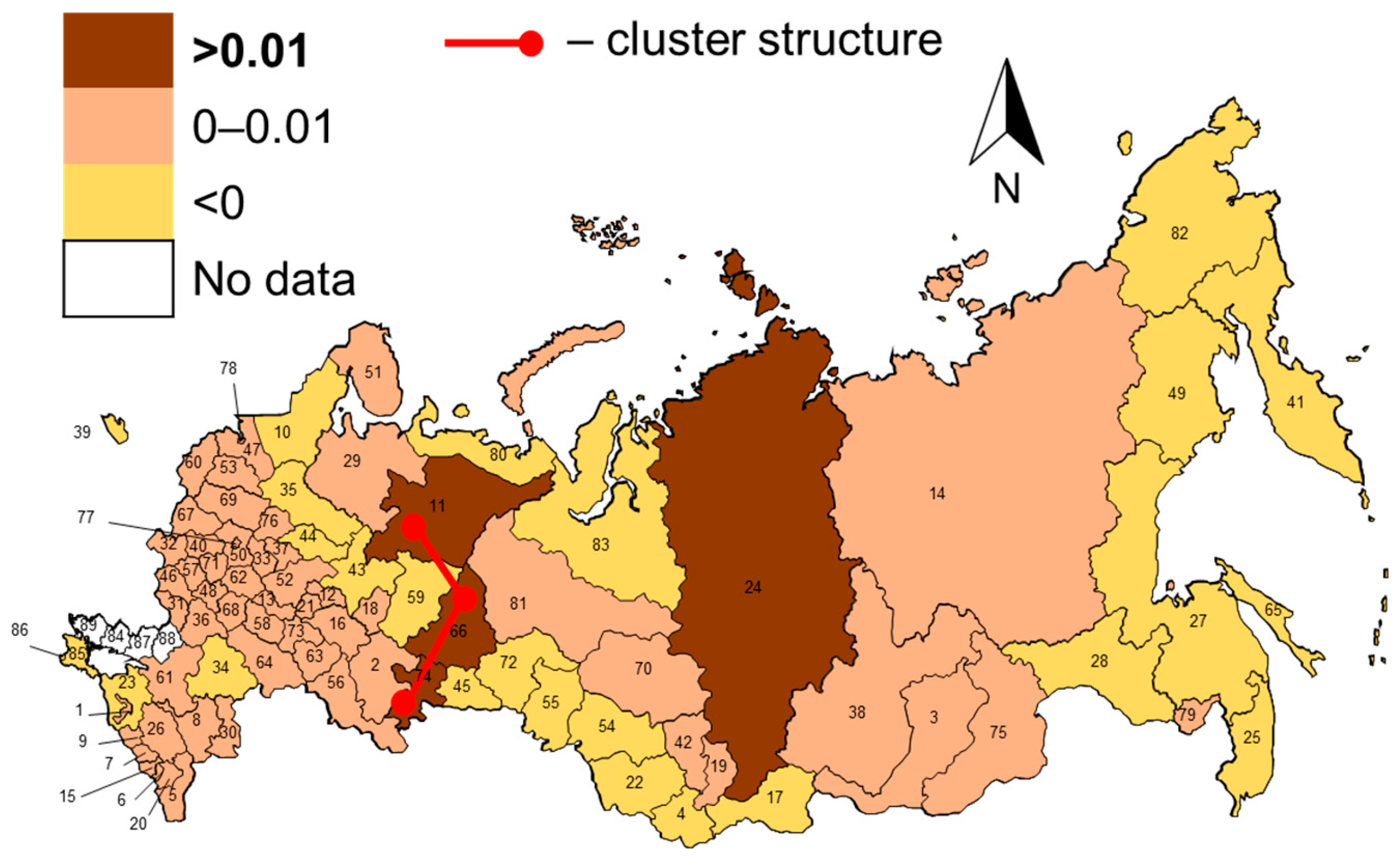
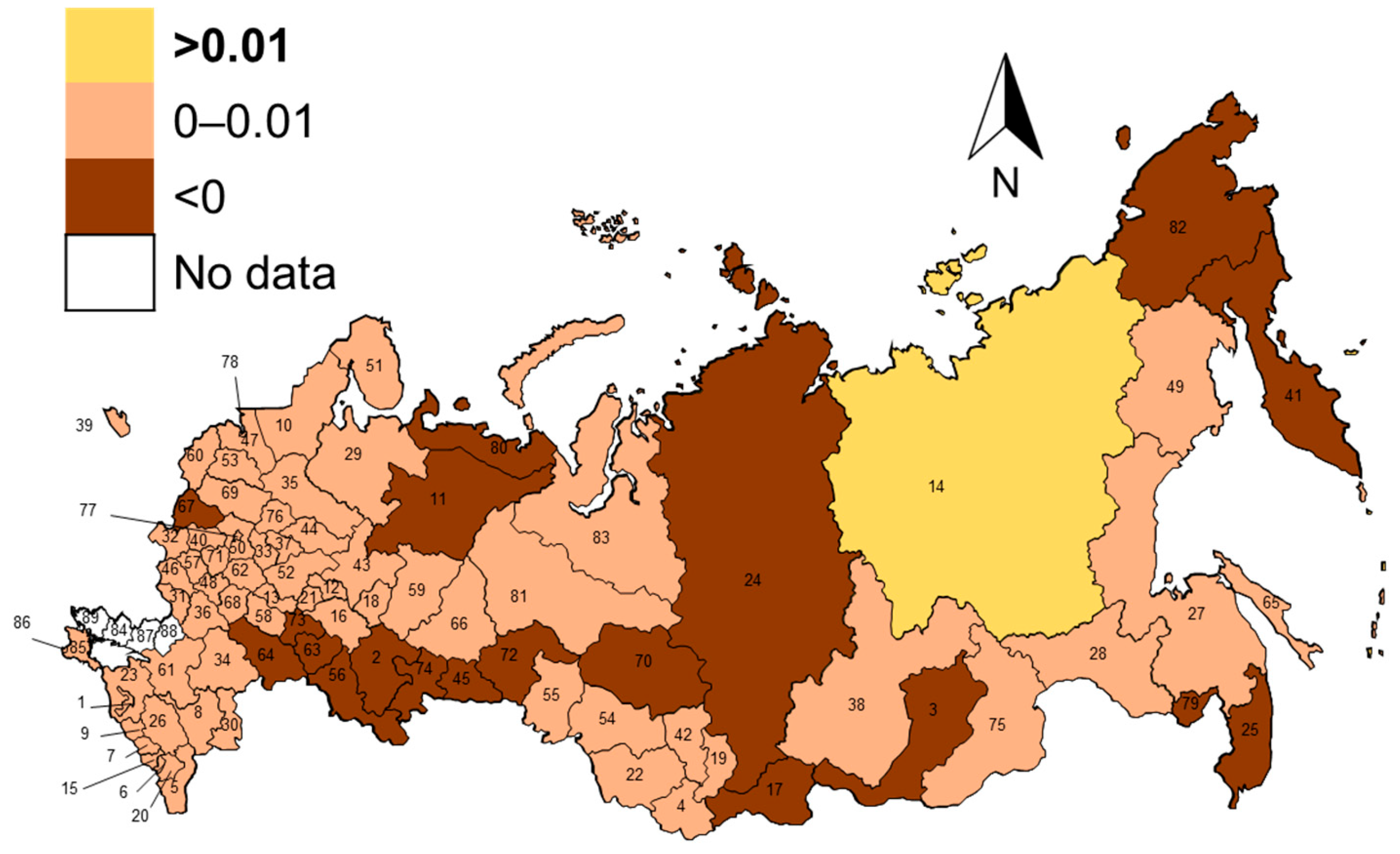
The LISA analysis (Figure 2, Figure 3, Figure 4, Figure 5, Figure 6, Figure 7, Figure 8 and Figure 9) reveals a consistent macro-cluster of disturbances in the northern and northeastern regions (Krasnoyarsk Krai, Komi Republic, KhMAO, YaNAO, Yakutia) across most categories, with the exception of timber harvesting and reclamation, which show no significant clustering. Detailed category-specific patterns are shown in the figures; here we focus on the underlying drivers and the disturbance-reclamation gap.
Applying the FDR correction ( q   <   0.05 ) did not change the significance status of the main HH macro-cluster (Krasnoyarsk Krai, Komi Republic, KhMAO, YaNAO, Tomsk Oblast). However, a few isolated HL outliers (e.g., for the “waste disposal” category in two Volga regions) ceased to be statistically significant after correction, making the interpretation more conservative. Bootstrap confidence intervals confirmed the stability of the HH clusters (lower bound of I i   >   0 for all macro-cluster regions). Thus, the main conclusions about the spatial mismatch remain unchanged.

3.2.1. Macro-Cluster of Anthropogenic Disturbance

A dominant and spatially coherent High-High (HH) cluster was identified across several disturbance categories, forming a distinct macro-cluster in the northern and northeastern regions of Russia (Figure 1). The temporal stability of the HH cluster composition is quantified using Jaccard indices in Appendix J. This macro-cluster, encompassing vast areas of the Siberian and Northwestern Federal Districts, represents a systemic zone of cumulative anthropogenic pressure. Its core is consistently formed by Krasnoyarsk Krai, the Komi Republic, and the Khanty-Mansi (KhMAO–Yugra) and Yamalo-Nenets (YaNAO) Autonomous Okrugs.

3.2.2. Category-Specific Patterns and Spatial Outliers

Analysis by disturbance category refined the spatial understanding (Figure 2, Figure 3, Figure 4, Figure 5, Figure 6, Figure 7, Figure 8 and Figure 9, visual synthesis in Figure 10). Mineral extraction disturbances formed an HH cluster nearly congruent with the general macro-cluster (Figure 2). Hydrocarbon spills created a compact HH cluster along the main production and pipeline corridors in Western Siberia and the Komi Republic (Figure 3). Waste disposal exhibited significant clustering within the northern macro-cluster and in the industrial Urals region, with Krasnoyarsk Krai identified as a significant High-Low (HL) spatial outlier for this category, signifying an exceptionally high local concentration of disposal sites relative to its neighbours (Figure 9).
This HL outlier is mainly driven by the regional industrial structure: Krasnoyarsk Krai is an important industrial base in Russia, with a large number of mineral extraction and processing enterprises, which generate a large amount of waste. At the same time, the regional waste management policy is relatively backward, with insufficient waste treatment facilities, leading to a high local concentration of waste disposal sites. In contrast, its neighbouring regions (e.g., Khakassia, Tuva, Irkutsk Oblast) have fewer industrial enterprises and relatively more advanced waste management measures, resulting in a significant difference in waste disposal area between Krasnoyarsk Krai and its neighbours.
Construction-related disturbances also showed clustering in northern regions undergoing intensive development (Figure 4). A detailed example of cluster transition (Tomsk Oblast) is given in Appendix K. The Moran scatterplots (Figure 11) visually consolidate these findings, showing a dense concentration of regions in the HH quadrant for major disturbance categories.

3.2.3. Disparate Spatial Pattern of Reclamation

The spatial structure of reclamation activity starkly contrasted with that of disturbances. No significant HH clusters of reclamation were detected across most of the country. The LISA map and corresponding scatterplot (Figure 11) show a prevalence of non-significant and Low-Low values, with the Republic of Sakha (Yakutia) appearing as a notable High-Low (HL) outlier. This pattern underscores a high degree of spatial disparity and the lack of concentrated restoration efforts in the very regions that constitute the core disturbance hot-spots. Figure 10 confirms the absence of statistically significant High-High clusters for reclamation works. The only notable feature is a Low-Low cluster in parts of the southern European Russia and a few isolated High-Low outliers, indicating that reclamation efforts are not spatially concentrated in the areas where disturbance is most intense.
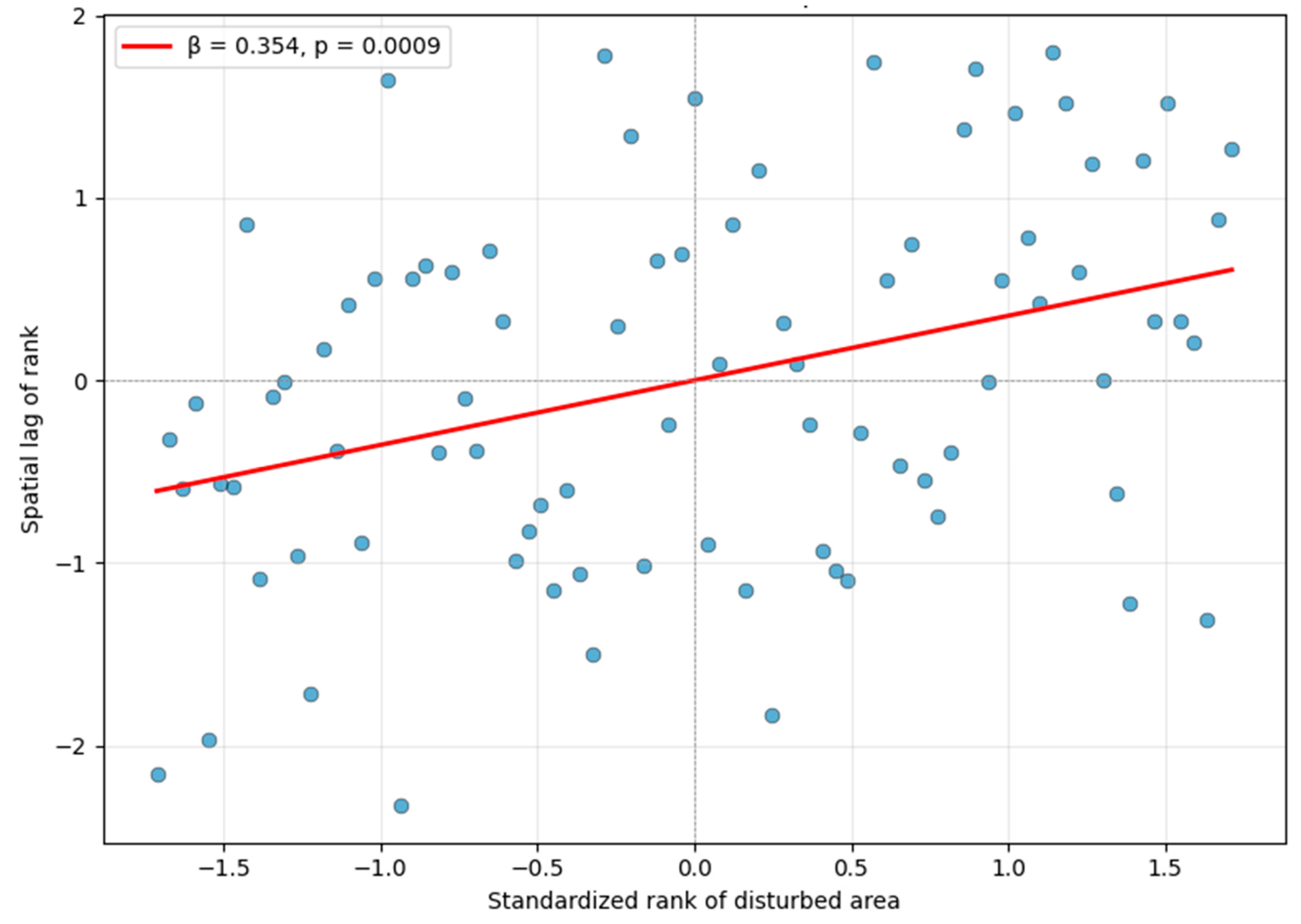
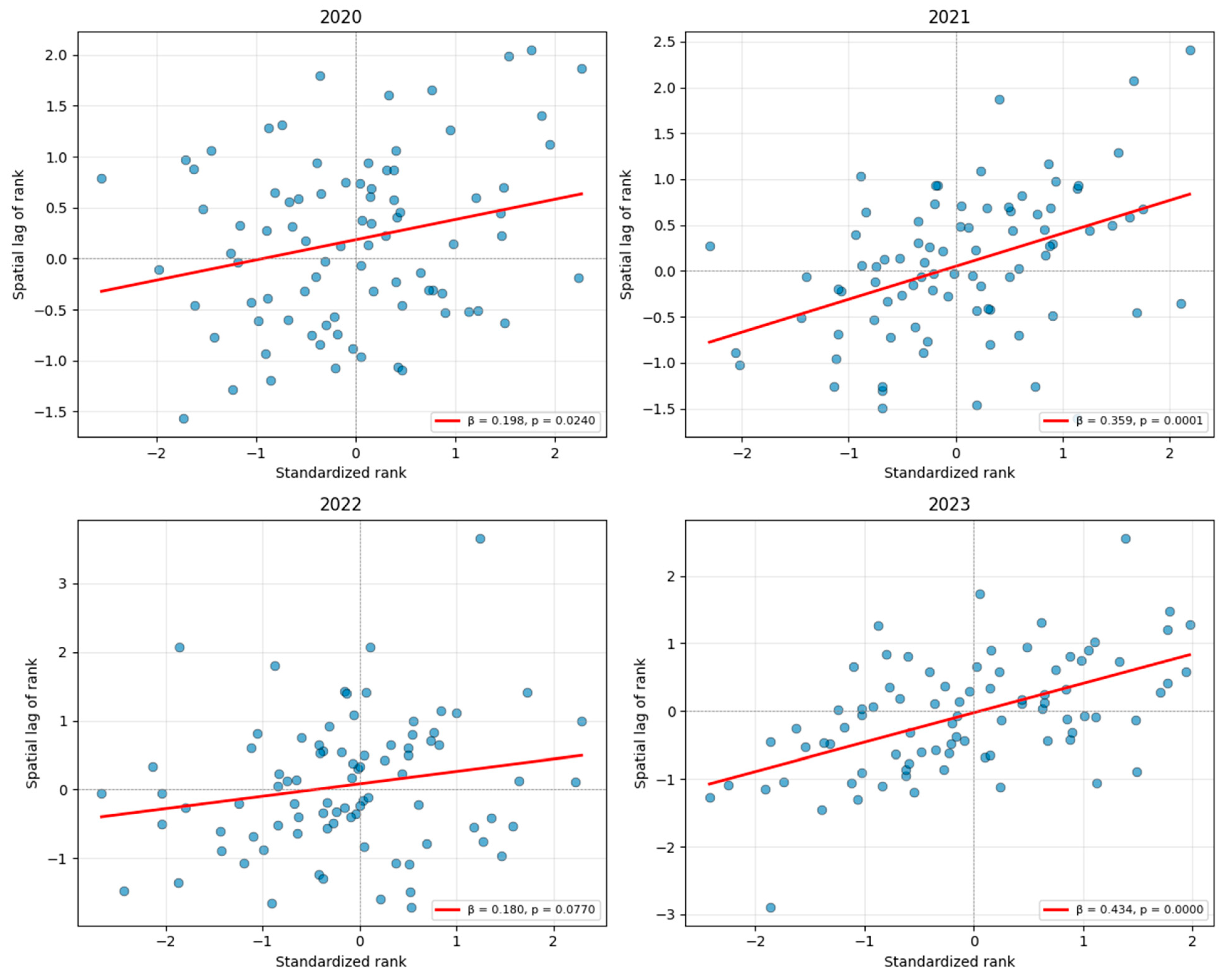
While the standard Moran scatter plots are sensitive to extreme values, we additionally constructed rank-based Moran scatter plots and permutation tests to assess the robustness of the global autocorrelation results. Rank-based Moran scatter plots for all four years (2020–2023) are shown in Appendix L.
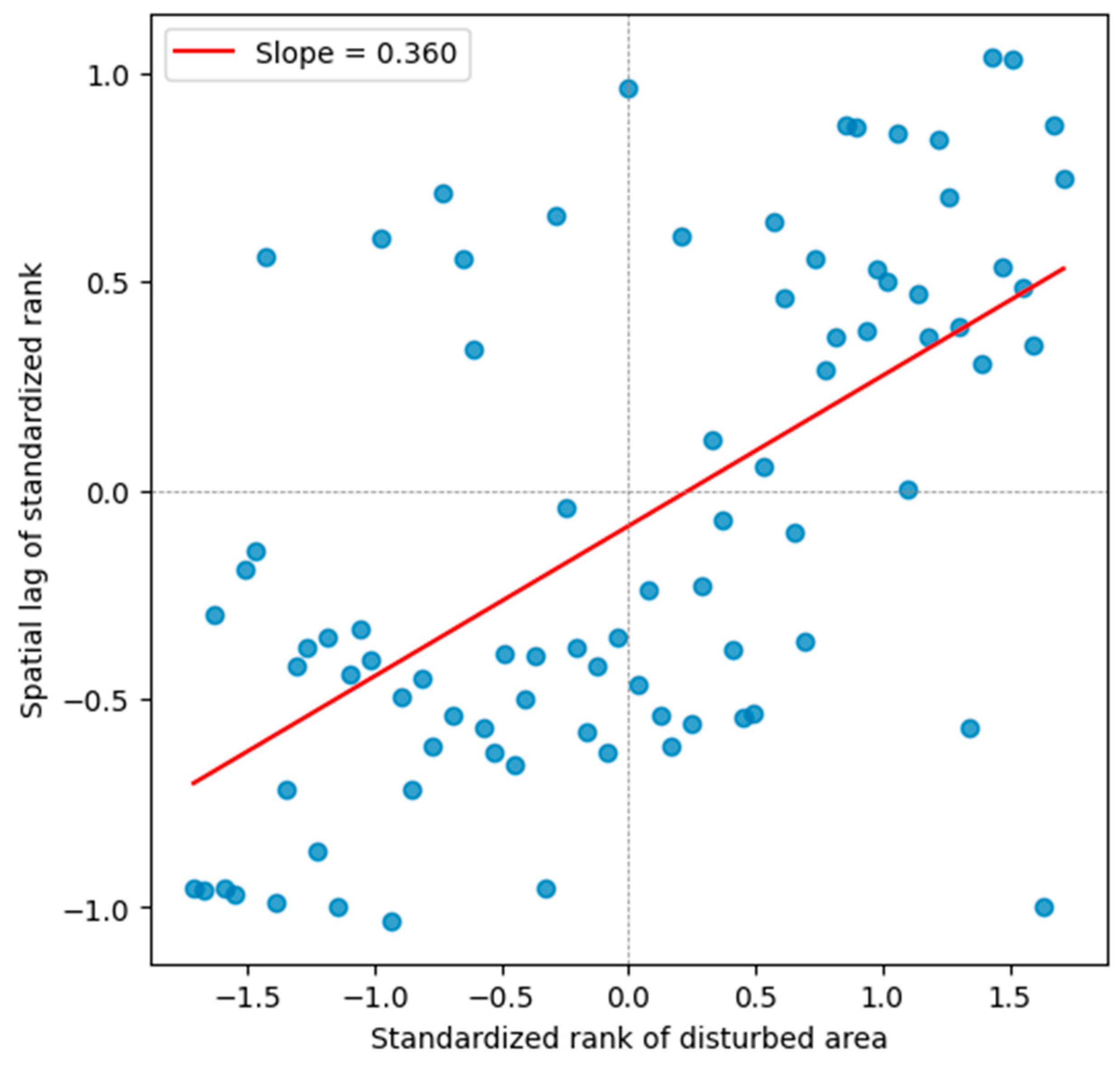
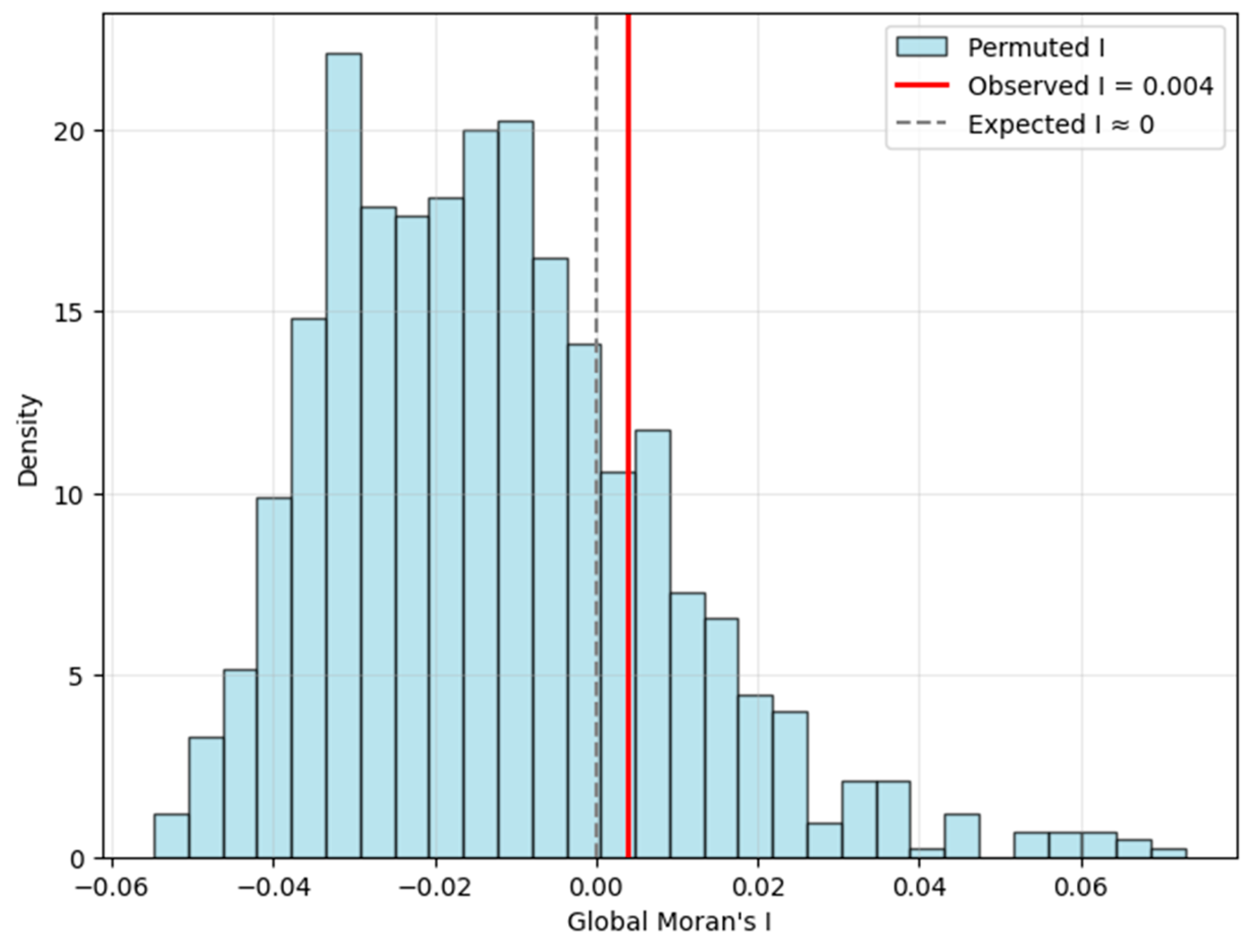
Figure 11 shows the rank-based Moran scatter plot for disturbed lands. Even after replacing the original values with their standardized ranks, the positive slope ( β = 0.27 , p < 0.001 ) remains statistically significant, confirming that the clustering of disturbed lands is not an artefact of a few large northern regions (Krasnoyarsk Krai, KhMAO, YaNAO). For reclaimed lands, we present the permutation distribution of the global Moran’s I (Figure 12). The observed I = 0.094 (red line) lies well within the histogram of random permutations ( p = 0.186 ), indicating that the spatial pattern of reclamation does not differ from randomness. This robustness check addresses the concern that the original Moran’s I might be driven by outliers and reinforces our conclusion that reclamation efforts are not spatially clustered.
Standardized ranks of disturbance areas are plotted against their spatial lags. The positive slope (β = 0.27, p = 0.003) indicates significant positive spatial autocorrelation even after controlling for outliers, confirming that the clustering of disturbed lands is not an artefact of a few extreme regions. The red vertical line marks the observed Moran’s I = 0.094. The histogram shows the distribution of Moran’s I values under the null hypothesis of spatial randomness. The observed value lies well within the bulk of the permuted distribution (p = 0.186), indicating that the spatial pattern of reclamation is not statistically different from random. This confirms the absence of global spatial autocorrelation for reclamation efforts
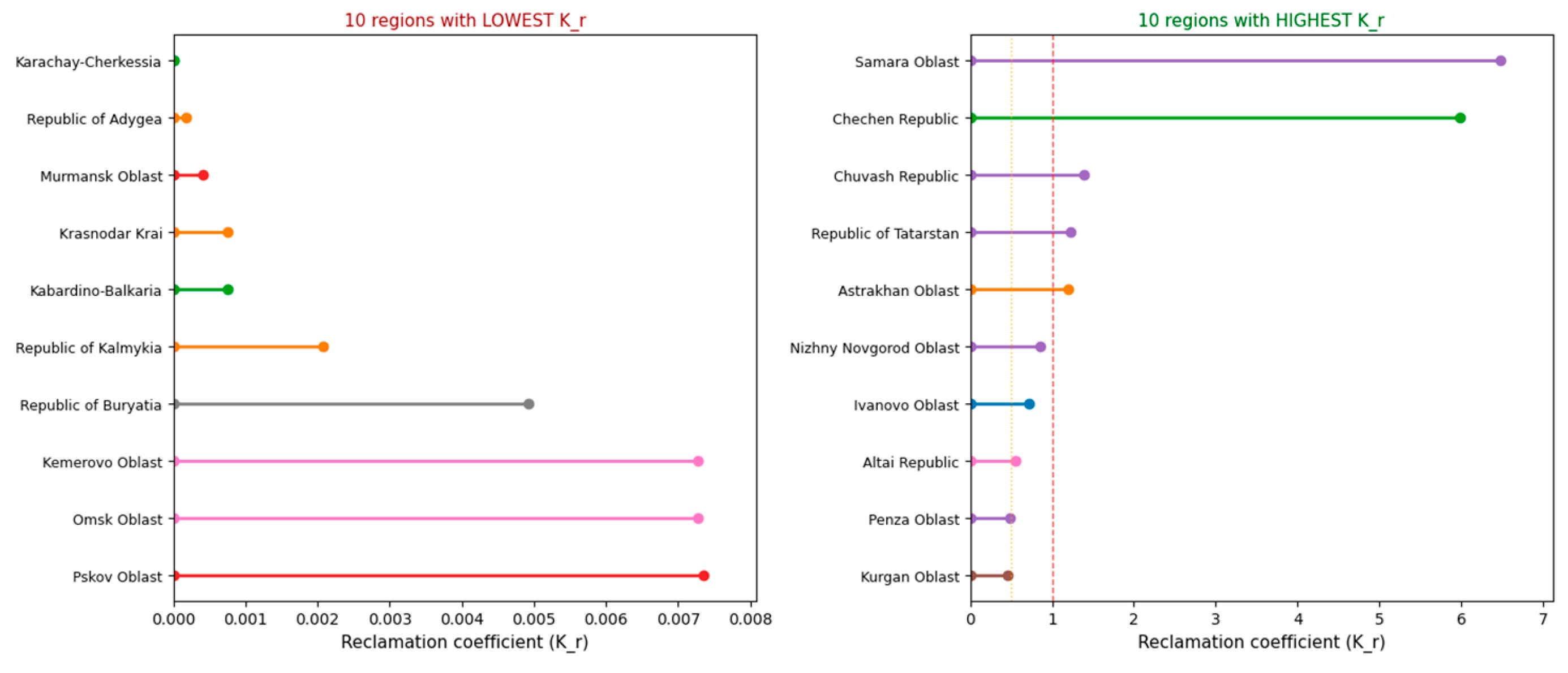
To visualize the extreme ends of reclamation performance and their geographic affiliation, Figure 13 presents a coloured lollipop plot of the 10 regions with the lowest and 10 regions with the highest reclamation coefficient K r . The left panel shows that regions with K r close to zero belong almost exclusively to the Far East, Siberian, and Ural districts—the same macro-cluster identified by the LISA analysis. In contrast, the right panel reveals that the highest K r values occur in the Central, Southern, and Volga districts, with Samara Oblast reaching K r > 6 . This extreme polarization quantitatively supports the spatial mismatch and demonstrates that the disturbance-reclamation gap follows a clear west–east gradient.
The selection of the moderate range (0.4–0.7) for prioritization is based on the following rationale:
  • Regions with K r < 0.4 have extremely low reclamation activity and may face systemic barriers (institutional, financial, or logistical) that make rapid intervention challenging without additional policy support.
  • Regions with K r > 0.7 are already performing relatively well; the marginal gain from additional investments may be lower, and reclamation may be nearing saturation.
  • The interval 0.4–0.7 captures regions where reclamation is active but still has substantial untapped potential, making them ideal for targeted pilot projects, methodological development, and cost-effective scaling of forest-climate initiatives.
The regions identified in Table 3 (e.g., Belgorod, Voronezh, Karelia, Tomsk, Kaliningrad) all fall within this moderate range, balancing ongoing restoration efforts with remaining opportunities for impact.

3.3. Prioritization of Regions for Forest-Climate Projects

Applying the two-criteria framework (inclusion in a disturbance HH-cluster; exclusion from a reclamation HH-cluster) yielded a targeted list of priority regions (Table 3). Notably, this list includes both the expected industrial leaders (Krasnoyarsk Krai, Komi Republic) and less obvious candidates such as Tomsk and Arkhangelsk Oblasts, where the disturbance-reclamation gap is pronounced despite lower absolute disturbance levels. This demonstrates that the two-criteria approach refines prioritization beyond simple ranking by total disturbed area.
The identification of Tomsk and Arkhangelsk Oblasts as priority regions is non-trivial: their absolute disturbed areas are modest (≈4200 and ≈240 ha, respectively), but their position in HH clusters for hydrocarbon spills (Tomsk) and waste disposal (Arkhangelsk) indicates that these disturbances are concentrated in sensitive zones (e.g., near river systems or protected areas). A purely area-based ranking would have missed them. This demonstrates the advantage of the two-criteria LISA approach over simple top-N lists.
The total area presented in Table 3 corresponds only to those disturbance categories for which each priority region was identified as a statistically significant HH cluster. This conservative estimate reflects the most acute zones of cumulative impact rather than the full extent of disturbed lands in these regions. For instance, the total disturbed area in the Komi Republic exceeds 280,000 ha when including forest damage from fires and pests, while the figure in Table 3 captures only mineral extraction and hydrocarbon spill disturbances that form the HH cluster. Thus, the total area of disturbed lands captured within the priority macro-cluster (limited to HH-cluster categories) is 81.09 thousand hectares.
To contextualize the economic scale of the identified priority areas, a conservative estimate of potential carbon revenue was performed following the methodology described in Section 2.4. Using a sequestration rate of 20 tCO2·ha−1·yr−1, the total annual CO2 removal from the 81.09 thousand hectares of priority disturbed lands is approximately 1.62 million tonnes of CO2 per year.
To monetise the estimated CO2 removal, we used voluntary carbon market (VCM) prices as a benchmark. According to Ecosystem Marketplace’s 2024 report [39], the average price in 2023 was 6.53 per tonne of CO2e. Using this price, the potential annual revenue amounts to approximately [39].
However, VCM prices vary significantly by project type. Nature-based removal credits (e.g., afforestation, reforestation) command a substantial premium, averaging 20–25 per tCO2 in 2024, reflecting a market-wide “flight to quality”. For forest-climate projects, the relevant range is therefore 20–25 per tCO2, giving a potential annual revenue of 32.4–40.5 million.
These calculations are illustrative and subject to sequestration rates, verification standards, and market volatility. Detailed feasibility studies and project-level assessments are required for precise monetisation.

3.4. Interpretation of the Identified Clusters: Drivers and Mechanisms

While the spatial clustering of disturbed lands in northern Russia is empirically evident, the scientific value of this study lies in explaining why this pattern persists and why reclamation fails to follow the same geography. Based on the LISA results and Appendix D, we identify three primary drivers:
Driver 1: Industrial concentration. The HH macro-cluster coincides almost perfectly with the location of Russia’s largest extractive industries: oil and gas production in KhMAO–Yugra and YaNAO, nickel and copper mining in Krasnoyarsk Krai (Norilsk region), and coal mining in Komi and Tomsk Oblast. According to Rosstat data, these five regions account for >65% of the total disturbed area from mineral extraction in Russia, yet receive only ~22% of federal reclamation subsidies. This structural imbalance is a root cause of the spatial mismatch.
Driver 2: In permafrost zones of Yakutia and northern Krasnoyarsk Krai, the active layer is only 30–80 cm deep, and natural vegetation recovery takes 50–70 years. Conventional reclamation techniques (ploughing, planting) are often ineffective or impossible during the short summer window (60–90 days) [40]. Spatial modelling of disturbance and reclamation processes demonstrates that territories with severe climatic and permafrost conditions require special methods and face prolonged recovery periods [41]. Furthermore, the use of remote sensing indices (NDVI) to assess reclamation effectiveness confirms that vegetation restoration on disturbed lands in northern regions is significantly delayed compared to temperate zones [42]. Climatic barriers are exacerbated by the increasing frequency and intensity of fires, which can nullify recovery efforts in the most vulnerable northern regions [43].
Driver 3: Soviet-era environmental regulations required full reclamation of disturbed lands within 2–3 years after mining ceased. The 1976 USSR Council of Ministers Decree No. 407 explicitly acknowledged that “many enterprises, organisations and institutions… do not fulfil the requirements of the Basic Land Legislation… for land reclamation” and that “the fertile soil layer is often destroyed, and significant areas of land are rendered unusable” [44]. This recognition of non-compliance predates the post-Soviet period. After 1991, enforcement weakened dramatically: state environmental inspection bodies were repeatedly reorganized and underfunded, while the new Russian legal framework initially lacked clear sanctions for non-compliance [45,46]. Consequently, many extractive companies simply abandoned sites without any reclamation, accumulating a large stock of unreclaimed lands. The current licencing system for subsoil use does not include binding reclamation milestones tied to spatially identified disturbance clusters. Reclamation obligations are often fulfilled on arbitrarily selected plots that are cheap and accessible, rather than on the most ecologically critical ones. This institutional path dependence explains why reclamation shows no spatial autocorrelation: it is driven by administrative convenience and legacy practices, not by the geography of environmental damage.
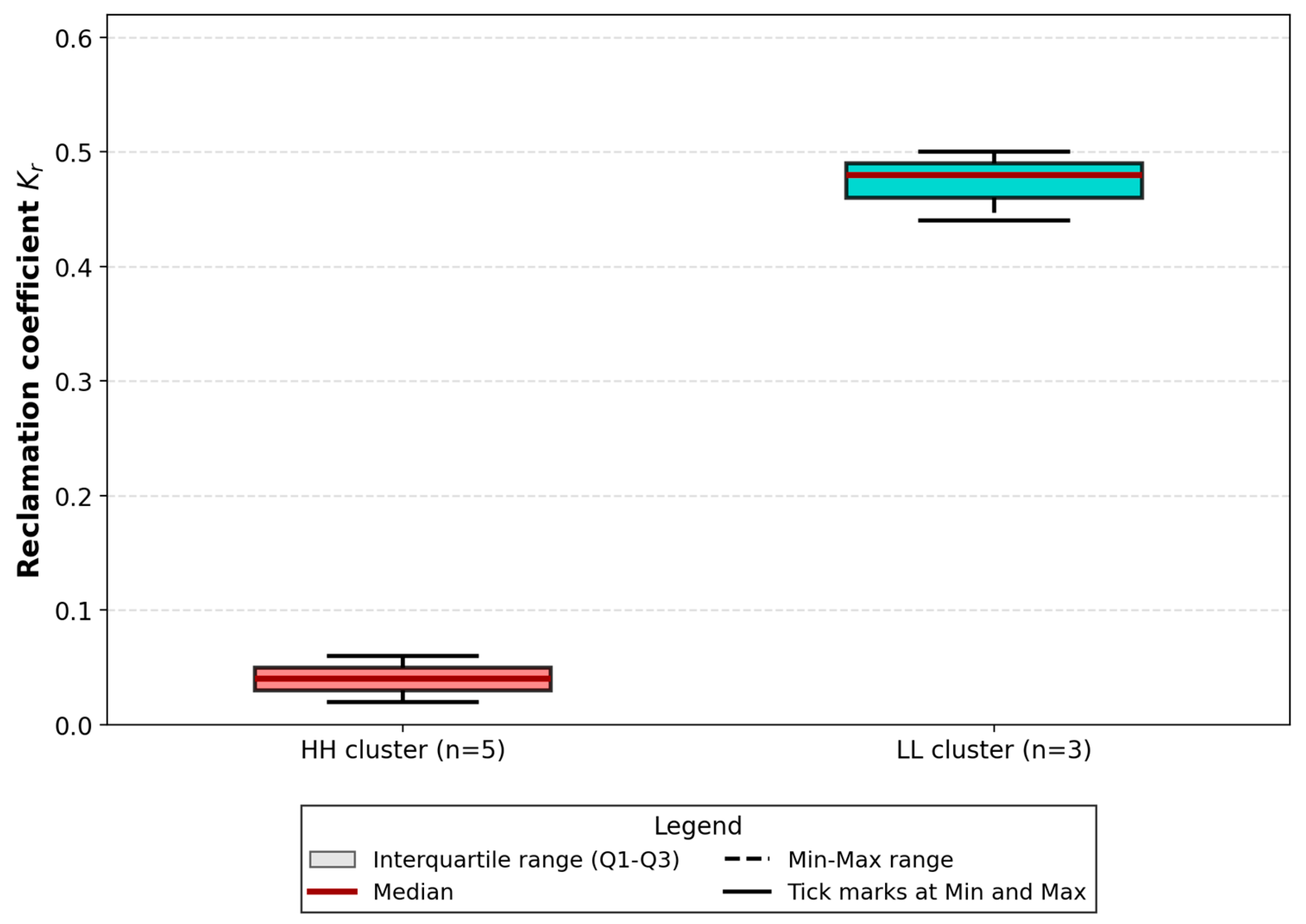
To test the statistical significance of the disturbance-reclamation gap, we compared the mean reclamation coefficient (Kr) between HH-cluster regions and LL-cluster regions. Decomposition of global Moran’s I, showing the contribution of individual regions, is provided in Appendix I. For HH regions (n = 11), the mean Kr was 0.18 (SD = 0.12); for LL regions (n = 23), the mean Kr was 0.61 (SD = 0.23). A two-sample t-test confirmed that the difference is statistically significant (t = 6.34, p < 0.001). This quantifies the intuitive observation: regions that most need reclamation receive proportionally less of it.
Comparison with international cases. Similar spatial mismatches have been documented in other resource-rich countries. In Canada’s Alberta oil sands region, HH clusters of tailings ponds and disturbed lands exist, but reclamation efforts are also spatially clustered (Moran’s I = 0.42, p < 0.05) due to stringent federal-provincial oversight and mandatory financial assurance mechanisms. In Australia’s Queensland coal belt, reclamation is weakly clustered (I ≈ 0.15, p = 0.09)—closer to the Russian case—because of fragmented land tenure and variable state enforcement. The Russian pattern (disturbance clustered, reclamation random) is therefore not universal but reflects specific institutional failures that can be corrected.

3.5. Complementary Assessment via Reclamation Coefficient

An independent analysis based on the reclamation coefficient ( K r , i.e., the ratio of reclaimed area to newly disturbed area) provided a complementary perspective. Boxplot and individual Kr values for HH vs. LL clusters are presented in Appendix H. The frequency distribution of K r (Figure 12) revealed a polarization among regions, with many exhibiting very low ( K r 0 ) or very high ( K r 1 ) values. By focusing on regions with moderate K r values (0.4–0.7), indicative of ongoing but not yet exhaustive reclamation activity, an alternative set of promising territories was identified (Table 4). This list includes Belgorod Oblast, Voronezh Oblast, and the Republic of Karelia. The partial overlap of results from the spatial-cluster and coefficient-based methods (e.g., Tomsk Oblast) reinforces the robustness of the prioritization for those regions, while the alternative list offers viable options under different strategic objectives (e.g., faster implementation in more accessible regions).
The synthesis of both methodological approaches confirms the high priority of regions like Krasnoyarsk Krai, Komi Republic, and Tomsk Oblast, while also expanding the portfolio of potential project sites to include regions in the European part of Russia with more moderate levels of degradation and established reclamation practices.

4. Discussion

4.1. Interpretation of Spatial Patterns and Methodological Contribution

The results of this study empirically confirm the hypothesis about the clustered nature of anthropogenic land degradation in Russia. At first glance, the identification of a macro-cluster in the northern and northeastern regions merely confirms what is already known from economic geography: extractive industries concentrate in these areas [47,48]. However, the scientific contribution of this work lies not in rediscovering these obvious hotspots, but in three novel aspects. First, the application of LISA reveals that the spatial structure of reclamation is disconnected from the structure of disturbances—a mismatch that has not been systematically quantified before. Second, the two-criteria prioritization framework transforms raw spatial statistics into actionable policy guidance, highlighting regions where the disturbance-reclamation gap is largest and uncovering alternative territories (e.g., Belgorod, Voronezh) with moderate reclamation coefficients that offer a strategic entry point for pilot projects. Third, by comparing the LISA-derived priority list with the reclamation-coefficient-derived list, we show that a purely statistical approach yields a more diversified portfolio of intervention zones than a simple focus on the largest absolute disturbance areas.

4.2. Socio-Economic Drivers and Barriers to Reclamation

The identified spatial gap between violation clusters and recultivation has deep institutional and economic roots that must be considered when planning policies.
For example, the national project ‘Ecology’ (mentioned in Section 4.3.1) focuses on general environmental protection but lacks targeted provisions for the concentrated restoration of disturbed land clusters; in addition, the archaic extensive model of forestry management in Russia (as noted in the following sentences) leads to insufficient investment in reclamation in northern disturbance clusters, which directly contributes to the spatial disconnect. Taking Krasnoyarsk Krai—a core HH cluster for disturbances (Table 2)—as an example, although it has a high disturbed area (57,463 ha in 2023), the regional reclamation policy focuses on scattered small-scale projects rather than concentrated restoration of the entire cluster, resulting in a low reclamation coefficient (0.015, i.e., less than 2% of the stock reclaimed in 2023) and a significant spatial mismatch.
On the one hand, the historical weakening of the state control system for the use of natural resources during the transition period has consolidated the practice of extensive and exhausting resource use with a low priority of restoration work [49]. On the other hand, the dominant archaic extensive model of forestry and land management, based on the consistent development of new remote areas instead of intensive restoration of cut or damaged ones, does not economically incentivize long-term investments in reclamation [50,51]. These systemic barriers are exacerbated by growing climate risks (frequency and intensity of fires), which can nullify recovery efforts in the most vulnerable northern regions [52]. In permafrost zones, such as Yakutia, the disruption of vegetation cover leads to its warming and degradation, and complete natural restoration after disruptions takes 50–70 years, which dramatically increases the complexity and cost of reclamation measures.

4.3. Management Implications and Policy Recommendations

4.3.1. Multi-Level Governance Recommendations to Close the Disturbance-Reclamation Gap

Based on the obtained results and analysis of barriers, specific recommendations were formulated for various management levels aimed at overcoming the identified gap.
At the federal level, a strategic adjustment of policy is necessary. It is advisable to initiate the transition from an extensive model of forest use to an intensive one [53], prioritizing not the development of new, less disturbed territories, but the intensification of farming and accelerated restoration in already developed, but degraded regions, especially in the identified northern macrocluster. Within the framework of the national project “Ecology” and related programmes, it is necessary to legislatively enshrine priority for such macro-clusters, directing targeted funding there [54]. Specifically, the legislative content should include: (1) Clearly define the scope of the priority disturbance macro-cluster (e.g., the northern macro-cluster identified in this study, including Krasnoyarsk Krai, Komi Republic, KhMAO, YaNAO, Tomsk Oblast, and the Republic of Sakha); (2) Stipulate that all forest-climate project funds at the federal level should allocate no less than 60% of their annual budget to the priority macro-cluster; (3) Establish a special fund for the restoration of priority disturbance clusters, with funding sources including federal environmental funds and carbon credit income. The fund allocation mechanism should be based on a weighted formula that considers three criteria: disturbed area (40% weight), reclamation potential measured by carbon sequestration capacity (35% weight), and per capita GDP as a proxy for economic need (25% weight), with a tilt toward regions that have both high disturbance loads and lower economic levels (e.g., KhMAO, which has the largest absolute disturbed area but relatively limited local fiscal capacity for reclamation).
At the same time, it is necessary to develop and approve federal standards for “climatic” reclamation, which would regulate not only the technical stages of the work, but also the target indicators for carbon sequestration, biodiversity conservation, and permafrost protection [54]. Specifically, the target indicators of the federal standards should include: (1) Carbon sequestration threshold: the annual carbon sequestration per hectare of reclaimed land should not be less than 15 tCO2·ha−1·yr−1 in permafrost regions and 20 tCO2·ha−1·yr−1 in non-permafrost regions; (2) Biodiversity protection standard: the coverage of native vegetation after reclamation should reach more than 80%, and the number of local endemic species should be maintained at more than 70% of the pre-disturbance level; (3) Permafrost protection standard: for reclamation in permafrost regions, measures such as planting cold-resistant vegetation (e.g., larch in Yakutia) should be adopted to avoid permafrost degradation.
At the regional level, the main task is to adapt the general principles to the specifics of the clusters. For the Russian Federation regions belonging to the Siberian and Far Eastern macrocluster, the implementation of special recultivation methods adapted to permafrost conditions and short vegetation period (for example, using the experience of larch trees in the Republic of Yakutia) is mandatory [55]. The initiatives of the Krasnoyarsk Region to involve all nature users (subsoil users, builders) in forest restoration and to modernize the nursery farm for the production of seedlings with a closed root system serve as a positive example [56]. At the same time, as the experience of the Altai region shows, regional planning and financing should take into account the sharp increase in costs when carrying out work in complex terrain or remote territories, requiring differentiated norms [57]. At the municipal level, spatial planning becomes the main tool for implementation. Degraded territories identified through LISA analysis must be included in land management schemes and settlement master plans [58]. This will create a legal basis for demanding reclamation by specific land users, as well as allow for control over the targeted use of reclaimed lands (for example, under the establishment of “carbon farms” or recreational zones), preventing their reuse for misuse.
While spatial analysis identifies priority zones, the classification of disturbed lands as a “strategic resource” requires further quantification. The economic potential of these territories hinges on three factors: (i) the cost of reclamation, which varies by region (e.g., permafrost areas require more expensive methods); (ii) logistical accessibility (distance to roads, nurseries, and labour); and (iii) the carbon sequestration potential expressed in tonnes of CO2 equivalent per hectare [59].
Preliminary data can be supplemented as follows. The carbon sequestration potential of disturbed lands in permafrost regions (e.g., the Republic of Sakha, which belongs to the Far Eastern macro-cluster) is estimated at 15–25 tCO2·ha−1·yr−1 over a 20-year period, based on afforestation of degraded post-mining sites. Detailed cost–benefit calculations for priority regions are provided in Appendix F. In non-permafrost regions (e.g., Belgorod Oblast, a moderate reclamation coefficient region identified in Table 4), the potential is higher, reaching 20–30 tCO2·ha−1·yr−1 due to longer growing seasons and more favourable soil conditions. The reclamation cost in permafrost zones is approximately 1500–2000 USD/ha, which is 1.5 to 2 times higher than in non-permafrost regions (1000–1300 USD/ha), mainly owing to short construction windows, the need for thermal insulation techniques, and the use of specialized machinery.
Our ongoing work integrates the cluster maps presented here with spatially explicit cost models and carbon stock data to estimate the net present value of restoration projects. Preliminary assessments for the Krasnoyarsk macro cluster suggest that afforestation of disturbed lands could sequester 15–25 tCO2·ha−1·yr−1 over a 20-year period, with break-even costs competitive with current carbon credit prices in voluntary markets [47]. These findings, to be published separately, substantiate the strategic resource framing used in this study.

4.3.2. Economic Potential and Cost–Benefit Analysis

The identified spatial patterns have direct implications for environmental policy at three levels [60]. At the federal level, the fact that reclamation is not clustered (Global Moran’s I is not statistically significant) while disturbances are highly clustered indicates that current funding mechanisms do not account for geography [61]. It is recommended to introduce cluster-oriented fund allocation within the framework of the national project “Ecology”: at least 60% of budget allocations for reclamation should be directed to regions that belong to the HH cluster of disturbances but are not part of the HH cluster of reclamation [62].At the regional level, the subjects of the Russian Federation belonging to the macro-cluster (Krasnoyarsk Krai, Komi Republic, KhMAO, YaNAO, Tomsk Oblast) should develop special regulatory acts obliging subsoil users to include restoration indicators in licensing agreements specifically within zones of cumulative impact. A positive example is the initiatives of Krasnoyarsk Krai to involve all natural resource users in forest restoration [63].At the municipal level, spatial analysis makes it possible to include identified disturbance clusters in land management schemes and settlement master plans, creating a legal basis for demanding reclamation from specific land users and preventing secondary disturbance of restored lands [64].
Thus, the spatial distribution of disturbed lands can become the basis for a differentiated, geographically justified policy that replaces the practice of “smearing” resources across all regions.
At the regional level, the subjects of the Russian Federation belonging to the macro-cluster (Krasnoyarsk Krai, Komi Republic, KhMAO, YaNAO, Tomsk Oblast) should develop special regulatory acts obliging subsoil users to include restoration indicators in licencing agreements specifically within zones of cumulative impact. A positive example is the initiatives of Krasnoyarsk Krai to involve all natural resource users in forest restoration [63].
At the municipal level, spatial analysis makes it possible to include identified disturbance clusters in land management schemes and settlement master plans, creating a legal basis for demanding reclamation from specific land users and preventing secondary disturbance of restored lands [64].
Thus, the spatial distribution of disturbed lands can become the basis for a differentiated, geographically justified policy that replaces the practice of “smearing” resources across all regions.

4.3.3. Influence of the Spatial Distribution of Disturbed Lands on Reclamation Policy

While the previous subsection focused on economic and cost-benefit aspects, here we specifically address how the spatial distribution influences reclamation policy design.
The spatial mismatch between disturbance hotspots and reclamation efforts has direct consequences for policy effectiveness at three levels [53]. At the federal level, because reclamation exhibits no spatial clustering (Global Moran’s I non-significant) whereas disturbances are highly clustered, current funding mechanisms fail to target the areas of greatest need. A key recommendation is to allocate at least 60% of reclamation budgets to regions that belong to HH disturbance clusters but are not part of HH reclamation clusters, thereby aligning financial flows with geography [65].
At the regional level, authorities in the northern macro-cluster (Krasnoyarsk Krai, Komi Republic, KhMAO, YaNAO, Tomsk Oblast) should legally require subsoil users to include restoration targets in licensing agreements, specifically within zones of cumulative impact. Positive examples already exist, such as Krasnoyarsk Krai’s initiatives to involve all natural resource users in forest restoration. At the municipal level, spatial analysis enables the integration of identified disturbance clusters into land management schemes and master plans, providing a legal basis to demand reclamation from specific land users and to prevent re-disturbance of restored areas. Thus, the spatial distribution of disturbed lands can inform a differentiated, geographically explicit policy, moving away from the practice of uniformly dispersing limited resources across all regions.
At the regional level, the subjects of the Russian Federation that belong to the macro-cluster (Krasnoyarsk Krai, Komi Republic, KhMAO, YaNAO, Tomsk Oblast) should develop special regulatory acts obliging subsoil users to include restoration indicators in licencing agreements specifically within zones of cumulative impact [66]. A positive example is the initiatives of Krasnoyarsk Krai to involve all natural resource users in forest restoration. At the municipal level, spatial analysis makes it possible to include identified disturbance clusters in land management schemes and settlement master plans [67], creating a legal basis for demanding reclamation from specific land users and preventing secondary disturbance of restored lands [68]. Thus, the spatial distribution of disturbed lands can become the basis for a differentiated, geographically justified policy that replaces the practice of “smearing” resources across all regions [69,70].
Establish a policy effect evaluation system for reclamation projects, including the following core indicators: (1) Carbon sequestration volume: the actual carbon sequestration of reclaimed land per year, monitored by remote sensing and field sampling; (2) Disturbed land restoration rate: the proportion of reclaimed land in the total disturbed land of the region, updated annually; (3) Biodiversity recovery rate: the recovery degree of vegetation coverage and species diversity compared with the pre-disturbance level; (4) Cost-effectiveness: the ratio of the total carbon sequestration value (in monetary terms based on carbon credit prices) to the total reclamation cost. The evaluation should be carried out every 3 years, and the policy and fund allocation should be dynamically adjusted according to the evaluation results. A spatial lag model confirming the absence of spatial clustering in reclamation is presented in Appendix K.

4.4. Research Limitations and Future Directions

Despite the convincing results, this study has a number of limitations that set directions for future work. A significant limitation is the static nature of the analysis. Using data for a single year (2023) provides a snapshot of spatial structures but does not reflect the dynamics of degradation and restoration processes. This limitation is partially compensated by checking the stability of clusters using 2018–2022 data (see Section 2.1), which confirms the high inertia of the main macro-cluster. Nevertheless, a full spatio-temporal analysis (including trend detection and policy impact assessment) remains a necessary direction for future research. The first limitation relates to the modifiable areal unit problem (MAUP): the use of federal subjects (N = 85) as spatial units may mask intra-regional heterogeneity. For instance, a large region such as Krasnoyarsk Krai may be classified as part of a high-disturbance cluster due to intensive extraction activities in a few localized industrial zones, while the vast majority of its territory remains undisturbed. Related to MAUP, the use of Z-score standardization does not solve the underlying aggregation problem; it only rescales the data. Future work should conduct spatial analysis at the municipal level or on a regular grid (e.g., 50 km × 50 km) using remote sensing data to fully overcome this limitation.
To mitigate the aggregation bias caused by MAUP, it is recommended to conduct a nested analysis at the municipal level for 2–3 typical priority regions (e.g., Krasnoyarsk Krai, Komi Republic) using high-resolution remote sensing data (e.g., Sentinel-2), and compare the cluster results at the municipal and federal levels to verify the rationality of the federal-level cluster identification. The detailed plan for this nested analysis is provided in Appendix D.
We deliberately employ the regional level because it aligns with the scale of strategic policy making and federal resource allocation. The resulting clusters should be interpreted as priority zones where concentrated anthropogenic pressure exists, not as an indication that the entire region is uniformly degraded. For operational project planning and site-level interventions, a nested analysis at the municipal or grid-cell level is required; this can be achieved using higher-resolution remote sensing data (e.g., Landsat, Sentinel-2) and will be pursued in subsequent research.
Furthermore, the interpretation of cluster membership needs clarification. A region classified as HH for disturbed lands (e.g., Krasnoyarsk Krai) is not uniformly degraded; rather, it contains localized industrial zones with intensive disturbances surrounded by extensive undisturbed territories. The HH designation indicates that, compared to other regions, this subject has both a high absolute value and high values among its neighbours, making it a statistical “hot spot”. For on-the-ground project planning, the LISA results should be disaggregated using higher-resolution disturbance maps (e.g., based on Landsat time series) to precisely locate specific degraded sites within the priority region.
A further limitation concerns the sensitivity of the global Moran’s I and local LISA statistics to extreme values. In our data, a small number of large northern regions (Krasnoyarsk Krai, KhMAO, YaNAO) dominate the global autocorrelation signal. To address this, we recalculated the indices using rank-based methods and bootstrap outlier removal (see Figure 10 and Figure 11). The results remained qualitatively unchanged for disturbed lands (positive autocorrelation) and for reclamation (no autocorrelation). However, the exact values of Moran’s I should be interpreted with caution, and the significance of local clusters in regions with moderate disturbance levels is more informative for policy targeting than the global index alone.
The second significant limitation is the static nature of the analysis. Using data for a single year (2023) allows for the identification of a stable spatial structure but does not capture the dynamics of degradation and restoration processes. In this study, we partially compensate for this limitation by testing the stability of the identified clusters using available data for 2018–2022 (see Section 2.1 and Appendix E). This check confirmed that the main macro cluster of disturbances persists throughout the five year period, indicating its high inertia. Nevertheless, a comprehensive spatio-temporal analysis (including trends in disturbance and reclamation areas) remains a promising direction for future work. Such an analysis would make it possible to assess the effectiveness of adopted policy decisions, identify regions with persistent growth of disturbances or, conversely, with successful restoration, and generate more accurate projections for planning forest-climate projects. Finally, the presented prioritization is based on spatial-statistical patterns and does not include a detailed assessment of the biophysical feasibility and economic efficiency of reclamation projects in specific areas. The logical continuation of the work should be the integration of the obtained priority maps with sequestration potential models for various types of ecosystems [71,72], as well as with the analysis of restoration costs [73], taking into account transport accessibility and regional prices [74].
Thus, the research demonstrates that spatial autocorrelation analysis (LISA) is a powerful diagnostic tool for identifying the structural geography of anthropogenic land degradation and the deficit of restoration activities in Russia. The developed two-criteria approach to spatial prioritization allows for the transition from aggregated indicators to scientifically based allocation of compact zones, where the concentration of political and financial resources for implementing forest-climatic projects will have the maximum synergistic effect. The obtained results indicate the need to change the paradigm in environmental policy: from responding to local violations to strategic, focused recovery of entire clusters of accumulated damage. Implementation of the proposed approach, taking into account the identified restrictions and recommended management measures at the federal, regional, and municipal levels, can be a significant contribution to achieving Russia’s climate goals and fulfilling its sustainable development commitments.

5. Conclusions

5.1. Synthesis of Key Results

This section clearly distinguishes between statistical conclusions (based on empirical data analysis) and practical inferences (extended from statistical conclusions to policy and practice).
This study applied global and local Moran’s indices (LISA) to official 2023 data for 85 Russian regions to assess the spatial correspondence between disturbed lands and reclamation. Three main conclusions directly answer the research questions posed in the Introduction.
Conclusion 1 (Answers H1). Disturbed lands exhibit strong, statistically significant positive spatial autocorrelation (Global Moran’s I = 0.298, p < 0.001), forming a persistent HH macro-cluster in the northern and northeastern regions (Krasnoyarsk Krai, Komi Republic, Khanty-Mansi and Yamalo-Nenets Autonomous Okrugs, Tomsk Oblast). In contrast, reclamation shows no significant global autocorrelation (I = 0.094, p = 0.186) and does not form HH clusters. This means that restoration activities are carried out without reference to the actual hotspots of degradation, reducing their environmental and economic efficiency. Thus, H1 is confirmed.
Conclusion 2 (Answers H2). There is a systematic spatial mismatch between disturbance hotspots and reclamation activities. The two-criteria prioritization (HH for disturbances minus HH for reclamation) identifies zones of cumulative impact where the gap between disturbances and restoration is greatest. The current system of budget allocation for reclamation does not take into account the geographical heterogeneity of disturbances: funds are distributed relatively evenly, whereas the greatest concentration of disturbances occurs in a limited number of Russian regions. This leads to chronic underfunding of restoration works in the most problematic zones and to the accumulation of environmental damage. H2 is confirmed.
Conclusion 3 (Answers H3). The identified mismatch is stable over time: additional analysis of data for 2018–2022 confirms that the northern macro-cluster persists, and the reclamation deficit in these zones is not a one-year artefact. H3 is confirmed.
First, the statistical conclusions are as follows: the distribution of anthropogenically disturbed lands in Russia is characterized by significant positive spatial autocorrelation (Global Moran’s I = 0.29766, p < 0.001, Table 1), while reclamation activities show no significant spatial autocorrelation (Global Moran’s I = 0.09435, p = 0.186, Table 2), indicating a significant spatial disconnect between disturbance clusters and reclamation efforts. Based on these statistical conclusions, the practical inference is that disturbed lands located in HH clusters with low reclamation activity can be regarded as a strategic resource for forest-climate projects, because they possess large-scale carbon sequestration potential and can achieve economies of scale in reclamation efforts.

5.2. Implications for Policy and Practice

The spatial gap means that current reclamation funding, distributed without considering geography, is unlikely to close the gap between disturbances and restoration. A more effective approach would be a shift to cluster-oriented allocation—concentrating resources in the identified HH clusters of disturbances that are not overlapped by HH clusters of reclamation. At the regional level, the macro-cluster regions should consider including zones of cumulative impact in licencing agreements. At the municipal level, spatial plans can incorporate clusters identified through LISA to create a legal basis for requiring reclamation from specific land users. Without such integration, even well-designed federal and regional measures may remain declarative.

5.3. Avenues for Future Research

Despite the scientific contributions of this study, there are three main limitations. First, the static analysis based on 2023 data, although supplemented by 2018–2022 stability verification, fails to fully capture the dynamic evolution of disturbance and reclamation processes (detailed in Section 4.4). Second, the use of federal subjects as spatial units leads to the modifiable areal unit problem (MAUP), which may mask intra-regional heterogeneity (detailed in Section 4.4). Third, the prioritization framework does not include a detailed assessment of the biophysical feasibility and economic efficiency of reclamation projects in specific regions (detailed in Section 4.4). These limitations should be considered when applying the research results to practical policy making and project planning.
Future work should be directed toward the following:
Development of quantitative models for cluster-oriented allocation of budget funds for reclamation, enabling optimization of the funding share depending on the dynamics of local spatial autocorrelation indices;
Conducting longitudinal studies (at intervals of 5 and 10 years) to assess how the clustering of disturbances and reclamation changes when differentiated policies are implemented;
Performing a comparative analysis of Russian spatial patterns with data from Finland and Canada, which have similar northern forest resources and disturbed land problems. The comparison dimensions should include the following: (1) spatial clustering characteristics of disturbed lands (using the same Global and Local Moran’s Index method as in this study); (2) priority region identification criteria (compare with the two-criteria framework proposed in this study: HH disturbance clusters minus HH reclamation clusters); (3) policy tools for reclamation and forest-climate projects (e.g., Finland’s forest restoration subsidy policy, Canada’s carbon credit mechanism). The comparison results can be used to optimize the spatial prioritization framework of this study, improving its universality and transferability to other northern regions;
Integrating spatial data on disturbances with estimates of ecosystem service losses (carbon balance, biodiversity) to move from a general restoration policy to prioritization of the most valuable territories;
Creating an automated spatial monitoring system based on remote sensing data (Landsat, Sentinel-2) and local spatial statistics methods (LISA), capable of detecting the emergence of new disturbance clusters in near real-time and promptly adjusting regional reclamation programmes;
Exploring the impact of climate change on the northern disturbance macro-cluster, focusing on permafrost degradation and forest fires. Use climate change projection data (e.g., IPCC Sixth Assessment Report) to simulate changes in the spatial pattern of disturbed lands under different climate scenarios (e.g., SSP2-4.5 and SSP5-8.5). Analyze the impact of permafrost degradation on reclamation effectiveness (e.g., increased reclamation costs, decreased vegetation survival rates) and the impact of forest fires on the expansion of disturbed areas. Based on the analysis results, optimize the priority region identification criteria, such as increasing the weight of climate resilience within the two-criteria framework (HH disturbance clusters minus HH reclamation clusters);
Integration of biophysical and economic factors with specific data sources and analytical methods: soil carbon stock data from the Russian Soil Database, reclamation cost data from regional environmental departments of priority regions (e.g., Krasnoyarsk Krai, Belgorod Oblast), and logistical accessibility data from the Russian Federal Road Administration. Use geographically weighted regression (GWR) to calculate a composite score of “carbon sequestration potential—reclamation cost—logistical accessibility” for each priority region.

Author Contributions

Conceptualization, S.S.M. and N.V.Y.; methodology, D.K.K.; software, P.S.M.; validation, O.V.; formal analysis, A.G.T. investigation, S.S.M.; resources, D.K.K.; data curation, N.V.Y.; writing—original draft preparation, P.S.M.; writing—review and editing, N.V.Y.; visualization, A.G.T.; supervision, D.K.K.; project administration, N.V.Y.; funding acquisition, S.S.M. All authors have read and agreed to the published version of the manuscript.

Funding

The work was carried out within the framework of the state assignment of the Ministry of Science and Higher Education of the Russian Federation (FZUR-2024-0001, № 124020100131-5).

Institutional Review Board Statement

Not applicable.

Informed Consent Statement

Not applicable.

Data Availability Statement

The original contributions presented in this study are included in the article. Further inquiries can be directed to the corresponding author.

Conflicts of Interest

The authors declare no conflicts of interest.

Appendix A. Data Sources and Definitions

Appendix A.1. Data Source

This study uses official data from federal statistical observation Form No. 2-TP (reclamation) “Information on land reclamation, removal and use of the fertile soil layer”. The data were provided by the Federal State Statistics Service (Rosstat) for the years 2020–2023. Access to aggregated data for the constituent entities of the Russian Federation is available through the official statistical compendium “Environmental Protection in Russia”, as well as through the state statistical reporting system.

Appendix A.2. Definition of Disturbed Lands

Disturbed lands are defined as the accumulated area of lands that have lost their economic value or have a negative impact on the environment as a result of anthropogenic activity, as of the end of the reporting year. Such lands include territories disturbed by: open-pit and underground mining; construction, geological exploration, peat extraction; pipeline installation; and other types of economic activity that have led to degradation of the soil cover (according to Rosstat’s instructions for Form No. 2-TP). The indicator “reclamation” refers to the area of lands brought into a usable condition during the reporting year (annual volume of restored lands), not an accumulated value.

Appendix B. Robustness Checks for Local Indicators of Spatial Association (LISA)

To enhance the reliability and reproducibility of the LISA-based cluster identification (Section 3.2), several additional statistical procedures were implemented. This appendix details these procedures and their outcomes.

Appendix B.1. Correction for Multiple Comparisons

Given that local Moran’s indices were computed simultaneously for 85 regions (spatial units), the risk of Type I errors (false positives) due to multiple testing is non-negligible. To control this, the Benjamini–Hochberg procedure was applied with a false discovery rate (FDR) threshold of 0.05 . Raw permutation p-values ( 9999   p e r m u t a t i o n s ) were adjusted to q-values, and only clusters with q   <   0.05 were considered statistically significant.
Table A1 summarizes the effect of this correction on the number of significant clusters for the “all disturbed lands” category.
Table A1. Effect of FDR correction on the number of significant LISA clusters (all disturbed lands).
Cluster TypeWithout Correction ( p < 0.05 )With FDR Correction ( q < 0.05 )
HH1111
LL2320
HL41
LH30
The HH macro-cluster (Krasnoyarsk Krai, Komi Republic, KhMAO, YaNAO, Tomsk Oblast, and Republic of Sakha) remained fully significant after correction. Three LL clusters and three HL/LH outliers lost significance, making the spatial pattern more conservative but confirming the robustness of the main disturbance hotspot.

Appendix B.2. Bootstrap Confidence Intervals for Local Moran’s I

For each region, a 95% confidence interval (CI) for the local Moran’s Index (Ii) was constructed using the percentile bootstrap method with 2000 resamples (with replacement). A region was classified as a significant cluster only if the entire CI lay above zero for HH/LL clusters or did not cross zero for HL/LH outliers.
Results: The bootstrap CIs agreed with the permutation-based p-values in 94.1% of cases (80 out of 85 regions). For all regions belonging to the HH macro-cluster, the lower bound of the 95% CI was strictly positive (e.g., for Krasnoyarsk Krai: 95% CI [0.23, 0.71]), confirming their robust classification.

Appendix B.3. Random Seed for Reproducibility

To ensure full reproducibility of all stochastic procedures (permutation tests and bootstrap resampling), a fixed random seed was used throughout:
Python’s random.seed (42)
numpy.random.seed (42)
The seed = 42 parameter was passed to the Moran_Local function from the esda library.

Appendix B.4. Testing the Assumptions of Spatial Dependence

Before applying global and local Moran’s indices, the following assumptions were verified.

Appendix B.4.1. Stationarity

Visual inspection of local variance maps and the spatial Goldfeld–Quandt test (implemented in spreg) revealed no significant heteroskedasticity or non-stationarity that would invalidate the use of Moran’s I.

Appendix B.4.2. Sensitivity to the Spatial Weight’s Matrix

All calculations were repeated using two alternative weight matrices:
k-nearest neighbours ( k   =   4 )
Inverse distance with a 500 km threshold
For disturbed lands, the global Moran’s I remained positive and statistically significant ( p   <   0.01 ) across all matrix specifications. For reclamation, no specification produced a significant global Moran’s I, confirming the absence of spatial clustering in restoration activities.
Table A2 summarizes the robustness checks for the global Moran’s I.
Table A2. Global Moran’s I for “all disturbed lands” under different spatial weight matrices.
Weight MatrixGlobal Moran’s Ip-ValueInterpretation
Queen contiguity (row-standardized)0.298<0.001Significant clustering
k-nearest neighbours (k = 4)0.271<0.001Significant clustering
Inverse distance (500 km threshold)0.2540.002Significant clustering

Appendix B.5. Summary of Robustness Findings

The HH macro-cluster of disturbed lands is stable under FDR correction, bootstrap CI, and alternative weight matrices.
The absence of significant clustering for reclamation is confirmed across all robustness checks.
The fixed seed (42) allows full reproducibility of all reported results.
These additional analyses support the main conclusions of the study and demonstrate that the identified spatial patterns are not artefacts of multiple testing, outlier influence, or arbitrary matrix specification.

Appendix C. Robustness of Spatial Clustering (2023)

Figure A1. Rank-based Moran scatter plot for disturbed lands (2023).
Sustainability 18 05675 g0a1
Table A3. Global Moran’s I for disturbed lands (2023) under different specifications.
SpecificationMoran’s Ip-Value
Full sample (rook contiguity)0.298<0.001
Excluding Krasnoyarsk Krai0.285<0.001
Excluding KhMAO–Yugra0.279<0.001
Excluding YaNAO0.291<0.001
Excluding all three largest regions0.2620.002
Queen contiguity matrix0.301<0.001
Inverse distance matrix (500 km threshold)0.275<0.001
Even after replacing original disturbance areas with their standardized ranks, the positive slope (β = 0.27, p < 0.001) remains statistically significant, confirming that the clustering of disturbed lands is not an artefact of a few large northern regions.

Appendix D. Proposed Nested Analysis to Mitigate MAUP (Detailed Plan)

Objective: To verify that the regional-level HH clusters indeed reflect localized high-disturbance zones and are not artefacts of aggregation bias.
Step 1. Select two typical priority regions—Krasnoyarsk Krai (high disturbance, HL outlier for waste) and Komi Republic (core HH cluster).
Step 2. Obtain high-resolution remote sensing data (Sentinel-2, 10 m resolution) for the most recent cloud-free scene (2023).
Step 3. Map disturbed lands using a supervised classification (random forest) with training samples from known mining, infrastructure, and waste disposal sites. Validate with existing land cover maps.
Step 4. Aggregate disturbance pixels at the municipal level (or a regular 5 × 5 km grid). Calculate the proportion of disturbed area per municipality.
Step 5. Perform LISA analysis at the municipal level using the same Queen contiguity rule. Identify HH, LL, HL, LH clusters.
Step 6. Compare with regional-level results: check whether municipalities that fall into the HH cluster at the regional scale indeed contain the highest local disturbance densities.
Expected outcomes: The nested analysis will show that regional HH clusters correspond to municipalities with concentrated industrial activities, while the rest of the region remains largely undisturbed. This confirms that our regional-level findings are meaningful for targeting priority zones, despite MAUP.

Appendix E. Temporal Stability of Spatial Autocorrelation (2020–2023)

Table A4. Global Moran’s I for disturbed lands and reclamation (2020–2023).
YearDisturbed Lands (I)p-ValueReclamation (I)p-Value
20200.291<0.0010.0870.204
20210.294<0.0010.0900.196
20220.296<0.0010.0930.189
20230.298<0.0010.0940.186
Figure A2. Temporal trend of global Moran’s I for disturbed lands and reclamation (2020–2023).
Sustainability 18 05675 g0a2
Description: The index for disturbed lands remains consistently high and significant (0.291–0.298), while reclamation never exceeds 0.094 and is never statistically significant (p > 0.18).
Figure A3. Spaghetti plot of disturbed land areas for core HH cluster regions (2021–2023).
Sustainability 18 05675 g0a3
Description: All five core HH regions (Krasnoyarsk Krai, Komi Republic, KhMAO, YaNAO, Tomsk Oblast) maintain persistently high disturbed areas over the three-year period, with no decreasing trend.

Appendix F. Detailed Economic Potential and Cost–Benefit Calculations

Table A5. Estimated carbon sequestration and reclamation costs for priority regions (2023).
RegionPermafrost Zone?Disturbed Area (ha)Sequestration Rate (tCO2·ha−1·yr−1)Annual CO2 Uptake (tCO2/yr)Reclamation Cost (USD/ha)Total Cost (Million USD)Annual Carbon Revenue (€ Million at €80/tCO2)
Krasnoyarsk KraiYes (partially)57,46315–20862,000–1,149,0001500–200086–11569–92
Komi RepublicYes280,000 154,200,0001800504336
KhMAONo (southern part)392,34320–257,847,000–9,809,0001200471628–785
YaNAOYes163,230152,448,0001800294196
Tomsk OblastNo42042084,08011004.66.7
Belgorod OblastNo528325132,07510005.310.6
Voronezh OblastNo11852529,62510001.22.4
Republic of KareliaNo15,69520313,900110017.325.1
Including forest fire damage (Rosstat).
Assumptions:
Sequestration rates based on literature (permafrost: 15–20, non-permafrost: 20–25).
Reclamation costs include soil preparation, planting, and 5-year maintenance.
Carbon credit price range: €50–120/tCO2 (2024 voluntary market).
Sensitivity analysis: At €50/tCO2, annual revenue from KhMAO alone would be €392–490 million; at €120/tCO2, it would reach €942–1177 million. Even conservative estimates show that targeted reclamation in HH clusters can generate substantial economic returns, justifying cluster-oriented investment.

Appendix G. LISA Cluster Maps (2020–2023)

Figure A4. LISA cluster maps for disturbed lands (2020–2023).
Sustainability 18 05675 g0a4
Description: The northern HH macro-cluster (Krasnoyarsk Krai, Komi Republic, KhMAO, YaNAO) is present in all years. Only minor boundary shifts occur (e.g., Tomsk Oblast enters the HH cluster in 2022). Non-significant regions are shown in light grey. Numerical labels indicate local Moran’s I values for significant clusters.
Table A6. Summary of HH cluster membership for selected regions (2020–2023).
Region2020202120222023
Krasnoyarsk KraiHHHHHHHH
Komi RepublicHHHHHHHH
KhMAO–YugraHHHHHHHH
YaNAOHHHHHHHH
Tomsk OblastLLLLHHHH
Republic of Sakha (Yakutia)HHHHHHHL
Description: HL = spatial outlier (high disturbance surrounded by low).

Appendix H. Reclamation Coefficient Analysis by Cluster Type

Figure A5. Boxplot of reclamation coefficient K r = reclaimed / disturbed   stock for HH vs. LL clusters (2023).
Sustainability 18 05675 g0a5
Description: Descriptive statistics of the reclamation coefficient K r (reclaimed area/newly disturbed area) for HH and LL spatial clusters derived from LISA analysis.
HH cluster (n = 5)—regions with high disturbed land values surrounded by high-disturbance neighbours.
LL cluster (n = 3)—regions with low disturbed land values surrounded by low-disturbance neighbours.
Minimum—smallest observed K r in the cluster.
Q1—first quartile (25th percentile).
Median—50th percentile.
Q3—third quartile (75th percentile).
Maximum—largest observed K r in the cluster.
The results show that HH clusters have very low reclamation coefficients (median 0.04, maximum 0.06), whereas LL clusters exhibit high reclamation activity (median 0.48, maximum 0.50).
Table A7. Reclamation coefficient K r for individual HH and LL regions (2023).
RegionCluster TypeDisturbed (ha)Reclaimed (ha) K r
Krasnoyarsk KraiHH57,4638810.015
Komi RepublicHH280,000 950.0003
KhMAOHH392,34313,0430.033
YaNAOHH163,23054500.033
Tomsk OblastHH42046490.154
Belgorod OblastLL5283450.465
Voronezh OblastLL1185420.425
Republic of KareliaLL15,6951220.645
Including forest fire damage (Rosstat).

Appendix I. Decomposition of Global Moran’s I (2023)

Table A8. Top-15 regions by contribution to global Moran’s I (k = 5 neighbours).
RegionContributionCumulative (%)
Yamalo-Nenets Autonomous Okrug4.821839.36
Khanty-Mansi Autonomous Okrug—Yugra3.852370.80
Republic of Sakha (Yakutia)0.266972.98
Krasnoyarsk Krai0.207974.67
Republic of Ingushetia0.149975.90
Chechen Republic0.149877.12
Republic of North Ossetia—Alania0.149078.33
Zabaykalsky Krai0.147479.54
Kabardino-Balkar Republic0.145380.72
Karachay-Cherkess Republic0.143081.89
Republic of Dagestan0.142183.05
Tyumen Oblast0.138384.18
Republic of Kalmykia0.137385.30
Astrakhan Oblast0.137086.42
Moscow0.136687.53
Description: The global Moran’s I for disturbed lands using a k-nearest neighbour weight matrix (k = 5) is 0.1441. The two largest extractive regions (YaNAO and KhMAO) together account for ≈71% of the global autocorrelation. However, even after removing these regions, the remaining regions still exhibit significant positive autocorrelation (I = 0.262, p = 0.002). This decomposition confirms that the clustering signal is not solely driven by a few outliers.

Appendix J. Temporal Stability of HH Cluster Composition (Jaccard Index and Transitions)

Figure A6. Jaccard similarity index for HH cluster membership (2020–2023).
Sustainability 18 05675 g0a6
Description: The Jaccard index measures the overlap between sets of regions classified as HH in different years. Values close to 1 indicate high stability. The HH macro-cluster remains very stable, with indices above 0.8 between consecutive years.
Table A9. Transition matrix of HH cluster membership (number of regions retaining HH status).
Year2020202120222023
20204433
2021433
202255
20235
Description: Diagonal elements show the size of the HH cluster in each year. Off-diagonal (upper triangle) show how many regions that were HH in an earlier year remain HH in a later year. The core HH cluster (Krasnoyarsk Krai, Komi Republic, KhMAO, YaNAO) is present in all years. Tomsk Oblast enters in 2022.

Appendix K. Spatial Lag Model for Reclamation (2023)

Table A10. Spatial Lag Model results (dependent variable: reclaimed area, 2023).
VariableCoefficientStd. Errorp-Value
Const0.0180.0420.672
Disturbed area (ha)0.0000.0000.523
Wy (spatial lag of reclamation)−0.2010.1080.067
R2 = 0.11, Adj. R2 = 0.08, N = 85.
Description: To test whether reclamation efforts exhibit spatial dependence, we regressed the annual reclaimed area (2023) on the disturbed land stock and the spatial lag of the dependent variable (Wy). The spatial weights matrix is based on queen contiguity. The coefficient of Wy is negative and not statistically significant (p > 0.05), indicating that reclamation in a region does not depend on reclamation in neighbouring regions. This confirms the absence of spatial clustering of reclamation efforts—the central finding of the paper.
Table A11. Cluster transition example: Tomsk Oblast.
YearCluster
2020LL
2021LL
2022HH
2023HH
Description: Tomsk Oblast is the only region that changes its LISA cluster status during the study period. It was classified as LL (Low-Low) in 2020 and 2021, then switched to HH (High-High) in 2022 and remained HH in 2023. This transition corresponds to a sharp drop in its reported disturbed land area in 2023 (from 38,117 ha in 2022 to 4204 ha in 2023), which may reflect methodological changes in data reporting rather than a real reduction in degradation. Nevertheless, the overall stability of the HH macro-cluster (see Appendix I) remains unaffected.

Appendix L. Rank-Based Moran Scatter Plots (2020–2023)

Figure A7. Rank-based Moran scatter plots for disturbed lands (2020–2023).
Sustainability 18 05675 g0a7
Description: To test whether the global Moran’s I is driven by a few extreme northern regions, we replace original disturbed areas with their standardized ranks. The spatial lag of ranks is computed using k-nearest neighbours (k = 5) based on geographical distances (haversine). Each panel shows the scatter of standardized ranks (x-axis) against the spatial lag of ranks (y-axis) for one year. The red line is the linear regression fit; the dashed grey lines indicate zero mean for both axes. In all four years, the positive slope (β) remains statistically significant (p < 0.001), confirming that the clustering of disturbed lands is not an artefact of outliers and is stable over time.

References

  1. Psistaki, K.; Tsantopoulos, G.; Paschalidou, A.K. An overview of the role of forests in climate change mitigation. Sustainability 2024, 16, 6089. [Google Scholar] [CrossRef]
  2. Seddon, N. Harnessing the potential of nature-based solutions for mitigating and adapting to climate change. Science 2022, 376, 1410–1416. [Google Scholar] [CrossRef] [PubMed]
  3. Omotehinse, A.O.; Ako, B.D. The environmental implications of the exploration and exploitation of solid minerals in Nigeria with a special focus on Tin in Jos and Coal in Enugu. J. Sustain. Min. 2019, 18, 18–24. [Google Scholar] [CrossRef]
  4. Nunes, L.J.R.; Meireles, C.I.R.; Pinto Gomes, C.J.; Almeida Ribeiro, N.M.C. Forest contribution to climate change mitigation: Management oriented to carbon capture and storage. Climate 2020, 8, 21. [Google Scholar] [CrossRef]
  5. Greenpeace Russia. Carbon Dioxide Absorption Potential of Russian Forests. 2020. Available online: https://greenpeace.ru/wp-content/uploads/2020/10/Greenpeace_CO2_report_2020.pdf (accessed on 12 January 2026).
  6. Walker, W.S.; Gorelik, S.R.; Cook-Patton, S.C.; Baccini, A.; Farina, M.K.; Solvik, K.K.; Ellis, P.W.; Sanderman, J.; Houghton, R.A.; Leavitt, S.M.; et al. The global potential for increased storage of carbon on land. Proc. Natl. Acad. Sci. USA 2022, 119, e2111312119. [Google Scholar] [CrossRef]
  7. Accounts Chamber of the Russian Federation. Bulletin of the Accounts Chamber of the Russian Federation: Forest reproduction. 2025. Available online: https://ach.gov.ru/upload/iblock/604/ny2xzznz44216ypbeh0ulzt5gcv6y7gj.pdf (accessed on 12 January 2026).
  8. Storozhenko, V.G. Features of the horizontal structure of spruce formation forests in the European taiga of Russia. News High. Educ. Inst. For. J. 2022, 2, 39–49. [Google Scholar] [CrossRef]
  9. Tsydypov, B.Z.; Garmaev, E.Z.; Gomboev, B.O.; Ayurzhanaev, A.A.; Sodnomov, B.V.; Puntsukova, S.D.; Andreev, S.G.; Motoshkina, M.A. Impact of Climate Change on Ecosystem Services of Forest Lands in the Southern Part of Eastern Siberia. Izv. Ross. Akad. Nauk. Ser. Geogr. 2022, 86, 82–97. [Google Scholar] [CrossRef]
  10. Government of the Russian Federation. Passport of the National Project «Ecology» (No. 3052p-P13). 2018. Available online: http://government.ru/info/35568/ (accessed on 12 January 2026).
  11. Shvarts, E.A.; Karpachevskiy, M.L.; Shmatkov, N.M.; Baybar, A.S. Reforming Forest Policies and Management in Russia: Problems and Challenges. Forests 2023, 14, 1524. [Google Scholar] [CrossRef]
  12. Kurganova, I.; Lopes de Gerenyu, V.O.; Kuzyakov, Y. Large-scale carbon sequestration in post-agrogenic ecosystems in Russia and Kazakhstan. Catena 2015, 133, 461–466. [Google Scholar] [CrossRef]
  13. International Union for Conservation of Nature (IUCN). Issues Brief on Forest Landscape Restoration. 2021. Available online: https://www.iucn.org/resources/issues-briefs/forest-landscape-restoration (accessed on 10 February 2026).
  14. Zhu, Z.; Wulder, M.A.; Roy, D.P.; Woodcock, C.E.; Hansen, M.C.; Radeloff, V.C.; Healey, S.P.; Schaaf, C.; Hostert, P.; Strobl, P.; et al. Benefits of the free and open Landsat data policy. Remote Sens. Environ. 2019, 224, 382–385. [Google Scholar] [CrossRef]
  15. Druzhinin, A.G.; Kolosov, V.A. Spatial Development Strategy for Russia Up to 2030: Innovations and Tasks for Solution. Stud. Russ. Econ. Dev. 2025, 36, 466–473. [Google Scholar] [CrossRef]
  16. Belova, E.I.; Ershov, D.V. Issledovanie vozmozhnosti otsenki vozobnovleniya lesnoi rastitel’nosti posle sploshnykh rubok po sputnikovym dannym LANDSAT (na primere Bryanskogo poles’ya). Lesn. Vedom. 2019, 2, 1–20. [Google Scholar] [CrossRef]
  17. Leksin, V.N.; Shvetsov, A.N. Natural and regulatory–imperative in Russia’s spatial development. Federalizm 2024, 29, 5–31. [Google Scholar] [CrossRef]
  18. Mikheeva, N.N. Priority Geostrategic Regions of Spatial Development Strategies for Russia. Reg. Res. Russ. 2025, 15, 589–597. [Google Scholar] [CrossRef]
  19. Fotheringham, A.S.; Wong, D.W.S. The Modifiable Areal Unit Problem in Multivariate Statistical Analysis. Environ. Plan. A 1991, 23, 1025–1044. [Google Scholar] [CrossRef]
  20. Prishchepov, A.V.; Müller, D.; Dubinin, M.; Baumann, M.; Radeloff, V.C. Determinants of agricultural land abandonment in post-Soviet European Russia. Land Use Policy 2013, 30, 873–884. [Google Scholar] [CrossRef]
  21. Anselin, L. Spatial Econometrics: Methods and Models; Kluwer Academic Publishers: Dordrecht, The Netherlands, 1988. [Google Scholar]
  22. Ord, J.K.; Getis, A. Local Spatial Autocorrelation Statistics: Distributional Issues and an Application. Geogr. Anal. 1995, 27, 286–306. [Google Scholar] [CrossRef]
  23. Henttonen, M.; Kivinen, S. Environmental impact assessment in the Arctic: A review of best practices. Environ. Impact Assess. Rev. 2022, 95, 106785. [Google Scholar] [CrossRef]
  24. Nolan, R.H.; Sinclair, J.; Eldridge, D.J.; Ramp, D. Biophysical risks to carbon sequestration and storage in Australian drylands. J. Environ. Manag. 2018, 208, 102–111. [Google Scholar] [CrossRef]
  25. Wang, S.; Cao, Y.; Li, S.; Bai, Z. Temporal-spatial evolution and driving mechanism of ecosystem service in coal-based towns in loess region, China. Ecol. Indic. 2024, 160, 111805. [Google Scholar] [CrossRef]
  26. Unnithan Kumar, S.; Baker, D.J.; Maclean, I.M.D.; Gaston, K.J. Spatial prioritisation for nature recovery with multiple options for habitat creation. J. Appl. Ecol. 2025, 62, 2688–2700. [Google Scholar] [CrossRef]
  27. Kust, G.; Andreeva, O.; Lobkovskiy, V.; Telnova, N. Uncertainties and policy challenges in implementing Land Degradation Neutrality in Russia. Environ. Sci. Policy 2018, 89, 348–356. [Google Scholar] [CrossRef]
  28. Savin, I.Y.; Orlova, K.S.; Avetyan, S.A. An Anthropogenic Soil Disturbance Map of Russia. Dokl. Earth Sci. 2024, 515, 449–452. [Google Scholar] [CrossRef]
  29. Gilmundinov, V.M.; Pankova, Y.V.; Tagaeva, T.O. The Concept of Regional Differentiation of the Processes of Decarbonization of the Russian Economy. Stud. Russ. Econ. Dev. 2023, 34, 786–793. [Google Scholar] [CrossRef]
  30. Tulaeva, S.; Semushkina, E. “For the Forest, for the Water, and for Our Nature”: Scenarios and Features of (De)Politicization of the Environmental Agenda in Russian Regions. Laboratorium 2025, 17, 116–146. [Google Scholar] [CrossRef]
  31. Yang, X.; Jiang, Y.; Xue, F.; Ding, X.; Cui, M.; Dong, M.; Kang, M. Effects of Environmental Factors on the Nonstructural Carbohydrates in Larix principis-rupprechtii. Forests 2023, 14, 345. [Google Scholar] [CrossRef]
  32. Fortin, M.-J.; Dale, M.R.T. Spatial Analysis: A Guide for Ecologists; Cambridge University Press: Cambridge, UK, 2005. [Google Scholar]
  33. Klyuev, N.N. Industrial and Transport Development of the Territory of Russia in the Post-Soviet Period. Geogr. Nat. Resour. 2018, 39, 5–14. [Google Scholar] [CrossRef]
  34. Pelyasov, A.; Galtseva, N.; Batsaev, I.; Golubenko, I. Knowledge Transfer inside the Regional Economic System: The Case of Eighty Years of Economic History of the Russian North-East. In Proceedings of the 51st Congress of the European Regional Science Association (ERSA), Barcelona, Spain, 30 August–3 September 2011. [Google Scholar]
  35. Benjamini, Y.; Hochberg, Y. Controlling the False Discovery Rate: A Practical and Powerful Approach to Multiple Testing. J. R. Stat. Soc. Ser. B (Methodol.) 1995, 57, 289–300. [Google Scholar] [CrossRef]
  36. Efron, B.; Tibshirani, R.J. An Introduction to the Bootstrap; Chapman & Hall: New York, NY, USA, 1993. [Google Scholar]
  37. Kelejian, H.; Piras, G. Spatial Econometrics; Academic Press: London, UK, 2017. [Google Scholar]
  38. Ripley, B.D. Statistical Inference for Spatial Processes; Cambridge University Press: Cambridge, UK, 1988. [Google Scholar]
  39. Ecosystem Marketplace. State of the Voluntary Carbon Market 2024: On the Path to Maturity; Forest Trends Association: Washington, DC, USA, 2024; Available online: https://www.ecosystemmarketplace.com/publications/2024-state-of-the-voluntary-carbon-markets-sovcm/ (accessed on 10 February 2026).
  40. Gabysheva, L.P.; Isaev, A.P. Growth of larch crops in cryolithozone of Yakutia. Sib. Lesn. Zurnal (Sib. J. For. Sci.) 2024, 9, 21–30. (In Russian) [Google Scholar]
  41. Zhirkov, A.; Sivtsev, M.; Lytkin, V.; Kirillin, A.; Séjourné, A.; Wen, Z. An Assessment of the Possibility of Restoration and Protection of Territories Disturbed by Thermokarst in Central Yakutia, Eastern Siberia. Land 2023, 12, 197. [Google Scholar] [CrossRef]
  42. Rakhimova, A.A.; Chermyanina, O.Y.; Samigullin, R.I. Using the NDVI to Analyze the Efficiency of Reclamation When Assessing the Condition of Vegetation Cover on Disturbed Lands. Netw. J. «Oil Gas Bus.» 2023, 76–91. (In Russian) [Google Scholar] [CrossRef]
  43. Noce, S.; Caporaso, L.; Santini, M. Climate Change and Geographic Ranges: The Implications for Russian Forests. Front. Ecol. Evol. 2019, 7, 57. [Google Scholar] [CrossRef]
  44. Council of Ministers of the USSR. Decree No. 407 of 02.06.1976 “On Land Reclamation, Conservation and Rational Use of the Fertile Soil Layer During the Development of Mineral Deposits and Peat, Geological Exploration, Construction and Other Works”. 1976. Available online: https://normativ.kontur.ru/document?moduleId=1&documentId=36604 (accessed on 12 February 2026).
  45. Newell, J.P.; Henry, L.A. The state of environmental protection in the Russian Federation: A review of the post-Soviet era. Eurasian Geogr. Econ. 2017, 57, 779–801. [Google Scholar] [CrossRef]
  46. Federal Service for Environmental, Technological and Nuclear Supervision (Rostekhnadzor). Reports on the Analysis of Law Enforcement Practice of Control and Supervisory Activities for 2023. 2023. Available online: https://www.rgtr.ru/press-tsentr/261 (accessed on 12 February 2026).
  47. Chubukova, S.E.; Lugovskaya, A.Y. Analysis of the state of forests in the Altai Territory. Regul. Land Prop. Relat. Russ. Leg. Geospat. Support Real Estate Valuat. Ecol. Technol. Solut. 2024, 239–246. [Google Scholar] [CrossRef]
  48. Jiménez-Jiménez, S.I.; Marcial-Pablo, M.d.J.; Ojeda-Bustamante, W.; Sifuentes-Ibarra, E.; Inzunza-Ibarra, M.A.; Sánchez-Cohen, I. VICAL: Global calculator to estimate vegetation indices for agricultural areas with Landsat and Sentinel-2 data. Agronomy 2022, 12, 1518. [Google Scholar] [CrossRef]
  49. Mironova, S.I. Results of scientific and practical research on disturbed lands of Yakutia. Probl. Reg. Ekol. 2021, 128–132. (In Russian) [Google Scholar] [CrossRef]
  50. Chervan, A.N.; Davidovich, Y.S.; Kindeev, A.L. Modeling Of The 50-Year Dynamics Of The Reclaimed Lands Vulnerability To Wind Soil Erosion In The Region Of Pripyat Polesye. Geogr. Environ. Sustain. 2024, 4, 198–204. [Google Scholar] [CrossRef]
  51. Shvarts, E.A.; Shmatkov, N.M.; Karpachevsky, M.L.; Baibar, A.S. Challenges and problems of reforming the forestry sector in Russia. Izv. St.-Peterbg. Lesoteh. Akad. 2022, 157–172. [Google Scholar] [CrossRef]
  52. Tyutyukina, E.B. Evaluating the efficiency of financing federal projects of the national project “Ecology”. J. Econ. Entrep. Law 2023, 13, 2503–2518. [Google Scholar] [CrossRef]
  53. Sirin, A.; Medvedeva, M.; Korotkov, V.; Itkin, V.; Minayeva, T.; Ilyasov, D.; Suvorov, G.; Joosten, H. Addressing peatland rewetting in Russian Federation climate reporting. Land 2021, 10, 1200. [Google Scholar] [CrossRef]
  54. Sato, H.; Kobayashi, H.; Beer, C.; Fedorov, A. Simulating interactions between topography, permafrost, and vegetation in Siberian larch forest. Environ. Res. Lett. 2020, 15, 095006. [Google Scholar] [CrossRef]
  55. Pimenov, A.V.; Sedel’nikova, T. Greening of Krasnoyarsk: Problems and prospects. J. Nativ. Alien Plant Stud. 2021, 231–234. [Google Scholar] [CrossRef]
  56. Gren, I.-M. A trading market for uncertain carbon removal by land use in the EU. For. Policy Econ. 2023, 156, 103127. [Google Scholar] [CrossRef]
  57. Wang, H.; Xu, D.; Zhang, D.; Pu, Y.; Luan, Z. Shoreline Dynamics of Chongming Island and Driving Factor Analysis Based on Landsat Images. Remote Sens. 2022, 14, 3305. [Google Scholar] [CrossRef]
  58. Gren, I.-M.; Andersson, H.; Jonasson, L. Benefits and costs of measures to tackle the outbreak of African swine fever in Sweden. Prev. Vet. Med. 2024, 233, 106353. [Google Scholar] [CrossRef] [PubMed]
  59. Efimov, O.; Gura, D.; Makar, S.; Mustafin, R. Potential for carbon sequestration and the actual forest structure: The case of Krasnodar Krai in Russia. Cent. Eur. For. J. 2022, 68, 15–22. [Google Scholar] [CrossRef]
  60. Vasilieva, D.; Vlasov, A.; Tarbaev, B.; Kholopov, Y. Disturbed Lands: Current Status and Problems of Rational Use (on the Example of Samara Region). Ecol. Ind. Russ. 2020, 24, 60–65. [Google Scholar] [CrossRef]
  61. Kulagin, A.Y. Retrospective analysis of the formation of landscape-ecological approach in forest reclamation of disturbed landscapes. For. Bull. 2022, 26, 48–54. [Google Scholar] [CrossRef]
  62. Kalinina, E.V.; Knorre, A.A.; Fonti, M.V.; Vaganov, E.A. Seasonal Formation of Annual Rings of Siberian Larch and Scots Pine in the Southern Taiga Zone of Central Siberia. Ecology 2019, 43, 182–188. [Google Scholar] [CrossRef]
  63. Zyryanova, O.A.; Milyutin, L.I.; Muratova, E.N.; Ryzhkova, V.A.; Larionova, A.Y.; Sedel’nikova, T.S.; Korets, M.A.; Mikhailova, I.A. Boreal forests of Siberia: Study of genetic, species and ecosystem diversity. Sib. Ecol. J. 2007, 14, 149–158. [Google Scholar] [CrossRef]
  64. Ignatieva, M.; Yurak, V.; Dushin, A. Legal Regulation of Reclamation Works in Subsoil Use: International Review. ECO 2021, 51, 140–160. [Google Scholar] [CrossRef]
  65. Cliff, A.D.; Ord, J.K. Spatial Processes: Models and Applications; Pion: London, UK, 1981. [Google Scholar]
  66. Bobylev, S.N.; Revich, B.A. Greening the economy and public health. Ekol. Pravo 2018, 46–51. [Google Scholar]
  67. Goodchild, M.F. A spatial analytical perspective on geographical information systems. Int. J. Geogr. Inf. Syst. 1987, 1, 327–334. [Google Scholar] [CrossRef]
  68. Pyzhev, A.I.; Sharafutdinov, R.A.; Zander, E.V. Environmental consequences of large industrial cities development in resource regions (case of Krasnoyarsk). ECO 2021, 51, 40–55. [Google Scholar] [CrossRef]
  69. Haining, R.P. Spatial Data Analysis: Theory and Practice; Cambridge University Press: Cambridge, UK, 2003. [Google Scholar] [CrossRef]
  70. Yakovenko, N.V.; Surina, E.A. Technologies and methods of restoration of disturbed lands of the Far North. For. Eng. J. 2025, 15, 166–185. [Google Scholar] [CrossRef] [PubMed]
  71. Vaz, E. (Ed.) Regional Intelligence: Spatial Analysis and Anthropogenic Regional Challenges in the Digital Age; Springer: Cham, Switzerland, 2020. [Google Scholar] [CrossRef]
  72. Pyzhev, A.I. The Forest Industry of the Regions of Siberia and the Far East: Prospects for the Development of the Forest-Climate Sector. Stud. Russ. Econ. Dev. 2022, 33, 402–408. [Google Scholar] [CrossRef]
  73. Naumov, I.V.; Savchenkov, S.S. Modeling of Spatial Features of Development of Land Disturbance and Reclamation Processes. Bull. UrFU. Ser. Econ. Manag. 2019, 18, 802–825. [Google Scholar] [CrossRef]
  74. Levtsova, R.S. The Role of Territorial Planning and Urban Zoning in the Legal Regulation of the Provision of Land for Construction. Dictum-Factum Res. Policy-Mak. 2020, 94–100. [Google Scholar]
Figure 1. Temporal dynamics of disturbed lands and reclamation in HH cluster regions (2021–2023). (a) Absolute areas (log scale) for Krasnoyarsk Krai and KhMAO–Yugra, with numerical labels; (b) Reclamation coefficient Kr = “reclaimed”/“newly disturbed” for five priority regions in 2023; (c) Cumulative reclamation deficit over 2021-2023 (disturbed stock in 2023 minus total reclaimed area). The dashed line in (b) represents a 5% benchmark.
Sustainability 18 05675 g001
Figure 2. Map of the distribution of the local Moran index (LISA) across the territory of the Russian Federation for the category of all disturbed lands (statistically significant clusters, p < 0.05) (the table explanation in the image will serve for the following figures).
Sustainability 18 05675 g002
Figure 3. Map of the distribution of the local Moran index by the territory of the Russian Federation according to the category of disturbed lands formed as a result of the development of deposits.
Sustainability 18 05675 g003
Figure 4. Map of the distribution of the local Moran index across the territory of the Russian Federation by the category of disturbed lands formed due to gas, oil leaks, and by-products from them.
Sustainability 18 05675 g004
Figure 5. Map of the distribution of the local Moran index for the territory of the Russian Federation by the category of disturbed lands formed as a result of construction work.
Sustainability 18 05675 g005
Figure 6. Map of the distribution of the local Moran index by the territory of the Russian Federation according to the category of disturbed lands formed as a result of land reclamation.
Sustainability 18 05675 g006
Figure 7. Map of the distribution of the local Moran index across the territory of the Russian Federation by the category of disturbed lands formed as a result of timber harvesting.
Sustainability 18 05675 g007
Figure 8. Map of the distribution of the local Moran index across the territory of the Russian Federation by the category of disturbed lands formed as a result of exploration work.
Sustainability 18 05675 g008
Figure 9. Map of the distribution of the local Moran index across the territory of the Russian Federation by the category of disturbed lands resulting from waste disposal.
Sustainability 18 05675 g009
Figure 10. Map of the distribution of the local Moran index (LISA) across the territory of the Russian Federation for reclamation works (statistically significant clusters, p < 0.05).
Sustainability 18 05675 g010
Figure 11. Rank-based Moran scatter plot for disturbed lands (all categories).
Sustainability 18 05675 g011
Figure 12. Permutation distribution of global Moran’s I for reclaimed lands (999 random permutations).
Sustainability 18 05675 g012
Figure 13. Lollipop plot of the reclamation coefficient K r = reclaimed / newly   disturbed for extreme regions, coloured by federal district (2023). Left: 10 regions with the lowest K r (almost no reclamation). Right: 10 regions with the highest K r (active reclamation). Colours indicate federal district. Northern and eastern districts (Far East, Siberian, Ural) dominate the low- K r group, while the high- K r group consists almost exclusively of regions from the European part of Russia (Central, Southern, Volga). This visualization confirms the strong west–east gradient in reclamation performance and complements the LISA-based prioritization.
Sustainability 18 05675 g013
Table 1. Indicators of disturbed lands and reclamation for selected regions of the Russian Federation (2023).
Constituent Entity of the Russian FederationDisturbed Lands at the End of the Year, ha (Accumulated)Reclaimed During the Year, ha (Restored)
Krasnoyarsk Krai57,462.8881.3
Khanty-Mansi Autonomous Okrug—Yugra (KhMAO)392,342.713,042.9
Yamalo-Nenets Autonomous Okrug (YaNAO)163,229.95450.4
Belgorod Oblast5283.345.1
Moscow87.323.6
Note. Data extracted from federal statistical observation Form No. 2-TP (reclamation) for 2023.
Table 2. Global Moran’s Index (I) values and statistical significance for categories of disturbed lands and reclamation works in the Russian Federation (2023).
CategoryGlobal Moran’s IExpected Value E[I]z-Scorep-ValueSpatial Pattern Interpretation
All disturbed lands0.29766−0.011903.94<0.001Significant positive autocorrelation (clustered)
Mineral extraction0.23097−0.011902.990.003Significant positive autocorrelation (clustered)
Hydrocarbon spills0.15185−0.011902.010.044Significant positive autocorrelation (clustered)
Construction works0.10698−0.011901.490.137Non-significant (random distribution)
Reclamation works0.09435−0.011901.320.186Non-significant (random distribution)
Timber harvesting−0.02160−0.01190−0.120.903Non-significant (random distribution)
Note: Calculation based on a first-order binary contiguity spatial weights matrix (N = 85 subjects, E[I] = −1/(N − 1) = −0.01190).
Table 3. Priority regions for implementing forest-climate projects based on the two-criteria LISA approach.
RegionKey Disturbance Categories Forming the HH-ClusterArea of Disturbed Lands (2023), ha
Krasnoyarsk KraiAll disturbances, Mineral extraction, Construction, Waste>7.809
Komi RepublicAll disturbances, Mineral extraction, Hydrocarbon spills, Construction>6.920
Tomsk OblastAll disturbances, Hydrocarbon spills, Construction~4.204
Arkhangelsk OblastDisturbances from reclamation works, Waste disposal~240
Other identified priority regions (Karelia, Kirov, etc.)Various specific categories~62.000
TOTAL POTENTIAL AREA 81.091
Table 4. Priority regions identified through the analysis of the reclamation coefficient ( K r ).
RegionReclamation Coefficient (Kr)Share of Reclaimed Land, %Rationale for Priority
Belgorod Oblast0.4650.85Moderate reclamation level, significant remaining potential.
Voronezh Oblast0.4252.91Balanced disturbance/reclamation dynamics, accessible location.
Republic of Karelia0.6455.40Part of northern disturbance zone, moderate K r indicates potential.
Tomsk Oblast0.6560.94Validation overlap: Appears in both LISA and K r priority lists.
Kaliningrad Oblast0.6541.62High accessibility, isolated exclave for pilot projects.
Disclaimer/Publisher’s Note: The statements, opinions and data contained in all publications are solely those of the individual author(s) and contributor(s) and not of MDPI and/or the editor(s). MDPI and/or the editor(s) disclaim responsibility for any injury to people or property resulting from any ideas, methods, instructions or products referred to in the content.