1. Introduction
Sustainability has become an essential academic and institutional priority which universities now recognize as a vital social commitment [
1,
2,
3]. The shift demonstrates alignment with Sustainable Development Goals which the global community established with Sustainable Development Goal 4 that demands educational access for all students and Target 4.7 which requires students to learn sustainable development competencies [
4,
5,
6]. The educational system now functions as a force which changes societal values and responsible environmental, social, and economic behavior instead of serving as a tool for knowledge distribution [
7,
8]. UNESCO established Education for Sustainable Development as a key strategic method to empower students to make responsible decisions which protect both people and the environment through their knowledge and ethical judgment [
9].
Higher education institutions hold a vital role in carrying out this comprehensive mission. Universities develop their students into workforce-ready professionals while teaching them the skills and attitudes needed for their future roles as leaders and decision makers [
10,
11]. Previous research indicates that higher education institutions must achieve sustainability through complete institutional change which includes all aspects of their educational programs and awareness initiatives, as well as their governance structure and organizational values and teaching methods and student participation [
12,
13]. The research conducted through systematic studies and perspective studies shows that universities must function as both knowledge creators and sustainability transition drivers, yet different institutions and countries show varying degrees of sustainability implementation [
14].
The learning outcomes of sustainability education at universities show inconsistent results despite the increased discussion of sustainability at academic institutions [
15,
16,
17]. A recurring concern in the literature is that students may develop theoretical familiarity with concepts such as climate change, renewable energy, circular economy, and responsible consumption without necessarily translating that knowledge into sustained behavioral change. The gap between sustainability education and its purpose needs to be addressed because it extends beyond teaching students about sustainability concepts. The program requirements for sustainable innovation education need to establish practical achievement requirements which should include competency development in systems thinking and anticipatory reasoning and normative judgment and strategic action and interpersonal collaboration abilities. Wiek et al. developed fundamental sustainability competencies which academic programs should use for their program development, whereas their later work on competency assessment required improved evaluation methods. Al-Naqbi and Alshannag [
18] discovered that university students in the UAE develop sustainability knowledge, attitudes, and behaviors at different rates which demonstrates the difficulty of turning sustainability awareness into actual environmental action.
One reason for this gap is that sustainability education requires educational programs which teach sustainability through methods which combine traditional teaching practices with universal instructional frameworks. In many courses, all learners receive the same materials, pace, and assessment logic regardless of prior knowledge, digital readiness, motivation, or engagement behavior. Sustainability topics require multiple disciplines because their content requires personal interactions to understand their real-world implications. Students do not enter the learning process with equal environmental interest, equal academic preparation, or equal capacity to engage with abstract or action-oriented content. Standard delivery models, which educational institutions use to teach students, fail to provide adequate support for students who face learning challenges while creating obstacles for students who need to learn advanced material. Digital learning environments create a situation where learner variability increases while engagement patterns become easier to track, but educational institutions fail to use this data for customizing teaching methods [
19,
20,
21].
This challenge has directed increasing attention toward adaptive and personalized learning systems. Adaptive learning seeks to tailor instruction according to learner needs, often by using educational data such as quiz performance, time spent, attempts, navigation behavior, and participation signals. Recent reviews have reported that personalized and AI-supported adaptive learning can improve academic performance, engagement, feedback quality, and instructional efficiency in higher education. In parallel, broader reviews of artificial intelligence in education have shown that AI is increasingly being used to support prediction, recommendation, automation, and decision-making in learning systems. These developments suggest that adaptive learning is no longer a conceptual aspiration, but a technically feasible instructional model with growing empirical support [
21,
22,
23].
Recent research demonstrates that student use of AI learning systems depends on their assessment of system value and their ability to trust the system and their acceptance of its automated recommendations which results in shifts to their learning behavior and academic performance [
24,
25]. The Technology Acceptance Model [
26] and Unified Theory of Acceptance and Use of Technology [
27] show that students will use adaptive systems when they can see benefits and system operations. Research shows that personalized feedback and targeted content in adaptive learning environments lead to students developing better study habits which result in higher levels of engagement and better academic performance.
The findings of recent studies demonstrate that students’ acceptance of AI-based learning systems depends on their assessment of the system’s value, their ability to trust the system, the system’s ability to deliver customized experiences and the system’s level of transparent information which together determine how students interact with the system and change their behavior in adaptive learning environments. The Technology Acceptance Model, together with adaptive learning theory research, shows that students will use AI educational systems when they find the system recommendations to be relevant and easy to understand while also meeting their specific learning requirements. The research shows that personalized adaptive systems help students develop better motivation and self-control which leads to improved academic results in both higher education and adult learning environments [
28,
29,
30]. The current research findings support additional theoretical evidence which helps explain the study’s observed improvements in both behavior and comprehension.
The studies which examined educational machine learning through empirical research and literature reviews demonstrate that machine learning applications have progressed beyond standard academic research to create adaptive learning systems which provide personalized learning in higher education and adult education [
19,
20,
21]. Personalized adaptive learning systems use learner data, such as prior knowledge, assessment results, engagement patterns, and progress indicators, to adjust content delivery and recommend suitable learning activities [
23]. Adult learning theory states that learners experience advantages when they receive instruction which connects to their needs and allows them to study through problem-solving methods. The latest higher education research demonstrates that adaptive learning systems help students achieve better academic results and stay engaged with their studies [
31], but their effectiveness varies based on course design and learner characteristics and instructional delivery methods and system implementation standards. The recent research on personalized adaptive learning in higher education demonstrated that students achieved higher academic performance and engagement results, but the researchers described adaptive learning as an approach which requires contextual evaluation before implementation in various educational environments [
32]. The research shows that AI-enabled adaptive learning platforms provide better learning results when they follow pedagogical principles together with transparent feedback systems and learner-centered design methods [
33]. The study advances existing research by introducing a machine learning framework which connects predictive modeling with adaptive sustainability education, although the framework requires real-world adult learning validation to prove its effectiveness [
34,
35,
36,
37].
The study indicates a research gap that requires investigation. Sustainability education intends to create both knowledge and practical skills for students. The two fields of adaptive learning and machine learning research have shown effective methods to create personalized learning experiences and forecast student requirements, yet educational institutions have failed to implement these techniques within their sustainability learning systems. Higher education sustainability studies currently assess student understanding and institutional practices, yet adaptive learning research focuses on student performance and classroom participation without connecting these elements to sustainability practices. The research field suffers because there is no standardized framework which connects learner analytics with knowledge forecasting and content modification and the assessment of behavior changes.
The current research work fills this existing research gap because it introduces a machine learning framework which adapts to provide personalized sustainability education. The framework predicts students’ understanding of core sustainability topics and uses those predictions to assign targeted content pathways. The framework assesses both post-learning achievement and sustainability-related behavioral change which sets it apart from most previous methods. The purpose of sustainability education is to change student behavior instead of teaching them knowledge about sustainability. The proposed system, therefore, links three dimensions that are often studied separately: predictive learning analytics, adaptive instructional design, and sustainability behavior outcomes.
The research produces a synthetic dataset which simulates student interactions across eight sustainability topics that include climate change, carbon footprint, recycling, water conservation, renewable energy, sustainable transport, food waste, and green buildings. The Random Forest classifier uses academic information together with demographic data and engagement metrics to assess whether students achieve low, medium, or high understanding levels. The system creates different learning paths based on its predictions which it uses to assess how those new paths affect students’ quiz performance and their ability to adopt sustainable behaviors. The study demonstrates a proof-of-concept model which shows universities how they can change from traditional sustainability teaching methods to create personalized learning experiences based on collected data.
This paper makes the following four main contributions. First, it presents an adaptive learning framework that aims to promote sustainability education rather than for the prediction of general academic performance. Furthermore, it combines machine learning-based understanding classification with a concrete recommendation logic to deliver personalized content. Third, it analyses sustainability education in terms of a dual-outcome perspective featuring cognitive gain and behavioral change. Fourth, it provides a clear dataset and analytic pipeline that can be the basis for future real-world deployments in higher education. Collectively, these contributions locate the study at the nexus of sustainability pedagogy, educational data mining and AI-enabled personalization.
The rest of this paper is organized as follows.
Section 2 describes the materials and methods covering dataset construction, preprocessing, prediction models and adaptive recommendation logic. We present our experimental results, that is, classification performance, group comparison and topic-level findings, in
Section 3. The implications of results for sustainability education and research on adaptive learning are discussed in
Section 4.
Section 5 concludes the paper, highlights practical implications for universities and policy stakeholders, and suggests limitations of the study and future work.
2. Materials and Methods
The study used its methods to create an integrated framework which combined synthetic educational data generation with supervised multiclass classification and adaptive instructional mapping and comparative outcome analysis. The approach was designed to answer not only whether student understanding could be predicted accurately but also whether those predictions could be used to improve sustainability learning and behavior through personalization. The study demonstrates its main contribution through this methodological combination because it combines prediction with adaptation and behavioral assessment into one unified scientific process.
2.1. Research Design
This research adopts a proof-of-concept design that combines supervised machine learning with a simulation-based experimental framework. The system applies classification models to generate adaptive learning pathways and to simulate how personalized interventions may influence predicted learning and behavioral outcomes under controlled conditions. The primary objective is to estimate student understanding levels within the synthetic dataset and to explore the feasibility of using adaptive personalization in sustainability education, rather than to provide empirical evidence of real-world effectiveness.
Let the dataset be defined as:
where
represents the feature vector of student ,
represents the understanding level (Low, Medium, High),
and is the total number of observations.
Each student is observed across 8 sustainability topics:
The study uses two groups:
The main outcome variables are defined as:
This design allows direct comparison between groups using mean difference analysis.
The research used a simulation-based experimental design to conduct its investigations. The researchers created two distinct learning pathways through their modeling work. The control group students followed standard learning procedures which did not include adaptive learning support in the first pathway. The adaptive group students received content that matched their expected understanding level according to their second pathway. The structure evaluated whether the adaptive mechanism produced measurable benefits which exceeded traditional teaching methods. The research design combined three elements which included predictive modeling and recommendation logic, together with comparative outcome assessment through one unified analytical system. The student-topic interaction served as the primary research focus of the investigation. The dataset showed each student across multiple sustainability topics instead of showing each student through a single record. The model design enabled the system to track student performance across different content areas while it gathered diverse educational behavior data for analysis purposes. The framework estimated how learners would react to different sustainability themes based on their specific topic difficulty and engagement level and prior knowledge.
2.2. Sustainability Learning Framework
The framework design included four interrelated elements. The first component was the learner data layer, which captured academic, demographic, and behavioral signals. The second component was the understanding prediction model, which classified each student-topic interaction into one of three learning states: low, medium, or high understanding. The third component was the adaptive learning engine, which translated the predicted state into a personalized instructional format. The fourth component was the outcome evaluation layer, which measured both quiz improvement and sustainability-related behavior change after learning. The selected structure for sustainability education shows that sustainability education needs more than basic knowledge. Instructional decision-making needs to address learner needs while assessments need to measure more than student grades. The framework achieved educational personalization through its components because it started from basic prediction functions. The model predicted support needs, while the adaptive engine determined support delivery methods and the evaluation stage assessed whether academic performance and sustainability behavior improved through that support.
2.3. Dataset Development
We created a synthetic dataset simulating a university sustainability learning environment. Synthetic generation was employed as it supported controlled experimentation, reproducibility, and explicit modeling of educational relationships before deployment in the real world. The dataset finally retained a total of 9600 records and 21 variables. In total, 1200 simulated students were used across eight sustainability topics. Topics, including climate change, carbon footprint, recycling, water conservation, renewable energy, sustainable transport, food waste and green building.
Demographic data, selected indicators of academic readiness, interaction features, and outcomes related to behavior and learning were included for each record. Demographic and background variables included age, gender, level of study, previous GPA, digital literacy and interest in the environment. These variables were considered since sustainability learning is influenced by academic ability, but also an individual’s capability using digital media and motivational processes regarding environmental and green issues. Interaction variables included engagement score, time spent (in minutes), attempts, discussion posts, clicks and retries. These variables were a proxy for observable learning behavior and informed the model how actively and persistently the learner engaged with the material.
The dataset contained embedded outcome variables as part of its structure. The quiz_score functioned as the first variable to show pre-adaptation performance results to a specific topic. The second variable, understanding level, divided students into three groups based on their test results, which established different thresholds for low, medium, and high comprehension levels. The third variable post_quiz_score showed the academic results that students achieved after they completed the educational program. The system used behavior_score_before and behavior_score_after to create simulations of environmental sustainability behavior before and after educational activities. The scores assessed whether the educational experience led to changes in students’ sustainable living practices, which included their recycling efforts, conservation activities, and responsible consumption patterns.
The synthetic generation process used four elements which included topic difficulty together with student readiness and engagement and random variation. The baseline performance decreased when students faced more challenging topics, while their academic and motivational strengths led to performance improvements. The system produced a dataset which contained understandable internal connections together with actual data distribution patterns. The data generation approach was not intended to replace institutional data, but to provide a stable and transparent proof-of-concept environment for method development.
2.4. Variable Specification
The predictor variables derived during the modeling stage were age, prior GPA, digital literacy, environmental interest, engagement score, time spent attempts, discussion post clicks, retries of quiz score and behavior score before learning. Also, categorical variables (gender, study level, topic and group) were encoded into machine-readable shape and added to the model.
The understanding level served as the dependent variable for the study. The variable measured the level of knowledge that learners had obtained about a specific sustainability subject which was divided into three categories. A score of 75 or higher was labeled as high understanding, a score between 50 and 74.99 was labeled as medium understanding, and a score below 50 was labeled as low understanding. The three-class system was selected because it effectively supports actual teaching choices which instructors need to make. A student with low understanding needs remediation and more guided content. A student with medium understanding benefits from applied explanation and structured examples. A student with high understanding is ready for project-oriented or advanced learning tasks.
Understanding level is derived as:
This creates a 3-class classification problem.
These represent the treatment effect.
The evaluation process required the creation of two derived variables which were used as assessment tools. The calculation of quiz improvement used the post-quiz score to determine the difference from the quiz score. The calculation of behavior change used the difference between behavior scores which were measured before and after the learning process. The two variables functioned as the primary measurement tools which determined the success of the intervention program.
2.5. Data Preprocessing
The organization of prediction model training required initial dataset processing to establish machine learning algorithm compatibility. The first step was categorical encoding. One-hot encoding was used to convert the study group, academic level, and gender variables into binary features. The process created binary feature columns from nominal categories while maintaining their non-ordinal nature.
Stratified sampling ensures:
The second step was to encode the target. The understanding level was then encoded into three numerical class labels using a label encoder. This enabled the classification model to consider it a supervised multiclass learning task. In the preprocessing stage, this included selecting columns that remained constant within the supplemented features and then transforming categorical variables into one-hot encoded form.
This dataset was subsequently split into training and testing subsets using an 80:20 ratio. Stratified sampling was used to preserve the relative distribution of low, medium, and high understanding levels in both subsets. This was necessary because the model should be evaluated with a test set which represents the overall class structure. The split used a fixed random seed in order to ensure reproducibility.
2.6. Prediction Model Development
The Random Forest classifier serves as the primary predictive model. The algorithm was selected because it requires three main reasons for its selection. First, the system delivers accurate performance with structured tabular data that contains different types of features. Second, the system withstands both noisy data and unpredictable relationships. Third, the system offers a feature importance mechanism which enables users to understand how the model makes decisions. Fourth, the system performs multiclass classification effectively without needing detailed feature scaling processes.
The model used 250 trees as its basic configuration, together with maximum depth control and minimum split size and minimum leaf size requirements which were implemented to prevent overfitting. Class weighting established the understanding categories which needed adjustment because the high-understanding class contained fewer members than the low- and medium-understanding classes. The model was trained on the training portion of the dataset and then used to predict the understanding level on the test set.
Where
Model minimizes impurity across splits.
Performance of the model was measured using accuracy, precision, recall, and the f1 score. These metrics were chosen because they present a well-rounded perspective on the accuracy of classification in multiclass scenarios. Accuracy measures the overall proportion of correct predictions, while precision and recall give class-sensitive insights into how reliably the model identified each learning state. The F1-score is a summary of the tradeoff between precision and recall. Finally, a confusion matrix was generated to examine the distribution of errors across classes to enable identification of whether certain levels of understanding were harder to distinguish.
2.7. Adaptive Content Recommendation Mechanism
The system used a basic recommendation system to deliver personalized learning material after it determined the student’s comprehension capacity. The mechanism used machine learning results to create teaching material. Interactive simulation content was given to students who showed low understanding. Case study content was given to students who showed a medium understanding. Students who showed high understanding were given project-based activity content. The mapping was based on established educational principles. Interactive simulations were chosen for low-understanding learners because they provide structured learning environments that support both essential material and actual learning through exploration. Case studies were assigned to medium-understanding learners because they support structured application and contextual reasoning without requiring full independent synthesis. High-understanding learners received project-based activities which demanded greater independence and system knowledge and sustainability practice application to real-world situations.
In the framework, the recommendation mechanism has two purposes. Technically, it turned the model prediction into a kind of adaptive learning. It echoed this notion on the educational front: all learners should not receive the same instructional treatment where needs differ significantly. While a static rule set was used in the present study, the design lays the groundwork for more sophisticated recommendation options in future work, such as reinforcement learning or dynamic sequencing.
2.8. Simulation of Learning and Behavioral Outcomes
The learning outcomes were simulated independently for groups adapted to the adaptive and control groups. This allowed the framework to assess whether the adaptive mechanism was more likely to achieve stronger effects than typical instruction. The average score gain and the behavior gain for students assigned to the adaptive group were generated with larger expected values than their peers in the control group. These gains were also conditioned by the learner’s initial understanding level, such that students with low understanding gave the largest potential gains (value-added), medium learners received moderate gains, and high learners received smaller but still positive gains.
The design contains an educational assumption which it demonstrates. Students who begin with a lower understanding typically have greater room for improvement when properly supported. The students with a strong understanding will continue to learn new material, but their progress will be less compared to their previous achievements. The same logic was applied to sustainability behavior change. The research showed that students who began with limited knowledge and received customized support were more likely to develop practical sustainability habits after completing their education.
The control group received lower expected gains because the researchers used non-personalized instruction as their testing method. The setup established a real-world comparison environment where both groups had potential for improvement, yet one group received specific assistance while the other group remained without such help. The researchers created the dataset to show an instructional difference which researchers could measure through quantitative testing.
2.9. Comparative Group Analysis
The research used two levels of assessment to test the effectiveness of the adaptive framework. The first level tested both adaptive conditions and control conditions through their ability to show different results between the two groups. The research team computed mean values for quiz scores, post-quiz scores and all other behavior metrics which included behavior scores before learning and after learning and behavior changes. The researchers used this method to test whether adaptation led to better results in both academic performance and behavioral development.
The study produced visual representations which included multiple visual displays together with numerical data tables. The study generated visual displays which consisted of grouped bar charts and boxplots and violin plots and heatmaps and bubble charts and radar charts and slope charts and feature importance graphs and histograms and scatter plots and line charts and a confusion matrix. The figures display group differences together with topic-level patterns and variable importance and distributional behavior in an easier-to-understand format.
2.10. Topic-Level Analysis
Two additional methodological steps were taken: Because the dataset represented students across eight sustainability topics, analysis was conducted at the topic level. Mean quiz change and behavior change were calculated by topic and group. These values were subsequently represented as heatmaps and ranking charts. This enabled assessment of whether the adaptive learning effects applied uniformly across the sustainability curriculum or were confined to one or two domains.
This type of analysis around topic-level discussions has significance for sustainability education, due to the varying degrees of conceptual difficulty and relevance that geographic themes ultimately represent in real life. Think about recycling, carbon footprint modeling, or green buildings. Recycling might be more well-known to students as it is simply an easy concept to grasp in comparison to the other two. Including this analytical level allowed the study to investigate whether adaptive learning was beneficial for learners across content domains with diverging profiles in challenge.
2.11. Feature Importance Analysis
The Random Forest model performed feature importance analysis to achieve better interpretability by using its internal importance scores. The importance value of each predictor variable showed how much it reduced impurity across all decision trees. The top fifteen features were then displayed through a horizontal bar chart which shows their ranked positions. The research needed this step because a successful model requires both learner attributes and their impact on predictions to be understood. Feature importance analysis provided insight into whether understanding level was shaped mainly by direct academic performance, motivational attributes, behavioral traces, or demographic factors. The framework’s educational value increases through this interpretive layer because it enables instructors and researchers to identify which factors should be prioritized for crafting tailored sustainability learning programs.
2.12. Reproducibility and Implementation Environment
The complete analytical workflow was developed using the Python 3.12 programming language. Pandas and NumPy libraries were used to perform data manipulation tasks. The scikit-learn library was used to build machine learning functions. Matplotlib 3.9.0 was used to create all visualizations. The pipeline used a specific random seed which generated synthetic data and conducted train-test splits to produce reproducible results. The workflow produced all output which was stored as structured files that included the synthetic dataset, prediction-enhanced dataset, group summary tables, understanding-level summary tables, feature importance tables, and high-resolution graphical outputs. The design enables researchers to repeat experiments while the framework allows them to develop it further for upcoming real-world implementations which will use learning management system data and institutional analytics platforms.
2.13. Ethical Considerations
The research study employed a synthetic dataset as its primary data source while avoiding human participants and personal information and identifiable institutional records. The study required no human subject approval because it conducted research without human participants who needed to provide informed consent. The research developed its educational deployment framework to support upcoming educational programs. Actual use of the system must prioritize four main areas which include privacy protection and responsible learner analytics and fair prediction methods and clear rules for adaptive decision-making. Future work must resolve these areas before institutions can start using institutional integration.
3. Results
In this section, we discuss empirical results of the proposed adaptive machine learning framework for sustainability learning. We start with an overview of the dataset characteristics and class distribution, then use standard classification metrics to evaluate our prediction model. This section proceeds to analyze how the adaptive learning environment affected quiz scores, looking at improvements of students in both the adaptive and control groups as well as changes in sustainability-based behaviors. Analysis delves deeper into the performance by various levels of understanding as well as sustainability topics, backed up by statistical summaries and visualizations. In addition, this study also elucidates the implications of predictive modeling and personalized content delivery on both academic outcomes as well as behavioral transformation in sustainability education.
3.1. Dataset Characteristics and Distribution
The final dataset consisted of 9600 records which included 21 variables for student demographic information and academic background data and engagement behavior details and sustainability learning outcomes assessment. The research observed students through eight sustainability topics because this approach created different assessment methods which enabled researchers to evaluate individual student performance across all topics.
The distribution of the target variable, understanding level, showed a clear imbalance:
This imbalance reflects realistic educational settings where fewer students reach high mastery levels. Descriptive statistics showed:
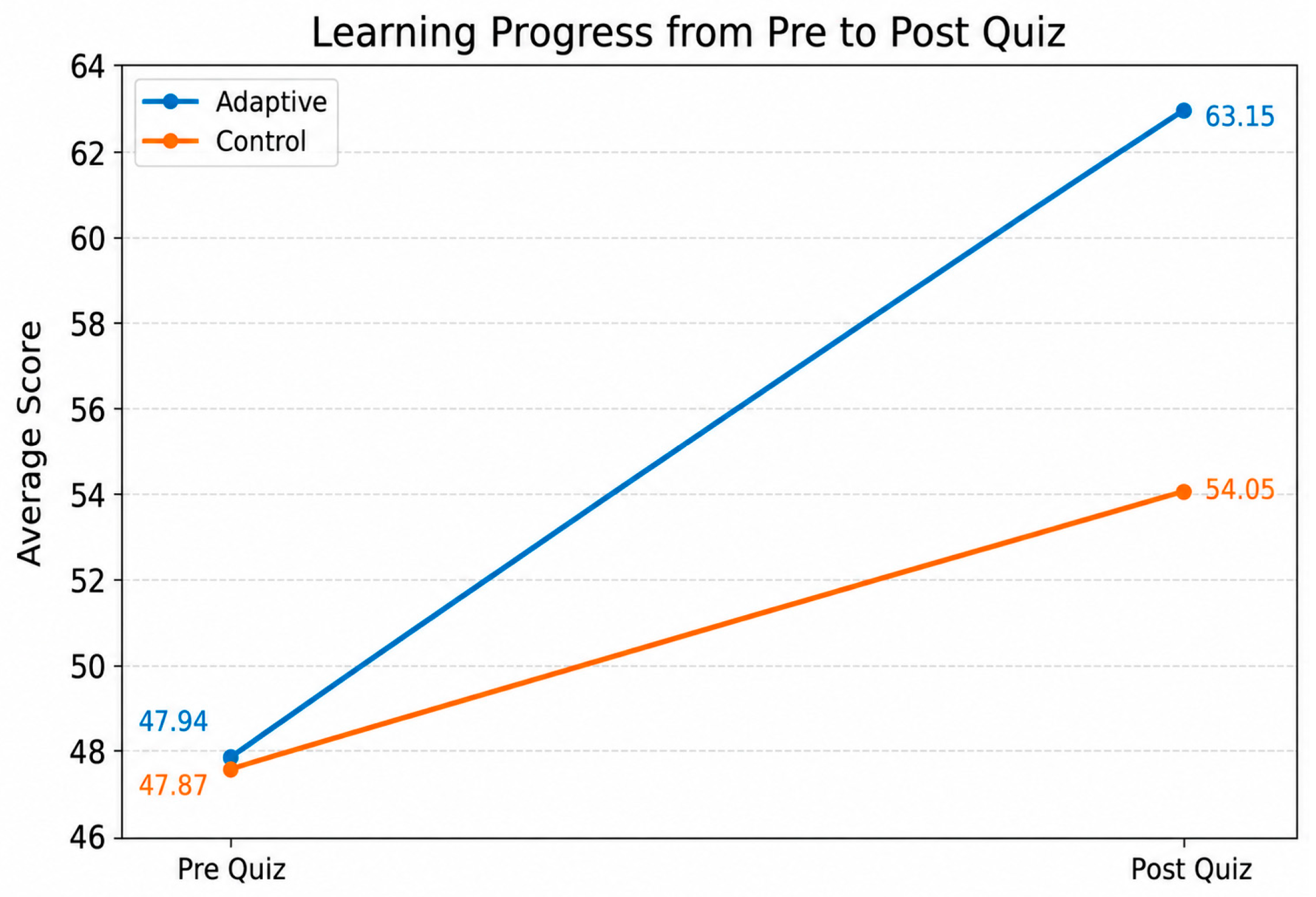
Mean pre-quiz score ≈ 47.95
Mean post-quiz score (adaptive) ≈ 63.15
Mean engagement score ≈ 70
Mean behavior score before ≈ 65
These baseline statistics confirm that both groups started from comparable initial conditions, which supports the validity of subsequent comparisons.
3.2. Classification Model Performance
The Random Forest classifier performed exceedingly well in predicting student understanding levels. Evaluation metrics are summarized in
Table 1.
The model accuracy is defined as:
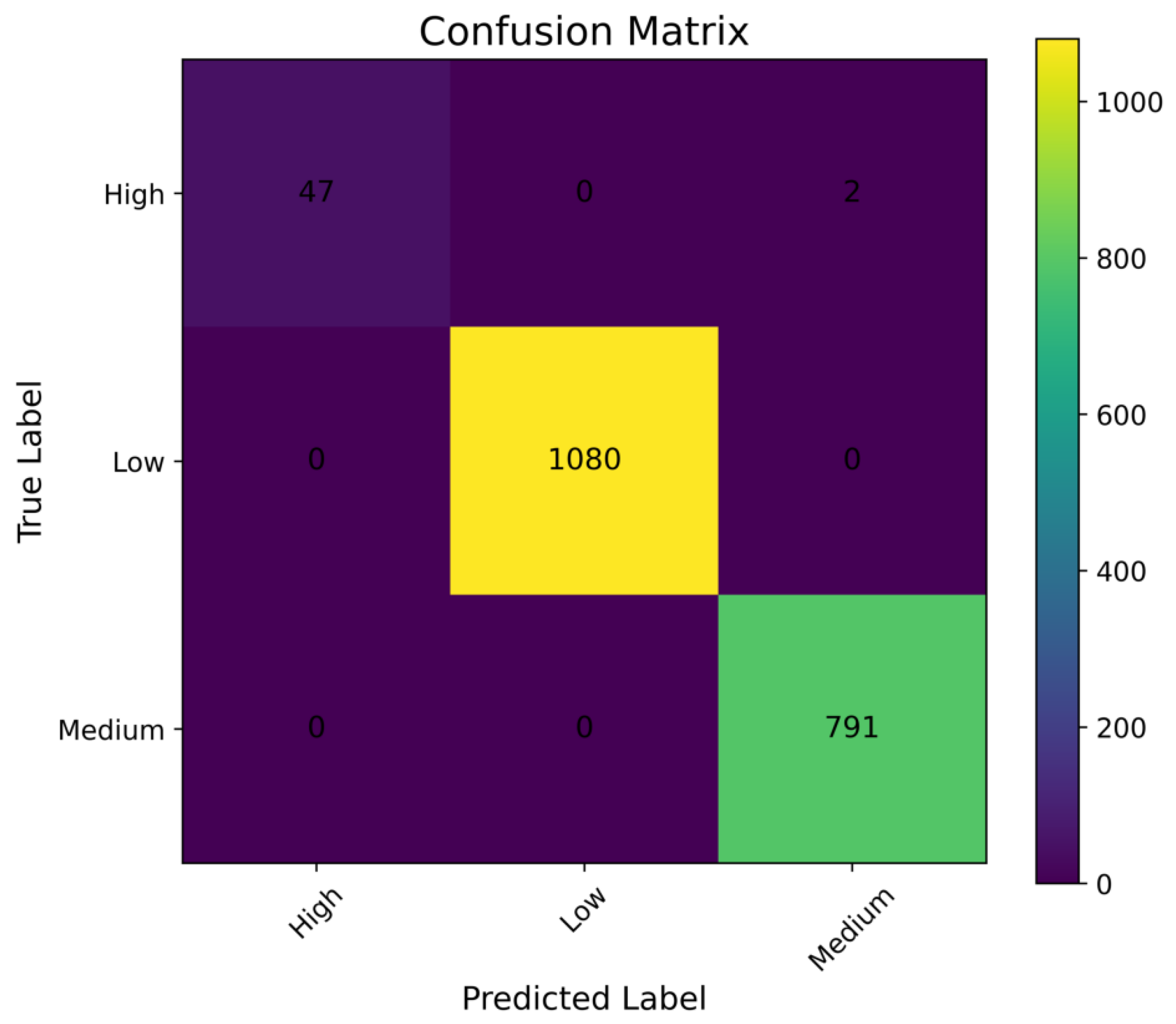
The extremely high performance indicates strong separability of the feature space. This suggests that variables such as quiz score, engagement, and environmental interest are highly predictive of student understanding. The confusion matrix in
Figure 1 illustrates classification performance across classes.
The matrix shows:
1080 correctly classified Low cases
791 correctly classified Medium cases
47 correctly classified High cases
Only 2 misclassifications
This confirms that classification errors are minimal and occur mainly between adjacent classes.
3.3. Group-Level Learning Outcomes
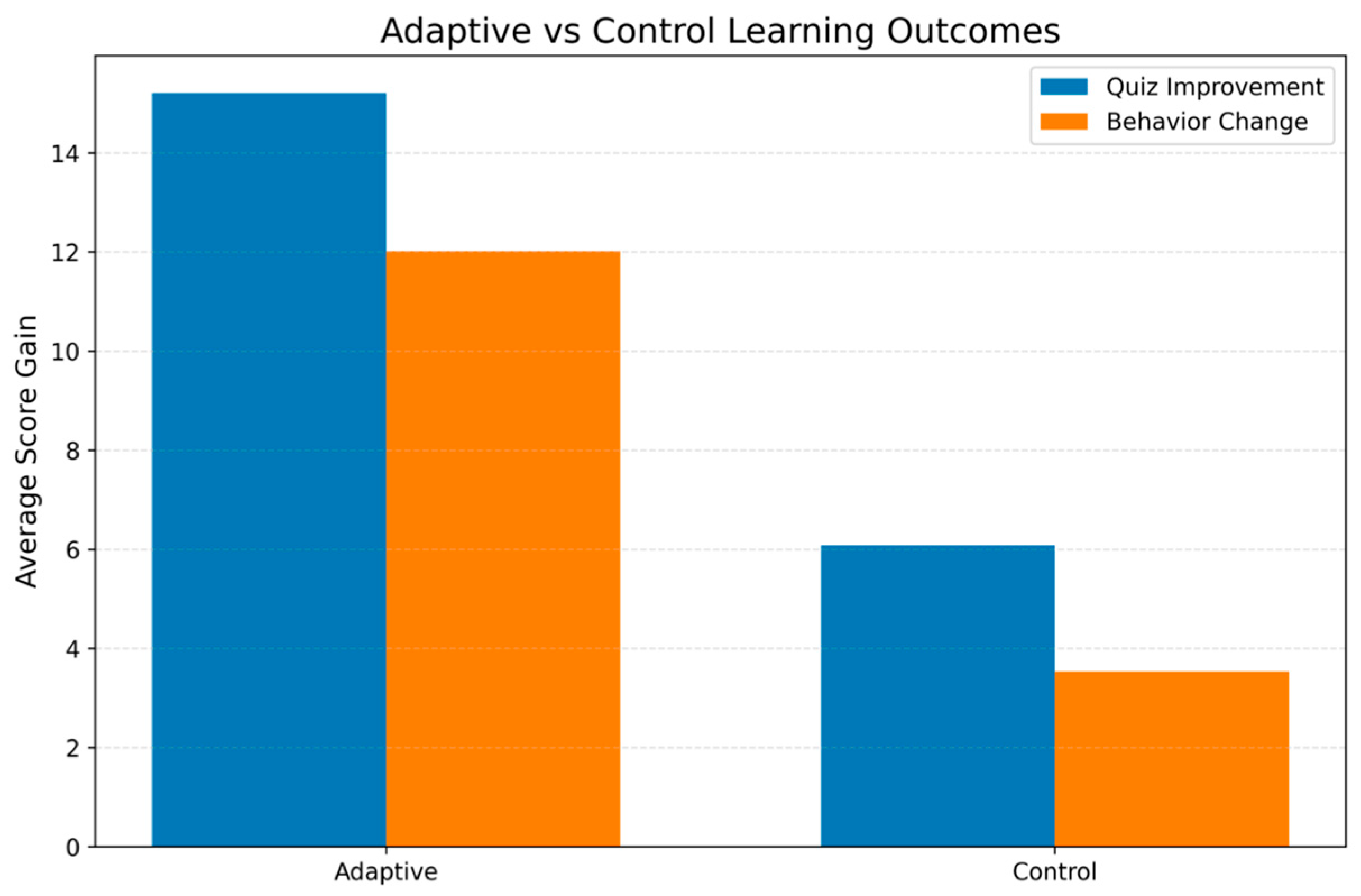
A comparison between adaptive and control groups reveals substantial differences in learning performance and behavioral change. The results are summarized in
Table 2.
The difference between groups is:
Within the simulation environment, the adaptive learning pathway produced greater predicted improvements in both quiz performance and sustainability-related behavior compared with the static learning pathway. The simulated adaptive group showed larger relative gains across both measures, suggesting the potential value of personalized learning strategies under the defined experimental conditions. These simulation outcomes are illustrated in
Figure 2, where the bar chart visually compares the relative differences between the adaptive and static groups. However, these results should be interpreted as illustrative outputs of the proposed framework rather than empirical evidence of actual student learning or behavioral change.
3.4. Distribution of Learning Gains
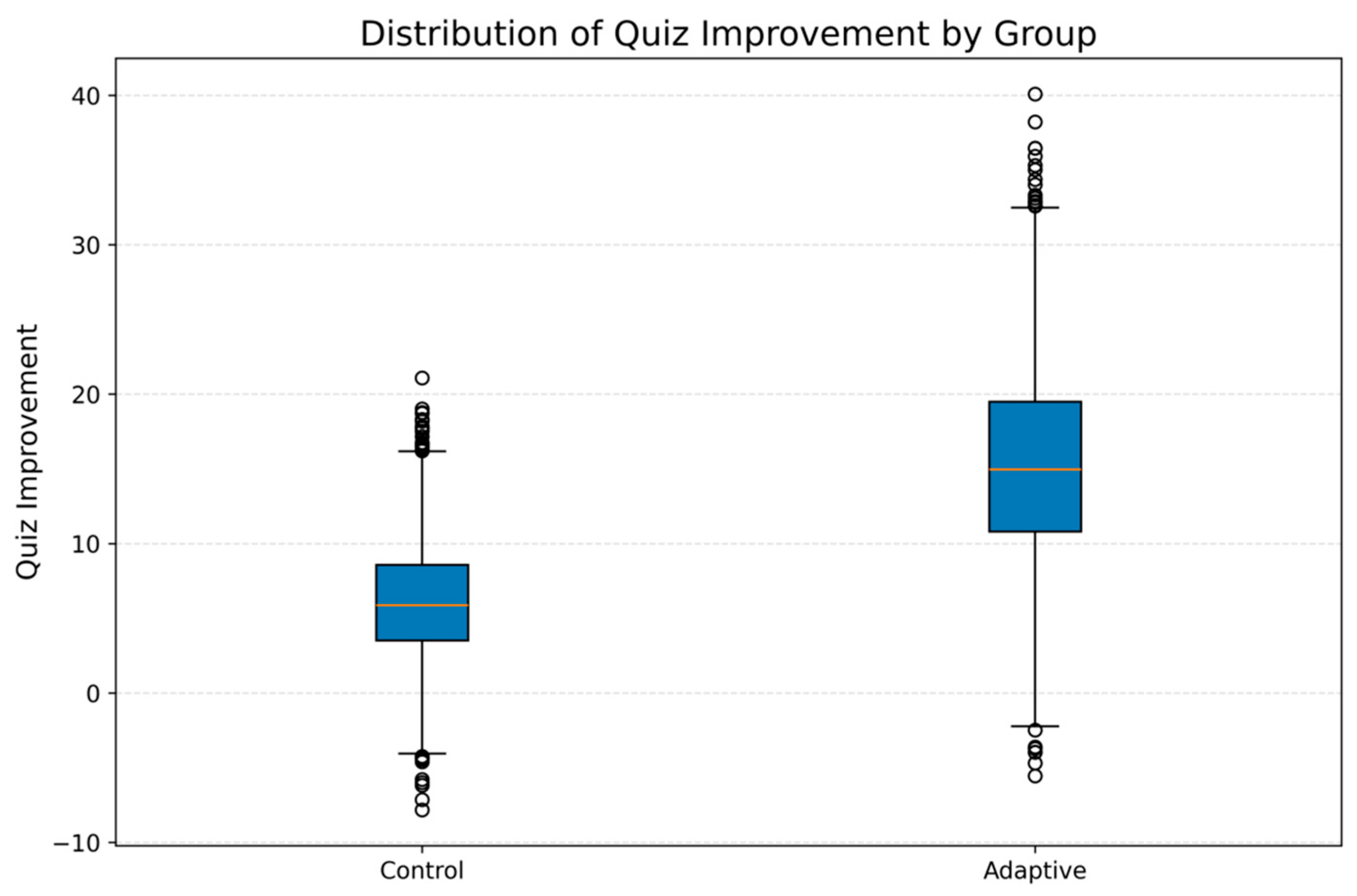
To examine the variability and distribution of improvements, multiple distribution plots were generated. The boxplot in
Figure 3 presents the spread of quiz improvement across groups.
The adaptive group shows:
Higher median
Wider upper range
More high-value outliers
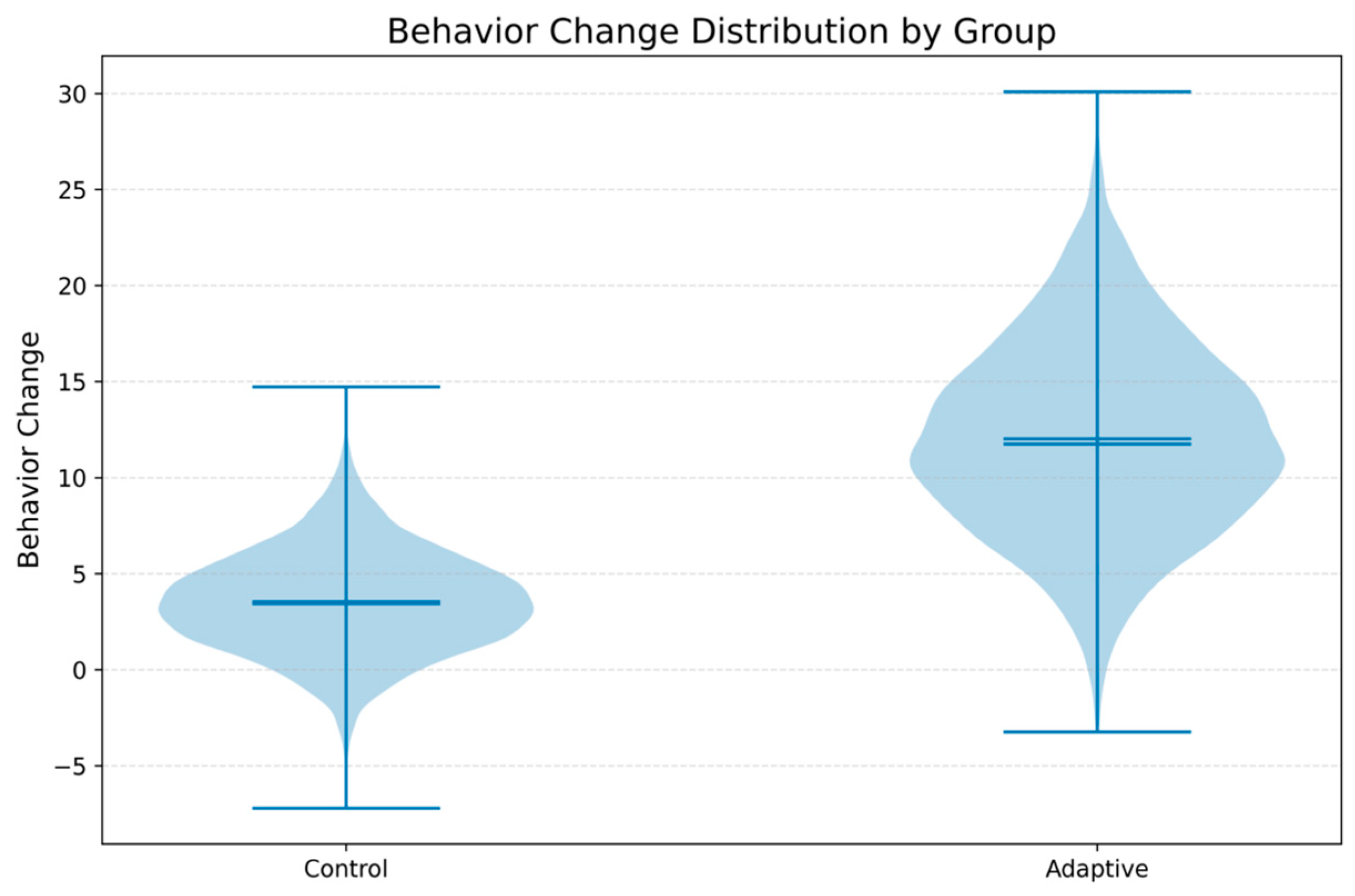
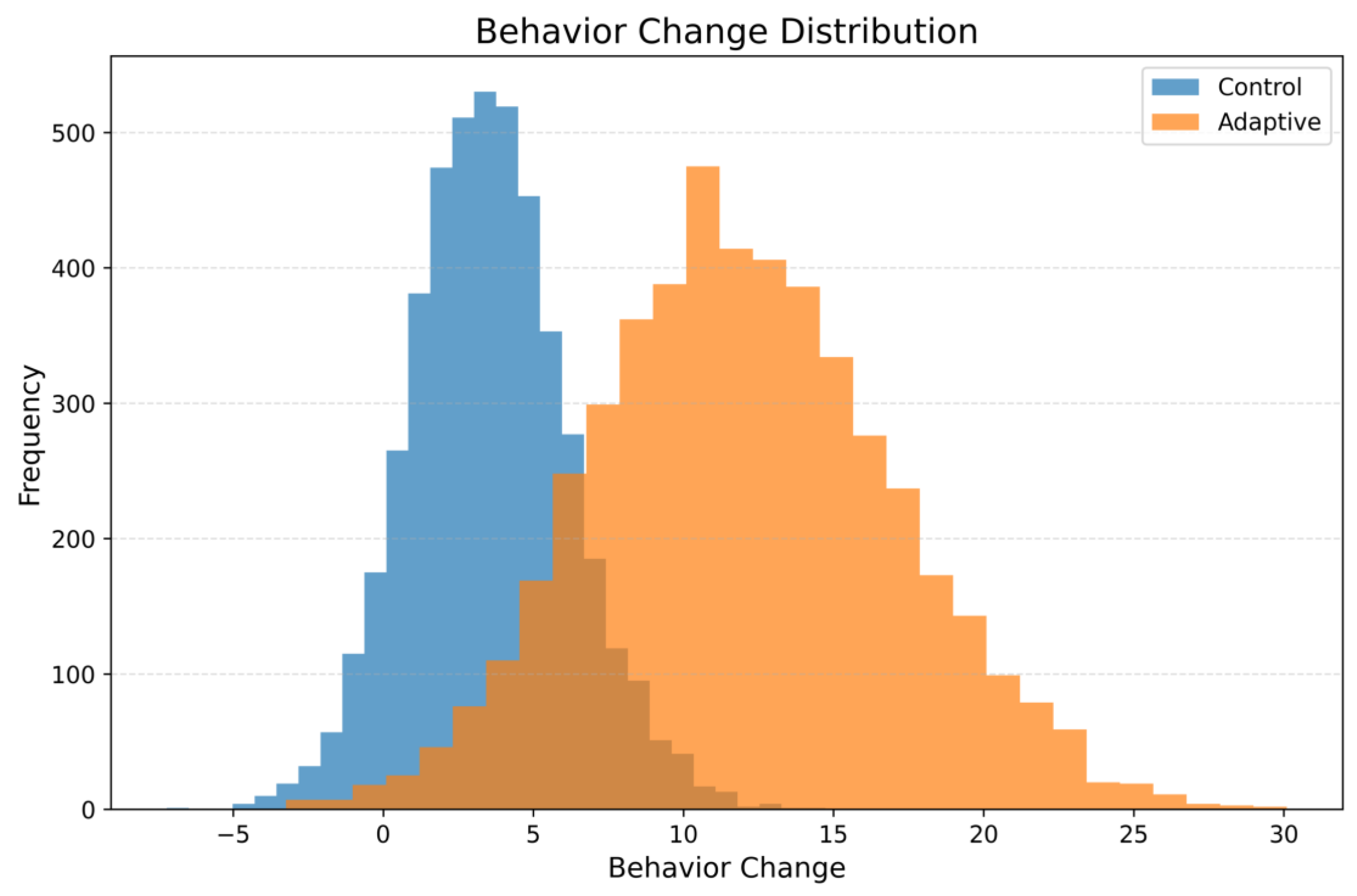
This indicates stronger and more consistent performance gains. The violin plot in
Figure 4 shows the behavior change distribution.
The adaptive group distribution shows an upward shift because of increased concentration which occurs at larger gain values. The results demonstrate that all students in the study show behavioral improvement instead of only some students displaying this effect.
3.5. Topic-Level Performance Analysis
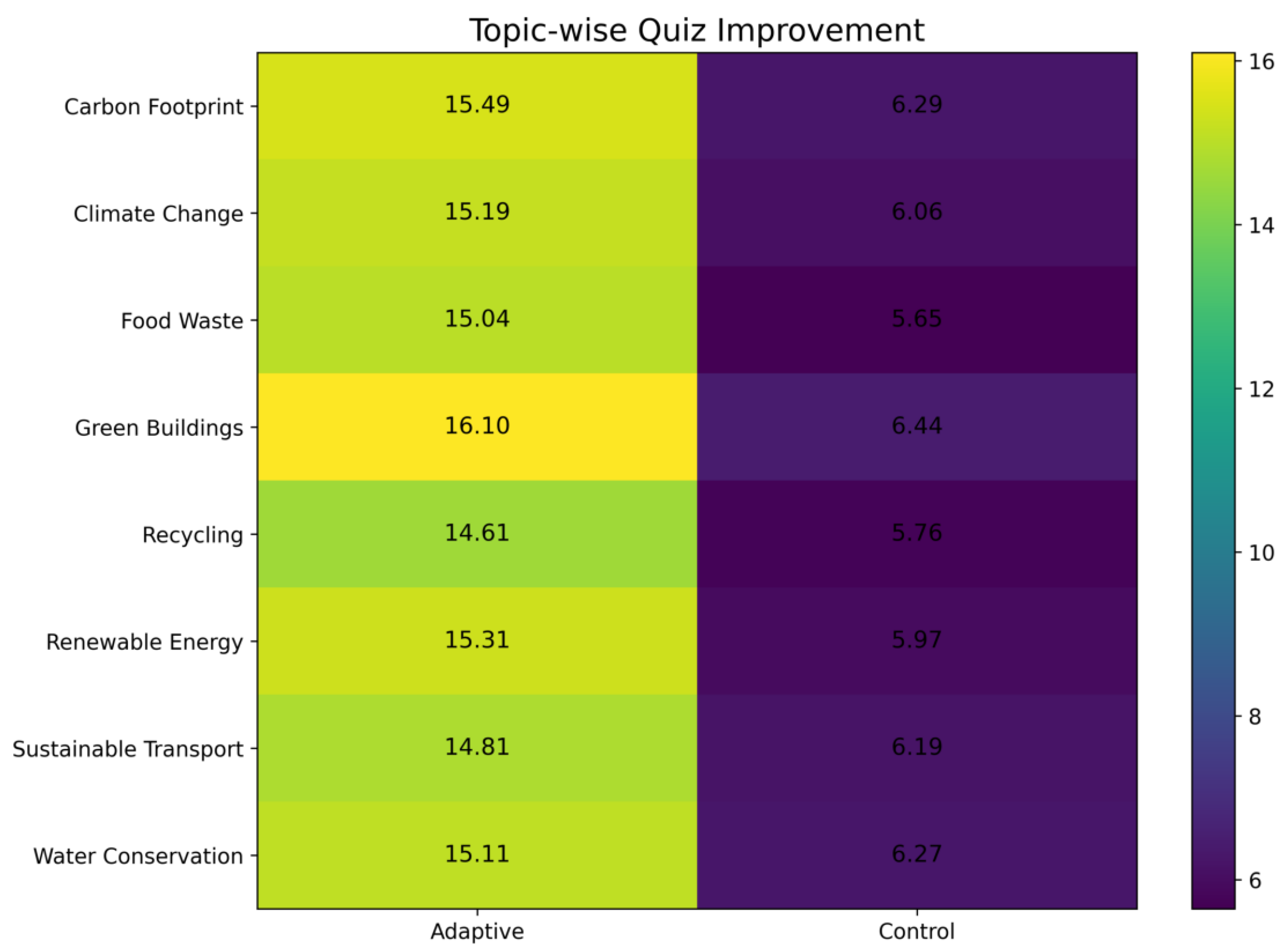
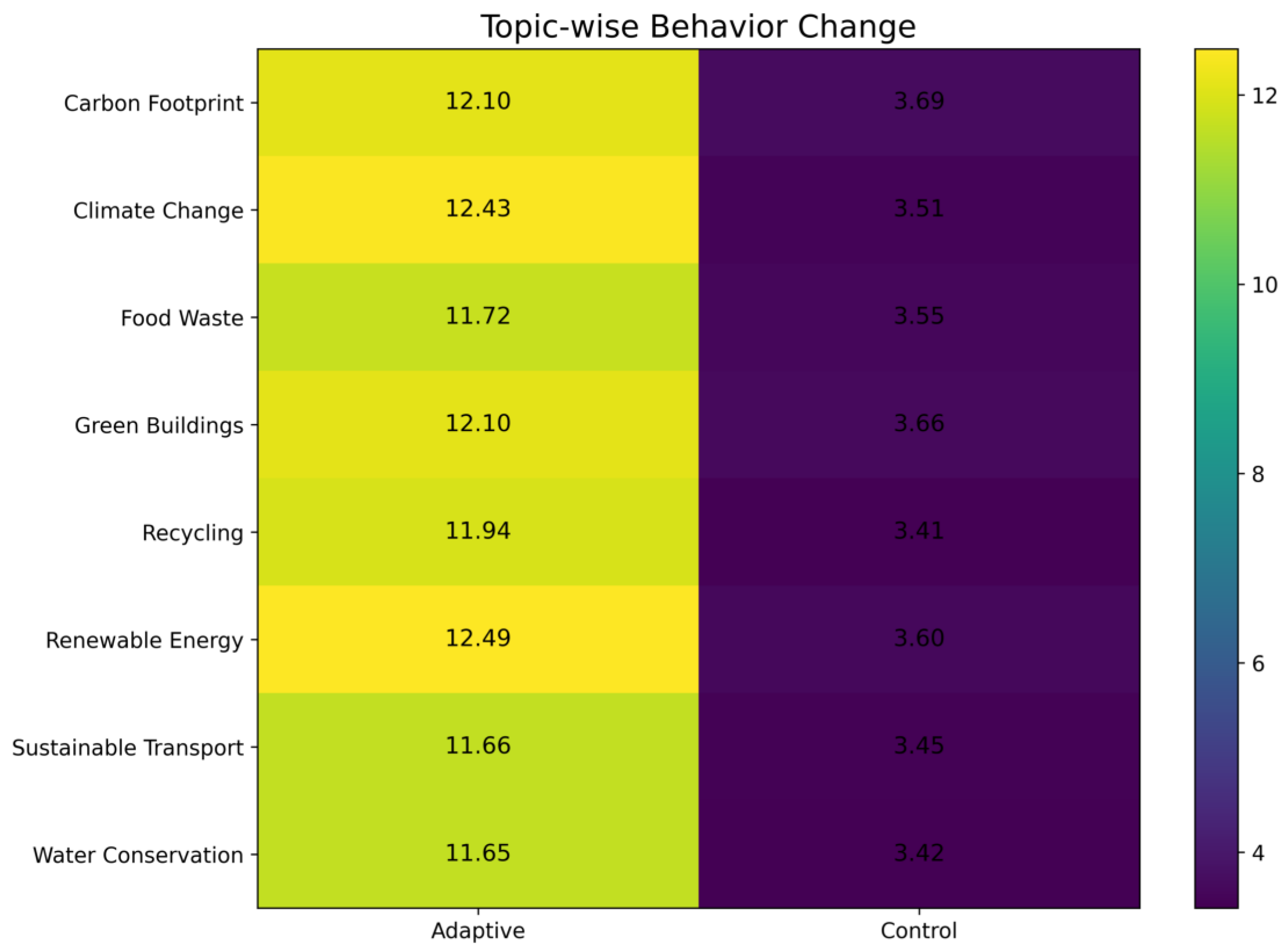
Topic-level analysis was conducted to examine whether improvements were consistent across sustainability domains. The results are visualized in
Figure 5 and
Figure 6.
The highest improvements were observed in:
Green Buildings ≈ 16.10
Climate Change ≈ 15.19
Renewable Energy ≈ 15.31
The lowest improvements still exceeded control group performance, confirming robustness of the adaptive approach.
3.6. Engagement and Learning Relationship
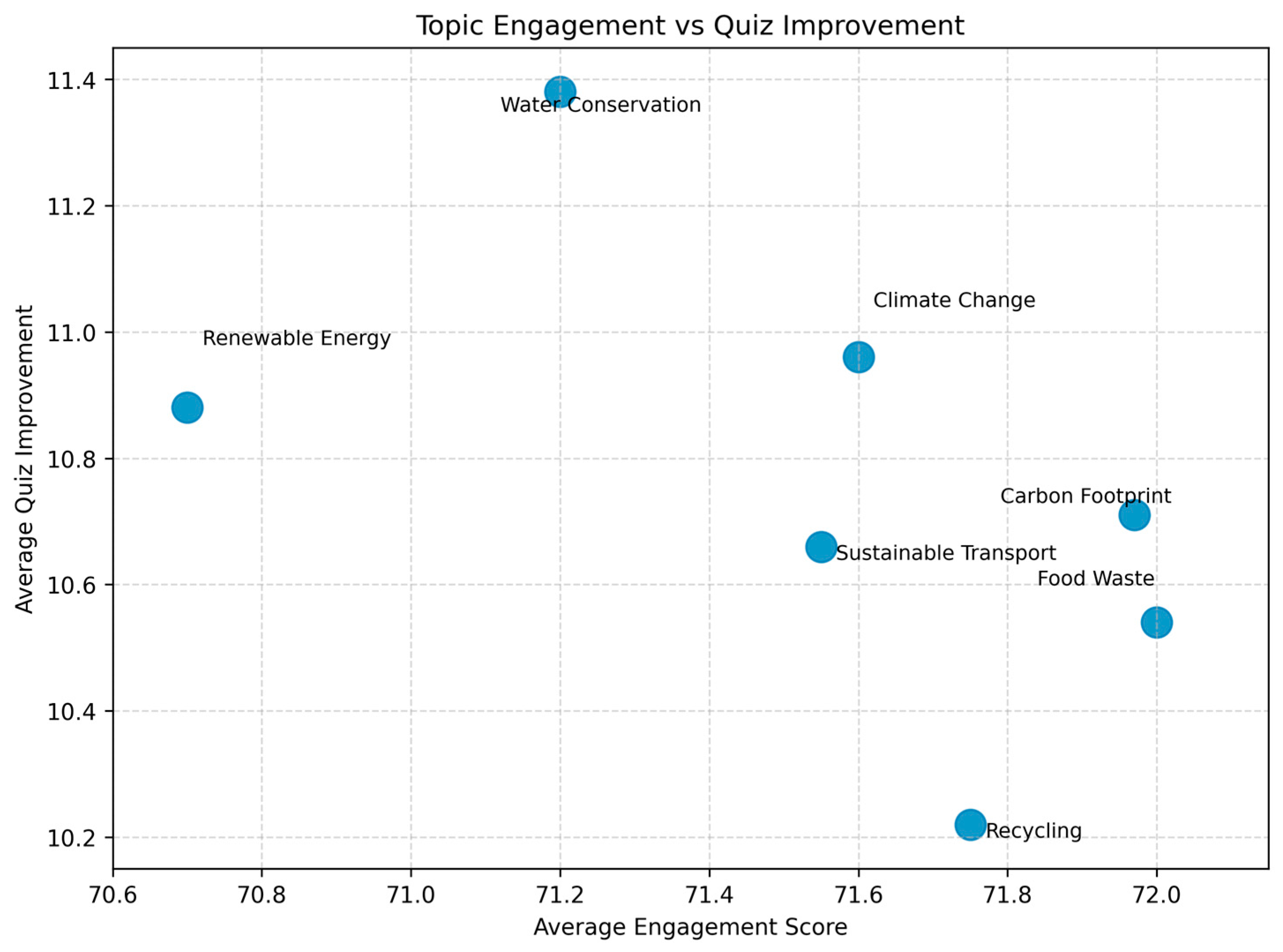
The relationship between engagement and performance was analyzed using a bubble chart in
Figure 7.
Each point represents a topic, with bubble size reflecting behavior change.
This confirms that engagement is a key driver of learning outcomes.
3.7. Multivariate Comparison Across Indicators
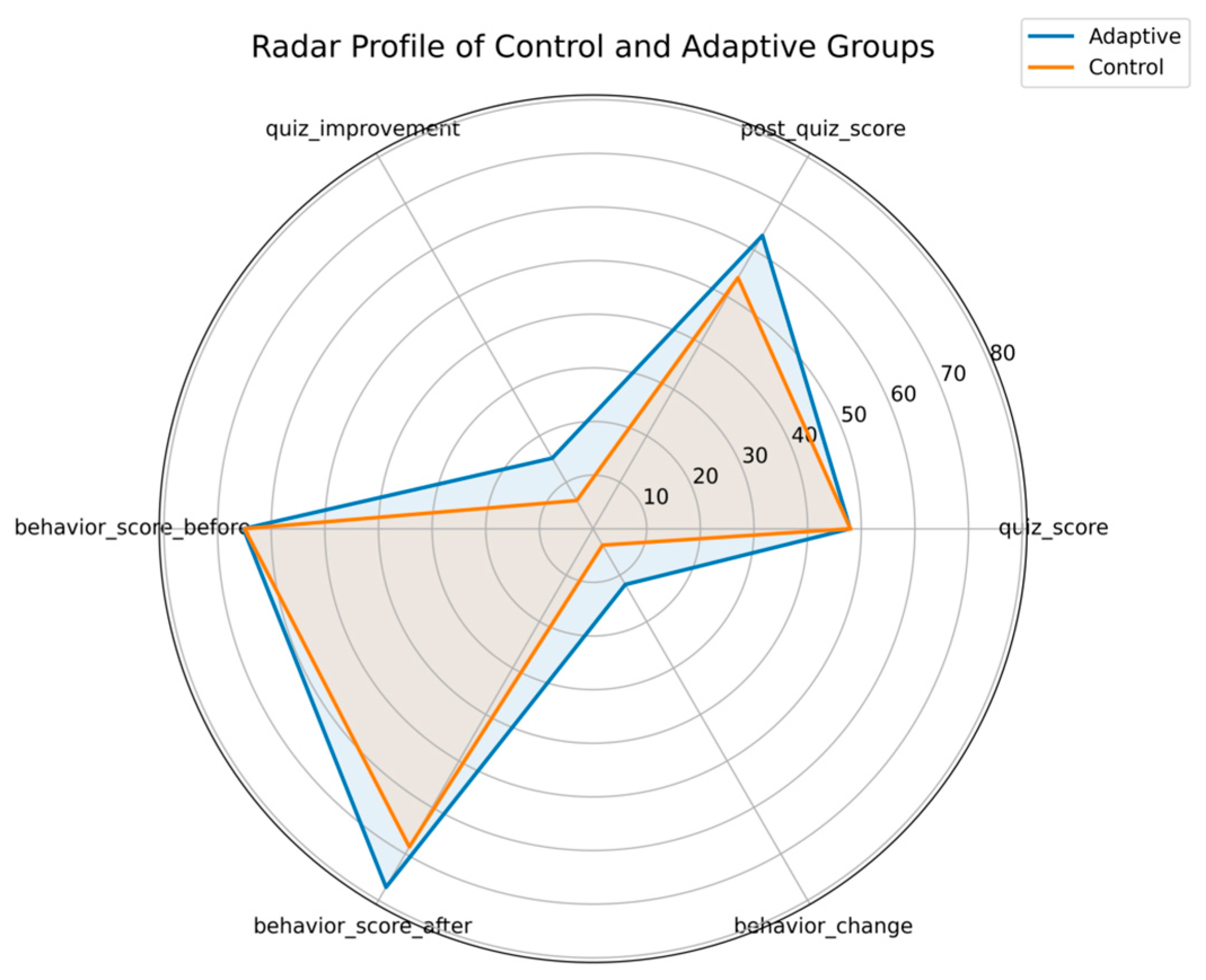
A radar chart was used to compare multiple indicators simultaneously (See
Figure 8).
The adaptive group dominates across all axes:
Post quiz score
Quiz improvement
Behavior after learning
Behavior change
This demonstrates consistent superiority across all measured dimensions.
3.8. Learning Progress Analysis
The slope chart in
Figure 9 illustrates learning progress from pre-quiz to post-quiz.
The adaptive group shows a steeper slope:
compared to:
This confirms stronger learning progression under adaptive conditions.
3.9. Feature Importance Analysis
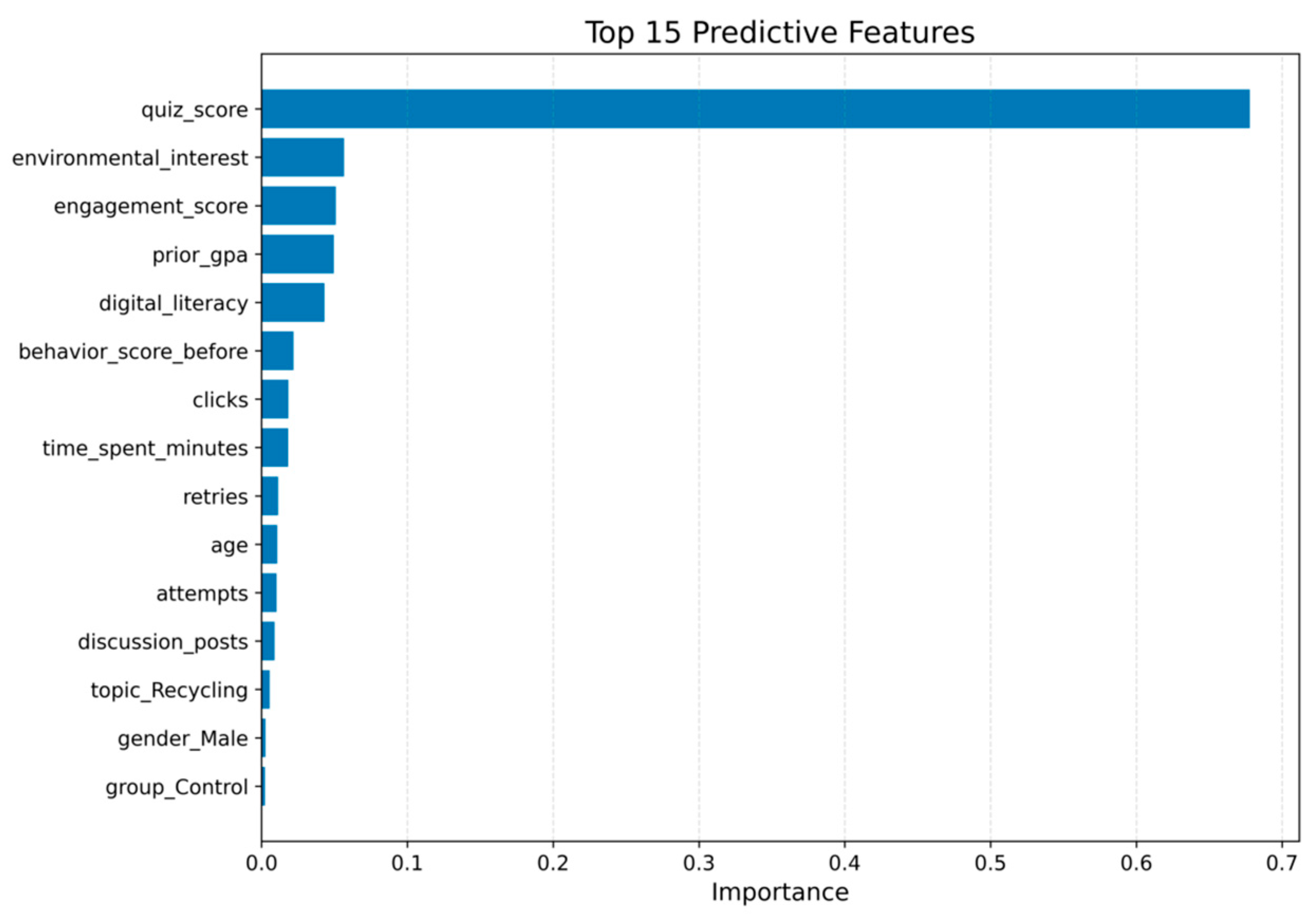
Feature importance was computed using Random Forest impurity reduction (See
Figure 10).
The most important feature is:
Other significant features include:
Environmental interest
Engagement score
Prior GPA
Digital literacy
This indicates that both academic and behavioral features influence prediction.
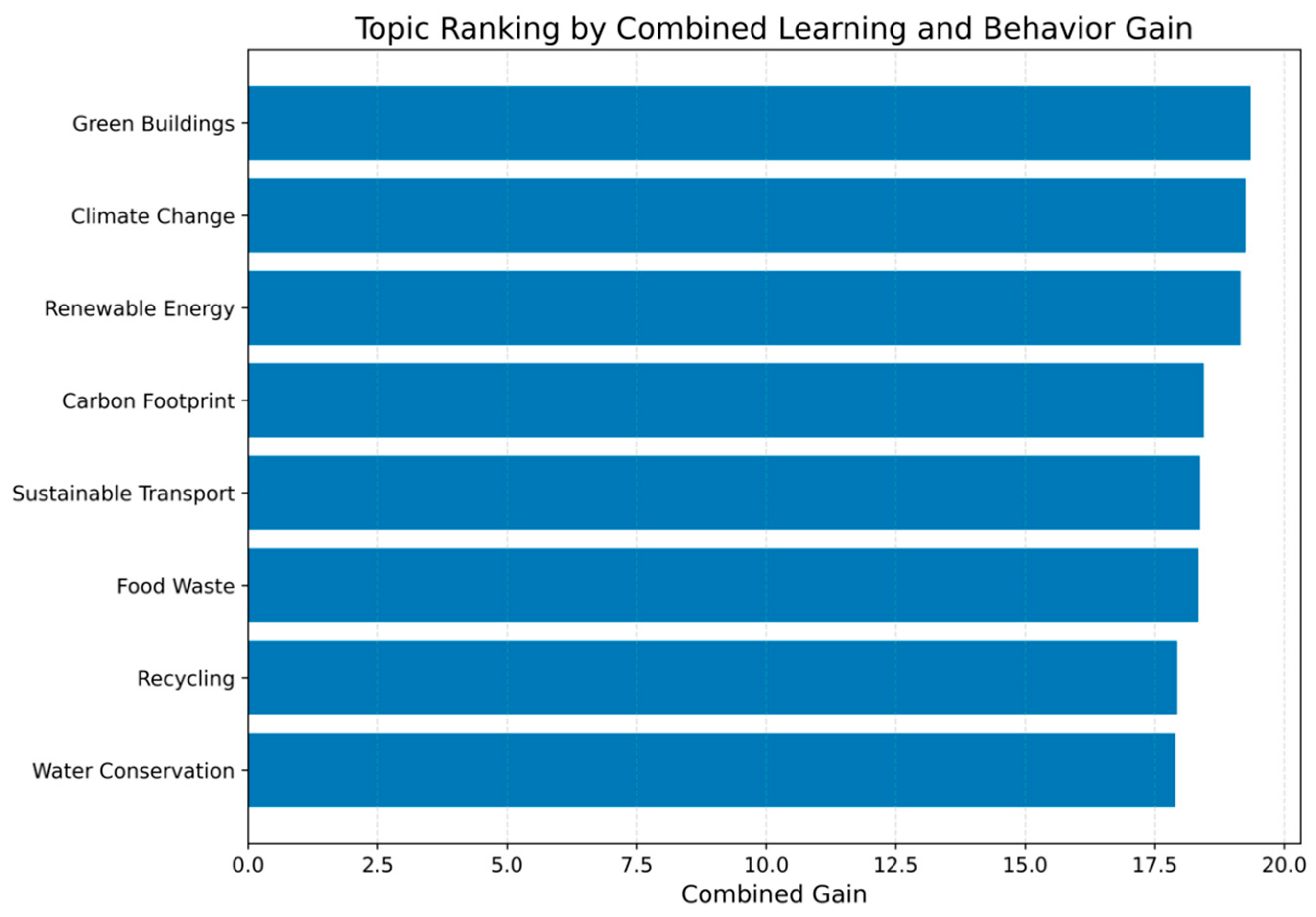
3.10. Topic Ranking
Topics were ranked based on combined learning and behavior gains (See
Figure 11).
The ranking is computed as:
Top topics:
Green Buildings
Climate Change
Renewable Energy
These rankings highlight which sustainability topics benefit most from adaptive learning.
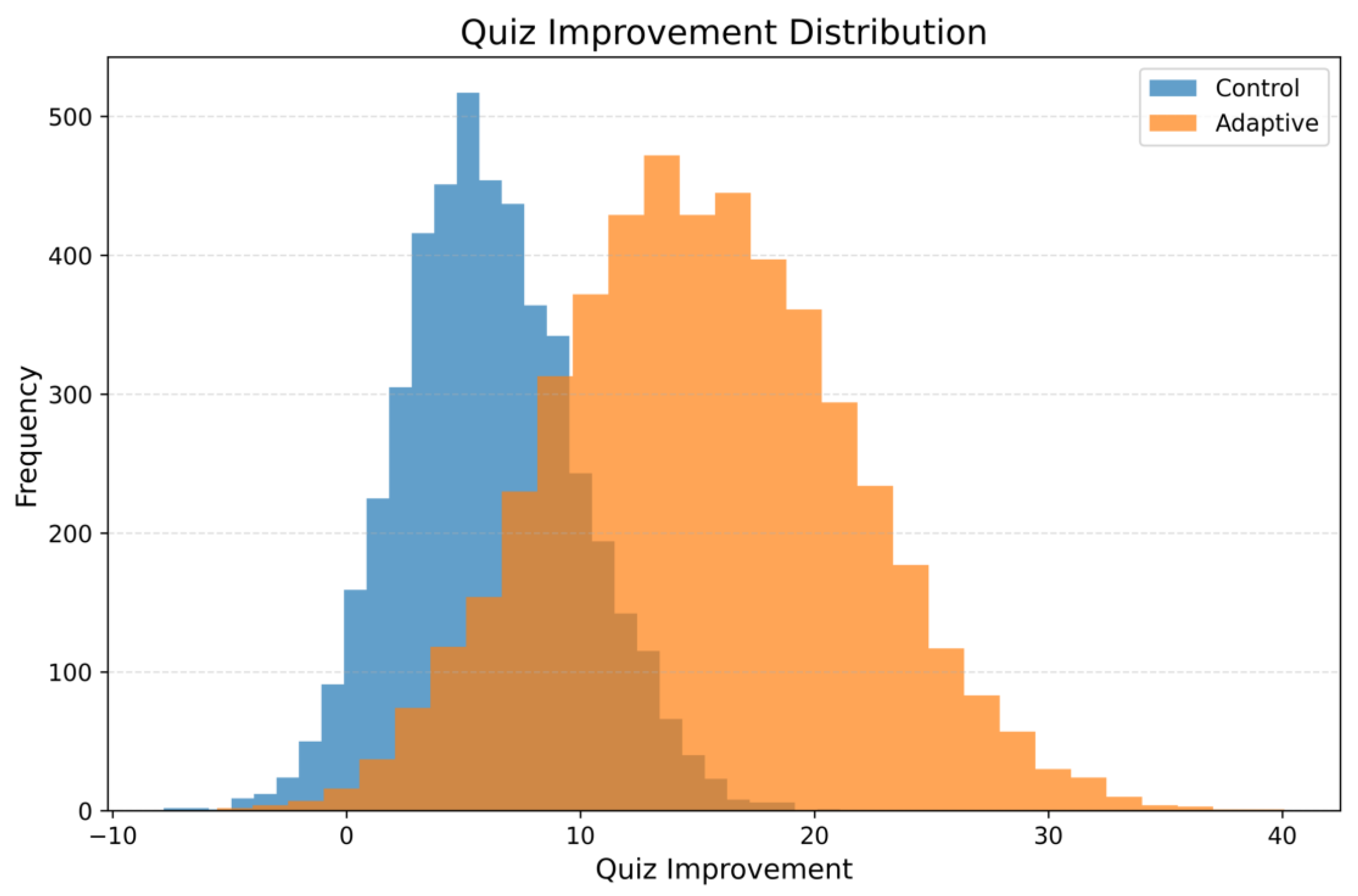
3.11. Distribution Analysis
The adaptive group distributions shift rightward, indicating higher gains across the population.
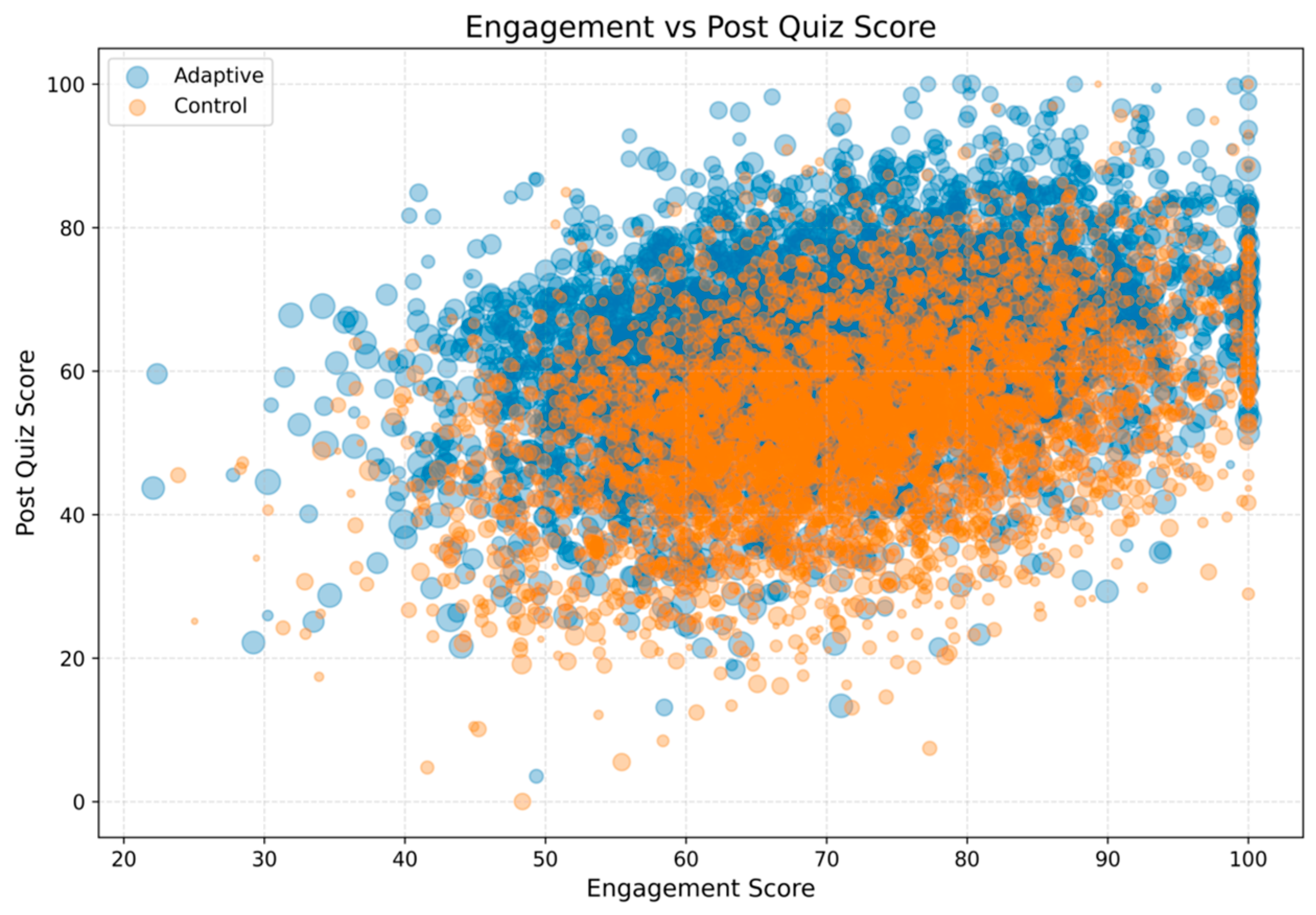
3.12. Engagement vs. Performance Relationship
Scatter plot analysis is shown in
Figure 14. The plot shows:
Adaptive group points dominate the higher region, indicating better outcomes at similar engagement levels.
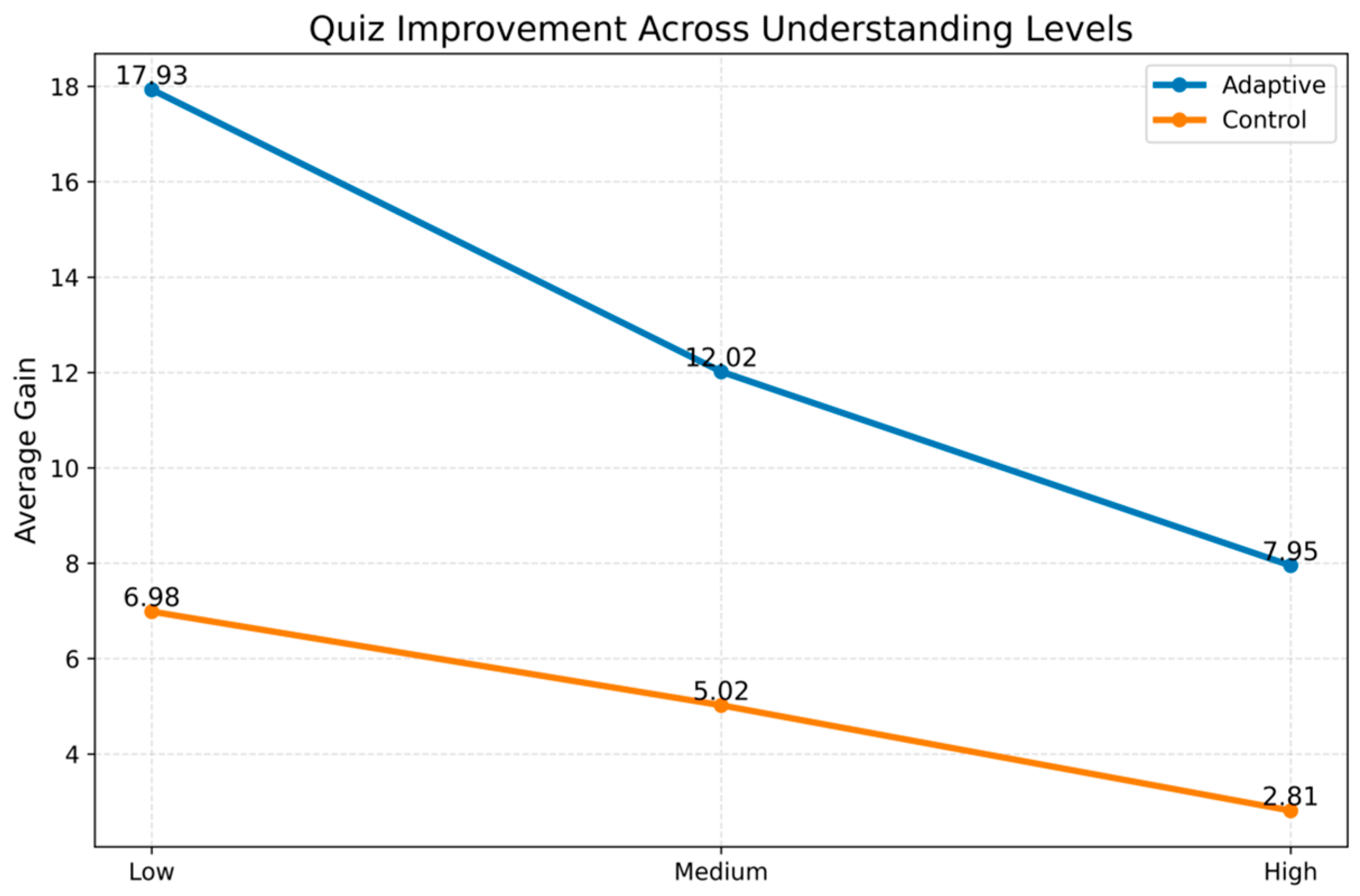
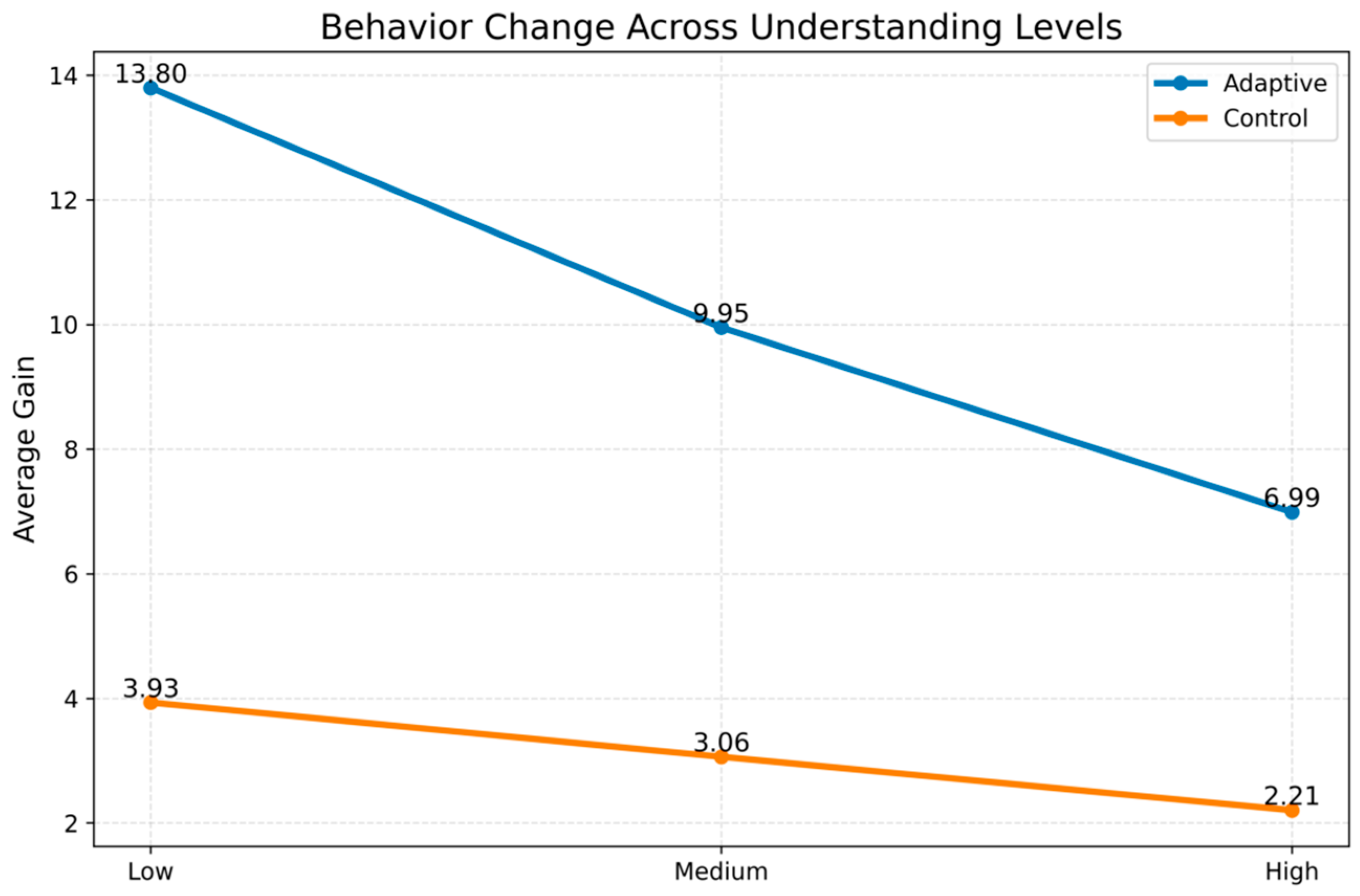
3.13. Understanding-Level Analysis
Performance was analyzed using the initial understanding level (See
Figure 15 and
Figure 16). Results show:
This confirms that adaptive learning reduces learning gaps.
The outcomes evidence three main results that highlight the strength of the proposed framework. First, as can be seen in
Figure 6, the prediction model performed practically perfectly, reaching 1.00 for all performance measures, including accuracy, precision, recall and F1 on distinguishing between understanding levels of students. These selected features’ temporal coupled states representations of those such as quiz performance, engagement behavior, and environment interest is highly informative about student learning states. This result is also visible in the confusion matrix, where almost all samples are correctly classified but for a few that are misidentified across adjacent classes. Second, the adaptive learning method resulted in significant improvements in academic performance and behavior related to sustainability. Students assigned to the adaptive group saw over twice the improvement on quiz performance compared to those in the control and their behavior change scores were significantly higher. Such results show that ideas based on personalization through predictive analytics can improve learning and lead to actions that you can quantify.
The adaptive framework provided its greatest advantages to students who started with minimal knowledge according to our extended study. The results showed that adaptive intervention helped learners to achieve their highest progress because they showed better results in quizzes and behavioral development. The students who required assistance the most received higher benefits from personalized learning than the other two student groups who had medium and high knowledge levels. The pattern demonstrates how adaptive learning functions as a tool for advancing fairness and inclusion in sustainability education. The results demonstrate that the adaptive group achieved better results than the control group in all evaluation metrics which can be expressed as Adaptive > Control ∀ metrics. The proposed framework proved successful because it demonstrated superior results in both academic and behavioral assessments, which showed its capability to serve as a solution that can expand sustainability education for university students.
4. Discussion
The research presents an experimental machine learning system which uses adaptive technology to create customized sustainability education tracks while estimating various learning outcomes and behavioral patterns through testing. The system demonstration proves that the proposed method can combine supervised learning with adaptive educational recommendations to create measurable differences in learning pathways which operate under both adaptive and static modes. The entire simulation process used synthetic data instead of authentic student records which resulted in the simulation failing to demonstrate actual student learning and true behavioral transformation and genuine educational value. The observed enhancements demonstrate how the simulation environment operates which explains why they should not be considered actual educational results. The upcoming validation process needs to use actual student groups along with extended academic records and controlled research experiments to assess whether adaptive personalization leads to sustained progress in understanding and participation and sustainability-related actions within various educational environments.
The observed improvements match existing research about adaptive learning and artificial intelligence in education because research shows that personalized learning systems improve student engagement and performance together with self-regulation, when educational systems are used correctly. Luckin and Wayne [
38] show that AI systems enable students to learn according to their individual requirements through customized educational content. The research of [
34] shows that adaptive systems improve student learning results through their capacity to deliver prompt evaluation together with precise educational resources. The research of [
30] shows that higher education institutions use artificial intelligence to forecast student achievements and create personalized learning experiences, which have shown effective results in multiple educational fields. The studies provide theoretical and empirical support for the potential effectiveness of the proposed framework, even though direct validation is not conducted in the current study.
The adaptive system which we propose to design will support adult learning through its implementation of andragogical principles which allow learners to create their own study paths through material which relates to their needs. Adaptive systems enable learners to progress at their own pace which includes receiving customized guidance while they work on improving their specific skill deficiencies. The research conducted by [
23] demonstrates that specialized adaptive learning systems in higher education improve academic results and student participation when these systems follow principles which put the learner at the center of design. The field of sustainability education requires personalized feedback which connects to real-life situations because it needs ongoing support to create lasting behavioral changes.
The study shows significant limitations because of its existing research connections. Synthetic data usage prevents researchers from achieving direct causal links and broader educational outcome results which apply to practical learning situations. The dataset creates educational scenarios which simulate real-life conditions but fails to replicate the complete range of human learning behavior which consists of motivation, social interaction and environmental factors. The simulation process attempted to reduce bias, but the controlled data generation method still affects the results which researchers observe. Real-world data validation is necessary for proving the reliability and effectiveness of AI-based educational systems according to previous research findings.
The effectiveness of adaptive learning systems depends on the context which defines their learning environment. Previous research shows that AI-driven systems produce different results based on four elements which include course design and delivery mode and institutional support and learner characteristics. Adaptive systems show different performance results according to the online and face-to-face learning environments and the various levels of prior knowledge held by learners. The future research needs to study how contextual variables affect learning gains which occur throughout the learning process and their long-term effects.
The implementation of adaptive learning systems requires consideration of ethical factors which have a major impact on their development and use. Large-scale systems that operate over extended periods face increased difficulties in addressing fairness issues and maintaining transparent operations and protecting user data. The monitoring process needs to continue because adaptive models must remain free from introducing biases which create different educational results for various student groups. The system requires transparent models which generate understandable recommendations to establish user trust and provide educators with insights into the recommendation process. The system needs to safeguard student data through strong security measures which protect sensitive information during extended time periods of data usage.
The upcoming research work needs to test the proposed framework through actual data from real-world situations and through systematic scientific experiments. The research requires longitudinal studies to determine whether adaptive interventions produce permanent changes in behavior and whether the observed improvements maintain their effectiveness over time. The framework needs cross-context testing to determine its effectiveness in various educational environments. The system will become more trustworthy and usable through the combination of explainable AI methods and ethical protection systems.
5. Conclusions
Higher education institutions now prioritize sustainability education because students need to learn environmental and societal problem-solving skills. Traditional teaching methods fail to fulfill their educational goals because they provide identical content to students while testing only their mental abilities without improving their skills. The present situation shows that people understand sustainability, but they fail to take practical measures in their daily lives. The researchers developed a solution to this problem through their design of an adaptive machine learning framework which combines sustainability learning system elements into a single system for evaluation and prediction and personalized learning. The results presented in this study were generated within a controlled simulation environment using a synthetic dataset and a machine learning-based adaptive framework. Therefore, the findings should be interpreted as proof-of-concept outputs that demonstrate the operational behavior and feasibility of the proposed system rather than empirical evidence confirming real-world educational effectiveness. The Random Forest model achieved near-perfect classification performance, with an accuracy of 0.999 and an F1-score of 0.9989, demonstrating that student understanding of sustainability topics can be predicted with high reliability using academic, behavioral, and engagement features. The adaptive learning framework delivered significant advancements to academic outcomes and environmental sustainability practices. The adaptive group achieved a mean quiz improvement of 15.21 compared with 6.08 in the control group, and a mean behavior change of 12.02 compared with 3.54 in the control group. The results demonstrate that personalized learning methods help students acquire knowledge while fostering their ability to make significant changes in their behavior. The research discovered that adaptive learning systems create different effects on students who learn through them. The students who had the least knowledge at the start of their studies showed the greatest benefits from personalized learning because they achieved better quiz results and changed their study habits more than students in the control group. The research results demonstrate that adaptive learning systems function as essential tools which help bridge educational gaps while assisting learners who need extra teaching assistance. The results demonstrated that all sustainability topics showed steady progress because the adaptive framework proved effective in all content areas. The findings result in important educational outcomes which affect both teaching methods and research work. The study proves that educational institutions can improve sustainability education through personalized learning methods which use data analysis. Universities can apply learning analytics together with machine learning models to assess student requirements and create specific educational materials which will enhance student performance while promoting sustainable practices. The study demonstrates how learning environments can benefit from using predictive models together with adaptive recommendation systems. The framework enables educational institutions to implement their scalable solution which functions within learning management systems and smart campus systems. The results show that educational institutions should establish measurable standards for sustainability education because they need to evaluate both student knowledge acquisition and their behavioral development. The study presents valuable findings to the research field but has multiple existing shortcomings. First, the dataset used in this research was synthetic, which means that although it was designed to reflect realistic educational patterns, it does not capture all the complexities of real-world learning environments. The researchers used a controlled simulation to evaluate their model which requires validation through real institutional data to establish its ability to function in different contexts. The adaptive recommendation mechanism used predefined rules for content adaptation which restricted its ability to create customized learning experiences. The researchers used simulated scores to demonstrate behavioral changes instead of monitoring actual physical movements which may vary from what occurs during real-world situations. The present restrictions of the framework require testing through its application in authentic educational settings which should become its next research focus. The project needs to gather information from real students while developing an integrated system for learning management systems that will enable testing in actual classroom environments. Future research can investigate advanced machine learning models which include gradient boosting and deep learning and hybrid architectures to enhance prediction and adaptation capabilities. The implementation of reinforcement learning approaches will create dynamic recommendation systems which use student feedback and performance data to refresh content. The integration of actual behavioral data, including energy consumption and recycling participation and sustainability application usage, represents a crucial research path for obtaining better results in measuring behavioral transformations.
The research shows that the adaptive machine learning system works as designed through its tests in simulated environments, yet the results do not provide proof of actual performance in real-world situations. The study uses artificial data which leads to results that display the simulation’s specific features instead of showing real student behavior from authentic educational settings. The research demonstrates predictive modeling methods through its implementation in adaptive sustainability education systems which show how the system functions. The framework needs testing with actual educational data and experimental research to determine its effects on student learning and behavioral development in different school environments.
The future work will build its activities to develop a complete ethical framework which will guide the use of adaptive learning systems in educational research that spans extensive time periods and large population groups. The research will focus on fairness through its upcoming studies which will assess the distribution of performance improvements among different student groups by using continuous monitoring methods. The research will create interpretable models which will generate explainable systems that show users how they produce recommendations and how those recommendations change in different learning environments which include online, blended, and face-to-face environments. The upcoming research will develop data security solutions through the implementation of strong data protection measures which include encryption methods, anonymization techniques, and restricted access procedures to protect sensitive student information during extended periods of data collection and research analysis. The proposed research directions will enable researchers to assess sustained intervention impacts more accurately while the research will examine how different contextual elements affect both learning progress and achievement stability.