1. Introduction
Disasters continue to test the capacity of households, communities, and public institutions to cope with disruption. In this context, actual household disaster preparedness is an important component of sustainable community resilience, because prepared households are better able to withstand, adapt to, and recover from shocks, while also reducing pressure on public response systems [
1,
2]. In this paper, sustainable community resilience is understood as a community-level expression of community sustainability, referring to the capacity of communities to maintain essential functions and adapt over time in the face of disruption. It is used in a narrower sense than sustainable development, which encompasses broader environmental, economic, and social development goals. Research has identified many factors associated with disaster preparedness, including prior experience, risk perception, preparedness knowledge, social capital, institutional and community support [
1,
3,
4,
5]. At the same time, studies increasingly distinguish between perceived preparedness and actual preparedness, showing that people may feel prepared without necessarily having taken concrete preparedness actions [
6,
7]. This distinction is important because interventions that raise confidence or awareness may not automatically strengthen actual preparedness.
An important gap remains, however, in understanding how perceived preparedness becomes actual household disaster preparedness. Existing studies have often examined either subjective perceptions or objective preparedness measures, but have paid less attention to the social and attitudinal mechanisms that connect them. Yet sustainable community resilience depends not only on whether people believe they are prepared, but also on whether they trust institutions appropriately, participate in civic networks that support preparedness, and possess the social and motivational capacities needed to translate preparedness beliefs into action [
3,
8,
9]. The literature also suggests that these pathways may not operate uniformly across population groups, because preparedness is shaped by demographic and socioeconomic heterogeneity [
10,
11].
This study addresses that gap by examining whether perceived disaster preparedness is associated with actual household disaster preparedness and whether this relationship is mediated by institutional trust, civic participation, and perceived well-being and moderated by demographic variables. By doing so, the study contributes specifically to research on community sustainability at the local level.
The remainder of the article is structured as follows: In
Section 2, the relevant literature is reviewed and the hypotheses guiding the study are developed. In
Section 3, the data source, study participants, measurement approach, and statistical analysis methods are described. In
Section 4, the empirical findings are presented, beginning with the preliminary analysis and proceeding to hypothesis testing, which shows that perceived disaster preparedness has no direct association with actual household disaster preparedness, but operates through indirect pathways. In
Section 5, these findings are discussed, with particular attention to the indirect linkages identified and the role of social-attitudinal and demographic factors in shaping them. In
Section 6, the main conclusions are presented.
2. Literature Review and Hypothesis Development
Household disaster preparedness is widely recognized as a core component of community resilience, and more specifically of sustainable community resilience. The latter is understood as the collective, long-term capacity of communities to anticipate, adapt to, and recover from hazards while strengthening transformative capacities and well-being without compromising core functions [
12]. Households are the first unit expected to cope with disruption when formal response systems are delayed, overwhelmed, or not accessible. In this sense, preparedness is a matter of possessing material supplies, but also of having the cognitive, social, and institutional conditions that enable households to respond to risk effectively [
4,
7]. This link is important because resilience is built through interconnected social, economic, institutional, infrastructural, and environmental capacities rather than through material resources alone [
12]. Recent research has shown that household preparedness is multidimensional and should not be reduced to a single indicator, since people may express confidence in their readiness while lacking the practical resources needed to cope with disaster [
6,
13,
14].
A key distinction in the preparedness literature is between
perceived disaster preparedness and
actual household disaster preparedness. Perceived disaster preparedness refers to a subjective evaluation of readiness, that is, the extent to which individuals believe they are prepared for a future emergency. It is therefore closely related to confidence, self-efficacy, risk appraisal, and perceived ability to manage disruption. Actual household disaster preparedness, in contrast, refers to observable and reportable preparedness actions and resources, such as emergency kits, stored water and food, evacuation plans, communication arrangements, or prior training [
6,
7]. Studies increasingly emphasize that these two dimensions are related but not equivalent. Brown et al. [
6], for example, show that perceived and actual household disaster preparedness overlap, but are shaped by different factors. Similarly, Hasan et al. [
13] found that university students assessed themselves as moderately prepared, although their actual preparedness was lower, while Hong et al. [
14] documented high self-reported confidence alongside weaker practical capacity to cope with loss of essential services. Tkachuck [
15] also reported a positive but incomplete correspondence between perceived and actual preparedness, and Velásquez-Espinoza and Alcántara-Ayala [
16] further show in educational settings that risk awareness and confidence in preparedness do not necessarily imply strong operational readiness. Together, these findings suggest that feeling prepared does not automatically translate into household readiness, and that a gap may exist between cognitive confidence and enacted preparedness behavior.
This distinction is analytically important because an exclusive focus on either perceived or actual preparedness risks producing an incomplete understanding of household resilience. From a resilience perspective, such misalignment matters because households that overestimate their readiness may delay additional action, whereas households with some objective preparedness may still feel unready and respond hesitantly during a disaster. From the perspective of sustainable community resilience, such a gap is consequential because long-term resilience depends not simply on subjective confidence, but on whether households can mobilize concrete capacities across preparedness, response, recovery, and adaptation [
12,
17]. This suggests that the relationship between perceived disaster preparedness and actual household disaster preparedness is unlikely to be exhausted by a simple direct association alone and instead may operate through broader social and psychosocial variables. On this basis, the present study proposes the following hypothesis:
H1. Perceived disaster preparedness is associated with actual household disaster preparedness through indirect social-attitudinal pathways rather than through a direct effect.
The literature further suggests that the relationship between perceived disaster preparedness and actual household disaster preparedness is not purely individual, but socially embedded. One important factor in this regard is
institutional trust. Trust in government, public authorities, and emergency management institutions is often assumed to facilitate preparedness by increasing acceptance of official information and guidance. However, the available evidence points to a more complex relationship. Nikkanen et al. [
4] show that trust in authorities does not necessarily increase preparedness directly and may have only a limited effect on preparedness measures in some contexts. More broadly, the literature suggests two competing pathways: trust may encourage preparedness when institutions are seen as credible and supportive, but high trust may also reduce households’ sense of personal responsibility if people assume that authorities will manage the crisis on their behalf [
4,
18]. Related work also points to the importance of institutional support for preparedness capacity, especially when institutions provide coordination, communication, and credible structures for action [
19]. In addition, Qiu et al. [
2] show that institutional communication itself can shape citizens’ willingness to co-produce preparedness, although the effect depends on how emergency information is framed. In the context of sustainable community resilience, this institutional dimension matters because institutional resilience depends on adaptive governance, coordinated stakeholder mechanisms, transparent decision-making, and inclusive policy implementation [
12]. From this, we propose the following hypothesis:
H1a. Institutional trust mediates the relationship between perceived disaster preparedness and actual household disaster preparedness.
A second relevant factor is
civic participation. Recent disaster risk reduction research increasingly shows that preparedness is not only a private household matter, but also a socially relational process shaped by participation in networks, community groups, and collective preparedness activities. Das et al. [
8] define civic participation as activities undertaken beyond immediate personal responsibilities to support community well-being and show that such participation contributes to collective action for disaster risk reduction through communication, planning, resource maintenance, and social-capital formation. Satizábal et al. [
20] similarly emphasize that meaningful preparedness depends on relationships among publics, emergency agencies, local government, and community “connectors,” rather than on one-way information delivery alone. This is consistent with Chang et al. [
21], who show that merely distributing preparedness materials is insufficient and that effective preparedness support requires active facilitation, discussion, and capacity-building tailored to individual needs. This is also central to sustainable community resilience, because resilient communities depend on community capital, social networks, trust, cooperation, participation, and collective action [
22,
23]. From this, we propose the following hypothesis:
H1b. Civic participation mediates the relationship between perceived disaster preparedness and actual household disaster preparedness.
Within this socially embedded understanding of preparedness,
perceived well-being also deserves particular attention. Research has shown that higher well-being, as reflected in quality of life, psychological well-being, and spiritual well-being, can support protective behavior, preparedness intentions, and resilience-related action [
24,
25,
26]. At the same time, some studies suggest that well-being may shape preparedness indirectly through risk perception and coping orientation [
27]. In this way, perceived well-being may influence both how prepared households feel and whether they mobilize concrete preparedness practices. Individuals with higher perceived well-being may feel more efficacious, future-oriented, and capable of planning, while lower perceived well-being may reduce motivation, emotional capacity, or willingness to engage in preparedness activities. From a sustainable resilience perspective, perceived well-being is therefore not only an outcome of resilience but also a potential driver of household readiness. From this, we propose the following hypothesis:
H1c. Perceived well-being mediates the relationship between perceived disaster preparedness and actual household disaster preparedness.
Institutional trust, civic participation, and perceived well-being represent interrelated social and psychosocial dimensions of preparedness. One plausible pathway is that perceived disaster preparedness influences actual household disaster preparedness through institutional trust and subsequent civic participation. Institutional trust may shape whether households view public authorities as credible sources of guidance, while civic participation may provide the networks and practical opportunities through which preparedness is enacted [
2,
19]. Accordingly, the following serial pathway is proposed:
H2. Perceived disaster preparedness is indirectly associated with actual household disaster preparedness through institutional trust and then civic participation.
Prior research suggests that institutional trust is positively associated with perceived well-being, partly through greater perceived security and confidence in surrounding support structures, while perceived well-being has been linked to stronger disaster preparedness behaviors and protective action [
24,
28,
29]. This reasoning leads to the following serial pathway hypothesis:
H3. Perceived disaster preparedness is indirectly associated with actual household disaster preparedness through institutional trust and then perceived well-being.
A similar logic applies to the relationship between civic participation and perceived well-being. Research on community resilience, inclusive participation, and community empowerment suggests that civic participation not only provides information and practical opportunities for preparedness, but also strengthens social connectedness, collective efficacy, and shared problem-solving. In the broader perspective of sustainable community resilience, these participatory and relational capacities matter because resilient communities depend not only on material resources, but also on community capital, social networks, and collective action that can be sustained over time [
22,
23]. These qualities are closely related to perceived well-being. In turn, individuals with higher perceived well-being may be better able to sustain preparedness-related action because they possess stronger motivational and emotional resources for planning and coping. Thus, civic participation may reinforce actual household disaster preparedness both directly and indirectly through its contribution to perceived well-being. This provides the basis for the following serial hypothesis:
H4. Perceived disaster preparedness is indirectly associated with actual household disaster preparedness through civic participation and then perceived well-being.
Taken together, the reviewed literature suggests that institutional trust, civic participation, and perceived well-being should not be treated as isolated correlates of preparedness. Rather, they appear to form an interconnected set of institutional, social, and psychosocial conditions through which perceptions of readiness may be translated into concrete preparedness. From the perspective of sustainable community resilience, this interdependence is important because long-term resilience is shaped by the interaction of institutional capacity, participatory governance, social connectedness, and adaptive community resources rather than by any single factor alone [
12,
22]. Recent work on co-production, disaster literacy, and participatory risk communication further supports this integrated perspective by showing that preparedness depends not only on what households have, but also on how they understand risk, how they are engaged by institutions, and how they are embedded in social relationships and communication environments [
2,
30]. This broader logic supports a full serial pathway linking all three mediating factors in sequence:
H5. Perceived disaster preparedness is indirectly associated with actual household disaster preparedness through institutional trust, civic participation, and perceived well-being.
The relationship between perceived disaster preparedness and actual household disaster preparedness also needs to be considered in light of sociodemographic characteristics. Existing studies repeatedly show that preparedness varies across gender, age, education, income, homeownership, household composition, and place of residence, although the direction and strength of these effects are not always consistent. Brown et al. [
6] found that some factors were more strongly associated with actual than perceived preparedness, while Hasan et al. [
13] reported no overall gender differences in preparedness levels but did find gender-specific patterns in predictors. Nikkanen et al. [
4] show that age and rural residence were associated with greater preparedness measures, and Cong et al. [
31] demonstrate that preparedness is also shaped by wider social vulnerability at the community level. Gülsoy et al. [
30] further strengthen this line of evidence by showing that lower education, lower income, and older age were associated with lower disaster literacy and lower disaster preparedness, while disaster experience was associated with higher levels of both. These findings imply that sociodemographic variables should not be treated merely as controls; rather, they may condition the strength of the relationship between perceived and actual disaster preparedness. From the perspective of sustainable community resilience, this is important because resilience capacities are unevenly distributed across social groups, and the effectiveness of institutional, civic, and psychosocial mechanisms may therefore differ according to households’ social positions and resources. Among demographic variables, education and gender were selected as moderators because prior disaster preparedness research suggests that both variables are consistently associated with differences in preparedness-related perceptions, risk interpretation, civic engagement, and preparedness behaviors [
4,
6,
10,
13,
30]. Education may shape how individuals interpret institutional information and personal responsibility for preparedness, whereas gender differences have been linked to variation in preparedness perceptions and reporting patterns. Other demographic variables, including age, income, occupation, and marital status, were examined in preliminary analyses; however, they did not demonstrate theoretically consistent and statistically meaningful moderation effects in the present study and were therefore not retained in the final moderated mediation models. Accordingly, we propose the following hypothesis:
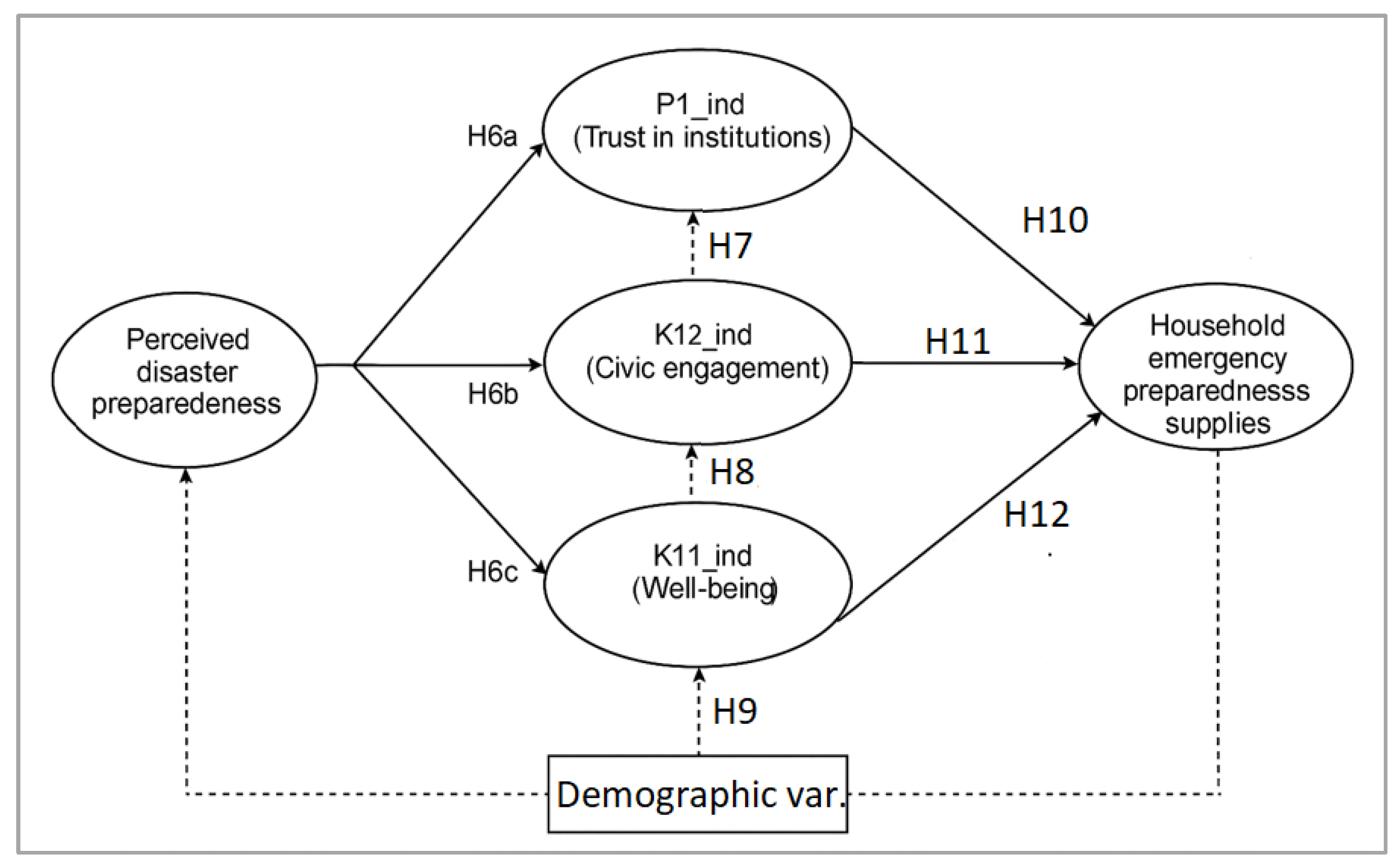
H6. Demographic variables will moderate the effect of perceived disaster preparedness on (a) institutional trust, (b) civic participation, and (c) perceived well-being.
The following hypotheses follow from the expectation that demographic characteristics shape not only levels of preparedness, but also the way institutional, civic, and psychosocial factors are translated into actual preparedness behavior. In this sense, the effects of institutional trust, civic participation, and perceived well-being may vary across social groups:
H7. Demographic variables will moderate the effect of institutional trust on actual household disaster preparedness.
H8. Demographic variables will moderate the effect of civic participation on actual household disaster preparedness.
H9. Demographic variables will moderate the effect of perceived well-being on actual household disaster preparedness.
The final set of hypotheses concerns moderated mediation effects, namely whether the indirect pathways differ across demographic groups.
H10. The indirect effect of perceived disaster preparedness on actual household disaster preparedness through institutional trust will differ across demographic variables.
H11. The indirect effect of perceived disaster preparedness on actual household disaster preparedness through civic participation will differ across demographic variables.
H12. The indirect effect of perceived disaster preparedness on actual household disaster preparedness through perceived well-being will differ across demographic variables.
3. Materials and Methods
3.1. Data Source
This study analyzed cross-sectional data collected as part of a representative omnibus survey of the Lithuanian population. The survey was carried out between 22 February and 5 March 2024 by a public opinion research company, based on a questionnaire coordinated with the researchers. The survey was implemented in compliance with the ICC/ESOMAR International Code on Market, Opinion and Social Research and Data Analytics, which sets recognized ethical and professional standards for survey research, including respondent protection, data confidentiality, and research transparency. Lithuanian residents aged 18 years and older participated in the survey. Respondents were selected through a multistage stratified random sampling procedure.
3.2. Study Participants
The final sample consisted of 550 adults, all of whom reported their gender, with 46.3% male and 53.7% female. Participants ranged in age from 18 to 86 years (M = 48.19, SD = 17.08; median = 48). Education levels were reported by respondents and spanned from primary education to university master’s/doctoral degrees, with professional education (23.2%) being the most common category. Most participants were employed or retired, with occupation data available for 550 individuals; the largest group identified as specialists (29.6%), followed by workers (27.4%) and pensioners (21.4%). Employment sector information also indicated that 47.7% worked in the private sector, 18.6% in the public sector, 1.1% in NGOs, and 32.7% were not employed (e.g., students, retirees, and those managing the household). Household income was reported by respondents and ranged from 0 to 6000, with a mean of 1923.17 and a median of 1800, indicating substantial variability in economic conditions across respondents. Marital status was provided by participants, most of whom were married (55.7%), followed by those who live together (14.8%) and never married (13.2%). The majority of participants identified as Lithuanian, comprising 95.3% of the sample (n = 525). Smaller proportions identified as Russian (1.8%, n = 10) and Polish (2.3%, n = 12), while 0.5% (n = 2) reported belonging to other nationalities. Overall, the nationality data demonstrated that the sample was predominantly Lithuanian in ethnic composition, which reflects the actual ethnic composition of Lithuania’s population. The achieved sample was treated as representative of the Lithuanian adult population within the limits of the applied multistage stratified sampling design.
3.3. Research Instrument
As the data were collected as part of an omnibus survey, the present study included only those questionnaire items that were relevant to its analytical objectives. The research instrument thus comprised measures of actual household disaster preparedness, perceived disaster preparedness, institutional trust, perceived well-being, civic participation, and selected demographic characteristics. Before inclusion in the analysis, the items were reviewed for conceptual fit and combined into a measure.
Actual household disaster preparedness was measured by the presence of disaster-related supplies and arrangements prepared at home. This operationalization is consistent with research that conceptualizes household preparedness as an action- and resource-based construct reflected in concrete household measures such as emergency supplies, emergency plans, and other practical provisions maintained prior to a disaster [
1,
6]. This measure was based on dichotomous items asking respondents which preparedness-related items they had in their household. These included, for example, backup copies of important documents, non-perishable food supplies for three days for each family member, an evacuation plan for the respondent and the whole family, etc.
Perceived disaster preparedness was assessed using items reflecting subjective readiness, risk awareness, and perceived preparedness-related capabilities. This approach is in line with studies that distinguish perceived preparedness from actual preparedness and treat it as a subjective assessment of how prepared individuals believe they are for an emergency, including confidence in their capacity to undertake preparedness-related action and to cope effectively with disaster conditions [
6,
32,
33].
Institutional trust was measured with items in which respondents evaluated their trust in different institutions, including the Lithuanian Parliament, the Lithuanian Government, the police, etc., on a four-point Likert-type scale. Although the exact institutional list was adopted from the public survey company’s standard omnibus survey instrument rather than designed specifically for this study, it aligns with disaster preparedness research that highlights confidence in authorities, organizational preparedness, and trust in formal response structures as important institutional dimensions shaping preparedness-related beliefs and actions [
1,
6].
Perceived well-being was assessed using items capturing respondents’ evaluations of (1) life satisfaction in general, (2) satisfaction with their health, and (3) satisfaction with their material circumstances, rated on a five-point Likert-type scale. Higher values indicated more positive self-evaluations of well-being. The three items were treated as indicators of a broader subjective well-being construct reflecting respondents’ perceived quality of life across general, physical, and material domains. This measure reflects the broader resilience literature in which well-being is treated as a relevant psychosocial dimension of adaptive functioning [
34].
Civic participation was measured by dichotomous items reflecting participation in civic and community-related activities, such as involvement in the activities of a public organization or movement. Each item captured whether or not the respondent had engaged in a specific activity, and these items were then aggregated to create an overall indicator of civic participation. This approach was intended to capture the behavioral dimension of civic engagement rather than attitudes alone, e.g., participated in community activities in the neighborhood, participated in a civic or political discussion. The selection of the items was guided by the theory on civic participation. This operationalization was consistent with research that treats participation, engagement, collective action, networking, and involvement in community decision-making and community-based processes as important social dimensions of resilience-building and preparedness-related capacity [
23].
The analysis also included selected demographic characteristics: education, ethnicity, main occupation, average monthly household income, marital status, and gender.
3.4. Statistical Analysis
The final analytical sample (
N = 550) consisted of respondents with complete data on the study variables. Descriptive statistical analysis was conducted for all study variables, and the results are reported as means (M) and standard deviations (SD). The internal consistency of multi-item scales was assessed using Cronbach’s alpha coefficient based on reliability analysis of the constructed indices (
Table 1).
The index measuring institutional trust (INT), composed of 10 items, demonstrated good internal consistency (Cronbach’s α = 0.828). The perceived well-being index (PWB), consisting of 3 items, showed acceptable reliability (Cronbach’s α = 0.746). The civic participation index (CVP), based on 6 items, indicated moderate internal consistency (Cronbach’s α = 0.636). The actual household disaster preparedness variable (K34) was constructed as a composite index from 9 dichotomous items reflecting the availability of specific preparedness supplies and demonstrated acceptable internal consistency (Cronbach’s α = 0.713). Overall, the reliability results indicate that the indices are suitable for further statistical analysis.
Pearson’s product–moment correlation analysis was used to examine bivariate relationships among the study variables. To assess group differences, inferential statistical analyses were performed. Independent samples t-tests were applied for variables with two categories, while one-way analysis of variance (ANOVA) was used for variables with more than two categories. When statistically significant differences were identified, post hoc comparisons were conducted using appropriate multiple comparison procedures.
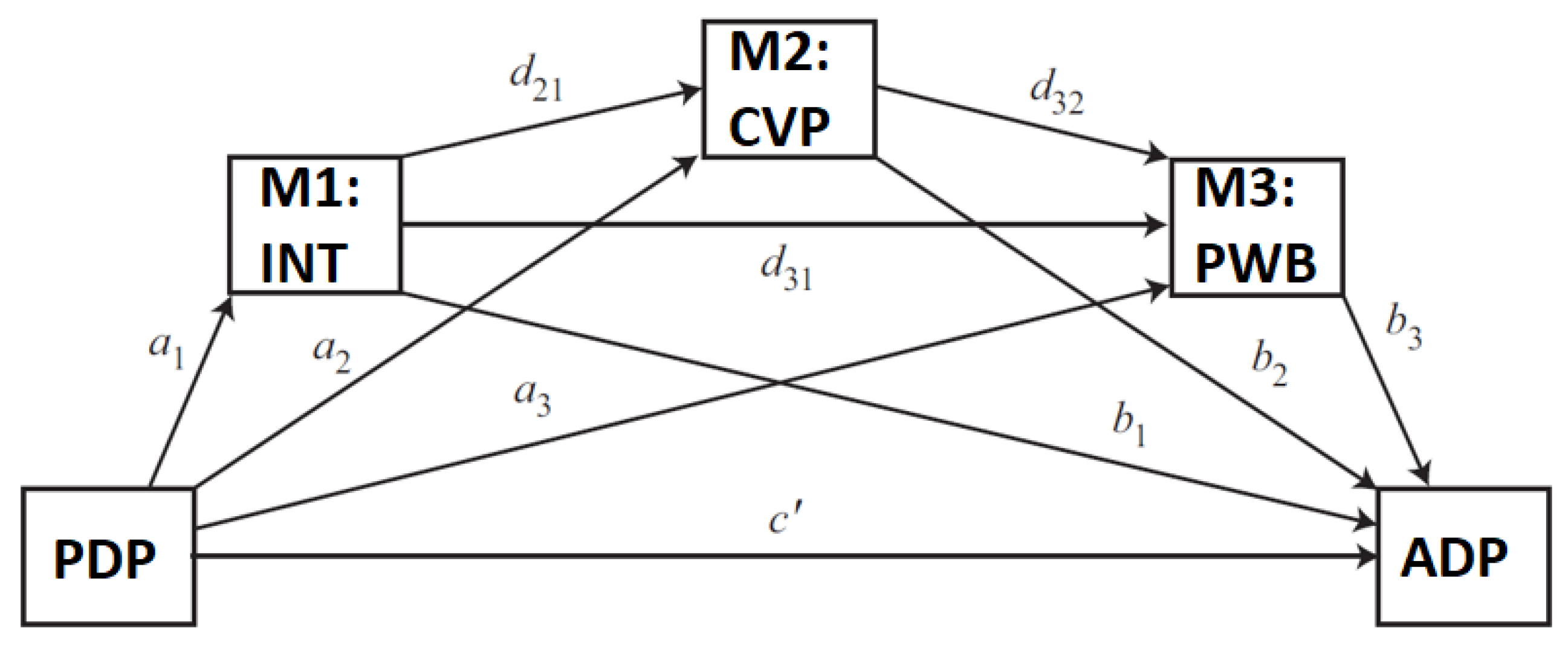
The proposed theoretical models (
Figure A1,
Appendix B) were tested using moderated mediation analysis, also referred to as conditional process modelling. The analyses were conducted using the PROCESS macro (version 3.5) for SPSS developed by Hayes [
35]. Model 6 was applied to test serial mediation effects, while Model 58 was used to examine moderated mediation effects.
The analytical approach enabled the assessment of (1) the direct and indirect effects of perceived disaster preparedness (PDP) on actual household emergency preparedness (K34) through the mediators—institutional trust (INT), perceived well-being (PWB), and civic participation (CVP) as specified in PROCESS Model 6 (
Figure A1,
Appendix B); and (2) the conditional indirect effects of perceived disaster preparedness (PDP) on actual household emergency preparedness (ADP), moderated by education (EDU) and gender (GEN). These moderators were retained because preliminary analyses indicated meaningful moderation patterns, whereas other demographic variables did not demonstrate statistically significant conditional effects, as specified in PROCESS Model 58 (
Figure A2,
Appendix B). In these models, the moderating effects of education (EDU) and gender (GEN) on the relationships within the mediation pathways were examined, allowing the strength of the indirect effects to vary across levels of the moderator. Prior to the analyses, the dataset was screened for missing values. Cases with missing responses on variables included in the mediation and moderation models were handled using listwise deletion within the PROCESS procedure. The proportion of missing data was low and did not materially affect the effective sample size or the stability of the estimated coefficients.
Prior to hypothesis testing, the assumptions underlying the regression-based mediation and moderated mediation models were evaluated. Linearity between predictors and outcome variables was assessed through inspection of scatterplots and partial regression plots. Normality of residuals was examined using standardized residual histograms and normal probability (Q–Q) plots. Homoscedasticity was evaluated by visual inspection of residual-versus-predicted value plots. Multicollinearity was assessed using correlation coefficients and variance inflation factor (VIF) statistics, with no evidence of problematic multicollinearity observed. The diagnostic analyses indicated that the assumptions for regression-based PROCESS analyses were adequately satisfied.
All hypotheses were tested within the specified PROCESS models. In addition to regression coefficients and bootstrap confidence intervals, explanatory power was evaluated using R
2 statistics obtained from the PROCESS regression outputs. Statistical inference for indirect and conditional effects was based on bias-corrected bootstrap confidence intervals (95% CI) generated from 5000 bootstrap samples, following established recommendations for mediation and moderated mediation analysis. Indirect effects were considered statistically significant when the confidence intervals did not include zero. All analyses were conducted in SPSS 29v using PROCESS v3.5.3 [
35].
Before testing the hypothesized mediation and moderated mediation models, preliminary analyses were conducted. These analyses provide the descriptive and correlational context for the multivariate results presented below.
5. Discussion
This study’s results are important not only for explaining household disaster preparedness, but also for understanding preparedness from the perspective of sustainable community development and public management. Community resilience depends on the interaction of household capacities, community relationships, and institutional support, while preparedness is increasingly understood as a co-produced public good rather than solely a matter of private responsibility [
1,
2]. The findings offer several theoretical and empirical contributions, particularly regarding the role of civic participation, institutional trust, perceived well-being, gender, and education in shaping actual preparedness.
Consistent with the first hypothesis, perceived preparedness did not directly predict actual household disaster preparedness. This aligns with research showing that perceived and actual household disaster preparedness are often only weakly aligned, and that feeling prepared does not necessarily translate into concrete action [
6]. Prior studies suggest that preparedness perceptions may fail to generate action when psychological, social, and contextual mechanisms intervene [
3,
37,
38]. The present results reinforce this interpretation by demonstrating that preparedness operates mainly through indirect pathways rather than through a direct conversion of perceived preparedness into actual preparedness. This distinction is important for sustainable community resilience, which depends not only on perceived readiness but on the capacity to convert beliefs into sustained individual and collective action [
5,
12].
Among the three mediators examined, civic participation emerged as the only significant mediator linking perceived to actual household disaster preparedness. This finding is consistent with scholarship documenting the central role of civic participation and collective action in motivating protective behaviors and strengthening disaster readiness [
8,
9]. Civic participation appears to function as a social mobilizer that converts abstract preparedness beliefs into concrete actions by embedding individuals in collective norms of responsibility, information exchange, and community readiness. In resilience terms, such participation helps build social capital, solidarity, and locally available capacities that are essential for sustainable community resilience before disasters occur [
5,
8]. In contrast, higher perceived preparedness was associated with lower civic participation, suggesting that individuals who consider themselves ready may disengage from community preparedness activities. This is theoretically consistent with community engagement theory, which posits that preparedness depends on reciprocal relationships among citizens, social networks, and civic agencies rather than on individual judgment alone [
9]. The absence of mediation effects for institutional trust and perceived well-being suggests that these constructs operate more distally from actual preparedness behavior. Although institutional trust and well-being may shape general attitudes, confidence, or resilience perceptions, they do not necessarily produce concrete preparedness actions at the household level. In contrast, civic participation reflects active involvement in social networks, collective problem-solving, and community-based activities that are directly connected to preparedness-related practices. This distinction may explain why civic participation alone emerged as a statistically meaningful mediator in the present study.
Institutional trust did not mediate the preparedness-behavior relationship, although previous studies show that trust plays an important role in disaster risk reduction and can support preparedness, risk awareness, and resilience-building activities [
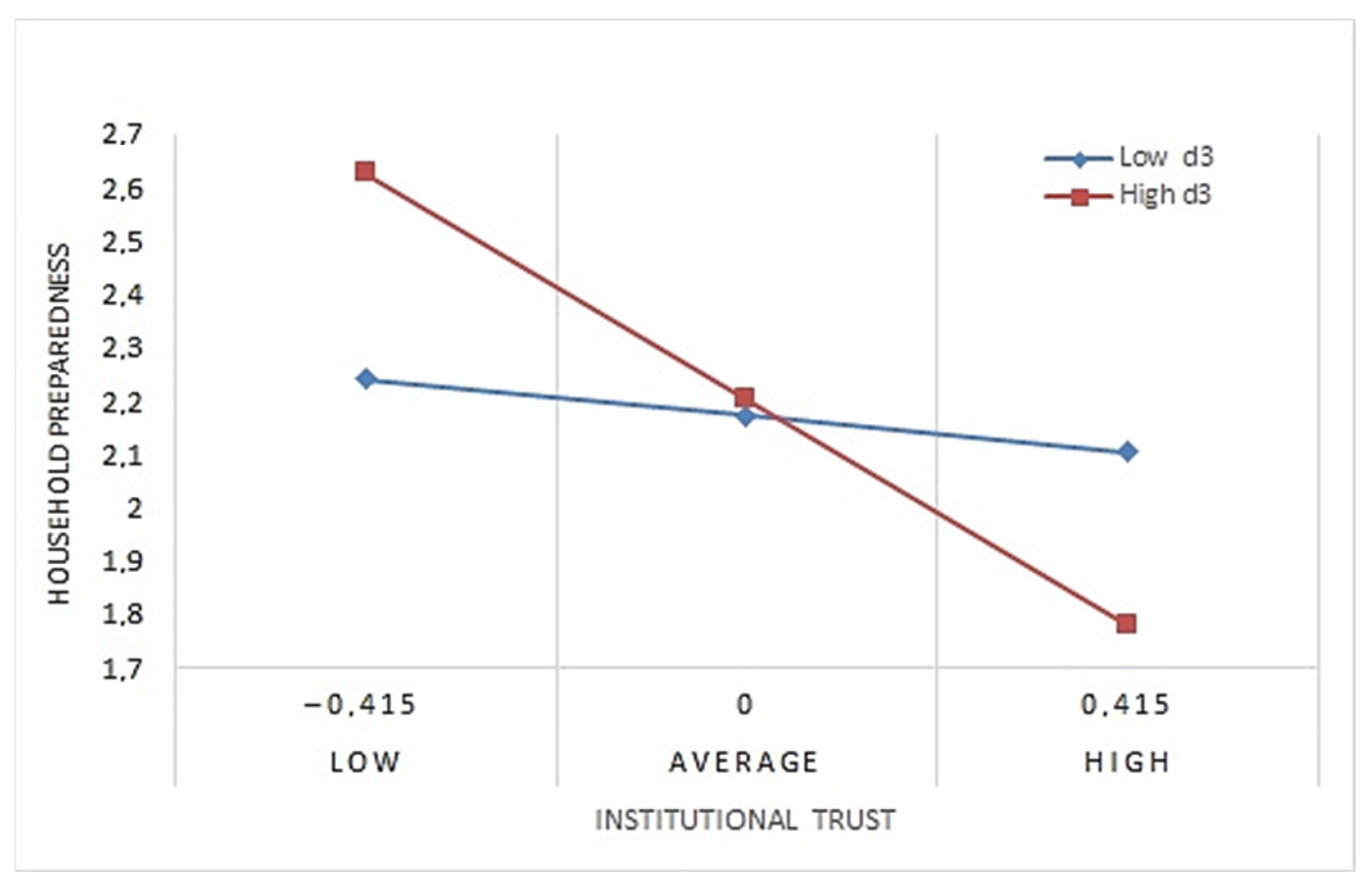
3]. In the present study, the indirect path through institutional trust was small and non-significant, suggesting that institutional trust may matter conditionally rather than uniformly. At the same time, the association between institutional trust and actual household disaster preparedness was not uniform, suggesting that its role may be more complex than a consistently positive interpretation would suggest.
One possible explanation is that high institutional trust may, under some conditions, create a sense of security, potentially leading households to rely more on public authorities for disaster management rather than taking individual preparedness measures. Although institutional trust is commonly viewed as beneficial for public cooperation and policy legitimacy, very high confidence in institutional response capacity may unintentionally reduce individuals’ motivation to undertake personal preparedness actions. Individuals who strongly trust governmental and emergency-management institutions may in some contexts assume that authorities will provide sufficient protection and support during crises, thereby transferring responsibility for preparedness from the household to public institutions. In this sense, institutional trust may operate not only as a resilience-supporting resource, but also as a mechanism that reduces perceived personal responsibility for preparedness.
This interpretation is consistent with studies showing that trust in institutions can influence compliance with public guidelines while also reducing the perceived need for personal action [
39,
40]. Thus, the present findings do not necessarily contradict previous research but rather suggest that the effects of trust may depend on whether it reinforces household initiative or substitutes for it. This is also consistent with prior research suggesting that preparedness may decline when citizens perceive emergency management primarily as a governmental responsibility rather than a shared responsibility between institutions and households [
3,
9]. From a sustainable community resilience perspective, trust remains important, but resilience is likely to be stronger when institutional trust is complemented by participation, empowerment, and community capacity rather than substituted for them.
Similarly, perceived well-being did not serve as a significant mediator, indicating that well-being may play a more distal role in actual household preparedness. Research on emergencies and civic participation more often links well-being to social cohesion, solidarity, coping, and resilience during emergencies than to pre-event household preparedness behaviors themselves [
37]. The present findings therefore underscore the need to distinguish between drivers of preparedness intentions and drivers of preparedness actions, as these may be led by different psychological and social mechanisms. This distinction also matters for sustainable community resilience, because well-being may be better understood as an outcome of supportive social and civic conditions than as a direct trigger of household preparedness action.
The moderated mediation analyses expand theoretical understanding by demonstrating that indirect pathways differ across demographic groups. Education moderated the institutional-trust pathway: individuals with higher education showed a stronger negative association between institutional trust and actual household disaster preparedness. This pattern aligns with research showing that the relationship between education and trust is neither linear nor uniform. Hakhverdian and Mayne [
11] show that education interacts with institutional context to shape trust in different directions depending on governance quality and performance. This interpretation is broadly consistent with our finding that highly educated individuals may place greater weight on institutional capacity, thereby reducing their own preparedness behaviors.
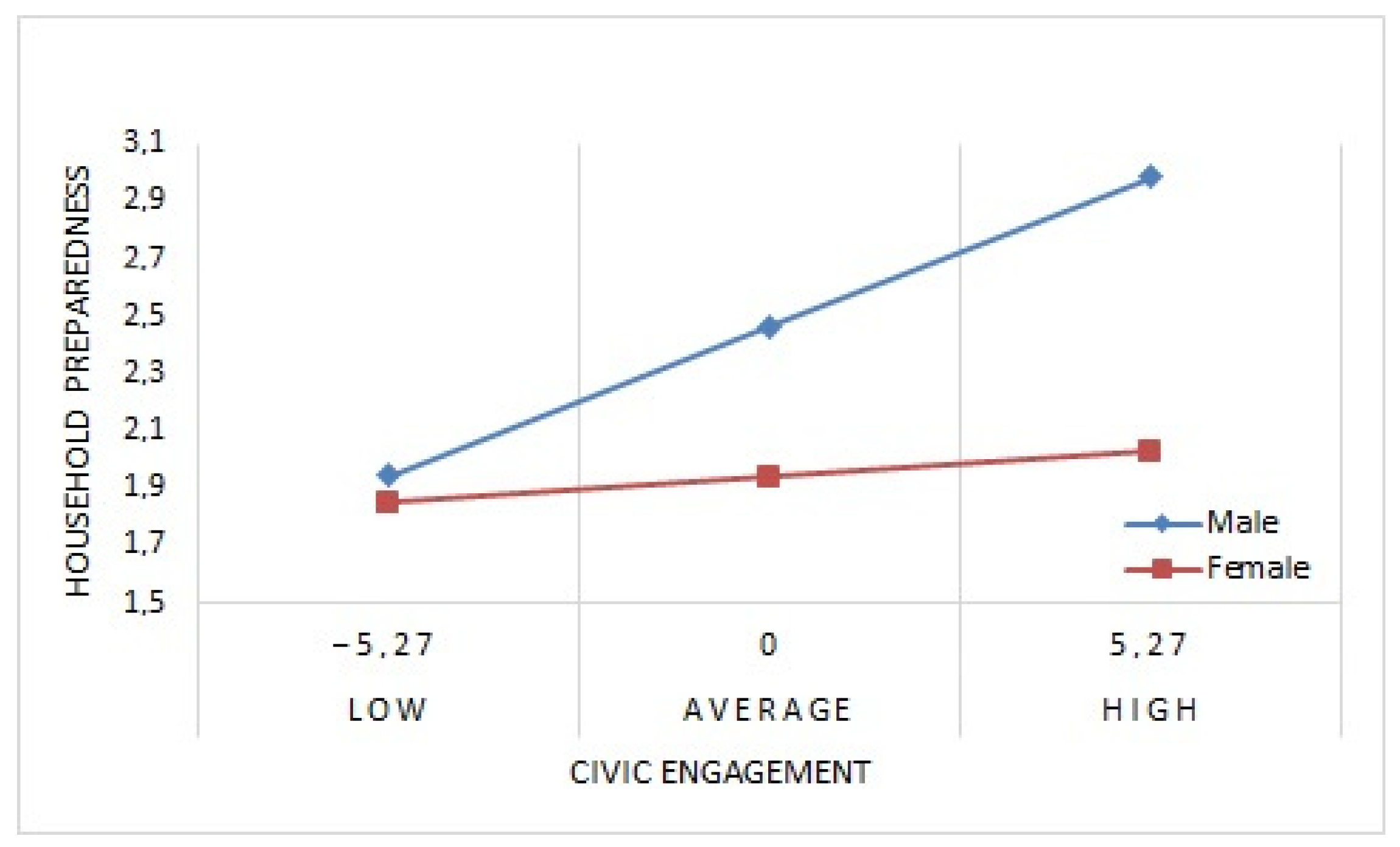
Gender moderated the civic participation pathway, with civic participation showing a stronger positive association with reported household preparedness among male respondents than among female respondents. This is consistent with evidence that preparedness-related perceptions and reported behaviors may vary by gender [
10]. In this context, the observed difference may reflect gendered patterns in how respondents perceive and report actual household preparedness, rather than differences in the household’s preparedness per se.
Overall, the results demonstrate that household disaster preparedness is embedded in a broader social, institutional, and demographic context. Institutional trust, civic participation, perceived well-being, gender, and education shape how perceived preparedness is linked to actual preparedness. These findings resonate with research emphasizing that preparedness depends on both individual and community-based resources, including social capital, participation, and shared capacities [
5]. More broadly, they suggest that sustainable community resilience is strengthened not simply by increasing perceived readiness, but by cultivating the social relationships, civic participation, and institutional conditions that enable households to act on that readiness.
Implications. These findings have several implications for public management. First, disaster preparedness should be managed not only as a matter of household action, but also as a process that is strengthened through civic participation. For public agencies, this means investing in community networks, local organizations, and participatory arrangements that can support participation and preparedness action [
9,
38]. Second, communication with highly educated groups should be designed meaningfully so that confidence in institutional capacity does not reduce household preparedness motivation. Public risk communication should frame preparedness as a shared responsibility between households and institutions, while avoiding excessive reliance on institutional response capacity alone. The findings further indicate that preparedness strategies may require differentiation across social groups, particularly where civic participation more strongly translates into preparedness behaviour. From a public management perspective, these results highlight the importance of balancing institutional trust with the promotion of active household preparedness and recognizing that preparedness perceptions and behaviours may vary across respondent groups.
Limitation. One limitation of this study is its cross-sectional design, which means that firm conclusions about causal direction cannot be drawn. While the analyses identified statistically significant associations and indirect pathways, they could not establish the temporal ordering of the variables. Further longitudinal or experimental studies are needed to assess causality more directly.
Second, although the study included several important variables related to household resilience, its analytical scope remained relatively broad, which may have limited the detection of more nuanced patterns across contextual conditions. Several preparedness-related factors, including geographic location, housing conditions, insurance status, household composition, prior disaster experience, and community-level social capital, were not included. Future research would benefit from integrating a wider range of contextual and household-level variables in order to better capture the heterogeneity of preparedness-related behaviors.
A third limitation concerns the use of self-reported measures, which may be affected by social desirability, recall error or differences in how respondents interpret preparedness-related questions. A fourth limitation is that the study was conducted in one national context (Lithuania), which may restrict the generalisability of the findings to countries with different institutional, cultural and safety environments.
Future research. Longitudinal and cross-cultural studies should examine how preparedness perceptions evolve over time and under different institutional conditions, and how these changes contribute to sustainable community resilience. Future work might also incorporate additional moderators such as political ideology, hazard experience, social networks, or place-based identity, as these factors may shape not only household preparedness but also the broader social and institutional capacities. Qualitative studies may further deepen understanding of how individuals interpret civic roles, institutional obligations, and preparedness responsibilities, which may remain partly hidden in quantitative models.