1. Introduction
The global transition toward low-carbon development is reshaping industrial competition. Firms are judged not only by cost efficiency and productivity but also by their ability to align operations with climate targets, disclosure requirements, and increasingly stringent supply chain regulations. Sustainability is therefore moving from a peripheral compliance concern to a core dimension of industrial strategy [
1,
2].
Within this shift, carbon management has emerged as a central operational metric. Carbon footprint provides a measurable link between production activity and climate impact, allowing firms to identify emission hotspots, evaluate mitigation options, and incorporate environmental performance into planning, investment, and reporting processes [
3,
4,
5]. The GHG Protocol also distinguishes direct operational emissions, purchased electricity emissions, and selected value chain emissions, making carbon accounting increasingly relevant to operational design as well as disclosure [
6].
Industrial symbiosis offers a promising way to close that gap. Rooted in industrial ecology, it enables the exchange of energy, materials, water, and by-products among interconnected facilities, thereby transforming linear production systems into more circular and regenerative networks [
7,
8]. The Kalundborg symbiosis in Denmark remains the benchmark example, showing that coordinated inter-firm exchange can generate simultaneous environmental and economic gains [
9]. Recent literature further emphasizes that industrial symbiosis depends on network resilience, resource flow coordination, and the ability of firms to organize shared infrastructure under changing operational conditions [
10,
11]. In Southeast Asia, similar approaches are increasingly relevant in agro-industrial systems, where biomass residues and wastewater create opportunities for energy recovery, waste valorization, and circular resource use [
12,
13].
However, industrial symbiosis should not be understood only as a technical arrangement. Its performance depends on organizational coordination, information transparency, and governance structures that enable firms to manage shared flows of waste, energy, and data over time [
8,
14]. From this perspective, carbon reduction is achieved not simply through technological substitution but through systemic reconfiguration of operations, interdependencies, and managerial routines.
Existing research has not fully addressed this managerial dimension. Much of the literature emphasizes environmental efficiency or engineering feasibility, while giving less attention to how carbon management can operate as an organizing principle linking environmental performance with economic efficiency, social inclusion, and governance systems within industrial operations. This gap is particularly important in emerging economies, where firms must respond simultaneously to resource constraints, regulatory transition, and international market pressures [
6,
12].
Thailand provides an especially relevant context for examining this issue. The country’s Bio-Circular-Green (BCG) Economy Model promotes circular resource use, renewable energy integration, and bio-based innovation as pillars of sustainable industrialization, while national climate policy targets carbon neutrality by 2050 and net-zero greenhouse gas emissions by 2065 [
15,
16]. Thailand’s emerging alignment with international ESG disclosure expectations and supply chain regulations, including EUDR-related traceability requirements, further increases the need for operational models that connect carbon accounting, circularity, and verifiable governance [
17]. Within this policy environment, the Eastern Economic Corridor (EEC) serves as a strategic development zone in which low-carbon industrial transformation can be implemented and tested at scale.
Against this background, this study examines industrial symbiosis as a carbon-centered operational strategy through the case of Thai Eastern Group Holdings (TEGH), an integrated agro-industrial complex in the EEC. The case is used as empirical evidence rather than as a firm-level promotional account: it provides a setting for analyzing how rubber processing, palm oil production, renewable energy generation, wastewater treatment, and organic waste valorization are coordinated within a closed-loop operating system [
18].
The study addresses three research questions: (1) how does industrial symbiosis reconfigure resource flows and production processes to reduce carbon emissions; (2) how does carbon management interact with economic, social, and governance performance within industrial systems; and (3) what insights can be drawn for scaling industrial symbiosis in emerging economies under evolving policy and market conditions?
The paper makes three contributions. First, it reconceptualizes industrial symbiosis as an operational strategy rather than a purely environmental intervention. Second, it shows how carbon footprint management can function as a coordinating mechanism across environmental, economic, social, and governance (EESG) dimensions. Third, it adds empirical evidence from an emerging economy context and offers a framework for carbon-smart industrialization aligned with national policy priorities and broader climate commitments.
Together, these arguments position the TEGH case as more than a firm-level example. It provides a lens for understanding how industrial systems in emerging economies can integrate decarbonization, circularity, and institutional accountability into a coherent model of sustainable operations while acknowledging that transferability depends on regulatory, infrastructural, and organizational conditions.
2. Introduction to TEGH and Its Operations
2.1. Corporate Background and Strategic Context
Thai Eastern Group Holdings Public Company Limited (TEGH) is an integrated agro-industrial enterprise headquartered in Chonburi Province within Thailand’s Eastern Economic Corridor (EEC). Established in 1988 and listed on the Stock Exchange of Thailand, the group operates across natural rubber processing, crude palm oil production, renewable energy generation, and organic waste management. Its business model is organized around circular economy principles that emphasize waste minimization, resource recovery, renewable energy substitution, water stewardship, and traceable supply chains [
18].
Over the past decade, TEGH has aligned its growth strategy with Thailand’s Bio-Circular-Green (BCG) Economy Model. Within this framework, Chonburi facilities have evolved into a symbiotic agro-industrial cluster that combines production, energy recovery, and environmental management into a single coordinated system. The strategic objective is not only to reduce environmental impact but also to improve efficiency, control costs, and strengthen long-term competitiveness.
This positioning is reinforced by investments in biogas, waste-to-value technologies, and stakeholder partnerships. TEGH’s sustainability strategy links greenhouse gas reduction, resource circularity, and supply chain traceability to national climate priorities and to the Sustainable Development Goals: SDG 7 on clean energy, SDG 9 on industry and innovation, SDG 12 on responsible consumption and production, and SDG 13 on climate action [
19].
2.2. System Layout and Operational Integration
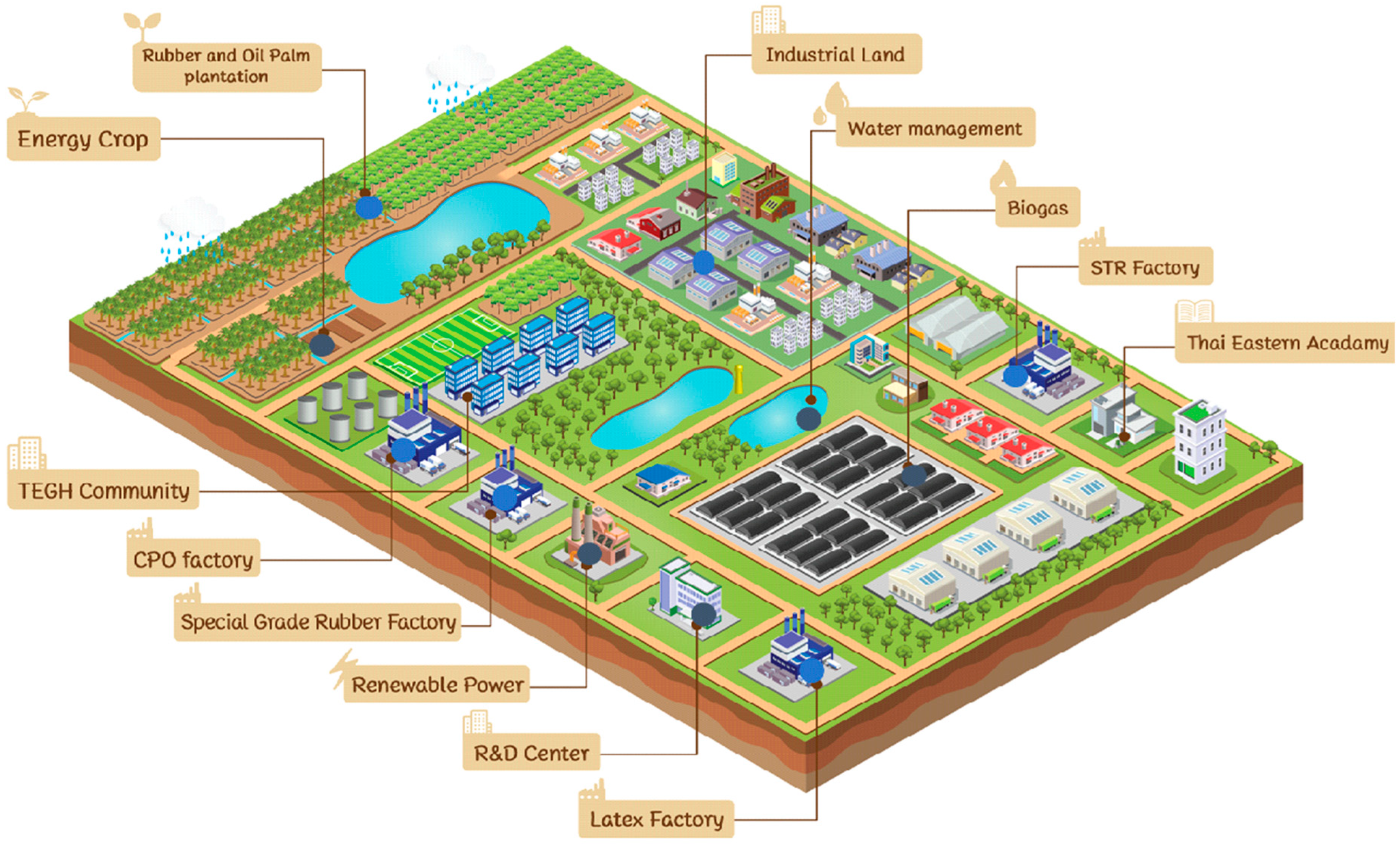
The TEGH complex covers approximately 320 hectares and integrates plantations, palm oil mills, a block rubber factory, latex facilities, wastewater treatment systems, a biogas plant, and organic fertilizer production. These assets are configured as a closed-loop industrial ecosystem in which energy, water, and material flows are intentionally shared across units.
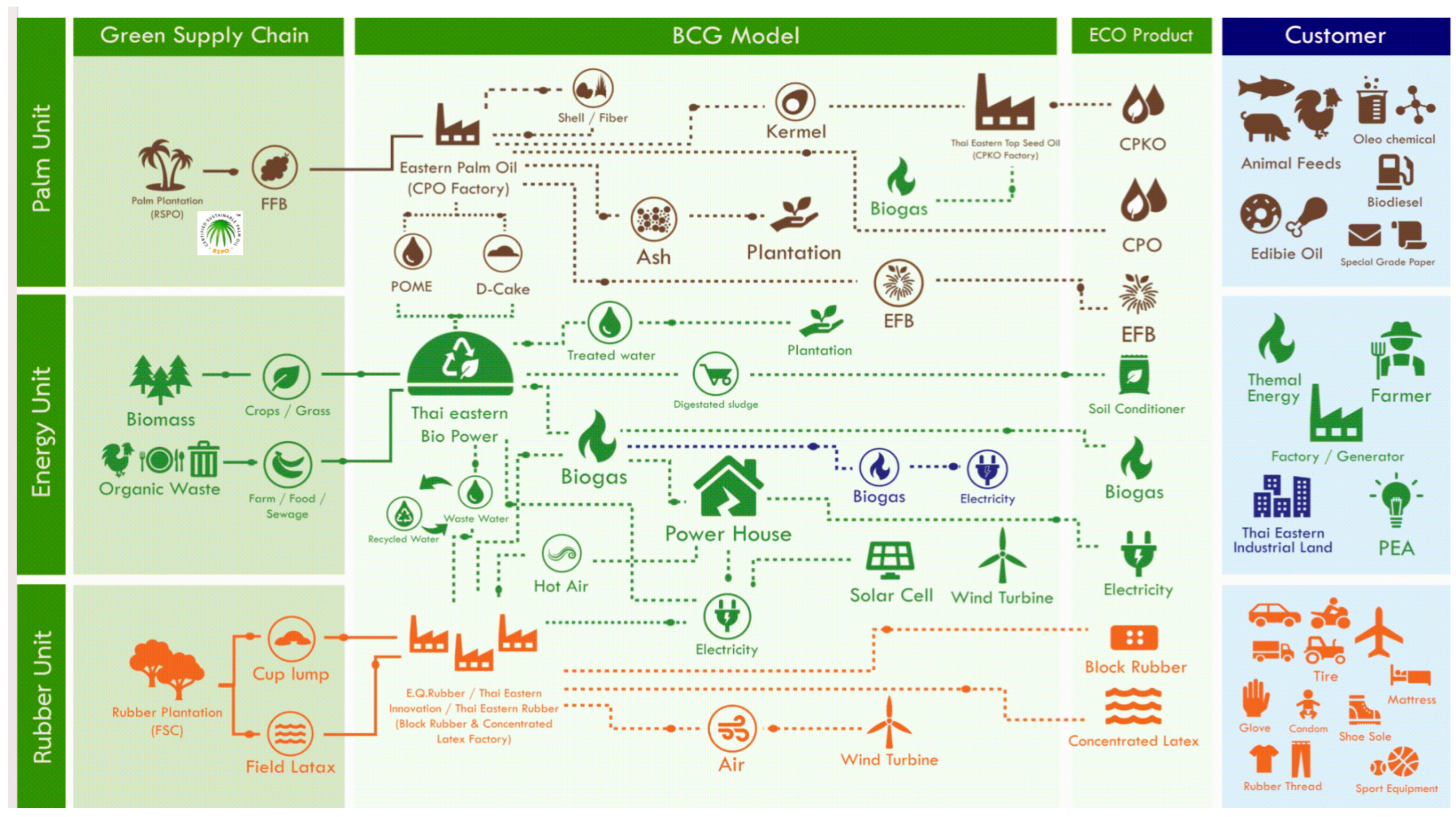
At the heart of the system is anaerobic digestion using palm oil mill effluent and rubber sludge as primary feedstocks. The captured biogas is used for rubber drying and electricity generation, thereby displacing fossil fuels and lowering direct operational emissions (Scope 1) and purchased electricity emissions (Scope 2), as defined in the GHG Protocol [
6]. Digestate and biosludge are then composted and returned to agriculture as organic fertilizer, reinforcing nutrient circularity.
Industrial wastewater is treated through anaerobic, aerobic, and polishing stages before being reused in factories and irrigation. This reduces freshwater abstraction and demonstrates how the company manages energy, water, and carbon as interconnected operational resources [
20].
The spatial configuration of the complex is provided in
Appendix A.1.
2.3. Resource Flows and Carbon Mitigation Potential
The Thai Eastern Symbiosis manages more than 420,000 tons of direct organic waste each year and more than 600,000 tons when upstream residues are included. This feedstock base supports approximately 23 million Nm
3 of biogas production annually and contributed to an estimated 19,271 tCO
2e reduction in 2024 through renewable energy substitution and waste valorization effects, while also reducing fossil fuel use in thermal and electrical applications [
16,
18,
21].
Material flow analysis also shows that the system recovers more than one million cubic meters of treated water per year, reuses digestate fully, and produces organic fertilizer for use on surrounding farms [
21]. These outputs reduce the environmental burden of TEGH’s operations and generate secondary economic value through input substitution and product diversification. The 2025 sustainability disclosure further reports 1,416,308 m
3 of recycled water and a 92.95% water recycling rate, supporting the continued relevance of the water circularity claim beyond the formal 2022–2024 analysis period [
22].
The detailed resource-flow diagram is provided in
Appendix A.2.
2.4. Managerial and Policy Innovations
Beyond its technical configuration, the TEGH model illustrates formalized managerial coordination in sustainable operations. Sustainability is supported by environmental management units, ISO 14001-certified operations, and reporting practices aligned with the Global Reporting Initiative (GRI), rather than through isolated environmental projects [
23].
The company also operates within the broader EEC innovation ecosystem, which supports collaboration with research institutes and technology partners on waste-to-energy conversion, digital monitoring, and environmental accounting. This strengthens the firm’s ability to respond to evolving market requirements, including EUDR compliance and carbon disclosure expectations.
The model also generates social value. Organic fertilizer programs, green job creation, and partnerships with universities and local authorities extend the benefits of industrial symbiosis beyond the factory gate and strengthen regional innovation capacity.
Taken together, these environmental, operational, and managerial features make TEGH a relevant case for examining how carbon management can be integrated into routine production decisions in an emerging market setting. The case does not imply universal transferability; rather, it provides evidence for analyzing how coordination among energy, water, waste, supply chain, and governance subsystems shapes system-level outcomes.
3. Methodology
3.1. Conceptual and Analytical Framework
This study adopts a carbon-centered sustainability framework to evaluate how industrial symbiosis contributes to sustainable operations through resource integration and emission reduction. The framework combines life cycle assessment (LCA), industrial ecology, and sustainability performance analysis, treating carbon footprint reduction as both an environmental outcome and an indicator of operational efficiency [
3,
4].
Within this framework, industrial symbiosis is interpreted as a management innovation that reorganizes production processes, energy systems, and stakeholder relationships to deliver measurable performance gains [
14]. Environmental, economic, social, and governance outcomes are analyzed as mutually reinforcing dimensions rather than isolated result areas.
The approach is consistent with eco-efficiency and shared value perspectives in sustainable management [
24]. It assumes that emission reduction can be a driver of innovation, competitiveness, and institutional learning rather than merely a compliance response.
3.2. Data Sources and Verification
The empirical analysis draws on primary and secondary data from 2022 to 2024. Primary sources include TEGH sustainability reports, One Reports, and operational records on waste volumes, biogas generation, electricity use, wastewater treatment, and fertilizer production [
18,
25,
26]. Secondary sources include Thai government publications, international reports, and default emission factors from IPCC guidance [
21,
27]. The 2025 sustainability report is used only as supplementary validation and post-study context because it provides additional disclosure on assurance, governance, water recycling, renewable energy, and capacity expansion after the formal study period [
22].
To improve reliability, reported figures were normalized to standard units for energy, emissions, and water use, then cross-checked against third-party assessments, including TRIS Rating, TGO Carbon Footprint for Organization verification, SET ESG disclosures, and other external references [
18,
28,
29]. TEGH’s 2025 report states that selected data are certified or independently verified, including CFO, CFP, and certified sustainable land areas; this reduces but does not eliminate the limitations associated with using company-reported operational data [
22]. Sensitivity testing with a ±10 percent range was conducted for key parameters such as methane yield and capture efficiency.
3.3. Carbon Footprint Assessment
Carbon emissions were quantified using a process-based life-cycle approach consistent with ISO 14067 and the GHG Protocol Corporate Standard [
6,
30]. For each activity i, annual emissions were calculated as the product of activity data and the relevant emission factor, as shown in Equation (1).
Scope classification follows the GHG Protocol. Scope 1 refers to direct emissions from owned or controlled operations, including fuel combustion and on-site process emissions. Scope 2 refers to indirect emissions from purchased electricity. Scope 3 refers to selected indirect value-chain emissions associated with upstream sourcing and related activities [
6].
where E
i is the annual emission from activity i (tCO
2e/year), A
i is the corresponding activity data (for example, liters of diesel, megawatt-hours of electricity, or cubic meters of wastewater), and EF_i is the emission factor.
System-level emissions were then aggregated across all activities and converted to CO
2 equivalents using the appropriate global warming potentials, as shown in Equation (2).
Avoided emissions from renewable energy substitution and waste valorization were estimated by comparing the symbiosis system to a fossil-fuel baseline, as shown in Equation (3).
This procedure distinguishes between gross operational emissions and mitigation benefits attributable to circular resource use, enabling a clearer assessment of net carbon performance. To separate efficiency effects from changes in production scale, the study reports both absolute annual emissions and emissions intensity normalized per ton of output. Benchmark comparisons are based primarily on normalized indicators where comparable data are available.
Emission factors applied in this study included 2.68 kg CO
2e per liter of diesel, 555 kg CO
2e per megawatt-hour of grid electricity, and 1.98 kg CO
2e per cubic meter of biogas combusted, adjusted for a 92% methane capture efficiency [
7,
28]. Methane emissions from untreated palm oil mill effluent were estimated at 1.8 kg CH
4 per cubic meter of wastewater, based on IPCC default values for tropical anaerobic lagoons.
All emissions were reported as annual system totals and subsequently normalized per ton of primary output—crude palm oil, rubber sheet, or organic fertilizer—to enable cross-process comparison.
3.4. Sustainability Indicators and ESG Dimensions
While carbon accounting provides the quantitative foundation, the study also integrates qualitative ESG indicators to capture the broader performance implications of TEGH’s industrial symbiosis. These indicators are categorized under four dimensions: environmental, economic, social, and governance (EESG). Each reflects how carbon management outcomes influence or are reinforced by other aspects of sustainability performance.
The environmental dimension includes total GHG emission reductions (avoided emissions), water reused, and waste recycled, representing direct outputs of sustainable operations. The economic dimension assesses energy-cost savings, new revenue streams from bio-based products, and overall return on investment (ROI). The social dimension considers employment generation, smallholder engagement, and community benefit programs linked to organic fertilizer distribution. The governance dimension evaluates the robustness of sustainability reporting, readiness for compliance with the EU Deforestation Regulation (EUDR), and the presence of independent third-party ESG assessment and verification mechanisms, including EcoVadis sustainability ratings and the Stock Exchange of Thailand (SET) ESG Rating, which together provide external validation of governance quality, transparency, and responsible supply chain practices.
These indicators were derived from TEGH’s sustainability reports and triangulated with independent assessments by TRIS and IR PLUS. Rather than treating each dimension as an isolated domain, the analysis interprets them as interconnected layers within a sustainable operations management system. The assumption is that successful carbon mitigation creates a reinforcing cycle of performance improvement: lower emissions lead to reduced operational costs, which in turn strengthen financial stability, social investment, and corporate accountability.
3.5. Analytical Process and Validation
All calculations were conducted using OpenLCA 1.11 and verified through spreadsheet-based recalculations in Microsoft Excel Power Query. The analytical process comprised four steps:
- (1)
compiling the life-cycle inventory of energy, material, and waste flows;
- (2)
calculating direct and avoided emissions using Equations (1)–(3);
- (3)
normalizing the results per product output and per year; and
- (4)
benchmarking performance against comparable industrial-symbiosis cases, including Kalundborg (Denmark) and similar Southeast Asian agro-industrial clusters [
12,
13].
Uncertainty analysis was performed using ±10 percent variations in emission factors and activity data to assess the robustness of results. Given the partial data availability for some upstream processes, conservative estimates were applied to prevent overestimation of mitigation potential. The system boundary excluded downstream logistics and product-use phases, focusing solely on cradle-to-gate operational emissions.
By combining carbon footprint accounting with EESG indicators, the method provides both quantitative rigor and managerial relevance. It allows industrial symbiosis to be assessed not only as an environmental intervention but also as a broader model of sustainable operations innovation. At the same time, causal claims are interpreted cautiously because the analysis is based on a single case and relies partly on company-reported operational indicators.
4. Results and Discussion
4.1. Economic Performance
Economic performance is central to sustainable operations because financial viability determines whether firms can reinvest in low-carbon technologies and long-term social programs. As shown in
Table 1, TEGH recorded increases in revenue and net profit between 2023 and 2024, with revenue rising by 38.9 percent and net profit by 158.9 percent. These changes occurred alongside fuller utilization of biogas assets, operational optimization, and expanded access to traceable export markets. The results are interpreted as associated outcomes rather than as proof that industrial symbiosis alone caused all financial improvements.
Renewable biogas contributed to cost reduction by replacing purchased energy and reducing exposure to fossil fuel price volatility. In 2024, TEGH generated about 23 million Nm
3 of biogas and roughly 43 GWh of electricity, equivalent to more than THB 180 million in avoided electricity costs at prevailing industrial tariffs [
18,
21]. Additional savings came from lower fuel purchases and reduced wastewater treatment energy demand.
Waste-to-value activities provided additional resource efficiency benefits. Digestate-based organic fertilizer created an outlet for residual biomass while supporting contract farmers, and increasing EUDR-compliant output improved access to traceable export channels. Together, these factors indicate that circularity can contribute to efficiency and market positioning, although the magnitude of each subsystem’s contribution should be interpreted within the limits of available data.
The business case is further supported by relatively rapid capital recovery. Based on company-reported performance, renewable energy investments achieved an estimated payback period of about 4.8 years, which compares favorably with similar bioenergy projects in the region. This indicates that low-carbon assets can become part of operating infrastructure, although payback may differ under other tariff, feedstock, and regulatory conditions.
Integration across rubber, palm, and energy divisions also created economies of scale. Shared utilities, wastewater treatment, and logistics infrastructure reduced duplication and improved asset utilization, helping the firm lower unit costs and shorten feedstock transport distances relative to less integrated processors.
Regulatory preparedness also contributed to operational resilience. By 2024, 89.8 percent of raw materials were covered by EUDR-compliant digital traceability systems, reducing compliance risk in export markets [
17,
18]. ESG recognition from the Stock Exchange of Thailand and TRIS Rating provides external context for the company’s disclosure and governance profile [
28,
29].
Managerially, digital monitoring, reporting, and verification dashboards support tracking of biogas yield, power generation, and carbon intensity. These tools help managers coordinate maintenance and resource allocation across energy, waste, and production subsystems, which is central to the coordination logic of industrial symbiosis.
Overall, the evidence suggests that TEGH’s economic gains are associated with resource synergies and sustainability-driven process coordination. The case indicates complementarity between environmental and financial performance, while avoiding a claim that all observed gains are attributable solely to industrial symbiosis.
4.2. Environmental Performance
Environmental performance is a central outcome of the Thai Eastern Symbiosis model because resource efficiency and emissions reduction are embedded within operational design. Between 2022 and 2024, reported indicators show a downward trajectory in GHG emission intensity alongside improvements in waste recovery and renewable energy utilization.
4.2.1. Carbon Emissions and Energy Efficiency
As shown in
Table 2, TEGH’s greenhouse gas inventory, verified under Thailand Greenhouse Gas Management Organization (TGO) protocols, covers Scope 1 direct emissions, Scope 2 purchased electricity emissions, and selected upstream Scope 3 emissions [
18,
28]. In 2024, the company reported 4019 tCO
2e in Scope 1 emissions, 18,141 tCO
2e in Scope 2 emissions, and 53,691 tCO
2e in Scope 3 emissions, yielding a total of 75,851 tCO
2e. Despite operational expansion, GHG intensity fell to 0.2471 tCO
2e per ton of output, indicating continuing decoupling of emissions from production growth.
Table 2 summarizes the GHG emission profile and intensity from 2022 to 2024.
This improvement was driven primarily by renewable energy substitution and coordination between energy and waste management subsystems. The biogas system generated around 23 million Nm
3 per year and approximately 43 GWh of electricity, offsetting grid power and fossil fuel use in thermal drying. These substitutions reduced operating emissions and exposure to carbon-intensive energy inputs [
18,
21].
Relative to comparable agro-industrial systems in Southeast Asia, TEGH records lower normalized carbon intensity than the regional range reported in secondary sources, while its methane-capture and biogas-utilization rates indicate high process efficiency. These comparisons are treated as indicative because system boundaries and reporting practices differ across firms.
4.2.2. Waste Management and Resource Circularity
The circular design of the TEGH system enables waste and by-products from one process to be reused in another. In 2024, the company managed over 420,000 tons of direct corporate organic waste annually and approximately 628,000 tons when broader upstream agricultural residues are included, converting a majority into biogas and organic fertilizer [
18,
21]. Digestate and biosludge from anaerobic digestion were fully utilized as soil conditioners for contract farmers. This material flow helps prevent methane release from unmanaged decomposition and can reduce dependence on synthetic fertilizers, which are associated with nitrous oxide emissions in agricultural systems [
27,
31].
The company’s waste management system also emphasizes water reuse and conservation. More than one million cubic meters of treated wastewater were recycled annually for irrigation and factory cleaning during the study period [
18,
21]. The later 2025 disclosure reports 1,416,308 m
3 of recycled water and a 92.95% water-recycling rate, offering additional support for the continued water circularity performance of the system [
22].
4.2.3. Renewable Energy Transition and Carbon-Neutral Pathway
TEGH’s renewable energy transition is a central pillar of its carbon-neutral pathway. The company has adopted interim targets for carbon neutrality and 100 percent renewable energy by 2030, 100 percent renewable electricity by 2040, and net-zero emissions by 2050 [
18]. These commitments align with Thailand’s LT-LEDS and the national BCG framework [
15,
16].
By 2024, biogas supplied roughly 35–40 percent of total energy demand across rubber and palm operations. The planned expansion of biogas capacity and rooftop solar is expected to deepen renewable substitution, reduce residual emissions, and reinforce the firm’s long-term decarbonization pathway. The 2025 report indicates a transition phase in which absolute emissions rose due to production capacity expansion, reinforcing the importance of using intensity indicators alongside absolute totals [
22].
4.2.4. Comparative Environmental Performance and Benchmarking
Benchmarking against ASEAN agro-industrial systems suggests that TEGH’s carbon intensity of 0.2471 tCO2e per ton of output compares favorably with regional averages of approximately 0.32–0.45 tCO2e per ton. Its biogas utilization rate of about 98 percent and wastewater-reuse rate above 90 percent also indicate high circular resource efficiency. These comparisons are presented as indicative rather than definitive because peer disclosures are not fully standardized.
From a life-cycle perspective, the Thai Eastern Symbiosis delivers a positive environmental balance: avoided emissions from renewable energy generation and waste valorization are substantial relative to residual process emissions. The analysis distinguishes avoided emissions from gross operational emissions to avoid overstating net performance.
4.2.5. Policy and Management Implications
TEGH’s environmental results carry implications beyond the firm. The case shows how corporate-level innovation can operationalize national climate policy by embedding renewable energy, circular resource use, and verifiable emissions accounting within day-to-day industrial practice.
From a management perspective, the case also demonstrates the value of embedding sustainability metrics in operational control systems. Digital MRV tools allow managers to monitor efficiency and emission trends in near real time, making sustainability a practical decision variable rather than a retrospective reporting exercise.
Taken together, these findings show that TEGH’s environmental performance extends beyond compliance. Renewable energy, circular material use, and data-driven management operate as an integrated strategy for low-carbon industrial transformation, while the single-case design requires caution in generalizing the results.
4.3. Social Performance
Sustainable operations cannot be fully assessed without considering social inclusion and local capability building. For TEGH, the social dimension of industrial symbiosis extends beyond corporate philanthropy toward supply chain participation, workforce development, and community engagement. The company’s integrated agro-industrial model in the EEC provides an empirical illustration of how circular economy practices can generate distributive and capability-building outcomes aligned with the principles of a just transition [
32].
4.3.1. Inclusive Supply Chains and Farmer Empowerment
A central feature of TEGH’s social performance is its inclusion of smallholder farmers in a traceable, sustainability-oriented sourcing system. As shown in
Table 3, more than 44,600 farmers were enrolled in the EUDR digital traceability system by 2024, up from 29,612 in 2022. Geo-referenced land-parcel mapping improves transparency and deforestation-free compliance while giving farmers greater formal inclusion in export-oriented value chains.
Traceability is supported by capability building. Training events increased from nine in 2022 to twenty-one in 2024, covering soil management, safe chemical use, and waste handling. A reported participant satisfaction rate of 95.7 percent suggests that these programs deliver perceived practical value.
4.3.2. Employment and Local Economic Spillovers
Within the EEC complex, direct employment increased from 2834 to 3012 workers between 2022 and 2024, with 97 percent of employees drawn from local communities and 27 percent of the workforce comprising women. Although quantitative growth was moderate, qualitative improvements in training, safety certification, and advancement opportunities indicate a shift toward more skilled green employment.
Indirect effects are also important. Waste-to-value activities support local logistics providers, fertilizer distributors, and technical contractors, while university partnerships contribute internships and applied research on biofertilizers and process improvement.
4.3.3. Community Engagement and Well-Being
TEGH’s community-engagement strategy emphasizes regular dialogue rather than one-off donations. Annual consultations with local authorities, schools, and community leaders help identify shared concerns such as odor control, waste transport scheduling, and emergency preparedness. These indicators are used only for within-case interpretation and are not treated as directly comparable with other companies unless survey methods are equivalent.
These engagements are linked to tangible co-benefits. Improved wastewater management and lagoon covering have reduced nuisance risks, while organic fertilizer use can lower chemical input costs and support soil productivity for nearby farms. Because the study relies on company-reported social indicators, the analysis interprets these outcomes cautiously and does not infer causal community impacts beyond the disclosed evidence.
4.3.4. Synthesis: Social Sustainability as Operational Resilience
The Thai Eastern Symbiosis shows that social inclusion and operational performance can reinforce one another. Traceability reduces supply chain risk, training improves material quality, and green employment strengthens local skills and retention.
Overall, TEGH’s social results suggest that environmental and economic gains are more durable when they are anchored in equitable participation, capability building, and community trust.
4.4. Governance Performance
Governance performance is examined as the institutional mechanism that translates environmental and social commitments into measurable procedures, accountability, and verification. In this study, governance is not interpreted as a general reputational attribute; rather, it is analyzed through specific mechanisms such as board oversight, risk committees, digital traceability, third-party verification, and reporting alignment.
4.4.1. Governance Architecture and Strategic Oversight
TEGH’s governance system is organized through board oversight and committee-level risk management. The Board of Directors is supported by the Risk and Sustainability Management Committee and related operational teams, which review climate strategy, ESG reporting, regulatory compliance, and supply chain traceability. The 2025 sustainability disclosure further indicates that TEGH’s risk management framework is aligned with COSO ERM 2017 and that sustainability-related risks are integrated into strategic planning and operational monitoring [
22].
To institutionalize accountability, sustainability performance indicators such as emission intensity, renewable energy share, and supplier traceability compliance are incorporated into management review processes. Board- and committee-level reporting creates a formal channel through which environmental data, operational performance, and compliance risks inform resource allocation decisions.
4.4.2. Transparency, Disclosure, and Verification
TEGH’s data transparency mechanisms support external verification of reported performance. GHG and energy data are disclosed through TGO-related Carbon Footprint for Organization processes, while sustainability reporting follows GRI-oriented disclosure and includes TCFD-informed climate risk content [
18,
22,
28].
Independent verification is used to strengthen auditability. As shown in
Table 4, TEGH maintained an AAA rating on the Stock Exchange of Thailand ESG Index in 2024 and underwent multiple third-party audits related to traceability and sustainability compliance [
28,
29]. The EUDR system covered more than 485,000 rai and 89.8 percent of raw material inputs, thereby supporting auditability across export supply chains [
17,
18].
4.4.3. Risk Management and Ethical Governance
Sustainability performance is reinforced by an enterprise risk management framework that integrates environmental and social considerations into risk assessment. Key risks—including carbon price exposure, feedstock volatility, regulatory changes, and reputational risks—are evaluated through formal risk management procedures. Mitigation measures include renewable energy planning, supplier diversification programs, traceability systems, and stakeholder engagement protocols.
Ethical governance is further institutionalized through the Thai Eastern Code of Conduct, anti-corruption rules, supplier requirements, and whistleblowing mechanisms. The 2025 report states that the governance framework is guided by internal policies on corporate governance, code of conduct, enterprise risk management, anti-corruption, whistleblowing, and sustainable supply chain conduct [
22].
TEGH’s governance framework is designed not only to meet domestic standards but also to align with emerging global sustainability regimes. Its monitoring systems and traceability database support compliance with EUDR requirements and could potentially support future digital MRV and carbon crediting processes, subject to regulatory and verification requirements [
17,
22].
At the policy level, TEGH’s alignment with the BCG model and participation in the EEC innovation ecosystem provide a setting for examining how firm-level governance connects with broader industrial and climate policy objectives. This supports the interpretation of governance as an enabling condition for coordinated industrial symbiosis rather than as a general claim of corporate excellence.
4.4.4. Policy Integration and Global Alignment
This governance architecture connects the firm to broader policy and reporting regimes. Alignment with the BCG model, EECi, GRI, TCFD-informed disclosure, and TGO verification strengthens the company’s ability to respond to tightening sustainability standards in regional and global markets, while the evidence remains limited to a single organizational setting.
As a result, governance does not function only as an internal control mechanism. It operates as institutional infrastructure that supports documented coordination and cautious assessment of transferability in industrial symbiosis.
4.4.5. Governance and Sustainable Operations
TEGH’s governance experience indicates that formalized institutional arrangements are important for scaling sustainable operations. Governance mechanisms convert environmental and social practices into verifiable procedures through transparency, accountability, and external assurance. This interpretation is consistent with work emphasizing ESG authenticity and data integration in sustainability assessment [
14].
By embedding long-term climate targets within oversight structures, verifying selected performance data through third parties, and linking sustainability metrics to management processes, TEGH illustrates how governance mechanisms can shape allocation decisions and resource sharing routines inside an industrial symbiosis system. This directly strengthens the coordination logic of the paper.
4.5. Limitations
Several limitations should be acknowledged in interpreting these results. The study uses a single-case design and relies partly on company-reported ESG and operational data, even though selected GHG, traceability, and sustainability indicators are subject to third-party verification or external assurance. The analysis is also bounded by a cradle-to-gate assessment and therefore does not fully capture downstream logistics, product-use emissions, or all Scope 3 categories defined in the GHG Protocol. Because the study combines process-based accounting with disclosure-based benchmarking, it supports analytical interpretation but does not establish strong causal inference. Generalizability is therefore limited: transferability to other industrial clusters will depend on feedstock availability, infrastructure quality, spatial proximity among facilities, governance capacity, digital traceability, data assurance systems, and policy support. The 2025 TEGH Sustainability Report provides supplementary evidence on assurance, Scope 1–3 disclosure, water recycling, traceability, and risk management, but it is used only as post-study validation rather than as an expansion of the formal 2022–2024 study period [
6,
22,
30,
33].
5. Benchmarking and Comparative Analysis
5.1. Purpose and Analytical Framework
Benchmarking is used here to position the Thai Eastern Symbiosis within broader debates on sustainable industrial operations. The comparison focuses on indicators that can be aligned across cases, especially carbon intensity, renewable energy integration, resource circularity, and capital recovery.
The peer set includes the Kalundborg Symbiosis in Denmark as a mature industrialsymbiosis benchmark, together with selected regional agro-industrial peers in Malaysia, Indonesia, and Thailand (
Table 5). FGV Holdings is used as the Malaysian comparator because it operates palm oil-related biogas and methane capture systems, making it relevant to biomass-intensive industrial symbiosis [
34]. PTPN and Sri Trang are included only for indicative comparison because they disclose ESG and supply chain indicators in related agro-industrial sectors [
35,
36]. These cases provide reference points for interpreting TEGH’s performance in a developing economy context; they are not treated as fully equivalent due to differences in commodity focus, scale, regulation, and disclosure methods.
5.2. Comparative Economic and Environmental Performance
Benchmarking results indicate that TEGH reports comparatively favorable efficiency indicators on several measures. Its carbon intensity of 0.247 tCO2e per ton of output is close to the Kalundborg benchmark and below the regional agro-industrial range reported in secondary sources. These results are interpreted as evidence of internal coordination rather than as proof of general superiority across industrial contexts.
The company’s biogas utilization rate of about 98 percent, wastewater reuse above 90 percent, and avoided-emission efficiency of roughly 350 kg CO2e per ton of waste suggest an integrated circular system. These outcomes reflect coordination among spatial clustering, feedstock proximity, anaerobic digestion infrastructure, and governance mechanisms that support reliable material flow management.
The estimated 4.8-year payback period on renewable energy assets is shorter than several regional comparators. This finding suggests that industrial symbiosis can be economically viable in tropical agro-industrial settings, although the result depends on local tariffs, feedstock quality, infrastructure, and policy conditions.
5.3. Methodological Validation and Comparability
Methodologically, TEGH’s carbon footprint assessment adopts a cradle-to-gate, process-based LCA comparable to ISO 14067 and the GHG Protocol Corporate Standard [
6,
30]. Peer cases such as Kalundborg and FGV Holdings use related disclosure boundaries and emission factor approaches, but exact comparability remains limited by differences in product mix, reporting scope, and system scale [
9,
27,
34].
Furthermore, normalization of outputs (tCO2e per ton of product) and inclusion of avoided emission accounting under renewable energy substitution make the analysis more transferable to future cross-sectoral benchmarking studies. Nevertheless, comparisons are treated as indicative because firm-level ESG disclosures do not always apply identical survey methods, audit scopes, or calculation boundaries.
5.4. Environmental, Social, and Governance Benchmarking
The benchmarking analysis offers three systems-level insights. First, the case indicates that lower reported carbon intensity can be achieved in developing economy contexts when technological integration is combined with supportive governance and policy frameworks. TEGH’s reported carbon intensity below common regional ranges suggests that industrial symbiosis can be relevant beyond mature European eco-industrial systems, provided that infrastructure, feedstock availability, and institutional conditions are supportive.
Second, the results indicate that industrial symbiosis can have an economic rationale when waste-to-energy, water reuse, and material valorization are coordinated as one operating system. The reported payback period and energy cost savings suggest that circular resource strategies can contribute to financial resilience, although the evidence remains case-specific.
Third, scalability depends on institutional design. Transparent metrics, digital monitoring reporting verification (MRV), and external audits create trust in reported outcomes and support coordination across supply chain actors. These mechanisms help explain how governance shapes allocation decisions, resource sharing routines, and traceability requirements inside the symbiosis system.
Taken together, these findings position the Thai Eastern Symbiosis model as an informative case of carbon-smart industrialization in Southeast Asia. Its integrated configuration—linking renewable energy generation, waste-to-value practices, supplier inclusion, and verified ESG governance—suggests that sustainable operations can improve resource efficiency and institutional accountability when technological and governance systems are aligned. The broader transferability of the model should be examined through additional cases and comparative research.
Because complete sustainability appraisal extends beyond economic and environmental metrics, the study also compares selected social and governance indicators using public ESG disclosures and related reports. These indicators are interpreted as disclosure-based context rather than as direct like-for-like rankings.
Table 6 summarizes selected indicators for smallholder inclusion, training, traceability, disclosure quality, and verification. Community satisfaction, audit frequency, and board committee indicators are not treated as directly equivalent across companies because survey methods, assurance requirements, and governance mandates differ.
5.5. Comparative Insights
Across the comparison set, TEGH reports a relatively large smallholder traceability base and frequent farmer-training activities. These results support the interpretation that supply chain coordination is part of the symbiosis model, but they should not be interpreted as a direct ranking of social performance across companies.
Governance mechanisms also provide important context. Board-level ESG oversight, TGO-related verification, and EUDR audits support data integrity and regulatory readiness. Audit frequency is reported as an indicator of verification intensity, not as evidence that one firm is inherently better governed than another.
These results suggest that TEGH’s social and governance outcomes are linked to the institutionalization of sustainability management. The key point is not that each indicator is directly comparable across firms, but that resource-flow coordination is supported by traceability, supplier engagement, and verification systems.
Taken together, the benchmarking exercise indicates that TEGH combines comparatively favorable environmental indicators with documented traceability and governance verification for its scale. This combination is relevant for replication analysis, but further multi-case research is needed before making broad claims about sector-wide transferability.
6. Integrated Sustainability Insights and Policy Implications
The combined evidence from case analysis and benchmarking, summarized in
Table 7, shows that industrial symbiosis can generate measurable benefits across economic, environmental, social, and governance dimensions when embedded in corporate strategy and supported by credible institutions.
First, the case demonstrates that carbon mitigation and economic efficiency can reinforce one another. TEGH’s renewable energy and waste valorization investments reduced emissions while improving energy security, lowering operating costs, and shortening capital payback periods.
Second, environmental performance is closely linked to social inclusion. The firm’s traceability program extends sustainability benefits beyond the plant boundary by supporting smallholder participation, regulatory readiness, and local capacity building.
Third, governance provides the enabling infrastructure for scale. External verification, digital MRV, and alignment with recognized disclosure frameworks transform sustainability from an internal initiative into a transparent and financeable operating model.
The findings also point to the importance of digital and institutional infrastructure in scaling industrial symbiosis. Resource sharing and circular flows depend not only on physical proximity among facilities, but also on interoperable data systems, traceability mechanisms, and governance arrangements that allow firms to coordinate material, energy, and carbon information across organizational boundaries. Recent work on blockchain and Internet of Things applications in sustainable supply chains similarly emphasizes transparency, tracking, technological maturity, sustainability performance, and emissions reduction as critical criteria for evaluating digital transformation pathways in complex supply chain environments [
33]. In the context of industrial symbiosis, these insights suggest that digital MRV, supplier traceability, and verified carbon accounting should be treated as enabling infrastructure rather than supplementary reporting tools.
These findings have policy implications. Industrial symbiosis clusters may support national climate goals where agriculture, food processing, and manufacturing can share energy and material flows. Public support for renewable energy integration, digital traceability, and MRV systems would help test and replicate similar models under appropriate local conditions.
The implications for managers are equally direct. Firms that embed carbon accounting, stakeholder engagement, and verifiable ESG systems into routine operations are better positioned to manage energy price volatility, comply with tightening regulations, and attract sustainability-oriented capital. However, these benefits depend on credible data systems, cross-functional coordination, and external assurance.
The TEGH model may be transferable to similar agro-industrial clusters in ASEAN where organic residues, wastewater streams, renewable energy demand, and traceability requirements coincide. Transferability should be assessed cautiously because results will depend on feedstock availability, infrastructure, regulation, customer requirements, and governance capability.
The Thai Eastern Symbiosis illustrates how industrial symbiosis can function not only as an environmental intervention but also as a practical model of coordinated low-carbon development. The central insight is that value arises less from isolated sustainability practices than from system redesign around carbon, energy, water, material, and governance interdependencies.
7. Conclusions
This study shows that industrial symbiosis can be understood not simply as an environmental intervention, but as a carbon-centered operational strategy. Evidence from Thai Eastern Group Holdings (TEGH) in Thailand’s Eastern Economic Corridor indicates that coordinated resource flows across palm oil, rubber, energy, wastewater, and waste valorization systems can reduce emissions while improving resource efficiency and supporting broader sustainability outcomes.
The case further indicates that carbon management is most effective when embedded in operational design rather than isolated in reporting systems. At TEGH, emissions reduction, cost savings, supply chain inclusion, and governance transparency are connected through coordinated subsystems, suggesting that industrial symbiosis operates as an integrated managerial and institutional model.
These findings are especially relevant for emerging economies pursuing low-carbon industrialization under tightening regulatory and market conditions. The model observed in the EEC suggests that renewable energy integration, circular resource use, and traceable governance systems can be developed together, although replication will depend on local feedstock availability, infrastructure, regulation, and managerial capability.
Although the study is based on a single case, it provides an analytical framework for future comparative research and policy design. Overall, the TEGH case provides case-based evidence that industrial symbiosis can link decarbonization, resource efficiency, and institutional accountability in carbon-constrained industrial systems when supported by appropriate governance and digital infrastructure.
Future research should extend this case-based framework through comparative multi-case studies across sectors and countries, especially in agro-industrial, food processing, and bioenergy clusters with different regulatory and infrastructure conditions. Deeper life-cycle assessment and techno-economic analysis would help separate subsystem effects, investment performance, and emissions outcomes more precisely. Future studies should also expand the boundary to downstream logistics, product use stages, and broader Scope 3 emissions, while testing how digital MRV, supplier traceability, blockchain, IoT, and interoperable data systems support sustainable supply chain coordination and scalable circular operations [
33].