1. Introduction
One of the most important technological transformation processes that fundamentally changes the structure of production systems is digital transformation. The new production technology, defined as Industry 4.0, supports making production processes more flexible, data-driven, and integrated through the Internet of Things (IoT), smart automation technologies, cyber–physical systems, and big data analytics. By integrating these technologies into production systems, businesses can reshape their operational processes, thus gaining a competitive advantage. Current research emphasizes that Industry 4.0 technologies improve the operational performance of businesses by increasing production efficiency [
1,
2].
The integration of Industry 4.0 technologies into production processes is closely related to both the transformation of the technological infrastructure and the coordination between processes within the business. Real-time data flow between production systems via digital technologies enables both faster decision-making processes and more effective planning of production activities. In this context, production system integration is a key organizational mechanism explaining the impact of Industry 4.0 applications on business performance [
3].
As a result of digital manufacturing technologies, businesses can organize their supply chain structures in a more agile manner. Generally, supply chain agility refers to businesses’ ability to respond quickly to market changes and develop flexible operational strategies in uncertain environments. In this context, within the framework of data sharing and digital integration capabilities enhanced by Industry 4.0 technologies, businesses can manage their supply chain processes faster and more coordinately, thereby improving their agility levels. Recent research supports the idea that digital manufacturing technologies indirectly affect business performance outcomes by strengthening supply chain agility [
4].
However, although there are many studies in the literature examining the effects of Industry 4.0 technologies on business performance, studies that systematically examine the organizational mechanisms through which this effect emerges remain limited. In particular, the sequential mediating roles of production system integration (PSI) and supply chain agility (SCA) in the relationship between Industry 4.0 applications and operational performance represent an underexplored research area. While prior work has examined these constructs individually, the serial mediation pathway through which I4PPs first enhance integration and subsequently elevate agility to drive performance has not been rigorously tested within a unified structural model. Recent research highlights that the impact of digitalization on performance is not direct but often occurs through intermediate mechanisms such as integration and agility [
5].
This study applied an integrated model framework grounded in Dynamic Capabilities Theory (DCT) [
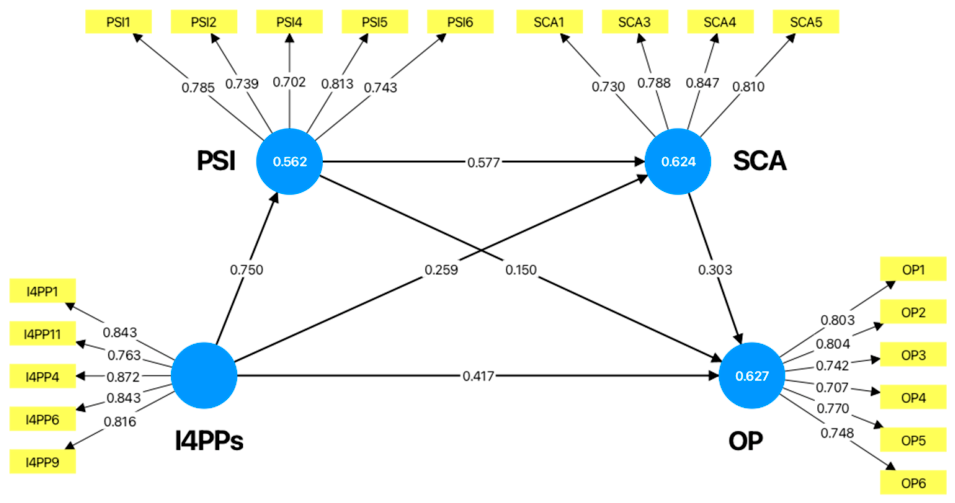
6]. The findings support the DCT prediction that I4PPs build sensing capabilities (PSI) enabling reconfiguring capabilities (SCA). Drawing on Dynamic Capabilities Theory, the proposed serial pathway is based on the idea that Industry 4.0 manufacturing practices enhance operational performance through capability development rather than through technology adoption alone. PSI represents an internal integration capability that coordinates production-related information and processes, whereas SCA reflects a reconfiguring capability that enables rapid adaptation to demand and supply chain uncertainty. Accordingly, PSI is positioned before SCA because internal coordination is required before firms can effectively reconfigure supply chain routines and respond to external changes. VAF analysis (43.5%) confirms partial mediation. PSI to OP f
2 = 0.019 (negligible) indicates PSI contributes via SCA primarily. In addition to improving operational processes, Industry 4.0 applications contribute to more adaptive and efficient production systems by enabling tighter integration and faster responsiveness. Understanding how these technologies shape organizational capabilities is therefore important not only for operational performance research but also for discussions of long-term manufacturing competitiveness [
7,
8].
Accordingly, the primary aim of this study is to examine the impact of Industry 4.0 manufacturing practices (I4PPs) on the operational performance of manufacturing firms, and to analyze the serial mediating roles of production system integration (PSI) and supply chain agility (SCA) in this relationship. Through a structural equation model tested via PLS-SEM, the study addresses the following question: does the effect of I4PPs on operational performance operate through a sequential pathway in which I4PPs first strengthen PSI, which in turn enhances SCA, which finally improves operational performance? By testing this serial mediation logic, the study aims to contribute to the emerging literature on the organizational mechanisms linking digital manufacturing to performance outcomes.
While prior studies have examined individual mediators between digital manufacturing technologies and performance [
9,
10], none has simultaneously tested PSI and SCA as sequential capability-building mechanisms within a unified structural model grounded in DCT [
6]. Specifically, our study differs in three ways: (1) it formally operationalizes the serial pathway I4PPs → PSI → SCA → OP using bootstrapped indirect effect tests; (2) it draws on DCT to theorize why sensing capabilities (PSI) must precede reconfiguring capabilities (SCA) in the digitalization process; and (3) it employs PLSpredict to demonstrate predictive, not merely explanatory, validity (
Table 1).
2. Materials and Methods
The sequential ordering of PSI before SCA is theoretically grounded in two complementary bodies of literature. First, within Dynamic Capabilities Theory [
6], sensing and seizing capabilities (represented here by PSI) logically precede reconfiguring capabilities (represented by SCA), because firms must first achieve internal informational coherence before they can adaptively reconfigure external supply chain routines [
11]. Second, the information processing perspective [
12] suggests that organizations must reduce internal information asymmetry before they can effectively process and respond to external environmental signals. Flynn et al. (2010) similarly demonstrated that internal integration is a prerequisite for effective external supply chain coordination [
13]. Consistent with this logic, Fayezi et al. (2017) and Swafford et al. (2006) showed that firms with stronger internal process integration exhibit significantly higher supply chain flexibility and responsiveness [
14,
15]. Collectively, these theoretical and empirical foundations support the claim that internal coordination (PSI) must be established before firms can successfully reconfigure their supply chain agility (SCA).
Industry 4.0 technologies have led to significant structural changes in production systems. In particular, big data analytics, the Internet of Things, intelligent automation technologies, and cyber–physical systems support more integrated, flexible, and data-driven production processes. These technologies not only digitize production processes but also improve the organizational structures and supply chain management approaches within businesses. In this context, evaluating the relationships between Industry 4.0 production applications, production system integration, supply chain agility, and operational performance will provide significant gains to the literature and application systems.
It is frequently emphasized in the literature that Industry 4.0 production applications strengthen internal process integration within businesses. Industry 4.0 manufacturing practices may enhance integration and agility by improving real-time data visibility, cross-functional information synchronization, and operational decision-making speed. Digital production technologies reduce information asymmetry between production, purchasing, logistics, and planning functions, thereby strengthening internal production systems integration. This internal coordination then enables firms to revise production and distribution plans more rapidly and to respond more flexibly to demand and supply chain uncertainty. Thus, the effect of Industry 4.0 practices on agility is not merely technological but operates through improved information processing and capability development. This study adopts Dynamic Capabilities Theory (DCT) [
6] as its primary theoretical lens. PSI = sensing/seizing capability; SCA = reconfiguring capability. Serial ordering I4PPs to PSI to SCA to OP is DCT-derived. Thanks to digital production technologies, real-time data sharing between production machines, information systems, and enterprise software becomes possible, which increases coordination between departments within the business. The acceleration of information flow between functions such as production planning, purchasing, and logistics allows production processes to be carried out in a more synchronized manner. Recent studies show that Industry 4.0 technologies enhance coordination between production systems by strengthening intra-organizational integration [
8,
9]. Accordingly, Industry 4.0 production applications are expected to increase the integration of production systems. Accordingly, the mechanism underlying this relationship is that Industry 4.0 practices transform fragmented production data into integrated operational information, which improves interdepartmental coordination and supports synchronized production-related decision-making.
H1: Industry 4.0 manufacturing applications (I4PPs) positively impact production system integration (PSI).
Industry 4.0 technologies are also creating significant transformations in supply chain processes. Thanks to digital production systems, businesses can analyze data obtained from production and supply processes in real time and respond more quickly to changes in demand. This allows businesses to manage their supply chain processes in a more flexible and adaptable structure. The literature states that Industry 4.0 technologies strengthen supply chain coordination by increasing data visibility and increase business agility capacity [
10,
16]. Accordingly, Industry 4.0 production applications are expected to increase supply chain agility. This relationship is theoretically meaningful because digital visibility allows firms to detect demand and supply changes earlier, while integrated data flows support faster adjustment of production and distribution activities.
H2: Industry 4.0 production applications (I4PPs) positively affect supply chain agility (SCA).
Industry 4.0 technologies contribute to the more efficient execution of operational processes by increasing the level of automation in production processes. Thanks to digital production technologies, data obtained from production processes can be analyzed, process optimization can be achieved, and resource utilization can be made more effective. This situation increases production efficiency while having positive effects on operational outputs such as delivery performance and product quality. There are significant findings in the literature indicating that Industry 4.0 applications improve businesses’ operational performance [
16,
17]. Accordingly, Industry 4.0 production applications are expected to have a positive impact on operational performance.
H3: Industry 4.0 production applications (I4PPs) positively affect operational performance (OP).
Production systems integration is a crucial organizational capability that enables businesses to manage their production processes more effectively. Effective information sharing and process coordination between departments contribute to more harmonious production activities. Increased integration allows for more efficient management of production planning processes and optimization of resource utilization. This facilitates faster and more flexible movement in business supply chain processes. The literature states that intra-business integration is one of the key factors increasing supply chain agility [
18]. Accordingly, production systems integration is expected to increase supply chain agility.
H4: Production systems integration (PSI) positively impacts supply chain agility (SCA).
Production systems integration is also considered a significant factor in improving businesses’ operational performance. Thanks to integrated production systems, businesses can plan their production processes more effectively and strengthen coordination between operational activities. This contributes to increased efficiency in production processes, reduced costs, and improved delivery performance. There is strong evidence in the literature that there is a positive relationship between production system integration and operational performance [
13,
18].
H5: Production system integration (PSI) positively affects operational performance (OP).
Agile supply chains allow businesses to quickly respond to changing market conditions and adjust production plans. Businesses with agile supply chains can respond quickly to demand fluctuations and revise their production plans in a short amount of time. This enables businesses to respond faster to customer demands, thus improving operational performance. The literature states that supply chain agility has a significant impact on operational performance [
15,
19].
H6: Supply chain agility (SCA) positively affects operational performance (OP).
It has been established in the literature that the performance impact of Industry 4.0 technologies is not direct but is mediated by organizational capabilities. Drawing on the Resource-Based View (RBV) and dynamic capabilities theory, firms that deploy digital manufacturing technologies are able to build internal integration capabilities (PSI) that subsequently improve operational outcomes. When PSI is introduced as a mediating variable between I4PPs and OP, it is hypothesized to capture the mechanism by which technology investment is converted into operational value through enhanced coordination and data integration. This logic is consistent with prior research demonstrating that organizational integration capabilities mediate the performance effects of digital technologies.
H7: Production system integration (PSI) plays a mediating role in the relationship between Industry 4.0 manufacturing practices (I4PPs) and operational performance (OP).
In parallel, Industry 4.0 technologies increase supply chain data visibility and responsiveness, thereby enabling firms to build agile supply chain structures (SCA). Agile supply chains improve operational performance by allowing faster adaptation to demand fluctuations and market changes. From a dynamic capabilities perspective, SCA represents a higher-order operational capability that emerges from the digitalization of supply chain processes. Its mediating role between I4PPs and OP is supported by empirical evidence showing that digital technologies enhance performance indirectly through agility-building mechanisms.
H8: Supply chain agility (SCA) plays a mediating role in the relationship between Industry 4.0 manufacturing practices (I4PPs) and operational performance (OP).
Finally, the serial mediation logic rests on a theoretically grounded sequential pathway: I4PPs → PSI → SCA → OP. Digital manufacturing technologies first strengthen internal process integration (PSI); this enhanced integration then expands the firm’s supply chain responsiveness and flexibility (SCA); and increased agility subsequently translates into improved operational performance (OP). This sequential ordering reflects both the temporal logic of capability building and the empirical argument that integration precedes agility in the digitalization process. The serial mediation model therefore captures a more complete and theoretically coherent account of how I4PPs create operational value than single-mediator models.
H9: Manufacturing systems integration (PSI) and supply chain agility (SCA) play a serial mediating role in the relationship between Industry 4.0 manufacturing practices (I4PPs) and operational performance (OP).
2.1. Research Model and Methodology
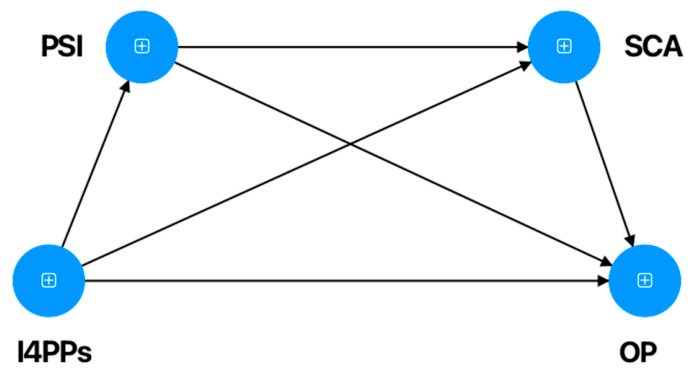
This research was designed using a quantitative research method to examine the impact of Industry 4.0 production applications on the operational performance of businesses. In the context of Industry 4.0, production system integration is considered to act as a crucial component of production system capacity by providing digital coordination and data integration. In this study, the relationships between Industry 4.0 production applications, production system integration, supply chain agility, and operational performance are examined within a structural model framework (
Figure 1). The Partial Least Squares Structural Equation Modeling (PLS-SEM) method was chosen to test the direct and indirect relationships between the variables within the research model.
The PLS-SEM method is widely used in business and management sciences, particularly for testing complex structural models and providing reliable results with relatively small sample sizes [
20]. Furthermore, this method offers a suitable approach for analyzing research models by allowing the testing of multiple mediating relationships. Research data were collected online through a structured questionnaire. In the process of data collection, participants were informed of the study’s purpose, and their anonymity was maintained. The collected data were used for scientific research only. To assess potential common method bias (CMB), Harman’s one-factor test was applied as an initial screening procedure. The results indicated that the first factor accounted for less than 50% of the total variance, providing preliminary evidence that common method variance is not a dominant concern. As a supplementary check, the full collinearity VIF procedure recommended by Kock (2015) was applied; all VIF values remained below 3.3, indicating the absence of severe CMB [
21]. Beyond Harman’s single-factor test and full collinearity VIF, procedural remedies were also applied to reduce common method bias. Respondents were assured anonymity, the purpose of the study was clearly explained, and the items were presented in a neutral and non-leading manner. In addition, previously validated scales were used to reduce item ambiguity. However, since the data were collected from a single source at one point in time, common method bias cannot be fully eliminated. Future studies should therefore employ multi-source, longitudinal, or time-lagged designs to provide stronger evidence against common method bias. Nonetheless, the cross-sectional, single-source nature of the data collection remains a methodological limitation. Future research should consider longitudinal or multi-source designs to more rigorously address this concern [
22].
2.2. Universe and Sample
The research population comprised middle- and upper-level managers employed in Turkish manufacturing firms, with responsibilities in production management, operations management, supply chain management, or digital transformation. Eligibility criteria required that participants held a managerial role in a manufacturing firm and had direct experience with Industry 4.0-related technologies or operational processes. Data were collected between October and December 2024 using a structured online questionnaire distributed through professional networks and direct organizational contact. Of the 412 questionnaires distributed, 300 usable responses were retained after removing incomplete and inconsistent submissions, yielding a response rate of approximately 72.8%. The study employed convenience sampling, a non-probability technique. While this limits generalizability, convenience sampling is widely used in manufacturing management research when access to a complete sampling frame is not feasible [
20]. The sample size of 300 is consistent with the recommended guidelines for PLS-SEM Version 4.1.1 applications involving models of this complexity.
2.3. Data Collection Tool
A structured questionnaire was used as a data collection tool in this research. The questionnaire consisted of two sections. The first section contained questions about the participants’ demographic characteristics, and the second section contained scale items to measure the variables included in the research model. The scales used in this research were adapted from previously validated instruments in the literature. Since the original scales were developed in English, a forward-translation procedure was applied to produce Turkish versions. Each item was independently translated by two bilingual researchers with expertise in operations management and subsequently reviewed for semantic equivalence and contextual appropriateness. A pilot test was conducted with 20 manufacturing managers to evaluate the comprehensibility of the items; minor wording adjustments were made based on pilot feedback. All scale items were measured using a five-point Likert-type rating scale (1 = Strongly Disagree, 5 = Strongly Agree).
Industry 4.0 Production Applications Scale: This scale, used to measure the level of digital technology use in a business’s production processes, was adapted from the measurement tool developed in [
23]. The scale consists of items that evaluate dimensions such as the use of digital technologies in production processes, data analytics applications, automation level, and digital integration of production systems. Production Systems Integration Scale: This scale, used to measure the level of information sharing and process coordination between departments within a business, was based on that in [
13]. The scale items evaluate coordination and information sharing between production, purchasing, and logistics units [
13,
24]. Supply Chain Agility Scale: This scale, used to measure a business’s capacity to adapt to changing market conditions and respond quickly to demand changes, was based on the work in [
15] and [
15,
25,
26]. Li et al. (2007) developed a measurement tool for measuring operational outputs such as productivity, quality, delivery performance, and process efficiency [
27] (
Table 2).
4. Discussion
This study applied an integrated model framework to examine how Industry 4.0 manufacturing applications affect production systems, supply chain agility, and operational performance. In line with the existing literature, the results showed that Industry 4.0 manufacturing applications impact operational performance both directly and through organizational mechanisms, with production system integration and supply chain agility serving as critical mediating pathways. The use of smart manufacturing systems, such as sensor technologies and big data analytics, makes production processes more flexible and innovative [
7,
36]. Industry 4.0 applications have been found to improve the innovation performance of businesses by restructuring process designs [
36].
The research results also showed that production systems have a significant and strong impact on supply chain agility. This finding revealed that production systems are transforming not only production processes but also supply chain processes. Current research shows that digital manufacturing technologies accelerate information flow in the supply chain and enable businesses to respond more quickly to environmental uncertainties [
10,
37]. In particular, the development of data-driven decision-making mechanisms contributes to businesses achieving higher levels of agility in their supply chain processes [
18]. In this context, the findings demonstrate that production systems support operational efficiency by increasing businesses’ supply chain agility.
Another important finding of this research is that supply chain agility has a significant and positive impact on operational performance. This result parallels those of current studies showing that businesses with agile supply chain structures are more successful regarding their operational performance. Research, particularly in the post-pandemic period, has revealed that supply chain agility is a critical factor in increasing businesses’ operational resilience and performance
It is important to acknowledge that the proposed relationships may not be equally applicable across all industrial contexts. Specifically, the strength of the I4PPs–PSI pathway may vary depending on firm size, as larger firms tend to have more resources to invest in integration infrastructure. Similarly, the SCA–OP relationship may be moderated by industry dynamism, with firms in more volatile sectors benefiting more strongly from agility capabilities. The level of prior digitalization experience and managerial commitment to Industry 4.0 adoption may also serve as boundary conditions that influence the magnitude of the observed effects. Future research should explicitly test these moderating variables to establish the conditions under which the serial mediation mechanism holds most strongly [
38,
39]. Businesses benefit from agile supply chain structures by being able to adapt more quickly to fluctuations in demand and achieving higher efficiency in their operational processes [
40].
The very small direct effect of PSI on OP suggests that production systems integration functions mainly as an enabling capability rather than as an immediate performance driver. Internal integration improves coordination and information processing, but its operational value becomes more visible when it supports supply chain agility. Thus, from a dynamic capability’s perspective, PSI contributes to performance primarily by enabling reconfiguration through SCA, which explains why the indirect pathway is theoretically more meaningful than the direct PSI → OP path.
The research model results indicated that Industry 4.0 production applications have a significant association with operational performance through production systems and supply chain agility on operational performance through production systems and supply chain agility. VAF approximately 43.5% confirms partial (not full) mediation. The PSI to OP path carries negligible f
2 = 0.019. Technologically driven advanced manufacturing affects business performance through a multi-stage value creation process due to the chain mediation mechanism defined as Industry 4.0 + production systems + supply chain agility + operational performance. In one recent study, digital transformation was found to impact business performance mainly through operational and organizational capabilities, rather than directly [
9]. These findings also suggest that the contribution of Industry 4.0 extends beyond immediate operational gains. By strengthening integration and agility capabilities, digital manufacturing practices help firms develop more adaptive and responsive operational systems capable of managing uncertainty and market volatility.
The theoretical contribution of this study lies in positioning production systems integration and supply chain agility as sequential capability mechanisms that explain the relationship between Industry 4.0 manufacturing practices and operational performance. Rather than treating Industry 4.0 as a direct performance-enhancing factor, the study demonstrates that digital manufacturing practices first strengthen internal integration and then support external responsiveness. This provides a more nuanced explanation of how digital technologies are transformed into operational outcomes. From a practical perspective, the findings suggest that managers should not focus only on investing in Industry 4.0 technologies, but should also ensure that these technologies are embedded into integrated production systems and agile supply chain routines.
5. Conclusions
This study examined the associations between I4PPs and OP, grounded in DCT [
6]. focusing specifically on the serial mediating roles of production system integration and supply chain agility within a PLS-SEM-based structural model. A model developed using the PLS-SEM method was tested. The results showed that Industry 4.0 production applications are a significant strategic factor affecting business performance. These results also revealed that Industry 4.0 production applications have a strong and significant impact on production systems. In this context, the research findings are consistent with prior research demonstrating that digital production technologies make manufacturing processes more flexible, data-driven, and operationally integrated [
41].
Furthermore, according to the research results, production systems increase supply chain agility, and supply chain agility has a significant impact on operational performance. This shows that digital transformation processes transform businesses’ production systems and their supply chain structures. In recent years, uncertainties and crises experienced in global supply chains in the business world have necessitated that businesses have agile and flexible supply chain structures [
38]. In this context, I4PP adoption is associated with operational performance both directly and indirectly. One of the important findings of this research is that the impact of Industry 4.0 production applications on operational performance largely occurs through production systems and supply chain agility. According to the chain mediation findings, digital production technologies do not directly increase business performance but create an indirect value creation process through organizational and operational capabilities. This result supports the competency-based value creation approach in the digital transformation literature. Several limitations should be acknowledged. First, the use of convenience sampling and a Turkey-based sample restricts the generalizability of the findings. Second, the cross-sectional design limits causal inference. Third, the HTMT value between PSI and SCA (0.944) suggests these constructs share considerable conceptual proximity, which future research should address through refined measurement. Fourth, control variables such as firm size, firm age, industry type, and digital investment intensity were not included in the model; their omission may introduce unobserved heterogeneity. Future research should address these limitations by employing multi-country samples, longitudinal designs, and more differentiated measurement instruments for integration and agility constructs [
42].
The PLSpredict analysis used in this research revealed that the proposed model has not only explanatory but also predictive power. The positive Q
2_predict values obtained in this research and lower PLS-SEM prediction errors in many indicators showed that the model offers a meaningful analytical framework regarding predicting future performance. This supports recent studies highlighting the importance of the explanatory and predictive modeling approach [
35]. This study demonstrated that Industry 4.0 manufacturing applications are not only a technological transformation tool for businesses but also a strategic management approach that enhances innovation capacity, supply chain agility, and operational performance. Furthermore, the results indicate that Industry 4.0 manufacturing applications impact operational performance indirectly and directly, via multi-stage value creation through production systems and supply chain agility. By demonstrating that Industry 4.0 applications boost business performance, this study makes a significant contribution to the literature on digital transformation and operations management. In addition, the findings may be evaluated from a sustainability-oriented managerial perspective. The ability of Industry 4.0 manufacturing practices to enhance integration, agility, and operational effectiveness suggests that digital transformation can serve not only as a productivity tool but also as a strategic mechanism for building more resilient and sustainable manufacturing systems. Accordingly, this study contributes to the growing discussion on how firms can align digital transformation with long-term operational sustainability.