1. Introduction
Over the past decade, Saudi Arabia has implemented wide-ranging fiscal and structural reforms under Saudi Vision 2030, aimed at diversifying public revenues, improving market efficiency, and strengthening the non-oil economy. Among the most consequential reforms was the introduction of a Value-Added Tax (VAT) at 5% in January 2018, followed by an increase to 15% in July 2020. These measures represented a fundamental shift in the domestic tax system and altered price structures, business incentives, and consumer purchasing conditions across multiple sectors. The restaurant, café, and food service sector is particularly relevant in this context because it combines high transaction frequency, discretionary spending, relatively elastic demand, and growing reliance on electronic payments, making it highly responsive to both tax policy and digital market transitions [
1].
Beyond fiscal diversification, VAT reform and digital payment expansion are increasingly viewed as components of sustainable economic governance because they improve transparency, reduce informality, strengthen institutional accountability, and support resilient market systems under long-term development strategies. In rapidly modernizing economies, digital financial systems and electronic transaction reporting play an important role in promoting fiscal sustainability, enhancing policy monitoring, and supporting sustainable economic transformation.
Consumption taxation has become a central pillar of modern public finance systems. Governments increasingly rely on VAT to broaden tax bases, improve administrative efficiency, and reduce dependence on volatile revenue sources. However, the economic effects of VAT reforms are not mechanically determined. Standard consumer-demand theory predicts that higher indirect taxation raises final prices and may reduce quantities demanded, ceteris paribus [
2]. Yet actual market responses depend on several mediating factors, including tax pass-through, competition intensity, income expectations, liquidity constraints, and intertemporal expenditure timing. Consumers may accelerate purchases before the tax is implemented and subsequently reduce spending, while firms may absorb part of the tax burden through margins or pricing strategies. Empirical evidence from European VAT reforms confirms that pass-through rates vary substantially across products and countries, with some reforms producing temporary price spikes and others yielding only partial transmission to consumers [
3,
4,
5].
At the same time, the rapid expansion of digital payment systems has transformed the interpretation of transaction-based economic indicators. POS terminals, mobile wallets, online payment gateways, and contactless technologies reduce transaction friction, improve convenience, and widen the formal reporting base of economic activity. Consequently, high-frequency administrative transaction datasets are increasingly used as proxies for real economic performance. High-frequency POS transaction data provide near real-time information on consumer behavior, market formalization, and institutional compliance, making them increasingly valuable for evaluating macroeconomic shocks and policy interventions. However, an important distinction must be made between recorded turnover and underlying real demand. When consumers shift from cash to electronic payments, recorded POS sales may rise even if aggregate consumption changes only modestly. Similarly, merchants entering formal reporting systems may reveal activity that previously went unrecorded. Thus, digitalization can generate structural upward shifts in transaction data independent of genuine increases in consumption [
6,
7]. These issues become especially important when tax reform and payment-system modernization occur simultaneously. In such cases, measured tax policy effects may partly reflect stronger compliance, wider reporting coverage, and formalization rather than purely behavioral demand responses. Modern VAT systems are typically associated with invoicing requirements, digital records, audit trails, and stronger enforcement mechanisms. Public finance research, therefore, emphasizes that tax modernization can narrow the gap between declared and actual economic activity, especially in fragmented service sectors characterized by numerous small transactions [
8]. Restaurants and cafés provide a clear example, since official sales may increase after reform because formal reporting expands relative to previously cash-based or weakly documented transactions. Accordingly, observed post-reform transaction dynamics may reflect both conventional demand responses and institutional reporting effects.
Saudi Arabia provides a particularly insightful case for examining these interactions. Along with VAT reform, the country saw rapid growth in payment infrastructure, POS terminals, fintech adoption, and consumer use of non-cash transactions. These developments were reinforced by regulatory modernization and behavioral shifts triggered by the COVID-19 pandemic, which accelerated the adoption of contactless payments and digital ordering channels. International evidence shows that epidemics can cause major disruptions in household spending, followed by heterogeneous recoveries depending on sector characteristics and policy responses [
9,
10,
11]. In Gulf economies, Food behavior and retail demand also changed significantly during the pandemic period [
12]. Since the VAT increase in July 2020 happened amid this unusual macroeconomic setting, any empirical analysis that overlooks pandemic-related shocks risks incorrectly attributing changes solely to tax policy.
This distinction is critical because policymakers increasingly rely on high-frequency transaction indicators as real-time measures of economic conditions. If digitalization, compliance reforms, and pandemic shocks alter the relationship between recorded transactions and actual demand, then a naïve interpretation of post-reform POS data may be misleading. The Saudi case, therefore, provides insights that extend beyond a single country, especially for economies implementing simultaneous fiscal modernization and financial digitalization. Although prior literature has examined VAT pass-through, inflationary effects, and household expenditure responses in Europe and advanced economies [
3,
4,
5], and separate strands of research analyze the effects of digital payments on measurable consumption and formalization [
6,
7], three important gaps remain. First, few studies use monthly administrative POS data to evaluate VAT reforms at the sector level in emerging economies. Second, limited research explicitly separates tax effects from digital-payment formalization effects in observed transaction series. Third, evidence for restaurant and food-service markets in Gulf Cooperation Council countries remains scarce despite their growing importance for tourism, urban consumption, entrepreneurship, and non-oil diversification.
Interrupted Time Series (ITS) analysis is considered one of the strongest quasi-experimental approaches for evaluating large-scale policy interventions when randomized experiments are infeasible [
13,
14]. Against this background, the present study investigates how VAT reforms affected recorded POS sales in Saudi Arabia’s restaurant, café, and food service sector using official monthly data covering 2016–2024. The empirical strategy applies an ITS framework with two intervention points corresponding to the 2018 and 2020 VAT reforms. To strengthen statistical inference and capture multiple dynamic channels, the analysis combines GLS estimation with AR (1) correction, seasonal SARIMAX models, and an ECM to distinguish short-run responses from long-run equilibrium adjustment.
This paper makes four principal contributions. First, it provides one of the earliest high-frequency sectoral evaluations of Saudi VAT reforms using administrative transaction data. Second, it demonstrates how payment-system modernization can amplify measured tax-policy effects in retail datasets. Third, it integrates multiple econometric approaches to test robustness under serial correlation, seasonality, and cointegration. Fourth, it offers practical policy implications for governments implementing simultaneous tax reforms and digitalization strategies.
By integrating fiscal policy analysis, digital payment transformation, and high-frequency transaction data within a unified quasi-experimental framework, this study contributes to the emerging literature on sustainable economic modernization, fiscal sustainability, and institutional transformation in digitally transitioning economies.
2. Materials and Methods
This study employs an ITS framework to estimate the causal effects of implementing and subsequently increasing the VAT on recorded POS sales in Saudi Arabia’s restaurant, café, and food service sector. ITS is widely regarded as a credible quasi-experimental method for evaluating nationwide policy interventions when randomized experiments are infeasible, particularly when reforms occur at clearly identifiable dates and affect the entire market simultaneously [
13]. The two policy interventions examined are the introduction of VAT at 5% in January 2018 and the increase to 15% in July 2020.
Accordingly, the ITS model estimates (1) the immediate shift in sales levels and (2) the post-intervention changes in growth slope after each VAT policy shock, while controlling for key macro-price variables shaping consumption responses.
The study uses monthly official data covering the period from January 2016 to January 2024, providing: a sufficiently long pre-policy baseline, two major tax interventions, and an extended post-reform adjustment horizon. The sample therefore captures four economically relevant phases: Pre-VAT period, First VAT regime (5%), COVID-19 disruption period, Second VAT regime (15%).
The dataset was compiled from publicly available official Saudi sources for POS transactions, consumer price indices, inflation, and the COVID-19 period from the Saudi Central Bank (SAMA) and the General Authority for Statistics (GASTAT). The dependent variable focuses on POS turnover in the restaurant, café, and food service segment, one of the most consumer-facing and transaction-intensive sectors in the Saudi economy. All data used in this study are publicly available from official government statistical sources, ensuring transparency and reproducibility of the empirical analysis (
Table 1 summarizes the study variables). Monthly sector-level data on POS terminal diffusion, merchant-level card penetration, or cash-substitution intensity were not consistently available for the full study period; therefore, direct digitalization proxies could not be incorporated without risking measurement inconsistency.
To ensure valid estimation, all level-dependent variables were transformed into natural logarithms to stabilize variance and linearize elasticities. Pre-estimation diagnostics detected first-order autocorrelation based on Durbin–Watson and Breusch-Godfrey LM tests (DW = 1.32; LM = 5.18,
p < 0.05). Because ignoring autocorrelation may bias standard errors and overstate statistical significance in policy-evaluation studies, the preferred baseline specification was estimated using GLS with AR(1) disturbances [
15],
where ut is white noise. The estimated autoregressive parameter ρ = 0.47, confirming moderate serial persistence that was successfully corrected. PACF and Ljung–Box tests (
p > 0.05) supported the post-estimation assumption of residual independence.
The GLS model for logged POS sales takes the following form:
where intervention variables
&
capture level shifts, slope terms represent post-intervention trend changes. Specifically, β
3 and β
5 capture post-intervention slope changes. This structure follows standard ITS practice in policy evaluation literature [
14,
16].
To account for seasonal patterns and extract orthogonal impacts of exogenous inflation and price effects, a Seasonal ARIMAX/SARIMAX specification was also estimated using the seasonal form:
The monthly frequency (s = 12) is particularly relevant in Saudi consumer markets where spending patterns may be influenced by Ramadan, Eid holidays, school cycles, tourism activity, and weather-related consumption. Seasonal adjustment is especially important in food-service demand because recurring calendar effects may otherwise bias intervention estimates and exaggerate measured policy impacts. The SARIMAX specification includes the same intervention variables and macroeconomic controls as the baseline ITS model. Final model selection was guided by AIC and BIC criteria. This robustness model helps verify whether baseline GLS findings remain valid after explicitly modeling seasonality and stochastic dynamics.
To distinguish between short-run effects and long-run equilibrium adjustments, Johansen and augmented Dickey–Fuller (ADF) procedures were used to establish cointegration among logged sales and price/inflation variables, after which an ECM was specified as:
where
represents the lagged error-correction term. The error-correction coefficient
λ < 0 measures the monthly speed of adjustment toward the long-run equilibrium, consistent with consumption adjustment to VAT-induced price shocks.
A counterfactual simulation framework was implemented by predicting sales values under scenarios with activated VAT indicators (actual) and deactivated VAT indicators (counterfactual). The percentage effect was computed as:
Counterfactual estimation is widely used in quasi-experimental policy evaluation because it approximates the expected market trajectory in the absence of intervention [
13,
14]. Thus, the ITS-SARIMAX-GLS-ECM strategy combines structural time-series modeling, macro-adjusted elasticities, and counterfactual inference to produce credible estimates of VAT impact consistent with modern fiscal evaluation practice.
Although both transaction counts and transaction values were available, the econometric models were specified with ln(Post) as the dependent variable for three reasons:
POS values reflect true monetary demand, which is the target of VAT policy, whereas transactions may include non-comparable ticket sizes.
The expansion of POS digital infrastructure between 2016 and 2019 introduces structural growth unrelated to consumer demand, producing bias in pot-based elasticity estimates.
POT was therefore used only for descriptive trend comparison and diagnostic stability testing (such as CUSUM), not for core causal modeling.
Estimating parallel models for ln(POTt) is feasible but may conflate VAT impacts with structural changes in digital payment adoption, weakening identification. From a sustainability perspective, combining ITS, GLS, SARIMAX, and ECM frameworks allows more accurate monitoring of fiscal-policy impacts, market formalization, and digital economic transformation, thereby supporting evidence-based sustainable governance and long-run economic resilience assessment under Saudi Vision 2030.
3. Results and Discussion
The study adopts an ITS design with two main interventions: the introduction of the 5% VAT in January 2018 and its increase to 15% in July 2020. GLS with first-order autoregressive errors AR (1) is used as the main model. At the same time, Seasonal ARIMAX and the ECM are employed as additional robustness checks. The models include explanatory variables to control for price dynamics, such as the consumer price indices for food and beverages, the general inflation rate, and a dummy variable for the COVID-19 crisis to capture external shocks unrelated to the VAT policy.
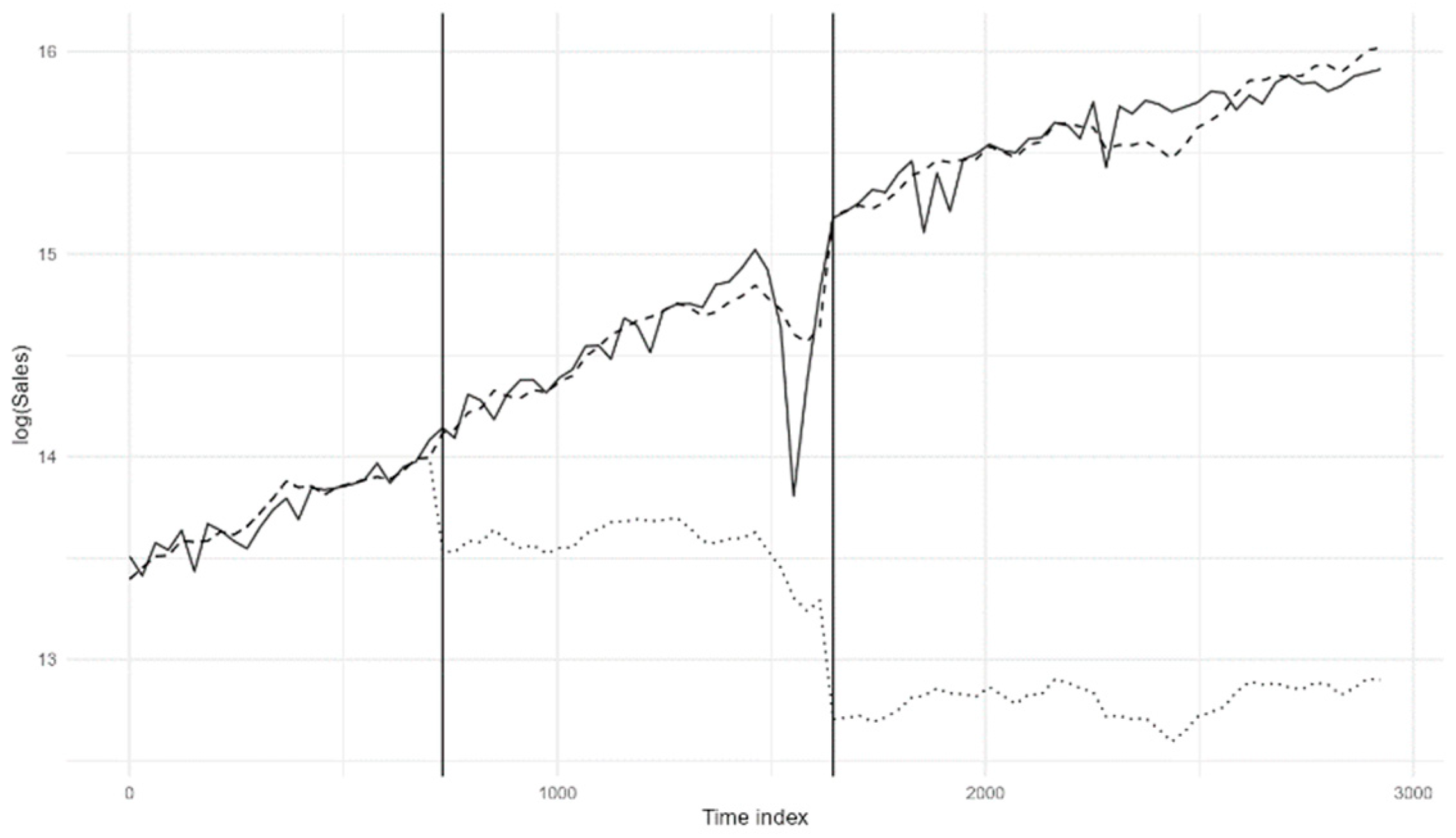
Figure 1 shows the close alignment between actual and fitted nominal sales (log Sales), with clear jumps at the two intervention points (2018 and 2020). The dotted line represents the counterfactual path, which illustrates how sales would have evolved in the absence of VAT policy changes. Actual sales rise sharply after each intervention and then gradually return to a more stable path, reflecting a short-run impact of the tax policy followed by an automatic market correction. From a sustainability perspective, these dynamics reflect how fiscal reforms and payment-system modernization jointly influence the resilience and formalization of food-service markets. The transition toward digitally recorded transactions improves transparency, strengthens institutional monitoring capacity, enhances tax compliance, and supports data-driven economic governance, all of which are increasingly recognized as important dimensions of economic sustainability under Saudi Vision 2030 and the broader Sustainable Development Goals (SDGs).
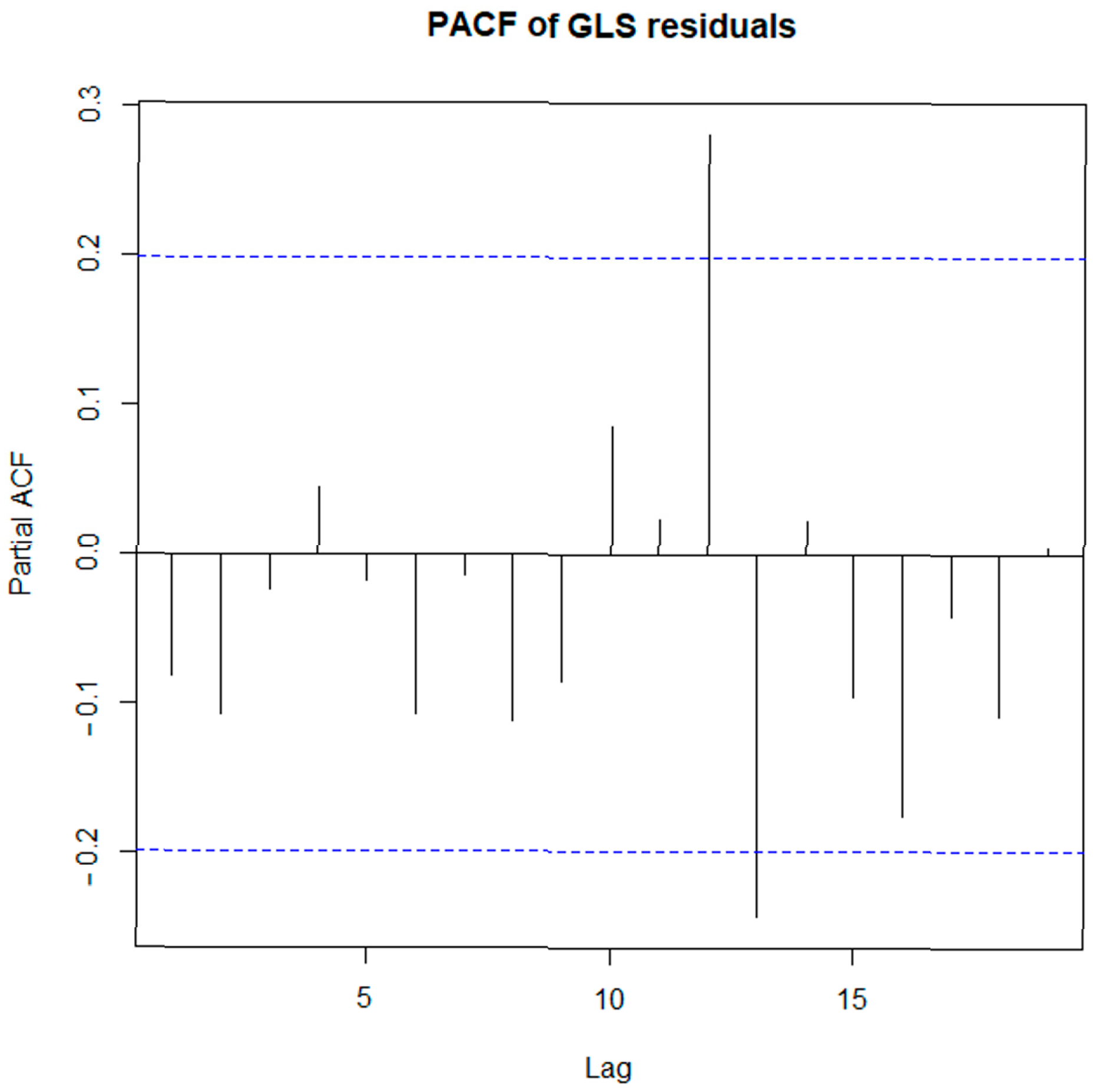
Figure 2 reports the partial autocorrelation function (PACF) of the GLS residuals, which lies within the statistical bounds, indicating that first-order autocorrelation has been successfully removed and that the residuals are stable.
Table 2 shows that both tax-policy dummies (T1, T2) are positive and statistically significant, confirming a sizeable level shift in POS sales immediately after each VAT reform. The slope coefficients (timeT1 and timeT2) capture post-intervention trends: the positive slope after 2018 suggests that the market gradually adjusted and recovered, whereas the slightly negative slope after 2020 indicates a stabilization of sales following the initial shock.
The model coefficients (T1 = 0.582, T2 = 1.689), obtained by exponentiating from the log scale, show significant rises in reported POS sales following the introduction of the 5% VAT and its later increase to 15%. These notable spikes likely result from two combined factors: (1) the rapid growth and stricter documentation of POS transactions during the same period, and (2) short-run consumer behavior such as stockpiling, buying more before the VAT rate hikes to avoid higher taxes, and changes in shopping routines, rather than a true increase in underlying demand.
While the exponential transformation of the VAT dummy (for example, exp (1.68)) mechanically implies a very large proportional change in logged POS sales, this should mainly be seen as a structural shift in reported electronic sales rather than an exact increase in actual consumption. Recent work using high-frequency payment-system data during COVID-19 shows that restrictions on cash use and health-related measures can cause a rapid shift to digital and card payments, leading to abrupt increases in electronically recorded spending even if overall economic activity changes only slightly [
7,
11]. Our findings are consistent with this evidence: the positive VAT effects in the GLS and SARIMAX models mainly capture improved reporting and the migration of cash transactions into the POS system in response to VAT requirements and health protocols. Beyond fiscal administration, the expansion of electronic payments contributes to sustainability through improved economic transparency, reduced informal-market dependence, lower transaction frictions, and stronger institutional accountability. In the context of Saudi Arabia’s Vision 2030, digital financial inclusion and transaction formalization represent key pillars for sustainable economic transformation and long-term market efficiency. This interpretation also aligns with the concept of the “compliance gap,” whereby administrative reforms and enforcement tools affect reported tax bases differently from underlying real activity [
8].
The slight negative post-2020 slope reflects a gradual return to a new steady state for the restaurant and café sector after the initial VAT- and pandemic-related disturbances. The strong negative relationship between the food price index and sales confirms the price sensitivity of demand: higher food prices are associated with a marked decline in POS sales volumes.
With respect to the broader tax and consumption literature, the observed short-run VAT effects can be framed in light of both classical consumption theory and empirical VAT studies. Friedman’s [
2] permanent income hypothesis suggests that households base spending decisions on long-run expected income, so temporary tax changes should have only limited effects on intertemporal consumption. In contrast, standard demand theory predicts that increases in commodity prices via higher VAT rates reduce the quantity demanded, ceteris paribus. Empirically, ref. [
3] shows that VAT-rate changes often generate complex, non-linear patterns in consumption, with evidence of anticipation effects, asymmetric responses to increases versus cuts, and short-lived impacts that fade over time. Studies on epidemics and pandemics similarly report large negative effects on retail activity during lockdowns, followed by strong rebounds driven by pent-up demand and a shift toward digital channels [
10,
11]. Our POS-based results are therefore consistent with international evidence that tax and health shocks can temporarily distort observed spending patterns, especially when combined with the rapid digitalization of payments. These findings also highlight the importance of integrating fiscal-policy analysis with sustainability-oriented institutional reforms. In rapidly digitalizing economies, transaction-based indicators increasingly serve not only as measures of economic activity but also as tools for monitoring sustainable consumption patterns, improving governance quality, and supporting adaptive policy responses during periods of economic uncertainty and public-health shocks.
As a robustness check, the SARIMAX model of order SARIMAX (0,0,1) (1,0,0) {12} yields estimates consistent with the GLS results: the VAT coefficients (T1 = 0.547, T2 = 1.474) remain positive and statistically significant at the 1% level (
Table 3).
The Ljung–Box test (
p = 0.651) indicates no residual autocorrelation, and the AIC value of −115.95 points to a good statistical fit.
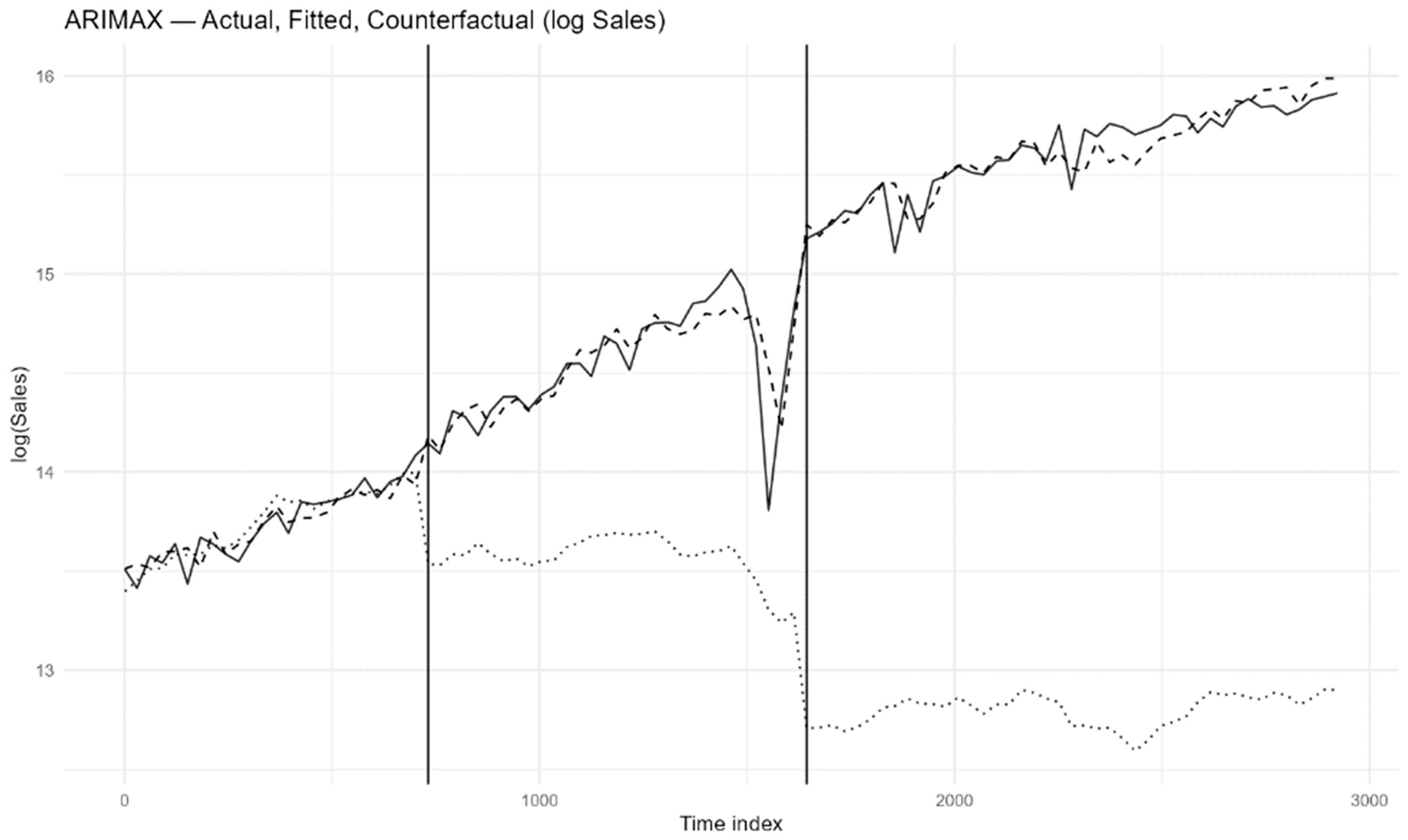
Figure 3 plots actual, fitted, and counterfactual sales from the SARIMAX model. The overall pattern closely resembles that of the GLS model, with the seasonal specification providing a slightly better fit during periods of pronounced volatility after 2020. The figure also shows that the actual path lies above the counterfactual after each VAT intervention and then gradually converges, indicating a strong but short-lived treatment effect that weakens over time. These results support the hypothesis that sudden changes in POS sales coincide temporally with VAT interventions, even after controlling for seasonality and serial dependence.
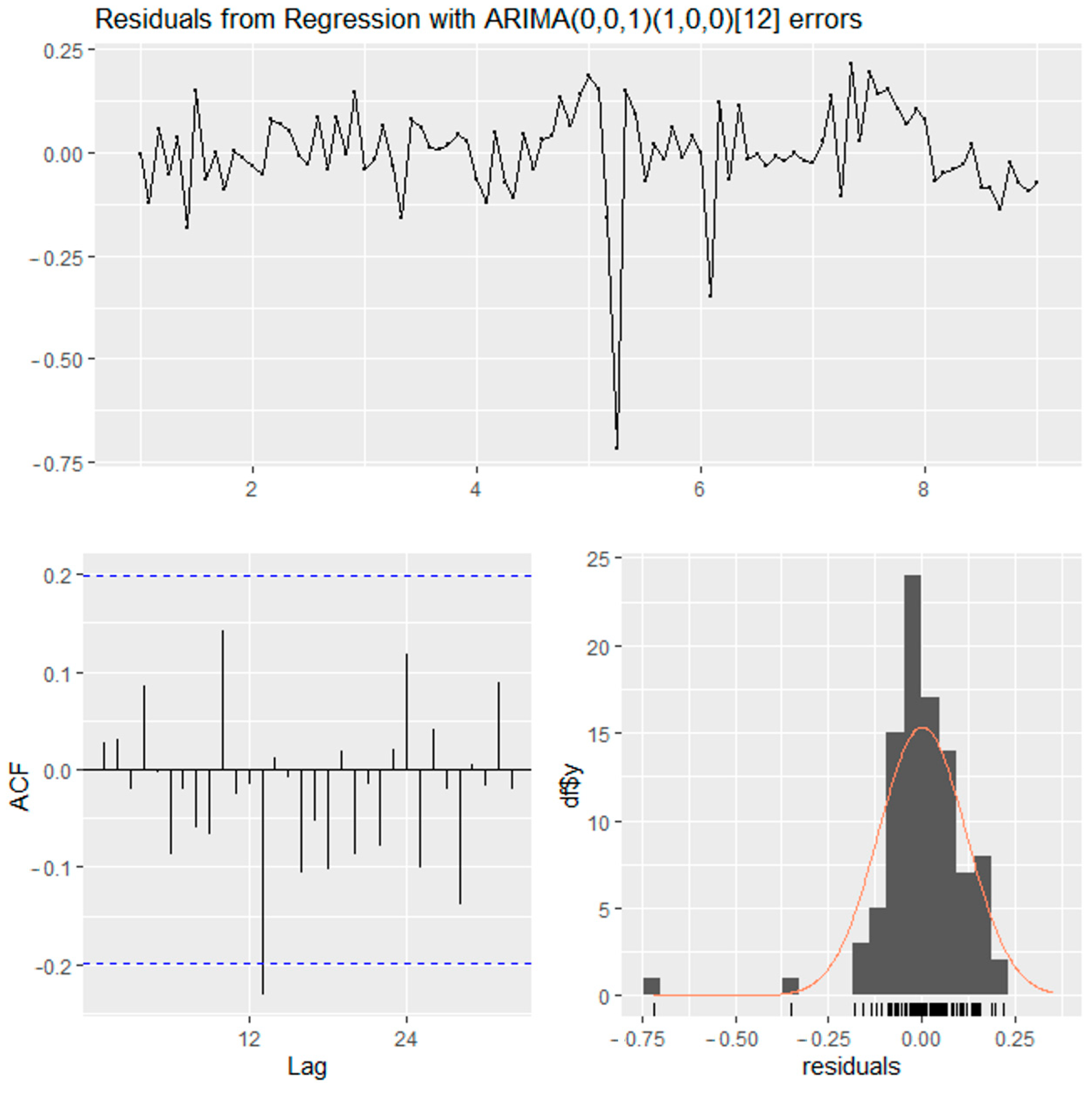
Figure 4 presents diagnostic checks for the SARIMAX residuals. The time-series plot, the ACF, and the residual distribution all suggest that the residuals are randomly distributed around zero without systematic autocorrelation. The Ljung–Box test (
p = 0.65) corroborates the model adequacy and the absence of remaining time-series problems.
Before estimating the ECM, the time-series properties of all variables were examined using the Augmented Dickey–Fuller (ADF) test to justify the use of an error-correction specification. The results show that key variables, log POS sales, the food CPI (lcpif), and inflation (infl), are non-stationary in levels but become stationary after first differencing, implying integration of order one, I (1). Stationarity tests on the residuals from the cointegrating regression yield an ADF statistic of −2.68, which is below the 5% critical value (−1.95), indicating rejection of the unit-root null and the existence of a long-run equilibrium relationship among the variables.
The ECM estimates (
Table 4) indicate that the error-correction term is negative and highly significant (ECT
−1 = −0.563), meaning that about 56% of short-run deviations from the long-run equilibrium are corrected each month. In other words, the market rapidly returns to its equilibrium path after VAT-related shocks. The relatively fast speed of adjustment identified by the ECMs may also indicate a degree of structural resilience in Saudi Arabia’s food-service sector, suggesting that the sector is capable of absorbing fiscal and pandemic-related shocks while maintaining long-run operational continuity. Such adaptive adjustment capacity is an important component of economic sustainability and market stability. In the short run, both VAT interventions remain positive and significant (T1 = 0.158, T2 = 0.417), confirming a clear immediate response to the tax changes. The COVID-19 dummy exerts a negative effect on sales; this effect is not statistically significant in the nominal model (
p = 0.11) but becomes significant in the real-sales model (−0.27,
p = 0.02), indicating that the pandemic had a more pronounced impact on real demand than on nominal values.
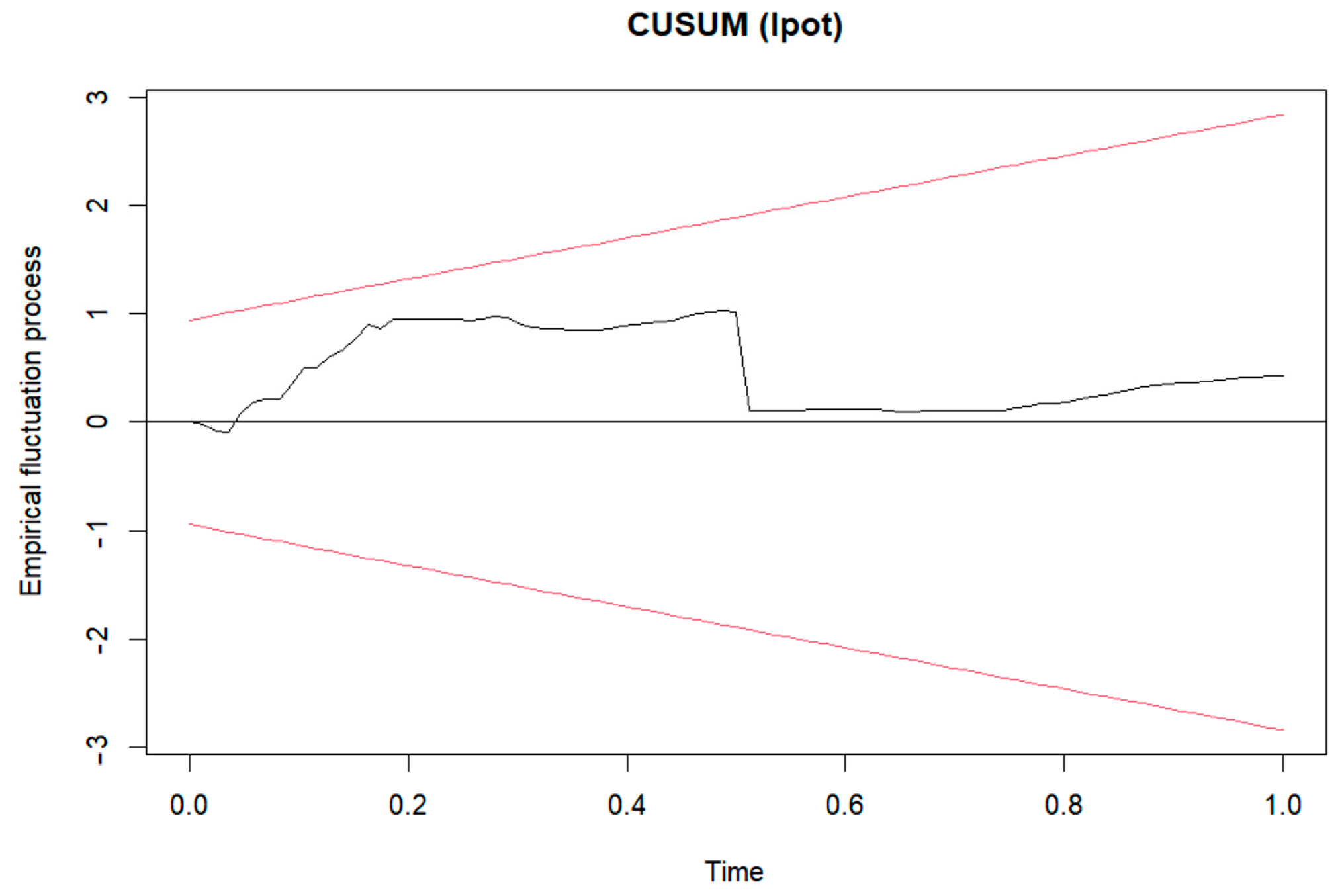
Figure 5 reports the CUSUM tests for both log sales (lpos) and log number of transactions (lpot). In all cases, the paths remain within the ±3 confidence bands, indicating parameter stability and the absence of unaccounted structural breaks. The VAT and COVID-19 shocks did not induce permanent changes in the underlying model coefficients, which provides further evidence of the reliability of the statistical specifications.
Analysis of the number of transactions (POTt) reveals a time pattern similar to that of nominal sales, with transaction counts rising around the VAT introduction, then increasing and stabilizing. The CUSUM test for ln (POTt) also shows that the empirical fluctuation process remains within the ±3 bounds, pointing to a stable behavioral structure without hidden structural breaks. This consistency between pot and pos supports the main econometric results based on ln(POSt), even though pot was not used as the dependent variable in the GLS, SARIMAX, or ECMs, given its sensitivity to the rapid expansion of POS infrastructure and documentation reforms during the study period.
Comparing the different models used in this study (GLS, SARIMAX, ECM) shows that they deliver broadly consistent statistical and economic patterns. VAT interventions generate sharp but temporary increases in nominal POS sales, while price and inflation variables contribute to a gradual decline in real demand over the longer term. The ECM’s correction mechanism confirms structural stability in market behavior after the initial adjustment period. From a policy perspective, these findings suggest that consumption-tax reforms initially trigger temporary spending spikes, driven by stockpiling, reporting changes, and timing responses, but that markets revert to normal conditions within a few months. Thus, policymakers should interpret these increases as transitional effects rather than evidence of sustained growth in real consumption. From a sustainability policy perspective, the results imply that fiscal reforms should be evaluated jointly with digital transformation policies, since electronic payment expansion can substantially alter the measurement and interpretation of market activity. This is particularly relevant for designing sustainable taxation systems, improving institutional transparency, and strengthening evidence-based economic planning.
In summary, both VAT interventions (2018 and 2020) have positive and statistically significant effects on nominal POS sales, with a larger impact in 2020. The post-intervention time trends reveal gradual adjustment phases following each shock. Inflation and food-price indices remain key long-run determinants of sales levels, and the ECM confirms a stable long-run equilibrium with relatively fast error correction. Counterfactual analysis indicates that, absent the two VAT changes, nominal sales in the restaurant and café sector would have been about 20–30% lower over 2018–2020.
These results highlight that fiscal reforms, such as changes in VAT rates, can generate pronounced short-run behavioral and monetary responses without necessarily producing sustained growth in real demand. This has important implications for fiscal and food-policy analysis: authorities should closely monitor post-reform consumption behavior to avoid over-interpreting temporary surges as signs of lasting economic recovery. Finally, the combination of ITS–GLS with SARIMAX and ECM provides an integrated framework for evaluating the impact of macro-policies in sensitive sectors such as food and beverages and can be applied to other domains within Saudi Arabia’s food-security strategy and Vision 2030. Finally, the combination of ITS–GLS with SARIMAX and ECM provides an integrated analytical framework for evaluating macroeconomic policy interventions in sensitive sectors such as food services. The framework contributes not only to fiscal-policy evaluation but also to sustainability-oriented economic monitoring by linking taxation, digitalization, market formalization, and institutional resilience within a unified empirical setting. In the Saudi context, these findings support Vision 2030 objectives related to economic diversification, digital transformation, financial inclusion, and sustainable governance. The proposed framework can also be extended to other sectors and emerging economies undergoing simultaneous fiscal and digital transitions.
4. Conclusions
The results obtained from the ITS–GLS and SARIMAX models show an immediate and strong tax effect on the level of sales recorded through POS terminals in the restaurant and café sector in Saudi Arabia. The introduction of the 5% VAT and its subsequent increase to 15% were associated with a substantial rise in nominal sales. However, this increase appears to reflect improved documentation and a shift toward formal channels rather than a genuine, proportional expansion in underlying consumption. These findings indicate that VAT reform in Saudi Arabia was closely intertwined with broader institutional and digital transformation processes, suggesting that fiscal modernization can contribute not only to revenue generation but also to more sustainable and transparent market governance. The post-intervention slope coefficients indicate a gradual slowdown in growth, suggesting that consumers adapted to the new price levels and that the market absorbed the tax shock over time. The alternative models, SARIMAX and ECM, yielded results consistent with the baseline estimates: the error-correction term in the ECM is negative and statistically significant, indicating a monthly adjustment speed of about 56% toward the long-run equilibrium. The food price index has a significant negative impact on sales. At the same time, the effect of overall inflation is weak in nominal terms. Still, it becomes significant when real (price-adjusted) sales are considered, confirming the high price sensitivity of food demand. All models passed the Ljung–Box and CUSUM diagnostics, which support the internal stability of the specifications and the reliability of the counterfactual scenario used in the impact assessment.
These findings carry several important practical implications for policy. First, the fact that the introduction of VAT and rate hikes coincided with higher recorded POS sales underscores the importance of enhancing digitalization and expanding electronic payment infrastructure, as these measures directly improve tax compliance and the accuracy of official statistics. These outcomes support broader sustainability goals related to financial inclusion, institutional transparency, digital governance, and long-run economic diversification under Saudi Arabia’s national transformation agenda. Second, given the observed slowdown in the post-shock trend, it is advisable to design temporary mitigation policies targeted at vulnerable groups, such as low-income households, using instruments such as food vouchers or selective fee reductions. Third, the results point to pricing and behavioral responses by firms, indicating that strengthening competition and price transparency in the food and beverage sector is essential to limit excessive pass-through of taxes into consumer prices. In light of the strong role of prices, relevant authorities are encouraged to develop a food demand elasticity monitoring dashboard to track the pass-through of VAT changes to prices and sales every month and to adjust policy settings accordingly.
Several limitations of the study should be acknowledged. Variance inflation factor (VIF) diagnostics revealed high multicollinearity between the two price indices (lcpif and lcpib) when included jointly with time trends in the same specification. This required using alternative model versions that rely on a single index at a time to ensure model stability and reliable estimates, thereby mitigating multicollinearity. In addition, the COVID-19 pandemic was modeled with simple binary dummy variables, even though its effects unfolded in multiple phases over time. Furthermore, deflating sales with the food CPI to obtain real values is an approximate adjustment, which may not fully capture the specific consumption basket and price structure of the restaurant and café segment.
These results open up several avenues for future research. One direction is to implement more disaggregated sectoral estimates, for example, by region or by firm size, to examine heterogeneous VAT impacts across different market segments. Another is to apply more advanced causal inference methods, such as Bayesian Structural Time Series or Synthetic Control, when suitable comparison groups and richer microdata become available. Additional robustness checks could include ARDL-type dynamic distributed lag models or multiple structural break tests (such as Bai–Perron), as well as developing a joint supply–demand model that explicitly captures the tax pass-through mechanism to prices.
In conclusion, the integrated ITS–GLS–SARIMAX–ECM framework proved effective in evaluating VAT policy shocks in a rapidly modernizing economy. The evidence suggests that VAT reforms significantly altered recorded market activity, although much of the observed effect operated through formalization, reporting improvements, and payment-channel transformation rather than permanent expansion in real consumption. More broadly, the study demonstrates how fiscal reform, digital financial infrastructure, and institutional modernization can interact to reshape observed economic behavior in rapidly transforming economies. By integrating ITS, GLS, SARIMAX, and ECM within a unified empirical framework, the study contributes to sustainability-oriented policy evaluation through improved understanding of market resilience, digital governance, and adaptive economic behavior under large-scale structural reforms.




 ,
,