Article

Optimal Sizing of High-Altitude Wind–Solar–Hydrogen Storage Systems Considering Hybrid Electricity–Hydrogen Dispatch


1
School of Information and Control Engineering, Southwest University of Science and Technology, Mianyang 621000, China
2
Sichuan Hydrogen Energy and Multi Energy Complementary Microgrid Engineering Research Center, Mianyang 621000, China
3
School of Electrical Engineering, Chongqing University, Chongqing 400044, China
*
Authors to whom correspondence should be addressed.
Sustainability 2026, 18(11), 5515; https://doi.org/10.3390/su18115515 (registering DOI)
Submission received: 21 April 2026 / Revised: 23 May 2026 / Accepted: 29 May 2026 / Published: 1 June 2026

Abstract

High-altitude regions provide abundant wind and solar resources but impose severe environmental constraints on energy storage systems. To address these challenges, this study proposes a bi-level optimal sizing method for wind–solar–hydrogen storage systems considering altitude-induced impacts. A system model integrating electrochemical storage and hydrogen storage is established, and a hybrid electricity–hydrogen storage dispatch strategy is designed to exploit their complementary characteristics. The upper-level optimization minimizes lifecycle cost using the Golden Sine Algorithm-Subtraction Average Based Optimizer (GSABO), while the lower level conducts 8760 h simulations to optimize the loss of power supply probability (LPSP) and excess energy rate (EER). A case study in western Sichuan, China, at an altitude of approximately 3500 m, demonstrates the method achieves 0% EER and 0.8% LPSP, reducing total costs by 50.65% compared to single electrochemical storage.

1. Introduction

With the deepening of the global energy transition, the development and application of renewable energy have attracted increasing attention across various sectors [1]. High-altitude regions possess abundant wind and solar resources, thereby offering unique advantages in the construction of Integrated Energy Systems (IES) [2]. In terms of energy storage, electrochemical storage has been widely applied due to its high energy conversion efficiency. However, in high-altitude environments, it is prone to problems such as thermal runaway and lithium plating caused by overcharging and over-discharging, which may threaten power supply safety. In contrast, hydrogen energy features high energy density and strong environmental adaptability. The synergy of hydrogen storage and electrochemical storage in hybrid electricity–hydrogen storage systems can combine the advantages of both, providing a new storage solution for off-grid power supply and storage in high-altitude regions [3,4]. In the planning of IES, capacity allocation of multi-energy coupling devices constitutes a core process. Nevertheless, in high-altitude areas, environmental factors such as low air density, low atmospheric pressure, and extreme temperatures impose significant constraints and challenges on capacity allocation. Therefore, research on optimal sizing of IES tailored to high-altitude regions is of great significance for ensuring an independent power supply in these areas [5,6].
As a key technology for wind–solar–hydrogen storage systems, optimal sizing has been investigated by scholars from multiple perspectives. For example, Zhang et al. [7] developed a multi-objective optimization model for wind/PV/hydrogen/battery systems with coordinated dispatch—hydrogen storage for long-cycle balancing and batteries for fast response. An enhanced NSGA-II combined with 8760 h simulations reduced cost and curtailment relative to baseline NSGA-II and MOPSO while improving overall efficiency. Moreover, Zhao et al. [8] established photovoltaic, hydrogen, and electrochemical storage models to compare hydrogen-based and battery-based storage systems, showing that a hydrogen-dominated generation mode reduces total generation cost while maintaining power supply reliability and enabling zero-carbon operation. Additionally, Pu et al. [9] proposed a bi-level optimal sizing scheme for an islanded power-hydrogen-heat-cooling IES that couples life-cycle cost with explicit PEMFC/PEMEL/battery degradation, used eigenvalue-based clustering for scenario generation, and applied RT-GWO-guided MILP dispatch. Benchmarks and a real case validate the feasibility and economics, highlighting the value of degradation modeling and seasonal hydrogen storage. Furthermore, Le et al. [10] developed a multi-objective optimization framework that accounts for storage degradation and electricity pricing when comparing battery, hydrogen, and hybrid options. In tropical regions, a battery-first strategy with hydrogen absorbing surplus achieved favorable economics. Li et al. [11] designed a distributed robust co-sizing approach for multi-microgrids with distributed wind/solar and electric-hydrogen buffers, identifying hydrogen capital expenditure and price as pivotal drivers of operating cost. In addition, Zhang et al. [12] formulated a life-cycle economic optimization for hybrid renewable systems with Li-ion and hydrogen storage, integrating capex/opex with heat recovery and solving a binary power-flow MILP to quantify costs and benefits, and to assess hydrogen’s advantage under projected cost declines. Xia et al. [13] proposed an optimal capacity planning approach for industrial electricity–hydrogen systems considering variable unit costs. Dividing the producer and consumer sides for energy trading enabled efficient local green electricity accommodation, ultimately reducing industrial users’ grid electricity purchase costs by nearly half. Yang et al. [14] presented an optimal sizing method for hybrid electricity–hydrogen storage that constructs representative load/generation scenarios via a weighted directional synchronous reduction and employs an improved adaptive noise complete ensemble empirical mode decomposition (ICEEMD) to separate high- and low-frequency fluctuations for precise regulation. Finally, Li et al. [15] proposed a capacity optimization method for wind–solar–hydrogen-electric integrated energy systems that coordinates hydrogen storage across multi-time scales and aggregates temporal scenarios, ensuring high renewable energy utilization while reducing total life-cycle investment.
To further clarify the distinction between existing hybrid electricity–hydrogen sizing or dispatch studies and the proposed method, a concise comparison is provided in Table 1.
As shown in Table 1, most existing studies focus on hybrid storage sizing, dispatch optimization, or economic coordination, while altitude-related environmental effects are rarely incorporated into the sizing and dispatch framework. This motivates the proposed high-altitude wind–solar–hydrogen storage optimization method.
Therefore, grounded in the characteristics of high-altitude regions, this study proposes a wind–solar–hydrogen storage system architecture that is dominated by wind/PV generation and complemented by electrochemical and hydrogen storage. The main contributions of this study are summarized as follows.
(1)
A high-altitude-oriented system modeling framework is established. The effects of altitude-related environmental factors, including air density, atmospheric pressure, and ambient temperature, are incorporated into the modeling of wind power, photovoltaic generation, and energy storage operation, so that the capacity sizing process can better reflect the operating characteristics of high-altitude regions.
(2)
A hybrid electricity–hydrogen dispatch strategy is proposed to coordinate battery storage, PEMEL, and PEMFC. Surplus renewable power is preferentially absorbed by the PEMEL for hydrogen production, while the battery is prioritized for short-term deficit compensation before PEMFC operation, thereby combining the fast response of battery storage with the long-duration regulation capability of hydrogen storage.
(3)
A GSABO-based bi-level sizing model is formulated. The upper level minimizes the 20-year lifecycle cost, whereas the lower level evaluates LPSP and EER through 8760 h simulations under the proposed dispatch strategy.
Finally, using one year of wind speed, solar irradiance, and load data from a high-altitude site in western Sichuan, China, a case study is conducted to demonstrate the effectiveness of the proposed method in terms of economic performance and operational stability.

2. Wind–Solar–Hydrogen Storage System Modeling in High-Altitude Regions

High-altitude regions are endowed with abundant wind and solar resources; however, their inherent intermittency and uncertainty pose challenges to the stable operation of wind–solar–hydrogen storage systems and to power quality. Therefore, the optimal sizing of energy storage devices becomes a key step to ensure system stability. The wind–solar–hydrogen storage system constructed in this study is illustrated in Figure 1, which consists of the following modules: wind turbines, photovoltaic arrays, battery packs, proton exchange membrane electrolyzers (PEMEL), proton exchange membrane fuel cells (PEMFC), hydrogen storage tanks, and electrical loads.

2.1. Analysis of Wind and Solar Resource Characteristics in High-Altitude Regions

High-altitude regions exhibit unique natural and climatic characteristics. As altitude increases, a series of environmental parameters—including air density, atmospheric pressure, solar radiation, and temperature—undergo significant changes. Atmospheric pressure and temperature remain in continuous dynamic variation, with their characteristics determined primarily by the meteorological conditions at different altitudes and showing long-term spatiotemporal evolution trends [16]. Consequently, the wind and solar resource characteristics in high-altitude regions differ markedly from those in plain areas. The specific impacts of altitude on various environmental parameters are summarized in Table 2.
Based on the environmental parameter impacts summarized in Table 2, certain regions in northern China, the ridge areas of the Qinghai–Tibet Plateau, and the Yunnan-Guizhou Plateau possess favorable wind resources, with wind power density at 70 m height exceeding 300 W/m2, which is conducive to wind power generation. Meanwhile, most of Tibet, northern and central Qinghai, and western Sichuan exhibit an annual horizontal global solar irradiation above 1750 kWh/m2, ranking among the most solar-abundant regions in China [17]. Such climatic conditions provide inherent advantages for the development of wind and solar power in high-altitude areas.

2.2. Mathematical Models of Wind and PV Power Generation

In high-altitude regions, the increase in altitude leads to a significant reduction in atmospheric pressure and air density, which directly affects the power generation performance of wind turbines. The output power of a wind turbine can be expressed as [18]:
P wind = P wind , rate v 2 v C 2 v R 2 v C 2 ρ 1 ρ 0 v C v v R P wind , rate ρ 1 ρ 0 v R v v F 0 v v F 0 v v C
where Pwind is the actual output power of the wind turbine, Pwind, rate is the rated power of the wind turbine, vC is the cut-in wind speed, vR is the rated wind speed, v is the real-time environmental wind speed, vF is the cut-out wind speed, ρ0 is the air density at standard conditions, and ρ1 is the air density at the actual altitude.
The photovoltaic power generation is simultaneously affected by irradiance intensity and ambient temperature. The output power of photovoltaic modules should be calculated by considering the actual irradiance intensity and ambient temperature. The output power of solar photovoltaic panels can be expressed as [19]:
P pv = A m G t η r 1 β t T a + G t N O C T 20 800 T r
where PPV is the actual output power of the photovoltaic generation, Am is the area of the photovoltaic panel, Gt is the solar irradiance intensity, ηr is the energy conversion efficiency of the photovoltaic panel, Tr is the rated temperature of the photovoltaic panel, βt is the temperature coefficient, Ta is the ambient temperature, and NOCT is the nominal operating cell temperature.
By substituting the historical meteorological data of the target region into Equations (1) and (2) and incorporating the actual variations in air density and temperature, a more realistic and altitude-accurate power generation profile can be obtained.

2.3. Mathematical Model of Hydrogen Storage Equipment

High-altitude regions have abundant wind and solar resources, but they also experience significant power fluctuations. PEMEL, with its strong resistance to fluctuations, can adapt well to fluctuating power. The hydrogen production rate of PEMEL can be expressed as [20]:
m el , t = P el , t η el q H 2
where mel,t is the hydrogen flow rate produced by PEMEL, Pel,t is the active power output of PEMEL, ηel is the operational efficiency of PEMEL, and qH2 is the heating value of hydrogen.
The hydrogen storage tank is used to store the hydrogen produced by water electrolysis and provide a hydrogen source for the fuel cell. If the storage tank is considered a leak-free closed system, its mathematical model can be expressed as [21]:
Q t 0 + 1 = t 0 t 0 + 1 q t d t + Q t 0 p t Q cap = n t R T
where Q(t0 + 1) is the hydrogen volume at the current time, q(t) is the hydrogen storage rate of the tank, Q(t0) is the hydrogen volume at the previous time, p(t) is the pressure of the hydrogen storage tank, Qcap is the total volume of the storage tank, n(t) is the amount of hydrogen in moles at the current time, R is the gas constant, taken as 8.314 J/mol·K, and T is the gas temperature defined thermodynamically.
Based on the defined variables Q(t) and Qcap, the State of Hydrogen (SOH) is further introduced to characterize the real-time energy status of the storage tank, which is formulated as:
S O H t = Q t Q c a p
This normalized ratio functions as the hydrogen equivalent to the battery’s State of Charge (SOC), representing the remaining capacity in terms of both pressure and energy content.
PEMFC, as an option for powering the wind–solar–hydrogen storage system, can generate electricity using surplus hydrogen stored in the hydrogen tank when power resources are insufficient. The simplified mathematical model of PEMFC is expressed as [22]:
P fc , t = η fc m fc , t q H 2 ,
where Pfc,t is the active power output of PEMFC, ηfc is the operational efficiency of PEMFC, and mfc,t is the hydrogen flow rate consumed by PEMFC.

2.4. Mathematical Model of Battery Storage

The battery, as another option for energy storage in the wind–solar–hydrogen storage system, charges when the power generation exceeds the load demand; conversely, the battery discharges when the power generation is less than the load demand. The state of charge (SOC) models for battery charging and discharging are expressed as [23]:
S O C t + 1 = S O C t P b a t Δ t η c / C S O C t + 1 = S O C t P b a t Δ t / η d C
where SOC(t) is the state of charge of the battery at time t, Pbat is the battery power, Δt is the charging or discharging duration, C is the battery capacity, ηc is the charging efficiency, and ηd is the discharging efficiency of the battery.

2.5. Degradation Model of Energy Storage Equipment Lifetime in High-Altitude Regions

Both electrochemical and hydrogen energy storage systems are constrained by design and cycle-life limitations, often necessitating equipment replacement over the project’s lifetime. Furthermore, environmental stresses inherent to high-altitude regions, particularly low temperatures, accelerate the performance degradation of electrochemical systems [24]. Based on this, we construct lifetime degradation models for both types of energy storage systems.
(1)
Battery Lifetime Degradation Model
The lifetime degradation of battery energy storage mainly includes cycle aging and calendar aging. Cycle aging occurs during the charge and discharge process and is significantly influenced by temperature conditions and operating modes. Calendar aging, on the other hand, occurs over time, where the battery undergoes internal state changes due to self-discharge during open-circuit storage, leading to both reversible and irreversible capacity degradation. Typically, when the capacity degrades to 80% of the initial value, it is considered the replacement threshold. To characterize battery degradation for replacement estimation, temperature-dependent cycle-aging and calendar-aging models capable of describing low-temperature capacity fade are introduced; in the system-level lifecycle calculation, the calendar-aging duration is mapped to the reference accelerated-aging time scale, while the cycle-aging degradation is evaluated according to the battery cycling behavior under different dispatch scenarios [25]:
D c y c = 60.46 3.6 sin 0.19 T b a t N c y c R Ω 41.6 exp 0.089 N 2
D cal = 0.2 t bat 7.6 × 10 4 t bat 2 + 1.1 × 10 6 t bat 3 1.8 × 10 10 t bat 4
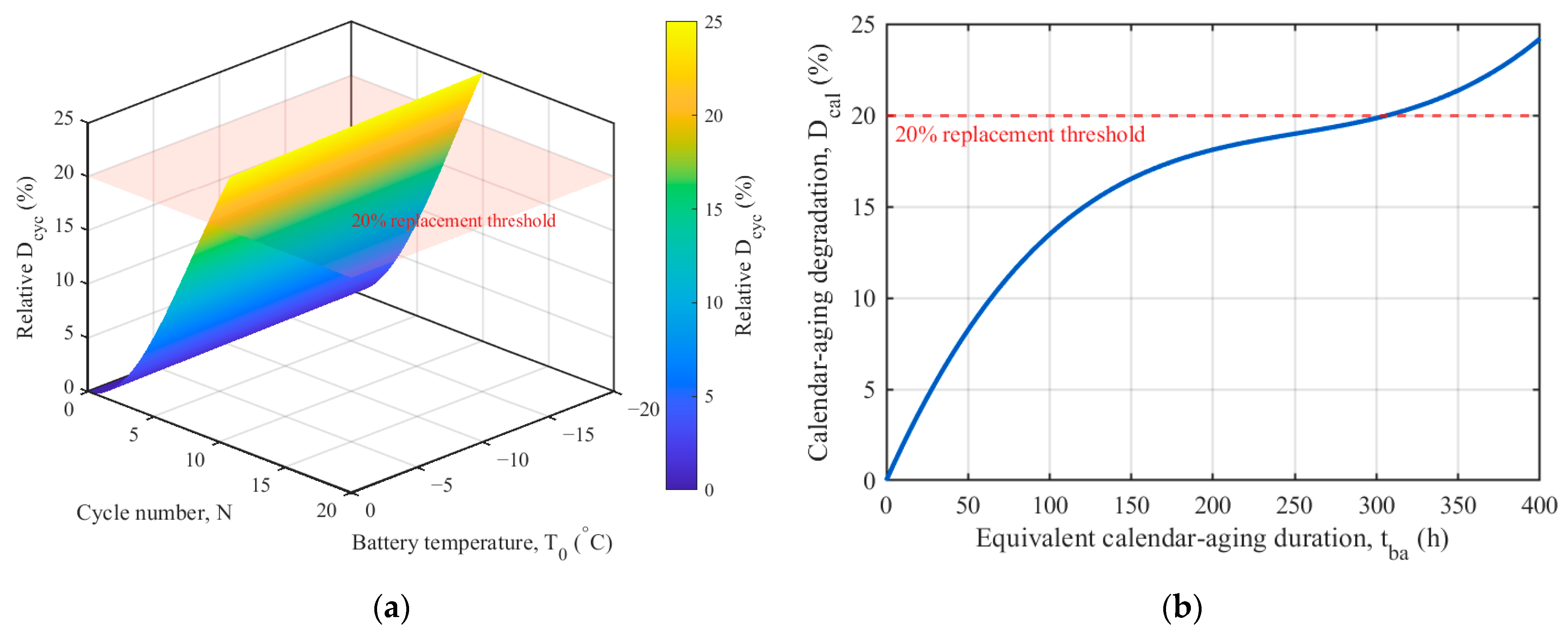
where Dcyc is the capacity degradation caused by cycling, N is the number of battery cycles, Tbat is the battery temperature, Dcal is the capacity degradation caused by calendar aging, and tba is the equivalent calendar-aging duration mapped to the reference accelerated-aging condition. The degradation trends described by Equations (8) and (9) are further visualized in Figure 2. Figure 2a presents the relative cycle-aging degradation under different low-temperature conditions, while Figure 2b shows the calendar-aging degradation as a function of the equivalent calendar-aging duration. The 20% degradation level is marked as the battery replacement threshold.
As shown in Figure 2a, the relative cycle-aging degradation increases with the number of battery cycles under low-temperature conditions, indicating the effect of repeated charge–discharge operation on battery capacity fade. Figure 2b shows that the calendar-aging degradation increases with the equivalent calendar-aging duration. In both subfigures, the 20% degradation level is marked as the battery replacement threshold.
(2)
Device Lifetime Degradation Model
Although the internal operating temperature significantly influences the performance of PEMEL and PEMFC devices, these systems exhibit rapid cold-start capabilities on the order of minutes. Relying on their rapid self-heating characteristics, they can quickly reach and maintain their rated internal operating states. Consequently, the external ambient temperature in high-altitude environments has a minimal direct impact on their long-term physical degradation. To reasonably simplify the system-level capacity sizing model, external environmental stress factors are decoupled from the PEM lifetime evaluation [26], and a linear empirical degradation model based on cumulative operational time is adopted, expressed as [27,28]:
D el = k el t el
D fc = k fc t fc
where Del is the change in PEMEL cell voltage, Dfc is the change in PEMFC cell voltage, reflecting the degradation level of the PEM device. Typically, when the rate of change in cell voltage reaches 20% of the rated value, the device is considered to need replacement. kel is the lifetime constant of PEMEL, taken as 35 μV/h, kfc is the lifetime constant of PEMFC, taken as 29.4 μV/h, and tel and tfc are the operating times of the PEM devices.

3. Proposed Electricity–Hydrogen Storage Dispatch Strategy Considering the Impacts of High-Altitude Regions

3.1. Complementarity of Electrochemical and Hydrogen Energy Storage

As summarized in Table 3, electrochemical and hydrogen storage exhibit complementary attributes under high-altitude conditions, which directly motivates our proposed electricity–hydrogen storage dispatch strategy [29,30].

3.2. Hybrid Electricity–Hydrogen Storage Dispatch Strategy

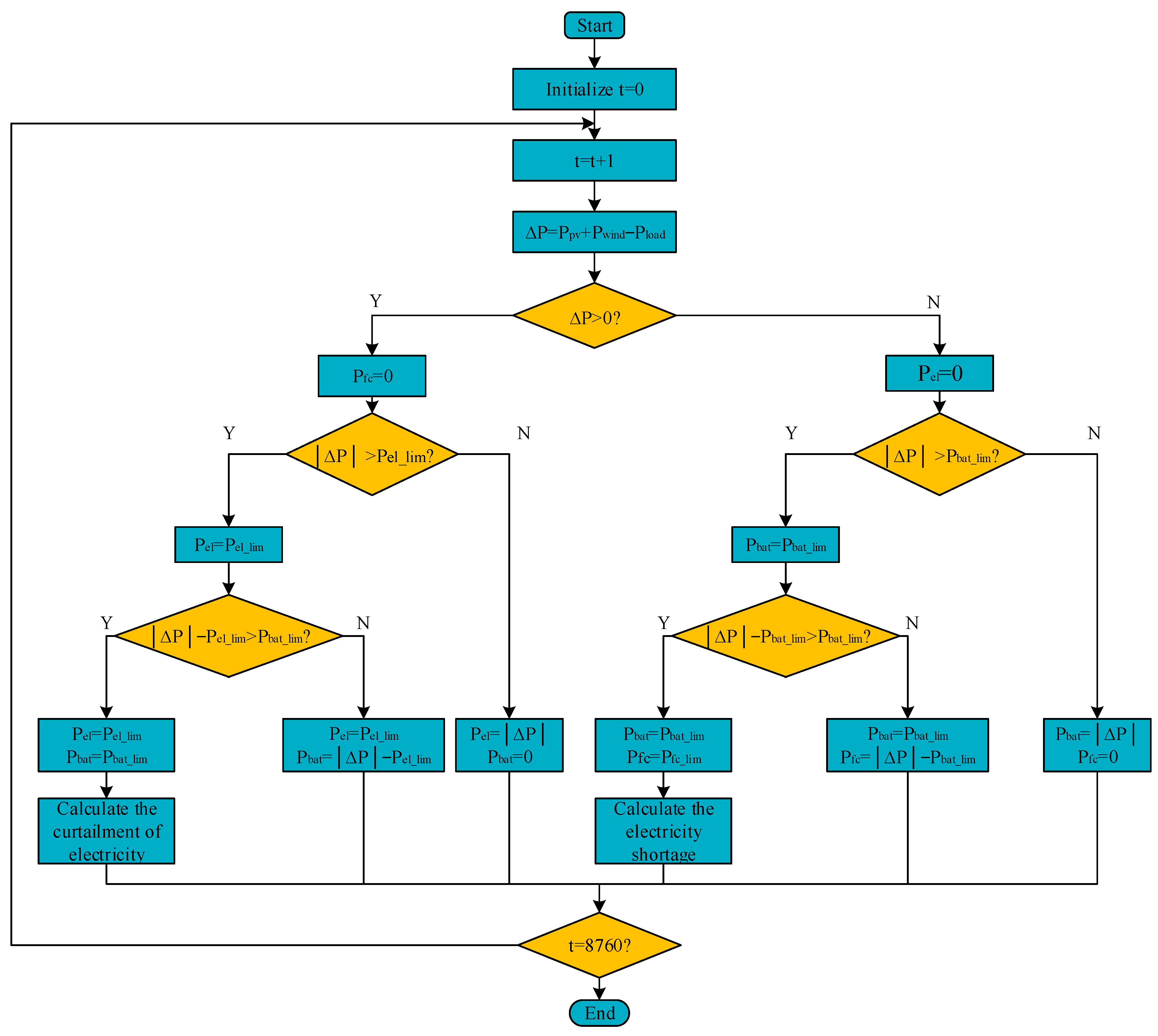
Accounting for the physical characteristics and lifetime degradation trends of electrochemical and hydrogen energy storage, this study proposes a hybrid dispatch strategy featuring PEMEL-priority surplus absorption and battery-priority deficit compensation. This priority structure is suitable for high-altitude wind–solar systems because hydrogen storage is more appropriate for absorbing sustained renewable surplus, while the battery has a faster response and higher round-trip efficiency for short-term power deficits. During renewable generation peaks, surplus power is first absorbed by the PEMEL for hydrogen production. The battery is then charged only when the SOH reaches its upper limit or when the installed PEMEL capacity is insufficient to fully consume the surplus power. During load peaks or renewable power deficits, the battery first provides short-term compensation, and the PEMFC is activated to supply the remaining deficit only when the battery cannot fully meet the shortage. Additionally, to mitigate degradation, the battery’s single charge/discharge depth is controlled. The specific strategy is shown in Figure 3.
In Figure 3, ΔP denotes the net power difference between renewable generation and load demand, which is expressed as ΔP = PPV + Pwind − Pload. A positive ΔP indicates surplus renewable power, whereas a negative ΔP indicates a power deficit. The subscript “lim” represents the available power limit of the corresponding device at the current time step, considering both the rated power and the operating constraints of SOC or SOH. Specifically, Pel,lim, Pbat,lim, and Pfc,lim denote the available power limits of the PEMEL, battery, and PEMFC, respectively.
The decision conditions in Figure 3 can be divided into seven operating cases according to the net power ΔP.
Case 1: When ΔP = 0, the renewable generation exactly matches the load demand, and neither charging nor discharging is required.
Cases 2–4: When ΔP > 0, the system operates under surplus-power conditions. The surplus power is first absorbed by the PEMEL for hydrogen production. If the PEMEL can fully consume the surplus power, only the PEMEL operates and no electricity curtailment occurs. If the surplus power exceeds the PEMEL limit, the remaining power is further absorbed by the battery. When the PEMEL and battery can jointly absorb all surplus power, no curtailment occurs; otherwise, the remaining surplus power is recorded as curtailed electricity.
Cases 5–7: When ΔP < 0, the system operates under power-deficit conditions. The battery discharges first to compensate for the deficit. If the battery can fully meet the deficit, only the battery operates and no power shortage occurs. If the deficit exceeds the battery discharge limit, the remaining deficit is supplied by the PEMFC. When the battery and PEMFC can jointly meet the load deficit, no shortage occurs; otherwise, the remaining unmet load is recorded as an electricity shortage.

4. Bi-Level Optimization Sizing Model

4.1. Upper-Level Optimization Problem

4.1.1. Upper-Level Model Objective Function

The upper-level optimization model in this study aims to minimize the total lifecycle cost of the wind–solar–hydrogen storage system, i.e.:
min C = C f + C m + C r
where Cf is the fixed investment cost, Cm is the operation and maintenance cost, and Cr is the equipment replacement cost.
The fixed investment of each subsystem in the wind–solar–hydrogen storage system, including wind power, photovoltaic, PEMEL, hydrogen storage tank, PEMFC, and battery, is:
C WT = N WT C WTi
C PV = N PV C PVi
C el = N el C eli
C sto = N sto C stoi
C fc = N fc C fci
C bat = N bat C bati
where CWT, CPV, Cel, Csto, Cfc, and Cbat are the fixed investment costs of wind power, photovoltaic, PEMEL, hydrogen storage tank, PEMFC, and battery; NWT, NPV, Nel, Nsto, Nfc, and Nbat are the installation quantities of wind power, photovoltaic, PEMEL, hydrogen storage tank, PEMFC, and battery; CWTi, CPVi, Celi, Cstoi, Cfci, and Cbati are the investment costs of wind power, photovoltaic, PEMEL, hydrogen storage tank, PEMFC, and battery.
C f = C R F i i = 1 M C i
C R F i = d 1 + d L i 1 + d L i 1
where i is the subsystem module, M is the number of subsystem modules, Ni, Ci and Li are the unit price, configuration quantity, and service life of the i-th subsystem, respectively; CRF(i) is the capital recovery factor of the i-th subsystem; and d is the discount rate, taken as 0.04.
Operation and maintenance costs include equipment maintenance fees and operating costs, and they are proportional to the equipment investment costs. The system’s operation and maintenance cost is:
C m = C f k m
where km is the conversion factor between equipment investment cost and operation and maintenance cost, taken as 0.01.
In the cost calculation with a 20-year cycle, the lifetimes of the PEM device and battery do not meet the requirements for a full lifecycle, thus requiring equipment replacement. The equipment replacement cost is:
C r = C R F j k j = 1 n C j i = 1 n N i
where n is the number of devices to be replaced during the lifecycle, including PEMEL, PEMFC, and the battery; k is the number of replacements estimated based on the energy storage device lifetime degradation model; and Cj is the replacement cost of device j.

4.1.2. Upper-Level Model Constraints

The decision variables of the upper-level model are solely the capacities of the wind–solar–hydrogen storage system. Therefore, the constraints are the capacity limits of each module, and the installation quantity constraint is:
N W T N W T . max N P V N P V . max N el N el . max N sto N sto . max N fc N fc . max N bat N bat . max
where NWT, NPV, Nel, Nsto, Nfc, Nbat are the actual installation quantities of wind power, photovoltaic, PEMEL, hydrogen storage tank, PEMFC, and battery, respectively; NWT.max, NPV.max, Nel.max, Nsto.max, Nfc.max, Nbat.max are the maximum installation quantities of wind power, photovoltaic, PEMEL, hydrogen storage tank, PEMFC, and battery under actual installation conditions, respectively.

4.2. Lower-Level Optimization Problem

4.2.1. Lower-Level Model Objective Function

The lower-level model focuses on two objectives related to the system’s power supply reliability. Based on the system capacity configuration provided by the upper-level model, the lower-level model aims to minimize the loss of supply probability and the excess energy rate over the scheduling period. The objective function is:
min L P S P = t = 1 8760 P vac t Δ t t = 1 8760 P load t Δ t min E E R = t = 1 8760 P sur t Δ t t = 1 8760 P load t Δ t
where LPSP is the ratio of system deficit power to the required load required power, EER is the ratio of system excess power to the required load required power, Pload(t) is the load demand power at time t, Pvac(t) is the system deficit power at time t, and Psur(t) is the system surplus power at time t.
Because the lower-level model constitutes a typical bi-objective optimization problem, and the upper-level capacity sizing model necessitates singular fitness feedback to guide the iterative search, applying a scalarization process to the lower-level objectives is imperative. In this study, the linear weighted sum method is adopted to aggregate the two objectives into a single overarching fitness function F l o w , formulated as:
min F l o w = ω 1 L P S P + ω 2 E E R
ω 1 + ω 2 = 1 , ω 1 , ω 2 0 , 1
where ω 1 and ω 2 represent the weights assigned to the LPSP and the EER, respectively. In this study, considering that both power supply reliability and energy utilization efficiency are equally critical, both weights are set to 0.5.

4.2.2. Lower-Level Model Constraints

The decision variables of the lower-level model are the power outputs of the subsystems in the wind–solar–hydrogen storage system. Therefore, the constraints are the power output limits, and the power output constraints are:
0 P wind P wind . max 0 P pv P pv . max 0 P el P el . max 0 P fc P fc . max 0 P bat P bat . max
where Pwind is the actual power output of the wind turbine, Pwind,max is the predicted power generation of the wind turbine obtained from the upper-level model solution; Ppv is the actual power output of the photovoltaic system, Ppv,max is the predicted power generation of the photovoltaic system obtained from the upper-level model solution; Pel is the actual power of PEMEL, Pel,max is the maximum installed capacity of PEMEL; Pfc is the actual power of PEMFC, Pfc,max is the maximum installed capacity of PEMFC; Pbat is the actual power of the battery, and Pbat,max is the maximum installed capacity of the battery.
Both the electrochemical battery and the hydrogen storage subsystem operate within predefined safe-capacity windows; accordingly, the per-cycle charge/discharge depth is constrained as follows:
0.2 S O C 0.8 0.2 S O H 0.8
where SOC is the state of charge of the battery, and SOH is the hydrogen level of the hydrogen storage tank.

4.3. Solution of the Bi-Level Model Based on GSABO

To efficiently solve the formulated bi-level capacity optimization model, this study adopts the GSABO algorithm. GSABO integrates the excellent local exploitation capability of the Subtraction Average Based Optimizer (SABO) with the powerful global search potential of the Golden Sine Algorithm (GSA) [31]. This combination is designed to overcome the challenges of slow convergence and the susceptibility to local optima in complex nonlinear configuration problems.

4.3.1. Population Initialization Optimization

During the optimization process of the upper-level algorithm, parameter initialization is first conducted:
X i , d = l b d + r i , d u b d l b d , i 1 , , N , d = 1 , m
where Xi,d represents the individual, lbd and ubd are the lower and upper bounds of optimization, respectively, and ri,d is a random number in the range [0, 1]; m is the number of decision variables, which is 6 in this study (corresponding to the installed capacities of wind turbines, PV arrays, batteries, PEMEL, PEMFC, and hydrogen storage tanks). Additionally, the population is initialized using a Piecewise chaotic map to ensure a more uniform distribution of particles within the feasible region:
x t + 1 = x t p , 0 x t < p x t p 0.5 p , p x t < 0.5 1 p x t 0.5 p , 0.5 x t < 1 p 1 x t p , 1 p x t < 1
where x(t) is a random number in the range [0, 1], the value of p is taken as 0.4, and x(t + 1) represents the population position after initialization via the Piecewise chaotic map.
Furthermore, by replacing ri,d with x(t + 1), the distribution of random values becomes more uniform, which enhances particle diversity when the algorithm performs the subtraction average calculation. The initialization is then modified as follows:
X i , d = l b d + x t + 1 u b d l b d , i 1 , , N , d = 1 , m

4.3.2. GSABO Collaborative Optimization Mechanism

The core of GSABO lies in its adaptive search strategy switching logic. The algorithm first executes the search mechanism of SABO by calculating the arithmetic mean of the particles in the current population as an evolutionary reference. Furthermore, it utilizes the “v-operation” operator to characterize the dynamic interaction relationships among search agents:
X i , d n e w = X i + r i 1 N j = 1 N X i v X j , i = 1 , 2 , , N
where X i , d n e w is the new position of the i-th particle after iteration, and V is a vector of dimension m, whose components follow a normal distribution within the range [0, 1].
When stagnation in particle position updates is detected, the position update rule based on the GSA is activated. This mechanism effectively breaks free from the constraints of local extrema while preserving the computational efficiency of the original algorithm. By synergistically leveraging the local exploitation capability of SABO and the global search capability of the GSA, both the probability of escaping local optima and the convergence accuracy are significantly enhanced. The updated strategy after incorporating the GSA is as follows:
X i t + 1 = X i t | sin r 1 | r 2 sin x 1 X i b e s t t x 2 X i t
where r1 is a random number in the range [0, 2π] and r2 is a random number in the range [0, π], with r1 representing the movement distance and r2 representing the movement direction; X i b e s t t denotes the optimal position of the i-th particle at the t-th iteration. x1 and x2 are the golden section coefficients, which are:
x 1 = π + 2 π 1 τ
x 2 = π + 2 π τ
where τ is the golden section coefficient, which is taken as 5 1 / 2 .
Finally, after each iteration, the new fitness value is compared with the fitness value from the previous iteration:
X i = X i n e w , F i n e w < F i X i , e l s e
If the new fitness value F is superior to that of the previous iteration, the position is updated; otherwise, the particle position remains unchanged. Through this collaborative mechanism, GSABO significantly increases the probability of escaping local optima and ensures convergence accuracy.

4.3.3. Iterative Solution Process of the Bi-Level Model

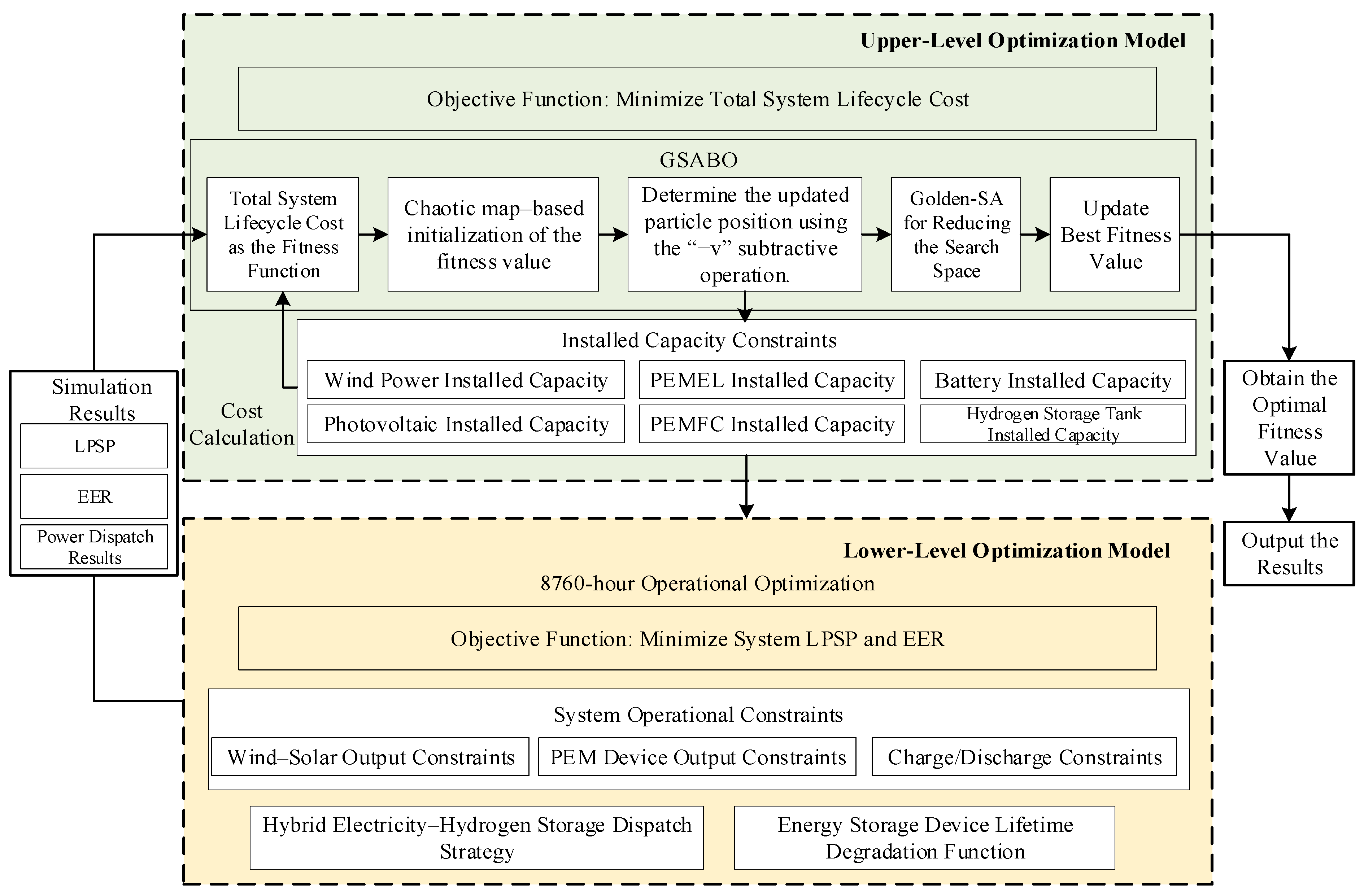
The GSABO algorithm is applied to solve the upper-level capacity optimization problem, with the population initialized as NWT, NPV, Nel, Nfc Nbat and Nsto. During execution, the algorithm forms new populations through iterative optimization until the maximum number of iterations is reached or the optimal fitness value is identified. The configuration scheme derived from each iteration is substituted into the lower-level model, which is solved in conjunction with the energy storage device lifetime model and the hybrid electricity–hydrogen storage dispatch strategy. This process returns key indicators, including the system’s loss of power supply probability (LPSP) and excess energy rate (EER). In the solution process, the lower-level optimization results are fed back to the upper-level to serve as new inputs for the GSABO algorithm’s fitness function. Through this iterative feedback mechanism, the upper-level and lower-level problems are progressively decoupled and collaboratively optimized, ultimately yielding the optimal sizing solution. The solution flowchart is illustrated in Figure 4.

5. Simulation Results and Analysis

5.1. Typical Simulation Scenarios

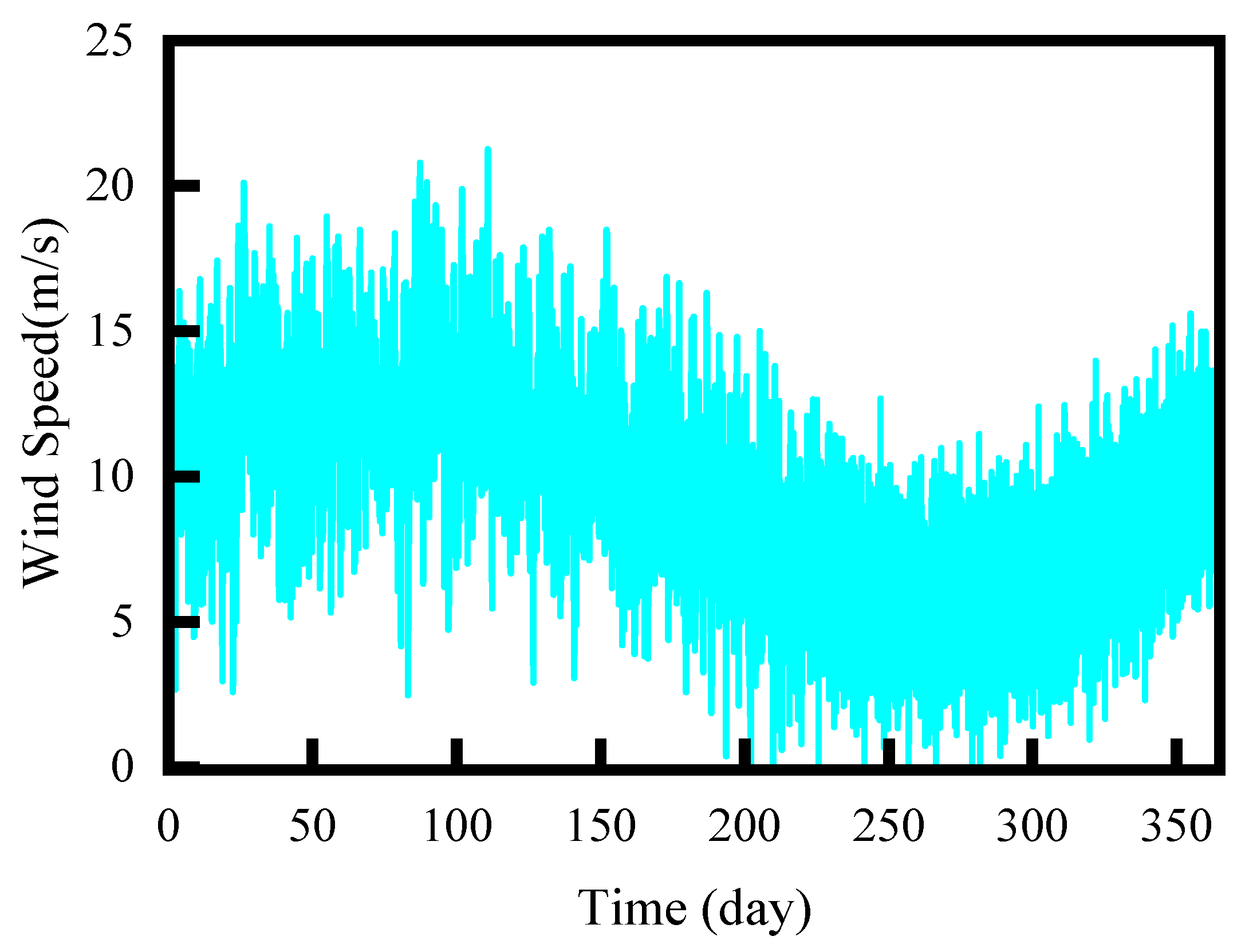
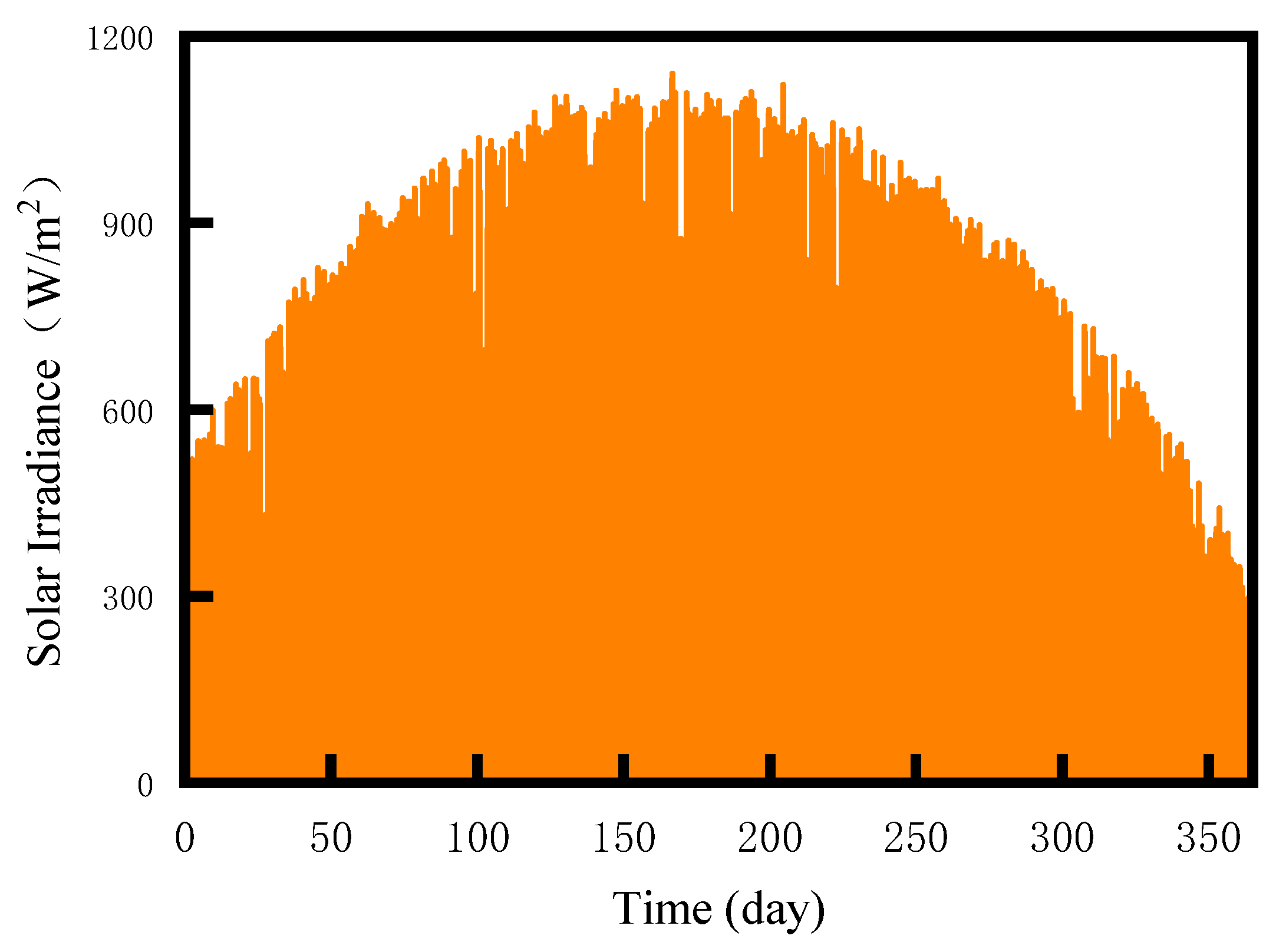
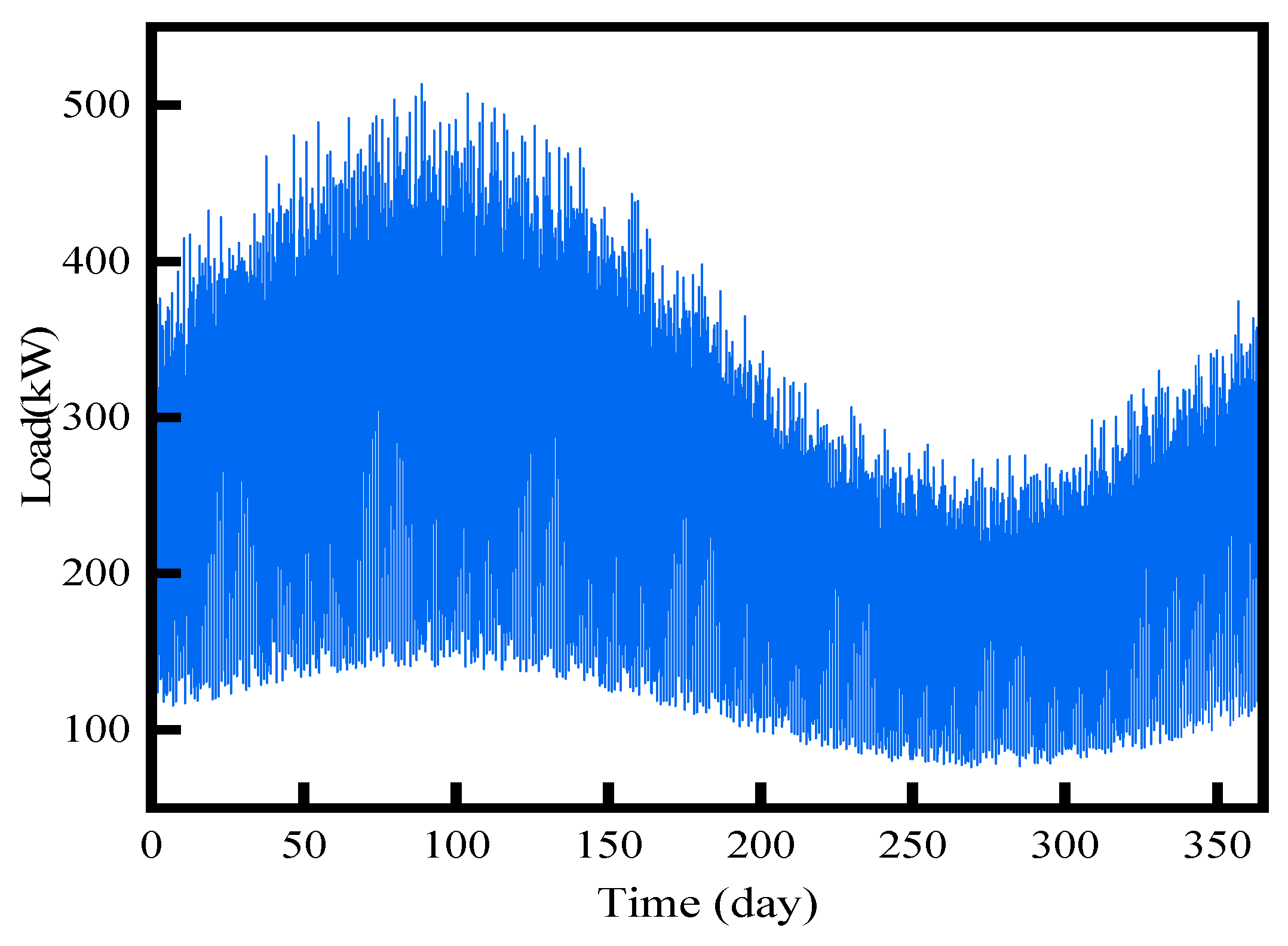
In the simulations, measured data of wind speed, solar irradiance, and load from a high-altitude site in western Sichuan, China (at an altitude of approximately 3500 m) are selected as a reference. The wind speed and solar irradiance throughout the year are shown in Figure 5 and Figure 6, respectively, and the residential electricity load is shown in Figure 7.

5.2. System Parameters of Wind–Solar–Hydrogen Storage

The parameters of each module in the wind–solar–hydrogen storage system are shown in Table 4. The initial SOC and SOH are set to 50%. By importing the parameters of each module into MATLAB 2022b for simulations, the ideal values of each objective function are obtained.

5.3. Analysis of the System Capacity Optimization Sizing Results

This paper performs simulation calculations for three scenarios, comparing the system cost, excess energy rate, and loss of supply probability of the three energy storage methods in a high-altitude environment, to validate the effectiveness of the model. The settings for the three scenarios are as follows:
Scenario 1: The system uses only battery storage as the sole energy storage device, with no restrictions on the maximum charge and discharge capacity of the battery storage in a single cycle.
Scenario 2: The system uses both battery storage and hydrogen storage as energy storage devices, with a priority of hydrogen first, followed by electricity. There are no restrictions on the maximum charge and discharge capacity of the battery storage in a single cycle.
Scenario 3: In the proposed system, both battery storage and hydrogen storage are used as energy storage devices, and the power allocation follows the unified strategy: PEMEL-first for surplus absorption and battery-first for deficit compensation.
In this study, the population size is set to 50, and the maximum number of iterations is set to 100.
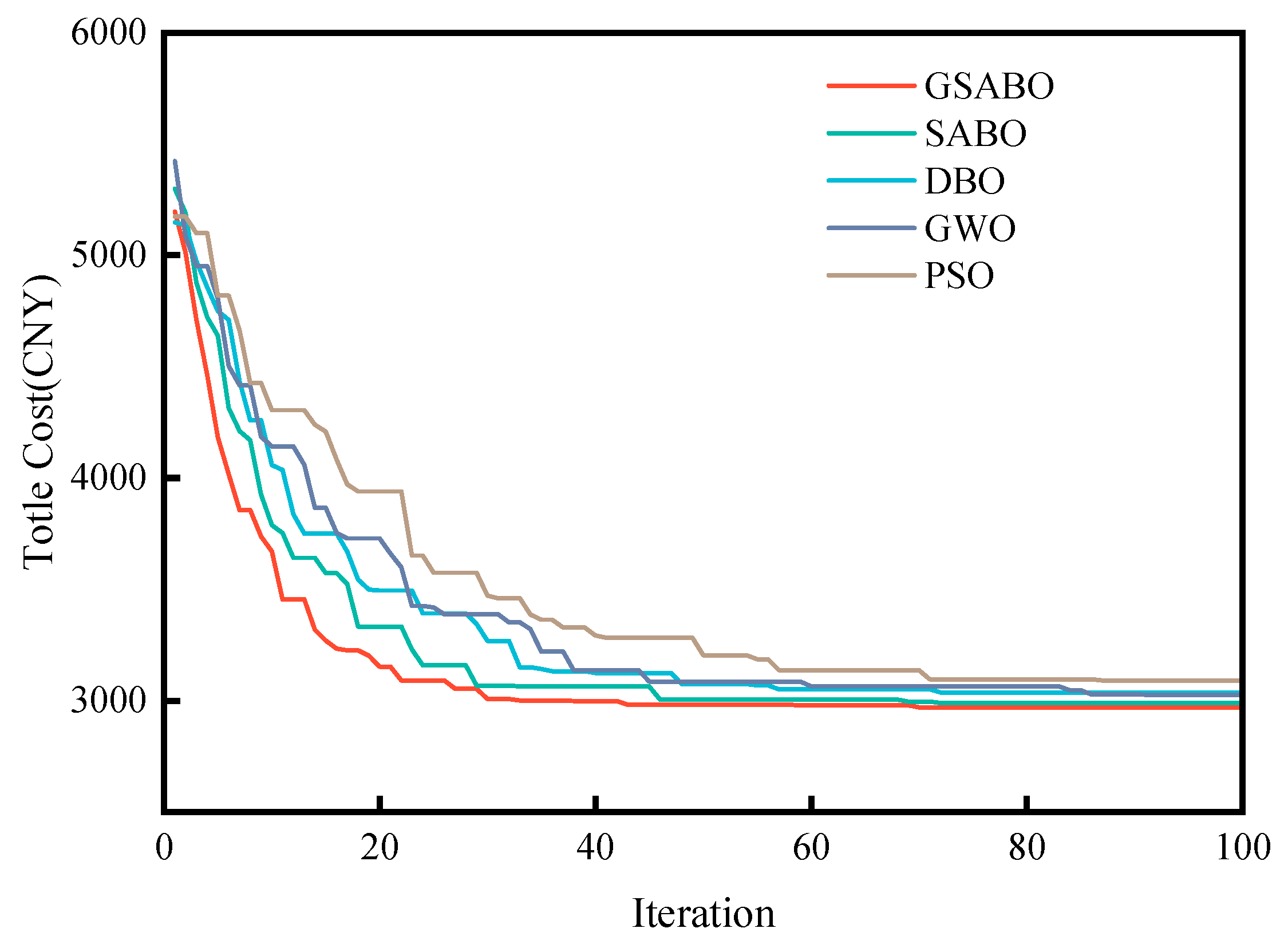
To further validate the application-specific performance of GSABO, a comparative analysis was conducted for the optimal sizing problem in Scenario 3. As shown in Figure 8, traditional algorithms like PSO and SABO exhibited premature convergence around the 40th iteration, being trapped in sub-optimal capacity configurations with higher lifecycle costs. In contrast, fueled by the explicit stagnation-triggering mechanism, GSABO successfully escaped local minima and achieved the lowest total cost. This directly proves the applicability and superior stability of GSABO in solving the proposed complex electricity–hydrogen sizing model.
Based on the superior performance of GSABO, the final calculation results of the optimization sizing model for all three scenarios are shown in Table 5.
According to the simulation results in Table 5, the battery-only configuration (Scenario 1) incurs a total cost 33.7477 million CNY higher than the basic hybrid system (Scenario 2), primarily driven by severe battery degradation and frequent replacements. Furthermore, Scenario 1 exhibits poor reliability, with a 5% LPSP and an 8.7% EER. Scenario 2 mitigates these issues, reducing the LPSP to 3.5% and the EER to 1.1%. Under the same baseline conditions using the historical meteorological data, the energy storage capacities across all scenarios are configured to be sufficiently large to secure system reliability. On this basis, implementing the optimized hybrid dispatch strategy (Scenario 3) introduces a marginal cost increase of 3.2577 million CNY compared to Scenario 2, but further reduces the LPSP to 0.8% and completely eliminates curtailment (0% EER), achieving full renewable utilization and stable power delivery. This complete elimination of curtailment owes to the advantage of the hydrogen system in mitigating seasonal supply-demand mismatches through long-term bulk energy shifting. This performance stems from the prioritized dispatch mechanism: utilizing the PEMEL for initial surplus absorption and the battery for initial deficit compensation. This strategic coordination minimizes battery cyclic aging—thereby controlling replacement costs—while exploiting its rapid response to buffer power fluctuations. Notably, despite the large overall capacity configuration, the total cost of this hybrid system remains lower than that of the single battery system (Scenario 1). Ultimately, Scenario 3 delivers a practical, cost-effective solution that secures the long-term stability and sustainability of the high-altitude off-grid system.

5.4. Analysis of the Operation Scheduling Results

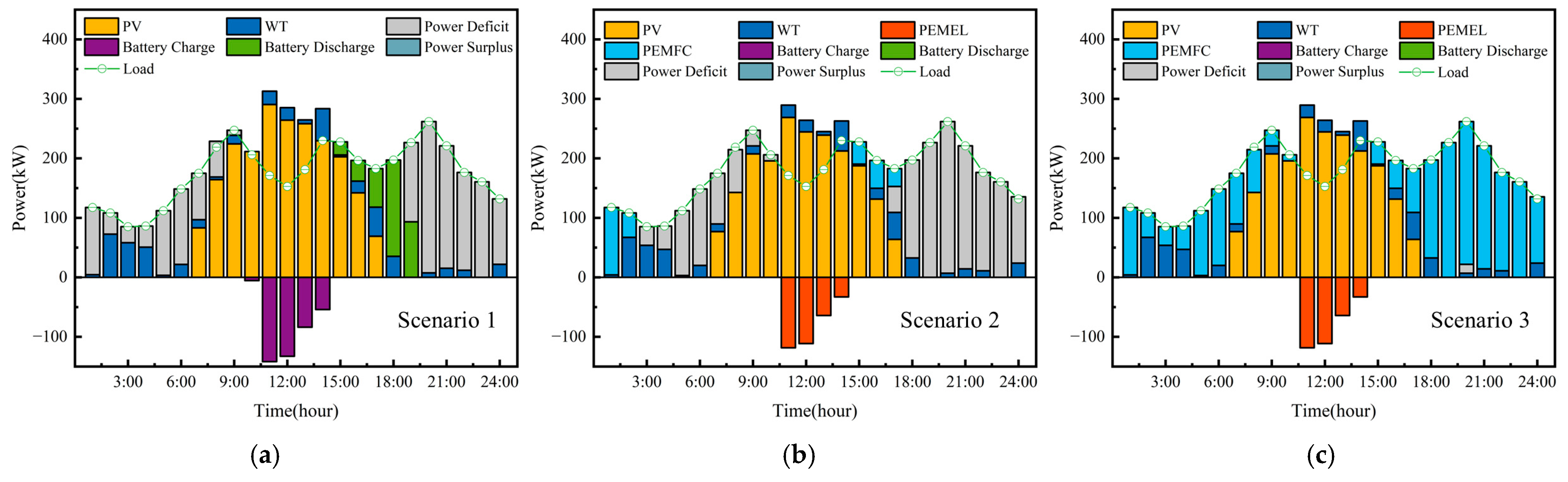
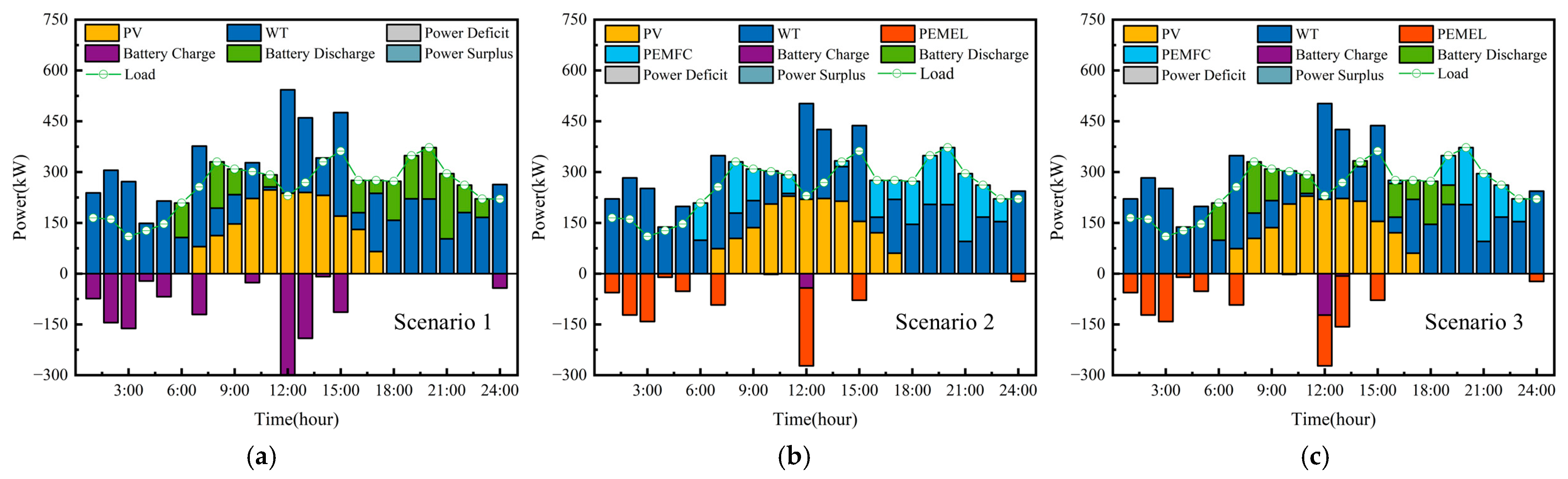
On a typical winter day (Figure 9), the renewable energy supply is relatively sufficient. During the night, high wind speeds combined with low load demand allow the energy storage devices (battery and PEM system) to steadily charge, increasing their overall state of charge. As daytime approaches and photovoltaic generation peaks, the system effectively absorbs the remaining surplus power despite a rise in load. Later in the evening, when renewable output drops and load increases, the storage devices discharge to compensate for the energy deficit. Throughout this daily cycle, the overall state of charge maintains a net upward trend. Consequently, all three scenarios operate without curtailment or power shortages, demonstrating that the proposed dynamic energy management strategy ensures efficient renewable utilization and a highly stable off-grid power supply.
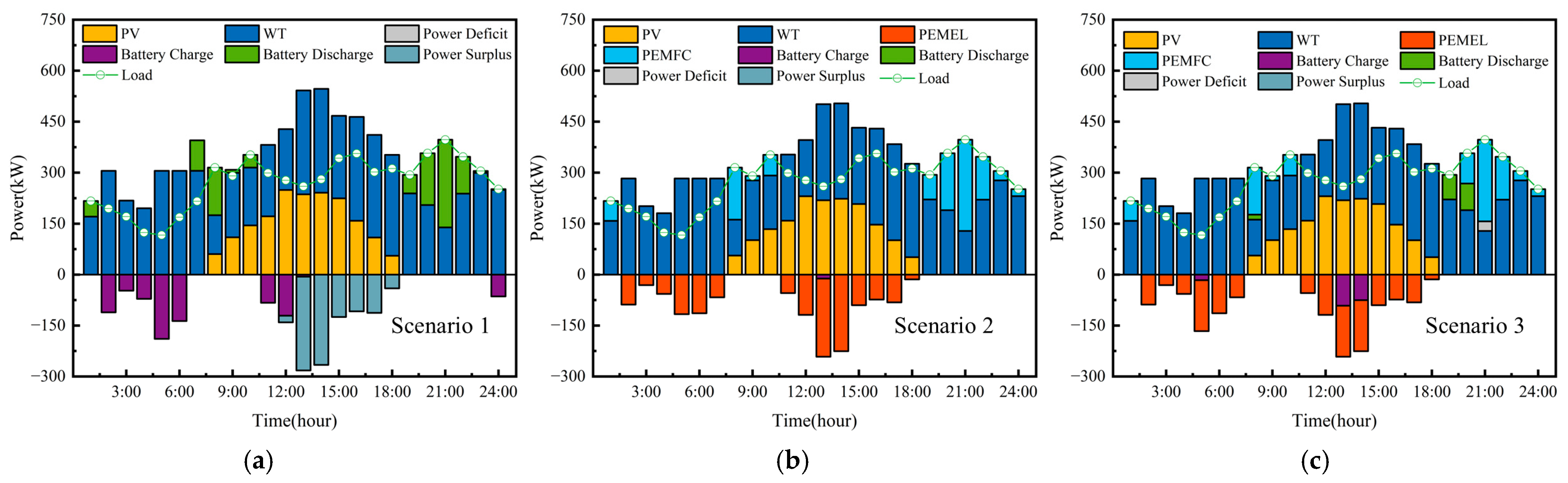
On a typical spring day (Figure 10), renewable energy generation remains abundant. In Scenario 1, the battery-only configuration rapidly reaches its upper State of Charge (SOC) limit, causing prolonged energy curtailment during the peak generation period (12:00–18:00). Conversely, Scenarios 2 and 3 eliminate curtailment via the hybrid dispatch strategy: surplus power is preferentially absorbed by the PEM electrolyzer, with the battery only engaging to capture the remaining excess. Notably, because Scenario 3 features a smaller hydrogen storage capacity than Scenario 2, its battery assumes a larger role in energy absorption and compensation. This optimized coordination keeps the battery within a healthier SOC operational window, mitigating the risk of overcharge-induced degradation. Ultimately, the specific battery-hydrogen balance in Scenario 3 maximizes renewable energy utilization and ensures highly reliable power dispatch during periods of abundant generation.
On a typical summer day (Figure 11), robust photovoltaic generation is offset by a significant drop in wind output and a higher overall system load, substantially increasing the demand for storage compensation. Benefiting from the high State of Charge (SOC) accumulated during the preceding seasons, all three scenarios successfully maintain a stable power supply despite this tightened energy balance. Nevertheless, the prolonged net load deficit drives a continuous decline in the storage devices’ SOC, gradually escalating the operational stress on system reliability.
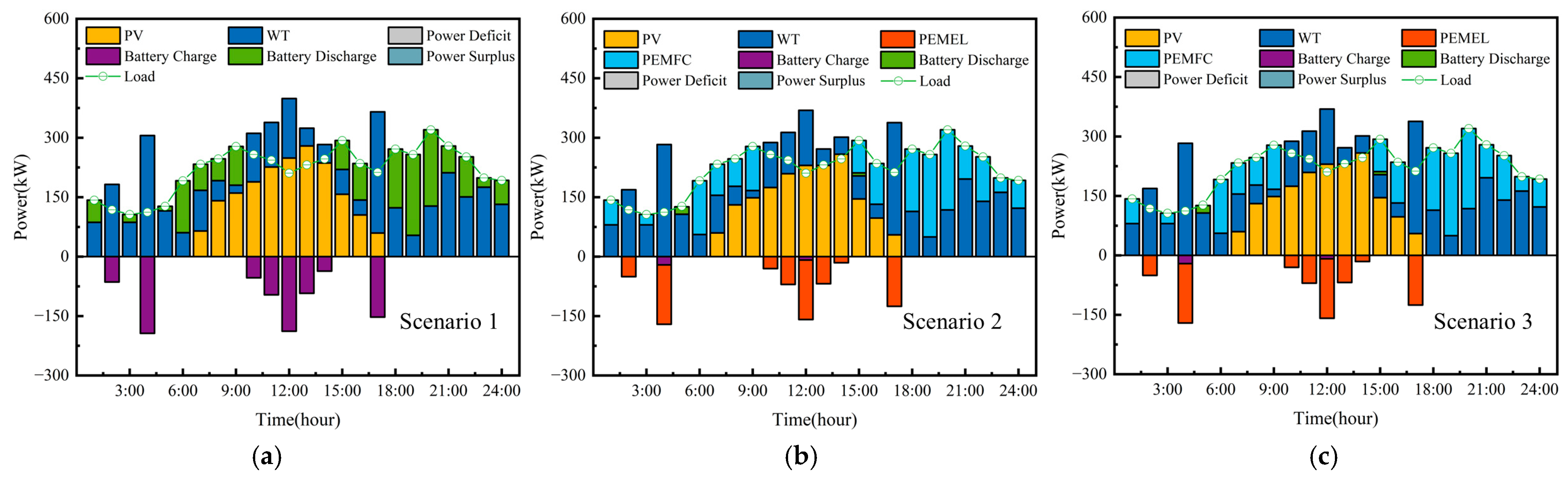
On a typical autumn day (Figure 12), persistently low wind generation significantly heightens the system’s reliance on energy storage. In the battery-only configuration (Scenario 1), prolonged discharging depletes the SOC to its lower limit. Consequently, the system suffers from extensive power deficits during high-demand periods (1:00–8:00 and 17:00–24:00), severely compromising power supply stability.
Although Scenario 2 incorporates hydrogen storage to mitigate battery constraints, its SoH becomes severely depleted after prolonged compensation duties throughout the summer. As a result, it suffers from autumn power deficits identical to Scenario 1. In contrast, the optimized hybrid dispatch in Scenario 3 prioritizes battery discharge during power shortfalls, strategically preserving hydrogen reserves. By entering autumn with a healthier SOH, the system in Scenario 3 can rely on continuous PEMFC operation to sustain a highly reliable power supply.
The 8760 h annual simulation underscores the critical vulnerability of energy storage dispatch to seasonal climatic shifts. While the battery-only configuration (Scenario 1) maintains stable operation during winter and summer, it fails under the operational extremes of transitional seasons: prolonged overcharging in spring forces energy curtailment, and excessive discharging in autumn rapidly exhausts battery capacity, causing severe power deficits.
Although Scenario 2 incorporates hydrogen storage to absorb spring surpluses, its long-term performance deteriorates. The inherent low round-trip efficiency of the hydrogen pathway hinders the accumulation of adequate energy reserves during generation peaks. By autumn, these depleted hydrogen reserves, compounded by the restricted dispatch priority of the battery, lead to rapid capacity exhaustion and large-scale power shortages.
Conversely, the hybrid dispatch strategy in Scenario 3 optimally overcomes these seasonal constraints. By prioritizing the PEM electrolyzer for surplus absorption and the battery for deficit compensation, the system effectively offsets the hydrogen pathway’s efficiency losses and maximizes overall storage utilization. This dynamic coordination ensures that, unlike Scenario 2, energy reserves remain robust entering autumn, ultimately satisfying the high-altitude year-round power supply requirements with superior stability.

5.5. Sensitivity Analysis

To further elucidate the impact of key economic and degradation-related parameters on the lifecycle cost of the wind–solar–hydrogen storage system, this study conducts sensitivity analysis under perturbation ranges of ±10%, ±20%, and ±30%.
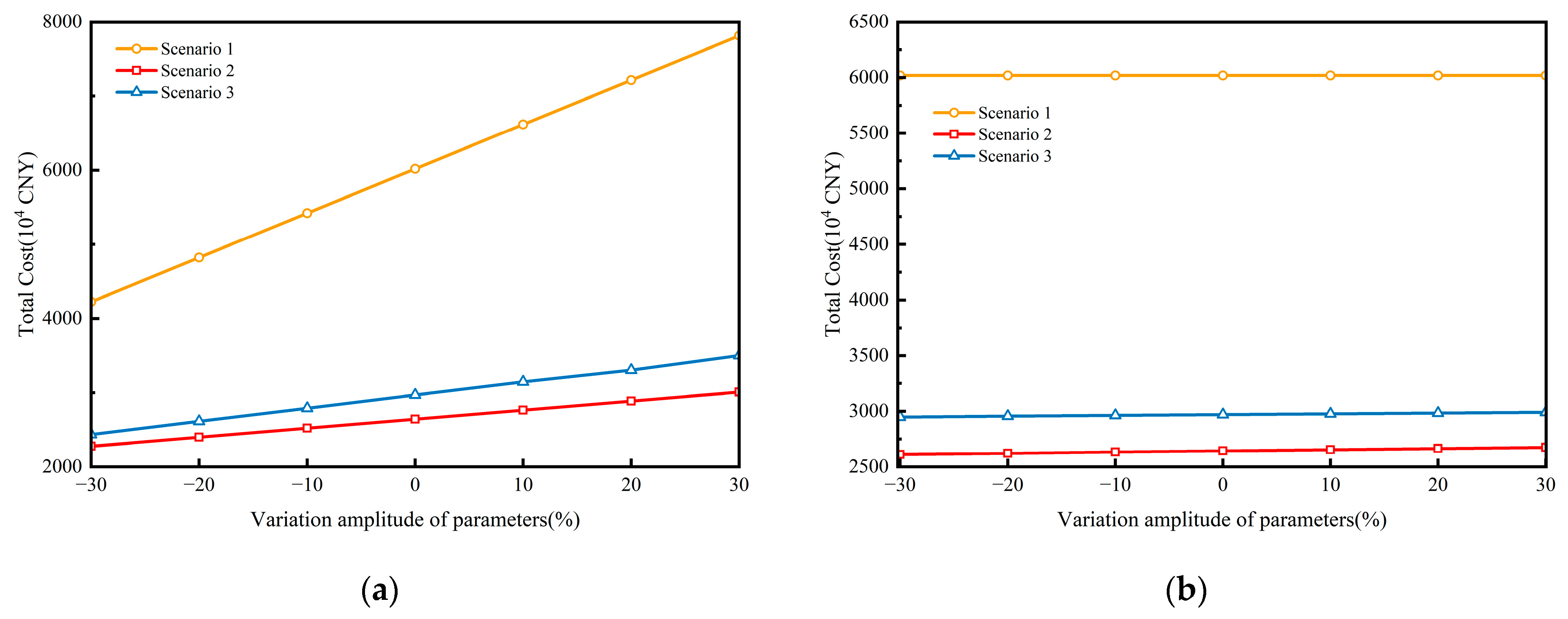
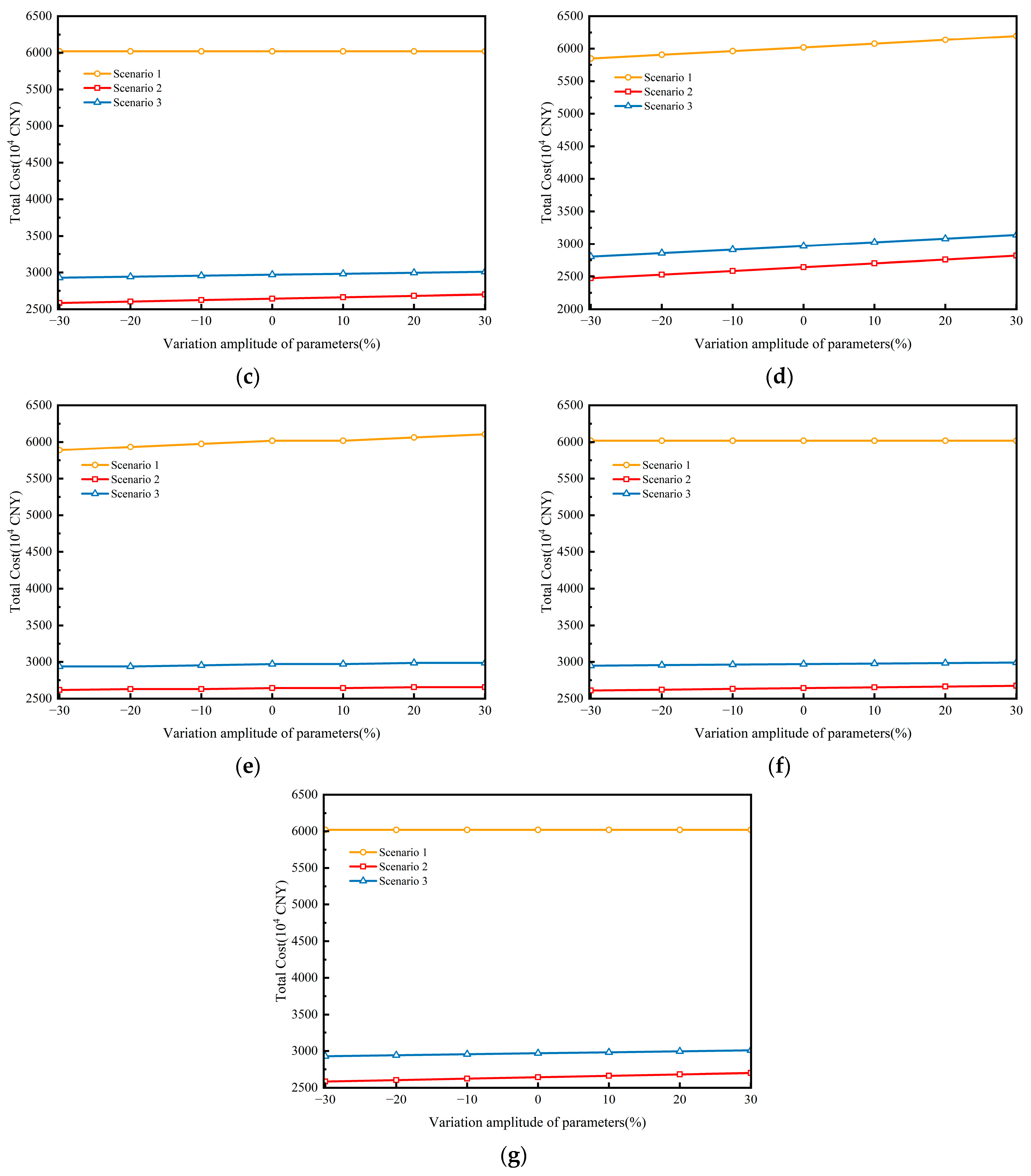
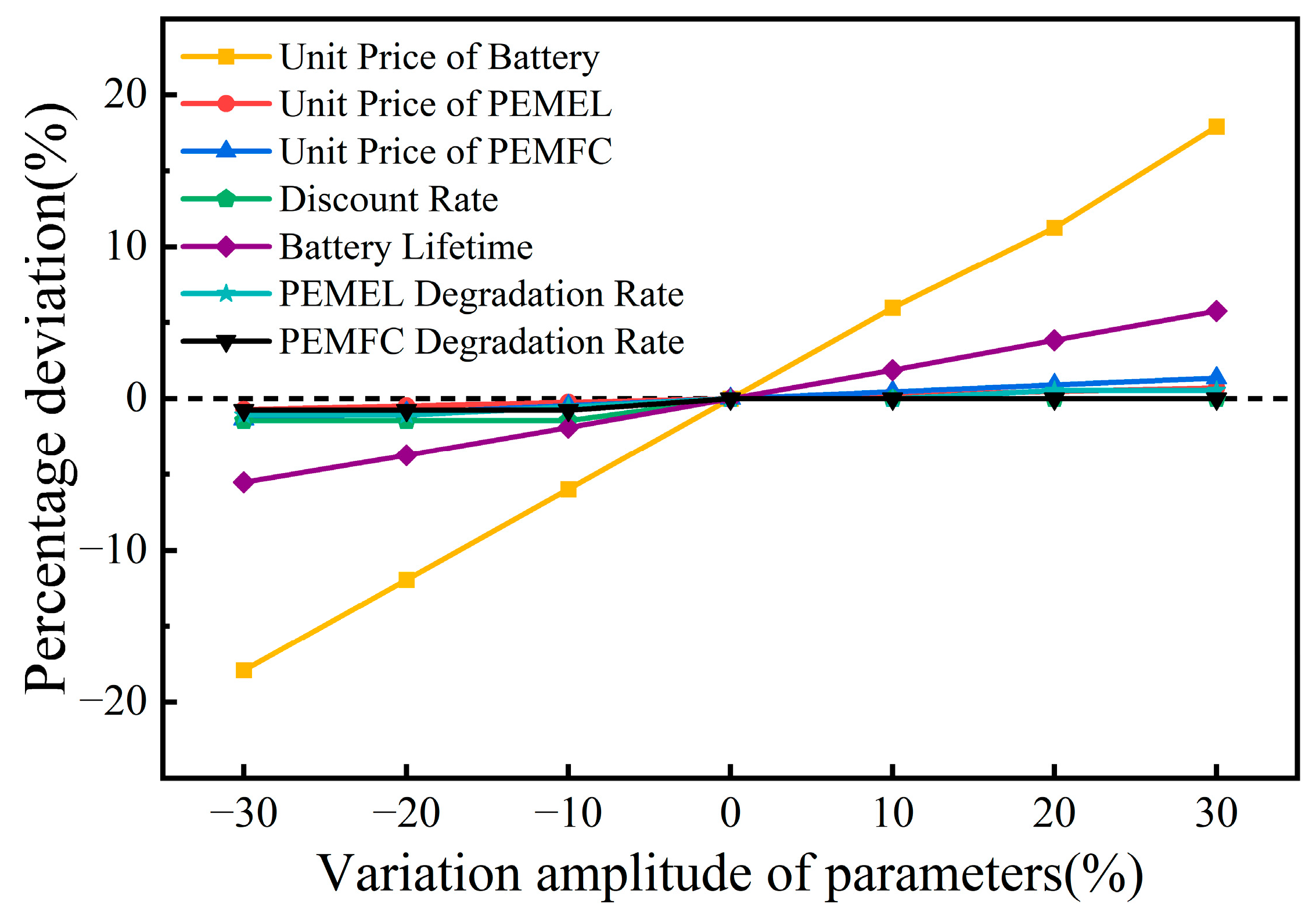
The results for the three scenarios are shown in Figure 13, and the detailed percentage deviation of Scenario 3 is further illustrated in Figure 14.
As indicated in Figure 13, there are significant differences in the impacts of the four categories of key economic parameters on the lifecycle cost (LCC) of the three scenarios. Among all examined economic parameters, the LCC of the three scenarios is most sensitive to changes in the battery unit price. As shown in Figure 13a, Scenario 1 exhibits the largest curve slope, indicating that the system’s economic performance undergoes significant changes when the battery unit price fluctuates. This suggests that in high-altitude regions, the system is highly susceptible to fluctuations in battery unit price when battery storage serves as the sole energy storage device. The impact of the discount rate on system cost ranks second (Figure 13d). Notably, an increase in the discount rate leads to a linear upward trend in the LCC for all three scenarios, with relatively similar slopes of change, indicating that the discount rate, as a macroeconomic parameter, has a universal cost impact on different energy storage configuration schemes. In contrast, the system demonstrates lower sensitivity to changes in the PEMEL unit price (Figure 13b) and PEMFC unit price (Figure 13c). Particularly for Scenario 2 and Scenario 3 (coupled systems containing hydrogen storage), their cost curves appear relatively flat under fluctuations in the prices of hydrogen energy components. This indicates that in high-altitude regions, the introduction of the hydrogen storage system can effectively mitigate economic constraints caused by price changes in a single device, thereby enhancing the overall economic robustness of the system.
In addition, Figure 13e–g further illustrate the influence of degradation-related assumptions on the LCC. As shown in Figure 13e, the battery lifetime has a noticeable effect on the total cost, especially in Scenario 1, where the battery capacity and replacement frequency are both relatively high. Therefore, variations in battery lifetime directly affect the replacement cost and lead to more evident changes in LCC. Compared with battery lifetime, the effects of PEMEL and PEMFC degradation rates are relatively limited, as shown in Figure 13f,g. For the hydrogen-based scenarios, changes in the PEMFC degradation rate have a greater impact than changes in the PEMEL degradation rate, particularly in Scenario 2, due to its higher PEMFC replacement demand. Nevertheless, within the tested variation range, the overall cost ranking of the three scenarios remains unchanged, indicating that the proposed hybrid dispatch strategy maintains its economic advantage and robustness under different degradation assumptions.
To further evaluate the economic robustness of the proposed strategy (Scenario 3) under market fluctuations and degradation-related uncertainties, Figure 14 illustrates the percentage deviation of the total system cost within a ±30% variation range of key economic and degradation parameters. Among all examined parameters, the battery unit price exhibits the highest sensitivity, where its ±30% price fluctuation results in approximately a ±18% deviation in the total cost. This indicates that although the energy storage system in Scenario 3 is no longer dominated by battery storage, the investment and replacement costs of batteries still significantly affect the lifecycle cost of the system. Furthermore, as the discount rate varies from −30% to +30%, the total system cost shows a nearly linear upward trend, suggesting that the cost of capital exerts a strong regulatory influence on the long-term economic performance of high-altitude wind–solar–hydrogen storage systems. In contrast, although PEMEL and PEMFC are important components of the hydrogen storage subsystem, the lifecycle cost shows relatively low sensitivity to their unit prices, with the total cost deviation remaining below 2% within the ±30% variation range. Regarding degradation-related parameters, the variation in battery lifetime leads to a limited cost deviation compared with the battery unit price, mainly because the hybrid electricity–hydrogen dispatch strategy reduces excessive dependence on battery replacement. The effects of PEMEL and PEMFC degradation rates are also relatively small, and their cost curves exhibit slight stepwise changes because the replacement numbers vary discretely over the 20-year lifecycle. Among the hydrogen components, the PEMFC degradation rate has a slightly greater impact than the PEMEL degradation rate due to its higher replacement cost and replacement demand. Overall, compared with the battery unit price and discount rate, the influence of degradation-related parameters remains limited, indicating that the proposed hybrid dispatch strategy maintains good economic robustness under both market-price fluctuations and degradation-parameter variations.

6. Conclusions

This paper addresses the economic and stability requirements of wind–solar–hydrogen storage systems in high-altitude regions. It analyzes the characteristics of wind and solar resources in high-altitude areas, as well as the operational characteristics, advantages, and disadvantages of energy storage systems in these regions. A hybrid electricity–hydrogen storage optimization dispatch strategy, considering the impact of high-altitude environmental factors and the lifespan of storage devices, is designed. A bi-level capacity configuration model is developed with the objectives of minimizing total lifecycle cost, curtailment rate, and power deficit rate. The results are validated through simulation examples, leading to the following conclusions:
(1)
The proposed hybrid electricity–hydrogen storage dispatch strategy reduces the 20-year lifecycle cost to 29.7037 million CNY, 50.65% lower than single electrochemical storage. This cost reduction stems from the rational configuration of electrochemical and hydrogen storage, which avoids overreliance on batteries and minimizes replacement expenses.
(2)
The proposed wind–solar–hydrogen storage configuration reduces power fluctuations and enhances supply stability, achieving 0% excess energy rate and 0.8% LPSP. In contrast, Scenario 1 records 8.7%/5% and Scenario 2 records 1.1%/3.5% for excess energy and LPSP, respectively. Compared with single electrochemical storage and hydrogen-priority strategies, the proposed system significantly improves reliability by reducing energy waste and ensuring load demand.
(3)
The proposed wind–solar–hydrogen storage configuration shows strong dispatch performance in 8760 h simulations. Despite seasonal fluctuations, it maintains stable operation and high adaptability to varying loads, offering a reliable solution for off-grid power supply in high-altitude regions with extreme climates and limited resources.
Lastly, it should be noted that the system sizing and dispatch optimization in this study are performed based on the historical meteorological data of a single typical year at a specific high-altitude site. Although altitude-dependent parameters such as air density, atmospheric pressure, and ambient temperature can be described using empirical relationships, key renewable resource inputs, including wind speed and solar irradiance, are highly site-specific and cannot be reliably represented by altitude alone. Therefore, further validation using measured meteorological datasets from different altitude sites is still required to evaluate the applicability of the proposed method under broader high-altitude conditions. In addition, the inherent inter-annual variability of renewable resources and extreme worst-case meteorological scenarios are not explicitly incorporated into the current deterministic optimization loop. Consequently, the resulting capacities primarily serve as a baseline economic optimum for the given resource profile. Future work will integrate multi-altitude field data, multi-year historical meteorological datasets, and robust optimization or chance-constrained programming methods to further improve the adaptability and resilience of the proposed method under varying altitude-dependent and climate conditions.

Author Contributions

Methodology, L.Z.; project administration, K.L.; resources, K.L. and Y.Y.; writing—original draft preparation, L.Z. and H.Z.; writing—review and editing, L.Z., C.Z. and Y.L.; supervision, W.H. and K.L. All authors have read and agreed to the published version of the manuscript.

Funding

The central government guides local funds for science and technology development, grant number 2025ZYDF086 and 2025ZYDF057; The Artificial Intelligence Key Laboratory of Sichuan Province, grant number 2024RYY08; The National Natural Science Foundation of China, grant number 62471412.

Institutional Review Board Statement

Not applicable.

Informed Consent Statement

Not applicable.

Data Availability Statement

The data presented in this study are available on request from the corresponding author. The data are not publicly available due to future patent protection.

Conflicts of Interest

The authors declare no conflicts of interest.

References

  1. Gu, Z.; Zhang, S.; Lv, F.; Pan, G.; Gu, W.; Li, H.; Feng, G.; Chen, H. Market-driven multi-stage generation expansion planning for hydrogen-penetrated power systems towards energy transition. IEEE Trans. Ind. Appl. 2026, 62, 93–109. [Google Scholar] [CrossRef]
  2. Wu, J.; Cui, S.; Zhu, R.; Chen, H. An energy sharing framework for improving load supply and renewable energy utilization in high-altitude area energy systems. Renew. Energy 2025, 252, 123574. [Google Scholar] [CrossRef]
  3. Lu, Z.; Li, Y.; Zhuo, G.; Xu, C. Configuration Optimization of Hydrogen-Based Multi-Microgrid Systems under Electricity Market Trading and Different Hydrogen Production Strategies. Sustainability 2023, 15, 6753. [Google Scholar] [CrossRef]
  4. Marchenko, O.V.; Solomin, S.V. Modeling of hydrogen and electrical energy storages in wind/PV energy system on the Lake Baikal coast. Int. J. Hydrogen Energy 2017, 42, 9361–9370. [Google Scholar] [CrossRef]
  5. Liu, J.; Xu, Z.; Wu, J.; Liu, K.; Guan, X. Optimal planning of distributed hydrogen-based multi-energy systems. Appl. Energy 2021, 281, 116107. [Google Scholar] [CrossRef]
  6. Yang, S.; Lin, H.; Ju, L.; Ma, J. Chance-constrained bi-level optimal dispatching model and benefit allocation strategy for off-grid microgrid considering bilateral uncertainty of supply and demand. Int. J. Electr. Power Energy Syst. 2023, 146, 108719. [Google Scholar] [CrossRef]
  7. Zhang, Y.; Sun, H.; Tan, J.; Li, Z.; Hou, W.; Guo, Y. Capacity configuration optimization of multi-energy system integrating wind turbine/photovoltaic/hydrogen/battery. Energy 2022, 252, 124046. [Google Scholar] [CrossRef]
  8. Zhao, H.; Xu, J.; Xu, K.; Sun, J.; Wang, Y. Optimal Allocation Method of Source and Storage Capacity of PV-Hydrogen Zero Carbon Emission Microgrid Considering the Usage Cost of Energy Storage Equipment. Energies 2022, 15, 4916. [Google Scholar] [CrossRef]
  9. Pu, Y.; Li, Q.; Zou, X.; Li, R.; Li, L.; Chen, W.; Liu, H. Optimal sizing for an integrated energy system considering degradation and seasonal hydrogen storage. Appl. Energy 2021, 302, 117542. [Google Scholar] [CrossRef]
  10. Le, T.S.; Nguyen, T.N.; Bui, D.-K.; Ngo, T.D. Optimal sizing of renewable energy storage: A techno-economic analysis of hydrogen, battery and hybrid systems considering degradation and seasonal storage. Appl. Energy 2023, 336, 120817. [Google Scholar] [CrossRef]
  11. Li, J.; Xiao, Y.; Lu, S. Optimal configuration of multi microgrid electric hydrogen hybrid energy storage capacity based on distributed robustness. J. Energy Storage 2024, 76, 109762. [Google Scholar] [CrossRef]
  12. Zhang, Y.; Hua, Q.S.; Sun, L.; Liu, Q. Life Cycle Optimization of Renewable Energy Systems Configuration with Hybrid Battery/Hydrogen Storage: A Comparative Study. J. Energy Storage 2020, 30, 101470. [Google Scholar] [CrossRef]
  13. Xia, Q.; Zou, Y.; Wang, Q. Optimal Capacity Planning of Green Electricity-Based Industrial Electricity-Hydrogen Multi-Energy System Considering Variable Unit Cost Sequence. Sustainability 2024, 16, 3684. [Google Scholar] [CrossRef]
  14. Yang, S.; Luo, Y.; Wu, T. Optimization of electro-hydrogen energy storage configuration in off-grid wind-solar-hydro complementary systems. Energy 2025, 332, 137221. [Google Scholar] [CrossRef]
  15. Li, Z.; Xia, Y.; Sun, Y.; Li, D.; Li, B.; Wei, W. Optimal Sizing of Electricity-hydrogen Integrated Energy System Considering Multi-timescale Operation of Hydrogen Storage System. Power Syst. Technol. 2025, 49, 12–21. [Google Scholar] [CrossRef]
  16. Kassem, Y.; Camur, H.; Ghoshouni, E. Assessment of a Hybrid (Wind-Solar) System at High-Altitude Agriculture Regions for achieving Sustainable Development Goals. Eng. Technol. Appl. Sci. 2024, 14, 12595–12607. [Google Scholar] [CrossRef]
  17. Liang, Y.; Ji, X.; Wu, C.; He, J.; Qin, Z. Estimation of the influences of air density on wind energy assessment: A case study from China. Energy Convers. Manag. 2020, 224, 113371. [Google Scholar] [CrossRef]
  18. Bai, S.; Lu, J. Analysis for the Influences of Circumstance in Tibet Plateau on Wind Power. Power Syst. Technol. 2006, 27, 141–145. [Google Scholar] [CrossRef]
  19. Smaoui, M.; Abdelkafi, A.; Krichen, L. Optimal sizing of stand-alone photovoltaic/wind/hydrogen hybrid system supplying a desalination unit. Sol. Energy 2015, 120, 263–276. [Google Scholar] [CrossRef]
  20. Buttler, A.; Spliethoff, H. Current status of water electrolysis for energy storage, grid balancing and sector coupling via power-to-gas and power-to-liquids: A review. Renew. Sustain. Energy Rev. 2018, 82, 2440–2454. [Google Scholar] [CrossRef]
  21. Kavadias, K.A.; Apostolou, D.; Kaldellis, J.K. Modelling and optimisation of a hydrogen-based energy storage system in an autonomous electrical network. Appl. Energy 2018, 227, 574–586. [Google Scholar] [CrossRef]
  22. Luo, S.; Li, Q.; Pu, Y.; Xiao, X.; Chen, W.; Liu, S.; Mao, X. A carbon trading approach for heat-power-hydrogen integrated energy systems based on a Vickrey auction strategy. J. Energy Storage 2023, 72, 108613. [Google Scholar] [CrossRef]
  23. Kumar, R.R.; Bharatiraja, C.; Udhayakumar, K.; Devakirubakaran, S.; Sekar, K.S.; Mihet-Popa, L. Advances in Batteries, Battery Modeling, Battery Management System, Battery Thermal Management, SOC, SOH, and Charge/Discharge Characteristics in EV Applications. IEEE Access 2023, 11, 105761–105809. [Google Scholar] [CrossRef]
  24. Ando, K.; Matsuda, T.; Imamura, D. Degradation diagnosis of lithium-ion batteries with a LiNi0.5Co0.2Mn0.3O2 and LiMn2O4 blended cathode using dV/dQ curve analysis. J. Power Sources 2018, 390, 278–285. [Google Scholar] [CrossRef]
  25. Jaguemont, J.; Boulon, L.; Venet, P.; Dubé, Y.; Sari, A. Lithium-Ion Battery Aging Experiments at Subzero Temperatures and Model Development for Capacity Fade Estimation. IEEE Trans. Veh. Technol. 2016, 65, 4328–4343. [Google Scholar] [CrossRef]
  26. Yan, Q.; Toghiani, H.; Lee, Y.-W.; Liang, K.; Causey, H. Effect of sub-freezing temperatures on a PEM fuel cell performance, startup and fuel cell components. J. Power Sources 2006, 160, 1242–1250. [Google Scholar] [CrossRef]
  27. Lu, X.; Du, B.; Zhou, S.; Zhu, W.; Li, Y.; Yang, Y.; Xie, C.; Zhao, B.; Zhang, L.; Song, J.; et al. Optimization of power allocation for wind-hydrogen system multi-stack PEM water electrolyzer considering degradation conditions. Int. J. Hydrogen Energy 2023, 48, 5850–5872. [Google Scholar] [CrossRef]
  28. He, Y.; Zhou, Y.; Wang, Z.; Liu, J.; Liu, Z.; Zhang, G. Quantification on fuel cell degradation and techno-economic analysis of a hydrogen-based grid-interactive residential energy sharing network with fuel-cell-powered vehicles. Appl. Energy 2021, 303, 117444. [Google Scholar] [CrossRef]
  29. Amirante, R.; Cassone, E.; Distaso, E.; Tamburrano, P. Overview on recent developments in energy storage: Mechanical, electrochemical and hydrogen technologies. Energy Convers. Manag. 2017, 132, 372–387. [Google Scholar] [CrossRef]
  30. Wang, Y.; Pang, Y.; Xu, H.; Martinez, A.; Chen, K.S. PEM Fuel cell and electrolysis cell technologies and hydrogen infrastructure development—A review. Energy Environ. Sci. 2022, 15, 2288–2328. [Google Scholar] [CrossRef]
  31. Trojovský, P.; Dehghani, M. Subtraction-Average-Based Optimizer: A New Swarm-Inspired Metaheuristic Algorithm for Solving Optimization Problems. Biomimetics 2023, 8, 149. [Google Scholar] [CrossRef] [PubMed]
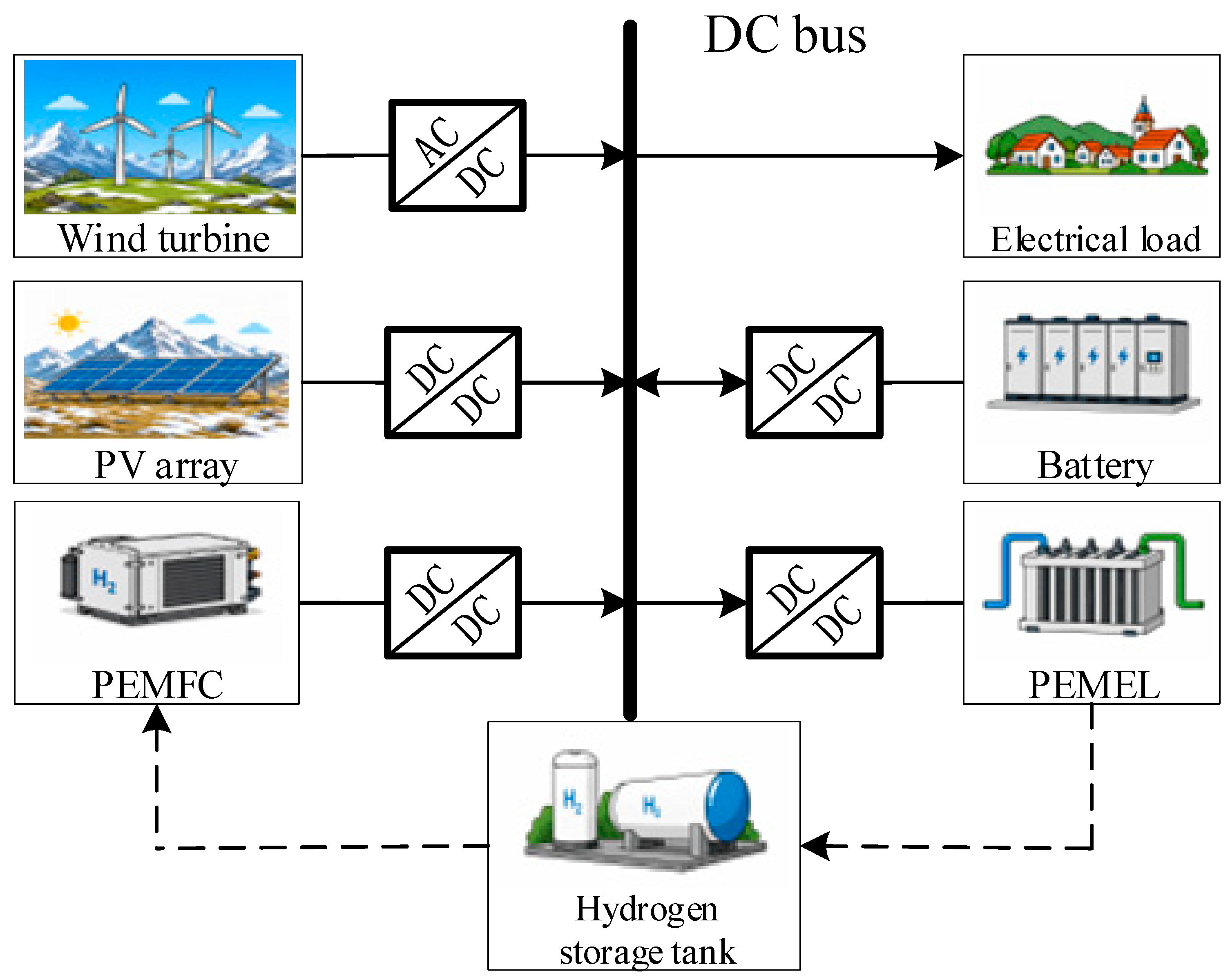
Figure 1. Structure of Wind–Solar–Hydrogen Storage System.
Sustainability 18 05515 g001
Figure 2. Visualization of the battery degradation models. (a) Relative cycle-aging degradation based on Equation (8); (b) calendar-aging degradation with respect to equivalent calendar-aging duration based on Equation (9).
Sustainability 18 05515 g002
Figure 3. Hybrid Electricity–Hydrogen Storage Dispatch Strategy.
Sustainability 18 05515 g003
Figure 4. Double-layer capacity optimization configuration process.
Sustainability 18 05515 g004
Figure 5. Annual wind speed distribution.
Sustainability 18 05515 g005
Figure 6. Annual irradiance distribution.
Sustainability 18 05515 g006
Figure 7. Annual power load demand.
Sustainability 18 05515 g007
Figure 8. Convergence curves of different algorithms for Scenario 3.
Sustainability 18 05515 g008
Figure 9. Power dispatch for the three scenarios on a typical winter day. (a) Scenario 1, (b) Scenario 2, and (c) Scenario 3.
Sustainability 18 05515 g009
Figure 10. Power dispatch for the three scenarios on a typical spring day. (a) Scenario 1, (b) Scenario 2, and (c) Scenario 3.
Sustainability 18 05515 g010
Figure 11. Power dispatch for the three scenarios on a typical summer day. (a) Scenario 1, (b) Scenario 2, and (c) Scenario 3.
Sustainability 18 05515 g011
Figure 12. Power dispatch for the three scenarios on a typical autumn day. (a) Scenario 1, (b) Scenario 2, and (c) Scenario 3.
Sustainability 18 05515 g012
Figure 13. Sensitivity analysis of total lifecycle cost under three scenarios: (a) unit price of battery; (b) unit price of PEMEL; (c) unit price of PEMFC; (d) discount rate; (e) battery lifetime; (f) PEMEL degradation rate; (g) PEMFC degradation rate.
Sustainability 18 05515 g013aSustainability 18 05515 g013b
Figure 14. Sensitivity analysis results of key parameters for Scenario 3.
Sustainability 18 05515 g014
Table 1. Comparison between existing hybrid electricity–hydrogen storage studies and this work.
StudySystem TypeDispatch StrategyAltitude FactorsMain Distinction
Zhang et al. [7]Wind/PV/hydrogen/batteryCoordinated dispatch/Focuses on multi-objective sizing and 8760 h simulation, without high-altitude environmental modeling
Zhao et al. [8]PV/hydrogen/electrochemical storageStorage-mode comparison/Compares hydrogen-based and battery-based storage, but does not develop altitude-aware hybrid dispatch
Pu et al. [9]Power–hydrogen–heat–cooling IESMILP-based dispatch/Considers degradation and lifecycle cost, but focuses on islanded multi-energy IES rather than high-altitude wind–solar–hydrogen storage
Le et al. [10]Battery/hydrogen/hybrid storageBattery-first strategy/Evaluates storage degradation and pricing, but is not oriented to high-altitude operating conditions
Li et al. [11], Zhang et al. [12]Multi-microgrid / hybrid renewable systemsRobust or MILP-based operation/Focuses on economic co-sizing and hydrogen cost effects, without altitude-induced environmental constraints
Yang et al. [14], Li et al. [15]Hybrid electricity–hydrogen storageScenario-based or multi-timescale coordination/Improves renewable utilization through scenario aggregation or multi-timescale storage coordination, but does not address high-altitude degradation and dispatch characteristics
This workHigh-altitude wind–solar–hydrogen storageHybrid electricity–hydrogen dispatchCouples altitude-related environmental effects, hybrid battery–hydrogen dispatch, and GSABO-based bi-level sizing for high-altitude wind–solar–hydrogen storage systems
✓ indicates that altitude-related environmental factors are explicitly considered in the corresponding study.
Table 2. Relationship between environmental parameters and altitude.
ParameterAltitude (km)
012345
Atmospheric pressure (kPa)101.590.079.570.061.554.0
Air density (kg·m3)1.2921.1671.0500.9430.8440.753
Average temperature (°C)353025201510
Maximum temperature (°C)454035302520
Minimum temperature (°C)5−5−15−25−40−45
Table 3. Comparative Analysis of Electrochemical Energy Storage and Hydrogen Energy Storage.
Energy Storage TypeAdvantagesDisadvantages
Electrochemical Energy StorageHigh energy conversion efficiency;
Short start-up time
Rapid capacity degradation in low-temperature environments;
High storage costs;
Short energy storage cycles
Hydrogen Energy StorageLow storage costs;
Long energy storage time;
Low storage costs;
Less affected by environmental factors
Low energy conversion efficiency;
Long start-up time
Table 4. Wind–solar–hydrogen storage system parameters.
DevicesParametersValues
Wind TurbineInstalled Capacity (kW)10
Unit Power Price (CNY)8000
Lifetime (years)20
PV ArrayInstalled Capacity (kW)1
Unit Power Price (CNY)5000
Lifetime (years)20
PEMELInstalled Capacity (kW)5
Unit Power Price (CNY)15,000
Unit Power Replacement Price (CNY)7500
Conversion Efficiency (%)75
Lifetime (years)10
PEMFCInstalled Capacity (kW)5
Unit Power Price (CNY)18,000
Unit Power Replacement Price (CNY)9000
Conversion Efficiency (%)50
Lifetime (years)10
BatteryInstalled Capacity (kWh)50
Unit Power Price (CNY)3000
Unit Power Replacement Price (CNY)1500
Charge/Discharge Efficiency (%)95
Lifetime (years)4
Hydrogen Storage TankInstalled Capacity (Nm3)100
Unit Capacity Cost (CNY)3000
Lifetime (years)20
Table 5. Capacity configuration scheme for wind–solar–hydro storage system.
ScenarioEquipment Installed CapacityEER
(%)
LPSP (%)Total Cost
(CNY)
Wind Turbine
(kW)
PV Array
(kW)
Battery
(kWh)
PEMEL
(kW)
PEMFC
(kW)
Hydrogen Storage Tank (Nm3)
146029014,4500008.7560.1937 million
2430270420023029048,9001.13.526.4460 million
3430270535015024043,00000.829.7037 million
Disclaimer/Publisher’s Note: The statements, opinions and data contained in all publications are solely those of the individual author(s) and contributor(s) and not of MDPI and/or the editor(s). MDPI and/or the editor(s) disclaim responsibility for any injury to people or property resulting from any ideas, methods, instructions or products referred to in the content.