1. Introduction
Digital transformation is no longer a temporary phase of organizational change. Artificial intelligence, automation, data analytics, cloud platforms and other disruptive technologies are now embedded in everyday work and continue to reshape job roles, decision-making processes and employee expectations. These technologies not only create demand for new technical competences. They also change the value of skills that employees already have. A digital skill that was useful a few years ago may become less relevant, less frequently used, or even insufficient for current work demands. This creates an important challenge for organizations, since workforce sustainability depends not only on attracting or training people with new skills, but also on protecting existing human capital from gradual erosion and functional devaluation.
The literature on digital transformation has shown that technological change modifies occupational tasks and increases the need for digital, analytical, cognitive and adaptive skills [
1,
2,
3]. Much of this discussion, however, remains focused on skills gaps, namely whether employees possess the digital skills required by new technologies. While this issue is important, less is known about how already-acquired digital skills gradually lose fluency, relevance and organizational value before they become obsolete. The problem is not always the absence of digital skills. In many cases, existing digital skills become weaker, less updated, or less aligned with new technological systems. This study therefore shifts the focus from the possession of digital skills to their continuing relevance under disruptive technological change.
A central distinction in this study is between digital skills decay and digital skills obsolescence. Digital skills decay refers to the gradual erosion of employees’ digital competences, often because certain skills are not practised often, some tasks are automated, or employees become less exposed to activities that previously maintained their proficiency. Digital skills obsolescence, in contrast, refers to the functional irrelevance of existing skills. Employees may still know how to perform a digital task, but the task itself may no longer be sufficient, valued or aligned with the current technological environment. In this manuscript, both constructs are examined as employees’ perceptions rather than as objective assessments of actual skill loss or technical proficiency. More specifically, digital skills decay refers to the perceived weakening of existing digital competences, digital skills obsolescence to their perceived loss of relevance or usefulness, and digital skill devaluation is used as a broader umbrella term that includes both processes. Both processes threaten employability and workforce sustainability, but they do so in different ways [
4,
5].
This issue is directly connected with sustainable human resource management. Sustainable HRM is not limited to employee well-being, retention or general training policies. It also concerns the long-term capacity of employees to remain employable, adaptable and included in changing work systems. Training and development are often presented as core elements of sustainable HRM because they support long-term human capability and not only short-term performance outcomes [
6,
7]. However, the sustainability of human resources also depends on whether organizations can detect and respond to early signs of skill deterioration before employees become professionally insecure or excluded from new forms of work. From this perspective, digital skills decay and obsolescence are not only technical problems. They are HRM and sustainability problems, because they affect employees’ capacity to remain employable, included and able to participate in technologically changing workplaces.
The existing literature has not yet examined these relationships sufficiently as an integrated HRM model. Research has shown that disruptive technologies increase the need for reskilling and upskilling, while employability studies emphasize adaptability, learning orientation and career security [
3,
8]. Still, less is known about how employees react when they perceive that their existing digital skills are becoming outdated or insufficient. Such perceptions may create employability anxiety, as employees begin to question whether they can remain useful, competitive or secure in their current and future roles. At the same time, this anxiety may also stimulate adaptive responses, especially when employees intend to engage in reskilling or upskilling. The key issue, therefore, is not simply that reskilling is needed, but when and how employees recognize that their digital skills are losing value, and under which organizational conditions this recognition leads to constructive learning rather than insecurity or withdrawal.
The purpose of this study is to examine how disruptive technological change is associated with digital skills decay and digital skills obsolescence and how these processes shape employability anxiety, reskilling intention and workforce sustainability. The central research question is formulated as follows: How are digital skills decay and digital skills obsolescence associated with workforce sustainability under disruptive technological change, and what role do sustainable HRM practices and organizational learning culture play in this process? This question places the human side of technological disruption at the centre of the analysis and connects digital transformation with sustainability by treating employees’ ability to remain skilled, employable and adaptive as a key condition of sustainable organizational development.
The originality of this study lies in distinguishing digital skills decay from digital skills obsolescence and linking both processes with employability anxiety, reskilling intention and workforce sustainability. In this way, the study moves beyond the general argument that organizations need more training. It argues that sustainable HRM should also be concerned with the prevention, detection and management of digital skill devaluation.
These relationships are examined empirically through survey data from employees exposed to technological changes, using PLS-SEM as the main analytical approach and complementary Bayesian analysis as a robustness check for the core relationships.
The study is therefore grounded in a combined theoretical framework. Sustainable HRM provides the broader perspective, since the central concern is the long-term employability, adaptability and inclusion of employees under technological change. Human capital and skill depreciation perspectives explain why existing digital competences may lose strength or value over time. Within this logic, digital skills decay is treated as an early deterioration of human capital, while digital skills obsolescence reflects the loss of strategic and functional value of that human capital in changing technological environments. Employability theory then helps explain why employees may experience anxiety when they perceive that their skills are losing relevance, while organizational learning theory clarifies why learning-oriented contexts may support continued skill renewal. This combined framing allows the study to connect digital transformation, employee responses and workforce sustainability within one HRM-focused model.
2. Literature Review
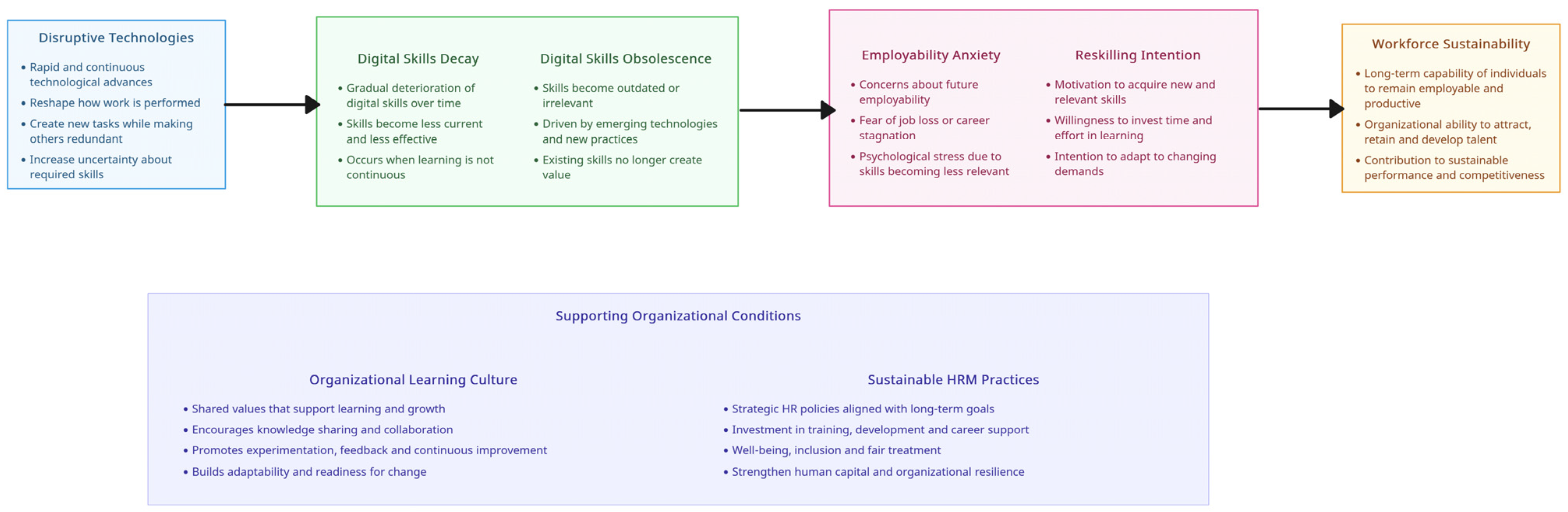
The literature review develops the theoretical logic of this study through a combined framework that links sustainable HRM, human capital depreciation, employability and organizational learning with digital skills devaluation and workforce sustainability. Within this framework, digital skills decay is understood as an early-stage deterioration of human capital, whereas digital skills obsolescence reflects the loss of strategic and functional value of that capital in changing technological environments. As shown in
Figure 1, the starting point is that digital skills cannot be treated as fixed assets that remain equally useful once acquired. This review first discusses disruptive technologies and digital skill devaluation, then connects decay and obsolescence with employability anxiety and reskilling intention, and finally places these relationships within sustainable HRM and organizational learning.
2.1. Disruptive Technologies and the Changing Nature of Digital Skills
Disruptive technologies are changing not only the tools used at work, but also the meaning and durability of digital skills. Artificial intelligence, automation, cloud platforms, data analytics and interconnected digital systems increasingly reshape how employees search for information, communicate, solve problems and make decisions. In this context, digital skills cannot be treated as a fixed stock of knowledge that remains stable once acquired. They are better understood as a moving capability, because their value depends on how well they remain aligned with changing technologies, tasks and organizational routines.
This argument is also consistent with the broader shift from Industry 4.0 to Industry 5.0. While Industry 4.0 mainly emphasized automation, connectivity and data-driven production, Industry 5.0 brings the human role more clearly into the discussion by stressing human-centricity, resilience and sustainability. From this perspective, digital skills are not only technical competences needed to operate new systems. They are part of employees’ capacity to remain active, adaptable and included in technologically changing workplaces [
9,
10]. This is important for sustainable HRM, because technological progress has limited value if employees cannot follow, understand or meaningfully participate in the new forms of work it creates.
Existing literature shows that digital transformation affects work mainly through the reconfiguration of tasks rather than through the simple replacement of jobs. Automation and AI tend to reduce the importance of routine and predictable activities, while increasing the need for data interpretation, digital coordination, problem solving and oversight of intelligent systems [
1,
4]. Digital skills are therefore no longer limited to basic ICT use. They include the ability to work with platforms, understand data-based processes, collaborate in technology-mediated environments and adjust to new digital workflows [
5,
11]. This makes digital competence more complex, but also more fragile, because what is considered useful can change quickly.
Prior research has stressed the need for continuous upskilling and reskilling under Industry 4.0 and digital transformation [
3,
12]. It also shows that digital competences are connected with organizational learning and work cultures, not only with individual technical ability [
13]. These studies are useful because they show that digital transformation is not only a technological shift. It also changes the way organizations support learning, adaptation and competence maintenance.
However, the literature still tends to frame the issue mainly through “skills gaps” and future skill needs. This framing is necessary, but not sufficient. A skills gap usually refers to the distance between current employee capabilities and new job requirements. It says less about what happens to skills that employees already have but use less frequently, update too slowly, or apply in systems that are gradually being replaced. In practice, an employee may not lack digital skills in a general sense but may still feel that specific competences are becoming less fluent, less current or less useful. This is the early space where digital skills decay becomes relevant.
For sustainable HRM, this point has practical and theoretical importance. If organizations notice the problem only when skills have already become obsolete, the response may come too late. Workforce sustainability depends on earlier recognition of skill weakening, before employees lose confidence, employability or access to new work opportunities. Perceived disruptive technological change is therefore expected to increase digital skills decay. When employees experience frequent changes in digital tools, platforms and work processes, they are more likely to perceive that some of their existing skills are becoming less practised, less updated and less aligned with current work demands.
H1. Perceived disruptive technological change positively affects digital skills decay.
2.2. Digital Skills Decay and Digital Skills Obsolescence
The distinction between digital skills decay and digital skills obsolescence can be grounded in the broader literature on skill depreciation. Skill decay has usually been associated with the loss or weakening of acquired knowledge and abilities after periods of limited use or insufficient practice [
14]. Skill obsolescence, by contrast, has been discussed as a wider process in which skills lose their value because work requirements, technologies or organizational conditions change [
15,
16]. Applied to digital work, this distinction becomes particularly relevant. Digital skills may first become less fluent or less updated because they are not practised in the same way. Later, they may become obsolete when they no longer fit the systems, platforms or digital procedures used in the organization.
This distinction is important because the two constructs refer to different forms of human capital depreciation. Digital skills decay mainly concerns the deterioration of the employee’s usable proficiency: the skill becomes less fluent, less practised or less confidently applied [
14]. Digital skills obsolescence concerns the declining value of that skill in the organizational or technological context: the employee may still possess the skill, but the skill is no longer sufficiently aligned with current systems, tasks or performance expectations [
15,
16]. In this sense, decay is closer to capability deterioration, whereas obsolescence is closer to a loss of strategic or functional value [
16]. The two processes may be sequential, but they are not identical. A skill can decay without yet being obsolete, and a skill can become obsolete because the technological environment changes even if the employee has not fully lost the ability to perform it.
Digital skills decay refers to the gradual weakening of employees’ existing digital competences. It does not mean that employees suddenly lose their ability to use technology. Rather, it captures a slower process in which specific skills become less active, less confident or less useful in everyday work. This may happen when a digital tool is replaced, when a task becomes automated, or when employees are moved away from activities that previously helped them maintain their proficiency. For example, an employee may still know how to use a specific reporting system, but if the organization gradually shifts to automated dashboards or AI-supported analytics, this older competence may be used less often and become less reliable in practice. In this sense, decay is partly internal to the employee, because it concerns fluency and confidence, but it is also shaped by the organization, because work systems determine which skills are actually practised.
Digital skills obsolescence is a more advanced form of skill devaluation. It refers to the point where existing digital skills are no longer adequate, relevant or functional for current work demands. The important point is that obsolescence does not necessarily imply that the employee has forgotten the skill. A skill may still exist, but its value may have declined because the technological context has changed. This is close to the distinction made in skill-obsolescence literature between internal depreciation, where the worker’s own proficiency declines, and external depreciation, where the market or organization values the skill less because tasks and technologies have moved on [
16,
17]. In digital workplaces, this external dimension is very strong, because software, platforms, data systems and automated processes may change faster than employees’ existing competences can be renewed.
Recent research on digital skills also supports this logic. Digital competence is increasingly understood as a broad and evolving capacity that includes problem solving, information management, digital collaboration, data-related understanding and adaptation to changing technological environments [
10,
11]. At the same time, employers’ expectations regarding digital skills continue to shift, creating risks for employees whose competences remain tied to older tools or narrower technical routines [
5].
From a sustainable HRM perspective, the distinction matters because decay and obsolescence require different organizational responses. Decay calls for early maintenance-oriented interventions, such as practice opportunities, refresher training, job rotation, peer learning or targeted learning support. Obsolescence requires more strategic interventions, such as deeper reskilling, new career pathways, role redesign or redeployment into tasks where renewed competences can retain value. If organizations treat all digital skill problems as simple “training needs”, they may miss the early warning signs. A decaying skill is not yet useless, but it may become so if employees are not given opportunities to update and apply it. This is directly related to workforce sustainability, because employees remain sustainable as human capital only when their skills can be renewed before they lose practical value.
Although prior research has examined skills gaps and future digital skill requirements, less attention has been given to the gradual movement from digital skills decay to digital skills obsolescence. This movement matters because employees may first perceive a weaker connection between what they know and what their job now requires, before these skills become functionally outdated.
Based on this reasoning, digital skills decay is expected to increase digital skills obsolescence. When employees perceive that their digital skills are becoming less practised, less current or less useful, they are also more likely to perceive these skills as increasingly inadequate or functionally outdated.
H2. Digital skills decay positively affects digital skills obsolescence.
2.3. Digital Skills Decay, Obsolescence, and Employability Anxiety
Having distinguished between digital skills decay and digital skills obsolescence, the next issue concerns how employees interpret these processes in relation to their future employability. In technologically changing workplaces, the declining value of digital skills is not experienced only as a technical mismatch. It can also become a source of personal uncertainty, especially when employees feel that their current competences may no longer be enough to secure their role, career progression, or future labour market position. In this research, employability anxiety refers to this worry about remaining employable under conditions of technological change.
Employability is commonly understood as a psychosocial resource that helps individuals obtain, maintain and move between jobs [
18]. In digital workplaces, this perception is increasingly shaped by whether employees believe that their digital competences remain relevant to current and future work demands [
5,
8]. Therefore, when employees perceive that their digital skills are losing relevance, they may also begin to question their future value as workers.
Digital skills decay may increase employability anxiety because it weakens employees’ confidence in their capacity to keep pace with work demands. The problem is not necessarily that employees immediately become unable to perform their jobs. Rather, they may sense that their fluency, speed or confidence with certain digital tasks is declining. This may be especially stressful in workplaces where new systems are introduced frequently and employees are expected to adapt without much time for consolidation. Under such conditions, the gradual digital skills decay may be interpreted as an early warning that one’s employability is becoming less secure.
Digital skills obsolescence may create a stronger employability threat because it signals that existing competences are no longer valued in the same way. Employees may feel that what they know is still technically present, but no longer sufficient for current or emerging roles. This is close to the broader employability literature, which shows that perceived employability is connected with well-being, job security and the ability to cope with career uncertainty [
19]. When the perceived usefulness of skills declines, employees may experience a loss of control over their future work position. In this sense, obsolescence does not only affect competence. It also affects the psychological security attached to competence.
For sustainable HRM, this connection is important. Employability anxiety should not be treated only as an individual emotional reaction. It may indicate that the organization is failing to maintain the long-term usability of its human capital. If employees feel that their digital skills are becoming outdated, they may become more cautious, less confident, or less willing to engage with new technologies. This can weaken workforce sustainability, because sustainable workforces depend on employees who feel capable of adapting rather than threatened by every technological transition.
A critical limitation in existing research is that employability, digital transformation and skills development are often discussed separately. The literature explains that digital skills are important for employability and that technological change increases the need for reskilling. However, it less often examines the psychological consequences of skill devaluation itself. This is important because employees do not respond only to objective skill requirements. They also respond to how they perceive the future value of their own competences.
Based on this reasoning, both digital skills decay and digital skills obsolescence are expected to increase employability anxiety. Decay may raise anxiety because employees perceive an early weakening of their digital competence, while obsolescence may raise anxiety because employees perceive a deeper loss of relevance and future usefulness.
H3. Digital skills decay positively affects employability anxiety.
H4. Digital skills obsolescence positively affects employability anxiety.
2.4. Reskilling Intention as an Adaptive Response
Employability anxiety does not necessarily lead only to negative outcomes. In technologically changing workplaces, it may also operate as a signal that employees need to adjust their competences before their position becomes more vulnerable. When employees perceive that their digital skills are losing relevance, anxiety about future employability may encourage them to consider reskilling or upskilling as a way to regain control over their career prospects. In this research, reskilling intention refers to employees’ willingness to engage in learning activities that help them acquire or renew competences required by changing digital work environments.
The literature on digital transformation has repeatedly emphasized that reskilling and upskilling are no longer optional activities. Industry 4.0, artificial intelligence and automation increase the pressure on employees to update their skills in order to remain employable and able to move across changing job roles [
3]. Recent evidence also shows that lower-skilled or more routine occupations face stronger upskilling pressure, because the distance between existing and required skills becomes wider under technological change [
20]. This suggests that reskilling intention is not simply a personal preference. It is often shaped by the perceived risk that current skills may no longer protect future employability.
At the same time, the relationship between anxiety and reskilling intention should not be treated as automatic. Employability anxiety may motivate learning when employees believe that action is possible and that learning opportunities are accessible. However, under weak organizational support, limited learning climate or low psychological safety, the same anxiety may lead to avoidance, resistance or disengagement. This is why the HR context matters. Sustainable HRM practices and learning-oriented environments can help transform employability anxiety into a more constructive response by making reskilling realistic, available and connected with career development rather than with blame or deficit [
12,
21].
Reskilling intention is also relevant for workforce sustainability. A sustainable workforce is not only one that remains employed in the short term, but one that can renew its capabilities as work changes. Employees who intend to reskill are more likely to maintain their employability, adapt to new digital tasks and remain included in emerging forms of work. Prior research shows that continuous learning, self-development and organizational learning support perceived employability and long-term capability development [
12,
21]. In this sense, reskilling intention can be understood as an adaptive bridge between perceived skill threat and sustainable participation in the workforce.
For this reason, the present study treats reskilling intention not only as a general response to technological disruption, but as an adaptive reaction to perceived digital skill devaluation.
Based on this reasoning, employability anxiety is expected to increase reskilling intention, as employees may respond to perceived career threat by seeking competence renewal. Reskilling intention is also expected to support workforce sustainability, because it reflects employees’ willingness to remain adaptable, employable and active in technologically changing workplaces.
H5. Employability anxiety positively affects reskilling intention.
H6. Reskilling intention positively affects workforce sustainability.
2.5. Sustainable HRM, Organizational Learning Culture, and Workforce Sustainability
Workforce sustainability depends on whether employees can remain employable, adaptable and meaningfully included as work changes. In the context of disruptive technologies, this issue becomes more demanding because employees are asked not only to perform their current roles, but also to renew their skills continuously. Employability anxiety may therefore become a risk for workforce sustainability when employees feel that their future position is uncertain and that their digital competences are losing value. If such anxiety remains unsupported, it may reduce confidence, weaken commitment and make technological change feel threatening rather than developmental [
22,
23].
Sustainable HRM provides an important organizational response to this problem. It emphasizes the long-term development of people, the preservation of human capability and the creation of working conditions that support both organizational performance and employee well-being. Training and development are central in this perspective, but they should not be understood only as short-term interventions for immediate skill shortages. Sustainable HRM practices should help employees maintain employability, update their competences and see technological change as part of a supported career path [
6,
7]. This is particularly relevant when digital skills decay or obsolescence threatens the continuity of employees’ contribution to the organization.
Organizational learning culture also plays a key role. A learning culture supports knowledge sharing, feedback, experimentation, learning from mistakes and self-directed development. These elements are important because employees cannot respond effectively to digital disruption only through occasional training programmes. They need a work environment where learning is embedded in everyday practice. Previous research has shown that organizational learning can strengthen perceived employability, while continuous learning environments can support commitment and digital adaptation [
21,
24]. In this sense, learning culture helps transform skill renewal from an individual burden into a shared organizational process.
The relationship between employability anxiety and workforce sustainability is therefore not straightforward. Anxiety may push employees toward reskilling, but it may also harm sustainability when it reflects insecurity, perceived exclusion or loss of control over one’s future work role. A workforce cannot be considered sustainable if employees remain formally employed but feel increasingly unable to follow technological change. For this reason, employability anxiety is expected to have a negative direct effect on workforce sustainability.
At the same time, sustainable HRM practices and organizational learning culture are expected to strengthen workforce sustainability directly. HR practices that support continuous development, internal mobility, fair access to training and long-term employability can reduce the risk that employees become professionally marginalized by technological change. Similarly, a learning culture can help employees keep their skills active, update their knowledge and participate more confidently in new digital work arrangements. This is where the sustainability contribution of the study becomes clearer: workforce sustainability is not only about retention or well-being, but also about preventing the gradual exclusion of employees whose skills are becoming outdated.
Less attention has been given to how HR systems and learning cultures may protect employees from the consequences of digital skills decay and obsolescence. This matters because sustainable organizations need mechanisms that support both technological adaptation and human continuity.
Based on this reasoning, employability anxiety is expected to reduce workforce sustainability, while sustainable HRM practices and organizational learning culture are expected to strengthen it.
H7. Employability anxiety negatively affects workforce sustainability.
H8. Sustainable HRM practices positively affect workforce sustainability.
H9. Organizational learning culture positively affects workforce sustainability.
2.6. Research Model and Hypotheses
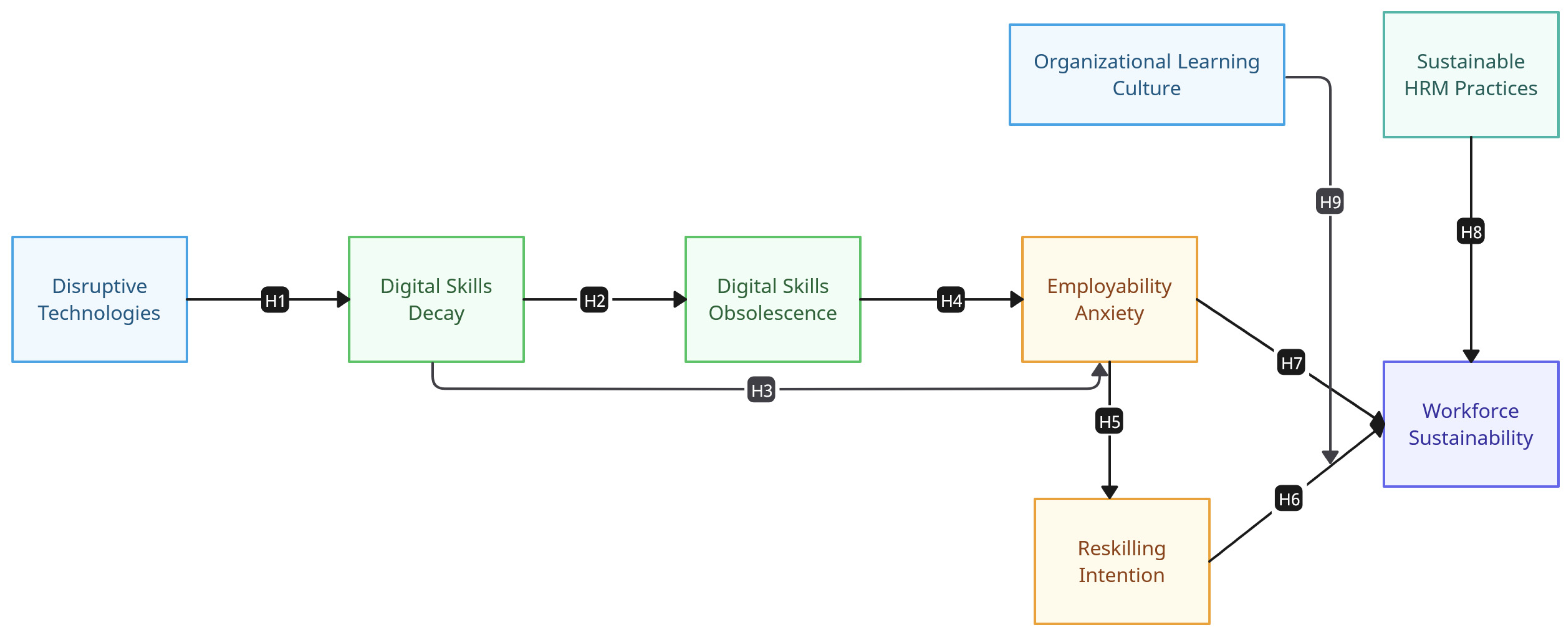
Drawing on the previous subsections, the proposed research model brings together the main theoretical relationships developed in the literature review. The model starts from the idea that disruptive technological change does not only create new skill requirements but may also weaken the usefulness of digital skills that employees already possess. Perceived disruptive technological change is therefore expected to increase digital skills decay, while this gradual weakening of skills is expected to lead to digital skills obsolescence. Both processes are then linked with employability anxiety, since employees may begin to worry about whether their existing competences are still sufficient for their current role and future employment prospects.
The model also connects these employee-level reactions with workforce sustainability. Employability anxiety is treated not only as a potentially harmful condition for the sustainable participation of employees in changing workplaces, but also as a possible trigger for reskilling intention. In this sense, the model does not present employees only as passive recipients of technological disruption, but also as actors who may respond through learning and skill renewal. Reskilling intention is expected to support workforce sustainability, while sustainable HRM practices and organizational learning culture are included as organizational conditions that strengthen employees’ long-term employability, adaptability and inclusion.
Figure 2 presents the proposed research model and the corresponding hypotheses. The hypotheses express theoretically expected directional associations, while the empirical design allows these relationships to be tested as cross-sectional associations rather than as demonstrated causal processes.
3. Methodology
3.1. Research Design and Sampling Strategy
This study follows a quantitative, cross-sectional research design based on a structured questionnaire. This design was selected because the study examines employees’ perceptions of technological change, digital skills decay, digital skills obsolescence, employability anxiety, reskilling intention, sustainable HRM practices, organizational learning culture and workforce sustainability. These constructs are not directly observable as single behaviours. They are better captured through employees’ reported experiences and evaluations of their work environment. A survey approach was therefore considered appropriate, as it allowed the collection of comparable data from a relatively large number of respondents across different organizational settings.
The target population consisted of employees and business executives working in organizations located in European Union countries. The final sample included respondents from diverse demographic and professional backgrounds, covering different age groups, educational levels, sectors and organizational positions. This heterogeneity was useful because the study aimed to examine digital skill devaluation across varied work contexts rather than within a single occupation or sector. The detailed distribution of the available sample characteristics, including age, gender, education, sector, position and frequency of digital technology use, is reported in
Appendix B. Respondents were included only if they were adults, currently employed in an organization located in an EU country, and able to report some exposure to technological change in their workplace. Such exposure could include the introduction of new digital tools, automation, data-based systems, cloud platforms, or changes in digital work processes. This criterion was important because the study does not examine digital skills in general, but the way employees experience the changing value of their digital competences under technological disruption.
A purposive, criterion-based sampling strategy was used. This approach was appropriate because the study required respondents who could provide informed answers about workplace digital transformation and skill renewal. A random sample of the general working population would not necessarily include enough employees with direct exposure to disruptive technological change. Although purposive sampling does not support claims of full statistical representativeness, it is suitable for theory-driven organizational research where the aim is to examine relationships among constructs within a relevant professional population. In this research, the sampling strategy was also consistent with the HRM focus of the study, since the selected respondents were positioned inside organizations where learning, employability and workforce sustainability are practically experienced.
3.2. Data Collection Procedure
Data were collected between October 2025 and March 2026. The survey was distributed by email to employees and executives working in organizations across EU countries. Contact details were identified through publicly available professional sources, including company websites, corporate contact pages, professional association directories, business directories and publicly accessible organizational profiles. Only work-related contact information available for professional communication was used, and no sensitive personal data were collected for recruitment purposes. The use of professional email addresses was based on a legitimate-interest rationale for academic research communication, limited to a one-time invitation and follow-up reminders. No automated scraping or bulk harvesting of personal data was conducted, duplicate contacts were removed before distribution, and identifiable email addresses were not retained after the fieldwork was completed. Each invitation included information about the purpose of the study, voluntary participation, anonymity of responses, and the possibility to ignore the invitation or opt out from further contact.
Data collection took place in three phases. In the first phase, an invitation email was sent to potential participants. The email briefly explained the academic purpose of the study, the voluntary nature of participation, the approximate time required to complete the questionnaire and the anonymous handling of responses. In the second phase, a reminder was sent to non-respondents in order to improve participation and reduce the risk of relying only on the most immediately responsive individuals. In the third phase, a final follow-up was conducted. After the end of the collection period, the dataset was screened and only fully completed questionnaires were retained.
In total, 3867 email invitations were sent to unique individuals. A total of 932 fully completed questionnaires were returned and used in the analysis. This corresponds to a response rate of approximately 24.1%. For an email-based organizational survey, this response rate was considered acceptable, especially because participation was voluntary and the questionnaire targeted employees with relevant workplace experience. The final sample size was also adequate for the use of PLS-SEM, which is commonly applied in organizational and management research when models include several latent variables and theoretically connected paths [
25].
Before analysis, the dataset was screened for incomplete responses, duplicate entries and response patterns suggesting careless completion. Only fully completed and usable questionnaires were retained. To reduce concerns about response bias, early and late responses were also compared on key demographic and construct-level indicators. The results of this diagnostic check are reported in the Results section.
3.3. Questionnaire Development and Measurement
A structured questionnaire was used as the main research instrument. The questionnaire was designed to reflect the theoretical model and to capture both individual-level perceptions and organizational conditions related to workforce sustainability. The first part included demographic and professional background questions. The second part contained the main measurement items. Participants were asked to indicate their level of agreement with each statement on a seven-point Likert scale, ranging from 1 = strongly disagree to 7 = strongly agree.
The main questionnaire included 32 items measuring eight latent variables. The measurement instrument combined adapted and contextually developed items. Constructs with clearer theoretical anchors, such as employability anxiety, sustainable HRM practices, organizational learning culture and reskilling intention, were formulated with reference to previous work on employability, sustainable HRM, organizational learning and digital reskilling. The two central constructs of the manuscript, digital skills decay and digital skills obsolescence, were contextually developed for this study, because they refer to a specific form of digital skill devaluation under disruptive technological change. Their wording was grounded in the broader literature on skill decay, skill obsolescence and digital competence, but was adapted to the workplace digital transformation context examined here.
Perceived disruptive technological change was measured with four items referring to changes in work tasks, digital tools, technological developments and new skill requirements. Digital skills decay was measured with four items capturing the gradual weakening, reduced usefulness and declining effectiveness of existing digital skills. Digital skills obsolescence was measured with four items referring to the possibility that existing digital skills become outdated, less relevant or insufficient for current workplace needs. Employability anxiety was measured with four items focusing on concerns about future employability and the continuing relevance of digital skills. Reskilling intention was measured with four items assessing employees’ willingness and motivation to develop new digital skills. Sustainable HRM practices were measured with four items related to organizational support for training, professional development, adaptation and long-term employability. Organizational learning culture was measured with four items referring to continuous learning, knowledge sharing and managerial support for skill development. Workforce sustainability was measured with four items capturing the organization’s ability to maintain a skilled, adaptable and effective workforce over time. The full list of measurement items, together with their construct assignment and item origin, is provided in
Appendix D.
All latent variables were modelled as reflective constructs, as the indicators were designed to represent observable manifestations of the same underlying perception. Before the main survey was launched, the questionnaire was reviewed through alpha and beta testing. In the alpha stage, the draft instrument was examined by three reviewers, including academics and professionals with knowledge of HRM, digital transformation, organizational learning and survey research. They assessed the clarity, relevance and conceptual fit of the items, with particular attention to the distinction between digital skills decay and digital skills obsolescence. Minor wording changes were made to reduce overlap between constructs and to make the items easier for employees to understand. In the beta stage, the questionnaire was tested with twelve employees and business professionals similar to the target respondents. This stage focused on item clarity, survey flow, response burden and completion time. After these revisions, the final questionnaire was used for the main data collection.
3.4. Data Analysis Strategy
The main analysis was conducted through Partial Least Squares Structural Equation Modeling using SmartPLS version 4.1.1.7. PLS-SEM was selected because the study examines a multi-construct model with several latent variables, multiple endogenous constructs and theoretically connected direct paths. The purpose of the analysis was not only to confirm an established covariance structure, but also to explain variance in key HRM-related outcomes, especially employability anxiety, reskilling intention and workforce sustainability. This was important because the constructs of digital skills decay and digital skills obsolescence are contextually developed for the present study and are examined within a relatively new sustainable HRM framework. PLS-SEM was therefore considered suitable for assessing the measurement model and the structural relationships in a prediction-oriented and theory-development setting. The use of a large sample strengthened the stability of the estimates, while the complementary Bayesian analysis provided an additional robustness check beyond conventional significance testing [
25]. Although the sample size was large enough for covariance-based SEM, PLS-SEM was selected because the study aimed to examine a prediction-oriented model with contextually developed constructs and several endogenous outcomes, rather than to confirm a well-established covariance structure.
The analysis followed a two-stage procedure. First, the measurement model was assessed in order to examine the quality of the constructs. Indicator reliability, internal consistency reliability, convergent validity and discriminant validity were evaluated through outer loadings, Cronbach’s alpha, composite reliability, average variance extracted and HTMT where appropriate. Collinearity was also examined through variance inflation factor values. The detailed VIF diagnostics are reported in the Results section, where both outer-model and inner-model VIF values are presented. The detailed reliability and validity results are presented in the Results section.
Second, the structural model was examined in order to test the proposed hypotheses. The analysis focused on the direction, strength and significance of the hypothesized relationships among perceived disruptive technological change, digital skills decay, digital skills obsolescence, employability anxiety, reskilling intention, sustainable HRM practices, organizational learning culture and workforce sustainability. The structural paths were assessed through bootstrapping with 5000 subsamples, using two-tailed tests and confidence intervals, following common recommendations for PLS-SEM analysis [
25].
As a complementary step, Bayesian regression analysis was conducted using JASP version 0.96.0.0. This analysis was not used as a second SEM model, but as a robustness check for the core relationships of the study. The Bayesian analysis was added to examine whether the main relationships remained stable under a different inferential logic, using posterior estimates, credible intervals and Bayes Factors as complementary evidence [
26].
In JASP, Bayesian linear regression was estimated for the two key outcome variables, reskilling intention and workforce sustainability. The models were estimated using the default prior settings available in JASP for Bayesian linear regression. Posterior estimates, 95% credible intervals and Bayes Factors were used to assess the direction and strength of the evidence, while posterior model probabilities were used to compare the relative support for alternative predictor combinations. The Bayesian models were interpreted as robustness checks rather than as a replacement for the PLS-SEM model. For this reason, the emphasis was placed on whether the posterior estimates and credible intervals were consistent with the direction of the hypothesized PLS-SEM paths [
26].
In addition to the hypothesized structural paths, three supplementary contextual paths were examined as part of an exploratory robustness-oriented analysis. These paths concerned the possible associations of organizational learning culture with digital skills obsolescence and reskilling intention and of sustainable HRM practices with reskilling intention. They were not treated as formal hypotheses and were not included in the main theoretical model. Their purpose was to check whether the organizational learning and HRM context had additional explanatory relevance beyond the core hypothesized relationships. For this reason, these paths are reported separately from the main hypothesis-testing results and interpreted cautiously.
3.5. Common Method Bias and Ethical Considerations
Because the study relied on self-reported questionnaire data collected at one point in time, common method bias was considered during both the design and analysis stages. Procedurally, the questionnaire was anonymous, participation was voluntary, and respondents were informed that there were no right or wrong answers. The items were also worded in a clear and construct-specific way in order to reduce ambiguity. Statistically, Harman’s single-factor test was applied as an initial diagnostic. The first unrotated factor explained 21.61% of the total variance, which is well below the commonly used 50% threshold. In addition, collinearity-based diagnostics were used as a further check, including both outer-model and inner-model VIF values. These diagnostics are reported in detail in the Results section.
Ethical considerations were addressed throughout the research process. All participants received information about the purpose of the study before completing the questionnaire and provided informed consent. Participation was voluntary, and respondents could choose not to participate or stop completing the questionnaire without any negative consequence. The invitation email also allowed recipients to ignore the invitation or opt out from further contact. No sensitive personal data were collected, and no personally identifiable information was retained in the final dataset used for analysis. Professional email addresses were used only for the purpose of survey distribution and were not stored after the completion of fieldwork. The data were processed only for academic research purposes and were analyzed in aggregated form. The research followed the principles of confidentiality, data minimization, purpose limitation and lawful processing under the General Data Protection Regulation (EU) 2016/679 and the relevant Greek data protection framework, including Law 4624/2019.
The following section reports the main empirical findings, including the sample profile, common method bias diagnostics, measurement model assessment, explanatory power, structural paths and Bayesian robustness checks.
4. Results
4.1. Sample Profile and Preliminary Checks
The final sample consisted of 932 fully completed questionnaires, with no missing values in the main demographic and professional variables. The respondents represented different age groups, educational backgrounds, sectors and organizational positions, allowing the study to examine digital skills devaluation and workforce sustainability across varied workplace contexts. The detailed demographic profile is provided in
Appendix B.
In brief, most respondents were between 26 and 45 years old, while the educational profile was mainly composed of bachelor’s and master’s degree holders. The sample included employees and business professionals from the private sector, public sector, non-profit/NGO sector, self-employment and other organizational settings. It also included both non-managerial employees and respondents with supervisory, middle-management or senior-management responsibilities. This distribution was useful for the purposes of the study, as technological change, learning support and workforce sustainability may be experienced differently across organizational levels.
The sample also showed sufficient exposure to digital technologies. More than three quarters of respondents reported using digital technologies often, very often, or almost all the time in their work. This supports the relevance of the dataset for examining perceived disruptive technological change, digital skills decay, digital skills obsolescence and workforce sustainability. The full frequency distributions are reported in
Appendix B.
4.2. Common Method Bias and Collinearity
Since this study relied on self-reported questionnaire data, common method bias was examined before the main model was interpreted. Harman’s single-factor test showed that the first unrotated factor explained 21.61% of the total variance. This value is below the commonly used 50% threshold, suggesting that the dataset was not dominated by a single general factor.
Collinearity was also examined through both outer-model and inner-model VIF values as an additional diagnostic. The item-level outer VIF values ranged from 1.748 to 2.523, while the inner-model VIF values ranged from 1.000 to 1.240. All values remained below conservative cut-off points commonly used in PLS-SEM research. These results suggest that multicollinearity was not likely to distort either the measurement model or the structural estimates. Together with Harman’s single-factor test, the VIF diagnostics provided no indication of a serious common method bias or collinearity problem. However, these tests should be interpreted as diagnostic checks rather than definitive proof that common method bias is absent. Because the data were collected from a single source through a self-reported and cross-sectional survey, common method bias cannot be fully ruled out and is acknowledged as a limitation.
4.3. Measurement Model Assessment
The measurement model showed satisfactory reliability and convergent validity. Indicator loadings were also examined for all retained measurement items. All outer loadings ranged from 0.798 to 0.884, supporting the adequacy of the reflective measurement model. The full set of indicator loadings is reported in
Appendix C. Cronbach’s alpha values ranged from 0.861 to 0.886, while composite reliability values ranged from 0.905 to 0.921 (
Table 1). These values indicate strong internal consistency across all constructs. The AVE values ranged from 0.706 to 0.746, exceeding the recommended minimum value of 0.50. This means that each construct explained a sufficient share of the variance of its indicators.
Discriminant validity was assessed through the HTMT criterion. The HTMT values among the main constructs were below the usual thresholds of 0.85 or 0.90. The highest value among the main constructs was observed between digital skills obsolescence and employability anxiety, but it remained within an acceptable range. Therefore, the constructs were sufficiently distinct from one another. To avoid overloading the main text with technical matrices, the full indicator loadings are reported in
Appendix C, while the main reliability and validity results are summarized in
Table 1.
4.4. Explanatory Power and Predictive Relevance
The model explained a meaningful share of variance in the main endogenous constructs. As shown in
Table 2, the R
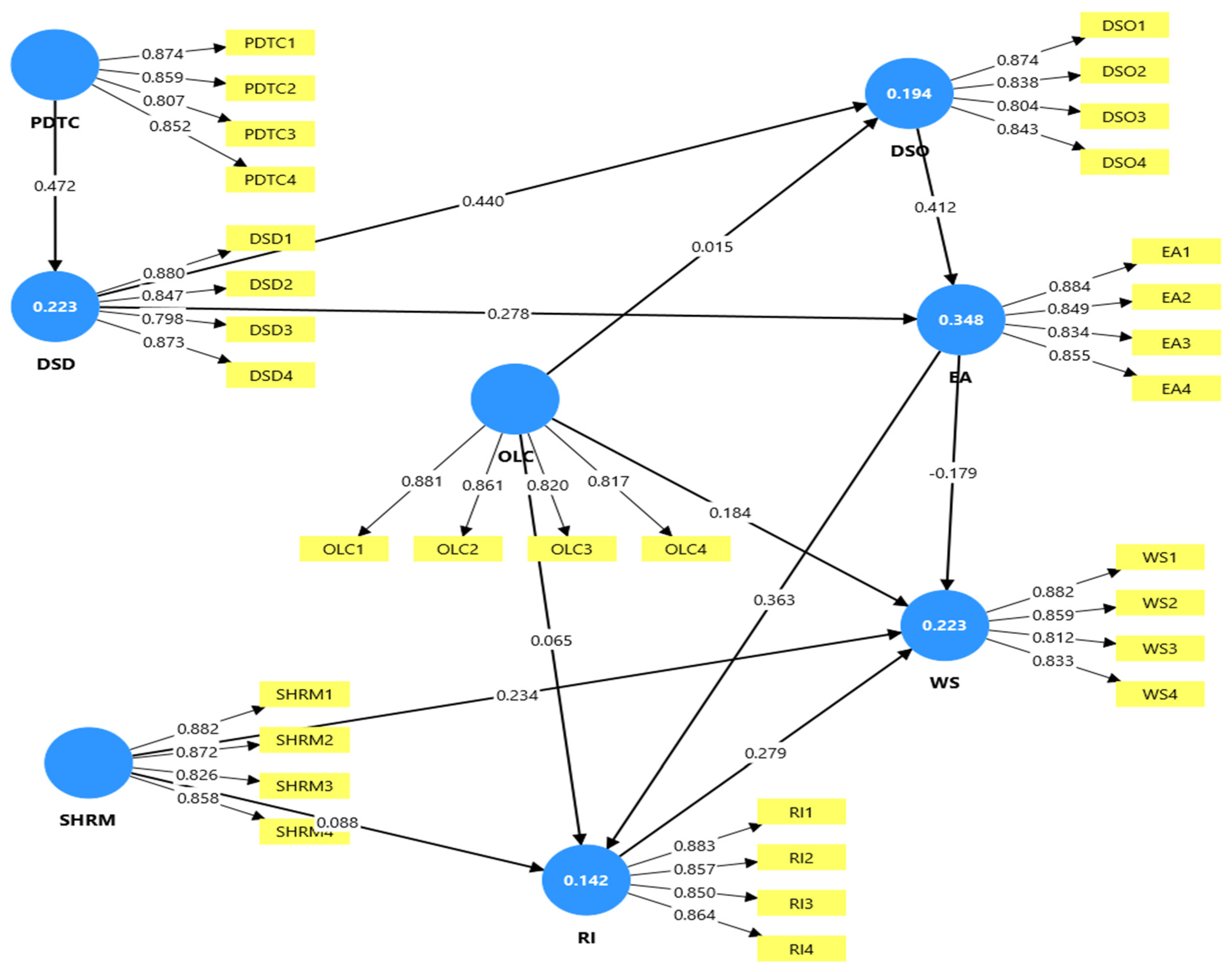
2 value was 0.223 for digital skills decay, 0.194 for digital skills obsolescence, 0.348 for employability anxiety, 0.142 for reskilling intention and 0.223 for workforce sustainability. The highest explanatory power was observed for employability anxiety, suggesting that digital skills decay and obsolescence are relevant predictors of employees’ concerns about future employability.
The effect size results showed that perceived disruptive technological change had a relevant effect on digital skills decay (f2 = 0.286), while digital skills decay had a meaningful effect on digital skills obsolescence (f2 = 0.240). Employability anxiety also showed a noticeable effect on reskilling intention (f2 = 0.151). The remaining effects were smaller, especially those directed toward workforce sustainability. This pattern is reasonable, as workforce sustainability is likely to be influenced by several organizational, contextual and strategic factors beyond those included in the present model.
The PLSpredict results were also acceptable. The Q2_predict values were positive for the endogenous latent variables, including digital skills decay, digital skills obsolescence, employability anxiety, reskilling intention and workforce sustainability. At the indicator level, most Q2_predict values were also positive. These results suggest that the model has predictive relevance, although the strength of prediction varies across constructs.
4.5. Structural Model and Hypothesis Testing
The structural model was examined through bootstrapping with 5000 subsamples. The main hypothesized paths are presented in Panel A of
Table 3. Overall, the results provide consistent support for the proposed theoretical model. Perceived disruptive technological change was positively associated with digital skills decay (β = 0.472, t = 18.003,
p < 0.001), supporting H1. Digital skills decay was also positively associated with digital skills obsolescence (β = 0.440, t = 16.400,
p < 0.001), supporting H2. In relation to employability anxiety, both digital skills decay (β = 0.278, t = 9.455,
p < 0.001) and digital skills obsolescence (β = 0.412, t = 14.994,
p < 0.001) showed significant positive associations, supporting H3 and H4.
The results also supported the employee-response part of the model. Employability anxiety was positively associated with reskilling intention (β = 0.363, t = 12.822, p < 0.001), supporting H5. Reskilling intention, in turn, was positively associated with workforce sustainability (β = 0.279, t = 9.530, p < 0.001), supporting H6. As expected, employability anxiety was negatively associated with workforce sustainability (β = −0.179, t = 5.705, p < 0.001), supporting H7. Finally, both sustainable HRM practices (β = 0.234, t = 7.691, p < 0.001) and organizational learning culture (β = 0.184, t = 5.860, p < 0.001) were positively associated with workforce sustainability, supporting H8 and H9. These findings suggest that workforce sustainability is shaped not only by employees’ adaptive responses, but also by the organizational conditions that support long-term employability and learning.
In addition to the main hypothesized paths, three supplementary contextual paths were examined separately from the formal hypothesis-testing model (
Table 3). These paths were included only as an exploratory contextual check in order to assess whether organizational learning culture and sustainable HRM practices showed additional associations with employees’ skill-renewal context and reskilling orientation. They were not treated as formal hypotheses and were therefore interpreted cautiously. Organizational learning culture did not have a significant effect on digital skills obsolescence (β = 0.015,
p = 0.614). However, it showed a small positive effect on reskilling intention (β = 0.065,
p = 0.044), while sustainable HRM practices also had a small positive effect on reskilling intention (β = 0.088,
p = 0.007). These supplementary findings should be interpreted cautiously. Although organizational learning culture and sustainable HRM practices showed statistically significant associations with reskilling intention, the small effect sizes suggest that these conditions may support, but do not strongly determine, employees’ intention to reskill. These paths are therefore treated only as exploratory contextual findings, and the main interpretation of the model remains centred on the hypothesized relationships shown in
Figure 3.
4.6. Bayesian Robustness Checks
Bayesian regression analyses were used as a complementary robustness check for the main PLS-SEM findings. The analysis used the default Bayesian linear regression priors in JASP and compared alternative predictor combinations through posterior model probabilities. The Bayesian results were interpreted mainly through the posterior mean estimates, 95% credible intervals and the relative strength of Bayesian evidence, as reported in
Table 4. Predictors whose credible intervals did not cross zero were treated as providing more stable support for the direction of the relationship. The purpose was not to estimate a second structural equation model, but to examine whether the core relationships remained stable under a different inferential approach. For this reason, the Bayesian analysis focused on two key outcome variables of the model: reskilling intention and workforce sustainability.
For reskilling intention, the Bayesian model including employability anxiety, sustainable HRM practices and organizational learning culture showed the highest posterior model probability, with an R2 of 0.219. Employability anxiety was the strongest predictor, with a posterior mean of 0.444 and a 95% credible interval from 0.389 to 0.497. This provides strong additional support for the relationship between employability anxiety and reskilling intention. The evidence for organizational learning culture was positive but more modest, while the effect of sustainable HRM practices was weaker and its credible interval was close to zero. This pattern is consistent with the PLS-SEM results, where employability anxiety was the main driver of reskilling intention, while the supplementary organizational paths were smaller.
For workforce sustainability, the Bayesian model including reskilling intention, sustainable HRM practices, organizational learning culture and employability anxiety had the strongest support and explained 32.9% of the variance. The posterior estimates were consistent with the hypothesized direction of the PLS-SEM paths. Reskilling intention showed a positive effect; sustainable HRM practices and organizational learning culture also had positive effects, while employability anxiety showed a negative effect. The credible intervals for these predictors did not cross zero, which supports the stability of the main findings regarding workforce sustainability.
The Bayesian correlation results also supported the broader structure of the model. Strong positive associations were observed between perceived disruptive technological change and digital skills decay, between digital skills decay and digital skills obsolescence, and between both digital skills decay and obsolescence with employability anxiety. The correlations also supported the positive links between employability anxiety and reskilling intention, between reskilling intention and workforce sustainability, and between the two organizational conditions and workforce sustainability.
Overall, the Bayesian checks were aligned with the main PLS-SEM findings. They confirmed the central logic of the model: digital skill devaluation is linked with employability anxiety; employability anxiety is strongly associated with reskilling intention, and workforce sustainability is supported by reskilling intention, sustainable HRM practices and organizational learning culture, while being weakened by employability anxiety.
5. Discussion
The results are consistent with the main sequence proposed in the research. Perceived disruptive technological change was positively related to digital skills decay, and digital skills decay was positively related to digital skills obsolescence. This suggests that technological disruption not only create demand for new skills; it may also reduce the practical value of skills that employees already possess. The findings therefore move the discussion beyond the usual skills-gap argument and show that digital competence should be treated as a capability that needs continuous renewal. This is also consistent with recent work showing that digital competencies are closely connected with digital transformation and digital HRM, although the present study adds that such competencies also need to be maintained and renewed as technologies change [
27]. The positive associations of both digital skills decay and digital skills obsolescence with employability anxiety further show that skill devaluation is not a neutral technical process. Employees appear to interpret the weakening or declining relevance of their skills as a threat to their future employability, which is consistent with research linking technological change, skill renewal and employability pressure [
3,
4].
The findings also clarify the dual role of employability anxiety. As expected, employability anxiety had a negative effect on workforce sustainability, suggesting that employees who feel uncertain about the future value of their skills may also feel less secure, less included and less able to remain effective in changing workplaces. At the same time, employability anxiety positively affected reskilling intention. This means that anxiety may also act as a signal for action, especially when employees believe that learning and skill renewal are still possible. However, this interpretation should remain cautious, because employability anxiety may also produce avoidance or disengagement when employees do not perceive sufficient organizational support or learning safety. The Bayesian robustness checks supported the same general pattern for the key outcomes, particularly the associations of reskilling intention, sustainable HRM practices, organizational learning culture and employability anxiety with workforce sustainability. This strengthens the interpretation that workforce sustainability depends on the ability of organizations to turn skill-related insecurity into structured learning and renewed employability.
Based on this interpretation of the findings, the following subsections discuss the main theoretical and practical implications, as well as the limitations and future research directions.
5.1. Theoretical and Practical Implications
Theoretically, the study contributes by separating digital skills decay from digital skills obsolescence and showing how both are connected to employee responses. This distinction is useful because digital skills rarely become irrelevant suddenly. They may first lose fluency, frequency of use or practical value, and only later become functionally obsolete. By placing this process within a sustainable HRM framework, the study shows that workforce sustainability is also a human capital sustainability issue: employees remain valuable, adaptable and included only when their skills can be renewed before they lose relevance. This extends sustainable HRM beyond general well-being, retention or training provision and connects it more directly with the prevention of skill devaluation [
6,
7].
For HR practice, the findings point to the need for earlier and more specific detection mechanisms. HR departments should not wait until employees are already unable to meet new technological demands. A practical response would be to introduce periodic digital skills audits by role, short employee self-assessments after major technological changes, and supervisor feedback on which digital tasks are becoming more difficult, less used or more dependent on new systems. These tools can help identify digital skills decay before it becomes full obsolescence. In larger organizations, HR analytics could also be used to map training participation, internal mobility and changes in digital task requirements, so that reskilling needs are detected before they appear as performance or employability problems.
The results also suggest that reskilling should be built into sustainable workforce planning rather than treated as an occasional training reaction. More concrete interventions include role-based reskilling pathways, short modular training for new digital tools, peer learning groups, mentoring between digitally experienced and less experienced employees, and internal mobility routes for employees whose current roles are strongly affected by automation or AI-supported systems. These interventions should be connected with career development, not presented as remedial actions for employees who are “behind”. Sustainable HRM practices provide the structure and resources, while organizational learning culture makes continuous skill renewal normal in everyday work. This combination can reduce the risk that technological change produces exclusion, insecurity or loss of employability [
12,
21].
5.2. Limitations and Future Research
As with any survey-based study, the findings should be interpreted with some caution. The first limitation concerns the cross-sectional design, which does not allow strong causal claims. The proposed sequence should therefore be interpreted as a theoretically informed pattern of associations, rather than as evidence of temporal ordering or demonstrated causal processes. Future research could use longitudinal designs to examine whether digital skills decay actually develops into obsolescence over time and whether early HR interventions can slow this process. Second, the data were based on self-reported perceptions. Although the diagnostic checks did not indicate serious common method bias, future studies could combine employee responses with HR records, training participation data, performance evaluations or supervisor assessments. Third, the sample covered employees and business professionals from EU countries, but the analysis did not compare national, sectoral or institutional differences. In addition, although the sample included respondents from different professional backgrounds, the dataset did not allow a detailed country-by-country or organizational-size comparison. This limits the possibility of examining whether digital skills decay and obsolescence vary across specific national or organizational contexts. Furthermore, the sample should not be interpreted as statistically representative of the EU workforce. It reflects a criterion-based sample of employees and professionals reachable through publicly available professional contact sources and reporting exposure to workplace technological change. Future research could examine whether digital skills decay, employability anxiety and reskilling intention differ across sectors, organizational sizes, age groups or levels of digital maturity. Finally, sustainable HRM practices and organizational learning culture were examined mainly as direct contributors to workforce sustainability. Future studies could test whether these factors also buffer the negative effects of digital skills obsolescence or employability anxiety, especially in organizations where technological change is rapid and continuous. Future research could also examine whether organizational support, learning climate or psychological safety moderate the relationship between employability anxiety and reskilling intention.
6. Conclusions
This study addressed the central research question by examining how digital skills decay and digital skills obsolescence are associated with workforce sustainability under disruptive technological change and what role sustainable HRM practices and organizational learning culture play in this process. The findings suggest that perceived disruptive technological change is associated with digital skills decay, which in turn is related to digital skills obsolescence. Both processes were linked with employability anxiety, while reskilling intention, sustainable HRM practices and organizational learning culture were positively related to workforce sustainability.
The main contribution of the manuscript is that it shifts attention from the simple possession of digital skills to their continuing relevance over time. By distinguishing digital skills decay from digital skills obsolescence, this study shows that digital competences may first lose fluency or practical usefulness before they become functionally outdated. This distinction supports a sustainable HRM view of workforce sustainability as continuous human capital renewal.
From a practical perspective, organizations should monitor early signs of perceived digital skills decay and develop reskilling systems before employees experience skill obsolescence as exclusion, employability insecurity or loss of professional relevance. This requires not only general training provision, but also more regular skills audits, role-based reskilling pathways and learning support embedded in everyday work. This study is limited by its cross-sectional design, its reliance on self-reported perceptions and the absence of detailed country-by-country or organizational-size comparisons. Future research could address these issues through longitudinal designs and more fine-grained comparative data.