Python-Based AI-Assisted Modeling and Computation of Life Cycle Assessment of European Polymeric Waste: Application in Manufacturing and Recycling Industries Regarding Sustainability
 , , ,
, , ,  , and
, and 
Abstract
1. Introduction
2. Materials and Methods
2.1. Description and Selection of European Polymeric Waste for LCA
2.2. Python-Based AI—Assisted LCA and Modeling
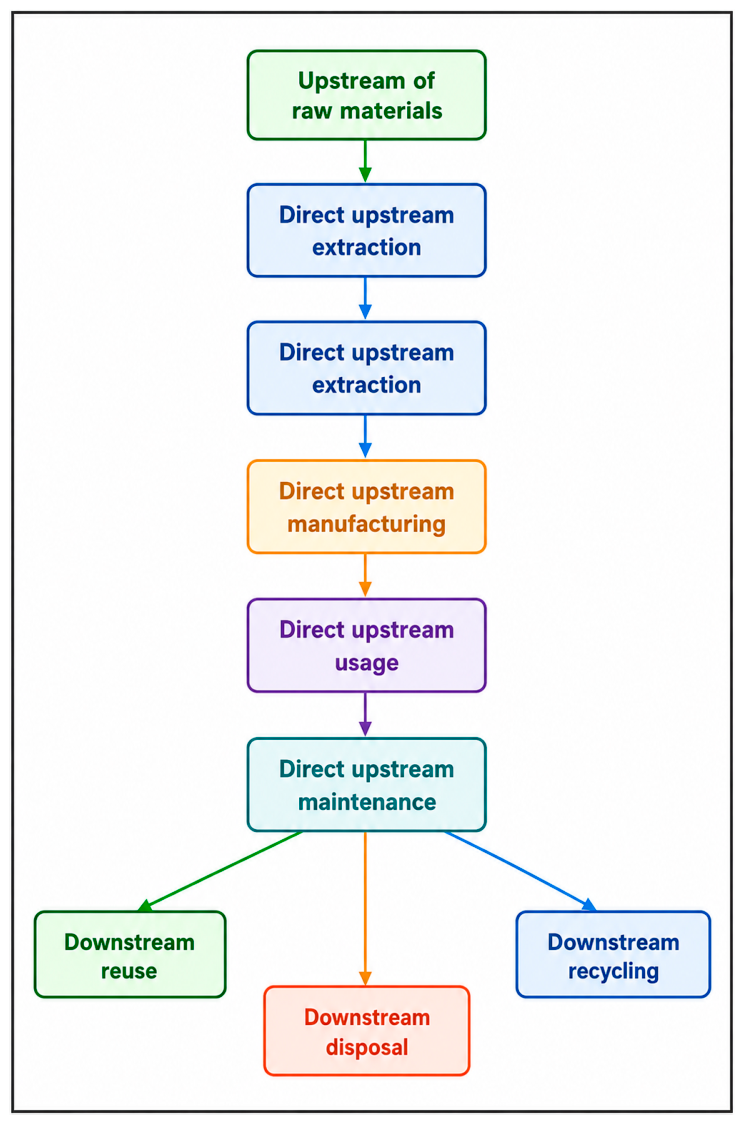
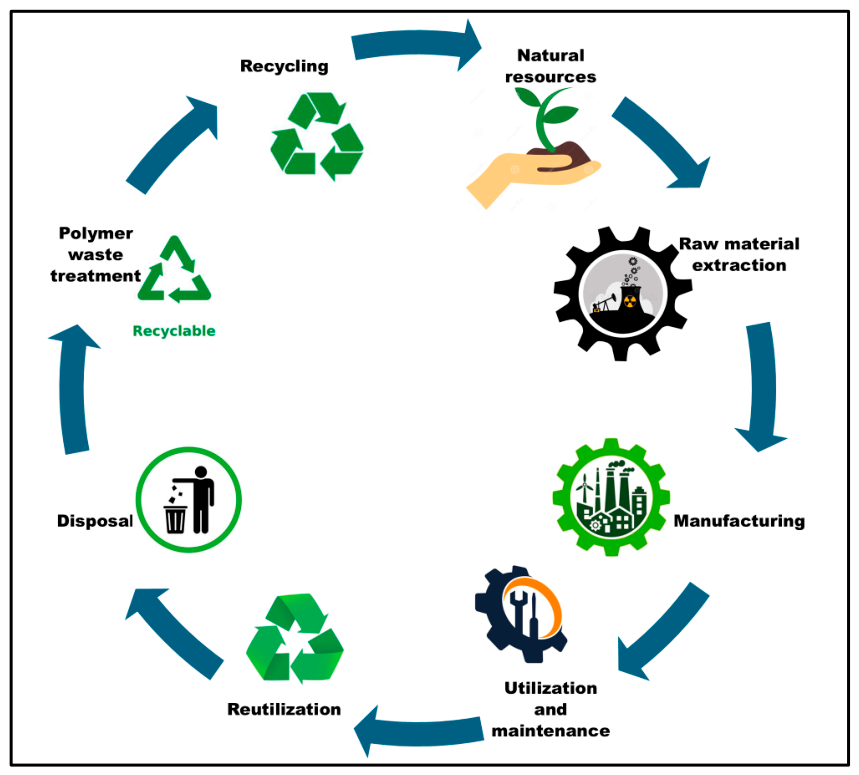
2.3. Input Flows and Output Processes of Modeling
2.4. Implementation of Product Systems and Projects for Results Interpretation
2.5. LCA and Python-Based ML Studies
2.6. Innovative Systems of Sustainability
2.7. Python-Based AI-Assisted ML Studies
3. Results and Discussions
3.1. Standard Model Graphs
3.2. Sankey Diagram
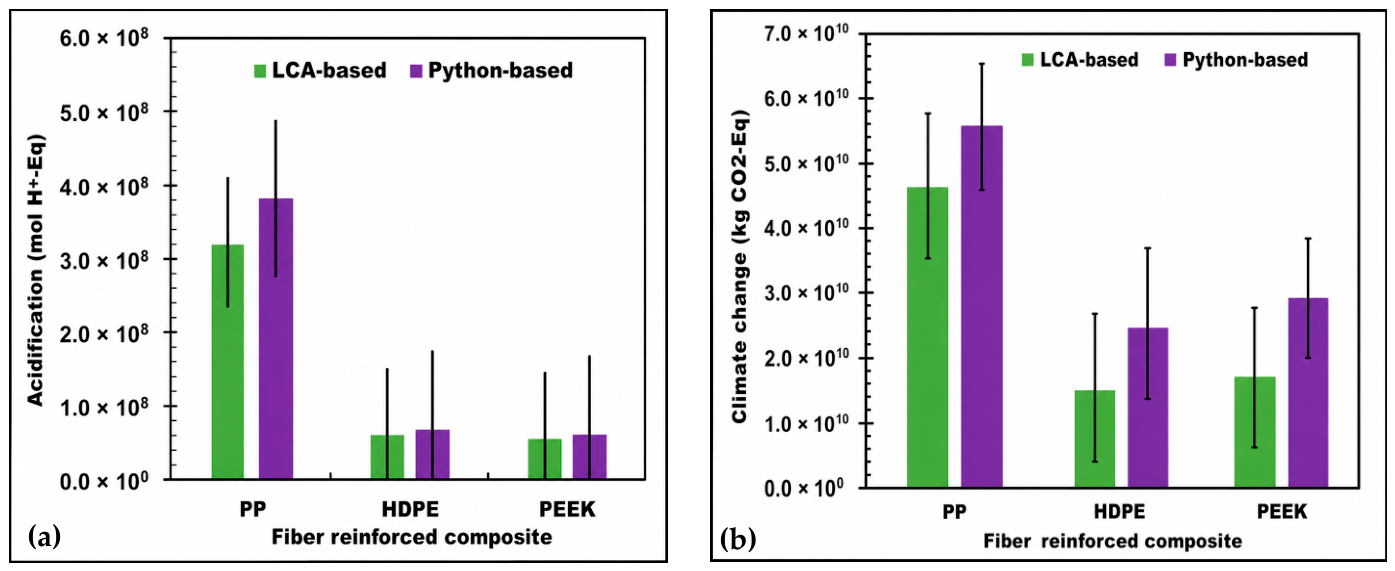
3.3. Natural Resources and Extraction of Polymeric Raw Materials
3.4. Manufacturing of Composite Systems
3.5. Effect of Utilization and Maintenance on Environmental Impacts
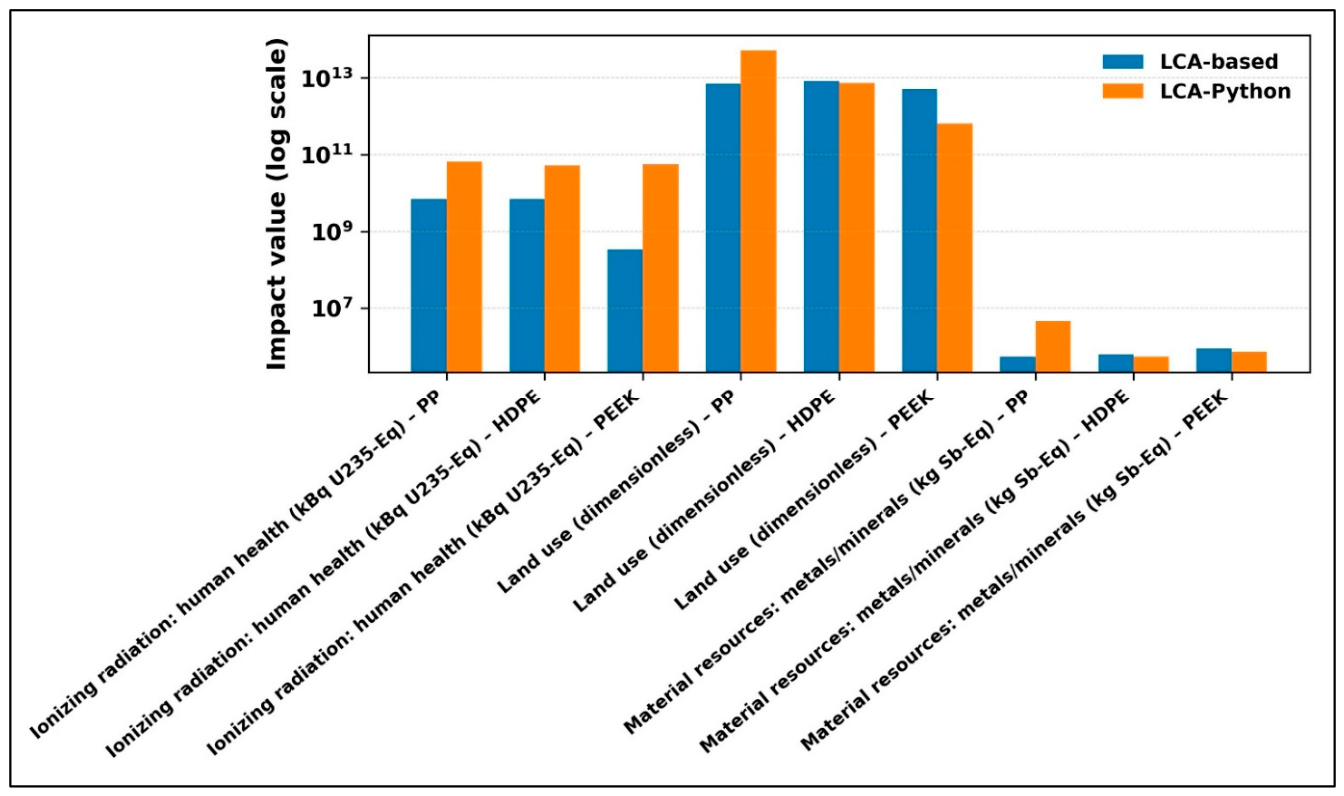
3.6. Human Health, Land Use, and Material Resource Impact Indicators During Reuse and Disposal
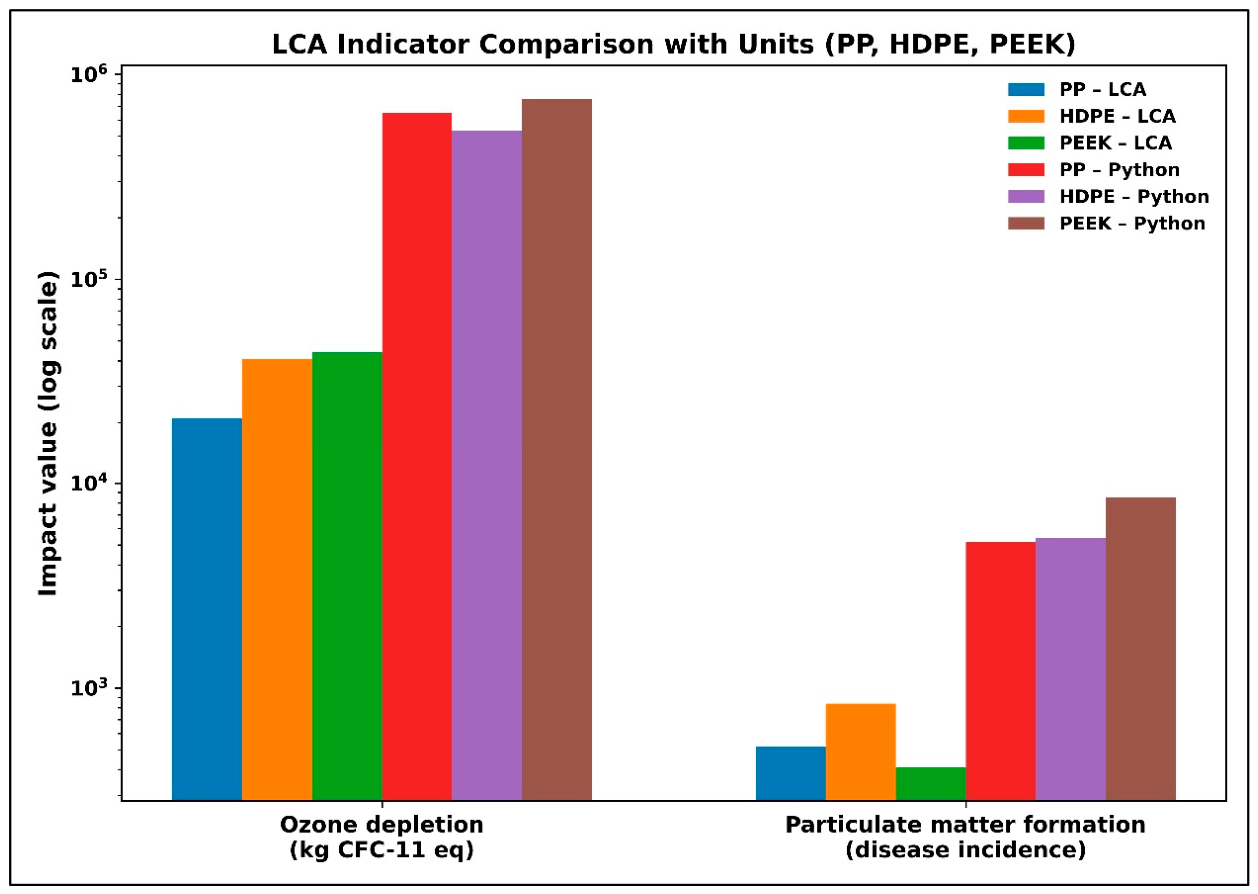
3.7. Waste Treatment Impact Indicators: Ozone Depletion and Particulate Matter Formation
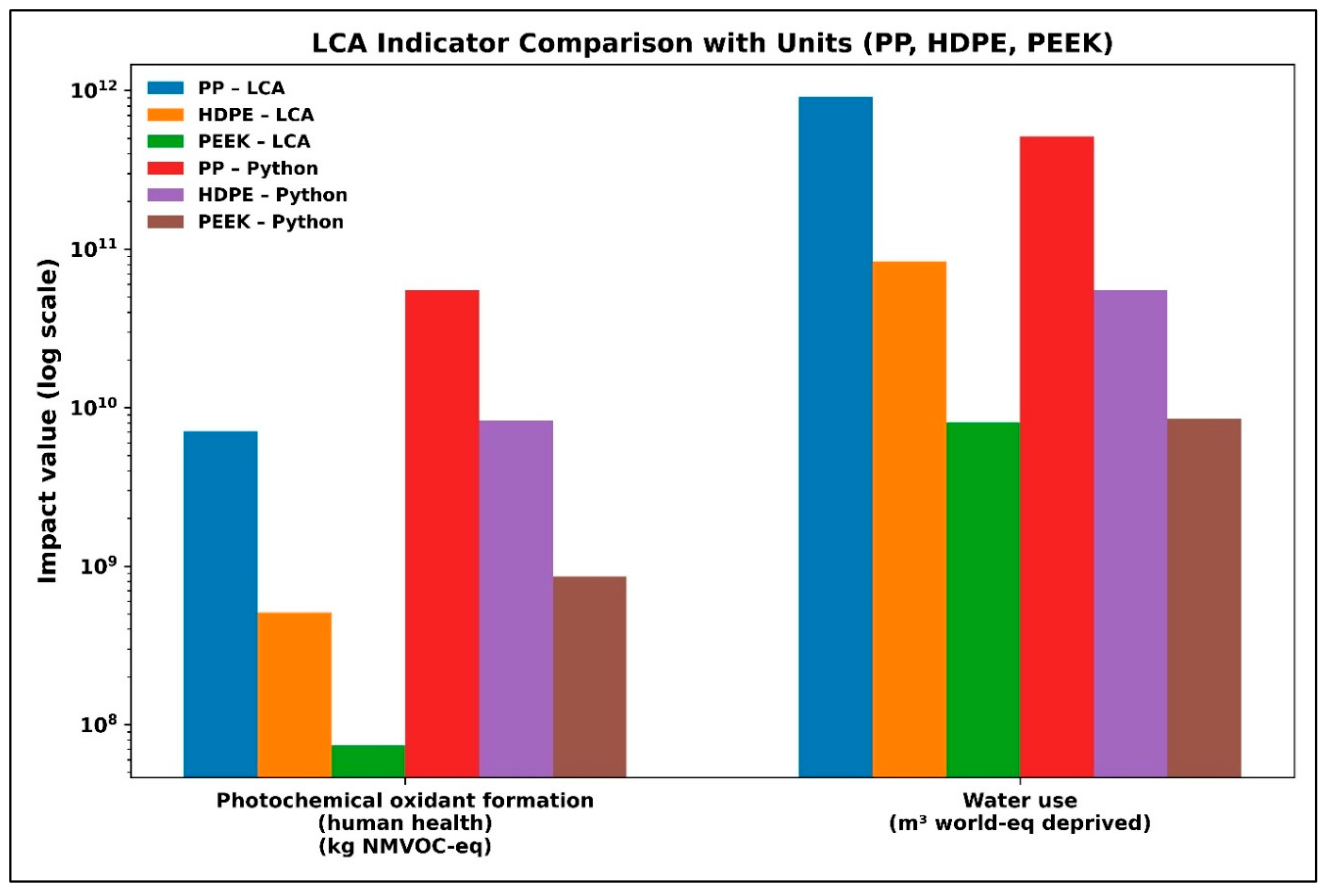
3.8. Recycling Impact Indicators: Photochemical Oxidant Formation and Water Use
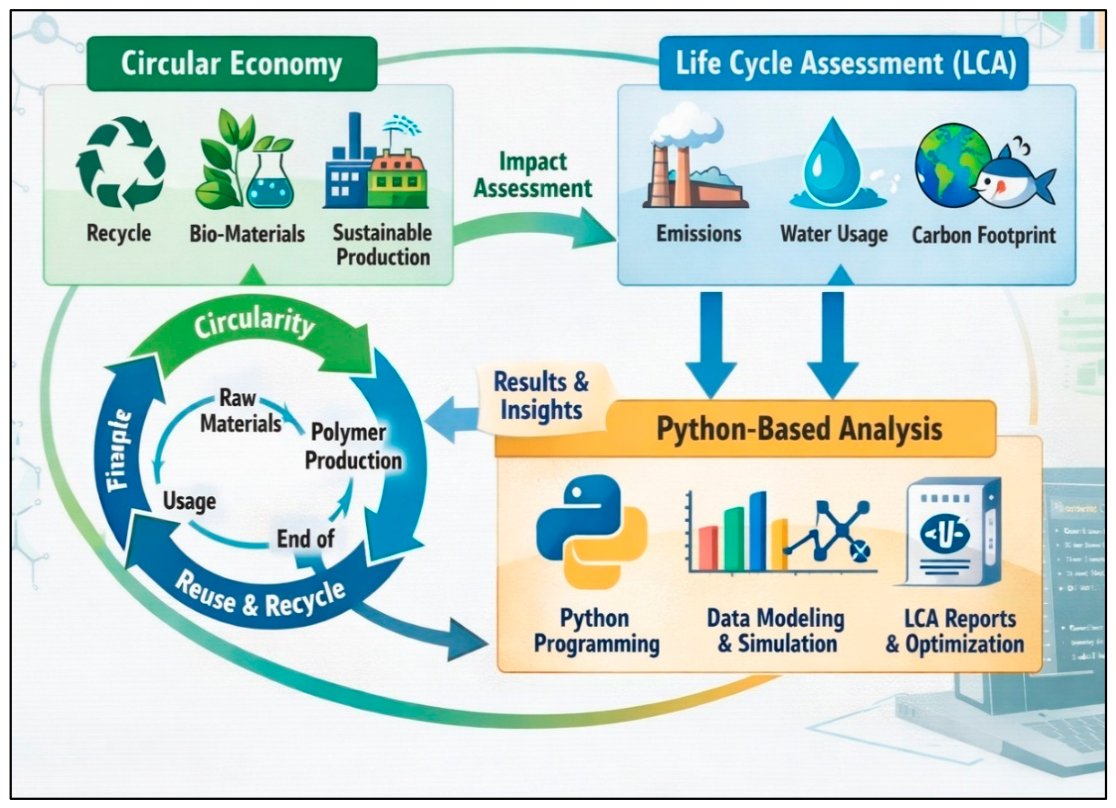
3.9. LCA and Circularity-Sustainability Relationship
4. Conclusions
- I.
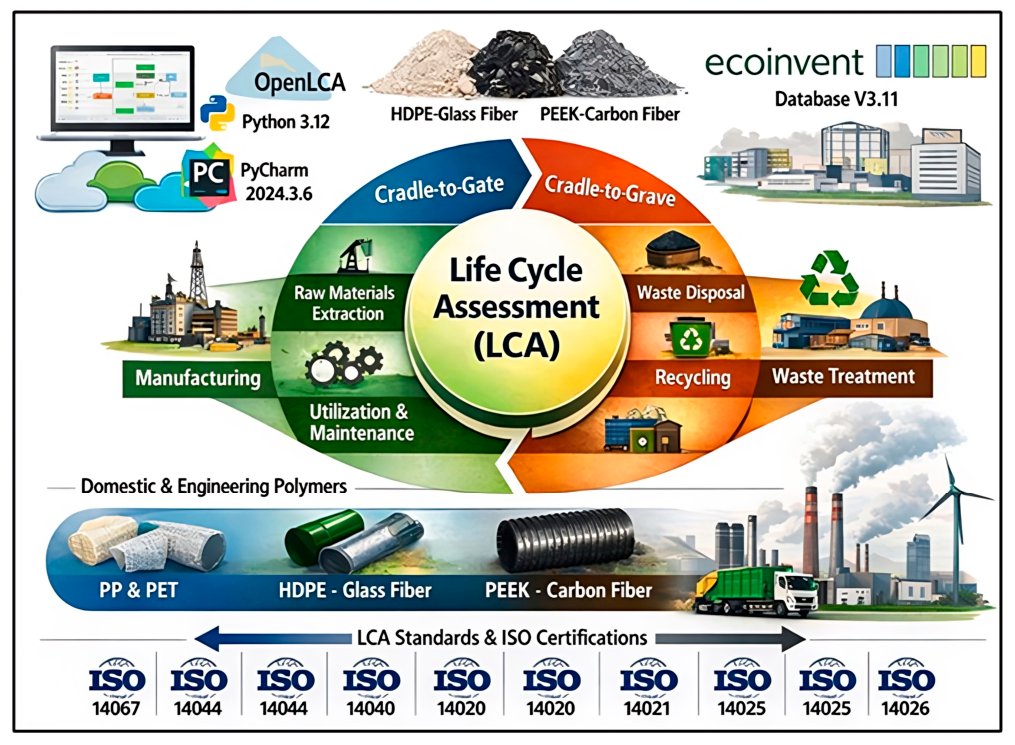
- The current study presents an integrative LCA framework for European polymeric waste. The study combines OpenLCA, Ecoinvent v3.11, and Python-based ML tools to evaluate environmental impacts across cradle-to-gate, service life, and cradle-to-grave stages. The proposed methodology advances LCA, automation, stochastic uncertainty analysis, and predictive capability to enable robust sustainability assessments for polymer manufacturing and recycling systems.
- II.
- The comparative assessment of PP-, HDPE-, and PEEK-based composite systems demonstrates that polymer type, processing intensity, and reinforcement selection strongly govern environmental performance. PP-based composites exhibit the lowest overall environmental burdens due to lower processing temperatures, simpler molecular structure, and reduced energy demand. HDPE-based composites show moderate impacts, balancing durability and recyclability, but remain constrained by fossil-based feedstock and energy use. However, PEEK-based composites display the highest environmental impacts driven by energy-intensive synthesis routes, high processing temperatures, and complex aromatic precursors. PEEK’s long service life and superior performance suggest that its sustainability can be justified in high-value, durability-driven applications when coupled with circular reuse and low-carbon energy inputs.
- III.
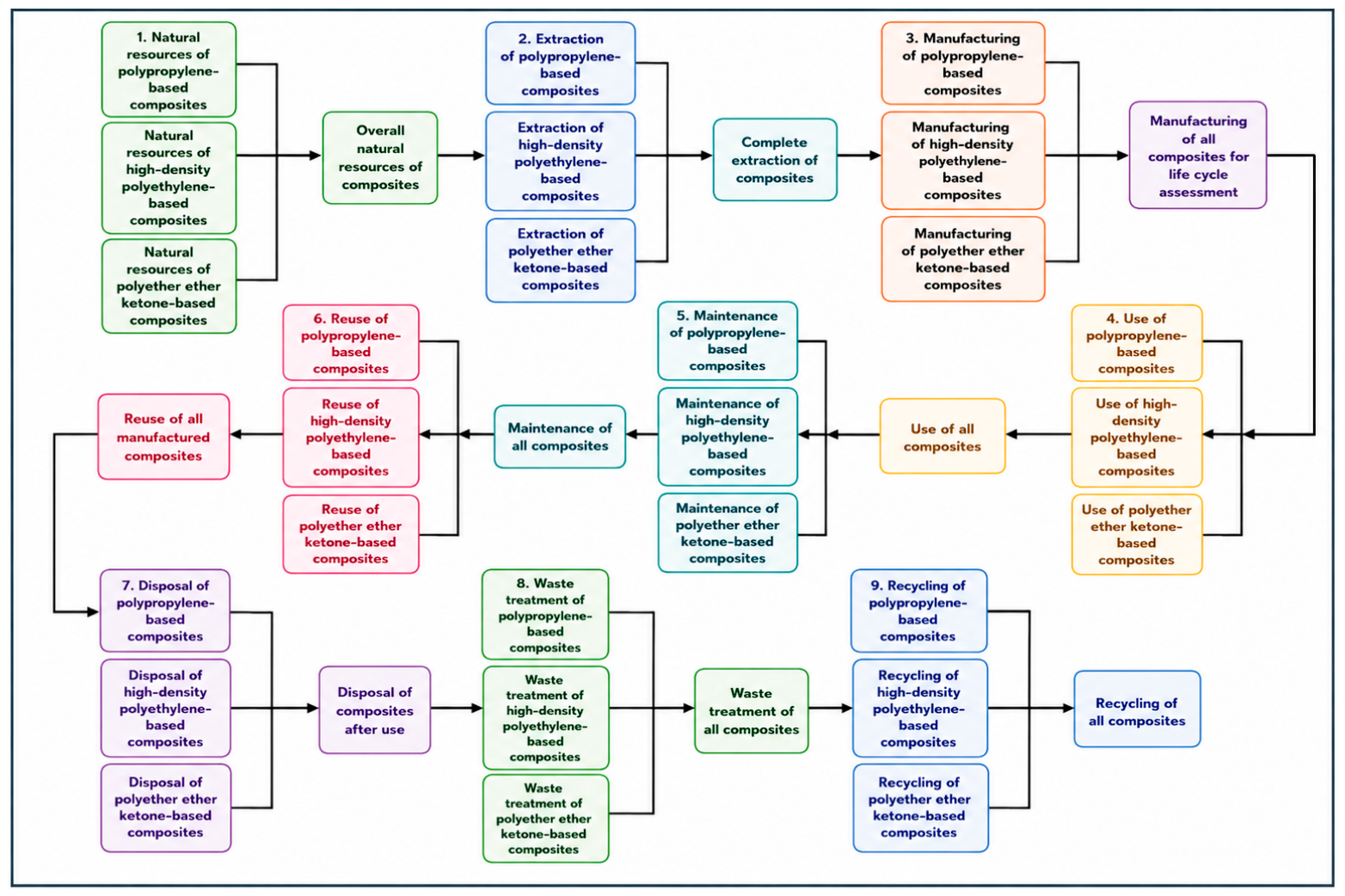
- Across all polymer systems, raw material extraction and manufacturing emerge as dominant environmental hotspots, contributing to most of the climate change, ecotoxicity, and energy resource impacts. Service life stages (use, maintenance, and reuse) generally show comparatively low impacts, highlighting the importance of designing durable, lightweight, and high-performance polymer products. End-of-life stages reveal that recycling pathways significantly reduce overall environmental burdens, whereas disposal and energy recovery remain major contributors to emissions and toxicity.
- IV.
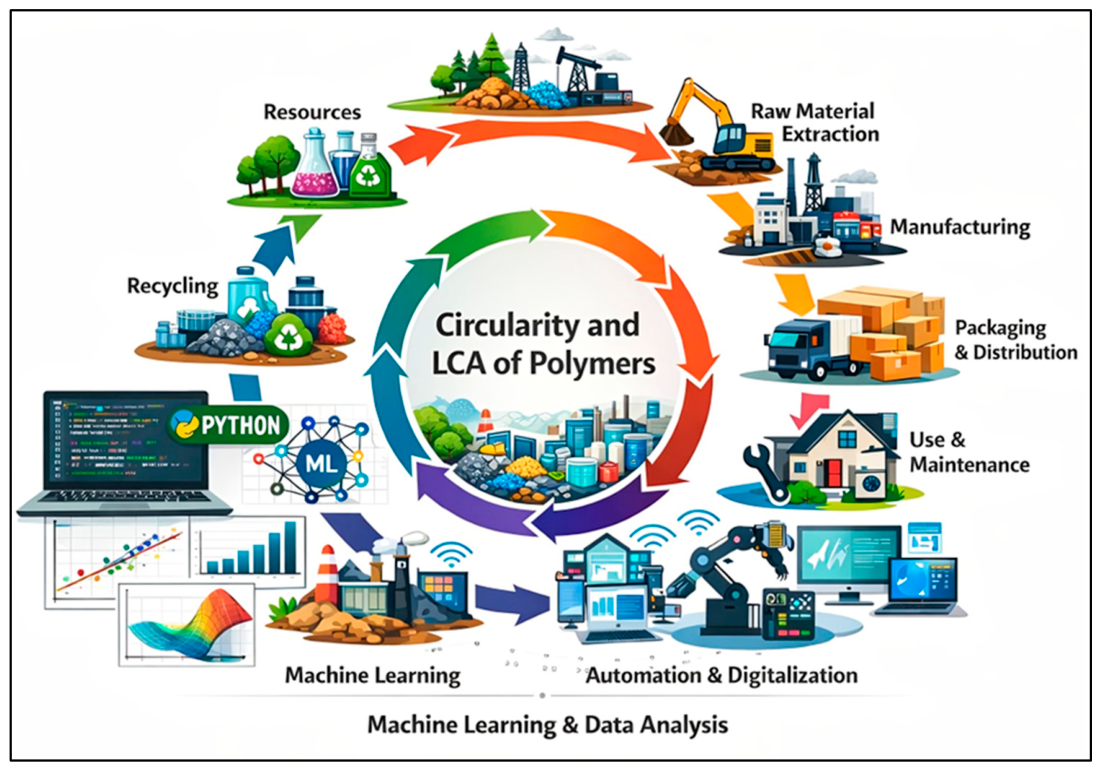
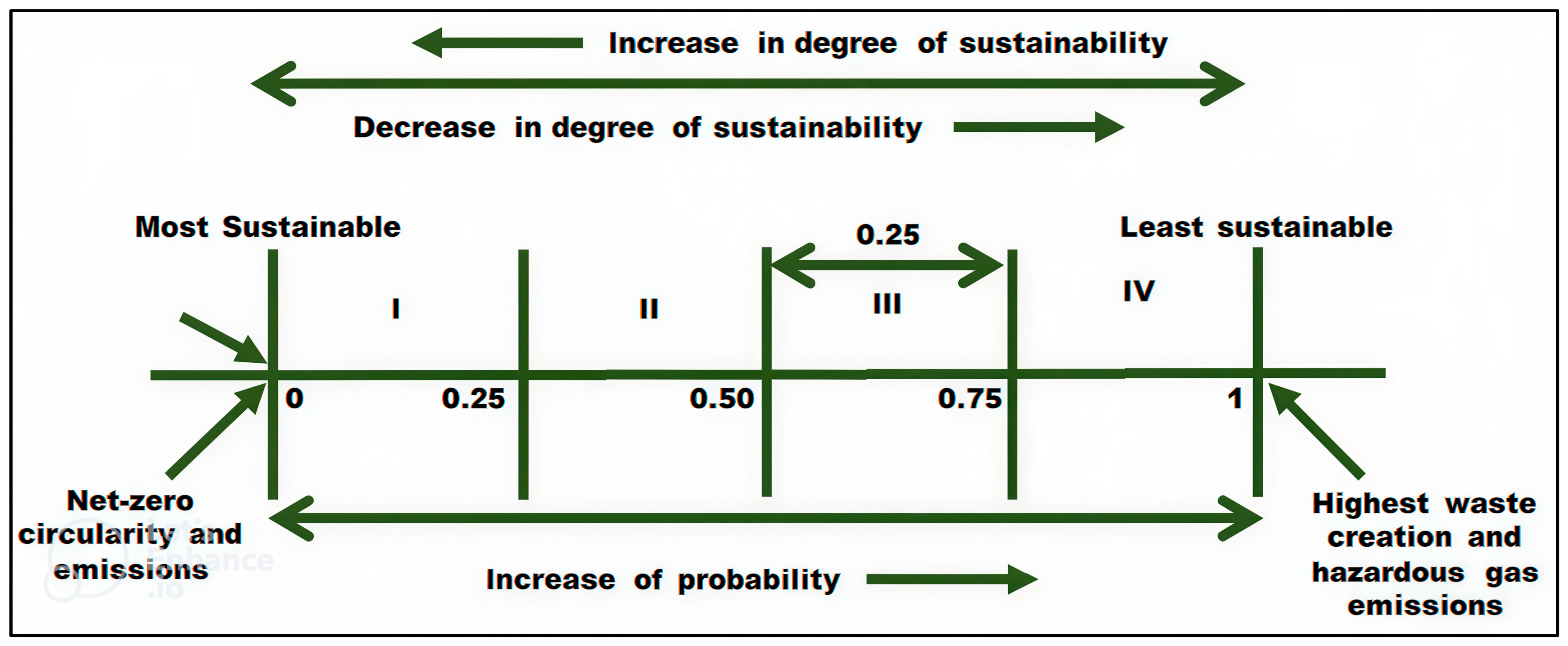
- Monte Carlo simulations and ML-assisted LCA reveal substantial uncertainty and variability in key impact categories, particularly climate change, energy demand, and toxicity indicators. The integration of Python with OpenLCA enables the prediction of minimum, maximum, and probabilistic impact ranges, supporting the development of quantitative sustainability systems where environmental performance is inversely linked to impact probability. This approach provides a powerful decision-support tool for material selection, policy design, and circular economy planning.
- V.
- At the European scale, the analysis of 57 Mt of polymeric waste shows that environmental burdens are highly concentrated in countries with large industrial bases and high polymer consumption, notably Germany, Italy, France, Spain, Poland, and the United Kingdom. Differences between countries with similar waste volumes underline the critical role of energy mix, recycling infrastructure, and waste management strategies in shaping national sustainability performance. Smaller economies exhibit lower absolute impacts but still benefit from targeted circular economic interventions.
5. Limitations and Future Work
- First, the country-level comparisons presented in this work are based on harmonized modeling assumptions and proportional scaling approaches using reference inventory datasets. Therefore, the results should be interpreted as comparative scenario-based estimates rather than exact national environmental inventories. Real-world environmental impacts can vary significantly depending on regional electricity mixes, transportation infrastructure, industrial technologies, waste-management efficiencies, recycling capacities, and local policy conditions.
- Second, the investigated composite systems, including PP–PET–cotton, HDPE–GF, and PEEK–CF composites, represent modeling scenarios intended for comparative LCA and sustainability analysis. In practice, many polymer composites currently undergo mechanical recycling, downcycling, energy recovery, or partial material recovery rather than complete closed-loop recycling at the same functional performance level. Accordingly, the proposed circularity framework should not be interpreted as evidence of fully industrialized closed-loop recycling technologies for all investigated composite systems.
- Third, the sustainability scoring methodology developed in this work represents a comparative computational indicator based on probabilistic environmental burden evaluation. Different LCA indicators, including climate change, ionizing radiation, ecotoxicity, land use, resource depletion, and waste generation, possess different environmental priorities and real-world significance. Therefore, the sustainability score should be interpreted cautiously as a screening-level comparative tool rather than an absolute environmental certification or policy-ranking system.
- Fourth, ML models were developed primarily for computational integration, uncertainty propagation, and exploratory sustainability analysis. Comprehensive optimization of model performance metrics, large industrial datasets, real-time process monitoring, and advanced hybrid AI architectures were beyond the scope of the current study.
Author Contributions
Funding
Data Availability Statement
Acknowledgments
Conflicts of Interest
Abbreviations
| LCA | Life cycle assessment | LCIA | Life cycle assessment impact |
| ISO | International Organization of Standardization | PET | Polyethylene terephthalate |
| PP | Polypropylene | PVC | Polyvinyl chloride |
| PE | Polyethylene | PLA | Polylactic acid |
| ML | Machine learning | AI | Artificial intelligence |
| CT | Cotton | GF | Glass fiber |
| CF | Carbon fiber | HDPE | High density polyethylene |
| PEEK | Polyether ether ketone | EU | European |
| Mt | Million tons | LD | Low density |
| LLD | Linear low density | MD | Medium density |
| PS | Polystyrene | PA | Polyamide |
| ABS | Acrylonitrile butadiene styrene | SAN | Styrene acrylonitrile |
| PC | polycarbonate | PMMA | Polymethyl methacrylate |
| PUR | Polyurethane | % | Percentage |
| kg CO2-Eq | kilograms of carbon dioxide equivalent | CTUe | Comparative Toxic Unit for ecosystems |
| KBq U235-Eq | kilobecquerel of Uranium-235 equivalent | Kg Sb-Eq | kilograms of antimony equivalent) |
| Kg CFC-11 eq | kilogram of CFC-11 equivalent | Kg NMVOC-eq | kilograms of Non-Methane Volatile Organic Compounds equivalent |
| m | meter | mol H+-Eq | moles of hydrogen ion equivalents |
| MJ | Mega joule | kg P-Eq | kilograms of phosphorus equivalents |
| kg N-Eq | kilograms of nitrogen equivalents | mol N-Eq | moles of nitrogen equivalents |
| CTUh | Comparative Toxic Unit for human toxicity. | LULUC | Land use and land use change |
| SO2 | Sulphur dioxide | NH3 | Ammonia |
| NOx | Nitrogen oxides. |
References
- Finnveden, G.; Hauschild, M.Z.; Ekvall, T.; Guinée, J.; Heijungs, R.; Hellweg, S.; Koehler, A.; Pennington, D.; Suh, S. Recent developments in life cycle assessment. J. Environ. Manag. 2009, 91, 1–21. [Google Scholar] [CrossRef] [Scilit] [PubMed]
- Guinée, J.B.; Heijungs, R.; Huppes, G.; Zamagni, A.; Masoni, P.; Buonamici, R.; Ekvall, T.; Rydberg, T. Life cycle assessment: Past, present, and future. Environ. Sci. Technol. 2010, 45, 90–96. [Google Scholar] [CrossRef] [Scilit]
- Hellweg, S.; Milà i Canals, L. Emerging approaches, challenges and opportunities in life cycle assessment. Science 2014, 344, 1109–1113. [Google Scholar] [CrossRef] [Scilit] [PubMed]
- Hauschild, M.; Jeswiet, J.; Alting, L. From life cycle assessment to sustainable production: Status and perspectives. CIRP Ann. 2005, 54, 1–21. [Google Scholar] [CrossRef] [Scilit]
- Al Rashid, A.; Khan, S.A.; Koç, M. Life cycle assessment on fabrication and characterization techniques for additively manufactured polymers and polymer composites. Clean. Environ. Syst. 2024, 12, 100159. [Google Scholar] [CrossRef] [Scilit]
- Miah, J.H.; Koh, S.C.; Stone, D. A hybridised framework combining integrated methods for environmental Life Cycle Assessment and Life Cycle Costing. J. Clean. Prod. 2017, 168, 846–866. [Google Scholar] [CrossRef] [Scilit]
- Pieragostini, C.; Mussati, M.C.; Aguirre, P. On process optimization considering LCA methodology. J. Environ. Manag. 2012, 96, 43–54. [Google Scholar] [CrossRef] [Scilit]
- Castellani, V.; Beylot, A.; Sala, S. Environmental impacts of household consumption in Europe: Comparing process-based LCA and environmentally extended input-output analysis. J. Clean. Prod. 2019, 240, 117966. [Google Scholar] [CrossRef] [Scilit]
- Finkbeiner, M.; Inaba, A.; Tan, R.; Christiansen, K.; Klüppel, H.J. The new international standards for life cycle assessment: ISO 14040 and ISO 14044. Int. J. Life Cycle Assess. 2006, 11, 80–85. [Google Scholar] [CrossRef] [Scilit]
- Guinée, J.B. Handbook on Life Cycle Assessment: Operational Guide to the ISO Standards; Springer Science & Business Media: Berlin/Heidelberg, Germany, 2002. [Google Scholar]
- Esnouf, A.; Heijungs, R.; Coste, G.; Latrille, É.; Steyer, J.P.; Hélias, A. A tool to guide the selection of impact categories for LCA studies by using the representativeness index. Sci. Total Environ. 2019, 658, 768–776. [Google Scholar] [CrossRef] [Scilit]
- McClelland, S.C.; Arndt, C.; Gordon, D.R.; Thoma, G. Type and number of environmental impact categories used in livestock life cycle assessment: A systematic review. Livest. Sci. 2018, 209, 39–45. [Google Scholar] [CrossRef] [Scilit]
- Rebitzer, G.; Ekvall, T.; Frischknecht, R.; Hunkeler, D.; Norris, G.; Rydberg, T.; Schmidt, W.P.; Suh, S.; Weidema, B.P.; Pennington, D.W. Life cycle assessment: Part 1: Framework, goal and scope definition, inventory analysis, and applications. Environ. Int. 2004, 30, 701–720. [Google Scholar] [CrossRef] [Scilit]
- Alhazmi, H.; Almansour, F.H.; Aldhafeeri, Z. Plastic waste management: A review of existing life cycle assessment studies. Sustainability 2021, 13, 5340. [Google Scholar] [CrossRef] [Scilit]
- Das, S.; Liang, C.; Dunn, J.B. Life cycle assessment of polymers and their recycling. In Circular Economy of Polymers: Topics in Recycling Technologies; American Chemical Society: Washington, DC, USA, 2021; pp. 143–170. [Google Scholar]
- Walker, S.; Rothman, R. Life cycle assessment of bio-based and fossil-based plastic: A review. J. Clean. Prod. 2020, 261, 121158. [Google Scholar] [CrossRef] [Scilit]
- Khorgade, P.; Rettinger, M.; Burghartz, A.; Schlaich, M. A comparative cradle-to-gate life cycle assessment of carbon fiber-reinforced polymer and steel-reinforced bridges. Struct. Concr. 2023, 24, 1737–1750. [Google Scholar] [CrossRef] [Scilit]
- Resalati, S.; Okoroafor, T.; Henshall, P.; Simões, N.; Gonçalves, M.; Alam, M. Comparative life cycle assessment of different vacuum insulation panel core materials using a cradle to gate approach. Build. Environ. 2021, 188, 107501. [Google Scholar] [CrossRef] [Scilit]
- Stoiber, N.; Hammerl, M.; Kromoser, B. Cradle-to-gate life cycle assessment of CFRP reinforcement for concrete structures: Calculation basis and exemplary application. J. Clean. Prod. 2021, 280, 124300. [Google Scholar] [CrossRef] [Scilit]
- Banerjee, R.; Ray, S.S. Sustainability and life cycle assessment of thermoplastic polymers for packaging: A review on fundamental principles and applications. Macromol. Mater. Eng. 2022, 307, 2100794. [Google Scholar] [CrossRef] [Scilit]
- Yates, M.R.; Barlow, C.Y. Life cycle assessments of biodegradable, commercial biopolymers—A critical review. Resour. Conserv. Recycl. 2013, 78, 54–66. [Google Scholar] [CrossRef] [Scilit]
- Speck, R.; Selke, S.; Auras, R.; Fitzsimmons, J. Life cycle assessment software: Selection can impact results. J. Ind. Ecol. 2016, 20, 18–28. [Google Scholar] [CrossRef] [Scilit]
- Silva, D.A.; Nunes, A.O.; Piekarski, C.M.; da Silva Moris, V.A.; de Souza, L.S.; Rodrigues, T.O. Why using different Life Cycle Assessment software tools can generate different results for the same product system? A cause–effect analysis of the problem. Sustain. Prod. Consum. 2019, 20, 304–315. [Google Scholar] [CrossRef] [Scilit]
- Herrmann, I.T.; Moltesen, A. Does it matter which Life Cycle Assessment (LCA) tool you choose?–a comparative assessment of SimaPro and GaBi. J. Clean. Prod. 2015, 86, 163–169. [Google Scholar] [CrossRef] [Scilit]
- Zalazar-Garcia, D.; Fernandez, A.; Rodriguez-Ortiz, L.; Torres, E.; Reyes-Urrutia, A.; Echegaray, M.; Rodriguez, R.; Mazza, G. Exergo-ecological analysis and life cycle assessment of agro-wastes using a combined simulation approach based on Cape-Open to Cape-Open (COCO) and SimaPro free-software. Renew. Energy 2022, 201, 60–71. [Google Scholar] [CrossRef] [Scilit]
- Venkatachalam, V.; Pohler, M.; Spierling, S.; Nickel, L.; Barner, L.; Endres, H.J. Design for recycling strategies based on the life cycle assessment and end of life options of plastics in a circular economy. Macromol. Chem. Phys. 2022, 223, 2200046. [Google Scholar] [CrossRef] [Scilit]
- Hussain, A.; Podgursky, V.; Goljandin, D.; Antonov, M.; Sergejev, F.; Krasnou, I. Circular production, designing, and mechanical testing of polypropylene-based reinforced composite materials: Statistical analysis for potential automotive and nuclear applications. Polymers 2023, 15, 3410. [Google Scholar] [CrossRef] [Scilit]
- Tan, Q.; Yang, L.; Wei, F.; Chen, Y.; Li, J. Comparative life cycle assessment of polyethylene agricultural mulching film and alternative options including different end-of-life routes. Renew. Sustain. Energy Rev. 2023, 178, 113239. [Google Scholar] [CrossRef] [Scilit]
- Korol, J.; Hejna, A.; Burchart-Korol, D.; Chmielnicki, B.; Wypiór, K. Water footprint assessment of selected polymers, polymer blends, composites, and biocomposites for industrial application. Polymers 2019, 11, 1791. [Google Scholar] [CrossRef] [Scilit] [PubMed]
- Alhashim, R.; Deepa, R.; Anandhi, A. Environmental impact assessment of agricultural production using LCA: A review. Climate 2021, 9, 164. [Google Scholar] [CrossRef] [Scilit]
- Baltrocchi, A.P.; Carnevale Miino, M.; Maggi, L.; Rada, E.C.; Torretta, V. A comprehensive critical review of Life Cycle Assessment applied to thermoplastic polymers for mechanical and electronic engineering. Environ. Technol. Rev. 2025, 14, 458–470. [Google Scholar] [CrossRef] [Scilit]
- Köck, B.; Friedl, A.; Serna Loaiza, S.; Wukovits, W.; Mihalyi-Schneider, B. Automation of life cycle assessment—A critical review of developments in the field of life cycle inventory analysis. Sustainability 2023, 15, 5531. [Google Scholar] [CrossRef] [Scilit]
- Steubing, B.; Mendoza Beltran, A.; Sacchi, R. Conditions for the broad application of prospective life cycle inventory databases. Int. J. Life Cycle Assess. 2023, 28, 1092–1103. [Google Scholar] [CrossRef] [Scilit]
- Lueddeckens, S.; Saling, P.; Guenther, E. Temporal issues in life cycle assessment—A systematic review. Int. J. Life Cycle Assess. 2020, 25, 1385–1401. [Google Scholar] [CrossRef] [Scilit]
- Mansor, M.R.; Mastura, M.T.; Sapuan, S.M.; Zainudin, A.Z. The environmental impact of natural fiber composites through life cycle assessment analysis. In Durability and Life Prediction in Biocomposites, Fibre-Reinforced Composites and Hybrid Composites; Woodhead Publishing: Cambridge, UK, 2019; pp. 257–285. [Google Scholar]
- Ead, A.S.; Appel, R.; Alex, N.; Ayranci, C.; Carey, J.P. Life cycle analysis for green composites: A review of literature including considerations for local and global agricultural use. J. Eng. Fibers Fabr. 2021, 16, 15589250211026940. [Google Scholar] [CrossRef] [Scilit]
- Ramesh, M.; Deepa, C.; Kumar, L.R.; Sanjay, M.R.; Siengchin, S. Life-cycle and environmental impact assessments on processing of plant fibres and its bio-composites: A critical review. J. Ind. Text. 2022, 51, 5518S–5542S. [Google Scholar] [CrossRef] [Scilit]
- Mio, A.; Bertagna, S.; Cozzarini, L.; Laurini, E.; Bucci, V.; Marinò, A.; Fermeglia, M. Multiscale modelling techniques in life cycle assessment: Application to nanostructured polymer systems in the maritime industry. Sustain. Mater. Technol. 2021, 29, e00327. [Google Scholar] [CrossRef] [Scilit]
- Amponsah, L.; Chuck, C.; Parsons, S. Life cycle assessment of a marine biorefinery producing protein, bioactives and polymeric packaging material. Int. J. Life Cycle Assess. 2024, 29, 174–191. [Google Scholar] [CrossRef] [Scilit]
- Meramo, S.; Pasutto, E.; Sukumara, S. Automating relative and absolute environmental sustainability assessments of bio-based products. Bioresour. Technol. 2024, 394, 130196. [Google Scholar] [CrossRef] [Scilit] [PubMed]
- Nair, R.R.; Chougule, K.M.; Gomez, J.C.; Brand-Daniels, U. A generalized schema to publish and share life cycle inventories (LCI): Exemplary case of an aviation fuel supply chain. J. Clean. Prod. 2025, 520, 146120. [Google Scholar] [CrossRef] [Scilit]
- Hussain, A.; Podgursky, V.; Antonov, M.; Viljus, M.; Goljandin, D. TiCN coating tribology for the circular economy of textile industries. J. Ind. Text. 2022, 51, 8947S–8959S. [Google Scholar] [CrossRef] [Scilit]
- Hussain, A.; Podgursky, V.; Goljandin, D.; Viljus, M.; Antonov, M.; Bogatov, A.; Krasnou, I. Tribological and mechanical properties investigations of post-consumer cotton textiles. Solid State Phenom. 2021, 320, 97–102. [Google Scholar] [CrossRef] [Scilit]
- Shekoohiyan, S.; Hadadian, M.; Heidari, M.; Hosseinzadeh-Bandbafha, H. Life cycle assessment of Tehran Municipal solid waste during the COVID-19 pandemic and environmental impacts prediction using machine learning. Case Stud. Chem. Environ. Eng. 2023, 7, 100331. [Google Scholar] [CrossRef] [Scilit]
- Khanna, A.; Lamba, B.Y.; Jain, S.; Sah, A.; Dangi, S.; Sharma, A.; Tiang, J.J.; Tiang, S.S.; Lim, W.H. Multi-Objective AI Optimization of Plastic Waste Pyrolysis Integrating Energy Return on Investment for Circular Polymer Recycling. Polymers 2026, 18, 1062. [Google Scholar] [CrossRef] [Scilit]
- Chin, H.H.; Varbanov, P.S.; You, F.; Sher, F.; Klemeš, J.J. Plastic circular economy framework using hybrid machine learning and pinch analysis. Resour. Conserv. Recycl. 2022, 184, 106387. [Google Scholar] [CrossRef] [Scilit]
- Rahmani, R.; Resende, P.R.; Couto, R.; Lopes, S.I.; Kumar, R.; Maurya, H.S.; Karimi, J.; Afonso, A.M.; Hussain, A.; Abrantes, J.C. Structural analysis of selective laser melted copper-tin alloy. J. Alloys Metall. Syst. 2024, 7, 100097. [Google Scholar] [CrossRef] [Scilit]
- Fang, Z.; Chen, D.; Hu, X.; Deng, Z.; Xu, J.; Wang, Y.; Qiao, Y.; Hu, S.; Xiang, J. Rapid detection and identification of plastic waste based on multi-wavelength laser Raman spectroscopy combining machine learning methods. Spectrochim. Acta Part A Mol. Biomol. Spectrosc. 2025, 340, 126316. [Google Scholar] [CrossRef] [Scilit]
- Hussain, A.; Goljandin, D.; Podgursky, V.; Yörük, C.R.; Sergejev, F.; Kübarsepp, J.; Maurya, H.S.; Rahmani, R. Industrial sustainable Fabrication, SEM Characterization, mechanical Testing, ANOVA analysis of PP-PETF recycled Composites: Artificial intelligence and deep learning studies for nuclear shielding applications. Eur. Polym. J. 2024, 213, 113082. [Google Scholar] [CrossRef] [Scilit]
- Tabone, M.D.; Cregg, J.J.; Beckman, E.J.; Landis, A.E. Sustainability metrics: Life cycle assessment and green design in polymers. Environ. Sci. Technol. 2010, 44, 8264–8269. [Google Scholar] [CrossRef] [Scilit] [PubMed]
- Hottle, T.A.; Bilec, M.M.; Landis, A.E. Sustainability assessments of bio-based polymers. Polym. Degrad. Stab. 2013, 98, 1898–1907. [Google Scholar] [CrossRef] [Scilit]
- Antelava, A.; Damilos, S.; Hafeez, S.; Manos, G.; Al-Salem, S.M.; Sharma, B.K.; Kohli, K.; Constantinou, A. Plastic solid waste (PSW) in the context of life cycle assessment (LCA) and sustainable management. Environ. Manag. 2019, 64, 230–244. [Google Scholar] [CrossRef] [Scilit] [PubMed]
- Sharifian, S.; Iranmanesh, Z.; Asasian-Kolur, N.; Vahidi, E.; Harasek, M. Toward sustainable carbon utilization: Integrated LCA–TEA assessment of carbon dioxide–derived polymers. J. Environ. Manag. 2026, 400, 128785. [Google Scholar] [CrossRef] [Scilit]
- Demirdelen, T.; Aksu, İ.Ö.; Yilmaz, K.; Koç, D.D.; Arikan, M.; Şener, A. Investigation of the carbon footprint of the textile industry: PES-and PP-based products with Monte Carlo uncertainty analysis. Sustainability 2023, 15, 14237. [Google Scholar] [CrossRef] [Scilit]
- Hussain, A.; Podgursky, V.; Goljandin, D.; Antonov, M.; Viljus, M. Tribology of alumina materials for the circular economy of manufacturing textile industries. Proc. Est. Acad. Sci. 2021, 70, 215–220. [Google Scholar] [CrossRef] [Scilit]
- Lo, S.C.; Ma, H.W.; Lo, S.L. Quantifying and reducing uncertainty in life cycle assessment using the Bayesian Monte Carlo method. Sci. Total Environ. 2005, 340, 23–33. [Google Scholar] [CrossRef] [Scilit]
- Maurya, H.S.; Kumar, R.; Kumar, S.A.; Tarraste, M.; Hussain, A.; Rahmani, R.; Juhani, K.; Sergejev, F.; Prashanth, K.G. Sliding wear and debris evolution in LPBFed ceramic-reinforced steel composites under variable loads and temperatures. Mater. Chem. Phys. 2025, 345, 131195. [Google Scholar] [CrossRef] [Scilit]
- Ramesh, P.; Vinodh, S. State of art review on Life Cycle Assessment of polymers. Int. J. Sustain. Eng. 2020, 13, 411–422. [Google Scholar] [CrossRef] [Scilit]
- Vinodh, S.; Rathod, G. Application of life cycle assessment and Monte Carlo simulation for enabling sustainable product design. J. Eng. Des. Technol. 2014, 12, 307–315. [Google Scholar] [CrossRef] [Scilit]
- Hussain, A.; Podgursky, V.; Goljandin, D.; Antonov, M. Industrial approach to circularity of polymer composites: Processing, characterization, mechanical testing, and wear regression. J. Reinf. Plast. Compos. 2024, 43, 456–472. [Google Scholar] [CrossRef] [Scilit]
- Yaghoubi, V.; Kumru, B. Retrosynthetic life cycle assessment: A short perspective on the sustainability of integrating thermoplastics and artificial intelligence into composite systems. Adv. Sustain. Syst. 2024, 8, 2300543. [Google Scholar] [CrossRef] [Scilit]
- Hashmi, R.; Singh, S.K.; Singh, A.K. AI-Driven Sustainable Polymers: A Pathway to Environmental Resilience. Macromol. Symp. 2026, 415, e70175. [Google Scholar] [CrossRef] [Scilit]
- Pande, P.B.; Dhengare, S.W.; Raut, J.M.; Bhagat, R.M.; Bahoria, B.V.; Shelke, N.; Upadhye, S.D.; Vairagade, V.S. Optimizing sustainability and resilience of composite construction materials using life cycle assessment and advanced artificial intelligence techniques. Asian J. Civ. Eng. 2025, 26, 471–489. [Google Scholar] [CrossRef] [Scilit]
- Hussain, A.; Maurya, H.S.; Goljandin, D.; Sinka, M.; Bajare, D. Development of Experimental and Computational Lightweight Industrial Circularity Manufacturing Systems for Polymer Waste Recycling: Mechanical Testing and Characterization. Int. J. Lightweight Mater. Manuf. 2025, 9, 314–336. [Google Scholar] [CrossRef] [Scilit]
- Hussain, A.; Kübarsepp, J.; Sergejev, F.; Goljandin, D.; Hussainova, I.; Podgursky, V.; Karjust, K.; Maurya, H.S.; Rahmani, R.; Sinka, M.; et al. Advanced machine learning and experimental studies of polypropylene based polyesters tribological composite systems for sustainable recycling automation and digitalization. Int. J. Lightweight Mater. Manuf. 2025, 8, 252–263. [Google Scholar] [CrossRef] [Scilit]
- Hu, X.; An, A.K.; Chopra, S.S. Life cycle assessment of the polyvinylidene fluoride polymer with applications in various emerging technologies. ACS Sustain. Chem. Eng. 2022, 10, 5708–5718. [Google Scholar] [CrossRef] [Scilit]
- Yakoubi, S. Sustainable revolution: AI-driven enhancements for composite polymer processing and optimization in intelligent food packaging. Food Bioprocess Technol. 2025, 18, 82–107. [Google Scholar] [CrossRef] [Scilit]




| Country Name | Amount of Waste (Mt) | Recycling Capacity (%) | ||
|---|---|---|---|---|
| Recycling | Energy Recovery | Landfill | ||
| Germany | 12 | 42 | 57 | 1 |
| Italy | 8 | 34 | 34 | 32 |
| France | 5.5 | 25 | 44 | 31 |
| Spain | 4 | 43 | 21 | 36 |
| Poland | 4 | 27 | 32 | 41 |
| The United Kingdom | 4 | 37 | 44 | 19 |
| Belgium | 2.5 | 39 | 59 | 2 |
| Luxemburg | 2.5 | 34 | 66 | 0 |
| The Netherlands | 2.3 | 45 | 55 | 0 |
| Czech Republic | 1.9 | 39 | 22 | 39 |
| Austria | 1.8 | 31 | 69 | 0 |
| Portugal | 1.6 | 32 | 35 | 33 |
| Sweden | 1.7 | 39 | 60 | 1 |
| Hungary | 1.6 | 22 | 21 | 57 |
| Romania | 1.6 | 33 | 11 | 56 |
| Switzerland | 0.9 | 28 | 72 | 0 |
| Greece | 0.85 | 25 | 2 | 73 |
| Denmark | 0.70 | 40 | 58 | 2 |
| Finland | 0.70 | 21 | 77 | 0 |
| Slovakia | 0.50 | 30 | 25 | 45 |
| Bulgaria | 0.45 | 23 | 8 | 69 |
| Lithuania | 0.40 | 27 | 28 | 45 |
| Ireland | 0.45 | 29 | 62 | 9 |
| Slovenia | 0.35 | 35 | 32 | 33 |
| Norway | 0.40 | 44 | 54 | 2 |
| Croatia | 0.30 | 28 | 5 | 67 |
| Latvia | 0.25 | 34 | 2 | 64 |
| Estonia | 0.25 | 34 | 46 | 20 |
| Cyprus | 0.15 | 27 | 2 | 71 |
| Malta | 0.10 | 23 | 2 | 75 |
| Polymer Type | Abundance (Mt) | Applications |
|---|---|---|
| PP | 10 | Packaging and others |
| HDPE (including low density (LD), linear low density (LLD), and medium density (MD)) | 17 | Domestic, engineering, and strategic |
| PVC | 6 | Domestic and engineering |
| PET | 5 | Domestic and engineering |
| Polystyrene (PS) (including expandable) | 3.5 | Domestic, engineering, and strategic |
| PA | 1 | Domestic, engineering, and strategic |
| ABS | 1 | Domestic, engineering, and strategic |
| SAN | 1 | Domestic, engineering, and strategic |
| PC | 1 | Domestic, engineering, and strategic |
| PMMA | 0.5 | Engineering and strategic |
| PUR | 5 | Domestic, engineering, and strategic |
| Other thermoplastics | 3 | Engineering and strategic |
| Other thermosetting | 4 | Domestic, engineering, and strategic |
| Nature of LCA and LCAI | LCA Element | Amounts of Matrices (Mt) | Amounts of Reinforcements (Mt) | |||||
|---|---|---|---|---|---|---|---|---|
| PP | HDPE | PEEK | PET | Cotton | GF | CF | ||
| Cradle to gate | Natural resources | 38 | 11 | 4 | 7.5 | 3 | 1500 | 2 |
| Raw materials extraction | 10 | 6 | 2 | 5 | 1 | 2.4 | 0.80 | |
| manufacturing | 10 | 6 | 2 | 4 | 2 | 2.4 | 0.80 | |
| Service life | Utilization | 10 | 6 | 2 | 4 | 2 | 2.4 | 0.80 |
| Maintenance | 10 | 6 | 2 | 4 | 2 | 2.4 | 0.8 | |
| Reuse | 8.10 | 4.74 | 1.58 | 3.24 | 1.62 | 1.90 | 0.63 | |
| Cradle to grave | Disposal | 8.10 | 4.74 | 1.58 | 3.24 | 1.62 | 1.90 | 0.63 |
| Waste treatment | 8.10 | 4.74 | 1.58 | 3.24 | 1.62 | 1.90 | 0.63 | |
| Recycling | 8.10 | 4.74 | 1.58 | 3.24 | 1.62 | 1.90 | 0.63 | |
| Method | Matrix Materials Contribution | Reinforcement Contribution |
|---|---|---|
| Open LCA Lazy-on-demand | 80 | 20 |
| Open Eager-All | 75 | 25 |
| Open LCA Monte Carlo Simulation | 70 | 30 |
| Python-Open LCA integration | 78 | 22 |
| LCA Indicator | LCA-Based Calculation | LCA-Python Based Calculations | Indicator Units | ||||
|---|---|---|---|---|---|---|---|
| PP | HDPE | PEEK | PP | HDPE | PEEK | Standard Unit | |
| Climate change: biogenic | 4.20 × 10⁸ | 9.02 × 10⁶ | 2.60 × 10⁷ | 6.20 × 10⁸ | 1.02 × 10⁷ | 4.60 × 10⁷ | kg CO2-Eq |
| Climate change: fossil | 4.50 × 10¹⁰ | 1.50 × 10¹⁰ | 1.50 × 10¹⁰ | 6.50 × 10¹⁰ | 4.50 × 10¹⁰ | 5.50 × 10¹⁰ | kg CO2-Eq |
| Climate change: land use and land use change | 1.20 × 10⁹ | 9.60 × 10⁶ | 6.50 × 10⁶ | 4.20 × 10⁹ | 1.60 × 10⁷ | 9.50 × 10⁶ | kg CO2-Eq |
| LCA Indicator | LCA-Based Calculation | LCA-Python Based Calculations | Indicator Units | ||||
|---|---|---|---|---|---|---|---|
| PP | HDPE | PEEK | PP | HDPE | PEEK | Standard Unit | |
| Ecotoxicity: freshwater | 6.80 × 10¹¹ | 3.60 × 10¹⁰ | 1.40 × 10¹¹ | 7.20 × 10¹² | 3.30 × 10¹¹ | 4.60 × 10¹² | CTUe |
| Ecotoxicity: freshwater, inorganics | 1.17 × 10¹¹ | 3.40 × 10¹⁰ | 7.10 × 10¹⁰ | 3.75 × 10¹² | 6.40 × 10¹¹ | 7.50 × 10¹¹ | CTUe |
| Ecotoxicity: freshwater, organics | 5.65 × 10¹¹ | 2.40 × 10⁹ | 6.80 × 10¹⁰ | 8.75 × 10¹² | 5.35 × 10¹⁰ | 9.50 × 10¹¹ | CTUe |
| LCA Indicator | Minimum Values | Maximum Values | Units | ||||
|---|---|---|---|---|---|---|---|
| PP | HDPE | PEEK | PP | HDPE | PEEK | Standard Unit | |
| Acidification | 2.50 × 10⁷ | 5.6 × 10⁶ | 4.30 × 10⁶ | 5.40 × 10¹⁰ | 7.90 × 10⁹ | 9.80 × 10⁸ | mol H+-Eq |
| Climate change | 3.50 × 10⁷ | 2.50 × 10⁸ | 5.50 × 10⁸ | 6.50 × 10¹³ | 8.50 × 10¹² | 6.50 × 10¹² | kg CO2-Eq |
| Climate change: biogenic | 2.20 × 10⁶ | 5.26 × 10⁵ | 3.45 × 10⁵ | 6.20 × 10¹¹ | 5.92 × 10⁹ | 4.36 × 10¹⁰ | kg CO2-Eq |
| Climate change: fossil | 3.65 × 10⁷ | 3.74 × 10⁷ | 3.67 × 10⁷ | 9.50 × 10¹³ | 6.25 × 10¹² | 3.37 × 10¹² | kg CO2-Eq |
| Climate change: land use and land use change | 3.24 × 10⁶ | 5.64 × 10⁴ | 7.50 × 10⁴ | 9.87 × 10¹² | 4.25 × 10⁹ | 7.56 × 10¹⁰ | kg CO2-Eq |
| Ecotoxicity: freshwater | 3.95 × 10⁸ | 4.78 × 10⁸ | 4.54 × 10⁸ | 8.80 × 10¹⁴ | 6.96 × 10¹³ | 7.10 × 10¹³ | CTUe |
| Ecotoxicity: freshwater, inorganics | 1.50 × 10⁸ | 2.25 × 10⁷ | 2.64 × 10⁷ | 1.00 × 10¹⁴ | 2.30 × 10¹³ | 4.50 × 10¹³ | CTUe |
| Ecotoxicity: freshwater, organics | 9.50 × 10⁸ | 3.60 × 10⁵ | 9.60 × 10⁶ | 1.25 × 10¹⁴ | 1.60 × 10¹² | 2.63 × 10¹³ | CTUe |
| Energy resources: non-renewable | 3.50 × 10⁹ | 1.13 × 10⁹ | 9.50 × 10⁸ | 1.12 × 10¹⁵ | 1.23 × 10¹³ | 4.48 × 10¹³ | MJ, net calorific value |
| Eutrophication: freshwater | 1.50 × 10⁶ | 1.41 × 10⁵ | 1.74 × 10⁵ | 3.90 × 10⁹ | 5.50 × 10⁸ | 8.81 × 10⁹ | kg P-Eq |
| Eutrophication: marine | 3.30 × 10⁶ | 4.50 × 10⁶ | 1.50 × 10⁶ | 7.50 × 10¹⁰ | 3.53 × 10⁹ | 6.34 × 10⁹ | kg N-Eq |
| Eutrophication: terrestrial | 5.81 × 10⁷ | 6.91 × 10⁵ | 3.30 × 10⁶ | 8.30 × 10¹² | 8.44 × 10¹⁰ | 6.33 × 10¹⁰ | mol N-Eq |
| Human toxicity: carcinogenic | 7.50 | 4.69 | 2.15 | 13.81 | 7.65 | 4.15 | CTUh |
| Human toxicity: carcinogenic, inorganics | 3.15 | 3.25 | 14 | 5.17 | 5.61 | 19 | CTUh |
| Human toxicity: carcinogenic, organics | 4.50 | 1.10 | 16 | 6.27 | 1.95 | 21 | CTUh |
| Human toxicity: non-carcinogenic | 4.72 × 10² | 1.72 × 10² | 1.10 × 10² | 6.31 × 10⁴ | 5.91 × 10⁴ | 8.92 × 10⁵ | CTUh |
| Human toxicity: non-carcinogenic, inorganics | 3.81 × 10² | 1.61 × 10⁵ | 4.84 × 10² | 6.31 × 10⁴ | 9.10 × 10⁷ | 5.41 × 10⁴ | CTUh |
| Human toxicity: non-carcinogenic, organics | 90 | 10 | 110 | 105 | 15 | 150 | CTUh |
| Ionizing radiation: human health | 7.21 × 10⁸ | 3.61 × 10⁸ | 3.54 × 10⁷ | 4.21 × 10¹¹ | 7.71 × 10¹¹ | 3.25 × 10¹⁰ | kBq U235-Eq |
| Land use | 5.50 × 10¹⁰ | 4.50 × 10⁹ | 3.50 × 10⁹ | 7.21 × 10¹² | 7.21 × 10¹¹ | 7.21 × 10¹⁰ | dimensionless |
| Material resources: metals/minerals | 2.23 × 10⁴ | 4.00 × 10⁴ | 3.50 × 10⁴ | 6.11 × 10⁷ | 3.10 × 10⁷ | 1.50 × 10⁷ | kg Sb-Eq |
| Ozone depletion | 7.34 × 10⁴ | 1.14 × 10⁴ | 4.10 × 10⁴ | 1.24 × 10⁵ | 3.25 × 10⁵ | 6.24 × 10⁵ | kg CFC-11-Eq |
| Particulate matter formation | 5.50 × 10² | 5.71 × 10² | 7.80 × 10² | 9.70 × 10⁴ | 8.80 × 10⁴ | 7.92 × 10⁴ | disease incidence |
| Photochemical oxidant formation: human health | 4.71 × 10⁸ | 1.00 × 10⁷ | 9.00 × 10⁶ | 7.11 × 10¹⁰ | 3.42 × 10⁹ | 4.32 × 10⁹ | kg NMVOC-Eq |
| Water use | 8.30 × 10¹⁰ | 1.20 × 10⁹ | 2.00 × 10⁸ | 1.51 × 10¹³ | 5.25 × 10¹⁰ | 9.71 × 10¹¹ | m3 world Eq deprived |
| LCA Indicator | Monte Carlo Simulations | Units | ||||||||
|---|---|---|---|---|---|---|---|---|---|---|
| PP | HDPE | PEEK | Standard Unit | |||||||
| Mean | Standard Deviation | Median | Mean | Standard Deviation | Median | Mean | Standard Deviation | Median | Subunits | |
| Acidification | 0.60 | 0.04 | 0.60 | 0.60 | 0.05 | 0.60 | 0.90 | 0.02 | 0.80 | mol H+-Eq |
| (3.20 × 10⁸) | (1.40 × 10⁷) | (3.20 × 10⁸) | (6.10 × 10⁷) | (5.61 × 10⁶) | (6.10 × 10⁶) | (5.65 × 10⁷) | (6.60 × 10⁶) | (5.60 × 10⁷) | ||
| Climate change | 0.80 | 0.17 | 0.85 | 0.70 | 0.30 | 0.65 | 0.85 | 0.03 | 0.90 | kg CO2-Eq |
| (4.70 × 10¹⁰) | (1.84 × 10⁹) | (4.60 × 10¹⁰) | (1.50 × 10¹⁰) | (7.30 × 10⁸) | (1.50 × 10¹⁰) | (1.50 × 10¹⁰) | (1.50 × 10⁹) | (1.40 × 10¹⁰) | ||
| Climate change: biogenic | 0.92 | 0.05 | 0.85 | 0.80 | 0.20 | 0.75 | 0.75 | 0.03 | 0.85 | kg CO2-Eq |
| (4.20 × 10⁸) | (2.64 × 10⁸) | (4.60 × 10⁸) | (9.0 × 10⁶) | (9.80 × 10⁵) | (8.90 × 10⁶) | (2.60 × 10⁷) | (3.10 × 10⁷) | (2.60 × 10⁷) | ||
| Climate change: fossil | 0.85 | 0.17 | 0.82 | 0.70 | 0.30 | 0.75 | 0.80 | 0.04 | 0.70 | kg CO2-Eq |
| (4.50 × 10¹⁰) | (1.80 × 10⁹) | (4.80 × 10¹⁰) | (1.50 × 10¹⁰) | (7.30 × 10⁸) | (1.50 × 10¹⁰) | (1.50 × 10¹⁰) | (1.10 × 10⁹) | (1.70 × 10¹⁰) | ||
| Climate change: land use and land use change | 0.65 | 0.36 | 0.64 | 0.80 | 0.25 | 0.85 | 0.90 | 0.05 | 0.87 | kg CO2-Eq |
| (1.24 × 10⁹) | (4.38 × 10⁷) | (1.24 × 10⁹) | (9.60 × 10⁶) | (7.00 × 10⁵) | (9.50 × 10⁵) | (6.50 × 10⁶) | (8.50 × 10⁵) | (6.40 × 10⁶) | ||
| Ecotoxicity: freshwater | 0.78 | 0.20 | 0.82 | 0.85 | 0.20 | 0.85 | 0.80 | 0.04 | 0.75 | CTUe |
| (6.80 × 10¹¹) | (2.74 × 10¹⁰) | (6.80 × 10¹¹) | (3.40 × 10¹⁰) | (6.83 × 10⁹) | (3.40 × 10¹⁰) | (1.40 × 10¹¹) | (1.80 × 10¹⁰) | (1.35 × 10¹¹) | ||
| Ecotoxicity: freshwater, inorganics | 0.89 | 0.15 | 0.90 | 0.84 | 0.15 | 0.87 | 0.95 | 0.01 | 0.96 | CTUe |
| (1.20 × 10¹¹) | (1.60 × 10¹⁰) | (1.13 × 10¹¹) | (3.40 × 10¹⁰) | (6.80 × 10⁹) | (3.30 × 10¹⁰) | (7.10 × 10¹⁰) | (10 × 109) | (7 × 10¹⁰) | ||
| Ecotoxicity: freshwater, organics | 0.90 | 0.14 | 0.87 | 0.80 | 0.25 | 0.85 | 0.80 | 0.04 | 0.65 | CTUe |
| (5.60 × 10¹¹) | (2.14 × 10¹⁰) | (5.66 × 10¹¹) | (9.60 × 10⁶) | (7.00 × 10⁵) | (9.50 × 10⁵) | (6.60 × 10¹⁰) | (1.50 × 10¹⁰) | (7.10 × 10¹⁰) | ||
| Energy resources: non-renewable | 0.68 | 0.35 | 0.60 | 0.84 | 0.19 | 0.90 | 0.75 | 0.08 | 0.79 | MJ, net calorific value |
| (1.10 × 10¹²) | (3.52 × 10¹⁰) | (4.80 × 10¹⁰) | (1.00 × 10¹²) | (1.60 × 10¹⁰) | (4.20 × 10¹¹) | (3.50 × 10¹¹) | (2.50 × 10¹⁰) | (3.50 × 10¹⁰) | ||
| Eutrophication: freshwater | 0.84 | 0.16 | 0.88 | 0.93 | 0.04 | 0.95 | 0.75 | 0.01 | 0.95 | kg P-Eq |
| (1.90 × 10⁷) | (5.82 × 10⁶) | (1.70 × 10⁷) | (3.12 × 10⁶) | (1.60 × 10⁶) | (2.80 × 10⁶) | (2.60 × 10⁶) | (1.20 × 10⁶) | (2.30 × 10⁶) | ||
| Eutrophication: marine | 0.81 | 0.19 | 0.79 | 0.89 | 0.15 | 0.85 | 0.85 | 0.10 | 0.90 | kg N-Eq |
| (3.34 × 10⁸) | (2.24 × 10⁷) | (3.34 × 10⁸) | (1.30 × 10⁷) | (1.00 × 10⁶) | (1.25 × 10⁷) | (2.20 × 10⁷) | (1.60 × 10⁶) | (2.20 × 10⁷) | ||
| Eutrophication: terrestrial | 0.72 | 0.30 | 0.78 | 0.87 | 0.13 | 0.84 | 0.90 | 0.20 | 0.95 | mol N-Eq |
| (1.00 × 10⁹) | (4.70 × 10⁷) | (1.00 × 10⁹) | (1.33 × 10⁸) | (1.10 × 10⁷) | (1.32 × 10⁸) | (2.20 × 10⁸) | (1.50 × 10⁷) | (1.40 × 10⁸) | ||
| Human toxicity: carcinogenic | 0.50 | 0.50 | 0.65 | 0.87 | 0.25 | 0.88 | 0.95 | 0.66 | 0.95 | CTUh |
| (8.77) | (7.10) | (8.57) | (5.50) | (4.60) | (5.40) | (2.90) | (2.09) | 2.82 | ||
| Human toxicity: carcinogenic, inorganics | 0.75 | 0.28 | 0.70 | 0.82 | 0.21 | 0.80 | 0.85 | 0.50 | 0.90 | CTUh |
| (3.50) | (2.35) | (3.36) | (4.00) | (3.30) | (3.95) | (1.40 × 10²) | (1.20 × 101) | (1.30 × 10²) | ||
| Human toxicity: carcinogenic, organics | 0.68 | 0.35 | 0.70 | 0.79 | 0.26 | 0.78 | 0.95 | 0.30 | 0.95 | CTUh |
| (5.24) | (4.26) | (5.19) | (1.50) | (1.10) | (1.40) | (1.50 × 10²) | (1.11 × 10²) | (1.50 × 10²) | ||
| Human toxicity: non-carcinogenic | 0.55 | 0.45 | 0.60 | 0.80 | 0.30 | 0.72 | 0.85 | 0.40 | 0.75 | CTUh |
| (4.72 × 10²) | (8.00 × 101) | (4.60 × 10²) | (3.10 × 10²) | (3.80 × 101) | (3.00 × 10²) | (1.50 × 10²) | (6.50 × 10²) | (9.70 × 10²) | ||
| Human toxicity: non-carcinogenic, inorganics | 0.63 | 0.35 | 0.67 | 0.93 | 0.04 | 0.95 | 0.93 | 0.43 | 0.90 | CTUh |
| (3.80 × 10²) | (7.80 × 101) | (3.70 × 10²) | (3.12 × 10⁶) | (1.60 × 10⁶) | (2.80 × 10⁶) | (9.70 × 10²) | (5.50 × 10²) | (8.70 × 10²) | ||
| Human toxicity: non-carcinogenic, organics | 0.75 | 0.25 | 0.77 | 0.65 | 0.35 | 0.70 | 0.96 | 0.25 | 0.95 | CTUh |
| (9.50 × 101) | (5.40) | (9.5 × 101) | (9.10) | (7.10) | (8.70) | (1.10 × 10²) | (7.60 × 10²) | (1.10 × 10²) | ||
| Ionizing radiation: human health | 0.90 | 0.04 | 0.88 | 0.99 | 0.01 | 0.99 | 0.96 | 0.01 | 0.95 | kBq U235-Eq |
| (3.10 × 10⁹) | (2.90 × 10⁹) | (2.26 × 10⁹) | (1.60 × 10⁹) | (1.70 × 10⁹) | (1.10 × 10⁹) | (9.80 × 10⁸) | (9.40 × 10⁸) | (7.10 × 10⁸) | ||
| Land use | 0.95 | 0.04 | 0.94 | 0.88 | 0.15 | 0.85 | 0.95 | 0.20 | 0.95 | dimensionless |
| (6.70 × 10¹¹) | (4.20 × 10¹¹) | (6.41 × 10¹¹) | (3.40 × 10¹⁰) | (5.10 × 10⁹) | (3.30 × 10¹⁰) | (3.20 × 10¹⁰) | (6.60 × 10⁹) | (3.10 × 10¹⁰) | ||
| Material resources: metals/minerals | 0.85 | 0.10 | 0.88 | 0.68 | 0.31 | 0.65 | 0.95 | 0.18 | 0.93 | kg Sb-Eq |
| (2.80 × 10⁵) | (9.34 × 10⁴) | (2.61 × 10⁵) | (6.12 × 10⁵) | (4.30 × 10⁴) | (6.00 × 10⁶) | (1.20 × 10⁵) | (6.12 × 10⁴) | (1.10 × 10⁵) | ||
| Ozone depletion | 0.90 | 0.15 | 0.88 | 0.75 | 0.12 | 0.85 | 0.98 | 0.25 | 0.98 | kg CFC-11-Eq |
| (5.10 × 10⁴) | (1.20 × 10⁴) | (4.90 × 10⁴) | (8.30 × 10²) | (8.15 × 101) | (8.20 × 10²) | (5.80 × 10²) | (5.20 × 10²) | (5.80 × 10²) | ||
| Particulate matter formation | 0.85 | 0.14 | 0.88 | 0.75 | 0.30 | 0.70 | 0.99 | 0.02 | 0.99 | disease incidence |
| (2.40 × 10³) | (3.26 × 10²) | (2.31 × 10³) | (4.10 × 10²) | (5.70 × 101) | (3.90 × 10⁶) | (3.80 × 10²) | (3.10 × 10²) | (3.82 × 10²) | ||
| Photochemical oxidant formation: human health | 0.60 | 0.35 | 0.65 | 0.87 | 0.15 | 0.85 | 0.97 | 0.29 | 0.96 | kg NMVOC-Eq |
| (2.10 × 10⁸) | (2.10 × 10⁷) | (2.10 × 10⁸) | (8.10 × 10⁷) | (9.11 × 10⁶) | (7.83 × 10⁷) | (5.70 × 10⁷) | (8.50 × 10⁶) | (5.60 × 10⁷) | ||
| Water use | 0.80 | 0.18 | 0.82 | 0.89 | 0.15 | 0.82 | 0.99 | 0.25 | 0.98 | m3 world Eq deprived |
| (3.92 × 10¹¹) | (1.60 × 10¹⁰) | (3.92 × 10¹¹) | (4.30 × 10⁹) | (2.10 × 10⁸) | (4.30 × 10⁹) | (7.50 × 10⁹) | (7.40 × 10⁸) | (7.50 × 10⁹) | ||
| Country Name | Amount of Waste (Mt) | Acidification (mol H+-Eq) | Climate Change kg CO2-Eq | Climate Change: Biogenic (kg CO2-Eq) | Climate Change: Fossil (kg CO2-Eq) | Climate Change: Land use and Land Use Change (kg CO2-Eq) | Ecotoxicity: Freshwater (CTUe) | Ecotoxicity: Freshwater, Inorganics (CTUe) | Ecotoxicity: Freshwater, Organics (CTUe) | Energy Resources: Non-Renewable (MJ, Net Calorific Value) |
|---|---|---|---|---|---|---|---|---|---|---|
| Germany | 12 | 9.40 × 10¹⁵ | 7.20 × 10¹⁷ | 2.60 × 10¹⁵ | 1.60 × 10¹⁸ | 5.00 × 10¹⁵ | 7.10 × 10¹⁹ | 9.90 × 10¹⁹ | 2.50 × 10¹⁹ | 6.10 × 10²¹ |
| Italy | 8 | 7.20 × 10¹⁰ | 5.00 × 10¹⁵ | 2.50 × 10¹⁴ | 3.90 × 10¹⁶ | 7.10 × 10¹⁴ | 3.70 × 10¹⁷ | 8.50 × 10¹⁸ | 1.10 × 10¹⁸ | 9.50 × 10²⁰ |
| France | 5.5 | 8.40 × 10⁸ | 4.50 × 10¹⁴ | 3.50 × 10¹² | 7.50 × 10¹⁵ | 2.60 × 10¹³ | 4.10 × 10¹⁴ | 5.70 × 10¹⁶ | 1.95 × 10¹⁷ | 3.15 × 10¹⁹ |
| Spain | 4 | 5.34 × 10⁶ | 6.50 × 10¹³ | 1.20 × 10¹² | 9.41 × 10¹³ | 2.50 × 10¹³ | 6.50 × 10¹⁴ | 5.50 × 10¹⁵ | 7.91 × 10¹⁵ | 4.00 × 10¹⁷ |
| Poland | 4 | 6.34 × 10⁷ | 5.83 × 10¹³ | 8.21 × 10¹² | 8.50 × 10¹⁴ | 5.31 × 10¹³ | 9.20 × 10¹³ | 8.52 × 10¹⁵ | 8.21 × 10¹⁵ | 6.50 × 10¹⁷ |
| The United Kingdom | 4 | 1.00 × 10⁸ | 9.34 × 10¹⁴ | 6.30 × 10¹³ | 8.32 × 10¹⁴ | 8.30 × 10¹³ | 6.30 × 10¹³ | 8.51 × 10¹⁴ | 9.20 × 10¹⁵ | 9.10 × 10¹⁷ |
| Belgium | 2.5 | 1.10 × 10⁴ | 5.81 × 10¹⁰ | 8.50 × 10⁹ | 1.32 × 10¹⁰ | 3.70 × 10¹⁰ | 7.20 × 10¹¹ | 6.23 × 10¹² | 9.00 × 10¹³ | 5.20 × 10¹⁵ |
| Luxemburg | 2.5 | 5.20 × 10⁵ | 3.97 × 10¹⁰ | 3.45 × 10⁸ | 4.91 × 10¹⁰ | 9.10 × 10¹⁰ | 8.12 × 10¹¹ | 7.10 × 10¹² | 1.97 × 10¹³ | 1.50 × 10¹⁵ |
| The Netherlands | 2.3 | 3.40 × 10⁴ | 1.35 × 10¹⁰ | 9.10 × 10⁷ | 9.00 × 10¹⁰ | 7.10 × 10¹⁰ | 4.93 × 10¹¹ | 5.60 × 10¹¹ | 5.50 × 10¹² | 9.20 × 10¹³ |
| Czech Republic | 1.9 | 1.10 × 10⁴ | 2.83 × 10⁹ | 4.20 × 10⁷ | 2.80 × 10⁹ | 7.30 × 10⁹ | 1.50 × 10¹⁰ | 1.30 × 10¹⁰ | 4.50 × 10¹¹ | 1.20 × 10¹³ |
| Austria | 1.8 | 2.60 × 10⁴ | 1.50 × 10⁹ | 3.70 × 10⁷ | 5.41 × 10⁹ | 8.51 × 10⁹ | 9.50 × 10¹⁰ | 6.30 × 10¹⁰ | 4.25 × 10¹¹ | 9.20 × 10¹³ |
| Portugal | 1.6 | 3.60 × 10⁵ | 3.75 × 10⁸ | 3.90 × 10⁷ | 6.40 × 10⁹ | 9.19 × 10⁹ | 7.20 × 10¹⁰ | 7.20 × 10¹⁰ | 5.50 × 10¹¹ | 1.90 × 10¹³ |
| Sweden | 1.7 | 5.10 × 10⁴ | 9.25 × 10⁹ | 9.70 × 10⁷ | 7.50 × 10⁹ | 5.21 × 10⁹ | 9.50 × 10¹⁰ | 9.12 × 10⁹ | 6.50 × 10¹⁰ | 3.50 × 10¹³ |
| Hungary | 1.6 | 3.30 × 10⁵ | 5.63 × 10⁸ | 6.50 × 10⁷ | 1.60 × 10⁸ | 5.70 × 10⁹ | 8.10 × 10¹⁰ | 1.20 × 10⁹ | 5.90 × 10¹⁰ | 2.54 × 10¹² |
| Romania | 1.6 | 7.60 × 10⁴ | 3.50 × 10⁸ | 8.80 × 10⁷ | 9.92 × 10⁸ | 5.50 × 10⁹ | 5.60 × 10¹⁰ | 3.60 × 10⁹ | 2.90 × 10⁹ | 3.98 × 10¹¹ |
| Switzerland | 0.9 | 2.60 × 10³ | 5.47 × 10⁶ | 5.00 × 10⁵ | 1.70 × 10⁷ | 1.10 × 10⁷ | 6.50 × 10⁹ | 2.95 × 10⁸ | 9.50 × 10⁸ | 1.50 × 10¹⁰ |
| Greece | 0.85 | 6.50 × 10³ | 3.81 × 10⁷ | 6.20 × 10⁴ | 4.50 × 10⁷ | 6.60 × 10⁶ | 9.60 × 10⁸ | 3.12 × 10⁷ | 8.50 × 10⁸ | 2.80 × 10¹⁰ |
| Denmark | 0.70 | 7.10 × 10³ | 6.37 × 10⁵ | 3.00 × 10⁴ | 3.50 × 10⁶ | 7.50 × 10⁶ | 6.17 × 10⁸ | 2.70 × 10⁷ | 9.50 × 10⁷ | 9.20 × 10⁹ |
| Finland | 0.70 | 4.30 × 10³ | 4.54 × 10⁶ | 9.45 × 10³ | 7.16 × 10⁶ | 3.50 × 10⁶ | 3.60 × 10⁷ | 9.97 × 10⁸ | 7.25 × 10⁷ | 8.50 × 10⁹ |
| Slovakia | 0.50 | 3.14 × 10³ | 7.87 × 10⁵ | 4.56 × 10³ | 1.30 × 10⁶ | 5.31 × 10⁵ | 7.30 × 10⁶ | 2.97 × 10⁷ | 8.25 × 10⁶ | 1.50 × 10⁷ |
| Bulgaria | 0.45 | 6.91 × 10³ | 6.87 × 10⁶ | 3.81 × 10³ | 5.55 × 10⁵ | 3.41 × 10⁵ | 9.50 × 10⁶ | 8.20 × 10⁷ | 9.60 × 10⁶ | 2.50 × 10⁷ |
| Lithuania | 0.40 | 5.40 × 10³ | 1.20 × 10⁴ | 2.60 × 10³ | 1.50 × 10⁵ | 6.31 × 10⁵ | 9.30 × 10⁶ | 7.20 × 10⁶ | 8.10 × 10⁶ | 1.10 × 10⁷ |
| Ireland | 0.45 | 1.80 × 10³ | 8.27 × 10⁵ | 3.50 × 10³ | 6.60 × 10⁴ | 6.41 × 10⁵ | 8.70 × 10⁶ | 1.90 × 10⁷ | 3.85 × 10⁶ | 6.50 × 10⁷ |
| Slovenia | 0.35 | 5.21 × 10³ | 9.00 × 10⁴ | 3.10 × 10³ | 6.30 × 10⁴ | 3.52 × 10⁵ | 7.50 × 10⁶ | 8.20 × 10⁶ | 8.90 × 10⁵ | 2.55 × 10⁶ |
| Norway | 0.40 | 2.14 × 10³ | 6.45 × 10⁴ | 1.87 × 10³ | 5.90 × 10⁴ | 3.30 × 10⁴ | 1.50 × 10⁶ | 5.70 × 10⁶ | 5.10 × 10⁵ | 6.30 × 10⁶ |
| Croatia | 0.30 | 8.30 × 10³ | 1.50 × 10⁴ | 9.19 × 10³ | 8.90 × 10³ | 7.60 × 10⁴ | 7.50 × 10⁵ | 9.50 × 10⁵ | 7.50 × 10⁴ | 5.61 × 10⁵ |
| Latvia | 0.25 | 4.60 × 10² | 9.00 × 10³ | 1.90 × 10² | 6.90 × 10³ | 3.41 × 10³ | 8.40 × 10⁵ | 8.90 × 10⁵ | 9.50 × 10⁴ | 5.90 × 10⁵ |
| Estonia | 0.25 | 1.80 × 10² | 9.97 × 10² | 2.17 × 10² | 5.50 × 10³ | 4.40 × 10³ | 8.50 × 10⁴ | 5.70 × 10⁵ | 9.50 × 10⁴ | 5.90 × 10⁵ |
| Cyprus | 0.15 | 9.00 × 10² | 2.10 × 10² | 1.90 × 10² | 3.80 × 10³ | 8.36 × 10² | 9.40 × 10³ | 4.26 × 10⁴ | 1.50 × 10³ | 4.65 × 10⁴ |
| Malta | 0.10 | 5.00 × 10² | 1.20 × 101 | 310 | 4.90 × 10² | 9.70 × 10² | 5.70 × 10³ | 5.10 × 10⁴ | 5.25 × 10³ | 2.50 × 10⁴ |
| Country Name | Amount of Waste (Mt) | Eutrophication: Freshwater (kg P-Eq) | Eutrophication: Marine (kg N-Eq) | Eutrophication: Terrestrial (mol N-Eq) | Human Toxicity: Carcinogenic (CTUh) | Human Toxicity: Carcinogenic, Inorganics (CTUh) | Human Toxicity: Carcinogenic, Organics (CTUh) | Human Toxicity: Non-Carcinogenic (CTUh) | Human Toxicity: Non-Carcinogenic Inorganic (CTUh) | Human Toxicity: Non-Carcinogenic, Organics (CTUh) |
|---|---|---|---|---|---|---|---|---|---|---|
| Germany | 12 | 3.50 × 10¹¹ | 6.55 × 10¹³ | 7.77 × 10¹⁴ | 9.50 | 4.95 | 6.20 | 9.90 × 10⁴ | 1.90 × 10⁵ | 140 |
| Italy | 8 | 3.11 × 10¹⁰ | 3.60 × 10¹² | 3.33 × 10¹³ | 8.70 | 4.20 | 5.25 | 9.50 × 10³ | 9.45 × 10⁴ | 135 |
| France | 5.5 | 5.00 × 10⁹ | 5.66 × 10¹¹ | 4.95 × 10¹² | 7.50 | 3.95 | 4.95 | 5.72 × 10³ | 4.19 × 10⁴ | 130 |
| Spain | 4 | 4.44 × 10⁸ | 5.50 × 10¹⁰ | 8.60 × 10¹¹ | 7.21 | 3.40 | 4.50 | 3.60 × 10³ | 2.10 × 10⁴ | 120 |
| Poland | 4 | 9.54 × 10⁸ | 9.20 × 10¹⁰ | 2.55 × 10¹¹ | 7.10 | 3.50 | 4.10 | 1.50 × 10³ | 1.50 × 10⁴ | 115 |
| The United Kingdom | 4 | 9.88 × 10⁸ | 6.90 × 10¹⁰ | 5.50 × 10¹¹ | 7.15 | 3.55 | 4.05 | 1.15 × 10³ | 1.03 × 10⁴ | 113 |
| Belgium | 2.5 | 1.66 × 10⁵ | 6.50 × 10⁸ | 9.15 × 10⁹ | 5.75 | 2.94 | 3.50 | 2.90 × 10² | 9.50 × 10³ | 105 |
| Luxemburg | 2.5 | 3.33 × 10⁶ | 6.70 × 10⁸ | 8.77 × 10⁹ | 5.60 | 2.90 | 3.45 | 2.80 × 10² | 8.90 × 10³ | 104 |
| The Netherlands | 2.3 | 5.12 × 10⁵ | 8.80 × 10⁸ | 2.50 × 10⁹ | 5.45 | 2.85 | 3.30 | 2.60 × 10² | 5.70 × 10³ | 101 |
| Czech Republic | 1.9 | 7.77 × 10⁵ | 4.40 × 10⁷ | 9.60 × 10⁸ | 4.95 | 2.50 | 2.90 | 2.40 × 10² | 4.50 × 10³ | 98 |
| Austria | 1.8 | 5.55 × 10⁵ | 8.50 × 10⁷ | 6.70 × 10⁸ | 4.45 | 2.40 | 2.85 | 2.30 × 10² | 2.90 × 10³ | 94 |
| Portugal | 1.6 | 9.44 × 10⁴ | 5.60 × 10⁷ | 4.55 × 10⁸ | 4.50 | 2.20 | 2.70 | 2.20 × 10² | 1.80 × 10³ | 92 |
| Sweden | 1.7 | 1.90 × 10⁴ | 7.50 × 10⁶ | 9.50 × 10⁷ | 4.60 | 2.40 | 2.50 | 2.12 × 10² | 2.70 × 10³ | 91 |
| Hungary | 1.6 | 1.88 × 10⁴ | 9.50 × 10⁶ | 8.25 × 10⁷ | 4.40 | 2.35 | 2.40 | 1.50 × 10² | 1.10 × 10³ | 88 |
| Romania | 1.6 | 6.50 × 10⁴ | 8.50 × 10⁶ | 7.50 × 10⁷ | 4.21 | 2.34 | 2.45 | 1.20 × 10² | 1.25 × 10³ | 89 |
| Switzerland | 0.9 | 4.50 × 10³ | 4.50 × 10⁵ | 9.70 × 10⁶ | 3.90 | 1.90 | 2.20 | 95.16 | 8.70 × 10² | 76 |
| Greece | 0.85 | 6.50 × 10³ | 1.95 × 10⁵ | 8.50 × 10⁶ | 3.70 | 1.85 | 2.15 | 95.91 | 7.10 × 10² | 70 |
| Denmark | 0.70 | 5.70 × 10³ | 3.60 × 10⁵ | 6.12 × 10⁶ | 3.47 | 1.70 | 2.15 | 89.17 | 6.90 × 10² | 69 |
| Finland | 0.70 | 9.00 × 10³ | 4.54 × 10⁵ | 5.40 × 10⁶ | 3.50 | 1.80 | 2.20 | 79.15 | 6.70 × 10² | 65 |
| Slovakia | 0.50 | 7.12 × 10³ | 1.95 × 10⁵ | 9.90 × 10⁵ | 2.95 | 1.50 | 2.10 | 75.70 | 5.80 × 10² | 62 |
| Bulgaria | 0.45 | 9.44 × 10² | 9.50 × 10⁴ | 8.80 × 10⁵ | 2.80 | 1.40 | 2.05 | 60.97 | 4.55 × 10² | 61 |
| Lithuania | 0.40 | 9.50 × 10² | 8.50 × 10⁴ | 7.50 × 10⁵ | 2.78 | 1.30 | 2.01 | 59.17 | 3.90 × 10² | 57 |
| Ireland | 0.45 | 2.50 × 10² | 6.40 × 10⁴ | 6.50 × 10⁵ | 2.85 | 1.40 | 1.95 | 58.19 | 4.10 × 10² | 58 |
| Slovenia | 0.35 | 9.80 × 10² | 3.50 × 10³ | 9.50 × 10⁴ | 2.60 | 1.35 | 1.90 | 55.17 | 3.10 × 10² | 52 |
| Norway | 0.40 | 6.50 × 10² | 9.90 × 10³ | 9.20 × 10⁴ | 2.45 | 1.40 | 1.85 | 55.47 | 2.90 × 10² | 56 |
| Croatia | 0.30 | 8.50 × 10² | 5.60 × 10³ | 5.55 × 10⁴ | 2.30 | 1.20 | 1.80 | 49.64 | 1.80 × 10² | 49 |
| Latvia | 0.25 | 95 | 7.10 × 10² | 8.50 × 10³ | 2.1 | 1.15 | 1.50 | 44.68 | 1.60 × 10² | 47 |
| Estonia | 0.25 | 92 | 4.60 × 10² | 7.77 × 10³ | 2.05 | 1.10 | 1.40 | 43.14 | 1.20 × 10² | 45 |
| Cyprus | 0.15 | 81 | 6.10 × 10² | 4.55 × 10³ | 1.90 | 1.02 | 1.30 | 34.97 | 1.10 × 10² | 39 |
| Malta | 0.10 | 70 | 1.50 × 10² | 1.10 × 10³ | 1.80 | 0.95 | 1.20 | 29.14 | 1.01 × 10² | 33 |
| Country Name | Amount of Waste (Mt) | Ionizing Radiation: Human Health (kBq U235-Eq) | Land Use (Dimensionless) | Material Resources: Metals/Minerals (kg Sb-Eq) | Ozone Depletion (kg CFC-11-Eq) | Particulate Matter Formation (Disease Incidence) | Photochemical Oxidant Formation: Human Health (kg NMVOC-Eq) | Water Use (m3 World Eq Deprived) | Probability Score | Sustainability Score |
|---|---|---|---|---|---|---|---|---|---|---|
| Germany | 12 | 9.10 × 10¹¹ | 9.50 × 10¹⁵ | 6.25 × 10⁶ | 9.85 × 10⁷ | 9.90 × 10⁷ | 8.50 × 10¹⁴ | 5.50 × 10¹⁷ | 0.95 | 1.05 |
| Italy | 8 | 5.90 × 10¹⁰ | 8.50 × 10¹³ | 7.10 × 10⁵ | 3.25 × 10⁷ | 8.85 × 10⁶ | 8.21 × 10¹³ | 4.50 × 10¹⁶ | 0.86 | 1.16 |
| France | 5.5 | 7.50 × 10⁹ | 5.10 × 10¹¹ | 5.50 × 10⁵ | 1.25 × 10⁷ | 2.75 × 10⁶ | 7.90 × 10¹² | 8.50 × 10¹⁶ | 0.75 | 1.33 |
| Spain | 4 | 4.50 × 10⁸ | 4.70 × 10¹⁰ | 3.50 × 10⁵ | 8.55 × 10⁶ | 5.50 × 10⁶ | 6.10 × 10¹¹ | 6.40 × 10¹⁵ | 0.67 | 1.50 |
| Poland | 4 | 5.10 × 10⁸ | 6.10 × 10⁹ | 3.25 × 10⁵ | 7.50 × 10⁶ | 4.55 × 10⁶ | 6.56 × 10¹¹ | 5.20 × 10¹⁵ | 0.62 | 1.60 |
| The United Kingdom | 4 | 6.50 × 10⁸ | 7.50 × 10⁹ | 1.50 × 10¹⁵ | 5.50 × 10⁶ | 3.20 × 10⁶ | 5.12 × 10¹¹ | 3.50 × 10¹⁵ | 0.68 | 1.50 |
| Belgium | 2.5 | 8.80 × 10⁷ | 4.50 × 10⁸ | 8.25 × 10⁴ | 1.25 × 10⁶ | 7.60 × 10⁵ | 7.11 × 10⁹ | 8.10 × 10¹⁴ | 0.53 | 1.90 |
| Luxemburg | 2.5 | 7.10 × 10⁷ | 6.10 × 10⁸ | 7.10 × 10⁴ | 9.90 × 10⁵ | 6.70 × 10⁵ | 8.30 × 10⁹ | 7.50 × 10¹⁴ | 0.54 | 1.85 |
| The Netherlands | 2.3 | 7.50 × 10⁷ | 8.50 × 10⁸ | 9.50 × 10¹⁵ | 8.30 × 10⁵ | 6.30 × 10⁵ | 5.22 × 10⁹ | 3.50 × 10¹⁴ | 0.51 | 1.96 |
| Czech Republic | 1.9 | 5.10 × 10⁶ | 9.50 × 10⁶ | 2.10 × 10⁴ | 7.25 × 10⁵ | 5.50 × 10⁵ | 4.10 × 10⁸ | 7.50 × 10¹³ | 0.47 | 2.13 |
| Austria | 1.8 | 5.10 × 10⁶ | 7.20 × 10⁶ | 1.50 × 10⁴ | 5.50 × 10⁵ | 4.20 × 10⁵ | 3.10 × 10⁸ | 4.50 × 10¹³ | 0.45 | 2.22 |
| Portugal | 1.6 | 4.10 × 10⁶ | 4.20 × 10⁶ | 1.30 × 10⁴ | 4.50 × 10⁵ | 4.10 × 10⁵ | 2.22 × 10⁸ | 2.50 × 10¹³ | 0.46 | 2.17 |
| Sweden | 1.7 | 1.90 × 10⁶ | 7.50 × 10⁶ | 1.50 × 10⁴ | 6.25 × 10⁵ | 3.85 × 10⁵ | 3.15 × 10⁸ | 1.50 × 10¹³ | 0.48 | 2.10 |
| Hungary | 1.6 | 4.40 × 10⁶ | 5.50 × 10⁶ | 1.05 × 10⁴ | 4.25 × 10⁵ | 2.55 × 10⁵ | 1.10 × 10⁸ | 1.10 × 10¹³ | 0.44 | 2.27 |
| Romania | 1.6 | 7.10 × 10⁶ | 3.50 × 10⁶ | 1.01 × 10⁴ | 3.25 × 10⁵ | 2.10 × 10⁵ | 1.01 × 10⁸ | 1.02 × 10¹³ | 0.45 | 2.22 |
| Switzerland | 0.9 | 9.80 × 10⁵ | 7.10 × 10⁵ | 6.25 × 10³ | 7.50 × 10⁴ | 7.95 × 10⁴ | 8.10 × 10⁷ | 5.50 × 10¹² | 0.38 | 2.63 |
| Greece | 0.85 | 8.11 × 10⁵ | 6.50 × 10⁵ | 7.50 × 10³ | 5.50 × 10⁴ | 8.50 × 10⁴ | 4.58 × 10⁷ | 2.50 × 10¹² | 0.36 | 2.77 |
| Denmark | 0.70 | 5.10 × 10⁵ | 4.10 × 10⁵ | 5.50 × 10³ | 6.50 × 10⁴ | 7.40 × 10⁴ | 3.55 × 10⁷ | 1.90 × 10¹² | 0.33 | 3.03 |
| Finland | 0.70 | 3.50 × 10⁵ | 5.60 × 10⁵ | 4.50 × 10³ | 4.25 × 10⁴ | 6.50 × 10⁴ | 2.50 × 10⁷ | 1.50 × 10¹² | 0.34 | 2.94 |
| Slovakia | 0.50 | 2.10 × 10⁵ | 8.50 × 10⁴ | 3.70 × 10³ | 3.25 × 10⁴ | 4.44 × 10⁴ | 1.50 × 10⁷ | 7.50 × 10¹¹ | 0.31 | 3.22 |
| Bulgaria | 0.45 | 6.50 × 10⁴ | 4.50 × 10⁴ | 2.10 × 10³ | 8.50 × 10³ | 4.10 × 10⁴ | 8.25 × 10⁶ | 3.50 × 10¹¹ | 0.29 | 3.35 |
| Lithuania | 0.40 | 4.30 × 10⁴ | 7.50 × 10⁴ | 1.50 × 10³ | 7.50 × 10³ | 3.10 × 10⁴ | 5.10 × 10⁶ | 4.50 × 10¹¹ | 0.27 | 4.76 |
| Ireland | 0.45 | 4.50 × 10⁴ | 5.50 × 10⁴ | 3.50 × 10³ | 6.35 × 10³ | 2.50 × 10⁴ | 4.15 × 10⁶ | 3.75 × 10¹¹ | 0.30 | 3.33 |
| Slovenia | 0.35 | 6.30 × 10⁴ | 3.50 × 10⁴ | 9.90 × 10² | 3.50 × 10³ | 2.10 × 10⁴ | 3.20 × 10⁶ | 2.50 × 10¹¹ | 0.25 | 4.00 |
| Norway | 0.40 | 3.50 × 10⁴ | 3.50 × 10⁴ | 1.05 × 10³ | 3.25 × 10³ | 1.05 × 10⁴ | 3.75 × 10⁶ | 4.50 × 10¹⁰ | 0.28 | 3.57 |
| Croatia | 0.30 | 1.10 × 10⁴ | 1.50 × 10⁴ | 8.50 × 10² | 4.40 × 10³ | 8.10 × 10³ | 9.60 × 10⁵ | 7.50 × 10¹⁰ | 0.24 | 4.16 |
| Latvia | 0.25 | 7.40 × 10³ | 6.50 × 10³ | 7.50 × 10² | 3.20 × 10³ | 7.33 × 10³ | 7.22 × 10⁵ | 1.50 × 10¹⁰ | 0.22 | 4.55 |
| Estonia | 0.25 | 3.10 × 10³ | 7.55 × 10³ | 8.50 × 10² | 2.25 × 10³ | 5.30 × 10³ | 4.10 × 10⁵ | 4.50 × 10¹⁰ | 0.21 | 4.76 |
| Cyprus | 0.15 | 5.10 × 10³ | 5.20 × 10³ | 6.50 × 10² | 1.50 × 10³ | 9.44 × 10² | 1.20 × 10⁴ | 7.50 × 10⁹ | 0.19 | 5.26 |
| Malta | 0.10 | 5.60 × 10² | 8.50 × 10² | 4.50 × 10² | 9.50 × 10² | 7.34 × 10² | 7.10 × 10⁴ | 4.50 × 10⁹ | 0.15 | 6.66 |
Disclaimer/Publisher’s Note: The statements, opinions and data contained in all publications are solely those of the individual author(s) and contributor(s) and not of MDPI and/or the editor(s). MDPI and/or the editor(s) disclaim responsibility for any injury to people or property resulting from any ideas, methods, instructions or products referred to in the content. |
© 2026 by the authors. Licensee MDPI, Basel, Switzerland. This article is an open access article distributed under the terms and conditions of the Creative Commons Attribution (CC BY) license.
Share and Cite
Hussain, A.; S. Maurya, H.; Goljandin, D.; Rahmani, R.; Sinka, M.; Bajare, D. Python-Based AI-Assisted Modeling and Computation of Life Cycle Assessment of European Polymeric Waste: Application in Manufacturing and Recycling Industries Regarding Sustainability. Sustainability 2026, 18, 5445. https://doi.org/10.3390/su18115445
Hussain A, S. Maurya H, Goljandin D, Rahmani R, Sinka M, Bajare D. Python-Based AI-Assisted Modeling and Computation of Life Cycle Assessment of European Polymeric Waste: Application in Manufacturing and Recycling Industries Regarding Sustainability. Sustainability. 2026; 18(11):5445. https://doi.org/10.3390/su18115445
Chicago/Turabian StyleHussain, Abrar, Himanshu S. Maurya, Dmitri Goljandin, Ramin Rahmani, Maris Sinka, and Diana Bajare. 2026. "Python-Based AI-Assisted Modeling and Computation of Life Cycle Assessment of European Polymeric Waste: Application in Manufacturing and Recycling Industries Regarding Sustainability" Sustainability 18, no. 11: 5445. https://doi.org/10.3390/su18115445
APA StyleHussain, A., S. Maurya, H., Goljandin, D., Rahmani, R., Sinka, M., & Bajare, D. (2026). Python-Based AI-Assisted Modeling and Computation of Life Cycle Assessment of European Polymeric Waste: Application in Manufacturing and Recycling Industries Regarding Sustainability. Sustainability, 18(11), 5445. https://doi.org/10.3390/su18115445