Article

What Influences Farmers’ Participation in Recycling Waste Agricultural Plastic Film? A Study Based on the Extended Theory of Planned Behavior

1
College of Mechanical and Electrical Engineering, Tarim University, Aral 843300, China
2
Key Laboratory of Modern Agricultural Engineering, Tarim University, Aral 843300, China
3
Key Laboratory of Tarim Oasis Agriculture, Tarim University, Ministry of Education, Aral 843300, China
*
Author to whom correspondence should be addressed.
These authors contributed equally to this work.
Sustainability 2026, 18(11), 5392; https://doi.org/10.3390/su18115392
Submission received: 10 April 2026 / Revised: 21 May 2026 / Accepted: 25 May 2026 / Published: 27 May 2026
(This article belongs to the Section Pollution Prevention, Mitigation and Sustainability)

Abstract

Recycling residual plastic film is an important measure to prevent plastic pollution and achieve farmland sustainability, with farmers’ participation being the key. To understand the determinants of farmers’ participation in the recycling of residual plastic film, this study developed an extended TPB framework by introducing moral norm and responsibility attribution as additional explanatory constructs. Based on questionnaire responses from 429 cotton farmers in southern Xinjiang, China, the proposed relationships were examined through structural equation modeling. The empirical results indicated that recycling intentions were mainly determined by attitudes and perceived behavioral control, and responsibility attribution had a positive effect on subjective norm. Furthermore, the influence of moral norm served as a minor mediating factor in the connection between subjective norms and intentions to recycle. These findings not only deepen the understanding of the behavioral mechanisms underlying residual film recovery, but also provide policy-relevant insights for strengthening government efforts to address plastic film pollution.

1. Introduction

The technology of plastic film mulching has been widely adopted globally, which plays a crucial role in agricultural production by raising soil temperature, reducing soil moisture loss, conserving water, and protecting seedlings. It is generally used to boost crop productivity and thereby increase farmers’ incomes [1]. Global plastic production has increased over the past decades. In 2020, agricultural applications utilized over 2.1 million tons of plastic mulch [2]. However, as most agricultural mulch films are produced from low-density polyethylene, their incomplete removal can result in persistent film residues and microplastic particles in soil environments [1,3]. When these films are not effectively recovered after use, the yield benefits of mulching may be accompanied by long-term risks to soil quality and agroecosystem health. At present, the main methods for disposing of plastic film residue are landfilling and open burning, which are harmful to agricultural production and environmental safety [4]. In view of this, effective recycling of residual plastic film is essential to prevent environmental pollution.
To mitigate residual film pollution, China has introduced a series of policy measures encouraging farmers to participate in film recovery and promoting sustainable agriculture, especially in the northwestern production areas [4]. Specifically, it has established a framework for recycling residual film through financial subsidies, technological promotion, and the development of new facilities. Such policies include the Action Program on Agricultural Film Recycling [5], the Guidelines on Accelerating the Prevention and Control of Agricultural Film Pollution [6], and the “Old for New” Program [4]. Although the recycling policies are being constantly improved and recycling technologies are making progress, recycling outcomes remain unsatisfactory. Residual film recycling remains a major challenge in agricultural environmental pollution. Given the crucial role that farmers play in the process of recycling used plastic films, the primary barrier to increasing recycling efficiency might stem from farmers’ reluctance to engage in recycling activities. Therefore, these improvements should be grounded in the broad participation of farmers.
Enhancing farmer participation requires a clearer explanation of how farmers make decisions about residual film recovery. Farmers’ low enthusiasm for recycling can be primarily attributed to their low environmental awareness and insufficient intrinsic motivation for voluntary residual film recycling [7]. Thus, stimulating farmers’ willingness to participate through policy guidance and support is crucial for determining the effectiveness of residual film recycling and environmental management. Although a large body of research has applied the Theory of Planned Behavior (TPB) to investigate recycling behavior intention in various contexts worldwide, and some studies have incorporated moral norm and responsibility-related variables into the model to explain pro-environmental behavior [8,9], farmers’ participation in agricultural plastic film recycling in China has received comparatively limited empirical examination [10]. Within agricultural environmental governance [8], the TPB has often been adopted to explain farmers’ intentions toward environmentally sustainable practices. Some of them integrated and expanded the TPB with other determinants into their research models, such as household characteristics, socioeconomic status, education level, and age. These studies examined the effects of objective conditions on farmers’ behavioral intentions. Nonetheless, the TPB has been frequently criticized for not adequately accounting for additional constructs related to human behavior [11]. An increasing number of studies suggest that relying on objective factors is inadequate, which has prompted a growing recognition that attention should be focused on subjective factors to improve the model’s explanatory power. Consequently, further research is required to enhance our comprehension of the factors that affect farmers’ willingness to recycle residual plastic film. Specifically, when investigating the influencing factors of farmers’ willingness, both subjective and objective factors should be taken into consideration. These considerations suggest that the original TPB may be insufficient to fully explain recycling intentions in this context.
To respond to this theoretical gap, the present research employs an extended TPB model that integrates moral norm and responsibility attribution. The primary innovation of this research is the connection between farmers’ recycling intentions and participation decisions with village-level social expectations, moral obligations, and perceived responsibility for soil and rural environmental degradation. In this context, farmers’ decisions are influenced by practical evaluations and perceived feasibility, alongside normative expectations and responsibility-related considerations. In particular, residual film recovery differs from general household waste recycling because it is embedded in agricultural production, depends on local recycling infrastructure, and is significantly influenced by collective village governance and government-led environmental policies.
Therefore, this study advances prior TPB-based research in the following ways. First, this study provides empirical evidence from Xinjiang, a major plastic-film-mulching region in China where residual film pollution is severe but farmers’ recycling behavior remains insufficiently understood. Second, this study clarifies the mechanism through which external social pressure may be internalized as a moral obligation by exploring the mediating influence of moral norm between subjective norm and behavioral intention. Third, this study examines responsibility attribution as an antecedent of subjective norm, thereby showing how farmers’ perceived responsibility for residual film pollution may strengthen their sensitivity to expectations from family members, neighbors, village committees, and local governments. These contributions distinguish the present study from a simple replication of previous TPB extensions and provide more context-specific insights into farmers’ participation in agricultural plastic film recycling.

2. Theoretical Framework and Research Hypotheses

The research is grounded in the TPB. The TPB framework is suitable for analyzing residual film recovery because this behavior is not only shaped by farmers’ environmental attitudes but also constrained by perceived resources, labor availability, access to recycling facilities, and social expectations within rural communities. However, recycling residual plastic film also involves a moral and responsibility-related dimension because unrecycled film may damage soil quality and impose environmental costs on the community. Therefore, the conventional TPB framework needs to be extended to capture farmers’ moral obligation and attribution of responsibility.

2.1. Theory of Planned Behavior (TPB)

The TPB is a well-known psychological model that helps elucidate the process through which individuals develop intentions to engage in specific behaviors [12]. Expanding on the theory of reasoned action, the TPB includes the concept of perceived behavioral control. In the context of TPB, a stronger intention to behave is typically associated with a higher likelihood that the person will engage in that behavior. This intention is influenced by three fundamental elements: attitude, subjective norm, and perceived behavioral control [13].
Attitude (ATT) denotes the evaluative response of an individual towards a particular object, which can be either favorable or unfavorable. It is a crucial component of the Theory of Planned Behavior (TPB). When the ATT is favorable, there is a greater likelihood that farmers will participate in the recycling of residual film. That is, the higher the expected economic and environmental benefits that farmers anticipate from waste plastic film recycling, the greater the probability that individuals will engage in recycling behavior.
H1. 
The ATT of farmers towards recycling significantly and positively predicts their recycling intentions.
The second important variable is perceived behavioral control (PBC), and this variable indicates farmers’ subjective assessment of whether they have the ability, resources, time, and external conditions required to recycle residual plastic film. In the context of residual film recycling, farmers may be more willing to participate when they believe that recycling is technically feasible, collection points are accessible, labor and time costs are manageable, and they are capable of complying with recycling requirements.
H2. 
The PBC of farmers positively and significantly predicts their intentions to recycle waste plastic film.
Subjective norm (SN) denotes the perceived social expectations that encourage or discourage an individual from performing a given behavior—that is, whether individuals believe that the person or group they consider important expects them to perform a behavior. This perception is not only about objectively existing social rules, but also about individuals’ subjective understanding of societal expectations. According to Ajzen [13], behavior results from behavioral intention, which is shaped by ATT, SN, and PBC. Namely, individuals feel social pressure that directly impacts their ATT and PBC [14,15].
H3. 
The SN among farmers significantly and positively affects their ATT to recover plastic film waste.
H4. 
The SN among farmers positively and significantly predicts their PBC regarding the recycling of plastic film waste.
H5. 
The farmers’ SN indirectly predicts their intention to recycle waste plastic film through ATT.
H6. 
The farmers’ SN indirectly predicts their intentions to recycle waste plastic film through PBC.

2.2. Extending the Theory of Planned Behavior (ETPB)

The ETPB builds upon the original TPB by integrating extra variables. Within the context of the foundational TPB, it is difficult to fully capture the logic of the formation of behavioral intentions by relying solely on the traditional three elements. Individuals’ behavioral intentions are not only influenced by ATT, SN, and PBC, but may also be driven by more complex factors. Thus, the extended TPB effectively compensates for the limitations of the original theory by integrating additional variables that are suitable for specific research scenarios. This extension idea has been verified in many agriculture-related studies, such as the management of farmland surface pollution [16], farmers’ intention to withdraw from their homesteads [17], and the willingness of farmers to use chemical fertilizers safely [12]. Such findings indicate that additional constructs can enhance the suitability and explanatory capacity of TPB in agricultural decision-making research. Based on this, this study incorporates responsibility attribution and moral norm into the TPB framework to study farmers’ willingness to participate in residual film recycling, with reference to previous theoretical studies.

2.2.1. Moral Norm

Moral norm (MN) refers to an individual’s beliefs; violating one’s morals can trigger negative emotions such as guilt, while adherence to MN triggers positive emotions such as pride or satisfaction with oneself [18]. Previous studies have suggested that incorporating MN into the original model may provide additional explanatory insight, as MN is associated with individuals’ behavioral intentions and may help capture the moral dimension of decision-making [10]. For example, previous research has examined the impact of MN on household waste recycling [19] and farmers’ willingness to use fertilizers safely [12]. Existing evidence also shows that MN is intricately related to individuals’ subjective attitudes and behavioral norms in various behavioral contexts. Farmers’ behavioral intentions are significantly enhanced when they are perceived as meeting moral norm requirements. MN not only aids in better explaining farmers’ intentions toward residual film recycling, but also contributes to more accurate predictions of individual attitudes. Therefore, the following hypotheses were proposed:
H7. 
Farmers’ subjective norm positively influences their moral norm regarding residual plastic film recycling.
H8. 
Farmers’ MN is similarly associated with their intentions to recover plastic film waste.
Subjective norm may function as an external source of moral internalization. According to social influence and norm-internalization theory, repeated external expectations from significant others may gradually be transformed into self-regulated moral standards when individuals perceive these expectations as legitimate and consistent with their own values. In the context of agricultural plastic film recycling, farmers are embedded in village-based social networks where family members, neighbors, village committees, and local officials frequently communicate expectations regarding residual film recycling. These social expectations may therefore not only exert external pressure, but also activate farmers’ personal moral obligation to protect soil quality and the rural environment. Accordingly, subjective norm is expected to positively influence moral norm, and moral norm may further transmit the effect of subjective norm to recycling intention. Thus, the following hypothesis was proposed:
H9. 
The farmers’ SN is indirectly associated with their intentions to recycle waste plastic film through MN.

2.2.2. Responsibility Attribution

Responsibility Attribution (RA), a component of norm activation theory, pertains to individuals’ recognition of responsibility regarding the outcomes of their behavior [20]. RA is an important precondition for activating personal norms, as individuals are more likely to feel morally obligated to act when they believe that they share responsibility for environmental degradation. Although RA is often regarded as an antecedent of personal or moral norms in the norm-activation literature [21], this study treats RA as an antecedent of subjective norm because of the particular context of recycling agricultural plastic film. In the present research, moral norm refers to farmers’ internal moral obligation, while subjective norm refers to perceived expectations from family members, neighbors, village committees, and local governments [13]. RA is further conceptualized as an antecedent of SN. When farmers believe that they are personally responsible for residual plastic film pollution, the expectations from family members, neighbors, village committees, and local governments become more salient, legitimate, and personally relevant [9]. As a result, farmers may be more sensitive to these external expectations and more motivated to comply with them. Conversely, if farmers attribute the responsibility for residual film pollution entirely to the government, recycling enterprises, or the policy system, they may perceive such expectations as less relevant to themselves, thereby weakening the subjective norm. Therefore, responsibility attribution is expected to strengthen farmers’ perceived subjective norm regarding residual film recovery [22,23].
In view of this, the present study proposed the subsequent hypothesis:
H10. 
Farmers’ RA is associated with their SN regarding the recovery of plastic film waste.
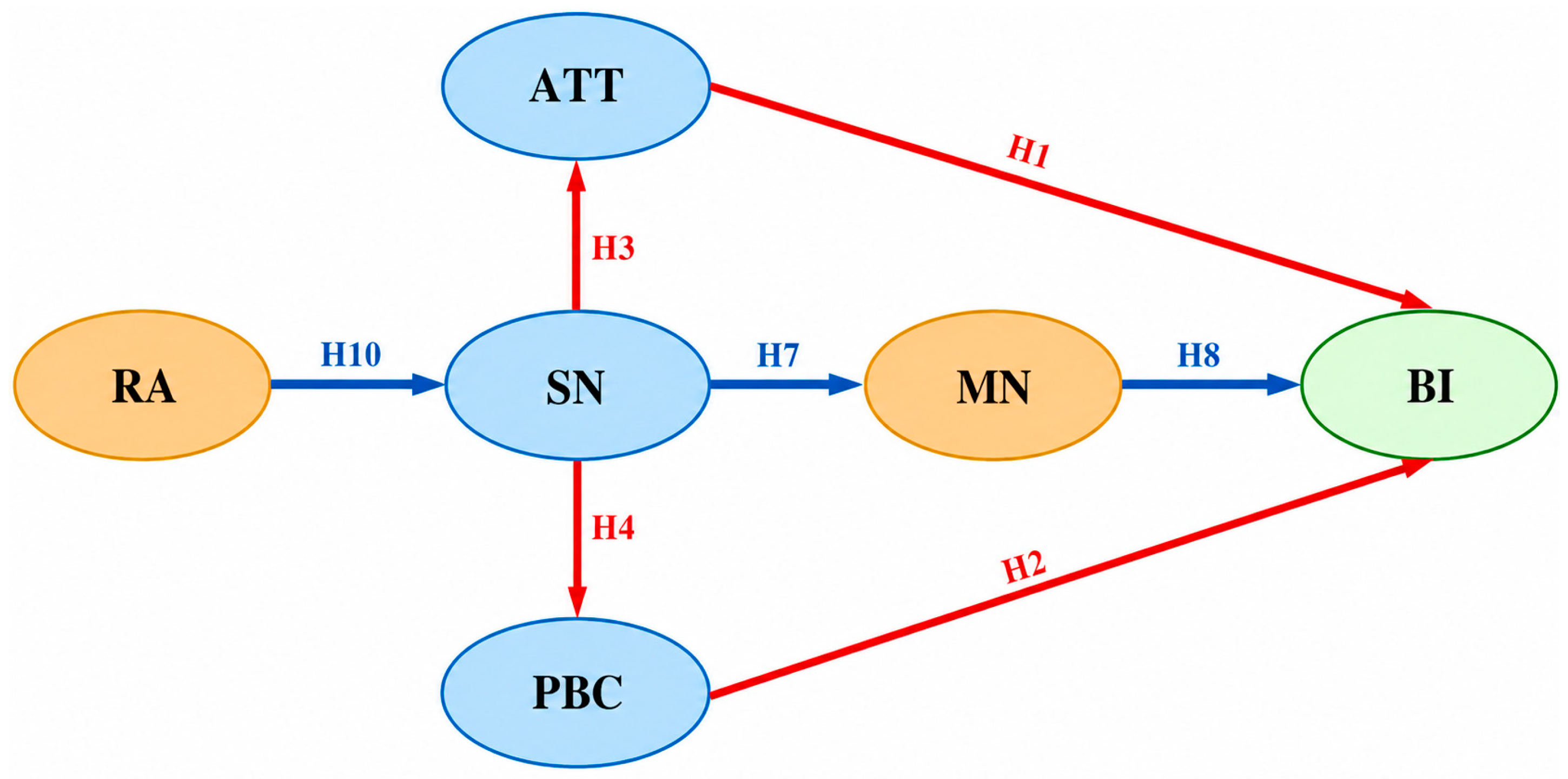
In accordance with the hypotheses outlined previously, Figure 1 illustrates the theoretical framework that serves as the foundation for this research.

3. Research Methodology

This study utilized the ‘Extended Theory of Planned Behavior’ to analyze the relationships among farmers’ ATT, SN, PBC, MN, RA and behavioral intention regarding waste plastic film recycling using structural equation modeling (SEM). SEM is particularly suitable for examining complex relationships among multiple latent variables and for evaluating both measurement quality and hypothesized structural paths. The measurement model delineates how observed indicators reflect latent constructs, while the structural model assesses the proposed relationships among those constructs. The basic equations are of the form:
Measurement modeling:
X = λ ξ + δ , Y = λ η + ε
Structural modeling:
η = γ ξ + β η + ζ
In Equation (1), X denotes the observed variables that measure the exogenous latent variable ξ . The variable ξ is identified as the exogenous latent construct, while λ represents the matrix of factor loadings associated with the indicator variables. Additionally, δ signifies the measurement error related to the X variable. Conversely, Y symbolizes the observed variables that assess the endogenous latent variable η . Here, η refers to the endogenous latent construct, and ε indicates the measurement error applicable to the Y variable. In Equation (2), γ embodies the matrix containing path coefficients that link exogenous latent variables to their endogenous counterparts, while β denotes the matrix that outlines the path coefficients between the endogenous latent variables. Lastly, ζ refers to the term for the residual error pertaining to the endogenous latent variables.

4. Data Collection and Questionnaire Design

4.1. Data Collection

Xinjiang is a significant agricultural region in the arid northwest of China, where the principal crops include cotton, wheat, and rice. The adoption of plastic film mulching is crucial for conserving soil moisture and enhancing crop yields. Nevertheless, continuous and large-scale use of mulch film has caused residual film to accumulate in farmland soils, thereby threatening soil environmental quality. To address this issue, a series of residual plastic film pollution control policies has been introduced by the Chinese government. During the implementation of these policies, farmers’ insufficient awareness and low participation have remained major barriers to effective pollution control. The primary objective of this study was to thoroughly investigate the various factors affecting the management of plastic film residue pollution specifically in the Xinjiang region. Therefore, Xinjiang was chosen as the case study region.
To improve the transparency of the sampling procedure, this study employed a multistage sampling strategy. First, several counties were sampled from the major cotton-producing counties in southern Xinjiang, where cotton cultivation relies heavily on plastic film mulching and therefore faces a relatively serious residual film pollution problem. Subsequently, four villages were chosen from each county as the survey sites, and 50 respondents were surveyed in each village. Third, with the assistance of local village committees, cotton-farming households were identified as the sampling frame. One adult household member who was directly involved in cotton production and familiar with plastic film use and recycling practices was invited to complete the questionnaire.
The survey in the field took place from 2024 to 2025. Before the survey began, each respondent was told about the study purpose, voluntary participation, and confidentiality of the collected information. Trained investigators conducted face-to-face interviews, which helped respondents, particularly those with limited formal education, understand the questionnaire items accurately. After removing questionnaires with substantial missing data, patterned responses, contradictions in reverse-coded items, or unusually short completion times, 429 valid responses remained, corresponding to a valid response rate of 75.13%.

4.2. Questionnaire Design

A structured questionnaire was employed to collect data for this study. The questionnaire items were developed based on the theoretical structure of the TPB and previous studies on moral norm and responsibility attribution. Indicators for ATT, SN, PBC, and BI were drawn and adapted from validated TPB-related literature, while items related to moral norm and responsibility attribution were modified from prior research on norm activation theory and environmentally responsible behavior [9,10,20]. All items were revised to suit the specific context of agricultural plastic film recycling among cotton farmers in Xinjiang.
Experts in agricultural environmental management and rural sustainability reviewed the initial questionnaire to evaluate its content validity and contextual relevance. Based on their suggestions, several items were reworded to improve clarity and consistency with farmers’ actual production practices. A pilot survey was then conducted with 93 cotton farmers prior to the formal investigation. The pilot results indicated that the respondents could understand the meaning of the items clearly. Several questions were slightly revised according to feedback obtained during the pilot survey. Therefore, the finalized questionnaire was considered suitable for the formal survey.
The finalized questionnaire contained two sections. The first part was a measurement scale for the willingness of farmers to recycle plastic film residues, and the second part collected socio-economic characteristics. To be more specific, the first part consisted of 18 items to measure the key psychological factors (e.g., ATT, SN, PBC, RA, MN, BI) that influence farmers’ recycling intentions. Among them, items PBC1, MN3, and BI1 were reverse-scored. These items were recoded before analysis to ensure consistency across items. The questionnaire employed a five-point Likert scale that varied from 1 (strongly disagree) to 5 (strongly agree). Farmers were asked to select the response that best reflected their actual situation from the five options. All items are presented in Table 1.

4.3. Data Analysis

The analysis of data utilized SPSS 27, AMOS 28, and SmartPLS 4. Descriptive statistics and reliability tests were first conducted, followed by confirmatory factor analysis and structural equation modeling. Prior to conducting SEM, the normality of the observed variables was assessed using skewness and kurtosis. The normality assessment followed the commonly accepted criteria that the absolute value of skewness should be less than 2 and the absolute value of kurtosis should be less than 7 [31]. The results indicated that the data did not seriously deviate from normality. Specifically, the absolute values for skewness varied between 0.699 and 1.391, while the absolute values for kurtosis ranged from 0.048 to 2.420. Therefore, the normality assumption was considered acceptable for subsequent SEM analysis. During data preprocessing, a small number of missing values were identified in the dataset. As the proportion of missing values was low, missing value imputation was applied to ensure data completeness and the validity of subsequent statistical analyses. Since all constructs were measured with five-point Likert items, the indicators were treated as approximately continuous variables for SEM estimation, which is commonly applied in SEM when the scale has five or more response categories and the data do not show serious non-normality. Indirect effects were evaluated through 5000 bootstrap resamples; mediation was considered significant when the 90% bias-corrected confidence interval excluded zero [32].

4.4. Sample Characteristics

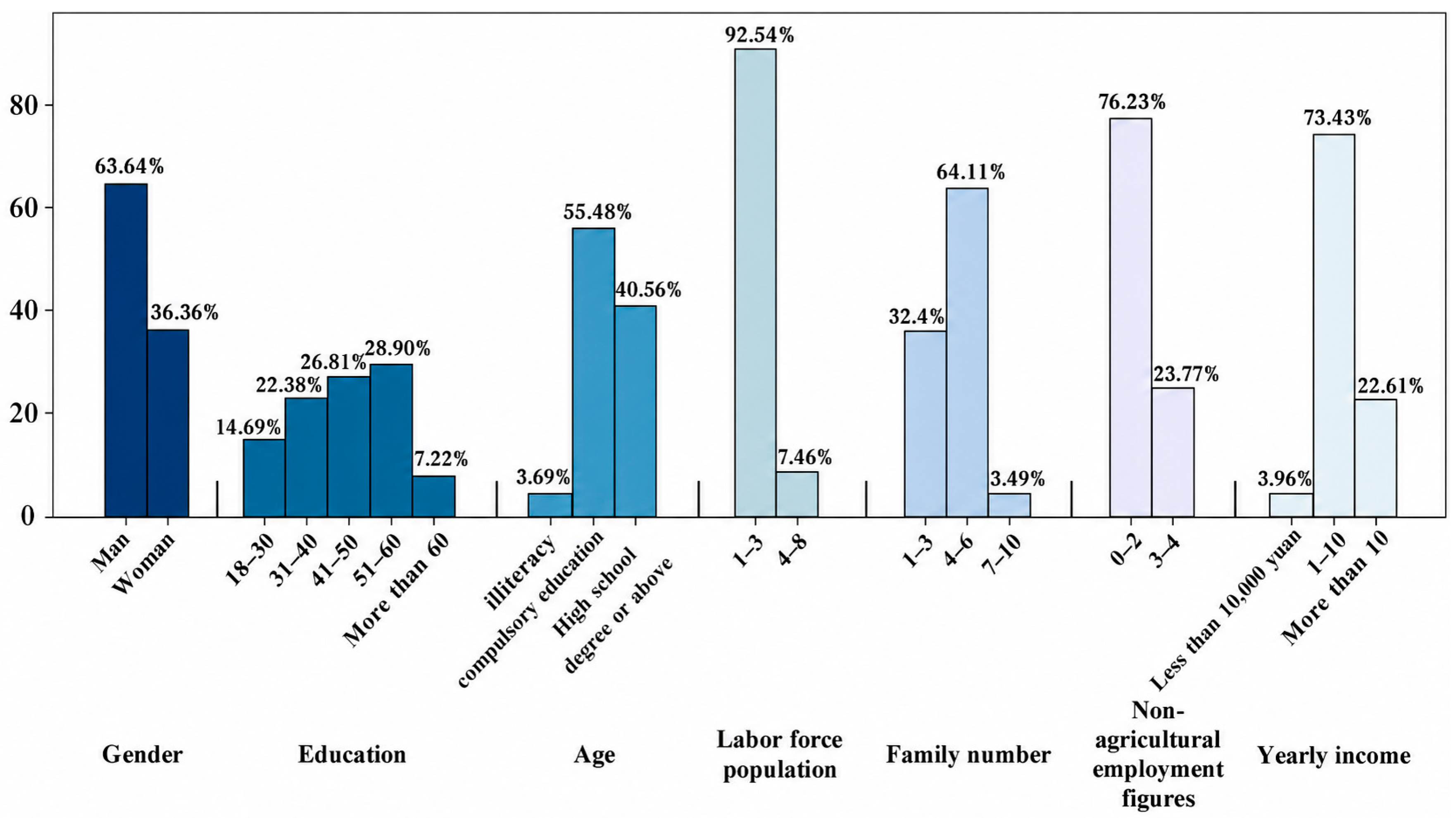
The respondents’ socio-demographic profile is summarized in Figure 2. Most respondents were male, accounting for 63.64%, while females accounted for 36.36%. This may be because men are often regarded as the household heads in rural families, and thus they are more likely to respond on behalf of the family when interviewed. Regarding age distribution, over half of the respondents (62.94%) were aged 40 years or above. This trend can be attributed to the aging rural population, as many young individuals typically migrate to urban areas for education or work, resulting in a workforce predominantly composed of middle-aged and older adults involved in agricultural activities. In terms of education level, 82.5% of respondents had completed high school or less, while 17.5% had some college education or more. One possible explanation is that the current group of middle-aged and elderly farmers grew up in an era when educational resources were relatively scarce, and educational conditions in rural areas were limited, resulting in a generally low educational attainment. As for family composition, the average household size within the sample was four members, with an average of two adult laborers per household. During the agricultural off-season, a portion of rural laborers went out to work. This resulted in over 92% of households having three or fewer non-agricultural workers. Most respondents indicated that their yearly household income was in the range of RMB 10,000 to 100,000 (73.4%), with the remainder reporting incomes above RMB 100,000. Overall, the respondents were primarily male, and middle-aged or older, and had relatively low levels of formal education. This composition is partly consistent with the structure of agricultural decision-makers in rural cotton-producing areas of southern Xinjiang, where male household heads and older farmers are more likely to be directly involved in farming decisions and to respond to household-level agricultural surveys.

5. Results

5.1. Reliability Analysis

To assess the likelihood of common method bias in the study, Harman’s single-factor test was employed. This process involved incorporating all measurement items into an exploratory factor analysis to determine if a single factor would dominate the variance explained by the measures. The results revealed that the first unrotated factor captured 37.024% of the total variance. This percentage is notably below the commonly recognized threshold of 40%. As a result of these findings, it can be concluded that the issue of common method bias is not a significant concern in the context of this research.
Before conducting SEM, an evaluation of the reliability of the measurement scales was conducted. When Cronbach’s alpha exceeds 0.7 [33,34], and all standardized factor loadings exceed 0.6, it indicates that the scale data have adequate reliability. All standardized factor loadings exceeded 0.6, with Cronbach’s alpha also exceeding 0.7. Therefore, the scales demonstrated good reliability. The results of the internal consistency assessment for the questionnaire are shown in Table 2.

5.2. Validity Analysis

5.2.1. Exploratory Factor Analysis

To assess the appropriateness of the dataset for factor analysis, KMO and Bartlett’s tests of sphericity were employed. The findings revealed a KMO value of 0.915 and a p-value for Bartlett’s test of sphericity that was less than 0.001. These results affirmed the adequacy of the data for conducting factor analysis.

5.2.2. Confirmatory Factor Analysis (CFA)

After the reliability test was conducted on the data, a validity test was conducted. This study utilized CFA to evaluate the goodness of fit for the measurement model. The outcomes showed that all items had significant standardized factor loadings (SFL > 0.6), and the model fit indices met the recommended standards. Furthermore, Table 2 provides an overview of the AVE and the composite reliability (CR) results for the study. The findings indicated that the CR values surpassed the threshold of 0.7, which is considered a benchmark for establishing adequate reliability. Similarly, the AVE values were found to be greater than 0.5, suggesting that the constructs measured in the model demonstrated a sufficient level of convergent validity. The model fit indices were all within the acceptable ranges.
To assess the discriminant validity within the study, the heterotrait–monotrait correlation ratio (HTMT) was employed as a key statistical measure. According to the commonly recommended criterion, HTMT values below 0.85 indicate adequate discriminant validity, while a threshold of 0.90 is sometimes considered acceptable for conceptually related constructs [35]. The findings, detailed in Table 3, indicated that all calculated HTMT values fell within the range of 0.340 to 0.758. In the context of agricultural environmental governance, farmers’ moral obligations may be closely associated with both their positive evaluation of recycling and the expectations of family members, neighbors, village committees, and local governments. Therefore, the results confirmed adequate discriminant validity among the constructs and the relatively high HTMT values indicated conceptual relatedness.

5.3. Model Fit Test

Table 4 reports the model fit results. The results show that c2/df = 1.805, RMSEA = 0.043, AGFI = 0.924, GFI = 0.946, RMR = 0.034, NFI = 0.937, CFI = 0.971, IFI = 0.971, and TLI = 0.963. These findings indicated that all measured indicators met the goodness-of-fit standards, implying a favorable fit for the model.

5.4. Structural Equation Model (SEM)

The R2 values of the endogenous constructs were used to assess the explanatory power of the structural model utilized in this analysis. In accordance with the results presented in Table 5, it was found that the model accounted for 32.7% of the variance observed in behavioral intention. This result indicated that the extended TPB model provided an acceptable level of explanatory power for farmers’ intention to recycle residual plastic film. Given that farmers’ recycling intention may also be influenced by external conditions such as recycling facilities, subsidies, labor availability, and local policy implementation, the R2 value should be interpreted as evidence of the model’s explanatory adequacy. The main contribution of incorporating moral norm and responsibility attribution lies in revealing the normative and responsibility-related mechanisms underlying farmers’ recycling intentions.

5.4.1. Hypothesis Testing for Direct Effects

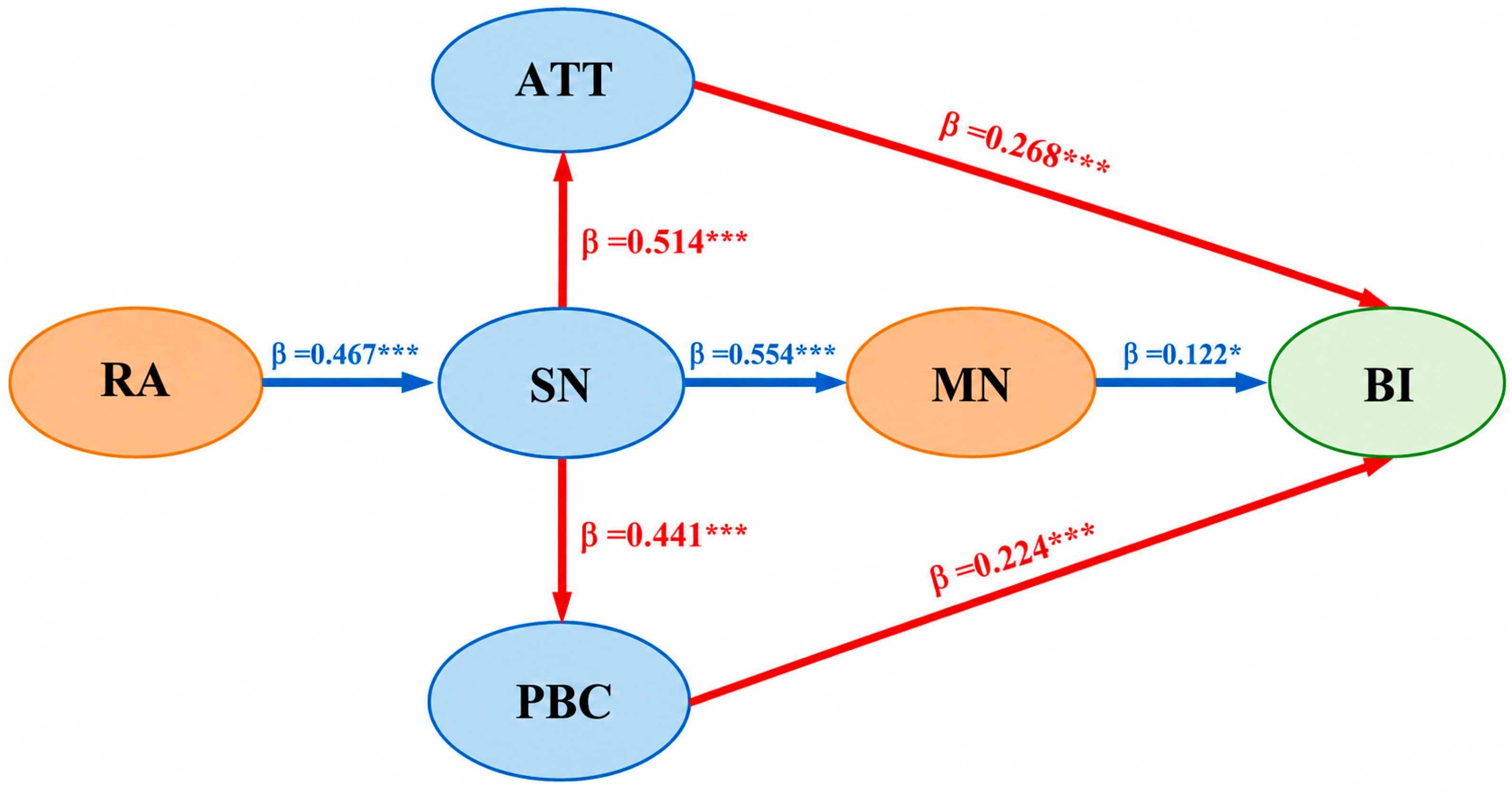
To better understand the interrelationships among these variables, the SEM was employed to evaluate the hypotheses, as illustrated in Figure 3 and Table 6. The findings indicated that farmers’ ATT towards plastic film waste recycling and their PBC had a significant positive effect on their behavioral intentions, thus supporting hypotheses H1 and H2. SN positively and significantly influenced ATT and PBC, which supported hypotheses H3 and H4. SN was associated with farmers’ moral norm, and hypothesis H7 was supported. Farmers’ MN regarding recycling positively affected behavioral intention, so hypothesis H8 was marginally supported. RA positively influenced farmers’ SN, thereby supporting hypothesis H10.

5.4.2. Hypothesis Testing for Mediating Effects

Table 7 demonstrates that there was no statistically significant direct relationship between subjective norm and behavioral intention. Regarding the mediation effects, the bootstrap results confirmed the indirect influence of subjective norm on behavioral intention via perceived behavioral control, moral norm, and attitude. The total indirect effect accounted for 78.45% of the total effect. Therefore, the mediation pattern was identified as indirect-only mediation, indicating that subjective norm is associated with farmers’ recycling intention mainly through attitude, perceived behavioral control, and moral norm. Therefore, hypotheses H5 and H6 were supported, whereas hypothesis H9 was marginally supported.

6. Discussion

This study utilized the ETPB framework to examine the intentions of farmers to recycle residual plastic film in Xinjiang. The findings demonstrated that integrating MN and RA into the TPB provided additional explanatory insights for farmers’ behavioral intentions. Moreover, apart from the core TPB constructs (ATT, SN, PBC), MN directly influenced recycling intentions, while RA indirectly contributed to intention formation by shaping SN. Therefore, strengthening farmers’ sense of responsibility and establishing appropriate moral norms may help promote recycling participation and alleviate the adverse effects of residual film pollution.
In this study, the result for H1 showed that ATT significantly and positively predicted the farmers’ BI. This finding aligns with prior research [8,16]. The results of H2 indicated that PBC had a significantly positive influence on farmers’ BI, which is consistent with the findings of Zhang [36], Novak [15], and Erekalo [37]. The importance of ATT and PBC shows that farmers’ recycling intention depends on both their evaluation of recycling value and their perception of practical feasibility. A positive attitude reflects farmers’ recognition of the environmental and agricultural benefits of residual film recycling, such as reducing soil pollution and protecting crop production. However, attitude alone may not be sufficient to ensure participation. Farmers also need to believe that recycling is practically achievable in terms of time, labor, collection facilities, transportation convenience, and economic costs. This may explain why PBC holds a crucial role in the formation of recycling intention. In the context of southern Xinjiang, where cotton cultivation is highly dependent on plastic film mulching, farmers may support recycling in principle, but their actual willingness depends heavily on whether recycling channels are accessible and whether the required labor and transaction costs are acceptable. Thus, policy interventions should not only improve farmers’ environmental attitudes, but also reduce the practical barriers that weaken their PBC.
Furthermore, SN exerts a significant positive indirect effect on farmers’ BI via ATT and PBC, which is consistent with the findings of Peng [38]. This suggests that social expectations need to be transformed into farmers’ value judgments, perceived feasibility, or moral obligations before shaping recycling intentions. The stronger roles of attitude and PBC, relative to SN, may be explained by the production-oriented characteristics of residual film recycling in Xinjiang. For farmers, recycling used plastic film is not merely an environmental action, but also a production-related practice involving labor input, time costs, transportation convenience, access to collection points, and perceived benefits for soil quality. Farmers are therefore more inclined to recycle when they view the activity as beneficial and believe that the necessary resources and opportunities are available.
The socio-economic and institutional conditions in southern Xinjiang further explain why SN mainly influenced BI through indirect pathways rather than through a direct effect. Many farmers are middle-aged or elderly, have relatively low education levels, and depend strongly on agricultural income. Under these conditions, external expectations from family members, neighbors, village committees, and local governments may not directly translate into recycling intention unless farmers perceive the behavior as beneficial and feasible. Thus, subjective norm may operate mainly through ATT, PBC, and MN rather than as a strong direct predictor. Residual film recovery is closely connected with government-led rural environmental governance, village-level mobilization, subsidies, and recycling infrastructure. Therefore, improving recycling participation requires a combination of social mobilization, institutional support, and practical measures that reduce anticipated behavioral barriers.
The finding that RA is associated with farmers’ SN (H10) is also in accordance with previous findings [39,40,41]. The assignment of responsibility is considered a significant factor influencing intentions toward environmentally responsible behavior, as it indicates individuals’ recognition of their duty concerning the adverse effects of failing to engage in pro-environmental practices [42]. When individuals internally attribute responsibility, they translate external social expectations into personal responsibilities and obligations, thereby strengthening the influence of SN. Conversely, an external attribution leads individuals to reject such expectations as outside their duty, which weakens the influence of SN. In other words, if farmers perceive that they themselves bear primary responsibility for residual plastic film pollution, expectations expressed by the village collective and the government regarding residual film recycling will be interpreted as their own environmental obligation. If farmers attribute responsibility for residual plastic film pollution to the government’s insufficient development of recycling policies and systems, then even when their family members and the village committee strongly expect them to recycle used plastic film, farmers may regard it as “not my responsibility” and therefore decline to engage in such recycling behavior. This result suggests that responsibility attribution is an important psychological condition under which external expectations from village committees, neighbors, and family members become more acceptable to farmers.
The result for H7 indicated that SN significantly and positively affected the farmers’ moral norm. Stronger perceived social expectations among farmers are associated with clearer internal standards and a stronger moral norm. This suggests that village cadres and community role models may help transform external social expectations into farmers’ internal moral obligations. While traditional theoretical frameworks often treat these two constructs as parallel predictors of behavioral intention, this significant positive influence reveals that subjective norm is an important antecedent of moral norm. The results for H8 showed that MN influenced farmers’ intentions to recycle residual plastic film. MN refers to individuals’ beliefs and perceptions about whether a given behavior is morally acceptable or not [43]; it reflects internal ethical standards and a sense of responsibility rather than external pressure. In other words, farmers tend to be more inclined to participate in recycling efforts when they view it as an ethical duty and feel a personal responsibility for minimizing residual film pollution. This is congruent with the findings of Emmanouil [10]. Although the SN to MN path was strong, the MN to BI path was only marginally significant. The mediation pathway through which SN is associated with BI via MN should be interpreted as suggestive. Practically, this means that moral appeals alone may not be sufficient to substantially increase recycling intention unless they are combined with measures that improve farmers’ attitudes and perceived behavioral control, such as reducing recycling costs, improving collection-point accessibility, and providing reliable recycling services.
This study has demonstrated that farmers’ ATT mediates the relationship between SN and behavioral intention. Previous research has demonstrated the effectiveness of treating attitude as a mediating variable [44,45]. This indicates that social expectations may influence farmers’ recycling intentions by reshaping their evaluations of residual film recycling. In rural communities, expectations from family members, neighbors, village committees, and local governments can make farmers more aware of the environmental and production-related value of recycling. When these expectations are accepted, farmers may develop more positive attitudes toward recycling and perceive it as beneficial for soil protection, crop production, and rural environmental governance.
These findings are also comparable to international studies using the TPB framework in agricultural and environmental contexts. For example, studies on Iranian farmers’ safe use of chemical fertilizers and Nepalese farmers’ pesticide safety behavior have also emphasized the importance of farmers’ perceived capability, resources, and behavioral feasibility in shaping pro-environmental or safety-related intentions [12,14]. Similarly, research on farmers’ intention to learn about sustainability in Slovenia suggests that farmers’ behavioral intention is closely associated with perceived opportunities and the practical conditions that enable action [15]. Compared with household waste separation or conservation behaviors, in which moral or social norms may exert a more direct influence, agricultural plastic film recycling is more strongly constrained by production conditions and local recycling infrastructure [10,43]. Therefore, the present findings suggest that the relative importance of TPB constructs is context-dependent: subjective norm remains important, but in resource- and infrastructure-dependent agricultural practices, attitude and perceived behavioral control may become the more immediate drivers of behavioral intention.
The unique contribution of this research is not just in enhancing the TPB by incorporating moral norm and the attribution of responsibility, but in applying and verifying this framework in the specific context of agricultural plastic film recycling. This context differs from general recycling behavior because it is closely embedded in agricultural production, rural governance, soil environmental protection, and government-led recycling systems. By examining the mediating role of moral norm between subjective norm and behavioral intention, and by identifying responsibility attribution as an antecedent of subjective norm, this study provides new empirical evidence on how external social expectations are transformed into internal moral obligations among farmers. These findings offer context-specific theoretical and practical insights into improving farmers’ participation in residual film recovery.

7. Conclusions and Policy Suggestions

7.1. Main Findings

This research uses an ETPB framework to examine the factors influencing farmers’ willingness to recycle residual plastic film. To overcome the limitations of the original TPB, this study develops an extended theoretical model by incorporating MN and RA. The results indicate that the ETPB with MN and RA helps reveal the normative and responsibility-related mechanisms underlying farmers’ behavioral intentions. The primary findings are outlined below.
  • Farmers’ ATT and PBC are positively and significantly related with their BI to recycle leftover plastic film. Therefore, ATT and PBC are important determinants of farmers’ willingness to recycle residual plastic film.
  • SN shows a significantly positive influence on PBC and ATT. It also indirectly affects behavioral intention via attitude and PBC, demonstrating that these constructs are interrelated.
  • RA shows a considerable positive influence on SN. Farmers who perceive themselves as responsible for residual plastic film pollution are more likely to regard the recycling expectations of the village collective and the government as personal environmental obligations. This perception may further encourage their participation in recycling behavior.
  • Farmers’ SN shows a marginal indirect association with recycling intention through MN. When farmers perceive a positive subjective norm toward residual film recovery within their social group, they internalize these external social expectations as personal moral obligations, which may in turn promote recycling behavior.

7.2. Policy Suggestions

Given these findings, this study offers recommendations to the Chinese government to encourage farmers’ participation in residual film pollution control.
First, environmental education should be strengthened. Public awareness and educational programs on the hazards of residual plastic film pollution should be implemented in rural areas. Through on-site training sessions and short educational videos, the long-term detrimental effects of residual film on soil and crops should be communicated, thereby enhancing farmers’ risk perception and improving farmers’ overall environmental literacy. These initiatives should be supported by village broadcast systems and wall slogans to further reinforce farmers’ moral awareness and environmental consciousness.
Second, the construction of village-level collection systems should be strengthened. Fixed collection points could be established near village committees, agricultural machinery stations, or main cotton-producing areas, while temporary collection points could be arranged during the peak recycling period after harvest. Centralized transport services should be provided for remote villages to reduce farmers’ transportation costs and improve perceived behavioral control.
Third, local governments should encourage farmers to participate in environmental monitoring and problem-solving initiatives, thereby fostering their awareness and responsibility for soil environmental protection.
Fourth, local governments could establish a performance-based subsidy mechanism in which farmers receive subsidies according to the amount of residual film recycled, the frequency of recycling, or the area from which residual film is collected. Additional incentives, such as agricultural material vouchers, transport subsidies, or priority access to technical services, could be provided to farmers who participate continuously in recycling programs.
Finally, villages should formulate rules and agreements for the recycling of plastic film residue, incorporating such behavior into the selection criteria for “civilized households” and “model households”. Neighbor demonstrations and collective recycling activities can further reinforce a shared norm of participation within the community. In this way, subjective norm can be leveraged to promote attitudinal change among farmers and enhance their perceived behavioral control.

7.3. Limitations

This research affirmed the significance of the TPB components; however, it is important to recognize its limitations.
First, this study focused on farmers’ behavioral intention. Future studies could include actual recycling frequency, verified participation in recycling programs, or the amount of residual plastic film recycled as behavioral indicators.
Second, the sample was restricted to cotton farmers in Xinjiang, China. Although Xinjiang is a typical region with intensive plastic film mulching and serious residual film pollution, its agricultural conditions, crop structure, policy environment, and recycling infrastructure may differ from those of other regions. Therefore, caution is needed when extending these findings to other regions or crop systems. In addition, the sample composition represents another limitation. Most respondents were male, and middle-aged or older, and had relatively low education levels. Although this demographic pattern reflects, to some extent, the characteristics of household agricultural decision-makers in the surveyed cotton-growing areas, it may restrict how broadly the findings can be applied to other groups of farmers.
Third, the cross-sectional research design limits the capacity to make causal inferences. Future studies could utilize longitudinal data to investigate shifts in farmers’ attitudes, perceived behavioral control, moral norm, recycling intentions, and actual recycling behavior over time. In addition, integrating questionnaire findings with accurate recycling data or on-site observations could reduce the potential influence of common method bias and social desirability bias.

7.4. Concluding Remarks

Overall, this study demonstrates that extending the TPB with moral norm and responsibility attribution provides a useful framework for explaining farmers’ residual plastic film recycling intentions.
The scientific relevance of this study lies in applying and extending the TPB within the context of agricultural plastic film recycling, a representative issue in agricultural environmental governance. By linking the practical characteristics of residual film recycling with farmers’ psychological decision-making processes, this study shows how attitudes, perceived behavioral control, social expectations, moral obligations, and perceived responsibility jointly shape farmers’ recycling intentions. These findings provide empirical evidence on the psychological and normative mechanisms underlying farmers’ environmental decision-making, contribute to the literature on agricultural environmental governance, pro-environmental behavior, and plastic pollution control, and offer useful evidence for designing more effective policies to promote sustainable agricultural waste management in regions facing serious residual film pollution.


Author Contributions

Conceptualization, B.M.; methodology, Y.Z. (Yufei Zhang) and B.M.; investigation, Y.Z. (Yufei Zhang), Y.Z. (Yong Zeng), B.M., Y.X. and J.L.; data collection, Y.Z. (Yufei Zhang), Y.Z. (Yong Zeng) and Y.X.; writing—original draft, Y.Z. (Yufei Zhang); writing—review and editing, Y.Z. (Yufei Zhang), Y.Z. (Yong Zeng) and B.M.; funding acquisition, B.M. All authors have read and agreed to the published version of the manuscript.

Funding

This research was funded by the Guiding Science and Technology Program Project of XPCC, grant number 2024ZD108, and Presidential Foundation of Tarim University, grant number TDZKBS202405.

Institutional Review Board Statement

This study was exempted from ethical review by the Ethics Committee of Tarim University because it involved voluntary, anonymous, questionnaire-based data collection.

Informed Consent Statement

Informed consent was obtained from all subjects involved in the study.

Data Availability Statement

The data presented in this study are available on request from the corresponding author. (The data are not publicly available due to privacy or ethical restrictions.)

Conflicts of Interest

The authors declare no conflicts of interest.

Abbreviations

The following abbreviations are used in this manuscript:
TPBTheory of Planned Behavior
ETPBExtended Theory of Planned Behavior
ATTAttitude
PBCPerceived Behavioral Control
SNSubjective Norm
BIBehavioral Intention
MNMoral Norm
RAResponsibility Attribution

References

  1. Dong, H.; Yang, G.; Zhang, Y.; Yang, Y.; Wang, D.; Zhou, C. Recycling, Disposal, or Biodegradable-Alternative of Polyethylene Plastic Film for Agricultural Mulching? A Life Cycle Analysis of Their Environmental Impacts. J. Clean. Prod. 2022, 380, 134950. [Google Scholar] [CrossRef] [Scilit]
  2. Qiang, L.; Hu, H.; Li, G.; Xu, J.; Cheng, J.; Wang, J.; Zhang, R. Plastic Mulching, and Occurrence, Incorporation, Degradation, and Impacts of Polyethylene Microplastics in Agroecosystems. Ecotoxicol. Environ. Saf. 2023, 263, 115274. [Google Scholar] [CrossRef] [Scilit]
  3. Zhao, Z.-Y.; Wang, P.-Y.; Xiong, X.-B.; Wang, Y.-B.; Zhou, R.; Tao, H.-Y.; Grace, U.A.; Wang, N.; Xiong, Y.-C. Environmental Risk of Multi-Year Polythene Film Mulching and Its Green Solution in Arid Irrigation Region. J. Hazard. Mater. 2022, 435, 128981. [Google Scholar] [CrossRef] [Scilit]
  4. Zhao, Z.-Y.; Li, W.-B.; Wang, P.-Y.; Tao, H.-Y.; Zhou, R.; Cui, J.-Y.; Zhang, J.; Tian, T.; Zhao, X.-Z.; Wang, Y.-B.; et al. Farmers’ Participation into the Recovery of Waste Agricultural Plastic Film: An Application of the Theory of Planned Behavior. Waste Manag. 2023, 169, 253–266. [Google Scholar] [CrossRef] [Scilit]
  5. Ministry of Agriculture of the People’s Republic of China. Notice of the Ministry of Agriculture on Issuing the “Action Plan for Agricultural Film Recycling”. Document No.: Nongkejiaofa [2017] No. 8. 2017. Available online: https://www.moa.gov.cn/govpublic/KJJYS/201705/t20170518_5612288.htm (accessed on 18 January 2025).
  6. Ministry of Agriculture and Rural Affairs of the People’s Republic of China. Opinions on Accelerating the Prevention and Control of Agricultural Plastic Mulch Film Pollution. Ministry of Agriculture and Rural Affairs Gazette, Issue 7. 2019. Available online: https://www.moa.gov.cn/nybgb/2019/201907/202001/t20200103_6334258.htm (accessed on 10 January 2025).
  7. Xue, Y.; Guo, J.; Li, C.; Xu, X.; Sun, Z.; Xu, Z.; Feng, L.; Zhang, L. Influencing Factors of Farmers’ Cognition on Agricultural Mulch Film Pollution in Rural China. Sci. Total Environ. 2021, 787, 147702. [Google Scholar] [CrossRef] [Scilit]
  8. Cammarata, M.; Scuderi, A.; Timpanaro, G.; Cascone, G. Factors Influencing Farmers’ Intention to Participate in the Voluntary Carbon Market: An Extended Theory of Planned Behavior. J. Environ. Manag. 2024, 369, 122367. [Google Scholar] [CrossRef] [Scilit]
  9. Savari, M.; Damaneh, H.E.; Damaneh, H.E.; Cotton, M. Integrating the Norm Activation Model and Theory of Planned Behaviour to Investigate Farmer Pro-Environmental Behavioural Intention. Sci. Rep. 2023, 13, 5584. [Google Scholar] [CrossRef] [Scilit]
  10. Emmanouil, C.; Chachami-Chalioti, S.Ε.; Kyzas, G.Z.; Kungolos, A. Application of the Theory of Planned Behavior to Predict Waste Source Separation. Sci. Total Environ. 2024, 956, 177356. [Google Scholar] [CrossRef] [Scilit]
  11. Randall, T.; Cousins, A.L.; Neilson, L.; Price, M.; Hardman, C.A.; Wilkinson, L.L. Sustainable Food Consumption across Western and Non-Western Cultures: A Scoping Review Considering the Theory of Planned Behaviour. Food Qual. Prefer. 2024, 114, 105086. [Google Scholar] [CrossRef] [Scilit]
  12. Savari, M.; Gharechaee, H. Application of the Extended Theory of Planned Behavior to Predict Iranian Farmers’ Intention for Safe Use of Chemical Fertilizers. J. Clean. Prod. 2020, 263, 121512. [Google Scholar] [CrossRef] [Scilit]
  13. Ajzen, I. The Theory of Planned Behavior. Organ. Behav. Hum. Decis. Process. 1991, 50, 179–211. [Google Scholar] [CrossRef] [Scilit]
  14. Sapkota, U.; Adhikari, S.; Bhandari, G. Farmers’ Behavioral Intention towards Pesticide Safety in Nepal: An Assessment of the Extended Theory of Planned Behavior. J. Environ. Manag. 2025, 389, 126185. [Google Scholar] [CrossRef] [Scilit]
  15. Novak, A.; Alif, Ž.; Juvančič, L.; Šumrada, T. What Affects Farmers’ Intention to Learn about Sustainability in Online Settings? An Application of the Extended Theory of Planned Behaviour in Slovenia. J. Rural Stud. 2025, 114, 103548. [Google Scholar] [CrossRef] [Scilit]
  16. Zhang, X.; Wu, Y.; Li, L.; Sun, C.; Yang, S.; Lu, J.; Wang, W. Analyzing Determinants of Farmers’ Participation in Agricultural Non-Point Source Pollution Control: An Application of the Theory of Planned Behavior. Sustainability 2025, 17, 5746. [Google Scholar] [CrossRef] [Scilit]
  17. Shi, R.; Hou, L.; Jia, B.; Jin, Y.; Zheng, W.; Wang, X.; Hou, X. Effect of Policy Cognition on the Intention of Villagers’ Withdrawal from Rural Homesteads. Land 2022, 11, 1356. [Google Scholar] [CrossRef] [Scilit]
  18. Shipley, N.J.; Van Riper, C.J. Pride and Guilt Predict Pro-Environmental Behavior: A Meta-Analysis of Correlational and Experimental Evidence. J. Environ. Psychol. 2022, 79, 101753. [Google Scholar] [CrossRef] [Scilit]
  19. Li, Y.; Bhutto, M.Y.; Sun, C.; Mehdi, S.M. Do Information Publicity and Moral Norms Trigger Waste-Sorting Intention among Households? A Sequential Mediation Analysis. Front. Psychol. 2023, 14, 1193411. [Google Scholar] [CrossRef] [Scilit]
  20. Ai, P.; Rosenthal, S. The Model of Norm-Regulated Responsibility for Proenvironmental Behavior in the Context of Littering Prevention. Sci. Rep. 2024, 14, 9289. [Google Scholar] [CrossRef] [Scilit]
  21. De Groot, J.I.M.; Steg, L. Morality and Prosocial Behavior: The Role of Awareness, Responsibility, and Norms in the Norm Activation Model. J. Soc. Psychol. 2009, 149, 425–449. [Google Scholar] [CrossRef] [Scilit] [PubMed]
  22. Thøgersen, J. The Mediated Influences of Perceived Norms on Pro-Environmental Behavior. Rev. D’économie Polit. 2014, 124, 179–193. [Google Scholar] [CrossRef] [Scilit]
  23. Kaiser, F.G.; Shimoda, T.A. Responsibility as a predictor of ecological behaviour. J. Environ. Psychol. 1999, 19, 243–253. [Google Scholar] [CrossRef] [Scilit]
  24. Abadi, B. Impact of Attitudes, Factual and Causal Feedback on Farmers’ Behavioral Intention to Manage and Recycle Agricultural Plastic Waste and Debris. J. Clean. Prod. 2023, 424, 138773. [Google Scholar] [CrossRef] [Scilit]
  25. Yan, L.; Zhao, X.; Zhang, D.; Deng, J.; Zhang, Y. Associated Factors of Pesticide Packaging Waste Recycling Behavior Based on the Theory of Planned Behavior in Chinese Fruit Farmers. Sustainability 2022, 14, 10937. [Google Scholar] [CrossRef] [Scilit]
  26. Li, C.; Sun, M.; Xu, X.; Zhang, L.; Guo, J.; Ye, Y. Environmental Village Regulations Matter: Mulch Film Recycling in Rural China. J. Clean. Prod. 2021, 299, 126796. [Google Scholar] [CrossRef] [Scilit]
  27. Xie, X.; Wang, H.; Zhang, S.; Liu, Y. How to Incentivize Farmers to Adopt and Recycle High-Standard Plastic Mulch in China: Economic Subsidies, Government Regulations or Social Norms? Front. Environ. Sci. 2025, 13, 1683437. [Google Scholar] [CrossRef] [Scilit]
  28. Gu, X.; Yin, R.; Cai, W.; Chen, P.; Cui, K.; Du, Y.; Li, Y.; Cai, H. Residual Plastic Film Decreases Crop Yield and Water Use Efficiency through Direct Negative Effects on Soil Physicochemical Properties and Root Growth. Sci. Total Environ. 2024, 946, 174204. [Google Scholar] [CrossRef] [Scilit] [PubMed]
  29. Zhao, C.; Wang, Y.; Lian, Z.; Zhang, Z.; Ma, S.; Matsubae, K. Agricultural Plastic Pollution in China: Sources, Supply Chain Drivers, and Mitigation Strategies. Sustain. Horiz. 2024, 11, 100102. [Google Scholar] [CrossRef] [Scilit]
  30. Cao, J.; Qiu, H.; Morrison, A.M. Self-Identity Matters: An Extended Theory of Planned Behavior to Decode Tourists’ Waste Sorting Intentions. Int. J. Environ. Res. Public Health 2023, 20, 5099. [Google Scholar] [CrossRef] [Scilit]
  31. Rigdon, E.E.; Hoyle, R.H. Structural Equation Modeling: Concepts, Issues, and Applications. J. Mark. Res. 1997, 34, 412. [Google Scholar] [CrossRef] [Scilit]
  32. Fang, W.; Wu, T.-H.; Chang, T.-W.; Hung, C.-Z. What Could Entrepreneurial Vision Do for Sustainable Development? Explore the Cross-Level Impact of Organizational Members’ Green Shared Vision on Green Creativity. Sustainability 2021, 13, 5364. [Google Scholar] [CrossRef] [Scilit]
  33. Cronbach, L.J. Coefficient Alpha and the Internal Structure of Tests. Psychometrika 1951, 16, 297–334. [Google Scholar] [CrossRef] [Scilit]
  34. Nunnally, J.C. Psychometric Theory 3E; Tata McGraw-Hill Education: Noida, India, 1994; ISBN 978-0-07-107088-1. [Google Scholar]
  35. Henseler, J.; Ringle, C.M.; Sarstedt, M. A New Criterion for Assessing Discriminant Validity in Variance-Based Structural Equation Modeling. J. Acad. Mark. Sci. 2015, 43, 115–135. [Google Scholar] [CrossRef] [Scilit]
  36. Zhang, K.; Li, F.; Li, H.; Yin, C. Revealing Urban Residents’ Intention to Pay for the Greening of Farmland in the Urban Fringe by Extending the Theory of Planned Behavior: Insights from Payment for Ecosystem Services. Land Use Policy 2024, 141, 107127. [Google Scholar] [CrossRef] [Scilit]
  37. Erekalo, K.T.; Gemtou, M.; Kornelis, M.; Pedersen, S.M.; Christensen, T.; Denver, S. Understanding the Behavioral Factors Influencing Farmers’ Future Adoption of Climate-Smart Agriculture: A Multi-Group Analysis. J. Clean. Prod. 2025, 510, 145632. [Google Scholar] [CrossRef] [Scilit]
  38. Peng, M.; Cai, Z.; Chen, K.; Yin, C.; Ao, C.; Ren, H. How Risk Perception of Air Pollution Influences Consumers’ Pro-Environmental Behaviors: An Empirical Study Based on the Extended Theory of Planned Behavior. Sustainability 2025, 17, 2414. [Google Scholar] [CrossRef] [Scilit]
  39. Arkorful, V.E.; Lugu, B.K.; Shuliang, Z. Unearthing Mask Waste Separation Behavior in COVID-19 Pandemic Period: An Empirical Evidence from Ghana Using an Integrated Theory of Planned Behavior and Norm Activation Model. Curr. Psychol. 2023, 42, 8515–8530. [Google Scholar] [CrossRef] [Scilit] [PubMed]
  40. Ju, C.; Wang, S. Determinants of Consumer Intention to Use Autonomous Delivery Vehicles: Based on the Planned Behavior Theory and Normative Activation Model. Humanit. Soc. Sci. Commun. 2025, 12, 340. [Google Scholar] [CrossRef] [Scilit]
  41. Schrank, J.; Hanchai, A.; Thongsalab, S.; Sawaddee, N.; Chanrattanagorn, K.; Ketkaew, C. Factors of Food Waste Reduction Underlying the Extended Theory of Planned Behavior: A Study of Consumer Behavior towards the Intention to Reduce Food Waste. Resources 2023, 12, 93. [Google Scholar] [CrossRef] [Scilit]
  42. Ding, Z.; Wen, X.; Zuo, J.; Chen, Y. Determinants of Contractor’s Construction and Demolition Waste Recycling Intention in China: Integrating Theory of Planned Behavior and Norm Activation Model. Waste Manag. 2023, 161, 213–224. [Google Scholar] [CrossRef] [Scilit]
  43. Richards, J.C.; Miller, Z.D.; Norvell, R.; Smith, J.W. Integrating Moral Norms and Stewardship Identity into the Theory of Planned Behavior to Understand Altruistic Conservation Behavior among Hunters in Southwestern Utah (USA). Hum. Dimens. Wildl. 2024, 29, 670–690. [Google Scholar] [CrossRef] [Scilit]
  44. Karimi, S.; Saghaleini, A. Factors Influencing Ranchers’ Intentions to Conserve Rangelands through an Extended Theory of Planned Behavior. Glob. Ecol. Conserv. 2021, 26, e01513. [Google Scholar] [CrossRef] [Scilit]
  45. Liu, M.T.; Liu, Y.; Mo, Z. Moral Norm Is the Key: An Extension of the Theory of Planned Behaviour (TPB) on Chinese Consumers’ Green Purchase Intention. Asia Pac. J. Mark. Logist. 2020, 32, 1823–1841. [Google Scholar] [CrossRef] [Scilit]
Figure 1. Hypothetical path.
Sustainability 18 05392 g001
Figure 2. Socio-demographic characteristics of respondents.
Sustainability 18 05392 g002
Figure 3. Path model with standardized output. Note: * is significant at the 10% level; *** is significant at the 1% level. The reported path coefficients are standardized coefficients.
Sustainability 18 05392 g003
Table 1. Measurement items and supporting references of the constructs.
FactorsItemsVariablesDescriptionSupporting References
Attitude (ATT)Item1ATT1I think I should carry out the recycling of used plastic films.Zhao et al., 2023 [4]; Abadi, 2023 [24]
Item2ATT2I think it is a positive action to recycle used agricultural plastic film.Zhao et al., 2023 [4]; Yan et al., 2022 [25]
Item3ATT3I think I should contribute to the recycling of used plastic films.Zhao et al., 2023 [4]; Savari et al., 2023 [9]
Subjective Norm (SN)Item4SN1My family believes that I should carry out the recycling of used plastic films.Zhao et al., 2023 [4]; Savari et al., 2023 [9]
Item5SN2My neighbors believe that I should carry out the recycling of used plastic films.Li et al., 2021 [26]; Xie et al., 2025 [27]
Item6SN3The village committee and village officials encourage me to recycle the used plastic films.Zhao et al., 2023 [4]; Xie et al., 2025 [27]
Perceived Behavioral Control (PBC)Item7PBC1I don’t have the ability to recycle used plastic films.Zhao et al., 2023 [4]; Yan et al., 2022 [25];
Item8PBC2I have the opportunity and the means to carry out the recycling of used plastic films.Zhao et al., 2023 [4]; Yan et al., 2022 [25]
Item9PBC3Recycling used plastic films is a relatively easy task for me.Yan et al., 2022 [25]
Responsibility Attribution (RA)Item10RA1I am responsible for the reduction in crop yields caused by not recycling used plastic films.Kaiser & Shimoda, 1999 [23]; Gu et al., 2024 [28]; Savari et al., 2023 [9]
Item11RA2I am responsible for the deterioration of soil quality caused by not recycling used plastic films.Kaiser & Shimoda, 1999 [23]; Gu et al., 2024 [28];
Item12RA3I am responsible for the environmental pollution in rural areas caused by not recycling used plastic films.Kaiser & Shimoda, 1999 [23]; Zhao et al., 2024 [29]
Moral norm (MN)Item13MN1If I don’t recycle the plastic films used, I would feel guilty.Kaiser & Shimoda, 1999 [23]; Savari et al., 2023 [9];
Item14MN2Recycling used plastic films is part of my moral principles.Savari et al., 2023 [9]; Cao et al., 2023 [30]
Item15MN3I don’t think I have the moral obligation to recycle used plastic films.Savari et al., 2023 [9]; Cao et al., 2023 [30]
Behavioral intention (BI)Item16BI1I am unwilling to carry out the recycling of the plastic film used in farmland.Zhao et al., 2023 [4]; Yan et al., 2022 [25]
Item17BI2I am willing to place the used plastic films in the designated area.Zhao et al., 2023 [4]; Yan et al., 2022 [25]; Xie et al., 2025 [27]
Item18BI3I am willing to abide by the management system for the recycling of used plastic films.Xie et al., 2025 [27]; Zhao et al., 2023 [4]
Table 2. Tests for reliability and validity of the final measurement model.
Latent VariablesIndicatorsStd. Factor LoadingsCronbach’s αAVECR
Attitude (ATT)ATT10.7360.758 0.51 0.76
ATT20.736
ATT30.676
Subjective Norm (SN)SN10.7980.786 0.55 0.79
SN20.757
SN30.67
Perceived Behavioral Control (PBC)PBC10.7330.813 0.59 0.81
PBC20.828
PBC30.747
Responsibility Attribution (RA)RA10.8660.880 0.71 0.88
RA20.819
RA30.846
Moral norm (MN)MN10.7340.7470.50 0.75
MN20.732
MN30.652
Behavioral intention (BI)BI10.7120.766 0.52 0.76
BI20.756
BI30.695
Table 3. HTMT ratios for assessing discriminant validity.
ConstructATTBIMNPBCRASN
ATT
BI0.627
MN0.7580.582
PBC0.50.5570.641
RA0.4620.340.5750.556
SN0.6620.5120.7110.5370.558
Table 4. Model fit.
Table 4. Model fit.
Fit Indexc2/dfRMSEAAGFIGFIRMRNFICFIIFITLI
Acceptable value<3<0.05>0.80>0.9<0.05>0.9>0.9>0.9>0.9
Observed value1.8050.0430.9240.9460.0340.9370.9710.9710.963
Table 5. R2 values of endogenous constructs in the original and extended models.
Endogenous ConstructOriginal ModelExtended Model
BI0.3190.327
Table 6. Path coefficients of the structural model and hypothesis testing (direct effects).
HypothesisPathStd. Estimate (β)S.E.t-ValuesHypothesis Supported
H1ATT → BI0.268 ***0.0713.752Yes
H2PBC → BI0.224 ***0.0902.707Yes
H3SN → ATT0.514 ***0.04511.382Yes
H4SN → PBC0.441 ***0.0459.874Yes
H7SN → MN0.554 ***0.04213.132Yes
H8MN → BI0.122 *0.0731.681Marginally supported
H10RA → SN0.467 ***0.0548.652Yes
Note: * is significant at the 10% level; *** is significant at the 1% level.
Table 7. Path coefficients of the structural model and testing of hypotheses (mediating effects).
HypothesisPathStd. Estimate (β)S.E.t-Valuep-ValueLLCIULCIVAF (%)SupportMediation Type
H5SN → ATT → BI0.138 ***0.0383.622p < 0.0010.080.20634.59YesIndirect-only mediation
H6SN → PBC → BI0.108 **0.0392.7690.0060.040.16927.07YesIndirect-only mediation
H9SN → MN → BI0.068 *0.0411.6590.0970.0010.13517.04Marginally supportedIndirect-only mediation
Direct effect: SN → BI0.0860.0681.2640.206−0.0230.200No
Total indirect effect0.313 ***0.0437.343p < 0.0010.2240.38378.45
Note: * is significant at the 10% level; ** is significant at the 5% level; *** is significant at the 1% level.
Disclaimer/Publisher’s Note: The statements, opinions and data contained in all publications are solely those of the individual author(s) and contributor(s) and not of MDPI and/or the editor(s). MDPI and/or the editor(s) disclaim responsibility for any injury to people or property resulting from any ideas, methods, instructions or products referred to in the content.