Systematic Review

AI and Data Analytics in Sustainable Financial Reporting and ESG Disclosure: A Systematic Literature Review

by
Percy Antonio Vilchez Olivares
1,* and
Brandelt Jesús Astorga De La Cruz
2
1
Faculty of Accounting, Major National University of San Marcos, Lima 15021, Peru
2
Academic Department of Accounting, Faculty of Business Studies, Pacific University, Lima 15072, Peru
*
Author to whom correspondence should be addressed.
Sustainability 2026, 18(11), 5393; https://doi.org/10.3390/su18115393
Submission received: 16 March 2026 / Revised: 27 April 2026 / Accepted: 11 May 2026 / Published: 27 May 2026
(This article belongs to the Section Economic and Business Aspects of Sustainability)

Abstract

Expanding ESG disclosure mandates under the Corporate Sustainability Reporting Directive (CSRD) and the International Sustainability Standards Board (ISSB) have driven rising demand for artificial intelligence (AI) and data analytics capable of supporting sustainability reporting and verification at scale. Nevertheless, the scholarly literature remains dispersed across discrete disciplinary fields—natural language processing, machine learning, auditing, and regulatory compliance—with limited integrative synthesis. To address this gap, the present study conducts a PRISMA 2020-compliant systematic review of 45 peer-reviewed articles indexed in Scopus and published between 2020 and 2025. The methodology combines bibliometric mapping through VOSviewer with qualitative thematic content analysis. Findings document a rapidly expanding field exhibiting a compound annual growth rate of 91.9%. Four principal thematic dimensions emerge: (i) NLP and text mining for ESG disclosure analysis; (ii) machine learning for ESG scoring and corporate performance; (iii) AI-enabled ESG assurance, auditing, and governance; and (iv) regulatory frameworks and the digital transformation of sustainability reporting. The evidence indicates that AI is progressively reshaping ESG disclosure from a largely narrative and self-reported practice into a data-driven, independently verifiable transparency system. These developments carry substantive implications for regulators, corporate practitioners, assurance providers, and investors seeking to strengthen the reliability and comparability of sustainability disclosures.

1. Introduction

Since the emergence of voluntary reporting practices in the 1990s, corporate sustainability disclosure has undergone a profound transformation, evolving into a structured, mandatory, and internationally coordinated regime. Recent regulatory milestones mark an unmistakable inflection point in this trajectory. The Corporate Sustainability Reporting Directive of the European Union, in force since January 2023 and binding on roughly 50,000 firms from 2024 onward, mandates that Environmental, Social, and Governance information be prepared under the European Sustainability Reporting Standards and subjected to compulsory external assurance [1]. In parallel, the International Sustainability Standards Board—established under the IFRS Foundation in 2021—issued IFRS S1 and IFRS S2 in June 2023, setting an internationally consistent baseline for sustainability-linked financial disclosures that has since extended to more than 20 jurisdictions [2]. Taken together, these developments signal the migration of ESG reporting away from a largely voluntary and uneven practice toward a regime that is mandatory, externally verifiable, and aligned across borders.
Against this backdrop of regulatory expansion, the scale and intricacy of sustainability disclosure obligations have grown substantially. Corporate reporting functions now face operational pressure that exceeds the capacity of conventional manual workflows. A multinational firm subject to CSRD requirements, for instance, must compile, validate, and report hundreds of ESG data points, integrating information from supply chains, subsidiaries, and business units across multiple jurisdictions. Consequently, what was historically a qualitative and narrative exercise has become a quantitative, data-intensive, and technology-dependent operation. This shift has generated strong interest in AI and data analytics tools capable of supporting ESG data capture, quality assurance, disclosure preparation, and large-scale independent verification [3].
The corporate response is evident in the rapid expansion of the ESG technology solutions market. By 2023, global investment in ESG data and analytics platforms had exceeded USD 1 billion annually, with projected annual growth above 20% through 2028 [4]. In parallel, academic research at the nexus of AI, data analytics, and ESG disclosure has expanded significantly since 2020. This growing body of literature now displays a scope, methodological diversity, and practical relevance beyond what narrative reviews can adequately capture. A comprehensive and systematic synthesis—capable of mapping its intellectual structure, consolidating its principal findings, and identifying its key research gaps—is therefore both timely and necessary.
Despite this rapid expansion, the relevant literature remains fragmented across disciplinary silos that seldom engage with each other’s methodological contributions. NLP researchers examining sustainability report readability and greenwashing detection [5,6] operate largely in isolation from those developing machine learning models for ESG scoring [7] and from accounting scholars investigating AI use in assurance contexts [8]. This disciplinary fragmentation produces a material analytical gap. Although each stream offers methodologically robust contributions, the absence of an integrative synthesis constrains practitioners and policymakers in developing a sufficiently comprehensive, evidence-based understanding of how AI and data analytics are reshaping the ESG disclosure ecosystem.
Earlier reviews on adjacent topics—determinants of sustainability reporting [9], AI in accounting [10], and ESG rating methodologies [11]—predate the latest AI–ESG convergence phase (2020–2025). Moreover, they do not deploy systematic bibliometric methods capable of comprehensively mapping the intellectual architecture of the field’s intellectual framework. Table 1 delineates the primary research domains at the convergence of artificial intelligence and ESG, while identifying the deficiencies that underpin the current investigation.
The principal research gap motivating this study is the absence of an encompassing, systematic appraisal of how artificial intelligence and data analytics are being deployed across the entire ESG disclosure landscape—covering text mining and natural language processing, machine learning approaches to performance evaluation, AI-supported assurance and auditing, and the digital transformation of regulatory compliance. Three additional shortcomings reinforce this gap: bibliometric work mapping the field’s intellectual architecture and collaboration patterns is still limited; no structured taxonomy currently exists to gauge the depth of AI integration across methodologically heterogeneous studies; and there is a notable lack of evidence-based guidance for the stakeholder groups—regulators, corporate practitioners, assurance providers, and investors—who must navigate decisions about AI adoption in sustainability reporting.
To address these shortcomings, the present study pursues four interconnected objectives. The first uses bibliometric techniques to chart the quantitative architecture of scientific output at the AI–ESG disclosure interface, attending to publication trajectories over time, geographic distribution, citation behaviour, and keyword co-occurrence. The second consolidates the qualitative substance of the retrieved literature into a coherent thematic framework, organising studies by their depth of AI involvement and their substantive emphasis. The third extracts theoretical and managerial implications from the corpus by engaging with established viewpoints in accounting, sustainability management, and information systems research. The fourth diagnoses the structural constraints and priority avenues that define the field’s present stage of maturity.
These four objectives converge on a single guiding research question: in what ways are artificial intelligence and data analytics reconfiguring sustainable financial reporting and ESG disclosure practices? The question is investigated through a systematic literature review carried out under the PRISMA 2020 protocol [15], drawing on 45 peer-reviewed articles retrieved from Scopus and refined through a multi-stage screening procedure.
To broaden the interpretive reach of the analysis, the evidence is examined through three complementary theoretical lenses. From an institutional standpoint, the lens accounts for how regulatory pressures—notably the CSRD and the ISSB standards—drive the diffusion of AI-supported ESG reporting practices [16]. The dynamic capabilities perspective then clarifies why the cultivation of organisational AI competencies, rather than the mere acquisition of technology, is what ultimately shapes disclosure quality and reporting effectiveness [17]. Finally, theories of information asymmetry and voluntary disclosure illuminate how AI-driven verification and analytical tools recalibrate the balance between managerial discretion and the capacity of external stakeholders to access trustworthy sustainability information [18].
The review delivers four primary contributions. First, it offers a systematic bibliometric portrait of the AI–ESG disclosure domain, documenting its accelerated growth, marked geographic concentration, and persisting intellectual fragmentation—features that situate the field at an early stage of theoretical maturation and underscore the need for tighter conceptual integration. Second, it puts forward a three-tier AI Integration framework that classifies studies according to whether artificial intelligence operates as the methodological core, as an analytical support, or merely as a contextual reference. This taxonomy provides a coherent scaffold for subsequent research on AI applications in accounting and sustainability reporting.
Third, the review consolidates findings across four substantive dimensions: text mining and natural language processing for disclosure analysis; machine learning applied to ESG scoring and corporate performance; artificial intelligence in assurance and audit governance; and regulatory frameworks set against the broader digital transformation. By drawing these methodologically heterogeneous streams together, the synthesis connects them to practical implications spanning the full ESG disclosure cycle. Fourth, the review delineates four priority research avenues—multilingual NLP, longitudinal and causal designs, AI governance within assurance, and comparative work in emerging markets—thereby setting out a structured agenda for the field’s next phase of development.
Beyond its academic contribution, the review carries practical value for four central stakeholder communities active in ESG reporting: regulators and standard setters tasked with designing governance frameworks for AI-supported disclosure and assurance; corporate practitioners weighing investment in ESG technologies under CSRD and ISSB obligations; assurance providers developing AI-based verification methodologies; and institutional investors that embed AI-generated ESG analytics within their investment and stewardship processes.
The subsequent sections of this work are organised as follows: Section 2 describes the methodological framework, including the PRISMA-based selection protocol, database search strategy, inclusion and exclusion criteria, AI Integration Level classification framework, data extraction process, and quality assessment methodology. Section 3 reports the findings in two stages: a quantitative bibliometric mapping of the field’s architecture and a qualitative thematic analysis across the four core dimensions. Section 4 discusses the theoretical and practical implications, acknowledges methodological limitations, and proposes directions for future research. Section 5 concludes with the principal findings and contributions of the study.

2. Materials and Methods

This systematic literature review adopts the methodological framework of the Preferred Reporting Items for Systematic Reviews and Meta-Analyses (PRISMA), widely used to secure transparency, reproducibility, and methodological rigour in evidence synthesis [15]. The PRISMA framework provides systematic guidance across all stages of the review process, including identification, screening, eligibility assessment, and final inclusion. This methodology reduces selective reporting bias and improves the replicability of the review [19].

2.1. Data Source and Search Strategy

The bibliographic search used the Scopus database, selected for its comprehensive multidisciplinary coverage, standardised indexing criteria, and suitability for bibliometric analysis in interdisciplinary fields such as accounting, finance, sustainability, and information systems [20]. Scopus is appropriate for this review because of its dependable citation database, compatibility with bibliometric tools such as VOSviewer version 1.6.20, and its extensive compilation of peer-reviewed worldwide literature relevant to artificial intelligence in ESG disclosure research.
Relying exclusively on Scopus introduces a potential coverage bias. Studies indexed only in Web of Science, SSRN, specialised legal or policy repositories, practitioner-focused journals, or region-specific databases fall outside the search frame. The final dataset may therefore underrepresent contributions oriented towards regulatory, legal, policy, or applied practice perspectives. Readers should keep this constraint in mind when interpreting the breadth and applicability of the results.
The search strategy was organised around three conceptual pillars: (i) terminology related to ESG and sustainability disclosure, (ii) financial reporting and accounting frameworks, and (iii) artificial intelligence and data analytics methods. Table 2 presents the conceptual groups, search terms, and rationale for their inclusion, while Table 3 reports the search string applied in Scopus through the TITLE-ABS-KEY field.

2.2. Study Selection Process

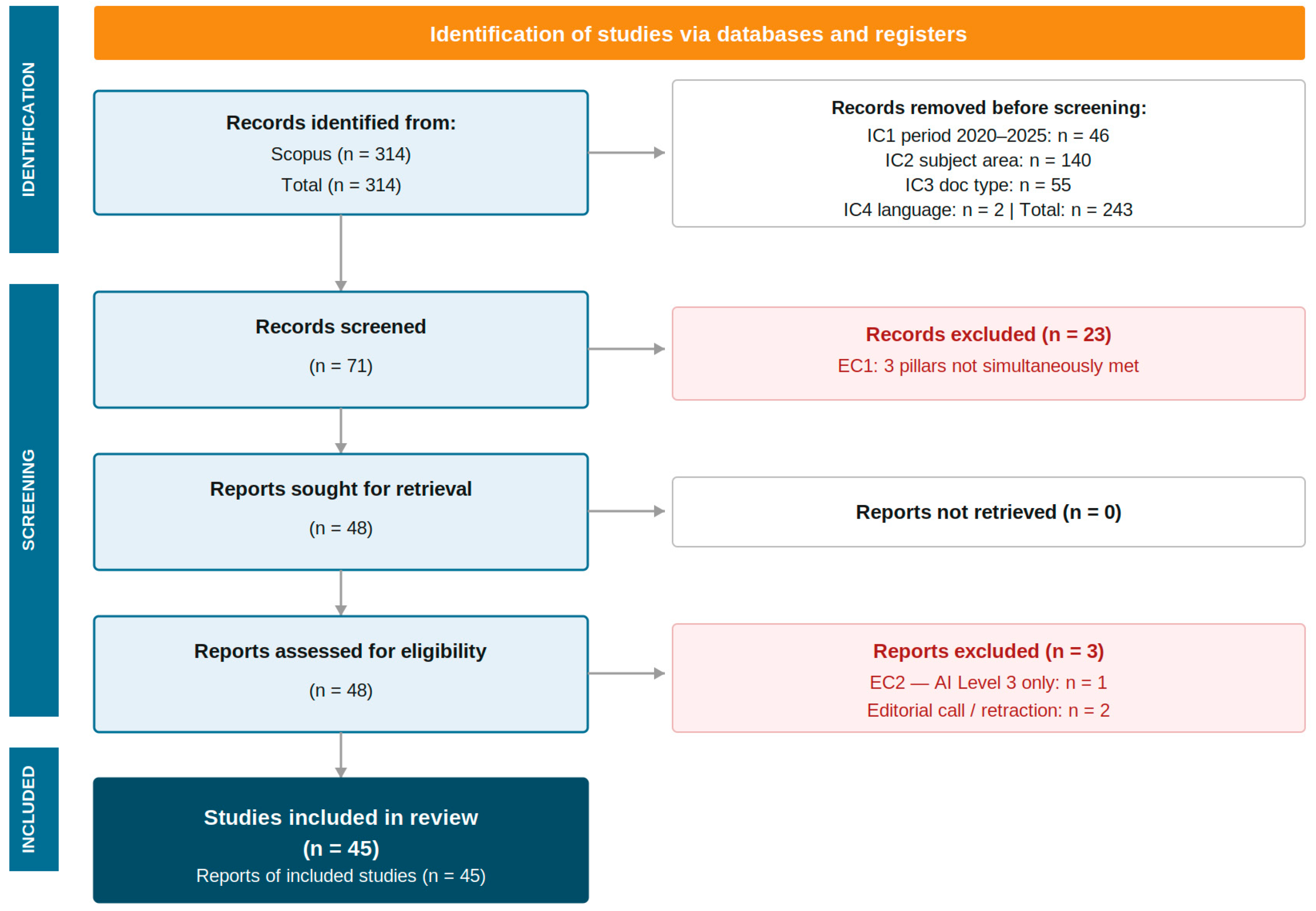
The preliminary search yielded 314 records. A sequential filtering process was applied in Scopus prior to export, followed by manual screening at both the abstract and full-text stages. Table 4 presents the inclusion and exclusion criteria, while Figure 1 depicts the comprehensive process via the PRISMA flow diagram.
The first stage limited the publication window to 2020–2025 (IC1), a period that captures the recent convergence of important ESG regulatory milestones—among them the TCFD recommendations and the EU Non-Financial Reporting Directive—together with the rising uptake of machine learning approaches in accounting scholarship [21]. The subject area was then narrowed to Business, Management, and Accounting (IC2). Records were further restricted to peer-reviewed journal articles (IC3) written in English (IC4), yielding 71 documents for manual review.
During the initial screening (EC1), titles and abstracts were examined to confirm that artificial intelligence or data analytics performed a meaningful role in either ESG disclosure or financial reporting. Items that failed to articulate an intersection of the three conceptual pillars were removed (n = 23), bringing the pool of articles forward to 48 for full-text appraisal.
In the second stage (EC2), articles categorised as AI Integration Level 3 were omitted (n = 3). The conclusive analytical corpus comprises 45 peer-reviewed studies. A complete list of the 45 studies included in the final corpus is provided in the Supplementary Materials (Table S1).

2.3. AI Integration Level Classification Framework

This study introduces a three-tier classification scheme for assessing the depth of AI integration across heterogeneous research designs, thereby avoiding the common pitfall of treating methodologically diverse studies as analytically equivalent. The scheme extends the typology advanced by [10], which separates studies where AI constitutes the core methodological component from those where AI plays a supporting or contextual role.
To ensure consistency, each article was independently classified by both authors through close reading of abstracts and full texts, with disagreements resolved through iterative discussion until consensus was achieved. Table 5 presents the operational definitions of each level, along with their distribution within the corpus.
Levels 1 and 2 were retained for analysis (n = 45), since each offers empirically solid or conceptually meaningful insights into AI applications in ESG disclosure. Level 3 studies were excluded (n = 1), as their AI references were merely contextual and lacked the analytical depth required for inclusion. The final corpus spans 2020–2025 and comprises contributions from 22 countries published in 26 peer-reviewed journals.

2.4. Qualitative Coding and Dimension Assignment

The four substantive dimensions emerging from the qualitative analysis were arrived at inductively through repeated coding cycles applied to titles, abstracts, and full texts, and were subsequently triangulated against the keyword co-occurrence network. Coding was governed by a structured extraction matrix together with explicit decision rules. Where a study spanned more than one dimension, its primary placement followed the dominant methodological and substantive emphasis, with any secondary affiliations logged during the analysis. Both authors reviewed the thematic labels and assignments, resolving any disagreements through deliberation until full consensus was reached. To reinforce the dependability of the coding procedure, inter-rater reliability was quantified using Cohen’s kappa: the assignment of articles to the four thematic dimensions yielded a kappa of 0.879, denoting almost perfect agreement among coders [22].

2.5. Data Extraction and Analysis

The included articles were systematically catalogued in an extraction matrix capturing title, authorship, year of publication, journal, country, research aim, methodology, AI or analytics technique, ESG dimension, principal findings, and contributions to sustainable reporting practice [23]. Two complementary analytical strands were then applied. The first was a quantitative bibliometric phase, drawing on descriptive statistics and keyword co-occurrence mapping with VOSviewer [24]. The second consisted of qualitative thematic content analysis, from which the four principal dimensions were derived. The reliability of the AI Integration Level classification was likewise evaluated through Cohen’s kappa, returning a coefficient of 0.736—indicative of substantial agreement among coders [25].

2.6. Quality Appraisal

A formal quality appraisal was conducted using the Mixed Methods Appraisal Tool, version 2018, due to the methodological diversity of the corpus, which encompasses quantitative empirical studies, qualitative case analyses, mixed methods research, and conceptual frameworks. This instrument is designed for systematic reviews that integrate diverse research methodologies [26]. Each study was assessed using the MMAT screening questions and categorised as High, Medium, or Low based on the extent of design-specific criteria met. The appraisal evaluated the methodological rigour of the included studies and informed the interpretation of the evidence. Quality ratings were not used as an exclusion criterion, nor was any formal weighting mechanism applied based on quality scores. The appraisal provided a qualitative benchmark to distinguish between robust empirical contributions and more exploratory or conceptual studies. Table 6 presents the appraisal results for all 45 articles in the corpus.

3. Results

Examination of the 45 peer-reviewed articles published between 2020 and 2025 reveals a research domain at the intersection of artificial intelligence, data analytics, and ESG disclosure that is evolving rapidly and exhibits considerable thematic breadth. The findings are organised in two complementary segments: Section 3.1 sets out the quantitative bibliometric evidence describing the structural features of scientific output, while Section 3.2 reports the qualitative content analysis that distils four principal thematic dimensions characterising the field.

3.1. Quantitative Bibliometric Analysis

The bibliometric analysis draws on a final corpus of 45 peer-reviewed articles retained through the PRISMA screening process. Key metrics, including citation frequencies, co-authorship patterns, keyword distributions, and co-citation frameworks, were calculated for this dataset to ensure alignment between the quantitative and qualitative findings [68].

3.1.1. Temporal Distribution and Growth Trajectory

The temporal distribution of publications reveals a sharply accelerated growth trajectory, with a Compound Annual Growth Rate (CAGR) of 91.9% over the 2020–2025 period. Table 7 documents that the corpus opens with a single publication in 2020—the NLP-focused investigation by [6] on sustainability report readability—and grows to 26 articles by 2025, accounting for 57.8% of the corpus. This trajectory suggests that the field has entered an accelerated expansion phase, temporally aligned with the implementation of pivotal regulatory frameworks, particularly the Corporate Sustainability Reporting Directive (CSRD) [69] and the sustainability disclosure standards IFRS S1 and IFRS S2 issued by the International Sustainability Standards Board [2]. The COVID-19 pandemic plausibly amplified both forces by accelerating the digitalisation of corporate reporting and stimulating academic interest in data-driven analyses of non-financial disclosure [21].
The lack of publications during 2021 and 2022, followed by a pronounced uptick from 2023 onward, lends support to the view that the consolidation of this research area is tightly bound to post-pandemic dynamics and the most recent wave of regulatory change.

3.1.2. Geographical Distribution and International Collaboration

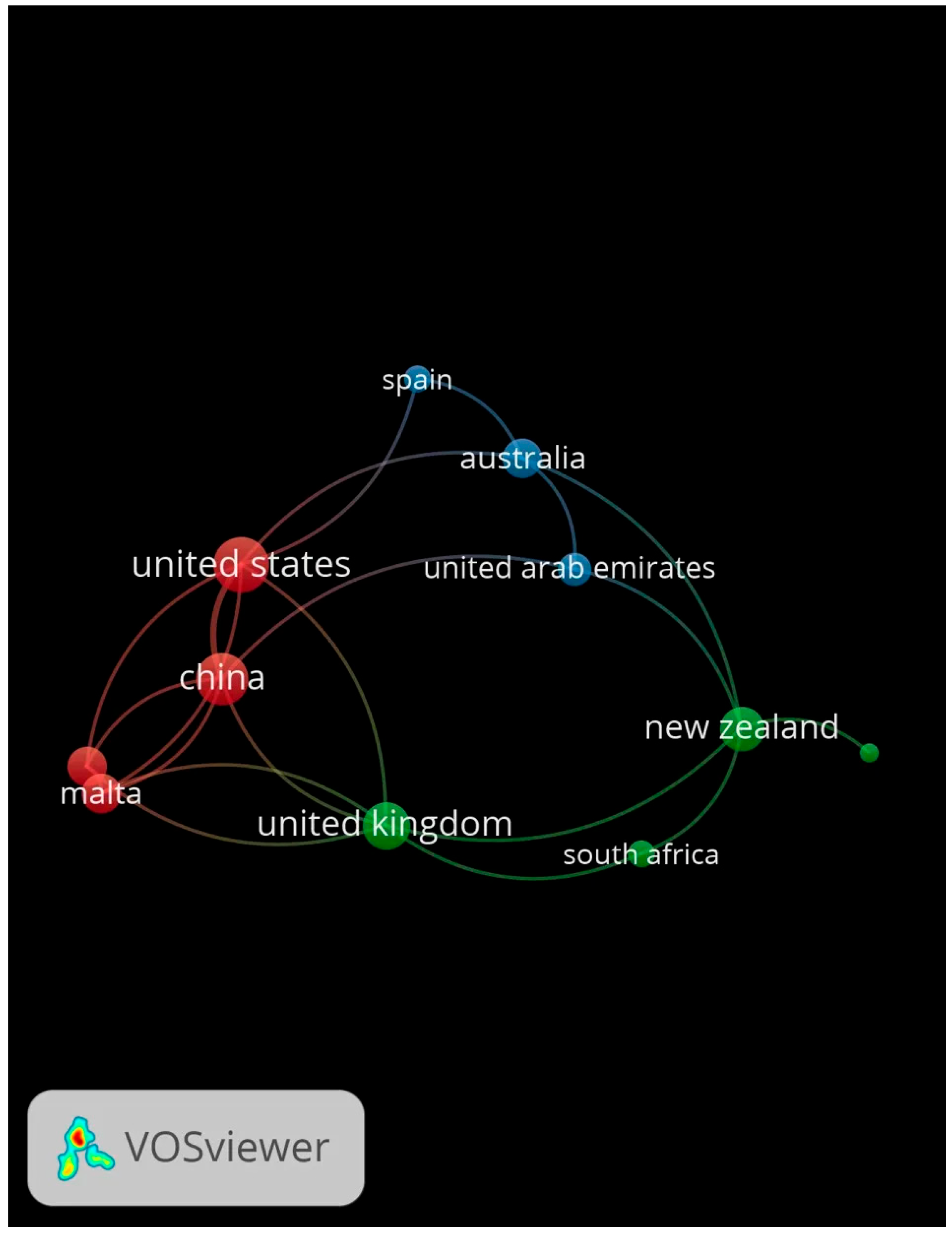
The spatial distribution of the corpus, documented in Table 8 and visualised in Figure 2, shows a pronounced concentration in the United States, parts of Asia, and several European countries. The United States accounts for 18 affiliated author records, representing 40.0% of the corpus, a pattern that may be associated with the country’s strong research infrastructure in accounting information systems and the contribution of the Rutgers KPMG Center for Continuous Auditing. Researchers affiliated with this centre, particularly [63], constitute the most productive author group in the corpus.
Coming in second is China with 14 records (31.1%), a presence that is consistent with state-backed investment in big data infrastructure and with the country’s incorporation of ESG-oriented policy agendas. European involvement is likewise sizeable: Italy (9), Spain (8), and France (5) account for the bulk of the regional contribution, a configuration that aligns with the growing institutional salience of the CSRD and its implications for AI-supported compliance research. Within Asia-Pacific, Malaysia (8) and Vietnam (7) display considerable activity, a pattern that may reflect both regional sustainability reporting initiatives and the parallel maturation of local fintech ecosystems [35].
The co-authorship network by countries (Figure 2) identifies three primary collaboration clusters, with a total of 32 international co-authorship links across the corpus. Approximately 31.9% of articles (n = 15) involve authors from two or more countries, while 68.1% reflect single-country authorship. The strongest cluster connects the United States and China, with 3 bilateral co-authorship links, representing the most active cross-national research axis in the field. The second cluster connects the United Kingdom, New Zealand, and South Africa, with a combined link strength of 13 across Commonwealth-affiliated institutions. The third cluster links Australia, the United Arab Emirates, and Spain. Malta’s participation in the US–China cluster reflects specific interdisciplinary collaborations rather than national research volume. The network structure confirms that international AI–ESG research remains geographically fragmented, with limited collaboration bridges between European regulatory-driven and Asian technology-driven research traditions.

3.1.3. Most Cited Documents and Citation Impact

Citation analysis sheds light on the foundational works that have shaped the trajectory of the field. Table 9 lists the ten most cited articles within the analytical corpus. At the top stands [3], with 108 citations, advancing a conceptual framework for assessing the prospective influence of generative artificial intelligence on sustainability reporting; its visibility indicates that theoretical contributions anticipating technological disruption have rapidly captured the attention of the scholarly community. In second place, [6] has accumulated 63 citations and continues to function as a key methodological reference for corpus-based NLP analysis of sustainability texts—its earlier publication date helping to account for the durable citation impact it retains even as the field has accelerated more recently.
Across the corpus, articles average 11.2 citations, accumulating to a total of 504. Roughly 38% of the studies remain uncited—an outcome consistent with the dataset’s recent composition, given that 57.8% of the included works appeared in 2025. After normalisation, the citation analysis reveals that the Audit 4.0 study by [63], which mobilises satellite imagery to verify greenhouse gas assurance, exhibits the highest citation velocity among mid-period publications. This finding hints that methodologically novel approaches that pair artificial intelligence with unconventional data sources tend to garner academic attention more rapidly than conventional contributions.

3.1.4. Journal Distribution and Keyword Analysis

The 45 articles are distributed across 36 distinct journals, yielding a source-to-article ratio of 1.25. This distribution suggests the emergence of a multidisciplinary area that has not yet consolidated around a small set of dominant publication outlets. The leading journals, Sustainable Futures and Meditari Accountancy Research (three articles each), are followed by the Journal of Emerging Technologies in Accounting, Corporate Social Responsibility and Environmental Management, Journal of Cleaner Production, International Journal of Accounting and Information Management, and Journal of Financial Reporting and Accounting (two articles each). This pattern indicates that research on AI and ESG disclosure is being developed across multiple disciplinary communities, including accounting technology, sustainability management, and environmental economics, without a single predominant outlet.
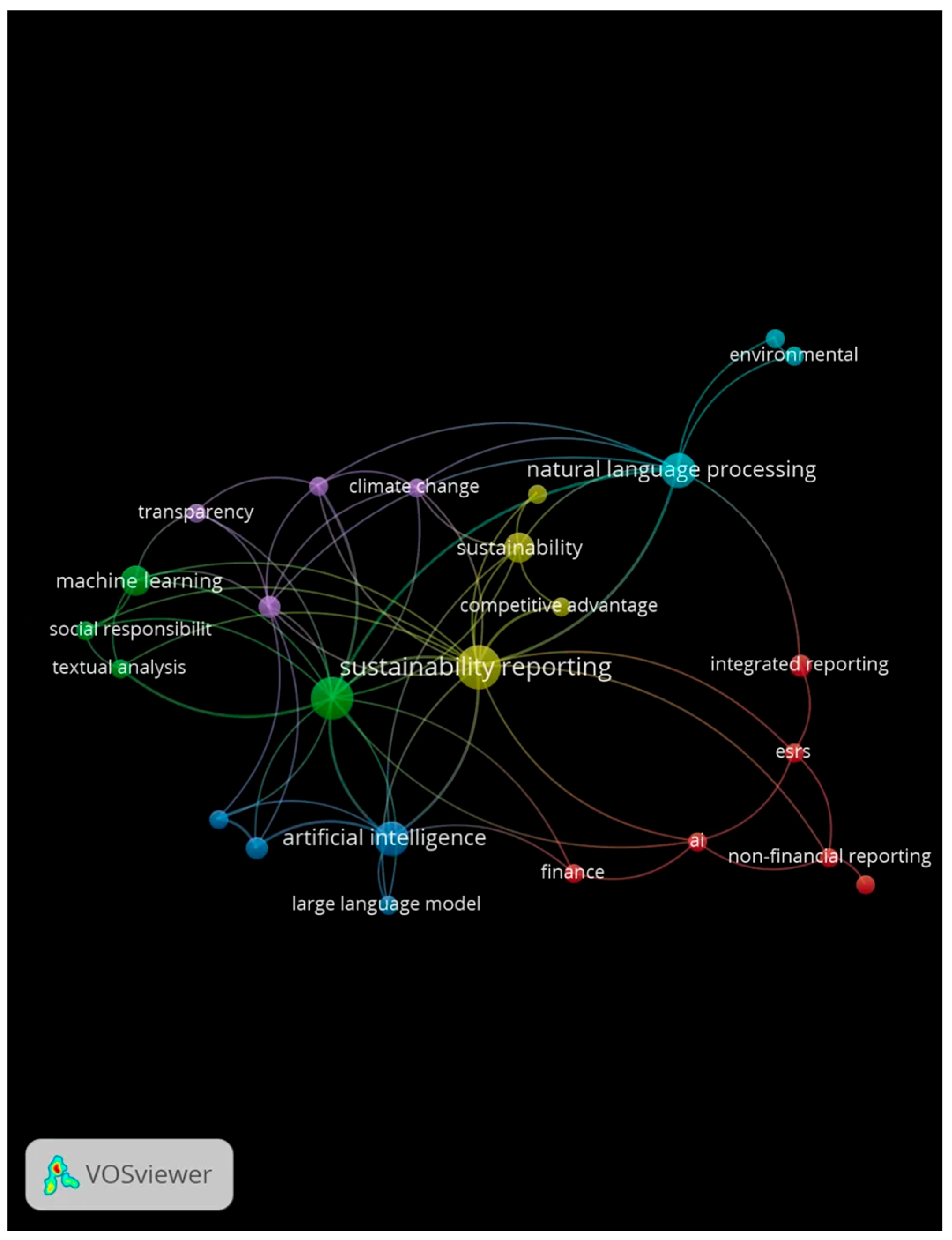
Figure 3 depicts the keyword co-occurrence network and offers a panoramic view of the field’s conceptual organisation. Sustainability reporting (frequency: 11) sits at the core of the network and operates as the thematic anchor connecting the main research clusters. ESG (10) functions as the broadest transversal bridge, while natural language processing (7) and artificial intelligence (7) emerge as the dominant technology-related nodes. Surrounding this hub, machine learning (5), textual analysis (2), and greenwashing (3) coalesce into a methodological cluster. Regulatory vocabulary—non-financial reporting, integrated reporting, and ESRS—reflects the institutional dimension, while large language models surface as a secondary technological node. The four colour-coded clusters in the network correspond closely to the four thematic dimensions developed in the qualitative analysis (Section 3.2), reinforcing the analytical coherence between the bibliometric and thematic perspectives.

3.1.5. Co-Citation Analysis and Intellectual Structure

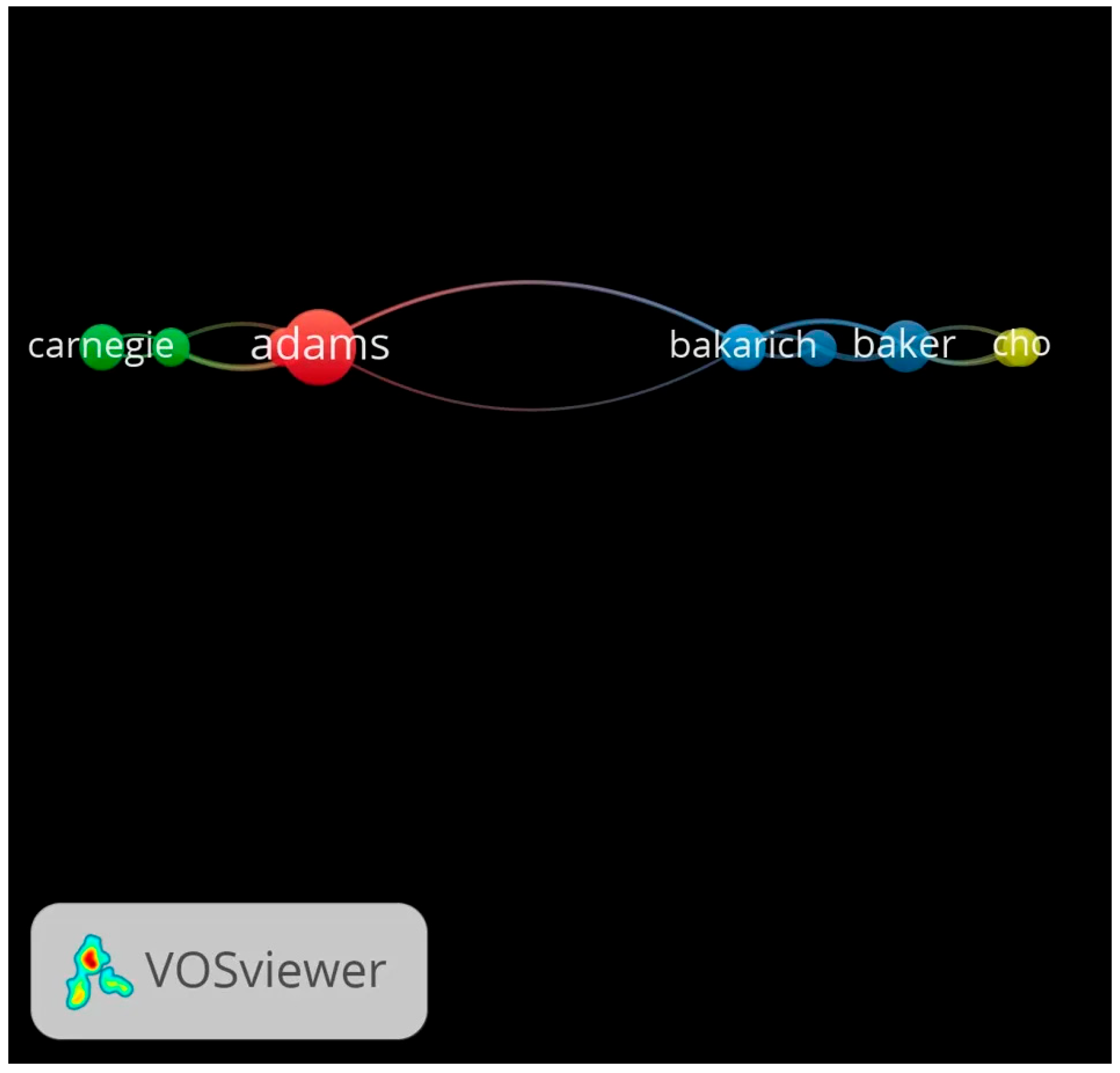
Author co-citation analysis (Figure 4) yields a comparatively sparse network in which only five nodes—Adams, Carnegie, Bakarich, Baker, and Cho—meet the minimum threshold of two co-citations. These authors form two loosely connected groupings. Adams stands out as the most frequently co-cited figure, a pattern likely tied to the influence of Carol Adams’s work on integrated thinking and sustainability accounting systems. The relative thinness of the co-citation structure is itself revealing: it suggests that the AI–ESG disclosure domain has yet to crystallise around a unified theoretical framework and continues to draw selectively on heterogeneous intellectual traditions spanning accounting theory, computer science, and sustainability governance.
Such intellectual dispersion stands in marked contrast to the denser co-citation structures characteristic of more mature research fields, signalling that the discipline remains in an early paradigm-formation stage [24]. The thin cross-citation traffic between the accounting-oriented cluster (Adams, Carnegie) and the analytics-oriented cluster (Bakarich, Baker) further suggests that scholars working from different disciplinary vantage points are not yet systematically engaging with one another’s foundational references. This shortfall functions simultaneously as a theoretical limitation of the current literature and as a productive opening for future integrative scholarship.

3.2. Qualitative Content Analysis: Thematic Dimensions

The qualitative content analysis of the 45 articles comprising the final corpus surfaced four principal thematic dimensions in research at the intersection of artificial intelligence, data analytics, and ESG disclosure. As outlined in Table 10, these dimensions were derived inductively through successive coding of titles, abstracts, and full texts, and were subsequently triangulated against the structure of the keyword co-occurrence network (Figure 3). Inter-rater agreement, evaluated through Cohen’s kappa to bolster the reliability of the coding procedure, reached 0.879 for the assignment of studies to the four dimensions—a value indicating near-perfect concordance among coders. Although the dimensions are analytically distinct, they exhibit notable areas of overlap—most evidently between NLP applications and regulatory compliance—consistent with the integrative character of the field.

3.2.1. Dimension 1—NLP & Text Mining for ESG Disclosure Analysis (n = 13)

The first and most prominent thematic cluster brings together studies that draw on natural language processing, corpus linguistics, textual analysis, and large language models to interrogate the content, quality, and stylistic features of ESG and sustainability disclosures. The stream extends earlier methodological work—especially the corpus-based readability analysis introduced by [6]—and has progressively expanded into sentiment analysis, greenwashing detection, materiality identification, and cross-sector comparisons of disclosure practices.
Recent work signals a clear migration toward more advanced analytical methods. As shown by [5], the deployment of BERT-based architectures and topic modelling techniques such as LDA and GNTM in the analysis of climate-related disclosures evidences rising methodological sophistication. Along similar lines, the construction of ESG KIBERT—a domain-tailored NLP model—marks a transition away from general-purpose language models and towards specialised instruments better equipped to capture the semantic nuances of ESG reporting. Complementing these advances, [57] demonstrate that machine learning approaches can detect longitudinal disclosure patterns across jurisdictions and underpin more robust comparative benchmarking.
Greenwashing detection has emerged as one of the most active research fronts within this dimension. Studies that mobilise NLP to expose mismatches between stated ESG commitments and observed performance outcomes underscore the rising regulatory salience of such tools, particularly in light of the third-party verification obligations imposed by the CSRD. The pairing of textual analysis with climate risk indicators is part of a broader push toward comprehensive disclosure analytics that combine linguistic and financial information. Sentiment analysis findings further reveal that disclosure tone varies systematically by industry and regulatory environment, with carbon-intensive sectors tending to adopt more guarded language than service-oriented industries.

3.2.2. Dimension 2—Machine Learning for ESG Scoring & Corporate Performance (n = 9)

The second thematic cluster gathers studies that apply both supervised and unsupervised machine learning to forecast ESG scores, assess disclosure quality, and probe the connection between ESG performance and financial outcomes. Methodological breadth is one of its defining features, encompassing gradient boosting machines, XGBoost, K-means clustering, dual machine learning, and interpretability tools such as SHAP values.
A pivotal contribution in this stream is [7], cited 52 times, which documents a positive association between firm-level ESG performance and financial outcomes across a range of industries. Notably, the study mobilises SHAP values to confront the long-standing black-box critique levelled at machine learning, supplying feature-level explanations that bolster interpretability and make the approach more defensible in regulatory and investment settings. Building on this, [38] turn attention to governance characteristics—among them the attributes of board secretaries—and show that machine learning is capable of detecting organisational drivers of ESG disclosure quality that lie outside the conventional set of purely financial variables.
A further notable advance lies in the use of dual machine learning to recover the causal effect of green product certification on ESG performance, an approach that mitigates the endogeneity problems that have long constrained causal inference in ESG research. In parallel, the application of gradient boosting techniques to flag firms adopting double materiality under the CSRD illustrates the regulatory utility of these methods for compliance monitoring [52]; meanwhile, it shows that unsupervised learning can surface latent patterns in corporate disclosure strategies and reveal sector-specific traits that conventional methods tend to overlook.

3.2.3. Dimension 3—AI in ESG Assurance, Audit & Governance (n = 8)

The third dimension assembles studies that investigate how artificial intelligence, big data, and advanced analytics are being integrated into ESG assurance processes, audit practices, and governance arrangements. The stream sits naturally within the Audit 4.0 framework, which articulates a transition toward real-time data access, continuous monitoring, and AI-driven anomaly detection.
Among the most influential contributions to this dimension is [63], with 36 citations, which demonstrates how satellite imagery analysis can be deployed to verify greenhouse gas emissions and thereby allow assurance providers to validate environmental data independently rather than depending solely on figures reported by the firms themselves. The capability speaks directly to a long-standing credibility weakness of ESG assurance, where auditors are often left working from internally generated data shaped by managerial discretion [8]. Complementing this view, [57] examines how AI tools can be embedded within established audit methodologies, mapping both the efficiency gains and the implementation hurdles that accompany such integration.
Evidence from emerging market settings suggests that big data analytics can strengthen sustainable auditing by improving the detection of ESG compliance deviations and supporting decision-making at the descriptive, predictive, and prescriptive levels. Concurrently, work grounded in UTAUT and perceived risk theory identifies auditor trust and regulatory acceptance as the main hurdles to AI adoption—obstacles that are likely to recede as professional standards evolve, particularly those advanced by the IAASB. From a governance angle, [67] proposes frameworks for the responsible use of AI in assurance, underscoring the imperative of balancing automation with continued human oversight.

3.2.4. Dimension 4—Regulatory Frameworks, Digital Transformation & ESG Reporting Standards (n = 15)

The fourth and most heterogeneous dimension centres on the regulatory and institutional context of ESG disclosure. It encompasses studies of frameworks such as CSRD, NFRD, TCFD, ISSB, and ESRS, alongside work on digital transformation, ESG software solutions, and governance arrangements surrounding the implementation of AI within reporting processes. What characterises this dimension is its policy orientation and its sustained focus on how institutional environments condition the uptake of AI in sustainability reporting.
A core conceptual contribution within this dimension comes from [3]—the most cited work in the corpus with 108 citations—whose framework on the role of artificial intelligence in sustainability reporting interrogates the prospective implications of generative AI for report preparation, verification, and stakeholder communication. Complementary research evaluating ESG software solutions for CSRD compliance, especially within the manufacturing sector, surfaces concerns around system selection, regulatory fit, scalability, and the assurance of data quality. Extending this line, [35] argues that the convergence of financial technologies with artificial intelligence may forge novel institutional pathways for sustainability reporting that extend beyond traditional corporate boundaries.
Findings reported by [40] indicate that AI adoption is linked to gains in ESG disclosure quality within Chinese firms, with the relationship operating through channels such as the cultivation of dynamic capabilities and the heterogeneous composition of sustainability committees. This pattern aligns with dynamic capability theory, which underscores the role of organisational competencies in shaping firm-level outcomes [17]. A governance angle also emerges from studies that examine the joint use of blockchain and artificial intelligence in ESG accounting, where technological complementarities may produce outcomes that exceed what either technology delivers on its own. Evidence on ESG decoupling along supply chains further suggests that it is the depth of AI integration, rather than the sheer breadth of adoption, that determines whether AI underwrites substantive transparency or merely reinforces symbolic compliance.

4. Discussion

The systematic analysis of 45 peer-reviewed articles reveals that AI, data analytics, and ESG disclosure have converged from a fragmented set of early-stage inquiries into a coherent research domain with distinctive theoretical and methodological contributions. Whereas prior reviews have addressed AI in accounting [3] or sustainability reporting separately, the present corpus documents an integrated field propelled by regulatory pressures (CSRD, ISSB) and technological maturation (transformer-based NLP, explainable machine learning, AI-enabled assurance). The discussion that follows interprets the principal findings across the four thematic dimensions, positions them against the extant literature, articulates their theoretical and practical implications for regulators, firms, assurance providers, and investors, and reflects on the structural gaps shaping the field’s continued evolution.

4.1. The Transformative Role of NLP and Text Mining in ESG Disclosure

The prominence of NLP and text mining as the largest thematic cluster (13 studies) signals a fundamental methodological reorientation in ESG disclosure research. This finding extends prior work on NLP in financial disclosures [6] by demonstrating that transformer architectures have now migrated from financial reporting into sustainability contexts, overcoming the traditional scalability and consistency limitations of manual content analysis. The implication is consequential: academic research can now examine disclosure quality at scales previously unattainable, while regulators and assurance providers gain viable candidate tools for the third-party verification mandates introduced by the CSRD. This positions NLP not as a marginal methodological innovation but as enabling infrastructure for the next generation of ESG oversight.
An especially salient strand within this dimension concerns the use of NLP models for greenwashing detection—that is, the gap between firms’ stated ESG commitments and their verifiable environmental performance. Work that applies BERT-based classifiers and sentiment analysis to ESG disclosures in the European energy sector [5] points to recurring patterns of linguistic inflation across corporate sustainability narratives, with firms in high-emission industries appearing to display greater divergence between textual claims and measured environmental outcomes. The regulatory implication is direct: the third-party verification obligations introduced by the CSRD are likely to amplify demand for scalable, automated tools capable of detecting greenwashing at scale.
To illustrate, [5] applied BERT-based NLP classifiers to over 2000 climate-related disclosure paragraphs from CSRD-subject companies in the European energy sector, achieving classification accuracy exceeding 85% in distinguishing substantive environmental commitments from vague or inflated claims. This level of precision substantially exceeds what traditional manual content analysis can deliver at a comparable scale, demonstrating that NLP-based greenwashing detection tools are viable candidates for regulatory verification workflows.
The emergence of domain-adapted language models—including ESG KIBERT and related sector-specific NLP frameworks—marks a transition from generic language models toward instruments capable of capturing industry-specific disclosure semantics more accurately. This specialisation addresses a notable limitation of general-purpose models, which frequently misinterpret ESG terminology whose meaning is context-dependent (e.g., the concept of materiality, which carries distinct implications in financial versus environmental contexts). The integration of NLP with financial materiality assessment suggests that text-based AI tools are advancing toward comprehensive disclosure analytics that jointly evaluate linguistic quality and economic relevance, thereby enhancing the decision-making utility of sustainability disclosures for investors [3].
Despite these advances, the dimension exhibits a material methodological gap. The predominance of English-language corpora restricts the generalisability of findings to non-Anglophone reporting environments. CSRD implementation across 27 EU member states—where disclosure obligations span multiple languages—heightens the need for multilingual ESG-NLP tools that remain largely absent from the current literature. Addressing this gap should therefore rank as a priority for broadening the applicability of AI-driven disclosure analysis.

4.2. Machine Learning as an Instrument of ESG Transparency and Accountability

The second thematic dimension reveals that machine learning has moved from an experimental alternative to a mainstream analytical instrument in ESG research, progressively displacing traditional regression-based approaches in both predictive accuracy and interpretive depth. These methods may offer advantages in handling non-linear relationships and can be combined with interpretability tools that make model outputs more transparent and easier to scrutinize. The use of SHAP values, gradient boosting explainability interfaces, and dual causal machine learning frameworks across the corpus points to a shift beyond predictive performance alone toward greater analytical accountability, which may be relevant for the regulatory acceptance of machine learning-based ESG assessments [7].
A recurring empirical pattern across these studies is the robust association between ESG disclosure quality and organisational governance characteristics—board composition, secretarial qualifications, and sustainability committee structure [38]. This evidence refines the disclosure literature by moving beyond the conventional regulatory-pressure and firm-size explanations toward a more governance-embedded understanding of disclosure behaviour. The findings align with and extend institutional theory [16], which frames disclosure practices as organisational routines that mediate regulatory demands. The practical implication is direct and consequential: regulators and standard-setters (particularly those implementing the ISSB) should complement disclosure requirements with governance-capability guidance, since mandating disclosure without addressing organisational readiness risks produces compliance-driven rather than substance-driven reporting.
A methodologically notable contribution within this dimension is the deployment of unsupervised machine learning—specifically K-means++ clustering—to identify latent ESG disclosure profiles at the organisational level [52]. This approach suggests that disclosure quality may cluster along dimensions not fully captured by conventional ESG assessment methods, thereby revealing patterns that may remain difficult to identify through traditional analytical approaches. At the same time, an important limitation in this dimension concerns data dependence. The effectiveness of ML-driven ESG scoring models rests on the quality, consistency, and comparability of the underlying disclosure data used for training. The simultaneous operation of diverse reporting standards—GRI, SASB, TCFD, and the forthcoming ESRS—introduces variability that can undermine model stability and comparability. Progressive standardisation under the ISSB framework is likely to enhance the reliability and applicability of ML-based disclosure analytics by providing more uniform input data.

4.3. AI-Driven Assurance and the Future of ESG Audit

The third thematic dimension, focused on artificial intelligence in ESG assurance, audit, and governance, addresses what may be one of the most consequential applications of AI within the ESG disclosure ecosystem. This dimension documents a gradual shift from document-focused, retrospective verification toward data-driven, continuous, and forward-looking assurance. The Audit 4.0 framework, as illustrated by [63] through the use of satellite imagery for greenhouse gas emissions verification, suggests that assurance providers may be able to validate company-reported environmental data against external and independently verifiable sources. This development may alter the relationship between reporting entities and assurance providers by expanding the range and quality of evidence available for audit and assurance. For example, [63] cross-referenced corporate carbon emission disclosures against satellite-derived atmospheric CO2 concentration data, detecting discrepancies of up to 23% between self-reported GHG figures and satellite-verified estimates in sampled industrial facilities. This demonstrates that AI-enabled external data triangulation can identify material misstatements in environmental disclosures that would remain undetectable under conventional document-review assurance.
This transition carries substantial implications for ESG disclosure credibility. Contemporary assurance systems remain narrow in scope and heavily dependent on self-reported data, typically verified by audit firms and sustainability consultancies [70]. The integration of AI systems capable of triangulating corporate disclosures with satellite observations, IoT telemetry, supply chain transaction records, and regulatory databases represents a qualitative break from established attestation techniques—not merely an incremental efficiency gain, but a paradigm shift toward independently verifiable ESG assurance. The International Auditing and Assurance Standards Board’s formulation of ISSA 5000 recognises the growing reliance on technology for evidence gathering. Collectively, these advancements indicate that regulatory frameworks may progressively integrate the convergence between artificial intelligence and assurance identified in this literature.
Research on perceived risks in AI adoption for ESG assurance identifies auditor capability limitations, data privacy concerns, and liability uncertainty as the principal barriers to deployment. These challenges are primarily institutional and regulatory rather than technological. These challenges appear to be more institutional and regulatory than technological. The findings, therefore, suggest that the central obstacle to AI integration in assurance lies less in technological readiness than in institutional preparedness. Professional standards, liability frameworks, and training systems necessary for embedding AI in assurance practice appear to be less developed than the underlying technologies themselves. Addressing this gap should therefore be considered an important priority for professional accounting bodies, standard-setting institutions, and academic programs in auditing and assurance.
Research on big data analytics in sustainable auditing—particularly in banking—indicates that data-driven auditing can enhance the detection of ESG compliance inconsistencies and improve audit resource allocation across descriptive, predictive, and prescriptive dimensions. The banking sector, with its advanced data infrastructure and established regulatory reporting requirements, likely represents an early-adopter context for AI-driven ESG auditing. Evidence from this sector also offers relevant lessons for organisations with less mature data infrastructures as ESG reporting practices continue to evolve.

4.4. Regulatory Convergence and the Organizational Conditions for AI Integration

The fourth thematic dimension situates AI deployment within the institutional context that simultaneously generates demand for and constrains data-driven ESG disclosure tools. The CSRD’s implementation in 2024, with its requirements for double materiality assessment and third-party verification across more than 50,000 European companies, represents one of the most significant regulatory catalysts for AI integration in ESG reporting since the introduction of the NFRD in 2014. Evaluations of ESG software for CSRD compliance indicate that no current platform fully meets the regulatory, integration, and scalability requirements of large manufacturing firms, highlighting both market opportunities and compliance challenges for reporting organisations [14].
This regulatory dynamic is tightly coupled with organisational capability conditions. Evidence from the Chinese business environment shows that AI integration can enhance the comprehensiveness and accuracy of sustainability disclosures, particularly when supported by the cultivation of dynamic capabilities and sustainability committee diversity [40]. These results align with dynamic capability theory, which holds that the value of AI depends less on technology deployment per se than on an organisation’s ability to integrate data, competencies, governance, and reporting frameworks [17]. A key implication is that disclosure regulations that fail to address these capability requirements risk incentivising superficial compliance rather than meaningful ESG transparency improvements.
The conceptual framework advanced by [3]—the most cited paper in the corpus—maps the potential implications of generative AI for sustainability reporting through automated drafting, AI-assisted verification, and more tailored stakeholder communication. Related work suggests that the future of ESG disclosure infrastructure lies in integrated technological ecosystems rather than AI deployed as a standalone tool [31]. Within such ecosystems, AI operates as the analytical layer of a broader data governance architecture, and its organisational value is likely to grow as foundational infrastructures—standardised ESG taxonomies, interoperable reporting platforms, blockchain-based transparency systems—continue to mature.
These observations also carry substantive theoretical implications. The reviewed literature indicates that AI can enable the independent verification and supplementation of company-reported ESG data, fundamentally challenging a cornerstone assumption of voluntary disclosure theory—that information asymmetry between firms and external stakeholders is structurally irreducible [18]. If AI-enabled triangulation allows stakeholders to circumvent managerial discretion over disclosure content, the theoretical foundations of the voluntary disclosure paradigm itself require reconsideration. The geographical concentration of AI–ESG research in the United States, China, and the European Union, together with the limited presence of contributions from Latin America, Sub-Saharan Africa, and South Asia, is consistent with a diffusion-of-innovations perspective in which technological adoption follows centre–periphery dynamics shaped by institutional readiness, regulatory structures, and absorptive capacity [71]. From an institutional theory perspective, this pattern may also be interpreted as coercive isomorphism, whereby regulatory mandates encourage the simultaneous adoption of reporting standards and compliance-related technological tools [16].
The relevance of these findings depends on geographical and sectoral diversity. The concentration of research in the United States, China, and Europe reflects the alignment of AI–ESG studies with the most advanced reporting and regulatory regimes. This raises questions about transferability to under-represented regions—Latin America, Sub-Saharan Africa, and parts of Asia—where institutional readiness, reporting practices, and data infrastructures differ markedly. ESG disclosure also cannot be treated as homogeneous across sectors, since materiality profiles, data availability, assurance approaches, and AI readiness vary substantially among banking, manufacturing, energy, and services industries.

4.5. Ethical, Transparency, and Governance Challenges of AI in ESG Reporting

Although the reviewed literature emphasises the efficiency and scalability advantages of AI in ESG disclosure and assurance, these benefits come with important ethical and governance concerns. NLP and machine learning algorithms can replicate or even amplify biases embedded in training data, with consequences for ESG scoring, sentiment analysis, and greenwashing detection. This concern is especially salient where disclosure norms vary across firms, languages, and institutional environments.
Second, transparency remains a material concern. Black-box models can produce functionally useful outputs that are difficult to explain to regulators, assurance providers, and corporate stakeholders. In ESG settings—where accountability and comparability are paramount—insufficient explainability may erode trust in AI-assisted evaluations and diminish their regulatory legitimacy.
AI-assisted reporting also raises accountability and validation questions. When AI tools contribute to disclosure drafting, classification, or assurance, responsibility for errors, omissions, or fabricated outputs cannot be wholly transferred to automated systems. Human oversight, therefore, remains essential, particularly in critical reporting and assurance contexts.
Taken together, these concerns indicate that the future value of AI in ESG reporting will hinge not only on technological capability but, more fundamentally, on the construction of governance frameworks that guarantee transparency, auditability, fairness, and unambiguous accountability—without which the efficiency gains documented in the corpus risk being offset by systemic losses of legitimacy and trust.

4.6. Practical Implications for Regulators, Firms, Assurance Providers, and Investors

The findings of this review translate into differentiated and actionable practical implications across stakeholder groups. For regulators and standard-setters (notably the European Commission implementing CSRD and the ISSB advancing IFRS S1/S2), the evidence points to an urgent need to codify governance principles for AI-assisted sustainability reporting—including minimum requirements on model transparency, documentation standards, and mandatory human oversight in both disclosure preparation and assurance workflows. Without such guardrails, regulatory frameworks risk being outpaced by the very technologies designed to serve them.
For reporting organisations, the evidence shows that technology adoption in isolation does not enhance disclosure quality. Firms derive greater benefit when AI is woven into broader organisational capabilities encompassing data governance, cross-functional coordination, sustainability expertise, and oversight mechanisms. Effective ESG transformation, therefore, demands investment in institutional readiness rather than software procurement alone.
For assurance providers, the literature signals the emerging feasibility of AI-assisted evidence gathering, anomaly detection, and external verification using alternative data sources. These opportunities, however, call for new competencies in model evaluation, data validation, and AI governance. Professional development and methodological standardisation will thus be essential for responsible adoption.
For investors and analysts, the findings indicate that AI-enhanced ESG analytics can improve the comparability and granularity of sustainability information, but should be interpreted cautiously when derived from opaque models or heterogeneous disclosure inputs. ESG data users should therefore pair automated outputs with critical scrutiny of model transparency, data provenance, and sector-specific context.

4.7. Limitations of the Review

Several methodological limitations of this comprehensive literature review warrant acknowledgement when interpreting the results. Restricting the search to a single bibliographic database (Scopus) may have introduced selection bias, since relevant contributions indexed solely in Web of Science, SSRN, or specialised repositories could have been left out. Subsequent reviews would therefore benefit from multi-database search designs in order to broaden coverage—particularly for practitioner-oriented work and working papers that may not yet have been incorporated into Scopus.
Second, the temporal delimitation (2020–2025) was designed to capture the field’s current development phase. This choice nonetheless excludes earlier foundational contributions—particularly in the NLP-accounting and continuous auditing literatures—and may therefore understate the theoretical and methodological legacy underpinning contemporary research. Researchers seeking to situate the field within a broader historical trajectory should complement this review with targeted searches covering pre-2020 literature.
Third, the AI Integration Level classification framework—which categorises studies by the depth of AI methodological application—was developed inductively for this review and has not yet been externally validated. To strengthen classification reliability, inter-rater agreement was assessed using Cohen’s kappa: the AI Integration Level classification achieved a kappa of 0.736, while the assignment of studies to the four thematic dimensions reached 0.879. Although these results support the internal consistency of the coding process, the framework’s applicability beyond the AI–ESG disclosure domain remains to be tested. Future research applying this classification should benchmark it against alternative typologies of technology integration in accounting research.
Finally, the rapid evolution of AI capabilities and ESG regulatory frameworks means that conclusions reflecting the state of the literature as of early 2026 will likely require updating within a relatively short horizon. The roll-out of the ISSB’s IFRS S1 and S2 implementation guidance, the IAASB’s ISSA 5000, and continuing advances in generative AI are poised to generate research streams that were either nascent or absent in the current corpus.
Furthermore, as noted in Section 4.4, the marked geographical and sectoral concentration of the corpus constrains the wider transferability of the review’s conclusions to alternative institutional and industry settings.

4.8. Future Research Directions

This analysis identifies four priority areas for future research at the AI–ESG disclosure intersection. First, the development and validation of multilingual ESG-NLP models is an urgent methodological priority, given the multilingual regulatory architecture established by the CSRD. Second, longitudinal and quasi-experimental designs are required to determine whether the cross-sectional relationships identified in the extant literature reflect genuine capability-driven improvements or endogenous selection effects. Third, further research should examine the organisational, professional, and ethical governance of AI in assurance contexts—including responsibility allocation, human oversight, and competency requirements for AI-literate auditors. Fourth, comparative analyses across institutional contexts are needed to assess whether the efficiency and transparency gains documented in the existing literature transfer to diverse regulatory and technological environments, particularly in emerging markets.

5. Conclusions

Drawing on 45 peer-reviewed articles published between 2020 and 2025, this systematic literature review examined the role played by artificial intelligence and data analytics in sustainable financial reporting and ESG disclosure. The accumulated evidence indicates that AI is increasingly functioning as a foundational enabling infrastructure for ESG reporting—operating through natural language processing applied to disclosure analysis, machine learning for ESG scoring and classification, AI-supported assurance mechanisms, and digital instruments that facilitate compliance with rapidly evolving reporting frameworks. Read collectively, the reviewed studies trace a gradual reconfiguration of ESG disclosure from a primarily narrative, self-reported practice toward a transparency regime that is more data-driven and externally verifiable.
A number of substantive findings can be drawn from the review. First, NLP techniques appear to expand both the scalability and consistency of disclosure analysis, with particular gains in readability assessment, sentiment analysis, and greenwashing detection. Second, machine learning models seem to deliver analytical advantages over conventional linear techniques when predicting ESG ratings, surfacing disclosure patterns, and enhancing interpretability through instruments such as SHAP values. Third, the literature on AI-enabled assurance points to the credibility-enhancing potential of innovative external verification methods—satellite-based monitoring and data-integrated tracking being among them. Taken in the aggregate, the evidence suggests that organisational readiness, governance frameworks, and regulatory alignment are decisive in determining how far AI adoption translates into genuine improvements in disclosure quality.
The review also yields a theoretical contribution. The findings suggest that AI-driven verification and analytics could unsettle the traditional underpinnings of voluntary disclosure theory by narrowing the information asymmetries that exist between firms and external stakeholders [18]. The synthesis advances a dynamic capability reading: the value extracted from AI is not a function of mere technology adoption but rather of the organisation’s ability to integrate data, skills, governance, and reporting processes into a coherent operational fabric [17]. The review thereby permits a wide range of empirical sources to be drawn together within a single interpretive framework.
The findings hold relevance for regulators, reporting entities, assurance providers, and investors alike. For regulators, the review highlights the rising importance of governance frameworks tailored to AI-assisted reporting and assurance. For reporting entities, the evidence indicates that AI should be embedded within wider efforts to reinforce data governance, organisational capabilities, and internal coordination, rather than being treated as a self-contained compliance instrument. For assurance providers and investors, the literature surfaces a dual landscape of opportunity and risk: while AI may deepen analytical capacity and bolster verification, its ultimate value rests on transparency, auditability, and the quality of the disclosure inputs feeding the system.
Several limitations characterise this review. The decision to rely solely on Scopus may have excluded pertinent research indexed in alternative academic, legal, policy, or practitioner-oriented venues, which in turn produced a final corpus geographically skewed toward the United States, China, and Europe. These caveats should be borne in mind when assessing the generalisability of the conclusions.
The body of evidence assembled in this study indicates that the intersection of AI and ESG disclosure is advancing rapidly, even as it remains comparatively nascent. Future inquiry should broaden the evidence base by adopting multi-database search designs, conducting multilingual disclosure analyses, embracing more rigorous causal approaches, and probing more deeply into the ethical, governance, and assurance ramifications of AI adoption. Sustained research in this space will be indispensable for determining whether AI can improve not only the efficiency of ESG reporting but also the reliability, comparability, and accountability of sustainability disclosure systems more broadly.


Supplementary Materials

The following supporting information can be downloaded at https://www.mdpi.com/article/10.3390/su18115393/s1, Table S1: Complete corpus of included studies (n = 45).

Author Contributions

P.A.V.O.: Conceptualization, methodology, investigation, writing—review and editing, project administration and supervision. B.J.A.D.L.C.: methodology, software, validation, formal analysis, resources, data curation, writing—original draft preparation and visualization. All authors have read and agreed to the published version of the manuscript.

Funding

This research received no external funding.

Institutional Review Board Statement

Not applicable.

Informed Consent Statement

Not applicable.

Data Availability Statement

The bibliometric dataset supporting this systematic literature review was retrieved from Scopus in January 2026. The VOSviewer network visualization files and the complete data extraction matrix are available upon reasonable request from the corresponding author. An earlier version of this manuscript was deposited as a preprint on Preprints.org (DOI: 10.20944/preprints202603.1378.v1) by the publisher upon submission, in accordance with MDPI’s standard editorial policy.

Conflicts of Interest

The authors declare no conflicts of interest.

Abbreviations

The following abbreviations are used in this manuscript:
AIArtificial Intelligence
CAGRCompound Annual Growth Rate
CSRDCorporate Sustainability Reporting Directive
ESGEnvironmental, Social, and Governance
GHGGreenhouse Gas
IAASBInternational Auditing and Assurance Standards Board
IFRSInternational Financial Reporting Standards
ISSBInternational Sustainability Standards Board
ISSAInternational Standard on Sustainability Assurance
LLMLarge Language Model
MLMachine Learning
MMATMixed Methods Appraisal Tool
NLPNatural Language Processing
PRISMAPreferred Reporting Items for Systematic Reviews and Meta-Analyses
SEMStructural Equation Modeling
SHAPSHapley Additive exPlanations
SLRSystematic Literature Review

References

  1. European Commission. Directive 2022/2464 of the European Parliament and of the Council on Corporate Sustainability Reporting. Off. J. Eur. Union 2022. Available online: https://eur-lex.europa.eu/eli/dir/2022/2464/oj/eng (accessed on 27 April 2026).
  2. IFRS Foundation. IFRS Sustainability Disclosure Standards (IFRS S1 and IFRS S2); International Financial Reporting Standards Foundation: London, UK, 2023. [Google Scholar]
  3. De Villiers, C.; Dimes, R.; Molinari, M. How will AI text generation and processing impact sustainability reporting? Critical analysis, a conceptual framework and avenues for future research. Sustain. Account. Manag. Policy J. 2024, 15, 96–118. [Google Scholar] [CrossRef]
  4. Bloomberg Intelligence. ESG Assets may Hit $53 Trillion by 2025, a Third of Global AUM; Bloomberg Professional Services: New York, NY, USA, 2023. [Google Scholar]
  5. Chabot, M. Textual and AI-based analysis of climate disclosures: Evidence from the European energy sector. Br. Account. Rev. 2025; in press. [CrossRef]
  6. Smeuninx, N.; De Clerck, B.; Aerts, W. Measuring the Readability of Sustainability Reports: A Corpus-Based Analysis Through Standard Formulae and NLP. J. Bus. Commun. 2016, 57, 52–85. [Google Scholar] [CrossRef]
  7. D’AMato, V.; D’ECclesia, R.; Levantesi, S. Firms’ profitability and ESG score: A machine learning approach. Appl. Stoch. Model. Bus. Ind. 2023, 40, 243–261. [Google Scholar] [CrossRef]
  8. Moffitt, K.C.; Rozario, A.M.; Vasarhelyi, M.A. Robotic Process Automation for Auditing. J. Emerg. Technol. Account. 2018, 15, 1–10. [Google Scholar] [CrossRef]
  9. Hahn, R.; Kühnen, M. Determinants of sustainability reporting: A review of results, trends, theory, and opportunities in an expanding field of research. J. Clean. Prod. 2013, 59, 5–21. [Google Scholar] [CrossRef]
  10. Kokina, J.; Davenport, T.H. The Emergence of Artificial Intelligence: How Automation is Changing Auditing. J. Emerg. Technol. Account. 2017, 14, 115–122. [Google Scholar] [CrossRef]
  11. Berg, F.; Kölbel, J.F.; Rigobon, R. Aggregate Confusion: The Divergence of ESG Ratings. Rev. Financ. 2022, 26, 1315–1344. [Google Scholar] [CrossRef]
  12. Drempetic, S.; Klein, C.; Zwergel, B. The Influence of Firm Size on the ESG Score: Corporate Sustainability Ratings Under Review. J. Bus. Ethics 2019, 167, 333–360. [Google Scholar] [CrossRef]
  13. Liu, L.; Ma, Z.; Zhou, Y.; Fan, M.; Han, M. Trust in ESG reporting: The intelligent Veri-Green solution for incentivized verification. Blockchain Res. Appl. 2024, 5, 100189. [Google Scholar] [CrossRef]
  14. Hąbek, P. Evaluating ESG Software Solutions for Sustainability Reporting in the Manufacturing Sector. Manag. Syst. Prod. Eng. 2025, 33, 420–432. [Google Scholar] [CrossRef]
  15. Page, M.J.; McKenzie, J.E.; Bossuyt, P.M.; Boutron, I.; Hoffmann, T.C.; Mulrow, C.D.; Shamseer, L.; Tetzlaff, J.M.; Akl, E.A.; Brennan, S.E.; et al. The PRISMA 2020 statement: An updated guideline for reporting systematic reviews. BMJ 2021, 372, 71. [Google Scholar] [CrossRef] [PubMed]
  16. Dimaggio, P.J.; Powell, W.W. The Iron Cage Revisited: Institutional Isomorphism and Collective Rationality in Organizational Fields. Am. Sociol. Rev. 1983, 48, 147–160. [Google Scholar] [CrossRef]
  17. Teece, D.J.; Pisano, G.; Shuen, A. Dynamic capabilities and strategic management. Strateg. Manag. J. 1997, 18, 509–533. [Google Scholar] [CrossRef]
  18. Verrecchia, R.E. Essays on disclosure. J. Account. Econ. 2001, 32, 97–180. [Google Scholar] [CrossRef]
  19. Moher, D.; Liberati, A.; Tetzlaff, J.; Altman, D.G. Preferred Reporting Items for Systematic Reviews and Meta-Analyses: The PRISMA Statement. PLoS Med. 2009, 6, e1000097-269. [Google Scholar] [CrossRef]
  20. Falagas, M.E.; Pitsouni, E.I.; Malietzis, G.A.; Pappas, G.; Kouranos, V.D.; Arencibia-Jorge, R.; Karageorgopoulos, D.E.; Reagan-Shaw, S.; Nihal, M.; Ahmad, N.; et al. Comparison of PubMed, Scopus, Web of Science, and Google Scholar: Strengths and weaknesses. FASEB J. 2008, 22, 338–342. [Google Scholar] [CrossRef]
  21. Cao, S.; Jiang, W.; Yang, B.; Zhang, A.L. How to Talk When a Machine Is Listening: Corporate Disclosure in the Age of AI. Rev. Financ. Stud. 2023, 36, 3603–3642. [Google Scholar] [CrossRef]
  22. Clarke, V.; Braun, V. Thematic Analysis: A Practical Guide; SAGE: Thousand Oaks, CA, USA, 2023. [Google Scholar] [CrossRef]
  23. Kitchenham, B.; Charters, S. Guidelines for Performing Systematic Literature Reviews in Software Engineering; Technical Report EBSE-2007-01; Keele University: Staffordshire, UK, 2007. [Google Scholar]
  24. Van Eck, N.J.; Waltman, L. Software survey: VOSviewer, a computer program for bibliometric mapping. Scientometrics 2010, 84, 523–538. [Google Scholar] [CrossRef]
  25. Massaro, M.; Dumay, J.; Guthrie, J. On the shoulders of giants: Undertaking a structured literature review in accounting. Account. Audit. Account. J. 2016, 29, 767–801. [Google Scholar] [CrossRef]
  26. Hong, Q.N.; Fàbregues, S.; Bartlett, G.; Boardman, F.; Cargo, M.; Dagenais, P.; Gagnon, M.-P.; Griffiths, F.; Nicolau, B.; O’cAthain, A.; et al. The Mixed Methods Appraisal Tool (MMAT) version 2018 for information professionals and researchers. Educ. Inf. 2018, 34, 285–291. [Google Scholar] [CrossRef]
  27. Campbell, J.L.; Foerster, A.; Garg, M.; Unda, L.A. The Determinants and Informativeness of ‘Voluntary’ Climate and Sustainability-related Financial Disclosures in Australia. Abacus 2025, 61, 961–1022. [Google Scholar] [CrossRef]
  28. Riyath, M.I.M.; Jariya, A.M.I. The role of ESG reporting, artificial intelligence, stakeholders and innovation performance in fostering sustainability culture and climate resilience. J. Financ. Rep. Account. 2024. advance online publication. [Google Scholar] [CrossRef]
  29. Janvrin, D.J.; Jeffrey, C. Using Data Analytics to Analyze Wind Turbine Upgrade Decisions: An ESG Case. J. Emerg. Technol. Account. 2025, 22, 181–200. [Google Scholar] [CrossRef]
  30. Stander, Y.S. Climate Sentiment Analysis on the Disclosures of the Corporations Listed on the Johannesburg Stock Exchange. J. Risk Financ. Manag. 2025, 18, 470. [Google Scholar] [CrossRef]
  31. Nguyen, N.M.; Abu Afifa, M.M.; Dao, V.T.T.; Van Bui, D.; Van, H.V. Leveraging artificial intelligence and blockchain in accounting to boost ESG performance: The role of risk management and environmental uncertainty. Int. J. Organ. Anal. 2025, 34, 1268–1299. [Google Scholar] [CrossRef]
  32. Ferro, A.; Marazzina, D.; Stocco, D. Uncovering ESG Ratings: The (Im)Balance of Aspirational and Performance Features. Corp. Soc. Responsib. Environ. Manag. 2025, 32, 5895–5917. [Google Scholar] [CrossRef]
  33. Sun, Q.; Qiu, X. How does green product certification affect ESG performance? Evidence from dual machine learning. J. Clean. Prod. 2025, 521, 146201. [Google Scholar] [CrossRef]
  34. Lee, H.; Kim, J.H.; Jung, H.S. ESG-KIBERT: A new paradigm in ESG evaluation using NLP and industry-specific customization. Decis. Support Syst. 2025, 193, 114440. [Google Scholar] [CrossRef]
  35. Nair, A.J.; Manohar, S.; Mittal, A. AI-enabled FinTech for innovative sustainability: Promoting organizational sustainability practices in digital accounting and finance. Int. J. Account. Inf. Manag. 2024, 33, 287–312. [Google Scholar] [CrossRef]
  36. Sahu, A.K.; Debata, B. Firm-level climate risk exposure, ESG disclosure and stock liquidity: Evidence from textual analysis. China Account. Financ. Rev. 2025, 27, 181–209. [Google Scholar] [CrossRef]
  37. Lang, T. Identifying Financially Material Content in Corporate Social Responsibility Reports. J. Corp. Account. Financ. 2024, 36, 169–182. [Google Scholar] [CrossRef]
  38. Yang, J.; Niu, Y.; Shi, W.; Zhu, K. Predicting ESG disclosure quality through board secretaries’ characteristics: A machine learning approach. Res. Int. Bus. Financ. 2025, 76, 102865. [Google Scholar] [CrossRef]
  39. Lodhia, S.; Farooq, M.B.; Sharma, U.; Zaman, R. Digital technologies and sustainability accounting, reporting and assurance: Framework and research opportunities. Meditari Account. Res. 2025, 33, 417–441. [Google Scholar] [CrossRef]
  40. Naveed, K.; Farooq, M.B.; Zahir-Ul-Hassan, M.K.; Rauf, F. AI adoption, ESG disclosure quality and sustainability committee heterogeneity: Evidence from Chinese companies. Meditari Account. Res. 2025, 33, 708–732. [Google Scholar] [CrossRef]
  41. Ahmed, M.M.A.; Hassan, D.K.A.S.A. Integrated reporting in accounting research from 2013 to 2022: A systematic literature review and future research directions. Meditari Account. Res. 2025, 33, 296–334. [Google Scholar] [CrossRef]
  42. Nguyen, T.A. Bibliometric Analysis and Systematic Literature Review of Environmental, Social, and Governance Risk. Bus. Strat. Dev. 2025, 8, e70163. [Google Scholar] [CrossRef]
  43. Van der Lugt, C.T.; Bakker, H.-P.; Mans-Kemp, N. Materiality in reporting integration in South Africa: A natural language processing analysis. S. Afr. J. Econ. Manag. Sci. 2025, 28, 15. [Google Scholar] [CrossRef]
  44. Sekine, T.; Amri, I.; Cherief, A.; Le Guenedal, T.; Sakout, S.; Tilly, S. AI and Decision-Making in Investment—Why We Will Not Return to the Cave. J. Portf. Manag. 2025, 52, 96–105. [Google Scholar] [CrossRef]
  45. Suhardjo, I.; Suparman, M.; Rahman, P. Double materiality and stakeholder engagement: JALA’s sustainability journey. Emerald Emerg. Mark. Case Stud. 2025, 15, 1–17. [Google Scholar] [CrossRef]
  46. Tiwari, C.K.; Bhat, M.A.; Alshabibi, B.; Al Balushi, Z.S.; Pal, A. Mapping four decades of research on sustainability accounting, sustainable finance, and governance: A bibliometric analysis and future directions. J. Financ. Rep. Account. 2025. ahead-of-print. [Google Scholar] [CrossRef]
  47. Hoai, N.T. Exploring AI Application in ESG Assurance: Insights from UTAUT and Perceived Risk Theory. Int. J. Anal. Appl. 2025, 23, 269. [Google Scholar] [CrossRef]
  48. Lu, Q.; Cao, Y.; Yu, K.; Deng, Y. Effects of AI adoption on ESG decoupling in supply chains. Prod. Plan. Control. 2025, 1–19. [Google Scholar] [CrossRef]
  49. Teruel-Gutiérrez, R.; Carreres-Prieto, D.; Molina-Moreno, V.; Gálvez-Sánchez, F.J. Financial governance and subcontracting in US defence firms: A predictive model for public accountability. Public Money Manag. 2025, 1–10. [Google Scholar] [CrossRef]
  50. Shuheng, Q. ESG Information Disclosure and Path Selection of New Energy Enterprises in the Context of Digital Economy. Manag. (Montev.) 2025, 3, 272. [Google Scholar] [CrossRef]
  51. Mittelbach-Hörmanseder, S.; Barrantes, E. An exploratory study of the demand side of firms’ non-financial information. Account. Audit. Account. J. 2025, 38, 163–188. [Google Scholar] [CrossRef]
  52. Subramaniam, R.K.; Samuel, S.D.; Seera, M.; Alam, N. Utilising machine learning for corporate social responsibility (CSR) and environmental, social, and governance (ESG) evaluation: Transitioning from committees to climate. Sustain. Futur. 2024, 8, 100329. [Google Scholar] [CrossRef]
  53. Huy, P.Q.; Phuc, V.K. Appraisal model on how accounting data analytics impacts public sector sustainability reporting. Sustain. Futur. 2024, 8, 100295. [Google Scholar] [CrossRef]
  54. Crocco, E.; Broccardo, L.; Alofaysan, H.; Agarwal, R. Sustainability reporting in carbon-intensive industries: Insights from a cross-sector machine learning approach. Bus. Strat. Environ. 2024, 33, 7201–7215. [Google Scholar] [CrossRef]
  55. Wang, J.; Zeng, X. Corporate environmental, social, and governance information disclosure and audit governance in the context of green development. J. Clean. Prod. 2024, 476, 143763. [Google Scholar] [CrossRef]
  56. Sahu, A.K.; Debata, B.; Dash, S.R. Manager sentiment, policy uncertainty, ESG disclosure and firm performance: A large language model in corporate landscape. Int. J. Account. Inf. Manag. 2024, 32, 858–882. [Google Scholar] [CrossRef]
  57. Li, N.; Kim, M.; Dai, J.; Vasarhelyi, M.A. Using Artificial Intelligence in ESG Assurance. J. Emerg. Technol. Account. 2024, 21, 83–99. [Google Scholar] [CrossRef]
  58. Ismail, W.A.W.; Marzuki, M.M.; Lode, N.A. Financial reporting quality, industrial revolution 4.0 and social well-being among Malaysian public companies. Asian J. Account. Res. 2024, 9, 294–308. [Google Scholar] [CrossRef]
  59. Mohamed, O.Y.; Jamaludin, N.F. Development of an integrated ESG and climate risk assessment framework for semiconductors industries in Malaysia. Sustain. Futur. 2025, 10, 101052. [Google Scholar] [CrossRef]
  60. Camilleri, M.A.; Zhong, L.; Rosenbaum, M.S.; Wirtz, J. Ethical considerations of service organizations in the information age. Serv. Ind. J. 2024, 44, 634–660. [Google Scholar] [CrossRef]
  61. Li, D.; Adriaens, P. Deconstruction of ESG Impacts on US Corporate Bond Pricing: The Cost of Capital Benefits Across Industry Sectors. J. Manag. Eng. 2024, 40, 04023052. [Google Scholar] [CrossRef]
  62. Makarenko, I.; Steiner, B.; Yuhai, K. Toward a novel Sustainability Transparency Index for improved governance in agri-food value chains: A comparative study of Finnish and Ukrainian companies. Account. Financ. Control 2024, 5, 68–81. [Google Scholar] [CrossRef]
  63. Gu, Y.; Dai, J.; Vasarhelyi, M.A. Audit 4.0-based ESG assurance: An example of using satellite images on GHG emissions. Int. J. Account. Inf. Syst. 2023, 50, 100625. [Google Scholar] [CrossRef]
  64. Fedorova, E.; Demin, I.; Silina, E. Impact of expenditures and corporate philanthropy disclosure on company value. Corp. Commun. Int. J. 2023, 28, 425–450. [Google Scholar] [CrossRef]
  65. Said, F.; Jalil, A.A.; Zainal, D. Big Data Analytics Capabilities, Sustainability Reporting on Social Media, and Competitive Advantage: An Exploratory Study. Asian J. Bus. Account. 2023, 16, 129–160. [Google Scholar] [CrossRef]
  66. Aguado-Correa, F.; de la Vega-Jiménez, J.J.; López-Jiménez, J.M.; Padilla-Garrido, N.; Rabadán-Martín, I. Evaluation of non-financial information and its contribution to advancing the sustainable development goals within the Spanish banking sector. Eur. Res. Manag. Bus. Econ. 2023, 29, 100211. [Google Scholar] [CrossRef]
  67. Brusseau, J. AI human impact: Toward a model for ethical investing in AI-intensive companies. J. Sustain. Financ. Invest. 2021, 13, 1030–1057. [Google Scholar] [CrossRef]
  68. Donthu, N.; Kumar, S.; Mukherjee, D.; Pandey, N.; Lim, W.M. How to conduct a bibliometric analysis: An overview and guidelines. J. Bus. Res. 2021, 133, 285–296. [Google Scholar] [CrossRef]
  69. KPMG. The Corporate Sustainability Reporting Directive (CSRD). 2022. Available online: https://assets.kpmg.com/content/dam/kpmgsites/ch/pdf/the-corporate-sustainability-reporting-directive.pdf.coredownload.inline.pdf (accessed on 27 April 2026).
  70. Bakarich, K.M.; Baranek, D.; O’bRien, P.E. The Current State and Future Implications of Environmental, Social, and Governance Assurance. Curr. Issues Audit. 2023, 17, A1–A21. [Google Scholar] [CrossRef]
  71. Rogers, E.M. Diffusion of Innovations, 5th ed.; Free Press: New York, NY, USA, 2003. [Google Scholar]
Figure 1. PRISMA 2020 flow diagram of the study selection process. Note. PRISMA 2020 flow diagram illustrating the systematic study selection process. Starting from 314 records identified in Scopus, inclusion criteria (IC1–IC4) removed 243 records; abstract screening (EC1) excluded 23; full-text review (EC2) excluded 3, yielding a final analytical corpus of n = 45 peer-reviewed articles.
Sustainability 18 05393 g001
Figure 2. Co-authorship network by countries. Note. Node size reflects the number of publications per country; line thickness indicates the strength of international collaborative links; colour clusters denote distinct collaboration communities. Minimum country document threshold: 1.
Sustainability 18 05393 g002
Figure 3. Keyword co-occurrence network. Note. Node size reflects author keyword frequency; line thickness indicates co-occurrence strength between keyword pairs; colour clusters denote thematic groupings. Minimum keyword occurrence threshold: 2.
Sustainability 18 05393 g003
Figure 4. Co-citation network of cited authors. Note. Node size reflects total citation count of each cited author; line thickness indicates co-citation frequency between author pairs; colour clusters denote distinct intellectual communities. Minimum co-citation threshold: 2.
Sustainability 18 05393 g004
Table 1. Research streams at the AI-ESG disclosure intersection: representative studies and identified gaps.
Research StreamRepresentative StudiesIdentified Gap
Sustainability reporting quality and readability[3,6]Focuses on text characteristics; limited integration of AI as a verification tool
ESG ratings, scores and firm performance[7,12]Uses ML for prediction; rarely connects to disclosure process improvement
AI in auditing and continuous assurance[8,13]Focuses on financial audit; ESG-specific assurance applications are nascent
ESG regulatory compliance and CSRD/ISSB adoption[3,14]Primarily conceptual; lacks systematic evidence of AI-enabled compliance tools
AI and data analytics in ESG disclosure (integrated)(this review)No prior SLR synthesizes AI/analytics across all four dimensions simultaneously
Note. SLR = systematic literature review. The final row identifies the contribution of the present review relative to existing literature streams.
Table 2. Search strategy: concept groups, search terms, and justification for term selection.
Concept GroupSearch Terms (OR Within Group)Justification
ESG/Sustainability Disclosure“ESG” OR “environmental social governance” OR “sustainability reporting” OR “sustainability report*” OR “non-financial reporting” OR “integrated reporting” OR “corporate sustainability disclosure” OR “climate-related disclosure”Captures ESG and sustainability disclosure terminology, including mandatory and voluntary reporting frameworks.
Financial Reporting/Accounting“financial reporting” OR accounting OR “corporate disclosure” OR “disclosure quality” OR materiality OR assurance OR audit *Anchors the search in accounting and financial reporting, covering quality, assurance, and audit dimensions.
AI/Data Analytics“artificial intelligence” OR AI OR “machine learning” OR “deep learning” OR “natural language processing” OR NLP OR “text mining” OR “data analytics” OR “big data” OR “business intelligence”Encompasses the main technological labels applied to data-driven analysis in accounting and sustainability research.
Note. Groups are connected by AND operators; terms within each group by OR. Truncation (*) captures term variants.
Table 3. Search string applied to the Scopus database.
DatabaseSearch String (TITLE-ABS-KEY)
ScopusTITLE-ABS-KEY ((“ESG” OR “environmental social governance” OR “sustainability reporting” OR “non-financial reporting” OR “integrated reporting” OR “corporate sustainability disclosure” OR “climate-related disclosure”) AND (“financial reporting” OR accounting OR “corporate disclosure” OR “disclosure quality” OR materiality OR assurance OR audit *) AND (“artificial intelligence” OR AI OR “machine learning” OR “deep learning” OR “natural language processing” OR NLP OR “text mining” OR “data analytics” OR “big data” OR “business intelligence”))
Note. Search conducted via Advanced Search in Scopus using the TITLE-ABS-KEY field. Date of search: May 2025.
Table 4. Inclusion and exclusion criteria applied in the study selection process.
CodeTypeCriterionRecords After Filter
IC1InclusionPublication period: 2020–2025268
IC2InclusionSubject area: Business, Management and Accounting128
IC3InclusionDocument type: peer-reviewed journal articles only73
IC4InclusionLanguage: English only71
EC1ExclusionAbstract screening: AI/analytics not substantively applied to ESG disclosure or financial reporting48 retained
EC2ExclusionFull-text review: AI Level 3 (n = 1), editorial call (n = 1), retraction notice (n = 1)45 retained (final)
Table 5. AI Integration Level framework: operational definitions and corpus distribution.
LevelDesignationOperational DefinitionnIncluded
1AI as Methodological CoreThe study applies AI/ML techniques (e.g., NLP, deep learning, text mining) as the primary analytical method directly to ESG disclosures or financial reporting data.12Yes
2AI as Analytical SupportAI or data analytics tools are employed as part of a broader analytical framework addressing ESG or financial disclosure, but AI is not the exclusive methodological focus.33Yes
3AI as Contextual ReferenceAI is mentioned prospectively or conceptually without direct technical application to reporting or disclosure processes.1No
Table 6. Methodological quality appraisal of all included studies based on the Mixed Methods Appraisal Tool (MMAT).
Author(s)/Title Ref.ApproachS1/S2RatingCritical Appraisal & Identified Constraints
[27]Quantitative (NLP)Yes/YesHighNLP/text mining applied to disclosure data; robust methodology; replication across broader contexts recommended.
[28]Quantitative (ML)Yes/YesHighML-based empirical analysis; robust methodology; replication across broader contexts recommended.
[29]Quantitative (Empirical)Yes/YesHighQuantitative empirical study; robust methodology; replication across broader contexts recommended.
[14]Quantitative (Empirical)Yes/YesHighQuantitative empirical study; robust methodology; replication across broader contexts recommended.
[30]Quantitative (NLP)Yes/YesMed.NLP/text mining applied to disclosure data; moderate rigor; exploratory design; causal inference limited.
[31]Quantitative (ML)Yes/YesHighML-based empirical analysis; robust methodology; replication across broader contexts recommended.
[32]Quantitative (ML)Yes/YesHighML-based empirical analysis; robust methodology; replication across broader contexts recommended.
[33]Quantitative (ML)Yes/YesHighML-based empirical analysis; robust methodology; replication across broader contexts recommended.
[34]NLP/LLMYes/YesHighTransformer-based NLP (BERT/LLM); robust methodology; replication across broader contexts recommended.
[35]Conceptual/OtherYes/NoLowConceptual or theoretical contribution; limited empirical scope; no primary empirical validation.
[36]Quantitative (NLP)Yes/YesHighNLP/text mining applied to disclosure data; robust methodology; replication across broader contexts recommended.
[37]Quantitative (NLP)Yes/YesHighNLP/text mining applied to disclosure data; robust methodology; replication across broader contexts recommended.
[38]Quantitative (ML)Yes/YesHighML-based empirical analysis; robust methodology; replication across broader contexts recommended.
[39]Conceptual/OtherYes/NoLowConceptual or theoretical contribution; limited empirical scope; no primary empirical validation.
[40]Quantitative (Econometric)Yes/YesHighEconometric panel data analysis; robust methodology; replication across broader contexts recommended.
[41]QualitativeYes/YesHighQualitative/case-based inquiry; robust methodology; replication across broader contexts recommended.
[42]Quantitative (SEM)Yes/YesHighSEM-based quantitative design; robust methodology; replication across broader contexts recommended.
[43]Quantitative (NLP)Yes/YesHighNLP/text mining applied to disclosure data; robust methodology; single-country scope; limited generalizability.
[44]Quantitative (NLP)Yes/YesHighNLP/text mining applied to disclosure data; robust methodology; self-reported data; potential common method bias.
[45]QualitativeYes/YesMed.Qualitative/case-based inquiry; moderate rigor; single-case design; limited external validity.
[46]BibliometricYes/YesHighSystematic bibliometric mapping; robust methodology; replication across broader contexts recommended.
[47]Conceptual/OtherYes/NoLowConceptual or theoretical contribution; limited empirical scope; no primary empirical validation.
[48]Quantitative (Empirical)Yes/YesHighQuantitative empirical study; robust methodology; replication across broader contexts recommended.
[49]Conceptual/OtherYes/NoHighConceptual or theoretical contribution; robust methodology; no primary empirical validation.
[50]Quantitative (Econometric)Yes/YesHighEconometric panel data analysis; robust methodology; self-reported data; potential common method bias.
[51]Conceptual/OtherYes/NoMed.Conceptual or theoretical contribution; moderate rigor; exploratory design; causal inference limited.
[52]Quantitative (ML)Yes/YesHighML-based empirical analysis; robust methodology; replication across broader contexts recommended.
[53]NLP/LLMYes/YesHighTransformer-based NLP (BERT/LLM); robust methodology; self-reported data; potential common method bias.
[54]Quantitative (ML)Yes/YesHighML-based empirical analysis; robust methodology; replication across broader contexts recommended.
[55]Quantitative (NLP)Yes/YesHighNLP/text mining applied to disclosure data; robust methodology; replication across broader contexts recommended.
[56]NLP/LLMYes/YesHighTransformer-based NLP (BERT/LLM); robust methodology; replication across broader contexts recommended.
[57]Quantitative (Empirical)Yes/YesHighQuantitative empirical study; robust methodology; replication across broader contexts recommended.
[58]Quantitative (Empirical)Yes/YesHighQuantitative empirical study; robust methodology; replication across broader contexts recommended.
[7]Quantitative (ML)Yes/YesHighML-based empirical analysis; robust methodology; replication across broader contexts recommended.
[3]NLP/LLMYes/YesHighTransformer-based NLP (BERT/LLM); robust methodology; replication across broader contexts recommended.
[59]Quantitative (SEM)Yes/YesHighSEM-based quantitative design; robust methodology; self-reported data; potential common method bias.
[60]QualitativeYes/YesHighQualitative/case-based inquiry; robust methodology; replication across broader contexts recommended.
[61]Quantitative (ML)Yes/YesHighML-based empirical analysis; robust methodology; replication across broader contexts recommended.
[62]Quantitative (NLP)Yes/YesHighNLP/text mining applied to disclosure data; robust methodology; replication across broader contexts recommended.
[63]QualitativeYes/YesMed.Qualitative/case-based inquiry; moderate rigor; single-case design; limited external validity.
[64]Quantitative (ML)Yes/YesHighML-based empirical analysis; robust methodology; replication across broader contexts recommended.
[65]Quantitative (Survey)Yes/YesMed.Survey-based quantitative design; moderate rigor; self-reported data; potential common method bias.
[66]Quantitative (NLP)Yes/YesHighNLP/text mining applied to disclosure data; robust methodology; replication across broader contexts recommended.
[67]Quantitative (ML)Yes/YesHighML-based empirical analysis; robust methodology; replication across broader contexts recommended.
[6]Quantitative (NLP)Yes/YesHighNLP/text mining applied to disclosure data; robust methodology; replication across broader contexts recommended.
Note. S1/S2 = MMAT screening questions. Rating: High (≥4/5 criteria met), Medium (3/5), Low (≤2/5). Short title references used; full citations in the References Section.
Table 7. Annual distribution of publications and dominant thematic focus per year (2020–2025).
Yearn%Dominant Themes
202012.2%Big Data; NLP in sustainability reporting (foundational studies)
202100.0%
202200.0%
2023511.1%NLP for SDG analysis; ESG assurance; textual ESG detection; Big Data analytics
20241328.9%ML for ESG scoring; AI in assurance; LLMs; ESG–firm performance
2025 *2657.8%CSRD/ISSB compliance tools; AI adoption & ESG governance; generative AI in reporting
Total45100%
Note. (*) The 2025 figure represents publications indexed in Scopus as of the search date (February 2026) and therefore constitutes a partial-year count. CAGR calculated over the full 2020–2025 period (n = 5 intervals).
Table 8. Geographical distribution of scientific production: top 10 countries by number of affiliated author records.
RankCountryn% of CorpusMost Productive Authors
1United States1840.0%[57]
2China1431.1%[55,63]
3Italy920.0%
4Spain817.8%
5Malaysia817.8%
6India715.6%[36]
7Viet Nam715.6%
8France511.1%
9Australia48.9%
10South Africa48.9%
Note. Author records reflect total institutional affiliations per document; articles with multi-country authorship are counted in each represented country. Percentage calculated relative to total corpus articles (n = 45).
Table 9. Ten most globally cited documents in the analytical corpus.
Author(s)/YearTitle (Abbreviated)CitesJournalKey Contribution
[3]How will AI text generation… impact sustainability reporting?108Sustainability Accounting, Mgmt & Policy J.Conceptual framework on generative AI in ESG reporting
[6]Measuring the Readability of Sustainability Reports63Int. J. Business CommunicationNLP readability analysis; foundational corpus linguistics methodology
[7]Firms’ profitability and ESG score: A ML approach52Applied Stochastic Models Bus. & Ind.ML-based ESG scoring; interpretability tools
[66]Evaluation of non-financial information and SDGs41European Research on Mgmt & Bus. EconomicsNLP applied to SDG alignment in banking sector
[8]Audit 4.0-based ESG assurance using satellite images36Int. J. Accounting Info. SystemsBig Data + satellite imagery for GHG assurance
[67]AI human impact: ethical investing model30J. Sustainable Finance & InvestmentESG scoring + AI ethics framework
[59]ESG reporting, AI, stakeholders and innovation22J. Financial Reporting & AccountingAI–ESG integration in sustainability culture
[35]AI-enabled FinTech for innovative sustainability19Int. J. Accounting & Info. MgmtAI + FinTech for digital accounting and sustainable finance
[57]Using AI in ESG Assurance19J. Emerging Technologies in AccountingAI application in ESG assurance practice
[61]Deconstruction of ESG Impacts on US Bond Pricing18J. Management in EngineeringESG impacts on corporate bond cost of capital
Note. Citation counts retrieved from Scopus as of February 2026. Titles are abbreviated for display purposes.
Table 10. Four thematic dimensions of the analytical corpus: operational scope and distribution.
No.DimensionScopenRepresentative Studies
1NLP & Text Mining for ESG Disclosure AnalysisStudies applying NLP, corpus linguistics, textual analysis, and LLMs to analyze ESG/sustainability report content, readability, sentiment, and greenwashing detection.13[3,5,57]
2Machine Learning for ESG Scoring & Corporate PerformanceStudies using ML algorithms (supervised/unsupervised) to predict, classify, or evaluate ESG scores, disclosure quality, and firm performance.9[7,38,52]
3AI in ESG Assurance, Audit & GovernanceStudies applying AI, Big Data, and advanced analytics to auditing, continuous assurance, internal control, and ESG governance processes.8[8,57,67]
4Regulatory Frameworks, Digital Transformation & ESG Reporting StandardsStudies addressing CSRD, NFRD, ISSB, TCFD compliance, ESG software tools, and the digital transformation of mandatory and voluntary reporting.15[3,14,35,40]
Note. n values reflect primary dimension assignment (total = 45). Articles exhibiting dual thematic relevance were assigned to the dominant dimension based on methodological focus.
Disclaimer/Publisher’s Note: The statements, opinions and data contained in all publications are solely those of the individual author(s) and contributor(s) and not of MDPI and/or the editor(s). MDPI and/or the editor(s) disclaim responsibility for any injury to people or property resulting from any ideas, methods, instructions or products referred to in the content.