


Abstract
This paper examines the evolution of urban transport policy in Saudi Arabia from a car-dependent paradigm toward sustainability-oriented planning and early implementation between 2000 and 2025. Using a longitudinal qualitative analysis of national strategies, municipal plans, and giga-project documents, this study traces shifts in policy discourse, governance arrangements, and delivery evidence across three phases: an expansionist phase (2000–2015), a vision transition phase (2016–2020), and a sustainability implementation phase (2021–2025). These phases were selected to capture the transition from pre-Vision 2030 automobile-oriented planning to the early implementation of sustainability-oriented transportation reforms. The findings reveal a clear transition from road-expansion-oriented planning—characterized by highway development, fuel subsidies, and limited public transport—toward system performance, decarbonization, and multimodal integration. Recent years have seen the rollout of metro and bus networks, expansion of rail systems, early electrification of vehicles and public transport, and fuel price rationalization. However, persistent behavioral lock-in, low-density urban forms, climatic constraints, and complex multi-level governance arrangements continue to limit modal shift and equitable mobility outcomes. The findings suggest that infrastructure investment alone cannot achieve substantial modal shift without integrated land-use planning, feeder systems, and demand-management measures. By linking policy ambition to implementation pathways over time, this study provides transferable insights for sustainable mobility transitions in oil-dependent and arid urban contexts.
1. Introduction
Saudi Arabia is among the most urbanized countries in the world, with roughly eight in ten residents living in urban areas [1]. Over the past three decades, Saudi Arabia has experienced rapid urban growth and low-density expansion, industrialization, fuel abundance, extensive road construction, and challenging climatic conditions [2]. Consequently, urban mobility in Saudi cities such as Riyadh, Jeddah, and Dammam has been characterized by private-car reliance and limited investment in public and non-motorized transport modes [3]. In 2023, the transport sector consumed 27% of national energy and produced about 25% of total CO2 emissions [4]. As a result, several environmental and social challenges have emerged in Saudi Arabia, including higher traffic congestion and accidents, air and noise pollution, and excessive energy consumption [5].
In response to these growing concerns, the Saudi government launched Vision 2030 in 2016, which is a national strategic framework aimed at reducing dependence on oil, promoting economic diversification, improving people’s quality of life, protecting the environment, and lowering emissions across all sectors [6]. One of the main pillars of Vision 2030 is transforming Saudi Arabia’s urban infrastructure into a sustainable, efficient, and inclusive system, including a reimagined transport sector that aligns with international best practices in environmental, social, and economic sustainability [6]. Key initiatives include the National Transport and Logistics Strategy (NTLS), the Saudi Green Initiative (SGI), the humanizing neighborhoods initiative, and mega-projects such as NEOM, the King Abdulaziz Project for Riyadh Public Transport, the Haramain High-Speed Railway, North Railway, and electric vehicles; these initiatives promote more energy-efficient transport options, reduce dependence on private vehicles, and incorporate smart and green technologies.
Despite these ambitious goals, questions remain about the depth, pace, and coherence of policy changes toward sustainable transport. While global cities have increasingly adopted frameworks like Transit-Oriented Development (TOD), low-carbon mobility, and walkability-focused planning, it remains unclear to what extent Saudi urban transport policies have transitioned beyond historically car-centric development patterns and partial sustainability reforms. A systematic review is therefore needed to assess how sustainability principles have been integrated into national and municipal transport policies over time, and to what extent they have influenced infrastructure and planning outcomes.
This study is situated within broader urban policy and planning debates on implementation gaps, path dependence, and the challenges of translating strategic visions into behavioral change. Previous research has demonstrated that large-scale infrastructure investments alone often cannot alter travel behavior without supportive institutional, regulatory, and urban-form transformations [7,8,9,10,11,12]. By examining these factors in a rapidly changing, oil-dependent context, this paper contributes to understanding how sustainability transitions unfold under conditions of strong government-led development.
This study addresses that gap through a longitudinal qualitative analysis of transport policy evolution from 2000 to 2025, focusing on the emergence and institutionalization of sustainable urban transport principles. Drawing on official planning documents, national strategies, and policy reports, it traces shifts in vision, language, investment priorities, and implementation frameworks. The central question is as follows: How have sustainability principles—environmental protection, social equity, and economic efficiency—been integrated into Saudi Arabia’s transport policy from 2000 to 2025?
To structure the analysis, this paper distinguishes three phases: the expansionist phase (2000–2015), the vision transition phase (2016–2020), and the sustainability implementation phase (2021–2025). The findings aim to inform academic debates and policy practice in Saudi Arabia and other rapidly growing countries navigating the shift to sustainable urban mobility.
This study makes three main contributions to the literature on sustainable urban transport and policy transitions. First, it provides one of the first longitudinal, nationwide analyses (2000–2025) of sustainable urban transport policy in Saudi Arabia, systematically tracing how sustainability principles evolved across pre-Vision 2030 planning, the Vision transition period, and the current implementation phase. Unlike existing studies that focus on single cities, individual projects, or technical systems, this research integrates national strategies, municipal plans, and giga-project documents within a unified analytical framework.
Second, this study advances policy-oriented transport research by explicitly linking policy discourse to implementation pathways. Rather than treating sustainability adoption as a linear or purely rhetorical process, the analysis identifies overlaps, implementation challenges, and policy tensions across phases, showing how car-oriented planning legacies, low-density urban forms, climatic conditions, and institutional coordination challenges continue to influence the pace of modal shift despite substantial infrastructure investment.
Third, this paper contributes empirically to debates on sustainable mobility transitions in oil-dependent and arid contexts. By examining governance arrangements, behavioral lock-in, and socio-environmental constraints specific to Saudi cities, this study offers transferable insights for other rapidly urbanizing regions pursuing sustainability agendas under similar structural conditions. Together, these contributions position the paper as both an empirical policy review and an analytical framework for evaluating the depth and limits of sustainable urban transport transitions.
2. Sustainable Urban Transport
Historically, growing mobility demand was addressed by expanding road supply; however, adding road capacity induces additional traffic [13]. Over the past three decades, sustainable transport has gained significance in transport planning, but few studies have clearly defined it [14]. Sustainable transport refers to mobility systems that lower environmental impacts, enhance energy efficiency, and offer safe, affordable, and equitable access [15,16]. It includes environmental protection, economic efficiency, and social equity, requiring a move away from private car dependence toward public transport, active mobility, and low-emission systems [16,17]. As summarized by Al-lami & Torok [18], incorporating sustainable transport infrastructure into urban areas contributes to reduced emissions, improves air quality, reduces congestion, boosts public health, and increases urban accessibility.
Sustainable urban transport has increasingly become a central component of urban policy in cities seeking to reduce congestion, environmental impacts, and excessive automobile dependence [7]. International experiences demonstrate that successful mobility transitions require integrated land-use and transport planning, long-term public investment, supportive governance frameworks, and behavioral change strategies [8,9]. European cities such as Copenhagen and Amsterdam have invested extensively in cycling infrastructure, pedestrian-oriented design, and integrated public transport systems, contributing to lower car dependence and higher rates of active mobility [19,20]. Similarly, Singapore has combined transit-oriented development, congestion pricing, and strict vehicle ownership controls to promote high public transport use and efficient land utilization [21]. In Asia, Hong Kong achieved high transit accessibility through dense, mixed-use development closely coordinated with rail investment [22]. Gulf cities have also increasingly adopted sustainable mobility initiatives despite challenging climatic conditions and historically car-oriented urban development patterns. Dubai introduced the Dubai Metro alongside smart mobility technologies, integrated public transport systems, and walkability improvements to reduce private vehicle dependence [23,24]. Abu Dhabi similarly incorporated sustainability principles into transport and urban planning through investments in public transit, low-emission mobility, and pedestrian-oriented development within projects such as Masdar City [25]. These international experiences suggest that sustainable transport transitions depend not only on infrastructure expansion but also on governance coordination, pricing policies, land-use integration, and gradual shifts in travel behavior and urban form.
3. Urban Transport in the Saudi Context
Saudi Arabia has experienced rapid urban growth, characterized by low-density development, high car ownership, and heavy dependence on private vehicles. About 85% of city trips are made by car, with limited use of public transport [26]. Consequently, the transport sector plays a major role in the country’s energy use and emissions [27], leading to traffic congestion, environmental degradation, and safety issues [28]. Riyadh, the capital, reflects these trends, with high automobile dependence and limited public transport historically leading to congestion, longer travel times, and environmental issues [29]. Jeddah, the second-largest urban area, similarly shows automobile-oriented development, driven by limited public transport and urban form constraints [30], with pedestrian infrastructure often lacking [31]. Dammam city is the third largest city and also relies heavily on private vehicles, with limited and underdeveloped public transport services [32]. Historically shaped by oil dependence and car-oriented planning, Saudi cities are now increasingly engaging with sustainability frameworks under Vision 2030 frameworks [33]. These efforts aim to lower environmental impacts, enhance livability, and promote economic diversification through more sustainable urban mobility systems. Growing congestion, traffic fatalities, rising fuel consumption, environmental pressures, and the economic costs of automobile dependence increasingly highlighted the limitations of the existing transportation model and created strong policy momentum for sustainability-oriented mobility reforms under Vision 2030.
4. Saudi Vision 2030 and Sustainable Transport
Saudi Vision 2030, launched in 2016, provides the national framework for economic diversification, sustainability, and enhanced urban living, with transport as a key sector [33]. The vision aligns with global sustainability goals, including emission reduction, safety, and inclusive mobility. Vision 2030 is implemented through various national programs, including the Quality of Life Program (QoL), the National Transport and Logistics Strategy (NTLS), the National Industrial Development and Logistics Program (NIDLP), and the Saudi Green Initiative (SGI). Collectively, these initiatives support multimodal transport, promote environmental sustainability, and foster integration between transport and urban development.
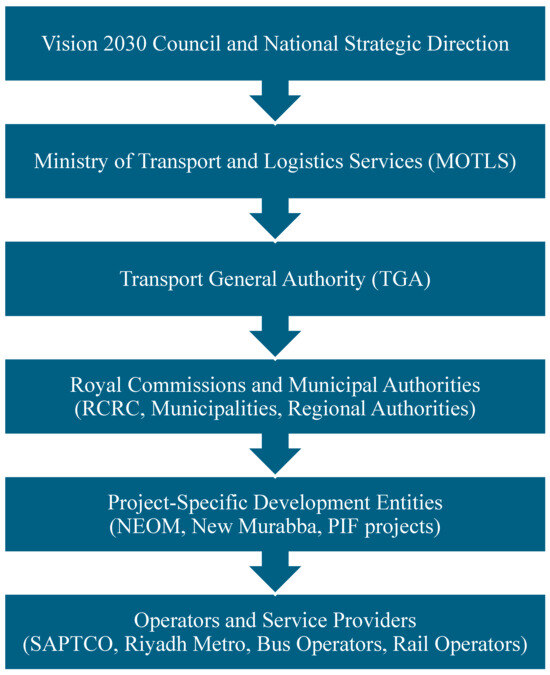
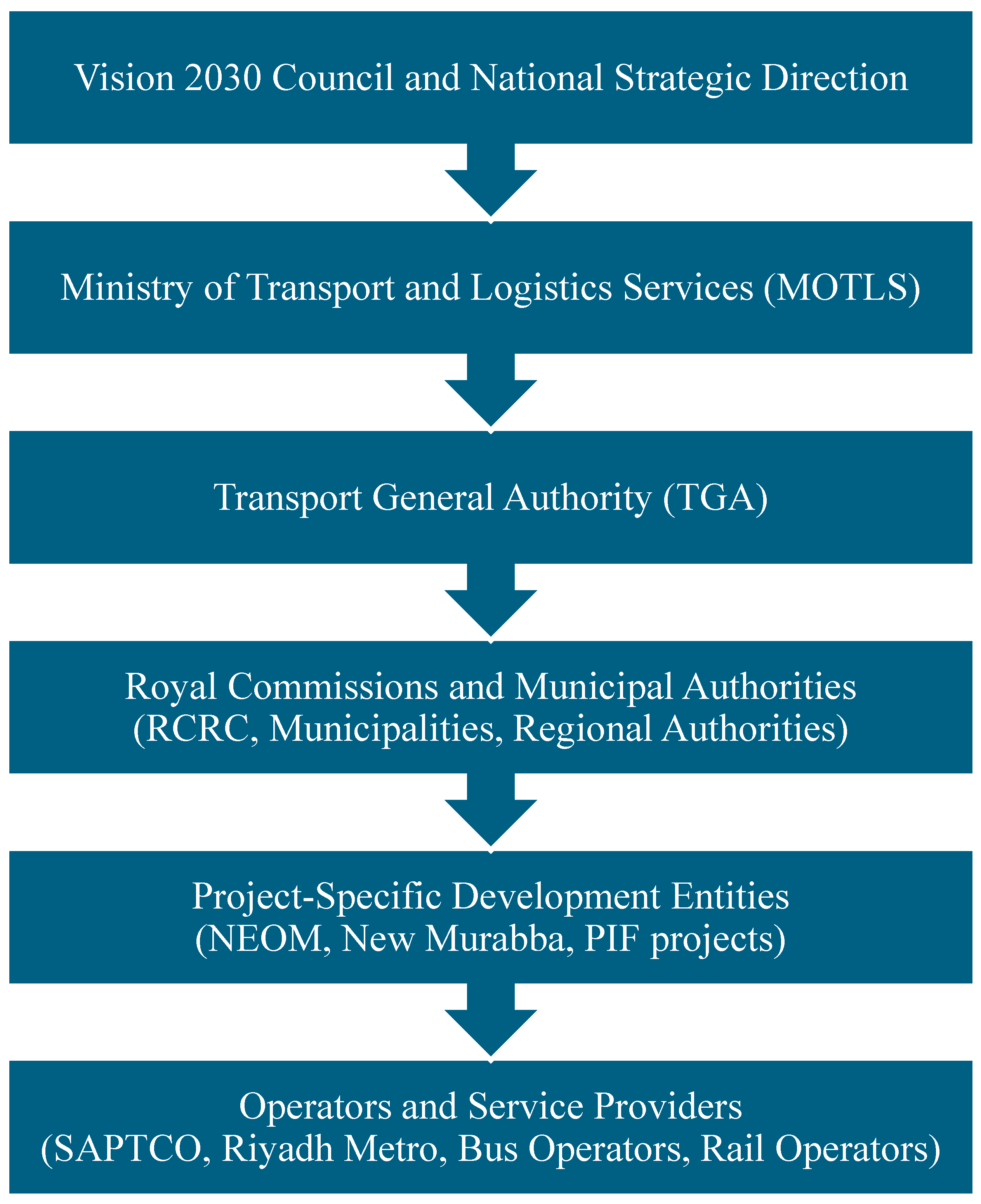
Urban transport governance in Saudi Arabia involves coordination among national authorities, sectoral agencies, and city-level institutions. While this multi-level system allows for large-scale projects, it also introduces coordination challenges across different agencies and sectors. Figure 1 illustrates the multi-level governance structure that shapes urban transport planning and implementation in Saudi Arabia. The framework highlights the relationships among national strategic authorities, sectoral regulators, municipal entities, and project-specific development organizations involved in delivering sustainable transport initiatives under Vision 2030.
Figure 1.
Multi-level governance structure of urban transport in Saudi Arabia.
The figure demonstrates that sustainable transport implementation depends on coordination across multiple governance levels and institutions, contributing to variations in implementation approaches across Saudi cities.
Major projects such as metro systems, high-speed rail, and large-scale urban developments (e.g., NEOM) reflect the implementation priorities of Vision 2030 toward more sustainable and technology-driven mobility solutions. Smart mobility and intelligent transport systems (e.g., ITS technologies, SAHER, and automated parking) have also been adopted to improve traffic management and system efficiency. Despite these initiatives, gaps remain between policy goals and implementation. Existing studies often concentrate on individual projects, while a thorough national-level analysis of policy development remains limited.
5. Methodology
This study adopts a longitudinal qualitative policy document analysis to examine the evolution of sustainable urban transport policy in Saudi Arabia from 2000 to 2025. The 2025 phase reflects policy developments, implementation reports, and operational evidence available during the early months of 2025. The approach traces how sustainability concepts have emerged, shifted, and been institutionalized over time across national strategies, sectoral programs, and urban-scale planning and project documents. Rather than evaluating individual projects or modeling travel behavior, the analysis focuses on policy framing, stated priorities, governance arrangements, and evidence of implementation across successive planning phases.
Methodologically, the study contributes by combining longitudinal policy tracing with multi-scalar document analysis of national strategies, municipal plans, and giga-project frameworks over a 25-year period. Unlike conventional transport policy reviews that focus on single projects or sectors, this approach enables examination of how sustainability principles evolved, overlapped, and became institutionalized across multiple governance scales and implementation phases.
Because the study relies primarily on policy and planning documents, it does not directly measure individual travel behavior through surveys or interviews. Instead, interpretations related to behavioral lock-in and mobility preferences are inferred from policy discourse, infrastructure patterns, and findings reported in secondary literature.
5.1. Document Selection and Data Sources
A multi-scalar corpus of documents was compiled to capture both strategic intent and implementation pathways. The dataset comprises: (1) national-level policy and strategy documents (e.g., Saudi Vision 2030 and its delivery plans, NTLS, the QoL, NIDLP, SGI); (2) sectoral and regulatory materials on transport governance, rail, public transport, electric mobility, and energy transition; and (3) municipal plans and major project documentation for key cities and giga-projects, including Riyadh, Jeddah, Makkah, Madinah, Dammam, NEOM, and New Murabba.
Documents were selected based on three criteria: (i) official status (published by the government ministries, authorities, or state-owned entities); (ii) relevance to urban transport, mobility, land use, or sustainability objectives; and (iii) temporal relevance to the study period (2000–2025). Academic literature and independent reports were used to contextualize policy developments and triangulate official narratives, while the core analysis remained grounded in primary policy and planning documents. Because the study analyzes policy evolution and implementation evidence, the corpus includes both peer-reviewed literature and non-academic institutional sources, such as official strategies, authority reports, project documents, and implementation updates. These sources were included when they provided relevant evidence on policy direction, project delivery, or reported implementation progress.
Table 1 summarizes the main categories of documents reviewed in the analysis, including their institutional sources, temporal coverage, and analytical purpose. The document corpus was designed to capture both policy formulation and implementation across multiple governance levels.
Table 1.
Summary of reviewed documents used in the analysis.
In total, approximately 60 documents were reviewed to identify changes in policy discourse, implementation priorities, governance arrangements, and the integration of sustainability principles across the three analytical phases.
5.2. Analytical Framework and Coding
The analysis applies a thematic content analysis informed by the three pillars of sustainability: environmental protection, social equity and livability, and economic efficiency. An initial codebook was developed deductively from the sustainable transport literature and refined inductively through iterative document review. Key coding categories included emissions reduction and decarbonization; public and active transport provision; electric and alternative-fuel mobility; safety and accessibility; governance and institutional coordination; pricing, subsidies, and demand management; and links between transport and urban form.
Coding was conducted across all documents to identify changes in policy language, stated objectives, investment priorities, and references to implementation mechanisms. Attention was given not only to the introduction of new policy themes but also to persistence, overlap, and tension between approaches, particularly where legacy car-oriented planning approaches continued alongside emerging sustainability-oriented goals.
The coding process was conducted manually by the author through iterative reading and thematic categorization of documents. Documents were first coded according to the three sustainability dimensions and then grouped into subthemes covering governance, infrastructure investment, behavioral transition, electrification, accessibility, and land-use integration. This iterative process enabled comparison across policy phases and helped identify recurring patterns, policy tensions, and implementation gaps within the policy discourse. For example, references to metro systems, bus expansion, walkability, and rail investment were coded under public and active transport, while discussions of parking reform, fuel pricing, and first/last-mile connectivity were coded under demand management. To improve analytical transparency, Table 2 summarizes the main coding categories and representative themes used during the thematic document analysis.
Table 2.
The main analytical coding categories used in the document analysis.
5.3. Phase Delineation and Longitudinal Comparison
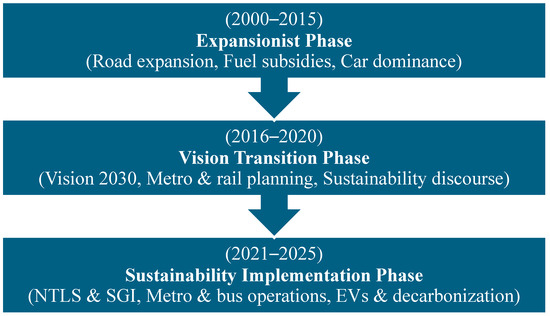
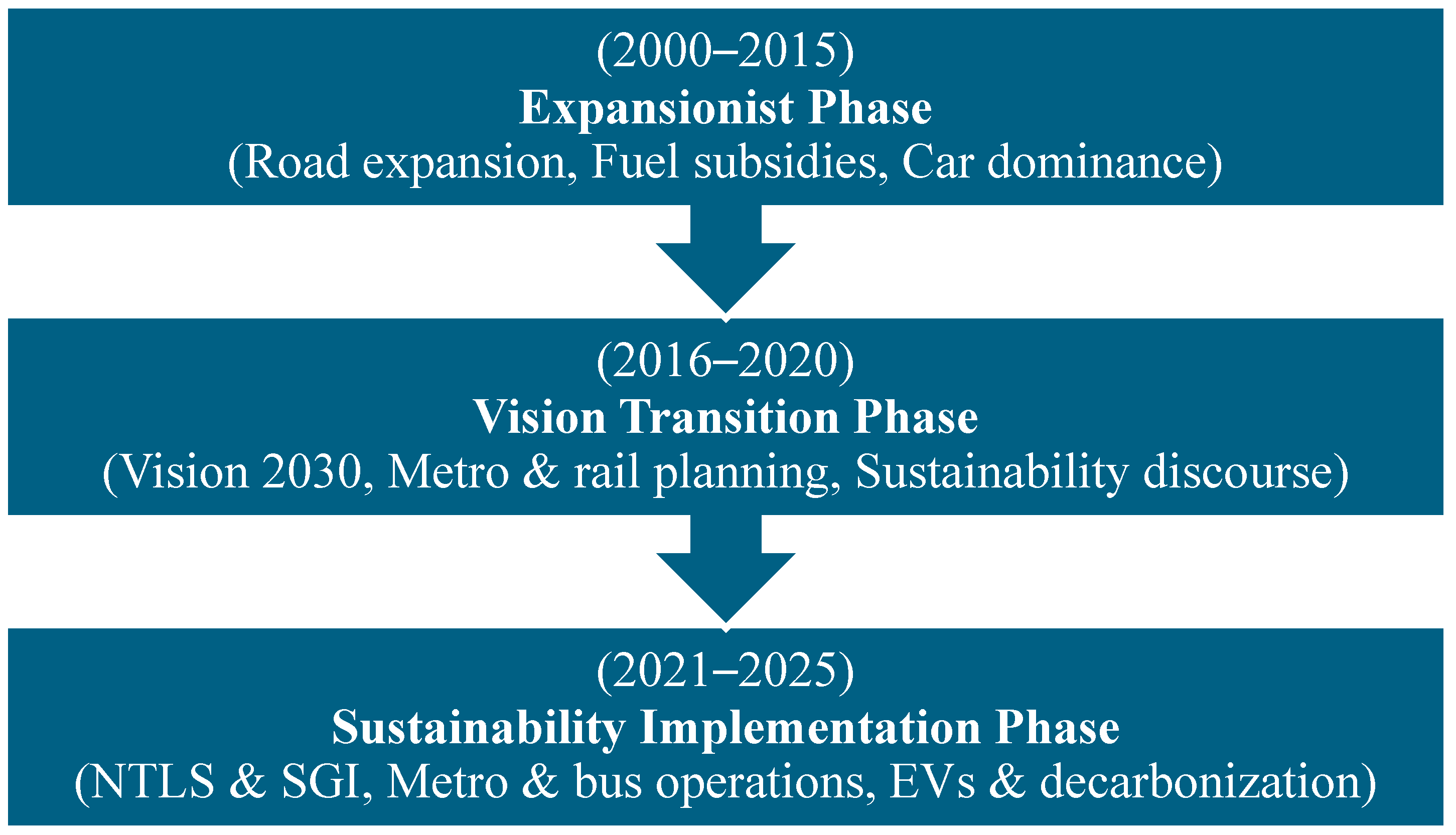
To structure the longitudinal analysis, this study distinguishes three phases: an expansionist phase (2000–2015), a vision transition phase (2016–2020), and a sustainability implementation phase (2021–2025). These phases are grounded in major institutional and policy milestones rather than arbitrary cut-off years. The first phase precedes Vision 2030 and is characterized by road expansion, fuel subsidies, and limited public transport. The second phase begins with the launch of Vision 2030 in 2016 and reflects a shift in strategic discourse toward sustainability, diversification, and livability. The third phase corresponds to the rollout of implementation frameworks such as NTLS and SGI, the opening of major rail and bus systems, and the scaling of electric mobility initiatives. The 2025 endpoint reflects the most recent available official strategies, progress reports, and implementation updates at the time of analysis; therefore, 2025 is treated as an early implementation year rather than the end of a policy cycle. Figure 2 summarizes the temporal evolution of Saudi Arabia’s urban transport policy and the key shifts in planning priorities across the three phases.
Figure 2.
Evolution of urban transport policy in Saudi Arabia (2000–2025).
Comparative analysis across phases focuses on how sustainability principles were introduced, expanded, or constrained over time, and on the extent to which policy ambitions were translated into concrete delivery mechanisms. This longitudinal perspective helps identify implementation gaps, behavioral lock-in, and governance challenges that persist despite policy reform.
5.4. Reliability and Validation
To enhance analytical rigor, findings were triangulated across multiple document types and sources, including policy texts, official progress reports, project announcements, and independent evaluations. Consistency between stated goals and reported outcomes was examined where data were available. The emphasis on official documents helps ensure internal coherence within the policy system, while cross-referencing with secondary literature mitigates the risk of over-reliance on aspirational or symbolic policy language. Analytical consistency was further strengthened through repeated cross-checking of themes across multiple document categories, including policy strategies, implementation reports, and independent institutional evaluations.
Because the study relies primarily on policy and institutional documents, references to implementation outcomes are interpreted cautiously and understood mainly through officially reported indicators and secondary evaluations, rather than through independent causal verification. Ethical approval was not required because the study relied exclusively on publicly available policy documents, institutional reports, and secondary sources and did not involve human participants, personal data, surveys, or interviews.
6. Results
6.1. Phase 1: Expansionist Phase (2000–2015)
Transport during this period was predominantly road-based, with a vast network of roads and highways connecting its urban areas [34]. Commuting within and between cities heavily depended on private automobiles, while transport policy emphasized road expansion and highway connectivity due to high car ownership, heavily subsidized fuel prices, limited public transport, low taxation, and widespread free roadside parking [3,32]. This pattern was further reinforced by dispersed urban development, abundant parking supply, limited investment in public transportation, and planning approaches that prioritized highway expansion and automobile accessibility.
Saudi Arabia has one of the world’s highest car-ownership rates [34] and is ranked among the top consumers of motor gasoline [35]. Heavy dependence on private automobiles and diesel trucks made the sector a major contributor to greenhouse gas emissions and traffic fatalities [36,37]. Urban planning prioritized vehicular mobility and spatial growth over walkability, transit integration, or equity, reinforcing unsustainable patterns.
No metro or urban rail existed, and bus services were limited in most cities, mainly used by very low-income expatriates [3]. Even low-income Saudi families, who did not own private automobiles, commonly relied on contracted drivers or taxis, as public transport was culturally disfavored [3]. Freight also depended on roads and diesel trucks, with minimal rail freight (only two operational lines) [36]. The transport sector was the second-largest source of greenhouse-gas emissions; traffic injuries and deaths were a leading public-health and economic burden [37].
The dominance of road-based transport during this period created a mobility system that was effective for rapidly expanding mobility in the short term, but which was associated with long-term sustainability challenges. Dependence on automobiles, underinvestment in public transit, and urban planning focused on spatial expansion entrenched patterns of high fuel consumption, increased carbon emissions, and unequal access to mobility. These conditions not only led to serious environmental problems but also made road accidents a major public health issue. By ignoring non-motorized transport, mixed-use planning, and integrated transit solutions, this era built structural barriers that hindered sustainable mobility transitions. Recognizing these limitations was crucial for shaping later reforms under Vision 2030.
6.2. Phase 2: Vision Transition Phase (2016–2020)
In this phase, Saudi Vision 2030 was introduced in 2016 as a national framework for economic diversification and social development. A central component was transforming the transport sector toward sustainability, including investments in public transit, rail, electric mobility, and smart infrastructure [38,39,40]. However, implementation was still in early stages, and dependence on private cars continued.
Vision 2030 aims to enhance public transport to reduce car dependence, congestion, crashes, and fuel consumption; improve air quality and safety; create attractive living and working environments; and promote social equity [6]. Therefore, the government has significantly invested in developing public transport systems in major cities such as Riyadh, Jeddah, Makkah, Madinah, and Dammam. One major initiative is the King Abdulaziz Public Transport Project in Riyadh, which includes six metro lines supported by an extensive bus network [41]. This metro system incorporates intelligent infrastructure elements like automated train control, real-time passenger information, and smart ticketing [38]. Early official projections suggested that the project could reduce traffic by approximately 30% [42]. Makkah planned 183 km of LRT; Jeddah proposed a network of metro/BRT/ferries with four LRT lines spanning 149.8 km; and Dammam proposed 110 km of bus lanes and 50 km of LRT [43]. Intercity rail investments, including high-speed and freight networks, also improved connectivity and supported national mobility goals. The Haramain High-Speed Railway was launched in 2018 and is among the fastest electric rail systems globally, with expected benefits related to energy efficiency, congestion reduction, and lower transport emissions [44]. Another major project, the North Railway Network, established in 2017, is recognized as one of the largest railway networks in the region [45].
In 2017, the government announced NEOM, a giga-project intended to function as a model for low-carbon and technology-driven urban development. Mobility planning within NEOM emphasizes renewable-energy-powered transport systems, reduced automobile dependence, and pedestrian-oriented urban forms [46]. The project is planned to be developed in phases over multiple decades, with major components expected to continue beyond 2030. The project remains under phased development and represents one of the world’s most ambitious experiments in sustainable and reduced-car-dependence urban mobility [46].
The government introduced early policy measures to support electric mobility, including charging infrastructure deployment and regulatory incentives. The first EV charger in Riyadh was installed in 2019, followed by many more EV chargers at various gas stations across the country [47]. Solar and wind projects started powering transport systems. They are being used to provide energy for EV charging stations, street lighting, and other transport systems [38].
Smart mobility technologies were increasingly incorporated into transport planning and operational systems to enhance traffic management, safety, and the overall system efficiency [38]. For example, the Riyadh Metro is equipped with automatic electrification, Wi-Fi services, LED lighting, and surveillance cameras [39]. Another example of its application is the automated traffic management camera system known as “SAHER,” which uses a network of surveillance cameras to enforce traffic regulations and enhance general road safety [47]. Furthermore, a comprehensive range of parking solutions and automated parking systems is designed to address various parking challenges [47]. Policy initiatives increasingly emphasize walkability and active transport within broader urban livability strategies. Improving walkability and pedestrian accessibility is a key part of these efforts [40]. Another key aspect is implementing bike-sharing systems in several cities [38]. Several projects explicitly promote walkability, including Sports Boulevard, King Salman Park, New Murabba, NEOM, and specific districts in Riyadh such as Al-Malaz, Al-Olaya, and Al-Falah, along with the historic Al-Balad in Jeddah.
Overall, this phase represented a strategic shift toward sustainability by combining infrastructure investment with new policy directions. However, a gap persisted between planning goals and actual behavior, as car dependence and structural barriers continued to limit modal shift.
6.3. Phase 3: Sustainability Implementation Phase (2021–2025)
The period from 2021 to 2025 represents a shift from policy vision to large-scale implementation. Building on earlier reforms, frameworks such as the NTLS and SGI integrated sustainability into governance, infrastructure, and investment. This phase included expanding public transport, electrification initiatives, and smart mobility systems.
NTLS established policy targets related to sustainability, fuel-efficiency improvement, and smart mobility integration through the adoption of innovative and advanced global mobility technologies [48]. It also aims to position Saudi Arabia as a global logistics hub connecting three continents while simultaneously upgrading domestic mobility [49]. Although NTLS emphasizes multimodal connectivity, several of its pillars have direct implications for urban transport. NTLS stresses the importance of combining modes (rail, bus, maritime, aviation) to ensure seamless passenger and freight flows [49]. At the urban level, this implies multi-tier public transport systems in which metro, BRT, and feeder buses are coordinated through unified ticketing and digital platforms. NTLS also prioritizes upgrading the road infrastructure to improve safety and support high-quality public transport services [48]. In addition, the strategy includes targets to reduce road traffic accidents and fatalities by more than 50% and to cut fuel consumption in the transport sector by 25% by 2030 relative to the 2021 baseline [48]. NTLS further aligns with Vision 2030 and the Saudi Green Initiative by incorporating decarbonization goals, including fleet modernization through Euro-5 buses, early electric bus pilots in Jeddah and Tabuk, and integration with the target of increasing electric vehicles to 30% of vehicles in Riyadh by 2030.
NEOM is envisioned as a large-scale urban development with minimal private-car reliance and a strong emphasis on renewable-energy-powered mobility systems [46]. The project proposes a renewable-energy-powered mobility system designed to minimize dependence on conventional private vehicles [46]. New Murabba, announced in 2023, is a modern downtown development in Riyadh that uses a more compact and walkable urban model that residents can reach within 15 min communities. It has pedestrian-oriented districts connected by a “mobility loop” with shaded walkways and cycle paths [50].
Rail transit in Saudi Arabia experienced a remarkable transformation from 2021 to 2025, reflecting the implementation priorities of Vision 2030 and the NTLS [51]. During this phase, the focus shifted from strategic planning toward large-scale implementation and network expansion, with major projects launched to modernize both urban mass transit and intercity rail connectivity. At the urban level, the most notable development was the phased opening of the Riyadh Metro (2024–2025), comprising six automated lines extending over 176 km and designed to serve approximately 3.6 million daily passengers [52]. A comparative scenario analysis by the King Abdullah Petroleum Studies and Research Center (KAPSARC) estimated that replacing Riyadh Metro ridership with private-car trips between 1 December 2024 and 15 February 2025 would have generated approximately 297.6 million vehicle-kilometers traveled (VKT) by nearly 53,237 cars, consuming approximately 22.9 million liters of gasoline and emitting about 52,885 metric tons of CO2 [53]. The Riyadh Bus Project, launched in 2023, further expanded public transport provision through 80 bus routes operated by 842 buses across more than 1900 km and approximately 2860 bus stations [41]. Official transport reports also indicated substantial increases in bus ridership in Riyadh and Makkah between 2022 and 2025 [6,54].
At the national level, the government allocated $7 billion for the Saudi Landbridge—a cross-Kingdom corridor linking Jeddah to Riyadh and onward to Dammam—comprising a new 950 km Riyadh–Jeddah line, upgrades to Riyadh–Dammam, and a new 115 km Dammam–Jubail link [55]. Parallel expansions of the North–South Railway and upgrades to passenger rail fleets further strengthened the national railway system, with the total network length expected to increase from 5500 km to over 8000 km [45]. Intercity rail passengers reached 13 million in 2024, representing a 22% increase from 2023 [6]. Also, the Haramain High-Speed Railway ridership rose from around 143,000 in 2018 to 9.3 million in 2024 [6].
Recent policy reforms have increasingly prioritized transport electrification through industrial policy, regulatory reforms, and pilot projects. Recently, Saudi Arabia has increasingly expanded its role in the electric vehicle manufacturing sector, fueled by Vision 2030, which aims not only to align with global trends toward cleaner energy but also to diversify the economy, cut reliance on oil, and improve environmental sustainability [56], with a headline target of achieving 30% electric vehicles in Riyadh by 2030 through partnerships with major electric vehicle manufacturers [57]. Industrial policy reinforced these ambitions: in 2022, the Ministry of Finance signed a procurement deal with Lucid Motors (target: 155,000 EVs annually); in 2023, Lucid opened its first overseas plant at King Abdullah Economic City [56]. PIF launched Ceer in 2022 as the first Saudi EV brand, partnering with Foxconn and BMW [56]. Technical standards for EV charging were issued in 2023; Electric Vehicle Infrastructure Company (EVIQ) plans 5000 fast chargers at 1000 locations by 2030, with installations beginning in 2024 [58].
Public transport electrification was piloted; in February 2023, the TGA and SAPTCO introduced Saudi Arabia’s first electric buses in Jeddah, followed by a similar pilot in Madinah in April 2023 [59]. In addition, in November 2023, SAPTCO launched 85 electric buses in Dammam and Qatif [60]. In 2024, Riyadh Air introduced the first 47-seat electric buses for employee transport as part of its commitment to sustainability [61]. TGA has initiated a pilot program with a hydrogen bus and other hydrogen-powered vehicles in the private taxi sector, representing an early experimental step toward alternative-fuel mobility [62]. Hydrogen-powered vehicles can operate for up to eight hours a day with a range of 350 km, while the Hydrogen bus can travel approximately 630 km [6]. Additionally, TGA announced a strategic partnership with Abdul Latif Jameel Company, focusing on environmentally friendly vehicles and advanced technologies [62].
Smart mobility and ITS technologies were increasingly integrated into transport modernization strategies [38]. Under NTLS and Vision 2030, cities deployed real-time data systems, AI-driven traffic management, and connected infrastructure to improve urban mobility and logistics efficiency [51]. Riyadh’s metro/bus network integrates automated train control, real-time passenger information (RTPI), and smart ticketing [38] and traffic signal priority for buses, supported by more than 1500 digital displays designed to withstand Riyadh’s climate [41]. Jeddah and Madinah implemented ITS for traffic management, smart parking, and electric bus scheduling [59]. EVIQ’s charger rollout integrates cashless payment and remote monitoring [63]. NEOM pilots autonomous shuttles, air taxis, drone logistics, and AI-controlled traffic [46].
In 2024, SDAIA developed several advanced automated systems that generate large amounts of information on road traffic, ranging from a macro, citywide level to individual streets through camera-based detection and computer vision tools. One of these is the Sawaher system, a national platform designed to analyze streams of images and videos using artificial intelligence and computer vision, designed to support real-time traffic monitoring and operational analysis [64]. Another is the Smart C platform, which uses data and artificial intelligence technologies to monitor, analyze, and predict operational indicators, supporting decision-making in smart city management [64].
Recent years have witnessed growing experimentation with micromobility options—especially shared e-scooters and e-bikes—as solutions for first and last-mile transit [65]. A 2022 pilot project in the Riyadh Diplomatic Quarter deployed approximately 50 e-scooters with IoT/GPS for evaluation [66]. Tier Mobility also launched e-scooters and e-bikes in Riyadh and Jeddah around 2023, allowing users to unlock devices through an app, utilize virtual parking, and follow safety guidelines [67]. In Medina, e-bikes were introduced in 2023 with 500 bikes and 60 charging stations [68]. Market forecasts anticipate rapid growth for shared and private e-scooters [65]. Persistent challenges include limited dedicated infrastructure, heat exposure, safety concerns, and uneven service availability [69].
Saudi Arabia advanced its fuel-price rationalization plan as part of energy transition policies under Vision 2030. A major milestone occurred in July 2021 when a royal directive set a price cap for gasoline—fixing Gasoline 91 at SAR 2.18/L and Gasoline 95 at SAR 2.33/L—with the state treasury instructed to cover any excess costs above this limit. This move effectively separated gasoline prices from global oil price fluctuations, with the stated aim of maintaining price stability for consumers [70]. Although this consumer protection mechanism remained in place through 2025, other fuels continued to undergo subsidy reforms. Specifically, diesel prices were increased in early 2025, with Saudi Aramco announcing a new rate of SAR 1.66/L, reflecting a year-over-year increase of about 44% [71]. The International Monetary Fund noted this reform in its 2025 Article IV consultation, observing that while gasoline prices have remained capped since 2021, diesel and other fuel products are gradually being aligned with international benchmarks to reduce fiscal distortions and promote efficiency [72].
Saudi Arabia has adopted the Circular Carbon Economy (CCE) as a guiding framework for its energy and climate strategy, emphasizing the four pillars of Reduce, Reuse, Recycle, and Remove to manage carbon emissions across sectors [73]. In the transport sector, Reduce includes fuel-economy standards and price reforms; Reuse/Recycle includes EVs and hydrogen/biofuel pilots; Remove involves carbon-capture pilots that could enable synthetic fuels for heavy transport [74]. Urban transport planning under NTLS and giga-projects promotes shifts to public transport, e-mobility, and walkable design.
Overall, this phase reflects a transition from strategic vision toward large-scale implementation. Through frameworks such as NTLS and SGI, alongside major projects including the Riyadh Metro and NEOM, Saudi Arabia expanded investments in rail and bus networks, transport electrification, micromobility, hydrogen pilots, fuel-price reforms, and Circular Carbon Economy (CCE) integration. Together, these initiatives indicate a broader policy approach that combines infrastructure expansion, digital transformation, industrial diversification, and environmental objectives. However, important challenges remain, including affordability, equity, behavioral transition, and the need for network-scale active-mobility infrastructure.
7. Discussion
This study reveals a clear evolution in Saudi Arabia’s urban transport policy, from an expansionist, car-oriented paradigm to an explicit sustainability agenda and, more recently, to early stages of large-scale implementation. However, the longitudinal analysis also shows that policy ambition and infrastructure investment have not yet translated into proportional changes in everyday travel behavior. The discussion interprets these findings through four interrelated dimensions: implementation gaps, behavioral and structural lock-in, governance and coordination challenges, and the depth of sustainability integration. Table 3 summarizes the evolution of sustainable urban transport policy in Saudi Arabia across the three analytical phases, highlighting dominant policy orientations, key instruments, and persistent implementation gaps.
Table 3.
Evolution of sustainable urban transport policy in Saudi Arabia (2000–2025).
7.1. From Policy Ambition to Implementation Gaps
Findings from the reviewed policy documents across the three phases indicate a clear intensification of sustainability discourse, particularly after the launch of Vision 2030 and implementation frameworks such as the NTLS and SGI. Major investments in rail, bus systems, electric mobility, and smart transport signal a substantive shift away from purely road-based expansion. This distinction between strategic policy discourse and implementation outcomes is important because ambitious sustainability language must be assessed against delivery mechanisms, operational integration, and measurable changes in mobility behavior. Nevertheless, the analysis reveals a persistent gap between strategic intent and on-the-ground outcomes. While metros, buses, and rail systems have expanded rapidly, their ability to reshape modal shares remains constrained by the surrounding urban form, incomplete feeder networks, and limited demand-management measures. This confirms that infrastructure provision alone is insufficient to trigger a systemic modal shift without complementary policies that actively discourage private car use and improve first- and last-mile conditions. These findings are consistent with previous international research showing that infrastructure expansion alone rarely produces substantial modal shift without integrated land-use planning, demand-management measures, and behavioral incentives [7,8,9,10,11,12].
7.2. Behavioral Lock-In and Urban Form Constraints
Findings from the expansionist and vision-transition phases reveal persistent automobile dependence, reflecting deep-seated behavioral and structural lock-in reinforced by decades of car-oriented planning and a subsidized mobility system. Decades of low-density development, wide road hierarchies, abundant parking, and subsidized fuel prices have normalized car use as the default mode of travel. Even during the sustainability implementation phase, many public transport investments operate within urban environments that remain poorly suited to walking, cycling, or seamless intermodal transfers. Climatic conditions, particularly extreme heat, further reduce the attractiveness of active modes where shade, thermal comfort, and pedestrian continuity are insufficient. These findings suggest that Saudi Arabia’s mobility transition is constrained less by a lack of strategic vision and more by the inertia of inherited urban form and travel habits. Similar patterns of behavioral and structural lock-in have also been observed in other rapidly urbanizing and car-oriented cities, particularly in Gulf and arid urban contexts [23,24,25].
7.3. Socio-Cultural Dimensions of Mobility Transition
The reviewed policy documents and previous studies on mobility behavior in Saudi Arabia and Gulf cities also point to underexplored socio-cultural dimensions that influence mobility transition and travel behavior, including perceptions of safety, household travel norms, climatic comfort, gender-related mobility considerations, and preferences favoring private automobile use [3,26,30,32]. While recent reforms have expanded women’s mobility options and labor-force participation, transport planning has been slower to integrate gender-sensitive design, safety perceptions, and caregiving-related travel needs. Similarly, reliance on private drivers and ride-hailing services among some households reflects social preferences that sustainability policies do not directly target. These dynamics help explain why car dependence persists despite new transit supply and highlight the need for culturally responsive mobility strategies. Previous studies in Saudi Arabia have similarly shown that perceptions of safety, climatic conditions, urban sprawl, and social preferences for private automobile use continue to shape mobility behavior and constrain modal shift [3,26,32].
7.4. Governance, Coordination, and Scale
The governance arrangements identified across national strategies, municipal plans, and project-level documents reveal both strong state-led coordination capacity and ongoing coordination challenges across institutions. National strategies set ambitious targets, while implementation depends on coordination among ministries, regulators, municipal authorities, and project-specific entities. The analysis shows that sustainability initiatives are often implemented at the project level rather than through fully integrated network-based systems, resulting in uneven coverage of active transport, micromobility, and pedestrian improvements. Without stronger horizontal coordination and performance-based accountability, sustainability gains risk remaining fragmented. Transparent indicators, public dashboards, and integrated land-use–transport governance are important for scaling early implementation successes.
7.5. Depth of Sustainability Integration
Finally, the reviewed policy documents raise important questions about the depth and balance of sustainability integration across the environmental, social, and economic dimensions. Environmental objectives—such as emissions reduction, electrification, and energy efficiency—are increasingly well articulated and supported by industrial and regulatory measures. Social equity and accessibility considerations have also received growing attention in recent years, particularly through investments in accessible metro systems, bus networks, and inclusive urban infrastructure. Recent metro and bus investments have increasingly incorporated accessibility standards for older adults and people with disabilities, including step-free access, designated seating areas, and improved pedestrian connectivity around transit stations. However, implementation varies across some peripheral areas and mobility contexts, especially regarding first- and last-mile accessibility and broader integration with walkable urban environments.
Overall, the longitudinal comparison demonstrates that sustainability integration in Saudi Arabia has evolved unevenly across policy domains and implementation levels. While environmental modernization and infrastructure expansion are strongly represented in official strategies and implementation reports, behavioral transition and land-use integration remain comparatively less integrated within the reviewed policy framework.
Compared with other Gulf states such as the UAE and Qatar, Saudi Arabia’s sustainable transport transition is distinctive for its national scale, integration with Vision 2030, and simultaneous emphasis on public transport expansion, logistics modernization, electrification, and giga-project urbanism. While Dubai and Doha introduced metro systems earlier as part of compact metropolitan transport strategies, the Saudi case involves a broader, multi-city, and national policy transition across Riyadh, Jeddah, Makkah, Madinah, Dammam, NEOM, and New Murabba. This comparison suggests that Saudi Arabia’s transition is not only a project-based mobility reform but also a nationwide restructuring of transport policy under economic diversification and sustainability objectives.
8. Policy Implications
The findings of this study suggest that advancing sustainable urban transport in Saudi Arabia requires moving beyond large-scale infrastructure toward integrated regulatory, operational, and urban-design interventions that directly address the constraints identified in the analysis. Policy implications are therefore structured around five interrelated areas.
First, infrastructure investment should be systematically coupled with demand-management measures. While metro, bus, and rail systems have expanded rapidly, their effectiveness will remain limited without policies that moderate private car use. Gradual parking reform—such as priced on-street parking, parking maximums near transit stations, and reduced minimum parking requirements in new developments—would directly respond to observed behavioral lock-in and reinforce public transport competitiveness while maintaining implementation flexibility.
Second, first- and last-mile connectivity must be prioritized as a core policy objective rather than a project-specific add-on. The persistence of car dependence reflects gaps in feeder bus services, pedestrian continuity, and thermal comfort. National and municipal authorities should adopt a heat-adaptive street design framework that mandates continuous shade, safe crossings, and protected micromobility infrastructure within transit catchment areas. This directly responds to the climatic constraints identified in the analysis and improves the practical usability of public transport.
Third, land-use and transport integration requires stronger regulatory alignment. While transit-oriented development is frequently referenced in strategic documents, its implementation remains uneven. Enforceable TOD codes—specifying minimum densities, mixed-use requirements, and reduced parking near high-capacity transit—would help translate policy intent into spatial outcomes. Value-capture mechanisms linked to metro and rail investments could finance local accessibility upgrades and reinforce long-term ridership.
Fourth, governance and coordination mechanisms should be strengthened to scale sustainability outcomes. The multi-level governance structure that enabled rapid project delivery now requires consolidation through shared performance indicators, transparent public dashboards, and clearer accountability for service quality, accessibility, and emissions outcomes. Aligning national targets under Vision 2030 and NTLS with city-level operational KPIs would reduce fragmentation and support network-wide sustainability rather than isolated successes.
Finally, equity and socio-cultural considerations should be more explicitly integrated into transport policy. Gender-sensitive design, safety perceptions, and household travel needs remain insufficiently addressed despite their influence on travel behavior and mode choice. Policies such as safe-routes-to-school programs, enhanced pedestrian safety near residential neighborhoods and schools, and affordable integrated ticketing can help ensure that sustainability gains translate into inclusive mobility outcomes. Addressing these dimensions would strengthen the social pillar of sustainability and support broader behavioral transition objectives identified in the study.
Together, these policy implications emphasize that Saudi Arabia’s transport transition is not solely a technological or infrastructural challenge but an institutional and behavioral one. Aligning regulation, urban form, pricing, and governance with existing investments is essential for converting ambitious national strategies into durable and socially inclusive mobility change.
9. Conclusions
This study examined the evolution of sustainable urban transport policy in Saudi Arabia from 2000 to 2025 through a longitudinal qualitative policy document analysis. The findings indicate a substantial policy transition from an expansionist, car-oriented development model toward a sustainability-focused policy agenda, followed by an emerging phase of large-scale implementation under Vision 2030 and associated frameworks such as NTLS and SGI. This transition is reflected in major investments in rail systems, public transport networks, electric mobility, and smart transport technologies.
However, the analysis also indicates that the depth of transformation remains uneven. While policy ambition and infrastructure provision have advanced rapidly, changes in everyday travel behavior have been comparatively slower. Persistent car dependence, low-density urban form, climatic constraints, and socio-cultural factors continue to influence modal shifts. These findings highlight that sustainable mobility transitions are not solely technical challenges but also complex institutional and behavioral processes shaped by governance arrangements, urban design, and long-term mobility patterns.
By integrating national strategies, municipal plans, and giga-project documentation over 25 years, this study provides a comprehensive policy-level perspective on sustainable transport transitions in an oil-dependent and arid context. The findings underscore the importance of aligning infrastructure investment with demand management, land-use regulation, first- and last-mile connectivity, and inclusive urban design to translate strategic goals into durable mobility outcomes. Because this study relies primarily on policy and institutional documents, future research that incorporates travel surveys, behavioral data, and qualitative interviews would further strengthen understanding of how sustainability policies influence everyday mobility practices.
Overall, the Saudi case illustrates both the opportunities and challenges associated with rapid state-led mobility transitions. Continued progress toward sustainable urban transport will depend on consolidating early implementation gains, addressing structural and behavioral constraints, and integrating sustainability more deeply into everyday urban mobility practices.
Funding
The author is thankful to the Deanship of Graduate Studies and Scientific Research at Najran University for funding this work under the Growth Funding Program grant code (NU/GP/SERC/14/1947-1).
Institutional Review Board Statement
Not applicable.
Informed Consent Statement
Not applicable.
Data Availability Statement
Data is contained within the article.
Conflicts of Interest
The author declares no conflicts of interest.
References
- Alqarni, S. A Review of Prevalence of Obesity in Saudi Arabia. J. Obes. Eat. Disord. 2016, 2, 1–6. [Google Scholar] [CrossRef] [Scilit]
- Belloumi, M.; Alshehry, A. The impact of urbanization on energy intensity in Saudi Arabia. Sustainability 2016, 8, 375. [Google Scholar] [CrossRef] [Scilit]
- Alturif, G.; Saleh, W. Attitudes and Behaviour towards More Sustainable Travel Options in the Kingdom of Saudi Arabia: An Emerging Social Change? Sustainability 2023, 15, 12548. [Google Scholar] [CrossRef] [Scilit]
- International Energy Agency. Country Profile Saudi Arabia. Available online: https://www.iea.org/countries/saudi-arabia (accessed on 1 March 2026).
- Al-Douri, Y.; Waheeb, S.; Voon, C. Review of the renewable energy outlook in Saudi Arabia. J. Renew. Sustain. Energy 2019, 11, 015906. [Google Scholar] [CrossRef] [Scilit]
- Saudi Vision 2030: Annual Report 2024; Public Investment Fund: Riyadh, Saudi Arabia, 2025.
- Tiboni, M.; Rossetti, S.; Vetturi, D.; Torrisi, V.; Botticini, F.; Schaefer, M.D. Urban policies and planning approaches for a safer and climate friendlier mobility in cities: Strategies, initiatives and some analysis. Sustainability 2021, 13, 1778. [Google Scholar] [CrossRef] [Scilit]
- Santos, G.; Behrendt, H.; Teytelboym, A. Part II: Policy instruments for sustainable road transport. Res. Transp. Econ. 2010, 28, 46–91. [Google Scholar] [CrossRef] [Scilit]
- Alipour, D.; Dia, H. A Systematic Review of the Role of Land Use, Transport, and Energy-Environment Integration in Shaping Sustainable Cities. Sustainability 2023, 15, 6447. [Google Scholar] [CrossRef] [Scilit]
- Heinen, E.; Panter, J.; Mackett, R.; Ogilvie, D. Changes in mode of travel to work: A natural experimental study of new transport infrastructure. Int. J. Behav. Nutr. Phys. Act. 2015, 12, 81. [Google Scholar] [CrossRef] [Scilit]
- Heinen, E.; Harshfield, A.; Panter, J.; Mackett, R.; Ogilvie, D. Does exposure to new transport infrastructure result in modal shifts? Patterns of change in commute mode choices in a four-year quasi-experimental cohort study. J. Transp. Health 2017, 6, 396–410. [Google Scholar] [CrossRef] [Scilit]
- Wang, J.; Lu, Y.; Yang, Y.; Peng, J.; Liu, Y.; Yang, L. Influence of a new rail transit line on travel behavior: Evidence from repeated cross-sectional surveys in Hong Kong. J. Transp. Geogr. 2023, 106, 103526. [Google Scholar] [CrossRef] [Scilit]
- Turan, B.; Hemmelmayr, V.; Larsen, A.; Puchinger, J. Transition towards sustainable mobility: The role of transport optimization. Cent. Eur. J. Oper. Res. 2024, 32, 435–456. [Google Scholar] [CrossRef] [Scilit]
- Zhou, J. Sustainable transportation in the US: A review of proposals, policies, and programs since 2000. Front. Archit. Res. 2012, 1, 150–165. [Google Scholar] [CrossRef] [Scilit]
- United Nations Development Programme. What Is Sustainable Transport and What Role Does It Play in Tackling Climate Change? Available online: https://climatepromise.undp.org/news-and-stories/what-sustainable-transport-and-what-role-does-it-play-tackling-climate-change (accessed on 5 September 2025).
- Rodrigue, J. The Geography of Transport Systems; Routledge: Abingdon, UK, 2024. [Google Scholar]
- Al Zohbi, G. Sustainable Transport Strategies: A Case Study of Riyad, Saudi Arabia. E3S Web Conf. 2021, 259, 02007. [Google Scholar] [CrossRef] [Scilit]
- Al-lami, A.; Torok, A. Sustainability Indicators of Surface Public Transportation. Sustainability 2023, 15, 15289. [Google Scholar] [CrossRef] [Scilit]
- Abdullahi, U.; Adnan, A. Sustainable Urban mobility: Lessons from European Cities. Glob. J. Eng. Technol. Adv. 2024, 21, 157–170. [Google Scholar] [CrossRef] [Scilit]
- Michel, S.; Banwell, N.; Senn, N. Mobility Infrastructures and Health: Scoping Review of studies in Europe. Public Health Rev. 2024, 45, 1606862. [Google Scholar] [CrossRef] [Scilit]
- Lam, S.H.; Toan, T.D. Land Transport Policy and Public Transport in Singapore. Transportation 2006, 33, 171–188. [Google Scholar] [CrossRef] [Scilit]
- Cervero, R.; Murakami, J. Rail and Property Development in Hong Kong: Experiences and Extensions. Urban Stud. 2009, 46, 2019–2043. [Google Scholar] [CrossRef] [Scilit]
- Yahia, O.; Chohan, A.H.; Arar, M.; Awad, J. Toward Sustainable Urban Mobility: A Systematic Review of Transit-Oriented Development for the Appraisal of Dubai Metro Stations. Smart Cities 2025, 8, 21. [Google Scholar] [CrossRef] [Scilit]
- Arar, M.; Mushtaha, E. A Study of Changes in User Satisfaction in Metro Stations in Dubai. Futur. Cities Environ. 2025, 11, 1–13. [Google Scholar] [CrossRef] [Scilit]
- Crot, L. Planning for Sustainability in Non-democratic Polities: The Case of Masdar City. Urban Stud. 2013, 50, 2809–2825. [Google Scholar] [CrossRef] [Scilit]
- Peterson, H.; Al Kassim, Z. A case study on perceptions of public transportation in the eastern province of Saudi Arabia. Transp. Probl. 2020, 15, 5–15. [Google Scholar] [CrossRef] [Scilit]
- Alquthami, T.; Alsubaie, A.; Alkhraijah, M.; Alqahtani, K.; Alshahrani, S.; Anwar, M. Investigating the Impact of Electric Vehicles Demand on the Distribution Network. Energies 2022, 15, 1180. [Google Scholar] [CrossRef] [Scilit]
- Aljoufie, M. Spatial analysis of the potential demand for public transport in the city of Jeddah, Saudi Arabia. WIT Trans. Built Environ. 2014, 138, 113–123. [Google Scholar] [CrossRef] [Scilit]
- Alkhresheh, M. Urban Sprawl in Riyadh: Assessing the Impacts of Horizontal Expansion on Sustainability and Quality of Life. In Proceedings of the REAL CORP 2025, 30th Intl. Conference on Urban Development, Regional Planning and Information Society; Competence Center of Urban and Regional Planning: Graz, Austria, 2025; pp. 973–980. [Google Scholar]
- Almatar, K.; Almulhim, A. The Issue of Urban Transport Planning in Saudi Arabia: Concepts and Future Challenges. Int. J. Sustain. Dev. Plan. 2021, 16, 1317–1327. [Google Scholar] [CrossRef] [Scilit]
- Alamoudi, M.; Imam, A.; Majrashi, A.; Osra, O.; Hegazy, I. Integrating intelligent and sustainable transportation systems in Jeddah: A multidimensional approach for urban mobility enhancement. Int. J. Low Carbon Technol. 2024, 19, 1301–1314. [Google Scholar] [CrossRef] [Scilit]
- Dano, U.; Alqahtany, A. Issues undermining public transport utilization in Dammam City, Saudi Arabia: An expert-based analysis. J. Sustain. Sci. Manag. 2019, 14, 157–171. [Google Scholar]
- Saudi Vision 2030. Saudi Vision 2030; Public Investment Fund: Riyadh, Saudi Arabia, 2025.
- Kamboj, P.; Hejazi, M.; Qiu, Y.; Kyle, P.; Iyer, G. Saudi Arabia Net-Zero GHG Emissions by 2060: Transformation of the Transport Sector; KAPSARC: Riyadh, Saudi Arabia, 2024. [Google Scholar]
- Alwosheel, A.; Dua, R. Estimating Regional Variation in Saudi Arabia’s Energy Usage and Carbon Emissions; KAPSARC: Riyadh, Saudi Arabia, 2023. [Google Scholar]
- Lopez-Ruiz, H.; Nezamuddin, N.; Muhsen, A. Designing Transport Policy for Sustainable Freight Movement in Saudi Arabia; KAPSARC: Riyadh, Saudi Arabia, 2020. [Google Scholar]
- Dahim, M. Challenges and opportunities in development sustainable transportation system in Saudi Arabia. Appl. Eng. Technol. 2022, 2, 34–45. [Google Scholar] [CrossRef] [Scilit]
- Alanazi, F.; Alenezi, M. Sustainable Transportation and Intelligent Infrastructure Development in Saudi Arabia: A Study on the Impact of Saudi Vision 2030 and Renewable Energy Integration. Adv. Transdiscipl. Eng. 2024, 63, 90–101. [Google Scholar] [CrossRef] [Scilit]
- Doheim, R.; Farag, A.; Badawi, S. Smart city vision and practices across the Kingdom of Saudi Arabia—A review. In Smart Cities: Issues and Challenges Mapping Political, Social and Economic Risks and Threats; Visvizi, A., Miltiadis, L., Eds.; Elsevier: Amsterdam, The Netherlands, 2019; pp. 309–332. [Google Scholar]
- Homoud, M.; Jarrar, O. Walkability in Riyadh: A Comprehensive Assessment and Implications for Sustainable Community—Al-Falah Case Study. Sustainability 2024, 16, 8073. [Google Scholar] [CrossRef] [Scilit]
- Royal Commission for Riyadh City. King Abdulaziz Project for Riyadh Public Transport. Available online: https://www.rcrc.gov.sa/en/projects/king-abdulaziz-project-for-riyadh-public-transport-2/ (accessed on 10 September 2025).
- Oakil, A.; Muhsen, A. Potential trip coverage of the proposed public transport network in Riyadh. Acad. Lett. 2021, 3794. [Google Scholar] [CrossRef] [Scilit]
- Abubakar, I.; Dano, U. Sustainable urban planning strategies for mitigating climate change in Saudi Arabia. Environ. Dev. Sustain. 2020, 22, 5129–5152. [Google Scholar] [CrossRef] [Scilit]
- Saudi Press Agency. Haramain High Speed Railway Ready to Accommodate 1.6 Million Passengers for Hajj Season. Available online: https://www.spa.gov.sa/en/N2114492 (accessed on 24 September 2025).
- Saudi Press Agency. Network Length Expected to Increase from 5300 km to over 8000 km. Available online: https://www.spa.gov.sa/en/N2211136 (accessed on 10 January 2026).
- NEOM. Mobility: Building the Future of Public Mobility. Available online: https://www.neom.com/en-us/our-business/sectors/mobility (accessed on 17 September 2025).
- Alanazi, F. Development of Smart Mobility Infrastructure in Saudi Arabia: A Benchmarking Approach. Sustainability 2023, 15, 3158. [Google Scholar] [CrossRef] [Scilit]
- Arab News. Saudi Arabia launches National Transport and Logistics Strategy|Arab News. 2021. Available online: https://www.arabnews.com/node/1885636/saudi-arabia (accessed on 24 September 2025).
- Ministry of Transport and Logistics Services. Ministry of Transport and Logistic Services. Available online: https://mot.gov.sa/en/about-motls (accessed on 24 September 2025).
- Public Investment Fund. Reimagined Cities Put a New Spin on Mobility in Saudi Arabia. Available online: https://www.pif.gov.sa/en/news-and-insights/news-network/2025/reimagined-cities-put-a-new-spin-on-mobility-in-saudi-arabia/ (accessed on 17 September 2025).
- Ministry of Transport and Logistics Services. The National Transport and Logistics Strategy. Available online: https://mot.gov.sa/en/ntls (accessed on 17 September 2025).
- Saudi Press Agency. Riyadh Metro Opens Its Doors to the Public Today. Available online: https://www.spa.gov.sa/en/N2216717 (accessed on 10 September 2025).
- Yaseen, L.; Bhatt, Y.; Gertin, T.; Arora, A. Prospects for Sustainability in Riyadh’s Metro Connectivity; KAPSARC: Riyadh, Saudi Arabia, 2025. [Google Scholar]
- Transport General Authority. Public Transportation Within Saudi Cities. Available online: https://www.tga.gov.sa/MediaCenter/TGANewsDetails/176 (accessed on 18 October 2025).
- Pillai, R. Inside Saudi Arabia’s Mega Transport Projects Powering Vision 2030. Available online: https://gulfbusiness.com/en/2025/transport/inside-saudi-arabias-mega-transport-projects-powering-vision-2030/ (accessed on 16 May 2025).
- National Automotive and Vehicles Academy. Electric Vehicle Industry in Saudi Arabia. Available online: https://nava.edu.sa/en/electric-vehicle-industry-in-saudi-arabia/ (accessed on 2 June 2025).
- Saudi Press Agency. Saudi Arabia’s Automotive Industry: Progress Towards Becoming a Regional Hub. Available online: https://www.spa.gov.sa/en/N2264401 (accessed on 17 September 2025).
- Electric Vehicle Infrastructure Company. The First Public Fast EV Charging Network in Saudi Arabia. Available online: https://eviq.sa/en?gad_source=1&gad_campaignid=21904662910&gbraid=0AAAAAqdNjqb1BP84gr1VneOxxIUNWlaO1&gclid=Cj0KCQjwuKnGBhD5ARIsAD19RsbJcxJenl33udebpthGp_2clys3SZ47mTHmHyR4tLL6ljSd-MaITwwaAjrYEALw_wcB (accessed on 17 September 2025).
- SAPTCO. Sustainability: Solutions and Innovations. Available online: https://saptco.com.sa/en/solutions-innovations (accessed on 6 July 2025).
- Saudi Press Agency. Transport General Authority Inaugurates Electric Bus in Dammam, Al-Qatif. Available online: https://spa.gov.sa/en/N1993515 (accessed on 5 September 2025).
- Saudi Press Agency. Riyadh Air Introduces Kingdom of Saudi Arabia’s First 47-Seat Electric Coach, Showing Commitment to Sustainability. Available online: https://www.spa.gov.sa/en/w2152124 (accessed on 13 June 2025).
- Saudi Press Agency. Transport Authority Launches First Hydrogen-Powered Taxi. Available online: https://www.spa.gov.sa/en/N2194025 (accessed on 5 September 2025).
- Arab News. EVIQ, BYD Sign Deal to Expand Saudi Arabia’s EV Charging Network. 2025. Available online: https://www.arabnews.com/node/2588108/business-economy (accessed on 9 August 2025).
- Arab News. How Saudi Arabia Is Using Advanced Automated Systems to Tackle Traffic Congestion. 2025. Available online: https://www.arabnews.com/node/2591881/saudi-arabia (accessed on 19 May 2025).
- Ledraa, T.; Aldubikhi, S. The Strategic Vision 2030 as a Catalyst for Riyadh Smart City Making. Migr. Lett. 2024, 21, 1020–1039. [Google Scholar]
- Tayan, O.; Showail, A.; Al-Sharif, M.; Shirah, M. Implementation of an e-Scooter Micro-mobility Pilot Study: Towards Sustainable Smart Riyadh Mobility. In Proceedings of the 1st International Conference on Creativity, Technology, and Sustainability; Springer: Jeddah, Saudi Arabia; pp. 155–164.
- Arab News. Eco-Conscious Saudis Drive Growing Popularity of e-Scooters. 2023. Available online: https://www.arabnews.com/node/2304011/%7B%7B (accessed on 9 August 2025).
- Saudi Press Agency. In Medina, e-Bikes Were Introduced in 2023 with 500 Bikes and 60 Charging Stations. Available online: https://spa.gov.sa/en/N1989699 (accessed on 9 August 2025).
- Almannaa, M.; Alsahhaf, F.; Ashqar, H.; Elhenawy, M.; Masoud, M.; Rakotonirainy, A. Perception analysis of E-scooter riders and non-riders in Riyadh, Saudi Arabia: Survey outputs. Sustainability 2021, 13, 863. [Google Scholar] [CrossRef] [Scilit]
- Saudi Press Agency. Royal Directive Issued on Fixing Local Price Ceiling for Gasoline. Available online: https://www.spa.gov.sa/2254826 (accessed on 9 August 2025).
- Arab News. Aramco Raises Diesel Prices in Saudi Arabia to $0.44 per Liter. 2025. Available online: https://www.arabnews.com/node/2584936/business-economy (accessed on 9 August 2025).
- International Monetary Fund. 2025 Article IV Consultation—Press Release and Staff Report; International Monetary Fund: Washington, DC, USA, 2025. [Google Scholar]
- Ministry of Energy. Circular Carbon Economy. Available online: https://www.moenergy.gov.sa/en/eco-system/programs/circular-carbon-economy/about (accessed on 16 August 2025).
- Sheldon, T.; Dua, R. How responsive is Saudi new vehicle fleet fuel economy to fuel-and vehicle-price policy levers? Energy Econ. 2021, 97, 105026. [Google Scholar] [CrossRef] [Scilit]

Disclaimer/Publisher’s Note: The statements, opinions and data contained in all publications are solely those of the individual author(s) and contributor(s) and not of MDPI and/or the editor(s). MDPI and/or the editor(s) disclaim responsibility for any injury to people or property resulting from any ideas, methods, instructions or products referred to in the content. |
© 2026 by the author. Licensee MDPI, Basel, Switzerland. This article is an open access article distributed under the terms and conditions of the Creative Commons Attribution (CC BY) license.