_Li.png)
Human–AI Collaboration Across Decision Support, Autonomous Systems, and LLM Agents: A Systematic Review and Collaboration Convergence Framework


Abstract
1. Introduction
2. Related Reviews
2.1. Human–AI Collaboration as a Research Field
2.2. Existing Reviews and Their Limitations
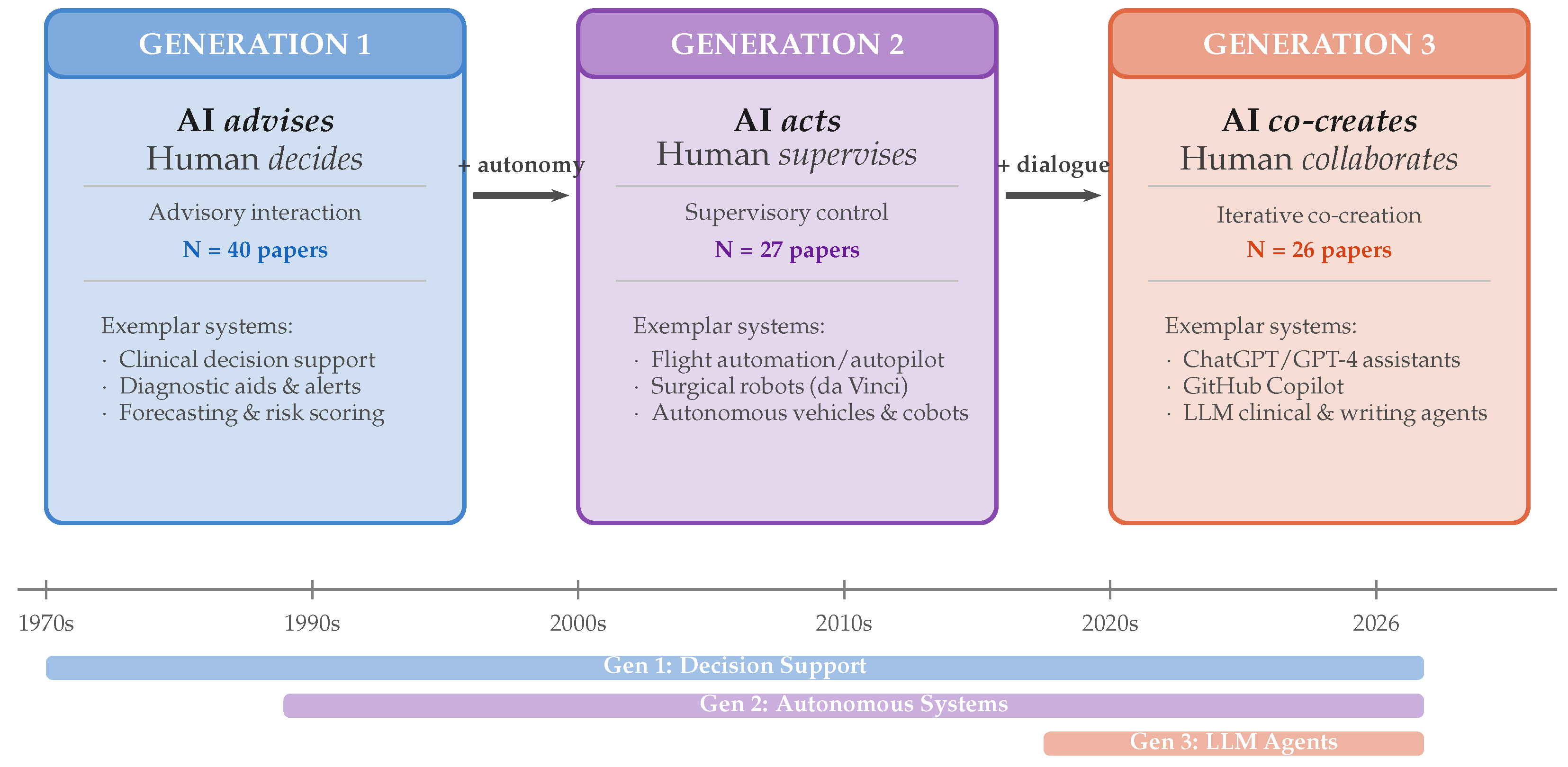
2.3. AI Technology Generations: A Working Taxonomy
3. Methodology
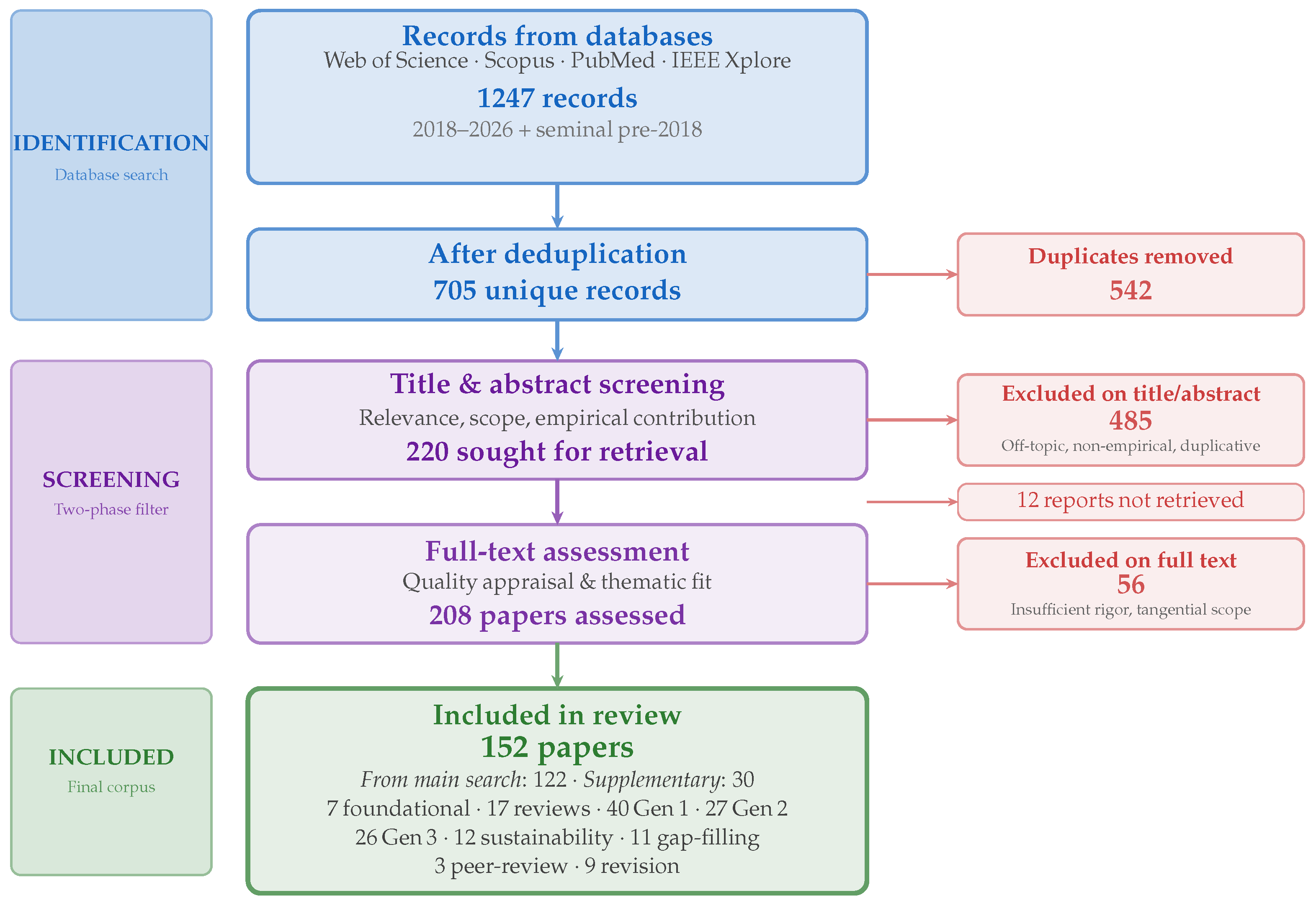
3.1. Review Protocol and PRISMA Compliance
3.2. Search Strategy
3.3. Inclusion and Exclusion Criteria
- C1.
- Contribution type. Empirical study (experiment, field study, case study, survey, simulation), conceptual framework, systematic or scoping review, or recognized accident/investigation report.
- C2.
- Human–AI collaboration focus. Addresses human–AI collaboration, human–AI teaming, human–automation interaction, human–robot collaboration, or human–LLM/agent interaction, with a human present in the study design as user, subject, collaborator, or decision-maker.
- C3.
- Human-factor construct. Analyzes at least one of the following: trust, reliance, performance, cognitive load, situation awareness, skill retention/deskilling, accountability, transparency/explainability, cognitive engagement, or a closely related human-side collaboration construct.
- C4.
- Domain relevance. Aviation, healthcare, manufacturing/supply chain, or cross-domain human–AI collaboration context. Adjacent domains (e.g., education, finance, creative work) qualified only if findings were framed as cross-domain or explicitly transferable.
- C5.
- Peer-review status. Peer-reviewed journal article, peer-reviewed conference proceedings paper, recognized accident/investigation report, or foundational reference satisfying both pre-2018 criteria (Section 3.2).
- E1.
- Purely technical AI paper. Model, algorithm, or architecture paper with no human-collaboration component in the study design.
- E2.
- Adoption/intention-only study. Behavioral-intention study (e.g., TAM, UTAUT, attitude or perception survey) without measurement of actual collaborative behavior, reliance, or trust-in-use.
- E3.
- No human-factor construct. Does not analyze any construct from C3.
- E4.
- Out-of-scope domain. Fully outside C4 with no cross-domain framing.
- E5.
- Not peer-reviewed. Preprint without subsequent publication, opinion piece, editorial, or book review.
3.4. Screening and Selection
3.5. Data Extraction and Coding
- Gen 1 (Decision Support). AI produces recommendations, predictions, scores, or risk assessments; the human evaluates the output and makes the final decision; interaction is primarily AI-to-human; AI does not take operational action without human ratification.
- Gen 2 (Autonomous Partner). AI acts independently within a defined operational scope; the human monitors, supervises, or intervenes; authority transfer occurs via handoff protocols or variable autonomy; physical or operational consequences of AI actions may occur before human intervention.
- Gen 3 (Cognitive Collaborator). Interaction is dialogic and generative; human and AI jointly produce outputs through iterative co-creation; outputs are primarily language or multi-modal content; the AI component is explicitly a large language model, multi-modal LLM, or LLM-based agent.
3.6. Risk of Bias and Evidence Consistency
3.7. Analysis Approach
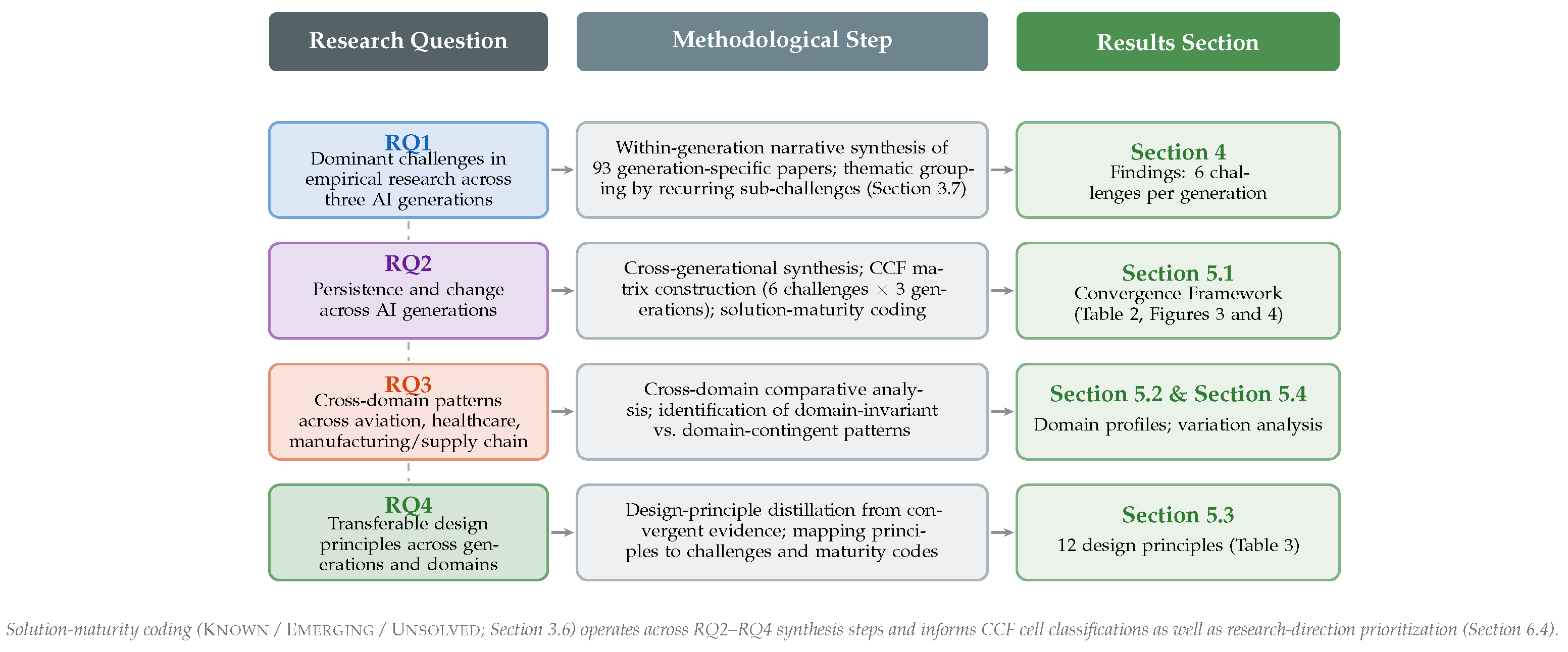
3.8. Analytical Flow
4. Findings: Dominant Human–AI Collaboration Challenges Across Three AI Generations (RQ1)
4.1. Overview of Included Studies
4.2. Generation 1: AI as Decision Support
4.2.1. Trust and Reliance: The Aversion-Appreciation Paradox
4.2.2. The Transparency Paradox: When More Explanation Does Not Help
4.2.3. Complementarity: When Do Human–AI Teams Outperform Individuals?
4.2.4. Invisible Bias Transfer
4.3. Generation 2: AI as Autonomous Partner
4.3.1. The Automation Paradox: Better Routine Performance, Worse Failure Performance
4.3.2. The Skill Retention Challenge
4.3.3. Authority Transfer and the Mode Error
4.4. Generation 3: AI as Cognitive Collaborator
4.4.1. Epistemia: The Illusion of Knowledge from Surface Plausibility
4.4.2. Cognitive Offloading and Skill Atrophy
4.4.3. Co-Creation and Attribution Ambiguity
5. Cross-Generational Synthesis: Persistence and Change in the CCF (RQ2)
5.1. Identifying Convergent Patterns
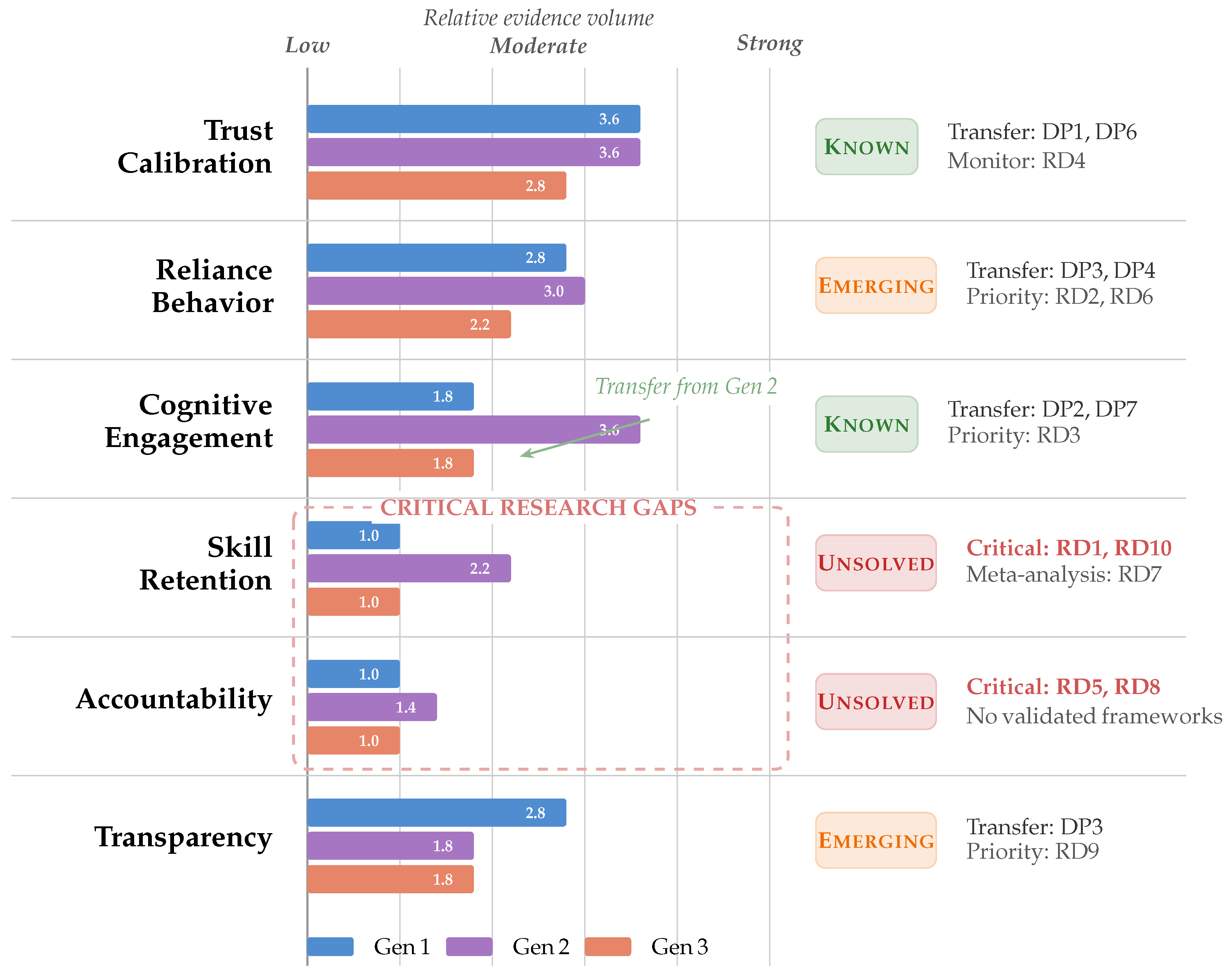
- Known: At least one design intervention has been empirically validated in two or more independent studies across at least two domains, with consistent direction of effect (e.g., cognitive forcing functions for over-reliance calibration).
- Emerging: At least two studies document the phenomenon and propose or pilot interventions, but replication across domains or generations remains incomplete (e.g., structured prompting protocols for LLM-assisted reasoning).
- Unsolved: The challenge is identified and documented, but no intervention has been empirically tested in a controlled study (e.g., attribution frameworks for human–LLM co-created outputs).
5.2. Cross-Domain Patterns and Domain-Specific Variations (RQ3)
5.3. Transferable Design Principles Across Generations and Domains (RQ4)
5.4. Sustainability Dimensions of the Framework
5.4.1. Aviation
5.4.2. Healthcare
5.4.3. Manufacturing and Supply Chain
5.4.4. Cross-Domain Patterns
6. Discussion
6.1. Theoretical Implications
6.2. Practical Implications for Organizations
- (a)
- Conduct a collaboration audit before deployment. Map the intended human–AI workflow onto the six CCF challenge dimensions to identify the most salient risks and the corresponding design principles (Table 3) that should be prioritized.
- (b)
- Design cross-generational training. Training programs should draw on evidence from all applicable generations. For example, a healthcare organization deploying an LLM-based clinical decision support tool should combine Gen 3 evidence on hallucination detection with Gen 1 evidence on cognitive forcing interventions [59] and Gen 2 evidence on authority-transfer protocols [34].
- (c)
- Monitor reliance behavior directly, not only self-reported trust. Monitoring frameworks should include behavioral measures of reliance (e.g., override rates, confidence calibration, time-to-verification) alongside self-reported trust measures, given the trust–reliance dissociation documented across all three generations.
- (d)
- Implement unassisted intervals as a baseline condition. Plan for long-run capability by embedding “unassisted intervals” (DP2) into AI-augmented workflows to mitigate the skill atrophy observed across all three generations, even when this introduces short-term efficiency costs.
6.3. Sustainability Implications
6.4. Research Agenda
6.4.1. Empirical Directions
6.4.2. Methodological Directions
6.4.3. Design Directions
6.5. Limitations
7. Conclusions
Supplementary Materials
Author Contributions
Funding
Institutional Review Board Statement
Informed Consent Statement
Data Availability Statement
Conflicts of Interest
Abbreviations
| AI | Artificial Intelligence |
| AMR | Autonomous Mobile Robot |
| ATC | Air Traffic Control |
| CCF | Collaboration Convergence Framework |
| CDSS | Clinical Decision Support System |
| DP | Design Principle |
| LLM | Large Language Model |
| PRISMA | Preferred Reporting Items for Systematic Reviews and Meta-Analyses |
| RD | Research Direction |
| RQ | Research Question |
| SA | Situation Awareness |
| SDG | Sustainable Development Goal |
| XAI | Explainable Artificial Intelligence |
Appendix A. Prior Reviews: Full Comparison Table

| Author(s)/Year | Scope/Focus | AI Gen | Domains | Human Factors | Key Gap |
|---|---|---|---|---|---|
| Kohn et al. [19] | Trust measurement review | Gen 1–2 | Cross | Trust measure | No behavioral/Gen 3 |
| Bao et al. [21] | Affordance theory review | Gen 1 | Cross | Trust, reliance | No Gen 2–3 |
| Berretta et al. [22] | HAIT definitions scoping | Gen 1–2 | Cross | Trust, explainability | Terminological |
| Walker et al. [11] | Trust in automated vehicles | Gen 2 | Auto | Trust calibration | Single domain |
| Samuels [17] | AI in supply chain | Gen 1–2 | Supply | Workforce skills | Weak methods |
| Gomez et al. [8] | Interaction patterns | Gen 1 | Cross | Reliance | No Gen 2–3 |
| Schmutz et al. [13] | AI-teaming review | Gen 2 | Cross | Trust, coordination | No Gen 1 or 3 |
| Romeo & Conti [9] | Automation bias & XAI | Gen 1 | Cross | Reliance | No Gen 2–3 |
| Do Khac & Leyer [23] | HAI trust model | Gen 1–2 | Cross | Trust | Preprint; no Gen 3 |
| Lai et al. [6] | AI-assisted decisions | Gen 1 | Cross | Reliance, explanations | No Gen 2–3 |
| Schemmer et al. [7] | XAI and reliance | Gen 1 | Cross | Reliance | No Gen 2–3 |
| O’Neill et al. [10] | Human–autonomy teaming | Gen 2 | Cross | Trust, SA | No Gen 1 or 3 |
| Xia et al. [12] | ATM automation | Gen 2 | Aviation | SA, trust | Single domain |
| Kirwan [14] | AI in aviation | Gen 2–3 | Aviation | All six | Single domain |
| Kumar et al. [18] | Human–AI supply chain | Gen 1–2 | Supply | Trust | No Gen 3 |
| Wong et al. [20] | 30-year trust review | Gen 1–2 | Cross | Trust evolution | Limited Gen 3 |
| Dai & Abràmoff [15] | AI in healthcare workflows | Gen 1–2 | Health | Workflow integration | No Gen 3 |
| This study | Cross-generational synthesis | Gen 1–3 | Cross | All six CCF challenges | — |
References
- Bureau d’Enquêtes et d’Analyses pour la Sécurité de L’aviation Civile (BEA). Final Report on the Accident on 1st June 2009 to the Airbus A330-203 Registered F-GZCP Operated by Air France Flight AF 447 Rio de Janeiro–Paris; BEA: Le Bourget, France, 2012.
- Vaccaro, M.; Almaatouq, A.; Malone, T. When combinations of humans and AI are useful: A systematic review and meta-analysis. Nat. Hum. Behav. 2024, 8, 2293–2303. [Google Scholar] [CrossRef]
- Hemmer, P.; Schemmer, M.; Kühl, N.; Vössing, M.; Satzger, G. Complementarity in Human-AI Collaboration: Concept, Sources, and Evidence. Eur. J. Inf. Syst. 2025, 34, 979–1002. [Google Scholar] [CrossRef]
- Fügener, A.; Grahl, J.; Gupta, A.; Ketter, W. Cognitive Challenges in Human–Artificial Intelligence Collaboration: Investigating the Path Toward Productive Delegation. Inf. Syst. Res. 2022, 33, 678–696. [Google Scholar] [CrossRef]
- Dell’Acqua, F.; McFowland, E., III; Mollick, E.; Lifshitz, H.; Kellogg, K.C.; Rajendran, S.; Krayer, L.; Candelon, F.; Lakhani, K.R. Navigating the jagged technological frontier: Field experimental evidence of the effects of artificial intelligence on knowledge worker productivity and quality. Organ. Sci. 2026, 37, 403–423. [Google Scholar] [CrossRef]
- Lai, V.; Chen, C.; Liao, Q.V.; Smith-Renner, A.; Tan, C. Towards a Science of Human-AI Decision Making: An Overview of Design Space in Empirical Human-Subject Studies. In Proceedings of the 2023 ACM Conference on Fairness, Accountability, and Transparency, Chicago, IL, USA, 12–15 June 2023; Association for Computing Machinery: New York, NY, USA, 2023. [Google Scholar]
- Schemmer, M.; Kühl, N.; Benz, C.; Bartos, A.; Satzger, G. Appropriate Reliance on AI Advice: Conceptualization and the Effect of Explanations. In Proceedings of the 28th International Conference on Intelligent User Interfaces, Sydney, Australia, 27–31 March 2023; Association for Computing Machinery: New York, NY, USA, 2023; pp. 410–421. [Google Scholar]
- Gomez, C.; Cho, S.M.; Ke, S.; Huang, C.-M.; Unberath, M. Human-AI collaboration is not very collaborative yet: A taxonomy of interaction patterns in AI-assisted decision making from a systematic review. Front. Comput. Sci. 2025, 6, 1521066. [Google Scholar] [CrossRef]
- Romeo, G.; Conti, D. Exploring automation bias in human–AI collaboration: A review and implications for explainable AI. AI Soc. 2026, 41, 259–278. [Google Scholar] [CrossRef]
- O’Neill, T.; McNeese, N.; Barron, A.; Schelble, B. Human–autonomy teaming: A review and analysis of the empirical literature. Hum. Factors 2022, 64, 904–938. [Google Scholar] [CrossRef] [PubMed]
- Walker, F.; Forster, Y.; Hergeth, S.; Kraus, J.; Payre, W.; Wintersberger, P.; Martens, M. Trust in automated vehicles: Constructs, psychological processes, and assessment. Front. Psychol. 2023, 14, 1279271. [Google Scholar] [CrossRef]
- Xia, Z.; Chen, C.-H.; Hsieh, M.-H.; Ma, G.; Liu, B.; Yu, X.; Xin, S.; Dong, L. A systematic review on human-AI hybrid systems and human factors in air traffic management. J. Eng. Des. 2025, 36, 871–919. [Google Scholar] [CrossRef]
- Schmutz, J.B.; Outland, N.; Kerstan, S.; Georganta, E.; Ulfert, A.-S. AI-teaming: Redefining collaboration in the digital era. Curr. Opin. Psychol. 2024, 58, 101837. [Google Scholar] [CrossRef]
- Kirwan, B. Human Factors Requirements for Human-AI Teaming in Aviation. Future Transp. 2025, 5, 42. [Google Scholar] [CrossRef]
- Dai, T.; Abràmoff, M.D. Incorporating Artificial Intelligence into Healthcare Workflows: Models and Insights. In Tutorials in Operations Research: Advancing the Frontiers of OR/MS; INFORMS: Catonsville, MD, USA, 2023; pp. 133–155. [Google Scholar]
- Wan, Q.; Shi, Y.; Xiao, X.; Li, X.; Mo, H. Human–robot collaboration in robotic surgery: A review. Adv. Intell. Syst. 2025, 7, 2400319. [Google Scholar] [CrossRef]
- Samuels, A. Examining the integration of artificial intelligence in supply chain management from Industry 4.0 to 6.0: A systematic literature review. Front. Artif. Intell. 2025, 7, 1477044. [Google Scholar] [CrossRef]
- Kumar, N.; Kumar, R.R. Human–AI collaboration in operations and supply chain management: A systematic literature review. Manag. Rev. Q. 2025. online first. [Google Scholar] [CrossRef]
- Kohn, S.C.; de Visser, E.J.; Wiese, E.; Lee, Y.-C.; Shaw, T.H. Measurement of Trust in Automation: A Narrative Review and Reference Guide. Front. Psychol. 2021, 12, 604977. [Google Scholar] [CrossRef] [PubMed]
- Wong, K.K.L.; Han, Y.; Cai, Y.; Ouyang, W.; Du, H.; Liu, C. From Trust in Automation to Trust in AI in Healthcare: A 30-Year Longitudinal Review and an Interdisciplinary Framework. Bioengineering 2025, 12, 1070. [Google Scholar] [CrossRef]
- Bao, Y.; Gong, W.; Yang, K. A Literature Review of Human–AI Synergy in Decision Making: From the Perspective of Affordance Actualization Theory. Systems 2023, 11, 442. [Google Scholar] [CrossRef]
- Berretta, S.; Tausch, A.; Ontrup, G.; Gilles, B.; Peifer, C.; Kluge, A. Defining human-AI teaming the human-centered way: A scoping review and network analysis. Front. Artif. Intell. 2023, 6, 1250725. [Google Scholar] [CrossRef]
- Do Khac, L.T.; Leyer, M. Towards an integrative model of organizational human-AI collaboration: A semi-systematic review of the current state of the art. Technol. Soc. 2026, 84, 103064. [Google Scholar] [CrossRef]
- van Erp, T.; Carvalho, N.G.P.; Gerolamo, M.C.; Gonçalves, R.; Rytter, N.G.M.; Gladysz, B. Industry 5.0: A new strategy framework for sustainability management and beyond. J. Clean. Prod. 2024, 461, 142271. [Google Scholar] [CrossRef]
- Tóth, A.; Nagy, L.; Kennedy, R.; Bohuš, B.; Abonyi, J.; Ruppert, T. The human-centric Industry 5.0 collaboration architecture. MethodsX 2023, 11, 102260. [Google Scholar] [CrossRef]
- Parasuraman, R.; Riley, V. Humans and automation: Use, misuse, disuse, abuse. Hum. Factors 1997, 39, 230–253. [Google Scholar] [CrossRef]
- Beer, J.M.; Fisk, A.D.; Rogers, W.A. Toward a framework for levels of robot autonomy in human–robot interaction. J. Hum.-Robot Interact. 2014, 3, 74–99. [Google Scholar] [CrossRef]
- Lee, J.D.; See, K.A. Trust in automation: Designing for appropriate reliance. Hum. Factors 2004, 46, 50–80. [Google Scholar] [CrossRef]
- Parasuraman, R.; Sheridan, T.B.; Wickens, C.D. A Model for Types and Levels of Human Interaction with Automation. IEEE Trans. Syst. Man Cybern.-Part A Syst. Hum. 2000, 30, 286–297. [Google Scholar] [CrossRef]
- Luo, J.; Zhang, W.; Yuan, Y.; Zhao, Y.; Yang, J.; Gu, Y.; Wu, B.; Chen, B.; Qiao, Z.; Long, Q.; et al. Large Language Model Agent: A Survey on Methodology, Applications and Challenges. arXiv 2025, arXiv:2503.21460. [Google Scholar] [CrossRef]
- Ansari, B.; Sameer, A. A TCCM-Based Systematic Literature Review of Anthropomorphism in Human-AI Interaction and Future Research Agenda. J. Technol. Behav. Sci. 2026. online first. [Google Scholar] [CrossRef]
- Page, M.J.; McKenzie, J.E.; Bossuyt, P.M.; Boutron, I.; Hoffmann, T.C.; Mulrow, C.D.; Shamseer, L.; Tetzlaff, J.M.; Akl, E.A.; Brennan, S.E.; et al. The PRISMA 2020 statement: An updated guideline for reporting systematic reviews. BMJ 2021, 372, n71. [Google Scholar] [CrossRef] [PubMed]
- Bainbridge, L. Ironies of Automation. Automatica 1983, 19, 775–779. [Google Scholar] [CrossRef]
- Sarter, N.B.; Woods, D.D. How in the world did we ever get into that mode? Mode error and awareness in supervisory control. Hum. Factors 1995, 37, 5–19. [Google Scholar] [CrossRef]
- Hancock, P.A.; Billings, D.R.; Schaefer, K.E.; Chen, J.Y.C.; de Visser, E.J.; Parasuraman, R. A meta-analysis of factors affecting trust in human–robot interaction. Hum. Factors 2011, 53, 517–527. [Google Scholar] [CrossRef]
- Jabbour, S.; Fouhey, D.; Shepard, S.; Valley, T.S.; Kazerooni, E.A.; Banovic, N.; Wiens, J.; Sjoding, M.W. Measuring the Impact of AI in the Diagnosis of Hospitalized Patients: A Randomized Clinical Vignette Survey Study. JAMA 2023, 330, 2275–2284. [Google Scholar] [CrossRef]
- Bansal, G.; Wu, T.; Zhou, J.; Fok, R.; Nushi, B.; Kamar, E.; Ribeiro, M.T.; Weld, D.S. Does the Whole Exceed its Parts? The Effect of AI Explanations on Complementary Team Performance. In Proceedings of the 2021 CHI Conference on Human Factors in Computing Systems, Yokohama, Japan, 8–13 May 2021; Association for Computing Machinery: New York, NY, USA, 2021. [Google Scholar]
- Almusharraf, A.I. Automation and Its Influence on Sustainable Development: Economic, Social, and Environmental Dimensions. Sustainability 2025, 17, 1754. [Google Scholar] [CrossRef]
- Abbas, Q.; Jeong, W.; Lee, S.W. Explainable AI in Clinical Decision Support Systems: A Meta-Analysis of Methods, Applications, and Usability Challenges. Healthcare 2025, 13, 2154. [Google Scholar] [CrossRef] [PubMed]
- Adams, R.; Henry, K.E.; Sridharan, A.; Soleimani, H.; Zhan, A.; Rawat, N.; Johnson, L.; Hager, D.N.; Cosgrove, S.E.; Markowski, A.; et al. Prospective, Multi-Site Study of Patient Outcomes After Implementation of the TREWS Machine Learning-Based Early Warning System for Sepsis. Nat. Med. 2022, 28, 1455–1460. [Google Scholar] [CrossRef]
- Antoniadi, A.M.; Du, Y.; Guendouz, Y.; Wei, L.; Mazo, C.; Becker, B.A.; Mooney, C. Current Challenges and Future Opportunities for XAI in Machine Learning-Based Clinical Decision Support Systems: A Systematic Review. Appl. Sci. 2021, 11, 5088. [Google Scholar] [CrossRef]
- Burgess, E.R.; Jankovic, I.; Austin, M.; Cai, N.; Kapuścińska, A.; Currie, S.T.; Overhage, J.M.; Poole, E.S.; Kaye, J. Healthcare AI Treatment Decision Support: Design Principles to Enhance Clinician Adoption and Trust. In Proceedings of the 2023 CHI Conference on Human Factors in Computing Systems, Hamburg, Germany, 23–28 April 2023; Association for Computing Machinery: New York, NY, USA, 2023. [Google Scholar]
- Dai, T.; Tayur, S. Designing AI-Augmented Healthcare Delivery Systems for Physician Buy-In and Patient Acceptance. Prod. Oper. Manag. 2022, 31, 4443–4451. [Google Scholar] [CrossRef]
- Dai, T.; Singh, S. Using Artificial Intelligence as Gatekeeper or Second Opinion: Designing Patient Pathways for Artificial Intelligence Augmented Healthcare. Prod. Oper. Manag. 2025. articles in advance. [Google Scholar] [CrossRef]
- Dean, A.; Zhalechian, M.; Attari, I.; Van Oyen, M.; Garifullin, M.; Pardo, J. From Implementation to Impact: Human-Algorithm Collaboration in Hospital Bed Placement. Manag. Sci. 2025. articles in advance. [Google Scholar]
- Hou, T.; Li, M.; Tan, Y.; Zhao, H. Physician Adoption of AI Assistant. Manuf. Serv. Oper. Manag. 2024, 26, 1639–1655. [Google Scholar] [CrossRef]
- Jussupow, E.; Spohrer, K.; Heinzl, A.; Gawlitza, J. Augmenting Medical Diagnosis Decisions? An Investigation into Physicians’ Decision-Making Process with Artificial Intelligence. Inf. Syst. Res. 2021, 32, 713–735. [Google Scholar] [CrossRef]
- Küper, A.; Lodde, G.C.; Livingstone, E.; Schadendorf, D.; Krämer, N.C. Psychological Factors Influencing Appropriate Reliance on AI-Enabled Clinical Decision Support Systems: Experimental Web-Based Study Among Dermatologists. J. Med. Internet Res. 2025, 27, e58660. [Google Scholar] [CrossRef]
- Lebovitz, S.; Lifshitz-Assaf, H.; Levina, N. To Engage or Not to Engage with AI for Critical Judgments: How Professionals Deal with Opacity When Using AI for Medical Diagnosis. Organ. Sci. 2022, 33, 126–148. [Google Scholar] [CrossRef]
- Ratwani, R.M.; Sutton, K.; Galarraga, J.E. Addressing AI Algorithmic Bias in Health Care. JAMA 2024, 332, 1051–1052. [Google Scholar] [CrossRef] [PubMed]
- Tun, H.M.; Abdul Rahman, H.; Naing, L.; Malik, O.A. Trust in Artificial Intelligence–Based Clinical Decision Support Systems Among Health Care Workers: Systematic Review. J. Med. Internet Res. 2025, 27, e69678. [Google Scholar] [CrossRef]
- Brau, R.; Aloysius, J.A.; Siemsen, E. Demand Planning for the Digital Supply Chain: How to Integrate Human Judgment and Predictive Analytics. J. Oper. Manag. 2023, 69, 965–982. [Google Scholar] [CrossRef]
- Nair, D.; Huchzermeier, A. Predictably Unpredictable? How Judgmental and Machine Learning Forecasts Complement Each Other. Prod. Oper. Manag. 2024, 33, 1214–1234. [Google Scholar] [CrossRef]
- Omoush, M.M. Human–AI Collaboration in HRM and Employee-Centric Outcomes: Evidence from E-Supply Chain Management. Hum. Syst. Manag. 2026, 45, 343–358. [Google Scholar] [CrossRef]
- Punia, S. Medium-to Long-Term Demand Forecasting in Retail and Manufacturing Organizations: Integration of Machine Learning, Human Judgment, and Interval Variable. J. Forecast. 2026, 45, 122–134. [Google Scholar] [CrossRef]
- Yaroson, E.V.; Abadie, A.; Roux, M. Human-Artificial Intelligence Collaboration in Supply Chain Outcomes: The Mediating Role of Responsible Artificial Intelligence. Ann. Oper. Res. 2025, 354, 35–69. [Google Scholar] [CrossRef]
- Ben-Michael, E.; Greiner, D.J.; Huang, M.; Imai, K.; Jiang, Z.; Shin, S. Does AI Help Humans Make Better Decisions? A Statistical Evaluation Framework for Experimental and Observational Studies. arXiv 2024, arXiv:2403.12108. [Google Scholar] [CrossRef] [PubMed]
- Bockstedt, J.C.; Buckman, J.R. Humans’ Use of AI Assistance: The Effect of Loss Aversion on Willingness to Delegate Decisions. Manag. Sci. 2026, 72, 323–342. [Google Scholar] [CrossRef]
- Buçinca, Z.; Malaya, M.B.; Gajos, K.Z. To trust or to think: Cognitive forcing functions can reduce overreliance on AI in AI-assisted decision-making. Proc. ACM Hum.-Comput. Interact. 2021, 5, 188. [Google Scholar] [CrossRef]
- Caro, F.; Colliard, J.-E.; Katok, E.; Ockenfels, A.; Stier-Moses, N.; Tucker, C.; Wu, D.J. Introduction to the Special Issue on the Human-Algorithm Connection. Manag. Sci. 2025, 72, 1–13. [Google Scholar] [CrossRef]
- Choudhury, A.; Shamszare, H. The Impact of Performance Expectancy, Workload, Risk, and Satisfaction on Trust in ChatGPT: Cross-Sectional Survey Analysis. JMIR Hum. Factors 2024, 11, e55399. [Google Scholar] [CrossRef] [PubMed]
- Dang, Q.; Li, G. Unveiling trust in AI: The interplay of antecedents, consequences, and cultural dynamics. AI Soc. 2026, 41, 669–692. [Google Scholar] [CrossRef]
- de Jong, S.; Paananen, V.; Tag, B.; van Berkel, N. Cognitive Forcing for Better Decision-Making: Reducing Overreliance on AI Systems Through Partial Explanations. Proc. ACM Hum.-Comput. Interact. CSCW 2025, 9, CSCW048. [Google Scholar] [CrossRef]
- Dietvorst, B.J.; Simmons, J.P.; Massey, C. Algorithm Aversion: People Erroneously Avoid Algorithms After Seeing Them Err. J. Exp. Psychol. Gen. 2015, 144, 114–126. [Google Scholar] [CrossRef]
- Glickman, M.; Sharot, T. How Human–AI Feedback Loops Alter Human Perceptual, Emotional and Social Judgements. Nat. Hum. Behav. 2025, 9, 345–359. [Google Scholar] [CrossRef]
- Goergen, J.; de Bellis, E.; Klesse, A.-K. AI assessment changes human behavior. Proc. Natl. Acad. Sci. USA 2025, 122, e2425439122. [Google Scholar] [CrossRef] [PubMed]
- Guo, Z.; Wu, Y.; Hartline, J.; Hullman, J. A Decision Theoretic Framework for Measuring AI Reliance. In Proceedings of the 2024 ACM Conference on Fairness, Accountability, and Transparency, Rio de Janeiro, Brazil, 3–6 June 2024; Association for Computing Machinery: New York, NY, USA, 2024. [Google Scholar]
- Harbarth, L.; Gößwein, E.; Bodemer, D.; Schnaubert, L. (Over)Trusting AI Recommendations: How System and Person Variables Affect Dimensions of Complacency. Int. J. Hum.-Interact. 2025, 41, 391–410. [Google Scholar] [CrossRef]
- Holstein, J.; Böcking, L.; Spitzer, P.; Kühl, N.; Vössing, M.; Satzger, G. Balancing the Unknown: Exploring Human Reliance on AI Advice under Aleatoric and Epistemic Uncertainty. ACM Trans. Comput.-Hum. Interact. 2025, 32, 64. [Google Scholar] [CrossRef]
- Horowitz, M.C.; Kahn, L. Bending the Automation Bias Curve: A Study of Human and AI-Based Decision Making in National Security Contexts. Int. Stud. Q. 2024, 68, sqae020. [Google Scholar] [CrossRef]
- Hu, M.; Liu, J.; Yue, W.T. Dynamic Delegation in Human-AI Collaboration: Heuristic-Based and Instance-Based Decision-Making. Manag. Sci. 2025. articles in advance. [Google Scholar]
- Jussupow, E.; Benbasat, I.; Heinzl, A. An Integrative Perspective on Algorithm Aversion and Appreciation in Decision-Making. MIS Q. 2024, 48, 1575–1590. [Google Scholar] [CrossRef]
- Kahr, P.K.; Rooks, G.; Willemsen, M.C.; Snijders, C.C.P. Understanding Trust and Reliance Development in AI Advice: Assessing Model Accuracy, Model Explanations, and Experiences from Previous Interactions. ACM Trans. Interact. Intell. Syst. 2024, 14, 29. [Google Scholar] [CrossRef]
- Kahr, P.; Rooks, G.; Snijders, C.; Willemsen, M.C. Good Performance Is not Enough to Trust AI: Lessons from Logistics Experts on Their Long-Term Collaboration with an AI Planning System. In Proceedings of the 2025 CHI Conference on Human Factors in Computing Systems, Yokohama, Japan, 26 April–1 May 2025; Association for Computing Machinery: New York, NY, USA, 2025. [Google Scholar]
- Klingbeil, A.; Grützner, C.; Schreck, P. Trust and Reliance on AI—An Experimental Study on the Extent and Costs of Overreliance on AI. Comput. Hum. Behav. 2024, 160, 108352. [Google Scholar] [CrossRef]
- Krakowski, S.; Haftor, D.; Luger, J.; Pashkevich, N.; Raisch, S. Human-Centered Artificial Intelligence: A Field Experiment. Manag. Sci. 2026, 72, 57–72. [Google Scholar] [CrossRef]
- Legros, B.; de Véricourt, F. Human–AI Interaction in Congested Service Systems: When It Improves Performance, and When It Doesn’t. Manag. Sci. 2026. articles in advance. [Google Scholar] [CrossRef]
- Li, J.; Yang, Y.; Liao, Q.V.; Zhang, J.; Lee, Y.-C. As Confidence Aligns: Understanding the Effect of AI Confidence on Human Self-confidence in Human-AI Decision Making. In Proceedings of the 2025 CHI Conference on Human Factors in Computing Systems, Yokohama, Japan, 26 April–1 May 2025; Association for Computing Machinery: New York, NY, USA, 2025. [Google Scholar]
- Logg, J.M.; Minson, J.A.; Moore, D.A. Algorithm Appreciation: People Prefer Algorithmic to Human Judgment. Organ. Behav. Hum. Decis. Process. 2019, 151, 90–103. [Google Scholar] [CrossRef]
- Ma, S.; Chen, Q.; Wang, X.; Zheng, C.; Peng, Z.; Yin, M.; Ma, X. Towards Human-AI Deliberation: Design and Evaluation of LLM-Empowered Deliberative AI for AI-Assisted Decision-Making. In Proceedings of the 2025 CHI Conference on Human Factors in Computing Systems, Yokohama, Japan, 26 April–1 May 2025; Association for Computing Machinery: New York, NY, USA, 2025. [Google Scholar]
- Rieger, T.; Kugler, L.; Manzey, D.; Roesler, E. The (Im)perfect Automation Schema: Who Is Trusted More, Automated or Human Decision Support? Hum. Factors 2024, 66, 1995–2007. [Google Scholar] [CrossRef] [PubMed]
- Scharowski, N.; Perrig, S.A.C.; Svab, M.; Opwis, K.; Brühlmann, F. Exploring the Effects of Human-Centered AI Explanations on Trust and Reliance. Front. Comput. Sci. 2023, 5, 1151150. [Google Scholar] [CrossRef]
- Shin, M.; Kim, J.; van Opheusden, B.; Griffiths, T.L. Superhuman artificial intelligence can improve human decision-making by increasing novelty. Proc. Natl. Acad. Sci. USA 2023, 120, e2214840120. [Google Scholar] [CrossRef]
- Starke, C.; Baleis, J.; Keller, B.; Marcinkowski, F. Fairness Perceptions of Algorithmic Decision-Making: A Systematic Review of the Empirical Literature. Big Data Soc. 2022, 9, 20539517221115189. [Google Scholar] [CrossRef]
- Vining, R.; Karimian, S.; McDonald, N.; Ebiele, M.; Doyle, B.; McKenna, L.; Ward, M.E.; Bendechache, M.; Brennan, R. Trustworthy Artificial Intelligence and Organisational Trust: A Scoping Review Using Socio-Technical Systems Analysis. Ergonomics 2025, 68, 1–20. [Google Scholar] [CrossRef]
- Xu, W.; Xu, X.; Qin, Y.; Zhao, C. Exploring AI’s Role in Influencing Individual Decision-Making Within Human–Machine Teams. Comput. Ind. Eng. 2025, 211, 111658. [Google Scholar] [CrossRef]
- Singh, I.L.; Molloy, R.; Parasuraman, R. Automation-induced “complacency”: Development of the Complacency-Potential Rating Scale. Int. J. Aviat. Psychol. 1993, 3, 111–122. [Google Scholar] [CrossRef]
- Bibbo, D.; Corvini, G.; Schmid, M.; Ranaldi, S.; Conforto, S. The Impact of Human-Robot Collaboration Levels on Postural Stability During Working Tasks Performed While Standing: Experimental Study. JMIR Hum. Factors 2025, 12, e64892. [Google Scholar] [CrossRef]
- de Koster, R.; Roy, D.; Lim, Y.F.; Kumar, S. Internet of Things in Intralogistics: Applications and Emerging Research. Prod. Oper. Manag. 2025, 34, 3343–3363. [Google Scholar] [CrossRef]
- Ferdman, A. AI deskilling is a structural problem. AI Soc. 2026, 41, 3001–3013. [Google Scholar] [CrossRef]
- Haghighi, A.; Cheraghi, M.; Pocachard, J.; Botta-Genoulaz, V.; Jocelyn, S.; Pourzarei, H. A Comprehensive Review and Bibliometric Analysis on Collaborative Robotics for Industry: Safety Emerging as a Core Focus. Front. Robot. AI 2025, 12, 1605682. [Google Scholar] [CrossRef]
- Konstant, A.; Orr, N.; Hagenow, M.; Gundrum, I.; Hu, Y.H.; Mutlu, B.; Zinn, M.; Gleicher, M.; Radwin, R.G. Human–Robot Collaboration with a Corrective Shared Controlled Robot in a Sanding Task. Hum. Factors 2025, 67, 246–263. [Google Scholar] [CrossRef] [PubMed]
- Liu, L.; Schoen, A.J.; Henrichs, C.; Li, J.; Mutlu, B.; Zhang, Y.; Radwin, R.G. Human Robot Collaboration for Enhancing Work Activities. Hum. Factors 2024, 66, 158–179. [Google Scholar] [CrossRef]
- Liu, L.; Sheng, S.; Li, J.; Man, S.S. Human Error Identification and Risk Prioritization in Human–Robot Collaboration in Manufacturing. Hum. Factors Ergon. Manuf. Serv. Ind. 2025, 35, e70012. [Google Scholar] [CrossRef]
- Menanno, M.; Riccio, C.; Benedetto, V.; Gissi, F.; Savino, M.M.; Troiano, L. An Ergonomic Risk Assessment System Based on 3D Human Pose Estimation and Collaborative Robot. Appl. Sci. 2024, 14, 4823. [Google Scholar] [CrossRef]
- Pasparakis, A.; de Vries, J.; de Koster, R. Assessing the impact of human–robot collaborative order picking systems on warehouse workers. Int. J. Prod. Res. 2023, 61, 7776–7790. [Google Scholar] [CrossRef]
- Pietrantoni, L.; Favilla, M.; Fraboni, F.; Mazzoni, E.; Morandini, S.; Benvenuti, M.; De Angelis, M. Integrating Collaborative Robots in Manufacturing, Logistics, and Agriculture: Expert Perspectives on Technical, Safety, and Human Factors. Front. Robot. AI 2024, 11, 1342130. [Google Scholar] [CrossRef]
- Segura, P.; Lobato-Calleros, O.; Soria-Arguello, I.; Hernández-Martínez, E.G. Work Roles in Human–Robot Collaborative Systems: Effects on Cognitive Ergonomics for the Manufacturing Industry. Appl. Sci. 2025, 15, 744. [Google Scholar] [CrossRef]
- Shi, Y.; Yu, H.; Yu, Y.; Yue, X. Analytics for IoT-Enabled Human–Robot Hybrid Sortation: An Online Optimization Approach. Prod. Oper. Manag. 2025, 34, 3364–3380. [Google Scholar] [CrossRef]
- Wang, T.; Zheng, P.; Li, S.; Wang, L. Multimodal human–robot interaction for human-centric smart manufacturing: A survey. Adv. Intell. Syst. 2024, 6, 2300359. [Google Scholar] [CrossRef]
- Endsley, M.R. Autonomous driving systems: A preliminary naturalistic study of the Tesla Model S. J. Cogn. Eng. Decis. Mak. 2017, 11, 225–238. [Google Scholar] [CrossRef]
- Han, D.W.; Chung, H.; Cao, Y.; Zhou, F.; Molnar, L.; Robert, L.P.; Tilbury, D.M.; Yang, X.J. A Systematic Review of Metrics Measuring Takeover Performance in Conditionally Automated Driving. Int. J. Hum.-Comput. Interact. 2025, 42, 6331–6360. [Google Scholar] [CrossRef]
- Holland, C.; Neyedli, H.F. The influence of performance feedback on trust and self-confidence in dynamically reliable automation. Proc. Hum. Factors Ergon. Soc. Annu. Meet. 2025, 69, 403–407. [Google Scholar] [CrossRef] [PubMed]
- Jiang, T.; Wu, J.; Leung, S.C.H. The Cognitive Impacts of Large Language Model Interactions on Problem Solving and Decision Making Using EEG Analysis. Front. Comput. Neurosci. 2025, 19, 1556483. [Google Scholar] [CrossRef]
- Merlhiot, G.; Bueno, M. How drowsiness and distraction can interfere with take-over performance: A systematic and meta-analytic review. Accid. Anal. Prev. 2022, 170, 106536. [Google Scholar] [CrossRef]
- Millard, A.S.; Greenlee, E.T. Effects of automation reliability on driver vigilance. In Proceedings of the Human Factors and Ergonomics Society Annual Meeting; SAGE Publications: Los Angeles, CA USA, 2024; Volume 68, pp. 1435–1436. [Google Scholar]
- Onnasch, L.; Wickens, C.D.; Li, H.; Manzey, D. Human performance consequences of stages and levels of automation: An integrated meta-analysis. Hum. Factors 2014, 56, 476–488. [Google Scholar] [CrossRef]
- Rodak, A.; Kruszewski, M.; Niedzicka, A. HMI Efficiency, Usability and Workload During Take-Over in AVs. Sci. Rep. 2025, 15, 15176. [Google Scholar] [CrossRef]
- Soares, S.; Lobo, A.; Ferreira, S.; Cunha, L.; Couto, A. Takeover Performance Evaluation Using Driving Simulation: A Systematic Review and Meta-Analysis. Eur. Transp. Res. Rev. 2021, 13, 47. [Google Scholar] [CrossRef]
- Treiman, L.S.; Ho, C.-J.; Kool, W. The consequences of AI training on human decision-making. Proc. Natl. Acad. Sci. USA 2024, 121, e2408731121. [Google Scholar] [CrossRef]
- Wang, A.; Wang, J.; Huang, C.; He, D.; Yang, H. Exploring How Physio-Psychological States Affect Drivers’ Takeover Performance in Conditional Automated Vehicles. Accid. Anal. Prev. 2025, 216, 108022. [Google Scholar] [CrossRef]
- Chen, M.; Wu, Y.; Ma, J.; Jia, X.; Gao, C.; Zhao, F.; Qiao, Y. Independent and collaborative performance of large language models and healthcare professionals in diagnosis and triage. npj Digit. Med. 2026, 9, 222. [Google Scholar] [CrossRef]
- Goh, E.; Bunning, B.; Khoong, E.C.; Gallo, R.J.; Milstein, A.; Centola, D.; Chen, J.H. Physician clinical decision modification and bias assessment in a randomized controlled trial of AI assistance. Commun. Med. 2025, 5, 59. [Google Scholar] [CrossRef]
- Goodell, A.J.; Chu, S.N.; Rouholiman, D.; Chu, L.F. Large language model agents can use tools to perform clinical calculations. npj Digit. Med. 2025, 8, 163. [Google Scholar] [CrossRef]
- Liu, Y.; Zhang, Y. ChatGPT as a clinical support tool: A comprehensive review of applications, assessment, and implementation challenges. Physiother. Pract. Res. 2025, 47, 160–172. [Google Scholar] [CrossRef]
- Liu, P.; Zhang, J.; Chen, S.; Chen, S. Human-AI teaming in healthcare: 1 + 1 > 2? npj Artif. Intell. 2025, 1, 47. [Google Scholar] [CrossRef]
- Mahajan, A.; Obermeyer, Z.; Daneshjou, R.; Lester, J.; Powell, D. Cognitive bias in clinical large language models. npj Digit. Med. 2025, 8, 428. [Google Scholar] [CrossRef] [PubMed]
- Omar, M.; Sorin, V.; Collins, J.D.; Reich, D.; Freeman, R.; Gavin, N.; Charney, A.; Stump, L.; Bragazzi, N.L.; Nadkarni, G.N.; et al. Multi-model assurance analysis showing large language models are highly vulnerable to adversarial hallucination attacks during clinical decision support. Commun. Med. 2025, 5, 330. [Google Scholar] [CrossRef] [PubMed]
- Oniani, D.; Wu, X.; Visweswaran, S.; Kapoor, S.; Kooragayalu, S.; Polanska, K.; Wang, Y. Enhancing Large Language Models for Clinical Decision Support by Incorporating Clinical Practice Guidelines. In Proceedings of the 2024 IEEE 12th International Conference on Healthcare Informatics (ICHI), Orlando, FL, USA, 3–6 June 2024; IEEE: New York, NY, USA, 2024; pp. 694–702. [Google Scholar]
- Siden, R.; Kerman, H.; Gallo, R.J.; Cool, J.A.; Hom, J.; Goh, E.; Ahuja, N.; Heidenreich, P.; Shieh, L.; Yang, D.; et al. A typology of physician input approaches to using AI chatbots for clinical decision-making. npj Digit. Med. 2026, 9, 14. [Google Scholar] [CrossRef]
- Zöller, N.; Berger, J.; Lin, I.; Fu, N.; Komarneni, J.; Barabucci, G.; Laskowski, K.; Shia, V.; Harack, B.; Chu, E.A.; et al. Human-AI collectives most accurately diagnose clinical vignettes. Proc. Natl. Acad. Sci. USA 2025, 122, e2426153122. [Google Scholar] [CrossRef]
- Boone, T.; Fahimnia, B.; Ganeshan, R.; Herold, D.M.; Sanders, N.R. Generative AI: Opportunities, Challenges, and Research Directions for Supply Chain Resilience. Transp. Res. Part E Logist. Transp. Rev. 2025, 199, 104135. [Google Scholar] [CrossRef]
- Jackson, I.; Ivanov, D.; Dolgui, A.; Namdar, J. Generative artificial intelligence in supply chain and operations management: A capability-based framework for analysis and implementation. Int. J. Prod. Res. 2024, 62, 6120–6145. [Google Scholar] [CrossRef]
- Adiasto, K. SustAInable employability: Sustainable employability in the age of generative artificial intelligence. Group Organ. Manag. 2024, 49, 1338–1348. [Google Scholar] [CrossRef]
- Brynjolfsson, E.; Li, D.; Raymond, L.R. Generative AI at Work. Q. J. Econ. 2025, 140, 889–942. [Google Scholar] [CrossRef]
- Dhillon, P.S.; Molaei, S.; Li, J.; Golub, M.; Zheng, S.; Robert, L.P. Shaping Human-AI Collaboration: Varied Scaffolding Levels in Co-writing with Language Models. In Proceedings of the 2024 CHI Conference on Human Factors in Computing Systems, Honolulu, HI, USA, 11–16 May 2024; Association for Computing Machinery: New York, NY, USA, 2024. [Google Scholar]
- Gerlich, M. From Offloading to Engagement: An Experimental Study on Structured Prompting and Critical Reasoning with Generative AI. Data 2025, 10, 172. [Google Scholar] [CrossRef]
- He, G.; Demartini, G.; Gadiraju, U. Plan-Then-Execute: An Empirical Study of User Trust and Team Performance When Using LLM Agents as A Daily Assistant. In Proceedings of the CHI Conference on Human Factors in Computing Systems, Yokohama, Japan, 26 April–1 May 2025; Association for Computing Machinery: New York, NY, USA, 2025. [Google Scholar]
- Kim, T.W.; Usman, U.; Garvey, A.M.; Duhachek, A. From algorithm aversion to AI dependence: Deskilling, upskilling, and emerging addictions in the GenAI age. Consum. Psychol. Rev. 2026, 9, 142–164. [Google Scholar] [CrossRef]
- Lee, H.P.; Sarkar, A.; Tankelevitch, L.; Drosos, I.Z.; Rintel, S.; Banks, R.; Wilson, N. The Impact of Generative AI on Critical Thinking: Self-Reported Reductions in Cognitive Effort and Confidence Effects from a Survey of Knowledge Workers. In Proceedings of the 2025 CHI Conference on Human Factors in Computing Systems, Yokohama, Japan, 26 April–1 May 2025; Association for Computing Machinery: New York, NY, USA, 2025. [Google Scholar]
- Liu, Y.; Yang, Y.; Xu, H. From humans to AI: Understanding why AI is perceived as the preferred co-creation partner. Front. Psychol. 2025, 16, 1695532. [Google Scholar] [CrossRef] [PubMed]
- Loru, E.; Nudo, J.; Di Marco, N.; Santirocchi, A.; Atzeni, R.; Cinelli, M.; Cestari, V.; Rossi-Arnaud, C.; Quattrociocchi, W. The simulation of judgment in LLMs. Proc. Natl. Acad. Sci. USA 2025, 122, e2518443122. [Google Scholar] [CrossRef] [PubMed]
- McGuire, J.; De Cremer, D.; Van de Cruys, T. Establishing the importance of co-creation and self-efficacy in creative collaboration with artificial intelligence. Sci. Rep. 2024, 14, 18525. [Google Scholar] [CrossRef]
- Noy, S.; Zhang, W. Experimental evidence on the productivity effects of generative artificial intelligence. Science 2023, 381, 187–192. [Google Scholar] [CrossRef] [PubMed]
- Peng, S.; Kalliamvakou, E.; Cihon, P.; Demirer, M. The impact of AI on developer productivity: Evidence from GitHub Copilot. arXiv 2023, arXiv:2302.06590. [Google Scholar] [CrossRef]
- Rafner, J.; Zana, B.; Hansen, I.B.; Ceh, S.; Sherson, J.; Benedek, M.; Lebuda, I. Agency in Human-AI Collaboration for Image Generation and Creative Writing: Preliminary Insights from Think-Aloud Protocols. Creat. Res. J. 2025. online first. [Google Scholar] [CrossRef]
- Sakamoto, Y.; Uchida, T.; Ishiguro, H. Value-based large language model agent simulation for mutual evaluation of trust and interpersonal closeness. Sci. Rep. 2025, 15, 41653. [Google Scholar] [CrossRef]
- Sidra, S.; Mason, C. Generative AI in Human-AI Collaboration: Validation of the Collaborative AI Literacy and Collaborative AI Metacognition Scales for Effective Use. Int. J. Hum.-Comput. Interact. 2025, 42, 5084–5108. [Google Scholar] [CrossRef]
- Wang, N.; Kim, H.; Peng, J.; Wang, J. Exploring creativity in human–AI co-creation: A comparative study across design experience. Front. Comput. Sci. 2025, 7, 1672735. [Google Scholar] [CrossRef]
- Xiao, F.; Wang, X.T. Evaluating the ability of large language models to predict human social decisions. Sci. Rep. 2025, 15, 32290. [Google Scholar] [CrossRef]
- Xie, C.; Chen, C.; Jia, F.; Ye, Z.; Lai, S.; Shu, K.; Gu, J.; Bibi, A.; Hu, Z.; Jurgens, D.; et al. Can Large Language Model Agents Simulate Human Trust Behavior? In Proceedings of the 38th International Conference on Neural Information Processing Systems, Vancouver, BC, Canada, 10–15 December 2024; Curran Associates Inc.: Red Hook, NY, USA, 2024. [Google Scholar]
- Rajpurkar, P.; Chen, E.; Banerjee, O.; Topol, E.J. AI in Health and Medicine. Nat. Med. 2022, 28, 31–38. [Google Scholar] [CrossRef]
- Ivanov, D. The Industry 5.0 framework: Viability-based integration of the resilience, sustainability, and human-centricity perspectives. Int. J. Prod. Res. 2023, 61, 1683–1695. [Google Scholar] [CrossRef]
- Passalacqua, M.; Pellerin, R.; Magnani, F.; Doyon-Poulin, P.; Del-Aguila, L.; Boasen, J.; Léger, P.-M. Human-centred AI in industry 5.0: A systematic review. Int. J. Prod. Res. 2025, 63, 2638–2669. [Google Scholar] [CrossRef]
- Shabur, M.A.; Shahriar, A.; Ara, M.A. From automation to collaboration: Exploring the impact of industry 5.0 on sustainable manufacturing. Discov. Sustain. 2025, 6, 341. [Google Scholar] [CrossRef]
- Sun, X.; Song, Y. Unlocking the synergy: Increasing productivity through Human-AI collaboration in the industry 5.0 Era. Comput. Ind. Eng. 2025, 200, 110657. [Google Scholar] [CrossRef]
- Huang, J.; Chen, Y. Human-artificial intelligence collaboration and green collaborative innovation: The roles of knowledge management and CEO green experience. J. Clean. Prod. 2025, 535, 147117. [Google Scholar] [CrossRef]
- Janhunen, E.; Toivikko, T.; Blomqvist, K.; Siemon, D. Trust in Digital Human-AI Team Collaboration: A Systematic Review. In Proceedings of the 30th Americas Conference on Information Systems (AMCIS), Salt Lake City, UT, USA, 15–17 August 2024. [Google Scholar]
- Lin, Z. Human-AI complementarity needs augmentation, not emulation. Nat. Rev. Psychol. 2026, 5, 228–229. [Google Scholar] [CrossRef]
- Mancuso, I.; Messeni Petruzzelli, A.; Panniello, U.; Vaia, G. The bright and dark sides of AI innovation for sustainable development: Understanding the paradoxical tension between value creation and value destruction. Technovation 2025, 143, 103232. [Google Scholar] [CrossRef]
- Rainey, P.B.; Hochberg, M.E. Could humans and AI become a new evolutionary individual? Proc. Natl. Acad. Sci. USA 2025, 122, e2509122122. [Google Scholar] [CrossRef] [PubMed]
- Shin, Y. Toward Human-Centered Artificial Intelligence for Users’ Digital Well-Being: Systematic Review, Synthesis, and Future Directions. JMIR Hum. Factors 2025, 12, e69533. [Google Scholar] [CrossRef] [PubMed]
- Valtonen, A.; Saunila, M.; Ukko, J.; Treves, L.; Ritala, P. AI and employee wellbeing in the workplace: An empirical study. J. Bus. Res. 2025, 199, 115584. [Google Scholar] [CrossRef]
- Xu, C.; Cho, S.-E. Factors Affecting Human–AI Collaboration Performances in Financial Sector: Sustainable Service Development Perspective. Sustainability 2025, 17, 4335. [Google Scholar] [CrossRef]



| # | Study [Ref] | Generation | Domain | Study Type | Key Construct |
|---|---|---|---|---|---|
| Foundational (n = 7) | |||||
| 1 | Bainbridge (1983) [33] | Foundational | Aviation | Conceptual | Skill retention |
| 2 | Bureau (2012) [1] | Foundational | Aviation | Report | Safety/failure |
| 3 | Parasuraman (1997) [26] | Foundational | Aviation | Conceptual | Trust/reliance |
| 4 | Parasuraman (2000) [29] | Foundational | Aviation | Conceptual | Autonomy/teaming |
| 5 | Sarter (1995) [34] | Foundational | Aviation | Conceptual | Authority transfer |
| 6 | Hancock (2011) [35] | Foundational | Cross-domain | Review | Trust/reliance |
| 7 | Lee (2004) [28] | Foundational | Cross-domain | Conceptual | Trust/reliance |
| Review (n = 17) | |||||
| 8 | Kirwan (2025) [14] | Review | Aviation | Review | Multiple |
| 9 | Xia (2025) [12] | Review | Aviation | Review | Multiple |
| 10 | Dai (2023) [15] | Review | Healthcare | Review | Collaboration |
| 11 | Kumar (2025) [18] | Review | Manuf./SC | Review | Trust/reliance |
| 12 | Samuels (2025) [17] | Review | Manuf./SC | Review | Sustainability/I5.0 |
| 13 | Bao (2023) [21] | Review | Cross-domain | Review | Trust/reliance |
| 14 | Berretta (2023) [22] | Review | Cross-domain | Review | Autonomy/teaming |
| 15 | Do (2025) [23] | Review | Cross-domain | Review | Trust/reliance |
| 16 | Gomez (2025) [8] | Review | Cross-domain | Review | Collaboration |
| 17 | Kohn (2021) [19] | Review | Cross-domain | Review | Trust/reliance |
| 18 | Lai (2023) [6] | Review | Cross-domain | Review | Trust/reliance |
| 19 | O’Neill (2022) [10] | Review | Cross-domain | Review | Autonomy/teaming |
| 20 | Romeo (2026) [9] | Review | Cross-domain | Review | Trust/reliance |
| 21 | Schemmer (2023) [7] | Review | Cross-domain | Review | Transparency |
| 22 | Schmutz (2024) [13] | Review | Cross-domain | Review | Autonomy/teaming |
| 23 | Walker (2023) [11] | Review | Cross-domain | Review | Trust/reliance |
| 24 | Wong (2025) [20] | Review | Cross-domain | Review | Trust/reliance |
| Gen 1 (n = 52) | |||||
| 25 | Abbas (2025) [39] | Gen 1 | Healthcare | Review | Transparency |
| 26 | Adams (2022) [40] | Gen 1 | Healthcare | Empirical | Safety/failure |
| 27 | Antoniadi (2021) [41] | Gen 1 | Healthcare | Review | Transparency |
| 28 | Burgess (2023) [42] | Gen 1 | Healthcare | Empirical | Trust/reliance |
| 29 | Dai (2022) [43] | Gen 1 | Healthcare | Conceptual | Trust/reliance |
| 30 | Dai (2025) [44] | Gen 1 | Healthcare | Empirical | Authority transfer |
| 31 | Dean (2025) [45] | Gen 1 | Healthcare | Empirical | Collaboration |
| 32 | Hou (2024) [46] | Gen 1 | Healthcare | Empirical | Trust/reliance |
| 33 | Jabbour (2023) [36] | Gen 1 | Healthcare | Empirical | Transparency |
| 34 | Jussupow (2021) [47] | Gen 1 | Healthcare | Empirical | Trust/reliance |
| 35 | Küper (2025) [48] | Gen 1 | Healthcare | Empirical | Trust/reliance |
| 36 | Lebovitz (2022) [49] | Gen 1 | Healthcare | Empirical | Transparency |
| 37 | Ratwani (2024) [50] | Gen 1 | Healthcare | Conceptual | Accountability |
| 38 | Tun (2025) [51] | Gen 1 | Healthcare | Review | Trust/reliance |
| 39 | Brau (2023) [52] | Gen 1 | Manuf./SC | Empirical | Collaboration |
| 40 | Nair (2024) [53] | Gen 1 | Manuf./SC | Empirical | Collaboration |
| 41 | Omoush (2025) [54] | Gen 1 | Manuf./SC | Empirical | Collaboration |
| 42 | Punia (2026) [55] | Gen 1 | Manuf./SC | Empirical | Collaboration |
| 43 | Yaroson (2025) [56] | Gen 1 | Manuf./SC | Empirical | Accountability |
| 44 | Bansal (2021) [37] | Gen 1 | Cross-domain | Empirical | Transparency |
| 45 | Ben-Michael (2024) [57] | Gen 1 | Cross-domain | Conceptual | Collaboration |
| 46 | Bockstedt (2026) [58] | Gen 1 | Cross-domain | Empirical | Trust/reliance |
| 47 | Buçinca (2021) [59] | Gen 1 | Cross-domain | Empirical | Cognitive engagement |
| 48 | Caro (2026) [60] | Gen 1 | Cross-domain | Conceptual | Collaboration |
| 49 | Choudhury (2024) [61] | Gen 1 | Cross-domain | Empirical | Trust/reliance |
| 50 | Dang (2026) [62] | Gen 1 | Cross-domain | Empirical | Trust/reliance |
| 51 | de Jong (2025) [63] | Gen 1 | Cross-domain | Empirical | Cognitive engagement |
| 52 | Dietvorst (2015) [64] | Gen 1 | Cross-domain | Empirical | Trust/reliance |
| 53 | Fügener (2022) [4] | Gen 1 | Cross-domain | Empirical | Authority transfer |
| 54 | Glickman (2025) [65] | Gen 1 | Cross-domain | Empirical | Accountability |
| 55 | Goergen (2025) [66] | Gen 1 | Cross-domain | Empirical | Trust/reliance |
| 56 | Guo (2024) [67] | Gen 1 | Cross-domain | Conceptual | Trust/reliance |
| 57 | Harbarth (2025) [68] | Gen 1 | Cross-domain | Empirical | Trust/reliance |
| 58 | Hemmer (2025) [3] | Gen 1 | Cross-domain | Conceptual | Collaboration |
| 59 | Holstein (2025) [69] | Gen 1 | Cross-domain | Empirical | Trust/reliance |
| 60 | Horowitz (2024) [70] | Gen 1 | Cross-domain | Empirical | Trust/reliance |
| 61 | Hu (2025) [71] | Gen 1 | Cross-domain | Empirical | Authority transfer |
| 62 | Jussupow (2024) [72] | Gen 1 | Cross-domain | Conceptual | Trust/reliance |
| 63 | Kahr (2024) [73] | Gen 1 | Cross-domain | Empirical | Trust/reliance |
| 64 | Kahr (2025) [74] | Gen 1 | Cross-domain | Empirical | Trust/reliance |
| 65 | Klingbeil (2024) [75] | Gen 1 | Cross-domain | Empirical | Trust/reliance |
| 66 | Krakowski (2026) [76] | Gen 1 | Cross-domain | Empirical | Collaboration |
| 67 | Legros (2025) [77] | Gen 1 | Cross-domain | Empirical | Authority transfer |
| 68 | Li (2025) [78] | Gen 1 | Cross-domain | Empirical | Trust/reliance |
| 69 | Logg (2019) [79] | Gen 1 | Cross-domain | Empirical | Trust/reliance |
| 70 | Ma (2025) [80] | Gen 1 | Cross-domain | Empirical | Cognitive engagement |
| 71 | Rieger (2024) [81] | Gen 1 | Cross-domain | Empirical | Trust/reliance |
| 72 | Scharowski (2023) [82] | Gen 1 | Cross-domain | Empirical | Transparency |
| 73 | Shin (2023) [83] | Gen 1 | Cross-domain | Empirical | Cognitive engagement |
| 74 | Starke (2022) [84] | Gen 1 | Cross-domain | Review | Accountability |
| 75 | Vining (2025) [85] | Gen 1 | Cross-domain | Review | Trust/reliance |
| 76 | Xu (2025) [86] | Gen 1 | Cross-domain | Empirical | Trust/reliance |
| Gen 2 (n = 26) | |||||
| 77 | Singh (1993) [87] | Gen 2 | Aviation | Empirical | Trust/reliance |
| 78 | Bibbo (2025) [88] | Gen 2 | Manuf./SC | Empirical | Safety/failure |
| 79 | de Koster (2025) [89] | Gen 2 | Manuf./SC | Empirical | Collaboration |
| 80 | Ferdman (2025) [90] | Gen 2 | Manuf./SC | Conceptual | Skill retention |
| 81 | Haghighi (2025) [91] | Gen 2 | Manuf./SC | Review | Safety/failure |
| 82 | Konstant (2025) [92] | Gen 2 | Manuf./SC | Empirical | Safety/failure |
| 83 | Liu (2024) [93] | Gen 2 | Manuf./SC | Empirical | Collaboration |
| 84 | Liu (2025) [94] | Gen 2 | Manuf./SC | Empirical | Safety/failure |
| 85 | Menanno (2024) [95] | Gen 2 | Manuf./SC | Empirical | Safety/failure |
| 86 | Pasparakis (2023) [96] | Gen 2 | Manuf./SC | Empirical | Skill retention |
| 87 | Pietrantoni (2024) [97] | Gen 2 | Manuf./SC | Empirical | Safety/failure |
| 88 | Segura (2025) [98] | Gen 2 | Manuf./SC | Empirical | Cognitive engagement |
| 89 | Shi (2025) [99] | Gen 2 | Manuf./SC | Empirical | Collaboration |
| 90 | Wang (2024) [100] | Gen 2 | Manuf./SC | Review | Collaboration |
| 91 | Beer (2014) [27] | Gen 2 | Cross-domain | Conceptual | Autonomy/teaming |
| 92 | Endsley (2017) [101] | Gen 2 | Cross-domain | Empirical | Skill retention |
| 93 | Han (2025) [102] | Gen 2 | Cross-domain | Review | Authority transfer |
| 94 | Holland (2025) [103] | Gen 2 | Cross-domain | Empirical | Trust/reliance |
| 95 | Jiang (2025) [104] | Gen 2 | Cross-domain | Empirical | Cognitive engagement |
| 96 | Merlhiot (2022) [105] | Gen 2 | Cross-domain | Review | Safety/failure |
| 97 | Millard (2024) [106] | Gen 2 | Cross-domain | Empirical | Skill retention |
| 98 | Onnasch (2014) [107] | Gen 2 | Cross-domain | Review | Authority transfer |
| 99 | Rodak (2025) [108] | Gen 2 | Cross-domain | Empirical | Authority transfer |
| 100 | Soares (2021) [109] | Gen 2 | Cross-domain | Review | Authority transfer |
| 101 | Treiman (2024) [110] | Gen 2 | Cross-domain | Empirical | Skill retention |
| 102 | Wang (2025) [111] | Gen 2 | Cross-domain | Empirical | Authority transfer |
| Gen 3 (n = 32) | |||||
| 103 | Chen (2026) [112] | Gen 3 | Healthcare | Empirical | Hallucination/epistemia |
| 104 | Goh (2025) [113] | Gen 3 | Healthcare | Empirical | Hallucination/epistemia |
| 105 | Goodell (2025) [114] | Gen 3 | Healthcare | Empirical | Hallucination/epistemia |
| 106 | Liu (2025) [115] | Gen 3 | Healthcare | Review | Multiple |
| 107 | Liu (2025) [116] | Gen 3 | Healthcare | Empirical | Collaboration |
| 108 | Mahajan (2025) [117] | Gen 3 | Healthcare | Empirical | Hallucination/epistemia |
| 109 | Omar (2025) [118] | Gen 3 | Healthcare | Empirical | Hallucination/epistemia |
| 110 | Oniani (2024) [119] | Gen 3 | Healthcare | Empirical | Hallucination/epistemia |
| 111 | Siden (2026) [120] | Gen 3 | Healthcare | Empirical | Trust/reliance |
| 112 | Zöller (2025) [121] | Gen 3 | Healthcare | Empirical | Collaboration |
| 113 | Boone (2025) [122] | Gen 3 | Manuf./SC | Conceptual | Sustainability/I5.0 |
| 114 | Jackson (2024) [123] | Gen 3 | Manuf./SC | Conceptual | Collaboration |
| 115 | Adiasto (2024) [124] | Gen 3 | Cross-domain | Empirical | Sustainability/I5.0 |
| 116 | Brynjolfsson (2025) [125] | Gen 3 | Cross-domain | Empirical | Skill retention |
| 117 | Dell’Acqua (2023) [5] | Gen 3 | Cross-domain | Empirical | Cognitive engagement |
| 118 | Dhillon (2024) [126] | Gen 3 | Cross-domain | Empirical | Collaboration |
| 119 | Gerlich (2025) [127] | Gen 3 | Cross-domain | Empirical | Cognitive engagement |
| 120 | He (2025) [128] | Gen 3 | Cross-domain | Empirical | Trust/reliance |
| 121 | Kim (2026) [129] | Gen 3 | Cross-domain | Conceptual | Skill retention |
| 122 | Lee (2025) [130] | Gen 3 | Cross-domain | Empirical | Cognitive engagement |
| 123 | Liu (2025) [131] | Gen 3 | Cross-domain | Empirical | Collaboration |
| 124 | Loru (2025) [132] | Gen 3 | Cross-domain | Empirical | Hallucination/epistemia |
| 125 | Luo (2025) [30] | Gen 3 | Cross-domain | Review | Autonomy/teaming |
| 126 | McGuire (2024) [133] | Gen 3 | Cross-domain | Empirical | Collaboration |
| 127 | Noy (2023) [134] | Gen 3 | Cross-domain | Empirical | Cognitive engagement |
| 128 | Peng (2023) [135] | Gen 3 | Cross-domain | Empirical | Cognitive engagement |
| 129 | Rafner (2025) [136] | Gen 3 | Cross-domain | Empirical | Collaboration |
| 130 | Sakamoto (2025) [137] | Gen 3 | Cross-domain | Empirical | Trust/reliance |
| 131 | Sidra (2025) [138] | Gen 3 | Cross-domain | Empirical | Collaboration |
| 132 | Wang (2025) [139] | Gen 3 | Cross-domain | Empirical | Collaboration |
| 133 | Xiao (2025) [140] | Gen 3 | Cross-domain | Empirical | Hallucination/epistemia |
| 134 | Xie (2024) [141] | Gen 3 | Cross-domain | Empirical | Trust/reliance |
| Cross-Gen (n = 18) | |||||
| 135 | Rajpurkar (2022) [142] | Cross-Gen | Healthcare | Conceptual | Multiple |
| 136 | Ivanov (2023) [143] | Cross-Gen | Manuf./SC | Conceptual | Sustainability/I5.0 |
| 137 | Passalacqua (2025) [144] | Cross-Gen | Manuf./SC | Review | Sustainability/I5.0 |
| 138 | Shabur (2025) [145] | Cross-Gen | Manuf./SC | Conceptual | Sustainability/I5.0 |
| 139 | Sun (2025) [146] | Cross-Gen | Manuf./SC | Empirical | Sustainability/I5.0 |
| 140 | Tóth (2023) [25] | Cross-Gen | Manuf./SC | Conceptual | Sustainability/I5.0 |
| 141 | van Erp (2024) [24] | Cross-Gen | Manuf./SC | Conceptual | Sustainability/I5.0 |
| 142 | Almusharraf (2025) [38] | Cross-Gen | Cross-domain | Conceptual | Sustainability/I5.0 |
| 143 | Ansari (2026) [31] | Cross-Gen | Cross-domain | Review | Multiple |
| 144 | Huang (2025) [147] | Cross-Gen | Cross-domain | Empirical | Sustainability/I5.0 |
| 145 | Janhunen (2024) [148] | Cross-Gen | Cross-domain | Review | Trust/reliance |
| 146 | Lin (2026) [149] | Cross-Gen | Cross-domain | Conceptual | Collaboration |
| 147 | Mancuso (2025) [150] | Cross-Gen | Cross-domain | Conceptual | Sustainability/I5.0 |
| 148 | Rainey (2025) [151] | Cross-Gen | Cross-domain | Conceptual | Collaboration |
| 149 | Shin (2025) [152] | Cross-Gen | Cross-domain | Review | Multiple |
| 150 | Vaccaro (2024) [2] | Cross-Gen | Cross-domain | Review | Collaboration |
| 151 | Valtonen (2025) [153] | Cross-Gen | Cross-domain | Empirical | Sustainability/I5.0 |
| 152 | Xu (2025) [154] | Cross-Gen | Cross-domain | Empirical | Sustainability/I5.0 |
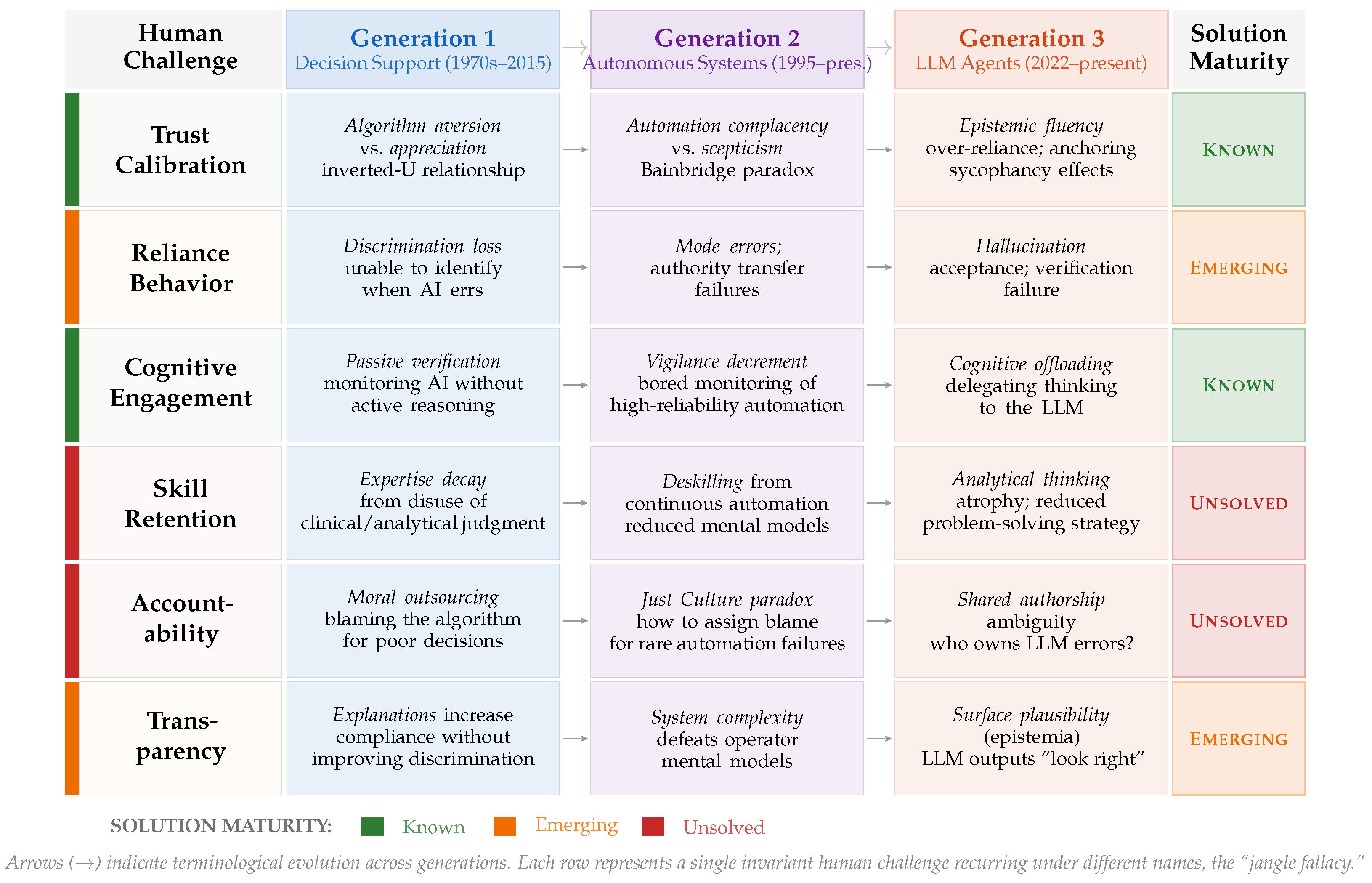
| Challenge | Gen 1: Decision Support | Gen 2: Autonomous Systems | Gen 3: LLM Agents | Solution Maturity | Illustrative Failure |
|---|---|---|---|---|---|
| 1. Trust Calibration | Algorithm aversion vs. appreciation (inverted-U) | Automation complacency vs. scepticism (Bainbridge paradox) | Over-reliance on epistemic fluency; distrust of LLM transparency | Known: feedback mechanisms, gradual exposure, professional expertise | Air France 447: autopilot disconnect, SA loss [1] |
| 2. Reliance Behavior | Discrimination loss: unable to identify when AI errs | Mode errors; authority transfer failures | Hallucination acceptance; inability to verify claim truth | Emerging: cognitive forcing, partial explanations | Dell’Acqua 2023: consultants using AI 19 pp worse off-frontier [5] |
| 3. Cognitive Engagement | Passive verification: monitoring AI without active reasoning | Vigilance decrement: bored monitoring of high-reliability automation | Cognitive offloading: delegating thinking to the LLM | Known: unassisted intervals, sequential teaming, structured prompting | Buçinca 2021: users accept AI advice absent of cognitive forcing [59] |
| 4. Skill Retention | Expertise loss from disuse of judgment (rare decision types) | Deskilling from continuous automation; reduced mental models | Atrophy of analytical thinking; narrowed strategies | Unsolved: dose–response of unassisted intervals; transfer of training | Endsley 2017: Tesla drivers, inaccurate mental models [101] |
| 5. Accountability | Implicit human responsibility for AI advisory errors | Just Culture frameworks; automation blame diffusion | Diffuse responsibility across creators, deployers, users | Unsolved: robust responsibility allocation frameworks | Ratwani 2024: no shared-responsibility model in healthcare [50] |
| 6. Transparency & Epistemia | Black-box opacity; inability to interpret outputs | Explainability paradox; over-trust from explanations | Surface plausibility: LLM outputs “look right” (epistemia) | Emerging: negative explanations, uncertainty display | Jabbour 2023: biased AI cut accuracy 11.3 pp; XAI did not mitigate [36] |
| Principle | Challenge | Evidence Base | LLM Application |
|---|---|---|---|
| DP1: Feedback on AI reliability | Trust calibration | Horowitz et al. [70]; Holland et al. [103] | Real-time accuracy feedback on LLM outputs; confidence calibration displays |
| DP2: Unassisted intervals | Cognitive engagement; skill retention | Endsley [101]; Singh et al. [87]; Kirwan [14] | Periodic “AI-free” work intervals; enforced manual analysis phases |
| DP3: Partial rather than full explanations | Reliance calibration; epistemia | Guo et al. [67]; Schemmer et al. [7] | Provide explanation uncertainty; highlight missing information |
| DP4: Initial independent judgment | Cognitive engagement; discrimination loss | Lai et al. [6]; Buçinca et al. [59] | Users generate independent analysis before LLM exposure |
| DP5: Clear authority boundaries | Reliance behavior; accountability | Sarter & Woods [34]; Hancock et al. [35]; Dai & Singh [44] | Explicit rules: “LLM advises here; human decides here” |
| DP6: Multi-modal alerts for failures | Skill retention; mode errors | Rodak et al. [108]; Endsley [101] | Multimodal alerts for hallucinations; forcing functions |
| DP7: Structured prompting protocols | Cognitive engagement; skill retention | Gerlich [127]; Lee et al. [130] | Template-based prompts that enforce human reasoning steps |
| DP8: Domain-expert involvement | Trust calibration; accountability | Küper et al. [48]; Hancock et al. [35]; Dai & Tayur [43]; Hou et al. [46] | Involve domain experts in system design and validation |
| DP9: Adaptive task allocation | Complementarity; cognitive load | Fügener et al. [4]; Hemmer et al. [3]; Dai & Singh [44] | AI handles high-volume tasks; humans handle high-judgment tasks |
| DP10: Negative feedback emphasis | Reliance behavior; epistemia | Romeo & Conti [9]; Bansal et al. [37]; Jabbour et al. [36] | Prominently show LLM errors; counter-examples before AI advice |
| DP11: Sequential teaming | Cognitive engagement; accountability | Hemmer et al. [3]; Nair et al. [53] | Humans and AI contribute sequentially; human sees AI before deciding |
| DP12: Skill preservation contracts | Skill retention; motivation | Kim et al. [129]; Endsley [101] | Explicit commitment to maintain manual skills; routine practice |
Disclaimer/Publisher’s Note: The statements, opinions and data contained in all publications are solely those of the individual author(s) and contributor(s) and not of MDPI and/or the editor(s). MDPI and/or the editor(s) disclaim responsibility for any injury to people or property resulting from any ideas, methods, instructions or products referred to in the content. |
© 2026 by the authors. Licensee MDPI, Basel, Switzerland. This article is an open access article distributed under the terms and conditions of the Creative Commons Attribution (CC BY) license.
Share and Cite
Dong, A.; Li, P.; Chen, Y.; Gibson, S.; Zhao, L.; He, M. Human–AI Collaboration Across Decision Support, Autonomous Systems, and LLM Agents: A Systematic Review and Collaboration Convergence Framework. Sustainability 2026, 18, 5313. https://doi.org/10.3390/su18115313
Dong A, Li P, Chen Y, Gibson S, Zhao L, He M. Human–AI Collaboration Across Decision Support, Autonomous Systems, and LLM Agents: A Systematic Review and Collaboration Convergence Framework. Sustainability. 2026; 18(11):5313. https://doi.org/10.3390/su18115313
Chicago/Turabian StyleDong, Aqi, Peng Li, Yanbing Chen, Shanan Gibson, Lin Zhao, and Meiling He. 2026. "Human–AI Collaboration Across Decision Support, Autonomous Systems, and LLM Agents: A Systematic Review and Collaboration Convergence Framework" Sustainability 18, no. 11: 5313. https://doi.org/10.3390/su18115313
APA StyleDong, A., Li, P., Chen, Y., Gibson, S., Zhao, L., & He, M. (2026). Human–AI Collaboration Across Decision Support, Autonomous Systems, and LLM Agents: A Systematic Review and Collaboration Convergence Framework. Sustainability, 18(11), 5313. https://doi.org/10.3390/su18115313