A Novel Inland Barge Practice for Sustainable Freight in the Pearl River Delta: Pricing Strategies for Outsourcing Leftover Shipping Demands


Abstract
1. Introduction and Background
2. Literature Review
2.1. Dynamic Pricing
2.2. Channel Leadership
3. Model
3.1. Notation and Assumptions
3.1.1. Notation
- : The random demand function of the leftover freight market
- r: The market price that shippers pay to the FTC
- : The random demand factor
- : The market price ceiling, determined by the competition between barges and trucks
- q: The agreed volume between the FTC and STC
- p: The agreed price that the FTC pays to the STC
- : The spot price in the spot leftover market
- c: The unit transportation cost to the STC
- z: The agreed volume factor
- : The expected profit function of the FTC under model j,
- : The expected profit function of the STC under model j,
- : The expected profit function of the entire supply chain under model j,
- : The equilibrium results under model j without ,
- : The equilibrium results under model j with ,
3.1.2. Basic Assumptions
3.2. Demand Function and Profit Function
3.3. Game Models
3.3.1. The STC-Stackelberg Model (Model S)
3.3.2. The FTC-Stackelberg Model (Model F)
3.3.3. The Nash Model (Model N)
3.3.4. The Centralized Model (Model C)
4. Result Discussion
5. Case Study
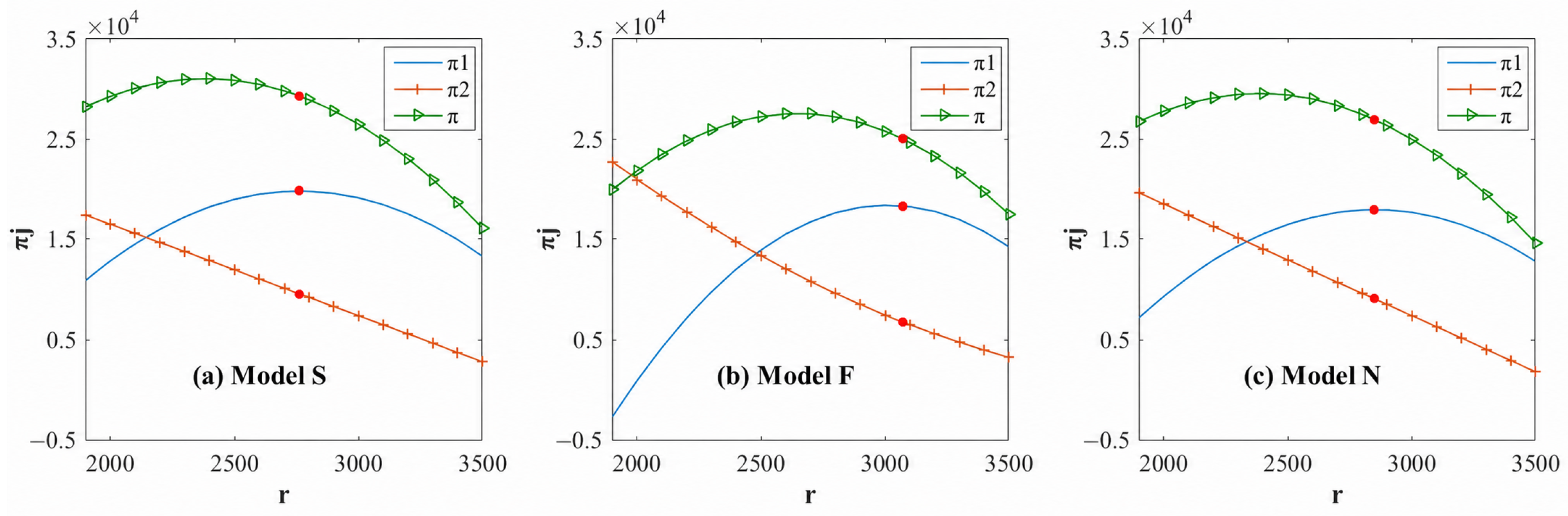
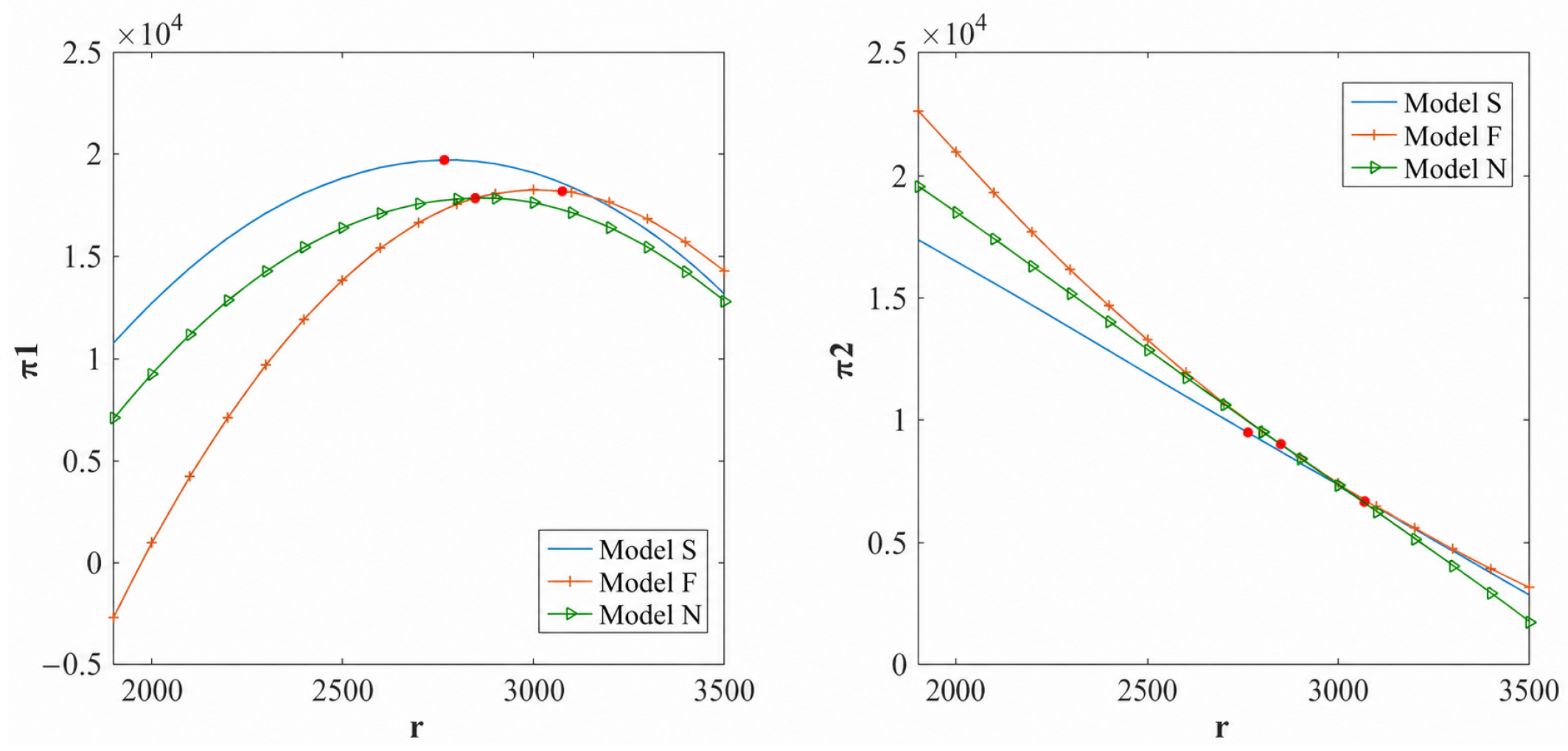
5.1. Analysis of the Optimal Values
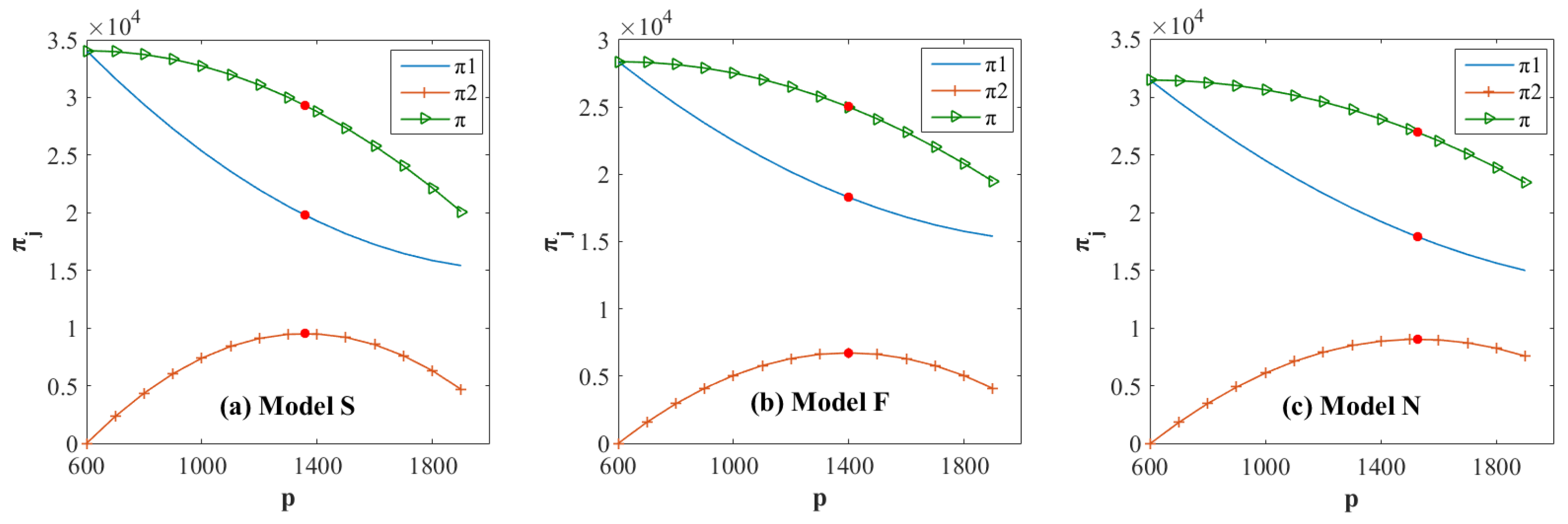
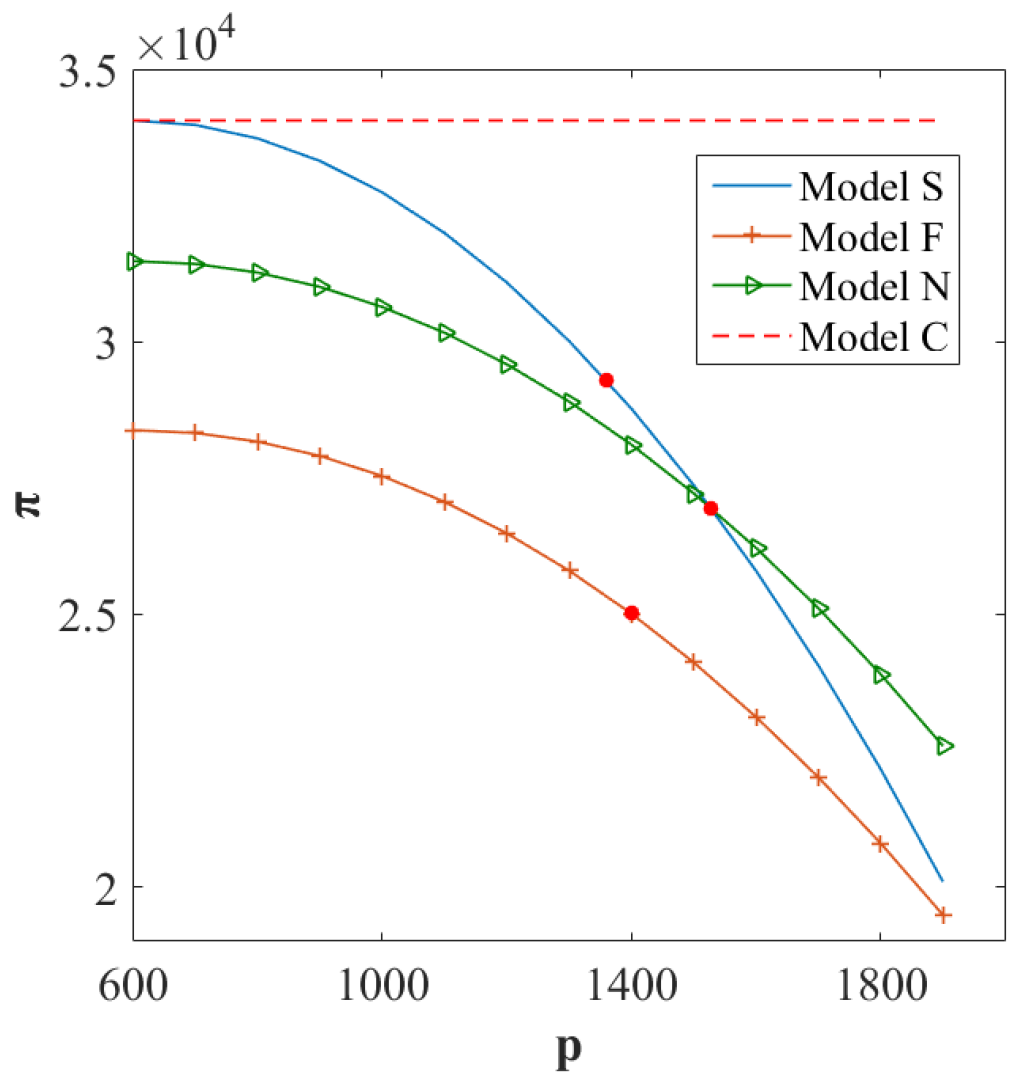
5.2. Analysis of the Agreed Price
5.3. Analysis of the Market Price Ceiling
6. Conclusions
Author Contributions
Funding
Institutional Review Board Statement
Informed Consent Statement
Data Availability Statement
Conflicts of Interest
Appendix A
References
- Safdar, M.; Zhong, M.; Ren, Z.; Li, L.; Raza, A.; Hunt, J. An integrated spatial economic modeling framework for forecasting inland waterway freight demand. Transp. Policy 2026, 176, 103900. [Google Scholar] [CrossRef]
- China Communications News. The Water Freight Volume of the Pearl River System Increased by 7.9% over the Previous Year in 2023. Available online: https://www.zgjtb.com/2024-01/04/content_394594.html (accessed on 28 March 2026).
- Zweers, B.; Bhulai, S.; van der Mei, R. Planning hinterland container transportation in congested deep-sea terminals. Flex. Serv. Manuf. J. 2021, 33, 583–622. [Google Scholar] [CrossRef]
- Tian, G.; Lu, W.; Zhang, X.; Zhan, M.; Dulebenets, M.; Aleksandrov, A.; Fathollahi-Fard, A.; Ivanov, M. A survey of multi-criteria decision-making techniques for green logistics and low-carbon transportation systems. Environ. Sci. Pollut. Res. 2023, 30, 57279–57301. [Google Scholar] [CrossRef]
- Mollaoglu, M.; Yazar Okur, I.; Gurturk, M.; Doganer Duman, B. Review on sustainable development goals in maritime transportation: Current research trends, applications, and future research opportunities. Environ. Sci. Pollut. Res. 2024, 31, 8312–8329. [Google Scholar] [CrossRef]
- Li, C.; Lin, T.; Zhang, Z.; Xu, D.; Huang, L.; Bai, W. Can transportation infrastructure reduce haze pollution in China? Environ. Sci. Pollut. Res. 2022, 29, 15564–15581. [Google Scholar] [CrossRef]
- Lin, S.; Wang, J. Carbon emission reduction effect of transportation structure adjustment in China: An approach on multi-objective optimization model. Environ. Sci. Pollut. Res. 2022, 29, 6166–6183. [Google Scholar] [CrossRef] [PubMed]
- MOT. Statistical Bulletin on the Development of Transportation Industry in 2024. Available online: https://xxgk.mot.gov.cn/jigou/zhghs/202506/t20250610_4170228.html (accessed on 28 March 2026).
- Chang, C.H.; Thai, V. Shippers’ Choice Behaviour in Choosing Transport Mode: The Case of South East Asia (SEA) Region. Asian J. Shipp. Logist. 2017, 33, 199–210. [Google Scholar] [CrossRef]
- Tiwari, P.; Itoh, H.; Doi, M. Shippers’ Port and Carrier Selection Behaviour in China: A Discrete Choice Analysis. Marit. Econ. Logist. 2003, 5, 23–39. [Google Scholar] [CrossRef]
- Shobayo, P.; Bedoya-Maya, F.; van Hassel, E.; Vanelslander, T.; Christopoulou, E.; Majoor, I. Assessing Inland Waterway Transport (IWT) container logistics on the Rhine Alpine corridor: A discrete event simulation approach. Res. Transp. Econ. 2024, 107, 101475. [Google Scholar] [CrossRef]
- Shobayo, P.; van Hassel, E. Container barge congestion and handling in large seaports: A theoretical agent-based modeling approach. J. Shipp. Trade 2019, 4, 4. [Google Scholar] [CrossRef]
- Gao, P.; Xu, Z.; Huang, L.; Zhao, X. An inland waterway navigation congestion mitigation strategy based on a multi-objective moment bottleneck model. Ocean Eng. 2025, 338, 121928. [Google Scholar] [CrossRef]
- Lee, C.Y.; Song, D.P. Ocean container transport in global supply chains: Overview and research opportunities. Transp. Res. Part B-Methodol. 2017, 95, 442–474. [Google Scholar] [CrossRef]
- Song, D.W.; Panayides, P. A conceptual application of cooperative game theory to liner shipping strategic alliances. Marit. Policy Manag. 2002, 29, 285–301. [Google Scholar] [CrossRef]
- Yang, H.; Wu, L.; Yue, A.; Zhao, C. Optimization of slot mutual exchange and allocation based on revenue management in liner alliance. Syst. Eng. Theory Pract. 2016, 36, 1806–1815. [Google Scholar]
- Caris, A.; Macharis, C.; Janssens, G.K. Decision support in intermodal transport: A new research agenda. Comput. Ind. 2013, 64, 105–112. [Google Scholar] [CrossRef]
- Konings, J.W. Opportunities to improve container barge handling in the port of Rotterdam from a transport network perspective. J. Transp. Geogr. 2007, 15, 443–454. [Google Scholar] [CrossRef]
- Wang, J.C.; Wang, Y.Y.; Lai, F. Impact of power structure on supply chain performance and consumer surplus. Int. Trans. Oper. Res. 2019, 26, 1752–1785. [Google Scholar] [CrossRef]
- Yang, L.; Cai, Y.; Wei, Y.; Huang, S. Choice of technology for emission control in port areas: A supply chain perspective. J. Clean. Prod. 2019, 240, 118105. [Google Scholar] [CrossRef]
- Chaab, J.; Rasti-Barzoki, M. Cooperative advertising and pricing in a manufacturer-retailer supply chain with a general demand function; A game-theoretic approach. Comput. Ind. Eng. 2016, 99, 112–123. [Google Scholar] [CrossRef]
- Perakis, G.; Sood, A. Competitive Multi-period Pricing for Perishable Products: A Robust Optimization Approach. Math. Program. 2006, 107, 295–335. [Google Scholar] [CrossRef]
- Serrano, I.; Cantillo, V.; Arteta, A. Optimal fare model for inland waterway transport passengers’ services. Transp. Policy 2025, 174, 103820. [Google Scholar] [CrossRef]
- Chen, R.; Lei, Z. Airport dominance and airline pricing power: An investigation of hub premiums in the Chinese domestic market. Transp. Res. Part A Policy Pract. 2017, 103, 509–524. [Google Scholar] [CrossRef]
- Chen, S.; Sun, G.; Wei, Z.; Wang, D. Dynamic pricing in electricity and natural gas distribution networks: An EPEC model. Energy 2020, 207, 118138. [Google Scholar] [CrossRef]
- Gan, S.S.; Pujawan, I.; Suparno; Widodo, B. Pricing decision for new and remanufactured product in a closed-loop supply chain with separate sales-channel. Int. J. Prod. Econ. 2017, 190, 120–132. [Google Scholar] [CrossRef]
- Mumbower, S.; Garrow, L.; Higgins, M. Estimating flight-level price elasticities using online airline data: A first step toward integrating pricing, demand, and revenue optimization. Transp. Res. Part A Policy Pract. 2014, 66, 196–212. [Google Scholar] [CrossRef]
- Vives, A.; Jacob, M. Dynamic pricing in different Spanish resort hotels. Tour. Econ. 2021, 27, 398–411. [Google Scholar] [CrossRef]
- Wang, J.; Zhou, Z.; Yu, M. Pricing models in a sustainable supply chain with capacity constraint. J. Clean. Prod. 2019, 222, 57–76. [Google Scholar] [CrossRef]
- Wang, X.; Zhou, W. Integrating dynamic pricing and inventory control for fresh agriproduct under multinomial logit choice. Math. Probl. Eng. 2018, 2018, 5936971. [Google Scholar] [CrossRef]
- Dasci, A.; Karakul, M. Two-period dynamic versus fixed-ratio pricing in a capacity constrained duopoly. Eur. J. Oper. Res. 2009, 197, 945–968. [Google Scholar] [CrossRef]
- Bergantino, A.; Capozza, C. One price for all? Price discrimination and market captivity: Evidence from the Italian city-pair markets. Transp. Res. Part A Policy Pract. 2015, 75, 231–244. [Google Scholar] [CrossRef]
- Zhang, D.; Cooper, W. Pricing substitutable flights in airline revenue management. Eur. J. Oper. Res. 2009, 197, 848–861. [Google Scholar] [CrossRef]
- Du, C.; He, F.; Lin, X. Dynamic pricing for air cargo revenue management. Transp. Res. Part E Logist. Transp. Rev. 2025, 197, 104088. [Google Scholar] [CrossRef]
- Bao, X.; Xing, X.; Zhang, D. Research on freight pricing mechanism of shipping companies considering supply chain management. J. Coast. Res. 2019, 94, 568–572. [Google Scholar] [CrossRef]
- Meng, Q.; Zhao, H.; Wang, Y. Revenue management for container liner shipping services: Critical review and future research directions. Transp. Res. Part E Logist. Transp. Rev. 2019, 128, 280–292. [Google Scholar] [CrossRef]
- Zhang, L.; Schacht, O.; Liu, Q.; Ng, A. Predicting inland waterway freight demand with a dynamic spatio-temporal graph attention-based multi attention network. Transp. Res. Part E Logist. Transp. Rev. 2025, 199, 104139. [Google Scholar] [CrossRef]
- Ding, Y.; Chen, K.; Xu, D.; Zhang, Q. Dynamic pricing research for container terminal handling charge. Marit. Policy Manag. 2021, 48, 512–529. [Google Scholar] [CrossRef]
- Zhu, X.; Jian, L.; Chen, X.; Zhao, Q. Reinforcement learning for Multi-Flight Dynamic Pricing. Comput. Ind. Eng. 2024, 193, 110302. [Google Scholar] [CrossRef]
- Lange, F.; Dreessen, L.; Schlosser, R. Reinforcement learning versus data-driven dynamic programming: A comparison for finite horizon dynamic pricing markets. J. Revenue Pricing Manag. 2025, 24, 584–600. [Google Scholar] [CrossRef]
- Yin, M.; Kim, K. Quantity discount pricing for container transportation services by shipping lines. Comput. Ind. Eng. 2012, 63, 313–322. [Google Scholar] [CrossRef]
- Liu, D.; Yang, H. Joint slot allocation and dynamic pricing of container sea–rail multimodal transportation. J. Traffic Transp. Eng. (Engl. Ed.) 2015, 2, 198–208. [Google Scholar] [CrossRef]
- Sun, Q.; Li, W.; Meng, Q. Single-leg shipping revenue management for expedited services with ambiguous elasticity in transit-time-sensitive demand. Transp. Res. Part B Methodol. 2024, 180, 102886. [Google Scholar] [CrossRef]
- Peng, Z.; Shan, W.; Guan, F.; Yu, B. Stable vessel-cargo matching in dry bulk shipping market with price game mechanism. Transp. Res. Part E Logist. Transp. Rev. 2016, 95, 76–94. [Google Scholar] [CrossRef]
- Amin-Naseri, M.; Khojasteh, M. Price competition between two leader-follower supply chains with risk-averse retailers under demand uncertainty. Int. J. Adv. Manuf. Technol. 2015, 79, 377–393. [Google Scholar] [CrossRef]
- Clark, D.; Jorgensen, F.; Mathisen, T. Relationships between fares, trip length and market competition. Transp. Res. Part E Policy Pract. 2011, 45, 611–624. [Google Scholar] [CrossRef]
- Pan, K.; Lai, K.; Leung, S.; Xiao, D. Revenue-sharing versus wholesale price mechanisms under different channel power structures. Eur. J. Oper. Res. 2010, 203, 532–538. [Google Scholar] [CrossRef]
- Qiu, X.; Lee, C.Y. Quantity discount pricing for rail transport in a dry port system. Transp. Res. Part E Logist. Transp. Rev. 2019, 122, 563–580. [Google Scholar] [CrossRef]
- Wang, C.; Chen, X. Option pricing and coordination in the fresh produce supply chain with portfolio contracts. Ann. Oper. Res. 2017, 248, 471–491. [Google Scholar] [CrossRef]
- Xiao, T.; Choi, T.M.; Cheng, T. Product variety and channel structure strategy for a retailer-Stackelberg supply chain. Eur. J. Oper. Res. 2014, 233, 114–124. [Google Scholar] [CrossRef]
- Lu, L.; Menezes, M. Supply chain vertical competition and product proliferation under different power structures. Int. J. Prod. Econ. 2024, 267, 109097. [Google Scholar] [CrossRef]
- Choi, T.M.; Li, Y.; Xu, L. Channel leadership, performance and coordination in closed loop supply chains. Int. J. Prod. Econ. 2013, 146, 371–380. [Google Scholar] [CrossRef]
- Edirisinghe, N.; Bichescu, B.; Shi, X. Equilibrium analysis of supply chain structures under power imbalance. Eur. J. Oper. Res. 2011, 214, 568–578. [Google Scholar] [CrossRef]
- Gao, J.; Han, H.; Hou, L.; Wang, H. Pricing and effort decisions in a closed-loop supply chain under different channel power structures. J. Clean. Prod. 2016, 112, 2043–2057. [Google Scholar] [CrossRef]
- Luo, M.; Liu, L.; Gao, F. Post-entry container port capacity expansion. Transp. Res. Part B Methodol. 2012, 46, 120–138. [Google Scholar] [CrossRef]
- Wang, H.; Meng, Q.; Zhang, X. Game-theoretical models for competition analysis in a new emerging liner container shipping market. Transp. Res. Part B Methodol. 2014, 70, 201–227. [Google Scholar] [CrossRef]
- Yue, J.; Austin, J.; Huang, Z.; Chen, B. Pricing and advertisement in a manufacturer-retailer supply chain. Eur. J. Oper. Res. 2013, 231, 492–502. [Google Scholar] [CrossRef]
- Zhang, R.; Liu, B.; Wang, W. Pricing decisions in a dual channels system with different power structures. Econ. Model. 2012, 29, 523–533. [Google Scholar] [CrossRef]
- Jiang, W.; Huang, T.; Shi, K.; Martek, I. Pricing, crashing and coordination for prefabricated construction supply chain with the lead-time incentive: A power perspective. Humanit. Soc. Sci. Commun. 2025, 12, 431. [Google Scholar] [CrossRef]
- Yang, B.; Yu, X. Equilibrium Pricing and Power Design in Hybrid Supply Chains: A Stackelberg Game Approach. Mathematics 2025, 13, 3939. [Google Scholar] [CrossRef]
- Hu, X.; Cai, J.; Yue, X. Power structure preferences in a dual-channel supply chain: Demand information symmetry vs. asymmetry. Eur. J. Oper. Res. 2024, 314, 920–934. [Google Scholar] [CrossRef]
- Shi, R.; Zhang, J.; Ru, J. Impacts of power structure on supply chains with uncertain demand. Prod. Oper. Manag. 2013, 22, 1232–1249. [Google Scholar] [CrossRef]
- Choi, T.M.; Chung, S.H.; Zhuo, X. Pricing with risk sensitive competing container shipping lines: Will risk seeking do more good than harm? Transp. Res. Part E Methodol. 2020, 133, 210–229. [Google Scholar] [CrossRef]
- Li, J.; Wang, H.; Shi, V.; Sun, Q. Manufacturer’s choice of online selling format in a dual-channel supply chain with green products. Eur. J. Oper. Res. 2024, 318, 131–142. [Google Scholar] [CrossRef]
- Hadi, T.; Chaharsooghi, S.; Sheikhmohammady, M.; Hafezalkotob, A. Pricing strategy for a green supply chain with hybrid production modes under government intervention. J. Clean. Prod. 2020, 268, 121945. [Google Scholar] [CrossRef]
- Cheng, S.; Zhang, F.; Chen, X. Optimal contract design for a supply chain with information asymmetry under dual environmental responsibility constraints. Expert Syst. Appl. 2024, 237, 121466. [Google Scholar] [CrossRef]
- Wang, L.; Ye, M.; Ma, S.; Sha, Y. Pricing and coordination strategy in a green supply chain with a risk-averse retailer. Math. Probl. Eng. 2019, 2019, 7482080. [Google Scholar] [CrossRef]
- Agrawal, V.; Seshadri, S. Impact of uncertainty and risk aversion on price and order quantity in the newsvendor problem. Manuf. Serv. Oper. Manag. 2000, 2, 410–423. [Google Scholar] [CrossRef]






| Parameter | Value | Parameter | Value |
|---|---|---|---|
| The average market demand (a) | 50 | The unit transportation cost to the STC (c) | 600 |
| The standard deviation of market demand (b) | 0.012 | The spot market price () | 1900 |
| The random fluctuations of market demand () | [−10, 10] | The market price ceiling () | 2100 |
| Game Theory Model | ||||
|---|---|---|---|---|
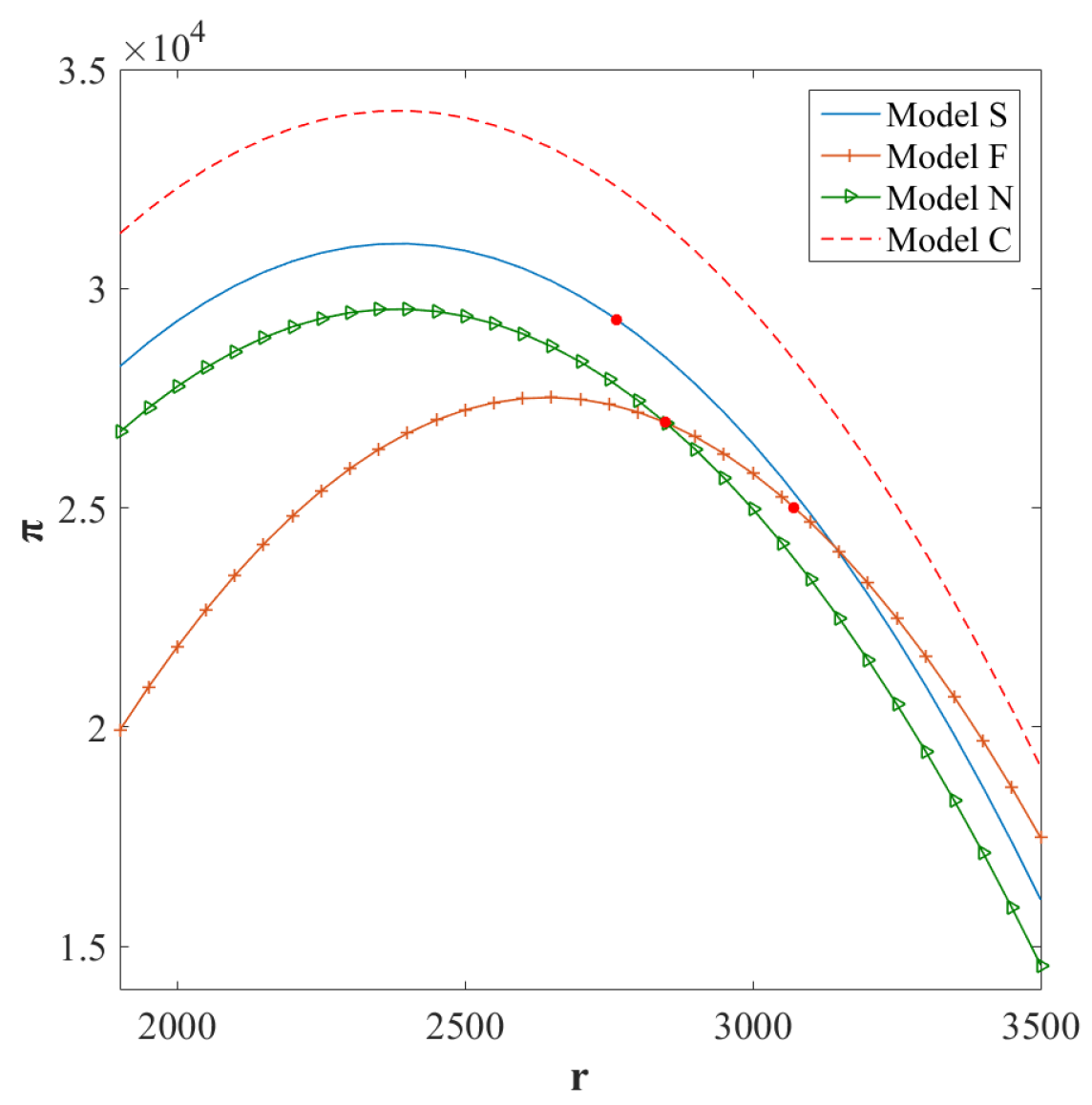
| The STC-Stackelberg model (S) | 1358.9 | 2762.8 | −4.3 | 12.5 |
| The FTC-Stackelberg model (F) | 1399.3 | 3071.3 | −4.7 | 8.4 |
| The Nash model (N) | 1527.2 | 2846.9 | −6.1 | 9.8 |
| The centralized model (C) | - | 2383.3 | 3.7 | 25.1 |
| Game Theory Model | |||
|---|---|---|---|
| The STC-Stackelberg model (S) | 19,780.4 | 9518.4 | 29,298.9 |
| The FTC-Stackelberg model (F) | 18,289.3 | 6725.6 | 25,014.9 |
| The Nash model (N) | 17,903.5 | 9050.2 | 26,953.7 |
| The centralized model (C) | - | - | 34,058.1 |
| Game Theory Model | ||||
|---|---|---|---|---|
| The STC-Stackelberg model (S) | 1358.9 | 2100 | −4.3 | 20.5 |
| The FTC-Stackelberg model (F) | 1953.0 | 2100 | −10.6 | 14.2 |
| The Nash model (N) | 1527.2 | 2100 | −6.1 | 18.7 |
| The centralized model (C) | - | 2100 | 3.7 | 28.5 |
| Game Theory Model | |||
|---|---|---|---|
| The STC-Stackelberg model (S) | 14,508.9 | 15,554.5 | 30,063.4 |
| The FTC-Stackelberg model (F) | 4190.4 | 19,269.6 | 23,459.9 |
| The Nash model (N) | 11,208.2 | 17,361.4 | 28,569.6 |
| The centralized model (C) | - | - | 33,094.7 |
Disclaimer/Publisher’s Note: The statements, opinions and data contained in all publications are solely those of the individual author(s) and contributor(s) and not of MDPI and/or the editor(s). MDPI and/or the editor(s) disclaim responsibility for any injury to people or property resulting from any ideas, methods, instructions or products referred to in the content. |
© 2026 by the authors. Licensee MDPI, Basel, Switzerland. This article is an open access article distributed under the terms and conditions of the Creative Commons Attribution (CC BY) license.
Share and Cite
Cai, W.; Wang, W.; Liu, Y.; Gu, Y.; Loh, H.S. A Novel Inland Barge Practice for Sustainable Freight in the Pearl River Delta: Pricing Strategies for Outsourcing Leftover Shipping Demands. Sustainability 2026, 18, 5304. https://doi.org/10.3390/su18115304
Cai W, Wang W, Liu Y, Gu Y, Loh HS. A Novel Inland Barge Practice for Sustainable Freight in the Pearl River Delta: Pricing Strategies for Outsourcing Leftover Shipping Demands. Sustainability. 2026; 18(11):5304. https://doi.org/10.3390/su18115304
Chicago/Turabian StyleCai, Wenxue, Wenzhuo Wang, Yan Liu, Yimiao Gu, and Hui Shan Loh. 2026. "A Novel Inland Barge Practice for Sustainable Freight in the Pearl River Delta: Pricing Strategies for Outsourcing Leftover Shipping Demands" Sustainability 18, no. 11: 5304. https://doi.org/10.3390/su18115304
APA StyleCai, W., Wang, W., Liu, Y., Gu, Y., & Loh, H. S. (2026). A Novel Inland Barge Practice for Sustainable Freight in the Pearl River Delta: Pricing Strategies for Outsourcing Leftover Shipping Demands. Sustainability, 18(11), 5304. https://doi.org/10.3390/su18115304