Article

Experimental and Numerical Analysis of a Small-Scale Desalination System Using Humidification–Dehumidification Fed by Linear Fresnel Concentration


by
Brayan Eduardo Tarazona-Romero
1,*,
Álvaro Campos-Celador
2,
Yecid Muñoz-Maldonado
3,
Omar Lengerke-Perez
1 and
Javier Ascanio-Villabona
1
1
Research Group in Energy, Automation and Control Systems (GISEAC), Electromechanical Engineering Program, Faculty of Natural Sciences and Engineering, Unidades Tecnológicas de Santander, Bucaramanga 680005, Colombia
2
ENEDI Research Group, Department of Energy Engineering, Faculty of Engineering of Bilbao, University of the Basque Country UPV/EHU, Plaza Ingeniero Torres Quevedo 1, 48013 Bilbao, Spain
3
GIRES Research Group, Energy and Sustainability Engineering Program, Faculty of Engineering, Universidad Autonoma de Bucaramanga UNAB, Bucaramanga 680003, Colombia
*
Author to whom correspondence should be addressed.
Sustainability 2026, 18(11), 5224; https://doi.org/10.3390/su18115224 (registering DOI)
Submission received: 14 February 2026 / Revised: 17 March 2026 / Accepted: 24 March 2026 / Published: 22 May 2026
(This article belongs to the Section Energy Sustainability)

Abstract

Access to freshwater is one of the major global challenges, driven by population growth, industrial development, climate change, and increasing water stress, particularly in economically constrained regions. In this context, this study designs, builds, and experimentally and numerically evaluates an indirect solar concentration desalination system (ICST) composed of a humidification–dehumidification (HDH) subsystem thermally powered by a Linear Fresnel Concentrator (LFC) under the appropriate technology paradigm. The methodology integrates an experimental campaign conducted under real climatic conditions in Bucaramanga, Colombia, mathematical modeling based on mass and energy balances, and the implementation of a TRNSYS simulation model validated through qualitative and quantitative analyses using absolute and relative errors. Results showed close agreement between experimental and simulated data, with daily freshwater production deviations of 0.53 and 0.65 L/day in tests 04 and 05, respectively, while mean relative errors remained below 5% for the main thermal and productivity variables. Experimentally, an average freshwater production of 1.13 L/h was achieved, with a production gain ratio (GOR) of 0.32 and a recovery ratio (RR) of 0.021, while maintaining total dissolved solids below 500 mg/L. Economic assessment estimated a production cost of $0.065/L, demonstrating the technical and economic feasibility of the system for decentralized small-scale applications in regions with high solar irradiance throughout the year.

1. Introduction

Water is fundamental to human life and ecological survival, fully justifying the need to ensure its supply. Furthermore, it plays a crucial role in economic development and, along with energy, is a key element for global security and food supply [1]. The United Nations (UN), in its report entitled “UN World Water Development Report 2025 (WWDR 2025)” [2], reaffirms the importance of improving water resource management to achieve sustainable and equitable processes, which will enable the achievement of the Sustainable Development Goals (SDGs).
Although water is abundant on the planet, only about 2.5% is freshwater, while the remaining 97.5% is seawater. Of the freshwater, approximately 2.25% is in the form of ice, and only 0.25% is available for direct consumption [3,4]. The WWDR 2025 highlights the phenomenon of water stress, experienced by various regions worldwide, associated with the relationship between water use and available supply. This phenomenon is classified into physical water stress, which refers to the actual scarcity of the resource, and economic water stress, which occurs when water is available but the means or infrastructure to access it are lacking [5].
Given this scenario, desalination technologies, despite their high implementation and operating costs, are considered a reliable source for producing fresh water, and technological developments have been documented since 1662. These technologies have been developed primarily under two approaches, depending on their input source: thermal and membrane [6]. It is important to note that both approaches can be combined to achieve greater process efficiency [7]. For a more detailed understanding, Table 1 presents a general classification of these desalination technologies.
Over the past five decades, numerous scientific advances have contributed to the development and optimization of desalination technologies, mitigating their high energy consumption through the integration of renewable solar energy sources as a primary or auxiliary source [11]. In this context, thermal technologies have received increasing interest due to their ability to integrate renewable and waste heat [12,13]. Unlike membrane technologies, these allow for operation with water of varying salinity levels, dissolved solids concentrations, and organic matter, reducing the need for pretreatment chemicals.
Recent research has focused on improving the performance of solar desalination systems through advanced modeling approaches, hybrid configurations, and thermal energy management strategies. For instance, Hussein et al. [14] applied multi-objective heuristic optimization combined with machine learning to enhance the operational performance of solar-driven HDH desalination systems. Similarly, Mohammad et al. [15] investigated the integration of phase change materials (PCM) into HDH desalination systems, demonstrating that thermal storage can extend operating periods and increase freshwater production. Other studies have explored advanced configurations such as solar-assisted heat pump HDH systems and alternative thermal management strategies to improve thermodynamic efficiency and economic feasibility [16]. Experimental research has also investigated novel structural materials and hybrid desalination architectures to enhance system stability and freshwater productivity under variable operating conditions [17,18]. These developments highlight the growing interest in improving solar desalination technologies through system optimization, hybridization, and advanced thermal management strategies.
Humidification–dehumidification (HDH) systems are an emerging technology that does not require large-scale infrastructure and exhibits low energy consumption compared to commercial systems such as MED, MSF, MVC, MD, and RO [19]. Among its main advantages are its simple design, lower maintenance requirements, operation at low pressure and temperature, low cost, and flexibility in construction materials, making it a promising small-scale technology for small-scale applications [20]. HDH systems can be classified by the type of water and air circulation, either closed or open, as well as by the type of air circulation, forced or natural [21].
The operating process of the HDH system is relatively simple: salt water is heated by an external heat source before entering the humidifier or evaporator, where it is converted into water vapor. This vapor then enters the dehumidification unit or condenser, where fresh water condensate is produced through a heat exchange process between a pipe through which salt water circulates at a temperature lower than that of the water vapor, producing the distillate [22,23]. The main components are the heat supply system, the humidifier, and the dehumidifier, which can be constructed from various materials such as iron, aluminum, and copper, among others [20].
Among the alternatives for supplying thermal energy to the HDH system, solar concentration systems stand out for their ability to supply heat in temperature ranges compatible with this type of process [24,25]. In particular, Linear Fresnel Collectors (LFCs) offer greater versatility and application potential at different scales, due to their simple optical configuration, lower relative cost compared to other concentration systems, and their high capacity for application in environments with high levels of direct solar irradiance (DNI) [26,27,28]. In the context of this document, the integration of solar concentration technologies into HDH systems is referred to as indirect solar concentration desalination system (ICST) systems.
Once the configuration of ICST systems has been defined, it is necessary to analyze this type of configuration beyond thermal and energy performance, considering its viability at a small and medium scale based on its adaptation to the social, environmental, and economic conditions of the real application environment [29]. In this sense, the appropriate technology (AT) paradigm provides a relevant framework that prioritizes construction flexibility, the efficient use of local resources and labor, as well as ease of operation and maintenance, favoring its implementation in real-world decentralized scenarios with infrastructure constraints [30,31], characteristic of a wide variety of regions with limited access to water worldwide.
In summary, this study proposes and evaluates a humidification–dehumidification (HDH) desalination system thermally supplied by a Linear Fresnel collector (LFC), developed under an appropriate technology approach. The novelty of the proposed configuration lies in the integration of a solar concentration system with a small-scale HDH desalination unit designed to operate under real climatic conditions and adapted to decentralized contexts with infrastructure limitations. Section 2 describes the materials and methods employed, including the system description, the experimental campaign, the mathematical simulation model implemented in TRNSYS, and its validation process. Subsequently, Section 3 presents and discusses the main results, analyzing the thermal and economic performance of the system under real climatic conditions. Finally, Section 4 presents the most relevant conclusions of the study.

2. Materials and Methods

2.1. System Description

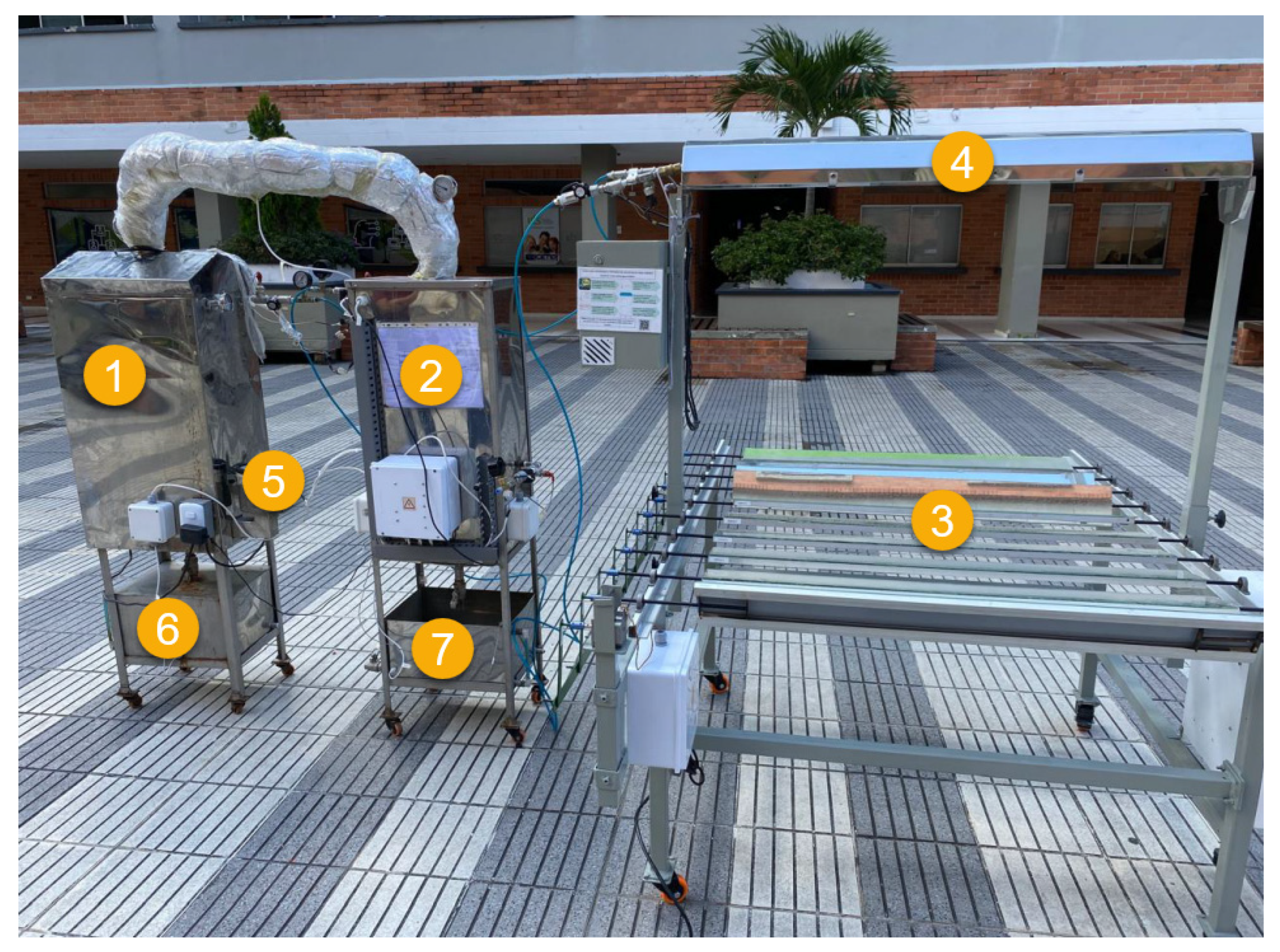
The indirect solar concentration desalination system (ICST) desalination system developed (Figure 1) is divided into two subsystems: a humidification–dehumidification (HDH) desalination unit and a linear Fresnel concentrator (LFC). The HDH unit consists of a humidification chamber (evaporator) and a dehumidification chamber (condenser). During the humidification process, air is injected in an open circuit by a fan (110 V, 550 W, commercially available and locally sourced in Colombia) through the bottom of the humidification chamber, where it is heated and humidified to saturation upon contact with the preheated brine (preheated by the Fresnel subsystem) sprayed from the top.
Air from the fan and hot sprayed water flow counter-currently through the humidification chamber packing (polyurethane foam, 50 PPI, open-cell structure, operating range −40 to 120 °C, commercially available in Colombia) to enhance mass and heat exchange between the fluids. During humidification, mass and heat are transferred from the heated salt water to the air. The saturated air resulting from the fluid contact exits the top of the humidification chamber and reaches the dehumidification chamber via an insulated circular pipe. Additionally, at the bottom of the humidifier, the condensate containing excess salts (brine) produced during humidification is collected in a brine tank.
The salt water circulates in a one-way open flow and enters a coiled pipe within the dehumidification chamber. Inside this chamber, the saturated air condenses upon contact with the coiled pipe, through which the feed salt water circulates. The condensate is stored in a freshwater tank located at the bottom of the dehumidification chamber. Subsequently, the saltwater exits the dehumidifier and passes to the Fresnel subsystem, before supplying the humidification chamber.
The Fresnel subsystem consists of 10 larger reflector mirrors (1000 mm × 100 mm × 3 mm, reflectivity 0.712, locally sourced in Colombia), along with a single axis of automated mirror movement [32]. Regarding the secondary reflection system, a Compound Parabolic Concentrator (CPC) was adopted, in contrast to the pyramidal envelope system studied by [33]. This decision is based on the study presented by [34], who concluded that the CPC is the most efficient secondary reflection system for LFC technology.
In keeping with the appropriate technology approach, the ICST system presented above (see Figure 1) uses low-cost materials that are widely available in the local context and easy to acquire, in order to simplify maintenance and ensure replicability. The main materials used were commercial and stainless steel, aluminum profiles, commercial mirrors, standard bearings, commercial glass, copper tubing, fiberglass (for thermal insulation), PVC fittings, and 50 PPI polyurethane foam-based filler material (all materials commercially available and sourced in Colombia).

2.2. Experimental Campaign

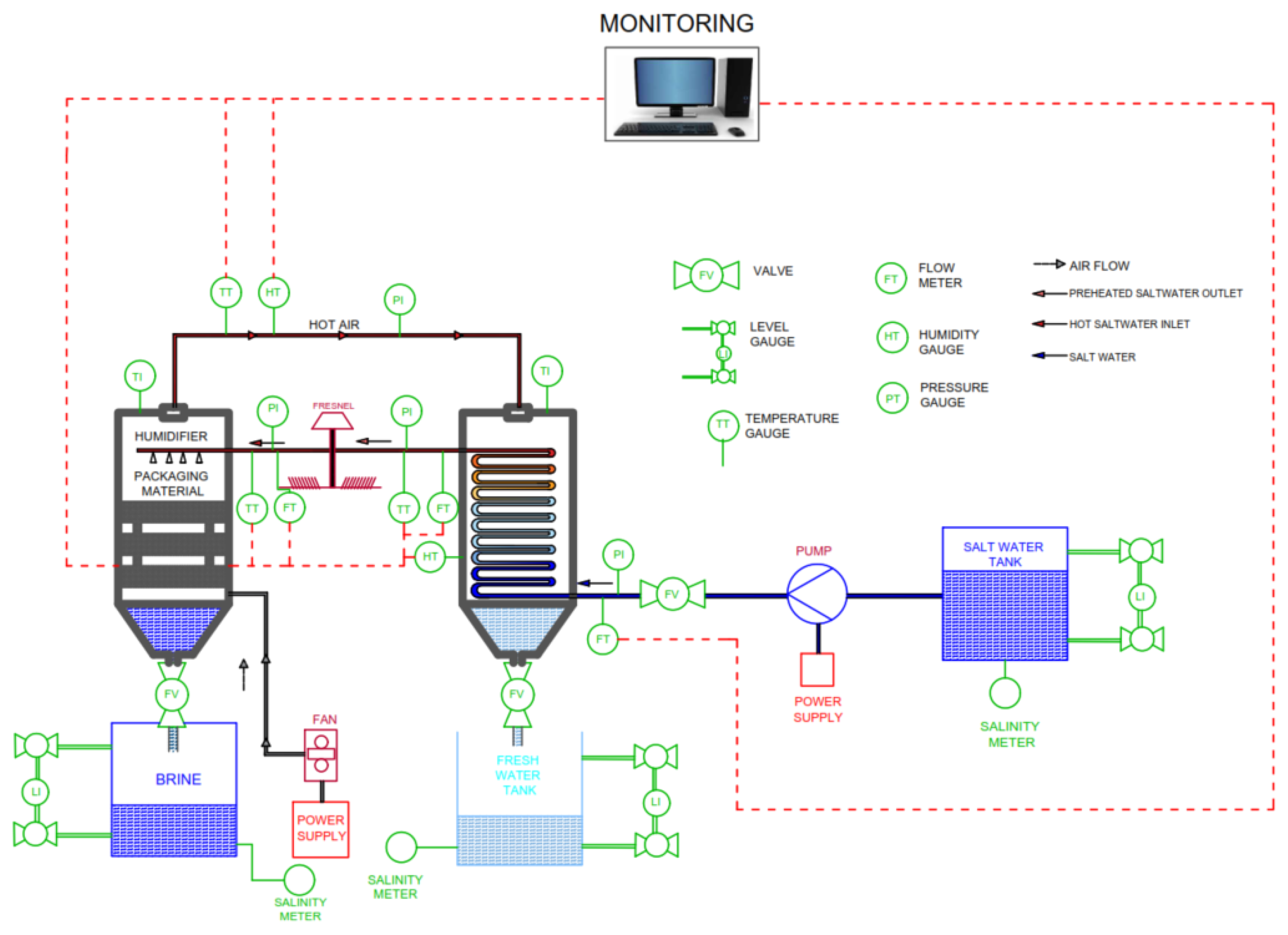
Figure 2 presents the flow diagram for the ICST system shown in Figure 1, indicating the measurement points with the different sensors used. For the prototype evaluation, several experiments were conducted covering a wide range of operating parameters. The ICST desalination system was installed at the facilities of the Technological Units of Santander in Colombia, where experimental tests were performed. Initially, each subsystem was evaluated separately, and subsequently, the entire ICST desalination system was evaluated as a single integrated unit.
In accordance with the above, the experimental campaign evaluated the subsystems separately. To this end, three trials were conducted over three different days (see Table 2), with each of the three subsystems tested individually. Subsequently, two further trials (see Table 3) were conducted over two different days, integrating the subsystems into the ICST desalination system. All five trials were performed under the operating conditions presented in Table 4.
In order to assess the limitations of the salinity study of the freshwater production from the proposed ICST desalination system, the following consideration is made based on [35]: “the Total Dissolved Salts (TDS) concentration is below 500.” To ensure that this criterion is met for any operating flow rate, the Fresnel subsystem was replaced with an electric boiler, which allowed for the evaluation of distillate quality at flow rates up to 0.56 kg/s at a maximum temperature of 90 °C. The experimental results determined that the salinity levels for the maximum flow rate reached a maximum value of 0.39 g/L, confirming the validity of the proposed configuration and providing confidence in the execution of the experimental tests.
Although the experimental campaign employed artificially prepared saline water in order to maintain controlled and repeatable operating conditions, the humidification–dehumidification desalination process is inherently applicable to real seawater since it is based on evaporation and condensation phenomena rather than membrane selectivity. However, real seawater may introduce additional operational challenges such as scaling, corrosion, and biological fouling in some system components. Therefore, future studies should evaluate the long-term performance of the ICST system under real seawater operating conditions.
During the experimental campaign, all variables were recorded at a fixed acquisition interval of 15 min. The monitoring system was configured so that all sensors operated under a common time reference, ensuring synchronization between environmental, thermal, and hydraulic measurements. This configuration allowed consistent comparison between experimental data and the results obtained from the TRNSYS simulation model.
During the experimental campaign, data acquisition was performed using a system based on an Arduino Mega 2560 microcontroller and a Raspberry Pi 4 single-board computer (both commercially available and locally sourced in Colombia). The system was programmed using the Arduino IDE (v1.8.x) and Python (v3.x), enabling serial communication, real-time processing, and data storage. Additionally, data visualization and monitoring were carried out using LabVIEW (National Instruments, Austin, TX, USA). The simulation results used for comparison were obtained using TRNSYS (v17, Thermal Energy System Specialists, Madison, WI, USA).

2.3. Error Propagation

Table 5 presents the specifications of the sensors used in the experiment, describing the instrument type, the measured variable, range, manufacturer-provided accuracy, and uncertainty value. Additionally, when a variable is determined through a series of independent measurements, Guide EA-4/02 “Expression of the Uncertainty of Measurements in Calibration” [36] allows for error propagation, considering the accuracy of the measurements from the different sensors used to calculate the variable. The uncertainty associated with each instrument was determined through calibration processes and statistical repeatability analysis, considering only those sensors directly involved in calculating the system’s thermal power, and is lower than the nominal accuracy provided by the manufacturer.
The experimentally average value is related to the actual thermal power of the system as follows:
Q ˙ = Q ˙ E X P ± δ Q ˙    
where Q ˙ is tha actual thermal power of the system (W), Q ˙ E X P is the experimentally measured thermal power obtained from sensor data and δ Q ˙ is the uncertainty of the measured thermal power. For estimating the propagation of uncertainty in the experimental results, the uncertainty in the measurements of the different sensors used to calculate the thermal power has been considered (see Table 6). In this way, the uncertainty of the measurement of the exchanged power can be calculated. For the least favorable situation, this expression results in an uncertainty of ± 2.29% of the experimentally measured thermal power, which is considered acceptable for experimental studies of this type. Finally, the modified types include a * in their numbering.

2.4. Simulation Model

To support the mathematical model that describes the behavior of the developed ICST system, the following assumptions were considered: (i) heat losses through the pipe connecting the collector outlet to the humidification chamber are neglected; (ii) heat losses through the pipe connecting the water vapor outlet of the humidification chamber to the dehumidification chamber are neglected; (iii) irreversibilities of the heat pump and the fan are neglected; (iv) the thermophysical properties of air and water are constant for all operating temperature ranges; (v) the air pressure at the outlet of the humidification chamber is equal to that at the inlet of the dehumidification chamber; and (vi) the one-dimensional (1D) behavior of the working variables along the system components is assumed.

2.4.1. Global Mass and Energy Balance of the ICST System

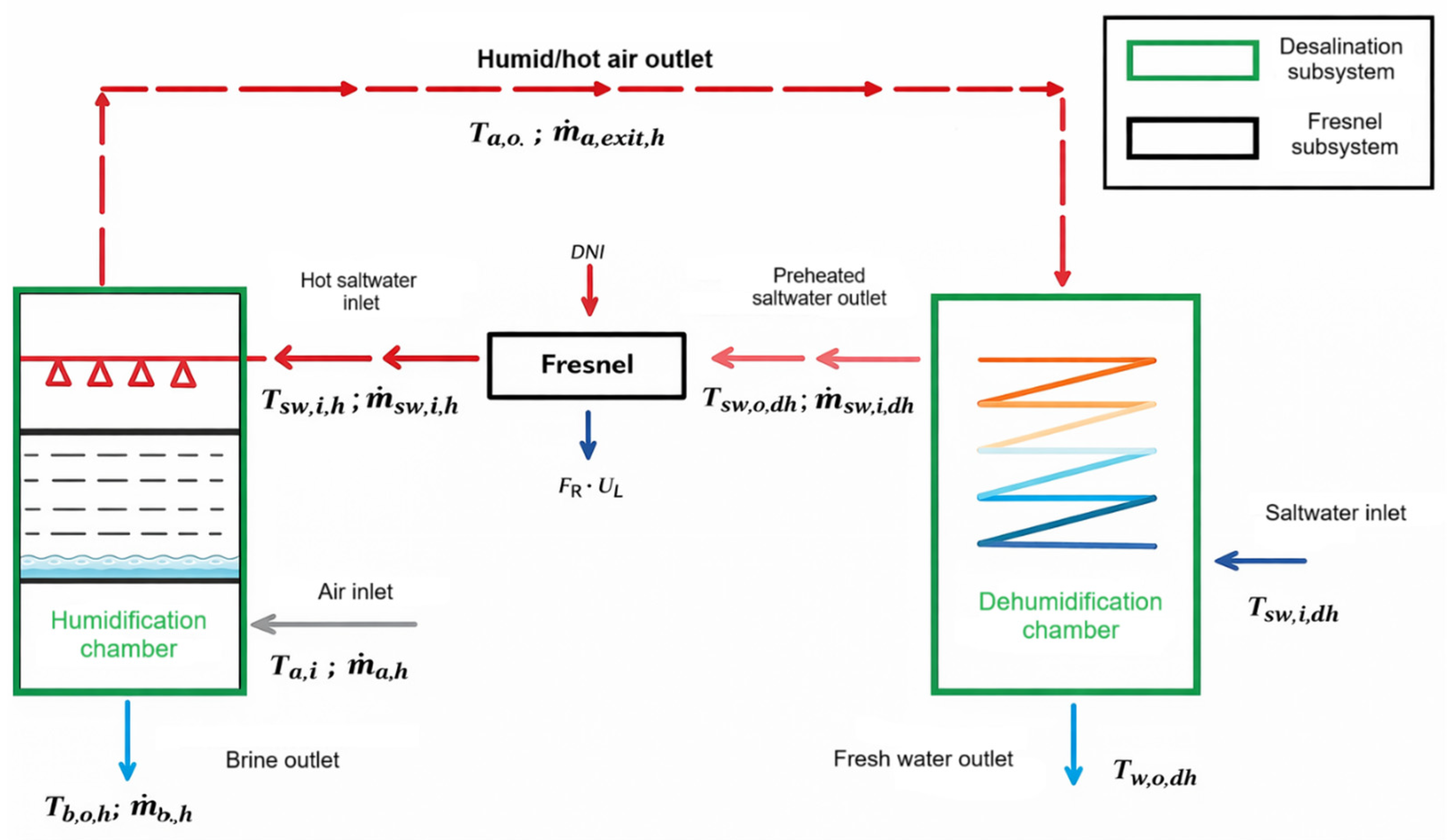
Figure 3 presents the mass and energy balance for simulating the ICST desalination system process, where evaporation and condensation occur in the humidification and dehumidification chambers, respectively. In the humidification chamber, the air and water flows come into direct contact, while in the dehumidification chamber, they do so indirectly through a coil. The Fresnel subsystem is responsible for transferring the Direct Normal Irradiation (DNI) to the working fluid. Furthermore, the model assumes an immediate thermal response of the system and does not explicitly represent the transient thermal inertia of the absorber structure and working fluid during the start-up period. This simplification may introduce temporary deviations between the experimental measurements and the model predictions during the first operating intervals of the experimental tests.

2.4.2. Modeling of the HDH Desalination Subsystem

The humidification chamber is modeled as a direct contact process between the mass flow rates of water and air, based on formulations used in evaporation devices. The mathematical model adapts the correlation used to operate the Type 51, originally developed for cross-flow cooling towers by Thermal Energy Systems Specialists (TESS) and incorporated into the HVAC library of the Trnsys software V.17., and adapts it to the operating conditions corresponding to the proposed desalination device section. In the system, air enters at a known inlet temperature ( T a , i ) and humidity ratio ( ω a , i , h ) and exits at T a , o and ω a , o , h . The outlet air limit would be reached if the air were saturated at a temperature equal to that of the incoming water stream, which defines the maximum possible enthalpy of the outlet air (see Figure 3).
Based on these enthalpies, the air-side heat transfer efficiency is defined as the ratio of the air enthalpy difference to the maximum possible air enthalpy difference. For a known efficiency, the heat rejection for an individual tower cell is then:
Q ˙ h =   ε a · m ˙ a h a , w , i h a , i , h    
where the heat transfer efficiency with air for a humidification chamber ( ε a ) can be determined by Equation (3).
ε a = 1 m · 1 exp z 1 exp N T U h
The dehumidification chamber is modeled as a direct contact process between the coil and the humid air from the humidification chamber, where the latter releases sensible heat upon contact with a cold surface. The mathematical model is based on steady-state mass and energy balances (see Figure 3), widely used to describe air-water heat exchanger processes. To determine the Nusselt number in the dehumidifier ( N u d h ), Equation (4) [37] is used, which evaluates the heat transfer efficiency in the dehumidifier, crucial for the condensation of water vapor in the air. This dimensionless number characterizes the intensity of convective heat transfer between the humid air and the coil surface and therefore determines the capacity of the dehumidification chamber to remove heat and promote vapor condensation.
N u d h = 140 P r d h 0.33 · R e d h 0.27 · R H i , d h 4.48 T · R d h 0.5  
Regarding the performance of the dehumidification chamber, it can be estimated by applying Equation (5), where the efficiency of the dehumidifier is calculated considering the heat transfer in the system. This expression relates the heat transfer effectiveness to the number of transfer units of the heat exchanger, allowing for the estimation of the real thermal performance of the condensation process inside the chamber. A higher value of N u d h and a suitable choice of c can lead to greater efficiency in freshwater production.
ε d h = 1 exp   1 c 1 exp c N t u d h  

2.4.3. Modeling of the Fresnel Subsystem

The Fresnel subsystem is represented by a linear concentrating energy model, where the net energy loss (NEL) is transformed into useful heat gain (see Figure 3) of the working fluid. The model is based on a steady-state energy balance, which considers overall heat losses and the system’s optical effects. The mathematical model employed is based on the standard energy formulation widely used for linear solar concentrators, originally developed by Thermal Energy Systems Specialists (TESS) for parabolic trough collectors (PTCs) and incorporated into the Trnsys software’s solar library. It has been adapted to the specific conditions of the proposed linear solar concentrator (LFC) system to represent its optical and thermal behavior.
In the base model, the standard efficiency for a concentrator is expressed as follows. This equation represents the useful thermal power gained by the working fluid in the Fresnel collector, considering the absorbed solar radiation and the thermal losses to the environment.
Q ˙ u = A c o   F R · ( τ α ) n · D N I F R · U L   ·   Δ T  
where A c o is the concentrator area, F R · ( τ α ) n is the efficiency with which solar radiation is transferred through the absorber tube in contact with the working fluid, and Δ T is the difference between the average temperature of the fluid inside the absorber tube T f m and the ambient temperature T a m b . In configurations that include several concentrators in series, the model considers correction factors for the working mass flow rate and the concentration ratio.
However, to adapt the mathematical model presented in the previous section to the needs of the proposed Fresnel subsystem, the thermal loss coefficient ( F R · U L ) will be modified using a polynomial expression based on the optical and thermal characteristics suggested by [33] for small-scale Fresnel systems with a geometry comparable to that of the present study. In this work, thermal losses by conduction, convection and radiation were evaluated by CFD analysis and validated by widely accepted classical correlations such as Haberle [38], Mertins [39], Montes I [40] and Montes II [41].
The polynomial expression obtained from the analysis developed by [33] and used for the present work was:
F R · U L =   48.1693 + 1.14521 · T f m 0.0358476   · D N I c     0.00188877   T f m 2                                   + 0.000381164   · D N I c ·   T f m +   9.62259 · 10 7   · D N I c 2
where D N I c is the Direct Normal Irradiation concentrated in the absorber tube.

2.5. Application in TRNSYS

In this work, TRNSYS was selected due to its flexibility for representing complex energy systems composed of multiple interacting subsystems. As reported in previous studies [42,43,44,45,46,47,48,49], TRNSYS has been widely used for the simulation and validation of solar thermal systems and renewable-energy-based processes [49,50]. Unlike highly specialized numerical models focused on detailed local phenomena, TRNSYS enables system-level modeling by integrating experimental data, customized components, and dynamic interactions between thermal subsystems. This capability makes it particularly suitable for hybrid configurations such as the ICST system proposed in this study, which combines a solar concentration subsystem with a humidification–dehumidification desalination process.
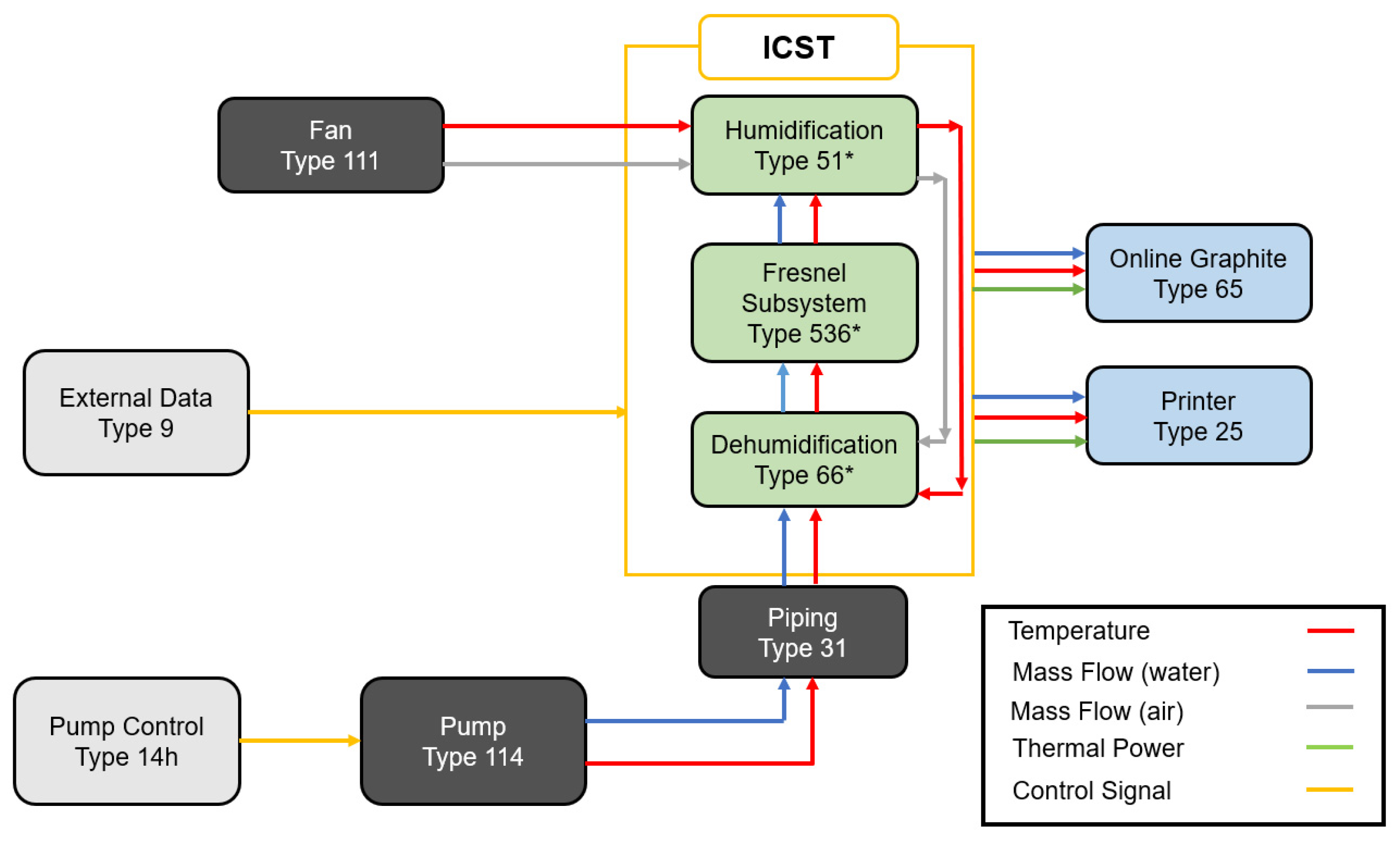
The main components were derived from adapting three TRNSYS types to simulate the dynamic behavior of each. The adaptation process was carried out using existing types in the TRNSYS libraries, through modifications to the previously proposed mathematical models (see Figure 4). Type 66 * corresponds to an element that calls the code developed in EES to simulate the thermal and mass transfer behavior of the dehumidification chamber. Type 51 * is directly associated with a cooling tower, adapted to represent the operation of the humidification layer. Finally, type 536 * represents the Fresnel subsystem and was modified by adjusting the code of the base model included in the TRNSYS libraries to incorporate the thermal loss coefficients described in the previous section.

2.6. Validation Protocol

In the validation process, the results obtained in the simulation are compared with the data from the experimental process. Initially, the data are evaluated individually for each subsystem and, subsequently, for the integrated ICST desalination system. Validation is performed through a dual evaluation: qualitative and quantitative. The qualitative analysis of the results is carried out by graphically visualizing the behavior of thermal power variables and inlet and outlet temperatures, representing both the values obtained from the experimental process and the predictions of the simulation model. This analysis is complemented by a quantitative evaluation, using the estimation of absolute error, relative error, and maximum error.
The absolute error of a measurement ( ε a ) is an indicator of the imprecision of a given measurement. It can be determined from the difference between the actual value of the measurement (X) and the value obtained in the measurement ( X i ) (see Equation (8)). The absolute error can be a positive or negative value, depending on whether the measurement is higher or lower than the true value.
ε a = X X i
The relative error ( ε r ) is a percentage indicator of the precision of the measurement. It can be determined from the ratio between the absolute error ( ε a ) and the mean value X (see Equation (9)). Like the absolute error, it can be positive or negative.
ε r = ε a X   · 100
Additionally, to determine the performance of an indirect solar desalination system, it is essential to estimate a series of parameters [51]. Basically, these dimensionless parameters serve as an operational cycle metric to evaluate the system’s behavior [52]. The three parameters to be considered are described below:
  • Production Gain Ratio (GOR), equal to the ratio between the product of the mass flow rate of desalinated water by the latent heat of vaporization of the saline water and the thermal energy (Equation (10)). Note: If an HDH unit achieves a GOR of at least 8, its thermal performance is comparable to Multistage Flash Distillation (MSF) or Multieffect Distillation (MED) technologies [51].
G O R = m f w ˙ · h f g H ˙
  • Recovery Index (RR), equal to the ratio between the mass flow rate of desalinated water and the mass flow rate of incoming water (Equation (11)). RR is a criterion for the water production efficiency of the cycle [52].
R R = m f w ˙ m S w ˙
  • Specific Water Production (SWP), equal to the amount of water produced per square meter of solar collector area per day (Equation (11)). SWP is a parameter applicable to solar-powered HDH cycles and indicates the solar energy efficiency of the HDH cycle [52].
S W P = m f w ˙ A c o    

3. Results and Discussion

3.1. Experimental Validation of the Fresnel Subsystem

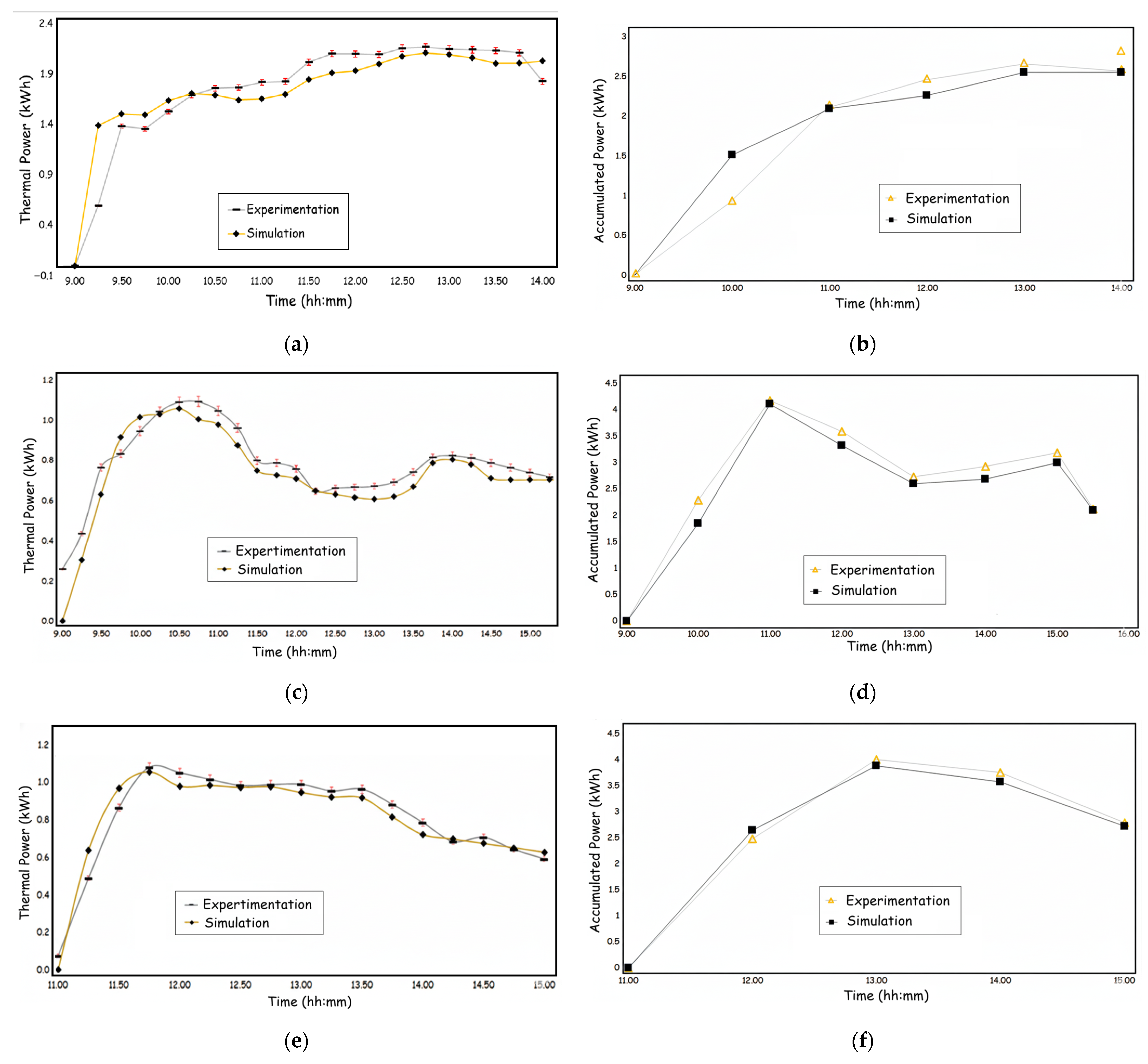
The validation of the Fresnel subsystem evaluated the relationship between the data obtained in the experimental process and the simulation model in TRNSYS, considering the thermal power absorbed by the working fluid and the accumulated thermal power. Figure 5 presents the combined analysis of the results from three representative tests, recording data over a 15 min interval under different operating conditions, with an average DNI between 450 and 710 W/m2. Figure 5a,b correspond to test 1, Figure 5c,d to test 2, and Figure 5e,f to test 3. In each case, the top row (Figure 5a,c,e) shows the time-domain evaluation of the thermal power absorbed by the fluid, while the bottom row (Figure 5b,d,f) shows the accumulated thermal power per hour.
The analysis of the thermal power absorbed by the fluid (see Figure 5a,c,e) identifies a difference in the maximum absolute and relative error of the tests during the initial operating periods. Specifically, an error of −45.34% is recorded in test 01, while in tests 02 and 03 it is below 20%. However, as the system’s operating period progresses, the errors gradually decrease and fall below 10%, indicating a model that is adequately reproducible under different DNI conditions. This behavior of the maximum errors is mainly attributed to the difference in the thermal inertia of the experimental system, since the effects of the progressive heating of the absorber fluid are not fully captured by the numerical simulation model. During the start-up period, part of the incident solar energy is consumed in increasing the internal energy of the absorber tube, the working fluid, and the supporting structural components before the system reaches quasi-steady thermal conditions. This warm-up stage produces a temporary delay in the thermal response of the experimental system, whereas the simulation model reacts almost instantaneously to the available solar radiation. Consequently, the model tends to initially overestimate the useful thermal power transferred to the fluid.
Additionally, early convective heat losses to the environment, minor optical misalignments in the reflector field, and the finite response time of the measurement sensors may contribute to the discrepancies observed during the initial operating stage. These effects are particularly relevant during the first operating intervals, when the absorber temperature gradient and heat transfer processes are still stabilizing. Once the system approaches steady-state conditions, the influence of these transient effects decreases, and the relative error is significantly reduced, leading to a closer agreement between the experimental data and the model predictions.
Meanwhile, the analysis of the accumulated thermal power (see Figure 5b,d,f) shows a high correlation between the experimental and simulation data for the three tests. Although the simulation in the three tests tends to overestimate the accumulated thermal power in the first few hours and slightly underestimate it at the end of the test day, the discrepancy between the experimental and simulation data generally remains below 1.5% for test 2 and 1% for tests 1 and 3, reflecting low average values for both absolute and relative error.
These results allow us to conclude that, despite the transient deviations in the initial operating periods observed in Figure 5a,c,e, the proposed model has the predictive capacity to reliably estimate the accumulated energy performance, thus validating its application for performance analysis and energy estimation of linear Fresnel concentrating solar thermal (LFC) systems.

3.2. Experimental Validation HDH Desalination Subsystems

The validation of the HDH Desalination subsystem evaluated the correlation between the data obtained in the experimental process and the simulation model in TRNSYS, considering the air temperature variations at the inlet and outlet of the humidification and dehumidification chambers, as well as the water temperature changes at the inlet and outlet of the coil inside the dehumidification chamber. The experimental data analyzed correspond to the same tests used in the validation of the Fresnel subsystem.
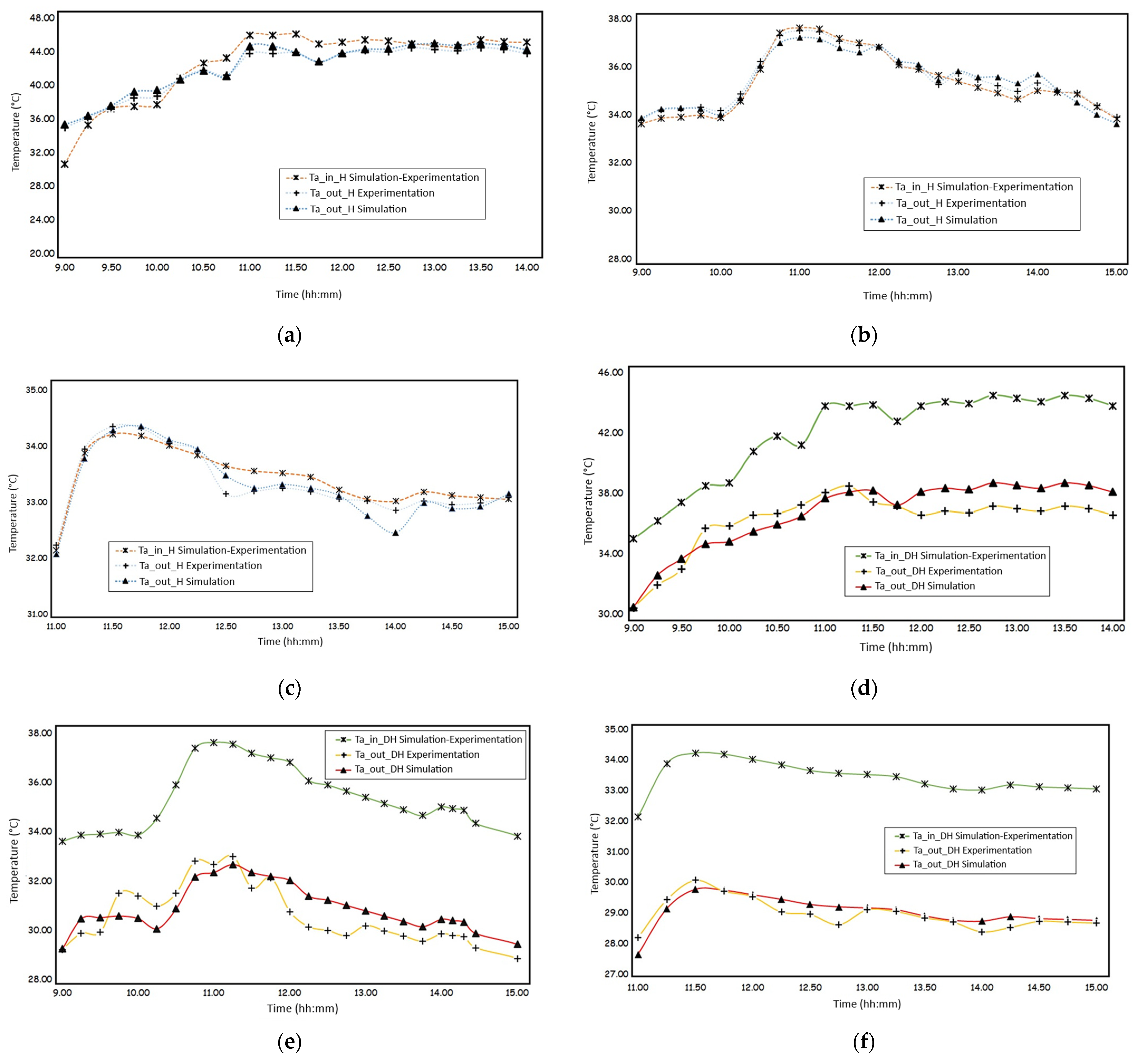
The analysis of the humidification chamber’s thermal behavior is presented in Figure 6a–c, corresponding to tests 01, 02, and 03. These tests show a consistent temporal trend in the operating temperature with respect to the DNI conditions, exhibiting moderate differences between the experimental and simulation data. The initial operating periods show the greatest dispersion associated with absolute and relative errors, particularly test 01, which presents average errors below 1%, while tests 02 and 03 present values below 0.5%. The most significant discrepancies occur in the test with the highest DNI, which may be associated with transient effects of the initial heating of the humid air and environmental variations not fully represented by the numerical model. Overall, these results indicate that the simulation model is capable of adequately reproducing the thermal behavior of the proposed humidification chamber.
The analysis of the dehumidification chamber’s thermal behavior, also presented in Figure 6d–f corresponding to tests 01, 02, and 03, shows greater sensitivity of the proposed model to actual operating conditions compared to the humidification chamber. The absolute and relative errors show a slight overestimation of the simulated temperatures, particularly in test 01 with average errors below 1.5%, while tests 02 and 03 show errors below 0.5%. The most significant discrepancies are observed in the test with the highest DNI, demonstrating better model agreement under moderate DNI conditions, resulting in greater thermal stability.
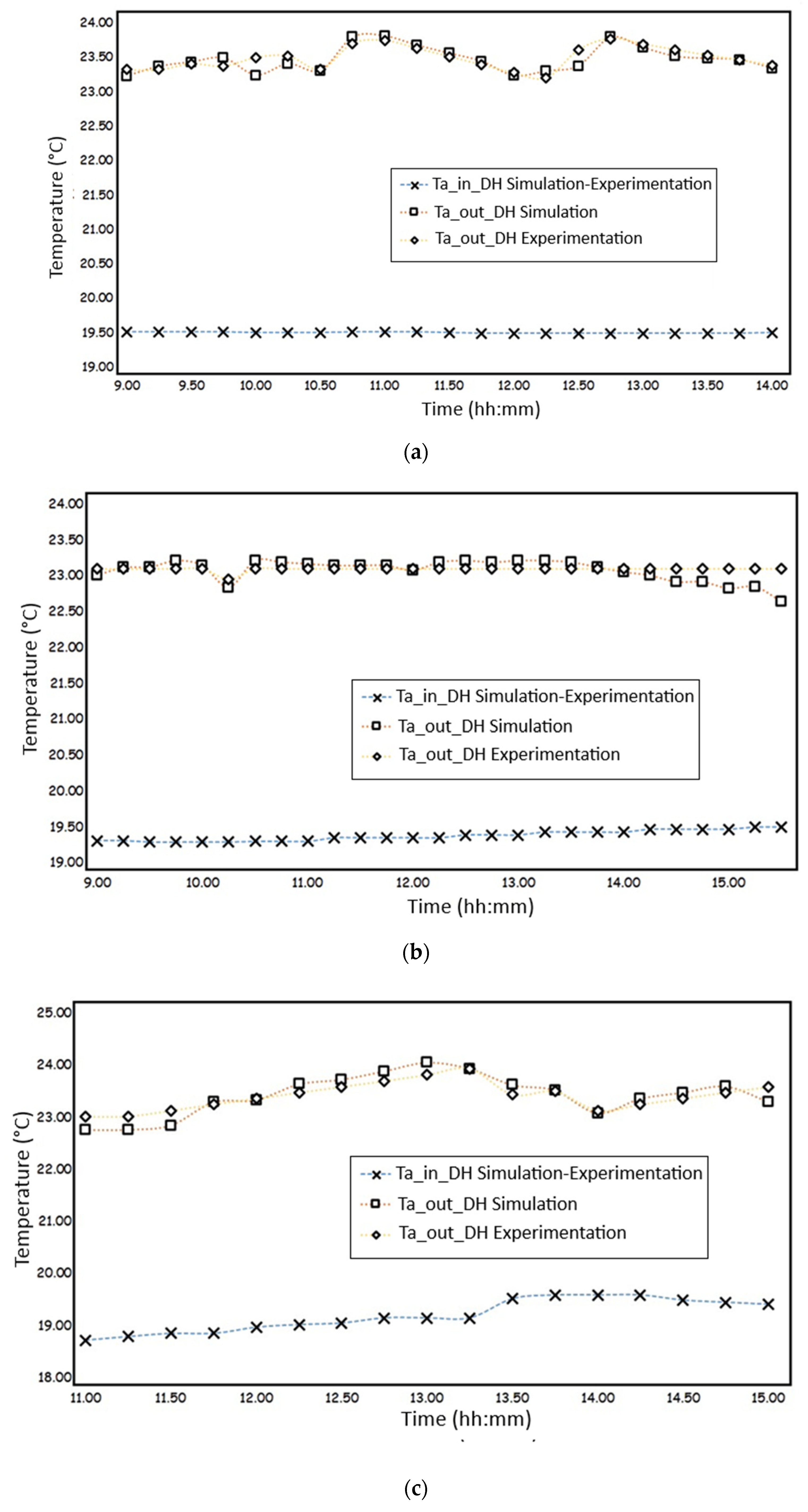
Additionally, the temporal evolution of the water temperature at the inlet and outlet of the coil inside the dehumidification chamber was analyzed (see Figure 7a–c) for tests 01, 02, and 03. The results show a maximum discrepancy of 1.3 °C, but in general, the average errors are close to zero for the temperatures between both points, with similar behavior between the experimental and simulation data. Considering the operating temperature range of the dehumidification subsystem (approximately 27–35 °C, as shown in Figure 6d–f), this difference corresponds to a relative deviation of about 3–5%. The occasional fluctuations during operation are consistent with heat losses not explicitly represented in the numerical model, associated with the lack of thermal insulation in the dehumidification chamber, directly influencing the heat exchange between the coil walls and the humid air coming from the humidification chamber. Overall, the results allow us to conclude that the model developed in TRNSYS has the capacity to adequately reproduce the thermal behavior of the dehumidification chamber and the coil under the different operating conditions evaluated.

3.3. Experimental Validation of the ICST System

The validation of the indirect solar concentration (ICST) desalination system comprehensively evaluated the system’s thermal efficiency and productivity, considering the Production Gain Ratio (GOR), Recovery Rate (RR), and Specific Water Production (SWP), defined in Section 2.6 as widely used performance parameters in HDH desalination cycles. Based on these parameters, temporal variations in the flow rates of saltwater and freshwater in the humidification and dehumidification chambers were analyzed, as well as the overall performance of the ICST system under real solar operating conditions.
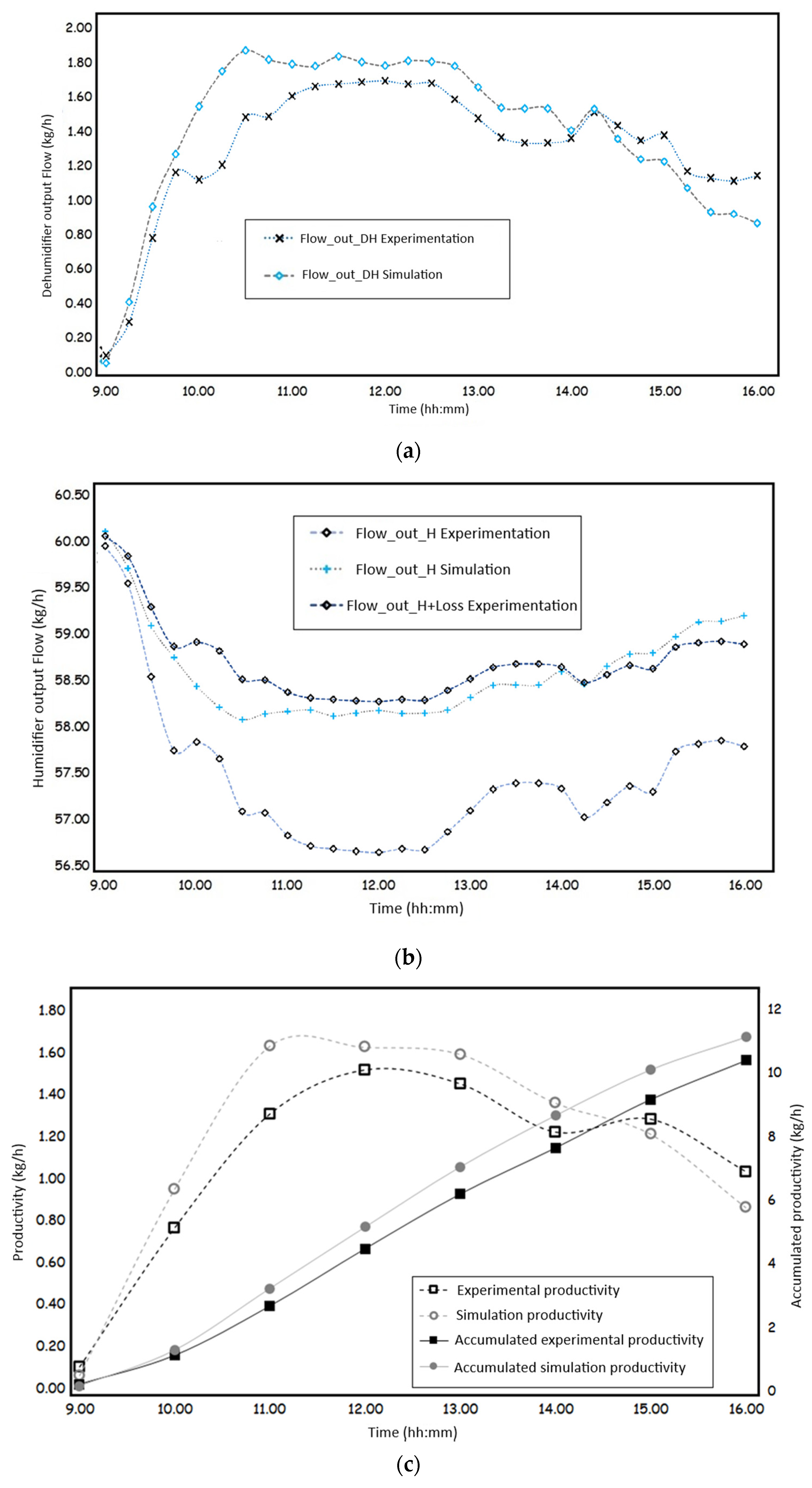
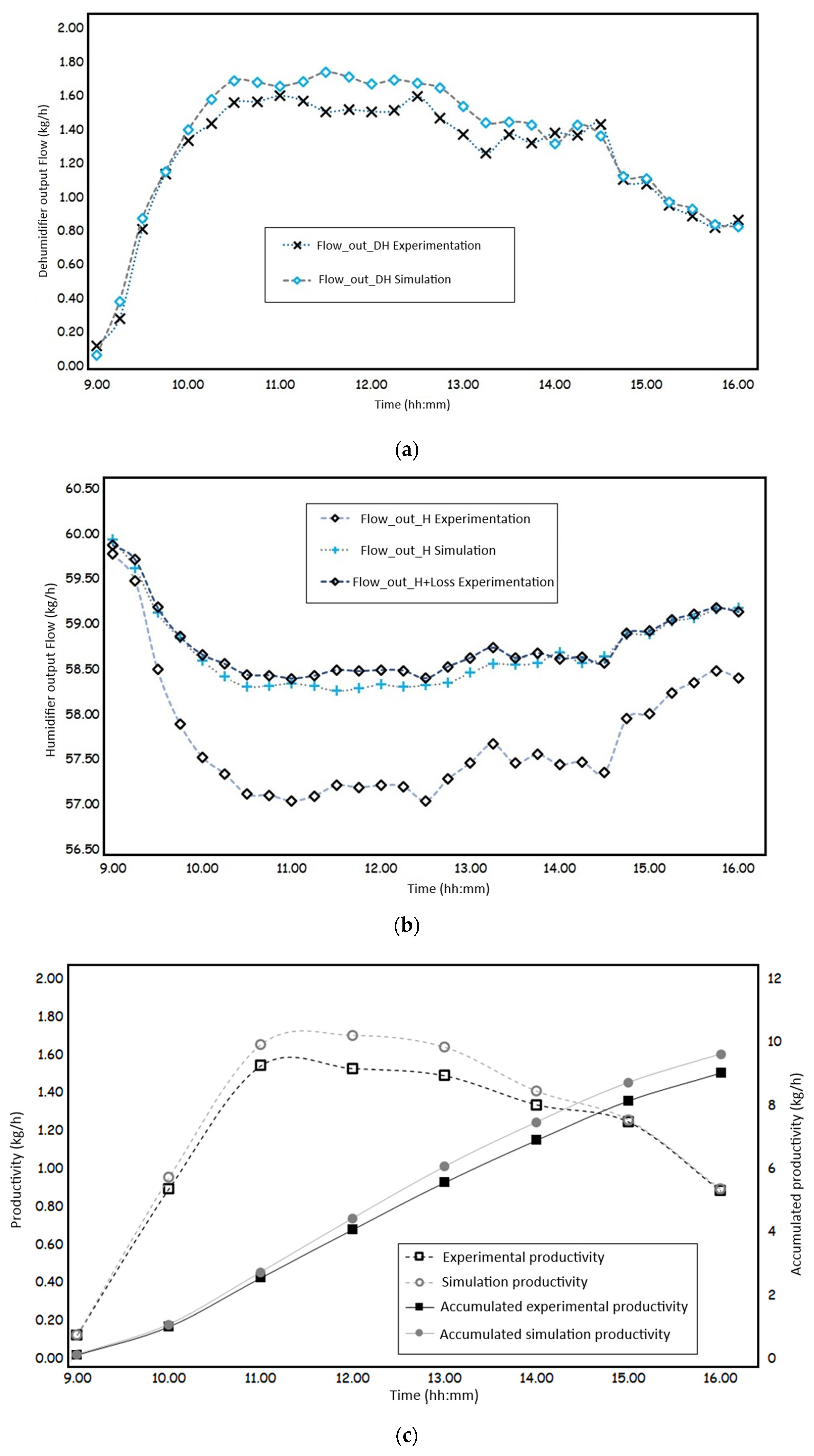
The results of test 04 of the ICST system are presented in an integrated manner in Figure 8, where subgraphs a, b, and c correspond, respectively, to the water flow rate from the dehumidification chamber, the water flow rate from the humidification chamber, and the water production. Specifically, Figure 8b includes the simulation results for both loss-free and loss-containing scenarios. The loss-containing scenario considers the system’s thermal losses, which are associated with the lack of thermal insulation in the dehumidification chamber and convective losses to the environment. The loss-free scenario, on the other hand, assumes no heat exchange with the surroundings, allowing for a framework to be established regarding the direct impact of thermal losses on the ICST system’s performance.
In this context, Figure 8 presents a comparison of experimental and simulation data for the flow rate of saltwater into the humidification chamber, showing low absolute and relative errors, specifically a mean absolute error of 0.09 kg/h and a mean relative error of 0.16%. These values confirm that, on average, the humidification chamber is relatively insensitive to heat losses. This is attributed to the high operating flow rates and the predominance of mass transfer phenomena over energy losses from the environment.
Conversely, Figure 8b shows fluctuations and discrepancies between the experimental and simulation data for the flow rate of freshwater at the outlet of the dehumidification chamber. The mean absolute errors are 0.08 kg/h, and the mean relative errors reach up to −4.99% at midday, where the transient dynamics of the process and unmodeled heat losses become more significant. These values indicate that the dehumidification subsystem is more sensitive to instantaneous operational variations.
Finally, Figure 8c shows the temporal evolution of hourly freshwater production, where there is a proportional relationship between the increase in production during peak hours and a gradual decrease towards the end of the day. The results of the comparison between experimental and simulation data show a difference of 0.56 L of water produced per day. This behavior allows us to conclude that, although the inclusion of thermal losses affects the overall flow rate prediction, the numerical simulation model proposed in TRNSYS is capable of adequately reproducing the daily freshwater production and the overall performance of the proposed ICST desalination system.
On the other hand, Figure 9a–c presents the results of the comparison between the experimental and simulation data from trial 05. In general, the flow rate of saltwater at the outlet of the humidification chamber (see Figure 9a) shows good correlation between the data, with low mean absolute and relative errors of 0.11 kg/h and 0.13%, respectively. In contrast, Figure 9b shows greater dispersion among the data for the flow rate of freshwater at the outlet of the dehumidification chamber, with mean absolute and relative errors of −0.10 kg/h and −4.95%, respectively. Regarding the hourly and cumulative production of freshwater (see Figure 9c), it shows a trend consistent with the DNI, similar to trial 04, with a daily difference of 0.65 L between the experimental and simulation data.
Although the environmental conditions during tests 04 and 05 were relatively similar, small variations in Direct Normal Irradiance (DNI) and ambient temperature may influence the thermal response of the ICST system. Since the Fresnel subsystem directly converts solar radiation into thermal energy, any reduction in DNI decreases the useful heat transferred to the working fluid and consequently affects the evaporation potential in the humidification chamber. Additionally, ambient temperature modifies the thermal gradients within the dehumidification chamber, influencing the condensation process and freshwater production. Therefore, part of the differences observed between the experimental tests can be associated with these environmental variations, which affect both the thermal behavior and the productivity of the desalination system.
Finally, Table 7 consolidates the energy and production performance of the ICST desalination system for trials 04 and 05, integrating results for water production, GOR, RR, SWP, environmental conditions, and the quality of the water obtained. The daily production values show a maximum absolute error of 0.65 L between the experimental and simulation data for both trials. Likewise, the GOR, RR, and SWP indicators are consistent with the variations in DNI and the recorded ambient temperatures. Furthermore, the total dissolved solids (TDS) values at the system outlet remained below 500 mg/L during the experimental phase. Overall, the results confirm that the observations in trial 05 are consistent with the behavior of trial 04, validating the applicability of the simulation model developed in TRNSYS for performing energy and production analyses of HDH desalination cycles powered by LFC solar concentration technologies.

3.4. Economic Analysis

The economic evaluation of a desalination system depends on parameters such as: the expected useful life of the system (n), the total cost of the device or sum of the individual cost of each component of the system ( C C C ), the variable cost or maintenance of the system ( C V ) [53]. In this study, these parameters were estimated based on the construction cost of the experimental ICST prototype, including the Fresnel concentrating subsystem and the HDH desalination subsystem. The selection of these parameters was based on the actual construction cost of the experimental prototype and on economic assumptions commonly adopted in previous HDH desalination studies [53,54,55], ensuring that the analysis reflects realistic operating and investment conditions for small-scale solar desalination systems. Thus, for the economic analysis, the following assumptions were made:
  • The useful life of the indirect solar concentration desalination system is considered to be 10 years.
  • The system maintenance cost ( C V ) for the first year is 20% of the total device cost [53].
  • Taking [54,55] as references, the C C C is equivalent to 20% of the total device cost.
  • The production period ( P P ) is considered to be 333 days with sufficient Direct Solar Irradiation (DNI) throughout the year, taking La Guajira, Colombia as a reference [56].
  • The operating period ( P F ) of the system is 8 continuous hours per day (starting at 9 am and ending at 5 pm), taking [56] as a reference.
The total cost of the device is $868.47, of which $365.17 corresponds to the Fresnel subsystem and $503.27 to the HDH desalination subsystem. The C v of the ICST desalination system must consider future maintenance costs. Therefore, to estimate the total C v of the ICST desalination system, the assumed value for n, the maintenance cost for the first year, and a discount rate of 10% are considered, resulting in $1083.05 for a 10-year period. The C T of freshwater is the algebraic sum of the C C C and the C v , estimated at $1951.47. The average daily liters of fresh water produced ( P D ) for the P F of the ICST desalination system is estimated at 9.03 L/d, and the total fresh water production ( P T ) for a period of 10 years is calculated at 30,076.56 L. Finally, the cost of fresh water per liter ( C w ) is equal to the quotient between C T and P T , estimated at $0.065/L [53,54].

3.5. Comparative Analysis

The main objective of any desalination system is to produce water at a lower cost; therefore, a comparative analysis is carried out with the production costs of other studies, as shown in Table 8. It should be emphasized here that the countries listed in Table 8 present heterogeneous economic conditions and water stress problems; however, the comparative analysis between them is based on the normalization of costs and the relative comparison of the economic performance of the developed technologies, which allows for the identification of trends, cost ranges, and dominant factors, beyond the specific context of each country.
The data presented in Table 8 show high variability in the energy and economic performance indicators of the different technologies developed. Specifically, the system proposed by Wang et al. [57] exhibits the highest water production, a high GOR value, and the lowest reported production cost. This is attributed to the inclusion of a heat pump, which improves the energy recovery process but increases technological complexity and energy requirements. In contrast, the data presented by Dave et al. [58], Jawad et al. [59], Shaikh et al. [60] and Santosh et al. [22] report higher production costs, associated with lower production rates and lower thermal efficiencies. In this context, the ICST system composed of a single LFC-HDH configuration developed in this study, while not maximizing hourly production, presents a competitive production cost and consistent performance for single-stage HDH systems, being a technically and economically viable alternative and applicable in a decentralized manner in contexts with high budget constraints, but with high levels of radiation, as is the case of Colombia in the Caribbean coastal sector.

4. Conclusions

In this work, an ICST desalination system based on an HDH desalination cycle integrated with a Linear Fresnel Concentrator (LFC) was designed, manufactured, tested, and validated using an appropriate technology approach. This presents a favorable outlook for the integration of alternative technologies for freshwater production, adaptable to impoverished regions and, in terms of construction, to local resources. Therefore, it is significantly more economical, but less efficient, than commercial desalination technologies. Based on the results obtained, the following conclusions are drawn:
  • The choice of materials for the ICST system was based on their availability in the local environment, using low-cost materials. This favored replicability and maintainability, ensuring that the system is adaptable and efficient within the specific context of its application. It was recognized that there is no universal solution that can be directly replicated in other regions or countries; rather, the system must be adapted to the available resources in the installation area.
  • The proposed ICST system presents clear scalability potential through series or parallel connection of both HDH and LFC subsystem units to increase production. This modularity does not directly require a centralized infrastructure, making it suitable for application in isolated areas with technical and energy limitations.
  • The development of the simulation tool in TRNSYS allowed for the consistent modeling of the thermal and freshwater production behavior of the proposed ICST system, guaranteeing a reliable evaluation of decentralized energy performance. This developed methodology is considered a tool with the ability to analyze and optimize similar systems in different climatic and socioeconomic contexts.
  • The experimental campaign validated the performance of the ICST system and its simulation tool in TRNSYS, demonstrating close values between the experimental and simulation results, with low average errors in the estimation of thermal power, operating temperatures, and daily freshwater production. In general, the maximum errors found are directly associated with initial transient periods, thermal inertia effects, and unmodeled losses, without directly compromising the predictive power of the TRNSYS model for analyzing system behavior under various DNI levels and real operating conditions.
  • Experimentally, average freshwater production of 1.13 L/h was achieved with a production gain ratio of 0.32, a recovery index of 0.021, and total dissolved solids below 500 mg/L, meeting the quality criteria for desalinated water produced in the experimental campaign.
  • The economic and comparative analysis shows that, with an approximate production cost of $65/m3 for a 10-year lifespan, the ICST system is a technically and economically viable alternative for centralized applications in regions with budget constraints and high levels of digital sub standardization (DNI). Although the proposed system does not reach the performance levels or minimum costs reported for more complex configurations, it offers a favorable compromise between construction simplicity, modularity, and acceptable cost, consistent with its appropriate technology approach and its orientation toward small-scale contexts.
Although this study validated the experimental and numerical performance of the ICST system, further research is needed to optimize its scalability and evaluate it under real-world operating conditions in specific communities. In addition, seasonal and climatic variations may influence the performance of solar-driven desalination systems. Variations in solar radiation, cloud cover, and ambient temperature throughout the year may modify the thermal energy available for the Fresnel subsystem and the condensation conditions in the dehumidification chamber, potentially affecting freshwater production rates. Therefore, long-term evaluations under different climatic conditions are recommended to better assess the operational stability of the ICST system. Furthermore, it is essential to integrate sustainable brine management strategies aligned with the appropriate technology approach.
The results obtained in this study also reveal several research gaps that should be addressed in future investigations. In particular, further work is required to analyze the long-term operational stability of ICST systems under real seawater conditions, including potential scaling, corrosion, and fouling effects on system components. Additionally, future research should explore system optimization strategies aimed at improving thermal efficiency and freshwater productivity, as well as the techno-economic performance of modular configurations operating at larger scales. Addressing these research gaps will contribute to strengthening the applicability and transferability of ICST systems as decentralized solutions for freshwater production in regions with high solar irradiation and limited infrastructure.

Author Contributions

Conceptualization, B.E.T.-R.; Methodology, B.E.T.-R. and Y.M.-M.; Software, B.E.T.-R. and Á.C.-C.; Validation, B.E.T.-R., Á.C.-C. and Y.M.-M.; Formal analysis, B.E.T.-R. and Y.M.-M.; Investigation, B.E.T.-R. and Y.M.-M.; Resources, O.L.-P. and J.A.-V.; Data curation, B.E.T.-R. and Á.C.-C.; Writing—original draft, B.E.T.-R.; Writing—review & editing, B.E.T.-R., Á.C.-C. and Y.M.-M.; Visualization, B.E.T.-R. and Á.C.-C.; Supervision, Á.C.-C., O.L.-P. and J.A.-V.; Project administration, B.E.T.-R. and Á.C.-C.; Funding acquisition, O.L.-P. and J.A.-V. All authors have read and agreed to the published version of the manuscript.

Funding

This research received no external funding.

Institutional Review Board Statement

Not applicable.

Informed Consent Statement

Not applicable.

Data Availability Statement

The data presented in this study are available on request from the corresponding author.

Conflicts of Interest

The authors declare no conflicts of interest.

Abbreviations

The following abbreviations are used in this manuscript:
1DOne-Dimensional
ADAdsorption Desalination
ATAppropriate Technology
CFDComputational Fluid Dynamics
CPCCompound Parabolic Concentrator
DCDirect Current
DNIDirect Normal Irradiance
EA-4/02Expression of the Uncertainty of Measurements in Calibration (EA-4/02 guide)
EDElectrodialysis
EESEngineering Equation Solver
FOForward Osmosis
FTP-HDHFlat-Plate Collector–Driven HDH
G. Hyd.Gas Hydrates
GORProduction Gain Ratio
HDHHumidification–Dehumidification
HP-HDHHeat Pump–Driven HDH
HVACHeating, Ventilation and Air Conditioning
ICSTIndirect Solar Concentration Desalination System
LFCLinear Fresnel Concentrator
LLELiquid–Liquid Extraction
MDMembrane Distillation
MEDMulti-Effect Distillation
MSFMulti-Stage Flash Distillation
MVCMechanical Vapor Compression
NFNanofiltration
PPIPores Per Inch
PSIPounds per Square Inch
PTCParabolic Trough Collector
PV/TPhotovoltaic/Thermal
RHRelative Humidity
ROReverse Osmosis
RRRecovery Ratio
SDGsSustainable Development Goals
SH-HDHSolar Humidifier–HDH
SWPSpecific Water Production
TDSTotal Dissolved Solids
TESSThermal Energy System Specialists
TRNSYSTRaNsient SYstem Simulation Tool
UNUnited Nations
USDUnited States Dollar
VCRVapor Compression Refrigeration
WWDRUN World Water Development Report

References

  1. Yang, W.; Gao, Y. Performance study of a new dual condenser heat pump driven humidification and dehumidification desalination system. Int. J. Refrig. 2026, 184, 42–53. [Google Scholar] [CrossRef]
  2. UN World Water Development Report 2025, Mountains and Glaciers: Water Towers, as Well as Related ReSources, Including the Executive Summary and More. 2025. Available online: https://www.unesco.org/reports/wwdr/en/2025/download (accessed on 1 February 2026).
  3. Hoffman, A. Water, Energy, and Environment: A Primer; IWA Publishing: London, UK, 2019; Available online: https://library.oapen.org/handle/20.500.12657/25809 (accessed on 31 January 2022).
  4. NASA. Ocean Worlds. 2021. Available online: http://www.nasa.gov/specials/ocean-worlds/index.html (accessed on 31 January 2022).
  5. Koncagul, E.; Tran, M.; Connor, R. Informe Mundial de Las Naciones Unidas Sobre el Desarrollo de Los Recursos Hídricos 2021: El Valor del Agua; Datos y Cifras—UNESCO Biblioteca Digital. 2021. Available online: https://unesdoc.unesco.org/ark:/48223/pf0000375751_spa (accessed on 31 January 2022).
  6. Goghari, A.S.; Ghofrani, I.; Yazdi, M.A.; Golab, E.; Moosavi, A. Experimental study and economic analysis of a novel humidification-dehumidification system with a two-stage bubble column humidifier and packed bed dehumidifier for high-saline water desalination. Energy Convers. Manag. 2025, 343, 120255. [Google Scholar] [CrossRef]
  7. Mehmood, A.; Ren, J. Chapter 11—Renewable energy-driven desalination for more water and less carbon. In Renewable-Energy-Driven Future; Ren, J., Ed.; Academic Press: Cambridge, MA, USA, 2021; pp. 333–372. [Google Scholar] [CrossRef]
  8. Kabeel, A.E.; Elazab, M.A.; Diab, M.R.; El-Said, E.M.S.; El Hadi Attia, M.; Elshaarawy, M.K. Hybrid humidification-dehumidification with renewable energy integration for enhanced desalination: An overview. Renew. Sustain. Energy Rev. 2025, 211, 115313. [Google Scholar] [CrossRef]
  9. Mohan, C.C.; Chiranjeevi, C. A comprehensive review of advancements in solar and waste Heat-Based air Humidification-Dehumidification desalination. Sol. Energy 2024, 284, 113045. [Google Scholar] [CrossRef]
  10. Rahimi-Ahar, Z.; Sadegh Hatamipour, M. Performance evaluation of hybrid humidification-dehumidification desalination systems: State of the art. Appl. Therm. Eng. 2024, 244, 122736. [Google Scholar] [CrossRef]
  11. Tarazona-Romero, B.E.; Campos-Celador, A.; Maldonado-Muñoz, Y.A. Can solar desalination be small and beautiful? A critical review of existing technology under the appropriate technology paradigm. Energy Res. Soc. Sci. 2022, 88, 102510. [Google Scholar] [CrossRef]
  12. Shaikh, J.S.; Aswalekar, U.; Sonkhaskar, Y.M.; Save, A.; Malgol, A.; Wahile, G. Evaluation of photovoltaic thermal-based humidification-dehumidification desalination. Appl. Therm. Eng. 2026, 285, 129277. [Google Scholar] [CrossRef]
  13. Picotti, G.; Simonetti, R.; Molinaroli, L.; Manzolini, G. Experimental Characterization and Modelling of a Humidification–Dehumidification (HDH) System Coupled with Photovoltaic/Thermal (PV/T) Modules. Energies 2025, 18, 5586. [Google Scholar] [CrossRef]
  14. Hussein, M.M.; Hussein, B.A.; Metwalli, S.M. Multi-objectives heuristic GP and machine learning optimization of a solar-powered humidification-dehumidification water desalination system. J. Eng. Appl. Sci. 2026, 73, 86. [Google Scholar] [CrossRef]
  15. Mohammad, S.I.; Jawad, M.; Vasudevan, A.; Faisal, Z.A.; Kamolova, N.; Sharma, M.K.; Shaaban, Z.; AlMohamadi, H.; Aladdin, M. Transient modeling and performance evaluation of a solar-driven HDH desalination system with phase change material storage. Sci. Rep. 2026, 16, 5745. [Google Scholar] [CrossRef]
  16. Zhao, X.; Wu, W.; Zhu, Q.; Zhang, H.; Han, Y. Thermo-economic optimization of a novel solar-assisted heat pump humidification-dehumidification desalination system with dual-fluid preheating. Appl. Therm. Eng. 2026, 292, 130362. [Google Scholar] [CrossRef]
  17. Messaouda, A.; Hamdi, M.; Lazaar, M. Experimental thermal analysis of a clay-based solar desalination system enhanced with phase change material. Appl. Therm. Eng. 2026, 292, 130383. [Google Scholar] [CrossRef]
  18. Abdelaziz, G.B.; Al-Nagdy, A.A.; Kandel, M.G.; Dahab, M.A.; El-Said, E.M.S. Experimental investigation of innovative hybrid solar desalination tower using heat storage and packing materials. Renew. Energy 2026, 260, 125185. [Google Scholar] [CrossRef]
  19. Rahimi-Ahar, Z.; Hatamipour, M.S. Performance evaluation of a solar and vacuum assisted multi-stage humidification-dehumidification desalination system. Process Saf. Environ. Prot. 2021, 148, 1304–1314. [Google Scholar] [CrossRef]
  20. Xu, H.; Jiang, S.; Xie, M.X.; Jia, T.; Dai, Y.J. Technical improvements and perspectives on humidification-dehumidification desalination—A review. Desalination 2022, 541, 116029. [Google Scholar] [CrossRef]
  21. Sharma, D.; Ghosh, D.P.; Dennis, S.J.; Abbasi, B. Fouling mechanism in airblast atomizers and its suppression for water desalination. Water Res. 2022, 221, 118726. [Google Scholar] [CrossRef]
  22. Santosh, R.; Lee, H.-S.; Kim, Y.-D. A comprehensive review on humidifiers and dehumidifiers in solar and low-grade waste heat powered humidification-dehumidification desalination systems. J. Clean. Prod. 2022, 347, 131300. [Google Scholar] [CrossRef]
  23. Luberti, M.; Capocelli, M. Enhanced Humidification–Dehumidification (HDH) Systems for Sustainable Water Desalination. Energies 2023, 16, 6352. [Google Scholar] [CrossRef]
  24. Kasaeian, A.; Babaei, S.; Jahanpanah, M.; Sarrafha, H.; Sulaiman Alsagri, A.; Ghaffarian, S.; Yan, W.-M. Solar humidification-dehumidification desalination systems: A critical review. Energy Convers. Manag. 2019, 201, 112129. [Google Scholar] [CrossRef]
  25. Giwa, A.; Akther, N.; Housani, A.A.; Haris, S.; Hasan, S.W. Recent advances in humidification dehumidification (HDH) desalination processes: Improved designs and productivity. Renew. Sustain. Energy Rev. 2016, 57, 929–944. [Google Scholar] [CrossRef]
  26. Tarazona-Romero, B.E.; Maldonado, Y.A.M.; Celador, A.C.; Pérez, O.L. Optical performance assessment of a handmade prototype of linear Fresnel concentrator. Period. Eng. Nat. Sci. 2021, 9, 795–811. [Google Scholar] [CrossRef]
  27. Tarazona Romero, B.E.T.; Celador, A.C.; Rodriguez, C.L.S.; Villabona, J.G.A.; Quintero, A.D.R. Design and construction of a solar tracking system for Linear Fresnel Concentrator. Period. Eng. Nat. Sci. PEN 2021, 9, 778–794. [Google Scholar] [CrossRef]
  28. Khraisheh, M.; Inamdar, M.; AlMomani, F.; Adham, S. Humidification–Dehumidification (HDH) Desalination and Other Volume Reduction Techniques for Produced Water Treatment. Water 2022, 14, 60. [Google Scholar] [CrossRef]
  29. Zarei, A.; Zarei, T.; Abedini, E.; Adibi, P. Design, modeling, and optimization of a novel humidification-dehumidification desalination in a cartridge tray tower using response surface methodology (RSM). Results Eng. 2025, 27, 106684. [Google Scholar] [CrossRef]
  30. Kaplinsky, R. Schumacher meets Schumpeter: Appropriate technology below the radar. Res. Policy 2011, 40, 193–203. [Google Scholar] [CrossRef]
  31. Shin, H.; Hwang, J.; Kim, H. Appropriate technology for grassroots innovation in developing countries for sustainable development: The case of Laos. J. Clean. Prod. 2019, 232, 1167–1175. [Google Scholar] [CrossRef]
  32. Barbón, A.; Barbón, N.; Bayón, L.; Otero, J.A. Theoretical elements for the design of a small scale Linear Fresnel Reflector: Frontal and lateral views. Sol. Energy 2016, 132, 188–202. [Google Scholar] [CrossRef]
  33. López Smeetz García de Tuñón, C. Estudio de la Distribución de la Temperatura en el Sistema Reflector Secundario de un Reflector Lineal Fresnel de Pequeña Escala. Master’s Thesis, University of Oviedo, Oviedo, Spain, 2019. Available online: https://digibuo.uniovi.es/dspace/handle/10651/51548 (accessed on 14 December 2023).
  34. Morales Medina, J.E.; Quintero Escobar, N.D. Desarrollo De Un Sistema De Reflexión Secundario Para Un Prototipo De Concentrador Lineal Tipo Fresnel. 8 March 2022. Available online: http://repositorio.uts.edu.co:8080/xmlui/handle/123456789/8667 (accessed on 26 April 2024).
  35. Naddeo, V.; Balakrishnan, M.; Choo, K.-H. Frontiers in Water-Energy-Nexus—Nature-Based Solutions, Advanced Technologies and Best Practices for Environmental Sustainability. In Proceedings of the 2nd WaterEnergyNEXUS Conference, Salerno, Italy, 14–17 November 2018; Springer: Cham, Switzerland, 2020. [Google Scholar]
  36. EA. Expression of the Uncertainty of Measurement in Calibration. 1999. Available online: https://www.isobudgets.com/pdf/documents/05_EA_4-02.pdf?utm_source=chatgpt.com (accessed on 1 February 2026).
  37. Fouda, A.; Wasel, M.G.; Hamed, A.M.; Zeidan, E.-S.B.; Elattar, H.F. Investigation of the condensation process of moist air around horizontal pipe. Int. J. Therm. Sci. 2015, 90, 38–52. [Google Scholar] [CrossRef]
  38. Häberle, A.; Zahler, C.; Lerchenmüller, H.; Mertins, M.; Wittwer, C.; Trieb, F.; Dersch, J. The Solarmundo line focussing Fresnel collector. Optical and thermal performance and cost calculations. In Proceedings of the 2002 SolarPACES International Symposium, Zurich, Switzerland, 4–6 September 2002. [Google Scholar]
  39. Mertins, M. Technische und Wirtschaftliche Analyse von Horizontalen Fresnel-Kollektoren. Ph.D. Thesis, Universität Karlsruhe (TH), Karlsruhe, Germany, 2009. [Google Scholar]
  40. Montes, M.J.; Barbero, R.; Abbas, R.; Rovira, A. Performance model and thermal comparison of different alternatives for the Fresnel single-tube receiver. Appl. Therm. Eng. 2016, 104, 162–175. [Google Scholar] [CrossRef]
  41. Montes, M.J.; Abbas, R.; Rovira, A.; Muñoz-Antón, J.; Martínez-Val, J.M. Methodology for the thermal characterization of linear Fresnel collectors: Comparative of different configurations and working fluids. AIP Conf. Proc. 2017, 1850, 040007. [Google Scholar] [CrossRef]
  42. Álvarez, G.; Chagolla, M.A.; Xamán, J.P.; Jiménez, M.J.; Suárez, S.; Heras, M.R. A trnsys simulation and experimental comparison of the thermal behavior of a building located in desert climate. Energy Sustain. 2010, 2, 349–356. [Google Scholar] [CrossRef]
  43. Fong, K.F.; Chow, T.T.; Lee, C.K.; Lin, Z.; Chan, L.S. Comparative study of different solar cooling systems for buildings in subtropical city. Sol. Energy 2010, 84, 227–244. [Google Scholar] [CrossRef]
  44. Allard, Y.; Kummert, M.; Bernier, M.; Moreau, A. Intermodel comparison and experimental validation of electrical water heater models in TRNSYS. In Proceedings of the Building Simulation 2011: 12th Conference of International Building Performance Simulation Association, Sydney, Australia, 14–16 November 2011; pp. 688–695. [Google Scholar]
  45. Yaïci, W.; Entchev, E.; Lombardi, K. Experimental and simulation study on a solar domestic hot water system with flat-plate collectors for the Canadian climatic conditions. In Energy Sustainability; American Society of Mechanical Engineers: New York, NY, USA, 2012; pp. 69–78. [Google Scholar] [CrossRef]
  46. Kalogirou, S.A.; Agathokleous, R.; Barone, G.; Buonomano, A.; Forzano, C.; Palombo, A. Development and validation of a new TRNSYS Type for thermosiphon flat-plate solar thermal collectors: Energy and economic optimization for hot water production in different climates. Renew. Energy 2019, 136, 632–644. [Google Scholar] [CrossRef]
  47. Rezvanpour, M.; Borooghani, D.; Torabi, F.; Pazoki, M. Using CaCl2·6H2O as a phase change material for thermo-regulation and enhancing photovoltaic panels’ conversion efficiency: Experimental study and TRNSYS validation. Renew. Energy 2020, 146, 1907–1921. [Google Scholar] [CrossRef]
  48. Brough, D.; Ramos, J.; Delpech, B.; Jouhara, H. Development and validation of a TRNSYS type to simulate heat pipe heat exchangers in transient applications of waste heat recovery. Int. J. Thermofluids 2021, 9, 100056. [Google Scholar] [CrossRef]
  49. Dezhdar, A.; Assareh, E.; Agarwal, N.; Bedakhanian, A.; Keykhah, S.; Fard, G.Y.; Zadsar, N.; Aghajari, M.; Lee, M. Transient optimization of a new solar-wind multi-generation system for hydrogen production, desalination, clean electricity, heating, cooling, and energy storage using TRNSYS. Renew. Energy 2023, 208, 512–537. [Google Scholar] [CrossRef]
  50. Shrivastava, R.L.; Kumar, V.; Untawale, S.P. Modeling and simulation of solar water heater: A TRNSYS perspective. Renew. Sustain. Energy Rev. 2017, 67, 126–143. [Google Scholar] [CrossRef]
  51. Dehghani, S.; Date, A.; Akbarzadeh, A. 7—Humidification-dehumidification desalination cycle. In Emerging Technologies for Sustainable Desalination Handbook; Gude, V.G., Ed.; Butterworth-Heinemann: Oxford, UK, 2018; pp. 227–254. [Google Scholar] [CrossRef]
  52. Sharqawy, M.H.; Antar, M.A.; Zubair, S.M.; Elbashir, A.M. Optimum thermal design of humidification dehumidification desalination systems. Desalination 2014, 349, 10–21. [Google Scholar] [CrossRef]
  53. Hamed, M.H.; Kabeel, A.E.; Omara, Z.M.; Sharshir, S.W. Mathematical and experimental investigation of a solar humidification–dehumidification desalination unit. Desalination 2015, 358, 9–17. [Google Scholar] [CrossRef]
  54. Mohamed, A.S.A.; Ahmed, M.S.; Shahdy, A.G. Theoretical and experimental study of a seawater desalination system based on humidification-dehumidification technique. Renew. Energy 2020, 152, 823–834. [Google Scholar] [CrossRef]
  55. El-Agouz, S.A. Desalination based on humidification–dehumidification by air bubbles passing through brackish water. Chem. Eng. J. 2010, 165, 413–419. [Google Scholar] [CrossRef]
  56. Maplogs. Worldwide Elevation Map Finder Sunset Sunrise Times Lookup. Salida y Puesta de Sol de La Guajira, Colombia. 2023. Available online: https://sunrise.maplogs.com/es/la_guajira_colombia.35953.html (accessed on 15 December 2023).
  57. Wang, B.; Shen, J.; Zhu, W.; Wang, W. Analysis of heat pump operated two-stage humidification-dehumidification desalination system with subcooler and heat regenerator. Desalination 2024, 581, 117593. [Google Scholar] [CrossRef]
  58. Dave, T.; Ahuja, V.; Krishnan, S. Economic analysis and experimental investigation of a direct absorption solar humidification-dehumidification system for decentralized water production. Sustain. Energy Technol. Assess. 2021, 46, 101306. [Google Scholar] [CrossRef]
  59. Jawad, S.A.; Lawal, D.U.; Antar, M.A.; Sharqawy, M.H.; Khalifa, A.E.; Zubair, S.M. Performance analysis of a pilot-scale modified air heated and dual heated humidification-dehumidification desalination system. Appl. Therm. Eng. 2023, 223, 119956. [Google Scholar] [CrossRef]
  60. Shaikh, J.S.; Ismail, S. Performance evaluation of a solar humidification dehumidification desalination system employing a multistage bubble column dehumidifier. Sol. Energy 2023, 263, 111933. [Google Scholar] [CrossRef]
Figure 1. Photograph of the experimental setup and its components (1) humidification chamber; (2) dehumidification chamber; (3) primary Fresnel reflection systems; (4) secondary Fresnel reflection system; (5) fan; (6) brine tank; (7) freshwater tank.
Sustainability 18 05224 g001
Figure 2. Schematic diagram of the experimental system for indirect solar concentration desalination. The system integrates a humidification–dehumidification (HDH) unit with a linear Fresnel collector and a monitoring network for data acquisition. The red dashed lines represent the electrical control and sensor signal connections used for system monitoring. The color gradient applied to the heat exchanger coil, ranging from dark blue to red, indicates the progressive increase in temperature of the working fluid as it absorbs thermal energy during the process. Green lines denote the fluid flow paths within the system, while blue-colored sections represent saline water streams.
Sustainability 18 05224 g002
Figure 3. Mass and energy balance of the ICST desalination system. Red dashed lines represent airflow paths, black lines indicate system boundaries, and triangular symbols denote water spray nozzles in the humidification chamber. The color gradient in the heat exchanger coil (dark blue to red) represents the temperature increase of the working fluid. Blue lines indicate saline water, light blue freshwater, and gray arrows air inlet and outlet streams.
Sustainability 18 05224 g003
Figure 4. Schematic of the ICST desalination system simulation model applied in TRNSYS. The asterisk (*) indicates components that were modified or developed specifically for this study, based on standard TRNSYS types, to represent the physical behavior of the system more accurately.
Sustainability 18 05224 g004
Figure 5. Experimental validation diagrams of the Fresnel subsystem. (a) Time evolution of the thermal power absorbed by the working fluid for test 1; (b) Hourly accumulated thermal power for test 1; (c) Time evolution of the thermal power absorbed by the working fluid for test 2; (d) Hourly accumulated thermal power for test 2; (e) Time evolution of the thermal power absorbed by the working fluid for test 3; (f) Hourly accumulated thermal power for test 3.
Sustainability 18 05224 g005
Figure 6. Humidification and dehumidification chamber validation diagrams. (a) Time evolution of air temperature at the inlet and outlet of the humidification chamber for test 1; (b) Time evolution of air temperature at the inlet and outlet of the humidification chamber for test 2; (c) Time evolution of air temperature at the inlet and outlet of the humidification chamber for test 3; (d) Time evolution of air temperature at the inlet and outlet of the dehumidification chamber for test 1; (e) Time evolution of air temperature at the inlet and outlet of the dehumidification chamber for test 2; (f) Time evolution of air temperature at the inlet and outlet of the dehumidification chamber for test 3.
Sustainability 18 05224 g006
Figure 7. Serpentine dehumidification chamber validation diagrams. (a) Temporal evolution of the water temperature at the inlet and outlet of the coil for Test 01, comparing experimental and simulation data; (b) Temporal evolution of the water temperature at the inlet and outlet of the coil for Test 02, comparing experimental and simulation data; (c) Temporal evolution of the water temperature at the inlet and outlet of the coil for Test 03, comparing experimental and simulation data.
Sustainability 18 05224 g007
Figure 8. Validation of the ICST desalination system based on freshwater and brine mass flow rates and hourly productivity, considering ideal and thermal-loss scenarios (Test 04). (a) Freshwater mass flow rate at the outlet of the dehumidification chamber as a function of time, comparing experimental and simulation data; (b) Saltwater mass flow rate at the outlet of the humidification chamber as a function of time, including simulation results with and without thermal losses; (c) Hourly freshwater productivity and accumulated production, comparing experimental and simulation results.
Sustainability 18 05224 g008
Figure 9. Validation of the ICST desalination system based on freshwater and brine mass flow rates and hourly productivity, considering ideal and thermal-loss scenarios (Test 05). (a) Freshwater mass flow rate at the outlet of the dehumidification chamber as a function of time, comparing experimental and simulation data; (b) Saltwater mass flow rate at the outlet of the humidification chamber as a function of time, including simulation results with and without thermal losses; (c) Hourly freshwater productivity and accumulated production, comparing experimental and simulation results.
Sustainability 18 05224 g009
Table 1. Classification of desalination technologies.
Membrane TechnologiesReverse Osmosis (RO)
Electrode Ionization (ED)
Forward Osmosis (FO)
Nanofiltration (NF)
Thermal TechnologiesSolar Still
Multi-Effect Distillation (MED)
Multi-Stage Flash Distillation (MSF)
Mechanical Vapor Compression (MVC)
Adsorption Desalination (AD)
Humidification–Dehumidification (HDH)
Freezing
Membrane Distillation (MD)
Other technologiesIon exchange
Liquid–liquid extraction (LLE)
Gas hydrates (G. Hyd.)
Note: Original work. Information taken from [8,9,10].
Table 2. Environmental conditions during experimental tests 1–3 of the subsystems.
TestDate
(dd/mm/yyyy)
Time Interval
(hh/mm)
D N I
(W/m2)
Average Ambient Temperature (°C)
17 February 20239:00–14:00712.0433.5
28 February 20239:00–15:30453.0327.3
39 February 202311:00–15:00490.4727.9
Table 3. Environmental conditions during experimental tests 4–5 of the subsystems.
TestDate
(dd/mm/yyyy)
Time Interval
(hh/mm)
D N I
(W/m2)
Average Ambient Temperature (°C)
421 February 20239:00–16:00689.6232.8
522 February 20239:00–16:00685.7732.1
Table 4. General operating conditions for preliminary trials.
ParameterValue
Water flow rate (pump)60 kg/s
Air flow rate (fan)10 kg/s
Feed water salinity30–35 g/L
Table 5. Specifications of the measuring instruments used.
InstrumentSpecification/StandardRangeAccuracyUncertainty
Temperature sensor (type J thermocouple)IEC 60584-1 Class 2−40 °C to +333 °C ± 2.5 °C ± 0.5 °C
Temperature sensor (type K thermocouple)IEC 60584-1 Class 2−40 °C to +333 °C ± 2.5 °C ± 0.5 °C
Pressure indicatorEN 837-10 to 30 PSI ± 1 PSI ± 0.5 PSI
Pressure transducerDC 5V G1/40 to 174 PSI ± 1 PSI ± 0.02 PSI
Pressure transducerDC 5V G1/40 to 73 PSI ± 1.5 PSI ± 0.07 PSI
Temperature (T)DHT110 °C to +50 °CT ± 2 °CT ± 0.3 °C
Humidity (RH) sensorDHT1120 to 90%Hr ± 5%Hr ± 0.6%
Volumetric flow meterYF-S2011 to 30 L/min ± 1% ± 0.5%
Salinity meterXH2.54-2P0 to 100% ± 0.2% ± 0.05%
Table 6. Classification of components used in TRNSYS.
TypeDescriptionComponent
InputsMeteorological dataType 109
External dataType 9
Pump controlType 14
OutputsOnline graphType 65
PrinterType 25
Auxiliary componentsPumpType 114
FanType 111
PipeType 31
Main componentsFresnelType 536 *
Humidification chamberType 51 *
Dehumidification chamberType 66 *
The asterisk (*) indicates components that were modified or developed specifically for this study, based on standard TRNSYS types, to represent the physical behavior of the system more accu-rately.
Table 7. Comparison of the energy and productive performance of the ICST system for tests 04 and 05.
Water Sample0405
SimulationExperimentationSimulationExperimentation
Daily freshwater production (L/day)9.569.039.308.65
Average freshwater production (L/h)1.2031.1291.1631.085
D N I (W/m2)689.62689.62685.77685.77
Average ambient temperature (°C)32.832.832.132.1
Production gain ratio (GOR)0.41 0.320.390.31
Recovery index (RR)0.0220.0210.0220.021
Specific water production (kg/m2 day)1.3121.2331.2761.187
Total dissolved solids in incoming water (mg/L)N.A.3500N.A.3000
Total dissolved solids in outgoing water (mg/L)N.A.256N.A.235
Note: “N.A.” indicates “Not Applicable”. These values are not reported in the simulation results since water quality parameters (e.g., total dissolved solids, TDS) were not modeled in TRNSYS and were only obtained from experimental measurements.
Table 8. Comparison of the ICST system with other authors.
ReferenceSystem TypeNumber of StagesFreshwater Production (kg/h)GORRRFreshwater Production Costs ($/m3)Country
Wang et al. [57]HP-HDH242.897.9379.3413.33China
Dave et al. [58]SH-HDH12.221.01/35India
Jawad et al. [59]HDH14.8850.740.0010755–83Saudi Arabia
Shaikh et al. [60]FTP-HDH20.380.79/71.6India
Santosh et al. [60]VCR-HDH14.630.81/165.8India
Current studyLFC-HDH11.1290.320.02165Colombia
Note: HDH: Humidification–Dehumidification; SH-HDH: Solar Humidification–Dehumidification; HP-HDH: Heat Pump Humidification–Dehumidification; FTP-HDH: Flat Plate Collector-based Humidification–Dehumidification; VCR-HDH: Vapor Compression Refrigeration-assisted Humidification–Dehumidification; LFC-HDH: Linear Fresnel Concentrator-based Humidification–Dehumidification; GOR: Gain Output Ratio; RR: Recovery Ratio.
Disclaimer/Publisher’s Note: The statements, opinions and data contained in all publications are solely those of the individual author(s) and contributor(s) and not of MDPI and/or the editor(s). MDPI and/or the editor(s) disclaim responsibility for any injury to people or property resulting from any ideas, methods, instructions or products referred to in the content.