1. Introduction
In recent years, mobile payment technologies have evolved from niche financial innovations into widely adopted digital consumption tools that increasingly shape everyday financial interactions. Beyond their transactional functionality, mobile payment applications are transforming how consumers engage with financial services, influencing consumption routines, relationship continuity, and value creation processes within digital ecosystems [
1,
2]. In this study, sustainable mobile payment consumption is understood as a form of digital consumption sustainability, rather than as a direct measure of environmental sustainability. Specifically, it refers to the economic, social, relational, and institutional continuity of mobile payment use through efficient transactions, inclusive access, trust-based engagement, and advocacy-supported diffusion. Customer advocacy is treated as a sustainability-relevant relational outcome because users who voluntarily recommend and promote mobile payment services reduce informational barriers for potential adopters, reinforce social norms of digital financial participation, and support the broader diffusion and resilience of digital payment ecosystems, mechanisms that collectively contribute to the social and institutional dimensions of digital sustainability [
3,
4,
5,
6]. From this perspective, mobile payment services may contribute to more efficient and inclusive digital financial practices by reducing dependence on cash-based transactions, improving transaction accessibility, and supporting long-term engagement with digital financial platforms [
7,
8]. Mobile payment services are also valued for their flexibility and convenience [
9,
10], enabling more efficient, traceable, and accessible financial exchanges that reduce reliance on physical currency [
11,
12], while simultaneously promoting financial inclusion and responsible digital consumption [
13,
14]. Research on digital financial ecosystems further suggests that long-term user engagement, advocacy-driven diffusion, and trust-based continuity are foundational to the sustainability of mobile financial services in both developed and emerging markets [
15,
16]. This transformation is particularly salient in emerging economies such as Lebanon, where shifting digital habits, economic uncertainty, and growing reliance on mobile technologies have positioned mobile payment systems as important components of the broader financial landscape.
However, the sustainability relevance of mobile payment services cannot be inferred from digital adoption alone. A growing body of research has examined mobile payment adoption, continuance intention, service quality, perceived value, loyalty, and trust [
17,
18,
19,
20]. While these studies have improved understanding of why consumers adopt and continue using digital payment services, they have primarily focused on individual-level adoption decisions and service continuance, leaving less attention to how value perceptions become associated with advocacy as a relational behavior that supports ecosystem-level sustainability outcomes. Studies have shown that service quality dimensions such as efficiency, reliability, and security influence satisfaction and trust, shaping users’ intentions to continue using mobile payment platforms [
21,
22,
23,
24]. Yet the pathway from holistic value perception to advocacy through relational mechanisms remains insufficiently examined. This distinction is important because advocacy goes beyond personal usage; it reflects users’ willingness to recommend, defend, and promote a service within their social networks, thereby helping reduce uncertainty among potential users and strengthening the social acceptance of digital financial practices [
3,
4].
Prior research suggests that perceived value plays an important role in shaping users’ evaluations of mobile payment services [
25,
26,
27]. Perceived utilitarian value, hedonic value, and social value each contribute to shaping customer loyalty and advocacy intentions [
27,
28]. However, existing studies tend to examine individual value dimensions (utilitarian, hedonic, and social) rather than modeling perceived value as a holistic higher-order evaluation. This distinction matters because a holistic evaluation integrates functional, emotional, and social assessments into a unified judgment that shapes experience, loyalty, and advocacy in ways that dimension-specific models may not capture. Relationship marketing theory further suggests that sustained interactions and relational bonds are essential for transforming transactional usage into long-term commitment [
29,
30], and the experiential dimension of digital consumption strengthens satisfaction, continuance intentions, and willingness to recommend the service [
26,
31]. This creates a need to examine mobile payment perceived value (MPPV) as an integrated construct and to clarify how it is associated with advocacy through customer experience and customer loyalty.
Another important gap concerns the sequencing of relational mechanisms. Studies on mobile commerce and digital services have shown that experience, satisfaction, loyalty, and trust are important determinants of continued engagement and recommendation behavior [
31,
32,
33,
34]. Yet most studies examine these variables as parallel or independent predictors rather than as a sequential, relational pathway. Whether customer experience and loyalty operate in sequence (such that perceived value first shapes how users experience the service, and only repeated favorable experiences consolidate the loyalty necessary for outward-facing advocacy) remains insufficiently tested. Accordingly, the present study does not treat advocacy as a simple extension of satisfaction but as a relational outcome that may emerge through accumulated experience and loyalty formation.
Trust represents a further unresolved issue in mobile payment research. Security and privacy concerns remain among the most significant concerns in digital financial services, especially in environments marked by economic instability and institutional uncertainty [
35,
36,
37]. Satisfaction and trust are fundamental relational mechanisms in fostering durable customer relationships in mobile commerce contexts [
34,
38], and trust functions as a key relational asset that stabilizes exchange relationships, reinforces perceived value, and strengthens customer experience, thereby encouraging long-term loyalty and advocacy behaviors [
39]. Although trust has frequently been examined as a direct predictor of adoption or continuance, its conditional role (that is, whether trust determines the extent to which perceived value actually translates into loyalty and advocacy) has received comparatively limited attention [
32,
33]. In a high-uncertainty context such as Lebanon, users may perceive mobile payment services as valuable, yet such value may be less likely to translate into loyalty or advocacy if users doubt the provider’s integrity, privacy protection, or service reliability. Examining trust as a boundary condition therefore extends existing trust research beyond a direct-effects model.
The Lebanese context provides a particularly relevant setting for examining these relationships. Lebanon represents an emerging and trust-sensitive financial environment shaped by economic volatility, banking-sector disruption, and growing reliance on alternative digital financial services [
40,
41,
42]. Rather than treating Lebanon as a passive geographic backdrop, this study positions the context as analytically meaningful: the heightened uncertainty of Lebanon’s financial environment may accentuate the importance of trust and perceived value in shaping relational outcomes, as consumers in crisis-affected markets increasingly rely on digital financial platforms when confidence in traditional banking institutions has eroded [
43,
44], making the findings particularly informative for other emerging and institutionally fragile markets. Accordingly, the findings should be interpreted as context-sensitive rather than universally generalizable.
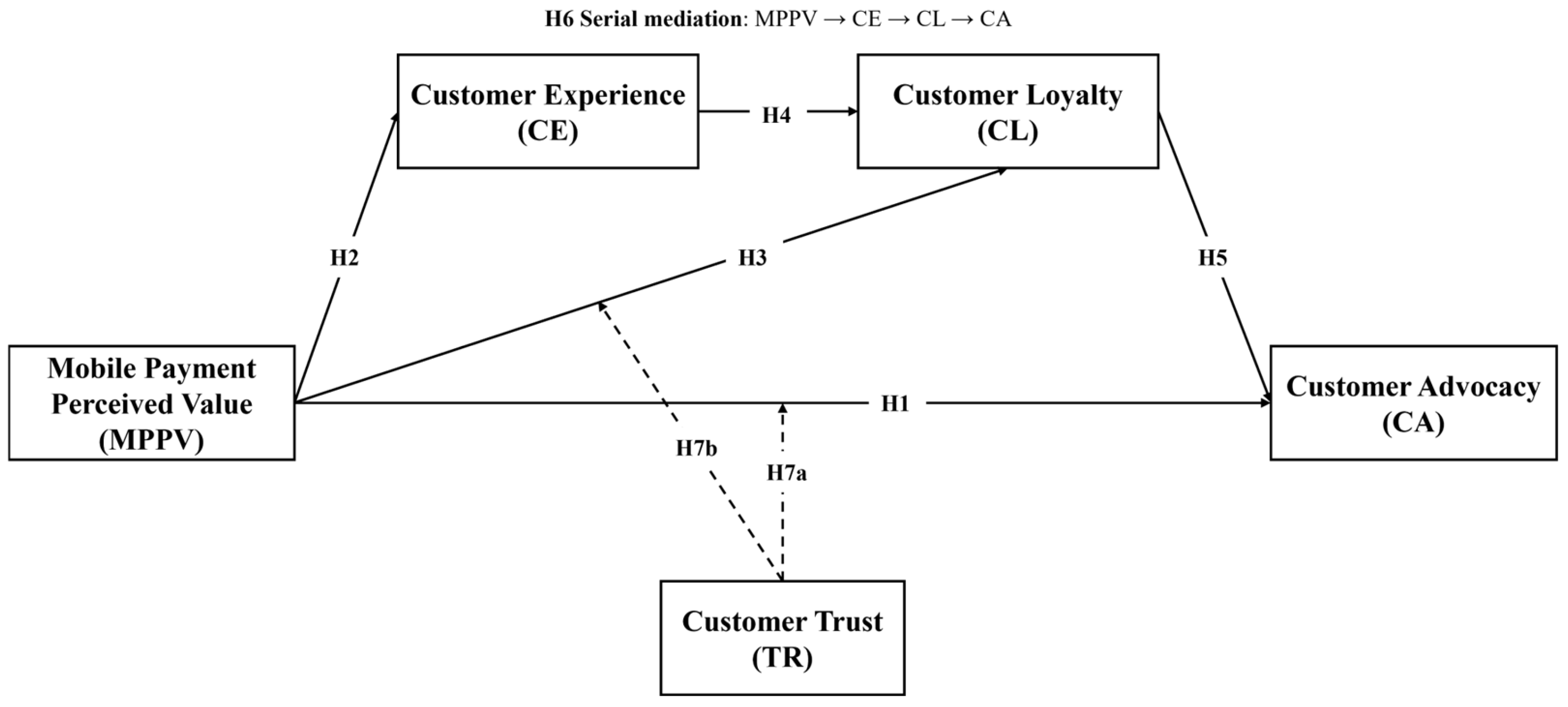
To address these gaps, this study examines how MPPV is associated with customer advocacy through customer experience and customer loyalty and whether customer trust strengthens the associations between MPPV and both loyalty and advocacy. The theoretical logic of the model is deliberately integrative rather than additive: each theoretical lens is assigned a distinct explanatory function. Perceived Value Theory explains why users form overall holistic evaluations of mobile payment services and how these evaluations shape downstream relational responses [
25,
26,
27]. Relationship marketing explains how value evaluations become linked to customer experience and loyalty through sustained service interaction [
29,
30]. Social Exchange Theory [
45] explains why loyal users who perceive favorable service relationships are likely to reciprocate through voluntary advocacy behavior [
3,
27,
46,
47]. Trust-based consumption logic explains why perceived value is more likely to translate into relational outcomes when users feel confident in the provider’s integrity and reliability [
32,
48,
49]. A single-theory model would not adequately account for all four steps: value formation, relational accumulation, reciprocal advocacy, and trust contingency.
This study makes several contributions that distinguish it from prior work. First, whereas sustainability framing in mobile payment research has remained largely implicit or declarative, this study explicitly defines the sustainability dimension as digital consumption sustainability and provides a reasoned justification for why advocacy constitutes a sustainability-relevant outcome through its role in ecosystem diffusion and continuity. Second, it advances perceived value research by modeling MPPV as a higher-order construct, capturing users’ holistic evaluation of mobile payment services rather than isolating individual value dimensions, a specification underutilized in prior fintech studies. Third, it contributes to digital relationship marketing by testing a sequential relational pathway (MPPV to customer experience to customer loyalty to customer advocacy) in a single integrated model. Fourth, it extends trust-based fintech research by examining customer trust not as a direct predictor but as a boundary condition that strengthens the relationship between perceived value and both loyalty and advocacy. Finally, it offers context-specific evidence from Lebanon, an emerging economy where financial uncertainty and institutional trust concerns make mobile payment relationships particularly consequential. The novelty of this study lies not in the individual constructs, which are established in the literature, but in their specific configuration: a higher-order value construct examined through a sequential relational pathway, moderated by trust, in a sustainability framing, within a high-uncertainty emerging market context.
5. Discussion and Implications
5.1. Discussion of Key Findings
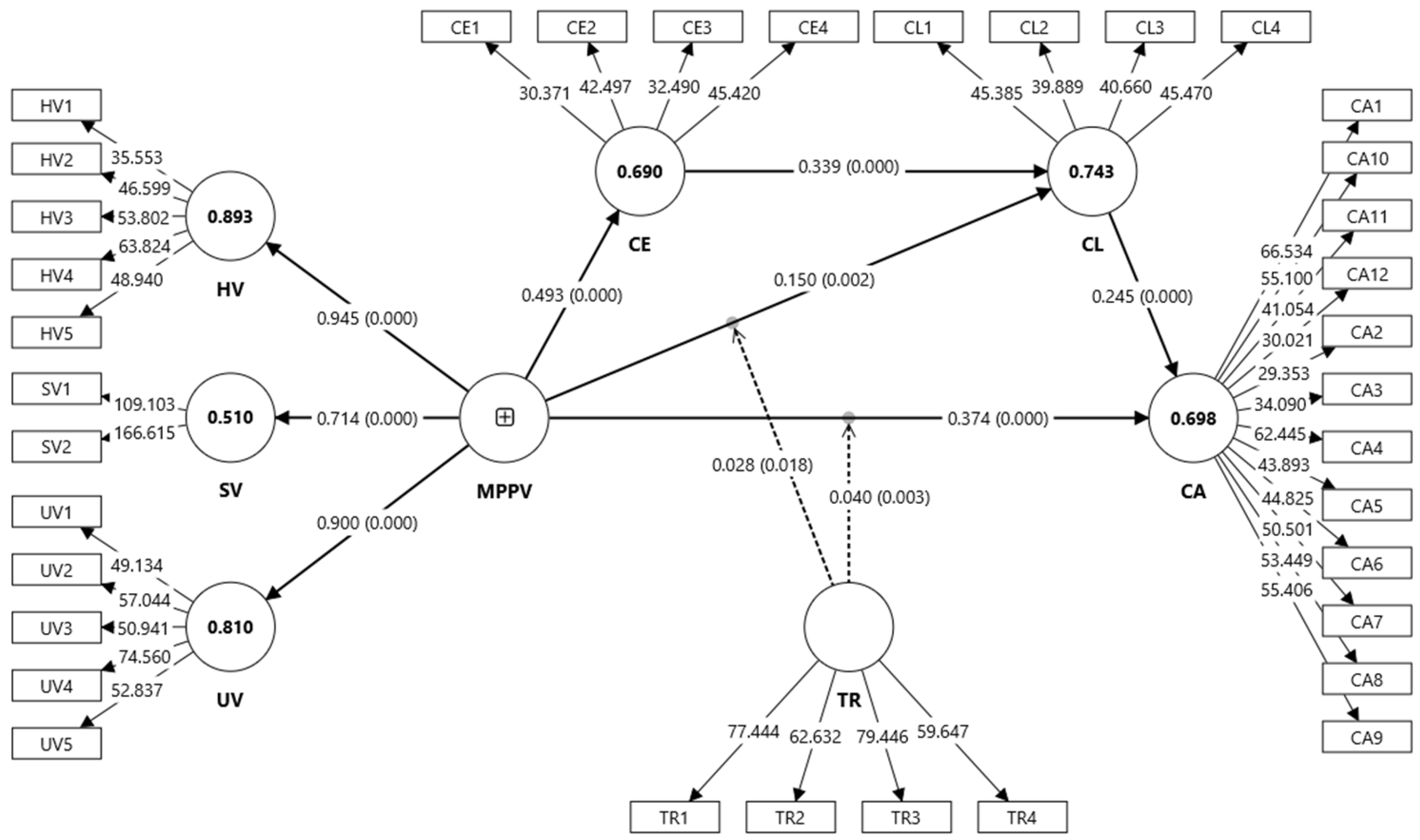
The findings of this study provide support for a relational interpretation of MPPV, customer experience, customer loyalty, customer trust, and customer advocacy in the Lebanese mobile payment context. Mobile payment sustainability should not be treated as an automatic consequence of digital adoption. Rather, the results suggest that sustainable mobile payment consumption is better understood as a relational and trust-sensitive process through which perceived value becomes associated with continued engagement and advocacy. This interpretation is important because the empirical model does not directly measure environmental sustainability; instead, it examines sustainability-relevant relational outcomes, including loyalty, advocacy, trust, and ecosystem continuity.
The positive association between MPPV and customer advocacy suggests that users who perceive greater overall value in mobile payment services are more likely to recommend and support these services within their social networks. This finding is consistent with prior research showing that perceived value is associated with positive word-of-mouth and customer advocacy in digital service settings [
27,
73]. Sustained cashless engagement driven by perceived value has also been shown to support continuance intention and platform diffusion in mobile wallet contexts [
112]. However, this study extends prior work by positioning advocacy not only as a marketing outcome but also as a relational behavior that may support the diffusion and normalization of mobile payment use. In a context such as Lebanon, where digital financial services operate amid economic instability and institutional uncertainty, advocacy may help reduce perceived uncertainty among potential users by providing socially trusted signals about service reliability.
The results also indicate that MPPV is positively associated with customer experience. This aligns with studies suggesting that users’ value evaluations shape how they interpret digital service encounters [
25,
27]. The Lebanese context provides a meaningful explanation for this relationship. Under conditions of financial volatility and banking-sector disruption, users may evaluate mobile payment services not only in terms of convenience or enjoyment but also in terms of practical reliability, accessibility, and perceived usefulness in daily financial transactions. Thus, positive customer experience may reflect more than interface satisfaction; it may also reflect users’ perception that mobile payment platforms offer a workable alternative in an uncertain financial environment.
The positive associations among MPPV, customer experience, and customer loyalty further support the relevance of relationship marketing logic in mobile payment ecosystems. Prior research has shown that loyalty in digital and mobile financial contexts is shaped by service quality, trust, and repeated favorable experiences [
19,
20,
75]. From a consumption value perspective, customer loyalty in mobile payment is also shaped by the overall benefits users perceive relative to available alternatives, reinforcing the importance of holistic value evaluation in sustaining relational commitment [
113,
114]. The present findings refine this literature by suggesting that loyalty is not merely a post-adoption outcome but a relational response connected to users’ cumulative evaluation of value and experience. In this sense, loyalty may help stabilize mobile payment relationships by reducing switching tendencies and encouraging repeated use, especially in markets where users may be cautious about financial technologies.
The association between customer loyalty and customer advocacy suggests that users who maintain stronger commitment to mobile payment services are more willing to recommend and defend these services. This is consistent with Zhao and Bacao [
20], who emphasize the importance of post-adoption relational outcomes in mobile payment use. The finding also clarifies the distinction between loyalty and advocacy: loyalty reflects continued commitment, whereas advocacy represents outward-facing relational support. In the Lebanese context, this distinction is particularly important because users’ recommendations may carry strong social influence when institutional trust is weak and consumers rely heavily on peer-based information to evaluate digital financial services.
The sequential mediation result is consistent with the proposed relational pathway linking MPPV to customer advocacy through customer experience and customer loyalty. This result should not be interpreted as proof of temporal causality because the study is based on cross-sectional data. Rather, it suggests that the observed associations are consistent with the theoretical argument that users first evaluate mobile payment services through experience, then develop loyalty, and subsequently become more willing to advocate the service. Because the data were collected from the same respondents at one point in time, the sequential mediation should be interpreted as a theoretically grounded pattern of association rather than evidence that these relational stages necessarily unfold over time. This interpretation aligns with Social Exchange Theory [
45], in which favorable exchanges may be associated with reciprocal relational behaviors over time. Importantly, whereas prior studies in mobile payment and digital service contexts have examined perceived value, experience, loyalty, and advocacy as separate or parallel predictors [
19,
25,
27], this study provides a more integrated explanation by testing whether these constructs are associated through a sequential relational chain within a single model.
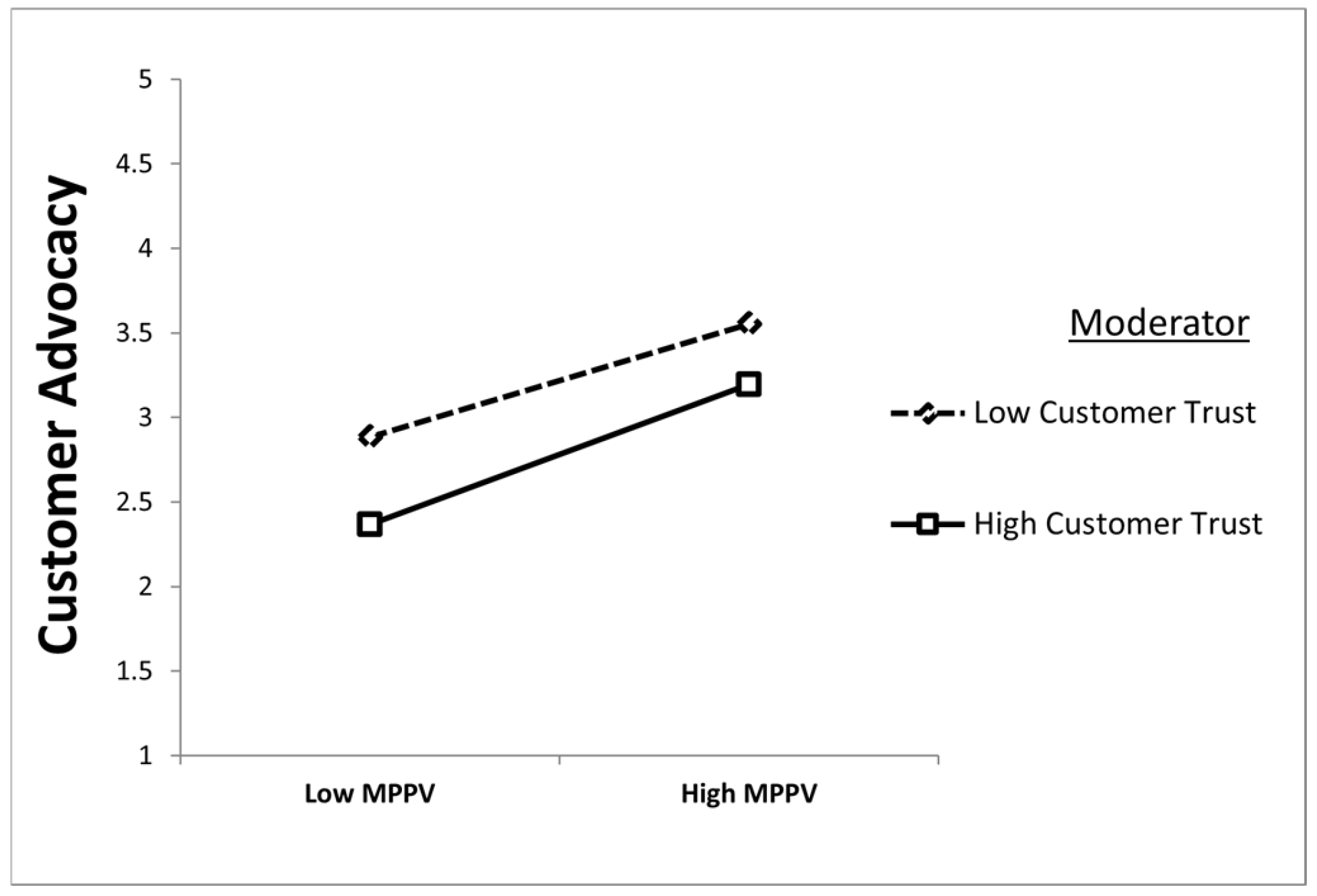
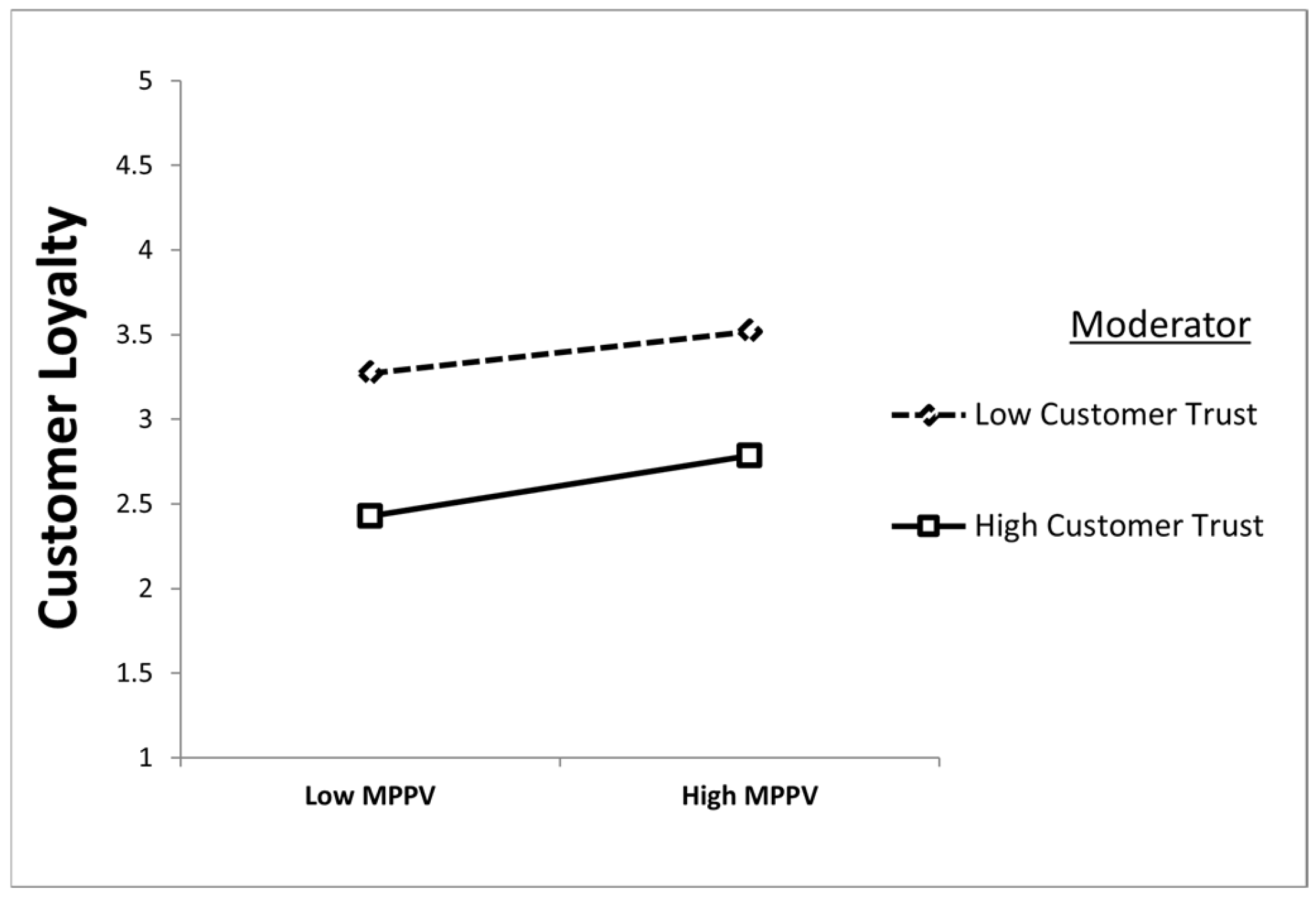
The moderation results further suggest that customer trust strengthens the associations between MPPV and both customer loyalty and customer advocacy. This finding is consistent with research emphasizing the role of trust in reducing perceived risk and supporting relational stability in mobile commerce and digital financial services [
34,
64]. Trust has also been shown to moderate the relationship between perceived service quality and behavioral intentions in mobile payment and e-wallet contexts, suggesting that its amplifying role extends beyond direct adoption to broader relational outcomes [
115,
116,
117]. In Lebanon’s high-uncertainty environment, trust may be especially important because users’ willingness to remain loyal or advocate a mobile payment service may depend on whether they believe the provider can safeguard transactions, protect privacy, and deliver reliable service [
44]. Whereas prior trust research in mobile commerce has predominantly examined trust as a direct predictor of adoption or continuance, the present study adds that trust may operate as a boundary condition that determines the extent to which perceived value translates into relational outcomes. This distinction is theoretically important because it suggests that strengthening perceived value without also building trust may produce weaker loyalty and advocacy effects in high-uncertainty contexts.
Overall, the findings suggest that sustainable mobile payment consumption is better understood as a relational digital consumption process rather than a purely technological or transactional one. The study’s contribution does not lie in claiming that perceived value, experience, loyalty, trust, or advocacy are new constructs; rather, it lies in showing how these constructs operate together in a high-uncertainty emerging market through a higher-order perceived value structure, a sequential relational pathway, and trust-based boundary conditions. At the same time, the interpretation should remain cautious. The strong model performance may partly reflect the use of self-reported perceptual measures and a digitally reachable convenience sample. Therefore, the findings should be viewed as context-sensitive evidence consistent with the proposed model, rather than as definitive proof of universal behavioral processes.
5.2. Theoretical Implications
This study offers several theoretical implications for perceived value research, digital relationship marketing, and sustainable digital consumption in mobile financial services. First, it extends Perceived Value Theory by examining MPPV as a higher-order construct that captures users’ holistic value evaluation of mobile payment services. Prior research has often examined perceived value dimensions or post-adoption outcomes separately [
11,
25,
27,
72,
118]. By modeling MPPV as an integrated construct, this study suggests that users may evaluate mobile payment services through an overall judgment of functional, emotional, and social benefits. This approach provides theoretical parsimony and aligns with the integrated nature of digital service evaluations. However, it also reduces the ability to identify the separate weight of utilitarian, hedonic, and social value, particularly in crisis-sensitive contexts. Thus, the higher-order specification should be viewed as a parsimonious modeling strategy rather than as evidence that functional, emotional, and social value contribute equally to advocacy. Future research should therefore examine these value dimensions separately to determine whether utilitarian value becomes especially salient in crisis contexts, while hedonic or social value may become more influential in more stable digital markets.
Second, the study contributes to sustainable digital consumption research by positioning customer advocacy as a sustainability-relevant relational outcome. Advocacy has traditionally been studied as an advanced form of word-of-mouth or customer support behavior [
74,
119]. The present study extends this view by arguing that, in mobile payment ecosystems, advocacy may support digital consumption sustainability by contributing to the diffusion, continuity, and social normalization of mobile payment use. This contribution is especially relevant because the paper does not claim to measure environmental sustainability directly [
66,
118,
120,
121]. Rather, it clarifies a more specific sustainability logic grounded in economic, social, relational, and institutional continuity within digital financial ecosystems.
Third, the findings contribute to digital relationship marketing by identifying customer experience and customer loyalty as relational mechanisms linking MPPV to advocacy. Relationship marketing research emphasizes the role of long-term engagement, trust, and commitment in service relationships [
19,
38,
77]. This study refines that logic by showing that advocacy is associated not only with perceived value but also with the relational sequence through which users evaluate service experiences and develop loyalty. The sequential pathway is therefore important because it suggests that advocacy is more likely to emerge from accumulated relational engagement than from isolated service encounters.
Fourth, the study extends trust-based consumption research by examining trust as a boundary condition rather than merely as a direct antecedent. Prior studies have emphasized the importance of trust in electronic and mobile commerce [
34,
64,
116]. The present study adds that trust may strengthen the association between perceived value and relational outcomes, particularly in high-uncertainty financial environments. This is theoretically meaningful because it suggests that perceived value may be less effective in producing loyalty or advocacy when users doubt provider reliability, privacy protection, or institutional safeguards.
Finally, the study contributes contextually by examining these relationships in Lebanon, where banking-sector disruption and institutional uncertainty make trust especially salient. The Lebanese context does not simply provide a geographical setting; it helps explain why trust may amplify the value-loyalty and value-advocacy associations. This context-sensitive contribution distinguishes the study from more general mobile payment models developed in stable financial environments and highlights the importance of examining digital relationship mechanisms under conditions of financial uncertainty.
5.3. Practical Implications
The findings provide practical implications for fintech providers, digital banks, policymakers, and platform managers operating in Lebanon’s mobile payment ecosystem. First, the positive associations involving MPPV suggest that providers should focus on delivering holistic value rather than isolated functional improvements. In Lebanon, where economic instability, currency fluctuations, and banking-sector disruption have heightened financial uncertainty, users may be especially sensitive to transaction reliability, service accessibility, and fee transparency. Fintech providers should therefore prioritize stable service performance, clear transaction information, transparent pricing, and reliable customer support as core elements of perceived value.
Second, the results suggest that customer experience should be managed as a relational asset. Short-term incentives may encourage trial use, but they may be insufficient for sustaining loyalty or advocacy. Mobile payment providers should reduce friction in onboarding, simplify user interfaces, improve real-time problem resolution, and communicate service updates clearly. These actions are particularly important in a trust-sensitive market where even minor service failures may reinforce uncertainty and weaken relational commitment.
Third, the loyalty-advocacy relationship suggests that providers should cultivate advocacy through relational consistency rather than aggressive promotion. In Lebanon’s socially connected market environment, peer recommendations may influence users’ willingness to adopt or continue using mobile payment services. Referral programs, user testimonials, review platforms, and community-based digital education initiatives may help transform satisfied and loyal users into credible advocates. However, these strategies should be grounded in authentic service quality and trust-building rather than promotional pressure.
Fourth, the moderating role of trust has direct implications for platform governance and communication. Because trust appears to strengthen the value-loyalty and value-advocacy relationships, providers should treat trust as a strategic infrastructure rather than as a communication slogan. This includes visible privacy policies, clear dispute-resolution procedures, transaction security assurances, regulatory compliance, and partnerships with credible institutions. Policymakers can support this process by strengthening consumer protection frameworks, digital payment regulations, and public awareness campaigns focused on safe and responsible mobile payment use.
Fifth, fintech providers and policymakers should address the digital divide among user groups that may be underrepresented in online samples, particularly older, less-educated, rural, lower-income, and less digitally confident consumers. Practical actions may include simplified application interfaces, clearer transaction instructions, Arabic-language support, assisted onboarding, telephone or in-person help channels, and community-based digital literacy programs. Such initiatives can help ensure that mobile payment services are not only attractive to digitally confident users but also accessible and trustworthy for consumers who may face greater barriers to digital financial participation. This implication should be interpreted in light of the sample profile, which was predominantly female and highly educated, and therefore may not fully capture the needs and experiences of all Lebanese mobile payment users.
Finally, managers should interpret advocacy as part of a broader relational performance system. In addition to adoption rates, providers should monitor experience quality, retention, complaint resolution, referral behavior, and user trust indicators. Such metrics can help assess whether mobile payment use is becoming relationally sustained, rather than merely transactionally adopted.
5.4. Limitations and Future Research
Despite its contributions, this study is subject to several limitations that should guide interpretation and future research. The cross-sectional design restricts causal inference, and the findings should therefore be interpreted as associations consistent with the proposed relational model rather than evidence of definitive causal processes. This limitation is particularly relevant to the sequential mediation pathway, as cross-sectional data cannot establish whether customer experience temporally precedes loyalty or whether loyalty subsequently develops into advocacy over time. The empirical setting is limited to Lebanon, an emerging economy shaped by financial instability, banking-sector disruption, and institutional trust concerns. This context provides meaningful insight into mobile payment use under uncertainty, but the relational pathways identified here may not replicate in markets with stronger regulatory systems or more stable traditional banking sectors. Indeed, Lebanon’s financial instability may heighten the salience of trust and functional value, meaning that users’ advocacy may partly reflect financial adaptation and practical necessity rather than only emotional attachment or identification with a digital service provider. The use of non-probability convenience sampling through online channels introduces self-selection and digital access bias, and the sample is predominantly female and highly educated, which may reflect the digital recruitment strategy rather than the broader Lebanese population. Accordingly, the findings should be interpreted as reflecting the perceptions of digitally reachable mobile payment users rather than all Lebanese mobile payment users. This demographic skew limits the extent to which the findings can be generalized to older users, less-educated users, rural users, lower-income consumers, or those with limited digital literacy. In addition, although procedural remedies, Harman’s single-factor test, and full collinearity VIF diagnostics were applied, these methods cannot fully rule out method-related variance associated with single-source, self-reported data. Finally, the sustainability framing should be interpreted carefully because this study examines sustainability-relevant relational outcomes, such as continuity, loyalty, advocacy, trust, and diffusion, rather than direct environmental sustainability outcomes.
Future research should address these limitations through longitudinal, comparative, and multi-method designs. Longitudinal, time-lagged, or panel-based studies could examine whether perceived value, trust, loyalty, and advocacy persist as Lebanon’s financial environment changes or as traditional banking conditions stabilize. Comparative cross-country studies could assess whether the same relational pathways operate in markets with different levels of institutional trust, fintech maturity, and regulatory stability. More diverse and probability-based samples, including stratified designs across age, income, region, and digital literacy groups, would strengthen generalizability. Future studies could also use marker variables, multiple data sources, app usage logs, transaction records, or qualitative interviews to capture behavioral nuances that self-reported survey data may overlook. Finally, future research should compare higher-order and disaggregated perceived value models to examine whether utilitarian, hedonic, and social value operate differently in crisis-sensitive financial environments. Although the higher-order MPPV specification provides theoretical parsimony, it may obscure whether customer advocacy is primarily associated with practical utility, emotional enjoyment, or social recognition. Future disaggregated analyses could clarify whether utilitarian value becomes more influential during periods of financial crisis while hedonic and social value become more salient when mobile payment ecosystems mature or financial conditions stabilize.