This is an early access version, the complete PDF, HTML, and XML versions will be available soon.
Article

Beans, Blockchain, and Beliefs: How German Consumers Perceive Value in Sustainable Coffee Certifications

by
Meta Leonie Boller
and
Christian Krupitzer
*
Department of Food Informatics and Computational Science Hub, University of Hohenheim, 70599 Stuttgart, Germany
*
Author to whom correspondence should be addressed.
Sustainability 2026, 18(10), 5159; https://doi.org/10.3390/su18105159
Submission received: 21 April 2026 / Revised: 13 May 2026 / Accepted: 17 May 2026 / Published: 20 May 2026
(This article belongs to the Section Sustainable Food)

Abstract

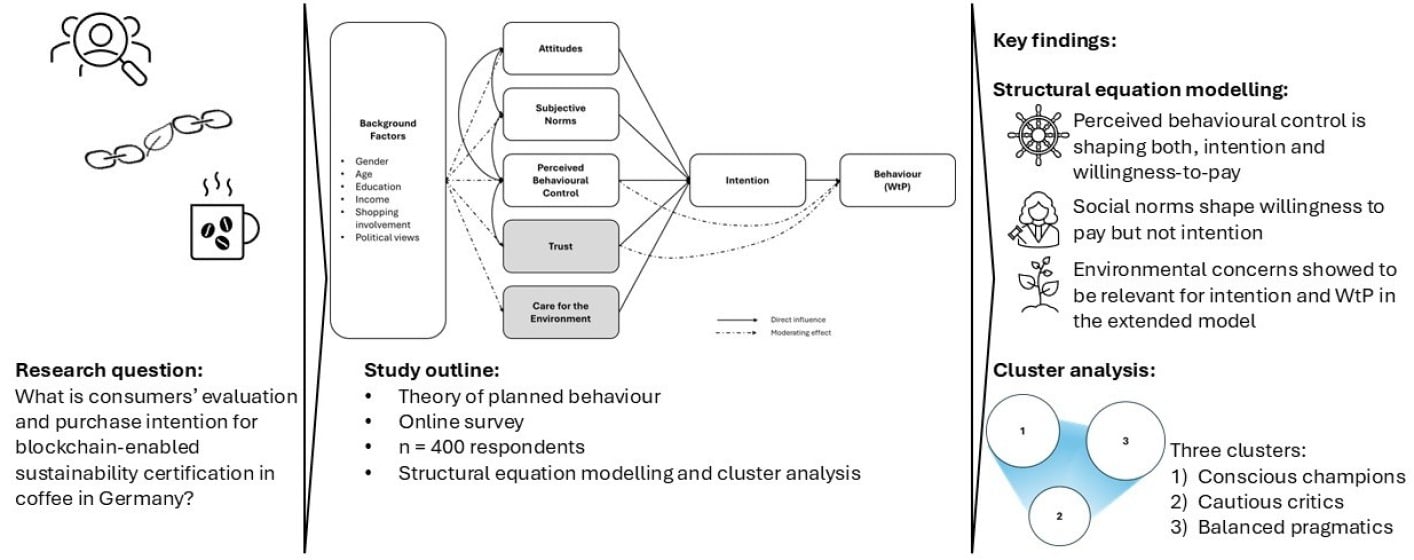
Given the increasing relevance of sustainability certification in food supply chains and, at the same time, rising confusion among consumers about the multitude of labels on food products, concerns about the value of sustainability certification occur frequently. This paper aims to investigate consumers’ evaluation and purchase intentions, and willingness-to-pay (WtP) for blockchain-enabled sustainability certification in coffee. Utilizing a questionnaire guided by an extended model of Ajzen’s theory of planned behavior (TPB), an online survey was conducted with n = 400 German consumers. Data were analyzed using structural equation modeling and cluster analysis. The results revealed perceived behavioral control (PBC) and subjective norms (SN) as the most influential factors on WtP, whereas intention to buy is shaped by PBC and environmental concerns. Notably, trust in blockchain technology did not emerge as a significant direct predictor, suggesting it operates as a background condition rather than a behavioral driver. Three distinct clusters were identified with concise preference, intention, and WtP profiles, highlighting heterogeneous consumer motivations. The study contributes to the literature in three ways: it provides the first consumer-behavioral evidence from the German market; it demonstrates that blockchain-specific trust constructs do not constitute independent behavioral drivers, suggesting that adoption follows generic TPB mechanisms; and it empirically differentiates intention and WtP as distinct psychological outcomes driven by different construct sets.
Keywords: sustainability certification; blockchain; consumers’ willingness; coffee; theory of planned behavior sustainability certification; blockchain; consumers’ willingness; coffee; theory of planned behavior
Graphical Abstract