Article

Cold Asphalt Mixtures with Industrial By-Products for Rapid Pavement Repairs

by
Paula Cristina Fernandes-Leal
,
Hernán Patricio Moyano-Ayala
* and
Marisa Sofia Fernandes Dinis-Almeida
C-MADE, Centre of Materials and Civil Engineering for Sustainability, University of Beira Interior, Calçada Fonte do Lameiro, Edifício II das Engenharia, 6200-001 Covilhã, Portugal
*
Author to whom correspondence should be addressed.
Sustainability 2026, 18(10), 5147; https://doi.org/10.3390/su18105147
Submission received: 29 April 2026 / Revised: 15 May 2026 / Accepted: 19 May 2026 / Published: 20 May 2026
(This article belongs to the Section Sustainable Engineering and Science)

Abstract

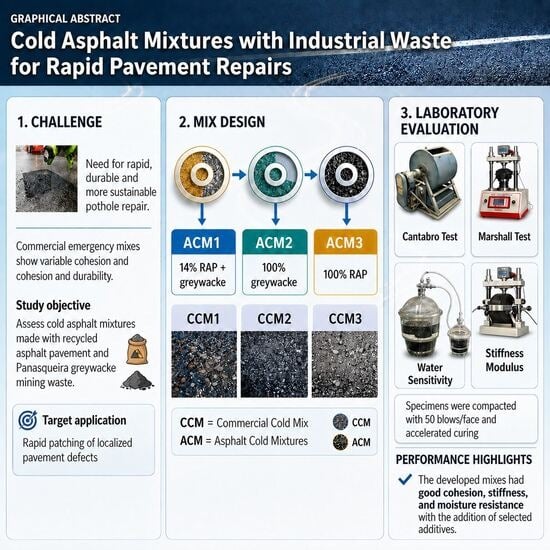
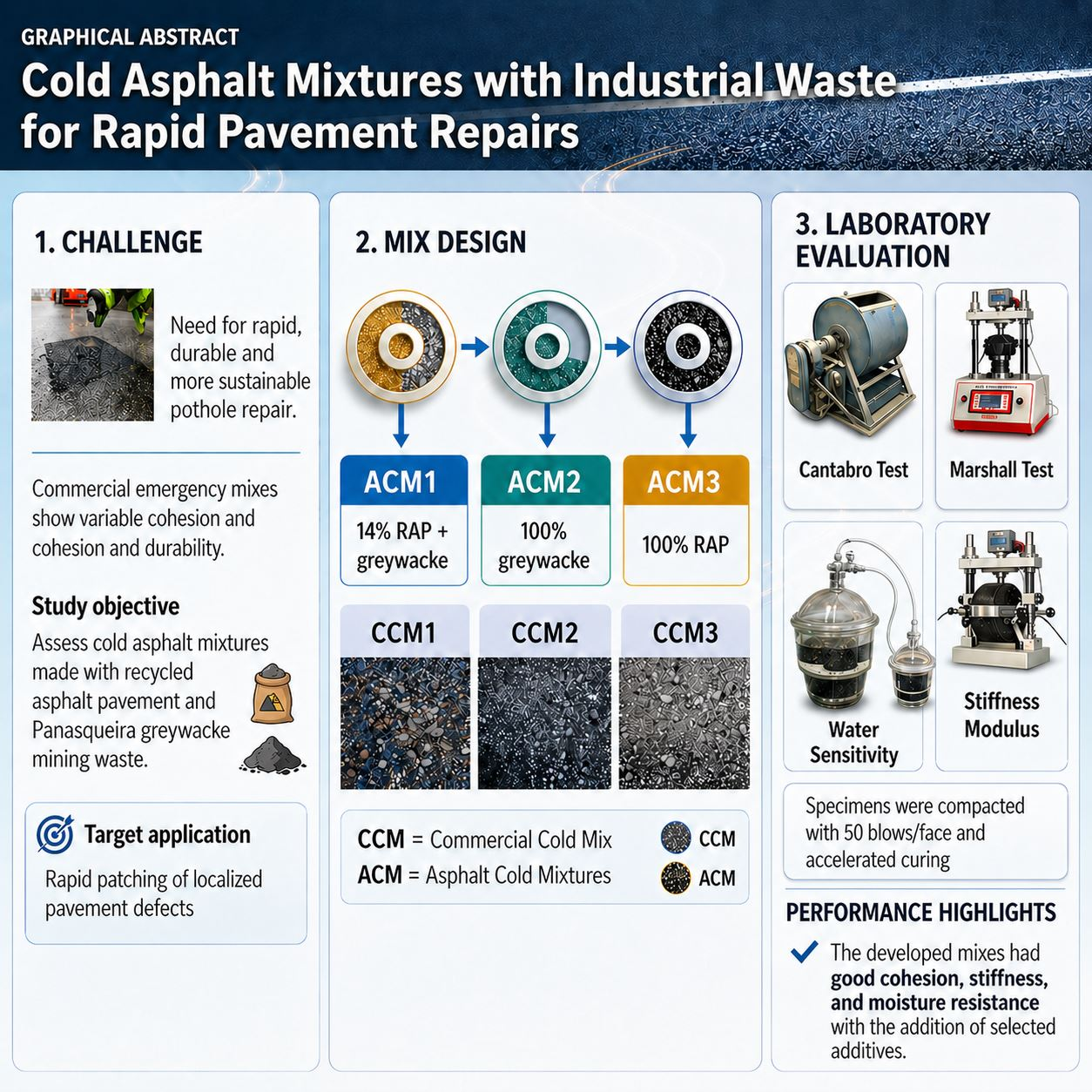
The growing demand for sustainable and economically efficient road maintenance solutions has driven the development of materials that reduce the use of natural aggregates and promote waste valorization. In this context, this study evaluates the use of reclaimed asphalt pavement (RAP) and greywacke aggregates derived from Panasqueira mining by-products as partial or total substitutes for granite aggregates in cold asphalt mixtures intended for rapid pothole repair. Reference mixtures and recycled mixtures were produced with controlled proportions of RAP and greywacke, using cationic bituminous emulsion and hydrated lime, as well as an additional mixture composed only of RAP with a fluxing cold binder. Three commercial mixtures, identified as CCM1, CCM2, and CCM3, were also evaluated. Performance was analyzed through Cantabro particle loss, Marshall stability and flow, indirect tensile stiffness modulus, and water sensitivity (ITSR). The results show that greywacke provides a robust granular skeleton, while RAP content and binder type influence stiffness, cohesion, and moisture resistance. Overall, the combination of RAP and greywacke proved to be technically viable and, in several cases, superior to the commercial mixtures studied.

Graphical Abstract

1. Introduction

The progressive deterioration of flexible pavements results from the combined action of repeated traffic loading and environmental factors, whose interaction promotes structural fatigue, binder aging, loss of cohesion, and surface deterioration [1,2,3]. Among the most critical forms of distress, potholes stand out because they directly compromise road safety, ride quality, pavement structural performance, and vehicle operating costs [4]. In addition to the discomfort and risk associated with evasive maneuvers, potholes favor water infiltration and the progressive disintegration of the material, accelerating the deterioration of underlying layers and increasing the frequency and cost of maintenance interventions [5,6,7,8]. In this sense, the timely repair of these localized defects is essential to limit damage propagation, preserve the functional and structural integrity of the pavement, and reduce technical, economic, and social impacts [9]. Therefore, the development of high-performance materials for rapid maintenance has become increasingly relevant within the framework of sustainable road infrastructure management.
Recent studies have further highlighted the potential of cold asphalt technologies as sustainable solutions for pavement rehabilitation and maintenance. In particular, cold in-place recycling (CIR) has been successfully applied at both laboratory and field scales, demonstrating improvements in fatigue and cracking resistance due to the incorporation of recycled materials and emulsified binders [10]. Similarly, comprehensive reviews on cold recycling with bitumen emulsion and cement have shown that mixture performance is highly dependent on binder balance and stiffness control, as excessive rigidity may lead to cracking and reduced durability [11]. More broadly, cold mix asphalt (CMA) has been recognized as a low-energy and environmentally favorable alternative to hot mix asphalt, with significant reductions in fuel consumption and greenhouse gas emissions, although its performance strongly depends on mix design optimization, curing conditions, and the incorporation of suitable additives or recycled materials [12]. These findings reinforce the need for further research on the design and performance of cold mixtures incorporating recycled constituents, particularly for rapid repair applications where both mechanical performance and sustainability are critical.
In this context, cold asphalt mixtures have been recognized as a technically viable solution for localized repairs, especially in situations requiring rapid application, simplified logistics, and minimal operational infrastructure [13,14,15]. The absence of heating during production and application results in lower energy consumption, greater flexibility in storage and transport, and the possibility of use under different environmental conditions [16]. However, these operational advantages also introduce additional challenges in formulation, particularly regarding gradation control, aggregate binder interaction, and the development of initial cohesion, since strength evolution depends strongly on physical processes [17], binder characteristics, and compatibility among constituents [18,19,20]. For this reason, parameters such as air void content, stability, stiffness, indirect tensile strength, and water sensitivity play a decisive role in the durability and in service performance of these mixtures [21]. The rheological behavior of asphalt binders also influences mixture performance, particularly through creep and stress relaxation. These viscoelastic properties, affected by binder ageing, control permanent deformation and cracking resistance, and are especially relevant in cold mixtures incorporating RAP [22].
At the same time, the incorporation of recycled materials and industrial by products has gained increasing attention as a strategy to improve resource efficiency and reduce the environmental impacts associated with road construction and maintenance [23,24,25,26,27]. Among these alternatives, Reclaimed Asphalt Pavement (RAP) is particularly relevant because it enables the valorization of waste generated during pavement rehabilitation while simultaneously reducing the extraction of natural aggregates and landfill disposal [28,29]. However, the presence of aged binder may modify the stiffness and mechanical response of the mixture, affecting workability, cracking susceptibility, and behavior under repeated loading, which requires a carefully justified mix design [21,30]. In a complementary way, the use of greywacke aggregates from the Panasqueira mine [31,32] represents a promising route for the valorization of mining by products, since their high angularity and predominantly siliceous nature may favor particle interlock and improve the mechanical resistance of the mixture. In this study, the greywacke corresponds to inert rock fractions generated during extraction and processing operations, which are subsequently crushed and graded to produce aggregates suitable for civil engineering applications, rather than hazardous mine waste or contaminated tailings. Their suitability must nevertheless be confirmed through appropriate physic-mechanical characterization [33,34].
Despite the growing number of studies on cold patching materials and recycled asphalt mixtures, investigations analyzing the combined use of RAP and mining by-products aggregates in cold asphalt mixtures specifically intended for rapid pothole repair applications are still limited. There remains a lack of knowledge regarding the interaction between aged binders present in RAP, greywacke mining residues, cationic emulsions, and adhesion-promoting additives, as well as the combined influence of these constituents on stiffness development, cohesion, particle loss resistance, and moisture susceptibility. Furthermore, comparative studies evaluating laboratory-developed sustainable mixtures against commercially available pothole repair materials under the same testing conditions remain scarce. Therefore, the present study develops and experimentally evaluates three cold asphalt mixtures formulated with RAP and greywacke aggregates as total replacements for natural aggregates, aiming at rapid pavement repair applications. The performance of the proposed mixtures is compared with that of three commercial cold asphalt mixtures through the analysis of volumetric and mechanical properties, including Cantabro particle loss, Marshall stability, stiffness modulus, and water sensitivity [21]. The results contribute to clarifying the technical feasibility and sustainability potential of combining RAP and mining by-products in cold asphalt mixtures for emergency pavement maintenance applications.

2. Materials and Methods

The experimental program was designed to systematically develop and evaluate cold asphalt mixtures intended for rapid pavement repair, with particular emphasis on pothole patching using Reclaimed Asphalt Pavement (RAP) and greywacke aggregates derived from Panasqueira mine by-products. First, all constituent materials, including virgin aggregates, RAP, greywacke aggregates in accordance with EN 933-1 [35], binders, and additives, were characterized through relevant physical and mechanical tests to assess their suitability for cold mix production. Based on these results, three experimental mixtures were designed with different proportions of aggregates, binder, and additives. The mixtures were then produced under controlled laboratory conditions, compacted, and cured according to the requirements of each formulation, with binder contents adjusted on the basis of workability and mechanical performance criteria. Laboratory testing included Cantabro particle loss, Marshall stability and flow, indirect tensile stiffness modulus, and water sensitivity, together with volumetric characterization through bulk density and air void content. All testing procedures were conducted in accordance with applicable technical standards to ensure the reliability, repeatability, and comparability of the results. This methodological approach enabled the assessment of mechanical performance, handling properties, and durability related indicators, supporting the identification of technically viable and environmentally sustainable mixtures for emergency road maintenance applications.

2.1. Materials

This study considered the development of three cold asphalt mixtures for rapid pavement repair, particularly for pothole patching. One mixture was produced by incorporating greywacke aggregates from the Panasqueira mine and RAP (ACM1), a second mixture was produced with 100% greywacke aggregates from the Panasqueira mine (ACM2), and a third mixture was produced using 100% RAP (ACM3). The aggregates were subsequently mixed with a cationic bituminous emulsion and hydraulic lime. The three commercial mixtures tested present distinct formulations, consisting of natural aggregates and waste materials, which influence their volumetric and mechanical behavior and make it possible to establish a comparative basis for evaluating the performance of the formulated solutions against market available alternatives.

2.1.1. Binder

Two binders were used in the experimental program. For the formulations containing greywacke aggregates, a C67BF3 cationic bituminous emulsion supplied by Lusasfal (Vendas Novas, Portugal), was adopted as the binder, as presented in Table 1. In contrast, the formulation composed of 100% RAP was produced using IterBflux Cold, supplied by Iterchimica (Bérgamo, Italy). IterBflux Cold is a high-performance binder for cold mixtures, with the dual function of a binder and a fluxing agent, consisting of a blend of hydrocarbons, vegetable esters, and distillation derivatives. The InterBflux cold properties as presented in Table 2. The recommended dosage of IterBflux Cold is 3.0 to 4.5% of the total mass of aggregates or RAP.

2.1.2. Reclaimed Asphalt Pavement

The RAP used in this study was recovered from the surface course of the A23 motorway in Castelo Branco, Portugal, and incorporated as the main recycled component in the cold mixtures. In addition to its contribution as an aggregate, the recovered material was analyzed in order to quantify the condition of the aged binder present in the RAP. This characterization was carried out by CEPSA Betumes at its Madrid laboratory, including the determination of aged binder content according to EN 12697-1 [41], penetration according to EN 1426 [42], and softening point according to EN 1427 [43]. The extracted binder showed a content of 5.6%, a penetration value of 11 × 10−1 mm, and a softening point of 77.8 °C, indicating a highly aged and stiff binder with reduced elasticity, consistent with prolonged field exposure. The gradation curve of the RAP after processing, including sieving and crushing to remove oversized particles and impurities, is presented in Table 3.

2.1.3. Greywacke Aggregates

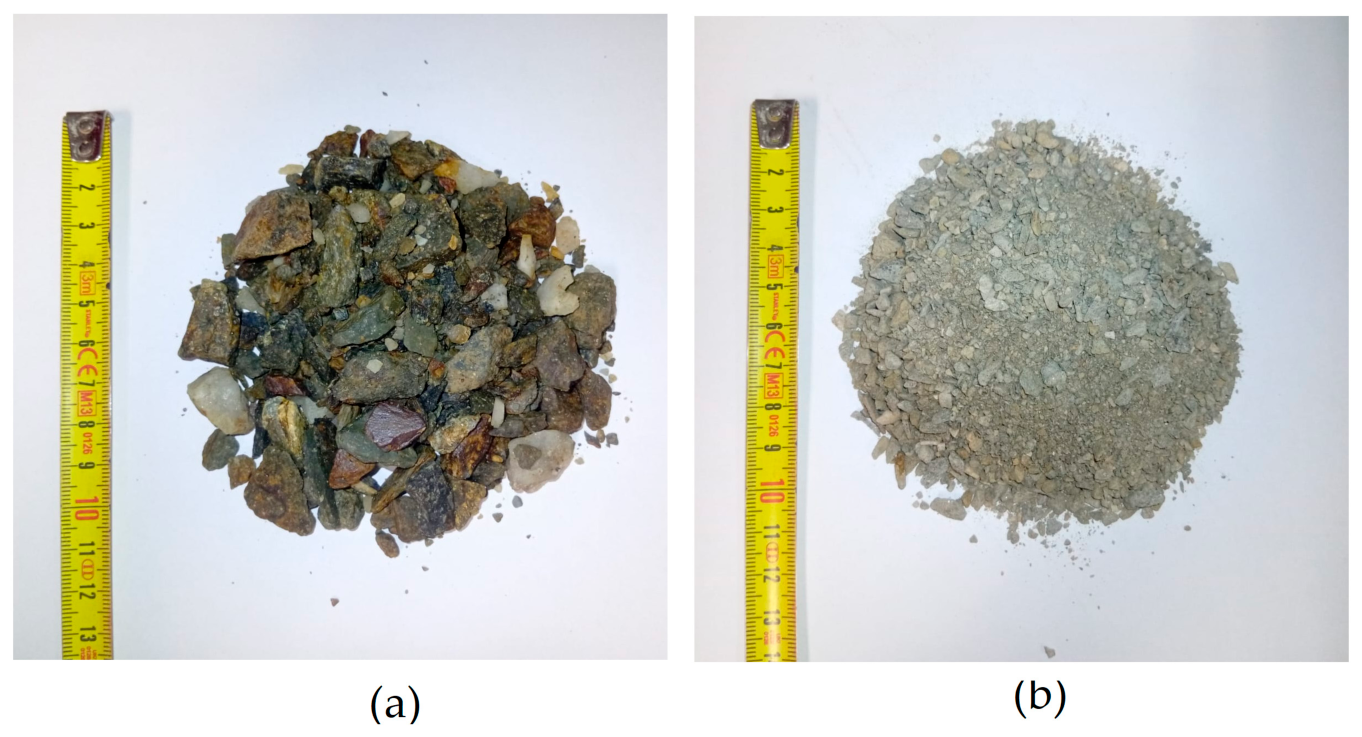
Greywacke aggregates derived from Panasqueira mining by-products, processed into Stone Dust 0/4 and crushed aggregate 2/12.5 fractions, are presented in Figure 1.
The selected aggregate fractions, namely Stone Dust 0/4 and crushed aggregate 2/12.5, correspond to the particle size distribution of the materials rejected during the mining and processing operations at the Panasqueira mine. These fractions were chosen because they represent the most abundant and readily available greywacke waste materials generated during mining activities. Their incorporation into cold asphalt mixtures may contribute to reducing the environmental burden associated with the accumulation of extraction and processing residues in disposal areas. The use of these materials supports circular economy principles by promoting the reuse of locally available industrial by-products while reducing the demand for virgin quarry aggregates typically used in pavement maintenance operations.
Furthermore, the combination of the finer Stone Dust fraction with the coarser 2/12.5 fraction enabled the development of a continuous gradation suitable for cold asphalt mixtures intended for pothole repair applications. The finer fraction improved particle packing and mixture cohesion, while the coarser fraction enhanced particle interlocking, providing a robust granular skeleton capable of ensuring mechanical stability and load distribution. The adopted gradation was also adjusted in accordance with the grading limits specified by the Portuguese Road Administration specifications for cold maintenance mixtures [41].
The greywacke aggregates from the Panasqueira mine showed very high resistance to fragmentation, with a Los Angeles coefficient (LA) value of 8.8%, determined in accordance with EN 1097-2 [44], indicating a hard material with high resistance to impact, abrasion, and traffic induced wear, which favors the development of a mechanically robust cold mixture. The bulk density was also determined according to the EN 1097-6 [45] for Greywacke Stone Dust and Gravel 2/12.5, obtaining values of 2850 kg/m3 and 2830 kg/m3, respectively. The flakiness index of Greywacke Gravel 2/12.5, determined according to the EN 933-3 [46] was 33%.
Hydraulic lime was incorporated as a mineral additive to adjust the gradation and improve mixture cohesion. The gradation results are presented in Table 3 as cumulative percentages passing each sieve, determined according to EN 933-1 [35].
The mixture compositions, expressed as percentages by mass, are summarized in Table 4 and were established in accordance with the specified limits for routine maintenance works with thicknesses below 4 cm, as specified by the Portuguese Road Administration [47].
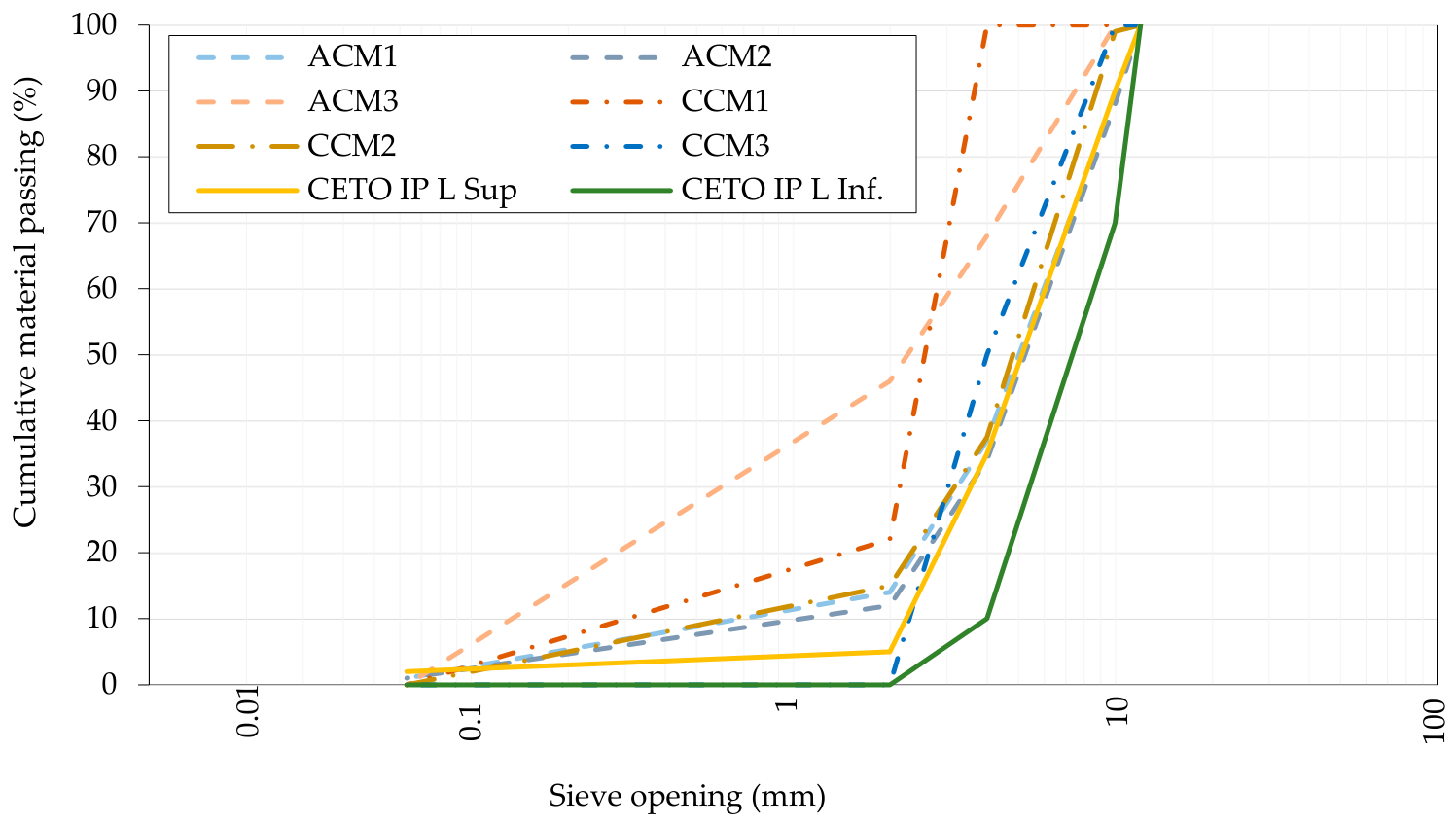
The gradation curves of the developed mixtures (ACM1, ACM2, and ACM3), together with the grading limits established by the Portuguese Road Administration specifications for cold maintenance mixtures [47], are presented in Figure 2. The formulations were designed based on gradations commonly adopted for hot mix asphalt surface courses and commercially available cold patching mixtures, aiming to achieve a balanced combination of workability, cohesion, air void content, and mechanical stability.
The gradation curves of the different mixtures (ACM1, ACM2, and ACM3), as well as the gradation limits defined in the Portuguese specifications, are presented in Figure 2.

2.1.4. Adhesion Promoting Additive

In this study, two adhesion-promoting additives, Iterlene PE 31/F and Iterlene SL/100 PLUS, supplied by Iterchimica, were used. The first consists of a mixture of phosphoric acid derivatives and the second of a mixture of siloxane derivatives, both aiming to improve the bond between the cationic bituminous emulsion and the greywacke aggregates. The use of these additives proved particularly relevant due to the mineralogical characteristics of the Panasqueira aggregates, which require greater affinity with the binder to ensure adequate coating and mixture durability. The properties of adhesion-promoting additives are presented in Table 5.
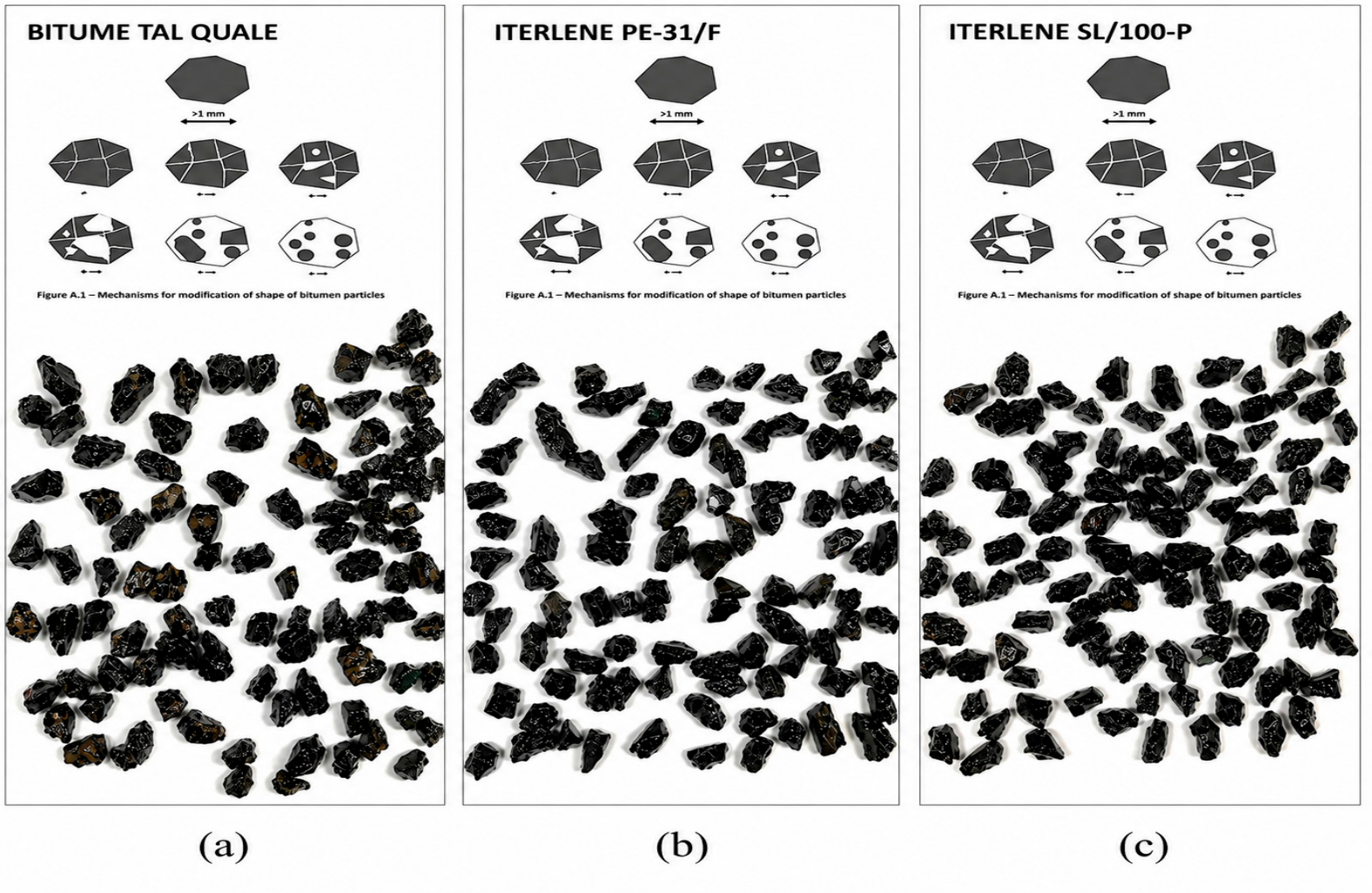
As illustrated in Figure 3, the adhesion tests carried out on the greywacke aggregates showed a significant improvement with the incorporation of the additive. Without the use of the additive, the coating was approximately 70%; with 0.3% Iterlene PE 31/F, the coating increased to 85%; and with 0.1% Iterlene SL/100 PLUS, complete coating of 100% was achieved.

2.2. Methods

This section describes the experimental procedure adopted to determine the optimum binder content of the cold mixtures produced with industrial residues, namely greywacke aggregates from Panasqueira mining operations and Reclaimed Asphalt Pavement (RAP), as well as the characterization tests performed on these mixtures and on three commercial mixtures frequently used by the Municipal Works Department of the Covilhã City Council for rapid pavement repair in localized areas, particularly pothole patching. To ensure confidentiality, the commercial mixtures were randomly identified as CCM1, CCM2, and CCM3.
The optimum binder content for the laboratory formulated mixtures was determined by means of the Cantabro test. The experimental program also included the Marshall test, the determination of the indirect tensile stiffness modulus, and the evaluation of water sensitivity for both the formulated mixtures and the three commercial mixtures. For all tests, Marshall specimens were prepared for each mixture using 50 blows per face. In a preliminary stage, experimental specimens were produced based on the curing procedures recommended by applicable standards. However, after evaluating the mechanical behavior of the mixtures, it was found that the accelerated curing procedure consisting of 2 h in the mold, 1 day in air at room temperature, and 3 days in an oven at 60 °C provided the best overall performance and was therefore adopted throughout the experimental program [48].

2.2.1. Optimum Bitumen Content

The initial emulsion content (IEC) was ascertained according to the Asphalt Institute utilizing empirical Equation (1):
P = K × α × 5
where
  • P is the percent residual asphalt content by weight of the total mix;
  • K is the richness modulus = 3.8;
  • α = 2.65 ρ a ; ρ a —is the bulk density of the aggregates mixture;
  • = 1 100 × ( 0.25 × G + 2.3 × S + 12 × s + 135 × f ) ;
  • G = percentage of aggregate retained on a 6.3 mm sieve;
  • S = percentage of aggregate passing a 6.3 mm sieve and a 0.315 mm sieve;
  • s = percentage of aggregate passing a 0.315 mm sieve and a 0.075 mm sieve;
  • f = percentage of aggregate passing a 0.075 mm sieve.
The value of IEC was determined using Equation (2):
I E C = P X   × 100
where
  • X is the residual bitumen percentage of the emulsion (X), which was 65%.
Thus, the IEC values for ACM1 and ACM2 are 7.5% and 7.4%, respectively.
The optimum emulsion content of the cold asphalt mixtures was determined by means of the Cantabro test, in accordance with EN 12697-17 [49]. Marshall specimens were prepared for each mixture considering three emulsion contents: the initial content, the initial content increased by 0.5%, and the initial content reduced by 0.5%. Each specimen was weighed before testing, and the mass was recorded as P1. The specimens were then individually placed in the Los Angeles drum, without steel balls, and subjected to 300 revolutions at a speed between 30 and 33 rpm. After the test, each specimen was removed and weighed again to obtain P2. Particle loss was calculated for each specimen using Equation (3):
P L = W 1 W 2 W 1   × 100
where
  • PL is the value of particle loss, in percent (%);
  • W1 is the initial specimen mass, in grams (g);
  • W2 is the final specimen mass, in grams (g).

2.2.2. Marshall Test

All aggregates, RAP, and filler were mixed using the binder contents defined through the Cantabro test, and cylindrical Marshall specimens were subsequently prepared by applying 50 blows per face. After the accelerated curing period, the specimens were conditioned in a water bath at 60 °C for the duration specified in EN 12697-34 [50] and then tested to determine Marshall stability and flow, allowing the evaluation of mixture cohesion and its response to loading. Bulk density was determined according to EN 12697-6 [51], Procedure D (by dimensions), and the main volumetric parameters were calculated to support the interpretation of performance.

2.2.3. Stiffness Modulus

The stiffness modulus of the developed cold mixtures was determined in accordance with NP EN 12697-26 [52] (Annex C), using the indirect tensile stiffness modulus (ITSM) procedure on cylindrical specimens prepared with the selected optimum binder contents. For each mixture (ACM1, ACM2, and ACM3), five specimens were tested, with the load applied in two diametrically opposite directions to improve repeatability. The tests were carried out at 20 °C, considering a Poisson’s ratio of 0.35, a load rise time of 124 ms, and a maximum horizontal deformation of 5 μm, as specified in the standard. The modulus was obtained from five repeated load applications, preceded by a preloading phase intended to condition the testing system to the type of mixture.

2.2.4. Water Sensitivity

Water sensitivity was evaluated using the indirect tensile strength ratio (ITSR), in accordance with EN 12697-12 [46]. A total of 60 specimens were compacted, comprising ten specimens for each laboratory-produced mixture (ACM1, ACM2, and ACM3), compacted at their respective optimum bitumen contents, and ten specimens for each commercial mixture (CCM1, CCM2, and CCM3).
For each mixture, five specimens were stored under dry conditions at 20 °C, while the remaining five were subjected to vacuum saturation and immersion in water at 40 °C for 72 h, followed by conditioning at 15 °C. Dimensional stability was verified, ensuring that no specimen exhibited a volume increase greater than 2%.
The indirect tensile strength (ITS) was determined by diametral compression, in accordance with EN 12697-23 [47], using a loading rate of 50 mm/min and calculated according to Equation (4).
I T S = 2 P π D H
where
  • ITS is the indirect tensile strength, expressed in megapascals (MPa);
  • P is the peak load, expressed in kilonewtons (kN);
  • D is the diameter of the specimen, expressed in millimeters (mm); and
  • H is the height of the specimen, expressed in millimeters (mm).
The ITSR was calculated by comparing the ITS values under wet and dry conditions, using Equation (5):
I T S R =   I T S W I T S D × 100
where
  • ITSR represents the indirect tensile strength ratio (%);
  • ITSW is the average indirect tensile strength of the specimens conditioned under wet conditions (kPa);
  • and ITSD is the average indirect tensile strength of the specimens not conditioned under dry conditions (kPa).

3. Results

3.1. Cantabro Test

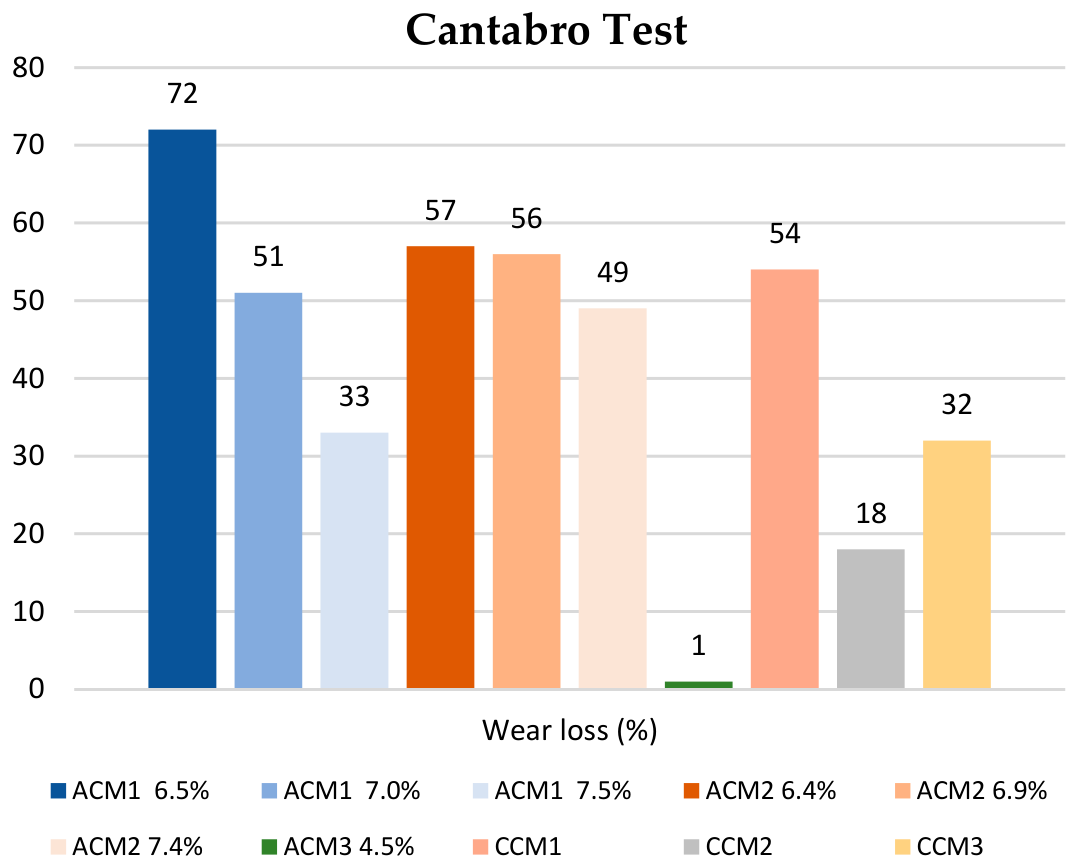
The results indicate that the Cantabro test mixtures ACM1 and ACM2 exceeded the maximum particle loss limit of 25% for cold mixtures established in the Portuguese Specifications [47], whereas ACM3 showed excellent performance, with only 1% particle loss.
The commercial mixtures CCM1, CCM2, and CCM3 were also subjected to the Cantabro test, and their results are likewise presented in Figure 4.
Based on this test, the optimum emulsion contents for mixtures ACM1 and ACM2 were defined as 7.5% and 7.4%, respectively [47]. Mixture ACM3 showed excellent performance in the Cantabro test, with a particle loss of only 1%. Although direct numerical comparison should be made cautiously because of differences in materials, curing conditions, and mixture design, this value is markedly lower than those reported for other cold asphalt systems. Usman et al. reported a minimum Cantabro loss of 33.85% in a dense graded cold mix asphalt improved with palm oil fuel ash, while Xiao et al. showed that Cantabro loss in emulsified asphalt mixtures is strongly affected by the balance between emulsion content and mineral additives [53,54].
The behavior observed for ACM3 is associated with the characteristics of the RAP, namely its gradation, aged binder condition, and material heterogeneity. The RAP was directly incorporated without additional crushing or gradation control to reduce production costs and minimize the environmental impact of processing. Despite its inherent variability, the material presented a continuous gradation suitable for cold repair mixtures. The recovered aged binder exhibited high stiffness, with a penetration of 11 × 10−1 mm and a softening point of 77.8 °C. In this context, IterBflux Cold acted as a binder, fluxing agent, and rejuvenator, partially restoring the workability and cohesion of the residual binder, which may explain the low Cantabro loss observed for ACM3. This interpretation agrees with that by Al Saffar et al., who reported that rejuvenating agents can soften aged RAP binders and improve the overall performance of recycled asphalt mixtures, with Cantabro loss included among the indicators used to assess the resulting mixture durability [55].
The commercial mixtures analyzed exhibited distinct behaviors in the Cantabro test, highlighting significant variability in performance. CCM2 showed the lowest wear loss, indicating greater resistance to raveling. In contrast, CCM1 presented high values, suggesting lower cohesion, whereas CCM3 showed intermediate behavior. These results demonstrate that the commercial solutions available on the market do not provide uniform performance, making prior evaluation essential for rapid repair applications. This variability agrees with previous studies showing that Cantabro particle loss in cold and emulsion-based asphalt mixtures is strongly influenced by mixture design, curing conditions, and binder formulation. DeLaFuente-Navarro et al. and Yang et al. reported that improved curing strategies and optimized emulsion composition can enhance cohesion and resistance to ravelling [56,57].

3.2. Marshall Test

Table 6 presents the Marshall test results [47], expressed as the average of five specimens, for the mixtures produced in the laboratory (ACM1, ACM2, and ACM3). Regarding the commercial mixtures, results could only be obtained for CCM2, since the specimens prepared from the remaining mixtures disintegrated during testing.
The experimental results reveal substantial differences in the mechanical and volumetric behavior of the asphalt mixtures studied with respect to the requirements established for road applications. Mixture ACM1 showed overall compliant performance, simultaneously meeting the criteria for Marshall stability, with a value of 8.1 kN, flow, with 2.0 mm, and air void content, with 24.8%, indicating an adequate balance between internal cohesion and deformation capacity. In contrast, ACM2, although meeting the volumetric requirements, exhibited a stability value below the specified minimum of 6.2 kN and a flow value of 1.6 mm, suggesting a stiffer behavior and a potential tendency to crack under repeated traffic loading. ACM3 showed clearly insufficient performance, characterized by low stability, 3.5 kN, and an air void content below the recommended range, 19.9%, which may indicate an excessively dense structure, with an increased risk of bleeding and loss of functional performance. A similar response was reported by Boateng et al., who observed that cold-mix specimens disintegrated during stability and flow testing, attributing this behavior mainly to inadequate aggregate structure and low binder content, which reduced cohesion within the compacted matrix [18].
Regarding the commercial mixtures, CCM2 presented a binder content lower than the reference value of 3.5%, which was reflected in a low Marshall stability of 2.9 kN, although its flow value remained within the admissible range, 3.5 mm, indicating limited resistance to permanent deformation and reduced cohesion. CCM3, although with incomplete mechanical data, showed a high air void content, 31.3%, suggesting an open granular structure, susceptible to high permeability and consequent reduction in service durability. Overall, the results confirm the strong dependence of mechanical performance on binder content, with mixtures containing higher bitumen contents tending to exhibit greater stability and cohesion. In addition, significant deviations in volumetric parameters, particularly air void content, were shown to have a decisive influence on the functional behavior of the mixtures, compromising both resistance to permanent deformation and durability under water and traffic action. Tedla et al. reported that, in cold asphalt mixtures containing RAP, variations in air void content significantly affect mechanical response and overall mixture performance [58]. Similarly, Flores et al. showed that, in cold recycled mixtures with emulsion and 100% RAP, compaction energy and mixture formulation play a decisive role in the final mechanical behavior [59]. These findings support the differences observed in Marshall stability, flow, and volumetric properties among the mixtures evaluated in this study.
Since no minimum requirements are defined for cold open graded mixtures, the Marshall test results were compared with those established for AC14 Surf (Asphalt concrete 14 surface) mixtures. In the case of air void content, the reference limits adopted correspond to the hot mix porous asphalt PA12.5.

3.3. Stiffness Modulus

Table 6 presents the average stiffness modulus of five specimens obtained for the three formulated cold asphalt mixtures and for the commercial mixture CCM2. Among the evaluated formulations, ACM3 exhibited the lowest stiffness modulus, at 210 MPa, indicating a more flexible behavior. In contrast, mixtures ACM1 and ACM2 showed higher stiffness values, 1030 MPa and 642 MPa, respectively, reflecting a stiffer response. CCM2 was the only commercial mixture for which results could be obtained, since the specimens of the remaining commercial mixtures disintegrated during testing, yielding a stiffness modulus of 592 MPa. These differences are consistent with previous findings for RAP-based cold asphalt mixtures. Nanda et al. reported that RAP dosage and fractionation significantly affected the indirect tensile stiffness modulus, with average ITSM increases ranging from 30% to 80% depending on the incorporation method [17]. Similarly, Flores et al. showed that, in cold mixtures produced with emulsion and 100% RAP, compaction energy, emulsion content, and cement addition influenced the stiffness modulus and the overall mechanical response of the mixtures [59]. Overall, these results confirm that increasing stiffness reduces mixture flexibility. However, the lower modulus observed for ACM3 may be advantageous in pothole repair applications, since greater flexibility can reduce cracking susceptibility and the subsequent risk of raveling in service. For pothole repair applications, a lower stiffness modulus should be interpreted together with the capacity to preserve cohesion and adequate post-placement performance. Wang et al. emphasized that cold repaired asphalt mixtures require a balance between flexibility, strength, and durability under service conditions [60]. In the same context, Pei et al. demonstrated that the mechanical development of cold mixed liquid asphalt systems depends strongly on curing time and temperature, which directly affects their suitability for pavement maintenance applications [61].
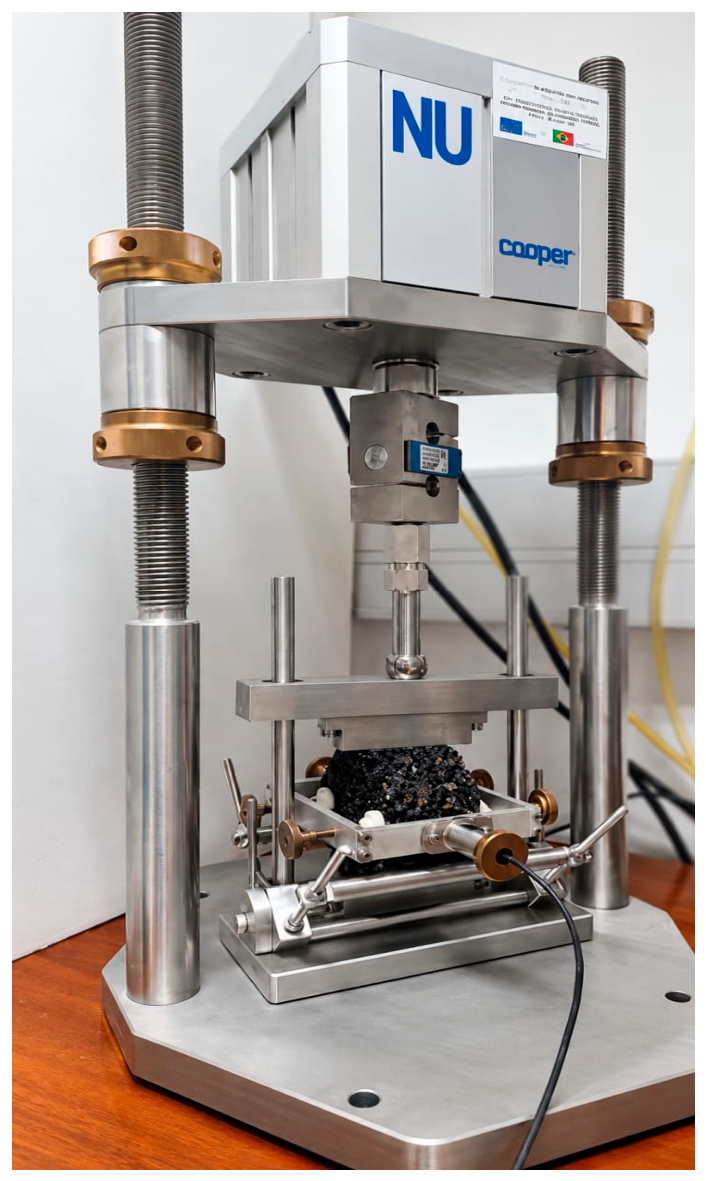
The stiffness modulus of the asphalt mixtures was determined in accordance with NP EN 12697-26 [52] using the indirect tensile stiffness modulus (ITSM) test, performed at 20 °C on compacted cylindrical specimens, as shown in Figure 5. For each formulation, five specimens were tested, with the load applied in two diametrically opposite directions in order to improve the repeatability of the obtained results The stiffness modulus values should also be interpreted considering the curing state of the mixtures. Yang et al. demonstrated that curing history and compaction method significantly affect the volumetric and mechanical properties of cold-recycled mixtures with asphalt emulsion [62]. Likewise, Du et al. reported that the mechanical properties of emulsified asphalt cold recycled mixtures evolve substantially during the first 28 days of curing, including changes in splitting tensile modulus [63]. This reinforces the need to discuss stiffness results within the specific testing and curing conditions adopted in this study.
Table 7 presents the average stiffness modulus of five specimens obtained for the three formulated cold asphalt mixtures and for the commercial mixture CCM2. Among the evaluated formulations, ACM3 exhibited the lowest stiffness modulus, at 210 MPa, indicating a more flexible behavior. In contrast, mixtures ACM1 and ACM2 showed higher stiffness values, 1030 MPa and 642 MPa, respectively, reflecting a stiffer response. CCM2 was the only commercial mixture for which results could be obtained, since the specimens of the remaining commercial mixtures disintegrated during testing, yielding a stiffness modulus of 592 MPa. The differences observed among the tested mixtures agree with previous findings for cold recycled asphalt materials. Orosa et al. reported that the stiffness response of mixtures containing RAP is strongly affected by air void content, RAP characteristics, and compaction conditions [64]. Similarly, Liu and Sun highlighted those variations in compaction methods that modify the internal structure of cold recycled mixtures, influencing their volumetric properties and mechanical response [65]. These factors may help explain the marked differences between ACM1, ACM2, ACM3, and CCM2.
The stiffness values should also be interpreted together with the expected cracking response of cold asphalt systems. Chen et al. observed that increasing the proportion of recycled aggregate in emulsified cold recycled mixtures can reduce mechanical strength while improving low temperature flexibility [66]. In a related study, Yu et al. showed that enhanced deformation capacity and optimized binder formulation improve the cracking resistance of cold asphalt mixtures [67]. These findings support the idea that a lower modulus, such as that observed for ACM3, does not necessarily indicate inadequate performance when the material is intended for flexible repair applications.
Overall, these results confirm that increasing stiffness reduces mixture flexibility. However, the lower modulus observed for ACM3 may be advantageous in pothole repair applications, since greater flexibility can reduce cracking susceptibility and the subsequent risk of raveling in service. This interpretation is consistent with studies focused on cold repair materials. Hafezzadeh et al. emphasized that cold mix patching materials should not be evaluated only in terms of strength, since workability, bonding, and resistance to surface deterioration are also critical for effective pothole repair [15]. Likewise, Wang et al. reported that cold repaired asphalt mixtures require a balance between flexibility, strength, and durability, particularly under adverse service conditions [60]. Therefore, the lower stiffness of ACM3 may be beneficial for localized repair applications, provided that adequate cohesion is maintained.

3.4. Water Sensitivity

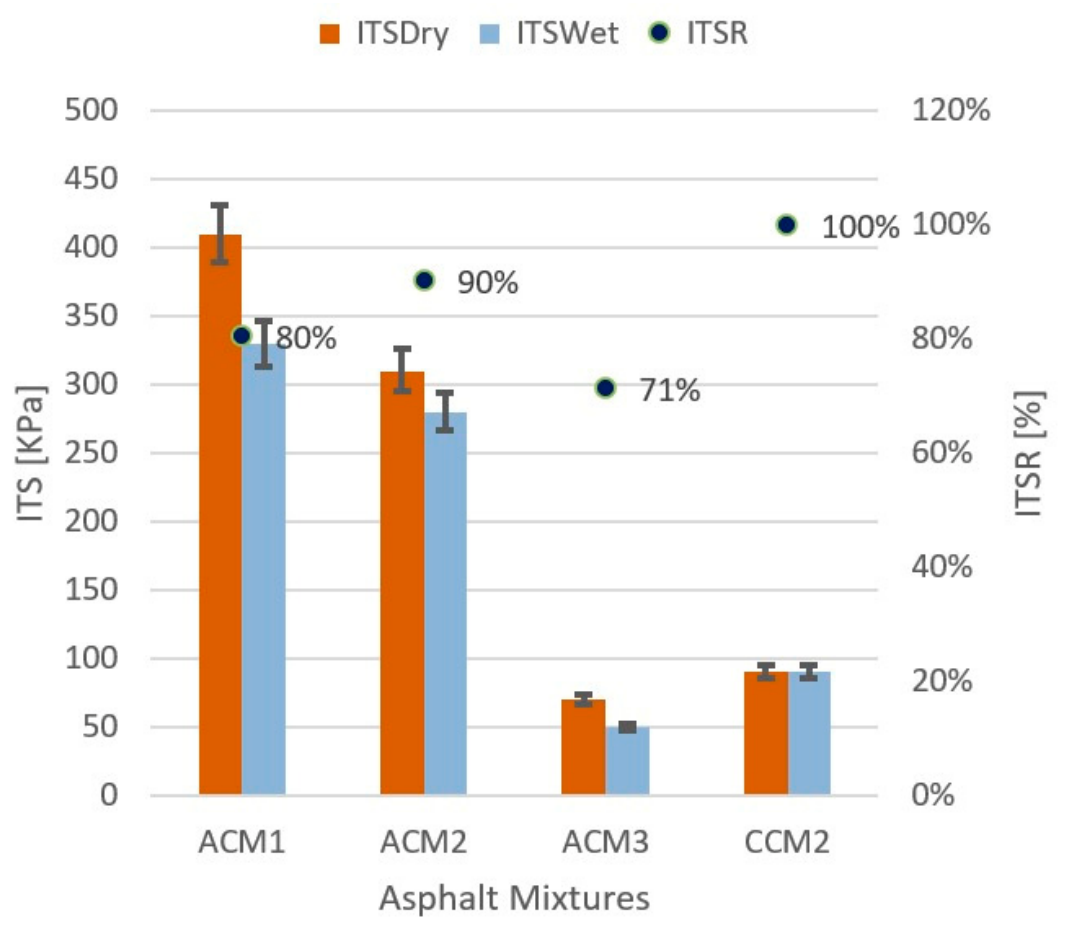
The water sensitivity results are presented in Figure 6, which shows the indirect tensile strength (ITS) measured under dry conditions and after immersion, as well as the corresponding indirect tensile strength ratio (ITSR), calculated from Equation (4). Overall, the conditioning protocol produced distinct responses depending on mixture composition. Similar trends have been reported for cold recycled and emulsion-based asphalt mixtures. Hou et al. showed that moisture migration and pore-structure evolution directly influence the mechanical development of emulsified asphalt cold recycled mixtures [68]. Likewise, Chen et al. found that water resistance varies with RAP proportion, cement addition, curing time, and emulsified asphalt content [66]. These findings support the different responses observed in the mixtures after immersion.
All mixtures produced in the laboratory showed a decrease in ITSR after immersion. ACM1 decreased from 410 kPa under dry conditions to 330 kPa under immersion conditions, resulting in an ITSR of 81%. ACM2 decreased from 310 kPa to 280 kPa, with an ITSR of 90%, while ACM3 decreased from 70 kPa to 50 kPa, yielding an ITSR of 71%. CCM2 remained unchanged at 90 kPa, resulting in an ITSR of 100%. The differences observed among the mixtures are also consistent with the importance of internal bonding and formulation in moisture resistance. Zhang et al. reported that improved adhesion and interface fusion between emulsified asphalt and RAP enhance stripping resistance and water stability in cold recycled mixtures [69]. Similarly, Phan et al. showed that changes in cold asphalt mixture composition can substantially affect moisture vulnerability and stripping performance [70]. This helps explain the higher retained strength of ACM2 compared with the lower ITSR obtained for ACM3. Although Estradas de Portugal [47], does not establish specific ITSR limits for cold asphalt mixtures, minimum values of 75% for MBA-BBA and 65% for MBR-BBR are defined for surface courses, and the developed mixtures meet these reference requirements. Although direct comparison should be made cautiously because of differences in materials, conditioning procedures, and mixture design, the use of ITSR as an indicator of retained tensile performance is consistent with previous studies on cold recycled asphalt mixtures. Han et al. evaluated tensile strength ratio together with long-term strength development in emulsified cold recycled mixtures [71], while Tavassoti et al. considered moisture damage resistance as a key criterion in the design of cold mixes produced with 100% RAP [72]. This supports the interpretation of the ITSR results obtained for ACM1, ACM2, and ACM3.

4. Discussion

The results show that cold asphalt mixtures with RAP and Panasqueira mine by-products are strongly influenced by recycled material content, binder type, additive selection, and aggregate structure. Overall, the laboratory formulations exhibited complementary performance profiles, demonstrating the technical feasibility of using high levels of recycled materials in rapid pavement repair applications.
Among the studied mixtures, ACM1 presented the most balanced performance, meeting the reference limits for stability, flow, and air voids, while also exhibiting high stiffness and excellent water resistance. ACM2 showed a comparable structural response but lower stability and deformation capacity, indicating the need for further optimization. In contrast, ACM3 showed very low particle loss and greater flexibility, although with limited structural performance [53,54]. These findings are consistent with previous studies highlighting the influence of binder formulation and recycled material composition on the mechanical response of cold asphalt mixtures [4,8].
In terms of aggregate performance, greywacke was not a limiting factor. The material exhibited excellent resistance to fragmentation, with a Los Angeles value of 8.8%, comfortably satisfying national requirements [47], thus confirming its suitability as a durable granular skeleton for cold repair mixtures. This high resistance is particularly relevant in localized repairs, where braking forces and vehicle maneuvers may intensify abrasion and accelerate raveling if the aggregate structure is weak [73,74,75]. Therefore, the mechanical quality of the Panasqueira greywacke supports its use as a sustainable alternative aggregate source, contributing to circular economy objectives through the valorization of mining by-products [21,31].
Binder and additive selection had a direct influence on the mechanical response and durability. In ACM1 and ACM2, the use of a C67BF3 cationic emulsion required careful control of coating and early cohesion, as strength development depends on demulsification and binder–aggregate bonding. This behavior is consistent with Pi et al. [76], who reported the performance of emulsified asphalt cold mixtures depending on gradation, emulsion content and moisture evolution. Similarly, Al-Mohammedawi and Mollenhauer [77] showed that the filler type affects the rheological behavior of bitumen emulsion mastics, supporting the role of hydraulic lime in improving cohesion. In this study, Iterlene was essential to enhance adhesion between the emulsion and greywacke aggregates, ensuring adequate coating and moisture resistance. By contrast, ACM3, produced exclusively with RAP and IterBflux Cold, exhibited very low Cantabro particle loss (1%), indicating strong internal cohesion and reduced susceptibility to raveling. This behavior agrees with Hafezzadeh et al. [4] and Geng et al. [78], who highlighted the importance of fluxing agents and binder systems in improving the performance of cold patching mixtures.
Regarding Marshall performance, ACM1 showed the most suitable response, meeting the required stability, flow, and air void limits, indicating adequate cohesion and deformation capacity. ACM2 presented lower stability and reduced flow, suggesting a stiffer and less deformable structure, while ACM3 showed the lowest stability despite its excellent resistance to particle loss. This confirms that high cohesion does not necessarily translate into sufficient load-bearing capacity. Similar observations were reported by Zhang et al. [79] and Zhou et al. [80] who emphasized the role of binder modification and curing in improving mechanical performance. Liu et al. [81] showed that cold mix epoxy asphalt systems require careful formulation of binder components to achieve early strength and adequate workability, which supports the superior mechanical balance observed in ACM1 compared with the other laboratory and commercial mixtures.
The stiffness modulus results further highlighted the influence of mixture composition. ACM1 exhibited the highest stiffness modulus, with 1030 MPa, followed by ACM2 with 642 MPa, reflecting the contribution of the greywacke aggregate skeleton and the binder system to structural capacity. This is consistent with findings by Zhang et al. [6] and Bao et al. [13], who reported that stiffness development in cold recycled mixtures depends on aggregate interaction, curing, and moisture loss. In contrast, ACM3 showed a much lower modulus, 210 MPa, indicating a more flexible response, which may be attributed to the exclusive use of RAP combined with a fluxing cold binder, allowing greater deformability despite the presence of aged binder. Similar trends were noted by Bi et al. [82], who emphasized that the performance of cold patching asphalt mixtures depends strongly on binder formulation, adhesion development, and cohesion. The commercial mixture CCM2 showed intermediate behavior, with a stiffness modulus of 592 MPa, suggesting that ACM2 can reproduce performance levels comparable to market solutions.
Water sensitivity results confirmed that the mixtures maintained adequate durability despite differences in composition. ACM2 exhibited the best performance (ITSR = 90%), followed by ACM1 (81%) and ACM3 (71%), all above commonly adopted threshold values. The high moisture resistance observed in ACM1 and ACM2 can be attributed to the combined effect of hydraulic lime, cationic emulsion, and improved adhesion, in agreement with Jin et al. [83] and Eleyedath et al. [84] who highlighted the positive effect of active fillers on moisture resistance. Therefore, the ITSR results confirm that adequate binder selection, active filler incorporation, and aggregate coating are essential to preserve durability in cold mixtures for emergency maintenance applications.
Quantitatively, the developed mixtures showed performance comparable to or exceeding that reported for cold asphalt mixtures incorporating RAP and recycled materials. ACM1 achieved Marshall stability within the typical range for emulsified cold mixes (3–8 kN), with adequate flow and air voids. ACM3 exhibited a Cantabro loss of 1%, significantly lower than the 5–15% commonly reported for RAP-based cold patching mixtures, indicating excellent cohesion and resistance to raveling provided by the IterBflux Cold binder. The stiffness modulus of ACM1 (1030 MPa) also exceeded typical values (<800 MPa) for similarly cured cold recycled mixtures, highlighting the beneficial effect of the greywacke aggregate structure and hydraulic lime on mechanical performance.
Overall, the results demonstrate that the mechanical performance of these mixtures is strongly governed by the type and proportion of recycled materials. Greywacke-containing mixtures (ACM1 and ACM2) provided higher stiffness and structural capacity, whereas the RAP-only mixture (ACM3) exhibited greater flexibility and cohesion. ACM2 showed a comparable structural response to CCM2 but requires improvement in stability and deformation capacity. This highlights the need to balance stiffness and deformability according to the specific requirements of pothole repair applications.
Despite these promising results, some limitations of the present study should be acknowledged. The experimental program was conducted exclusively at the laboratory scale, and no environmental assessments, such as leaching tests or life cycle analysis, were performed. Therefore, the long-term environmental behaviors of the mining by-product aggregates, as well as the overall environmental impacts of the proposed mixtures, require further investigation prior to large-scale application.

5. Conclusions and Recommendations

This study demonstrated that cold asphalt mixtures incorporating reclaimed asphalt pavement (RAP) and greywacke mining aggregates can provide technically viable and sustainable solutions for rapid pavement repair, supporting circular economy principles in road engineering [18,19,20,24].
The results confirm that mixture performance is strongly dependent on proper control of gradation, aggregate morphology, binder content, and binder–aggregate compatibility, which govern workability, strength, and durability [15,65]. The greywacke aggregates exhibited excellent mechanical quality (Los Angeles = 8.8%), confirming their suitability as a durable granular skeleton in cold mixtures [41].
Among the developed formulations, ACM1 showed the most balanced performance, with high stiffness (1030 MPa), adequate Marshall properties, and excellent moisture resistance (ITSR = 80%). ACM2 also provided good structural performance, while ACM3, despite its lower stiffness (210 MPa), demonstrated outstanding cohesion and resistance to particle loss (Cantabro loss = 1%), highlighting its potential for flexible, crack-resistant repairs.
The commercial mixtures exhibited significant variability, with some showing insufficient cohesion for testing. CCM2 displayed intermediate behavior (stiffness = 592 MPa; ITSR = 100%; Cantabro loss = 18%), reflecting a compromise between flexibility and durability.
Binder selection proved to be a critical factor: The Iterlene ensured effective coating in greywacke mixtures, while IterBflux Cold provided excellent cohesion in the fully recycled mixture, emphasizing the importance of binder compatibility in cold mix performance [66].
Despite the generally positive results, resistance to particle loss remained a key challenge for some formulations. ACM1 and ACM2 exceeded the 25% Cantabro loss limit specified for cold mixtures [41], indicating susceptibility to raveling, whereas ACM3 demonstrated outstanding performance. This highlights the trade-off between stiffness and cohesion, which must be optimized depending on the intended application.
Overall, RAP and greywacke by-products show strong potential, provided that binder selection, coating efficiency, and curing are properly optimized [67].
Key takeaways:
-
Cold mixtures with RAP and greywacke can achieve competitive mechanical and durability performance;
-
ACM1 is the most balanced formulation for structural capacity, while ACM3 excels in cohesion and raveling resistance;
-
Binder system compatibility is a decisive factor for performance;
-
A trade-off between stiffness and particle loss must be carefully managed.
For future work, it is recommended to (i) assess the influence of RAP variability, considering different sources and milling processes; (ii) evaluate mixture storage stability and shelf life under both laboratory and field conditions; and (iii) conduct full-scale field trials under varying climatic and traffic conditions to validate laboratory findings, with particular attention to in situ compaction, adhesion, moisture resistance, raveling progression, and long-term performance.

Author Contributions

Conceptualization P.C.F.-L., H.P.M.-A. and M.S.F.D.-A.; methodology, P.C.F.-L., H.P.M.-A. and M.S.F.D.-A.; validation, M.S.F.D.-A.; formal analysis, P.C.F.-L., H.P.M.-A. and M.S.F.D.-A.; investigation, P.C.F.-L., H.P.M.-A. and M.S.F.D.-A.; writing—original draft preparation, P.C.F.-L., H.P.M.-A. and M.S.F.D.-A.; writing—review and editing, P.C.F.-L., H.P.M.-A. and M.S.F.D.-A.; supervision, M.S.F.D.-A. All authors have read and agreed to the published version of the manuscript.

Funding

This work is supported with Portuguese national funds by FCT—Foundation for Science and Technology, I.P. in the C-MADE. This research received no external funding.

Institutional Review Board Statement

Not applicable.

Informed Consent Statement

Not applicable.

Data Availability Statement

The data are available upon request.

Conflicts of Interest

The authors declare no conflicts of interest.

References

  1. Li, J.; Li, M.; Wu, H. Key Performance Analysis of Emulsified Asphalt Cold Recycling Mixtures of the Middle Layer of Pavement Structure. Materials 2023, 16, 1613. [Google Scholar] [CrossRef]
  2. Qiao, Y.; Dawson, A.R.; Parry, T.; Flintsch, G.; Wang, W. Flexible Pavements and Climate Change: A Comprehensive Review and Implications. Sustainability 2020, 12, 1057. [Google Scholar] [CrossRef]
  3. Mączka, E.; Mackiewicz, P. Asphalt Mixtures and Flexible Pavement Construction Degradation Considering Different Environmental Factors. Appl. Sci. 2022, 12, 12068. [Google Scholar] [CrossRef]
  4. Hafezzadeh, R.; Autelitano, F.; Giuliani, F. Asphalt-based cold patches for repairing road potholes—An overview. Constr. Build. Mater. 2021, 306, 124870. [Google Scholar] [CrossRef]
  5. Kocak, S.; Haider, S.W. Performance and cost evaluations of 100% recycled hot asphalt mixtures for pothole patching applications in flexible pavements. Constr. Build. Mater. 2023, 392, 131921. [Google Scholar] [CrossRef]
  6. Zhang, W.; Zuo, S.; Zhang, K.; Liu, Z.; Sun, Y.; Ding, B. Second Distress Mechanism of Repaired Potholes and Performance Evaluation of Repair Techniques from Multiple Perspectives. Coatings 2025, 15, 1188. [Google Scholar] [CrossRef]
  7. Jweihan, Y.S.; Al-Kheetan, M.J.; Rabi, M. Empirical Model for the Retained Stability Index of Asphalt Mixtures Using Hybrid Machine Learning Approach. Appl. Syst. Innov. 2023, 6, 93. [Google Scholar] [CrossRef]
  8. Bruno, S.; Cantisani, G.; D’aNdrea, A.; Di Mascio, P.; Fiore, N.; Loprencipe, G.; Moretti, L.; Polidori, C.; Venturini, L. Maintenance and Safety of the Road Infrastructure by a New Robotised System for Pothole Repair. In Transport Research Arena Conference; Springer Nature: Cham, Switzerland, 2026; pp. 463–469. [Google Scholar] [CrossRef]
  9. Fawzy, M.M.; el Shrakawy, A.S.; Hassan, A.A.; Khalifa, Y.A. Enhancing sustainability for pavement maintenance decision-making through image processing-based distress detection. Innov. Infrastruct. Solut. 2024, 9, 58. [Google Scholar] [CrossRef]
  10. Jin, D.; Yin, L.; Malburg, L.; You, Z. Laboratory evaluation and field demonstration of cold in-place recycling asphalt mixture in Michigan low-volume road. Case Stud. Constr. Mater. 2024, 20, e02923. [Google Scholar] [CrossRef]
  11. Dołżycki, B.; Jaskuła, P. Review and evaluation of cold recycling with bitumen emulsion and cement for rehabilitation of old pavements. J. Traffic Transp. Eng. Engl. Ed. 2019, 6, 311–323. [Google Scholar] [CrossRef]
  12. Dash, S.S.; Chandrappa, A.K.; Sahoo, U.C. Design and performance of cold mix asphalt—A review. Constr. Build. Mater. 2022, 315, 125687. [Google Scholar] [CrossRef]
  13. Bao, L.; Guo, R.; Yan, F. Effect of Biodiesel on Performance of Cold Patch Asphalt Mixtures. Materials 2024, 17, 5566. [Google Scholar] [CrossRef]
  14. Bi, Y.; Li, R.; Han, S.; Pei, J.; Zhang, J. Development and Performance Evaluation of Cold-Patching Materials Using Waterborne Epoxy-Emulsified Asphalt Mixtures. Materials 2020, 13, 1224. [Google Scholar] [CrossRef] [PubMed]
  15. Hafezzadeh, R.; Autelitano, F.; Giuliani, F. Performance-related methods for the characterization of cold mix patching materials used in asphalt pavements maintenance. Case Stud. Constr. Mater. 2023, 19, e02600. [Google Scholar] [CrossRef]
  16. Suo, Z.; Xu, S.; Hu, T.; Zhang, Y.; Wang, Y.; Yang, S. Study on Performance of Reactive Diluted Cold Patch Asphalt Fluid. In Advances in Frontier Research on Engineering Structures II; Springer: Singapore, 2025; Volume 525, pp. 115–130. [Google Scholar] [CrossRef]
  17. Nanda, H.; Siddagangaiah, A.K. Effect of RAP fractionation and dosage on design and mechanical behaviour of cold asphalt mixes. Constr. Build. Mater. 2024, 422, 135773. [Google Scholar] [CrossRef]
  18. Boateng, K.A.; Tuffour, Y.A.; Obeng-Atuah, D.; Agyeman, S. Quality of cold-mix asphalt in bituminous pavement maintenance in Ghana: Preliminary indications. Case Stud. Constr. Mater. 2021, 15, e00769. [Google Scholar] [CrossRef]
  19. Dulaimi, A.; Al-Busaltan, S.; Kadhim, M.A.; Al-Khafaji, R.; Sadique, M.; Al Nageim, H.; Ibrahem, R.K.; Awrejcewicz, J.; Pawłowski, W.; Mahdi, J.M. A Sustainable Cold Mix Asphalt Mixture Comprising Paper Sludge Ash and Cement Kiln Dust. Sustainability 2022, 14, 10253. [Google Scholar] [CrossRef]
  20. Li, Y.; Lyv, Y.; Fan, L.; Zhang, Y. Effects of Cement and Emulsified Asphalt on Properties of Mastics and 100% Cold Recycled Asphalt Mixtures. Materials 2019, 12, 754. [Google Scholar] [CrossRef]
  21. Moyano-Ayala, H.P.; Dinis-Almeida, M.S.F. Mechanical Performance of Sustainable Asphalt Mixtures Incorporating RAP and Panasqueira Mine Waste. Constr. Mater. 2025, 5, 52. [Google Scholar] [CrossRef]
  22. Li, X.; Zhou, Z.; Ye, J.; Zhang, X.; Wang, S.; Diab, A. High-temperature creep and low-temperature relaxation of recycled asphalt mixtures: Evaluation and balanced mix design. Constr. Build. Mater. 2021, 310, 125222. [Google Scholar] [CrossRef]
  23. Mashaan, N.S.; Oguntayo, D.O.; Dassanayake, C. Waste By-Products in Asphalt Concrete Pavement Construction: A Review. Materials 2025, 18, 4092. [Google Scholar] [CrossRef]
  24. Mantalovas, K.; Graziano, F.; Teresi, R.; Mangano, M.C.; Sarà, G.; Celauro, C. Life Cycle Assessment of Asphalt Mixtures Incorporating Secondary Raw Materials Under a Circular Economy Perspective. Sustainability 2025, 17, 10869. [Google Scholar] [CrossRef]
  25. Choudhary, J.; Kumar, B.; Gupta, A. Utilization of solid waste materials as alternative fillers in asphalt mixes: A review. Constr. Build. Mater. 2020, 234, 117271. [Google Scholar] [CrossRef]
  26. Raposeiras, A.C.; Movilla-Quesada, D.; Muñoz-Cáceres, O.; Andrés-Valeri, V.C.; Lagos-Varas, M. Production of asphalt mixes with copper industry wastes: Use of copper slag as raw material replacement. J. Environ. Manag. 2021, 293, 112867. [Google Scholar] [CrossRef]
  27. Zhang, K.; Zhang, W.; Xie, W.; Luo, Y.; Wei, G. Investigation of mechanical properties, chemical composition and microstructure for composite cementitious materials containing waste powder recycled from asphalt mixing plants. J. Build. Eng. 2024, 96, 110362. [Google Scholar] [CrossRef]
  28. Sukhija, M.; Coleri, E. A systematic review on the role of reclaimed asphalt pavement materials: Insights into performance and sustainability. Clean. Mater. 2025, 16, 100316. [Google Scholar] [CrossRef]
  29. Song, Y.; Xu, H.; Wu, S.; Xie, J.; Chen, A.; Lv, Y.; Cheng, Y.; Li, Y. High-quality utilization of reclaimed asphalt pavement (RAP) in asphalt mixture with the enhancement of steel slag and epoxy asphalt. Constr. Build. Mater. 2024, 445, 137963. [Google Scholar] [CrossRef]
  30. Elnihum, A.; Lu, Q.; Alharthai, M.; Alamri, M.; Chen, C.; Elmagarhe, A. Evaluation of an Asphalt Mixture Containing a High Content of Reclaimed Asphalt Pavement (RAP) Materials with Epoxy Asphalt. Sustainability 2024, 16, 4988. [Google Scholar] [CrossRef]
  31. Marignac, C.; Cuney, M.; Cathelineau, M.; Lecomte, A.; Carocci, E.; Pinto, F. The Panasqueira Rare Metal Granite Suites and Their Involvement in the Genesis of the World-Class Panasqueira W–Sn–Cu Vein Deposit: A Petrographic, Mineralogical, and Geochemical Study. Minerals 2020, 10, 562. [Google Scholar] [CrossRef]
  32. Mateus, M.; Noronha, F.; Pinto, F. The Panasqueira Mine (Portugal): A Landmark in W (-Sn-Cu) Mining and Geological Research. SGA News 2025, 56, 44–55. Available online: https://www.researchgate.net/publication/391768972_The_Panasqueira_Mine_Portugal_a_landmark_in_W_-Sn-Cu_mining_and_geological_research (accessed on 24 April 2026).
  33. Monteiro, L.S.V.E.; Bandarra, B.S.; Quina, M.J.; Coelho, P.A.L.F. A multidisciplinary evaluation of mixtures of municipal solid waste incineration bottom ash and mine tailings for sustainable geotechnical solutions. Constr. Build. Mater. 2024, 455, 139139. [Google Scholar] [CrossRef]
  34. Solouki, A.; Viscomi, G.; Lamperti, R.; Tataranni, P. Quarry Waste as Precursors in Geopolymers for Civil Engineering Applications: A Decade in Review. Materials 2020, 13, 3146. [Google Scholar] [CrossRef]
  35. EN 933-1:2012; Tests for Geometrical Properties of Aggregates—Part 1: Determination of Particle Size Distribution-Sieving Method. CEN—European Committee for Standardization: Brussels, Belgium, 2012. Available online: https://standards.iteh.ai/catalog/standards/cen/100b983f-85a4-4a80-934c-e93c584dbdb4/en-933-1-2012?srsltid=AfmBOopNdLqu051OZ95mNmBGqhoEZavu2fYBmNJuf_fkxjaatCjKInrd (accessed on 24 April 2026).
  36. EN 13075-1:2016; Bitumen and Bituminous Binders—Determination of Breaking Behaviour—Part 1: Determination of Breaking Value of Cationic Bituminous Emulsions, Mineral Filler Method. CEN—European Committee for Standardization: Brussels, Belgium, 2016. Available online: https://standards.iteh.ai/catalog/standards/cen/5ed21851-dd43-4a81-827c-385904644f19/en-13075-1-2016?srsltid=AfmBOoqUsvuVk_4KeienPW9EYDCTWcCcGjE-McvPoOfjd3rDhP8qh46v (accessed on 24 April 2026).
  37. EN 1431:2018; Bitumen and Bituminous Binders—Determination of Residual Binder and Oil Distillate from Bitumen Emulsions by Distillation. CEN—European Committee for Standardization: Brussels, Belgium, 2018. Available online: https://standards.iteh.ai/catalog/standards/cen/8e818c03-dd9a-4ce6-80d5-d8d41d85a81e/en-1431-2018?srsltid=AfmBOoqfMB9UUfZ3cBt6_Pa_hNGJWNbbIv-g1D8wT1SipdgjQIANavZl (accessed on 24 April 2026).
  38. EN 12846-1:2022; Bitumen and Bituminous Binders—Determination of Efflux Time by the Efflux Viscometer—Part 1: Bituminous Emulsions. CEN—European Committee for Standardization: Brussels, Belgium, 2022. Available online: https://standards.iteh.ai/catalog/standards/cen/beb6fbbc-ed98-4499-8bef-ac4f625f094d/en-12846-1-2022?srsltid=AfmBOopQRFeCwHygMbTo5vPigJN6CpVWQU1ZdwUq-pueaqrN6bkoQboE (accessed on 24 April 2026).
  39. EN 1429:2013; Bitumen and Bituminous Binders—Determination of Residue on Sieving of Bituminous Emulsions, and Determination of Storage Stability by Sieving. CEN—European Committee for Standardization: Brussels, Belgium, 2013. Available online: https://standards.iteh.ai/catalog/standards/cen/c4a9f5dd-3755-4e91-b1b1-ead18c0fdc12/en-1429-2013?srsltid=AfmBOooawoPJ4ZAt1YU09OQoEKcIR6B2iXkRlqoBl65SJ1pmPIpAyRZt (accessed on 24 April 2026).
  40. EN 12847:2022; Bitumen and Bituminous Binders—Determination of Settling Tendency of Bituminous Emulsions. CEN—European Committee for Standardization: Brussels, Belgium, 2022. Available online: https://standards.iteh.ai/catalog/standards/cen/61c6a04e-e29b-46b4-9041-4a572a856081/en-12847-2022?srsltid=AfmBOopbVBbcapaPJJQE8hQ58ELLTiA58R2WUYkGFNtzq6Mj6ge0hHRA (accessed on 24 April 2026).
  41. EN 12697-1:2020; Bituminous Mixtures—Test Methods—Part 1: Soluble Binder Content. CEN—European Committee for Standardization: Brussels, Belgium, 2020. Available online: https://standards.iteh.ai/catalog/standards/cen/11612a5a-5f05-41cb-869f-a6b8abd60c3f/en-12697-1-2020?srsltid=AfmBOoqeLAS0NmnaSQfeYOtd4zGnXhGGfiGv2PhKQD8utQvug1ZWIt5N (accessed on 24 April 2026).
  42. EN 1426:2024; Bitumens and Bituminous Binders—Determination of Needle Penetration. CEN—European Committee for Standardization: Brussels, Belgium, 2024. Available online: https://standards.iteh.ai/catalog/standards/cen/69de2641-b52b-4730-bafa-c50c63f81b12/en-1426-2024?srsltid=AfmBOorIPsxfJ4CTGyJyjG9YId-6LXL4gX80jLcNkreRzLrAIZa2eDOA (accessed on 24 April 2026).
  43. EN 1427:2015; Bitumen and Bituminous Binders—Determination of the Softening Point—Ring and Ball Method. CEN—European Committee for Standardization: Brussels, Belgium, 2015. Available online: https://standards.iteh.ai/catalog/standards/cen/0edd2612-e3e1-43b4-b533-8debe5c55040/en-1427-2015?srsltid=AfmBOooNldAj4HtLPQIwASicTbfwZ5a2K-UeGlfeUogwfR5B9N-hNfje (accessed on 24 April 2026).
  44. EN 1097-2:2020; Tests for Mechanical and Physical Properties of Aggregates—Part 2: Methods for the Determination of Resistance to Fragmentation. CEN—European Committee for Standardization: Brussels, Belgium, 2020. Available online: https://standards.iteh.ai/catalog/standards/cen/2b59008c-ab4d-428f-9e85-780705498a57/en-1097-2-2020?srsltid=AfmBOopTNXmzrtcbBiq346HutK_7oSQROPnD_aBuTtBs6LTr7GJT-qHB (accessed on 24 April 2026).
  45. EN 1097-6:2022; Tests for Mechanical and Physical Properties of Aggregates—Part 6: Determination of Particle Density and Water Absorption. CEN—European Committee for Standardization: Brussels, Belgium, 2022. Available online: https://standards.iteh.ai/catalog/standards/cen/7eb55eec-cf2d-449c-bdf5-45534b169181/en-1097-6-2022?srsltid=AfmBOorvBNEvL1AtLPyAscZ4_FkkmAgoACJ2uVdxlaXNDS8Aww8tJ4ga (accessed on 13 May 2026).
  46. EN 933-3:2012; Tests for Geometrical Properties of Aggregates—Part 3: Determination of Particle Shape—Flakiness Index. CEN—European Committee for Standardization: Brussels, Belgium, 2012. Available online: https://standards.iteh.ai/catalog/standards/cen/0ccc19d3-9861-4d02-b943-5f166e7cf6d6/en-933-3-2012?srsltid=AfmBOoorZoLmxKMHc_zwEthGN9x_RTKE9iZKxzbt9LGnEjtVqPFTjdCa (accessed on 13 May 2026).
  47. Estradas de Portugal, S.A. Caderno de Encargos Tipo Obra (CETO), 14.03-Pavimentação Características dos Materiais. Available online: https://servicos.infraestruturasdeportugal.pt/sites/default/files/pdfs/infraestruturas/14_03_set_2014.pdf (accessed on 24 April 2026).
  48. Batista, F.A.; Antunes, M.L. Asphalt Cold Mixtures for Pavement Rehabilitation: Curing and Mechanical Characteristics. In Proceedings of the International Conferences on the Bearing Capacity of Roads, Railways and Airfields, Trondheim, Norway, 25–27 June 2005; Available online: https://www.ntnu.no/ojs/index.php/BCRRA/article/view/3186 (accessed on 13 May 2026).
  49. EN 12697-17:2017; Bituminous Mixtures—Test Methods—Part 17: Particle Loss of Porous Asphalt Specimens. CEN—European Committee for Standardization: Brussels, Belgium, 2017. Available online: https://standards.iteh.ai/catalog/standards/cen/6be521b4-d355-458b-83bb-11c90a00df2e/en-12697-17-2017?srsltid=AfmBOorshvnMQICvV4p4ElVLZ4wHE2JGCEOUVjFzdNmEOFaxH4uoeGCF (accessed on 25 April 2026).
  50. EN 12697-34:2020; Bituminous Mixtures—Test Methods—Part 34: Marshall Test. CEN—European Committee for Standardization: Brussels, Belgium, 2020. Available online: https://standards.iteh.ai/catalog/standards/cen/3932b867-10ea-4628-9113-dde2768f04b6/en-12697-34-2020?srsltid=AfmBOoqqvGygZ4HxQVJzvAf6uU-wIzL6xG36GpM300SNbsEq648Xod8F (accessed on 24 April 2026).
  51. EN 12697-6:2020; Bituminous Mixtures—Test Methods—Part 6: Determination of Bulk Density of Bituminous Specimens. CEN—European Committee for Standardization: Brussels, Belgium, 2020. Available online: https://standards.iteh.ai/catalog/standards/cen/c02553f4-7a24-43c8-bbcd-6cdb7b516662/en-12697-6-2020?srsltid=AfmBOoq5C-bGj51rwLoXP_p34Uwohly4r6nxFi7ouYhX3CXutoybA8P0 (accessed on 24 April 2026).
  52. EN 12697-26:2018+A1:2022; Bituminous Mixtures—Test Methods—Part 26: Stiffness. CEN—European Committee for Standardization: Brussels, Belgium, 2022. Available online: https://standards.iteh.ai/catalog/standards/cen/4f6c3726-f142-4a05-be4d-ae9f0bbb5fb4/en-12697-26-2018a1-2022?srsltid=AfmBOoqUMxJBI5wT4TG91EDk3tRt7CtBD1oWWXgWC5NbCBCRZ77KGo98 (accessed on 24 April 2026).
  53. Usman, K.R.; Hainin, M.R.; Satar, M.K.I.M.; Warid, M.N.M.; Kamarudin, S.N.N.; Abdulrahman, S. Palm oil fuel ash application in cold mix dense-graded bituminous mixture. Constr. Build. Mater. 2021, 287, 123033. [Google Scholar] [CrossRef]
  54. Xiao, J.; Jiang, W.; Ye, W.; Shan, J.; Wang, Z. Effect of cement and emulsified asphalt contents on the performance of cement-emulsified asphalt mixture. Constr. Build. Mater. 2019, 220, 577–586. [Google Scholar] [CrossRef]
  55. Al-Saffar, Z.H.; Hasan, H.G.M.; Abdulmawjoud, A.A.; Bilema, M.; Alharthai, M. Tailored enhancement of reclaimed asphalt pavement with waste engine oil/vacuum residue blend as rejuvenating agent. Constr. Build. Mater. 2023, 409, 133936. [Google Scholar] [CrossRef]
  56. Yang, B.; Jiang, J.; Wang, H.; Leng, Z.; Sui, X.; Jiang, X. Optimization design of asphalt emulsion with rejuvenator towards a uniform distribution inside the damaged porous asphalt mixture for a better ravelling resistance. Case Stud. Constr. Mater. 2024, 21, e03747. [Google Scholar] [CrossRef]
  57. DeLaFuente-Navarro, C.; Lastra-González, P.; Indacoechea-Vega, I.; Castro-Fresno, D. Novel cold asphalt mixture featuring fast curing and self-healing by means of magnetic induction. Case Stud. Constr. Mater. 2024, 21, e03799. [Google Scholar] [CrossRef]
  58. Tedla, T.A.; Singh, D.; Showkat, B. Effects of air voids on comprehensive laboratory performance of cold mix containing recycled asphalt pavement. Constr. Build. Mater. 2023, 368, 130416. [Google Scholar] [CrossRef]
  59. Flores, G.; Gallego, J.; Miranda, L.; Marcobal, J.R. Cold asphalt mix with emulsion and 100% rap: Compaction energy and influence of emulsion and cement content. Constr. Build. Mater. 2020, 250, 118804. [Google Scholar] [CrossRef]
  60. Wang, T.; Zhang, X.; Cheng, Z.; Shen, D.; Tan, J.; Xie, S.; Zhang, C.; Sun, G.; Xu, Y.; Xu, C. Road performance of cold repaired asphalt mixture with new green maintenance materials. Case Stud. Constr. Mater. 2024, 21, e03959. [Google Scholar] [CrossRef]
  61. Pei, Z.; Yi, J.; Fan, L.; Yu, W.; Hai, B.; Feng, D. Analysis of the trend in evolution of multilevel mechanical properties of solvent-based cold mixed liquid asphalt and mixture. Constr. Build. Mater. 2022, 335, 127476. [Google Scholar] [CrossRef]
  62. Yang, W.; Ouyang, J.; Meng, Y.; Han, B.; Sha, Y. Effect of curing and compaction on volumetric and mechanical properties of cold-recycled mixture with asphalt emulsion under different cement contents. Constr. Build. Mater. 2021, 297, 123699. [Google Scholar] [CrossRef]
  63. Du, H.; Li, R.; Zhu, H.; Qi, P.; Lei, L.; Yang, S.; Tan, Q.; Xu, Y.; Yang, Y. Evolutive properties of emulsified asphalt cold recycled mixtures at early stage. Constr. Build. Mater. 2024, 456, 139320. [Google Scholar] [CrossRef]
  64. Orosa, P.; Orozco, G.; Carret, J.C.; Carter, A.; Pérez, I.; Pasandín, A.R. Compactability and mechanical properties of cold recycled mixes prepared with different nominal maximum sizes of RAP. Constr. Build. Mater. 2022, 339, 127689. [Google Scholar] [CrossRef]
  65. Liu, Z.; Sun, L. A review of effect of compaction methods on cold recycling asphalt mixtures. Constr. Build. Mater. 2023, 401, 132758. [Google Scholar] [CrossRef]
  66. Chen, K.P.; Zhang, P.; Peng, Y.; Yang, Q.-G.; Miao, J.-K.; Ren, S.; Li, Z.; Jiang, X.; Zhang, J. Study on the performance of cold recycled emulsified asphalt mixture under multi-factor coupling action. Case Stud. Constr. Mater. 2025, 22, e04536. [Google Scholar] [CrossRef]
  67. Yu, J.; Feng, Z.; Chen, Y.; Yu, H.; Korolev, E.; Obukhova, S.; Zou, G.; Zhang, Y. Investigation of cracking resistance of cold asphalt mixture designed for ultra-thin asphalt layer. Constr. Build. Mater. 2024, 414, 134941. [Google Scholar] [CrossRef]
  68. Hou, S.; Tian, W.; Tan, J. Investigation of the moisture migration mechanism in emulsified asphalt cold recycled mixtures using low-field nuclear magnetic resonance. Constr. Build. Mater. 2025, 487, 142061. [Google Scholar] [CrossRef]
  69. Zhang, Y.; Li, J.; Ma, T.; Liu, H.; Chen, C.; Hao, J. Cold recycled mixtures prepared with finely separated RAP aggregates and modified emulsified asphalt: Adhesive performance and interface fusion characteristics. Constr. Build. Mater. 2025, 493, 143122. [Google Scholar] [CrossRef]
  70. Phan, T.M.; Kang, S.P.; Vo, H.V.; Park, D.W. Evaluation on performances of cold asphalt mixture containing recycled waste glass and red mud. Case Stud. Constr. Mater. 2024, 20, e03194. [Google Scholar] [CrossRef]
  71. Han, D.; Liu, G.; Xi, Y.; Zhao, Y. Research on long-term strength formation and performance evolution with curing in cold recycled asphalt mixture. Case Stud. Constr. Mater. 2023, 18, e01757. [Google Scholar] [CrossRef]
  72. Tavassoti, P.; Solaimanian, M.; Chen, X. Characterization of fatigue performance of cold mix recycled asphalt mixtures through uniaxial tension–compression testing. Constr. Build. Mater. 2022, 329, 127155. [Google Scholar] [CrossRef]
  73. Sun, Z.; Ma, Y.; Liu, S.; Li, Y.; Qiu, X.; Luo, Z. Evaluation of engineering properties of Fiber-reinforced Usual-temperature Synthetic Pitch (USP) modified cold mix patching asphalt. Case Stud. Constr. Mater. 2022, 16, e00997. [Google Scholar] [CrossRef]
  74. Wang, T.; Dra, Y.A.S.S.; Cai, X.; Cheng, Z.; Zhang, D.; Lin, Y.; Yu, H. Advanced cold patching materials (CPMs) for asphalt pavement pothole rehabilitation: State of the art. J. Clean. Prod. 2022, 366, 133001. [Google Scholar] [CrossRef]
  75. Xie, W.; Li, L.; Yang, R. Multiscale Evaluation System for Cold Patch Asphalt Mixtures: Integrating Macro-Performance Tests and Meso-Structural CT Analysis. Appl. Sci. 2025, 15, 7121. [Google Scholar] [CrossRef]
  76. Pi, Y.; Li, Y.; Pi, Y.; Huang, Z.; Li, Z. Strength and Micro-Mechanism Analysis of Cement-Emulsified Asphalt Cold Recycled Mixture. Materials 2020, 13, 128. [Google Scholar] [CrossRef]
  77. Al-Mohammedawi, A.; Mollenhauer, K. A Study on the Influence of the Chemical Nature of Fillers on Rheological and Fatigue Behavior of Bitumen Emulsion Mastic. Materials 2020, 13, 4627. [Google Scholar] [CrossRef]
  78. Geng, L.; Xu, Q.; Yu, X.; Jiang, C.; Zhang, Z.; Li, C. Laboratory performance evaluation of a cold patching asphalt material containing cooking waste oil. Constr. Build. Mater. 2020, 246, 117637. [Google Scholar] [CrossRef]
  79. Zhang, Y.; Chen, Z.; Zhang, X.; Zhang, Y.; Zhu, X.; Li, Q.; Liu, S. Investigation of the Water Damage Resistance and Storability of a SEBS-Modified Cold-Patching Asphalt Mixture. Polymers 2022, 14, 5191. [Google Scholar] [CrossRef]
  80. Zhou, C.; Peng, M.; Yang, X.; Qi, Y.; Xu, B. Study of the Cold Curing Characteristics of Isocyanate-Modified Asphalt. Materials 2024, 17, 1048. [Google Scholar] [CrossRef]
  81. Liu, Y.; Qian, Z.; Wang, Y.; Xue, Y. Development and Laboratory Evaluation of a Cold Mix High-Early-Strength Epoxy Asphalt Concrete for Steel Bridge Deck Pavements. Materials 2021, 14, 4555. [Google Scholar] [CrossRef]
  82. Bi, C.; Wang, X.; Fu, J.; Zhao, H.; Zheng, M.; Xu, J. Study on the Filler Composition Optimization and Performance Evaluation of Cold-Patch Asphalt Mixture. Materials 2025, 18, 3894. [Google Scholar] [CrossRef]
  83. Jin, D.; Ge, D.; Chen, S.; Che, T.; Liu, H.; Malburg, L.; You, Z. Cold In-Place Recycling Asphalt Mixtures: Laboratory Performance and Preliminary M-E Design Analysis. Materials 2021, 14, 2036. [Google Scholar] [CrossRef]
  84. Eleyedath, A.; Ali, A.; Mehta, Y. Cold Central Plant Recycling Mixtures for High-Volume Pavements: Material Design, Performance, and Design Implications. Materials 2025, 18, 3345. [Google Scholar] [CrossRef]
Figure 1. Greywacke aggregates from the Panasqueira Mine: (a) Stone Dust, (b) gravel 2/12.5.
Sustainability 18 05147 g001
Figure 2. Gradation curves of the formulated mixtures (ACM1, ACM2, and ACM3) and commercial mixtures (CCM1, CCM2, and CCM3).
Sustainability 18 05147 g002
Figure 3. Binder–aggregate adhesion tests on greywacke with different additives: (a) without additive (≈70% coating); (b) with 0.3% Interlene PE-31/F (≈85% coating); (c) with 0.1% Interlene SL/100-P (100% coating).
Sustainability 18 05147 g003
Figure 4. Cantabro Test Results.
Sustainability 18 05147 g004
Figure 5. Indirect Tensile Stiffness Modulus (ITSM).
Sustainability 18 05147 g005
Figure 6. Water sensitivity test: ITS (kPa) and ITSR (%) (average of 4 specimens).
Sustainability 18 05147 g006
Table 1. Characteristics of the C67BF3 Emulsion.
PropertiesStandardResult
Breaking indexEN 13075-1 [36]115
Binder content, %EN 1431 [37]65
Distillate oil content, %EN 1431 [37]5
Flow time, 4 mm at 40 °C, sEN 12846 [38]8
Sieve residue on 0.500 mm sieve, %EN 1429 [39]0
Sedimentation (7 days), %EN 12847 [40]1
Table 2. Properties of InterBflux Cold.
PropertiesResult
Density 25 °C, g/cm31.00
Viscosity at 25 °C, cP1000–5000
Flash point, °C≥160
Table 3. Gradation of greywacke aggregates, and RAP.
Sieve Size [mm]Cumulative Passing [%]
Greywacke AggregatesRAPHydraulic Lime
Stone DustGravel 2/12.5
12.510074100100
1010062100100
4932268100
261646100
0.063000100
Table 4. Asphalt mixture compositions [%].
AggregateACM1ACM2ACM3
Greywacke Stone Dust510-
Greywacke Gravel 2/12.58089-
Hydraulic lime11-
RAP14-100
Table 5. Properties of adhesion-promoting additives.
PropertiesInterlene PE-31/FInterlene SL/100-PLUS
Density 25 °C [g/cm3]0.85–0.951.0–1.1
Viscosity at 25 °C [cP]250–35015–25
Flash point [°C]≥150≥120
Pour point [°C]≤−5≤−5
Table 6. Mechanical and volumetric properties of the developed cold mixtures.
Bituminous
Mixtures
Bitumen [%]Bulk Density [kg/m3]Marshall
Stability [kN]
Marshall Flow [mm]VMA
[%]
Porosity [%]
ACM17.520798.12.040.524.8
ACM27.421036.21.640.724.9
ACM34.520543.51.229.019.9
CCM23.517322.93.523.712.9
CCM3 1799 42.631.3
Portuguese road requirements>4.0-7.5–152–4>1422–30
Table 7. Stiffness modulus (average of 5 specimens).
Asphalt MixturesStiffness Modulus [MPa]
ACM11030
ACM2642
ACM3210
CCM2592
Disclaimer/Publisher’s Note: The statements, opinions and data contained in all publications are solely those of the individual author(s) and contributor(s) and not of MDPI and/or the editor(s). MDPI and/or the editor(s) disclaim responsibility for any injury to people or property resulting from any ideas, methods, instructions or products referred to in the content.