Article

Repurposing Wastewater from the Cigarette Butt Recycling Process as a Growth Stimulant for Brachiaria ruziziensis Germain & Evrard In Vitro

by
Thais Huarancca Reyes
1,
Lorenzo Guglielminetti
1,* and
Cláudia Roberta Damiani
2
1
Department of Agriculture, Food and Environment, University of Pisa, 56124 Pisa, Italy
2
Faculdade de Ciências Biológicas e Ambientais (FCBA), Universidade Federal da Grande Dourados (UFGD), Dourados 79804-970, MS, Brazil
*
Author to whom correspondence should be addressed.
Sustainability 2026, 18(10), 5150; https://doi.org/10.3390/su18105150
Submission received: 3 February 2026 / Revised: 1 May 2026 / Accepted: 16 May 2026 / Published: 20 May 2026

Abstract

In vitro methods rely on costly chemical inputs, such as synthetic nutrients, prompting us to search for sustainable alternatives. This study evaluated wastewater generated from the cigarette butt (CB) recycling process as a potential growth stimulant additive for in vitro plant cultivation. Seeds of Brachiaria ruziziensis Germain & Evrard were sown on agar media containing increasing CB wastewater concentrations from 0 to 25% v/v (CB0 to CB25, respectively) under controlled conditions. Germination was monitored over 10 days, and functional and physiological traits of shoot and root systems were assessed at the end. Responses were concentration-dependent and consistent with hormesis. Low concentrations, particularly CB2, enhanced germination (92.2% vs. ~67% in CB0), shoot elongation (~6 vs. 3.4 cm), and total biomass (~47 vs. ~33 mg fresh weight), while maintaining total chlorophyll and increasing carotenoids (147.8 vs. 103.3 µg g−1 FW) and chlorophyll a/b ratio (2.1 vs. 1.5). Contrarily, higher concentrations (≥CB10) reduced germination (47.6% at CB25), strongly inhibited root growth (0.5 cm at CB25), decreased total biomass (~19 mg at CB25), led to growth disorders, and reduced pigment stability. These inhibitory effects were associated with the accumulation of CB-derived compounds, including high nicotine levels and unbalanced nutrients. At low concentrations, coordinated root aerenchyma formation and modulation of stomatal density indicated anatomical plasticity under mild stress conditions, although their physiological significance remains to be clarified. Overall, CB recycling-derived wastewater can act as an effective growth stimulant for B. ruziziensis in vitro when applied at low concentrations, offering a potential alternative for plant biotechnology while contributing to waste valorization.

1. Introduction

Waste littering affects ecosystems globally, contributing to environmental pollution and becoming a major concern. Among solid waste, cigarette butts (CBs) are the most common type of litter. Each year, trillions of CBs are improperly discarded and found in diverse locations including cities, beaches, parks, roads, and even protected areas [1]. Their degradation in the environment is slow, although certain conditions, such as the presence of earthworms, can accelerate the process [2,3]. This persistence allows the continuous release of various chemicals trapped in CBs, including nicotine, cyclic aromatic compounds, and heavy metals, which impact both aquatic and terrestrial organisms [4]. In plants, however, the described effects of CBs are more heterogenous. Some studies demonstrate clear phytotoxicity, whereas others describe neutral or even stimulatory effects, depending on the plant species studied, and the experimental conditions applied [5,6,7,8,9,10,11]. These responses have shown to be dose-dependent, in which low concentrations stimulate biological performance while higher concentrations inhibit it, consistent with the concept of hormesis, a phenomenon generated by physical or chemical agents in plants [12].
Recently, researchers have identified, proposed, and evaluated alternative methodologies to address this pervasive litter issue. Among these, CB recycling has emerged as a promising and environmentally responsible solution, consistent with the principles of circular economy and sustainable development [13]. In horticultural applications, it has been demonstrated that filters of CB litter can be converted into a plant-growing substrate for soilless systems [14]. Moreover, other byproducts generated during the recycling process, including wastewater and solid debris, can be reutilized for turfgrass cultivation in a dose-dependent manner. In particular, the weekly application of CB recycling-derived wastewater was found to induce beneficial hormetic responses rather than toxicity, enhancing turf growth and physiological performance [11]. Altogether, these studies underscore the potential of CB recycling to produce multiple products while mitigating its environmental impact.
In vitro methods are widely employed to propagate plant species for recovery of populations, research, and commercial production, as well as to preserve genetic diversity through germplasm banking. However, the success of these methods depends on several critical steps, beginning with the preparation of contaminant-free cultures, which requires diverse chemical compounds such as nutrients and hormones. Moreover, the maintenance of culture lines requires periodic subculturing, leading to increased consumption of reagents and materials, thereby raising overall costs [15]. Therefore, optimizing in vitro methodologies to reduce costs without compromising the quality of the plant material is essential to support diverse sectors such as agriculture, horticulture, forestry, and floriculture. In this context, we hypothesized that CB recycling-derived wastewater may trigger hormetic responses under in vitro conditions, acting as a plant growth stimulant and offering a novel, low-cost alternative to conventional inputs. However, despite some evidence under soil and hydroponic conditions, the effects and potential use of CB leachates under in vitro systems remain largely unknown, where sterility and defined media create a particular environment.
This study aimed to evaluate the potential of wastewater from the CB recycling process as a growth stimulant under in vitro conditions for Brachiaria ruziziensis. Grasses in the genus Brachiaria are monocotyledons of high economic impact in Brazil, widely used in pasture-based systems [16] and maintained in germplasm banks, such as those maintained by the Embrapa institution (https://www.embrapa.br/en/busca-de-projetos/-/projeto/21475/bancos-ativos-de-germoplasma-de-forrageiras, accessed on 28 August 2025), for breeding and conservation purposes. Importantly, these species are widely used under in vitro conditions for germplasm conservation and research applications, making it a suitable model to evaluate alternative resources to common culture media components. In detail, the effects of varying wastewater concentrations in solid media on seed germination, as well as on functional and physiological traits of both shoot and root systems, were assessed over 10 days in order to identify concentrations that do not compromise plant health. By assessing the viability of CB recycling-derived wastewater as a sustainable and low-cost alternative to conventional culture media inputs, this study contributes to novel strategies that integrate waste valorization with plant biotechnology within a controlled in vitro research framework. It should be mentioned that this approach is intended for laboratory conditions and does not propose direct application in agricultural systems, where additional safety and regulatory assessments would be required.

2. Materials and Methods

2.1. Wastewater from CB Recycling Process

The collection and cleaning process of cigarette butts (CBs) were performed as described [14]. Briefly, collected CBs were cleaned in hot distilled water (100 g L–1), and the solids were separated from the liquid through filtration. The wastewater was cooled to room temperature before use.

2.2. Chemical Characterization of CB Wastewater

In the laminar flow cabinet, CB wastewater was filtered through a 0.45 µm filter (Sartorius, Göttingen, Germany) for further chemical and biological analyses. Chemical characterization was performed on CB25 (25% wastewater) as a representative high-exposure condition to assess the maximum content of dissolved compounds into the medium, while pH and electrical conductivity (EC) were determined for all treatments (CB0-CB25).
To determine the concentration of elements, samples were filtered with a 0.22 µm porous membrane, followed by the addition of 1 mL nitric acid (ICP-OES grade) into aliquots of 25 mL. The analysis was performed by an inductively coupled plasma optical emission spectrometry with the ICP-OES system iCAP 7000 Plus Series (Thermo Fisher Scientific, Waltham, MA, USA), operating at a plasma power of 4 kVA, Argon gas with a purity of 99.995%, and a pressure of 0.55 MPa according to Janczak et al. [17]. Multi-element Certipur® standards (Merck, Darmstadt, Germany) were used and the calibration curves for each element were performed as described [17].
To determine nicotine, samples were analyzed by high-resolution GC-MS using a Saturn 2200 quadrupole ion trap mass spectrometer coupled to a CP-3800 gas chromatograph (Varian Analytical Instruments, Walnut Creek, CA, USA) equipped with a MEGA-SE54 HT capillary column (10 m; 0.15 mm i.d., 0.10 µm film thickness, MEGA s.n.c., Milan, Italy) as previously described [14]. Nicotine (CAS 54-11-5) obtained from Merck (Darmstadt, Germany) was used as standard. All other reagents were purchased from Fluka-Sigma-Aldrich (St. Louis, MO, USA).
Total nitrogen (N) was evaluated using the Kjeldahl digestion procedure [18]. The pH and EC were also evaluated using a HI 8520 microprocessor bench-top pH meter (Hanna Instruments, Limena, PD, Italy) and XS COND 7 Vio conductimeter (Giorgio Bormac, Carpi, MO, Italy), respectively. All samples were analyzed in triplicate.

2.3. Plant Material and Growth Conditions

Brachiaria ruziziensis Germain & Evrard (sin. Urochloa ruziziensis) cv. ruziziensis (Fertigrãos—Sementes de Pastagens®, Álvares Machado-SP, Brazil) was used as the material in this study. Medium preparation and sowing were performed inside the laminar flow cabinet to maintain sterile conditions. Seeds of B. ruziziensis were surface-sterilized as previously reported [19] and grown on modified medium (50 mL) in sterile transparent glass bottles (6.5 cm diameter × 10 cm height, 268 mL capacity) with autoclavable plastic lid under a controlled environment (temperature of 25 ± 2 °C, photoperiod 16 h, and light intensity 70 µmol photon m–2 s–1) for 10 days. Modified medium consisted of autoclaved distilled water containing 0.6% agar supplied with 0, 1, 2, 5, 10, and 25% (v/v) of CB recycling process stream (hereafter referred to as CB0, CB1, CB2, CB5, CB10, and CB25, respectively). The selected concentrations (0–25% v/v) were based on preliminary assays showing that concentrations above 25% arrested germination. The experimental unit was defined as the glass bottle, each containing 10 seeds, and each treatment consisted of five independent biological replicates unless otherwise specified.

2.4. Biometric Analysis

Germination (%) was monitored daily in a time course within 10 days after sowing using five bottles per treatment. At 10 days of treatment, plantlets from different bottles per treatment were carefully collected with tweezers and imaged using a digital camera (Pentax X-5; Pentax Ricoh Imaging Company LTD., Tokyo, Japan) to measure shoot (aboveground) and root (belowground) length (cm). Afterwards, plantlets were separated into above- and belowground organs, and then weighed (fresh weight, FW).

2.5. Photosynthetic Pigments

Photosynthetic pigments were extracted and analyzed as reported [20]. Briefly, leaves of B. ruziziensis plantlets were harvested at 10 days of treatment. Samples were grounded in 80% (v/v) acetone solution and incubated at 4 °C in darkness. The absorbance of extracts was measured at 470, 647, and 663 nm by using a DU-8200 UV–VIS spectrophotometer (Drawell, Shanghai, China). Pigments including total chlorophyll (Chla+b) and carotenoid (Car) were determined according to the equations previously represented [21].

2.6. Stomata and Aerenchyma Observation and Quantification

Leaf stomatal density (mm–2) was expressed as the guard cell number of stomata per area, while stomatal size (µm2) was calculated as the guard cell length × guard cell pair width. Images were collected by using an Eclipse E100 optical microscope (Nikon, Tokyo, Japan) at ×40 magnification and processed with ImageJ (v1.54p) (National Institutes of Health, Bethesda, MD, USA). Three plants and three measurements per leaf were examined in the central portion of the leaf, between the midrib and margin. The density of stomata was counted in a field of 144 µm2 for each replica. The length and width of guard cells were measured for at least 12 stomata selected randomly in a replica.
Roots were harvested, and cross-sections were prepared to evaluate aerenchyma formation. Root segments were free-hand cut into cross-sections with double-edge razor blades (Gillette Wilkinson Sword Blade, Edgewell Personal Care, High Wycombe, UK), stained in 10% Giemsa (Merck, Darmstadt, Germany) at room temperature for 5 min, and mounted on slide glass for microscopical observation. Each segment was manually analyzed calculating the root cross-sectional area and aerenchyma area with ImageJ. Results were expressed as the percentage of aerenchyma area relative to the root cross-sectional area. Since CB25 plantlets had extremely small roots, no aerenchyma-related calculations were performed.

2.7. Statistical Analysis

Statistical analysis was performed in GraphPad Prism version 10.0.0 (GraphPad Software, San Diego, CA, USA). Statistical differences between the means of biological replicates were evaluated using one-way analysis of variance (ANOVA), with treatment as the main factor, followed by Tukey’s HSD post hoc tests. Prior to ANOVA, assumptions of normality and homogeneity of variance were assessed using Shapiro–Wilk and Levene’s tests, respectively. Mean differences were considered statistically significant at p < 0.05.

3. Results

3.1. Chemical Properties of CB Wastewater

The pH of the media remained slightly acidic (5.78 on average) with no significant alteration by the presence of CB wastewater across treatments (p > 0.05) (Table 1). In contrast, the EC markedly and significantly increased with CB concentration (p < 0.05), rising from 20.03 µS cm−1 in the control (CB0) to 616.00 µS cm−1 in CB25 (Table 1).
Chemical characterization of CB25 medium, selected as a representative high-exposure treatment, showed a strongly unbalanced nutrient composition (Table 2). Among primary macronutrients, potassium (K) was the predominant one, followed by nitrogen (N), whereas phosphorus (P) was comparatively low, leading to an estimated N:P:K ratio of 15:1:66. Secondary macronutrients such as calcium (Ca) and magnesium (Mg) were found at moderate concentrations, 23.89 and 11.80 mg L−1, respectively. Trace metals such as aluminum (Al), manganese (Mn), iron (Fe), zinc (Zn), and copper (Cu) were present only at low concentrations, while concentrations of nickel (Ni), lead (Pb), cobalt (Co), chromium (Cr), and cadmium (Cd) were below the limit of detection. Notably, nicotine in CB25 reached 2653.67 mg L−1, being the most predominant compound.

3.2. Germination, Morphogenesis, and Biomass

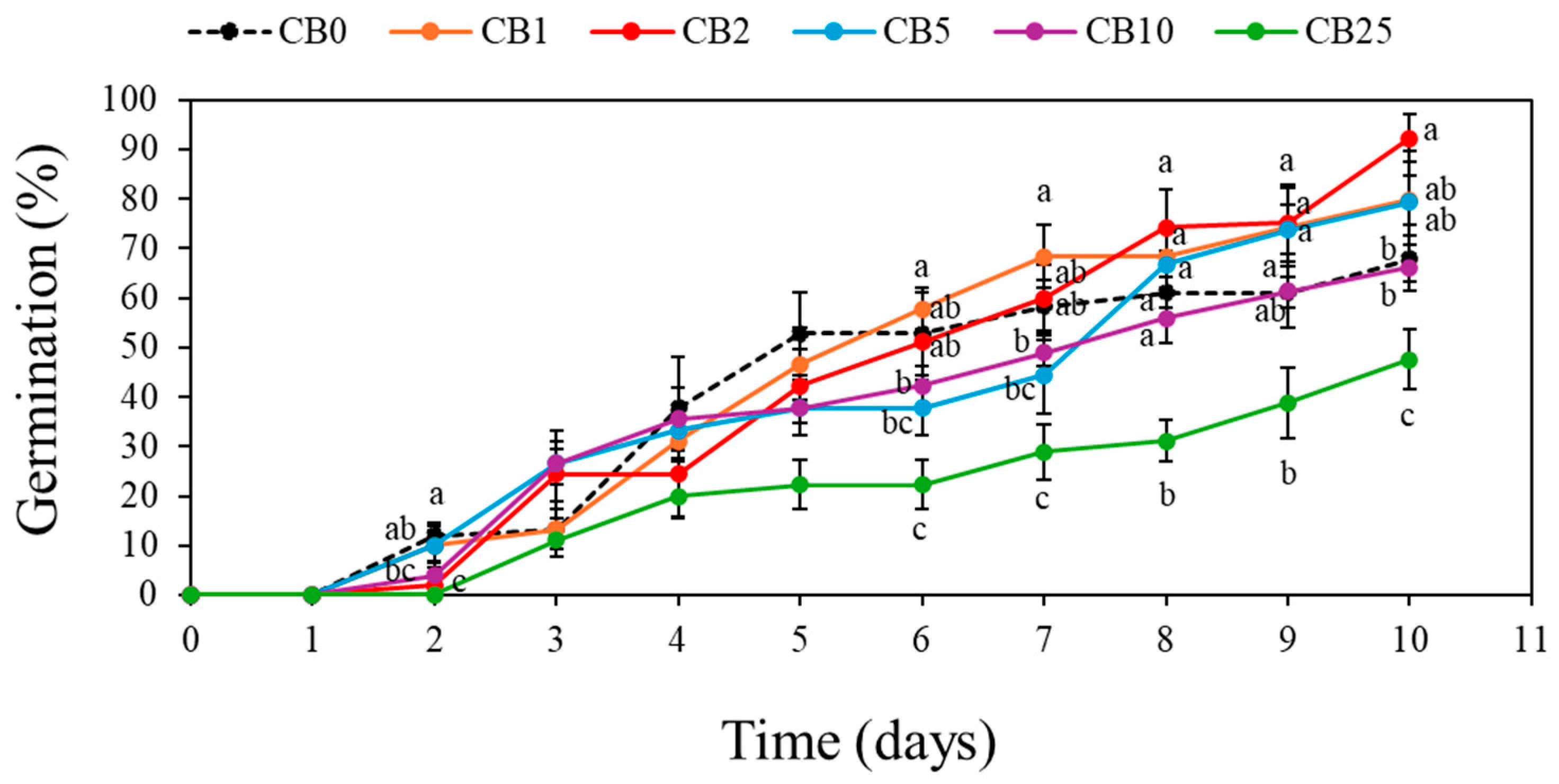
Although the percentage of seed germination gradually increased over time, significant differences were found among treatments (p < 0.05) (Table A1), particularly from 6 days after treatment (Figure 1). At the end of the experiment (i.e., 10 days), seed germination in CB2 reached the highest percentage (92.2%), followed by CB1 and CB5 (79.6% on average), and CB0 and CB10 (67% on average). Additionally, seeds in CB25 exhibited consistently low germination over time, resulting in an inhibition of germination and reaching only 47.6% of germinated seeds at the end of the experiment.
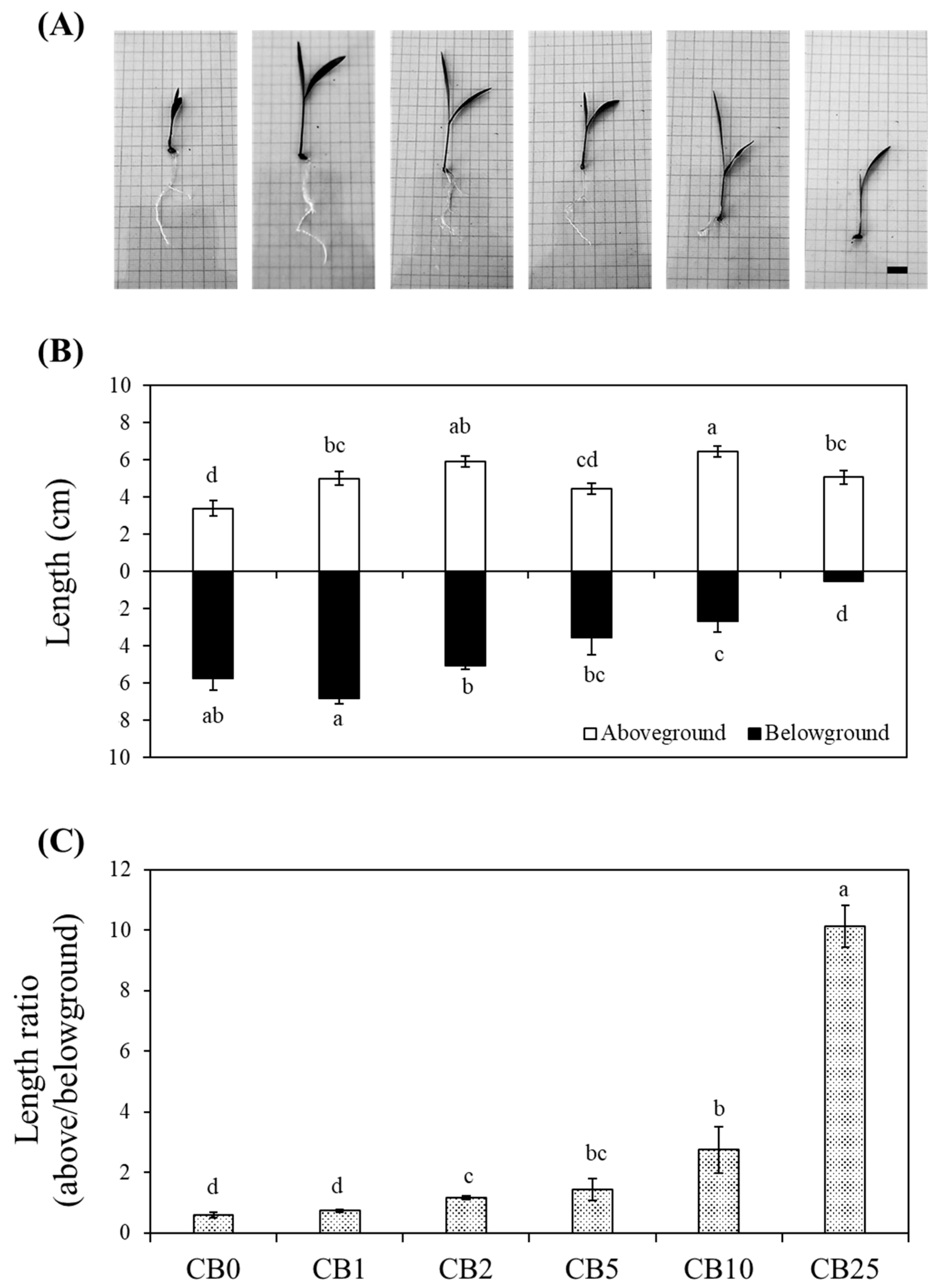
Morphological analysis at the end of the experiment revealed that root growth (belowground) was more affected by increasing CB concentrations than shoot growth (aboveground) (Figure 2A,B), with significant treatment effects on plantlet length (p < 0.05) (Table A1). Regarding aboveground length, plantlets in CB2 and CB10 exhibited the longest shoots (6.2 cm on average), followed by those in CB1 and CB25 (5.0 cm on average), and those in CB5 (4.5 cm), while plantlets in CB0 showed the shortest shoots (3.4 cm) (Figure 2B). Plantlets grown in CB0 and CB1 showed similar root lengths (6.3 cm on average), followed by a gradual and significant decrease as CB increased, culminating in strong root growth inhibition under CB25 conditions (0.5 cm) (Figure 2B). Moreover, the ratio of shoot-to-root length gradually increased with CB concentration, with CB0 and CB1 plantlets exhibiting the lowest ratios (0.7) and CB25 the highest (10) (Figure 2C).
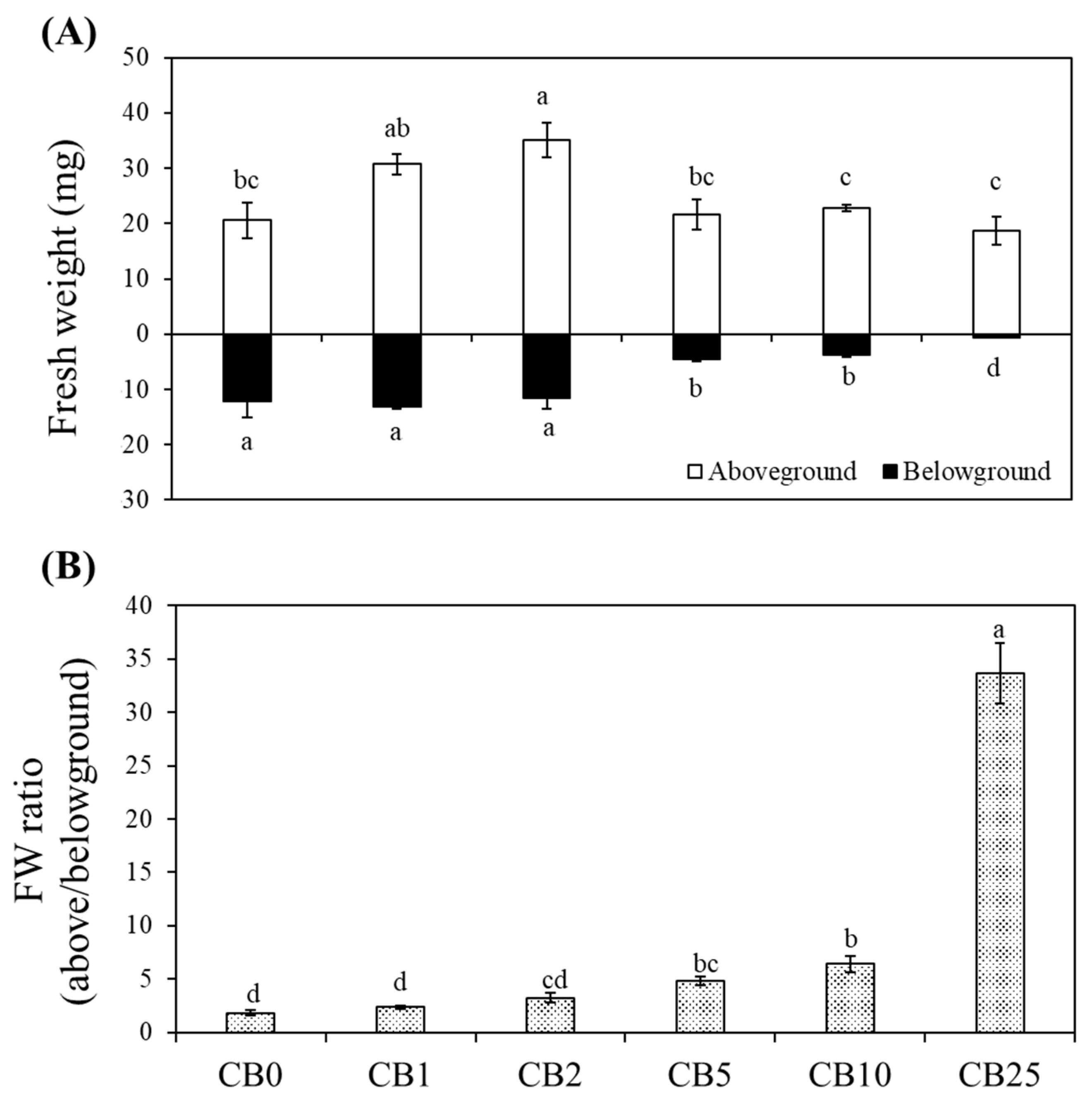
The fresh biomass results showed a significant treatment effect (p < 0.05) (Table A1). In detail, shoot weight gradually increased from CB0 to CB2 conditions, reaching its highest value at CB2 (35.2 mg) (Figure 3A). Beyond 2% CB concentration, shoot weight declined to levels similar to the control (CB0 = 20.6 mg) and remained unchanged even at the highest CB concentration. Regarding root weight, plantlets grown in CB1 and CB2 showed no significant differences, with values similar to the control (CB0 = 12.2 mg) (Figure 3A). Subsequently, a significant decline in root weight was observed in CB5 plantlets (–63% compared to CB0), which remained unchanged in CB10. This was followed by a further decrease in CB25, where the lowest root weight (0.6 mg) was recorded. The ratio of shoot to root fresh weight showed a progressive increase with CB concentration, with CB0 and CB1 plantlets exhibiting the lowest ratios (2.1 on average) and CB25 the highest (33.6) (Figure 3B).

3.3. Photosynthetic Pigments

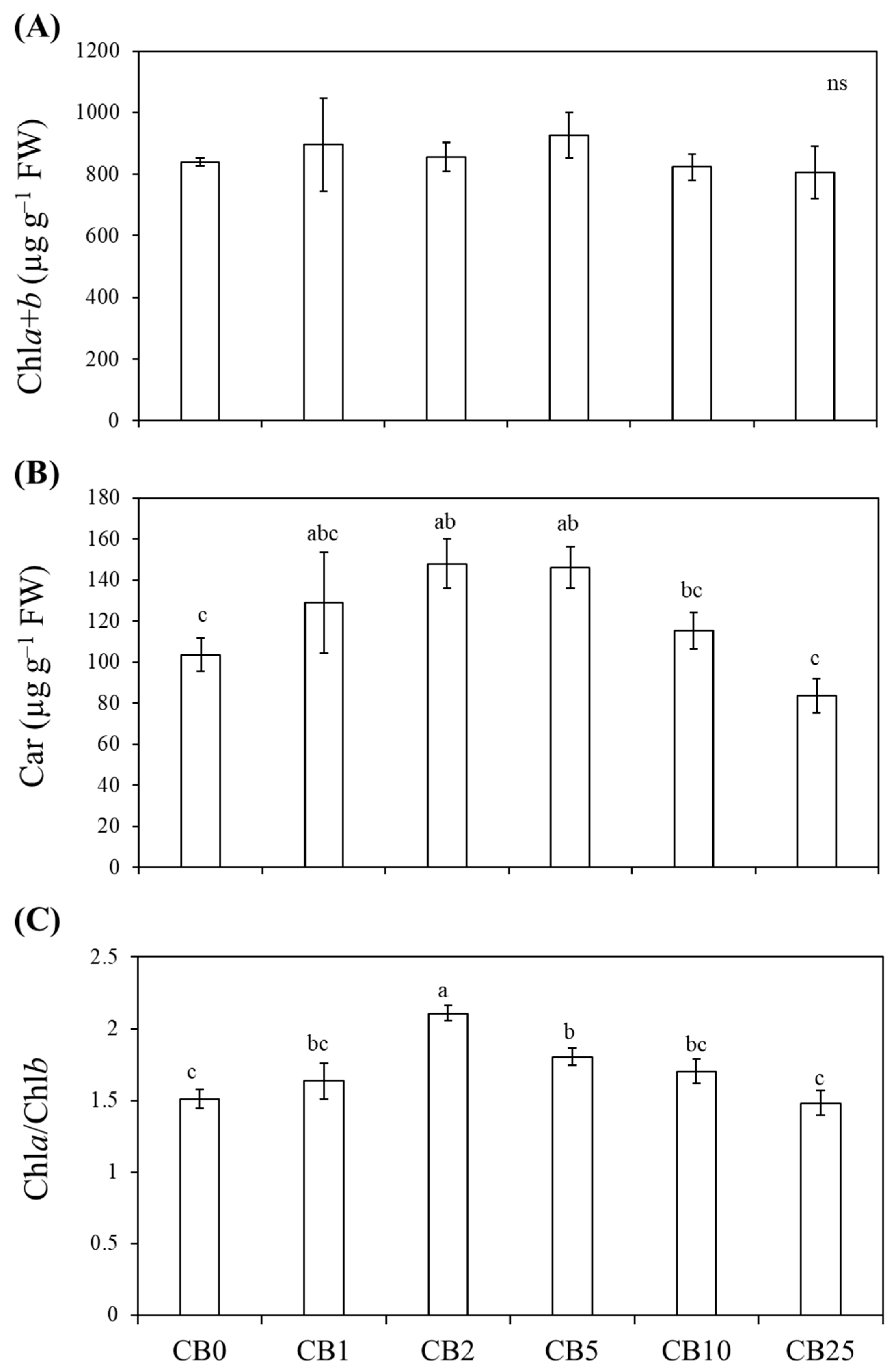
Total chlorophyll (Chla+b) was unaffected by treatment (p > 0.05) (Figure 4A), whereas carotenoids (Car) and the Chla-to-Chlb ratio (Chla/Chlb) were significantly affected (p < 0.05) (Table A1). Car content gradually and significantly increased from CB0 to CB2, rising from 103.3 to 147.8 µg g–1 FW (Figure 4B). This level was maintained in plantlets under CB5, which showed no significant differences from CB2. Subsequently, Car content gradually declined with increasing CB concentration, with CB25 exhibiting levels similar to CB0. Plantlets grown under CB0 to CB2 conditions showed a gradual increase in Chla/Chlb, reaching the highest ratio at CB2 (2.1) (Figure 4C). This was followed by a gradual decline as CB concentration increased, with CB25 showing values similar to the control (CB0 = 1.5).

3.4. Anatomical Trait Variations in Above- and Belowground Organs

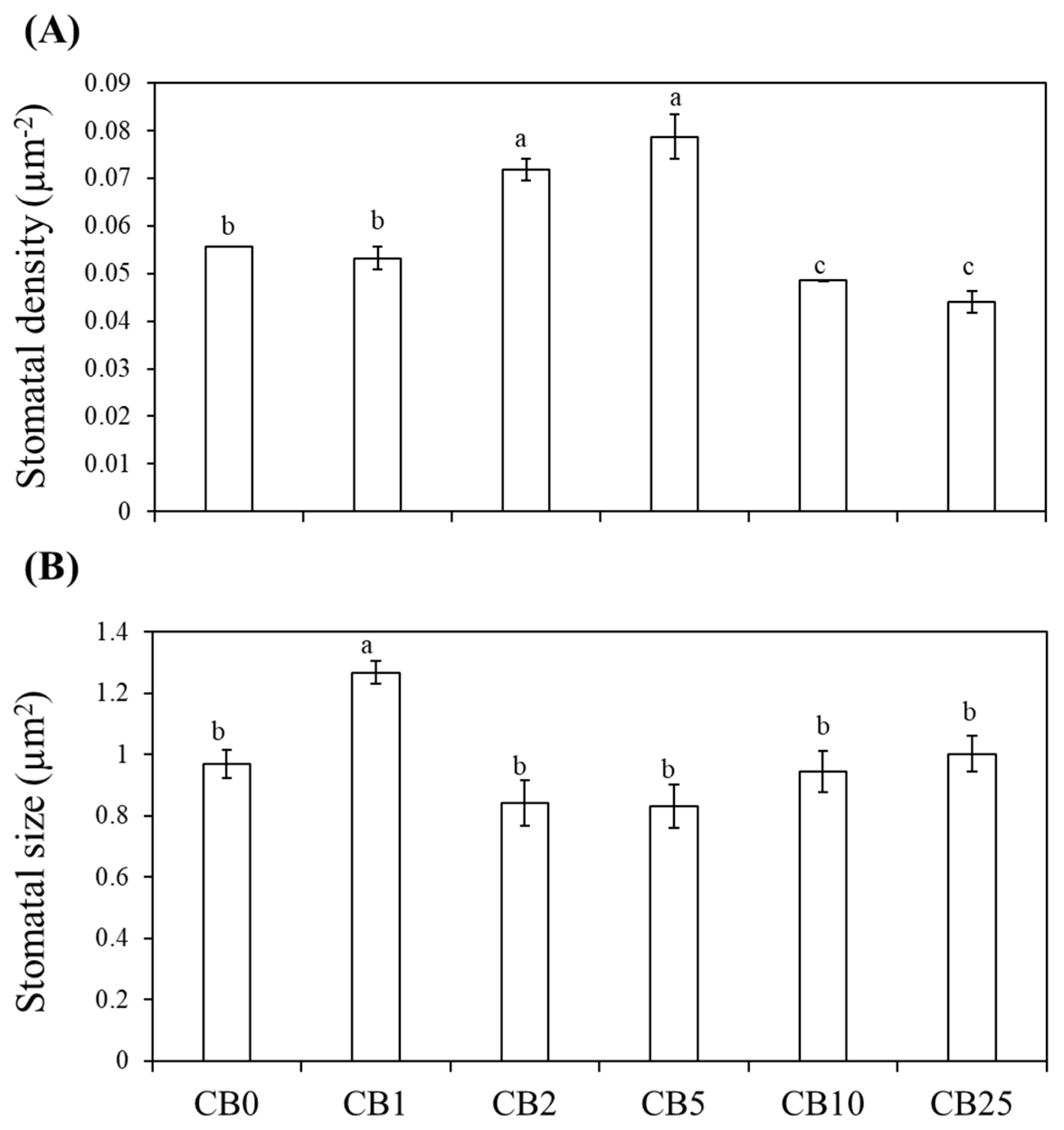
Stomatal density ranged from 0.044 to 0.079 µm–2 (Figure 5A), showing a significant treatment effect (p < 0.05) (Table A1). Specifically, plantlets grown in CB2 and CB5 exhibited the highest stomatal density (0.075 µm–2 on average), followed by those in CB0 and CB1 (0.054 µm–2 on average), and those in CB10 and CB25 (0.046 µm–2 on average). No significant differences were observed within each pair-growth condition. Similarly, stomatal size showed a significant treatment effect (p < 0.05) (Table A1), with CB1 plantlets displaying the largest stomata (1.27 µm2) among treatments (Figure 5A). In contrast, plantlets in the other treatments exhibited smaller stomata (0.92 µm2 on average), with no significant differences among them. Notably, the differences in stomatal size across treatments were primarily attributed to variations in stomatal length, as stomatal width remained consistent regardless of treatment (0.81 µm on average; p > 0.05).
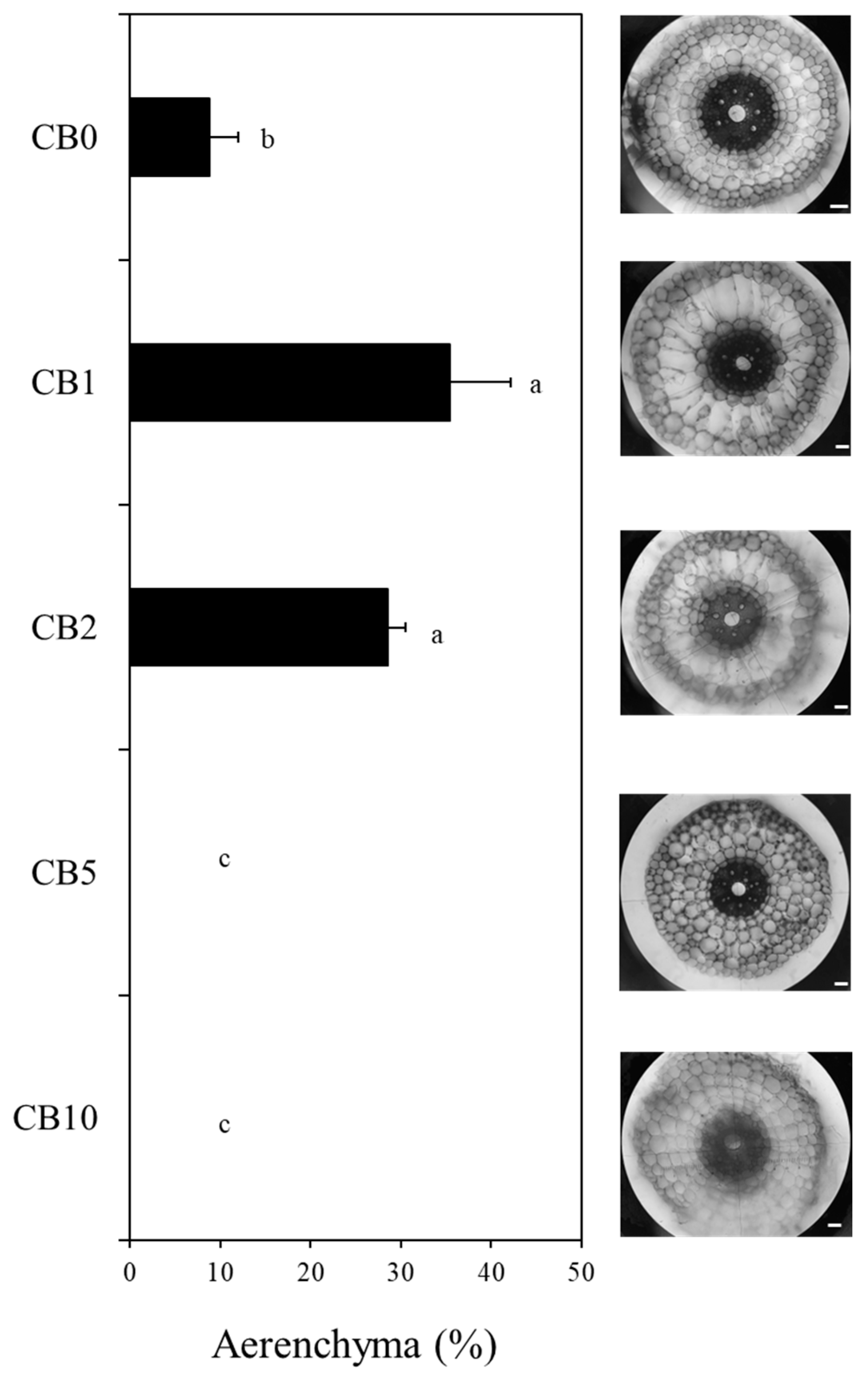
Aerenchyma formation exhibited a significant treatment effect (p < 0.05) (Table A1), with CB1 roots displaying the highest percentage of aerenchyma (35%) among treatments (Figure 6). Although CB2 roots developed slightly less aerenchyma formation than CB1, the difference was not significant (29%; p > 0.05). Moreover, only a small amount of air spaces were observed in roots under control conditions (CB0 = 9%), while no aerenchyma was detected in plantlets grown under CB5 and CB10 treatments.

4. Discussion

Previous studies related to seed germination and early plant development have reported positive, negative or no effects of cigarette butt (CB) leachates, depending on the CB concentration in solution and plant species [5,6,8,22,23,24]. Such variable responses are consistent with hormesis, in which low concentrations stimulate biological performance while higher concentrations inhibit it [12]. Concerning plant species, it is plausible that species native to stressful habitats, such as those characterized by nutrient-poor soils, drought or periodic flooding, may display broader tolerance against the chemical constituents of CB leachates [25]. In line with this, a recent study demonstrated that grasses belonging to the PACMAD clade, comprising Panicoideae, Arundinoideae, Chloridoideae, Micrairoideae, Aristidoideae, and Danthonioideae subfamilies, have evolved unique anatomical, physiological, molecular, and life-history traits that confer resilience to harsh or dynamic environments [26]. Within this clade, panicoid grasses, including all Brachiaria species, are recognized for their tolerance to drought, waterlogging and low-fertility acidic soils associated with several mineral toxicities (e.g., aluminum, iron and manganese) and nutrient deficiencies [16,27,28,29]. Based on this evidence, B. ruziziensis may possess adaptive traits that contribute to its capacity to cope with CB recycling-derived wastewater during germination and early growth. This was supported by its ability to successfully germinate and to maintain growth and development at specific CB concentrations, particularly under CB2 treatment (equivalent to 10 CBs L–1). Consistently, a recent study in another grass species from the same subfamily Panicoideae showed that weekly application of CB recycling-derived wastewater enhanced plant growth and physiology performance [11].
Regarding CB concentration, this study showed that low levels promoted germination and early growth, while high levels caused inhibition, thus revealing a hormetic response [12]. Similar hormetic effects of CB leachates have been documented in other species, such as Sinapis alba [5], Hordeum vulgare [8], and Paspalum vaginatum [11]. In our experiment, increasing CB concentrations were associated with higher electrical conductivity in the medium; however, these values remained too low to induce osmotic stress capable of limiting seed water uptake [30,31]. Thus, osmotic stress can be excluded as the main factor of germination inhibition at high CB concentrations. In addition, CB25 showed a markedly unbalanced chemical composition, dominated by nicotine, while heavy metals were present in trace amounts or were not detected. Among macronutrients, K was the most abundant, followed by moderate N, low P, and detectable Ca and Mg. This characterization suggests that at low CB wastewater concentrations, seeds were likely exposed to nutrients and mild chemical stress that positively influence seed metabolic activation, explaining the superior performance under CB2. In contrast, at higher concentrations, the increase in nicotine combined with the chemical imbalance may impair germination. Indeed, the marked inhibition at CB25 highlighted a toxicity threshold beyond which harmful effects outweigh any stimulatory benefit.
Unlike germination, plant growth requires a continuous and balanced nutrient supply for both below and above ground organs’ development. In this study, low CB concentrations (1–2%) enhanced plant growth and biomass accumulation, indicating that CB wastewater at low doses may provide minerals or organic compounds acting as nutrient sources. This interpretation is consistent with the analytical data, which showed that the wastewater supplied essential macronutrients for early seedling establishment. This agrees with previous studies that reported that CB wastewater, at appropriate concentrations, can serve as a nutrient source for algae and plants [5,8,11,32,33]. Conversely, growth disorders and biomass reduction at high CB concentrations (10–25%) reflected toxicity of wastewater constituents. Accordingly, high CB leachate concentrations have been shown to inhibit root growth in different plant species [23,34,35]. Altogether, high concentrations of CB-derived chemicals negatively affected root development, which in turn might alter water and nutrient uptake, ultimately compromising B. ruziziensis plantlet growth. It is not excluded that alterations in plant hormone balance due to CB-derived compounds may also contribute to these effects [36], although this was not evaluated in the present study.
Increasing CB dose exposure has been shown to disrupt photosynthesis, as its chemical compounds interfere with photosynthetic enzymes, pigment biosynthesis, and induce reactive oxygen species (ROS) accumulation [6,11,24,33,37,38]. ROS are associated with dose–response hormesis in plants as at low levels they act as signaling molecules that trigger several cellular activities, whereas in excess they cause oxidative damage to lipids, proteins, and nucleic acids, impairing chloroplast and cellular function [12]. Here, although no significant differences in Chla+b were detected, the Chla/Chlb ratio and Car content increased transiently with CB concentration. This pattern is consistent with a transition from nutrient limitation at 0% wastewater to nutrient availability and mild chemical stress at 1–2%, conditions that may promote pigment adjustment and accumulation [12,39,40]. At ≥5% wastewater (≥25 CBs L–1), increasing xenobiotic exposure likely promoted oxidative imbalance, leading to pigments degradation and composition shifts [6,11,24]. Considering that nicotine was the most abundant compound identified, it is plausible to hypothesize that its elevated levels may have contributed to oxidative stress, as previously reported [41,42]. However, ROS production, antioxidant activity, and photosynthetic performance were not directly analyzed in this study; therefore, these mechanisms remain plausible but unconfirmed.
Inducible aerenchyma formation occurs in response to environmental factors such as waterlogging, drought, and nutrient deficiency [43], as well as exposure to organic [44,45,46] and inorganic pollutants [47]. Root aerenchyma has different physiological roles. For instance, those induced by oxygen deficiency contribute to oxygen transport from shoot to root tips, while those induced by nutrient stress help to reduce respiration and enhance nutrient remobilization [48]. Although induced root aerenchyma has been proposed to facilitate oxygenation and detoxification of harmful compounds [46], its development is negatively affected as contaminant concentrations increase [49]. In this study, nutrient-starvation-induced aerenchyma was observed in the control; however, it was markedly enhanced in CB1 and decreased thereafter. This pattern suggests that low wastewater concentrations stimulated root anatomical plasticity, whereas higher concentrations triggered toxicity that suppressed root development and aerenchyma formation, consistent with previous reports on seedlings exposed to increasing xenobiotic levels [49,50]. Brachiaria species are known to increase aerenchyma formation in response to abiotic stimuli, though the magnitude varies across species and even accessions [29,51]. Thus, we hypothesize that low CB concentrations may have activated signaling pathways associated with anatomical acclimation, similar to those described in species from the Poaceae family [52,53]; however, the responsible mechanisms were not evaluated in the present study. Altogether, these findings highlight the multifunctional role of aerenchyma and raises questions on the interplay between hormetic responses and root anatomical adjustment.
Morpho-anatomical root changes (e.g., aerenchyma) can be associated with adjustments in stomatal regulation to balance internal gas exchange [54]. In this study, the percentage of aerenchyma and stomatal density negatively correlated when plants were exposed to 1–5% CB (R2 = 0.685; r = –0.83), suggesting a coordinated regulation between above and belowground organs under low CB exposure. Moreover, at the same conditions, reduced stomatal density appeared to be compensated by increased stomatal size, evidenced by a strong negative correlation between these traits (R2 = 0.941; r = –0.97). Accordingly, Doheny-Adams et al. [55] also reported an inverse relationship between stomatal size and density across Arabidopsis genotypes, and Gomes et al. [56] described coordinated anatomical plasticity between roots and leaves in Brachiaria species as an adaptive trait to contaminated soils. However, because gas exchange parameters were not assessed, the physiological significance of these correlations remains unresolved. Further studies are needed to elucidate physiological mechanisms coordinating root and shoot function under CB exposure.
From an applied perspective, a preliminary cost estimation suggested that producing CB wastewater at the optimal concentration (2% v/v) may be economically competitive, as its approximate cost is 80–94% lower than the reported retail price of standard Murashige and Skoog medium (€5.80–17.50 per liter, depending on the supplier, as of April 2026). However, further economic and life-cycle analyses are required to validate this estimation.

5. Conclusions

This study demonstrated that wastewater derived from CB recycling process has the potential to act as a growth stimulant for the in vitro cultivation of B. ruziziensis. A clear concentration-dependent effect was found: low concentrations (particularly CB2) enhanced germination (92.2% vs. ~67% in CB0), shoot growth (~6 vs. 3.4 cm), biomass accumulation (~47 vs. ~33 mg total FW), and pigment adjustment, consistent with a hormetic effect. These responses are likely associated with the combined effect of nutrient availability and mild chemical stress, as supported by the chemical characterization of the wastewater, while pH and electrical conductivity values indicate that neither pH nor osmotic stress were the main drivers of the observed responses. Contrarily, higher concentrations (≥CB10) reduced germination (down to 47.6% at CB25), impaired root development (0.5 cm at CB25), decreased total biomass (~19 mg at CB25), and reduced pigment stability, consistent with phytotoxicity linked to the accumulation of CB-derived compounds, particularly nicotine and chemical imbalance.
The induction of aerenchyma and the coordinated adjustments between root (aerenchyma formation) and leaf (stomatal traits) tissues at low CB concentrations indicate that B. ruziziensis showed anatomical and morphological plasticity in response to CB wastewater, suggesting a potential adaptive stress response that may contribute to plant tolerance. This highlights the capacity of B. ruziziensis to tolerate and even physiologically benefit from low-level exposure to CB-derived wastewater. Overall, this study provides experimental evidence that wastewater from the CB recycling process can be valorized as a cost-effective input for in vitro systems when applied at appropriate concentrations, contributing to novel strategies that integrate waste valorization in plant biotechnology applications. Future studies are required to validate its effectiveness across species and in comparison with standard culture media, as well as to elucidate the physiological and biochemical mechanisms underlying the observed hormetic responses.

Author Contributions

T.H.R.: investigation, methodology, formal analysis, visualization, writing—original draft preparation. L.G.: investigation, conceptualization, writing—reviewing and editing. C.R.D.: resources, visualization, supervision, writing—reviewing and editing. All authors have read and agreed to the published version of the manuscript.

Funding

This research was funded by the PhD fellowship from the University of Pisa (to T.H.R).

Institutional Review Board Statement

Not applicable.

Informed Consent Statement

Not applicable.

Data Availability Statement

Data will be made available on reasonable request.

Acknowledgments

The authors thank Giuseppe Conte and Monica Tognocchi of the Department of Agriculture Food and Environment (University of Pisa), as well as Sandro Francesconi of the Department of Chemistry and Industrial Chemistry (University of Pisa), for their contribution to the chemical analysis of cigarette butt wastewater.

Conflicts of Interest

The authors declare no conflicts of interest. The funders had no role in the design of the study; in the collection, analyses, or interpretation of data; in the writing of the manuscript; or in the decision to publish the results.

Appendix A

Table A1. One-way ANOVA used to test the effect of cigarette butt (CB) recycling wastewater concentration (0, 1, 2, 5, 10 and 25% v/v) for the studied physiological traits at 10 days of treatment. The p-values in bold indicate significant differences. df: degree of freedom (treatment, residual).
df (Treat., Res.)F-Valuep-Value
Germination5, 247.09<0.001
Shoot length5, 1210.62<0.001
Root length5, 1218.50<0.0001
Length ratio (shoot/root)5, 1267.01<0.0001
Shoot fresh weight5, 126.73<0.01
Root fresh weight5, 1213.03<0.001
Fresh weight (shoot/root)5, 12100.13<0.0001
Total chlorophyll5, 120.320.8934
Carotenoids5, 123.56<0.05
Chla/Chlb5, 127.78<0.01
Stomatal density5, 1229.70<0.0001
Stomatal size5, 126.91<0.01
Aerenchyma formation4, 1022.63<0.0001

References

  1. Acarer Arat, S. A Review on Cigarette Butts: Environmental Abundance, Characterization, and Toxic Pollutants Released into Water from Cigarette Butts. Sci. Total Environ. 2024, 928, 172327. [Google Scholar] [CrossRef] [PubMed]
  2. Bonanomi, G.; Maisto, G.; De Marco, A.; Cesarano, G.; Zotti, M.; Mazzei, P.; Libralato, G.; Staropoli, A.; Siciliano, A.; De Filippis, F.; et al. The Fate of Cigarette Butts in Different Environments: Decay Rate, Chemical Changes and Ecotoxicity Revealed by a 5-Years Decomposition Experiment. Environ. Pollut. 2020, 261, 114108. [Google Scholar] [CrossRef]
  3. Korobushkin, D.I.; Garibian, P.G.; Pelgunova, L.A.; Zaitsev, A.S. The Earthworm Species Eisenia Fetida Accelerates the Decomposition Rate of Cigarette Butts on the Soil Surface. Soil. Biol. Biochem. 2020, 151, 108022. [Google Scholar] [CrossRef]
  4. Green, D.S.; Tongue, A.D.W.; Boots, B. The Ecological Impacts of Discarded Cigarette Butts. Trends Ecol. Evol. 2022, 37, 183–192. [Google Scholar] [CrossRef]
  5. Jakimiuk, A.; Bulak, A.; Barroso, P.M.; Podlasek, A.; Vaverková, M.D. Impact of Cigarette Butts on Plant Germination Based on Sinapis alba L. and Hordeum vulgare L. Seeds. J. Ecol. Eng. 2022, 23, 226–237. [Google Scholar] [CrossRef]
  6. Green, D.S.; Boots, B.; Da Silva Carvalho, J.; Starkey, T. Cigarette Butts Have Adverse Effects on Initial Growth of Perennial Ryegrass (Gramineae: Lolium perenne L.) and White Clover (Leguminosae: Trifolium repens L.). Ecotoxicol. Environ. Saf. 2019, 182, 109418. [Google Scholar] [CrossRef]
  7. Selmar, D.; Radwan, A.; Abdalla, N.; Taha, H.; Wittke, C.; El-Henawy, A.; Alshaal, T.; Amer, M.; Kleinwächter, M.; Nowak, M.; et al. Uptake of Nicotine from Discarded Cigarette Butts—A so Far Unconsidered Path of Contamination of Plant-Derived Commodities. Environ. Pollut. 2018, 238, 972–976. [Google Scholar] [CrossRef]
  8. Ajibade, S.; Simon, B.; Takács, A.; Gulyás, M. Effects of Cigarette Butt Leachate on the Growth of White Mustard (Sinapis alba L.) and Soil Properties: A Preliminary Study. Pollutants 2024, 4, 515–536. [Google Scholar] [CrossRef]
  9. Zittel, R.; da Silva, C.P.; Domingues, C.E.; Seremeta, D.C.H.; da Cunha, K.M.; de Campos, S.X. Availability of Nutrients, Removal of Nicotine, Heavy Metals and Pathogens in Compounds Obtained from Smuggled Cigarette Tobacco Compost Associated with Industrial Sewage Sludge. Sci. Total Environ. 2020, 699, 134377. [Google Scholar] [CrossRef] [PubMed]
  10. Núñez, M.d.P.; López Loveira, E.G.; Domínguez, S.E.; Calfayan, L.M.; Itria, R.F.; Butler, M. Assessment of Nicotine and Degradation Products in Cigarette Butts Leachates after Detoxification by White Rot Fungi. J. Hazard. Mater. 2025, 492, 138059. [Google Scholar] [CrossRef] [PubMed]
  11. Huarancca Reyes, T.; Volterrani, M.; Guglielminetti, L.; Scartazza, A. Towards a Circular Economy: Unlocking the Potentials of Cigarette Butt Recycling as a Resource for Seashore Paspalum Growth. Sustainability 2025, 17, 6976. [Google Scholar] [CrossRef]
  12. Jalal, A.; de Oliveira Junior, J.C.; Ribeiro, J.S.; Fernandes, G.C.; Mariano, G.G.; Trindade, V.D.R.; Reis, A.R. dos Hormesis in Plants: Physiological and Biochemical Responses. Ecotoxicol. Environ. Saf. 2021, 207, 111225. [Google Scholar] [CrossRef]
  13. Marinello, S.; Lolli, F.; Gamberini, R.; Rimini, B. A Second Life for Cigarette Butts? A Review of Recycling Solutions. J. Hazard. Mater. 2020, 384, 121245. [Google Scholar] [CrossRef]
  14. Mariotti, L.; Huarancca Reyes, T.; Curadi, M.; Guglielminetti, L. Recycling Cigarette Filters as Plant Growing Substrate in Soilless System. Horticulturae 2022, 8, 135. [Google Scholar] [CrossRef]
  15. Pence, V.C. Evaluating Costs for the in Vitro Propagation and Preservation of Endangered Plants. Vitr. Cell. Dev. Biol. Plant 2011, 47, 176–187. [Google Scholar] [CrossRef]
  16. da Silva, D.R.; Schaefer, C.E.G.R.; Kuki, K.N.; Santos, M.F.S.; Heringer, G.; da Silva, L.C. Why Is Brachiaria decumbens Stapf. a Common Species in the Mining Tailings of the Fundão Dam in Minas Gerais, Brazil? Environ. Sci. Pollut. Res. 2022, 29, 79168–79183. [Google Scholar] [CrossRef]
  17. Janczak, D.; Lucejko, J.J.; Zborowska, M.; Francesconi, S.; Krupka, M.; Pochwatka, P.; Gikas, P.; Czekała, W.; Qiao, W.; Dach, J. Evaluation of Tree Leaf Properties for Potential Biogas Production. J. Environ. Manag. 2025, 393, 127018. [Google Scholar] [CrossRef] [PubMed]
  18. Bryson, G.M.; Mills, H.A.; Sasseville, D.N.; Jones, J.B.; Barker, A.V. Plant Analysis Handbook IV: A Guide to Sampling, Preparation, Analysis, and Interpretation for Agronomic and Horticultural Crops; Bryson, M.G., Mills, A.H., Eds.; Micro-Macro Publishing, Inc.: Athens, GA, USA, 1991; ISBN 9781878148032. [Google Scholar]
  19. Mariotti, L.; Huarancca Reyes, T.; Ramos-Diaz, J.M.; Jouppila, K.; Guglielminetti, L. Hormonal Regulation in Different Varieties of Chenopodium quinoa Willd. Exposed to Short Acute UV-B Irradiation. Plants 2021, 10, 858. [Google Scholar] [CrossRef]
  20. Huarancca Reyes, T.; Pompeiano, A.; Ranieri, A.; Volterrani, M.; Guglielminetti, L.; Scartazza, A. Photosynthetic Performance of Five Cool-Season Turfgrasses under UV-B Exposure. Plant Physiol. Biochem. 2020, 151, 181–187. [Google Scholar] [CrossRef]
  21. Lichtenthaler, H.K. Chlorophylls and Carotenoids: Pigments of Photosynthetic Biomembranes. In Methods in Enzymology; Packer, L., Douce, R., Eds.; Academic Press Inc.: New York, NY, USA, 1987; Volume 148, pp. 350–382. ISBN 9780121820480. [Google Scholar]
  22. Noble, R.E. Effect of Cigarette Smoke on Seed Germination. Sci. Total Environ. 2001, 267, 177–179. [Google Scholar] [CrossRef]
  23. Mansouri, N.; Etebari, M.; Ebrahimi, A.; Ebrahimpour, K.; Rahimi, B.; Hassanzadeh, A. Genotoxicity and Phytotoxicity Comparison of Cigarette Butt with Cigarette Ash. Environ. Sci. Pollut. Res. 2020, 27, 40383–40391. [Google Scholar] [CrossRef]
  24. Momeni, L.; Mohsenzadeh, S. The Effect of Toxic Substances of Cigarette Filter on the Growth and Some Physiological Characteristics of Tall Fescue (Festuca arundinacea) in Soil and Hydroponic Media. Glob. Res. Environ. Sustain. 2023, 1, 27–35. [Google Scholar]
  25. Rodgers, E.M.; Gomez Isaza, D.F. The Mechanistic Basis and Adaptive Significance of Cross-Tolerance: A ‘Pre-Adaptation’ to a Changing World? J. Exp. Biol. 2023, 226. [Google Scholar] [CrossRef]
  26. Pardo, J.; VanBuren, R. Evolutionary Innovations Driving Abiotic Stress Tolerance in C4 Grasses and Cereals. Plant Cell 2021, 33, 3391–3401. [Google Scholar] [CrossRef]
  27. Worthington, M.; Perez, J.G.; Mussurova, S.; Silva-Cordoba, A.; Castiblanco, V.; Cardoso Arango, J.A.; Jones, C.; Fernandez-Fuentes, N.; Skot, L.; Dyer, S.; et al. A New Genome Allows the Identification of Genes Associated with Natural Variation in Aluminium Tolerance in Brachiaria Grasses. J. Exp. Bot. 2021, 72, 302–319. [Google Scholar] [CrossRef] [PubMed]
  28. Arroyave, C.; Barceló, J.; Poschenrieder, C.; Tolrà, R. Aluminium-Induced Changes in Root Epidermal Cell Patterning, a Distinctive Feature of Hyperresistance to Al in Brachiaria Decumbens. J. Inorg. Biochem. 2011, 105, 1477–1483. [Google Scholar] [CrossRef] [PubMed]
  29. Jiménez, J.d.l.C.; Cardoso, J.A.; Dominguez, M.; Fischer, G.; Rao, I. Morpho-Anatomical Traits of Root and Non-Enzymatic Antioxidant System of Leaf Tissue Contribute to Waterlogging Tolerance in Brachiaria Grasses. Grassl. Sci. 2015, 61, 243–252. [Google Scholar] [CrossRef]
  30. Müller, F.L.; Leroko, J.E.; Cupido, C.F.; Samuels, I.; Ngcobo, N.; Masemola, E.L.; Manganyi-Valoyi, F.; Tjelele, T.J. Seed Germination Responses to Temperature and Osmotic Stress Conditions in Brachiaria Forage Grasses. Grasses 2024, 3, 264–273. [Google Scholar] [CrossRef]
  31. Sulaiman, H.; Yusof, A.A.; Mohamed Nor, M.K. Automated Hydroponic Nutrient Dosing System: A Scoping Review of PH and Electrical Conductivity Dosing Frameworks. AgriEngineering 2025, 7, 43. [Google Scholar] [CrossRef]
  32. Chiellini, C.; Mariotti, L.; Huarancca Reyes, T.; de Arruda, E.J.; Fonseca, G.G.; Guglielminetti, L. Remediation Capacity of Different Microalgae in Effluents Derived from the Cigarette Butt Cleaning Process. Plants 2022, 11, 1770. [Google Scholar] [CrossRef]
  33. Hao, T.-B.; Balamurugan, S.; Zhang, Z.-H.; Liu, S.-F.; Wang, X.; Li, D.-W.; Yang, W.-D.; Li, H.-Y. Effective Bioremediation of Tobacco Wastewater by Microalgae at Acidic PH for Synergistic Biomass and Lipid Accumulation. J. Hazard. Mater. 2022, 426, 127820. [Google Scholar] [CrossRef]
  34. Sadıç, E.; Aşkın Çelik, T. Environmental Threats of Cigarette Waste: Phytotoxic Effects of Leachate from Cigarette Butts on Vigna radiata (L.) R. Wilczek Seeds. Int. J. Agric. Environ. Food Sci. 2025, 9, 654–662. [Google Scholar] [CrossRef]
  35. Montalvão, M.F.; Sampaio, L.L.G.; Gomes, H.H.F.; Malafaia, G. An Insight into the Cytotoxicity, Genotoxicity, and Mutagenicity of Smoked Cigarette Butt Leachate by Using Allium cepa as Test System. Environ. Sci. Pollut. Res. 2019, 26, 2013–2021. [Google Scholar] [CrossRef] [PubMed]
  36. Cheng, Y.-D.; Bai, Y.-X.; Jia, M.; Chen, Y.; Wang, D.; Wu, T.; Wang, G.; Yang, H.-W. Potential Risks of Nicotine on the Germination, Growth, and Nutritional Properties of Broad Bean. Ecotoxicol. Environ. Saf. 2021, 209, 111797. [Google Scholar] [CrossRef] [PubMed]
  37. Shah, G.; Bhatt, U.; Singh, H.; Kumar, D.; Sharma, J.; Strasser, R.J.; Soni, V. Ecotoxicological Assessment of Cigarette Butts on Morphology and Photosynthetic Potential of Azolla pinnata. BMC Plant Biol. 2024, 24, 300. [Google Scholar] [CrossRef]
  38. Alkhatib, R.; Alkhatib, B.; Abdo, N. Impact of Exogenous Nicotine on the Morphological, Physio-Biochemical, and Anatomical Characteristics in Capsicum annuum. Int. J. Phytoremediat. 2022, 24, 666–674. [Google Scholar] [CrossRef]
  39. Green, D.S.; Boots, B.; Olah-Kovacs, B.; Palma-Diogo, D. Disposable E-Cigarettes and Cigarette Butts Alter the Physiology of an Aquatic Plant Lemna minor (Lemnaceae). Sci. Total Environ. 2023, 892, 164457. [Google Scholar] [CrossRef]
  40. Lichtenthaler, H.K.; Babani, F. Contents of Photosynthetic Pigments and Ratios of Chlorophyll a/b and Chlorophylls to Carotenoids (A+b)/(X+c) in C4 Plants as Compared to C3 Plants. Photosynthetica 2022, 60, 3–9. [Google Scholar] [CrossRef]
  41. Vicidomini, C.; Palumbo, R.; Moccia, M.; Roviello, G.N. Oxidative Processes and Xenobiotic Metabolism in Plants: Mechanisms of Defense and Potential Therapeutic Implications. J. Xenobiotics 2024, 14, 1541–1569. [Google Scholar] [CrossRef]
  42. Farooq, M.; Hussain, T.; Wakeel, A.; Cheema, Z.A. Differential Response of Maize and Mungbean to Tobacco Allelopathy. Exp. Agric. 2014, 50, 611–624. [Google Scholar] [CrossRef]
  43. Evans, D.E. Aerenchyma Formation. New Phytol. 2004, 161, 35–49. [Google Scholar] [CrossRef]
  44. Alkhatib, R.; Alkhatib, B.; Al-Eitan, L.; Abdo, N.; Tadros, M.; Bsoul, E. Physio-Anatomical Responses of Tobacco under Caffeine Stress. Photosynthetica 2018, 56, 1140–1146. [Google Scholar] [CrossRef]
  45. Maricle, K.L.; Maricle, B.R. Relationship between Root Aeration and Oil Tolerance in Four Wetland Species. Trans. Kansas Acad. Sci. 2018, 121, 137–144. [Google Scholar] [CrossRef]
  46. Váňová, L.; Kummerová, M.; Votrubová, O. Fluoranthene-Induced Production of Ethylene and Formation of Lysigenous Intercellular Spaces in Pea Plants Cultivated in Vitro. Acta Physiol. Plant. 2011, 33, 1037–1042. [Google Scholar] [CrossRef]
  47. Díaz, A.S.; da Cunha Cruz, Y.; Duarte, V.P.; de Castro, E.M.; Magalhães, P.C.; Pereira, F.J. The Role of Reactive Oxygen Species and Nitric Oxide in the Formation of Root Cortical Aerenchyma under Cadmium Contamination. Physiol. Plant. 2021, 173, 2323–2333. [Google Scholar] [CrossRef]
  48. Abiko, T.; Obara, M. Enhancement of Porosity and Aerenchyma Formation in Nitrogen-Deficient Rice Roots. Plant Sci. 2014, 215–216, 76–83. [Google Scholar] [CrossRef]
  49. Chai, M.; Li, R.; Shen, X.; Yu, L.; Han, J. Multiple Heavy Metals Affect Root Response, Iron Plaque Formation, and Metal Bioaccumulation of Kandelia Obovata. Sci. Rep. 2022, 12, 14389. [Google Scholar] [CrossRef] [PubMed]
  50. Vaculíková, M.; Vaculík, M.; Tandy, S.; Luxová, M.; Schulin, R. Alleviation of Antimonate (SbV) Toxicity in Maize by Silicon (Si). Environ. Exp. Bot. 2016, 128, 11–17. [Google Scholar] [CrossRef]
  51. Cardoso, J.A.; Rincón, J.; De La Cruz Jimenez, J.; Noguera, D.; Rao, I.M. Morpho-Anatomical Adaptations to Waterlogging by Germplasm Accessions in a Tropical Forage Grass. AoB Plants 2013, 5, plt047. [Google Scholar] [CrossRef]
  52. Yamauchi, T.; Nakazono, M. Mechanisms of Lysigenous Aerenchyma Formation under Abiotic Stress. Trends Plant Sci. 2022, 27, 13–15. [Google Scholar] [CrossRef] [PubMed]
  53. Yamauchi, T.; Watanabe, K.; Fukazawa, A.; Mori, H.; Abe, F.; Kawaguchi, K.; Oyanagi, A.; Nakazono, M. Ethylene and Reactive Oxygen Species Are Involved in Root Aerenchyma Formation and Adaptation of Wheat Seedlings to Oxygen-Deficient Conditions. J. Exp. Bot. 2014, 65, 261–273. [Google Scholar] [CrossRef] [PubMed]
  54. Mohammed, U.; Caine, R.S.; Atkinson, J.A.; Harrison, E.L.; Wells, D.; Chater, C.C.; Gray, J.E.; Swarup, R.; Murchie, E.H. Rice Plants Overexpressing OsEPF1 Show Reduced Stomatal Density and Increased Root Cortical Aerenchyma Formation. Sci. Rep. 2019, 9, 5584. [Google Scholar] [CrossRef]
  55. Doheny-Adams, T.; Hunt, L.; Franks, P.J.; Beerling, D.J.; Gray, J.E. Genetic Manipulation of Stomatal Density Influences Stomatal Size, Plant Growth and Tolerance to Restricted Water Supply across a Growth Carbon Dioxide Gradient. Philos. Trans. R. Soc. B Biol. Sci. 2012, 367, 547–555. [Google Scholar] [CrossRef] [PubMed]
  56. Gomes, M.P.; de Sá e Melo Marques, T.C.L.L.; de Oliveira Gonçalves Nogueira, M.; de Castro, E.M.; Soares, Â.M. Ecophysiological and Anatomical Changes Due to Uptake and Accumulation of Heavy Metal in Brachiaria decumbens. Sci. Agric. 2011, 68, 566–573. [Google Scholar] [CrossRef]
Figure 1. Effect of cigarette butt recycling process stream on germination. Germination (%) was evaluated in B. ruziziensis grown in unmodified (control) or modified medium containing different concentrations of cigarette butt (CB) recycling process stream. Data were obtained daily over 10 days of treatment. Different letters indicate significant differences between means at a specific time point according to Tukey’s HSD test (p < 0.05). The absence of letters indicates no significant treatment effect (p > 0.05). Data are expressed as means of 5 different replicates ± standard error (SE). CB0: 0% (v/v) CB-derived stream; CB1: 1% (v/v) CB-derived stream; CB2: 2% (v/v) CB-derived stream; CB5: 5% (v/v) CB-derived stream; CB10: 10% (v/v) CB-derived stream; CB25: 25% (v/v) CB-derived stream.
Sustainability 18 05150 g001
Figure 2. Effect of cigarette butt recycling process stream on plantlet growth. (A) Representative image of plantlet growth, and measurements of (B) plantlet length and (C) the ratio of above- to belowground lengths were taken and determined in B. ruziziensis grown in unmodified (control) or modified medium containing different concentrations of cigarette butt (CB) recycling process stream. Data were obtained at 10 days of treatment. Different letters indicate significant differences between means according to Tukey’s HSD test (p < 0.05). Data are expressed as means of 3 different replicates ± standard error (SE). CB0: 0% (v/v) CB-derived stream; CB1: 1% (v/v) CB-derived stream; CB2: 2% (v/v) CB-derived stream; CB5: 5% (v/v) CB-derived stream; CB10: 10% (v/v) CB-derived stream; CB25: 25% (v/v) CB-derived stream. Scale bar in (A) = 1 cm.
Sustainability 18 05150 g002
Figure 3. Effect of cigarette butt recycling process stream on plantlet biomass. (A) Fresh weight, and (B) the ratio of above- to belowground fresh weight were determined in B. ruziziensis grown in unmodified (control) or modified medium containing different concentrations of cigarette butt (CB) recycling process stream. Data were obtained at 10 days of treatment. Different letters indicate significant differences between means according to Tukey’s HSD test (p < 0.05). Data are expressed as means of 3 different replicates ± standard error (SE). FW: fresh weight; CB0: 0% (v/v) CB-derived stream; CB1: 1% (v/v) CB-derived stream; CB2: 2% (v/v) CB-derived stream; CB5: 5% (v/v) CB-derived stream; CB10: 10% (v/v) CB-derived stream; CB25: 25% (v/v) CB-derived stream.
Sustainability 18 05150 g003
Figure 4. Effect of cigarette butt recycling process stream on the photosynthetic pigments. (A) Total chlorophyll (Chla+b), (B) carotenoids (Car), and (C) the ratio of Chla to Chlb (Chla/Chlb) were determined in B. ruziziensis grown in unmodified (control) or modified medium containing different concentrations of cigarette butt (CB) recycling process stream. Data were obtained at 10 days of treatment. Different letters indicate significant differences between means according to Tukey’s HSD test (p < 0.05). Data are expressed as means of 3 different replicates ± standard error (SE). CB0: 0% (v/v) CB-derived stream; CB1: 1% (v/v) CB-derived stream; CB2: 2% (v/v) CB-derived stream; CB5: 5% (v/v) CB-derived stream; CB10: 10% (v/v) CB-derived stream; CB25: 25% (v/v) CB-derived stream. ns: not significant.
Sustainability 18 05150 g004
Figure 5. Effect of cigarette butt recycling process stream on plantlet stomata. (A) Stomatal density and (B) size were determined in B. ruziziensis grown in unmodified (control) or modified medium containing different concentrations of cigarette butt (CB) recycling process stream. Data were obtained at 10 days of treatment. Different letters indicate significant differences between means according to Tukey’s HSD test (p < 0.05). Data are expressed as means of 3 different replicates ± standard error (SE). CB0: 0% (v/v) CB-derived stream; CB1: 1% (v/v) CB-derived stream; CB2: 2% (v/v) CB-derived stream; CB5: 5% (v/v) CB-derived stream; CB10: 10% (v/v) CB-derived stream; CB25: 25% (v/v) CB-derived stream.
Sustainability 18 05150 g005
Figure 6. Effect of cigarette butt recycling process stream on aerenchyma formation. Estimated aerenchyma formation (%, left side) and representative images (scale bar = 1 µm, right side) were determined and taken in roots of B. ruziziensis grown in unmodified (control) or modified medium containing different concentrations of cigarette butt (CB) recycling process stream. Data were obtained at 10 days of treatment. Different letters indicate significant differences between means according to Tukey’s HSD test (p < 0.05). Data are expressed as means of 3 different replicates ± standard error (SE). CB0: 0% (v/v) CB-derived stream; CB1: 1% (v/v) CB-derived stream; CB2: 2% (v/v) CB-derived stream; CB5: 5% (v/v) CB-derived stream; CB10: 10% (v/v) CB-derived stream; CB25: 25% (v/v) CB-derived stream.
Sustainability 18 05150 g006
Table 1. pH and electrical conductivity (EC) of media containing increasing concentrations of cigarette butt (CB) recycling process wastewater. Data are expressed as means of 3 different replicates ± standard error (SE). LOD: limit of detection. Different letters indicate significant differences between means (p < 0.05, Tukey’s HSD test). CB0: 0% (v/v) CB-derived stream; CB1: 1% (v/v) CB-derived stream; CB2: 2% (v/v) CB-derived stream; CB5: 5% (v/v) CB-derived stream; CB10: 10% (v/v) CB-derived stream; CB25: 25% (v/v) CB-derived stream.
CB0CB1CB2CB5CB10CB25
pH5.71 ± 0.035.79 ± 0.045.81 ± 0.095.83 ± 0.085.82 ± 0.105.74 ± 0.13
EC (µS cm−1)20.03 ± 1.50 a38.10 ± 1.13 b57.47 ± 4.09 c127.07 ± 5.65 d248.33 ± 13.86 e616.00 ± 28.15 f
Table 2. Chemical composition of the CB25 medium (25% cigarette butt wastewater). Data are expressed as means of 3 different replicates ± standard error (SE). LOD: limit of detection.
CB25
N (mg L−1)20.92 ± 1.17
K (mg L−1)92.04 ± 5.16
P (mg L−1)1.39 ± 0.07
N:P:K15:1:66
Ca (mg L−1)23.89 ± 0.81
Mg (mg L−1)11.80 ± 0.20
Al (mg L−1)0.20 ± 0.01
Mn (mg L−1)0.18 ± 0.00
Fe (mg L−1)0.10 ± 0.01
Zn (mg L−1)0.06 ± 0.00
Cu (mg L−1)0.03 ± 0.00
Ni, Pb, Co, Cr, Cd<LOD
Nicotine (mg L−1)2653.67 ± 86.99
Disclaimer/Publisher’s Note: The statements, opinions and data contained in all publications are solely those of the individual author(s) and contributor(s) and not of MDPI and/or the editor(s). MDPI and/or the editor(s) disclaim responsibility for any injury to people or property resulting from any ideas, methods, instructions or products referred to in the content.