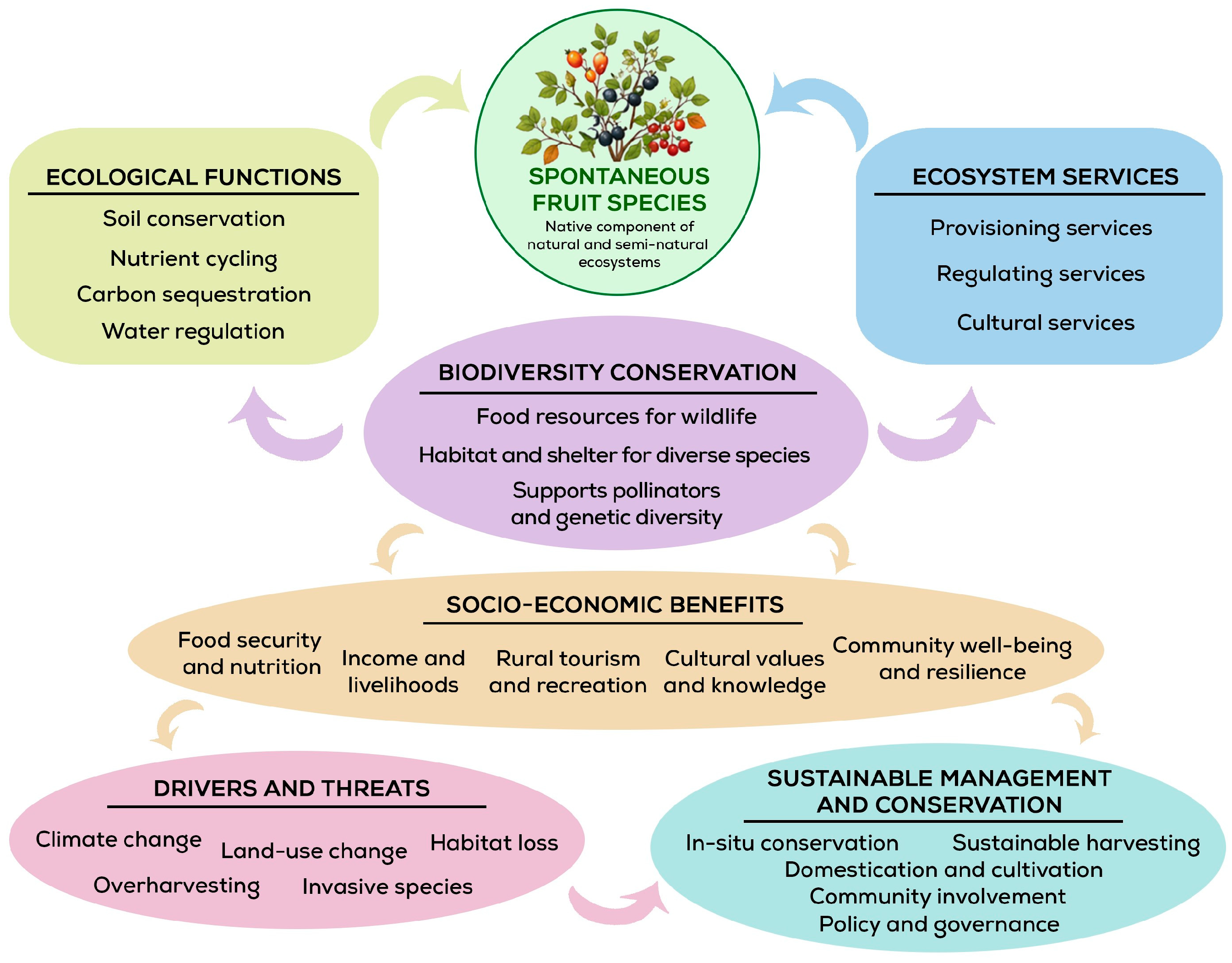
Spontaneous Fruit Species—Ecological Functions, Biodiversity Conservation, and Ecosystem Services


Abstract
1. Introduction
2. Materials and Methods
3. Results and Discussion
3.1. Ecological Functions of Spontaneous Fruit Species
3.1.1. The Role of Fruit Species from Spontaneous Flora in Soil Conservation
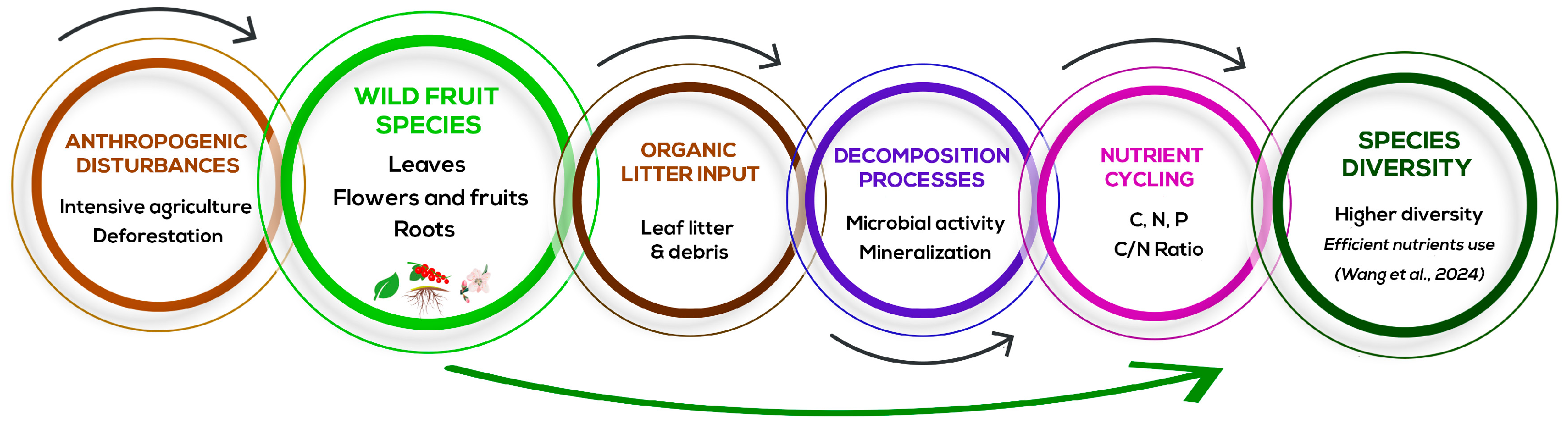
3.1.2. The Role of Fruit Species from Spontaneous Flora in the Nutrient Cycle
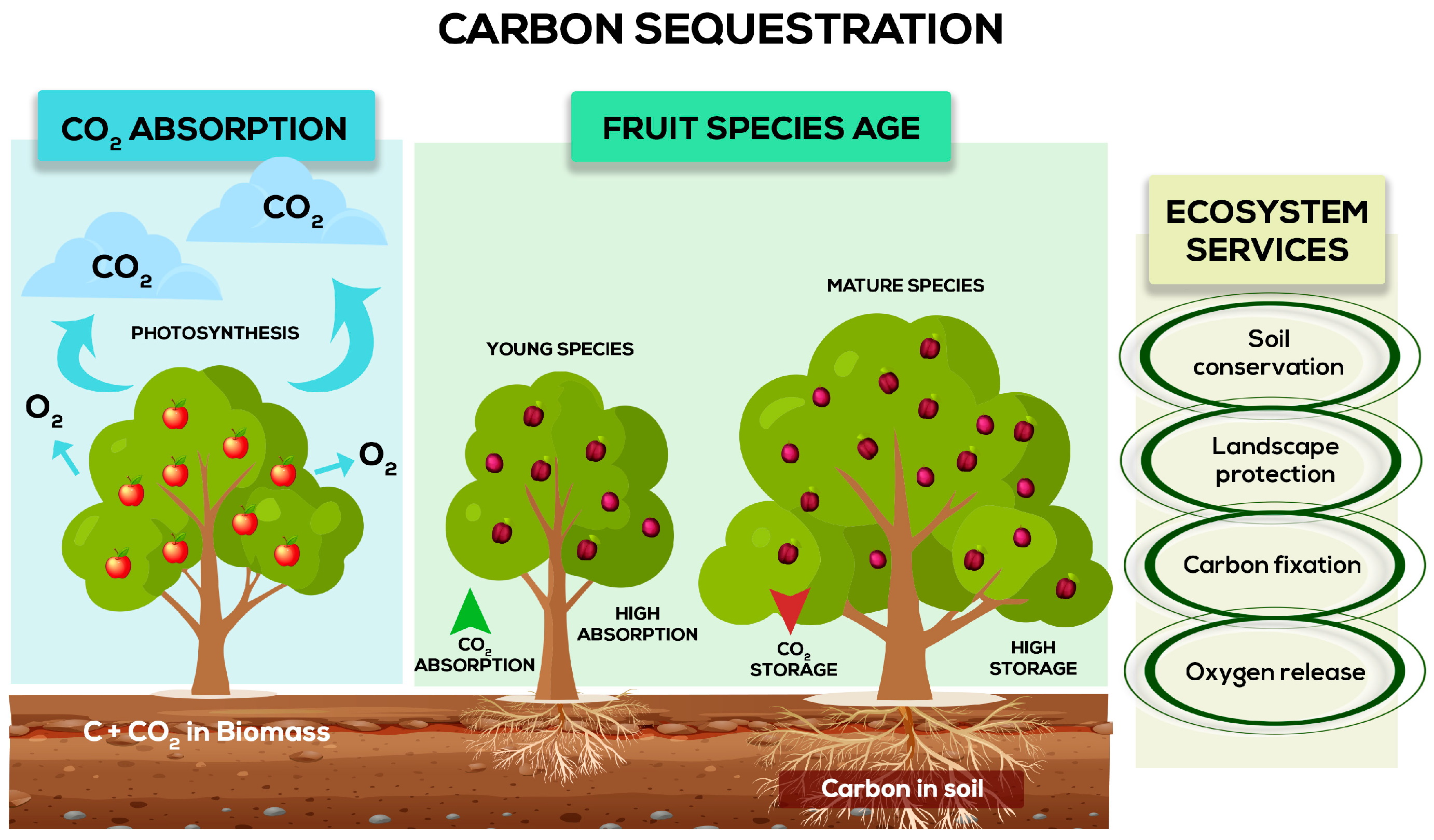
3.1.3. The Role of Fruit Species from Spontaneous Flora in Ecosystem Stability and Carbon Sequestration
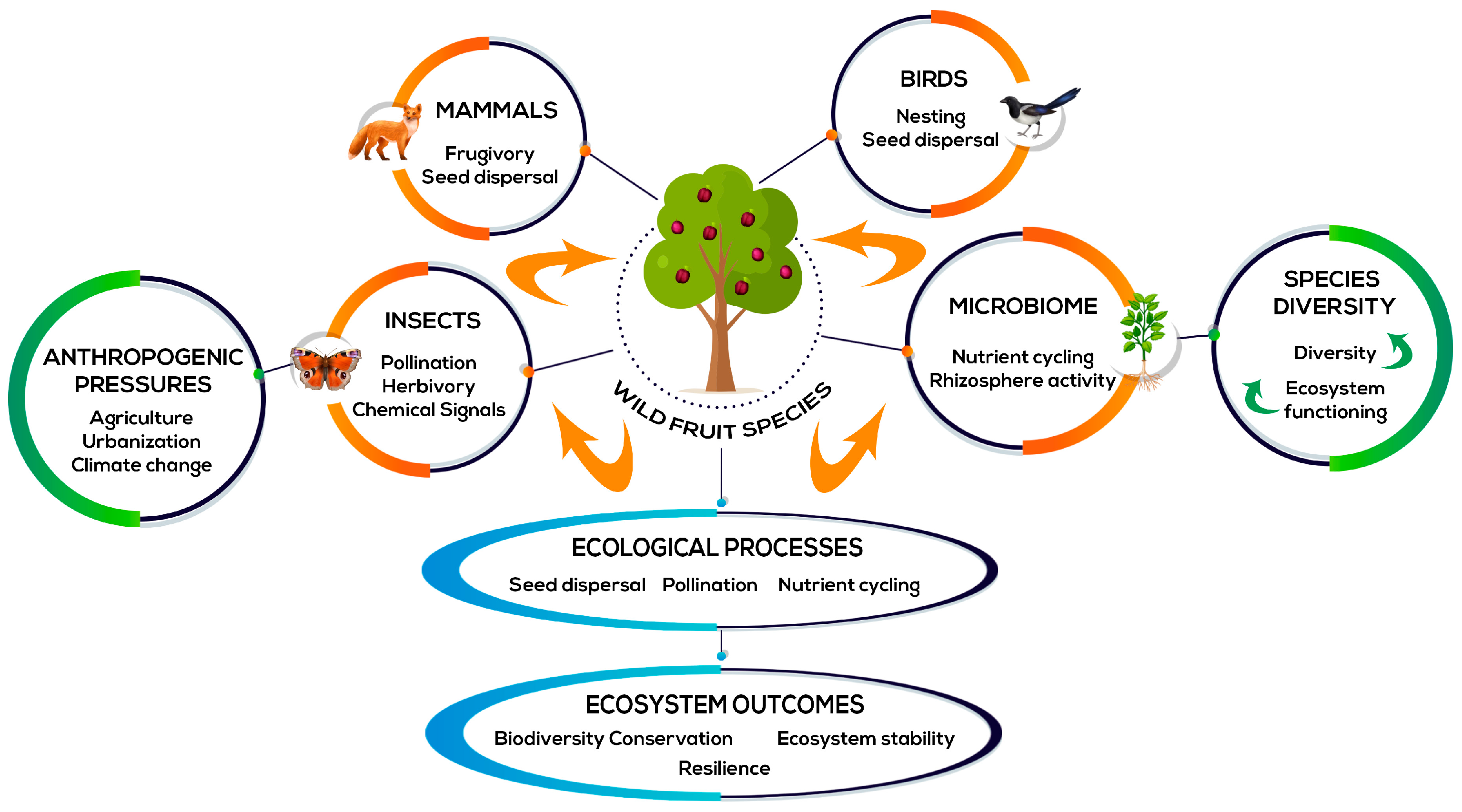
3.2. The Contribution of Spontaneous Fruit Species to Biodiversity Conservation
3.2.1. The Role of Fruit Species in Maintaining the Diversity of Mammals
3.2.2. The Role of Fruit Species in Maintaining Bird Diversity
3.2.3. The Role of Fruit Species in Maintaining Insect Diversity
3.2.4. The Role of Fruit Species in Maintaining Microbiome Diversity
3.3. Ecosystem Services Provided by Spontaneous Fruit Species
3.3.1. Valorization of Fruit Species from Spontaneous Flora in Traditional Medicine and Scientific Research
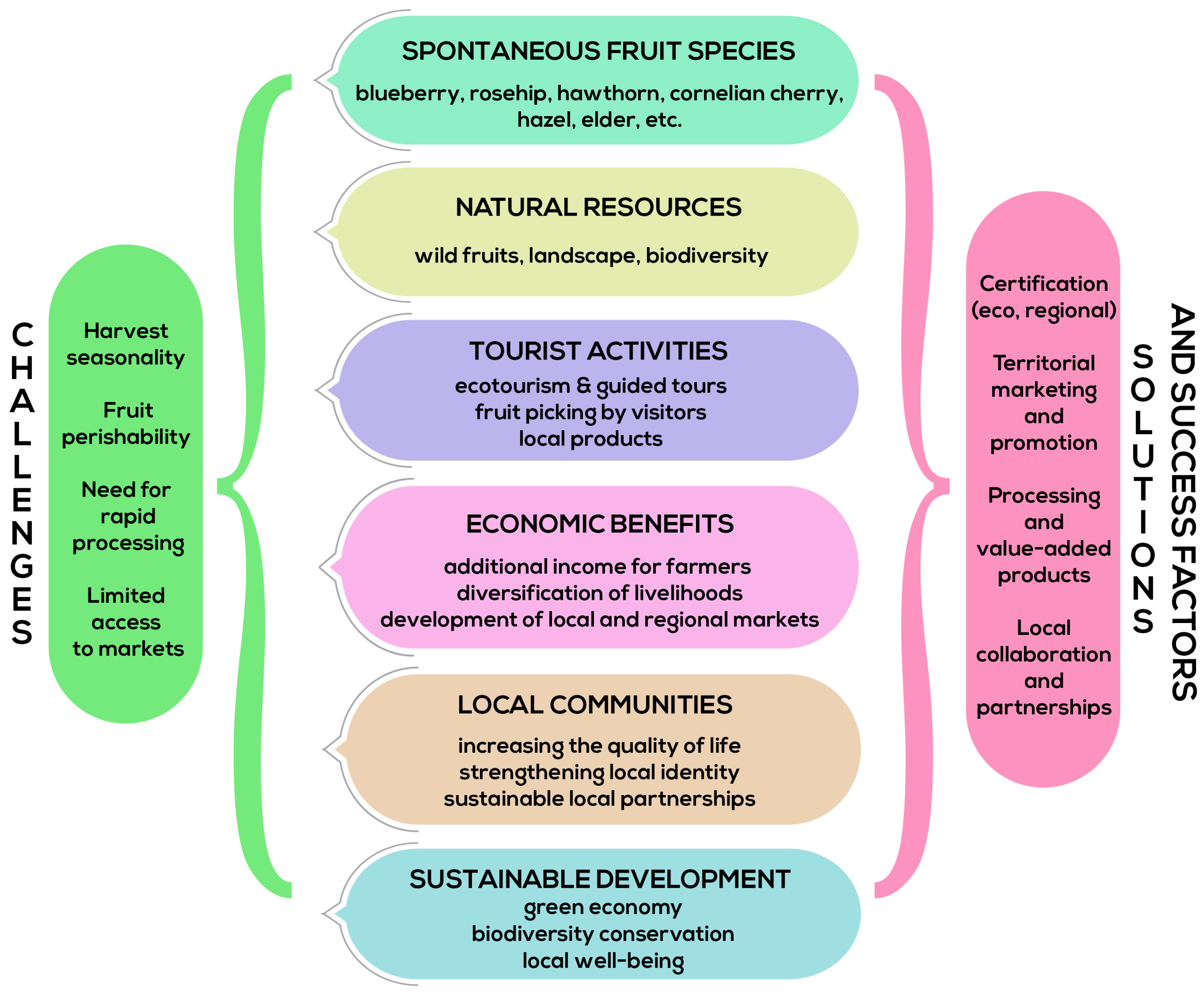
3.3.2. Valorization of Fruit Species from Spontaneous Flora in Rural Tourism and Development of Rural Communities
3.3.3. Synergies and Trade-Offs Between Ecosystem Services
4. Conclusions
Author Contributions
Funding
Institutional Review Board Statement
Informed Consent Statement
Data Availability Statement
Conflicts of Interest
References
- Wang, J.; Peñuelas, J.; Shi, X.; Brearley, F.Q.; Lucas-Borja, M.E.; Leng, P.; Huang, Z. Tree species richness improves soil net nitrogen mineralization rates in a young biodiversity-ecosystem function experiment. Catena 2024, 243, 108178. [Google Scholar] [CrossRef]
- Oncini, F.; Hirth, S.; Mylan, J.; Robinson, C.H.; Johnson, D. Where the wild things are: How urban foraging and food forests can contribute to sustainable cities in the Global North. Urban For. Urban Green. 2024, 93, 128216. [Google Scholar] [CrossRef]
- Cemansky, R. Africa’s Indigenous Fruit Trees: A Blessing in Decline. Environ. Health Perspect. 2015, 123, A291–A296. [Google Scholar] [CrossRef] [PubMed]
- Agbahoungba, S.; Assogbadjo, A.E.; Agoyi, E.E.; Sinsin, B. Diversity and current spatial distribution of wild-edible fruit trees species in the Lama Forest Reserve in Benin. Int. J. Fruit Sci. 2019, 19, 13–28. [Google Scholar] [CrossRef]
- Cosmulescu, S.; Ștefănescu, D.; Stoenescu, A.M. Variability of phenological behaviours of wild fruit tree species based on discriminant analysis. Plants 2021, 11, 45. [Google Scholar] [CrossRef]
- Stamin, F.D.; Vijan, L.E.; Topală, C.M.; Cosmulescu, S.N. The influence of genotype, environmental factors, and location on the nutraceutical profile of Rosa canina L. fruits. Agronomy 2024, 14, 2847. [Google Scholar] [CrossRef]
- Cornescu, F.C.; Cosmulescu, S.N. Morphological and biochemical characteristics of fruits of different cornelian cherry (Cornus mas L.) genotypes from spontaneous flora. Not. Sci. Biol. 2017, 9, 577–581. [Google Scholar] [CrossRef]
- Sarkar, D.; Jha, P.K.; Balasani, R.; Kar, S.K.; Seth, V.; Rakshit, A.; Datta, R.; Ercişli, S. Underutilized edible fruit species of the Indo-Gangetic Plains: A systematic review for food security and land degradation neutrality. Turk. J. Agric. For. 2024, 48, 443–469. [Google Scholar] [CrossRef]
- Sardeshpande, M.; Shackleton, C. Wild edible fruits: A systematic review of an under-researched multifunctional NTFP (non-timber forest product). Forests 2019, 10, 467. [Google Scholar] [CrossRef]
- Seyoum, Y.; Teketay, D.; Shumi, G.; Wodafirash, M. Edible wild fruit trees and shrubs and their socioeconomic significance in central Ethiopia. Ethnobot. Res. Appl. 2015, 14, 183–197. [Google Scholar] [CrossRef]
- Stamin, F.D.; Cosmulescu, S.N. Wild fruits–a review of food and medical importance. Ann. Univ. Craiova Biol. Hortic. Food Prod. Process. Technol. Environ. Eng. 2024, 29, 480–489. [Google Scholar] [CrossRef]
- Ngurthankhumi, R.; Hazarika, T.K.; Lalruatsangi, E.; Lalnunsangi, T.; Lalhmangaihzuali, H.P. Bioactive constituents and health promoting compounds of few wild edible fruits of North-East India. Int. J. Food Prop. 2024, 27, 927–950. [Google Scholar] [CrossRef]
- Stabnikova, O.; Stabnikov, V.; Paredes-López, O. Fruits of wild-grown shrubs for health nutrition. Plant Foods Hum. Nutr. 2024, 79, 20–37. [Google Scholar] [CrossRef]
- Stamin, F.D.; Cosmulescu, S.N. Population estimates for some spontaneous fruit species in forest ecosystems located in Southern Romania. Ann. Univ. Craiova Biol. Hortic. Food Prod. Process. Technol. Environ. Eng. 2025, 30, 605–612. [Google Scholar] [CrossRef]
- Leakey, R.R. The role of trees in agroecology and sustainable agriculture in the tropics. Annu. Rev. Phytopathol. 2014, 52, 113–133. [Google Scholar] [CrossRef]
- Montanaro, G.; Xiloyannis, C.; Nuzzo, V.; Dichio, B. Orchard management, soil organic carbon and ecosystem services in Mediterranean fruit tree crops. Sci. Hortic. 2017, 217, 92–101. [Google Scholar] [CrossRef]
- Yazdani, F.; AliPanahi, P.; Sadeghi, H. A comparative study of environmental and economic assessment of vegetation-based slope stabilization with conventional methods. J. Environ. Manag. 2024, 359, 121002. [Google Scholar] [CrossRef]
- Dugan, I.; Pereira, P.; Barcelo, D.; Bogunovic, I. Conservation practices reverse soil degradation in Mediterranean fig orchards. Geoderma Reg. 2024, 36, e00750. [Google Scholar] [CrossRef]
- Lann, T.; Bao, H.; Lan, H.; Zheng, H.; Yan, C. Hydro-mechanical effects of vegetation on slope stability: A review. Sci. Total Environ. 2024, 926, 171691. [Google Scholar] [CrossRef]
- Jinger, D.; Kakade, V.; Bhatnagar, P.R.; Paramesh, V.; Dinesh, D.; Singh, G.; Kumar, N.; Kaushal, R.; Singhal, V.; Rathore, A.C.; et al. Enhancing productivity and sustainability of ravine lands through horti-silviculture and soil moisture conservation: A pathway to land degradation neutrality. J. Environ. Manag. 2024, 364, 121425. [Google Scholar] [CrossRef]
- Zhang, X.; Fu, Y.; Pei, Q.; Guo, J.; Jian, S. Study on the root characteristics and effects on soil reinforcement of slope-protection vegetation in the chinese loess plateau. Forests 2024, 15, 464. [Google Scholar] [CrossRef]
- Dalir, P.; Naghdi, R.; Jafari, S.; Tsioras, P.A. Comparative assessment of woody species for runoff and soil erosion control on forest road slopes in harvested sites of the Hyrcanian forests, northern Iran. Forests 2025, 16, 1013. [Google Scholar] [CrossRef]
- Lu, J.; Zheng, F.; Li, G.; Bian, F.; An, J. The effects of raindrop impact and runoff detachment on hillslope soil erosion and soil aggregate loss in the Mollisol region of Northeast China. Soil Tillage Res. 2016, 161, 79–85. [Google Scholar] [CrossRef]
- Cai, J.S.; Yeh, T.C.J.; Yan, E.C.; Tang, R.X.; Hao, Y.H.; Huang, S.Y.; Wen, J.C. Importance of variability in initial soil moisture and rainfalls on slope stability. J. Hydrol. 2019, 571, 265–278. [Google Scholar] [CrossRef]
- Li, S.; Wang, Z.; Stutz, H.H. State-of-the-art review on plant-based solutions for soil improvement. Biogeotechnics 2023, 1, 100035. [Google Scholar] [CrossRef]
- Xie, Q.; Xu, H.; Wen, R.; Wang, L.; Yang, Y.; Zhang, H.; Su, B. Integrated management of fruit trees and Bletilla striata: Implications for soil nutrient profiles and microbial community structures. Front. Microbiol. 2024, 15, 1307677. [Google Scholar] [CrossRef]
- Liu, S.; Yang, R.; Peng, X.; Hou, C.; Ma, J.; Guo, J. Contributions of plant litter decomposition to soil nutrients in ecological tea gardens. Agriculture 2022, 12, 957. [Google Scholar] [CrossRef]
- Naik, S.K.; Maurya, S.; Mukherjee, D.; Singh, A.K.; Bhatt, B.P. Rates of decomposition and nutrient mineralization of leaf litter from different orchards under hot and dry sub-humid climate. Arch. Agron. Soil Sci. 2018, 64, 560–573. [Google Scholar] [CrossRef]
- Froufe, L.C.M.; Schwiderke, D.K.; Castilhano, A.C.; Cezar, R.M.; Steenbock, W.; Seoane, C.E.S.; Bognola, I.A.; Vezzani, F.M. Nutrient cycling from leaf litter in multistrata successional agroforestry systems and natural regeneration at Brazilian Atlantic Rainforest Biome. Agrofor. Syst. 2020, 94, 159–171. [Google Scholar] [CrossRef]
- Isidorov, V.; Maslowiecka, J.; Sarapultseva, P. Bidirectional emission of organic compounds by decaying leaf litter of a number of forest-forming tree species in the northern hemisphere. Geoderma 2024, 443, 116812. [Google Scholar] [CrossRef]
- Ramananjatovo, T.; Guénon, R.; Peugeot, J.; Chantoiseau, E.; Delaire, M.; Buck-Sorlin, G.; Guillermin, P.; Cannavo, P. Positive influence of apple trees on soil chemical and biological activities in agroecological garden orchard system. Agrofor. Syst. 2024, 98, 3233–3246. [Google Scholar] [CrossRef]
- Jia, X.; Wu, L.; Ren, J.; Peng, X.; Lv, H. Response of carbon, nitrogen, and phosphorus in leaves of different life forms to altitude and soil factors in Tianshan wild fruit forest. Front. Ecol. Evol. 2024, 12, 1368185. [Google Scholar] [CrossRef]
- Carranca, C.; Brunetto, G.; Tagliavini, M. Nitrogen nutrition of fruit trees to reconcile productivity and environmental concerns. Plants 2018, 7, 4. [Google Scholar] [CrossRef]
- Bharucha, Z.; Pretty, J. The roles and values of wild foods in agricultural systems. Philos. Trans. R. Soc. B Biol. Sci. 2010, 365, 2913–2926. [Google Scholar] [CrossRef]
- Borelli, T.; Hunter, D.; Powell, B.; Ulian, T.; Mattana, E.; Termote, C.; Pawera, L.; Beltrame, D.; Penafiel, D.; Tan, A.; et al. Born to eat wild: An integrated conservation approach to secure wild food plants for food security and nutrition. Plants 2020, 9, 1299. [Google Scholar] [CrossRef]
- Gelaye, Y.; Getahun, S. A review of the carbon sequestration potential of fruit trees and their implications for climate change mitigation: The case of Ethiopia. Cogent Food Agric. 2024, 10, 2294544. [Google Scholar] [CrossRef]
- Wambede, M.N.; Akello, G.; Mulabbi, A.; Barasa, B.; Lugumira, J.S.; Amonya, D. Carbon Sequestration of Fruit Trees under Contrasting Management Regimes. Indones. J. Geogr. 2022, 54, 420–427. [Google Scholar] [CrossRef]
- Roberti, G.; Herzog, F.; Jäger, M.; Kay, S. Temperate agroforestry for tree carbon storage in Switzerland: 10 years of biophysical and social monitoring. Clim. Smart Agric. 2025, 2, 100055. [Google Scholar] [CrossRef]
- Zomer, R.J.; Bossio, D.A.; Trabucco, A.; van Noordwijk, M.; Xu, J. Global carbon sequestration potential of agroforestry and increased tree cover on agricultural land. Circ. Agric. Syst. 2022, 2, 3. [Google Scholar] [CrossRef]
- Nnko, L.E. Carbon sequestration in agroforestry technologies as a strategy for climate change mitigation. In The Nature, Causes, Effects and Mitigation of Climate Change on the Environment; IntechOpen: London, UK, 2022; p. 133. [Google Scholar] [CrossRef]
- Shiwangee, S.; Negi, S.; Hussnain, M.; Mehta, M. Fruit tree based agroforestry: A scalable solution for climate change and food security. IOSR J. Agric. Vet. Sci. 2025, 18, 46–54. [Google Scholar]
- Ferreiro-Domínguez, N.; Rigueiro-Rodríguez, A.; Rial-Lovera, K.E.; Romero-Franco, R.; Mosquera-Losada, M.R. Effect of grazing on carbon sequestration and tree growth that is developed in a silvopastoral system under wild cherry (Prunus avium L.). Catena 2016, 142, 11–20. [Google Scholar] [CrossRef]
- Chavula, P.; Abdi, E.; Ntezimana, M.G.; Jimaima, M.; Umer, Y. Hidden Harvests: The Role of Forest, Wild, and Exotic Fruits in Agricultural Landscapes of East and Southern Africa. Preprints 2026. [Google Scholar] [CrossRef]
- Ilie, D.; Cosmulescu, S. Spontaneous plant diversity in urban contexts: A review of its impact and importance. Diversity 2023, 15, 277. [Google Scholar] [CrossRef]
- Awasthi, B.; Chen, J.; McConkey, K.R. Fruiting trees provide fruit and insect resources for four tropical deer species. Ecosphere 2024, 15, e4889. [Google Scholar] [CrossRef]
- Grünewald, C.; Breitbach, N.; Böhning-Gaese, K. Tree visitation and seed dispersal of wild cherries by terrestrial mammals along a human land-use gradient. Basic Appl. Ecol. 2010, 11, 532–541. [Google Scholar] [CrossRef]
- Al Malki, K.A.; Al Ghamdi, A.R.; Shuraim, F.; Neyaz, F.; Al Boug, A.; Al Jbour, S.; Angelici, F.M.; Amr, Z.S. Diversity and Conservation of Rodents in Saudi Arabia. Diversity 2024, 16, 398. [Google Scholar] [CrossRef]
- Fedriani, J.M.; Garrote, P.J.; Burgos, T.; Escribano-Ávila, G.; Morera, B.; Virgós, E. The seed dispersal syndrome hypothesis in ungulate-dominated landscapes. Sci. Rep. 2024, 14, 5436. [Google Scholar] [CrossRef]
- Francis, O.E.; Mohapatra, S.P. Bird species diversity in relation with indigenous tree species for sustainable tourism development Urhonigbe Forest Reserve Edo state Nigeria. Sci. Rep. Life Sci. 2024, 5, 38–52. [Google Scholar] [CrossRef]
- Iwajomo, S.B.; Olayemi, O.E. Avian Encounter Rates and Interaction Network with Trees in an Urban Setting. Sahel J. Life Sci. FUDMA 2024, 2, 171–178. [Google Scholar] [CrossRef]
- Martins, L.P.; Stouffer, D.B.; Blendinger, P.G.; Böhning-Gaese, K.; Costa, J.M.; Dehling, D.M.; Donatti, C.I.; Emer, C.; Galetti, M.; Heleno, R.; et al. Birds optimize fruit size consumed near their geographic range limits. Science 2024, 385, 331–336. [Google Scholar] [CrossRef]
- Conchou, L.; Lucas, P.; Meslin, C.; Proffit, M.; Staudt, M.; Renou, M. Insect odorscapes: From plant volatiles to natural olfactory scenes. Front. Physiol. 2019, 10, 972. [Google Scholar] [CrossRef]
- Dubuisson, C.; Wortham, H.; Garinie, T.; Hossaert-McKey, M.; Lapeyre, B.; Buatois, B.; Temime-Roussel, B.; Ormeno, E.; Staudt, M.; Proffit, M. Ozone alters the chemical signal required for plant–insect pollination: The case of the Mediterranean fig tree and its specific pollinator. Sci. Total Environ. 2024, 919, 170861. [Google Scholar] [CrossRef]
- Jones, P.L.; Agrawal, A.A. Learning in insect pollinators and herbivores. Annu. Rev. Entomol. 2017, 62, 53–71. [Google Scholar] [CrossRef]
- Bastida, J.M.; Garrido, J.L.; Cano-Sáez, D.; Perea, A.J.; Pomarede, L.C.; Alcántara, J.M. Effects of plant leaf traits, abundance and phylogeny on differentiation of herbivorous insect assemblages in Mediterranean mixed forest. Eur. J. For. Res. 2024, 143, 1149–1164. [Google Scholar] [CrossRef]
- Harrison, J.G.; Philbin, C.S.; Gompert, Z.; Forister, G.W.; Hernandez-Espinoza, L.; Sullivan, B.W.; Wallace, I.S.; Beltran, L.; Dodson, C.D.; Francis, J.S.; et al. Deconstruction of a plant-arthropod community reveals influential plant traits with nonlinear effects on arthropod assemblages. Funct. Ecol. 2018, 32, 1317–1328. [Google Scholar] [CrossRef]
- Fahey, C.; Koyama, A.; Antunes, P.M.; Dunfield, K.; Flory, S.L. Plant communities mediate the interactive effects of invasion and drought on soil microbial communities. ISME J. 2020, 14, 1396–1409. [Google Scholar] [CrossRef] [PubMed]
- Guo, Q.; Gong, L. Compared with pure forest, mixed forest alters microbial diversity and increases the complexity of interdomain networks in arid areas. Microbiol. Spectr. 2024, 12, e02642-23. [Google Scholar] [CrossRef]
- Dawud, S.M.; Raulund-Rasmussen, K.; Ratcliffe, S.; Domisch, T.; Finér, L.; Joly, F.X.; Hättenschwiler, S.; Vesterdal, L. Tree species functional group is a more important driver of soil properties than tree species diversity across major European forest types. Funct. Ecol. 2017, 31, 1153–1162. [Google Scholar] [CrossRef]
- Gómez-Aparicio, L.; Domínguez-Begines, J.; Villa-Sanabria, E.; García, L.V.; Muñoz-Pajares, A.J. Tree decline and mortality following pathogen invasion alters the diversity, composition and network structure of the soil microbiome. Soil Biol. Biochem. 2022, 166, 108560. [Google Scholar] [CrossRef]
- Rong, X.; Wu, N.; Yin, B.; Zhou, X.; Zhu, B.; Li, Y.; Aanderud, Z.T.; Zhang, Y. Degradation of wild fruit forests created less diverse and diffuse bacterial communities decreased bacterial diversity, enhanced fungal pathogens and altered microbial assembly in the Tianshan Mountain, China. Plant Soil 2024, 501, 23–38. [Google Scholar] [CrossRef]
- Ehlers Smith, Y.C.; Ehlers Smith, D.A.; Ramesh, T.; Downs, C.T. The importance of microhabitat structure in maintaining forest mammal diversity in a mixed land-use mosaic. Biodivers. Conserv. 2017, 26, 2361–2382. [Google Scholar] [CrossRef]
- de Brito Freire, G., Jr.; Diniz, I.R.; Salcido, D.M.; Oliveira, H.F.M.; Sudta, C.; Silva, T.; Rodrigues, H.; Dias, J.P.; Dyer, L.A.; Domingos, F.M.C.B. Habitat heterogeneity shapes multiple diversity dimensions of fruit-feeding butterflies in an environmental gradient in the Brazilian Cerrado. For. Ecol. Manag. 2024, 558, 121747. [Google Scholar] [CrossRef]
- Moore, J.H.; Sittimongkol, S.; Campos-Arceiz, A.; Sumpah, T.; Eichhorn, M.P. Fruit gardens enhance mammal diversity and biomass in a Southeast Asian rainforest. Biol. Conserv. 2016, 194, 132–138. [Google Scholar] [CrossRef]
- Quitián, M.; Santillán, V.; Espinosa, C.I.; Homeier, J.; Böhning-Gaese, K.; Schleuning, M.; Neuschulz, E.L. Direct and indirect effects of plant and frugivore diversity on structural and functional components of fruit removal by birds. Oecologia 2019, 189, 435–445. [Google Scholar] [CrossRef]
- Medina-Serrano, N.; Hossaert-McKey, M.; Diallo, A.; McKey, D. Insect–flower interactions, ecosystem functions, and restoration ecology in the northern Sahel: Current knowledge and perspectives. Biol. Rev. 2025, 100, 969–995. [Google Scholar] [CrossRef]
- Saunders, M.E.; Luck, G.W. Interaction effects between local flower richness and distance to natural woodland on pest and beneficial insects in apple orchards. Agric. For. Entomol. 2018, 20, 279–287. [Google Scholar] [CrossRef]
- Compant, S.; Cambon, M.C.; Vacher, C.; Mitter, B.; Samad, A.; Sessitsch, A. The plant endosphere world–bacterial life within plants. Environ. Microbiol. 2021, 23, 1812–1829. [Google Scholar] [CrossRef]
- Rashidifard, M.; Fourie, H.; Ashrafi, S.; Engelbrecht, G.; Elhady, A.; Daneel, M.; Claassens, S. Suppressive effect of soil microbiomes associated with tropical fruit trees on Meloidogyne enterolobii. Microorganisms 2022, 10, 894. [Google Scholar] [CrossRef] [PubMed]
- Cosmulescu, S.; Trandafir, I.; Nour, V. Phenolic acids and flavonoids profiles of extracts from edible wild fruits and their antioxidant properties. Int. J. Food Prop. 2017, 20, 3124–3134. [Google Scholar] [CrossRef]
- Mgalula, M.E. An ethnobotanical study of wild edible fruits in miombo woodlands of Tabora region in Western Tanzania. J. Ethnobiol. Ethnomed. 2024, 20, 23. [Google Scholar] [CrossRef] [PubMed]
- Prakofjewa, J.; Sartori, M.; Šarka, P.; Kalle, R.; Pieroni, A.; Sõukand, R. Knowledge in motion: Temporal dynamics of wild food plant use in the Polish-Lithuanian-Belarusian border region. J. Ethnobiol. Ethnomed. 2024, 20, 65. [Google Scholar] [CrossRef]
- Che, C.T.; George, V.; Ijinu, T.P.; Pushpangadan, P.; Andrae-Marobela, K. Traditional Medicine. In Pharmacognosy; Academic Press: London, UK, 2024; pp. 11–28. [Google Scholar] [CrossRef]
- Xu, H.Y.; Zhang, Y.Q.; Liu, Z.M.; Chen, T.; Lv, C.Y.; Tang, S.H.; Zhang, X.B.; Zhang, W.; Li, Z.Y.; Zhou, R.R.; et al. ETCM: An encyclopaedia of traditional Chinese medicine. Nucleic Acids Res. 2019, 47, D976–D982. [Google Scholar] [CrossRef]
- Lee, K.I.; Jo, Y.; Yuk, H.J.; Kim, S.Y.; Kim, H.; Kim, H.J.; Hwang, S.K.; Park, K.S. Potential Phytotherapy of DSS-Induced Colitis: Ameliorating Reactive Oxygen Species-Mediated Necroptosis and Gut Dysbiosis with a New Crataegus pinnatifida Bunge Variety—Daehong. Antioxidants 2024, 13, 340. [Google Scholar] [CrossRef]
- Păun, G.; Neagu, E.; Albu, C.; Alecu, A.; Seciu-Grama, A.M.; Radu, G.L. Antioxidant and Antidiabetic Activity of Cornus mas L. and Crataegus monogyna Fruit Extracts. Molecules 2024, 29, 3595. [Google Scholar] [CrossRef]
- Cui, M.; Cheng, L.; Zhou, Z.; Zhu, Z.; Liu, Y.; Li, C.; Liao, B.; Fan, M.; Duan, B. Traditional uses, phytochemistry, pharmacology, and safety concerns of hawthorn (Crataegus genus): A comprehensive review. J. Ethnopharmacol. 2023, 319, 117229. [Google Scholar] [CrossRef]
- Li, R.; Luan, F.; Zhao, Y.; Wu, M.; Lu, Y.; Tao, C.; Zhu, L.; Zhang, C.; Wan, L. Crataegus pinnatifida: A botanical, ethnopharmacological, phytochemical, and pharmacological overview. J. Ethnopharmacol. 2023, 301, 115819. [Google Scholar] [CrossRef]
- Sagaradze, V.A.; Babaeva, E.Y. Resources and Use of Crataegus Species (Rosaceae) of the Asian Part of Russia. Rastit. Resur. 2022, 58, 5–19. [Google Scholar]
- Jarić, S.; Kostić, O.; Mataruga, Z.; Pavlović, D.; Pavlović, M.; Mitrović, M.; Pavlović, P. Traditional wound-healing plants used in the Balkan region (Southeast Europe). J. Ethnopharmacol. 2018, 211, 311–328. [Google Scholar] [CrossRef] [PubMed]
- Hong, S.Y.; Lansky, E.; Kang, S.S.; Yang, M. A review of pears (Pyrus spp.), ancient functional food for modern times. BMC Complement. Med. Ther. 2021, 21, 219. [Google Scholar] [CrossRef] [PubMed]
- Prakash, O.M.; Chauhan, A.S.; Kudachikar, V.B. Traditional uses, nutrition, phytochemistry and various pharmacological properties of Indian wild pear. Int. J. Func. Nutr. 2021, 2, 9. [Google Scholar] [CrossRef]
- Cosmulescu, S.; Stoenescu, A.M.; Trandafir, I.; Tuțulescu, F. Comparison of chemical properties between traditional and commercial vinegar. Horticulturae 2022, 8, 225. [Google Scholar] [CrossRef]
- Petran, M.; Dragos, D.; Gilca, M. Historical ethnobotanical review of medicinal plants used to treat children diseases in Romania (1860s–1970s). J. Ethnobiol. Ethnomed. 2020, 16, 15. [Google Scholar] [CrossRef]
- Kitic, D.; Miladinovic, B.; Randjelovic, M.; Szopa, A.; Sharifi-Rad, J.; Calina, D.; Seidel, V. Anticancer potential and other pharmacological properties of Prunus armeniaca L.: An updated overview. Plants 2022, 11, 1885. [Google Scholar] [CrossRef]
- Koriem, K.M.M. Phytochemical screening, chemical constituents, traditional medicine usage, pharmacological effect, metabolism and pharmacokinetics of Semen armeniacae. Biointerface Res. Appl. Chem. 2022, 12, 3186–3197. [Google Scholar] [CrossRef]
- Tang, S.; Wang, M.; Peng, Y.; Liang, Y.; Lei, J.; Tao, Q.; Ming, T.; Shen, Y.; Zhang, C.; Guo, J.; et al. Armeniacae semen amarum: A review on its botany, phytochemistry, pharmacology, clinical application, toxicology and pharmacokinetics. Front. Pharmacol. 2024, 15, 1290888. [Google Scholar] [CrossRef] [PubMed]
- Wei, Y.; Li, Y.; Wang, S.; Xiang, Z.; Li, X.; Wang, Q.; Dong, W.; Gao, P.; Dai, L. Phytochemistry and pharmacology of Armeniacae semen Amarum: A review. J. Ethnopharmacol. 2023, 308, 116265. [Google Scholar] [CrossRef] [PubMed]
- Khadka, D.; Kunwar, R.M.; Baral, B.; Bhatta, S.; Cui, D.; Shi, S. Prunus mira Koehne and Prunus armeniaca L. in Nepal Himalaya: Distribution, use, and conservation. Genet. Resour. Crop Evol. 2024, 71, 4583–4602. [Google Scholar] [CrossRef]
- Babotă, M.; Voştinaru, O.; Păltinean, R.; Mihali, C.; Dias, M.I.; Barros, L.; Ferreira, I.; Mocan, A.; Crișan, O.; Nicula, C.; et al. Chemical composition, diuretic, and antityrosinase activity of traditionally used Romanian Cerasorum stipites. Front. Pharmacol. 2021, 12, 647947. [Google Scholar] [CrossRef]
- Özen, M.; Özdemir, N.; Filiz, B.E.; Budak, N.H.; Kök-Taş, T. Sour cherry (Prunus cerasus L.) vinegars produced from fresh fruit or juice concentrate: Bioactive compounds, volatile aroma compounds and antioxidant capacities. Food Chem. 2020, 309, 125664. [Google Scholar] [CrossRef]
- Nunes, A.R.; Gonçalves, A.C.; Falcão, A.; Alves, G.; Silva, L.R. Prunus avium L. (sweet cherry) by-products: A source of phenolic compounds with antioxidant and anti-hyperglycemic properties—A review. Appl. Sci. 2021, 11, 8516. [Google Scholar] [CrossRef]
- Blando, F.; Oomah, B.D. Sweet and sour cherries: Origin, distribution, nutritional composition and health benefits. Trends Food Sci. Technol. 2019, 86, 517–529. [Google Scholar] [CrossRef]
- Damar, I.; Yilmaz, E. Ultrasound-assisted extraction of phenolic compounds in blackthorn (Prunus spinosa L.): Characterization, antioxidant activity and optimization by response surface methodology. J. Food Meas. Charact. 2023, 17, 1467–1479. [Google Scholar] [CrossRef]
- Putkaradze, J.; Diasamidze, M.; Vanidze, M.; Kalandia, A. Antioxidant Activity of Prunus cerasifera products. Int. J. Life Sci. 2021, 10, 52–54. [Google Scholar]
- Faruk, A.; Nersesyan, A.; Papikyan, A.; Galstyan, S.; Hakobyan, E.; Barblishvili, T.; Mikatadze-Pantsulaia, T.; Darchidze, T.; Kuchukhidze, M.; Kereselidze, N.; et al. Multigenerational differences in harvesting and use of wild edible fruits and nuts in the South Caucasus. Plants People Planet 2024, 6, 238–248. [Google Scholar] [CrossRef]
- Hancer, C.K.; Sevgi, E.; Altinbasak, B.B.; Cakir, E.A.; Akkaya, M. Traditional Knowledge of Wild Edible Plants of Biga (Canakkale), Turkey. Acta Soc. Bot. Pol. 2020, 89, 1–19. [Google Scholar] [CrossRef]
- Sile, I.; Romane, E.; Reinsone, S.; Maurina, B.; Tirzite, D.; Dambrova, M. Medicinal plants and their uses recorded in the Archives of Latvian Folklore from the 19th century. J. Ethnopharmacol. 2020, 249, 112378. [Google Scholar] [CrossRef]
- Fierascu, R.C.; Temocico, G.; Fierascu, I.; Ortan, A.; Babeanu, N.E. Fragaria genus: Chemical composition and biological activities. Molecules 2020, 25, 498. [Google Scholar] [CrossRef]
- Weber, J.T. Traditional uses and beneficial effects of various species of berry-producing plants in eastern Canada. Botany 2022, 100, 175–182. [Google Scholar] [CrossRef]
- Shikov, A.N.; Narkevich, I.A.; Akamova, A.V.; Nemyatykh, O.D.; Flisyuk, E.V.; Luzhanin, V.G.; Povydysh, M.N.; Mikhailova, I.V.; Pozharitskaya, O.N. Medical species used in Russia for the management of diabetes and related disorders. Front. Pharmacol. 2021, 12, 697411. [Google Scholar] [CrossRef]
- Sargin, S.A. Plants used against obesity in Turkish folk medicine: A review. J. Ethnopharmacol. 2021, 270, 113841. [Google Scholar] [CrossRef]
- Kalle, R.; Sõukand, R.; Pieroni, A. Devil is in the details: Use of wild food plants in historical Võromaa and Setomaa, present-day Estonia. Foods 2020, 9, 570. [Google Scholar] [CrossRef]
- Khazaei, M.K.M.R.; Khazaei, M.R.; Pazhouhi, M. An overview of therapeutic potentials of Rosa canina: A traditionally valuable herb. WCRJ 2020, 7, e1580. [Google Scholar] [CrossRef]
- Manzione, M.G.; Kumar, R.; Harilal, S.; Mishra, P.; Youb, K.A.; Fokou, P.V.T.; Pezzani, R. Rosa canina and Cancer: Which Evidence? J. Herb. Med. 2024, 45, 100875. [Google Scholar] [CrossRef]
- Negrean, O.R.; Farcas, A.C.; Nemes, S.A.; Cic, D.E.; Socaci, S.A. Recent advances and insights into the bioactive properties and applications of Rosa canina L. and its by-products. Heliyon 2024, 10, e30816. [Google Scholar] [CrossRef]
- Živković, J.; Ilić, M.; Zdunić, G.; Jovanović-Lješković, N.; Menković, N.; Šavikin, K. Traditional use of medicinal plants in Jablanica district (South-Eastern Serbia): Ethnobotanical survey and comparison with scientific data. Genet. Resour. Crop Evol. 2021, 68, 1655–1674. [Google Scholar] [CrossRef]
- Leahu, A.; Hretcanu, C.E.; Roșu, A.I.; Ghinea, C. Traditional uses of wild berries in the Bukovina region (Romania). Food Environ. Saf. J. 2020, 18, 279–286. [Google Scholar]
- Tundis, R.; Tenuta, M.C.; Loizzo, M.R.; Bonesi, M.; Finetti, F.; Trabalzini, L.; Deguin, B. Vaccinium species (Ericaceae): From chemical composition to bio-functional activities. Appl. Sci. 2021, 11, 5655. [Google Scholar] [CrossRef]
- Ștefănescu, R.; Laczkó-Zöld, E.; Ősz, B.E.; Vari, C.E. An updated systematic review of Vaccinium myrtillus leaves: Phytochemistry and pharmacology. Pharmaceutics 2022, 15, 16. [Google Scholar] [CrossRef]
- Vaneková, Z.; Rollinger, J.M. Bilberries: Curative and miraculous—A review on bioactive constituents and clinical research. Front. Pharmacol. 2022, 13, 909914. [Google Scholar] [CrossRef]
- Pundir, S.; Garg, P.; Dviwedi, A.; Ali, A.; Kapoor, V.K.; Kapoor, D.; Kulshrestha, S.; Lal, U.R.; Negi, P. Ethnomedicinal uses, phytochemistry and dermatological effects of Hippophae rhamnoides L.: A review. J. Ethnopharmacol. 2021, 266, 113434. [Google Scholar] [CrossRef]
- Chen, A.; Feng, X.; Dorjsuren, B.; Chimedtseren, C.; Damda, T.A.; Zhang, C. Traditional food, modern food and nutritional value of Sea buckthorn (Hippophae rhamnoides L.): A review. J. Future Foods 2023, 3, 191–205. [Google Scholar] [CrossRef]
- Ilhan, G.; Gundogdu, M.; Karlović, K.; Židovec, V.; Vokurka, A.; Ercişli, S. Main agro-morphological and biochemical berry characteristics of wild-grown sea buckthorn (Hippophae rhamnoides L. ssp. caucasica Rousi) genotypes in Turkey. Sustainability 2021, 13, 1198. [Google Scholar] [CrossRef]
- Jaśniewska, A.; Diowksz, A. Wide spectrum of active compounds in sea buckthorn (Hippophae rhamnoides) for disease prevention and food production. Antioxidants 2021, 10, 1279. [Google Scholar] [CrossRef] [PubMed]
- El Maaiden, E.; El Kharrassi, Y.; Qarah, N.A.; Essamadi, A.K.; Moustaid, K.; Nasser, B. Genus Ziziphus: A comprehensive review on ethnopharmacological, phytochemical and pharmacological properties. J. Ethnopharmacol. 2020, 259, 112950. [Google Scholar] [CrossRef]
- Liu, S.J.; Lv, Y.P.; Tang, Z.S.; Zhang, Y.; Xu, H.B.; Zhang, D.B.; Cui, C.L.; Liu, H.B.; Sun, H.H.; Song, Z.X.; et al. Ziziphus jujuba Mill., a plant used as medicinal food: A review of its phytochemistry, pharmacology, quality control and future research. Phytochem. Rev. 2021, 20, 507–541. [Google Scholar] [CrossRef]
- Mongalo, N.I.; Mashele, S.S.; Makhafola, T.J. Ziziphus mucronata Willd. (Rhamnaceae): It’s botany, toxicity, phytochemistry and pharmacological activities. Heliyon 2020, 6, e03708. [Google Scholar] [CrossRef]
- Alsayari, A.; Wahab, S. Genus Ziziphus for the treat ment of chronic inflammatory diseases. Saudi J. Biol. Sci. 2021, 28, 6897–6914. [Google Scholar] [CrossRef]
- Soni, H.; Malik, J.K. Phyto-Pharmacological Potential of Zizyphus jujube: A Review. Sch. Int. J. Biochem. 2021, 4, 1–5. [Google Scholar] [CrossRef]
- Hajam, T.A.; Saleem, H. Phytochemistry, biological activities, industrial and traditional uses of fig (Ficus carica): A review. Chem.-Biol. Interact. 2022, 368, 110237. [Google Scholar] [CrossRef] [PubMed]
- Nuri, Z.N.; Uddin, M.S. A review on nutritional values and pharmacological importance of Ficus carica. J. Curr. Res. Food Sci. 2021, 2, 55–59. [Google Scholar] [CrossRef]
- Li, Z.; Yang, Y.; Liu, M.; Zhang, C.; Shao, J.; Hou, X.; Tian, J.; Cui, Q. A comprehensive review on phytochemistry, bioactivities, toxicity studies, and clinical studies on Ficus carica Linn. leaves. Biomed. Pharmacother. 2021, 137, 111393. [Google Scholar] [CrossRef]
- Teruel-Andreu, C.; Andreu-Coll, L.; López-Lluch, D.; Sendra, E.; Hernández, F.; Cano-Lamadrid, M. Ficus carica fruits, by-products and based products as potential sources of bioactive compounds: A review. Agronomy 2021, 11, 1834. [Google Scholar] [CrossRef]
- Morovati, M.R.; Ghanbari-Movahed, M.; Barton, E.M.; Farzaei, M.H.; Bishayee, A. A systematic review on potential anticancer activities of Ficus carica L. with focus on cellular and molecular mechanisms. Phytomedicine 2022, 105, 154333. [Google Scholar] [CrossRef]
- Dadhwal, R.; Banerjee, R. Ethnopharmacology, pharmacotherapeutics, biomedicinal and toxicological profile of Morus alba L.: A comprehensive review. S. Afr. J. Bot. 2023, 158, 98–117. [Google Scholar] [CrossRef]
- Batiha, G.E.S.; Al-Snafi, A.E.; Thuwaini, M.M.; Teibo, J.O.; Shaheen, H.M.; Akomolafe, A.P.; Ayandeyi Teibo, T.A.; Al-kuraishy, H.M.; Al-Garbeeb, A.I.; Alexiou, A.; et al. Morus alba: A comprehensive phytochemical and pharmacological review. Naunyn-Schmiedebergs Arch. Pharmacol. 2023, 396, 1399–1413. [Google Scholar] [CrossRef] [PubMed]
- Yadav, S.; Nair, N.; Biharee, A.; Prathap, V.M.; Majeed, J. Updated ethnobotanical notes, phytochemistry and phytopharmacology of plants belonging to the genus Morus (Family: Moraceae). Phytomed. Plus 2022, 2, 100120. [Google Scholar] [CrossRef]
- Rehman, S.; Iqbal, Z.; Qureshi, R.; Shah, G.M.; Irfan, M. Ethnomedicinal plants uses for the treatment of respiratory disorders in tribal District North Waziristan, Khyber Pakhtunkhawa, Pakistan. Ethnob. Res. Appl. 2023, 25, 1–16. [Google Scholar] [CrossRef]
- Tenuta, M.C.; Deguin, B.; Loizzo, M.R.; Cuyamendous, C.; Bonesi, M.; Sicari, V.; Trabalzini, L.; Mitaine-Offer, A.C.; Xiao, J.; Tundis, R. An overview of traditional uses, phytochemical compositions and biological activities of edible fruits of European and Asian Cornus species. Foods 2022, 11, 1240. [Google Scholar] [CrossRef]
- Süntar, I.; Cevik, C.K.; Çeribaşı, A.O.; Gökbulut, A. Healing effects of Cornus mas L. in experimentally induced ulcerative colitis in rats: From ethnobotany to pharmacology. J. Ethnopharmacol. 2020, 248, 112322. [Google Scholar] [CrossRef]
- Bayram, H.M.; Ozturkcan, S.A. Bioactive components and biological properties of cornelian cherry (Cornus mas L.): A comprehensive review. J. Funct. Foods 2020, 75, 104252. [Google Scholar] [CrossRef]
- Sala, G.; Pasta, S.; Maggio, A.; La Mantia, T. Sambucus nigra L. (fam. Viburnaceae) in Sicily: Distribution, Ecology, Traditional Use and Therapeutic Properties. Plants 2023, 12, 3457. [Google Scholar] [CrossRef]
- Waswa, E.N.; Li, J.; Mkala, E.M.; Wanga, V.O.; Mutinda, E.S.; Nanjala, C.; Odago, W.O.; Katumo, D.M.; Gichua, M.K.; Gituru, R.W.; et al. Ethnobotany, phytochemistry, pharmacology, and toxicology of the genus Sambucus L. (Viburnaceae). J. Ethnopharmacol. 2022, 292, 115102. [Google Scholar] [CrossRef] [PubMed]
- Młynarczyk, K.; Walkowiak-Tomczak, D.; Łysiak, G.P. Bioactive properties of Sambucus nigra L. as a functional ingredient for food and pharmaceutical industry. J. Funct. Foods 2018, 40, 377–390. [Google Scholar] [CrossRef] [PubMed]
- Radojković, M.; Vujanović, M.; Majkić, T.; Zengin, G.; Beara, I.; Catauro, M.; Montesano, D. Evaluation of Sambucus nigra L. biopotential as an unused natural resource. Appl. Sci. 2021, 11, 11207. [Google Scholar] [CrossRef]
- Ryndin, A.; Kulyan, R.; Slepchenko, N. The Preservation and Study of the Biodiversity of Subtropical Crops Are Carried Out in the Genetic Collection of the FRC SSC of RAS. In BIO Web of Conferences; EDP Sciences: Les Ulis, France, 2024; Volume 95, pp. 1–6. [Google Scholar] [CrossRef]
- Huang, H. Discovery and domestication of new fruit trees in the 21st century. Plants 2022, 11, 2107. [Google Scholar] [CrossRef]
- Chrysargyris, A.; Baldi, A.; Lenzi, A.; Bulgari, R. Wild Plant Species as Potential Horticultural Crops: An Opportunity for Farmers and Consumers. Horticulturae 2023, 9, 1193. [Google Scholar] [CrossRef]
- Rana, J.C.; Pradheep, K.; Verma, V.D. Naturally occurring wild relatives of temperate fruits in Western Himalayan region of India: An analysis. Biodivers. Conserv. 2007, 16, 3963–3991. [Google Scholar] [CrossRef]
- Patil, S.; Pattanshetti, M.; Patil, P.; Bilagi, A.; Edramimath, P. Evaluating the impact of ecotourism on sustainable development: A meta-analysis of economic, environmental, and socio-cultural benefits. J. Res. Adm. 2024, 6, 7266–7283. [Google Scholar]
- Sattarova, Z.I.; Mirzaeva, S.N.; Xikmatullaeva, S. Agro and Ecotourism in Uzbekistan. Gospod. Innow. 2024, 45, 169–177. [Google Scholar]
- Nigatu, T.F.; Tegegne, A. A potential resources, local communities’attitudes and perceptions for outdoor recreation and ecotourism development in urban fringe Harego and Bededo conserved forest, South Wollo zone, Ethiopia. Geo J. Tour. Geosites 2021, 39, 1421–1429. [Google Scholar] [CrossRef]
- Zainal, S.; Nirzalin; Fakhrurrazi; Yunanda, R.; Ilham, I.; Badaruddin. Actualizing local knowledge for sustainable ecotourism development in a protected forest area: Insights from the Gayonese in Aceh Tengah, Indonesia. Cogent Soc. Sci. 2024, 10, 2302212. [Google Scholar] [CrossRef]
- Lovrić, M.; Da Re, R.; Vidale, E.; Prokofieva, I.; Wong, J.; Pettenella, D.; Verkerk, P.J.; Mavsar, R. Non-wood forest products in Europe—A quantitative overview. For. Policy Econ. 2020, 116, 102175. [Google Scholar] [CrossRef]
- Jabeen, S.; Arshad, F.; Harun, N.; Waheed, M.; Alamri, S.; Haq, S.M.; Vitasović-Kosić, I.; Fatima, K.; Chaudhry, A.S.; Bussmann, R.W. Folk Knowledge and Perceptions about the Use of Wild Fruits and Vegetables–Cross-Cultural Knowledge in the Pipli Pahar Reserved Forest of Okara, Pakistan. Plants 2024, 13, 832. [Google Scholar] [CrossRef] [PubMed]
- Catarino, L.; Romeiras, M.M.; Fernandes, Â. Food from the Wild—Roles and Values of Wild Edible Plants and Fungi. Foods 2024, 13, 818. [Google Scholar] [CrossRef]
- Ghanbari, S.; Weiss, G.; Liu, J.; Eastin, I.; Fathizadeh, O.; Moradi, G. Potentials and opportunities of wild edible forest fruits for rural household’s economy in Arasbaran, Iran. Forests 2022, 13, 453. [Google Scholar] [CrossRef]
- Plummer, P.; Andersson, J.; Lennerfors, T.T. Foraging for development: An analysis of the Swedish wild berry innovation system. Agric. Syst. 2024, 216, 103901. [Google Scholar] [CrossRef]
- Suwardi, A.B.; Navia, Z.I.; Harmawan, T.; Syamsuardi, S.; Mukhtar, E. Wild edible fruits generate substantial income for local people of the Gunung Leuser National Park, Aceh Tamiang Region. Ethnobot. Res. Appl. 2020, 20, 1–13. [Google Scholar] [CrossRef]
- Stamin, F.D.; Cosmulescu, S. Comparative assessment of biodiversity and ecological indicators in three forest ecosystems of southern Romania. Diversity 2025, 17, 277. [Google Scholar] [CrossRef]
- Stamin, F.D.; Cosmulescu, S. Assessing the Vegetation Diversity of Different Forest Ecosystems in Southern Romania Using Biodiversity Indices and Similarity Coefficients. Biology 2025, 14, 869. [Google Scholar] [CrossRef]
- González-Zamorano, L.; Cámara, R.M.; Morales, P.; Cámara, M. Harnessing edible wild fruits: Sustainability and health aspects. Nutrients 2025, 17, 412. [Google Scholar] [CrossRef] [PubMed]
- Jafarzadeh, A.A.; Mahdavi, A.; Shamsi, S.R.F.; Yousefpour, R. Assessing synergies and trade-offs between ecosystem services in forest landscape management. Land Use Policy 2021, 111, 105741. [Google Scholar] [CrossRef]
- Schaafsma, M.; Bartkowski, B. Synergies and trade-offs between ecosystem services. In Life on Land; Springer International Publishing: Cham, Switzerland, 2020; pp. 1022–1032. [Google Scholar] [CrossRef]
- Bartolini, F.; Vergamini, D. Trade-offs and synergies between ecosystem services provided by different rural landscape. Agronomy 2023, 13, 977. [Google Scholar] [CrossRef]
- Shackleton, C.M.; Cocks, M.L.; Maroyi, A.; Ntshanga, N.; Twine, W.C. The roles, significance and sustainability of wild plant and fungal non-timber forest product use in southern Africa: A systematic review. S. Afr. J. Bot. 2025, 184, 1386–1401. [Google Scholar] [CrossRef]
- Chakravarty, S.; Bhutia, K.D.; Suresh, C.P.; Shukla, G.; Pala, N.A. A review on diversity, conservation and nutrition of wild edible fruits. J. Appl. Nat. Sci. 2016, 8, 2346. [Google Scholar] [CrossRef]
- Negi, G.C.S. Trees, forests and people: The Central Himalayan case of forest ecosystem services. Trees For. People 2022, 8, 100222. [Google Scholar] [CrossRef]



| Species | Geographic Distribution | Main Uses | Cultivated Forms |
|---|---|---|---|
| Vaccinium myrtillus | Europe, temperate Asia | Food, medicinal uses | Limited cultivation |
| Rubus idaeus | Europe, Asia, North America | Food, medicinal uses | Yes |
| Crataegus monogyna | Europe, Western Asia, North Africa | Medicinal uses, food | Limited cultivation |
| Rosa canina | Europe, Western and Central Asia | Medicinal uses | Limited cultivation |
| Sambucus nigra | Europe, Western Asia, North Africa | Food, medicinal products | Yes |
| Cornus mas | Central and Southern Europe, Western Asia | Food products, medicinal uses | Yes |
| Prunus spinosa | Europe, Western Asia | Food products, beverages | Mostly wild |
| Hippophae rhamnoides | Europe, Central and East Asia | Nutraceuticals, oils, medicinal uses | Yes |
| Vegetation Type/Species | Mechanism and Associated Processes | Main Results | Ref. |
|---|---|---|---|
| Horti-silvicultural systems | Complementary interactions, soil water conservation, improvement of nutrient cycling, and carbon accumulation | Significant increases in biomass, carbon sequestration, soil fertility, and fruit production | [20] |
| Hippophae rhamnoide, Crataegus monogyna | Complex and extensive root systems, increased soil cohesion | Erosion reduction and superior soil stabilization | [21,22] |
| Vegetation (general) | Interception of precipitation, reduction in the kinetic energy of raindrops | Reducing erosion and soil instability | [23,24,25] |
| Prunus persica, Pyrus sorotina, Malus pumila | Rhizospheric interactions, stimulation of microorganisms, and nutrient cycling | Increasing soil fertility (P, K, microbiome), reduction of NH4+ and pH | [26] |
| System | Integrated Processes, Indicators, and Results | Ref. |
|---|---|---|
| Forestry ecosystem | Species diversity supports nutrient cycling and ecosystem productivity. | [26] |
| Global | Leaf litter is a key factor in the biogeochemical cycles of carbon and nutrients. | [28,29,30] |
| Agroforestry system (Malus domestica) | Fruit species improve soil fertility and microbial activity. | [31] |
| Forests/Fruit plantations | Leaf traits influence stress adaptation and nutrient dynamics. | [32] |
| Component | Main Mechanism | Effects on the Ecosystem | Ref. |
|---|---|---|---|
| Spontaneous fruit species | Trophic interactions and natural regeneration | Support biodiversity and ecosystem stability | [8,35] |
| Orchard/agroforestry systems | CO2 fixation and accumulation in biomass and soil | Increasing carbon stocks and soil fertility | [36] |
| Fruit species (e.g., mango) | High biomass and perennial growth | High carbon stocks (≈74.6 t C/ha) | [37] |
| Agroforestry system | Plant–soil interactions and management | Variable sequestration (0.4–2.5 t CO2 eq. ha−1 year−1) | [38] |
| Increasing tree cover | Expansion of perennial biomass | High global potential (>18 Pg C) | [39] |
| Biological Group | Type of Interaction | Resources Provided by Fruit Species | Ecological Role | Ref. |
|---|---|---|---|---|
| Mammals | Frugivory, seed dispersal | Fruits, seeds, shelter | Plant regeneration, spatial distribution | [45,46,47] |
| Birds | Seed dispersal, nesting | Fruits, insects, canopy structure | Ecosystem dynamics, regeneration | [48,49,50] |
| Insects | Pollination, herbivory | Nectar, plant tissues, volatile compounds | Pollination services, trophic interactions | [51,52,53,54,55,56] |
| Microorganisms | Rhizosphere interactions | Root exudates, organic matter | Nutrient cycling, soil health | [57,58,59,60,61] |
| Family | Representative Genera | Plant Parts Used | Preparation | Main Biological Activities | Ref. |
|---|---|---|---|---|---|
| Rosaceae | Crataegus, Pyrus, Malus | Fruits, leaves, flowers | Fresh, infusions, extracts | Cardioprotective, anti-inflammatory, hypoglycemic | [75,76,77,78,79,80,81,82,83,84] |
| Prunus, Cerasus, Armeniaca | Fruits, seeds, bark | Fresh, decoctions, oils | Antioxidant, antitumor, neuroprotective | [85,86,87,88,89,90,91,92,93,94,95,96,97] | |
| Rubus, Fragaria, Rosa | Fruits, leaves | Fresh, infusions | Antioxidant, antimicrobial, anti-inflammatory | [98,99,100,101,102,103,104,105,106,107,108] | |
| Ericaceae | Vaccinium | Fruits, leaves | Fresh, juices, infusions | Antidiabetic, antimicrobial, anti-inflammatory | [109,110,111] |
| Elaeagnaceae | Hippophae | Fruits, seeds | Oils, extracts | Antioxidant, wound healing, anti-inflammatory | [112,113,114,115] |
| Rhamnaceae | Ziziphus | Fruits, leaves | Decoctions, powders | Antidiabetic, hepatoprotective, tonic | [116,117,118,119,120] |
| Moraceae | Morus, Ficus | Fruits, leaves | Fresh, extracts | Antioxidant, antimicrobial, antidiabetic | [121,122,123,124,125,126,127,128,129] |
| Cornaceae | Cornus | Fruits | Fresh, extracts | Antioxidant, cardioprotective | [130,131,132] |
| Caprifoliaceae | Sambucus | Whole plant | Infusions, extracts | Anti-inflammatory, antiviral, immunostimulant | [133,134,135,136] |
| Component | Role in Rural Tourism and Local Development | Ref. |
|---|---|---|
| Ecotourism and wild fruit harvesting | Attracts visitors, creates authentic nature-based experiences (guided tours, harvesting activities), and generates direct income. | [143,144] |
| Non-timber forest products | Provides fresh and processed products for local, regional, and international markets; adds value to natural resources. | [145] |
| Local communities | Ensures additional income, diversifies livelihoods, and strengthens cultural identity. | [146,147] |
| Socio-economic development | Improves quality of life, supports local partnerships, and enhances rural resilience. | [142] |
| Markets and territorial marketing | Facilitates product commercialization through certification (eco/regional labels), local processing, and destination branding. | [148,149,150] |
Disclaimer/Publisher’s Note: The statements, opinions and data contained in all publications are solely those of the individual author(s) and contributor(s) and not of MDPI and/or the editor(s). MDPI and/or the editor(s) disclaim responsibility for any injury to people or property resulting from any ideas, methods, instructions or products referred to in the content. |
© 2026 by the authors. Licensee MDPI, Basel, Switzerland. This article is an open access article distributed under the terms and conditions of the Creative Commons Attribution (CC BY) license.
Share and Cite
Cosmulescu, S.; Stamin, F.D.; Melinescu, A. Spontaneous Fruit Species—Ecological Functions, Biodiversity Conservation, and Ecosystem Services. Sustainability 2026, 18, 5140. https://doi.org/10.3390/su18105140
Cosmulescu S, Stamin FD, Melinescu A. Spontaneous Fruit Species—Ecological Functions, Biodiversity Conservation, and Ecosystem Services. Sustainability. 2026; 18(10):5140. https://doi.org/10.3390/su18105140
Chicago/Turabian StyleCosmulescu, Sina, Florin Daniel Stamin, and Andreea Melinescu. 2026. "Spontaneous Fruit Species—Ecological Functions, Biodiversity Conservation, and Ecosystem Services" Sustainability 18, no. 10: 5140. https://doi.org/10.3390/su18105140
APA StyleCosmulescu, S., Stamin, F. D., & Melinescu, A. (2026). Spontaneous Fruit Species—Ecological Functions, Biodiversity Conservation, and Ecosystem Services. Sustainability, 18(10), 5140. https://doi.org/10.3390/su18105140