Article

Residential Tourism, Real Estate Urbanization, and Socio-Ecological Fragility: Rethinking Resilience in Isla Cortés, México

by
Pascual García-Macías
1,2,* and
Michelle Leyva-Iturrios
3
1
Faculty of Economics, Universidad Técnica Particular de Loja, Loja 1101608, Ecuador
2
Faculty of Health Sciences, Autonomous University of Zacatecas (UAZ), Zacatecas 98160, Mexico
3
Faculty of International Studies and Public Policy, Autonomous University of Sinaloa (UAS), Culiacán 80050, Mexico
*
Author to whom correspondence should be addressed.
Sustainability 2026, 18(10), 5109; https://doi.org/10.3390/su18105109
Submission received: 10 March 2026 / Revised: 21 April 2026 / Accepted: 9 May 2026 / Published: 19 May 2026
(This article belongs to the Special Issue Resilient and Regenerative Tourism: Beyond Sustainability)

Abstract

This study critically examines residential tourism in Isla Cortés within the context of the real estate boom and the growing sustainability challenges facing coastal regions. Driven by global mobility, investment flows, and lifestyle migration, residential tourism is reshaping coastlines through intensive urban expansion. The analysis highlights the socio-environmental consequences of this model, including habitat fragmentation, mangrove loss, increasing pressure on water resources, and the gradual privatization of coastal areas. Using a qualitative research design that combines literature review, comparative case analysis, and territorial assessment, the study identifies structural similarities between Isla Cortés and other coastal tourism enclaves while emphasizing locally specific processes shaped by Mexico’s political economy and regulatory context. Findings suggest the structurally unsustainable character of this development pathway. Although residential tourism has stimulated short-term economic growth, it has also intensified socio-spatial segregation, commodified coastal commons, and generated long-term ecological and social vulnerabilities. The study challenges dominant narratives that portray residential tourism as inherently sustainable and instead draws on ecological reflexivity and socio-ecological systems perspectives to outline alternative planning pathways. It underscores the need for stronger regulatory frameworks, nature-based solutions, participatory governance, and regenerative planning strategies capable of aligning economic activity with ecological integrity and social inclusion in coastal territories.

1. Introduction

In recent decades, residential tourism has become an increasingly important lens through which to understand the transformation of coastal territories. Although it is often associated with leisure, second-home ownership, and amenity-seeking mobility, the phenomenon also involves broader processes of land valorization, real estate promotion, and the reorganization of coastal space. In the Mexican case, Hiernaux-Nicolas [1] showed early on that residential tourism cannot be reduced to a simple extension of conventional tourism, since it is closely tied to real estate dynamics, second-home production, and forms of territorial occupation that reshape local landscapes and patterns of settlement. From this perspective, residential tourism is not merely a tourism product; it is also a spatial and economic process with lasting territorial effects.
These transformations are particularly significant in coastal environments, where tourism-related urbanization tends to concentrate investment, infrastructure, and speculative pressures in ecologically sensitive areas. Coastal zones often bring together fragile ecosystems, intense land-use competition, and high expectations of economic return, making them especially vulnerable to uneven and accelerated forms of development. Research on Mexico’s coasts has shown that tourism-oriented urban expansion can produce substantial ecological costs. In a study of the Gulf of Mexico coastline, Mendoza-González et al. [2] found that land-use change associated with tourism and urban growth resulted in the loss of natural ecosystems such as mangroves, beaches, and grasslands, reducing the value of ecosystem services. Their findings are important because they demonstrate that apparently profitable forms of coastal development may conceal deeper socio-environmental degradation.
The tensions generated by residential tourism are not only ecological. They are also social and territorial. Previous research has shown that the expansion of tourism-oriented residential development can intensify socio-spatial differentiation, increase property values, and reorient local land use toward external demand rather than local needs. In this sense, coastal urbanization linked to tourism may generate fragmented territories in which access to landscape, housing, and common resources becomes increasingly unequal. This is especially visible where real estate development advances more rapidly than planning or regulation, and where the language of development tends to obscure the uneven distribution of costs and benefits.
While an important body of scholarship has addressed residential tourism and tourism-related urbanization, much of that literature has focused on already consolidated destinations. Less attention has been paid to emerging or intermediate coastal enclaves in which residential tourism is still expanding and where its long-term effects are only beginning to become visible. This is a significant gap, because such contexts allow us to observe the early articulation between real estate investment, territorial restructuring, and ecological fragility before these dynamics become fully normalized. In other words, they provide an opportunity to analyze not only the outcomes of mature tourism urbanization but also the formative stages through which these landscapes are produced.
This article addresses that gap through the case of Isla Cortés, Mexico. Rather than approaching the area simply as a promising tourism destination, the study examines it as a coastal territory undergoing accelerated transformation under the pressure of residential real estate development. The central argument is that the expansion of residential tourism in Isla Cortés cannot be understood only in terms of investment and urban growth; it must also be interpreted in relation to socio-ecological fragility, changing forms of territorial access, and the governance tensions that accompany uneven coastal development. The aim is therefore not merely to describe growth, but to understand what kind of territorial order that growth is producing.
The main objective of this article is to analyze how residential tourism is reshaping Isla Cortés through processes of real estate urbanization and the production of socio-ecological fragility. More specifically, the study is guided by three questions: How has residential tourism contributed to the spatial reconfiguration of Isla Cortés? What socio-ecological pressures are associated with this transformation? And what does this case contribute to broader debates on residential tourism and coastal governance? By addressing these questions, the article seeks to contribute to a more critical and empirically grounded understanding of tourism-led territorial change in environmentally sensitive coastal settings in Mexico.

2. Literature Review

2.1. Residential Tourism: Conceptual Debates, Territorial Dynamics, and Socio-Environmental Impacts

Residential tourism has been widely studied since the 1980s, although its conceptual boundaries remain contested. Early work focused on the residential tourist as a social actor, examining motivations, profiles, and mobility patterns, whereas other approaches emphasized the productive side of the phenomenon, defining it as an activity centered on the urbanization, construction, and commercialization of housing outside the traditional hotel sector. In this sense, residential tourism links leisure, second-home ownership, and real estate production, generating new forms of mobility and residentiality.
Although the phenomenon has been documented for decades, its conceptualization has evolved unevenly. Ljungdahl [3] offered an early contribution, while Jurdao [4] described residential tourism as a process through which agricultural land is transformed into tourist-oriented developable land, displacing the hotel as the only accommodation model and positioning housing as a central component of tourism expansion. This process typically unfolds after conventional tourism has consolidated, triggering the urbanization of rural and coastal areas that gradually lose their social, ecological, and territorial specificities. Hiernaux [1] later challenged the idea that residential tourism must emerge only in established destinations, arguing that second-home tourism may also develop in places where users own, rent, or borrow property for leisure purposes. Yet, despite its economic dynamism and employment effects, this model often restructures everyday life in receiving communities through rising living costs, territorial reordering, and social disruption.
The expansion of residential tourism is closely linked to globalization and the reorganization of capitalist mobility. Changes in living standards, aging populations, increased life expectancy, more leisure time, paid vacations, and advances in information and communication technologies have fostered new lifestyles and consumption patterns, helping consolidate residential tourism as a global form of tourism development [5,6]. Empirical research shows a strong connection between foreign housing investment and tourism, as tourists increasingly rent or purchase second homes in destination areas [6]. In the Balearic Islands, for example, residential tourism has driven socioeconomic modernization but also accelerated coastal urbanization and water consumption; swimming pools alone accounted for nearly 5% of total urban water use in the archipelago [7]. In Mauritius, the same model has generated jobs and income while simultaneously increasing land scarcity, housing prices, and socio-spatial inequality, challenging the sustainability of coastal development [5].
From a critical perspective, residential tourism is an intensive form of territorial consumption. It promotes speculation, scattered urbanization, enclosed communities, and the fragmentation of coastal ecosystems. Despite this, planning discourses have often framed it as a low-impact activity compatible with sustainable development, even where there are no effective mechanisms to regulate construction, contain land prices, or prevent the enclosure and privatization of beaches. O’Connor [8] helps explain this contradiction through the notion of the second contradiction of capital: accumulation progressively erodes the environmental conditions on which it depends. In tourism, this becomes evident when the success of a destination degrades the very landscapes and ecosystems that originally sustained its attractiveness. García [9] describes this as a vicious cycle in which the esthetic value of coastal landscapes stimulates real estate investment, encourages land conversion for residential use, and attracts political and economic interests that reinforce permissive regulation. Under these conditions, residential tourism tends to undermine rather than balance the economic, social, and environmental dimensions of sustainability.
The socio-environmental impacts of this model are well documented. Mangrove forests—key ecosystems for coastal protection, biodiversity, carbon storage, and marine reproduction—have experienced severe decline due to tourism, urbanization, and coastal development [1,10,11,12]. At least one-third of the world’s mangroves have been lost in recent decades, largely because of land conversion, infrastructure expansion, pollution, and resource extraction [1,13]. In Zanzibar, tourism has contributed both to mangrove clearance and to the extraction of mangrove materials for hotel construction [10]. In the Mexican Caribbean, tourism infrastructure has intensified mangrove loss and altered coastal dynamics, while in Puerto Morelos, land conversion linked to tourism and urbanization has been identified as a major driver of biodiversity decline [14,15]. Similar pressures have been documented in Mauritius, Kenya, Thailand, Puerto Rico, and other island and coastal contexts [12,16,17]. These cases show that residential tourism does not simply occupy coastal space; it transforms ecological relations, weakens habitat connectivity, and threatens the socio-cultural values associated with coastal ecosystems.
Water exploitation is another central dimension of this model. Residential developments demand large quantities of water for houses, swimming pools, golf courses, and landscaped areas, often exceeding the carrying capacity of coastal environments. In the Balearic Islands, pool-related evaporative losses reached almost 5 hm3 in a single year, representing 4.9% of total urban water consumption [7]. More broadly, tourism-related land-use patterns have been associated with groundwater depletion and weakly regulated consumption regimes in Mediterranean destinations [18]. In San Andrés, tourism-led urbanization generated severe hydrological disruption, including the drainage of wetlands and lagoons, aggravated by poor planning and weak public oversight [19].
Residential tourism is equally associated with dramatic land-use change and socio-spatial exclusion. In Koh Chang, Thailand, urban and recreation areas expanded massively over three decades, replacing mangroves, orchards, and local settlements [16]. In the Mexican Caribbean, continuous tourism urbanization has fueled the growth of Cancún, Playa del Carmen, and Tulum, while also generating aquifer contamination, reef degradation, and waste management problems [14]. Coastal development has likewise degraded seagrass meadows, salt marshes, and coral reefs in multiple destinations [20,21]. Socially, the model tends to concentrate benefits unevenly, intensify seasonality, and exclude local populations from access to the best coastal areas. In Mauritius, rising land and housing prices have displaced local residents and reinforced the perception that coastal territories are being appropriated by affluent outsiders and tourism interests [5,17]. In San Andrés, excessive tourism growth produced infrastructural overload and displacement pressures that further marginalized local communities [19]. Residential tourism, therefore, is not only a land-use pattern but also a mechanism of unequal territorial reallocation.
These dynamics expose the limitations of conventional regulatory frameworks. Residential tourism is often treated in planning discourse as compatible with sustainability, yet existing regulations are usually too weak to control speculation, prevent environmental degradation, or protect coastal commons. Barbados offers a clear example: decades of beach-oriented mass tourism and deficient land-use planning severely damaged coastal ecosystems, even though later efforts in integrated coastal management attempted to reverse some of these effects [22]. In Thailand, formal commitments to sustainability have similarly coexisted with persistent degradation of marine and coastal ecosystems [20]. This gap between discourse and practice suggests that the problem is not merely technical, but political and structural.
In response, recent scholarship proposes more complex governance approaches. Ecological reflexivity, developed in the context of the Sargassum crisis in the Mexican Caribbean, argues that governance must move beyond protecting tourism revenues and instead recognize the interdependence between human and non-human components within socio-ecological systems [14]. This framework emphasizes uncertainty, institutional learning, and the need to acknowledge unintended consequences. It is particularly relevant for destinations such as Isla Cortés, where real estate speculation, environmental degradation, and social displacement converge. Similarly, socio-ecological systems analysis and the DPSIR framework have proven useful for identifying the drivers, pressures, states, impacts, and responses associated with ecosystem degradation in coastal areas, including the Mexican Caribbean [10,15]. These approaches highlight the scalar complexity of coastal governance and the insufficiency of fragmented responses.
Finally, emerging work stresses the importance of integrating relational values into coastal governance, that is, the cultural, social, and livelihood meanings communities attribute to ecosystems such as mangroves [17]. Community-based conservation and ecotourism approaches have been proposed as alternatives capable of strengthening territorial stewardship and ecological protection [23]. At the same time, research on environmental innovation shows that greener practices in the tourism sector can improve environmental performance when supported by adequate institutional and planning frameworks [24,25]. Taken together, this literature suggests that residential tourism cannot be assessed solely in terms of economic growth. It must be understood as a socio-ecological and political process whose outcomes depend on how land, resources, and coastal futures are governed.

2.2. The Case of Isla Cortés: Emerging Dynamics and Critical Challenges

2.2.1. Contextualizing Isla Cortés Within Mexican Coastal Development

Isla Cortés, located in Sinaloa on Mexico’s Pacific coast, represents an emerging case of residential tourism development that shares structural characteristics with more established Mexican destinations while also presenting unique local dynamics. The Mexican experience with coastal tourism development is well documented, particularly in the Caribbean coast of Quintana Roo, where the creation of Cancún in the 1970s initiated a trajectory of intensive coastal urbanization that has continued with Playa del Carmen and Tulum [14,15]. The lessons from these destinations—including unplanned urbanization, contamination of aquifers, deforestation of mangroves, and alteration of coastal environments—provide critical reference points for understanding the potential trajectory of Isla Cortés [14,15,24].
The real estate boom in Isla Cortés follows the classic pattern identified in the residential tourism literature: the esthetic appreciation of coastal landscapes attracts initial tourism interest, which stimulates real estate speculation, which in turn drives the conversion of land into developable plots for residential use. As tourist housing expands, it attracts political and economic interests, leading to permissive regulatory frameworks that further intensify pressure on the environmental context. This pattern has been documented across diverse geographies, from the Mediterranean to the Caribbean to the Indian Ocean [5,7,22].

2.2.2. Environmental Vulnerabilities

The environmental vulnerabilities of Isla Cortés mirror those documented in other coastal tourism destinations worldwide. Mangrove ecosystems, which provide critical services including coastal protection, nursery habitat for commercially important species, and carbon sequestration, are particularly at risk from residential development [1,10,11]. The fragmentation of coastal habitats through scattered residential development creates negative effects on regional biodiversity, disrupting habitat connectivity and separating ecosystems [16,20].
Water resource exploitation represents another critical vulnerability. The high water demand generated by tourist homes, swimming pools, green areas, and recreational facilities places enormous pressure on local water supplies [7,18]. In arid and semi-arid coastal environments like those of Sinaloa, this pressure is particularly acute and can lead to groundwater depletion, saltwater intrusion, and the degradation of freshwater-dependent ecosystems.
The risk of coastal erosion and shoreline modification is amplified by residential development, which often involves the removal of natural coastal defenses such as dunes, mangroves, and coastal vegetation [16]. In many coastal tourist destinations, the construction of seawalls, hotels, residences, and other structures along the beach has been shown to increase vulnerability to sea-level rise and storm events [22].

2.2.3. Socio-Economic Contradictions

The socioeconomic contradictions of residential tourism in Isla Cortés reflect broader patterns documented in the literature. While the model generates short-term economic benefits through construction employment, service sector jobs, and increased commercial activity, it simultaneously produces social displacement, rising land prices and cost of living, and the marginalization of local populations from coastal spaces [5,17,19].
The seasonality inherent in residential tourism creates labor and economic imbalances, with periods of intense activity followed by periods of relative inactivity that leave local workers and businesses vulnerable [5]. The development of gated communities and exclusive residential complexes produces socio-spatial segregation, creating physical and social barriers between tourist/residential enclaves and local communities.
The privatization of coastal access—through the walling-in of beachfront areas, the construction of private marinas and recreational facilities, and the effective exclusion of local populations from previously public spaces—represents one of the most socially contentious aspects of residential tourism development. This dynamic has been documented across multiple contexts, from the Mediterranean to the Caribbean to the Indian Ocean [5,17,19].

2.3. Toward Sustainable Coastal Development: Recommendations and Future Directions

2.3.1. Integrated Coastal Zone Management

The evidence from multiple geographies underscores the need for integrated coastal zone management approaches that consider the full range of socio-ecological interactions in coastal environments [10,15,22]. Such approaches must move beyond sectoral planning to address the interconnected challenges of urbanization, environmental degradation, social equity, and climate adaptation. The DPSIR framework offers a useful analytical tool for identifying the drivers, pressures, states, impacts, and responses relevant to specific coastal contexts [10,15].
In Barbados, innovations in physical planning policies, integrated coastal zone management, and infrastructure projects have begun to offset the past ills of mass tourism and now serve as pre-emptive measures in adapting to climate change [22]. The array of methods for combating these changes includes protection, accommodation, and retreat strategies informed by rigorous cost–benefit analysis and stakeholder consultation [22]. Ecosystem-based adaptation to climate change is also necessary, especially for islands where coastal ecosystem protection is urgent [22].

2.3.2. Regulatory Innovation and Enforcement

The failure of conventional regulatory frameworks to prevent environmental degradation in coastal tourism destinations calls for regulatory innovation [10,14,22]. Policy adjustments are required on building construction, water resources management, sewage treatment, coastal zone management, physical planning, and land management [22]. Institutional constraints, including the lack of capacity to implement, monitor, and enforce measures, must also be addressed [22].
The concept of ecological reflexivity offers a promising governance principle for institutions faced with increasingly complex and unforeseeable circumstances [14]. Governance strategies should not only consider responding to human interests and sustaining the tourist industry but should also encompass an approach that considers the interplay between human and non-human components within the socio-ecological system [14]. Acknowledging institutional errors and shortcomings is an indispensable aspect of formulating effective strategies [14].

2.3.3. Community Participation and Social Equity

The integration of local communities into decision-making processes is essential for achieving sustainable coastal development [5,10,17]. The relational values that communities attribute to coastal ecosystems—including cultural heritage, local ecological knowledge, and traditional livelihoods—must be formally integrated into policy and governance frameworks [17]. Without such integration, the decline of coastal ecosystems will further produce economic and social insecurity for stewards and users of the coast [17].
Community-based approaches to coastal management, including community-based ecotourism, offer promising alternatives to the extractive model of residential tourism [25]. These approaches can help ensure that the benefits of tourism development are more equitably distributed and that local populations retain meaningful access to and stewardship of coastal resources.

2.3.4. Environmental Innovation and Nature-Based Solutions

The adoption of environmental innovation in the tourism and real estate sectors has been shown to have significant positive effects on environmental sustainability [24]. Hotels and residential developments should direct their efforts toward the development and implementation of strategies to improve their capacity for innovation and sustainability in environmental terms [24]. Nature-based solutions, including mangrove restoration, green infrastructure, and ecosystem-based adaptation, offer promising approaches to mitigating the environmental impacts of coastal development while enhancing resilience to climate change [1,11,15].
The use of remote sensing and geographic information systems for monitoring land-use change, mangrove dynamics, and coastal erosion provides essential tools for evidence-based management of coastal environments [1,16,25]. Multi-temporal change detection and spatial analysis can help identify priority areas for conservation and restoration, track the impacts of development, and inform adaptive management strategies [1,16].

3. Materials and Methods

3.1. Study Area

Bahía de Altata is located in the municipality of Navolato, 5 km away, on the other side of the bay, where the beaches of El Tambor are located. There, the tourist development of “Nuevo Altata’’ has been consolidated, now called Isla Cortés, which is the objective of our study.
The Isla Cortés project emerged as a result of a partnership established in 1998 between ejidatarios from El Tetúan (located on the other side of the bay) and a group of investors led by architect Jacobo Sevilla under the premise of boosting sustainable tourism in the region. After several years of construction, Isla Cortés was inaugurated in 2008 [26] as a nautical, golf, and residential destination.
The project cost approximately 635 million dollars, covering an area of about 2425 hectares. From the outset, the developers envisioned it as a tourism enclave, meaning a secluded place with no social relationship with its surroundings, intended for high-income tourists [27].
Isla Cortés stands out as an attractive tourist destination due to its warm and dry climate, with frequent summer rains but scarce precipitation for the rest of the year. This environment is complemented by the natural beauty of its vast channels, estuaries, small estuarine lagoons, and a coastline characterized by its low and sandy surface, inviting visitors to enjoy the sun and beach. During weekends, the island experiences a constant influx of visitors drawn to these unique landscapes and its relaxing atmosphere.
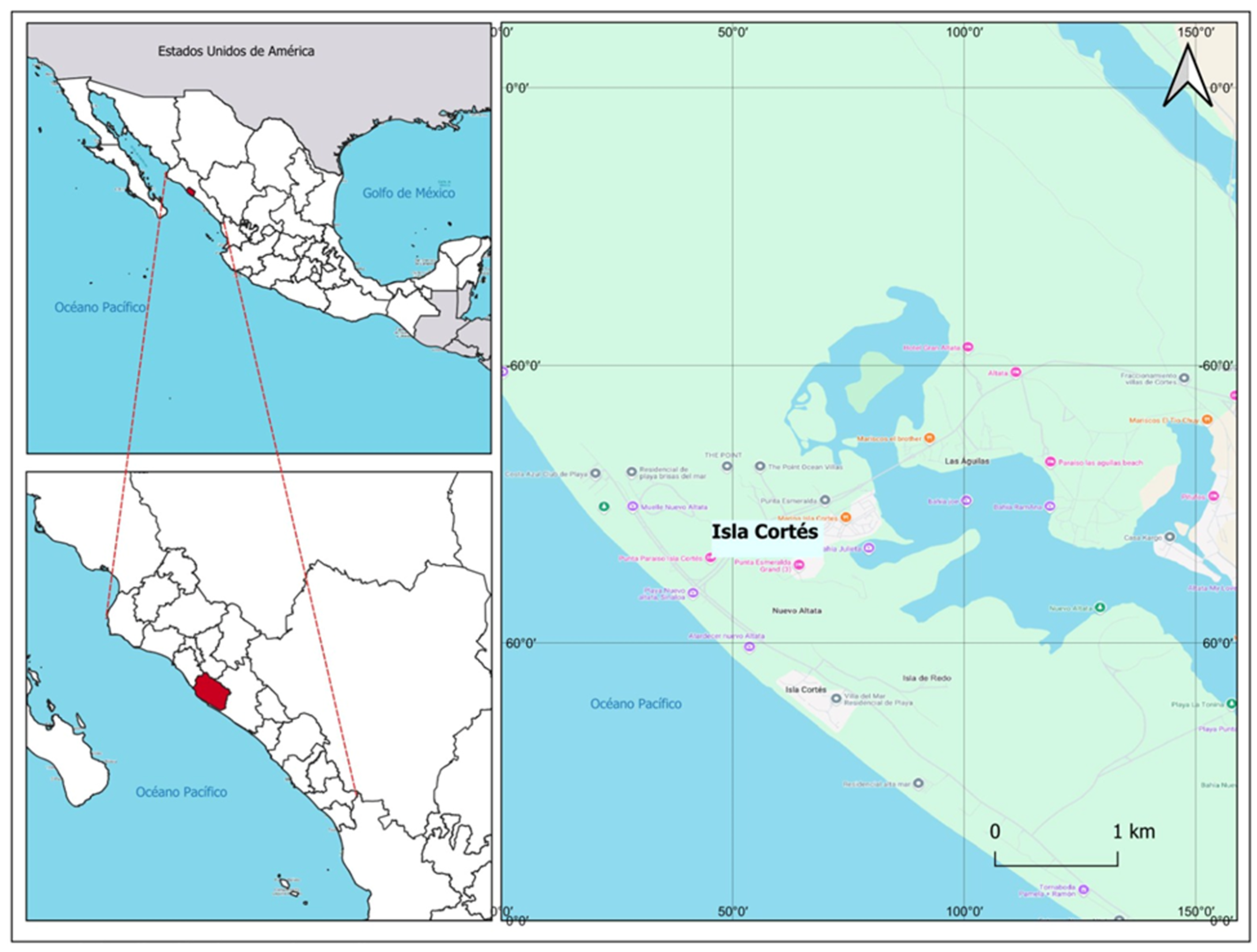
Due to the geophysical characteristics of Isla Cortés, its strategic location in the Altata Bay and in front of the Gulf of California make this destination attractive for the configuration of this tourist phenomenon. This had a strong impulse from the arrival of a road infrastructure in 2006, with the Nuevo Altata creating connectivity and the Altata boardwalk in 2015 attracting the offer of tourists to the region. Figure 1 shows the geographical location of Isla Cortés.
According to the Sinaloa Tourism Secretariat, in 2020 alone, Altata received more than 900,000 visitors, making it the second most popular beach destination in the state. Tourism has driven rapid growth in the real estate market on Isla Cortés, offering multiple housing options. Initially, investments were concentrated in the main bay area of Julieta and later extended to the Nuevo Altata beach coastline. The production of these real estate developments was entrusted to local construction companies.
In summary, Isla Cortés uniquely combines natural and ecological features with modern amenities, creating a paradise-like sun-and-beach resort. This makes it an ideal case study for analyzing how the influx of economic activity and real estate development have integrated with and transformed the natural and ecological landscape, causing irreparable damage to the area’s natural ecosystem. The results of our research have important implications for Isla Cortés and other sun-and-beach tourist regions facing similar challenges.

3.2. Methodological Approach

This study adopts a qualitative case study design focused on Isla Cortés, Mexico. The research is supported by spatial analysis and territorial observation, combining documentary review, field-based observation, and diachronic visual interpretation of land-use and landscape change. The purpose is not to produce a fully quantitative measurement of environmental transformation but to understand how residential tourism, real estate expansion, and coastal fragility intersect in the production of a changing socio-ecological territory. In methodological terms, the study prioritizes contextual interpretation and territorial reading, while using spatial evidence to strengthen the empirical analysis of coastal urbanization. This design is particularly suitable for examining a contemporary process that unfolds in a specific and ecologically sensitive setting, where the interaction between tourism, real estate investment, and environmental pressure cannot be reduced to a purely descriptive or purely statistical account (Table 1).

3.3. Research Design

The research was conducted in several phases, described below:
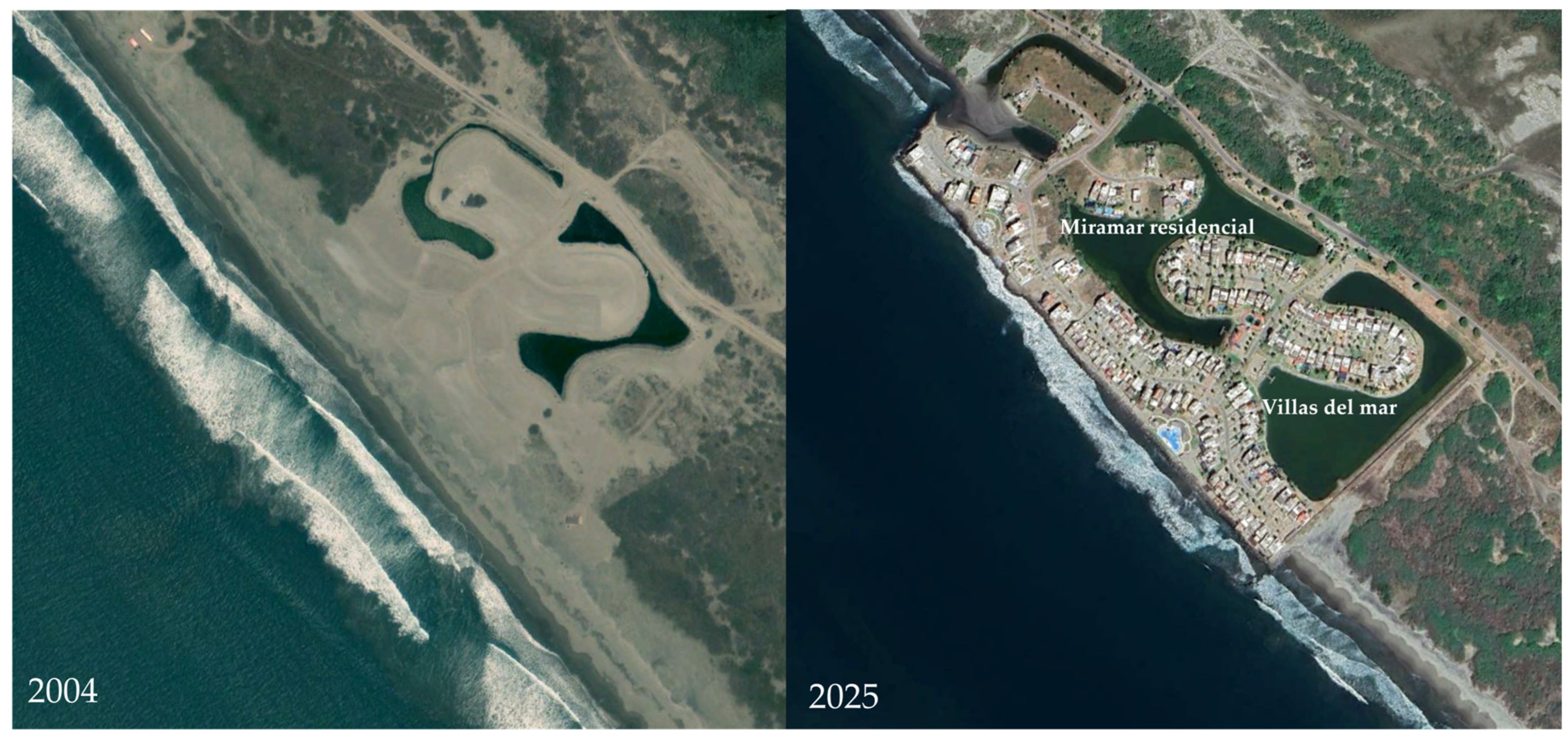
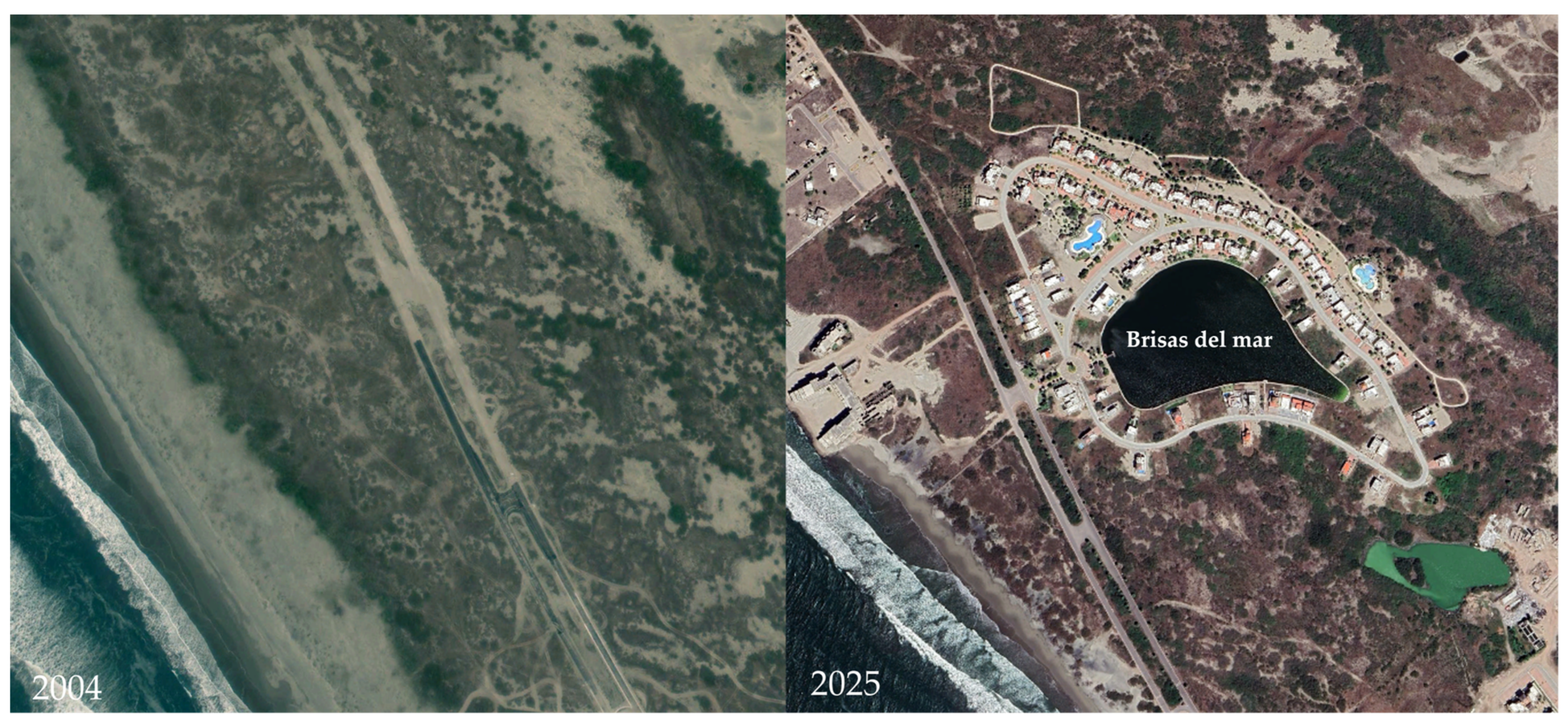
First is ‘’Analysis of the historical development of residential tourism and changes in the natural landscape on Isla Cortés’’. Here, satellite images are highlighted as a key tool for understanding the effects of real estate development on the environment, enabling the visualization of the transformations resulting from this activity in the natural environment’s components—water, soil, topography, and vegetation specifically, to gain a territorial understanding of the impact that economic activities have on the natural environment. Here, an analysis of historical changes in tourism was conducted using satellite imagery based on a multitemporal analysis, allowing us to observe the evolution of urban development and land use on Isla Cortés over two periods: 2004 and 2025.
To achieve this, historical images were first processed to create a timeline; here, each development present in the study area during the different periods was identified geographically. This method sought to identify.
(i) Tourism Infrastructure: access roads, kiosks, piers, walkways, and connectivity routes;
(ii) Construction Areas: conversion of natural land to built-up areas (tourism developments);
(iii) Coastal Modifications: retreat of the shoreline, construction in coastal zones, development of artificial channels;
(iv) Loss of Vegetation Cover.
Second is ‘’ Identify the socio-environmental impacts resulting from the development of residential tourism’’. An assessment was conducted here of the environmental impacts on Cortés Island resulting from the urban transformation process driven by residential tourism. The impacts were characterized using the following indicators: water, soil, flora and fauna, air, and socioeconomic aspects. Once the impact factor (urbanization, residential-tourism) was determined, a matrix was developed to identify environmental impacts. This matrix evaluates each development and its environmental elements to ultimately determine the degree of impact. This methodology allows for the identification of activities and their environmental effects in the study area, as well as the correlation of environmental impacts with the actions of real estate developments.
Thus far, this list of factors and impacts provides a preliminary understanding of the effects on the natural environment, which is being altered for economic gain. These factors and actions comprise the environmental impact matrix shown below, which describes each of its components (Table 2):
The environmental impact characterization matrix was designed based on the components of the real estate developments on Isla Cortés and the elements of the natural environment that have been altered.
The third phase is known as ‘’Understanding residential tourism through the historical development of the real estate market on Isla Cortés’’. This section analyzes the real estate boom based on the following indicators: year of establishment (the year the project was created), project name, property type (apartment or house), amenities (services, facilities, or features offered by the real estate development or accommodation that enhance consumers’ comfort and well-being) and minimum price range. To achieve this, the primary data were obtained through a field visit conducted between December 2024 to March 2025.
Secondary data were collected through systematic digital documentary review. Local and regional press sources were consulted using targeted keyword searches, including real estate offers in Isla Cortés, privatization of Isla Cortés, the real estate boom in Isla Cortés, coastal construction, and vacation rentals. These sources enabled the reconstruction of the temporal narrative of real estate expansion and public debates surrounding territorial privatization. To support spatial and diachronic analysis, geographic information platforms such as Google Earth were used to examine the urban transformations resulting from tourism-related real estate developments.
As the fourth phase, ‘’Identify the accommodations offered by digital platforms in the tourism and residential sector on Isla Cortés’’, an analysis of the tourism offerings in the study area was conducted using a methodology that allows for the organization and evaluation of the elements available to visitors. The objective is to identify the tourism offerings currently available in the area; to achieve this, an inventory was compiled incorporating the following indicators: development, type of offer and prices. To achieve this, the primary data were obtained through a field visit conducted between December 2024 to March 2025. This visit had a purpose:
To achieve this, primary data was collected through a field visit conducted between December 2024 and March 2025. Secondary data was obtained through a systematic digital literature review that consulted digital platforms where these residences were listed (Booking, Airbnb, Expedia, TripAdvisor, and Facebook). These platforms enabled the analysis of the economic landscape of residential tourism in the area.

3.4. Construction of the Residential Developments Inventory

The inventory of residential developments was constructed through a systematic qualitative procedure combining documentary review, territorial observation, and spatial verification. The purpose of this inventory was to identify, delimit, and characterize the residential-tourism projects that have contributed to the recent transformation of Isla Cortés. In methodological terms, the inventory was not conceived as a cadastral or purely statistical database, but as an analytical instrument designed to capture the territorial expression of real estate expansion in the study area. This approach is consistent with qualitative case study research, where documentary evidence and contextual observation are used to reconstruct contemporary processes in their real-world setting.
The identification of residential developments was carried out in three stages. First, a documentary review was undertaken using publicly available material related to real estate promotion, tourism marketing, local reports, and secondary sources referring to urban growth in the area. This stage made it possible to compile the names of projects, their advertised characteristics, and their approximate locations. Second, this preliminary list was contrasted with field-based territorial observation in order to verify the physical presence of developments, identify visible construction patterns, and distinguish consolidated projects from those still under development or only partially materialized. Third, the resulting inventory was cross-checked through spatial verification using Google Earth Pro and historical imagery, which allowed the approximate location and territorial footprint of each development to be visually corroborated over time. Google Earth’s historical imagery functionality is specifically designed to allow users to examine places across different dates, making it useful for diachronic spatial interpretation.
To ensure internal consistency, explicit inclusion and exclusion criteria were applied. Developments were included when they met at least three conditions: (1) they were visibly identifiable within the study area; (2) they corresponded to residential, condominium, villa, second-home, or tourism-oriented housing projects; and (3) they presented either a recognizable built footprint, active construction, or clear evidence of lot subdivision and urban preparation associated with residential-tourism use. By contrast, isolated dwellings, small-scale self-built housing, non-residential infrastructure, and projects located outside the delimitation of Isla Cortés were excluded from the inventory. Likewise, projects mentioned in promotional materials but lacking any territorial trace or spatial confirmation were treated with caution and not incorporated as fully verified cases.
For each identified development, a basic analytical record was created, including, whenever available, the project name, approximate location, observable stage of development, visible spatial extent, and relation to nearby environmental features such as coastal strips, wetlands, mangroves, or zones of recent land-use change. This procedure did not aim to produce an exhaustive legal or commercial registry of properties, but rather to build a robust empirical basis for interpreting how residential tourism is materializing territorially. In this sense, the inventory functioned as a bridge between documentary evidence and spatial interpretation, helping to organize the empirical material used later in the results and discussion sections.
Finally, the construction of the inventory was treated as an iterative process rather than a single-stage listing exercise. As qualitative research emphasizes, documentary materials do not simply provide neutral information; they must be interpreted critically, triangulated, and situated in relation to other forms of evidence. For that reason, the inventory was continuously refined as documentary, observational, and spatial sources were compared. This triangulated procedure strengthened the credibility of the dataset and reduced the risk of relying solely on promotional discourse or on decontextualized visual evidence.

4. Results

4.1. Spatial Trajectory of Residential Tourism Development in Isla Cortés

The evidence collected through documentary review, territorial observation, and spatial verification indicates that residential tourism in Isla Cortés has not developed as an isolated or purely local phenomenon, but rather as a progressive process of coastal transformation associated with real estate expansion and the increasing valorization of the landscape. The inventory of developments identified in the study area shows that this process has unfolded through the gradual consolidation of residential projects oriented toward leisure, seasonal occupation, and tourism-related housing demand. In line with what has been documented for residential tourism in Mexico, these developments appear not merely as secondary by-products of tourism, but as structuring elements in the territorial reorganization of coastal space [1].
A diachronic reading of the territory based on field observation and historical imagery suggests that the transformation of Isla Cortés has occurred through an incremental but clearly directional expansion of the built environment. Rather than a single wave of urbanization, the study area shows successive phases of intervention, including lot subdivision, the opening or improvement of access routes, the visible extension of built-up surfaces, and the emergence of residential enclaves in areas previously characterized by lower levels of anthropogenic occupation. This pattern is consistent with tourism-related land-use transitions documented in other Mexican coastal settings, where urban growth tends to advance through cumulative and spatially uneven processes rather than through a single concentrated rupture [2].
The mapped distribution of developments also suggests that residential expansion has not been spatially neutral. On the contrary, the projects identified tend to cluster in areas of high landscape value and strategic coastal proximity, reinforcing a pattern in which the scenic and environmental qualities of the territory are transformed into locational assets. In territorial terms, this means that the attraction of the coast does not remain external to urbanization; it becomes one of the main forces organizing where and how development occurs. This pattern is especially relevant in an ecologically sensitive environment such as Isla Cortés, where the concentration of residential pressure in coastal zones increases the likelihood that environmental transformation will accompany real estate growth.
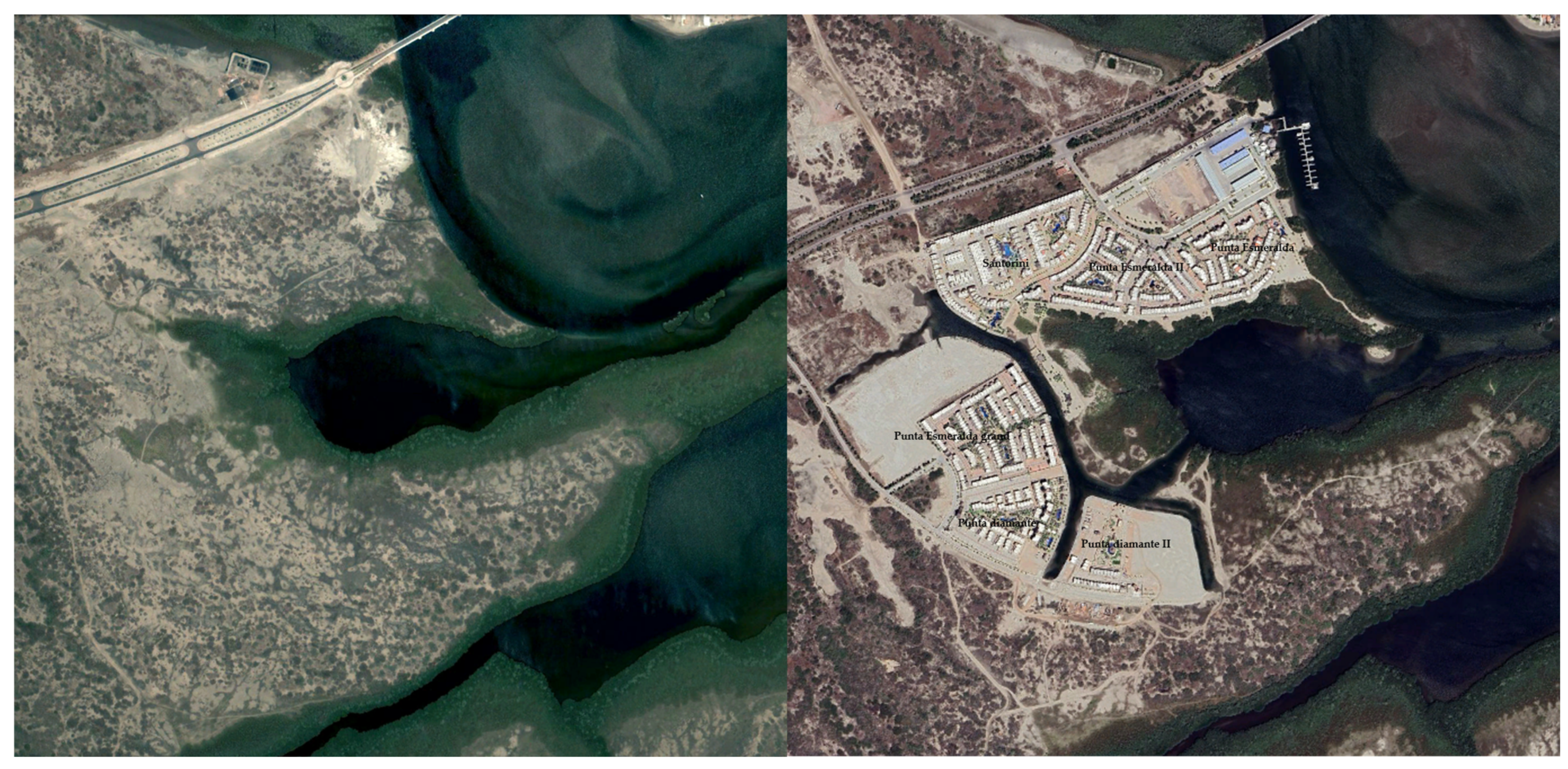
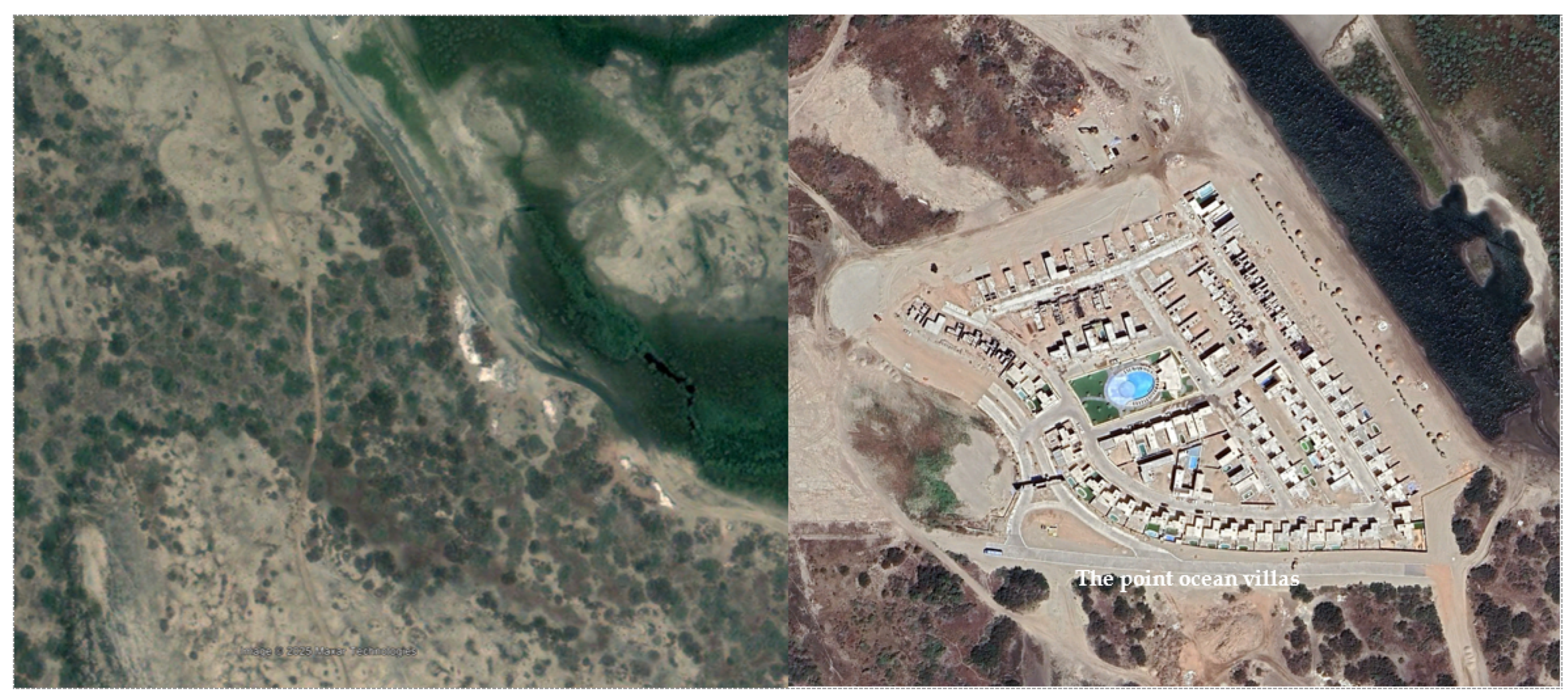
As shown in Figure 2 and Figure 3, the territorial footprint of residential development expanded from 2004 to 2025, particularly in areas closest to the coastal strip and bayfront zone.

4.2. Territorial Transformation and Emerging Socio-Ecological Pressures

The results further show that the advance of residential tourism in Isla Cortés is not limited to visible construction activity, but is associated with broader territorial changes that affect the ecological conditions of the coastal environment. The spatial evidence examined in this study suggests that urbanization has progressively occupied or altered areas that are environmentally sensitive, either because of their proximity to the shoreline, their relation to low-lying coastal ecosystems, or their function within a wider landscape matrix. Although this study does not seek to provide a remote-sensing quantification of environmental loss, the territorial reading undertaken here indicates that the pattern of development is occurring in a context of socio-ecological fragility rather than in an environmentally neutral setting. This interpretation is consistent with previous research showing that tourism-oriented land-use change along Mexican coasts often generates pressures on beaches, mangroves, and other valuable ecosystems [2].
One of the most visible findings concerns the relationship between residential expansion and the increasing artificialization of the coastal landscape. In the study area, the development process appears to involve the conversion of land into residential and infrastructural use, the introduction of new physical barriers or spatial delimitations, and the gradual redefinition of what had previously functioned as more open or less intensively occupied territory. From a socio-ecological perspective, this matters because the transformation of the coastal environment is not only esthetic or urbanistic; it potentially affects hydrological dynamics, habitat continuity, and the resilience of the territory in the face of future environmental stress. Similar concerns have been raised in coastal management studies, which emphasize that tourism expansion frequently intensifies pressure where environmental oversight and long-term planning remain weak or fragmented [28].
The findings also indicate that environmental pressure in Isla Cortés should be understood as cumulative. No single development, taken in isolation, necessarily explains the broader transformation of the territory. However, when the identified projects are examined together, a wider pattern becomes visible: the gradual multiplication of residential developments, access infrastructure, and spatial interventions generates a cumulative effect that redefines the coastal environment over time. In this sense, the socio-ecological fragility identified in the case does not emerge only from the scale of one project, but from the aggregate logic of a development model that progressively intensifies land occupation in a sensitive coastal setting [2].
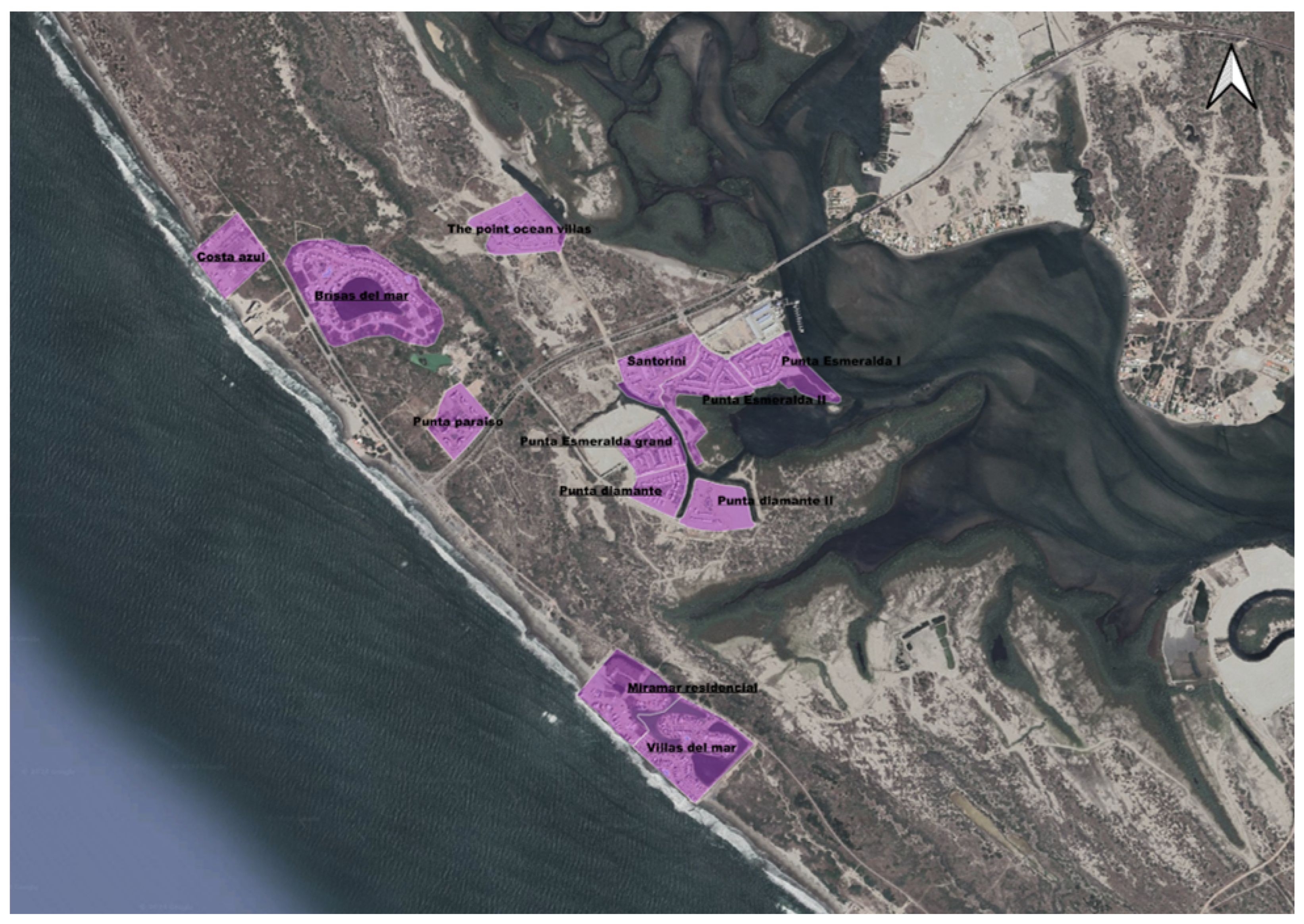
Figure 4 and Figure 5 show that several developments are located in close relation to wetlands, mangrove areas and recently transformed land, suggesting that residential growth is unfolding in direct proximity to environmentally sensitive spaces.

4.3. Differentiated Access, Socio-Spatial Selectivity, and Governance Tensions

Beyond its material footprint, the evidence gathered in this study suggests that residential tourism in Isla Cortés is contributing to a more selective territorial order. The developments identified are not simply adding housing units to the local landscape; they are producing a differentiated geography in which access, use, and value are increasingly organized around residential consumption and real estate expectations. In this respect, the findings point toward an emerging form of socio-spatial selectivity, one in which certain portions of the coast become more strongly associated with exclusive, investment-driven, or privatized uses than with open or collectively accessible forms of occupation. This does not necessarily imply a fully consolidated pattern of exclusion, but it does indicate that territorial change is moving in that direction. Similar processes of socio-spatial differentiation have been documented in Mexican tourist cities, where tourism-led development tends to intensify uneven access to infrastructure and urban benefits [29].
The results also show that the transformation of Isla Cortés is taking place in a context where governance appears limited in its capacity to shape or contain the territorial effects of residential tourism. The evidence reviewed suggests that development has advanced more rapidly than any clearly visible framework of integrated planning, environmental control, or participatory regulation. This mismatch does not necessarily mean that governance is absent, but it does suggest that regulatory and institutional responses remain weaker than the speed and spatial reach of real-estate-led change. In practical terms, this creates a scenario in which residential projects become materially established before their cumulative effects are fully assessed or publicly debated. Studies on coastal governance have repeatedly noted that such institutional lag is one of the key conditions under which tourism-driven environmental pressure becomes harder to manage over time [28].
Taken together, these findings indicate that Isla Cortés is undergoing more than simple tourism growth. What is emerging is a process of territorial reordering in which residential development, ecological pressure, and governance limitations interact in mutually reinforcing ways. The case therefore suggests that residential tourism in Isla Cortés should be read not only as an economic or urban phenomenon, but as a coastal transformation process with social, spatial, and environmental consequences that are already visible, even if not yet fully consolidated. This interpretation is consistent with broader analyses of residential tourism in Mexico, which highlight the territorial significance of real estate promotion and its long-term implications for destination restructuring [1].

4.4. Synthesis of the Main Empirical Findings

Overall, the results of the study point to three main empirical findings. First, residential tourism in Isla Cortés is contributing to a progressive spatial reconfiguration of the coastal territory through the expansion of developments, access infrastructure, and market-oriented land use. Second, this transformation is occurring in an environmentally sensitive setting, where the cumulative effects of real estate urbanization generate emerging forms of socio-ecological pressure. Third, the process is advancing in a governance context that appears fragmented and reactive, allowing territorial change to move faster than collective mechanisms of regulation and environmental protection. Together, these findings support the argument that Isla Cortés should be understood as an emerging tourism-residential enclave in which the promises of development coexist with increasingly visible signs of socio-ecological fragility and spatial selectivity [1,2,28].
Currently, the study area is experiencing an unprecedented real estate boom, with the projection of 12 private condominium-type developments in consolidation, which began forming around 2010 (see Figure 6). These constructions are mainly concentrated in natural bays, intensifying environmental degradation and exacerbating sustainability problems. Bays play a crucial role in marine ecosystems, and those surrounded by mangroves represent some of the most misunderstood ecosystems, holding little social value in Altata. These coastal forests are often seen as “unused” or “dead” zones, vacant lands repurposed for sandy beaches and, in this case, tourism-oriented vacation homes.
On Isla Cortés, residential tourism has consolidated as in other sun and beach destinations in the municipality of Navolato and the surrounding areas. This model presented similarities with previous studies in other regions of the world and in México in the sense that, in Isla Cortés, its inhabitants already perceive the effects of the vicious circle of residential tourism.
Satellite analysis made it possible to identify the effects of urbanization on Cortés Island. The main impacts suggest progressive environmental degradation; it was observed that, over time, the natural landscape has been modified to make way for urban expansion in the area, leaving natural habitats essential for coastal protection and biodiversity—such as mangroves—unprotected. Increased urban transformation through real estate developments: in recent years, there has been a noticeable increase in the presence of developers on the island, which is linked to the creation of space driven by tourism consumption, where new real estate investments have been facilitated.
Environmental impact is a growing concern in areas of natural beauty due to population growth and the activities it drives, which disrupt the natural balance. In particular, real estate development in coastal areas transforms the landscape, alters ecosystems, and has contradictory impacts on natural resources. The expansion of tourism on Isla Cortés has turned its natural beauty into a heavily exploited area, resulting in a decline in biodiversity and habitat fragmentation (Table 3).
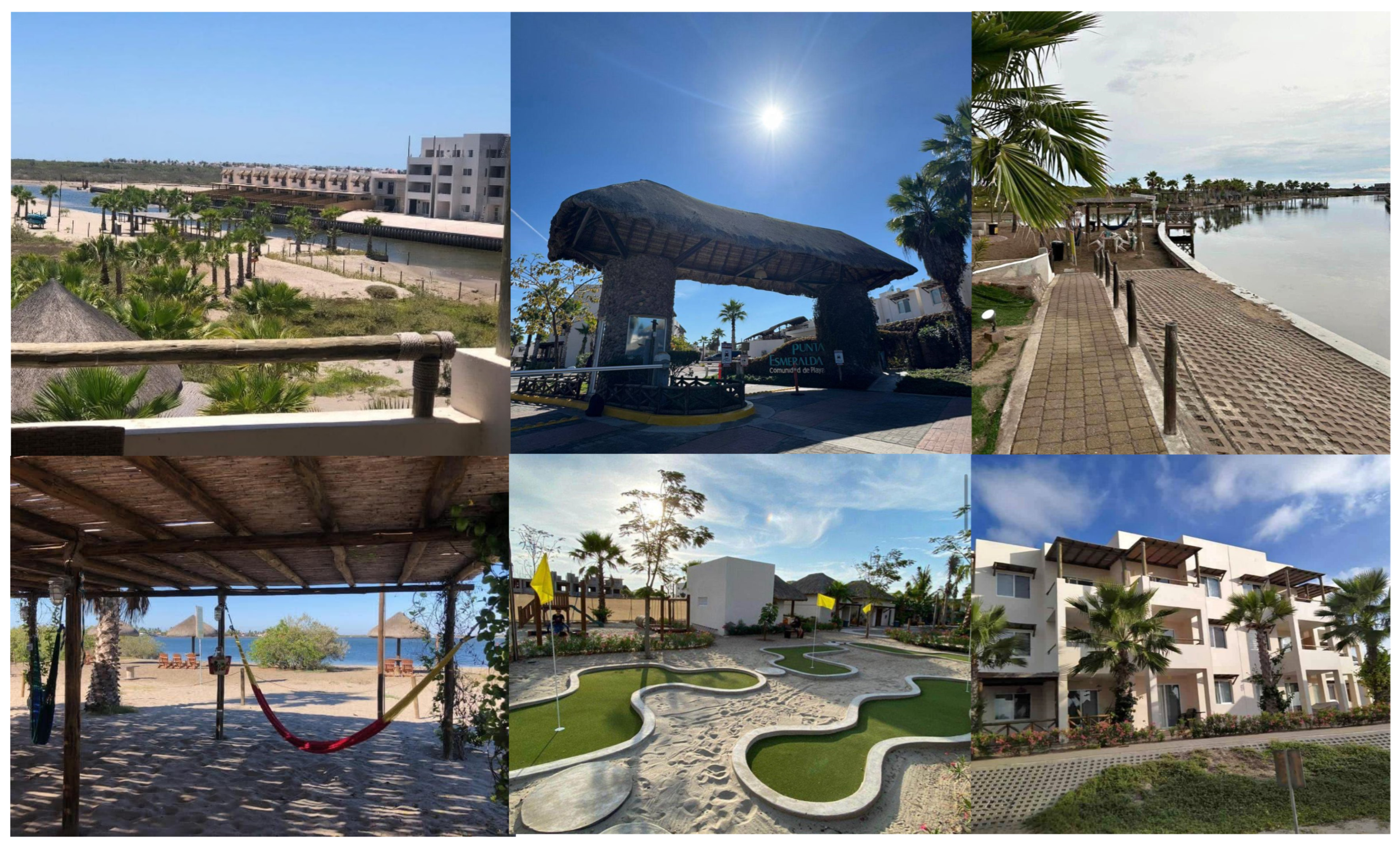
The tourist offer in Isla Cortés includes closed subdivisions and departmental areas where kayaking, recreation areas, swimming pools, among others, are offered for the enjoyment of its visitors (see Figure 7). The wide area of mangroves, close to these developments, has not been a limiting factor for the expansion of the tourist-residential area, since a large part of it was destroyed for its construction, forgetting the essential role of these for aquatic ecosystems. Among other negative effects, the following have been highlighted: landscape degradation, biological reduction and fragmentation, deforestation, loss of vegetative cover, increase in water, acoustic and atmospheric.
On Isla Cortés, a preliminary review of the lodging options suggests that the market is not balanced. Here, the supply is substantial and diverse, but as one moves away from this area, the lodging options become limited, since the surrounding areas have not yet been developed for real estate purposes. However, it is undeniable that the real estate sector has found in collaborative tourism a significant stimulus to expand the tourist area through the construction of new developments, including apartment towers for tourist use in residential areas, which are offered through digital platforms such as Airbnb and social media such as Facebook (Table 4 and Table 5).
Since 2018, with the arrival of Airbnb in Sinaloa, a trend has emerged toward further expanding residential and tourist accommodation developments. Private condominiums are concentrated in this beach destination, driven by flexible land-use regulations that the state has granted to promote this type of development, without prioritizing environmental protection. According to the Airbnb website, there are 276 accommodations on Isla Cortés listed on the platform, distributed across various real estate projects.
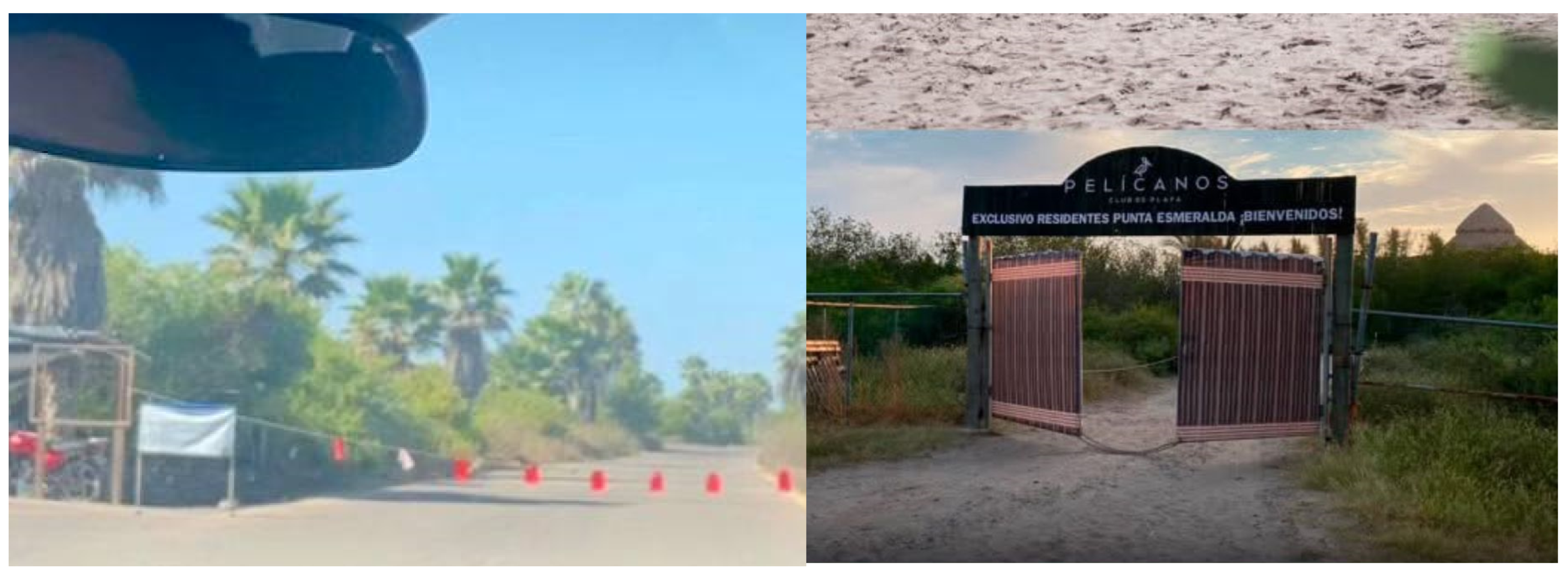
As has been pointed out, the cycle of real estate tourism is reduced to the acquisition of land, construction of houses and their sale. There is no such tourist business. In Isla Cortés, we are faced with a real estate activity. Just like any business, this must continue to grow; that is to say, building itself, because there are no other objectives or intention to create alternative or complementary ones. There have been frequent complaints from citizens regarding the privatization of the beach, which has been taken over by private developers who arbitrarily restrict access to the sea for visitors who do not own property in the area: “The issue is that the island is practically hijacked in some way because access is charged, or certain filters are imposed, and the authorities are fully aware of these irregularities” [30] (Figure 8).
The purpose of these complaints has been to ensure that local tourists can access the beaches without restrictions, establishing a free zone. However, this goal has not been achieved due to the lack of effective management by the authorities. Another news report highlights a citizen’s concern: “Isn’t the beach supposed to be federal property and therefore cannot be privatized? Are common citizens NOT allowed to enjoy what belongs to everyone?” This development model is closely related to the material production of space and implies a new way of reorganizing it extensively and based on leisure activities and free time [31]. This tourism model works through a process of speculation in which the soil is stripped of its natural qualities and irregularized by natural cycles to be the object of speculation [32].
This has meant that it is more profitable to pave and subdivide natural areas for their subsequent sale; therefore, it promotes the process of artificialization of the soil. Thus, the landscape is transformed and made invisible, vanishing its environmental attributes, replacing it with an artificial one, that of a touristized nature.
The stripping of ecological attributions from the soil and its integration into the logic of the market identified by Smith [33] as a more qualitative than quantitative capitalist development, which implies that nature is progressively shaped from within the system. The author names this process as the construction of a second nature, where the first nature is deprived of its originality. In another sense, it forms the natural space in accordance with the interests of capital.

5. Discussion

The case of Isla Cortés confirms that residential tourism should not be understood merely as an extension of leisure activity, but as a territorial process that reorganizes coastal space through the interaction of real estate investment, land valorization, and selective forms of spatial occupation. In the Mexican context, this interpretation is consistent with Hiernaux-Nicolas’s argument that residential tourism is closely linked to real estate promotion and the production of new territorial configurations rather than to conventional tourism alone [1]. It also resonates with broader discussions of lifestyle and residential mobility, which show that these forms of settlement often generate durable transformations in destination areas, especially through housing markets and changing uses of local space [34].
At the same time, the Isla Cortés case suggests that these processes become particularly significant in ecologically fragile coastal settings, where urbanization does not simply add built infrastructure but alters the material conditions that sustain the territory itself. This interpretation is aligned with research on Mexican coasts showing that tourism- and urbanization-related land-use change has frequently occurred at the expense of ecosystems such as mangroves, beaches, and coastal vegetation, generating measurable losses in ecosystem services [2]. In this sense, the relevance of Isla Cortés lies not only in the existence of residential projects, but in the way these projects are embedded in a coastal environment where ecological vulnerability and development pressure reinforce one another [1,35].
A first comparative insight emerging from this study is that Isla Cortés shares important traits with broader patterns of tourism urbanization documented elsewhere in Mexico, yet it also differs in a meaningful way. Similarly to other coastal destinations, the expansion of tourism-oriented residential development appears linked to the commodification of landscape, rising land values, and the reorganization of space according to market-oriented uses [1]. Research on tourist cities such as Puerto Vallarta has also shown that tourism-led urbanization can intensify socio-spatial segmentation and uneven access to urban benefits [29]. Isla Cortés appears to move in that direction, but unlike more consolidated tourism cities, it allows these processes to be observed at an earlier stage, when territorial trans-formation is already visible but not yet fully stabilized institutionally or ecologically.
This is where the main contribution of the case becomes clearer. Much of the literature on tourism urbanization has concentrated on mature destinations in which environmental degradation, social fragmentation, and infrastructure pressure are already deeply sedimented. By contrast, Isla Cortés makes visible the formative phase of a tourism-residential enclave, that is, the stage at which residential development is still advancing, governance responses remain partial, and ecological fragility is only beginning to be articulated as a public problem. This early-stage perspective is analytically important because it shows how the discourse of development can coexist with emerging but still fragmented evidence of socio-ecological stress [1,35].
A second important point concerns governance. The findings suggest that the problem is not simply the existence of residential tourism itself, but the way it advances in settings where planning, environmental regulation, and territorial oversight are limited, fragmented, or reactive. This interpretation is consistent with the literature on integrated coastal zone management, which has repeatedly emphasized that coastal change is especially difficult to manage when economic expansion outpaces institutional coordination and environmental monitoring [28]. In that sense, Isla Cortés reflects a broader pattern of uneven governability: investment and territorial transformation move relatively quickly, while mechanisms for ecological protection, long-term planning, and meaningful participation remain comparatively weak or delayed [28].
The case also invites a more nuanced reading of residential tourism than one based exclusively on celebratory or catastrophic narratives. It would be analytically insufficient to describe the process either as straightforward progress or as a fully consolidated model of dispossession. What Isla Cortés reveals, rather, is a transitional territorial condition in which the promises of investment, destination visibility, and urban improvement coexist with signs of ecological strain, differentiated access to coastal space, and the gradual reorganization of the territory around residential consumption. This interpretation is important because it shifts the discussion from abstract denunciation to mechanism: residential tourism does not simply “affect” the coast in general terms; it reshapes the logic through which coastal land is inhabited, valued, and governed [1,34].
From a broader analytical standpoint, the case contributes to debates on residential tourism by reinforcing the need to examine these developments not only as mobility phenomena but also as processes of coastal urbanization with lasting socio-ecological consequences. The territorial significance of residential tourism lies less in the temporary presence of visitors than in the infrastructures, property relations, and land transformations it leaves behind. This is particularly relevant in emerging destinations, where cumulative environmental pressure may still appear dispersed but already points toward more durable patterns of spatial selectivity and ecological vulnerability [2,28]. Isla Cortés therefore helps illuminate how residential tourism can operate as an early driver of coastal reordering within wider dynamics of real-estate-led change in Mexico’s littoral regions [1].
Finally, these findings also have implications for future research. The case suggests the importance of examining emerging tourism-residential landscapes before their transformation becomes ecologically entrenched or institutionally normalized. It also points to the need for more comparative work across Mexican coastal enclaves in order to distinguish which regulatory, ecological, and political conditions make residential tourism more exclusionary, more environmentally disruptive, or more difficult to govern. Combining territorial observation, spatial evidence, and governance analysis seems especially useful for capturing these processes in contexts where formal quantitative records remain limited but territorial change is already underway [2,36].

6. Conclusions

This article examined how residential tourism is reshaping Isla Cortés through processes of real estate urbanization, territorial reconfiguration, and emerging socio-ecological fragility. The findings suggest that the transformation of the study area cannot be understood solely as an expression of tourism growth or local economic dynamism. Rather, what is unfolding is a broader process in which residential development progressively reorganizes coastal space, concentrates value in selected areas, and generates cumulative pressures on an environmentally sensitive territory. In this sense, the case supports previous research showing that residential tourism in Mexico is closely tied to real estate dynamics and to longer-term processes of territorial restructuring, rather than to temporary tourism activity alone [1].
A first central conclusion is that residential tourism in Isla Cortés is contributing to a visible spatial reconfiguration of the coastal environment. The developments identified in the study do not simply add new buildings or housing units; they participate in a wider transformation of land use, access, and territorial organization. This process is especially significant because it unfolds in a coastal setting where ecological fragility is not external to development, but deeply entangled with it. As previous studies on Mexican coastal change have shown, tourism- and urbanization-related land-use transformations can generate lasting environmental consequences, particularly when they affect sensitive ecosystems and accelerate the conversion of land into built or market-oriented uses [2]. The case of Isla Cortés points in that direction, even when some of these effects are still emerging rather than fully consolidated.
A second conclusion is that the socio-ecological significance of the case lies in its cumulative character. The territorial pressures identified in Isla Cortés are not reducible to a single intervention or project. Instead, they emerge through the gradual aggregation of residential developments, access infrastructure, and landscape transformation over time. This cumulative logic matters because it helps explain why the environmental implications of residential tourism are often underestimated in their early stages. What may initially appear as dispersed or incremental growth can, in fact, produce a more profound reordering of the coastal environment and its conditions of use, governance, and resilience. Seen from this perspective, the case contributes to a more critical understanding of how fragile coastal territories are progressively incorporated into real estate-driven development dynamics.
A third conclusion concerns governance. The evidence suggests that the advance of residential tourism in Isla Cortés is occurring in a context where planning, environmental oversight, and territorial regulation appear limited in relation to the speed and spatial reach of development. This does not necessarily imply a total absence of regulation, but it does indicate an uneven relationship between investment-driven transformation and the institutional capacity to anticipate, manage, or mitigate its broader effects. In line with work on coastal governance, this kind of mismatch is especially relevant because it allows environmentally sensitive changes to become normalized before their long-term implications are fully assessed or collectively debated [28].
From a broader scholarly standpoint, this article contributes to the literature in two ways. First, it reinforces the need to analyze residential tourism not only as a form of mobility or consumption, but also as a process of coastal urbanization with durable socio-spatial and ecological consequences. Second, it brings attention to an emerging coastal enclave rather than a fully consolidated tourism destination. This is important because much of the literature has focused on mature tourism spaces, whereas Isla Cortés makes it possible to observe the formative stages through which tourism-residential landscapes are produced. In that sense, the article offers an empirically grounded contribution to debates on residential tourism, coastal development, and socio-ecological vulnerability in Mexico.
At the same time, the study has limitations that should be acknowledged clearly. The research was designed as a qualitative case study supported by spatial analysis and territorial observation, not as a cadastral survey or a full remote-sensing assessment. For that reason, the article does not claim to provide exhaustive quantitative measurement of land-cover change, hydrological alteration, or ecosystem loss. Instead, its contribution lies in reconstructing the territorial logic of residential expansion and in identifying the socio-ecological pressures that become visible through documentary review, field observation, and diachronic spatial interpretation. This methodological scope is consistent with case study research aimed at understanding contemporary processes in their real-life context rather than producing statistical generalization [36].
These limitations also point toward future research priorities. Further studies would benefit from combining qualitative territorial analysis with more detailed geospatial measurement, environmental indicators, and comparative work across other Mexican coastal enclaves undergoing similar transformations. Such research would help clarify the specific conditions under which residential tourism becomes more ecologically disruptive, more socially selective, or more difficult to govern. It would also strengthen the evidence base needed to move beyond generalized development rhetoric and toward more context-sensitive forms of coastal planning.
Ultimately, Isla Cortés should not be read simply as an isolated tourism destination or a local real estate story. It should be understood as a revealing case of how coastal space is being reorganized under contemporary development pressures, where the promises of investment and territorial improvement coexist with increasingly visible signs of socio-ecological fragility. Recognizing this tension is essential, not only for interpreting the present transformation of Isla Cortés, but also for thinking more critically about the future of coastal development in Mexico.

Author Contributions

Conceptualization, M.L.-I.; Methodology, P.G.-M.; Software, M.L.-I.; Formal analysis, M.L.-I.; Investigation, P.G.-M. and M.L.-I.; Writing–review & editing, P.G.-M. and M.L.-I.; Supervision, P.G.-M.; Funding acquisition, P.G.-M. All authors have read and agreed to the published version of the manuscript.

Funding

We would like to thank Universidad Técnica Particular de Loja (UTPL) for its financial support in making this research possible.

Institutional Review Board Statement

Not applicable.

Informed Consent Statement

Not applicable.

Data Availability Statement

The original contributions presented in this study are included in the article. Further inquiries can be directed to the corresponding author.

Conflicts of Interest

The authors declare no conflict of interest.

References

  1. Hiernaux, D. La promoción inmobiliaria y el turismo residencial: El caso mexicano. Scr. Nova 2005, IX, 741–798. [Google Scholar]
  2. Mendoza-González, G.; Martínez, M.L.; Lithgow, D.; Pérez-Maqueo, O.; Simonin, P. Land use change and its effects on the value of ecosystem services along the coast of the Gulf of Mexico. Ecol. Econ. 2012, 82, 23–32. [Google Scholar] [CrossRef]
  3. Ljungdahl, Z. Sommar-Stockholm. Ymer 1938, 58, 218–242. [Google Scholar]
  4. Jurdao, F. Los mitos del turismo. In Endymion; Bantam Spectra: New York, NY, USA, 1992. [Google Scholar]
  5. Wortman, T.; Donaldson, R.; van Westen, G. “They are stealing my island”: Residents’ opinions on foreign investment in the residential tourism industry in Tamarin, Mauritius. SJTG 2016, 37, 139–157. [Google Scholar] [CrossRef]
  6. Şit, M.; Karadağ, H. The relationship between foreign housing investments and tourism in Turkey: Causality analysis. Erciyes 2018, 51, 115–126. [Google Scholar] [CrossRef][Green Version]
  7. Hof, A.; Morán-Tejeda, E.; Lorenzo-Lacruz, J.; Blázquez-Salom, M. Swimming pool evaporative water loss and water use in the Balearic Islands (Spain). Water 2018, 10, 1883. [Google Scholar] [CrossRef]
  8. O’Connor, J. Causas Naturales: Ensayos de Marxismo Ecológico; Siglo XXI: Mérida, Mexico, 2001. [Google Scholar]
  9. García, H. El círculo vicioso del turismo residencial: Análisis de los factores locales del boom inmobiliario español. Rev. De Tur. Y Patrim. Cult. 2014, 12, 395–408. [Google Scholar]
  10. Quinn, C.H.; Stringer, L.C.; Berman, R.; Lê, H.; Msuya, F.E.; Pezzuti, J.C.B.; Orchard, S.E. Unpacking changes in mangrove social-ecological systems: Lessons from Brazil, Zanzibar, and Vietnam. Resources 2017, 6, 14. [Google Scholar] [CrossRef]
  11. Alongi, D.M. The impact of climate change on mangrove forests. Curr. Clim. Change Rep. 2015, 1, 30–39. [Google Scholar] [CrossRef]
  12. Salazar-Ortiz, M.; Cuevas, E. Land use and land management during the past century determine mangrove dynamics in northwestern Puerto Rico: The case of the Maracayo Mangrove. J. Environ. Sci. Eng. B 2017, 6, 593–623. [Google Scholar] [CrossRef]
  13. Abdullah, R.; Hanif, A.F.; Toufik, S.; Mohamad Zakaria, R.; Kadir, W.R.; Husin, T.M.; Halim, N.S.A.; Ajeng, A.A. Community knowledge, attitude, and practice towards importance and sustainability of mangrove forests: A case study of Kuala Langat, Malaysia. Int. J. Res. Innov. Soc. Sci. 2021, 5, 222–235. [Google Scholar] [CrossRef]
  14. Durand, L.; Sundberg, J.; Rodríguez-Martínez, R.E. Seaweed blooms in paradise: Ecological reflexivity, governance and the Sargassum crisis in the Mexican Caribbean. Ocean Coast. Res. 2024, 72, e24014. [Google Scholar] [CrossRef]
  15. Sánchez-Quinto, A.; Correa da Costa, J.; Zamboni, N.S.; Sanches, F.H.C.; Principe, S.C.; Viotto, E.V.; Casagranda, E.; Lima, F.A.V.; Possamai, B.; Faroni-Perez, L. Development of a conceptual framework for the management of biodiversity and ecosystem services in the Mexican Caribbean. Biota Neotrop. 2020, 20, e20190901. [Google Scholar] [CrossRef]
  16. Waiyasusri, K.; Chotpantarat, S. Spatial evolution of coastal tourist city using the Dyna-CLUE model in Koh Chang of Thailand during 1990–2050. ISPRS Int. J. Geo-Inf. 2022, 11, 49. [Google Scholar] [CrossRef]
  17. Merven, R.; Florens, F.B.V.; Appadoo, C.; Iranah, P. Relational values of mangroves shaped by local narratives, social changes and gender roles: Case study of an oceanic island in the Western Indian Ocean. J. Ethnobiol. 2025, 45, 380–399. [Google Scholar] [CrossRef]
  18. Hof, A.; Schmitt, T. Urban and tourist land use patterns and water consumption: Evidence from Mallorca, Balearic Islands. Land Use Policy 2011, 28, 792–804. [Google Scholar] [CrossRef]
  19. Aparicio, J.R.; Macías Perdomo, L.V. Hurricanes, reconstruction, and resistance: Thinking through vulnerability in the Caribbean. Disasters 2024, 49, e12664. [Google Scholar] [CrossRef]
  20. Umprasoet, W.; Mu, Y.; Somrup, S.; Junchompoo, C.; Guo, Z.; Zhang, Z. Assessment of habitat risks caused by human activities and integrated approach to marine spatial planning: The case of Sriracha District—Sichang Island. Coasts 2023, 3, 190–208. [Google Scholar] [CrossRef]
  21. Purvis, D.; Jiddawi, N. Seagrass cover reduction in Zanzibar from 2006 to 2019. West. Indian Ocean J. Mar. Sci. 2023, 22, 1–14. [Google Scholar] [CrossRef]
  22. Mycoo, M. Sustainable tourism, climate change and sea level rise adaptation policies in Barbados. Nat. Resour. Forum 2013, 38, 47–57. [Google Scholar] [CrossRef]
  23. Singgalen, Y.A.; Gudiato, C.; Prasetyo, S.Y.J.; Fibriani, C. Mangrove monitoring using normalized difference vegetation index (NDVI): Case study in North Halmahera, Indonesia. J. Ilmu Dan Teknol. Kelaut. Trop. 2021, 13, 219–239. [Google Scholar] [CrossRef]
  24. Rubio, K.; Vargas Martínez, E.E.; Delgado Cruz, A.; Martínez Rubio, K.; Vargas Martínez, E.E.; Delgado Cruz, A. Effect of environmental innovation on sustainability in the hotel sector. Rev. De Adm. De Empresas 2024, 64, e2022-0492. [Google Scholar] [CrossRef]
  25. Alreahi, M.; Bujdosó, Z.; Lakner, Z.; Pataki, L.; Zhu, K.; Dávid, L.D.; Kabil, M. Sustainable tourism in the post-COVID-19 era: Investigating the effect of green practices on hotel attributes and customer preferences in Budapest, Hungary. Sustainability 2023, 15, 11859. [Google Scholar] [CrossRef]
  26. Victoria, M. Sinaloa 360. 2023. Available online: https://www.sinaloa360.com/isla-cortes-altata-navolato/ (accessed on 23 May 2025).
  27. Guevara, P. El Proyecto de Isla de Cortés Nace en un Momento de Intensa Competencia Turística a Nivel Internacional y Nacional. Noroeste. 2008. Available online: https://www.noroeste.com.mx/opinion/malecon-mazatlan/el-proyecto-de-isla-de-cortes-nace-en-un-momento-de-intensa-competencia-turistica-a-nivel-internacional-y-nacional-AHOP13741 (accessed on 12 July 2025).
  28. Mestanza-Ramón, C.; Pranzini, E.; Anfuso, G.; Botero, C.M.; Chica-Ruiz, J.A.; Mooser, A. Integrated coastal zone management in continental Ecuador and Galapagos Islands: Challenges and opportunities in a changing tourism and economic context. Sustainability 2019, 11, 6386. [Google Scholar] [CrossRef]
  29. Pérez-Campuzano, E.; Santos-Cerquera, C. Segregación socioespacial en ciudades turísticas: El caso de Puerto Vallarta, México. Estud. Y Perspect. En Tur. 2010, 19, 780–798. [Google Scholar] [CrossRef]
  30. Bravo, K. Isla Cortés Está Prácticamente Secuestrada por Particulares, Denuncia Canaco Navolato. Noroeste. 2023. Available online: https://www.noroeste.com.mx/culiacan/isla-cortes-esta-practicamente-secuestrada-por-particulares-denuncia-canaco-navolato-AF3412741 (accessed on 8 May 2026).
  31. Aledo, A.; Mazón, T.; Mantecón, A. La insostenibilidad del turismo residencial. In Antropología y Turismo: Claves Culturales y Disciplinares; Plaza y Valdés Editores: Mexico City, Mexico, 2007; pp. 185–208. [Google Scholar]
  32. Aledo, A. Turismo residencial y vulnerabilidad en el interior del Levante español. In Turismo Residencial y Gentrificación Rural; Pasos Edita: Tenerife, Spain, 2016; pp. 37–59. [Google Scholar]
  33. Smith, N. Uneven Development: Nature, Capital, and the Production of Space; University of Georgia Press: Athens, GA, USA, 1990. [Google Scholar]
  34. Benson, M.; O’Reilly, K. Migration and the search for a better way of life: A critical exploration of lifestyle migration. Sociol. Rev. 2009, 57, 608–625. [Google Scholar] [CrossRef]
  35. Aguilar, P.; Mendoza, E.; Silva, R. Interaction between tourism carrying capacity and coastal squeeze in Mazatlán, Mexico. Land 2021, 10, 900. [Google Scholar] [CrossRef]
  36. Yin, R.K. Case Study Research and Applications, Design and Methods; Sage: Thousand Oaks, CA, USA, 2018; p. 6. [Google Scholar]
Figure 1. Geographical location of the study area.
Sustainability 18 05109 g001
Figure 2. Modification of the coastal strip by real estate developments.
Sustainability 18 05109 g002
Figure 3. Territorial transformation in coastal areas.
Sustainability 18 05109 g003
Figure 4. Real estate developments in the mangrove area.
Sustainability 18 05109 g004
Figure 5. Territorial transformation resulting from real estate development on Isla Cortés.
Sustainability 18 05109 g005
Figure 6. Real estate on Isla Cortés.
Sustainability 18 05109 g006
Figure 7. Amenities and architectural and landscape configuration of homes on Isla Cortés.
Sustainability 18 05109 g007
Figure 8. Privatization on Isla Cortés.
Sustainability 18 05109 g008
Table 1. Presents the research design implemented in this study, structured around four analytical objectives and their corresponding methodological procedures.
ObjectiveCategoryTechniquesInstrumentUnit of Analysis
Analysis of the historical development of residential tourism and changes in the natural landscape on Isla CortésGeography of residential tourismGeoreferencingField data on the location of real estate developmentsTourism developments from 2010 to 2024.
Identify the socio-environmental impacts resulting from the development of residential tourismEnvironmental Impact Assessment of Real Estate DevelopmentsObservationEnvironmental Impact MatrixEnvironmental indicators:
physical (soil, air, and water), natural (flora and fauna), and socioeconomic (economic and social)
Understanding residential tourism through the historical development of the real estate market on Isla CortésContextualization and identification of propertiesObservationTerritorial schemeTourist properties.
-Year of construction
-Urban context
-Real estate offerings
-Types of properties
Identify the accommodations offered by digital platforms in the tourism and residential sector on Isla CortésContextualization and identification of properties and tourism offeringsContent analysisTerritorial schemeAccommodation options
Characterize the geography of residential tourism and the resulting reconfiguration of this phenomenon in Isla CortésGeography of residential tourismGeoreferencingField data on the location of real estate developmentsTourism developments from 2010 to 2024.
Table 2. Presents an environmental impact matrix for this study, designed to address environmental assessment needs.
DevelopmentEnvironmental IndicatorImpact FactorEnvironmental ImpactImpact Classification
List of real estate developmentsPhysical indicators (soil, air, and water)Refers to the area of influence of the impact in relation to the development’s surroundingsRepresents the anthropogenic modification or action on the ecosystem resulting from real estate developmentRepresents the degree of environmental impact on the factor in terms of the specific degree of impact: Low, Medium, High, Very High.
Natural indicators (flora and fauna)
Socioeconomic indicators (economic and social)
Table 3. Housing offer in Isla Cortés.
Year of
Establishment
Project NameProperty TypeAmenitiesMinimum Price Range ($)
2010Brisas del MarApartmentsGated access, swimming pools, wading pools, children’s playgrounds, kayak lake, bike paths, beach access.1,950,000
Costa AzulHouseGated access, beachfront, swimming pools, wading pools.2,000,000
Miramar ResidencialHouseGated access, beachfront, swimming pools, wading pools.2,600,000
Villas del MarHouseGated access, beachfront, swimming pools, wading pools.3,250,000
2017Punta Esmeralda IApartments/HouseGated access, swimming pools, wading pools, children’s playgrounds, kayaks, palapas with grills, hammocks, mini foosball, inflatable water trampoline.1,750,000
2018Punta Esmeralda IIApartments/HouseGated access, swimming pools, wading pools, children’s playgrounds, kayaks, palapas with grills, hammocks, mini foosball, inflatable water trampoline.2,150,000
Punta Esmeralda GrandApartments/HouseGated access, swimming pools, wading pools, children’s playgrounds, kayaks, palapas with grills, hammocks, mini foosball, inflatable water trampoline.3,800,000
SantoriniApartments/HouseGated access, swimming pools, wading pools, children’s playgrounds, navigation canal, kayaks and paddleboards, fire pits, mini golf, hammocks, mini foosball, inflatable water trampoline.2,770,950
2022The Point Ocean VillasHouseWading pools.3,100,000
Punta ParaísoApartmentsGated access, swimming pools, wading pools, children’s playgrounds, palapas with grills, fire pits, volleyball and soccer courts, mini golf, hammocks, outdoor cinema, beach access.2,186,000
Punta DiamanteApartmentsGated access, swimming pools, wading pools, children’s playgrounds, outdoor cinema, palapas with grills, fire pits, volleyball and soccer courts, mini golf, hammocks, beach access, navigation canal.2,363,000
2024Punta Diamante IIApartmentsGated access, swimming pools, wading pools, children’s playgrounds, outdoor cinema, palapas with grills, fire pits, volleyball and soccer courts, mini golf, hammocks, beach access, navigation canal.2,363,000
Table 4. Tourist offer in Isla Cortés.
DevelopmentType of OfferPrices ($MXN)
Brisas del MarApartments1300–3100
Costa AzulHouse1000–1300
Residencial MiramarHouse2100–5800
Villas del MarHouse1700–5300
Punta Esmeralda IApartments/House1300–3000
Punta Esmeralda IIApartments/House1300–4800
Punta Esmeralda GrandApartments/House1200–2100
SantoriniApartments/House1500–2700
The Point Ocean VillasHouse3000–4000
Punta ParaísoApartments1200–2100
Punta DiamanteApartments1500–2700
Punta Diamante IIApartments1500–2500
Table 5. Environmental impact matrix.
DevelopmentEnvironmental IndicatorImpact FactorEnvironmental ImpactImpact Classification
Brisas del marWaterUrbanizationWater qualityMedium
High water consumptionHigh
Residential tourismWater consumptionVery high
FaunaUrbanizationLoss of local biodiversityHigh
Habitat fragmentationVery high
Disruption of migration routes and nestingHigh
Displacement of speciesHigh
Urbanization /Residential tourismSpecies mortalityMedium
Ecosystem changesMedium
FloraUrbanizationDirect loss of vegetation coverMedium
Introduction of invasive speciesLow
Permanent alteration of the landscapeMedium
SoilResidential tourismCritical waste managementMedium
UrbanizationChemical leachingLow
ExcavationsHigh
Construction wasteLow
Presence of oilLow
Concrete slabsMedium
Accumulation of wasteLow
Soil compactionLow
Debris and landfillsLow
Destruction of dunesHigh
Air Combustion gasesLow
SocioeconomicUrbanizationCreation of temporary jobsMedium
Residential tourismJob creationLow
Costa AzulWaterUrbanizationWater qualityLow
Construction wasteLow
Exposure to storm surges and hurricanes.Very high
High water consumptionLow
Changes in coastal dynamicsHigh
Residential tourismWater consumptionLow
Water pollution caused by wastewater and wasteMedium
FaunaUrbanizationHabitat fragmentationMedium
Displacement of speciesLow
Urbanization /Residential tourismEcosystem changesMedium
FloraUrbanizationDirect loss of vegetation coverMedium
Permanent alteration of the landscapeMedium
SoilUrbanizationConcrete slabsMedium
Accumulation of wasteLow
Soil compactionMedium
Accelerated erosion due to changes in coastal dynamicsHigh
AirUrbanizationvulnerability to weather eventsVery high
Combustion gasesLow
SocioeconomicUrbanizationCreation of temporary jobsLow
Residential tourismJob creationLow
Miramar
Residencial/Villas del Mar
WaterUrbanizationWater qualityLow
Construction wasteLow
Exposure to storm surges and hurricanes.Very high
High water consumptionMedium
Changes in coastal dynamicsMedium
Residential tourismWater consumptionMedium
Water pollution caused by wastewater and wasteHigh
FaunaUrbanizationHabitat fragmentationMedium
Displacement of speciesMedium
FloraUrbanization /Residential tourismEcosystem changesMedium
UrbanizationDirect loss of vegetation coverMedium
Permanent alteration of the landscapeMedium
SoilUrbanizationConcrete slabsMedium
ExcavationsMedium
Accumulation of wasteLow
Soil compactionMedium
Accelerated erosion due to changes in coastal dynamicsHigh
AirUrbanizationvulnerability to weather eventsVery high
Combustion gasesLow
SocioeconomicUrbanizationCreation of temporary jobsLow
Residential tourismJob creationLow
Punta
Esmeralda
I,
Punta
Esmeralda
II, Santorini, Punta
Esmeralda
Grand, Punta diamante, Punta diamante II
WaterUrbanizationWater qualityMedium
Exposure to storm surges and hurricanes.Medium
High water consumptionHigh
Wetland fillingHigh
Changes in water flowHigh
Residential tourismWater consumptionVery high
Water pollution caused by wastewater and wasteHigh
FaunaUrbanizationLoss of local biodiversityHigh
Habitat fragmentationVery high
Disruption of migration routes and nestingHigh
Displacement of speciesHigh
Urbanization /Residential tourismSpecies mortalityMedium
Ecosystem changesMedium
FloraUrbanizationDirect loss of vegetation coverMedium
Introduction of invasive speciesLow
Permanent alteration of the landscapeMedium
Removal of mangrove vegetationVery high
wetland fillingMedium
Replacement of native vegetation with ornamental plantsHigh
SoilResidential tourismCritical waste managementMedium
UrbanizationChemical leachingLow
ExcavationsHigh
Construction wasteLow
Presence of oilLow
Concrete slabsMedium
Accumulation of wasteLow
Soil compactionLow
Debris and landfillsLow
Landfill and DredgingHigh
Destruction of dunesHigh
Air Combustion gasesLow
SocioeconomicUrbanizationCreation of temporary jobsMedium
Residential tourismJob creationHigh
The point ocean villasWaterUrbanizationWater qualityLow
Construction wasteLow
Exposure to storm surges and hurricanes.Very high
High water consumptionLow
Changes in coastal dynamicsHigh
Residential tourismWater consumptionLow
Water pollution caused by wastewater and wasteMedium
FaunaUrbanizationHabitat fragmentationMedium
Displacement of speciesLow
FloraUrbanization /Residential tourismEcosystem changesMedium
UrbanizationDirect loss of vegetation coverMedium
Permanent alteration of the landscapeMedium
SoilUrbanizationConcrete slabsMedium
Accumulation of wasteLow
Soil compactionMedium
Accelerated erosion due to changes in coastal dynamicsHigh
AirUrbanizationvulnerability to weather eventsVery high
Combustion gasesLow
SocioeconomicUrbanizationCreation of temporary jobsLow
Residential tourismJob creationLow
Punta ParaísoWaterUrbanizationWater qualityMedium
High water consumptionHigh
Exposure to storm surges and hurricanesMedium
Residential tourismWater consumptionVery high
Water pollution caused by wastewater and wasteHigh
FaunaUrbanizationLoss of local biodiversityHigh
Habitat fragmentationVery high
Disruption of migration routes and nestingMedium
Displacement of speciesMedium
Urbanization /Residential tourismSpecies mortalityMedium
Ecosystem changesMedium
FloraUrbanizationDirect loss of vegetation coverMedium
Introduction of invasive speciesLow
Permanent alteration of the landscapeMedium
SoilResidential tourismCritical waste managementMedium
ExcavationsHigh
Construction wasteLow
Presence of oilLow
Concrete slabsMedium
Accumulation of wasteLow
Soil compactionLow
Debris and landfillsLow
Destruction of dunesHigh
AirUrbanizationCombustion gasesLow
SocioeconomicUrbanizationCreation of temporary jobsMedium
Residential tourismJob creationMedium
Disclaimer/Publisher’s Note: The statements, opinions and data contained in all publications are solely those of the individual author(s) and contributor(s) and not of MDPI and/or the editor(s). MDPI and/or the editor(s) disclaim responsibility for any injury to people or property resulting from any ideas, methods, instructions or products referred to in the content.