Article

Analysis of the Global Tungsten Supply Chain Trade Network: Does Sino–US Trade Friction Affect Supply Chain Resilience?


1
Postdoctoral Mobility Station, School of Economics, Peking University, Beijing 100871, China
2
Postdoctoral Research Station, Bank of Hebei Co., Ltd., Shijiazhuang 050011, China
3
College of Economics and Management, Tianjin University of Science and Technology, Tianjin 300222, China
*
Author to whom correspondence should be addressed.
Sustainability 2026, 18(10), 5110; https://doi.org/10.3390/su18105110
Submission received: 20 April 2026 / Revised: 12 May 2026 / Accepted: 15 May 2026 / Published: 19 May 2026

Abstract

Tungsten is a critical strategic resource whose supply chain has become increasingly exposed to external trade shocks, raising concerns about its resilience and sustainability. However, existing studies mainly focus on single products and lack a systematic analysis of multi-stage supply chain networks under trade shocks. Using trade data for 66 countries from 2012 to 2023 obtained from the UN Comtrade database, this study constructs a multi-stage trade network of the global tungsten supply chain, covering upstream, midstream, and downstream segments, and combines complex network analysis with a difference-in-differences (DID) approach to examine whether and how Sino–US trade friction affects supply chain resilience. The results show that the trade network exhibits significant structural heterogeneity across segments, with downstream networks being more complex and interconnected; trade friction has no significant effect on upstream and midstream segments but has a significant positive effect on downstream network centrality, indicating stronger adaptability and structural resilience in downstream segments; the results further suggest that the observed downstream adjustment is mainly associated with changes in China’s network position, while the impact on the United States remains statistically insignificant. This study contributes to the literature by integrating network analysis with causal inference in a supply chain framework and provides new evidence on the heterogeneous effects of trade shocks across different stages of strategic resource supply chains under geopolitical risks.

1. Introduction

Tungsten is a critical rare metal characterized by an exceptionally high melting point and outstanding physical and chemical properties. Due to its scarcity and limited substitutability, it plays a vital role in high-tech industries such as aerospace, electronics, and advanced manufacturing. In recent years, growing geopolitical tensions, trade conflicts, and disruptions to global value chains have intensified concerns over the stability and security of critical mineral supply chains [1,2,3,4]. Against this background, the resilience and sustainability of global supply chains, particularly those involving critical mineral resources, have become increasingly important research topics.
As the world’s dominant producer and exporter of tungsten, accounting for more than 80% of global supply, China occupies a central position in the global tungsten market [3]. However, resource endowment advantages do not necessarily translate into proportional market power or competitiveness [3,5]. This divergence between China’s dominant supply position and its broader supply chain influence has become increasingly pronounced under external shocks, particularly amid Sino–US trade friction and the ongoing restructuring of global supply chains [3,6,7,8]. Therefore, examining China’s role within the global tungsten supply chain requires not only an assessment of trade scale but also a structural analysis of its position across different stages of the trade network.
Existing studies on tungsten trade have examined trade patterns, industrial chain dynamics, market structure, international competition, and supply risk propagation, highlighting the evolving role of major economies in the global tungsten market [9,10,11]. In particular, recent studies have increasingly adopted industrial-chain and network-based perspectives to investigate the structural evolution and supply risks of tungsten trade systems [9,10,11]. However, these studies remain largely descriptive or risk-simulation-oriented and tend to focus on individual products or specific segments. As a result, they provide limited insight into the structural organization of the tungsten supply chain as a whole, especially under external trade shocks. In particular, the question of how trade shocks affect supply chain resilience from a network perspective remains insufficiently explored.
To address these limitations, recent studies have increasingly applied complex network approaches to the analysis of global resource trade systems. Complex network theory provides a methodological basis for representing countries as nodes and trade relationships as directed or weighted edges, thereby enabling researchers to identify key actors, characterize network structures, and evaluate the distribution of influence within international trade systems [12]. Building on this approach, studies on mineral and energy resources—such as cobalt, nickel, crude oil, natural gas, and bulk commodities—have developed more mature analytical frameworks [13,14,15]. Recent research has further extended these approaches to multi-layer, multiplex, and industrial-chain frameworks in global resource trade systems [11,12,13,14,15]. These studies provide an important methodological foundation for analyzing interdependencies across different supply chain stages and evaluating the structural resilience of trade networks. Nevertheless, compared with these advances, research on tungsten remains relatively fragmented and has rarely incorporated a multi-stage supply chain framework to examine how external shocks reshape network structure over time.
In addition to structural analysis, another important strand of literature examines the determinants and shock mechanisms of international trade. Traditional studies emphasize the role of economic size, trade costs, comparative advantage, and global value chain fragmentation in shaping trade flows and production networks [16,17,18,19]. More recently, increasing attention has been paid to trade policy uncertainty, geopolitical risks, and the restructuring of global supply chains, particularly in strategic and critical mineral sectors [6,7,8,20,21]. Existing studies suggest that geopolitical competition and trade policy shocks can significantly alter global trade dynamics and supply chain stability [6,7,8,20,22]. In the context of resource trade, these factors do not operate independently of network structure. Instead, trade policy may reshape trade flows by altering countries’ relative positions, changing the direction of trade linkages, and affecting the resilience of supply chain networks. This provides the theoretical basis for examining Sino–US trade friction not only as a change in trade flows but also as a structural shock to the global tungsten supply chain network.
Despite the growing body of literature, important gaps remain in understanding how trade shocks affect the structure and resilience of tungsten supply chain networks. Specifically, three key limitations can be identified. First, existing studies on tungsten trade are largely descriptive and tend to focus on individual products or isolated supply chain segments, providing limited insights into the structural interdependencies across upstream, midstream, and downstream stages. As a result, the heterogeneous transmission of external shocks throughout the supply chain remains insufficiently understood. Second, although recent studies have increasingly adopted network-based approaches, limited attention has been paid to how trade shocks reshape supply chain resilience through changes in network structure and trade linkages over time. Third, existing studies on mineral trade networks rarely incorporate causal inference approaches, making it difficult to identify the causal impact of external shocks on countries’ positions within trade networks. Building on prior studies of mineral trade networks, this study extends the literature by incorporating a multi-stage supply chain perspective and introducing a causal inference framework. Specifically, it constructs a multi-stage trade network covering upstream, midstream, and downstream segments and employs a difference-in-differences (DID) approach to identify the impact of Sino–US trade friction on countries’ network positions and structural resilience over time.
This study contributes to the literature in three ways. First, it develops a multi-stage analytical framework that captures structural differences across upstream, midstream, and downstream supply chain segments. This differs from prior studies on oil and rare earth trade networks, which have mainly focused on single-product or single-stage analyses. Second, it integrates complex network analysis with causal inference (difference-in-differences, DID), allowing the study to identify how external shocks reshape trade network structure over time rather than relying solely on descriptive network analysis. Third, the findings provide insights into the resilience and sustainability of global critical mineral supply chains under geopolitical risks, highlighting the differentiated and asymmetric responses across countries and supply chain stages.

2. Theoretical Framework and Research Hypotheses

2.1. Theoretical Framework

This study is primarily grounded in global value chain (GVC) theory and network resilience theory, while drawing on resource dependence theory to explain structural constraints in upstream segments.
From the perspective of GVC theory, production processes are fragmented across different stages, including upstream resource extraction, midstream processing, and downstream manufacturing. Countries occupy distinct positions within these stages, which determine both their exposure and response to external shocks [18,19]. Recent studies further show that geopolitical tensions and trade policy uncertainty can significantly reshape global value chains and alter countries’ positions within production networks [6,8,20,21,22]. This implies that trade shocks are unlikely to have uniform effects across the supply chain but instead generate heterogeneous impacts across different segments.
From a network perspective, resilience is reflected in the ability of a system to maintain connectivity and adapt through the reconfiguration of linkages under external shocks [12,23,24]. In global trade networks, such adaptation often occurs through the formation of alternative trade connections and the adjustment of countries’ positions within the network. Recent research emphasizes that resilience in trade networks is closely associated with structural flexibility, diversification, and the capacity to reorganize linkages under geopolitical risks [11,15,21,22,25].
Resource dependence theory complements this perspective by highlighting structural constraints in resource-based supply chains [26]. In the case of tungsten, upstream segments are strongly constrained by natural resource endowments and exhibit relatively stable trade patterns, while downstream segments involve more standardized products and diversified demand, allowing for greater flexibility in adjusting trade relationships. Recent reports and empirical studies on critical minerals suggest that resource concentration, geopolitical tensions, and supply chain disruptions continue to shape supply chain vulnerability and strategic dependence in strategic mineral markets [3,4,8,22,25,27,28].
Based on these perspectives, this study conceptualizes supply chain resilience as the ability of the trade network to maintain connectivity and adapt through the reconfiguration of trade relationships in response to external shocks. In this study, resilience is understood primarily as structural adaptability rather than complete resistance to shocks. When disruptions occur, countries may adjust by establishing new trade linkages or redirecting existing flows toward alternative partners. Although resilience is not directly observable, it can be inferred from network structural characteristics that reflect adaptive capacity through the reconfiguration of trade linkages. In particular, countries’ centrality within the network captures their ability to maintain connections, access alternative trade partners, and remain integrated in the trade network when existing linkages are disrupted [12,23,24]. Recent empirical studies further suggest that countries’ positions and connectivity within global trade systems are closely associated with adaptability and structural resilience under external shocks [10,11,15,21].
While supply chain resilience encompasses multiple dimensions, including redundancy, recovery capability, flexibility, and adaptability [23,24,29,30], this study focuses specifically on structural resilience within the global tungsten trade network. Accordingly, network centrality is employed as a proxy for structural resilience, reflecting countries’ ability to maintain trade connectivity, access alternative partners, and adapt to external disturbances through the reconfiguration of trade linkages. Grounded in network resilience theory and recent studies on industrial-chain and global trade-network resilience, this approach emphasizes the importance of network structure and connectivity in understanding adaptive capacity under external shocks [10,11,15,21].

2.2. Research Hypotheses

From the perspective of network resilience theory, external shocks may lead to structural adjustments in trade networks rather than a uniform contraction of trade activity. In global trade systems, countries respond to shocks by reconfiguring trade linkages and seeking alternative partners, which is reflected in changes in their positions within the network [12,23,24]. Recent studies further show that geopolitical tensions can significantly reshape trade networks by altering connectivity patterns and centrality distributions [11,15,21,22,25]. In this setting, countries’ network centrality reflects their ability to maintain connections and access alternative trade partners under external shocks. Trade friction is therefore expected to induce measurable changes in countries’ positions within the global tungsten trade network. Based on this reasoning, the following hypothesis is proposed:
H1. 
Sino–US trade friction has a significant impact on countries’ network centrality in the global tungsten trade network, reflecting structural adjustments in the trade network under external shocks.
According to global value chain (GVC) theory, different stages of the supply chain perform distinct economic functions and exhibit varying degrees of flexibility [19,20]. Upstream segments are constrained by resource endowments and geographical distribution, leading to relatively stable and concentrated trade patterns, whereas downstream segments involve more standardized and substitutable products, allowing countries to adjust trade relationships more easily. Recent studies further suggest that downstream segments tend to exhibit stronger adaptability under external shocks, as firms can reallocate production and redirect exports across markets [11,15,21,22]. These differences imply that the effects of trade shocks are unlikely to be uniform across the supply chain. Accordingly, the following hypothesis is proposed:
H2. 
The impact of Sino–US trade friction exhibits significant heterogeneity across different segments of the tungsten supply chain, with downstream segments expected to show stronger structural adjustments than upstream segments.
Resource dependence theory offers a useful perspective for understanding how actors’ responses to external shocks are shaped by their positions and roles within the supply chain [26]. In the global tungsten supply chain, China generally occupies a central position, particularly in midstream and downstream segments, whereas the United States is more reliant on tungsten imports and less embedded in certain production stages [10,11]. This structural asymmetry implies that countries may respond differently to trade shocks according to their level of integration, dependence, and functional specialization within the supply chain. Economies with higher import dependence may be more likely to adjust by diversifying supply sources, while economies with stronger processing and manufacturing capacities may respond by reconfiguring existing trade linkages within established networks. Recent reports on critical mineral supply chains further suggest that geopolitical risks tend to generate uneven adjustments across countries, depending on their strategic roles and exposure to external dependence [3,4,8,22,25,27,28]. Based on this reasoning, the following hypothesis is proposed:
H3. 
The impact of Sino–US trade friction on the tungsten trade network differs across countries, particularly between China and the United States, due to differences in their roles and positions within the global supply chain.

3. Materials and Methods

3.1. Multi-Stage Tungsten Supply Chain and Network Construction

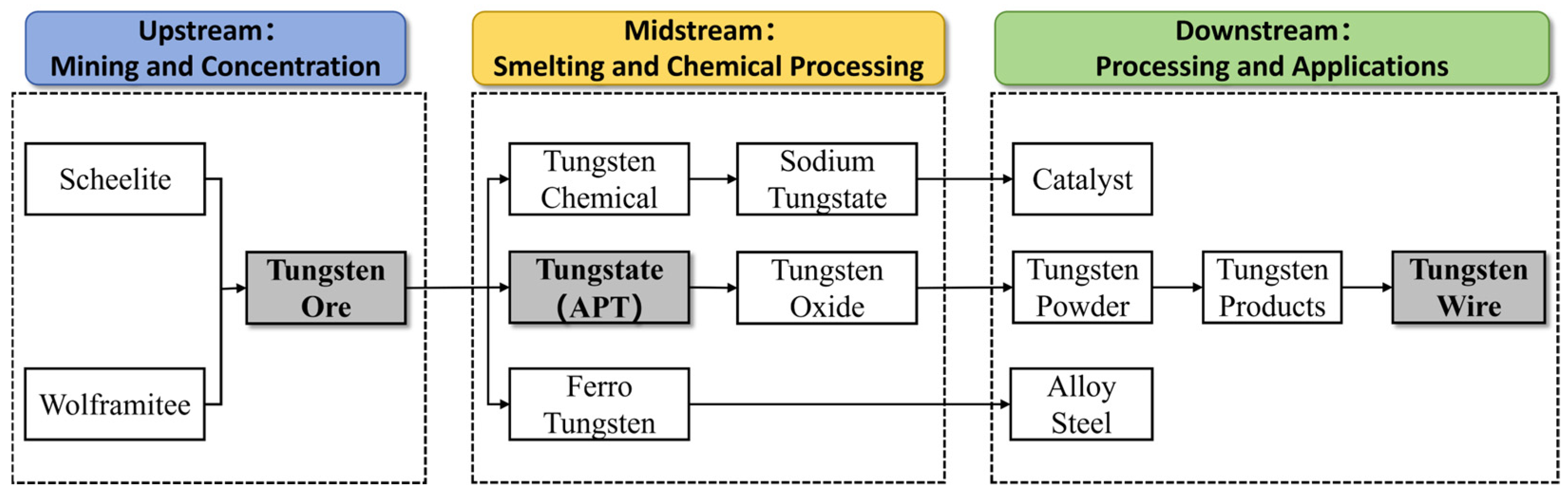
The tungsten supply chain is divided into three segments: upstream, midstream, and downstream, reflecting different functional roles and levels of resilience within the supply chain. The upstream segment consists of tungsten ore (concentrates), the midstream includes smelting and chemical processing products such as ammonium paratungstate (APT), and the downstream comprises processed products such as tungsten wire. Figure 1 illustrates the structure of the tungsten supply chain. The shaded nodes indicate the representative products selected for the empirical analysis.
To ensure consistency between the supply chain structure and the empirical analysis, this study selects tungsten ore, ammonium paratungstate (APT, hereafter referred to as “tungstate”), and tungsten wire as representative products for the upstream, midstream, and downstream segments, respectively.
For clarity, Table 1 reports the representative products and their corresponding HS codes used to define each stage in the empirical analysis, consistent with the highlighted nodes in Figure 1.
Based on this classification, a multi-stage trade network is constructed for each segment. This approach allows for the assessment of structural resilience within the trade network under external shocks. In the network, countries are defined as nodes, and bilateral trade relationships are represented as directed and weighted edges, where edge weights correspond to export values. This framework enables a systematic analysis of the structural characteristics, evolution, and resilience of the global tungsten supply chain trade network from 2012 to 2023. Trade data are obtained from the United Nations Commodity Trade Statistics Database (UN Comtrade), and export values (in US dollars) are used to measure trade relationships between countries.

3.2. Network Measures and Indicators

To characterize the structure of the global tungsten trade network, both global-level and node-level indicators are employed (Table 2).
At the global level, indicators such as average degree, network density, clustering coefficient, and average path length are used to capture the overall connectivity, tightness, clustering patterns, and transmission efficiency of the trade network.
At the node level, centrality measures—including degree centrality, betweenness centrality, closeness centrality, and eigenvector centrality—are adopted to evaluate countries’ roles and positions in the network in terms of connectivity, control, accessibility, and influence.
In addition, core–periphery structure analysis is used to identify the hierarchical organization of the network, while structural hole indicators (effective size and constraint) are employed to assess countries’ brokerage positions and information advantages. To provide a composite assessment of countries’ positions, a composite centrality index is constructed as follows:
CIi = BCi + CCi + ECi
where BCi, CCi, and ECi represent the normalized betweenness centrality, closeness centrality, and eigenvector centrality of country i, respectively. These centrality measures are normalized and equally weighted, and the composite index is used to identify key trading countries across different supply chain segments.

3.3. Difference-in-Differences Model

To identify the impact of Sino–US trade friction on the tungsten supply chain trade network, this study employs a difference-in-differences (DID) approach. The empirical model is specified as follows:
Yit = α + β1Treati + β2Postt + β3(Treati × Postt) + γXit + μi + λt + εit
where Yit represents the closeness centrality of country i at time t, capturing its position within the trade network. Treati is a dummy variable equal to 1 for the treatment group and 0 otherwise; Postt is a time dummy equal to 1 for the post-2018 period and 0 otherwise. The interaction term Treati × Postt captures the effect of Sino–US trade friction. Xit denotes control variables, including trade openness and labor force size; μi and λt represent country and time fixed effects, respectively, and εit is the error term.
The coefficient β3 reflects the net impact of Sino–US trade friction on countries’ positions within the trade network. A significantly positive (negative) coefficient indicates that trade friction enhances (reduces) the position of the treatment group in the network.
Using data from 2012 to 2023, the year 2018 is identified as the policy shock point, with 2012–2017 defined as the pre-policy period and 2018–2023 as the post-policy period. China and the United States are defined as the treatment group, while all other countries serve as the control group. Although the treatment group consists of only two countries, this specification is justified by both the nature of the policy shock and the structural characteristics of the tungsten supply chain. Sino–US trade friction represents a bilateral policy shock that directly targets trade relations between China and the United States, making them the most appropriately treated units in the empirical setting. Moreover, the global tungsten supply chain is highly concentrated, with China accounting for over 80% of global mine production and dominating processing activities, while production outside China represents less than 20% of the global supply [25,28]. In contrast, the United States is highly dependent on imports, with net import reliance exceeding 50% of apparent consumption, reflecting its limited domestic production capacity [28]. This asymmetric structure implies that trade adjustments involving these two countries can have disproportionate effects on global trade linkages. Existing studies and industry reports consistently emphasize that tungsten supply chains are characterized by high concentration and limited substitution, meaning that shocks affecting key economies can propagate through the entire network. Therefore, despite the small number of treated units, the treatment group captures both the direct target of the policy shock and the most economically significant nodes in the global tungsten supply chain.

3.4. Data and Sample Description

This study uses export trade data for three tungsten products—tungsten ore, tungstate, and tungsten wire—from 2012 to 2023, obtained from the United Nations Commodity Trade Statistics Database (UN Comtrade).
To construct a stable and representative trade network, the regions with relatively large trade values are initially selected for each product. After merging the country sets across different products and years, a total of 66 major countries and regions are retained, ensuring both network connectivity and adequate coverage of global tungsten trade, thereby enhancing the representativeness of the network. The list of countries and regions is presented in Table 3.
Given the differences in product quality and grade across countries, trade values (in US dollars) are used instead of physical quantities to ensure comparability.
Missing observations are treated as zero trade flows, assuming that they correspond to negligible or unreported trade. As such observations account for a small proportion of total trade, their impact on the overall network structure is limited.

3.5. Variables

The dependent variable Yit is defined as the closeness centrality of country i at time t, capturing its position within the trade network. This measure is consistent with the specification used in the DID model. Separate regressions are conducted for the upstream, midstream, and downstream segments.
The key independent variable is the interaction term Treati × Postt, which captures the impact of Sino–US trade friction. Control variables are included to account for cross-country differences in macroeconomic conditions. Trade openness is measured as merchandise trade as a percentage of GDP, and labor force size is included to capture differences in production capacity and market scale.
The definitions of all variables are reported in Table 4.

4. Results

4.1. Network Structure of the Tungsten Supply Chain

4.1.1. Overall Network Structure

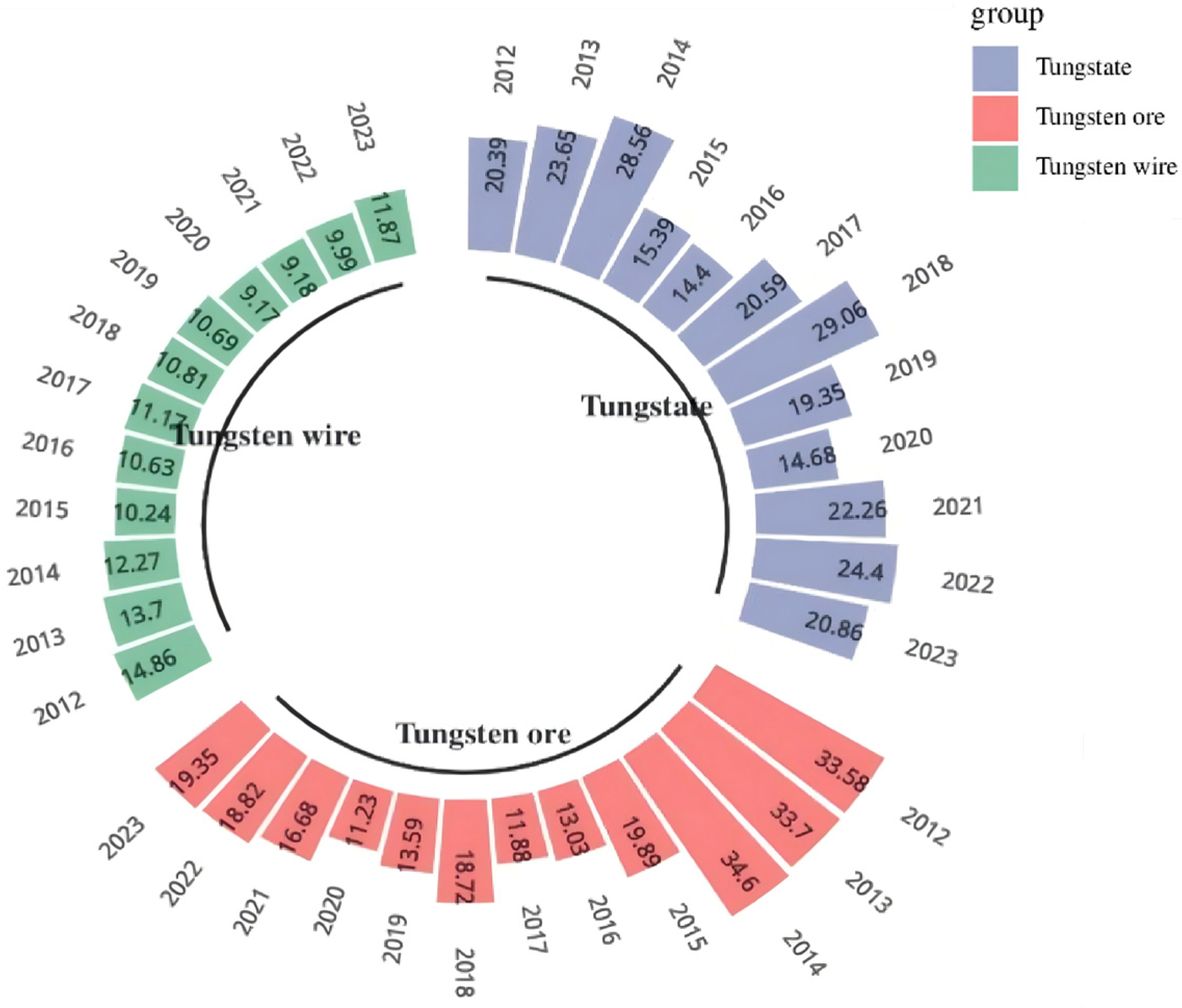
The global trade patterns of tungsten products exhibit distinct dynamics across different segments of the supply chain. Figure 2 illustrates the evolution of trade values for tungsten ore, tungstate, and tungsten wire from 2012 to 2023.
Figure 2 shows that trade values across all three segments exhibit varying degrees of volatility. Tungsten ore experienced a fluctuating decline, particularly before 2018, and remained at a relatively low level thereafter. Tungstate exhibited more pronounced fluctuations, peaking around 2018 before declining significantly in subsequent years. In contrast, tungsten wire maintained smaller trade values than the other two segments, showing a gradual decline from 2012 to 2022, followed by a slight rebound in 2023. These patterns indicate increased volatility and a general downward trend in trade values across the tungsten supply chain, suggesting potential differences in resilience across segments, with certain stages being more vulnerable to external shocks than others.
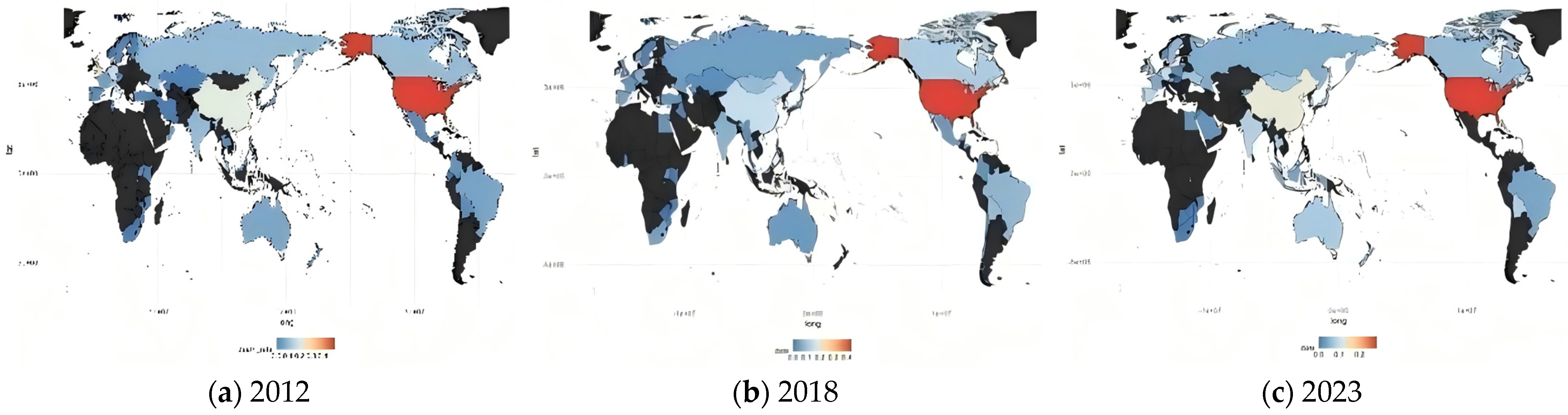
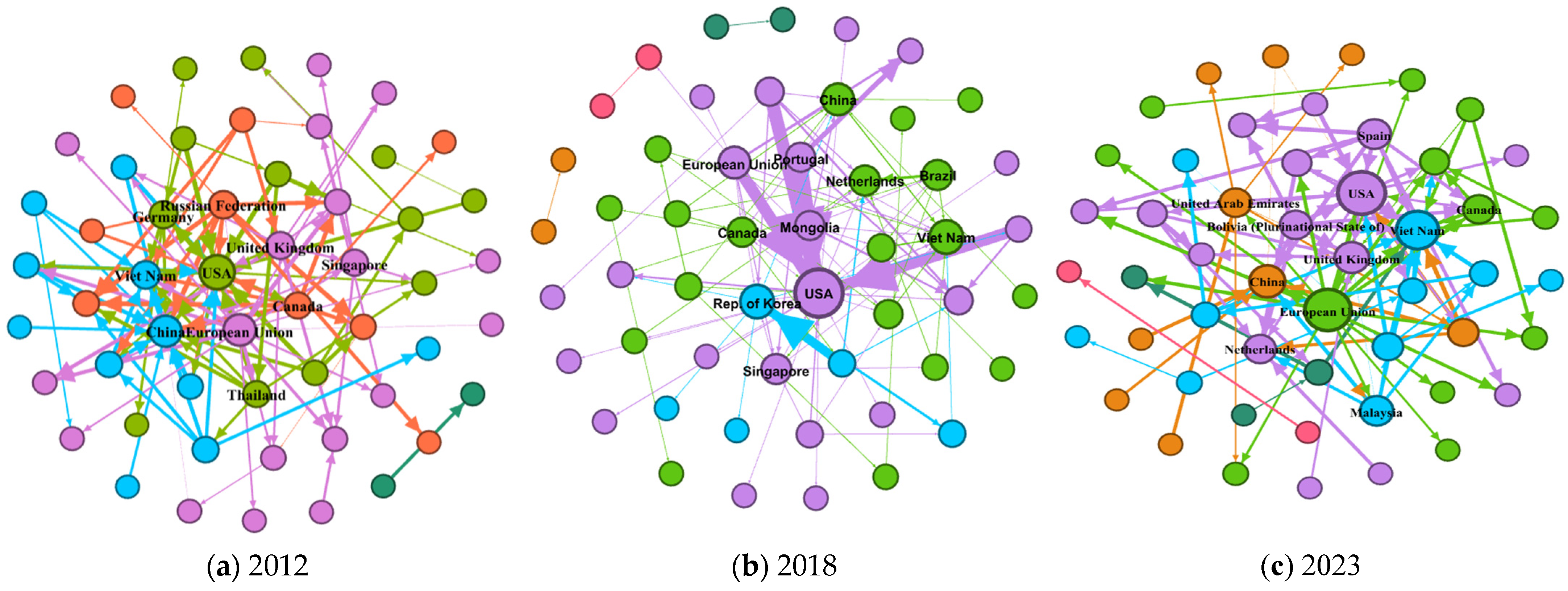
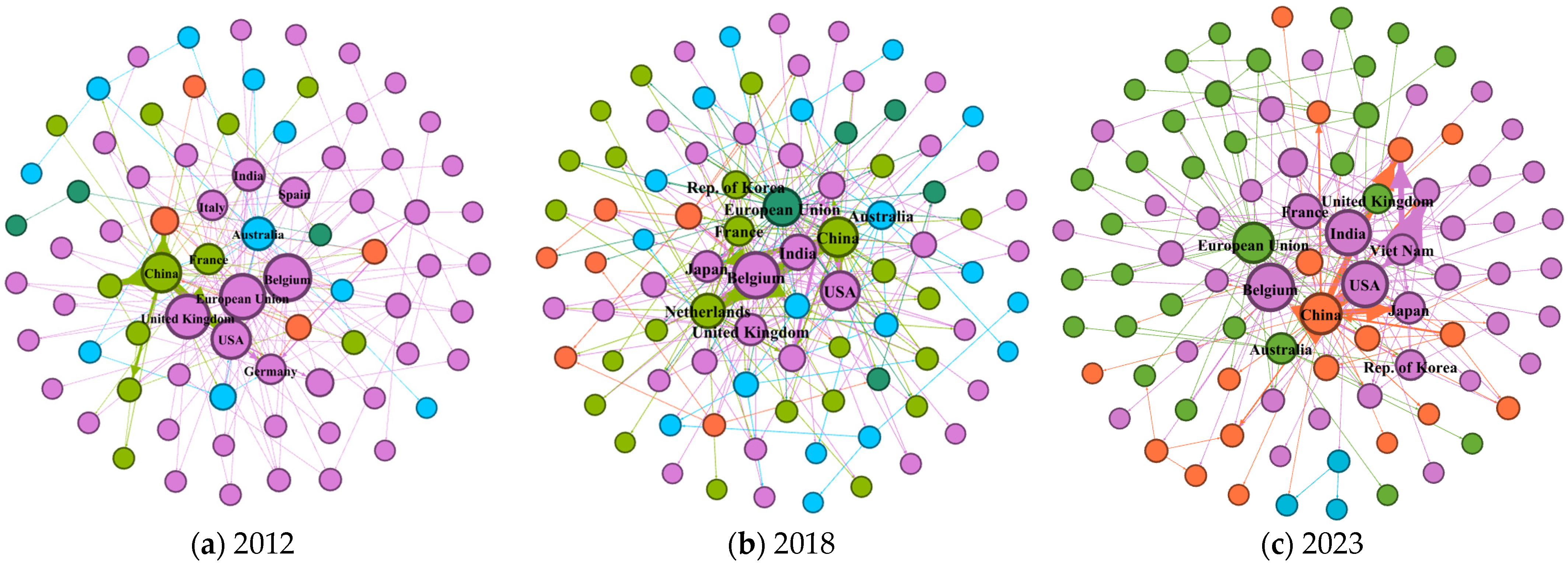
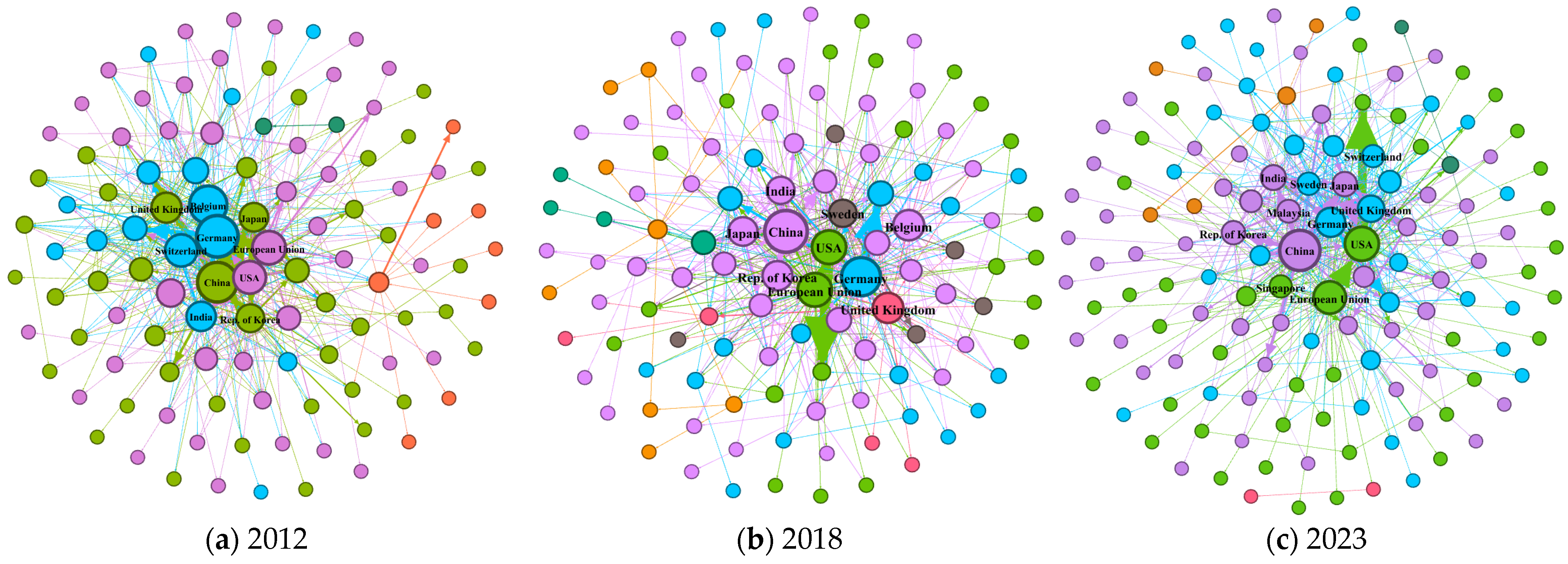
To examine the structural evolution of the global tungsten supply chain, this study selects three representative years—2012, 2018, and 2023—corresponding to the pre-shock, shock, and post-shock periods of trade friction. Based on these time points, upstream, midstream, and downstream trade networks are constructed using Gephi 0.9.2 (Figure 3, Figure 4 and Figure 5).
As shown in Figure 3, Figure 4 and Figure 5, node size represents trade degree, node color indicates community structure, directed edges reflect trade flows, and edge thickness corresponds to trade volume.
The upstream tungsten ore network (Figure 3) exhibits a relatively sparse and centralized structure, with core nodes concentrated in a limited number of countries such as China, the United States, and several European economies. Although the network becomes slightly denser over time, its overall structure remains relatively concentrated. In contrast, the midstream tungstate network (Figure 4) is more interconnected and balanced, with broader country participation and the emergence of regional clusters. China, the European Union, and several Asian economies occupy central positions, indicating a more diversified structure. The downstream tungsten wire network (Figure 5) is the most complex and densely connected, displaying a multi-core structure. Major economies maintain central roles, while a larger number of countries participate in the network, reflecting a more distributed pattern of connectivity. Overall, the network evolves from a relatively centralized upstream structure to a more complex and decentralized downstream system, with increasing connectivity across all segments. This structural evolution reflects a transition from concentrated and potentially fragile upstream networks to more diversified and robust downstream systems, indicating improved resilience in the latter.
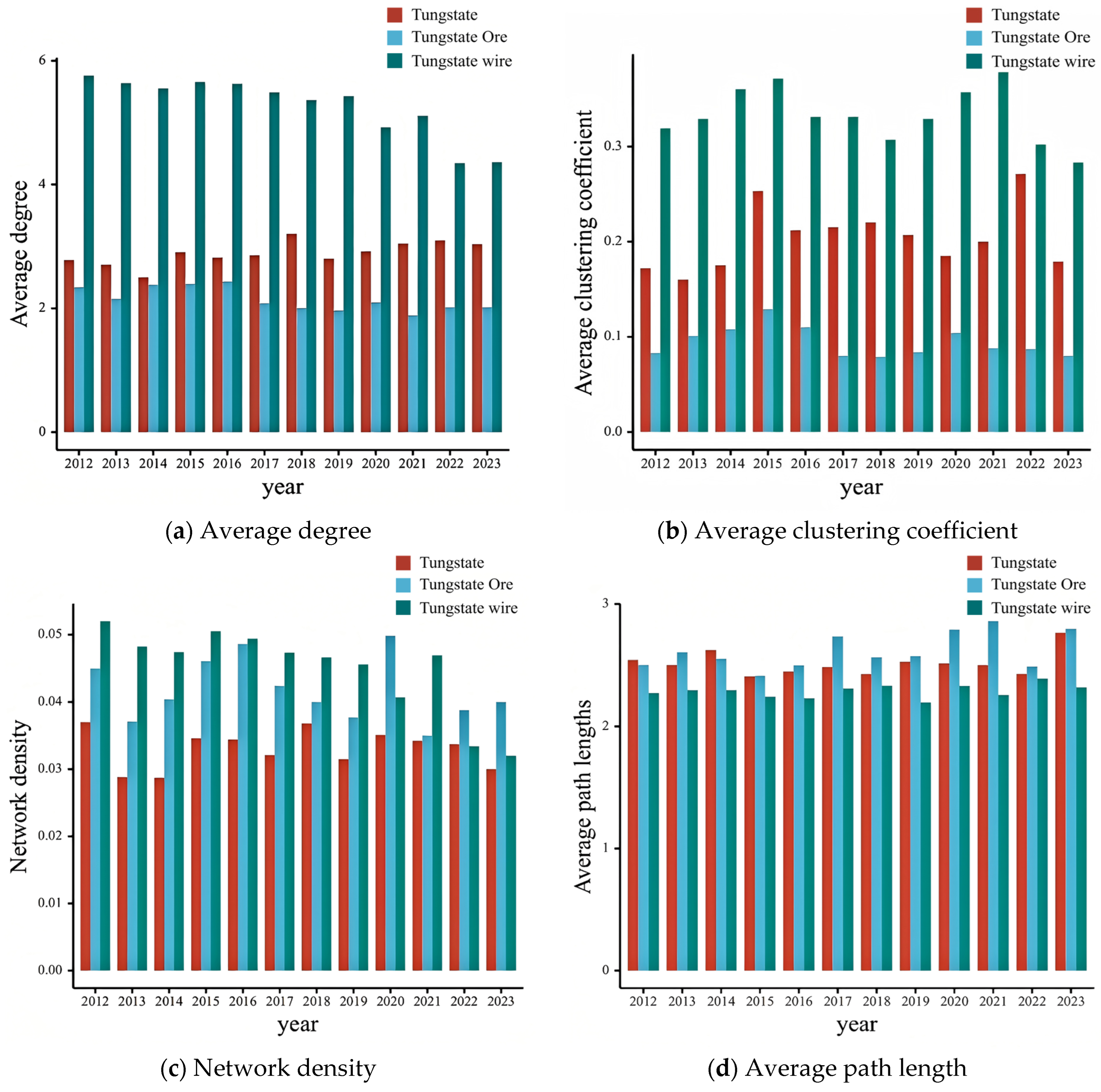
To further characterize the evolution of network connectivity in the global tungsten supply chain, this study examines the dynamic changes in four key network metrics—average degree, clustering coefficient, network density, and average path length—from 2012 to 2023 (Figure 6). The raw numerical values corresponding to the network metrics presented in Figure 6 are reported in Appendix A for reference (Table A1, Table A2, Table A3 and Table A4).
As shown in Figure 6a–c, the average degree, clustering coefficient, and network density exhibit relatively stable trends over time. Across all three segments, the downstream network consistently shows higher connectivity and clustering levels, followed by the midstream segment, while the upstream network remains the least connected. Clustering coefficients and network density remain low, indicating that trade relationships are relatively sparse and that tightly connected trade clusters are limited. Figure 6d shows that the average path length remains short and stable across all segments. The upstream and midstream networks exhibit a slight decline, while the downstream network shows a marginal increase, suggesting differences in network concentration and dispersion. These patterns indicate that the network exhibits certain small-world properties, particularly in the downstream segment. The higher connectivity and clustering observed in downstream networks indicate stronger adaptability and a greater capacity to absorb external shocks, whereas the relatively sparse structure of upstream networks suggests higher vulnerability to disruptions. Overall, these findings reveal significant heterogeneity in resilience across different segments of the supply chain.

4.1.2. Node Centrality and Core Positions

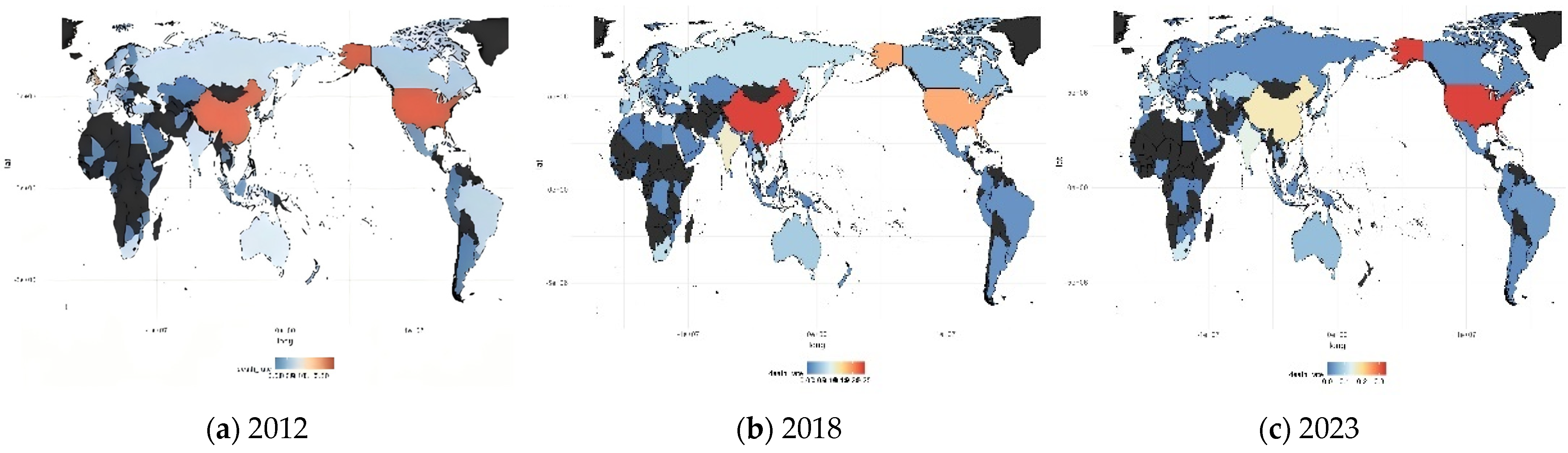
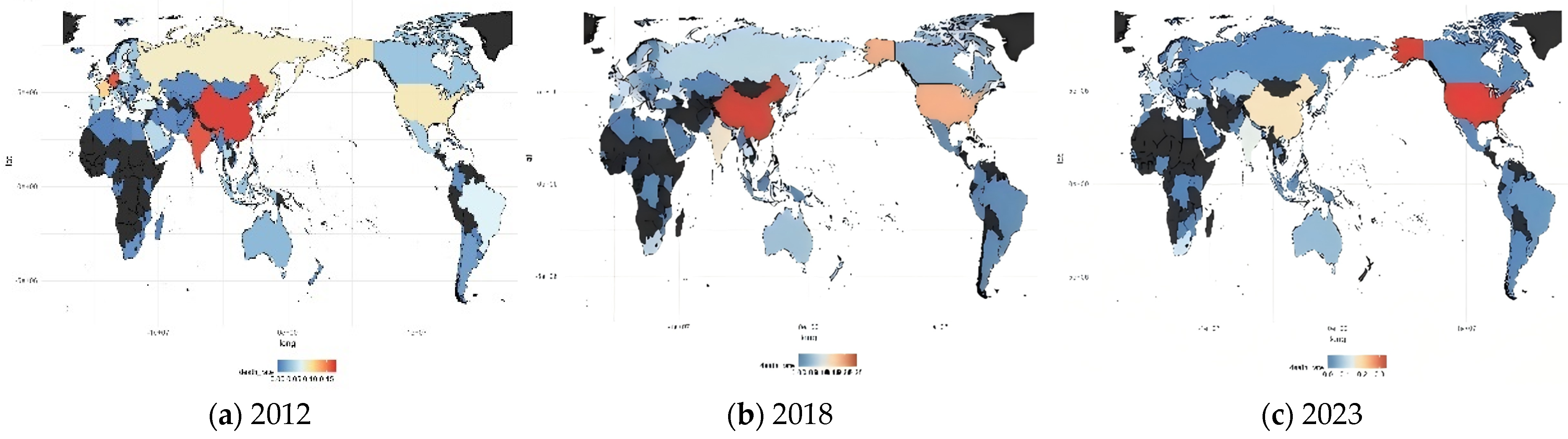
To identify the core trading countries in the global tungsten supply chain, this study analyzes node centrality using three indicators—betweenness centrality, closeness centrality, and eigenvector centrality. Figure 7, Figure 8 and Figure 9 illustrate the evolution of centrality patterns for major countries across upstream, midstream, and downstream trade networks, where darker red colors indicate relatively higher centrality values and darker blue colors indicate relatively lower centrality values.
In the upstream tungsten ore network (Figure 7), the United States and China consistently occupy dominant positions, indicating strong influence over global trade flows. Other countries, including Russia and several European economies, exhibit relatively lower centrality, reflecting a more concentrated structure. In the midstream tungstate network (Figure 8), the structure becomes more diversified, with multiple countries occupying central positions. In addition to China and the United States, countries such as India and Belgium emerge as important nodes, indicating a more distributed pattern of influence. In the downstream tungsten wire network (Figure 9), the centrality distribution shifts toward a multi-core structure. China and Germany emerge as key hubs, while the role of the United States becomes more prominent, suggesting a broader distribution of influence among major economies. The high concentration of centrality in upstream networks suggests greater dependence on a limited number of key countries, which may increase vulnerability to external shocks. By contrast, the more diversified and multi-core structure observed in downstream networks indicates a more balanced distribution of trade relationships, enhancing the capacity of the system to absorb disruptions.
Across the three segments, the network evolves from a relatively concentrated upstream structure to a more decentralized and diversified downstream system, while a limited number of countries consistently maintain central positions. This evolution reflects a transition toward greater structural resilience in downstream segments, while upstream networks remain relatively fragile due to their concentrated structure.

4.2. Effects of Sino–US Trade Friction

4.2.1. Parallel Trend Test

Before estimating the DID model, the parallel trend assumption is examined to validate the identification strategy. Although third countries may be indirectly affected by trade friction through trade diversion, they are not directly targeted by tariff policies and can therefore serve as a reasonable control group.
As reported in Table 5, the estimated coefficients for the pre-policy periods t − 2 and t − 1 are statistically insignificant and fluctuate around zero, indicating no systematic differences between the treatment and control groups prior to the onset of Sino–US trade friction. By contrast, the coefficient for the policy implementation year (t) becomes significantly positive, and the post-policy coefficients remain significantly positive in subsequent periods, suggesting that the trade shock gradually reshaped countries’ positions within the tungsten trade network after the onset of the policy shock. This supports the validity of the parallel trend assumption.

4.2.2. Baseline DID Results

Having validated the parallel trend assumption, the DID model is employed for the upstream, midstream, and downstream segments. The estimation results are reported in Table 6. The dependent variables Y1 (Upstream), Y2 (Midstream), and Y3 (Downstream) represent network centrality measures and serve as the outcome variables in the DID framework. The interaction term (Treat × Post), which captures Sino–US trade friction, serves as the treatment variable, while trade openness and labor force size are included as exogenous control variables to account for cross-country differences.
Table 6 reports the DID estimation results for the upstream, midstream, and downstream segments. Models (1), (3), and (5) present the baseline results without control variables, while Models (2), (4), and (6) include control variables. The results indicate that Sino–US trade friction has no significant effect on the upstream tungsten ore and midstream tungstate trade networks. The coefficients of the interaction term (Treat × Post) in Models (1)–(4) are statistically insignificant, suggesting that trade friction does not affect the network positions of China and the United States in these segments. In contrast, a significant positive effect is observed in the downstream tungsten wire network. In Model (5), the coefficient of the interaction term is 0.074 and is significant at the 5% level. After including control variables in Model (6), the coefficient increases to 0.077 and remains significant at the 1% level, indicating that trade friction improves the relative position of the treatment group in the downstream network. These results suggest that the effects of trade friction are concentrated in the downstream segment, while the upstream and midstream networks remain largely unaffected. The significant increase in downstream centrality reflects stronger adaptability and a greater capacity to absorb external shocks, whereas the lack of significant effects in upstream and midstream segments suggests relatively rigid and less responsive structures.

4.2.3. Robustness Tests

To ensure the robustness of the empirical results, several additional tests are conducted.
First, the dependent variable is replaced with betweenness centrality, which captures the intermediary role of countries in the trade network. The estimated coefficient remains positive and statistically significant for the downstream segment (Table 7, Column 1), indicating that the results are not sensitive to alternative measures of network position. Second, to address potential distortions associated with the COVID-19 pandemic, the sample period is restricted to 2012–2020. The results (Table 7, Column 2) remain qualitatively consistent with the baseline findings.
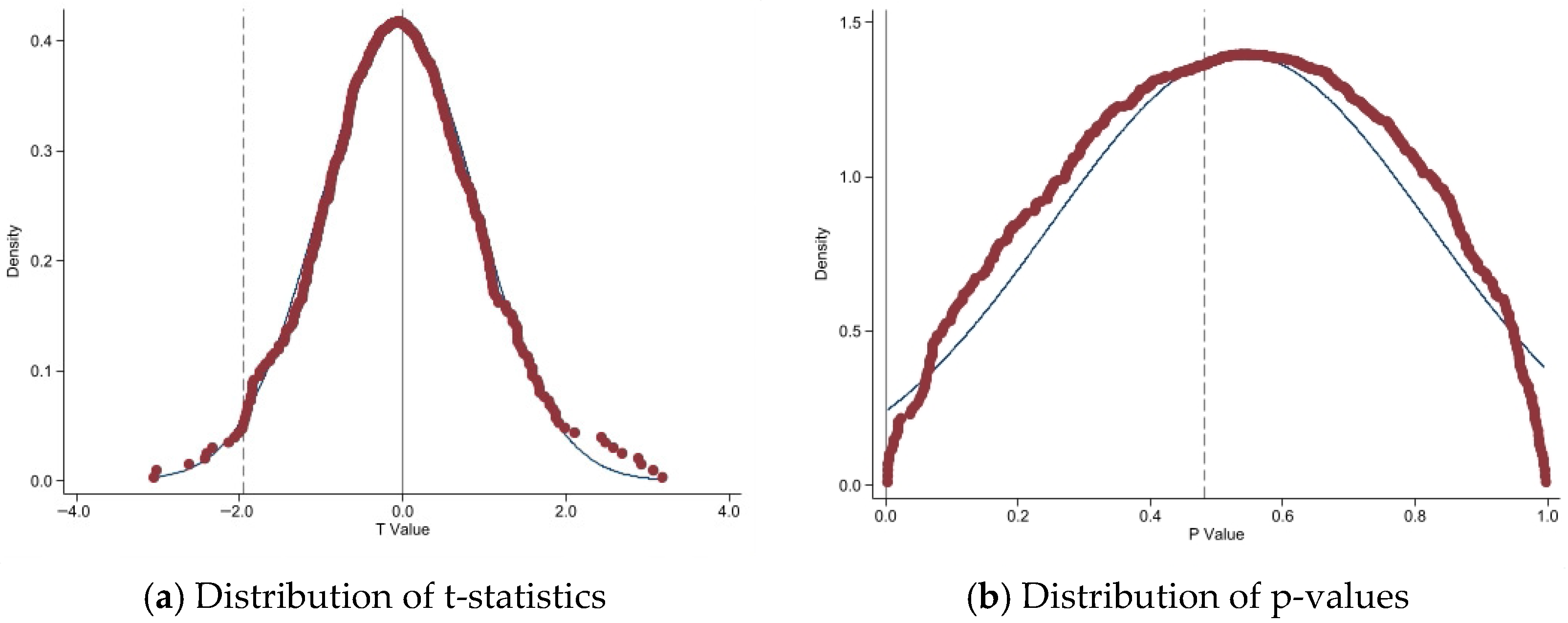
A placebo test is further conducted by randomly assigning the treatment variable. As shown in Figure 10, the reddish-brown dots represent the simulated placebo estimates, the blue curves indicate kernel density distributions, the solid vertical lines denote the observed estimates, and the dashed vertical lines indicate the reference thresholds. The estimated coefficients are centered around zero and are substantially smaller than the baseline estimates, with most p-values remaining insignificant. This suggests that the observed effects are unlikely to be driven by random factors.
These results consistently support the baseline findings and confirm the robustness of the estimated effects.

4.2.4. Heterogeneity Analysis

To further explore the heterogeneous effects of Sino–US trade friction, the treatment group is divided into China and the United States, and separate regressions are conducted. The results are reported in Table 7.
As shown in Table 8, the DID coefficient for China is positive and statistically significant at the 1% level, whereas the coefficient for the United States is positive but not statistically significant. This indicates that the overall effect of trade friction is primarily driven by changes in China’s position in the trade network, while the impact on the United States remains limited. This difference may reflect China’s more central role in the tungsten supply chain, particularly in downstream processing and manufacturing segments, where adjustments in trade linkages are more pronounced. By contrast, the relatively weaker and insignificant effect for the United States may be related to its efforts to reduce dependence on concentrated foreign sources of critical minerals. Existing policy and industry reports indicate that the United States has increasingly emphasized supply chain resilience and diversification through alternative sourcing arrangements, strategic stockpiling, and domestic supply chain support measures [25,28]. In this context, US tungsten demand may be less sensitive to short-term changes in Chinese prices or tariffs, as existing inventory management practices and diversified import channels can partially mitigate the impact of bilateral trade friction. These factors may reduce the responsiveness of the US network position to trade reallocation, contributing to the statistically insignificant effect observed in the DID analysis.
These findings highlight the asymmetric effects of trade friction across countries and further illustrate the differentiated responses in global critical mineral supply chains.

5. Conclusions and Policy Implications

This study examines how Sino–US trade friction affects the structure and resilience of the global tungsten supply chain trade network by integrating complex network analysis with a difference-in-differences (DID) approach. The findings indicate that trade friction does not lead to a uniform structural disruption of the supply chain but instead operates mainly through the reconfiguration of downstream trade linkages, thereby altering countries’ relative positions in the network, while upstream and midstream structures remain largely unaffected. The main conclusions can be summarized as follows:
(1) The global tungsten supply chain is not structurally uniform. The upstream network is relatively sparse and concentrated, with core nodes dominated by China, the United States, and select European economies. The midstream network is more interconnected, with China, the European Union, India, and Belgium occupying central positions. The downstream tungsten wire network is the most complex and densely connected, with China and Germany as major hubs and the United States playing a supplementary role. This difference is reflected not only in network metrics but also in how shocks propagate across the system. Downstream linkages adjust more readily, while upstream structures exhibit limited change, highlighting the importance of segment-specific strategies, as downstream segments require flexibility in trade linkages, whereas upstream segments call for stability. This adds a layer to the existing literature on global trade networks and industrial-chain structures [10,11,13,14,15], which tends to treat network properties as system-wide features, by showing that they vary systematically across supply chain stages. Given the relatively concentrated and less adjustable structure of upstream trade networks, resilience in upstream segments depends more on maintaining stable and diversified long-term supply relationships than on rapid trade reconfiguration. Accordingly, upstream mining countries should focus on securing diversified and stable sources of raw materials. By contrast, the stronger connectivity and adaptability observed in downstream networks suggest that resilience may be strengthened through flexible trade reconfiguration, diversified export markets, and broader cross-regional production linkages. Therefore, countries operating in midstream and downstream segments should enhance trade flexibility, develop alternative suppliers, and strengthen linkages across multiple markets to absorb shocks.
(2) The network is highly concentrated, with a small number of countries accounting for a disproportionate share of central positions. China consistently dominates across all segments, while the United States maintains significant but more limited influence in the upstream and midstream segments. Such concentration implies that shocks affecting these key countries can propagate rapidly through the network, increasing systemic vulnerability. This is consistent with recent studies on trade-network resilience and geopolitical risk, which suggest that highly concentrated trade structures and dominant central nodes can increase systemic vulnerability and accelerate shock transmission across global trade systems [3,8,11,21,22,23,24]. Because concentrated trade networks are more vulnerable to disruptions originating from highly central countries, excessive dependence on a limited number of dominant players may further amplify systemic risk. Accordingly, countries should proactively build alternative trade linkages, implement strategic stockpiling, and strengthen diversified trade cooperation to reduce reliance on a limited set of central players.
(3) Positions within the supply chain are not interchangeable. Countries tend to be more central in midstream and downstream segments, while upstream positions remain constrained by resource endowments. The results show that downstream positions, such as China and Germany in tungsten wire, are highly connected and adjustable, whereas upstream segments, including mining operations in China and the United States, exhibit limited structural change. The United States’ relatively weaker and statistically insignificant adjustment may be related to its efforts to diversify supply chains and maintain inventory buffers and strategic stockpiling [25,27,28]. This complements existing work on value chains, supply chain resilience, and resource dependency [19,20,26] by showing that flexibility itself is unevenly distributed across the chain. In practical terms, this highlights the importance of strengthening downstream capabilities to enhance adaptability and maintain the ability to reconfigure trade relationships when conditions change, particularly for technology-intensive downstream segments. By contrast, upstream resilience, which is more strongly constrained by resource endowments, depends on securing stable and diversified supply sources to reduce exposure to external shocks.
(4) The effect of Sino–US trade friction is not uniform across the network. The DID estimates show a clear increase in centrality for China in the downstream segment, whereas the effect on the United States is positive but not statistically significant. This suggests that trade adjustments are primarily driven by changes in China’s position, while the United States is less affected due to diversified import sources, inventory management, and strategic planning [25,27,28]. The pattern is consistent with recent studies on geopolitical risk and global value chain restructuring, which suggest that external shocks can reshape trade networks through the reorganization and diversification of trade linkages [3,6,8,18,21,22]. The network perspective further extends this literature by showing how such structural reorganization occurs through changes in trade linkages and countries’ relative positions. In practical terms, this highlights the importance of maintaining flexibility in downstream trade relationships, enabling countries to redirect exports, access alternative markets, and reconfigure trade networks when faced with external shocks, thereby strengthening the resilience of downstream supply chains.
Overall, the effects of trade friction on the tungsten supply chain are best understood as a process of network reconfiguration that shapes the resilience of the system rather than causing structural breakdown. This process is highly segmented, with downstream networks acting as the main channel for absorbing and redistributing shocks, while upstream and midstream structures remain relatively stable due to resource and structural constraints. These findings suggest that understanding global resource trade requires attention not only to changes in trade volumes but also to shifts in network structure and relational dynamics. They also highlight the importance of enhancing flexibility, diversification, and adaptive capacity in maintaining the sustainability of global critical mineral supply chains.
Despite these contributions, several limitations should be acknowledged. First, the analysis focuses on three representative tungsten products and does not cover the full spectrum of tungsten-related goods. Second, the study is limited to Sino–US trade friction and does not explicitly account for other global shocks. Third, the study relies on export value to measure network edges and uses country-level trade data. Export value may also be influenced by short-term price fluctuations and may not fully reflect physical trade volumes or firm-level behaviors. Future research could incorporate trade quantity data, micro-level firm or transaction data, and multi-layer supply chain structures to provide a more comprehensive understanding of network formation, resilience mechanisms, and responses to external shocks. In particular, more detailed bilateral or firm-level data may help identify the specific pathways through which geopolitical shocks reshape critical mineral supply chains.

Author Contributions

Conceptualization, H.Q. and Y.Z.; methodology, H.Q.; formal analysis, H.Q.; data curation, H.Q.; visualization, H.Q.; writing—original draft preparation, H.Q.; writing—review and editing, H.Q. and Y.Z.; validation, Y.Z.; supervision, Y.Z. All authors have read and agreed to the published version of the manuscript.

Funding

This research received no external funding.

Institutional Review Board Statement

Not applicable.

Informed Consent Statement

Not applicable.

Data Availability Statement

The data used in this study are publicly available from the United Nations Comtrade Database (https://comtradeplus.un.org/) and other publicly accessible sources cited in the manuscript. The processed data supporting the findings of this study are available from the corresponding author upon reasonable request.

Conflicts of Interest

Haiyan Qiang is affiliated with the Postdoctoral Research Station, Bank of Hebei Co., Ltd. The remaining authors declare that the research was conducted in the absence of any commercial or financial relationships that could be construed as a potential conflict of interest.

Appendix A

The following tables report the raw numerical values of the network metrics presented in Figure 6, including average degree, average clustering coefficient, network density, and average path length for the tungsten ore, tungstate, and tungsten wire trade networks from 2012 to 2023.
Table A1. Average degree of the tungsten trade networks.
YearTungstateTungsten OreTungsten Wire
20122.7792.345.759
20132.7052.1535.636
20142.5002.3835.551
20152.9062.3965.655
20162.8192.4315.626
20172.8562.0805.487
20183.2052.0005.362
20192.8001.9625.425
20202.9172.0934.926
20213.0441.8915.109
20223.0972.0194.344
20233.0362.0204.36
Table A2. Average clustering coefficient of the tungsten trade networks.
YearTungstateTungsten OreTungsten Wire
20120.1720.0830.319
20130.1600.1010.329
20140.1750.1080.360
20150.2530.1290.371
20160.2120.1100.331
20170.2150.0800.331
20180.2200.0790.307
20190.2070.0840.329
20200.1850.1040.357
20210.2000.0880.378
20220.2710.0870.302
20230.1790.0800.283
Table A3. Network density of the tungsten trade networks.
YearTungstateTungsten OreTungsten Wire
20120.0370 0.0450.0520
20130.0288 0.0371 0.0482
20140.0287 0.0404 0.0474
20150.0346 0.0461 0.0505
20160.0344 0.0486 0.0494
20170.0321 0.0424 0.0473
20180.0368 0.0400 0.0466
20190.0315 0.0377 0.0456
20200.0351 0.0498 0.0407
20210.0342 0.0350 0.0469
20220.0337 0.0388 0.0334
20230.0300 0.0400 0.032
Table A4. Average path lengths of the tungsten trade networks.
YearTungstateTungsten OreTungsten Wire
20122.543 2.5022.273
20132.502 2.605 2.296
20142.624 2.552 2.297
20152.409 2.414 2.242
20162.449 2.500 2.230
20172.486 2.733 2.310
20182.428 2.564 2.333
20192.529 2.573 2.194
20202.516 2.791 2.332
20212.501 2.859 2.257
20222.430 2.491 2.391
20232.765 2.795 2.319

References

  1. Heydari, M.; Mitchell, P.; Cullen, L.; Andrieu, B.; Serrenho, A.C.; Cullen, J. A Systematic review of resilience in critical minerals supply chains needed for the low-carbon energy transition. Renew. Sustain. Energy Transit. 2025, 8, 100127. [Google Scholar] [CrossRef]
  2. Whitlock, Z.; Kannan, S.G.; Toman, M.A. Resource Nationalism and the Resilience of Critical Mineral Supply Chains (RFF Report); Resources for the Future: Washington, DC, USA, 2025; Available online: https://share.google/kgaWUh97pwYX3ikG5 (accessed on 8 May 2026).
  3. Vivoda, V.; Matthews, R.; McGregor, N. A critical minerals perspective on the emergence of geopolitical trade blocs. Resour. Policy 2024, 89, 104587. [Google Scholar] [CrossRef]
  4. Saadaoui, J.; Smyth, R.; Vespignani, J. Ensuring the security of the clean energy transition: Examining the impact of geopolitical risk on the price of critical minerals. Energy Econ. 2025, 142, 108195. [Google Scholar] [CrossRef]
  5. Lèbre, É.; Valenta, R.; Kemp, D.; Ali, S.H. (Eds.) Critical Raw Materials and the Energy Transition; CRC Press: Boca Raton, FL, USA, 2024. [Google Scholar]
  6. Caldara, D.; Iacoviello, M.; Molligo, P.; Prestipino, A.; Raffo, A. The economic effects of trade policy uncertainty. J. Monet. Econ. 2020, 109, 38–59. [Google Scholar] [CrossRef]
  7. World Trade Organization (WTO). World Trade Report 2023: Re-Globalization for a Secure, Inclusive and Sustainable Future; WTO: Geneva, Switzerland, 2023. [Google Scholar]
  8. Vivoda, V. Friend-shoring and critical minerals: Exploring the role of the Minerals Security Partnership. Energy Res. Soc. Sci. 2023, 100, 103085. [Google Scholar] [CrossRef]
  9. Huang, J.; Ding, Q.; Wang, Y.; Hong, H.; Zhang, H. The evolution and influencing factors of international tungsten competition from the industrial chain perspective. Resour. Policy 2021, 73, 102185. [Google Scholar] [CrossRef]
  10. Tang, L.; Wang, P.; Ma, Z.; Pauliuk, S.; Chen, W.-Q.; Dai, T.; Lin, Z. Exploring the global trade networks of the tungsten supply chain: Insights into the physical and monetary mismatch among countries. J. Ind. Ecol. 2023, 27, 323–335. [Google Scholar] [CrossRef]
  11. Zheng, X.; Li, H.; Liu, X.; Wang, X.; Zhang, Y.; Tang, Q.; Ren, B. Supply risk propagation in international trade networks of the tungsten industry chain. Humanit. Soc. Sci. Commun. 2025, 12, 54. [Google Scholar] [CrossRef]
  12. Barabási, A.-L.; Pósfai, M. Network Science; Cambridge University Press: Cambridge, UK, 2016; Available online: http://networksciencebook.com/ (accessed on 5 May 2026).
  13. Shi, Q.; Sun, X.; Xu, M.; Wang, M. The multiplex network structure of global cobalt industry chain. Resour. Policy 2022, 76, 102555. [Google Scholar] [CrossRef]
  14. Wang, X.; Wang, A.; Zhong, W.; Zhu, D.; Wang, C. Analysis of international nickel flow based on the industrial chain. Resour. Policy 2022, 77, 102729. [Google Scholar] [CrossRef]
  15. Chen, W.; Zhao, X.; Yu, H. Evaluating the spatiotemporal dynamics and structural resilience of the global titanium industrial chain: Insights from trade network analysis. Resour. Environ. Sustain. 2025, 20, 100213. [Google Scholar] [CrossRef]
  16. Anderson, J.E.; van Wincoop, E. Gravity with Gravitas: A Solution to the Border Puzzle. Am. Econ. Rev. 2003, 93, 170–192. [Google Scholar] [CrossRef]
  17. Helpman, E.; Melitz, M.; Rubinstein, Y. Estimating Trade Flows: Trading Partners and Trading Volumes. Q. J. Econ. 2008, 123, 441–487. [Google Scholar] [CrossRef]
  18. Gereffi, G.; Humphrey, J.; Sturgeon, T.J. The governance of global value chains. Rev. Int. Political Econ. 2005, 12, 78–104. [Google Scholar] [CrossRef]
  19. Timmer, M.P.; Los, B.; Stehrer, R.; De Vries, G.J. Fragmentation, incomes and jobs: An analysis of European competitiveness. Econ. Policy 2013, 28, 613–661. [Google Scholar] [CrossRef]
  20. Caldara, D.; Iacoviello, M. Measuring geopolitical risk. Am. Econ. Rev. 2022, 112, 1194–1225. [Google Scholar] [CrossRef]
  21. OECD. Risks and Resilience in Global Trade: Key Trends in 2023–2024; OECD Publishing: Paris, France, 2024. [Google Scholar] [CrossRef]
  22. Müller, M. The “new geopolitics” of mineral supply chains. Aust. J. Int. Aff. 2023, 77, 525–543. [Google Scholar] [CrossRef]
  23. Holling, C.S. Resilience and stability of ecological systems. Annu. Rev. Ecol. Syst. 1973, 4, 1–23. [Google Scholar] [CrossRef]
  24. Christopher, M.; Peck, H. Building the resilient supply chain. Int. J. Logist. Manag. 2004, 15, 1–14. [Google Scholar] [CrossRef]
  25. International Energy Agency (IEA). Global Critical Minerals Outlook 2025; IEA: Paris, France, 2025; Available online: https://www.iea.org/reports/global-critical-minerals-outlook-2025 (accessed on 9 May 2026).
  26. Pfeffer, J.; Salancik, G.R. The External Control of Organizations: A Resource Dependence Perspective; Harper & Row: New York, NY, USA, 1978. [Google Scholar]
  27. Hund, K.; La Porta, D.; Fabregas, T.P.; Laing, T.; Drexhage, J. Minerals for Climate Action: The Mineral Intensity of the Clean Energy Transition; World Bank: Washington, DC, USA, 2023; Available online: http://hdl.handle.net/10986/40002 (accessed on 6 May 2026).
  28. U.S. Geological Survey. Mineral Commodity Summaries 2026: Tungsten; U.S. Geological Survey: Reston, VA, USA, 2026. Available online: https://pubs.usgs.gov/periodicals/mcs2026/mcs2026-tungsten.pdf (accessed on 8 May 2026).
  29. Dolgui, A.; Ivanov, D. Ripple effect and supply chain disruption management: New trends and research directions. Int. J. Prod. Res. 2021, 59, 102–109. [Google Scholar] [CrossRef]
  30. Ponis, S.T.; Koronis, E. Supply chain resilience: Definition of concept and its formative elements. J. Appl. Bus. Res. 2012, 28, 921–930. [Google Scholar] [CrossRef]
Figure 1. Structure of the tungsten supply chain.
Sustainability 18 05110 g001
Figure 2. Trade values of tungsten products from 2012 to 2023 (unit: USD 10 million).
Sustainability 18 05110 g002
Figure 3. The global tungsten ore trade network in 2012, 2018, and 2023.
Sustainability 18 05110 g003
Figure 4. The global tungstate trade network in 2012, 2018, and 2023.
Sustainability 18 05110 g004
Figure 5. The global tungsten wire trade network in 2012, 2018, and 2023.
Sustainability 18 05110 g005
Figure 6. Evolution of global tungsten supply chain trade network metrics, 2012–2023.
Sustainability 18 05110 g006
Figure 7. Evolution of centrality in the global tungsten ore trade network, 2012, 2018, and 2023.
Sustainability 18 05110 g007
Figure 8. Evolution of centrality in the global tungstate trade network, 2012, 2018, and 2023.
Sustainability 18 05110 g008
Figure 9. Evolution of centrality in the global tungsten wire trade network, 2012, 2018, and 2023.
Sustainability 18 05110 g009
Figure 10. Results of the placebo tests.
Sustainability 18 05110 g010
Table 1. Representative tungsten products by stage.
StageRepresentative ProductHS Code
UpstreamTungsten Ore2611
MidstreamTungstate (APT)284180
DownstreamTungsten Wire810196
Table 2. Indicators and formulas of the tungsten supply chain trade network.
IndicatorInterpretationFormula
Overall metricsAverage degreeMeasures the average number of trade connections per country. A higher value indicates stronger overall connectivity and more active participation in global tungsten trade. k = 1 N i = 1 N k i
Network densityReflects the overall tightness of trade relationships. A higher density indicates a more interconnected and globalized tungsten trade system. D = L N ( N 1 )
Average clustering coefficientIndicates the tendency of countries to form regional trade clusters. A higher value suggests localized cooperation or regional concentration in tungsten trade. C = 1 N i = 1 N C i ,
where C i = 2 e i k i k i 1
Average path lengthMeasures the efficiency of trade transmission across the network. A shorter path length indicates faster circulation of tungsten products and higher accessibility. L = 1 N ( N 1 ) i j d i j
Node metricsDegree centralityRepresents the number of direct trade partners of a country. A higher value indicates broader trade participation and stronger market connectivity. D C i = k i N 1
Betweenness centralityMeasures the extent to which a country acts as an intermediary in trade flows. A higher value indicates stronger control over tungsten trade routes and resource allocation. BC i = s i t σ s t i σ s t
Closeness centralityReflects how easily a country can access other countries. A higher value indicates better accessibility and a more central position in the trade network. C C i = N 1 j d i j
Eigenvector centralityMeasures a country’s influence by considering the importance of its trade partners. A higher value indicates a more influential position in the tungsten trade network. E C i = 1 λ j a i j E C j
Structural metricsCore–periphery structureIdentifies core countries with dense trade connections and peripheral countries with limited participation, revealing the hierarchical structure of the tungsten supply chain.Identified using core-periphery algorithms
CorenessIndicates the degree to which a country belongs to the core of the network. Higher values imply a more central and dominant position in tungsten trade.Measured using k-core decomposition
Effective sizeMeasures the extent to which a country occupies non-redundant trade positions. A higher value indicates greater access to diverse trade partners and information advantages. E S i = j 1 q p i q p q j
ConstraintReflects the degree to which a country’s trade relationships are constrained by its partners. A lower value indicates greater flexibility and stronger brokerage capacity. C o n s t r a i n t i = j p i j + q p i q p q j 2
Note: N denotes the number of countries (nodes) in the network, and L represents the total number of trade links. ki is the degree of node i, dij is the shortest path distance between country i and country j, and aij represents the trade connection between nodes. σst denotes the number of shortest paths between nodes s and t, and σst(i) is the number of those paths passing through node i. pij represents the proportion of trade flow from node i to node j.
Table 3. List of countries and regions included in the sample.
No.ISO CodeCountryNo.ISO CodeCountry
1ARGArgentina34LUXLuxembourg
2AUSAustralia35MYSMalaysia
3AUTAustria36MEXMexico
4BHRBahrain37MNGMongolia
5BLRBelarus38NLDNetherlands
6BELBelgium39NORNorway
7BOLBolivia40OMNOman
8BRABrazil41PANPanama
9BDIBurundi42PHIPhilippines
10KHMCambodia43POLPoland
11CANCanada44PRTPortugal
12CHNChina45KORSouth Korea
13HKGHong Kong, China46ROURomania
14COLColombia47RUSRussia
15HRVCroatia48SAUSaudi Arabia
16CZECzech Republic49SRBSerbia
17DNKDenmark50SGPSingapore
18ESTEstonia51SVKSlovakia
19EUUEuropean Union52SVNSlovenia
20FINFinland53ZAFSouth Africa
21FRAFrance54ESPSpain
22DEUGermany55SWESweden
23GRCGreece56CHESwitzerland
24HUNHungary57THAThailand
25INDIndia58TURTurkey
26IDNIndonesia59UGAUganda
27IRLIreland60UKRUkraine
28ISRIsrael61AREUnited Arab Emirates
29ITAItaly62GBRUnited Kingdom
30JPNJapan63TZATanzania
31KAZKazakhstan64USAUnited States
32KGZKyrgyzstan65VNMVietnam
33LTULithuania66ZWEZimbabwe
Table 4. Variable definitions.
VariableDefinition
YitCloseness centrality of country i at time t
Treati × PosttInteraction term capturing the effect of Sino–US trade friction
TradeopenitMerchandise trade as a percentage of GDP
LaboritTotal labor force (logarithm)
Note: All variables are defined at the country-year level; TradeOpenit is measured as merchandise trade (% of GDP); Laborit is expressed in logarithmic form.
Table 5. Results of the parallel trend test.
PeriodRelative PeriodCoefficientRobust SET-Statisticp-Value
Pre-policyt − 2−0.0040.013−0.300.776
t − 10.0360.0191.890.132
Policy yeart0.031 **0.0093.380.028
Post-policyt + 10.057 ***0.0106.010.004
t + 20.072 ***0.0106.940.002
t + 30.135 ***0.0177.870.001
t + 40.092 **0.0243.790.019
Notes: The year immediately before the policy implementation (2017) is omitted as the reference period. Robust standard errors are reported. ***, ** denote significance at the 1%, 5% levels, respectively.
Table 6. Difference-in-differences (DID) estimation results.
Upstream
(Tungsten Ore, Y1)
Midstream
(Tungstate, Y2)
Downstream
(Tungsten Wire, Y3)
(1)(2)(3)(4)(5)(6)
PeriodGroup
BeforeControl0.533−0.9060.3061.1320.5810.269
Treated0.676−0.0690.2871.1110.6750.387
Difference0.143
(1.31)
0.215
(1.62)
0.201
(2.65)
−0.021
(−0.26)
0.094
(4.75)
0.118
(5.51)
p-value0.1960.1100.010 ***0.7920.000 ***0.000 ***
AfterControl0.341−1.0910.3791.1900.5520.242
Treated0.551−0.7690.4871.0580.7190.438
Difference0.210
(1.93)
0.321
(2.43)
0.109
(1.43)
−0.132
(1.65)
0.168
(8.50)
0.195
(9.78)
p-value0.058 *0.018 **0.1580.1030.000 ***0.000 ***
DID estimate0.068
(0.44)
0.106
(0.69)
−0.093
(0.87)
−0.111
(1.19)
0.074
(2.65)
0.077
(3.13)
p-value0.6630.4930.3900.2390.010 **0.003 ***
R20.140.180.130.390.630.75
ControlsNoYesNoYesNoYes
Note: t-statistics are reported in parentheses. *, **, and *** denote significance at the 10%, 5%, and 1% levels, respectively.
Table 7. Results of the robustness tests.
(1)(2)
DID estimate317.270
(2.95)
0.043
(1.86)
p-value0.004 ***0.068 *
R20.620.65
ControlsYesNo
Note: t-statistics are reported in parentheses. * and *** denote significance at the 10% and 1% levels, respectively.
Table 8. Heterogeneity analysis of DID estimates.
ChinaUnited States
DID estimate0.077
(3.13)
0.037
(1.67)
p-value0.003 ***0.101
ControlsYesYes
Year FEYesYes
Country FEYesYes
R20.750.41
Note: t-statistics are reported in parentheses; *** denote significance at the 1% levels.
Disclaimer/Publisher’s Note: The statements, opinions and data contained in all publications are solely those of the individual author(s) and contributor(s) and not of MDPI and/or the editor(s). MDPI and/or the editor(s) disclaim responsibility for any injury to people or property resulting from any ideas, methods, instructions or products referred to in the content.