Article

Assessing Sustainable Autonomous Driving Performance by Real-World Multi-Dimensional Conflict Hotspot Analysis

Department of Transportation and Logistics Engineering, Hanyang University, Erica Campus, 55 Han-yangdaehak-ro, Sangnok-gu, Ansan 15588, Republic of Korea
*
Author to whom correspondence should be addressed.
Sustainability 2026, 18(10), 5108; https://doi.org/10.3390/su18105108
Submission received: 11 April 2026 / Revised: 1 May 2026 / Accepted: 13 May 2026 / Published: 19 May 2026

Abstract

Autonomous driving technology is widely recognized as a key solution for enhancing future road safety by preventing traffic accidents caused by human error. However, the widespread adoption of autonomous vehicles (AVs) has not yet been achieved, and traffic accidents involving autonomous vehicles in mixed traffic conditions continue to be reported. This study analyzed conflict events using real-world autonomous driving data and identified AV conflict hotspots. A two-dimensional Time to Collision was employed as a surrogate safety indicator to comprehensively capture various types of conflicts in urban interrupted traffic flow. Analysis of approximately 1000 h of driving data revealed 958,011 conflict events, which were distributed along major AV trajectories. The Network Kernel Density Estimation was applied to identify AV conflict hotspots based on conflict events. The optimal hotspot identification model was determined by evaluating various parameter combinations using the Predictive Accuracy Index validated against real-world accident data. Several hotspots were identified on arterial roads with signalized intersections, nearby bus stops, and frequent access points to roadside facilities such as restaurants, stores, gas stations, and residential complexes. Differences in hotspot patterns by conflict type reveal distinct risk characteristics across road sections, emphasizing the necessity of customized safety countermeasures for each conflict type. The findings of this study are expected to accelerate the deployment and wider adoption of autonomous driving technology, promoting the sustainable operation of AVs.

1. Introduction

Autonomous vehicles (AVs) are widely recognized as a next-generation core technology for enhancing road traffic safety and supporting a more sustainable transportation system. The World Health Organization (WHO) reported that approximately 1.19 million people die in traffic accidents every year [1]. Traffic accidents have become a major cause of death for individuals aged 5 to 29 [1]. In South Korea, the social cost of road traffic accidents was estimated at approximately 26 trillion KRW in 2022, accounting for 1.2% of GDP [2]. Human error contributes to 93% of traffic accidents, which indicates that the introduction of a fully autonomous driving system plays a crucial role in mitigating accidents caused by human factors [3].
However, fully autonomous driving technology remains in the early stages of development, and AV-related accidents continue to be reported [4]. The California Department of Motor Vehicles (CA DMV) reported that 394 AV-related accidents occurred in California between 2019 and 2022. Most of these cases resulted from rear-end collisions caused by human-driven vehicles (HVs) [4]. AVs operate on different principles compared to HVs [5]. The distinguished behavioral characteristics of AVs compared to HVs can increase the likelihood of human error among drivers. Consequently, the introduction of AVs could potentially have a negative impact on traffic safety in mixed traffic environments [6]. Therefore, it is necessary to analyze the driving safety of AVs in mixed-traffic environments and identify road sections with a high potential for conflict with HVs to facilitate AV adoption. This study aimed to analyze AV risk scenarios in mixed traffic using real-world data, identifying autonomous driving hotspots where risk events are dense.
The operation of AVs on public roads has become widespread in various countries, resulting in an increase in autonomous driving data open to the public. Open-source autonomous driving datasets, such as Waymo Open Dataset, nuScenes, Woven Planet Level 5, and Argoverse2, have been released. Several studies have utilized this real-world data to analyze the impact of AVs on traffic safety. Wen et al. [7] analyzed the car-following behaviors of AVs and HVs in mixed traffic using the Waymo Open Dataset. They employed driving volatility measures, as well as time headway and Time-to-Collision (TTC), to examine interaction patterns and traffic safety according to car-following types. Wang et al. [8] utilized the Waymo Open Dataset to analyze the driving behaviors of AVs and HVs at signalized intersections. The study considered headway distance and reaction times to lead vehicles and traffic signals, concluding that AVs exhibited conservative and safe driving behaviors. Hu et al. [9] investigated the interactions between AVs and HVs in car-following situations using the Waymo Open Dataset, adopting TTC and Deceleration Required to Avoid Crash (DRAC) as surrogate safety measures (SSMs).
Most studies analyzing AV-HV interactions have utilized one-dimensional SSMs to assess vehicle conflicts. However, these conventional conflict indicators are limited in capturing interactions arising from various directions within urban interrupted flow. Thus, this study adopted the two-dimensional (2D) TTC derived by Li et al. [10], thereby capturing conflicts occurring at various angles on urban roads. Furthermore, conflict types were classified based on the conflict angle.
The research on traffic safety generally defines a risk hotspot based on the frequency of accidents. However, the scarcity of AV-related accident data limits the use of actual crash data, as the sample size remains insufficient for robust analysis [4]. This study identified autonomous driving risk hotspots by analyzing the spatial distribution of AV conflict events. Various spatial analytical methods have been used to identify the hotspots. Kernel Density Estimation (KDE) is a non-parametric technique that models spatial distribution and is widely utilized to identify hotspots. Ryan et al. [11] identified hotspots regarding risky driving events, such as rapid deceleration and sharp turns, using a planar KDE technique. They proposed risk-aware path planning to minimize hazardous events. Srikanth and Srikanth [12] analyzed urban accident hotspots via planar KDE and applied the Getis-Ord GI* statistic to verify the significance of the identification results. Zheng et al. [13] estimated traffic accident hotspots using KDE, comparing the performance according to various bandwidths. Spatial analysis via planar KDE typically calculates density using Euclidean distance; however, this approach overlooks the characteristics of traffic accident occurrence on roads, potentially leading to inaccuracies in linear road environments. Zahran et al. [14] compared various hotspot modeling techniques, including planar KDE and network KDE (NKDE). Their findings suggested that network-based hotspot analysis techniques enable a more realistic evaluation of road traffic safety.
Despite extensive research on traffic safety and spatial analysis, existing approaches remain limited in capturing complex vehicle interactions and hotspot identification based on autonomous driving data. This study proposes an integrated framework for conflict-based hotspot identification on urban roads to address these limitations. Accordingly, the following research questions were addressed:
(1)
Do conflict-based hotspots reflect the spatial patterns of crash occurrences?
(2)
Does multi-dimensional conflict analysis provide improved performance in identifying hotspots on urban roads compared to conventional approaches?
Conflict-based risk events for AVs were derived from the autonomous driving data in the real world. The NKDE technique was employed to identify the distribution of risk events occurring along the road network. This study aimed to analyze the spatial distribution of conflict hotspots associated with high crash risk, thereby supporting proactive crash prevention. The proposed framework can offer the following contributions:
  • A multi-dimensional SSM is adopted to capture diverse vehicle interactions in complex urban traffic conditions, supporting a more sustainable and reliable safety assessment in mixed traffic environments.
  • A network-based spatial analysis is implemented to enable more appropriate representation of traffic events that inherently occur along linear networks.
  • The conflict-based hotspot identification model is quantitatively evaluated using actual crash data to assess its ability to identify crash-prone locations, contributing to sustainable and proactive crash prevention strategies.
This paper is organized as follows. Section 2 outlines the overview and processing of the autonomous driving data. Section 3 presents the methodology, covering the traffic safety indicators and spatial analysis techniques utilized for hotspot identification. Section 4 details the results of the AV traffic safety analysis and hotspot identification. Section 5 provides further discussion of the results. Finally, Section 6 summarizes conclusions and future research directions based on the limitations of this study.

2. Data Description

This study employed the Woven Planet (Lyft) Level 5 dataset to analyze autonomous driving risk in real-world environments. The dataset consists of information collected via onboard sensors from 20 AVs operating in Palo Alto, California. Autonomous driving trajectories and object perception data are included, which were collected over 1000 h of operation across approximately six months. Additionally, the dataset provides driving environmental information on lanes, crosswalks, and traffic signals through a high-quality semantic map [15]. The entire dataset is divided into training and validation sets. The training set comprises 134,622 scenes, each capturing approximately 25 s of continuous driving. The data sampling rate for individual scenes is 10 Hz. Each scene contains perception data on various road users within a 200 m radius, collected by the sensors, including time, location, unique ID, user type, velocity, and heading. This study extracted only the data corresponding to the vehicle type (“CAR”), along with the driving information of the AV. The Lyft Level 5 dataset provides detailed road network information, which is advantageous for granular spatial segmentation in network-based hotspot analysis. In addition, the high-quality semantic map included in the dataset offers significant potential for extended analyses incorporating infrastructure characteristics. The detailed information regarding the data collection is presented in Table 1.
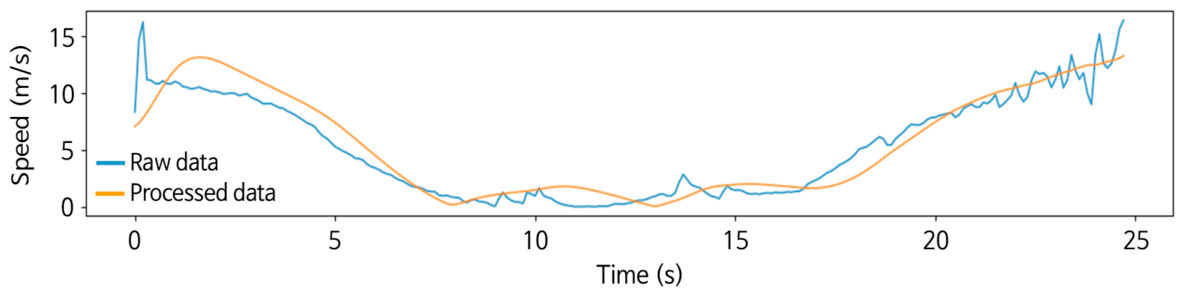
AV trajectories exhibited relatively higher quality, while several outliers and noise were observed in the object perception data. These anomalies were attributed to inherent errors in LiDAR sensors. This study conducted preprocessing to ensure trajectory consistency and the overall sensor data quality. Kalman filtering was applied for speed estimation, with Wavelet denoising for data smoothness [16,17,18,19,20]. Kalman filtering is a commonly used technology for the improvement of sensor-based data quality. Additionally, Wavelet denoising is a well-known method for controlling trajectory smoothness and continuity. As a result of the preprocessing step, the continuity of trajectories improved with noise reduction. The examples of vehicle trajectories before and after data preprocessing are illustrated in Figure 1.

3. Methodology

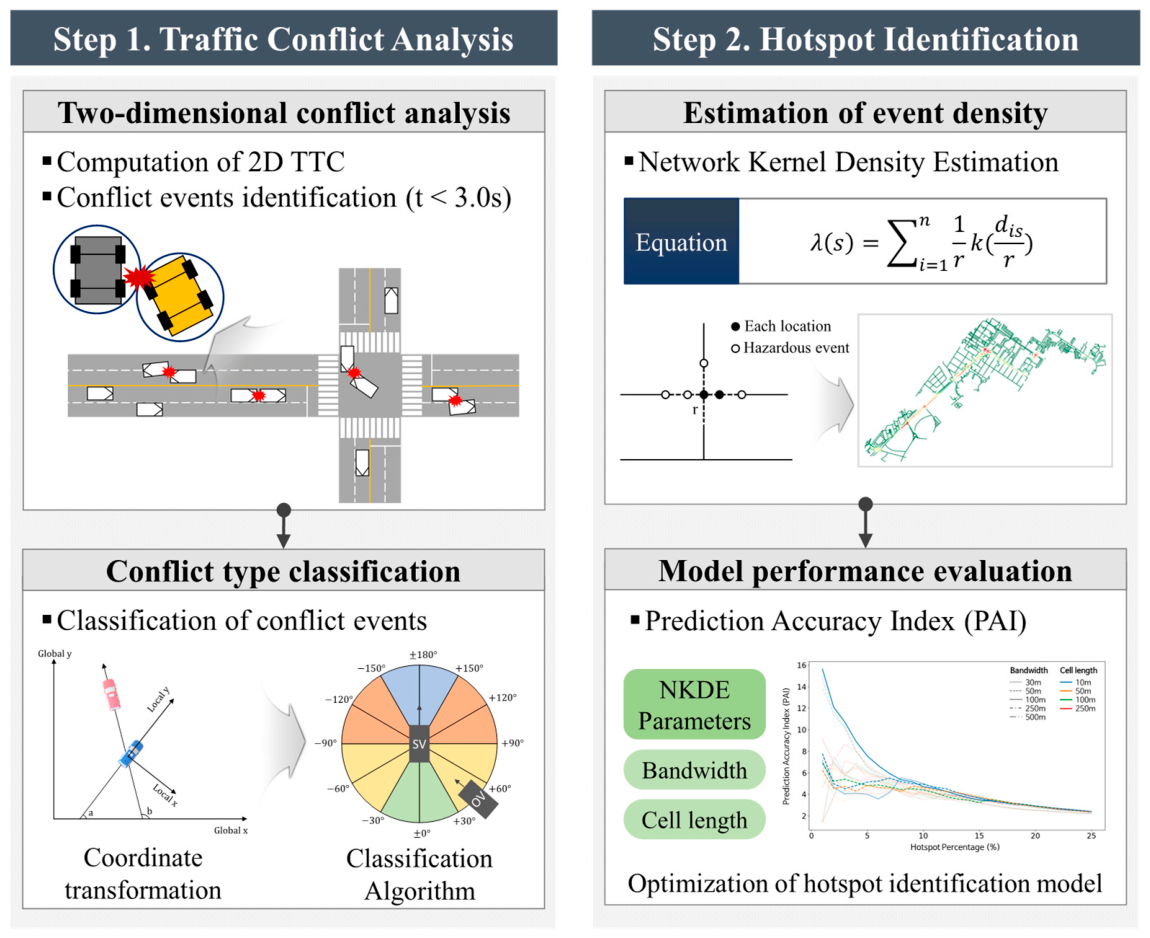
The proposed research framework to identify autonomous driving risk hotspots using conflict events derived from 2D TTC is presented in Figure 2. Step 1 involved a conflict analysis based on 2D TTC to evaluate interactions occurring on urban roads. Various types of conflict events were categorized by applying a classification algorithm based on conflict angles according to interaction type. In step 2, autonomous driving risk hotspots were identified for the conflict events derived from 2D TTC. The NKDE method was then employed for spatial analysis. The identification performance for hotspots estimated via NKDE was evaluated based on actual accident data, adopting the Prediction Accuracy Index (PAI) as the evaluation metric. The performance of NKDE hotspots was compared across various parameter combinations, and the characteristics of roads and infrastructure in hotspots were investigated using a selected optimal hotspot identification model.

3.1. Two-Dimensional Conflict Indicator

Traditional SSMs, such as TTC and DRAC, predominantly focus on longitudinal behaviors. Longitudinal TTC evaluates crash potential based on the computation of the time remaining until a collision for two vehicles traveling in the same direction, as presented in Equation (1).
T T C t = S t v F V , t v L V , t
where
  • v F V , t : Speed of the following vehicle at time t (m/s).
  • v L V , t : Speed of the leading vehicle at time t (m/s).
  • S t : Spacing at time t (m).
Urban roads with interrupted flow feature interactions with road users approaching from various directions, unlike uninterrupted flows such as highways. Traditional SSMs largely focus on one-dimensional interactions, considering only longitudinal behaviors, which limits their capability to analyze various types of conflicts in real-world traffic. Specifically, urban roads require realistic considerations regarding interactions across various directions, as collisions can occur at 360 degrees, including rear-end, sideswipe, and lane-change collisions. This study adopted the 2D TTC proposed by Li et al. (2024) to ensure the fidelity of the analysis by comprehensively considering longitudinal and lateral maneuvers [10]. The 2D TTC employs a state-space model to project the future trajectory. Similar to longitudinal TTC, vehicle states (the acceleration and steering angle) are assumed invariant, as driver intention or behavior is not accounted for. Thus, the current states and control variables are only required to calculate TTC under this assumption. Equation (2) presents the state-space model for future trajectory prediction [10,21].
χ ˙ i ( t ) = f ( χ i t ,   u i ( t ) )
where
  • χ ˙ i ( t ) : Transition of vehicle state at time t.
  • χ i : State of the vehicle, including position and direction.
  • u i : Control of vehicle, comprising acceleration and steering.
The state-space model is simplified through linear approximation using Taylor series expansion. The linearized model facilitates interpretability by simplifying the complex vehicle dynamics. The linearized state-space model is expressed in Equation (3), which derives solutions using matrix exponential, as expressed in Equation (4).
χ ˙ t = A χ t + B u t + C
χ t = e A t χ 0 + 0 t e A ( t τ ) B u τ + e A ( t τ ) C d τ
where
  • A ,   B : Matrices representing the state transition and control input, respectively.
  • C: Constant drift vector.
  • u i : Control of vehicle, comprising acceleration and steering.
These terms specify how the system state evolves over time under both control inputs and constant disturbances. The resulting formulation allows for the predictability of future vehicle trajectories by solving the linearized state-space model based on the matrix exponential e A t . τ is a dummy integration variable over past time. Subsequently, a 2D kinematic bicycle model was applied to describe vehicle motion in Cartesian coordinates, thereby simplifying vehicle behavior on a planar surface beyond 1D. The vehicle’s future state was estimated in the planar space using Equations (5)–(8). The proposed model designates the state vector χ t = [ x t ,   y t , θ t , v ( t ) ] T and the control input vector u t = [ δ t ,   a t ] T . The nonlinear bicycle model is linearized based on Equations (3) and (4).
x ˙ = v × c o s ( θ )
y ˙ = v × s i n ( θ )
θ ˙ = v × t a n ( δ ) L
v ˙ = a
where
  • x , y   : Cartesian coordinates of the vehicle’s center of gravity.
  • θ ,   δ : Heading angle and steering angle, respectively.
  • L : Wheelbase of the vehicle.
  • v ,   a : Speed (m/s) and acceleration (m/s2), respectively.
The condition for vehicle-to-vehicle collisions is defined in Equation (9), which derives from the computation of the Euclidean distance between the vehicle radii within the Cartesian coordinates. The model considers a collision to occur when the Euclidean distance between vehicles equals the sum of their radii. Li et al. [10] provide further mathematical details regarding this methodology.
g v χ i t c , χ j t c = x i , t c x j , t c 2 + y i , t c y j , t c 2 r i + r j 2 = ( 1 12 ( a i , 0 v i , 0 sin θ i , 0 tan δ i , 0 L i a j , 0 v i , 0 sin θ j , 0 tan δ j , 0 L j ) t c 3 + 1 2 ( a i , 0 c o s θ i , 0 v i , 0 2 sin θ i , 0 tan δ i , 0 L i a j , 0 c o s θ j , 0 + v j , 0 2 sin θ j , 0 tan δ j , 0 L j ) t c 2 + ( v i , 0 cos θ i , 0 v j , 0 cos θ j , 0 ) t c + x i , 0 x j , 0 ) 2 + ( 1 12 ( a i , 0 v i , 0 cos θ i , 0 tan δ i , 0 L i a j , 0 v i , 0 cos θ j , 0 tan δ j , 0 L j ) t c 3 + 1 2 ( a i , 0 s i n θ i , 0 v i , 0 2 cos θ i , 0 tan δ i , 0 L i a j , 0 s i n θ j , 0 v j , 0 2 cos θ j , 0 tan δ j , 0 L j ) t c 2 + v i , 0 sin θ i , 0 v j , 0 sin θ j , 0 t c + ( y i , 0 y j , 0 ) ) 2 r i + r j 2
Here, t c denotes the time to collision, assuming constant steering angles and accelerations for two conflicting vehicles; ( x i , y i ) and ( x j , y j ) represent the centers of the bounding circles of vehicles i and j , respectively; and r indicates the radius of the vehicle from the center. The analysis involved the computation of frame-by-frame TTC for each scene to identify the conflict events. The minimum TTC was derived within a single scene, where TTC values for the same vehicle were continuously generated. This study defined the interactions with TTC values below 3 s as conflict events (TTC < 3 s). Furthermore, the screening process excluded interactions with negative TTC values (TTC < 0), as these indicated no potential for conflict.
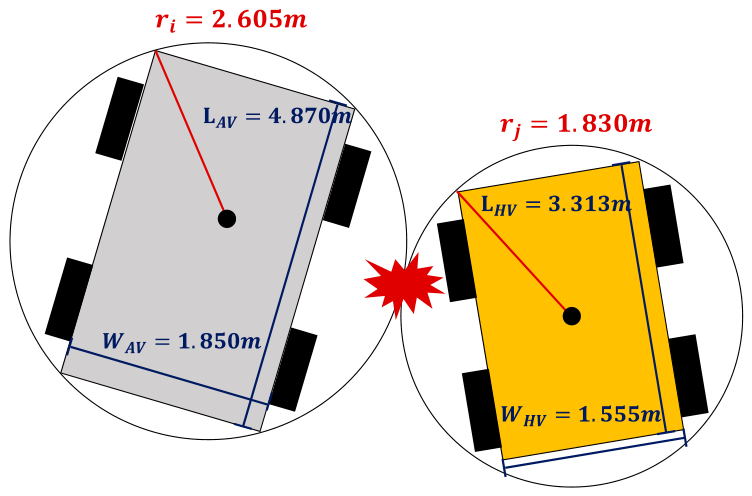
The radii of vehicles are required to be computed to determine the collision. The radius of the HV yielded 1.830 m ( W H V = 1.555   m ,   L H V = 3.313   m ) , considering the average extent of vehicles perceived by the AV. The AV’s radius was defined as 2.605 m ( W A V = 1.850   m ,   L A V = 4.870   m ) , referencing the specification of the data collection vehicle. The established radii for both the AV and HV are illustrated in Figure 3.

3.2. Two-Dimensional Conflict-Type Classification Algorithm

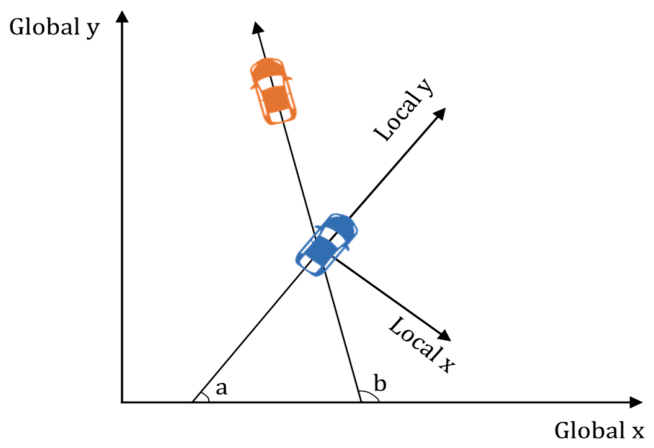
Conflict types were classified based on interaction angles, thereby developing a classification algorithm for conflict type. The computation of conflict angles requires a coordinate system transformation relative to the AV. However, existing datasets provide position and heading angles based on the global coordinate system for both the AV and HV, which complicates the determination of the relative phase between vehicles. Consequently, this study transformed the position and heading angle of the HV into a local coordinate system with the AV as the origin, as illustrated in Figure 4. This transformation derives the heading and position angle of the HV in a local coordinate system [9]. The differences in global headings between the two vehicles yield the relative heading of the HV. The relative positional difference between conflicting vehicles was computed, applying a 2D rotation matrix based on the heading [9,22]. The formulas for the computation of the local heading and relative position of the HV in the local coordinates are presented in Equations (10) and (11), respectively.
Figure 4. Coordinate transformation from global to local.
Sustainability 18 05108 g004
θ l o c a l = a b = φ H V φ A V
S l o c a l = cos φ A V sin φ A V sin φ A V cos φ A V · x H V x A V y H V y A V
where
  • θ l o c a l : Local heading of the HV.
  • S l o c a l : Local position angle.
  • φ : Global heading of the vehicle.
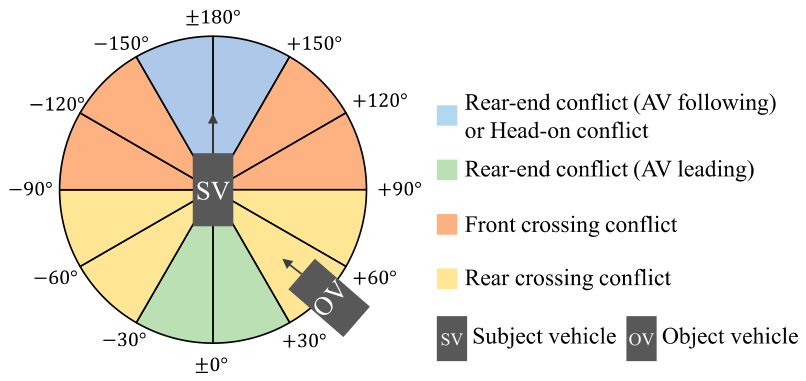
Next, conflict types were distinguished based on the position and heading of the HVs, which were transformed from global to local coordinates. The position angle (β) was computed from the local coordinates using Python 3.9’s built-in function ‘atan2’. The Federal Highway Administration (FHWA) presented criteria for classifying conflict types in the Surrogate Safety Assessment Model (SSAM). According to these criteria, conflicts are classified into types such as rear-end, lane change, and crossing conflicts based on the conflict angle [23]. A rear-end collision is defined based on a conflict angle threshold of an absolute 30 degrees. This study adopted the conflict angle-based classification framework from the FHWA, specifically adhering to the absolute 30-degree threshold for identifying rear-end conflicts. The conflict angle was defined as the local position angle (β) in this study, which represents the relative position of the interacting vehicle in angular form. However, the classification logic in this study was extended to five types to capture the various interactions on urban roads. Conflict types were first categorized based on the local position angles (β), as illustrated in Figure 5. Subsequently, the local heading (θ) was additionally considered to further distinguish conflict types, including rear-end, head-on, front crossing, and rear crossing conflicts. Specifically, rear-end conflicts were subdivided into cases where the AV is either following or leading the HV during car-following. The interaction patterns of rear-end conflicts differ depending on the relative positions. In the AV following scenario, the conflict is likely to be influenced by the AV’s system performance in response to the HV’s maneuver. Conversely, conflicts in the AV leading case arise from following drivers’ unfamiliarity with autonomous driving patterns, potentially leading to human errors. The classification algorithm based on the local position angle and heading is detailed in Algorithm 1.
Algorithm 1. Traffic conflict classification algorithm
β = Position   angle
θ = Local   heading
 
if   β 90   then
   if   β > 150   and   ( θ < 30 )   then
     return   Rear end   conflict   ( AV   following )
   elif   ( β > 150 )   and   ( | 180 θ | < 30 )   then
     return   Head on   conflict
   else :
     return   Front   crossing   conflict
else :
   if   β < 30   and   ( θ < 30 )   then
     return   Rear end   conflict   ( AV   leading )
   else :
     return   Rear   crossing   conflict

3.3. Network Kernel Density Estimation

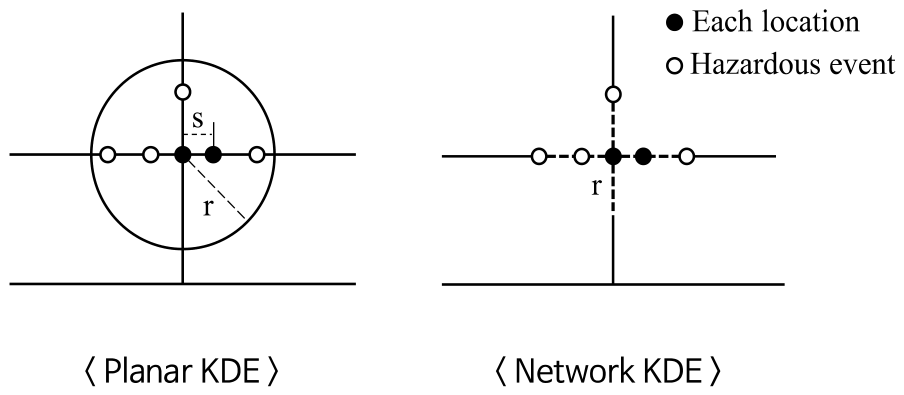
The Kernel Density Estimation (KDE) method was adopted to identify high-risk road sections for autonomous driving by considering the spatial distribution of conflict events and their relationship with road traffic characteristics. KDE is a non-parametric estimation technique commonly utilized for hotspot identification, by which event density is computed with spatial distribution [12]. Planar KDE generates an event density surface for Euclidean space and computes event intensity on a uniformly spaced grid within the coordinate plane. However, limitations exist in the application of planar KDE when analyzing the spatial characteristics of events that occur along road networks, such as traffic accidents and conflicts. Utilizing the planar KDE method poses a risk of overestimation when estimating event distribution in sections with adjacent or intersecting roads. Therefore, an appropriate approach is needed to capture the spatial patterns of events along road networks. The Network KDE (NKDE) method employs a kernel density function based on linear units [24]. NKDE is specifically designed to estimate the event density along road networks by using road network distance instead of Euclidean distance. This study adopted the NKDE method to analyze autonomous driving risk hotspots, considering the spatial characteristics of traffic conflicts occurring along the road network. The conceptual difference in density estimation between planar KDE and NKDE is illustrated in Figure 6. The formula for network-level event density estimation via NKDE is presented in Equation (12).
Figure 6. The conceptual difference between planar KDE and NKDE.
Sustainability 18 05108 g006
λ s = i = 1 n 1 r k ( d i s r )
where
  • λ s : Density estimate at location s
  • r : Local position angle.
  • k : The kernel function.
  • d i s : Network distance from point i to location s .
The parameters determining the NKDE model include the kernel function and the bandwidth. The choice of the kernel function is generally known to be less important for the results compared to the choice of bandwidth [25,26]. The Gaussian kernel function was adopted in this study, which is commonly utilized in existing studies. The formula for the Gaussian kernel is presented in Equation (13).
k d i s r = 1 2 π exp ( d i s 2 2 r 2 )
Bandwidth r serves as a critical factor influencing the density estimates derived from KDE results. The bandwidth is defined as the search distance to events referenced at each point, determining the smoothness of the density estimates [12]. A larger bandwidth dilutes the characteristics of event distribution, generating smoother density estimates. Next, network cell length is considered to have a critical impact on the details of the spatial density patterns. Shorter network cell lengths reduce data loss between the cells, while the computational load increases, potentially reducing analysis efficiency [26]. Therefore, the selection of appropriate bandwidth and network cell length, considering the characteristics of the study area and the study’s purpose, significantly impacts the reliability of the estimated results.

3.4. Model Performance Assessment

This study derived an optimal NKDE model for hotspot identification by selecting appropriate parameters, including bandwidth and network cell length. Model performance was assessed across a total of 20 parameter combinations. The candidate bandwidths included 30 m, 50 m, 100 m, 250 m, and 500 m, while network cell lengths were set at 10 m, 50 m, 100 m, and 250 m. The Prediction Accuracy Index (PAI) was adopted to evaluate the performance of each model, which is widely utilized in hotspot performance assessment [13,26,27]. The PAI represents the ratio of hit rate to hotspot area percentage, indicating the proportion of events contained within the hotspot area [28]. The hit rate refers to the proportion of events captured within the hotspots relative to the total events. However, a larger hotspot area inevitably results in capturing more events, which would render the identification results practically meaningless. Thus, PAI incorporates the ratio of the hotspot length to the entire road network length to prevent this bias. The PAI increases when a greater number of events are captured within a smaller hotspot coverage. The performance of the conflict hotspot identification model was evaluated through traffic accidents to assess how accurately the conflict hotspots capture the actual accidents. The formula for PAI computation is expressed in Equation (14).
P A I c o n f l i c t = H i t   r a t e A r e a   p e r c e n t a g e = C H / C r L H / L r
where
  • C H : Number of traffic accidents in the hotspot area.
  • C r : Number of traffic accidents in the study area.
  • L H : Length of the road network in the hotspot area.
  • L r : Length of the road network in the study area.
Model performance measured by the PAI is susceptible to the ratio of the hotspot length to total network length [29]. Consequently, PAI scores were computed across various hotspot length percentages to minimize bias associated with hotspot length. The average PAI for each parameter combination, computed across 25 hotspot length thresholds ranging from 1% to 25%, was selected for model performance assessment. The formula for computing the average PAI is presented in Equation (15).
P A I ¯ [ α m i n , α m a x ] = 1 N i = 1 N P A I α i
where
  • α i   : Network coverage percentage of the hotspot at step i .
  • P A I α i : PAI score at percentage α i .
  • N : Total number of thresholds.
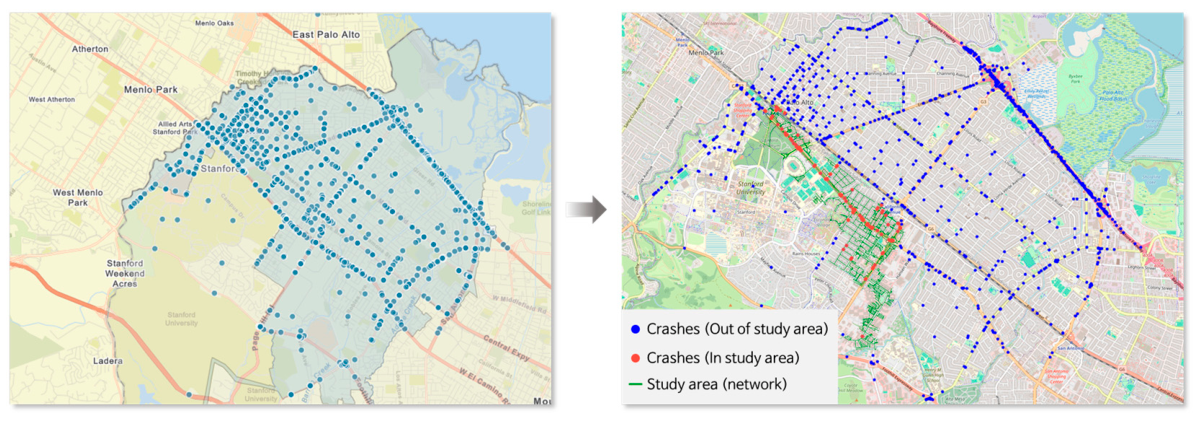
Furthermore, real-world traffic accident data within the study area was collected to evaluate the actual accident detection performance of the conflict hotspots. This study utilized accident data from the Statewide Integrated Traffic Records System (SWITRS), provided as GIS information by the Safe Transportation Research and Education Center (SafeTREC) at the University of California, Berkeley. Further details on the accident data can be found at https://tims.berkeley.edu/ (accessed on 1 October 2025) [30]. During the AV data collection period, only 154 accidents were recorded in Palo Alto, California, which is not sufficient for reliable analysis. To address this limitation, a total of 1370 traffic accidents were collected over a five-year period from 2018 to 2022, covering the collection time of the autonomous driving dataset. Although the data collection duration differs from that of the autonomous driving dataset, this study assumed that the spatial distribution of traffic accidents within the identical road sections remains relatively consistent during this period. Subsequently, the accident data was mapped onto the study area network. The PAI of the conflict hotspots was evaluated based on a total of 140 accidents. The result of GIS-based accident extraction within the study area is illustrated in Figure 7.

4. Results

4.1. Multi-Dimensional Conflict Analysis

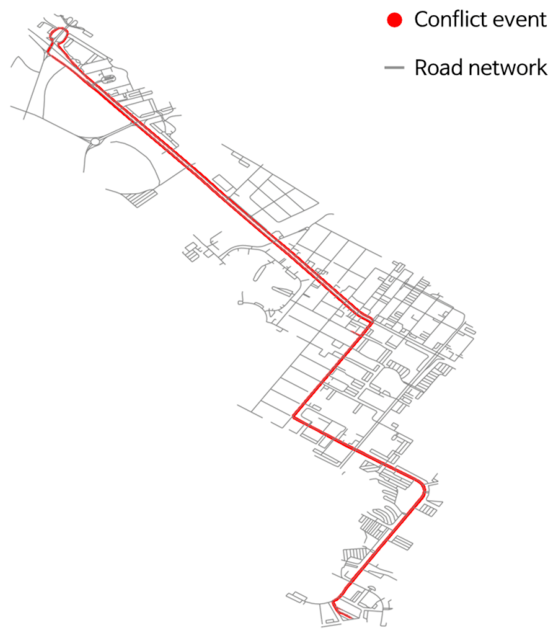
Conflict events were defined as interactions between the AV and HV with a TTC of less than 3 s by computing 2D TTC. A total of 958,011 conflict events were identified from over 1000 h of autonomous driving trajectories. The spatial distribution of events was visualized by mapping them onto road networks, which showed that conflict events were evenly distributed along the driving routes of the AV. The visualization results of the spatial distribution of conflict events are presented in Figure 8.
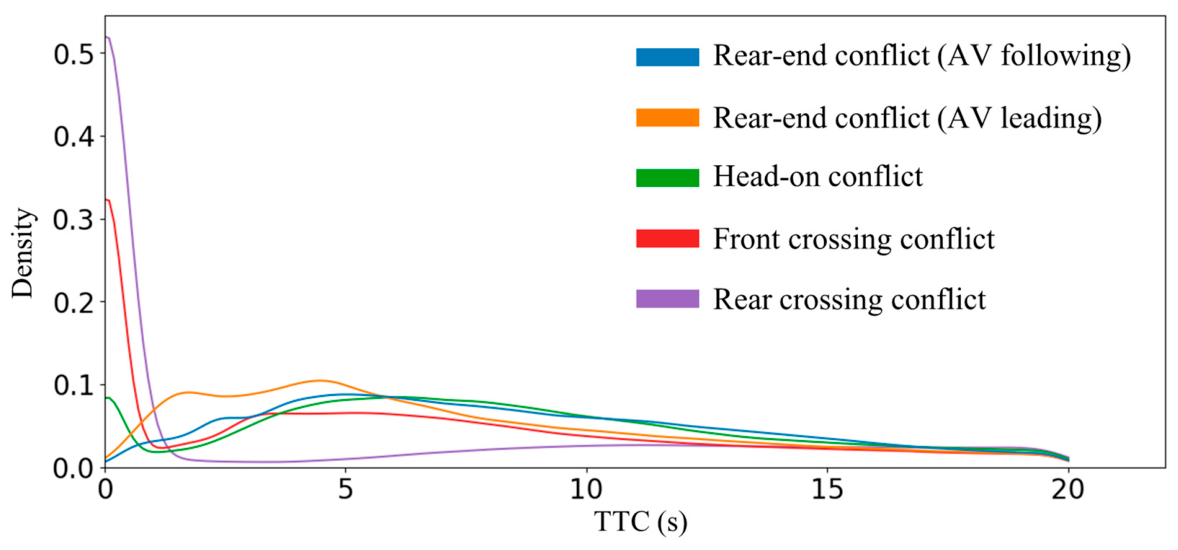
Next, five conflict types were identified using the classification algorithm. The TTC distribution by conflict type is shown in Figure 9, where only interactions with a TTC < 20 s were included to focus on potential risk situations. Crossing conflicts (both front and rear) exhibited a highly leptokurtic distribution with a positive skew. The probability density peaked sharply within the 0 to 2 s range, indicating that these conflicts inherently involved tighter safety margins compared to other types. Conversely, rear-end and head-on conflicts showed a platykurtic distribution with a wider variance. The peaks were observed in the 3 to 5 s range, with a gradual decrease in density. Longitudinal interactions occurred with a more diverse range of safety margins, depending on the driving situation. Notably, both head-on and rear-end (AV following) conflicts, which involve interactions with vehicles in front of the AV, showed the most uniform distributions with higher means and variances. This pattern suggests that the AV system demonstrates superior responsiveness to frontal situations.
The statistical characteristics of conflict events with a TTC below 3 s were evaluated, yielding a mean TTC of 0.697 s. Notably, conflicts concentrated in the longitudinal direction, such as rear-end and head-on conflicts, presented a higher mean TTC than the overall average. This higher average TTC implies that longitudinal interactions between the AV and HV exhibited a relatively lower accident risk, likely because the AV effectively predicted the behavior of leading vehicles. In contrast, front and rear crossing conflicts showed higher frequencies of 343,362 and 312,873 cases, respectively, with a lower average TTC compared to other conflicts. The lower TTC observed in interactions with vehicles approaching from the lateral direction, such as turning or lane-changing vehicles, potentially resulted from delayed perception or reaction by the AV. Furthermore, crossing conflicts may be influenced by interactions with parked vehicles on the roadside, depending on the AV’s lateral position within the lane. Meanwhile, rear-end conflicts where the AV followed the HV were observed to be 81,109 cases (52.4%) lower than conflicts where the AV led. This implies that human drivers following AVs are more likely to make errors because the driving behavior of AVs differs from that of HVs. The descriptive statistics for each conflict type are presented in Table 2.

4.2. Identification of Autonomous Driving Risk Hotspots

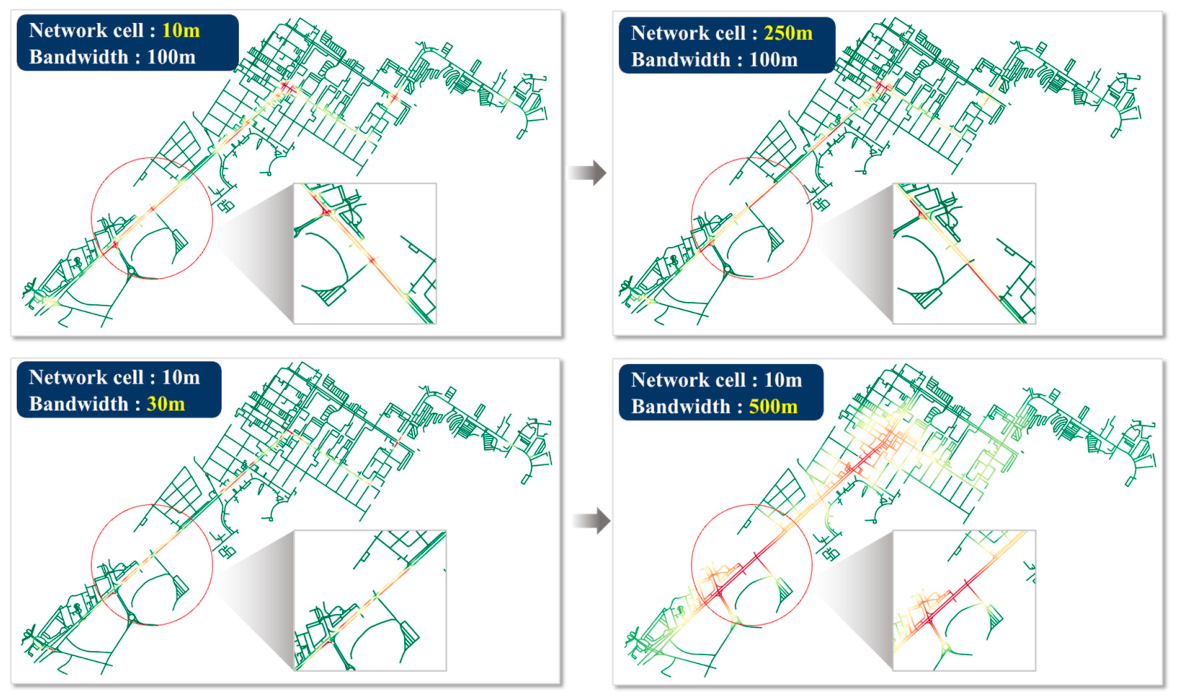
Hotspots were identified based on conflict events using the NKDE method, and the results comparing the differences in hotspot identification across parameter combinations involving bandwidth and network cell length are presented in Figure 10. Event density estimates were visualized using a color spectrum from green (indicating the lowest density) to red (indicating the highest density), with intermediate shades of yellow and orange. As the length of the network cells decreased, the continuity of the density surface deteriorated, while density estimates were obtained for detailed road segments. Conversely, as the cell length increased, the density estimation range expanded, resulting in a noticeable reduction in visual differences between adjacent segments. Meanwhile, variations in bandwidth were also confirmed to have a significant impact on the conflict event density estimation. Localized conflict hotspots were identified with narrower bandwidths, and density disparities with adjacent road networks were clearly observed. The increase in bandwidth resulted in overlapping density estimates with adjacent road networks, forming relatively flat distributions and wide-ranging hotspots. This result suggests that selection of appropriate parameters (bandwidth, network cell) is critical for developing an optimal NKDE model by considering the road and traffic characteristics.
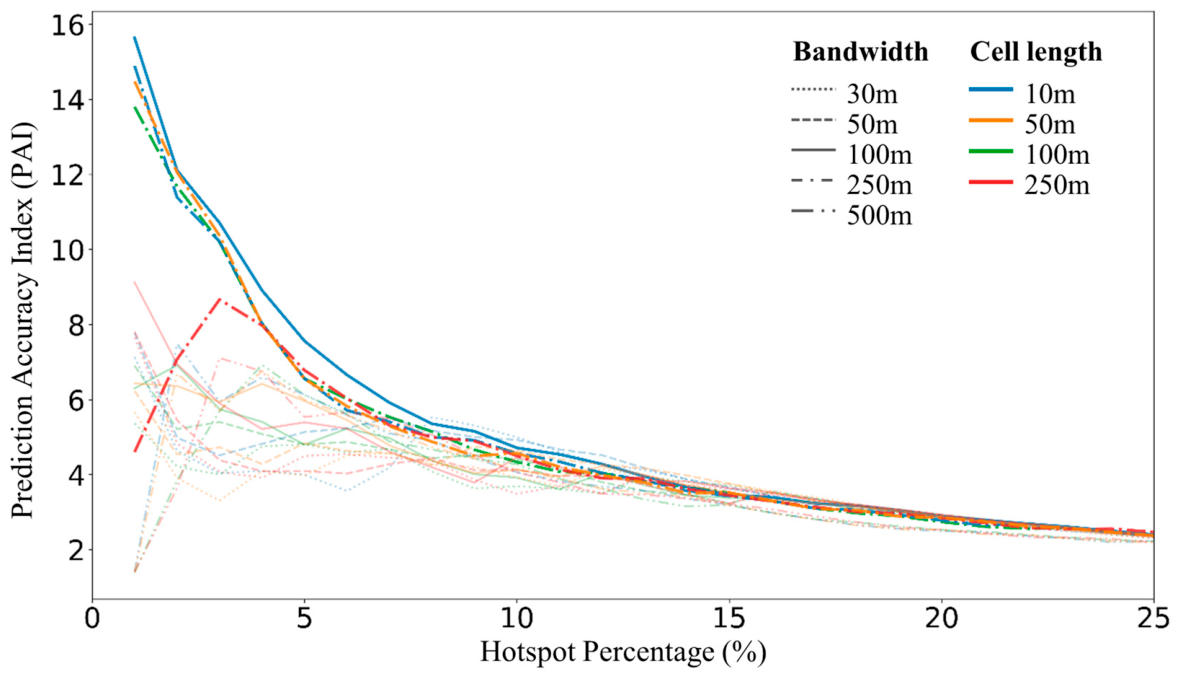
To derive the optimal parameter combination for hotspot identification from multiple parameter settings, this study performed a hotspot performance evaluation using PAI as the evaluation metric. The average PAI was computed based on PAI curves obtained for hotspot percentages ranging from 1% to 25%. The optimal hotspot identification model was then determined by comparing the average PAI scores under different parameter combinations. The PAI curves for each parameter combination are presented in Figure 11, with the top five performing models highlighted. The model performance varied according to the hotspot percentage. The combination of a 100 m bandwidth and a 10 m network cell length achieved a peak PAI of 15.636 at a hotspot percentage of 1%, where a gradually decreasing trend was observed as hotspot coverage increased. This result underscores the necessity of evaluating performance across different hotspot percentages using PAI curves.
The NKDE model with a 100 m bandwidth and a 10 m network cell length yielded the highest average PAI of 5.255. Under conditions of identical network cell length, the average PAI gradually increased as the bandwidth expanded up to 100 m, subsequently decreasing thereafter. This trend indicates that hotspot identification performance was influenced by localized characteristics observed at narrower bandwidths (below 100 m) and smoothing effects occurring at wider bandwidths. Therefore, a 100 m bandwidth was appropriate, considering the gap distance between intersections and the road traffic environment within the urban roadways of the study area. Furthermore, the average PAI scores reached a maximum of 5.255 and 4.941, respectively, when network cell lengths were 10 m and 50 m. This indicates that finer cell units effectively capture the spatial characteristics of conflict events on the road network. The optimal bandwidth varied depending on the network cell length, which implies a necessity to adjust parameter combinations to ensure proper hotspot identification specific to the study area. The statistical results of the average PAI are shown in Table 3. Significant variability was observed in combinations involving bandwidths of 100 m and 250 m across almost all network cell lengths, regarding the standard deviation of the average PAI. This study adopted the optimal NKDE model with a bandwidth of 100 m and a network cell length of 10 m. Furthermore, road segments in the top 1% of event density were defined as hotspots based on the hotspot coverage percentage that showed the highest PAI score.
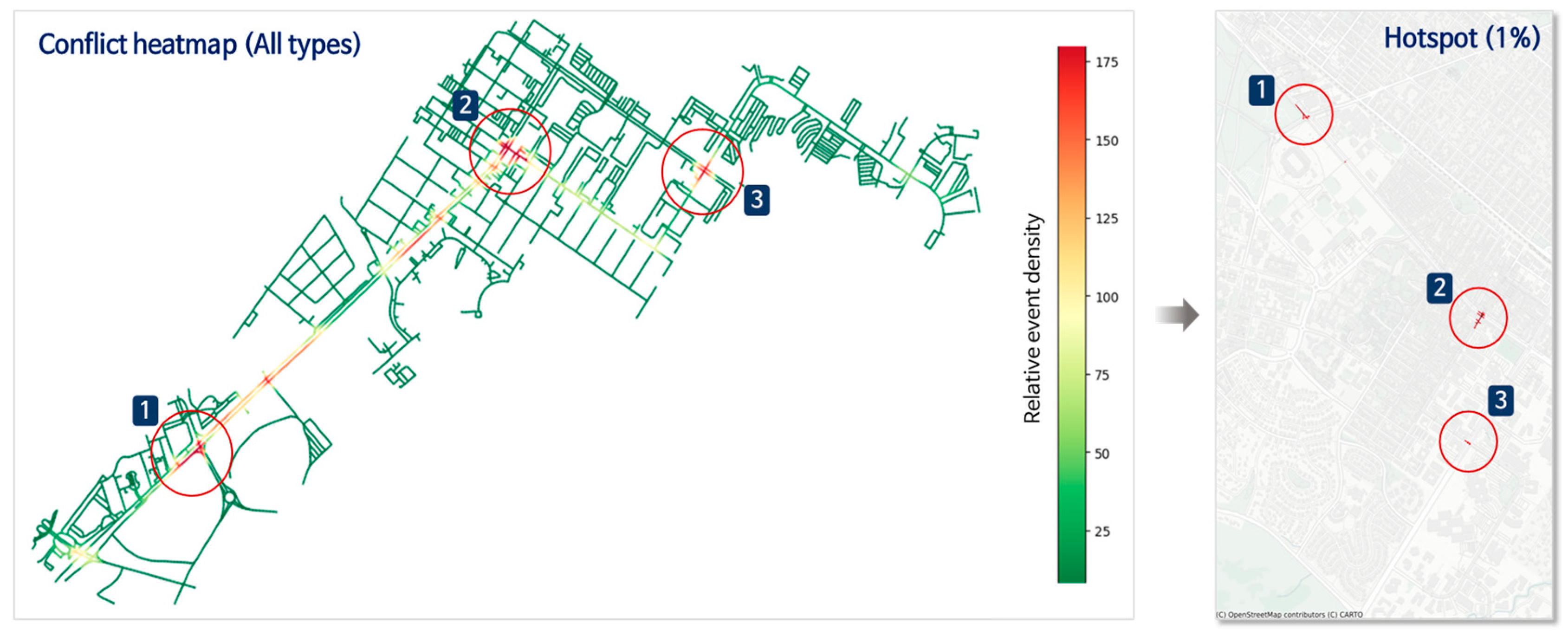
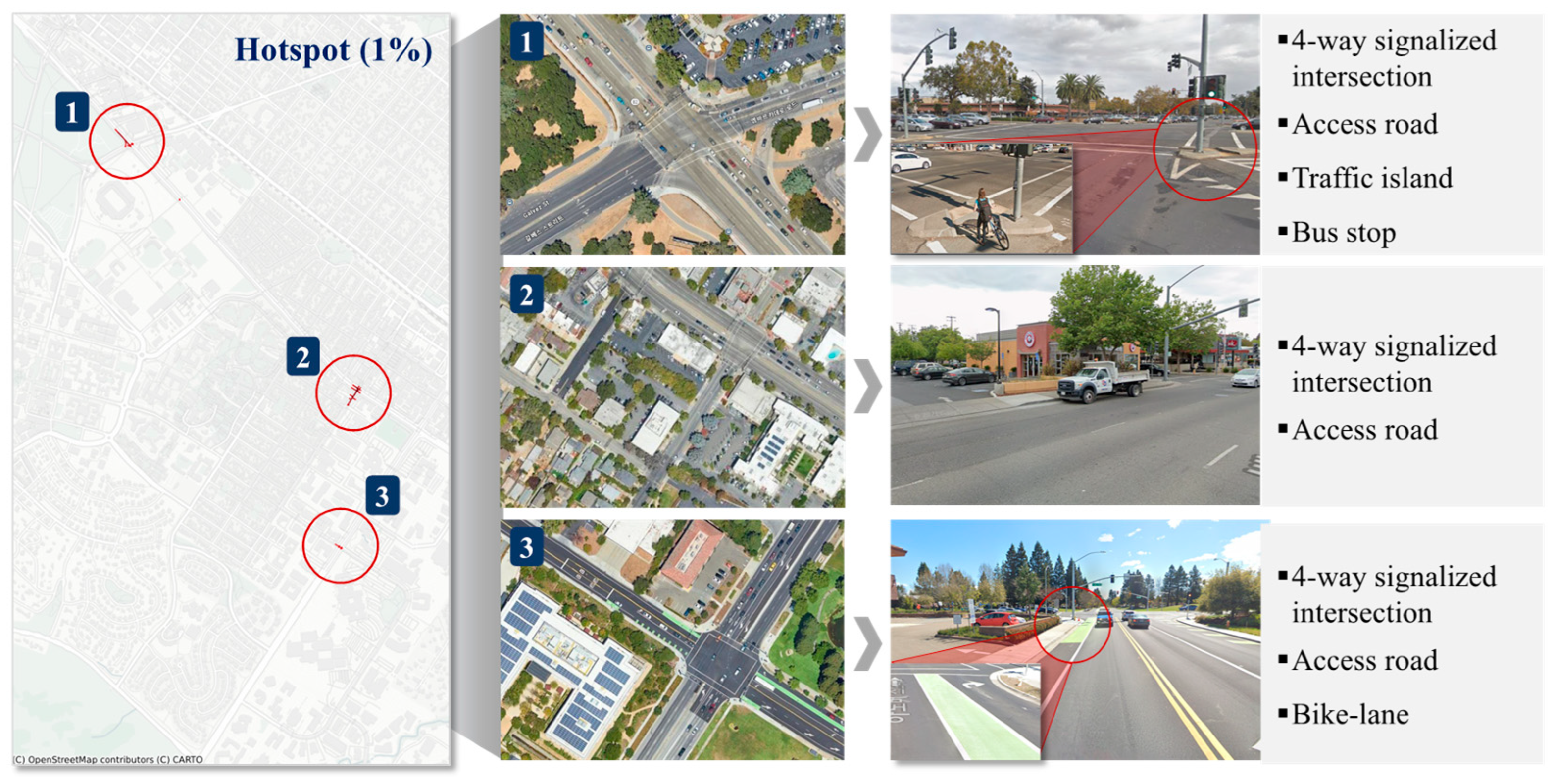
Hotspots for total conflict events were identified using the optimal NKDE model. The estimated density of the top 1% hotspots is visualized in Figure 12. The NKDE hotspot analysis revealed that conflict events were concentrated at certain intersections. Specifically, the top 1% hotspots were distributed across three road segments, including one intersection. The detailed discussion of each hotspot location (1–3) is provided in Section 5.

5. Discussion

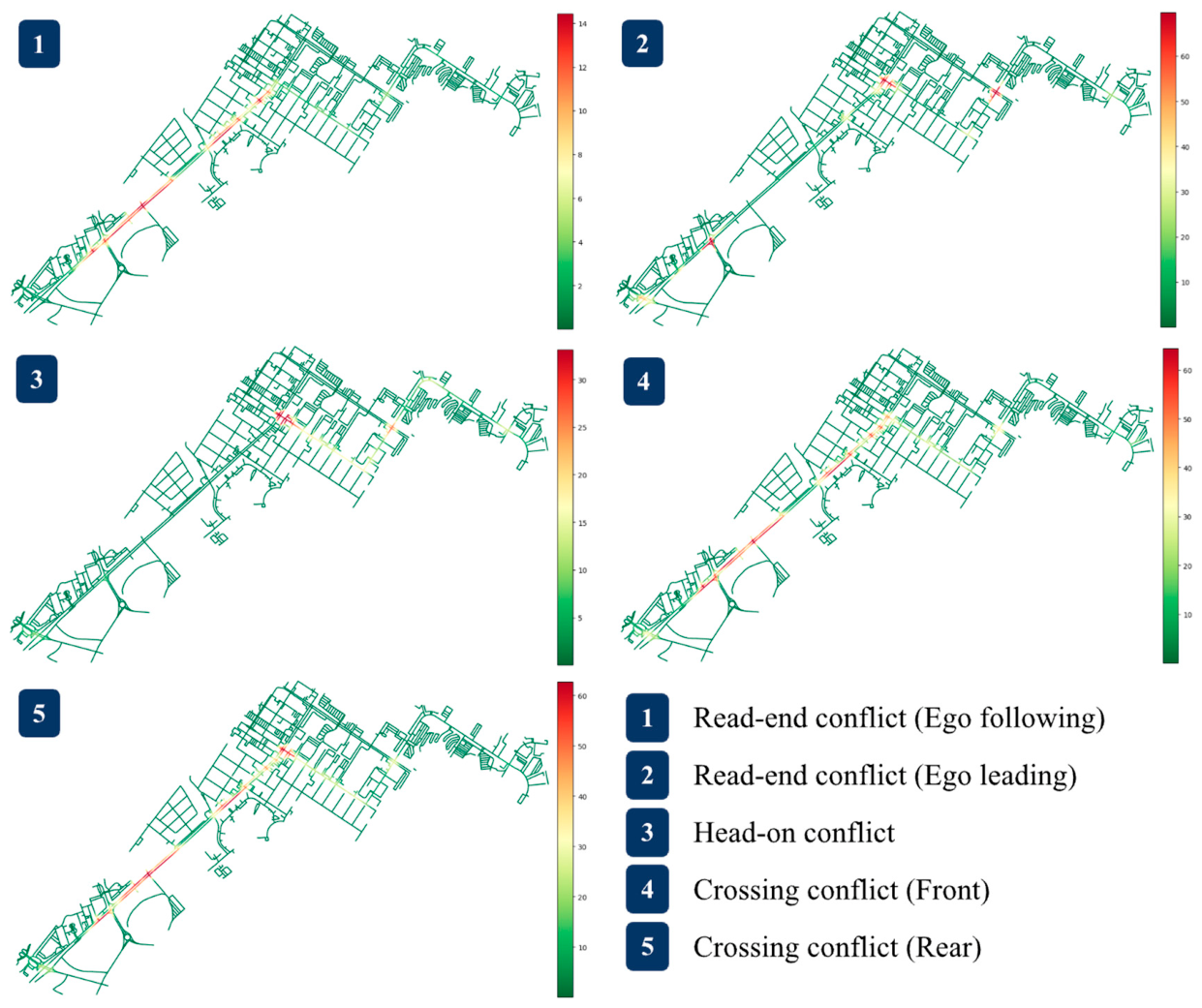
NKDE results were derived for each conflict type, as presented in Figure 13. Distinct spatial patterns were revealed depending on the conflict type. In the case of rear-end conflicts where the AV followed vehicles, a broader range of hotspots was distributed across the main roadway. Conversely, localized hotspots were identified in three intersections for rear-end conflicts where the AV led. AVs have unique maneuvers that are not familiar to human drivers [31]. AVs generally show more conservative behavior than HVs, which deviates from human expectations. Such conservative behavior may lead to errors when following HVs, potentially resulting in conflicts [32]. These patterns become more pronounced at intersections where deceleration and turning are frequent. Liu et al. [33] showed that the likelihood of rear-end collisions involving AVs increases in intersection segments. The highest average PAI (5.255) in this study was observed at a bandwidth of 100 m, indicating that conflict hotspots are most effectively captured at a localized spatial scale on urban roads. This result is consistent with the spatial characteristics of urban road environments, where conflict events tend to be concentrated around intersection segments.
Meanwhile, head-on conflicts were concentrated in road segments adjacent to multiple intersections. The likelihood of head-on conflicts increased as various directions of trajectories intersect within a confined space. Hotspots for both front and rear crossing conflicts were generally distributed evenly along the main road. However, rear crossing conflicts showed a distinct characteristic, where hotspots were densely concentrated around intersections. The differences in hotspot identification results by conflict type imply that potential risks arising from vehicle interactions manifest in distinct forms across road sections. This underscores the importance of developing customized safety measures for each conflict type within road infrastructure.
Subsequently, the road and infrastructure environments of hotspots for total conflict events were investigated using Google Maps 26.20.4 and Street View. Three intersection segments were identified as autonomous driving risk hotspots. Intersections are referred to as challenging for autonomous driving in mixed traffic conditions [33,34,35]. The investigation results of the top three conflict hotspots are presented in Figure 14. Hotspot Section 1 was identified as a four-way signalized intersection situated on a two-way road with seven lanes. Several roadside access points exist due to surrounding facilities such as complexes, gas stations, and parks around the intersection. The presence of a bus stop near the intersection indicates a high potential for interaction between vehicles and pedestrians. Lee et al. [35] found that bus stops pose challenges for autonomous driving. Bus stops induce interaction between AVs and other road users who use the facilities, potentially leading AVs to undertake avoidance maneuvers such as lane changes. Notably, a traffic island for right turns is located within the intersection. Specifically, the high density of conflict events on the right-turn lane suggests a significant likelihood of conflicts triggered by pedestrians utilizing the traffic island. Section 2 is a four-way signalized intersection adjacent to multiple other intersections, with numerous roadside access points similar to Section 1. Additionally, the proximity of multiple intersections within a short distance led to frequent acceleration and deceleration events, deteriorating the stability of autonomous driving. Frequent acceleration and deceleration of AVs in such road segments can increase uncertainty for human drivers who are not familiar with autonomous driving behavior. In addition, HVs following AVs tend to maintain shorter following distances, under the assumption that AVs operate more safely, which could further increase the risk of rear-end conflicts [31]. Finally, Section 3 also includes a four-way signalized intersection, featuring access points for gas stations and residential areas. In Section 3, bike lanes are installed around the intersection, suggesting a high probability of conflicts resulting from interactions between through or right-turning vehicles and cyclists. Keyhole lanes, where a bike lane near intersections is between the through lane and the right-turning lane, can further exacerbate the crash risk. In such cases, right-turning vehicles are required to cross the bike lane to merge into the turning lane, causing conflicts with other road users [36]. The results of this study suggest that AVs are also subject to similar risks at intersections with keyhole design.
These findings suggest that the perception and decision-making of AVs may have limitations in ensuring traffic safety due to the complex interactions with various road users. Accordingly, the adoption of cooperative driving systems in connected environments, such as vehicle-to-vehicle (V2V) and vehicle-to-infrastructure (V2I) communication, is crucial for enhancing traffic safety in mixed traffic conditions. Such cooperative environments enable proactive detection of potential risks and more effective responses to hazardous scenarios.

6. Conclusions

This study identified autonomous driving hotspots based on conflict events. 2D TTC was employed as conflict indicators to ensure the fidelity of results for urban roads. Various types of interaction that occur on urban roads were derived by incorporating both longitudinal and lateral behaviors. Conflict events derived from 2D TTC were categorized according to the relative position and heading angle of the interacting vehicles using a conflict type classification algorithm. Subsequently, NKDE-based autonomous driving hotspots were identified for conflict events. The PAI was adopted for the evaluation of model performance. The optimal parameters were selected by utilizing the average PAI for 20 combinations of bandwidths and network cell lengths, which are the crucial parameters of NKDE. Finally, autonomous driving hotspots were identified using the optimal NKDE model, and the road infrastructure characteristics of hotspots were investigated.
The results of conflict analysis using 2D TTC showed that front and rear crossing conflicts were identified in 343,362 and 312,873 cases out of the 958,011 conflict events, respectively. These crossing conflicts yield a lower mean TTC compared to rear-end and head-on conflicts. Inter-vehicle conflicts occur at various angles on urban roads. This result can be interpreted as the inclusion of conflicts with diverse angles caused by factors such as lane changes and turning maneuvers within the category of crossing conflicts. Furthermore, AVs rely on multiple sensors and cameras to perceive surrounding traffic conditions, while a potential vulnerability to lateral vehicle intrusions coming from the side exists. Meanwhile, the high frequency and low mean TTC of crossing conflicts may also stem from the fact that the range of conflict angles encompassed by crossing conflicts is wider than that of other types. Additionally, these results could be attributed to differences in lateral clearance resulting from the circular vehicle radius assumed in the 2D TTC computation process. Thus, further analysis is required to specify the vehicle radius based on the specifications of each vehicle.
The performance of the hotspot identification model based on the NKDE method was evaluated for multiple parameter combinations. The PAI based on actual accident data was utilized to assess how well conflict hotspots cover traffic accidents in the real world. The average PAI across various hotspot coverage percentages was adopted to minimize the impact of the hotspot lengths. Consequently, the optimal NKDE model with a 100 m bandwidth and a 10 m network cell length was determined for hotspot identification. The results of hotspot identification revealed that high event densities were derived in several intersections. Specifically, the top 1% hotspots were concentrated in three intersections on main road. Meanwhile, distinct spatial patterns of conflict events were derived depending on the conflict type. This indicates that granular road and infrastructure improvement measures are necessary to enhance the safety and operational efficiency of autonomous driving. Finally, the road and infrastructure characteristics of hotspots were investigated. Numerous roadside access points near intersections were consistently observed in hotspot sections. Furthermore, facilities such as traffic islands, bus stops, and bike lanes existed in certain sections, which implies that potential risk events between vehicles may stem from interactions with pedestrians.
The methodology in this study is expected to be used for prioritizing targets in road and infrastructure improvement strategies to ensure the operational safety of AVs and road safety. The limitations of this study are as follows. First, there is a possibility that lateral conflicts were over-identified due to the application of a circular vehicle radius during the 2D TTC computation. Future research requires a dynamic radius for each vehicle based on specifications to enable a more precise determination of TTC. Second, this study examined the road infrastructure environments of AV hotspots by comparing the findings with existing research. However, a quantitative assessment is still required to systematically identify the factors contributing to autonomous driving risks. Third, future research should incorporate traffic exposure to provide normalized results beyond event density-based spatial analysis, thereby improving the robustness and generalizability of the results. Lastly, the temporal mismatch between the AV observation period and the crash data used for evaluation arises from the need to obtain enough crash events, requiring the assumption that the crash patterns remain constant over time. However, this assumption may not fully capture temporal variations, and future research should consider methods that explicitly account for temporal and exposure differences.

Author Contributions

Conceptualization, H.L. and C.O.; data curation, H.L. and J.J.; methodology, H.L. and C.O.; analysis, H.L. and J.J.; visualization, H.L.; writing—original draft, H.L.; writing—review and editing, C.O. All authors have read and agreed to the published version of the manuscript.

Funding

This work was supported by the Korea Institute of Police Technology (KIPoT) grant funded by the Korean government (KNPA) (Project Name: Development of Lv.4 Driving Ability Evaluation Technology for Autonomous Vehicles Based on Real Roads/Project Number: RS-2023-00238253).

Institutional Review Board Statement

Not applicable.

Informed Consent Statement

Not applicable.

Data Availability Statement

Dataset available on request from the authors.

Conflicts of Interest

The authors declare no conflicts of interest.

References

  1. WHO. Global Status Report on Road Safety; WHO: Geneva, Switzerland, 2023; pp. 6–7. [Google Scholar]
  2. KOROAD. The Social Cost of Road Traffic Accidents in 2022 Will be Approximately 26 Trillion 283.3 Billion Won; KOROAD: Wonju, Republic of Korea, 2024. [Google Scholar]
  3. Singh, S. Critical Reasons for Crashes Investigated in the National Motor Vehicle Crash Causation Survey; DOT HS 812 115; NHTSA: Washington, WA, USA, 2015. [Google Scholar]
  4. Ghorai, P.; Eskandarian, A.; Abbas, M.; Nayak, A. A causation analysis of autonomous vehicle crashes. IEEE Intell. Transp. Syst. Mag. 2024, 16, 33–45. [Google Scholar] [CrossRef]
  5. Ren, Q.; Xu, M. Heterogeneity in crash patterns of autonomous vehicles: The latent class analysis coupled with multinomial logit model. Accid. Anal. Prev. 2025, 209, 107827. [Google Scholar] [CrossRef] [PubMed]
  6. Ye, L.; Yamamoto, T. Evaluating the impact of connected and autonomous vehicles on traffic safety. Phys. A 2019, 526, 121009. [Google Scholar] [CrossRef]
  7. Wen, X.; Cui, Z.; Jian, S. Characterizing car-following behaviors of human drivers when following automated vehicles using real-world data. Accid. Anal. Prev. 2022, 172, 106689. [Google Scholar] [CrossRef]
  8. Wang, Y.; Farah, H.; Yu, R.; Qiu, S.; Van Arem, B. Characterizing behavioral differences of autonomous and human-driven vehicles at signalized intersections based on Waymo open dataset. Transp. Res. Rec. 2023, 2677, 324–337. [Google Scholar] [CrossRef]
  9. Hu, X.; Zheng, Z.; Chen, D.; Sun, J. Autonomous vehicle’s impact on traffic: Empirical evidence from Waymo open dataset and implications from modelling. IEEE Trans. Intell. Transp. Syst. 2023, 24, 6711–6724. [Google Scholar] [CrossRef]
  10. Li, S.; Anis, M.; Lord, D.; Zhang, H.; Zhou, Y.; Ye, X. Beyond 1D and oversimplified kinematics: A generic analytical framework for surrogate safety measures. Accid. Anal. Prev. 2024, 204, 107649. [Google Scholar] [CrossRef]
  11. Ryan, C.; Murphy, F.; Mullins, M. Spatial risk modelling of behavioural hotspots: Risk-aware path planning for autonomous vehicles. Transp. Res. Part A 2020, 134, 152–163. [Google Scholar] [CrossRef]
  12. Srikanth, L.; Srikanth, I. A case study on kernel density estimation and hotspot analysis methods in traffic safety management. In Proceedings of the 2020 International Conference on Communication Systems & Networks (COMSNETS), Bangalore, India, 7–11 January 2020; pp. 99–104. [Google Scholar]
  13. Zheng, M.; Xie, X.; Jiang, Y.; Shen, Q.; Geng, X.; Zhao, L.; Jia, F. Optimizing kernel density estimation bandwidth for road traffic accident hazard identification: A case study of the City of London. Sustainability 2024, 16, 6969. [Google Scholar] [CrossRef]
  14. Zahran, E.S.M.M.; Tan, S.J.; Tan, E.H.A.; Mohamad’Asri Putra, N.A.A.B.; Yap, Y.H.; Abdul Rahman, E.K. Spatial analysis of road traffic accident hotspots: Evaluation and validation of recent approaches using road safety audit. J. Transp. Saf. Secur. 2021, 13, 575–604. [Google Scholar] [CrossRef]
  15. Houston, J.; Zuidhof, G.; Bergamini, L.; Ye, Y.; Chen, L.; Jain, A.; Ondruska, P. One thousand and one hours: Self-driving motion prediction dataset. In Proceedings of the 2021 Conference on Robot Learning, London, UK, 8–11 November 2021; pp. 409–418. [Google Scholar]
  16. Sun, P.; Tang, X.; Huang, Y.; Sun, G. Wavelet de-noising Kalman filter-based global navigation satellite system carrier tracking in the presence of ionospheric scintillation. IET Radar Sonar Navig. 2017, 11, 226–234. [Google Scholar] [CrossRef]
  17. Hu, X.; Zheng, Z.; Chen, D.; Zhang, X.; Sun, J. Processing, assessing, and enhancing the Waymo autonomous vehicle open dataset for driving behavior research. Transp. Res. Part C 2022, 134, 103490. [Google Scholar] [CrossRef]
  18. Li, G.; Jiao, Y.; Knoop, V.L.; Calvert, S.C.; Van Lint, J.W.C. Large car-following data based on Lyft Level 5 open dataset: Following autonomous vehicles vs. human-driven vehicles. In Proceedings of the IEEE 26th International Conference on Intelligent Transportation Systems, Bilbao, Spain, 24–28 September 2023; pp. 5818–5823. [Google Scholar]
  19. Wang, J.; Liang, Y.; Tang, J.; Wu, Z. Vehicle trajectory reconstruction using Lagrange-interpolation-based framework. Appl. Sci. 2024, 14, 1173. [Google Scholar] [CrossRef]
  20. Tang, Y.; Gong, J.; Li, Y.; Zhang, G.; Yang, B.; Yang, Z. Wavelet transform-based inertial neural network for spatial positioning using inertial measurement units. Remote Sens. 2024, 16, 2326. [Google Scholar] [CrossRef]
  21. Anis, M.; Li, S.; Geedipally, S.R.; Zhou, Y.; Lord, D. Real-time risk estimation for active road safety: Leveraging Waymo AV sensor data with hierarchical Bayesian extreme value models. Accid. Anal. Prev. 2025, 211, 107880. [Google Scholar] [CrossRef] [PubMed]
  22. Altendorfer, R. Observable dynamics and coordinate systems for automotive target tracking. In Proceedings of the IEEE Intelligent Vehicles Symposium, Xi’an, China, 3–5 June 2009; pp. 741–746. [Google Scholar]
  23. Gettman, D.; Pu, L.; Sayed, T.; Shelby, S. Surrogate Safety Assessment Model and Validation: Final Report; FHWA-HRT-08-051; U.S. Department of Transportation: Washington, DC, USA, 2008.
  24. Shen, B.; Xu, X.; Li, J.; Plaza, A.; Huang, Q. Unfolding spatial-temporal patterns of taxi trip based on an improved network kernel density estimation. ISPRS Int. J. Geo-Inf. 2020, 9, 683. [Google Scholar] [CrossRef]
  25. Xie, Z.; Yan, J. Kernel density estimation of traffic accidents in a network space. Comput. Environ. Urban Syst. 2008, 32, 396–406. [Google Scholar] [CrossRef]
  26. Thakali, L.; Kwon, T.J.; Fu, L. Identification of crash hotspots using kernel density estimation and kriging methods: A comparison. J. Mod. Transp. 2015, 23, 93–106. [Google Scholar] [CrossRef]
  27. Ge, H.; Dong, L.; Huang, M.; Zang, W.; Zhou, L. Adaptive kernel density estimation for traffic accidents based on improved bandwidth research on black spot identification model. Electronics 2022, 11, 3604. [Google Scholar] [CrossRef]
  28. Zhuang, Y.; Dong, C.; Li, P.; Xu, B. Identifying spatio-temporal pattern of electric vehicles involved traffic accidents. J. Transp. Saf. Secur. 2024, 16, 1448–1468. [Google Scholar] [CrossRef]
  29. Hu, Y.; Wang, F.; Guin, C.; Zhu, H. A spatio-temporal kernel density estimation framework for predictive crime hotspot mapping and evaluation. Appl. Geogr. 2018, 99, 89–97. [Google Scholar] [CrossRef]
  30. University of California, Berkeley; Safe Transportation Research and Education Center. Transportation Injury Mapping System (TIMS): SWITRS Query & Map Tool. Available online: https://tims.berkeley.edu/ (accessed on 28 August 2025).
  31. Tavassoli, A.; King, D.; Xiouris, C.; Krauss, D. Revealing right-turn behavior of human drivers as a model for autonomous vehicles. SAE Tech. Pap. 2021, 2021-01-0866. [Google Scholar]
  32. Fu, H.; Ye, S.; Fu, X.; Chen, T.; Zhao, J. New insights into factors affecting the severity of autonomous vehicle crashes from two sources of AV incident records. Travel Behav. Soc. 2025, 38, 100934. [Google Scholar] [CrossRef]
  33. Liu, Q.; Wang, X.; Liu, S.; Yu, C.; Glaser, Y. Analysis of pre-crash scenarios and contributing factors for autonomous vehicle crashes at intersections. Accid. Anal. Prev. 2024, 195, 107383. [Google Scholar] [CrossRef] [PubMed]
  34. Tengilimoglu, O.; Carsten, O.; Wadud, Z. Implications of automated vehicles for physical road environment: A comprehensive review. Transp. Res. Part E Logist. Transp. Rev. 2023, 169, 102989. [Google Scholar] [CrossRef]
  35. Lee, H.; Jee, J.; Kim, H.; Oh, C. Machine learning-based analysis of contributing factors affecting autonomous driving behavior in urban mixed traffic. Comput. Mater. Contin. 2026, 87, 60. [Google Scholar] [CrossRef]
  36. Wu, Y.; Abdel-Aty, M.; Zheng, O.; Cai, Q.; Yue, L. Developing a crash warning system for the bike lane area at intersections with connected vehicle technology. Transp. Res. Rec. 2019, 2673, 47–58. [Google Scholar] [CrossRef]
Figure 1. Examples of speed profile before and after processing.
Sustainability 18 05108 g001
Figure 2. Proposed methodology.
Sustainability 18 05108 g002
Figure 3. The radii for the AV and HV.
Sustainability 18 05108 g003
Figure 5. Conflict type classification based on position angle (β).
Sustainability 18 05108 g005
Figure 7. Traffic accident data mapping and extraction in the study area.
Sustainability 18 05108 g007
Figure 8. The spatial distribution of conflict events.
Sustainability 18 05108 g008
Figure 9. Distribution of 2D TTC for conflict types.
Sustainability 18 05108 g009
Figure 10. Comparison of hotspot identification across bandwidths and network cell lengths.
Sustainability 18 05108 g010
Figure 11. PAI patterns by parameter combinations.
Sustainability 18 05108 g011
Figure 12. Visualization of hotspot identification by NKDE.
Sustainability 18 05108 g012
Figure 13. Visualization of hotspot identification for conflict types.
Sustainability 18 05108 g013
Figure 14. Investigation of road infrastructural characteristics of hotspot sections.
Sustainability 18 05108 g014
Table 1. Description of autonomous driving data.
ItemContents
PeriodOctober 2019~March 2020
Total collection timeOver 1000 h
Number of vehicles20 vehicles
Total distanceOver 26,000 km
Number of scenes134,622 scenes
Driving time per scene25 s
Table 2. Descriptive statistics for each conflict type.
StatisticsTotalRear-End
(AV Following)
Head-OnRear-End
(AV Leading)
Crossing
(Front)
Crossing
(Rear)
Samples958,01173,577154,686154,686343,362312,873
Mean0.697 s1.858 s1.764 s1.764 s0.465 s0.090 s
Standard deviation0.983 s0.772 s0.735 s0.735 s0.881 s0.308 s
Minimum<0.001 s<0.001 s<0.001 s<0.001 s<0.001 s<0.001 s
Maximum2.999 s2.999 s2.999 s2.999 s2.999 s2.998 s
Table 3. Descriptive statistics of average PAI for different network cell and bandwidth settings.
ParametersAverage PAI
Network Cell (m)Bandwidth (m)MeanStandard
Deviation
MinimumMaximumMedian
10303.8581.1242.3707.1343.876
504.0941.2882.3427.7784.175
1005.2553.3692.40015.6363.954
2504.9553.1282.37114.8913.846
5003.7751.6021.4187.4863.365
50303.6190.7872.3405.6643.717
503.8680.9672.3706.2294.169
1004.0751.3232.3966.4283.950
2504.9413.1482.37114.4793.790
5003.7321.5231.3936.7663.414
100303.6380.8192.3125.3703.630
503.9031.1142.3956.9023.569
1003.9341.2442.3986.9163.611
2504.9093.0292.39913.7983.824
5003.6171.4021.3946.9283.188
250303.7011.0932.3067.6553.613
503.7661.1222.3687.8083.734
1004.1281.5482.3639.1203.819
2504.3191.7762.4698.6673.896
5003.6801.4981.4137.1093.361
Disclaimer/Publisher’s Note: The statements, opinions and data contained in all publications are solely those of the individual author(s) and contributor(s) and not of MDPI and/or the editor(s). MDPI and/or the editor(s) disclaim responsibility for any injury to people or property resulting from any ideas, methods, instructions or products referred to in the content.