Article

Handling and Properties of Methanol as a Marine Fuel

1
National Laboratory of the Rockies, Golden, CO 80401, USA
2
Department of Chemical & Environmental Engineering, Yale University, New Haven, CT 06520, USA
3
ExxonMobil (United States), Spring, TX 77389, USA
*
Author to whom correspondence should be addressed.
Sustainability 2026, 18(10), 4931; https://doi.org/10.3390/su18104931
Submission received: 26 February 2026 / Revised: 9 April 2026 / Accepted: 27 April 2026 / Published: 14 May 2026
(This article belongs to the Special Issue Sustainable Fuel for Green Shipping)

Abstract

Given the increasing concern around greenhouse gas emissions and the decline in the availability of fossil fuels, there is increasing global demand to develop alternate fuels for maritime transportation that are sustainable and which have lower greenhouse gas emissions. Methanol is one such alternative fuel that has garnered considerable attention given its potential to be produced by more sustainable processes and its more favorable greenhouse gas emission profile in comparison with current fossil fuels. Understanding the physical and chemical properties of methanol under a range of conditions is essential for its development as a marine fuel. In this study, we seek to define physical and chemical properties of different methanol samples to simulate real-world storage conditions as these data are lacking in the literature. Several methanol samples were evaluated: nearly pure methanol; International Organization for Standardization (ISO) marine methanol (MM) grades A, B, and C; and methanol plus higher alcohols. We first evaluated all methanol samples for impurities, acetic acid content, density, and distillation range. We then characterized the effects of water absorption and found that methanol can easily absorb unacceptable water content from humid air within hours, necessitating storage conditions that prevent this process. In eight-week aging experiments at 20 °C and 40 °C in ambient air, we did not observe significant oxidation for any of the methanol samples; however, we did observe increases in acid number. We assessed the impact of contamination of methanol with water, marine gas oil (MGO), and an MGO–biodiesel mixture on density, viscosity, distillation range, and lubricity. Finally, we show that MGO contamination of methanol results in a slight increase in sooting tendency. In aggregate, our results provide an in-depth analysis of physical and chemical properties of methanol as well as the impacts of storage conditions and impurities on the properties of fuel methanol.

1. Introduction

Methanol has become of interest as a fuel for marine vessels as the marine industry seeks to meet sulfur oxide (SOx) and nitrous oxide (NOx) emission limits, reduce carbon intensity, and diversify fuel resources reducing our dependence on fossil fuels. Global production of methanol was 92.8 million metric tons in 2024 and is projected to grow to 116.3 million tons annually by 2030 [1]. Global production capacity in 2025 was about 198 million metric tons [2]. While methanol is primarily made from natural gas, it can be made from many feedstocks including coal, biomass, and waste carbon dioxide (CO2). Demand in the shipping industry is intended to spur production of methanol from sustainable resources. Methanol production is on roughly the same scale as total marine fuel use of 211 million metric tons in 2023, which was roughly 60% heavy fuel oil; however, this does not consider the significantly lower energy content of methanol [3]. Methanol is a commodity that is shipped as cargo all over the world, resulting in methanol being available in many ports [4]. Methanol contains almost no sulfur—in contrast to very-low-sulfur fuel oil (VLSFO) that can contain up to 5000 ppm—and thus dramatically reduces SOx emissions. As an oxygenate, it also produces much lower soot emissions than conventional fuels and burns cooler reducing NOx [5,6,7]. Methanol is miscible with water, is biodegradable, and does not bioaccumulate; if there were to be a large methanol spill the fuel would dissolve, be rapidly dispersed, and rapidly biodegraded [8,9].
Some basic properties of neat methanol are shown in Table 1 compared to properties of a marine gas oil (MGO) used in this study. In comparison to the distillate fuel, boiling point is much lower, and flash point is 11 °C indicating that a flammable mixture could exist in tank ullage. Both specific energy and energy density are less than half of the MGO value, while mass density is 10% lower.
Challenges to using methanol include the following: its toxicity; it has a much lower energy density than MGO or VLSFO; it is corrosive to tank and piping materials; it has a low flashpoint, resulting in potential flammability; it has a low cetane number (<5); it has a tendency to take up water from the atmosphere. Methanol is toxic to humans and can be absorbed by the body via inhalation, ingestion, skin or eye contact. Care must be taken to prevent exposure to those handling the fuel and ship crews. The lower energy density means that 2.4 times more volume of methanol than diesel or MGO fuel is required to achieve the same vessel range [13]. Because of methanol’s differing corrosion properties compared to conventional fuel oil, the compatibility of tank coatings, piping, seals and other components must be carefully considered. Given the low flashpoint of methanol (11 °C), the International Maritime Organization requires that the bunker ullage space be filled with inert gas, such as nitrogen, to reduce risks of explosion [13]. This tank headspace purging may also limit water uptake.
The very low cetane number of methanol results in a difficulty in reaching compression ignition. A strategy for igniting methanol is to use a pilot injection of marine diesel or marine gas oil to initiate combustion; this is the strategy currently used for all methanol-capable ships. As of 2025, there are over 60 methanol fueled ships in operation, including 28 tankers and 30 container ships [14]. A key operating parameter is the ratio of methanol to pilot fuel consumed. Lloyd’s Register suggests that around 95% of fuel energy is provided by methanol in commercial ships that operate on dual-fuel methanol [13].
Methanol producers typically produce methanol that meets the International Methanol Producers and Consumers Association (IMPCA) specifications, describing the purity and properties of a chemical that is used to make multiple different products [15]. The main requirements of the IMPCA specification are shown in Table 2, including parameters that are not relevant for use as a marine fuel. This specification was the starting point for development of ISO 6583:2024 (this covers methanol as a fuel for marine applications, its general requirements, and its specifications—also shown in Table 2). Several of the IMPCA requirements that are not relevant for marine use are not included in the ISO standards. The various grades of ISO 6583:2024 ensure that methanol is primarily methanol, with minimal contaminants—including ethanol, acetone, sulfur, chloride, and acids. The MMA grade is primarily the same as IMPCA but allows buyers and sellers to agree on limits for lubricity and particle count. MMB grade is the same as MMA, having no requirements for lubricity and particle count. The MMC grade has the same requirements as MMB, but with a wider tolerance for many of the properties listed.
There are several handling issues that could occur once methanol that meets one of the ISO specification grades has left the onshore storage tank and is in the bunker barge or vessel bunker. Bunker barges may not be cleaned between loads, or might contain residual MGO or heavy fuel oil such that the methanol could be contaminated with low levels of conventional marine fuel. Methanol is lighter than fuel oil and will sit on top of any residual fuels in the barge or bunker. If methanol is contaminated with hydrocarbon fuel, this could impact the fuel’s properties, including its lubricity, as well as soot formation. Additionally, little is known about the stability of methanol in storage over long time periods. Methanol is also hygroscopic such that water uptake from the atmosphere can occur. In this study, we characterize several commercial methanol samples. Due to the lack of data in the literature on water uptake rate, storage stability, and the impact of impurities on methanol IMPCA properties, a study was designed to evaluate the impact of these impurities. The rate of water uptake from humid air was evaluated. The potential for acid and peroxide formation during storage in air over 8 weeks was determined. Samples were contaminated by saturation with MGO or an MGO–biodiesel (FAME) blend and characterized for important ISO specification properties as well as lubricity.
Methanol has the potential to reduce the emission of carbonaceous soot particles in comparison to MGO or VLSFO. The yield sooting index (YSI) is a fuel property that characterizes the dependence of soot formation on fuel composition [34,35]. The measured YSI for methanol is 6.6 on a scale where YSI = 0 corresponds to a fuel that produces no soot, YSI = 36 to n-heptane, and YSI = 171 to toluene [36]. This suggests that soot emissions with methanol as the fuel could be over an order of magnitude lower compared with MGO. In previous work, we showed that polyoxymethylene ethers (POMEs) reduced engine-out soot emissions from an automotive compression ignition engine by a factor of five compared to conventional diesel fuel, and that this reduction scaled with the YSIs of the fuel mixtures [37].
In this study, we measured YSIs of methanol, MGO, and their mixtures. Since methanol and MGO are not miscible, the YSI procedure was modified to allow the two fuels to be injected into the flame separately so that any arbitrary ratio could be tested. This new procedure is described in the Materials and Methods Section and was extensively validated.

2. Materials and Methods

Several methanol samples from diverse sources and of various levels of purity were obtained for fuel property testing. Methanol samples included (a) a liquid chromatography/mass spectrometry (LC/MS) grade methanol of high purity (>99.8% purity from Supelco (Millipore Sigma, Burlington, MA, USA)), (b) methanol solvent containing ethanol (4.6 wt%), and isopropanol (0.25 wt%) (Fisher Scientific, Hampton, NH, USA), and (c) three methanol samples meeting ISO MMB grade produced from natural gas steam reforming (Gage Products Co, Ferndale, MI, USA). Additionally, an MGO, and a soy biodiesel blended at 7 vol% were utilized as potential contaminates in methanol fuel by saturating the sample with the contaminates. MGO and soy biodiesel samples were supplied by commercial producers.
Appearance was determined by IMPCA 003-98 by an outside laboratory. Purity of the methanol samples was measured by gas chromatography (GC) using method IMPCA 001-014. Chloride was determined by IMPCA 002 with a modification to the method. Rather than using the specified titration solvent specified in the method (850 mL acetone, 150 mL glacial acetic acid, and 10 mL of 1 mmol/L hydrochloric acid), deionized water was used instead. LC/MS-grade methanol was spiked with a known amount of chloride and used as a quality control sample to ensure that replacement of the dilution solvent with water did not affect the results. Sulfur content, density, and viscosity were measured by ASTM D5453, ASTM D4052, and ASTM D7042 [38], respectively.
To examine the uptake of water from the atmosphere by methanol, LC/MS-grade methanol was dried over molecular sieves (3 Å pore size) for 72 h to remove any residual water from the sample. Karl Fischer (KF) titration was utilized to confirm that no residual water remained. To simulate humid conditions of approximately 75% relative humidity, a saturated solution of sodium chloride was prepared in a 100 × 50 mm Corning Pyrex crystallizing dish (Millipore Sigma, Burlington, MA, USA), and placed inside an empty desiccator under the ceramic shelf. A measure of 200 mL of the dried methanol in a 250 mL glass beaker was then set inside the desiccator on top of the ceramic shelf and the desiccator was sealed. At pre-determined intervals, 8 mL of methanol was removed via pipet and sealed in an 8 mL glass vial for analysis by KF titration.
Acidity was measured both manually and by automatic titration using ASTM D1613 and ASTM D7795 [39], respectively. Method D7795 scope is intended for measuring the acidity of the ethanol; the two methods were compared as a quality control measure, since methanol is outside the scope of D7795. A sample of methanol was spiked with a known amount of acetic acid and measured by both methods to validate that both methods measured the same amount of acid accurately.
Because bunker barges or vessels on board tankage may contain residual MGO that can contaminate methanol, MGO and a solution of MGO with 7% biodiesel (B7) were prepared as potential contaminates. Samples were saturated by adding 10% by volume of either MGO or the B7 MGO blend and vigorously shaking the sample for 2 min under ambient laboratory conditions of 22 °C. The sample was then centrifuged for 10 min at 1440 revolutions per minute to generate a clear and bright top layer that was subsequently removed via pipet for testing. Distillation range was measured by ASTM D1078 to measure the effect of the MGO and B7 MGO on the distillation range. To determine the amount of MGO dissolved into the methanol, 8 mL of the sample was introduced into a weighed glass vial. The sample was allowed to evaporate at 22 °C by leaving the vial uncapped in a fume hood with a flow rate of 200 feet per minute for 48 h. The uncapped vial was then subsequently dried in an oven at 40 °C for 24 h and weighed. The initial vial weight was subtracted from the vial plus residue weight to determine the amount of dissolved MGO. Samples were run in triplicate.
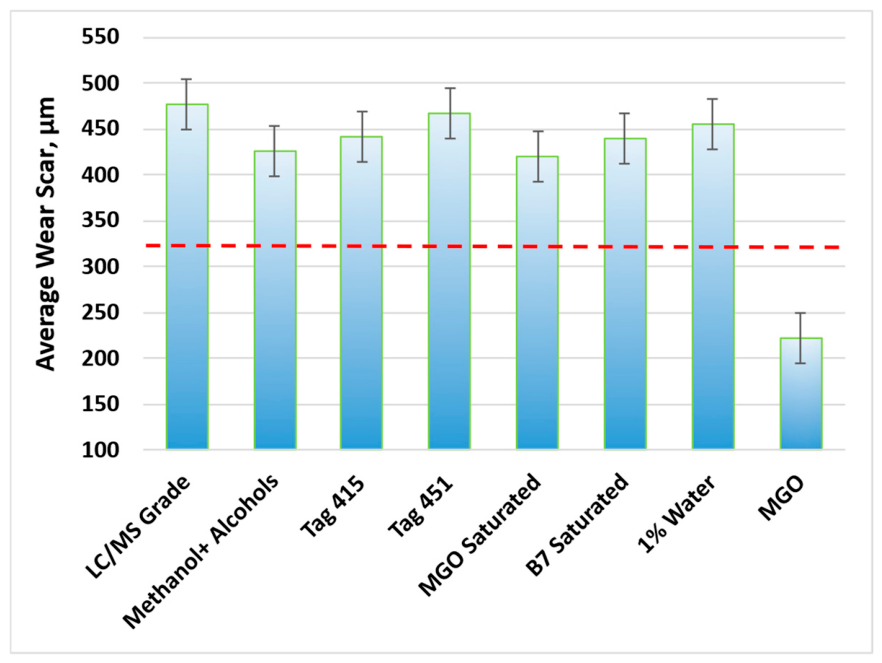
The effect of contamination on lubricity was determined using the high-frequency reciprocating rig (HFRR) using the IP PM FK method (methanol fuel—assessment of lubricity using an HFRR, as modified by Infineum to have a 500 g load (as opposed to the 200 g load in the IP method)) [40]. This method is similar to ASTM D6079 [41], but it is modified to use the HFRR gasoline conversion with a 15 mL test well. Based on the Infineum study, an acceptable diesel fuel will have a wear scar diameter of under 300 µm on this test [40].
Storage stability was determined by developing an aging experiment based on ASTM D4625 [42], a method originally developed for diesel fuels. The experiments were intended to simulate storage onboard a ship. The nominal temperature we considered for storage was 20 °C, so this was selected as the baseline. A 40 °C temperature was selected to be slightly accelerated—to provide results in a shorter time—and is in line with the temperature of 43 °C used in ASTM D4625 long-term storage test for distillate fuels. A measure of 400 mL of methanol was charged into D4625 style glass borosilicate jars. The jars were fitted with plastic caps containing a drilled hole with a glass U tube to allow ambient air to enter the jar. Because of safety considerations due to the flammability of methanol, the jars were held in separate water baths at 20 °C and 40 °C for 8 weeks. Photographs are included in Figure S1. Samples were removed at two-week intervals; purity was measured by GC analysis using a DB-1 column. In addition, acidity was measured by ASTM D7795; peroxide number was measured by the AOCS Method AOCS Cd 8b-90, modified for potentiometric titration. Due to the volatility of methanol, the evaporation rate of methanol was also determined prior to initiating oxidation stability studies in a D4625 glass jar at 40 °C. A measure of 400 mL of methanol was charged into the jar, and the jar was weighed daily for one week. A measure of 250 mg of methanol evaporates per day corresponding to 14 g over 8 weeks or approximately 4% of the initial volume.
Sooting tendencies were measured using a yield-based approach we developed previously [43]. It consists of three steps: (1) we sequentially doped 1000 μmol/mol (1000 ppm) of n-heptane (H), toluene (T), and each test fuel (TF) into the fuel stream of a base methane/air flame; (2) we measured the maximum soot concentration in each flame with line-of-sight spectral radiance (LSSR); and (3) we rescaled the results into a yield sooting index (YSI) defined as:
Y S I T F = Y S I T Y S I H × L S S R T F L S S R H L S S R T L S S R H + Y S I H
This rescaling eliminates sources of systematic uncertainty such as the optical properties of the soot. Furthermore, it allows the new results to be quantitatively compared to a database that contains measured YSIs for hundreds of organic compounds [36]. The parameters YSIT and YSIH are constants that define the YSI scale; their values—170.9 and 36.0—were taken from the database so that the newly measured YSIs would be on the same scale for a direct comparison. The dopants are added at a small concentration to eliminate indirect effects such as changes in the flame temperature or residence time.
The specific procedure used in this study is a slightly modified version of the one that has been used extensively in previous work (e.g., Figure S2 gives details of the burner and Figure S3 gives details of the reactants and the diagnostic for measuring LSSR). In previous work, test fuels that contained multiple components were premixed in the liquid phase and then injected into the methane base fuel with a single syringe pump. The modification in this work was to add a second syringe pump that injected methanol separately from the rest of the test fuel; this modification allowed arbitrary ratios of methanol to MGO and other hydrocarbons to be achieved, without any limits due to its lack of miscibility. Figure S4 presents data verifying that all the methanol injected by the second pump vaporized and was delivered to the flame. Figure S5 shows that identical LSSR was measured from 1000 ppm of n-heptane when it was split between the two pumps in various ratios.

3. Results

3.1. Methanol Properties and Purity

The properties of the methanol samples are reported in Table 3. While not a part of the ISO specification, all samples were below detection (<5 ppm) for peroxide. Notably, the methanol plus alcohols sample fails the minimum methanol requirement and exceeds the maximum ethanol and distillation range requirements. The table contains data from two acidity methods. Acidity as acetic acid was measured using ASTM D1613, as required in the IMPCA and ISO specifications. We also measured acidity using ASTM D7795, an automated potentiometric titration. Within the range of the method reproducibility (error range given), these methods provide equivalent results. Sample Tag 416 spiked with 30 mg/kg acetic acid (33.0 total), with measured values of 36.2 ± 3 for manual titration and 33.4 ± 4.5 for potentiometric titration. D7795 was developed for measuring acidity of ethanol and is entitled Standard Test Method for Acidity in Ethanol and Ethanol Blends by Titration but could clearly be adapted as a method for quantifying acidity of methanol.

3.2. Storage and Handling

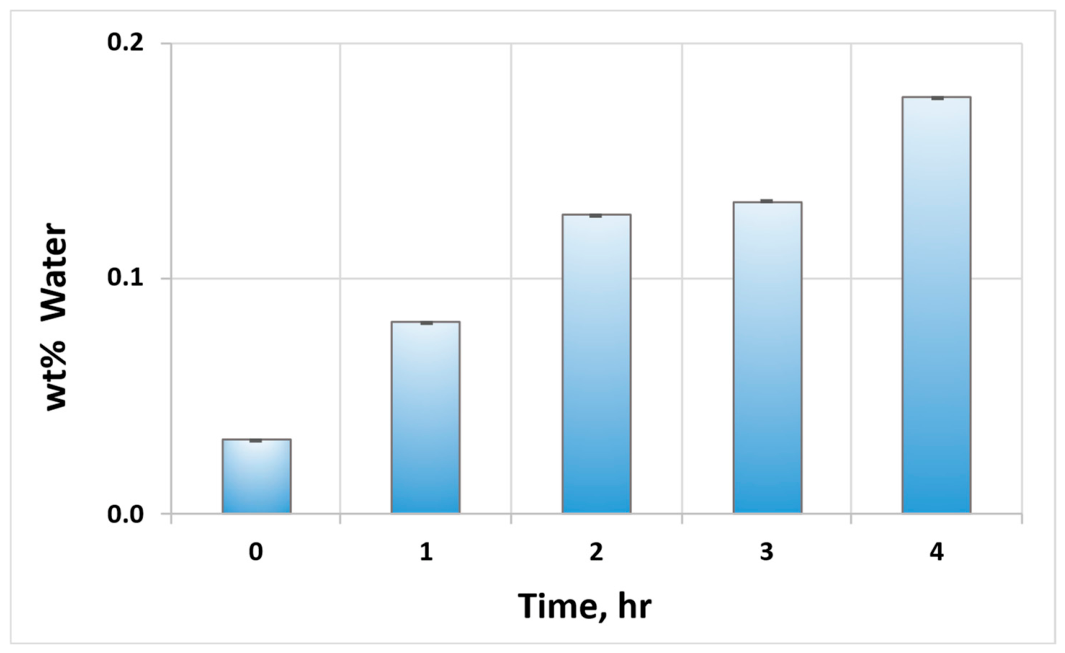
Methanol is hygroscopic and will absorb water from humid air. To assess the rate at which this can happen, LC/MS-grade methanol was exposed to a 75% relative humidity environment at room temperature with periodic sample analysis for water content by ASTM method E1064. This experiment was meant to simulate the “worst-case scenario” and does not reflect the typical storage conditions within the tank. The results are shown in Figure 1. The samples fail the 0.1 wt% water limit after less than 2 h exposure. Water uptake can likely be limited by minimizing tank or barge ullage volume, or by inert gas or nitrogen blanketing of methanol bunkers.
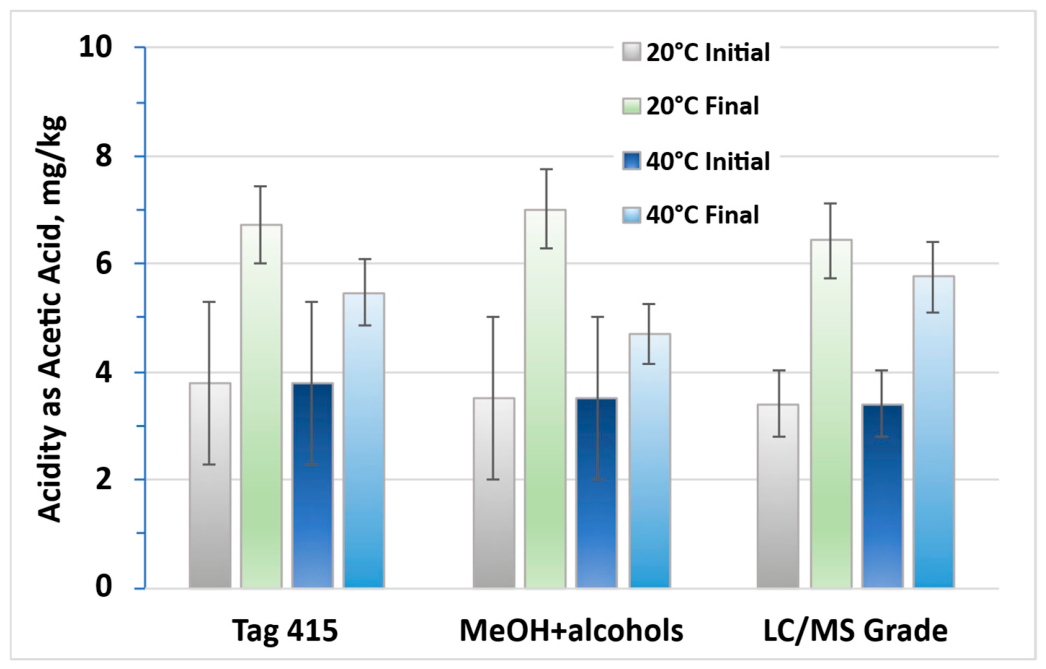
As far as we are aware, there have been no studies of the potential for methanol to degrade or oxidize in storage. We exposed the LC/MS-grade methanol, MMB-grade methanol (Tag 415), and methanol–alcohols samples to air at 20 °C and 40 °C for 8 weeks. The purity of these samples, as measured by the IMPCA method 001, did not change significantly over the aging period (Table S1) and no peroxide formation was observed. Infrared spectroscopy showed no formation of carbonyl (formaldehyde or methyl formate with a detection limit of roughly 1 wt%). Figure 2 shows the results for acidity as acetic acid. For the LC/MS-grade methanol, there was no significant change in the acidity at either temperature. For Tag 415 (ISO MMB grade) and the methanol–alcohols samples there may have been a small increase in acidity over the 8 weeks of aging. Because no formation of acids was observed for pure methanol, the increase in acids for these two samples is likely to be a result of the oxidation of ethanol or other impurities.

3.3. Impact of Methanol Contamination

The LC/MS-grade methanol was contaminated with water, MGO, and a B7 blend prepared from MGO and a commercial biodiesel (FAME). Additionally, the methanol–alcohols sample can be considered as being contaminated with higher alcohols. Water was added at 1 wt% to achieve the water contaminated sample. The properties of the MGO are shown in Table S2. The methanol was saturated with MGO and B7 by adding excess MGO or B7 at room temperature, mixing, centrifuging, and pipetting off the methanol top layer. The amount of MGO or B7 was determined by evaporating off the methanol and weighing the liquid residue (calculations shown in Table S3). The measured properties of these contaminated samples are shown in Table 4.
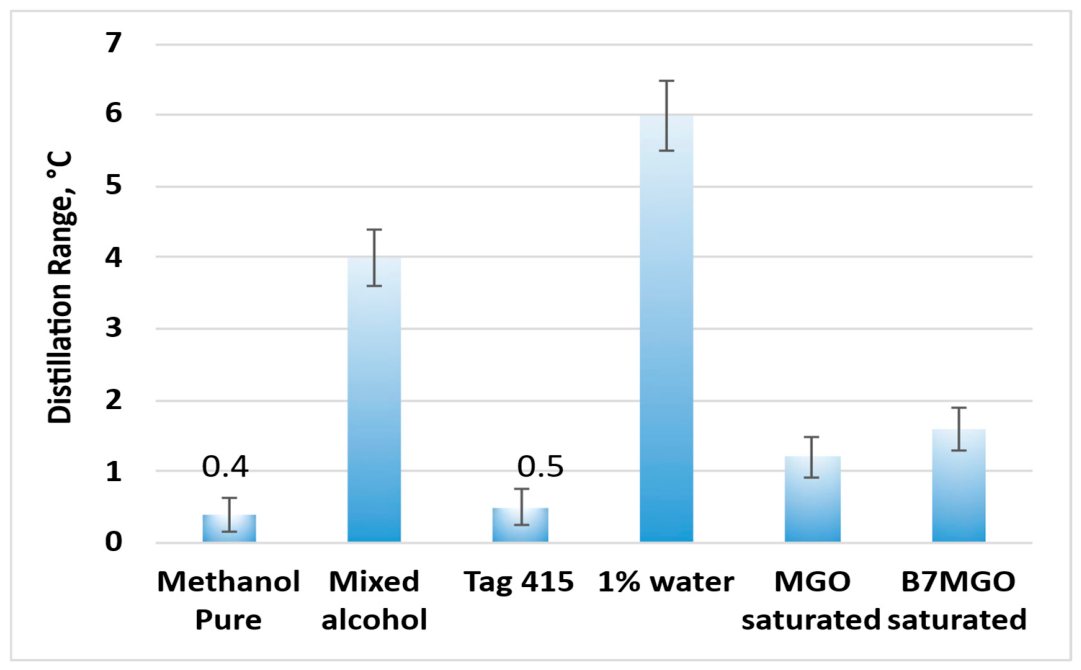
The contaminants had only a minor effect on density and viscosity. However, the impact on distillation range was significant, as shown in Figure 3, suggesting that this test is highly effective at controlling contaminants. As noted above, high levels of ethanol increase the distillation range to well beyond the limit of 1 °C. The presence of 1 wt% water also increases boiling range dramatically. Saturation with MGO and B7 (at about 4 wt%) had a much less significant effect on distillation range, although these samples also failed the requirement. Interestingly, the impact of water on the distillation range was more significant than that of MGO even though it has a higher boiling temperature. A possible explanation could be that with water it formed a solution impacting the distillation. We speculate that, with MGO, there is almost nothing that boils around the boiling point of methanol, so perhaps most of the MGO did not evaporate.
These samples were also evaluated for lubricity, as we speculated that the presence of MGO or B7 might lead to improved lubricity. As shown in Figure 4, all the methanol samples have about the same wear scar diameter, regardless of contamination, well above the 300 µm values that was measured by Infineum for a compliant diesel fuel [40]. This shows that contamination alone would not provide the required lubricity. However, there are many commercially available lubricity additives that could be utilized for this purpose. The MGO sample showed a much lower wear scar diameter than the other samples studied, indicating more than adequate lubricity.

3.4. Soot Formation Tendency as YSI for Methanol–MGO

Table 5 shows the YSIs measured for each sample. The studied sample results show that the sooting tendency of MGO is relatively large in comparison to those of the other samples (199); this is expected given that this fuel contains large molecules, including many aromatics. The YSIs of methanol mixtures are much lower (~8) which is not surprising since the YSI of methanol is very low (6.6). The YSIs of the mixtures are not statistically different than the YSI of pure methanol to within experimental uncertainty, which raises the possibility that the MGO is not affecting soot.
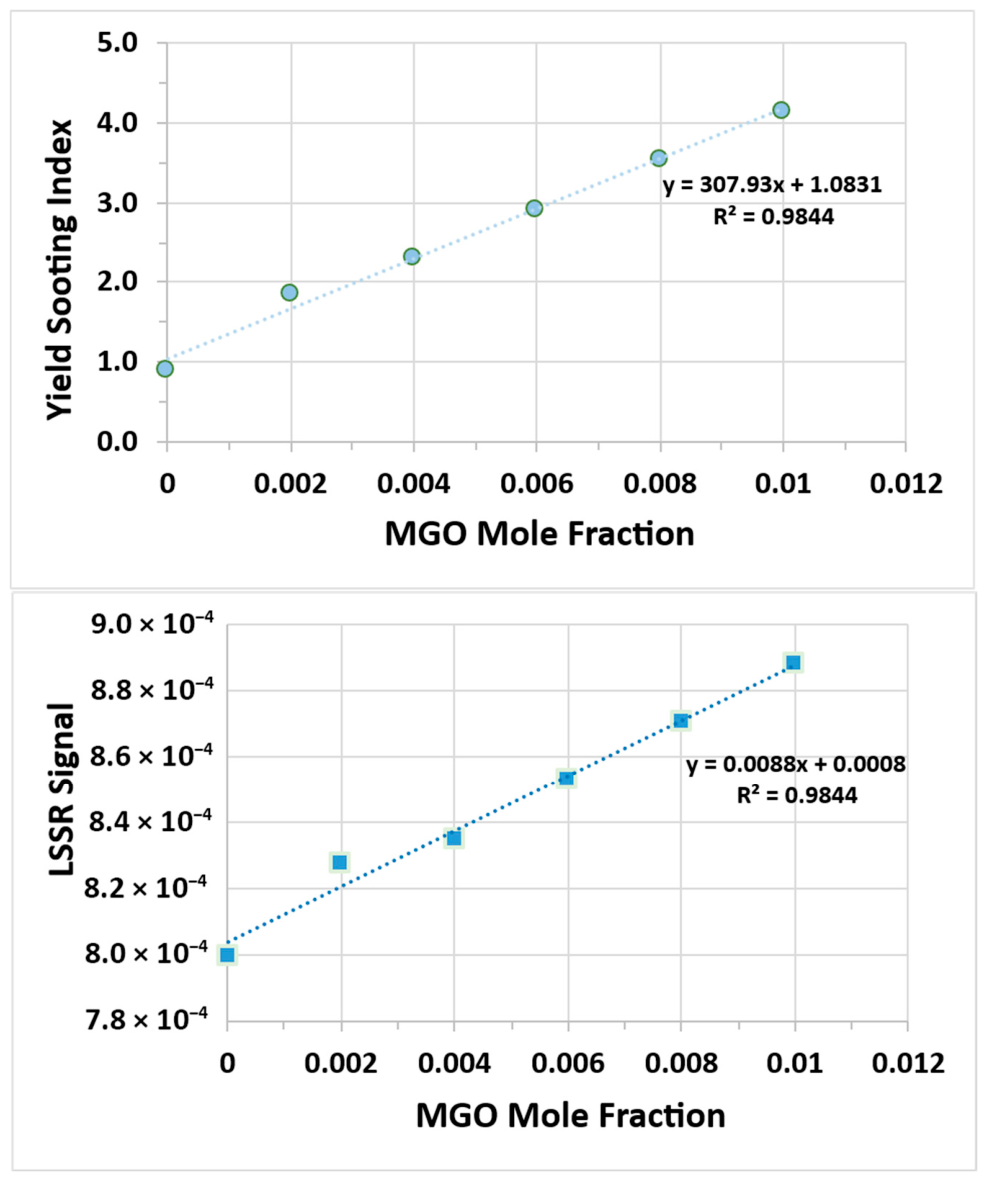
To further address this question, additional experiments were conducted in a two-syringe pump configuration, which allows the methanol to MGO ratio to be systematically varied and determine the relative trend of MGO addition on YSI. These experiments also simulate events in a dual-fuel marine engine where methanol and the pilot fuel (typically MGO) are injected separately.
To improve the sensitivity of these measurements, the dopant concentration was increased from the normal 1000 ppm to 10,000 ppm for these experiments. This change is useful because methanol has such a low sooting tendency that 1000 ppm barely changes the soot concentration beyond the base flame; increasing the concentration to 10,000 ppm produces a larger effect size that can be more accurately measured. Furthermore, the YSI endpoints were changed from n-heptane (YSI = 36) and toluene (YSI = 170.9) to water (YSI = 0) and n-heptane (YSI = 36). This change means the measured YSIs are between the endpoints, and they no longer require extrapolation outside of the endpoints. We have shown elsewhere that YSIs measured with these two scales are identical to within the absolute uncertainty [45].
Figure 5 (top panel) shows the raw soot signal measured in each flame or line-of-sight spectral radiance (LSSR) as a function of the MGO mole fraction in the dopant mixture. These results show that with a total dopant concentration of 10,000 ppm, the signal in each flame differs by an amount that is larger than the scatter in the data points. Figure 5 (bottom panel) below shows the LSSR data converted into YSI with Equation (1). The results show that while the YSIs are the same to within the absolute uncertainty (±5 YSI units), MGO increases the relative sooting tendency even at mole fractions as low as 0.002. The YSI measured for pure methanol (the data point at the lefthand side of the figure) is 0.9. This value agrees with the previous value of 6.6 to within the absolute uncertainty in YSI (±5 YSI units), but it is somewhat lower, probably due to the shift in calibration scale endpoints for this set of experiments. The saturated mixture of MGO in methanol has an MGO mole fraction of ~0.005; the data in the figure shows that this would yield a YSI of ~2.5, so while MGO addition increases the sooting tendency, it is still very low. The data also show that soot formation from methanol with varying levels of MGO varies linearly with MGO content on a molar or mass basis.

4. Conclusions

  • ISO 6583:2024 requires the use of ASTM Method D1613 for the measurement of acidity as acetic acid. ASTM Method D7795, an automated titration which was developed for denatured fuel ethanol, provides equivalent results.
  • Methanol can absorb water from humid air and will exceed the 0.1 wt% limit on water content within a few hours. This can likely be avoided by minimizing tank ullage volume or storing under inert gas blanket.
  • There was no significant evidence of oxidation of pure methanol after storage exposed to air over 8 weeks at 20 °C or 40 °C. For ISO MMB grade, there was also limited evidence for oxidation, although certain impurities may be reacting to form acids at a very low level.
  • The MGO sample used in this study was soluble in methanol at about 4 wt% at room temperature.
  • Impact of impurities (water, higher alcohols, MGO, and B7) could be detected with methanol purity measurements (IMPCA 001) or distillation range. None of the impurities resulted in improved lubricity of methanol.
  • MGO increases soot formation from methanol only slightly. Methanol has a very low sooting tendency to begin with.
  • Suggested future work includes investigating methanol samples produced from other raw material sources to quantify varying impurity profiles and the performance of IMPCA001 to detect them. Additional studies to understand the impact of water and MGO on the distillation range are warranted. Because MGO did not provide sufficient lubricity, exploring the addition of lubricity additives as an alternative would be beneficial. Further, an expanded storage stability study that extends beyond 8 weeks could reveal insights into the degradation of methanol during storage. Lastly, a study of the impacts of various impurities such as acids and water on the corrosivity of common marine alloys would be highly impactful. In particular, 16CrMo (chromium–molybdenum alloy steel) has been shown to be sensitive to the presence of formic acid [46].

Supplementary Materials

The following supporting information can be downloaded at: https://www.mdpi.com/article/10.3390/su18104931/s1. Table S1: Change in purity of methanol samples over 8-week aging experiment; Table S2: Properties of MGO samples used in this study; Table S3: Results of determination of saturation content of MGO and B7 by evaporation method; Figure S1: Apparatus used for storage stability evaluation; Figure S2: Schematic Diagram of the Burner used in the YSI measurements; Figure S3: Schematic Diagram of the YSI Apparatus; Figure S4: Test of methanol vaporization in the YSI apparatus; Figure S5: Test of the dual syringe pump setup for YSI measurements.

Author Contributions

G.M.F.: writing—review and editing, writing—original draft, supervision, methodology, investigation, formal analysis, and data curation. J.M.C.: formal analysis, data curation, and writing—review and editing. Z.X.: methodology, investigation, formal analysis, and data curation. C.S.M.: methodology, investigation, formal analysis, and data curation. K.K.: validation, supervision, funding acquisition, and conceptualization. R.L.M.: writing—review and editing, writing—original draft, supervision, project administration, funding acquisition, formal analysis, data curation, and conceptualization. All authors have read and agreed to the published version of the manuscript.

Funding

This work was authored in part by the National Laboratory of the Rockies, operated for the U.S. Department of Energy (DOE) under Contract No. DE-AC36-08GO28308. Support for the work was provided by the ExxonMobil Technology and Engineering Company under agreement CRD-18-00765/EM11699 project 23. The views expressed in the article do not necessarily represent the views of the DOE, the U.S. Government, nor ExxonMobil Technology and Engineering Company. The publisher, by accepting the article for publication, acknowledges that the U.S. Government retains a nonexclusive, paid-up, irrevocable, worldwide license to publish or reproduce the published form of this work, or allow others to do so, for U.S. Government purposes. ExxonMobil Technology and Engineering Company’s (ExxonMobil) work with, or collaboration with the noted third-party organizations does not constitute or imply an endorsement by ExxonMobil or its affiliates of any or all of the positions of such organizations. Yale University acknowledges funding from the National Laboratory of the Rockies under subcontract SUB-2023-10317.

Institutional Review Board Statement

Not applicable.

Informed Consent Statement

Not applicable.

Data Availability Statement

The original contributions presented in this study are included in the article/Supplementary Material. Further inquiries can be directed to the corresponding author. The data that support the findings of this study are openly available in Research and Markets Methanol—Global Strategic Business Report at: https://www.researchandmarkets.com/reports/338607/methanol_global_strategic_business_report?utm_code=jj7v7p URL (accessed 17 July 2025), Ref. [1]. The Methanol Institute Methanol Price and Supply and Demand. In: Methanol Institute at: https://www.methanol.org/methanol-price-supply-demand/, URL (accessed 26 July 2024), Ref. [2]. International Maritime Organization IMO Data Collection System. Reports of fuel oil consumption data submitted to the IMO Ship Fuel Oil Consumption Database at: https://wwwcdn.imo.org/localresources/en/OurWork/Environment/Documents/Reporting%20year%202023.pdf, URL (accessed 26 July 2024), Ref. [3]. The Methanol Institute at: https://www.methanol.org/marine/, URL (accessed 26 July 2024), Ref. [4]. The Engineering ToolBox Higher Calorific Values of Common Fuels: Reference & Data at: https://www.engineeringtoolbox.com/fuels-higher-calorific-values-d_169.html, URL (accessed 27 July 2024), Ref. [12]. International Methanol Producers and Consumers Association Methanol Reference Specifications, version 9, dated 10 June 2021 at: https://impca.eu/wp-content/uploads/2024/06/IMPCA-Ref-Spec-01-July-2021.pdf, URL (accessed 26 July 2025), Ref. [15]. The authors confirm that new data supporting the findings of this study are available within the article [and/or] its Supplementary Materials.

Conflicts of Interest

Author Kenneth Kar was employed by the company ExxonMobil (United States). The remaining authors declare that the research was conducted in the absence of any commercial or financial relationships that could be construed as a potential conflict of interest.

Abbreviations

The following abbreviations are used in this manuscript:
AOCSAmerican Oil Chemists’ Society
°CDegrees Celsius
CO2carbon dioxide
DMAdistillate marine fuel
FAMEfatty acid methyl esters
GC gas chromatograph
Hn-heptane (see Equation (1))
HFRRhigh-frequency reciprocating rig
IMPCAInternational Methanol Producers and Consumers Association
ISOInternational organization for Standardization
KFKarl Fischer
kg/m3kilograms per meter cubed
LC/MSliquid chromatography/mass spectrometry
LSSRline-of-sight spectral radiance
MGOmarine gas oil
MJ/kgmegajoules per kilogram
MJ/Lmegajoules per liter
MMAmarine methanol grade A
MMBmarine methanol grade B
MMCmarine methanol grade C
N/Anot applicable
NISTNational Institute of Standards and Technology
NOxnitrous oxide
POMEpolyoxylene methyl ethers
SOxsulfur oxide
Ttoluene (see Equation (1))
TFtest fuel (see Equation (1))
VLSFOvery-low-sulfur fuel oil
Wt%weight percent
YSIyield sooting index

References

  1. Research and Markets. Methanol—Global Strategic Business Report. Available online: https://www.researchandmarkets.com/reports/338607/methanol_global_strategic_business_report?utm_code=jj7v7p (accessed on 17 July 2025).
  2. The Methanol Institute. Methanol Price and Supply and Demand. Available online: https://www.methanol.org/methanol-price-supply-demand/ (accessed on 17 July 2025).
  3. International Maritime Organization. IMO Data Collection System. In Reports of Fuel Oil Consumption Data Submitted to the IMO Ship Fuel Oil Consumption Database; International Maritime Organization: London, UK, 2025; Available online: https://wwwcdn.imo.org/localresources/en/OurWork/Environment/Documents/Reporting%20year%202023.pdf (accessed on 26 July 2024).
  4. The Methanol Institute Marine; The Methanol Institute. Available online: https://www.methanol.org/marine/ (accessed on 26 July 2024).
  5. Gilbert, P.; Waslh, C.; Traut, M.; Kesieme, U.; Pazouki, K.; Murphy, A. Assessment of full life-cycle air emissions of alternative marine shipping fuels. J. Clean. Prod. 2018, 172, 855–866. [Google Scholar] [CrossRef]
  6. Zincir, B.; Deniz, C.; Tuner, M. Investigation of environmental, operational and economic performance of methanol partially premixed combustion at slow speed operation in a marine engine. J. Clean. Prod. 2019, 235, 1006–1019. [Google Scholar] [CrossRef]
  7. Ammar, N. An environmental and economic analysis of methanol fuel for a cellular container ship. Transp. Res. Part D Transp. Environ. 2019, 69, 66–76. [Google Scholar] [CrossRef]
  8. Ellis, J.; Tanneberger, K. Study on the Use of Ethyl and Methyl Alcohol as Alternative Fuels in Shipping; SSPA Sweden AB: Goteborg, Sweden, 2015. [Google Scholar]
  9. Kass, M.; Sluder, C.; Kaul, B. Spill Behavior, Detection, and Mitigation for Emerging Nontraditional Marine Fuels; No. DTMA91X20A65; United States Department of Transportation, Maritime Administration: Washington, DC, USA, 2021. [Google Scholar]
  10. ISO 6583:2024; Methanol as a Fuel for Marine Applications—General Requirements and Specifications. International Organization for Standardization: Geneva, Switzerland, 2024.
  11. ISO 8217:2024; Products from Petroleum, Synthetic and Renewable Sources—Fuels (Class F)—Specifications of Marine Fuels. International Organization for Standardization: Geneva, Switzerland, 2024.
  12. The Engineering ToolBox. Higher Calorific Values of Common Fuels: Reference & Data. Available online: https://www.engineeringtoolbox.com/fuels-higher-calorific-values-d_169.html (accessed on 27 July 2024).
  13. Lloyd’s Register. Fuel for Thought: Methanol; Lloyd’s Register: London, UK, 2023. [Google Scholar]
  14. DNV. DNV Alternative Fuels Insight. Available online: https://www.dnv.com/services/alternative-fuels-insights-afi/ (accessed on 25 February 2026).
  15. International Methanol Producers and Consumers Association. Methanol Reference Specifications, Version 9, Dated 10 June 2021. Available online: https://impca.eu/wp-content/uploads/2024/06/IMPCA-Ref-Spec-01-July-2021.pdf (accessed on 26 July 2025).
  16. IMPCA 003; IMPCA Methanol Reference Specifications. International Methanol Producers & Consumers Association: Brussels, Belgium, 2015.
  17. IMPCA 001; Purity and Impurities of Methanol. International Methanol Producers & Consumers Association: Brussels, Belgium, 2014.
  18. D1209; Standard Test Method for Color of Clear Liquids (Platinum-Cobalt Scale). ASTM International: West Conshohocken, PA, USA, 2025.
  19. D5386; Standard Test Method for Color of Liquids Using Tristimulus Colorimetry. ASTM International: West Conshohocken, PA, USA, 2024.
  20. E1064; Standard Test Method for Water in Organic Liquids by Coulometric Karl Fischer Titration. ASTM International: West Conshohocken, PA, USA, 2023.
  21. ASTM D1078; Standard Test Method for Distillation Range of Volatile Organic Liquids. ASTM International: West Conshohocken, PA, USA, 2026.
  22. ASTM D4052; Standard Test Method for Density, Relative Density, and API Gravity of Liquids by Digital Density Meter. ASTM International: West Conshohocken, PA, USA, 2022.
  23. ISO 12185:2024; Crude Petroleum, Petroleum Products and Related Products—Determination of Density—Laboratory density Meter with an Oscillating U-Tube Sensor. International Methanol Producers & Consumers Association: Brussels, Belgium, 2024.
  24. ASTM D1363; Standard Test Method for Permanganate Time of Acetone and Methanol. ASTM International: West Conshohocken, PA, USA, 2025.
  25. IMPCA 002; Chloride as Cl. International Methanol Producers & Consumers Association: Brussels, Belgium, 1998.
  26. ASTM D5453; Standard Test Method for Determination of Total Sulfur in Light Hydrocarbons, Spark Ignition Engine Fuel, Diesel Engine Fuel, and Engine Oil by Ultraviolet Fluorescence. ASTM International: West Conshohocken, PA, USA, 2025.
  27. ASTM D1722; Standard Test Method for Water Miscibility of Water-Soluble Solvents. ASTM International: West Conshohocken, PA, USA, 2023.
  28. E346; Standard Test Method for Analysis of Carbonizables in Methanol. ASTM International: West Conshohocken, PA, USA, 2023.
  29. ASTM D1613; Standard Test Method for Acidity in Volatile Solvents and Chemical Intermediates Used in Paint, Varnish, Lacquer, and Related Products. ASTM International: West Conshohocken, PA, USA, 2023.
  30. E394; Standard Test Method for Iron in Trace Quantities Using the 1,10-Phenanthroline Method. ASTM International: West Conshohocken, PA, USA, 2022.
  31. ASTM D1353; Standard Test Method for Nonvolatile Matter in Volatile Solvents for Use in Paint, Varnish, Lacquer, and Related Products. ASTM International: West Conshohocken, PA, USA, 2021.
  32. IP PM FK; Methanol Fuel—Assessment of Lubricity Using the High-Frequency Reciprocating rig (HFRR). Energy Institute: London, UK, 2024.
  33. IP PM FI; Determination of the Concentration of Dispersed Particles in Marine Methanol Fuel—Automatic Particle Counter (APC) Light Obscuration Method. Energy Institute: London, UK, 2024.
  34. Jalain, R.; Bonnety, J.; Legros, G.; Matynia, A. Sooting tendencies of ethylene diffusion flame doped by C3-C5 alcohols. Proc. Combust. Inst. 2023, 39, 979–987. [Google Scholar] [CrossRef]
  35. Singh, A.; Tsolas, N. Sooting tendency of isopropanol-butanol-ethanol (IBE)/diesel surrogate blends in laminar diffusion flames. Combust. Flame 2023, 250, 112630. [Google Scholar] [CrossRef]
  36. McEnally, C.; Das, D.; Pfefferle, L. Yield sooting index database volume 2: Sooting tendencies of a wide range of fuel compounds on a unified scale. In Harvard Dataverse; Institute for Quantitative Social Science (IQSS): Cambridge, MA, USA, 2017. [Google Scholar] [CrossRef]
  37. Burton, J.; Martin, J.; Fioroni, G.; Alleman, T.; Hays, C.; Ratcliff, M.; Thorson, M.R.; Schmidt, A.J.; Hallen, R.T.; Hart, T.R.; et al. Fuel Property Effects of a Broad Range of Potential Biofuels on Mixing Controlled Compression Ignition Engine Performance and Emissions; SAE Technical Paper No. 2021-01-0505; National Renewable Energy Laboratory (NREL): Golden, CO, USA, 2021. [Google Scholar]
  38. ASTM D7042; Standard Test Method for Dynamic Viscosity and Density of Liquids by Stabinger Viscometer (and the Calculation of Kinematic Viscosity). ASTM International: West Conshohocken, PA, USA, 2025.
  39. ASTM D7795; Standard Test Method for Acidity in Ethanol and Ethanol Blends by Titration. ASTM International: West Conshohocken, PA, USA, 2022.
  40. Simpson, F.; Kerr, R.; Bates, A. Overcoming the technical barriers of methanol and ammonia fuels using additives. In CIMAC Congress25, Paper No. 089, Zurich, Switzerland, 19–23 May 2025; CIMAC: Frankfurt, Germany, 2025. [Google Scholar]
  41. ASTM D6079; Standard Test Method for Evaluating Lubricity of Diesel Fuels by the High-Frequency Reciprocating Rig (HFRR). ASTM International: West Conshohocken, PA, USA, 2024.
  42. ASTM D4625; Standard Test Method for Middle Distillate Fuel Storage Stability at 43 °C (110 °F). ASTM International: West Conshohocken, PA, USA, 2022.
  43. Xiang, Z.; Acikel, M.; Hansen, C.; Jeong, G.U.; Perez-Soto, R.; Wang, D.; Whoriskey, V.; Kim, S.; McEnally, C.; Pfefferle, L.; et al. The sooting behavior of lactones as sustainable fuels. Sustain. Energy Fuels 2024, 8, 5206–5213. [Google Scholar] [CrossRef]
  44. ASTM D6709; Standard Test Method for Evaluation of Automotive Engine Oils in the Sequence VIII Spark-Ignition Engine (CLR Oil Test Engine). ASTM International: West Conshohocken, PA, USA, 2025.
  45. Zhu, J.; Chan, F.L.; Foust, T.D.; Kima, C.A.; Kwon, H.; Lucas, S.; McEnally, C.S.; Pfefferle, L.D.; Xuan, Y.; Windom, B.C. Sooting Tendencies of Individual Polyoxymethylene Ethers with Methyl, Ethyl, Propyl, and Butyl End-Groups and One to Five Oxymethylene Units. Ph.D. Thesis, Yale Graduate School of Arts and Sciences, New Haven, CT, USA, 2026. manuscript in preparation. [Google Scholar]
  46. Cai, Y.; Wang, Z.; Li, Q.; Song, Y.; Dong, K. Corrosion Behavior of Marine Engine Piston 16CrMo Alloy Steel in the Artificial Methanol Fuel Combustion Product Environment. Mater. Today Commun. 2025, 49, 114417. [Google Scholar] [CrossRef]
Figure 1. Methanol (LC/MS grade) water content over time during exposure to 75% relative humidity air at room temperature.
Sustainability 18 04931 g001
Figure 2. Changes in acidity as measured by D7795 potentiometric titration of methanol samples over the 8-week aging experiment.
Sustainability 18 04931 g002
Figure 3. Distillation range for various methanol samples (by method D1078).
Sustainability 18 04931 g003
Figure 4. HFRR lubricity results for methanol samples using the IP PM FK method with 500 g load. Results for MGO shown for comparison. Error bars are 95% confidence interval based on three replications for Tag 415. Red line indicates lubricity on this test for a compliant diesel fuel.
Sustainability 18 04931 g004
Figure 5. Line-of-sight spectral radiance (LSSR, top panel) and yield sooting index (YSI, bottom panel) for mixtures of methanol and MGO injected using the two-syringe pump system.
Sustainability 18 04931 g005
Table 1. Properties of neat methanol in comparison to MGO.
PropertyUnitsMethanolMGO
Boiling point or T90°C64.6 a--
Flash point°C11 a>60 c
Net heat of combustion (specific energy)MJ/kg20.0 b43 d
Net heat of combustion (energy density at 15 °C)MJ/L15.938
Density at 15 °Ckg/m3796.1 a<890 c
a From ISO 6583:2024 [10]. b Value from NIST Webbook. c DMA grade in ISO 8217:2024 [11]. d Typical value from [12].
Table 2. Requirements of IMPCA and ISO 6583:2024 methanol specifications [16,17,18,19,20,21,22,23,24,25,26,27,28,29,30,31,32,33].
UnitsMethodIMPCAISO MMAISO MMBISO MMC
Appearance IMPCA 003Homogeneous, clear and free of suspended matter
Purity, dry basiswt%IMPCA 00199.85 min99.85 min99.85 min99.70 min
Impurities, dry basiswt%IMPCA 001N/A0.15 max0.15 max0.30 max
Acetonemg/kgIMPCA 00130 max30 max30 max30 max
Ethanolmg/kgIMPCA 00150 max50 max50 max150 max
ColorPt-CoD1209 or D53865 maxN/AN/AN/A
Waterwt%E10640.1 max0.1 max0.1 max0.5 max
Distillation Range°CD10781.0 max1.0 max1.0 maxReport
Specific Gravity 20 °C/20 °C D40520.7910–0.7930N/AN/AN/A
Density at 15 °Ckg/m3ISO12185/D4052N/A795.0–797.0795.0–797.0795.0–798.0
Potassium Permanganate Time at 15 °CminutesD136360 minN/AN/AN/A
Chloride as Clmg/kgIMPCA 0020.5 max0.5 max0.5 max0.5 max
Sulfurmg/kgD54530.5 max0.5 max0.5 max10 max
Water miscibility D1722PassN/AN/AN/A
CarbonizablePt-CoE34630 maxN/AN/AN/A
Acidity as acetic acidmg/kgD161330 max30 max30 max30 max
Iron in solutionmg/kgE3940.10 maxN/AN/AN/A
Non-volatile mattermg/1000 mLD13538 maxN/AN/AN/A
Lubricity aµmIP PM FKN/Aa----
Particle count b IP PM FIN/Ab----
a Lubricity shall be agreed upon between buyer and seller. b Particle count shall be agreed upon between buyer and seller.
Table 3. Properties and purity of methanol samples evaluated in this study [16,17,20,21,22,25,29,39].
PropertyMethodLimitLC/MS MethanolMMB Tag 415MMB Tag 416MMB Tag 451Methanol
+ Alcohols
AppearanceIMPCA 003 PassPassPassPassPass
Methanol, wt% (dry)IMPCA 00199.8510099.9999.99100.0095.01
Impurities, wt% (dry)IMPCA 0010.15--0.010.0104.99
Acetone, mg/kgIMPCA 00130--22114ND
Ethanol, mg/kgIMPCA 00150--104ND a-- b
Water, wt%E10640.1000.0160.021 0.0190.128
Chloride ion, mg/kgIMPCA 0020.5<0.5<0.5--<0.25 a<0.5
Sulfur, mg/kgD54530.5--< 0.5<0.5<0.5< 0.5
Acidity as acetic acid, mg/kgD161330--4.5 ± 0.23.0 ± 0.2--3.7 ± 0.2
Acidity as acetic acid, mg/kgD7795303.4 ± 0.613.8 ± 1.52.6 ± 1.34.9 ± 1.63.5 ± 1.5
Density at 15 °C, kg/m3D4052795–797796.0796.0--795.9796.1
Distillation Range, °C maxD1078 a10.4 ± 0.240.5 ± 0.24--0.6 ± 0.254 ± 0.4
a ND = none detected. b 4.6 wt% ethanol based on certificate of analysis.
Table 4. Properties and purity of LC/MS-grade methanol contaminated with water, MGO, and MGO/B7 [21,22,38,44].
PropertyMethodLimitLC/MS Methanol +1% WaterMethanol–AlcoholsMGO SaturatedMGO B7 Saturated
MGO or B7 content, wt%Evaporate Methanol ------3.9 ± 0.424.5 ± 0.06
Kinematic Viscosity at 20 °C, mm2/s D7042 0.6565 ----0.6956 0.6974
Distillation Range, °C maxD107810.4 ± 0.246.0 ± 0.54 ± 0.41.2 ± 0.281.6 ± 0.29
Density at 15 °C, kg/m3D4052795–797796.0798.0796.1795.8796.7
Lubricity, µmD6709 mod300478456427421441
Table 5. YSI measurements for MGO, methanol, and saturated methanol.
SampleMeasured YSI
MGO199.2 ± 10.0
Methanol (reagent grade)6.6 ± 5.0
Methanol saturated with MGO (3.9 wt%)9.5 ± 5.0
Methanol saturated with B7 (4.5 wt%)7.5 ± 5.0
Disclaimer/Publisher’s Note: The statements, opinions and data contained in all publications are solely those of the individual author(s) and contributor(s) and not of MDPI and/or the editor(s). MDPI and/or the editor(s) disclaim responsibility for any injury to people or property resulting from any ideas, methods, instructions or products referred to in the content.