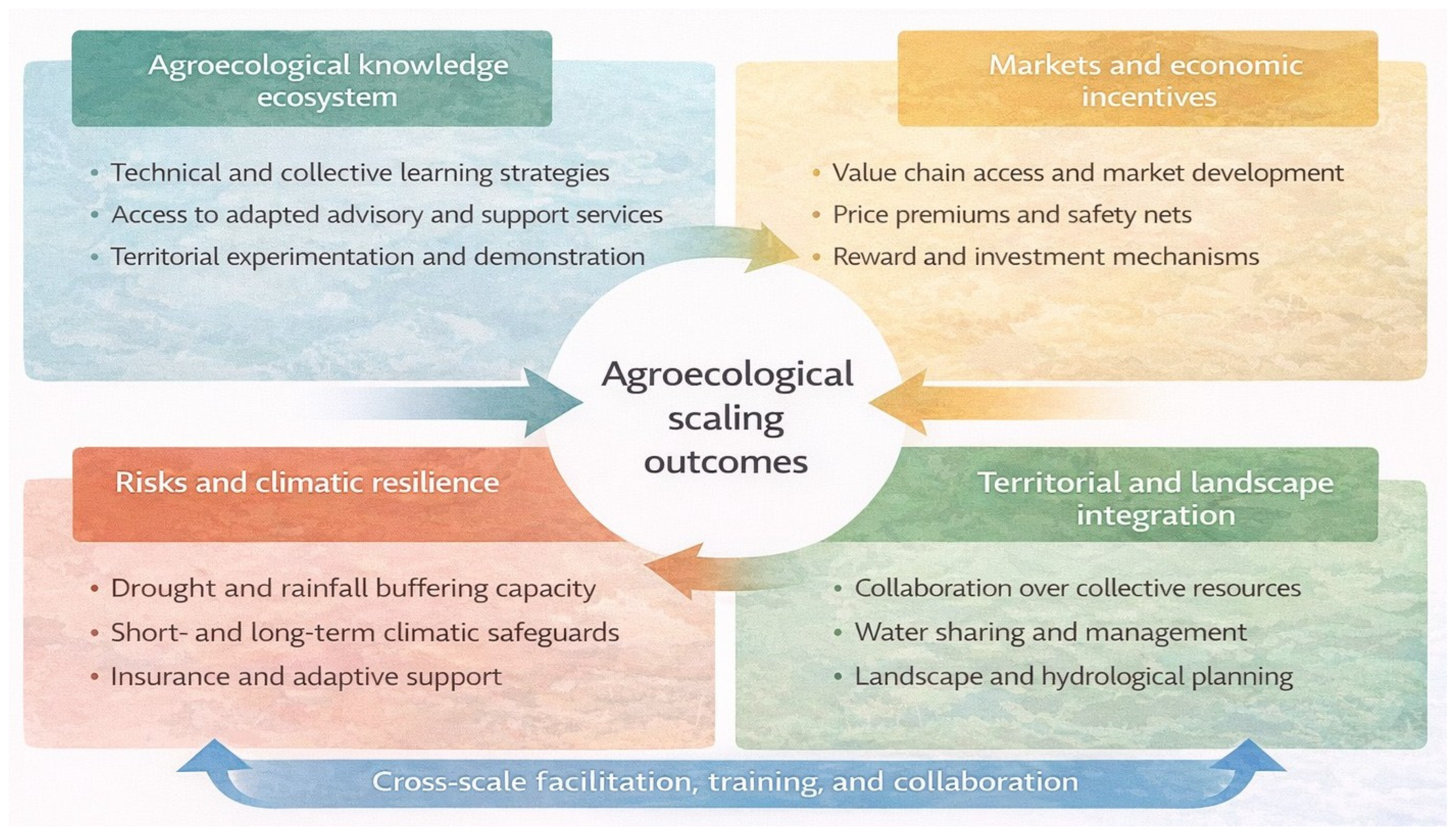
1. Introduction
Morocco has become one of the most revealing national contexts in which to assess whether agroecology can move from an attractive normative vision to an operational transition strategy. This is not only because the country is exposed to climate change but also because it is exposed to a particularly difficult combination of pressures: chronic and worsening water scarcity, repeated drought, strong dependence of agricultural output on rainfall variability, unequal access to irrigation, declining ecological buffers in many farming regions, and persistent socio-economic fragilities among small and medium producers. Recent literature describes Morocco as a semi-arid climate-change hotspot where water scarcity is now structuring agricultural sustainability debates rather than merely complicating them at the margins [
1,
2,
3,
4,
5,
6,
7,
8,
9,
10]. A recent Frontiers review on Moroccan agricultural policies and water sustainability notes that renewable water resources were estimated at around 22 billion m
3 in 2023 and frames water scarcity as a defining national challenge. In parallel, the World Bank’s recent support to Morocco’s agri-food transition underscores the country’s need to strengthen climate resilience, food safety, and agricultural quality under increasing climatic stress [
2].
The urgency of this context has contributed to making agroecology increasingly visible across policy, research, and development discourses in Morocco and the wider North African region. However, increased visibility should not be conflated with a systemic transition. Despite a growing number of initiatives related to sustainable and ecological farming, agroecology has yet to consolidate into a coherent organizing principle of agricultural transformation. Instead, it often manifests as a fragmented assemblage of practices, localized innovations, or partial adaptation strategies that coexist, sometimes uneasily, with dominant productivist and modernization-oriented agricultural models [
1,
9]. This coexistence reflects a broader structural tension in which agroecological approaches are promoted rhetorically while remaining marginal in terms of institutional integration and scaling capacity [
11,
12].
Although such tensions are not unique to Morocco, they are particularly pronounced in this context due to the coexistence of strong ecological imperatives and fragile enabling conditions. On the one hand, the country faces compelling environmental pressures, such as water scarcity, soil degradation, and climate variability, that would justify a transition toward agroecological systems. On the other hand, structural constraints, including policy incoherence, uneven access to resources, and entrenched agri-industrial development pathways, continue to limit the consolidation of agroecology as a transformative framework [
13,
14]. This contradiction highlights the difficulty of moving from isolated innovation niches toward broader regime-level transformation.
At the regional scale, this pattern is further confirmed by recent empirical syntheses. A 2024 review of 88 agroecology-related projects in North Africa shows that while initiatives are numerous, particularly in Morocco, they tend to remain concentrated at lower levels of agroecological transition, focusing primarily on technical or farm-level practices rather than systemic change [
13]. The same study emphasizes that scaling processes remain limited, with insufficient articulation between local initiatives, policy frameworks, and market structures. Consequently, agroecology in the region often operates as a set of fragmented interventions rather than a coordinated transition pathway, reinforcing the gap between normative ambitions and operational realities.
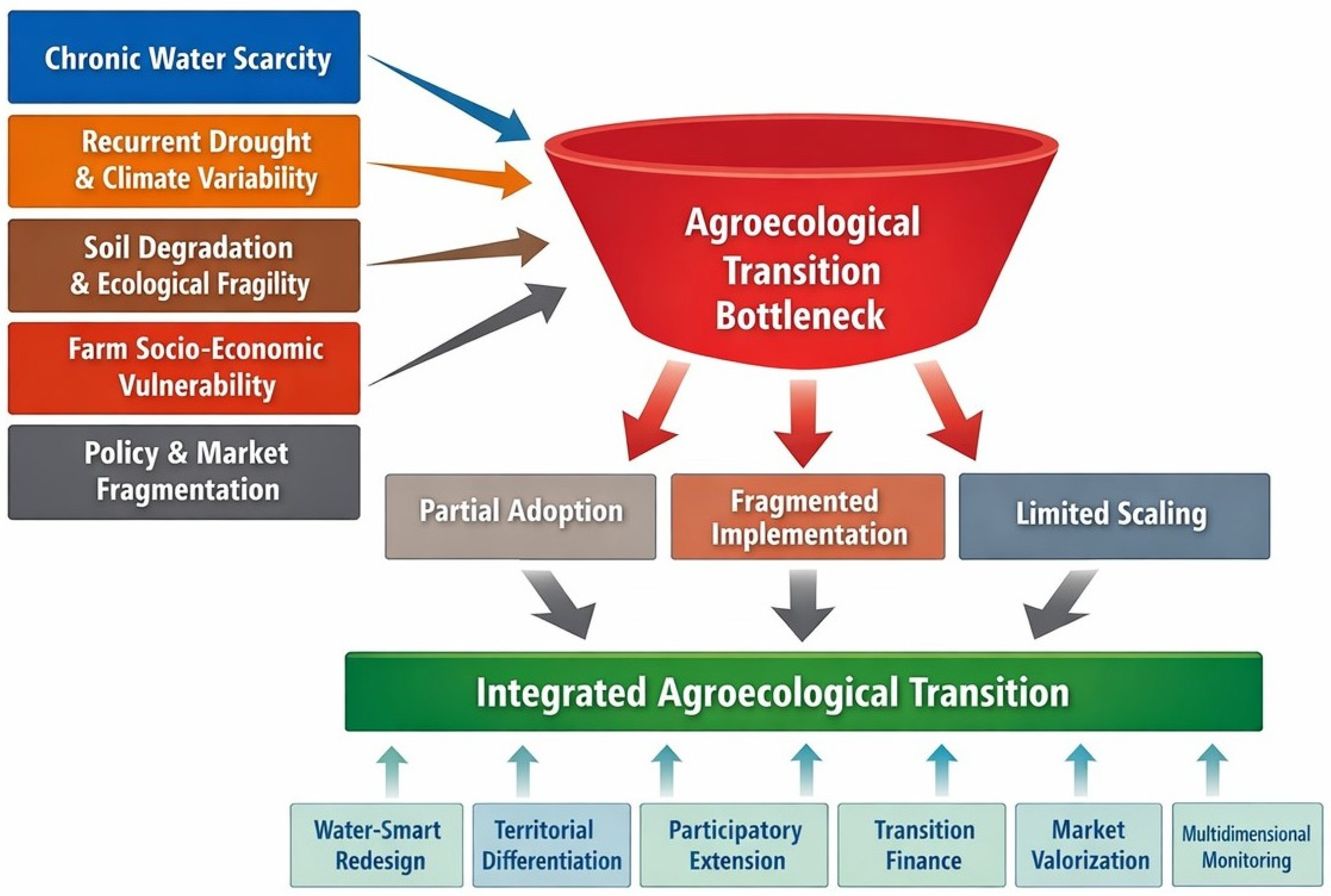
This review begins from a deliberately strong premise: in Morocco, the central problem is not the absence of agroecological potential but the failure to connect that potential to a credible transition architecture. Put differently, the country does not lack agroecological fragments; it lacks agroecological articulation. This distinction is analytically important because it shifts the debate away from narrow inventories of practices, such as crop rotation, reduced tillage, crop–livestock integration, or the use of organic amendments—toward the broader institutional and territorial conditions that make agroecology transformative rather than merely adaptive [
1,
13]. Recent work on North Africa and Morocco shows that agroecology rarely fails for lack of technical relevance; rather, it stalls when practices are not connected to knowledge systems, water governance, public incentives, territorial coordination, and value-chain organization [
11,
15]. In the Moroccan case, this missing alignment is especially consequential because hydro-climatic stress, ecological degradation, rural inequality, and policy fragmentation reinforce one another within the same socio-ecological system [
3,
16]. Morocco can therefore be understood as facing an agroecological transition bottleneck produced not only by water scarcity and soil degradation but also by fragmented governance arrangements, uneven territorial development, and the persistence of modernization-oriented agricultural incentives that often remain misaligned with ecological resilience objectives [
7,
10].
From this perspective, agroecology becomes transformative only when farming practices are articulated with systems of learning, collective resource management, territorial planning, and market structures capable of rewarding resilient production systems. This is precisely where the Moroccan debate remains underdeveloped. Existing evidence suggests that the country contains multiple agroecological niches and initiatives, yet these remain weakly coordinated and insufficiently embedded in a coherent transition strategy [
9,
13]. The problem, then, is not whether agroecological practices exist in Morocco; they clearly do, but whether they are institutionally assembled into a framework capable of moving beyond project-based experimentation and isolated adaptation. This is why the contextual drivers synthesized in
Figure 1 and
Table 1 are best interpreted not as separate constraints, but as interdependent dimensions of a wider Moroccan nexus linking water, land, production, and resilience [
1]. As summarized in
Table 1, Morocco concentrates a set of interacting hydro-climatic, agronomic, socio-economic, and institutional drivers that collectively make it a priority case for agroecological transition. The country’s agricultural future is shaped not by a single limiting factor, but by the convergence of chronic water stress, ecological degradation, farm vulnerability, fragmented support systems, and insufficient valorization of ecological production.
Accordingly, this review pursues four core objectives. First, it clarifies what agroecology means in the Moroccan context and explains why narrow or purely technical definitions have weakened both scientific analysis and policy debate [
11,
15]. Second, it synthesizes the available evidence on agroecological niches already present within Moroccan agriculture, including place-based initiatives and practice clusters that demonstrate adaptive potential without yet constituting systemic transition [
9,
13]. Third, it identifies the principal constraints that limit transition, ranging from water scarcity and soil degradation to weaknesses in extension, institutional incoherence, and disincentives embedded in dominant market and policy structures [
3,
7,
16]. Fourth, it proposes a strategic framework for moving from fragmented experimentation toward territorially differentiated transformation, on the premise that agroecological transition in Morocco will only become credible if it is simultaneously biophysical, institutional, and political. The purpose is therefore neither to romanticize agroecology nor to overstate its immediate capacity to resolve Morocco’s agricultural crisis; rather, it is to assess rigorously the conditions under which agroecology could become a scientifically robust and politically credible pathway for agricultural transformation in the country [
9,
10].
Methodologically, the article is based on a structured critical review combined with an interpretive bibliometric reading of the field. This approach was selected because the Moroccan agroecology literature remains fragmented across agronomy, water governance, rural development, transition studies, and food-system analysis, making a purely narrative overview insufficient and a formal quantitative meta-analysis premature. The objective was therefore to construct a reproducible analytical synthesis capable of linking conceptual clarification, thematic structuring of the literature, and strategic interpretation of transition constraints.
Despite the growing visibility of agroecology in Morocco and North Africa, an important gap remains in the literature. Existing reviews have documented practices, projects, and sustainability-oriented initiatives, but they have more rarely explained why agroecological relevance fails to translate into coherent scaling, why local experimentation remains weakly institutionalized, or how hydro-climatic stress and transition fragility reinforce one another. In other words, previous reviews have been stronger at identifying agroecological fragments than at explaining the absence of agroecological articulation. This article addresses that gap by moving beyond practice inventories and by focusing on the transition architecture required to connect ecological redesign, advisory systems, market valorization, and public governance under Moroccan conditions.
This makes the present study both timely and distinct. It is timely because Morocco is entering a phase of repeated drought, chronic water stress, and policy pressure in which the question is no longer whether agriculture should adapt but how transition can occur under structurally adverse conditions. It is distinct because it does not treat agroecology as a narrow set of techniques, nor as a purely normative ideal, but as a strategic and testable framework for understanding why transition remains necessary and difficult. The manuscript contributes to the international literature by proposing the Hydro-Agroecological Transition Trap as a conceptual lens and by translating this diagnosis into an operational six-pillar transition framework grounded in Moroccan territorial diversity.
2. Methodological Approach and Analytical Framework
This article adopts a structured critical review design complemented by an interpretive bibliometric synthesis. The study was not conceived as a statistical meta-analysis, because the available literature on agroecology in Morocco remains highly heterogeneous in terms of methods, scales, indicators, and objects of analysis. Instead, the objective was to build a transparent and analytically reproducible review framework capable of integrating conceptual, empirical, institutional, and territorial evidence across a fragmented field.
The review was conducted in four main stages. In the first stage, we established the conceptual and theoretical framing of the study. This framing was based on four starting propositions drawn from the literature: (i) agroecology must be understood as a multi-level approach linking ecological practices, farming-system redesign, and socio-political transformation [
1,
11,
15]; (ii) agricultural transition depends not only on the presence of relevant practices but also on the existence of a transition architecture capable of connecting knowledge systems, incentives, markets, and governance [
9,
13,
15]; (iii) socio-ecological resilience under drought and chronic water stress is a central analytical condition for evaluating transition pathways in Morocco [
1,
5,
6]; and (iv) the Moroccan case is especially revealing because ecological necessity and implementation fragility are structurally intertwined [
3,
10,
16]. These propositions served as the interpretive foundation of the review.
In the second stage, the literature corpus was assembled through targeted identification of peer-reviewed articles, review papers, policy-relevant academic studies, and selected institutional reports directly related to agroecology, water governance, agricultural transition, climate resilience, and food-system sustainability in Morocco and, where analytically necessary, the wider North African context. Priority was given to recent literature, particularly work published between 2020 and 2026, while earlier studies were retained when they provided essential conceptual or empirical grounding. The review relied on combinations of search terms related to agroecology, Morocco, water scarcity, drought, drylands, agricultural transition, resilience, farming systems, extension, value chains, and territorial governance.
Inclusion criteria required that sources contribute directly to at least one dimension of the research question: conceptualization of agroecology, identification of agroecological niches, hydro-climatic and soil constraints, socio-economic adoption barriers, advisory and cognitive bottlenecks, policy and institutional coherence, market valorization, or transition design. Exclusion criteria included purely technical agricultural studies with no transition relevance, descriptive accounts lacking analytical linkage to agroecology, and sustainability framings not sufficiently connected to Moroccan or North African transition dynamics. The screening process was iterative and interpretive rather than algorithmic, reflecting the heterogeneity of the field.
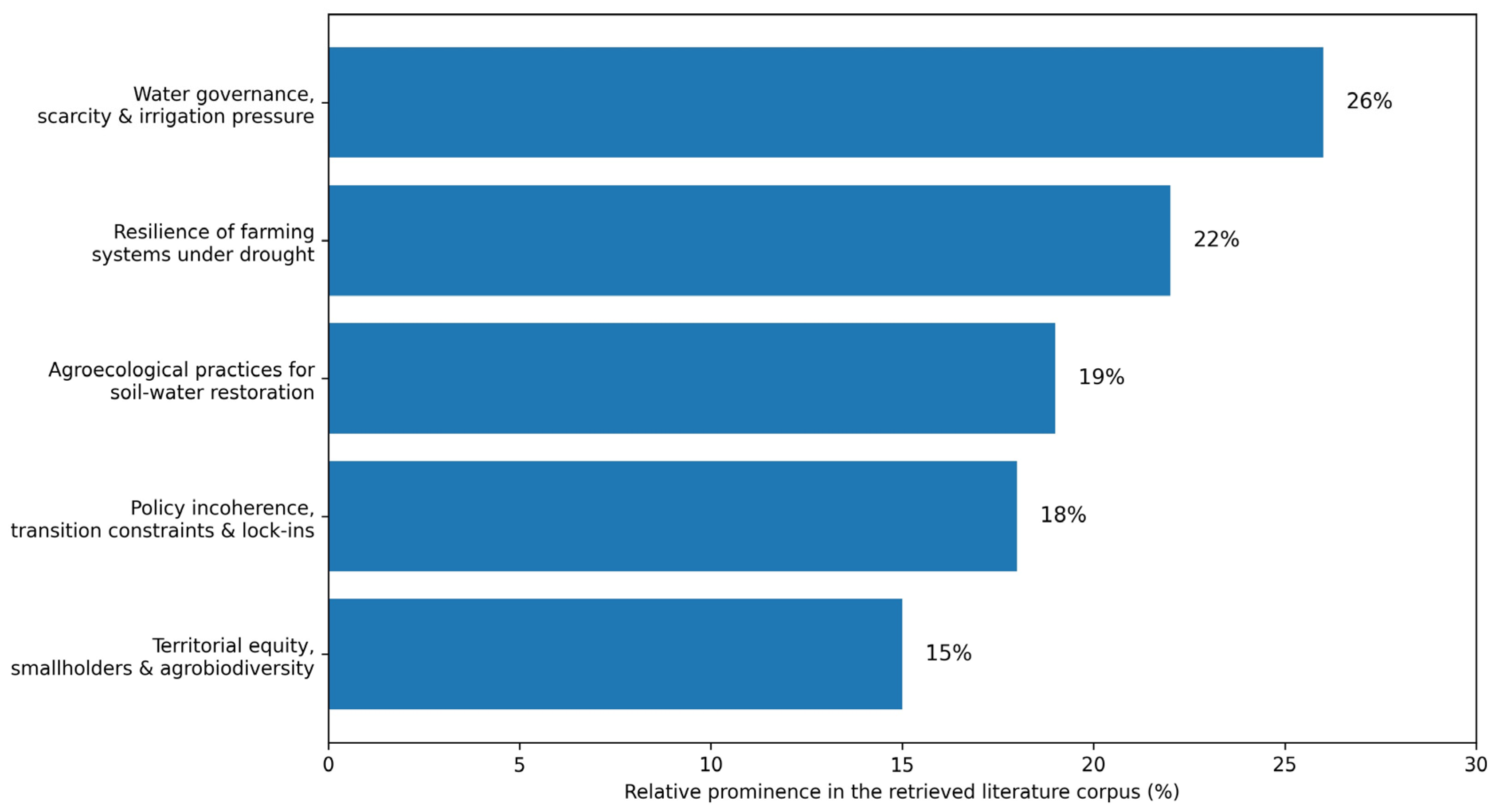
The bibliometric synthesis presented in
Figure 2 and
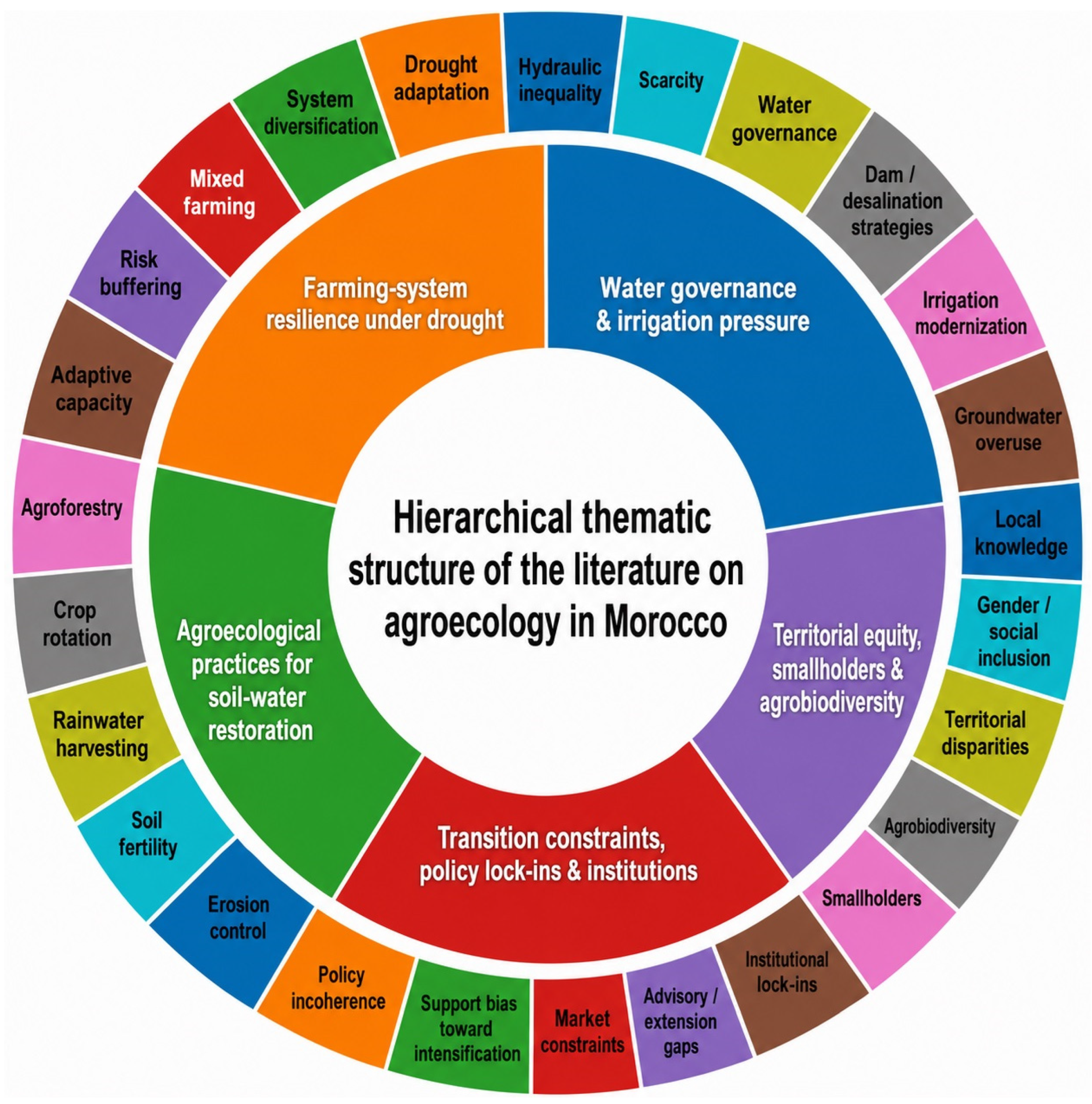
Figure 3 should therefore be interpreted as a structured thematic analysis of the retained corpus rather than as a formal scientometric exercise based on bibliographic coupling or co-occurrence software. The relative prominence of thematic domains shown in the figures was derived from the frequency, recurrence, and analytical centrality of themes within the selected literature.
In the third stage, the retained literature was screened and organized through iterative thematic coding. Each source was classified according to its principal analytical contribution, including water stress and drought resilience, soil restoration and ecological practices, farmer adoption and socio-economic vulnerability, advisory systems and knowledge co-production, public policy and institutional coherence, market organization and value chains, and territorial differentiation of transition pathways. This step made it possible to move beyond a simple accumulation of references and toward a structured interpretation of how different constraints and opportunities interact. The bibliometric overview presented in
Figure 2 and
Figure 3 should therefore be understood as an interpretive structuring of the retrieved corpus rather than as a formal scientometric mapping exercise based on network algorithms. Its purpose is to clarify the thematic architecture of the field and identify the dominant clusters shaping the Moroccan agroecology debate.
In the fourth stage, the thematic evidence was integrated into a higher-level analytical synthesis. This synthesis generated the core conceptual outputs of the review: the identification of major families of transition constraints, the comparative positioning of agroecology relative to adjacent frameworks, the formulation of the Hydro-Agroecological Transition Trap, the territorial differentiation of transition pathways, and the six-pillar transition framework proposed for Morocco. The tables and figures were therefore constructed not as independent descriptive elements, but as analytical devices designed to synthesize recurring patterns identified across the literature.
This methodological approach involves an explicit theoretical choice. Rather than asking whether agroecological practices exist in Morocco, the review asks why such practices remain weakly connected, poorly scaled, and insufficiently institutionalized despite their relevance under water stress. This shifts the analytical focus from practice inventory to transition architecture. In that sense, the review is anchored in a transition-oriented reading of agroecology in which the key unit of analysis is not the isolated technique but the alignment, or misalignment, among ecological processes, farmer capacities, governance systems, and value-chain structures.
The results should therefore be interpreted as an evidence-based conceptual synthesis. Their scientific contribution lies not in producing new primary field data, but in reorganizing dispersed knowledge into a coherent framework capable of explaining why agroecological transition in Morocco remains simultaneously necessary and difficult.
3. Bibliometric Overview of the Field
A bibliometric reading of the recent literature, conducted here as an interpretive thematic synthesis of the retrieved corpus, indicates that agroecology in Morocco is emerging as a strategically important but still only partially consolidated research domain at the intersection of water governance, climate resilience, farming systems analysis, and agrifood transformation. As shown in
Figure 2, the retained literature is structured primarily around five major thematic poles: water governance and irrigation pressure, resilience of farming systems under drought, agroecological practices for soil–water restoration, transition constraints and policy lock-ins, and issues of territorial equity, smallholder viability, and agrobiodiversity. This thematic distribution is highly significant because it shows that agroecology in Morocco is not being framed principally as a narrow agronomic agenda or a collection of isolated ecological practices. Rather, it is increasingly discussed as a systemic response to a broader socio-ecological crisis shaped by chronic water scarcity, hydro-climatic instability, uneven access to irrigation, fragile farm economics, and incomplete institutional coordination.
This interpretive shift is further clarified in
Figure 3, which highlights the internal organization of the field through a hierarchical structure linking broad thematic domains to their associated subthemes. The figure shows that the most visible literature clusters around groundwater overuse, irrigation modernization, drought adaptation, diversification, agroforestry, rainwater harvesting, institutional lock-ins, and the precarious position of smallholders within highly differentiated territorial systems. Together, these clusters suggest that the Moroccan agroecology debate has moved well beyond the question of whether ecologically compatible practices exist. The more central issue now concerns whether these practices can be articulated into a coherent transition architecture capable of linking water governance, ecological redesign, public incentives, advisory systems, and market valorization. In this sense, the bibliometric structure of the field reinforces the central argument of this review: Morocco does not suffer from a lack of agroecological relevance but from a deficit of transition alignment. The literature converges on the idea that agroecology becomes most necessary precisely where water stress, ecological degradation, and farm vulnerability are most severe, while the enabling conditions for adoption remain weakest. This explains why current scholarship increasingly treats agroecology in Morocco not as a marginal sustainability niche, but as a strategic framework for water-resilient transformation under conditions of structural constraint.
4. Agroecology in the Moroccan Context: From Technical Practice to Socio-Ecological Transition
In the Moroccan context, one of the central weaknesses of the agroecology debate lies in its conceptual dilution. The term is frequently used to refer to a broad spectrum of environmentally oriented agricultural practices, from input reduction and organic farming to conservation agriculture, without sufficient analytical precision. While these overlaps are not without merit, they tend to blur the distinct epistemological and transformative scope of agroecology. Agroecology should not be understood as a softer version of conventional intensification, nor simply as a label for low-input traditional farming systems. Rather, it represents a multidimensional approach that brings together ecological processes, system redesign, and socio-political transformation [
1,
11]. The 2024 review of 88 agroecology-related projects in North Africa is particularly revealing in this respect, showing that many initiatives—especially in Morocco—remain largely confined to farm-level technical practices, without engaging in deeper processes of system redesign, food system restructuring, or institutional change [
13]. This suggests that the language of agroecology is expanding more rapidly than its actual transformative reach.
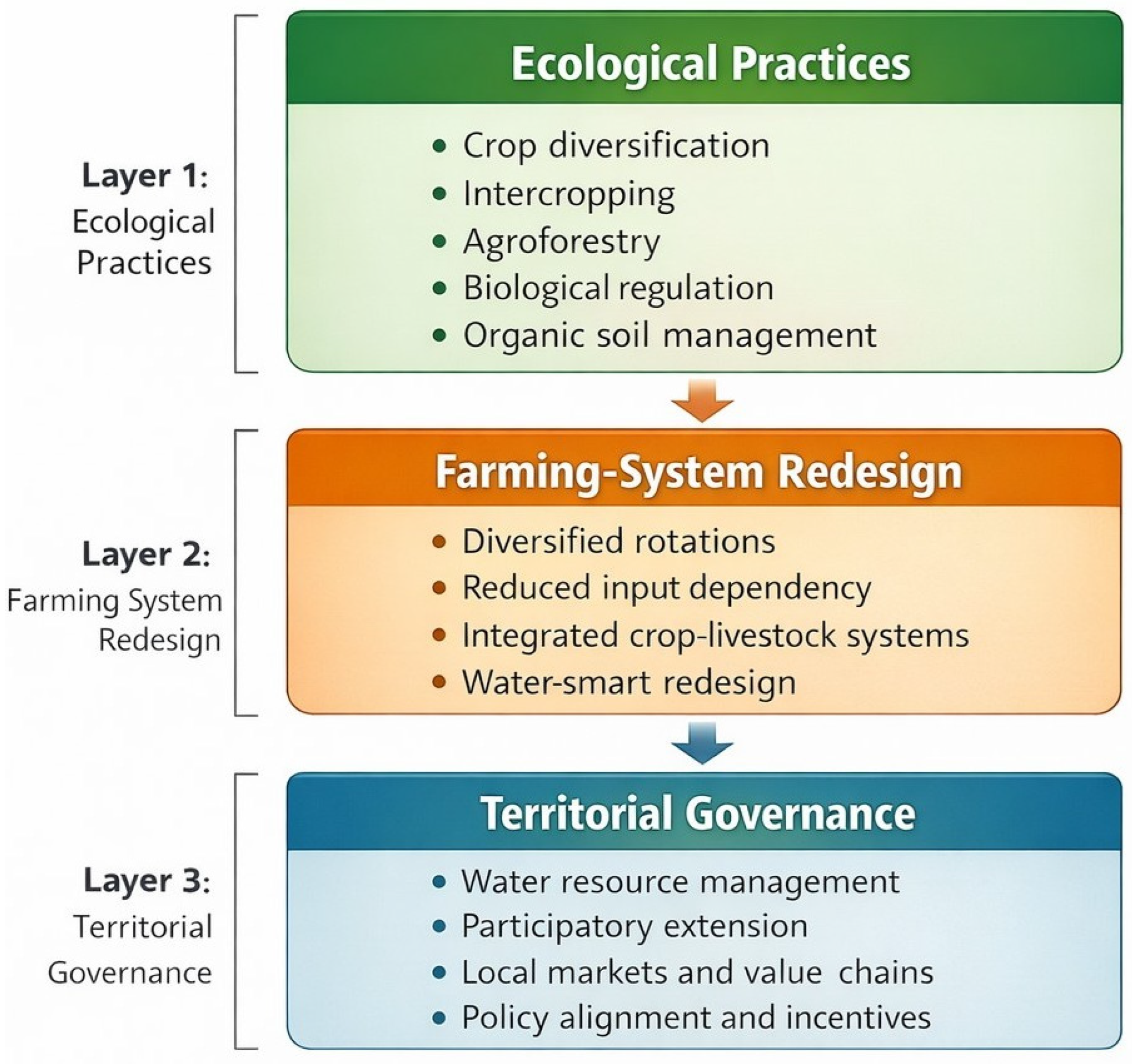
Clarifying this ambiguity requires approaching agroecology in Morocco as a multi-layered concept operating across at least three interrelated levels. The first is agronomic and ecological, concerned with the management of biological interactions among crops, soils, water, biodiversity, pests, and livestock. At this level, agroecology involves practices such as crop diversification, rotations, intercropping, organic amendments, and soil restoration, many of which are already present in Moroccan farming systems [
1,
12]. The second level is systemic, focusing on the redesign of farming systems to reduce dependence on external inputs, enhance resilience to hydro-climatic variability, and strengthen ecological buffering capacities [
17]. The third level is socio-political and territorial, where agroecology encompasses institutions, public incentives, extension systems, collective learning processes, market organization, and governance arrangements that enable diversified systems to persist and scale [
18,
19]. As illustrated in
Figure 4, these three levels are best understood as nested and interacting dimensions of agroecological transition, linking farm-level practices, system redesign, and territorial governance. The lack of clear differentiation between these levels has contributed to persistent ambiguity in the Moroccan debate, where practices are often discussed in isolation from system logic, and system-level ambitions are invoked without corresponding institutional strategies.
This clarification is particularly important given the pronounced heterogeneity of Moroccan agriculture. Rainfed cereal systems, irrigated perimeters, mountain agroecosystems, peri-urban horticulture, and oasis farming systems operate under markedly different ecological constraints, risk profiles, and socio-economic conditions. In this context, agroecology cannot be approached as a standardized package transferable across territories. Instead, it must be understood as a differentiated transition logic, shaped by local conditions and trajectories [
20,
21]. In this regard,
Figure 4 provides a conceptual representation of a three-layered agroecological model in Morocco, while
Table 2 compares agroecology with related approaches—such as conservation agriculture, climate-smart agriculture, organic farming, and sustainable intensification—highlighting both areas of overlap and the broader systemic and socio-political ambitions that distinguish agroecology [
13,
22].
Importantly, this distinction is not merely conceptual; it has direct implications for policy. When agroecology is reduced to a set of farm-level practices, it tends to be framed as a matter of voluntary technical adoption. By contrast, when it is understood as a socio-ecological transition, it brings into focus a wider set of structural questions, including irrigation governance, land-use planning, extension design, risk-sharing mechanisms, value-chain organization, and territorial coordination [
10,
15]. This review adopts the latter perspective, as it more accurately reflects both the depth of Morocco’s structural challenges and the scale of transformation required for agroecology to move beyond a niche discourse and become a credible pathway for agricultural transition.
These three levels are not merely theoretical distinctions; they are already visible in Moroccan agricultural territories. At the agronomic and ecological level, biological interactions are central in several contexts. In commercial vegetable systems of the Fez–Meknes region, for example, crop rotation and reduced dependence on strictly linear input logics have been documented as important entry points for agroecological thinking, even where farmers do not explicitly use the term agroecology [
12]. In rainfed cereal–livestock areas, legume rotations, crop diversification, and residue management already illustrate how ecological processes and resource circularity can support adaptation under drought exposure [
5,
6]. In pre-Saharan oasis systems, multistrata production, perennial diversity, and vertical ecological complementarity provide a long-standing example of agroecological functioning under scarcity [
20]. At the systemic level, these practices acquire greater significance when they are reorganized into broader redesign logics. This is particularly relevant in rainfed cereal systems, where diversification, residue allocation, and crop–livestock integration must be managed not as separate interventions but as interacting components of a drought-buffered system redesign. Similarly, in irrigated horticultural systems, the transition question is no longer only whether biological regulation or organic amendments can be introduced but whether intensive systems can be reoriented toward more ecologically differentiated and water-resilient production logics. At the socio-political and territorial level, agroecology becomes visible wherever ecological practices depend on collective coordination, market organization, or public support. In oasis territories, for instance, the persistence of agrodiversity depends not only on farm practices but also on water governance, institutional continuity, and territorial viability. Likewise, in project-based agroecological initiatives across Morocco, local experimentation often shows technical promise but remains weakly scaled because advisory, market, and governance arrangements are insufficiently aligned. These examples show that the three levels of agroecology are not abstract categories; they are already observable in Moroccan territories, although still rarely assembled into a coherent transition architecture.
5. Existing Agroecological Niches in Morocco: A Fragmented but Real Foundation
Morocco does not lack agroecological experience. On the contrary, several farming systems already incorporate important agroecological elements, although these remain unevenly distributed across sectors, regions, and projects rather than integrated into a coherent national transition strategy [
9,
13]. In rainfed cereal areas, especially in semi-arid plains and plateaus, crop diversification and legume-based rotations have long been identified as key strategies for reducing ecological and agronomic vulnerability associated with cereal monocultures [
5,
6]. These systems are particularly relevant because they concern the structural core of rainfed agriculture rather than marginal experimentation.
Conservation-oriented practices have gained increasing attention in water-stressed dryland systems, particularly where soil moisture retention and erosion control are critical. Yet these cases also reveal one of the central ambiguities identified in this review: reduced tillage, residue retention, and soil cover may generate important ecological benefits, but in Moroccan conditions they are often constrained by low biomass production and residue competition with livestock, meaning that their agroecological value depends on whether they are embedded in broader system redesign rather than implemented as isolated technical packages [
1,
22].
The horticultural sector offers more concrete examples of latent agroecology. In Fez–Meknes, empirical studies show that crop rotation and other ecologically compatible practices are already used in onion and vegetable systems, even where formal knowledge of agroecology remains low [
12]. In peri-urban Rabat, comparative work on ecological and more conventional farming systems highlights both the agronomic potential of ecological management and the commercial fragility that limits durable transition [
23]. In Sefrou and other localized initiatives, agroecological experimentation has demonstrated local learning effects and farmer engagement, but often without sufficient aggregation, certification support, or institutional follow-through to scale beyond the project level [
12,
24,
25]. Oasis systems remain among the strongest empirically grounded examples of agroecological logic in Morocco. Research on pre-Saharan oases shows that agrodiversity, especially perennial crop diversity and vertical stratification, plays a direct role in buffering scarcity and maintaining multifunctional resilience [
20].
However, these systems are under increasing pressure from climate stress, migration, land-use change, and institutional erosion, which means that their agroecological value lies not in romanticized continuity but in their capacity to reveal how diversity-based resilience functions under severe constraint.
Taken together, these examples show that Moroccan agroecology is not hypothetical. It is already present in dryland cereal systems, conservation-oriented drylands, commercial horticulture, peri-urban initiatives, mixed crop–livestock territories, and oasis agroecosystems. The central issue is therefore not the existence of agroecological forms, but their weak institutional articulation, uneven empirical evaluation, and limited scaling beyond localized or sector-specific niches.
As summarized in
Table 3, Morocco already harbors multiple agroecological niches across its major farming systems, from rainfed cereal areas and conservation-oriented drylands to commercial horticulture, mixed crop–livestock territories, mountain agroecosystems, oasis systems, and localized pilot initiatives. The key issue is therefore not the absence of agroecological potential but its fragmented expression, weak institutional embedding, and limited capacity to scale beyond localized or sector-specific settings [
1,
13].
Collectively, these cases suggest that Morocco possesses a real, though uneven, foundation for agroecological transition. The challenge is not to create agroecology from scratch but to articulate, reinforce, and scale what already exists through a coherent territorial and institutional transition framework [
9,
10].
6. Hydro-Climatic and Soil Constraints: The Biophysical Limits of Transition
If agroecology is to be taken seriously in Morocco, it must be examined under what can be described as the hard constraint of water. Water scarcity is not simply one challenge among others; it is the structuring condition that reshapes the feasibility, timing, and scale of agricultural transition. Recent analyses of Moroccan water governance and agricultural sustainability clearly show that water scarcity has become a defining limitation of current production models, while modernization policies have only partially addressed underlying sustainability tensions [
1,
16]. Morocco’s increasing exposure to recurrent droughts and rainfall variability further reinforces this constraint, as highlighted by recent agronomic and climate-focused studies emphasizing the growing need for resilient agri-food systems under intensifying climatic stress [
6,
26].
These conditions have direct implications for agroecology. Many practices commonly associated with agroecological transitions, such as permanent soil cover, organic matter rebuilding, diversified rotations, and reduced tillage, depend on medium-term ecological processes that require sufficient biomass production and relatively stable hydrological conditions. In semi-arid Moroccan environments, however, biomass is often limited, rainfall is highly variable, and crop residues are frequently diverted to livestock feeding rather than retained for soil cover. As a result, while the ecological logic of agroecology remains robust, its operational pathways become more constrained, slower to materialize, and highly context-dependent. This helps explain why generic transfer models often fail: Morocco does not need abstract agroecology but rather forms of agroecology explicitly adapted to water-constrained environments [
1,
22].
Soil conditions further intensify these constraints. Soil degradation, erosion, declining organic matter, nutrient depletion, and reduced biological activity remain widespread across North African agroecosystems, including in Morocco [
1,
27]. Under such conditions, agroecology cannot be understood as a simple substitution of external inputs with ecological processes. Instead, it should be seen as a gradual effort to rebuild ecological functions on already stressed and degraded land. This shift in perspective has important implications for how success is evaluated. Short-term yield increases alone are insufficient indicators; system stability, soil regeneration, improved water retention, and reduced vulnerability to climatic shocks are equally critical metrics [
6,
28].
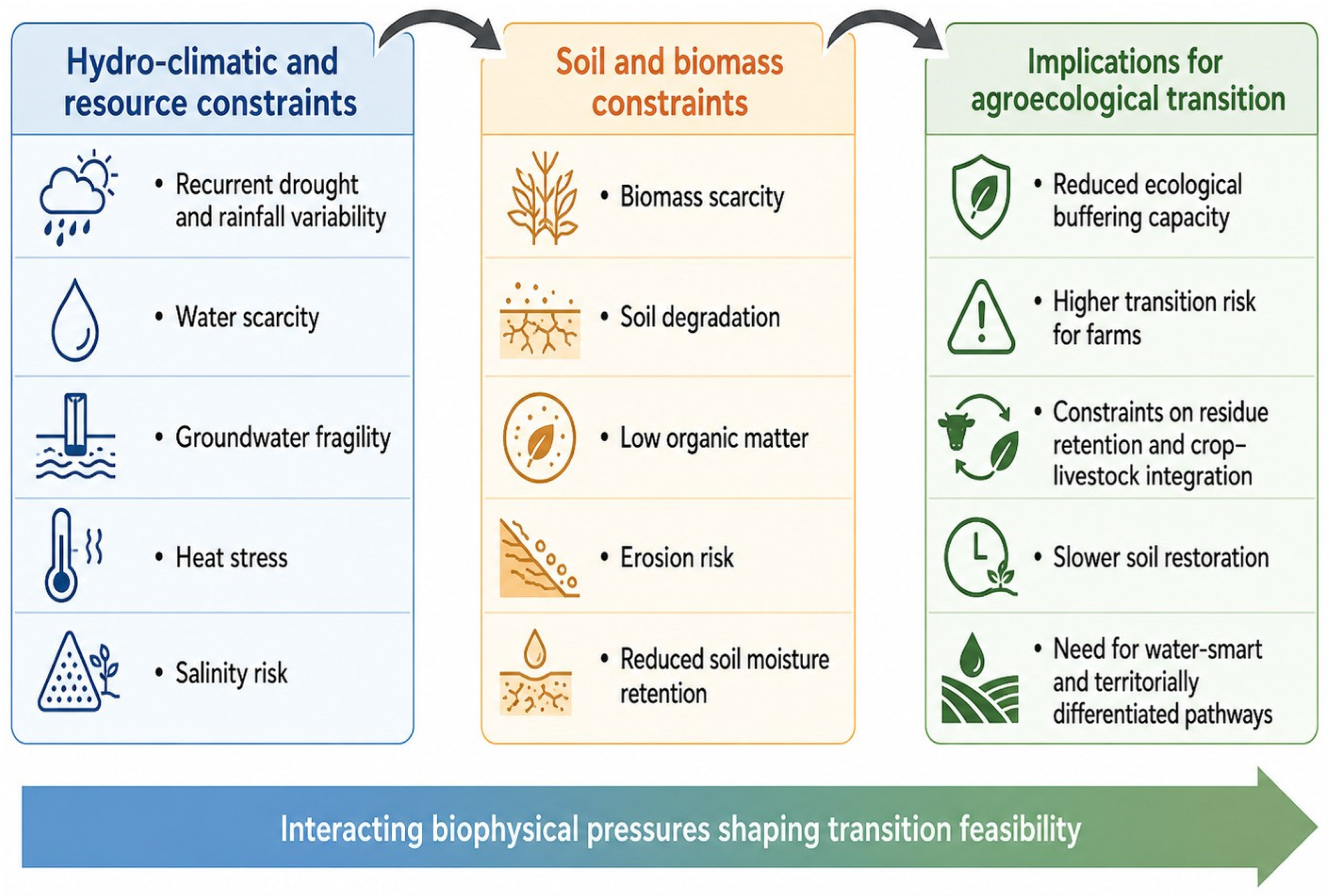
The interaction between drought frequency, limited biomass availability, soil degradation, residue competition, and groundwater pressure can therefore be conceptualized as a set of interdependent constraints that shape agroecological feasibility. As illustrated in the revised
Figure 5, these factors form a biophysical constraint system centered on water scarcity, drought instability, biomass limitations, soil degradation, erosion, salinity, thermal stress, and groundwater fragility. Their differentiated impacts on agroecological feasibility are further synthesized in
Table 4, which clarifies the major trade-offs and priority responses under Moroccan conditions [
1,
22].
This does not imply that agroecology is unsuitable for Morocco. Rather, it suggests that its implementation must be scientifically grounded, territorially differentiated, and explicit about trade-offs. In highly water-stressed environments, agroecology is not an easy alternative; it is a necessary but constrained pathway for agricultural transition.
7. Farm-Level and Socio-Economic Constraints: Why Rational Farmers Often Transition Slowly
The farm scale is where the rhetoric of agroecological transition confronts the arithmetic of survival. For many Moroccan producers, particularly small- and medium-scale farmers, the central issue is not whether agroecological principles are ecologically sound but whether they are economically and operationally viable under real constraints. Recent empirical work on the behavioral determinants of sustainable agricultural practice adoption in Morocco shows that adoption is shaped not only by technical knowledge but also by perceived usefulness, social norms, institutional support, and economic feasibility [
29,
30]. Complementary studies further demonstrate that access to irrigation, credit, and extension services plays a decisive role in shaping adoption decisions, particularly among smallholders facing structural constraints [
9,
31]. This aligns with a broader pattern observed in transition studies: farmers adopt innovations not when they are merely desirable, but when they become economically credible and socially validated within existing livelihood systems [
32].
However, “farmers” in Morocco do not constitute a homogeneous category. Transition constraints differ substantially between small rainfed cereal producers, commercially oriented irrigated farms, mixed crop–livestock households, peri-urban market-oriented systems, mountain mosaic farms, and oasis producers operating under severe resource scarcity. Access to irrigation, land tenure security, labor availability, capital, machinery, and advisory support varies markedly across these categories and directly shapes transition capacity. These differences are further mediated by gender, age, and household organization. Women often play major but insufficiently recognized roles in labor-intensive farming activities and resource management, while youth outmigration reduces labor availability and weakens generational continuity in agroecological experimentation. Conversely, youth entrepreneurship may also represent a strategic transition opportunity where territorial support, land access, and market organization exist. For this reason, adoption should not be interpreted as a uniform farmer response but as a differentiated and context-dependent process shaped by farm typology, gendered labor arrangements, age structure, irrigation access, and territorial resource distribution.
This dynamic is particularly acute in Morocco, where climatic volatility already compresses household margins. Recurrent droughts, rainfall uncertainty, fluctuating input costs, and unequal access to irrigation contribute to a risk-sensitive decision environment in which farmers prioritize short-term stability over long-term transformation [
5,
33]. Agroecological redesign, however, often requires experimentation, site-specific adaptation, and delayed returns linked to ecological processes such as soil regeneration and biodiversity enhancement. Under such conditions, partial adoption, such as selective crop diversification or reduced input use, becomes more common than systemic redesign. This reflects a rational response to uncertainty rather than a failure of awareness or willingness [
32,
34].
Labor and management complexity constitute an additional layer of constraint. While agroecological systems may reduce dependence on external inputs, they often require increased observation, adaptive management, and coordination across multiple farm components. In Moroccan rural contexts characterized by youth outmigration, livelihood diversification, and evolving gender roles in agriculture, this added complexity can become a significant barrier [
35,
36,
37,
38]. Empirical evidence suggests that labor availability, decision-making capacity, and access to knowledge networks are critical determinants of farmers’ ability to engage in more complex and knowledge-intensive systems [
20,
39].
These interacting constraints are synthesized in
Table 5, which identifies the principal farm-level barriers to agroecological transition in Morocco, including capital limitations, labor constraints, water uncertainty, fragmented landholdings, and transition-related risk. At a broader level, the structural mismatch between private short-term costs and public long-term benefits helps explain the slow pace of transition. As illustrated in
Figure 6, individually rational decisions, aimed at minimizing risk and ensuring immediate livelihood security, may collectively delay systemic transformation. This divergence between micro-level rationality and macro-level sustainability outcomes is a well-documented feature of agricultural transitions in resource-constrained environments [
30,
39].
The implication is clear. Agroecology cannot be scaled through normative discourse alone. It must become economically survivable during the transition phase. Without mechanisms to reduce risk, support learning, and compensate short-term costs, adoption will remain selective, fragile, and uneven across territories and farming systems.
8. Knowledge Systems, Extension, and the Cognitive Bottleneck
One of the most analytically revealing findings emerging from recent Moroccan research is the existence of a pronounced cognitive bottleneck in agroecological transition processes. Empirical evidence suggests that the widespread use of practices compatible with agroecology can coexist with very limited formal awareness of agroecology as a coherent conceptual framework. This paradox points to a deeper issue that goes beyond communication deficits and instead reflects structural weaknesses in the organization, translation, and circulation of knowledge [
12,
30,
40,
41]. In effect, farmers may already engage in forms of agroecological management, yet these practices remain fragmented at the level of meaning and articulation, while institutional actors continue to promote sustainability narratives without embedding them in adaptive, farm-level learning systems [
1,
13]. This cognitive bottleneck should not, however, be treated as a single undifferentiated deficit. It includes at least three distinct, though interrelated, limitations. The first is low formal awareness of agroecology as a coherent conceptual framework, even where compatible practices are already in use. The second is limited technical and adaptive capacity for translating isolated practices into coherent system redesign under highly variable local conditions. The third is weak institutional support for participatory and continuous learning, which prevents knowledge from circulating effectively between farmers, researchers, advisory actors, and territorial organizations. This distinction is important because lack of awareness is not equivalent to lack of capacity, and neither is equivalent to lack of institutional support. A farmer may already rotate crops or apply organic amendments without using the language of agroecology; another may understand the concept but lack the technical support needed to adapt it locally; still another may be willing to experiment but have no access to advisory continuity, collective platforms, or institutional recognition. In Morocco, this challenge is compounded by the legacy of conventional extension systems, which have historically been structured around linear transfer models privileging standard recommendations over iterative co-learning. Such systems may remain effective for predefined technical packages, but they are poorly configured to support the adaptive, place-based, and participatory logic required by agroecological transition. The core issue is therefore not simply whether extension exists but whether existing institutions have the capacity, mandate, and organizational culture to facilitate collective learning rather than one-way prescription.
This situation is consistent with a broader body of agroecological literature emphasizing that transition is not only a technical or economic process but also a transformation of knowledge systems. Agroecology fundamentally relies on the co-production of knowledge between farmers, researchers, and institutions, rather than on the linear transfer of standardized technologies [
42,
43,
44]. In this perspective, knowledge is not simply disseminated; it is collectively constructed through iterative processes of experimentation, observation, and adaptation within specific socio-ecological contexts [
45,
46].
However, agricultural extension systems in Morocco, and more broadly in many conventional agricultural systems, have historically been structured around top-down models of technology diffusion, privileging standardized recommendations over situated learning [
41]. Such models are poorly aligned with the epistemological foundations of agroecology, which require context-sensitive diagnosis, farmer participation, and continuous feedback loops between practice and knowledge [
42,
47]. As a result, conventional extension systems tend to underperform in supporting agroecological transitions: they deliver prescriptions, whereas agroecology depends on learning systems.
The importance of this cognitive dimension cannot be overstated. A growing body of literature shows that agroecological adoption is strongly influenced by how practices are framed, understood, and socially embedded. When agroecology is presented as an abstract or normative ideal, disconnected from farmers’ immediate constraints and priorities, adoption remains limited. Conversely, when it is translated into locally meaningful outcomes, such as improved water retention, enhanced soil fertility, reduced input dependency, or greater resilience to climatic variability, farmers are far more likely to engage [
48]. Participatory approaches, including farmer-to-farmer learning, collective experimentation, and multi-stakeholder platforms, have been shown to significantly enhance both knowledge integration and adoption dynamics [
49,
50].
This shift from knowledge transfer to knowledge co-creation is now widely recognized as a cornerstone of agroecological transition. Reviews of agroecological knowledge systems emphasize that effective transitions depend on the integration of scientific, local, and traditional knowledge systems, as well as on the institutional capacity to support iterative and participatory learning processes [
51,
52]. In this sense, the challenge is not simply epistemic but institutional: it concerns the ability of advisory systems to move from delivering information to facilitating collective intelligence and adaptive capacity [
53,
54].
The contrast between linear technology transfer models and participatory agroecological learning systems is conceptualized in
Figure S1, which illustrates the transition from top-down dissemination to interactive, co-produced knowledge systems. Complementarily,
Table 6 provides a structured comparison between conventional extension models and agroecological advisory approaches, highlighting key differences in knowledge sources, decision-making processes, temporal horizons, and expected adoption pathways. These distinctions are not merely methodological; they fundamentally shape the pace, depth, and scalability of agroecological transition [
47,
50].
A scientifically grounded agroecological strategy for Morocco must therefore recognize knowledge systems and extension not as peripheral components, but as central pillars of transition. The core challenge is not simply to disseminate more information, but to redesign the institutional ecology of knowledge—shifting from transmission to interaction, from prescription to co-learning, and from generalized solutions to territorially embedded, adaptive innovation systems [
30].
9. Policy and Institutional Incoherence: When Resilience Is Invoked but Simplification Is Rewarded
Morocco’s policy landscape presents a paradoxical configuration in which genuine openings for agroecological transition coexist with significant structural contradictions. On the one hand, recent national strategies and international partnerships increasingly emphasize climate resilience, sustainable water management, soil conservation, and the transformation of agri-food systems. Programs supported by international institutions, including World Bank–aligned initiatives, explicitly frame resilience, adaptation, and quality upgrading as central priorities for Moroccan agriculture [
10,
55]. Similarly, recent syntheses of Moroccan agricultural policy highlight a growing recognition of water scarcity as a systemic constraint requiring integrated and sustainable management approaches [
1,
56].
On the other hand, a growing body of literature suggests that the dominant modernization trajectory of Moroccan agriculture has not always been fully aligned with long-term ecological sustainability, particularly in relation to water use and resource pressures. Critical analyses indicate that productivity-oriented policies, including irrigation expansion and value-chain integration, have in some cases reinforced structural imbalances in resource use, contributing to groundwater depletion and ecological stress [
3,
57]. This tension between stated sustainability goals and actual policy outcomes is now widely recognized as a central feature of the Moroccan agricultural model [
1,
10]. More specifically, the contradiction does not lie in the absence of resilience discourse but in the incomplete alignment of policy instruments with the conditions required for agroecological transition. A first contradiction appears between climate-resilience objectives and the continued influence of productivity-centered modernization logics, especially where irrigation-dependent intensification and market-oriented specialization remain dominant. A second contradiction concerns water governance: although water scarcity is widely recognized as a systemic challenge, the integration of basin-scale hydrological constraints with crop choice, advisory systems, and transition incentives remains partial. A third contradiction emerges around agrobiodiversity and ecological complexity. While resilience is increasingly invoked in policy discourse, some policy and market trajectories continue to favor simplification, standardization, and export-oriented specialization, thereby weakening the diversity-based ecological foundations of long-term resilience. A fourth contradiction concerns transition support instruments themselves. Insurance expansion, youth entrepreneurship programs, agricultural digitalization, and market modernization all create openings for change, yet these instruments do not automatically converge toward biodiversity-based redesign, participatory advisory support, ecological value recognition, or territorially differentiated implementation. The core policy problem is therefore not rhetorical inconsistency alone, but the partial and uneven alignment between what resilience requires and what institutional instruments currently enable.
The contradiction becomes even more apparent when examined through the lens of agrobiodiversity. Recent empirical research in Moroccan farming systems shows that agricultural policies, interacting with market incentives, land-use dynamics, and institutional frameworks, have significantly influenced agrobiodiversity management, with direct implications for system resilience [
20,
58]. This finding is particularly important because agroecology depends on diversity not as a normative ideal, but as a functional property of resilient agroecosystems. When policy frameworks prioritize simplification, standardization, or export-oriented specialization without sufficient ecological safeguards, they may inadvertently erode the biological and socio-ecological foundations upon which resilience depends [
59,
60].
This highlights a critical point: the mere incorporation of agroecology into policy discourse is insufficient. What matters is coherence across policy domains. Water governance, agricultural subsidies, insurance schemes, extension services, biodiversity strategies, and market regulations must be aligned in ways that reinforce rather than undermine agroecological principles. Current evidence suggests that such alignment remains partial, with persistent gaps between policy rhetoric and enabling conditions on the ground [
15,
61]. This implementation gap is synthesized in
Table 7, which identifies the main areas of misalignment between resilience objectives and institutional instruments. At the same time,
Figure S2 maps zones of policy coherence and contradiction, illustrating how different policy domains interact—sometimes synergistically, but often in tension—in shaping the prospects for agroecological transition.
Ultimately, the core institutional challenge is not one of rhetorical recognition but of coordinated redesign. Agroecology cannot scale within a policy environment that simultaneously promotes resilience while continuing to reward ecologically narrowing trajectories. Bridging this gap requires moving beyond fragmented policy adjustments toward an integrated transition architecture capable of aligning ecological sustainability with economic incentives and institutional frameworks.
10. Markets, Value Chains, and the Failure to Reward Agroecological Value
A persistent limitation of agroecological transitions worldwide is the weak translation of ecological effort at the farm level into stable and differentiated economic reward. Morocco exemplifies this structural mismatch. Even when farmers diversify production systems, reduce dependence on external inputs, or invest in ecological functions such as soil restoration and biodiversity enhancement, these efforts do not automatically result in improved prices, secure market access, or stronger institutional support. Recent empirical work comparing organic and conventional farms in peri-urban Rabat highlights both the environmental and agronomic potential of ecological farming systems while also documenting persistent constraints related to commercialization, price premiums, and market integration [
23]. Similarly, field-based analyses of agroecological initiatives in regions such as Fez–Meknes and Sefrou indicate that weak and unstable demand for organic or differentiated products remains a major barrier to transition [
13,
62,
63].
These findings suggest that the Moroccan market problem is not simply one of weak consumer awareness or limited certification taken separately, but of incomplete value-chain construction. Certification may exist but remain costly, organizationally inaccessible, or poorly connected to stable commercial outlets. Demand for differentiated products is often uneven and territorially fragmented, while cooperative aggregation and traceability systems remain insufficiently developed in many regions. Public procurement mechanisms capable of rewarding ecological value also remain limited or weakly institutionalized. In practical terms, farmers are frequently asked to absorb the costs of ecological transition in markets that continue to reward volume, uniformity, and short-term throughput rather than resilience, environmental quality, or territorial embeddedness. This means that agroecological scaling in Morocco depends not only on changing production practices but on constructing value chains capable of recognizing, stabilizing, and redistributing ecological value through labels, cooperative marketing, procurement, traceability, and differentiated contractual arrangements.
This issue should not be underestimated, as it reflects a deeper structural characteristic of agroecology: much of the value it generates is diffuse, delayed, and partially public. Improvements in soil structure, water retention, biodiversity, and resilience to climatic shocks represent significant contributions to long-term sustainability, yet these benefits are rarely monetized through conventional market mechanisms [
1,
59]. As a result, the private actor who undertakes agroecological transition often captures only a fraction of the total social value produced. This divergence between private incentives and public benefits is widely recognized as a central barrier to sustainable agricultural transitions [
9,
60]. In practical terms, farmers are asked to internalize transition costs while operating within markets that continue to reward volume, standardization, and short-term productivity.
This structural gap is closely linked to the organization of value chains. Evidence from Moroccan agri-food systems shows that integration into value chains remains uneven, with smallholders often facing difficulties related to aggregation, certification, traceability, and access to differentiated market channels [
9,
10]. Moreover, the development of organic and agroecological value chains is still constrained by limited institutional support, fragmented distribution networks, and insufficient consumer awareness [
13,
23]. Without dedicated mechanisms to capture and redistribute ecological value, agroecological products risk being absorbed into conventional markets where their added value is neither recognized nor rewarded.
For this reason, agroecology in Morocco must be approached not only as a production paradigm but as a problem of value-chain construction and market design. A growing body of literature emphasizes the importance of institutional innovations, such as territorial labeling, participatory certification, public procurement schemes, cooperative aggregation, and payments for ecosystem services, in bridging the gap between ecological performance and economic viability [
1,
22]. These mechanisms can help align private incentives with public goods by ensuring that ecological practices are translated into tangible economic benefits.
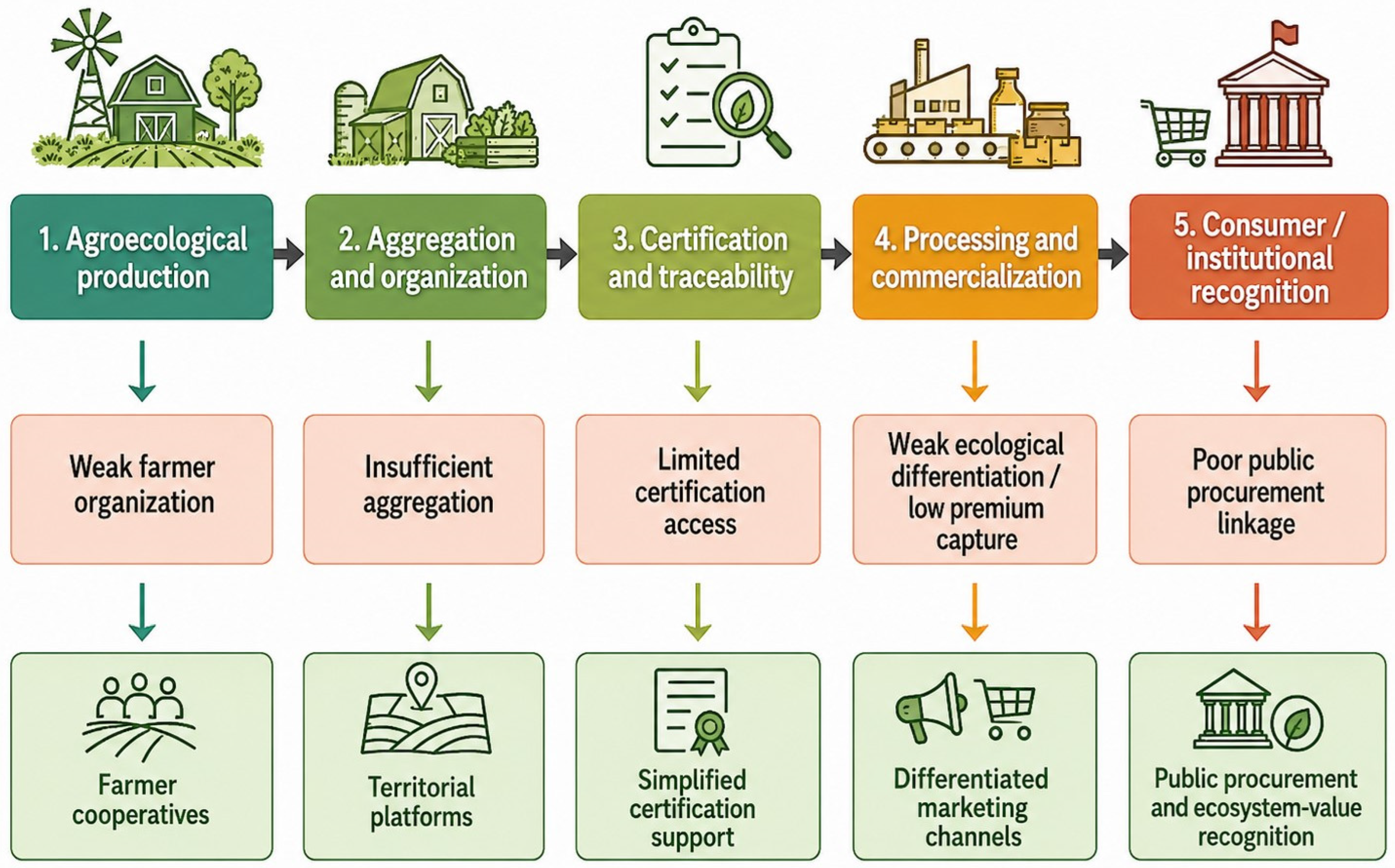
The points at which agroecological value is currently lost—between production, aggregation, certification, distribution, and consumption—are conceptualized in
Figure 7, which maps value leakage along Moroccan agri-food chains. Complementarily,
Table 8 identifies key market bottlenecks and associated institutional solutions, including pricing mechanisms, certification systems, cooperative structures, and policy instruments aimed at internalizing ecosystem services. These analytical tools shift the focus from farm-level adoption to system-level coordination, highlighting the importance of aligning markets with ecological objectives.
Without such alignment, agroecology risks remaining ecologically convincing but economically marginal. This creates a familiar pattern: successful pilot projects coexist with limited systemic transformation. In this sense, the challenge is not only to produce differently but to create markets capable of recognizing and rewarding the full spectrum of agroecological value.
11. The Hydro-Agroecological Transition Trap: A New Conceptual Lens for Morocco
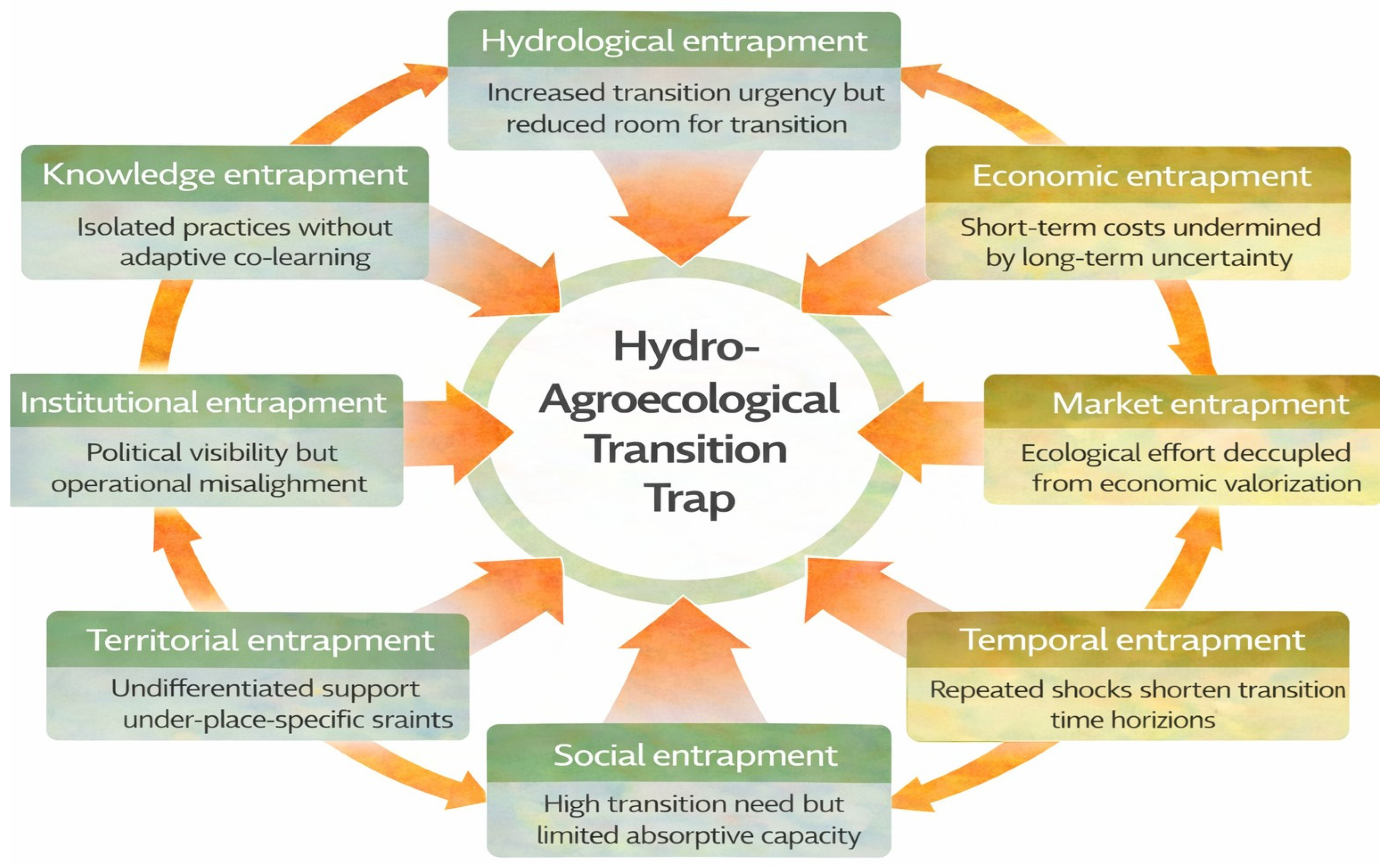
The Moroccan case calls for a more explicit conceptualization of transition difficulty under conditions of escalating hydro-climatic stress. This review proposes the notion of a Hydro-Agroecological Transition Trap, defined as a condition in which increasing water scarcity simultaneously intensifies the necessity of agroecological redesign while undermining the capacity of farms, communities, and institutions to undertake such a transformation. This proposition builds on broader theoretical insights from resilience and adaptation literature, which have identified “poverty traps,” “rigidity traps,” and “adaptation traps” as situations where environmental stressors and structural constraints reinforce each other, limiting transformative capacity [
64,
65,
66]. The Hydro-Agroecological Transition Trap differs from these broader concepts in one decisive respect: it is not defined only by generalized vulnerability or by failed adaptation under stress but by the specific paradox in which worsening hydro-climatic pressure simultaneously increases the necessity of agroecological redesign and reduces the material, institutional, and economic capacity to implement it. In that sense, it is a transition-specific trap located at the intersection of water scarcity, biomass constraints, delayed ecological returns, weak market valorization, and incomplete institutional support. This distinction is important because it shifts the analytical focus from vulnerability in general to the specific conditions under which agroecological transformation becomes both indispensable and structurally constrained. The concept can also be approached empirically. In Moroccan conditions, observable indicators of the trap may include repeated drought exposure, chronic biomass scarcity, persistent competition between residues and livestock feed, delayed soil recovery, weak continuity of participatory advisory support, low premium capture for ecological production, and the repeated postponement of diversification or broader system redesign. The trap is therefore not merely rhetorical; it can be approached as a set of interacting and observable transition conditions.
In semi-arid systems such as Morocco, this trap emerges through multiple interacting mechanisms. Water scarcity reduces biomass availability and soil organic matter inputs, increases yield variability, and raises the opportunity costs associated with experimentation and system redesign [
67,
68]. At the same time, recurrent droughts weaken farm liquidity, increase risk aversion, and reinforce short-term coping strategies that may stabilize production but delay structural transformation [
69,
70]. These dynamics are consistent with empirical findings showing that water insecurity constrains adaptive capacity even as it increases the need for more resilient agricultural systems [
71]. The result is a structural paradox: the more necessary agroecological transition becomes under intensifying climatic stress, the more difficult it is to implement in practice.
This conceptual lens helps bridge a gap between two strands of literature that often remain disconnected. On the one hand, agroecological research emphasizes the resilience benefits of diversified, ecologically grounded farming systems under drought conditions [
67,
72]. On the other hand, water policy and adaptation studies highlight how resource scarcity, financial constraints, and institutional limitations restrict the capacity of farmers to adopt such systems [
66,
68]. The Hydro-Agroecological Transition Trap integrates these perspectives by focusing on the feedback loops through which hydro-climatic stress both necessitates and constrains transition. These causal dynamics are conceptualized in
Figure 8, which maps reinforcing interactions among drought frequency, water scarcity, biomass constraints, financial risk, reduced adaptive capacity, and delayed agroecological uptake.
The analytical dimensions of the trap are further synthesized in
Table S1, which distinguishes four interrelated components: ecological (resource degradation and biomass limitation), economic (risk exposure and liquidity constraints), institutional (policy fragmentation and limited support systems), and cognitive (bounded rationality and short planning horizons). This multidimensional framing is consistent with recent calls for integrated approaches to agricultural transition that account for cross-scale interactions between environmental stress, socio-economic conditions, and institutional capacity [
70,
72,
73].
The strength of the Hydro-Agroecological Transition Trap lies in its practical implications. If Morocco is partially locked into such a dynamic, then transition policy cannot be limited to promoting improved practices alone. It must actively reduce the structural constraints generated by hydro-climatic stress itself. This implies prioritizing risk-sharing mechanisms, financial support during transition phases, soil and water restoration, and adaptive extension systems as preconditions rather than complements of agroecological transformation [
71]. Furthermore, the trap framework reinforces the need for territorially differentiated pathways, as hydro-climatic pressures and socio-economic vulnerabilities vary significantly across Moroccan farming systems.
In this sense, the Hydro-Agroecological Transition Trap does not suggest that agroecology is unfeasible under water scarcity. Rather, it highlights that without deliberate institutional and economic support, the very conditions that make agroecology necessary may continue to delay its realization.
12. A Six-Pillar Transition Framework for Morocco
A scientifically credible agroecological strategy for Morocco cannot rest on broad calls for sustainability alone. It needs to respond directly to the country’s specific ecological, hydrological, institutional, and socio-economic constraints. From that perspective, this review proposes a six-pillar transition framework designed to reflect the realities of Moroccan agriculture rather than an abstract model of change [
1,
10,
17]. To avoid conceptual overlap and increase practical relevance, these six pillars should be understood not simply as thematic priorities but as six operational domains of intervention, each associated with distinct actors, instruments, implementation scales, and assessment needs. In rainfed cereal systems, the most urgent pillars are water-smart agroecology, transition finance and risk-sharing, and participatory innovation, because transition is constrained above all by drought exposure, biomass scarcity, and economic fragility. In irrigated horticultural systems, water-smart redesign remains important, but market construction, ecological differentiation, and multidimensional monitoring become especially critical because these systems are strongly shaped by quality standards, commercialization pressures, and water productivity concerns. In mountain agroecosystems, territorial differentiation, participatory innovation, and territorial governance are particularly central, as resilience depends on local heterogeneity, agrobiodiversity, and collective management of ecological mosaics. In oasis and pre-Saharan systems, the most urgent pillars are water-smart agroecology, territorial differentiation, and institutional continuity, given the extreme sensitivity of these systems to water stress, migration, and erosion of traditional management structures. Across all systems, the six-pillar framework can therefore be read as a differentiated transition matrix rather than a uniform national package. Its operational value lies precisely in clarifying who must act, through which instruments, at what scale, and according to which monitoring criteria under contrasting Moroccan conditions.
The first pillar is water-smart agroecology. In Morocco, any serious agroecological transition must begin with water. This means prioritizing cropping systems, soil management practices, rotations, and biomass strategies that improve water productivity, increase infiltration, strengthen soil water-holding capacity, and reduce exposure to rainfall variability. In other words, water-smart agroecology is not simply about using less water; it is about reorganizing agroecosystems so that ecological functioning and hydrological resilience reinforce one another [
1,
74]. This is particularly important in Morocco, where water scarcity is no longer a secondary constraint but a defining feature of agricultural sustainability.
The second pillar is territorial differentiation. Moroccan agriculture is too heterogeneous for uniform recipes to be scientifically meaningful. Rainfed cereal-livestock systems in semi-arid regions, irrigated horticulture, mountain mosaics, and pre-Saharan oasis systems differ in their water regimes, labor organization, resource bases, and transition opportunities. Agroecology must therefore be approached as a set of regionally differentiated pathways rather than as a single national package. This territorial logic is increasingly emphasized in recent work on place-based transitions and agroecological planning [
10]. It is operationalized here in
Table S2, which proposes differentiated transition pathways by territory.
The third pillar is participatory innovation and knowledge co-production. As recent Moroccan studies suggest, the transition challenge is not only technical but also cognitive and institutional. Farmers do not simply need recommendations; they need adaptive learning systems that recognize local knowledge, support experimentation, and translate ecological principles into context-specific forms of management. This makes participatory innovation a strategic rather than secondary issue. Agroecological transition depends on the ability to create spaces where farmers, advisors, and institutions can learn together and adjust practices to local realities [
15,
17].
The fourth pillar is transition finance and risk-sharing. Many of the barriers to agroecology in Morocco are linked to short-term economic exposure. For this reason, public, cooperative, and territorial financial instruments are needed to make transition economically survivable. These may include climate-adapted insurance schemes, transitional subsidies, machinery-sharing systems, support for local biomass and compost chains, and financial tools that reduce the private cost of generating public ecological value. Without such instruments, even scientifically sound transitions may remain out of reach for farmers operating under tight margins and high uncertainty [
10,
17].
The fifth pillar is market construction and valorization. Ecological production will remain marginal if farmers cannot capture enough value from it. Territorial labels, cooperative marketing, public procurement, traceability systems, and differentiated quality markets are therefore not peripheral mechanisms; they are central conditions for scaling agroecology. A transition that improves soils, water regulation, and resilience without improving economic viability is unlikely to move beyond isolated niches. In this sense, value-chain design is not external to agroecology but part of its material foundation [
10,
15].
The sixth pillar is multidimensional monitoring and assessment. Agroecology cannot be evaluated through yield alone. In Morocco, a meaningful assessment framework must also include water productivity, soil organic matter, biodiversity, yield stability, income resilience, input dependence, and vulnerability to drought shocks. Recent work on agroecological assessment strongly supports this broader view, arguing that transitions should be monitored through integrated biophysical, socio-economic, and institutional indicators rather than a single production metric [
17,
75,
76]. The structure of such an assessment framework is proposed in
Table S3.
Taken together, these six pillars do not amount to a miracle solution. Rather, they offer a transition logic grounded in Morocco’s actual constraints and possibilities. That alone makes them more useful than a slogan. They provide a way of operationalizing agroecological transition not as a generic ideal but as a territorially differentiated process linking ecological redesign, institutional support, economic viability, and measurable transition outcomes.
13. Priority Research Gaps and Future Agenda
The recent literature has significantly improved the empirical basis for discussing agroecology in Morocco, but important gaps remain. One major limitation is the fragmentation of evidence. There are valuable studies on farmer awareness, agrobiodiversity, oasis resilience, water policy, and sustainable practice adoption, yet long-term integrated assessments remain scarce. There is still too little comparative evidence on the performance of agroecological systems across contrasting Moroccan territories under repeated drought conditions. Likewise, more work is needed on how water stress, ecological restoration, market design, and social vulnerability interact over time rather than being studied in isolation.
A second gap concerns trade-offs. Much of the literature still discusses agroecology in terms of benefits, but fewer studies rigorously quantify trade-offs among biomass allocation, labor demand, water-saving potential, income effects, and transition lags. This is particularly important in dryland Morocco, where ecological design often confronts hard resource limits. A third gap concerns scale. Farm-level studies are important, but agroecology is also a territorial and institutional process. Research should therefore move more decisively toward meso- and macro-scale analysis, including irrigation governance, value-chain restructuring, and place-based transition coalitions.
A fourth gap concerns metrics. Morocco would benefit from a scientifically robust national framework for agroecological performance assessment that integrates ecological, hydrological, economic, and social dimensions. The key research questions emerging from this review are summarized in
Table 9. These gaps are not signs of failure. They are signs that the Moroccan agroecological agenda is entering a more mature and demanding phase—one in which descriptive enthusiasm must increasingly give way to integrated evidence. These research gaps, however, do not all have the same urgency, function, or feasibility. A first category includes gaps that are immediately critical for policy design, notably the lack of evidence on socio-economic thresholds of adoption, the weakness of market valorization mechanisms, the incomplete integration of water governance with agroecological transition, and the absence of robust multidimensional monitoring systems. A second category includes gaps that are essential for scientific consolidation, such as long-term evidence on drought performance, the dynamics of soil recovery, biomass allocation trade-offs, and the modeling of systemic trap interactions over time. A third category includes gaps that are both scientifically relevant and feasible in the short term, including comparative territorial case studies, improved diagnosis of advisory systems, and better understanding of the differentiated roles of women, youth, and vulnerable producers in transition processes. This ranking matters because it clarifies which knowledge deficits currently block public action, which ones limit theoretical consolidation, and which ones can be addressed rapidly through targeted empirical work.
14. Limitations, Uncertainties, and Scope of Application
The analytical framework proposed in this review should be interpreted with several important limitations in mind. First, the existing literature on agroecology in Morocco remains highly heterogeneous in terms of methodology, spatial scale, and depth of evidence. The body of work examined includes conceptual discussions, empirical case studies, regional syntheses, policy analyses, and institutional reports. However, relatively few long-term comparative studies are available to assess agroecological performance across multiple territories exposed to recurrent drought conditions. This diversity of approaches complicates systematic comparison and limits the possibility of drawing fully generalized conclusions for all Moroccan agroecosystems.
Second, the available evidence is unevenly distributed across territories and production systems. Certain areas—particularly rainfed cereal systems, oasis agroecosystems, debates surrounding water governance, and some horticultural regions—have received considerably more scholarly attention than others. In contrast, important dimensions remain insufficiently documented, notably the transition dynamics of mixed crop–livestock systems under chronic biomass scarcity, the development of peri-urban ecological food networks, and the long-term interactions between irrigation modernization and biodiversity-based agricultural redesign. Consequently, some dimensions of the proposed framework are supported by stronger empirical evidence than others.
Third, this article should be understood as a structured critical review rather than a formal meta-analysis. It does not aim to calculate pooled effect sizes, establish statistical causality, or quantitatively compare agroecological and conventional systems using standardized indicators. Its contribution is therefore primarily conceptual and integrative rather than econometric or experimental. In this perspective, the Hydro-Agroecological Transition Trap and the associated six-pillar framework are best interpreted as analytical tools grounded in the current state of knowledge rather than as fixed predictive models.
Fourth, substantial uncertainties persist regarding both the pace and the depth of agroecological transition under Moroccan conditions. These uncertainties concern, among other factors, the time necessary for soil regeneration, the resilience of ecological gains under repeated drought events, the management of trade-offs between crop residues, livestock feed, and soil cover, the capacity of advisory systems to evolve toward participatory co-learning approaches, and the extent to which markets can sustainably reward ecological value creation. Far from being secondary issues, these uncertainties constitute a central component of the transition process itself.
Fifth, the practical implications of the findings must remain sensitive to territorial and institutional specificities. While the Moroccan experience offers valuable insights, its constraints and dynamics cannot be transferred mechanically to other contexts. The framework developed in this review is likely to be particularly relevant for semi-arid and water-constrained agricultural systems characterized by strong territorial heterogeneity, partial policy alignment, and mixed forms of market integration. Even within Morocco, however, the framework should not be applied as a universal template. Its primary value lies in its capacity to identify where, under which conditions, and through which enabling mechanisms agroecological transition may realistically emerge.
For these reasons, the findings presented in this review should be interpreted as a strategic, evidence-informed synthesis rather than as a deterministic roadmap. Their objective is to clarify the structural nature of the transition challenge, identify key leverage points, and provide a more coherent foundation for future empirical research, institutional innovation, and public policy development.
15. Conclusions
Agroecology in Morocco should not be judged by asking whether it offers a perfect substitute for conventional intensification or whether all its principles can be applied immediately and uniformly across the country. That would be a caricature of both the problem and the solution. The real question is whether agroecology can provide a scientifically credible framework for reorganizing agricultural systems under chronic water stress, ecological degradation, and social vulnerability. The answer emerging from this review is cautiously but firmly affirmative. However, this conclusion must be interpreted within the limits of the available evidence: the Moroccan literature remains fragmented, uneven across territories, and still insufficiently supported by long-term comparative assessment. What this review demonstrates most clearly is, therefore, not that transition is simple, but that its main conditions are now sufficiently visible to be analyzed systematically. Morocco has strong agroecological foundations, clear reasons for transition, and growing policy recognition of resilience as a strategic priority. Yet it also faces severe structural barriers that prevent ecological necessity from becoming institutional reality.
Taken together, the results of this review answer the central research question directly. The main limitation to agroecological transition in Morocco is not the absence of relevant practices but the absence of a coherent transition architecture capable of connecting ecological redesign with water governance, farm-level viability, advisory systems, public incentives, territorial differentiation, and market valorization. Existing agroecological niches demonstrate that ecologically relevant practices are already present across rainfed cereal systems, conservation-oriented drylands, horticultural systems, mountain agroecosystems, and oasis territories. Yet these niches remain fragmented, unevenly supported, and weakly scaled.
The principal limits of agroecology in Morocco are therefore not simply agronomic. They are hydrological, economic, cognitive, institutional, and commercial. They arise from the difficulty of implementing complex, knowledge-intensive, biodiversity-based transitions in environments already destabilized by drought, risk, and uneven policy support. That is why the concept of a Hydro-Agroecological Transition Trap is useful: it captures the fact that Morocco must transition under conditions that actively impede transition.
The theoretical contribution of this article lies in reframing the Moroccan case not as a simple problem of sustainability adoption, but as a problem of transition alignment under hydro-climatic stress. In this perspective, agroecology is best understood not as a narrow technical repertoire but as a multi-level socio-ecological transition requiring articulation across practices, systems, institutions, and value chains. The concept of the Hydro-Agroecological Transition Trap contributes to this interpretation by showing that the very conditions that make agroecological transition most necessary may also undermine the capacity to implement it.
The practical implication is equally clear. Agroecological transition in Morocco will remain limited if it is treated as a collection of desirable practices or isolated pilot experiences. It can become transformative only if it is approached as a territorially differentiated transition project supported by water-smart redesign, participatory innovation, risk-sharing mechanisms, coherent policy instruments, ecological market construction, and multidimensional monitoring. In that sense, the six-pillar framework proposed in this review should not be read as a generic sustainability agenda but as an operational logic for aligning ecological resilience, economic viability, and institutional coordination under Moroccan conditions.
The strategic implication is straightforward. Agroecology in Morocco will remain fragmented if it is treated as a set of admirable practices. It can become transformative only if it is treated as a national and territorial transition project, one that reorganizes how water, soils, biodiversity, knowledge, incentives, and markets are governed together. That is the real frontier. And it is a serious one.