
Revenue Distribution Behavior of the Authorized Operation of Public Data—Evidence from China
Abstract
1. Introduction
2. Literature Review
2.1. Governance Logic and Institutional Foundations of Open Data Value Creation
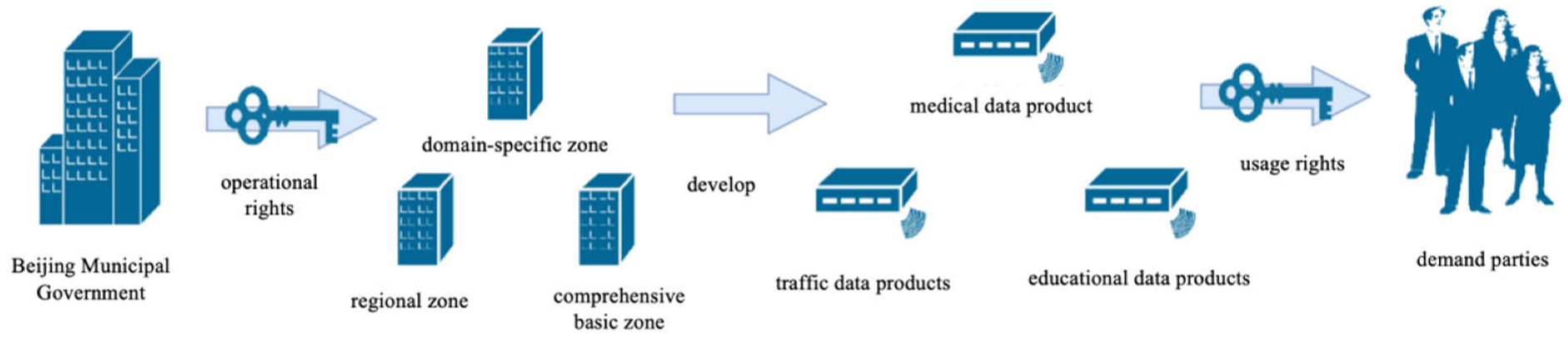
2.2. Authorized Operation of Public Data
2.2.1. Link Among Compliance Management, Mechanism Design, and Revenue Distribution
2.2.2. Data Valuation and Quantitative Basis for Benefit Distribution
2.2.3. Operation Modes and Practices of Benefit Distribution
2.3. Application of Evolutionary Game in the Field of Public Data
2.3.1. Behaviors of Game Subjects and Incentives for Benefit Distribution
2.3.2. Game Equilibrium and Optimization of the Mechanism of Benefit Distribution
2.4. Literature Commentary
3. Game Model
3.1. Game Relationships
3.1.1. Stakeholders in the Authorized Operation of Public Data
Government
Operating Institutions
Demand Sides
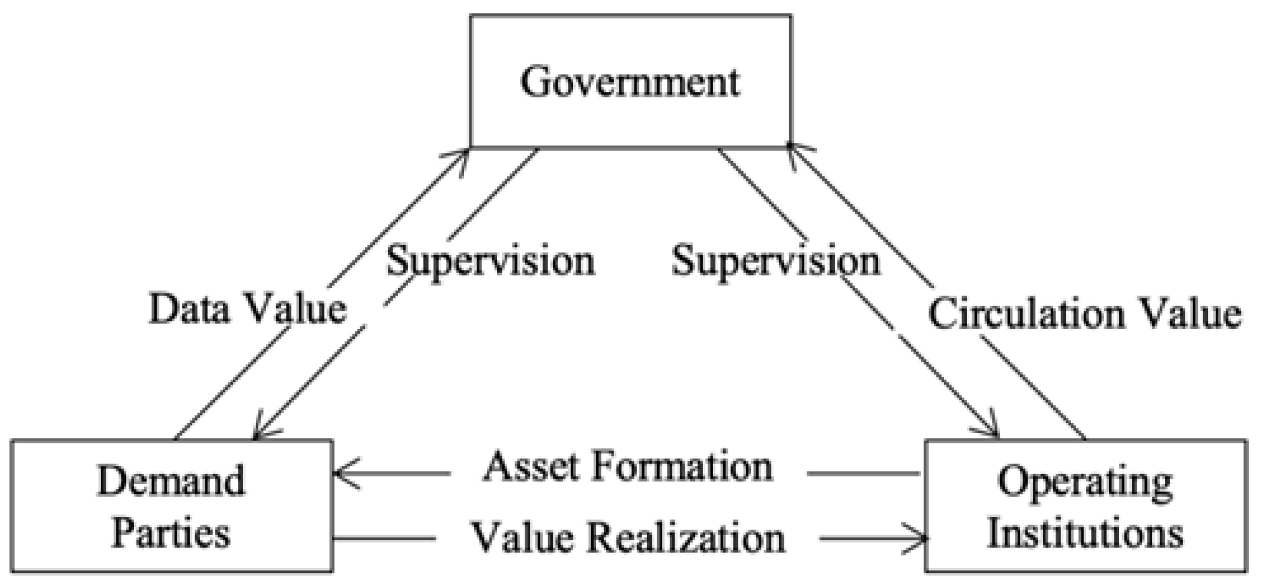
3.1.2. Tripartite Relationship Among the Government, Operating Institutions, and Demand Sides
3.1.3. Behavioral Analysis of the Three Stakeholders
Government
Operating Institutions
Demand Sides
3.2. Construction of the Game Model
3.2.1. Basic Assumptions of the Model
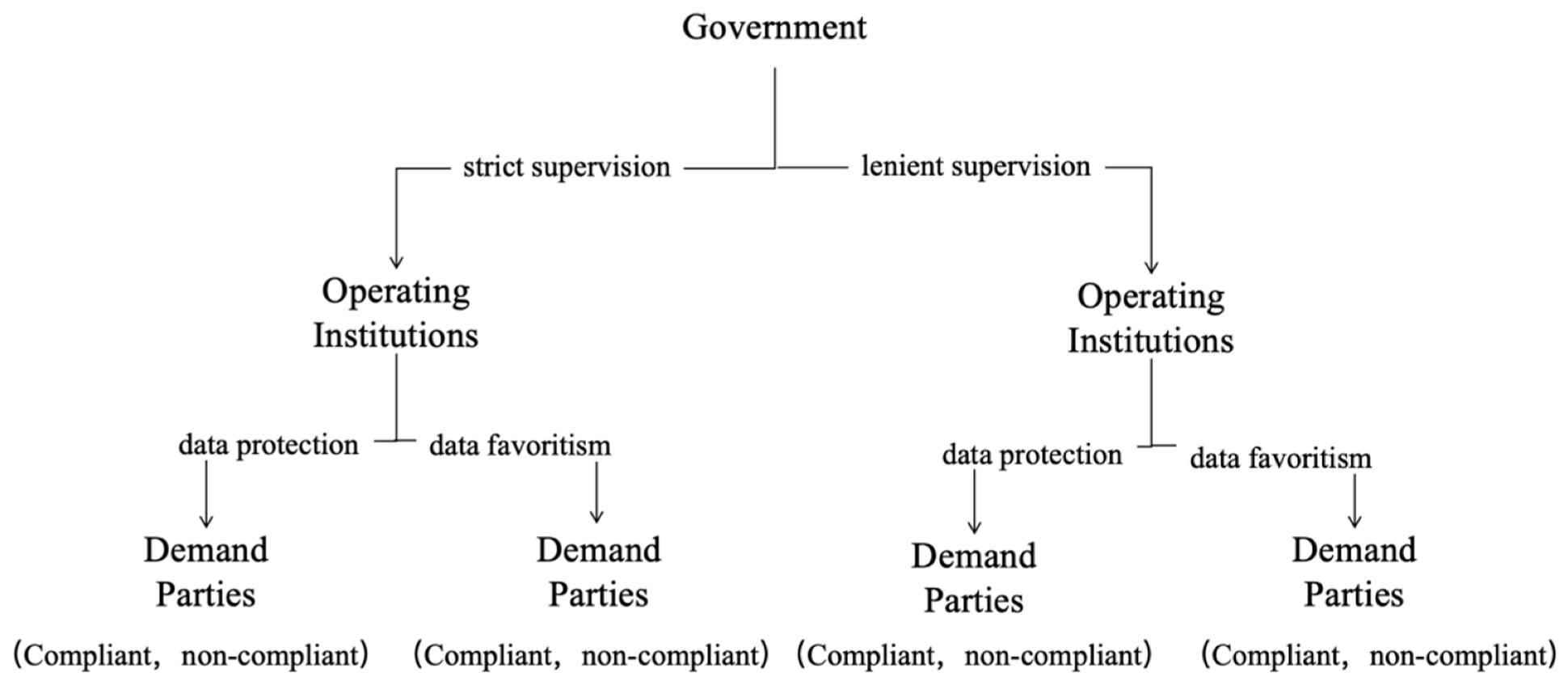
3.2.2. Model Construction
3.3. Model Derivation
3.3.1. Stability Analysis of the Strategy of the Demand Sides
3.3.2. Stability Analysis of the Strategy of the Operating Institution
- (1)
- Let , When , ; according to the stability theorem of differential equations, the first derivative of the replicator dynamic equation is always 0 for any value of . This indicates that any strategy of the operating institution is a stable strategy—in this state, the operating institution’s choice of any data strategy is stable, and its probability of choosing a strategy does not change over time.
- (2)
- When , there are two cases:
3.3.3. Stability Analysis of the Strategy of the Government
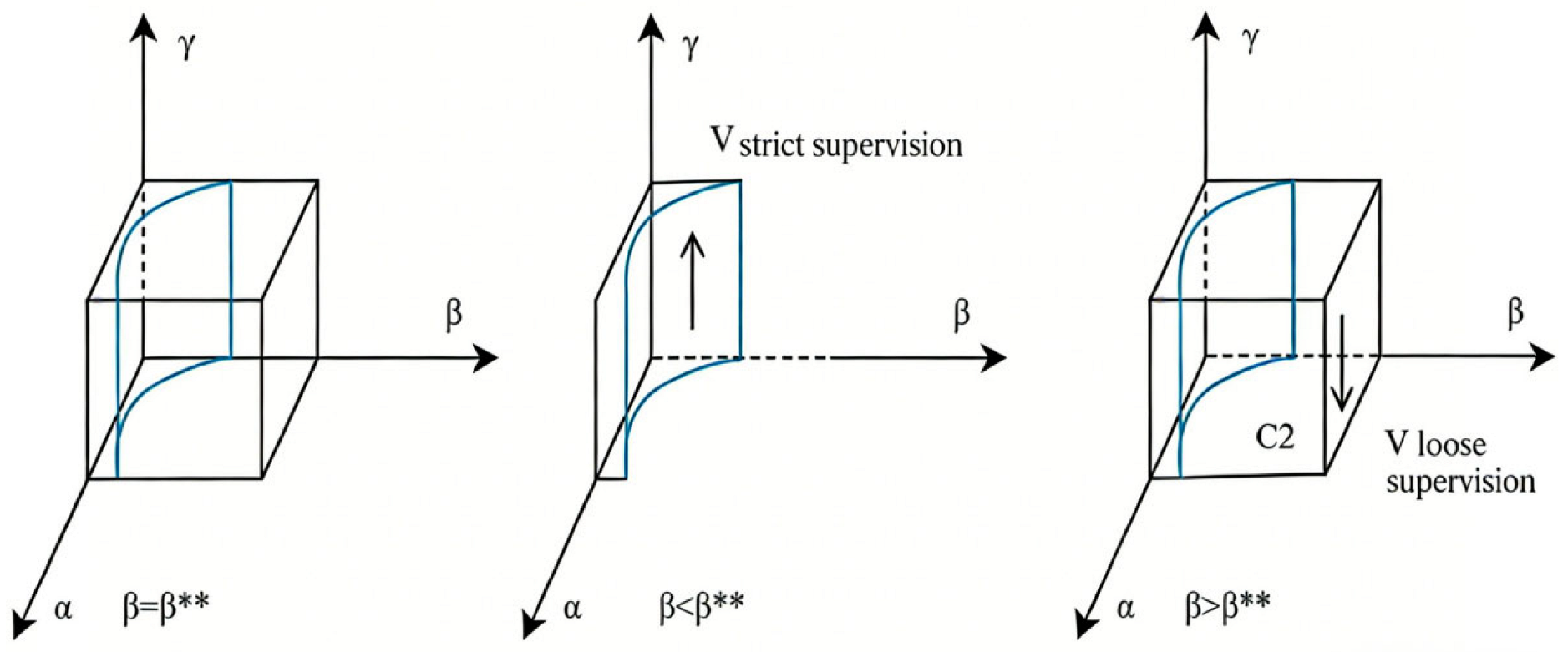
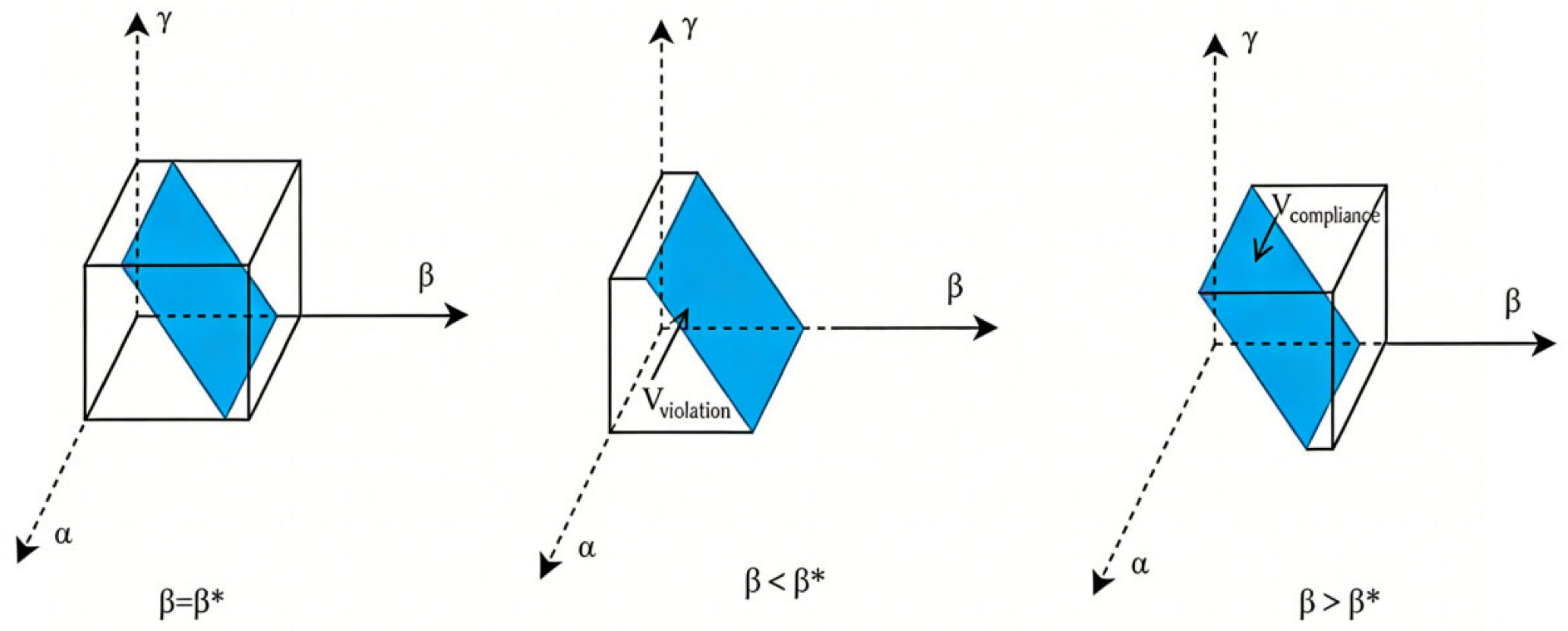
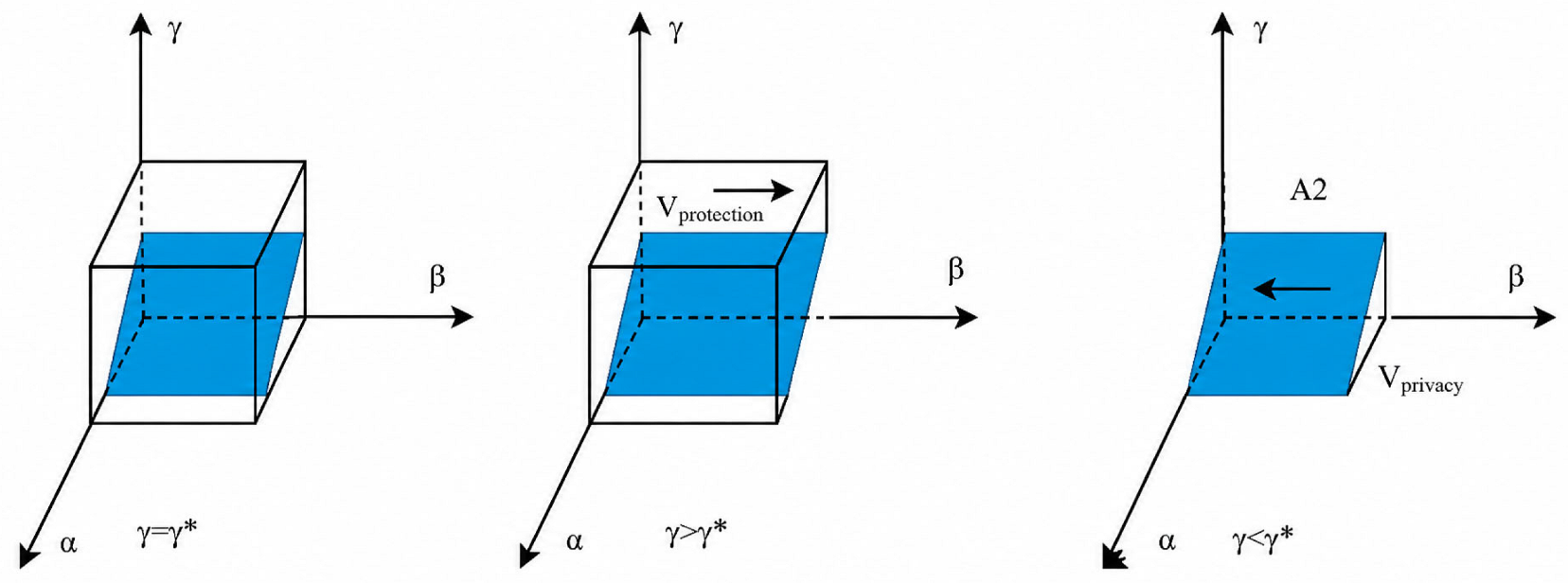
3.3.4. Stability Analysis of System Evolutionary Strategies
4. Model Simulation Experiment
4.1. Simulation Analysis of the Tripartite Evolutionary Game Model
- Note on Parameter Assignment
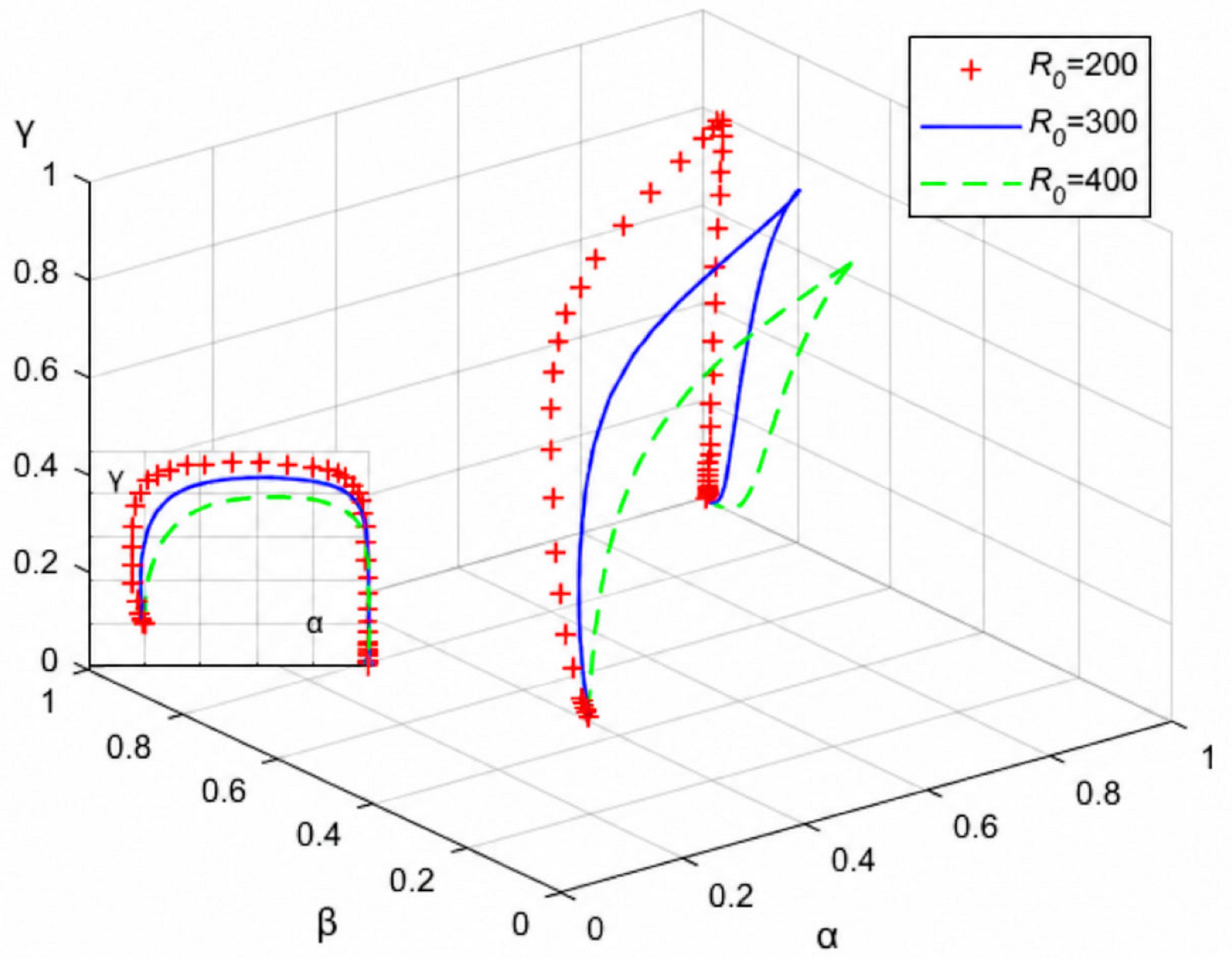
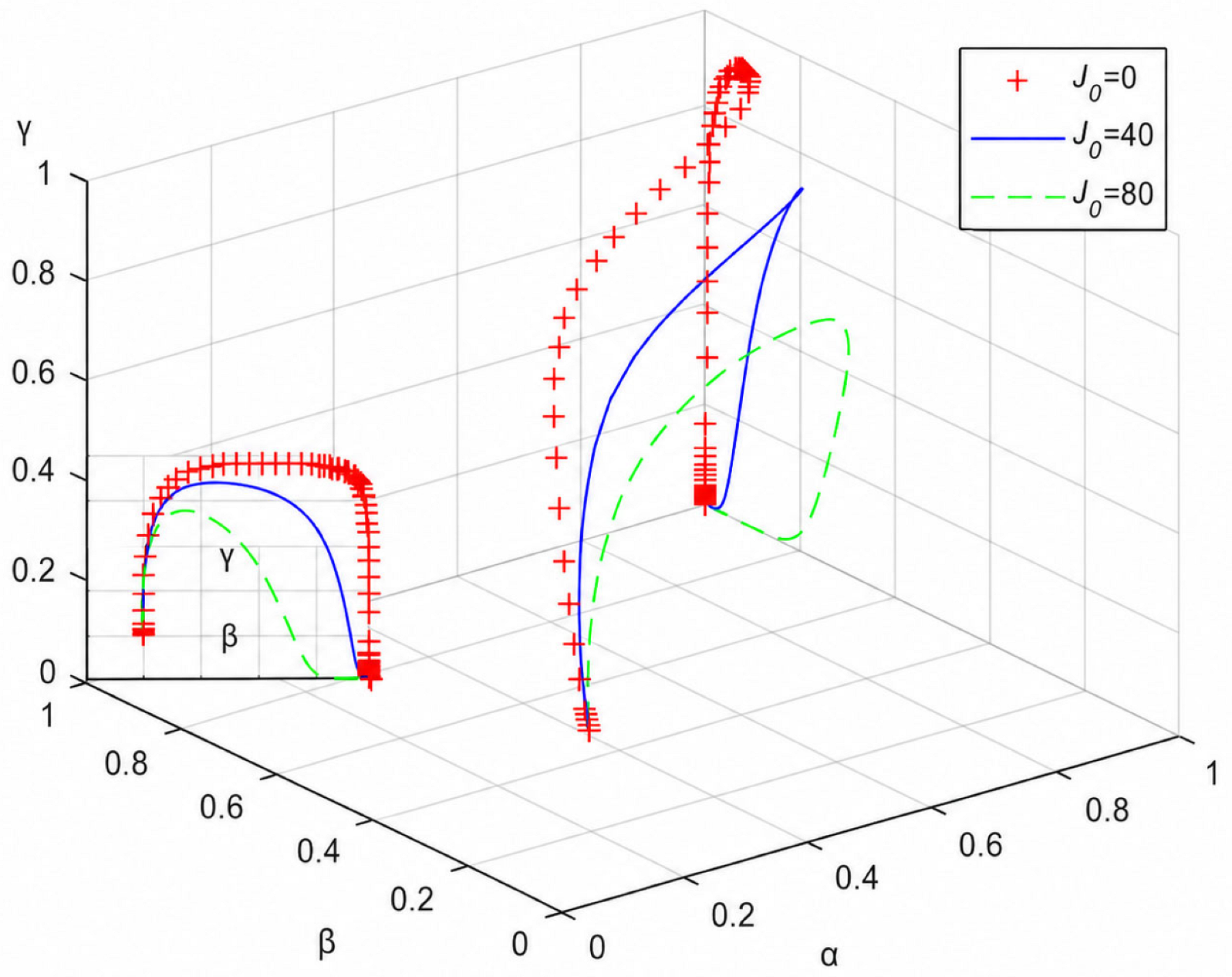
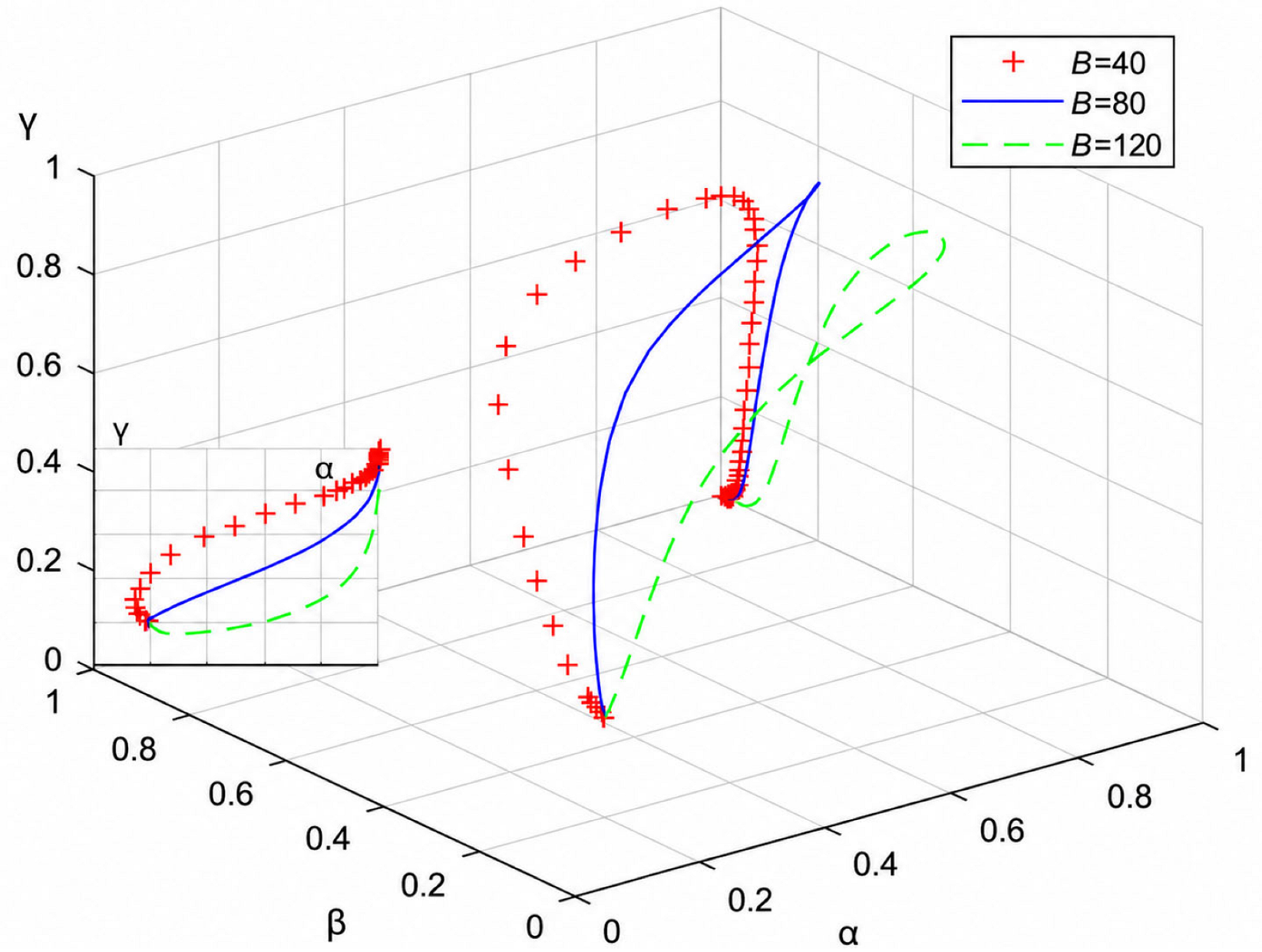
4.1.1. Impact of Revenue Generated by the Demand Sides Through Data Products
4.1.2. Impact of Collusion Costs Invested by the Demand Sides in Illegal Transactions with Operating Institutions
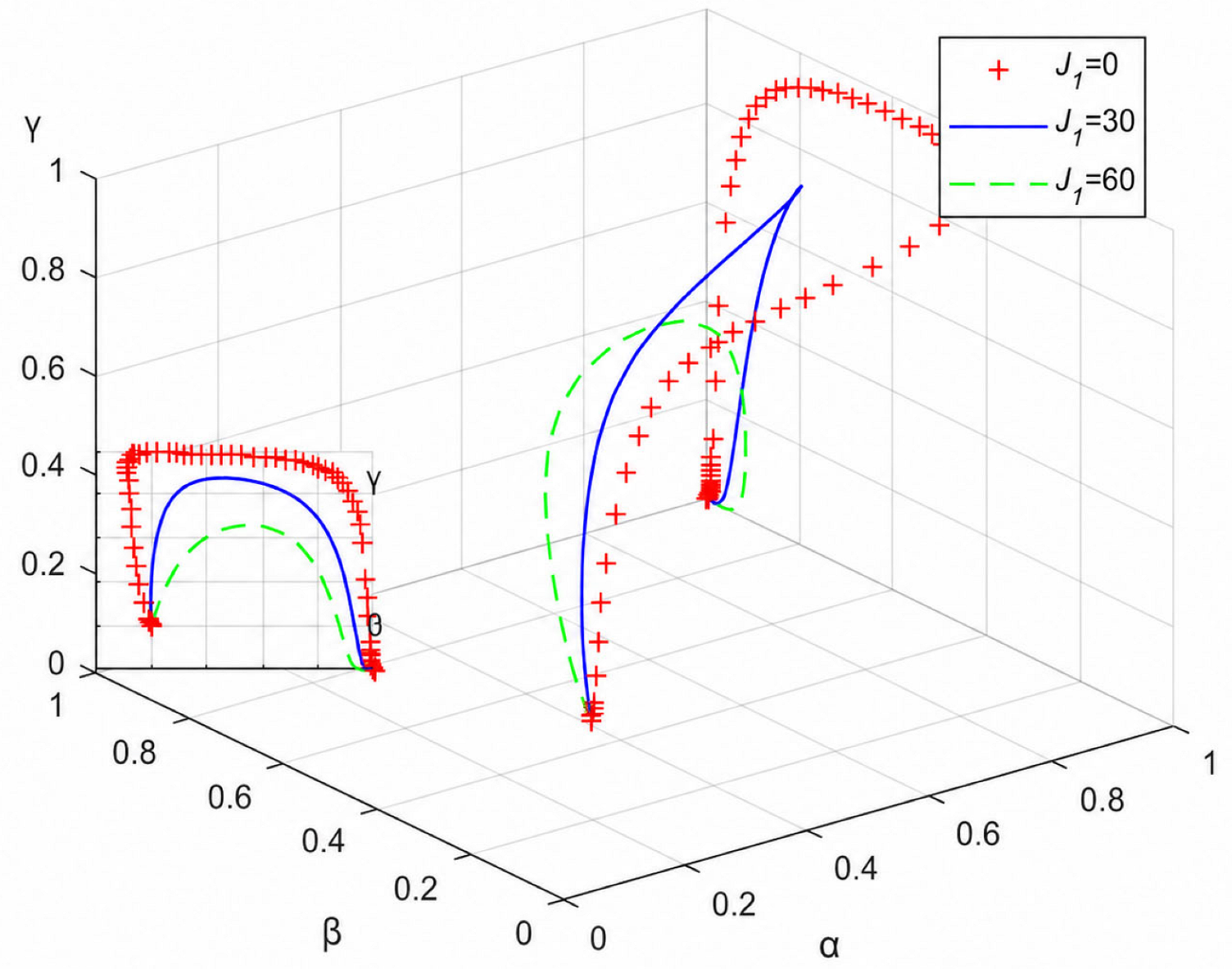
4.1.3. Impact of Government Rewards for Operating Institutions
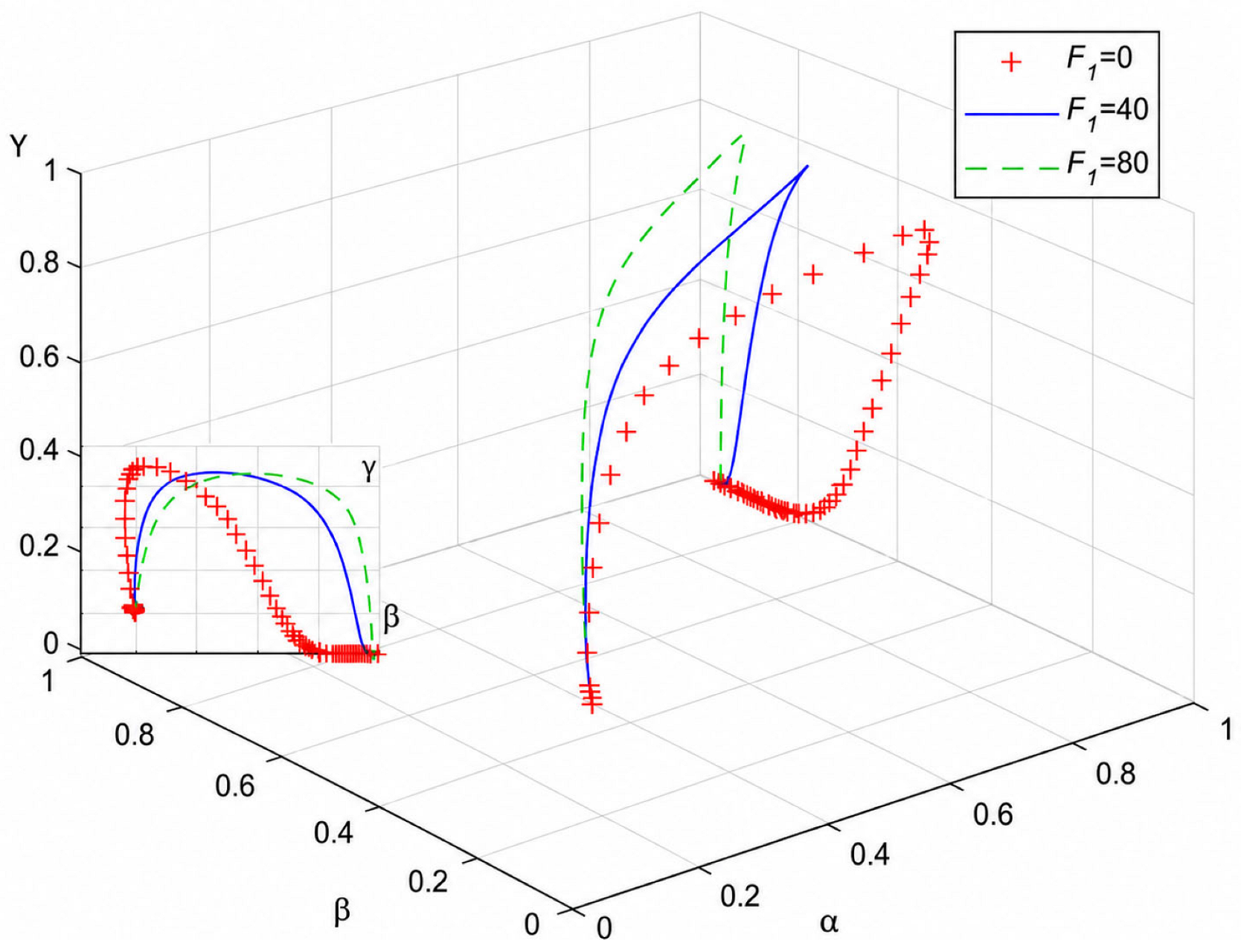
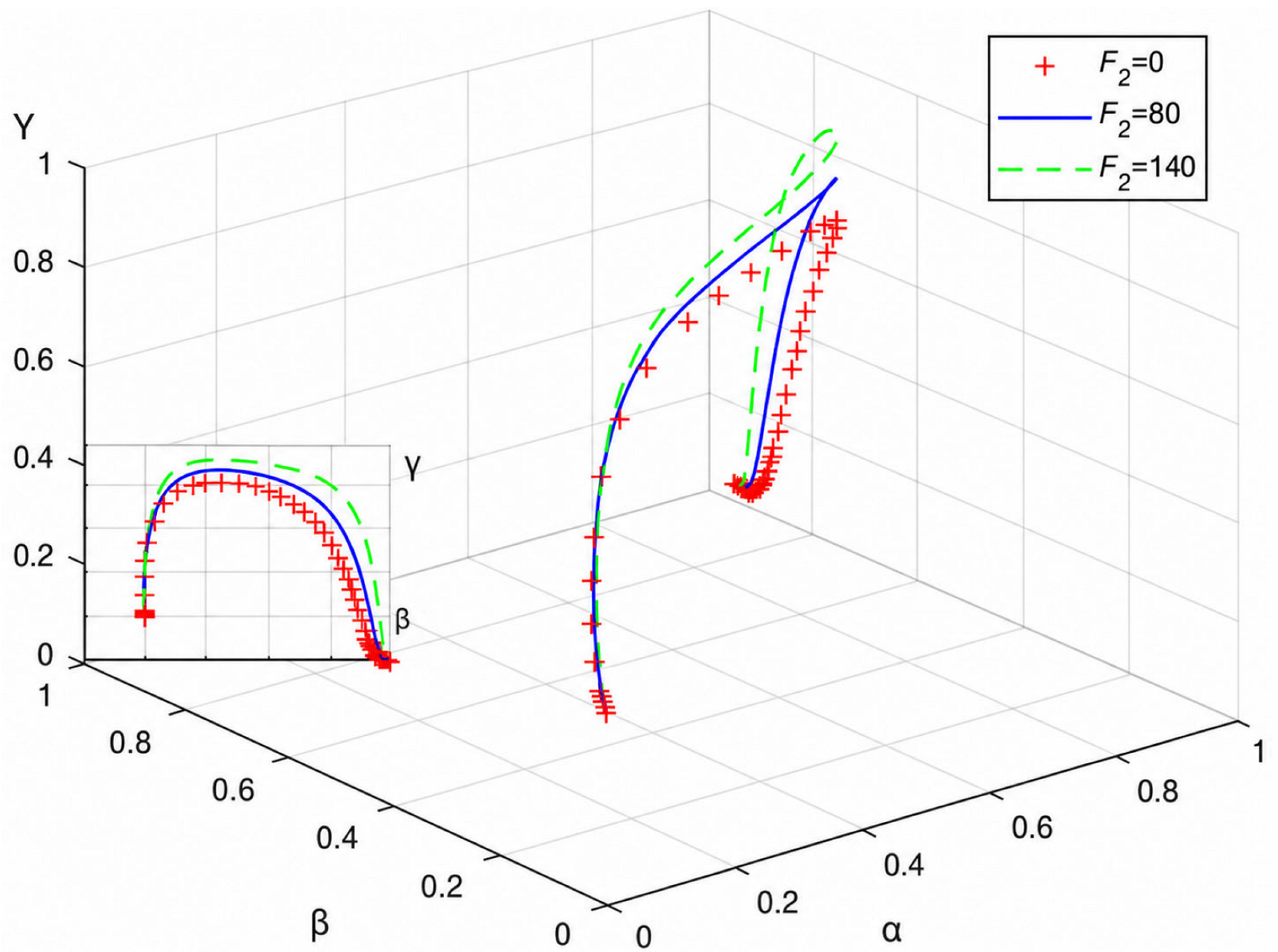
4.1.4. Impact of Government Fines on Operating Institutions
4.1.5. Impact of Government Rewards for the Demand Sides
4.1.6. Impact of Government Administrative Penalties
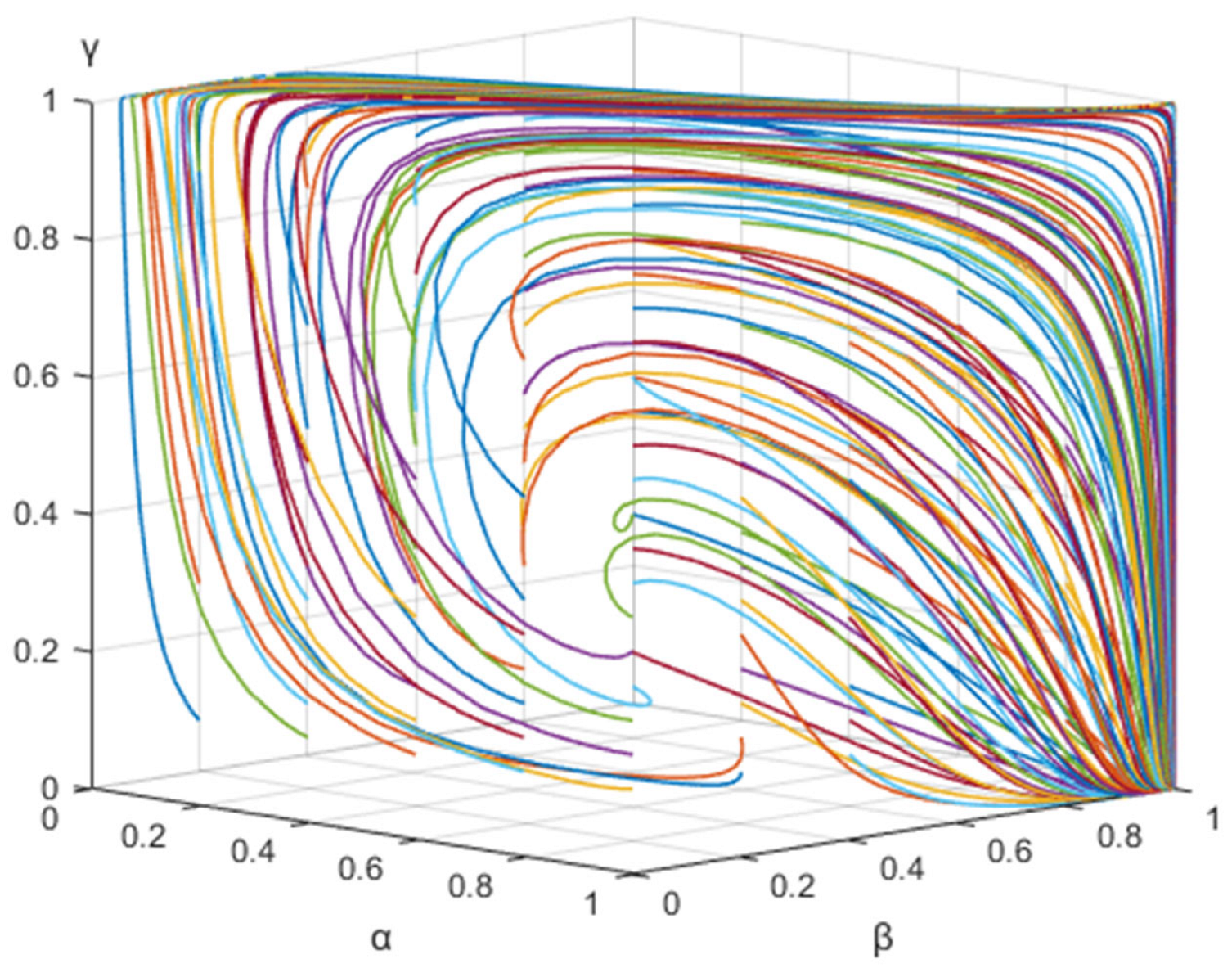
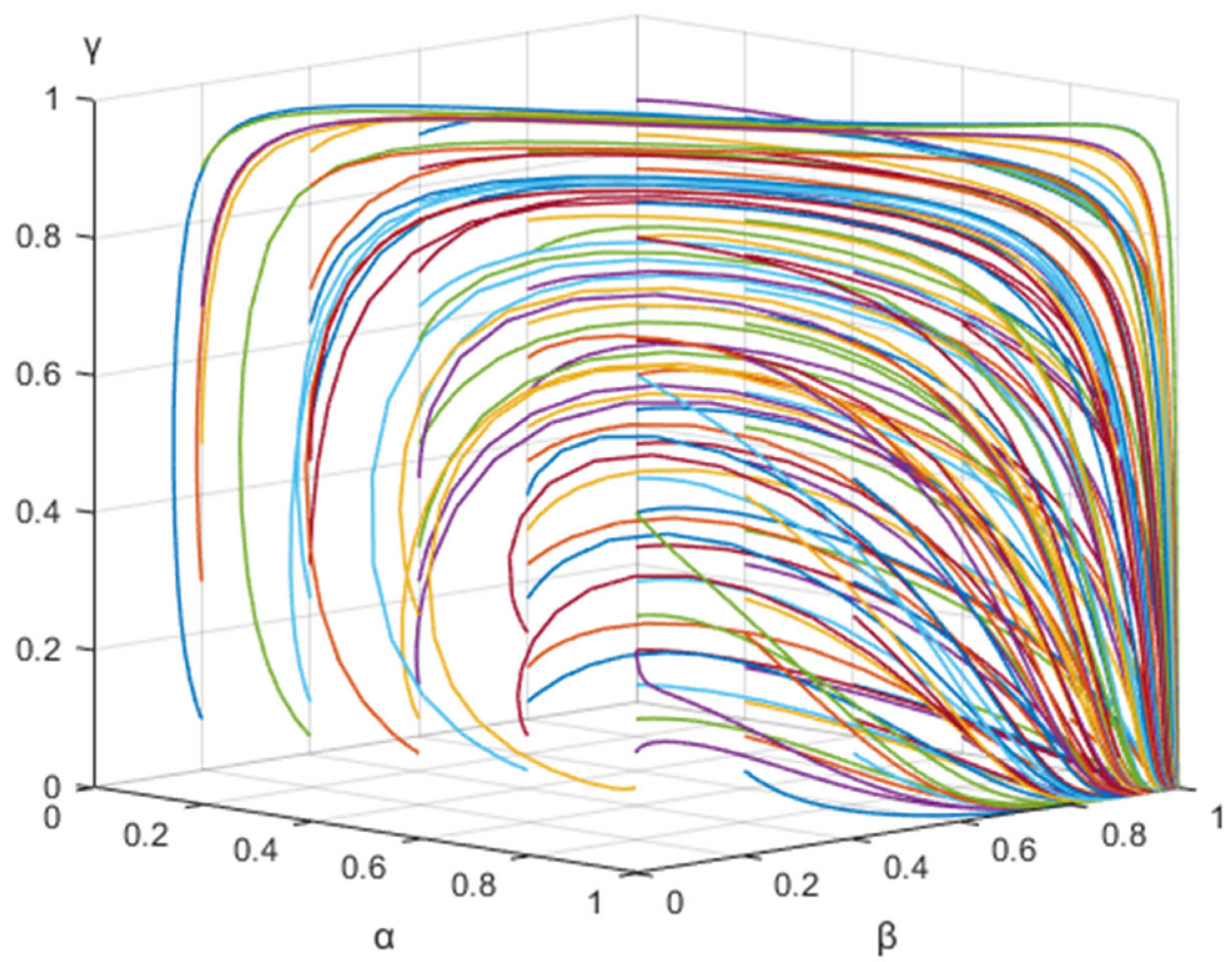
4.1.7. Array Simulation Results
4.2. Implications of Simulation Experiments for the Revenue Distribution of Authorized Operations
4.2.1. Revenue Distribution Should Be Linked to Subject Behavioral Performance
4.2.2. An Equitable Distribution Framework for Benefits and Risks Should Be Constructed
4.2.3. A Multi-Party Collaborative Revenue Sharing Mechanism Should Be Promoted
4.2.4. The Feedback of Social Value of Public Data Should Be Strengthened
4.3. Implications of Simulation Experiments for Pricing Decisions of Public Data
4.3.1. Differentiated Pricing Should Reflect Data Value and Risk Costs
4.3.2. Dynamic Pricing Should Adapt to the Market Evolution Stage
4.3.3. Cost-Sharing Mechanism Should Optimize the Pricing Structure
4.3.4. Credit Points Should Be Linked to Pricing Rights
4.4. Sensitivity Analysis and Robustness Test
4.4.1. Sensitivity Analysis
4.4.2. Robustness Test
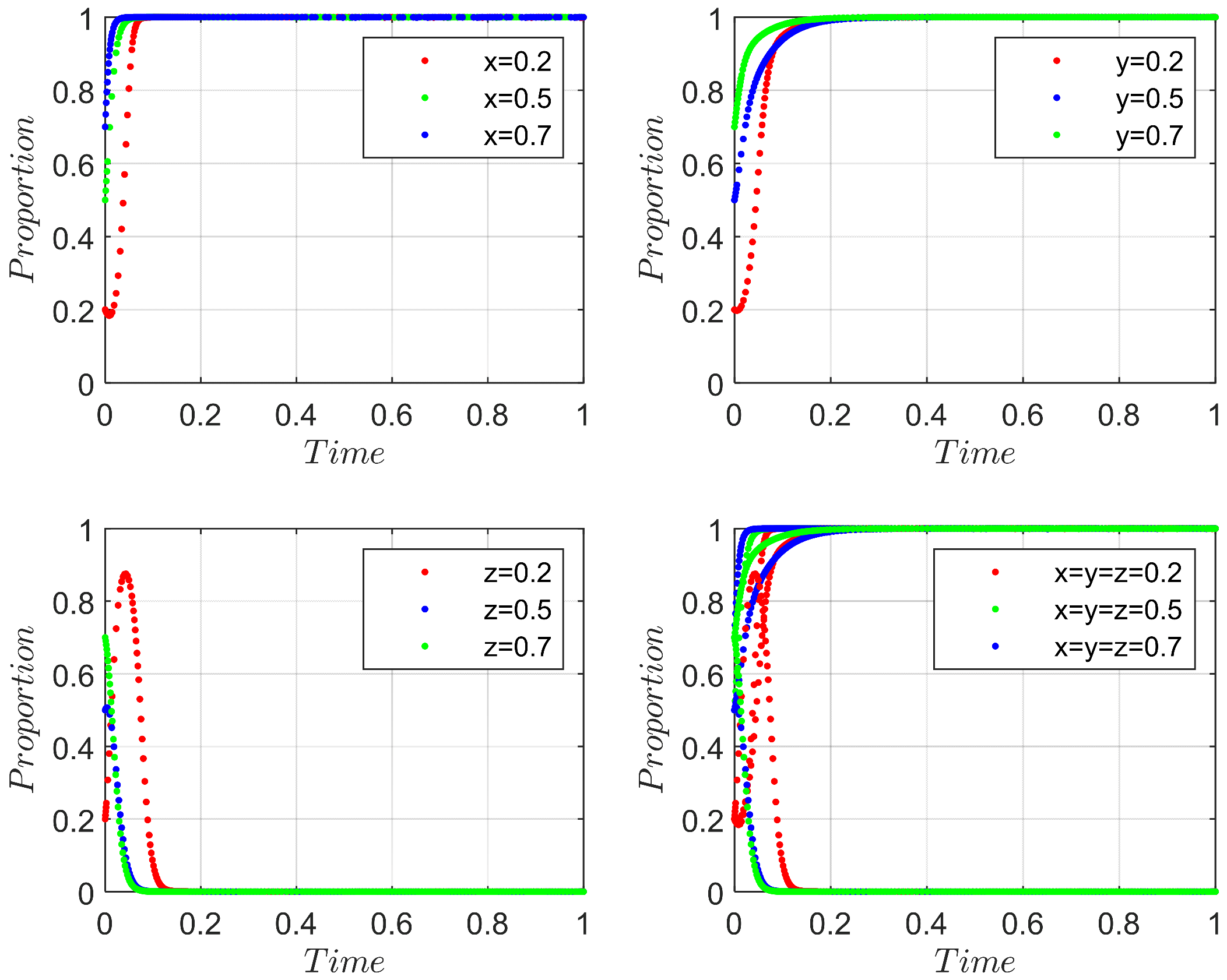
- Robustness of initial strategy probability: Four groups of differentiated initial strategy probability combinations were set, namely low-level (0.2,0.2,0.2), benchmark-level (0.5,0.5,0.5), high-level (0.8,0.8,0.8), and mixed asymmetric level (0.3,0.7,0.5). The results show that the system ultimately converges to the same equilibrium point under different initial conditions, with only differences in the evolution speed, which proves the robustness of the model to the initial strategy probability.
- Robustness of parameter assignment: Five groups of new parameter combinations were randomly generated within the range of ±10% around the benchmark parameters for simulation. The results indicate that the system equilibrium state and the strategic choices of the subjects are consistent with the original results under all parameter combinations, illustrating that the simulation results are not dependent on specific parameter assignments and possess stability.
- Robustness of iteration number: The simulation iteration number was adjusted to 30, 50, 80 and 100 times for comparison. The results show that the system achieves stable convergence after the iteration number reaches the benchmark value, with no significant differences in the results, which verifies the rationality of the iteration number setting.
Robustness of Initial Strategy Probability
Robustness of Parameter Assignment
Robustness of Iteration Number
Comprehensive Robustness Conclusion
5. Conclusions
5.1. Significant Impact of the Mechanisms of Revenue Distribution on Subject Behaviors
5.2. Stable Equilibrium Conditions for System Evolution
5.3. Optimization Directions for Revenue Distribution and Pricing Mechanisms
6. Suggestions and Discussion
6.1. Improve the Targeted Incentive and Constraint Mechanism for Main Players
6.2. Optimize the Scientific Revenue Distribution and Pricing System
6.3. Perfect the Integrated Governance and Guarantee System
6.4. Research Implications and Practical Prospects
Author Contributions
Funding
Institutional Review Board Statement
Informed Consent Statement
Data Availability Statement
Conflicts of Interest
References
- Jones, C.I.; Tonetti, C. Nonrivalry and the economics of data. Am. Econ. Rev. 2020, 110, 2819–2858. [Google Scholar] [CrossRef]
- Liu, Y.; Yang, Y.; Li, H.; Zhong, K. Digital economy development, industrial structure upgrading and green total factor productivity: Empirical evidence from China’s cities. Int. J. Environ. Res. Public Health 2022, 19, 2414. [Google Scholar] [CrossRef] [PubMed]
- Tai, K.T. Open government research over a decade: A systematic review. Gov. Inf. Q. 2021, 38, 101566. [Google Scholar] [CrossRef]
- Wirtz, B.W.; Weyerer, J.C.; Geyer, C. Open government data: A systematic literature review of empirical research. Electron. Mark. 2022, 32, 535–561. [Google Scholar] [CrossRef]
- Benfeldt, O.; Persson, J.S.; Madsen, S. Data governance as a collective action problem. Inf. Syst. Front. 2020, 22, 299–313. [Google Scholar] [CrossRef]
- Graef, I.; Prüfer, J. Mandated data sharing is a necessity in specific sectors. Res. Policy 2021, 50, 104330. [Google Scholar] [CrossRef]
- Li, C.; Li, H.; Tao, C. Evolutionary game of platform enterprises, government and consumers in the context of digital economy. J. Bus. Res. 2023, 167, 113858. [Google Scholar] [CrossRef]
- Janssen, M.; Charalabidis, Y.; Zuiderwijk, A. Benefits, adoption barriers and myths of open data and open government. Inf. Syst. Manag. 2012, 29, 258–268. [Google Scholar] [CrossRef]
- Jetzek, T.; Avital, M.; Bjørn-Andersen, N. The sustainable value of open government data. J. Assoc. Inf. Syst. 2019, 20, 702–734. [Google Scholar] [CrossRef]
- de Reuver, M.; Sørensen, C.; Basole, R.C. The digital platform: A research agenda. J. Inf. Technol. 2018, 33, 124–135. [Google Scholar] [CrossRef]
- Gawer, A. Bridging differing perspectives on technological platforms: Toward an integrative framework. Res. Policy 2014, 43, 1239–1249. [Google Scholar] [CrossRef]
- Dawes, S.S. Interagency information sharing: Expected benefits, manageable risks. J. Policy Anal. Manag. 1996, 15, 377–394. [Google Scholar] [CrossRef]
- Pardo, T.A.; Gil-Garcia, J.R.; Burke, G.B. Sustainable cross-boundary information sharing. Gov. Inf. Q. 2008, 25, 464–488. [Google Scholar]
- Ostrom, E. Governing the Commons: The Evolution of Institutions for Collective Action; Cambridge University Press: Cambridge, UK, 1990. [Google Scholar]
- Hess, C.; Ostrom, E. Understanding Knowledge as a Commons: From Theory to Practice; MIT Press: Cambridge, MA, USA, 2007. [Google Scholar]
- North, D.C. Institutions, Institutional Change and Economic Performance; Cambridge University Press: Cambridge, UK, 1990. [Google Scholar]
- Tilson, D.; Lyytinen, K.; Sørensen, C. Research commentary—Digital infrastructures: The missing IS research agenda. Inf. Syst. Res. 2010, 21, 748–759. [Google Scholar] [CrossRef]
- Shi, Z. Theoretical exposition and rules construction for the authorized operation of public data. Sci. Technol. Law (Chin. Engl.) 2023, 6, 33–42. (In Chinese) [Google Scholar] [CrossRef]
- Zhou, X.; Wang, Y. A paradigm analysis and improvement path for the authorized operation of public data. J. Univ. Electron. Sci. Technol. China (Soc. Sci. Ed.) 2023, 25, 8–15. (In Chinese) [Google Scholar] [CrossRef]
- Shi, J. Deconstructing the concept of data and constructing a legal system for data: Also on the disciplinary connotation and system of data jurisprudence. Peking Univ. Law J. 2023, 35, 23–45. Available online: https://kns.cnki.net/kcms2/article/abstract?v=7DtDJWciuTIpFHEpObMJfMwYdsM4WA6W8ycRTr0VX0ruFnI_v8r3atdBhkhCobgzqCBFq8PRq4Oba6KAVoxxroO7rMSKdG2NJvU1y18XcR0-N4E2hgZeYm_lCGa4fJ8629H8NCu7J6rN5s6Wo7LEwSdTgOG-rVD-82ADHU4DO4rWr2HvcANiXg==&uniplatform=NZKPT&language=CHS (accessed on 23 February 2026). (In Chinese)
- Xiao, W. A legal analysis of government data authorized operation. J. Beijing Adm. Inst. 2023, 01, 91–101. (In Chinese) [Google Scholar] [CrossRef]
- Feng, Y. The administrative licensing nature of public data authorized operation and directions for institutional construction. E-Government 2023, 77–87. (In Chinese) [Google Scholar] [CrossRef]
- Xiong, W.; Yu, B. Research on valuation methods for state-owned data assets. State-Own. Assets Manag. 2023, 61–76. Available online: https://kns.cnki.net/kcms2/article/abstract?v=7DtDJWciuTJPKU5njacUu_rnoMHvWNtm6seUOVUSvZ-vg50Rzxu9vgApOO_Bx6rC-O5b7m8pVqIhqKKUlMz5ROraDNMWRh-mBortAmaQyexOfLMEwL658lqnyRzTdmzR__AQ9rPztLI5XAxBtm3-MkoREQWCG4QzTRm5VYVdigUT9rLja1r5Hg==&uniplatform=NZKPT&language=CHS (accessed on 23 February 2026). (In Chinese)
- Zou, G.; Chen, W.; Wu, L.; Zhang, J.; Liang, Y.; Yu, Z. Research on pricing methods for power grid data assets: An analysis based on a two-stage modified cost method. Price Theory Pract. 2022, 3, 89–93+204. (In Chinese) [Google Scholar] [CrossRef]
- Luo, B.; Zhao, Y. Recognition of data assets based on blockchain technology. Account. Mon. 2022, 18, 80–87. (In Chinese) [Google Scholar] [CrossRef]
- Ren, D.; Wei, X.; Wang, J.; Wang, F. Urban waterlogging risk assessment from the perspective of optimal scale transformation and the analytic hierarchy process. Hydrology 2024, 44, 62–68+110. (In Chinese) [Google Scholar] [CrossRef]
- Xie, T.; Wang, F.; Feng, X.; Hu, L.; Zhang, H. Research on unsafe behaviors in university chemical laboratories based on the analytic hierarchy process. Sci. Technol. Innov. 2024, 26–31. Available online: https://kns.cnki.net/kcms2/article/abstract?v=7DtDJWciuTLIAqQKty0LNCAOLd_fTMY2etspWUqzM-LryhTBlkdObWbS2ZRJ_rPQeF4VnRD47eRFQ97EYF9MNPgZYgardU3dL_q4XOSKdJ6wZJd5PBeV60yxbDC19Lv3zTzf7sncp2fiMQ7GcuaEfUX7pUl9mqyce3_uYUTpk2EMN6wQcDGN7A==&uniplatform=NZKPT&language=CHS (accessed on 23 February 2026). (In Chinese)
- Zhang, H.; Gu, Q.; Xu, Z. Realization mechanisms and internal logic of government data authorized operation: A case study of Chengdu. E-Government 2021, 34–44. (In Chinese) [Google Scholar] [CrossRef]
- Men, L.; Zhang, Y.; Zhang, H.; Zhao, Q. Research on the revenue distribution system for the authorized operation of public data. E-Government 2023, 14–27. (In Chinese) [Google Scholar] [CrossRef]
- Deng, K. Evolutionary game research on data security under platform–trust cooperation. China Bus. Mark. 2023, 20, 99–102. (In Chinese) [Google Scholar] [CrossRef]
- Yang, T.M.; Wu, Y.J. Exploring the determinants of cross-boundary information sharing in the public sector: An e-government case study. Gov. Inf. Q. 2016, 33, 771–781. [Google Scholar] [CrossRef]
- Han, P.; Gu, L.; Ye, D.; Li, N. Evolutionary game study of blockchain-based government data sharing from the perspective of rewards and penalties. J. Ind. Eng. Eng. Manag. 2023, 38, 122–132. (In Chinese) [Google Scholar] [CrossRef]
- Feng, Z.; Pei, X. Evolution of data-sharing behavior between platform vendors and the government: Game mechanisms, path analysis, and policy formation. Manag. Rev. 2023, 35, 175–187. (In Chinese) [Google Scholar] [CrossRef]
- Smith, J.M.; Price, G.R. The logic of animal conflict. Nature 1973, 246, 15–18. [Google Scholar] [CrossRef]
- Wei, Y.; Yang, L. Government data openness and improvements in public governance efficiency under public emergencies: Evidence from a four-party evolutionary game analysis. Econ. Rev. J. 2022, 7, 69–77. (In Chinese) [Google Scholar] [CrossRef]
- Tong, N.; Yang, M.; Mo, X.; Zhu, N.; Zhao, Z. Data finance: A model framework for promoting benefit distribution in public data authorized operation in the new era. E-Government 2023, 23–35. (In Chinese) [Google Scholar] [CrossRef]
- Martin, C.J.; Upham, P.; Budd, L. Commercial orientation in grassroots social innovation: Insights from the sharing economy. Ecol. Econ. 2015, 118, 240–251. [Google Scholar] [CrossRef]
- Zhang, H.; Ma, T.; Sun, L. Government data empowering digital economy upgrading: Authorized operation, privacy computing, and scenario reconstruction. J. Intell. 2022, 41, 166–172. Available online: https://kns.cnki.net/kcms2/article/abstract?v=7DtDJWciuTJIXEVpikV6196IwMRWVV_YwIw5hMI_TXc5eIe6GnVMxSv6AaojNXLo92qeBZYF1JgNGPIGoLCwhBsWLMFltt2aW1NDwHpaBakx_FjLIJiFbd6ybHPr-KVH04Tf9ZjnQwZCBcOYxrz660SrEnEpbpUz3-DVk_lI0CNKVSTlOyzN8g==&uniplatform=NZKPT&language=CHS (accessed on 23 February 2026). (In Chinese)
- Becker, G. The Economic Approach to Human Behaviour; University of Chicago Press: Chicago, IL, USA, 1976. [Google Scholar]
- von Neumann, J.; Morgenstern, O. The Theory of Games and Economic Behavior; Princeton University Press: Princeton, NJ, USA, 1944. [Google Scholar]
- Nash, J.F. Non-Cooperative Games; Annals of Mathematics, Second Series; Mathematics Department, Princeton University: Princeton, NJ, USA, 1951; Volume 54, pp. 286–295. [Google Scholar]
- Simon, H.A. Administrative Behavior: A Study of Decision-Making Processes in Administrative Organization, 4th ed.; The Free Press: New York, NY, USA, 1997. [Google Scholar]
- van Tulder, R.; van Mil, E. Principles of Sustainable Business: Frameworks for Corporate Action on the SDGs; Routledge: Abingdon, UK, 2023. [Google Scholar]
- Sun, Y.; Zhang, Y.; Li, J.; Zhang, S. Evolutionary game analysis of data resale governance in data trading. Systems 2023, 11, 363. [Google Scholar] [CrossRef]
- Fu, J.; Huang, Y.; Wang, D. Cooperative mechanisms among stakeholders in government data openness: A tripartite evolutionary game analysis. Dyn. Games Appl. 2025, 15, 1587–1616. [Google Scholar] [CrossRef]









| Parameter | Meaning |
|---|---|
| Revenue obtained by the demand sides through data products | |
| Revenue of the operating institution from developing data products | |
| Cost incurred by the demand sides to purchase public data products when engaging in compliant transactions | |
| Cost incurred by the demand sides to purchase public data products when engaging in illegal transactions | |
| Cost of data irregularities for the operating institution | |
| Cost of strict supervision for the government | |
| Additional cost for the government to stabilize social order | |
| Collusion cost invested by the demand sides in the operating institution when engaging in illegal transactions | |
| Fine imposed by the government on the demand sides for illegal transactions under strict supervision | |
| Fine imposed by the government on the operating institution for data irregularities under strict supervision | |
| Administrative penalty on the government for data irregularities caused by relaxed supervision | |
| Reward given by the government to the demand sides for compliant transactions | |
| Reward given by the government to the operating institution for maintaining data security | |
| Intangible benefits of the government |
| Operating Institution | Government | |||
|---|---|---|---|---|
| Strict Supervision γ | Relaxed Supervision 1 − γ | |||
| demand sides | Compliant Transaction | Data Protection | , , | |
| Data Irregularities | , , | |||
| Illegal Transaction | Data Protection | , | , | |
| Data Irregularities | , , | , | ||
| Equilibrium Point | Eigenvalues of Jacobian Matrix | Sign of Real Part | Stability | ||
|---|---|---|---|---|---|
| (−, −, +) | Unstable | ||||
| (+, *, +) | Unstable | ||||
| (+, +, *) | Unstable | ||||
| (−, −, −) | ESS | ||||
| (−, −, −) | ESS | ||||
| (+, *, +) | Unstable | ||||
| (+, +, *) | Unstable | ||||
| (+, −, −) | Unstable | ||||
| Parameter | Assignment |
|---|---|
| Parameter | Assignment |
|---|---|
| Initial Strategy Probability (α, β, γ) | Equilibrium State (α, β, γ) |
|---|---|
| (0.2, 0.2, 0.2) | (1.0000, 1.0000, 0.0000) |
| (0.2, 0.2, 0.8) | (0.0000, 0.0000, 0.0000) |
| (0.2, 0.8, 0.2) | (0.0000, 1.0000, 0.0000) |
| (0.2, 0.8, 0.8) | (0.0000, 0.0000, 0.0000) |
| (0.8, 0.2, 0.2) | (1.0000, 0.0000, 1.0000) |
| (0.8, 0.2, 0.8) | (0.0000, 0.0000, 1.0000) |
| (0.8, 0.8, 0.2) | (0.0000, 0.0000, 1.0000) |
| (0.8, 0.8, 0.8) | (0.0000, 0.0000, 1.0000) |
Disclaimer/Publisher’s Note: The statements, opinions and data contained in all publications are solely those of the individual author(s) and contributor(s) and not of MDPI and/or the editor(s). MDPI and/or the editor(s) disclaim responsibility for any injury to people or property resulting from any ideas, methods, instructions or products referred to in the content. |
© 2026 by the authors. Licensee MDPI, Basel, Switzerland. This article is an open access article distributed under the terms and conditions of the Creative Commons Attribution (CC BY) license.
Share and Cite
Chen, Y.; Man, W.; Meng, Z.; Zhou, Y. Revenue Distribution Behavior of the Authorized Operation of Public Data—Evidence from China. Sustainability 2026, 18, 4854. https://doi.org/10.3390/su18104854
Chen Y, Man W, Meng Z, Zhou Y. Revenue Distribution Behavior of the Authorized Operation of Public Data—Evidence from China. Sustainability. 2026; 18(10):4854. https://doi.org/10.3390/su18104854
Chicago/Turabian StyleChen, Yongtong, Wanqin Man, Ziyi Meng, and Yuao Zhou. 2026. "Revenue Distribution Behavior of the Authorized Operation of Public Data—Evidence from China" Sustainability 18, no. 10: 4854. https://doi.org/10.3390/su18104854
APA StyleChen, Y., Man, W., Meng, Z., & Zhou, Y. (2026). Revenue Distribution Behavior of the Authorized Operation of Public Data—Evidence from China. Sustainability, 18(10), 4854. https://doi.org/10.3390/su18104854