Assessing the Low-Carbon Transition of Manufacturing Clusters and Its Evolution: Evidence from China
Abstract
1. Introduction
2. Literature Review
3. Research Design
3.1. Research Methods
3.2. Indicator System
- (1)
- Level of Economic Growth: LCT regards economic growth as both one of its objectives and its material foundation. The level of economic growth should be assessed from both qualitative and quantitative dimensions. In this study, per capita GDP, industrial added value, and total fixed asset investment are selected to measure the quantitative aspect of economic growth, while the proportion of the tertiary industry, actual utilization of foreign direct investment, and per capita disposable income of urban residents are selected as indicators to measure the qualitative aspect of economic growth. In China, per capita GDP directly affects innovation and low-carbon capacity, while fixed asset investment effectively promotes the growth of production growth rates [29], both are important drivers of economic growth. Furthermore, actual utilization of foreign direct investment helps absorb advanced foreign technologies, enhance green innovation capacity, and foster a more open industrial structure.
- (2)
- Level of Environmental Protection: Indicators of environmental protection are selected from three aspects: before, during, and after pollution events. Prior to the generation of pollution, preventive measures should be taken to enhance environmental protection capacity and avert potential risks. During the pollution-generating process, efforts should be made to reduce environmental pollution and control emission intensity. After pollution occurs, the capacity for pollutant treatment should be improved to minimize environmental impacts. The construction of green spaces in built-up areas can enhance regional carbon sequestration capacity and optimize ecosystem services, thereby improving the regional environment. Therefore, the green coverage rate of urban built-up areas is selected as a pre-event indicator of environmental protection. Zhou et al. [30], by analyzing the frequency of energy indicators in relevant production standards, found that the industrial “three wastes” appeared with frequencies of 12/70, 48/70, and 10/70, respectively, indicating their important role in environmental performance evaluation. Accordingly, this study selects the emission intensities of the industrial “three wastes” as during-event indicators of environmental protection. The harmless treatment of municipal solid waste can promote the sustainable development of the urban environment [31], while the number of days meeting air quality standards reflects the effectiveness of urban environmental protection efforts. Therefore, this study selects the harmless treatment rate of municipal solid waste and the number of days meeting air quality standards as post-event indicators of environmental protection.
- (3)
- Level of Resource Utilization: The level of resource utilization can be reflected by energy consumption intensity and the level of waste recycling. Additionally, referring to the classification of “resource utilization” indicators in the “Green Development Indicator System” issued by the National Development and Reform Commission, this study selects three indicators to measure resource utilization efficiency: the comprehensive utilization rate of industrial solid waste, energy consumption per 10,000 yuan of industrial added value, and electricity consumption per unit of industrial added value.
- (4)
- Level of Low-Carbon Technology: Advancing and deploying low-carbon technologies requires both human capital and physical infrastructure. The number of university students per 10,000 people reflects the educational level of a city; a higher educational level is more conducive to low-carbon technology research and development. Science and technology expenditure provides financial support for low-carbon technological innovation and helps attract high-end talent [32]. Therefore, the number of university students per 10,000 people and science and technology expenditure are selected to measure the potential for regional low-carbon technology development. The number of invention patents granted can reflect the development of innovative activities, while the number of green patents granted can demonstrate the level of green innovation [33]. Thus, the number of invention patents granted, and the number of green patents granted are selected to measure existing achievements in low-carbon technology.
3.3. Measurement Model
3.3.1. Entropy-Weighted CRITIC-Grey Relational TOPSIS Method
- (1)
- Indicator normalization.
- (2)
- Entropy weight method
- (3)
- CRITIC method
- (4)
- The grey relational analysis-TOPSIS (GRA-TOPSIS) method
- (5)
- Comprehensive evaluation
3.3.2. Convergence Analysis Method
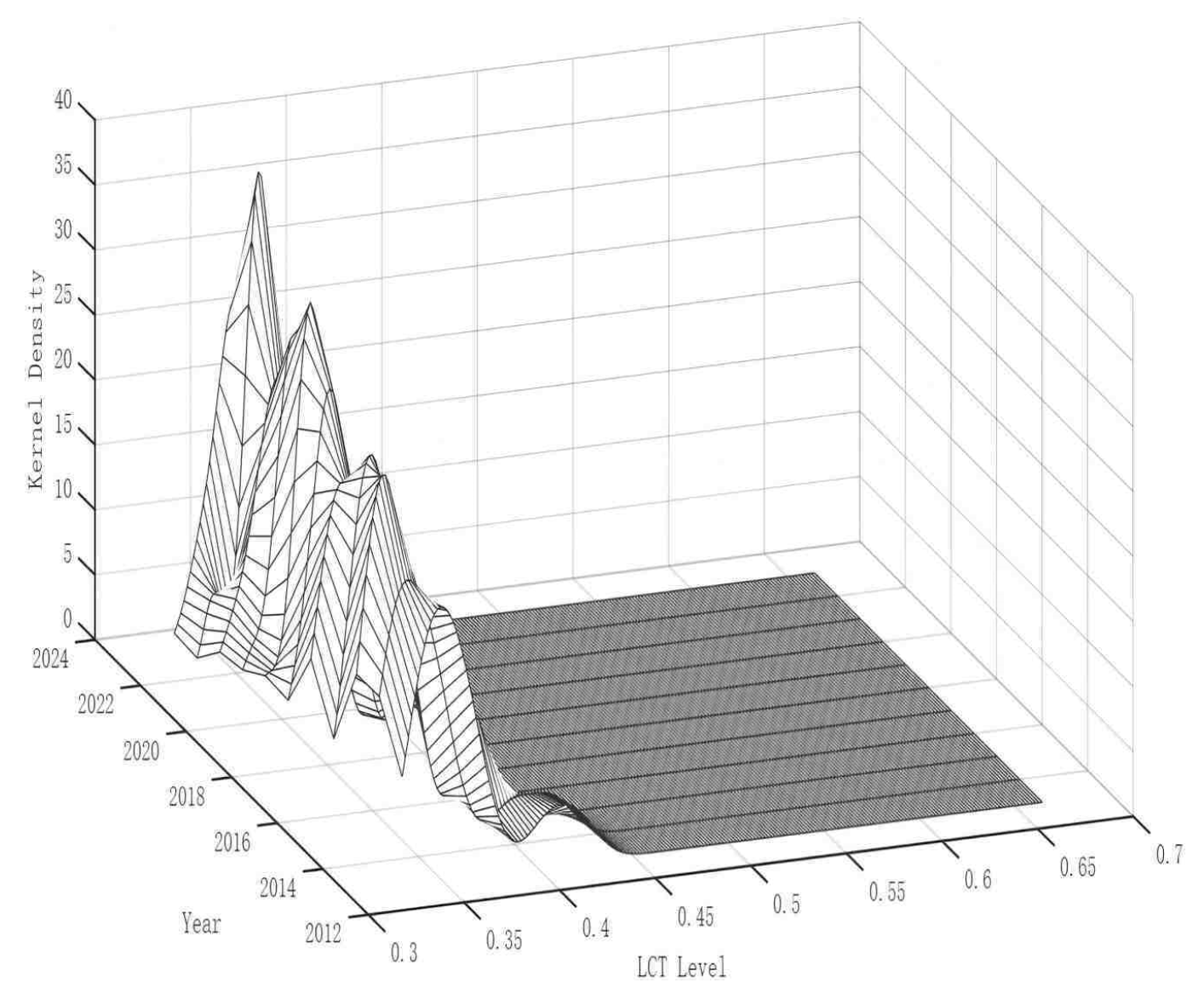
3.3.3. Kernel Density Estimation Method
3.3.4. Theil Index Calculation
3.4. Research Subjects
3.4.1. Evaluation Subjects
3.4.2. Data Sources
4. Measurement of Low-Carbon Transition Levels in China’s Four Major Industrial Bases
4.1. Weight Calculation Results
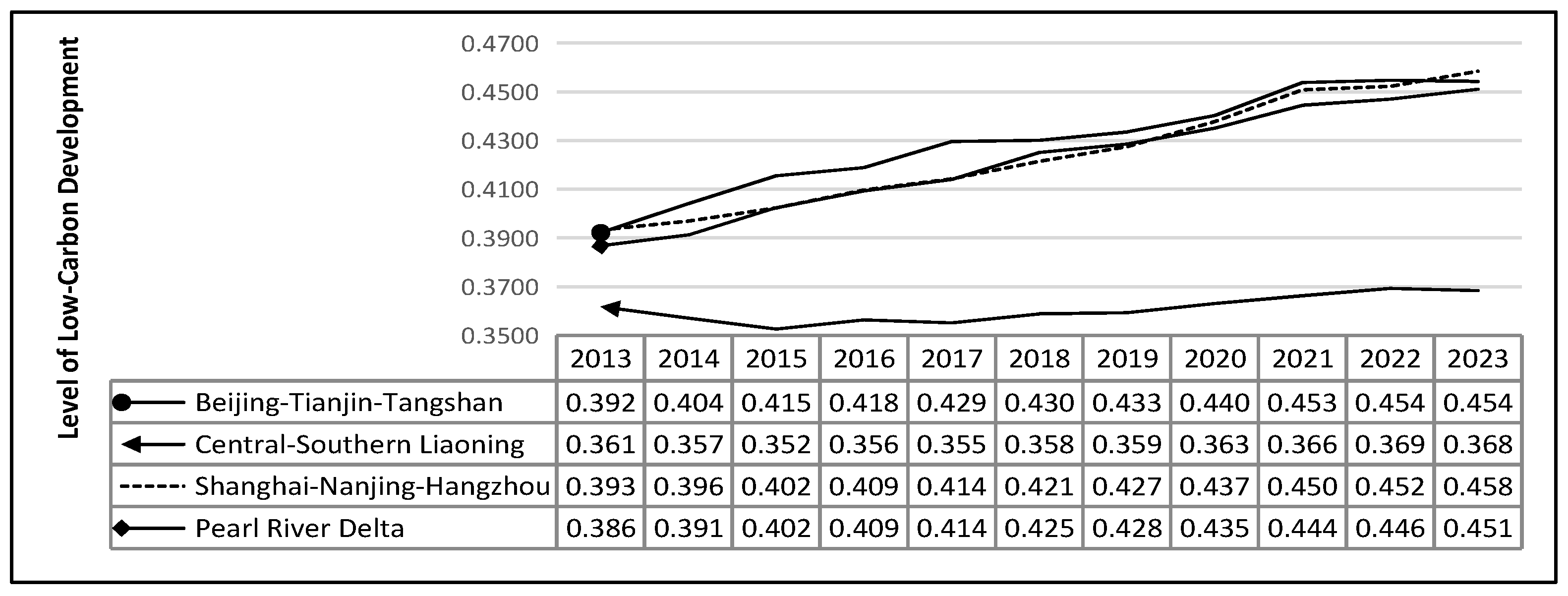
4.2. Comprehensive Evaluation Results
4.2.1. Overall Analysis
4.2.2. Specific Analysis
4.3. Dynamic Evolution and Disparity Decomposition Analysis
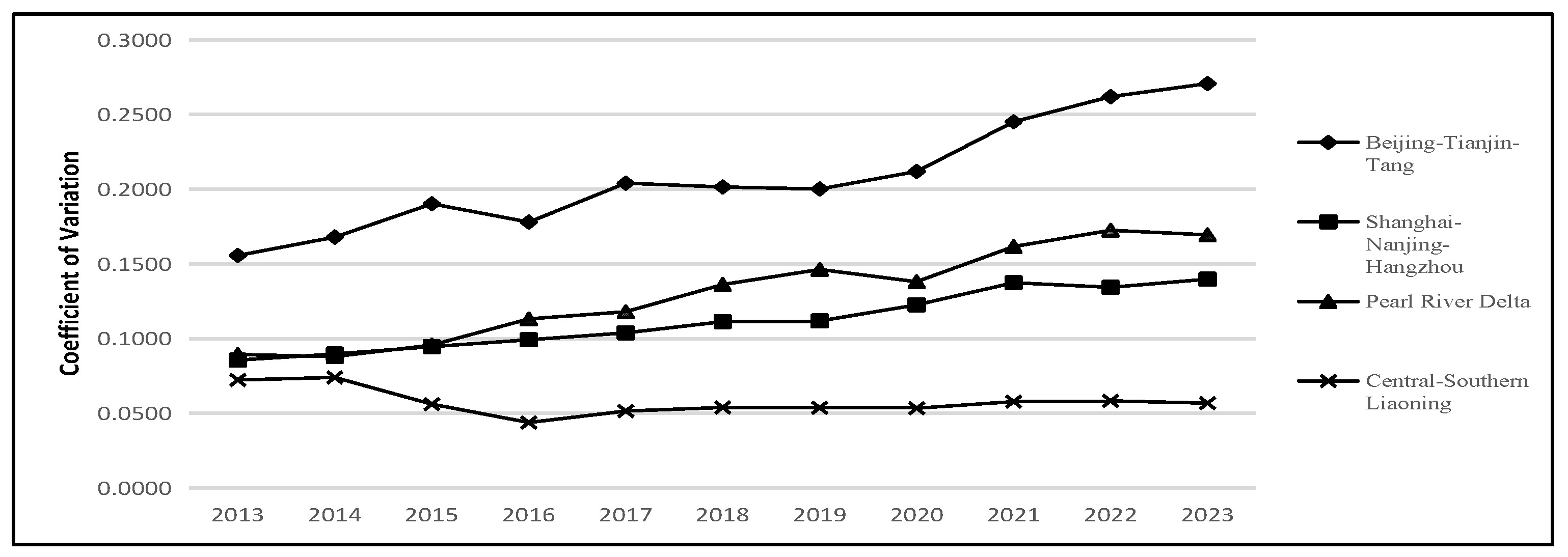
4.3.1. Convergence Analysis
σ-Convergence Analysis
Conditional β-Convergence Analysis
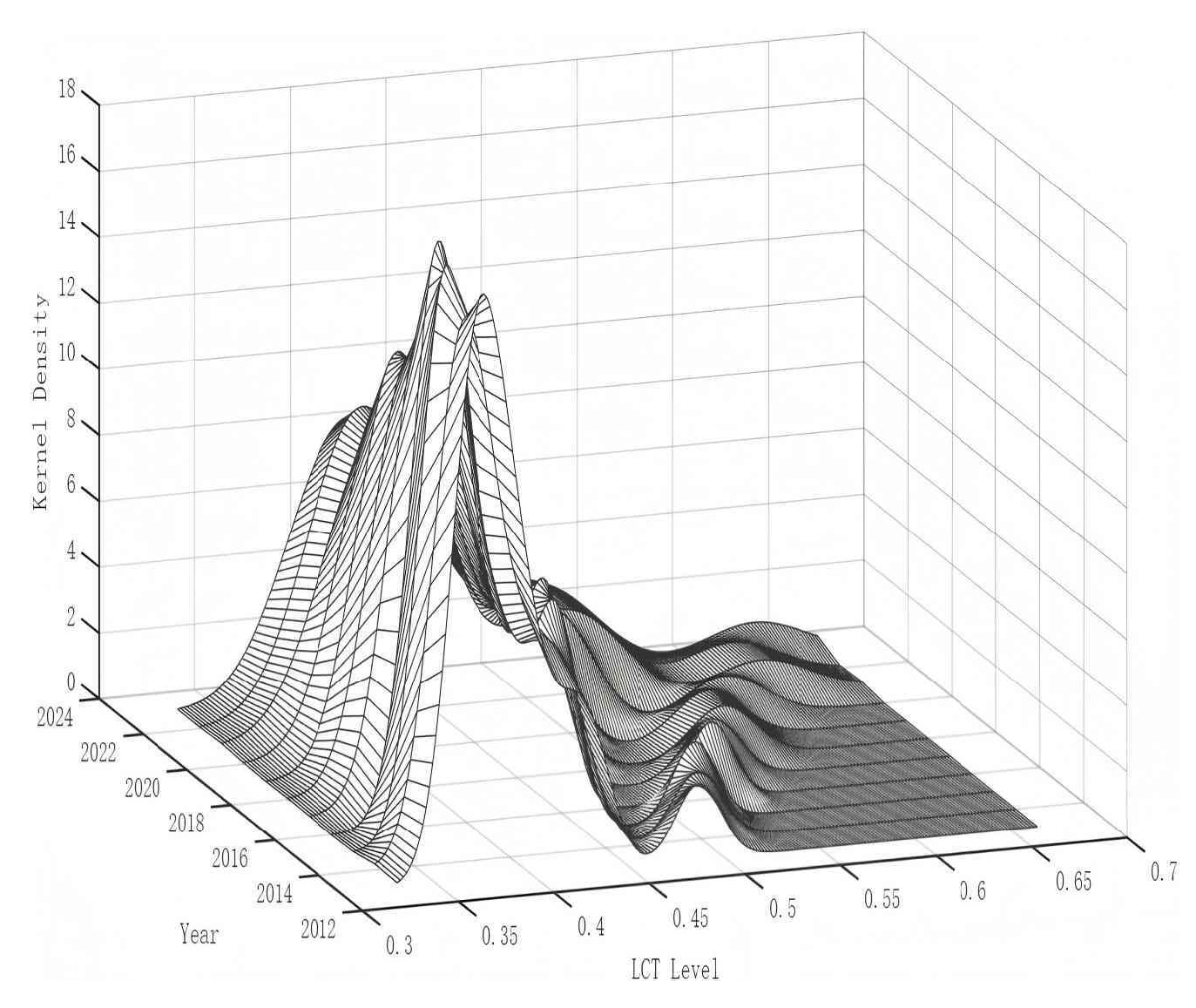
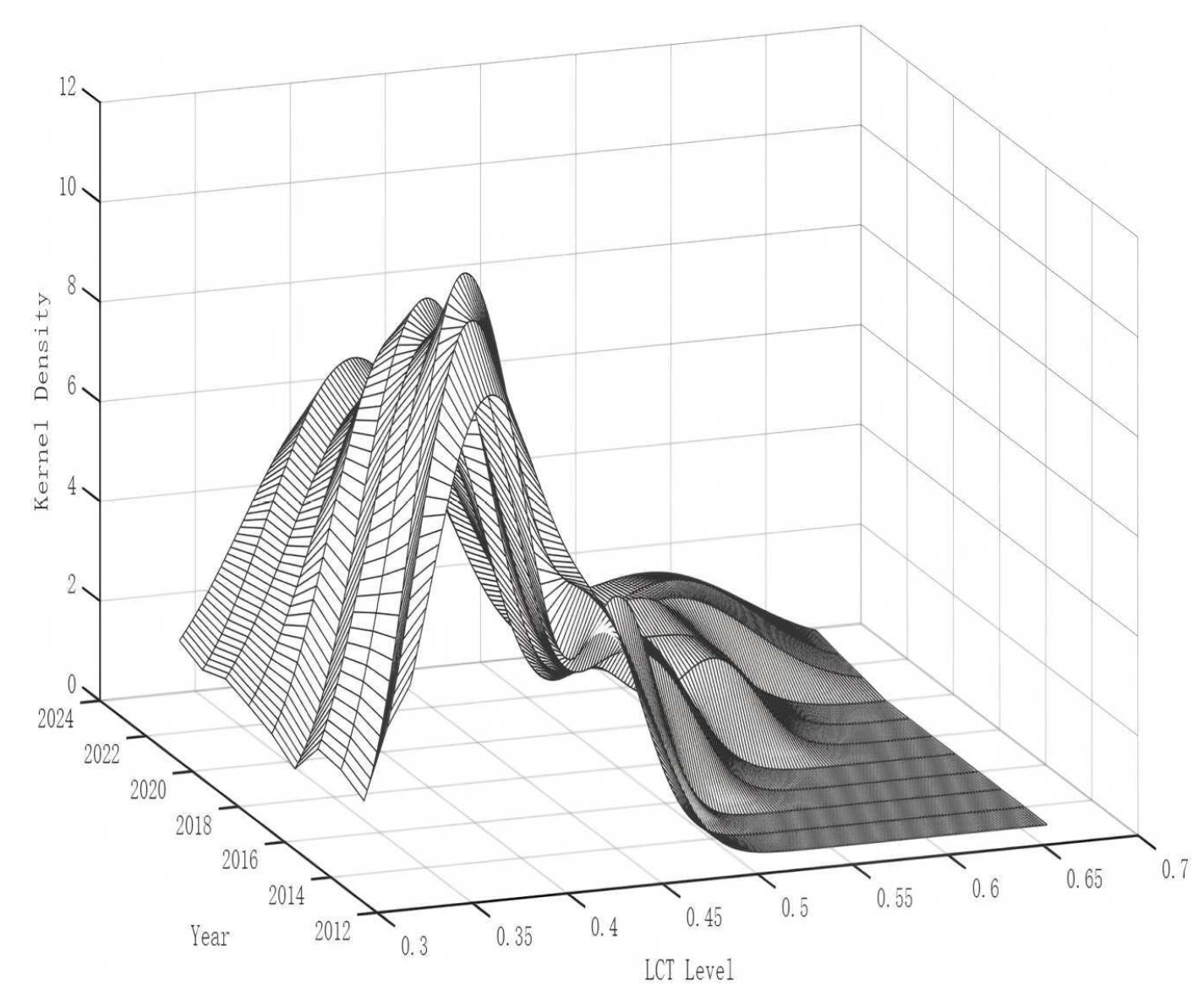
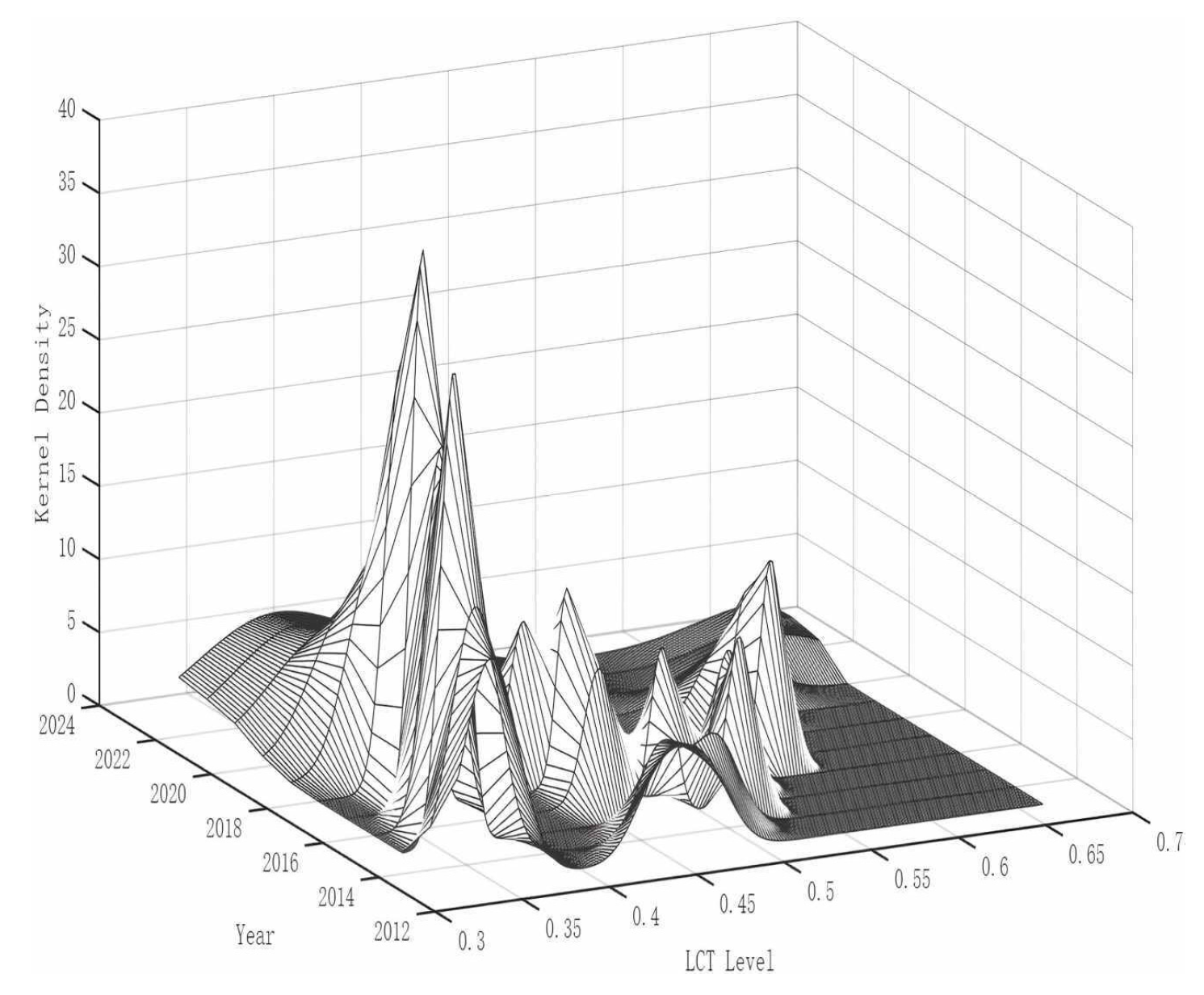
4.3.2. Kernel Density Analysis
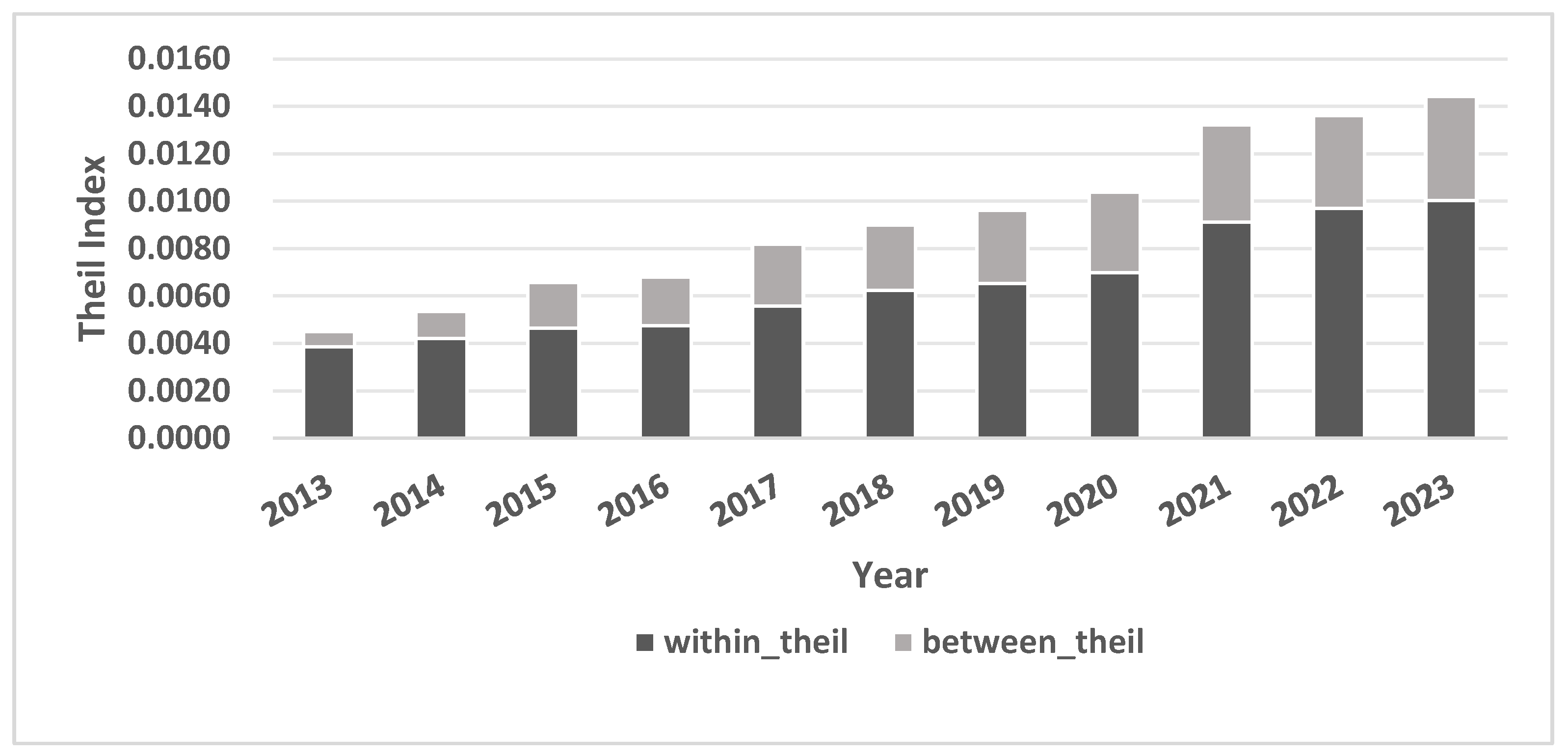
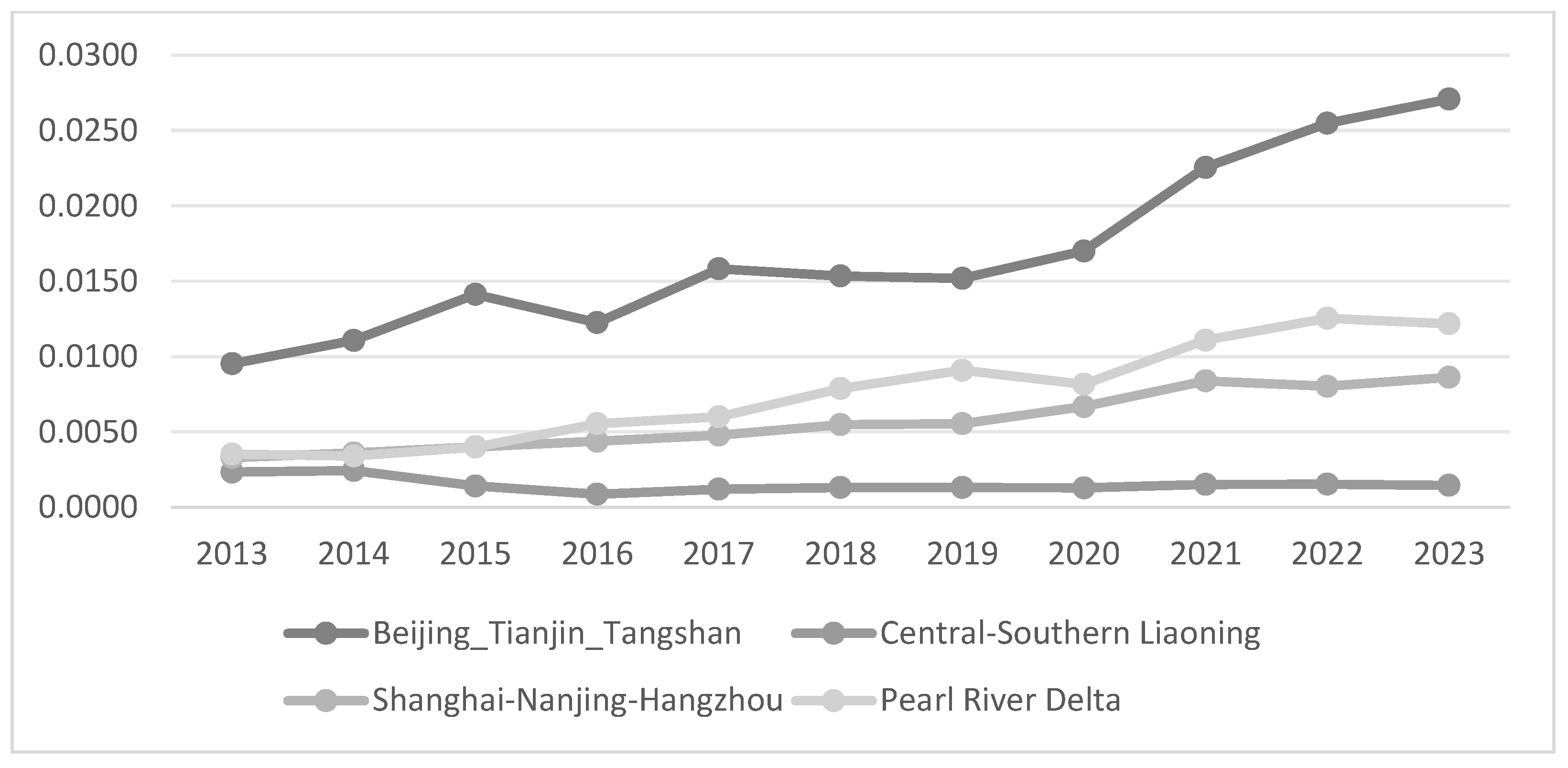
4.3.3. Theil Index Analysis
4.4. Robustness Analysis
4.4.1. Sensitivity Analysis of Key Parameters
4.4.2. Alternative Weighting Schemes
4.4.3. Cross-Method Validation with VIKOR
4.4.4. Robustness Analysis for Indicators with High Missing Rates
- (i)
- removing ×11: Industrial Soot Emission Intensity (from the environmental protection dimension);
- (ii)
- removing ×13: Comprehensive Utilization Rate of Industrial Solid Waste (from the resource utilization dimension);
- (iii)
- removing both ×11: Industrial Soot Emission Intensity and ×13: Comprehensive Utilization Rate of Industrial Solid Waste; and
- (iv)
- removing all indicators with missing rates higher than 5%, namely the following indicators: ×9: Industrial SO2 Emission Intensity, ×10: Industrial Wastewater Emission Intensity, ×11: Industrial Soot Emission Intensity, and ×13: Comprehensive Utilization Rate of Industrial Solid Waste.
4.4.5. Aggregation Sensitivity Analysis
5. Further Analysis
5.1. Mechanism Analysis
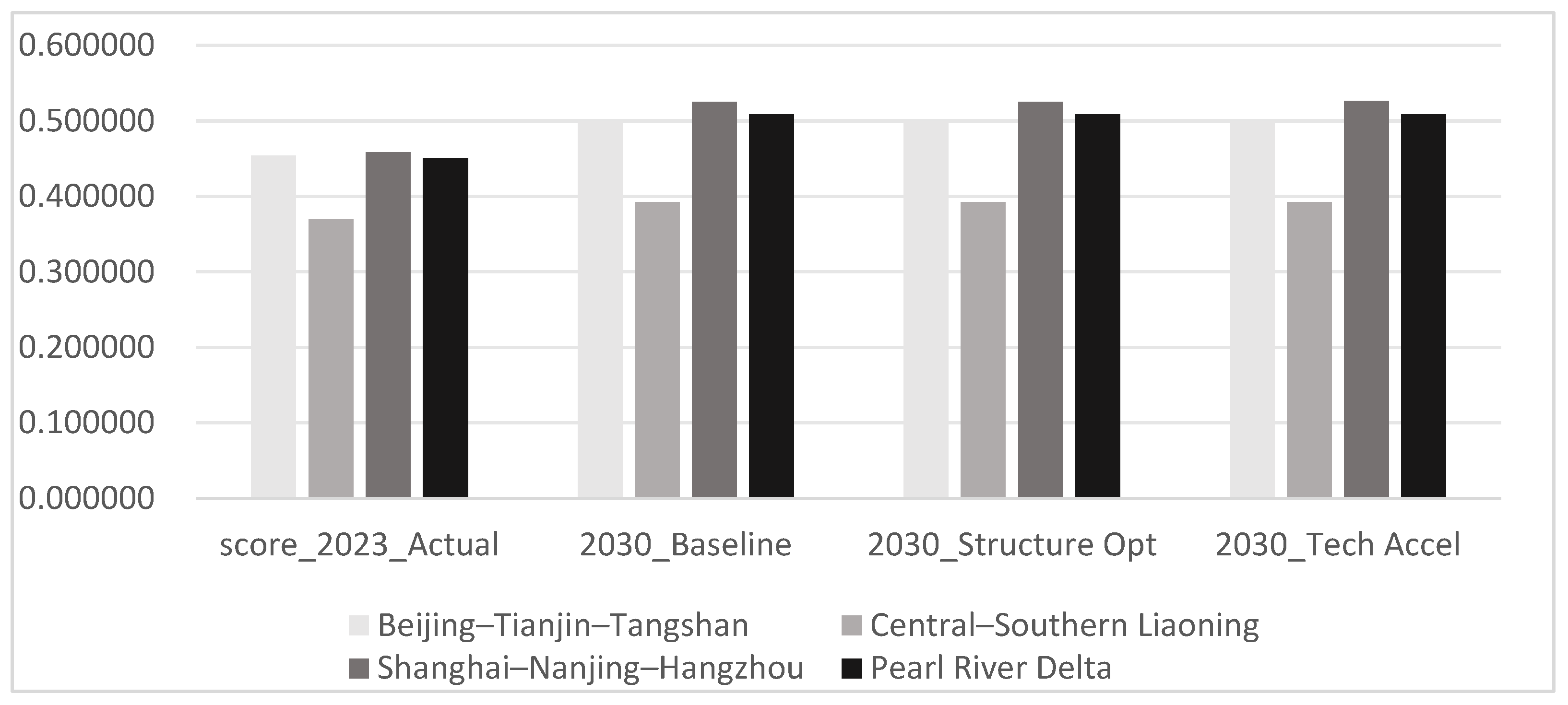
5.2. Scenario Simulation
- (i)
- Baseline Scenario: The industrial structure (proportion of the tertiary industry) and technological innovation (expenditure on science and technology) of each city are projected forward according to their historical compound annual growth rates (CAGR) observed during 2013–2023. The LCT level of each city in 2030 is then calculated based on these projected values.
- (ii)
- Industrial Structure Optimization Scenario: In resource-based cities, the CAGR of the proportion of the tertiary industry is increased by 50% relative to its historical value during 2013–2023, while other cities are projected forward according to the baseline scenario.
- (iii)
- Technological Innovation Acceleration Scenario: In resource-based cities, the CAGR of expenditure on science and technology is increased by 30% relative to its historical value during 2013–2023, while other cities are projected forward according to the baseline scenario.
- (1)
- Estimate the relationship between city-level LCT scores and the core driving variables (industrial structure and technological innovation) using the fixed-effects model:
- (2)
- Calculate the historical compound annual growth rates of the industrial structure and technological innovation variables for each city during 2013–2023:
- (3)
- Set up the three scenarios: baseline (historical growth rates unchanged), industrial structure optimization, and technological innovation acceleration. Project the core driving variables forward based on their historical growth rates or policy-specified adjustments:
- (4)
- Substitute the adjusted core driving variables into the estimated coefficients from step 1 to predict the LCT level of each city in 2030 and then aggregate the results to the industrial base level.
6. Conclusions
6.1. Main Findings
6.2. Policy Implications
- (1)
- Focus on the core driver and establish a full-chain low-carbon technology innovation ecosystem. The weighting results indicate that low-carbon technology is the primary driver of LCT, while the mechanism analysis further reveals that resource-based cities suffer from a notable deficiency in R&D investment, which constrains their transition capacity. Therefore, technological innovation must be prioritized as a key lever for LCT, with efforts directed toward establishing a full-chain low-carbon technology innovation ecosystem. Specifically, first, the green finance support system must be improved by expanding financing channels such as green credit and green bonds to channel capital into low-carbon technology sectors. Second, talent supply must be strengthened by reinforcing the cultivation of professionals in key fields through universities and research institutions, while promoting industry–university–research collaboration. Third, technology transfer efficiency must be enhanced by facilitating the deployment of low-carbon technologies through demonstration projects and application scenarios, thereby shortening the cycle from R&D to application.
- (2)
- Implement differentiated LCT strategies based on regional heterogeneity. Both the empirical results and scenario simulations reveal significant differences among industrial bases in terms of transition foundations and policy responsiveness. A one-size-fits-all policy approach should therefore be avoided. For resource-dependent regions such as Central-Southern Liaoning, the focus should be on industrial structure adjustment, gradually reducing reliance on traditional resource-based industries and fostering alternative industries and modern services. Although the simulation results indicate limited improvement in the short term, structural optimization remains a critical pathway for enhancing LCT levels in the long run. For the Beijing–Tianjin–Tangshan region, particular attention should be paid to internal development imbalances, with measures such as relocating non-core functions of the central city and jointly establishing industrial platforms to strengthen the driving effect on surrounding cities. For developed regions such as Shanghai–Nanjing–Hangzhou and the Pearl River Delta, the innovation-driven advantage should be further reinforced by increasing investment in green technology R&D and promoting technology diffusion to facilitate coordinated improvements in surrounding areas.
- (3)
- Break down administrative barriers and establish a coordinated governance mechanism for factor flows. The convergence analysis and Theil index decomposition indicate a general trend of widening disparities within industrial bases, with pronounced polarization between central cities and peripheral cities. Therefore, it is necessary to strengthen regional coordination mechanisms. First, optimize industrial division and collaboration. Intercity industrial cooperation platforms should be established, enabling central cities to gradually transfer general manufacturing industries while peripheral cities undertake industries aligned with their endowments, forming an efficient division system of “R&D in the core, manufacturing in the periphery.” Second, enhance transportation infrastructure networks. A transportation network centered on rail transit should be developed to achieve the integration of rail, road, information, and logistics networks, facilitating the flow of people, goods, and information, reducing the diffusion cost of low-carbon technologies, and expanding the radiation radius of central cities. Third, promote the equalization of public services. Infrastructure in less developed cities should be improved, social welfare protections strengthened, and regional sharing of educational and medical resources advanced. By establishing benefit-sharing and ecological compensation mechanisms, peripheral cities that undertake industrial transfers can receive fair compensation, thereby achieving coordinated regional development and empowering sustainable economic growth in China.
- (4)
- Anchor long-term goals and maintain the continuity and stability of LCT policies. The results of the policy scenario simulation show that, in the short term, the improvement in LCT levels resulting from various policies is overall limited, indicating that the transition process is inherently gradual. Therefore, a short-term orientation should be avoided, and policy design should emphasize continuity and stability, gradually achieving LCT goals through sustained efforts in structural adjustment and technological progress.
6.3. Limitations and Future Research
Author Contributions
Funding
Institutional Review Board Statement
Informed Consent Statement
Data Availability Statement
Acknowledgments
Conflicts of Interest
References
- Porter, M.E. Clusters and the New Economics of Competition. Harv. Bus. Rev. 1998, 76, 77–90. [Google Scholar]
- Lis, A.M.; Mackiewicz, M. The implementation of green transition through clusters. Ecol. Econ. 2023, 209, 107842. [Google Scholar] [CrossRef]
- Jiang, X.; Zhang, X.; Xia, Y. Peer effect on low-carbon practices of firms along the value chain: Evidence from China. Energy Econ. 2023, 127, 107102. [Google Scholar] [CrossRef]
- Yuan, H.; Liu, J.; Li, X.; Zhong, S. The impact of industrial collaborative agglomeration on total factor carbon emission efficiency in China. Sci. Rep. 2023, 13, 12347. [Google Scholar] [CrossRef]
- Rattle, I.; Taylor, P.G. Factors driving the decarbonisation of industrial clusters: A rapid evidence assessment of international experience. Energy Res. Soc. Sci. 2023, 105, 103265. [Google Scholar] [CrossRef]
- Han, L.; Li, J. Does green finance reform promote corporate carbon emission reduction? Evidence from China’s green finance reform and innovation pilot zones. Econ. Anal. Policy 2025, 85, 2091–2111. [Google Scholar] [CrossRef]
- Du, K.; Li, P.; Yan, Z. Do green technology innovations contribute to carbon dioxide emission reduction? Empirical evidence from patent data. Technol. Forecast. Soc. Change 2019, 146, 297–303. [Google Scholar] [CrossRef]
- Hao, X.; Li, Y.; Ren, S.; Wu, H.; Hao, Y. The role of digitalization on green economic growth: Does industrial structure optimization and green innovation matter? J. Environ. Manag. 2023, 325, 116504. [Google Scholar] [CrossRef]
- Chen, P. Is the digital economy driving clean energy development?—New evidence from 276 cities in China. J. Clean. Prod. 2022, 372, 133783. [Google Scholar] [CrossRef]
- Zhang, Z.; Wang, J.; Feng, C.; Chen, X. Do pilot zones for green finance reform and innovation promote energy savings? Evidence from China. Energy Econ. 2023, 124, 106763. [Google Scholar] [CrossRef]
- Feng, Y.; Zhang, J.; Geng, Y.; Jin, S.; Zhu, Z.; Liang, Z. Explaining and modeling the reduction effect of low-carbon energy transition on energy intensity: Empirical evidence from global data. Energy 2023, 281, 128276. [Google Scholar] [CrossRef]
- Tao, M.; Wen, L.; Sheng, M.S.; Yan, Z.J.; Poletti, S. Dynamics between energy intensity and carbon emissions: What does the clustering effect of labor and capital play? J. Clean. Prod. 2024, 452, 142223. [Google Scholar] [CrossRef]
- Xu, P.; Chen, X.; Chen, J. Characteristics and drivers of carbon emissions intensity vary across countries and time: Evidence from 210 countries worldwide. Ecol. Indic. 2025, 178, 114056. [Google Scholar] [CrossRef]
- Tong, Y.; Wang, K.; Liu, J.; Zhang, Y.; Gao, J.; Dan, M.; Yue, T.; Zuo, P.; Zhao, Z. Refined assessment and decomposition analysis of carbon emissions in high-energy intensive industrial sectors in China. Sci. Total Environ. 2023, 872, 162161. [Google Scholar] [CrossRef] [PubMed]
- Ke, Y.; Liu, W.; Wang, J.; Wu, Y.; Yao, Q.; Liu, F. How to improve eco-efficiency of projects with low-carbon transition in energy utilization. Energy 2025, 322, 135531. [Google Scholar] [CrossRef]
- Du, M.; Antunes, J.; Wanke, P.; Chen, Z. Ecological efficiency assessment under the construction of low-carbon city: A perspective of green technology innovation. J. Environ. Plan. Manag. 2022, 65, 1727–1752. [Google Scholar] [CrossRef]
- Taleb, M. Modelling environmental energy efficiency in the presence of carbon emissions: Modified oriented efficiency measures under polluting technology of data envelopment analysis. J. Clean. Prod. 2023, 414, 137743. [Google Scholar] [CrossRef]
- Long, Y.; Liu, L.; Yang, B. Different types of environmental concerns and heterogeneous influence on green total factor productivity: Evidence from Chinese provincial data. J. Clean. Prod. 2023, 428, 139295. [Google Scholar] [CrossRef]
- Zhu, Q.; Liu, C.; Li, X.; Zhou, D. The total factor carbon emission productivity in China’s industrial Sectors: An analysis based on the global Malmquist-Luenberger index. Sustain. Energy Technol. Assess. 2023, 56, 103094. [Google Scholar] [CrossRef]
- Duan, H.; Li, B.; Wang, Q. Static High-Quality Development Efficiency and Its Dynamic Changes for China: A Non-Radial Directional Distance Function and a Metafrontier Non-Radial Malmquist Model. Mathematics 2024, 12, 2323. [Google Scholar] [CrossRef]
- Shen, Y.; Shi, X.; Zhao, Z.; Sun, Y.; Shan, Y. Measuring the low-carbon energy transition in Chinese cities. iScience 2023, 26, 105803. [Google Scholar] [CrossRef]
- Zhang, L.; Diao, G.; You, K. Toward a low-carbon economy: Insights from low-carbon complexity index. Environ. Impact Assess. Rev. 2025, 112, 107856. [Google Scholar] [CrossRef]
- Niu, D.; Du, R.; Xu, X.; Zhao, Y. City low-carbon transition efficacy evaluation and prediction based on game combination empowerment and Stacking integration model—An example of 296 cities in China. Energy 2025, 337, 138612. [Google Scholar] [CrossRef]
- Wang, F.; Xu, L.; Wang, W. Low Carbon City Evaluation Based on Entropy Weight-TOPSIS Method—Taking Liaoning Province as an Example. Sustain. Dev. 2024, 14, 144–151. [Google Scholar] [CrossRef]
- Zhang, W.; Zhang, X.; Liu, F.; Huang, Y.; Xie, Y. Evaluation of the Urban Low-Carbon Sustainable Development Capability Based on the TOPSIS-BP Neural Network and Grey Relational Analysis. Complexity 2020, 2020, 6616988. [Google Scholar] [CrossRef]
- Wei, Y.-M.; Chen, W. A time-space-efficiency-benefit (TSEB) mix approach to carbon mitigation roadmap design. Struct. Change Econ. Dyn. 2026, 77, 412–427. [Google Scholar] [CrossRef]
- Zhang, J.; Bai, C.; Zhou, L.; Yin, S. Low-carbon transformation of China’s cities: Evaluation and spatiotemporal pattern evolution. Humanit. Soc. Sci. Commun. 2025, 12, 597. [Google Scholar] [CrossRef]
- Li, X.; Zhou, X.; Zhao, Y.; Zhou, S. Exploring coupling coordination of new urbanization, green innovation and low-carbon development systems in China. J. Clean. Prod. 2025, 495, 145022. [Google Scholar] [CrossRef]
- Atabayeva, A.; Kurmanalina, A.; Kalkabayeva, G.; Lambekova, A.; Myrzhykbayeva, A.; Akbayev, Y. Utilizing Investment in Fixed Assets and R&D as a Catalyst for Boosting Productivity to Stimulate Economic Growth. Economies 2024, 12, 266. [Google Scholar] [CrossRef]
- Zhou, R.; Yang, X.; Han, Y. Cleaner production and total factor productivity of polluting enterprises. J. Clean. Prod. 2023, 423, 138827. [Google Scholar] [CrossRef]
- Ríos, A.-M.; Picazo-Tadeo, A.J. Measuring environmental performance in the treatment of municipal solid waste: The case of the European Union-28. Ecol. Indic. 2021, 123, 107328. [Google Scholar] [CrossRef]
- Ding, Y.; Bi, C.; Sun, P. Low carbon constraints, innovation driven and carbon neutral technological innovation: Empirical evidence based on multiple policy combinations. Sci. Rep. 2025, 15, 22912. [Google Scholar] [CrossRef] [PubMed]
- Liu, C.; Wang, C.; Yang, S.; Wang, W.; Zhao, L.; Li, Q. Catalyst or Obstacle? Green innovation and total factor energy efficiency. Front. Environ. Sci. 2024, 12, 1397462. [Google Scholar] [CrossRef]
- Jin, C.; Fan, C.; Gong, Y.; Huang, X.; Li, S.; Liu, R.; Guo, C.; Liu, Y. An analysis of spatial changes in the manufacturing industry in china’s three major urban clusters from 2015 to 2019 using POI data. Sci. Rep. 2025, 15, 7401. [Google Scholar] [CrossRef]
- Opricovic, S.; Tzeng, G.-H. Compromise solution by MCDM methods: A comparative analysis of VIKOR and TOPSIS. Eur. J. Oper. Res. 2004, 156, 445–455. [Google Scholar] [CrossRef]
- Zheng, H.; Ge, L. Carbon emissions reduction effects of sustainable development policy in resource-based cities from the perspective of resource dependence: Theory and Chinese experience. Resour. Policy 2022, 78, 102799. [Google Scholar] [CrossRef]
- Guo, C.; Yu, J. Determinants and their spatial heterogeneity of carbon emissions in resource-based cities, China. Sci. Rep. 2024, 14, 5894. [Google Scholar] [CrossRef]
- Xu, H.; Li, H.; Yan, X.-W.; Cui, X.; Liang, X.; Xu, N. Can the Digital Economy Empower Low-Carbon Transition Development? New Evidence from Chinese Resource-Based Cities. Sustainability 2024, 16, 5966. [Google Scholar] [CrossRef]
- Lu, S.; Li, J.; Zhang, W.; Xiao, F. Towards sustainable development in resource-based cities: Assessing the effects of extraregional technology and investment on the low-carbon transition. J. Environ. Manag. 2024, 364, 121388. [Google Scholar] [CrossRef] [PubMed]







| Dimension | Specific Indicators | Unit | Indicator Attribute |
|---|---|---|---|
| Economic Growth | Per Capita GDP | Yuan | + |
| Industrial Added Value | 100 million yuan | + | |
| Proportion of the Tertiary Industry | % | + | |
| Actual Utilization of Foreign Direct Investment | 10,000 USD | + | |
| Total Fixed Asset Investment | 10,000 yuan | + | |
| Per Capita Disposable Income of Urban Residents | Yuan | + | |
| Environmental Protection | Green Coverage Rate of Urban Built-up Areas | % | + |
| Harmless Treatment Rate of Municipal Solid Waste | % | + | |
| Industrial SO2 Emission Intensity | Tons/100 million yuan | − | |
| Industrial Wastewater Emission Intensity | Tons/100 million yuan | − | |
| Industrial Soot Emission Intensity | Tons/100 million yuan | − | |
| Number of Days Meeting Air Quality Standards | Days | + | |
| Resource Utilization | Comprehensive Utilization Rate of Industrial Solid Waste | % | + |
| Energy Consumption per 10,000 yuan of Industrial Added Value | Tons of standard coal/10,000 yuan | − | |
| Electricity Consumption per Unit of Industrial Added Value | kWh/yuan | − | |
| Low-carbon Technology | Number of University Students per 10,000 People | Persons | + |
| Expenditure on Science and Technology | 10,000 yuan | + | |
| Number of Invention Patents Granted | Item | + | |
| Number of Green Patents Granted | Item | + |
| Base Name | Scope (Cities) |
|---|---|
| Beijing–Tianjin–Tangshan Industrial Base | Beijing, Tianjin, Tangshan, Langfang, Qinhuangdao |
| Central-Southern Liaoning Industrial Base | Shenyang, Dalian, Tieling, Fushun, Benxi, Liaoyang, Panjin, Anshan, Yingkou, Huludao, Dandong, Jinzhou |
| Shanghai–Nanjing–Hangzhou Industrial Base | Shanghai, Hangzhou, Nanjing, Suzhou, Yangzhou, Wuxi, Zhenjiang, Changzhou, Taizhou, Nantong, Ningbo, Zhoushan, Shaoxing, Jiaxing, Huzhou |
| Pearl River Delta Industrial Base | Guangzhou, Shenzhen, Zhuhai, Dongguan, Foshan, Zhongshan, Huizhou, Zhaoqing, Jiangmen |
| Dimension | Specific Indicators | Entropy Weight | CRITIC Weight | Combined Weight | |
|---|---|---|---|---|---|
| Economic Growth | Per Capita GDP | 0.0335 | 0.0564 | 0.0449 | 0.3505 |
| Industrial Added Value | 0.0830 | 0.0596 | 0.0713 | ||
| Proportion of the Tertiary Industry | 0.0127 | 0.0504 | 0.0316 | ||
| Actual Utilization of Foreign Direct Investment | 0.0732 | 0.0617 | 0.0674 | ||
| Total Fixed Asset Investment | 0.1295 | 0.0543 | 0.0919 | ||
| Per Capita Disposable Income of Urban Residents | 0.0298 | 0.0569 | 0.0434 | ||
| Environmental Protection | Green Coverage Rate of Urban Built-up Areas | 0.0065 | 0.0379 | 0.0222 | 0.1553 |
| Harmless Treatment Rate of Municipal Solid Waste | 0.0013 | 0.0413 | 0.0213 | ||
| Industrial SO2 Emission Intensity | 0.0025 | 0.0430 | 0.0227 | ||
| Industrial Wastewater Emission Intensity | 0.0025 | 0.0465 | 0.0245 | ||
| Industrial Soot Emission Intensity | 0.0021 | 0.0422 | 0.0221 | ||
| Number of Days Meeting Air Quality Standards | 0.0061 | 0.0790 | 0.0425 | ||
| Resource Utilization | Comprehensive Utilization Rate of Industrial Solid Waste | 0.0044 | 0.0717 | 0.0380 | 0.0883 |
| Energy Consumption per 10,000 yuan of Industrial Added Value | 0.0025 | 0.0502 | 0.0263 | ||
| Electricity Consumption per Unit of Industrial Added Value | 0.0022 | 0.0457 | 0.0239 | ||
| Low-carbon Technology | Number of University Students per 10,000 People | 0.0642 | 0.0745 | 0.0693 | 0.4059 |
| Expenditure on Science and Technology | 0.1849 | 0.0529 | 0.1189 | ||
| Number of Invention Patents Granted | 0.2011 | 0.0325 | 0.1168 | ||
| Number of Green Patents Granted | 0.1582 | 0.0435 | 0.1009 | ||
| Industrial Base | 2013 | 2018 | 2023 | |||
|---|---|---|---|---|---|---|
| Rank | Mean | Rank | Mean | Rank | Mean | |
| Beijing–Tianjin–Tangshan | 2 | 0.3922 | 1 | 0.4301 | 2 | 0.4542 |
| Central-Southern Liaoning | 4 | 0.3618 | 4 | 0.3589 | 4 | 0.3684 |
| Shanghai–Nanjing–Hangzhou | 1 | 0.3933 | 2 | 0.4275 | 1 | 0.4584 |
| Pearl River Delta | 3 | 0.3868 | 3 | 0.4251 | 3 | 0.4510 |
| 2013 | 2014 | 2015 | 2016 | 2017 | 2018 | 2019 | 2020 | 2021 | 2022 | 2023 | |
|---|---|---|---|---|---|---|---|---|---|---|---|
| Beijing | 0.4707 | 0.4930 | 0.5225 | 0.5323 | 0.5725 | 0.5750 | 0.5771 | 0.5944 | 0.6387 | 0.6568 | 0.6644 |
| Tianjin | 0.4456 | 0.4618 | 0.4782 | 0.4581 | 0.4558 | 0.4468 | 0.4540 | 0.4625 | 0.4765 | 0.4660 | 0.4603 |
| Tangshan | 0.3558 | 0.3603 | 0.3593 | 0.3670 | 0.3752 | 0.3789 | 0.3854 | 0.3917 | 0.3993 | 0.4017 | 0.4026 |
| Qinhuangdao | 0.3430 | 0.3565 | 0.3558 | 0.3646 | 0.3701 | 0.3721 | 0.3724 | 0.3731 | 0.3721 | 0.3709 | 0.3688 |
| Langfang | 0.3459 | 0.3491 | 0.3619 | 0.3722 | 0.3740 | 0.3775 | 0.3785 | 0.3796 | 0.3821 | 0.3779 | 0.3750 |
| Mean | 0.3922 | 0.4041 | 0.4155 | 0.4188 | 0.4295 | 0.4301 | 0.4335 | 0.4403 | 0.4537 | 0.4547 | 0.4542 |
| 2013 | 2014 | 2015 | 2016 | 2017 | 2018 | 2019 | 2020 | 2021 | 2022 | 2023 | |
|---|---|---|---|---|---|---|---|---|---|---|---|
| Shenyang | 0.4049 | 0.3985 | 0.3926 | 0.3816 | 0.3855 | 0.3917 | 0.3941 | 0.3964 | 0.4040 | 0.4118 | 0.4070 |
| Dalian | 0.4214 | 0.4200 | 0.3890 | 0.3902 | 0.3932 | 0.4003 | 0.3976 | 0.4020 | 0.4073 | 0.4108 | 0.4099 |
| Anshan | 0.3611 | 0.3453 | 0.3461 | 0.3526 | 0.3403 | 0.3494 | 0.3554 | 0.3629 | 0.3691 | 0.3661 | 0.3678 |
| Fushun | 0.3369 | 0.3378 | 0.3417 | 0.3419 | 0.3410 | 0.3454 | 0.3455 | 0.3482 | 0.3550 | 0.3541 | 0.3483 |
| Benxi | 0.3389 | 0.3352 | 0.3296 | 0.3426 | 0.3386 | 0.3447 | 0.3478 | 0.3561 | 0.3594 | 0.3642 | 0.3606 |
| Dandong | 0.3584 | 0.3560 | 0.3546 | 0.3616 | 0.3613 | 0.3625 | 0.3535 | 0.3553 | 0.3562 | 0.3613 | 0.3612 |
| Jinzhou | 0.3533 | 0.3544 | 0.3474 | 0.3550 | 0.3520 | 0.3536 | 0.3542 | 0.3556 | 0.3562 | 0.3618 | 0.3606 |
| Yingkou | 0.3710 | 0.3582 | 0.3515 | 0.3512 | 0.3546 | 0.3556 | 0.3615 | 0.3682 | 0.3702 | 0.3693 | 0.3706 |
| Liaoyang | 0.3469 | 0.3392 | 0.3413 | 0.3473 | 0.3473 | 0.3505 | 0.3538 | 0.3572 | 0.3622 | 0.3601 | 0.3607 |
| Panjin | 0.3604 | 0.3629 | 0.3622 | 0.3640 | 0.3647 | 0.3664 | 0.3675 | 0.3711 | 0.3745 | 0.3758 | 0.3768 |
| Tieling | 0.3452 | 0.3434 | 0.3383 | 0.3413 | 0.3356 | 0.3334 | 0.3296 | 0.3337 | 0.3353 | 0.3384 | 0.3412 |
| Huludao | 0.3436 | 0.3348 | 0.3373 | 0.3472 | 0.3475 | 0.3529 | 0.3516 | 0.3509 | 0.3462 | 0.3583 | 0.3557 |
| Mean | 0.3618 | 0.3571 | 0.3526 | 0.3564 | 0.3551 | 0.3589 | 0.3593 | 0.3631 | 0.3663 | 0.3693 | 0.3684 |
| 2013 | 2014 | 2015 | 2016 | 2017 | 2018 | 2019 | 2020 | 2021 | 2022 | 2023 | |
|---|---|---|---|---|---|---|---|---|---|---|---|
| Shanghai | 0.4872 | 0.4982 | 0.5082 | 0.5282 | 0.5400 | 0.5572 | 0.5615 | 0.5813 | 0.6117 | 0.6084 | 0.6309 |
| Nanjing | 0.4249 | 0.4265 | 0.4378 | 0.4434 | 0.4502 | 0.4576 | 0.4689 | 0.4849 | 0.5020 | 0.4996 | 0.4939 |
| Wuxi | 0.3928 | 0.3970 | 0.4055 | 0.4097 | 0.4154 | 0.4232 | 0.4289 | 0.4406 | 0.4558 | 0.4514 | 0.4562 |
| Changzhou | 0.3864 | 0.3896 | 0.3936 | 0.3985 | 0.4030 | 0.4048 | 0.4100 | 0.4182 | 0.4300 | 0.4309 | 0.4339 |
| Suzhou | 0.4317 | 0.4341 | 0.4374 | 0.4426 | 0.4637 | 0.4637 | 0.4721 | 0.4966 | 0.5261 | 0.5260 | 0.5300 |
| Nantong | 0.3833 | 0.3827 | 0.3856 | 0.3926 | 0.3974 | 0.4055 | 0.4094 | 0.4177 | 0.4287 | 0.4302 | 0.4327 |
| Zhenjiang | 0.3763 | 0.3786 | 0.3825 | 0.3881 | 0.3900 | 0.3892 | 0.3896 | 0.3961 | 0.4013 | 0.4018 | 0.4051 |
| Taizhou | 0.3714 | 0.3678 | 0.3733 | 0.3800 | 0.3842 | 0.3877 | 0.3925 | 0.3949 | 0.4014 | 0.4041 | 0.4057 |
| Yangzhou | 0.3715 | 0.3739 | 0.3759 | 0.3824 | 0.3839 | 0.3897 | 0.3953 | 0.4033 | 0.4071 | 0.4107 | 0.4094 |
| Hangzhou | 0.4099 | 0.4177 | 0.4301 | 0.4380 | 0.4431 | 0.4559 | 0.4677 | 0.4895 | 0.5124 | 0.5187 | 0.5267 |
| Ningbo | 0.3962 | 0.4037 | 0.4109 | 0.4175 | 0.4211 | 0.4297 | 0.4355 | 0.4417 | 0.4581 | 0.4635 | 0.4732 |
| Jiaxing | 0.3667 | 0.3749 | 0.3761 | 0.3847 | 0.3892 | 0.3946 | 0.4020 | 0.4064 | 0.4132 | 0.4161 | 0.4462 |
| Huzhou | 0.3583 | 0.3608 | 0.3638 | 0.3697 | 0.3737 | 0.3798 | 0.3865 | 0.3927 | 0.3980 | 0.4000 | 0.4039 |
| Shaoxing | 0.3687 | 0.3739 | 0.3804 | 0.3872 | 0.3915 | 0.3988 | 0.4021 | 0.4065 | 0.4149 | 0.4186 | 0.4213 |
| Zhoushan | 0.3736 | 0.3744 | 0.3739 | 0.3816 | 0.3813 | 0.3846 | 0.3907 | 0.3953 | 0.4009 | 0.4034 | 0.4068 |
| Mean | 0.3866 | 0.3897 | 0.3948 | 0.4011 | 0.4063 | 0.4118 | 0.4179 | 0.4275 | 0.4393 | 0.4411 | 0.4461 |
| 2013 | 2014 | 2015 | 2016 | 2017 | 2018 | 2019 | 2020 | 2021 | 2022 | 2023 | |
|---|---|---|---|---|---|---|---|---|---|---|---|
| Guangzhou | 0.4382 | 0.4450 | 0.4579 | 0.4663 | 0.4782 | 0.4856 | 0.5061 | 0.5262 | 0.5469 | 0.5534 | 0.5537 |
| Shenzhen | 0.4382 | 0.4426 | 0.4691 | 0.4991 | 0.5068 | 0.5500 | 0.5556 | 0.5438 | 0.5818 | 0.5981 | 0.5999 |
| Zhuhai | 0.4081 | 0.4108 | 0.4143 | 0.4203 | 0.4235 | 0.4256 | 0.4250 | 0.4306 | 0.4320 | 0.4264 | 0.4326 |
| Foshan | 0.3836 | 0.3887 | 0.3960 | 0.3997 | 0.4080 | 0.4190 | 0.4295 | 0.4355 | 0.4426 | 0.4489 | 0.4468 |
| Jiangmen | 0.3556 | 0.3579 | 0.3660 | 0.3701 | 0.3698 | 0.3739 | 0.3735 | 0.3867 | 0.3840 | 0.3835 | 0.3857 |
| Zhaoqing | 0.3404 | 0.3499 | 0.3607 | 0.3586 | 0.3645 | 0.3732 | 0.3724 | 0.3814 | 0.3820 | 0.3828 | 0.3832 |
| Huizhou | 0.3703 | 0.3754 | 0.3797 | 0.3830 | 0.3854 | 0.3945 | 0.3951 | 0.4002 | 0.4077 | 0.4167 | 0.4153 |
| Dongguan | 0.3802 | 0.3792 | 0.3997 | 0.4066 | 0.4067 | 0.4131 | 0.4124 | 0.4221 | 0.4303 | 0.4237 | 0.4501 |
| Zhongshan | 0.3669 | 0.3717 | 0.3784 | 0.3803 | 0.3830 | 0.3910 | 0.3875 | 0.3887 | 0.3927 | 0.3890 | 0.3917 |
| Mean | 0.3868 | 0.3912 | 0.4024 | 0.4093 | 0.4140 | 0.4251 | 0.4286 | 0.4350 | 0.4444 | 0.4469 | 0.4510 |
| Industrial Base | β | Constant Number | Observations | City Fixed Effects | |
|---|---|---|---|---|---|
| Beijing–Tianjin–Tangshan | −0.145 *** (0.023) | −0.113 *** (0.018) | 0.174 | 50 | yes |
| Shanghai–Nanjing–Hangzhou | −0.003 (0.012) | 0.012 (0.010) | 0.0002 | 150 | yes |
| Pearl River Delta | −0.092 *** (0.019) | 0.067 ** (0.031) | 0.095 | 90 | yes |
| Central-Southern Liaoning | −0.285 *** (0.042) | −0.290 *** (0.038) | 0.138 | 120 | yes |
| Scenario | Parameter Setting | Description | Spearman’s ρ |
|---|---|---|---|
| Base | All are 0.5. | Average | 1.0000 |
| S1 | = 0.8 | Entropy-dominant | 0.9850 *** |
| S2 | = 0.2 | CRITIC-dominant | 0.9931 *** |
| S3 | = 0.1 | Low distinguishing coefficient | 0.9963 *** |
| S4 | = 0.9 | High distinguishing coefficient | 0.9981 *** |
| S5 | = 0.2, = 0.8 | Grey-relational-dominant | 0.9932 *** |
| S6 | = 0.8, = 0.2 | Distance-dominant | 0.9872 *** |
| Type | Method | Spearman’s ρ |
|---|---|---|
| Alternative weighting schemes | Equal weights | 0.9928 *** |
| Entropy-only | 0.9806 *** | |
| CRITIC-only | 0.9941 *** |
| Dimension | Specific Indicators | Missing Count | Missing Rate (%) | Imputation Method |
|---|---|---|---|---|
| Economic Growth | Per Capita GDP | 4 | 0.89% | Linear Interpolation & Extrapolation |
| Industrial Added Value | 10 | 2.22% | Linear Interpolation & Extrapolation | |
| Proportion of the Tertiary Industry | 0 | 0.00% | None | |
| Actual Utilization of Foreign Direct Investment | 6 | 1.33% | Linear Interpolation & Extrapolation | |
| Total Fixed Asset Investment | 0 | 0.00% | None | |
| Per Capita Disposable Income of Urban Residents | 2 | 0.44% | Linear Interpolation & Extrapolation | |
| Environmental Protection | Green Coverage Rate of Urban Built-up Areas | 19 | 4.21% | Linear Interpolation & Extrapolation |
| Harmless Treatment Rate of Municipal Solid Waste | 0 | 0.00% | None | |
| Industrial SO2 Emission Intensity | 24 | 5.32% | Linear Interpolation & Extrapolation | |
| Industrial Wastewater Emission Intensity | 27 | 5.99% | Linear Interpolation & Extrapolation | |
| Industrial Soot Emission Intensity | 36 | 7.98% | Linear Interpolation & Extrapolation | |
| Number of Days Meeting Air Quality Standards | 3 | 0.67% | Linear Interpolation & Extrapolation | |
| Resource Utilization | Comprehensive Utilization Rate of Industrial Solid Waste | 29 | 6.43% | Linear Interpolation & Extrapolation |
| Energy Consumption per 10,000 yuan of Industrial Added Value | 10 | 2.22% | Linear Interpolation & Extrapolation | |
| Electricity Consumption per Unit of Industrial Added Value | 10 | 2.22% | Linear Interpolation & Extrapolation | |
| Low-carbon Technology | Number of University Students per 10,000 People | 3 | 0.67% | Linear Interpolation & Extrapolation |
| Expenditure on Science and Technology | 0 | 0.00% | None | |
| Number of Invention Patents Granted | 3 | 0.67% | Linear Interpolation & Extrapolation | |
| Number of Green Patents Granted | 0 | 0.00% | None | |
| Overall | Average Missing Rate | 186 | 2.17% | - |
| Type | Excluded Indicators | Spearman’s ρ |
|---|---|---|
| Baseline | _ | 1.0000 |
| (1) | ×11 | 0.9895 *** |
| (2) | ×13 | 0.9877 *** |
| (3) | ×11 and ×13 | 0.9868 *** |
| (4) | ×9, ×10, ×11, ×13 (missing rate > 5%) | 0.9857 *** |
| LCT (OLS) | LCT (RE) | Tech (×17) | Structure (×3) | Energy (×14) | |
|---|---|---|---|---|---|
| resource | −0.015 (0.011) | −0.028 *** (0.006) | −2.53 × 105 * (1.53 × 105) | −11.051 *** (2.586) | 0.375 (0.746) |
| ln_×1 | 0.043 *** (0.014) | 0.026 (0.028) | 38607.151 (5.77 × 10⁵) | −11.317 *** (2.798) | −0.838 * (0.507) |
| ln_×4 | 0.021 *** (0.006) | 0.015 (0.009) | 3.04 × 10⁵ (2.25 × 10⁵) | 0.968 (0.772) | −0.621 * (0.337) |
| Constant | −0.442 *** (0.134) | −0.152 (0.178) | −5.18 × 10⁶ (3.28 × 10⁶) | 155.587 *** (23.655) | 20.208 *** (6.680) |
| Observations | 451 | 451 | 451 | 451 | 451 |
| R-squared | 0.629 |
Disclaimer/Publisher’s Note: The statements, opinions and data contained in all publications are solely those of the individual author(s) and contributor(s) and not of MDPI and/or the editor(s). MDPI and/or the editor(s) disclaim responsibility for any injury to people or property resulting from any ideas, methods, instructions or products referred to in the content. |
© 2026 by the authors. Licensee MDPI, Basel, Switzerland. This article is an open access article distributed under the terms and conditions of the Creative Commons Attribution (CC BY) license.
Share and Cite
Liao, X.; Chu, Q.; Song, X. Assessing the Low-Carbon Transition of Manufacturing Clusters and Its Evolution: Evidence from China. Sustainability 2026, 18, 4384. https://doi.org/10.3390/su18094384
Liao X, Chu Q, Song X. Assessing the Low-Carbon Transition of Manufacturing Clusters and Its Evolution: Evidence from China. Sustainability. 2026; 18(9):4384. https://doi.org/10.3390/su18094384
Chicago/Turabian StyleLiao, Xiaofei, Qin Chu, and Xiaohui Song. 2026. "Assessing the Low-Carbon Transition of Manufacturing Clusters and Its Evolution: Evidence from China" Sustainability 18, no. 9: 4384. https://doi.org/10.3390/su18094384
APA StyleLiao, X., Chu, Q., & Song, X. (2026). Assessing the Low-Carbon Transition of Manufacturing Clusters and Its Evolution: Evidence from China. Sustainability, 18(9), 4384. https://doi.org/10.3390/su18094384