Measuring Livelihood Resilience in Ecologically Fragile Regions: An Entropy-Obstacle Diagnosis of Forest Farmers in Northern China

Abstract
1. Introduction
2. Theoretical Framework
2.1. Limitations of Existing Theoretical Perspectives
2.2. Resilience Theory as a Dynamic Complement to Livelihood Analysis
2.3. Multi-Level Mechanisms of Livelihood Resilience Formation
2.4. Construction of the Integrated Analytical Framework
2.5. Theoretical Implications
3. Research Data and Methods
3.1. Study Area and Data Sources
3.2. Sample Characteristics
3.3. Indicator System and Model Construction
3.3.1. Indicator System Construction
3.3.2. Model Construction
- (1)
- Entropy Method
- (2)
- Cluster Analysis
- (3)
- Obstacle Degree Model
3.3.3. Methodological Scope and Robustness Strategy
4. Results and Analysis
4.1. Weight Determination of Livelihood Resilience
4.2. Comprehensive Measurement of Livelihood Resilience
4.3. Livelihood Resilience of Different Types of Forest Farmers
4.4. Spatial Variation of Livelihood Resilience
4.5. Constraint Diagnosis of Livelihood Resilience
5. Discussion
6. Conclusions
- (1)
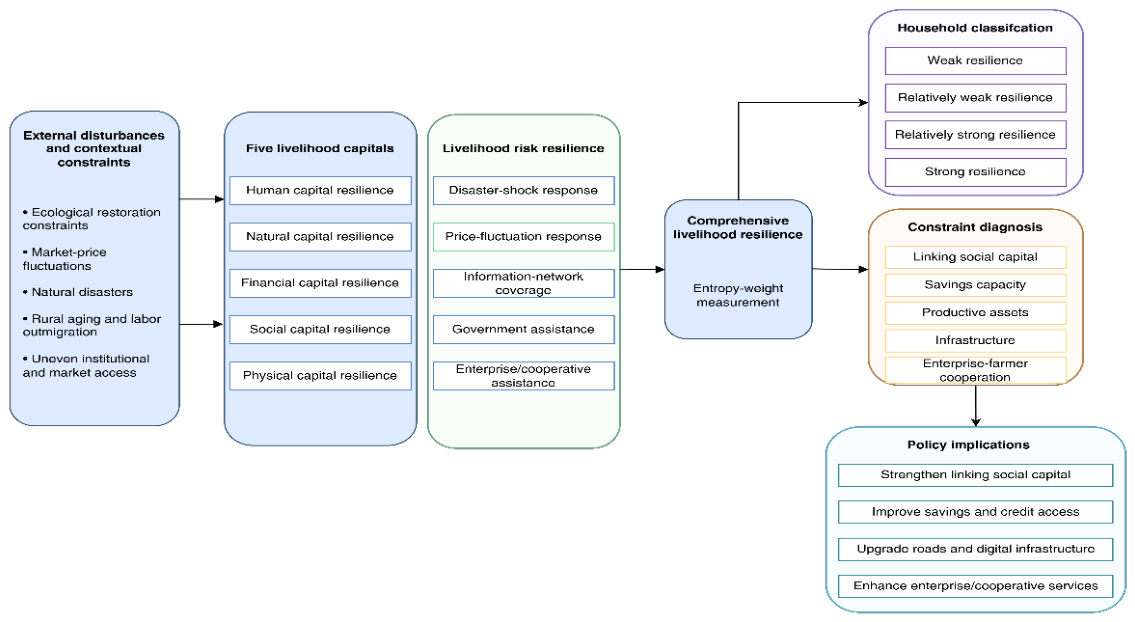
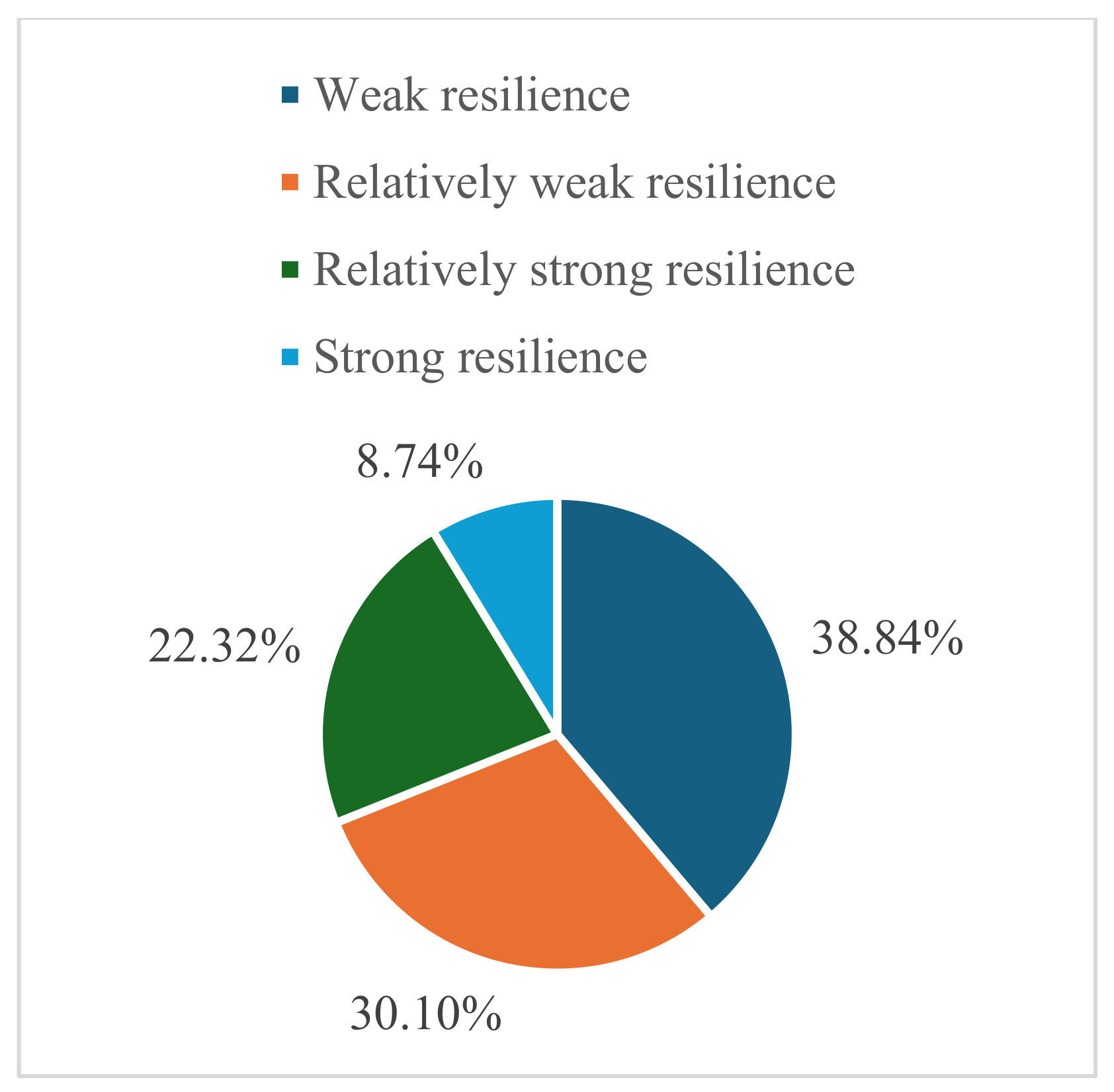
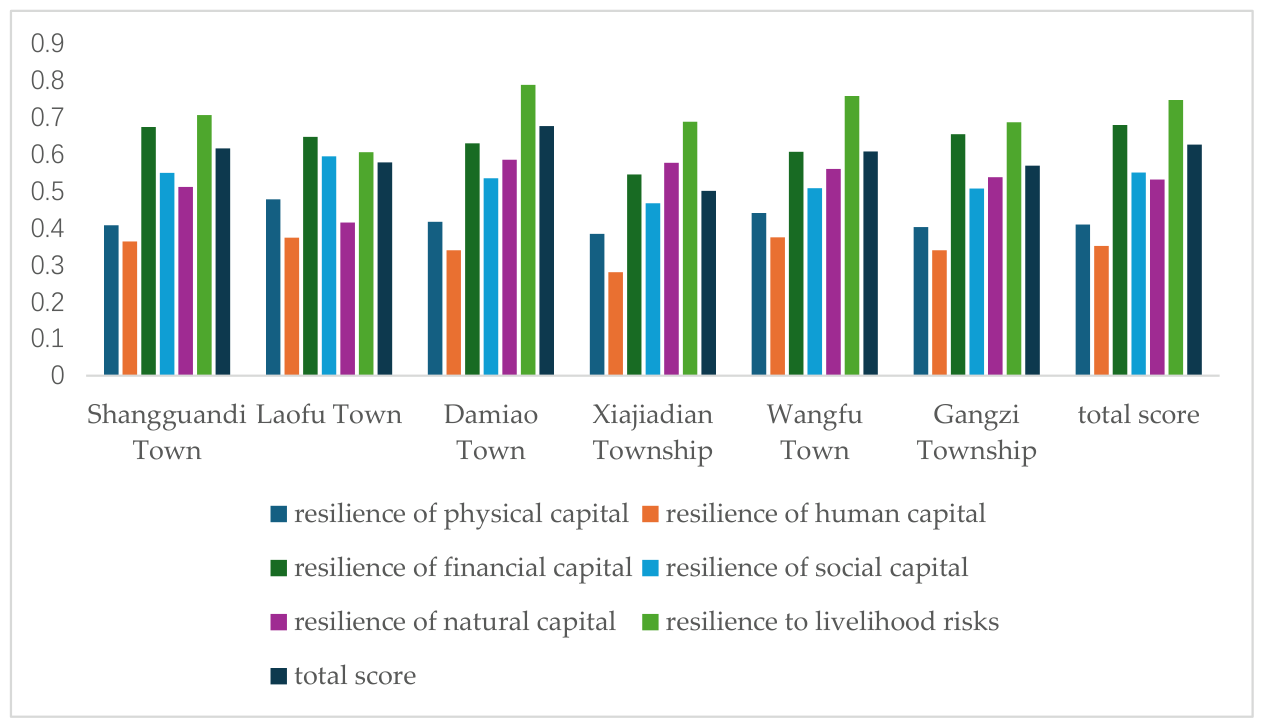
- The overall livelihood resilience score is 0.6267, indicating a relatively strong but uneven resilience level. Livelihood risk resilience and financial capital resilience are the strongest dimensions, while physical capital and human capital remain weak. This finding suggests that external support and financial access have improved, but infrastructure, labor, education, and health constraints continue to limit resilience.
- (2)
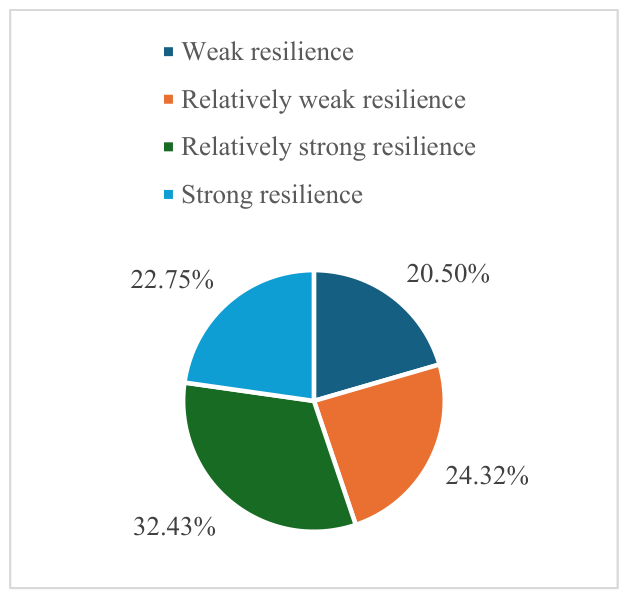
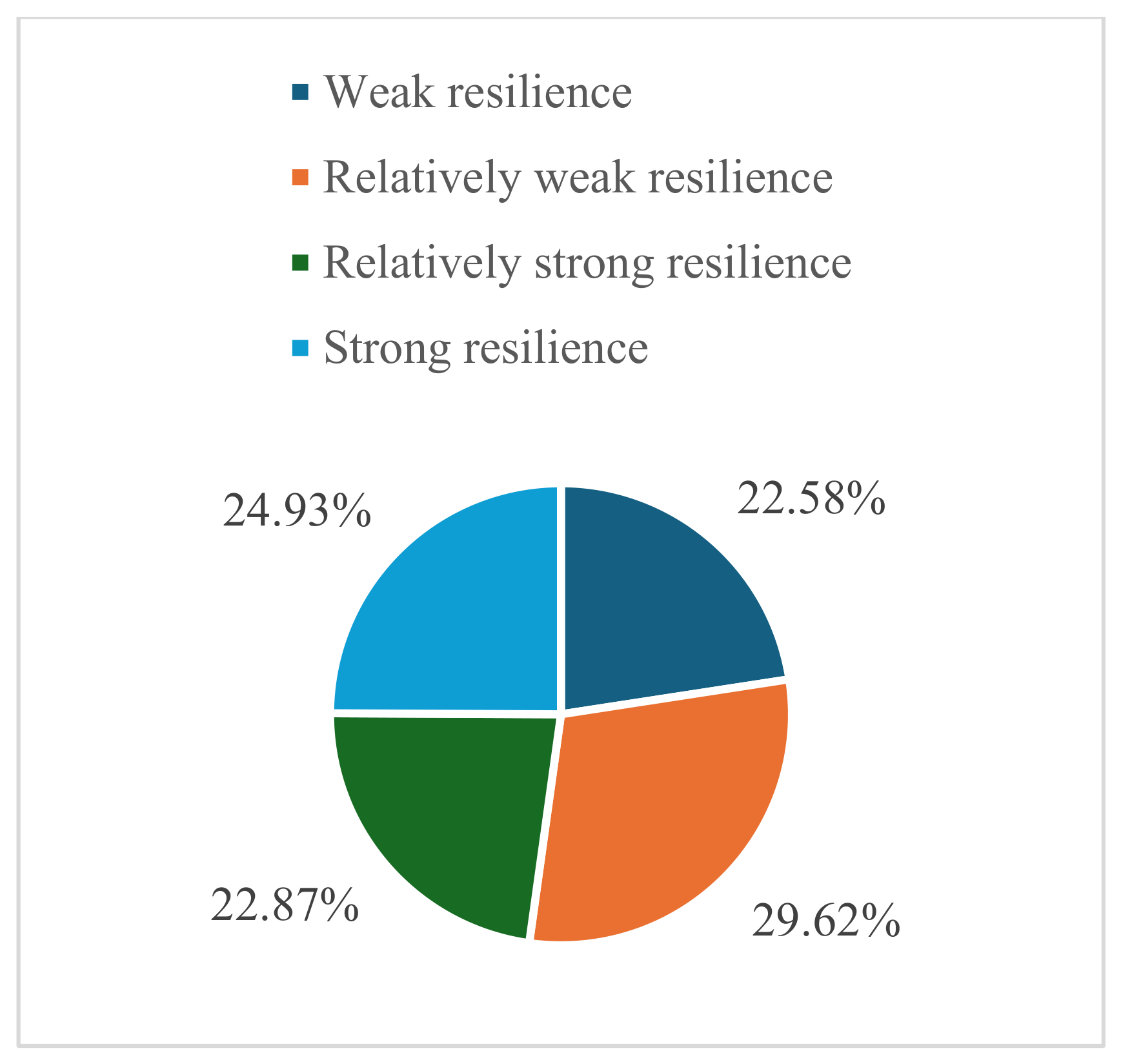
- Resilience differs by household type. General households score above the sample average and are more concentrated in the relatively strong and strong categories. Monitored households score below the average and face overlapping disadvantages in human capital, savings, physical assets, and social access.
- (3)
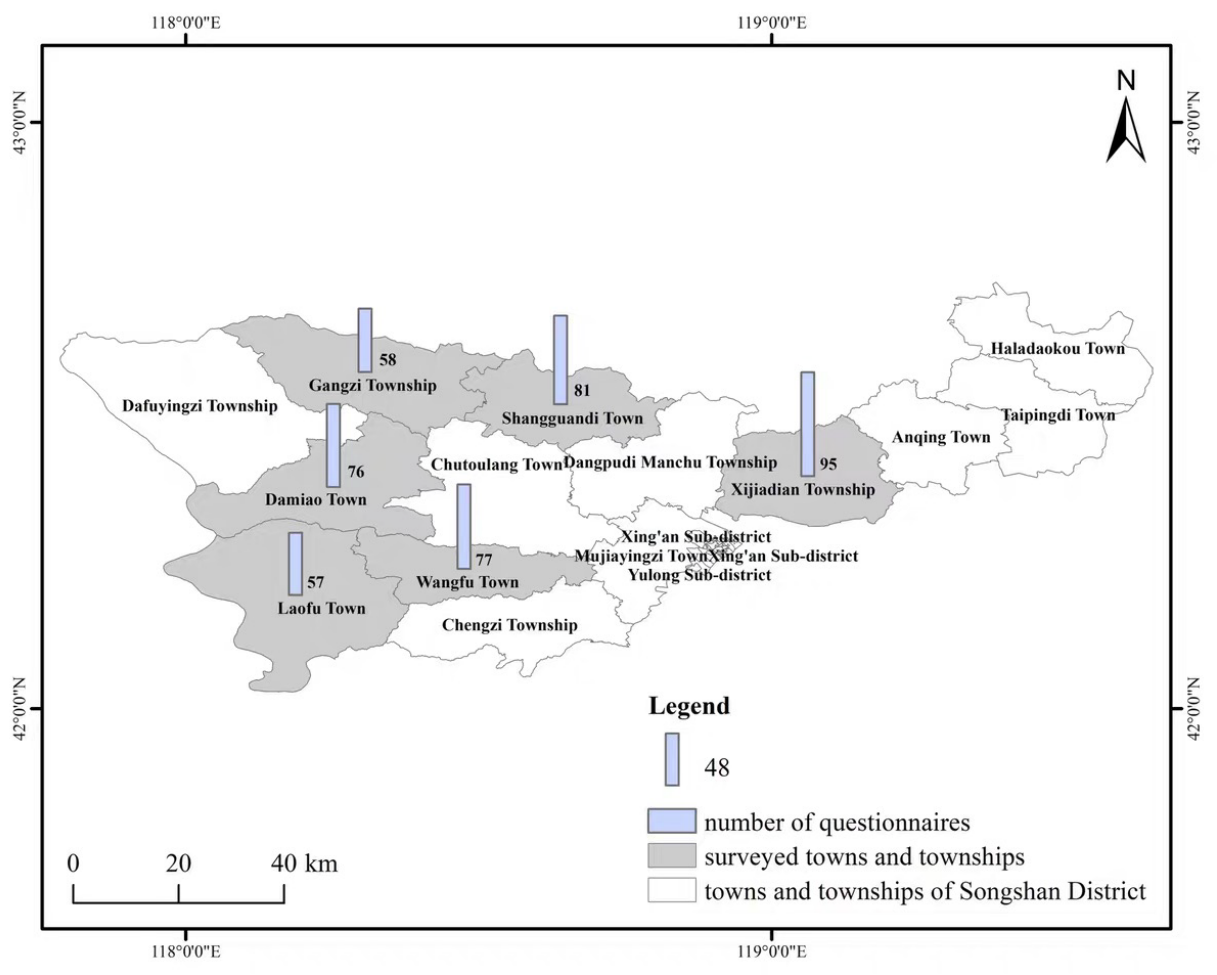
- Descriptive spatial variation exists across surveyed townships. Damiao has the highest resilience score, followed by Shangguandi, Wangfu, Laofu, and Gangzi, while Xiajiadian records the lowest level. The variation reflects differences in industrial development, infrastructure, financial access, and the maturity of modern agricultural initiatives.
- (4)
- The leading diagnostic constraints are relationships with village cadres (B11, 29.66%), household savings (B8, 16.25%), total value of livestock and poultry (B2, 14.70%), village road conditions (B1, 13.23%), relationships with relatives and friends (B10, 10.99%), and the income effect of corporate or cooperative assistance (B21, 6.88%). These results indicate that resilience improvement should focus on linking social capital, liquidity, productive assets, infrastructure, and higher-quality enterprise-farmer cooperation.
Author Contributions
Funding
Institutional Review Board Statement
Informed Consent Statement
Data Availability Statement
Conflicts of Interest
References
- Barrett, C.B.; Fanzo, J.; Herrero, M.; Mason-D’cRoz, D.; Mathys, A.; Thornton, P.K.; Wood, S.; Benton, T.G.; Fan, S.; Lawson-Lartego, L.; et al. COVID-19 pandemic lessons for agri-food systems innovation. Environ. Res. Lett. 2021, 16, 101001. [Google Scholar] [CrossRef] [Scilit]
- Quandt, A. Measuring livelihood resilience: The household livelihood resilience approach (HLRA). World Dev. 2018, 107, 253–263. [Google Scholar] [CrossRef] [Scilit]
- Béné, C.; Headey, D.; Haddad, L.; von Grebmer, K. Is resilience a useful concept in the context of food security and nutrition programmes? Some conceptual and practical considerations. Food Secur. 2016, 8, 123–138. [Google Scholar] [CrossRef] [Scilit]
- Zhang, C.; Fang, Y. Application of capital-based approach in the measurement of livelihood sustainability: A case study from the Koshi River basin community in Nepal. Ecol. Indic. 2020, 116, 106474. [Google Scholar] [CrossRef] [Scilit]
- Liu, W.; Li, J.; Ren, L.; Xu, J.; Li, C.; Li, S. Exploring livelihood resilience and its impact on livelihood strategy in rural China. Soc. Indic. Res. 2020, 150, 977–998. [Google Scholar] [CrossRef] [Scilit]
- Xu, J.; Lu, W.; Wang, W. From “fragile smallholders” to “resilient smallholders”: Measuring rural household resilience in China. Humanit. Soc. Sci. Commun. 2024, 11, 1712. [Google Scholar] [CrossRef] [Scilit]
- Wu, J.; Cao, Q.; Ouyang, W.; Chen, B.; Su, Y.; Xie, W.; Liu, S. Evolutionary patterns and influencing factors of livelihood resilience in tourism-dependent communities affected by an epidemic: An empirical study in the Wulingyuan scenic area, China. Sustainability 2025, 17, 2937. [Google Scholar] [CrossRef] [Scilit]
- Scoones, I. Sustainable Livelihoods and Rural Development; Practical Action Publishing: Rugby, UK, 2015; p. xv. [Google Scholar]
- Department for International Development. Sustainable Livelihoods Guidance Sheets; DFID: London, UK, 1999; Volume 445, p. 710.
- Saha, M.K.; Biswas, A.A.A. Faisal Livelihood vulnerability of coastal communities in context of the climate change: A index-based assessment. World Dev. Sustain. 2024, 4, 100152. [Google Scholar] [CrossRef] [Scilit]
- Ye, W.; Wang, Y.; Yang, X.; Wu, K. Understanding sustainable livelihoods with a framework linking livelihood vulnerability and resilience in the semiarid loess plateau of China. Land 2022, 11, 1500. [Google Scholar] [CrossRef] [Scilit]
- Newton, P.; Miller, D.C.; Byenkya, M.A.A.; Agrawal, A. Who are forest-dependent people? A taxonomy to aid livelihood and land use decision-making in forested regions. Land Use Policy 2016, 57, 388–395. [Google Scholar] [CrossRef] [Scilit]
- Liu, Y.; Li, J.T.; Yang, Y. Strategic adjustment of land use policy under the economic transformation. Land Use Policy 2018, 74, 5–14. [Google Scholar] [CrossRef] [Scilit]
- Chen, K.; Wang, Y.; Li, N.; Xu, Y.; Zheng, Y.; Zhan, X.; Li, Q. The impact of farmland use transition on rural livelihood transformation in China. Habitat Int. 2023, 135, 102784. [Google Scholar] [CrossRef] [Scilit]
- Sun, Y.; Wang, Y.; Huang, C.; Tan, R.; Cai, J. Measuring farmers’ sustainable livelihood resilience in the context of poverty alleviation: A case study from Fugong County, China. Humanit. Soc. Sci. Commun. 2023, 10, 75. [Google Scholar] [CrossRef] [Scilit] [PubMed]
- Zhao, X.; Zhao, R. The impact and mechanism of digital villages on agricultural resilience in ecologically fragile ethnic areas: Evidence from China’s provinces. Agriculture 2024, 14, 221. [Google Scholar] [CrossRef] [Scilit]
- Liu, W.; Dou, B.; Qian, L.; Zhao, X. Role of livelihood resilience in improving sustainable household well-being for disaster resettlement in Ankang Prefecture, Shaanxi Province, China. J. Mt. Sci. 2025, 22, 4190–4205. [Google Scholar] [CrossRef] [Scilit]
- Speranza, C.I.; Wiesmann, U.; Rist, S. An indicator framework for assessing livelihood resilience in the context of social–ecological dynamics. Glob. Environ. Change 2014, 28, 109–119. [Google Scholar] [CrossRef] [Scilit]
- Njurumana, G.N.; Ngongo, Y.; Octavia, D.; Suharti, S.; Rakatama, A.; Prameswari, D.; Maharani, R.; Wibowo, L.R.; Tampubolon, A.P.; Suratman; et al. Livelihood resilience of forest-dependent farmers amidst the COVID-19 pandemic in Sikka, Indonesia. Sustain. Futures 2025, 9, 10053. [Google Scholar] [CrossRef] [Scilit]
- Ke, L.; Ying, B.; Xiang, C.; Li, R.; Chen, X. Livelihood Resilience Among Zanthoxylum Bungeanum Farmers in Response to Technological Disruptions: Field Insights from Karst Rocky Desertification Mountainous Areas, China. Environ. Sustain. Indic. 2025, 28, 100901. [Google Scholar] [CrossRef] [Scilit]
- Barrett, C.B.; Constas, M.A. Toward a theory of resilience for international development applications. Proc. Natl. Acad. Sci. USA 2014, 111, 14625–14630. [Google Scholar] [CrossRef] [Scilit] [PubMed]
- Berkes, F.; Ross, H. Community resilience: Toward an integrated approach. Soc. Nat. Resour. 2013, 26, 5–20. [Google Scholar] [CrossRef] [Scilit]
- Li, E.; Deng, Q.; Zhou, Y. Livelihood resilience and the generative mechanism of rural households out of poverty: An empirical analysis from Lankao County, Henan Province, China. J. Rural Stud. 2022, 93, 210–222. [Google Scholar] [CrossRef] [Scilit]
- Tang, L.; Xu, Y.; Wang, W.; Wang, Y. Impact of livelihood capital and rural site conditions on livelihood resilience of farm households: Evidence from contiguous poverty–stricken areas in China. Environ. Sci. Pollut. Res. 2023, 30, 123808–123826. [Google Scholar] [CrossRef] [Scilit] [PubMed]
- Wang, Y.; Yan, J.; Wu, Y. Impact of policy measures on smallholders’ livelihood resilience: Evidence from Hehuang Valley, Tibetan Plateau. Ecol. Indic. 2024, 158, 111351. [Google Scholar] [CrossRef] [Scilit]
- Song, C.; Du, H. Spatial and temporal variations in the ecological vulnerability of northern China. J. Sens. 2022, 2022, 7232830. [Google Scholar] [CrossRef] [Scilit]
- Hu, C.; Dong, J. Measuring livelihood resilience of farmers and diagnosing obstacle factors under the impact of COVID-19 in Jiangsu Province, China. Front. Sustain. Food Syst. 2023, 7, 1250564. [Google Scholar] [CrossRef] [Scilit]
- Cheng, K.; Young, D.S. An approach for specifying trimming and winsorization cutoffs. J. Agric. Biol. Environ. Stat. 2023, 28, 299–323. [Google Scholar] [CrossRef] [Scilit]
- Şahin, M. A comprehensive analysis of weighting and multicriteria methods in the context of sustainable energy. Int. J. Environ. Sci. Technol. 2021, 18, 1591–1616. [Google Scholar] [CrossRef] [Scilit]
- Everitt, B.S.; Landau, S.; Leese, M.; Stahl, D. Hierarchical clustering. Clust. Anal. 2011, 5, 71–110. [Google Scholar]
- Javadi, S.; Hashemy, S.; Mohammadi, K.; Howard, K.; Neshat, A. Classification of aquifer vulnerability using K-means cluster analysis. J. Hydrol. 2017, 549, 27–37. [Google Scholar] [CrossRef] [Scilit]
- Campbell, D. Environmental change and the livelihood resilience of coffee farmers in Jamaica: A case study of the Cedar Valley farming region. J. Rural Stud. 2021, 81, 220–234. [Google Scholar] [CrossRef] [Scilit]



| Statistical Indicators | Category | Frequency | Percentage |
|---|---|---|---|
| Gender | Male | 347 | 78.15% |
| Female | 97 | 21.85% | |
| Age | Under 40 years old | 22 | 4.95% |
| 40 to 50 years old (inclusive) | 91 | 20.50% | |
| 50 to 70 years old (inclusive) | 270 | 60.81% | |
| Over 70 years old | 61 | 13.74% | |
| Education level | No formal education | 2 | 0.45% |
| Primary school | 108 | 24.32% | |
| Junior high school | 253 | 56.98% | |
| Senior high school or vocational school | 63 | 14.19% | |
| College degree or above | 18 | 4.06% | |
| Household labor force | 2 persons or fewer | 257 | 57.88% |
| 3 persons | 107 | 24.10% | |
| 4 persons | 57 | 12.84% | |
| 5 persons | 13 | 2.93% | |
| 6 persons or more | 10 | 2.25% | |
| Household type | General households | 341 | 76.80% |
| Monitored households | 103 | 23.20% |
| Category | Indicator Description | Measurement/Assignment |
|---|---|---|
| Physical capital resilience (A1) | Village road conditions (B1) | 1 (Very poor); 2 (Poor); 3 (Average); 4 (Good); 5 (Very good) |
| Total value of livestock and poultry (B2) | Discounted cash value of household livestock and poultry (RMB) | |
| Ownership of agricultural machinery and vehicles (B3) | 1 (One type); 2 (Two types); 3 (Three types); 4 (Four types); 5 (Five or more types) | |
| Human capital resilience (A2) | Education level (B4) | 1 (Uneducated); 2 (Primary school); 3 (Junior high school); 4 (Senior high school or vocational school); 5 (College degree or above) |
| Number of household laborers (B5) | Number of healthy laborers aged 16 to 65 (Persons) | |
| Health status of family members (B6) | 1 (Long-term illness or disability); 2 (Frequent illness); 3 (Occasional illness); 4 (Rarely ill); 5 (Very healthy) | |
| Financial capital resilience (A3) | Per capita annual household income (B7) | (Household income minus expenses) divided by family size (RMB) |
| Household savings amount (B8) | Annual household income minus annual household expenses (RMB) | |
| Ease of obtaining a loan when needed (B9) | 1 (Very difficult); 2 (Difficult); 3 (Average); 4 (Easy); 5 (Very easy) | |
| Social capital resilience (A4) | Relationship with relatives and friends (B10) | 1 (Very poor); 2 (Poor); 3 (Average); 4 (Good); 5 (Very good) |
| Relationship with village cadres (B11) | 1 (Very poor); 2 (Poor); 3 (Average); 4 (Good); 5 (Very good) | |
| Frequency of participating in community activities (B12) | Specific number of times participated | |
| Natural capital resilience (A5) | Existing household cropland area (B13) | Per capita cropland area (Mu) |
| Quality of existing household cropland (B14) | 1 (Very poor); 2 (Poor); 3 (Average); 4 (Good); 5 (Very good) | |
| Existing household forest land area (B15) | Per capita forest land area (Mu) | |
| Quality of existing household forest land (B16) | 1 (Very poor); 2 (Poor); 3 (Average); 4 (Good); 5 (Very good) | |
| Livelihood risk resilience (A6) | Impact of agricultural product price fluctuations on income (B17) | Reverse-coded: 1 (Very large impact); 2 (Large); 3 (Average); 4 (Small); 5 (Very small impact) |
| Impact of natural disasters on income (B18) | Reverse-coded: 1 (Very large impact); 2 (Large); 3 (Average); 4 (Small); 5 (Very small impact) | |
| Regional information network coverage (B19) | 1 (Very small); 2 (Small); 3 (Average); 4 (Large); 5 (Very large) | |
| Income effect of government policy assistance (B20) | 1 (Very small); 2 (Small); 3 (Average); 4 (Large); 5 (Very large) | |
| Income effect of corporate or cooperative assistance (B21) | 1 (Very small); 2 (Small); 3 (Average); 4 (Large); 5 (Very large) |
| Primary Indicator (A) | Weight | Rank | Secondary Indicator (B) | Weight | Rank |
|---|---|---|---|---|---|
| Physical capital resilience (A1) | 0.1165 | 5 | Village road conditions (B1) | 0.0502 | 12 |
| Total value of livestock and poultry (B2) | 0.0562 | 10 | |||
| Ownership of agricultural machinery and vehicles (B3) | 0.0101 | 21 | |||
| Human capital resilience (A2) | 0.0385 | 6 | Education level (B4) | 0.0116 | 20 |
| Number of household laborers (B5) | 0.0128 | 19 | |||
| Health status of family members (B6) | 0.0141 | 18 | |||
| Financial capital resilience (A3) | 0.2187 | 2 | Per capita annual household income (B7) | 0.0794 | 2 |
| Household savings amount (B8) | 0.0723 | 4 | |||
| Ease of obtaining a loan (B9) | 0.0670 | 6 | |||
| Social capital resilience (A4) | 0.2080 | 3 | Relationship with relatives and friends (B10) | 0.0708 | 5 |
| Relationship with village cadres (B11) | 0.0762 | 3 | |||
| Frequency of participating in community activities (B12) | 0.0610 | 8 | |||
| Natural capital resilience (A5) | 0.1960 | 4 | Existing household cropland area (B13) | 0.0203 | 17 |
| Quality of existing household cropland (B14) | 0.0545 | 11 | |||
| Existing household forest land area (B15) | 0.0627 | 7 | |||
| Quality of existing household forest land (B16) | 0.0585 | 9 | |||
| Livelihood risk resilience (A6) | 0.2223 | 1 | Resilience to agricultural product price fluctuations (B17) | 0.1213 | 1 |
| Resilience to natural-disaster income shocks (B18) | 0.0263 | 14 | |||
| Regional information network coverage (B19) | 0.0261 | 15 | |||
| Income effect of government policy assistance (B20) | 0.0211 | 16 | |||
| Income effect of corporate or cooperative assistance (B21) | 0.0275 | 13 |
| Primary Indicator (A) | Score | Rank | Secondary Indicator (B) | Score | Rank |
|---|---|---|---|---|---|
| Physical capital resilience (A1) | 0.4099 | 5 | Village road conditions (B1) | 0.3272 | 17 |
| Total value of livestock and poultry (B2) | 0.4616 | 15 | |||
| Ownership of agricultural machinery and vehicles (B3) | 0.2569 | 19 | |||
| Human capital resilience (A2) | 0.3521 | 6 | Education level (B4) | 0.2501 | 20 |
| Number of household laborers (B5) | 0.1345 | 21 | |||
| Health status of family members (B6) | 0.2775 | 18 | |||
| Financial capital resilience (A3) | 0.6797 | 2 | Per capita annual household income (B7) | 0.6630 | 3 |
| Household savings amount (B8) | 0.5578 | 10 | |||
| Ease of obtaining a loan (B9) | 0.6641 | 2 | |||
| Social capital resilience (A4) | 0.5510 | 3 | Relationship with relatives and friends (B10) | 0.5608 | 8 |
| Relationship with village cadres (B11) | 0.4617 | 14 | |||
| Frequency of participating in community activities (B12) | 0.5603 | 9 | |||
| Natural capital resilience (A5) | 0.5319 | 4 | Existing household cropland area (B13) | 0.5684 | 6 |
| Quality of existing household cropland (B14) | 0.4678 | 13 | |||
| Existing household forest land area (B15) | 0.5675 | 7 | |||
| Quality of existing household forest land (B16) | 0.5764 | 5 | |||
| Livelihood risk resilience (A6) | 0.7476 | 1 | Resilience to agricultural product price fluctuations (B17) | 0.7740 | 1 |
| Resilience to natural-disaster income shocks (B18) | 0.4740 | 12 | |||
| Regional information network coverage (B19) | 0.4774 | 11 | |||
| Income effect of government policy assistance (B20) | 0.5811 | 4 | |||
| Income effect of corporate or cooperative assistance (B21) | 0.4405 | 16 | |||
| Comprehensive livelihood resilience score | 0.6267 | ||||
| Survey Object | Category | Obstacle Degree | |||||
|---|---|---|---|---|---|---|---|
| Rank 1 | Rank 2 | Rank 3 | Rank 4 | Rank 5 | Rank 6 | ||
| Total sample | Constraint indicator | B11 | B8 | B2 | B1 | B10 | B21 |
| Obstacle degree | 29.66% | 16.25% | 14.70% | 13.23% | 10.99% | 6.88% | |
| General households | Constraint indicator | B11 | B2 | B8 | B1 | B21 | B10 |
| Obstacle degree | 31.23% | 19.87% | 12.40% | 11.42% | 7.44% | 3.56% | |
| Monitored households | Constraint indicator | B11 | B8 | B1 | B21 | B2 | B10 |
| Obstacle degree | 30.04% | 28.00% | 21.50% | 10.58% | 6.22% | 4.68% | |
Disclaimer/Publisher’s Note: The statements, opinions and data contained in all publications are solely those of the individual author(s) and contributor(s) and not of MDPI and/or the editor(s). MDPI and/or the editor(s) disclaim responsibility for any injury to people or property resulting from any ideas, methods, instructions or products referred to in the content. |
© 2026 by the authors. Licensee MDPI, Basel, Switzerland. This article is an open access article distributed under the terms and conditions of the Creative Commons Attribution (CC BY) license.
Share and Cite
Zhang, H.; Bao, Q. Measuring Livelihood Resilience in Ecologically Fragile Regions: An Entropy-Obstacle Diagnosis of Forest Farmers in Northern China. Sustainability 2026, 18, 4826. https://doi.org/10.3390/su18104826
Zhang H, Bao Q. Measuring Livelihood Resilience in Ecologically Fragile Regions: An Entropy-Obstacle Diagnosis of Forest Farmers in Northern China. Sustainability. 2026; 18(10):4826. https://doi.org/10.3390/su18104826
Chicago/Turabian StyleZhang, Hao, and Qingfeng Bao. 2026. "Measuring Livelihood Resilience in Ecologically Fragile Regions: An Entropy-Obstacle Diagnosis of Forest Farmers in Northern China" Sustainability 18, no. 10: 4826. https://doi.org/10.3390/su18104826
APA StyleZhang, H., & Bao, Q. (2026). Measuring Livelihood Resilience in Ecologically Fragile Regions: An Entropy-Obstacle Diagnosis of Forest Farmers in Northern China. Sustainability, 18(10), 4826. https://doi.org/10.3390/su18104826